Knife collecting is an extremely rewarding experience for knife enthusiasts. There truly is a knife for everyone. Many increase or hold their value throughout the years, making collecting knives something to pass on to the next generation of knife collectors.
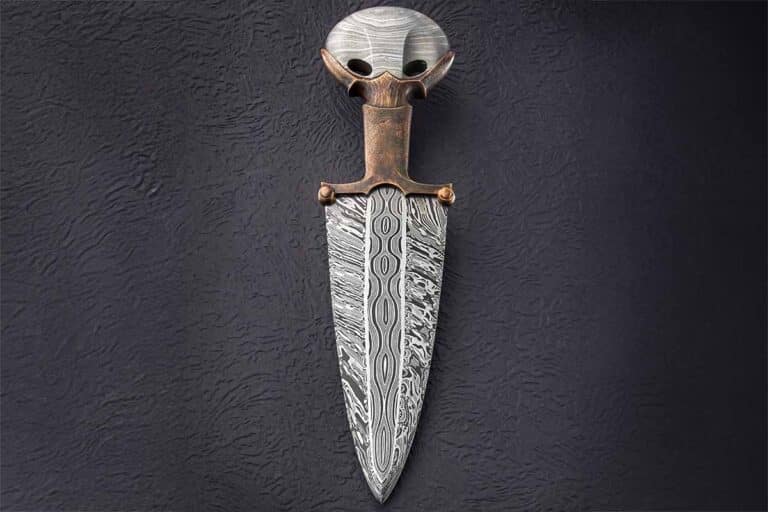
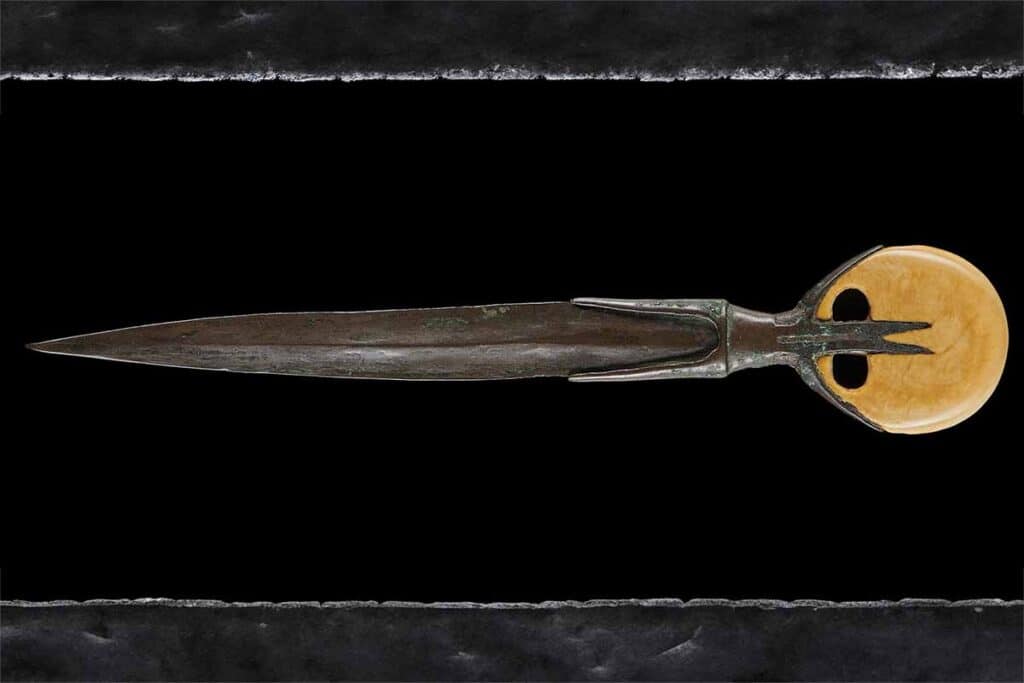
While it may appear to be an alien looking back at you, the Relic Dagger by ABS journeyman smith Ryan Breuer is inspired by Egyptian daggers from the Bronze Age that were made over 6,000 years ago.
The pommel on the originals are believed to have been made of hippo ivory.
“There’s such a striking shape to it,” Ryan said. “It very clearly looks like a human form in the handle holding up either a head or maybe the sun. It’s as if those who made the daggers thousands of years ago are looking back at me. It’s almost spooky.”
The damascus blade is a collaboration between Ryan and bladesmith Jason Morrissey, though Ryan gives Jason most of the credit for the steel. The blade is a composite mosaic damascus, with twisted mosaic edge bars of Jason’s steel and Ryan’s “eyes” mosaic in the core.
Ryan Breuer
Ryan ground, heat treated and finished the blade. The hilt is cast bronze made with the lost-wax process. The pommel is pattern-welded wrought iron and pure nickel, manipulated to imitate layers of organic ivory. Ryan drilled the two holes for the “eyes.”
Barret Chrisman puts a modern spin on a vintage Remington design.
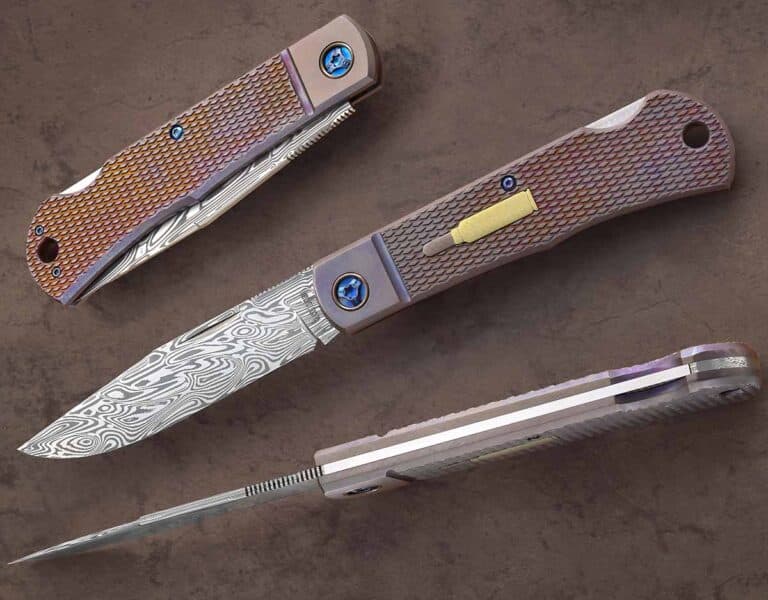
Barret Chrisman’s contemporary take on the classic Remington 1306 Bullet lockback combines tradition and hi-tech in one handsome custom pocketknife.
Barret outfitted his repro with all cutting-edge materials, including a blade of Loki pattern damascus by Damasteel, a handle of checkered titanium that resembles jigging and a titanium bullet shield. “I’ve seen people jig titanium before but I wanted to try checkering, so I made up a custom pantograph template and tried it out,” he said. He anodized the handle a purplish bronze.
Barret Chrisman
“It’s a modern take on an old school knife everybody likes,” Barret noted, “and I’ll probably be doing the same kind of thing in the future.”
Remington 1306 Bullet Modern Reproduction Specs Maker: Barret Chrisman Blade length: 4” Blade material: Loki pattern damascus by Damasteel Blade grind: Full flat Handle frame: Titanium Handle scales: Checkered titanium w/inlaid titanium bullet shield Lock: Lockback Closed length: 47/8” Maker’s price for a similar knife: $1,500
Know the visual tells of whether a hamon is done properly or not.
For centuries, the hamon has served as a mark of excellence in the forging of blades.
Conspicuous by its picturesque line generally dissecting the midsection of a differentially heat-treated blade, it demonstrates a skill set highly valued among top bladesmiths and swordsmiths. Moreover, the difference between a good hamon and one that doesn’t hit the mark can help the maker, owner and user in understanding the prospective performance of the blade itself.
Basically, think of a hamon as the equator between the hard and softer or more malleable areas of the blade. Everything above the hamon is softer, which translates as making the back of the blade malleable and thus tougher. In other words, the blade will bend but not break. Meanwhile, everything below the hamon is harder, which is better for holding an edge.
Emiliano Carrillo indicated a hamon should be continuous, with no areas falling off the edge of the blade. Francesco Piccinin and Denis Mura provide such a hamon on their bowie collaboration. Blade material is C130 carbon steel, according to Eurotechni (eurotechni.com) a grade that makes it possible to obtain “pretty hamons.” Overall length: 13 inches. (Jocelyn Frasier image)
“There are several things that make the edge pattern successful,” explained bladesmith Emiliano Carrillo of Sun and Stars Forge. “The first two are practical.
The hamon should be continuous; there should be no areas of it that fall off the edge of the blade. It should be high enough that the knife can support a lifetime of sharpening and removal of edge material without biting into soft material. For kitchen knives this can be somewhat low to the edge, as the geometry will have to be adjusted if a large amount of edge material is removed.
“The rest are my own opinion and are purely subjective. I’m a bladesmith who works in the historical tradition and therefore my work draws on traditional Japanese metalwork when it comes to hamon aesthetic and technique.
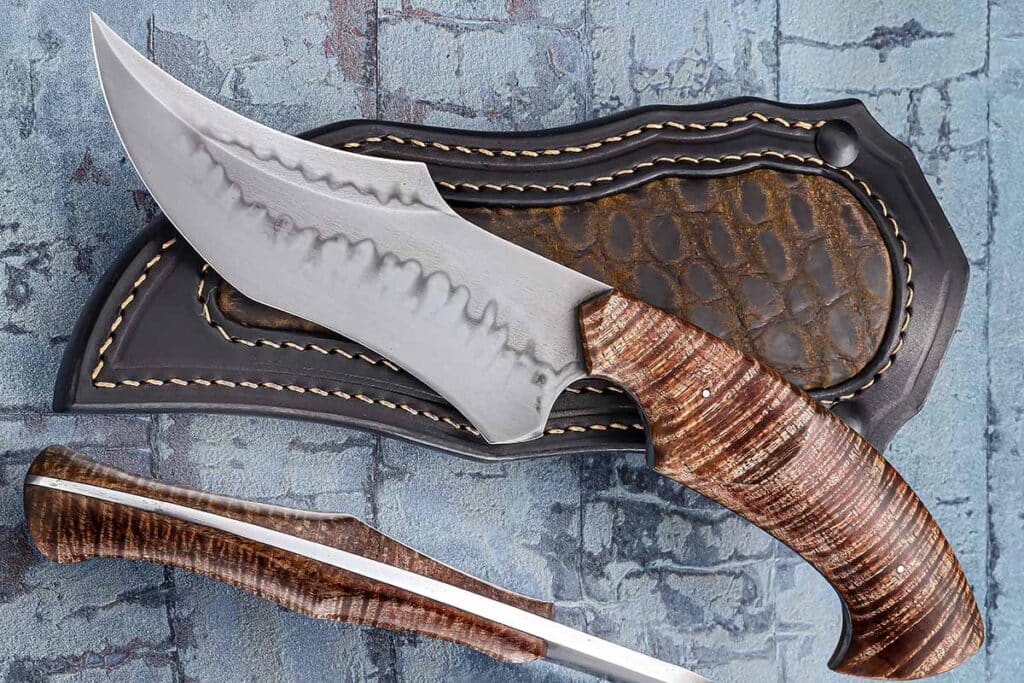
“I think a good hamon should be active and rippling, showcasing your imagination and artistic vision,” Emiliano continued. “It should have good undulations and look like it’s been drawn on the blade with an ink brush. There should be ashi [legs], which are areas of hardening within the hamon that drip down towards the edge. Sometimes a repeating motif, like sanbonsugi [three cedars] or choji [clove] can be utilized to guide the way you want to design the hamon.”
ABS master smith Mike Quesenberry agrees that there are hallmarks to a good hamon that are readily discernable.
“First and foremost, a good hamon will not come down to the cutting edge,” he remarked. “That is a no-no because it is bringing down soft steel where you want hard steel. I want a bigger transition area, and you can credit the Japanese for starting it. As the technology evolved over hundreds of years, they found bits and pieces coming down from the hamon, giving strength to the edge.”
ABS master smith Brion Tomberlin adds that the proper hamon is visible to the eye even when the maker is finishing the grinding process at 120 grit.
“The Japanese have many terms for effects you see and want to see in a nice hamon,” he commented. “And you can spend years studying these. For our purposes, you want it to be very visible and make a very visible demarcation from the hardened area to the softer area. Additional effects such as ashi, which are wispy cloud-like formations hanging down from the main line, are nice and show control.”
Steel Selection
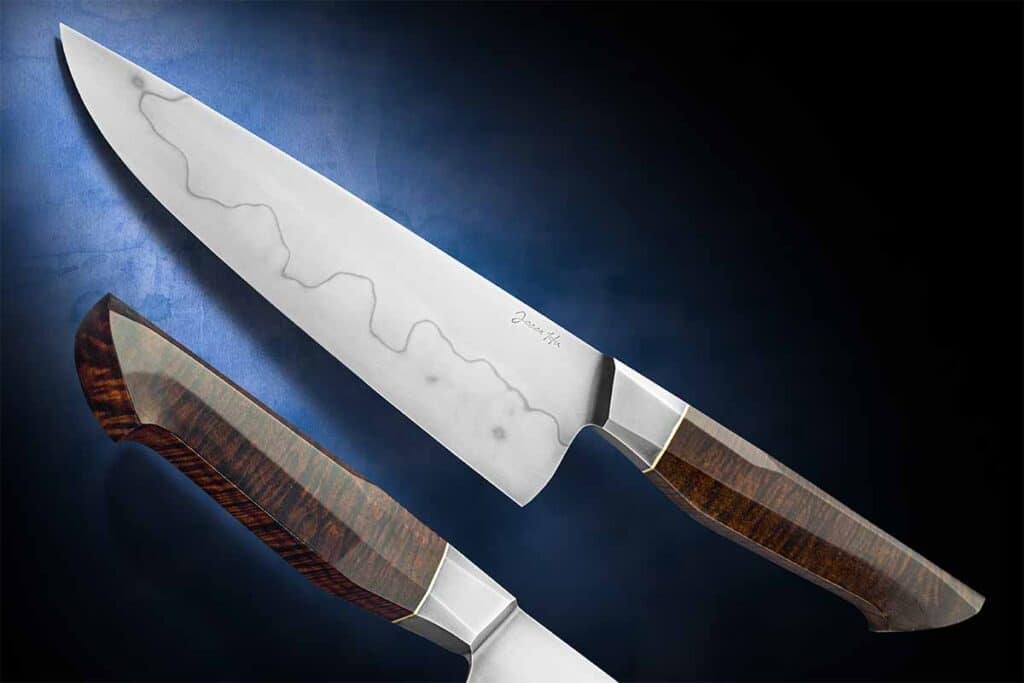
Brion Tomberlin stated that low-alloy carbon steels such as W2, W1, 1095 and 1075 yield the greatest success in producing good hamons. ABS apprentice smith Jesse Hu forged the 8.5-inch blade of his classic integral chef’s knife from W1. Overall length: 14 inches. (Jocelyn Frasier image)
Success or frustration in the hamon process begins with the proper steel, and BLADE Magazine Cutlery Hall-of-Fame® member/ABS master smith Steve Schwarzer emphasizes that point.
“Steel selection is critical,” he observed. “You want a simple carbon steel with .70 to 1 percent carbon, and guys are doing ‘gee whiz’ work using a formula with W2 steel, which is a very simple steel. The time-temperature-transformation curve is important, and alloy widens the curve. Too much alloy in the steel won’t transform fast enough to achieve the hamon pattern you want.”
Tomberlin added that low-alloy carbon steels yield the greatest success, and these include W2, W1, 1095 and 1075.
“The maker should look at the certifications for the steel to see the composition,” he recommended. “You want a steel low in manganese, as manganese promotes deep hardening instead of shallow hardening, which we want. We want the transformation of austenite to martensite to be fast upon quenching in order to achieve a hamon, and shallow hardening steels are what is needed. Can you achieve hamons with other steels? Yes, in some cases where the manganese is lower, but they usually do not have the activity or effects you would like to see. My go-to steel is W2.”
Creating A Hamon
Ashi, which Brion Tomberlin describes as “wispy cloud-like formations hanging down from the main line [of the hamon], are nice and show control.” Eliott Robinson provides ashi in ample supply on the 5-inch blade of his fighter. Blade material: U10A carbon steel. (SharpByCoop image)
After the heat treating and hardening process develops the desired hamon, bringing out the robust visual aesthetic is a process in itself that, according to Carrillo, varies from bladesmith to bladesmith.
“All makers have different ways of polishing out their hamon, and these methods evolve over time or to suit a particular project or aesthetic need,” he observed. “My technique has evolved over time but works for 90 percent of the work I do, and is a good way to practice bringing out all the activity you want to see in the steel.”
For his technique, Carrillo grinds the blade to 220 grit; polishes it to 800 grit using a hard backer for the sandpaper; cleans the blade completely using acetone, dish soap or rottenstone while making sure water does not bead up on it; etches it in ferric chloride; removes oxides completely using fine grit sandpaper; assembles; and then oils.
Quesenberry follows a similar protocol.
“I have a blade in front of me and I’m going to a hammer-in this weekend. I will take it up to 800-grit finish and dip it in ferric chloride,” he said, “and then I’ll wait until it turns black depending on the strength of the ferric. Once it’s black I neutralize it with Windex and then pull with a gray 3M polishing cloth in nice, even and straight lines, removing the black to get the white for the ashi to pop.”
Faux Hamons
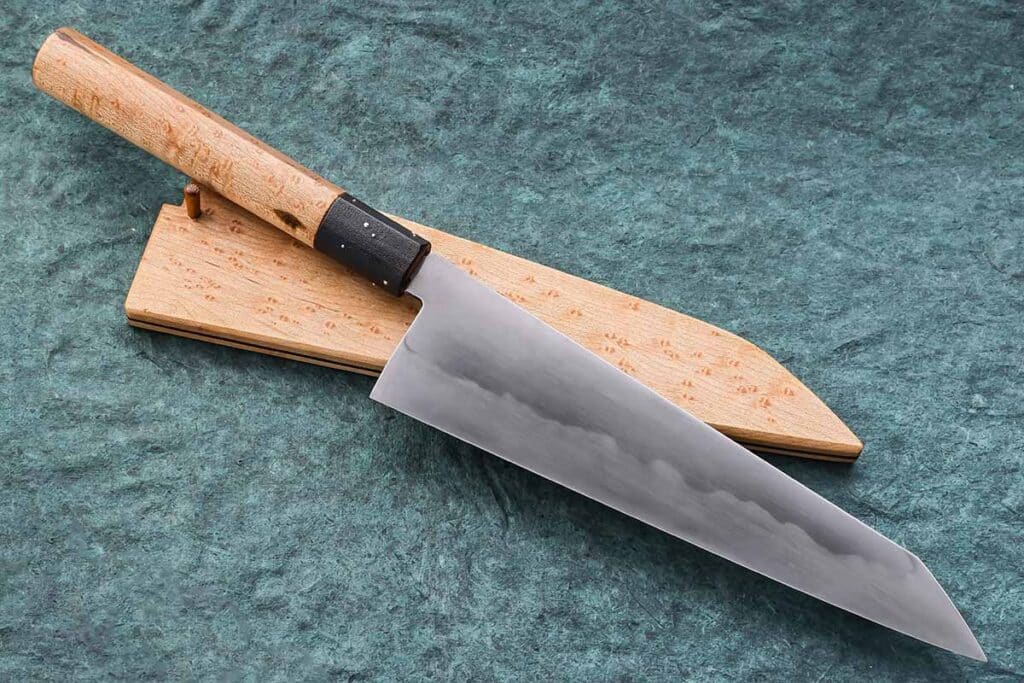
Emiliano Carrillo outfitted the blade of his K-Tip Gyuto with a clayed hamon. The handle is bird’s-eye maple, as is the saya (sheath), which includes a black walnut liner and a bamboo menugi (ornament) to keep the blade in place. (SharpByCoop image)
To dispel one common question, bladesmiths confirm that all knives do not have hamons. As Carrillo says, “There may be areas of decarb on the blade that may be mistaken for a hamon, but it is only surface level.”
At the same time, some factory-produced blades may have a fake hamon etched onto the blade to make the piece more attractive to the potential buyer.
“If a hamon has been etched on, a perfectly clean line is generally seen,” he added. “It doesn’t have any of the cloudiness or desired fuzziness seen in the line on a real hamon. The fake ones are generally very white and too regular to be a metallurgical effect.”
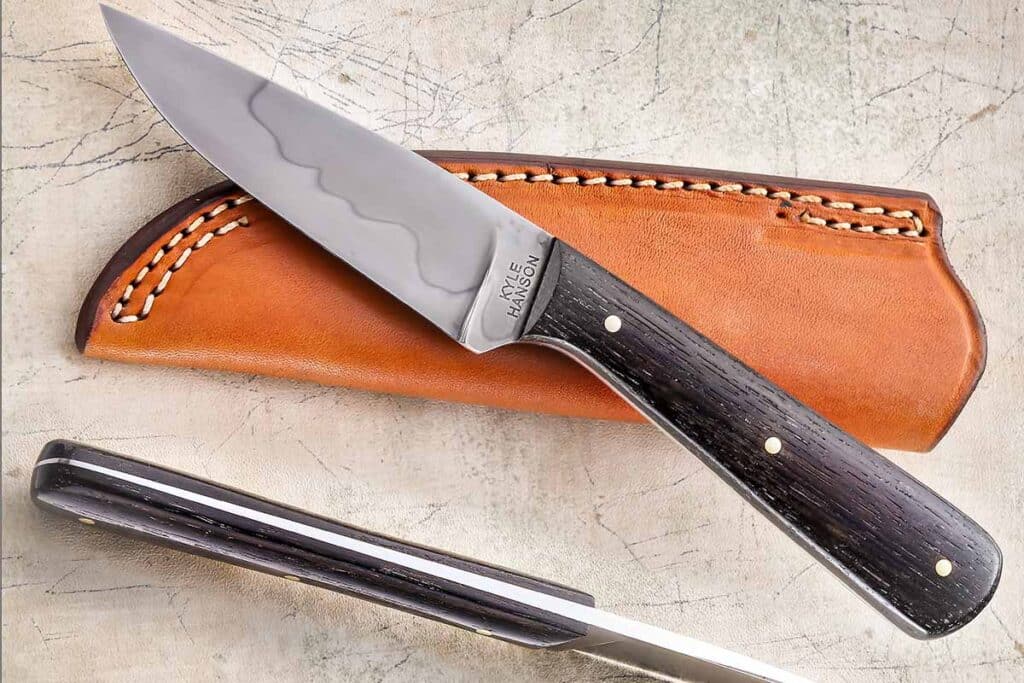
The blades even of smaller knives such as folders and hunters provide a solid canvas for a hamon, as Kyle Hanson demonstrates here on his no-nonsense hunting knife. (SharpByCoop image)
Tomberlin has seen a false hamon from time to time and says the technique to achieve one is quite different from the genuine article.
“This is usually done by selective etching or different polishing techniques,” he advised. “It is hard to explain how to tell, but if you see one versus a true hamon it stands out immediately, usually as too regular with no effects at all. Also, there is usually a very sharp demarcation line from highly polished to etched, and this is especially prevalent in some pieces from overseas.”
What Makes A Good And Bad Hamon
Separating the good hamon from the bad hamon may require practice. In some cases the differences are obvious but in others, they are more subtle. The professionals have seen it all.
“The biggest issues of a poorly done hamon are things like fading away in some areas or, yes, going off the edge of the blade,” Tomberlin related. “If the hamon fades off the edge that means your edge is not hard in that area, which is not good. The main causes of this are clay coating being too thick and improper heating of the blade when bringing it up to quench temperature. The main issue I have seen is the hamon going off the edge. As long as you have the edge hard you have a hamon.
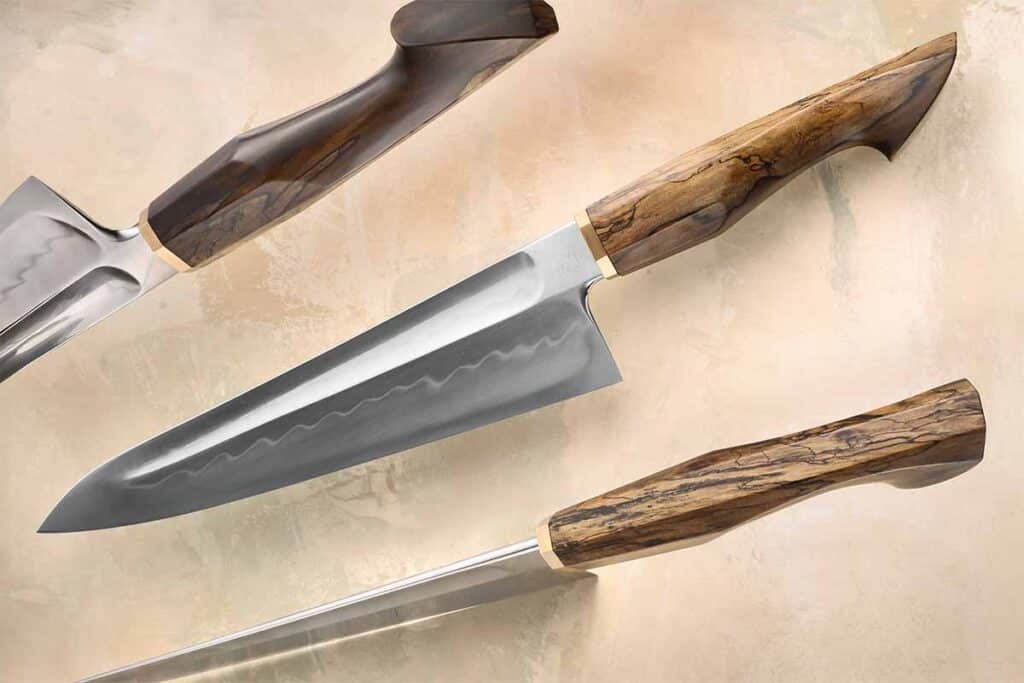
According to Emiliano Carrillo, a hamon should be high enough that the knife can support a lifetime of sharpening and removal of edge material without biting into the soft material above it. Will Newham achieved such a hamon on his Best Chef’s Knife winner from the 2023 Sydney Knife Show. (SharpByCoop image)
“Poorly done polishing will show up also. A well done hamon takes time both before and after quenching. Trying to cut corners on polishing will definitely show. As for a lack of activity in the hamon, such as being straight instead of having hills and valleys, someone told me a number of years ago that one of the hardest things to do well is a simple straight hamon called a suguha.”
Schwarzer sees crispness in the boundaries of a good hamon and acknowledges that heat treating and polishing techniques are critical in bringing that out.
“In the early ABS [American Bladesmith Society] we used an edge quench to get a hamon, and that is the mainstay of the ABS today,” he said. “In testing now you rarely see a hamon because you don’t see as much polishing as necessary to get you through the test. You can’t bring it out with a buffer. It’s almost like a metallurgical polish so you can see the grain in the steel.”
The well done hamon represents an art form in itself, and Quesenberry is impressed with the current wave of artistic impression.
ABS apprentice smith Aidan Garrity outfits the hamon of the 10.5-inch blade of his V-44 repro with hints of ashi. Blade material: W2 tool steel. Handle: carbon fiber. Overall length: 15.5 inches. (SharpByCoop image)
“People have ‘Americanized’ it I guess you could say, and I can do a decent hamon. But some guys out there have absolutely nailed it,” he smiled. “They can paint pictures with theirs using the clay and the heat treating process. You have to be careful not to over-refine the steel grain structure, especially in W2 shallow hardening steel, or you won’t get good results. There is a dance to it.”
The perfection of the hamon process, start to finish, steel and clay, temperature to quench and harden, has fascinated the bladesmith and the admirer of the finished product for centuries. Looking down the road, the possibilities are infinite.
Yet being aware of the good versus the inferior product adds even further to real appreciation of the process.
Kevin Casey feathers his cap with an outstanding array of custom throwback blades.
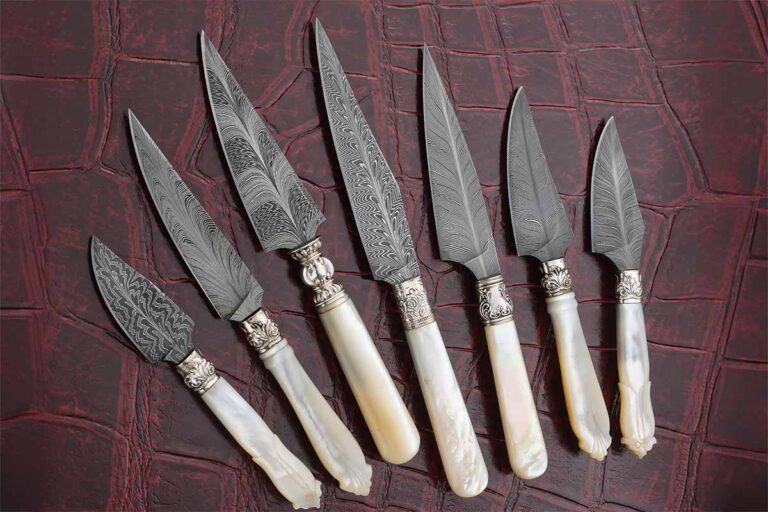
Kevin Casey may have hit on a great idea for knives with both a custom touch and an antique look and feel.
Taking some old yet inexpensive late 19th/early 20th-century dinner knives with mother-of-pearl handles and silver ferrules, he replaced the original blades with those forged of assorted patterns of his feather damascus. The result, the Little Feathers, went fast at the Solvang Show, with two selling individually and five going to one shrewd buyer.
Kevin Casey
Kevin said similar versions of the original antique knives are available on eBay, Etsy, at jewelry stores, flea markets and the like. He cleaned the insides of the ferrules with acetone before epoxying his damascus blades into them. He cleaned the ferrules with Flitz and a toothbrush, polished the handles and the knives basically were ready to go. He plans to do more like them in the future.
Little Feathers Specs Maker: Kevin Casey Model type: Dinner knives Blade lengths: 2.5 to 4.25” Blade material: Assorted patterns of feather damascus in 1080 carbon and 15N20 nickel-alloy steels w/a thin layer of pure nickel; depending on the pattern, the layer count ranges anywhere from 50 to 500 Handle material: Mother-of-pearl Ferrules: Silver Overall lengths: 6.5 to 8” Maker’s list price range for similar knives: $600 to $900 each
Josh Blount reproduces Chingachgook’s gunstock war club.
ABS apprentice smith Josh Blount recently rewatched the 1992 version of The Last of the Mohicans, and the gunstock war club of the character of Chingachgook in the film inspired him to make his own stunning version.
Josh patterned his reproduction after the movie piece* but with his own spin, including a low-layer-twist damascus blade and curly maple stock decorated with silver wire inlay in assorted mountain images: a daytime scene with hawks circling the sun, a nighthawk nighttime scene amid moon and stars, etc. “My background is wildlife biology, so I live birds and chasing wildlife,” he noted. “So, I put a little bit of that in there.”
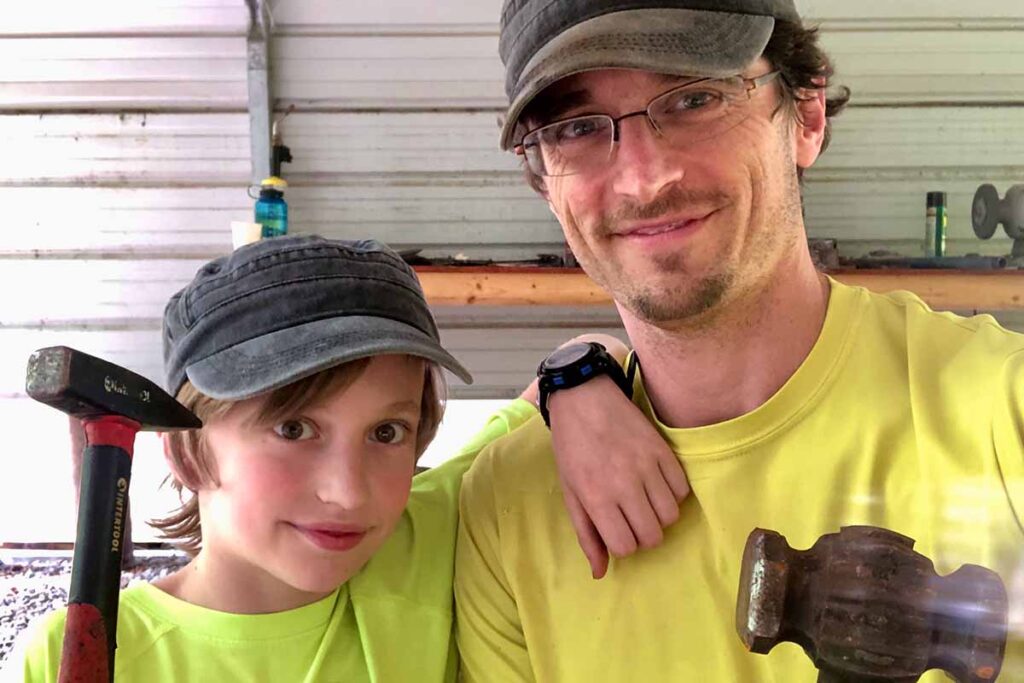
Josh and son Elliott appear here (inset) after beginning to forge a Scottish dirk for Elliott’s 10th birthday.
Josh’s mentors include the late Ron Claiborne and Larry Harley, and, of course, ABS master smith Daniel Winkler, who made some of the knives and tomahawks for Mohicans (February 1993 BLADE®). In fact, Josh visited the Winkler shop just over 20 years ago. Josh was bladesmithing then too, but life happened and he went to college. Now he’s back to hammering hot steel in Franklin, West Virginia, and hopes to test for ABS journeyman smith in the near future.
Gunstock War Club Specs Maker: Josh Blount Blade length: 6.5” Blade material: 80CrV2 carbon and 15N20 nickel-alloy steels Handle/stock: Curly maple from Dunlap Woodcraft, w/pewter pins and deerskin wrap from Crazy Crow Trading Post Overall length: 40” Maker’s price for a similar piece: $800
*The gunstock war club in The Last of the Mohicans was made by the movie’s prop department.
With BLADE Show 2024 just around the corner, many new knives are hitting the custom and factory markets. We scoured the former end—hitting all points of the compass along the way—to bring you some of the latest and greatest handmade gems. If you’re heading to Atlanta, be on the lookout for these and other great custom creations.
Camille Sennegon Fighter
Blade length: 8” Blade material: 80CrV2 carbon steel Blade grind: Flat, w/a small convex grind on the edge Blade finish: 800-grit satin Blade pattern: Harpoon w/recurve edge Handle: Ironwood Bolster: 304 stainless steel Overall length: 13” Maker’s price for a similar knife: $800 at press time rate of exchange Maker’s remark: “I made this knife based on a design drawn and given to me by my friend, ABS master smith Samuel Lurquin.” (Jocelyn Frasier image)
Francesco Piccinin Northern Style Utility
Blade length: 4” Blade steel: 14C28N stainless Blade grind: Flat Handle: White G-10 w/black G-10 frame and spacers w/hole for a lanyard Bolster: Ash burl Overall length: 9” Sheath: Leather w/belt loop and leather tiedown w/bead Maker’s price for a similar knife and sheath: $600 at press time rate of exchange (Jocelyn Frasier image)
Steven Ramos Pisces
Knife pattern: Hunting/utility Blade length: 7” Blade steel: CPM 154 stainless Blade grind: Hollow Blade finish: Bead blast Handle: Micarta® w/G-10 liners Overall length: 10.625” Sheath: Kydex over aluminum frame; made by Steven Ramos Maker’s price for a similar knife and sheath: $825 (Jocelyn Frasier image)
David Lisch Singing Crusader
Knife type: Fixed blade Blade length: 5.25” Blade material: Damascus of 1080 carbon and 15N20 nickel alloy steels Blade grind: Convex Construction: Damascus integral Handle: Forged pipe handle holds ball bearings that make the knife “sing” when shaken Knife to know: The bear head pommel is hand forged; the maker is an ABS master smith Overall length: 10.5” Maker’s price for a similar knife: $1,500, though this one being a one-of-a-kind, the pipe handle and carved pommel would be somewhat different, as would the damascus pattern davidlisch.com (Jocelyn Frasier image)
Jason Fry Border Bowie
Blade length: 8” Blade material: Explosion/twist/border-wall damascus D-guard/bolster: 1880s wrought iron artifacts Handle material: Mesquite Frame: 1848 and 2023 half dollars Overall length: 13” Knife to know: Border-wall stand included Maker’s price for a similar knife: $4,200 frycustomknives.com (SharpByCoop image)
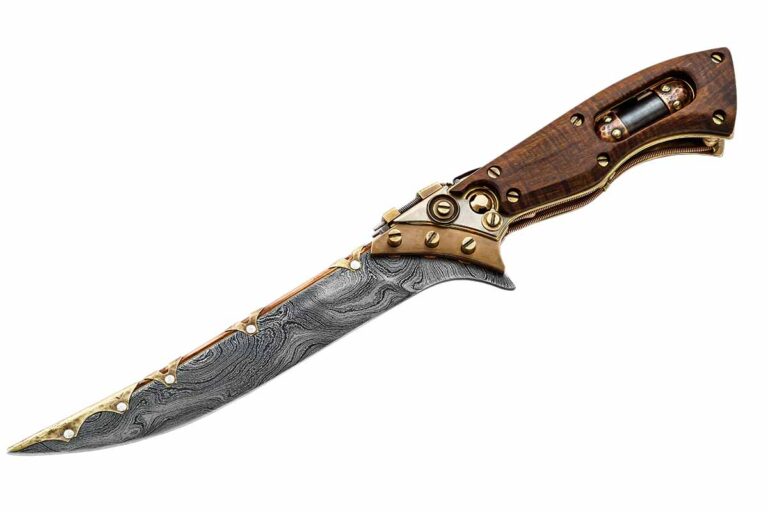
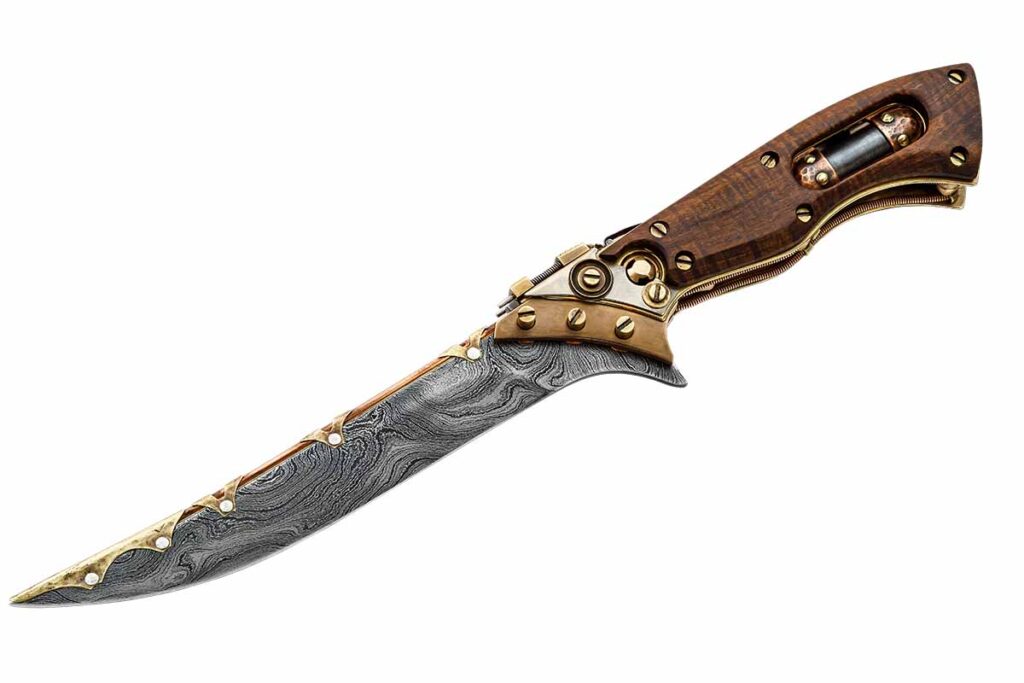
Blade length: 5.9” Blade material: Damascus of 1075 carbon and 15N20 nickel-alloy steels Blade grind: Flat Handle: Tasmanian blackwood Frame: Brass, copper, steel, clock parts, nickel silver Guard: Bronze Knife to know: The knife includes parts from clocks, a piano, cordless drill, gas valves, cigarette lighter and a gas bottle; the maker is a member of the Australian Knifemakers Guild and is an ABS apprentice smith Overall length: 12.2” Maker’s price for a similar knife: $4,700 at press time rate of exchange (Rod Hoare image)
Gabriel Turner Fixed Blade
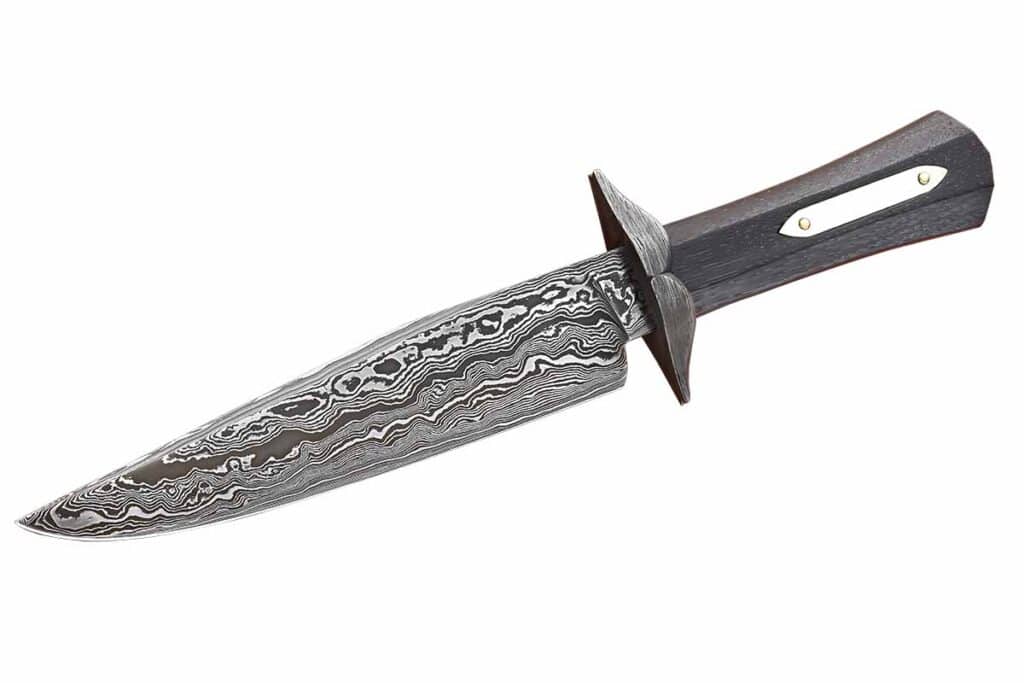
Blade length: 6.25” Blade material: Damascus of 1084 carbon and 15N20 nickel-alloy steels Blade grind: Full flat Guard: Cable damascus Handle material: Bog oak Overall length: 11.25” Maker’s price for a similar knife: $1,050 (SharpByCoop image)
Julian Roche Nakiri Chef’s Knife
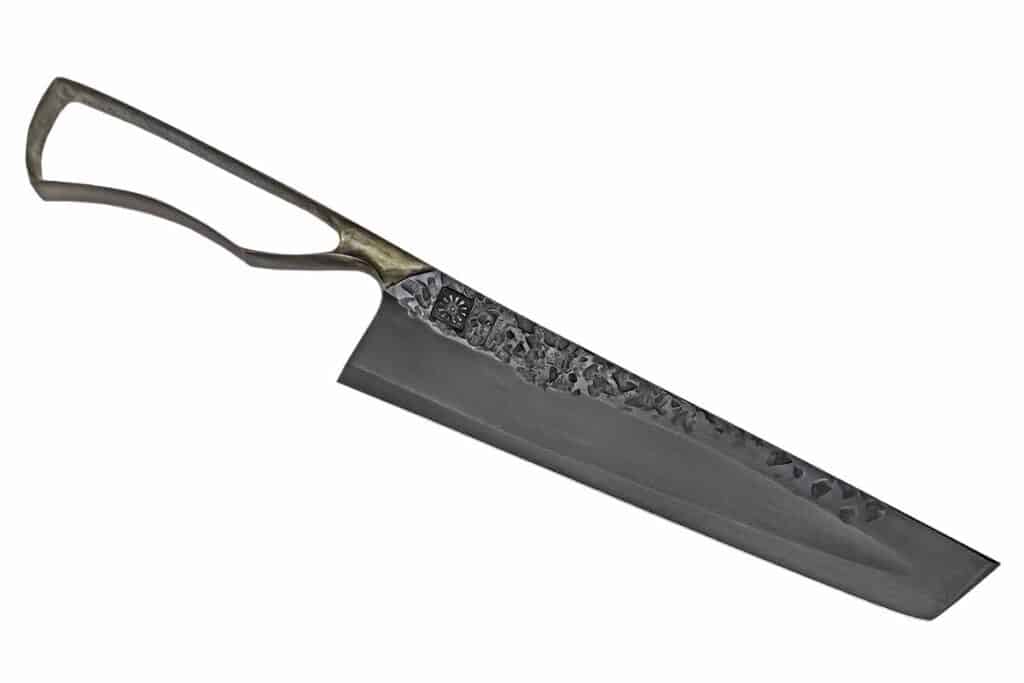
Blade length: 8.27” Blade material: 1084 carbon steel Blade grind: “S” grind Blade thickness @ ricasso: .196” Blade at widest: 1.77” Knife to know: Forged from one piece of 1084; rust-blue finish and brassed Overall length: 12.6” Maker’s price for a similar knife: $450-$475 at press time rate of exchange (Rod Hoare image)
Jeremy Wheaton Leon
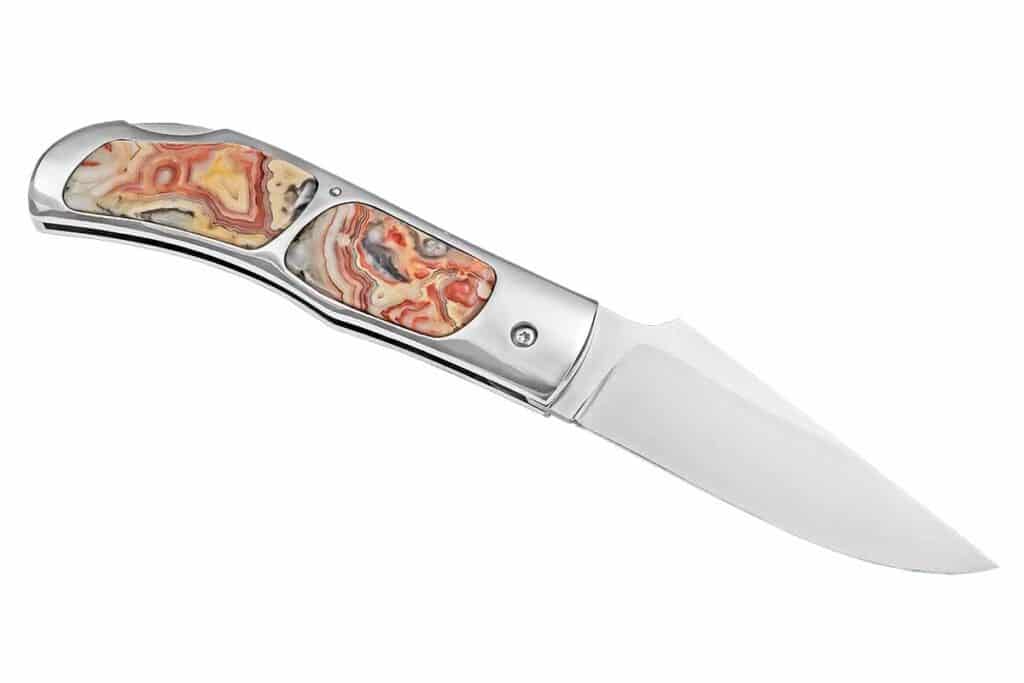
Knife type: Lockback folder Blade length: 3.19” Blade steel: CPM 154 stainless Blade thickness @ ricasso: .12” Blade @widest: 1.2” Blade grind: Flat Handle: Crazy lace agate seed inlays; a local miner sourced the agate Frame: 410 stainless steel Closed length: 5.27” Maker’s price for a similar knife: $445 at press time rate of exchange Maker’s remark: “The photo is a testament to Rod Hoare, who has worked very hard to bring his work up to an international standard. All of us Australian knifemakers are very grateful that we now have an artist of his caliber servicing our industry.” wheatonartsandcrafts.com (Rod Hoare image)
Mike Tyre Beavertail
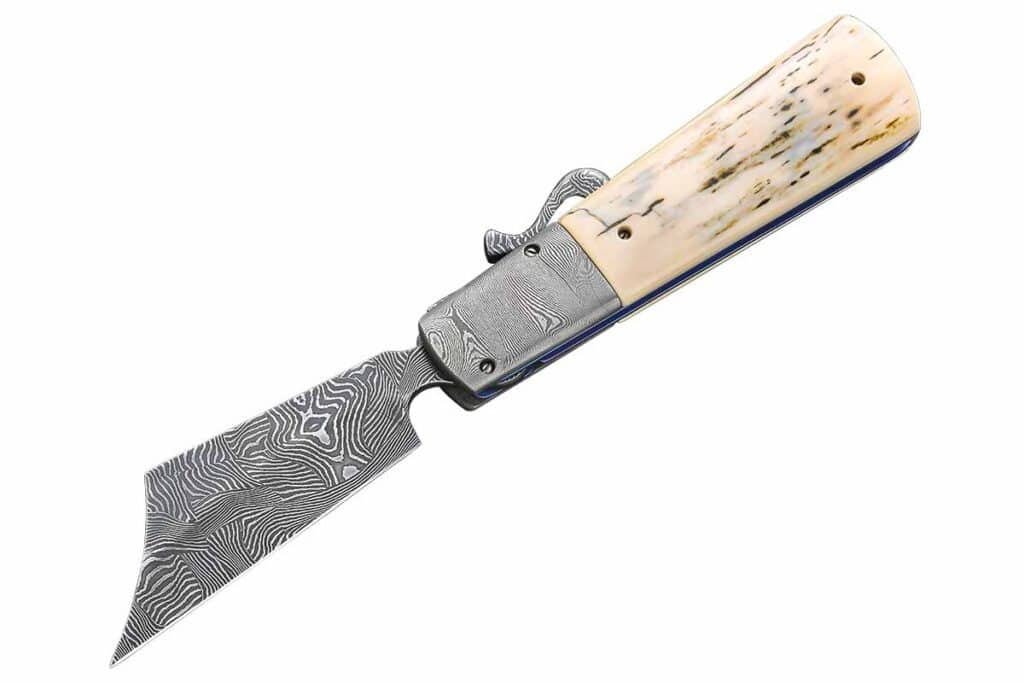
Knife type: Double-action automatic/manual folder Blade length: 3.5” Blade material: Damascus of O1 and L6 tool steels Blade grind: Flat Blade pattern: Wharncliffe Blade opener: Thumb stud Handle: Gold-lip mother-of-pearl Frame: Titanium Lock: Linerlock Closed length: 4.5” Knife to know: Engraving w/gold inlay by Joe Mason; heat-colored filework Maker’s price for a similar knife: $4,200 miketyrecustomknives.com (SharpByCoop image)
Observe all nine and your collecting pursuit can be most satisfying.
I have watched the custom knife market for 40 years with more than idle curiosity. The universal mantra of collectors regarding their collections is I buy what I like. At the outset, it seems a simple statement. The real question is, what does the collector collect and why?
The best thing about a collection is that it is yours. You decide what knives enter and which ones leave. Often, it is a combination of the design/style, material(s) and maker. Then again, it can be knives with a singular attribute that make up the collection. I have also found that the mantra of the collector is invoked when part of his or her collection is difficult to sell or trade.
TIP #1
Collecting and investing are not the same. Assembling a collection is done primarily for the pure joy of it. The search and subsequent acquisition of each knife only fuels your desire to increase/improve your collection.
One of the great things about custom knives is getting what you want. Custom knives can be made to your specifications, not knives that are merely one of a hundred thousand. Investing in custom knives is done for the specific reason to re-sell for a profit. Buy what you like because you may have it for a long time, whether that is your intention or not.
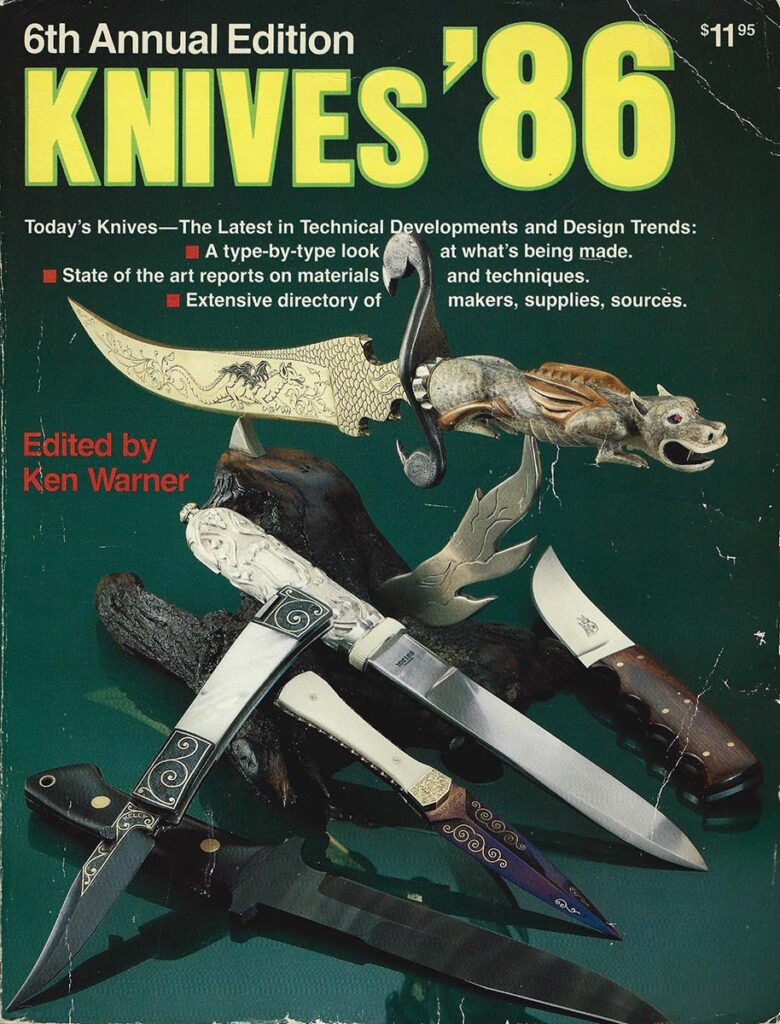
The author kept pages of notes in his copy of KNIVES ’86 that he bought in 1985. It became a blueprint for his knife collecting and then later for his business, including which knives he liked, questions to ask the makers and so on.
TIP #2
Do your research before you buy. I started doing research early on as a collector. I still enjoy looking at the KNIVES ’86 I got in the fall of 1985. In my copy of the book are pages of notes that became a blueprint for my collecting and then later for my business as a purveyor of custom knives, including which knives I liked, questions to ask the makers, etc. I then contacted the makers for their catalogs or just called them to get the information on each. Considering several factors or knife-buying skills listed here allowed me to identify and get the five knives I wanted at the 1986 BLADE Show. Today, the Internet saves a lot of time when researching knives.
TIP #3
Decide the direction of your knife collection (at least for this week). Determining a direction for your collection will be easier if you can master Tips 1 and 2. Doing your research before attending a show or placing the order will save you from a custom knife collector’s worst enemy—buyer’s remorse.
TIP #4
Buy the very best knife you can afford. This is an important concept to understand, as this will help you look past what many of us consider the most important factor: price. Price is not the most important factor, cost is. Price is what you are willing to pay for a custom knife. Cost is the hidden part of the price equation for not knowing if the knife is priced correctly for the maker’s position in the market. Overpaying for a knife will become an issue should you choose to sell or trade the knife.
A critical reason for mastering Tips 1 through 4 is that they will enable you to determine which knife is the best for you for the amount of money in your budget. Sometimes it is more prudent to take the money you would spend on two knives and buy only one. When considering buying a knife, always employ Tip #1 and consider the short- and long-term costs of the purchase.
TIP #5
The truth changes. This applies to many things in life, including the knives in your collection. Enlightenment can be a double-edged sword. You will begin to evaluate your collection as you gain expertise in custom knives. Mistakes that were invisible to you before now catch your eye. This expertise, however, is now helping you select better-made knives.
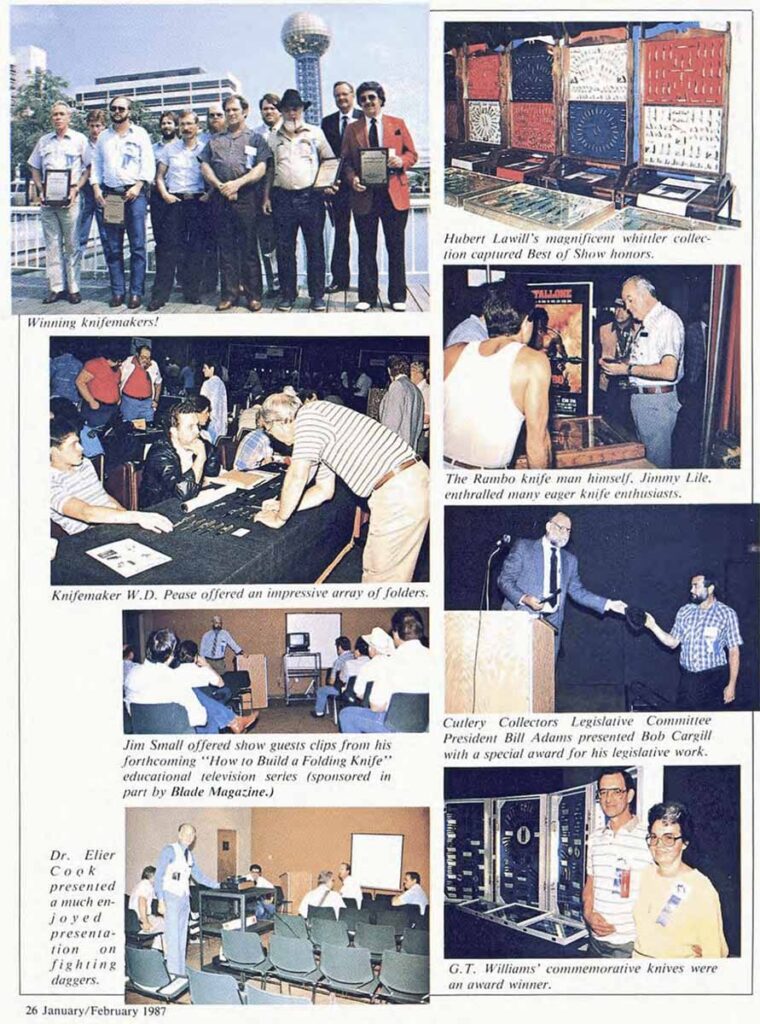
The author got the five knives he wanted at the 1986 BLADE Show. Scenes from the show, clockwise from top left: winning makers in the custom knife judging; Hubert Lawell’s collection of 500 pearl-handle whittlers; Jimmy Lile at his table; Bill Adams and Jim Cargill; Mr. and Mrs. G.T. Williams; Dr. Eiler Cook’s seminar; Jim Small’s seminar; and W.D. Pease at his table. Adams, Lawell and Lile are all members of the BLADE Magazine Cutlery Hall Of Fame®.
Knife publications, without a doubt, will influence the custom knife buyer by putting a knife on the cover or doing a big spread on a knife or knives. A feature or cover can create immediate demand for a maker’s work. You need to understand how this publicity will affect that maker’s short- and long-term pricing.
Because of the ability to disseminate information quickly, the Internet influences trends and fads. Social media creates the buzz with the latest photos of a particular maker’s work or a style of knives. Often the buzz influences buyers to act quicker than usual. This information can create a short-term inflated demand for the maker’s work. At the same time, it can drive up aftermarket prices to stupid levels. Those of you who bought the so-called tactical folders of the last decade know that what I like to call the Hype Cycle can be a double-edged sword. Collectors must pay attention to the buzz as it can have a long-term effect on their collections. My experience has shown me that the buzz is a poor shortcut for actual research.
KNIFE IQ
Try to determine the direction of your collection as early as possible with the understanding that you are not committed to this direction for an extended time. The reasoning behind this determination will help your focus, saving you both time and money. Once you have identified the direction you would like your collection to take, start your research. Raising your knife IQ prevents you from passing on a quality knife due to your failure to recognize the knife’s worth. Conversely, you could purchase a knife that you may trade or sell one day only to find that you overpaid for it.
The FOUR F’s
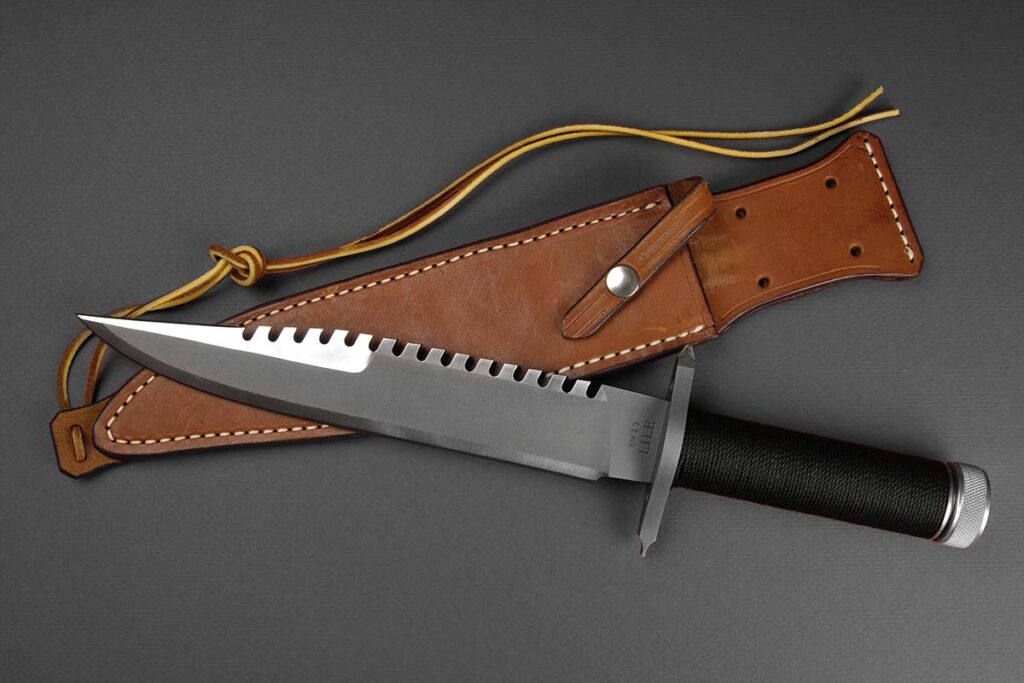
“Tactical movie knives have been and remain very collectible,” the author observed. BLADE Magazine Cutlery Hall-Of-Fame® member Jimmy Lile started the category with the Rambo knife. “This knife is responsible for my becoming a custom knife collector,” the author maintained. The 9-inch blade is bead-blasted 440C stainless steel. The cord-wrapped hollow handle has an aluminum buttcap. Guard: stainless steel. Lile passed away in 1991. (image courtesy of Jack Lucarelli)
Doing your knife research will increase your knife IQ. Increasing your knife IQ will help you get the best value for your money and enable you to confidently add knives to your collection. The building blocks of this research are the Four F’s: Fit, Finish, Flow and Function.
Fit: how does the knife fit together? Are there gaps between the blade and the guard? Are the scales flush with the tang? These are examples of some of the areas to examine.
Finish: I look for consistency and degree of difficulty. No matter what type of finish, is it consistent from the tip to the end of the knife with no spots, scratches or other inconsistencies? The degree of difficulty comes in the form of the type of finish. A mirror finish is much more complex than a tumble or bead blast finish. I give bonus points for two-tone finishes, such as a mirror finish on the hollow of the blade and satin for the flat of the blade.
Flow: Does the knife transition smoothly from one end to the other? Uneven grinds, blocky guards and poor ergonomics detract from the flow of the knife.
Function: Is the knife designed and built to complete the task it is supposed to accomplish? Will the knife do what the design intends it to do? While there is always room for improvement on standard designs, the maker should temper those changes and base them on reality. Often the designs border on or move into the fantasy realm.
Spending time on your favorite social media platform and reading knife magazines like BLADE® can help your knife IQ. However, nothing can replace attending a knife show and putting the knife in your hand, allowing you to apply what you have learned about the Four F’s. You can calibrate your eyes to the sometimes-subtle differences between knives in the same category.
Conclusion
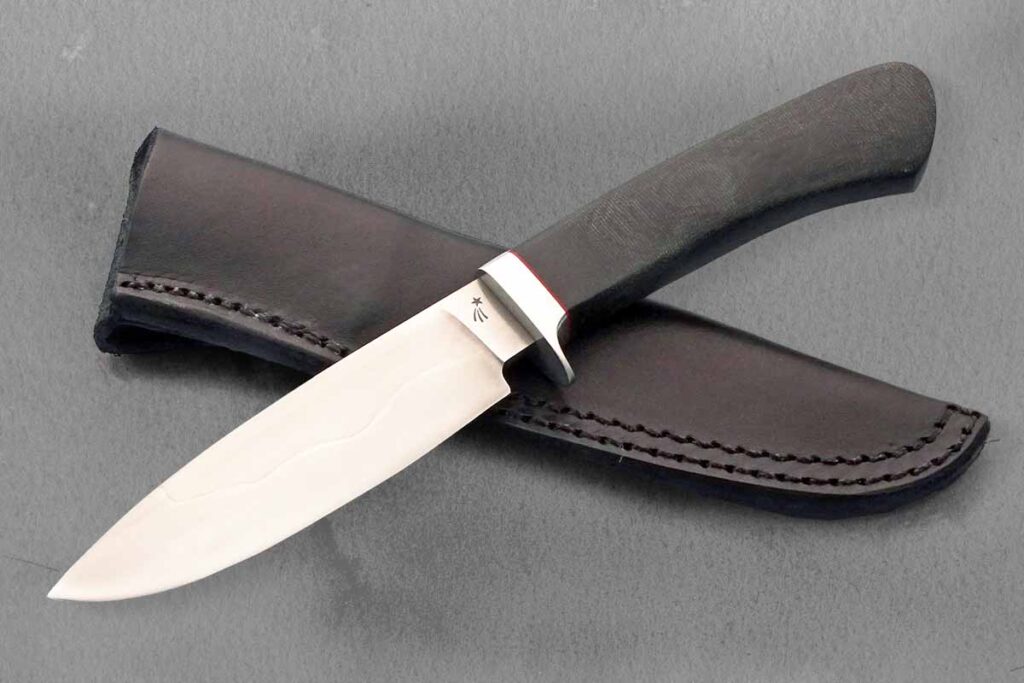
“Some collectors look for entry-level ABS master smith knives,” the author stated. “Utility hunters such as this one by ABS master smith Jim Crowell are a perfect example of that collectible category.” Jim’s forged drop point hunter has a 5-inch blade of W2 tool steel with hamon and a black Micarta® handle. Overall length: 9.75 inches. Jim’s custom leather sheath completes the outfit.
Buy what you like, enjoy what you have and welcome to the hunt for the next piece of your collection.