Knife Collecting

Knife collecting is an extremely rewarding experience for knife enthusiasts. There truly is a knife for everyone. Many increase or hold their value throughout the years, making collecting knives something to pass on to the next generation of knife collectors.

Review: $7.99 Lansky Quick Edge Knife Sharpener

best tools for knife sharpening
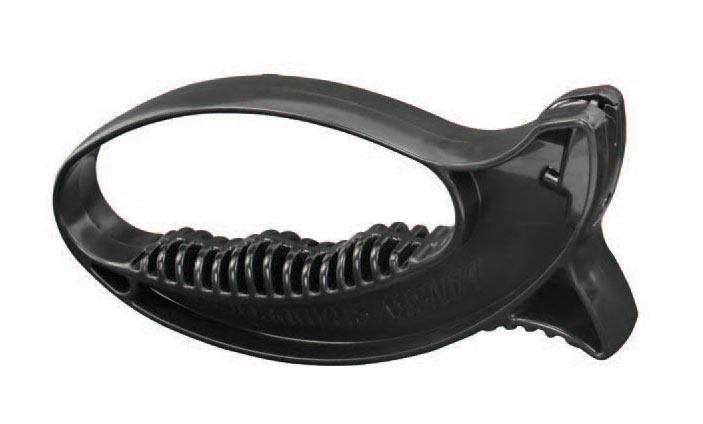
The Lansky Quick Edge is priced at only $7.99. Is it worth the purchase? (Lansky photo)

Lansky’s Quick Edge knife sharpener is the ticket for a fast track to a sharp edge.

The Quick Edge works like most other pull-through-type sharpeners. It consists of a sturdy plastic handle with a D-guard, and there is a pair of tungsten-carbide cutters in the sharpener’s head set at a pre-set angle of 20 degrees.

How It Works

how to sharpen a knife
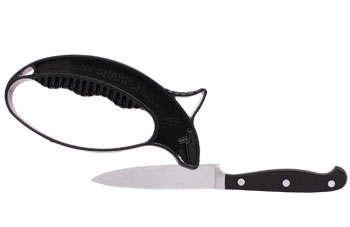
(Lansky image)

The pull-through sharpener works on the principle of scraping a tiny amount of steel from the edge to reconfigure it to a crisp “V” shape. Pull-through sharpeners require very little skill to master—just pull the sharpener head over the entire cutting edge a few times and you’ve got a sharp knife. The Quick Edge is fast, convenient and safe, too, thanks to the D-guard that prevents accidental cuts during sharpening.

The handle’s understated, user-friendly finger grooves enhance grip, and the D-guard is large enough to accommodate a gloved hand comfortably and securely.

A thumb rest on the handle enables you to use your thumb to aid in providing downward pressure during sharpening.

Using the Quick Edge

lansky knife sharpening
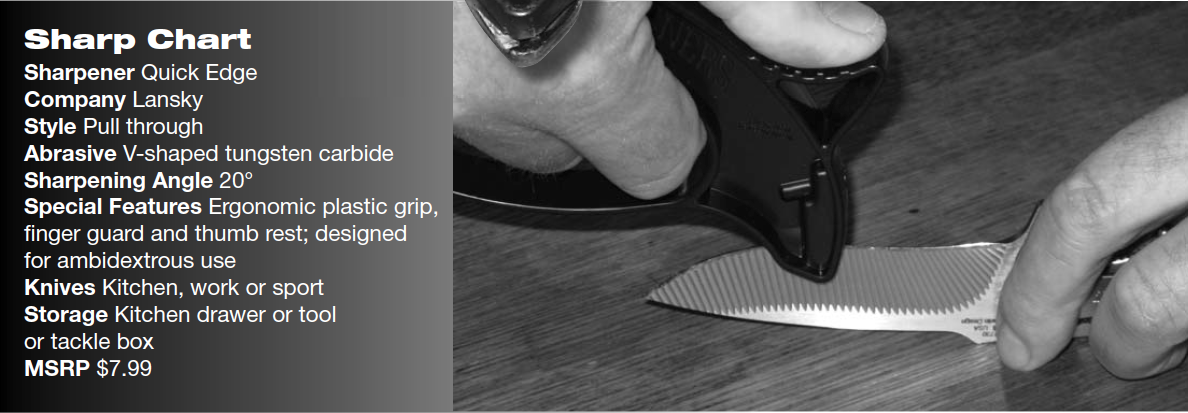
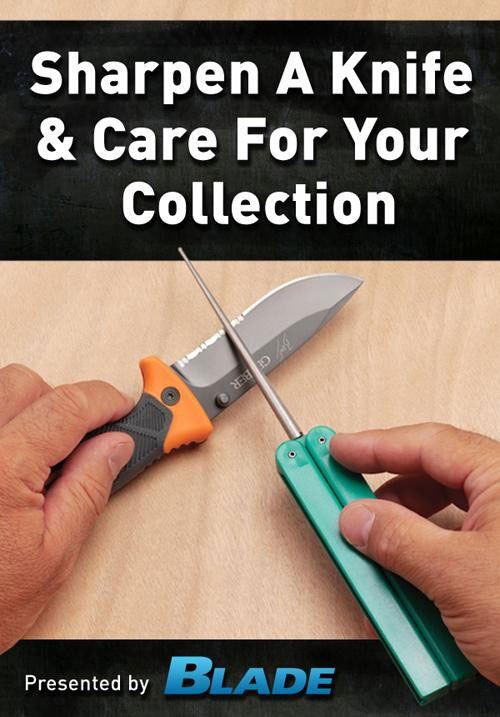
Place the V-shaped carbide sharpening element over the cutting edge at the tang and pull toward the blade tip. Repeat until you obtain a sharp edge. The knife is the Kershaw Groove. (Dexter Ewing photo)

Place the knife you want to sharpen edge up on a sturdy work surface. Firmly grip the knife’s handle with one hand and, with the other hand, place the Quick Edge cutting head down on the cutting edge at the area closest to the tang.

With light to moderate pressure, drag the sharpener over the edge in one motion, going toward the blade tip. Once you reach the tip, replace the sharpener where you started and repeat the process several times until you have a sharp edge.

Due to how pull-through sharpeners work—not just the Quick Edge but most pull-through models—I caution against using them with high-quality using knives, including customs. However, if you need a good, serviceable edge for inexpensive working or hunting knives, the Quick Edge is for you.

For instance, if you do a lot of machete work, the Quick Edge should be your cup of tea. When the edge gets dull, sharpen it with a series of pulls and you can go right back to work. The edge the Quick Edge creates will not be as sharp or uniform as one provided by any of Lansky’s clamp-style sharpening kits—hence my recommendation against using the Quick Edge on high-quality cutlery.

Nonetheless, the pull-through model provides a nice, serviceable edge for cutting/chopping outdoor knives that see a lot of use and, perhaps, abuse.

Stored in a tackle box or toolbox, the Quick Edge is ideal for fast stock removal in the field and works best with low- to mid-grade blade steels.

Learn More About Knife Maintenance

knife sharpening tips

5 New Knives (and 1 Survival Ax) for Rugged Use

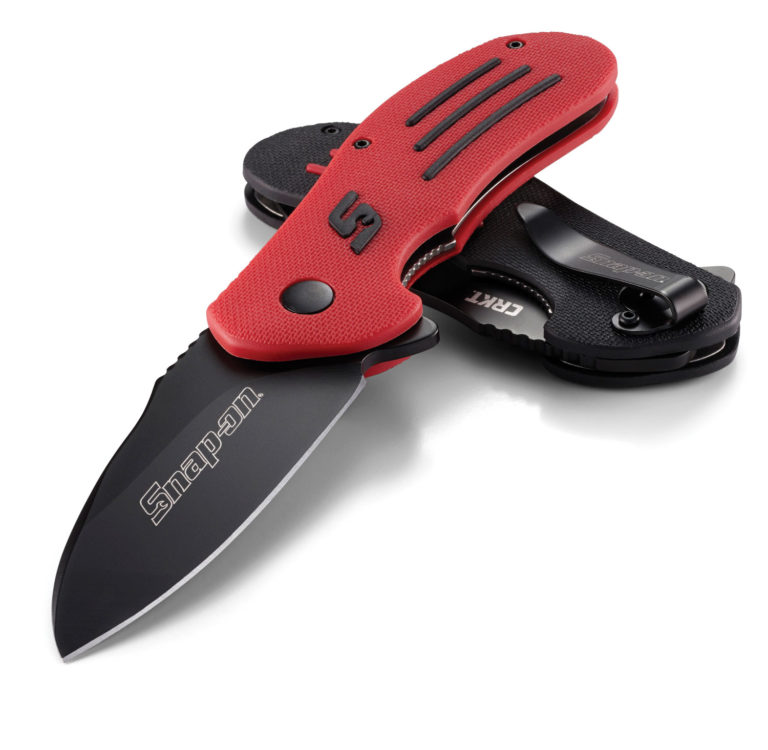
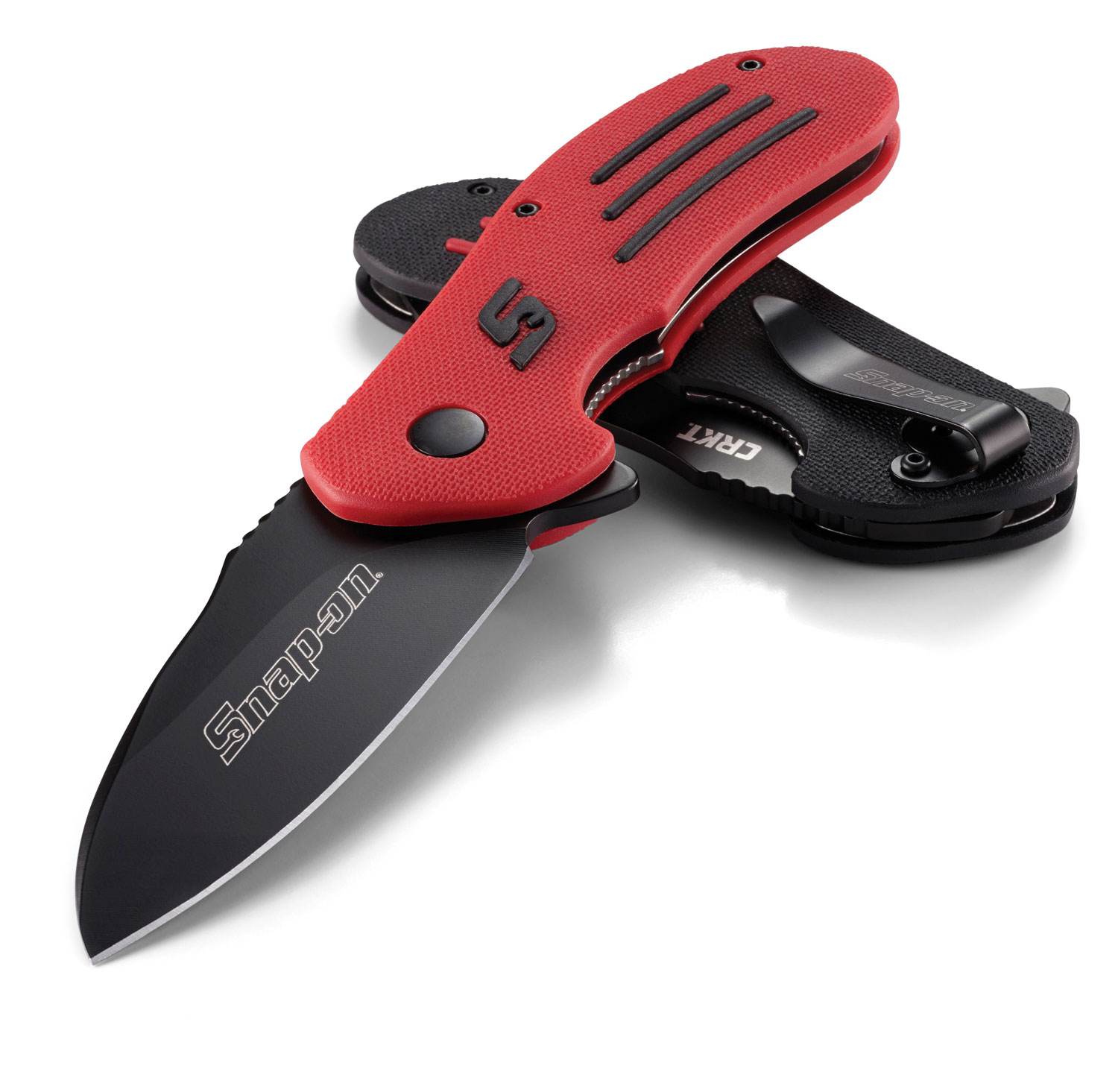
CRKT Snap-On® RAVE® XL

CRKT Snap On
CRKT image

From CRKT:

As rugged as the mechanics who use it, this overbuilt pocket knife features a modified drop point blade that’s built from stainless steel. It’s tough enough to cut hose but still precise enough to strip wiring. Meanwhile a black corrosion resistant coating keeps the blade intact no matter what you put it through in the shop.

  • Blade Steel: 1.4116
  • Blade hardness: 55-57 HRC
  • Blade Thickness: 0.120” (3.0 mm)
  • Blade Finish: EDP
  • Blade Length: 2.75” (69.85 mm)
  • Closed: 4.125” (104.76 mm)
  • Open: 6.875” (174.63 mm)
  • Weight: 6.2 oz. (175 g)
  • Handle: Glass-Reinforced Polypropylene with TPR Insert
  • Style: Folding Knife w/Locking Liner
  • Designer: Ken Onion
  • Available in three colors (red, black, red/black)

More information here


CRKT HVAS

Editor’s note: CRKT tell us that the H is silent in “HVAS.” It’s pronounced like “vase” with a long “a.”

From CRKT:

For a minimalist with an appetite for big adventure. Jesper Voxnaes’ Scandinavian backyard is filled with fjords, punctuated by mountains, and sliced by surging rivers. So when he sets out to design an outdoor knife, it’s crafted to perform. Everywhere.

  • Blade Length: 3.339″ (84.81 mm)
  • Blade Edge: Plain Edge
  • Blade Steel: 1.4116 SS
  • Blade Finish: Satin Finish
  • Blade Thickness: 0.126″ (3.2 mm)
  • Closed Length: 4.525″ (114.94 mm)
  • Open Length: 7.875″ (200.03 mm)
  • Weight: 3.7 oz
  • Handle: Glass Filled Nylon
  • Style: Folding Knife w/Locking Liner
  • Field Strip Technology
  • Designer: Jesper Voxnaes

More information here


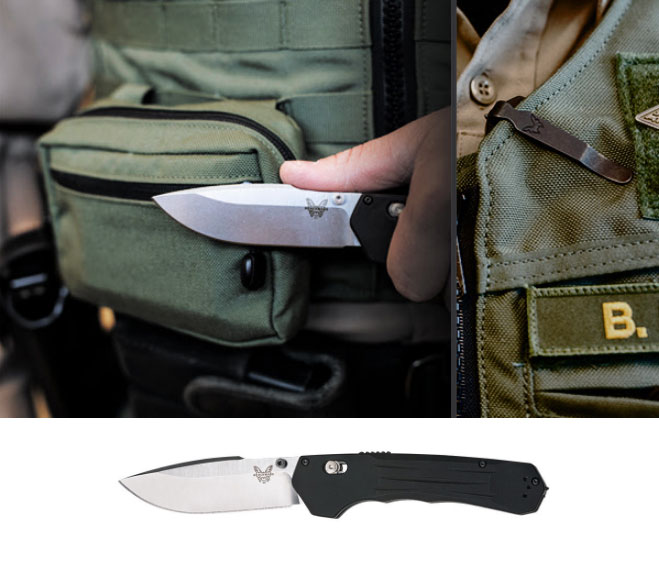
Benchmade 407 Vallation

Benchmade 407 assisted opening axis knife
Benchmade images

From Benchmade:

A duty knife that can be carried every day, this tactical AXIS® Assist takes its styling cues from our legacy line of automatic knives.

  • Designer: Benchmade
  • Mechanism: AXIS® Assist
  • Action: Assisted-opening
  • Blade Steel: CPM-S30V (58-60HRC)
  • Blade Length: 3.70″ (9.40cm)
  • Blade Thickness: 0.124″ (3.15mm)
  • Open Length: 8.76″ (22.25cm)
  • Closed Length: 5.09″ (12.93cm)
  • Handle Thickness: 0.70″ (17.70mm)
  • Weight: 6.38oz. (180.87g)
  • Blade Edge: Plain
  • Blade Finish/Color: Satin
  • Blade Style/Shape: Drop-point
  • Clip Type: Deep-Carry
  • Clip Position: Reversible Tip-Up
  • Glass Breaker: Yes
  • Handle Material: 6061-T6 Aluminum
  • MOLLE Compatible: Yes
  • Sheath Type: No Sheath

More information here


Benchmade Bugout®

Benchmade new Bugout
Benchmade images

From Benchmade:

Subtle, yet capable, the latest version of the Bugout® was developed to be easily carried anywhere without drawing attention to itself.

  • Designer: Benchmade
  • Mechanism: AXIS®
  • Action: Manual-opening
  • Blade Steel: CPMS30V (58-60 HRC)
  • Blade Length: 3.24″ (8.23cm)
  • Blade Thickness: 0.090″ (2.29mm)
  • Open Length: 7.46″ (18.95cm)
  • Closed Length: 4.22″ (10.72cm)
  • Handle Thickness: 0.42″ (10.54mm)
  • Weight: 1.85oz. (52.45g)
  • Blade Edge: Plain
  • Blade Finish/Color: Gray Coated
  • Blade Style/Shape: Drop-point
  • Clip Type: Mini Deep-Carry
  • Clip Position: Reversible
  • Handle Material: Grivory
  • Lanyard Hole: Yes
  • MOLLE Compatible: No

More information here


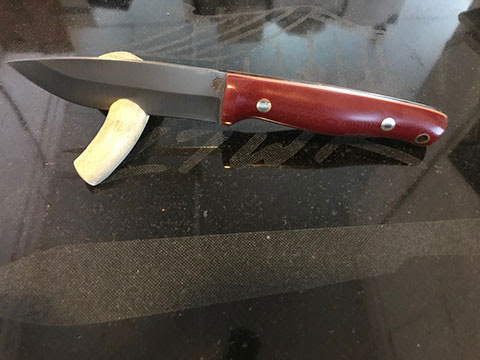
L.T. Wright (No Name) Knife

LT Wright Handcrafted Knives
LT Wright image

Part of the Vault series. From L.T. Wright Handcrafted Knives:

It is still made with 100% American steel and handcrafted here in Ohio.

  • Overall Length: 8″
  • Sharpened Edge: 3 3/4″
  • Steel: A2 Steel
  • Grind: Saber
  • Handle: Polished red G10 with coyote G10 Liners
  • Other Features: Sharpened spine, Brown leather dangler sheath with matching red thread and a fire steel loop

More information here


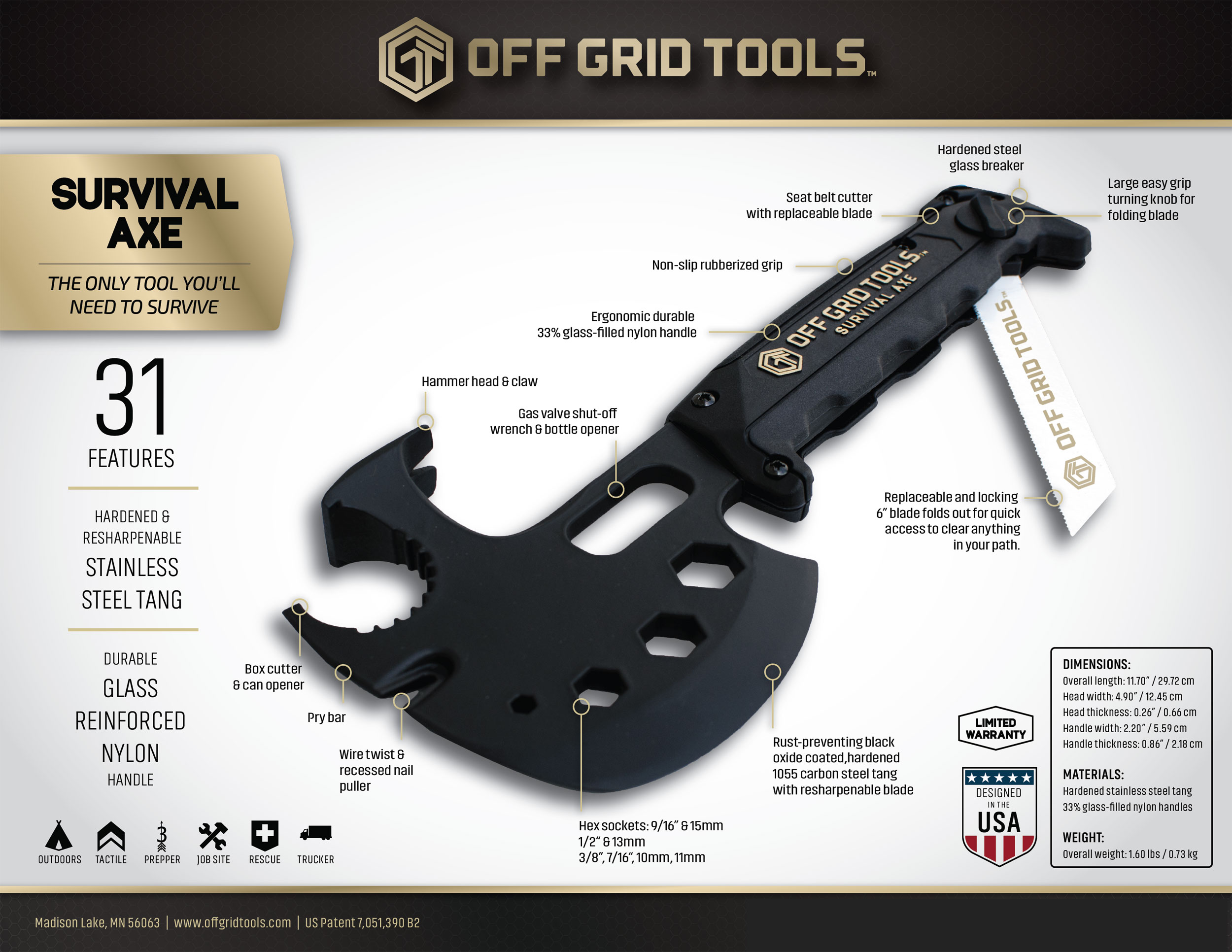
Off Grid Tools Survival Axe

OGT survival ax
Off Grid Tools image – click for larger view

From Off Grid Tools:

With 31 features, the tool will fully equip you for any situation you might come across.

  • Dimensions: 11.5 x 5.5 x 1.2 inches
  • Weight: 1.7 pounds
Steel: 420 stainless steel full tang
Hatchet blade
  • Hammer head, nail claw and pry bar
  • Replaceable 6 inch thin kerf reciprocal saw blade
  • Hex sockets 3/8, 7/16, 1/2, 9/16, 10mm, 11mm, 13mm, 15mm
  • Hardened steel glass breaker
  • Seat belt cutter
  • Gas valve wrench and bottle opener
  • Rubberized coated glass filled nylon handle

More information here

Editor’s note: In addition to a good blade, one of the best survival tools you can carry is a .22 pistol. Check out our sister site GunDigest.com for the Top list of best .22 pistol options.


Keep Up on New Knives with a BLADE Magazine Subscription

Never miss a beat with a great deal on a print subscription.


3 Memorable Times I Accidentally Cut Myself

Knives are a dominant force in many of our lives. There are the classic designs, the valued collectibles and, perhaps most of all, the users. Of the latter the ones I remember in a special way are those with which I accidentally cut myself. Of those cuts, three stand out.

Cut Number 1

I was 11 or so and rode a Western Auto Wildcat bicycle—the kind with the Hollywood handlebars and banana seat with sissy bar—most everywhere. At the time the oil company then known as Esso, today’s Exxon, had the promotion “put a tiger in your tank” with Esso gasoline.

To help sell it they gave away furry toy tiger tails with elastic looped straps people attached to their car gas caps so the tails would fl op in the breeze as the cars motored along.

I had the bright idea that I would cut the looped strap of one of the tails in two and tie the resulting straps around my banana seat sissy bar so the tail would fl op in the wind as I rode my bike. (To my later chagrin, I didn’t know how to do the old loop-tie trick back then.)

I pulled a large serrated knife from the kitchen drawer and proceeded to cut the strap—and also the base of my left index finger. It was one of those ragged-jagged cuts, and, when Dad walked in and saw it, I thought he was going to come un-gas-capped, so to- speak. Oddly enough, I don’t remember the cut hurting that much.

Anyhow, five stitches later I had learned just how fragile human flesh is.

Cut Number 2

Years later while fishing I caught a bream and was in the process of filleting it with a Marttiini classic fillet knife when zip, zap! the blade went right through the bream and across, over and through the tip of that same left index finger. The cut did not require stitches but the Marttiini blade was sharp as the dickens, and my finger burned like fire to the bone almost immediately after I cut it.

To this day I can recall how it felt and shudder at the memory.

Cut Number 3

knife injuries

The third most memorable cut happened while I was on what back then we called satellite television. In the early 1990s, BLADE Magazine Cutlery Hall-Of-Fame© member Bruce Voyles was BLADE publisher and the original host of The Knife Collector’s Show on the old Shop At Home Network. (If you Wikipedia Shop At Home Network, Bruce is glaringly omitted as one of the hosts of The Knife Collector’s Show.) I worked for Bruce back then and assisted him on a few of the satellite telecasts.
On one of them we had a number of custom knives that Bruce wanted me to display on shelves to help viewers see what they were buying. One of us had the bright idea of “standing” the knives tip first next to their sheaths on the shelves.

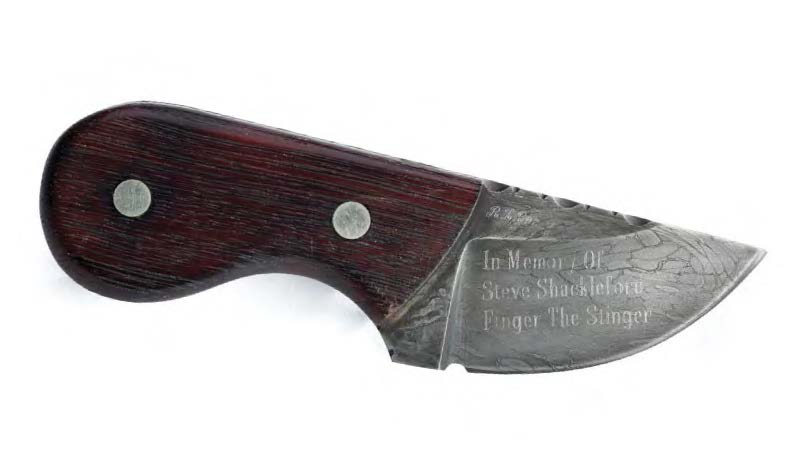
I propped up a small damascus fixed blade built by since-retired custom knifemaker Robert Brothers, along with its sheath, on a shelf. As the cameras photographed away, being the colossal klutz I am I bumped the shelf. The knife came tumbling down point-first into the webbed skin between my ring finger and pinky. You guessed it—I let out with the “sh__!” word in full earshot of the show’s television viewing audience.

Bruce took my on-air epithet better than I thought he would. (Unlike today, profanity was forbidden on television back then.) Maybe the best part was the knife did not sell and Brothers, being the good Samaritan, gave it to me—but not before having it etched, “In Memory of Steve Shackleford: Finger The Stinger.”

I don’t have the old serrated knife or the Marttiini fillet but I still have The Stinger—and, somehow, all my fingers, too.

Learn Knifemaking AND Keep Your Fingers Intact

How to make a knife guide book

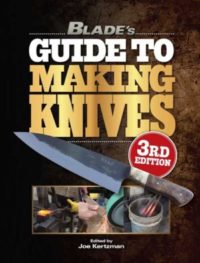
BLADE’s Guide to Making Knives, 3rd Edition might give you a paper cut, but you’ll be too busy enjoying the in-depth tutorials and rich, full-color photos to notice. Get it here from BLADE‘s online store.

Slip Joints Are Sizzlin’!

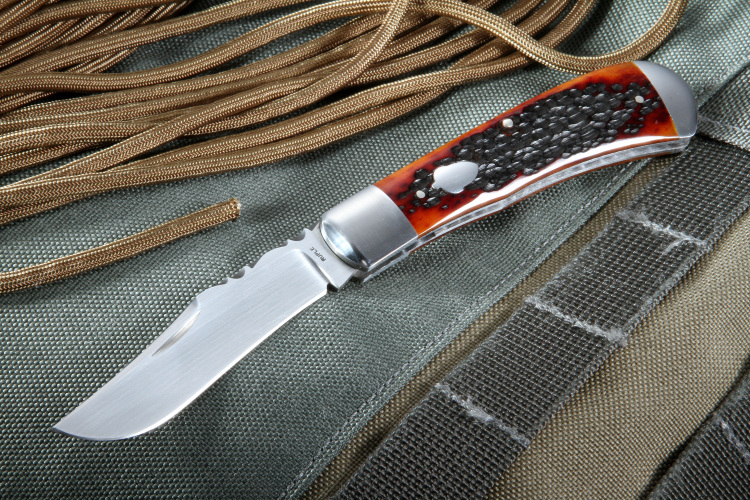
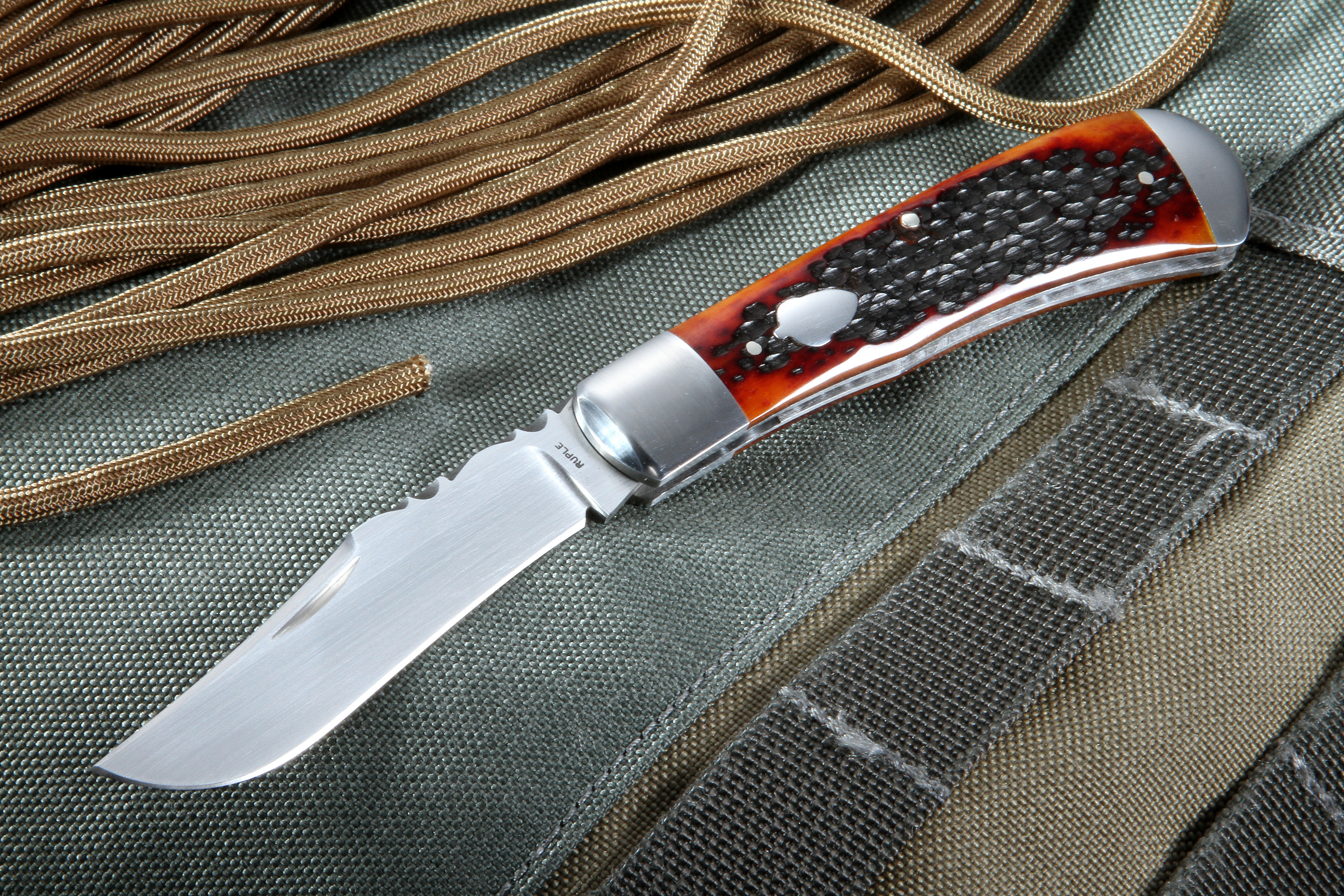
According to KnifeArt.com’s Larry Connelley, Bill Ruple ([email protected]) is one of the leading names in custom slip joints. Ruple’s “Acorn” single-blade trapper features a CPM-154 stainless blade and an amber-bone handle. Closed length: 4.25 inches. KnifeArt.com’s (www.knifeart.com) list price: $1,100. (KnifeArt.com photo)

One of cutlery’s oldest designs, the slip joint is also one of its hottest


By Pat Covert


    Long ago, someone added a spring to the back of a pocketknife to prop the blade open and enable it to shut with a snap—and what is known by many knife enthusiasts today as the slip joint was born. While locking-liner tacticals dominate much of the folder arena, the relatively new genre has a lot of catching up to do if it plans on eclipsing slip-joint sales.

    Like many sectors of the cutlery market, there are two basic customers for slip joints—users and collectors—with some overlap to be expected. So what would cause a knife user to carry a slip joint over the more modern fare? “Tradition,” KnifeArt.com’s Larry Connelley states simply. “Slip joints are built with traditional patterns or modifications of a traditional pattern from the early 1900s. Slip joints are easily carried and perceived as an American tradition. Many knife owners first owned a traditional slip joint.”

    From a practical standpoint, slip joints make excellent pocketknives, playing the same role they have for generations. “Slip-joint folders are used for cutting almost everything imaginable, such as peeling apples, skinning game, opening boxes, opening letters, and a myriad of other uses,” observes Kenny Wilson of Sooner State Knives.

    Josh Terryah of Knife Country USA says both tradition and everyday service play a role in the slip joint’s popularity. “Slip joints are great utility knives, and who doesn’t like to carry something around that reminds them of their granddaddy or father?” he opines. “Who would ever think a knife could bring back memories of being a kid on the family farm?”

    Though hard to quantify, another likely reason for the slip joint’s surge in attractiveness and popularity among users is the oppressive anti-knife laws and/or improper labeling of legal one-hand-opening and other knives as illegal by law enforcement, district attorney’s offices and local governments in some areas. In other words, the DA’s success rate in prosecuting someone for carrying a traditional peanut or stockman pattern is lower than for a one-hand opener.


Selection Never Better

Selection has never been better for factory slip-joint fans. Companies such as Buck, Boker, Case, KA-BAR, Queen and others long have produced and/or offered traditional slip joints. Outfits like Canal Street Cutlery, Columbia River Knife & Tool, Fallkniven, Great Eastern, Spyderco and more have joined/rejoined the slip-joint sweepstakes, and brands such as Schatt & Morgan (Queen), Tidioute and such (Great Eastern) and others have been revived. Better yet, a plethora of classic patterns is available in the midst of such healthy competition. These range from common patterns such as trappers, barlows and sunfish to more specialized ones like the melon tester and cotton sampler.

    On the other hand, some things never seem to change.

    “Case remains the most collected knife in the world. One reason for this is the detailed dating system Case uses,” Wilson notes. “But, I believe Canal Street is currently building the highest-quality traditional slip-joint folders. They simply spend more time to get the details right during production and assembly to ensure that everything fits as it should.”

    Terryah says not only has he seen an uptick in sales of traditional slip joints, but some of the more modern styles are selling as well. “I would have to say the Spyderco and Fallkniven slip joints are the hottest new models [for us] right now,” he offers. Wilson says Case’s traditional two-blade trapper (4 1/8 inches closed) is the best seller at Sooner State Knives. “Next would probably be the [Case] 3-inch tiny toothpick,” he advises.


Maker Explosion

The custom market long has had a clique of makers who keep the traditional patterns alive—Tony Bose, who also has designed some knives for Case, and Bill Ruple among them. In the past few years there has been an increase in custom makers joining the fray, adding even more fans to the slip-joint market.

    “Slip-joint collectors tend to be men in the 40-to-60-year-old range. They’re the classic baby boomer demographic. These customers appreciate the high level of fit and finish,” he says. “There are many sub-groups of slip-joint collectors, from the patterns to the number of blades on a folder.”

    According to Connelley, the best-selling slip-joint pattern at Knifeart is, once again, the trapper. He says some of the hot knifemakers (and their knives with Knifeart’s list prices in parentheses) are Don Morrow (two-blade stag trapper, $750), Bill Ruple (stag or bone two blade, $1,100), and Hiroaki Ohta (single-blade stag folders, $500). “Tony Bose is hands down the most popular,” Connelley opines. “His knives command a premium on the secondary market which, unless you are really lucky at his BLADE Show lottery, is the only place to buy one.”


Choice Materials

The materials offered in a knife are always a key consideration. “Most collectors seem to prefer stainless steel blades over carbon steel,” Wilson notes. “That said, many older buyers still prefer carbon steel in the knives they carry, and a few younger buyers prefer it because of their fathers and grandfathers.

    “The misconception seems to be that if a blade doesn’t rust, it won’t hold an edge. They don’t realize cutlery companies have kept up with the times and that new blade steels are constantly being introduced.”

    Among handle materials, Wilson indicates due to the variety of colors, jigged bone is his most popular but stag, mother-of-pearl and wood still move as well.

    On the custom side, Connelly says stag is the most popular, followed by traditional jigged bone. “For blade materials they prefer high-quality stainless steels such as CPM-154, ATS-34 and CPM-S30V. We occasionally see high-quality damascus on an upscale slip joint,” he adds. It is interesting to note that damascus is wildly popular in other genres such as fixed blades and locking folders, but it does not seem to translate well into traditional fare.

    Given the increase in custom makers joining the party and the extremely large number of factory pocketknives on the market, traditional slip-joint lovers will have fat pickings for a while. Whether you prefer production or custom knives, there are affordable options for everyone. Custom slip joints typically range from $250 up and factory pocketknives can be had for as little as $25 for models produced offshore—with stag handles, no less!—to $150-$200 for top-shelf limited editions.

    In essence, with the exception of some of the more rarified custom artisans who can name their price, it is a buyers’ market that shows no sign of slipping.

For more on the latest knives, knife legislation, knifemaking instruction, knife trends, knifemakers, what knives to buy and where and much more, subscribe to BLADE® Magazine, the World’s No. 1 Knife Publication. For subscription information click on http://www.shopblade.com/product/blade-magazine-one-year-subscripti…?r+ssfb020212#BL1SU


$50 or Less: 4 Excellent Assisted Opening Knives

0

These four assisted opening knives sit at the intersection of value and performance. They’re proof you don’t need to spend a bundle for a knife you can enjoy day in and day out.

Kutmaster Greased Lightning – MSRP $34.95

Best knives for the money

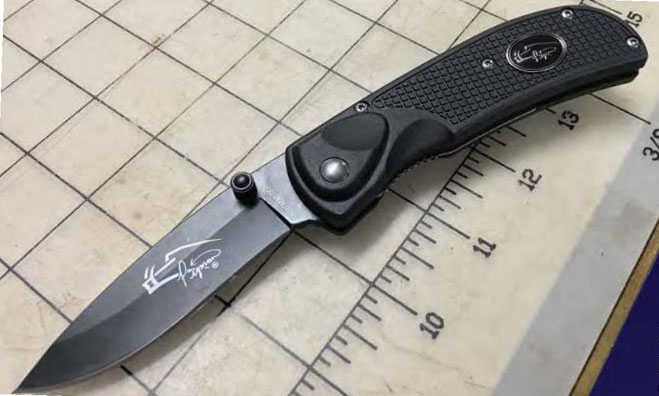
The triple-action assisted-opening mechanism of the Kutmaster Greased Lightning folder was designed by the brother tandem of Michael and the late BLADE Magazine Cutlery Hall-Of-Fame© member, Blackie Collins. It is the only folder in the line of Kutmaster knives designed in collaboration with the Sportsman Channel’s Brian “Pigman” Quaca.


Kershaw Intellect – MSRP $49.99

A flipper tab helps actuate the SpeedSafe® assisted-opening mechanism of Kershaw’s Intellect. Weight: 3.7 ounces. Closed length: 3.75 inches.


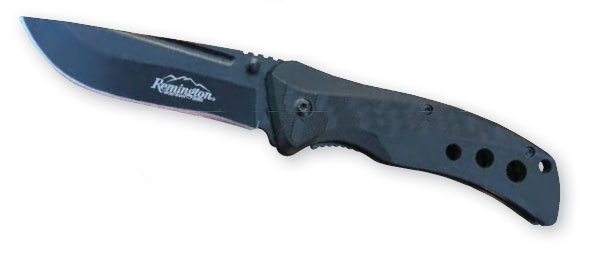
Remington R11516 – MSRP $39.99

Best value assisted opening knives

A textured G-10 grip with an integral guard and an angled blade fuller help distinguish the Remington R11516 assisted-opening tactical folder.


CRKT Largo – MSRP $49.99

Best folding knives for the money

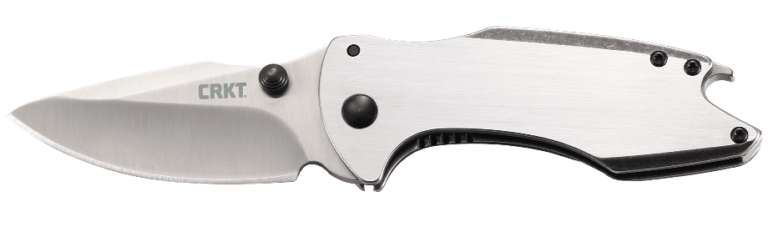
The CRKT Largo comes with a built-in bottle opener, which is appreciated in a category that’s usually stripped of extras. OAL: 6.125 inches.


Don’t Miss BLADE Show West 2018 

BLADE Show West 2018 information

Knife Photos: 5 Freaky Fantasy Knives

0

They might not look real, but the knife photos don’t lie. These fantasy knives, each made by a wizard of custom knifemaking, bring to mind sword-and-sandal TV shows and movies.

Aaron Schwartz


Custom fantasy knife photos

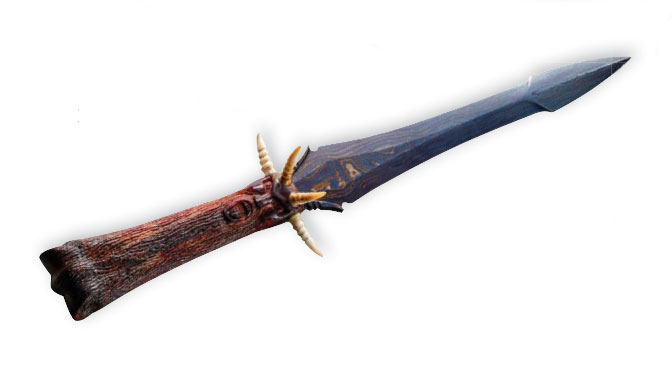
Some dyed zebra bone and Alabama damascus, and a tree came to life in the blue woods, horns protruding from its skull as it wreaked havoc on the land. (PointSeven image)


Josef Rusnak

Fantasy knife photos

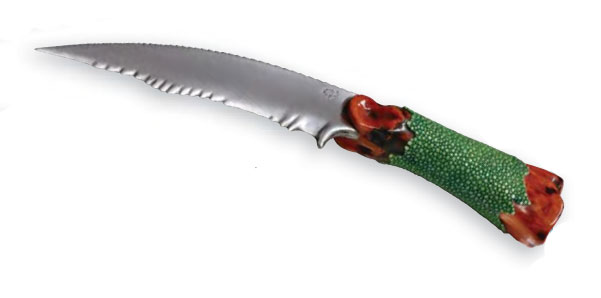
You don’t see much antelope bone on knives, nor too many 440C blades shaped like the “Dragon Claw,” which, in turn, wears the skin of a stingray with pride.


Logan Pearce

Custom knife photos

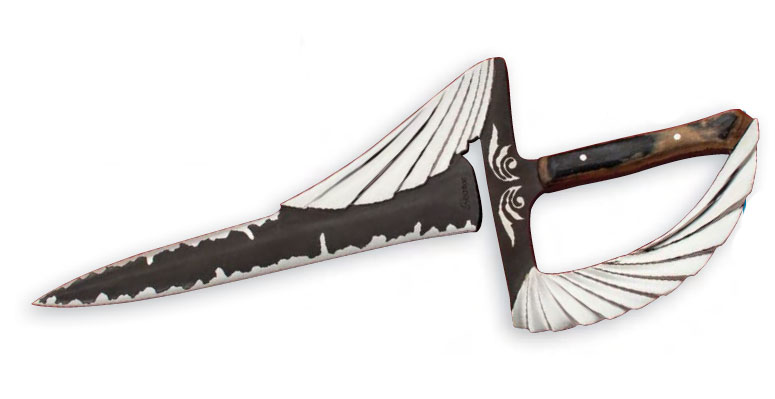
The Valkyrie, with filed O1 wings and blue mammoth ivory body, chooses those in battle who may live and those who die. (Ward image)


Jeff Knox

Photos of custom fantasy knives

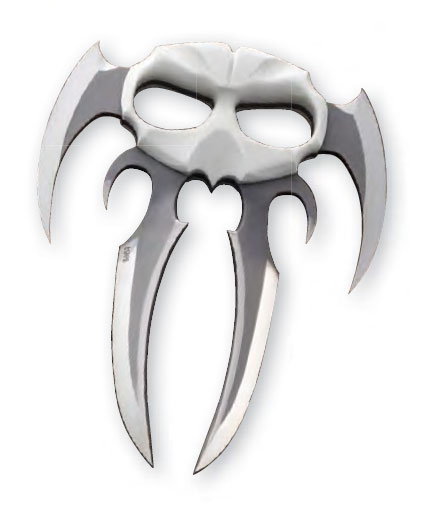
The main tusks of the “Trandoshan Mount” are hollow-ground 440C bent at 30 degrees, the horns ground using 1- and 3-inch wheels and the body of white Corian. (PointSeven image)


Glenn Paul Smit

Photos of fantasy knife

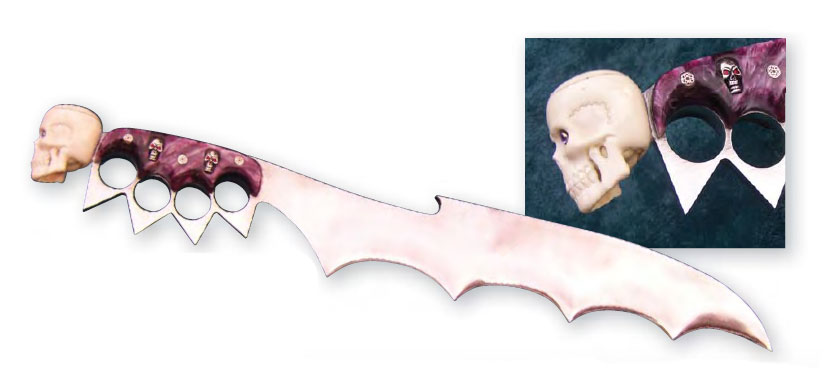
The integral “knuckle duster” guard of the “Myrlande Machete” would dust ’em off if the 18-inch tool steel blade didn’t take care of them first. Silver skulls embellish the purple swirled acrylic grip, and the skull pommel is carved bone with purple glass eyes.


Like “Weird” Knives? Come to BLADE Show West 2018

BLADE Show West is taking place Oct. 5-7, 2018, in the home of weird, Portland, Oregon. Expect high strangeness and masterful custom knife presentations. Details here.

Cool Knife/Sheath Combos By John H. Davis

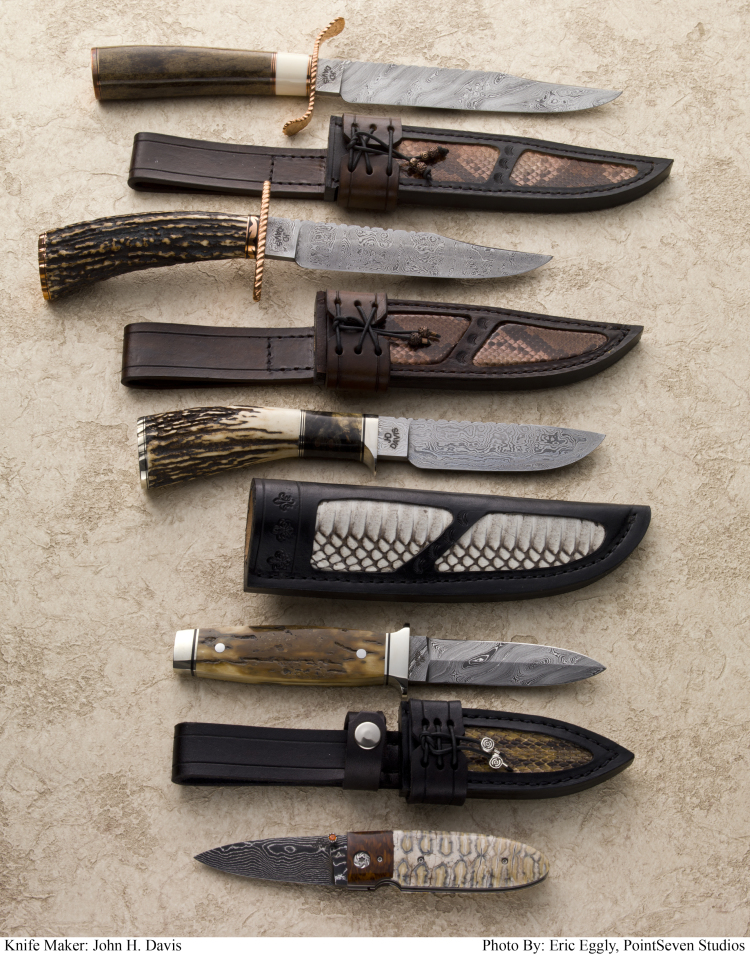
John H. Davis’ knives, from top: oosic/ivory bowie, twist damascus of 1084/15n20, copper guard, spacers and butt, 13 inches overall; India stag bowie, ladder-pattern damascus, copper guard, spacers and butt; India stag and buckeye burl drop point, 1084/A203E damascus, nickel-silver fittings; mammoth ivory boot dagger, 1084/15n20 damascus, nickel-silver fittings; and a mammoth tooth ivory and snakewood locking-liner folder, 1095/nickel damascus. Davis’ sheaths, from top: the first two are belt-loop pouch types in custom leather with python inlay; a pouch type in custom leather with cobra skin; and a belt-loop-and-snap pouch model in custom leather with snakeskin inlay. The maker’s list prices for similar outfits, from top (the prices include sheaths where applicable): $500, $400, $350, $350 and $350. (Point Seven photo)

John H. Davis offers nice knife-and-sheath combinations—and don’t forget the folder!

Some makers do not offer sheaths with their fixed blades. ABS apprentice smith John H. Davis is not among them.

    His selection of damascus fixed blades includes handsome sheaths, including one in a cobra-skin inlay he said “a couple of guys do back flips over.” Other sheaths have python and snakeskin inlays. A computer field engineer by day, Davis also has a background in metal fabrication, which helps explain the copper he uses for guards on some of his models. “I’m one of the few who uses it for guards,” he noted. “I love working with it. It’s an underrated material.”

    In terms of offering the total package of knife and sheath, underrated also would seem an appropriate way to describe Davis.

For more information contact John H. Davis, 33842 Picciola Dr., Fruitland Park, FL 34731 209-740-7125 [email protected], www.custom-knifemaker.com.


For more on the latest knives, knife legislation, knifemaking instruction, knife trends, knifemakers, what knives to buy and where and much more, subscribe to BLADE® Magazine, the World’s No. 1 Knife Publication. For subscription information click on http://www.shopblade.com/product/blade-magazine-one-year-subscripti…?r+ssfb022612#BL1SU


Advertisement

Must Read Articles

Read this before you make a knife

Knifemaking 101 – Read This Before You Make a Knife

  by Wayne Goddard My experience has taught me that there's nothing like digging in and getting started. I've often said the hardest part of the...
how to forge damascus steel

How to Forge Damascus

Advertisement
Advertisement