Knife collecting is an extremely rewarding experience for knife enthusiasts. There truly is a knife for everyone. Many increase or hold their value throughout the years, making collecting knives something to pass on to the next generation of knife collectors.
Is the assortment of knives in your house as appropriate as it should be?
At one time I thought I wasn’t a knife collector. I am a knife enthusiast, knife user, knifemaker, knife writer, maybe even a reluctant knife expert, but not a knife collector.
Back when I thought that way, I looked around and noticed I had a dozen knives within arm’s reach, plus the tools in the kitchen, plus the customs of my own and a few from others, plus all the factory knives. Turns out I had nearly 100 knives, which means I’m definitely a knife collector, or at least an accumulator.
In my usual ADHD stream-of-consciousness fashion, my next thought was, “I wonder if I have a knife in every room of the house?” followed immediately by thoughts of which kind of knife would go in each room. Come along on my imaginative journey as we explore the idea of a knife for every room.
Kitchen
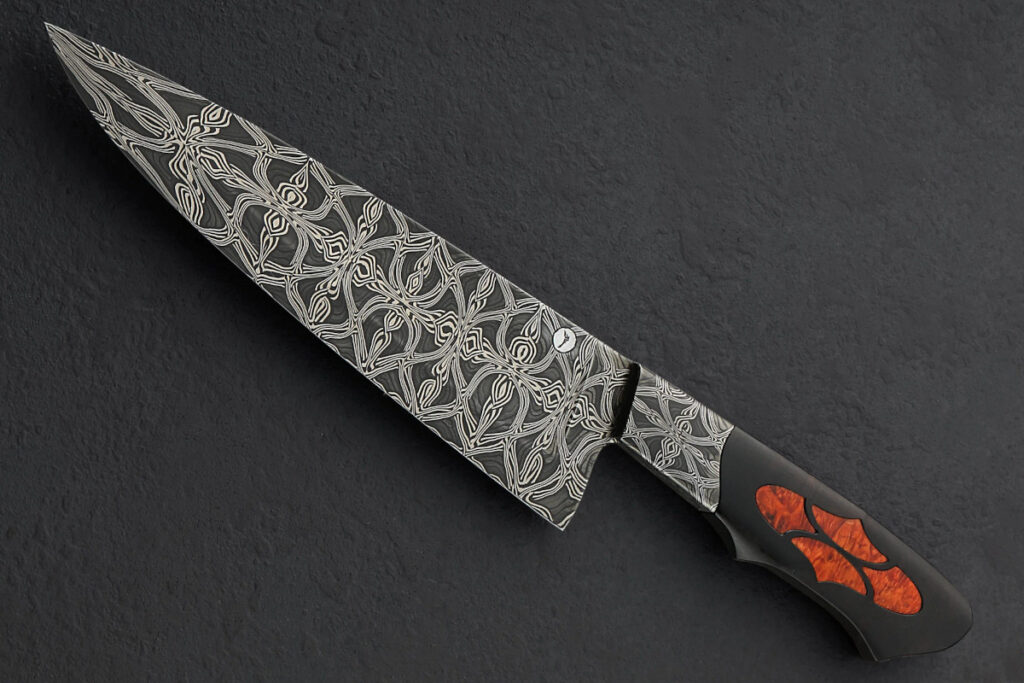
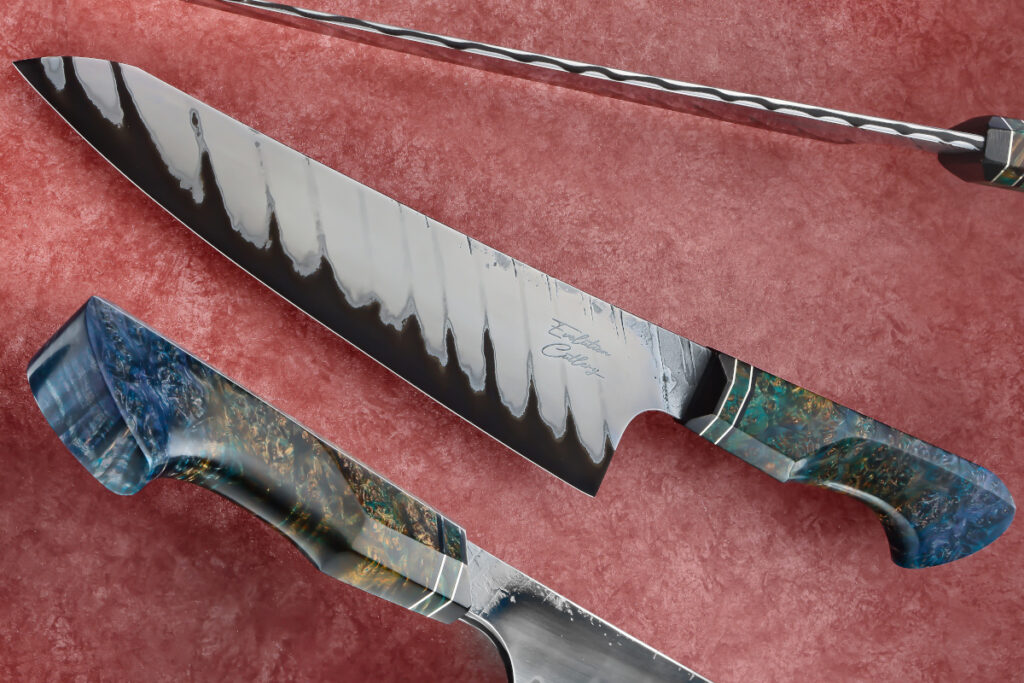
Knives in the kitchen are a given but including one by bladesmith Salem Straub is not. In the author’s perfect household cutlery world, one would be. An example: Salem’s Guimard chef’s knife in mosaic damascus. (EatingTools.com image)
The kitchen is intuitive. Most people have knives there, whether the knives are economy store cheapies, a mishmash random drawerful accumulated over years, a matching production set, or even dedicated custom household cutlery. On my imaginary journey, I can afford the good stuff, like a damascus chef’s knife from bladesmith Salem Straub. But that’s too easy. Why not a whole knife-fork-and-spoon-damascus set, like one from Nate “Tuna” Grant?
Garage
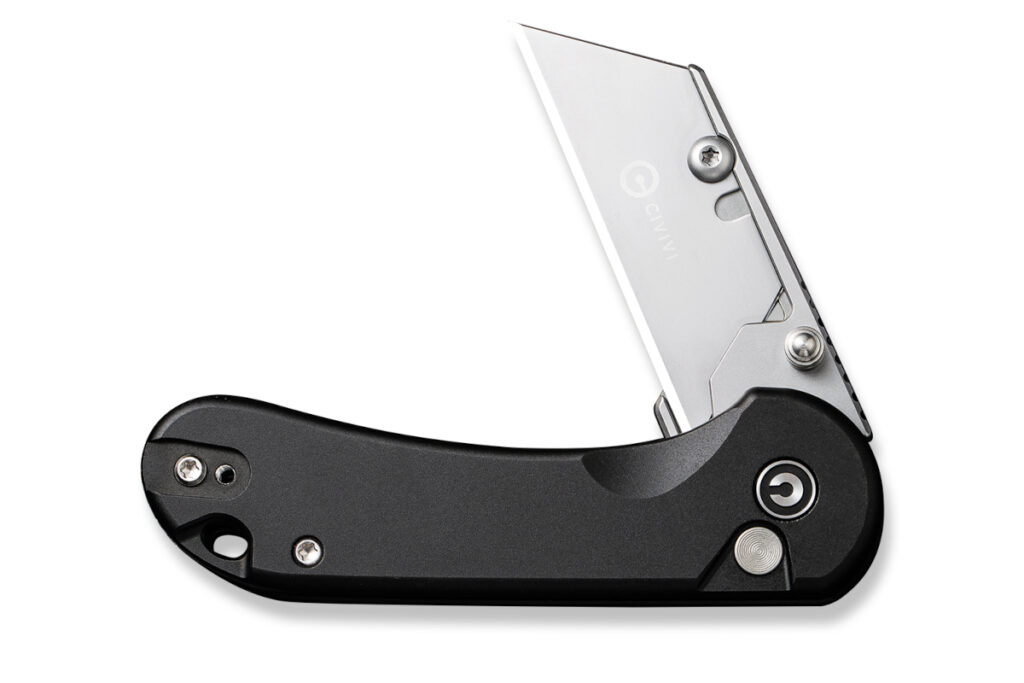
For the garage, the author suggests a factory utility knife of the replaceable-blade variety such as the Civivi Elementum.
The garage isn’t too tough either. My first thought was a utility knife of the replaceable-blade variety. In the past few years there’s been innovation in the custom knife world when it comes to replaceable blade knives, but for utilitarian and “I can use this and not be sad if I scratch it,” I think I’ll go with the Civivi Elementum that uses standard box cutter blades.
Living Room
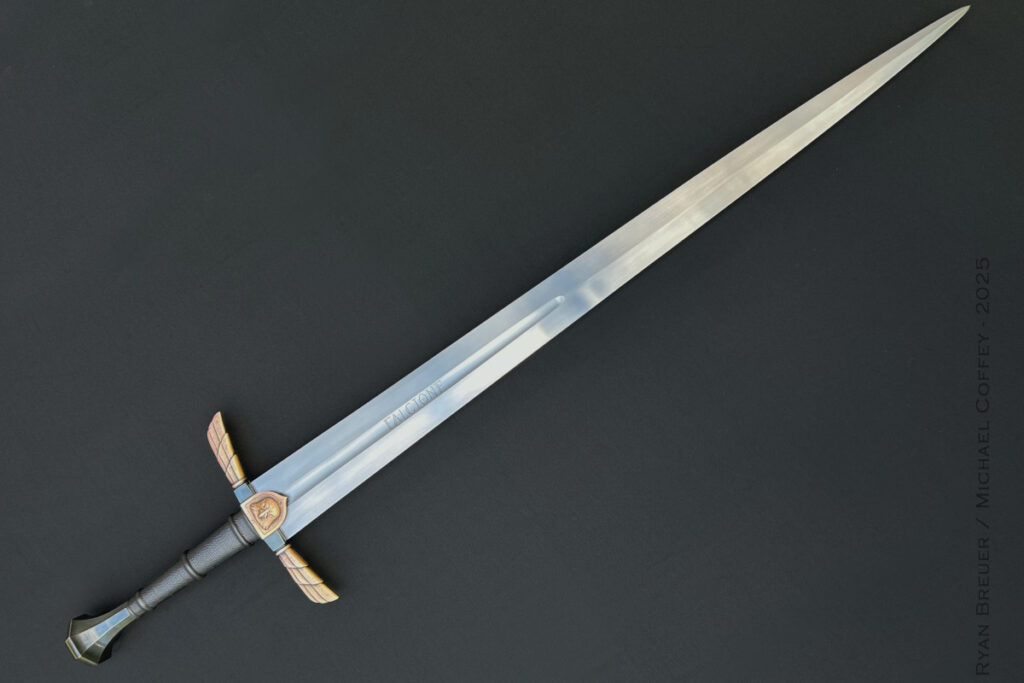
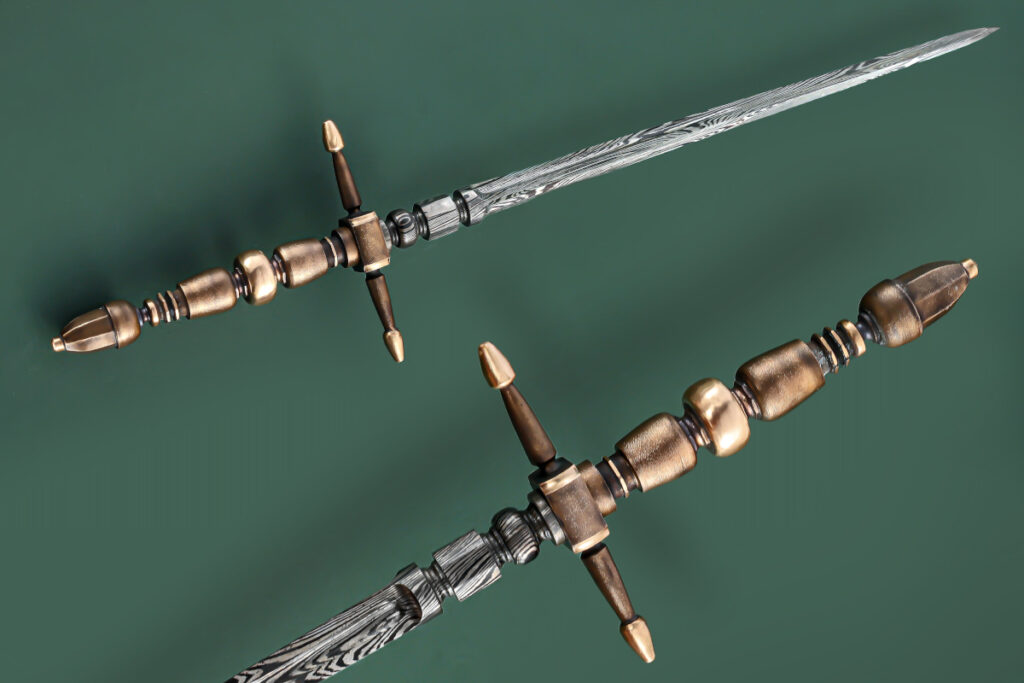
If the living room has a fireplace mantle, it’s a great place to display a custom sword. If you’re feeling medieval, the author recommends something like a hand-and-a-half piece by Ryan Breuer. (Ryan Breuer image)
The living room has the fireplace mantle, which is a great place to display a custom sword. If I were feeling medieval, I’d choose something like a hand-and-a-half piece from Ryan Breuer. Conversely, if I were feeling loud and Japanese, I might choose a fine bright katana like one from David Goldberg with an epic hamon.
Study
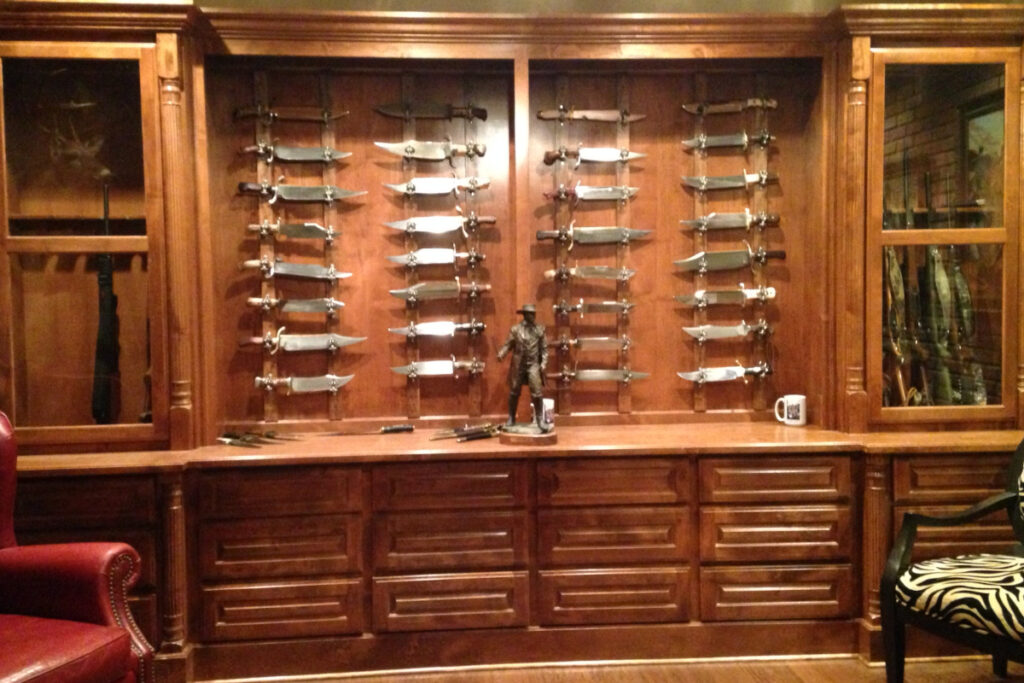
Along with studies, game rooms are also great for storing knife collections. Avid bowie collector Chris Nolen keeps his collectibles in a game room display designed by his son-in-law, replete with a statue of Jim Bowie and slide-out drawers that hold around 10 bowies each. (Chris Nolen image)
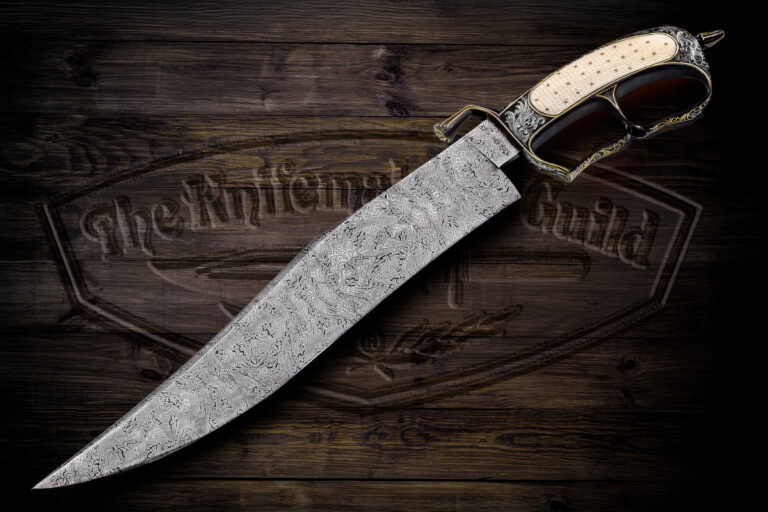
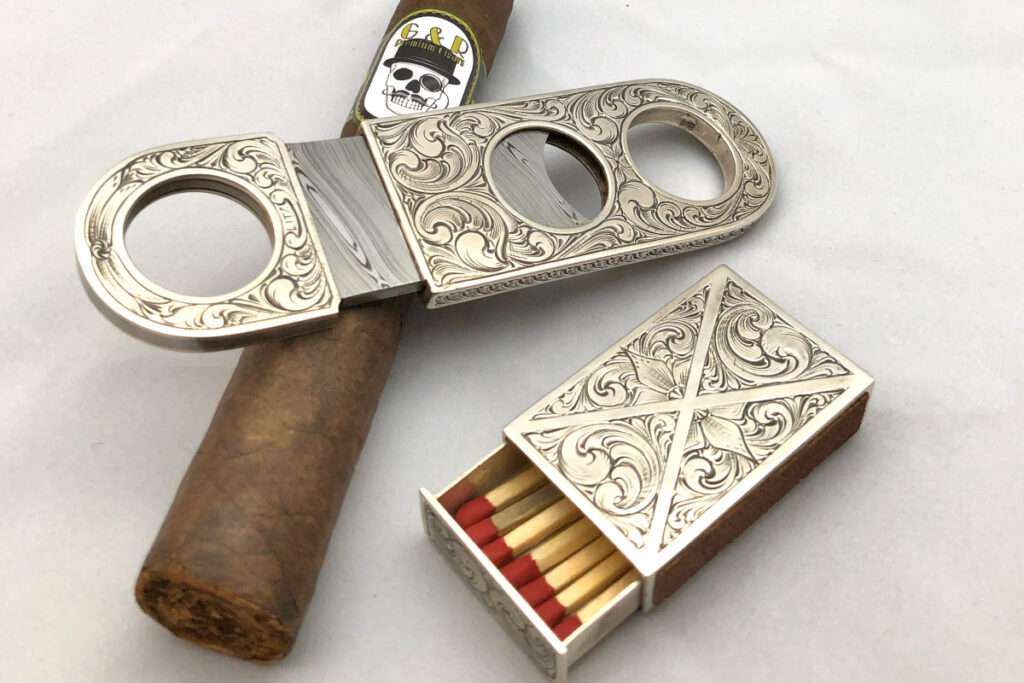
The gentleman’s study is dark, filled with books and memorabilia—the perfect place to store and display the “real” knife collection. Personally, I’d like a collection of custom bowies. I’d include pieces like a fully forged integral mosaic model from ABS master smith Mike Quesenberry, or an exquisite collaboration like The Knifemakers’ Guild award-winning piece by Nick Orr and Bailey Bradshaw. Or maybe I’d go rustic like ABS master smith Lin Rhea’s Preacher Bowie named after a mountain man. I’d round out the room with an engraved silver cigar-cutter-and-match-box set by Travis Payne engraved by Matt Litz for when the guys and I want to relax with a puff.
An engraved silver cigar-cutter-and-match-box set by Travis Payne engraved by Matt Litz for relaxing with a puff among friends would round out the author’s dream study. (Matt Litz image)
These days most tend not to receive letters, only junk mail and bills, and most of the junk mail goes straight to the trash unopened. But if I had a home office and I received good mail, I’d have to open it with a custom letter opener like one in a set from Deon Nel. He made a matching set of 16, so I bet he could spare one.
Outdoors
The backyard isn’t exactly part of the house, but that doesn’t exempt it from being a part of the author’s imaginary knife journey. If you have a standard grill, consider something like a san-mai brisket slicer from Dan Tompkins. (SharpByCoop image)
The backyard isn’t exactly part of the house, but that doesn’t exempt it from being a part of my imaginary knife journey. For those with a standard grill, you might consider something like a san-mai brisket slicer from Dan Tompkins. Or if you’ve got a fire pit, don’t forget Will Stelter’s damascus and mammoth ivory marshmallow fork. Or if you live in the woods, you might want a forged axe like a laminated wrought iron one from Nick Bachtel.
Bedroom
The author’s dream bedroom pillow dagger would be like Buttercup’s in The Princess Bride. If he were Buttercup’s beau, Dread Pirate Roberts, the author stated he might give his lady something like a poignard by Jamie Bishop. (SharpByCoop image)
Bedroom knives are a bit of a stretch. Personally, I have my hunting knives in my bedroom closet. If I were rich and fancy, though, I’d have to have a pillow dagger—you know, the dagger you keep under your pillow just in case. I’m reminded of the scene in The Princess Bride when Buttercup pulls out a fine stiletto in the bedroom, and the great Dread Pirate Roberts line that goes with it: “There is a shortage of perfect breasts in this world. It would be a pity to damage yours.” If I were Dread Pirate Roberts, I might give my lady friend something like a poignard by Jamie Bishop, or even something dainty and feminine like a fine small piece from ABS master smith Veronique Laurent. For under my personal pillow, I’d go with something extravagant like an art dagger from the Sobral Brothers.
Bathroom
Bathrooms are for hygiene and sometimes that takes a knife. To clean your fingernails or pull a splinter in style, the author recommends something like the fine Dourado collaboration between ABS master smith Dionatam Franco and Evan Nicolaides. (Mitchel Cohen image)
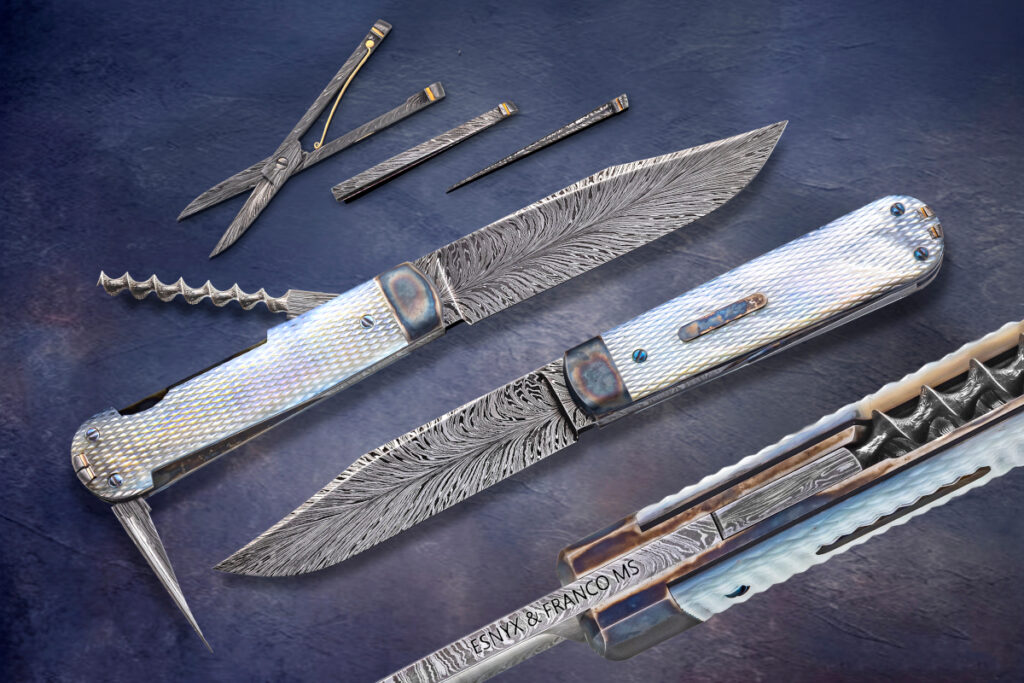
Bathrooms are for hygiene and sometimes that takes a knife. If you want to clean your fingernails or pull a splinter in style, I recommend something like a fine collaboration between ABS master smith Dionatam Franco and Evan Nicolaides. The pearl scales will shimmer in the vanity lights, and there are enough tools included to take care of many different tasks. Or if you want to play “Mack the Knife” in a dark alley then come home and comb your hair, Rick Lala can hook you up with his two-tool blade/comb folder.
How Close Are You?
You may not have a knife for every room, but I suspect that many BLADE® readers come very close. Here’s to improving the quality of your knife collection—even the bedroom knives!
The sub-hilt is at once belligerent and beautiful, adding a strange allure to the knives that sport it.
There is no consensus as to the origin of the sub-hilt knife, though most agree the sub-hilt fighter was popularized by BLADE Magazine Cutlery Hall-of-Fame® member Bob Loveless in the 1970s, if not earlier. Some believe the sub-hilt design was for hunting, and that the main purpose for the added hilt was for greater leverage when a surer grip was needed. A few have even postulated the additional hilt was for use as a brace in pulling the knife out after being stabbed into bone or another hard material, a use that it would no doubt accommodate most effectively.
Gary Langley: Gentleman’s Fixed Blade
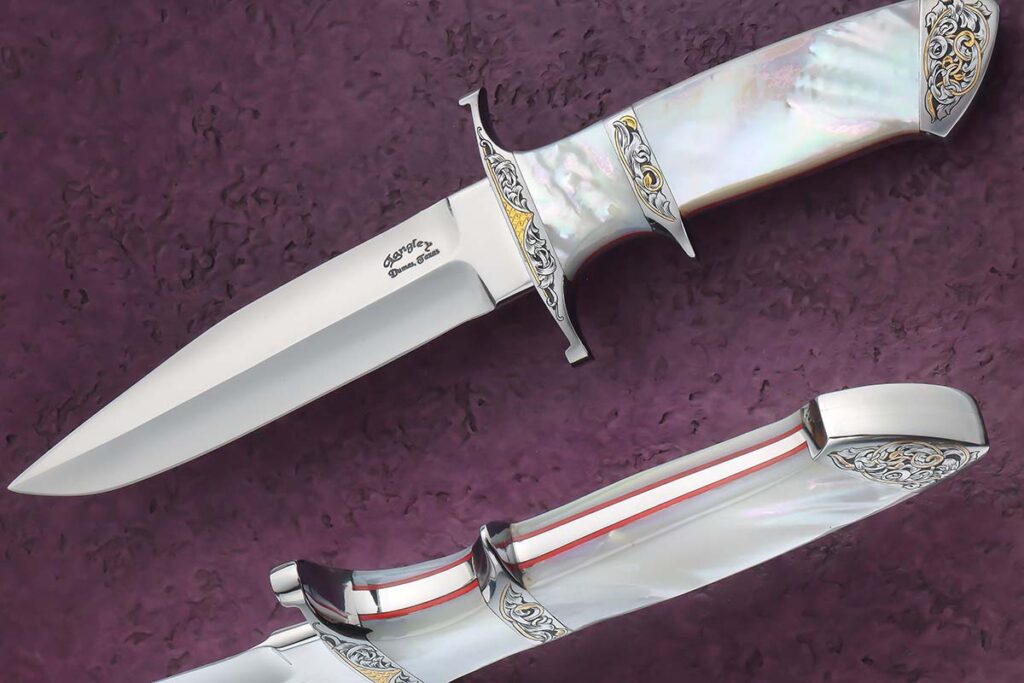
Custom maker Gary Langley’s sub-hilt fighter may be small at 9 inches overall but makes up for its size in sleek blade grinds, exquisite mother-of-pearl scales and gold inlay. Blade and overall lengths: 4.5 and 9 inches. Alice Carter did the engraving. (SharpByCoop knife image)
Many knife enthusiasts think of a sub-hilt fighter as being a heavier-edged companion—and in many cases it is—but custom knifemaker Gary Langley’s iteration is a little gem of a knife.
“The small Loveless-style sub-hilt fighter is 3/16-inch CPM 154 steel with a double hollow grind on a 3-inch wheel,” the Dumas, Texas, maker notes. “The heat treatment is by [Cutlery Hall-of-Famer] Paul Bos. I originally designed the knife without the rear bolster. I added it when I couldn’t source the mother-of-pearl scales long enough—and I believe it turned out even better.”
It has what might be called a 19th-century Michael Price San Francisco knife look that makes it a prime candidate for a true gentleman’s fixed blade.
Andrew Blomfield: Sub-Hilt Bowie
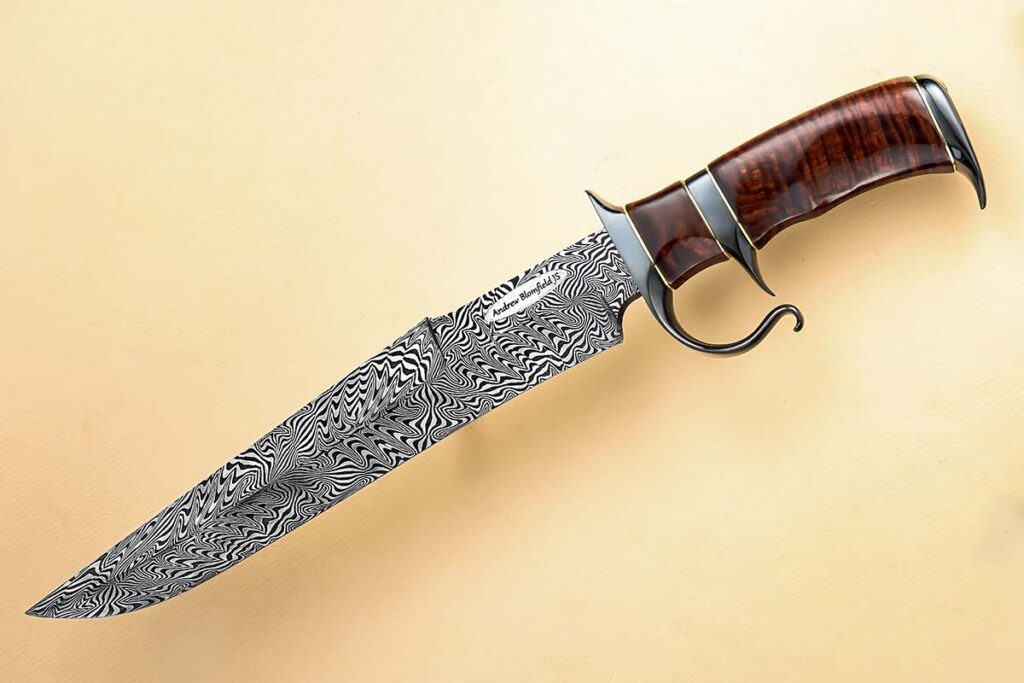
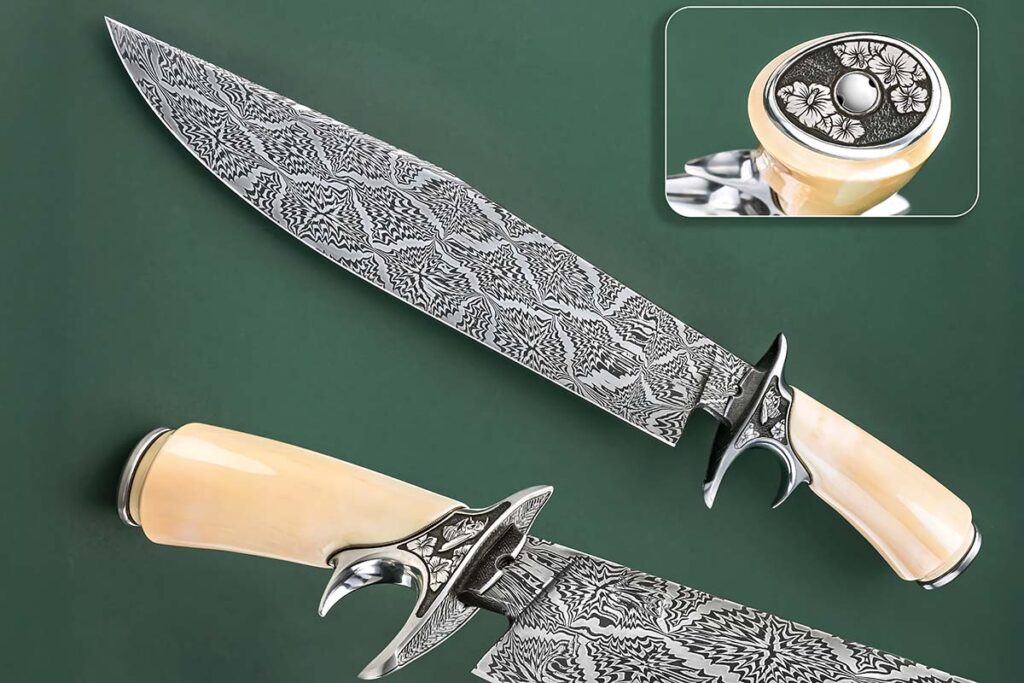
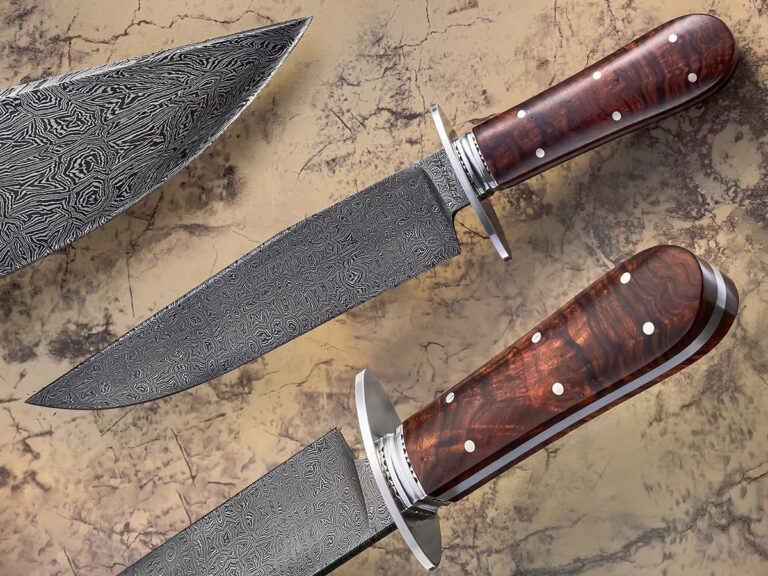
ABS master smith Andrew Blomfield’s sub-hilt bowie is a tour de force of explosive mosaic damascus, salt-blackened steel, brass spacers, and exquisite Australian ringed gidgee wood. Blade and overall lengths: 11 and 16 inches. (SharpByCoop knife image)
An ABS master smith from New South Wales, Australia, Andrew Blomfield enjoys building large knives such as bowies and daggers. “The bigger the knife the better,” he states. An example is his sub-hilt bowie.
“I feel that this knife has great flow and balance,” he begins. “The blade is an explosion mosaic pattern damascus hardened to 59 HRC. The guards and pommel are salt-blackened steel with brass spacers and the handle is a beautiful piece of Australian ringed gidgee.”
The guard’s bottom quillon curves back toward the sub-hilt to partially enclose the user’s hand a la a D-guard, but also has hints of both a C- and an S-guard to it. Very unusual!
Andrew Meers: Rose of Sharon
ABS master smith Andrew Meers calls his 16.5-inch sub-hilt fighter Bees and Flowers, due in no small part to the Rose of Sharon and bees engraving. The 12-inch blade is a damascus of 1084 carbon and 15N20 nickel-alloy steels in a mosaic pattern. Guard and furniture are 416 stainless steel. Overall length: 16.5 inches. (SharpByCoop knife image)
ABS master smith Andrew Meers of Raleigh, North Carolina, says, “I started with the sub-hilt in mind, which is a departure for me.” To say his deviation from the norm worked out well is an understatement.
“I like to incorporate Japanese influences wherever I can, and I wound up adding an integral habaki into the guard design as well,” he explains. “I wanted a blade that was able to feature a mosaic pattern, so I chose a broader shape that expands towards the point rather than tapers. The handle is a simple design to contrast the visual complexity of the guard.”
The engraving theme is of the Rose of Sharon and bees.
“The client had requested a floral theme, and we worked on the rest of the design and layout from there,” Andrew says. “The engraving was meant to complement the layout of the guard and furniture.”
Justin Harrington: A-Team
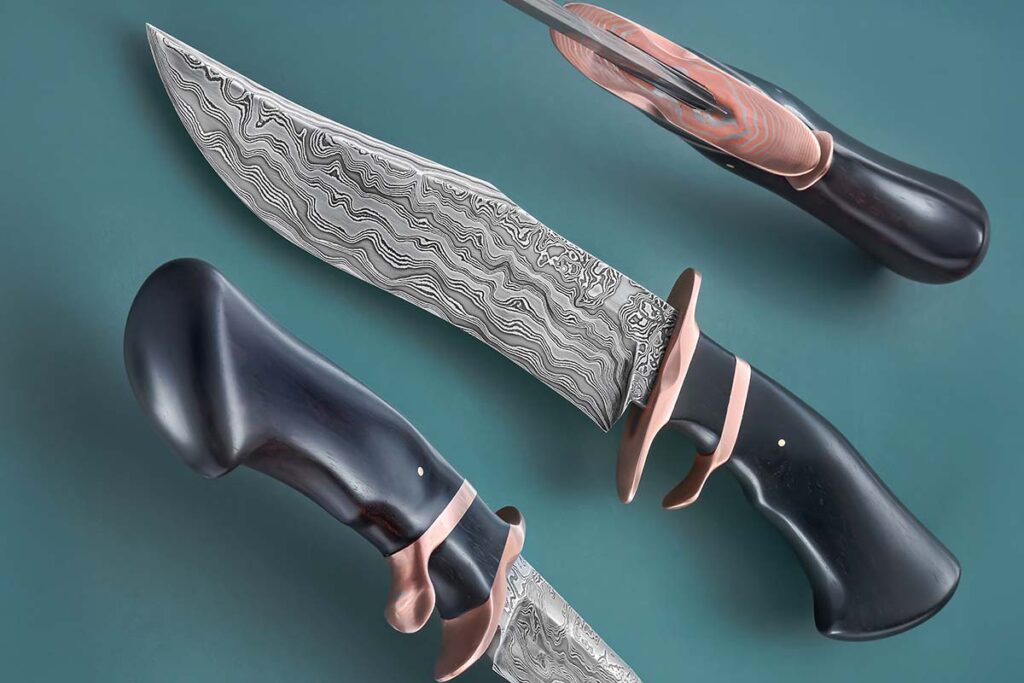
Built for an Army buddy, Justin Harrington’s superb sub-hilt fighter incorporates a masterful balance of random pattern damascus, mokumé gané and African blackwood. Blade and overall lengths: 8.5 and 13.5 inches. (SharpByCoop knife image)
Justin Harrington of Clemmons, North Carolina, began smithing 18 years ago and is the owner of Cyclops Forge. Of the sub-hilt he says, “It’s the racecar of fighting knives—weight, balance, curvature, tip control and placement all are important variables to be employed to reach a harmony which is felt right away when correctly done.
“This knife started its life as a phone call from an Army A-team member who wanted a special combat retirement gift for his buddy. The three of us got together and forged a damascus billet for the knife over three days in my shop. The 8-inch recurve blade is a random-pattern damascus of 1084 and 15N20 carbon steels. The guard and sub-hilt are made from a copper-and-nickel mokumé gané I make in my shop. The handle is around 5 inches of sculpted African blackwood with a bronze pin.”
The sub-hilt has a forward lean and spoon-cupped quillon that slants toward the guard to capture the user’s index finger. The result is a handle that seems to want to grab your hand.
Cool & Sexy
Whether fighter, bowie or what have you, the sub-hilt-knife genre may be more recognizably custom than any other. From the classic Loveless Big Bear fighter to the wide array of today’s renditions, top sub-hilts are cool, sexy and in harmony with the best custom knives extant.
Marine Corps hero feted with Nawrocki knife at The Battleship Ball.
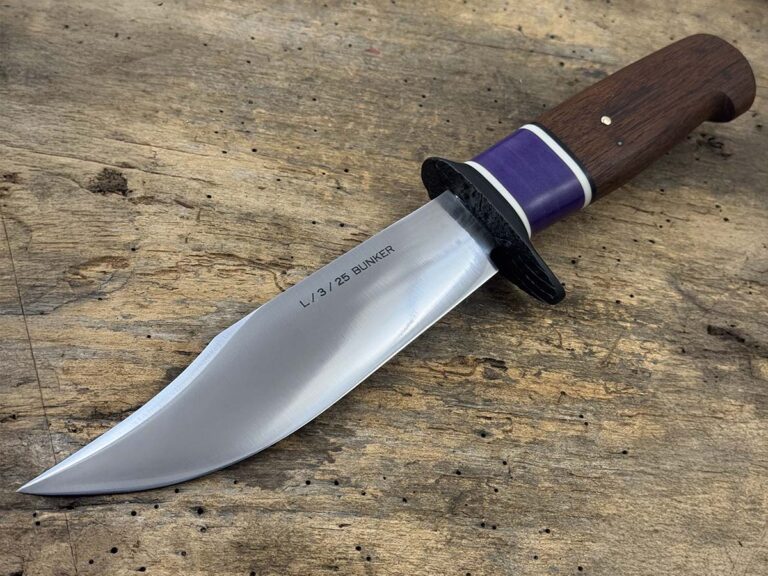
An unforgettable setting for a memorable event celebrating an American hero—all complemented by a beautiful knife by Brian “Rocco” Nawrocki—completed a tribute to USMC Sergeant Scott Bunker during last year’s 250th anniversary of the United States Marine Corps.
Assigned to Lima Company in 2005 during the Iraq War, Sergeant Bunker took multiple machine-gun rounds at point-blank range in house-to-house fighting, resulting in the loss of an eye, half a lung, several ribs and soft-tissue damage to his left arm. He was the guest of honor at The Battleship Ball 2025 on November 1, held on the deck of the vintage World War II Battleship USS North Carolina in Wilmington, North Carolina.
Event organizer/USMC veteran Dean Smith (left) congratulates Sgt. Scott Bunker after delivery of the Nawrocki tribute knife (in display case on the dais) during The Battleship Ball.
The handsome fixed blade Rocco made for Sergeant Bunker includes steel from the North Carolina for the blade and guard. The wood handle is teak from the battlewagon’s deck, along with purple heart ribbon spacers.
Stainless, high-carbon, super steels, see what 2025’s shakeups mean for knife steels in 2026.
Twenty-twenty-five saw radical change in the cutlery industry, but somehow the business of blades not only survived, in some ways, it also thrived. With new steels in the offing and despite a business environment made murky by the specter of tariffs, 2026 has several things going for it that could point to a year of continued resilience for knives.
Ironically, one of ’25’s biggest changes—the closing of Crucible Industries—did not turn out to be as debilitating as some thought it would be. While by mid-year there was no more Crucible, most of its coveted cutlery steels remained available, albeit under new manufacturer names (Knife After Crucible).
A steel processing company that came out quite well during the transition was Niagara Specialty Metals (NSM). Bob Shabala, NSM president, provided a look at the changes from an insider’s perspective.
Several sources say companies that manufacture their knives solely in the USA should experience little to no tariff-induced price increases in 2026. Case is such a company. The Crossroads Barlow features S35VN stainless blade steel and a black and tan Richlite handle. Closed length: 3.375 inches. MSRP: $118.99.
“Crucible’s decline didn’t happen overnight,” he notes. “Long before the shutdown, we saw signs of trouble: inconsistent allocations, slipping ship dates and growing uncertainty around future melts. As a steel processor that lives or dies by delivery reliability, we didn’t wait. We started to order more steel from Crucible to bolster our inventory in case something happened. We also reached out to Erasteel and Carpenter Technology to gauge their interest in supplying PM [powder metallurgy] steels. We have a long history with both companies and they were receptive to our requests. In September 2024, we started placing orders with both mills, not knowing that Erasteel would eventually buy the IP [intellectual property] and trademarks of Crucible in early 2025.
“In short, Crucible’s demise raised costs in the short term but also created an opportunity for us to buy high-quality steel from multiple suppliers. We diversified melt sources, invested in grinding/laser/ti capacity and kept steel flowing. The industry will come out of this with a more resilient supply chain, and makers will see faster builds and better consistency where it counts. If you’re a one-man shop or a major brand, you can get the material and the prep you need.”
Introduction MagnaMax Steel
Dr. Larrin Thomas, metallurgist.
Dr. Larrin Thomas is an acclaimed metallurgist whose web column knifesteelnerds.com is great reading if you want to stay current with knife steels. He sees the industry’s ability to bounce back over time as key to predicting events for the coming year.
“The huge changes in the ownership among steel manufacturers for cutlery consumers were minimal, mainly because the major players had a year to settle into their comfort zones,” states Thomas, whose portfolio as a steel designer includes the uber-popular MagnaCut. “Nothing changed as far as the king-of-the-hill steel. MagnaCut, which has been the most popular stainless steel among knife consumers for over two years, remains the top choice. That could change in 2026 because MagnaCut will be joined by a sibling dubbed MagnaMax.
“MagnaCut isn’t going away—its balance of edge retention, toughness and true ‘stainlessness’ keeps it the all-around benchmark. What’s new is MagnaMax: think MagnaCut-level corrosion resistance with meaningfully higher wear resistance, so edges hang on longer in abrasive cutting. That combination is why I expect MagnaMax to be one of 2026’s headline steels, especially in EDC folders, hunting/skinning knives, and pro kitchen blades that see lots of board or hide contact. MagnaMax complements MagnaCut rather than replacing it—pick MagnaMax when maximum edge life is the priority, MagnaCut when you want the ultimate do-everything balance.”
Knife Steels To Watch
AEB-L stainless will be one of the top blade steel choices for custom folders in 2026. Terry Jellison employs it on the blades of his Hobo Knife. Scales: mammoth ivory. Liners: brass. Closed length: 4 inches. The knife is not for sale. (Jocelyn Frasier image)
Despite or perhaps even because of the Crucible shakeup, manufacturers and custom makers have many steel options. Following is Larrin’s recap of the diversity of top-shelf options for 2026. First, the leading stainless steels for factory knives:
MagnaCut: Expanding across EDC folders, hunting knives and premium automatics as brands refresh the legacy of S30V/S35VN;
MagnaMax: Expect it to appear in the same knife types as MagnaCut and beyond. The appeal is simple: MagnaMax has the qualities of a stainless steel users already love (MagnaCut) but with more wear resistance for longer edge life, and;
LC200N and Vanax: Limited but visible in dive/fillet and salt-exposed knives where “no rust, period” is the spec.
Larrin’s top carbon steels for factory knives in ’26:
CPM 3V and CPM CruWear (aka NSM Wear): Factories use these steels selectively in choppers and survival/tactical fixed blades where warranty-safe toughness matters.
D2: The popular tool steel will persist in value lines, but you’ll see a gradual shift away from it toward tougher, easier-to-sharpen options. In the realm of carbon steels for custom knives, Larrin says Pop’s ProCut, a new blade material designed for use by bladesmiths, including in damascus, will shine. Its combination of nickel, tungsten and vanadium gives it high toughness and wear resistance while still being easy to forge and heat treat. It can be hardened in a 200°F window, which makes it extremely easy to heat treat. The high nickel content also makes it produce a bright layer in damascus. On the stainless custom side, Larrin says to watch these:
MagnaMax: Alongside MagnaCut and AEB-L, MagnaMax will be a go-to for customs where makers want a “set-and-forget” edge on EDC folders, hunting knives and chef’s knives. It delivers premium corrosion resistance plus a clear wear-resistance bump, which lets makers grind thin and still give customers long service intervals between sharpenings, and;
LC200N: It will fill a growing niche for dive knives, fillet knives, coastal EDC and pro kitchens where rust is the enemy.
Tariffs’ Affects On Knife Steel
Bear & Son is another company that manufactures its knives exclusively in the USA and that should experience little to no tariff-induced price increases in ’26. Its 11 7/8-inch White Smooth Bone Professional Fillet Knife features Sandvik 14C28N stainless blade steel. MSRP: $139.99.
Several sources say American consumers will see the effects of U.S. tariffs on both imported knives and/or the steel used in them in ’26—a double whammy in some cases. However, it’s too early to tell the overall impact tariffs will have on the prices American consumers will pay for imported knives. That said, enough has been done in the overall market to draw some conclusions as to what direction those numbers are heading in the knife market in general.
As for those who manufacture their knives in the USA, there will be little to no increase in prices, except for models that include some foreign-made parts. This is uncommon but a possibility, though for the most part, not a liability that cannot be overcome. Case, Bear & Son and others are among those that fall into this category.
The second group contains companies that do a large part of their manufacturing in the United States. Among those that fit into this group is Spyderco, which also has its “value line” of knives produced overseas. Sources say Spyderco can go with a bump in tariffs on its foreign-made knives, move all manufacturing in-house or ditch the value line entirely, though there was no indication at press time that the company will choose either of the latter two options.
Dr. Larrin Thomas says the new Pop’s ProCut blade material is designed for use by bladesmiths, including in damascus. Cliff Ivey combines it with 80CrV2 carbon steel for the damascus blade of his small hunter. Overall length: 6.25 inches. Cliff’s price for a similar knife: $450. (Jocelyn Frasier image)
Then there are American companies that produce the lion’s share of their knives overseas. CRKT is one such company. Sources indicate CRKT can work the tariff costs into existing pricing, move its manufacturing to a country that pays lower tariffs, or figure out a way to manufacture more of its knives domestically. Considering CRKT’s track record, it probably would be a mistake to underestimate the company’s ability to endure.
Bottom Line
While 2026 will have its challenges, barring any surprises, it should be relatively calmer than 2025 due to last year’s upheavals in the manufacturing sector and tariff-induced changes. Meanwhile, the cutlery industry remains healthy in both the budget, moderately priced and upscale sectors—and that is a very good sign.
Tony Lewis knife honors the late ABS master smith and chairman.
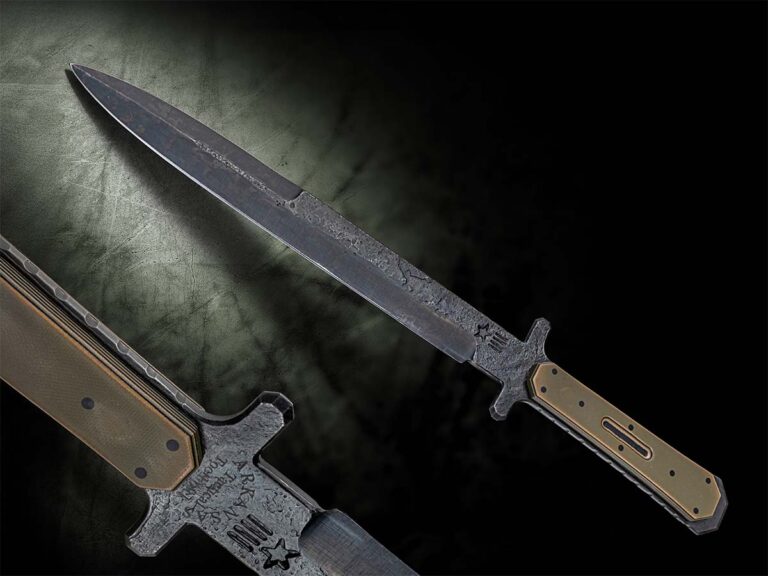
American Bladesmith Society Master Smith/past ABS chairman Steve Dunn was admired by many in the knife community and died way too soon at 68 in 2024. ABS Journeyman Smith Tony Lewis never met Steve but is a fan of his work, including Steve’s damascus pattern known as Thorns and Thistles.
Tony was fortunate enough to buy Steve’s Riverside hydraulic press, a purchase that included several of Dunn’s die sets. Among the dies was a saddle die—maybe the very one Steve originally used to make the Thorns and Thistles pattern.
Tony Lewis
“Recreating the Thorns and Thistles pattern was both a challenge and a joy,” Tony wrote. “Forging triangles and combining them into a cohesive mosaic was a new technique for me, but after some trial and error I managed to pull it off. When I finally etched the billet and saw the intricate pattern revealed, I felt a deep sense of satisfaction—and connection.”
After studying Steve’s signature style, Tony chose a bowie that he believes “embodies the spirit of Steve’s work.” The result is a terrific tribute to a most talented man.
Jesse Harber and Coy Baker forecast the hottest damascus steel for ’26.
There’s something about predicting the future that has intrigued humanity for ages. If you could just somehow know which stocks would turn a profit, which crypto would “go to the moon,” or which numbers were coming in the PowerBall, you like to imagine that you could really take advantage. Thus far the ability to accurately predict the future has been a challenge, which begs the question—what damascus steels and patterns will be hot for 2026?
Jesse Harber of Vegas Forge doesn’t hesitate to jump right in.
“Our Reptilian pattern stayed hot in 2025,” he observes, “and it should continue to do well.” Vegas most often uses a combination of AEB-L, 440C and 302 stainless steels for contrast in its stainless billets. It prefers the combination of O1 tool, 1075 carbon and nickel-alloy steels for its carbon varieties.
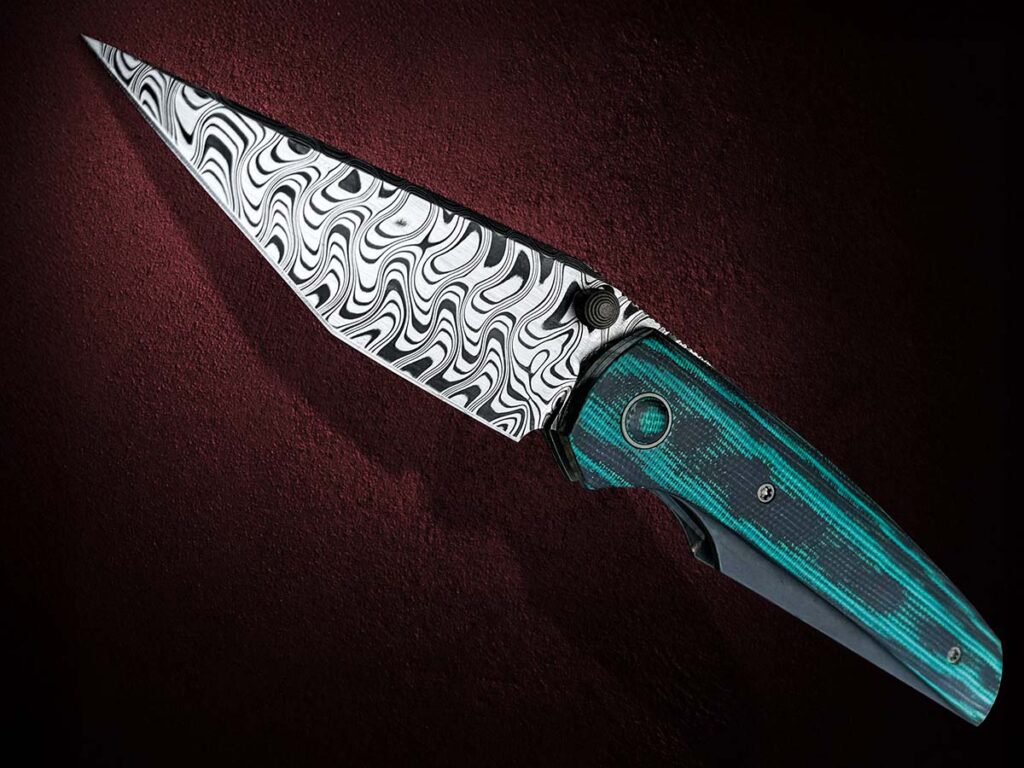
Jake McCoy used Baker’s Zeus stainless damascus for the blade of his folder.
Twenty-twenty-five was a fun year for Vegas Forge. It was able to continue making the steel it loves, the steel most knife enthusiasts all love to use—and it still managed to find time to innovate.
Makers have been using EDM cutouts in canisters to make unique figures and shapes for some time now. Over the past few years, a few have experimented with 3D-printed shapes inside canisters for truly limitless possibilities. Vegas has taken a different approach of using smaller cutouts within canisters that are then layered into “regular” damascus. There are obviously other critical details of the process not mentioned here, but the end result is small shapes or logos within the layers of the steel, not just as a shape like the other canister types you usually see.
Hammering Away At Baker Forge & Tool
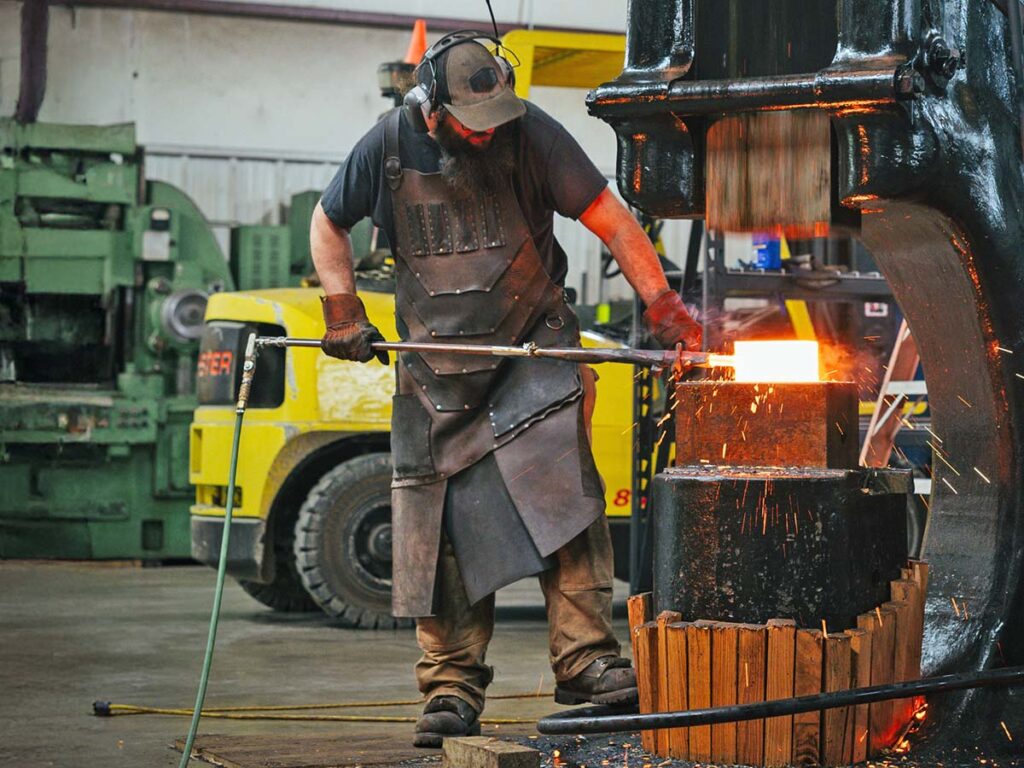
Coy Baker said Baker Forge & Tool is “really moving and shaking” for 2026, partly because of a new Chambersburg steam hammer converted to air. With a die surface of 6-by-14 inches and a 750-pound ram, the whole shop shakes when the hammer pounds on a giant billet. The hammer originally was used to make jib cranes for the Charlotte Railroad and runs on a 50-horsepower compressor with multiple 750-gallon air tanks. Coy stated he hasn’t pushed the hammer to its max, but said he thinks it can handle billets up to 35 pounds.
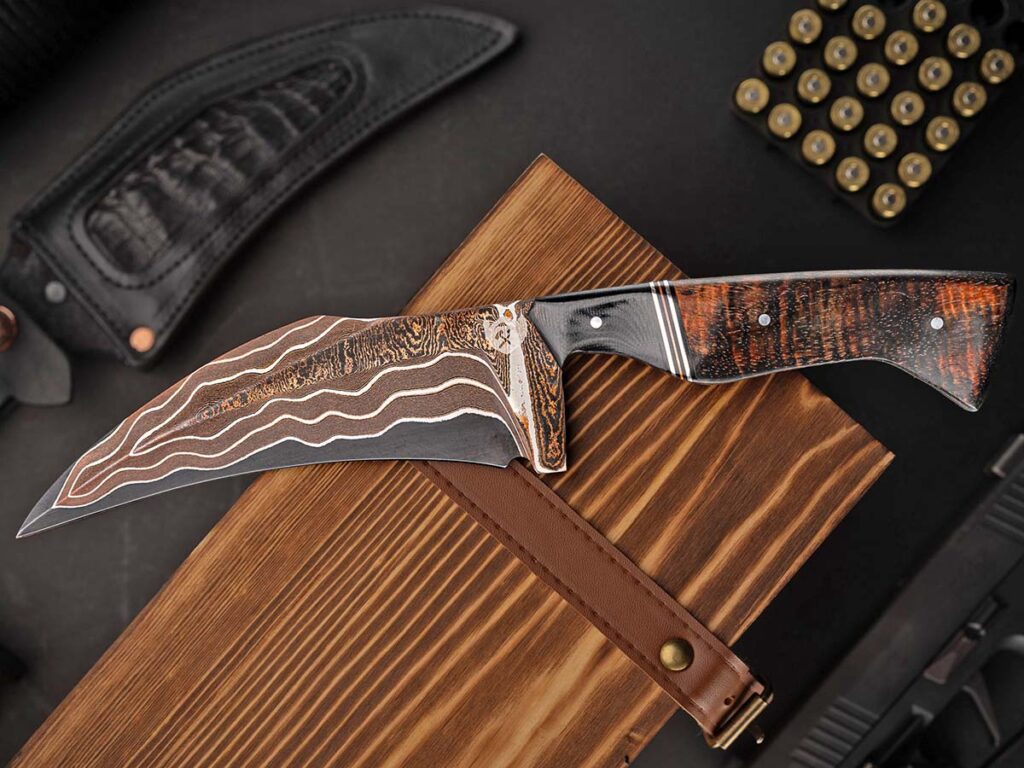
Baker’s Tsunami copper-mai steel is the material for the blade of a piece by Hans Molenkamp of Crimson Knife Co. (crimsonknives.com).
Why in the world would Baker Forge need such a giant hammer? Because the company, too, has been innovating and expanding into the production of stainless damascus. After two years of research and development and fine-tuning Baker’s processes for production, the prodigious pounder is finally up to speed. Baker prefers a combination of AEB-L and 154CM for its stainless damascus.
“The steel is really hard even when it’s hot,” Coy said. “Even with our 350-pound hammer it was like pounding on a rock.” The giant Chambersburg, on the other hand, moves a giant stainless billet with ease.
For those of you who don’t know, forging stainless damascus is quite a challenge, beyond the capability of many backyard smiths. Stainless steels contain high chromium, sometimes 12-to-15 percent, and chromium oxide doesn’t forge weld. Any oxygen at all in the forging environment and the welds simply will not stick. There are multiple ways to get around that, including inert gas purges and welding inside canisters. Add that to the fact that the stainless doesn’t like to move under the hammer and has only about a 100-degree-temperature window when you can safely work it, and you get a very difficult process.
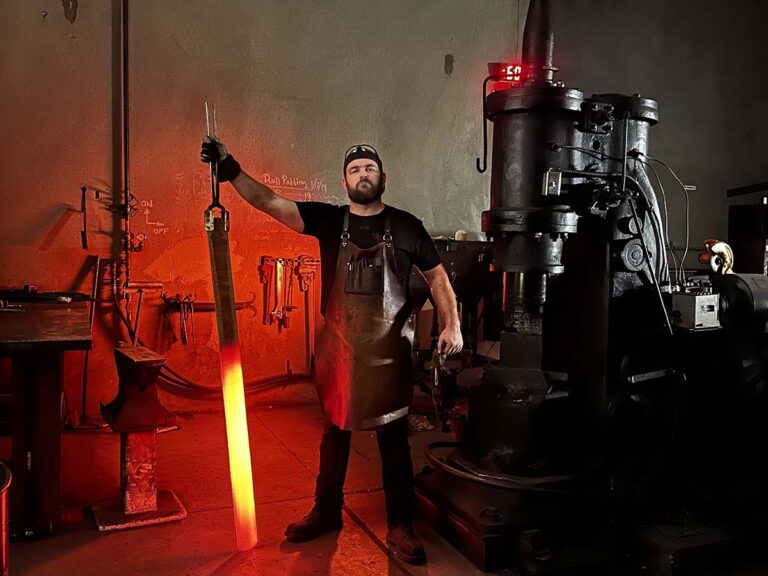
Baker Forge & Tool’s Will Spears forges a billet of stainless damascus on the Chambersburg high-frame power hammer at Baker. Built in 1946, the power hammer has a 750-pound ram and weighs just shy of 11 tons. “It took us 14 months to install,” Coy Baker laughed. “The foundation for it is over 12 feet deep.”
Baker isn’t just producing stainless damascus in run-of-the-mill patterns, it is innovating. It has developed patterns it will use in its stainless steel exclusively, particularly one called Zeus.
Copper damascus has long been Baker’s hottest commodity, and it’s still producing it at high volume and quantity. The company is pushing the limits there as well and has developed a method to weld and manipulate copper on the end grain. While the technique is under wraps, the results will be broadcast far and wide: copper damascus in formerly unobtainable mosaic patterns. When clad over a monosteel or carbon damascus core, the patterns stretch the imagination of what’s possible.
Steel Industry Challenges
Both Baker and Harber mentioned challenges and areas for growth in the steel industry. Baker was the first to put BLADE® on the story about Buderus apparently closing its primary mill for 10xx series steels. Coupled with the recent closing of Crucible on the stainless side (see our article on Crucible Industries closing), both Baker and Harber have been exploring new steel options in case their mainstays become unavailable. Vegas in particular is moving toward more cores of Nitro-V and Elmax and moving away from MagnaCut and XHP.
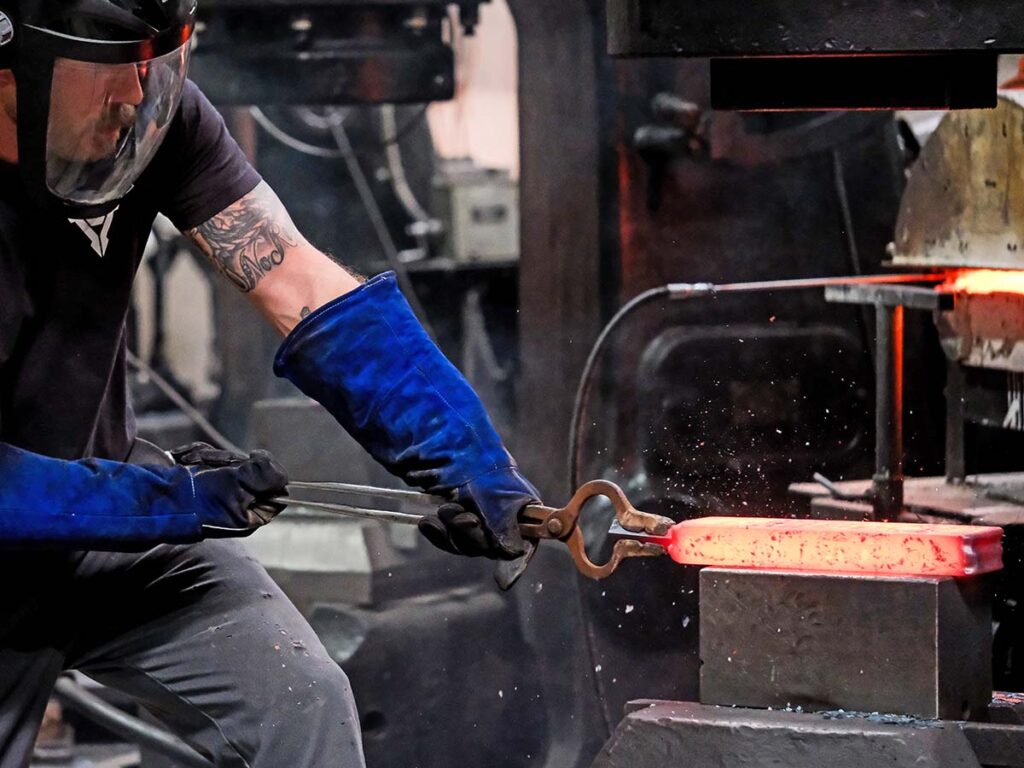
Vegas Forge team member Franklin draws out a 40-pound canister of stainless Raindrop-pattern damascus on the company’s 5B Nazel hammer.
The hot new kid on the block is ProCut, the brainchild of a partnership between Larrin Thomas and Pop’s Knife Supply. Both Vegas and Baker are looking forward to pushing the limits of ProCut. As a high-alloy steel, when combined with Apex Ultra, the maker achieves high performance out of what looks like “ordinary” 1084/15N20 damascus. If you think of the difference in performance between 1084 and 52100 carbon steels, you’re on the right track. Baker Forge is currently in the lead on the ProCut “arms race” but Vegas Forge has steel in hand and is ready to go.
What fun new things can we expect in the world of damascus in 2026? Vegas Forge is entertaining a few recent orders that sound interesting. There’s a maker in Alaska using Vegas material to make high-end custom ice skates, and another customer using the company’s material to make stainless damascus computer keyboards. Who’d a thunk it? For those who enjoy a good picture show, Vegas has another top-secret project in the works. Think aliens with amazing damascus weapons and tools and you’re on the right track.
Take two leaders in the field like Baker and Vegas, factor in the demand for their top steels and add lots of innovation, and you get the makings of a really great year to come in the world of damascus.
The story of a prototype Airman and a Marine pioneer.
Editor’s note: The author contacted BLADE® and asked if we would be interested in his story on a special Marine Corps knife and a special Marine to coincide with the semi-quincentennial of the United States Marine Corps. Needless to say, it was an easy decision on our part. Meanwhile, please join us in wishing a happy 250th birthday to the Corps and Marines everywhere.
The core values of honor, courage and commitment have defined the United States Marine Corps since its inception on Nov. 10, 1775. To remain an elite fighting force, the Marine Corps has adapted as the world has changed over the past 250 years, incorporating new technology and developing new doctrine.
One of the most significant transformations began with the birth of Marine Corps aviation in 1912. During World War II, Marine aviators played a vital role in the Pacific campaign, working closely with ground units to seize heavily defended island strongholds. As Gen. Keith B. McCutcheon, a pioneer of Marine aviation, later emphasized, “The Marine Corps is proud of the fact that it is a force of combined arms, and it jealously guards the integrity of its air-ground team.”
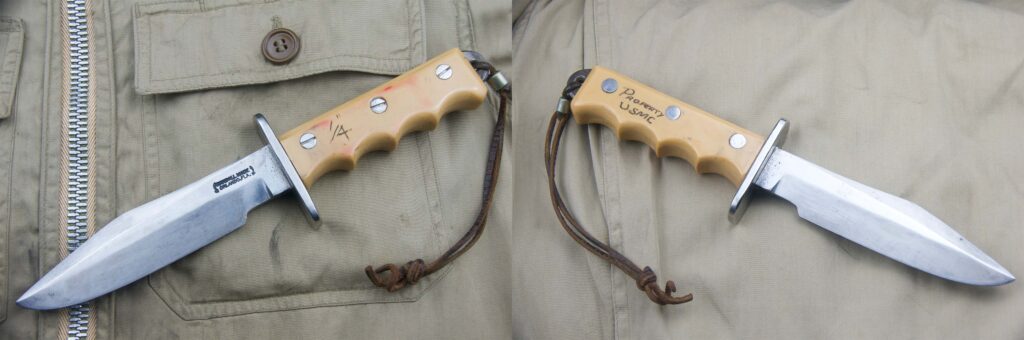
The mark and non-mark sides of a prototype Airman.
The evolution of air combat brought new challenges, challenges that extended even to the knives that aviators carried. One result was a collaboration between Marine aviators and BLADE Magazine Cutlery Hall-of-Fame® member Walter D. “Bo” Randall, who would redefine survival and combat knives with the now-iconic Randall Model 15. This article features one of Randall’s prototypes—a rugged, full-tang Airman’s Knife that was carried for more than 15 years by Gen. McCutcheon himself.
The Challenge
Marine aviators amassed extensive combat experience in World War II and Korea. By 1953, the Marine Corps recognized that the rigors of combat aviation demanded a new type of knife—one that was rugged, compact and versatile.
As documented by Randall historian Robert Gaddis, the Marine Corps Equipment Board assigned Lt. Col. H. Ross Jordan and Maj. Harold N. “Tex” Mehaffey to develop a survival and combat knife for Marine aviators. The knife had to be nearly indestructible—strong enough for an airman to pry, cut or smash his way out of a downed aircraft. At the same time, it had to be short enough to be worn in a cramped cockpit, and the sheath needed to allow the knife to be carried on the upper arm or lower leg.
Wearing his sheathed Randall Model 15 Airman on his left hip, United States Marine Corps Gen. Keith McCutcheon (center) is flanked by South Vietnamese Gen. Hoang Xuan Lam, Commander of I Corps, and USMC Gen. Edwin B. Wheeler (right), commanding general of the 1st Marine Division. (image of McCutcheon, Lam and Wheeler from somewhere near Da Nang, Vietnam, March 16, 1970)
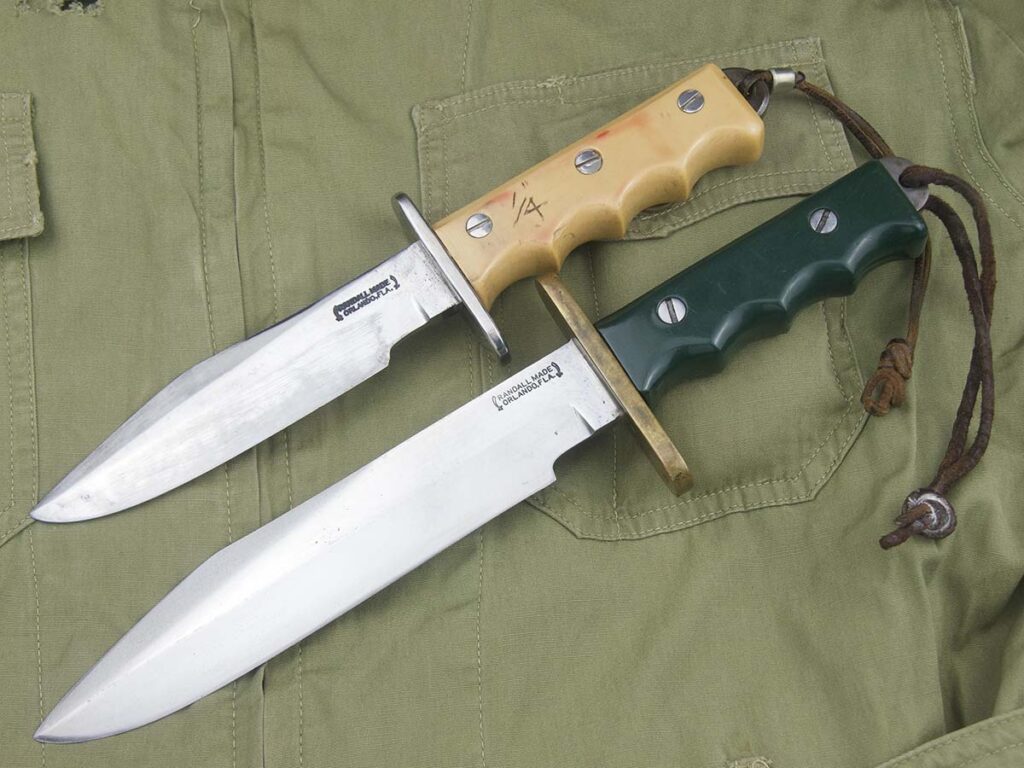
After reading a December 1953 magazine article about Bo and his expertly crafted blades, Mehaffey and Jordan arranged to tour his knife shop in Orlando on Feb. 11-12, 1954. By the end of their fruitful discussion on February 12, Bo had arrived at the basic design of the Randall Airman’s Knife. He also planned a longer-bladed version for ground troops, a design that would become the Randall Attack. Thus, this meeting launched the line of full-tang Randall models that would expand and evolve over the coming years.
Bo moved rapidly to fabricate prototypes that embodied his innovative design. The 5.5-inch blade would be forged from quarter-inch-thick O1 tool steel, a material that had been proven in earlier Randall combat knives. To strengthen the tip, the blade would retain the full quarter-inch thickness nearly to the point. To strengthen the junction between blade and the handle, the tang would be 7/8-inch wide along the entire grip. An extended segment of the tang would have a hole for a wrist thong and provide a surface that could be used for hammering. A heavy double hilt would prevent a gloved hand from slipping forward onto the blade. The handle would be made from a single piece of Tenite plastic, shaped with finger grips and a channel to snugly fit the tang. Stainless steel bolts would secure the handle.
To complete the package, Randall designed a sheath that could be worn on a belt, attached to a harness, or tied to the lower leg or upper arm with leather laces. It featured a diagonal keeper and rivets at stress points. The Randall shop completed the prototypes of the Airman’s Knife and the longer Attack Knife by the end of February 1954—barely more than two weeks after the formative design discussion—and Clarence Moore readied the sheaths soon after.
Three-star Gen. Keith McCutcheon, February 1970
The innovative features of the new knife and sheath designs were memorialized on certified blueprints on March 4, 1954. Randall filed a patent application on Aug. 11, 1954, and the United States Patent Office granted patent 177,590 for the Randall Airman’s Knife on May 1, 1956.
Prototype Testing
With prototypes in hand, Randall travelled to Quantico, Virginia in mid-March 1954 to present the new full-tang knives to Mehaffey, Jordan and other USMC and U.S. Navy officers. The group enthusiastically recommended that the Navy’s Bureau of Aeronautics purchase 10 prototype Airman’s Knives for evaluation: five from quarter-inch stock according to the original design, and five lighter examples from 3/16-inch stock.
The requisition arrived in early April 1954 and the shop shipped the 10 prototypes in early May. The invoice listed the Airman’s Knife as the #14, but later that month Randall adopted the still-current model numbers: the Airman became the Model 15, and the longer version became the Model 14 Attack.
The Marine Corps Equipment Board received two of the prototypes, one of each blade thickness, and the remaining eight were sent to squadrons and other units for real-world testing. In late May, Mehaffey informed Bo that preliminary testing had begun.
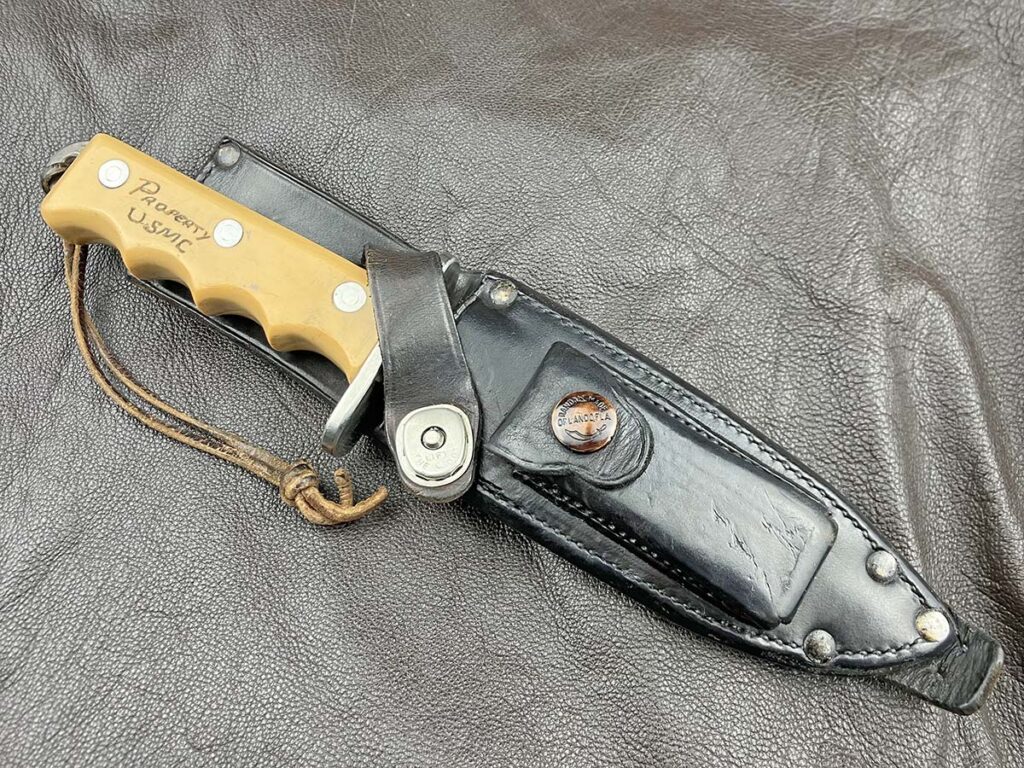
One of the original Randall prototypes is featured in the accompanying photographs. Made from quarter-inch steel, as indicated by the inscription on the handle, the prototype closely follows Bo’s patented design, except the blade lacks the fuller shown in the drawing. As in the original design, the prototype’s handle is secured by three bolts; this feature sets the prototype apart from later production examples of the Model 15, in which only two bolts were used.
Leatherworker Clarence Moore made the sheath for the prototype Airman according to Bo Randall’s design. Moore made the sheaths for the earliest full-tang knives until Heiser took over production in 1955.
The handle is made from white Tenite, a material used only for a year or so before Randall adopted the more familiar green Tenite that was characteristic of production for nearly 10 years, until Randall Made replaced Tenite with Micarta® in the mid-1960s. The prototype’s hilt is nickel silver in contrast to the brass hilts seen on almost all Model 15s with Tenite handles. The sheath was made according to Bo’s design by master leatherworker Clarence Moore, who made sheaths for the earliest full-tang knives until Heiser took over production in 1955.
After more than 70 years, the knife and sheath are in outstanding condition—a testament to Randall’s craftsmanship and superb design.
Project Setbacks
Despite starting with such promise, the project faltered in the summer of 1954 when Mehaffey was transferred for duty in France and Jordan retired. The departure of the two enthusiastic advocates delayed testing and communications. The next official update was in December 1954, when Bo heard that testing had been underway for two months with positive feedback. In April 1955, the United States Air Force also ordered a group of Model 15s for evaluation. Bo wrote again to the USMC in June 1955 but heard nothing further from the Marines or the Air Force.
Although Randall was never officially informed of the results, author Frank Trzaska uncovered a September 1955 testing report in the USMC archives. The report was authored by USMC Maj. Norman W. Gourley, who had succeeded Mehaffey. Extensive testing of the Randall Airman prototypes showed that the quarter-inch-thick version (i.e., Bo’s original design) was “suitable for aviators’ survival use.”
SONY DSCAfter a fruitful meeting on Feb. 12, 1954 with USMC Maj. Harold N. “Tex” Mehaffey and Lt. Col. H. Ross Jordan, Bo Randall had arrived at the basic design of the Randall Airman’s Knife (top). Bo also planned a longer-bladed version for ground troops, a design that would become the Randall Model 14 Attack (one from 1955 is shown at bottom). The meeting launched the line of full-tang Randall models that would expand and evolve over the coming years.
The report, which pictures this story’s featured prototype, notes the high quality of the design, materials and workmanship of the Randall knife and sheath and concludes that it is acceptable for extreme survival tasks. The report also noted potential changes that would improve the knife further, such as the addition of saw teeth, a flat butt surface for hammering, and different handle configurations. Bo independently incorporated most of these features in various full-tang Randall models by the mid-1960s, and presumably he would have made the changes sooner if the request had ever been made.
While the tests of the Randall Airman were underway, the Navy adopted the Imperial Pilot Survival Knife for its aviators. Because the Marine Corps operates as part of the Department of the Navy, this surely complicated any attempt by the Marines to adopt a different design. The Randall Airman was never issued by the military, but Bo added the Model 14 Attack and the Model 15 Airman to the new Randall catalog printed in 1954, which showed prototypes of both models as “patent pending.” As envisioned by Bo and the Marine aviators who helped to shape the design, Randall’s full-tang combat and survival knives were embraced by many American servicemen who purchased them privately, especially during the Vietnam War.
Pioneer & His Prototype
One Marine who had a high opinion of the Randall Airman was aviation pioneer Keith B. McCutcheon, who as a colonel served as Chief, Air Section, Marine Corps Equipment Board from June 1954 to July 1957. After the Randall Airman tests concluded, McCutcheon carried the quarter-inch prototype for the rest of his career.
An attack helicopter warms up in the background as Gen. McCutcheon surveys the situation six miles southwest of Da Nang, March 17, 1970, his trusty Randall Model 15 Airman sheathed at his side. At left is Gen. Edwin B. Wheeler.
In January 1966, while commanding the 1st Marine Aircraft Wing in Da Nang, Vietnam, then-Brig. Gen. McCutcheon wrote that the Airman was a “wonderful knife” that he had carried for “10 or 11 years.” Photographs from 1970 show McCutcheon wearing the knife when he returned to Da Nang as a lieutenant general and commander of the III Marine Amphibious Force (III MAF).
Commissioned as a Marine 2nd lieutenant in 1937, McCutcheon was a brilliant, courageous leader who transformed Marine aviation over the course of his illustrious 34-year career. Gen. Earl Anderson said McCutcheon “was one of the finest and most dedicated Marine officers [whose career] reads like a history of Marine Aviation. He earned his wings as an aviator in 1940 and served in World War II, Korea and Vietnam.”
McCutcheon was instrumental in integrating helicopters into Marine operations, and has been called “the Father of Marine Helicopters.” But, as historian William Fails observed, that title does not capture McCutcheon’s central contributions to numerous other areas. He also advanced close air support doctrine and techniques, guided missile systems, and the AV-8 Harrier jump jet. McCutcheon was also an effective leader of ground operations, launching successful operations as commander of III MAF.
For his exemplary service over 34 years, McCutcheon received many of the nation’s highest military decorations, including three Distinguished Service Medals, the Silver Star Medal, three Legions of Merit with Combat “V,” the Distinguished Flying Cross, 10 Air Medals and others. He was appointed to become the assistant commandant of the Marine Corps but was unable to assume the post because of failing health. He retired as a four-star general on July 1, 1971, and passed away from an illness soon after.
Enduring Legacy
On the 250th birthday of the United States Marine Corps, it is fitting to honor the legacy of Gen. Keith B. McCutcheon, an extraordinary leader who helped shape the modern Marine Corps. McCutcheon’s prototype Randall Airman remains as a tangible link to his many accomplishments and to the connection between the Marine Corps and Randall Made Knives.
Sources
William R. Fails. 1978. “Marines and Helicopters 1962-1973.” History and Museums Division, Headquarters U.S. Marine Corps. Robert L. Gaddis. 1993. “Randall Made Knives: The History of the Man and the Blades” Paladin Press. James Anthony Ginther, Jr. 1999. “Keith Barr McCutcheon: Integrating Aviation into the United States Marine Corps, 1937-1971.” Doctoral Dissertation, Texas Tech University. Norman W. Gourley. 1955. Marine Corps Equipment Board report A9-E-1039 on Project E-1039. Frank Trzaska. 2001. “Randall’s Model 15 & the U.S.M.C.” February 2001 Knife World.