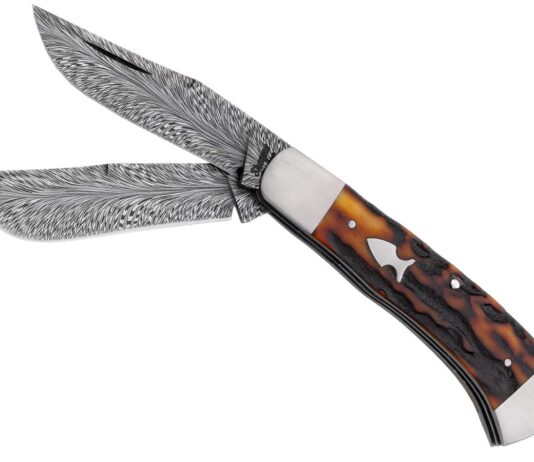
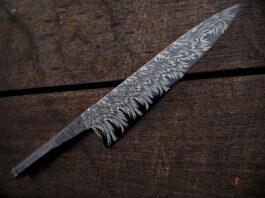
Knife collecting is an extremely rewarding experience for knife enthusiasts. There truly is a knife for everyone. Many increase or hold their value throughout the years, making collecting knives something to pass on to the next generation of knife collectors.
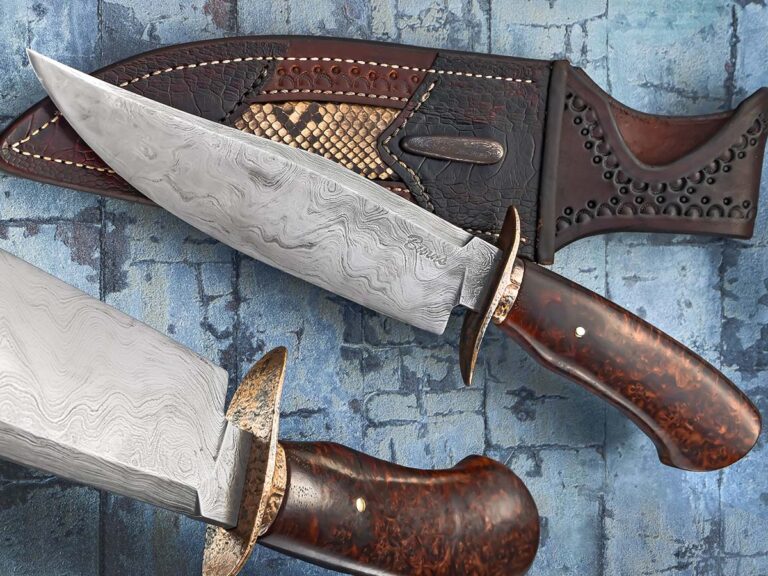
Explore the classic clip-point bowie knife from apprentice smith Robert Burns of Wilderness Ironworks.
ABS apprentice smith Robert Burns of Wilderness Ironworks wanted a project that would take him back to the roots of being a bladesmith, and appears to have satisfied that desire through his classic clip-point bowie.
“My goal was to combine the ancient and the contemporary,” he wrote.
For the ancient, he started with iron ore from Minnesota and iron sand from Connecticut. He smelted the two into bloom steel, which he then refined, “my goal being to make a steel fine enough that it could potentially pass for modern damascus”—thus the “contemporary.”
Robert Burns of Pittsburgh, Pennsylvania, used ancient materials such as iron ore and iron sand for the blade and a historic mix for the fittings of his sole-authorship bowie.
To augment the “ancient,” he used a “historic mix from the Bronze Age” for the bronze for the fittings.
As Robert noted, the knife is true sole authorship, from starting ore to the finished sheath.
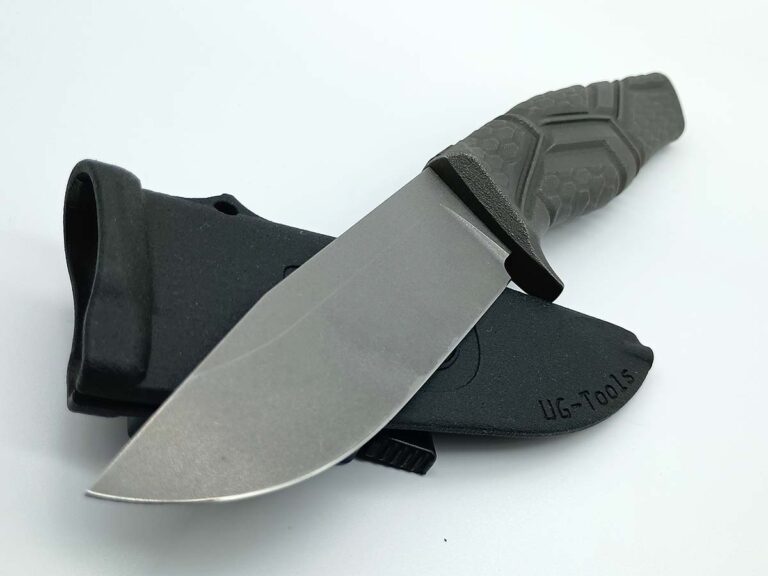
The TiNy packs hefty performance into a light package.
Despite hailing from Germany, Philipp Utsch and Jan Gierse are fluent in the basest American vernacular—Twinkies and violence.
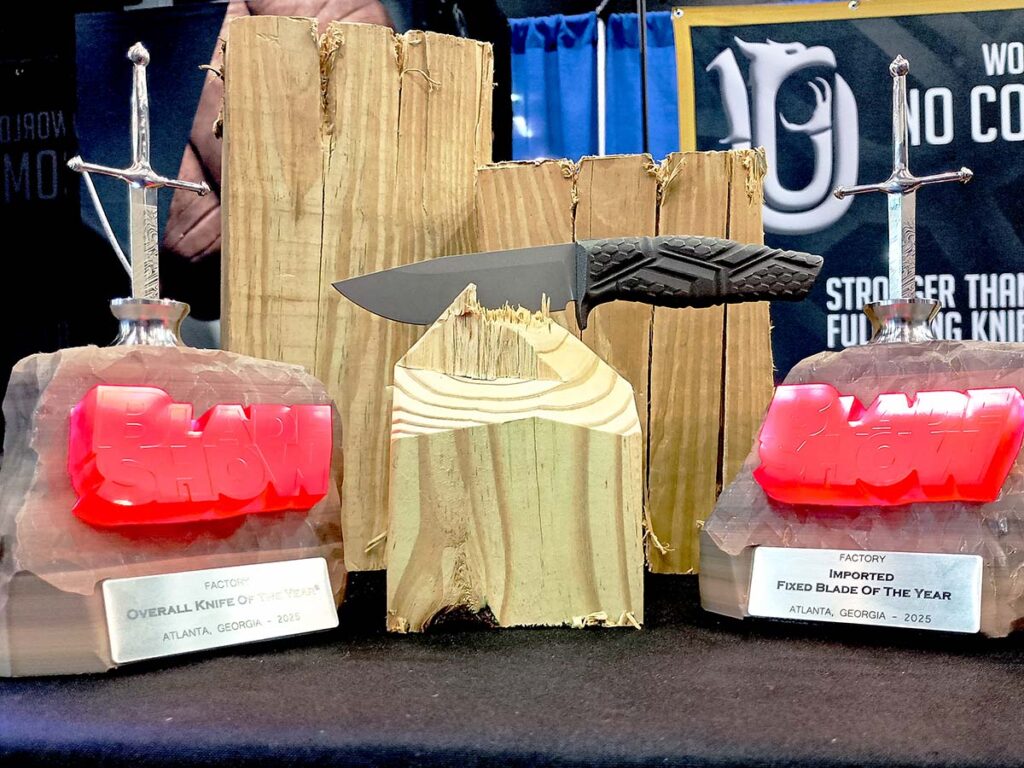
To say smashing a knife weighing all of two of the spongy confections through an 8-by-8 pine post was heard loud and clear at BLADE Show 2025 is an understatement. Aside from wowing some of the most discerning knife collectors, makers and users in the world, the tandem of Teutonic toolmakers also took home the event’s most coveted hardware.
It’s rare for fixed-blade knives to reach the pinnacle of edged tool accolades—BLADE Magazine’s Knife of the Year®. Yet, the German-made gem proved to have the edge over nearly 400 other knives clamoring for the singular honor. How?
Quite simple. Utsch and Gierse’s burgeoning knifemaking concern—UG Tools—and its award-winning knife—the TiNy—took the world’s oldest tool and firmly planted it in the 21st century.
One of the more interesting aspects of the TiNy’s meteoric rise is that this was UG Tools’ first official appearance at the BLADE Show. Utsch and Gierse were in attendance at the 2024 edge-stravaganze, but as attendees, not exhibitors.
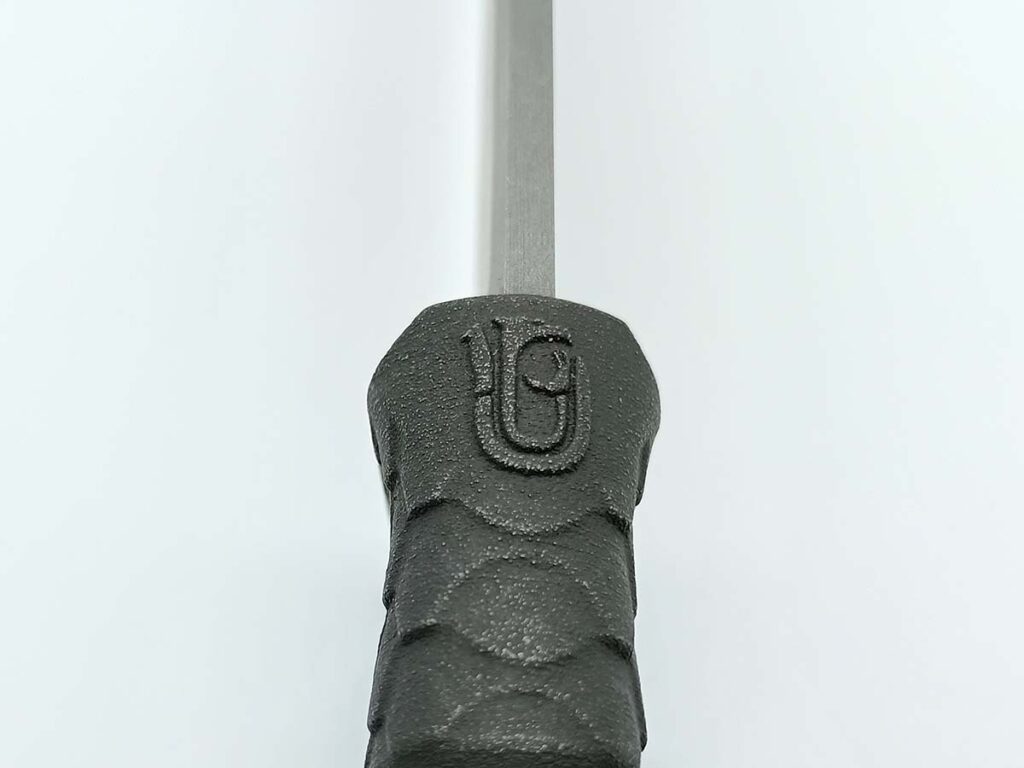
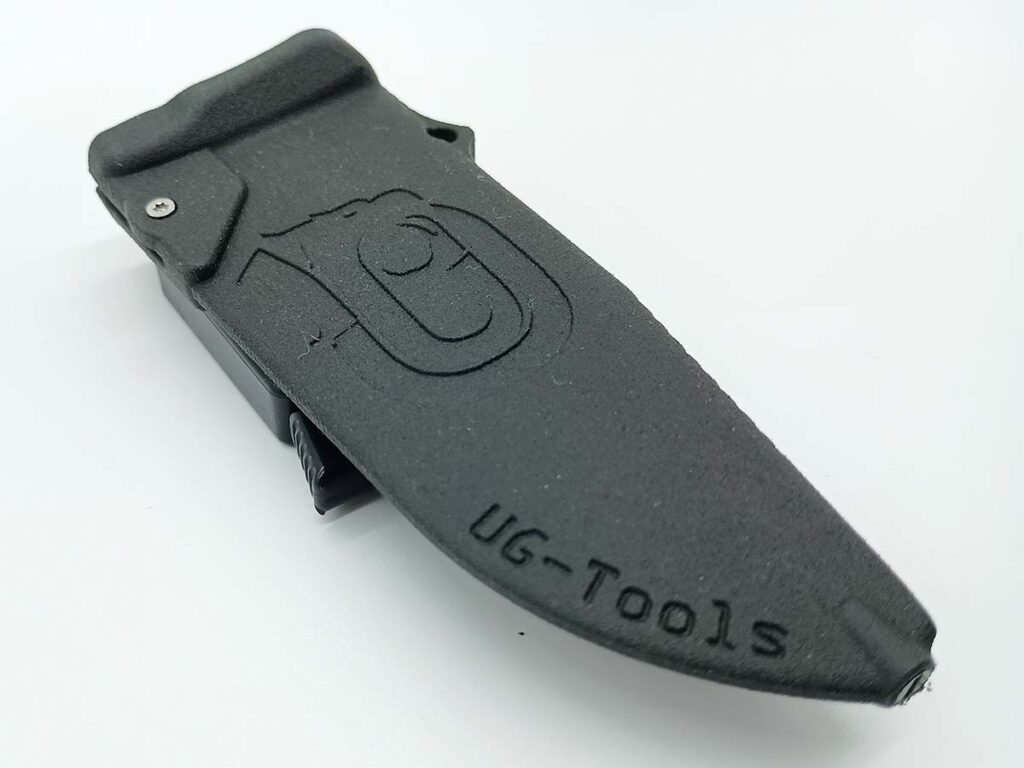
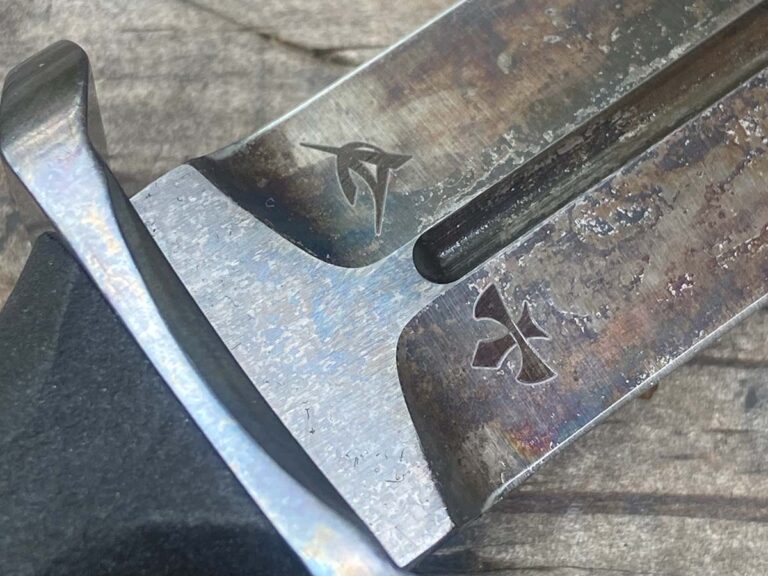
UG Tool’s mark is a combination of the founder’s last initials and some Teutonic ferocity.
The duo’s concern is also relatively new, founded in 2021. Not that knifemaking, fabrication and manufacturing were mysteries to UG’s founders.
Utsch has 20 years of knifemaking under his belt, but his daytime gig was a maintenance manager* in the founders’ hometown of Sundern. And Gierse’s career aspirations were focused on manufacturing, as he was pursuing his PhD in mechanical engineering.
It turns out, there was a lot of serendipity in those backgrounds.
Gierse’s topic focus is 3D printing—in particular, Selective Laser Melting (SLM). When he first moved into this field academically and got access to an SLM machine, a titanium knife handle was among his initial projects.
Down the line, that handle ate at him. He saw its potential, something revolutionary. He was acquainted with Utsch and approached him with the idea of teaming up to create a complete knife.
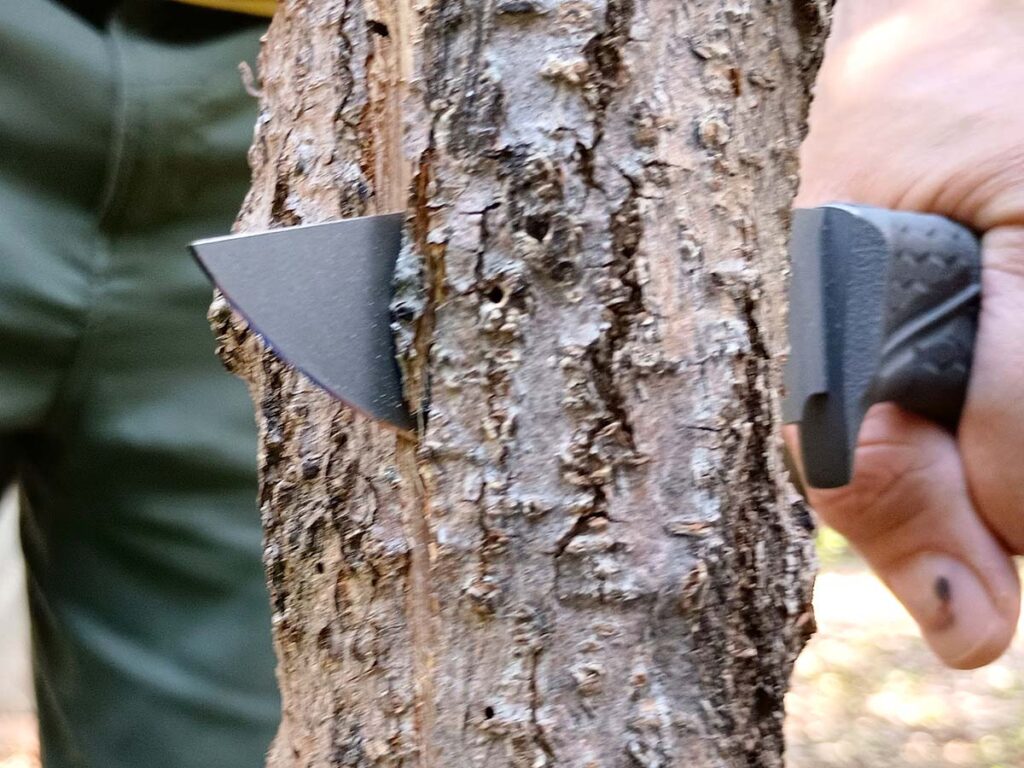
Thanks to its innovation and performance, the TiNy won both Imported Fixed Blade Knife of the Year and Knife of the Year® honors. It’s also stuck into some of its handy work, as the guys from UG Tools hacked through fence posts to demonstrate the knife’s resilience.
The bladesmith was instantly intrigued.
“[W]hen Jan suddenly sent me a photo of the first titanium handle out of the blue in 2021, I knew immediately what I was looking at. The potential was immediately clear to me,” Utsch said.
Getting A Handle On The TiNy
Funny as it might sound, the handle is the belle of the ball on the tiny. It’s where much of the innovation lies.
Additive manufactured, and hollow, the human-tool interface cuts the knife down to a scant 2.82 ounces—or two Twinkies. For a practical-tactical knife, this opens up a wealth of potential.
The old saying for backcountry hunting, military campaigns or just plain hiking is “Ounces make pounds, and pounds make pain.” At 8.27 inches in overall length, weight savings are substantial for a full-sized hunting, camping or military knife (the TiNy could fill all three roles).
UG’s design prowess overflows to the TiNy’s sheath, a sturdy Kydex unit with a retention-adjustment screw and UltiClip UltiLink for unlimited attachment/carry options. An aside, given the hollow handle, it makes a very satisfying ping when clipped all the way into its sheath.
However, keeping things light isn’t the only advantage of the 3D printed handle.
TiNy’s Big Ergonomics
The sky is nearly the limit when it comes to SLM manufacturing, allowing for the TiNy’s advanced—if not nuanced—ergonomics. From the Pango model, I spentd time testing, which isit’s the most enjoyable aspect of the knife.
Plain and simple, in my medium-sized mitts, it feels good to hold.
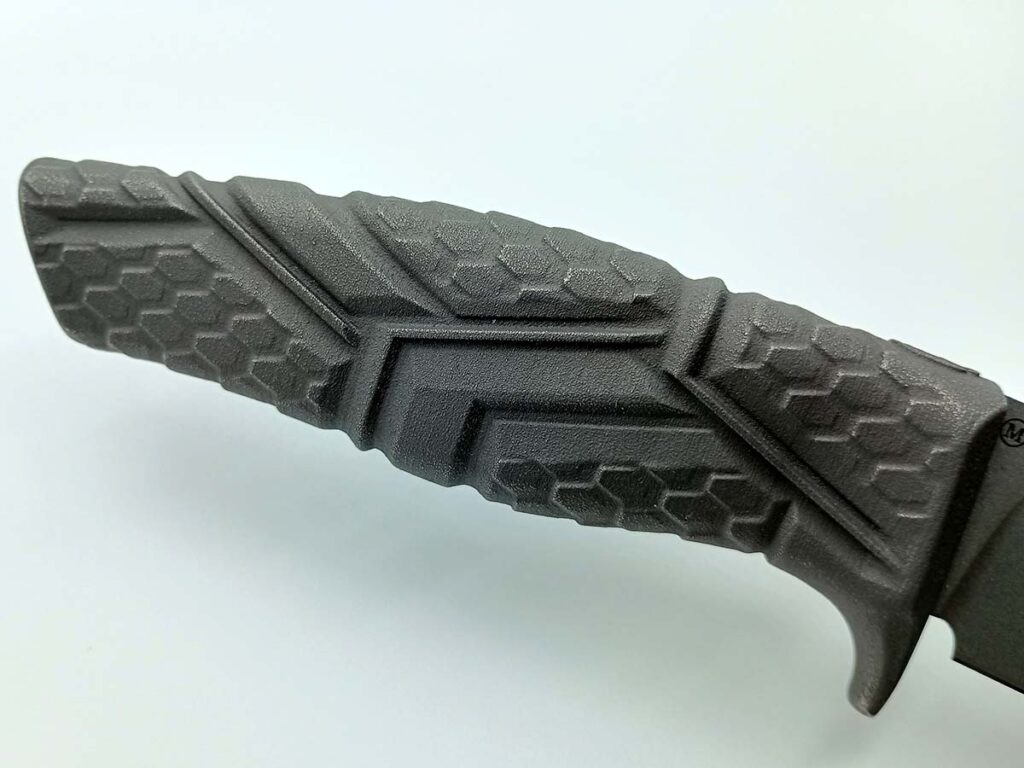
Well thought out, the handle swells and recesses at the right spots to form-fit my medium-sized hands. Yet, but for my money, the integral grip texturing gets the most accolades. A mixture of dragon scale and linear elements—with a fine pebble finish—the handle stays in place no matter what axis force is applied.
The TiNy’s 3D-printed handle isn’t only lightweight, but also as comfortable as the day is long. In testing, the Pango pattern stuck firmly to the hand without firing up a hot spot.
A final point, the knife is extremely well-balanced. Using my finger as a fulcrum, it’s right behind the guard, making the blade very agile and easy to manipulate.
TiNy Blade
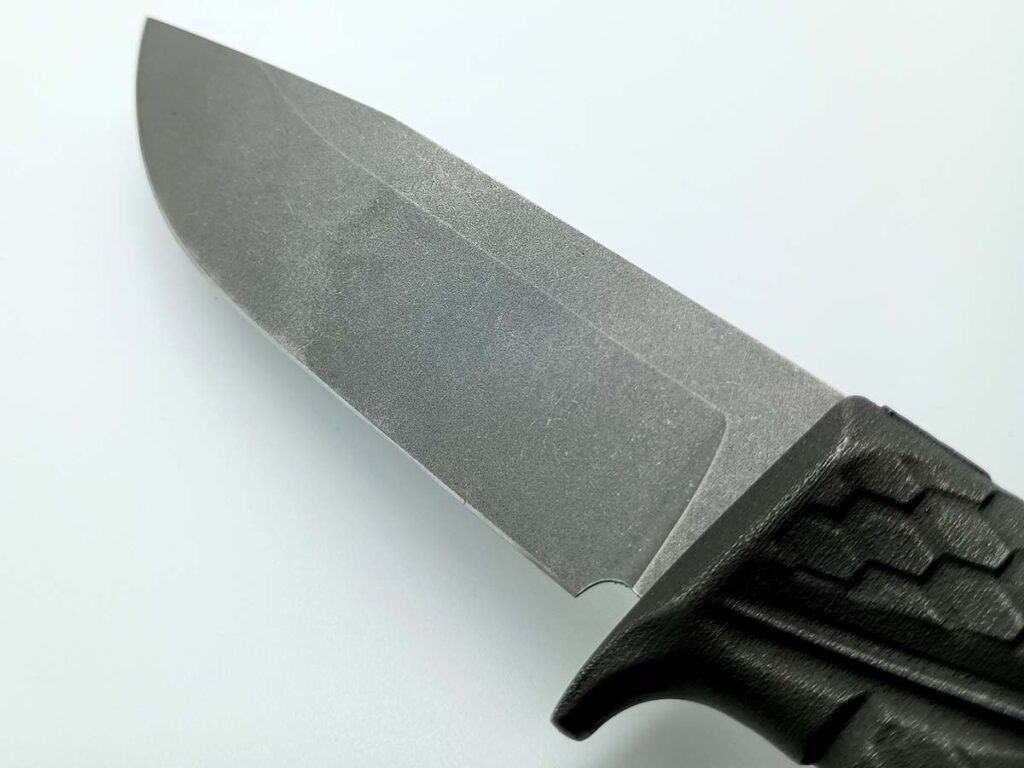
The 4-inch drop-point blade is very clean and understated, but well-formed for a general outdoor knife. Given UG pulled out all the stops and used MagnaCut steel, it’s also more than ready for hard use.
I appreciated the long, straight cutting surface just behind the belly. It is ample enough to facilitate larger push cuts and gives it plenty of edge on pull cuts.
Turning to Magnacut steel, UG produced a high-functioning cutting tool that requires little maintenance. Through general testing, the knife retained the same edge with which it came out of the box.
The drop on the point was just right for me to index when choking up on a pinch grip, like you might use field dressing a buck or the like. And the blade’s stonewashed finish gives it a level of tackiness, as well as hiding inevitable abuse.
TiNy Ruggedness
Interestingly, the TiNy is neither a full nor a classic tang knife, a fact that might get some traditionalists to clutch their pearls. Utsch and Gierse whacking it through an 8-inch by 8-inch post should put to rest any concerns about durability. But what’s going on to keep the blade and handle happily married?
“The extreme load-bearing capacity is achieved by the very precise press fit, in which the oversized blade is pressed into the undersized handle,” Gierse said. “This type of connection has been proven in industry for well over 100 years and transfers forces through a permanently elastic, form-fitting connection.”
UG’s knife made quick work battoning through a nearly 3-inch diameter elm log.
UG has done its testing on the knife, as well as sold several thousand and has yet to encounter a blade-handle separation.
“So far, we have not been able to damage the connection between the handle and the blade, even under extreme stress tests,” Gierse said. “This makes the knife behave like an ultra-light, fully integrated knife. Of course, the blade can break under excessive overload, just like any other knife. Despite the best heat treatment and steel, there are natural physical limits that even we cannot overcome.”
Testing The TiNny
I would have liked to have tested the TiNy during hunting season, to really put the knife through its paces. However, I received my test model during the summer and deadlines call.
In turn, I put it through a small, very unscientific laboratory evaluation that included:
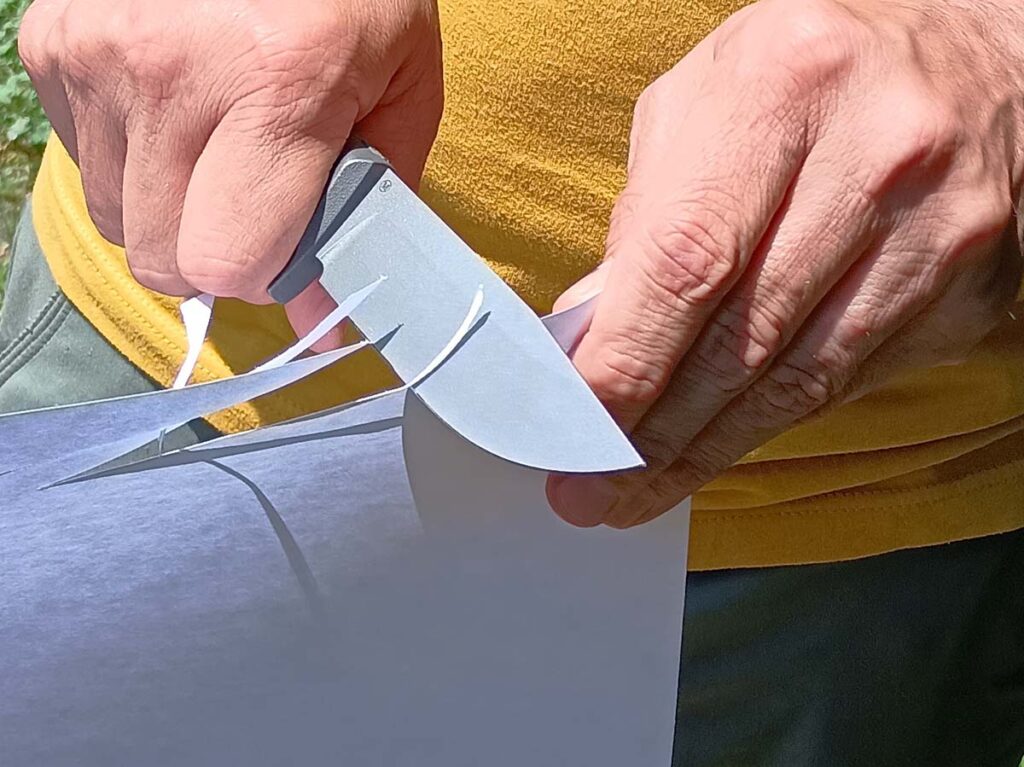
Initial sharpness test on 20-pound bond paper: The tiny passed my initial sharpness test with flying colors.
Push-cut test on 1/8-inch thick1/8-inch-thick leather: It snapped straight through the leather with an audible pop.
Pull-cut test on ¼-inch double-wall cardboard: The knife made quick work of the cardboard, through 100 some cuts.
Durability Test Battoning Siberian Elm Log: Had no problem passing through a seasoned 3-inch diameter log, splitting it roughly a third of the way through. Will note, this did mar the blade finish some.
Follow-up sharpness test on 20-pound bond paper: No edge loss from the initial test.
Overall Impression
I was impressed with the cutting performance of the TiNy; however, I wasn’t too surprised given the blade material. There’s a reason why MagnaCut continues to demand respect in the marketplace and this was proven out by the blade maintaining its edge after moderate use.
I walked away most impressed with the comfort and controllability of the knife, thanks to a well-thought-out handle. I did wonder if the linear aspects of the texturing would prove hot with extended work. This wasn’t the case. I could have worked all day with the TiNy and not thought twice.
Before and after testing, the TiNy’s blade was razor sharp, able to shave through 20 bond with ease.
I’m not the only one.
James Rodebaugh met Utsch and Gierse in 2024, when they attended the BLADE Show as attendees. The duo gave the ABS Master Bladesmith and custom knifemaker a TiNy for field testing, with Rodebaugh taking it on hunting trips in both Alaska and Wyoming.
Dressing game and spatchcocking fowl, the knife proved resilient. He also tested a concern I have with any metal-handled knife—performance in cold weather.
“The printed titanium handle surprised me,” he said. “I thought it would be cold to the hand but warmed to body temp from approximately 20 degrees Fahrenheit in a heartbeat.”
Good to know you won’t take off palm flesh if you’re gutting a deer in the bowels of winter.
Final Cut
Rarely do knives—even ones deemed top-of-class—vastly change the manufacturing landscape. Is the UG TiNy one of those sea-change pieces of cutlery? Only time—and likely mimicry—will tell.
What can be said is that Utsch and Gierse have concocted a version of the age-old fixed blade that firmly plants its feet in modern manufacturing. And they’ve done so at a level that should make the TiNy a useful and trustworthy piece of kit, be it in the backwoods or battlefield.
For two Twinkies’ worth of knife that’s pretty sweet.
Davidson’s integral salutes a unit that lost over 800 men on D-Day.
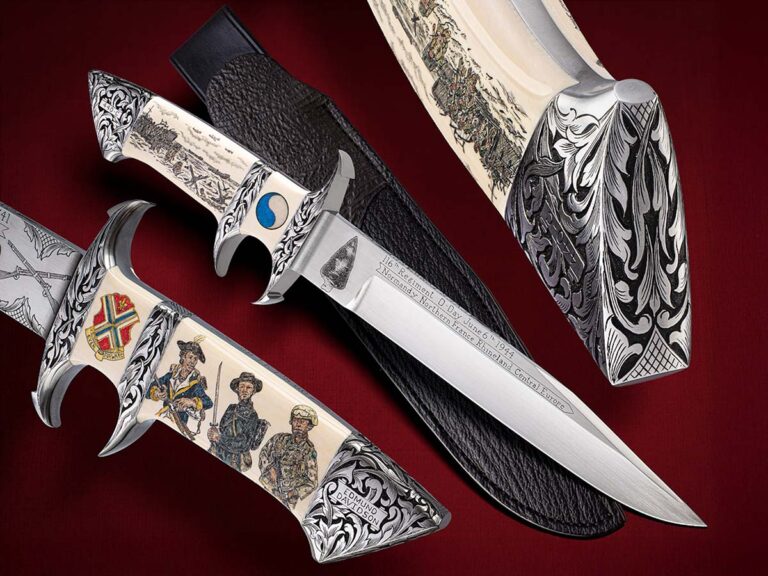
Made to support The 29th Division Museum in Verona, Virginia, Edmund Davidson’s integral subhilt fighter celebrates an American combat unit that’s served valiantly for almost 284 years.
The Augusta County Regiment formed on Nov. 3, 1741, in Staunton, Virginia, and fought in most every American war, including the American Revolution and the battle of Manassas in the Civil War. It became part of the U.S. Army’s 29th Division in World War I and adopted the theme of “Ever Forward.”
As the 116th Regiment it was in the first wave on Omaha Beach on D-Day, where it lost over 800 officers and men and was later cited by the War Department for extraordinary heroism and outstanding performance of duty. The regiment also saw action in the Iraq and Afghanistan Wars. Today, the 116th remains active as a National Guard Unit.
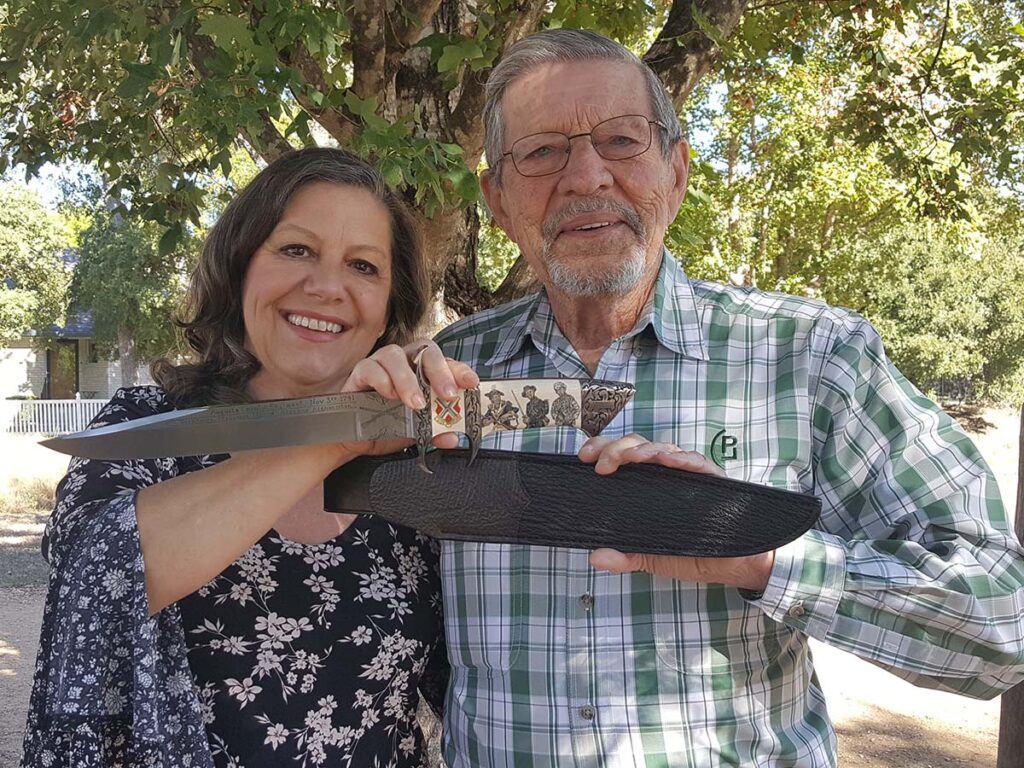
Scrimshander Linda Karst Stone (left) and sheath maker Paul Long (right) hold the completed project. (knife image by Whetstone Studio)
Linda Karst Stone scrimmed the Omaha Beach battle scene on one side of the handle and unit members from the American Revolution, Civil War and today’s 116th on the flip side. The copious scroll engraving on the butt and guard is by Jere Davidson. Paul Long made the shark-skin sheath.
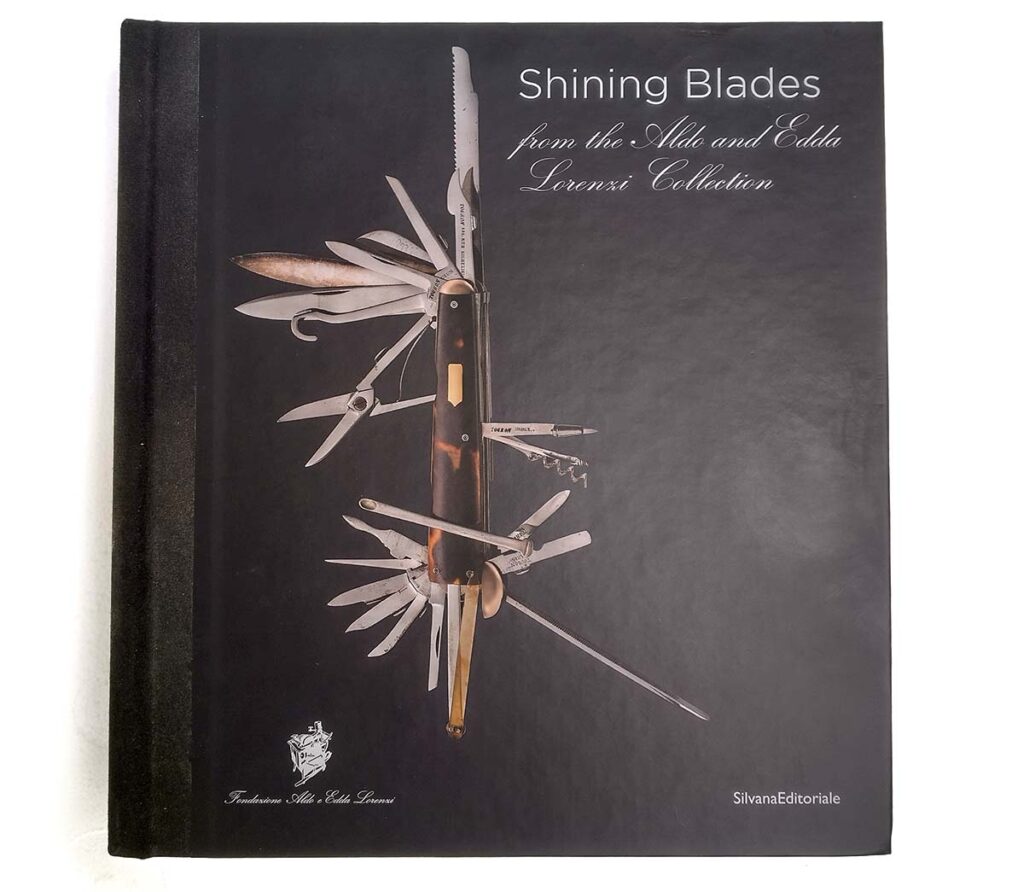
Cutlery Hall-of-Famer’s book showcases the most unique, historic and outlandish blades to enter their treasury.
Probably the most important international buyers of modern American custom knives ever, BLADE Magazine Cutlery Hall-of-Fame® members Aldo and Edda Lorenzi bought and then sold those knives and many other edged items in their iconic G. Lorenzi retail cutlery store in Milan, Italy.
Located on the Via Montenapoleone in the heart of Milan’s elegant retail sales district, and under Aldo and Edda’s direction, G. Lorenzi sold the finest knives, scissors, razors, table cutlery and assorted other edged wonders from 1959 to 2014, serving customers from every corner of the globe.
If you read BLADE® regularly, you know of the Lorenzis—but mostly only through the eyes of BLADE. In their new book, Shining Blades from the Aldo and Edda Lorenzi Collection, the Lorenzis recall their journeys far and wide in their lifelong search for the finest blades as only they can tell it, from the age of Elvis and crewcuts to the internet era.
Intrepidly scouring Europe, America and elsewhere for cutting tools of all kinds, the Lorenzis chronicle their travels in Shining Blades. From Aldo doubling Edda on their Guzzi Galletto motorbike through the snow and rain in the Alps on their first working trip to Fance in the early 1960s, to their early visits to the knifemaking shops of John Nelson Cooper, Cutlery Hall-of-Famer Bob Loveless and many other of the most famous American makers and beyond, the Lorenzis share their incredible story.
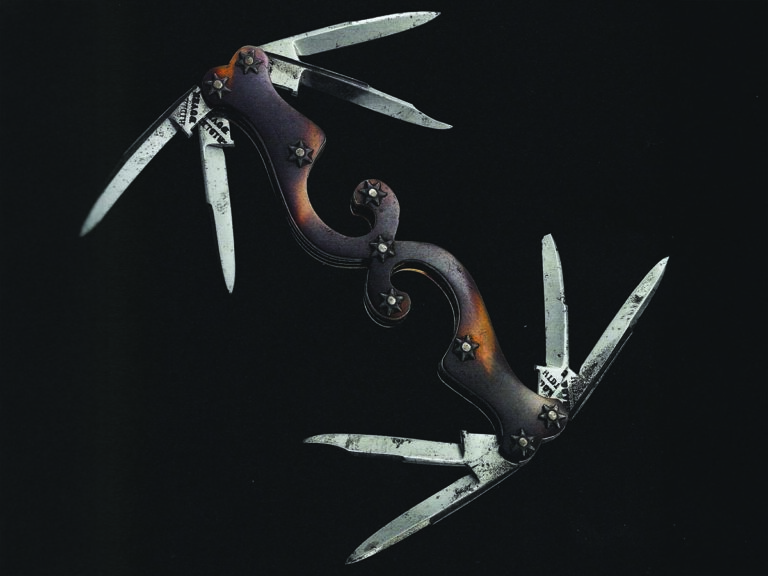
Shining through it all are full-page color images of some of the most spellbinding edged implements you will ever see. In addition to buying them the Lorenzis collected the vintage edged implements along the way. Bronze-Age spoons, folding forks and unbelievable folding knives of the 17th century forward are just some of the visual feasts of the edged art that populate the book’s pages.
For instance, if you think you’ve seen all there is to see in scissors, think again. The images of vintage scissors alone are enough to fill an encyclopedia on the subject. Spectacularly ornate and mystifying in construction, the scissors the Lorenzis amassed over the decades alone will take your breath away.
The preceding simply scratches the surface of what the book is all about. Most of what is illustrated and much more can be seen in the state-of-the-art Aldo and Edda Lorenzi Foundation museum in Milan.
The book also delves into some of the oldest knives known, from the 5,000-year-old knife of Otzi the Iceman discovered in 1991 on the Austrian-Italian border, the finest in European custom knives and knifemakers, ancient books on all things cutlery, notes on damascus steel and much more.
It’s all contained in a top-quality, 9 x 9.75-inch hardbound book with 344 pages that will provide you enjoyment for years to come. It’s a unique history with an MSRP of only $50—a ridiculously low price for such a landmark publication. However, as Edda Lorenzi noted, it’s not about the money so much as the education of worldwide edged tool enthusiasts and the recognition of those who authored some of the most fascinating edged tools extant.
“The book cost us about double its sales price [to produce], more or less,” she began. “Keeping the price low was our choice. It is a choice in line with our Nate Posner Award—to honor the artisans who created the works we loved most and whose names we would like to be known by as many people as possible, and to encourage new generations of artisans who, unlike collectors, certainly do not have large sums of money to invest in expensive books. To achieve this, this choice had to be made!”
If most anyone else had written the preceding paragraph I might be going, “Yeah, right.” But with the Lorenzis, you can rest assured it’s true. If you don’t believe me, ask members of the old guard at knife shows who know of them. If anything, my assessment of Aldo and Edda isn’t laudatory enough.
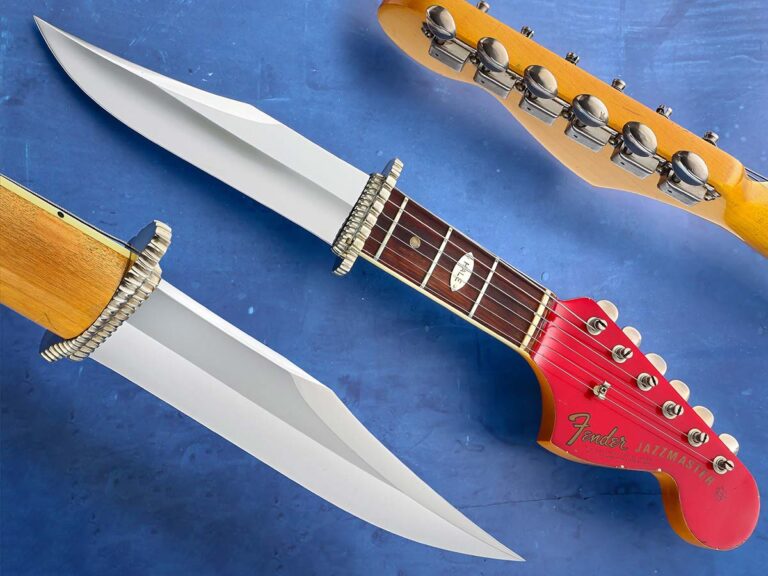
Lloyd Hale made the singular knife circa 2000 from the neck of a 1960s Fender Jazzmaster.
A self-described child of the ’60s, Larry Hirsch jumped at the chance to buy the DeFender when a collector offered it for sale.
Made by Lloyd Hale a quarter century ago from the neck of a 1960s-era Fender Jazzmaster guitar, the knife did not have a sheath originally, so Hirsch got with Hale earlier this year and brainstormed one in the shape of the main body of the guitar, complete with strap and volume and tone control knobs.
Larry Hirsch rocks his world with the DeFender. (Hirsch image)
“I told Lloyd the knobs had to turn because everyone that sees it, the first thing they will do is turn the knobs,” Hirsch said. Sure enough, when Larry displayed the knife at the 2025 Solvang Show, the first person that saw it turned the knobs.
Oh, left whole a 1960s-era Fender Jazzmaster—just the neck alone—would be worth obscene amounts today, but we won’t go there.
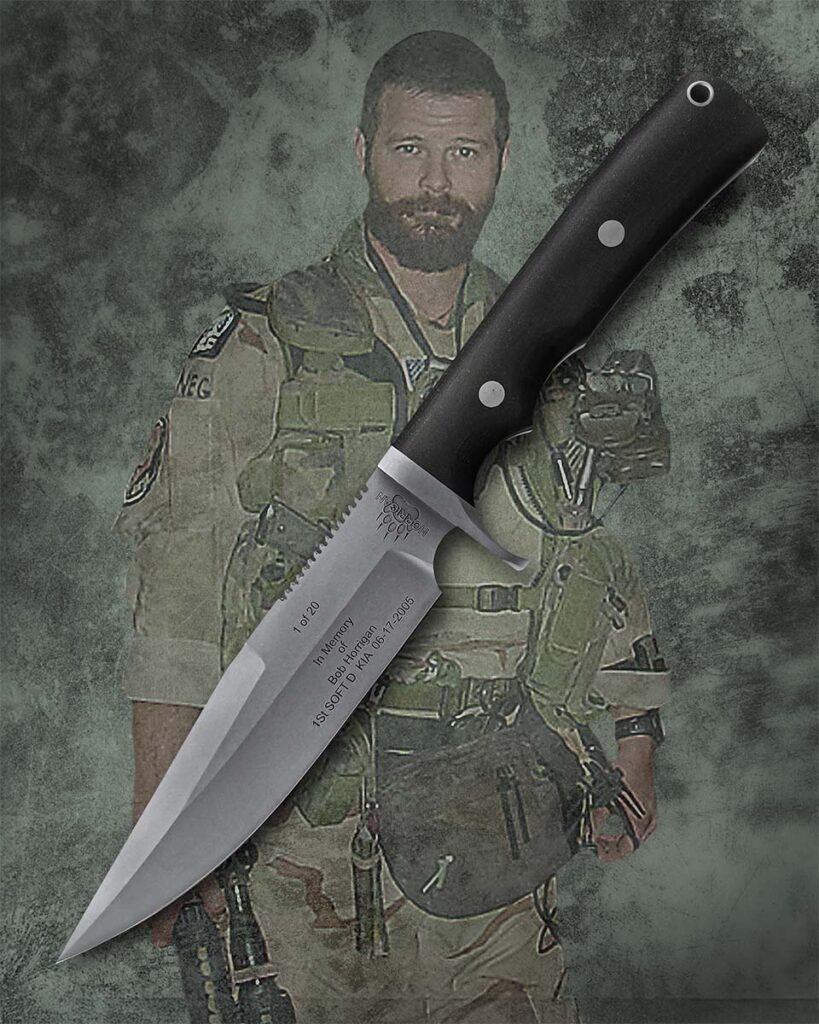
John Horrigan will auction Serial No. 1 on Veteran’s Day.
On June 17, 2005, while conducting military operations against known terrorists, United States Army Master Sergeant Robert M. “Bob” Horrigan was killed in action in Al Qaim, Iraq. In recognition of the 20th anniversary of Bob’s supreme sacrifice for his country, ABS master smith John Horrigan has made a series of 20 special knives in his twin brother’s honor.
Robert started his military career in 1984 with the 3rd 75th Ranger Battalion under the command of Captain Stanley McCrystal, going on to serve as a Ranger instructor in Mountain Phase in Dahlonega, Georgia. Robert was a light weapons sergeant with the 7th Special Forces Group ODA. His last assignment was with 1st Special Forces Group, detachment Delta. MSG Horrigan served 9½ years with the Counter Terrorist Unit. He had three tours to Afghanistan and was killed on his fifth tour in Iraq.
To say Robert was special would be an understatement. He excelled in everything he did. Pete Blaber, a former Delta commander, wrote about Bob in his book, The Mission, The Men and Me. George Hand wrote about Robert in SOFREP, chronicling his exploits in A Better Man Than I and Walking Among Giants. Robert was the fictional character of Bob Harrington in Brad Thor’s books Blow Back and Take Down. Sean Naylor also wrote about Bob in his book, Not a Good Day to Die.
John Horrigan will auction off Serial No. 1 of a special series of 20 knives this coming Veteran’s Day in memory of the 20th anniversary of his twin brother Bob’s death in action in Al Qaim, Iraq. (Jocelyn Frasier image)
Bob was nicknamed the “pack mule.” He would carry the gear of others when they became fatigued. He had a never-quit motto and was there to help his fellow service members through.
President Theodore Roosevelt once said, “… credit in life belongs to the man in the arena whose face is marred with sweat and dust and blood. It belongs to the man who strives valiantly, who knows great enthusiasms, great devotions, and spends himself daring greatly in a worthy cause so that he will know the triumph of high achievement; and whose place shall never be with those cold and timid souls who know neither victory nor defeat.”
Master Sergeant Robert Horrigan was exactly such a man.
Legacy Design
ABS master smith John Horrigan introduced his brother to knifemaking about five years before Robert was killed in action. The original Bob Horrigan Military Fighter is a model Robert designed, built and made famous.. The legacy design rightly named in his honor is 11.25 inches long with a 6.375-inch blade and a linen Micarta® handle.
Robert competed in the Best Ranger Competition in 1987 and finished in second place. John also was a Ranger in the 3rd 75th. He continues to stay connected by awarding the warriors who place second in the Best Ranger Competition with a Bob Horrigan knife in honor of his brother.
In recognition of the 20th anniversary of Robert’s death, John has made 20 commemorative knives with Robert’s touch mark—a bear paw with Horrigan through it. The knives are numbered 1 through 20. Robert designed the knife for the military elite who continue to carry it with service, pride and a brother’s love.
Robert loved where he worked and when someone asked him which unit he was in, he’d tell them “1st SOFT D.” He was all about secrecy of the unit. He’d let them try to figure it out. (Robert had a dry sense of humor). His nickname in the unit was “Puddy,” Elaine’s boyfriend in Seinfeld.
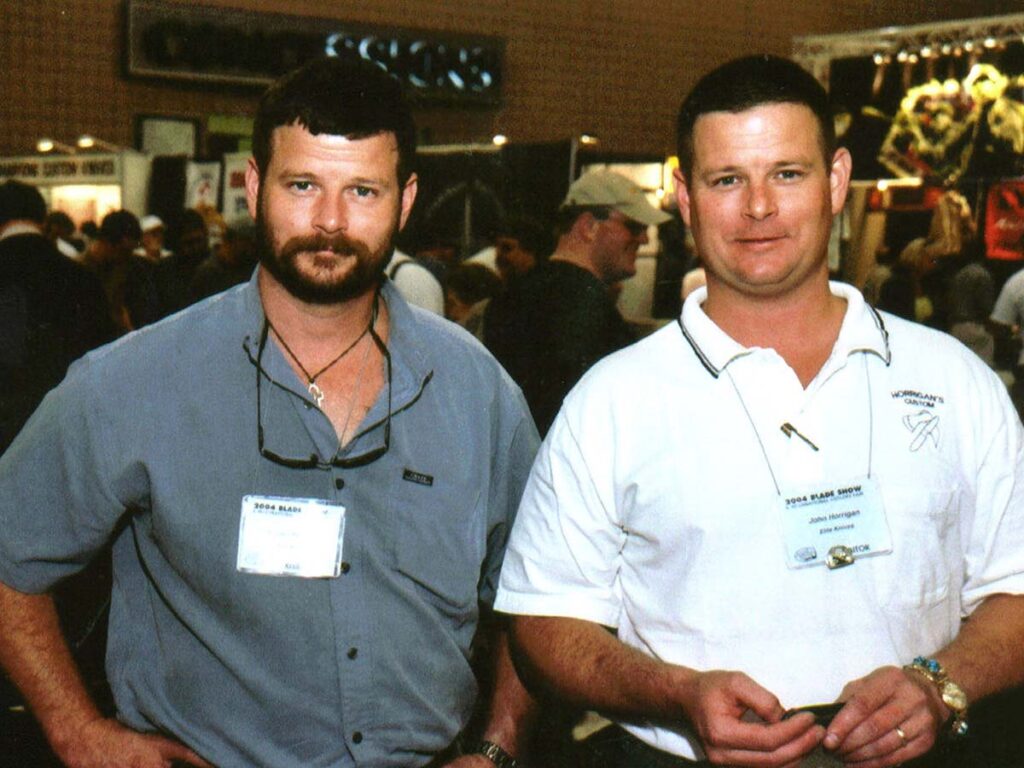
Robert (left) and John Horrigan enjoy the 2004 BLADE Show.
Serial No. 1 of the Bob Horrigan knife will be auctioned off this coming Veteran’s Day, November 11, with the proceeds going toward a great cause.
For more information on the auction and the entire series of 20th anniversary Bob Horrigan knives, visit John Horrigan Instagram page or visit eliteknives.com.
Allen Elishewitz/Les George knife collaborations are four point oh.
If you are into custom tactical knives, chances are very good that you have heard of knifemaking United States Marine Corps veterans Les George and Allen Elishewitz.
The two are at or near the top of the list for anyone wanting a high-quality custom tactical. Both possess an excellent knowledge of tactical design and the ability to execute same gained through their years of making knives—Les has 33 years of experience and Allen has 37. Their talent levels are extremely elevated.
Their time in service to their country walking the walk and talking the talk has helped each to fully understand the strengths and weaknesses of tactical knives. They have collaborated with factory brands such as Kershaw and Zero Tolerance (George), Benchmade, CRKT and Hogue Knives (Elishewitz), and Fox Knives and Pro-Tech (both of them). They also have collaborated with each other on some special custom knives.
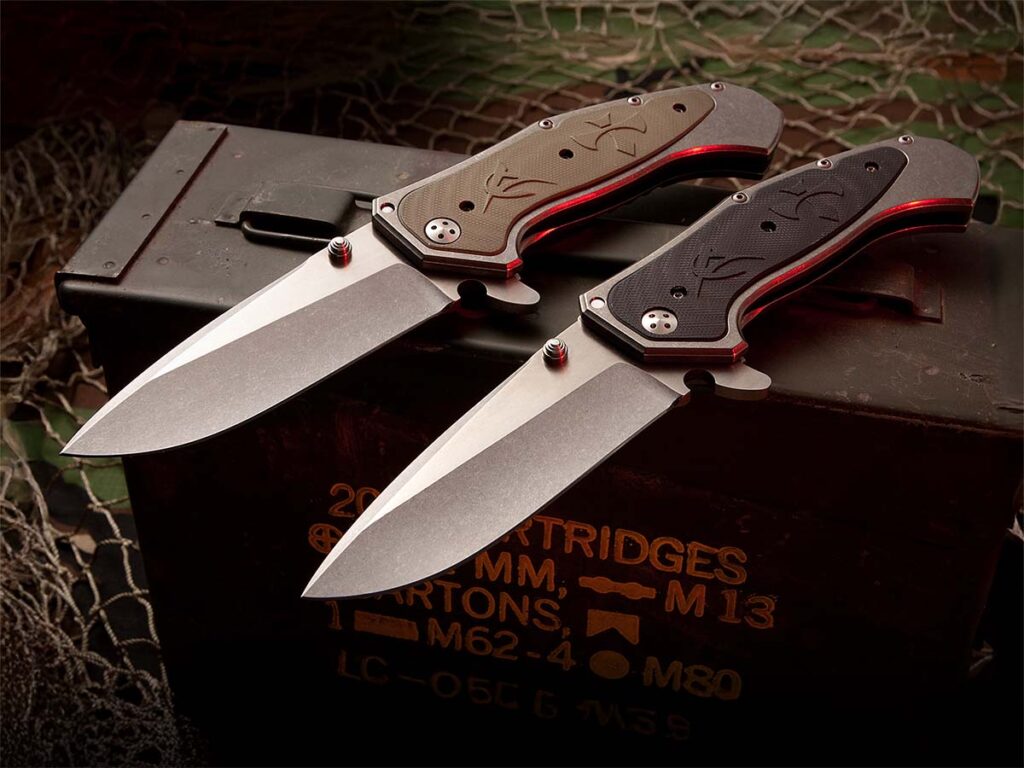
One of the more recent collaborative efforts between Allen Elishewitz and Les George is the Cerberus, a flipper folder in CPM 154 stainless blade steel and a titanium frame with insert. Closed length: 5 inches.
Perhaps most importantly, they are really good friends and inspire each other in many ways.
“I knew Allen by reputation and from the internet knife forums,” Les said. “When I moved to Texas, we were not far away [from each other].” It was about 15 years ago that Les first reached out and paid Allen a visit.
“He contacted me after he got out of the USMC. He happened to be in Texas and wanted to swing by my shop,” Allen recalled. “I guess we hit it off OK,” Les undersold the moment with his trademark brand of sarcasm.
In that initial meeting the two not only bonded over their service to their country but also their love of knifemaking, common grounds to forge a solid friendship. Each is outgoing and has a great sense of humor, not to mention an outstanding feel for knife design and ergonomics.
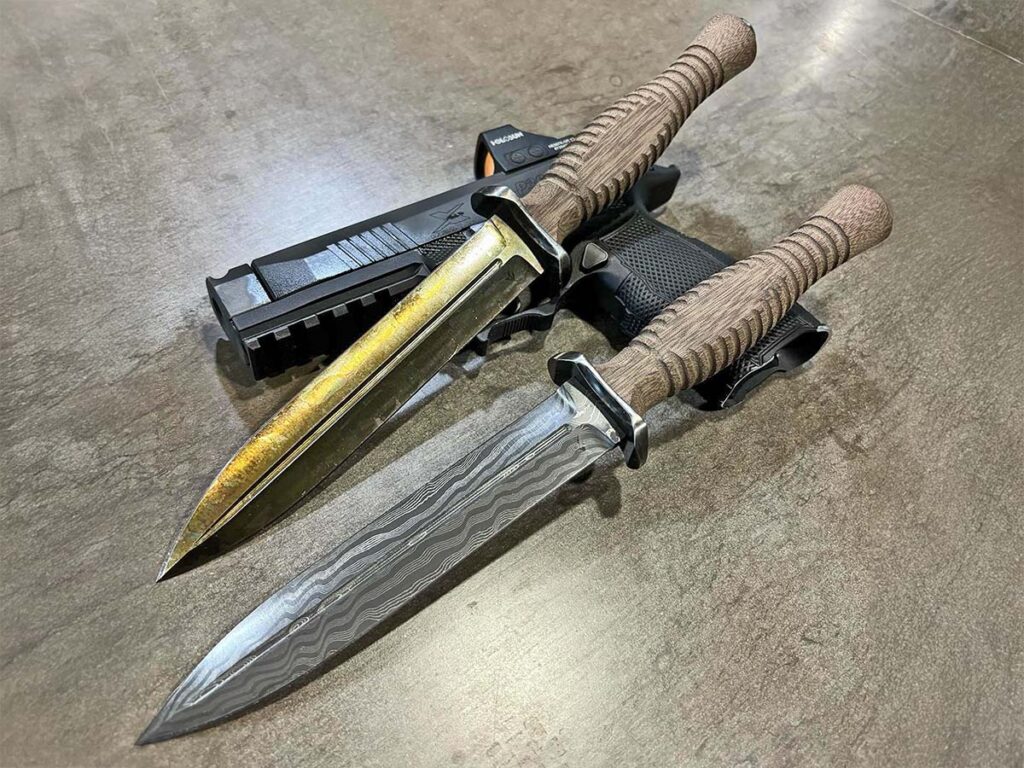
An excellent example of a collaboration between U.S. Marine veterans/knifemakers Allen Elishewitz and Les George is two iterations of the EGA (Elishewitz/George Association) Dagger, their spin on the iconic Fairbairn-Sykes dagger. The blade comes in a choice of CTS XHP stainless steel ($875 MSRP) and Chad Nichols stainless damascus ($1,200).
Allen’s first Military Occupational Specialty, or MOS, was designated O861 for Fire Support Marine, and his second was designated O321 for Reconnaissance Marine. In O861, he called in naval artillery and air support on targets, while in O321 he honed his recon skills in scouting and patrolling, small boat operations, long range communications and reconnaissance.
George’s path was slightly different.
“I started out as a heavy equipment mechanic, then volunteered for embassy guard duty,” he said.
Following embassy duty, he became an EOD (Explosive Ordinance Disposal) technician*.
“You know, making the bad bombs stop,” he quipped.
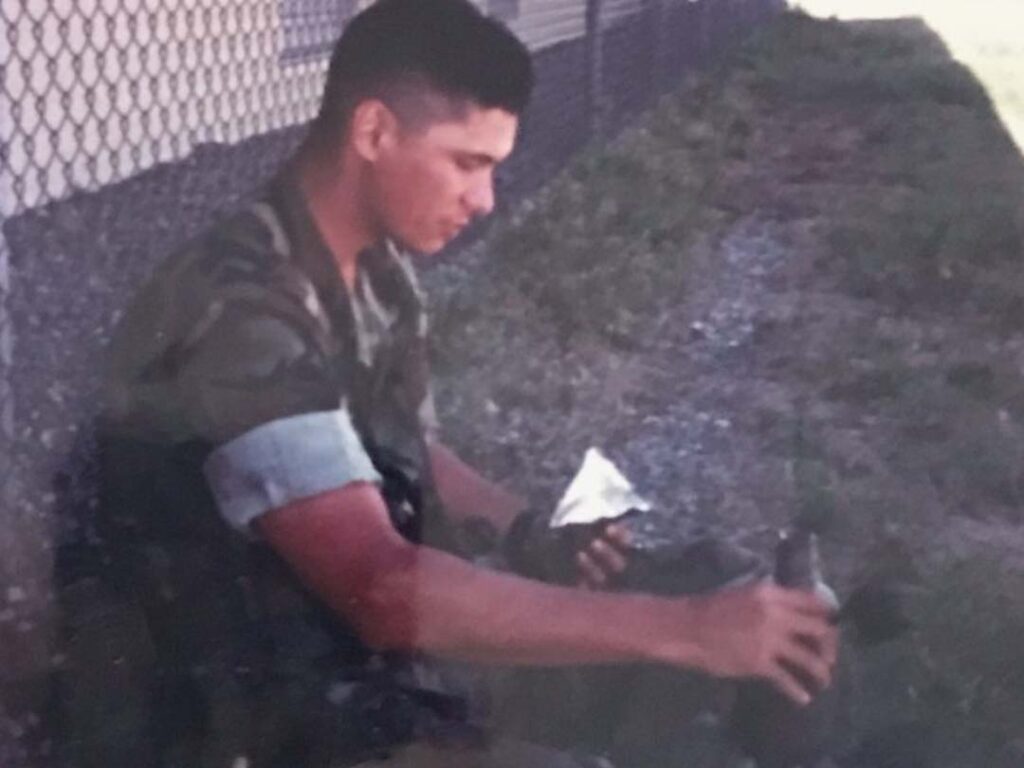
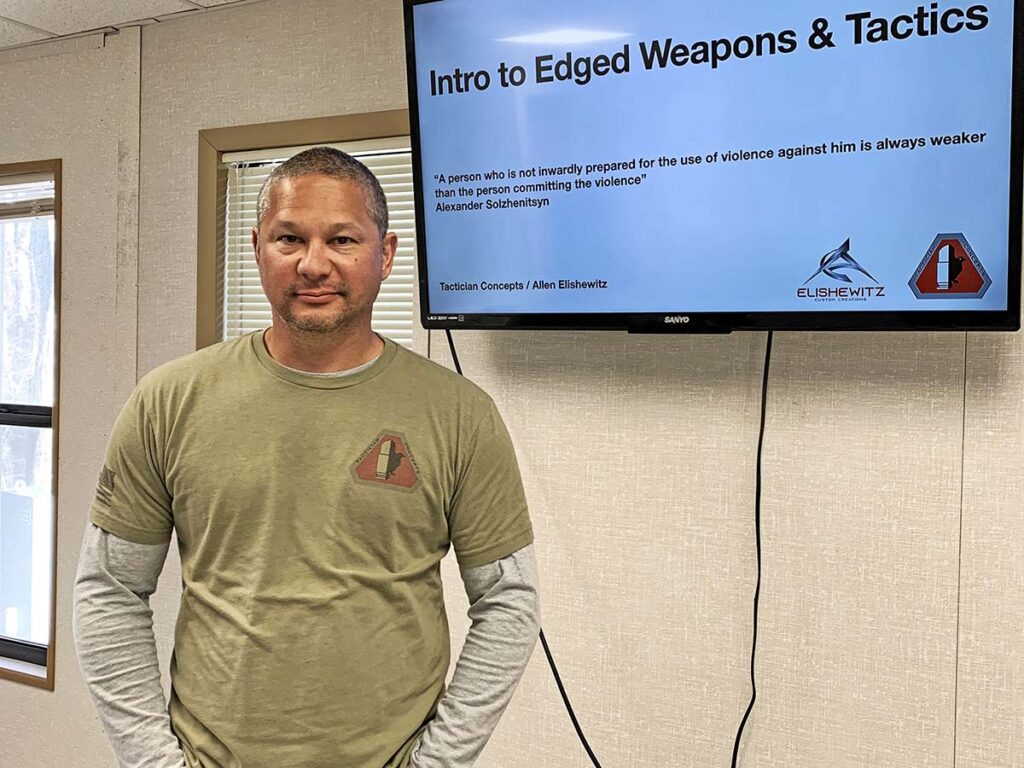
USMC Sergeant Allen Elishewitz takes a lunch break outside a Marine facility in the early ’90s.
The discipline and fortitude each gained in his respective duties set the stage for them to become solo entrepreneurs as knife designers and knifemakers. It also had a major influence on their approach to tactical knife design.
Their knifemaking styles are highly complementary.
“There are a lot of overlapping skill sets,” George observed.
For instance, Les has CNC experience while Allen has more manual machine know-how.
“Les uses CAD and CNC, I am strictly handmade,” Elishewitz reiterated.
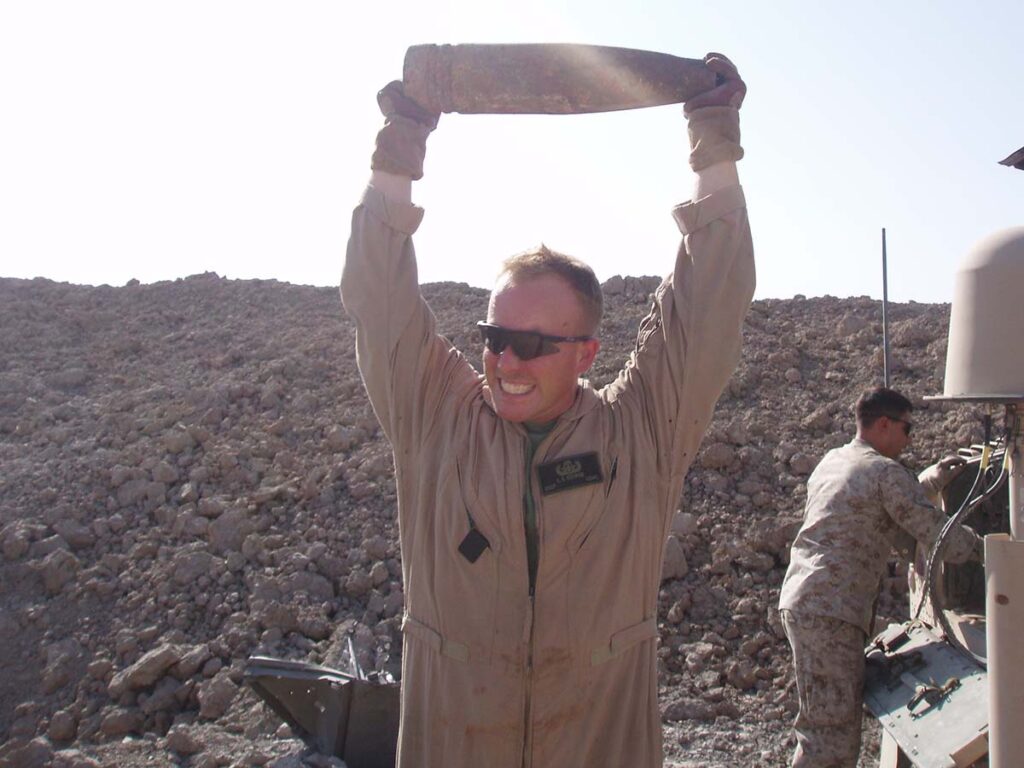
USMC Staff Sergeant Les George holds an artillery shell aloft somewhere in Iraq in the early 2000s.
“We can take a design and I can help scale it up and make more knives, while Allen can add the final touch,” Les noted.
“I see Les’s knives as very practical and utilitarian,” Allen said. “I have the same approach but with a little more emphasis on artistic flair.”
Both makers craft excellent cutting tools that are highly utilitarian. You can see the imagination and style in each of Elishewitz’s pieces. Meanwhile, form follows function with George’s work, where the beauty lies in how he builds his designs.
Long-Distance Teamwork
As with any business relationship, especially long-distance ones, it takes work to maintain along with the help of technology. Les lives in Blue Springs, Mississippi, and Allen in New Braunfels, Texas.
Allen Elishewitz has made and designed award-winning tactical and other hi-tech folding knives since 1988.
“We send designs back and forth through emails and texts,” Elishewitz explained. “Les has 3D printing capabilities for quick prototyping that has been a game changer.”
Making use of technology almost makes it feel like you are working with someone in the same space even though there is a significant physical distance. Despite the distance, these two always find ways to make things work and to collaborate on beautiful edged pieces.
Behind every good man is an even better woman, and it was never truer than with Allen and Les. Both are happily married and their wives wholeheartedly support their husbands’ endeavors in the knife industry.
“Bianca is interested and supportive but not usually super involved,” Les stated of his better half. His passion is knifemaking, hers is abuzz with a passion for beekeeping.
“Lots and lots of bees!” George affirmed.
Les George is heavily influenced by classic military fixed blade designs and modern tactical folders and fixed blades.
Meanwhile, Valerie Elishewitz not only is very supportive of her husband’s career, she plays an active role in it.
“Valerie is a crucial part of my business,” Allen stressed. “She takes care of all the administrative tasks which would eat up a lot of my time if I had to do it.”
Valerie sometimes answers emails, private messages, posts on Allen’s Facebook and Instagram accounts, helps pack and ship knife orders, and even helps her husband staff his table at knife shows. If you have bought a knife from Elishewitz at a knife show, chances are you met Valerie.
Upcoming ventures hold promise.
“Allen is doing several designs with my production company, Defiant7,” George observed.
“I’m really excited about the way those projects are shaping up.” Added Elishewitz, “We are going to do more of the Fairbairn-Sykes custom daggers. We made them a few years back and they were very popular.”
He also hints that he submitted designs to Les for what Elishewitz calls the BK, or Bangkok Special, a compact fixed blade for concealed carry for the Defiant7 line. He also submitted a blade design to accompany the handle of George’s M320 model for Defiant7.
Last but not least, Allen said, “Later this year I am going to send Les a crossbar-lock SOG bowie that is going to be killer!”
Allen and Les designed the Ek Integral Folder for Ketuo, winner of Best Imported Knife in the factory knife judging competition at the 2024 BLADE Show Texas. The knife is based on the Model 2 Ek Commando fixed blade. (SharpByCoop image)
All this in addition to keeping up with orders for their custom knives, too. Not too shabby for a couple of Marine veterans, right?
*Les George won the BLADE Magazine 2023 Publisher’s Award for his humanitarian effort in making 300 mine probes for shipment to Ukraine to help remove the thousands of deadly explosive devices buried throughout the war-torn country.