Knifemaking is the building of a knife, which includes the blade, handle and other accouterments. Blades are made by either removing metal from a steel blank via a grinder – known as stock removal – and the forging to shape of hot steel into a blade in the process known as bladesmithing. Other parts, including bolsters, guards, pommels, etc., are needed to complete the finished knife.
There have been tons of stories on how to be a knifemaker. Most are great and deal with subjects like taxes, suppliers, marketing, sales, bookkeeping and safety. Other great articles cover the technical side of how to make the knives you wish to sell, including stories on forging, grinding, heat treating, handles, sheaths and more.
My story will outline some things I have learned over the years as a full-time knifemaker in a home-shop setting that I think will benefit you, your knives and, most importantly, your family.
1) A Toaster Oven
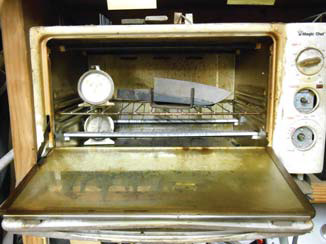
Your kitchen will get messy in a hurry if you don’t take things outside. Buy a cheap toaster oven. Problem solved.
The kitchen is not the place to be tempering knives, warming up knife sheaths for waxing them, heating Kydex® for the molding, or burning out axe heads. A $5 toaster at the flea market will do all that in your shop and is a bargain.
2) Pots & Pans
Get a selection of pots and pans, cutting boards and a small scale from a thrift shop. Don’t be tempted to use a “good pan” for that one, little task.
3) A Shop Sink
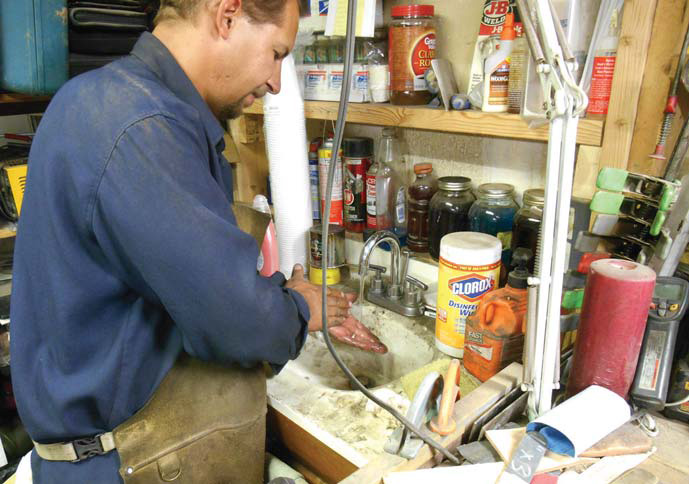
Would you want to eat out of this sink? No. That’s why it’s the dedicated shop sink, not the one inside the kitchen.
Install running water in your shop, or at least have a five-gallon bucket handy. Make sure there’s a countertop, too, in case of spills.
On that note, wipe your feet off before re-entering a home.
4) A Coffee Thermos
If who like your coffee as much as I do, get a big thermos, fill it in the morning, and take it to the shop with you. This cuts down on the trips away from the shop, as a trip inside the house to grab another cup can turn into an hour away by the time you get the cup, peek in the fridge, check for phone messages, etc.
Plus, every time you re-enter the house, you track shop dirt and oils in with you.
5) Discipline/Knowing When to Stop
Know when to quit for the day. This is one lesson I’m still learning. You get wrapped up in your work and the next thing you know it’s 2 in the morning.
Not only will you spend that night on the couch, but you may spend the next one there too if, as a result, you also forgot the plans you made, dinner, one or more of the kids’ school activities, etc. Besides, it’s tough to make good knives after a rough night on the couch.
6) Do Something Special for Your Family
Make knives, buy flowers, repeat.
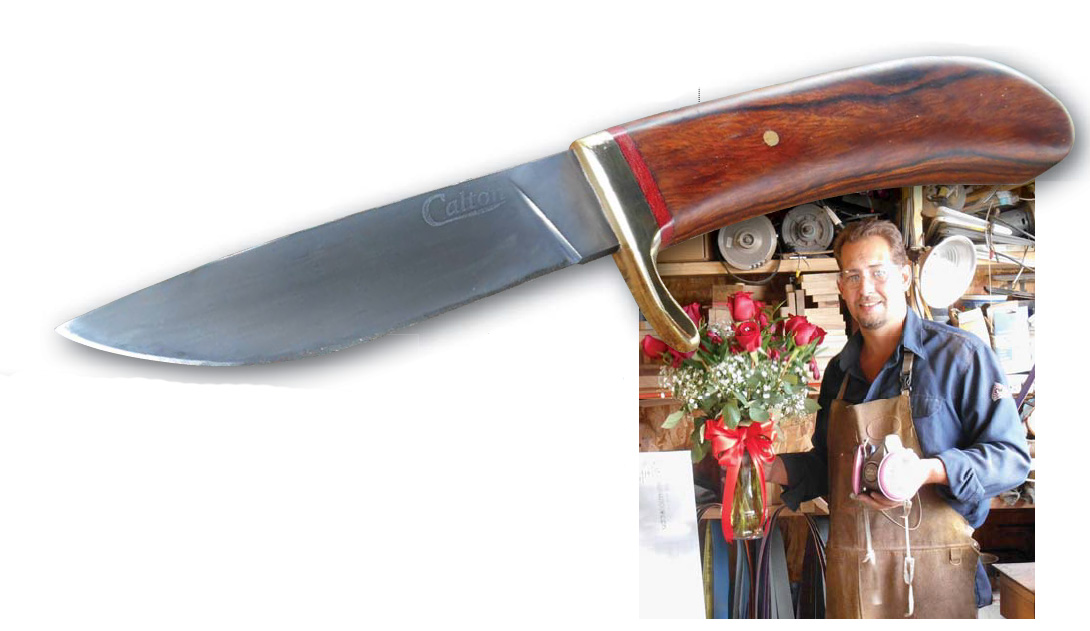
Use some of your knife money to buy your wife/husband/partner/significant other flowers. Buy them on a regular basis. Put it on the calendar if you must so you will remember. Think of the flowers as supplies, like grinding belts.
This is very important!
7) Mind the Dust
Know that what happens in your shop does not stay in your shop, and act accordingly. Dust from exotic woods will make it into your home. You may not be allergic to the dust but your wife, kids or family pets may be.
Keep an eye peeled for anything out of the ordinary when introducing new woods or materials into your shop. This also goes for smoke from quenching. Use “green” quenchants when you can, including vegetable-based oils and water. And keep the door to the rest of the house closed until you clear the air.
8) Consider Where Your Shop is Located
If you’re considering moving your shop away from your house, think long and hard about it.
Yes, a home-based shop offers some challenges. However, it offers quite a few benefits, too. Namely, the morning commute is a thing of the past, and people know how to find you.
Move the shop away, as some friends of mine have, and you may end up moving it right back anyway.
9) Make the Most of Breaks
Maximize the time between your work by throwing in a load of laundry, starting supper, taking care of a household task, paying bills, etc. This helps your family’s day-to-day quality of life.
10) Test Your Knives in the Kitchen
If you make them, there is no better test of the kitchen knives you create than to use them in making dinner. This is a twofer in that not only do you get the immediate feedback from hands-on testing, but also the household benefit of preparing meals.
11) Double Up Your Shop
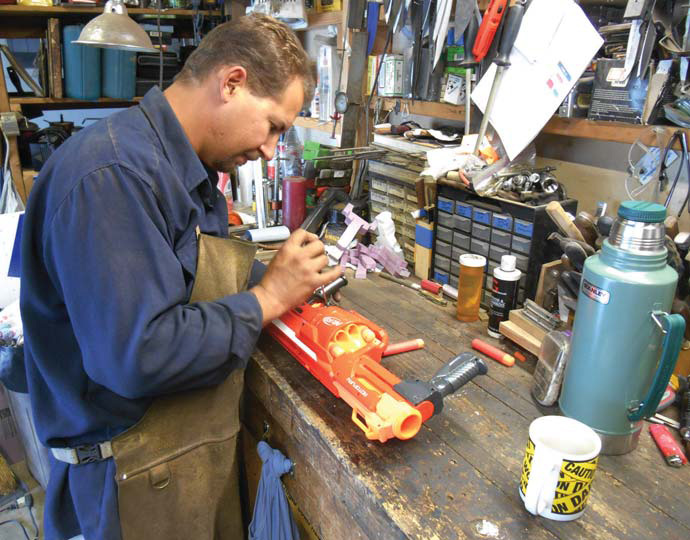
With your shop set up, you have all sorts of tools on hand you can use for other projects. From fixing your kid’s bicycle to tuning up a lawn mower, you’ll find taking care of these everyday things can reset your focus for knifemaking later.
Batson was an aerospace engineer, master bladesmith, author and educator.
James Lucian Batson Jr., an aerospace engineer, master bladesmith, author and educator, passed away June 5, 2026, after a brief illness at the age of 90. He was born Feb. 2, 1936, in Steubenville, Ohio, the son of James L. Batson Sr. and Bertha Mae (Cummings) Batson.
Batson spent 33 years as an aerospace engineer at Redstone Arsenal in Huntsville, Alabama, working on several key defense and rocket programs. He earned his master’s degree in aerospace engineering from Auburn University in 1967 and a Ph.D. from the University of Texas in 1972.
Outside of his engineering career, Batson was a pioneering figure in the knifemaking and blacksmithing communities. An American Bladesmith Society (ABS) master bladesmith, he co-founded the Alabama Forge Council, served as president of the Artist-Blacksmith Association of North America and founded the Batson Bladesmith Symposium, now in its 38th year. His extensive contributions to the craft earned him inductions into both the ABS Hall of Fame and the BLADE® Magazine Cutlery Hall of Fame®. Additionally, in the February 2014 BLADE Magazine issue, he was ranked No. 9 among the top 13 knifemakers from 1989 to 2000.
An active researcher of historic cutlery, Batson authored numerous articles and books, particularly focusing on the history of the bowie knife and the material science of bladesmithing, publishing his final book at age 90.
His other accomplishments included sailing the Olympic-class sailboat called the Flying Dutchman in the pre-Olympic trials in 1967. He skippered a cruise sailing across the Gulf Stream to the Bahamas five times in 1972. He also earned the rank of Eagle Scout with the Boy Scouts as a youth and continued to lead Troop 400 as an adult, hiking part of the Appalachian Trail with the Scouts.
Following his passing, ABS Chairman and President Kevin R. Cashen paid tribute to Batson’s immense legacy and humble nature in the organization’s newsletter: “It was always a fun pleasure to point out to people that this down to earth, very approachable, guy in bib overalls, was an actual rocket scientist! That was the first thing I admired about Jim, his unpretentious and humble demeanor that had him working beside anybody to get the job done … In sorting old, and yellowed, papers one thing became noticeable about halfway through the years spanning the ABS timeline. Suddenly the volume and organization of the documents exploded … I saw one man single-handedly remake the ABS, setting it on a climbing trajectory as if it were the rockets he had worked on in his other career.”
Batson is survived by his wife, Barbara, two children, two stepchildren, 14 grandchildren and five great-grandchildren. A memorial celebration is planned for this fall in Huntsville.
Remembering Others The Knife Industry Has Lost:
Betty Dowell, Driving Force Behind Knifemaker Ted Dowell, Passes
B. R. Hughes, Pioneering Writer And Bladesmithing Teacher, Passes Away
Niagara will help fill the shoes of an industry icon.
The recent demise of Crucible Industries LLC not only marked the end of a celebrated name in the manufacture of blade steels, it denoted the dawn of a new age—not only for the steels famously known by their CPM prefix, but other premium blade materials as well.
Used by Crucible and short for Crucible Particle Metallurgy*, CPM prefixed such Crucible steels as CPM S30V, CPM S35VN, CPM MagnaCut—today’s hottest CPM variant—and others among some of the most-used blade materials since Chris Reeve Knives popularized S30V on Reeve knives beginning in 2004-2005. S30V, in fact, was the first modern steel manufactured specifically for knife use. All other manufactured steels used in blades were originally made for purposes other than knives.
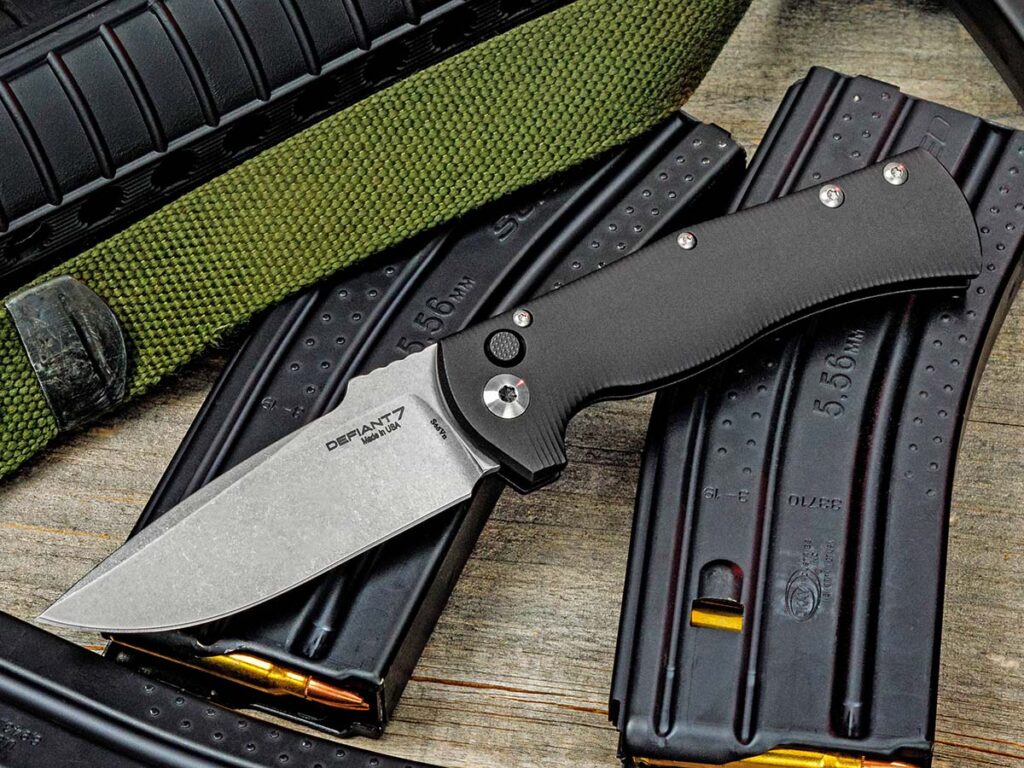
CPM S45VN is one of several of the old Crucible steels Niagara offers. The Defiant7 Auto Eagle has a stonewashed blade of the stainless steel and a black aluminum handle. Blade grind: flat. Weight: 4.4 ounces. Designed by Les George, it’s 4.75 inches closed. Country of origin: USA. MSRP: $285.
Crucible closed its doors earlier this year and sold most, if not all, of its assets at auction in February. So what happens to all those wonderful steels that both the factory and custom knife industries use in mass quantities?
According to Bob Shabala of Niagara Specialty Metals (NSM), NSM will do its part to have/supply most, if not all, of them, as well as other up-and-coming steels, to the custom and factory knife industries.
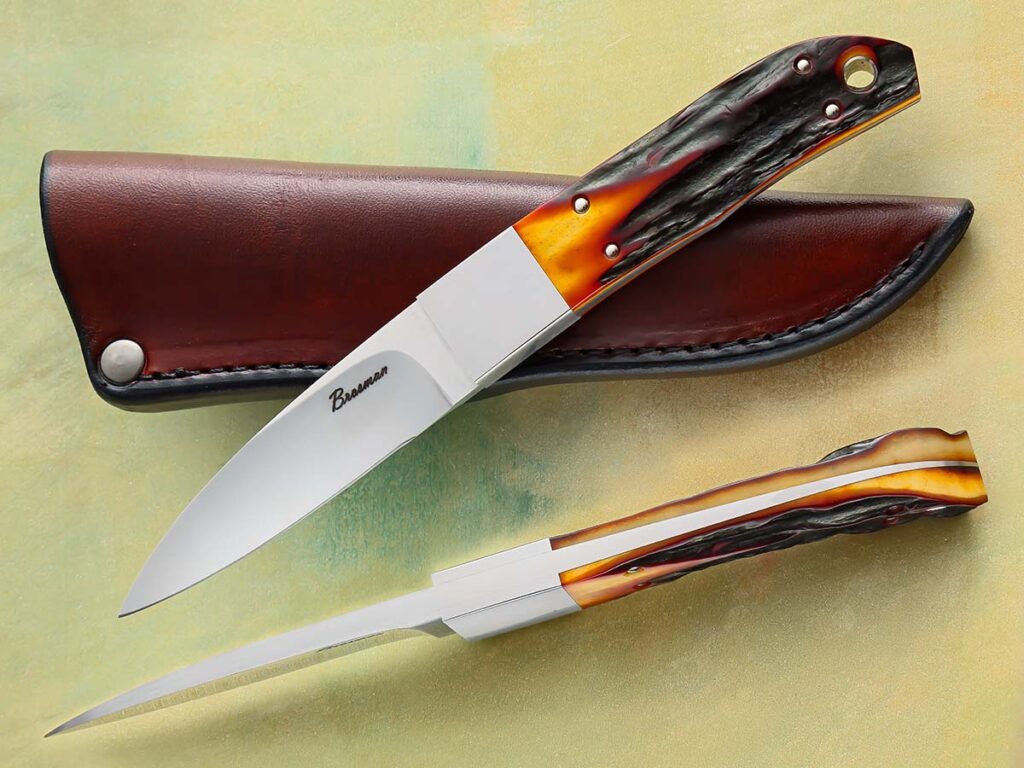
Among custom knifemakers especially, CPM 154 stainless is extremely popular. Craig Brosman employs it in a hollow grind and amber-dyed European red stag on his utility fixed blade. Overall length: 7.5 inches. (SharpByCoop image)
Opined Scott Devanna of steel service center SB Specialty Metals, “The majority of steel sheet in the U.S. comes out of Niagara. They’re the only [domestic mill] that can make it right now. It’s been that way for the last 25 years. They’re the only game in town.”
Erasteel And The Name Game
Erasteel, with state-of-the-art steel mills in France and Sweden, is owned by Syntagma Capital, a private equity group based in Brussels, Belgium. Erasteel acquired a part of the assets of the old Crucible Industries during the February auction, including working capital, steelmaking equipment and, perhaps most importantly, the trademarks for all the CPM steel names. A manufacturer and supplier of steels not only to the knife community but also the aerospace and other hi-tech industries, NSM had worked with Erasteel before the auction, processing millions of pounds of the Swedish mill’s steel for industrial applications.
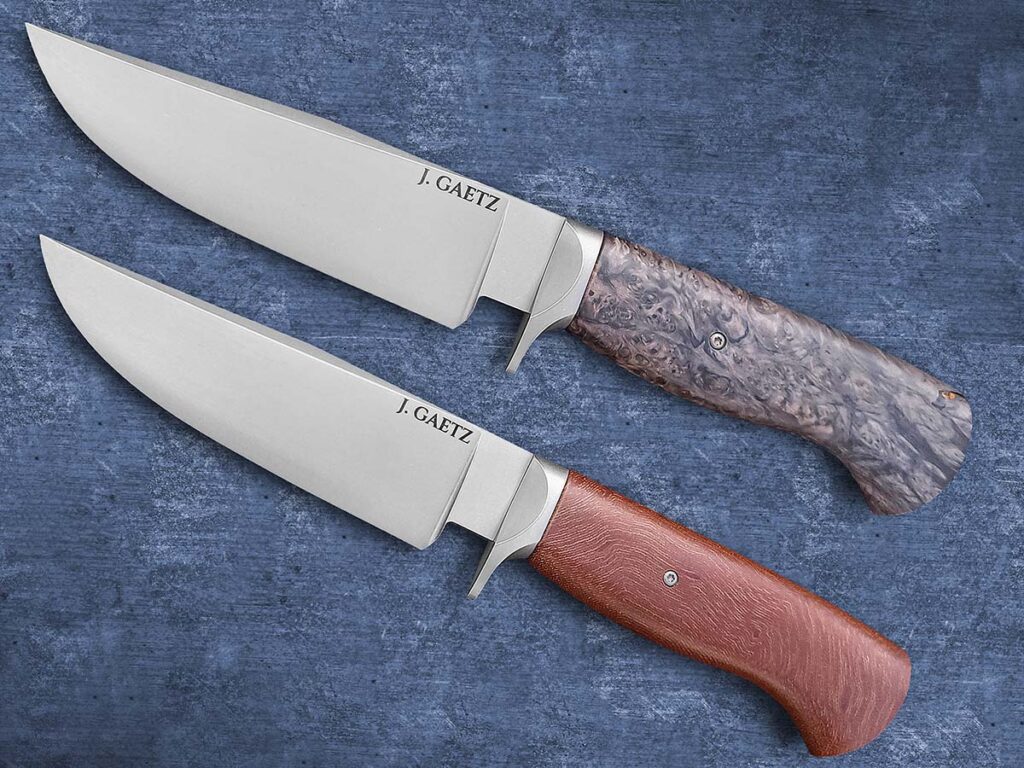
The 4.75-inch blade of Jacob Gaetz’s Large Field Hunter is CPM 3V carbon steel cryo-treated to a Rockwell hardness of 60-61 HRC. Handles are Apocalyptic box elder burl (left) and vintage Micarta® (right). Overall lengths: 9.875 inches. (Jocelyn Frasier image)
“We’d been doing that for several years,” Shabala noted, “so we know the quality of their steel is good.”
Together with Crucible, Erasteel is the pioneer in gas-atomized metal powders and started with the process in 1969. Today, it has the largest installed capacity in the world to produce metal powders, with two large atomizers built and designed by Erasteel.
Shabala said NSM officials understood their knife customers wanted the assorted CPM steels to keep the old names to avoid confusion among knife-buying consumers.
“They didn’t want to change the names and have to educate consumers on what the new names would be and how they related to the legacy Crucible names,” he explained.
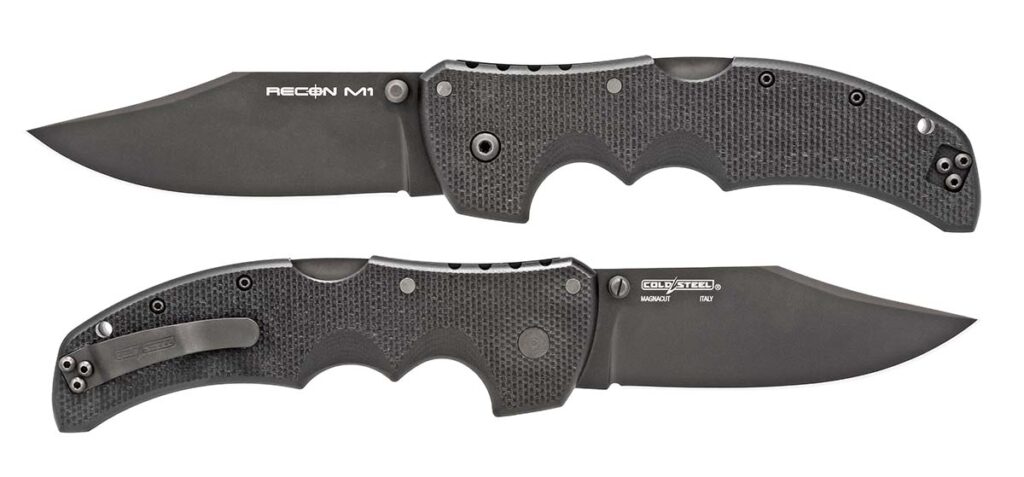
The Cold Steel Recon M1 sports a black-coated blade of MagnaCut stainless, which remains the hottest of the CPM steels used by both factory and custom segments of the sporting knife industry. Handle G-10. Lock: Atlas Lock. Weight: 5.2 ounces. Blade and closed lengths: 4 and 5.5 inches. Country of origin: Italy. MSRP: $309.99.
Meanwhile, the two companies reached an agreement where if NSM buys the steels exclusively from Erasteel, NSM can use the original names too, including S30V, S35VN, S45VN, MagnaCut, S110V, 3V and CPM 154. NSM and its customers can still use the full designation of CPM S30V, CPM S35VN and so on, though the customers can omit the CPM if they so choose.
“The reason we’re keeping the CPM 154 name is because everybody knows that it’s the powder metallurgy version of 154CM, so we want to keep that designation alive so people will know what’s going on there,” Shabala noted.
There will be a couple of exceptions. The steels formerly known as CPM Cruwear and CPM S90V will be renamed NSMwear and NSM 90PM, respectively.
Niagara is both a manufacturer and distributor, not only of knife steel but also steel for the aerospace and other industries. It is employee owned and employs 41. (NSM image)
“Erasteel already had an agreement with another distributor to buy Cruwear exclusively, so we worked out a deal with them where we can buy the steel, we just can’t use the name,” Shabala explained. “It’s on us to educate people and let them know they can still get CPM Cruwear, it’s just a different name.”
As for CPM S90V, NSM already had Carpenter Technology’s version of it in stock and wanted to rebrand it so that it’s not sole-sourced to one mill. By renaming it NSM 90PM, “hopefully people will understand that it’s coming from us,” Bob said.
Steel Tariffs
Concerning steel supplies in stock, Shabala indicated NSM officials had been aware of Crucible’s coming demise, and in January 2024 began ramping up purchases to build inventory for any future supply disruptions.
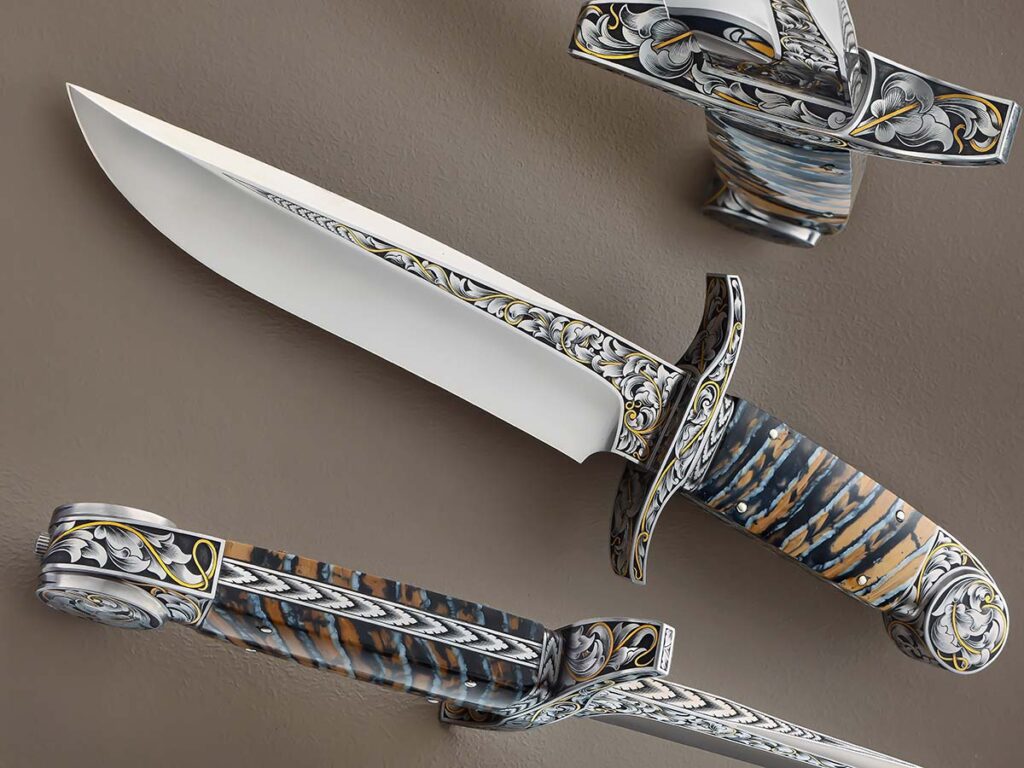
Dennis Friedly opts for CPM 154 stainless blade steel and a mammoth tooth handle for his Art Knife Invitational fighter. The copious engraving is by Ray Cover Jr. Overall length: 13 inches. (SharpByCoop image)
“We started placing orders with Carpenter and Erasteel in September 2024, though not knowing Erasteel would be the eventual owner of the CPM trademarks,” Shabala noted. “The steel we bought in September is starting to arrive. There will be some disruptions in MagnaCut and CPM 154, but everything else we still have a decent amount of and there should be no disruptions.”
In case you hadn’t heard, President Trump has instituted tariffs on most countries, including France and Sweden. At press time, the European tariff was 25 percent.
“Everything we buy from Erasteel as it stands right now is subject to a 25 percent tariff,” Shabala said. “Even the steel we buy from Carpenter, the powder for it is atomized in Sweden, so that’s subject to at least a 10 percent tariff.”
Dennis Friedly opts for CPM 154 stainless blade steel and a mammoth tooth handle for his Art Knife Invitational fighter. The copious engraving is by Ray Cover Jr. Overall length: 13 inches. (SharpByCoop image)
Another concern is whether knife companies can continue to mark their knives built with NSM steel “Made in the U.S.A.” Bob said he is up front with his customers, telling them that Erasteel will be supplying a “good chunk of our CPM alloys,” though it’s all hot rolled at NSM.
The question becomes if the raw materials are imported but don’t officially become a steel until they’re hot isostatic pressed, does that make the steel American made or imported? He indicated it will be up to his customers’ lawyers to hash out what the customers can and can’t do concerning U.S.A. markings on their knives.
NSM Innovaions
What’s on the horizon at NSM? One thing is a new grade developed by steel guru Larrin Thomas. Called Magnamax, it won’t be widely available until the end of the year. Since NSM has both patented and trademarked Magnamax, it can have it made by any mill it wants, and had it on order with both Erasteel and Carpenter at press time.
Bob Shabala of Niagara Specialty Metals
Meanwhile, along with Erasteel, Bob had high praise for the steel being made by Carpenter.
“We’re getting powder now that is atomized in a vacuum furnace. It’s a step forward in quality. We hardly ever had an issue with any CPM product from Crucible,” he qualified, “but I think Erasteel’s and Carpenter’s steel has a finer grain size. It’s a little microscopically cleaner than what we were getting before, so it really is an opportunity to provide a better product.”
As Shabala noted, Carpenter has made lots of cutlery steel, and NSM has processed a huge amount of it, hot rolling it into sheets and sending it back to Carpenter’s warehouse for sale to various customers. One of Carpenter’s best-known steels is CTS XHP stainless.
“It’s a grade that customers really like,” Shabala said, adding that NSM had over 20 tons of it and was in the process of preparing to make a big marketing push on it at press time.
Having steel manufactured in the USA remains a big selling point with many of NSM’s customers, so the company remains on the lookout for new melt sources, one of which is Prime Metals & Alloys (PMA) of Homer City, Pennsylvania. A manufacturer and supplier of a wide range of steels for assorted hi-tech and other uses, PMA was in the process of making steel for NSM at press time, which Shabala seemed to think holds great promise.
Larrin Thomas, metallurgist and knife writer
“We should receive it in a couple of months, but if it works out it’s going to be an ESR version of stainless steel that we’ve always supplied, so it should be a noticeably better product than what our customers were used to before,” he said. “It’s really a good find for us to be able to get a higher-quality steel with a shorter lead time, so we’re really excited about that.”
ESR stands for Electro-Slag Remelting, a process that results in a very clean steel devoid of contaminants.
“In a traditional melting process, you heat the steel up, get it in a molten state, pour it in an ingot and that’s it,” and later forge and finish it out, he explained. “With ESR you take that ingot and you remelt it again and all the slag and contaminants float to the top, and they’re skimmed off. What remains in the new ingot is a cleaner version of the original.”
Shabala added that two different grades of NSM stainless steels that had always been air melted will now be ESR melted.
NSM’s Role
People often misunderstand a company’s role in any endeavor, and Shabala said that seems to be the case with NSM.
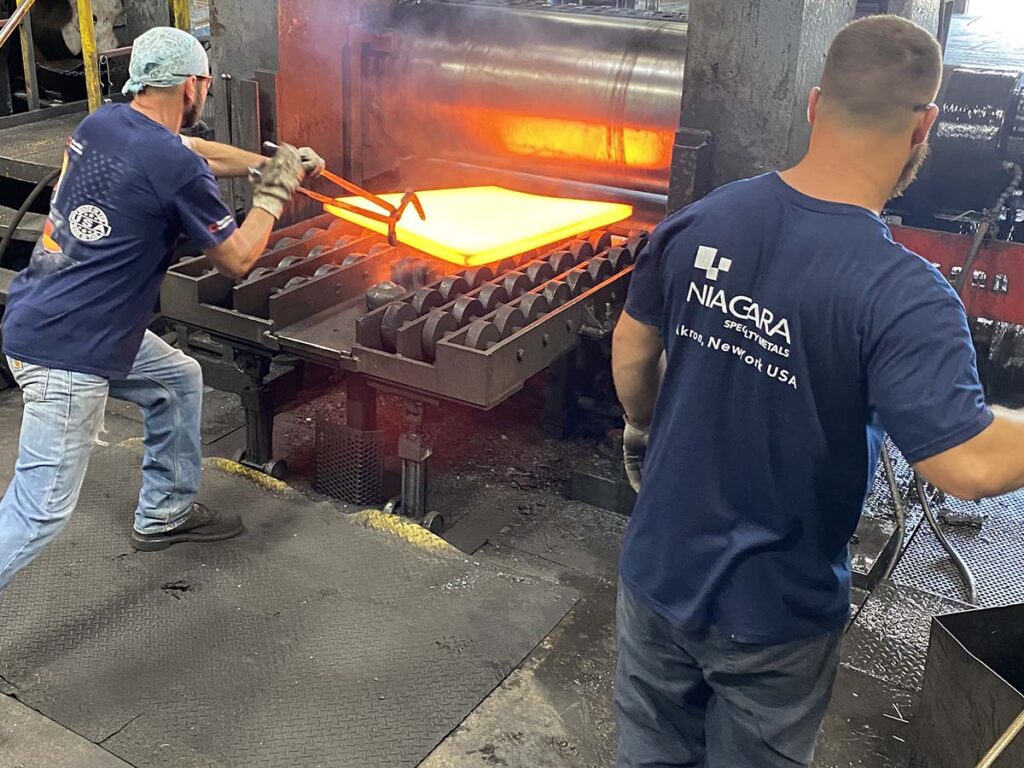
“Larrin Thomas was concerned that people had the misconception that NSM is just a distributor, that we just got sheets from Crucible and resold them,” he observed. “He said we should emphasize the fact that we’re a lot more than a distributor, we’re a manufacturer, we buy slabs of steel, we process it into the final dimensions and ship it. Cutlery is a big part of what we do. We do a lot with the aerospace industry, so we know a lot about quality standards.”
NSM is 100 percent employee-owned, so all 41 employees in its mill in Akron, New York, just outside Buffalo, own a piece of the company.
“Everyone here has a vested interest in ensuring that we’re successful and doing everything we can to put out a good product,” Shabala said.
A last point of emphasis Bob made was that just because Crucible went out of business doesn’t mean NSM is going out of business—in fact, far from it.
“We’re very financially sound. We just put out a $7 million upgrade in our sheet mill, we’re rolling out finished product, it’s the biggest expansion we’ve ever done and we’re getting ready to expand our grinding and laser-cutting capability,” he noted. “We’re really, really in good shape.”
*Editor’s Note: For more on the particle metallurgy process, visit Knife Steel Nerd’s post on powder metallurgy.
Brandon Hyner’s First Knife Is One Of His Most Current Knives As His New Work Takes Inspiration From His First Blade
Sometimes things take their own sweet time before coming to fruition. Such is the case with Brandon Hyner’s damascus gentleman’s hunter.
Hyner is an accomplished maker. He is a champion of History Channel’s Forged in Fire and has built a business of knifemaking and blacksmithing in his shop in Groton, on the Connecticut coast of Long Island Sound. He has built a following of just over 9,000 followers on Instagram where he showcases his work and produces behind the scenes videos in his shop of him doing everything from welding to forging by hand.
The damascus gentleman’s hunter is the second of a design Brandon made when he first started blacksmithing and knifemaking. With the help of a Texas bladesmith, he forged a damascus billet for the first knife, and “was forever grateful” for the opportunity. Four years later Brandon decided to finish the knife and was very pleased with how it turned out. As he noted, “I decided to keep the blade as is, as it was a big milestone knife for me.”
It has a six-inch blade with a desert ironwood handle. The brass spacer and carbon fiber bolster complete the look.
He posted the knife online and someone asked to buy it. However, rather than sell it, Brandon made a similar knife instead. “The second knife came out much better than the first one,” he noted, “but I’m extremely happy with them both.”
It’s a matched pair he can always point to as proof of his maturation as a maker and a beginning of possibly greater things to come. It was a four-year odyssey well worth the wait.
Damascus Gentleman’s Hunter Knife Specs
Knife name: Damascus gentleman’s hunter
Blade length: 6 inches
Blade material: Low-layer twist damascus
Handle: Desert ironwood w/brass spacer
Bolster: Carbon fiber
Overall length: 10 inches
For more information contact Brandon Hyner, Dept. BL4, 852 Bank St., New London, CT 06320 631-742-7227 [email protected].
Dedicated in honor of the “Father of Modern” damascus—William F. Moran—the Moran Bladesmith and Artisan Academy is now a reality.
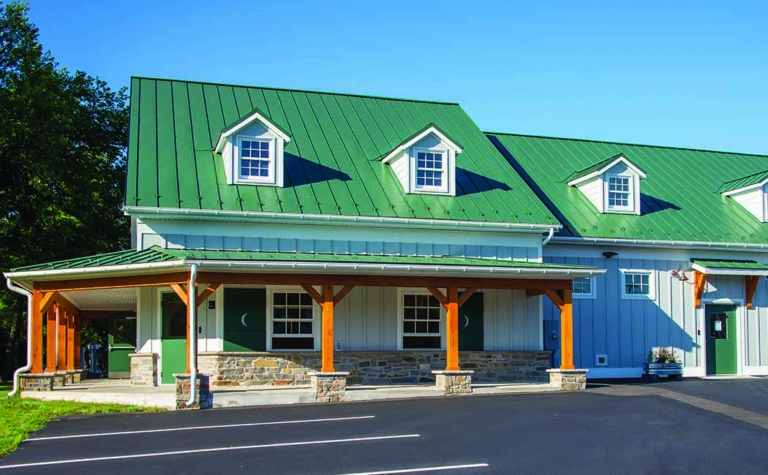
William F. “Bill” Moran, Jr., the first American bladesmith to successfully forge damascus steel blades and a founder of the American Bladesmith Society (ABS), was honored on October 16 in Middletown, Maryland, with the dedication of the Moran Bladesmith and Artisan Academy. Under the auspices of the Moran Museum & Foundation, the Academy is an impressive structure that stands less than 100 yards from Moran’s now idle knife shop.
The weather was virtually ideal as a large crowd assembled in front of the building. Director Nancy Hendrickson, mistress of ceremonies, welcomed the audience and introduced Robert Wilson, president of the Moran Foundation, who opened the proceedings with a prayer and gave an overview of the activities leading up to the dedication.
Mrs. Hendrickson next introduced the speakers for the afternoon: John Miller, burgess of Middletown; Jerry Donald, district commissioner; Jay Hendrickson, founder of the Moran Foundation and past ABS president; Joe Keeslar, past ABS president; Johnny Perry, past vice president and director of the Moran Foundation; and yours truly, a founder of the ABS and author of Master of the Forge, a Moran biography.
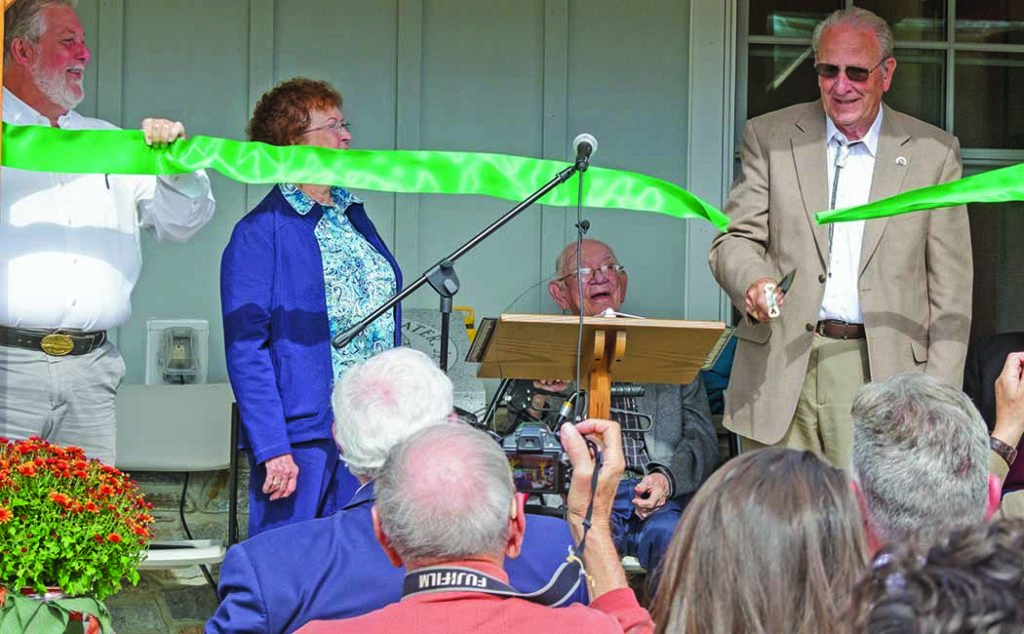
Jay Hendrickson uses one of Bill Moran’s favorite knives to cut the ribbon officially dedicating the Moran Academy. Looking on from left are Robert Wilson, Nancy Hendrickson and the author.
Following the oral presentations, a ribbon cutting done with a Moran knife was conducted by Jay Hendrickson, Robert Wilson and Gordon Conner, Foundation vice-president.
Mrs. Hendrickson closed the ceremony and the group enjoyed a round of refreshments that featured a cake cutting. The assemblage then toured the new building, which contains an office, classroom, museum and gift shop, and a large room where forging, grinding and related skills will be taught. The Moran shop, which is in excellent condition, will be a museum and a working smithy. A knife show was held October 15 in the space between the Moran Academy and the Moran shop, followed by an auction conducted by Robert Wilson.
FATHER of MODERN DAMASCUS Moran unveiled his eight damascus knives a half century ago at the 1973 Knifemakers’ Guild Show in Kansas City, Missouri. The knives were the hit of the show and rekindled interest in bladesmithing, which was a dying art form in America at the time. There were only about a dozen practicing smiths back then, including such notables as Bo Randall, Rudy Ruana and, of course, Moran. Under Moran’s leadership, the ABS was formed in 1976, with Moran elected president, Don Hastings, treasurer, Bill Bagwell, secretary, and yours truly, director. Moran, Bagwell and Hastings were the first three American smiths to successfully forge damascus knife blades.
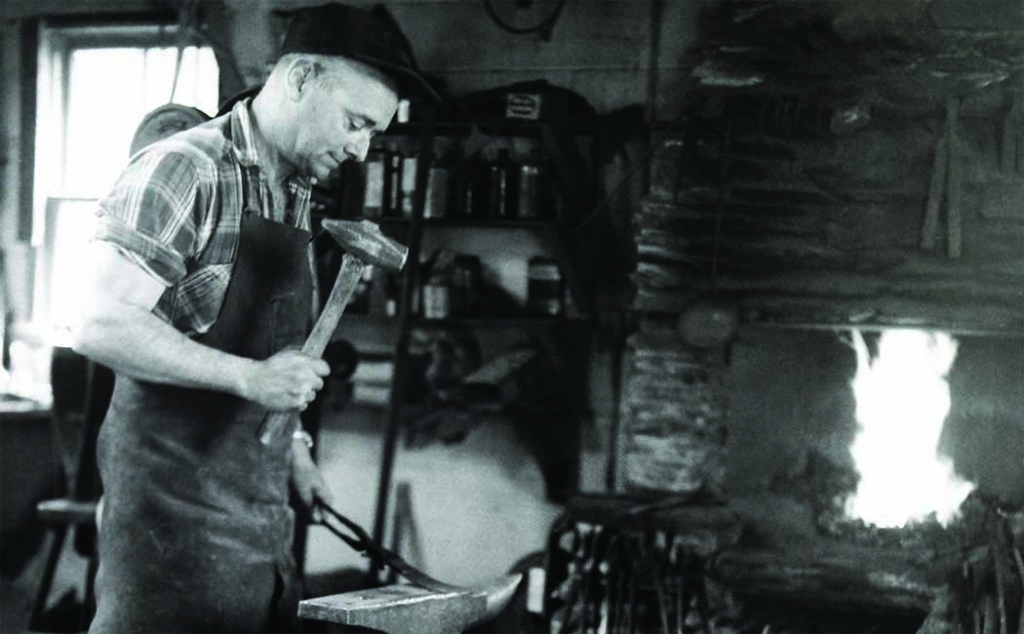
Bill Moran hammers away in his knife shop in this vintage photograph. The shop stands about 100 yards from the new Academy. The knife is the ST-24, considered one of the finest Moran knives ever. (Images from William F. Moran, Jr.: “Forever A Legend”)
As the meeting broke up, Moran turned to me and said, “If we play our cards right, Bill, one of these days we could have 25 members.” Today, of course, the ABS membership is many times that number and has gone global. The Moran Academy stands as mute testimony to the fact that Bill played his cards very well indeed. Almost single-handedly, he preserved the art of bladesmithing not only in America, but around the world.
Author’s note: Jay Hendrickson, Hughes, Keeslar, Moran, Randall and Ruana all are members of the BLADE Magazine Cutlery Hall of Fame® and the ABS Hall Of Fame as well.
Making knives can be gratifying, but it can also be dangerous, dirty labor that requires proper precautions. Here is a selection of gear that can make the knifemaking experience safe and more enjoyable.
If you need a reminder of what can happen if you don’t take safety seriously, read these knife shop horror stories here and here.
Reusable Respirator
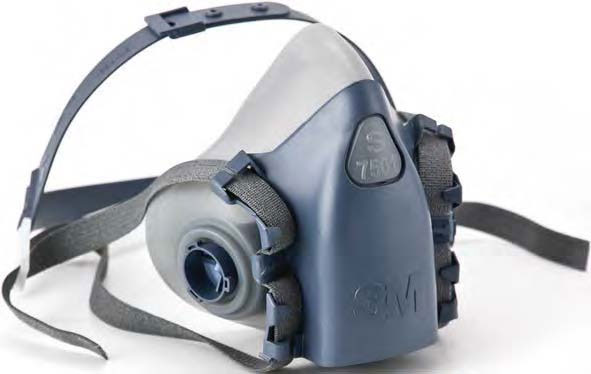
Breathing in fine metal particles and wood dust can do serious damage to your lungs over time. While disposable respirators are good products, anyone who grinds and sands frequently needs a higher level of protection. As result, Jantz offers the 3M 7500 series Reusable Respirator.
“The biggest complaint we hear about respirator use is comfort and heat,” Jantz’s Shanna Kemp noted. “3M’s 7500 series solves these problems with a combination of comfort and durability.”
MSRP for both medium and large sizes: $33.95 each. The MSRP for a combination cartridge to complement the unit is $14.95.
Belt Safety Guard
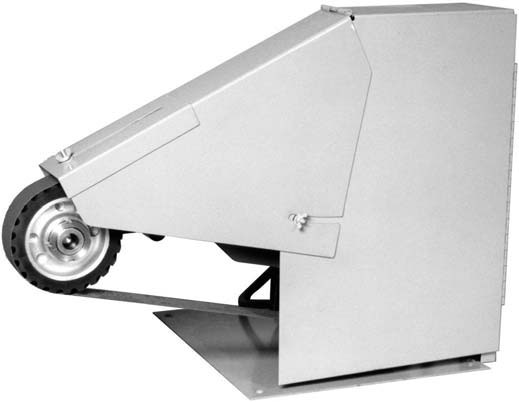
Hawkins Knife Making Supplies offers the Bader B3 Belt Guard, which features an adjustable front hood that minimizes the risk of injury if an abrasive belt should break while in use. Order by phone only. MSRP: $170 (plus shipping and handling).
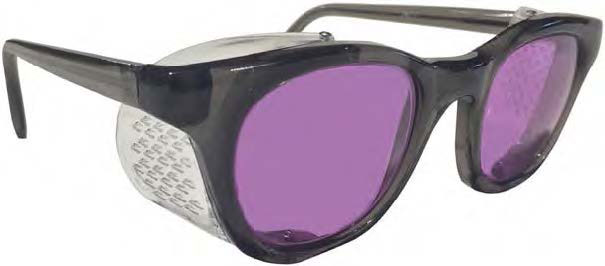
Forge-Welder Safety Glasses
David Kayne of Blacksmiths Depot says the Didymium Glasses are the company’s best-selling safety item.
“They will save the eyes of anyone who regularly works at temperatures above 2,000°F,” he noted, “forge welding of billets for damascus in particular.” MSRP: $75.
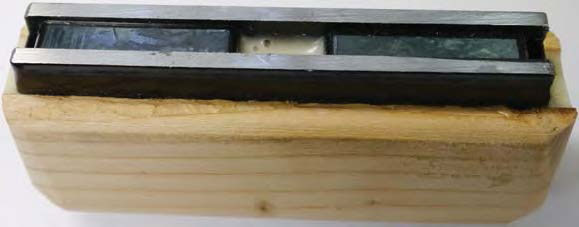
Super Magnet
According to Shannon Edgington of Knife & Gun Finishing Supplies, K&G’s model no. WT12 magnet comes in a 5-inch size and is more than strong enough to hold small pieces of steel against a disc or belt sander.
“The magnets are great ‘finger savers’ for removing the bark or just flattening the surface of steel,” she wrote. MSRP: $19.95.
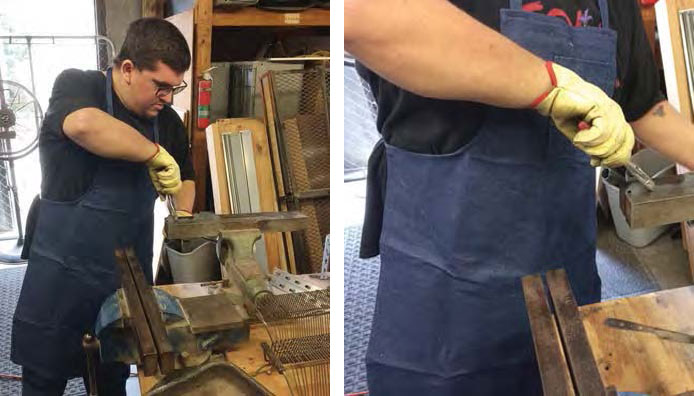
Heat-Resistant Work Apron
Texas Knifemaker Supply’s heat-treat technician wears the company’s heat-resistant denim work apron to shield himself from the oven’s radiant heat, as well as from the red-hot blades as he checks them for straightness before air quenching.
The heavy-duty denim is nice and thick and has a waistband cord to tie behind the back. One size fits all. The apron also protects clothes from dirt and grime. A handy pen pocket is ideal for telescopic magnets, safety glasses, etc. MSRP: $12.95.
Inspired By His Time Fly Fishing In The Pacific Northwest, Joe Mangiafico’s Trout Knives Are Durable, Eye-Catching Tools.
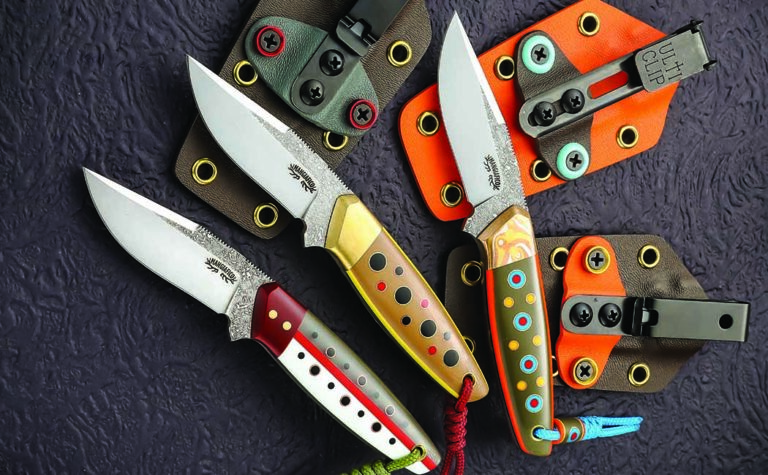
Joe Mangiafico’s trout knives not only are built to use but are cool and colorful to boot.
The 28-year-old Massachusetts maker acid etched the flat areas of the blades for a damascus look, yet it’s the handles and sheaths that really stand out.
The grips are structural mosaics of G-10, brass, and copper. For instance, the blue haloed red center pins of the model with the green handle are inlaid plugs, and the brass pins are press fit and epoxied all the way through. He designed the Kydex sheaths with centered pocket clips to attach to your pocket or waders while fishing. The red-banded model is inspired by the redband trout Joe fly fishes for in the Deschutes River Valley of central Oregon.
Who Is Joe Mangiafico
Mangiafico began making knives while still a college student several years ago. Joe makes his knives in his shop in Cotuit, on the southern coast of Cape Cod. While the majority of his work is custom knives, he does have a factory collaboration with the German company Boker Knives. His Brook fixed blade is made from VG-10 steel and, like his trout knives, showcases his deft ability to craft an eye-popping handle. It retails for $156.95 and can be found on Boker’s website.
Trout Knife Specs Model names: Brook Trout, Brown Trout and Rainbow Trout Knife type: Trout knife Blade lengths: 3 inches Blade steel: Nitro V stainless Blade grinds: Flat Handle materials: G-10, copper and brass Bolster materials: Brass, Micarta® and mokume gané Overall lengths: 6.5 inches Sheaths: Kydex Maker’s price for similar knives: $375 each