Knifemaking is the building of a knife, which includes the blade, handle and other accouterments. Blades are made by either removing metal from a steel blank via a grinder – known as stock removal – and the forging to shape of hot steel into a blade in the process known as bladesmithing. Other parts, including bolsters, guards, pommels, etc., are needed to complete the finished knife.
One of 10 ABS Hammer-Ins and events across the country, the Heartland Bladesmithing Symposium included demonstrations by renowned steel makers and knifemakers like Jerry Rados and Steve Culver, who conducted demonstrations covering such subjects as damascus pattern makng, tomahawk forging, creating wood-lined sheaths, applying metallurgical theory, ABS journeyman smith judging standards, and even a knife photography segment taught by Caleb Royer.
The 2012 American Bladesmith Society’s All Forged Blade EXPO is the premier show for hand forged blades. From utility blades, to the finest forged and crafted art knives, the ABS EXPO has something for everyone. The show will be held in San Antonio, Texas, January 27 – 29, 2012 the home of the Alamo.See some of the world’s finest forged knives showcased in a unique and informative format for the enjoyment of the forged blade collector/enthusiast by American Bladesmith Society Mastersmiths and Journeyman Smiths.
Dan Cassidy has set up an Expo Photo Gallery so that the makers can exhibit their knives prior to the show, so that collectors may have a sneak preview of these works of art. I have asked the table holders to make knives especially for this show and to photograph them. Please post your photos in the ABS Exposition Gallery of the ABS Forum and ABS Webmaster Dan Cassidy will be available to assist you. Also post your knife photos on other knife forums so that prospective buyers may have a sneak preview to what they will see at San Antonio.
14 inch Thomas Wells Antique Bowie Progress Report.
BLADE A full scale pattern was made of aluminum from a tracing of the original Bowie. The blade as it was being forged could be laid on the pattern hot as an aide to forge the blade to shape. The steel in this blade was forged from a large coil spring from a rail car.
(Photo 1)
The blade was ground, set up for the guard, Spanish Notch filed , heat treated and finish ground. The maximum blade thickness is .355 inches at the hilt and .250 inches at the clip. The clip was ground and hand finished on one side of the blade as was the original.
(Photo 2)
The large tang was used to give the knife a better balance and stronger handle. The tang is tapered from guard aft and from the top down. The pin holes were drilled in the tang.
GUARD
A brass 1/2 template was fabricated to the shape of the guard which fit snuggly on the blade. (Photos 3a & 3b)
The guard was hand filed from a 1/4 inch thick piece of cupro nickel 715 , hand finished and polished. Cupro nickel 715 is 30% nickel and 70% copper and is more corrosion resistant than nickel silver which has only 18% nickel.
HANDLE CONSTRUCTION Photo 4 is the end view of the handle that shows the basic handle construction.
Photo 5 is the handle
and Photo 6 is an exploded view of the handle showing all its components.
The handle was fabricated by wrapping the tang with Teflon tape. A piece of tin .007 inches thick was wrapped around the tang and drilled for the pin holes. Two pieces of Mastodon Tusk were shaped into a trapezoidal cross-section to fit against the tin liner. Holes were drilled in the Mastodon handle scales. The scales were shaped a little over size in the plan view. These scales were super glued with gel to the tin liner using pins to align the holes and a rubber band made of an inner tube as a clamp. The assembly was removed from the tang and a dam was made at each end of the handle with masking tape. The voids at the top and bottom of the handle above and below the tang were filled with JB Weld. The handle was ground to final shape in a rectangular cross-section with each scale being of equal thickness.
The handle is a little larger at the pommel than at the guard. I went to Microsoft Word and made a drawing of the rectangular cross-sections at the front and back of the handle. I drew an ellipse in the rectangles and printed them out.
(Photo 7)
I then cut out the rectangles and pasted them on the front and back of the handle. The handle was shaped with new belts from 36 grit and 80 grit on the flat platen by holding the handle vertically against the platen. The handle was hand finished to 600 grit.
The front of the handle was taped around the handle the required distance from the end as a guide for the front ferrule. A course file was used to recess the handle .032 inches. The pommel was done the same way. A piece of cardboard .032 inches thick was used to measure the circumference of the ferrule. A rectangular of dead soft German silver .032 inch thick was sawed out a little oversize. The handle was used to form the ferrule with the solder joint at the bottom. The joint was overlapped. Both ends were sawed into with a jeweler saw while held in a vise to obtain a straight joint. The ferrule was opened wide enough to allow an eight inch mill bastard file to be used to file the ends. The file is held in the vise with the face up and both ends are filed at the same time by pulling the ends along the top and bottom faces of the file with a slight pressure. The ferrule and pommel ferrule are wired up, fluxed and hard soldered. The ferrule is suspended by the top; the solder is applied to the inside and the heat to the bottom or outside. When the solder appears on the outside, it is done.
The pommel ferrule was wired to an oversize .070 inch thick plate on one end. It was fluxed and pieces of medium hard solder were laid around the joint on the inside and heated from the outside.
The top and bottom straps were made from 1/2 inch wide by .070 inch thick German silver. The bevels were ground and hand finished on each side. The ends were hand file to fit under the front ferrule and pommel cap. CHAIN KNUCKLE BOW
After some experimenting, I found that the original chain was called a rope chain that was twisted into a flat plane. (Photos 8a, b & c for construction details)
Eleven gauge (.088 inch diameter) fine silver wire was wrapped around a 3/8 inch diameter rod by hand. Thirty-six turns were made. Over 4 feet of wire was used. This coil was removed from the rod, fluxed and heated to a dull red, about 1250 degrees F., for about 30 seconds allowed to cool to a black heat and quenched in water. One loop was silver soldered with medium hard solder. The chain was constructed and soldered one loop at a time. After using about 10 loops, the chain was twisted flat to insure good solder joints, The chain was completed with 31 loops. A .093 inch internal diameter tube was constructed to make the hinge attachment to the pommel cap. The chain and tube are pictured in Photo 9 below.
METAL SHEATH (Photo 10)
The all metal sheath was constructed of .032 inch thick German silver sheet metal. After the blade was finished a pattern was made of a piece of oak about 3/4 inches thick. The pattern was made oversize to allow for the liner which is about .040 inch thick. Also make the pattern about 3 inches longer than the blade, the edges were rounded slightly. The sides were cut out of the sheet approximately 3/8 inches wider than the pattern on top and bottom. The tip was notched to allow for the bend. The sheet metal I had was in an as rolled state which was hard. I had to anneal the edges that were to be bent.
To shape the sides, place the sides between the pattern and a steel backing in the vice and bend the edges over with a small hammer only hitting the edge in a bending motion. You will have to reset in the vise several times. Take thickness measurements along top and bottom of the blade. Grind the edges of the sides to the require thickness, making sure you have allowed for the metal thickness, the liner thickness and 1/2 the width of the blade. Lay the side flat on the table and measure the height with the depth gage on the back of a veneer caliper.
Once the left and right side are made, flux the inside of each at the joint. Wire the two sides together with black wire at half inch increments. Flux the outside, use a metal spring clamp on a fire brick to present a joint in the up position to be soldered. Solder both sides with medium silver solder. I use a turbo torch and wire solder. Cut and pull the black wire off. I grind the extra solder off with about 80 grit. I use 120 grit to start the finish grinding on the sheath. It is easier to get the 120 grit scratches out than the 80 grit. You want to polish to 400 grit on a wheel. I use a 10 inch smooth 40 diameter wheel with a 3 inch drive pulley.
The sheath should be pickled to clean the inside. The tip and throat pieces were fitted, constructed and soldered with medium solder. These pieces were then soldered to the sheath body with easy easy solder. The belt loop was formed and tinned with soft 4% silver solder. It was then soldered to the sheath.
WHAT’S LEFT
1. Finish chain and pommel cap attachment with hinge. Polish chain in tumbler.
2. Layout incise carving pattern on handle and carve.
3. Assemble and finish knife.
4. Layout engraving pattern on sheath and engrave.
In this video Brian Thie shows how to do fine stitching around inlays in a leather sheath. Brian is a Journeyman Smith in the American Bladesmith Society…
Once upon a time, two little boys were smashing their toy cars with hammers. An errant swing caused a brain injury that left one of them without his hearing. Thirty-four years later the deaf boy grew up to be a man who swings a hammer in the forge. He holds no grudges. They were just boys playing, neither knew any better. “I’m a forgiving person,” wrote Norman “Buddy” Thomas of Quapaw, Oklahoma, in a Messager note. Today Buddy is a graphic artist and runs a screen printing shop by day, making knives part-time by stock removal and forge. He also strives to set a positive example in the deaf community. So, in essence, the hammer that took a bladesmith’s hearing gave him his craft. Another loss would wound Buddy further, but he is grateful, always grateful, for the love of his family and the means to create beautiful knives.
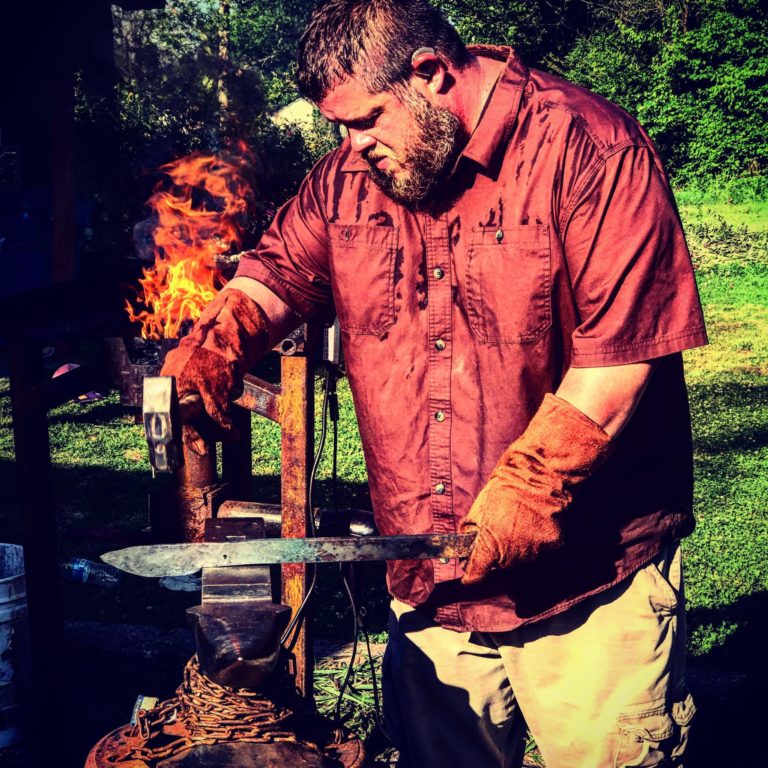
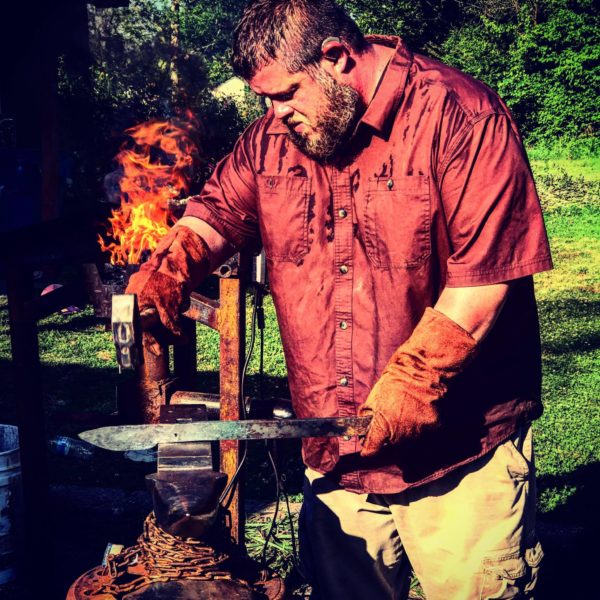
Norman “Buddy” Thomas of Tree of Liberty Bladecraft and Forge lost his hearing when he was accidentally hit in the head with a hammer. Today he’s the one wielding the hammer as he forges knives that run from frontier-style to post-apocalyptic.
Buddy was born in 1980. He and a neighbor boy were beating on their Hot Wheels with a hammer. Buddy was 3, the other boy, 5. The other boy’s swing went wild, hitting Buddy in the head. But a baby’s crown is not as forgiving as a die-cast model car. He irreparably lost his hearing. At first his parents tried the speech therapy route. Buddy began displaying social issues. It doesn’t seem like a bad idea to teach a non-hearing child to speak, but it confuses people who can hear and who do not realize the person is deaf. “No matter how well you can hone the speaking skills of a deaf individual, one thing is concrete certain, you can’t fix deaf,” Buddy explained.* He has one ear that is slightly better than the other and a hearing aid can maximize what remains, but it can’t cure the problem.
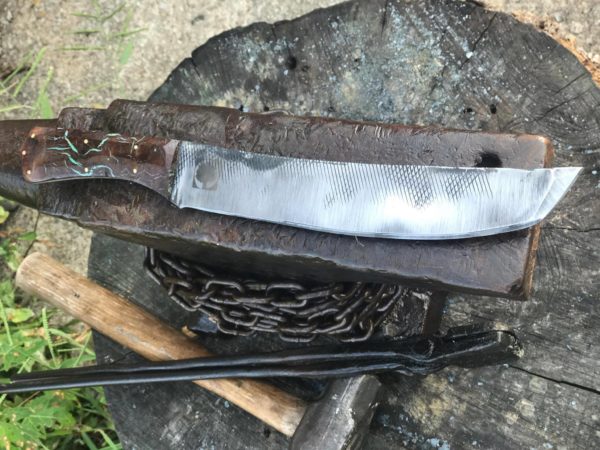
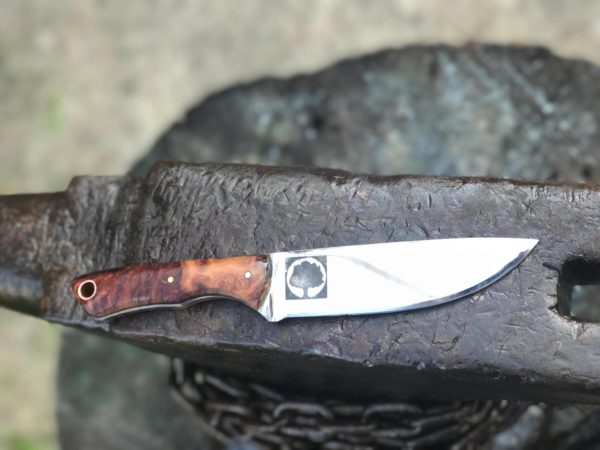
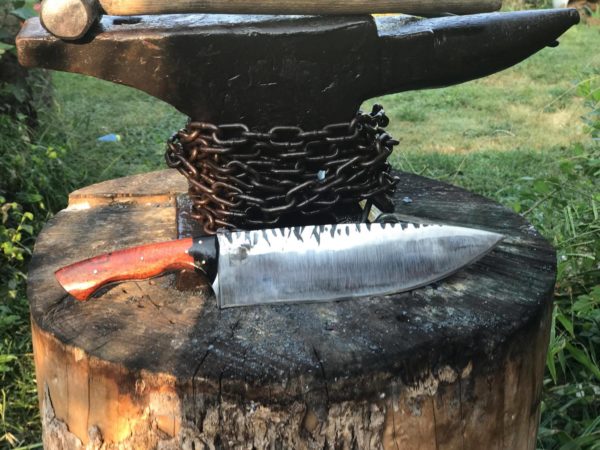
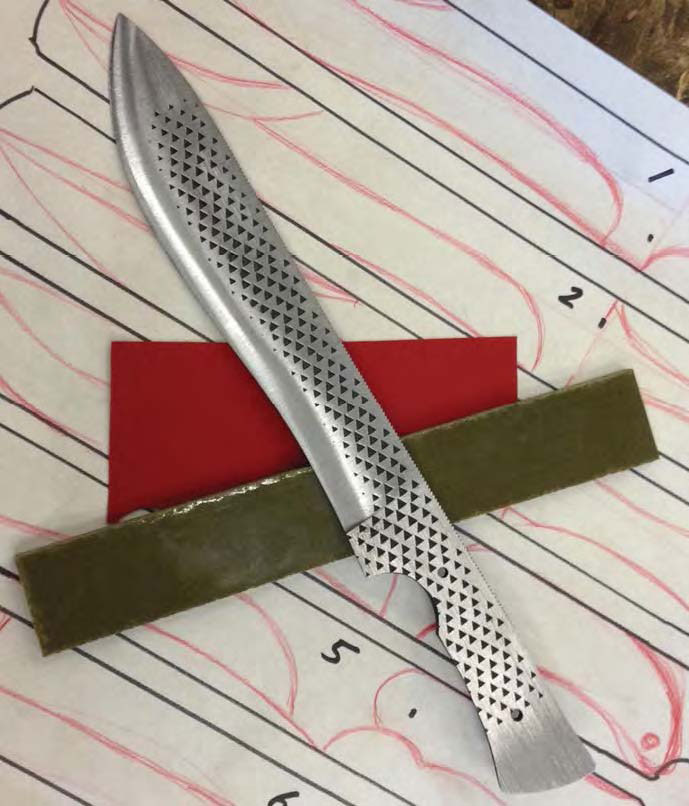
Buddy Thomas’ tanto chopper is made from a farrier rasp drawn out to 15 inches overall with a 9.75-inch blade length. The frontier-style coffin-shaped handle is stabilized maple burl with turquoise casting. Maker’s list price: $375. Contacts for Tree of Liberty Bladecrafting and Forge are listed at the end of this article.
Pre-kindergarten began for Buddy in an all-deaf environment. Throughout elementary and middle school Buddy was educated through a public-school system that focused on teaching deaf students to speak. His parents saw that he needed a change and enrolled him in Oklahoma School for the Deaf in Sulphur, which, funny enough, is one town over from where Jantz Supply is located in Davis. Jantz has been offering knifemaking supplies to craftsmen worldwide for 50 years. It was at OSD where Buddy flourished and his interest in metalwork began.
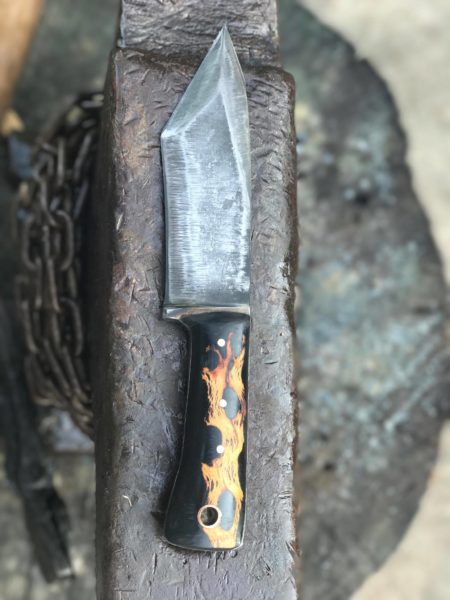
The American tanto hybrid from Tree of Liberty Bladecraft and Forge is made with 5160 spring steel. The blade length is 5.75 inches; overall length is 9.75 inches. The handle material is stabilized cholla cactus cast in black epoxy. Maker’s list price: $350. Contacts for Tree of Liberty are listed at the bottom of this article.
Meanwhile, at this time there were not a lot of American Sign Language courses for Buddy’s parents, but he taught them what he learned. His sister, Kalley, picked up on it quickly. Today, hearing parents are teaching sign language to their pre-verbal hearing children. Science is showing, in all mammals not just human babies, that possessing a non-verbal means of communication minimizes frustration and thereby aggression. Later these babies and, say, puppies who are taught means of communicating as early as three to four weeks of age, are more confident and better able to cope with the inevitable challenges of life. There are also positive physiological benefits. Buddy said that it was easiest to conduct a non-sign conversation with his parents, but even now he uses ASL frequently with his father. His mother passed away after an illness in 2014. Both of his parents encouraged Buddy tremendously, and his father, along with his fiance, June, remains one of his biggest supporters.
This small hunter has a 5.75-inch blade of 1095 high carbon steel. The overall length is 8.75 inches. The handle material is stabilized Australian red mallee burl cast in blur Alumilite by Lucas Free. Maker’s list price: $350. Contacts for Buddy Thomas at Tree of Liberty Bladecraft and Forge are listed at the bottom of this article.
Buddy didn’t realize how much his machine shop/metal working class would impact his life. He was focused on going to college. He graduated from OSD as a Salutatorian with a 4.0 grade point average, serving as president in the local National Honor Society. “The only mismatched puzzle was my machine shop/metal working class, which I loved because when I tried the first semester out in that class I got hooked to the welding and metal fabrication,” Buddy wrote. His instructor Dwayne Bryant spent hours of one-on-one time with him, helping him develop his welding skills. Each advancement in his metal fabrication skill fueled his creativity. “In fact, my very first nonfunctional knife was made in that class in 1997 when I was just 17 years old,” he recalled. “A piece of mild steel plating, ground into the shape of a knife roughly 8 inches overall. A DeWalt angle grinder was used to taper a bevel and create an edge. The handle was from a can of spray-on rubber. I wish I still had it. Well, after that it would be years before I attempted another knife build again.” Buddy sprinkled laughing emoticons throughout that description.
“It was pretty much just a plain little skinner, probably only an inch wide but at least a quarter-inch thick,” he noted with tears of laughter.
Buddy was also the co-editor of the school newspaper along with his good friend James Mitchell, who in his own right has had an impact on the deaf community supporting various organizations. Then it was off to major in visual communications art at the University of Oklahoma (UO) in Norman. “I was one of only three deaf students on campus: a football player recruited from Lee’s Summit, Missouri, a French major and myself, an art major,” Buddy wrote, revealing how isolating it can sometimes be for a deaf person in a hearing world.
Buddy Thomas’ large bushcraft chopper is made from reclaimed early-1900s saw mill high-carbon steel. It is 16 inches overall with a 10.25-inch blade. It is 2.75 inches wide at its widest point. The handle material is figured cedarwood with a black epoxy bolster guard. Maker’s list price: $425. Contacts for Tree of Liberty Bladecraft and Forge are listed at the bottom of this article.
But Buddy got to work, putting his art and journalism experiences into play as a cartoonist and copy editor for The Oklahoma Daily, the school newspaper. “My childhood dream was to be a comic book artist. Of course, dreams change as we go through life,” Buddy noted. He grew up around several talented comic artists, including Steve Erwin, the original penciler for DC Comics’ Deathstroke the Terminator, a character portrayed on the television show “Arrow.” “I had originally wanted to attend the Joe Kubert School of Cartoon and Graphic Art in Dover, New Jersey, but I was persuaded to apply to UO and was accepted, so I went that route.” It was nice to have UO on his resume, but by the end of his first semester all the visual communications art slots were filled and he was assigned to a painting major. That was definitely not where he wanted to take his art, so he did not return, despite his good grade standing.
Buddy now manages a screen print shop and does graphic designs and color separations. “Part of my time I’m out running the automatic press and printing T-shirts, and the other part of my time I’m cooking up some wicked graphics, either for the storefront or a customer order,” he wrote. “At night and on weekends I work my forge and knife shop.” Care to guess what the name of the print shop is? Metal Fab Trophy and Screen Printing. You don’t have to hit Buddy over the head for him to get that he may be exactly where he was meant to be all along. The name he chose for his business: Tree of Liberty Bladecraft and Forge, invoking the freedom that he experiences through his creativity.
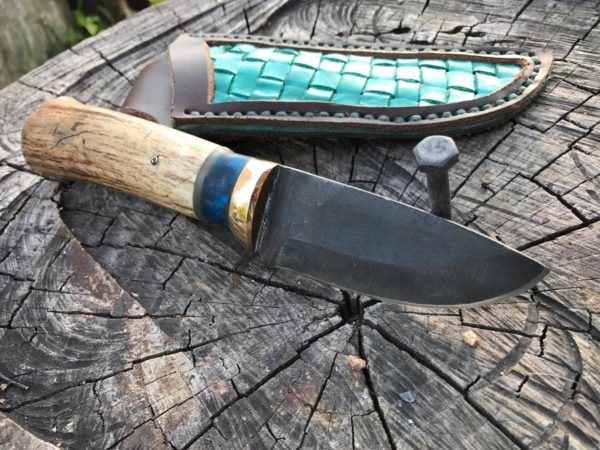
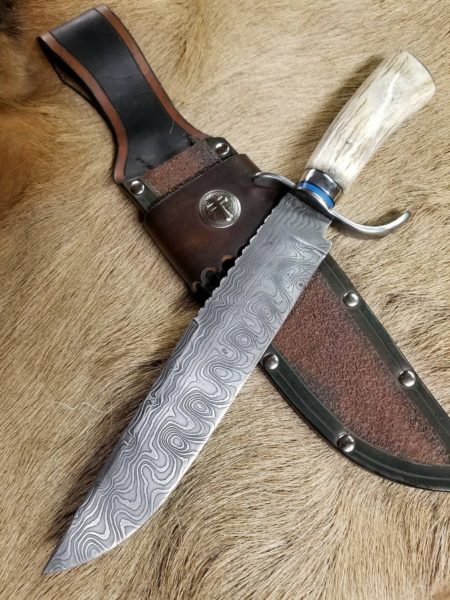
This Buddy Thomas creation comes with a turquoise leather weave sheath. It is made from CPM S90V steel, 9.5 inches overall with a 4.75-inch blade. The handle is elk antler with a rustic coffee stain and a blue Alumilite spacer and solid brass guard. Maker’s list price: $575. Contacts for Tree of Liberty Bladecraft and Forge are listed at the bottom of this article.
Buddy’s design skills do help him when he’s working up a pattern for a stock-removal knife on card stock, “but when forging, it’s all in the eye,” he wrote. Buddy started in stock removal and worked his way into forging by trial and error with lots of research and time spent learning from other forge artists. “A guy I ran into in a forum a few years back—his name was Ethan Paul Dobbins—he sent me tons of material to read up on. Another was a lifelong friend who did some blacksmith work as a tool maker, James Moore. I have actually learned most of my blacksmithing skills at the anvil from James, who was there to help me correct my hammering form and help guide me through and recognize heat requirements and steel reactions,” Buddy explained.
Buddy can read lips and his hearing aid, although not the best, helps him hear a little. “James is as hearing as they come! Maybe selectively deaf at times,” Buddy joked with a laughing emoticon. “I can read him pretty well, but sometimes have to have him repeat himself.”
Deaf bladesmith Buddy Thomas and his hearing wife, Sundae, have two daughters, Anna, 12, and Kaity, 9.
Buddy’s wife, Sundae, is also hearing. They met at a football game in Picher, Oklahoma, and were married in 2001. She did not know sign language at the time, but she has learned from Buddy. They have two daughters, Annaleigh, 12, and Kaitlynne, 9, who also know sign language. Their first child, also a girl, Daisy Elizabeth, would be 15 now, but the couple lost her two weeks after she was born, to infection. “She passed in my arms,” Buddy wrote.
Buddy and Sundae Thomas lost their first child, a daughter, at 2 weeks of age, due to infection. Buddy lost his hearing at the age of 3; his wife is hearing.
“She was beautiful. I always wonder what she might have been like as their older sister. I’m so grateful and thankful for those two.”
If you converse with Buddy for any length of time, you will sense the sad undercurrent of the tragedies in his life, but you simultaneously get the feeling of a silent, gentle but unwavering determination to not just live, but thrive. He doesn’t minimize the impact of his losses—his hearing, his daughter, even his childhood aspiration to become a comic strip artist though he admits to outgrowing that aspiration—but the Tree of Liberty gives him more than solace; it restores his life-battered spirit.
He enjoys the stock-removal method of knifemaking, but whenever possible, he prefers to forge. He started on a coal forge and still loves it, but he often goes to the propane forge because it’s quicker and cleaner. “Most CPM steels are difficult to forge,” he observed. “Stock-removal methods work much easier for such jobs. Most of my stainless and powder steels I apply the stock-removal method to, but my high carbons benefit me better at the forge. Ultimately, they all go in the forge for heat treating.”
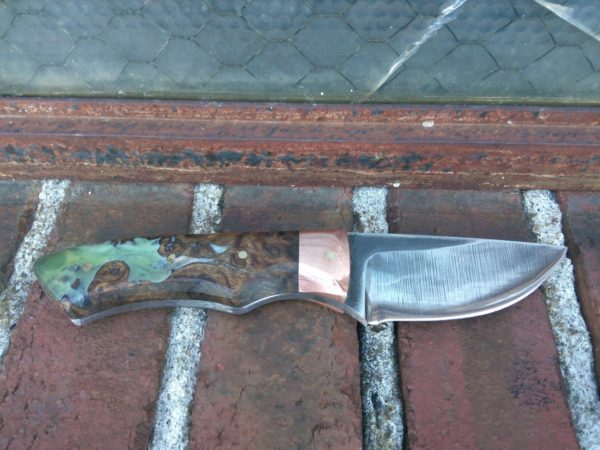
This Tree of Liberty Bladecraft and Forge creation has a 4-inch Elmax steel blade and an overall length of 8.75 inches. The handle material is rare black nargusta cast in a jade green Aluminite by Rob Carper of RC Innovations. The bolster is copper. Maker’s list price: $475. Contacts for Buddy Thomas listed at the bottom of this article.
Buddy’s knifemaking style swings from old frontier to post-apocalyptic utilizing reclaimed steel. He also makes everyday carry knives and has a preference for using copper bolstering. “One of my biggest goals as a maker is to get a prop knife made for ‘The Walking Dead’ show,” Buddy notes. His forging buddies, Aric Davis, Ryan Edwards and Louis Stark, often get together for Sunday forge-ins. In other words, the forge is the hearth of Buddy’s heart.
“I would not be where I am in this world if I did not have the deaf community behind me, specifically my best friend who has always had great words of encouragement,” Buddy said of a deaf woman who is like a sister to him. He recommends that deaf people who are interested in learning about knifemaking and forging do so through a deaf school or access vocational rehabilitation departments in their state for guidance and research. The next step is to seek out experienced bladesmiths who offer classes in their shops. “A deaf individual would acquire an interpreter to accompany them to the classes. It is actually my goal to establish a stronger bridge in that direction,” Buddy added. His plan is to work toward his American Bladesmith Society journeyman smith rating and eventually his master smith rating so he can offer classes to other deaf people. He knows they would be more comfortable learning from a deaf instructor. Three-way conversations with an interpreter can lead to a loss in focus.
Buddy lives out his favorite quote, attributed to Helen Keller: “Optimism is the faith that leads to achievement. Nothing can be done without hope or confidence.”
*Editor’s note: For this interview Buddy and I Messaged about using Facetime, but we felt it would be easier for him if we Messaged. It forced me to slow down and try to pick up on all of those nuanced things that happen even in phone conversations, like tone. In the end, Buddy and I both felt that he had told his story and I had heard his story in all its bittersweet humanness.
Buddy’s Links for Deaf-Related Services And Assistance
September is National Deaf Awareness month. Here are a few organizations that deaf bladesmith Buddy Thomas of Tree of Liberty Bladecraft and Forge in Quapaw, Oklahoma, recommends.
Empowers Oklahomans with disabilities to live healthy, active, smoking-free lives.
A Digital Subscription To BLADE Is The Answer
You can read your digital issues of BLADE Magazine anywhere you have your phone, tablet or computer, and there’s no need to find storage for all your old issues.
If piling up issues of magazine seems like a waste for you… If you feel like you don’t have time to read a magazine… If you like the stories we offer in BLADE, but want a more economical option, then a digital subscription is the answer. An annual subscription to BLADE is $17.98, $4 off the print price.
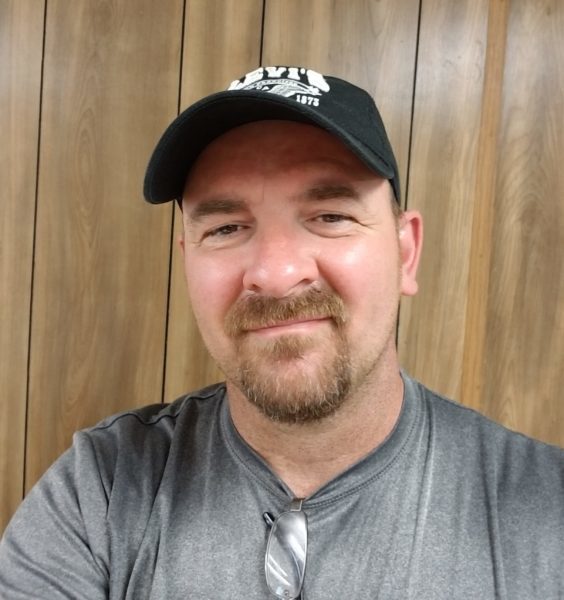
When Jerry Davis was a baby he was scooting across the floor and his grandmother dubbed him Scooter. He is a third-generation welder and fabricator. His dad made knives as a hobby, and by the time Scooter was a teenager, he, too, was making knives.
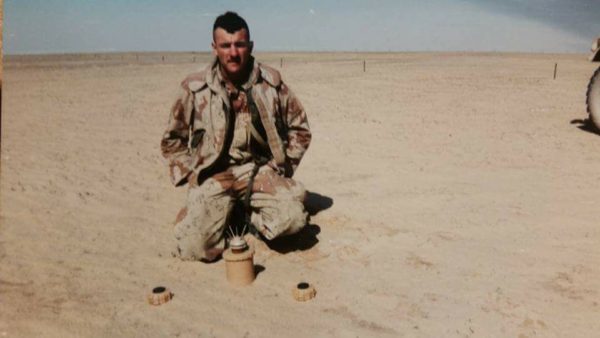
Schooter Davis, a Desert Storm US Marine Corps veteran, specializes in small everyday carry knives, skinners and survival knives.
At 19 he entered the U.S. Marine Corps and served as a heavy equipment engineer during Desert Storm. The Gulf War veteran served four years then returned to West Virginia.
Scooter Davis served in the U.S. Marine Corps during Desert Storm. The Gulf War vet then returned to his native West Virginia.
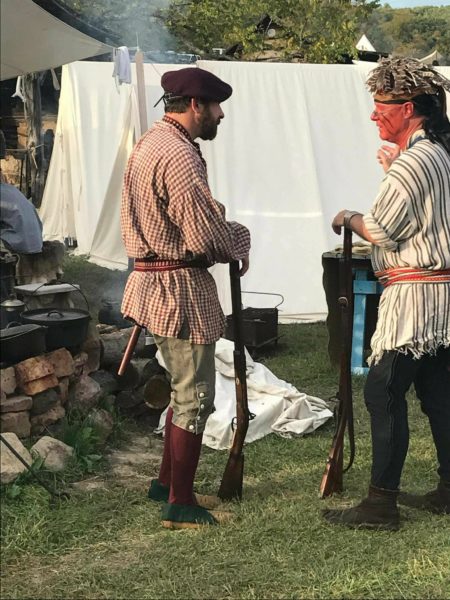
When he isn’t making knives, he’s attending rendezvous, living history gatherings that bring early American frontier days to life. He makes many items in his kit and, of course, period-appropriate knives.
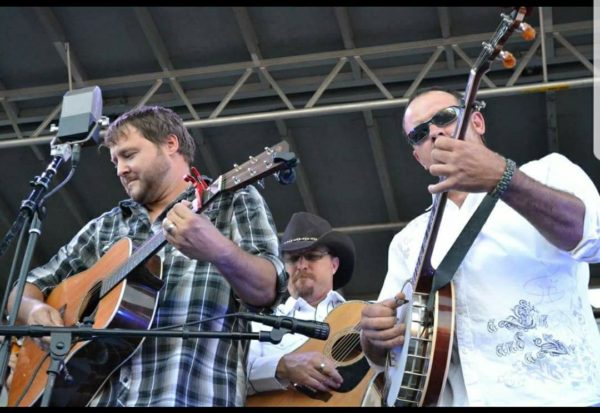
“A primitive rendezvous is a living history event,” Scooter Davis explained. “I have enjoyed them since I was a child. It’s like taking several steps back in time and I enjoy crafting knives and other items that represent that time period [early American frontier].”He’s also a singer and musician, playing weddings, parties and other events, equally comfortable with Sinatra or Stevie Ray Vaughan.
The quintessential Renaissance man, Scooter Davis of Rough Run Forge, can also perform anything from smooth jazz to country.
“I’ve always been an artistic feller, always making things. I can make just about anything,” Scooter said. But what really inspired him was the quality of the work he saw coming out of other knifemakers. John Savage has been a good friend along the way. “My goal is to create blades worthy of being used in the outdoors.”
Best-selling knife patterns: small everyday carry, skinning, survival
Favorite blade steels: 1095 for ease of forging, toughness; 52100 for toughness, edge retention
Blade grinds: flat for deep cutting and skinning, convex Scandi for durability in hard use
How he tests his knives: field use, chopping mountain laurel, slicing paper, cutting small bolts, shaving
Favorite handle materials: Micarta for toughness and durability; wood and bone for beauty and value. “I am partial to rare and hard-to-find materials,” Scooter noted.
Price range: $150 and up
Online purveyors: Pendleton County Outdoors, www.pendletoncountyoutdoors.com
Knife shows he attends: Greater Shenandoah Valley Knife Show, Harrisonburg, Virginia
Member of: American Bladesmith Society
Forums he participate in: Facebook Groups, Knife Dogs, BladeForums.com
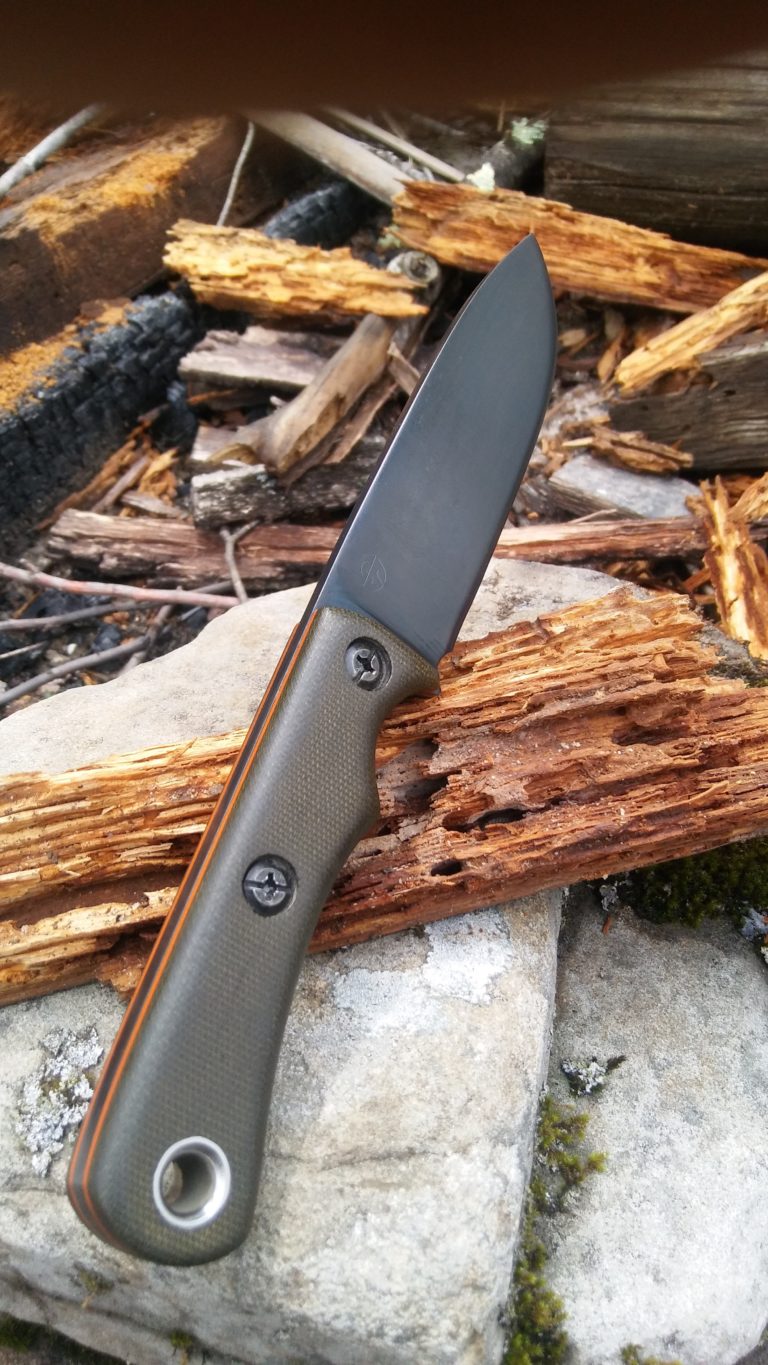
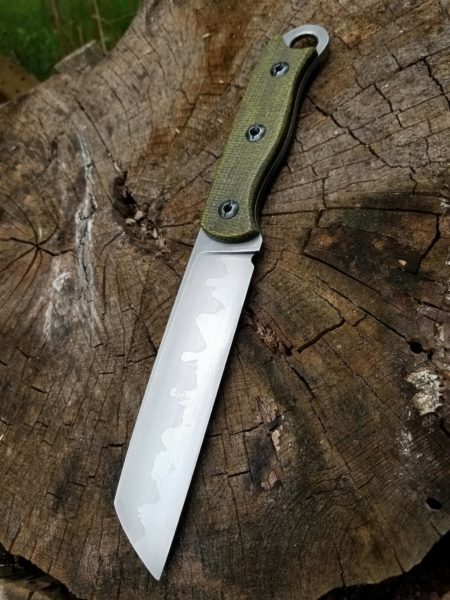
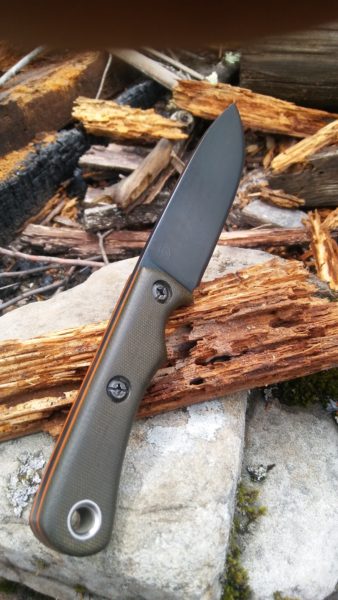
This bowie has a 13 1/2-inch blade made of pattern-welded steel by Zoe Crist Knives. The handle is comprised of elk antler, stainless steel and G-10 spacers. The maker’s own pattern-welded steel was used on the guard. Maker’s list price: $800. Contacts listed at the bottom of this article.Scooter Davis’ seax is 10 1/2 inches long with a 5 1/2-inch blade made from W2 steel with hamon. Avocado Micarta scales were used for the handle. Maker’s list price: $250. Contacts listed at the bottom of this article.The W.A.C.K.-1 (Wilderness Area Camp Knife) has a 5-inch blade forced from 1095 high-carbon steel. The scales are fashioned from OD green canvas Micarta with hunter orange G10 liners and a ½-inch stainless steel lanyard tube. Contacts listed at the bottom of this article.
Contact Scooter Davis at 540-560-1672, [email protected], on Facebook at Rough Run Forge and Instagram @roughrunforge.
A Digital Subscription To BLADE is the Answer
You can read your digital issues of BLADE Magazine anywhere you have your phone, tablet or computer, and there’s no need to find storage for all your old issues.
If piling-up issues of magazines seems like a waste to you… If you feel like you don’t have time to read a magazine… If you like the stories we offer in BLADE, but want a more economical option, then a digital subscription is the answer. An annual subscription to BLADE is $17.98, $4 off the print price.
Awards Were Given Out In Nine Different Custom Knife Categories Including Best In Show At BLADE Show West In Salt Lake City.
Dozens of makers entered knives in competition across eight different custom knife categories. The skill on display was tremendous, and numerous knives wowed the judges. However, these were the blades that stood out from the crowd and took home the awards. All images are SharpByCoop Images.
Explore the classic clip-point bowie knife from apprentice smith Robert Burns of Wilderness Ironworks.
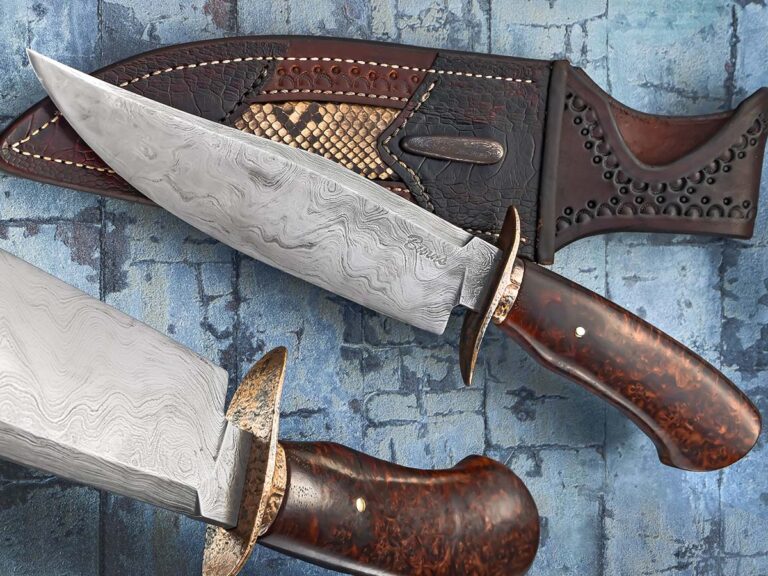
ABS apprentice smith Robert Burns of Wilderness Ironworks wanted a project that would take him back to the roots of being a bladesmith, and appears to have satisfied that desire through his classic clip-point bowie.
“My goal was to combine the ancient and the contemporary,” he wrote.
For the ancient, he started with iron ore from Minnesota and iron sand from Connecticut. He smelted the two into bloom steel, which he then refined, “my goal being to make a steel fine enough that it could potentially pass for modern damascus”—thus the “contemporary.”
Robert Burns of Pittsburgh, Pennsylvania, used ancient materials such as iron ore and iron sand for the blade and a historic mix for the fittings of his sole-authorship bowie.
To augment the “ancient,” he used a “historic mix from the Bronze Age” for the bronze for the fittings.
As Robert noted, the knife is true sole authorship, from starting ore to the finished sheath.





 (Photos 3a & 3b)


 (Photo 7)
 (Photos 8a, b & c for construction details)
 (Photo 10)