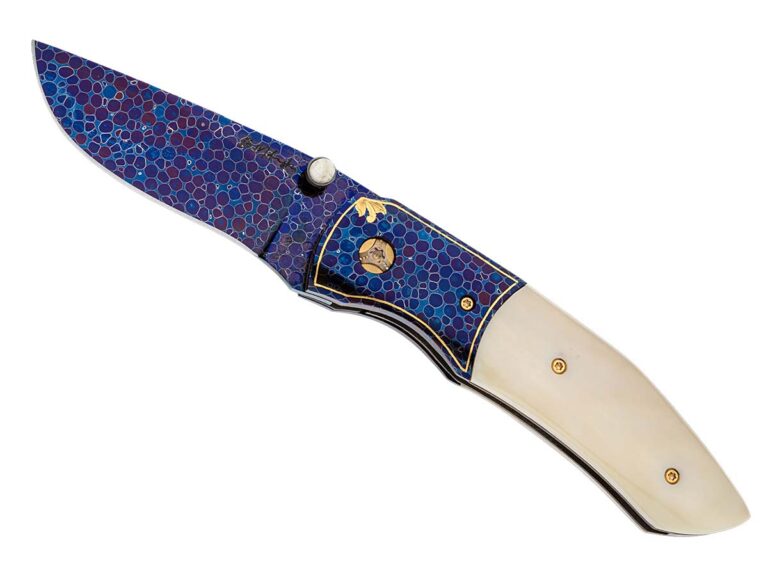
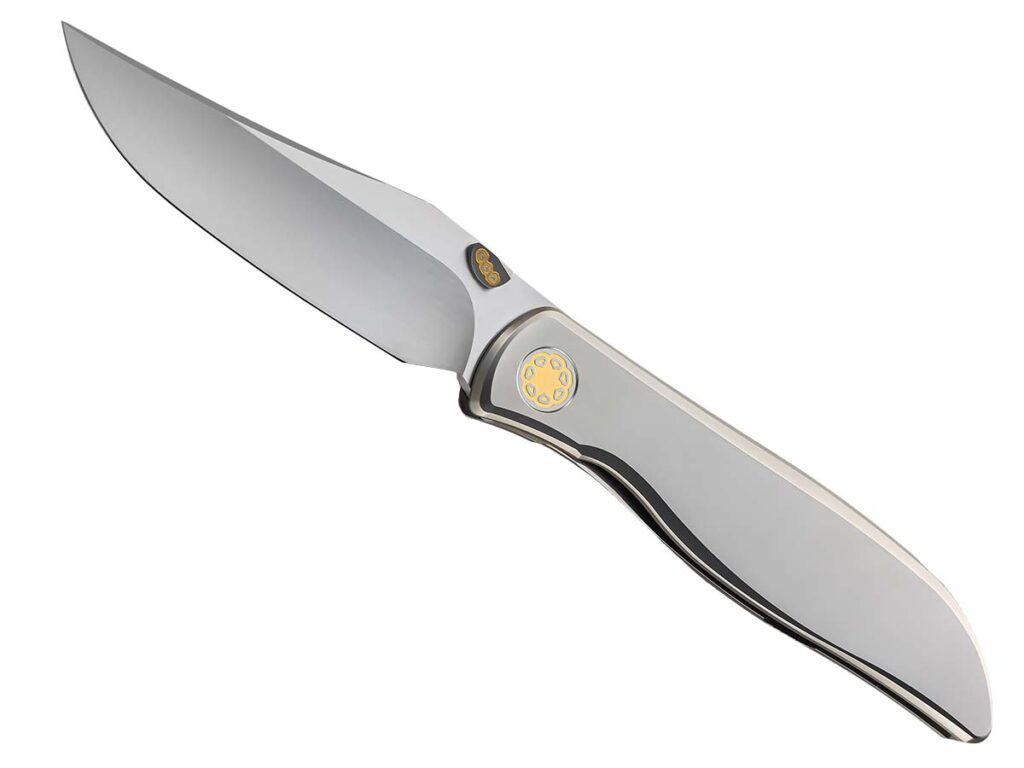
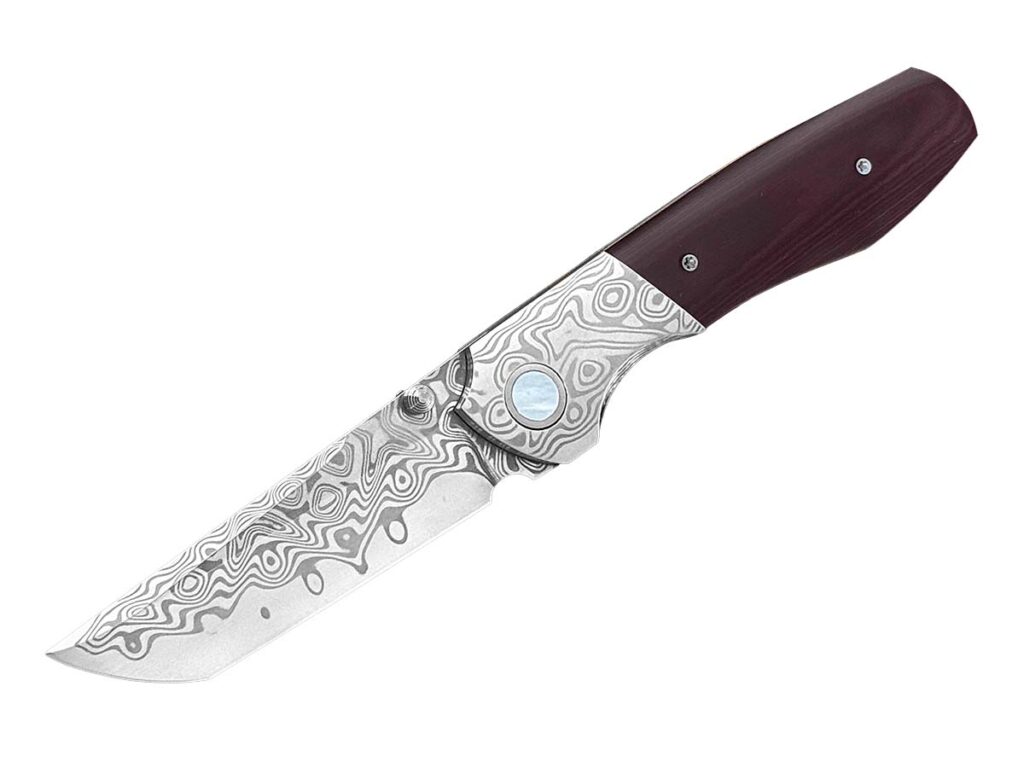
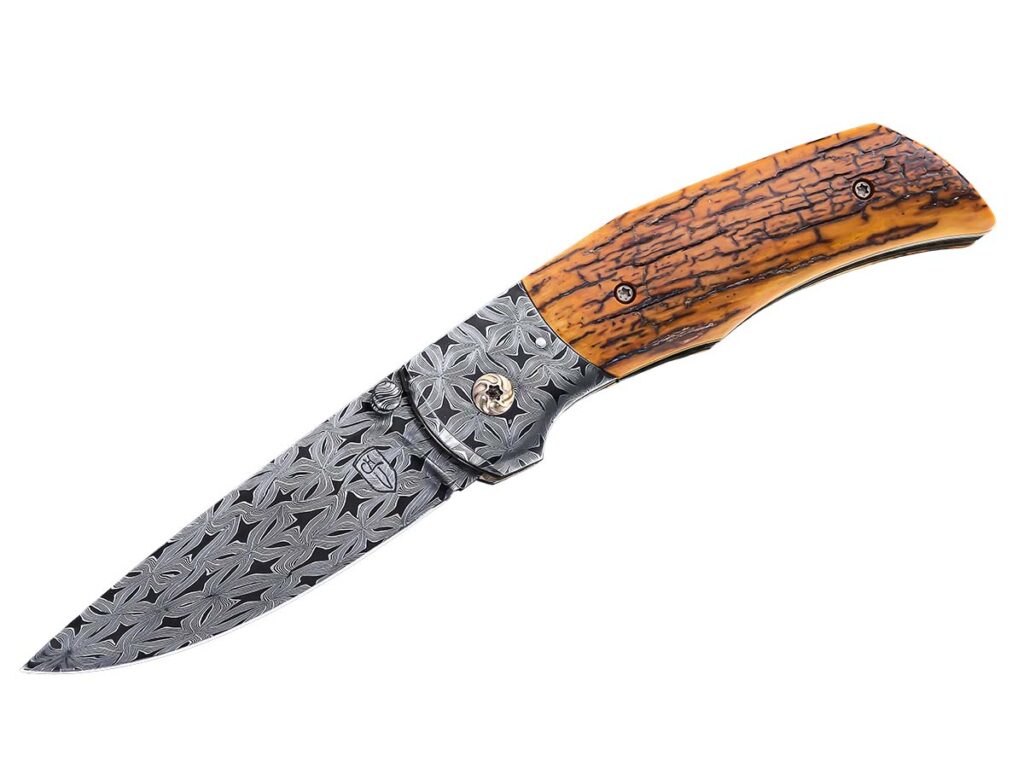
Knifemaking is the building of a knife, which includes the blade, handle and other accouterments. Blades are made by either removing metal from a steel blank via a grinder – known as stock removal – and the forging to shape of hot steel into a blade in the process known as bladesmithing. Other parts, including bolsters, guards, pommels, etc., are needed to complete the finished knife.
Marine Corps hero feted with Nawrocki knife at The Battleship Ball.
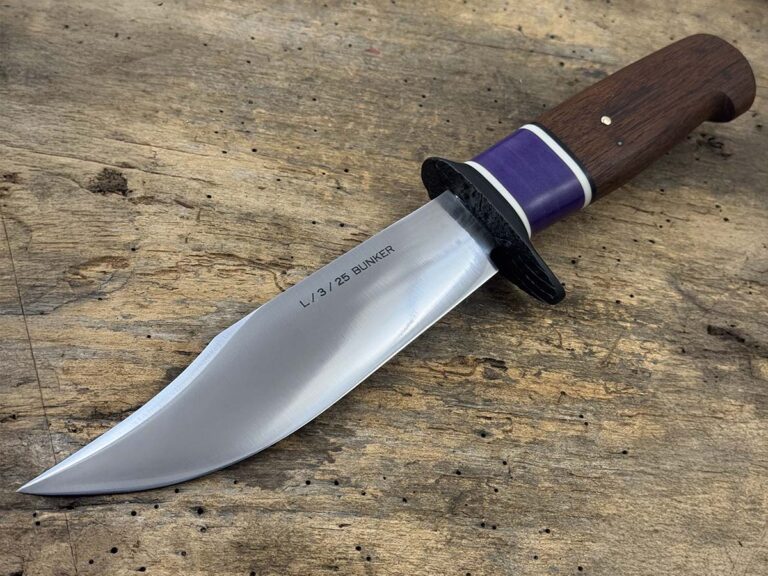
An unforgettable setting for a memorable event celebrating an American hero—all complemented by a beautiful knife by Brian “Rocco” Nawrocki—completed a tribute to USMC Sergeant Scott Bunker during last year’s 250th anniversary of the United States Marine Corps.
Assigned to Lima Company in 2005 during the Iraq War, Sergeant Bunker took multiple machine-gun rounds at point-blank range in house-to-house fighting, resulting in the loss of an eye, half a lung, several ribs and soft-tissue damage to his left arm. He was the guest of honor at The Battleship Ball 2025 on November 1, held on the deck of the vintage World War II Battleship USS North Carolina in Wilmington, North Carolina.
Event organizer/USMC veteran Dean Smith (left) congratulates Sgt. Scott Bunker after delivery of the Nawrocki tribute knife (in display case on the dais) during The Battleship Ball.
The handsome fixed blade Rocco made for Sergeant Bunker includes steel from the North Carolina for the blade and guard. The wood handle is teak from the battlewagon’s deck, along with purple heart ribbon spacers.
Knife edges come in all different styles. We break down the major types in this quick guide to blade grinds.
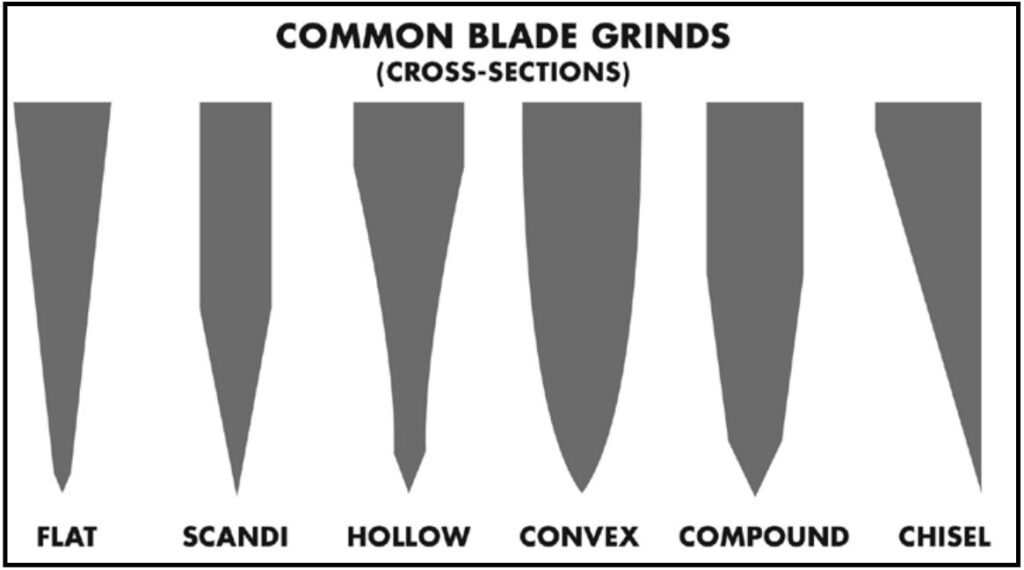
Cutting performance is greatly influenced by the way in which the maker grinds the knife. Each grind will have different cutting characteristics. A good knifemaker will consider whether the grind of the knife is suited to the chosen task. You as a buyer will also need to consider if the grind of a knife will suit the tasks you have in mind.
Blade grinds you’ll often come across can be seen here. (Image courtesy of Knafs.com)
Flat Grind
A flat-ground knife is a simple wedge and may be thick or thin. Flat grinds are good for slicing and deep cuts. I personally prefer a flat grind that goes all the way to the spine. A thinner flat grind will cut more smoothly than a thicker flat grind, where a thicker grind may be more durable.
Hollow Grind
A hollow-ground knife has a slightly concave bevel, which makes it thinner behind the cutting edge. This makes for good skinning and shallow cut work, without giving up overall blade heft or durability. Deep cuts or chopping are not well suited to a hollow grind.
Convex Grind
Convex grinds have slightly rounded bevels, which increases their edge stability. While they may not excel at slicing, they’re the way to go for hard use cutting and chopping.
Scandi Grind
Scandi grinds are a short flat grind with no secondary bevel. “Scandi” refers to the Scandinavian countries where that grind style is popular, especially Finland. This grind style cuts very well but can be difficult to sharpen properly.
Compound Grind
A compound grind may combine several of the basic grind shapes. Particularly on tactical and folding knives, many modern grinds are aesthetically interesting, but at the occasional sacrifice of performance. If you’re collecting for aesthetic reasons, however, these grinds could be all you ever wanted out of a knife.
There are different definitions of a full-time maker. My definition is that of a maker whose sole source of income comes from the making and selling of his/her knives. This is no easy task.
In fact, by my estimate, less than 2 percent of the makers worldwide fit into this category. The reason the number is so low is it is very difficult to depend on knifemaking as your sole source of income.
#1 – Treat Your Knifemaking Business Like a Business
Fisk’s advice is to take college courses on business management, accounting and marketing prior to going full time. McIntyre agrees. He recommends putting as much effort into learning to run a small business as you do into making knives.
I recommend adding a certified public accountant (CPA) to your knifemaking team. In addition to handling your books, a CPA can recommend which type of business entity you should form. Perhaps the CPA’s best skill: tax planning.
#2 – Invest in Equipment
What kind of equipment? As Winkler noted, he and his partner, Karen Shook, “invest money in new equipment that will make our work better and more efficient.”
#3 – Find Your Niche
This is where your marketing plan comes into play. The objective is to optimize how you introduce your knives to potential buyers. At a minimum, your plan should address how you will make the most of attending knife shows, advertising in print and on the internet, and the potential of working with a dealer and/or purveyor.
#4 – Communication Matters
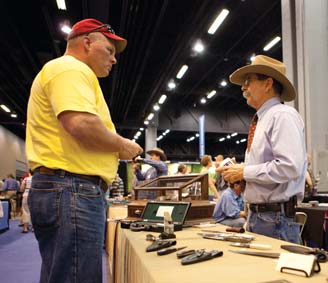
You must build time for interaction with your clients into your schedule. A basic rule of thumb: No customers, no business. The late John White (right) talks knives with a client during a past BLADE Show. (Point Seven photo)
For Hanson, it is one of the most important aspects of being a full-time maker.
“I answer phone calls and e-mails very quickly, and deliver on time or contact clients and let them know why there is a delay,” he stressed. “I listen to my clients.”
#5 – Create a Competitive Advantage
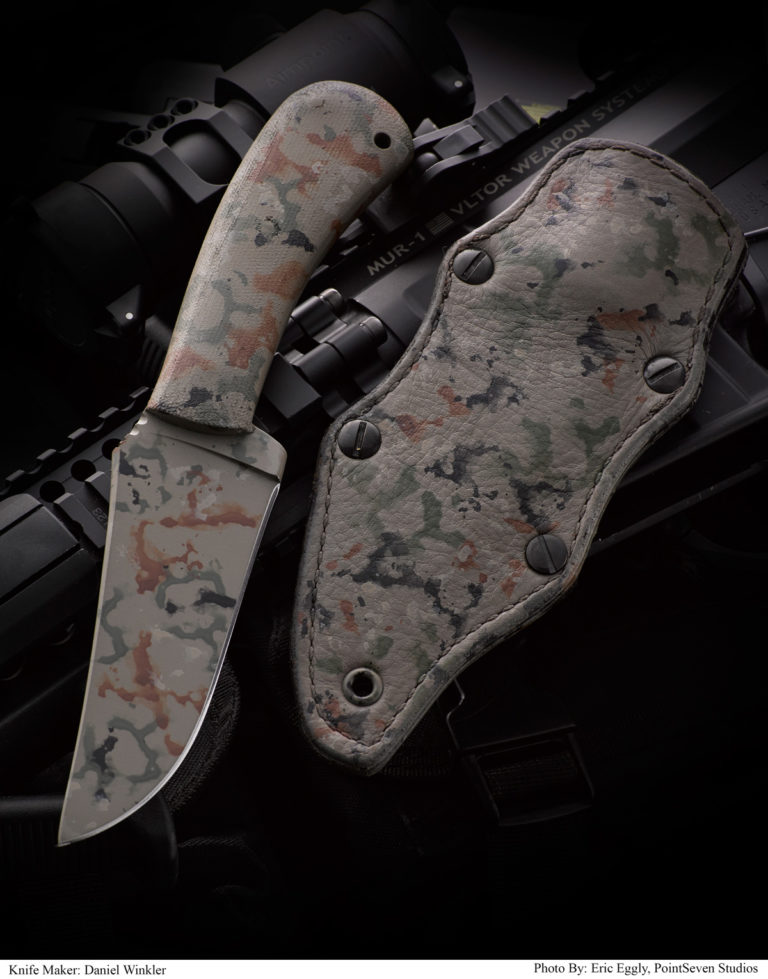
What separates you from your competitors? Winkler said adding Shook and her period style of sheathmaking to his operation years ago gave him a competitive advantage at the time.
“She brought a lot of business skills and makes sheaths that really put our work in a whole new league,” he observed.
More times than not your competitive advantage will come from being the first to adopt a new steel, handle material, design element, etc. You should incorporate such use of new materials or techniques into your business plan.
#6 – Delegate
No matter what their level of expertise, most makers realize they cannot do it all by themselves, though some try. Successful businessmen understand that utilizing the expertise of others frees them up to do the things they do best.
Enthusiasm and loving what you do are important factors in becoming a successful full-time knifemaker. However, understanding and implementing basic business concepts are equally important to building and maintaining a long-term, successful enterprise.
Final Words of Wisdom
Winkler may have summed it up best.
“I suspect very few makers are at [the full-time] level, as it’s the most difficult to survive in. It does not make your work more sought after. It does not put you in any kind of ‘exclusive club.’ But,” he observed, “if a maker can handle the pressure, it can be very rewarding mentally and somewhat rewarding financially.”
The thumb stud is reliable, time-tested and add dynamic dash to these customer folders.
Aside from the good ol’ nail nick, thumb studs are among the most enduring opening systems for folding knives. Why not? Typically ambidextrous, easy to manipulate and lightning fast, the reliable deployment feature has a lot going for it. Not to mention, on these custom knives, they add equal parts dash and traditional appeal.
Michael Raymond: Ziura folder
Forty-nine 24k gold inlays set into a 6-4 titanium frame elevate Michael Raymond’s Ziura folder. The swedge-ground Bohler M390 blade measures 3.53 inches with an 8.08-inch overall length. (SharpByCoop image)
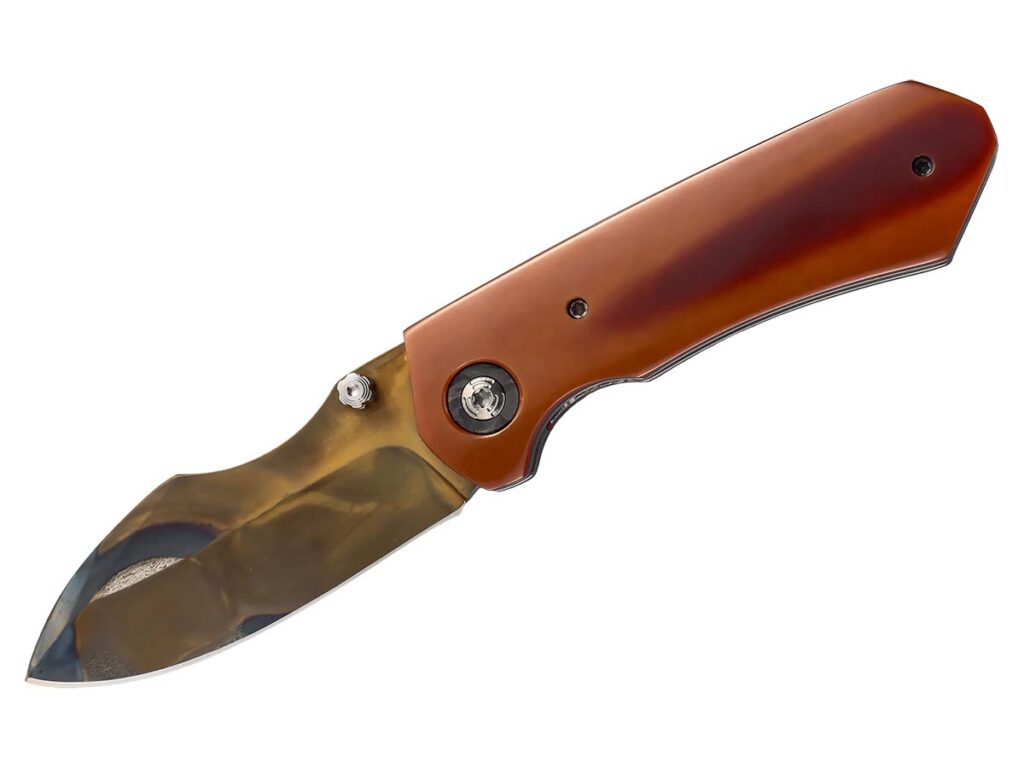
David Beaver: Shogun Horizon Folder
Vintage red linen Micarta scales and a hollow-ground Damasteel Baldur on Damacore blade highlight David Beaver’s Shogun Horizon folder. Blade and overall lengths: 3.75 and 8.5 inches. The maker’s price for similar knife is $1,800. (Jocelyn Frasier image)
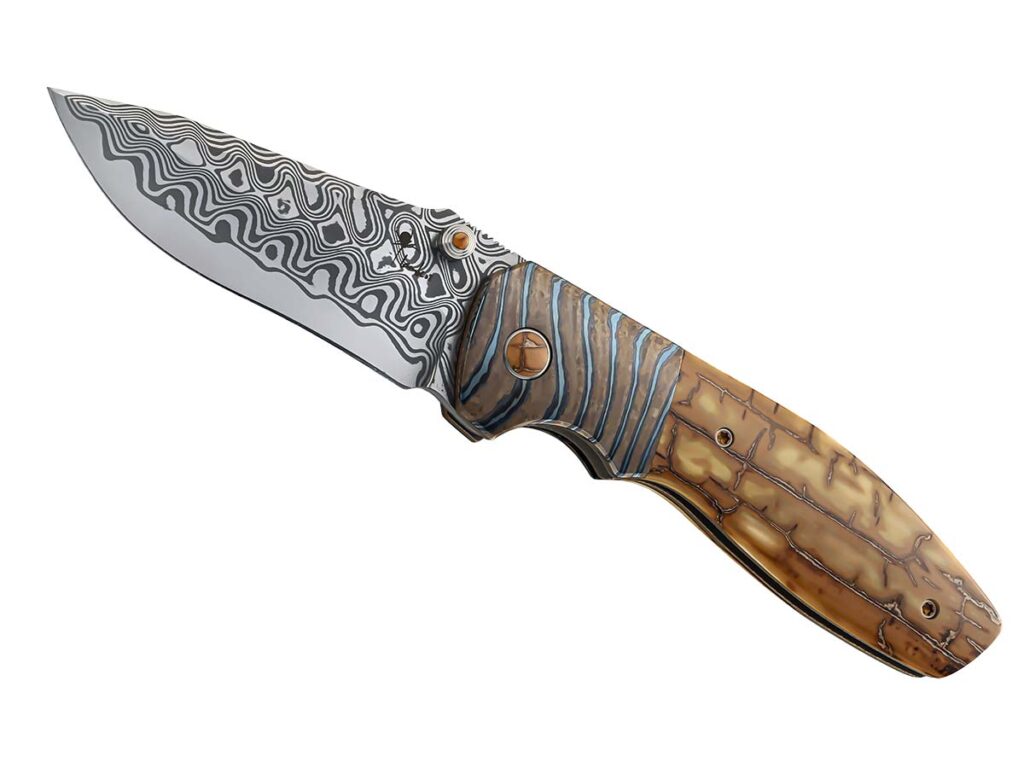
Cody Hofsommer: Mammoth Ivory Folder
Mammoth ivory scales and mosaic damascus bolsters define a sole-authorship flat-ground folder by Cody Hofsommer. The 1080/15n20 mosaic Damascus blade measures 3.375 inches with an 8-inch overall length. (SharpByCoop image)
Kirby Lambert: Augustus Mini Folder
A hollow-ground Damacore blade and mammoth ivory scales distinguish the Augustus Mini folder by Kirby Lambert. Bolsters are titanium and 2IRC damascus. Blade and overall lengths: 3.25 and 8 inches. (SharpByCoop image)
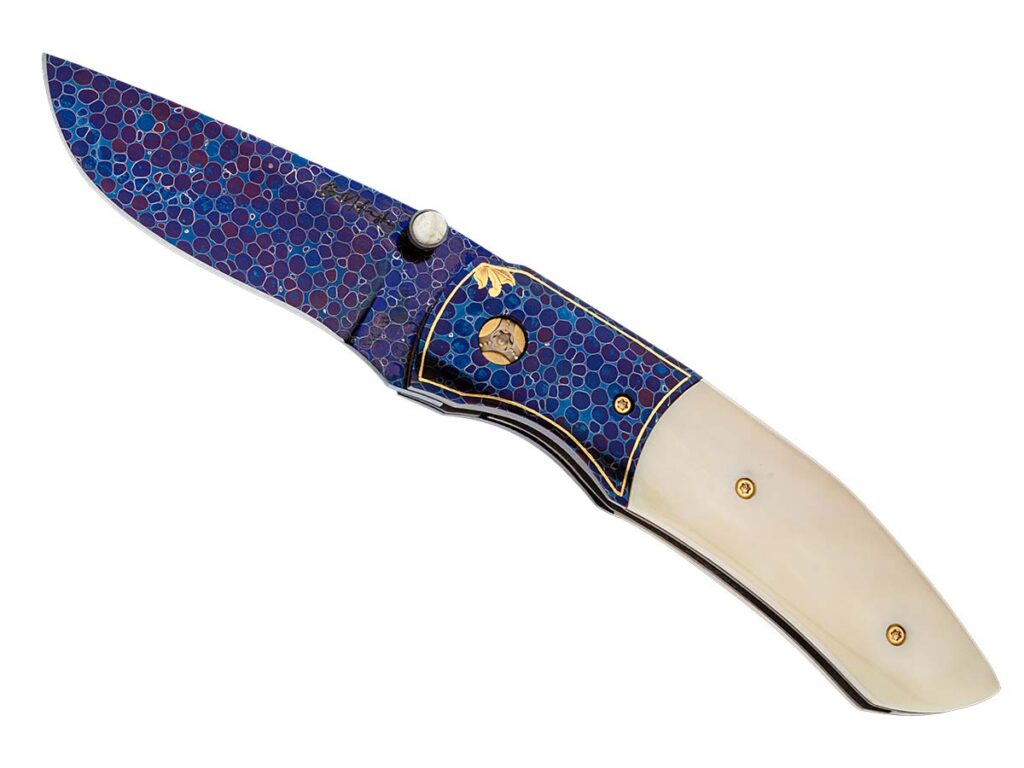
Brian Milinski: Paratrooper Elegante Linerlock
Nitre blued Rietveld damascus and fossilized walrus tusk scales characterize Brian Milinski’s Paratrooper Elegante linerlock. Joe Mason engraved and inlaid the matching bolsters. Blade and overall lengths: 3.25 and 7.75 inches. The maker’s price for a similar knife is $3,400. (Jocelyn Frasier image)
KC Gray: Titanium Folder
A 3.5-inch SM100 blade paired with vintage Micarta scales defines this 8-inch dress locking folder by Tucson maker KC Gray. The titanium frame includes marble carbon-fiber pivot collars and a black anodized clip. (SharpByCoop image)
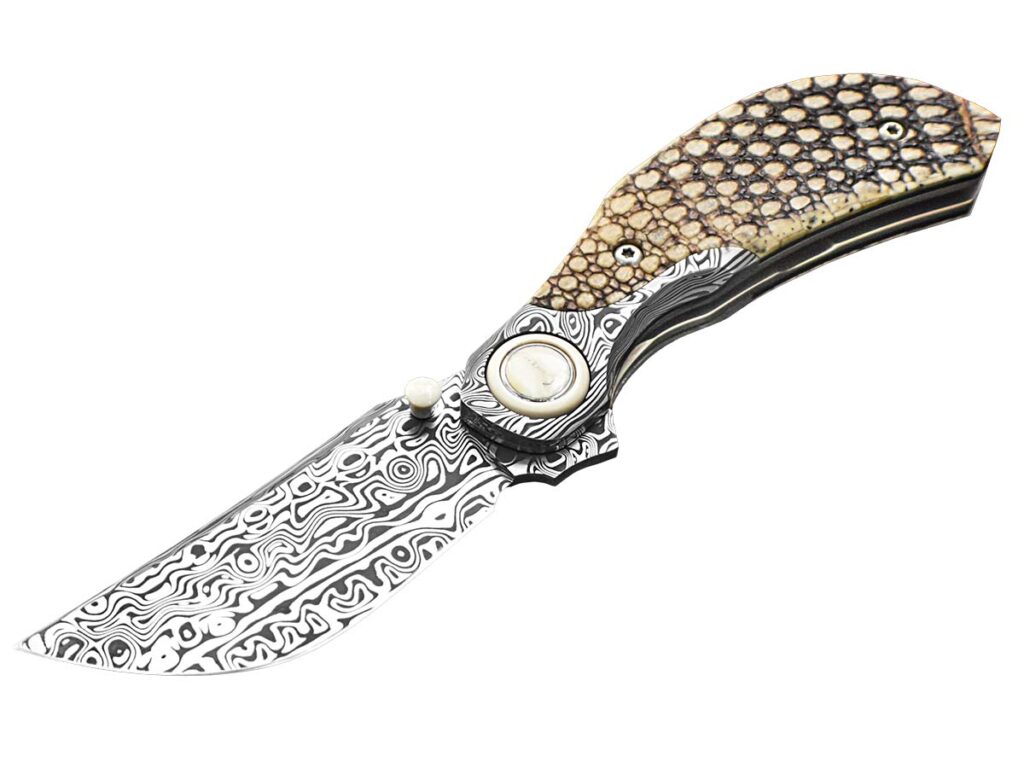
Sean Alonzo: Ani
Sean Alonzo’s Ani 3.2 linerlock features armadillo carapace, warthog ivory, and a hollow-ground Yggdrasil Damasteel blade. Blade and overall lengths: 3.2 and 7.8 inches. Maker’s price for a similar knife $5,500. (Jocelyn Frasier image)
As with most things knife, one type never fits all.
BY MIKE HASKEW BLADE® FIELD EDITOR
Finding the best blade grind for the job at hand has become the subject of some debate, but most knife users agree that certain grinds are better suited for certain functions. Combinations of steel, knife design and use influence the choice of grind.
“I’m a proponent of the right grind for the right job,” related author/knifemaker Abe Elias. “In small bushcraft knives, a thin, flat grind and a saber grind are hard to beat. It makes sense that clear cuts are best flat edged. Carving chisels have rounded convex edges to go into wood and take small cuts and come out.”
An inappropriate grind may produce drag, a ragged or erratic cut, and generally poor results. “For overall working of wood and good, straight, controlled cuts, you want a knife grind to ride flat against the surface so it cuts past certain levels and growth lines, riding flat on the wood between growth lines,” Elias added. “It’s just physics. That’s all, and nobody can really argue it.”
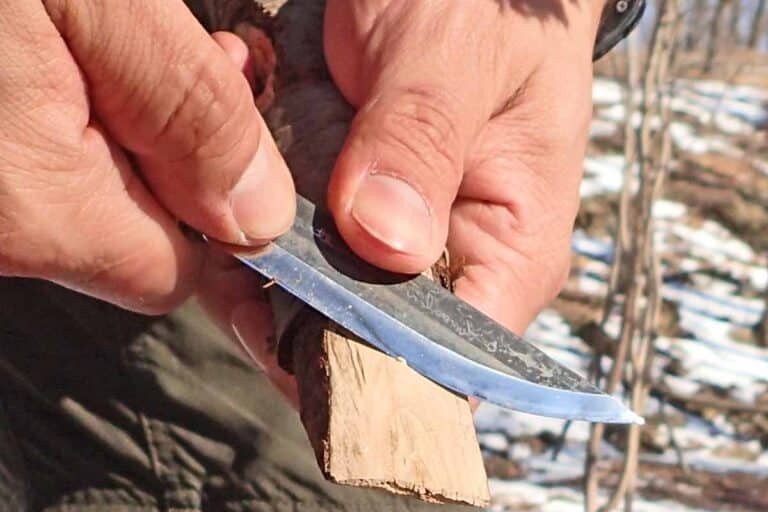
One of the most popular grinds for bushcraft knives is the scandi grind, and Elias describes it as a perfectly flat grind with no secondary bevel, starting at the shoulder with an angle that is perfectly flat and straight to zero.
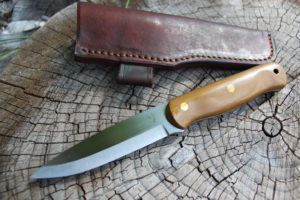
One of the most popular grinds for bushcraft knives is the scandi grind. Abe Elias describes it as a perfectly flat grind with no secondary bevel, starting at the shoulder with an angle that is perfectly flat and straight to zero. He used it on the blade of his Woodcrafter model. (Abe Elias image)
“Scandi grinds will go on any steel you want, but there are limitations to them because of the shoulder,” he noted. “It doesn’t tend to go through soft surfaces well, such as processing meat. When the knife enters a malleable surface, it creates too much drag on the blade. Like anything else, the thinner it is the easier it enters into other masses. We run into problems when custom makers make them and factories produce them without following the golden rule of proportion. The angle should be proportional to the thickness of the steel and the design of the knife itself.”
CONVEX MODIFIED
Influenced heavily by BLADE Magazine Cutlery Hall-Of-Fame® member Bill Moran, Bill Bagwell, and Don Hastings, ABS master smith Jim Crowell recognized early in his knifemaking career that the intent was to make a full convex grind from the spine of the blade to the cutting edge. He has adapted those original lessons through the years.
“I’ve found that it’s the edge that needs to be convex, not necessarily the whole cross section of the blade,” Jim noted. “Consequently, I have now, for many years, ground my blades flat from spine to cutting edge, stopping short of going to zero and then rolling the cutting edge on convexly. The trick is to get the geometry correct for the thickness the edge was ground to prior to sharpening in conjunction with the type and heat treat of the steel used.”
Crowell says he believes the convex grind is best for knives in the field, including bowies, fighters, and fillet knives. He uses the convex grind almost exclusively and indicates it allows for an uninterrupted transition from the cutting edge to the full thickness of the spine of the knife. No matter how thick or thin the spine of the knife, with convex geometry it will have the least amount of resistance when cutting through an object.
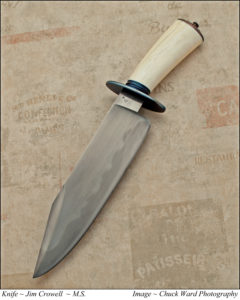
ABS master smith Jim Crowell has ground his blades in a modification of the convex style for many years, grinding them flat from the spine to the edge, stopping just short of a 0-degree angle, and then rolling the edge in a convex shape. His 15.5-inch bowie features W2 tool steel and walrus ivory. (Chuck Ward knife image)
As for sharpness, Jim gives the nod to the scandi grind. However, he believes that when the cutting edge is, in fact, the grind line as well, the edge itself is more fragile in comparison to other grinds.
“Scandi grinds are great,” he said, “and useful for a lot of small chores. Then there are special-purpose applications like some sushi knives that have specialized grinds. Still, for day in and day out I like and recommend the flat, convex grind.”
COMFORT MATTERS
Knifemakers tend to use the grinds they are comfortable with and which they believe fill the bill for the types of knives they make. The degree of difficulty associated with a particular grind lies more in the experience of the maker than in the grind itself.
“The hardest grind is the one you do not regularly do, and the easiest would be the one you do all the time,” Crowell reasoned. “When I started, I used to hollow grind stock removal blades. You could lay everything out and follow the lines—it is still hard though. When I started forging it was really hard because there were no layout lines to follow, and all the scale and hammer marks made it hard to tell what I was doing. Daggers are generally acknowledged to be more difficult. Some of the Russian and Persian stuff with a ‘T’ spine or center ridge would be tough.”
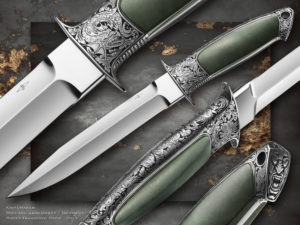
According to Jim Crowell, the dagger blade pattern generally is acknowledged to be more difficult to grind than most. Michael Jankowsky ground the blade to a double edge on his “Thor” model in Elmax steel and Siberian jade inlay. The engraving is by Kati Mau.(Francesco Pachi image)
“The hardest grind is the one you do not regularly do, and the easiest would be the one you do all the time.”—Jim Crowell
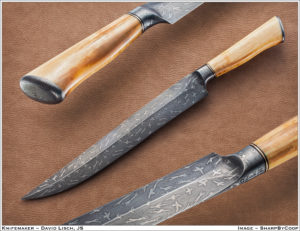
ABS journeyman smith David Lisch—shown grinding the blade of a custom collaboration knife to raise money for the African Wildlife Foundation in its fight to protect elephants from poachers—applied a Persian grind to his 16-inch integral fighter in Thunderbird damascus and walrus ivory. (SharpByCoop.com knife image; image of Lisch courtesy of Mark Knapp)
FACTORY APPROACH
Knife manufacturers gear their grinds for prospective use as well. Hollow grinds are usually the most efficient for manufacturing because both sides of the blade are ground at the same time. Flat grinds are ground one side at a time, and precise machining and good tooling create the even grinds for which manufacturers are known. Convex grinds are usually finished by hand, and such work is the province of a skilled custom maker.
“Hollow grinds are great for slicing,” commented Jim MacNair, new product coordinator and senior designer at KAI-USA Kershaw, “and they create a nice, thin edge geometry, and the panel of the grind stays thinner as you sharpen away the blade over time. These blades will feel very sharp because the grind scoops away more material and makes the blade thinner overall.
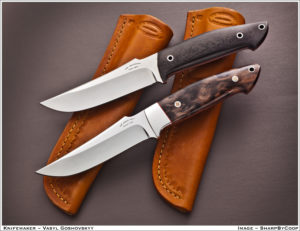
The hollow grind is great for slicing and feels very sharp because it scoops away more material and makes the blade thinner overall. Vasyl Goshovsky employs a hollow grind on his working knife’s 4.5-inch blade of N690Co stainless steel. (SharpByCoop.com image)
“The most obvious benefit of the flat grind is strength and toughness. The wheel is grinding a flat surface rather than a concave one like a hollow grind, and it removes less material from the blade. That added material makes the blade thicker and stronger.”
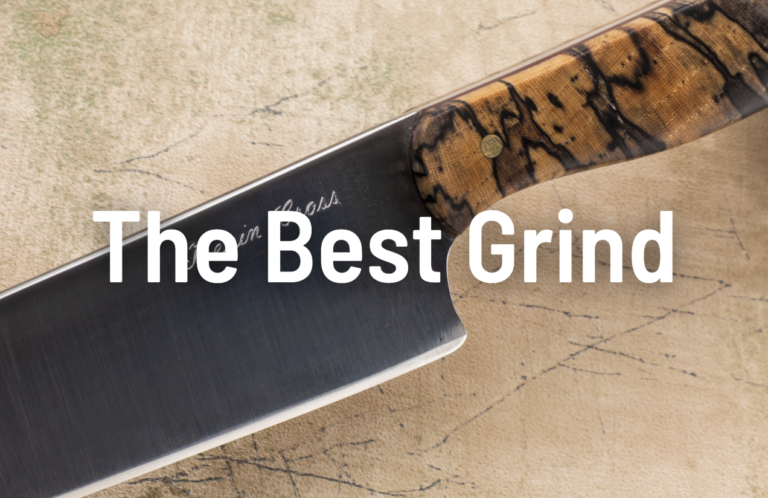
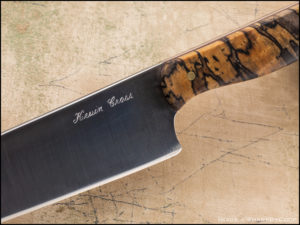
The most obvious benefit of the flat grind is strength and toughness, according to Jim MacNair. Kevin Cross flat ground the 52100 blade of his kitchen knife. The handle is spalted hickory. (SharpByCoop.com images)
MacNair sees compound grinds emerging in the custom market, including blades that feature a combination of flat- and hollow-ground bevels. These are often done to create a “cool” look, and the maker is also providing the best of both cutting options: a thin, hollow-ground edge for slicing and a thick, flat-ground tip for toughness.
Innovation continues to find its way into new and user-friendly blade grinds, while the emphasis on the job to be done is at the center of the decision. Putting the proper edge on the blade for cutting, slicing, skinning, chopping or any other task will always be primary.
SWORD GRINDS HOSTETTER’s WAY
Swordsmith Wally Hostetter focuses on Japanese blades and tailors the grind of each to its anticipated function. He forges the blades and sets up the edge geometry with hand filing.
“A lot of guys do hollow or flat grinds with a machine, but what I do has to be done by hand,” Wally explained. “I hand polish to the cutting edge, and there is no micro-bevel. Some have an appleseed [convex] edge—niku is the Japanese term—and some have the edge slightly rolled in for better cutting. For cutting heavy stuff, the niku comes to a finite edge but runs farther up the blade. There are many subtleties to it.”
According to Hostetter, other Japanese grinds, such as that found on the tanto, are fine and done to a thin edge because they are not intended for hard striking against surfaces. He uses 1095 carbon steel primarily and decides on the appropriate grind based on both the use of the blade and the historical time period that is being replicated.
Brandon Hyner’s First Knife Is One Of His Most Current Knives As His New Work Takes Inspiration From His First Blade
Sometimes things take their own sweet time before coming to fruition. Such is the case with Brandon Hyner’s damascus gentleman’s hunter.
Hyner is an accomplished maker. He is a champion of History Channel’s Forged in Fire and has built a business of knifemaking and blacksmithing in his shop in Groton, on the Connecticut coast of Long Island Sound. He has built a following of just over 9,000 followers on Instagram where he showcases his work and produces behind the scenes videos in his shop of him doing everything from welding to forging by hand.
The damascus gentleman’s hunter is the second of a design Brandon made when he first started blacksmithing and knifemaking. With the help of a Texas bladesmith, he forged a damascus billet for the first knife, and “was forever grateful” for the opportunity. Four years later Brandon decided to finish the knife and was very pleased with how it turned out. As he noted, “I decided to keep the blade as is, as it was a big milestone knife for me.”
It has a six-inch blade with a desert ironwood handle. The brass spacer and carbon fiber bolster complete the look.
He posted the knife online and someone asked to buy it. However, rather than sell it, Brandon made a similar knife instead. “The second knife came out much better than the first one,” he noted, “but I’m extremely happy with them both.”
It’s a matched pair he can always point to as proof of his maturation as a maker and a beginning of possibly greater things to come. It was a four-year odyssey well worth the wait.
Damascus Gentleman’s Hunter Knife Specs
Knife name: Damascus gentleman’s hunter
Blade length: 6 inches
Blade material: Low-layer twist damascus
Handle: Desert ironwood w/brass spacer
Bolster: Carbon fiber
Overall length: 10 inches
For more information contact Brandon Hyner, Dept. BL4, 852 Bank St., New London, CT 06320 631-742-7227 [email protected].
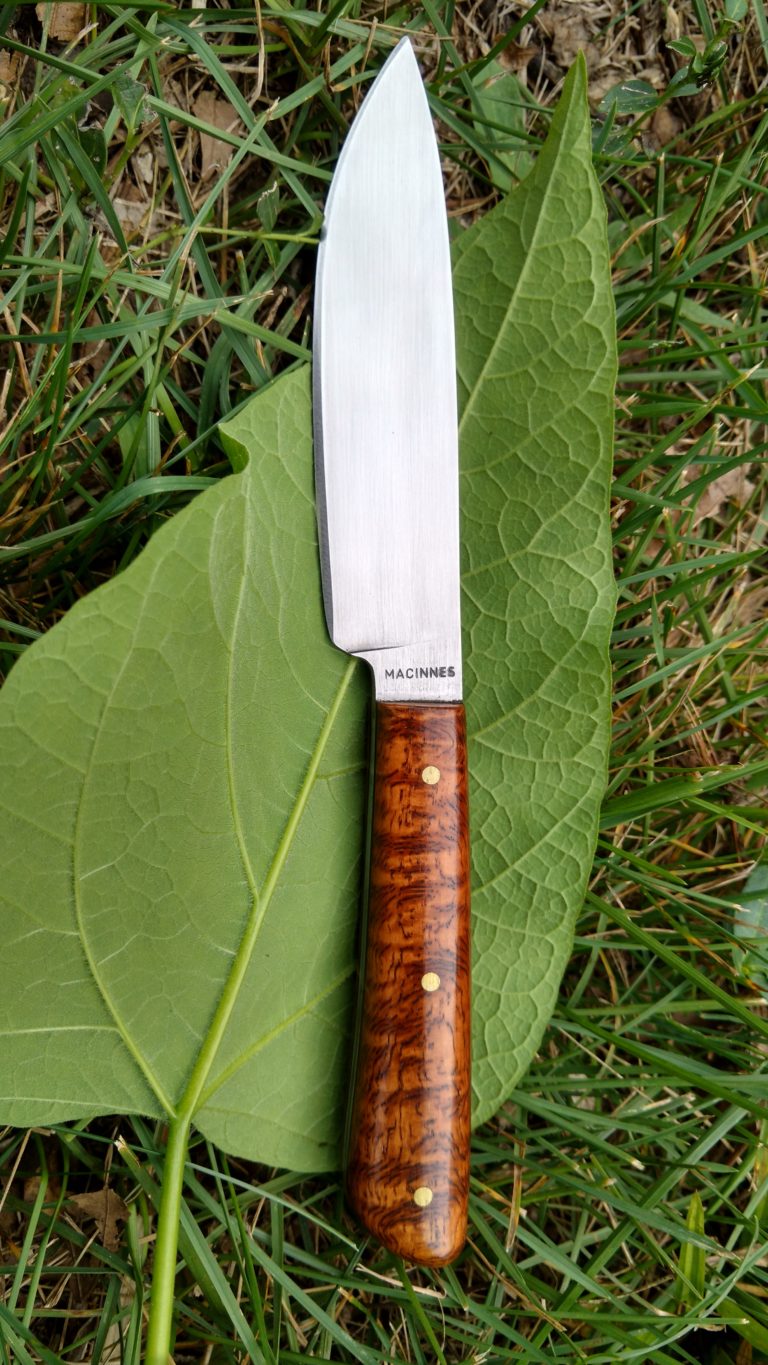
Mike MacInnes of Holland, Michigan, remembers his first two knives, both given to him by his dad. The first was a Buck 110 clone and the second was a Solingen hunting knife. Mike has been involved with black powder rifle hunting and gunsmithing all his life.
Mike MacInnes is a part-time bladesmith. He only makes, and therefore sells, the kinds of knives he likes to make, one of the joys of keeping making as a hobby while he holds on to his day job as a vending route supervisor in Michigan.
In 2012 he wanted to donate a knife for an auction to benefit the Michigan State Muzzle Loading Association. He called his friend Al Englsman and asked if he would help him make a Scagel-style knife. He enjoyed making the first one so much it lead to others. He advanced quickly, probably because his work on rifles aided his craftsmanship.
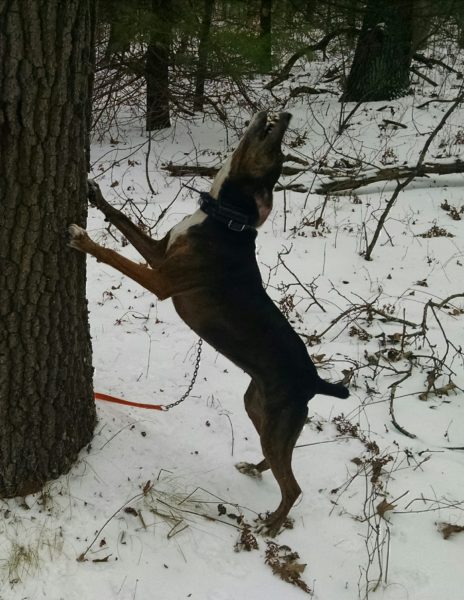
Betty is a mountain cur, dogs specifically bred to trail and tree small game or hunt and bay larger quarry.
Mike had met Al, who is a breeder of Mountain Cur, when he went to buy his squirrel-hunting dog, Betty.
Mike MacInnes and his wife, Erin, sometimes get out to Holland State Park in Holland, Michigan. The lighthouse in the background is called Big Red.
Mike is a route supervisor for a vending machine company by day, but loves his hobby. He only sells what he likes to make. He’s grateful for the influences of Bill Binky growing up, Marv Palmer and Joe Valentin. He lives near Lake Michigan with his wife, Erin, and their two children.
Best-selling knife patterns: full-tang hunter with 3- to 4-inch blade; hidden-tang drop-point hunter with 4- to 5-inch blade
Favorite blade steels: 1080; 5160
Blade grind: full flat
How he tests his knives: slice paper, shave hair, cut phone books, chop wood
Knife shows he attends: Badger Knife Club Knife Show
Facebook Groups he participates in: The Real Knife Makers of America, Knife Gods, Blade Smithing World
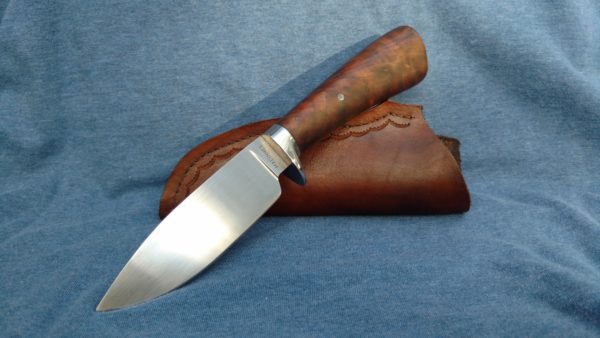
This 4 ¾-inch drop-point hunter was forged from 1080 steel. Handle is made of oak burl with black fiberboard liners. Overall length is 8 ½ inches. Pins are brass. Price is $175-$450.
Mike’s isn’t taking any more orders until he catches up on the orders he’s taken and finishes knives for upcoming shows. Follow him on Facebook though for updates on peeks at works-in-progress and finished pieces.
This hunter has a 3.25-inch blade forged from 1080 carbon steel. Its handle scales are made from bocote wood. The pins are brass. Maker’s list price: $185. Contacts listed at the bottom of this article.
This Mike MacInnes piece was forged from 1080 carbon steel. The blade is 4 inches long with an overall length of 8.25 inches. “The handle is made of some of the nicest walnut that was even harvested here in Michigan,” Mike declared. The shape of the handle is a little thicker in the butt than he normally makes, but it felt so good he will probably do more in that style. The guard was forged from 416 stainless steel with a matching pin. The sheath was hand-stitched and -tooled by Mike. Maker’s list price: $350. Contacts listed at the bottom of this article.
You can read your digital issues of BLADE Magazine anywhere you have your phone, tablet or computer, and there’s no need to find storage for all your old issues.
If piling-up issues of magazines seems like a waste to you… If you feel like you don’t have time to read a magazine… If you like the stories we offer in BLADE, but want a more economical option, then a digital subscription is the answer. An annual subscription to BLADE is $17.98, $4 off the print price.