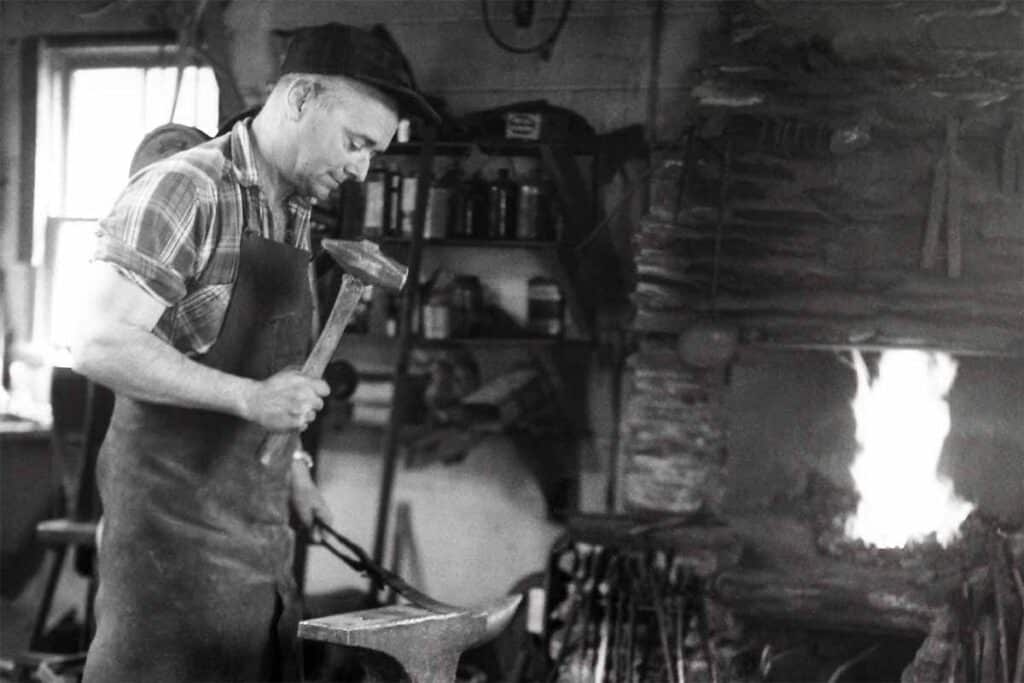
Knifemaking is the building of a knife, which includes the blade, handle and other accouterments. Blades are made by either removing metal from a steel blank via a grinder – known as stock removal – and the forging to shape of hot steel into a blade in the process known as bladesmithing. Other parts, including bolsters, guards, pommels, etc., are needed to complete the finished knife.
Robert Logan had a scrap to pull off his Tiny Fighter.
ABS apprentice smith and member of the Texas Knifemakers Guild, Robert Logan, has developed a varied catalog over his nearly nine-year career. His work in kitchen cutlery has raised eyebrows in some corners of the knife world. Yet, his smaller projects are certainly worth consideration.
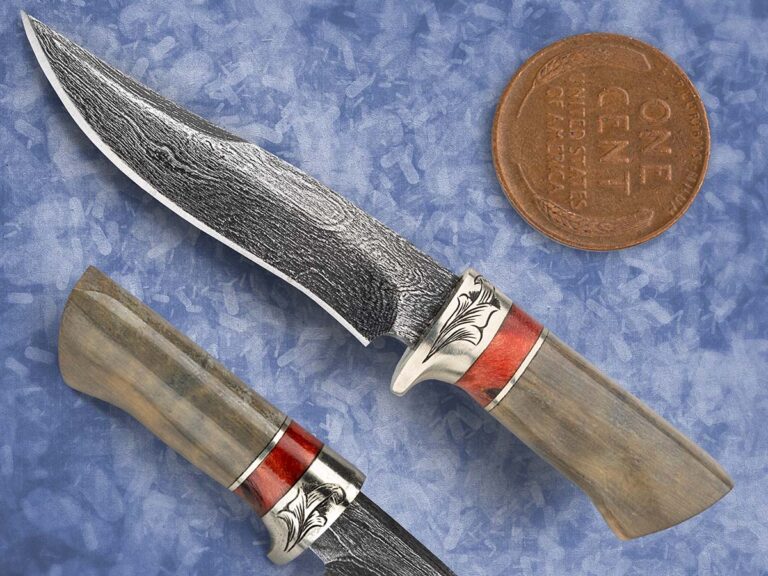
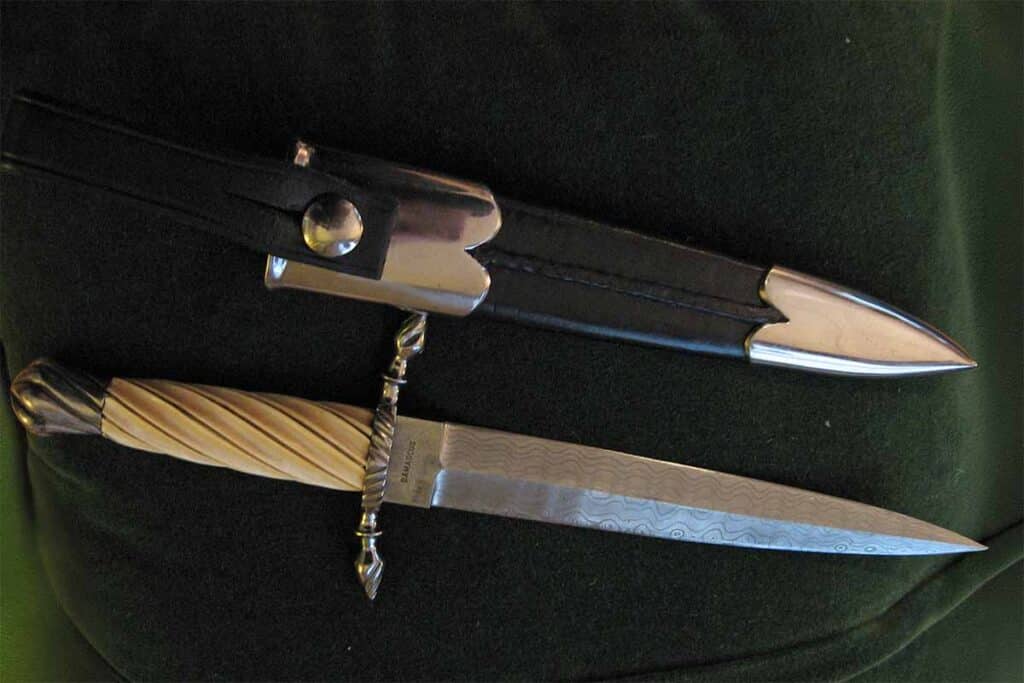
Such is the case with Robert’s Tiny Fighter, a minuscule fighter whose detailed execution is hard to miss—even if it’s no larger than a penny. The knife measures a scant 2.875 inches in overall length, with a 1.6875-inch damascus blade (192 layer 1084-15n20). Setting it all off is a mammoth-ivory handle and a beautiful guard featuring engraving by Alice Carter.
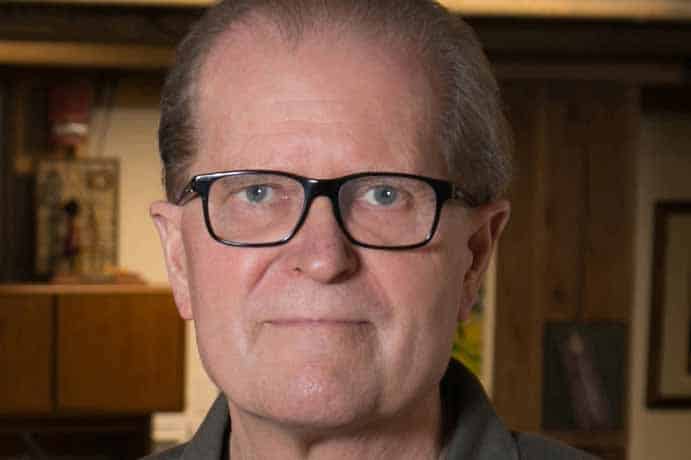
Robert Logan
Robert has tinkered with miniatures previously, making a couple of dozen scaled-down versions of his Mini Cleaver Belt Knife. But the Tiny Fighter, he said, was his first crack at venturing deeper than a simple slab handle in a miniature piece. Without special equipment for the job, it was especially tricky.
“Honestly, the most challenging thing about making tiny knives for me is just holding on to them,” Robert confessed. “I don’t use grinding jigs, so just holding on to the thing to grind, it was hilarious.”
From passion to icon: celebrating 30 years of Dietmar Pohl’s knife mastery.
Dietmar Pohl is a name well-known in knife circles. More so than his groundbreaking designs, the founder of Pohl Force knives might also be known for his professionalism. On Nov. 18, the designer celebrated 30 years in the industry.
With over 100 knife designs, three books translated into multiple languages, and a reputation for innovation, Pohl has established himself as a leading figure in the world of blades.
While Pohl might be best known for his knives, such as the Magnum Colection Knife and the Böker Speedlock switchblade, he has held many roles in the industry.
Pohl started his career as marketing director, design and production manager in Solingen, Germany. Combining contemporary design with cutting-edge materials, he quickly made his mark by creating knives that balanced performance and aesthetics.
However, his interest in edged tools started well before then. His imagination was captured at 11 years old when his older brother—10 years his senior—returned from the Bundeswehr paratroopers and showed him his paratrooper knife.
While Pohl has no military or law enforcement background, he’s built his expertise through hands-on training and close collaboration with professionals in elite units like Germany’s GSG9, SEK, and U.S. Marine Force Recon.
Practical experiences, such as SWAT training in Virginia and knife combat sessions with Marine Force Recon at Camp Pendleton, have deepened his understanding of tactical requirements.
Pohl’s influence extends beyond design. His books are respected resources for enthusiasts, and his work is frequently featured in trade publications. Among his standout achievements is the MK9 Heartstopper, created for Sylvester Stallone’s final Rambo movie, Last Blood. Dubbed The Knife Guy by the film crew, this project solidified his global reputation.
We talk with those who know Bill Moran best to determine how many damascus blades the godfather of the craft forged.
BLADE Magazine Cutlery Hall-of-Fame® member Bill Moran is and will forever be remembered as the father of modern damascus steel. He and a few early devotees popularized damascus during an era when the art of bladesmithing was an endangered species in the realm of the artisan.
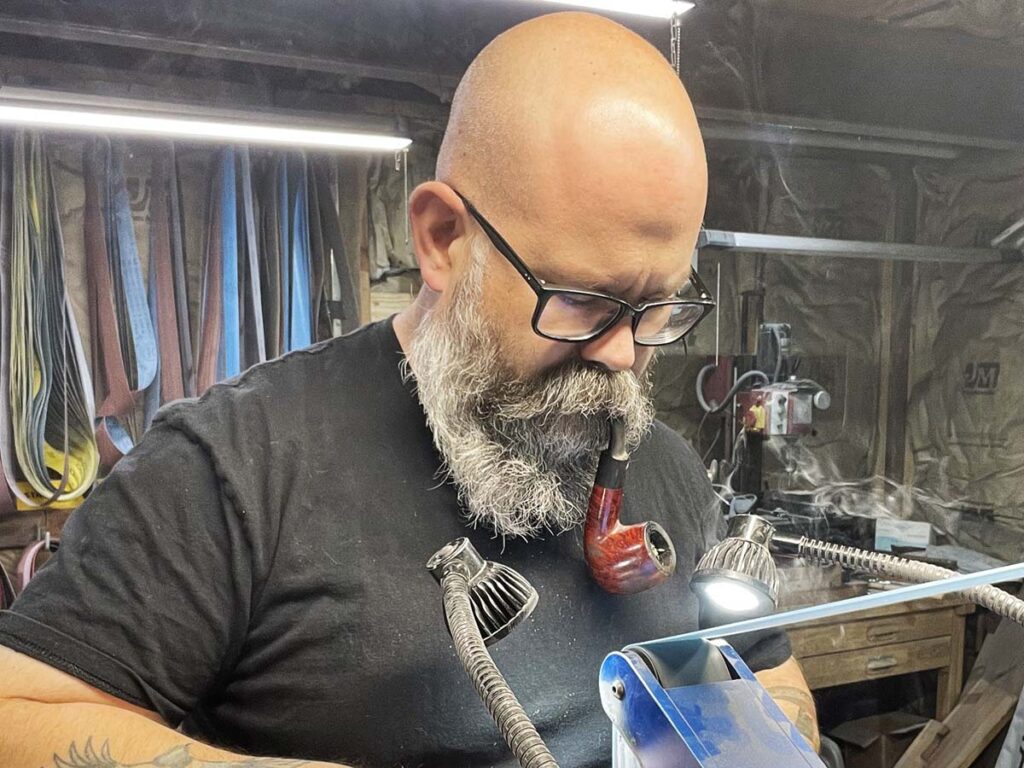
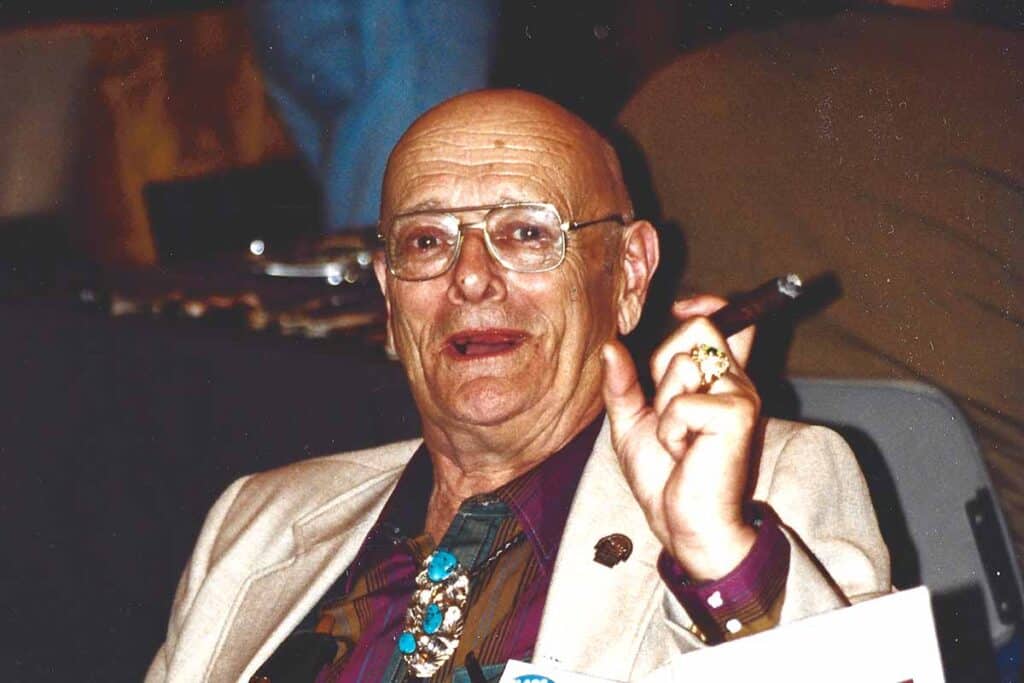
Though Moran was partial to smoking a pipe, he liked an occasional stogie as well. (Pete Cohan knife image)
It was Moran who shocked the custom knife world in 1973 when he brought eight knives to The Knifemakers’ Guild Show in Kansas City, Missouri. Those historic eight sported blades of Moran’s damascus steel and they created a sensation. Cutlery Hall-of-Famer, longtime journalist and friend of Moran’s, and a respected member of the knife community, B. R. Hughes remembered how the event electrified those who attended.
This is the first damascus knife Moran ever made. He forged “No. 1” circa 1972. It was misplaced for 30 years until Nancy Hendrickson found it in Moran’s house. (Pete Cohan knife image)
“When my wife [Carolyn] and I drove up to the Muehlebach Hotel in Kansas City, a friend of mine came out and said, ‘You gotta get in there and see the damascus knives Moran has on his table.’ Those knives were the talk of the show. Bill also had mimeographed sheets that explained what damascus steel was and how it was made. He gave those sheets away to anyone who desired one.”
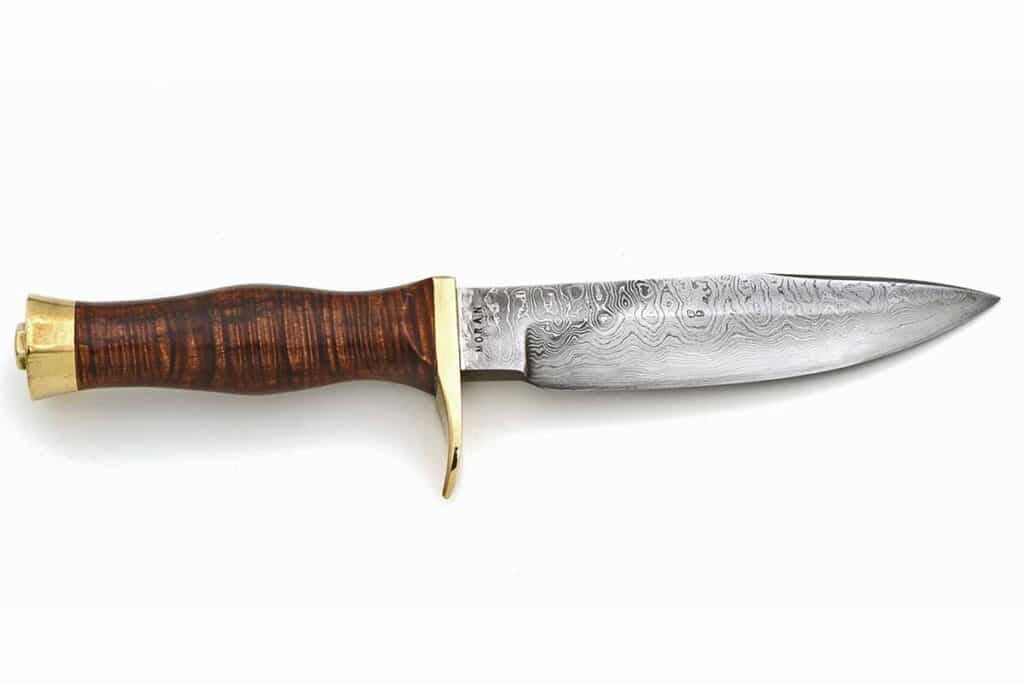
Moran made basic damascus knives. “They weren’t elaborate and this, that and the other thing, but most of them were for use,” B. R. Hughes noted. (Exquisiteknives.com image)
Three years later, Hughes joined Moran and bladesmiths Bill Bagwell and Don Hastings as the quartet that founded the American Bladesmith Society (ABS). When the ABS was founded in 1976, bladesmithing was on life support, and probably fewer than a dozen smiths were forging knives. Today, the Society includes more than 2,000 members and the future of the craft has been secured. Meanwhile, Moran deserves the credit as the catalyst for modern bladesmithing.
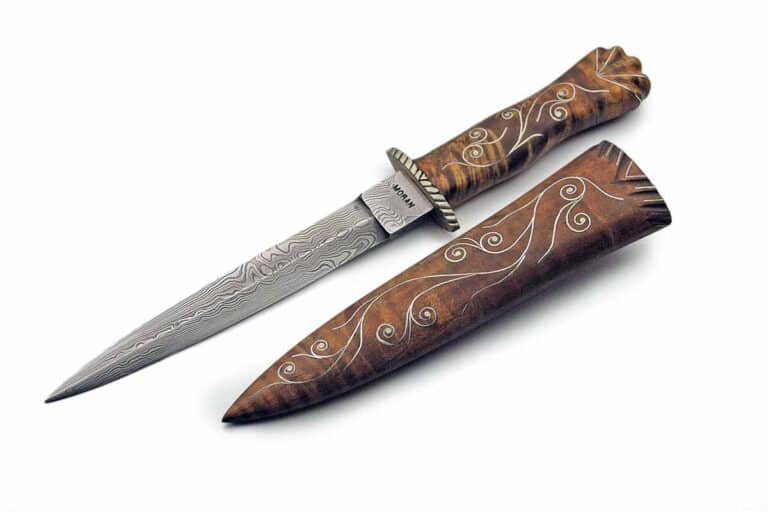
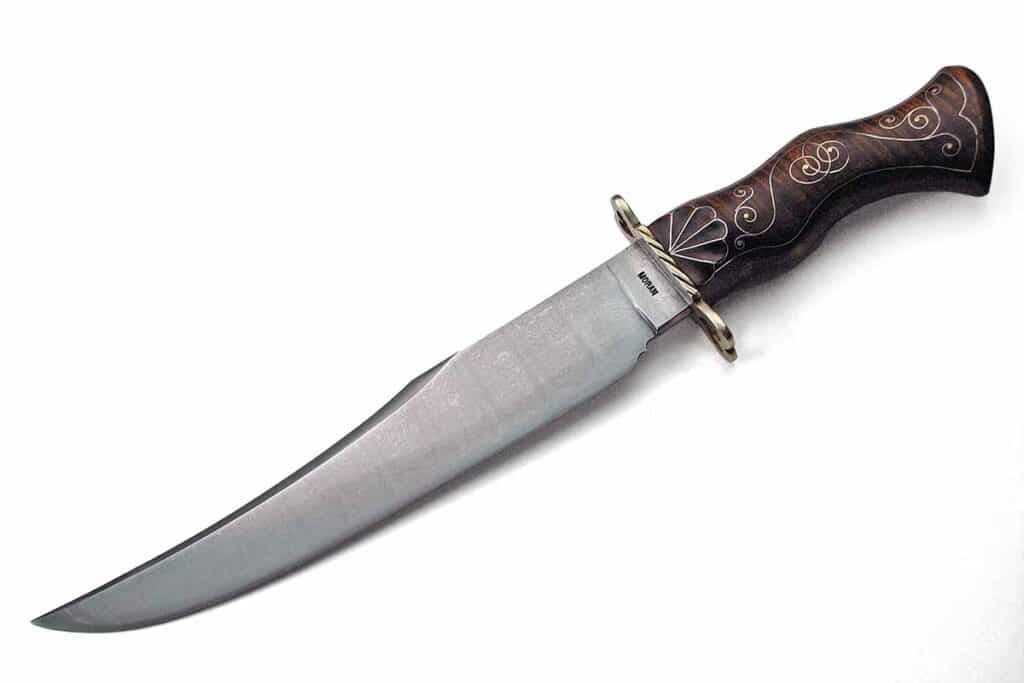
B. R. Hughes said Moran made some art daggers that “were a bit elaborate for the day.” An example is this large quillon dagger. (Exquisiteknives.com image)
How Many Damascus Knives Did Moran Make?
While there is no question that Moran and other dedicated disciples of the forged blade brought damascus and the ring of the hammer back to life in the early-to-mid-1970s, there is some conjecture as to just how many such knives the great Moran forged and completed himself. The thought of how many Moran damascus knives were made and exist today is tantalizing, and, of course, what’s a great legend without a bit of mystery and conjecture? Exploring Moran’s body of work and the damascus element within provides some insight into the man, the legend who padded about on the creaky floor of his Maryland shop, sometimes chewing tobacco, but rarely alone when his doors were open as crowds came to see the wizard work.
Back in the day, a Moran damascus knife was a challenge to own, considering the time Moran spent in his shop with the material actually able to work without the distraction of visitors, the many hours of labor required to produce a damascus billet, and the higher price for such a piece that naturally followed. (Exquisiteknives.com image)
Collectors such as Cutlery Hall-of-Famer Butch and Rita Winter bought the first of Moran’s damascus knives during that historic Guild Show more than a half-century ago, and, as Hughes relates, “Moran made basic damascus knives. Most of his were what folks would call ‘using’ knives. They weren’t elaborate and this, that, and the other thing, but most of them were for use. He did make some art daggers that I thought were a bit elaborate for the day.”
Dave Harvey, Nordic Knives
Hughes remembers that Moran himself was rather vague on the number of damascus knives he actually made. However, probably the best estimate is that fewer than 100 Moran damascus knives were made during a career that spanned more than 50 years.
“He liked the random pattern and the ladder pattern,” B. R. remembered, “and he could do some pretty good patterns, but it took a lot of time. He was very happy just making ladder pattern and stuff like that, and he continued making non-damascus knives and about 40 folders. When he was in his shop, there were always five or six locals in there talking to him and watching him work.” Agreed Cutlery Hall-of-Famer and ABS master smith Jay Hendrickson, a close friend of Moran for 30 years, “Bill had so many visitors to his shop on a daily basis that it is a wonder he ever got anything accomplished.”
According to Jay Hendrickson, Moran made all of his damascus in a coal fire. “All of Bill’s experiments were with coal, as gas forges were not popular at the time,” Jay explained. “In today’s world, gas forges are almost always used for damascus making because of adjustable temperature and the cleanliness of propane gas.” (vintage photo of Moran in his shop circa the 1960s)
Hendrickson served as the executor of Moran’s estate and founded the Moran Foundation to preserve the great bladesmith’s legacy, serving as its president for 10 years. Jay observed that Moran made a workingman’s knife with quality that was spot-on, though there may have been an occasional flaw in the solder on his early pieces. Nonetheless, Jay says, Bill’s knives always cut.
As for Moran’s damascus knife productivity, Hendrickson offered, “This is strictly a judgment call on my part, but I would say Bill made less than 100 damascus knives. I counted 36 in our Forever A Legend book. I only know a few people that own Bill’s damascus knives, but I think they are sold and traded often between collectors. You also see Bill’s damascus knives occasionally sold at auctions.”
Butch and Rita Winter bought this damascus quillon dagger from Bill Moran at the 1973 Knifemakers’ Guild Show where Moran introduced modern damascus knives. It was one of eight damascus knives Moran brought to the show. The tang is marked DAMASCUS in all uppercase letters. (image courtesy of Rita Winter)
Jay verifies the original sale of a Moran damascus quillon dagger and sheath to Butch and Rita Winter and adds a bit more information. “Rita Winter recently sold Bill’s first damascus dagger to Mr. Doug Hook, a Tennessee collector,” he commented. “Two years ago, I repaired one of the twisted wires on the handle for Mr. Hook. Because of that contact I was able to confirm the original purchase as Doug has written verification of the original sales transaction and the invoice.”
So where are the majority of Moran’s damascus treasures today? Longtime purveyor Dave Harvey of nordicknives.com is straightforward—“in collections around the world. Values vary and depend largely on the particular knife. But they are generally worth at least double that of [one of Moran’s straight carbon steel blades], sometimes even more.”
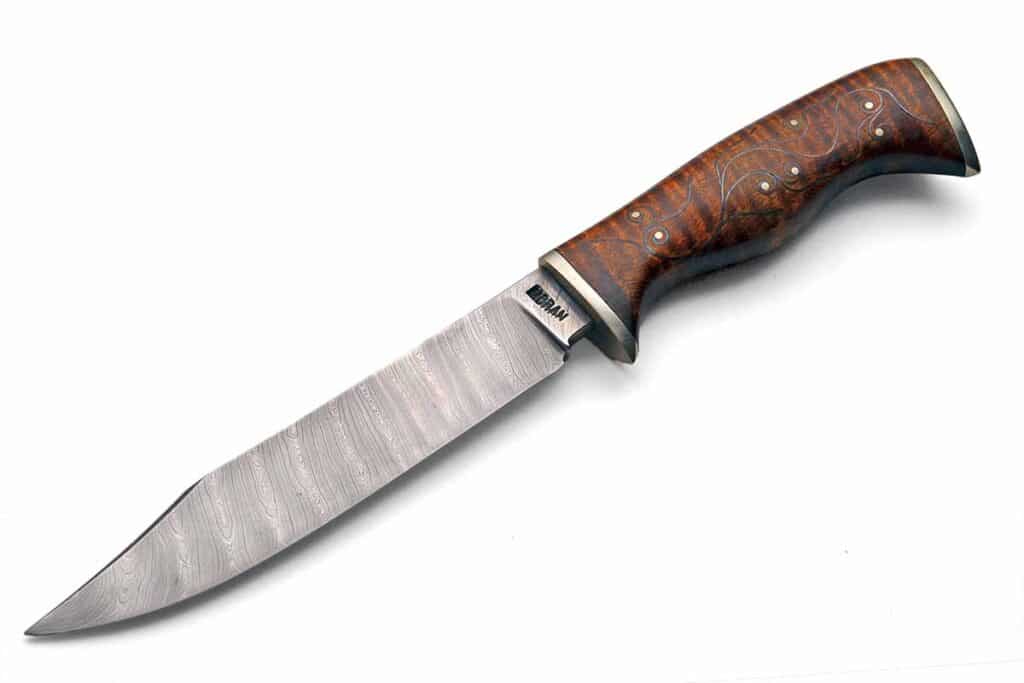
Dave Ellis said the first of the Moran damascus knives are quite valuable and guessed they would start at least at $10,000 and go up from there. Dave holds an early 1970s Moran damascus hunter at BLADE Show 2023.
Back in the day, a Moran damascus knife was a challenge to own, considering the time Moran spent in his shop with the material actually able to work without the distraction of visitors, the many hours of labor required to produce a damascus billet, and the higher price for such a piece that naturally followed. Dave Ellis of Exquisiteknives.com reasoned, “I could not say how many damascus knives Moran made in his lifetime, but certainly not a large number. Many of Moran’s damascus pieces reside in private collections, as well as the Moran Museum. I personally have owned and still own some and have sold a number of the finer pieces to overseas clients.
“I believe he made four or five patterns. Damascus steel was and still is a laborious process. Bill’s prices for his damascus knives were quite high for the time, so he made and sold mostly carbon steel pieces. Damascus was reserved for higher-end clientele and foreign dignitaries. A good number of the damascus knives were fighters and bowies. Damascus hunters were also made, many with Bill’s twist pattern steel, maidenhair. I do not know of any mosaic steel knives that Moran made. The first of the Moran damascus knives are quite valuable, and I would guess that they would start at least at $10,000 and go up from there.”
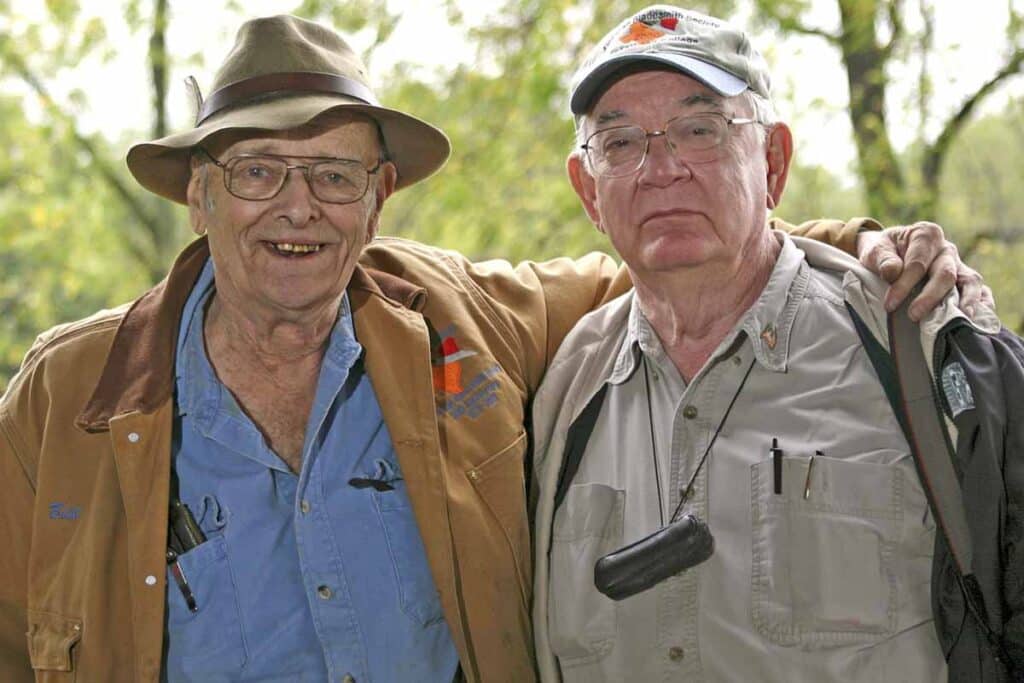
Along with Bill Bagwell and Don Hastings, Bill Moran (left) and B. R. Hughes (right) founded the American Bladesmith Society in 1976. Hughes is the only surviving founding member. (Buddy Thomason image)
HOW HE MADE THEM Hendrickson is familiar with Moran’s most common damascus patterns, the maidenhair twist, ladder pattern and others. “He knew how to fuse metal, as he learned that technique working on equipment on the family farm,” Jay remarked. “On the farm he made knives from whatever he could get his hands on, old springs, files, and rasps, for example. He could also buy steel from a local hardware store in town. Bill also knew the difference between plain iron and high carbon steel. His first damascus experience began by using one piece of steel and one piece of iron. He welded the two together, drew it out and folded it many times.”
The process yielded insight for Moran, and he learned from experience. At times during the process of hammering and folding, he realized that the steel was absorbing heat quicker than the iron because it was on the outside of the billet. Therefore, he moved to one piece of iron with steel in the center, and then a second piece of iron, using O1 tool steel and a carbon mix of 33 percent. According to Jay, this combination gave the billet the right hardness without the need for tempering. Moran’s test of the finished knife was to carve wood for two hours with no loss to the cutting edge, and he was satisfied with the results using this mixture.
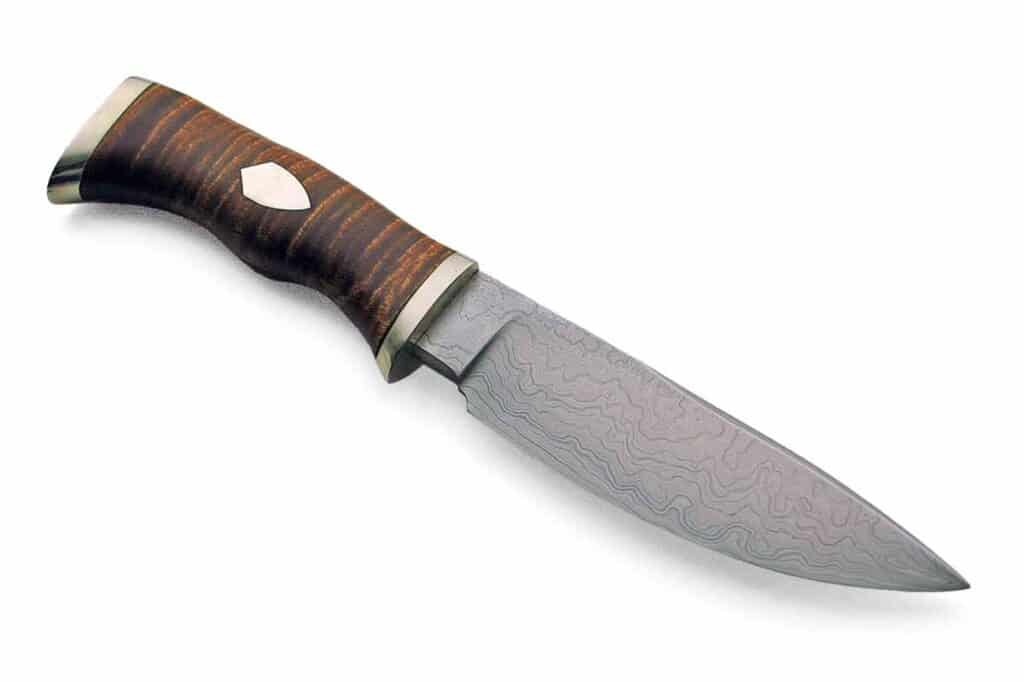
Moran’s test of the finished damascus knife was to carve wood for two hours with no loss to the cutting edge. An example is this clip-point model, again in a ladder pattern. (Exquisiteknives.com image)
“Bill made all of his damascus in a coal fire,” Hendrickson recalled. “A hot coal fire can melt steel as temperatures can reach over 2,700 degrees Fahrenheit, which is the melting point of steel. That is why Bill added iron to the outside of the billet, as iron is less apt to burn as quickly as steel. All of Bill’s experiments were with coal, as gas forges were not popular at the time. In today’s world, gas forges are almost always used for damascus making because of adjustable temperature and the cleanliness of propane gas. Therefore, the burning of steel to a great deal has been eliminated with the use of gas forges.”
Hendrickson attributes the relative scarcity of Moran damascus knives to the maker’s affinity for producing using knives, constraints on time and other factors. “Bill was truly a supporter of the art knife,” he noted, “and along with others they created that industry. Collectors were willing to pay big time for exceptionally well-made knives, and Bill, like other top-notch makers, profited as this industry took hold. However, Bill’s true passion was in using knives, such as camp knives, hunters and small utility knives, of which he made many. The vast majority of his knives came from customers wanting working knives.
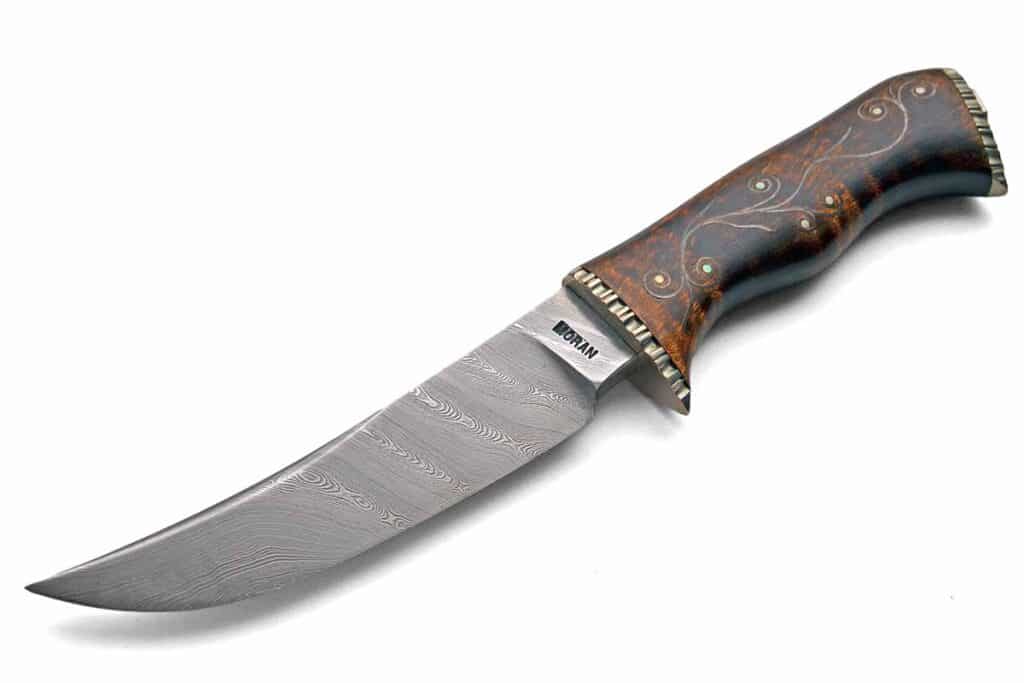
A good number of Moran’s damascus knives were fighters and bowies, according to Dave Ellis. This classic ST-24 in ladder-pattern damascus and curly maple handle with fancy wire inlay is a favorite of Moran collectors. (Exquisiteknives.com image)
“Bill liked to experiment with damascus. For example, he would slip in an added piece of iron after many folds to gain toughness in the end product. Another example was where he completed a damascus billet to the desired number of welds. He then cut it in two and added a piece of high carbon steel to form the middle and welded the two damascus pieces on both sides of the high carbon steel. Once that was completed, Bill forged the billet into a knife. One might call the finished product a damascus san-mai. Bill liked the various patterns that were being developed beyond the more basic patterns that he originally developed. To Bill, mosaic knives were art knives, not to be used but just admired. He didn’t like the process of welding pieces together to make a knife. Remember, he was more into using knives where the grain within the steel followed the entire edge of the blade.”
Through the years, Moran became a legend, leaving a legacy of learning, teaching, giving information freely, and welcoming many to his shop. He paid tribute in steel to the wonder of damascus, the art knife and the using knife. Today’s body of bladesmiths still looks to him as the guiding light that led them to the glow of the forge and the spark of the hammer on hot steel. Those who own or admire the few damascus knives that Moran completed continue to do so for their beauty, their imagination, their rarity, and simply because they bear the touch of the master’s hand.
Every blade that is created by hand is something unique. The edges, curves, look and feel will never be identical to any other knife, especially when you create that knife with someone like Jason Knight.
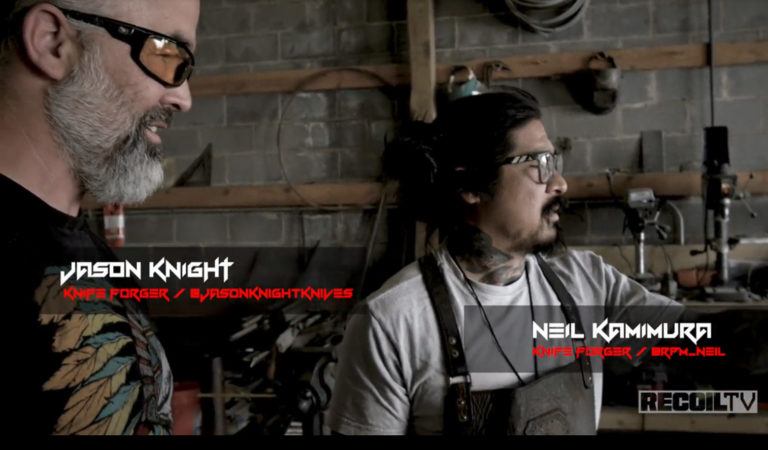
BLADE is proud to present A Knight with Neil. We followed knife forger Neil Kamimura to Jason Knight‘s own forge. We witnessed the two transform a military vehicle’s axle into a battle axe, create some badass looking kukris, and had some crazy good times in between.
Sharing his design experience with Neil, we learn a bit about Jason Knight’s crafting abilities, along with his lively persona. With these two personalities on hand, there are bound to be some shenanigans once the forging is complete.
Robert Young reinvents a classic Loveless fixed blade in flipper form.
Robert Young reproduces BLADE Magazine Cutlery Hall-of-Fame® member Bob Loveless’s New York Special fixed blade in a flipper folder format, and it’s something that would probably please even Bob himself.
Young also makes a standard fixed-blade repro of the knife. He holds it and the folder—when the folder’s open, both knives are the same size—side by side at shows to see if customers can tell which one’s which, and nine times out of 10 they can’t. Around 1976-77 when he was 16 and a California resident, he learned a man making knives lived three doors down from a friend’s grandfather’s house. Robert visited the man and it turned out to be Loveless. He had no idea who Bob was until later and then visited him about a dozen times.
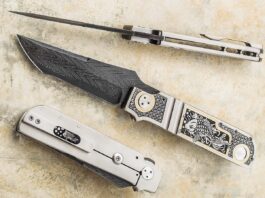
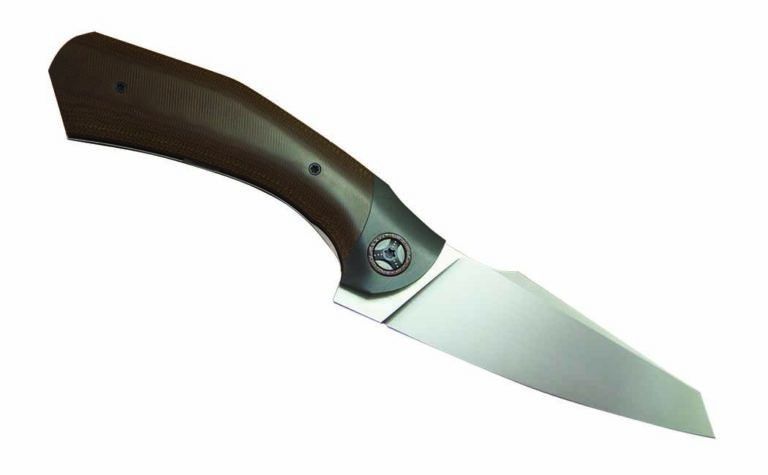
Robert Young, 64, has been making knives off and on since 1976 and has been full time for two years now. He moved from California to Arkansas in 1993. He’s made about a dozen of the New York Special flippers and also reproduces Loveless City Knife, Junior Bear and Big Bear fixed blades, the latter with a 1-inch-wide sub-hilt. At press time he was working on a folding version of the City Knife and a less expensive version of the New York Special folder. Loveless, of course, never made a custom folder. (Jocelyn Frasier knife image)
“He taught me and I improved a lot real quick,” Robert said. “I wished I’d stuck around there more than I did but I was kind of embarrassed once I found out who he was. I didn’t want to bug him a whole bunch, but he did teach me quite a bit.”
New York Special Flipper Specs Blade length: 3” Blade steel: RWL-34 stainless Rockwell hardness: 62 HRC Blade grind: Double hollow on a 3-inch wheel Blade pivot: Ceramic bearings Scales: Stag Liners: 416 stainless, integral Closed length: 4.25” Maker’s price for a similar knife: $1,500
Part of the Texas Slipjoint Cartel, Bubba Crouch shares the tools with witch he crafts his creations.
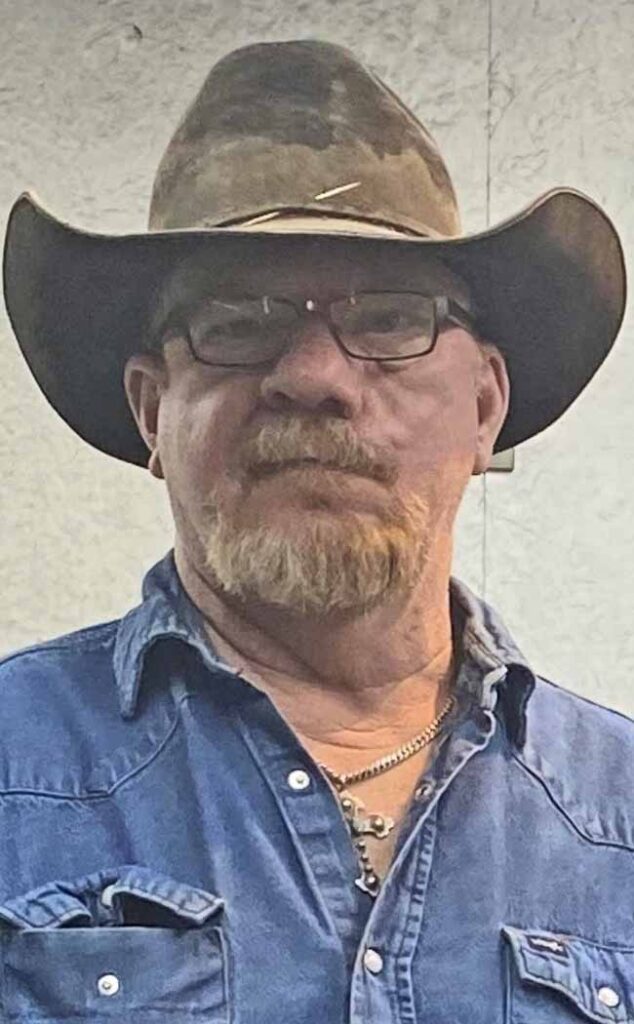
Tommy “Bubba” Crouch is a Texan through and through. In fact, he lives only minutes from Cutlery Hall-Of-Famer Bill Ruple, who has mentored more slip-joint knifemakers than a little bit. Crouch is one of those pupils and was also the spark in naming a merry band of talented custom makers who studied under Ruple the South Texas Slipjoint Cartel.
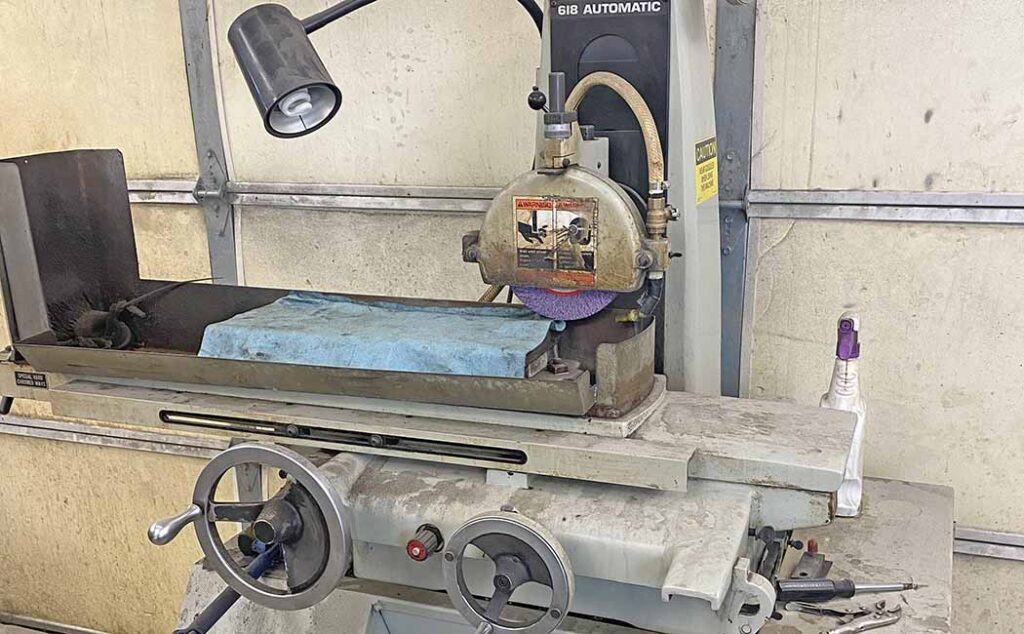
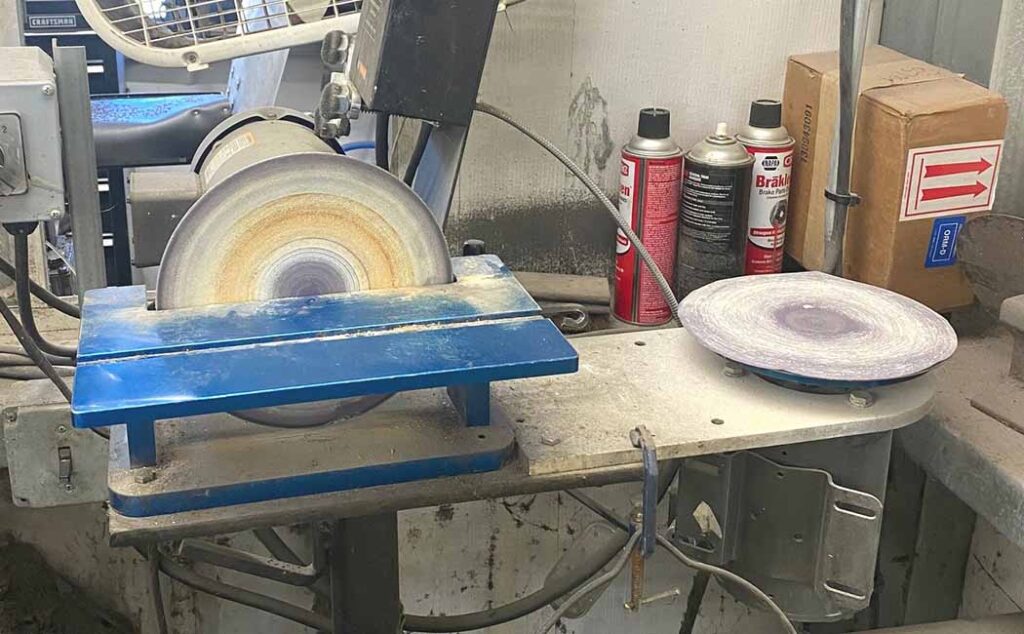
Crouch employs his Harig 618 automatic surface grinder for bringing parts to thicknesses pre-heat treat and for clean-up post-heat treat.
“Bill Ruple and I were sitting around one day in his shop and we were just talking about knives and such,” Bubba recalls. “We were talking about our bladesmithing friends in the Montana Mafia, so we came up with the name South Texas Slipjoint Cartel. It was mainly just to mess with our Montana knifemaking friends who’d formed such a group. We decided to make it an LLC. Our group has done many donation knives for charity events. It mainly consists of friends sharing techniques and better ways to do things. I have been blessed to have Bill Ruple five miles away and he has helped me tremendously. Other members sharing their knowledge have also been something that helped me personally.”
It can be truly said that Bubba is all cowboy and all hat. He grew up ranching, spent time on the competitive roping circuit, and even had a stint driving a cattle truck. He took up knifemaking in 2009 and credits his apprenticeship under Ruple as the key to where he is today.
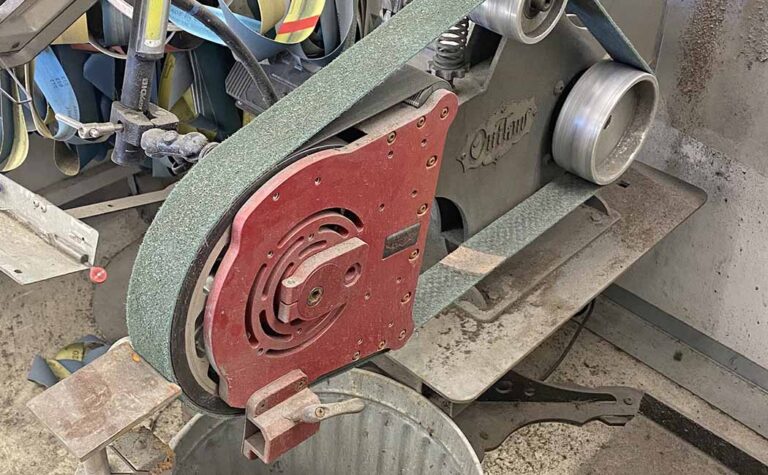
Bubba uses The Outlaw grinder with the Moen platen (above) for grinding blades exclusively. “Both work well together,” he observes.
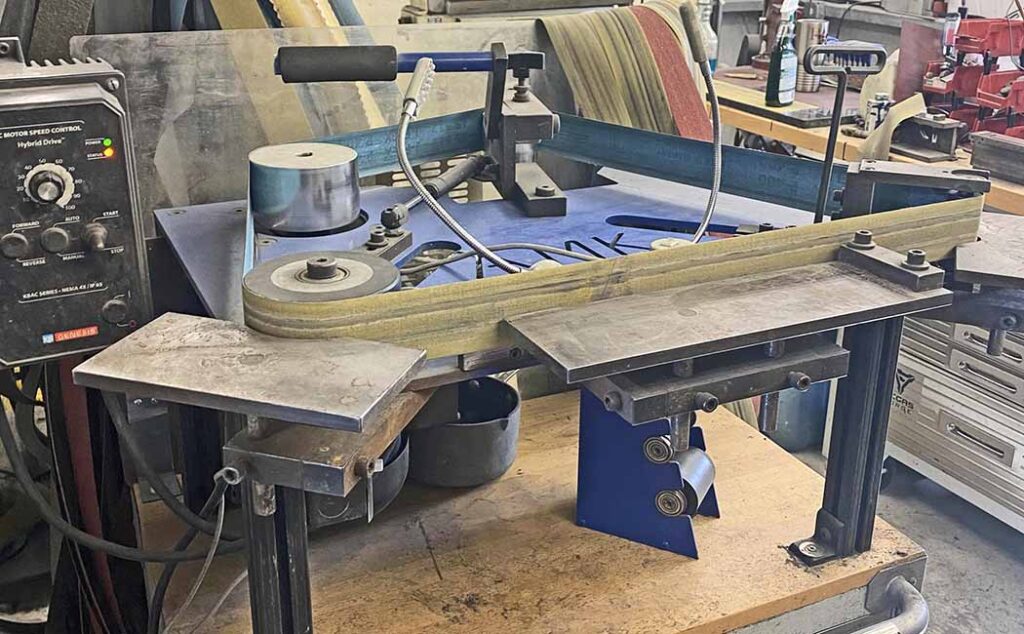
First Crouch calls out his milling machine. “The Bridgeport Mill is an adjustable speed head that I use for milling integrals, liners, relieving liners and spinning center handle pins,” he notes. As for shop grinders, he has a plethora. “My automatic surface grinder is a Harig 618. This machine I use for bringing parts to thicknesses pre-heat treat and for clean up after heat treat. The Outlaw grinder with the Moen platen is used for grinding blades only. Both work well together,” he observes. “The Northridge grinder I use for roughing out and shaping parts.
“My green grinder is made by Enrique Pena and is a great piece of equipment. The wheel and platen flip around and the back side can be used as a loose belt. The horizontal grinder is an AMK and is a necessity for making slip joints, in my opinion.”
For his main disc grinder setup, Crouch uses a Hardcore model for cutting blade tangs and fitting handle material into the liners. The flat disc is homemade for thinning and flattening handle material.
Last but not least on the grinder front Bubba lists his disc grinders. “My main disc setup came from Hardcore and is used on cutting in the tang on the blade and for fitting handle material into the liners,” Bubba explains. “The flat disc is homemade and used for thinning and flattening handle material.”
Bubba Crouch
He has two ovens for heat treating. “My heat-treat ovens are both newer models. The Paragon Pro is a great oven that gets to tip really quickly,” he notes. “The Evenheat has been a great addition and is very accurate.”
Bubba also keeps two pantographs in his shop. “The first is an Alexander 1B that I use for inlays and cutting shields. It’s an older machine from the early 1880s,” he states. “The second pantograph is a Gorton P1-2. I use this machine for engraving my name into the blades.”
He also keeps another specialty machine for shop duty. “The Oliver drill point thinner has been converted with a table and a cupped stone to cut nail nicks in the blades,” Crouch advises, wrapping up with something no maker can do without: “The workbench came from Sam’s Wholesale Club and I have three of them—very well built for the money.”
A knifemaker and other knife pros take different approaches to the Ukraine-Russia conflict.
The ravages of war often have global impact—even when the fighting is half a world away and the devastation is seen through pictures and words rather than bullets and bombs. War, anywhere, tends to touch the lives and livelihoods of many.
The knife industry, both factory and custom, is no different. The war in Ukraine has brought devastation to the country, and its end was nowhere in sight as BLADE® was going to press. Ukrainian resistance is robust, probably in sharp contrast to the results anticipated when Russian President Vladimir Putin decided to invade his sovereign neighbor. While the resilient Ukrainians defend against such aggression, where and how does the knife industry feel the long reach of war?
Oleksii Nesterenko is a custom knifemaker. He is also Ukrainian.
“On February 24,” he commented, “Russia, with the support of Belarus, launched an open military attack on Ukraine. My city, Kyiv, was one of the main goals. After systematic rocket attacks on the city, my wife and children were forced to evacuate to Germany.”
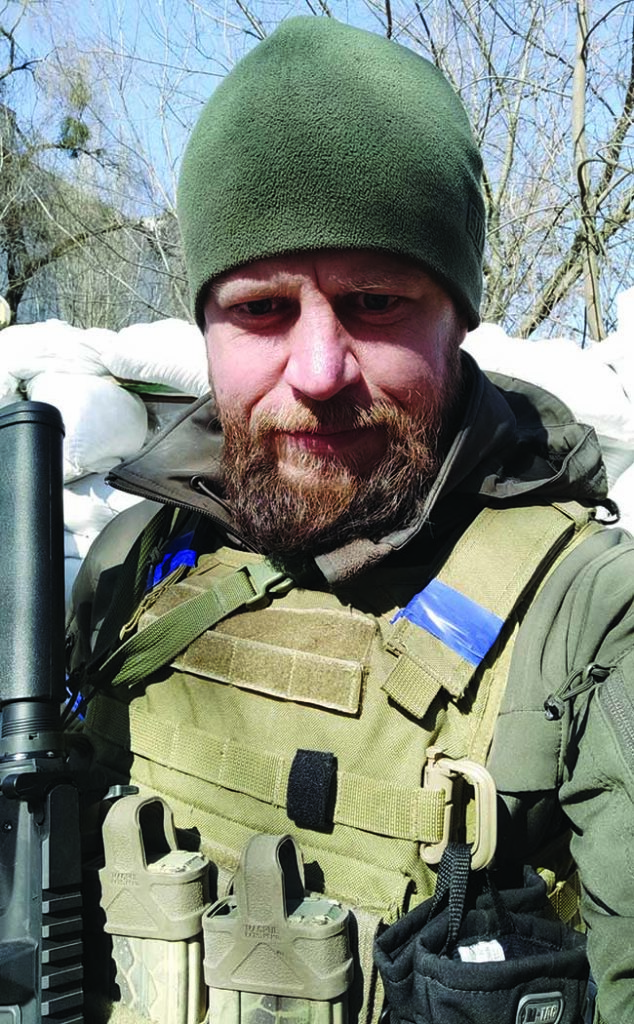
At press time, Ukrainian knifemaker Oleksii Nesterenko had signed a contract as a territorial defense volunteer for Ukraine and had stopped making knives.
The war came home to Oleksii, and his life may very likely never be the same. He has responded to the call to defend his country. “I signed a contract for a territorial defense volunteer and stopped making knives,” he said. “As far as I know, the work of some knifemakers who work in the cities where there are no active hostilities has changed too. Many have abandoned the making of collectible knives and make simple, utilitarian knives and other devices for the military.”
Purveyor Dave Stark of Steel Addiction Custom Knives sells Oleksii’s work, and despite the fact there is a temporary suspension of custom pieces from the Ukrainian maker, Dave praises the quality of his knives.
“Oleksii’s fit and finish and his attention to detail are what set him apart from his peers,” Stark noted. “His choice of materials and the manner in which they are finished really make his work stand out. His hand-rubbed satin finish on his blades is some of the best I’ve seen. The knives feel great in the hand and mechanically are spot on. I would say his style is ‘dress tactical.’ He uses Damasteel’s pattern-welded steel, damascus, mother-of-pearl, mokuti, zircuti and zirconium.”
Perhaps current events will make Nesterenko’s knives even more highly sought after in the future. Meanwhile, he is consumed with the dirty business at hand.
“Now in the Kyiv region where I live, Russian troops are defeated and active hostilities have ceased,” Oleksii reported. “But I am still on duty at checkpoints and volunteer. We help the civilian population in the villages near the front. I think that in a few weeks I will have time to partially return to knifemaking.” While he is hopeful and actively involved in the defense of his country, Nesterenko has kept an eye on the conditions of the knife industry in Ukraine and anticipates some adaptations.
“Currently, there are no problems with the supply of materials for the production and shipment of knives abroad,” he advised, “so I look forward to returning to work. I am sure that a knifemaker can make a quality knife only if he uses it for its intended purpose. That’s why I used to make only EDC knives. Thanks to the war, I understand what requirements a tactical folding knife must meet. I have already drawn several designs and am waiting for the opportunity to get started.”
Changes in demand are not noticeable at this time, according to Oleksii, and orders are in the queue for delivery around the world into 2023. Still, he warned, “I think that the consequences of the war in Ukraine will affect the economies of many countries. And over time, that will affect collectors.”
Little Change
In much of the domestic knife industry, little in the way of change has occurred due to the war thus far. Custom knife purveyor Les Robertson said that by mid-April FedEx service to Ukraine had been suspended. Therefore, the volume of knives conventionally being sent to Ukraine has probably been curtailed, at least somewhat. Neighboring European Union countries are still moving mail into Ukraine.
Les Robertson
“No one is sending knives directly to anyone in Ukraine,” Les noted. He went on to comment that factory sales to “armchair warriors” may in fact tick upward as the war persists.
Purveyor Neil Ostroff of True North Knives agrees that the current custom knife market is maintaining its status quo. “In my opinion, as a dealer,” he commented, “we have no change from the customers concerning knives from either Ukraine—now on hold—or Russia. Several Ukrainian knifemakers have set up in Poland, and they do not want to be named.”
Still, Ostroff is somewhat insulated businesswise from the turmoil in Eastern Europe. “Going forward, I see no issues coming through, as there have been none so far,” he observed. “And most if not all of my clientele prefer to buy only USA-made items, which is what I prefer to supply as well.”
From the factory perspective, Joe Bradley, director of sales and marketing for KA-BAR, has noticed virtually no changes in activity. “The war in Ukraine hasn’t had any impact on us at all,” he remarked. “As far as production, and even consumption, the impact has been zero.”
Bradley added that supply and demand are in line. “We have not seen an increase. Currently, we are seeing the market being more impacted by inflation than anything else. I think most of the people, at least Westerners, in the Ukraine already had their supplies and as a result didn’t have a need to buy anything new. Production and logistics have been a problem since the start of COVID,” he observed, “and are just now starting to get back on track and return to a semblance of normalcy.”
KA-BAR has experienced no changes in product offerings or knife styles as a result of the war in Ukraine. However, Bradley offers one interesting point of view. “If anything, this war has shown the merits of what some might consider antiquated weaponry like the AK-47,” he pointed out. The AK-47 is perhaps the world’s most famous assault rifle, arising in the Soviet Union during the Cold War, experiencing authentic production models and knockoffs made in the millions, and arming military organizations around the world for well over half a century.
“Free The Oppressed”
Spartan Blades is located in Fayetteville, North Carolina, near the gates of Fort Bragg, home of the U.S. Army’s XVIII Airborne Corps and Special Operations Command. Spartan owners Curtis Iovito and Mark Carey, both Special Forces veterans, have seen a groundswell of support for Ukraine. Knife sales bear the unmistakable mark of the conflict.
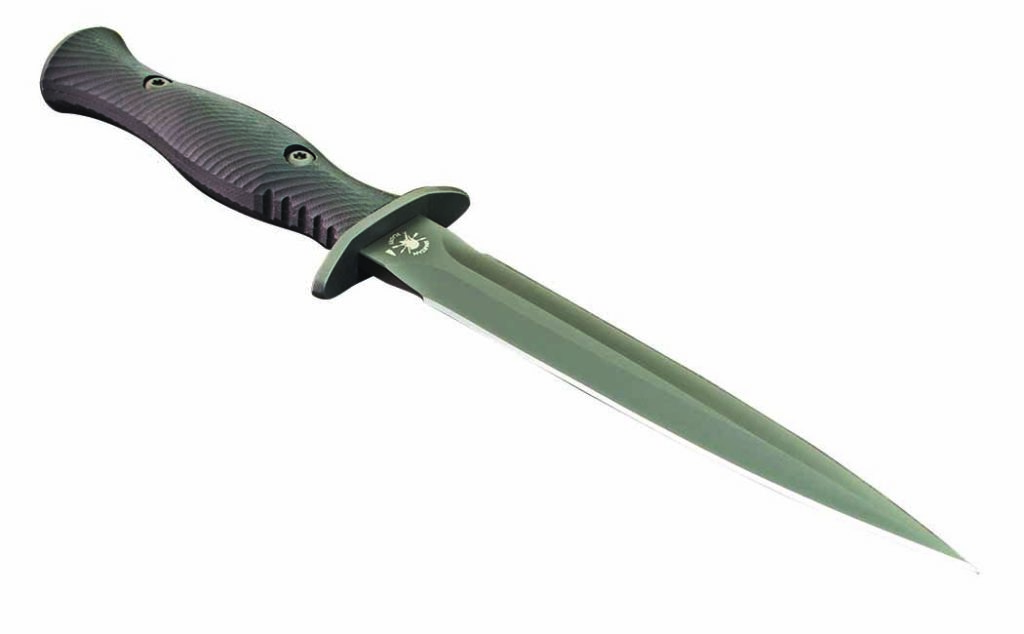
According to Curtis Iovito of Spartan Blades, more military professionals and contractors buy the company’s Gold Line knives. An example is the Spartan-Harsey Dagger in a 6-inch blade of CPM S35VN stainless steel with a hollow grind. MSRP starts at $390. Bill Harsey is the designer.
“Most of the sales are to people here in the U.S. with notes that they are purchasing for folks in the Ukraine,” explained Curtis in acknowledging the market uptick. “Several orders have had short tags like ‘Free the Oppressed in the Ukraine’ or ‘Support the War against Russian Aggression.’ Because we are at Fort Bragg, we have several Special Mission units from friendly foreign countries drop by the shop to pick up knives for their use. While that isn’t uncommon, it’s happening more than usual. We’ve noticed during our discussions with them that things have a more serious tone.”
Others buying more knives from Spartan Blades include people from all walks of life and military involvement. Curtis said, “Our Gold Line knives are going to more of the military professionals and contractors, and our Silver- and Bronze-grade knives are selling to folks across the spectrum. Many of the knives bought are by civilians that later donate the knives to NGOs [non-governmental organizations] that ship in bulk to Ukraine.”
As far as production, it’s business as usual at Spartan Blades, a longtime producer of knives that go to war. There are a few new items on the horizon, and the owners expect business to be brisk in the days ahead.
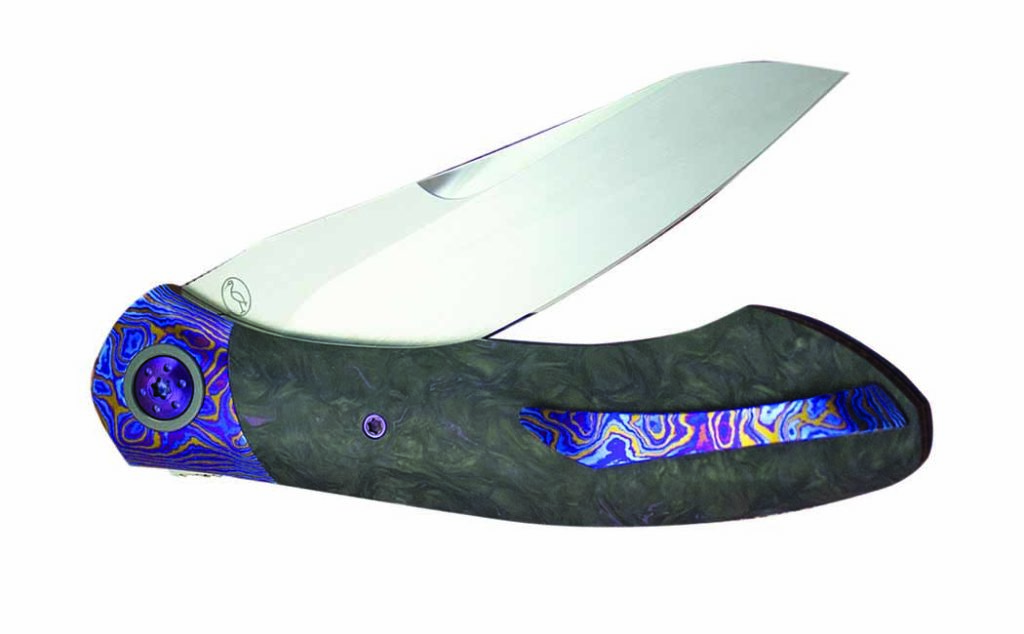
Oleksii employs M390 stainless steel for the 3.75-inch blade and a handle of black and purple Fat carbon fiber for his Morph flipper folder. The bolster is Timascus™ and the pivot rings and back spacer are zirconium. Closed length: 8 5/8 inches. Retail price: $2,800. (Steel Addiction Custom Knives image)
“Honestly, the war in Ukraine hasn’t affected how we do things here at Spartan Blades,” Iovito asserted. “We’ve made knives through the last two decades for troops in both Afghanistan and Iraq, so things are kind of par for the course. “We have several new knives coming out around the end of this year,” he continued. “We had planned on releasing these later but have sped up because the price point and style match some of the requirements we have seen lately. They are being designed by William W. Harsey, Jr.—a fighter, a Nessmuk and a kukri blade. They will be in 1095 Cro-Van blade steel and made in conjunction with KA-BAR Knives. Pricing has not been determined yet, but we are shooting for a sub-$200 retail price. The first one produced will be a fighter later this year.”
Surveying the knife landscape today begs a few questions as Iovito and Carey plan for the future, uncertain as it may be.
“We have seen a slight increase in steel prices, but we haven’t raised our prices in over a decade,” Curtis stated. “We assume we will continue to see price increases soon in commercial, off-the–shelf parts but are keeping our fingers crossed. We believe we will see an increase in knife demand as it appears the conflict in Ukraine [will not end as soon as many thought it would].”
The war has had other effects, including dampening attendance at European trade shows.
“We were very surprised that most of the U.S. knife companies did not attend the IWA show* in Nuremberg, Germany, this year,” Curtis noted. “We even had people thanking us for attending, as you could tell they are counting on U.S. support even if it is just showing up to support them in spirit. There was definitely a new and urgent concern about military spending. The German government approached two companies that I know of and bought their whole inventory—cutting checks the same day!”
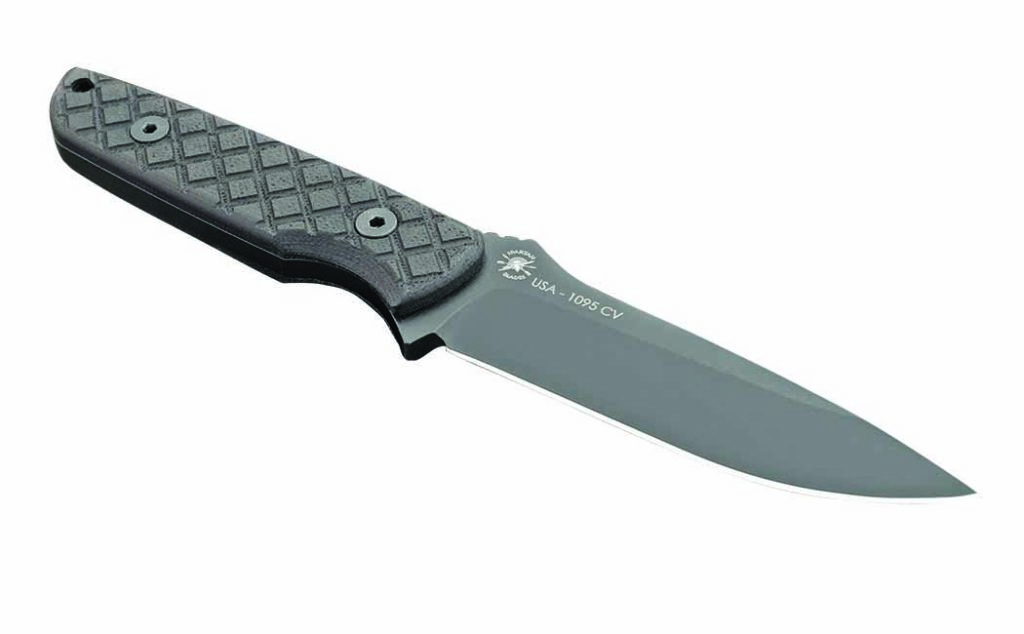
Curtis Iovito indicated Spartan’s affordable Silver- and Bronze-grade knives are selling well to people across the spectrum. One of the latest examples of a Silver-grade knife is the Alala in a 3.75-inch blade of Cro-Van carbon steel with a saber grind. MSRP: $159.
In wartime, uncertainty often reigns. However, awareness, preparation, and the desire to return to the shop are evidence that the ongoing conflict in Ukraine will influence the future of the entire knife industry for the foreseeable future.
*Held each spring, the IWA OutdoorClassics (iwa.info) is the European equivalent of the Shooting, Hunting, Outdoor, Trade (SHOT) Show stateside, and is a place where many new factory knives are debuted.