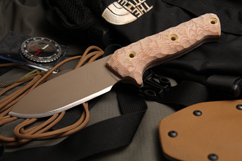
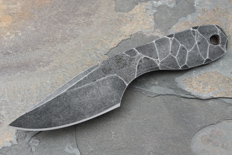
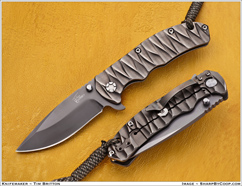
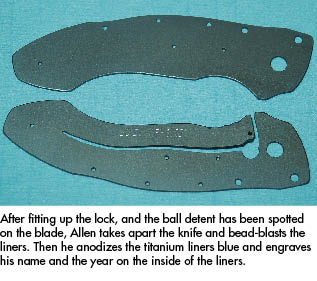
Knifemaking is the building of a knife, which includes the blade, handle and other accouterments. Blades are made by either removing metal from a steel blank via a grinder – known as stock removal – and the forging to shape of hot steel into a blade in the process known as bladesmithing. Other parts, including bolsters, guards, pommels, etc., are needed to complete the finished knife.
Steve is survived by his wife, Mary, six brothers, one sister and a number of nieces and nephews. Memorials may be made to the charity of your choice. Condolences may be expressed online at www.robinsonfuneralhomes.com or visit www.legacy.com/obituaries/charleston.
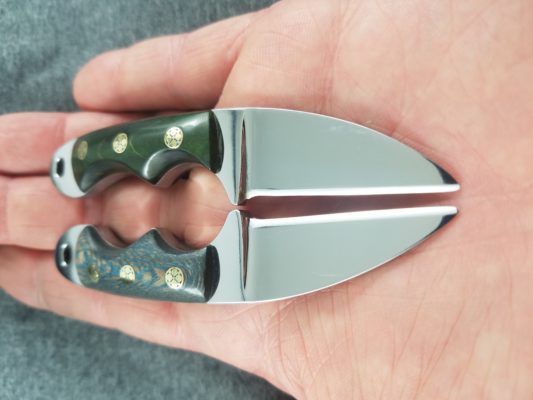
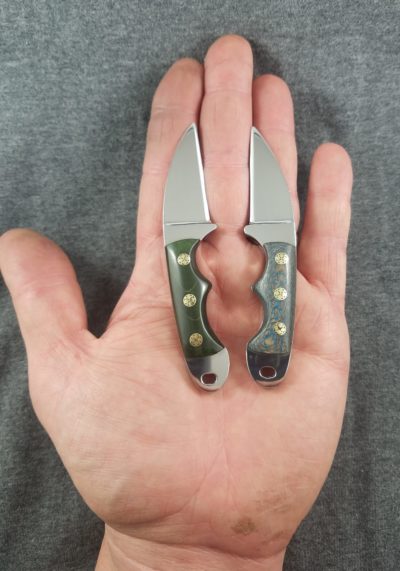
Pete Sloan made two neck knives for the wife and son of his friend and fellow maker Spencer Aplin. He used his daughter’s hand to perfect mini knife’s design, ensuring it fit the tiny hands of Lisa Johnson Aplin and son Alexx who suffer from brittle bone disease.
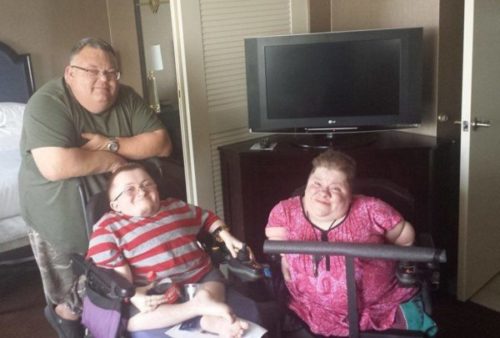
“One thing that Spencer is very good at is knowing what I’d like,” Lisa Johnson Aplin said. Lisa is the co-founder and chief operating officer of STA Custom Knives out of Brazoria, Texas. She and knifemaker Spencer Aplin were married in 1993, and together they have a son Alexx who will be 24 in a couple of months, a journalist and sometimes quality controller in his father’s shop. Lisa had no idea that a Sloan Custom Knives creation she admired had already been custom-ordered for her by her husband. Lisa suffers from osteogenesis imperfecta, or brittle bone disease, so although she does not have dwarfism and is therefore not a “little person,” she is a very little person. The one thing that Pete Sloan has plenty of access to is little people in the form of children, 9 to be exact. So, he used one daughter’s hand to perfect the mini knife fit and design.
Erin Sloan is 9 now, but she was 5 when her dad, Pete, asked her to help him custom-fit a tiny neck knife. Erin is one of 9 Sloan children.
Lisa’s favorite color is green and Spencer had been admiring a green knife he saw on Facebook that his friend Pete had made. “He asked me if I could make one for his wife,” Pete said. Pete was surprised and honored that Spencer, a maker he greatly admires for his knifemaking in general and blade-carving in particular, would ask him for a knife. Pete told Spencer that he was welcome to make the knife if he wanted, but Spencer said, no, that Pete had a good command of the Wharncliffe design and he wanted Pete to make it.
Pete Sloan started out with an old 4-by-36-inch belt grinder–generally considered underpowered and not ideally configured for knifemaking–and some hand files. “I liked it,” he said.
Humbled, Pete was determined to get it right. But he lived in Medina, Tennessee, and had never met Lisa. He only had Spencer’s description of her size to go on. Lisa is 2 feet, 10 inches tall. Pete’s daughter Erin was 5 at the time. So, he roughed out the 440C stainless steel blades and then with a Sharpie marked the first finger groove using Erin’s grip as a guide, grinding until it was just right for her petite hand. Spencer requested the stainless steel because the Aplins live next to salt water, and he wanted to minimize corrosion. Pete said he mostly gets requests for pattern-welded steel.
Spencer Aplin of STA Custom Knives, standing, took his son, Alexx, and wife and business partner, Lisa, to the 2015 BLADE Show.
If you’ve ever seen the movie “Unbreakable” starring Bruce Willis, you know what osteogenesis imperfecta entails. Mr. Glass’ character, played by Samuel L. Jackson, has a form of the condition that allowed him to grow to full height, but his lifestyle is still hampered by debilitating bone breaks. Lisa and subsequently her son Alexx have Type III OI. A genetic mutation causing a lack of collagen, subsequently prompting connective tissue issues. The result is that bones fracture easily and those with the affliction will be short in stature with a curved spine and barrel-shaped chest. Type I is the most mild form of the condition, Type II and Type VIII the most severe and most often fatal. Types III through VI vary in symptoms and genetic causes. OI has been traced through mummies back to 1000 BC Egypt. Even though the condition has been around a long time, there is still no cure.
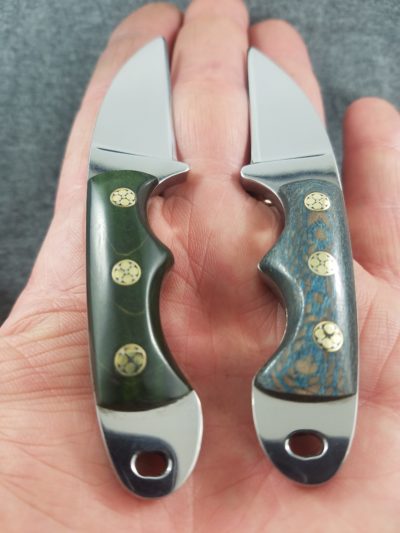
Pete Sloan used green-dyed curly maple for the scales on Lisa Aplin’s knife and blue-dyed and natural sycamore for Alexx’s. You can contact Richard Beam on Facebook for such impregnated wood products.
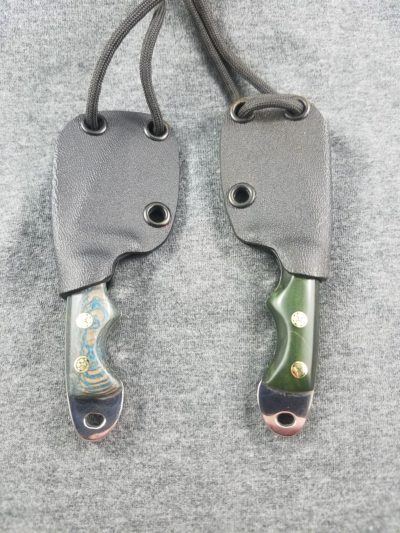
Pete used stabilized curly maple dyed green from Richard Beam at Nicholas Impregnated Woods to make the handle for Lisa’s knife and a combination blue-dyed and natural sycamore for Alexx’s. Each came with a Kydex sheath and cording to wear around the neck. At the 2015 BLADE Show, Lisa finally met Pete in person and he presented her with the knife. She loved it! “Green is my favorite color,” she said. She uses the knife all the time, opening boxes that come to the shop and for everyday uses around the house. Although it can be used for food preparation, Lisa doesn’t cook, she said laughing. Spencer does the cooking. She treasures the knife. “It’s one of my favorite’s in my collection.” She continues to be impressed with the fit and with how Pete obtained it.
Push Kydex sheaths away with your thumb rather than struggling to pull the knife out. If they are too tight, contact the maker. He can heat and loosen the fit while still ensuring the knife does not fall out.
The only thing that Pete could not have accounted for was hand strength or lack thereof. Both Lisa and Alexx had a hard time drawing their knives. Spencer simply heated up the sheaths and worked the knives in them so that they released more easily without falling out. “It not something he could have known about,” Lisa said. “I think he did a great job.”
When asked how she adapts to daily activities in a full-size house at her stature and in a wheelchair, Lisa’s answer was immediate and delivered in as cheery a tone as everything else she talks about. “The great thing about being married to someone who works with his hands,” Lisa explained, “is that Spencer can make me anything I might need customized.” The Sloan Custom Knife was an unexpected surprise, but in hindsight typical of Spencer to have picked out exactly what she would have picked out for herself long beforehand.
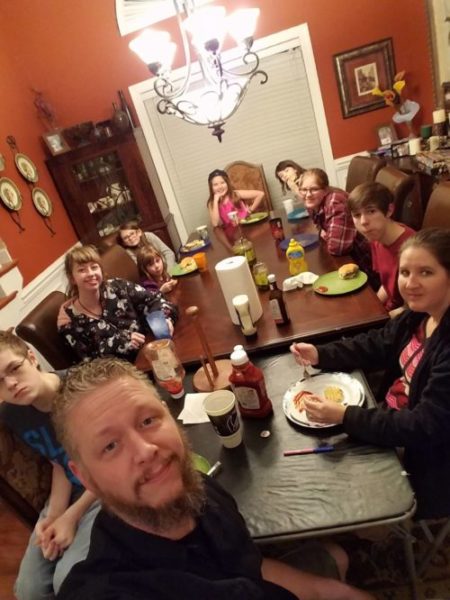
It’s a challenge to get all the Sloans in one place. This is the whole family minus oldest daughter, Becca, who is in the U.S. Air Force.
Pete visited Spencer before the 2017 BLADE Show and the two slept little working hard to finish up knives to sell. Spencer and Pete make knives with similar styles as Spencer shares his knowledge with Pete. And if Pete ever needs another hand model, he can turn to one of his and his wife, Holly’s, nine children, some biological, some adopted, some that came by other means: Becca, 19; Carson, 18; Gage, 15; Brant, 14; Makenzie, 13; Leigha, 10; Erin, 9; Madeline, 8; and Grace, 7. The couple used to be foster parents. “There a story to just about all of them,” Pete noted with a laugh.
Contact Pete Sloan at [email protected] or on Facebook at Sloan Custom Knives.
These mini neckers are 4.25 inches overall. The 440C stainless steel blades are 2 inches. The full-tang construction allows for a lanyard through hole. These were designed for child-sized hands, but come in larger versions. Handle material is impregnated wood from Richard Beam. Maker’s list price: $200 shipped with Kydex sheath.
Are You Looking to Perfect Your Own Everyday Carry?
Another thing you’ll learn more about in Wayne Goddard’s “Making The Everyday Carry Knife” is selecting the right materials for a handle that lasts.
“Making the Everyday Carry Knife” by Wayne Goddard includes information on how to determine the best blade and handle length. You’ll also get tips on how to use your computer to assist you in designing your knife, plus lots more including grinding and tempering techniques and tool suggestions. At only $4.99 in digital format it’s a wealth of information at a steal.
There aren’t many dull, boring or mundane trends, and for good reason.
Knifemakers embrace the old saying, “change is constant.” The “same old, same old” never catches on with a new generation. Knife craftsmen strive for fascinating and innovative ways of blade building, and collectors seek out the rare and unusual.
Eventually knifemakers find something modern that is not only aesthetic and utilitarian, but it also catches on with other artists. That’s the start of a trend.
You get the idea—trends are born out of creative thinking and design capabilities, and not from copying old patterns without any tweaking, improving or thinking outside of the box.
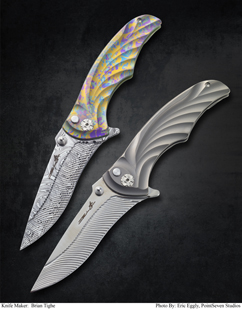
Sure, some trends have staying power. There are many new trends to take in, like dimpled, sculpted, grooved and glass-beaded knives, for example.
It is a trend in knives that presented itself to me while I poured over 1,000s of images from knife photographers for possible inclusion in the Knives 2014 book, now available and a gorgeous book, if I may say so myself, but not because of anything I did. It’s the knives and images thereof that make it a handsome title, and the Trends, State Of The Art, Factory Trends and Feature articles therein.
Enjoy, and keep your eyes peeled for new knife trends in the industry, particularly if you’re a collector, investor or general enthusiast with a habit of accumulating custom or production pieces.
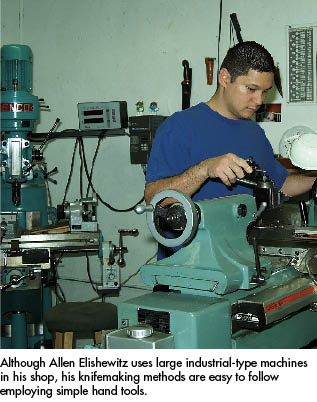
There are many methods to build a knife and there is no wrong way to do it. You can use anything from simple hand tools to industrial machines. The method I have chosen for readers to follow allows for a high-tech folder to be fashioned with either simple or large industrial-type machines, the latter of which are like the ones I own.
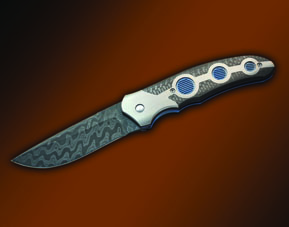
The fancy locking-liner folder that has resulted from this step-by-step instructional is completely handmade. The reason I choose to build all my knives in such a manner is because it gives me, the knifemaker, more flexibility in my production method. It also allows the knife to take on more of an individual and unique appearance.
Keep in mind that, due to space limitations, there are quite a few small steps that I have excluded. I will do my best to mention them but I will concentrate on the most important aspects of making a high-tech locking-liner folder.
For this project, the knife has titanium bolsters, a carbon fiber handle and a damascus blade. The locking-liner folder integrates a classical handle/bolster combination that, to build it, entails an intermediate level of difficulty. What makes the folder more complicated to build than other plain-handle knives is the introduction of the bolsters. The bolsters add just one more aspect to handle construction, and the alignment of the bolsters and handle material must be constantly maintained during the knife assembly.
American Bladesmith Society Founder William F. “Bill” Moran, Jr demonstrates his technique for making and attaching a guard to a Quillian Dagger.
BLADE Recommends:Spyderco Bill Moran Drop Point
Bill Moran’s legacy can be felt every time a knifemaker fires up a forge. It’s also the force behind the Spyderco Bill Moran Drop Point. With a VG-10 blade and ergonomic grip, it’s the perfect knife for the upcoming hunting season.
When established knifemaker Lee Williams met Donna, little did he know that he had a future knifemaker on his hands!
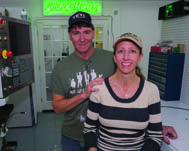
As husband and wife, Lee and Donna Williams collaborate on the usual things, like what’s for dinner or where to go on vacation. So why not team up on making knives?
When Lee, already an established knifemaker with a large collector base, met Donna, little did he know that he had a future knifemaker on his hands, or a beautiful and devoted wife!
In a feature article titled “Mr. and Mrs. Sharp” in the June 2015 issue of BLADE®, writer Pat Covert tells Lee and Donna’s story and shows some of the knives Lee has fashioned recently on his own, and collaborative pieces the couple has made together before and after marrying in July of 2014.
As Lee notes, “I started making knives in 2001. I had set up a small machine shop in my garage around 1996,” he recalls. “In November of 2001 I decided to make knives for my siblings as Christmas presents. Twenty-something knives later I had managed to finish knives for all of them, plus their spouses, before Christmas that year. I wasn’t completely satisfied with those first few knives and started doing a lot of research on the Internet.”
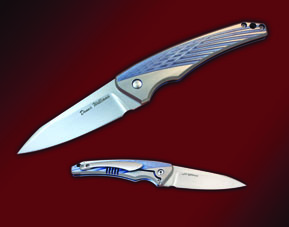
The Cherub (above right) is a result of the first collaboration between Donna and Lee Williams as a married couple. (Steel Addiction Custom Knives image)
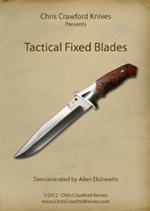
Learn both basic and advanced knife making techniques with expert instruction from Allen Alishewitz in Tactical Fixed Blades. Allen demonstrates how to craft a double-edged tactical fixed blade knife from start to finish, and creates two knives in order to fully illustrate the knife building process. You’ll learn:
– Profiling and Drilling the Knife
– Tang Tapering on a Grinder
– Tang Tapering on a Mill
– And more!
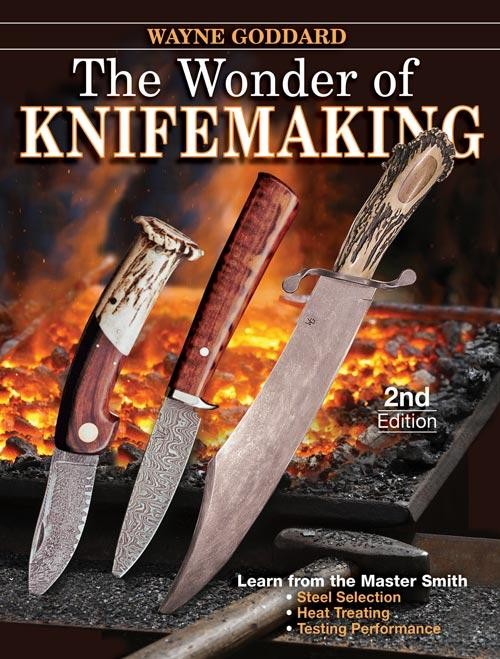
Learning how to make knives from someone who has done it for over 60 years and written about it professionally for about 30 years is exactly what you get with Wayne Goddard’s The Wonder of Knifemaking.
In The Wonder of Knifemaking he takes you on a fascinating journey explaining most everything every knife fan wants to know about knives and how they are made. From imparting his wisdom on how you should approach knifemaking in general, to getting started, insider tips, developing your own unique style, the pitfalls each maker must beware of and much more, Goddard guides you through the process in his measured, forthright writing style.
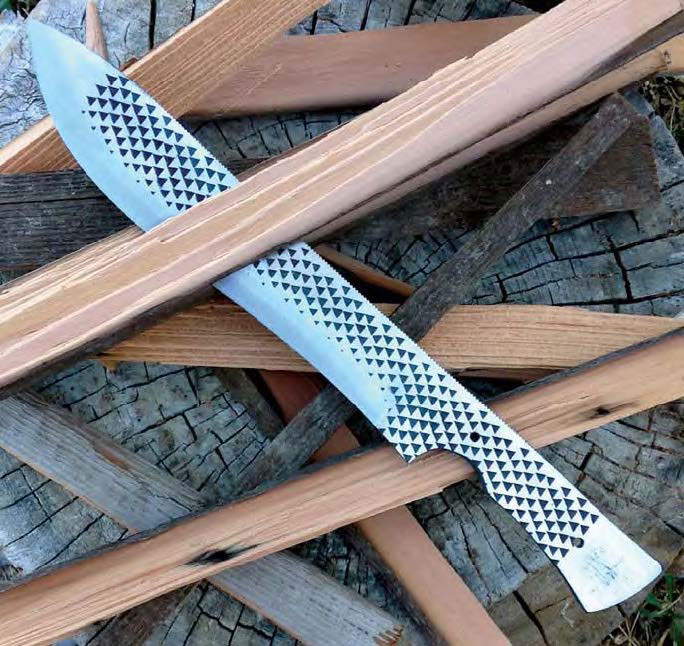
He tells you what steel is and how each of its constituent elements affects it; working with such old-fashioned materials as files, saw steel and horseshoe rasps; what you should know about heat treating, quenching, and selective hardening and tempering techniques; the best hardnesses for blades; clay back hardening; handles, guards and tangs, including narrow tang vs. full tang; grinding and finishing; material for pins; logo etching; tools for the knife shop; and more.
A huge proponent of knife testing, Wayne explains exactly what a testing program should consist of and what it should gauge: slicing cuts vs. pull cuts; the differences in the types of ropes to cut; tests for chopping ability and edge strength; and more. He also covers sharpening comprehensively, including methods and hones. Sharpening is a subject he knows extremely well, having taught it at many seminars over the years at the BLADE Show, BLADE Show West and many other events.





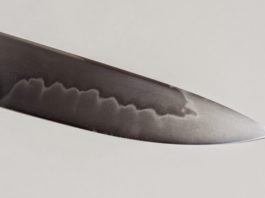
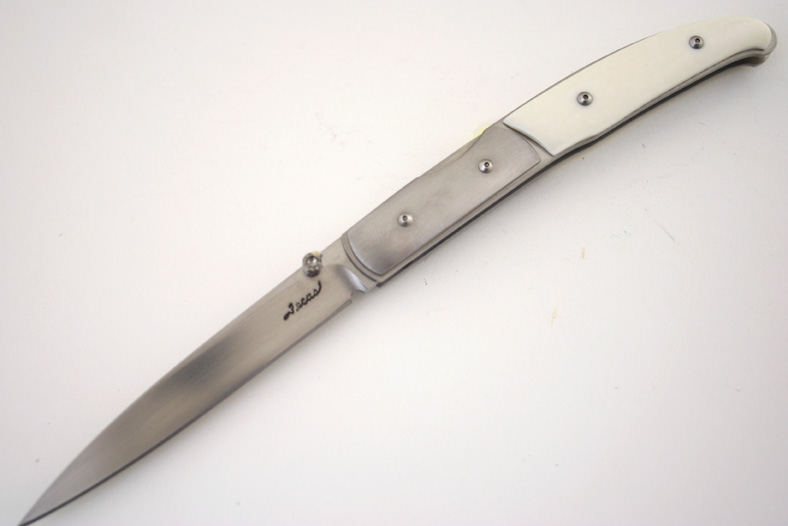 The world of knives lost a class act when knifemaker Stephen John “Steve” Fecas passed away Feb. 1. He was 66.