Knifemaking is the building of a knife, which includes the blade, handle and other accouterments. Blades are made by either removing metal from a steel blank via a grinder – known as stock removal – and the forging to shape of hot steel into a blade in the process known as bladesmithing. Other parts, including bolsters, guards, pommels, etc., are needed to complete the finished knife.
We’ve all heard it said: “There’s nothing new in knives.” And maybe there’s not. It could be that’s a true statement, although the flipper folder, assisted-opening knives, Mokuti (mokumé and titanium combination), lightning strike carbon fiber and other materials and mechanisms may be considered new. Perhaps innovation could be considered a newness, or progression at least.
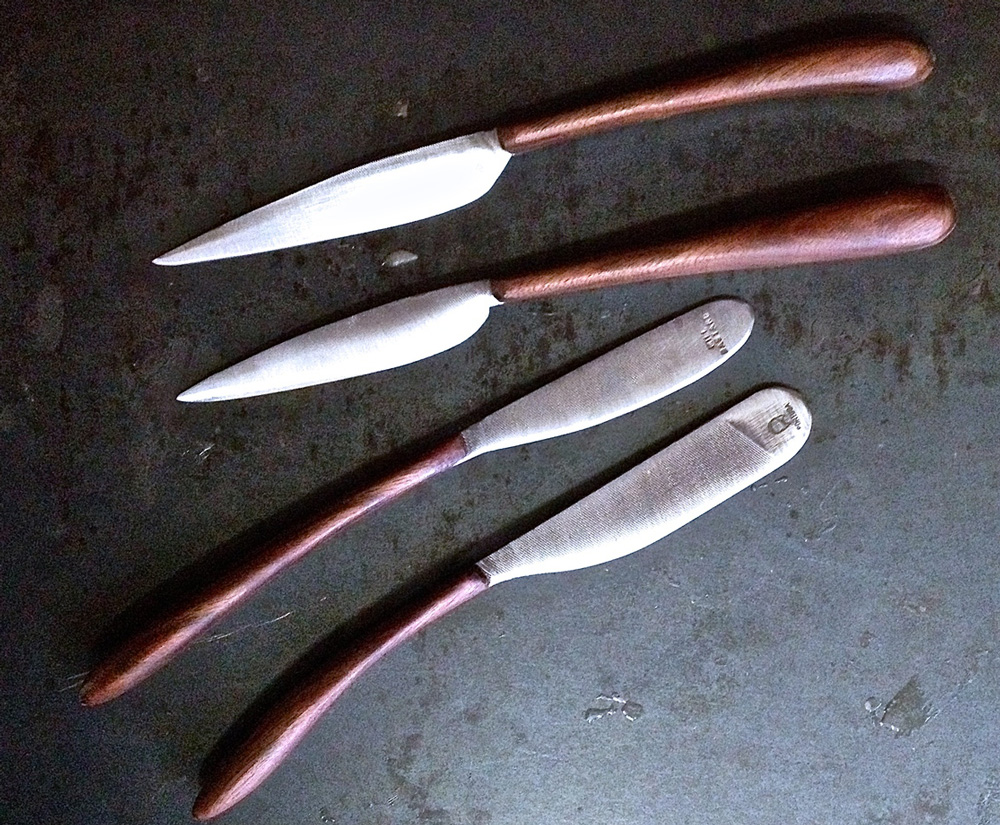
Chelsea Miller Rounded Cheese Knives. Click to enlarge.
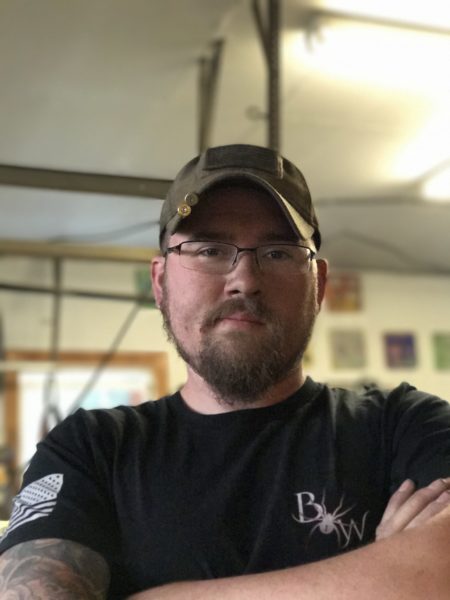
Brent Vaccaro of Black Widow Knifeworks & Tactical Gear left high school in his junior year. He already knew carpentry inside and out. But it was when he turned to knifemaking that he found a way to identify himself that had eluded him during his other business attempts. This dropout knifemaker is a master at marketing.
Brent Vaccaro of Black Widow Knifeworks & Tactical Gear attended high school in New Jersey where he was born and raised. He excelled in woodworking, banging out projects that those two years ahead of him struggled through. His teacher helped him, Brent said, but perhaps most by giving him the freedom to do his own thing. Brent grew up building houses. His family lived in the middle of an open subdivision field and every day after school Brent would work on the other eight houses that needed to be constructed. In his junior year, bullying got too much. He left school and became a carpenter. Over the course of 15 years he worked in construction, running his own business and working for others. He also started a tactical gear company, and he dabbled in beard accessories during the height of facial hair resurgence. He never could quite establish an identity for himself in any of his three businesses, he admitted, but when he started making knives, everything came together. Now, no matter how different Brent’s knives are from each other, when you see a Black Widow knife, you recognize it immediately. The dropout knifemaker is a master of marketing.
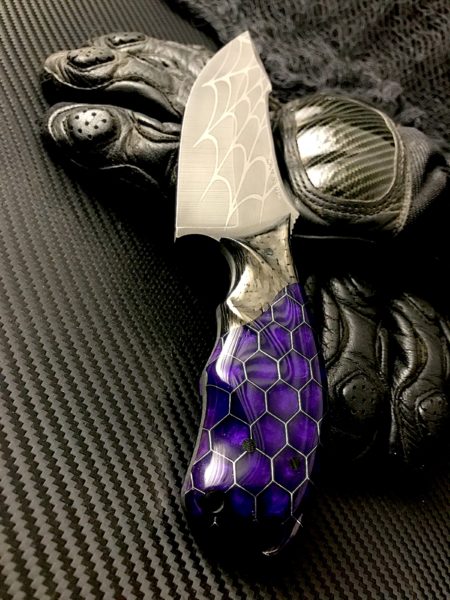
Model: H.E.R.L Blade Length: 4.25 inches Blade Steel: CPM-S30V Blade Finish: acid wash with spider web etch Scales: Voodoo Resin’s Purple Haze with KS Carbon bolster Overall Length: 8″ inches Maker’s list price: $250-$350 shipped with Kydex sheath and Tec-Lok Contact: Message Brent Vaccaro on Facebook at Black Widow Knifeworks & Tactical Gear. (Additional contacts at end of article.)
Around the time that Brent was struggling with being in school, when he was 16, his father gave him a pocketknife. It was a now-discontinued Kershaw model. “I still have it. I loved that knife,” Brent said. But he never had the money to collect knives, and some days he gets a mock scolding from his wife, Megan for forgetting to carry a blade on him. He was getting disillusioned with the diminishing level of artistry within carpentry, the lack of appreciation from the customers and the sense that the industry was solely focused on money. Although the skill sets are similar in woodworking and metalworking, it took some time to transition. Now Brent loves metalworking. It’s not months or years to finish a project with barely a handshake and never a thank you. It’s the instant gratification of seeing a knife come to completion over a course of days, sending it out and having the customer write him that they have no words for how impressed they are with his knife.
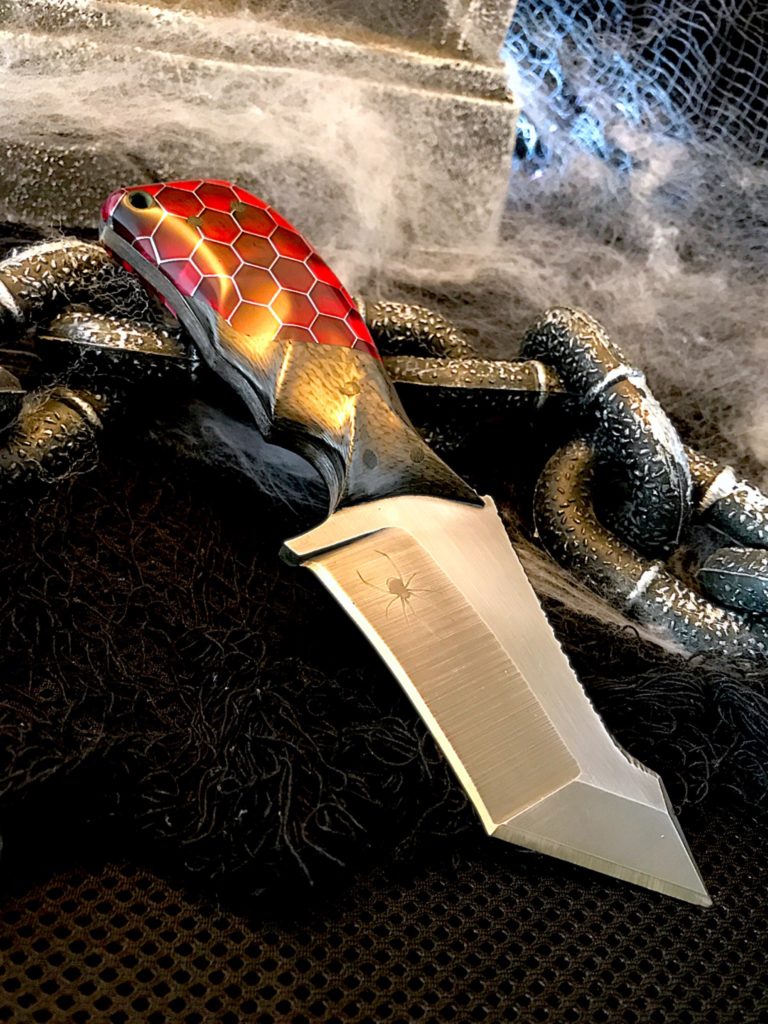
Model: BW Tac Tanto Blade Steel: CPM S30V Blade length: 3.5 inches Blade Finish: dark acid wash and stonewash finish with aggressive gimping Scales: Voodoo Resins’ Bloody Hulk with KS Carbon Fiber bolsters. Overall length: 7 inches Maker’s list price: $230-$330 shipped with Kydex sheath and Tec-Lok Contact: Message Brent Vaccaro on Facebook at Black Widow Knifeworks & Tactical Gear. (Additional contacts at end of article.)
And therein lies his mastery. Brent is fulfilled by that appreciation for his craft, and he knows exactly how to represent his knives to the world in the best possible light—literally—without ever crossing into exaggeration. It means a lot to him that he has created an identity for himself that is true to him, celebratory of his knifemaking and honoring to the client. “It’s an extension of self,” Brent said, adding that he wants his knives to be passed on as a part of his and his client’s heritage. You only have to look at a photo of a Black Widow knife to get the “feel” for the candied richness of the colors, the smoothness of the handle and the badassery of the blade itself.
“I don’t keep them,” Brent said. So each night he takes the time to shoot exceptional photos of each piece, a running catalog of his work, for him to remember by and for the client to share. He takes 10 to 15 photos of every knife and picks the best ones. And that’s because he’s found a system that works for him. At first, you’ll need to shoot far more to find the right lighting and angles. “You have to take the time to do it. It’s part of marketing,” he said.
If you want to take great photos of your knives, upgrade your cell phone, make yourself a lightbox, buy some handheld lights and take the time to learn how to make your knives look, not OK, but fantastic.
Building A Lightbox That Works
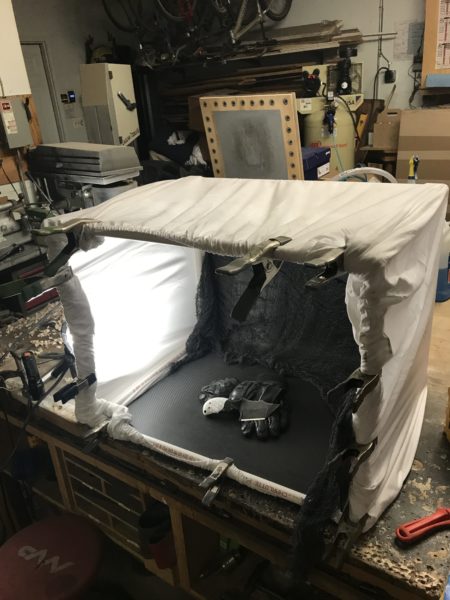
Brent invested $50 in his lightbox. At The Home Depot he bought 1-inch PVC and eight 90-degree T connections. With those he made his two squares for the box ends. He also got alligator clips. At Walmart he bought a king-sized white sheet and clipped it taught to the PVC frame. The whole thing is collapsible so that he can move it out of the way when he’s working. And, of course, the white sheet is no longer white.
The Backdrop
Normally, light boxes are made with white construction paper on the floor that bends up the back. Not Brent’s. He does a lot of Kydex. He was heating up a 2-by-4-foot sheet of carbon fiber one day and as it bent, it occurred to him to use it in the lightbox. He had to buy more Kydex, but he likes the look of it. That was probably anther $50, but wouldn’t be necessary for everyone since every knifemaker’s style is different. Brent strives to build tough knives that military and law enforcement can respect, while still appealing to the civilian population with his Candy-Crush-like handles. He mostly uses Matt Peterson’s Voodoo Resins scales, but he’s also using some of J Hue Customs’.
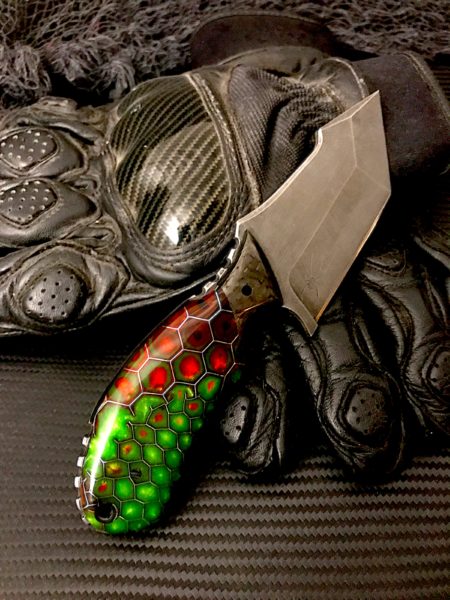
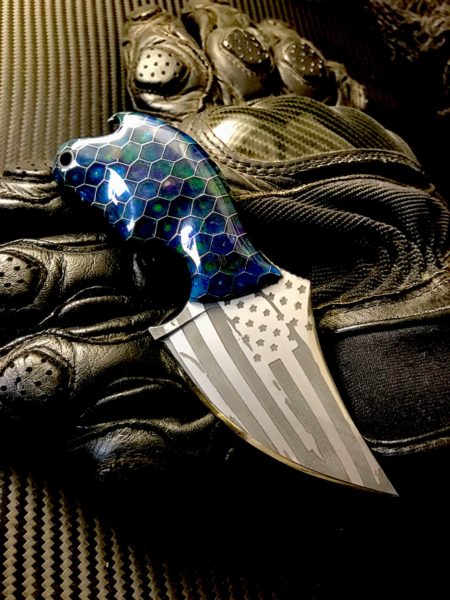
Model: Recluse Neck Knife Blade Steel: CPM-D2 Blade Length: 3.25 inches Blade Finish: acid wash with American flag etch on both sides Scales: Voodoo Resins’ Chameleon Overall length: 5.5 inches. Maker’s list price: Price range: $165-$200 with Kydex neck sheath Contact: Message Brent Vaccaro at Black Widow Knifeworks & Tactical Gear
Lights! Camera! Action—No Really, Move Around!
For lights he purchased round Utilitech LEDs that he can hold while he shoots. “The light is never stationary,” he explained. He waits until complete darkness because he has two windows in his shop and he wants total control of the lighting. Because the LEDs are very white lights, bluish even, he adds a 60-watt lightbulb to add a yellow hue to balance out the lighting. He moves around with his iPhone 7 Plus (“There is a difference with the Plus,” he notes.) and his light and gets exactly the angle and lighting he wants. Not only are the knives well lit, especially for mood-inducing vignettes, for which the majority of a knifemaker’s photos will be used, especially online, but they are in crystal clear focus. Brent does not use the focus feature on the phone. That will only cause the camera to focus on one point on the knife, when the objective is to show the entire knife in full focus, even if you have the point or butt stylistically in the background. He also does not use the flash, which only washes out colors and overexposes the image.
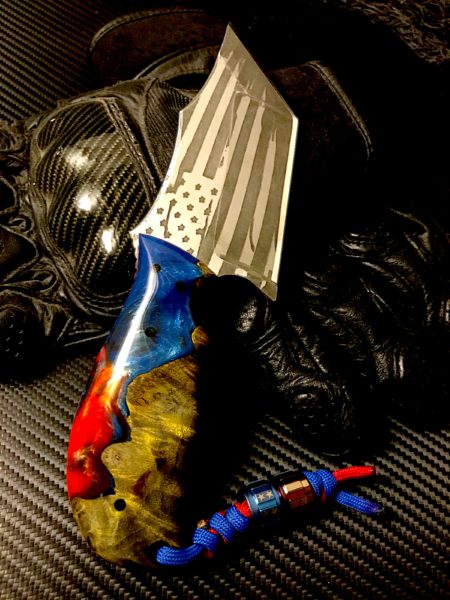
Model: The Carnage Blade length: 4 inches Blade Steel: CPM S30V Blade Finish: acid/stonewashed with American flag etch on both sides Scales: J Hue Customs’ hybrid red, white and blue resin with maple burl Overall length: 8 inches Maker’s list price: $320-$500 shipped with Kydex sheath and Tec-Lok Contact: Message Brent Vaccaro on Facebook at Black Widow Knifeworks & Tactical Gear (Additional contacts at end of article.)
Props Never Steal The Scene
Brent uses all kinds of props in his still-lifes. Because he also produces tactical gear, like custom Kydex sheaths, you will often see pistols, ammunition and other gear as accessories in his pictures. Chain, motorcycle gloves, even Halloween webbing have been used in Black Widow images. His artistic eye is always at work, not only in the making of the knives, but in his ability to let the knives do the talking. They are always center stage. They are the first things you see in the picture and the props are there only to compliment the knives, never upstage them.
Editing
Brent uses two apps to edit his images: PicLab and Aviary. He bumps up the saturation until the image represents what you see in person. It’s important not to overdue saturation because then your customers will be disappointed that your knife doesn’t live up to how it was displayed online, all back-lit by the computer screen. It’s equally important, though, that the knife not appear duller than it is in real life.
Creating An Image
Brent is one of those men who is smart, learns quickly and follows directions. He is also a good man, turning away from an industry that couldn’t fulfill his creativity and abraded his integrity. He has been rewarded with great success. “I’m outgrowing my shop,” he said. Brent knows he’ll have to return to carpentry to build himself more space. He can’t believe it sometimes when he thinks how far he’s come in his year of knifemaking. Metal work comes easier to him. “I don’t get nearly as angry as I used to get doing carpentry,” he said. He’d be thinking artistically and make a little strip of wood for something and it would break. Sometimes he’ll find a scratch in a knife handle and he’ll have to go back and grind it out and re-sand—normally, he goes all the way from 150 to 2000 grit—but it’s not nearly as frustrating as woodworking had been.
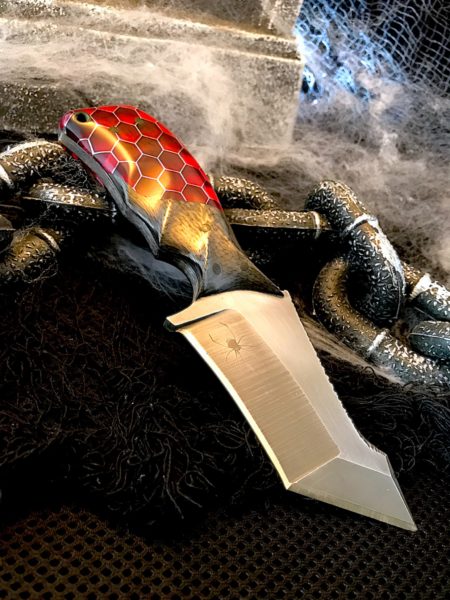
Model: The Patella Recurve Blade length: 4 inches Blade Steel: CPM S30V Blade Finish: acid wash Scales: Voodoo Resins’ Red Honeycomb with KS Carbon bolsters Overall length: 7.75 inches Maker’s list price: $380-$500 with Kydex sheath and Tec-Lok Contact: Message Brent Vaccaro on Facebook at Black Widow Knifeworks & Tactical Gear. (Additional contacts at bottom of article.)
Brent takes great pride when someone in the industry tells him they recognize his work right off. He has been an apt student of life. The years of entrepreneurship that didn’t work, prepared him for the one that would work. But no matter how much marketing you apply to your knifemaking, the knife must still cut. It must still hold up to wear and perform as expected upon arrival and for generations to come. Time will tell, but sometimes dues get paid behind the scenes and a meteoric rise is well-earned.
Meanwhile, Brent will have to break away for the birth of his first child, a son, Blake—due any day—and at some point, he’ll need to expand his shop, but he never closes his books for long. He doesn’t think it reflects well to just drop a knife. He refuses to do it. He respects reliability in the people he does business with, so he holds himself to that standard for his customers. Just get in touch, but be aware if you do, you’ll get caught up in the Black Widow web.
Contact: Brent E. Vaccaro by email at [email protected] or Message him on Facebook at Black Widow Knifeworks & Tactical Gear. He also has a website at www.blackwidowtac.com. If you need to call, Message first, otherwise he might not hear you over the machines, 908-328-2049.
It’s All In The Grind
Mastering this one skill will improve your craft immensely. For less than $5, you can add an essential to your knifemaking library.
Author R.J. Martin instructs on flat and double hollow grinds. He discusses chisel grinds, tip shaping, the two-hand pass and lots more in “Knife Grinding Secrets.” Most importantly the finesse of grinding will be covered so that you can master the skill. Downloadable version availabe for $4.99.
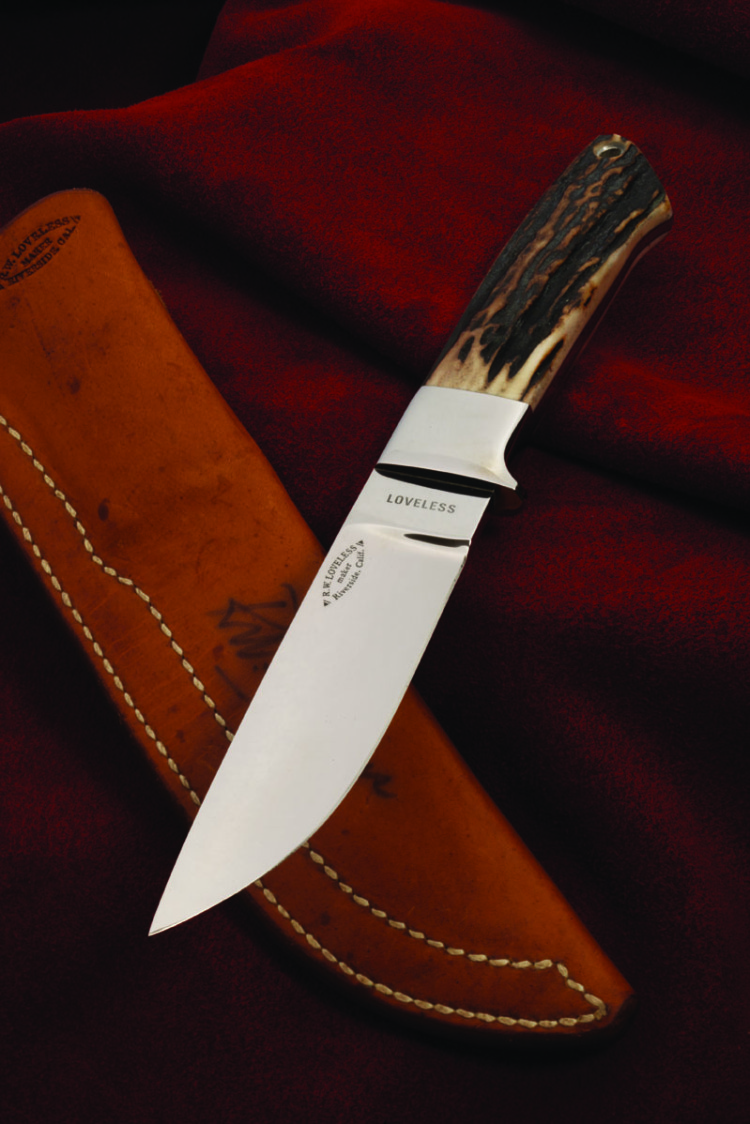
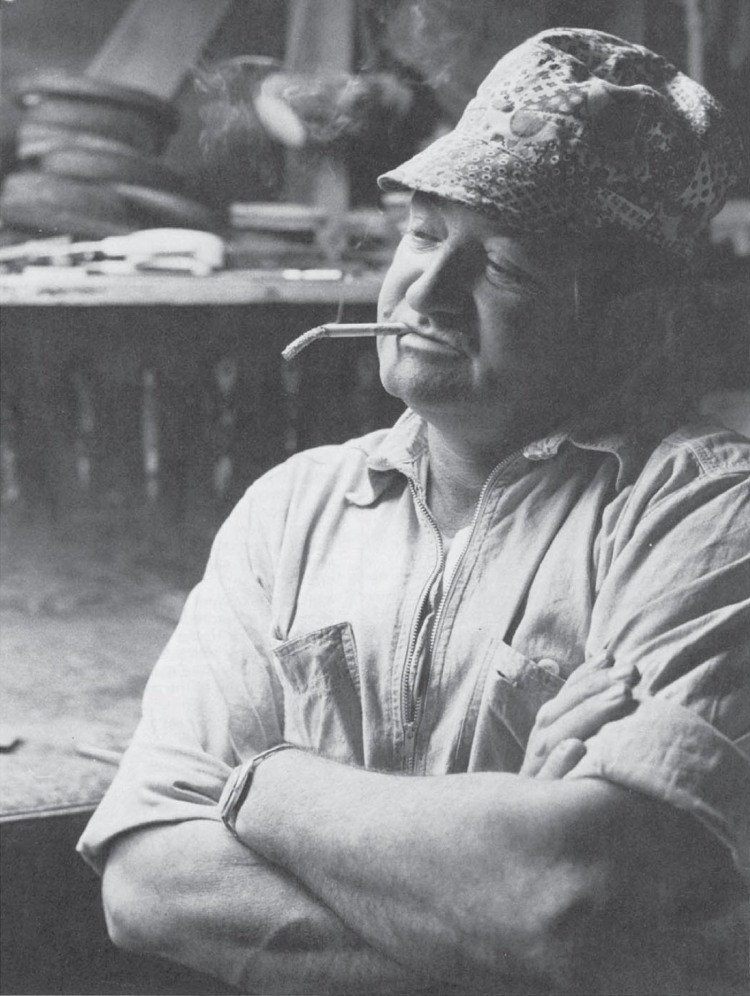
It’s a long, hot summer—so why not fill the time by reading Knifemaking with Bob Loveless and learn how to make knives the way the legend himself did?
Durwood Hollis knew Loveless and visited the Loveless shop many times. Hollis wrote the book and takes you through making knives the Loveless way in word and color pictures, including the tools, blade, handle, sheath and edge work, and much more. There are also chapters on knife care and the people who worked with Loveless over the years, as well as color pictures of some of Loveless’ greatest knives, including some of those from the John Denton collection.
For more on the latest knives, knife legislation, knifemaking instruction, knife trends, knifemakers, what knives to buy and where and much more, subscribe to BLADE® Magazine, the World’s No. 1 Knife Publication. Click on http://www.shopblade.com/blade-magazine-one-year-subscription-us/?r+ssfb062912 for more information.
This video shows how to finish Curly Maple knife and tomahawk handles. ABS Associate member RW Wilson demonstrates how to sand, stain, and finish curly maple handles.
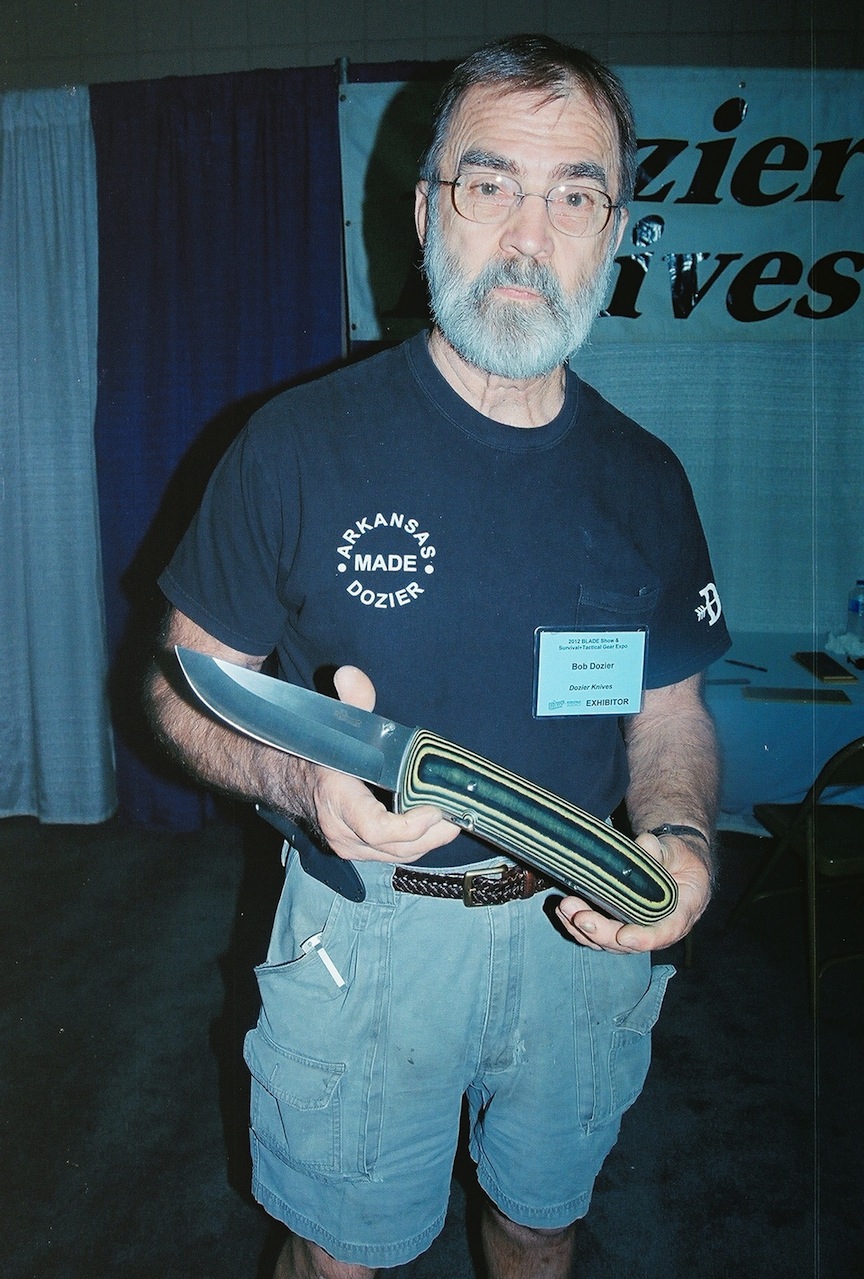
Ask the maker what blade steel he recommends. Bob Dozier holds one of his giant trappers.
A question we often hear is What are the best blade steels? A better way to approach the question is to determine what jobs the knife will be asked to perform.
Do you need a hunting knife or an everyday carry knife? A kitchen knife or a camp knife/chopper? There are others. The type of knife and how it will be used often will dictate the type of steel.
Say you need a hunting knife. Rather than ask what kind of blade steel will be best for it, research the websites of companies or makers who specialize in hunting knives. Such companies and makers will offer hunting knives not only with the steels that they find best for hunting knife purposes, but also with the edge geometries that the companies and makers feel they are most accomplished at making/offering.
Edge geometry refers to the blade’s grind and edge. If the grind and/or edge is too thick or otherwise not formed properly, it doesn’t matter how good the steel is—the knife will not cut well. As for the grind itself, there are many—hollow, flat, convex, chisel, etc., and combinations thereof. Usually the companies or makers employ the grinds they are best at. In cases where you have the option of picking the grind from a custom knifemaker, ask him which grind he’s best at and go with it.
Another important factor is the heat treatment of the steel. In fact, a low-grade steel heat treated properly often will outperform a high-grade steel with a substandard heat treatment.
In addition to the type of steel, ask how it is heat treated. While many makers are adept at heat treating their blades, many simply ship their blades off to professional heat treaters who specialize in the process. Blades heat treated by the pros usually will be heat treated properly and according to industry standards.
High-grade steels such as CPM S35VN, ZDP-189 and others are cutting tigers but can be difficult to sharpen and are more expensive. Lower-grade steels such as 440A, 5160 and others, all things being equal (including proper heat treatment and edge geometry), may not perform as well or hold an edge as long, but are usually easier to sharpen and will do most everyday cutting jobs that most people require. And, knives with such steels should be less expensive. In the case of 5160, while it is not a stainless steel, if you clean it and dry it off after each use, you should not have a problem with corrosion. The same is true with most non-stainless steel knives. Meanwhile, it’s not a bad idea to clean and dry off stainless steel knives after use as well. They can corrode, too—it’s just that they corrode less, as their name indicates.
Bottom line: Tell the company and maker what you plan to do with the knife. They make knives for a living and usually will be able to fit you with the proper knife and suitable blade steel for your needs.
Recommended:
Stay abreast of the latest developments on this and many more knife rights issues with a subscription to BLADE.
Mike MacInnes of Holland, Michigan, remembers his first two knives, both given to him by his dad. The first was a Buck 110 clone and the second was a Solingen hunting knife. Mike has been involved with black powder rifle hunting and gunsmithing all his life.
Mike MacInnes is a part-time bladesmith. He only makes, and therefore sells, the kinds of knives he likes to make, one of the joys of keeping making as a hobby while he holds on to his day job as a vending route supervisor in Michigan.
In 2012 he wanted to donate a knife for an auction to benefit the Michigan State Muzzle Loading Association. He called his friend Al Englsman and asked if he would help him make a Scagel-style knife. He enjoyed making the first one so much it lead to others. He advanced quickly, probably because his work on rifles aided his craftsmanship.
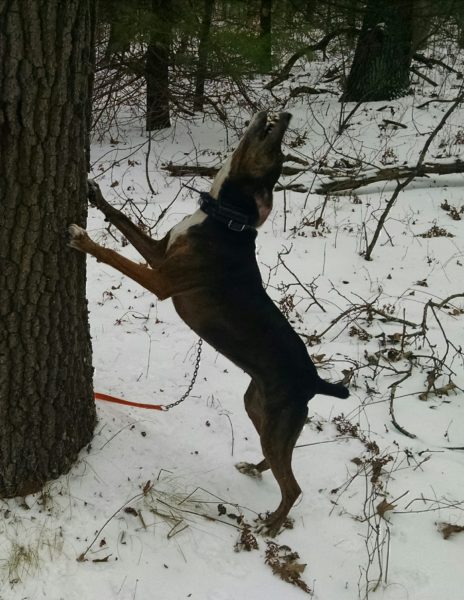
Betty is a mountain cur, dogs specifically bred to trail and tree small game or hunt and bay larger quarry.
Mike had met Al, who is a breeder of Mountain Cur, when he went to buy his squirrel-hunting dog, Betty.
Mike MacInnes and his wife, Erin, sometimes get out to Holland State Park in Holland, Michigan. The lighthouse in the background is called Big Red.
Mike is a route supervisor for a vending machine company by day, but loves his hobby. He only sells what he likes to make. He’s grateful for the influences of Bill Binky growing up, Marv Palmer and Joe Valentin. He lives near Lake Michigan with his wife, Erin, and their two children.
Best-selling knife patterns: full-tang hunter with 3- to 4-inch blade; hidden-tang drop-point hunter with 4- to 5-inch blade
Favorite blade steels: 1080; 5160
Blade grind: full flat
How he tests his knives: slice paper, shave hair, cut phone books, chop wood
Knife shows he attends: Badger Knife Club Knife Show
Facebook Groups he participates in: The Real Knife Makers of America, Knife Gods, Blade Smithing World
This 4 ¾-inch drop-point hunter was forged from 1080 steel. Handle is made of oak burl with black fiberboard liners. Overall length is 8 ½ inches. Pins are brass. Price is $175-$450.
Mike’s isn’t taking any more orders until he catches up on the orders he’s taken and finishes knives for upcoming shows. Follow him on Facebook though for updates on peeks at works-in-progress and finished pieces.
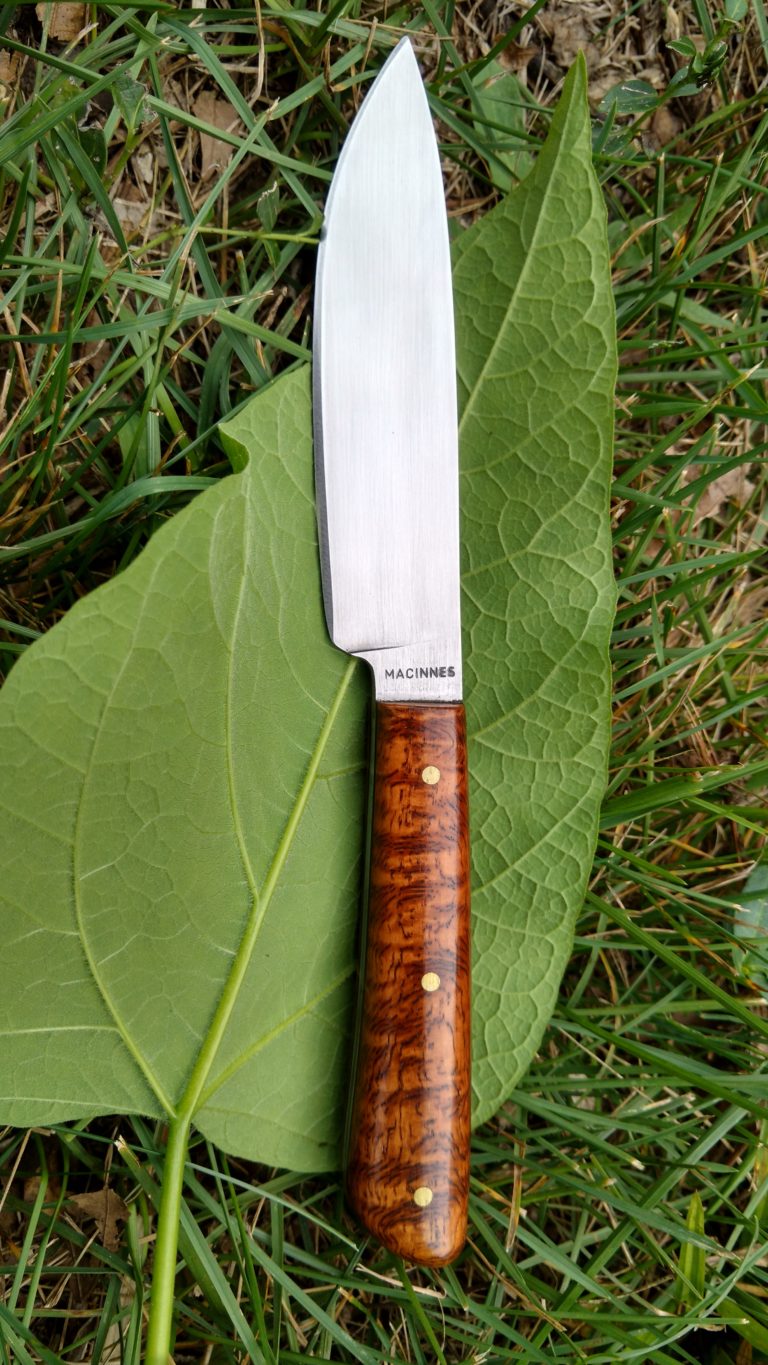
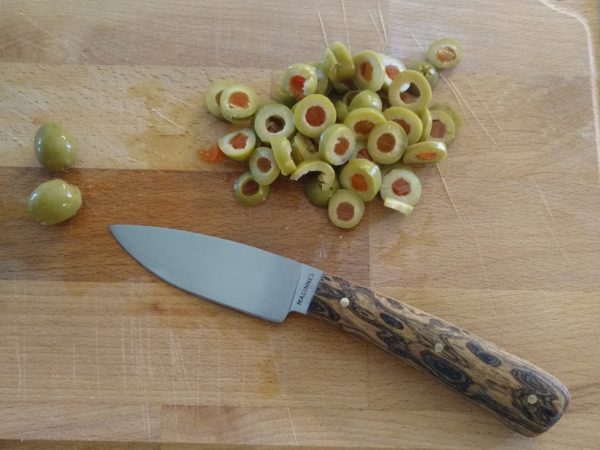
This hunter has a 3.25-inch blade forged from 1080 carbon steel. Its handle scales are made from bocote wood. The pins are brass. Maker’s list price: $185. Contacts listed at the bottom of this article.This Mike MacInnes piece was forged from 1080 carbon steel. The blade is 4 inches long with an overall length of 8.25 inches. “The handle is made of some of the nicest walnut that was even harvested here in Michigan,” Mike declared. The shape of the handle is a little thicker in the butt than he normally makes, but it felt so good he will probably do more in that style. The guard was forged from 416 stainless steel with a matching pin. The sheath was hand-stitched and -tooled by Mike. Maker’s list price: $350. Contacts listed at the bottom of this article.
You can read your digital issues of BLADE Magazine anywhere you have your phone, tablet or computer, and there’s no need to find storage for all your old issues.
If piling-up issues of magazines seems like a waste to you… If you feel like you don’t have time to read a magazine… If you like the stories we offer in BLADE, but want a more economical option, then a digital subscription is the answer. An annual subscription to BLADE is $17.98, $4 off the print price.
Fairbanks, Alaska, knifemaker Mark Knapp not only built and reportedly patented a cool .1911 Combat Survivor Knife, but he recently received some well-deserved press on the piece. For more combat and survivor knives, click here.
If any of you are familiar with Mark and his work, he fashions some high-art, yet utilitarian fixed blades and folders with “mosaic” handles of exotic natural materials from Alaska and around the world. He forges his own damascus, is a full-time maker and built his first knife in 2000.