



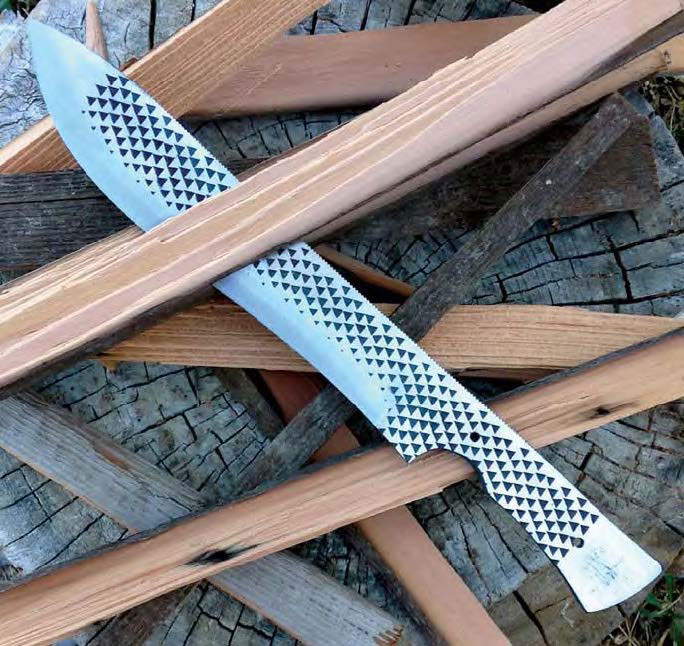
This is a great video of Kentucky knifemaker Bob Neal in action. I think you’ll enjoy it:
Educating the Future Of Knives
The American Knife & Tool Institute (AKTI) recently announced it will present a series of informative articles on its website, www.akti.org, that address various aspects of the knife owner’s experience. The first of the series will relate tips and advice on introducing young people to knives.
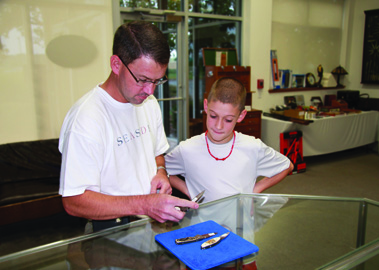
Among those giving insights in the new AKTI youth knife series will be A.G. Russell. Here a father demonstrates a knife for his son at A.G. Russell Knives retail store in Rogers, Arkansas. (A.G. Russell Knives photo)
“I was always taught that the age of reason was 7, which is also Cub Scout age when I got my first knife,” commented Dan Piergallini, president of the Gator Cutlery Club. “Safety was always stressed, and supervised use of a knife is a must. Also, one must insist that the knife never be taken to school no matter how much you want to show it off.”
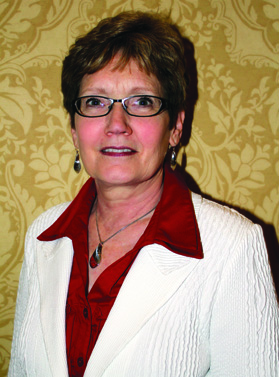 Along with Piergallini, AKTI Executive Director Jan Billeb, Becky Reid of Shepherd Hills Cutlery, and Blade Magazine Cutlery Hall-Of-Fame© member A.G. Russell will provide insights on their experiences in promoting safety, awareness, respect and proper knife use among young people.
AKTI Executive Director Jan Billeb (left).
Look for the story on kids and knives and subsequent offerings from AKTI to provide timely and relevant perspective on topics of interest to the cutlery community.
“We are excited to bring these informative articles to AKTI members and knife enthusiasts everywhere through our website,” Billeb said. “Introducing knives to the next generation is a key element in promoting their safe use and increasing the understanding of knives as valuable tools that are important in our everyday lives.”
To read the article on kids and knives visit www.akti.org/education/kids-and-knives.
For more information, call 307-587-8296 or visit www.AKTI.org. Follow AKTI at http://www.Facebook.com/SaveOurKnives and http://twitter.com/SaveOurKnives.
What’s Your Steel I.Q.?
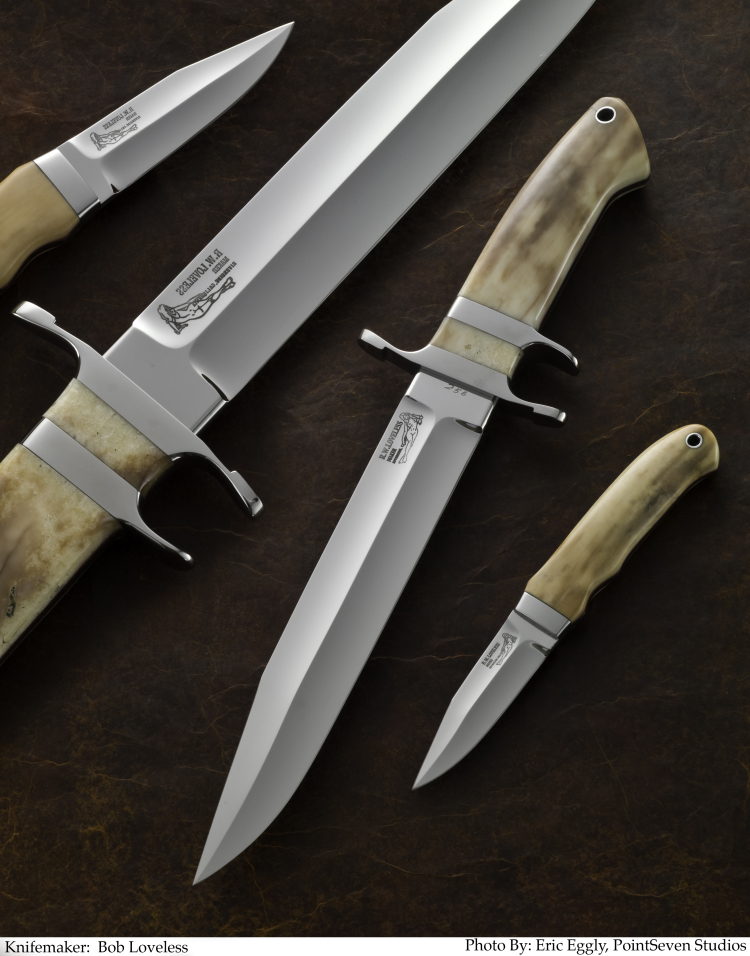
According to BLADE® subscriber surveys, one of the topics subscribers request BLADE cover most is steel—specifically, steel for knife blades. It is not much of a stretch, then, for the latest installment of “BLADE Quiz” to challenge your knowledge of the most popular of blade materials.
The answers are at the end of the story. Be sharp!
1) Damascus or a damascus type of steel has been traced as far back as: A) the 11th century A.D.; B) second century A.D.; C) 500 B.C.
2) Wootz steel is believed to have originated in: A) Damascus, Syria; B) Indian and/or Sri Lanka; C) Japan.
3) A Swedish steel with 2 percent nickel is known as A) Sandvik 12C27; B) Damasteel damascus; C) 15N20.
4) According to most authorities, for a steel to be stainless, it must contain what percentage range of chromium? A) 11.5 to 12; B) 12.5 to 13; C) 13 to 13.5.
5) The Japanese word for “blade steel” is: A) ha-gane; B) hada; C) ha-machi.
6) The two stainless steels for which Blade Magazine Cutlery Hall-Of-Fame© member Bob Loveless is most famous for introducing to custom knives are: A) BG-42 and 154CM; B) 154CM and ATS-34; C) 440C and Vascowear.
7) A material that is dissolved in another metal in a solid solution or that results when two or more elements combine in a solid solution A) is ductile; B) has been sintered; C) is an alloy.
8) The measure of a steel’s resistance to deformation is its A) wear resistance; B) toughness; C) hardness.
9) Cutlery Hall-Of-Famer Bill Moran introduced damascus steel to modern custom knives at the Knifemakers’ Guild Show held in A) 1972; B) 1973; C) 1974.
10) At the aforementioned Guild Show, Moran’s knives fetched how many dollars per blade inch of damascus? A) $50; B) $100; C) $150.
11) The relative resistance of a steel to breakage, chipping, or cracking under impact or stress is its A) toughness; B) hardness; C) wear resistance.
12) The Crucible Particle Metallurgy steel originally called CPM 440V is now called: A) CPM M4; B) CPM S90V; C) CPM S60V.
13) To harden to the 60 HRC level during heat treating, a steel must have at least what percentage of carbon? A) 0.5; B) 0.75; C) 0.90.
14) The first CPM steel created exclusively for knife use was: A) CPM S30V; B) CPM 440V; C) CPM 3V.
15) If the first symbol of a steel’s designation is a letter and the second symbol is a number, it is probably a: A) high-carbon steel; B) tool steel; C) high-speed steel.
16) The point at which a steel becomes permanently deformed is its: A) yield strength; B) tensile strength; C) impact strength.
17) Tool steel contains a number of different elements that combine with the steel’s excess carbon to form A) ferrite; B) austenite; C) carbides.
18) In order to cool fast enough, low-alloy steels such as O1 must be quenched in A) oil; B) water; C) a mixture of both A and B.
19) Steel handmade from electrolytic sponge iron and antique wrought iron is called A) tamahagane; B) bulat; C) oroshigane.
20) The carbon steel D.E. Henry claims to have used for knives in the 1940s and that BLADE® field editor Ed Fowler is known best for today is: A) 52100; B) 5160; C) 1084.
Answers: 1) C; 2) B; 3) C; 4) B; 5) A; 6) B; 7) C; 8) C; 9) B; 10) B; 11) A; 12) C; 13) A; 14) A; 15) B; 16) A; 17) C; 18) A; 19) C; and 20) A. Scoring: 0-3—You’re rusty. 4-7—You just went from Man of Steel to Man of La Mancha. 8-12—Come back when you can say molybdenum without chipping a tooth. 13-17—You are starting to become abrasion resistant. 18-19—Wayne Goddard just looked over his shoulder at you. 20—Your initials have officially been changed to HRC (hardness Rockwell C).
For more on the latest knives, knife legislation, knifemaking instruction, knife trends, knifemakers, what knives to buy and where and much more, subscribe to BLADE® Magazine, the World’s No. 1 Knife Publication. Click on http://www.shopblade.com/blade-magazine-one-year-subscription-us/?r+ssfb072712 for more information.
Tools for Silver Wire Inlay by Joe Keeslar, Master Smith
Master Smith Joe Keeslar describes the tools needed for Silver Wire Inlay work on knife handles and sheaths.
Video: Salt Bath Heat Treating
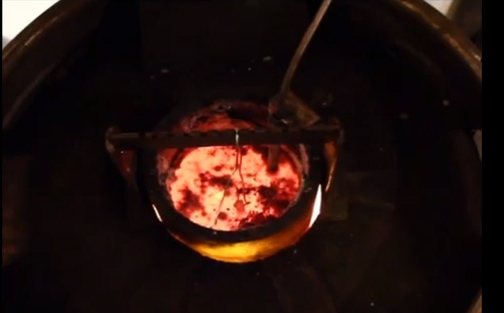
This video from the American Bladesmith Society (ABS) explains how to perform salt bath heat treating. It’s part of the Phoenix knife project ABS members created. You can see video about the incredible ABS Phoenix knife here.
Here’s a bit of background from the ABS about the Phoenix knife:
The Phoenix Knife was originally created by several members of the ABS Board, then disaster struck and it was damaged in a house fire. On its second life, several ABS Board Members contributed in the efforts to bring it back to life including Master Smith Kevin Cashen shown in this video heat treating the blade and bringing the knife back to life. Stay tuned for the third video about “Rockwell Testing” the blade.
To follow the Phoenix knife through its stages, be sure to subscribe to the ABS YouTube channel. There are plenty of knife videos online, but the expert insights from ABS are a cut above.
 Also recommended is BLADE’s Guide to Making Knives, 3rd Edition. It covers heat treating and many other steps in the knifemaking process.
Midweek Maker Military-Style: Randy Madan
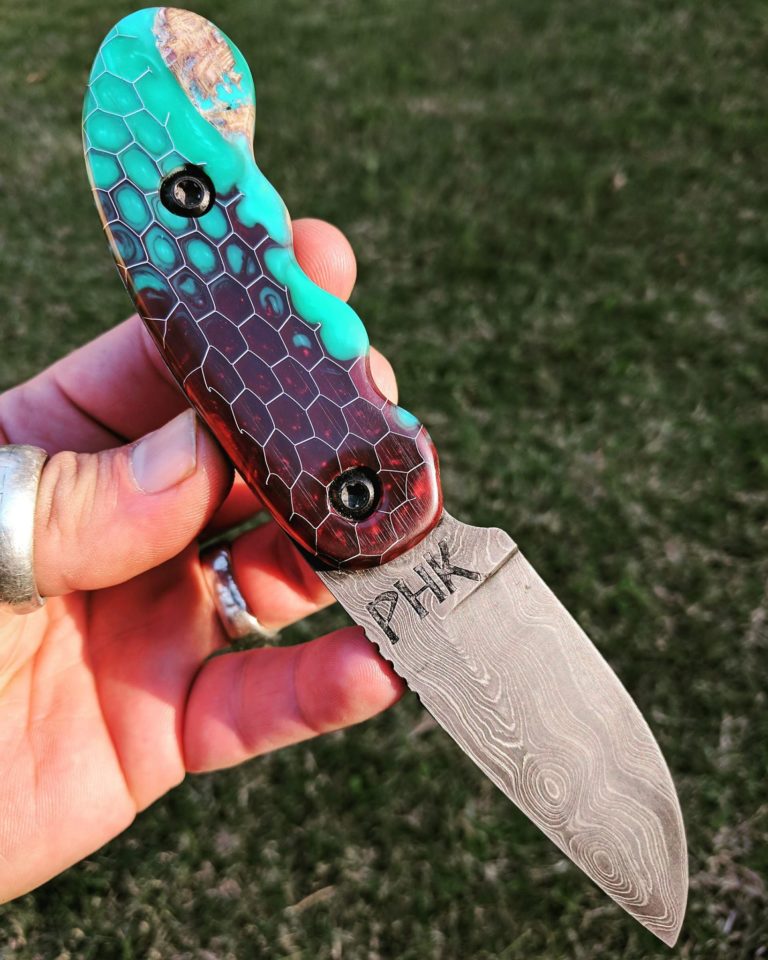
Randy Madan, known as JR on social media, served in the U.S. Marine Corps from 1992 to 1996 as a combat engineer. “I blew things up,” he said, laughing. Now, at 43, he has been a federal correctional worker for 20 years.
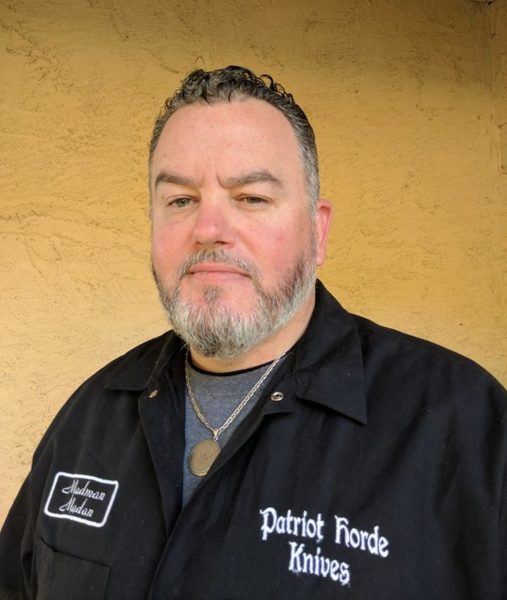
He always loved and carried knives, but he got his start in knifemaking in October 2016. “The knifemaker that I idolize, Michael Cleveland from Half Lives Knives, afforded me the opportunity to join a knife build-off for a veteran charity. Me being a vet myself, I jumped at the opportunity,” he explained. He has continued to make knives and to encourage other veteran makers.
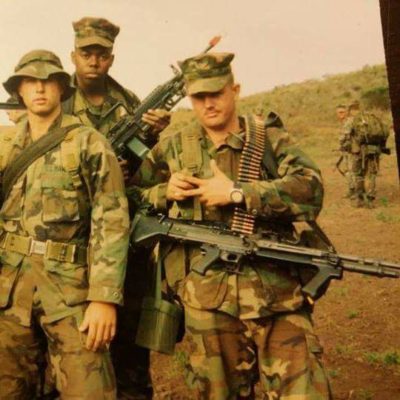
“I am just a small-time maker, wanting to perfect my knives so that when I retire in a couple of years I can make more,” he said. Other makers who have helped along the way include John Savage, Ryan Schreiber, Denny Furey and Mark Wagoner.
- Best-selling knife patterns: DaCleva, PMAT, Flatliner
- Favorite blade steels: 1095 with plans to start using O1 and 80CrV2
- Blade grinds: flat with plans to add hollow
- How he tests his knives: shave hair, skive 7- to 9-ounce leather, cut ¼-inch bolts, chop 2-by-4s
- Favorite handle materials: Voodoo Resins, Rob Carper Innovations, 8th Dimension Concepts and J Hue Customs. “I am a big fan of the hybrid materials,” Randy noted.
- Price range: $250 and up
- Forums he participate in: The Real Knife Makers of America, Global EDC and other Groups on Facebook
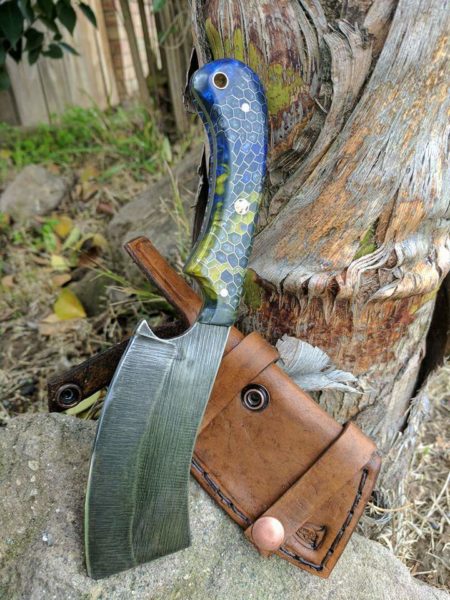
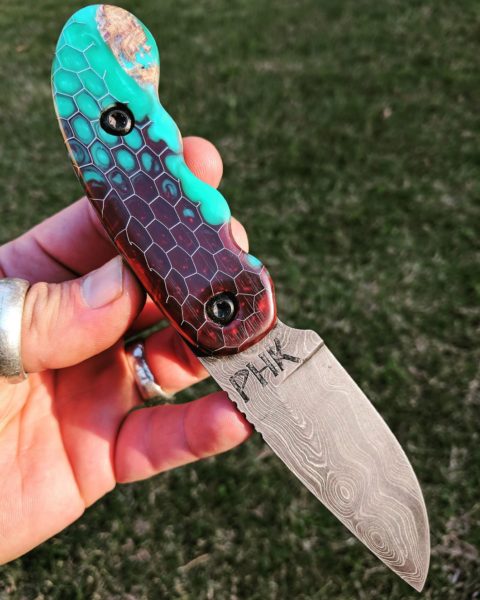
Randy uses All Star Abrasives in Lawrenceburg, Tennessee, for his abrasive supplies, which is what he puts to his hybrid scales to bring out their color.
Contact Randy Madan at [email protected], 760-885-9370 on Facebook at Patriot Horde Knives and on Instagram @the_patriot_horde.
A Digital Subscription to BLADE Is The Anwswer
If piling-up issues of magazines seems like a waste to you… If you feel like you don’t have time to read a magazine… If you like the stories we offer in BLADE, but want a more economical option, then a digital subscription is the answer. An annual subscription to BLADE is $17.98, $4 off the print price.
A Knife Completes A Circle of Grieving
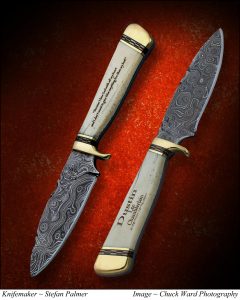
While at his parents’ Siloam Springs, Arkansas, home for Christmas break 2011, 20-year-old Dustin Chamberlain was shot dead by an intruder. Nearly five years later, knifemaker and racecar driver Stefan Neil Palmer was asked by his racing mentor if he would make a knife to auction off to raise money for Dustin’s Dream, the charity foundation organized in Dustin’s memory. Stefan agreed, but when he laser-engraved Dustin’s favorite saying on the handle, everyone agreed that the knife could never be auctioned off.
On Dec. 15, 2011 Dustin, a biology-pre-med sophomore at Baylor University in Waco, Texas, was resting at home after a minor outpatient procedure. Both his parents left for work with Dustin’s reassurance that he didn’t need anyone to stay with him. His father, Don, had planned to have lunch with him. At approximately 10:45 a.m. Dustin’s mother, Deondra, called the house and Dustin’s cell phone repeatedly but got no answer. She called Don and asked him to check on their son.
Don walked into the Chamberlain home to find his son lying dead just inside the door with four gunshot wounds. In the family room, he found a stranger with what police subsequently said appeared to be a self-inflicted gunshot wound that later proved fatal. The investigation revealed that the stranger was a local man who had been reported missing, depressed and possibly suicidal. He had wandered onto the Chamberlain property, and evidence showed he’d been on the premises for two hours before the Chamberlains left for work.
It’s an understatement to say that the Chamberlain’s lives were changed forever, but as day followed day, God showed them how they could carry on Dustin’s name and spirit, Don explained. “It’s been therapeutic,” he said, referring to the charity they set up in remembrance of their son. In honor of Dustin’s dream to one-day become a doctor, Dustin’s Dream sets up medical clinics in third-world countries and funds teams to conduct medical mission trips to those countries. They also offer scholarships for aspiring medical students.
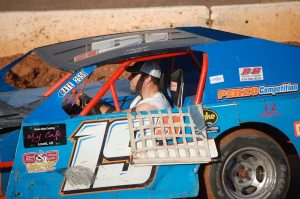
In 2013, two years after Dustin’s murder, Chamberlain family friend Steve Butler decided to use his racing hobby to support Dustin’s Dream. Steve introduced Stefan to Dustin’s Dream Racing, which raises money for the foundation “while being a positive, Godly influence” in the sport of racing, according to their web page. In the summer of 2016 it was suggested that Stefan make a knife to auction off to benefit Dustin’s Dream.
So Stefan set out to make the best knife he could to honor Dustin. The 3.112-inch hollow-ground drop-point hunter was constructed using buckshot-pattern steel forged by Brad Vice’s Alabama Damascus. “It’s my favorite pattern,” Stefan said. And buckshot- or raindrop-pattern damascus is his favorite steel. The handle was made from camel bone and brass with—fittingly—a checkerboard inlay front and rear of the handle. The shinbone of the camel is an economical choice, but it’s the ideal medium for laser engraving, explained Stefan. The rubbing compound left in the pores of the bone lend it that gray undertone. Signature filework runs from the tip to the butt of the spine. “It turned out great,” stated Stefan.
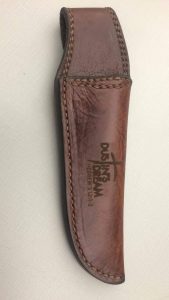
He went to Steve to see if there was anything that Dustin was known for saying. Steve showed Stefan what the Chamberlains had written about Dustin. “Whenever anyone asked Dustin how he could consistently make wise choices and live his faith, Dustin would say, ‘Because I love God with all my heart and I don’t want to give Him anything less than my best.’” Stefan explained, “I put that on the knife. When I looked at the finished product, I knew the knife was not for someone to buy. It was priceless and needed to go to Don.”
Stefan took his dilemma to Steve and it was agreed that a second knife would be made for the auction. The trick was to keep Don’s knife a secret, made harder by the fact that Don expressed great interest in the knife. Steve suggested to Don that he not bid on it because people would then back off their own bidding in an attempt to make sure that Dustin’s father ended up with Dustin’s knife. The racing team wanted the knife to bring in as much money for the foundation as possible.
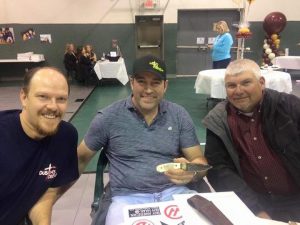
In the end, at Dustin’s 5th Heavenly Birthday Chili Supper and Baked Goods Auction on Dec. 10, 2016, Stefan presented the original knife to Don, with both giver and receiver ending up in tears. “It changed my life,” Stefan said. “I’m not so likely to cut someone off on the race track with the Dustin’s Dream sticker on my car,” he added with easy laugh. (The T in the Dustin’s Dream logo is in the shape of a cross.) He relates how so many people have been affected for the better through Dustin’s example and the strength of the Chamberlains. “So much beauty has come out of it,” Stefan said.
The Chamberlains never returned to their home. Don manages a beef cattle ranch and other properties for his boss, and the couple and their daughter stayed at the ranch the night of the murder. They found a place to rent, but the two payments nearly put them under financially. All the while, Don said he was thinking, “I wish I could afford to just give it away to a couple who could help foster children.” Two years later, a doctor—surprise, surprise—Carl Duncan and his wife, Carol, purchased the home, and—you guessed it—they had foster children.
It was Carol who ended up with the winning bid of $3000 on the second knife, and she presented it to her husband. According to the Dustin’s Dream website, the racing team has raised $45,000 for the foundation.
Stefan’s wife, Raquel, bringing the story full circle, is returning to school to become a doctor—in the same specialty as the doctor who purchased the house and the knife. She and Stefan hope one day to accompany a medical mission team through Dustin’s Dream. Don and Deondra, a nurse, are returning to Guatemala through Dustin’s Dream for his second trip and her third. If you want to know what you can do to get involved, visit www.DustinsDream.net/give.
When Don returned to the house that fateful day, he thought it was odd that the family’s Jack Russell-rat terrier cross was out in the yard. Cricket was trembling in fear, and, uncharacteristically, she would not come to Don. It is believed that she raised a ruckus when the intruder broke into the house near her bed. Dustin came to see what the fuss was about. In yet another connection, I breed Jack Russells.
According to what police revealed to Don, the shooter asked his wife what it meant if someone was very depressed. She answered that it meant the person needed professional help. The husband and father of four reportedly said that he felt he was too much of a coward to do that. He took a gun and left the home.
I asked Don if he knew how the family was doing now. He said he didn’t, but that it had been on his heart to find out, and that my asking had solidified that course of action for him. And “no,” he said quietly, “I could never use that knife.” He has it on a dresser, along with the sheath and some photos. He wants to put it in a shadow box. “I could never use that knife,” he repeated.
‘Art of the Knife’ Is A Showcase of Beauty
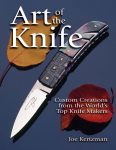
If you want inspiration for your own knifemaking, here’s your eye candy. Over 500 knives are pictured, and they run the gamut from highly polished and bejeweled to hunters with artistic flair. Author and former BLADE managing editor Joe Kertzman covers scrimshaw and engraving, as well as the art of each style of knife. Normally, $35, this beautiful book is now on sale for $21, a 40-percent savings.
Must Read Articles

Knifemaking 101 – Read This Before You Make a Knife
by Wayne Goddard
My experience has taught me that there's nothing like digging in and getting started. I've often said the hardest part of the...


