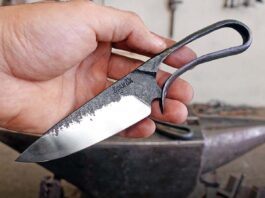
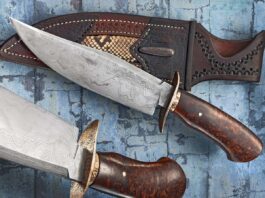
Knifemaking is the building of a knife, which includes the blade, handle and other accouterments. Blades are made by either removing metal from a steel blank via a grinder – known as stock removal – and the forging to shape of hot steel into a blade in the process known as bladesmithing. Other parts, including bolsters, guards, pommels, etc., are needed to complete the finished knife.
Barret Chrisman puts a modern spin on a vintage Remington design.
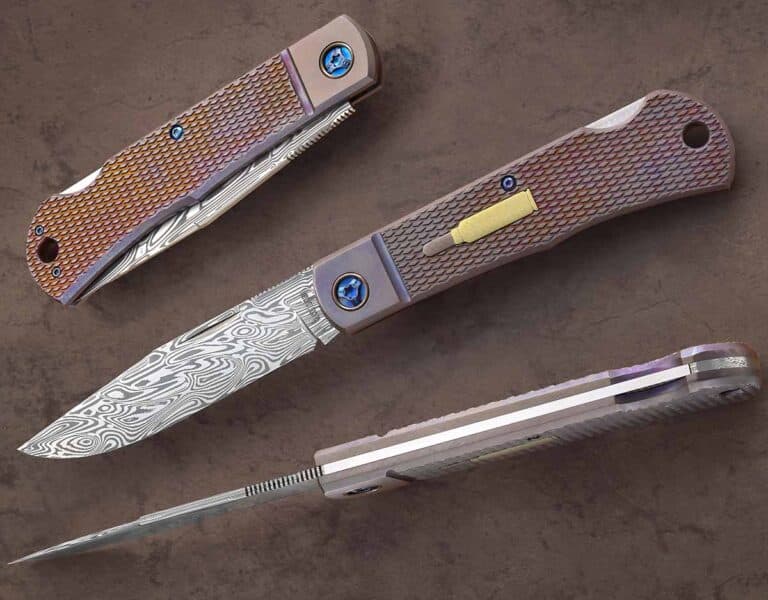
Barret Chrisman’s contemporary take on the classic Remington 1306 Bullet lockback combines tradition and hi-tech in one handsome custom pocketknife.
Barret outfitted his repro with all cutting-edge materials, including a blade of Loki pattern damascus by Damasteel, a handle of checkered titanium that resembles jigging and a titanium bullet shield. “I’ve seen people jig titanium before but I wanted to try checkering, so I made up a custom pantograph template and tried it out,” he said. He anodized the handle a purplish bronze.
Barret Chrisman
“It’s a modern take on an old school knife everybody likes,” Barret noted, “and I’ll probably be doing the same kind of thing in the future.”
Remington 1306 Bullet Modern Reproduction Specs Maker: Barret Chrisman Blade length: 4” Blade material: Loki pattern damascus by Damasteel Blade grind: Full flat Handle frame: Titanium Handle scales: Checkered titanium w/inlaid titanium bullet shield Lock: Lockback Closed length: 47/8” Maker’s price for a similar knife: $1,500
Bob & John Horrigan Made Knives Together. After The Former Died Defending The Country, John Kept Their Knifemaking Legacy Alive
It was a night mission, and it was dangerous—just like every mission, every moment in the deserts and villages of western Iraq or the mountains of Tora Bora in Afghanistan.
“You don’t have to come,” the others said matter-of-factly to Master Sergeant (MSG) Bob Horrigan. “You’ve only got two weeks left in the country.” The veteran Delta Force NCO, with 19½ years in the U.S. Army, three tours in Afghanistan, and a fifth in Iraq coming to an end, simply replied, “If you’re going, I’m going.”
True enough, Horrigan was just days away from returning to the USA, and he planned to retire from the Army in six months, then, in peace, to make custom knives in his shop and share that time with his twin brother, ABS master smith John Horrigan.
This night, however, there was dangerous work to be done. A raid was planned on a safehouse known to be frequented by terrorists, particularly Iraqi al Qaeda leader Abu Musab al-Zarqawi, a ruthless murderer pledged to support Osama bin Laden. Horrigan
A veteran Delta Force NCO, Bob Horrigan served 19½ years in the Army, including three tours in Afghanistan and five in Iraq. He was killed during a raid on a safehouse frequented by terrorists, including Iraqi al Qaeda leader Abu Musab al-Zarqawi. Bob was laid to rest with full military honors at Arlington National Cemetery.
When the call went out for someone to serve as a master breacher during the mission, blasting doors and first inside a building where hostiles might be hiding, Bob Horrigan said without hesitation, “I’ll breach.” In the town of al Qaim in western Iraq, the Delta Force team, accompanied by additional Special Forces personnel, moved toward the suspected Zarqawi safehouse. With MSG Michael McNulty at Bob’s side and the rest of the team close by, the two were first to enter the enemy compound.
Bob made it into a nearby room, and a machine gun opened up. McNulty was hit in the doorway. Bob was fatally wounded seconds later. Both died within a few hours.
“It was about 7 in the morning. I was at home, and Bob’s brother-in-law, Mark England, came to the house,” John Horrigan recalled. “Our sons were best friends, and I thought he was coming to tell me that my son had gotten into trouble. He said, ‘No, John. It’s Bob.’”
The news was devastating, and Bob Horrigan was laid to rest with full military honors at Arlington National Cemetery, following a funeral service in Austin, Texas. He left behind his wife, Denise; young daughter, Courtney; older sister, Lisa; younger brother, David; many friends and relatives; and, of course, twin brother John.
To say Bob and John shared a special bond, even as identical twins, would be an understatement. Their mannerisms and speech patterns were so alike, and they experienced the joy of growing up inseparable. They also shared their love of service to their country, and later came a great interest in custom knives.
First Drop Zone
The brothers were born in Limestone, Maine, on Jan. 13, 1965. “I came into the world seven minutes before Bob, so I cleared the drop zone. We always said he was a hung jumper,” John smiled. “We’re identical twins, so I got into fistfights for him, and he got into fistfights for me. It was like the Doublemint®-Spearmint commercial, and it was that way in school and in the Army. He continues to be half of me. He is still here, and I can feel his presence out in the shop now and then.”
John made his first knife in high school. Instead of making a planter as his shop project, he found a piece of O1 tool steel and went to work on the knife. His son carries the same fixed blade today, first with a cherry handle and later with one of maple. For 24 years now, John has worked as a firefighter with the Austin Fire Department, the family’s hometown after moving from Maine to Florida and then to Texas years ago.
John enlisted in the Army in 1984, six months ahead of Bob. The two became Rangers, elite soldiers engaging in demanding training programs and taking on the most hazardous combat operations. They served in the 3rd Ranger Battalion, 75th Ranger Regiment, and Captain Stanley McChrystal, who later reached the rank of general and commanded American forces in Afghanistan, led Company A.
John spent three years on active duty as an Army Ranger. Bob stayed in and spent about eight years with the 7th Special Forces Group and 9.5 years with Delta Force. Even among the elite of the 7th Special Forces and the clandestine Delta Force, Bob stood out. He attended just about every training school imaginable, including the Basic Airborne Course, Jungle Warfare Training Course, Special Forces Qualification Course, Military Freefall Jumpmaster Course, and several others. In 1987, he competed in the Best Ranger competition at Fort Benning, Georgia, and placed second.
He was a leader of hardened, highly trained military professionals, and among his numerous decorations were the Bronze Star, Purple Heart, Legion of Merit, Combat Infantryman Badge, and Expert Infantryman Badge. The full list of his accomplishments during a distinguished two-decade career is literally too long to include in this story.
Several well-known authors have written about his exploits, including Brad Thor, Pete Blaber, Sean Naylor, and George Hand IV. In writing of the funeral of a central character in one of his novels, Thor is actually describing Bob’s funeral, an all-too-real and somber event.
In his book The Mission, The Men, and Me, former Delta Squadron Commander Blaber remembered Bob and wrote, “After unshouldering his ruck, Bob H. scotched forward on his belly. He stopped behind a small pile of rubble. Canting his head slowly, he spied the valley below. His eyes and ears strained to detect any unnatural noise or movement; Bob was focused like a man whose finely tuned autonomic nervous system is programmed to maintain perfect equilibrium between the thrill of the hunt and the thrill of the chase. Bob understood his status as both the hunter and the hunted. He liked it that way … Courage has been called a contradiction in terms, meaning a strong desire to live manifesting as a readiness to die. It described Bob and his mates to a tee.”
During those long deployments to combat zones, Bob stayed in touch with John, mostly via email. “He would send one to me, and I would respond,” John said. “The next morning there was another one waiting for me. Robert downplayed a lot of what was going on. He’d say, ‘Not much happening here … I’m bored.’ But he was lying. They were in firefights every day; he just didn’t want people to worry about him.”
In his book The Mission, The Men, and Me, former Delta Squadron Commander Pete Blaber wrote of Bob Horrigan (above): “Bob understood his status as both the hunter and the hunted. He liked it that way … Courage has been called a contradiction in terms, meaning a strong desire to live manifest as a readiness to die. It described Bob and his mates to a tee.”
Meanwhile, there were those precious times that Bob came home, mostly during the Christmas season, and the twin brothers picked up where they had left off during a prior visit. One of their primary topics was—of course—knives.
$50 Sander
John was 21 when he left the military, and he visited a knife and gun show in Austin with a pair of his own custom knives and a couple of makeshift cardboard wheels under his arm that he used as sharpeners. He met Houston-based custom knifemaker Ed Thuesen, who also owned Texas Knifemakers Supply.
“Ed saw those under my arm and said, ‘Don’t use that crap!’” John recalled. “I told him I couldn’t afford a new sander, and he said that he had a used one in Houston that he would sell for $50, but I would have to drive there to pick it up, and he wanted cash. I said, ‘Deal!’” Later, John bought a brand-new Bader sander and sold the used one to Bob—
for $50.
“I got into knifemaking, and then I got Bob into it,” John smiled. “He mainly made military fighters for guys in his unit, for Navy SEALs or whoever. He had more business than I did.”
At Fort Bragg, North Carolina, home of the Army’s Airborne and Special Operations Forces, Bob set up a knife shop in a lawnmower shed. Power was supplied with an extension cord, running through a sliding glass door to the shop’s tools. He enjoyed working with 440C and 154CM stainless steels, but he couldn’t forge on the Army post. Hence, when he needed a piece of damascus, John gladly supplied it.
“He wrote me a letter once telling me how much he loved coming home, coming to the shop and learning new things,” John remarked. “He would tell me that copying someone else was the highest form of flattery, and if you look at Robert’s knives they were similar to the knives I made. But he’s my brother, and I don’t care. Later, he got into his own designs, and now my best-selling knife is one of Robert’s designs.”
That legacy design is the Robert “Bob” Horrigan Military Fighter, available from John today in the notable style that has become popular in the military as well as the general public. The fighter is 11.25 inches overall with a 6.375-inch blade of 440C stainless steel and a handle of black linen Micarta®. The knife weighs 8.7 ounces and is accompanied by a Kydex sheath.
“I actually didn’t make the Bob Horrigan,” John related. “I made my Model 1 and others, but there were some guys from the 160th Night Stalkers who were on the mission that night and asked if I would make the Bob Horrigan knife. Now I make the Bob Horrigan, and I make them the way he did.”
Through the years, John has established himself among the best bladesmiths and custom knifemakers around. His daggers, tomahawks, and fighters are acknowledged as fine work, and his dazzling inlay with precious metals is something to behold. “I tell everybody that is my Picasso work,” he laughed.
Tremendous Spirit
Living quietly in Burnett, Texas, about an hour outside Austin with Donna, his high school sweetheart and wife of 33 years, John works in a 30×40-foot shop on his farm, dotted with chickens, goats, and bees. Donna says the shop is as big as the couple’s first house. They have two grown children, Matthew and Krystal, and two grandchildren, whom they adore.
Reflecting quietly, John observes, “The greatest thing that has happened since Bob’s death is that he brought me back to God, and that is the best thing he could ever leave me. Being twins, it was pretty rough, and it felt like half of me was gone. Bob came to me at the BLADE Show* two years before he was killed and said, ‘I’m coming back to God. At the time I just said, ‘Great!’ but when he was killed, God was what got me through it.
Designed by Bob Horrigan, the Robert “Bob” Horrigan Military Fighter is ABS master smith John Horrigan’s best-selling model. “I make them the way he did,” John said, including a 6.375-inch blade of 440C stainless steel, a black linen Micarta® handle and a Kydex sheath.
“I started living for Robert, for my family and doing what God wanted me to do,” John continued. “I know where Robert is now, and I know where I’m going. Bob killed a lot of people and that worried him. So he went to the chaplain, who told him that the Bible said not to murder. It didn’t say not to kill in defense of your country. So, he was good with that. I don’t think my brother ever had PTSD because he had God.”
John received his ABS master smith rating shortly before Bob was killed, and as he continues to live his dedicated life, he takes comfort in the fact that his brother, who also wanted the ABS designation, knew that John had achieved it.
In recent years, John has made presentation knives depicting the American flag for Delta Force and for former President George W. Bush, whom he met at Fort Bragg during a visit after Bob’s death. He presented the knife to “W” sometime later in Dallas.
John is generous with Honor Flight Austin, donating knives that raised $19,000 at auction, paying for 19 veterans of World War II to visit their memorial in Washington, D.C. At one auction event, he presented a Bob Horrigan fighter to Admiral William H. McRaven, commander of U.S. Special Operations Command. At an auction the following year, he presented a Bob Horrigan fighter to Medal of Honor recipient Sergeant Salvatore Guinta of the 503rd Infantry Regiment, 173rd Airborne Brigade Combat Team.
During each of these events, John has felt his twin brother right there with him. In service to his country, Bob made men. In the shop, he made knives with lasting, honorable attributes like those who carry them today. Noted John, “The sacrifice of these young men and women is incredible.”
For the elder Horrigan, every day is a tribute to his brother. Their love of the custom knife is an unbreakable link, and to be sure, every knife that John will ever complete carries something of Bob’s tremendous spirit with it.
Celebrate the new class of master and journeyman smiths! See who received the top honors from the American Bladesmith Society at the recent BLADE Show.
The American Bladesmith Society awarded its coveted ratings of master smith and journeyman smith at the recent BLADE Show in Atlanta.
Three applicants achieved the rating pinnacle of master smith:
Andrew Blomfield (Australia)
Luiz Gustavo Gonçalves (Brazil)
Erik McCright (Weatherford, Texas)
Gonçalves also won the awards for Best Kitchen Knife and Best Fighter during the BLADE Show custom knife judging competition.
Argentina’s Matias Funes was awarded his ABS journeyman smith stamp during the 44th Annual BLADE Show after his five test knives met with the approval of the ABS JS judging panel. (SharpByCoop image)
Journeyman smith stamps were awarded to:
Felipe Cavallin (Brazil)
Jason W. Coy (Squires, Missouri)
Viktor De Bonte (Woodinville, Washington)
Adam Fromholtz (Australia)
Matias Funes (Argentina)
PJ Gouws (South Africa)
Nate “Tuna” Grant (Seguin, Texas)
Matthew Hartwig (Bozeman, Montana)
Nishan Mood (Fullerton, California)
Christopher Moss (Asheboro, North Carolina)
William Porto (Brazil)
Willie Van Der Merwe (South Africa)
Jan C. Vatelau, (Boise, Idaho)
Michael Hobbs (Shelbyville, Tennessee)
In addition, Gonçalves won the award for the best knife presented by a master smith applicant for judging, and Funes won the award for the best knife presented by a journeyman smith applicant for judging.
Journeyman smiths are the second highest level of ABS member bladesmiths, surpassed only by master smiths. Each must pass rigorous tests before achieving their respective rates, with the journeyman smiths having to wait a specified time once making JS before they can apply for the top rating of MS. For a complete rundown of the tests, requirements and other bona fides of both ratings, visit americanbladesmith.org and click on “Member Resources.”
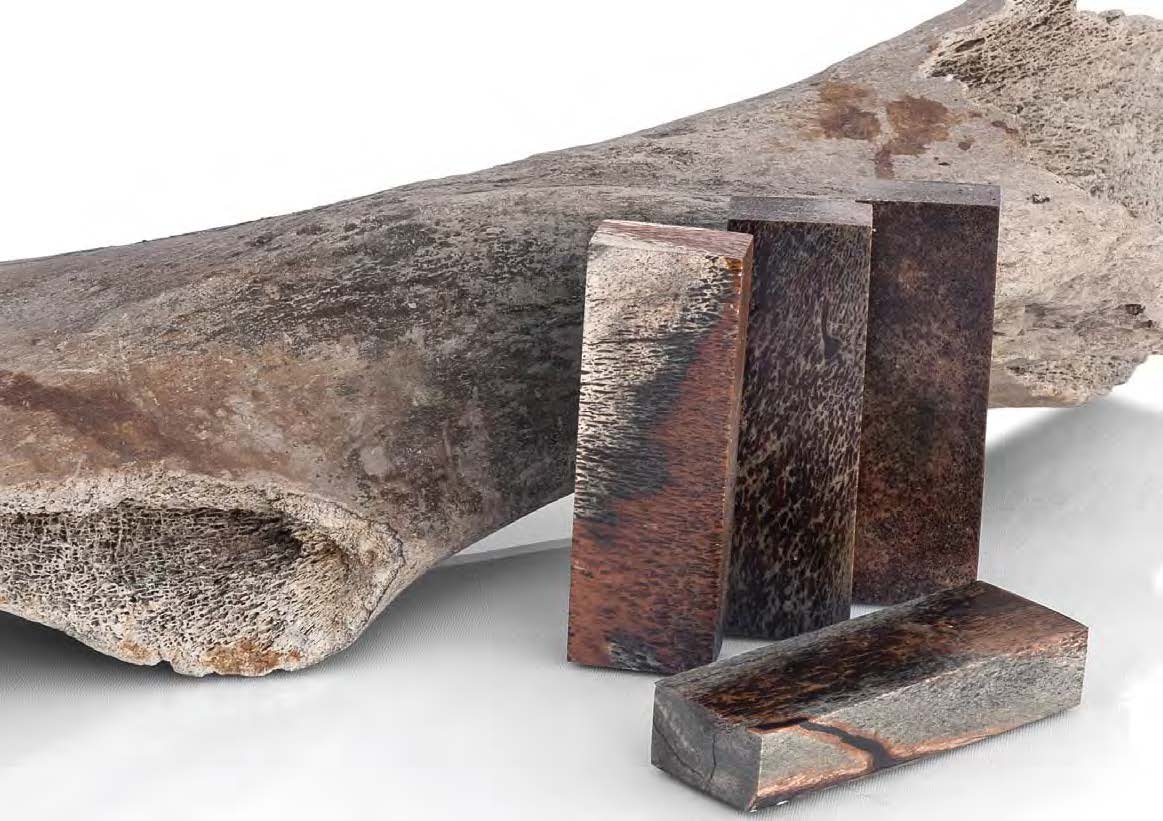
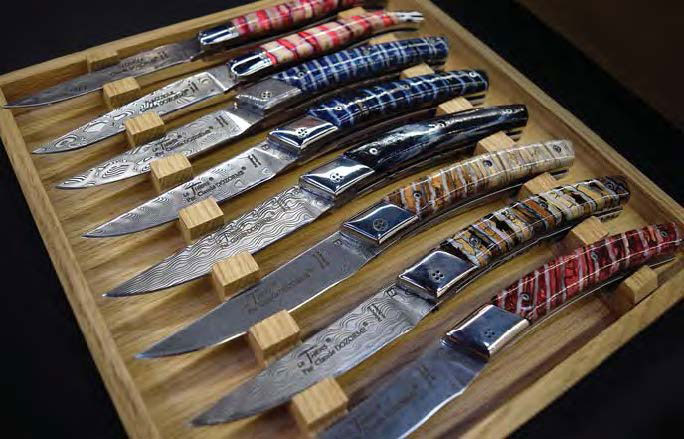
Synthetic materials from the Danish company known as Raffir include Raffir Fossil.
Richlite and Raffir: Two Synthetic Materials on the Rise
Synthetics continue to surge in light of the growing scarcity of some natural materials.
According to Chris Hartman, a 37-year veteran in the family business at Masecraft, the buzz about two synthetic materials, Richlite and Raffir, continues to grow.
“These product lines are totally different from each other, and they work like other materials that our customers already use, so the transition is easy,” he maintained.
Raffir
A few examples of Raffir Fossil. (Image courtesy of Santa Fe Stoneworks)
Distributed domestically by Santa Fe Stoneworks, Raffir is a resin-preserved material used in jewelry and other products also.
“It works well in fine handles and accessories in which aesthetics are of great importance,” Chris advised. “There are several categories. The first, Raffir Fiber, is a composite material of neutral plant fibers cast in resin.
“The second, Raffir Metapol, has aluminum fillers shining through a deep resin matrix. Raffir Noble is a composite material with fine brass and bronze-mesh layers encapsulated in a translucent epoxy resin. The last two categories, Raffir Fossil and Raffir Wood, are genuine rare fossils and fine-grained wood blocks that have been filled with a unifying and strengthening resin through a high pressure process that stabilizes the materials.”
The finished Raffir fossil and wood materials maintain the original structures of the untreated substance while obtaining the mechanical advantages of the homogeneous resin compound.
The Raffir materials are worked with the same tools that most knifemakers already own, therefore little or no additional investment is required.
Richlite
An example of Richlite. (Mark Newman image)
Richlite is a durable, versatile and sus-tainable material made from recycled, resin-infused paper and pulp derived from trees that have been harvested responsibly, Chris says.
Complete with Forest Stewardship Council Certification by the Rainforest Alliance and GREENGUARD Certification, it is also antimicrobial, which is a benefit in food preparation.
“Richlite is tough enough to build skateboards and skateboard parks, so it will take a beating and hold up to the elements,” he added. “Richlite is made in the USA and actually costs less than other like materials. It is similar to working with Micarta, G-10 or carbon fiber, and many of our customers are familiar with them. Customers appreciate that they are no longer inhaling carbon-fiber or fiberglass dust, which some of our customers just don’t like dealing with.”
Other Synthetic Knife Handle Materials
New composite laminates and hybrid materials are on the horizon, and their growth is steady.
“Even though they are mass produced,” Chris said, “they can still be individually unique. They are stable and available in sizes that can easily be used in CNC cutting for production, or can still be cut and worked with standard tools and be handmade.”
BLADE 2018 Knife Guide
Read more about hot knives, knifemaking and collecting in the BLADE 2018 Knife Guide. Download it here.
A sushi knife that developed a taste for Texas brisket.
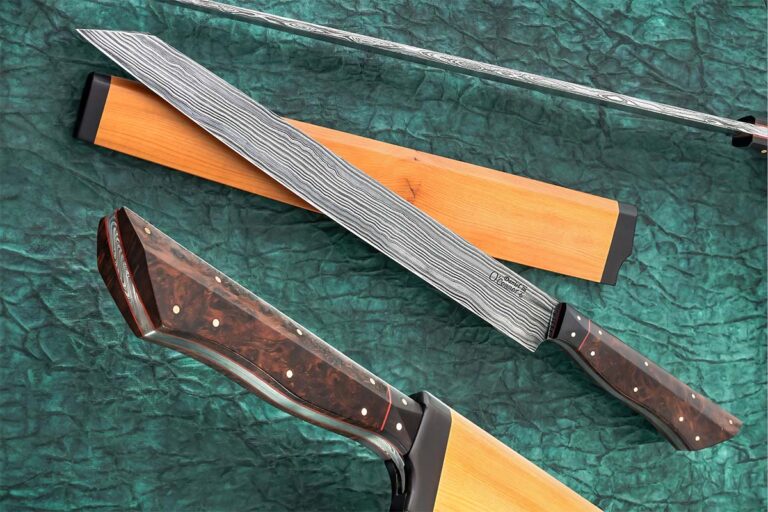
You might say Daniel O’Connor’s Black Widow leads a double life. It started as a sushi knife but when one of Daniel’s Texas pals said it looked like it would make a great brisket knife, O’Connor went with the flow, telling his friend, “It’s about whatever you want it to be.”
Based on a kiritsuke yanagi-ba sushi knife, Black Widow features a damascus of 150 layers of 1084 carbon and 15N20 nickel-alloy steels. Daniel forged the steels in a square and then forged them flat, perpendicular to the original stack. This resulted in the edges of the layers showing up in more or less straight lines, what Japanese swordsmiths call masame hada.
The accompanying image of the knife’s butt shows how the layers distorted when forged on edge. Daniel indicated he will use the pattern in the future.
Black Widow Specs Blade length: 12” Blade grind: A double urashi—double bevel w/a slight hollow on each side Handle: Bocote burl w/red fiber liners Bolster: Bog oak Overall length: 17” Sheath: Irish yew and bog oak Maker’s price for a similar knife and sheath: $1,500
With the popularity of the original article about knife shop accidents, here are five more knifemaking lessons learned the hard way. Use these stories as examples of what to watch for while in the shop. Stay safe!
“I Sawed My Index Finger in Half”
Lesson: A slow moving metal-cut bandsaw can appear quite harmless, yet one of my worst injuries in over 40 years of knife making occurred with mine.
While hurrying to cut a screwdriver slot into the head of a threaded stainless steel handle escutcheon bolt, I failed to do the two safety steps I apply now: fully support the fastener upon a slotted plate encircling the saw blade and hold the bolt with a pair of vice-grips, keeping my hands a safe distance back away from the blade.
But instead, as I pushed the 3/8″ fastener into the saw blade, it snagged the top edge of the face, dragging it down into the exposed slot in the table in front of the blade, pivoting the front part of my index finger into the blade while wedging it in place with the opposing shoulder on the part. As the blade sawed my nail in two and continued to slice through my entire fingertip due to the back pressure from the part, I had to slowly watch and wait for this gruesome process to end once I quickly turned the machine off.
To say it bled a bit was an understatement, as a friend who’d stopped by after I’d left for the hospital asked excitedly if I’d gotten a deer that morning, due to the amount of blood all over the doorknobs and floor leading into the house.
As the doctor was about to remove the sectioned fingernail pieces and stitch up the huge, tapered gash, I’d chosen to remain seated upright on the bench to watch. However, upon trying to insert the needle into my fingertip to deaden it, the callused tip proved so dense that he proceeded to drive the needle all the way through my finger and out the top, shooting a stream of Novocaine all the way to the top of my shoulder.
At that point, I told him, “I think I’ll lie down now.”
Lesson: Any time you place a blade against a fast-moving wheel, use extra caution.
I was getting ready for a turkey dinner and noticed how dull my knife was. I went out to my garage to my paper wheel. I started to sharpen, but my sleeves were loose. I put the knife down, rolled up my sleeves, and grabbed the knife. The knife caught the wheel like a bullet. It hit the back wall and shot straight at my head. I blocked the knife with my hand, and in doing so cut tendons on top of my little finger at the knuckle. I felt like a fool and knew that I did a stupid thing.
James Merten
“That Got Me Nine Stitches”
Lesson: Don’t assume pliers will never fail.
I’ve had a few times that scared me, but one time stands out in particular. I almost had this knife done, and I was holding the handle in my left hand and the blade in my right with a pair of pliers. The blade slipped, and the point went right through my first finger. That got me nine stitches.
Bill Stout
“The Point Spun Across the Palm of My Hand”
Lesson: Protect your hands when using a drill press.
I just finished grinding the blade and a small clip on this little 3-inch blade. I took it over to the drill press for the handle holes. Little did I know that copper, which is what the customer wanted, would grab the drill bit. The knife started to spin out of my hand, like a helicopter.
Instinct made me hold tighter, but the press was stronger. The point spun across the palm of my hand and gave me a deep, 1.5-inch gouge in the palm of my hand.
Now I always wear a Kevlar glove or use a stopper of some sort to catch the knife if it ever spins again.
Lesson: Locks have come a long way, but they’re not foolproof. Also: don’t stab tires to be a show off.
Editor’s note: This one isn’t about knifemaking, but it’s still worth reading.
I was at one of those big shows they hold at Las Vegas every year. The guy hawking the knife was talking about how his knife had the best grip. He was stabbing his knife through a steel belted radial tire.
As the demo went on he invited anyone from the crowd to come up and try to stab their knife through the tire. Finally, a man that looked like Charlie Daniels decided to try. He had a folder in his hand. He took two or three steps and lunged at the tire knife in hand.
I heard a crack and the big man withdrew his hand like people do when they get cut. He stared at his drooping fingers in disbelief. The lock on the lock back had broke and the folder folded closed on his fingers. The crowd gasped. The first aid guys shuffled him off.
So another big guy comes up with a rather large hunting knife. He raised his hand as high as he could and brought the blade down hard in a hammer fist motion. His hand slid down the handle on to the blade, cutting most of the way through three fingers.
That brought the dog and pony show to an end while the organizers of the show directed everyone’s attentions else where. Lesson learned: let someone else show off for the big crowd.
Ernest Lephart
Share Your Stories
Have a horror story of your own? Tell BLADE about it. It could save someone from injury, or worse.
5 LEADING SHARPENING RODS TAKE THE AUTHOR’S SHARP TEST
The sharpening rod is perhaps the No. 1 kitchen knife accessory in many households. Why? Usually 8 to 12 inches long, it is a hardened steel rod with a coating of industrial diamonds that helps abrade steel and lightly sharpens a cutting edge. Most models are basic and there’s not much to them. They are more effective than standard butcher-type steels that align the edge and don’t remove material, and are good for regular maintenance of kitchen knives in between professional sharpening.
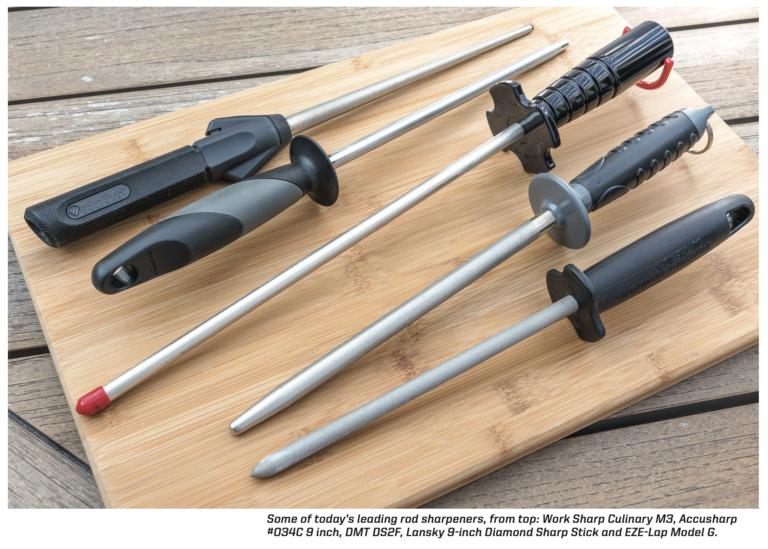
Accusharp 9-inch
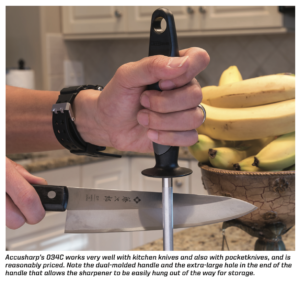
Accusharp offers a 9-inch sharpening steel, model #034C. The ergonomic, rubber overmold handle makes it easy to hold thanks to the non-slip grip. It stores easily in a drawer or hangs from an extra-large handle hole. The guard is round, so the sharpener will roll when you set it down, which can be annoying. It does not come with a container for protection while not in use.
The steel and its fine abrasive in a 1500 grit maintains a blade well. My only complaint is with the soft rubber part of the co-molded handle. The rubber is in a diagonal shape and on one end closest to the guard of the test model, it is visibly raised and you can peel it back a bit. However, if it comes undone, you can easily fix it with a strong adhesive. Country of origin: China. MSRP: $34.99.
TOOTHIER EDGES: Lansky’s Diamond Sharp Stick
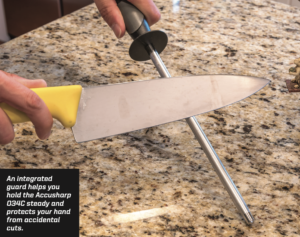
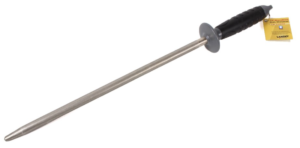
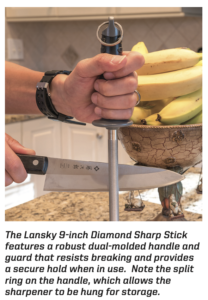
The handle of Lansky’s 9-inch Diamond Sharp Stick is a dual-material, rubber overmold for both comfort and durability. Like most sharpening-steel handles, a full integral guard protects your hand from accidental cuts. A split ring affixed to the handle’s end provides for hanging the rod on a hook or nail.
The Sharp Stick has a hard plastic tube that fits over it and secures in place by an O-ring that slides down the rod close to the guard. You can remove the O-ring but you must leave it on to take advantage of the hard plastic tube to protect the sharpening rod surface when stored. The O-ring is positioned far down on the handle to not interfere with operation.
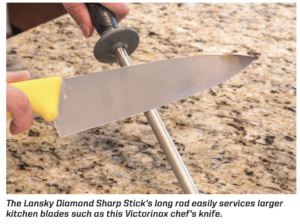
I discovered something interesting with the Sharp Stick. As with all the test models, the grit is fine but the Lansky seemed most aggressive in the cut and produces a toothier edge than the rest. In my opinion this is very good, as I prefer a toothier edge on my kitchen knives, though some do not.
The rubber gripping portion of the handle is textured well, and offers a great purchase with wet or dry hands. The guard is also robust in appearance, as some equate robustness with better quality. That’s not always the case but with this one it definitely is. Country of origin: China. MSRP: $33.99.
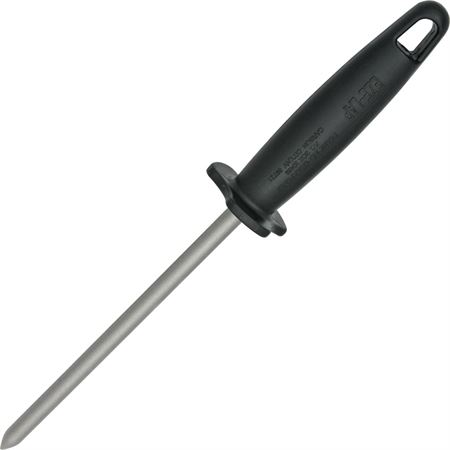
Diamond Machining Technology (DMT) DS2F
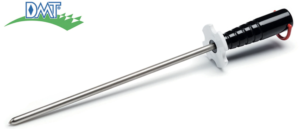
In my opinion, the Diamond Machining Technology (DMT) DS2F diamond sharpening steel is superior in several ways to the balance of the test rods. The fine-grit diamond-coated model has a red plastic/rubber tip. DMT uses a color-coded system to denote various grits, including red for fine. The tip also helps stabilize the rod on a flat surface. The DS2F ships in a nice, clear vinyl pouch that locks around the guard. The pouch is great for storage.
While the other test models have dual-molded handles that incorporate hard plastic and firm rubber for comfort, the DMT has a hard plastic one. However, don’t turn your nose up just yet. The handle tapers gradually toward the guard, which makes the entire grip fill your hand nicely. There are also five grooves on the tapered part that enhance a secure hold. The guard has four semi-circular cutouts to provide anti-roll qualities, which I really like. The DMT doesn’t roll at all when you put it down. A plastic shackle attached to the handle end for hanging also is color-coded to grit. The shackle can be removed if you desire. It’s creature comforts like these that make the difference between a good product and a great one.
The DMT is definitely a top performer. The 12-inch rod captures pretty much all sizes of kitchen knives. Of all the test models, I felt the DMT produced the finest edge, that is, the edge isn’t toothy or grabby, it’s just plain sharp. The D2SF leaves a nice, refined finish on the cutting edge.
One thing about the handle shape: Since it tapers toward the guard, it forces you to nestle your hand up against the guard when holding it. This stabilizes the sharpener in your hand. When you grip it farther away from the guard, the sharpener isn’t as stable—something to consider. If you prefer holding your sharpening rod, you might want to get the DMT for this very feature. This is just a top-notch, high-end sharpener. Country of origin: USA. MSRP: $53.59.
EZE-Lap Model G
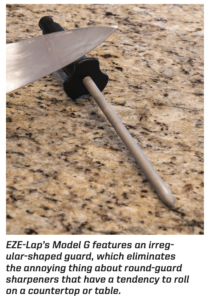
The 8-inch EZE-Lap Model G is the shortest of the test models. The shorter rod allows for easy use as well as com pact storage inside a drawer. It comes in a fine grit to produce a nice working edge in a minimal amount of time. The large-diameter plastic handle has enough girth for a comfortable hold. The integral guard is very much like the DMT D2SF’s, with a non-round shape that helps curb rolling on a flat surface. Well done! An extra-large handle hole promotes hanging for storage.
EZE-Lap’s Model G round-profile diamond sharpening rod is only 8 inches long, which makes it the shortest rod evalu- ated, though that doesn’t mean it is any less effective. The shorter overall length stores in a drawer easily or in cramped quarters such as in an RV.
The thing about a shorter rod like the Model G is you must be quick on the draw when working on longer kitchen knives, such as 8-inch chef’s knives and up. Compared to 10- and 12-inch rods, you’re losing real estate to work from and must pull the blade across the length of the Model G quicker. For shorter blades, this should not be an issue. On the other hand, the smaller size is ideal for camping, traveling in an RV, etc.
The Model G ships in a stiff paper sleeve, which can be reused to protect the rod as well as other items stored near/by it. The sharpener felt very coarse to the touch out of the packaging. All diamond sharpeners do. As you use them they will smooth out, though this has no bearing on performance, and performance-wise the EZE-Lap does very well. Country of origin: USA. MSRP: $31.95.
Work Sharp Culinary M3 Sharpener
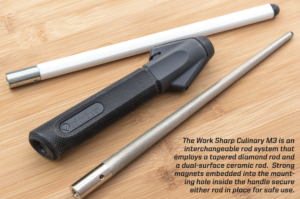
The Work Sharp Culinary M3 sharpener takes the basic diamond-coated steel rod sharpener and improves on its function by offering choices. The M3 comes with not one but two rods—coarse-grit steel with a diamond coating and a fine-grit ceramic rod. Both rods interchange with the included ergonomic handle and are secured in place by strong magnets.
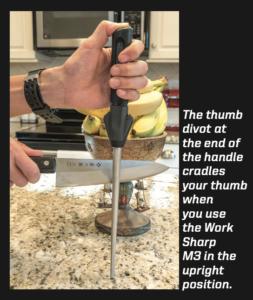
The 8.25-inch steel rod tapers gradually from handle to tip. At the end of the rod is a rubber button, which helps stabilize the sharpener when the end is placed on a table or countertop and the handle is held with one hand. It sounds like a typical steel rod until you get to the handle.
Instead of the standard integral, flared guard is a pair of ramped surfaces that serve as angle guides. When you hold the sharpener upright, place the side of the blade on the rod and rest it against the ramped surface. Then, with the standard motion using a rod sharpener, travel down the rod, holding the blade at the preset angle. Bring the opposite side of the blade to the other side of the rod and repeat. The gripping part of the handle is firm-textured rubber, and a thumb divot on the end helps stabilize the sharpener in use.
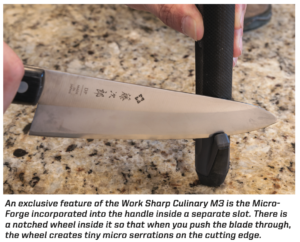
A little “MicroForge” slot in one of the guides contains a small yet wide serrated wheel. After you get a sharp edge, remove the rod from the handle and place the end of the handle on the table, in similar fashion to how you were sharpening. Place the blade in the slot at the tip. With light pressure, push the blade through until the handle gets to the tang, then stop. The serrated wheel will crimp the edge slightly, forming tiny and evenly spaced micro serrations. The serrations act like bigger serrations found on other kitchen knives. Using the MicroForge feature is not mandatory, but it is designed as an additional function to help provide the longest-lasting edge possible.
The steel rod cuts fast to restore dull edges. It provides a working edge in a minimal amount of time. Follow up with the fine ceramic rod after the edge has been established to refine it further. The ceramic rod’s smooth and fluted sides give a choice of edge finishes: a bit more bite with the latter and a more polished edge with the former.
The M3 ships in a sturdy cardboard box, the sharpener parts store inside a tray, and the tray slides into the box. The steel rod has a protective plastic sleeve, too. It is the most comprehensive of the test lot. Country of origin: Parts sourced globally, U.S. assembled/calibrated. MSRP: $69.99.
HOW TO USE A ROD
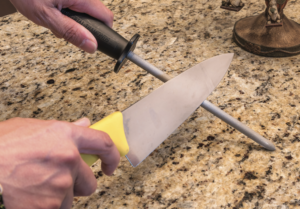
No matter the brand or model, sharpening steels are used the same way. Most manufacturers recommend using one while standing at the kitchen counter or seated at a table.
Take the sharpening steel and place the tip on the table, held upright with the handle at the top. With one hand, grasp the handle firmly, keeping it perpendicular with the flat surface at all times. With the other hand, grasp the knife handle and place the blade at a 20-to-30 degree angle in relation to the sharpening steel. Place the blade as close to the guard as possible, set to start at the part of the blade closest to the tang. In one motion, move the blade down the length of the rod while at the same time draw the blade fully across the steel. When you near the flat surface you are working from, though without touching the surface, you should be at the blade tip.
Raise the blade to where you started from, switching the blade to the opposite side, then repeat the same stroke. Then, return to the side you started from, and repeat once again. Do an equal amount of strokes for both sides of the blade.
As you become more comfortable using the sharpening steel, you can forego the flat surface and hold the steel with one hand similar to how you would a large kitchen knife. With the other hand, place the blade on the rod at the recommended 20-to-30 degree angle and lightly push the blade across the rod, ending at the blade tip. I highly recommend you not proceed to this step until you are confident enough, because with this alternate method chances for not holding the angle correctly is greater.
Whatever method you use, remember to always use light strokes. There is no need to bear down on the blade with pressure. Let the rod do the work.