Knifemaking is the building of a knife, which includes the blade, handle and other accouterments. Blades are made by either removing metal from a steel blank via a grinder – known as stock removal – and the forging to shape of hot steel into a blade in the process known as bladesmithing. Other parts, including bolsters, guards, pommels, etc., are needed to complete the finished knife.
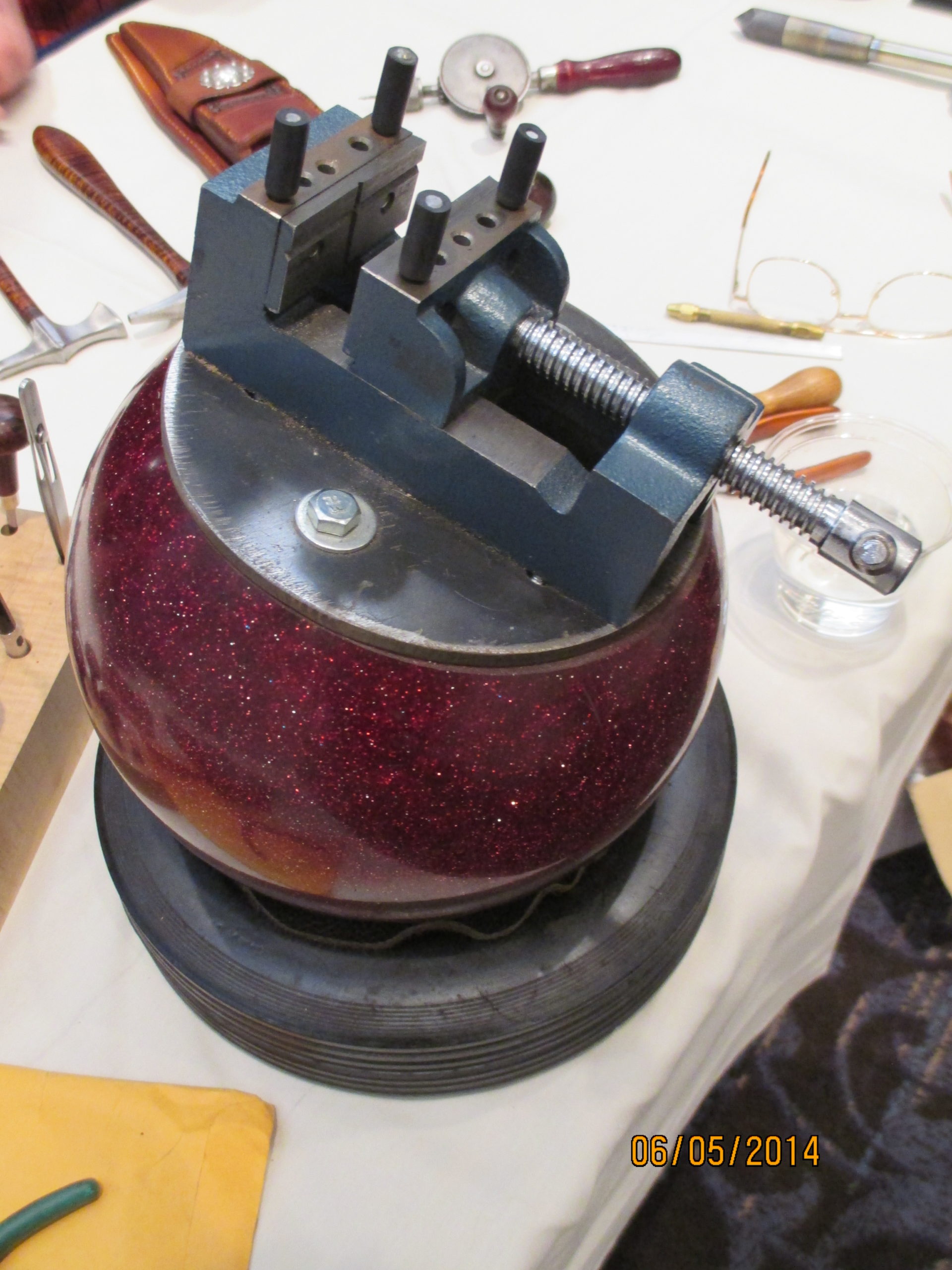
The bowling ball vise makes knife handle work easy and inexpensive
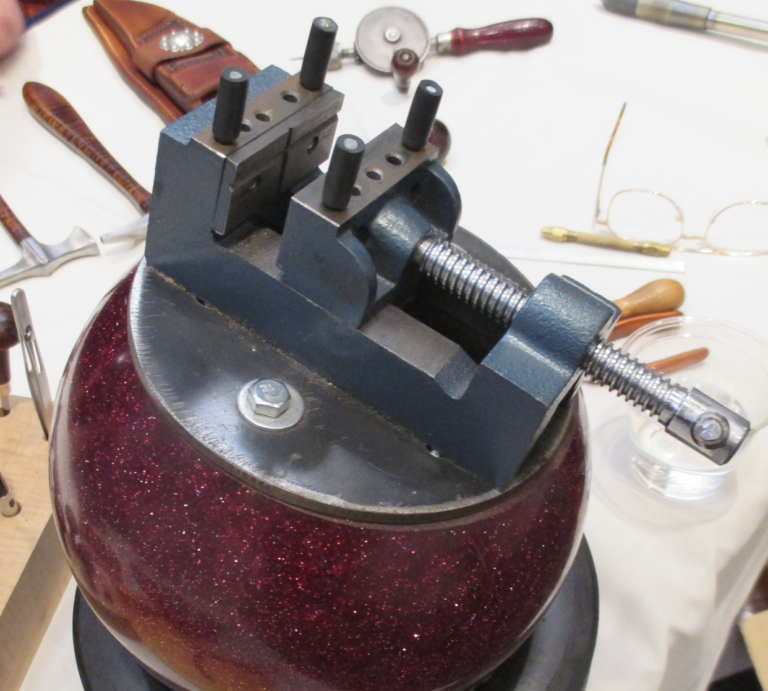
As the old adage goes, “necessity is the mother of invention,” but whoever thought of making an engraving vise out of a bowling ball deserves a medal!
The engraver’s vise, which has a rotating base so the craftsman can position his work at any angle, has been around for many years. Small versions are affordable but one big enough to accept a large knife handle can cost in the $600-to-$700 range.
Enter the bowling ball vise.
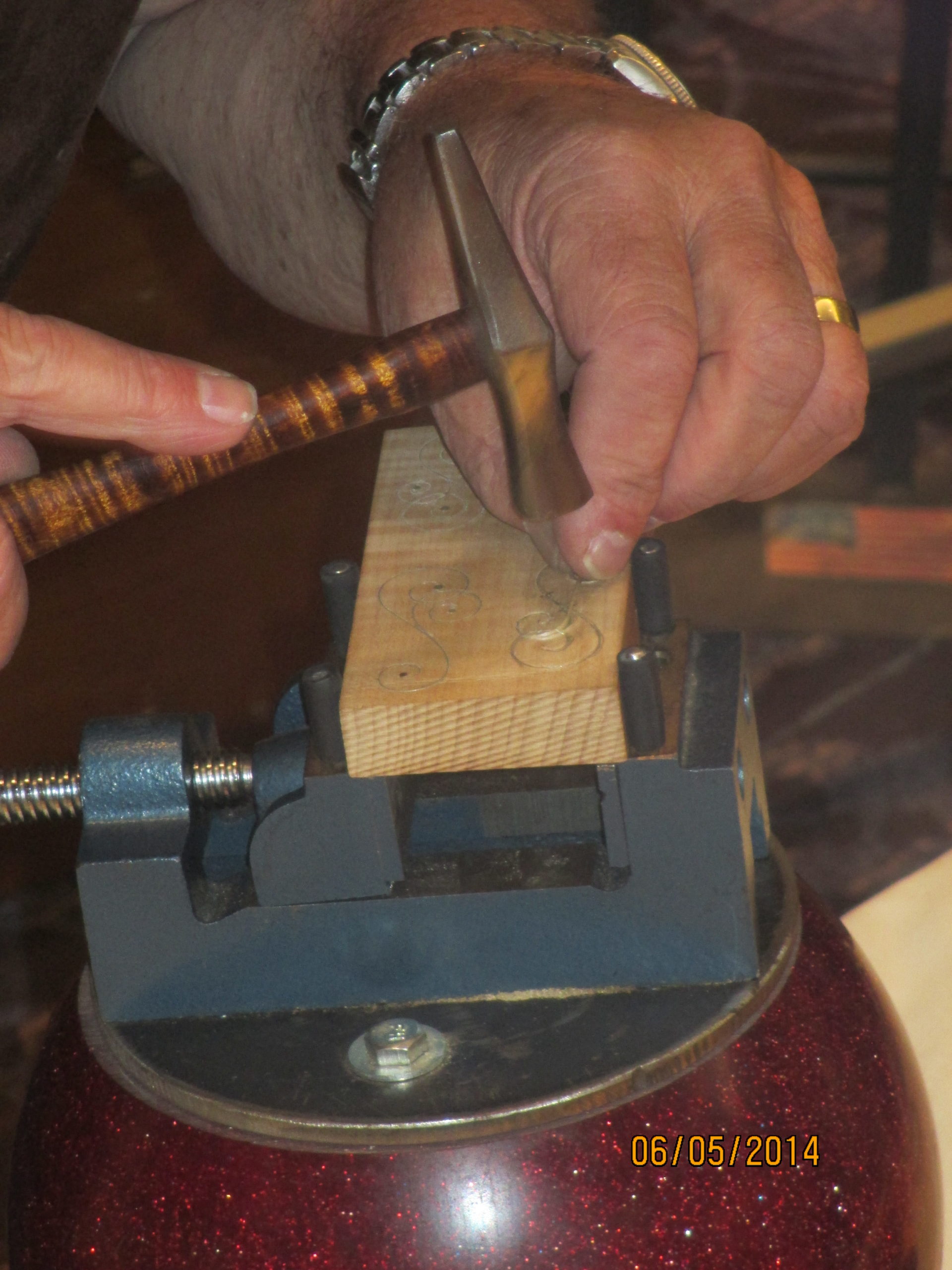
American Bladesmith Society Master Smith Don Hethcoat has made several bowling ball vises, including one for fellow ABS master smith Joe Keeslar. Both makers find the vise particularly useful for inlaying gold and silver wire into knife handles. “I learned about the vise in 1988,” Hethcoat recalls. “I wish I could take credit for creating it, but I first saw it being used by Firearm Engravers Guild member John Barraclough.”
“The first and only bowling ball vise that I ever had was a gift from Don Hethcoat many years ago,” Keeslar says. “In my Kentucky shop I use an engraving ball for my silver wire inlay work, but for my shop and demonstrations in France I use a bowling ball vise. I could not afford to buy a second engraver’s ball for my shop abroad.”
Used bowling balls are cheap, and beyond that the biggest expense to making a bowling ball vise is adding a machinist’s vise on top of the modified sphere. The cost for these items is a fraction of what an engraver’s vise costs, and the rest of the materials to complete the vise are very affordable. Indeed, they can be found around your shop, home or at your local scrap yard.
IMPROVISING WELCOME!
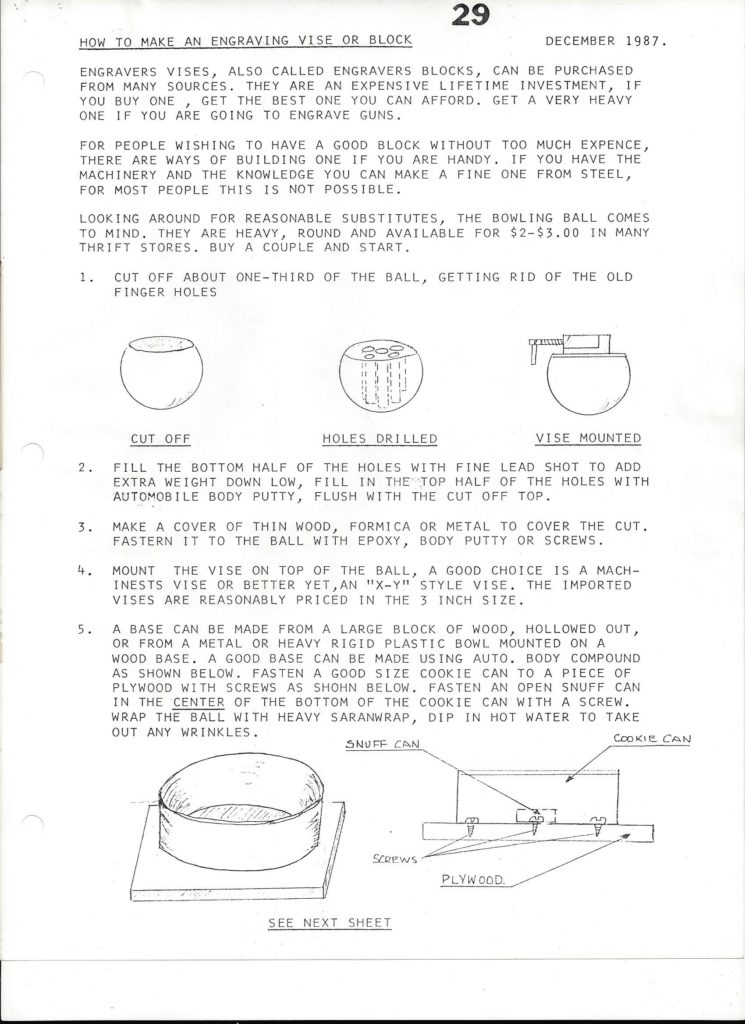
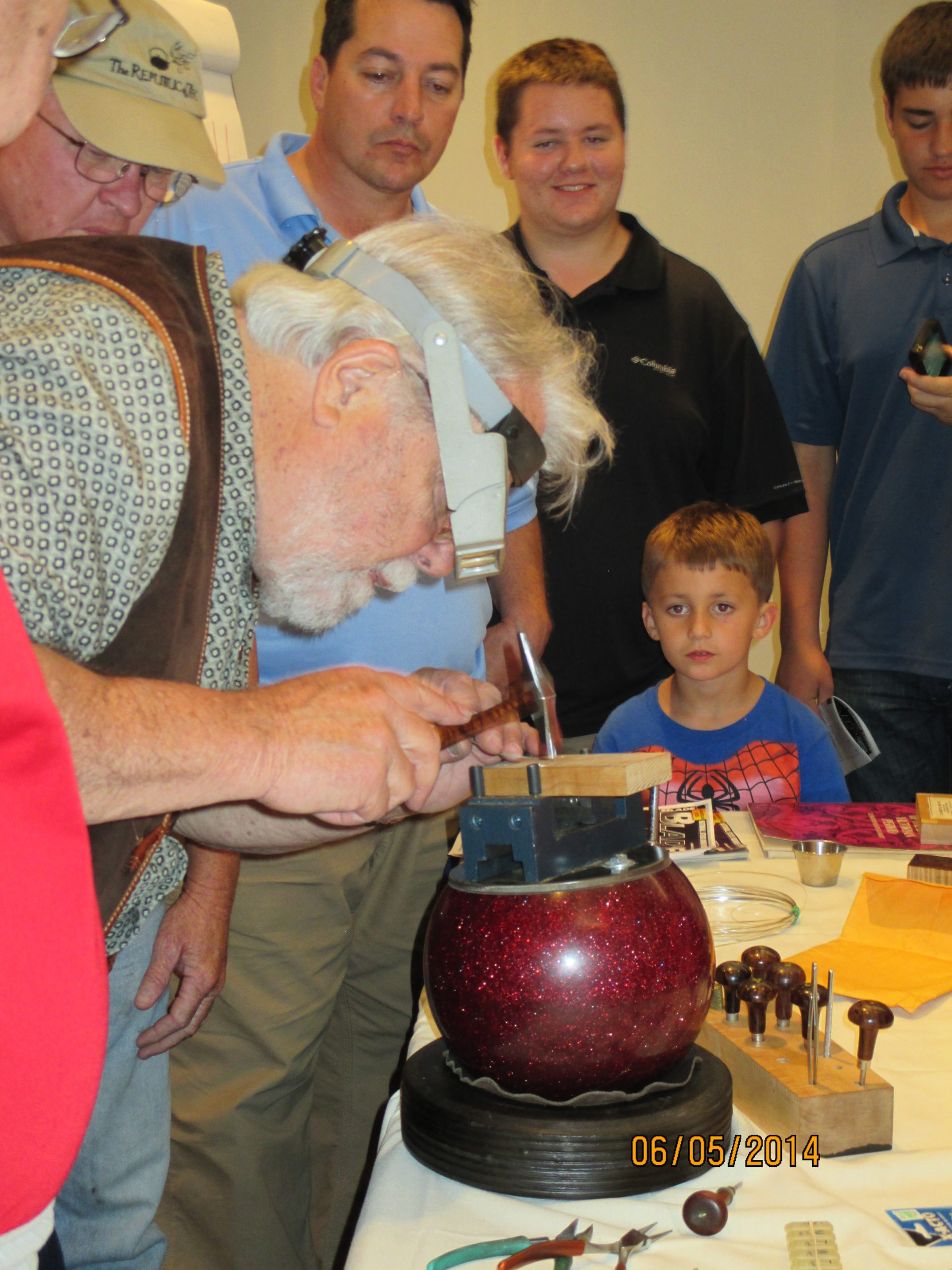
While the basics of making Hethcoat’s bowling ball vise are outlined in the below photo, there’s no reason you can’t add your own personal touches or substitutions. For instance, Don uses a piece of round pipe for the base of his vise, but Joe has a different way of skinning the cat. “My bowling ball sits in a lawn mower tire with the rim removed,” Keeslar notes. “It’s best to have a tire with rim diameter of about 6 inches. If no used tire is available, a new one can be found at a Harbor Freight store.”
There are other differences between the two makers’ vises. Hethcoat uses a bench-mount machinist’s vise mounted to the top of his modified bowling ball, while Keeslar prefers a low-profile drill-press vise commonly used for drilling and milling. Both vises work fine and your choice may be determined by factors such as your height in relation to your workbench or the configuration of the vise jaws that suit you best.
The jaws of the vise will need to be padded to keep from marring the knife handle. Here again, choose your preferred padding material. Thick leather will work as well as high-density foam—or take a look around your shop and use your imagination.
ROLL on a BUDGET
As a long-time instructor on how to make knives, Keeslar says beginning students may not have the money for expensive equipment, so he uses his bowling ball vise as an example of how they can get started without a huge investment.
“I personally use an engraver’s ball for my silver wire inlay, but the bowling ball vise is very inexpensive to make and affordable to use,” Joe observes. “When doing demos here in the U.S. [and abroad], I use the bowling ball vise to demonstrate to my students an easy way to get started in doing wire inlay. I also show them how to make the stabbing chisels and the like. So much of what is needed to produce knives is expensive and this is one activity that one can do for a small investment.”
It’s all about saving money. The extra cash you save by making a bowling ball vise can be poured into better handle materials—everything from wood to wire. This translates into a more upscale knife for your own satisfaction or, if you sell your wares, a higher price you can get from a customer. You’re a winner either way!
6 Easy Steps to Make the Bowling Ball Vise
According to ABS master smith Don Hethcoat, “Bowling balls make the perfect vise for knifemakers doing inlays and similar close work where you need both stability and flexibility. You can buy an old bowling ball at a flea market or thrift store for two or three dollars.”
In his own words, here are Don’s six steps:
1) “Saw off about one-third of the bowling ball, getting rid of the old finger holes. I used a metal band saw but you may have other means”;
2) “Drill five holes in the flat top of the ball, one at each corner of a square with one in the middle using a half-inch drill bit, then chisel out a cavity in the center of the ball”;
3) “Fill the opened cavity almost to the top with lead shot to add weight, then seal the shot to the top of the hole with automotive Bondo® filler”;
4) “Make a round cover for the flat top of the ball using metal, wood or Formica®. Mount your vise on top of this. Mine is a machinist’s vise using its mounting system”;
5) “Make a base and you’re almost done. I used a round piece of 8-inch pipe cut to 2.5 inches in depth. Fill the pipe with Bondo, cover it with Saran™ Wrap and push the bottom part of the ball into it to make an impression. Clean up the excess Bondo [or, you can use the lawn mower tired described by Joe Keeslar in the story]”;
6) “Cut a round piece of suede to fit inside the round cavity so the ball can rotate freely. That’s basically it! Feel free to modify the vise to fit your own scenario.”
1 of 5
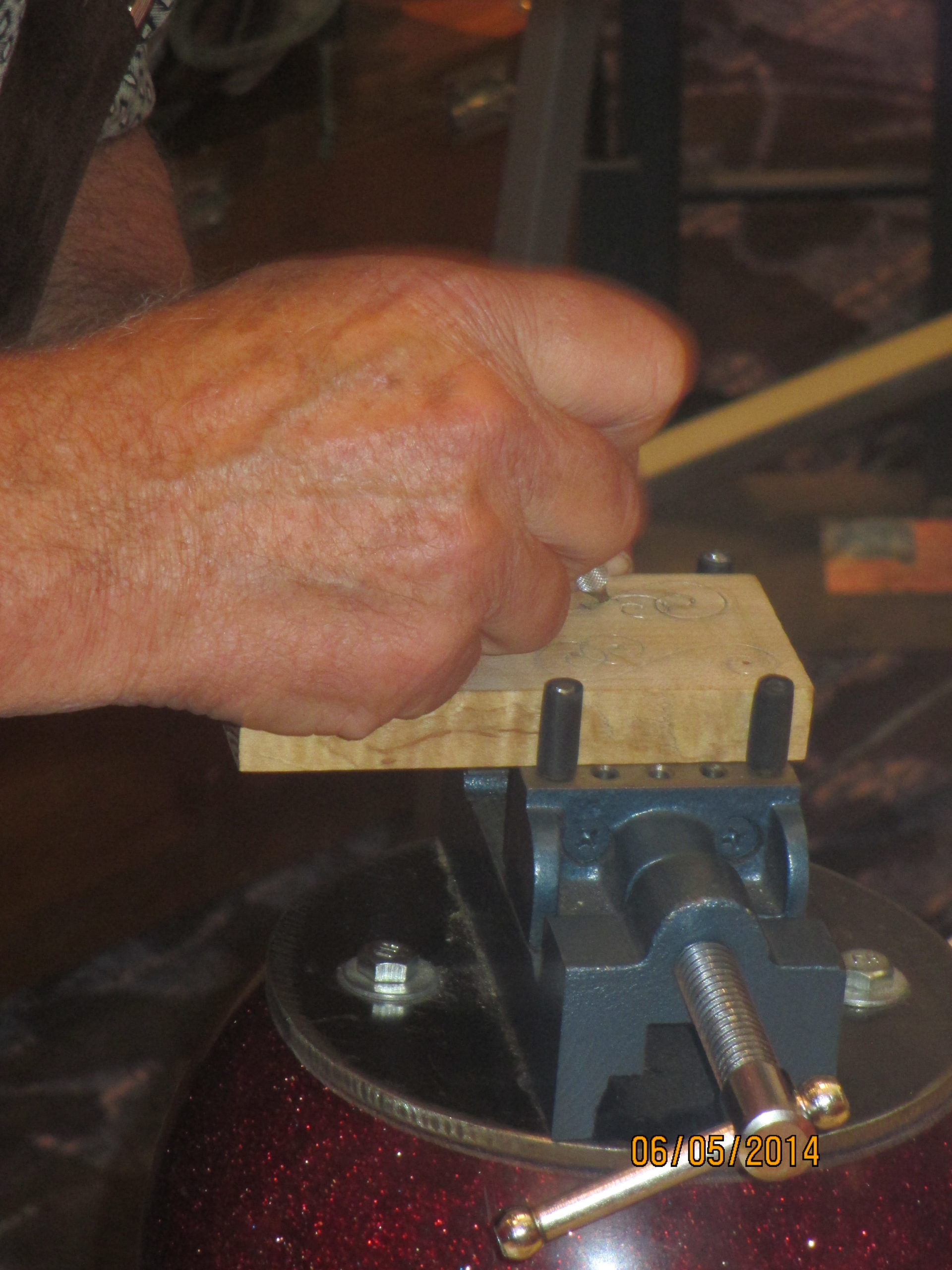
The bowling ball vise holds the wood securely as Keeslar lightly hammers the silver wire during his BLADE U. class.
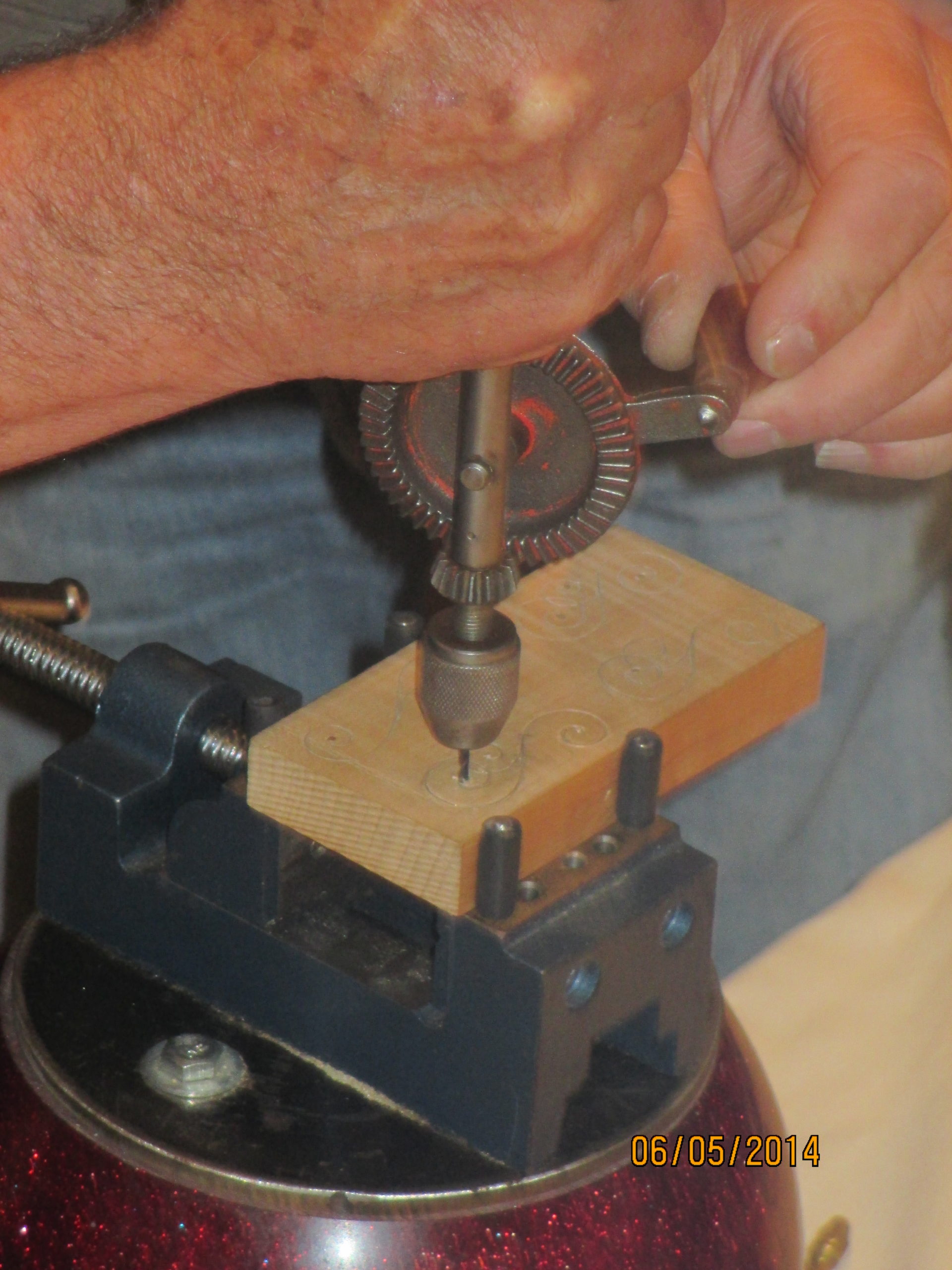
Keeslar uses a hand drill on the vise-held wood during the wire inlay process in his BLADE U. class.
Keeslar punch presses the silver wire into the wood held in the bowling ball vise.
As his students look on, Joe Keeslar uses the bowling ball vise in his wire inlay class during the first BLADE University at a previous BLADE Show.
THOSE WHO KNOW DISSECT TV’S LONG-RUNNING FORGED IN FIRE
Bladesmithing enjoys the same treatment as motorcycle building got in the mid- 2000s—that is, it has become a well-established reality show competition on cable television. Such treatment has ups and downs regarding its effect on the knife industry. Be that as it may, History Channel’s hit show, Forged in Fire, has been on the air for seven seasons, which proves its staying power.
FIF is characterized as both inspirational and gimmicky depending on who you ask. And ask we did—two contestants, a former FIF guest judge and a member of the board of directors of the American Bladesmith Society—with the goal of shedding light on where the hit show lands on the spectrum between the two.
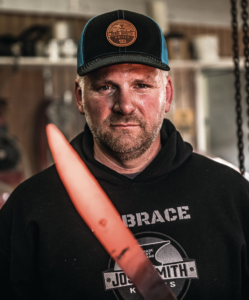
At 19, Josh Smith was the youngest smith to ever achieve ABS master smith status when he did so in 2000. He has appeared on two episodes of FIF. (Brandon Horoho mage)
The long-running TV competition undoubtedly has been an asset to the forging community. For starters, it has introduced the general viewing public to a cast of characters that constitutes a realistic cross section of the knifemaking community. While its list of participants is far from a comprehensive Who’s Who of bladesmiths, one would be hard-pressed to spend more than an hour at the next BLADE Show without encountering a first- person recollection of pounding steel on the small screen.
More important is the awareness such publicity has brought to the craft, according to J.W. Randall, veteran ABS master smith and winner of FIF’s 2017 international championship (season four, episode 19). “It’s brought the public’s awareness around to hand- crafted items, and that’s a good thing,” Randall observed. “It appeals to a lot of people because it’s an old craft, and it’s been brought back, in a sense.”
Indeed, the fiery furnaces easily translate into a burning interest among many of the show’s viewers. For them, witnessing the process of manipulating steel into a knife, sword or axe using fire, a hammer and other assorted machinery and instruments, while facing the adversity of time constraints and random surprises, is at once exciting and inspiring.
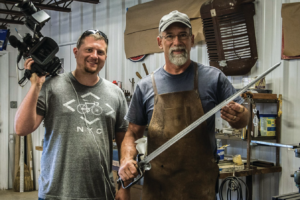
ABS master smith J.W. Randall holds his spadroon sword, the one he made to win the International Competition episode of FIF. At left is “Dan the cameraman.” (Tammy Randall image)
“The men and women who compete on this show are engaging in an arena of gladiators,” described ABS master smith Jason Knight, B.R. Hughes Award winner and guest FIF judge during portions of seasons three and four. He agreed that the show’s primary value lies in inspiring its audience to appreciate, and perhaps pursue, a craft that ties together history, art, science and technology from an ancient world. “It’s important in our culture,” Knight added. “People like me hold fast to it, and I want to share it as art.”
Such interest has had a measurable effect on ABS membership, according to ABS journeyman smith, board member and treasurer, Bill Wiggins. “I don’t know what to call it,” he pondered. “It’s not a spike—I’d call it a steady rise in membership since the show started.”
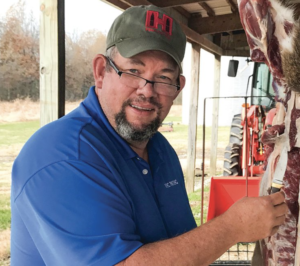
An ABS journeyman smith and treasurer of the ABS, Bill Wiggins said the ABS has enjoyed a steady rise in membership ever since FIF’s debut episode seven years ago. (image courtesy of Bill Wiggins)
He added that the ABS has also seen a lot more turnover lately, with people joining up for a year only to never be heard from again. “We’re still gaining members, though,” he allowed. “There’s good and bad, but the good outweighs the bad.”
“The bad” is definitely part of the mix, according to the story’s sources who were contestants. Though none had the proverbial sour grapes about their FIF experience, the recurring caveat was that good television producers have one goal in mind, which is producing good television—and that doesn’t necessarily translate into total satisfaction for the contestants.
One way to achieve “good television” is to introduce drama. Thankfully, according to Josh Smith, a two- time FIF contestant and the youngest person ever to earn an ABS master smith stamp at 19 in 2000, it didn’t include any typical reality-show-style infighting on the set.
“Everybody needs to realize that they’re trying to make an entertaining TV show, and I think they do a good job,” Smith explained. “The clock provides the drama that they need instead of drama between the contestants.” He added that Mareko Maumasi, his competitor and winner of the “Judges’ Pick” special episode (season four, episode one), is now a good friend. “We didn’t have to become enemies!” Josh emphasized.
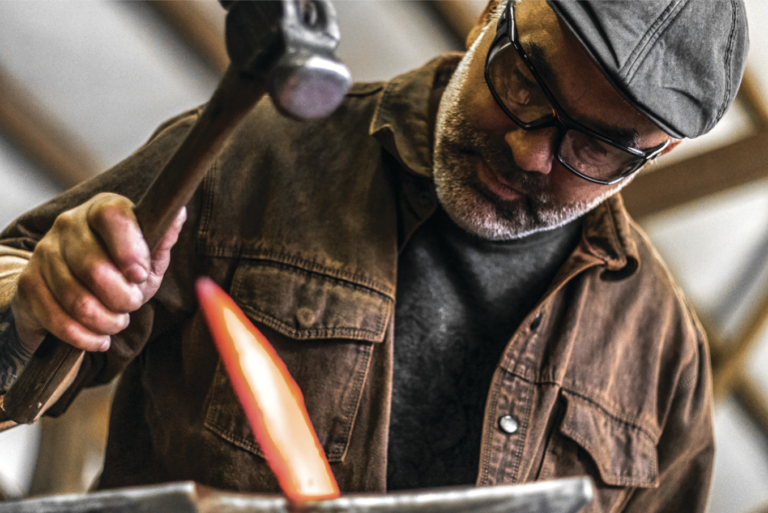
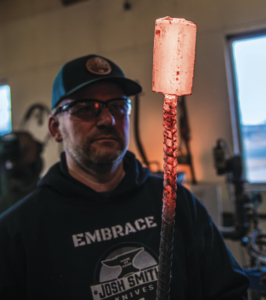
Unanimously, those interviewed who appeared on FIF maintained that the contestants should be better paid. “If you’re not sure if you do that show that you’ll be able to make your house payment, don’t do it,” advised Josh Smith, here admiring a red-hot billet in his shop.
TIME TELLS
Regarding the clock, each bladesmith is presented with strict time constraints— typically three hours to forge, grind and heat treat a blade, followed by a round of judging. In a second round, they have three hours to finish and handle the blade, followed by another round of judging.
“Three hours is a totally unrealistic timeframe,” Randall said. “That’s what makes the show interesting. Everything is stacked against you from the front, and that’s just a critical-thinking-and-an- overcoming-adversity deal. If you realize you’re backed into a corner, you have to adjust and come up with something to overcome it to gather yourself some time back on that clock.”
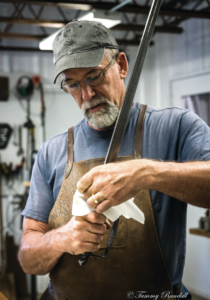
J.W. wipes down the spadroon sword in his shop. Of FIF he said, “It’s brought the pub- lic’s awareness around to hand-crafted items, and that’s a good thing.” (Tammy Randall image)
“A lot of these contestants have no experience, and it’s very entertaining to watch someone who doesn’t know what they’re doing get out there and forge a blade with unknown material,” Knight added. “It’s like throwing them to the beasts. It’s very gladiatorial and can be catastrophic. A lot of people will win by default because competitors will push themselves to the edge or get a bad choice in some garbage materials.”
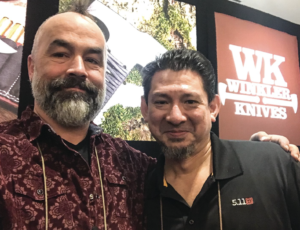
Jason (left) and his fellow FIF judge, Doug Marcaida, deliver looks that “will keal” at the Winkler Knives booth during the 2018 SHOT Show. (image courtesy of Shelly Knight)
He emphasized that the use of questionable materials adds a dramatic challenge to the mix, and during his time as a judge, Knight would advise the show’s producers on what to make available. “They have no idea about metallurgy, chemistry, physics or any science,” he remembered. “Their job is to produce content, and they have license to do whatever they want because it is entertainment. It’s good television but it’s not good bladesmithing.”
During a third portion of the show, makers have five days, or 40 hours, at their home shop to produce another more elaborate project.
Knight likened the whole production to a television game show made to entertain rather than inform viewers of the actual forging process. “You shouldn’t watch Forged in Fire with an expectation of learning how to forge blades,” he said. “That isn’t what the show is about.”
He should know, as he said he and his wife, Shelly, created the original premise. Before Forged in Fire was ever conceived, Battle of the Bladesmiths began as an ABS competition. “In 2010, Bill Wiggins asked ‘Hey, what could we do at a hammer-in that would be more fun?’” Knight recalled. “Shelly got the idea from Iron Chef. She said ‘What if you did a competition where you have unknown materials, a limited amount of time and you have to make a knife that works?’”
“You shouldn’t watch Forged in Fire with an expectation of learning how to forge blades,” said Jason Knight, here in his FIF garb during a forging demo in Johnson City, Tennessee. “That isn’t what the show is about.” (Shelly Knight image)
Big recurve blades are one of Jason’s specialties. He said he and his wife, Shelly, created the original premise for FIF: the Battle of the Bladesmiths, the first of which was held in 2010 during an ABS hammer-in at Haywood Community College in Clyde, North Carolina. (Matt Cohen/2020 Knight Forge Studio image)
“Jason approached me about doing Battle of the Bladesmiths at the Haywood Hammer-In,” at Haywood Community College in Clyde, North Carolina, Wiggins confirmed. “He won the first one, and since then it has become a yearly event.”
Flash forward to 2014. Knight also competed in and won the first-ever, never-aired pilot episode of Forged in Fire. “I’m glad to have been a part of the founding legacy that no one knows about,” he laughed, adding that he also advised the content producers on 12 of the episodes but remains unlisted as a creator. “I wouldn’t do the show again unless they paid me what I want to get paid,” he added. “What I want to do is what I’m doing. What I want that show to be, it can’t be.”
Smith, who competed on the show twice (including season three, episode five) but never won, said if he could change something about the show, it would be an opportunity to explain the knife project to the judges. “Instead of just handing the sword over to the judges, give me two minutes to talk about it,” he said. “I would have educated those guys about details that otherwise they wouldn’t notice with a cursory glance. I think it would have made a difference.”
He feels like he got a raw deal with his Kora Sword, in which his mosaic damascus was oriented so the pattern lined up, made with all take- down construction and blind-pinned together. “It’s a lot of stuff that no one on TV knew,” he noted. To his credit, changing the rules to allow non-winners to get their knives back was a prerequisite for his return to the show.
Randall said editing was an aspect that bothered him. “I want to be represented for who I am. I don’t want television to modify me and make me be somebody that I’m not,” he said, referring to being “bleeped” twice during his episode when he did not use profanity. “I don’t want to be seen by the world as that guy. That’s not who I am and what I want to represent, and it bothered me.
J.W. and Argentina’s Guillermo Mendoza (left), the two contestants in FIF’s Inter- national Competition, enjoy a reunion at a past BLADE Show. (Tammy Randall image)
“And more so in my closing remarks,” Randall added regarding the editing. “I gave God the credit and the glory at the end of this deal, and I also gave our military a bunch of credit for providing the freedom that we should never take for granted. That all got omitted. Represent people accurately for who they are and what they are.”
MORE JACK
Unanimously, those interviewed who appeared on FIF maintained that the contestants should be better paid. The $10,000 prize, which is only administered to the winner, isn’t enough compared to the month it takes the maker away from his or her work. For non-winners, it is a big financial hit to walk away with nothing. “If you’re not sure if you do that show that you’ll be able to make your house payment, don’t do it,” Smith advised.
“It’s like rolling the dice,” Randall proclaimed. “For me, it’ll take $25,000 to get me back. They’re cutting a fat hog, partner. That producer is making money hand over fist. They asked me to come back and I told them I’m not leaving my shop for 10 grand when I can make more money staying in my shop. Why would I roll the dice and potentially come up empty and lose a month of income?”
Overall, each source in the article was gracious in his comments about Forged in Fire, often reiterating that the drawbacks are tied into the fact that it is a television show. The point is to be entertaining, and it comes at the expense of some grievances about how it should be produced. They unanimously agreed that the most important effect is that it has enlightened and inspired millions of people regarding the craft of forging and knifemaking.
For the latest knives, knife news, trends and more visit blademag.com, BLADE®’s popular Instagram page @blade_ magazine, and on Facebook and Twitter.
One-piece custom-made chef’s knives embody strength, balance, line and flow and more
By Mike Haskew
As it does in other aspects of custom knives, integral construction, with blade bolster, tang and pommel forged from a single piece of steel, has its application in the kitchen. The high-performance chef ’s knives that result from such a construction provide an excellent opportunity for skilled knifemakers to showcase their abilities. Function is always at the forefront. After all, First and foremost, all knives must cut. So, chopping, slicing and dicing ability, comfort in the user’s hand, edge-holding properties, and easy maintenance and upkeep are prerequisites. To step it up, consider chef ’s knives that blend the basics in their efforts to raise the game. Good looks are indeed a bonus, and the featured models deliver with delicious damascus, tantalizing handles and overall presentation that will keep you in the kitchen just for the sheer pleasure of manipulating them.
FORM & FUNCTION TO CONSIDER FOR CUSTOM CHEF KNIVES
When Gabe Mabry of Norwood, North Carolina, cooked up a kitchen stunner with a 300-layer ladder-pattern damascus blade forged in partnership with Steve Grosvenor, he took the principles of form and function to heart.
“There’s something about an integral chef ’s knife,” he said. “Forging it connects bladesmiths to their forebears. With all the modern technology, there’s only one way I can think of to manufacture an integral chef ’s knife—and that’s to forge it to shape. A well-executed integral will have impeccable balance and design flow that seems intuitive. Conversely, much toil went into the shape.”
Mabry’s piece was constructed for a specific client order. The damascus is forged from a combination of 80CrV2, 52100 and CruForge V carbon and 15N20 nickel-alloy steels. e handle of ancient walrus ivory is tapered with a slight curve and accented with the owner’s initial in the butt.
“The construction of an integral is a labor of love,” Gabe commented. “However, all the work and care of setting up the bolster makes the handle assembly simpler to a degree, with the inclusion of up to an inch of metal in the bolster. is inch of material can be subtracted from the handle material, increasing the options in handle materials. Integral knife construction adds multiple steps and a degree of difficulty as well.”
While the fundamentals of any good working knife must be incorporated into the integral, the construction itself doesn’t apparently add or detract from the user’s experience. Balance, edge, comfort and dexterity, durability and cleanup still matter. And the last attribute is perhaps one where an integral has an advantage.
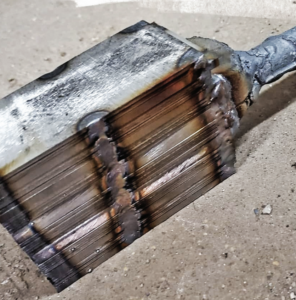
Above: A stacked billet is ready for more forging in Gabe Mabry’s shop. (Gabe Mabry image)
“An integral knife has its benefits,” offered Charlie Ellis of Eagle Crest Forge in Asheville, North Carolina. “And when done well it is very strong, with a minimal number of joints to become problems with material movement or becoming a possible breeding ground for bacteria. Also, it minimizes potential issues with wood movement. Having the joint positioned where there is the least chance of movement and using stable material is a wise choice.”
The HEXAGRAL CUSTOM MADE CHEF KNIFE
Ellis created a beautiful integral chef’s knife with a 10-inch damascus blade of 1095 spring and 15N20 nickel-alloy steels in a radial laddered W’s pattern, and an “S” grind for less resistance in the cut and better food release. The handle is African blackwood with silicon bronze and G-10 fittings. “It’s big but light for its size and balanced perfectly for a pinch grip,” Ellis explained.
The knife is fashioned in a distinctive style Charlie calls the hexagral. “I call this design the hexagral as a nod to my friend [and ABS master smith] Haley DesRosiers, who makes octagonal-shaped integrals she calls octagrals. With the hexagral, the integral bolster is shaped in a hexagon, both in cross-section and, quite challengingly so, on the faces.
“Compared to typical hidden-tang construction that is limited by the spine thickness, an integral can have a truly robust tang. Also, with this knife, the tang runs through to be bolted and capped on the end so that if for some reason the ep- oxy failed, there is a mechanical connection keeping it tight.
“So,” he continued, “while there are some practical bonuses to an integral, I would have to say that what draws me to them, and why I choose to make them the most, is their artistic potential. Seeing the pattern condensed in the bolster and then flowing out into the blade is always one of my favorite parts. Between that and the sculptural aspect of the transition between the blade and handle, there are so many interesting possibilities. I al- ways get excited with each new integral I create.”
Brent Stubblefield of Join or Die Knives in Richmond, Virginia, finds the challenge of integral construction one of the most appealing aspects of the undertaking. “Integral-construction chef’s knives are special because the production meth- od cannot be counterfeited,” he reasoned. “Standard stock removal processes can- not be used to make them, and machining processes, while an art unto themselves, cannot produce the flowing patterns that a forged damascus blade can.”
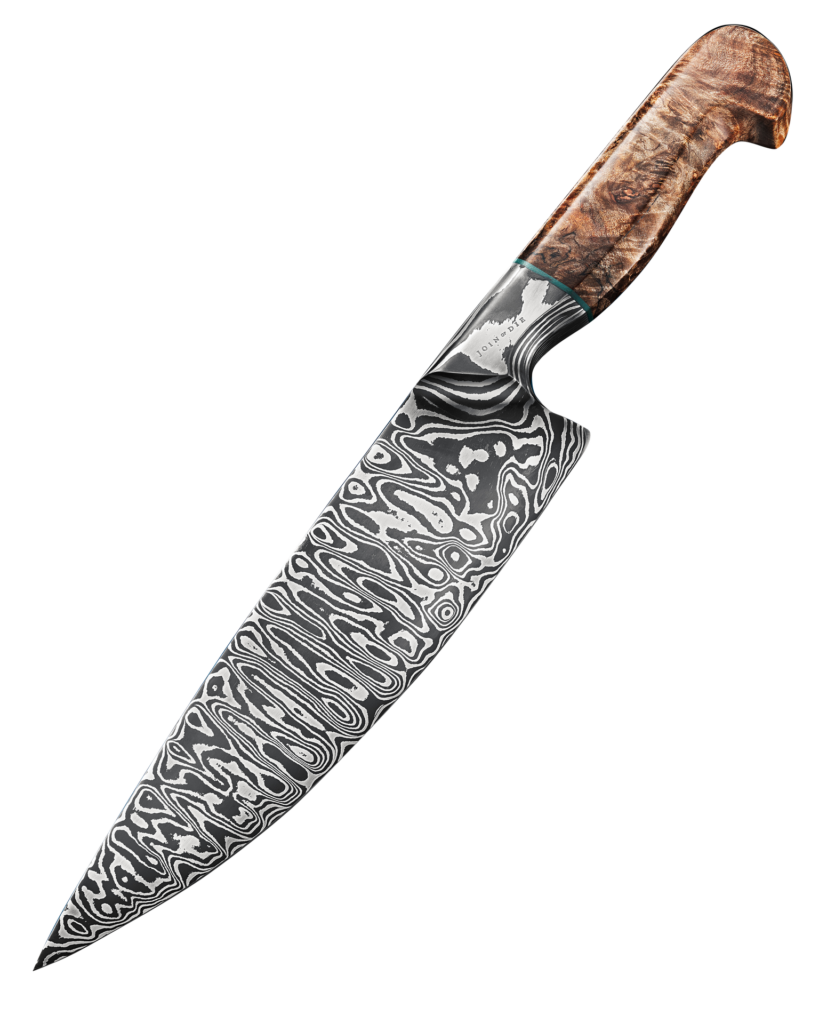
Brent Stubblefield’s chef’s knife features an “S” grind with hollow ground “cheeks,” while the cutting edge is flat ground up to about one-half inch above the edge to assist in food release. Depending on the pattern, Brent’s price for a similar knife ranges from $850 to $1,500. (Caleb Royer image)
For Stubblefield, the integral’s functional advantage lies in the flow of the handle, its uniqueness and strength rather than any perceived upgrade in edge performance. Integral construction, he says, should provide a blank canvas for the maker to use any shape or geometry desired. In this case, the style does not inherently improve edge geometry but al- lows for infinite possibilities.
“Larger stock must be used for integral construction,” he explained. “I usually use at least 1-inch round stock and, when making damascus, I leave the stock at 1 inch by 2 inches, plus the desired length. There must be enough thickness to leave material for the bolster and tang as well as drawing them out, and there must be enough blade material to draw the heel back toward the handle. In considering integral. hidden-tang-with-guard and full-tang knives, each has its pros and cons Quality material plus excellent fit and finish bring those differences down to the level of nuance. The standout advantage of the integral is the strength of the seamless connection of blade and bolster.”
“A WELL-EXECUTED INTEGRAL WILL HAVE IMPECCABLE BALANCE AND DESIGN FLOW THAT SEEMS INTUITIVE.” -GABE MABRY
Brent’s chef’s knife has an 80-layer ladder pattern damascus blade forged from 1084 carbon and 15N20 nickel-alloy steels. The blade features an “S grind with hollow ground cheeks while the cutting edge is flat ground up to about one-half inch above the edge to assist in food release. The Virginia maple burl handle is fashioned in the style of French Sabatier chef’s knives with extra wood at the end to help balance the longer blade. A G-l10 spacer provides a subtle accent.
“Integral knives have fewer seams when built in a hidden- tang fashion, he added. “There are no inside corners where handle or bolster material terminates. So, the integral may be easier to keep clean and free of food particles. Although we do our best to seal our handle material to the tang with epoxy, there is always a possibility of liquid intrusion, So, the more seams around the tang, the more chances of infiltration. I’m building knives with the intention for multiple lifetimes of use, so I prefer any advantage for longevity.”
ADDED STEEL MASS
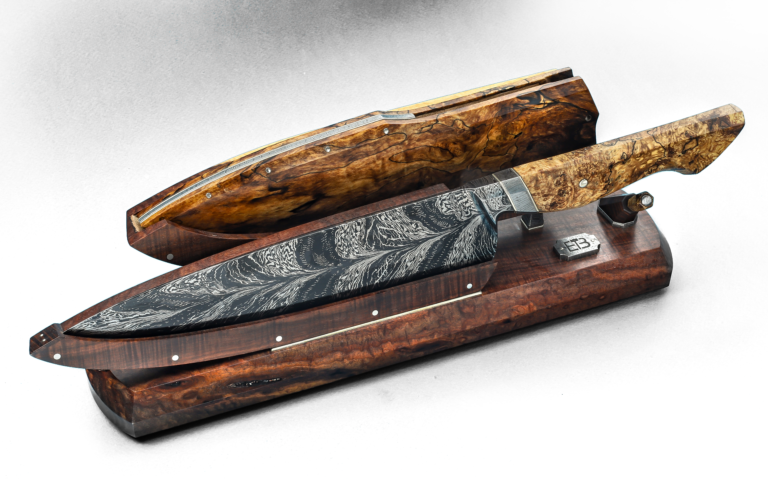
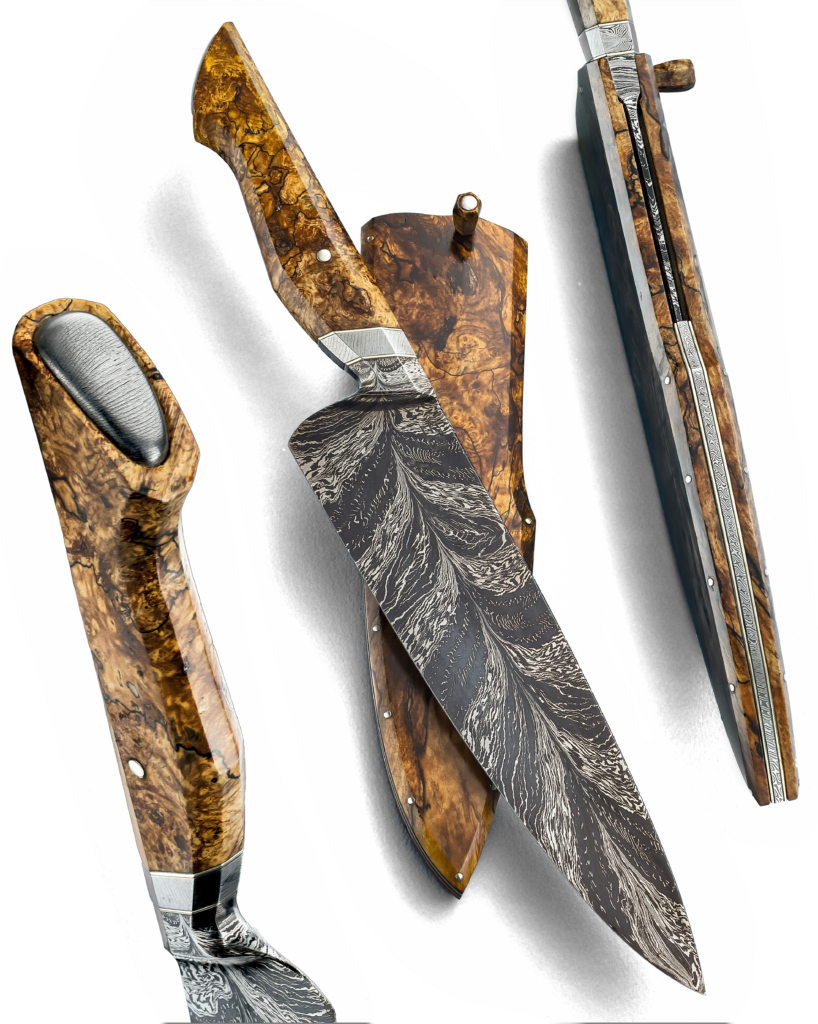
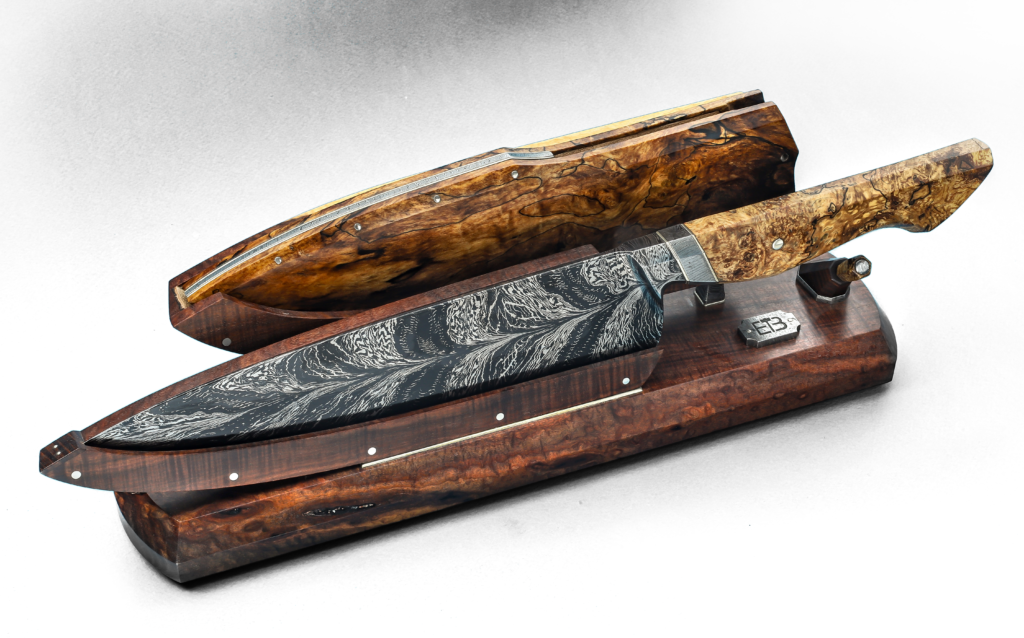
Jason Ellard of Coningham, Tasmania Australia, built a mosaic integral chef’s knife with an 8.86-inch blade of feathered damascus in 1084 and 1SN20 steels, spalted sassafras burl handle with a domed pin and twist damascus inlay, and an accompanying sheath in frame construction and nickel-silver and twist damascus to match the spacer. Overall length: 14.76 inches.
Jason Ellard’s mosaic integral chef’s knife boasts an 8.86-inch blade of feathered damascus in 1084 and 15N20 steels. Overall length: 14.76 inches. Jason’s price for a similar custom made chef knife: $7,000. (SharpByCoop image)
“The forward angle of the bolster- blade transition allows for easier stone sharpening,” remarked Jason. “Handle spacers are made from nickel-silver and twist damascus with broken edges for a nice feel. The handle also has proven edges, which help with stopping a hard ridge at the transition if the wood ever swells or shrinks. I carved out a recess to allow the bolster to fit inside the sheath, and the stand is ringed gidgee with damascus pegs raising the back portion and a nickel-silver plate under the front section. The sheath pin has a twist damascus inlay and its own designated holder on the stand. Lastly, I created a mosaic damascus logo plate pinned onto the base of the stand.”
Ellard approaches integral construction with a full understanding of its difficulty. “It takes a lot of skill in every aspect of creating it,” he observed, “and even more so to do it well. The forging, grinding, symmetry, handle fitting, and hand finishing are all a lot more difficult to do than other constructions, and it’s a major staple of a skilled maker to do this with a high level of quality. I person- ally just enjoy making integral knives a lot more. I find it more pleasing to the eye, and I enjoy the added challenges in creating them, allowing me to show what my skills are capable of.”
The stand for Jason El- lard’s chef’s knife is ringed gidgee with damascus pegs raising the back portion and a nickel-silver plate under the front section. The sheath pin has a twist damascus inlay and its own designated holder on the stand. Jason created a mosaic damascus logo plate pinned onto the base of the stand. (SharpbyCoop Image)
According to Jason, the added steel mass of the integral will always make the knife more solid and heavier than other types. Performance is a key attribute, though other kitchen knives are comparable in many ways. “The performance shouldn’t be affected negatively or positively as long as the knife is made correctly,” he noted. “The lack of a hard 90-degree at the ricasso in a hidden-tang knife can make cleaning a lot more difficult. It also makes it easier for debris or moisture to get into the handle. With the integral construction moving the seam further back, it takes these issues away very well. I’ve also found it easier to get a tight fit against an integral bolster than a hidden- tang ricasso.”
Integral construction in a chef’s knife adds another dimension to the artistry that is custom knifemaking. In fact, an appreciation of the skill and execution of the integral may actually push the chef to new heights of culinary creation.
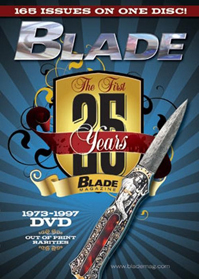
So I was working behind the table at the book booth during the BLADE Show this past weekend in Atlanta, a great show, by the way, best ever. And this gentleman was interested in buying the “First 25 years of BLADE Collection: 1973-1997” DVD. He said he already owned the DVD that came after it, “BLADE 1997-2007.”
He replied, “I can get 25 years worth of the magazine for $42.99, why would I want to pay $21.98 for one year?”
She said, “The subscription is new magazines, not old magazines, that’s why!”
It got me thinking that neither one of them was wrong. I prefer to get my magazine when it comes out, but to each their own. And I’m just glad they enjoy the magazine well enough to have the conversation.
Les George Leans On His Decade Of Service In The Marines To Guide His Knifemaking Philosophy
A veteran of the United States Marine Corps and the Iraq War, knifemaker Les George loves vintage military fixed blades and collects, designs, and reproduces them on a regular basis.
About four years ago, Kershaw asked him to design a folding version of one of his military favorites.
“It’s hard to translate from fixed blades to folders,” he noted but he went ahead and designed one based on the M3 trench knife. Kershaw made a prototype from the design—sold today as the XCOM—and sent the knife to Les. Today, the XCOM sells for $53.99 and is well reviewed on the Kershaw site.
He carried it for a while and was cutting with the folder one day when he laid it down and began admiring it. “I saw the prototype lying there and it was way cooler and much more utilitarian than I thought it would be because of the military vibe,” he said.
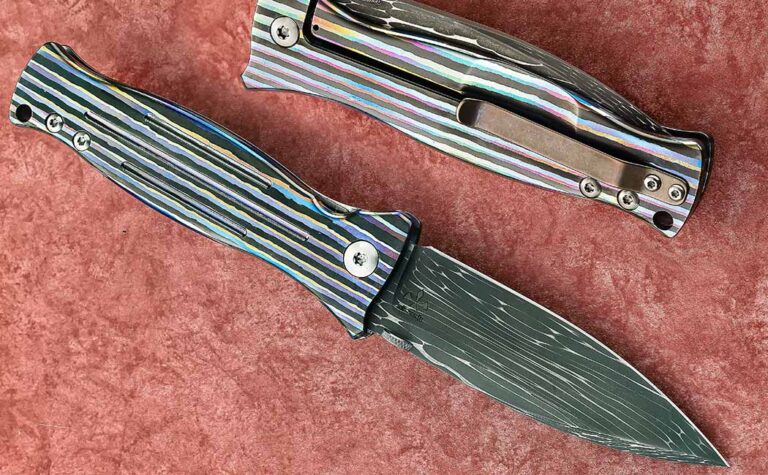
He dropped everything he was doing and made the custom M3 Folder with a blade of a stainless damascus forged especially for the knife by Chad Nichols, and a handle of Zircuti, a laminate of titanium and zirconium. The result is one stunning folding dagger.
Who Is Les George
Les George first started making knives in 1992. Many of his pieces are inspired by his 10 years of service in the Marines where he, among other jobs, worked as an explosive ordnance disposal technician. Overseeing hundreds of EOD missions has given up a unique view of how tools should be made that carries over into his knifemaking. George makes both fixed blades and folders.
M3 Folder Knife Specs
Maker: Les George Blade Length: 3.9 inches Blade Material: Chad Nichols stainless damascus Handle: Zircuti Pocket Clip: Titanium Lock: Framelock Closed Length: 4-⅝ inches Maker’s Price For A Similar Knife: $2,400
From passion to icon: celebrating 30 years of Dietmar Pohl’s knife mastery.
Dietmar Pohl is a name well-known in knife circles. More so than his groundbreaking designs, the founder of Pohl Force knives might also be known for his professionalism. On Nov. 18, the designer celebrated 30 years in the industry.
With over 100 knife designs, three books translated into multiple languages, and a reputation for innovation, Pohl has established himself as a leading figure in the world of blades.
While Pohl might be best known for his knives, such as the Magnum Colection Knife and the Böker Speedlock switchblade, he has held many roles in the industry.
Pohl started his career as marketing director, design and production manager in Solingen, Germany. Combining contemporary design with cutting-edge materials, he quickly made his mark by creating knives that balanced performance and aesthetics.
However, his interest in edged tools started well before then. His imagination was captured at 11 years old when his older brother—10 years his senior—returned from the Bundeswehr paratroopers and showed him his paratrooper knife.
While Pohl has no military or law enforcement background, he’s built his expertise through hands-on training and close collaboration with professionals in elite units like Germany’s GSG9, SEK, and U.S. Marine Force Recon.
Practical experiences, such as SWAT training in Virginia and knife combat sessions with Marine Force Recon at Camp Pendleton, have deepened his understanding of tactical requirements.
Pohl’s influence extends beyond design. His books are respected resources for enthusiasts, and his work is frequently featured in trade publications. Among his standout achievements is the MK9 Heartstopper, created for Sylvester Stallone’s final Rambo movie, Last Blood. Dubbed The Knife Guy by the film crew, this project solidified his global reputation.
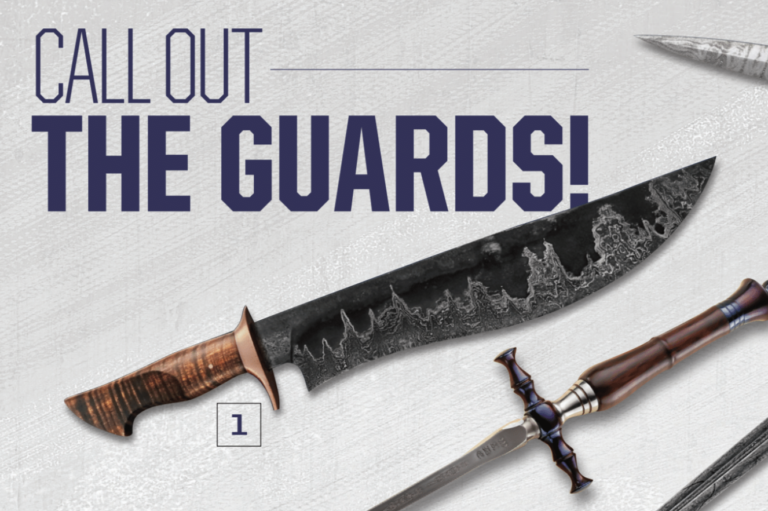
Constantly on the lookout for something that will make their knives better and stand out at the same time, many of today’s custom makers don’t hesitate to jazz up the guard.
And why not? A handsome, well-made guard adds to a knife’s looks, and, more importantly, serves as a sure safety feature in helping keep your hand where it needs to be—on the handle.
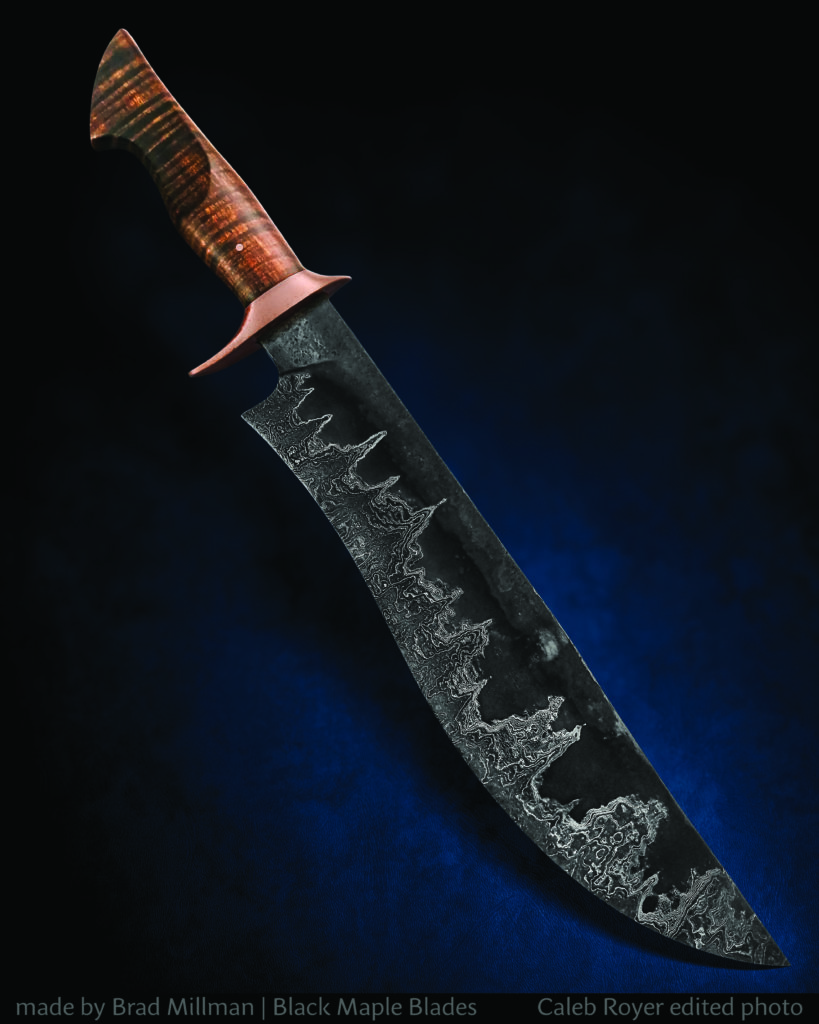
Above: Brad Millman forged the hammer-finished copper guard of his Wolftooth bowie. The 12-inch recurve blade is a san-mai construction of 360 layers of 1095 carbon and 15N20 nickel-alloy steels for the core sandwiched in a jacket of 1084 carbon steel. The bird’s-beak handle is curly Tasmanian blackwood. Overall length: 18 inches. (Caleb Royer edited image)
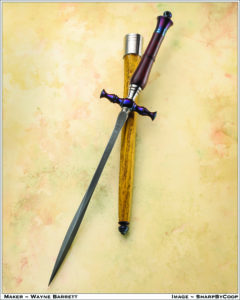
Above: Wayne Barrett heat-colored the shapely mild-steel crossguard of his 14.56-inch stiletto. The 10.6-inch blade is vintage butcher’s steel by F. Dick of Germany and features a classic triangular grind. The handle is Merino ram’s horn. (SharpByCoop image)
.
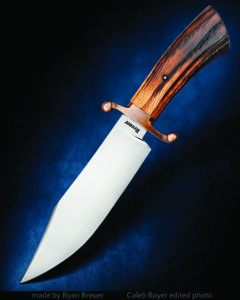
Above: It’s easy to see how Ryan Breur’s Ball-Guard Bowie got its name. The guard is cast bronze and the handle is flamed white oak with a domed inconel pin. The blade has a sharpened clip and is forged from 80CrV2 carbon steel. (Caleb Royer edited image)
Above: A stylish guard of wrought iron helps put the finish- ing touches on an ancient-walrus-ivory bowie by ABS master smith Tad Lynch. The 11.25-inch clip-point blade is W2 tool steel—a material some leading smiths consider ideal for producing a handsome hamon—and the knife is 16.375 inches overall. (SharpByCoop image)
Above: An upturned guard with a finger ring—each of hot- blued 4340HT steel—and a ladder-pattern damascus blade of 1095 carbon and 15N20 nickel-alloy steels help complete a quillon dagger by ABS journeyman smith Paul Savage. The handle is buffalo horn. (SharpByCoop image)
Above: Black mirror accent balls cap the stainless steel quillons on ABS master smith Kyle Royer’s Maiden Voyage Stiletto. The 11.75-inch damascus blade features an extra-deep hollow grind, a fuller and a reinforced piercing tip. The sculpted, fluted handle is wrapped in 24k-gold twisted wire. Overall length: 17.5 inches. (Caleb Royer image)
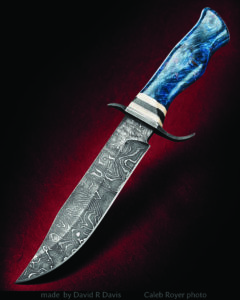
Above: The handforged nickel-silver finger guard “with curls” gives a damascus bowie by David Davis a curvaceous look. The 7.25-inch blade is pattern-welded steel forged by Alabama Damascus. Blade finish: acid etched. The handle is stabilized buckeye burl and the spacers/ liners are ebony and bone. Construction: hidden tang. Overall length: 12.25 inches. (Caleb Royer image)
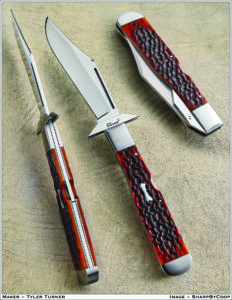
Above: Tyler Turner outfits his coke-bottle-pattern pocketknife with a folding swing guard of 416 stainless steel. The 4-inch blade is CPM 154 stainless steel in a hollow sabre grind and the scales are jigged bone. Closed length: 5 3/8 inches. (SharpByCoop image)








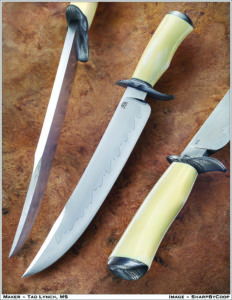 Above: A stylish guard of wrought iron helps put the finish- ing touches on an ancient-walrus-ivory bowie by ABS master smith Tad Lynch. The 11.25-inch clip-point blade is W2 tool steel—a material some leading smiths consider ideal for producing a handsome hamon—and the knife is 16.375 inches overall. (SharpByCoop image)
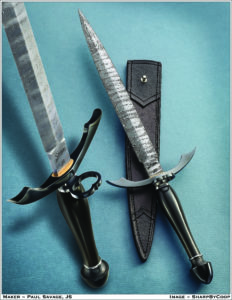 Above: An upturned guard with a finger ring—each of hot- blued 4340HT steel—and a ladder-pattern damascus blade of 1095 carbon and 15N20 nickel-alloy steels help complete a quillon dagger by ABS journeyman smith Paul Savage. The handle is buffalo horn. (SharpByCoop image)
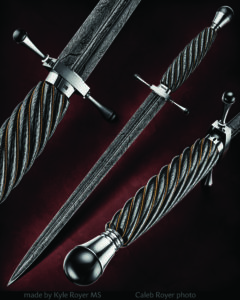 Above: Black mirror accent balls cap the stainless steel quillons on ABS master smith Kyle Royer’s Maiden Voyage Stiletto. The 11.75-inch damascus blade features an extra-deep hollow grind, a fuller and a reinforced piercing tip. The sculpted, fluted handle is wrapped in 24k-gold twisted wire. Overall length: 17.5 inches. (Caleb Royer image)