Knifemaking is the building of a knife, which includes the blade, handle and other accouterments. Blades are made by either removing metal from a steel blank via a grinder – known as stock removal – and the forging to shape of hot steel into a blade in the process known as bladesmithing. Other parts, including bolsters, guards, pommels, etc., are needed to complete the finished knife.
Knife edges come in all different styles. We break down the major types in this quick guide to blade grinds.
Cutting performance is greatly influenced by the way in which the maker grinds the knife. Each grind will have different cutting characteristics. A good knifemaker will consider whether the grind of the knife is suited to the chosen task. You as a buyer will also need to consider if the grind of a knife will suit the tasks you have in mind.
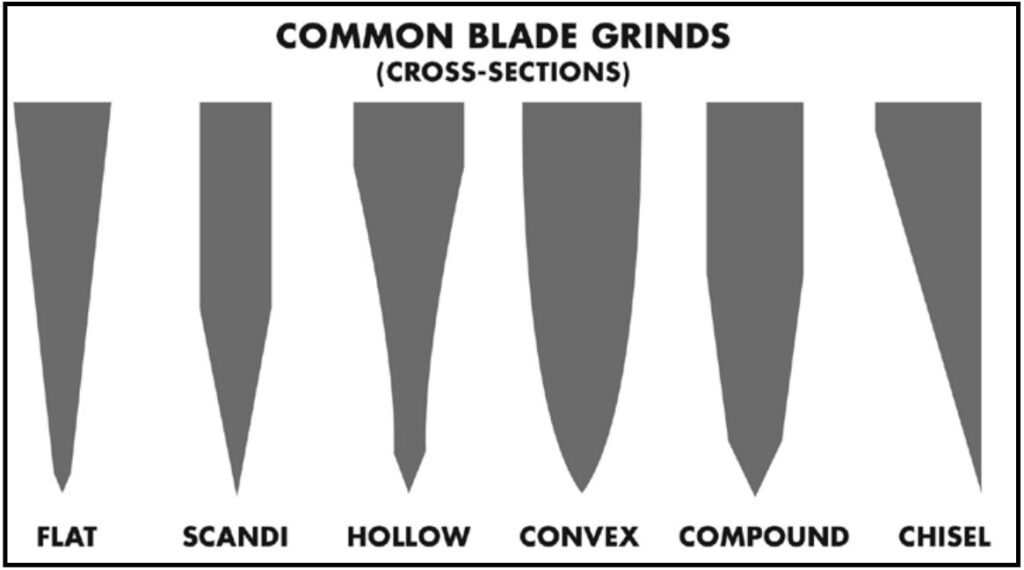
Blade grinds you’ll often come across can be seen here. (Image courtesy of Knafs.com)
Flat Grind
A flat-ground knife is a simple wedge and may be thick or thin. Flat grinds are good for slicing and deep cuts. I personally prefer a flat grind that goes all the way to the spine. A thinner flat grind will cut more smoothly than a thicker flat grind, where a thicker grind may be more durable.
Hollow Grind
A hollow-ground knife has a slightly concave bevel, which makes it thinner behind the cutting edge. This makes for good skinning and shallow cut work, without giving up overall blade heft or durability. Deep cuts or chopping are not well suited to a hollow grind.
Convex Grind
Convex grinds have slightly rounded bevels, which increases their edge stability. While they may not excel at slicing, they’re the way to go for hard use cutting and chopping.
Scandi Grind
Scandi grinds are a short flat grind with no secondary bevel. “Scandi” refers to the Scandinavian countries where that grind style is popular, especially Finland. This grind style cuts very well but can be difficult to sharpen properly.
Compound Grind
A compound grind may combine several of the basic grind shapes. Particularly on tactical and folding knives, many modern grinds are aesthetically interesting, but at the occasional sacrifice of performance. If you’re collecting for aesthetic reasons, however, these grinds could be all you ever wanted out of a knife.
Four custom makers push the boundaries of the tried-and-true cleaver.
An inclination toward the kitchen and a desire to design and deliver cutlery used on a regular basis has spurred a number of custom knifemakers to try their skill with the cleaver. It’s a staple in most kitchens and its uses are as varied as the food prepared there.
Robert Wayman of Middleburgh, New York, sees his cleavers as complementing years of food preparation. “I’ve done a lot of my own food processing, and I spent several years in commercial kitchens when I was younger,” he commented. “So, I’ve always had an affinity for culinary knives and especially cleavers. The cleaver is such an iconic blade. I love to make everything from heavy-duty butcher cleavers to medium-duty kitchen cleavers, Chinese cleavers and lighter-duty veggie cleavers for the kitchen.”
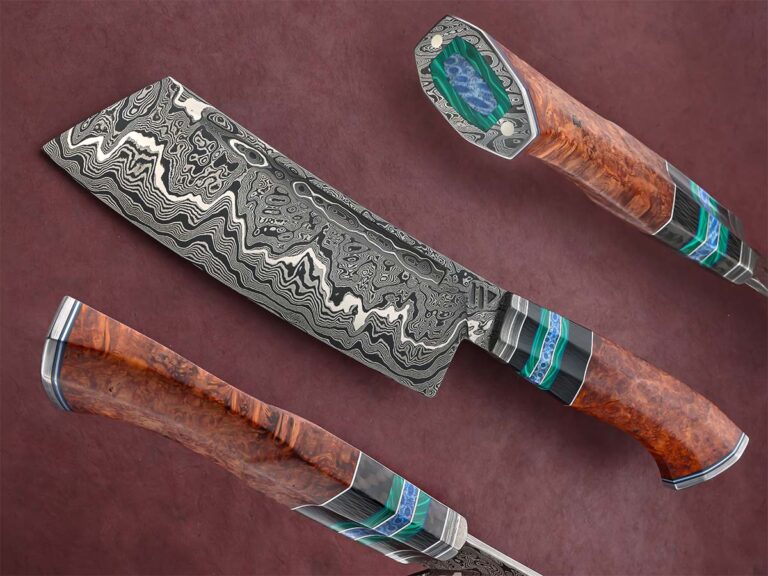
Robert’s featured cleaver is 14 inches in overall length with an 8-inch blade of pattern damascus go-mai five-layer steel. The core is a 100-layer random pattern damascus made of 1084 and 15N20 high-carbon steel and a layer of nickel and matching damascus cladding. The handle includes a damascus collar, stainless steel and G-10 spacers, crosscut carbon fiber, green malachite and blue coral accents, stabilized amboyna burl and a damascus butt cap with stainless mounting pins inset with blue coral framed with green malachite.
“I packed a lot into that one,” Wayman smiled. “As a maker, I’m all about sole authorship. I make all of my own high-carbon damascus steel in-house, and a cleaver provides a great opportunity to showcase that steel. One of my favorite things to forge is a large cleaver with an integral bolster.”
Wayman sees large blades, such as those associated with cleavers, as inherently challenging, while making a task-specific blade, such as a cleaver, adds another layer of complexity. Although they are labor-intensive and involve a lot of time in the shop, performance remains the key.
“Overall weight needs to be taken into consideration, as well as how that weight is distributed for the style cleaver you are making,” Robert advised. “Ergonomics is an important consideration for any knife or tool, but especially for kitchen cutlery. Whether it’s in a professional or home kitchen, you’re making a handle that a chef or cook could use for hours of food prep on any given day. So, it must be comfortable.”
Edgy Ebony
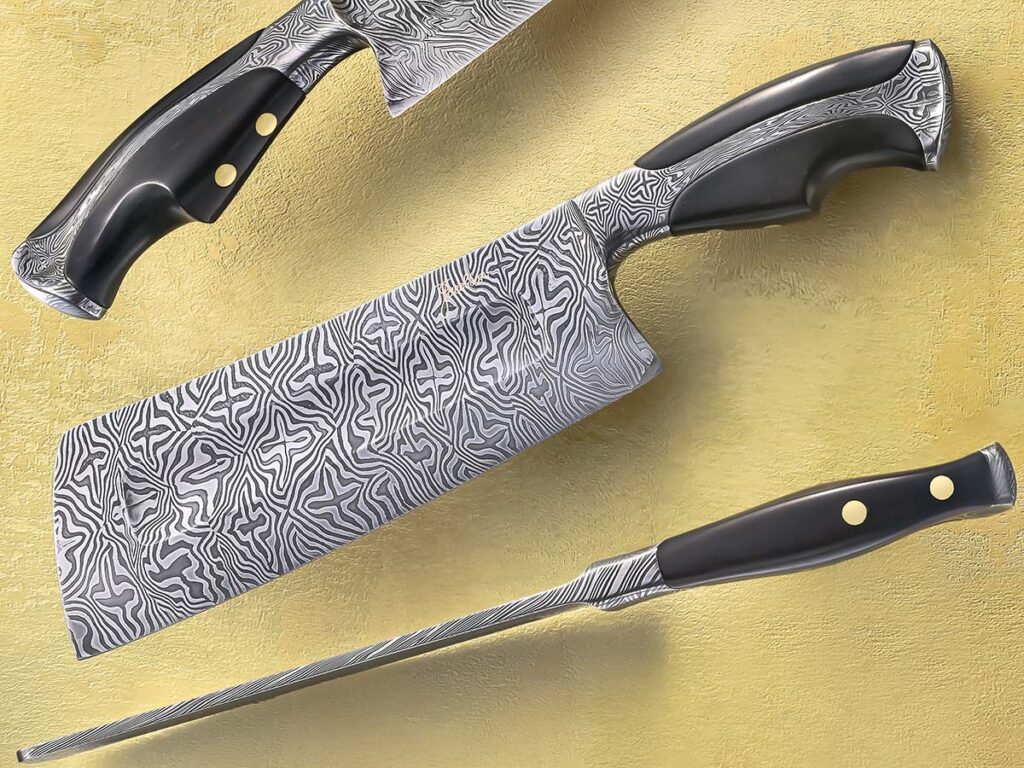
Having served time in professional food service, practical utility is never far from David Jacobson’s mind. However, he isn’t afraid of adding some flourish to his creations, such as the gold-inlay signature near the spine of his mosaic damascus bladed and ebony scaled cleaver. (SharpByCoop image)
David Jacobson’s integral 13-inch cleaver with ebony handle scales sports an 8¼-inch mosaic damascus blade of 1085 and 15N20 steels and a gold inlay signature—his first such accent. He used brass bolt pins to finish the ebony scale attachment.
“I love cooking and making cool chef’s knives and kitchen tools,” Jacobson related from his Felton, California, shop. “Edge geometry for chopping and balance are challenges, and fullers are nice when slicing vegetables for food release. Cleavers are not only for the kitchen. They are great for large fish processing at the dock, chopping through bone and restaurant back-alley butchering. The wide blade shows off the many designs in the damascus steel, and I chose a traditional profile for this particular cleaver. I’ve always liked a black handle with big brass pins—old school.”
Cutting Mustard
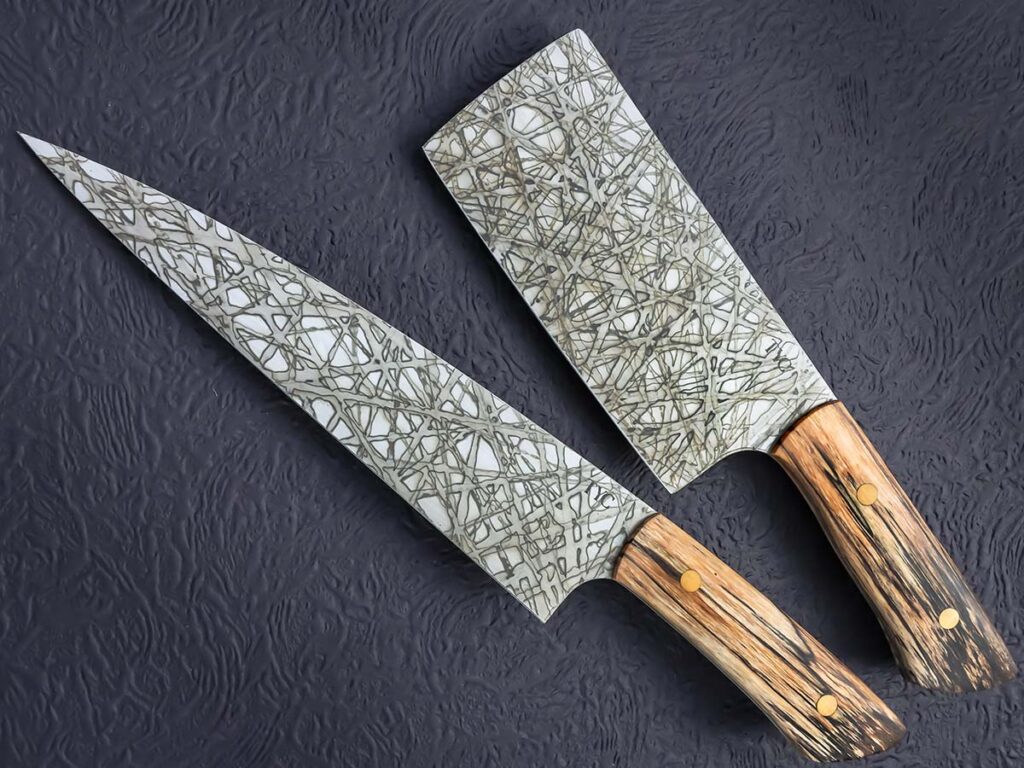
Given the amount of steel and the need to pay attention to minutia is what Bill Tyc figures steers most makers away from cleavers. Tyc achieves an intricate pattern on his cleaver-chef’s knife set through a simple mustard patina, but applied with a straight edge for a pattern he calls “Lines of Insanity.” (SharpByCoop image)
The pairing in Bill Tyc’s featured ensemble is stunning in its presentation. “The cleaver as well as the chef’s knife are made of 52100 high carbon steel from the NJ Steel Baron,” he remarked. “The handles are stabilized spalted tamarind from Wood Dynamics fastened with brass Corby bolts. The pattern on the steel is a mustard patina done with a ruler edge, hence the name “Lines of Insanity” pattern. The cleaver is 11½ inches overall with a 6¼-inch blade. It’s 3 inches tall and ¾ inches at the heel. I felt the spalted lines of the tamarind wood would look perfect with the mustard patina.”
Tyc, who resides in Waterbury, Connecticut, remembers making kitchen knives that did something no other creations had generated. He got immediate feedback from users.
“In fact, the first ‘kitchen’ knife I sold was a cleaver at the Mystic Knife Show in Connecticut,” Bill remembered. “A gentleman circled the floor three times, every time touching a cleaver I had on the table. Last pass, he picks it up and just says, ‘I’ll take it.’ My wife and I look at each other with a thumbs up, and off he goes. Well, the following year, the gentleman comes into the show, right up to my table, and says, ‘Last year I bought a cleaver from you.’ The wife and I again look at each other because we most certainly remembered. He says, ‘I have so much fun using that cleaver every day!’ I reached across the table, shook his hand and said, ‘I’ve been waiting 20 years to hear that! I could pack up and go home, I feel so good.’”
According to Tyc, many custom knifemakers shy away from cleavers because they require a lot of work. At just about any knife show, only a relative few are seen for sale. But he adds cleavers’ utility far exceeds their supposed kitchen niche, pointing out they are handy for camping, survival exercise, yard work and bushcraft as well.
“The most important things are balance and weight,” Bill observed. “A knife used as often as a kitchen knife or cleaver has to feel good in the hand, not just initially, but long term. You may find yourself using your kitchen knives for many hours through the week. You want it to be comfortable, not a labor.”
Veggies Beware
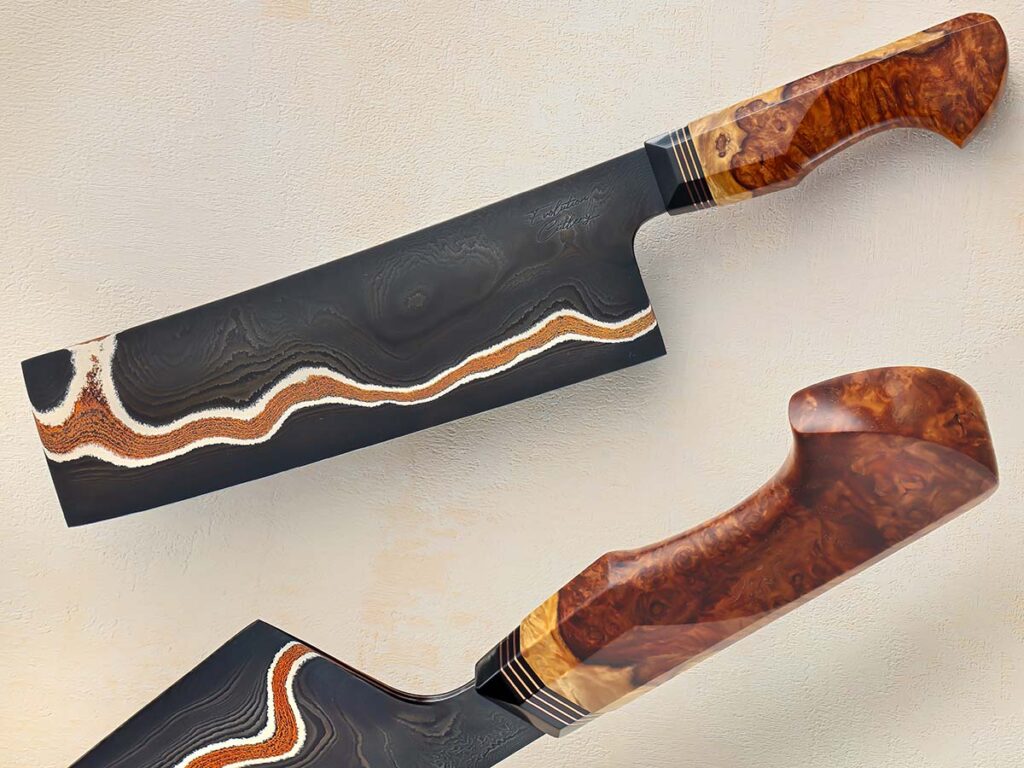
One of the unique advantages of the cleaver, Dan Tomplins points out, is the large canvas it allows for the steel. In the case of his nakiri—vegetable cleaver—its 81/2-inch copper mai blade can’t help but catch the eye, particularly with the steel’s blacked-out finish enhancing the patina’d copper. Note too, the hybrid octagonal/western-style handle made from amboyna burl. (SharpByCoop image)
In 2016, Dan Tompkins began making knives, and three years later, he started Evolution Cutlery in Highland, New York. His kitchen knife work began simply because he wanted to make cutlery used on a daily basis, and his cleaver immediately attracts attention.
“The big square profile is a great canvas to show forging skills, especially if using mosaic damascus. It allows a lot of room to see the details in the patterning,” said Dan. The subject steel is Baker Forge copper mai with a blacked-out finish and layers of patina’d copper in the nakiri, or veggie cleaver, design. The handle is Tompkins’ hybrid octagonal/western style made from amboyna burl, heirloom fit to a copper and G-10 bolster. The cleaver blade measures 8½ inches, and the overall length is 13 inches.
“One challenge in making cleavers is getting the edge geometry perfect for the intended purpose,” explained Dan. “There are many different types of cleavers, so the proper geometry is an important consideration. Heavy-duty blades require a heavy convex edge, while veggie cleavers are best with a laser-thin edge. When it comes to kitchen knife ergonomics, not only do you have to have a good feel in the handle’s shape and contour, but you also have to have proper balance to make the knife comfortable to use all day. While cleavers will almost always be slightly blade heavy in balance, they should still be balanced not far in front of the handle … Balance can make a light knife feel heavy or a heavy knife feel light. In my opinion, even a heavy knife with proper balance is far more comfortable to use than a light knife with improper balance.”
Tompkins sees the cleaver in action in varied settings, not just the kitchen. Camp chores like chopping wood or preparing food outdoors can be handled easily with a cleaver made for such adventures, and he makes the cleaver to fit the anticipated tasks.
Versatility is readily apparent in these custom cleavers, and their functionality is in lockstep with good looks driven by their makers’ creativity.
Fabulous forged knives, new smiths, new chairman top ABS annual meeting.
Some of the finest forged knives of the year, the newest American Bladesmith Society master and journeyman smiths and a brand new chairman helped highlight the annual meeting of the ABS held during BLADE Show 2024 at the Cobb Galleria Centre in Atlanta.
ABS master smith Kevin Cashen officially began his first term as ABS chairman at the annual meeting, succeeding ABS master smith Steve Dunn who passed away unexpectedly earlier this year. It was a bittersweet transfer of the office for all concerned, though a sparkling array of award knives and an impressive group of new master and journeyman smiths that includes those from Brazil, Europe, China, New Zealand and the USA were an appropriate way to greet the new chairman and pay tribute to the former one.
ABS Annual Awards
Award Winners
W. W. Scagel Award: Butch Sheely
Paul Burke Award: Robert A. Wilson
Distinguished Service Awards: Karen Cashen, Joel Worley
W. F. Moran Award: Matthew Parkinson
Antique Bowie Award, JS: Mace Vitale
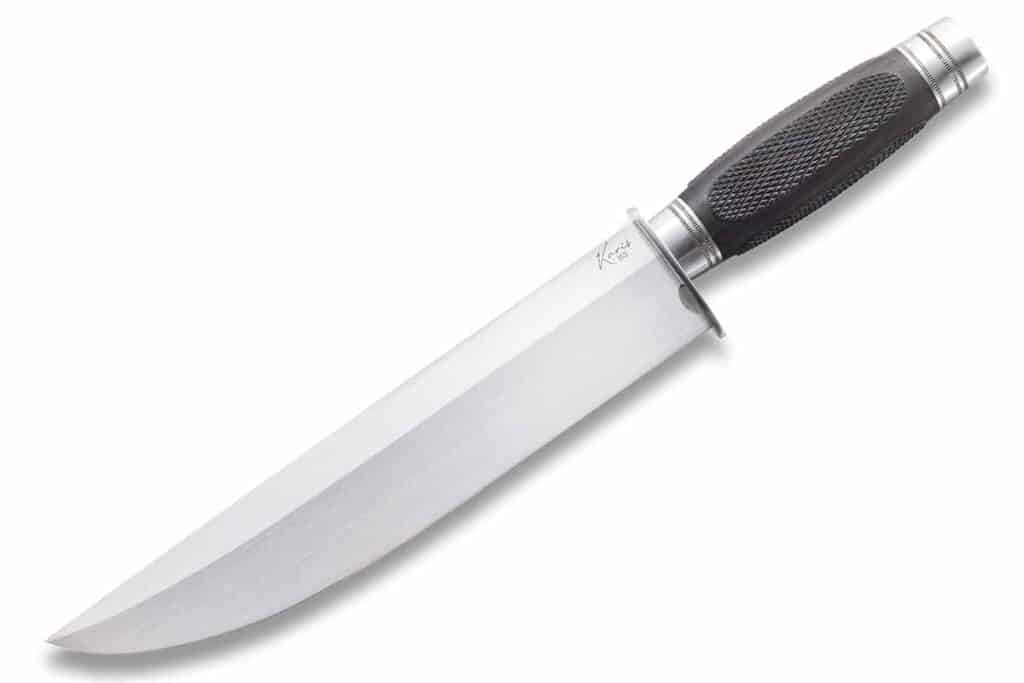
Antique Bowie Award, MS: Karis Fisher
Joe Keeslar Award: Jason Chen
B. R. Hughes Award: Fabio Barros
Chairman’s Awards: Kevin Cashen, James Rodebaugh
Fabio Barros
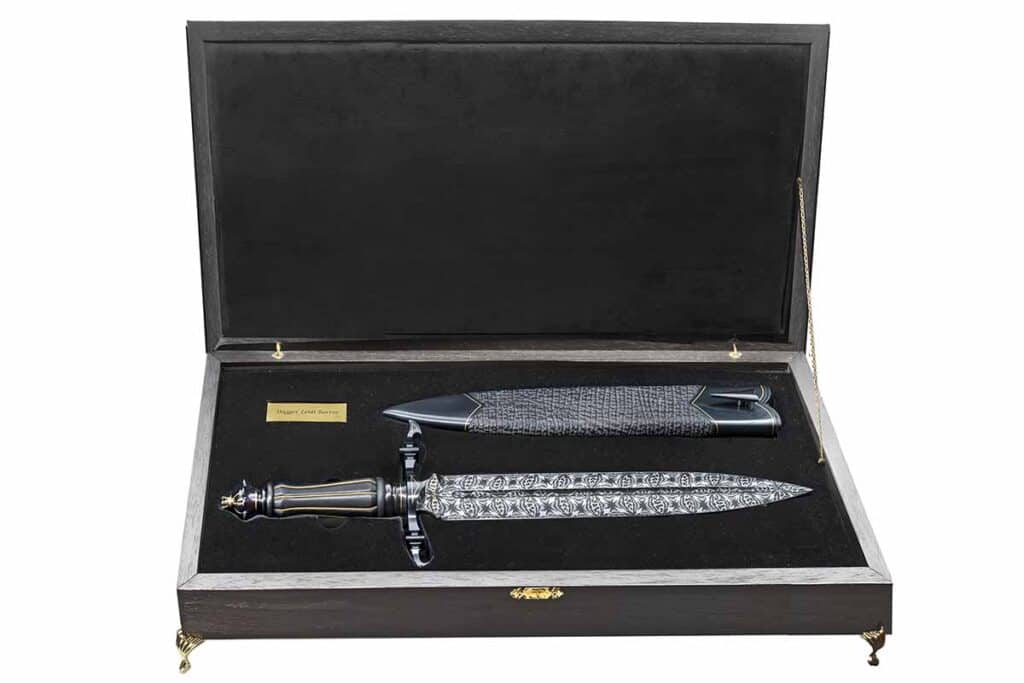
It was a weekend Brazil’s Fabio Barros probably will never forget. Not only was he the sole applicant to gain the coveted rating of ABS master smith, he also won the B. R. Hughes Award for the best knife submitted by such an applicant. In the eyes of some, that he was the only successful MS applicant might have detracted from his Hughes Award—if not for the fact that the same knife also won Best Art Knife at the concurrent BLADE Show.
B. R. Hughes Award Winner
B. R. Hughes Award Winner: Fabio Barros Knife name: Leidi Barros Dagger Maker/designer: Fabio Barros Blade material: Apricot pattern mosaic damascus w/four-sided roughing Construction: Take down Handle: Fluted ebony with gold-braid wire wrap Guard, shim and pommel: Black oxidation with gold appliqué Pommel stone: Onyx Sheath: Shark leather w/gold inlay Display: Ebony case w/exquisite finish Knife to know: The knife is named in honor of Leidiana Barros, wife of Fabio Barros; the handle design is inspired by the queen in a chess set
Karis Fisher
Karis Fisher added to her trophy case by winning the Antique Bowie Award for the best bowie in a 19th-century style by an ABS master smith. It was another feather in the cap of the young smith, who won for a reproduction of the Searles/Fowler bowie—with it being her first attempt at a repro to boot. Added Karis, “I’ve always wanted to try and make a reproduction, and I was drawn to the Searles bowie due to the mix of complexity and clean and timeless design.”
Antique Bowie Award, MS Winner
Antique Bowie Award, MS Winner: Karis Fisher Knife: Searles Reproduction Blade length: 9.25” Blade material: 52100 carbon steel Blade width: 2” Blade @ thickest: .25” Blade grind: Double ground Guard material: Stainless steel Handle material: African blackwood Ferrule and butt material: Stainless steel Ferrule and butt embellishment: Coined liners Overall length: 14.5” Special features: Half-moon cutout in blade and raised checkered panels on handle Knife to know: The knife is based on the Searles-Fowler bowie made by Daniel Searles in Baton Rouge, Louisiana, in 1828 Maker’s price for a similar knife: $2,500
The Challenge: “The most challenging part of this build was definitely the planning of the knife and trying to stay true to the original while building it solely off pictures.”
Matthew Parkinson
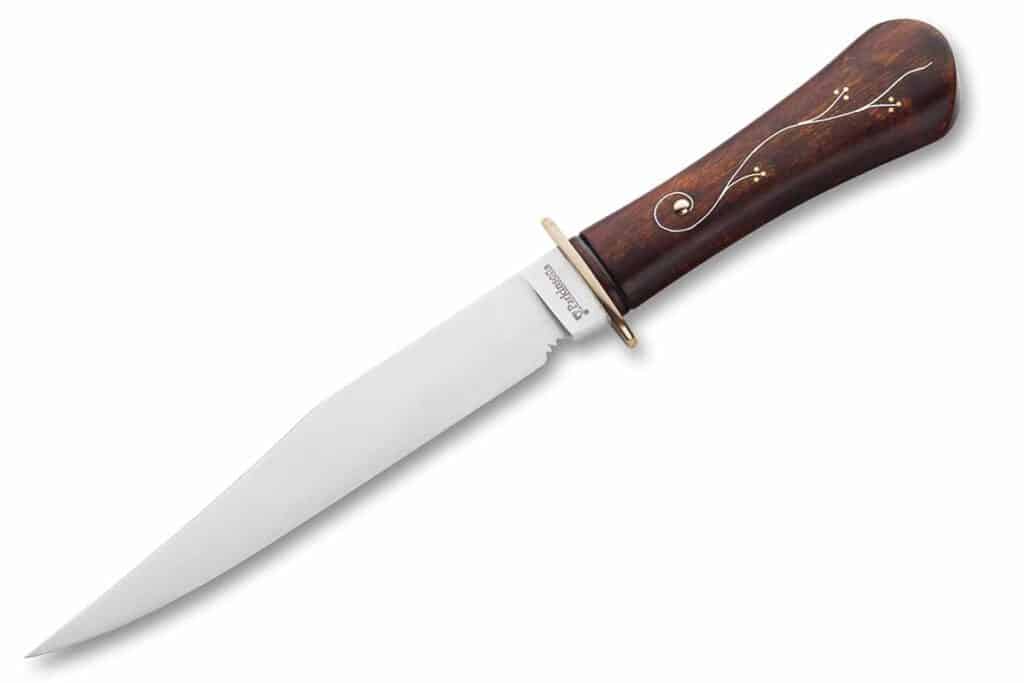
ABS journeyman smith Matthew Parkinson won the W. F. Moran Award for the best knife in the Moran style for his interpretation of a Moran fixed blade. “It wasn’t based on any one knife of his but more a general sort of impression of his body of work,” Matthew wrote. “That is to say, it is my design trying to work within his style—an interesting challenge!”
W. F. Moran Award Winner
W. F. Moran Award Winner: Matthew Parkinson Blade length: 7.25” Overall length: 12” Blade material: 1084 carbon steel Blade @ thickest: 3/16” Blade width: 1.125” Guard and pins: Bronze Handle: Maple Inlay: Sterling silver Maker’s price for a similar knife: $1,100
Maker’s remarks: “The Spanish Notch is just a detail to the choil rather than a plain rounded choil. I saw several similar examples on a knife that Mr. Moran had made and thought it might be a nice touch. The groove at the base of the handle is a carved molding. This is a detail I use frequently in knives that don’t have stabilized wood handles, as inlaid handles normally are. It helps keep a clean, even fit but still allows the wood to move, at the same time adding a nice visual feature that adds to the overall design.”
The Challenge: “I think the most challenging part of doing these is working within another maker’s aesthetic, especially one like Mr. Moran who has a huge and varied body of work. That’s the part that teaches you the most, I think. I find building one of these can give you insight into why another maker chooses one feature over another, or why a line or form is there. Those design ideas become incorporated into your own style and help you grow as a maker.”
Mace Vitale
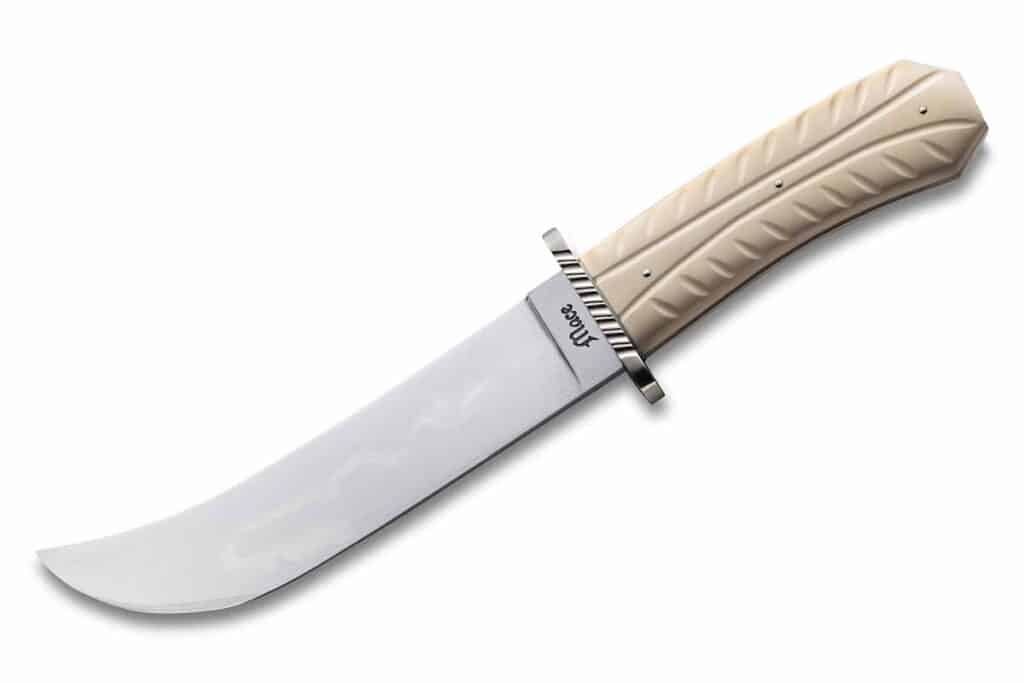
Mace Vitale captured the Antique Bowie Award for the best bowie in a 19th-century style by an ABS journeyman smith for a knife inspired by an antique piece made by Otto & Koehler of New York around 1850. The unusual knife features a markedly upturned blade tip and an ever-so-slightly downturned handle with a modified coffin-style butt featuring two carved lines and two rows of individually carved oblique divots that run its length. “The carving on the handles I’m positive were for extra grip. The knife has an excellent feel in the hand,” Mace observed. “There has been a bit of discussion as to the purpose of the original. As a knifemaker it was pretty clear to me when I picked up the original that it was very purposefully built to be a fighting knife.”
Antique Bowie Award, JS Winner
Antique Bowie Award, JS Winner: Mace Vitale Knife: Inspired by an antique fixed blade from New York makers Otto & Koehler from around 1850 Blade length: 6.5” Blade material: W2 tool steel Blade width: 1.25” Blade @ thickest: 3/16” Blade grind: Flat Fittings and pins: Nickel silver Handle: Mammoth ivory Overall length: 11”
The Challenge: “The most difficult part of building this knife was trying to keep all the parts going the way I wanted. When making a knife like this, it is put together and taken apart many, many times, and I found myself constantly putting the handle or guard on upside down. I was glad once it was done.”
Jason Chen
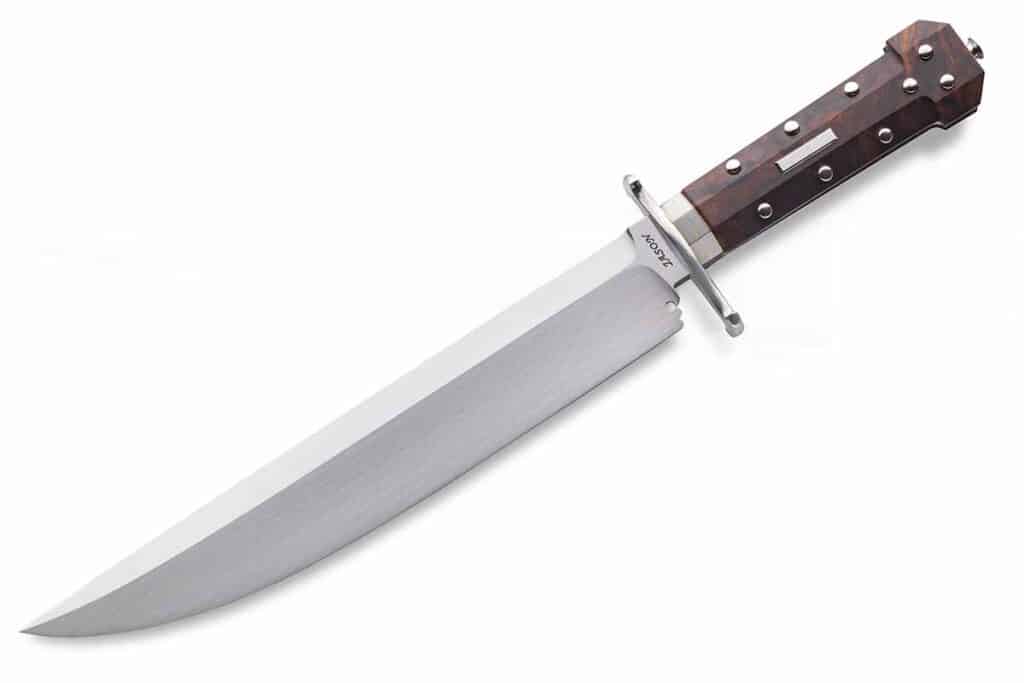
Newly minted ABS journeyman smith Jason Chen of YunNan, China, won the Joe Keeslar Award for the best knife submitted by a successful JS applicant for a spotless reproduction of a bowie not unlike the antique L. Kimball knife. The fact Jason prevailed over the best knives of 13 other successful JS applicants adds to the difficulty of his winning this year’s Keeslar Award. He is to be congratulated—as are all of those receiving top honors at the annual ABS meeting.
Newly minted ABS journeyman smith Jason Chen won the Joe Keeslar Award for the best knife submitted by a successful JS applicant for a bowie not unlike the antique L. Kimball knife.
New ABS Masters & Journeymen
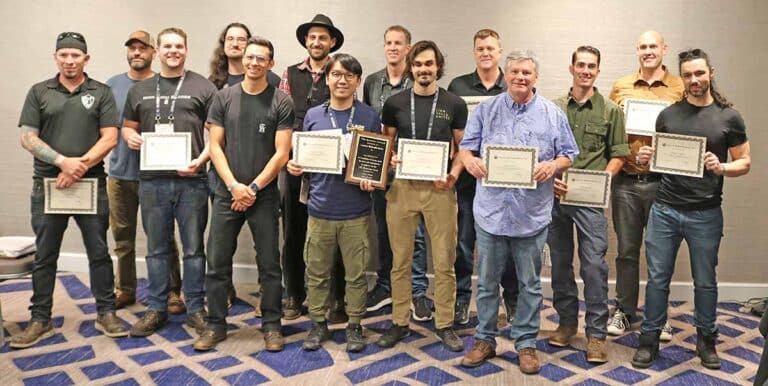
Five applicants presented for ABS master smith and one passed. Twenty-four applied for ABS journeyman smith and 14 were approved. The panels of judges were chosen by the ABS. The smiths who made the grade were: ABS master smith: Fabio Barros, Brazil; ABS journeyman smiths: Cameron Alarcio, California; Jason Chen, China; Pieter-Paul Derks, Netherlands; Zane Dvorak, Ohio; Robin Gagchian, France; Chris Gardner, Nevada; Aidan Garrity, Connecticut; Erik Greiner, Texas; Tony Lewis, Arizona; Dan Lewis, New Mexico; Tony Severio, Louisiana; Warren Thacker, Tennessee; Thiago Vidotto, Washington; and Liam
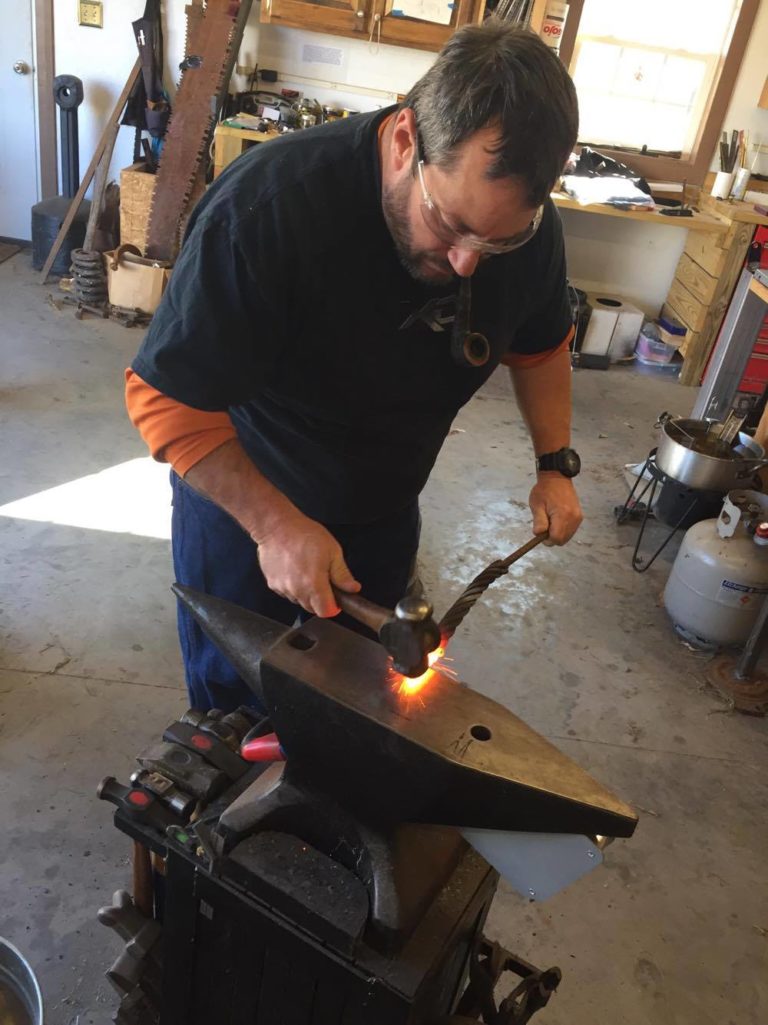
Tyrell Johnson has always been interested in knives and firearms, and two-plus years ago he decided to take a knifemaking class at Montgomery Community College in North Carolina. “As my wife can attest, I’ve had many hobbies in my life, but knifemaking immediately struck a chord with me,” he commented. “I knew right away that this was what I was meant to do, and I’ve been making knives ever since. I eat, drink and sleep knives.” Travis Daniels, of TED Knives, has been a helpful mentor to him. Tyrell does both stock removal and forging, and especially enjoys forging brut de forges.
Tyrell Johnson is a relative newcomer to knifemaking, but he loves both forging and stock removal. His 5-year plan is to retire and devote himself full-time to knifemaking.
Tyrell currently works full time as a waste treatment plant operator, but in five years he expect to retire and focus fully on knifemaking.
• Best-selling knife patterns: drop-point hunters, kitchen and filet knives
• Preferred blade steels: W2, 1084, 1095. “I love carbon steel. It has a great history and the keeness of the edge is hard to beat,” Tyrell noted.
• Blade grinds: hollow for slicing, flat for durability
• How he tests his knives: cutting paper, shaving hair, chopping wood
• Favorite handle materials: Micarta, exotic woods, burl wood, resins—“I love working with the scales produced by J Hue Customs by Tim Kipps,” Tyrell added.
• Price range: $150-$350
• Knife shows he attends: BLADE Show
• Member of: North Carolina Custom Knifemakers Guild, American Bladesmith Society
Tyrell hand-makes all his sheaths from premium 8-ounce leather or Kydex.
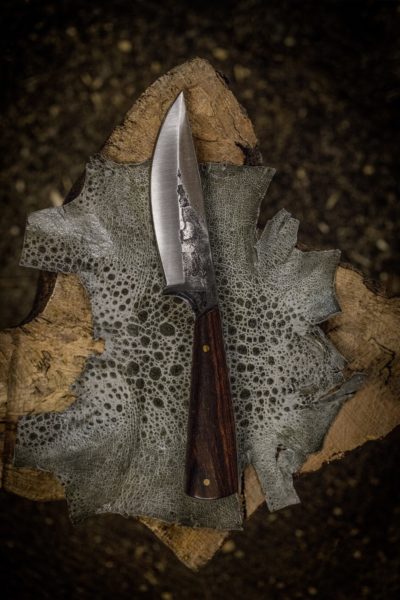
This brut de forge has a 4.25-inch hollow-ground blade forged out of 1084 carbon steel. The scales are fashioned from desert ironwood. The overall length is 8.5 inches. Maker’s list price: $275 with leather sheath. Contacts listed at the bottom of this article.
Tyrell Johnson and his wife, Lisa, sneak away for some trout fishing.
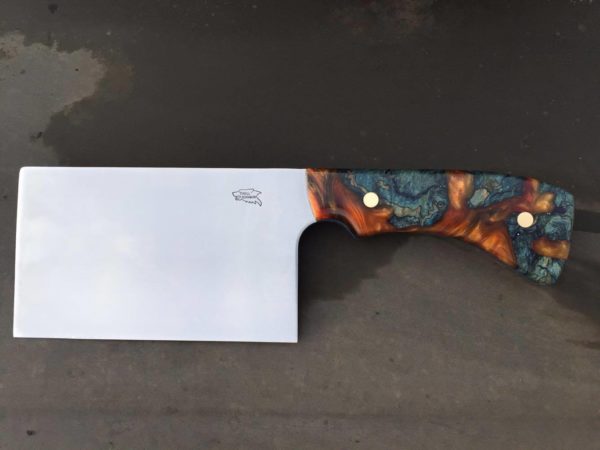
Tyrell Johnson’s cleaver has a 6-inch edge on a 3-inch wide 1095 carbon steel blade. The resin-breech wood scales were made by J. Hue Customs. The cleaver is 10.5 inches overall. Maker’s list price: $225-$250. Contacts listed at the bottom of this article.
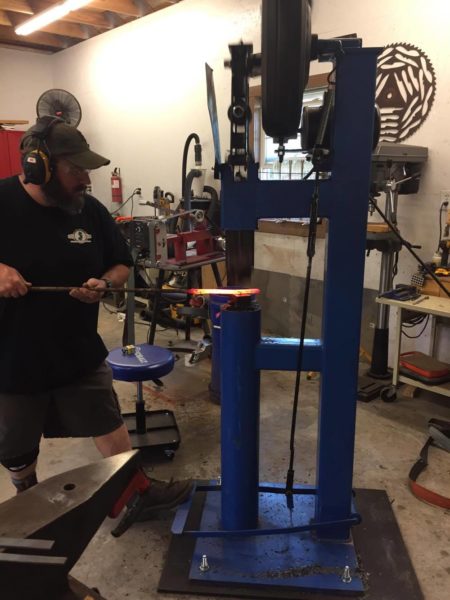
Tyrell made some san mai steel, sandwiching 1084 with mild steel. He wanted to try out his new tire hammer.
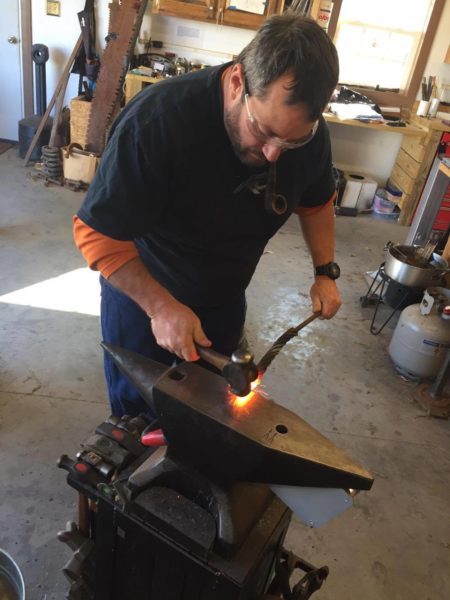
Tyrell Johnson forge-welds some cable-pattern steel in his North Carolina shop.
Tyrell made a combat knife for the North Carolina Custom Knifemakers Guild’s cutting competition last spring. The knife could not be longer than 15.5 inches overall with a maximum blade length of 10 inches. At least one visible pin had to pass through the handle, a tang was required and the knife had to have a lanyard hole with wrist lanyard and be accompanied by a sheath and zippered pouch.
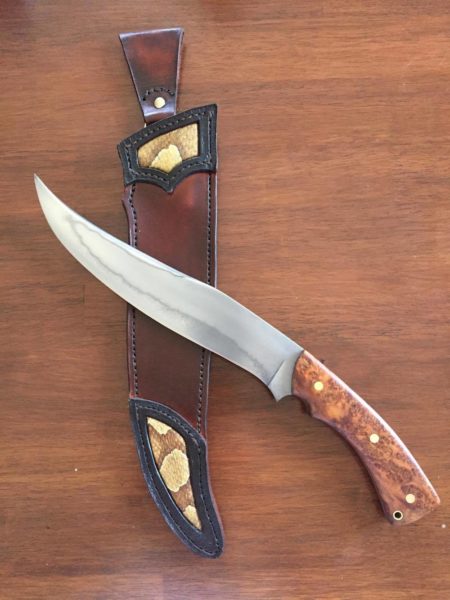
This Tyrell Johnson Knives’ Fighter was made using 1084 steel. The knife was 15 inches overall with a 9.75-inch blade. Tyrell used ambrosia maple burl for the handle. The sheath was 8-ounce premium leather with eastern North Carolina copperhead skin inset. “I personally harvested and processed” the snakeskin, Tyrell explained. Travis Daniels taught Tyrell how to make his own sheaths.
Contact Tyrell Johnson, 252-341-4791, [email protected], on Facebook at Tyrell Johnson and on Instagram @Tyrell_Johnson_Knives
A Digital Subscription to BLADE Is The Answer
You can read your digital issues of BLADE Magazine anywhere you have your phone, tablet or computer, and there’s no need to find storage for all your old issues.
If piling-up issues of magazines seems like a waste to you… If you feel like you don’t have time to read a magazine… If you like the stories we offer in BLADE, but want a more economical option, then a digital subscription is the answer. An annual subscription to BLADE is $17.98, $4 off the print price.
Mike MacInnes of Holland, Michigan, remembers his first two knives, both given to him by his dad. The first was a Buck 110 clone and the second was a Solingen hunting knife. Mike has been involved with black powder rifle hunting and gunsmithing all his life.
Mike MacInnes is a part-time bladesmith. He only makes, and therefore sells, the kinds of knives he likes to make, one of the joys of keeping making as a hobby while he holds on to his day job as a vending route supervisor in Michigan.
In 2012 he wanted to donate a knife for an auction to benefit the Michigan State Muzzle Loading Association. He called his friend Al Englsman and asked if he would help him make a Scagel-style knife. He enjoyed making the first one so much it lead to others. He advanced quickly, probably because his work on rifles aided his craftsmanship.
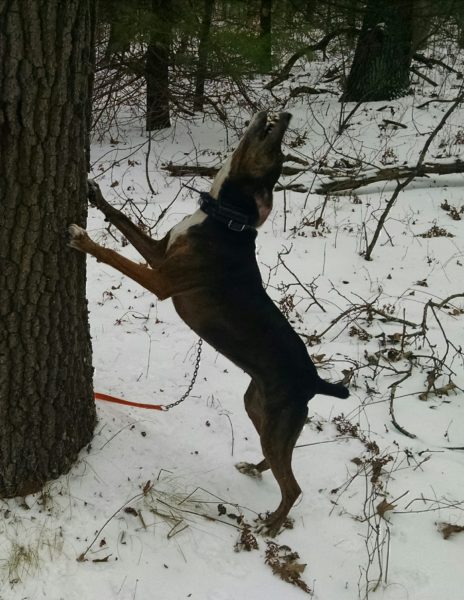
Betty is a mountain cur, dogs specifically bred to trail and tree small game or hunt and bay larger quarry.
Mike had met Al, who is a breeder of Mountain Cur, when he went to buy his squirrel-hunting dog, Betty.
Mike MacInnes and his wife, Erin, sometimes get out to Holland State Park in Holland, Michigan. The lighthouse in the background is called Big Red.
Mike is a route supervisor for a vending machine company by day, but loves his hobby. He only sells what he likes to make. He’s grateful for the influences of Bill Binky growing up, Marv Palmer and Joe Valentin. He lives near Lake Michigan with his wife, Erin, and their two children.
Best-selling knife patterns: full-tang hunter with 3- to 4-inch blade; hidden-tang drop-point hunter with 4- to 5-inch blade
Favorite blade steels: 1080; 5160
Blade grind: full flat
How he tests his knives: slice paper, shave hair, cut phone books, chop wood
Knife shows he attends: Badger Knife Club Knife Show
Facebook Groups he participates in: The Real Knife Makers of America, Knife Gods, Blade Smithing World
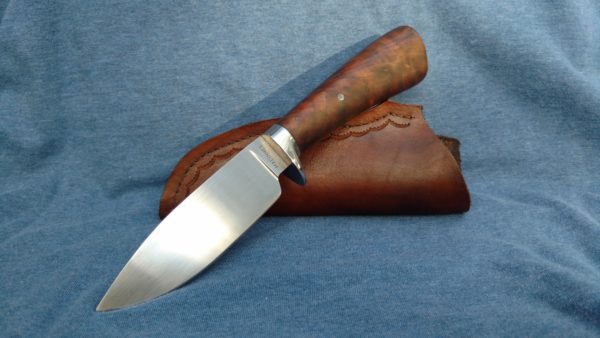
This 4 ¾-inch drop-point hunter was forged from 1080 steel. Handle is made of oak burl with black fiberboard liners. Overall length is 8 ½ inches. Pins are brass. Price is $175-$450.
Mike’s isn’t taking any more orders until he catches up on the orders he’s taken and finishes knives for upcoming shows. Follow him on Facebook though for updates on peeks at works-in-progress and finished pieces.
This hunter has a 3.25-inch blade forged from 1080 carbon steel. Its handle scales are made from bocote wood. The pins are brass. Maker’s list price: $185. Contacts listed at the bottom of this article.
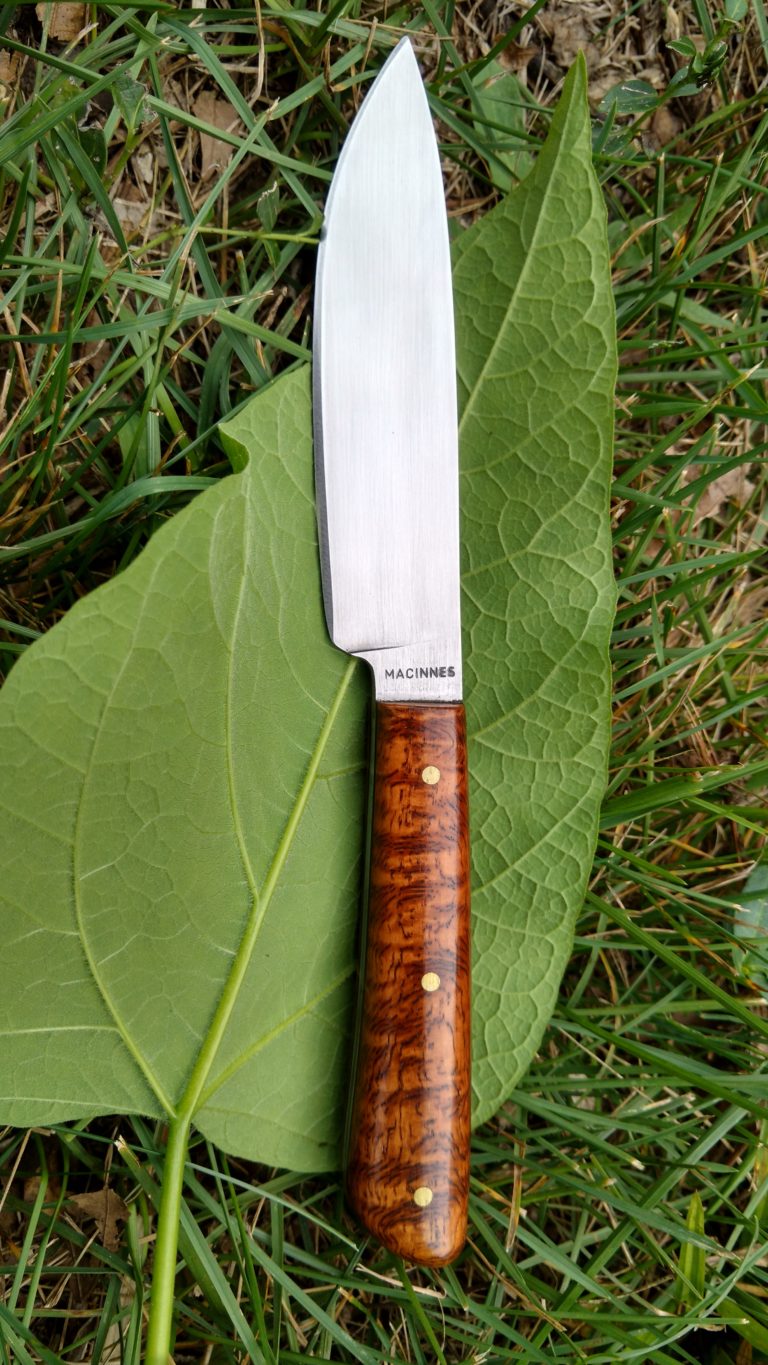
This Mike MacInnes piece was forged from 1080 carbon steel. The blade is 4 inches long with an overall length of 8.25 inches. “The handle is made of some of the nicest walnut that was even harvested here in Michigan,” Mike declared. The shape of the handle is a little thicker in the butt than he normally makes, but it felt so good he will probably do more in that style. The guard was forged from 416 stainless steel with a matching pin. The sheath was hand-stitched and -tooled by Mike. Maker’s list price: $350. Contacts listed at the bottom of this article.
You can read your digital issues of BLADE Magazine anywhere you have your phone, tablet or computer, and there’s no need to find storage for all your old issues.
If piling-up issues of magazines seems like a waste to you… If you feel like you don’t have time to read a magazine… If you like the stories we offer in BLADE, but want a more economical option, then a digital subscription is the answer. An annual subscription to BLADE is $17.98, $4 off the print price.
The Jose Santiago-Cummings BBQ Knife will rock your brisket.
Among Jose Santiago-Cummings’ growing ranks of customers are those he describes as “foodies,” and he built his second BBQ Knife expressly for them.
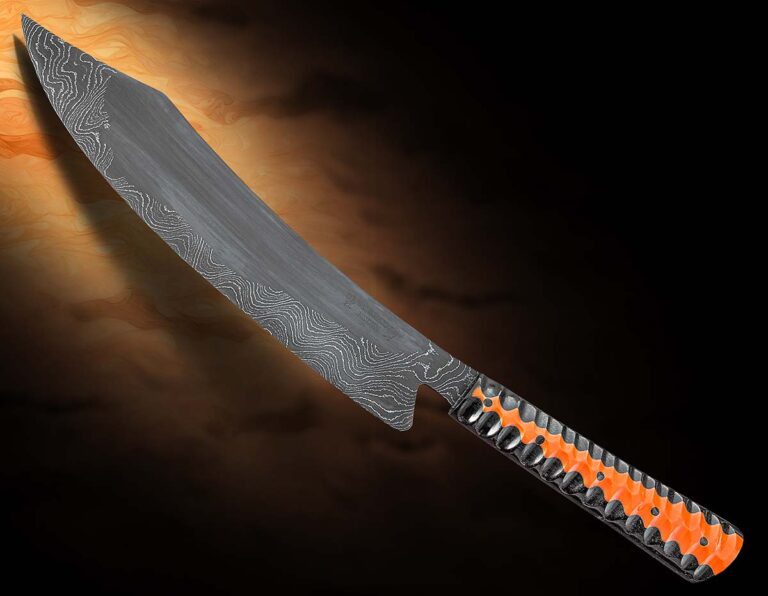
Not unlike a pirate boarding cutlass in appearance, the long, curved blade is designed for the rocking slices needed to cut meat and brisket. It’s similar to how a slicer is used as opposed to, for example, a nakiri for chop cuts.
Jose Santiago-Cummings
Jose, 62, used a cylindrical drum-sander-like attachment on a Ram tool to carve the grooves in the long, upswept handle. Jimmy Floyd forged the clip-point blade of damascus clad in wrought iron.
BBQ Knife Specs Maker: Jose Santiago-Cummings Blade length: 8.5” Blade steel: Damascus of 1084 carbon and 15N20 nickel-alloy steels clad in wrought iron Blade grind: Flat Handle: Black and orange G-10 resin Overall length: 13.25” Maker’s price for a similar knife: $450-$475
These slip joint knives overcome the mechanical challenges of the style to qualify as works of art.
The slip joint is the most recognized of any folding knife design. Variations on the theme continue to guide the custom knifemaker and the consumer through a journey of creativity and craftsmanship that is indeed endless.
The latest slip joints are true to this standard and don’t disappoint in looks or legs—easy on the eyes while walking and talking at the same time. They complement their makers’ personalities and demonstrate their skill sets in fit and finish, as well as mechanics. They provide pure inspiration for collectors and buyers alike, setting their own standard of excellence.
Standley Caldwell Five-Blade Cattle Knife
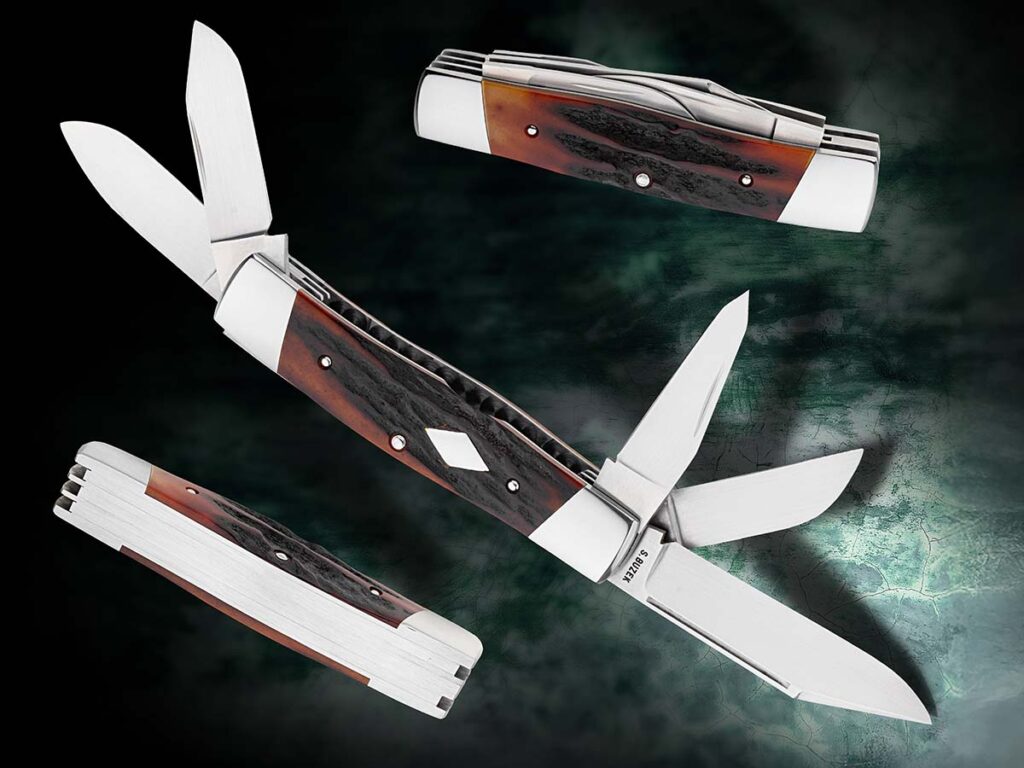
“The five-blade cattle knife is a very difficult build,” Stanley Burzek confesses. Not only are aesthetics at play, but mechanical aspects, such as the blades clearing frame and timed right, not to mention executing multiple grinds. Tackling more complex slip joints has been a natural progression for Stanley. The Texas maker began with single- up to three-blade stockmen but saw the more difficult projects as pushing his craftmanship to the next level. (Jocelyn Frasier image)
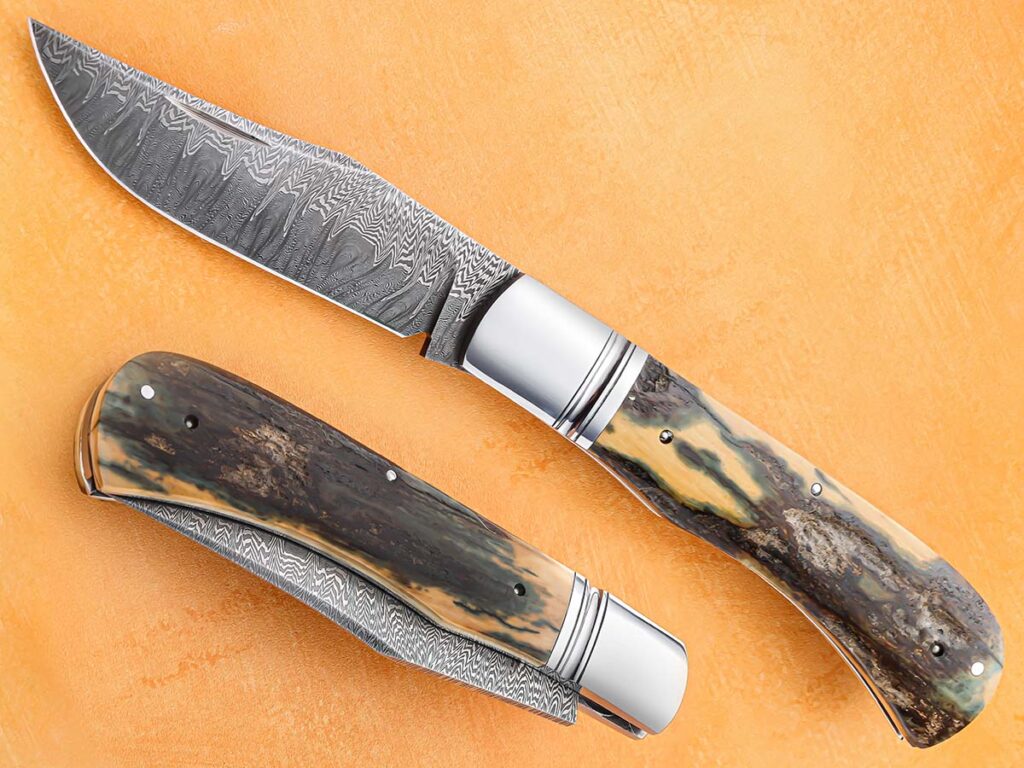
A slip joint maker for 18 years, Stanley Buzek of Caldwell, Texas, brought a beautiful five-blade cattle knife to life recently. Featuring a CPM 154 hollow ground blade with 416 stainless integral bolsters and liner, along with stag handle scales, the knife was a particular challenge.
“The five-blade cattle knife is a very difficult build, getting all the blades timed and working properly with everything flush in all positions,” Stanley explained, “and getting the blades to clear inside the frame in such a small area. The multiple offset grinds and the dagger grind of the awl blade make it especially challenging.”
Tackling the cattleman works right into the increasingly difficult projects Stanley has pitted himself against—even if it was a daunting proposition. “The five-blade was just a natural progression from the single-blade trapper, two-blade, three-bladed Stockman, and so on, to push myself to the next level of knifemaking,” he confided. “Actually, the hardest part was just getting over my fear of screwing it up and getting started on the build. It is an intimidating knife to build, having to pack so much into such a small area that you can paralyze yourself with the fear of getting started.”
Buzek got the pattern for the five-blade from Tim Robertson. He drew inspiration from the work of Tony Bose, whom he credits with bringing the pattern back. He has also seen photos of Reese Bose’s take on the pattern.
“I have received help from many great makers through the years,” Stanley reflected. “Bill Ruple and Rusty Preston were a huge help, and the South Texas Slip Joint School that I went to back in 2011 really increased my knowledge in how slip joints actually work. Right now, a lot of credit goes to Tim Robertson for pushing me and helping me with problems and us bouncing ideas off each other.”
Buzek makes all his slip joints with integral liners and bolsters accompanied by jeweling on the interior. He prefers slanted bolsters while gravitating toward natural handle materials such as jigged bone, mammoth and stag. “I think the single-blade slip joint will be the most popular for a long time for ease of carry and ease of build in the custom world,” he predicted. “Multi-blades, though not as popular, will push makers to step outside their comfort zone and show collectors and the general public alike the technicality and perfection and precision at which some of these pieces are made and will help makers improve their overall methods.”
Ted Friesenhahn Two-Blade Trapper
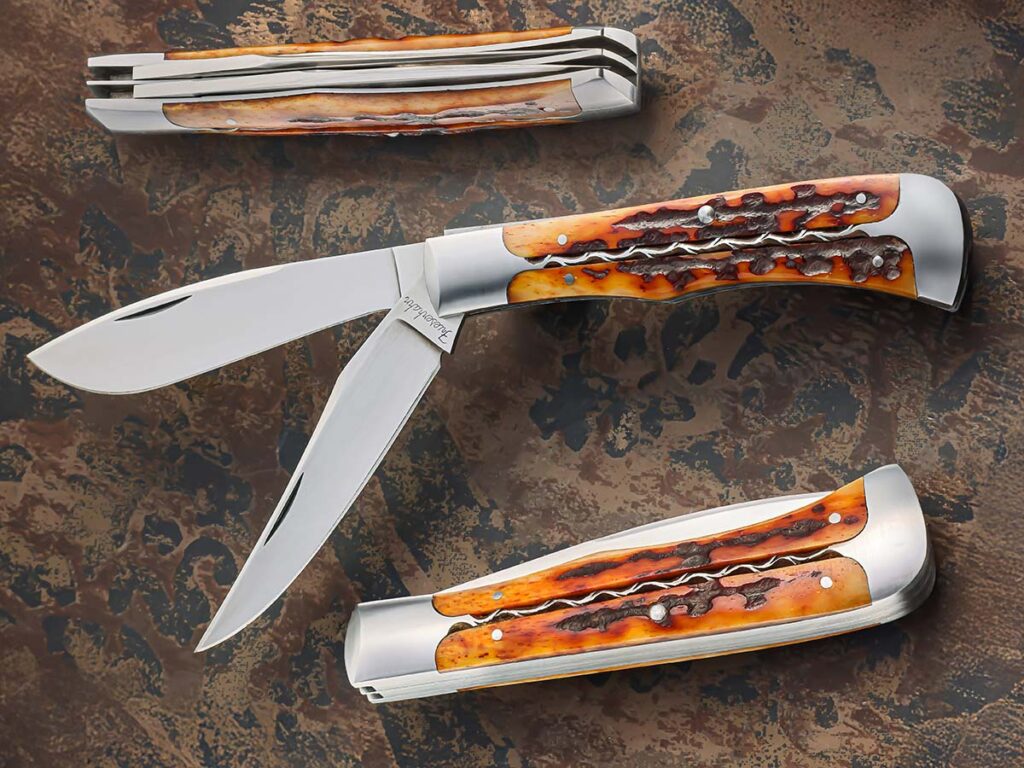
Like most custom makers, the most challenging aspect of the slip joint for Friesenhahn is getting the rise and fall of the blade correct. Add in embellishments, like the delicate vine filework down the center of his trapper’s handle, and the project becomes a taxing undertaking. (SharpByCoop image)
When Ted Friesenhahn took up the task of making his two-bladed trapper, he chose to make the second blade a “simmy” skinner. “This is the most popular slip joint, especially in Texas,” said the resident of Seguin, who has been a toolmaker since the age of 18. “I’ve worked in several different tool shops and have had the pleasure of teaching mill classes at hammer-ins.”
For his trapper, Ted chose a hollow ground blade of CPM 154 with a 416 stainless steel frame and bolster and a jigged bone handle. He added, “All of my knives have integral liners, and in this knife, the center is left standing. I have had this idea in my head for a while before I finally did it. I wanted something different and to be able to embellish it, so I chose to do vine filework.”
The most difficult aspect of the slip joint for Friesenhahn is common to most custom knifemakers—getting the rise and fall of the blade correct and flushed at closed, half stop, and open positions. “Of course, the walk and talk are key after all that fit and finish,” he said. “My first knife was an Old Timer Stockman that I had when I was growing up in the country. I have always carried a pocketknife, so like most makers and knife enthusiasts in this area, I had heard of Bill Ruple.
Ted Friesenhahn in his shop.
“Many years ago now, Johnny Stout and [ABS master smith and BLADE Magazine Cutlery Hall of Fame® member] Harvey Dean put on a hammer-in at Johnny’s shop in New Braunfels, Texas, where I first met Bill Ruple,” Ted continued. “He was teaching the slip joint classes, and he had a jig he came up with to measure the rise and fall of the blade and spring. It came to be called the Ruple jig … I still use this jig on every knife I build.”
Interestingly, Friesenhahn sees variations on patterns as emerging in popularity. “The current direction is in patterns being turned into different patterns,” he said, “in multi-blades like the stockman lockback whittler and sowbelly whittler. There seems to be a craze with the whittler, and of course, I have one of these variations in the works.”
Bill Burke Single-Blade Trapper
“This knife came about as a class demo for slip joint folders that I taught at Jim Poor’s Flatland Forge in Tuscola, Texas,” said Bill Burke of his single blade trapper, with a 3-inch stainless damascus blade and blacklip mother-of-pearl handle scale. (SharpByCoop image)
Master smith Bill Burke of Boise, Idaho, recently produced a handsome single-blade trapper with a hollow ground 3-inch blade of stainless damascus steel, blacklip mother-of-pearl handle scales, and 416 stainless integral bolster and liner.
“This knife came about as a class demo for slip joint folders that I taught at Jim Poor’s Flatland Forge in Tuscola, Texas,” said Bill. “The pattern for the class was the ever-popular large single-blade trapper. I added my personal preferences of filework and bolster fluting to this knife, as well as incorporating a piece of Jim Poor’s waterfall pattern damascus into the blade. The only guide I had was a pattern drawn on a piece of paper and e-mailed to me by Luke Swenson.”
Burke has found the most challenging aspect of the slip joint to be mechanical, sharing that observation with other makers. “The most difficult part of any slip joint, at least for me, is getting the timing right so that the spring is level with the frame/liners in all three positions, closed, half stop and open, while also keeping the end of the spring even with the end of the tang in the closed position,” he commented.
“I made my first slip joint folder in about 2001,” Burke continued. “It was a large trapper like this knife. I traced a friend’s knife on a piece of paper and used calipers to measure the dimensions of the tang. This knife was made because I had carried a slip joint pocketknife with me since I was about 5 years old. I can remember sharpening a pencil for a first grade teacher with my pocketknife.
“Over the years, I continued to make slip joints, and they did get better,” he observed. “But I always struggled with the spring timing. Fast-forward 16 years, and a friend of mine from Australia, [journeyman smith] Bruce Barnett, and I went to visit the maestro of the South Texas Slip Joint Cartel, Bill Ruple. We were at Bill’s shop for four days making slip joints. While there, Bill taught me the proper use of the Ruple jig, that little contraption he had put together to make timing of a slip joint something of a science instead of a swag. This little bit of knowledge changed my slip joints from being functional to well-working tools that I am proud of. Bill Ruple and Luke Swenson continue to motivate me to make better slip joint knives.”
As a master smith and forger of knives, Burke sometimes takes on that dimension completing the slip joint. “The only challenge is forging the steel, whether damascus, carbon or stainless, which is not commonly forged,” he advised. “Most people who do forge do not actually forge folder blades but instead forge the steel and then stock remove the blade from the forged steel. There are some who will forge damascus folder blades to get a specific pattern of damascus to follow the curve of the blade shape. This can be seen in the knives made by Owen Wood, Tim Foster, [master smith] Mike Quesenberry and a few others.
“I have forged san mai and damascus folder blades to shape when circumstances made it necessary but do not commonly do so,” Burke concluded. “The challenge making a slip joint knife from forged materials in my opinion is no different than doing stock removal with the possible exception of san mai blades and springs where careful attention has to be paid to ensure the hard core of blade and spring line up precisely so the components stay in alignment, keeping the spring from wandering off to one side of the blade. If this happens and is not corrected, eventually the bolsters will be forced apart and the spring will continue to wear on one side of the blade making the knife useless.”
Bubba Crouch Single-Blade Trapper
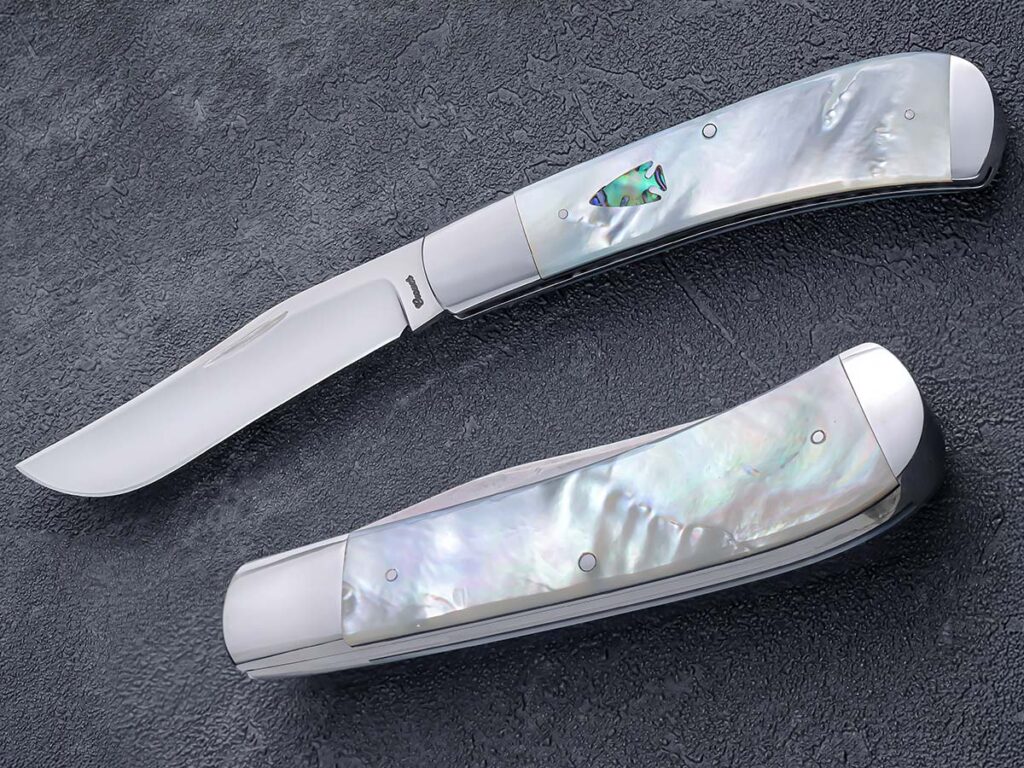
Bubba Crouch points to the influence of Slip Joint Cartel icon Bill Ruple in his career. More than anything, Ruple taught him to “make the next knife better than the last one.” Crouch’s pearl-handled trapper demonstrates that the knifemaker has taken this lesson to heart. The natural scale presented concerns in chipping, shattering, and even burning. (SharpByCoop image)
Bubba Crouch has been making knives in Pleasanton, Texas, since 2001 and lives just down the road from his friend and mentor Bill Ruple. While Ruple is the leader of the South Texas Slip Joint Cartel, Crouch is a founding member and revels in the lively exchange of ideas and the friendly banter that it provides.
Ruple’s influence is pervasive among slip joint makers, and Crouch is no different. “Bill taught me everything I know about knives,” commented Bubba. “I guess the most important thing he has taught me is to make the next knife better than the last one. That is hard to do!”
Recently, Crouch completed and sold the featured single-blade trapper to a resident of Philadelphia. His available knives sold out in two days during the last 10-day Las Vegas show, and the demand for his work is on the rise. This particular trapper features a 3¾-inch hollow-ground blade of CPM 154 stainless steel, an integral 416 stainless steel frame, and handle scales of pearl with an abalone arrowhead inlay.
“I do all 416 integrals,” Bubba noted. “So, I mill my liners instead of spot welding or soldering, and I have had a lot more luck keeping them flat and even. That makes a better knife, I think, and the integral frame prevents issues with warping and that type of thing.”
The biggest challenge in creating this trapper came with working in pearl, a natural material that presents concerns in chipping, shattering, and even burning. When working with the pearl, Bubba uses a thin liner material glued to the surface to stabilize it, and with the final grind, he removes the liner material while shaping the pearl to fit the handle space.
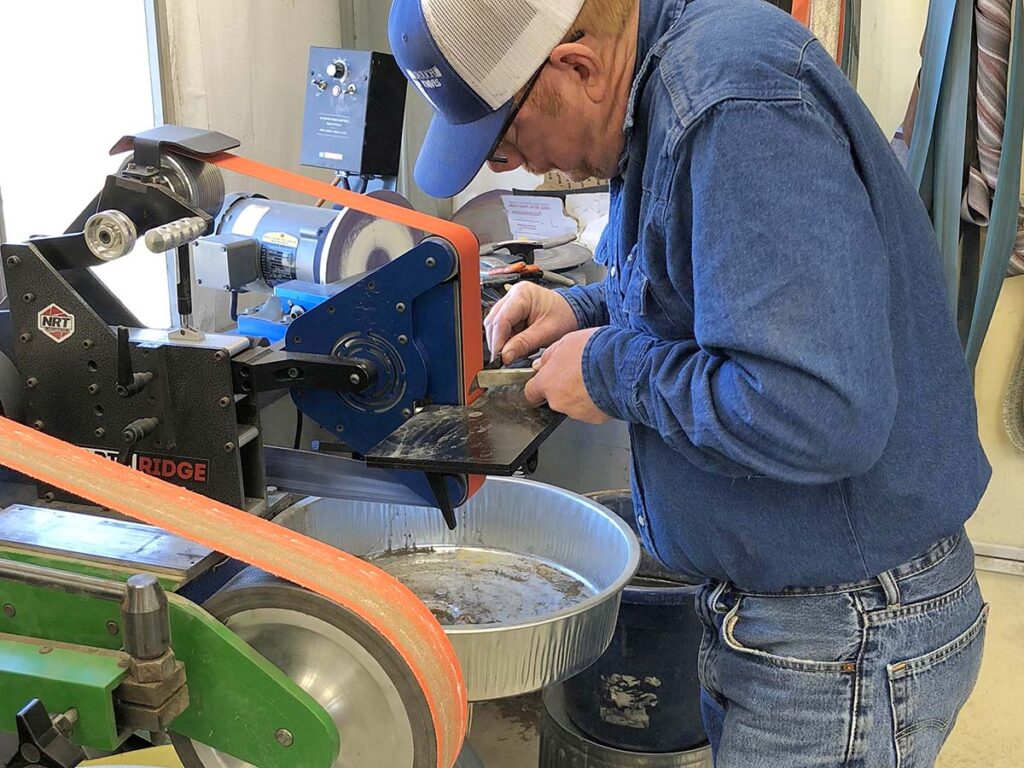
Bubba Crouch at his grinds a blade.
“If you look at the pearl on some knives, you can see a yellow edge from the heat sometimes,” he said. “I fit the pearl in the handle and then remove it, shaping it to the bolster to avoid the heat before putting it back in. When I’m sanding the pearl, I wet sand, and when I drill, I squirt water on it after starting the hole.”
The abalone inlay gives Bubba’s trapper a distinctive flair, and the process of inserting it is relatively simple. “I have a pantograph machine and use templates to cut the abalone and cut the pocket for it in the pearl,” he said. “You’ve got to be careful and don’t want to pop it in and out too many times. I drill a hole through the pocket that is pretty small and comes out the liner to test fit.”
Crouch enjoys building what he likes, and for now, that is the single- and two-blade slip joint. Multi-blades don’t have great appeal. “My clientele is the everyday carry guy,” he concluded. “So, I build those knives. I don’t see the slip joint market getting soft. It’s traditional and will stay stable. It’s what your grandpa and your dad carried, and as long as there are memories like that, there will always be a market for the slip joint.”
Demand doesn’t seem to waver with the slip joint, and today’s makers are eager to oblige the marketplace.