Knifemaking is the building of a knife, which includes the blade, handle and other accouterments. Blades are made by either removing metal from a steel blank via a grinder – known as stock removal – and the forging to shape of hot steel into a blade in the process known as bladesmithing. Other parts, including bolsters, guards, pommels, etc., are needed to complete the finished knife.
“I have been thinking of making a hidden-tang knife with a blade made by one of the companies that advertises in BLADE®. However, that leaves a problem. Most of the blades in question have either a small tang, which causes a possible stress point, or a traditional-shaped tang that seems very short. Which is better and why?
“I also have seen hidden tangs cut out of full-tang knives; how can this be done without affecting the temper?”
~Anonymous knifemaker
Answer
Let me start with the second question about converting a full-tang knife into a stick-tang- or a so-called hidden-tang knife without affecting the temper. If this is what you would like to do, it certainly can be done without damaging the blade or losing the temper.
While most factory-made blades are fully heat treated, tang and all, you do not need to be so worried about softening the tang. This area could just be spring hardened. But, as you know, it is very important to not let the heat travel up into the blade and soften it.
You will need a bench grinder or a belt sander, or you can even use a disc grinder. Any will do. Whichever machine you happen to have or choose to use, the main thing is to not overheat the material while working it.
To ensure this, you will need to use a coarser grinding stone or a new sanding belt not higher than 60 grit. A fresh new belt is essential for the operation. The sharper the belt, the less friction/heat will occur. A duller belt will create a lot more heat.
Another thing to watch for is to not apply a lot of pressure when you are grinding. Again, the more pressure, the more heat.
Besides using a sharp belt and light pressure, after each pass on the grinder be sure you cool off the blade completely by dipping it in cool water. If you want to get fancy, you can place the blade on a piece of dry ice to cool it, though it is not necessary to go to such lengths.
One obstacle when converting a full-tang knife into a hidden-tang one is the pin and glue holes. The size and placement of the holes will dictate the shape of the tang and obviously the handle shape as well. Consequently, you are limited as to what you can do.
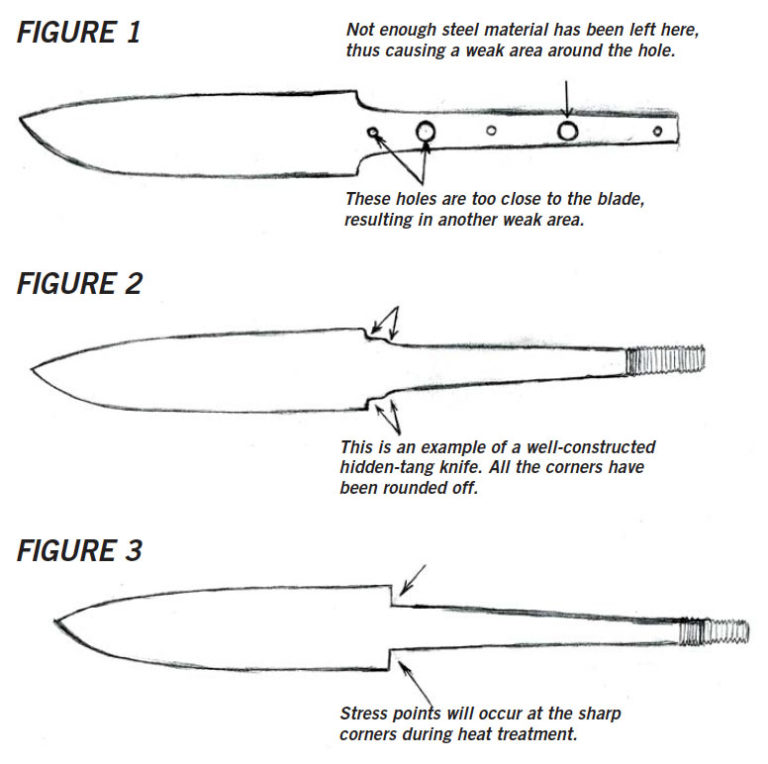
One last thing to watch for is to not grind too close to any of the pin or glue holes because this will be the fault or weakest point of the knife. (See Figure 1.)
As for your first question, both the hidden-and full-tang style of knife construction have been serving mankind for hundreds of years, so I would not consider one more traditional than the other.
Concerning which type of tang is better, it is up to individual preference. The properly prepared tang, either full or hidden, will perform well. A well-constructed hidden-tang knife should have no stress points. (See Figure 2.) A stress point can occur during heat treating if the juncture where the blade and tang meet has sharp corners. (See Figure 3.)
This juncture is where you need to pay more attention and take care to avoid creating sharp corners and edges. A full-tang knife also can have stress points if the drilled holes are not slightly countersunk to eliminate sharp edges.
You mentioned that some of the tangs appeared short in the advertisements you have seen. They say a picture is worth a thousand words, but sometimes a picture does not do justice or give you a true measure of the proportions of the subject.
While checking out all the pictures and blade designs available, you may have missed the information written under each picture. Each picture has the overall size and the blade size. If you take away the blade size from the overall size, you will end up with the exact measurement of the tang.
I am happy to hear you are going to try making a knife from a kit or a factory-made blade. Everyone needs to start somewhere. Maybe it will lead you to try making your own knives, too.
Learn More About Knifemaking
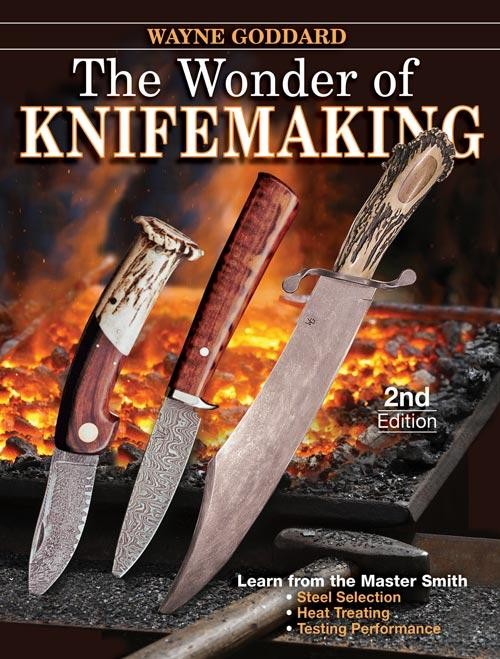
Wayne Goddard’s book makes knifemaking a wonder to behold.
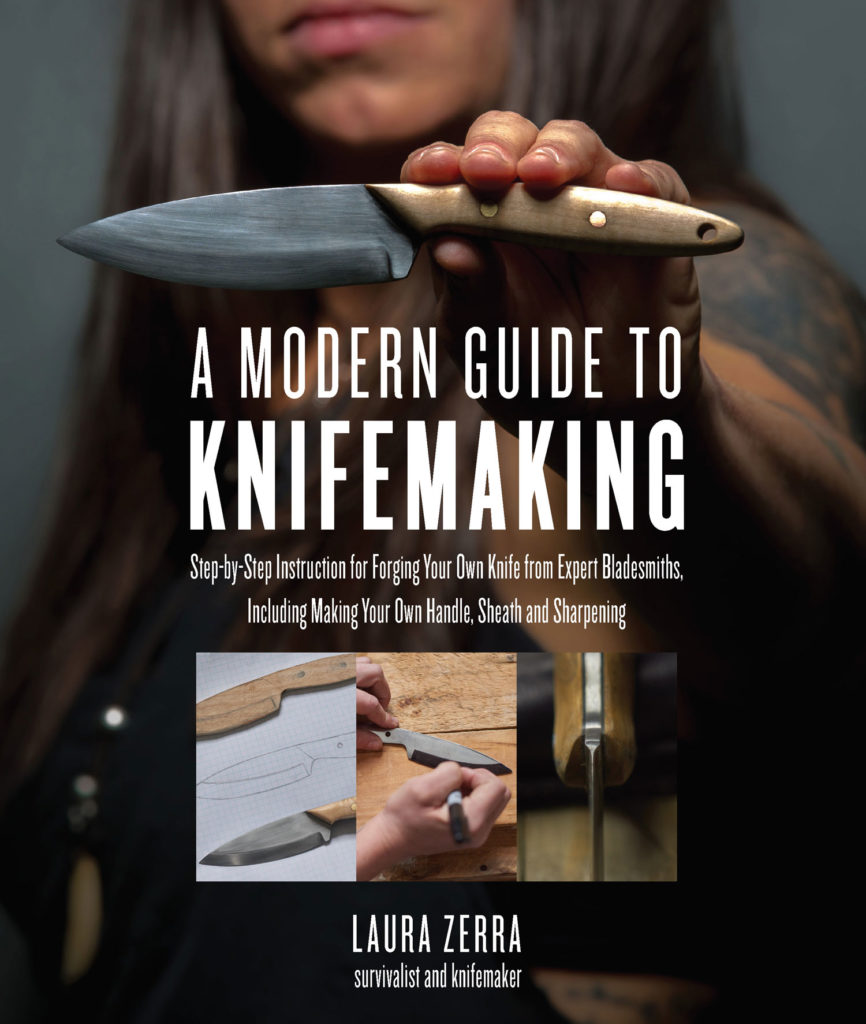
Fresh from an extended stay in the wilderness, Zerra talked with BLADE about knifemaking, survival knives and the biggest mistake people new to knifemaking make.
BLADE: Most people know of you through Naked & Afraid. Did you get into knifemaking after appearing on that show or was this something you were always practicing?
LZ: I used to be a farrier, so I got my first introduction to knifemaking through blacksmithing. I used to mess around with steel in the forge, and that led to trying my hand at making knives. As a survivalist and outdoors person, I’ve always had a love for knives, and starting to make my own was a natural progression.
What spurred you to write your new book, A Modern Guide to Knifemaking?
I was working on outlining a survival book, and my editor saw that I’d just been at BLADE Show. We talked about the possibility of me writing a book on knifemaking. I’ve always loved knives, and have been in numerous situations where my life literally depended on my blade. I’ve also been humbled by all the legendary knifemakers I know, and I don’t have the expansive years of experience and talent that a lot of them do.
The thought of writing a book on knifemaking was really intimidating at first, but I realized that my perspective would allow to me to write a book that could really break it down for a beginner, and that my relationship with knives as a survivalist could offer some unique insight. Knifemaking is one of those skills that everyone does a little bit differently, so I wanted to interview some experts in the field and have them offer their two cents, as well.
Can someone with little knifemaking experience pick this up and go at it?
I wrote the book that I wish I’d had when I first started knifemaking. I wanted someone with absolutely no experience to be able to pick up my book and be able to make their first knife, from start to finish. While I do talk about what has worked for me in my experience, I think knifemaking is personal. I really wanted to encourage the reader to experiment with different processes as well as designs to develop their own style and find what works for them.
What’s your philosophy when it comes to knifemaking?
As a survivalist, first and foremost, my knives have to be functional and durable. A knife has to be able to complete the tasks I need it to, and I don’t want to have to worry about it breaking or losing an edge quickly when I’m depending on it for my survival. That being said, I don’t think that means it has to be unattractive; I think a functional knife can still be beautiful, and a skilled knifemaker can complete both these objectives.
Zerra says she prefers working with 1095.
What are your favorite steels to work with?
I like working with 1095 steel. I find it easy to move with a hammer, and it holds a great edge with a good heat treat. But I have to admit, I’m a sucker for damascus carbon steel. Well-made damascus really does well with that balance of function and beauty. I just love the moment of pulling it out of the etch and seeing how the pattern has played out on the steel.
What’s the biggest mistake people make when first starting out making knives?
I think the biggest mistake people make is not getting started at all. I’ve talked to so many people who have told me, “I’ve always wanted to make a knife!” but have never actually done it. Getting started can be intimidating for people, and that can be enough to prevent them from ever getting out there and doing it.
If I could tell people one thing, it would be to commit to doing it; not in a year, not when you have time, but right now. And don’t be scared of making mistakes. Mistakes are a natural part of getting into any new skill, and are an important part of the learning process; but you have to actually get out in the shop to start making them!
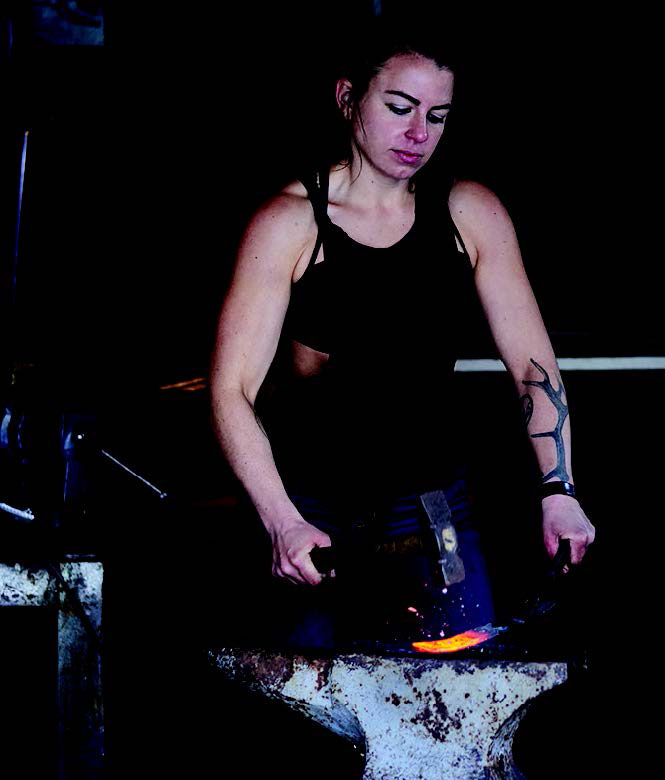
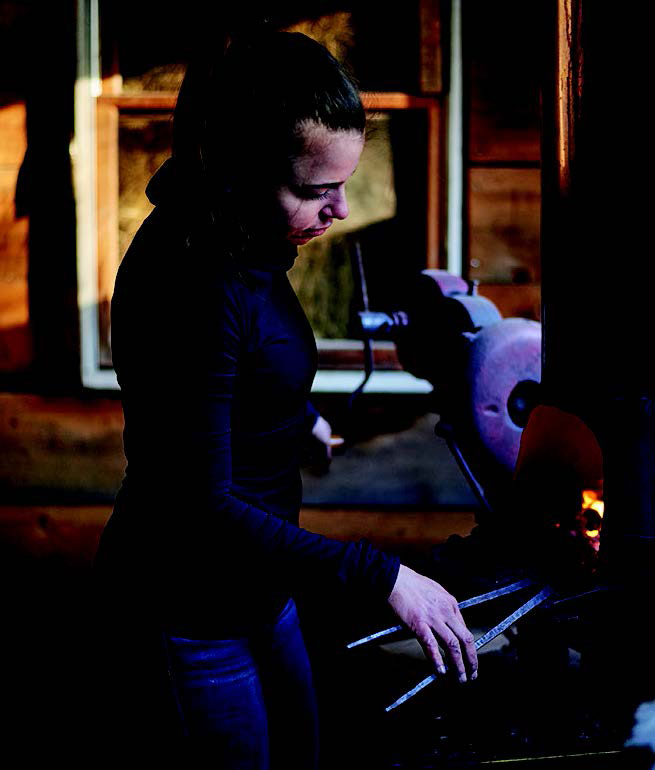
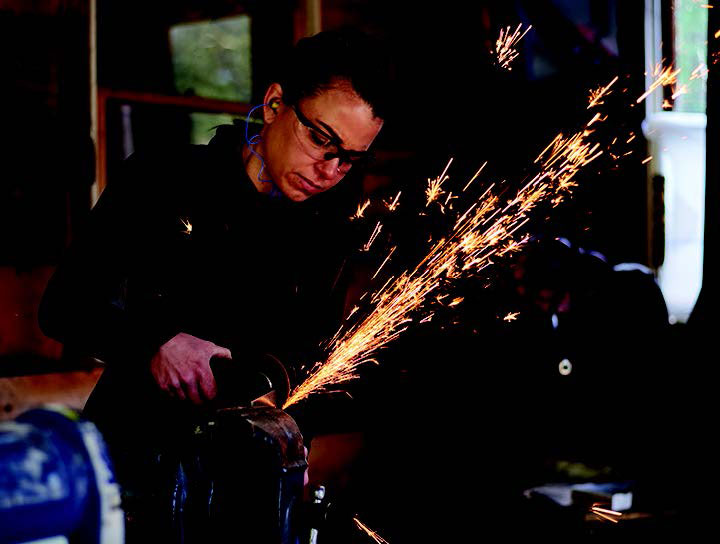
Laura Zerra, star of TV’s “Naked & Afraid,” at work in her shop. (all shop images provided by Laura Zerra)
Is there such a thing as a “survival knife” or are there only knives used for survival purposes?
I think the term “survival” is too broad to describe a specific type of knife. Where am I surviving? What’s the environment like? What tasks will I need my knife to perform?
Different circumstances will be best met with different qualities in a knife, from overall size and shape to steel choice to blade geometry. To try to make a “One Size Fits All” blade that will be the best tool for every survival situation seems like an impossible task.
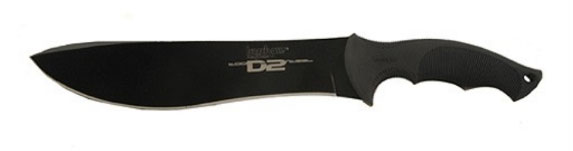
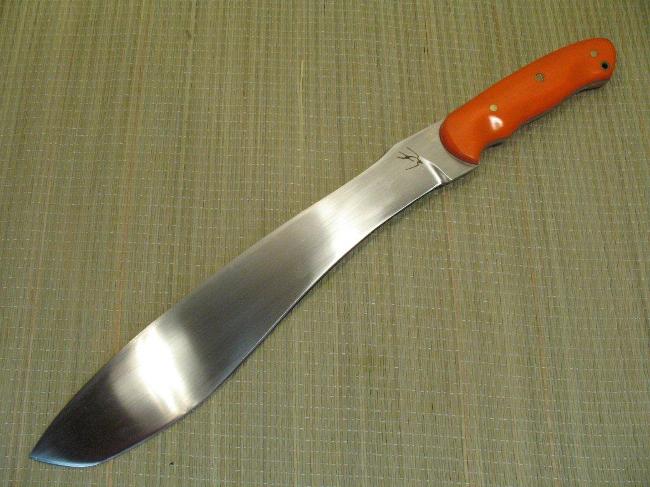
In seasons 1 and 2 of Naked & Afraid, you brought with you a Kershaw Outcast and a Diving Sparrow Mako Shark, respectively. Both of those sport big blades (10 inches and 11.25 inches). Is it safe to say that machetes are better than knives with smaller blades for survival purposes?
Kershaw OutcastMako Shark
I brought those knives based on my location in the tropics. Both of those knives made easy work of cutting through a massive amount of palm leaves and opening coconuts. It’s a bit more difficult to carve trap parts or butcher meat, but it can still be done.
A machete can be used to complete more delicate tasks by changing the way you use the cutting edge; for example, when gutting small game, I hold the machete between my feet and move the animal across the blade instead of trying to move the big knife across the much smaller animal.
For jungle survival, I absolutely recommend a big blade because the of amount of material you’ll be chopping though. Put me in a desert or a deciduous forest, however, and I’m likely to bring a smaller blade; it just depends.
What’s your take on survival knives versus survival multi-tools (those 31-in-1 sorts of things)? Are those multi-tools any better than a knife that’s just a knife?
I prefer a simple knife. A multi-tool has its place in urban survival and everyday use, but I find all those extra tools and edges can limit the use of your blade and get in the way. As a primitive survivalist, I’m used to improvising with what I have so maybe that’s part of it. I know people who love multi-tools, so I guess it’s personal preference.
Careful around the grinder, warns Zerra.
In the name of safety, we run a series on blademag.com about knifemakers’ worst accidents in the shop (so that no one else repeats the same mistakes). Have you ever had an accident in the shop? What did you do differently the next time around?
Yup! When I first started using the grinder, I ground a big notch out of one of my fingers. It took a minute to start bleeding, but then it gushed for quite awhile. I had to quit for the day, because my hands were so slippery from my own blood that I couldn’t hold the blade anymore.
It definitely gave me respect for the grinder, and I was more aware of the fact that the belt removes flesh much faster than steel. I also had a shirt catch on fire from hot steel dust gathering in a fold. I’d love to tell you that I wear a leather apron now but I’d be lying.
Laura Zerra is just one of the celebrities who have attended BLADE Show. The 2018 version takes place June 1 to 3 in Atlanta. Buy tickets and find information here.
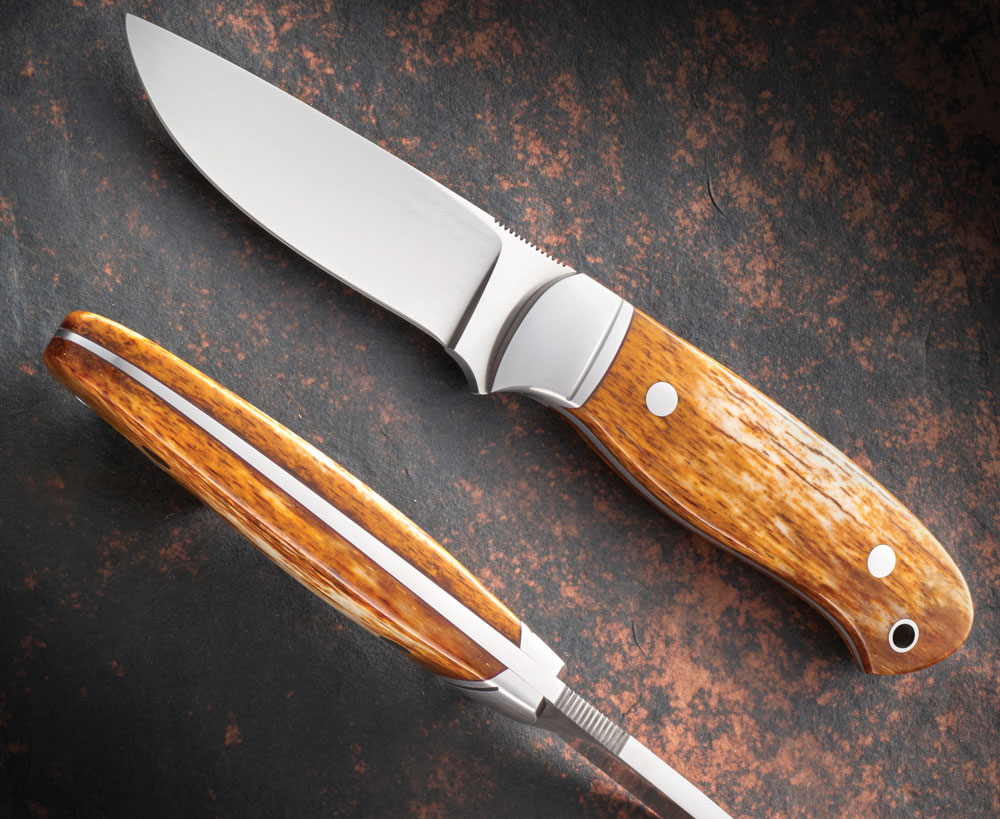
According to Joe Culpepper, cattle bone constitutes 98 percent of the total bone sales at Culpepper & Co., with camel and giraffe bone being the remainder. H.L. Holbrook employs stabilized giraffe bone on his hunter in CPM 154 stainless. Overall length: 8.25 inches. (PointSeven image)
Bone handle knives are good to the bone, including some of the latest blades made today.
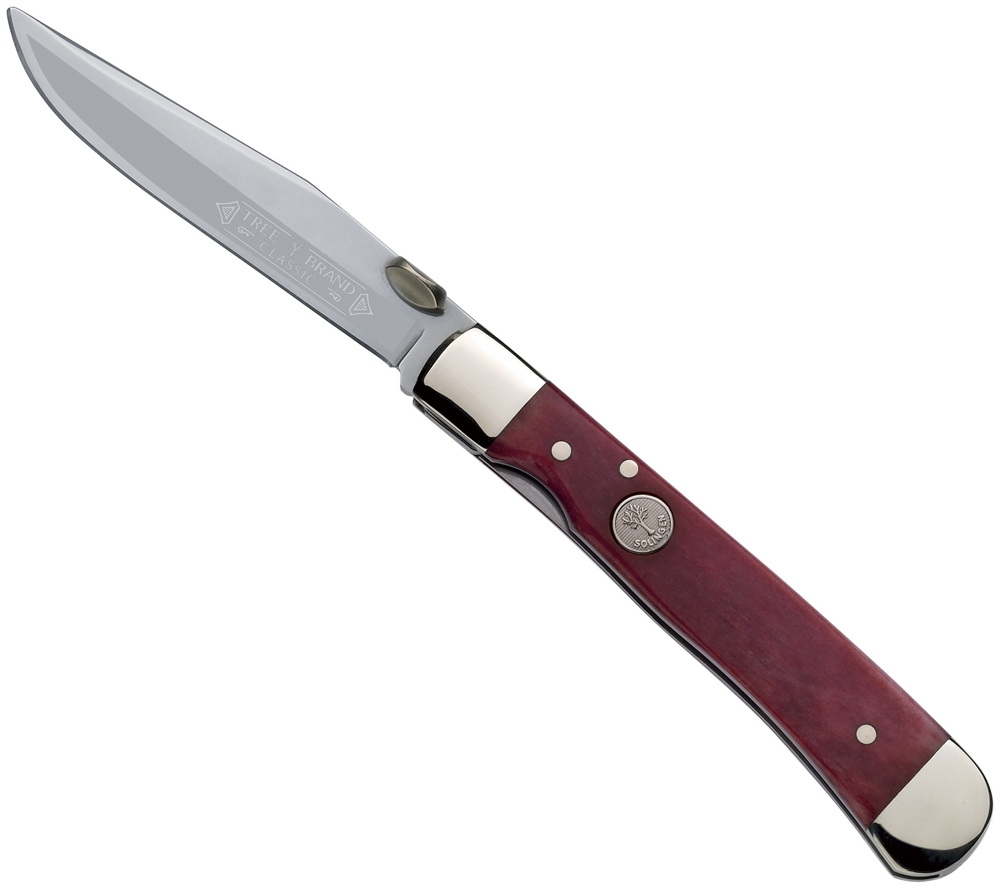
Smooth redbone completes the handle of the Boker Trapperliner. The 3.25-inch blade is 440A stainless steel. Closed length: 4 3/8 inches. MSRP: $107.95. (Boker image)
Bone is one of the earliest materials used on knife handles, becoming a high art during the early and mid-1800s when the factories in Solingen, Germany, and Sheffield, England, were peddling their wares to eager American consumers. When tariffs on the old-world manufacturers were imposed in the waning years of the 19th century, U.S. manufacturers gained a toehold on the domestic pocketknife market, and by the early 1900s were in high gear. Bone was the most prominent and popular handle material in those days—and remains among the most prevalent, if not the most prevalent, to this day.
Many offerings by pocketknife manufacturers are graced with bone scales, and custom knifemakers use it frequently on both fixed blades and folders. BLADE® went inside the knife industry to find out why bone remains such a dominant handle material on today’s knives.
Where’s the Bone?
Most bone used on knives is bovine—that is, from cattle. When you think about how much beef is consumed annually in this country, you have to believe there’s a whole lot of cow bone available. There is. We asked proprietor Joe Culpepper of Culpepper & Co.—a large wholesale supplier and processer of all types of handle materials to both factories and custom artisans—about the importance of bone on his bottom line.
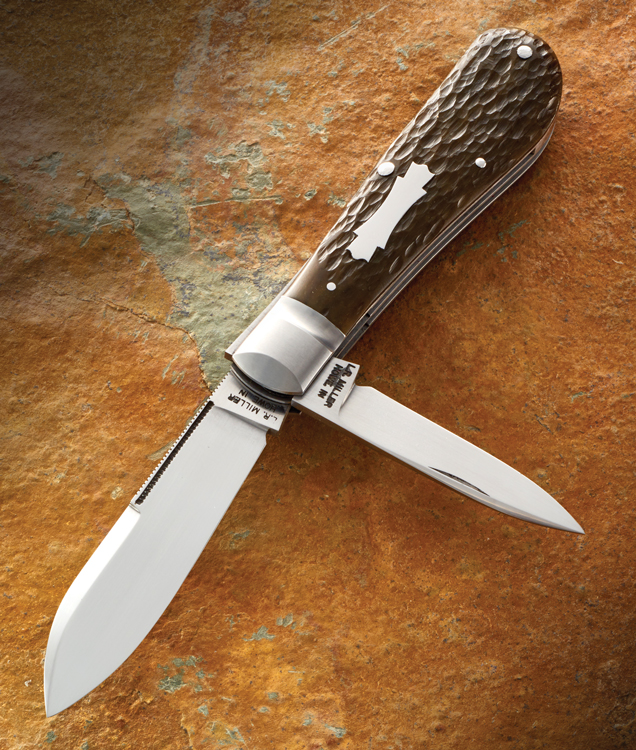
Joe Culpepper of Culpepper & Co.—shown inset with his wife and business partner, Kristi—said both factory and custom makers, though more custom than factory, lean heavily toward bone in browns, ambers, reds, oranges, blacks and other more conservative colors. Levi Miller opts for brown jigged bone on his trapper in 52100 carbon blade steel. Approximate closed length: 3 5/8 inches. (PointSeven knife image)
“Cattle bone constitutes 98 percent of our total bone sales, with camel and giraffe being the remainder,” Joe says. “The overwhelming majority of the cattle bone that we use is from South America, although it is available in nearly every country that has a beef industry.
“We find that cutlers, both factory and custom alike, lean heavily toward browns, ambers, reds, oranges, blacks and other colors that are more conservative. This is probably a bit truer for the custom makers than manufacturers. As for surface texture, we sell a lot of the more traditional jigging patterns that resemble patterns used before World War II. Approximately 60 percent of our sales are to factories, custom knifemakers the other 40 percent.”
Joe indicates he has seen an increase in demand for bone in recent years and, along with it, an jump in prices.
“As with anything, costs are always rising. The cost of jigging, polishing and cutting bone is nearly always a product of labor costs, which is somewhat predictable. Coloring is a different story,” he notes. “All of the dye components have risen exponentially in recent years.
“As far as overhead goes, we have to buy the raw material, have it shipped to our processing plant, treat it, cut it into scales, bleach the scales, sort for characteristics, identify outliers, texture and jig the bone, stack it into vats, color with dye, and test and document a sample before we make the final product available to the industry. There are also hundreds of other smaller processes involved, but these are the major things.”
While jigged bone is the most popular, Joe has seen an uptick in stag or carved bone patterns made to simulate deer antler.
“Most of our varieties of our carved stag bone have seen a rapid increase in popularity in recent years,” he says. “This is primarily because of the ban and scarcity of genuine stag. To my knowledge, we made the first variety of carved stag bone in the 1980s. It was made based on a Delrin [a type of thermoplastic] sample. Carved stag bone is popular in a variety of colors including amber, green, and various shades of brown and orange.” While smooth bone is still popular, it lags behind the jigged and carved varieties—but it does have the advantage of being laser etched and scrimshawed.
A Case Study
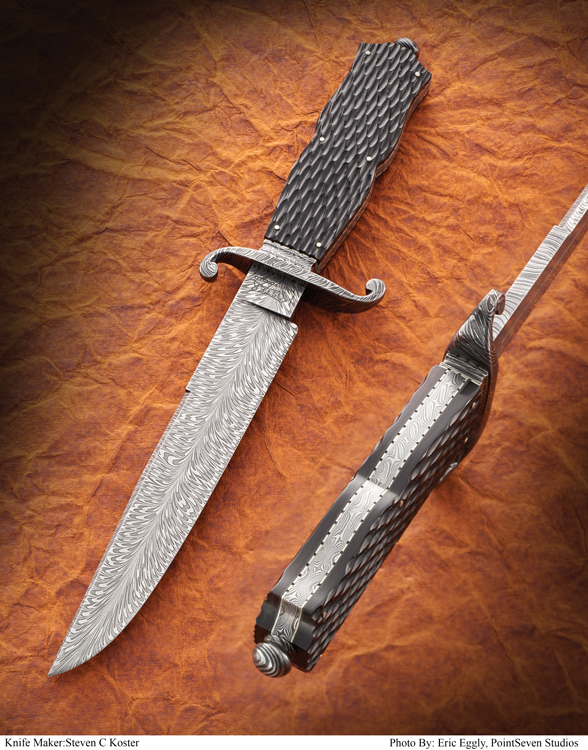
ABS journeyman smith Steven Koster combed through the entire box of bone scales at a Tru-Grit knife show booth to arrive at the nice matched pair of black jigged ones for his English bowie. The blade is Koster’s feather-pattern damascus in 1084 and 15n20 carbon steels. Overall length: 11.5 inches. (PointSeven image)
“Bone handles have always given Case knives their distinctive look and feel,” begins Fred Feightner, Case marketing coordinator. “While all of our handle materials cycle from time to time in terms of consumer favoritism, bone remains our most popular. Right now we are using our traditional cattle bone, the same we’ve been using for generations. Beyond that, some of our synthetics, woods and shells, like mother-of-pearl and abalone, continue to be very popular.”
According to Fred, Case handles its own jigging and color-dying processes. “We receive the bone in smooth slab form, then do all of the work needed to turn it into beautiful Case knife handles—including jigging, dying, drying and cutting to size. There are costs implicit in our manufacturing plans as the bone is sometimes stored before it goes to the production floor. The slabs also need enough time to take just the right color shade before being moved to assembly operations.”
Feightner sees no let-up in the popularity of bone handles in the near future.
“Bone is such a traditional knife handle material. It remains among our top sellers at Case, which is probably true of most makers of traditional folding knives today. Even with all the new handle materials that continually enter the marketplace, there’s still something special about the way a bone handle completes the look of a Case knife. We see demand for traditional folders to continue to grow, especially for Case knives, as our distribution and reach continue to expand into new markets.”
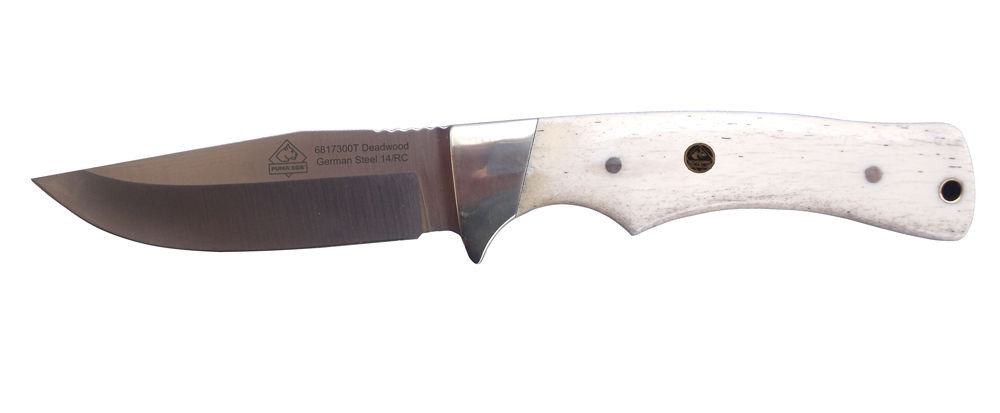
Puma USA opted for smooth white bone on the appropriately named Deadwood Canyon White Bone hunter. The 3.8-inch blade is 440A German stainless. Weight: 4.6 ounces. Overall length: 8 inches. It comes with a leather sheath.
Tried and True
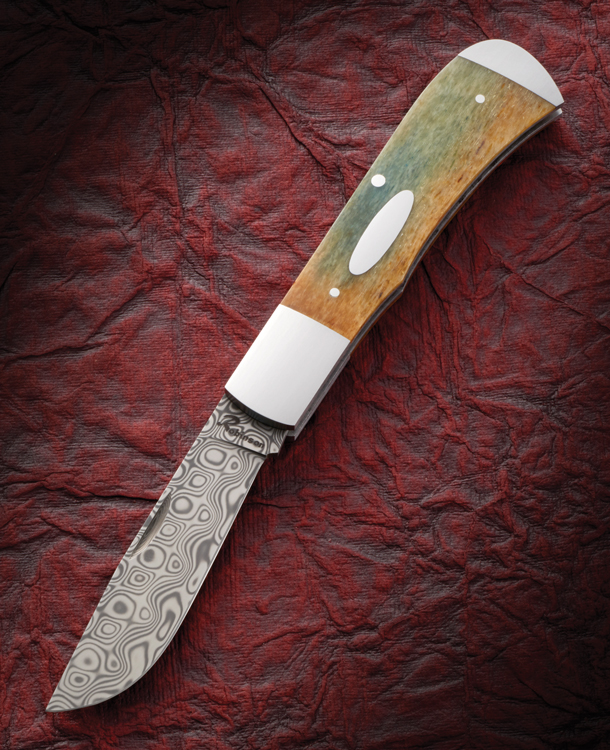
The giraffe bone grip of Calvin Robinson’s “Little Bill” slip joint exhibits a two-tone color effect. The 2 5/8-inch blade is Damasteel damascus. Approximate closed length: 3.5 inches. (PointSeven image)
Steve Koster is an American Bladesmith Society journeyman smith who specializes in traditional fixed blades, most featuring his exquisite handforged damascus as seen in the English-style bowie on page 37. It sports a forged 1084/15n20 feather-pattern damascus blade and a boxed-frame handle topped with thick jigged bone scales.
“I do not jig or dye any of my scales. I get most of them from various manufacturers and suppliers at knife shows,” he states. “The cheekbone scales on my English bowie came from Tru-Grit. I picked through the whole box to find a nice matched pair with a fine jigged pattern. Some of the jigged-bone patterns are not uniform so I have to spend time selecting a matched pair of scales to fit the tang or frame.”
Though Steve uses a wide variety of handle materials on his knives, bone finds its way onto a healthy percentage. “I do about two out of 10 knives with bone scales,” he says. “I like using natural handle materials, and bone has been used for knife handles for hundreds of years. It is very durable and I really like the look of anything natural or antique looking on handles. Natural cow bone, camel bone or any of the ancient bones can be used as they are, or can be stabilized.”
Koster opts for bone with a traditional look. “The imitation stag I don’t care for,” he notes. “I prefer bone that has been picked or jigged, and also bone sanded smooth with a natural finish.”
Rest Assured
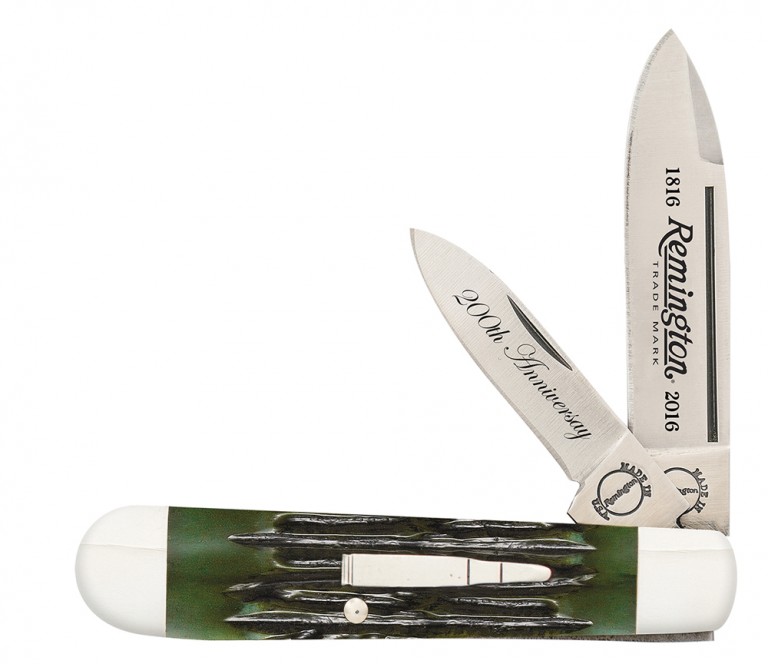
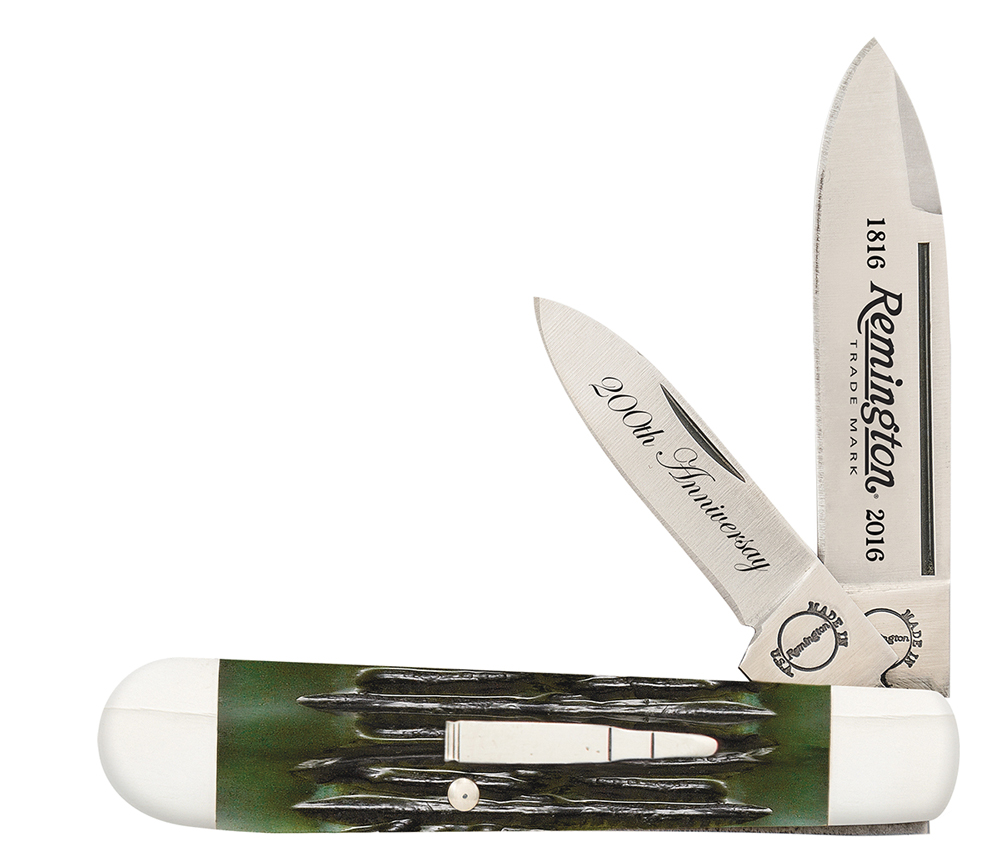
Green bone is a traditional favorite and the Remington Bullet 200th anniversary R11035 jackknife employs it along with blades of 440A stainless. Weight: 3.2 ounces. Closed length: 3.5 inches. Made in a limited edition of 5,000, it has an MSRP of $115.99. (Bear & Son image)
The tactical end of the cutlery industry (page 12) has ruled the roost for many years—and with it synthetic handle materials such as Micarta®, G-10 and carbon fiber—but traditional knives (page 12) still garner a sizable segment of the market. If you’re one of those who appreciate old-school pocketknives and fixed blades, rest assured—the factories and custom knifemakers have your back!one is one of the earliest materials used on knife handles, becoming a high art during the early and mid-1800s when the factories in Solingen, Germany, and Sheffield, England, were peddling their wares to eager American consumers. When tariffs on the old-world manufacturers were imposed in the waning years of the 19th century, U.S. manufacturers gained a toehold on the domestic pocketknife market, and by the early 1900s were in high gear. Bone was the most prominent and popular handle material in those days—and remains among the most prevalent, if not the most prevalent, to this day.
Many offerings by pocketknife manufacturers are graced with bone scales, and custom knifemakers use it frequently on both fixed blades and folders. BLADE® went inside the knife industry to find out why bone remains such a dominant handle material on today’s knives.
Silver wire inlay is one of several forms of embellishment—along with scrimshaw, decorative filework, metal engraving and carving—used on knife handles. For me, none of these decorative enhancements should replace what the basic knife should be: a well-designed, functional, well-made tool using the best materials and workmanship possible. Take a knife with these criteria and add some form of embellishment and you have a piece that a collector, user or aficionado of fine cutlery would drool over and want to own.
Simply put, silver wire inlay serves no functional purpose, but it sure makes a knife look pretty if it is done well—with a good, artistic design and well-executed technical application.
My introduction to wire inlay was some years ago while building Golden Age flintlock rifles. Many rifles of the period were relief carved with silver wire accents. The transition from wirework on rifles to knives was a short step.
In this two-part series on wire inlay you will be introduced to the tools used in the process, pattern/design development, the procedure for inlaying silver wire and final finishing of the handle.
So often in undertaking a new aspect of knifemaking, a large financial outlay is required up front to get started. This is not so with silver wire inlay. You can make nearly all the basic tools you need on a modest budget.
Synthetic materials from the Danish company known as Raffir include Raffir Fossil.
Richlite and Raffir: Two Synthetic Materials on the Rise
Synthetics continue to surge in light of the growing scarcity of some natural materials.
According to Chris Hartman, a 37-year veteran in the family business at Masecraft, the buzz about two synthetic materials, Richlite and Raffir, continues to grow.
“These product lines are totally different from each other, and they work like other materials that our customers already use, so the transition is easy,” he maintained.
Raffir
A few examples of Raffir Fossil. (Image courtesy of Santa Fe Stoneworks)
Distributed domestically by Santa Fe Stoneworks, Raffir is a resin-preserved material used in jewelry and other products also.
“It works well in fine handles and accessories in which aesthetics are of great importance,” Chris advised. “There are several categories. The first, Raffir Fiber, is a composite material of neutral plant fibers cast in resin.
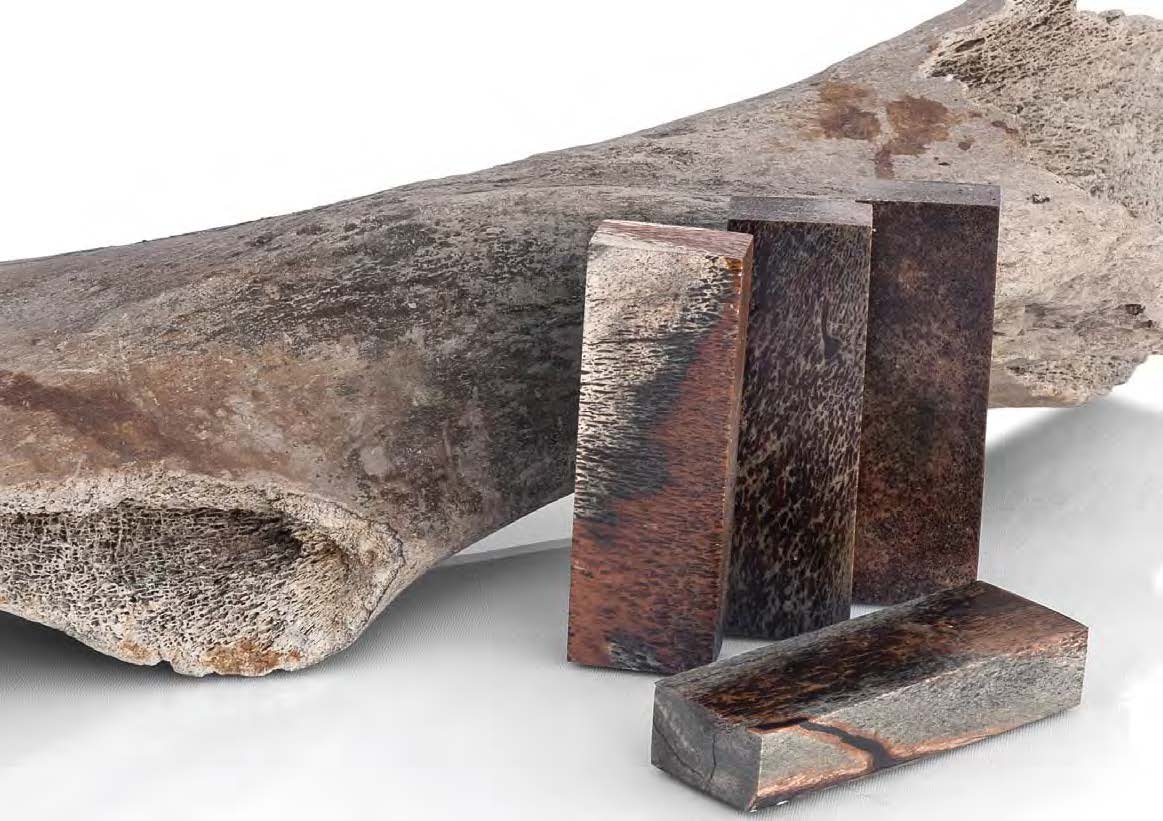
“The second, Raffir Metapol, has aluminum fillers shining through a deep resin matrix. Raffir Noble is a composite material with fine brass and bronze-mesh layers encapsulated in a translucent epoxy resin. The last two categories, Raffir Fossil and Raffir Wood, are genuine rare fossils and fine-grained wood blocks that have been filled with a unifying and strengthening resin through a high pressure process that stabilizes the materials.”
The finished Raffir fossil and wood materials maintain the original structures of the untreated substance while obtaining the mechanical advantages of the homogeneous resin compound.
The Raffir materials are worked with the same tools that most knifemakers already own, therefore little or no additional investment is required.
Richlite
An example of Richlite. (Mark Newman image)
Richlite is a durable, versatile and sus-tainable material made from recycled, resin-infused paper and pulp derived from trees that have been harvested responsibly, Chris says.
Complete with Forest Stewardship Council Certification by the Rainforest Alliance and GREENGUARD Certification, it is also antimicrobial, which is a benefit in food preparation.
“Richlite is tough enough to build skateboards and skateboard parks, so it will take a beating and hold up to the elements,” he added. “Richlite is made in the USA and actually costs less than other like materials. It is similar to working with Micarta, G-10 or carbon fiber, and many of our customers are familiar with them. Customers appreciate that they are no longer inhaling carbon-fiber or fiberglass dust, which some of our customers just don’t like dealing with.”
Other Synthetic Knife Handle Materials
New composite laminates and hybrid materials are on the horizon, and their growth is steady.
“Even though they are mass produced,” Chris said, “they can still be individually unique. They are stable and available in sizes that can easily be used in CNC cutting for production, or can still be cut and worked with standard tools and be handmade.”
BLADE 2018 Knife Guide
Read more about hot knives, knifemaking and collecting in the BLADE 2018 Knife Guide. Download it here.
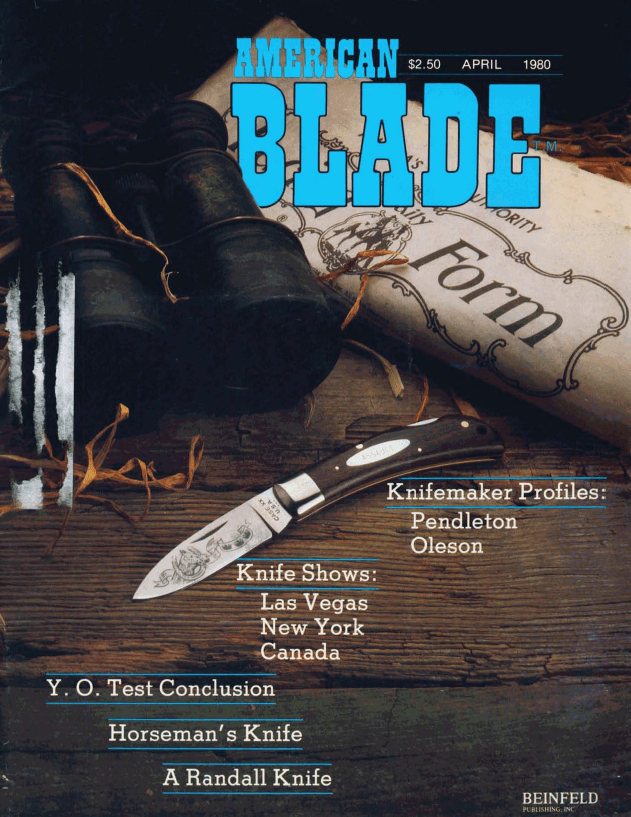
Editor’s Note: The following article by Pat Crawford was originally published in the April 1980 issue of BLADE, but the advice still holds true today.
New Knifemakers: You’re Not That Special (Yet)
The cover of the April 1980 issue of BLADE.
Any knifemaker can make almost any kind of knife, but some knifemakers are better than others. Knowing where you fit in the scheme of things is important, especially for developing a pricing structure that is compatible with the quality of your work.
Those makers who can command big bucks for anything that leaves the shop have paid a lot of dues for this success. And just because your work looks just as good doesn’t necessarily mean that you’ll be able to compete with the big names and legends whose work is priced at the higher end of the spectrum.
Remember, even today’s legends got their start by turning out quality work at fair prices.
Make Up Your Mind: Why Are You Here?
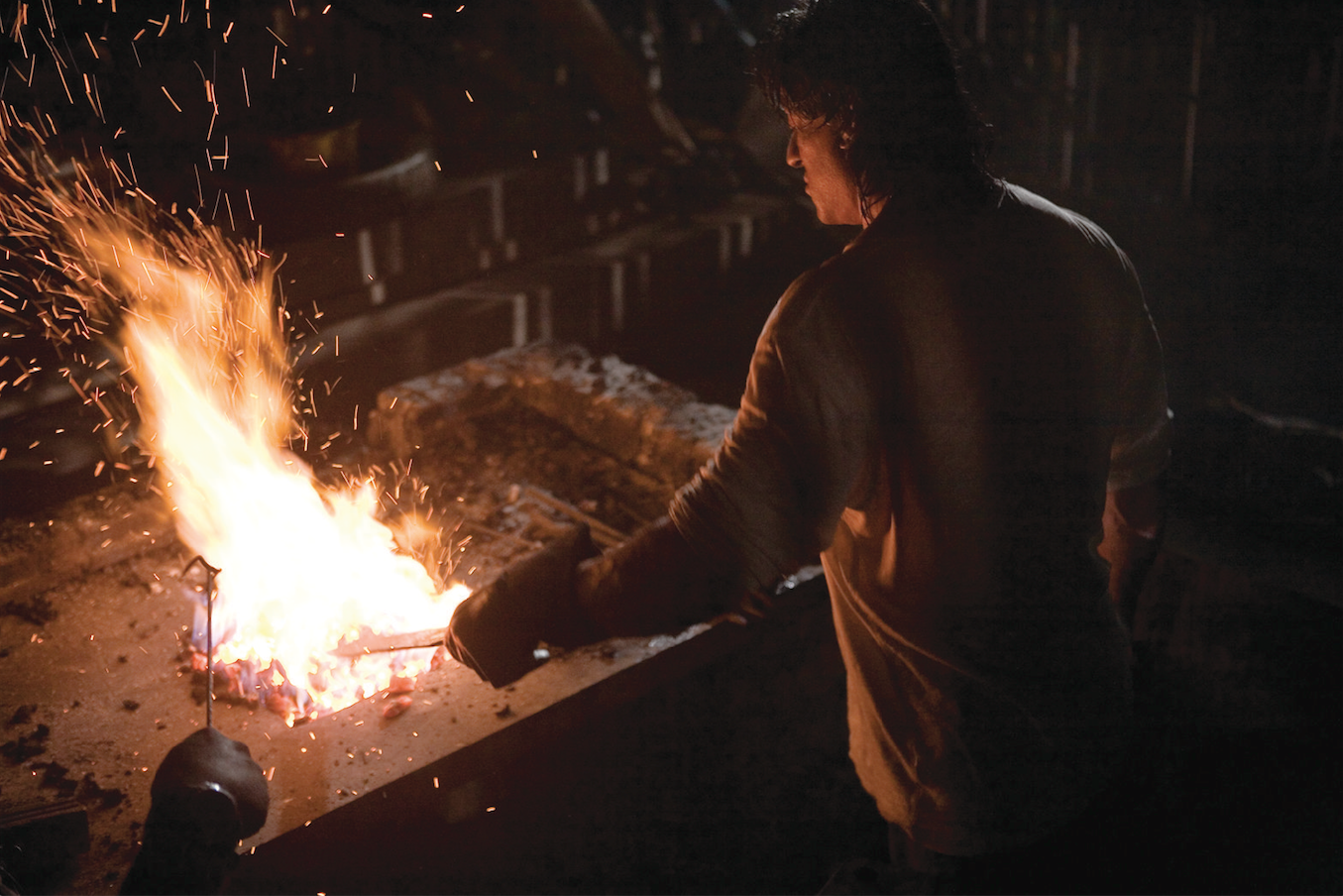
TV and movies can drive a lot of interest in knifemaking. That’s good, but it can also mean naive knifemakers wind up sinking their personal and financial lives. You’d better figure out your purpose in this market. This still from a deleted scene from “Rambo III” shows the titular character forging a knife.
Decide where you want to compete in the market. Should you specialize in something unique or should you offer a wide range of products?
The latter strategy has the potential of appealing to a larger share of the knife buying public. One example of this approach is the addition of folding knives to many makers’ offerings.
However, this type of market coverage won’t work for everyone making knives. You will have to decide whether diversification will capitalize on your strengths or spread your resources too thin.
Whatever you decide, the wrong choice could end you up making something that nobody wants. “Being there” at the right time with the right product takes as much hard work as it does luck, whether that product is one knife or a whole line of knives.
Knifemaking Isn’t A Romantic Business
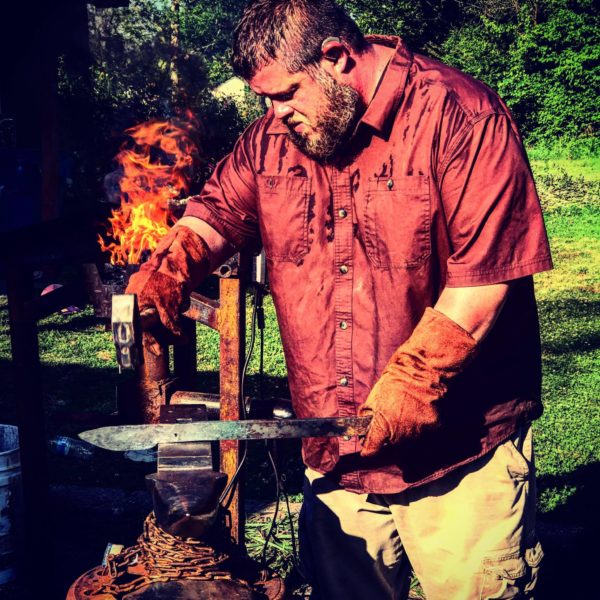
Knifemaking is tough work. Here, Norman “Buddy” Thomas, of Tree of Liberty Bladecraft and Forge, hammers on his latest project.
If you think making knives is a fun, romantic way to make a living, you may be overlooking a very important point. Making knives is enjoyable, but it is hard work.
There is a big difference between hobby knifemaking and doing it full-time. Hobby knifemakers (and there are some super part-timers) don’t have to depend on their knives for a living, while full-time makers do.
And the transition from part- to full-time can be a traumatic experience. For the first time, there’s the pressure of getting the work out and meeting delivery dates just to put bread on the table, and what used to be an activity you enjoyed in your spare time is suddenly a job you must do to exist.
Living with a constant backlog, increasing demands, and monthly quotas takes a certain amount of nerve and self-discipline. Roses wilt and so do some knifemakers under this kind of pressure. But, if you enjoy the challenge of a sink or swim kind of life, you may not want to do anything else for a living.
You’re Not Setting Trends, So Jump On One To Get Noticed
Remember when “zombie knives” were red hot? A new knifemaker could hop on that trend to get noticed. This Kharon Tanto Folder is from from KA-BAR’s Zombie Knives line. (KA-BAR image)
It’s a business world fact that some products are more popular than others, and what was popular yesterday may be a dog tomorrow. However, makers who are unable or unwilling to make what the people want have seen once loyal customers flock to those who do.
People will not automatically knock down your door just because you make knives. You have to let the public know what you have to offer; then if you’re lucky, they’ll knock down your door.
Of course, word of mouth advertising is great and it’s free, but a lot of mouths would have to do an awful lot of talking to reach as many people as are reached by a good magazine in even one issue.
Customers’ Attitudes Aren’t The Problem; You Are
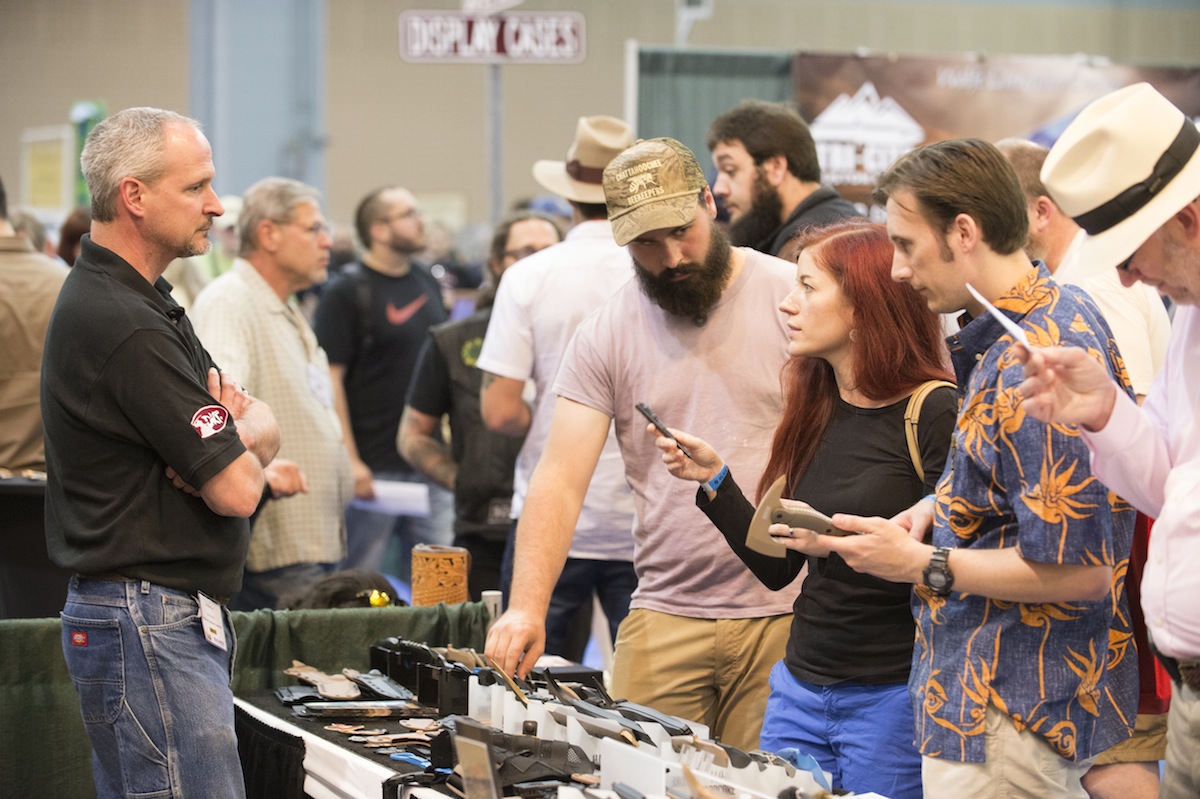
When you exhibit at a knife show, you’re not only there to sell knives. You’re also there to sell yourself. (PointSeven image)
People are more likely to buy your knives if they like you as a person. A personal relationship is one of the most important parts of the custom knife trade.
Knifemakers who are unfriendly, too busy to answer questions, too sold on themselves, or just plain rude to potential customers are shorting themselves as well as other makers.
Buckle Up, You’ve Got A Long Way To Go
Even the greatest knifemakers are constantly striving to better their product. Whether it’s a new design, material, or method of construction, there is always something you can do to perfect your product. And believe me, if you don’t, the competition will.
The One Thing That Sinks More Knifemakers Than Anything Else
Sure, you can make knives, but can you work a calculator? (Pexels photo)
No knifemaker can get away from the fact that he or she is a small businessman as well as a craftsman. Neglecting the business side of knifemaking has probably put more makers out of business than any other single factor.
You don’t have to be a business whiz to know you can’t have more money going out than you have coming in. To keep track of cash flow, accurate recordkeeping is imperative. This includes knowing the cost, both in time and materials, to produce one knife so the revenue from its sale is enough to cover costs and produce a profit.
See You At BLADE Show
If you’re serious about getting into knifemaking, there’s only one place you need to be: BLADE Show. See you in Atlanta.
There have been tons of stories on how to be a knifemaker. Most are great and deal with subjects like taxes, suppliers, marketing, sales, bookkeeping and safety. Other great articles cover the technical side of how to make the knives you wish to sell, including stories on forging, grinding, heat treating, handles, sheaths and more.
My story will outline some things I have learned over the years as a full-time knifemaker in a home-shop setting that I think will benefit you, your knives and, most importantly, your family.
1) A Toaster Oven
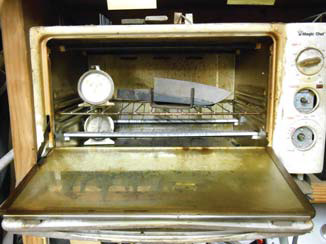
Your kitchen will get messy in a hurry if you don’t take things outside. Buy a cheap toaster oven. Problem solved.
The kitchen is not the place to be tempering knives, warming up knife sheaths for waxing them, heating Kydex® for the molding, or burning out axe heads. A $5 toaster at the flea market will do all that in your shop and is a bargain.
2) Pots & Pans
Get a selection of pots and pans, cutting boards and a small scale from a thrift shop. Don’t be tempted to use a “good pan” for that one, little task.
3) A Shop Sink
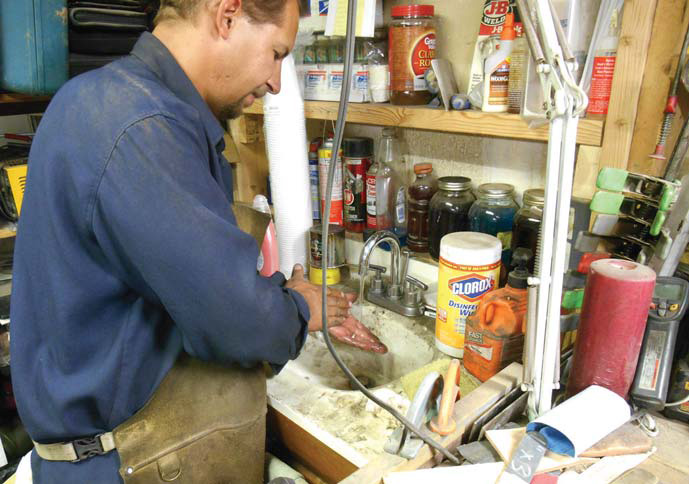
Would you want to eat out of this sink? No. That’s why it’s the dedicated shop sink, not the one inside the kitchen.
Install running water in your shop, or at least have a five-gallon bucket handy. Make sure there’s a countertop, too, in case of spills.
On that note, wipe your feet off before re-entering a home.
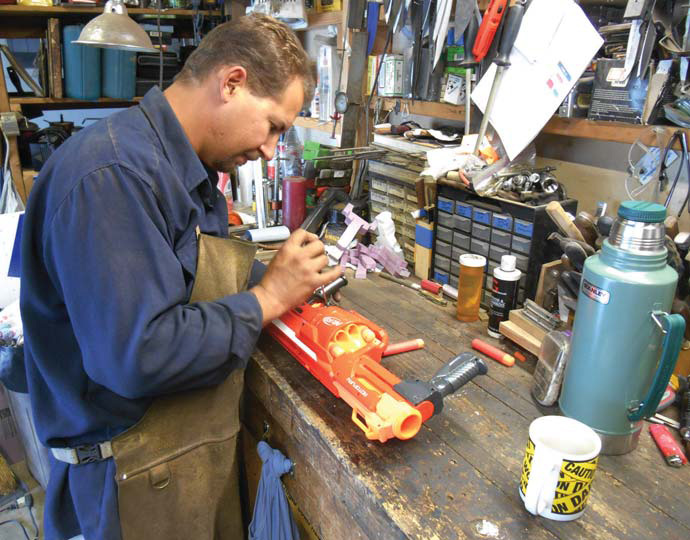
4) A Coffee Thermos
If who like your coffee as much as I do, get a big thermos, fill it in the morning, and take it to the shop with you. This cuts down on the trips away from the shop, as a trip inside the house to grab another cup can turn into an hour away by the time you get the cup, peek in the fridge, check for phone messages, etc.
Plus, every time you re-enter the house, you track shop dirt and oils in with you.
5) Discipline/Knowing When to Stop
Know when to quit for the day. This is one lesson I’m still learning. You get wrapped up in your work and the next thing you know it’s 2 in the morning.
Not only will you spend that night on the couch, but you may spend the next one there too if, as a result, you also forgot the plans you made, dinner, one or more of the kids’ school activities, etc. Besides, it’s tough to make good knives after a rough night on the couch.
6) Do Something Special for Your Family
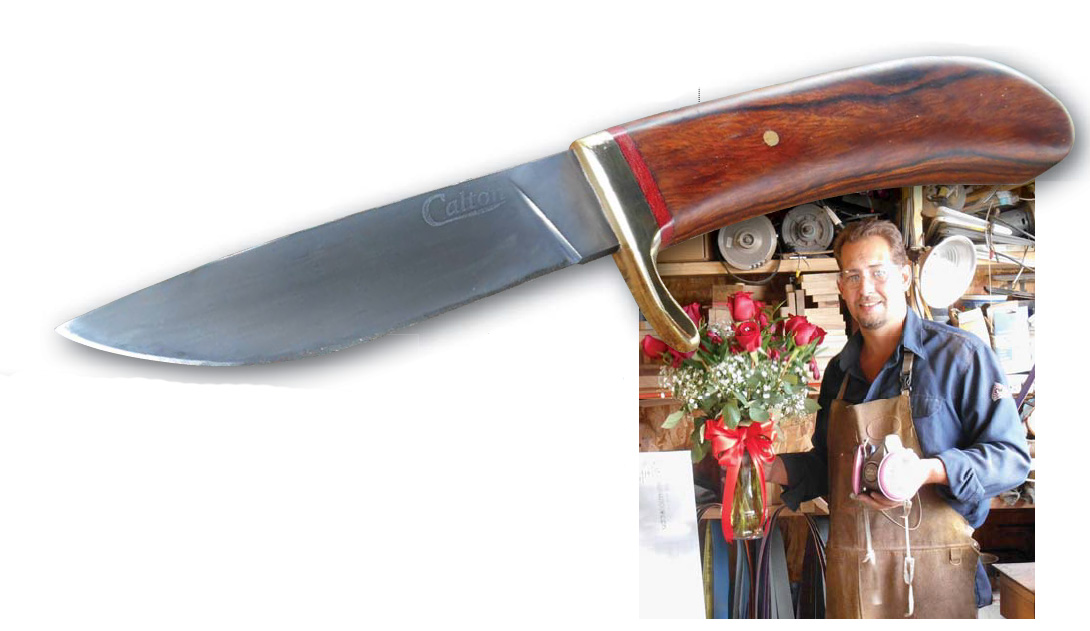
Make knives, buy flowers, repeat.
Use some of your knife money to buy your wife/husband/partner/significant other flowers. Buy them on a regular basis. Put it on the calendar if you must so you will remember. Think of the flowers as supplies, like grinding belts.
This is very important!
7) Mind the Dust
Know that what happens in your shop does not stay in your shop, and act accordingly. Dust from exotic woods will make it into your home. You may not be allergic to the dust but your wife, kids or family pets may be.
Keep an eye peeled for anything out of the ordinary when introducing new woods or materials into your shop. This also goes for smoke from quenching. Use “green” quenchants when you can, including vegetable-based oils and water. And keep the door to the rest of the house closed until you clear the air.
8) Consider Where Your Shop is Located
If you’re considering moving your shop away from your house, think long and hard about it.
Yes, a home-based shop offers some challenges. However, it offers quite a few benefits, too. Namely, the morning commute is a thing of the past, and people know how to find you.
Move the shop away, as some friends of mine have, and you may end up moving it right back anyway.
9) Make the Most of Breaks
Maximize the time between your work by throwing in a load of laundry, starting supper, taking care of a household task, paying bills, etc. This helps your family’s day-to-day quality of life.
10) Test Your Knives in the Kitchen
If you make them, there is no better test of the kitchen knives you create than to use them in making dinner. This is a twofer in that not only do you get the immediate feedback from hands-on testing, but also the household benefit of preparing meals.
11) Double Up Your Shop
With your shop set up, you have all sorts of tools on hand you can use for other projects. From fixing your kid’s bicycle to tuning up a lawn mower, you’ll find taking care of these everyday things can reset your focus for knifemaking later.