Home Blog Page 124

Ancient Bog Oak: Knife Handles Thousands of Years in the Making

As noted in Monty Python and the Holy Grail, “strange women lying in ponds distributing swords is no basis for a system of government.” On the other hand, oaken logs lounging in bogs for a couple of millennia transform into something of a “holy grail” for knifemakers.

The oxygen-poor, acid-rich bog environment changes humble woods such as oak into something dark and infused with history. And it’s in no small part because of this that makers have turned to the material for knife handles.

Knives seem to have a long relationship with bog oak, a prized and precious wood pulled from bogs after thousands of years.

For instance, take the Scottish sgian dubh, the small utility fixed blade sheathed in the sock of a Highlander in traditional Scottish garb. Translated from Gaelic, sgian dubh means black knife, which some think is a reference to the dark bog oak from which the handles of a number of sgian dubhs were carved.

Just as oxygen-poor and acid-rich bogs transform wood, some makers have gone beyond traditional sgian dubhs and use the handle material to hearken back to more mysterious and historic times.

Black Betty

Because it takes ages to form, bog oak is a finite resource. ABS journeyman smith Mike Deibert, who makes knives on the weekends and evenings when he’s not working as an elementary school teacher, waited five years after he bought a piece of bog oak for the right knife to come along.

Ancient Bog Wood Knives
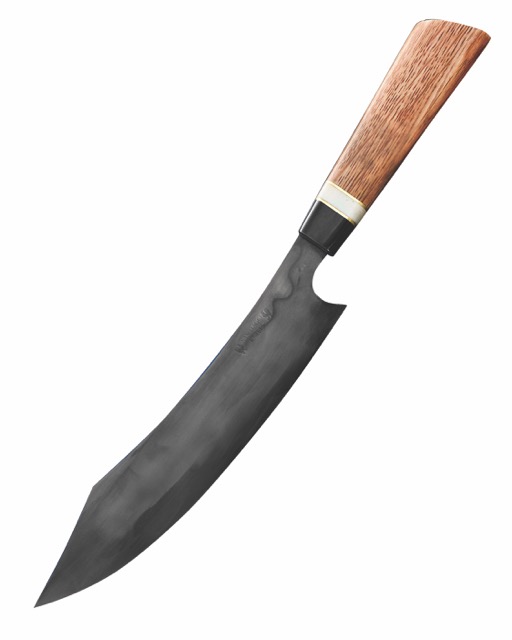
Mike Deibert (inset) uses 5,400-year-old bog oak for the handle of his Black Betty Bowie. Blade length and steel: 10 inches and bold-feather-pattern damascus. (SharpByCoop knife image)

The large, handle-sized piece of the material came already stabilized. Deibert has most of his natural handle materials stabilized so they’re not subject to fluctuation in humidity and are more predictable to work. Even before he decided to use the bog oak, the project was going to be a special one.

“The Black Betty Bowie was created in September of 2019,” Deibert explained. “I designed it for a client who wanted to present it as a gift to an individual who was responsible for raising hundreds of thousands of dollars for cancer research. I wanted to come up with a special work of art that even a non-knife enthusiast couldn’t help but appreciate.”

Deibert started with a bold-featherpattern-damascus design by working out the pattern on paper. When he saw the finished billet, the contrast thrilled him. Besides its tight grain and chocolate color, the wood, billed as a 5,400-year-old relic pulled from a bog in Ukraine, gave the blade historical gravitas.

“When I saw how incredible the dark plume billowed down the center of the blade, I knew I had to put together a guard and handle that complemented this intense feature,” he began. “Originally, I had drawn the knife with a piece of ironwood burl in mind for the handle and a satin-finished steel guard. But, with a very dark portion over most of the blade, I decided to go with all-dark furnishing as a complement.

“This wood, once growing and living thousands of years ago, is now preserved and on display as a handle on the world’s oldest tool. There’s a story in it, and it makes me proud to be able to keep that story going.”

Baba Yaga

What kind of knife would Baba Yaga, a mysterious and terrifying old woman in Slavic folklore, wield as a war blade? That’s the question Connecticut knifemaker Matt Berry pondered as he read through Katabasis, a novel in which the wicked witch swoops in for an appearance.

“Babayaga’s Warknife” began with a blade Berry had put aside after beginning it in 2016.

Ancient bog wood knives
One of the highlights of the Babayaga Warknife by Matt Berry (inset) is the pommel. Berry carved the bog oak to fit into the bronze pommel and ferrule, which he created by casting them via the lost-wax method. The oak for Berry’s handle entered a bog about 5,300 years ago and helped set the knife’s tone. (SharpByCoop photo)

“I started with the pommel carving, which was meant to be Baba Yaga’s face. The rest of the handle just kind of fell into place as I worked forward from the pommel,” he recalled. “I worked on it as time and inspiration allowed and finished it in the spring of 2019.”

One of the highlights of the knife is the pommel. Berry carved the bog oak to fit into the bronze pommel and ferrule, which he created by casting them via the lost-wax method. The oak for Berry’s handle entered a bog about 5,300 years ago and helped set the knife’s tone.

“I wanted something European even if bog oak was never used in the 1200s,” Berry said. “Bog oak is quite expensive. It’s right up there with burl in price and will sometimes cost more. There’s not a lot of it around and the supply is finite. I get most of mine from an English furniture company that digs up and dries its own logs and then makes high-end furniture. I’m buying the company’s scraps.”

Like anything that has sat around for a few millennia, bog wood has its quirks. According to Berry, it can be as temperamental as Baba Yaga herself.

“The grain isn’t tight, and it’s kind of mushy and chippy at the same time,” he warned. “Th at makes it very frustrating to carve. It drills and sands fairly normally but it can be prone to splitting.”

Dagger of Firsts

Brant Cochran of Gray Flame Forge works in the insurance industry but, when he can, he’s in his shop. When he created his 10.5-inch dagger with a blade of W2 tool steel and a bog oak handle, it was a project of firsts.

He took three months to slowly build the dagger, in part because it was his first time making a dagger of that length. While he wanted to make a large knife, the quintessential bowie didn’t appeal to a man whose interests in edged tools were whetted when, as a youngster, he saw an arming sword at his grandparents’ house.

Ancient Bog Oak Handled Knife
The bog oak for the handle of the dagger by Brant Cochran (shown inset in the process of assembling the takedown piece) is 3,300 years old. The 10.5-inch blade is W2 tool steel with a double hamon. Overall length: 17.5 inches. His list price to make a similar knife: $800. (SharpByCoop knife image)

The dagger was the first time he had made a knife with a cross guard, a pommel, takedown construction and a bog oak handle. He initially had planned on making the handle from ironwood. Then, after some African blackwood got “screwed up,” Cochran turned to a piece of bog oak.

“I’d never used it before,” he stated. “I was already doing all these new things—why not try a new material as well? That was part of it. But I was interested in bog wood because it has a historical element to it. It had spent 3,300-plus years sitting in a bog.”

His impressions? The bog oak worked a heck of a lot better than ironwood.

Furthermore, it was almost the perfect carving wood. He created a subtle ridge running down the length of the handle. The wood wasn’t soft enough for the subtle feature to get “completely washed out,” nor was it hard enough that it required extra effort to eliminate the sharp edges. The dagger of “firsts” became a springboard to future projects.

“I would work really hard on one piece as I was trying to build up my skills,” Cochran said. “Then I would bring it to master smiths I knew and respected to get it critiqued. A picture is not going to show you every little detail you need to figure out how to make a quality knife.

“Your edge might have good retention but if your handle’s too thick or just very uncomfortable, you might not pick that up. And, by speaking to the master smiths and having them show you what those details are, you can then train your own eye to do it as you move forward.”

Perfect Complement

For Anders Högström, bog oak is a relic from an ancient time and a perfect complement for his Valdez ceremonial dagger.

A full-time knifemaker who lives in southern Sweden, Högström is also a hobby chef when he’s not crafting knives. One vein of his work is to build knives of cultures that are combined or are long-ancient ones that persisted for years.

Ancient bog wood
One-thousand-year-old bog oak and ancient walrus ivory comprise the handle of the Valdez ceremonial dagger by Anders Högström (inset). The 3-inch blade is 1050 carbon steel with hamon. The custom leather sheath is by Balatoni. Högström’s price for a similar knife and sheath: $2,500. (SharpByCoop knife image)

According to Högström, “My main direction of design is that of a marriage between the Nordic and Japanese.”

He uses a lot of one-off casting and hamons. For his short-bladed ceremonial knife, he went with a model he imagined could have been used by an ancient American Indian culture, such as the Inca or Maya.

“The ceremonials I make are a sort of homage to what would have been used by a high priest, shaman or someone of similar standing at a ceremony of importance,” he explained.

Högström indicated bog oak pairs well with other materials. For the Valdez, he “married” the 1,200-year-old material with ancient walrus ivory left raw in the handle butt to provide texture. The bog oak, he said, carried a “meaningful weight”—almost as if the material were an artifact of an older time.

Ancient bog wood knife handles
Anders Högström used bog oak for the stand for his cutlass. As he noted, “The stand is made from an old piece of bog oak that was likely a beam from a ship—the ax marks are intact and are all on the top surface—and it comes from the area where I live, named Blekinge here in the south of Sweden, that has been in the ship building business for centuries.” (image courtesy of Anders Högström)

“Something ancient that has been left to decay—but, as nature would have it, something happened in the process, and the original material got to evolve into something else—much like the fossil walrus ivory in the handle that was colored by minerals in the ground and because of the thousands of years it stayed there,” he mused.

Högström pointed out that some pieces of bog oak must be stabilized because they might be soft and the pores of the wood must be filled.

It depends on the project. However, for his ceremonial dagger, he said the unstabilized wood was “easy to work and medium soft.” He chose a fine-steel-wool finish to get into the wood’s grain, thus bringing out the most character. This was followed by a couple of coats of wax to protect the surface.

When customers learn of the bog oak’s history and the stories it evokes, Högström said they often react with “both amazement and amusement, as well as a certain reverence.”

Knifemaking: ABS Master Smith J.D. Smith’s 4 Principles

0
  1. A personal approach and style.
  2. An object of art or music should give you a sense of life, an idea what it’s like to be in the artist’s shoes.
  3. Technical control.
  4. An endless flow of ideas.


J.D. Smith: Dancing in the Shop

J.D. Smith and I were neighbors for three years and, as it was a short walk, would frequently wander down to the Massachusetts College of Art and Design (MassArt) together, sometimes for class, sometimes just to work.

Boston’s a very diverse city, and it wasn’t uncommon for him to stop and start speaking Russian or Spanish with various friends along the way before getting to class and beginning to speak Korean with a student.

Neither was it unusual for J.D. to dance around the shop, especially while making damascus. Dance, music, sculpture: They all have a flow to them, and some people simply love to incorporate and live with all three. J.D. dances through the music, the work, and the awards. I was with him at the 2013 Oregon Knife Show when I watched him win four awards, and his study at home was littered with many more.

Two of the pieces were collaborations: one a hunting knife with now American Bladesmith Society master smith (MS) and past apprentice Zack Jonas, the second a precious metal and stone-laden sword crafted with the talented Joseph Shnayder, J.D.’s partner at AmeRRuss Blade Arts.

It was also at the Oregon show that BLADE Magazine Cutlery Hall-Of-Fame® member Wayne Goddard gifted J.D. his MS stamp, something I don’t think J.D. will ever forget.

J.D. received the MS stamp in 1998, along the way winning the B.R. Hughes Award for the best knife submitted by an MS applicant at the BLADE Show. This made J.D. the first black MS, though he tries not to dwell on this because he feels it detracts from the bladesmithing.

“The field should be blind to age, sex, and race,” he noted. “The focus should be on the work.”

Developing A Style

In 1991, J.D. walked into Joe Wood’s office, who at the time was head of the MassArt sculpture department. J.D. told Joe that the school’s officials couldn’t say they were teaching the most up-to-date metals program without teaching damascus. Joe agreed and offered J.D. a guest teaching position. In 1996, George Greenimire offered J.D. a regular class to teach.

As a teacher, J.D. would encourage students to do what he thought they were naturally inclined to do without controlling their sense of design, or discouraging them from pushing their limits. The goal isn’t to replicate other people’s work, but, if you can understand what you’re attracted to, you will have an easier time designing your own work and, hopefully, developing your own style.

JD Smith Master Smith
Another collaboration with Joseph Shnayder, this arresting art knife features a 6-inch blade of J.D.’s explosion damascus in 1084 carbon and 15N20 nickel-alloy steels. The handle is carved African blackwood, highly detailed silver work and gemstone settings. The quillons are carved in the shape of claws. Overall length: 12 inches. (SharpByCoop image)

“If there’s a table with 500 different knives on it,” he observed, “someone should be able to pick out your work with ease.”

When I asked him how he started to develop his style, he mentioned it being “cobbled together from Don Fogg, Wayne Goddard, Jimmy Fikes, and Wayne Valachovic—Valachovic especially for folders—Bill McHenry and Jim Schmidt.”

Bill and J.D. had become good friends over the years, and J.D. credits much of his knowledge of folders to him. Bill passed away in 2019 and is greatly missed by many inside and outside the knifemaking community.

Knifemaking: ABS Master Smith J.D. Smith’s 4 Principles of Superior Art

Over the years, J.D. has developed his Four Principles of Superior Art:

  1. A personal approach and style.
  2. An object of art or music should give you a sense of life, an idea what it’s like to be in the artist’s shoes.
  3. Technical control.
  4. An endless flow of ideas.
Tips for Making a Knife
The author collaborated with J.D. on this stylish fixed blade in damascus, a carved handle, and stunning wooden sheath. (SharpByCoop image)

Further explaining his sense of style, he said, “Style is every technique that you use as part of your personal toolbox, and the things you choose not to use. That equals your style. As an artist progresses, he starts to limit his options. It shows a level of maturity. You use four or five techniques, and you develop your style off the permeation of those techniques.”


Knife Sharpening: What’s the Best Angle?

The best sharpening angle depends on the use of the knife, the thickness of the blade, the type of blade steel, the sharpening materials used and more.

What is the Best Sharpening Angle?

What determines the best sharpening angle? The answer is one that plagues knife neophytes and old hands alike.

“The best angle of sharpening is one of those very intriguing topics that many have explored but most have come up with different answers,” states Jake Broce, online marketing coordinator for A.G. Russell Knives.

Agrees Kyle Crawford, brand manager for Work Sharp, “The answer is often different for everyone.”

He says the two keys are knife type/use and edge retention/maintenance. In fact, all of our story sources cited the intended use of the knife as a deciding factor. For tough chores such as chopping or batonning, a wider angle is best.

“Generally, the wider the angle of edge, the more steel is behind it, which increases the edge’s toughness,” Broce observes.

“For kitchen knives that see light duty cutting food on cutting boards, or a task-specific hunting knife like a camping knife, a low angle is ideal,” counters Crawford.

By “low” he means an edge angle between 15 and 20 degrees.

Find angle for sharpening knives
Knives come with a standard edge from the factory, around 22 degrees inclusive. The edge is sharp and durable, and a good middle-of-the-road angle that is a good balance between durability and cutting ease. The Work Sharp Ken Onion Elite sharpener is set here to sharpen at 22 degrees. (Marty Stanfield Photography)

Edge angle also affects edge retention.

“If you sharpen your heavy-use EDC knife to a low angle such as 15 degrees, it will be incredibly sharp,” Crawford says, “but the trade-off you are making is edge retention and durability.”

Conversely, he adds, if you sharpen at a wider angle, such as 25 degrees, the edge will still be very sharp but you gain improved edge retention and, thus, eliminate the need for more frequent maintenance.

However, Kendra Tobler, marketing communications manager for Benchmade Knife Co., indicates grades of blade steel also factor in as well.

“A harder steel with higher yield strength can be ground to a small included angle with less worry about rolling or deforming the edge,” she says. “Conventionally cast steels with large carbides are better suited to larger included angles.”

Knife sharpening tips
Lesser grades of steel such as the 7Cr17MoV stainless of the Gerber Tri-Tip should not be taken down to an acute angle. (Marty Stanfield Photography)

This is done so for edge durability. A prime example of Tobler’s point is Benchmade’s 15017-1 Hidden Canyon Hunter, a compact drop-point fixed blade in premium CPM S90V stainless steel well known for its extreme edge-holding ability.

Benchmade uses its SelectEdge 14-degree included edge on the knife. It is ground thinner because S90V is a high-yield-strength steel that can retain its strength with a thinner edge without deforming or chipping.

Blade Steel Sharpening Tips
With task-specific knives of high-yield-strength steels for hunting/field dressing, you may opt for a more acute edge angle, anywhere between 15 and 20 degrees. (Marty Stanfield Photography)

Blade thickness is a factor as well.

“Thin blades are much easier to sharpen to low edge angles than thick knives,” Crawford states. “The thicker the blade, the more material you will have to remove to create a low edge angle.”

And it usually takes time to thin down a thick blade.

As he warns, “If you choose to sharpen a low edge angle onto a thick blade, be prepared to be patient.”

How to sharpen knives
Blade thickness is a factor as well. “Thin blades are much easier to sharpen to low edge angles than thick knives,” Crawford states. “The thicker the blade, the more material you will have to remove to create a low edge angle.” (Marty Stanfield Photography)

Establishing Angles

How should you go about establishing the edge angle when you sharpen? A safe bet is to invest in a sharpener that sets and maintains the edge angle for you—all you have to do is set the sharpener to the desired angle.

“Angle guides are tried and true and solve one of the biggest sharpening challenges—establish the angle and be consistent,” Crawford says.

Cautions Broce, “The first time you use [a guide kit] on your knife will usually take the longest, as your edge angle adjusts to the way you use the sharpener.”

The angle guide kits subtract the science of maintaining a consistent angle, so all you need do is concentrate on getting the edge sharp. The kits have been a game changer for consumers who struggle with freehand sharpening on a bench stone.

Knife Sharpening Tips
A good tip is the black marker trick. Using a permanent black marker with a wider chisel tip, color the edge bevel on both sides of the blade. The goal is to sharpen the blade—here on the Gerber Tri-Tip—removing the black marker ink from both sides. (Marty Stanfield Photography)

Another good tip, regardless of which sharpener you use, is the tried-and-true black marker trick. Using a permanent black marker with a wider chisel tip, color the edge bevel on both sides of the blade. The goal is to sharpen the blade, removing the black marker ink from both sides. When you accomplish this, your edge angle is correct and you should have a sharp blade.

“The goal is to remove all of the ink in one swipe,” Crawford says. “If you are removing the marker at the cutting edge, your edge angle is too high and you are micro-beveling.”

From there adjust your edge angle to a lower degree and take a few more passes to see how the ink is being removed.

“It is a process of trial and error,” Crawford notes.

Tobler is another proponent of the marker method. “It helps for matching the edge angle already on the blade when resharpening,” she observes.

Grind Knife Sharpening Tips
According to Jason Broce of A.G. Russell Knives, “The blade grind determines how much steel is behind the edge. More steel behind the edge improves edge stability, whereas less material behind the edge can improve the pass-through.” (Marty Stanfield Photography)

You can use the method in conjunction with one of the guide kits even if the kit holds the angle constant for you. The method enables you to see how much more you must sharpen off in order for the edge bevel to be reestablished.

In this regard, you’re using it to determine how much more you have to go as opposed to if you’re holding the angle correctly.

Another tip is sharpen in a well-lighted area. Good visibility is very important and key to doing a thorough, well-executed sharpening job. And if you use the marker method a lot, abundant lighting helps you see clearer without eye strain.

Finally is sharpener selection. You can use any quality sharpener as long as it fits the steel type. The key here is to select a sharpener you feel very comfortable in using.

Blade sharpening tips
Another tip is sharpen in a well-lighted area. Good visibility is very important and key to doing a thorough, well-executed sharpening job. And if you use the marker method a lot, abundant lighting helps you see clearer without eye strain. (Marty Stanfield Photography)

Knife Sharpening Safety

Sharpening can be dangerous, so be sure you are in the right frame of mind when you do it—not mentally or physically tired, nor pre-occupied. Focus on sharpening with little to no distractions.

Not only is your own personal safety at stake, but the more focused you are, the better job you can do. This is especially true if you’re learning a new sharpening technique, such as re-establishing edge angles.

Most of all, be safe, have fun and take satisfaction in the knowledge that, once you master establishing edge angles, you have become self-sufficient at sharpening.

Knife Sharpening Safety Tips
Focus on sharpening with little to no distractions. Not only is your own personal safety at stake, but the more focused you are, the better job you can do. (Marty Stanfield Photography)

KA-BAR Gunny Knife: An Oversized Blade Commemorates a Larger-Than-Life Personality

R Lee Ermey Gunny Knife KA-BAR
(KA-BAR photo)

The late Gunny’s final knife collaboration was certainly not his least.

KA-BAR Gunny Review

The KA-BAR Gunny is a hybrid design that resembles a bolo. I suspect R. Lee Ermey, the unforgettable Gunny who serves as the knife’s namesake, spent some time in jungles because this combination chopper/slicer’s performance is on par with village-forged bolos I’ve used in Southeast Asia, and that’s a high compliment.

Its forward weight and terrific blade design promote efficient chopping. We cut through 3-to-4-inch-thick saplings with two strokes. We took down a tree with a 6-inch-thick truck just because we could.

After the chopping the blade was still sharp enough for camp kitchen work. The belly, good balance and fine edge combined to make slicing meat and vegetables a pleasure. Slashing hanging rubber hose and the water bottle were a piece of cake.

The comfortable handle lends itself both to heavy chopping and fine meat cutting, which is unusual.

Bottom line: The Gunny is an excellent all-around bush knife. The sheath has a pocket for a sharpening stone, which was not included with the review model.

KABAR Gunny Knives
After chopping wood, the Gunny sliced tomatoes like a chef’s knife.

Specs

  • DESIGNER: R. Lee “Gunny” Ermey
  • BLADE LENGTH: 9.75”
  • BLADE MATERIAL: 1095 Cro-Van carbon steel
  • BLADE WIDTH: 2”
  • BLADE THICKNESS: .2”
  • BLADE GRIND: Flat
  • HANDLE WIDTH: 1.5”
  • HANDLE THICKNESS: .94”
  • HANDLE MATERIAL: Wood
  • WEIGHT: 15.29 ozs.
  • OVERALL LENGTH: 15.5”
  • SHEATH: Leather
  • COUNTRY OF ORIGIN: USA
  • MSRP: $292

2021 BLADE Show Knife-Of-The-Year® Award Winners & Custom Knife Award Winners

The 2021 Overall Knife of the Year® is the Fox Saturn. The 40th BLADE Show took place June 4-6, 2021, at the Cobb Galleria in Atlanta, Georgia. The event is the largest knife show on Earth, with attendees and exhibitors from around the world.

This prestige is what makes the awards at BLADE Show so vital to the knife industry. Below are the factory and custom award winners.

2021 BLADE Show Knife-Of-The-Year® Award Winners

Representatives from BLADE (www.blademag.com) distributed BLADE Magazine Knife of the Year® awards in 11 categories, plus awards for individuals’ career achievements. All entrants in the Knife of the Year® competition were evaluated by a super panel of undisclosed judges on a number of factors, including utility, design, creativity, materials, aesthetics, feel and other traits.

Overall Knife of the Year®: Fox Knives Saturn
Imported Knife Of The Year®: Fox Knives Saturn


American-Made Knife Of The Year®: Case Marilla

Knife of the Year Awards
Case Knives Morilla

Most Innovative American Design: V Nives Metal-Tech


Most Innovative Imported Design: Maserin D-Dut

Best Buy: WE Knife Civivi Elementum

Collaboration Of The Year: Maserin/Solar

Manufacturing Quality Award: Heretic Knives


Investor/Collector Knife Of The Year®: Pro Tech Malibu Titanium Ultimate Custom

Accessory Of The Year: Ulticlip Ultimate Carry Solutions 

Kitchen Knife Of The Year®: Benchmade Meatcrafter Model 1550-1


Publisher’s Award: J. Bruce Voyles

Industry Achievement Award: Willey Knives

BLADE Magazine Cutlery Hall Of Fame Inductees: Jay Hendrickson, and Billy and Beverly Mace Imel


2021 BLADE Show Custom Knife Winners

Hugh Bartrug Best Of Show: Jordan Lamothe

Best Fighter: Josh Fisher

Best Bowie: Steven Rapp

Best Folder: Javier Vogt

Best New Maker: Princeton Wong

Best Collaboration: (No Winner)

Best Art Knife: M. Daletzky

Most Innovative Design: David R. Davis

Best Damascus: Shayne Carter

Best Sword: Alekseyev Ilya

Yvon Vachon Best Miniature: (No Winner)


Best Fixed Blade: Jordan Lamothe

Best Tactical Folder: Brian Brown

Tony Bose Best Slip Joint: Luke Swenson (New Award)


Best Of The Rest: Chuck Gedraitis

Best Utility Hunter: Eric McCright

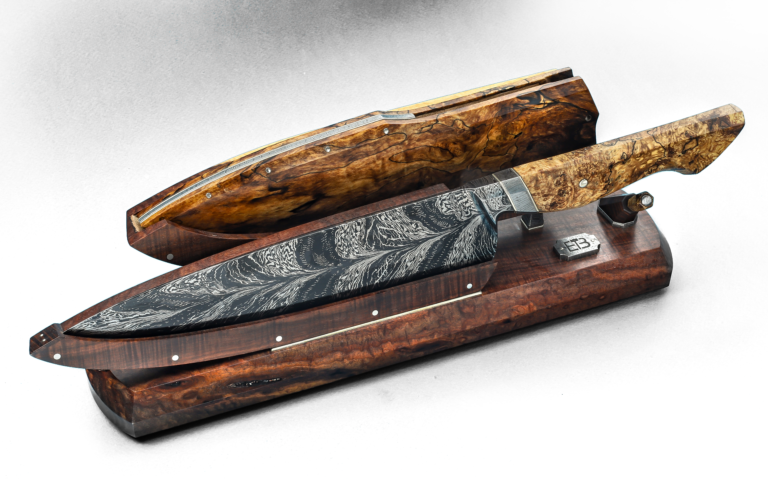
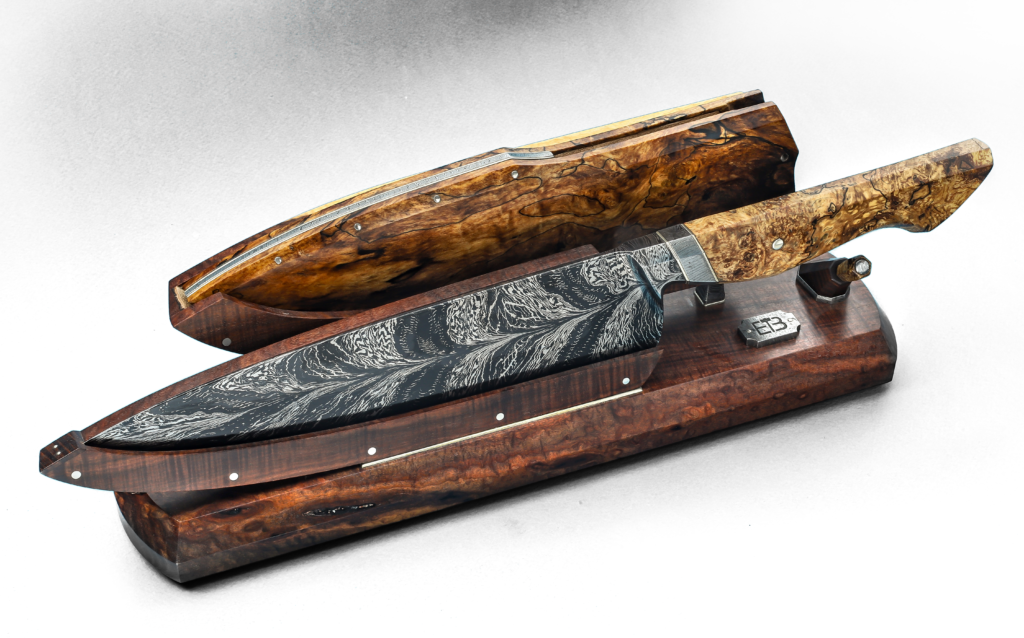
Best Kitchen Knife: Bill Burke

Best Handle Design: (No Winner)

History of the BLADE Show: It All Started With Two Names

If you are fortunate enough to attend this year’s 40th BLADE Show, when you initially walk into the mammoth show hall of the Cobb Galleria Centre, take a moment and look around you. Every table, every booth, every person and the exquisite atmosphere that screams knives! would not be if not for two people: BLADE Magazine Cutlery Hall-Of-Fame® members Bruce Voyles and Jim Parker.

Bruce Voyles

It was Bruce and Jim who organized the first BLADE Show—advertised early on as The Blade Magazine 1982 Knife Show—at the Drawbridge Motor Inn in Fort Mitchell, Kentucky. (At the time, Jim and Bruce co-owned both the show and BLADE® Magazine.) Just across the Ohio River from Cincinnati, Ohio, the event drew 7,000 attendees, by the standards of the day a huge amount of folks for one knife show. Even now, other than the BLADE Show, few if any knife shows attract that many people.

Remember, this was all done long before there was an internet and social media to generate pre-show interest. Pre-show advertising was basically all print—mostly in BLADE—and by word of mouth. Add the fact that the knife industry itself was a shadow of what it is today in terms of numbers of factory knife companies, custom knifemakers and, most importantly, knife enthusiasts, and attracting 7,000 attendees is even more remarkable.

Bruce and Jim, the latter founder of Parker Cutlery, were nothing if not visionary marketers of knives and venues in which to market them. They knew that to make the BLADE Show really stand out, they would have to make it the focal point of all things knives. To do this, they had to establish the event as the be-all/end-all knife show.

One of the things that set the BLADE Show apart even back then was it gathered all segments of the cutlery industry—factory, handmade, antique, knife collections, etc.—all under one roof. While the concept had been tried before, it had never continued in an annual fashion the way the BLADE Show was about to do it under the direction of Jim and Bruce.

History of the BLADE Show
Jim Parker

Another way to make the show unique was to establish awards that would be the factory knife industry’s equivalent of the movie industry’s Oscars. The awards would be the standard to which all factory knives and knife companies would aspire. The BLADE Magazine Knife-The-Year® Awards were the result, and they remain the most coveted factory knife honors to this day.

Bruce and Jim had the Knife-Of-The-Year concept covered, but what about a way for the show to memorialize its pioneers, the movers and shakers that made the knife industry the dynamic entity that it had been and would become even more so? The solution: the BLADE Magazine Cutlery Hall Of Fame®, with the latest members enshrined each year at the BLADE Show. Created for the 1983 event, it remains the industry standard to this day.

Jim and Bruce would continue to grow the show, moving it to the Holiday Inn & Convention Center in Knoxville, Tennessee, in 1984. In only its third year, with over 30 booths and almost 500 tables, it was vying for the title of the world’s largest knife show—if it wasn’t already.

Bruce bought out Jim’s interest in both BLADE and the BLADE Show in 1986, and moved the show to Atlanta and today’s Renaissance Atlanta Waverly in 1992. Bruce sold the show and the magazine to Krause Publications in 1994, and the event moved to the adjoining Cobb Galleria Centre in 1997, eventually evolving into the monster it is today, now under the ownership of Caribou Media Group LLC.

Jim passed away in 2004 but Bruce remains active in the knife industry as an auctioneer, show coordinator and author, among others. As of this writing, he had reserved BLADE Show booth No. 608. Unfortunately, he might not be able to attend this year’s show and if he does not, his beautiful wife Debbie and equally beautiful daughters Heather and Vanessa will be there to woman the booth. If he somehow is able to attend, he can answer any and all questions you have about knives, as well as the early history of the BLADE Show. Oh, and pack a lunch. He would have more tales to tell than a little bit.

BLADE Show 2021 – Virtual Swag Bag

0

BLADE Show is home to countless knives and just as many exclusive deals. Here are some outstanding highlights from our sponsors you don’t won’t want to miss.

  • Smoky Mountain Knife Works
  • WE Knife
  • Work Sharp
  • Big Daddy Unlimited
  • Wicked Edge
  • W.R. Case & Sons Cutlery
  • Hogue Knives
  • Kizer Cutlery
  • Microtech Knives


Virtual Swag BagSmoky Mountain Knife Works
Get Your Free Swag Bag at Booth 29

Stop by SMKW’s Booth (29) at BLADE Show, and we’ll give you an awesome free swag bag (while supplies last). Don’t wait!


WE Knife
WE KNIFE BANTER at Booth 725

See more of our new knives at Booth 725.


Work Sharp
Precision Adjust Special $50 (Only 300 Available) – Booth 312

All orders over $50 include a FREE Micro Sharpener. Precision Adjust on sale for $50 while supplies last.


Big Daddy Unlimited
We’ve SLASHED the price on our Big Daddy Unlimited annual membership!

Take a STAB at these savings ($79.41) & Sign up NOW! Click here.


Wicked Edge
10% Off – Booth 42

Come see us and our newest arrivals in Booth 42 and pick up your BLADE Show 2021 coupon for 10% off your favorite tool.


W.R. Case & Sons Cutlery
FREE “Made in Bradford” Stickers from Case Knives! – Booth 109

Get a free “Made in Bradford” sticker when you stop by Booth 109 to check out the all-new Marilla™ and Kinzua™ EDC knives from Case!


Hogue Knives
Hogue Knives 2021 BLADE Show Exclusive Deka – Booth 52

CPM 20CV stainless steel blade with a Glow Rhino Tritium infused ABLE Lock® carbon fiber frame and blue titanium hardware. Exclusively available at BLADE Show at Booth 52.


Kizer Cutlery
2021 BLADE Show knife – Kizer Sheepdog Mini C01c, 40th Anniversary Special edition

This special edition of the Sheepdog mini C01c is equipped with 154CM steel and champagne handles, only 300 available with a serial number. Get it here.


Microtech Knives
Ultratech D/E for Only $160 – Booth 324

This year’s BLADE Show Special from Microtech Knives is the Ultratech D/E. Price is $160. Cash only. Limit one per person. Available at Booth 324.

Advertisement

Must Read Articles

Read this before you make a knife

Knifemaking 101 – Read This Before You Make a Knife

  by Wayne Goddard My experience has taught me that there's nothing like digging in and getting started. I've often said the hardest part of the...
how to forge damascus steel

How to Forge Damascus

Advertisement
Advertisement