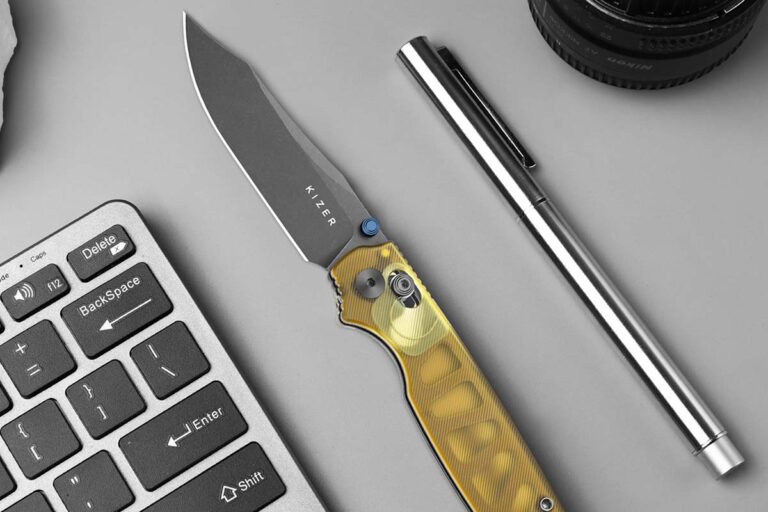
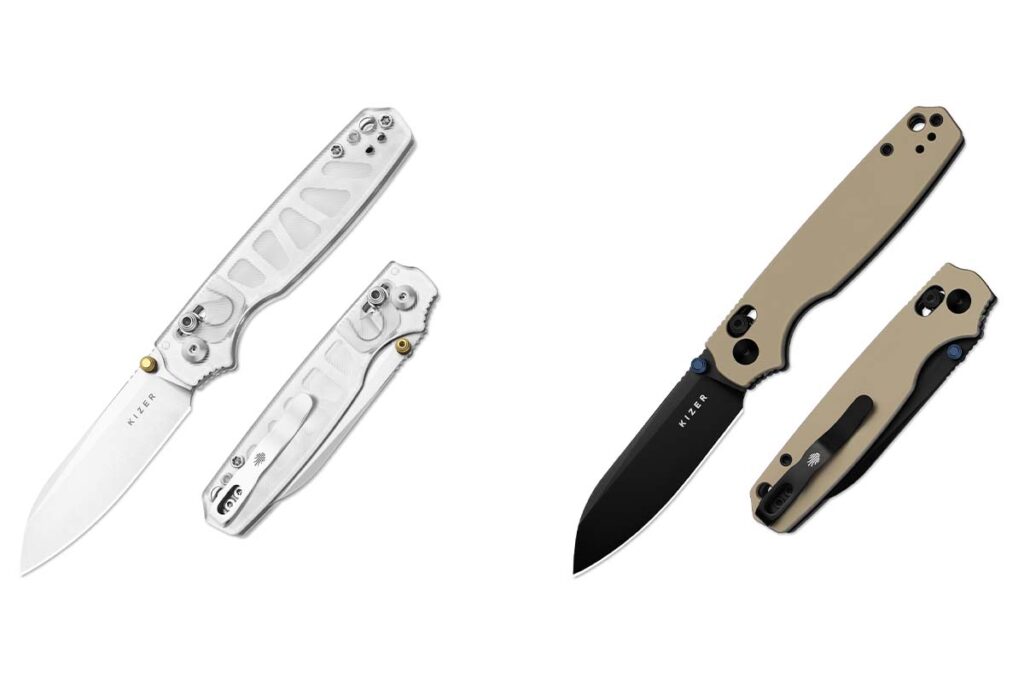
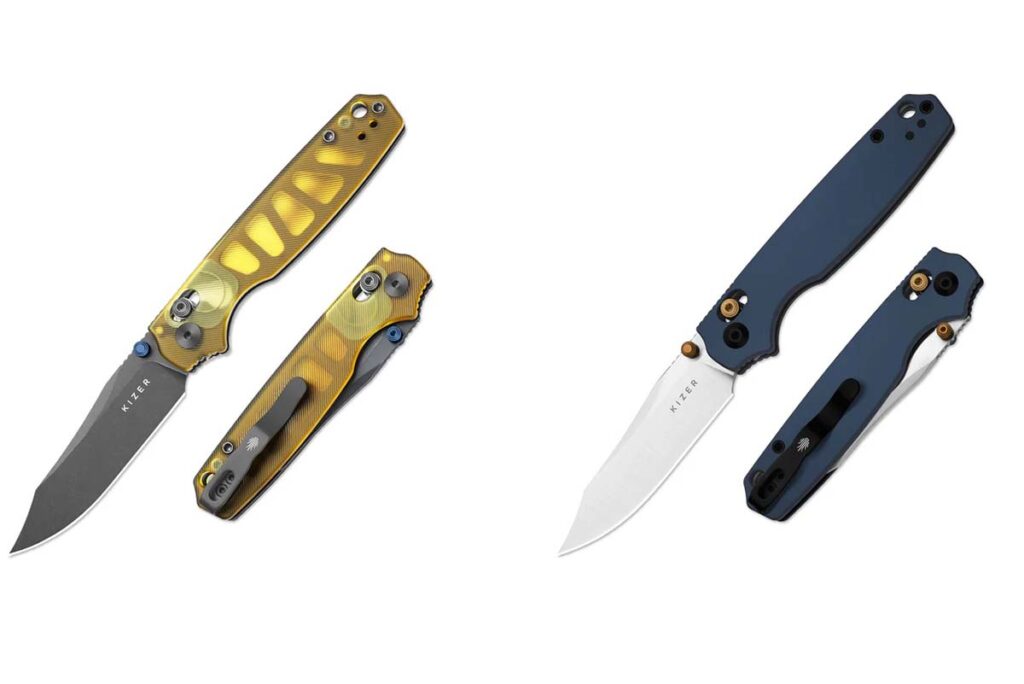
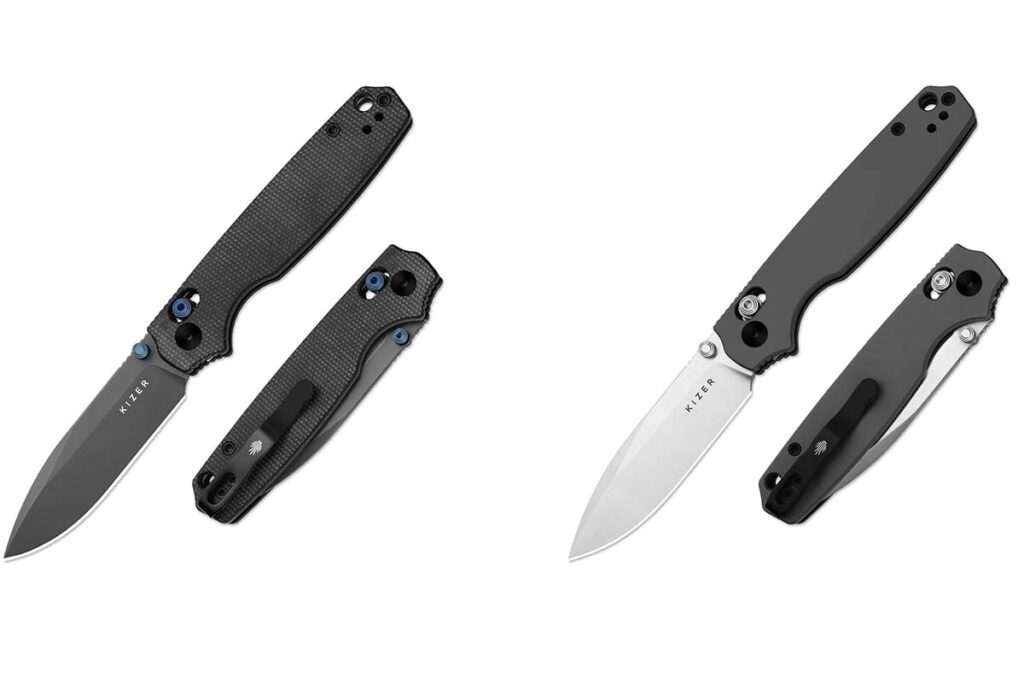
Class meets capability: Exploring Kizer’s ambidextrous Clutch Lock folders featuring AEB-L stainless steel and premium handle scales.
‘Tis the season for sharp gifts to place under the tree for your favorite knife enthusiast. Kizer Cutlery has a little something to stuff stockings with once the Yuletide season closes.
Set to officially launch in January 2026, the company’s Pokiman series is described as a collection of gentleman knives. The set of six knives—three models, each with two variations—may look suitable for a church picnic or the office, but they are not small and delicate.
All knives in the Kizer collection are essentially full-sized EDC options. Each one boasts a 3.16-inch blade. Overall length is just under 8 inches. This size provides enough tool for prying at a stuck locker lid or making mincemeat of sisal rope.
Yet, boasting everything from sheepsfoot to clip point blades and Micarta to aluminum and PEI scale, the knives have the look and lines for more suave tasks.
Common across the models are AEB-L steel blades, a very old and respected stainless steel, known for its fine carbide structure and a good balance between hardness and toughness. Plus, it’s known to take and hold an edge.
Kizer outfits the Pokiman line with its Clutch Lock, the company’s take on the ever-popular Axis Lock, presently sweeping the knife world. And why wouldn’t it, given its design makes a knife ambidextrous and offers a fast and quick, one-handed opening/closing option.
Interestingly, and seeming to walk hand-in-hand with the Axis Lock trend, Kaiser turns to thumb studs alone for the opening method on all the knives.
Depending on the model, the Pokiman line has MSRPs from $60-$70. While not available presently, several online retailers already have them on pre-order.
Pokiman CS Specs
Blade Length: 3.16″ Closed Length: 4.21″ Overall Length: 7.36″ Blade Material: AEB-L Stainless Steel Thickness: 0.110″ Blade Hardness: 58-60HRC Blade Style: Sheepsfoot Blade Grind: Flat Blade Finish: Black PVD or Gray Stonewashed Handle Material: Tan Aluminum or PEI Locking Mechanism: Clutch Lock Pivot Assembly: Bearings Pocket Clip: Deep Carry, Tip-Up, Right/Left Carry Weight: 3.08 oz. Origin: Made in China MSRP: Micarta & Stonwashed $60; Aluminum & Satin $70
Pokiman CC
Blade Length: 3.16″ Closed Length: 4.21″ Overall Length: 7.36″ Blade Material: AEB-L Stainless Steel Thickness: 0.110″ Blade Hardness: 58-60HRC Blade Style: Clip Point Blade Grind: Flat Blade Finish: Gray Stonewash or Satin Handle Material: PEI or Blue Aluminum Locking Mechanism: Clutch Lock Pivot Assembly: Bearings Pocket Clip: Deep Carry (Tip-Up, Right/Left Carry) Weight: 2.49 oz. Origin: Made in China MSRP: PEI & Stonewashed $60; Aluminum & Satin $70
Pokiman CD
Blade Length: 3.16″ Closed Length: 4.21″ Overall Length: 7.36″ Blade Material: AEB-L Stainless Steel Thickness: 0.110″ Blade Hardness: 58-60HRC Blade Style: Drop Point Blade Grind: Flat Blade Finish: Satin or Stonewashed Handle Material: Gray Aluminum or Black Micarta Locking Mechanism: Clutch Lock Pivot Assembly: Bearings Pocket Clip: Deep Carry (Tip-Up, Right/Left Carry) Weight: 3.07 oz. Origin: Made in China MSRP: Micarta & Stonwashed $60; Aluminum & Satin $70
Is the assortment of knives in your house as appropriate as it should be?
At one time I thought I wasn’t a knife collector. I am a knife enthusiast, knife user, knifemaker, knife writer, maybe even a reluctant knife expert, but not a knife collector.
Back when I thought that way, I looked around and noticed I had a dozen knives within arm’s reach, plus the tools in the kitchen, plus the customs of my own and a few from others, plus all the factory knives. Turns out I had nearly 100 knives, which means I’m definitely a knife collector, or at least an accumulator.
In my usual ADHD stream-of-consciousness fashion, my next thought was, “I wonder if I have a knife in every room of the house?” followed immediately by thoughts of which kind of knife would go in each room. Come along on my imaginative journey as we explore the idea of a knife for every room.
Kitchen
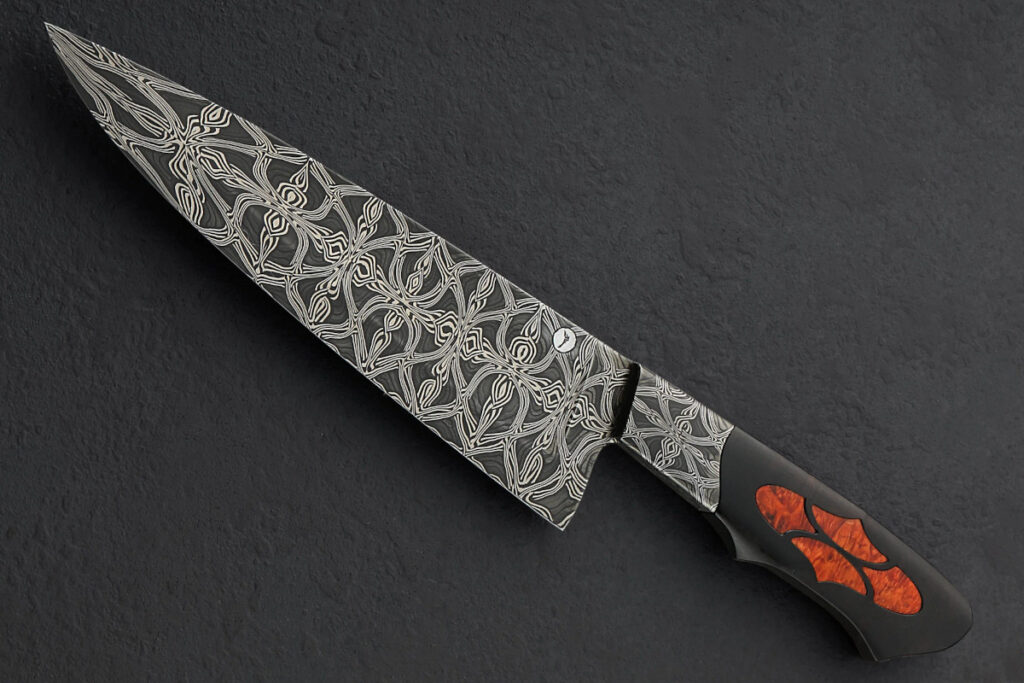
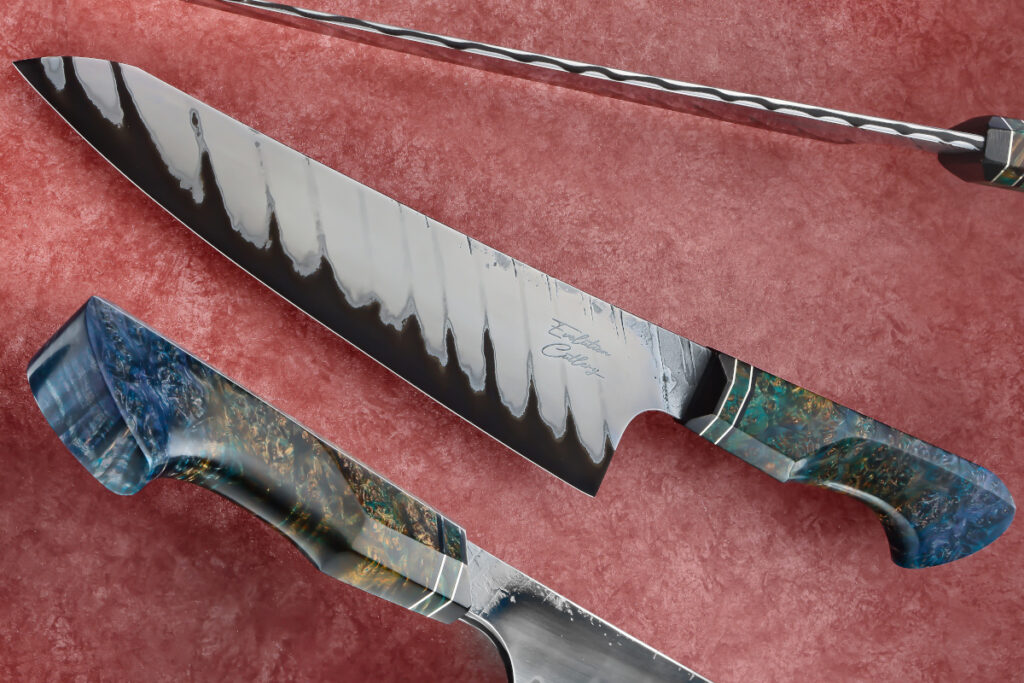
Knives in the kitchen are a given but including one by bladesmith Salem Straub is not. In the author’s perfect household cutlery world, one would be. An example: Salem’s Guimard chef’s knife in mosaic damascus. (EatingTools.com image)
The kitchen is intuitive. Most people have knives there, whether the knives are economy store cheapies, a mishmash random drawerful accumulated over years, a matching production set, or even dedicated custom household cutlery. On my imaginary journey, I can afford the good stuff, like a damascus chef’s knife from bladesmith Salem Straub. But that’s too easy. Why not a whole knife-fork-and-spoon-damascus set, like one from Nate “Tuna” Grant?
Garage
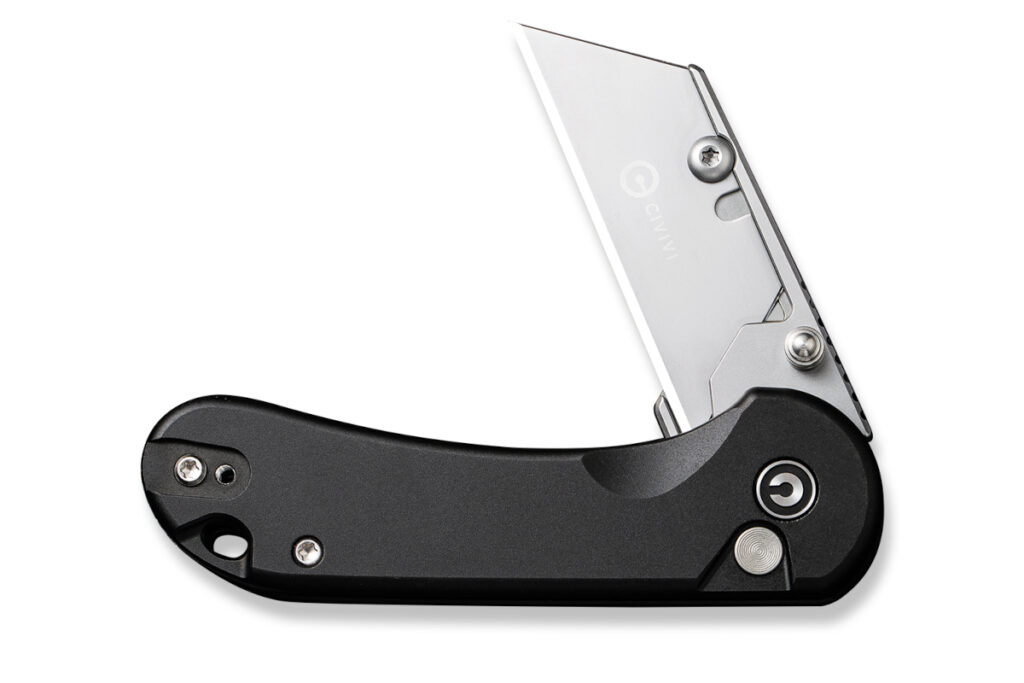
For the garage, the author suggests a factory utility knife of the replaceable-blade variety such as the Civivi Elementum.
The garage isn’t too tough either. My first thought was a utility knife of the replaceable-blade variety. In the past few years there’s been innovation in the custom knife world when it comes to replaceable blade knives, but for utilitarian and “I can use this and not be sad if I scratch it,” I think I’ll go with the Civivi Elementum that uses standard box cutter blades.
Living Room
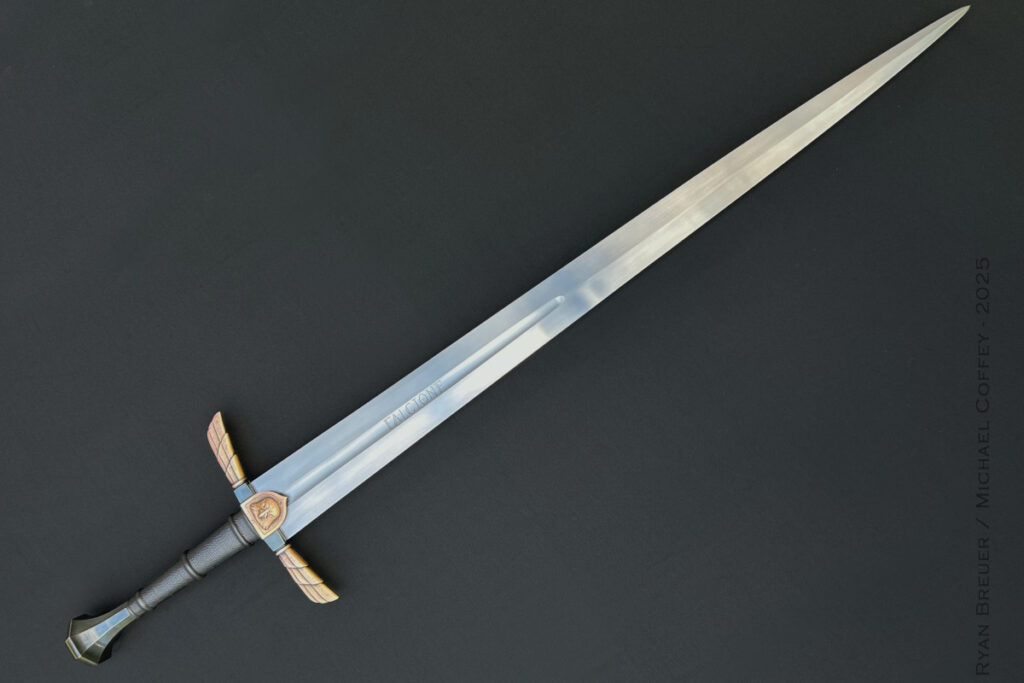
If the living room has a fireplace mantle, it’s a great place to display a custom sword. If you’re feeling medieval, the author recommends something like a hand-and-a-half piece by Ryan Breuer. (Ryan Breuer image)
The living room has the fireplace mantle, which is a great place to display a custom sword. If I were feeling medieval, I’d choose something like a hand-and-a-half piece from Ryan Breuer. Conversely, if I were feeling loud and Japanese, I might choose a fine bright katana like one from David Goldberg with an epic hamon.
Study
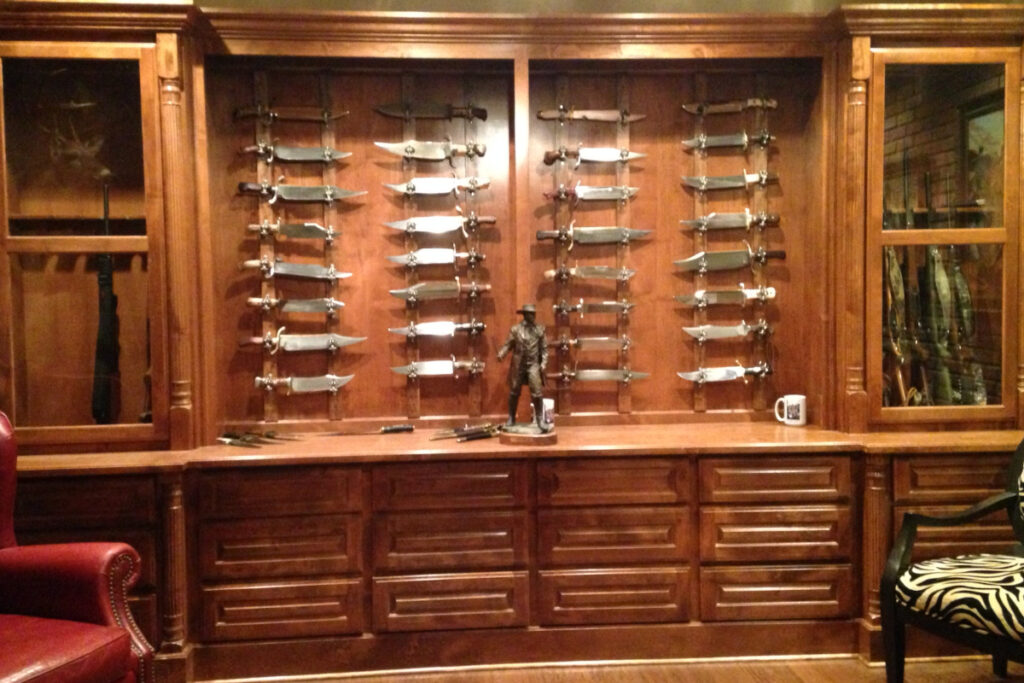
Along with studies, game rooms are also great for storing knife collections. Avid bowie collector Chris Nolen keeps his collectibles in a game room display designed by his son-in-law, replete with a statue of Jim Bowie and slide-out drawers that hold around 10 bowies each. (Chris Nolen image)
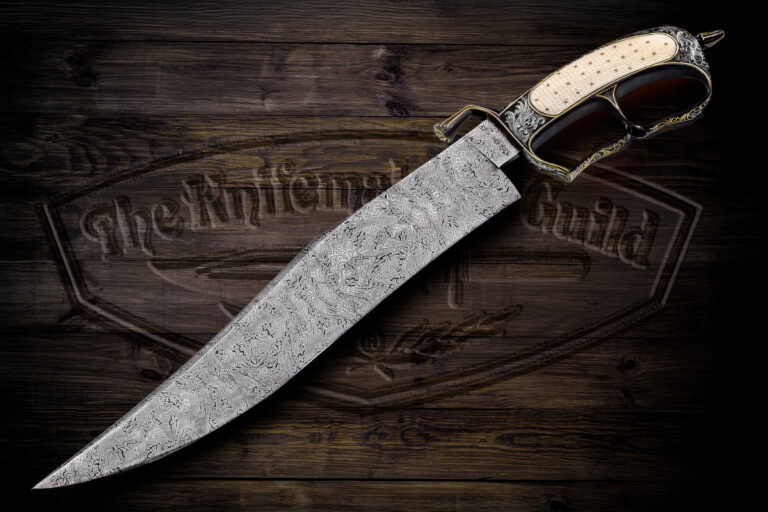
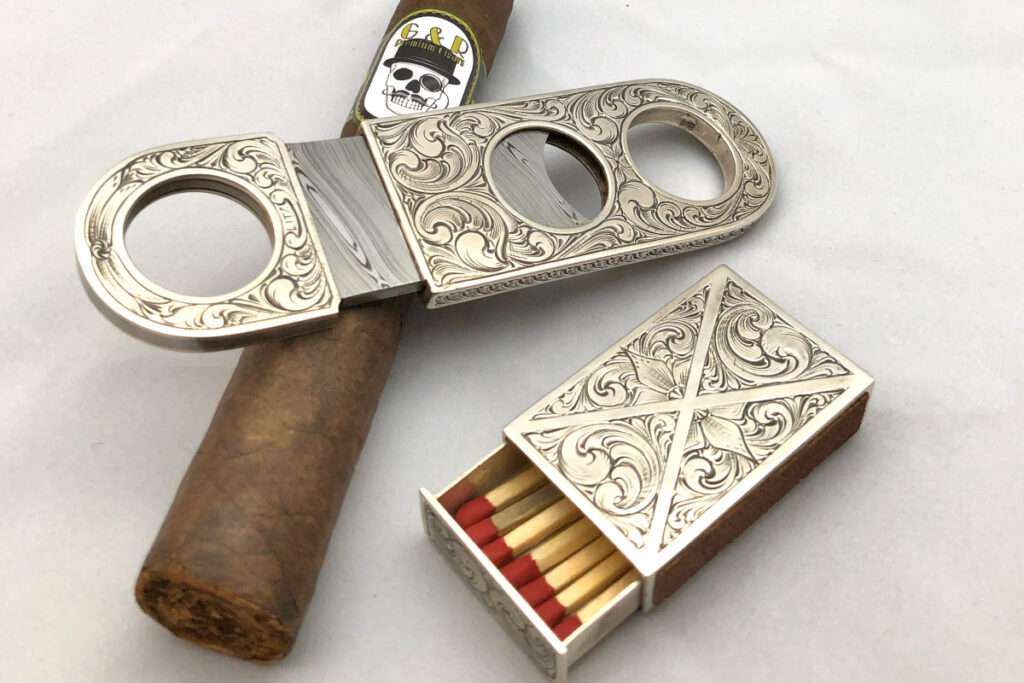
The gentleman’s study is dark, filled with books and memorabilia—the perfect place to store and display the “real” knife collection. Personally, I’d like a collection of custom bowies. I’d include pieces like a fully forged integral mosaic model from ABS master smith Mike Quesenberry, or an exquisite collaboration like The Knifemakers’ Guild award-winning piece by Nick Orr and Bailey Bradshaw. Or maybe I’d go rustic like ABS master smith Lin Rhea’s Preacher Bowie named after a mountain man. I’d round out the room with an engraved silver cigar-cutter-and-match-box set by Travis Payne engraved by Matt Litz for when the guys and I want to relax with a puff.
An engraved silver cigar-cutter-and-match-box set by Travis Payne engraved by Matt Litz for relaxing with a puff among friends would round out the author’s dream study. (Matt Litz image)
These days most tend not to receive letters, only junk mail and bills, and most of the junk mail goes straight to the trash unopened. But if I had a home office and I received good mail, I’d have to open it with a custom letter opener like one in a set from Deon Nel. He made a matching set of 16, so I bet he could spare one.
Outdoors
The backyard isn’t exactly part of the house, but that doesn’t exempt it from being a part of the author’s imaginary knife journey. If you have a standard grill, consider something like a san-mai brisket slicer from Dan Tompkins. (SharpByCoop image)
The backyard isn’t exactly part of the house, but that doesn’t exempt it from being a part of my imaginary knife journey. For those with a standard grill, you might consider something like a san-mai brisket slicer from Dan Tompkins. Or if you’ve got a fire pit, don’t forget Will Stelter’s damascus and mammoth ivory marshmallow fork. Or if you live in the woods, you might want a forged axe like a laminated wrought iron one from Nick Bachtel.
Bedroom
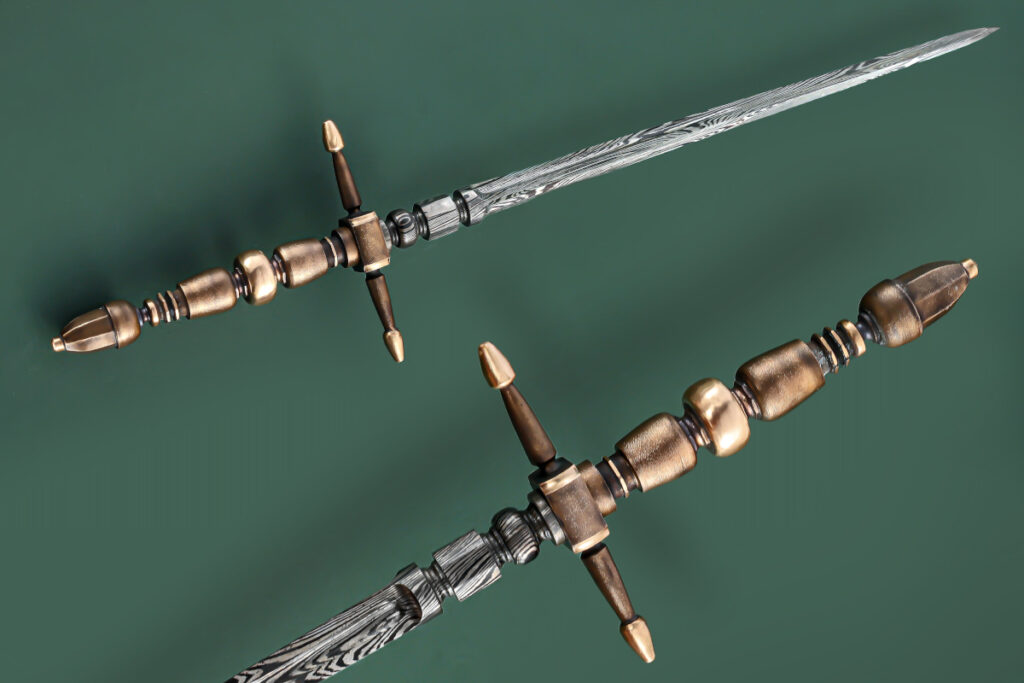
The author’s dream bedroom pillow dagger would be like Buttercup’s in The Princess Bride. If he were Buttercup’s beau, Dread Pirate Roberts, the author stated he might give his lady something like a poignard by Jamie Bishop. (SharpByCoop image)
Bedroom knives are a bit of a stretch. Personally, I have my hunting knives in my bedroom closet. If I were rich and fancy, though, I’d have to have a pillow dagger—you know, the dagger you keep under your pillow just in case. I’m reminded of the scene in The Princess Bride when Buttercup pulls out a fine stiletto in the bedroom, and the great Dread Pirate Roberts line that goes with it: “There is a shortage of perfect breasts in this world. It would be a pity to damage yours.” If I were Dread Pirate Roberts, I might give my lady friend something like a poignard by Jamie Bishop, or even something dainty and feminine like a fine small piece from ABS master smith Veronique Laurent. For under my personal pillow, I’d go with something extravagant like an art dagger from the Sobral Brothers.
Bathroom
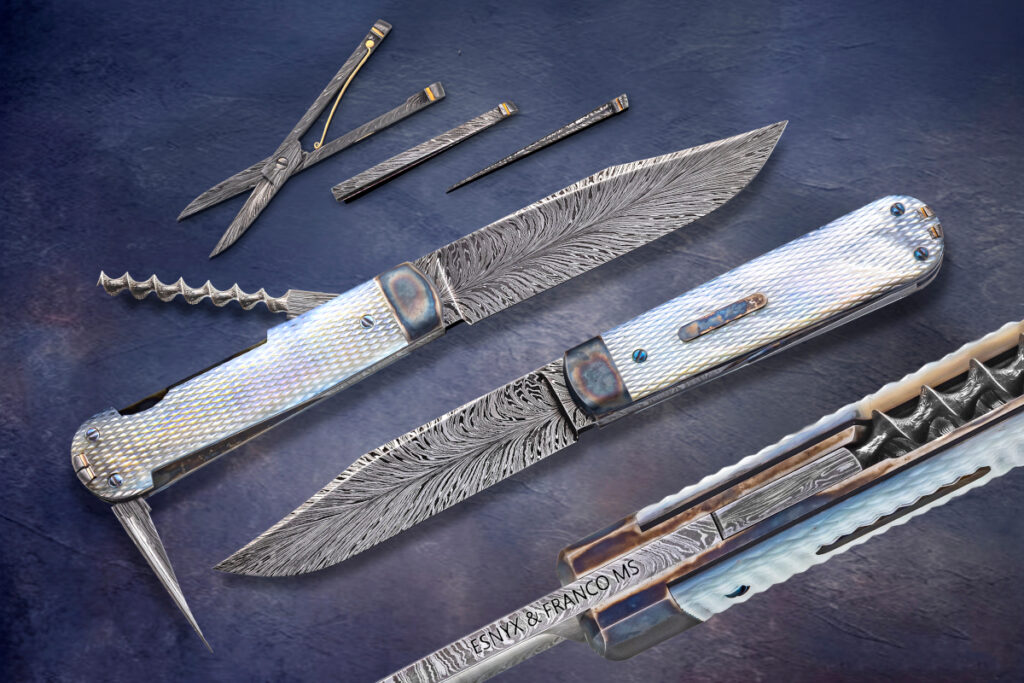
Bathrooms are for hygiene and sometimes that takes a knife. To clean your fingernails or pull a splinter in style, the author recommends something like the fine Dourado collaboration between ABS master smith Dionatam Franco and Evan Nicolaides. (Mitchel Cohen image)
Bathrooms are for hygiene and sometimes that takes a knife. If you want to clean your fingernails or pull a splinter in style, I recommend something like a fine collaboration between ABS master smith Dionatam Franco and Evan Nicolaides. The pearl scales will shimmer in the vanity lights, and there are enough tools included to take care of many different tasks. Or if you want to play “Mack the Knife” in a dark alley then come home and comb your hair, Rick Lala can hook you up with his two-tool blade/comb folder.
How Close Are You?
You may not have a knife for every room, but I suspect that many BLADE® readers come very close. Here’s to improving the quality of your knife collection—even the bedroom knives!
From tactical rings to signature openers: analyzing the practical advantages of negative space in blade engineering.
The hole in the handle or blade, or anywhere in knife construction, has something to tell the user. But what is it trying to say or do?
It is eye-catching but the hole and/or ring and the science that goes along with it complement the visual and the practical in knife use. Aesthetics, mechanics and utility are factors. After all, the essence of the knife is in its use as a tool, and who wouldn’t mind a prettier profile at the same time?
Original Hole
The story of the hole in the blade cannot be told without including Spyderco and its legendary leader, BLADE Magazine Cutlery Hall-of-Fame® member Sal Glesser. In the decades since Spyderco introduced its iconic hole in the blade, the company has produced countless folders that characterize the ease of opening inherent in the hole itself.
The story of the hole in the blade cannot be told without Spyderco and its legendary leader, Sal Glesser. The BLADE Magazine 1990 Overall Knife of the Year®, the blade-hole-opening Endura is one of the company’s longest-running models.
Sal said he well remembers the inspiration to step out with his company’s blades.
“The Buck 110 and Gerber Folding Hunter were the watershed change to locking knives, in my opinion,” he recalled. “I purchased a Buck 110 when they first came out. As a young man I learned to open the Buck and Gerber lockers with one hand using my thumb, pushing on the side of the blade. I was working late in the shop one night, payables, payroll, etc., and I thought to try to figure out a way to modify a folding knife so that anyone could learn to open [it] with one hand more easily and more safely than the way I was doing it.”
From that single thought, Glesser went to work. He experimented with adding to the blade for leverage—studs, discs, hoods and other things—but found they got in the way when cutting or sharpening and could “wave” the knife open unintentionally when deploying.
“So I started taking things away from the blade to create purchase for the thumb,” Sal continued. “I first roughed up the side of the blade, which worked, but not very well. Then I drilled a dent into the blade. A dent on both sides became a hole.”
Eureka!
Sal plowed ahead, making a rough prototype using a Japanese folder and welding a piece of drilling rod to the spine of the blade to add height. He ground it down to the thickness of the blade and then drilled the hole to test his ease-of-opening theory.
“We applied for a patent claiming a ‘ledge’ created by the edge of the hole that could be used by the fleshy part of the thumb to urge the blade open with one hand,” Sal recalled. “I chose to use a round hole because it was easier to make and was easily identifiable.”
The rest, as they say, is history.
From the first blade-hole model in 1981, the Spyderco Worker, the distance from the center of the pivot to the hole was analyzed while the optimal size of the hole for the average thumb was measured. Enhanced trademark work was successful in securing the round shape since copies were notable with different shapes to get around the word “hole” in the original Spyderco patent language. Hence, the company introduced the hole into its fixed blades as an identifier “large enough to be cleaned and small enough to be noticed.”
Perfecting the hole for its primary purpose of easy opening meant leaving a certain amount of steel above the hole to compensate for the space. “Some steels that are more brittle could be broken through the hole if pried with hard enough,” Sal concluded. “But the truth be told, there are millions of Spyderco knives in the marketplace over the past almost 50 years and there have been very few that were broken.”
Where & Why Of Holes
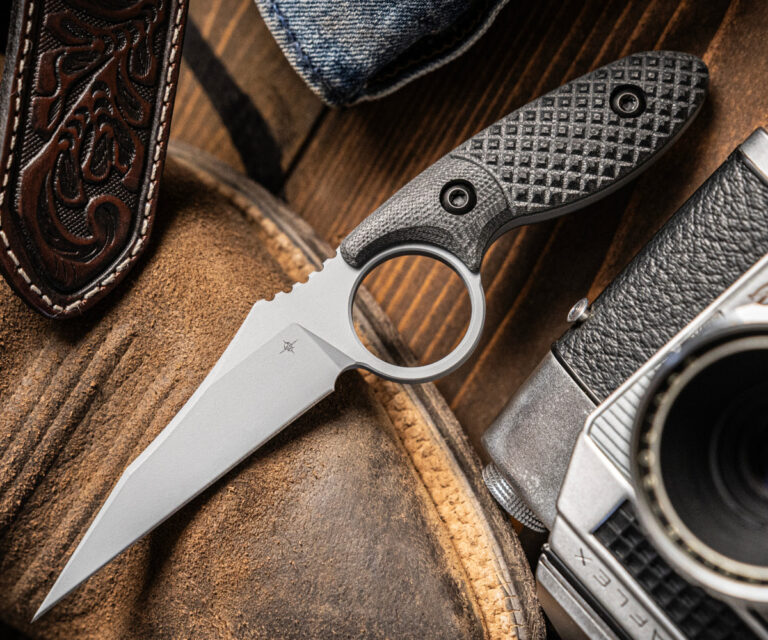
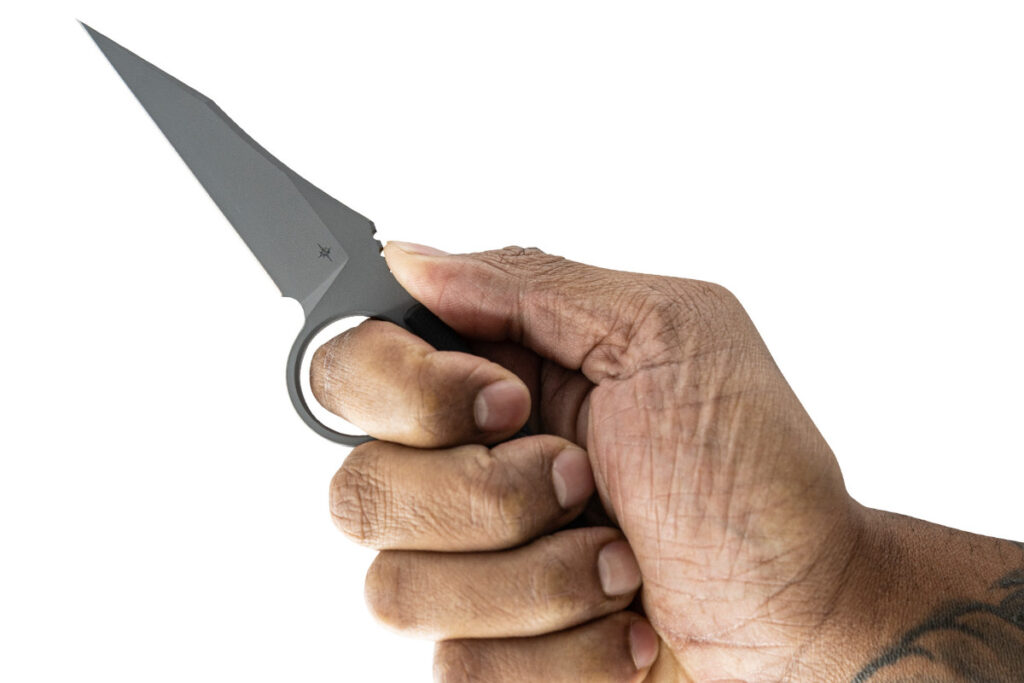
Toor Knives CEO Connor Toor says the hole/ring of the Cortano is between the handle and blade for several reasons, including deployment and retention, a tactile index for consistent hand placement, a lanyard attachment point, and an unmistakable visual signature. Another is the ability to choke up for precise cuts without losing control.
In overall perspective, the hole has its place in the fixed blade as well. The Toor Corporation Cortano sports the hole/ring for a simple reason according to CEO Connor Toor.
“A hole allows fast, ambidextrous one-handed deployment without extra hardware,” he explained, “and it keeps the blade profile clean and snag resistant. It also slightly reduces weight and manufacturing complexity compared with an added stud or thumb disc.”
The hole in the Cortano is located between handle and blade for several reasons, including deployment and retention, a tactile index for consistent hand placement, a lanyard attachment point, and an unmistakable visual signature that differentiates the knife. An added bonus, says Connor, is the ability of the user to choke up for precise cuts without losing positive control.
“We typically call it an ‘index/retention ring’ or simply the ‘deployment hole,’” Toor commented. “The concept is rooted in historic ring knife forms and modern karambit/utility designs more broadly, so while makers like Steve Likarich are part of that lineage, our design pulls from both traditional ring knives and contemporary tactical needs rather than a single source.
“Any aperture introduces stress concentration,” Connor continued, “but proper blade geometry, material selection and heat treatment mitigate that risk. We designed the Cortano so overall material thickness preserves strength around the hole. Real world testing and appropriate use show no practical durability issues when those engineering details are respected.”
Holes For Balance
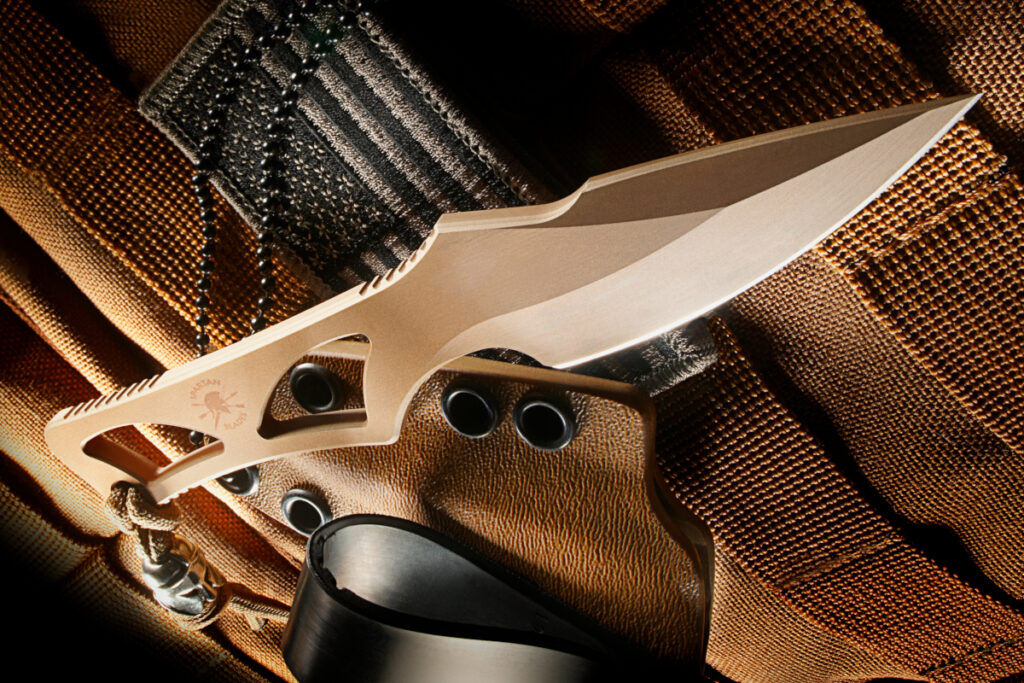
The Formido fixed blade from Spartan Blades comes with a series of grip holes, that, explains company president Curtis Iovito (inset), “primarily tune balance by reducing handle weight.”
The Formido fixed blade from Spartan Blades comes with a series of holes in the handle, and company president Curtis Iovito readily points to the advantages of the design.
“It’s primarily to tune balance by reducing handle weight,” he advised, “often to place the balance over the index finger. We’ll enlarge or shrink hidden holes under the scales to shift weight where it best serves the knife’s purpose. Looks can be a secondary benefit. Along with weight reduction, there are options for lashing or paracord wraps, and added indexing/traction without introducing weak corners. In some cases, they also enable spear mounting or other field attachments.”
Curtis adds that the parameters for the introduction of holes in the blade or body of the knife vary as to the designer’s objectives.
“There is no universal formula,” he related. Holes, however, must measure up to certain standards to “maintain strong ‘webs’ of material around fasteners and stress points, and scales must be clamped well to prevent lifting and contamination. Round holes are favored because they machine easily and avoid sharp internal corners that become stress risers during heat treat. Arched/rounded cutouts can add torsional strength as seen on our Enyo and Formido.”
Holes In Karambit
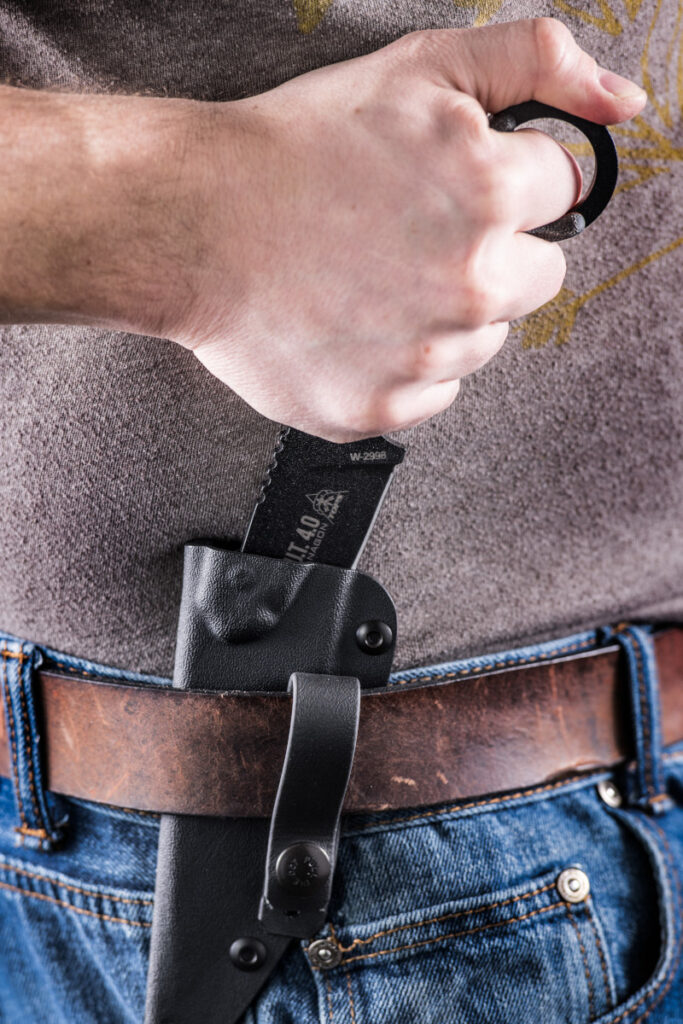
Designed by Joshua Swanagon, the TOPS Knives C.U.T. 4.0 is a hybrid karambit that combines the practicality of a utility knife with the defensive and combat features of a standard karambit. Its ringed handle is common to the pattern’s lineage while the utility drop-point blade is more of a traditional design element.
At TOPS Knives, the C.U.T. 4.0 is a hybrid karambit that combines the practicality of the utility knife with the defensive and combat features of the karambit. Its ringed handle is common to the karambit lineage while the utility drop-point blade is more of a traditional design element. The karambit hole itself is probably a derivative of agricultural use.
“It does seem to be the case that many karambits used in Asia were used as a tool first, cutting cane or other crops” said Craig Powell, TOPS general manager. “As a tool, the pinky is usually in the hole so that the knife can hang down from the hand while the user is picking up the harvest, and then it is swung back into the hand to use the cutting edge.
“I wouldn’t say there is a set rule on the size of the hole,” he added, “but too small makes it easy for fingers to get stuck, which can equal broken fingers or de-gloved fingers in situations where the knife can’t be dropped when needed. Too large makes the knife clunky to use and manipulate properly and too easy to drop. Definitely, there is a balance to be struck. The hole size we use for our karambits does vary somewhat with the overall size of the knife. Typically, the smaller the overall size, the less likely someone is going to use the knife while wearing gloves, so you can use a smaller hole to keep the overall profile of the knife smaller.”
The characteristic ring in the butt of the karambit adds versatility, and Iovito sees advantages in several areas.
“The ring allows rapid grip changes, secure retention of a short blade under stress, and manipulation without dropping the tool. On our CQB Tool, for example, the ring lets a user transition to a pistol grip in a pinch without discarding the blade. We use PEO Soldier [U.S. Army Program Executive Office] data on the average-gloved-finger size for reliable use with gloves. Our research points to about a 1 1/8-inch internal diameter as optimal—big enough for manipulation and glove use without binding, yet not so large that control gets sloppy or the blade flops on the finger. Too small risks pinching, circulation issues, and snagging; too large compromises indexing and retention.”
Michael Janich, special projects coordinator at Spyderco, agrees that the karambit has an agricultural lineage but adds that the island archipelagos of the Pacific, where the design developed, will often provide different cultural backgrounds to its story.
“After harvesting a bundle of vegetables, the handle was released, allowing the knife to hang from the pinky, freeing both hands to tie the bundle,” Janich reasoned. “In contrast, sheathing the knife every time was inefficient and would require the blade to be cleaned to prevent soiling the inside of the sheath. Logically and practically, this makes sense. Some stories of the origin of the karambit, though, suggest that it was developed primarily as a weapon.”
Arched/rounded handle cutouts can add torsional strength as seen on the Enyo by Spartan Blades.
As for the dimensions of the karambit and its characteristic hole, Janich points out that some tools defined as karambits of Southeast Asian origin do not even sport the hole. Nonetheless, the hole defines the karambit today.
“The karambit is not the only historical knife to have a ring,” Michael added. “The Japanese kunai was a trowel-like tool that had a ring at the end of the handle. The ring could be used to enhance grip retention. It also allowed the tool to be hung from a cord for easy transport or for the attachment of a lanyard. The Chinese martial arts also had daggers with butt-mounted rings. In some systems of kung fu, the rings had no specific purpose and only served as pommels. The bird and trout knife, first introduced by Marble’s, also had a pommel ring. Of integral construction, the handle portion of the knife was very narrow, so the ring provided both retention and grip stability.”
Attraction Of The Design
Universally in the world of knives, the hole or ring has its place, its moment, its degree of usefulness. Ultimately, the user chooses the tool that suits the task at hand, and the presence of the hole, for easy opening, control or enhanced utility, is always a candidate for deployment.
The sub-hilt is at once belligerent and beautiful, adding a strange allure to the knives that sport it.
There is no consensus as to the origin of the sub-hilt knife, though most agree the sub-hilt fighter was popularized by BLADE Magazine Cutlery Hall-of-Fame® member Bob Loveless in the 1970s, if not earlier. Some believe the sub-hilt design was for hunting, and that the main purpose for the added hilt was for greater leverage when a surer grip was needed. A few have even postulated the additional hilt was for use as a brace in pulling the knife out after being stabbed into bone or another hard material, a use that it would no doubt accommodate most effectively.
Gary Langley: Gentleman’s Fixed Blade
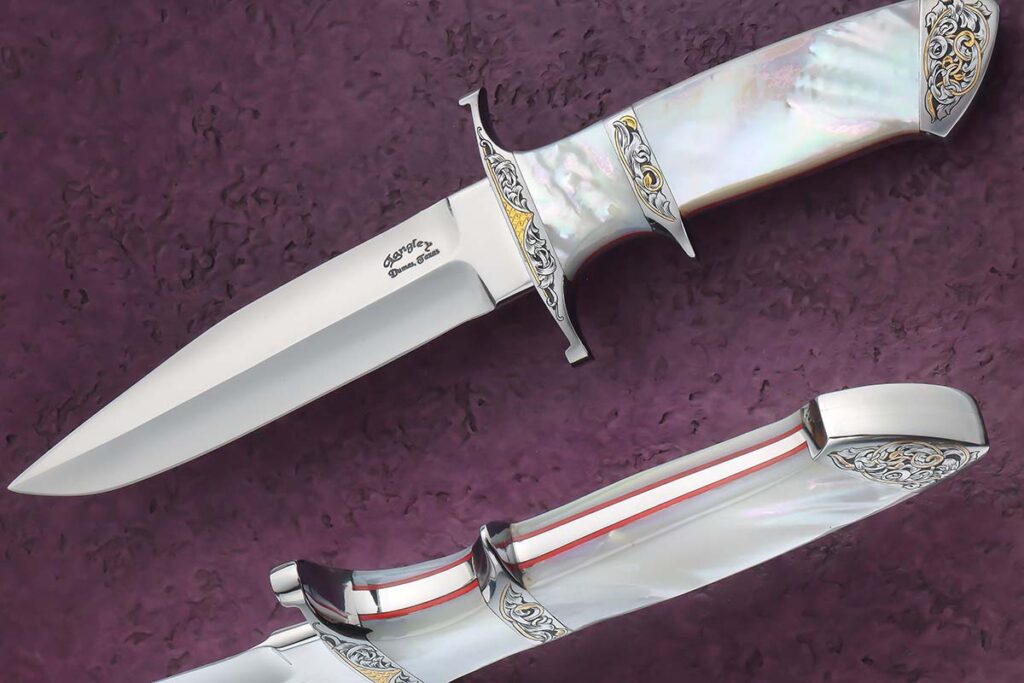
Custom maker Gary Langley’s sub-hilt fighter may be small at 9 inches overall but makes up for its size in sleek blade grinds, exquisite mother-of-pearl scales and gold inlay. Blade and overall lengths: 4.5 and 9 inches. Alice Carter did the engraving. (SharpByCoop knife image)
Many knife enthusiasts think of a sub-hilt fighter as being a heavier-edged companion—and in many cases it is—but custom knifemaker Gary Langley’s iteration is a little gem of a knife.
“The small Loveless-style sub-hilt fighter is 3/16-inch CPM 154 steel with a double hollow grind on a 3-inch wheel,” the Dumas, Texas, maker notes. “The heat treatment is by [Cutlery Hall-of-Famer] Paul Bos. I originally designed the knife without the rear bolster. I added it when I couldn’t source the mother-of-pearl scales long enough—and I believe it turned out even better.”
It has what might be called a 19th-century Michael Price San Francisco knife look that makes it a prime candidate for a true gentleman’s fixed blade.
Andrew Blomfield: Sub-Hilt Bowie
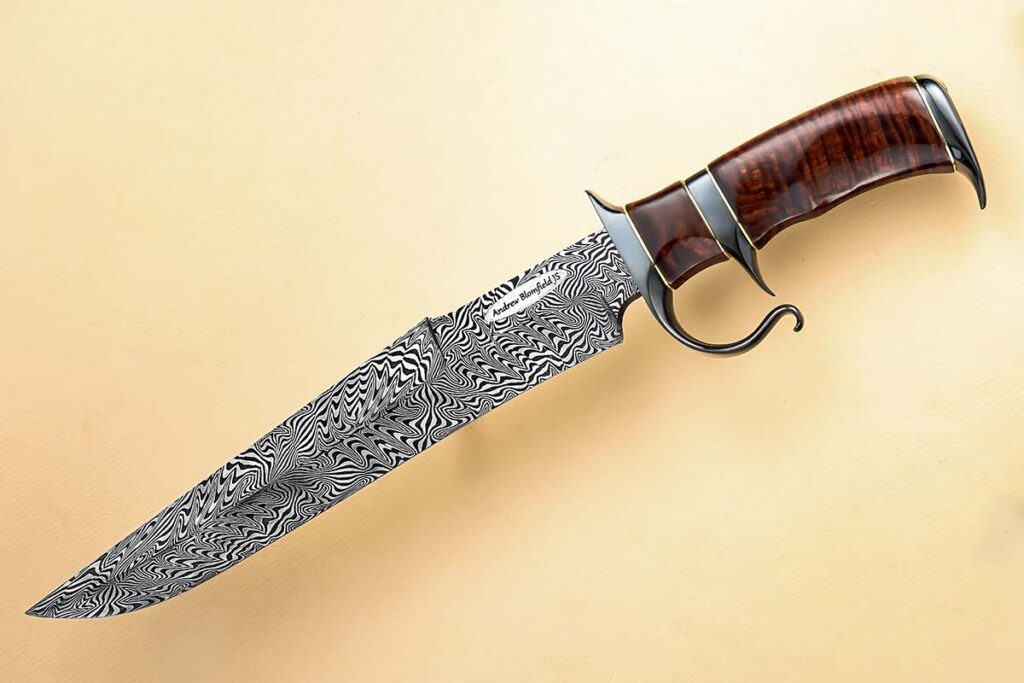
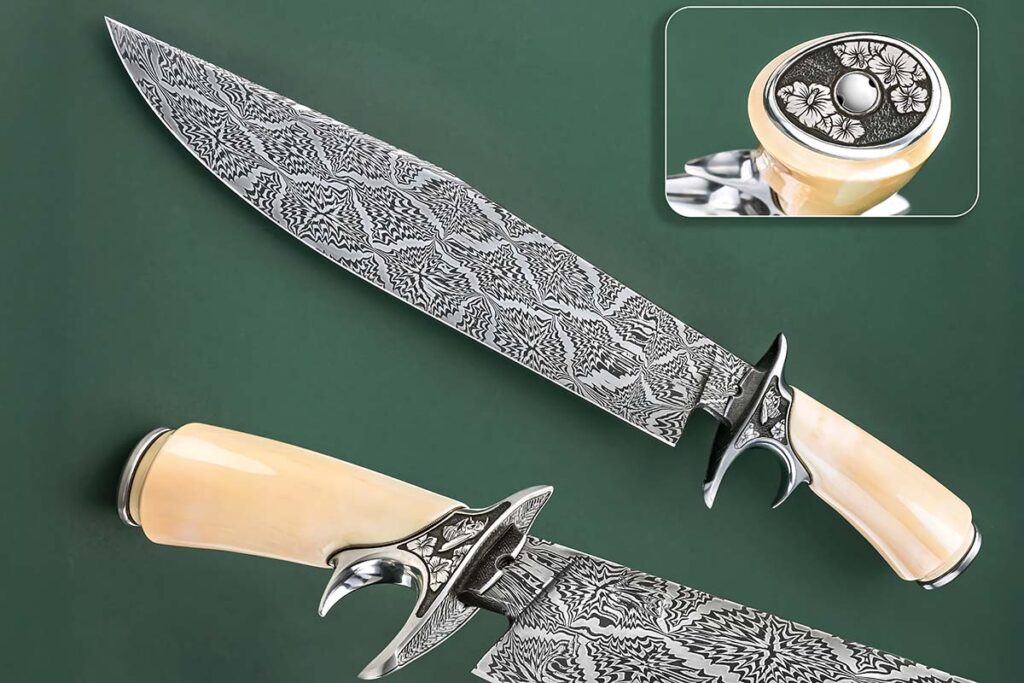
ABS master smith Andrew Blomfield’s sub-hilt bowie is a tour de force of explosive mosaic damascus, salt-blackened steel, brass spacers, and exquisite Australian ringed gidgee wood. Blade and overall lengths: 11 and 16 inches. (SharpByCoop knife image)
An ABS master smith from New South Wales, Australia, Andrew Blomfield enjoys building large knives such as bowies and daggers. “The bigger the knife the better,” he states. An example is his sub-hilt bowie.
“I feel that this knife has great flow and balance,” he begins. “The blade is an explosion mosaic pattern damascus hardened to 59 HRC. The guards and pommel are salt-blackened steel with brass spacers and the handle is a beautiful piece of Australian ringed gidgee.”
The guard’s bottom quillon curves back toward the sub-hilt to partially enclose the user’s hand a la a D-guard, but also has hints of both a C- and an S-guard to it. Very unusual!
Andrew Meers: Rose of Sharon
ABS master smith Andrew Meers calls his 16.5-inch sub-hilt fighter Bees and Flowers, due in no small part to the Rose of Sharon and bees engraving. The 12-inch blade is a damascus of 1084 carbon and 15N20 nickel-alloy steels in a mosaic pattern. Guard and furniture are 416 stainless steel. Overall length: 16.5 inches. (SharpByCoop knife image)
ABS master smith Andrew Meers of Raleigh, North Carolina, says, “I started with the sub-hilt in mind, which is a departure for me.” To say his deviation from the norm worked out well is an understatement.
“I like to incorporate Japanese influences wherever I can, and I wound up adding an integral habaki into the guard design as well,” he explains. “I wanted a blade that was able to feature a mosaic pattern, so I chose a broader shape that expands towards the point rather than tapers. The handle is a simple design to contrast the visual complexity of the guard.”
The engraving theme is of the Rose of Sharon and bees.
“The client had requested a floral theme, and we worked on the rest of the design and layout from there,” Andrew says. “The engraving was meant to complement the layout of the guard and furniture.”
Justin Harrington: A-Team
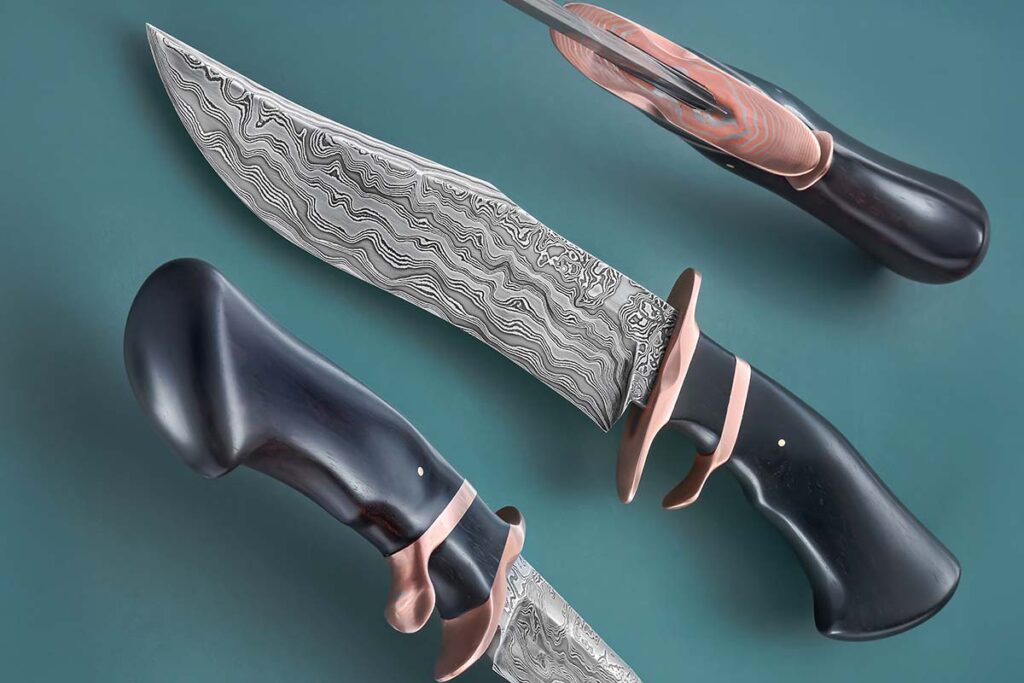
Built for an Army buddy, Justin Harrington’s superb sub-hilt fighter incorporates a masterful balance of random pattern damascus, mokumé gané and African blackwood. Blade and overall lengths: 8.5 and 13.5 inches. (SharpByCoop knife image)
Justin Harrington of Clemmons, North Carolina, began smithing 18 years ago and is the owner of Cyclops Forge. Of the sub-hilt he says, “It’s the racecar of fighting knives—weight, balance, curvature, tip control and placement all are important variables to be employed to reach a harmony which is felt right away when correctly done.
“This knife started its life as a phone call from an Army A-team member who wanted a special combat retirement gift for his buddy. The three of us got together and forged a damascus billet for the knife over three days in my shop. The 8-inch recurve blade is a random-pattern damascus of 1084 and 15N20 carbon steels. The guard and sub-hilt are made from a copper-and-nickel mokumé gané I make in my shop. The handle is around 5 inches of sculpted African blackwood with a bronze pin.”
The sub-hilt has a forward lean and spoon-cupped quillon that slants toward the guard to capture the user’s index finger. The result is a handle that seems to want to grab your hand.
Cool & Sexy
Whether fighter, bowie or what have you, the sub-hilt-knife genre may be more recognizably custom than any other. From the classic Loveless Big Bear fighter to the wide array of today’s renditions, top sub-hilts are cool, sexy and in harmony with the best custom knives extant.
BLADE Tactical Knife Show joins forces with CANCON Carolinas.
The best of both worlds—knives and firearms—drew edged and gun enthusiasts alike to the 2nd Annual BLADE Tactical Knife Show (BTAC) held in conjunction with CANCON Carolinas November 7 at The Clinton House in Clinton, South Carolina.
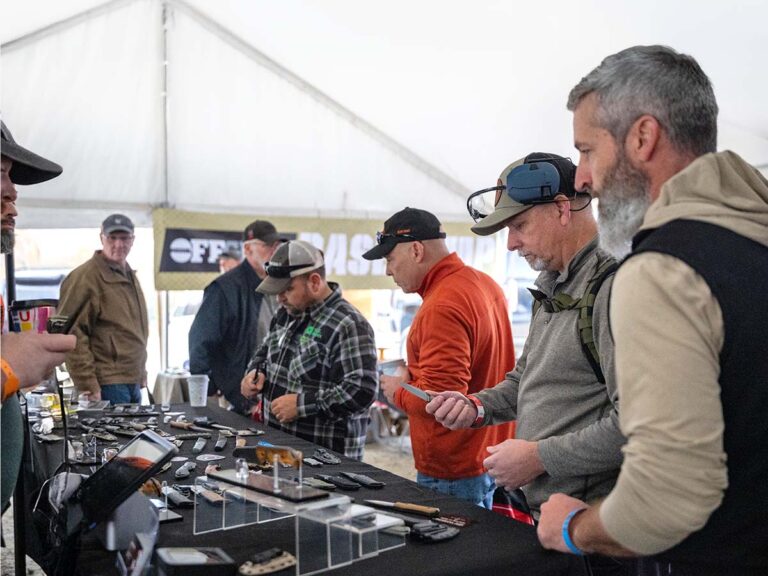
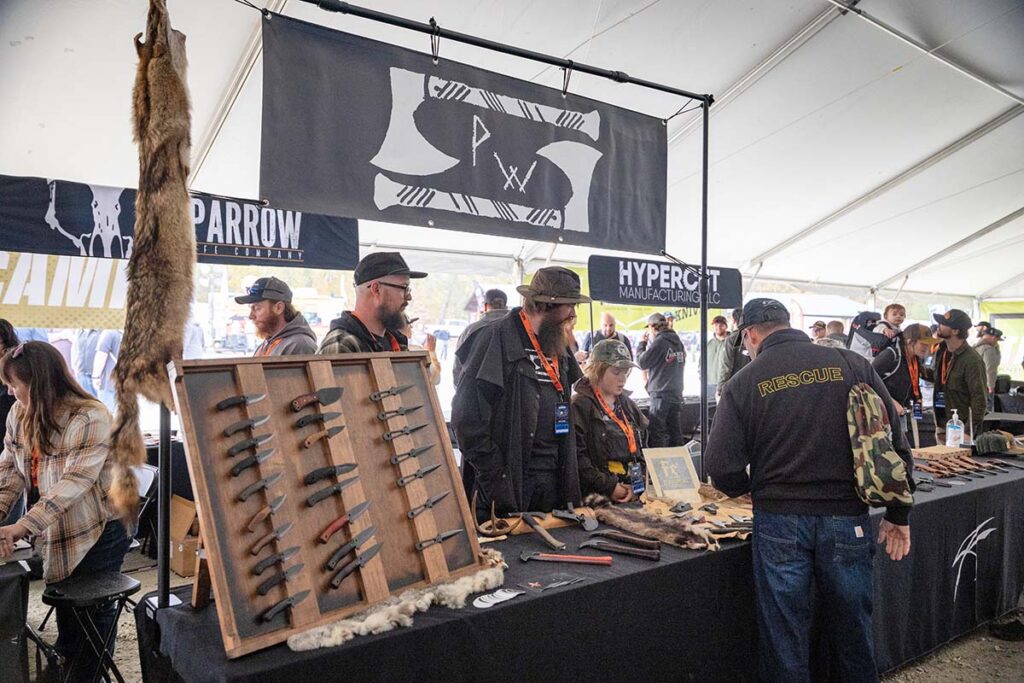
In addition to enjoying CANCON’s unlimited suppressed shooting with free ammo in various shooting lanes and perusing one-of-a-kind artisan gear items, patrons had access to the adjacent BTAC Invitational Knife Pavilion to shop among hundreds of tactical knives by some of the industry’s top custom and factory knifemakers.
Located just inside the front entrance of CANCON Carolinas, the BTAC Invitational Knife Pavilion drew gun and knife enthusiasts alike.
Mark Carey of Spartan Blades said folding knives seemed to appeal most to the combo knife/gun event’s patrons, who he described as “mostly gun people but many that know knives.” He also complemented CANCON as “an excellent on-range show; well set up, safe and secure.”
Mike Sweeney indicated folders under $200 sold best for Heretic Knives, while BLADE Magazine Cutlery Hall-of-Fame® member Daniel Winkler stated smaller/concealable pieces were top sellers for Winkler Knives.
The future of both the knife and gun industries were among the patrons on hand.
“The smaller pieces have lower price points, but there wasn’t a differentiation in handle materials or treatments from our perspective,” he wrote. “Customers familiar with our brand asked specifically for the smaller pieces.”
White River Exodus 3 is a great little companion blade to add to your gear.
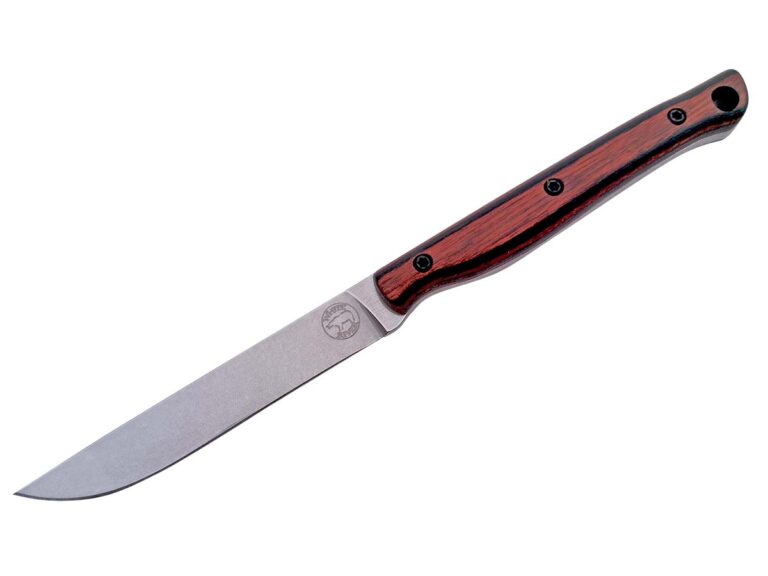
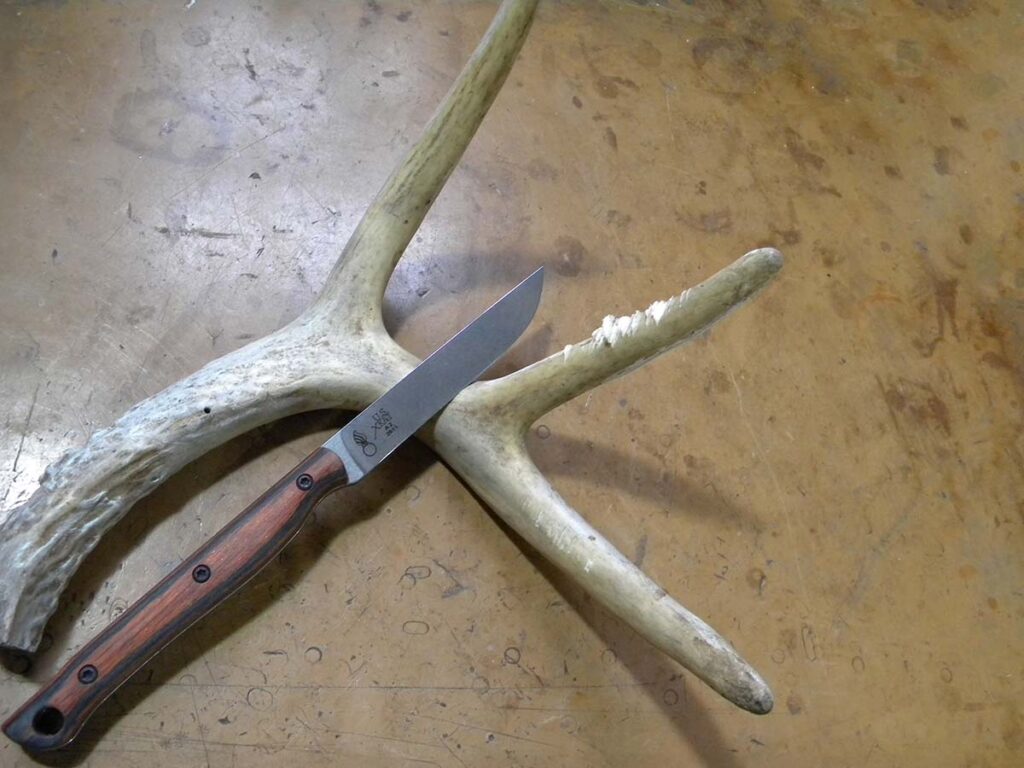
A small bushcrafter/EDC knife, the Exodus 3 by White River Knife & Tool can be very useful. Also known as the Adventurecraft, this lean cutter has a thin, super-sharp blade that does all the chores that a larger knife can’t do easily, from skinning small game to whittling firesticks to removing splinters. It’s a great little companion blade to add to your gear. Does it cut? Let’s see.
White River Knife & Tool Exodus 3 Specs
Company: White River Knife & Tool Blade length: 3.15” Blade material: A2 tool steel Rockwell hardness: 60-61 HRC Blade @the thickest: 0.130” Blade finish: Stonewashed Scales: G-10 Weight: 2 ozs. Overall length: 7.2” Sheath: Kydex® Weight w/sheath: 3.5 ozs. Knife to know: Leather belt loop and different handle materials available MSRP: $140
Light Cutting Duty
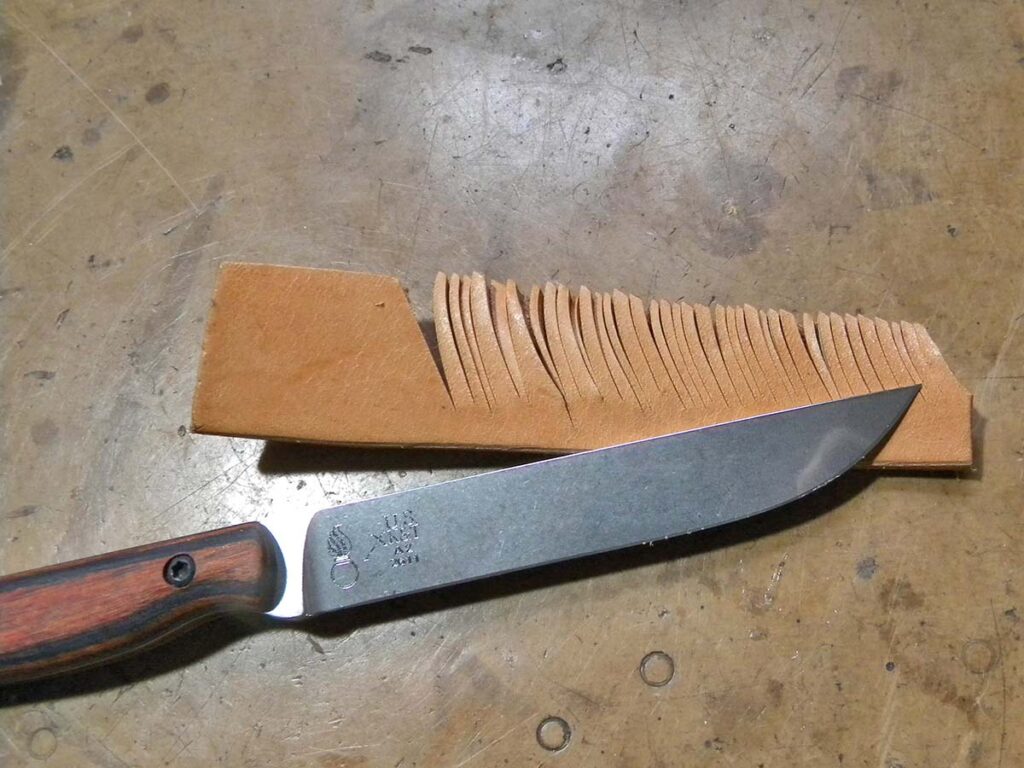
The author used vertical cuts on the 8-ounce leather as fast as he could. The edge bit swift and deep with a nice crunching sound.
Slicing regular lined notebook paper went very fast. The Adventurecraft cut smoothly and aggressively. As I warmed up to its thin shape, the cuts were faster. The flat-ground blade is easy to index in use.
Next up, it sliced single-walled cardboard very quickly with a slight curl to the cut pieces. The blade’s width and full flat grind pulled the curl as the blade went through. The aggressive edge was still making noise as it sliced.
Medium Cutting Duty
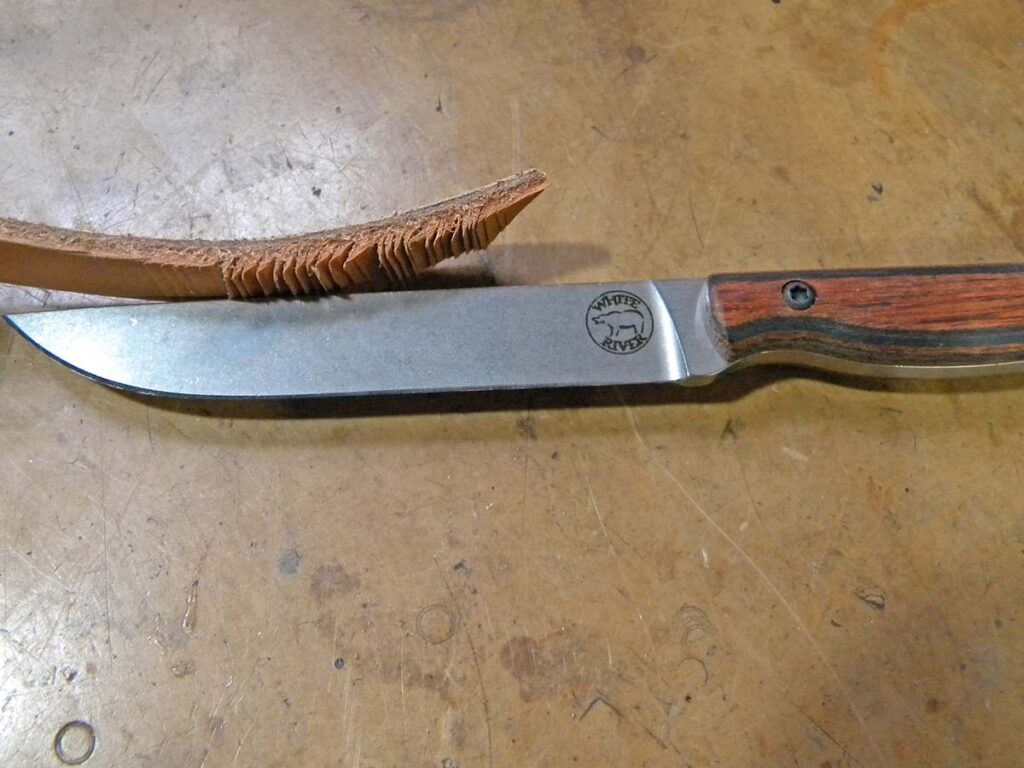
For skiving the 8-ounce leather, the blade rendered very thin flaps time and time again.
I used vertical cuts as fast as I could on 8-ounce scrap leather. The edge bit swift and deep with a nice crunching sound. I somehow managed to keep all the skin on my fingers in the process. The Adventurecraft is very aggressive cutting leather.
For skiving, the blade rendered extremely thin flaps of leather time and time again. As expected, I surrendered a few thin slices of skin on the leather. The Adventurecraft has a very sharp edge!
Heavy Cutting Duty
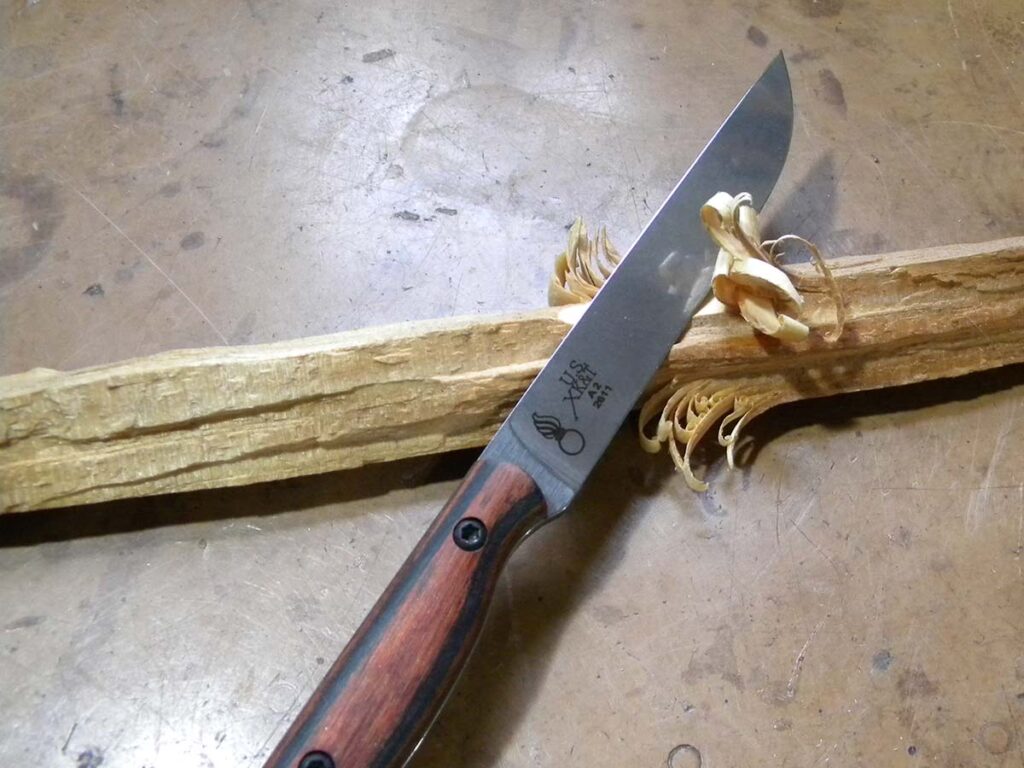
Since the handle is as narrow as the blade, the author had to adjust his grip a few times when whittling the firestick. The deeper he cut, the more it wanted to roll in his hand. So he made the curlicues thin and kept on whittling. As he noted, “It’s a handy whittler in any case.”
I grabbed a piece of pine from the kindling pile and started to whittle a firestick. I had to adjust my grip a few times as the handle is as narrow as the blade. The deeper I cut the more it wanted to roll in my hand. So I made the curlicues thin and kept on whittling. It’s a handy whittler in any case.
The edge withstood 30 whacks into a deer antler. The little blade took the beating with no chips or rolls, a sign of excellent heat treatment.
Half-inch sisal rope was next. The Adventurecraft put out 160 crunching cuts before some sliding ensued. The pressure I used on each cut made it challenging to hang on to the narrow handle. I really had to grip it tightly. It cut aggressively once I got going.
I checked the edge with 30 whacks into a deer antler. The little blade took the beating with no chips or rolls. Yep, excellent heat treatment! Back at the workbench, I grabbed the sheet of notebook paper for a second go-round. The Adventurecraft still sliced smoothly.
Final Cut
I would widen the handle for more leverage in cutting. This is a handy little blade to have around the campsite or in a backpack. It’s great for everyday uses.
Check Out More Outdoor Knives:
BEST TOMAHAWKS: OUR TOP HAWKS FOR BACKWOODS TO BATTLEFIELDS
Marine Corps hero feted with Nawrocki knife at The Battleship Ball.
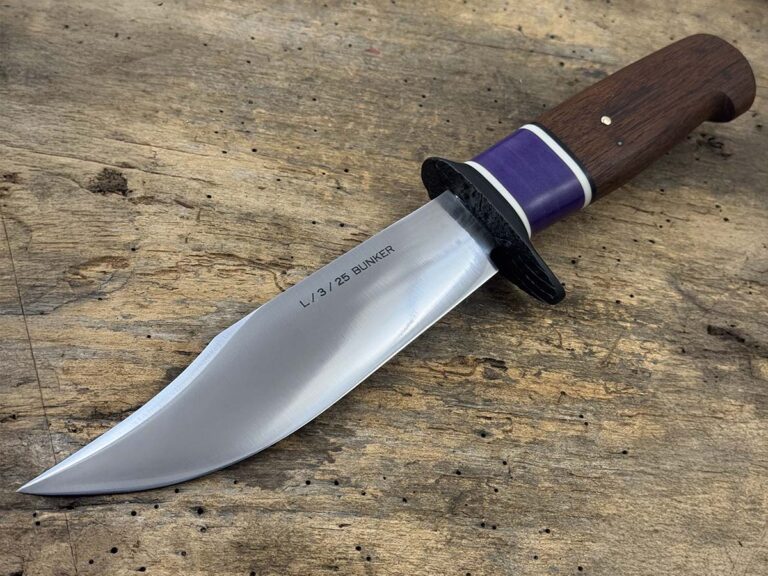
An unforgettable setting for a memorable event celebrating an American hero—all complemented by a beautiful knife by Brian “Rocco” Nawrocki—completed a tribute to USMC Sergeant Scott Bunker during last year’s 250th anniversary of the United States Marine Corps.
Assigned to Lima Company in 2005 during the Iraq War, Sergeant Bunker took multiple machine-gun rounds at point-blank range in house-to-house fighting, resulting in the loss of an eye, half a lung, several ribs and soft-tissue damage to his left arm. He was the guest of honor at The Battleship Ball 2025 on November 1, held on the deck of the vintage World War II Battleship USS North Carolina in Wilmington, North Carolina.
Event organizer/USMC veteran Dean Smith (left) congratulates Sgt. Scott Bunker after delivery of the Nawrocki tribute knife (in display case on the dais) during The Battleship Ball.
The handsome fixed blade Rocco made for Sergeant Bunker includes steel from the North Carolina for the blade and guard. The wood handle is teak from the battlewagon’s deck, along with purple heart ribbon spacers.