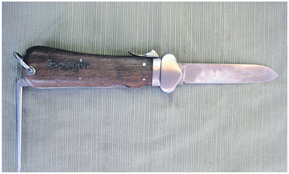
Doug Ritter of KnifeRights.org has been forwarding information about a couple articles New York Village Voice reporter Jon Campbell has written condemning the persecution of knife owners in New York City. Campbell’s How a ’50s-Era New York Knife Law Has Landed Thousands in Jail is a detailed exposé on New Yorkers, particularly Richard Neal who spent six years in jail, being wrongfully prosecuted under New York’s antiquated gravity knife law.
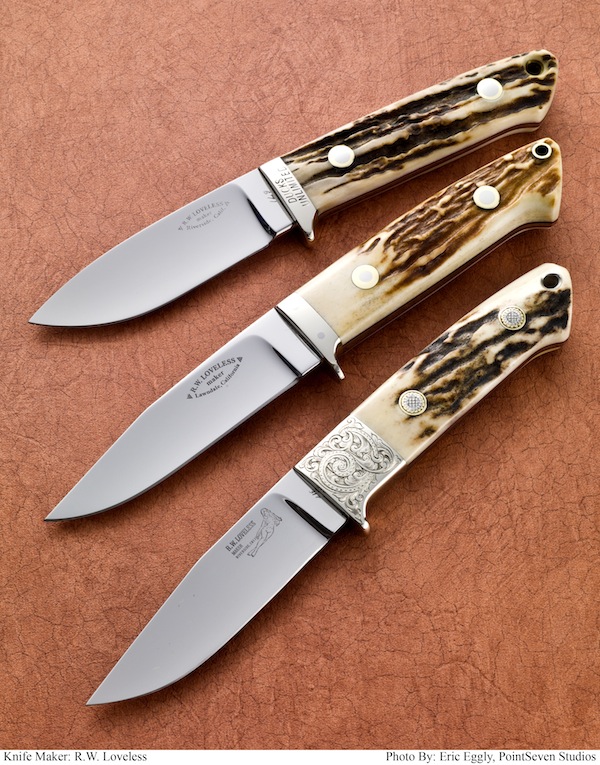
Knife terminology can change with the times. Known by many as the drop point, the knife at top by Bob Loveless originally was called the dropped hunter by Loveless himself. (PointSeven image)
Do you know your knife terminology? Yes, I agree that it probably doesn’t matter much if you do or not as long as you’re into knives and love to use them, collect them and otherwise celebrate your favorite sharp tool. On the other hand, there’s a certain satisfaction in knowing your knife terminology. In other words, it’s nice to be secure in the knowledge that your understanding of knife speak is current and that you can hold your own in conversation with knife aficionados.
Of course gentical is a newer entry in knife speak. There are others, some of which go back years, even decades.
For instance, Cutlery Hall-Of-Famer Bob Loveless is famous for a hunting knife that many call a drop-point hunter or simply a drop point. However, drop point is a misnomer—at least it is in regard to the name Loveless originally gave the design, which was dropped hunter. Both drop point and dropped refer to the point of the blade in the design, which drops or rests below the midpoint of the blade’s plane. Somewhere along the line someone called it a drop point instead of a dropped hunter and the name stuck. In my opinion, drop point is more descriptive of the blade design than dropped—besides, dropped hunter sounds like a knife you dropped and/or lost in the woods somewhere. But I digress.
Then there’s finger choil. Finger guard is another one. The word finger in either is superfluous—in other words, it’s not needed. It’s a guard or it’s a choil, period. Fingergroove or grooves is correct, but not finger guard or finger choil.
The guard is the cross/double guard with two quillons and/or single guard with one quillon—quillon is another entry in knife speak covered below—at the juncture of blade and handle that keeps your fingers/hand from sliding forward onto the blade from the grip.
New from BLADE! Check out the best articles on knife throwing, from the pages of BLADE magazine.
A choil is a small cutout at the base of the edge of the blade. Cutlery Hall-Of-Famer A.G. Russell once said the choil’s original purpose was to indicate where to stop the stroke with the sharpener on the blade during the sharpening process. Some knives have larger cutouts at that juncture for placement of a finger for more detailed-type cuts. However, even then the cutouts are still choils, not finger choils. In addition, some companies and makers put a single groove in the handle just before the guard. Though they may call it a finger choil, it is really nothing more than a finger groove.
Now, for the quillon. According to Websters, a quillon is “either of two transverse projecting members forming the cross guard of the sword.” In other words, a cross or double guard consists of two quillons and a single guard consists of one quillon. The cutlery community uses the term for knife guards as well.
Moreover, you will often hear quillon incorrectly pronounced quill-yun. How the word obtained that pronunciation I do not know, though I suspect it came from someone who saw the word, did not know how to pronounce it, and simply did what many do in such circumstances—took a “stab” (forgive the pun) at saying it and arrived at quill-yun. The correct pronunciation is key-yun (or a reasonable facsimilie. Hey, I’m a writer, not a pronunciation expert). However, many, including a large number in the bladesmithing community, continue to refer to it as a quill-yun. Hence, if you hear that pronunciation, you’ll know what it means. (By the way, I don’t recommend trying to correct bladesmiths on their pronunciation of quill-yun. Trust me on this one.)
There are many knife terminology concepts you might want to know. I will cover them sometime in the future here at blademag.com.
Tailor-made for a three-piece suit, jeans or purse, the Boker 145th Anniversary Knife salutes the Solingen, Germany, manufacturer's landmark birthday. The 2-inch blade is high-polished stainless steel with a laser-engraved 145th anniversary logo. The handle is Grenadill wood with the classic Boker Tree Brand logo shield, and the bolsters and liners are nickel silver. Closed length: 2 inches. The lockback pocketknife carries an MSRP of $149.
Check out the photo gallery of eight new, hot knives for fall 2014. See any keepers?
Now that you’ve seen what’s new, turn back the clock with BLADE‘s digital collection of annual KNIVES books. Get every KNIVES book from 2004 to 2015 in one PDF download for just $79.99.
Sometimes we get so carried away talking about the coolest new knives, the hottest tactical folders, the neatest mechanisms, latest locks and hottest handle materials, we forget about the average knife user, the end user, the guy or gal who carries and uses a knife everyday as a tool. That person might or might not be interested in the most state-of-the-art steels and most wicked blade grinds. Few of their knives are probably embellished with scrimshaw, engraving or jewel inlays. Even fewer probably have gold, silver, diamond or precious stone inlays.
AKTI—the American Knife & tool Institute, a knife legislative body fighting for our knife rights—has a cool link on its homepage titled “Everyday People Use Knives Every Day.” Clicking the link, web browsers land on a page that says “We’re your neighbors. We use knives every day in our work or carry them for other activities,” and it lists jobs and occupations in which people employed in those areas use knives every day. The page also has a query, simply reaching out with “Let us know if you’re not on the list.”
So, BladeMag.com visitors, please let us know if you’re not on the following list (from the AKTI website [and click here for more everyday using knives]):
Accountants
Adventure Racers
Advocate (for homeless)
Aircraft Mechanic
Antique Collectors
Archeologists
Architects
Artists
Armorer
Attorney
Automotive Technicians
Backpackers
Bakers
Basket Weavers
Beekeepers
Bicycle Repairmen
Bicyclists
Big Game Hunters
Bioscience / Biomedical Workers
Bloggers
Boaters
Book Binders
Bow Hunters
Boy Scouts
Business Executives
Butchers
Cable Installers
Campers
Canoeists
Carpenters
Carpet Installers
Carvers
Citizens Emergency Response Team
Chefs
Christmas Tree Dealers
Clammers
Clothing Designers
Cobblers (Shoe Makers)
Knife Collectors
Computer Technicians
Construction Workers
Cross Country Skiers
Curriers
Dairy Farmers
Deep Sea Fishermen
Deli Workers
Doctors
Downhill Skiers
Editor
Education Aministrator
Electricians
Emergency Medical Technicians (EMTs)
Engineers
Factory Workers
Farmers
Firemen
Fish Farmers
Fish Mongers
Fishermen
Floor Layers
Florists
Forensic Investigators
Forest Rangers
Four-Wheelers
Furniture Makers
Furriers
Game & Fish Rangers
Gardeners / Horticulturists
Garment Workers
Girl Scouts
Glaziers
Geocache Hunter
Greenhouse Worker
Gunsmith
Helicopter Pilots
Highland Game Participants
Hikers
Historical Re-enactors
Horse Breeders
Horse Drawn Carriage Drivers
Horseback Riders
Hunters
Ice Fishermen
Industrial Workers
Information Techs
Investigators
Janitors
Jewelers
Kayakers
Knifemakers
Landscapers
Leather Workers
Legislators
Licensed Firearms Dealers
Line Workers
Locksmiths
Loggers
Machinists
Mechanics
Metal Casters
Military Personnel
Miners
Milliners
Model Makers
Mold Makers
Moms
Motorcyclists
Mountain Climbers
Movers
Museum Curators
Musicians
Nurses
Nursery Workers
Office Workers
Outdoorsmen
Paramedics
Park Rangers
Photographers
Physical Therapists
Physicians
Plumbers
Police Officers
Potters (ceramic workers)
Precious Stone Setters
Printers
Private Pilots
Probation / Parole Officers
Project Managers
Railway Workers
Ranchers
Retired People
Roofers
Sailors
Salespeople
Scouts
Scout Leaders
Scuba Divers
Sculptors
Seamstresses
Search & Rescue Teams
Security Guards
Sheriffs
Shipping Clerks
Short Order Cooks
Sky Divers
Snowboarders
Snowmobilers
Sporting Goods Dealers
Stage Hands
Stone Workers / Masons
Surgeons
Survival Instructors
Tailors
Taxidermists
Teachers / Instructors
Telephone Repairmen
Television Repairmen
Tile Workers
Tow Truck Drivers
Tower (Cell/Phone/Radio) Climbers
Tractor Trailer Drivers or Commercial Truck Drivers
Trail Runners
Trappers
Veterinarians / Vet Techs
Warehouse Workers
Watchmen
Watchmakers / Horologists
Water Skiers
Weavers
Welders
Wood Workers
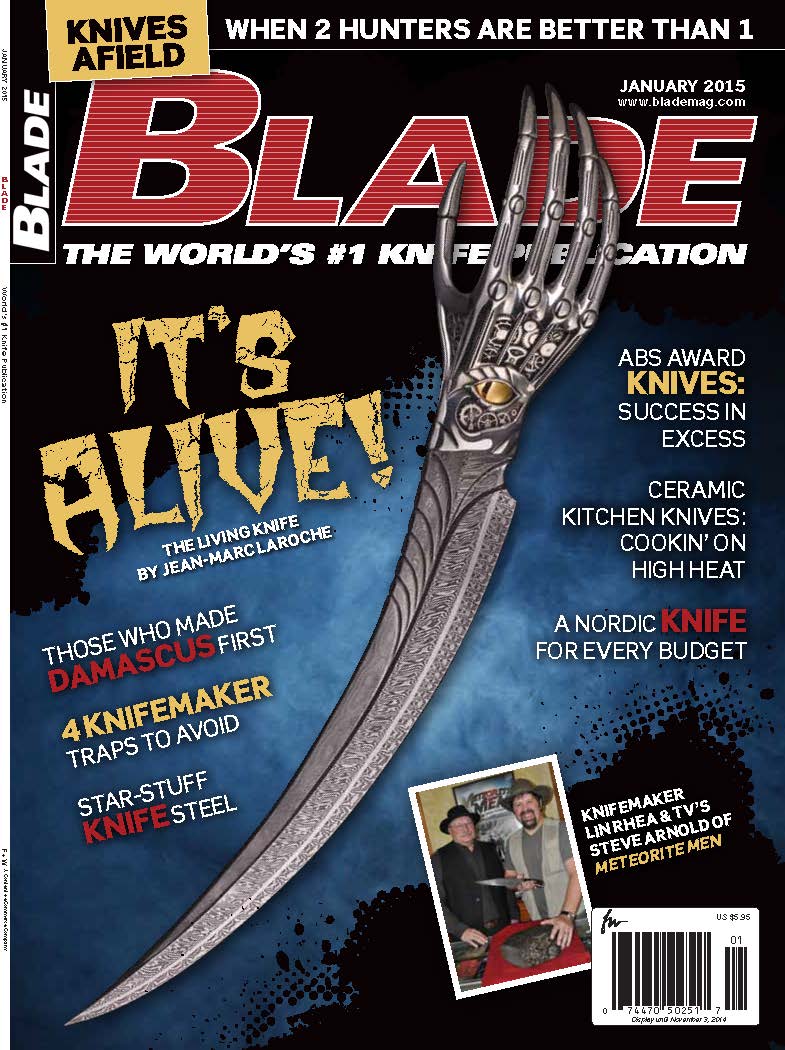
Living Knife by Jean-Marc Laroche highlights new issue of BLADE, on many newsstands today!
The Living Knife by Jean-Marc Laroche will literally grab you from the cover of the new BLADE®, on most newsstands today.
Featuring a damascus blade forged by Sweden’s Roger Bergh, the Living Knife includes a mechanical “hand” for a handle, the fingers of which will grasp your hand in return when you grip it! Find out more about this ingenious creation by Laroche, a French knifemaker and sculptor well known for his otherworldly approach to knives.
Speaking of out of this world, ABS master smith Lin Rhea visited Steve Arnold, one of the stars of the Discovery Channel’s “Meteorite Men” TV show, and obtained some meteorite material from Arnold for use in the damascus blade of a special bowie. Get the complete story on the meteorite material and its origin, how Lin made the knife and much more in this issue.
Speaking of damascus, it is one of the most fascinating materials for knife blades, among both knife neophytes and aficionados alike. How did this storied material first come about? How many different versions have there been? Get the inside scoop on this ancient material in the new BLADE.
The American Bladesmith Society traces its creation to the man who reintroduced damascus to the modern custom knife movement—Bill Moran. One of if not the largest organizations of knifemakers in the world, the ABS presented its annual best knife and bladesmith honors at the 2014 BLADE Show. See what those top knives and who those premier smiths are this issue.
Hunting season is in full swing and hunting knives are in hot demand. But is just one enough? Find out why two hunting knives are better than one in the new BLADE.
There’s much more, including a test of two automatics, the latest ceramic kitchen knives, a Nordic knife for every budget, the sharpest Christmas gifts anywhere, how Dan Keffeler won the BLADE Show World Championship Cutting Competition and much more in the January BLADE, on newsstands NOW!
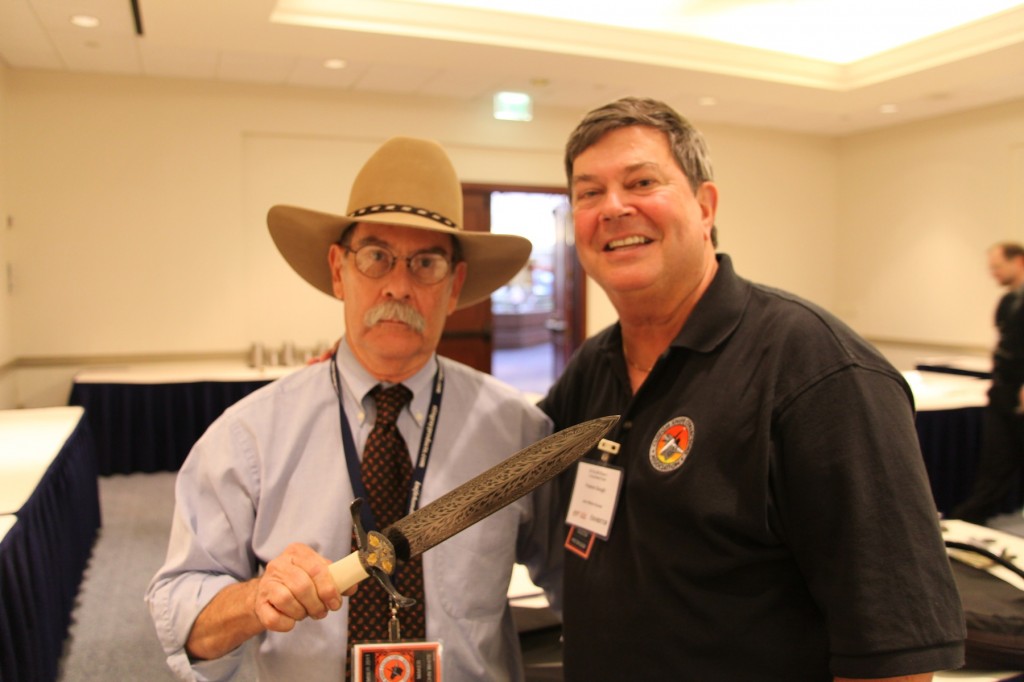
ABS master smith John White (left) holds his Best of Show and Best Damascus from the 2013 BLADE Show as the knife’s owner, Preston Gough, enjoys the moment.
Award-winning ABS master smith John White of Valparaiso, Florida, passed away Oct. 4 after a sudden illness. He was 71.
One of the most talented smiths in the ranks of the ABS, John was known for his elegant fixed blades in his beautiful damascus steel blades, natural handle materials and exquisite embellishment. He was also quite adept at such fixed blades in a take-down construction—that is, the knife was specially built to be easily disassembled and reassembled.
As John’s friend and fellow ABS master smith Terry Vandeventer noted in the American Bladesmith Society’s Express Email, “This is not only the greatest loss to Jill, [John’s] wife of 40 years, but to the knife community. Those who knew him saw a vivacious, smart, funny, and highly skilled artisan.” Vandeventer added that there would be no services and John’s ashes will be spread on the bayou near the Whites’ home.
The little man with the big smile enjoyed a meteoric rise in the fraternity of ABS smiths, winning a number of awards for his work, including several at the BLADE Show. Among them: Best Fixed Blade, 2014 BLADE Show; Best of Show and Best Damascus (see accompanying picture), 2013 BLADE Show; Best Bowie and Best Damascus Knife, 2011 BLADE Show; and Best Damascus, 2010 BLADE Show. Somehow it seemed fitting that John enjoyed so much success at the BLADE Show, as he was among the most vocal supporters of the event.
If you wish to make a comment on John’s passing and your memories of him, Click Here. A visit there will show you how many great makers and collectors thought the world of John. He will be missed.
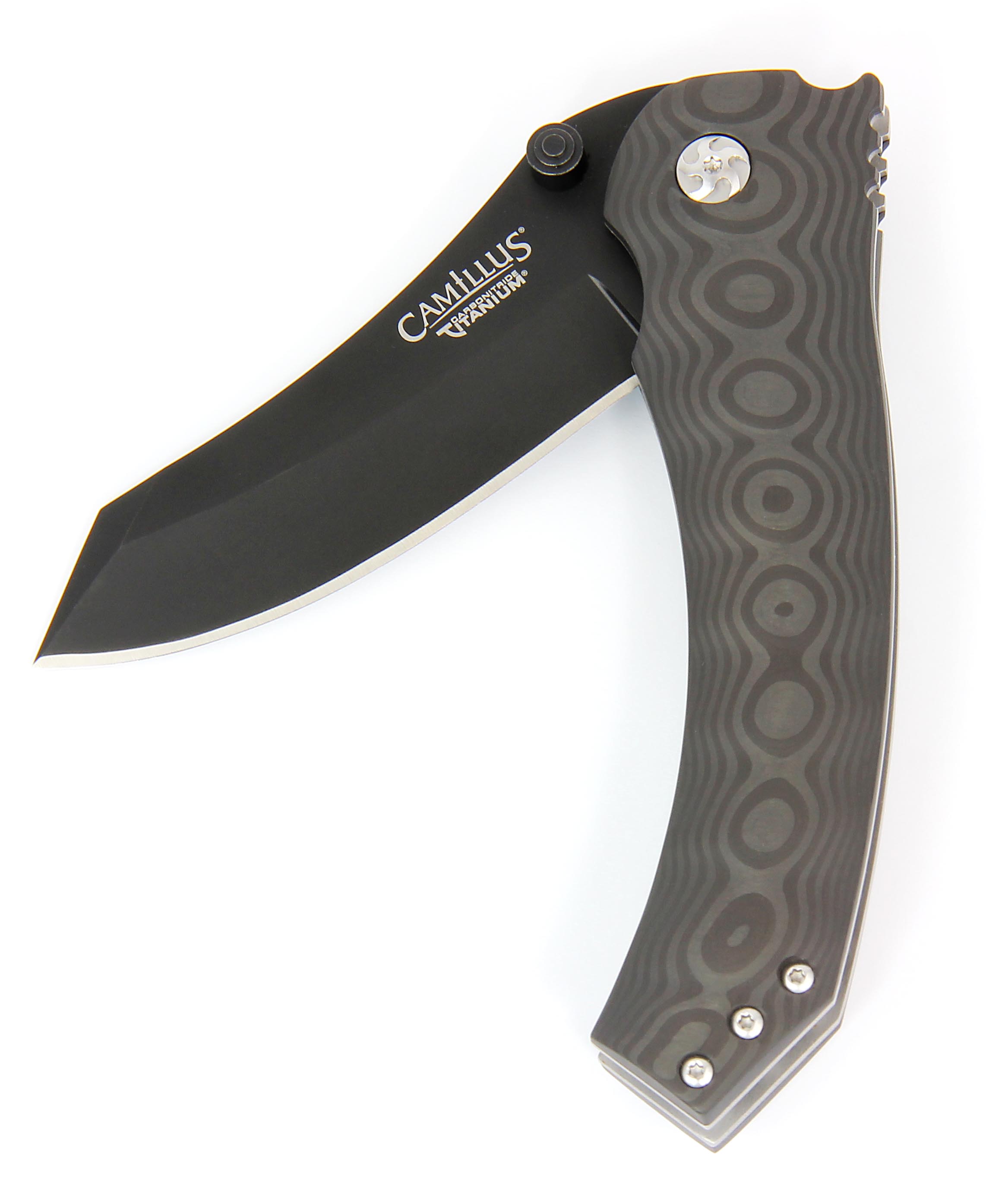
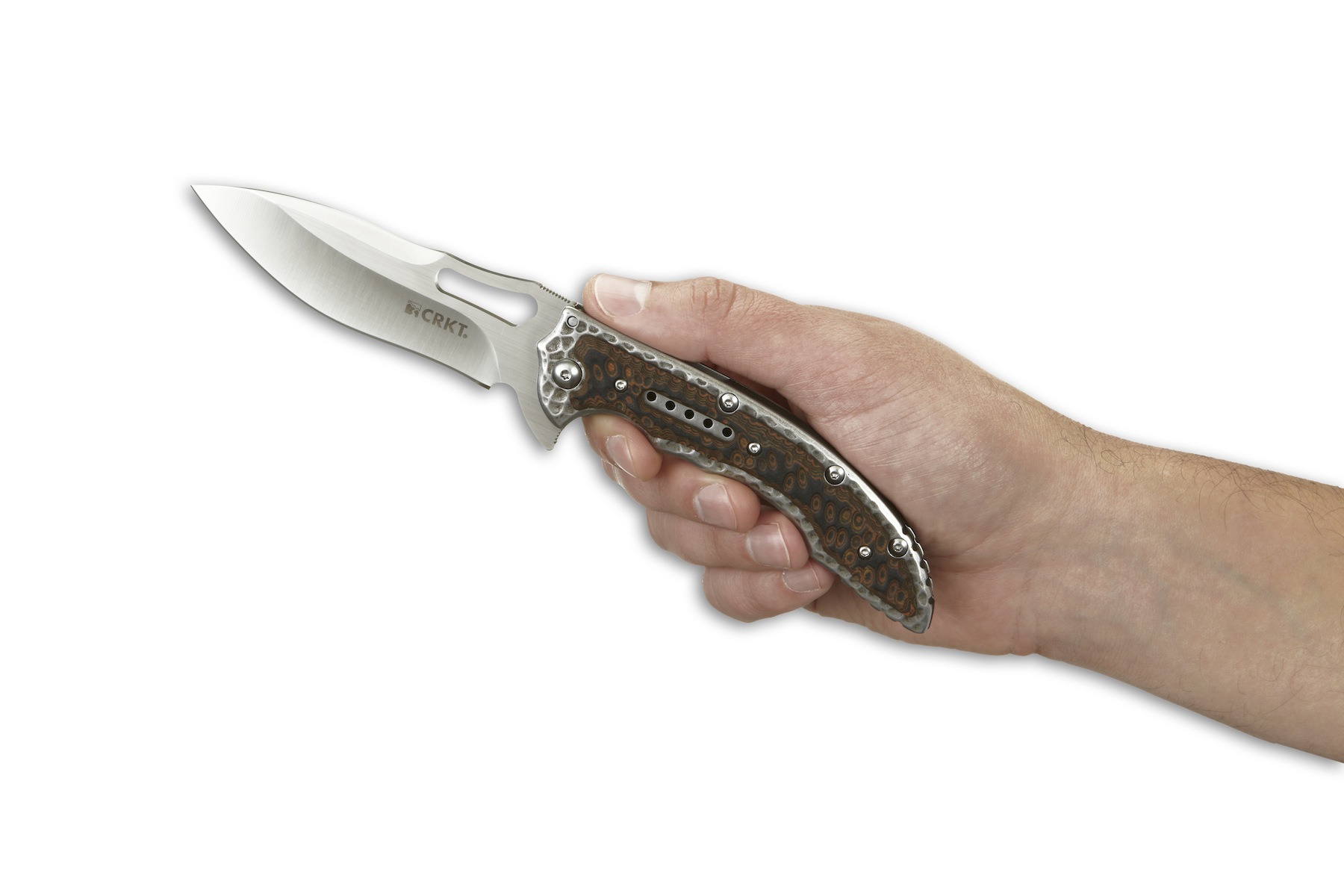
The knife handle should fit your hand snugly. The knife is the CRKT Fossil.
What to look for in a knife handle is a question whose answer—as with most things knife—depends on many factors.
For one thing, no one knife handle fits everyone. Hands come in all shapes and sizes, so a knife handle that will fit a large hand probably will not fit a small one—and vice versa. As a result, no matter how much a knife handle is touted as being “user friendly,” you can’t know if it will suit your needs unless you pick the knife up and use it. Of course, that’s hard to do when you can’t use the knife unless you buy it. Then, if you don’t like the knife, you’re stuck with it.
One way around that is to find a friend who has the knife in question and borrow it. Of course, you will need to take good care of the knife and give it back when you’re through.
Barring the above, look for a knife handle with gentle curves, contours and palm swells that fit the shape of your palm snugly. This will help prevent the knife from sliding around in your hand or cause you to have to constantly regrip the knife handle with your hand. Avoid finger grooves as they are too restrictive in terms of the way you can hold a knife handle. Besides, you may find over time that grooves you thought fit your fingers/hand really don’t.
Avoid a knife handle that has sharp corners at the butt or any place that tend to dig into your hand. Those can cause hot spots or even cut you. Avoid a knife handle that is too soft. It may feel good at first but it, too, can cause hot spots/friction on your palm and/or fingers over extended periods of use.
Single, integral guards are good as they keep your hand from sliding onto the blade. That’s one of the good things about flipper folders—not only do the flippers ease the job of opening the knife but they also serve as single guards.
For more on the best knife handle for you, see your local knife retailer and ask him to show you the many different options you have when it comes to a knife handle.
Recommended:
Stay abreast of the latest developments on this and many more knife rights issues with a subscription to BLADE.