Here’s a look at a movie knife classic, First Blood, and a movie that tried to rip off Rambo. Spoiler alert: ripping off Rambo is never a good idea.
Knife Use in First Blood: Rambo-esque, but Not Ridiculous
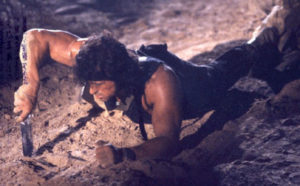
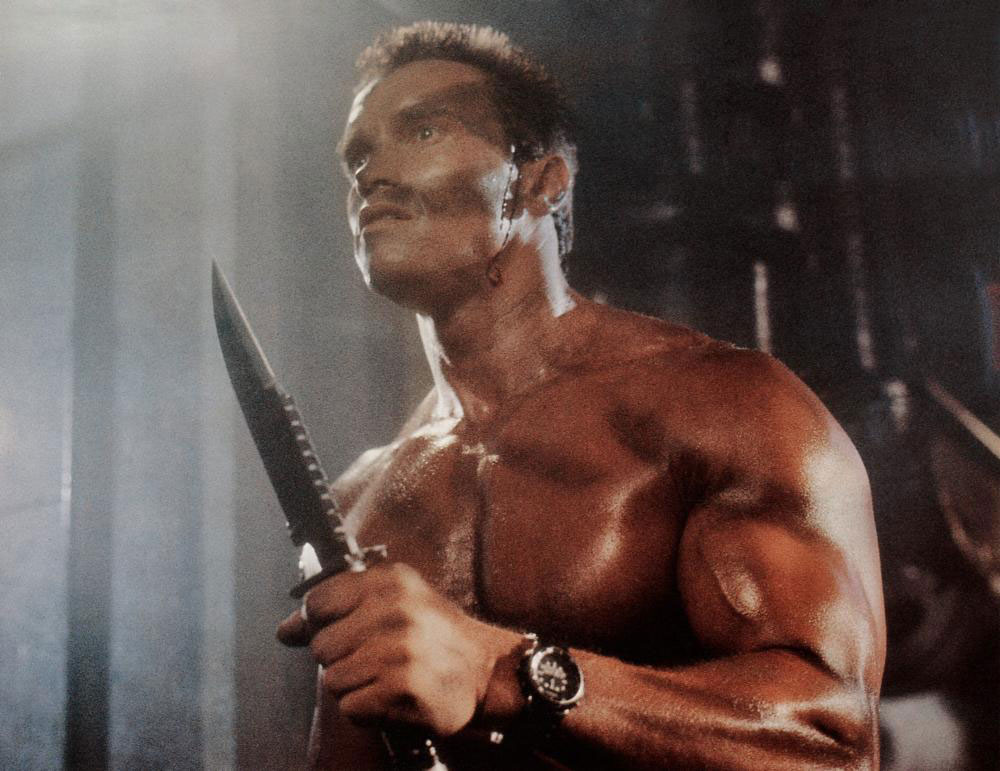
After I saw First Blood, the first Rambo movie, some buddies and I started to look at it with a critical, knife-centric eye.
Nothing that Rambo does in the movie is impossible. Some of the feats require a very well-trained man who’s in excellent physical condition, not to mention one who’s stubborn as hell. The feats also require a great deal of luck.
I’ve always been critical of fight sequences where the hero beats up 10-15 opponents all at one time. You can see the bad guys hanging back, each waiting his turn. That doesn’t happen in real life.
However, in First Blood, each person Rambo fights is physically isolated, so Rambo can take each one on one-on-one. It could work that way. The movie was very well thought out choreographically.
At one point Rambo leaps from a cliff and falls through a pine tree, breaking tree limbs on the way down, and survives. Tricky and tough—and yet possible. I once fell out of a pine tree, breaking pine limbs on the way down, and wasn’t hurt at all except for my 18-year-old ego. It was about a 20-foot drop, not anywhere near what Rambo fell, but long enough to convince me that it was possible to survive it.
Rambo’s use of the knife in First Blood is excellent. He knows what he’s doing. One of the first things he does is use the knife to make a spear, which is a good idea because a spear is a better hunting tool and a much better weapon than a knife. For one thing, a spear has reach and speed over a knife alone.
First Blood is an exciting movie. If you haven’t seen it, rent it. It’s worth it.
Knife Use in The Hunted: Ridiculous
Several of my friends saw The Hunted and told me that it was the MOAB (Mother Of All Bombs). However, having seen The Musketeer, I didn’t believe them. While The Hunted isn’t the MOAB, I would put it in the 2,000-pound category.
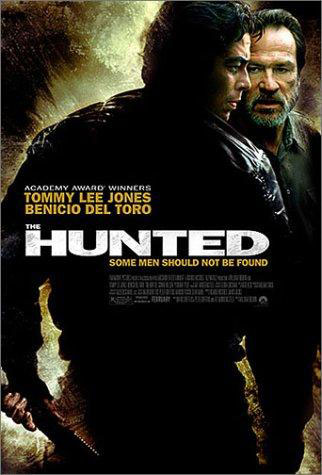
The Hunted isn’t a remake of First Blood but copies it—and does a lousy job at that.
The movie opens with a hellish scene in Kosovo, with Serbs killing Albanians right and left, especially women and children. I think the viewer is supposed to get the impression that all the Kosovo violence has driven the villain, Aaron Hallam— played by Benicio Del Toro—crazy.
I realized that I was in a fantasy movie very quickly. Tommy Lee Jones, who portrays L.T. Bonham, is running through a forest that’s deep in snow when he sees a wolf caught in a snare. He catches the injured animal, frees it from the snare and then dresses its paw. The animal doesn’t bite Bonham or, for that matter, make any threatening moves whatsoever. Heck, my wife rescued a four-week-old puppy a few months ago and was bitten!
(image via imdb.com)
The plot is that Hallam is a real killing machine whom Bonham has trained. The main action takes place in the dense rain forest of Oregon—sound familiar?—and starts with a scene of two deer hunters. The hunters are equipped with bolt-action rifles sporting monstrous telescopic sights. Stupid is such a harsh word, so let me just say that it makes no sense to use telescopic sights in underbrush so thick you can’t see 10 yards in front of you!
Anyway, Hallam threatens the hunters, telling them they have no reverence for life, and they have to match their guns against his knife. Needless to say, he kills the hunters, and subsequent photos show that he chopped them up like butchered deer. Meanwhile, it turns out that he also has killed a couple more hunters. Since the movie never offers any other reason for Hallam’s behavior, I guess he must have joined a radical arm of PETA (People for the Ethical Treatment of Animals).
Bonham is an amazing tracker and expert knife fighter who’s called in to capture the killer. He starts out after Hallam and, of course, doesn’t take a weapon. Hallam immediately finds Bonham, they have a brief fight and the chase begins.
I can’t begin to tell you how incredibly stupid this movie is. For one, in one scene a thrown knife goes all the way through a tree trunk that looks to be about 3 inches in diameter! Bonham knaps a flint blade to use as a weapon, never thinking to simply buy a knife instead.
One of the most startling scenes is when Hallam breaks off chunks of leaf spring. He starts a small fire and then forges a knife using the chunks of leaf spring for steel, and another chunk as a hammer. After he rough forges the blade, he hardens it and then files it! I have no idea where he gets the file, let alone how an open fire that size develops the heat necessary to forge steel.
In certain segments, The Hunted is a direct steal of First Blood, right down to Bonham repeating a quote from the Stallone movie about how many body bags will be filled in the quest to nab Hallam.
The knife fighting and the scenes showing the training aren’t so much stupid as just silly. Some guy stands still as someone pretends to cut his throat, chest, stomach, brachial artery, and then moves down to cut both femoral arteries! I mean, what’s the point? How many times does your opponent need to bleed out? It’s like blowing up a rabbit with a stick of dynamite—the furry little critter can only die so much!
The final fight sequence between the two principals is very poorly choreographed. It bears no resemblance to a real fight. For those who have read my reviews about movie knives before, you know that I feel a fight must follow the flow of the film. In other words, it need not necessarily be a “real” fight but one that must be consistent with the plot. In that respect, the final fight does follow the plot—both are total and complete nonsense.
Don’t waste your time or your money on The Hunted. This time I did the suffering for you.
THOSE WHO KNOW DISSECT TV’S LONG-RUNNING FORGED IN FIRE
Bladesmithing enjoys the same treatment as motorcycle building got in the mid- 2000s—that is, it has become a well-established reality show competition on cable television. Such treatment has ups and downs regarding its effect on the knife industry. Be that as it may, History Channel’s hit show, Forged in Fire, has been on the air for seven seasons, which proves its staying power.
FIF is characterized as both inspirational and gimmicky depending on who you ask. And ask we did—two contestants, a former FIF guest judge and a member of the board of directors of the American Bladesmith Society—with the goal of shedding light on where the hit show lands on the spectrum between the two.
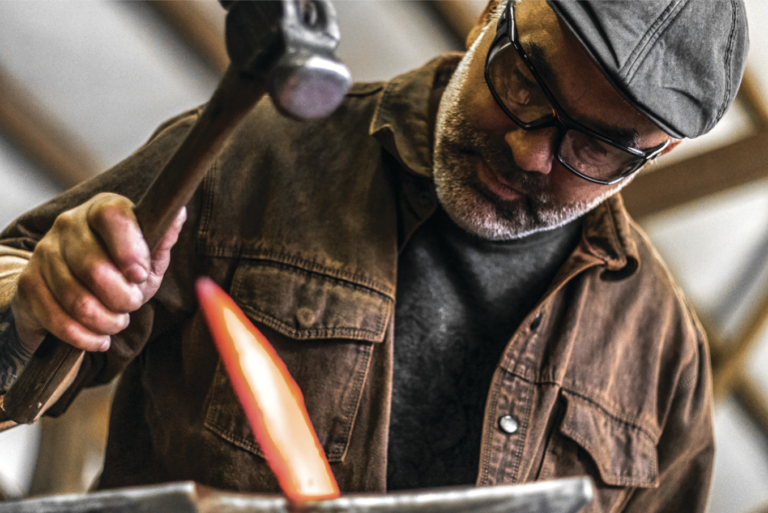
At 19, Josh Smith was the youngest smith to ever achieve ABS master smith status when he did so in 2000. He has appeared on two episodes of FIF. (Brandon Horoho mage)
The long-running TV competition undoubtedly has been an asset to the forging community. For starters, it has introduced the general viewing public to a cast of characters that constitutes a realistic cross section of the knifemaking community. While its list of participants is far from a comprehensive Who’s Who of bladesmiths, one would be hard-pressed to spend more than an hour at the next BLADE Show without encountering a first- person recollection of pounding steel on the small screen.
More important is the awareness such publicity has brought to the craft, according to J.W. Randall, veteran ABS master smith and winner of FIF’s 2017 international championship (season four, episode 19). “It’s brought the public’s awareness around to hand- crafted items, and that’s a good thing,” Randall observed. “It appeals to a lot of people because it’s an old craft, and it’s been brought back, in a sense.”
Indeed, the fiery furnaces easily translate into a burning interest among many of the show’s viewers. For them, witnessing the process of manipulating steel into a knife, sword or axe using fire, a hammer and other assorted machinery and instruments, while facing the adversity of time constraints and random surprises, is at once exciting and inspiring.
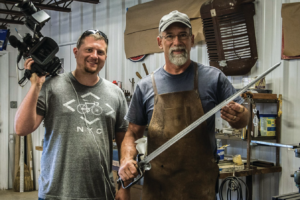
ABS master smith J.W. Randall holds his spadroon sword, the one he made to win the International Competition episode of FIF. At left is “Dan the cameraman.” (Tammy Randall image)
“The men and women who compete on this show are engaging in an arena of gladiators,” described ABS master smith Jason Knight, B.R. Hughes Award winner and guest FIF judge during portions of seasons three and four. He agreed that the show’s primary value lies in inspiring its audience to appreciate, and perhaps pursue, a craft that ties together history, art, science and technology from an ancient world. “It’s important in our culture,” Knight added. “People like me hold fast to it, and I want to share it as art.”
Such interest has had a measurable effect on ABS membership, according to ABS journeyman smith, board member and treasurer, Bill Wiggins. “I don’t know what to call it,” he pondered. “It’s not a spike—I’d call it a steady rise in membership since the show started.”
An ABS journeyman smith and treasurer of the ABS, Bill Wiggins said the ABS has enjoyed a steady rise in membership ever since FIF’s debut episode seven years ago. (image courtesy of Bill Wiggins)
He added that the ABS has also seen a lot more turnover lately, with people joining up for a year only to never be heard from again. “We’re still gaining members, though,” he allowed. “There’s good and bad, but the good outweighs the bad.”
“The bad” is definitely part of the mix, according to the story’s sources who were contestants. Though none had the proverbial sour grapes about their FIF experience, the recurring caveat was that good television producers have one goal in mind, which is producing good television—and that doesn’t necessarily translate into total satisfaction for the contestants.
One way to achieve “good television” is to introduce drama. Thankfully, according to Josh Smith, a two- time FIF contestant and the youngest person ever to earn an ABS master smith stamp at 19 in 2000, it didn’t include any typical reality-show-style infighting on the set.
“Everybody needs to realize that they’re trying to make an entertaining TV show, and I think they do a good job,” Smith explained. “The clock provides the drama that they need instead of drama between the contestants.” He added that Mareko Maumasi, his competitor and winner of the “Judges’ Pick” special episode (season four, episode one), is now a good friend. “We didn’t have to become enemies!” Josh emphasized.
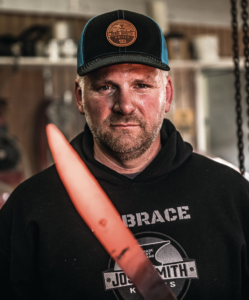
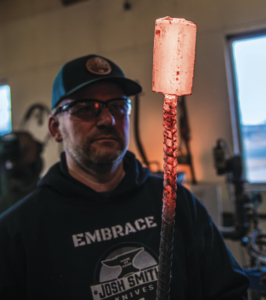
Unanimously, those interviewed who appeared on FIF maintained that the contestants should be better paid. “If you’re not sure if you do that show that you’ll be able to make your house payment, don’t do it,” advised Josh Smith, here admiring a red-hot billet in his shop.
TIME TELLS
Regarding the clock, each bladesmith is presented with strict time constraints— typically three hours to forge, grind and heat treat a blade, followed by a round of judging. In a second round, they have three hours to finish and handle the blade, followed by another round of judging.
“Three hours is a totally unrealistic timeframe,” Randall said. “That’s what makes the show interesting. Everything is stacked against you from the front, and that’s just a critical-thinking-and-an- overcoming-adversity deal. If you realize you’re backed into a corner, you have to adjust and come up with something to overcome it to gather yourself some time back on that clock.”
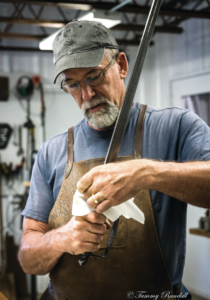
J.W. wipes down the spadroon sword in his shop. Of FIF he said, “It’s brought the pub- lic’s awareness around to hand-crafted items, and that’s a good thing.” (Tammy Randall image)
“A lot of these contestants have no experience, and it’s very entertaining to watch someone who doesn’t know what they’re doing get out there and forge a blade with unknown material,” Knight added. “It’s like throwing them to the beasts. It’s very gladiatorial and can be catastrophic. A lot of people will win by default because competitors will push themselves to the edge or get a bad choice in some garbage materials.”
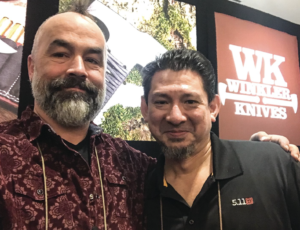
Jason (left) and his fellow FIF judge, Doug Marcaida, deliver looks that “will keal” at the Winkler Knives booth during the 2018 SHOT Show. (image courtesy of Shelly Knight)
He emphasized that the use of questionable materials adds a dramatic challenge to the mix, and during his time as a judge, Knight would advise the show’s producers on what to make available. “They have no idea about metallurgy, chemistry, physics or any science,” he remembered. “Their job is to produce content, and they have license to do whatever they want because it is entertainment. It’s good television but it’s not good bladesmithing.”
During a third portion of the show, makers have five days, or 40 hours, at their home shop to produce another more elaborate project.
Knight likened the whole production to a television game show made to entertain rather than inform viewers of the actual forging process. “You shouldn’t watch Forged in Fire with an expectation of learning how to forge blades,” he said. “That isn’t what the show is about.”
He should know, as he said he and his wife, Shelly, created the original premise. Before Forged in Fire was ever conceived, Battle of the Bladesmiths began as an ABS competition. “In 2010, Bill Wiggins asked ‘Hey, what could we do at a hammer-in that would be more fun?’” Knight recalled. “Shelly got the idea from Iron Chef. She said ‘What if you did a competition where you have unknown materials, a limited amount of time and you have to make a knife that works?’”
“You shouldn’t watch Forged in Fire with an expectation of learning how to forge blades,” said Jason Knight, here in his FIF garb during a forging demo in Johnson City, Tennessee. “That isn’t what the show is about.” (Shelly Knight image)
Big recurve blades are one of Jason’s specialties. He said he and his wife, Shelly, created the original premise for FIF: the Battle of the Bladesmiths, the first of which was held in 2010 during an ABS hammer-in at Haywood Community College in Clyde, North Carolina. (Matt Cohen/2020 Knight Forge Studio image)
“Jason approached me about doing Battle of the Bladesmiths at the Haywood Hammer-In,” at Haywood Community College in Clyde, North Carolina, Wiggins confirmed. “He won the first one, and since then it has become a yearly event.”
Flash forward to 2014. Knight also competed in and won the first-ever, never-aired pilot episode of Forged in Fire. “I’m glad to have been a part of the founding legacy that no one knows about,” he laughed, adding that he also advised the content producers on 12 of the episodes but remains unlisted as a creator. “I wouldn’t do the show again unless they paid me what I want to get paid,” he added. “What I want to do is what I’m doing. What I want that show to be, it can’t be.”
Smith, who competed on the show twice (including season three, episode five) but never won, said if he could change something about the show, it would be an opportunity to explain the knife project to the judges. “Instead of just handing the sword over to the judges, give me two minutes to talk about it,” he said. “I would have educated those guys about details that otherwise they wouldn’t notice with a cursory glance. I think it would have made a difference.”
He feels like he got a raw deal with his Kora Sword, in which his mosaic damascus was oriented so the pattern lined up, made with all take- down construction and blind-pinned together. “It’s a lot of stuff that no one on TV knew,” he noted. To his credit, changing the rules to allow non-winners to get their knives back was a prerequisite for his return to the show.
Randall said editing was an aspect that bothered him. “I want to be represented for who I am. I don’t want television to modify me and make me be somebody that I’m not,” he said, referring to being “bleeped” twice during his episode when he did not use profanity. “I don’t want to be seen by the world as that guy. That’s not who I am and what I want to represent, and it bothered me.
J.W. and Argentina’s Guillermo Mendoza (left), the two contestants in FIF’s Inter- national Competition, enjoy a reunion at a past BLADE Show. (Tammy Randall image)
“And more so in my closing remarks,” Randall added regarding the editing. “I gave God the credit and the glory at the end of this deal, and I also gave our military a bunch of credit for providing the freedom that we should never take for granted. That all got omitted. Represent people accurately for who they are and what they are.”
MORE JACK
Unanimously, those interviewed who appeared on FIF maintained that the contestants should be better paid. The $10,000 prize, which is only administered to the winner, isn’t enough compared to the month it takes the maker away from his or her work. For non-winners, it is a big financial hit to walk away with nothing. “If you’re not sure if you do that show that you’ll be able to make your house payment, don’t do it,” Smith advised.
“It’s like rolling the dice,” Randall proclaimed. “For me, it’ll take $25,000 to get me back. They’re cutting a fat hog, partner. That producer is making money hand over fist. They asked me to come back and I told them I’m not leaving my shop for 10 grand when I can make more money staying in my shop. Why would I roll the dice and potentially come up empty and lose a month of income?”
Overall, each source in the article was gracious in his comments about Forged in Fire, often reiterating that the drawbacks are tied into the fact that it is a television show. The point is to be entertaining, and it comes at the expense of some grievances about how it should be produced. They unanimously agreed that the most important effect is that it has enlightened and inspired millions of people regarding the craft of forging and knifemaking.
For the latest knives, knife news, trends and more visit blademag.com, BLADE®’s popular Instagram page @blade_ magazine, and on Facebook and Twitter.
Editor’s note: This article originally appeared in the December 1994 issue of BLADE. Read more from BLADE‘s extensive archive here.
Again and again, when knives hit the silver screen, they become characters unto themselves. Some knives take that more literally than others. Here’s one example.
A Movie Knife with Tibetan Influences
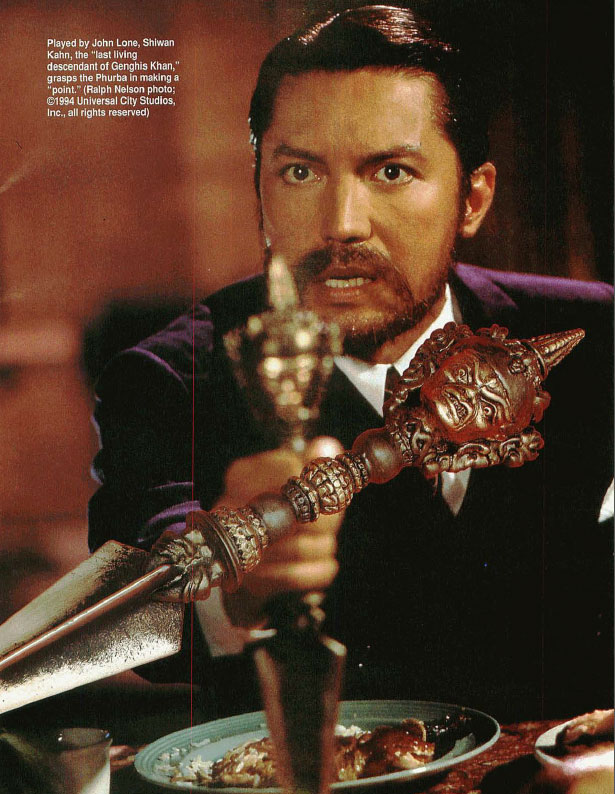
The Phurba, the knife from the 1994 motion picture, The Shadow, breaks new ground for movie blades because it’s the first to take advantage of new computer-generated special effects. For the dagger in The Shadow, that means the creation of a living, breathing character, so to speak.
“It growls a couple of times, flies through the air, sprouts legs and even bites Alec Baldwin’s hand,” United Cutlery’s Kit Rae said of the knife. “They used a lot of computer graphics so the face on the handle moves, and the handle twists around.”
Designed for the movie by Joe Nemec III, the Phurba – or “Phurbu” as it is also spelled – is based on an actual Tibetan exorcising knife or “ghost dagger” used by lamas (Buddhist monks) to drive out evil spirits. The Phurba dovetails with the theme of The Shadow since the movie begins in Tibet.
The Phurba from “The Shadow” sports a three-sided blade.
A Three-Sided Blade
According to A Glossary of the Construction, Decoration and Use of Arms and Armor, by George Cameron Stone, the original Phurbas had, “a three-winged blade and a hilt made up of lamaistic symbols. The pommel is usually a head with three faces crowned, with an animal’s head and neck projecting from the top. Thunderbolts (vajras), dragons and dragon’s heads are frequently present. Usually the blades are made of iron and the hilts of brass; sometimes the entire knife is of brass, and occasionally of wood.”
Played by John Lam, Shiwan Kahn, the “last living descendant of Genghis Khan,” grasps the Phurba in “The Shadow.” (Ralph Nelson photo; 1994 Universal City Studios, Inc., all rights reserved)Read more articles from BLADE’s archives with this collection of 25 years of back issues.
Nemec couldn’t get an authentic Phurba, so he based the movie knife on research, Rae said. The movie Phurba is true to the original knife in looks, right down to the three-sided blade. The main difference is in the number of faces on the handle, which was sculpted by Nemec. Where authentic Phurbas have three faces, the movie version has but one.
“[The movie’s officials] decided on a single face because it fit in with the idea that the knife was a living character,” Rae said.
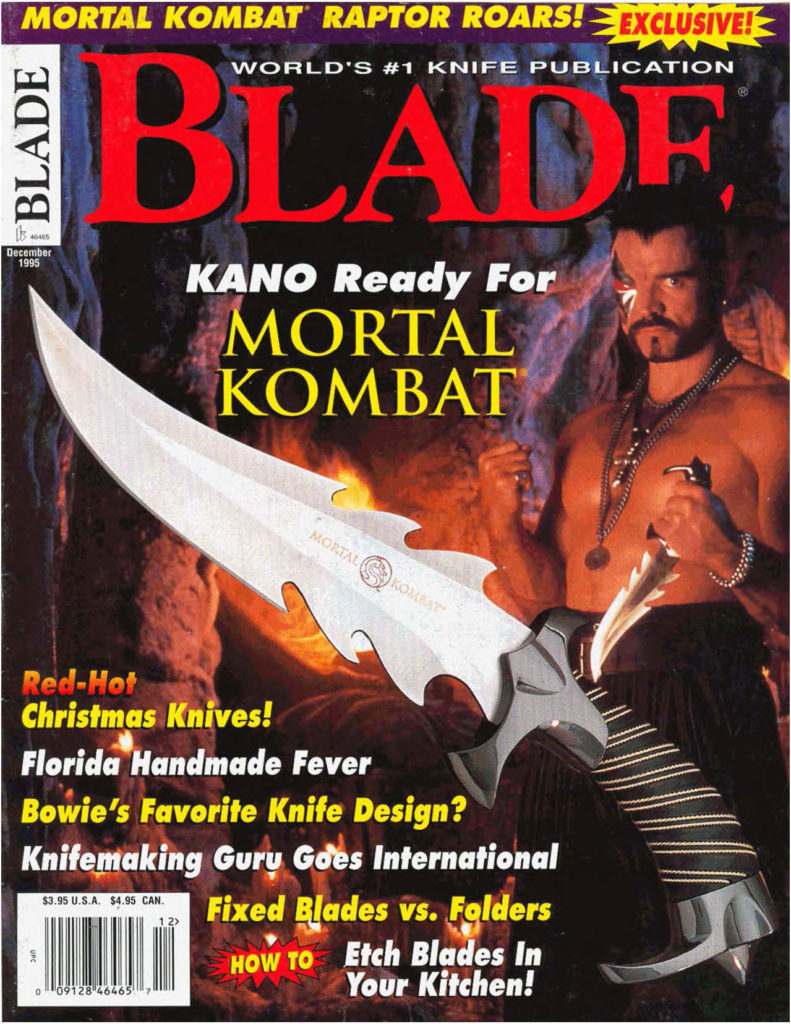
Mortal Kombat®, based on the video game series of the same name, hit screens in 1995. The story of the knife that appears in the movie is anything but linear. It’s a good example of how things work in Hollywood.
How the Gil Hibben Raptor for Mortal Kombat was Created
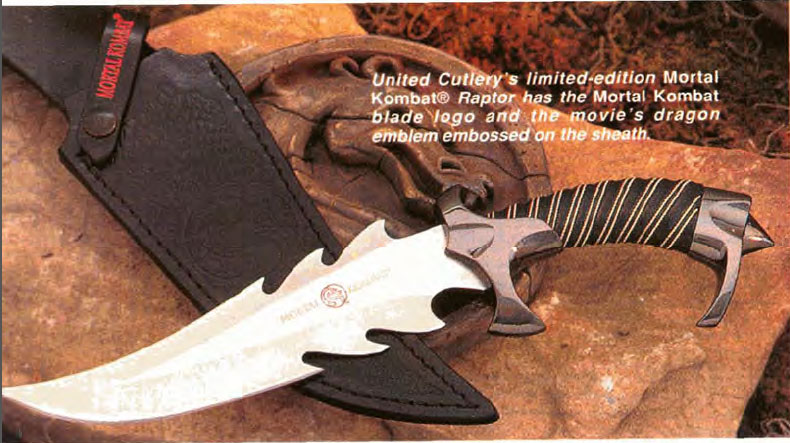
United Cutlery’s limited-edition Mortal Kombat Raptor has the Mortal Kombat blade logo and the movie’s dragon emblem embossed on the sheath.
As with many movie knife projects, the Mortal KombatRaptor materialized not by design but by some behind-the-scenes events that are typical of movie productions. Let me explain.
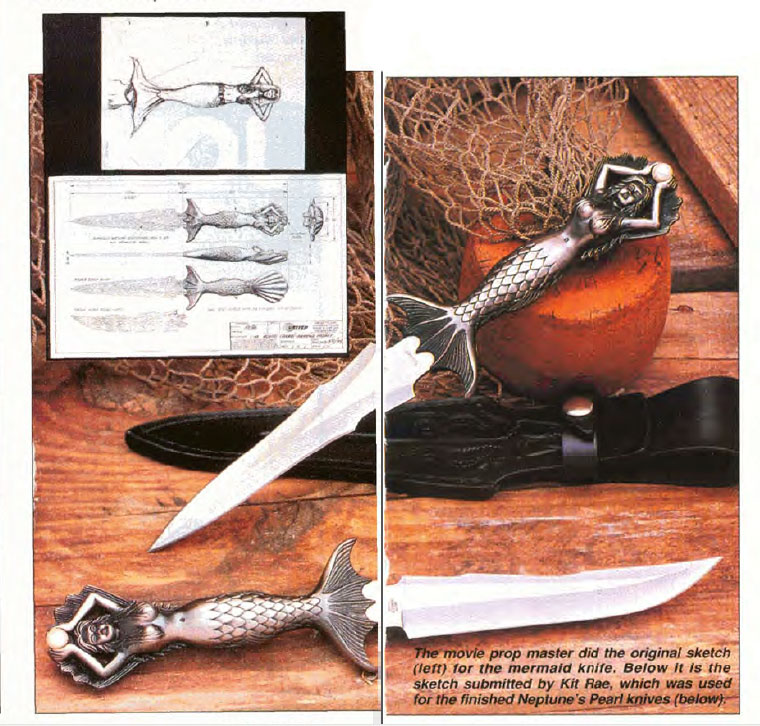
Originally, the producers of Mortal Kombat asked United Cutlery to design custom knife props for the movie. They wanted a knife with a mermaid handle for a specific scene that was to take place on a wooden ship that takes the characters to the island where the Mortal Kombat tournaments are held.
While on the ship, three heroes and three villains. including the captain, were to fight below decks. I t was during this scene that the captain was supposed to use the mermaid knife. As soon as he was to bring the knife to bear, a blue ball of energy would streak through the passageway and turn into the character of Kayden, Lord of the Dominion of Earth (played by Christopher Lambert).
The knife and everything in Rayden’s path would crackle with energy. There was even talk of having the eyes of the mermaid open as the energy went through the knife. It all sounded fascinating but in the movie knife business strange things happen, and this was no exception.
Evolution of the Mermaid Dagger
The movie prop master did the original sketch (left) for the mermaid knife. Below it is the sketch submitted by Kit Rae, which was used for the finished Neptune’s Pearl knives (below).
In July 1994, Mortal Kombat‘s prop master, Eugene McCarthy, sent United Cutlery a sketch of the handle he wanted for the movie knife. It was based on an existing mermaid dagger he had seen in UC’s catalog. except he wanted it to have a damascus tanto blade. I designed two versions of the knife around his requirements, one with a dagger blade and one with a tanto blade. The handle had to be metal so that the electricity could dance over it. I added a pearl and a seashell to make the handle different from United’s existing mermaid design.
The movie’s officials picked my dagger blade design, and United sent them a handmade blade with a carved wood handle. Since they needed to use rubber knives in the combat scenes for safety reasons, they were going to use the United prototype to make casts for rubber props that would be painted to look like real metal.
At United, we proceeded to make the molds and tooling for the version that we were going to sell to the public.
However, movie officials told us a few months later that the scene had been cut from the film. That kind of thing has happened in other movies we’ve worked on in the past, so we weren’t too upset.
Enter The Raptor Knife
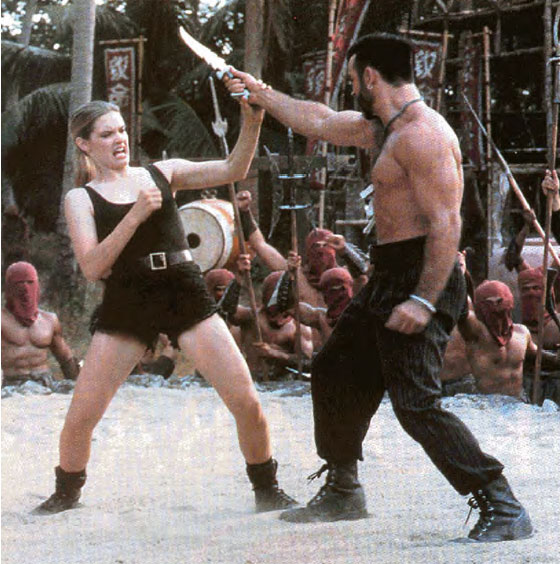
With Raptor in hand, the Mortal Kombat character of Kano (right), played by Trevor Goddard, lunges at Sonya, played by Bridgette Wilson. (R.E. Aaron/New Line Cinema photo)
Fortunately, the movie officials told us they had used one of our other knives, the Raptor. in another scene. The director, Paul Anderson, earlier had requested some samples from our existing line to consider for other characters in the movie. Two of the knives were our Gil Hibben Double Shadow and the Raptor.
The Raptor is the 1994 edition of United’s Hibben Knives Custom Design Series. Each year we produce a new knife for the series. Hibben’s knives have been featured in many films, including Rambo III and Under Siege. The Double Shadow has been in several TV shows and films, but to our knowledge the Raptor had not been used in a film yet.
Anderson wanted the character Kano (played by Trevor Goddard) to use the Raptor in a fight scene with Sonya (played by Bridgette Wilson), one of the heroes of the film. In the fight, which is mostly hand-to-hand and martial arts, Kano uses the Raptor but is disarmed in the end. The movie is targeted for kids, so no blood is shed with our knife in the film.
Collector Raptor
Read more articles from BLADE’s archives with this collection of 25 years of back issues.
We are producing a special Mortal Kombat edition of the Raptor for movie knife collectors. It is the same as the one seen in the film, except that it features a two-color deep etch of the Mortal Kombat logo on the blade and an embossed dragon emblem on the sheath.
Each knife will be individually serial numbered, and will come in a special box featuring movie graphics and photos. We liked the original mermaid knife so much that we produced a modified version of it and added it to our line.
We omitted the damascus-etched blade but otherwise it is the same as the one designed for the film.
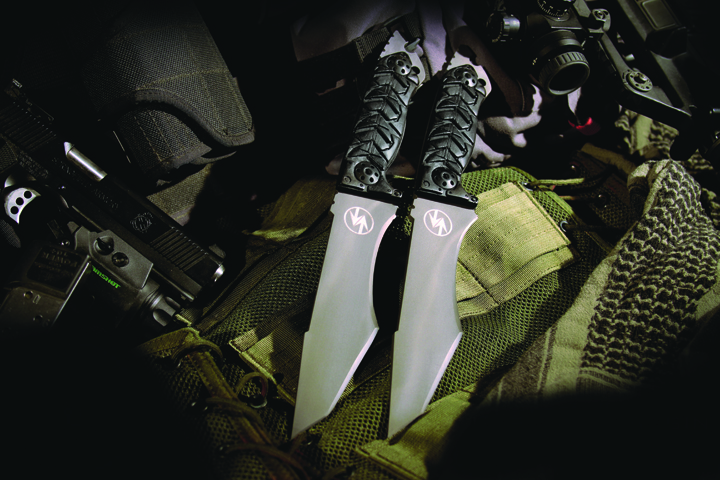
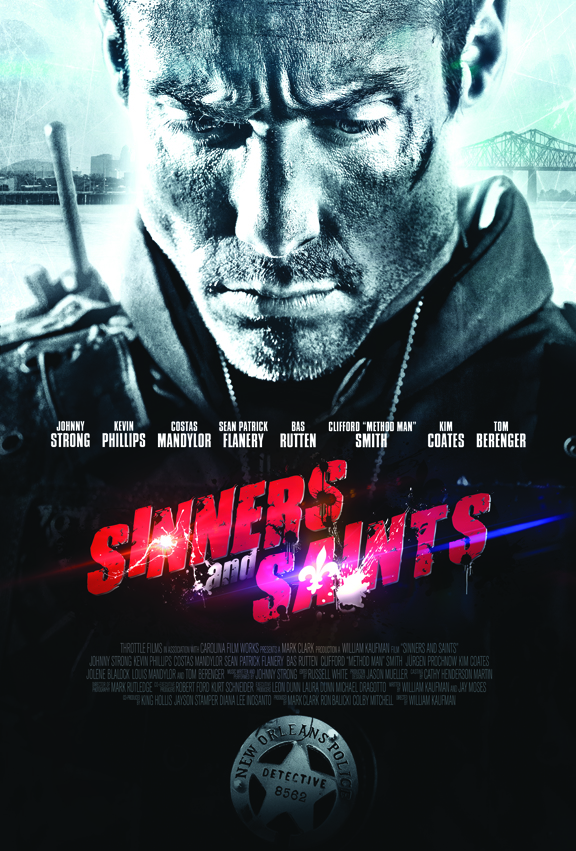
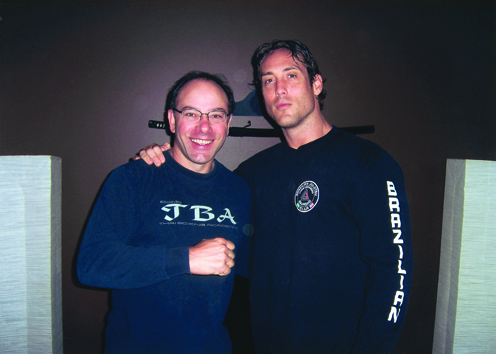
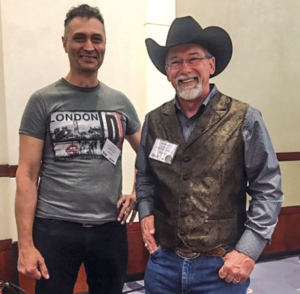
As with all Johnny Strong knives, the Urban Assassins (top photo) are flat ground from CPM-S35V stainless and heat treated by Paul Bos Heat Treating. Overall lengths: 11.5 inches. (Katie Summers photo) Johnny Strong’s latest movie Sinners and Saints (second photo from top) debuted in January. (Photo: Mark Rutledge; Poster: Dave Burton) The author [left] and Strong [right] (third photo from top) at the author’s house.
Star of Sinners and Saints also makes knives
By Wally Hayes
Through knives I have met some of the most amazing people, one of whom is actor Johnny Strong. Last summer I received an e-mail from Johnny. He was interested in my Dragon Waki he had found on Bladeart.com’s website. We exchanged e-mails about his new waki, music and his interest in knifemaking. I learned Johnny is an actor, musician, martial artist and artist. He has been collecting knives since he was 8.
“It was when I was on tour with my band, Operator, that I got serious about collecting custom knives. I would be on the tour bus searching the web for knife dealers,” he said.
After talking with Johnny and learning a little about him, I suggested he visit my shop and hang out for a weekend. He did—and he jumped in with both feet.
We started out forging two blades to shape. Then I taught him grinding and heat treating. The crash course was three long, fun-filled days. As Johnny told BLADE®, “It was a great experience coming to Wally’s and having him share all his knowledge with me. I learned how to manipulate steel and apply these skills to my edged art.”
As soon as Johnny returned home, he ordered a belt grinder, drill press and some steel. In the past year he has created some very original designs. His computer-drawing skills enabled him to develop a practical and aggressive-looking knife style. As he noted, “With my knives, I like to paint in tactical colors.” His blades are flat ground from CPM-S35V stainless steel and heat treated by Paul Bos Heat Treating.
Johnny has created some unusual blade finishes with a combination of bead blasting and etching. The blades are ground with a wide secondary bevel that makes his knives razor sharp, similar to those by Shiva Ki. Johnny hand carved a mold to make his handles. He casts them one at a time. The handle material is an impact/chemical-resistant resin. The cutouts in the handle butts are multi-purpose prying/shaping tools. He also designed and ordered custom-made black titanium handle fasteners.
Three of Johnny’s models are the Urban Assassin, Canine Assassin and Combat Assassin (this issue’s cover knife; see page 7). Respective blade lengths are 6.5, 8.5 and 11 inches. The blade of the Canine Assassin has a tiger-stripe finish, while the Combat Assassin blade features a sawback. Each blade has what Johnny calls his three-edge design, which was inspired by the knife-combat training he has received. All his knives come with custom leather sheaths.
Sinners and Saints
Johnny has starred in Black Hawk Down, The Fast and The Furious, Get Carter, The Glimmerman and his new action movie, Sinners and Saints. Johnny plays the lead role of Sean Riley, a New Orleans detective.
To prepare for one of the movie’s knife fight scenes, Johnny trained with Ron Balicki for three months. Balicki is well known as a practitioner and teacher of the martial arts, and is a student and son-in-law of Dan Inosanto, a legendary martial arts instructor who studied under Bruce Lee. Balicki is also a top Hollywood stuntman and plays the role of Rucker in Sinners and Saints.
Johnny learned both one-handed and two-handed combative drills. In a knife-fighting scene in the movie, Johnny uses an Allen Elishewitz “Phalanx” folder and a Cold Steel Tai Pan dagger. Balicki plays Rucker, a bad guy Johnny’s character must kill. The knife-fighting scene took two days to shoot. Balicki uses a Cold Steel Voyager folder in the scene.
“Ron has a ton of experience and was great to work with,” Johnny noted. “We wanted to make the knife fighting scene as realistic as possible.” Johnny has a strong background in martial arts with a black belt in Brazilian Ju-Jitsu and is training hard to get in shape for his next movie.
Movies, Music and Knives
This past fall I flew down to Johnny’s to help with his knifemaking and have some fun playing music as well. Music is a big part of Johnny’s life. When not acting, he works on music either for film scenes or his own CDs.
His new album is The War of Art on iTunes. It features two of his Urban Assassin models silhouetted on the cover. I was asked to bring my guitar so I could play lead on a couple of songs in his studio. What a blast—mixing knifemaking with recording music. We worked on edge geometry, sheaths and a new folder design coming out in 2012. Stay tuned for more movies, music and knives from a very talented guy.
For more on the latest knives, knife legislation, knifemaking instruction, knife trends, knifemakers, what knives to buy and where and much more, subscribe to BLADE Magazine, the World’s No. 1 Knife Publication. For subscription information click onhttp://www.shopblade.com/product/blade-magazine-one-year-subscripti…?r+ssfb030312#BL1SU
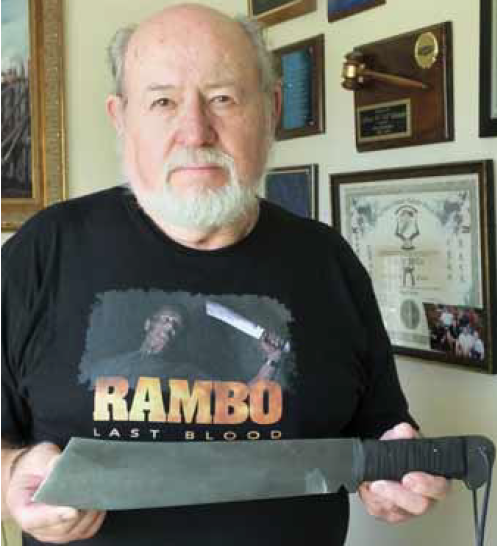
With the Hibben Machete in Rambo’s latest sequel, Last Blood, BLADE Magazine Cutlery Hall-Of-Fame® member Gil Hibben now holds two records: 1) having knives in the most Rambo movies—the trio of Rambo III (1988), Rambo (2008) and now Last Blood, and; 2) being the only maker to have the same custom knife model in more than one Rambo film: in this case, the Hibben Machete in Rambo and Last Blood.
Before Last Blood, Hibben was tied with Cutlery Hall-Of-Famer Jimmy Lile for having knives in the most Rambo movies at two. Lile, of course, made the original First Blood Rambo knife for First Blood (1982) and also the Mission knife for Rambo: First Blood Part II (1985).
In the 35th anniversary year of Rambo, Gil Hibben holds the Rambo III, one of if not his most popular knives ever. (File photo)
In addition to the Hibben Machete for the fourth and fifth Rambo films, Hibben made the fixed blade for Rambo III. It’s interesting to note that if not for the decision to omit the Mission knife from a scene in Rambo, Lile would have knives in three different Rambo movies as well. However, according to celebrated collector of all things Rambo, Randy Rousseau, the scene with the Mission knife did not make it off the cutting room floor of the fourth Rambo film.
“The Lile Mission knife does make an appearance in the outtakes of Rambo when it’s used to cut gas cans and then is thrown into the fire on the pirates’ boat,” Randy noted, “but the entire scene didn’t make it into the theatrical release.”
Including the Hibben Machete, Mrs. Linda ZeTur Hibben wrote that Sylvester Stallone contacted Gil to make four different knives for Last Blood. The other knives Gil made for Stallone and, ostensibly, for the fifth Rambo movie include a gut hook that Linda said was dropped in the early stages of Last Blood’s creation.
“Sly also had Gil make a bowie and a very pretty dagger/letter opener that Rambo was going to make on screen,” Linda observed. “Gil even provided handmade blade blanks for the bowie and dagger so it would appear Rambo was making the knives.”
However, other than the Hibben Machete, none of the additional Hibben knives made it into Last Blood. Meanwhile, since the fifth Rambo film is reputedly the final one in the series, neither the four aforementioned Hibben knives for it nor any other of the Rambo knives, including the new ones designed by Dietmar Pohl, will appear in another Rambo film, either.
On the other hand, one thing we’ve learned with Rambo is to never say never.
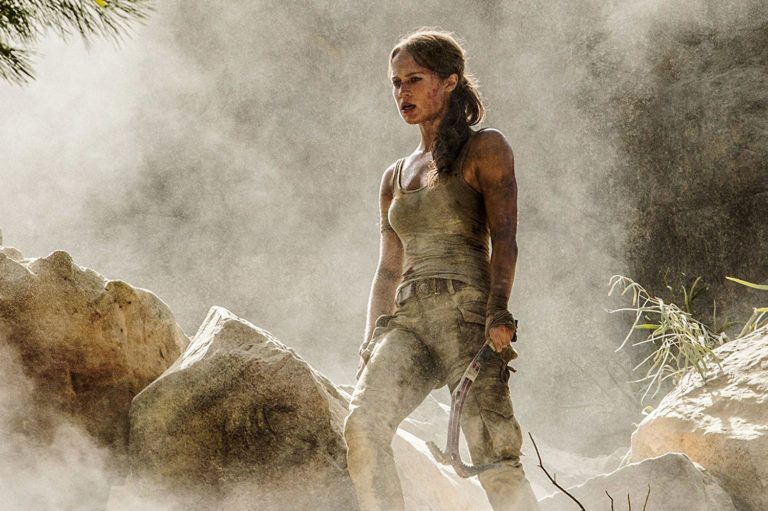
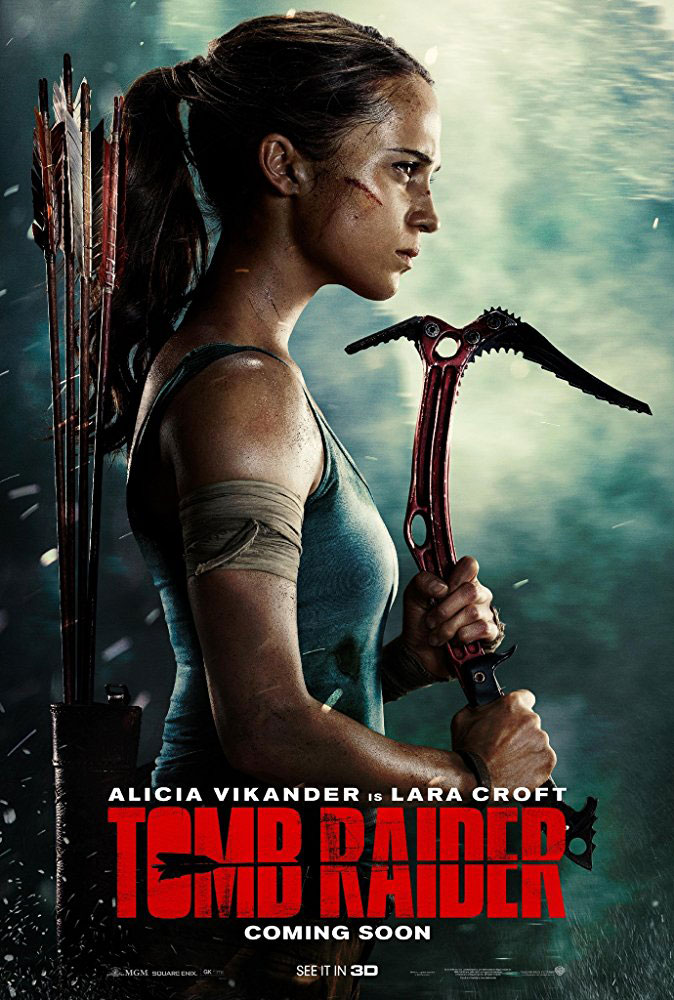
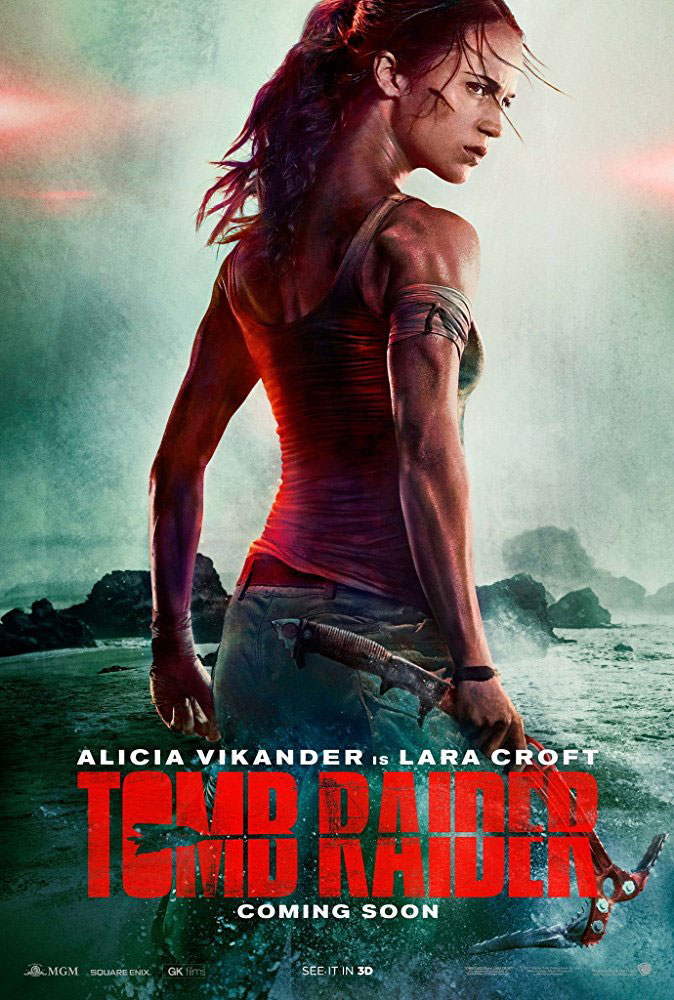
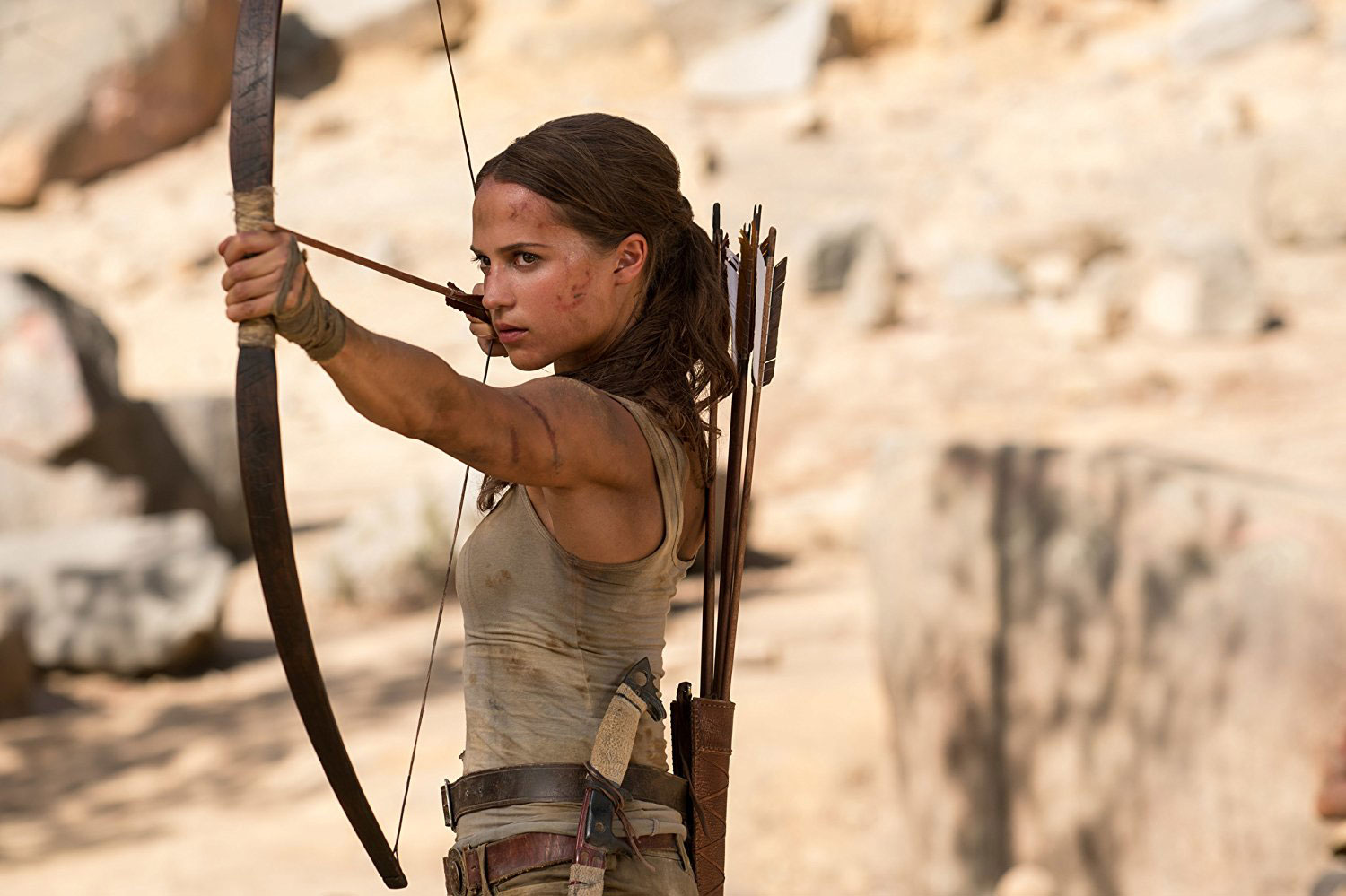
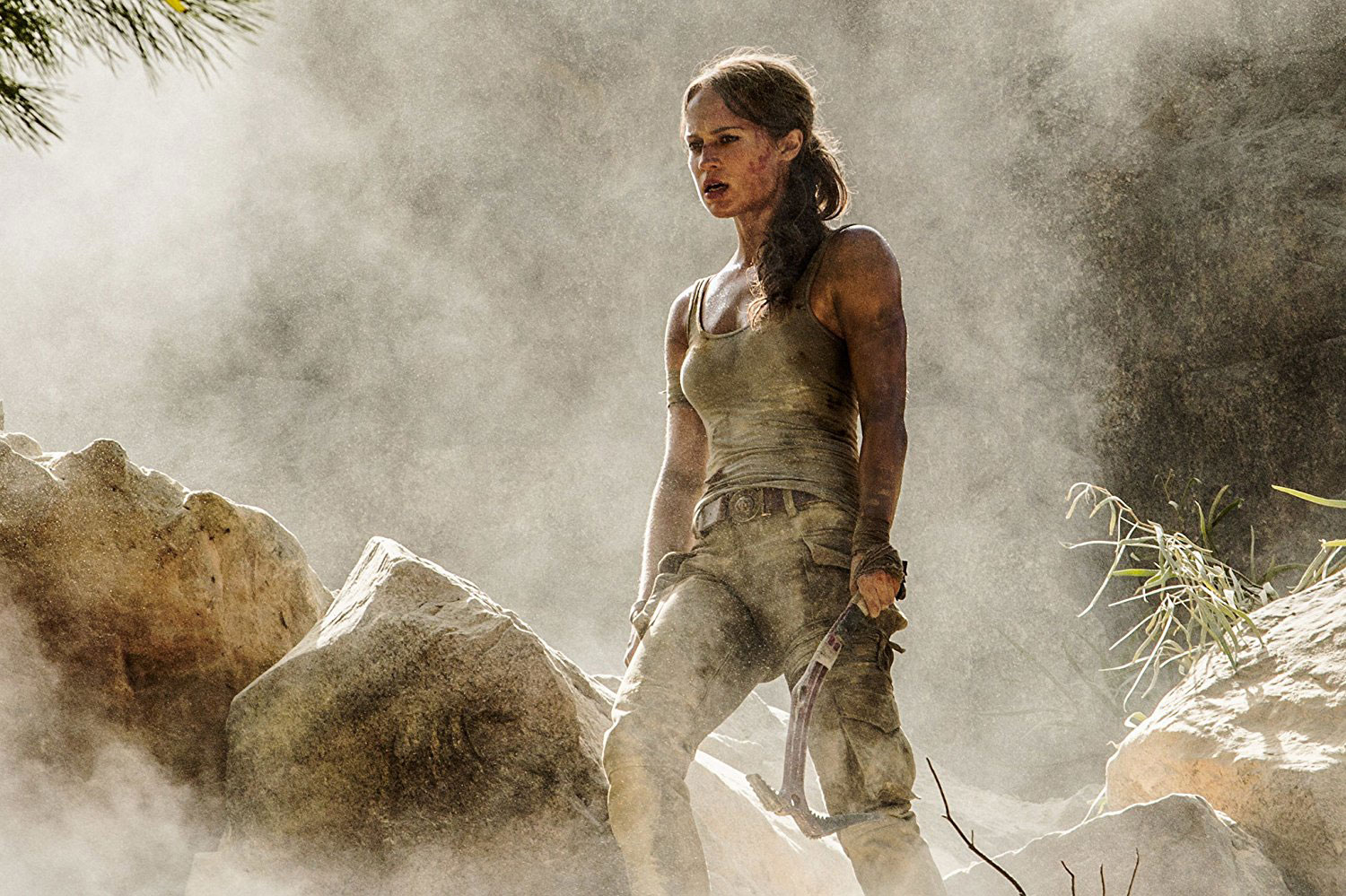
Promos for Tomb Raider, the movie based on the video game series that hits theaters today, may bring to mind the action scenes from the Rambo films, but the kit for protagonist Lara Croft is light on knives. Instead, Croft (played by Alicia Vikander) carries a climbing axe to handle tough environments and dispatch enemies.
Here are some shots from the film that feature the climbing axe:
(image via imdb.com)(image via imdb.com)Lara Croft (played by Alicia Vikander) carries the axe on her hip. (image via imdb.com)(image via imdb.com)
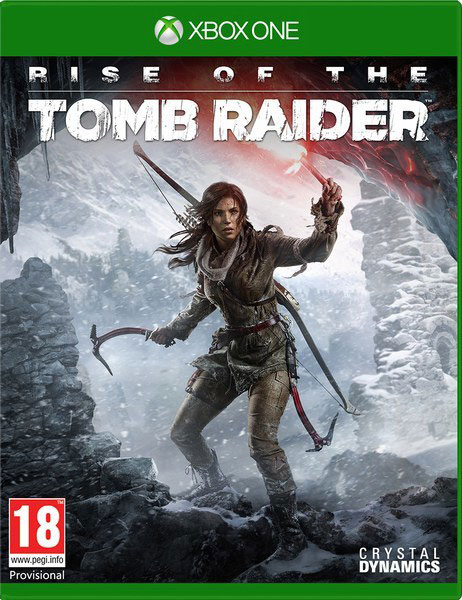
The film version of the axe is a copy/paste of the one used throughout the video game series, the latter of which can be seen on the cover of the game at right.
So it should come as no surprise that Tomb Raider fans figured out how to make a replica of the climbing axe as early as 2013.
Here are a few tutorials:
These are items for cosplay, meaning they’re made by fans for the sake of entertainment, not proper tools. They’re usually included as part of a larger ensemble.
However, the knife industry at large should pay attention to this on-ramp strategy. For many new and young knife collectors, bringing something from a video game into the real world is their first commissioned piece. Once they get a taste for the craftsmanship that goes into knifemaking (or axe making), they likely won’t stop there, especially when built-in fandoms keep the resale markets healthy.





 As with many movie knife projects, the