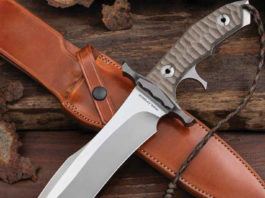
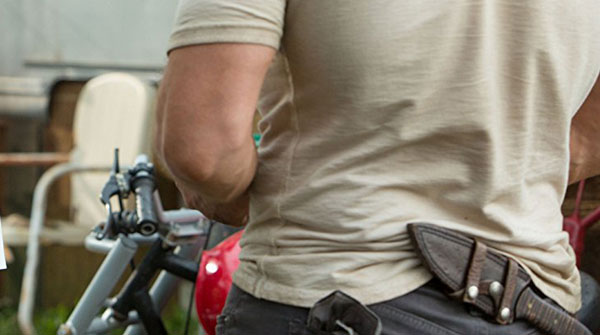
Jurassic World, the reboot of the Jurassic Park movie franchise, debuted in 2015 to the delight of both dinosaur and knife enthusiasts. The lead protagonist, Owen Grady (Chris Pratt), carried a custom knife made by Steve Auvenshine. Not only did the knife feature in a critical action scene, it sported a handsome leather sheath.
Here’s a look:
Carried scout-style, no less. (Universal Pictures)
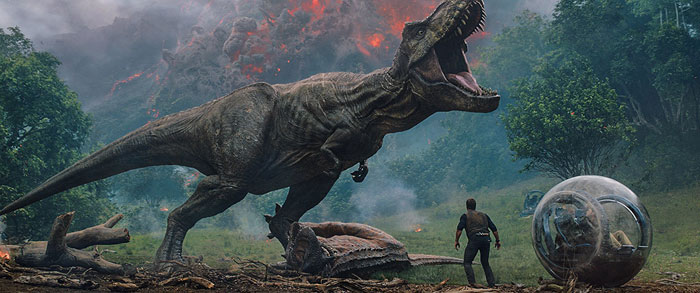
Judging by the trailer released last week, Chris Pratt’s character will use something similar in Jurassic World 2: Fallen Kingdom, to be released June 22, 2018. Here’s a still:
Looks like it’s carried scout-style once again. (Universal Pictures)
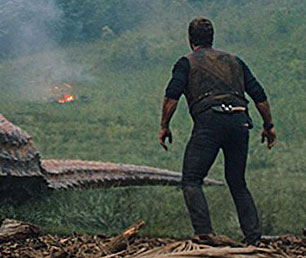
Here’s a closer look:
Appears pretty similar to the knife used in the first Jurassic World. (Universal Pictures)
In a conversation over Facebook, Auvenshine confirmed that while he made the knife used in Jurassic World, he was not commissioned to make one for the sequel.
A request for more information from Universal Pictures went unanswered as of this writing.
It’s only speculative, but it’s possible this is the same knife made for the original Jurassic World.
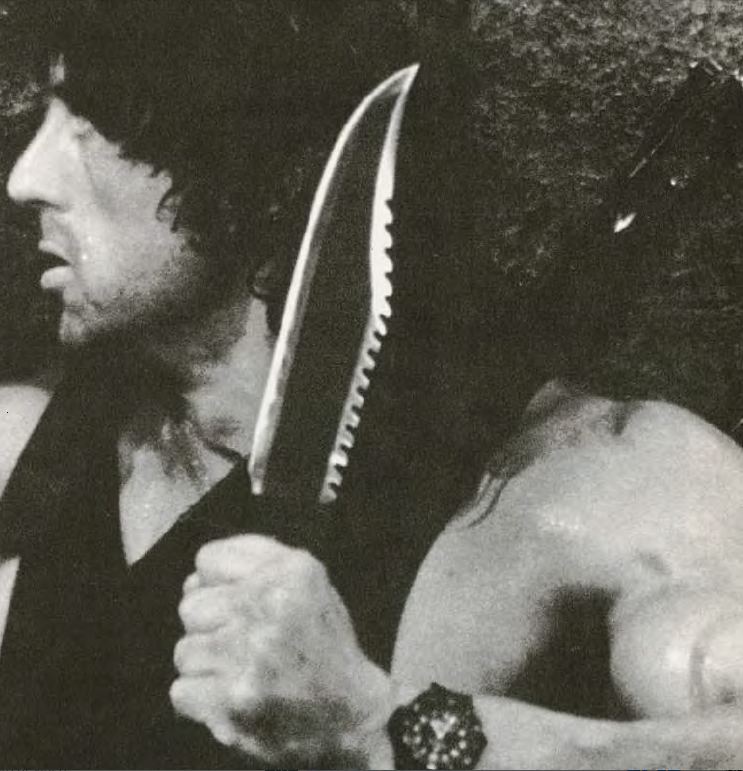
The impact of the Rambo movies and Rambo knives on both modern culture and the knife industry has been monumental over the past three-and-a-half decades.
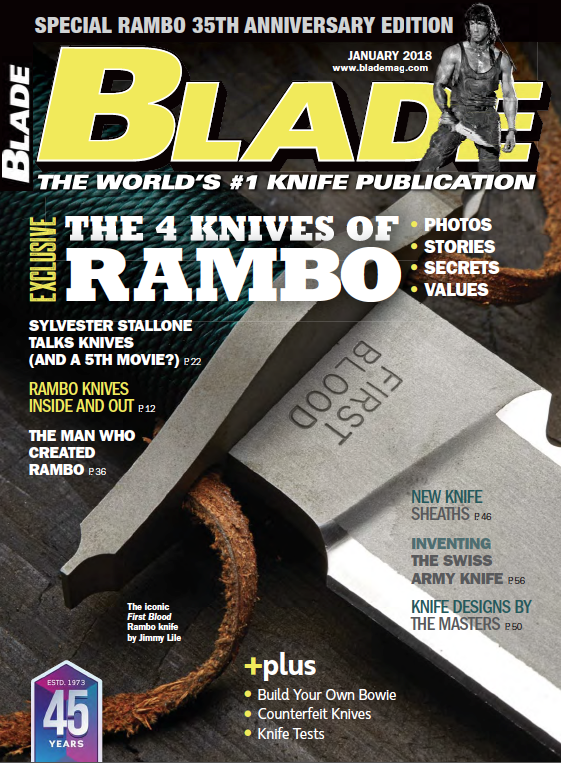
In this, the 35th anniversary year of the original Rambo movie, First Blood, BLADE® asked me to do a story on Sylvester Stallone and what has become the worldwide phenomenon of Rambo.
Ellithorpe recommended Lile and Stallone contacted the Arkansas maker.
“[Lile] understood the vision,” Stallone observed. “He was the real deal and I wanted a real knife for the film, not just another prop.”
The Knives of First Blood and Rambo: First Blood, Part Two
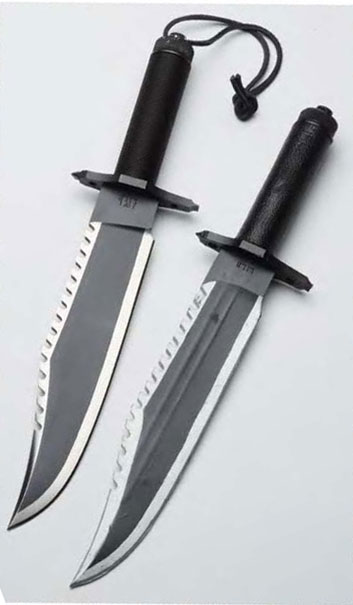
The Lile Mission Raven 1 of 1 (left) and a custom-made-for-production resin-molded version of it (right) screen used in the second Rambo movie. (from the Randy Rousseau collection)
Stallone stated he told Lile what was in the script rewrites for what would be required of the knife, and Jimmy took care of the rest. Lile gave the first six First Blood knives he made to Stallone, all of which survived the standard amount of wear and tear from the movie’s many takes.
Lile made the first two knives for the Rambo movie franchise, including Rambo 2: The Mission, which Stallone called “the fans’ favorite” and which is why he used it in a boat scene in Rambo IV (DVD extra deleted).
The Knife of Rambo III
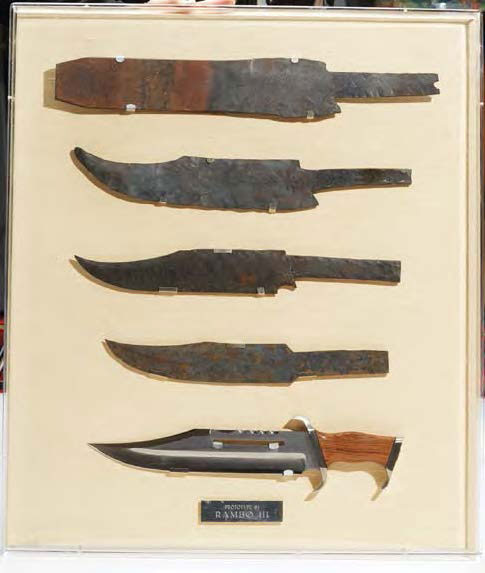
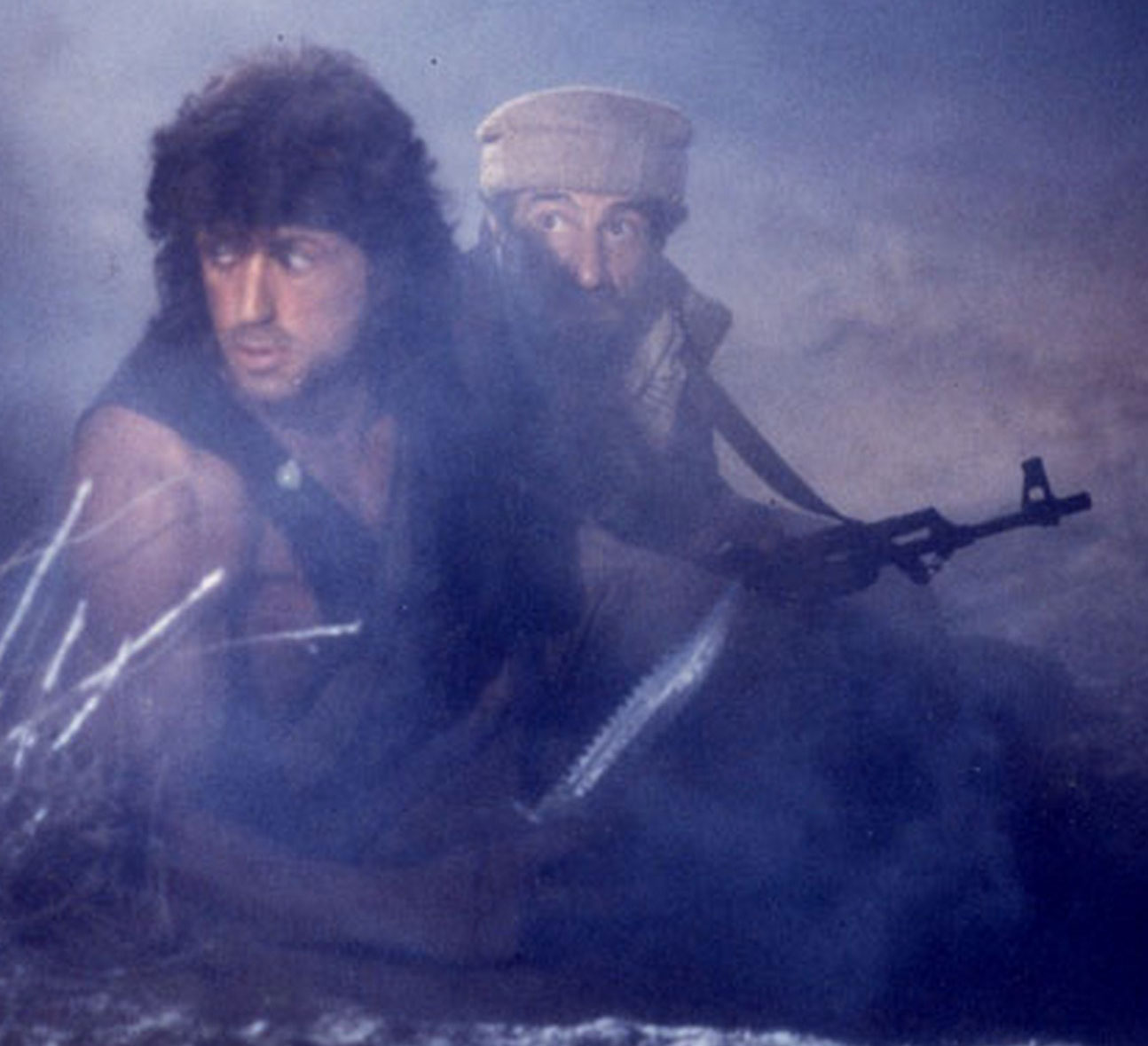
A display (above) from Stallone’s office of the original Rambo III Hibben movie knife shows the progression of the forging process. (from the Randy Rousseau collection)
For Rambo III, though, Stallone wanted to go in a different direction, that is, more of a fantasy look.
Enter Cutlery Hall-Of-Famer Gil Hibben. “I had collected some of his fantasy blades,” Stallone noted, “and then I met him at [the California Custom Knife Show] in Anaheim.”
Unlike with the Lile knives, Stallone had a lot of input on the Rambo III model.
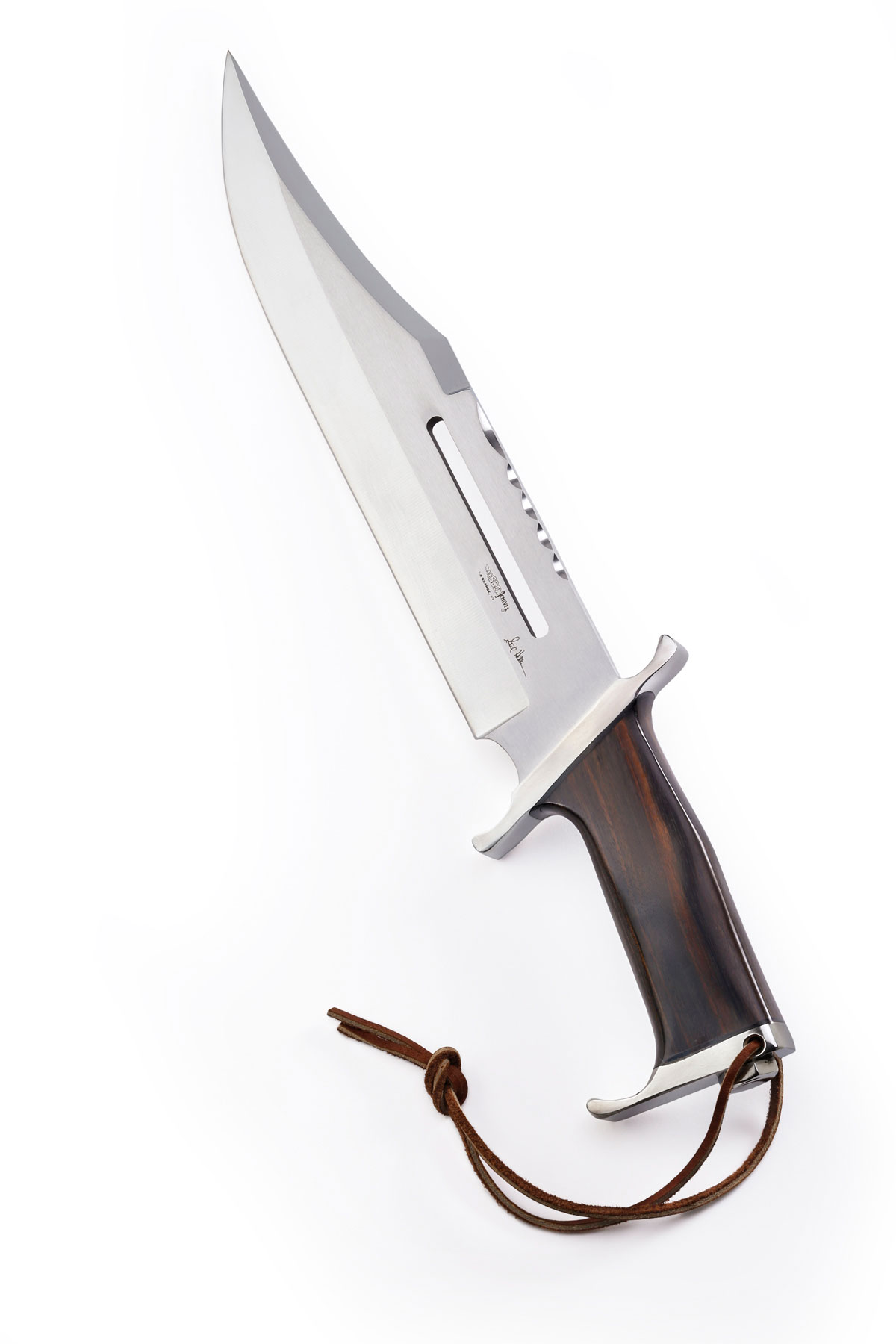
“I drew several versions out on paper and cardboard cutouts,” Stallone wrote. “Once I decided on a design, I told Gil my plan was to make this knife the most famous knife in the world! I believe it’s still selling very well today, along with the other film versions.”
In fact, according to Mrs. Linda Hibben, the Rambo III knife is the most popular knife Gil has ever made.
The Knife of Rambo IV
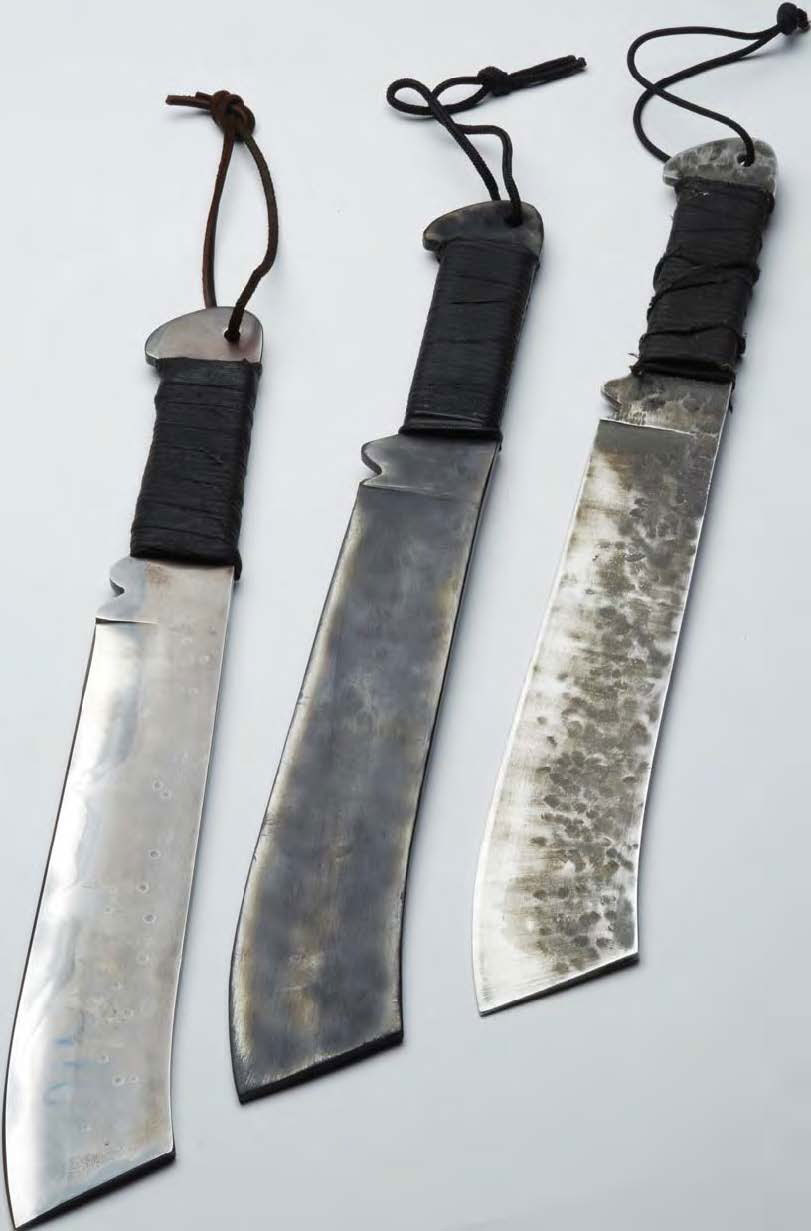
Rambo IV Gil Hibben movie knife (left) with Stallone’s custom-made rubber prop knife (center) and custom-made aluminum prop knife (right)—the latter two both screen used in the fourth movie. (from the Randy Rousseau collection)
Stallone also had input on the Rambo IV Hibben knife, stating, “More than the previous films I wanted something that looked like Rambo could have made in one evening, something crude.”
To prepare for the role of Rambo, Stallone received some training in knife use, “a little from ex-military folks,” he noted. He also studied real stories of those with experience in using the type of survival knives in the movie.
Prop Knives vs. the Real Thing
If the knives look real in First Blood, that’s because they are. However, in the second film molded resin versions of Lile’s handmade knives were made to help protect the actors during live takes. In Rambo III, unsharpened aluminum prop knives were used along with the real Hibben knives. Rubber stunt, aluminum and steel versions of the knives all were used in the fourth film.
“Most were destroyed on set but a very few still exist today,” Stallone wrote. Those include a Rambo II resin version prop knife, a Rambo III aluminum knife that looks great and is very lightweight, and all types from Rambo IV—rubber, aluminum and steel.
“They all look good. You can’t really tell them [from the real thing] just by looking—you have to pick them up,” he stated.
Will There Be a Rambo 5 Knife?
He still has a few of the original knives from each film and keeps them “proudly on display.” He does not clean them and keeps them in the same condition as they were after each movie.
According to some reports, Stallone has indicated he will never do another Rambo movie.
When I asked him if that was his final word or could something happen to change his mind, he simply said, “Never say never.”
Editor’s note: This article originally appeared in the May 2002 issue of BLADE magazine. It’s the first part in a three-part series about The Iron Mistress. You can read the entire series, plus 10 years of back issues, in this digital collection.
A “Choicely Good” Knife
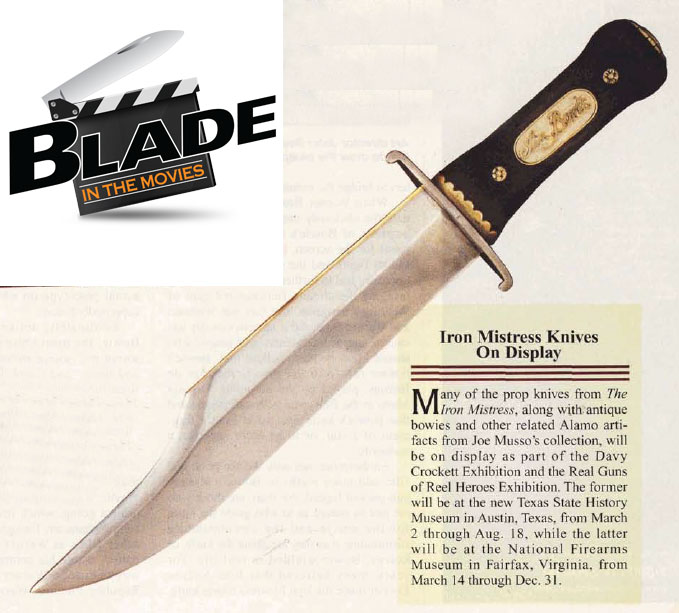
“It’s choicely good; I never thought such a knife could be,” remarked Jim Bowie as he handled the knife with its gleaming brass-backed blade, silver-lugged crossguard and shiny black hilt that showcased a scalloped brass ferrule and fancy nameplate.
“It will never be again,” concluded its maker, James Black, as he stepped forward added, “I fused into it a fragment of a star. For better or worse, that knife has a bit of heaven in it, or a bit of hell.”
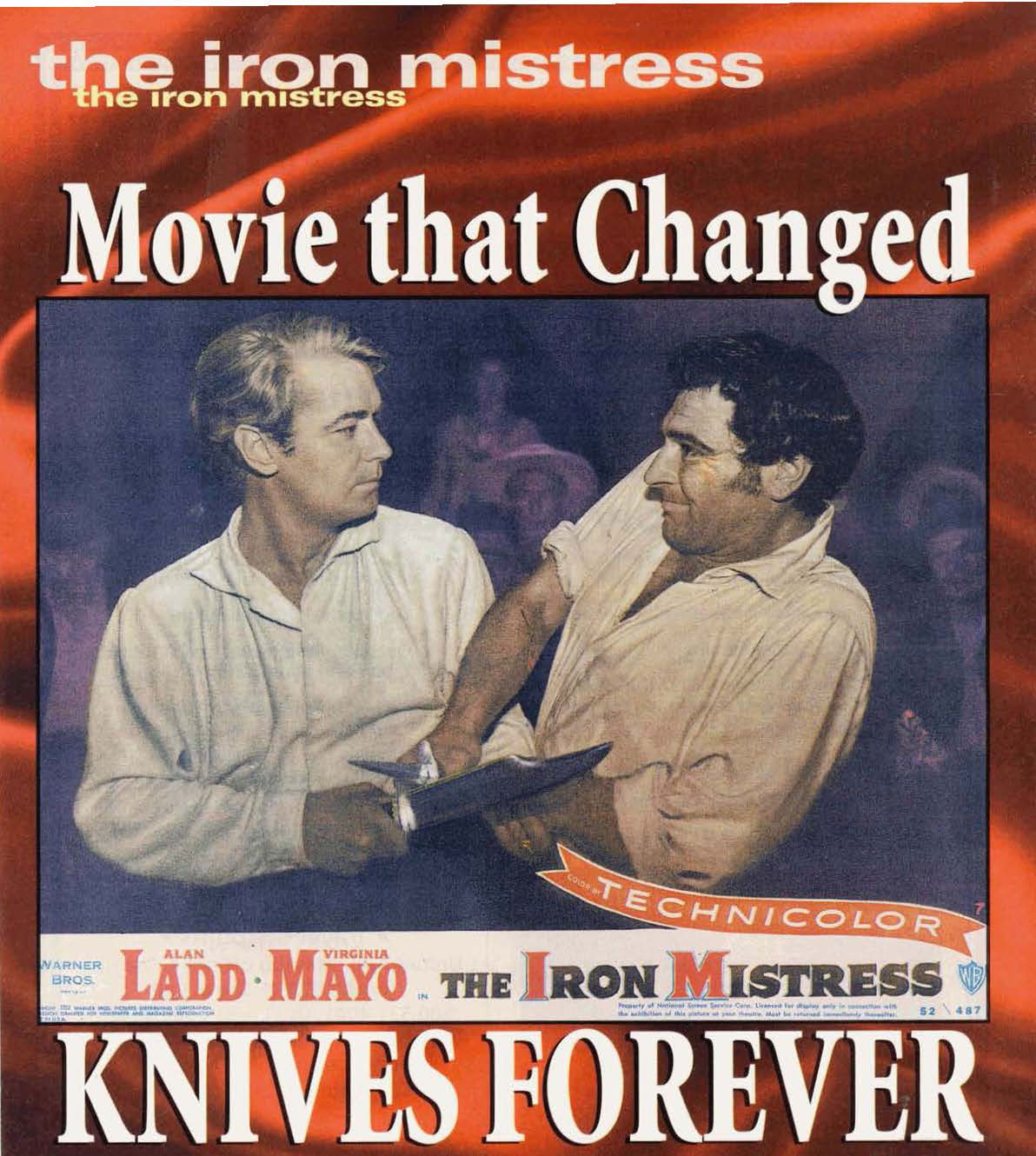
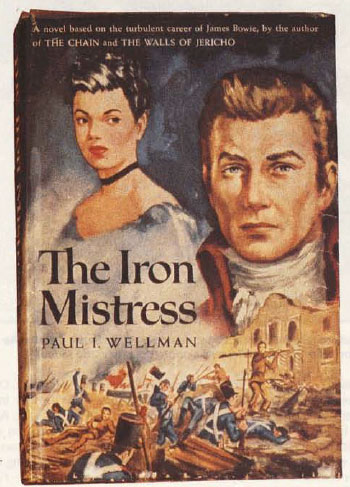
With these words, actor Alan Ladd, as Bowie, and David Wolfe, as Black, summed up 50 years ago in Warner Bros.’ film version of Paul I. Wellman’s best-selling 1951 novel, The Iron Mistress, what was to become, for better or worse, the world’s best known and, in some cases, favorite interpretation of Jim Bowie’s knife.
An Enduring Mystery
Actually, they had every right to do so, since whatever knife, or knives, the historic Jim Bowie may have owned disappeared after his valiant death on March 6, 1836, in the crumbling mission-fortress of San Antonio de Valero, nicknamed the Alamo, at the hands of hordes of Mexican soldiers.
This event, while giving Bowie immortal fame, unfortunately caused the exact style, mountings, dimensions and identity of whoever made his equally legendary knife to be argued by his family, including older brothers John and Rezin, and their descendants, as well as friends, historians, writers, collectors and fans ever since. Once Warner Bros. acquired the rights to Wellman’s novel, the chore of through the existing research and period bowie knives in order to arrive at a credible visual of Bowie’s blade was added to the other production concerns, such as the casting of the larger-than-life Bowie himself and deciding exactly how much of Wellman’s sprawling, epic novel to film.
Not only was the book colorful, befitting the real life Bowie, but it was also expensive in film terms. There were pirate fights, knife fights, Indian fights, fistfights, gunfights, and the Texas War of Independence from Mexico, culminating with Bowie’s force of possibly 200-260 men at the Alamo against an army of thousands.
As with his knife-and since the historic Bowie left no written record an his life known of thus far. The historians who preceded Wellman had to piece together all the salient events leading up to Bowie’s untimely yet heroic death. They were far from successful in many instances, so much so that Bowie and his knife, or knives, have been shrouded in legend almost from the day he died, and in some cases before then.
In choosing a fictionalized rendition, Wellman obviously not only felt that it wasn’t necessary to document his sources, but decided to incorporate all the fragmented, and sometimes inaccurate, 19th-century accounts on Bowie into a cohesive narrative, even if the author had to invent characters to bridge the events.
Adapting the Novel for the Silver Screen
When Warner Bros. decided to eliminate portions of Bowie’s life in adapting the novel for the screen, including the pirates, Indian fights and the entire Texas Revolution, they had to further confound history by bridging the already fictionalized gaps of Wellman’s narrative.
The fact that Wellman and Warner Bros. did it so convincingly has caused succeeding writers and people who should know better to believe that Bowie’s femme fatale in the novel, Judalon de Bornay, played by the gorgeous Virginia Mayo in the film, was an actual person and that Bowie’s knife was made from a fragment of a star, or to be more specific, a meteorite.
Furthermore, not only did the book and film add more myths to Bowie’s already jam-packed legend, but there are those who are just as unsure as to who made the knife for the movie and the circumstances surrounding it as they are about the knife, or knives, Bowie wielded in real life. For years, many believed that John Nelson Cooper made The Iron Mistress movie knife.
Others insisted it was Bo Randall. Only last year, a well-known cutlery writer indicated that Jimmy Lile was the artificer. All three makers drafted versions of it on request after the movie was released, but not for the movie itself. Still others are traipsing through the Smithsonian Institution to find the actual prototype on which the knife was supposedly based.
Fortunately, unlike the historic Jim Bowie, the prop knives and the primary source records regarding the film still exist, and those involved with the production lived long enough to share their insights.
Setting the Stage
Read 10 years worth of back issues, including the three-part series about “The Iron Mistress,” in this collection.
Turning the clock back to 1951, these records show that Wartier Bros. initially considered John Wayne, William Holden, Steve Cochran, Burt Lancaster, Jeff Chandler and Charlton Heston to play the larger-than-life Bowie.
However, at the time, Wayne was trying to get his own Alamo project going, which involved Bowie as a central character. Though he was starring in other films at Warner Bros. during the period, where his contract was split three ways between Warner Bros., RKO and Republic Pictures, Wayne was mistakenly led to believe by Republic’s president, Herbert J, Yates, that Republic was committed to also allow him to direct his Alamo film, as well as produce and star in it.
At the same time, while Warner Bros. was considering other options, 20th Century Fox president Darryl F. Zanuck announced that, “There aren’t any box office stars anymore except John Wayne and Alan Ladd.”
It’s interesting to note that Ladd’s 10-year contract was coming up for renewal at Paramount Pictures in 1951. Upset with the roles he was getting there, Ladd announced that he would be taking offers from other studios.
Team Iron Mistress
With these factors in place, Warner Bros. wooed Ladd away from Paramount, as well as from Fox who was also angling for him, and gave him the Bowie role to showcase the studio’s new contract with the star.
Warner Bros. then backed the film with a top production team. Besides assuring the studio that Ladd would be a credible Bowie, it was this team that spearheaded The Iron Mistress. The triumvirate of producer Henry Blanke (The Adventures of Robin Hood, The Maltese Falcon, Treasure of the Sierra Madre), director Gordon Douglas (San Quentin, Kiss Tomorrow Goodbye), and art director John Gabriel Beckman (The Adventures of Robin Hood, The Maltese Falcon,Casablanca) would play monumental roles in the finalized film version of The Iron Mistress.
Making The Iron Mistress Knife
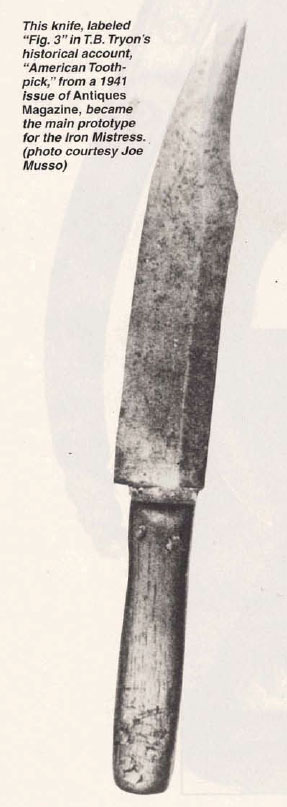
The knife referenced in the “American Toothpick” article.
With the Warner Bros. research department behind them, Blanke, Douglas and Beckman examined all the then-known accounts and photos of authentic bowie knives. Like Wellman, they also consulted Raymond W. Thorp’s 1948 book, Bowie Knife. In the end they decided to adapt the antique bowie labeled “Fig. 3” in T.B. Tryon’s historical account, American Toothpick, from the April 1941 issue of Antiques Magazine.
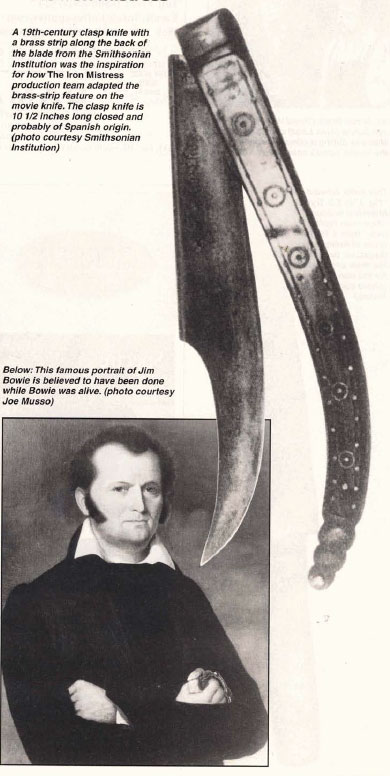
It’s interesting to note that they also saw that the knife had a similar blade shape to the 19th-century folding bowie, termed “clasp knife,” with a brass strip on the blade spine in the Smithsonian Institution.
The 19th century clasp knife with a brass strip along the back of the blade is pictured at top. James Bowie’s portrait is below.
Since Thorp described the brass-strip feature as being on some bowie knives made by one of Jim Bowie’s knifemakers, James Black, and Wellman said that the feature was on the knife Black made for Bowie, Blanke, Douglas and Beckman felt that they had “solved the mystery.”
Of course, other influencing factors included the similarity of the clip point on the knife facing page 97 in Thorp’s book, as well as Tryon’s belief in his American Toothpick article that the knife in “Fig. 3” was the style the historic Bowie used in the Sept. 19, 1827, Sandbar Fight, which initiated Bowie’s fame, and the fact that the brass strip could be traced back to the Highland dirk knives of Bowie’s Scottish ancestry.
Though Jim Bowie’s brother, Rezin, described the Sandbar Knife as having it 9 1/4-inch blade, family friend Caiaphas Ham said it was an 8-inch blade, Thorp described a brass-backed bowie made by Black with a 14-inch blade and Wellman wrote that it was an 1 1-inch blade, the Warner Bros. team compromised on a 10 1/2-inch blade 2 inches wide and 3/8-inch thick tapering to 3/16 inch at the brass back. Beckman then had production illustrator Philip Jefferies do some concept sketches for approval.
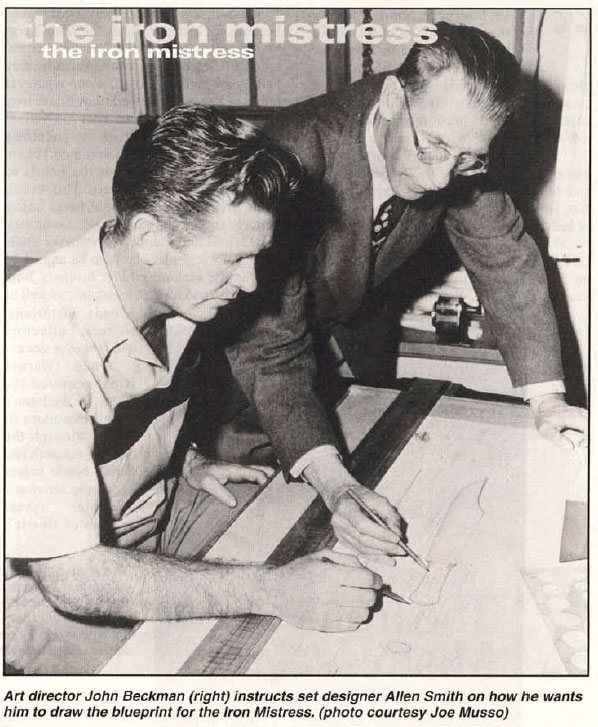
Once accepted, set designer Allen Smith drew up the blueprints for the knife. Besides the brass strip on the blade’s back, Beckman’s design included a lugged German (nickel) silver crossguard, a scalloped brass ferrule encasing the dogbone-shaped wood handle that was lacquered black, and a fancy three-piece brass buttcap.
Feeling that the historic Bowie would want his name somewhere on the knife, Beckman designed the letters “Jim Bowie” in script to be cut out of sheet brass. This was laid over an oval nameplate made of a cream-colored Formica to simulate ivory. A strip of brass bordered the nameplate and the entire ensemble was inlaid in the hahdle on the trademark, or reverse, side of the knife.
Flanking the nameplate were two brass rivet heads, each in the shape of a five-petal rosette. However, only the two rosette rivet heads appeared on the opposite, or obverse, side of the handle, not the nameplate.
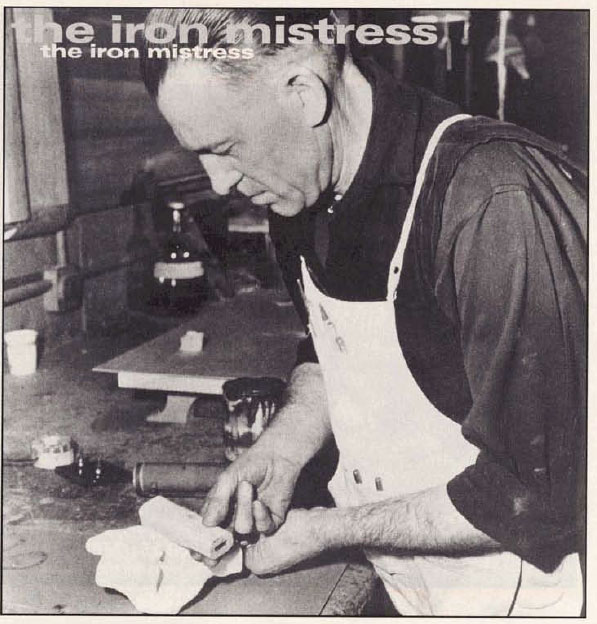
Prop maker Arthur Rhoades fits the wooden handle for the “Iron Mistress” to a plaster cast of Alan Ladd’s hand. (photo courtesy of Joe Musso)
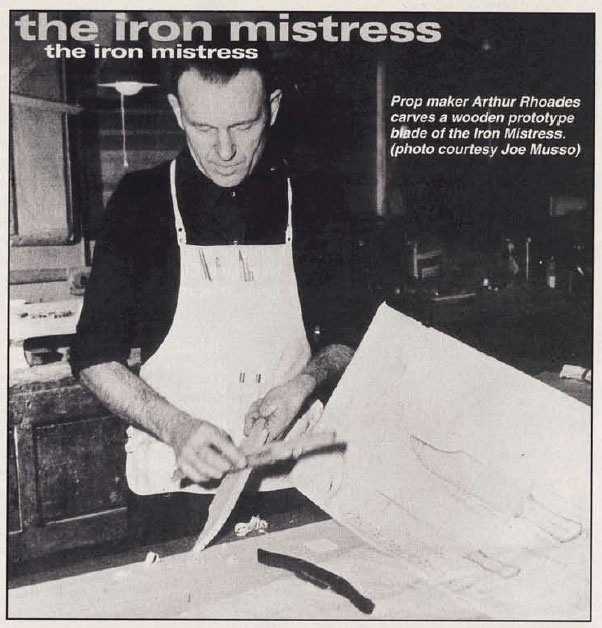
Beckman then gave the blueprints to property master Ed Edwards who, in turn, assigned prop maker Arthur Rhoades to execute the finished version. Using automotive spring steel, Rhoades ground out the blade and brazed a strip of brass along the back. A plaster cast of Ladd’s hand was given to the prop maker prior to carving the wooden hand1e. This caused Rhoades to alter the blueprints slightly by lengthening the handle to 5 31/4 inches and the crossguard to 3 1/2 inches for an overall length of 15 5/8 inches, or the entire knife.
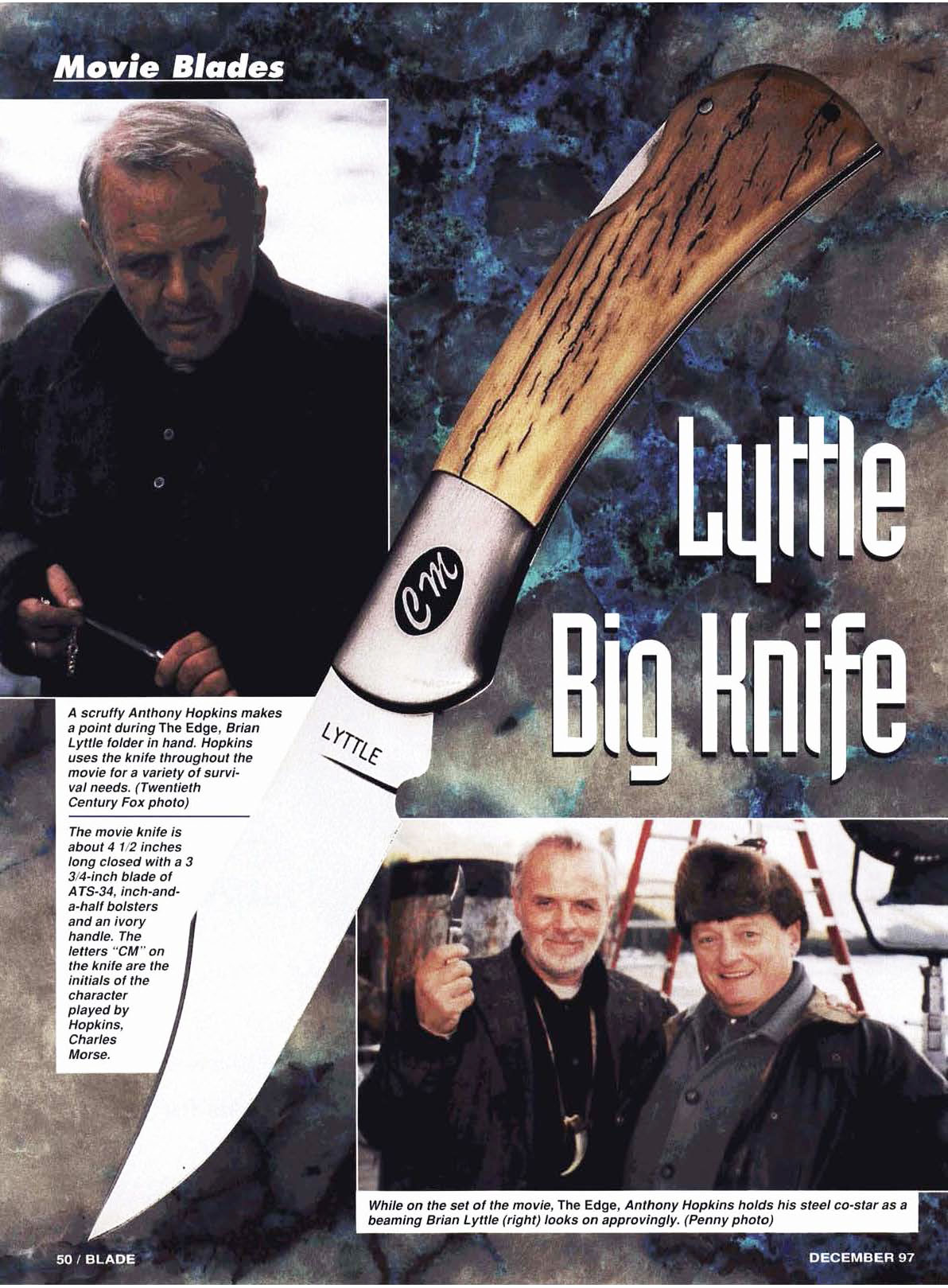
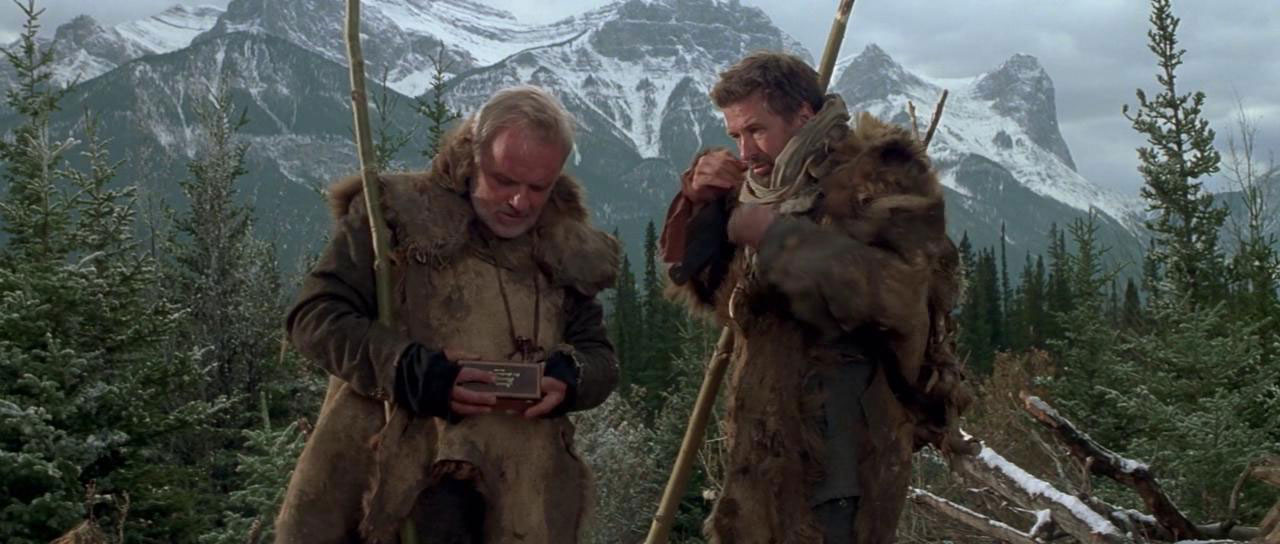
“The Edge” movie knife is about 4.5 inches long closed with a 3.75-inch blade of ATS-34, inch-and-a-half bolsters and an ivory handle. The letters “CM” on the knife are the initials of the character played by Anthony Hopkins, Charles Morse, in the 1997 movie, “The Edge.”
Editor’s note: The following originally appeared in the December 1997 issue of BLADE. Find more from BLADE‘s extensive archive in this download.
Brian Lyttle’s Blade Get Top Billing in Survival Epic, The Edge
Could this be THE movie where a knife will come across as what it truly is, an inanimate yet indispensable tool, instead of a living, breathing, killing demon that irrational crusaders and inept politicians constantly point to as the root of all evil? Let’s hope so.
Meanwhile, The Edge, starring award-winning actor Anthony Hopkins as a man trying to survive in harsh environs with the help of his knife and his ingenuity, may be a movie worth watching not only for the way he employs his blade but because it’s just fine entertainment.
One thing’s certain: Canadian knifemaker Brian Lyttle will be much more than just an interested observer because he made the “steel star” of the film and even appears in the flick as an extra.
The Design
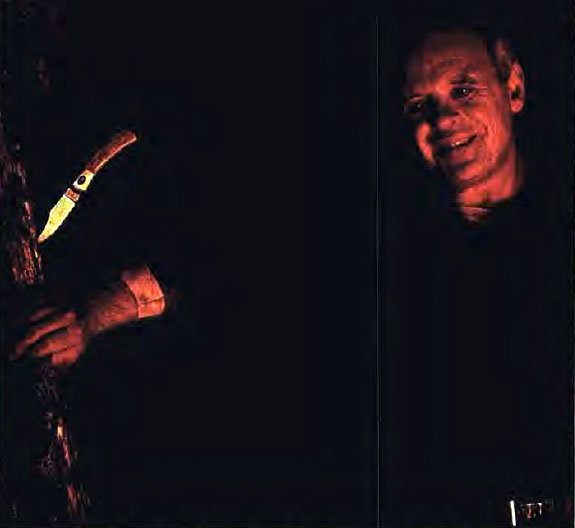
Anthony Hopkins, with Lyttle’s folder nearby, during a scene from “The Edge.” (Twentieth Century Fox photo)
The knife is a large folding hunter designed for the applications to which Hopkins puts it in the movie.
“It’s a gentleman’s piece in an old-time style but large enough for use as a tool to make traps and spears and for other survival needs,” Lyttle (pronounced LITTLE) observed. According to the maker, a voting member of The Knifemakers’ Guild who specializes in highly embellished folders and straight blades, film officials inspected similar knife patterns by assorted U.S. manufacturers to arrive at the piece they wanted.
“They liked big folders with clip-point blades,” he noted.
The result is a knife about 4 1/2 inches long closed with a 3 3/4-inch blade, inch-and-a-half bolsters and an ivory handle. Though Brian specializes in damascus, he used ATS-34 for the blade because movie officials said they wanted a material that wouldn’t stain. The letters “CM” on the knife are the initials of the character played by Hopkins, Charles Morse.
Multiple Models
Lyttle died in 2016, but his knives live on. See his legacy at lyttleknives.com.
Lyttle did five knives in all for the movie-four lockbacks and one sliplock. Of the four lockbacks, one is sharp for scenes where cutting is required; one’s dull for scenes where the prevention of any “accidental cutting” is the main concern; one’s a standby; and one’s the presentation piece used in the film. The sliplock appears in an underwater scene where the knife is used to cut a seat belt.
“They didn’t want the performer to have to worry about unlocking the blade while underwater,” Lyttle explained the reason for the sliplock.
He sold four of the knives to movie officials and rented the fifth one to them so he could get it back after filming.
The Knifemaker Steps Into the Movie
In this scene from “The Edge,” Hopkins (left) holds one of the presentation boxes Lyttle made. (image via imdb.com)
Don’t look for Lyttle’s name in the credits at the end of the movie. However, do look for a reference to the maker during the scene where the knife is presented to Hopkins. Inside the blade’s presentation box is a certificate that says, “Lyttle Knife Co.” By the way, that’s the blade Brian rented to the movie and is the one photographed with this story.
Knives are not the only examples of Brian’s work in the film. A skilled engraver, he engraved two watches (a gold one for Hopkins and a stainless steel Omega for co-star Alec Baldwin) and the presentation knife that appears early in the flick.
“The engraving will be easily visible and there’s a special reason for it to be seen,” he winked. “I read the script and it looks like one helluva movie. Hopkins doesn’t do duds.”
A Connection Through Brad Pitt and Legends of the Fall
Read more articles from BLADE’s archives with this collection of 25 years of back issues.
How did the movie officials learn of Lyttle and his knifemaking? During the filming of Legends Of The Fall, an earlier flick also done in the High River area starring Hopkins and Brad Pitt, Lyttle’s work came to the attention of Pitt.
Pitt visited Lyttle’s home and bought some knives and gave them to some of the movie’s cast, including Hopkins. The same man who put Lyttle in touch with Pitt introduced Brian to an assistant props master.
When it came time to select the knives for The Edge, the assistant props master brought along Lyttle’s knives during a meeting of movie officials, a meeting attended by Hopkins. When Hopkins saw the blades he recognized the maker’s name on them.
Hopkins reportedly said, “They’re damn sharp!”
His reaction no doubt helped sway the movie officials’ decision and Brian had almost every knifemaker’s dream job: making movie blades.
“A Pain in the Neck”
As with most movie relationships, however, it was no picnic for Lyttle. He had to work long hours to get the pieces ready.
“I had three weeks to get the first knife done and I had a knife show to do in-between,” he recalled. “I had to work day and night to meet their deadlines. I had two days off one month and worked some days through midnight until four in the morning.”
And, of course, the movie officials could be a pain in the neck.
“They were very fussy over stuff,” Brian related. “Twelve presentation boxes (for the knife presentation scene) had to be made before they were satisfied with one.”
Worth the Trouble
Still, as almost any knifemaker will tell you, all the toil and trouble is worth it for the dividends such exposure does not only now but down the road, and specifically for Lyttle when people will come up to his table at a knife show and say, “Wasn’t that your knife in that movie with Anthony Hopkins?”
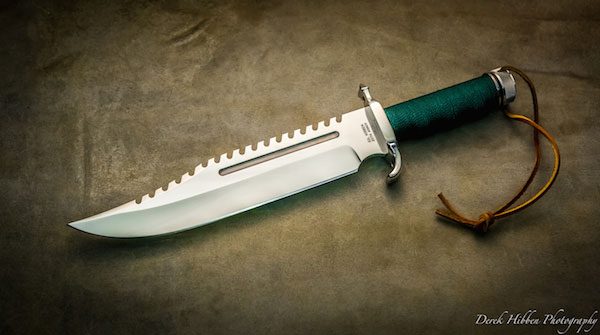
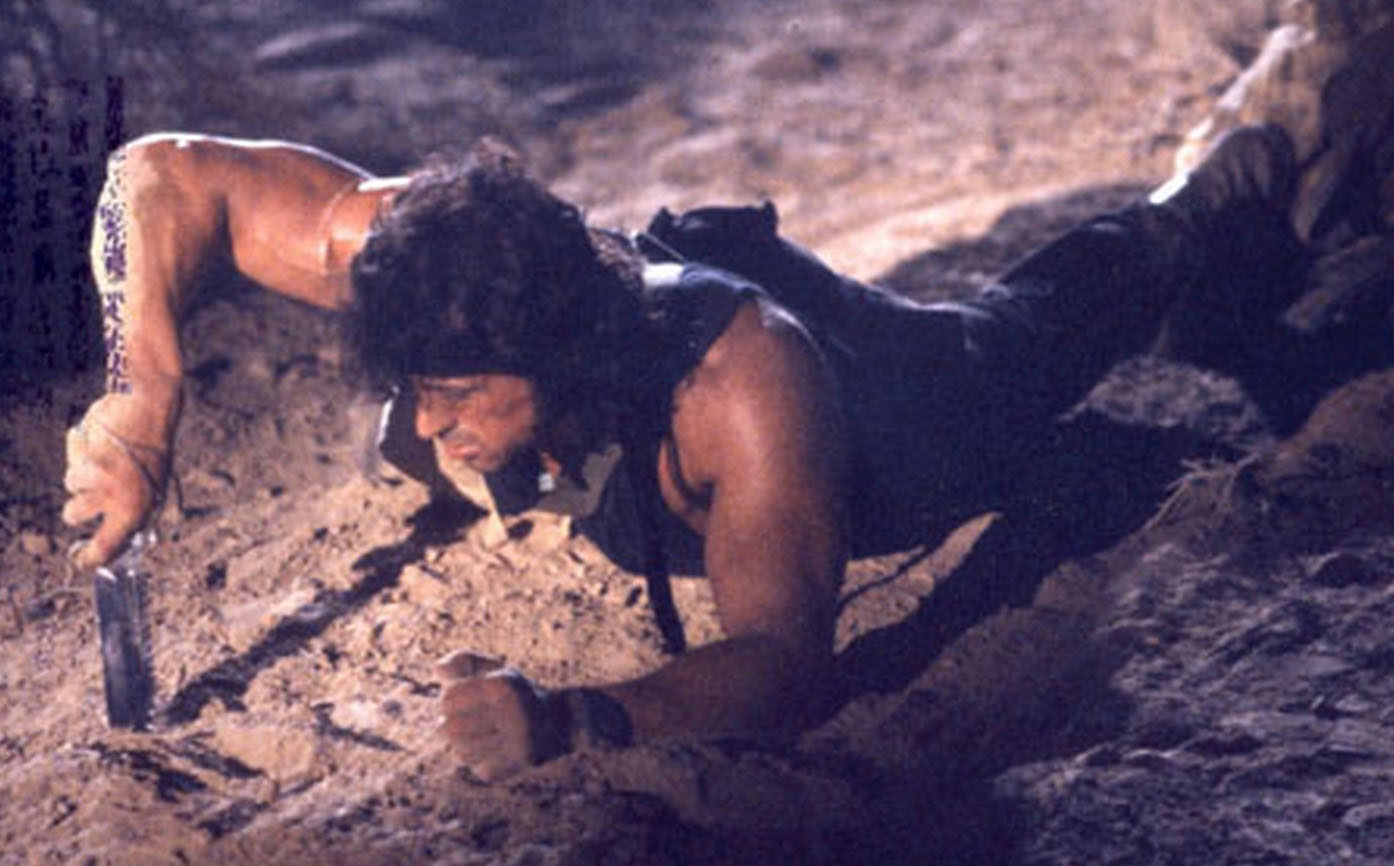
Rambo III was the first Rambo movie for which Gil Hibben made knives, taking over from Cutlery Hall-Of-Famer Jimmy Lile, who made the knives for the first two Rambo films. When Stallone contacted Hibben about doing the knife for the third film, Hibben made a prototype hollow-handle survival knife with sawteeth on the spine.
However, Stallone decided he wanted something different and opted for another of Hibben’s designs, the now famous Rambo III bowie. However, the minefield scenes for the third movie already had been filmed with Stallone using the first design, the knife known as the Rescue Mission Knife.
On the 25th anniversary of Rambo III, Hibben teamed with award-winning knifemaker Vaughn Neeley to fashion a limited edition of 100 specially marked, mirror-polished and serial-numbered 25th anniversary Rescue Mission knives. Go here for more information.
Instead of the Rescue Mission Knife, Stallone opted for Gil Hibben’s Rambo III bowie (shown here) as the featured knife for the third film. Stallone had more input on the design of the bowie, including the long cutout in the blade. (Kris Kandler image)
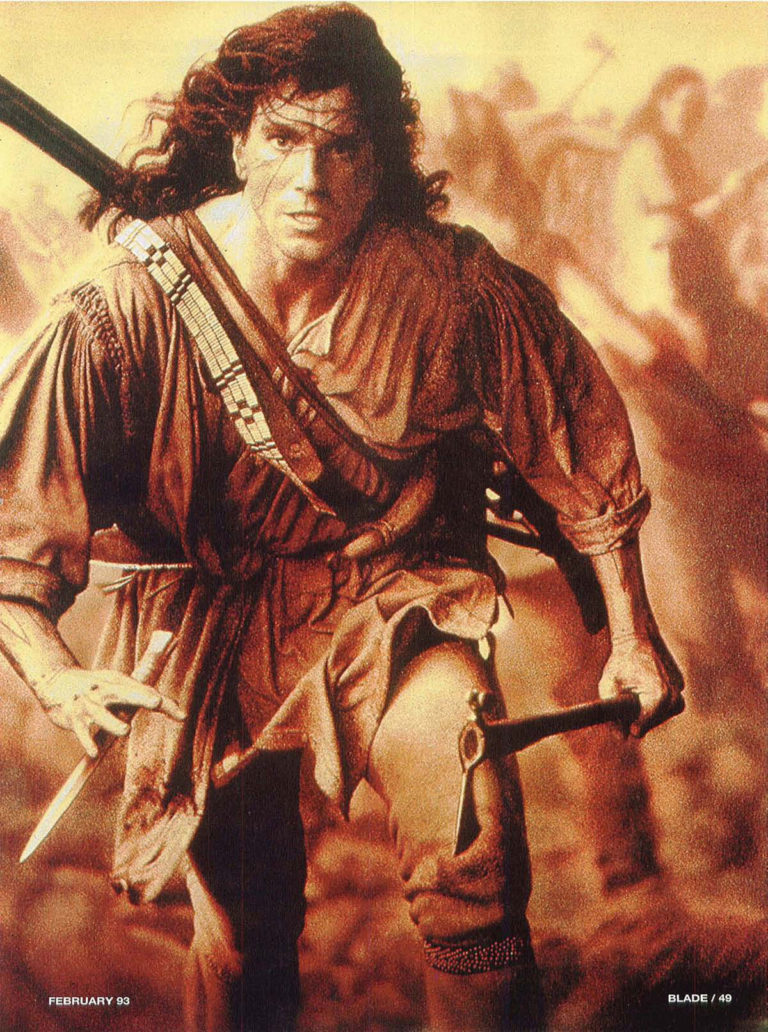
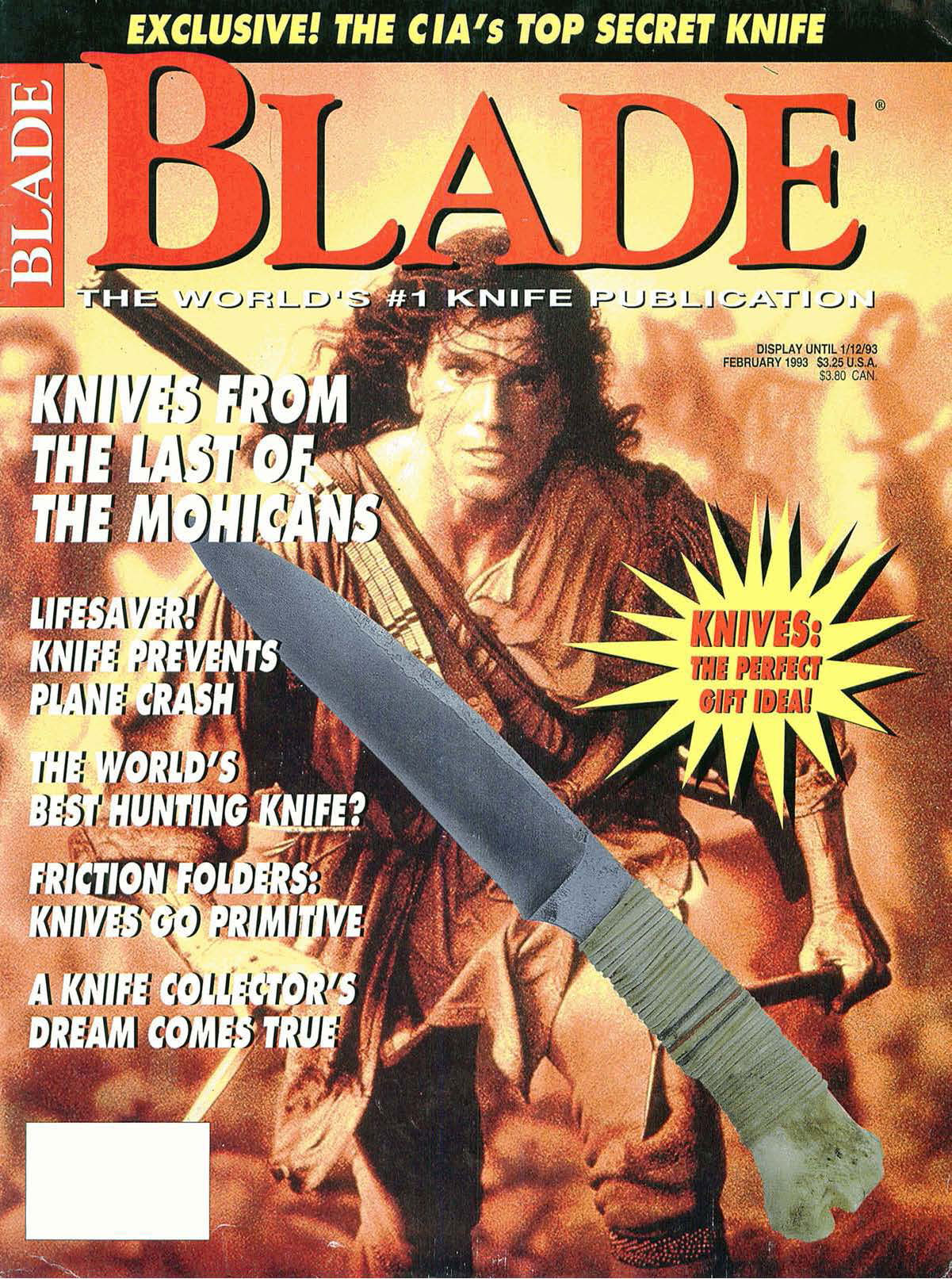
Editor’s note: The following appeared in the February 1993 issue of BLADE magazine. You can read more from BLADE‘s extensive archive here.
Knifemakers keep the candle lit for traditions going back generations. It’s no wonder Hollywood would turn to these keepers of history when making movies set in centuries past.
Winkler, who lives in Boone, North Carolina, (the movie was filmed in the nearby North Carolina mountains) read about a casting call for the movie in a local newspaper. A maker of period pieces for and a participant in mountain man rendezvous, Winkler and his knives would seem a good match for the movie’s mid-18th century time frame, but not even he and his business associate, Karen Shook, could have foreseen the good fortune that would befall them when they met with movie prop master Ron Downing.
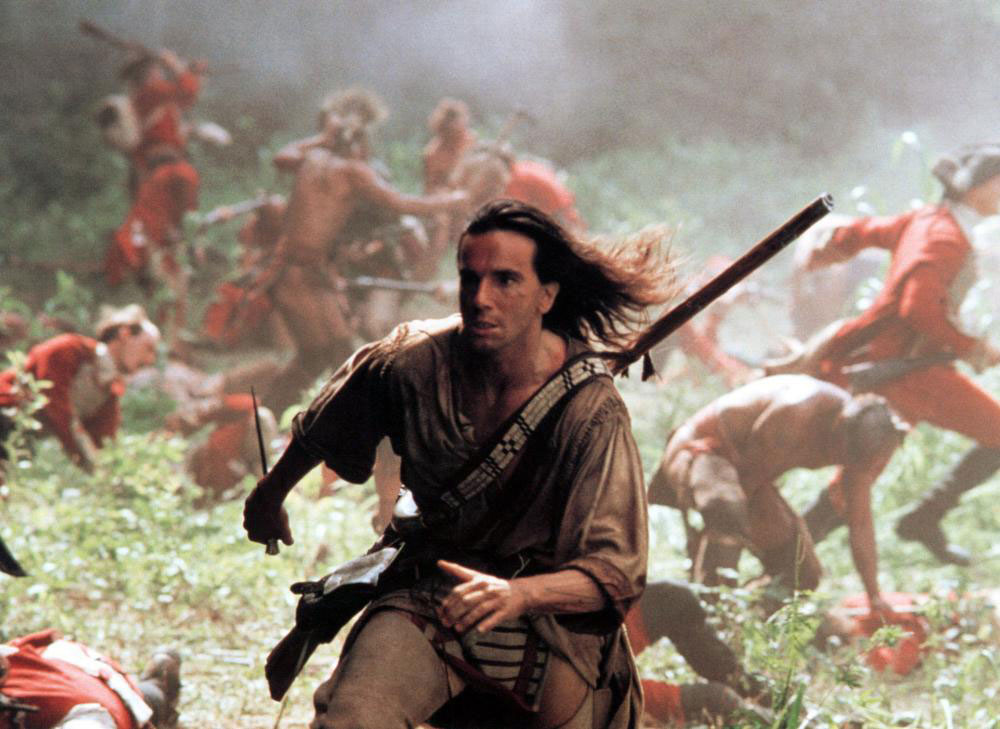
Hawkeye (Daniel Day-Lewis) carries the knife Winkler made in this scene from “The Last of the Mohicans.” (Image via imdb.com)
“Karen and I introduced ourselves to Downing’s secretary and got a map to his office,” Winkler recalled. “We spoke with Downing and he told us he had a meeting that night with the movie’s director, Michael Mann, at which time he was supposed to show Mann the knives that were to be used in the movie.
“But Downing didn’t have any knives! Karen and I ‘happened’ to have a suitcase full of knives and Downing asked if we would stay for the meeting with Mann. Though no specific knives were agreed upon at the meeting, they decided our knives were appropriate and gave them some idea of what they wanted.”
Designing, and Re-Designing, the Knives
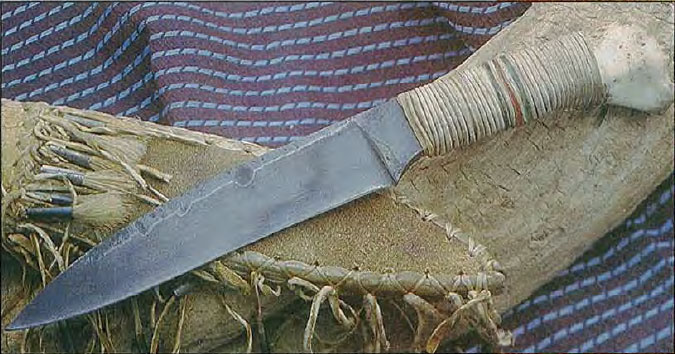
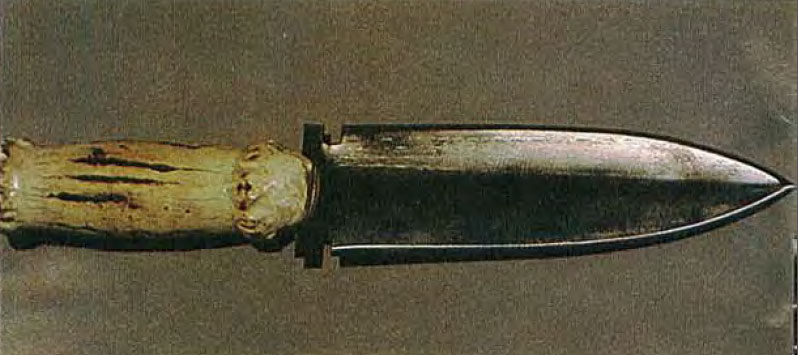
The knife Hawkeye (Daniel Day-Lewis) carries is shown above. Made by Daniel Winkler, the piece is 11 inches long overall. The blade is forged from L6, a steel Winkler said he chose to show “the right-age patina “for the French and Indian War time period. He said the blade design is not an exact straight edge because of its slight upswept tip. The handle is deer leg bone wrapped in rawhide and red and green bands, also inspired by handles from the mid-18th century.
From there, Winkler learned just how tough a job he had taken on. He met with production officials to decide on a specific knife design. From that design Winkler made a knife and brought it to the next production meeting, where movie officials suggested more changes.
“I went to six weeks of meetings and they’d change the knife at every meeting. They continually changed the design until the final knives were an evolution of changes,” Winkler said.
Once the final designs were agreed upon, he had to make three of each knife in case any one was damaged or lost, all of which had to look alike.
“It was difficult to get the same shape bone for each handle,” he noted.
The knife can be seen in the first few seconds of this video clip:
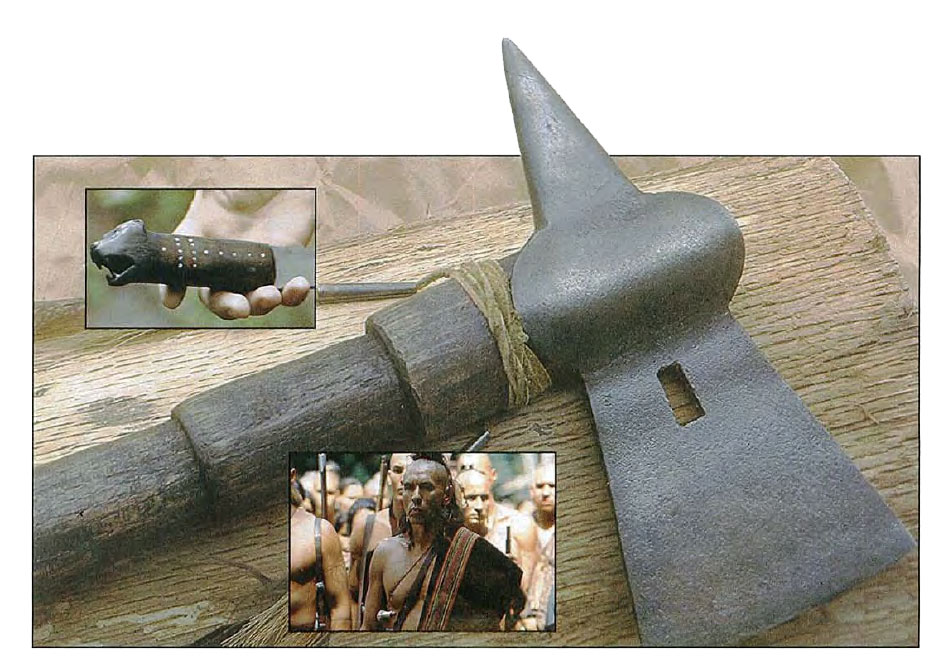
Winkler made the knives for Hawkeye (Daniel Day-Lewis) and his adopted brother, Uncas (Eric Schweig), and the tomahawk for the movie’s villain, Magua (Wes Studi). Magua’s tomahawk was one piece Winkler didn’t have to change. It gets the best close-up shot of any of the movie’s edged pieces early on when Magua attacks one of the English soldiers escorting Cora (Madeleine Stowe) and Alice (Jodhi May) Munro to see their father. Winkler said it was copied from a design on display in a French and Indian War museum in New York.
“(The movie officials) didn’t change the reproduction I made,” Winkler said. “When they got it, they liked it.”
King: It Started with Breakfast
King can thank his father for his opportunity to make the movie knives.
“Jim Morgan, the assistant prop master, ate breakfast where my Dad does every morning,” said King, who lives in Asheville, North Carolina, also near where the movie was filmed. “They got to talking and Dad said I made knives they could use in the movie. Jim said to send me down.”
The next thing King knew, he was making movie knives.
Hiding “Blood Bladders” Inside Knife Handles
Randall King made Chingachgook’s English dagger from a design by movie prop master Ron Downing. Like all of the knives made for the movie’s stars, King had to make two duplicates in case any of the knives were damaged or lost. To duplicate the stag handle, King sawed a piece off a moose antler 2 inches in diameter, sanded it down to the same shape as the original, and cut the same “character lines” in the stag with a Dremel tool. Finally, he burned the slabs in places for the brownish stag effect.
The knife King made for Chingachgook (played by Russell Means) is a combination of two knives-an English dagger blade with a handle designed by Downing. Like Winkler, King had to make several copies of the knives.
“Do you know how hard it is to duplicate a piece of stag? I took a moose antler and sawed a piece from it about 2 inches in diameter,” he explained. “I sanded it down to the same shape as the original and took a Dremel tool to cut the lines in it and then burned it in places for the stag effect.”
King also had to duplicate the carved bear-head handle of Magua’s knife, and made two special effects knives for Magua with removable handles that hid “blood bladders,” which squirted fake blood when squeezed for the movie’s action scenes. King also made the knives and sheaths for the movie’s extras.
Winkler said the huge gunstock war club that Chingachgook cames in the movie, as well as the other tomahawks used by movie extras, were made by in-house prop people. A lot of the tomahawks were based on authentic designs illustrated in blackpowder catalogs, he noted.
Magua’s tomahawk gets probably the best exposure of any edged piece in the movie early on (Magua is at bottom, played by Wes Studi). Daniel Winkler carved the handle from hickory and hand forged the head from L6 steel. He reproduced it from an authentic piece provided by Ft. Meigs, a restored fort from the French and Indian War period located in upstate New York. (Magua picture courtesy Twentieth Century Fox)
Working with the Stars
Read more articles from BLADE’s archives with this collection of 25 years of back issues.
Both makers said they got to meet the stars and were impressed with how cordial they were, King even to the point of having his picture made with Studi and Day-Lewis.
Though neither maker “got rich” from the money they made-King used the proceeds to make himself a new knife shop-both viewed the experience as educational.
“Working on a movie production is not something I would want to do very often,” Winkler admitted. “It was fun but it took a tremendous amount of time. They wanted everything right away. I had to put off some of my custom orders and missed some knife shows to meet their deadlines, and a lot of what I did for them was put on the shelf. We (knifemakers) are suppliers, not actors.”
The makers may not be actors but, in a way, the knives and tomahawk were. And if the past is prologue-as with the Rambo knives that helped boost the knifemaking fortunes of Gil Hibben and the late Jimmy Lile-Winkler and King may reap even more benefit to their knifemaking careers from the pieces for The Last Of The Mohicans.
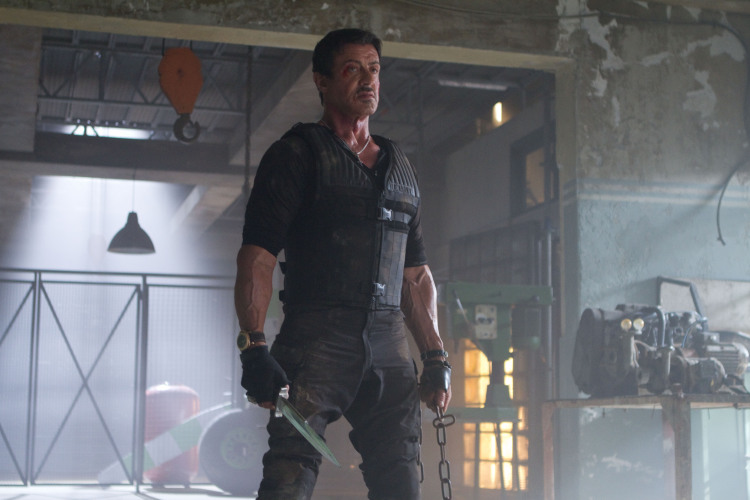
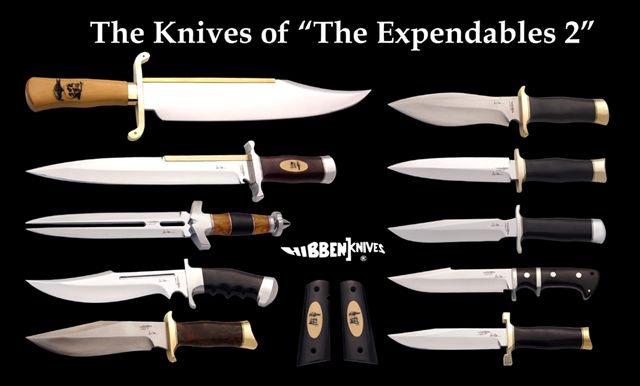
Sylvester Stallone (top) holds the Gil Hibben Toothpick (second from top left, above) in a scene from The Expendables 2. Along with the modified version of Gil’s Alamo Bowie (top left, above), it is a carryover from the first film in the series, The Expendables. The Legion Fighter (fourth from top left, above) is the knife Hibben made expressly for Stallone for the sequel. (photo from The Expendables 3 by Frank Masi; photo of Hibben knives by Mike Carter)
The longest-running custom knifemaker/movie star connection of all time will have another go soon with the imminent worldwide release of the action blockbuster, The Expendables 2.
In 2010, The Expendables, co-written, directed by and starring Stallone, along with an all-star cast of action-film heroes, again employed Gil’s knives. Stallone’s character, team leader Barney Ross, carried a custom Hibben 17.5-inch “Toothpick” model (cover, November 2010 BLADE). Meanwhile, Gunnar Jensen, played by Dolph Lundgren, and Lee Christmas, played by Jason Statham, took turns using a huge, 19-inch custom Hibben bowie.
All of the original Expendables except Mickey Rourke return for The Expendables 2, which at press time was due to open in theaters Aug. 17. The all-star cast has grown with the addition of Chuck Norris and Liam Hemsworth to the Expendables team. Action star Jean-Claude Van Damme joins the cast as the leader of an opposing team of mercenaries, along with his right-hand man, Hector, played by Scott Adkins. Both Bruce Willis and Arnold Schwarzenegger return with more substantial parts in the new film. The $100 million sequel was filmed in Bulgaria in late 2011.
SLY ON LINE 1
Gil received the call from Stallone early last year to discuss the knives Stallone wanted for the sequel. Two of Gil’s knives from The Expendables will return to the big screen in The Expendables 2. His big custom bowie again will be carried by Lundgren, and both Stallone and Van Damme will be seen with the Toothpick. But Stallone said he wanted more—a lot more.
The amazing 76-year-old Gil set to work and delivered at least 10 different models, including multiple copies of some and a few prop knives with half blades to give the appearance of being embedded into something or someone. As before, some of the knives have the Expendables skull-and-raven logo scrimshawed on the handles by scrimshander Richard “HutcH” Hutchings, who does nearly all of Gil’s scrimshaw work. HutcH also scrimmed the logo on several sets of black Micarta Colt .45 pistol grips Gil provided for the film.
Some of the knives Gil made for the movie were based on previous models he has made during his 55-year career, though some are new designs he made especially for the film. Among those expected to be prominently seen is his Legion Fighter, this issue’s cover knife, a recurve fighter with a 9.5-inch blade of quarter-inch 440C stainless steel. The Micarta handle is sandwiched between a hefty stainless steel guard and buttcap.
One of the new, never-before-seen models is a split-blade fighter, somewhat reminiscent of Gil’s “Double Shadow” knife (second photo from top, third knife down from top left), with a stainless steel guard and buttcap and a handle of black Micarta and amber.
Stallone chose the big bowie that appears in both the original movie and the soon-to-be-released sequel after seeing a similar model, Gil’s Alamo Bowie, on the Hibben Knives website (www.hibbenknives.com). The decision was made to modify it with a different handle of ivory Micarta® that could be scrimshawed with the skull-and-raven Expendables logo seen throughout the original film on tattoos, motorcycles, clubhouse doors and the knives. The long, slender Toothpick carried by Stallone in both movies was an entirely new design Gil developed for The Expendables.
I have seen some stills from the sequel and a couple of preview trailers that show some of the knives very prominently displayed, but it remains to be seen what makes the final cut. “We never know what will actually end up in the movie,” Gil notes. “Sometimes scenes are filmed using the knives and then those scenes get cut in editing. I guess we will find out when everyone else does at the theater.” (Editor’s note: From reports at press time, the Legion Fighter cover knife gets its best movie air time when actor Randy Couture, who plays the role of Toll Road, uses it.)
IMPROVISE AND REVISE
As is usually the case when making knives that will be featured in a film, designs are revised and changed along the way to satisfy the producers, directors, prop masters and actors involved. Once the designs are finalized and approved, Gil has to scramble to get several copies made and delivered to remote filming locations such as Burma for The Expendables and Bulgaria for The Expendables 2. The knives he makes for the films are fully functional and sharpened. In some cases the prop department will make dull replicas that can be safely used in close-up fight scenes.
The Expendables featured an impressive lineup of stars that, in addition to Stallone, Lundgren, Statham, Willis, Couture, Schwarzenegger and Rourke, included Jet Li, Steve Austin and Terry Crews as a team of elite mercenaries. Eric Roberts played the bad-guy/corrupt CIA agent.
The Expendables was No. 1 at the box office in its opening weekend in August 2010. The film’s budget was reportedly $70 million. It grossed over $274 million worldwide by the end of the year, and that is not counting DVD sales. That was certainly enough success to entice movie officials to make a sequel.
REEL STEEL BY THE DOZENS
Gil has made knives for dozens of movies and television shows, including designing and making Klingon swords and knives for assorted Star Trek TV shows and movies, throwing knives in Steven Seagal’s Under Siege, and knives in The Perfect Weapon starring Jeff Speakman. He also has enjoyed a following among Hollywood celebrity collectors, among them Elvis Presley, John Wayne, Steve McQueen and Shelley Berman.
Stallone long has been a collector of custom knives and a fan of Gil’s work. In fact, Stallone ordered some large custom lockback folders based on the Rambo III knife design he had personalized as gifts to Willis and Schwarzenegger during the filming of The Expendables.
The Expendables 2 will be the fourth Stallone film for which Gil has made custom knives. There are Hollywood rumors of further Rambo and Expendables sequels, so you may be seeing more of the Stallone-Hibben connection.
The Expendables 2 is produced by Nu Image and Millenium Films, and is distributed by Lionsgate. It is written by Sylvester Stallone and Richard Wenk and directed by Simon West.