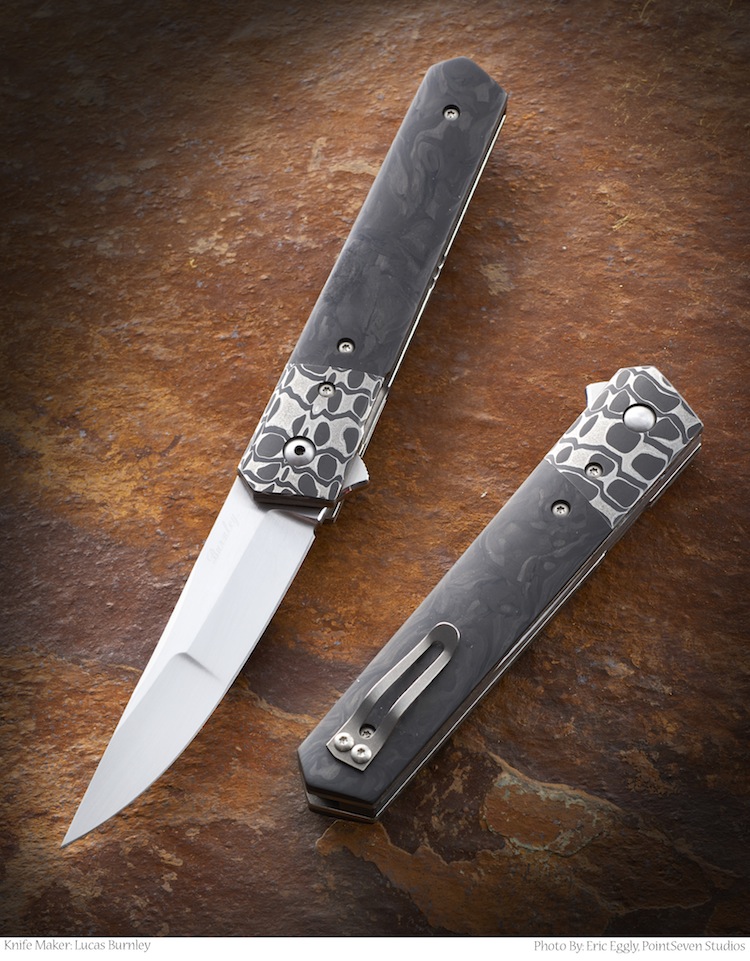

The knives from the Battle of Gettysburg, the best EDCs for your money, the blades of summer and the hottest flipper folders are but a sample of the topics covered in the new BLADE® (www.blademag.com), on newsstands TODAY!
On the eve of the battle’s 150th anniversary, we caught up with Paul Shevchuk, museum specialist at the Gettysburg Museum of the American Civil War. He was most forthcoming in providing pictures of and information about the knives, bayonets and other edged tools used by both sides in Pennsylvania in 1863. From a Confederate saber bayonet found on a Gettysburg street after the battle to side knives, pocketknives, D-guard bowies and more, Shevchuk’s contributions to the story make for an enlightening glimpse on how soldiers on both sides used their knives during the War Between the States.
Joe Kertzman tapped the know-how of a number of industry experts to get the lowdown on today’s best EDCs for the money. From the damascus and ebony of the Boker Plus Damascus Gent II—this issue’s cover knife—to the CRKT Carajas designed by Flavio Ikoma and many more, you’re bound to find an EDC that fits your pocket and pocketbook.
The new BLADE® features the Boker Plus Damascus Gent II on the cover.
Speaking of EDCs, it’s always good to know what the legal ramifications are when you carry a knife. Mike Haskew consulted such industry authorities as attorney Evan Nappen, AKTI Executive Director Jan Billeb and Knife Rights’ Doug Ritter for their recommendations on what you need to consider when you carry a knife.
With the beginning of summer mere days away, it’s time to replenish your summertime blade array. James Morgan Ayres suggests any number of ways to do it—including camping, picnic and just about every other knife need in the good ol’ summertime—in “The Blades of Summer.”
There are many more entertaining stories in the new BLADE (www.blademag.com). Check it out on newsstands NOW!
The knife steel you choose depends a lot on what jobs the knife will perform.
One of the questions knife enthusiasts ask most is What is the best steel for a knife? Before you can answer such a question, you must first know exactly what it is you need in a knife.
1) Will you use the knife to cut meat, or paper, or rope, or plastic, or a little bit of everything? Much depends on what you will be using the knife for, and just about any knifemaker or knife manufacturer who knows his stuff will know which steel he has on hand will be best for your purposes.
Learn more about selecting steel types and how to make knives in the third edition of “BLADE’s Guide to Making Knives.” The classic is back and better than ever!
2) The steel is just part of the equation. The blade’s geometry is also important. By blade geometry is meant how the blade is ground and tapered from the back (spine) to the edge. If too thick, it won’t slice or cut properly; if too thin, it may chip.
Our Knife Of The Day XII is Joel Worley’s tapered-tang straight knife with a 5.5-inch fileworked blade of a raindrop-pattern damascus forged from 1080 and 15n20 carbon steels. A flared finger groove doubles as a guard. The handle is sheep horn and the belt sheath features pit viper inlay.
For more information contact Joel Worley at [email protected] or visit jaworleyknives.webs.com.
Do you know Zac Brown of the Grammy-Award-winning Zac Brown Band owns his own knife company? Find out all about it and much more in the new May BLADE®, on many newsstands NOW!
Based in Atlanta, Brown’s knife company is aptly named Southern Grind and focuses on Brown’s lifelong love affair with knives. Get all the poop on it in the May BLADE.
Also in that issue:
•Wally Hayes shows you how to make a Steampunk tanto (his version of which also happens to be the May issue’s cover knife);
•Industry pros select the top 13 knives of the custom pioneers;
•Six knives tackle the deepest, darkest jungles of the Amazon;
•Industry pros show you how to identify knives with proper fit and finish;
•See which factory knives finished as runners-up in the voting for the Blade Magazine 2012 Knife-Of-The-Year® Awards;
•In part IV of a series, Ed Fowler continues to outline how he installs sheep-horn handles on his custom knives;
The money was raised through the CKCA’s raffle of a special bowie made by ABS master smiths/CKCA members Larry Fuegen and Tim Hancock. The winner was knifemaker/CKCA member Joel Chamblin.
The CKCA’s contributions to date to cancer research projects totals $34,053.30.
On one side of President Theodore Roosevelt’s knife is a forest scene with two men behind a tree, one standing with rifle in hand, the other crouching.The top of the handle of President Theodore Roosevelt’s knife is carved in the shape of an eagle’s head of solid gold. The eagle’s eyes are garnets.Theodore Roosevelt in October 1910.
A knife presented to President Theodore Roosevelt brought a world record price of $414,000 at auction this past weekend, Sept. 9-11.
It is believed to be the most ever paid for an American knife at auction, according to the auctioneer, Rock Island Auction Co.
The previous world record price for a knife at auction reportedly was $270,000 in 2006 for a piece that was linked to Sam Houston.
Made by J. Russell & Co. of Massachusetts and with an ornate handle of gold and platinum by New York luxury jewelry retailer Dreicer & Co., the knife originally was presented to Roosevelt “to carry with him on his African hunting trip” by James W. Gerard, New York Supreme Court Justice and later ambassador to Germany. The knife was said to have cost $1,250 when it was presented to Roosevelt in 1909, which is about $33,266 in today’s money. The knife had been in the Roosevelt family ever since until this past weekend’s auction.
The 6-inch spear-point blade has a mottled gray patina and is etched on the left side with “PRESENTED TO/THEODORE ROOSEVELT/BY HIS FRIEND/JAMES W. GERARD.” The blade mark is J. RUSSELL & CO./GREEN RIVER WORKS. The “T” guard is bear heads sculpted in gold. The sculpted gold handle has a pommel in the shape of a highly detailed eagle head with red garnet eyes. The left side of the handle has a frontier scene on a platinum background. Overall length: 11.5 inches.
When Roosevelt died in 1919, the knife became part of the estate of his widow, Edith C. Roosevelt. From there it went to Mrs. Roosevelt’s eldest daughter, Ethel Roosevelt Derby, probably sometime around Mrs. Roosevelt’s death in 1948. In 1976, Mrs. Derby presented it as a gift to the knife’s consignor, who wishes to remain anonymous, as the consignor was about to marry Mrs. Derby’s granddaughter. The consignor and Mrs. Derby’s granddaughter used the knife to cut the cake at their wedding ceremony.
In 2013, Stuteville Antiques & Appraisals reportedly valued the knife at a quarter of a million dollars.
Make Your Own Legendary Knife
The third edition of BLADE’s Guide to Making Knives gives you all the information you need to start making knives. At less than $20 when you order directly from BLADE, it’s the best investment in your knifemaking career you can make.