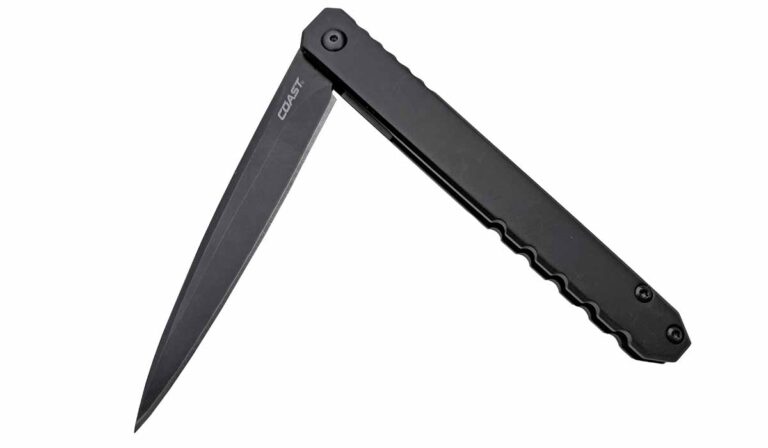
Every now and then I come across a folder that just feels right both in my hand and in my pocket, one that’s not too large nor too small, yet still has that sleek look to it. The Coast LX532 framelock does it all for me. I really love the blade shape. However, it still must be able to slice and dice to get a top place in my book.
Coast LX532 Edge Test
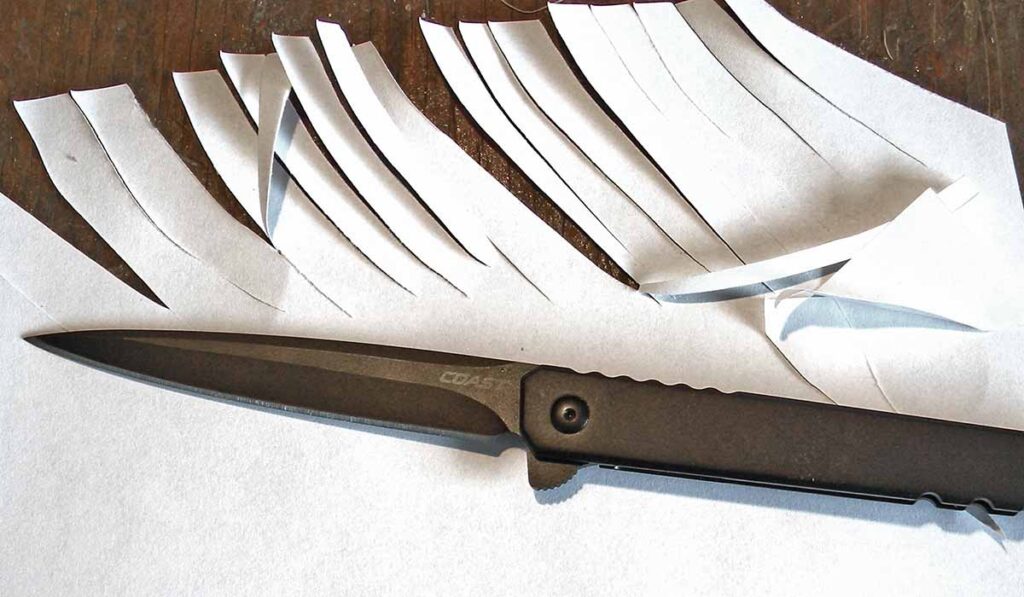
The good ol’ paper slice worked for starters. The LX532 sliced very smooth with no effort. The thin blade made for great control during the cuts. The only challenge was getting my fingers out of the way fast enough.
It was back to 20-pound bond copy paper for the final edge test. The LX532 didn’t miss a lick, slicing very smooth, aggressive cuts.
It was time for the single-walled cardboard. The knife was quite aggressive in cutting it. Again, control was great. The thinner handle takes some getting used to but that’s not a big deal. There was some twisting on the cut pieces but that was me getting accustomed to the handle.
Plastic board was next. The LX532 handled it with ease. The thumb notches on the handle spine really came in handy as more pressure was needed to make the cuts. They notches stopped the thin blade from twisting in my hand while cutting.
LX532 Meduim-Duty Cutting
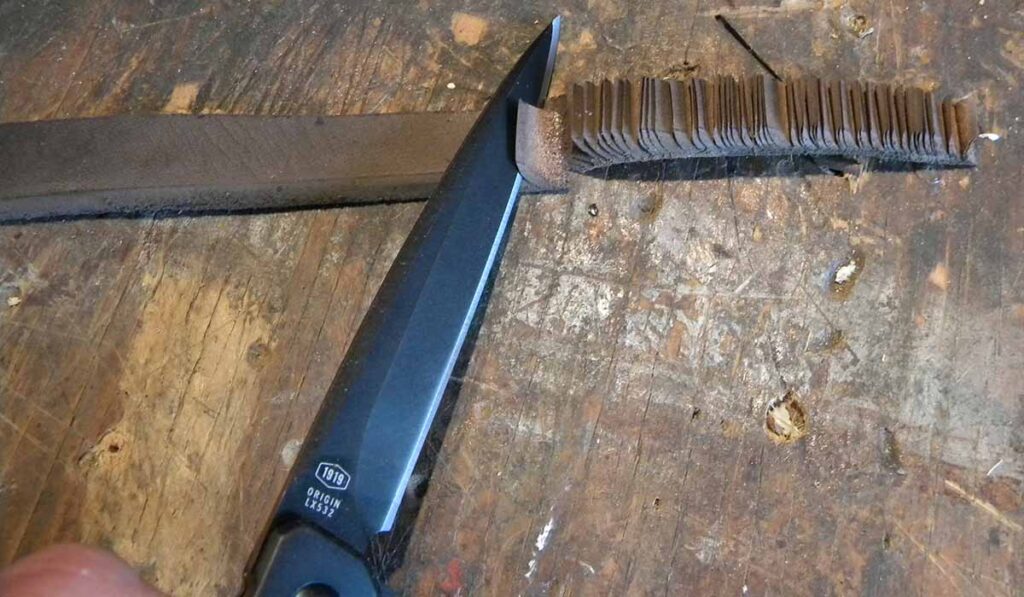
I had some leftover dense foam from the Kydex press to change out, so I decided to slice it up. The folder went through the foam like butter. The thin blade is extraordinarily sharp to say the least. Control was great yet again and I had to continue slowing my slicing down to keep my fingers intact.
The knife went through the foam like butter. The thin blade is extremely sharp to say the least.
Eight-ounce leather, anyone? I did some normal up-and-down slicing, along with some skiving. The edge was quite forceful slicing leather. I could hear each and every cut. The knife is exceptionally smooth and controllable for straight cutting. I switched positions and laid the leather flat for some skiving. The LX532 was very loud and aggressive slicing the material. I cut through the leather more times than I want to say. (It makes a better picture if the leather is all together rather than a bunch of smaller pieces.)
LX532 Heavy-Duty Cutting
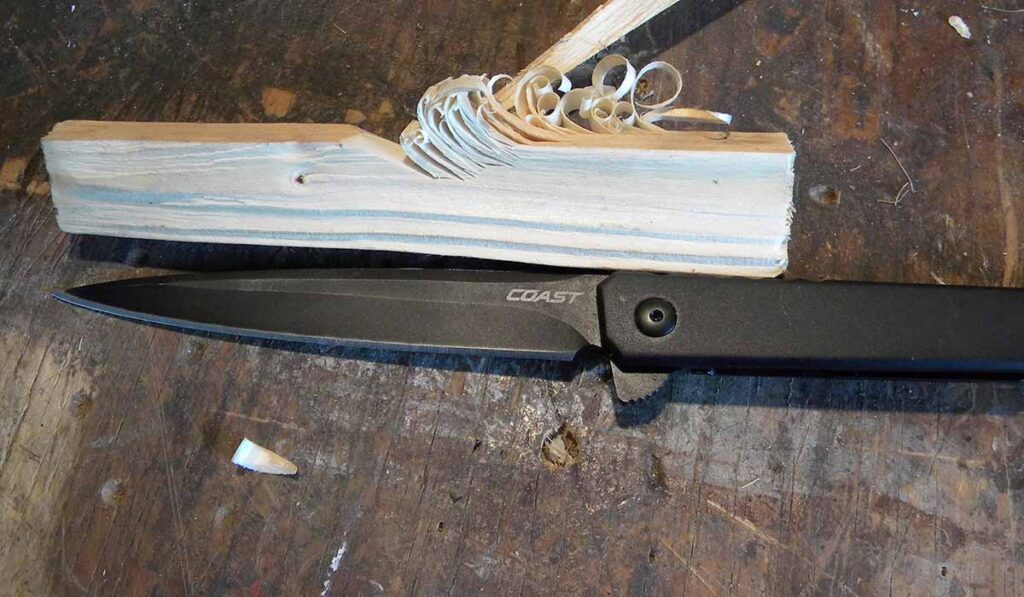
With camping season in full swing, I needed to stock up on firesticks to start the campfire. The LX532 worked perfectly. It made great thin curlicues in the pine. It also took deeper bites if needed. The blade zipped through the wood. Control was great with my thumb on top of the handle. It was a lot of fun to do.
The blade zipped through the pine and made great thin curlicues. It also took deeper bites if needed.
I had my doubts about cutting sisal rope with such a slim knife. However, the folder proved it could go the distance, providing 200 crunching cuts before I stopped. The knife was still going strong. I was impressed. The framelock stayed at 100 percent engagement the whole time and was still smooth upon closing. Hats off to the folks at Coast.
It was back to 20-pound bond copy paper for the final edge test. The LX532 didn’t miss a lick, making extra-smooth, uncompromising cuts.
Overall Take
The LX532 is one sweet framelock. The slim overall shape is right up my alley. Performance is in the top 10 percent. Excellent job, Coast. I wouldn’t change a thing. Maybe some texturing of the handle?
Push daggers are experiencing something of a renaissance in the knife world these days, as more and more people are coming to realize their value as a self-defense tool. More and more makers are releasing push daggers, and I for one couldn’t be happier.
To celebrate this resurgence of the push dagger, and as a bit of an aficionado of the genre, I thought this was as good a time as any to take a look at the push dagger in depth.
We’re going to start with some background on the push dagger, including its history, how to use it, why to use (and perhaps why not), some legal issues surrounding them, and finally we’re going to take a look at the best push daggers on the market today.
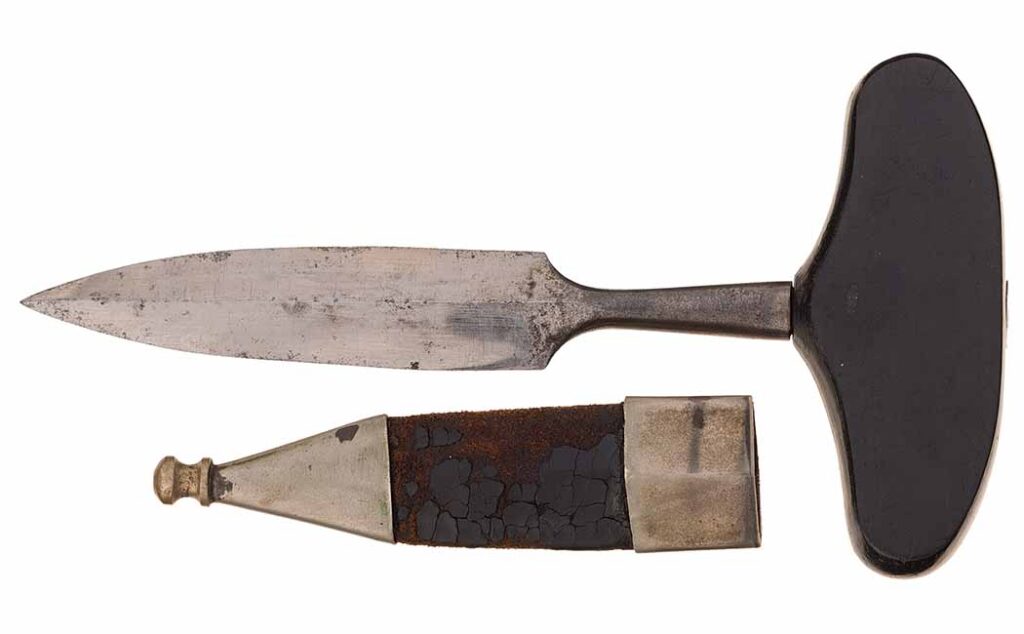
The push dagger, at least as we know it, originated in the early 1800s in the United States. At a time when small pocket pistols like the derringer weren’t yet reliably available, many people wanted a discrete, concealable weapon with which to defend themselves.
The push dagger arose to fill that niche, along with other concealable force multipliers like brass knuckles. They became especially popular with gamblers and other folks in places like New Orleans, Savannah, and other busy ports.
It also became popular with politicians and others who wanted to stay armed, without openly carrying a weapon. In turn, push daggers weren’t an uncommon thing to carry in various state houses, particularly throughout the South.
In New Orleans in particular, the “gimlet knife,” as the local version of the push dagger was known, became so popular and was used in so many different riots, brawls, and back-alley muggings, it eventually was banned in the city in 1879.
This version of the knife would live on and become the most popular variation of the push dagger. Its simply a T-handle gripped with a closed fist, featuring a tang that extends between the middle and ring fingers to form a short blade, usually 2-3 inches in length at most.
Abroad, sailors and other travelers brought the push knife to Germany, where local cutlers immediately took to it, and the faustmesser or “fist-knife” began to spread to other European countries, particularly England, France, and Spain.
Wartime Use
By the time of World War I, push-daggers of many different designs became a backup weapon for soldiers fighting in trenches on both sides as pistols were often in short supply. Everything—from straightened and braided wire to bent nails—was used to improvise punch dagger-style knives. Manufactured options were available as well.
Throughout World War II, the push-dagger became the domain of the special forces, particularly the British SAS and SOE infiltration forces who needed a very effective and concealable defensive tool (or assassination weapon).
It was also employed by French resistance forces who were not allowed weapons by occupying German forces.
Later, push daggers saw another surge in popularity during the 1980s when several US manufacturers started producing them again as tactical or self-defense weapons. That’s a trend continuing to this day.
Using a Push Dagger Correctly (and Safely)
A push dagger is fairly easy to use, though a bit limiting in some ways compared to other more traditional knives. It only has one practical use (defense) so we’ll look at it in that context. This is not the style of knife to pick up for, say, bushcrafting or folk art carving.
It can open packages, which is all most of us use our knives for anyway, but beyond that, this is a tool that’s always been designed to keep the wielder safe.
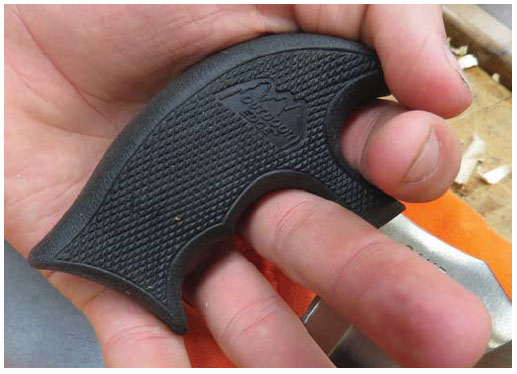
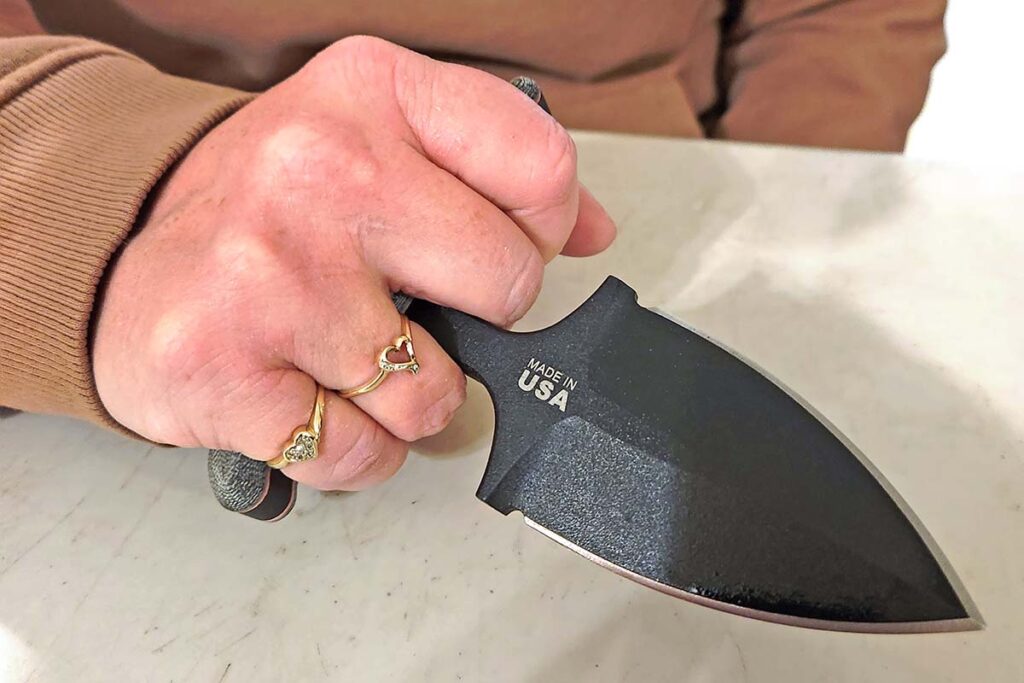
Towards that end, using it is relatively instinctive. Simply wrap your fingers around the (usually) T-shaped grip, and close your hand with the tang of the blade extending between your middle and ring fingers.
From here, you can punch more or less as you normally would, albeit with an immense amount of additional damage-dealing potential.
Off-Hand Comments
One thing not so intuitive is you will typically put the knife on your non-dominant hand. This is typically going to be your more forward hand in a fighting stance and will save your dominant hand for grabbing your opponent’s body or interacting with your environment.
Most people naturally want to wield the knife in their dominant hand, but that’s less than optimal if you ever have to use it in a true self-defense situation.
Your non-dominant hand isn’t going to be as strong or dexterous as your dominant one, but you’re not writing a letter or opening a jar…you’re throwing a punch. And while an off-hand jab isn’t the most powerful blow, when you have a knife extending over your knuckles, it doesn’t need to be.
Pros and Cons of the Push Dagger
These days, push daggers are still used as a very concealable self-defense tool. They’re fairly intuitive because most everyone has a basic idea of how to throw a punch. Those with any martial arts experience are likely to find them comfortable and familiar to use instinctively.
The predominant variety these days is the New Orleans-style version with the T-shaped handle, but some others do exist. Whichever variety you go with, know you aren’t going to be doing a whole lot of slashing.
These are tools meant for piercing and stabbing, so some traditional knife fighting techniques aren’t going to translate here. Experienced Kali/Escrima practitioners will likely not have any problems at the end of the day, but the knife just isn’t optimized for cutting blows.
Legality of the Push Dagger: Perhaps the Biggest Con
First, let me say none of this is legal advice. I’m not a lawyer, I’m just some guy on the internet who likes knives. Everything here is just what I’ve come to understand from my own research and is subject to be wrong.
Do your research about where you live and plan to own or carry a push knife and ask a licensed attorney.
Bans and Restrictions on Push Daggers
Now, while push knives aren’t outright banned in most states, several do have restrictions on “daggers” and knives designed to cause harm to another person without an obvious other purpose like a hunting knife.
Most push knives have a blade length of less than 3 inches, and many are single-edged so they don’t meet the “dagger” definition in states where this is part of the definition of a dagger. Also, many states have laws about carrying a knife with “intent to harm,” but that applies to any knife.
The things to look out for are the differences in what your state allows you to own versus what you can carry. If you just want to own a push knife as a collector piece, you’re going to have a much easier time than if you want to carry one.
That said, many states have weapons carry licenses/concealed carry permits that not only allow you to carry a firearm, but also a knife, such as a push dagger.
In general, all we can say is to check your state and local laws and make sure you’re not going to violate them by owning or carrying a push knife. Few states flat out say they’re illegal to own, but many have limits on carrying them, especially concealed.
When to Take Special Care
I would advise special caution to anyone living in the following states: California, Connecticut, Hawaii, Iowa, Kentucky, Maine, Maryland, Massachusetts, Michigan, Mississippi, Montana, Nevada, New Jersey, New York, North Dakota, Oklahoma, Pennsylvania, Rhode Island, Virginia, Washington, and West Virginia.
All of these states have some restrictions on what knives you can carry, some have restrictions on ownership in general, and many mention “daggers” without really defining what they consider a dagger.
As always, do your research and cover your backside. Don’t rely on anyone else to do it for you. Other states may have laws I don’t know about or didn’t find information on, and your local city government may have ordinances as well.
Best Push Daggers on the Market Today
Today, we have a huge number of great push daggers on the market, which is both a good and bad thing. On the one hand, we have more choices than ever, which means there’s something out there to fit every need
On the other hand…we have more choices than ever, which can make it hard to choose.
Let’s take a look at the best options on the market today, and narrow the field a bit while also highlighting the best of the best in the world of push knives.
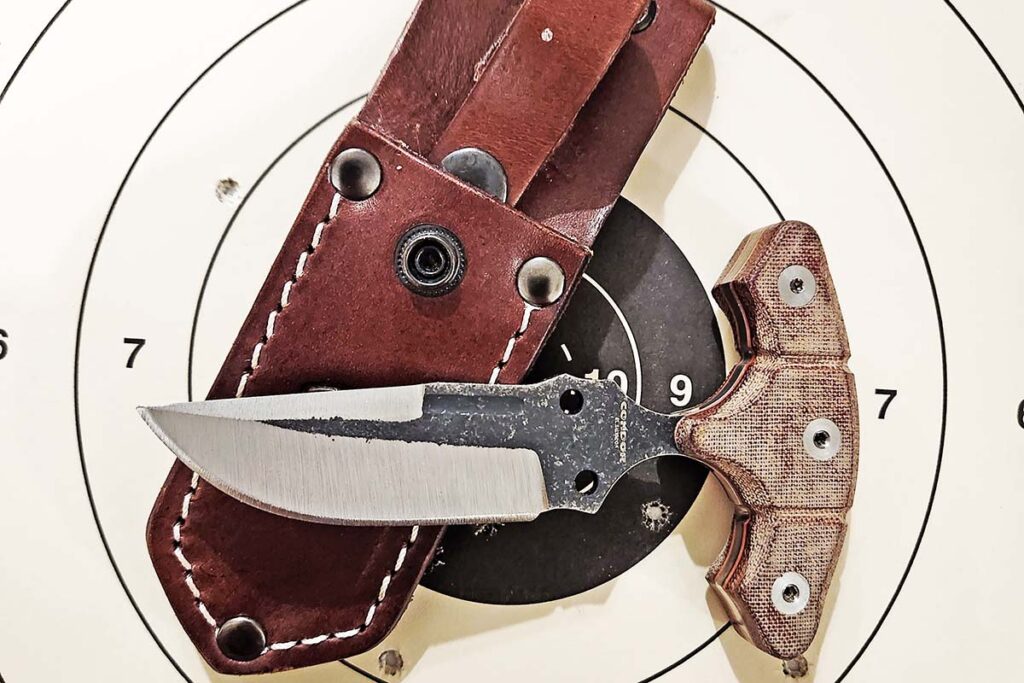
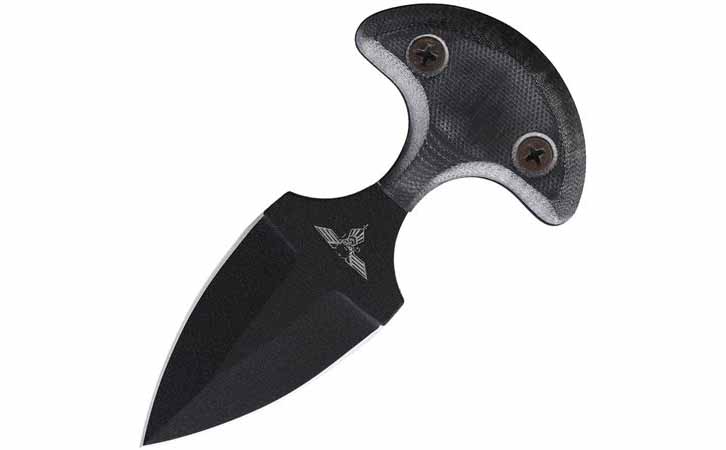
Right off the bat I must say I like the blade of the Tactical P.A.S.S. from Condor Tool & Knife because it departs from the traditional symmetrical dagger design. It pays often enough to try something different, and here it works. The hammer-finished look along with the clip point and false grind give it a rustic appearance. Condor also offers a fixed blade called the Tactical P.A.S.S. with the exact same blade pattern.
Now to talk about a practical bonus of the design. In some states double-edged blades are illegal. Condor’s false edge would allow you to carry the push dagger in such states and stay on the safe side of the law.
The handle size seems just right for my large, meaty hand. In most knives I look for that contoured fit. Due to the fact I want any resistance encountered by this blade absorbed by my palm and wrist, I want the handle to have a broad radius. The P.A.S.S. is in that Goldilocks position.
If I had to give any negative feedback, and I do when I find something wrong, it would be the leather sheath. Oddly enough, it is constructed very well. There are minor issues with the fit and finish but overall it is a sturdy, good-looking build.
My issue is with the design. Condor includes a full belt loop but I find that gets in the way when trying to make a smooth, full, fast purchase. For knives used for self-defense that is what you want—a solid grip and you want it fast. A horizontal and vertical carry patch is on the sheath’s back but will accommodate MOLLE-sized straps only. I know it might seem picky but keep in mind this is a push dagger, and the same rules apply for it as a pistol draw. I think the set-up would be taken to another level if the carrying system was mounted to the back of the sheath only and was large enough to accommodate regular-size belts. Such a change would leave the handle free and open to a quick, secure grasp.
Does the sheath make the knife a bad value? No, most people are either satisfied with the sheath or they aren’t. As a result, your decision to buy a P.A.S.S. might factor in an aftermarket sheath. The knife is still spot on.
Heretic Knives Sleight
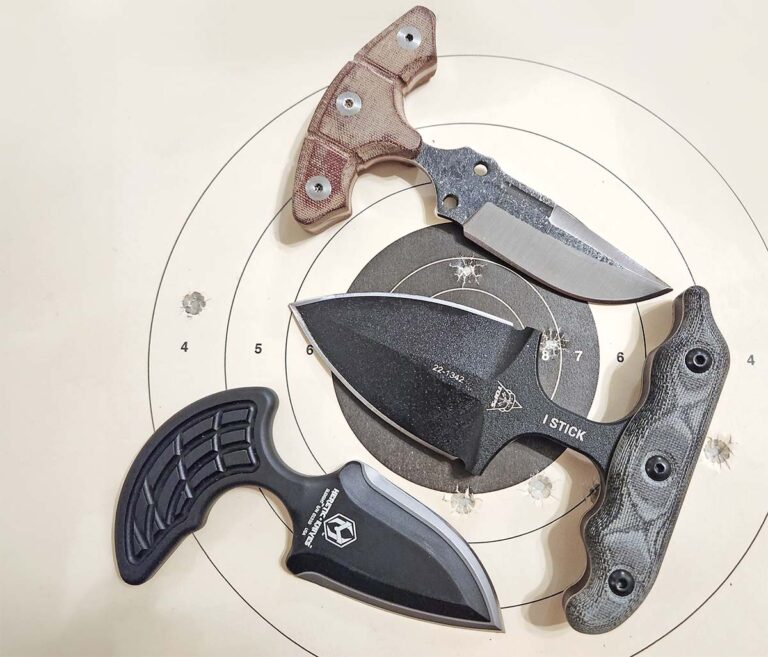
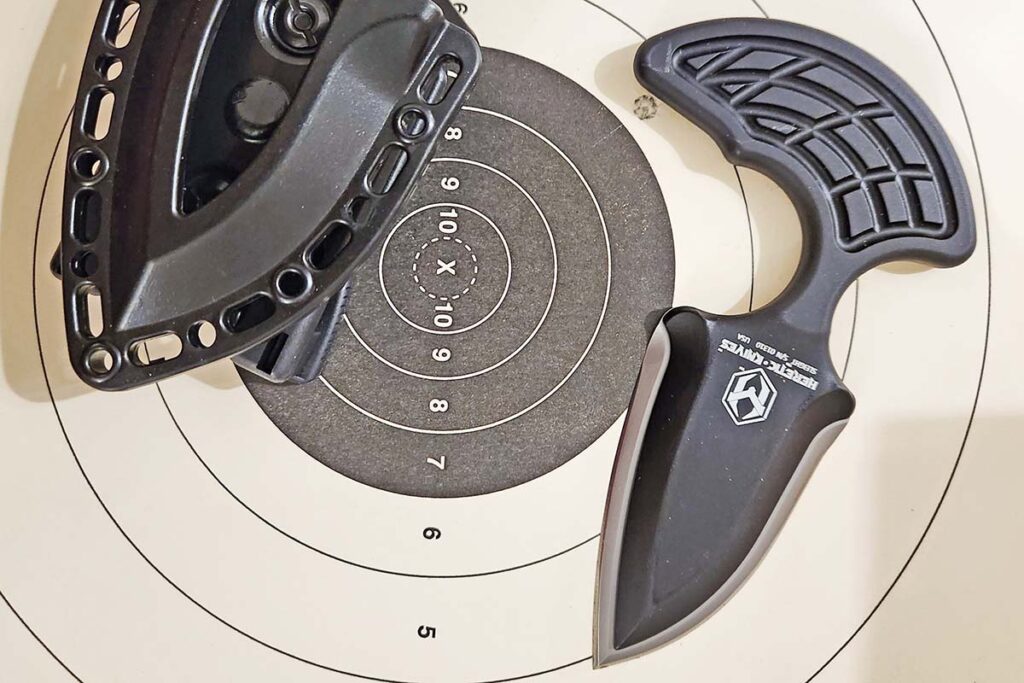
The Sleight from Heretic Knives is a sleek little design. Of the test group it’s the most compact and concealable. The blade is part of an aluminum body with a thin CPM 20CV layer mechanically fastened with screws to it to produce an edge. Such a design gives you the cutting power of a heavier metal while reducing weight. The aluminum body has an asymmetrical, CNC-textured handle. Heretic uses more of a pistol-grip design, enabling you to palm it quickly and have accurate control over the tip.
The Sleight is a great-looking piece of kit. Heretic even gets creative with the sheath, carrying through on the theme of decorative but lightweight. It has a Blade-Tech belt clip on the back for vertical carry.
The small design makes it easier to use for certain cutting chores without drawing too much attention. On the other hand, smaller knives lack the effectiveness of larger ones in self-defense situations.
One thing that bothered me is how difficult it is to draw the knife from the sheath. The first time I did it I thought I was going to have to follow up with a visit to my chiropractor. (OK, an exaggeration, but I must have at least one overstatement per story.) It was and still is difficult to draw and definitely not on the smooth side. Moreover, if you’re trying to pull it out of the sheath in a stealthy manner there is a loud click upon drawing. Perhaps over time it will break in as I sit fidgeting with it while watch Kung Fu reruns.
The Sleight is well made and well designed. It will make a good EDC blade once the sheath is broken in.
TOPS Knives I Stick
Of the test push daggers, the I Stick by TOPS Knives has to be the largest. According to TOPS, the I Stick weighs 12.6 ounces. When using a knife such as this, size can count—especially in the blade length. At this weight, though, you’d better be prepared for a long day. On its own the weight might not be that much, but when you start adding on your other everyday carry gear it gets burdensome. I am not normally one to point out the weight of a knife, but when they get this heavy you start to notice.
The blade is .38 inch at the thickest. You won’t have to worry about this knife breaking. Scales are black and green Micarta®. I do find the handle a bit big for my hand. The size does allow for a quick, solid grip, though. TOPS structures the handle to be asymmetrical so you can get a full thumb wrap around it. Being able to completely close your fist around the handle makes a world of difference in grip strength. The molded Kydex sheath has belt loops for vertical carry. Before carrying the I Stick, I recommend you practice drawing it from the sheath, as the sheath needs breaking in.
Overall, it is a good knife and has a respectable edge out of the box. Seeing as how it’s on the large side, the decision to purchase it would be something you would need to think over. A knife of this nature is no good if you don’t have program compliance and carry it. If you are not used to carrying a lot of weight, before buying it try carrying around something of comparable size and weight. As far as value, the I Stick is built like a tank. I am sure it will outlast us all and be handed down to future generations.
TOPS Knives Grim Ripper
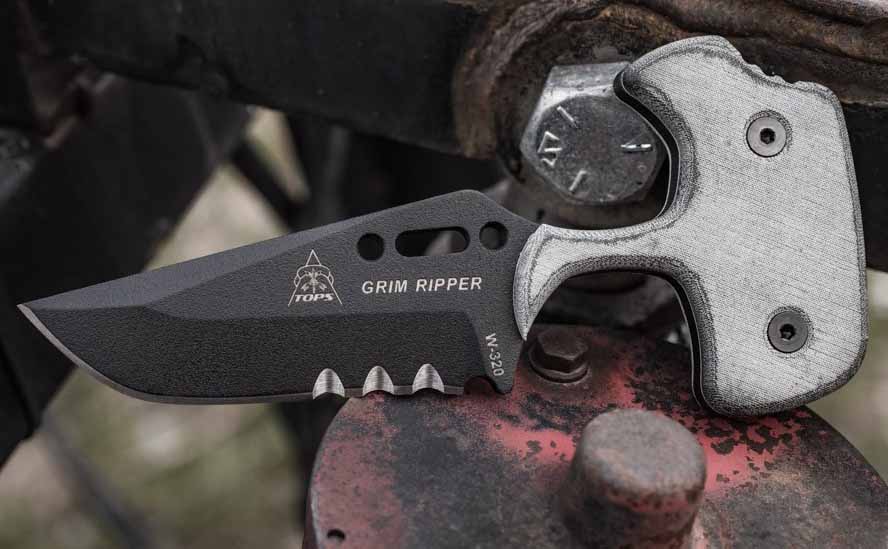
If you want a slightly more utility-focused knife, the TOPS Knives Grim Ripper might be up your alley. It features a shorter two-finger grip that is shaped to lock into your hand. It feels just as secure when wielding, but is less likely to dig into your side or what have you when carrying it.
It features a single-edge blade designed with some wavy semi-serrations ahead of the sharpening choil designed to quickly slice through webbing or ropes in the event of an emergency.
The handle is a very nice gray micarta that won’t get slick if held with wet hands. I felt very secure wielding the Grim Ripper in a variety of light camp tasks and it was easy to slice boxes as well, thanks to the well-designed handle.
The blade is a 3.75-inch long tanto-shaped affair made out of 1095 high-carbon steel for great edge retention and sharpness.
Esee Izula Tertiary
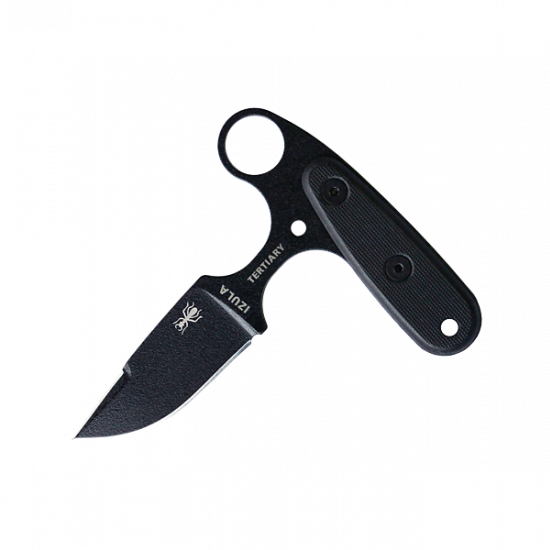
The Esee Izula is a wildly-popular small fixed blade that’s good for everything from opening a reluctant Amazon box to whittling by the fire. But the Tertiary version is geared strongly towards defense with its T-shaped handle and perpendicular blade.
“Izula” is the local Peruvian word for the bullet ant, one of the fiercest insects on the planet and the one with the most painful sting. I’d say Esee named its knife appropriately.
It is very compact and concealable, but easy to draw quickly when you need it. The grip allows for you to easily hold the stem between your first and second or second and third fingers, depending on your preferences, and is comfortable and secure in the hand.
The 2.625-inch blade is made out of 1095 steel and features a clip point so it is more acceptable in those places that might take issue with someone concealing a double-edged blade.
Cold Steel Safemaker II
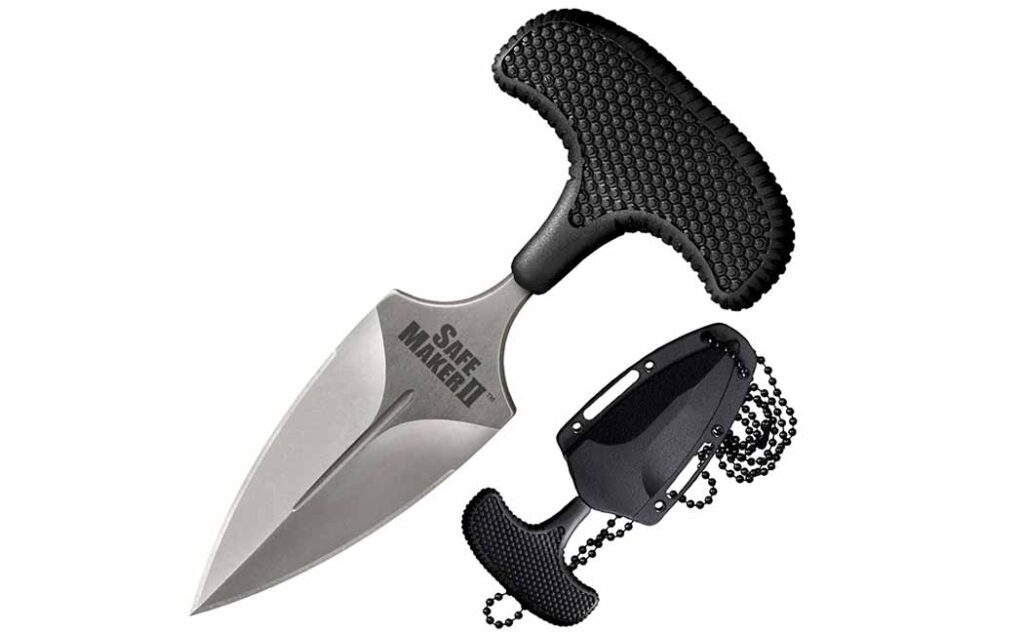
The Cold Steel Safemaker is, in my opinion, one of the knives that’s most true to the origins of the push dagger or push knife. It’s cheap, easy to conceal, and it’ll put a hole in an attacker. For those looking for an affordable and discrete means of protection, it’s difficult to argue against it.
Is the AUS-A8 steel the best? No. Does it have the best handle? No. Does it do what you need it to and will it hold up well in a self-defense situation? Absolutely.
Remember, this isn’t meant to be your EDC knife you blunt the edge on by opening boxes and slicing through tape all day…its meant for self-defense. To that end, if you do ever use it, it probably only really needs to be sharp once.
I’m all about lowering the barrier of entry to self-defense. I think too much emphasis is sometimes put on high-speed, low-drag designs made with the highest-quality materials out there and sometimes that distracts from the fact you don’t need any of those features most of the time.
I say that as someone who carries a $400 knife as my main EDC. I get it. But I also recognize the fact knives can be expensive for folks who have other priorities and other things they need to spend money on. That shouldn’t keep them from being able to defend themselves though.
The last I’ll say about it is a little anecdote that has stuck with me.
I had a friend tell me a story about a fellow Marine who chuckled during a briefing at the idea of facing a likely enemy armed with decades-old AKs. The unfortunate Marine’s Sergeant then sharply reminded him “Cain got the job done with a rock.”
That’s something I like to keep in mind when talking about weapons. Sometimes, you don’t need the best materials. Sometimes, you just need something to get the job done. And the Safemaker and the smaller Safemaker II will get the job done.
The Safemaker II has a 3.5-inch blade made out of very budget-friendly AUS-A8 steel.
CRKT Tecpatl
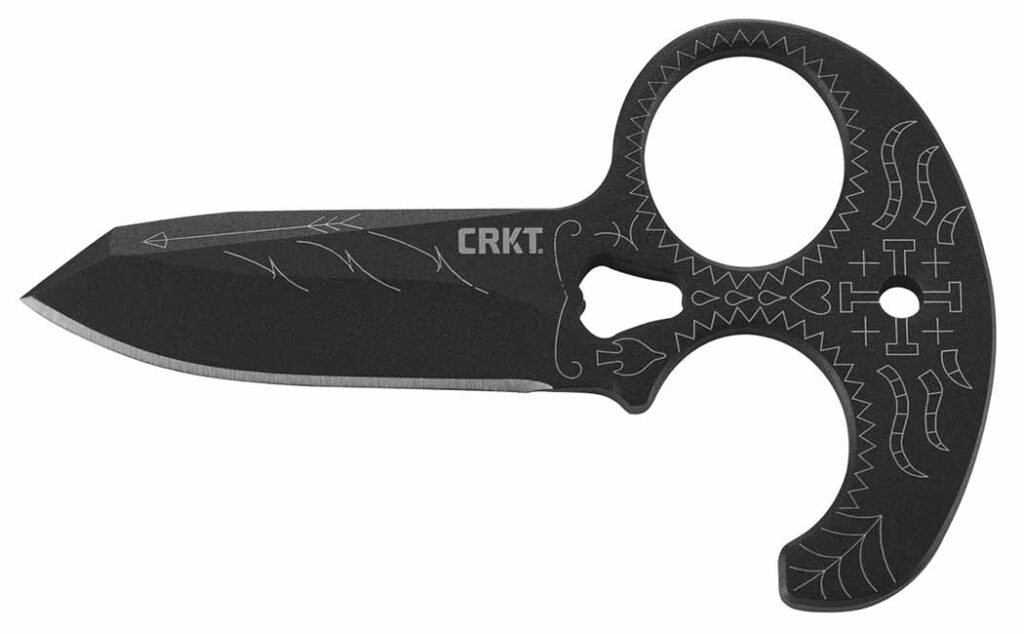
The Tecpatl by CRKT is a modern take on the push dagger designed by Army Special Forces veteran Michael R. Rodrigues as part of CRKT’s high-end Forged By War line of knives designed by or in collaboration with combat veterans.
Mr. Rodrigues is a bladesmith himself, and brought years of front-line experience to his version of the push dagger. It features an upswept Warncliffe profile making it fairly effective at utility tasks in a pinch, but it’s clear this is a knife meant to do damage to an attacker.
The handle is ergonomically shaped to give you a few different grip options depending on your preferences and what you’re doing with the knife, and I found it to be very comfortable and secure no matter what I was doing with it.
The 3.375-inch hollow-ground blade is made of Japanese SK5 carbon steel.
GTI Push Knife
Gingrich Tactical Innovations has (somewhat predictably, if you know anything about Justin Gingrich and his style) turned their attention to the push knife. Equally predictably they’ve given us something excellent.
GTI’s take on the push knife features a full tang design incorporating a generous handle to give you a secure grip in difficult conditions, like say, when you’re desperately defending yourself. Always nice to see the practicalities of being in a knife fight take precedence in a defensive knife design.
It also comes with a nice Kydex sheath that, on the one I handled, was one of the better examples of a push knife sheathe I’d seen. It covers everything but the oversized handle to protect the steel from moisture, but still allows the knife to slip free easily when you need it.
That big chunky handle is covered in excellent non-slip Micarta scales and tapers down to a sensible 2.6-inch blade made out of D2 steel.
WE Knives Typhoeus
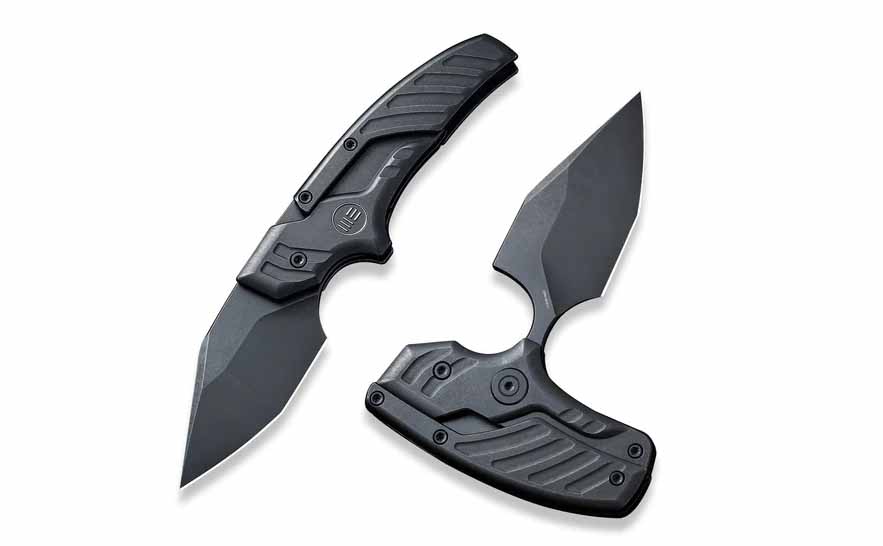
Lastly, we have the most unique knife on this list. The WE Knives Typhoeus, which is essentially a push knife that transforms into a more standard fixed-blade knife. But it’s not a fixed blade and it’s not a folder either… it’s confusing, I have to admit.
Even WE Knives seems unsure how to classify the Typhoeus because of the way it works. At its default, holstered state, it’s a fairly standard push knife, with an asymmetrical T-shaped handle that is very comfortable to grip.
But you can then push the knife blade up and have it snap forward parallel to the handle, giving you a more traditionally shaped knife you can use for everyday knife tasks.
It is available in three different finishes and uses an excellent CPM-20CV steel in the 2.27-inch blade.
Editor’s Note: Matt Collins and Abe Elias contributed to this article.
The New Kizer Drop Bear Is An Excellent EDC, And The Clutch Lock Is A Worthy New Addition To The World Of Axis Lock Knives
In the ever-growing world of EDC knives, finding ways to stand out is difficult. So many brands, so many steels, so much of everything. And even in that crowded field, the new Drop Bear from Kizer finds ways to catch the eye.
Boasting a high-quality blade, simple handle, and innovative lock, the Drop Bear is the kind of knife you’ll want to use every day … more so, it’s the type of blade you’ll go out of your way to use.
Getting The Drop On The Drop Bear
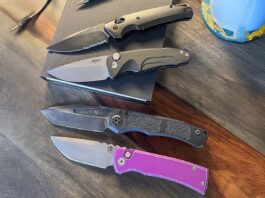
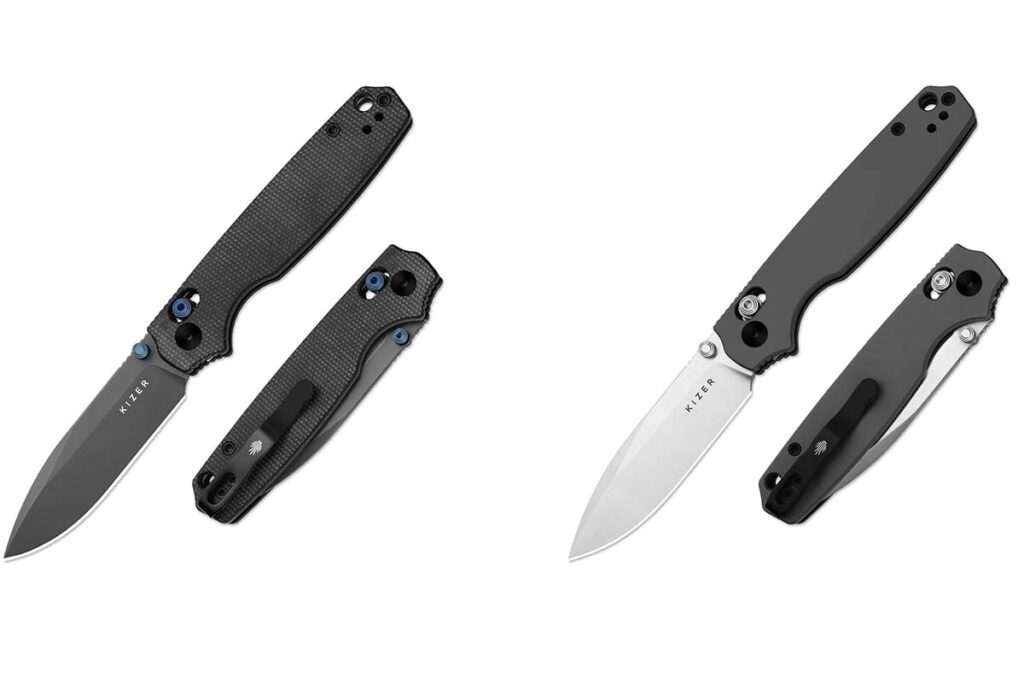
The Drop Bear in both of its colorways: Gunsteel on top and Black, with the bright purple thumb stud, below.
First that name. For those wondering it originates from a beast of Australian folklore that–as the legend goes–drops from trees to attack humans. Pleasant.
However, Kizer’s Drop Bear (MSRP $158) allure isn’t its reference to free-falling arboreal bruins. Instead, it’s Kizer’s twist to Benchmade’s Axis™ lock configuration.
Called a Clutch Lock by the China-based company, the mechanism provides a dead-tight lockup. I put this through the wringer, but we’ll get to that in a moment. And while few locking mechanisms have ever sold a knife, this adds enough of a spin to the traditional drop point to make it stand out.
So, let’s talk a little bit about the Drop Bear’s Clutch Lock.
Clutch Player
The clutch lock seen after removing one of the scales. The lock can be adjusted, and scales replaced, in less than two minutes.
As the fidgety type, I have to confess up front I love this knife. Right off that should give some indication of what the Clutch Lock brings to the table.
Where Kizer gets it correct is by not improving an already proven system, with the blade unlocking similar to most other Axis-type locks. For those unfamiliar, a pair of buttons situated on either side of the knife–in this case behind the pivot–are retracted, thus releasing the blade. As mentioned, it’s an ideal lock for those of us who fidget.
However, Kizer has improved the system by tinkering with the pair of Gemini springs hidden beneath the scales. The rub here, their tension is adjustable. This is a big deal.
This concept is not entirely foreign to those bold enough to have skunk worked spring tension for years. Many times the results were less than optimal, which is why Kizer’s setup is desirable. Basically, you won’t make the Drop Bear a victim of shoddy kitchen-table knifesmithing.
The tension adjustment itself is simple, even for the mechanically challenged. The frame has five holes on each side in which the spring is loosened or tightened. If you want a faster open and tighter lockup, crank it up to the holes closest to the blade. Desire a looser action, dial it down.
Interestingly, and probably grasped by the mathematically inclined in the audience, the five holes on each side don’t add up to five settings. Instead, it’s 5X5 settings for a total of 25. Boy, if you can’t find what you’re looking for in that range, then nearly any knife is likely to leave you cold.
Bear Necessities
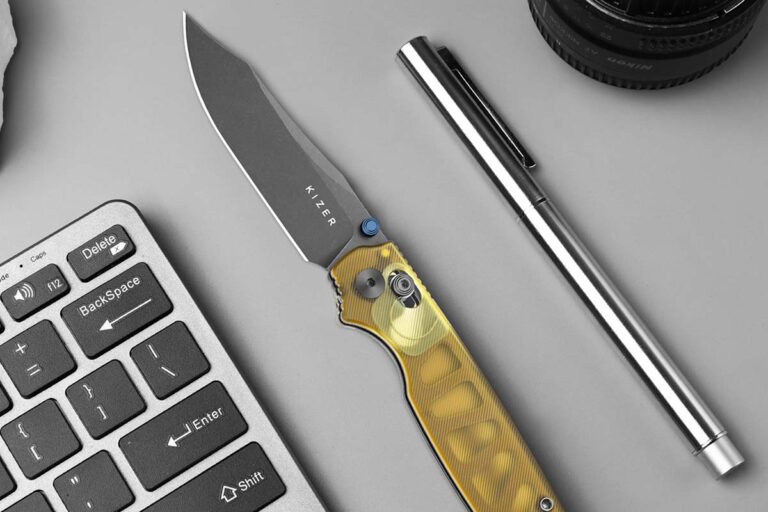
The Drop Bear is a sleek, nimble knife as seen from above.
Novel as the Drop Bear’s Clutch Lock is, it wouldn’t add up to a pile of scrap if Kizer didn’t finish the job with all the parts to make a solid knife. Overall, they make it worth the price of admission.
With a quality EDC knife in mind, Kiser outfitted the Drop Bear with a blade a shade under 3-inches long–legal in most jurisdictions. The 154CM stainless steel, again becoming popular in this role, offers a Rockwell hardness of 58-61 HRC.
Topping off this end of the knife, Kizer applies a flat grind to help create the edge. Good choice, because it comes out of the box frighteningly sharp. Outfitted with moderately sized thumb studs with plenty of clearance, this attribute is quickly deployed.
In the hand, the knife feels light–listed as 3.7 ounces–but not light as air. This is a good middle ground for this class of knife, where it feels substantial in your hand yet won’t tear the rivets out of your jean’s hip pockets.
Much of the weight savings come from an attractive skeletonized frame, under the aluminum handle scale. With an ergonomic swell toward the middle of the handle, the Drop Bear offers purchase and plenty of control.
As for aesthetics, the knife comes in two colorways. The first style is a gun steel blade with a satin finish and black thumb stud. The second has a black blade with an eye-catching purple thumb stud.
Finally, a tip-up clip keeps the knife at hand and riding deep in the pocket.
Testing The Drop Bear
The Drop Bear was a joy to test and cuts most types of material with ease.
It’s an EDC so I wasn’t going to try and chop through the vines slowly overtaking the corner of my backyard fence. I used it around the house for a few days.
It cut through plastic and tape like there was nothing there at all. It’s a perfect letter opener. The Drop Bear easily handles the daily tasks you’ll see every day. Taking it a step further, I used it as my only knife when prepping dinner for my wife and I.
First was the romaine lettuce, which the knife handled with ease. Whether holding the Drop Bear in the pinch grip like a chef’s knife or by using the jimping and pressing down with my thumb from the top down, the knife dispatched the lettuce easily.
Up next was the tomatoes, and it was the best experience I’ve had with a flat-edge knife cutting tomatoes. They were Campari tomatoes, so smaller and more delicate than beefsteak or Roma tomatoes, and the Drop Bear went through the flesh easily. This was best done in a pinch grip and got incredibly thin slices of tomato for the salad.
Celery is stiff and crunchy, and it was no problem for the Drop Bear. The chicken breast was easy too. I preferred cutting the chicken by utilizing the jimping, and the knife bit down easily and sliced through the meat without a hiccup.
My single favorite cutting task was the bell pepper. I chose to cut the pepper through the skin side as that is traditionally more difficult than cutting through the interior flesh. I have never cut through a bell pepper easier than I did with the Drop Bear. It left me thinking that this could reasonably replace a paring knife.
However, the Drop Bear did meet its match against a large carrot. The knife did not enjoy fighting through the harder, denser flesh, forcing me to switch to a kitchen knife to finish the job.
Beyond the kitchen, the Drop Bear shined. It gets through cardboard boxes like nothing. The corrugated cardboard can be the test upon which many knives fail, but the Drop Bear didn’t even blink.
Additionally, I tested it on some brand new ⅜-inch polypropylene cord. I figured that the cord would provide some sort of fight for the Drop Bear. Instead, it was a first-round knockout as the blade smoothly sliced through the rope, leaving a clean cut with little in terms of frayed strands.
As for the action, I preferred the knife a little looser and set it at the second position. And the lock, I put the strength of the lock through the ringer. I did everything I could to break it. I bent it backward, sideways, every which way I could to flex the knife. The lock held firm and never budged.
Final Cut
Overall, the Drop Bear makes the cut for me.
The knife has enough mechanical allure to make it intriguing while remaining practical. For tinkers and fidgeters, this is a big plus. For those less inclined to get wowed by engineering wizardry, Kizer’s creation still shows sharp.
The Drop Bear is more than ready to tackle most EDC jobs, though you might not want to push it too far out of its comfort zone. What knife isn’t that true for? But for the price, it seems Kizer has hit the mythological sweet spot for this class of knife.
Whether traditional or just made in the Land of the Rising Sun, Japanese kitchen knives are a sharp addition to any chef’s arsenal.
The Japanese kitchen knife is prized for being one of the most durable culinary tools. Many Japanese knives have a different construction than Western- or German-style knives, which are the norm in most American kitchens.
History Of Japanese Kitchen Knives
The Japanese kitchen knife was born out of Japan’s long sword-making history. When samurai were banned from carrying swords after the Meiji Restoration in the mid-19th century, metalsmiths turned their attention and talents to making knives for home use.
Today, the city of Seki, in central Japan, is the epicenter of Japanese cutlery and features museums, shows, and festivals dedicated to all things knives.
How Are Japanese Kitchen Knives Different From Western Knives
Japanese knives are different from Western varieties in numerous different ways. The most prominent is in the grind of the edge.
Nearly all Western-style knives have a double bevel, that is both sides of the knife are ground to a point meeting at the edge. Conversely, Japanese knives are traditionally single-bevel blades or only ground on one side.
The single-bevel blade in Japan is steeped in culture and history. No one knows how exactly it originated, but the tradition is maintained to this day. The blade is sharpened on only one side, also known as a chisel grind, and is designed specifically for precise slicing.
A Western double-bevel knife will be ground to equal angles on both sides of the blade, meeting in the middle. A single-bevel blade is only ground down on one side, which allows for a sharper edge.
In Japanese the parts of the blade are:
Shinogi: The flat cutting surface of the blade that runs to the edge
Urasuki: The concave surface on the opposite side of the blade from the edge
Uraoshi: The thin flat rim that surrounds the urasuki–essentially on the blade and the spine
This unique design endows Japanese blades with an unusual characteristic–knives specific to right- and left-handed people (most tend to be ground on the right for righties). Though, ambidextrous models exist. These models are similar to western-style knives in their grind but still use Japanese forging techniques and steels.
Great, the Japanese made dominant-hand-specific knives, so what? Well, there are some benefits to this unique design. The most predominant being a finer edge. Logically this means a sharper knife adept at making long thin cuts.
Most folks will recognize the advantage of these assets if they’ve eaten any sashimi, a form of culinary art practically defined by long thin cuts. That and good fish.
Shape also defines Japanese kitchen knives, particularly the blade, which is round at the tip. Additionally, the handle is typically different. Almost across the board, Western knives will have a bolster between the heel of the blade and the handle. Japanese knives are sans this feature.
There are more, but some of the more common types of single-bevel Japanese kitchen knives are:
Gyuto: A Japanese Chef’s Knife
Santoku: Shorter and wider than the Gyuto, the Santoku is made for slicing, cutting, and chopping
Sujihiki: Long and narrow, this is made for slicing fish and meats in long, single motions
Kiritsuke: Hybrid of the Sujihiki and Gyuto. This knife is difficult to use and shows off the skill of the chef when used well
Best Japanese Kitchen Knives
Miyabi Chef’s Knife
Miyabi Chef’s Knife, 8-Inch
Miyabi makes wonderful knives, and their chef’s knife is no exception. Eight inches long, and with an SG2 micro-carbide steel core, the blade is ground to an incredibly sharp 9.5-12 degrees. The damascus pattern is made from 101 layers and it has been Cryodur ice-hardened to a 63 HRC.
The handle is composed of Karelian Birchwood, the only wood ever used in the construction of a Fabrege egg, and has a mosaic pin accent and red spacers. This model is handmade in Seki, Japan.
MSRP: $349.95
Kai PRO 8-Inch Wasabi Chef’s Knife
Kai PRO 8-Inch Wasabi Chef’s Knife
The Pro 8-inch Wasabi Chef’s Knife from Kai is an excellent budget option. The cost-saving is due to the fact it’s a relatively plain Jane, missing the bells and whistles–such as damascus blade–that runs up the price. And also it definitely has Western influences in its design. Yet it’s a well-made workhorse from a well-respected manufacturer (Kai makes excellent scissors, by the way).
The Wasabi’s extra-wide, stainless-steel blade is where it wins points, creating plenty of clearance to chop, dice or whathaveyou at lightning speed. Additionally, its curved belly facilitates an effortless rocking motion, also picking up the pace. Interestingly, the traditional Japanese-style handle is fairly futuristic in its material–bamboo and polypropylene. While not a dead nuts traditional Japanese kitchen knife, Kai’s entry is nonetheless a top cutter from the Land of the Rising Sun.
MSRP: $43.50
Shun Premier Paring 4-Inch
Shun Premier Paring 4-Inch
A paring knife is one of the most important types of kitchen knives, and Shun knocks this one out of the park. The 69-layer damascus blade is wrapped around a VG-MAX core and has a hammered Tsuchime finish. The finish is ideal for the style of knife, helping the food release while you’re cutting.
The handle is walnut-finished, contoured Pakkawood. Also, it enhances the overall use of the Premier, with a slight bulge filling the hand and offering more control. About the only negative is the knife is on the spendy side. But for perhaps the second-most used knife in the kitchen, it’s well worth the investment.
MSRP: $169
Morado Kiritsuke Kuro-uchi
Morado Kiritsuke Kuro-uchi
There is an elegant strength in this special tool. The Morado Kiritsuke Kuro-uchi is a versatile monster that will control whatever you’re chopping or slicing.
Hand-forged from a core of Hitachi’s Super Blue Steel wrapped in stainless, the blade has been heat-treated to a 63 HRC. The kuro-uchi (black) patina on the upper half of the knife helps protect the material, and the hammer dents give it a traditional look and keep food from sticking. As a bonus, the finish makes it look wickedly beautiful.
The steel is extra tough thanks to .4% vanadium in the alloy, and its high-carbon content makes it easy to sharpen. The Japanese Wa handle is ovular and remains comfortable even in the face of large workloads. Furthermore, the smooth rosewood has a dark stain to bring out its rich hue.
MSRP: $275
Mutsumi Hinoura Shirogami Kurouchi
Mutsumi Hinoura Shirogami Kurouchi
We round out our list with a splash of color and another high-quality damascus blade. The Mutsumi Hinoura Shirogami Kurouchi looks tremendous and cuts even better.
The knife features a Shirogami #2 steel core wrapped in stainless and treated to a 63-64 HRC. A Gyuto style knife, which literally translates to “cow sword,” reveals its intent–to cut large slabs of meat. Today, it’s a great all-rounder chef’s knife that can handle almost any kitchen task and is a joy to use.
The handle is what catches the eye and is made from European maple burl, dyed green and blue. It takes two years for the wood to dry out to the point it can be stabilized and dyed. It’s cut into the traditional octagonal shape for superior grip and ease of use.
This is the priciest knife on our list, but we feel that it lives up to the lofty dollar amount.
Class meets capability: Exploring Kizer’s ambidextrous Clutch Lock folders featuring AEB-L stainless steel and premium handle scales.
‘Tis the season for sharp gifts to place under the tree for your favorite knife enthusiast. Kizer Cutlery has a little something to stuff stockings with once the Yuletide season closes.
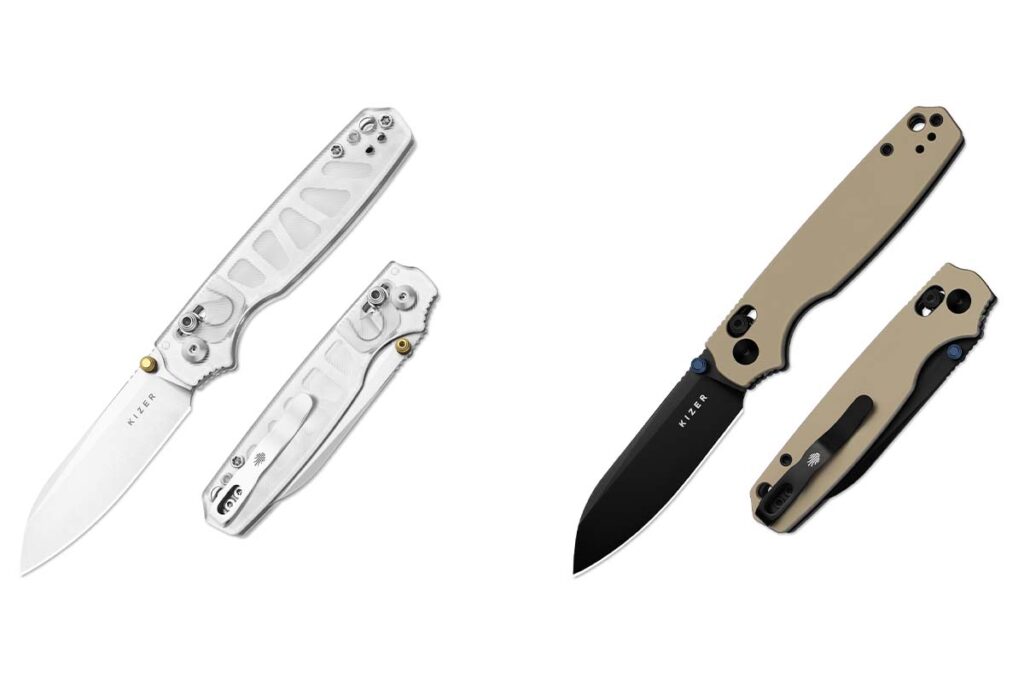
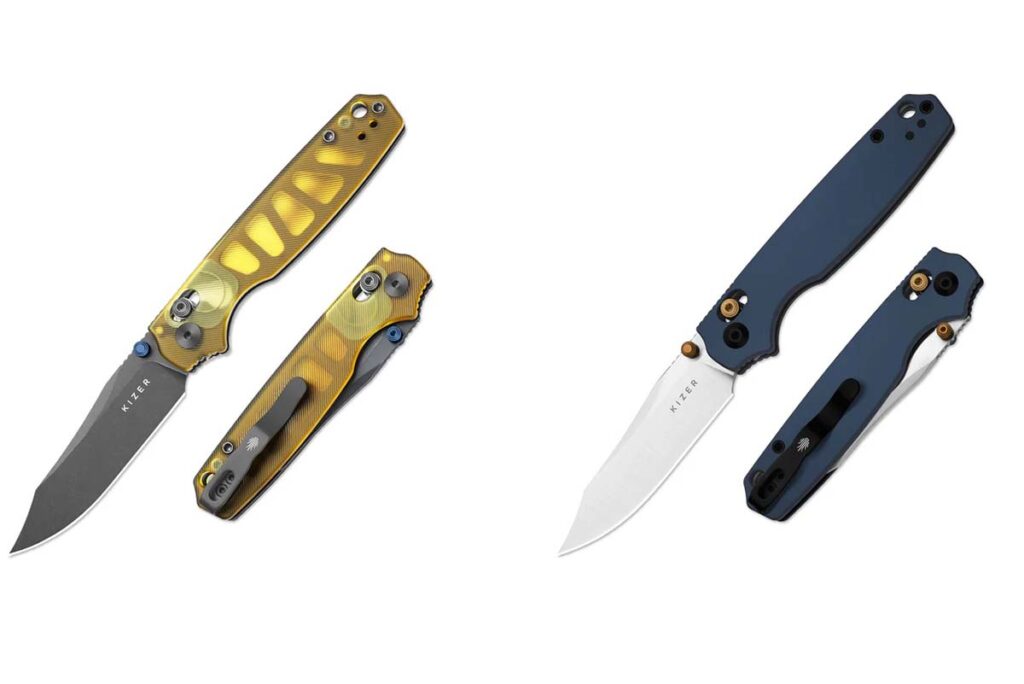
Set to officially launch in January 2026, the company’s Pokiman series is described as a collection of gentleman knives. The set of six knives—three models, each with two variations—may look suitable for a church picnic or the office, but they are not small and delicate.
All knives in the Kizer collection are essentially full-sized EDC options. Each one boasts a 3.16-inch blade. Overall length is just under 8 inches. This size provides enough tool for prying at a stuck locker lid or making mincemeat of sisal rope.
Yet, boasting everything from sheepsfoot to clip point blades and Micarta to aluminum and PEI scale, the knives have the look and lines for more suave tasks.
Common across the models are AEB-L steel blades, a very old and respected stainless steel, known for its fine carbide structure and a good balance between hardness and toughness. Plus, it’s known to take and hold an edge.
Kizer outfits the Pokiman line with its Clutch Lock, the company’s take on the ever-popular Axis Lock, presently sweeping the knife world. And why wouldn’t it, given its design makes a knife ambidextrous and offers a fast and quick, one-handed opening/closing option.
Interestingly, and seeming to walk hand-in-hand with the Axis Lock trend, Kaiser turns to thumb studs alone for the opening method on all the knives.
Depending on the model, the Pokiman line has MSRPs from $60-$70. While not available presently, several online retailers already have them on pre-order.
Pokiman CS Specs
Blade Length: 3.16″ Closed Length: 4.21″ Overall Length: 7.36″ Blade Material: AEB-L Stainless Steel Thickness: 0.110″ Blade Hardness: 58-60HRC Blade Style: Sheepsfoot Blade Grind: Flat Blade Finish: Black PVD or Gray Stonewashed Handle Material: Tan Aluminum or PEI Locking Mechanism: Clutch Lock Pivot Assembly: Bearings Pocket Clip: Deep Carry, Tip-Up, Right/Left Carry Weight: 3.08 oz. Origin: Made in China MSRP: Micarta & Stonwashed $60; Aluminum & Satin $70
Pokiman CC
Blade Length: 3.16″ Closed Length: 4.21″ Overall Length: 7.36″ Blade Material: AEB-L Stainless Steel Thickness: 0.110″ Blade Hardness: 58-60HRC Blade Style: Clip Point Blade Grind: Flat Blade Finish: Gray Stonewash or Satin Handle Material: PEI or Blue Aluminum Locking Mechanism: Clutch Lock Pivot Assembly: Bearings Pocket Clip: Deep Carry (Tip-Up, Right/Left Carry) Weight: 2.49 oz. Origin: Made in China MSRP: PEI & Stonewashed $60; Aluminum & Satin $70
Pokiman CD
Blade Length: 3.16″ Closed Length: 4.21″ Overall Length: 7.36″ Blade Material: AEB-L Stainless Steel Thickness: 0.110″ Blade Hardness: 58-60HRC Blade Style: Drop Point Blade Grind: Flat Blade Finish: Satin or Stonewashed Handle Material: Gray Aluminum or Black Micarta Locking Mechanism: Clutch Lock Pivot Assembly: Bearings Pocket Clip: Deep Carry (Tip-Up, Right/Left Carry) Weight: 3.07 oz. Origin: Made in China MSRP: Micarta & Stonwashed $60; Aluminum & Satin $70
Looking for the best pocketknife for your EDC needs? These five are certainly top options to get you well equipped.
The pocketknife stands alone when it comes to edged tools. Whether it’s outdoors, in the shop, in the kitchen or elsewhere, the number of uses for the pocketknife are seemingly endless.
And just as endless is the variety of pocketknives available today. With dozens of blade types made of dozens of steels with dozens of functions, it’s a deluge of knives that can be hard to parse through.
Types Of Pocketknives
SOG Recondo FX with serrated edge
While there are thousands of different individual pocketknives out there, the vast majority fall into two categories: the single blade and the multi-blade.
The single-blade pocketknife is exactly that: a knife with one blade. We’ll get to the types of blades shortly. While a single-blade piece could be a small fixed blade with a pocket-sized sheath, usually it’s a folding knife. The folding versions are especially good as EDCs.
The multi-blade knife will usually feature two or three blades—some more—across many different styles. A good chunk of these models are slip joints, which use a spring that helps either keep the blade tucked away or open.
There are many different types of slip-joint multi-blades. The Boker Trapper Red Bone is a prime example of a high-quality multi-blade knife.
When it comes to a multi-tool type of multi-blade, think of Swiss Army knives. These are pocket-sized tools that feature an assortment of tools ranging from blades and screwdrivers to toothpicks, pliers, corkscrews and more.
Types Of Pocketknife Blades
The Microtech Scarab II’s modified drop-point blade accommodates most cutting tasks with gusto.
The first pocketknives date as far back as 600 BCE in Europe, and folding knives have been found that date from pre-Roman times.
In the millennia since, the pocketknife has morphed and evolved in myriad ways. Today there are dozens of different types of pocketknives. Some are great for EDC use while others are more specialized.
While the styles of blades are all a bit different, these are three of the most common types.
Drop Point
A common blade style for a pocketknife, the drop point curves up from the edge to the point. Popularized by BLADE Magazine Cutlery Hall-Of-Fame® member Bob Loveless for fixed-blade hunting knives, it is a great style for hunters and for slicing, and ideal for all-around EDC as well. The point is good for piercing and the edge, being good for hunting, is more than capable of doing things throughout your day like opening envelopes, slicing rope, or even cutting vegetables in a pinch. The GiantMouse Ace Corta is an example of a modified drop point.
Clip Point
The clip point swoops down from the spine to the point of blade. Since it looks like the forward part of the blade was “clipped” off, the name clip point stuck. The spine is usually unsharpened, and the clip point has a narrower tip than a drop point. The clip point is seen on many bowie knives.
An example of a clip point on an EDC knife would be the SOG Recondo FX.
Spear Point
The spear point is the style of the main blade of many Swiss Army knives. A great puncture instrument, a blade with a spear point is ideal for penetration. Many daggers and swords are ground to a spear point.
Five Premier Pocketknives
We scoured the world of knives to pick out five of outstanding pocketknives available today. Across different styles, companies and price points, these five stood out from the pack.
Swiss Army Knife Huntsman
Swiss Army Knife Huntsman
One could argue that the Swiss Army knife is the gold standard of pocketknives. This classic multi-blade from Victorinox has stood the test of time and now comes in dozens of varieties.
The Huntsman was selected because of its tool set. There are 15 different implements within the knife, including classics like the spear-point blade, reamer and can opener, as well as a wood saw, tweezers, scissors and wire stripper, among others.
All the tools, like with other Swiss Army knives, are made from stainless steel. Having at least one SAK in your tool drawer or travel bag is an absolute must, and you can’t go wrong with the Huntsman.
MSRP: $37.99
Opinel #8 Carbon Steel Folding Knife
Opinel #8 Carbon Steel Folding Knife
By any measure, the Opinel #8 is a classic. First made in 1890, the #8 is still popular today due to its simplicity. It features a 3.28-inch blade of XC90 carbon steel. It’s robust yet delicate. The single blade is fine enough for an artisan or craftsman and tough enough to handle hard use in the kitchen or workshop.
In an era when EDC knives are becoming more complex and packed with features, Opinel sticks to its roots with a piece that is often imitated but rarely replicated.
MSRP: $18.
Benchmade Bugout
Benchmade Bugout
Coming in numerous different colors and styles, the Benchmade Bugout is one cool-looking pocketknife. Slim and ergonomic, and incredibly light, the Bugout knives were designed for the outdoorsman but are great for EDC too.
The clipped drop-point blade—you can choose between a plain or serrated edge—is made from CPM S30V stainless steel with a Rockwell hardness of 58-60 HRC. It’s 3.24 inches long with a satin finish that looks good when paired with any of the five different types of handles Benchmade offers.
Handle materials—options include Grivory or CF Elite—are lightweight. The entire knife weighs just 1.85 ounces. It’s almost lighter than air.
MSRP: $160.
Boker Damascus Duke
Boker Damascus Duke
If you’re looking for a showpiece that’s also a great utility knife AND won’t break the bank, Boker has you covered. The Damascus Duke features a 2.44-inch blade forged from 37 layers of steel. The artistic qualities don’t stop with the blade. Etched bolsters add to the beauty of the knife, and the root wood scales provide a classy grip.
But this knife is more than just a pretty girl at the prom. The lockback mechanism will give you confidence to put this piece through its paces. The short length of the blade makes this knife great for detail work or other finite tasks at home or on the road.
MSRP: $64.95.
Kershaw Blur
Kershaw Blur
Designed by Ken Onion, the youngest-ever inductee into the Cutlery Hall of Fame, the Kershaw Blur may be as good of an all-around edged tool as you’ll find in knife shops today.
The recurve drop-point blade can cut cord and small brush while camping, or slice open an over-taped FedEx package and keep rolling along.
The blade is 14C28N stainless steel in a black Cerakote coat for enhanced corrosion resistance and protection. It’s married to an aluminum handle that features Trac-Tec inserts and a reversible pocket clip.
Made in America and tough as nails, the Blur won’t let you down.
MSRP: $107.99
Read More
Best Knife Case Options To Protect Your Investment
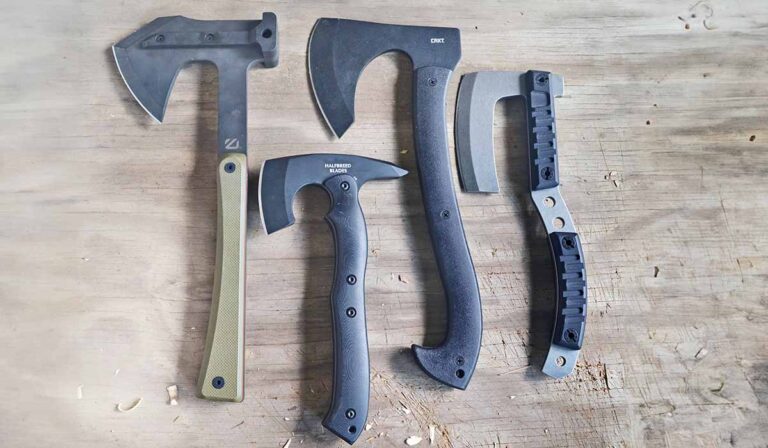
All axe heads have an edge, of course, but did you know some can give you an edge over others? The bearded axe chops just like any axe, but its beard can serve field duty beyond the norm.
The bearded axe was first used by the Scandinavian Norse people (Norsemen) in the Middle Ages and was called a skeggox—skegg for beard and ox for axe. Its distinctive shape allows you to grasp the handle at the base of the head and use the edge for woodworking chores.
It’s sometimes called a carving axe for its propensity for de-barking, shaving and notching wood, and other chores like slicing cord and rope—even serving as an ulu to prepare food. Not all bearded axes are made specifically for carving wood, however, as you’re about to find out.
CRKT James Williams Skeggox
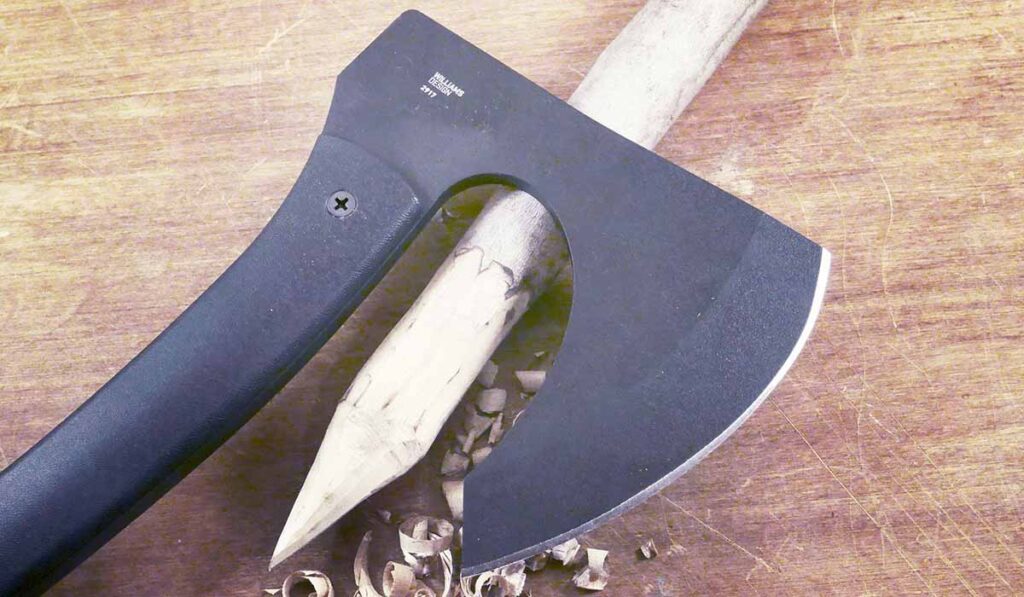
The CRKT Skeggox shaved bark and rendered nice shavings while debarking and pointing the tip of a hardwood stake. The SK5 carbon steel bit into the hardwood quite well and the handle scales offered a comfortable grip.
Columbia River Knife & Tool and martial artist/Japanese sword guru James Williams dipped back in time and chose the original Norse namesake for his design. The CRKT Skeggox is one of the larger two test axes.
The drop in the beard from the top of the inner curve to the bottom edge is 3.25 inches. The 11-inch handle has a lanyard loop at the base. The sheath features a black nylon keeper strap with a thermoplastic buckle to prevent slippage from the sheath. CRKT includes additional hardware for belt or MOLLE carry.
The SK5 carbon steel of the axe head has been compared to U.S.-produced 1084 and 1095 carbon steels, which typically fare well-working wood in the wild. I tested it for carving and immediately liked the deep drop and the “50 miles of elbow room” between the handle and the rear of the beard. I de-barked and pointed a fat hardwood tent peg, and the more I used the bearded blade the better my control got for taking off long shavings. This was in part due to the low profile of the quarter-inch steel and the nice bite of the high carbon alloy.
The Skeggox is also a good all-around chopper for firewood and clearing small trees. The sheath is economical and the option of belt or MOLLE carry is welcome. Better yet, it is the most affordable of the review axes and money well spent.
James Williams Skeggox Specs Head Width: 4.874” Blade Edge: 5” Blade Material: SK-5 carbon steel (Japan) Blade Thickness: .25” Blade Finish: Black powder coat Handle Material: Black FRN polymer Weight: 26 ozs. Overall Length: 13” Sheath: Black thermoplastic Country of Origin: Taiwan MSRP: $113
Doublestar/Outlier Kodiak Camp Axe
The author removed the splitter attachment from the Outlier Kodiak Camp Axe to clear the way for using the blade for debarking and shaving wood. He used the longer, lower portion of the double-edged blade and was impressed with the performance of the 52100 carbon steel.
The Outlier (formerly Doublestar) Kodiak Camp Axe is the second of the larger test axes and comes with a twist. The axe head has a removable steel splitter attachment installed, specifically made for cleaving wood. It is also notable in that the blade edge has two grinds.
The beard drop is 2.5 inches. The handle scales are sumptuous at a half-inch thick each. The sheath covers the axe head and splitter until it reaches the widened rear of the splitter used for hammering. The front has a nylon belly strap with a thermoplastic buckle to secure the axe head.
The splitter increases weight, blocks access to the beard for slicing and shaving, and is too unwieldy for my tastes for finesse work. I removed it, reducing axe weight by 8 ounces and making the Kodiak much easier to manipulate. I thought the two angles of edge might make a difference in cutting surface—and I’m sure they would—but the longer, lower edge turned out to be all I needed for de-barking and shaving long slivers. The 52100 carbon steel cut like a house afire, slicing wood and ¾-inch rappelling rope with ease.
It was a different axe altogether without the splitter and more in line with the other text axes. The only recommendation I’d have is that Outlier offer the same axe with a full, single-edged head to increase the coverage of the edge. Other than that, it’s a beast.
Kodiak Camp Axe Specs Head Width: 5.25” Blade Edge: Varied Blade Material: 52100 carbon steel Blade Thickness: .25” Blade Finish: Parkerized black Handle Material: Green G-10 composite w/orange liners Special Features: Splitter attachment Weight: 40 ozs. (including splitter) Overall Length: 13.125” Sheath: Black thermoplastic Country of Origin: U.S.A. MSRP: $319
Halfbreed Compact Rescue Axe
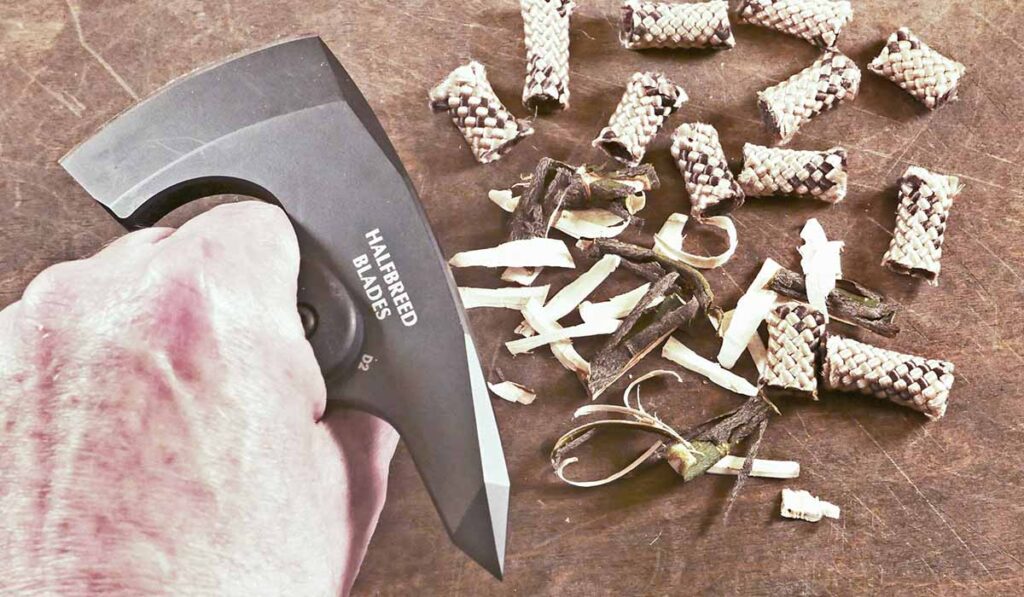
The Halfbreed Compact Rescue Axe shaved wood and sliced rappelling rope with flying colors. The axe head steel is the thickest of the test group.
The Halfbreed Compact Rescue Axe is the smallest of our bearded array yet is also the most overbuilt. It makes up for its smaller size with the thick axe head steel. There’s a nice palm swell at the lower grip area and a big finger groove at the top of the handle.
It has a beard drop of 1.5 inches. Out back is a 2-inch spike. The rear spine has gimping to enhance grip. The sheath offers full coverage and a keeper loop rolls under the bit to further secure the axe head. It has a mounted MOLLE-compatible plate, or you can swap it out with an optional DOTS Tek-Lok style attachment for belt carry.
While testing the Halfbreed I had to remind myself it is indeed a compact rescue axe. While all the other review subjects are geared for outdoor use, this small overbuilt wonder is more for city work. That said, the large finger groove at the top of the handle is custom-made for carving and slicing just as bearded axes were intended. I tested the little axe and it shaved bark, took off shavings, and sliced rappelling rope just fine, but its thick steel and superior weight-for-size ratio really shine when hacking and bashing. I have no doubt it would earn its stars as a close-quarters hawk.
I gave the spike a run on a pane of 3/16-inch door glass and it obliged, shattering it with gusto. The ample grip, with its added gimping, makes for excellent purchase, and the sheath—overbuilt like the axe—is the most comprehensive of the lot. In a nutshell, the Halfbreed is a handy axe—and a bulldog at that!
Compact Rescue Axe Specs Head Width: 4.5” Blade Edge: 2.55” Blade Material: Bohler K110 (D2) tool steel Blade Thickness: .31” Blade Finish: Black Teflon coating Handle Material: Black G-10 composite Special Features: Faceted spike, gimping Weight: 25.07 ozs. Overall Length: 9.52” Sheath: Black Kydex, MOLLE compatible Country of Origin: Australia MSRP: $310
Maserin Knives Mantis
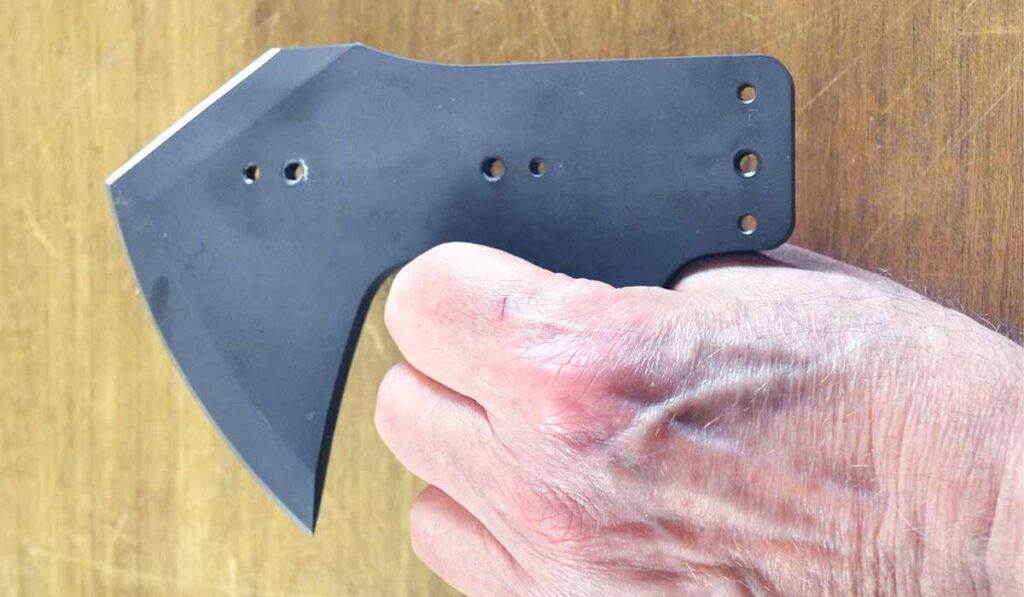
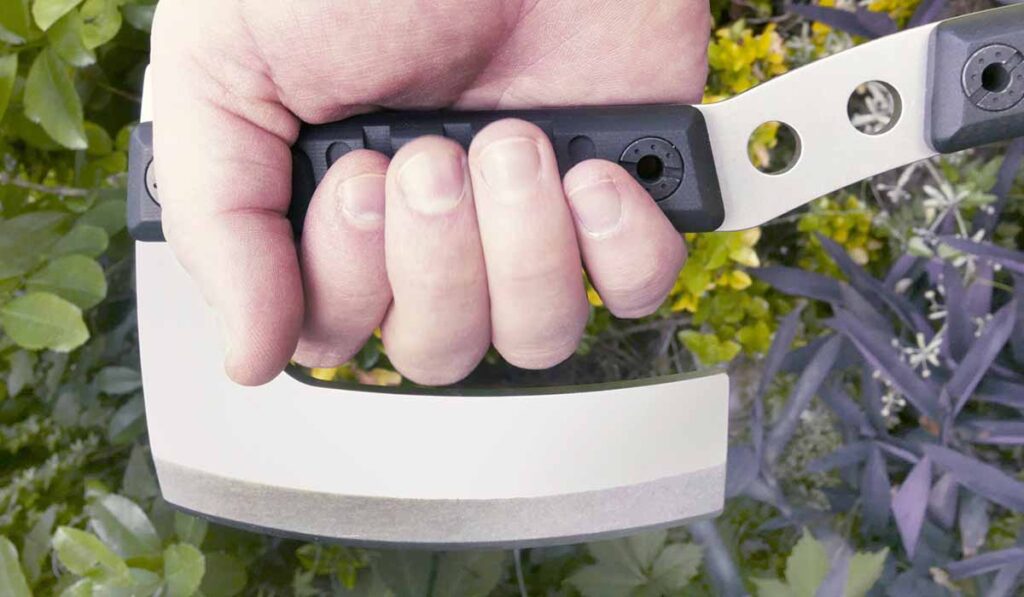
The unusual axe head of the Maserin Mantis offers full knuckle protection and then some. Note that the Mantis has a pair of upper scales just for the purpose of using the axe for shaving and slicing.
Maserin Knives may be giving us a glimpse into the future with its new, strikingly stylish Mantis. It is a small axe and you’ll notice the steep tool steel blade is quite lengthy for its size. In fact, the blade exceeds the width of the axe head—a bit unusual in a working axe.
“But wait, there’s more!” as the TV guy says. The Mantis has four (two sets) of scales: one at the top for carving comfort and the other on the lower portion of the handle for grip. At the base of the straight top scale the direction of the handle switches to an outward curve, and the exposed part on the handle has three lightening holes—plus there’s a lanyard hole and a spike on the base. The sheath fits the axe head only and butts against the top scale, and there’s a belt loop stitched to the back. It’s minimalism at its finest.
The Mantis has the longest beard drop of all the test axes at 3.75 inches and is the only one that offers full hand protection. The blade curve stands apart in that it is virtually symmetrical from end to end. It’s shape and full knuckle protection begged me to try it as an ulu for slicing, so I laid down some 3/8-inch rappelling rope and went at it. The Mantis sliced just like an ulu, taking off clean sections of rope. It performed even better when I reversed the grip with the handle facing away from me so it didn’t hit me in the belly. Voila! Instant ulu.
The Mantis shaved bark and carved off curls quite well and the full finger protection was welcome. It’s the lightest of the axes reviewed, which could put it at a disadvantage to the others when weight is a factor. You won’t be batonning this axe either because the top scales would block it from going past the front portion of the head. That said, there’s plenty to like about the Mantis’s utility value and its forward-thinking styling!
Mantis Specs Head Width: 3.75” Blade Edge: 4.527” Blade Material: D2 tool steel Blade Finish: Stonewashed Blade Thickness: .326” Handle Material: Black G-10 composite Special Feature: Futuristic design Weight: 20.23 ozs. Overall Length: 11.02” Sheath: Black Kydex Country of Origin: Italy MSRP: $216