Buyer's Guides

You’re looking for a new knife in a certain style – we’ve got recommendations on the best blades for every price point.

7 Of The Best Kukri Knife Options

The Kukri Is A Historic Knife With A Long History Of Military And Outdoor Use. These Are Seven Of The Best Kukri Knives Out There Today.

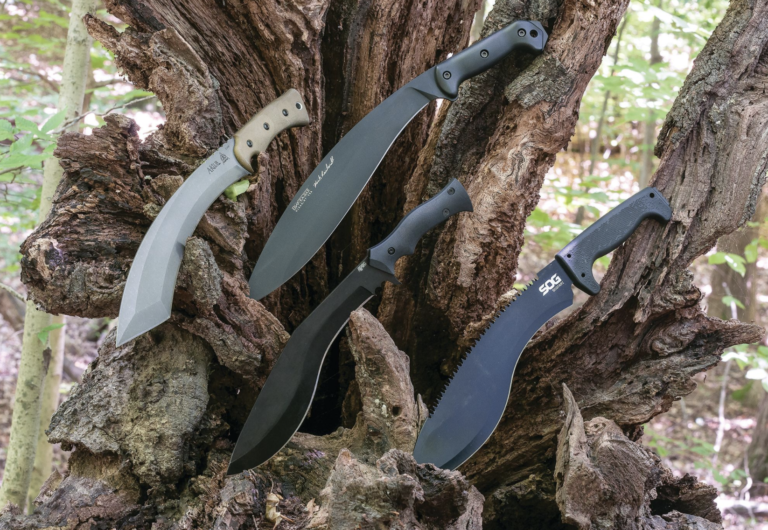
The way a kukri feels in your hand makes you want to obliterate thick foliage and saplings.  The blade’s forward-weighted feel, the ultra-secure handle, and the reach the knife provides all work together in an ancient cutting and chopping tool that packs more punch than a machete for tackling the tough stuff.

What Is A Kukri?

The kukri is a variant of the machete with a recurve blade that developed in South Asia hundreds of years ago. It may have evolved from the sickle and is today used as the standard utility knife for the Ghurkas in Nepal. The kukri is the national weapon of Nepal and still synonymous with the Nepalese Army. It remains the main weapon for all Ghurka military units around the world including the British Army’s Brigade of Ghurkas.

How To Use A Kukri

The kukri knife is designed for chopping outdoors. Like other machetes, the kukri has a longer blade of 10-15 inches depending on the type. It is a useful military weapon because its center of mass allows the fighter to slice as they chop to penetrate an enemy deeply and even slice through bone.

As an outdoor tool, the kukri machete can do a bit of everything. Nepalese use it to do everything from chopping wood, digging, slaughtering livestock, chopping vegetables, and even opening cans.

Due to its shape, with a more narrow blade by the hilt and a wider blade by the tip, the kukri can function as a nimble utility knife up close and do the work of a small spade or even an axe as well.

The 7 Best Kukri Knives Today

Today, the kukri is made of modern materials and is used around the world for its durability outdoors. These are seven of the best kukri knives on the market today that would make any lover of the outdoors happy.

CAS Iberia APOC Kukri
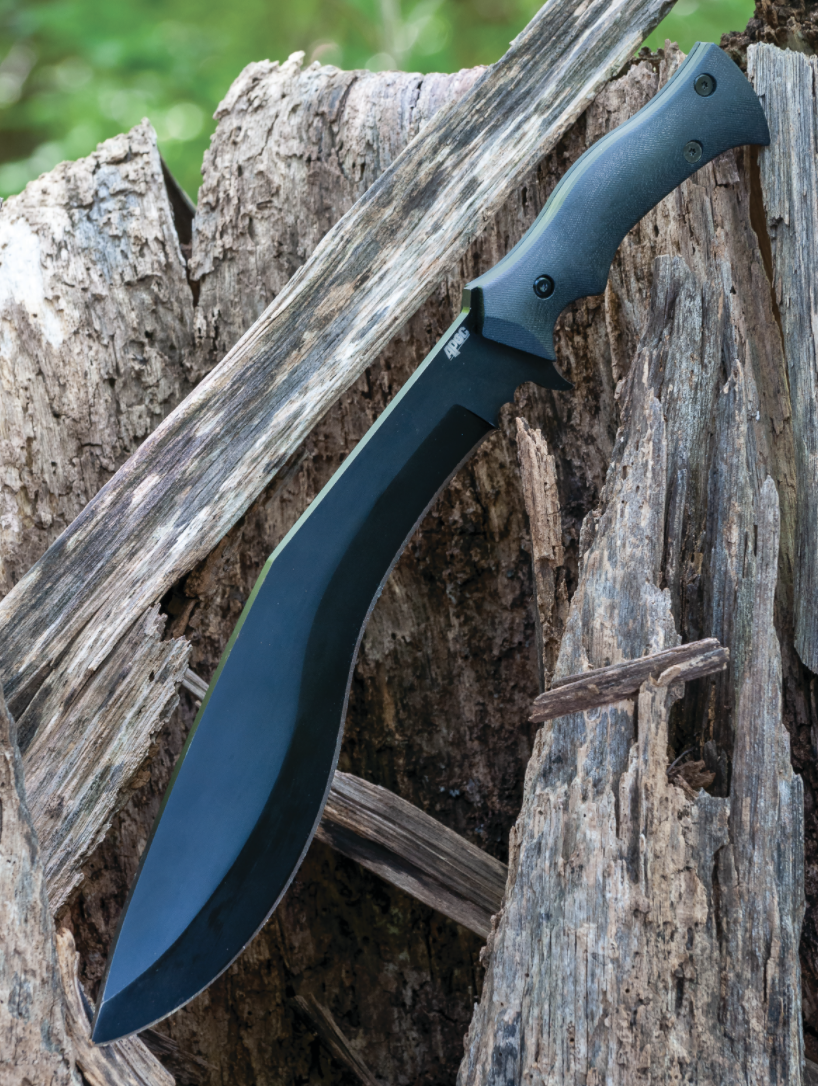
APOC Kukri
This APOC Kukri is one the author found to be very controllable—so controllable, in fact, it even whittles well in a pinch.

At 16.25 inches overall, the APOC Kukri from CASIberia is a formidable chopper.  The 10.25-inch blade of this knife is .22-inch-thick 9260 spring steel with a low-glare, rust-resistant black coating. Though it doesn’t hold an edge as long as some other steels, expect it to be easy to maintain in the field. It also is a forgiving material, able to withstand heavy use and abuse.

The ultra-ergonomic handle is machined black G-10 fastened by three Torx-head screws.  The multi-faceted grip features a pronounced index finger recess, an integral front guard, and a flared butt to prevent backward sliding of your hand. At 23 ounces, the knife harnesses the devastating cutting power of traditional kukris, and amplifies it using modern materials.  

I found rather crisp edges on the tang and guard where crispness shouldn’t be. The easy fix? Lightly file the harsh edges to soften them a bit.

Once past the aesthetic imperfections, what you see is a forward-weighted chopping tool whose overall blade shape was inspired by traditional kukris as well. The graceful curve of the belly houses the sweet spot.

I found the handle rather interesting with its varied curves and prominent finger groove. When I first held it, I didn’t like it. My initial impression was it didn’t “fill” my hand. However, once I took the kukri into the woods and began swinging it, only then did the handle start to make perfect sense. The dip behind the guard acts as a sort of pivot. The knife will move a bit in your grip because of this, but it doesn’t move so much that it’s distracting or impossible to use. The slight movement actually works with your hand in creating powerful chopping strokes. And, due to the blade’s weight and thickness, I found the knife a really effective chopper.
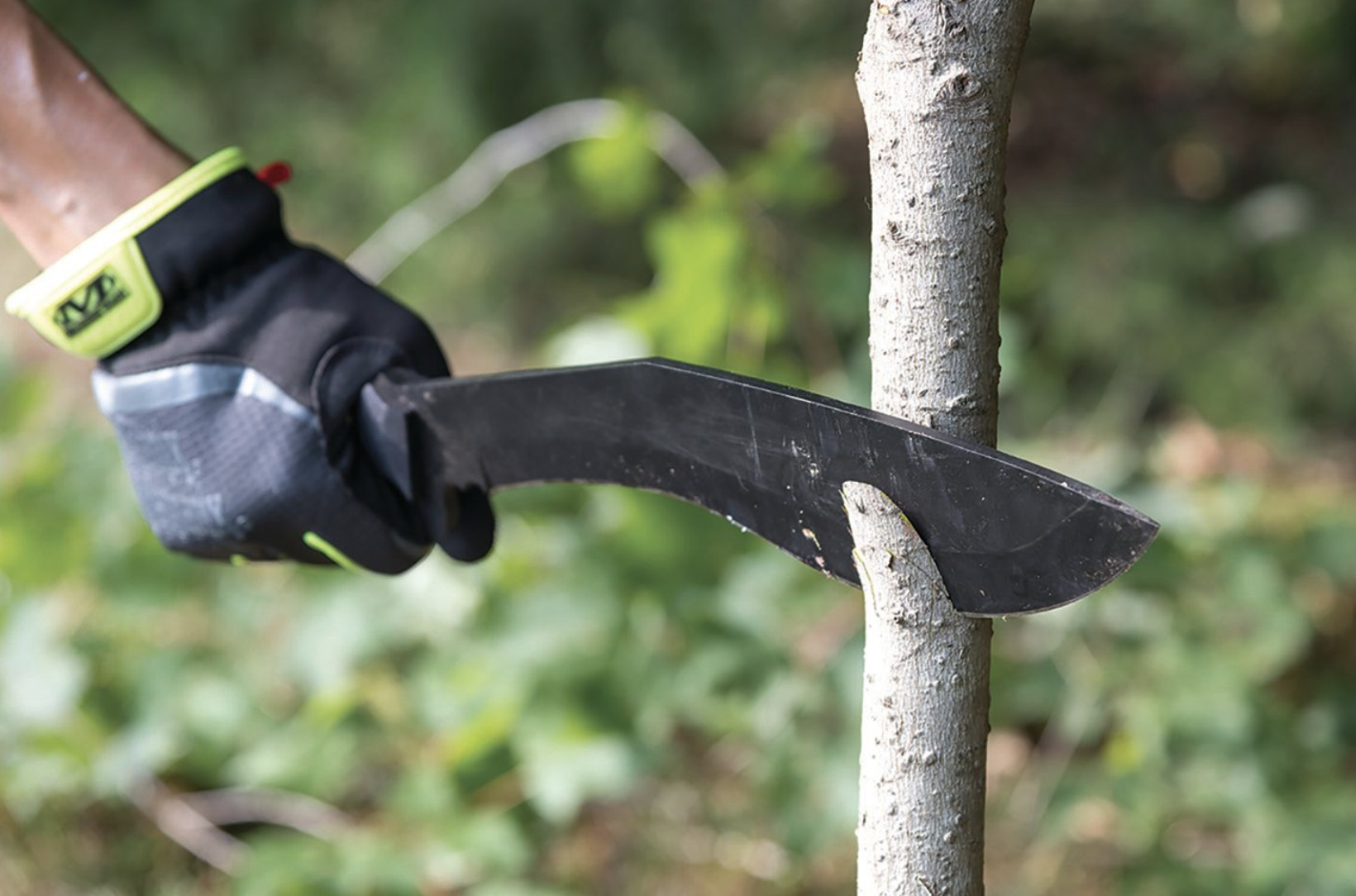
The APOC Kukri excels at chopping, with the sweet spot in the middle of the blade belly. It was the surprise of the bunch in terms of how well it performed, especially for such a relatively unknown brand.

Out of the box the cutting edge was sharp but rough—rough as in a coarse edge and not looking very refined. Nonetheless, that’s also good because the coarse edge has “teeth’’ and bites in harder. The APOC kukri really turned out to be the surprise of the test bunch. It performed very well. I was able to modify the edge by hand, evening it out a bit—and it does seem to sharpen up fast in the field.

The Kydex sheath is a side-break design, allowing the kukri to tilt itself out of the sheath. However, the sheath needs more tension as it locks onto the handle to secure the knife. A secondary button snap strap extends around the upper part of the handle to secure the kukri into the sheath. Be sure it is securely fastened or it may fall out of the sheath accidentally. The belt loop webbing is fairly flimsy as well, but it will do the job. It does, however, allow the kukri to move around in the sheath in response to your movements, so, in case it snags a branch while you’re walking through the woods, it might free itself as you move.

All in all, I think this would make a great use-and-abuse chopper, one that you won’t be hesitant to go out and beat up. Made in China, it has a manufacturer’s suggested retail price (MSRP) of $175.

SOG Knives SOGfari
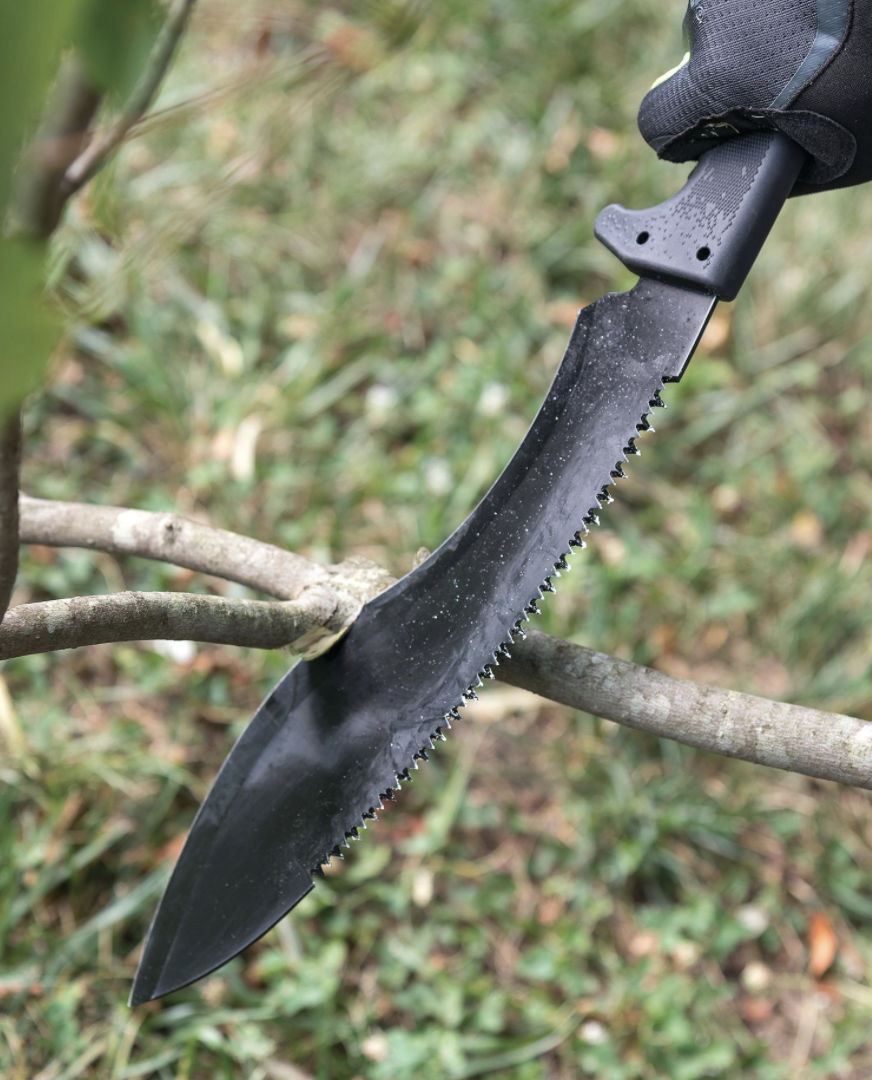
The SOGfari kukri is sharp all the way around—both the plain-edge blade and the sawtooth spine. Not as heavy as the other test knives, the author rates it for intermittent use.

The SOGfari Kukri Sawback Machete from SOG Knives combines three tools in one: kukri, machete and saw. The 12-inch blade is .1-inch-thick 3Cr13 stainless steel.

Overall length: 18 inches. The recurve blade adds cutting power and the double-cut sawback spine easily zips through saplings. The handle is molded Kraton rubber and sports dual guards at either end to prevent forward or rearward sliding of your hand. There’s plenty of handle belly to fill your grip and make the knife feel comfortable and secure. The exposed pommel is notched and can be employed as a hammer if needed. A black blade coating enhances rust resistance and cleans easily.

The sheath is heavy-duty, sewn-and-riveted ballistic nylon with plastic liners. It secures via a zipper pull. A fabric fastener flap protects the zipper to prevent accidental unzipping—a very thoughtful design. A large loop of ballistic nylon accommodates all belt sizes and a button snap secures the handle. The sawback makes it more difficult to slide the blade in and out, though the sheath unzips partially to provide more room.
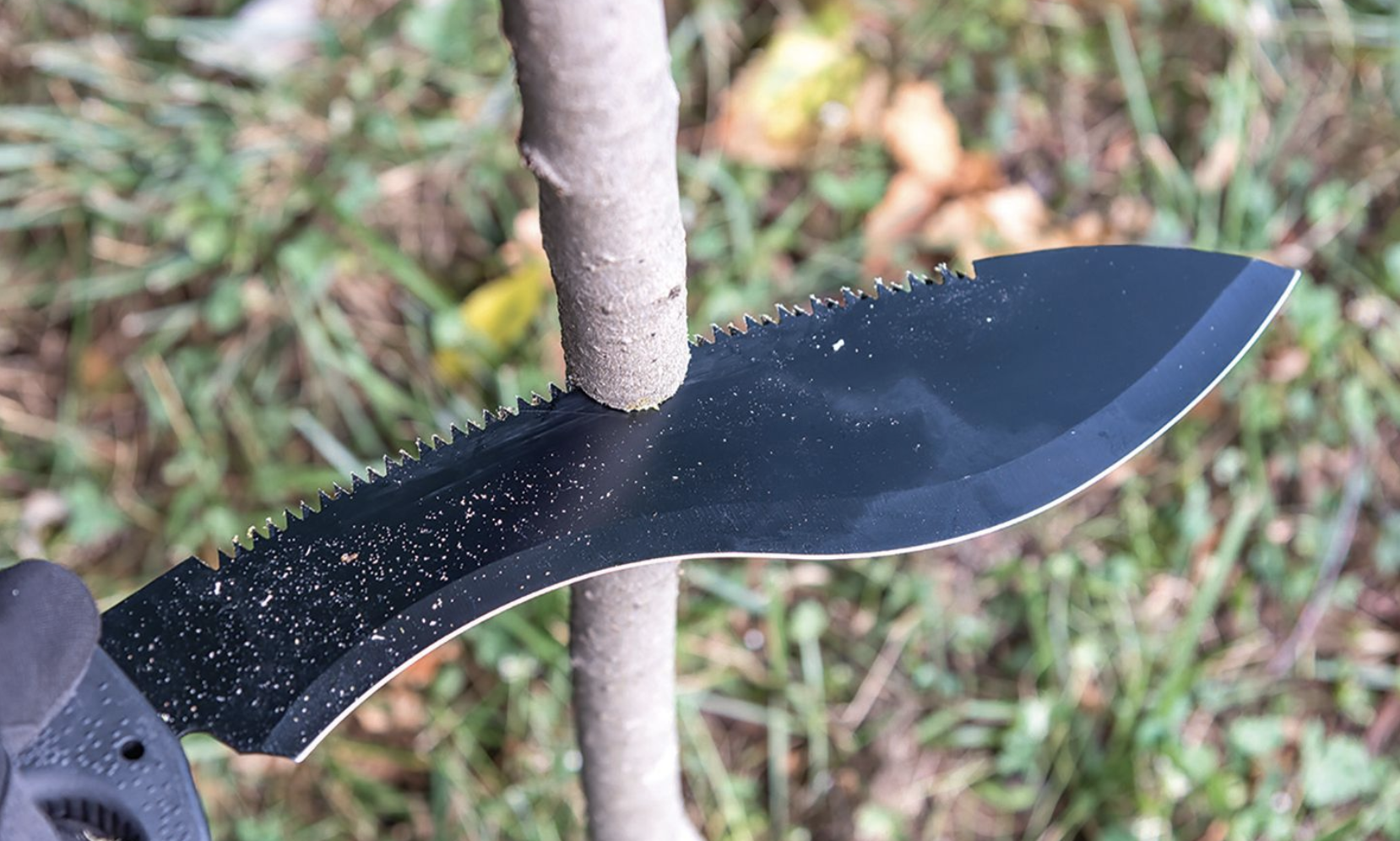
The SOG SOGfari Kukri is the only piece in the test bunch with sawteeth. While not intended to replace a nice, high-quality folding saw, it is better than no saw at all. The only problem is its tendency to bind up due to the blade’s thickness.

I found the SOGfari lacking in the weight-forward design of most kukris. This is good in that there’s less weight on your belt or pack—bad in that you must put more muscle behind chop strokes, which can be tiring. Normally, with a weight-forward blade you’d benefit from gravity on the down stroke. The sawback is more gimmick than anything. It really doesn’t work well and forces you to open the cut more to enable the thicker blade to slide through. If not, the saw binds up every time. Conversely, in a survival situation having the saw is better than no saw, so in that case it’s a plus. I would not rely on the SOGfari as your primary saw, so carry a dedicated folding saw if you’re exploring the woods.

The SOGfari is well made for the price but the lack of a weight-forward blade keeps it in the occasional-use category. Made in China, it has an MSRP of $29.99.

SOG Knives SOGfari 18" Machete, Black - MC02-N

SOG Knives SOGfari 18" Machete, Black – MC02-N

$47.99 $39.99
Prices accurate at time of publishing. Affiliate disclosure.

KA-BAR’s BK21

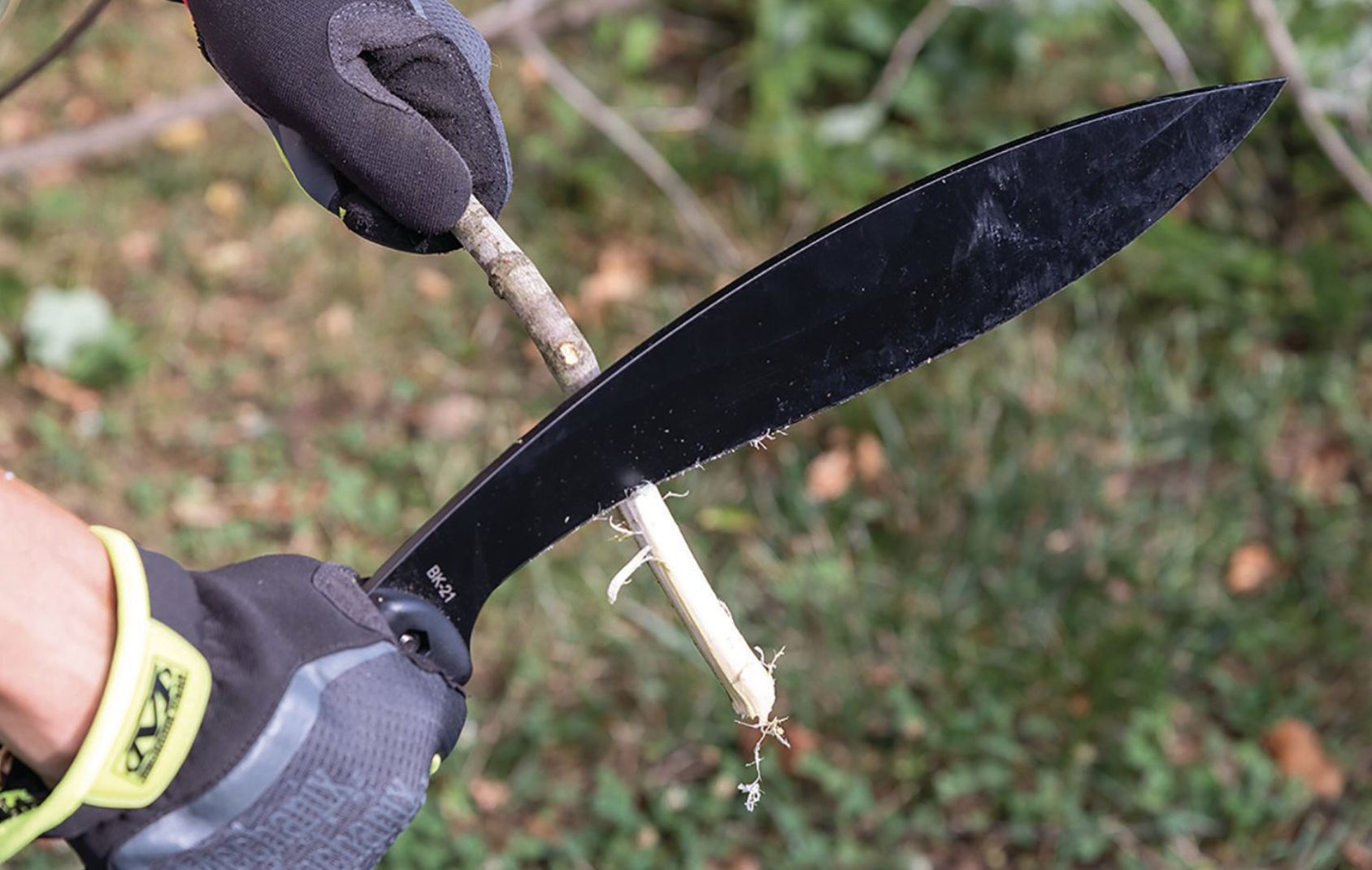
The KA-BAR BK21 Becker/Reinhardt Kukri is an exceptional all-around performer. It can be used as a chopping tool, machete or a utility knife as demonstrated here. It balances very well. Inset is Ethan Becker, one of the knife’s designers, outlining the rules of the chef’s knife cutting competition at the 2019 BLADE Show West. (Becker image by Eric Eggly)

KA-BAR’s BK21 Becker/Reinhardt Kukri was designed in conjunction with Ethan Becker and the Hank Reinhardt Estate. The 13.25-inch blade offers reach and power with plenty to spare. The blade is .195-inch-thick 1095 Cro-Van carbon steel epoxy coated for rust resistance. There is that forward-tilt signature of kukris, and the blade’s profile gently swells toward the center. Along with the flat grind, it enables the BK21 to be used as both a machete and a chopping tool.

Molded from an impact-resistant polymer called Ultramid®, the handle is dense and lightweight. It resists absorbing liquid and moisture, which makes it almost impervious to the elements. The rounded/blocky handle shape may look a bit awkward at first, but don’t knock it until you try it. The contours make for a very comfortable grip that isn’t tiring when evaluating for long-term use. Three rather large hex-head bolts secure the handle onto the full tang design, and the exposed pommel can be used as a hammer.

The BK21 has a high-quality sewn & riveted nylon sheath with a hard-plastic reinforced tip to prevent puncturing. An integral nylon loop promotes easy belt carry. A button snap closure secures the blade.
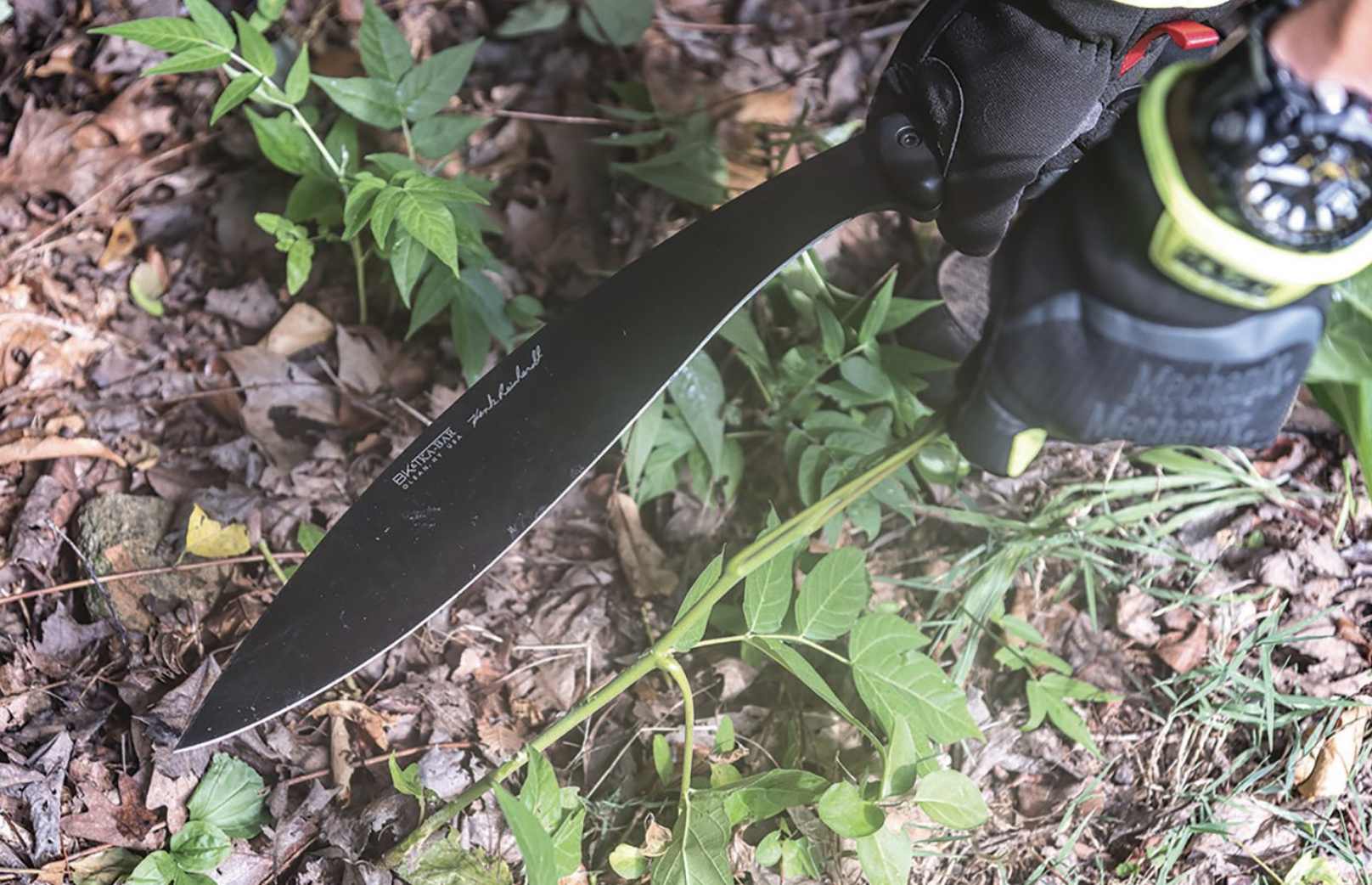
Due to the weight distribution of the KA-BAR BK21 Becker/Reinhardt Kukri, it excels as a machete in clearing tall grass, weeds, and vines.

The overall shape and weighted feel of the BK21 is reminiscent of traditional kukris. It’s not forward-heavy like some and is balanced well. Due to its length and weight/balance, it excels as both a chopping tool and a machete. It can cut vines and tall weeds as well as fell saplings. It’s really two tools in one. The entire kukri is solid. The designers knew what they were doing.

The BK21 is 18.75 inches overall, retails for $240.74, and is made in the USA. The sheath is imported from China.
Ka-Bar Becker/Reinhardt Kukri Fixed Blade Knife BK21

Ka-Bar Becker/Reinhardt Kukri Fixed Blade Knife BK21

$216.95
Prices accurate at time of publishing. Affiliate disclosure.

TOPS Knives A-Klub


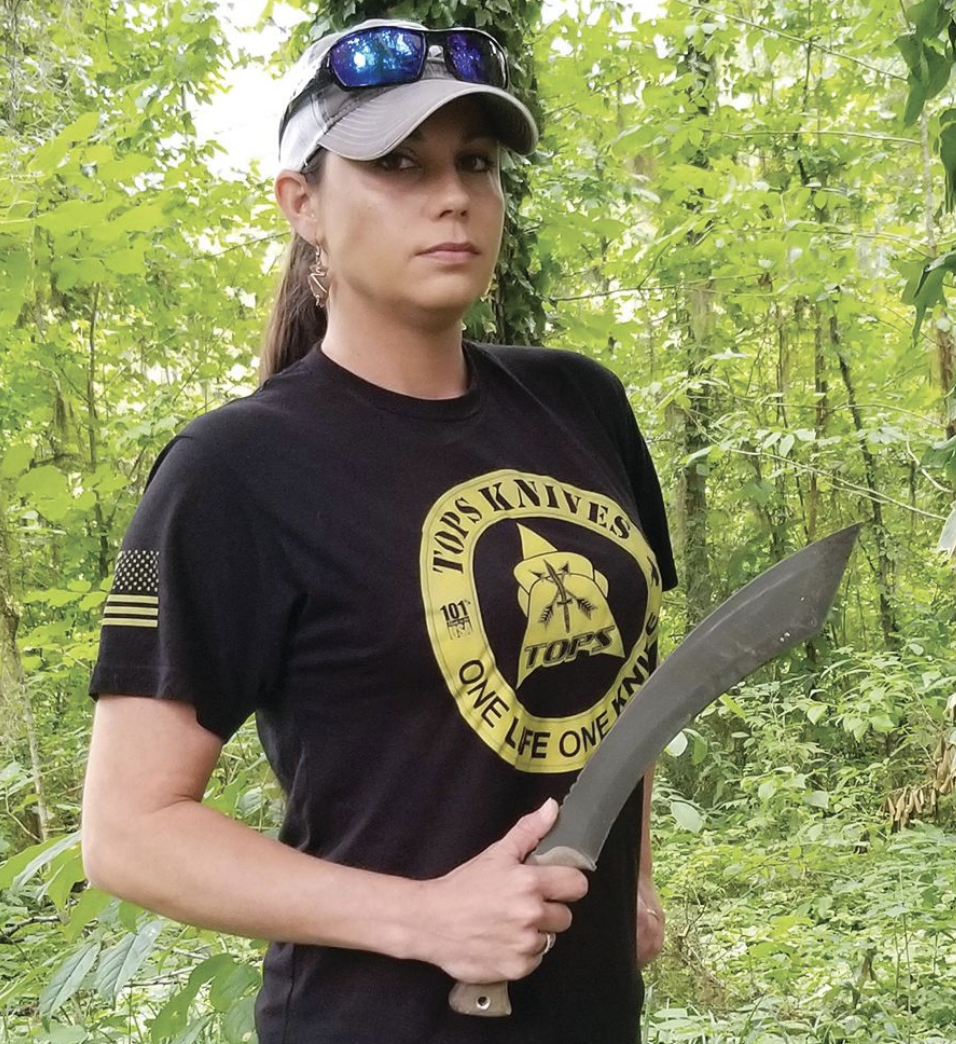
The gunstock war club used by Native Americans inspired Amanda Kaye of Discovery Channel’s Naked and Afraid
TV show in the design of the TOPS Knives A-Klub. The blade’s curvature accentuates cutting and chopping power.

Heavy duty and ruggedly built perfectly describes the A-Klub chopper by TOPS Knives, the company’s first knife designed by a female—Amanda Kaye of Discovery Channel’s Naked and Afraid television series.

She is an avid hunter and outdoor enthusiast, as well as having an interest in Native American primitive skills. Kaye employed the gunstock war club as the design inspiration for the A-Klub.

The gunstock war club was a blunt-strike weapon used primarily in the 18th and 19th centuries by Native Americans of the Eastern Woodland, Central, and Northern Plains tribes. Named for their resemblance to the wooden stocks of muskets and rifles, gunstock war clubs were fashioned from ash, oak or hickory. The swinging force put into the weapon meant it would strike with the points of the design, and it proved very effective and devastating.
The gunstock war club used by Native Americans inspired Amanda Kaye of Discovery Channel’s Naked and Afraid
TV show in the design of the TOPS Knives A-Klub. The blade’s curvature accentuates cutting and chopping power.

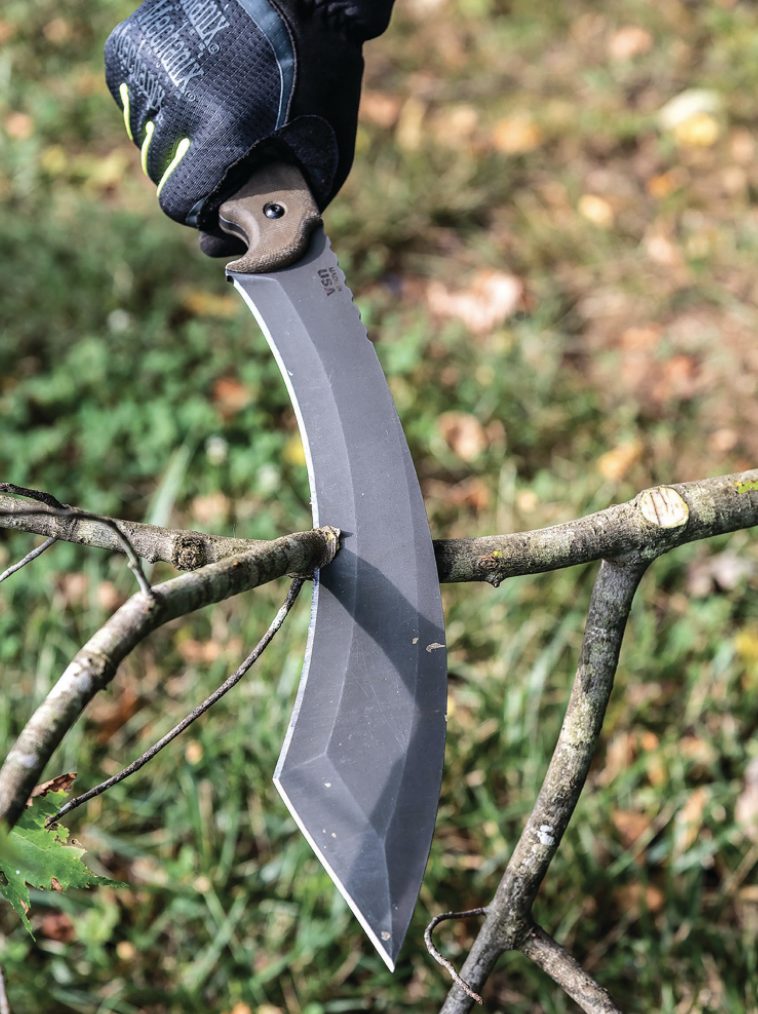
Due to the blade’s curve and angular tip somewhat reminiscent of a tanto, the A-Klub is also effective and devastating as a chopper. The blade is just over 12 inches of .19-inch-thick 1095 spring steel in the company’s subdued Acid Rain finish. The overall length is 18 inches.

The 23.8-ounce A-Klub is a beast. It has a forward-weighted tendency, though not as much as some choppers or even a traditional kukri. However, the blade curve accentuates swinging power and presents the edge at an angle in relation to the target, so the knife shears on contact.

Kaye designed the handle to maximize user comfort and control. An index-finger groove assists in locking in your hand, along with a curved main grip area that accommodates your other fingers. The green Micarta® handle is very lightweight and durable, and practically impervious to the elements, fluid absorption, and impact. Three hex-head screws fasten the scales to the full tang, and there’s a hole for a lanyard.

Coming off the index-finger groove, folks with smaller hands can shift their grip rearward on the handle for increased swing leverage. The A-Klub has a pronounced rectangular profile, which helps make it feel more secure in your hand.
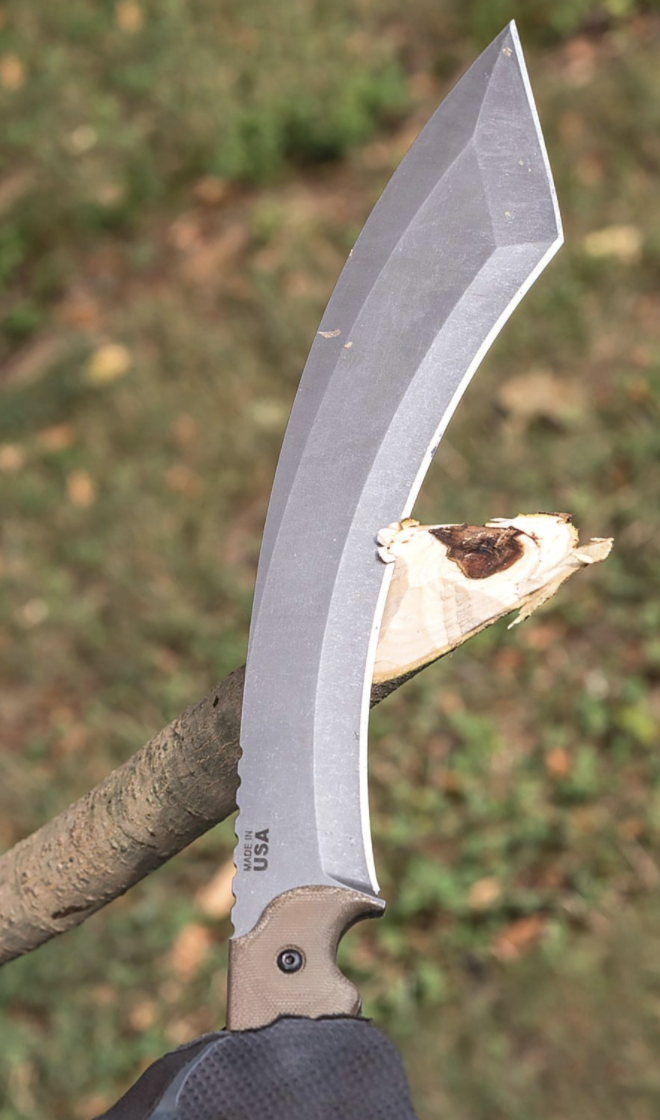
Due to its weight-forward design, the TOPS A-Klub harnesses very effective cutting and chopping power. No matter how you swing the blade, the edge is almost always going to catch the target at an angle and, therefore, cleave through it cleanly.

The knife includes an expertly designed side-break Kydex rig. The rig’s leather-dangler attachment permits the heavy knife to swing and pivot freely on your belt in response to your movement, being accidentally snagged on brush, etc. Having the knife swing freely makes it more comfortable to carry.

Performance-wise the A-Klub bites in deep and hard, consistently discharging large chunks of wood with each blow. The blade’s “sweet spot” extends from the bottom of the tanto tip about two inches back toward the curve.

The handle can be gripped in at least two ways. One is with your index finger nestling inside the forward finger groove to provide a degree of control and also leverage. In the second, back your hand out of the forward finger groove and grip the handle further rearward toward the butt end. The latter handhold will enhance the power of each stroke.

Of the test bunch, I rate the A-Klub the best chopper, hands down. Made in the USA, it has an MSRP of $350.
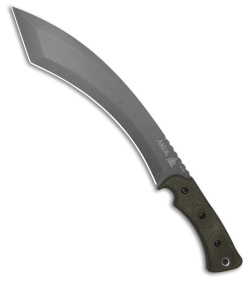
Tops Knives A-Klub Fixed Blade Knife 1095 RC 56-58 Canvas Micarta Handle

Tops Knives A-Klub Fixed Blade Knife 1095 RC 56-58 Canvas Micarta Handle

$299.95
Prices accurate at time of publishing. Affiliate disclosure.

Cold Steel Magnum Kukri Machete

Cold Steel Magnum Kukri Machete

It’s been said that good things come in small packages. Cold Steel has no time for that. Their Magnum Kukri Machete comes in two varieties with the larger having a massive 17-inch blade and an overall length of 22 inches.

At 2.8 mm thick, the blade is made of 1055 Carbon Steel with a black baked-on anti-rust matte finish. It weighs in at 20.1 ounces and is weighed forward to give you better leverage while slicing.

It has a five-inch polypropylene handle and comes with Cor-Ex sheath. It will most likely need some sharpening when you get but with an MSRP of just $35.99, the price can’t be beat.
Cold Steel Kukri Machete Fixed Blade Knife 97MKM

Cold Steel Kukri Machete Fixed Blade Knife 97MKM

$29.97
Prices accurate at time of publishing. Affiliate disclosure.

Condor Heavy Duty Kukri

Condor Heavy Duty Kukri

Condor Tool & Knife of El Salvador have made a kukri that combines the best of machetes and the best of an EDC knife. It’s smaller than traditional kukri machetes, with a blade at just nine inches, but what it lacks in size it more than makes up for in manuverability.

The blade is 6 mm thick and made from 1075 high carbon steel with a blasted satin finish. It has a more pronounced bend in the knife than most other kukris which allows for more precise knife work when needed.

With a sturdy walnut handle, and a sheath of welted leather, Condor’s kukri is made of quality materials from top to bottom. The only knock on it is that it will need sharpening out of the box to get the type of edge you want when cutting through brush. With an MSRP of $117.91, it’s a good knife for its price.
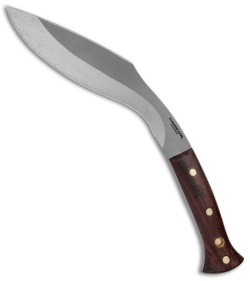
Condor Heavy Duty Kukri Fixed Blade Knife Walnut

Condor Heavy Duty Kukri Fixed Blade Knife Walnut

$100.23
Prices accurate at time of publishing. Affiliate disclosure.

Smith & Wesson Outback Kukri

Smith & Wesson Outback Kukri

Smith & Wesson makes more than just guns, and their Outback Kukri is a great example of the company’s knifemaking prowess. The 11.9-inch blade is made of 7Cr17Mov Stainless Steel and finished with a black powder coat. The rubberized steel handle provides great grip while slicing.

It’s a light knife at just under 20 ounces, and that lightness brings both pros and cons. The pros are that you can a better feel of what the knife is cutting through and can slice with more speed. The cons are that it could get damaged more easily than heavier kukri knives due to overuse.

The balance comes with its price. The MSRP is just $34.15, which is a great price. If you’re not looking to become the next Bear Grylls, this kukri might be all the knife you need.

Editor’s Note: Mike Abelson contributed to this piece

Read More


Kershaw Blur Review: Focusing On The EDC Classic

A mainstay in the company’s catalog, the Ken Onion-designed, USA-Made Kershaw Blur remains a clear EDC choice.

Kershaw’s Blur has been in the company’s line for several years and it continues to be a good seller for the company. You get it all with the Blur—a handsome look, useful blade shape, and made-in-the-USA toughness.

Devised by custom knifemaker Ken Onion, the Blur exhibits the hallmarks of Onion’s design with its recurve drop point blade and optimized handle shape promoting user comfort, as well as safety. Plus, you get a choice of several variations with the Blur. Each differs by blade steel and handle color, adding some style and flair to your daily carry arsenal.

Kershaw Blur Blade

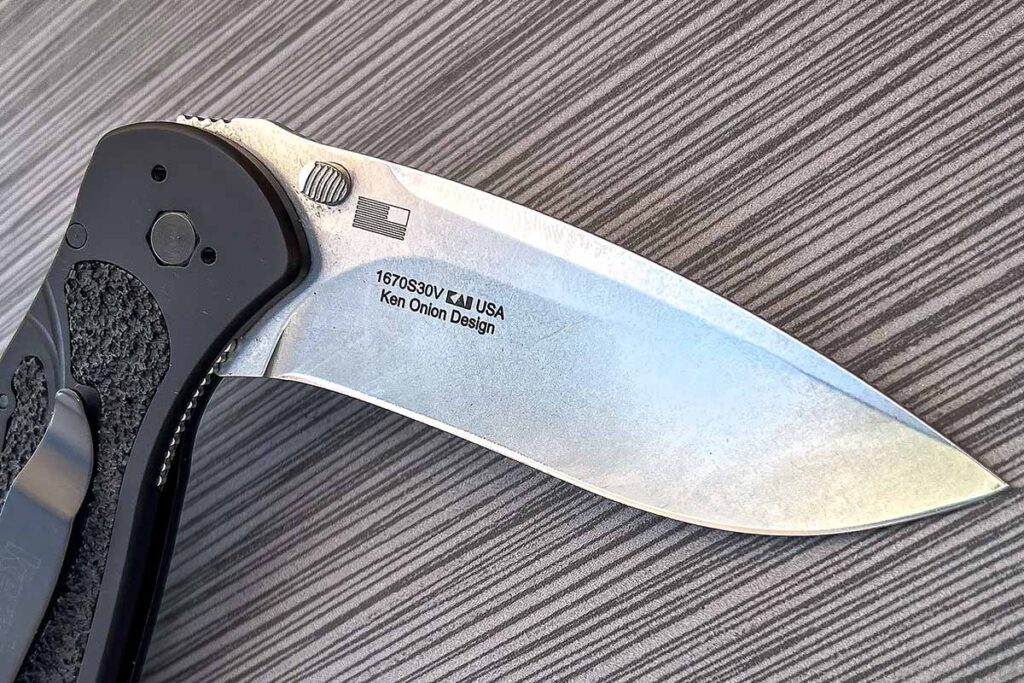
The Blur’s blade measures 3.4-inches long and is made of Sandvik 14C28N stainless steel. For those seeking a higher-performance steel, Kershaw offers an upgraded S30V version. Though the base-model steel is no slouch, as 14C28N holds an edge well, yet resharpens fairly easily. The Blur’s blade has plenty of bite right out of the box, thanks to its hollow grind.

Kershaw Blur Blade
The Blur’s blade has plenty of bite right out of the box, thanks to its hollow grind. Photos Marty Stanfield

For deployment, the Blur uses ambidextrous thumb studs. These are custom-designed studs, with a unique slanted portion. This rake allows you to bump with your thumb and then back off immediately, so they won’t be in the way of opening.

Speed Safe System

Deployment speed doesn’t disappoint, thanks to Kershaw’s Speed Safe assisted opening technology. The Speed Safe system was developed by Ken Onion and serves as a way to quickly and effectively open a folding knife blade quickly with minimal user effort. Essentially, a torsion bar propels the blade open after the user initiates blade movement by pushing out on the thumb stud.

Kershaw Blur Handle

For those who appreciate a solid and comfortable grip (who doesn’t?) the Blur incorporates some interesting design elements.

Starting with the construction, Kershaw has opted for aluminum alloy, making the handle both lightweight and strong. The shape is also well thought out, offering an intriguing and aesthetically pleasing shape, that doesn’t compromise on comfort. It’s a good example of Onion’s profound understanding of knife ergonomics.

Blur Handle
A fluid shape, the Blur looks nice and fits the palm well. Photos Marty Stanfield

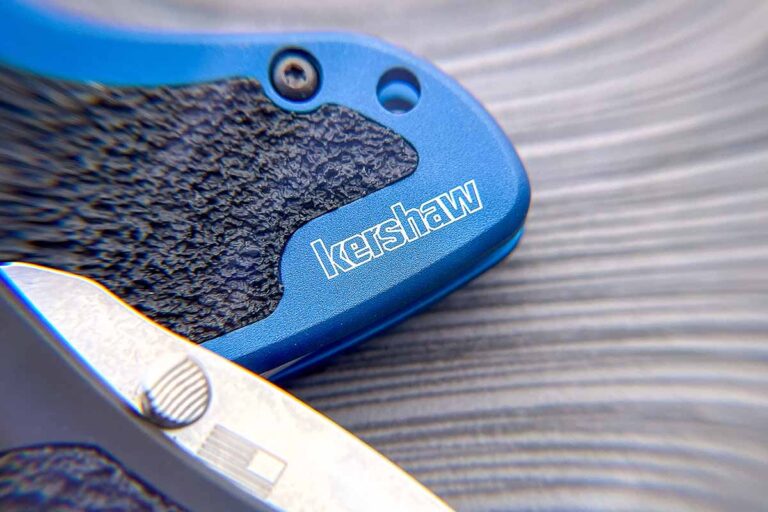
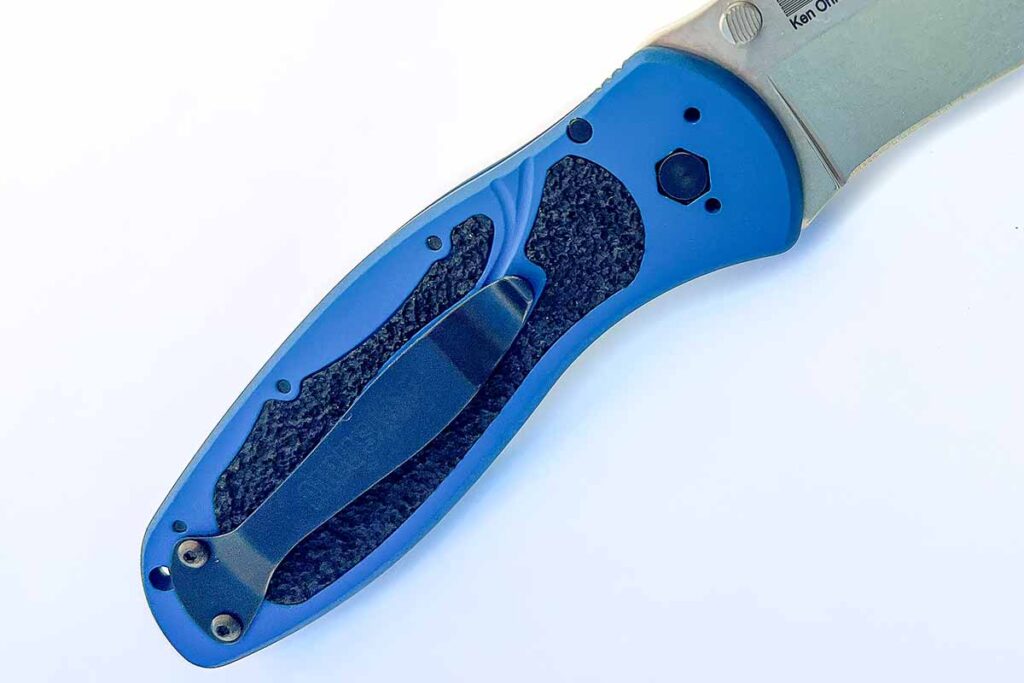
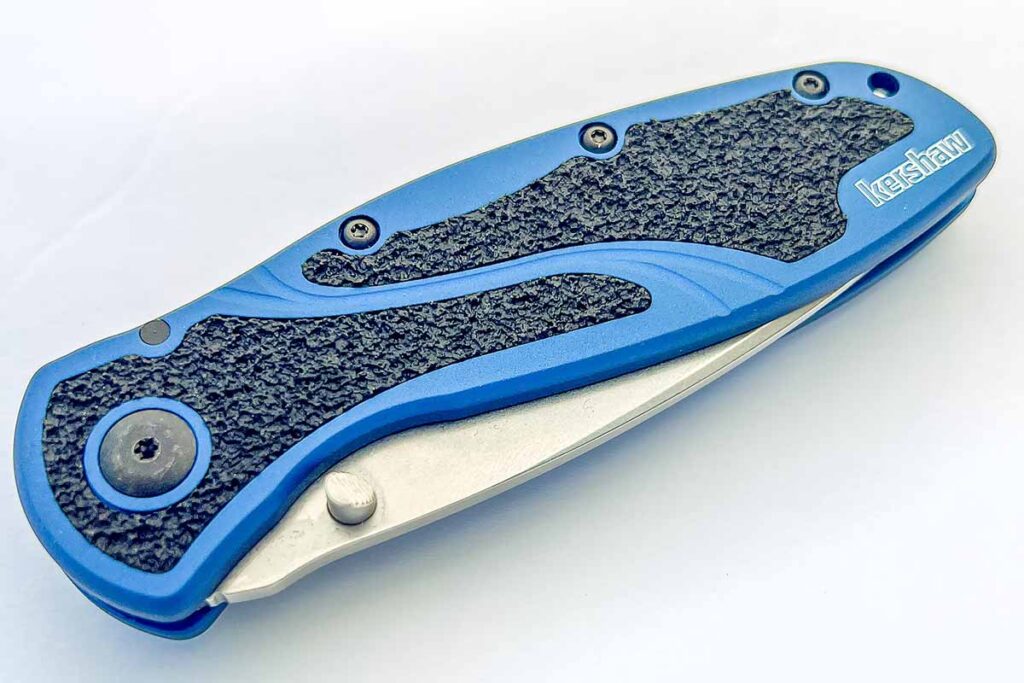
Furthering the usability, the Kershaw chamfers all the edges, ensuring there are no hotspots on the knife and textured rubber inlay inserts are a practical bonus, increasing grip traction tenfold with either wet or dry hands. Kershaw calls this material Trac Tech and it’s very similar to the self-adhesive grip tape you might find indoors in wet locations such as a swimming pool deck.

Interestingly, Trac Tech also helps with holding the knife to the pocket, making it a bit difficult to slide in and out. Depending on who you are and your particular activities, this can be a good thing or an annoyance. It is insurance from the knife falling out of your pocket, but it does slow retrieval time.

I like the use of Trac Tech on the blur simply because it gives the handle a more tactile feel to it.

Trac Tech in a Blur
Looking for more grip, Trac Tech inserts gives the Blur more bite. Photos Marty Stanfield

The general open build of the handle makes cleaning easy, especially when using compressed air or rinsing out under tap water. There is a pocket clip that helps to carry the Blur in the pocket and Kershaw gives you the option of either tip-up or tip-down carry but for right-hand carry only. Sorry lefties!

Final Cut

The Blur is a stylish EDC folding knife that doesn’t back down when there is tough work ahead. The recurve blade cuts very well, and its ample belly makes it an efficient slicer.

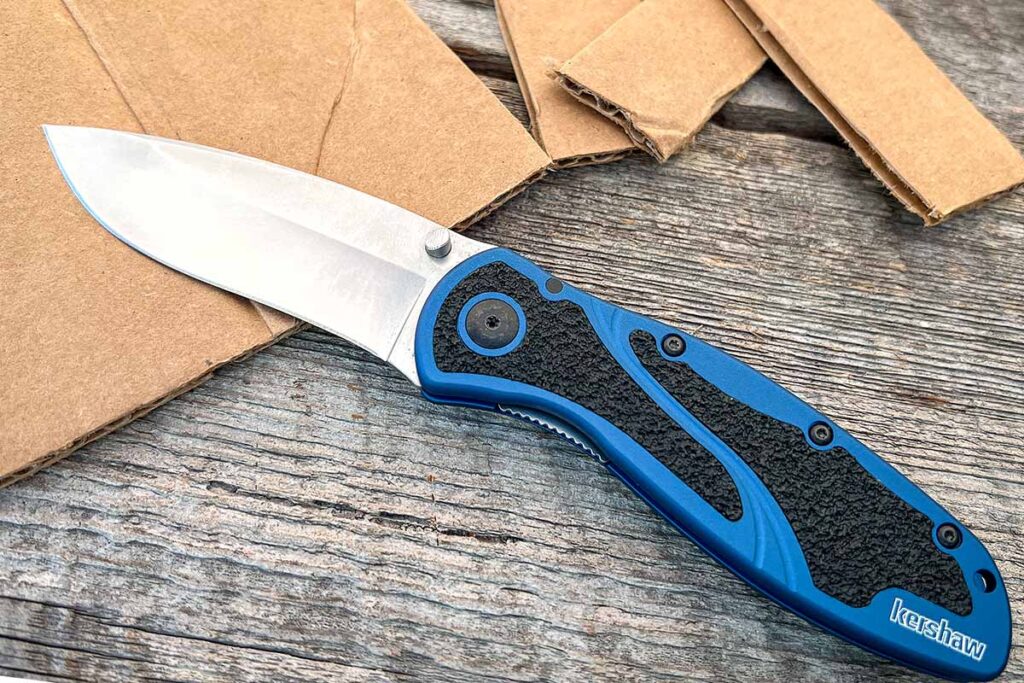
The hollow grind really thins the blade out nicely without making it too slender, and therefore it will cut through tougher materials with greater ease. It really excels at cardboard. I like this material for testing as it is a good standard because of its thickness and slight abrasiveness. Both aspects test the edge’s geometry.

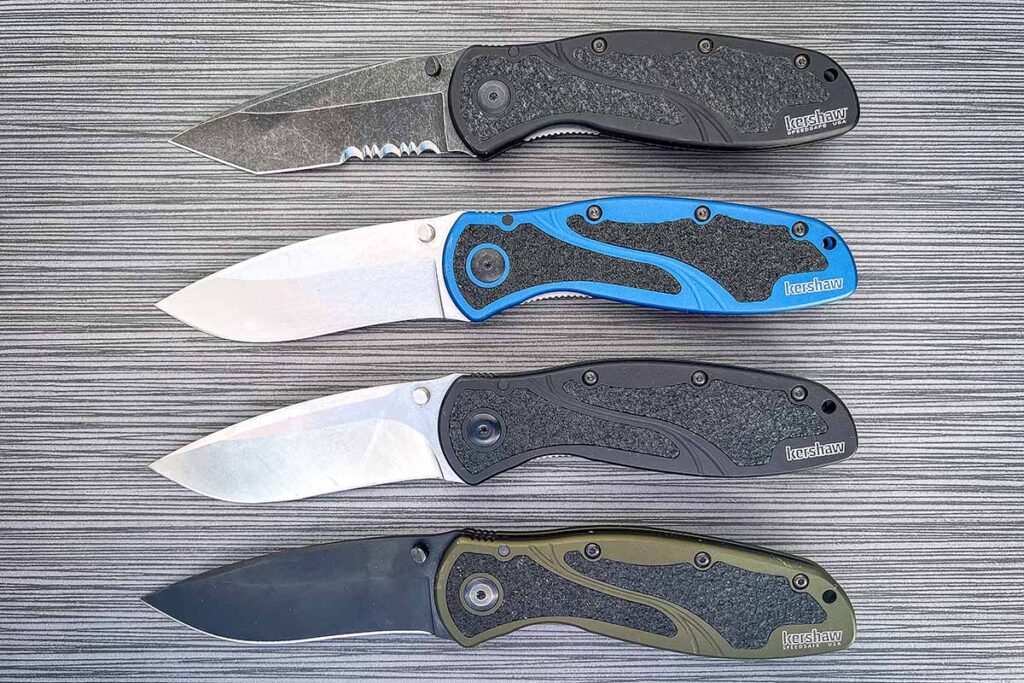
Several Kershaw Blurs
Kershaw offers several colors and blade options, helping the Blur fit most folks style. Photos Marty Stanfield

The liner lock of the Blur is dialed in nicely, it hits the tang on the lower third of the width of the blade and allows for some wear as the lock breaks in. Yet, the lockup is very secure. The exposed portion of the lock bar that you contact to release the lock has traction notches on it so you can get a good grip on it. I thought was a nice extra touch on Kershaw’s part.

Overall, the only nit to pick is I wish the clip was designed to carry the Blur deeper in the pocket. Other than this, no real issues to speak of with the knife

When it comes time to purchase a Blue, this might be the hardest decision because of the variety of models. There are a ton of colorways for the handle—black, navy blue, and olive green. Additionally, Kershaw offers several blade options, including plain edge and partly serrated as well as stonewashed, blackwash and Cerakote black finishes. If that weren’t enough, you also have a choice of a tanto blade as well, if that’s more your speed. Heck, there’s even an option with a carbide glass breaker at the end of the handle.

Blur and cardboard
Still a classic after all these years, the Kershaw remains a solid EDC option. Photos Marty Stanfield

The Blur’s MSRP starts at $135 and goes up from there to as much as $185 depending on blade finishes. Overall, the knife presents an overall package—Onion design, high function, nice styling and plenty of options choices. What this adds up to, is an EDC option that should be welcome in anyone’s collection.

Read More About Kershaw:

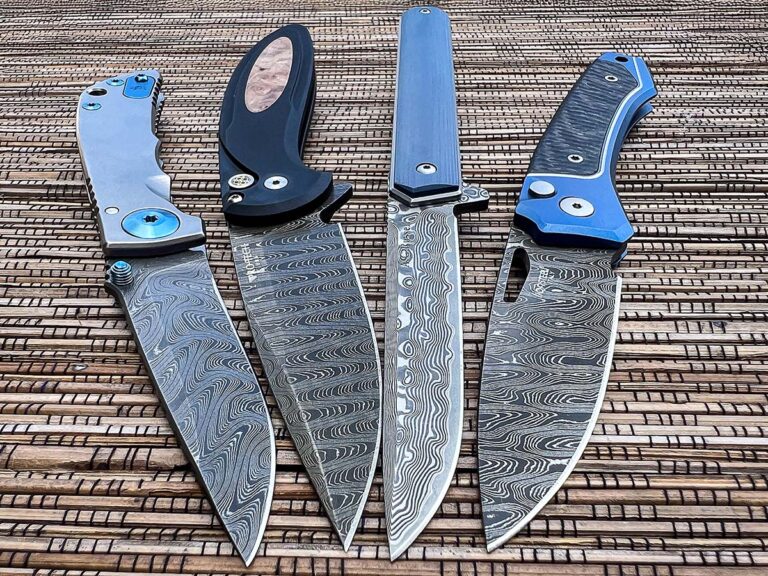
Damascus Folder: Top Options Straight From The Factory

We review four exquisite factory-made damascus folders that deliver the elegant look of custom work at a more affordable price.

Quality damascus knives have always been elegant. The steel, known for its unique surface appearance, defines “upscale” when it comes to high-end factory or custom knives. An increasing number of factory brands seem to be offering select models in damascus, bringing the knives to the masses at less than custom prices. For a nominal fee over the cost of a premium factory model—sometimes even less—you can have an exquisite damascus piece for your collection or daily carry rotation.

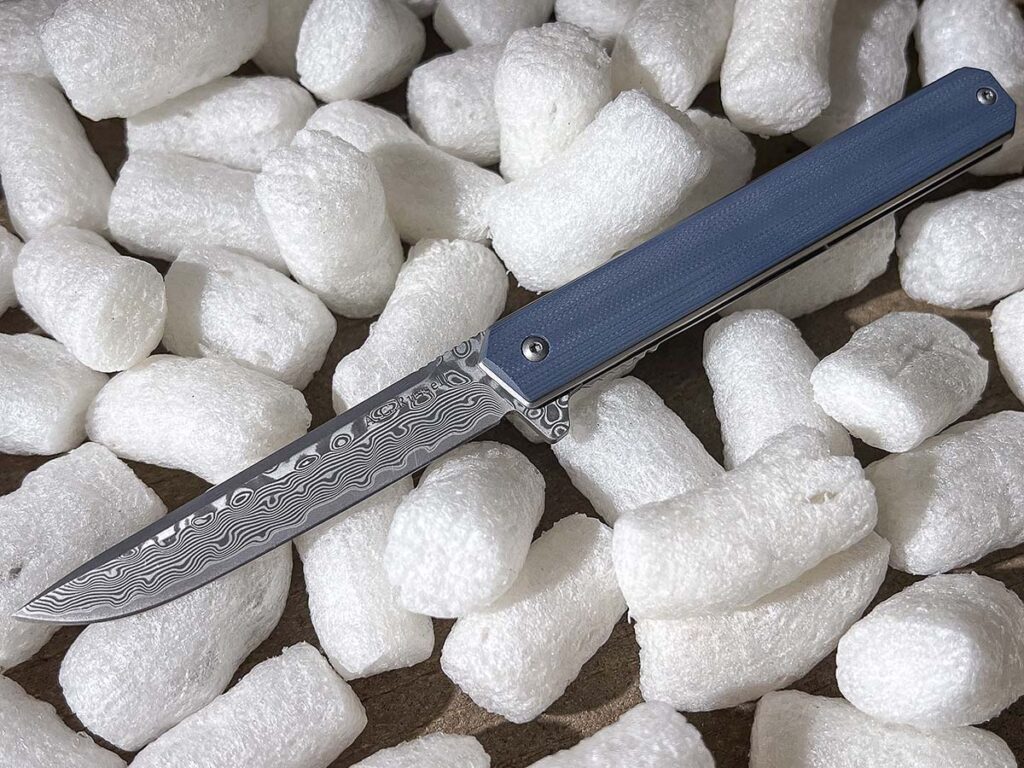
The A.G. Russell Knives Slim Damascus Folder

The A.G. Russell Knives Slim Damascus Folder is one of the better bangs for the buck in the genre. The 3⅝-inch drop-point blade is a damascus san-mai hybrid of sorts, featuring a core of 9Cr13MoV stainless steel clad with stainless damascus on either side. The construction allows the blade to be made for a more affordable price while also offering a distinctive appearance with the center core showing through near the cutting edge. 

The A.G. Russell’s 3-inch drop point blade is a damascus san-mai hybrid of sorts, featuring a core of 9Cr13MoV stainless steel clad with stainless damascus on either side.

The top of the thumb rest is notched for a non-slip grip, and the blade opens easily by a flipper tab. With the blade riding on a pair of caged bearings, the opening action is very smooth and sure. The 9Cr13MoV is a Chinese-made stainless that exhibits performance characteristics similar to the more familiar Japanese-made AUS-8 stainless.

The handle has stainless steel liners with beautiful chambray blue G-10 scales. The color is akin to a blueish gray that is less common for G-10. The double stainless liners are slightly oversized and chamfered for a refined appearance. A steel pocket clip carries the knife tip up. Overall construction is somewhat basic but executed extremely well.

Its overall slim form enables the folder to be carried comfortably in a variety of scenarios, from casual to full dress wear. As slender as it is, the handle remains a width that’s easy to grip and use. The smooth scales are slightly contoured to better fit the hand. The linerlock secures tight and safe, with zero blade play in any direction.

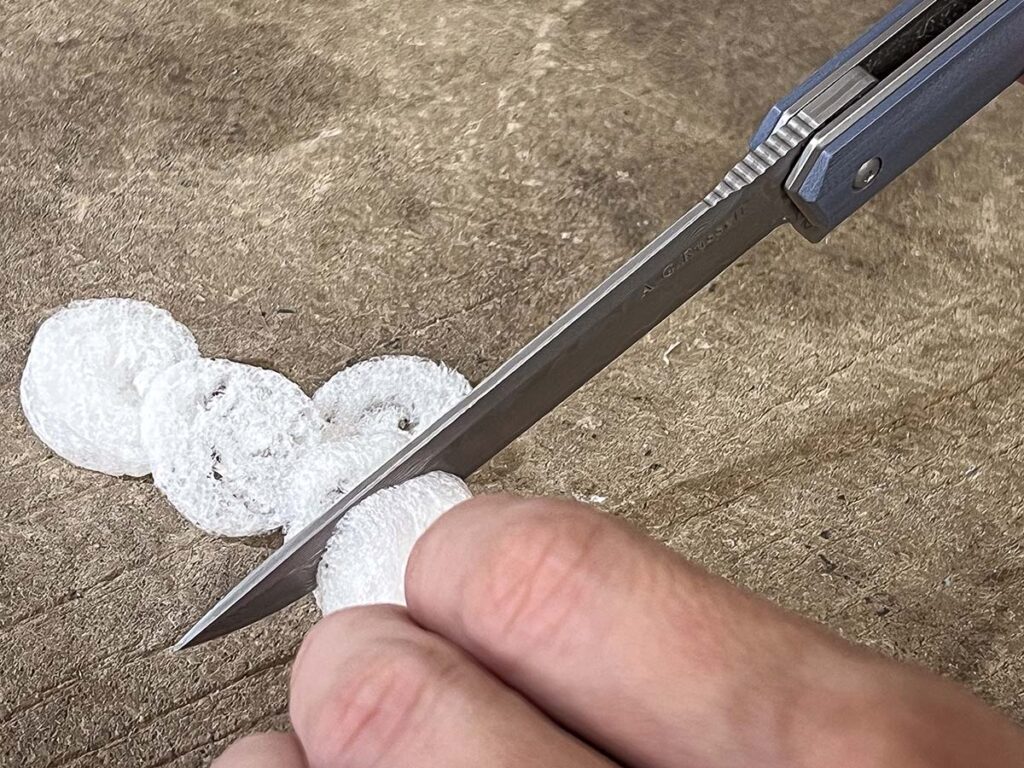
At about an eighth of an inch, the blade is moderately thick for such a slender folder. Add a shallow main grind bevel and there is a slight wedging effect when cutting cardboard, plastic foam and other materials, so you will have to apply a bit more force to get the blade through such media.

Cutting plastic foam into thin slices was a favorite edge tester of BLADE Magazine Cutlery Hall-of-Fame® member A.G. Russell, and the A.G. Russell Knives Slim Damascus Folder tackled the task with aplomb.

The handle is very straight, devoid of any features that prevent your hand from sliding forward or rearward. Combined with the blade grind, this doesn’t make the knife a good candidate for heavy/extended use. However, for casual and dress carry it’s perfect. It also makes a great folding steak knife. It’s low profile enough as not to catch unwanted attention in public. At a remarkably low manufacturer’s suggested retail price (MSRP) of $125, the knife represents a great value in a factory damascus folder. Made in China with the typical excellent manufacturing quality that is expected of such knives, the folder represents an excellent value. 

Lionsteel’s Twain

Lionsteel’s Twain damascus folder stands out in a crowd. Lionsteel calls it a double integral folder for its one-piece handle and one-piece scale. The handle is a solid piece of machined titanium—nothing new, though not too common, either.

Lionsteel calls the Twain a double integral folder for its one-piece machined titanium handle and one-piece carbon-fiber scale.

It isn’t exactly the easiest nor most cost-effective manner of making a knife handle, but it has loads of “wow factor.” It incorporates considerable CNC machining to arrive at the one-piece handle and one-piece scale. The resulting construction explains the knife’s high cost. It is an extremely strong design since the handle is a true integral as opposed to being composed of multiple parts. It is shaped so that it seats your hand comfortably, especially for prolonged use. The integral scale is 3D-machined carbon fiber and incorporates an integral spacer as well. The scale flows continuously around the spine for an appearance unseen on few if any other production folders.

The knife carries very deep in a pocket, with the clip fastened to the handle butt. When the knife is in your pocket, all that’s visible is the clip. You practically do not feel a thing when carrying it. The weight of titanium and carbon fiber are at a minimum and do not bog you down at all.

The versatile, user-friendly drop-point blade is 3.15 inches of Chad Nichols stainless damascus. Called Scrambled, the pattern gets its name from its eye-catching radial shapes. The flat-ground blade features an oblong hole for easy opening with either hand. The blade spine is crowned, meaning there is a slight radius to it. This is a very nice touch that not all manufacturers offer. It also creates a comfortable surface for a finger rest.

The scale flows continuously around the spine of the Twain for an appearance unseen on few if any other production folders.

The Twain’s high-tech approach to design and manufacturing yields a folder that is both very stylish and functional.  The blade has a sweeping belly that makes it easy to tackle mundane daily cutting tasks with ease, such as opening mail and packages, and even cutting food in a restaurant. It’s also not shy about tackling heavier cutting jobs like breaking down cardboard boxes. It is a lighter weight folder but feels very solid in-hand because of the integral titanium frame and super-secure button lock. 

The MSRP of $542 gets you a high-end folder with top-flight materials made of the finest craftsmanship in Maniago, Italy.  

Pro-Tech Knives Cambria

Known widely for superior-quality automatics, Pro-Tech Knives also makes equally exceptional manual folders such as the Cambria 2 button-lock flipper. The company released the updated version of the Cambria flipper this year, tweaking the design a bit for aesthetics and ergonomics—thus the Cambria 2. It’s designed primarily as an upscale EDC folder that combines style and function into one easy-to-carry package that comes in either a base, working knife format or a highly impressive full-dress model sure to please the most discriminating knife enthusiast.

The Cambria 2’s 3.5-inch drop-point blade of a ladder-pattern stainless damascus forged by Chad Nichols is slender and opens fast via the flipper tab.

The 3.5-inch drop-point blade of ladder-pattern stainless damascus forged by Chad Nichols is slender and opens fast via the flipper tab. The ergonomic aluminum handle is anodized black and has an integral lower guard to help keep your grip in place. The back end is oval shaped to conform to your hand. The maple burl inlay adds an organic touch to a high-tech knife. Each Cambria 2 comes with a deep carry pocket clip that totes the closed folder tip up. To add an ever-so-slight dash of panache, the lock button is inlaid with a mosaic pin.

Deploying the blade is a pure pleasure as it rides on a pair of caged bearings for super smooth action. Out of the box, the edge is super sharp and ready for work. In the pocket, the Cambria 2 rides comfortably. Due to its overall slender form, it practically disappears in your pocket. There is absolutely no bulk associated with this knife. You almost forget you have it! I really like how it slices. The flat grind thins the blade out nicely and gives the edge plenty of bite. Overall fit and finish is what you expect from Pro-Tech—flawless in every way. Country of origin: USA. MSRP: $570. Pro-Tech turns out each damascus piece in low quantities, so if you want one, you’d better act quickly.

Spartan Blades Harsey

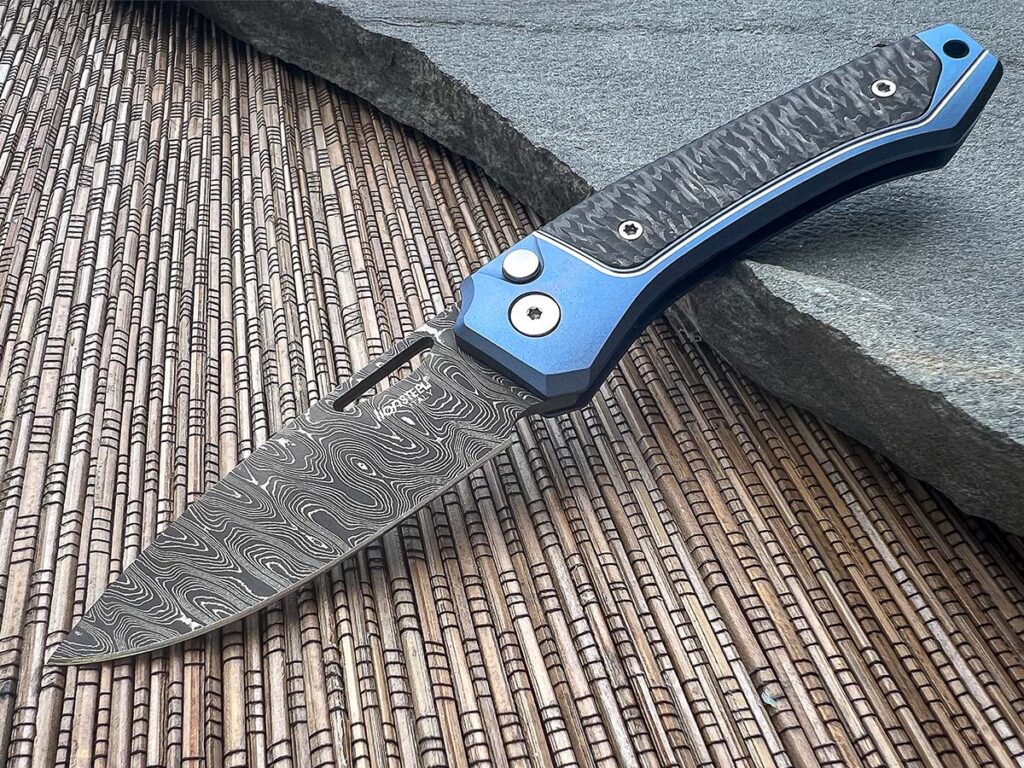
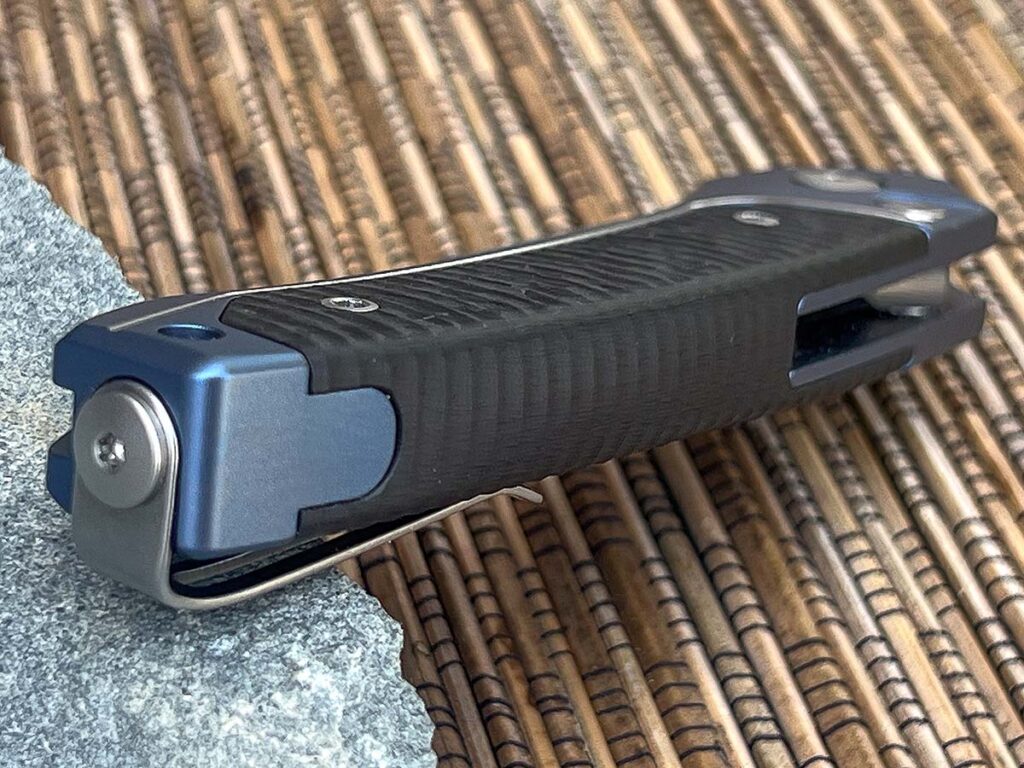
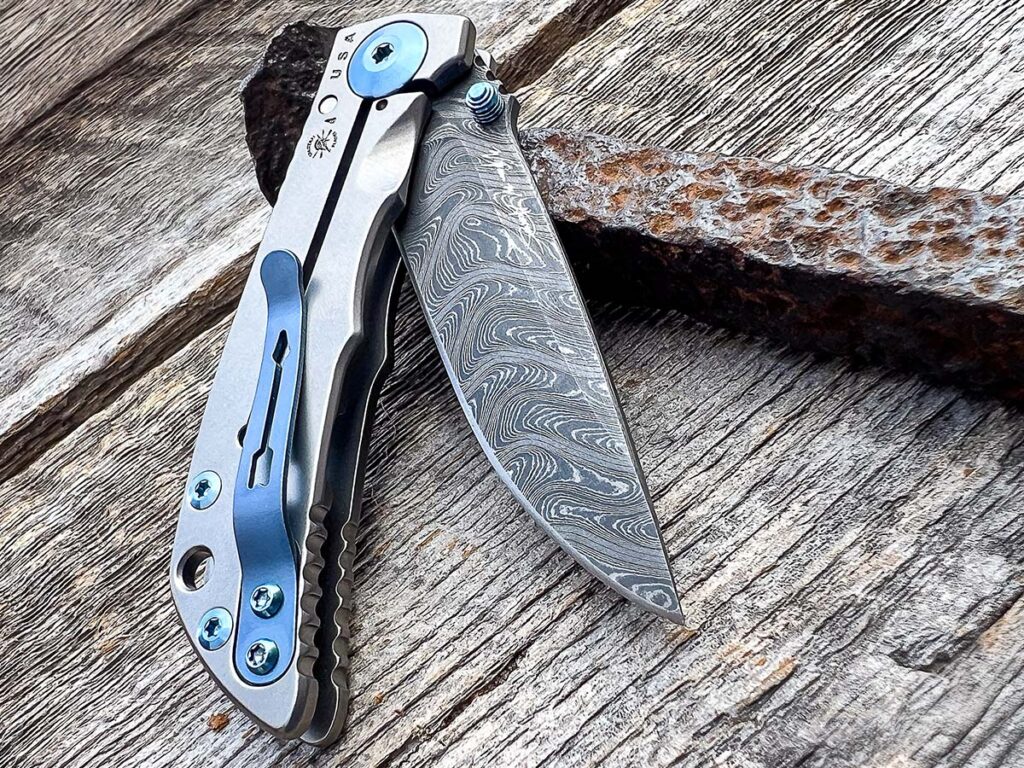
The Spartan Blades Harsey 3.25 folder is a scaled-down, EDC-size version of the Spartan Harsey Folder. The company had been receiving requests for a smaller size that’s easier to carry and less bulky while still retaining the heavy-duty build of the original. Enter the 3.25—and just like the larger Harsey Folder, Spartan also offers the 3.25 in a more-dressed-up version sporting a damascus blade paired with a handle of your choice of plain or a decorative machined titanium. The test knife is the former, a damascus blade with a bead-blasted titanium handle, simply stated but elegantly executed.  

The bead-blast titanium handle of the 3.25 boasts titanium hardware anodized a light blue for an interesting pop of color. 

The drop-point blade is 3.25 (hence the name) inches of Chad Nichols stainless steel damascus in a raindrop pattern. Dual-machined titanium thumb studs provide ease of one-handed opening with either paw. The thumb rest on the spine has some traction notches for a nonslip grip and to apply more pressure to the blade. The bead-blast titanium handle boasts titanium hardware anodized a light blue for an interesting pop of color. The blade secures by a framelock, and a titanium pocket clip also anodized a light blue carries the closed knife tip up. It is a very handsome folder incorporating some heavy-duty elements that make it a great candidate for a user piece.

The 3.25 is a compact workhorse built to go the distance. The flat-ground blade can readily tackle most any daily cutting task: opening packages, breaking down cardboard boxes, slicing steak, or anything else that needs cutting, trimming or stripping. The blade opens smoothly with no play in any direction. It is very solid all around. Multiple finger grooves help seat your hand, providing no-slip control. All handle edges are chamfered to soften the grip and allow the knife to ride in your pocket comfortably. The blade is plenty sharp out of the box and ready for work.  Country of origin: USA. MSRP: $545.

More Knife Reviews:

Beating The Bush: Top Bushcrafting Knives

Four Blades, One Purpose: Bushcraft Mastery

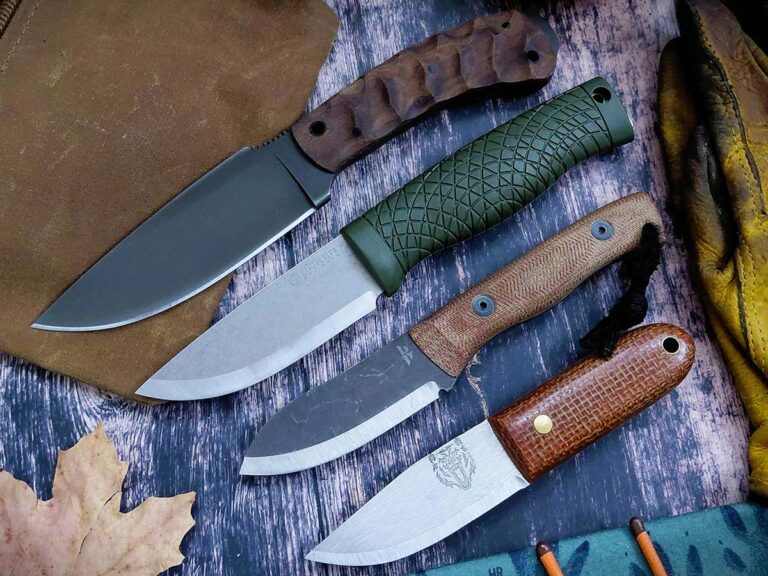
A bushcraft knife is more than a cutting tool—it’s a partner in the woods. Unlike kitchen cutlery or tactical blades, bushcraft knives balance durability with precision. They carve, split and shape wood, strike sparks and handle camp chores with ease. Key traits of a good bushcraft knife include a full tang for strength, a comfortable handle for extended use and a grind suited to carving and slicing. Blade steel must retain an edge while resisting chipping and the sheath should securely hold the knife in rugged conditions. In short, bushcraft knives are built for living outdoors, not just surviving it.

Survival Knives vs. Bushcraft Knives

Survival knives feature a robust design for emergencies, allowing users to chop, pry and withstand heavy abuse. They may feature serrations, hollow handles or multi-purpose functions aimed at crisis situations. Bushcraft knives, by contrast, emphasize control and precision. They carve wood, prepare food and perform camp tasks with efficiency. Where survival knives lean on brute strength, bushcraft knives rely on finesse. The distinction lies in intent: survival knives help you endure unexpected hardship, while bushcraft knives help you thrive in the wilderness through daily, deliberate use.

Böker Bronco Mini

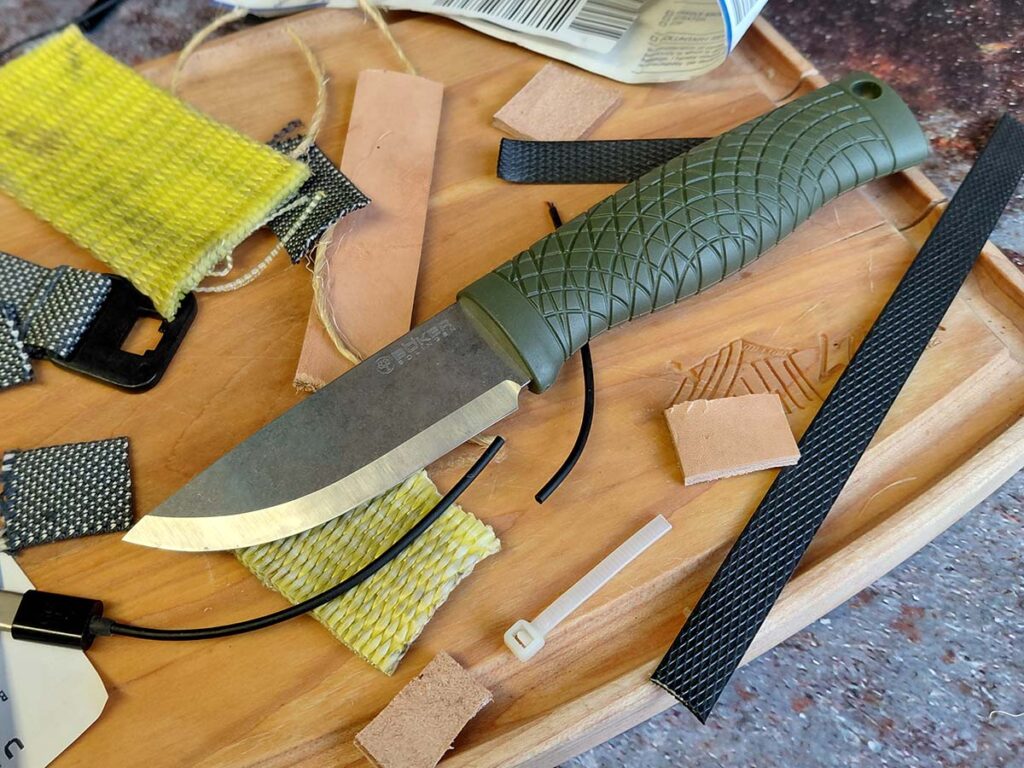
In the utility realm, the Böker Bronco Mini sliced all types of materials with Scandi precision.

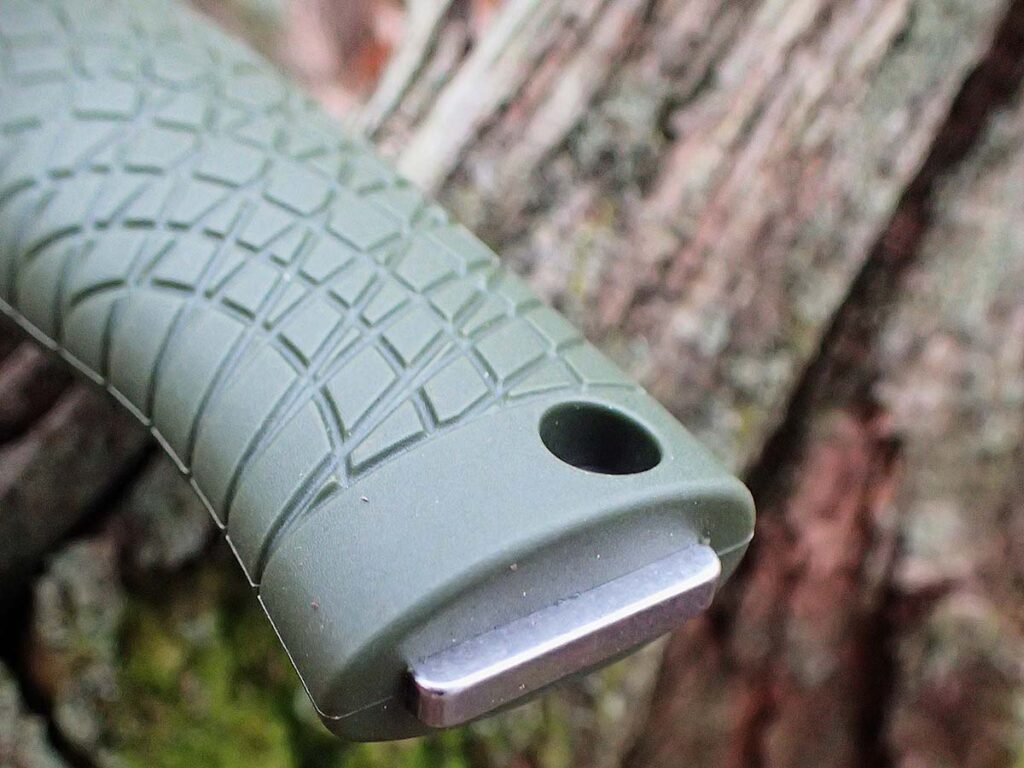
The Böker Bronco Mini Fixed Blade measures 8.23 inches overall with a 3.375-inch CPM 3V blade in a drop point profile. Finished in satin and stonewash, the blade combines toughness with clean cutting ability. A Scandi grind makes it ideal for carving wood and bushcraft tasks, giving precise control in camp chores. To ensure stability, the tang is continuous and extends slightly beyond the handle end, allowing it to withstand strong impacts, such as striking a log. Additionally, a brief segment at the back of the blade features sharp 90-degree edges on both sides. The exposed tang can be used to generate sparks with an optional fire starter. The green TPE handle is textured for grip and measures 4.625 inches, providing comfort and security during extended use. At 4.8 ounces, it balances portability with durability.

A Kydex sheath provides ambidextrous carry and locks the knife securely with a solid click. Compact yet rugged, Böker built the Bronco Mini to baton kindling, process game, and thrive as a daily outdoor companion.

Unbroken Bronco

The exposed pommel/ferro rod striker is an outstanding feature of the Böker Bronco Mini for added utility.

Although the Böker Bronco Mini did all the bushcraft chores as well as any, it really shone in a utility role. I created a solid, realistic gauntlet of slicing tasks for the Böker Bronco Mini. I started with cutting heavy-duty scrap leather on a cutting board, holding it in one hand while slicing with the other. Next, I did the same with high-strength tow strapping. This task was difficult and would dull most new blade edges. This then set the stage for the lighter jobs. Old phone cord and zip ties fell victim to the Scandi blade, as did the jute twine. I cut up a lot of strong plastic package strapping, as we were close to the box-breaking-down season. Still, no issues.

With the amount of traveling I do, my life is full of luggage tags and boarding passes. If the edge wouldn’t slice these, I’d know the more robust materials dimmed it down. The Böker Bronco Mini passed the utility test like a champ. These were very realistic everyday chores that extend past the duration of this review.

Knives By Nuge Cub‑Muk

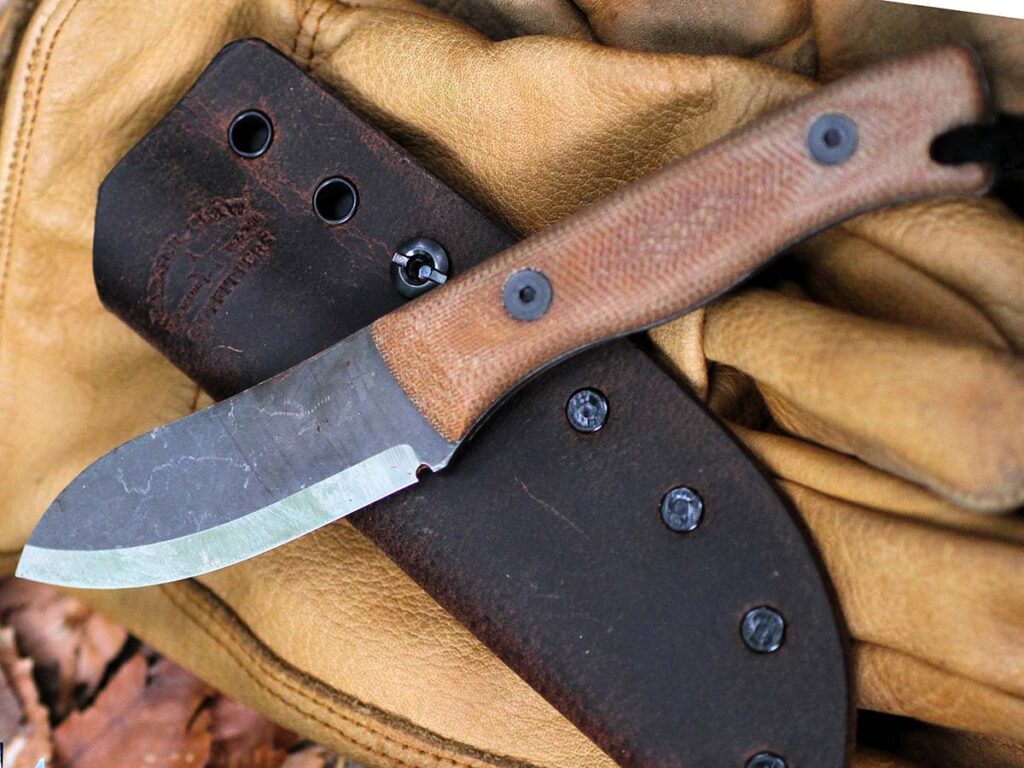
The Cub-Muk is a newish installment of the Knives By Nuge Cub series. The author used it as his companion blade in the Adirondacks with Nuge.

Inspired by the classic Nessmuk pattern, the Cub-Muk offers a compact yet full-featured design. Measuring 7 inches overall and featuring a 2.75-inch blade, with AEB-L stainless steel and a blackened, tumbled finish for durability. The Scandi grind, also available in Saber, excels at carving wood and shaping camp tools. Canvas Micarta scales provide a secure, weather-resistant grip, while the leather sheath adds traditional appeal and reliable retention. With its stout blade and full-sized handle, the Cub-Muk delivers agility and precision, making it a favorite for fine bushcraft work where control and efficiency matter most.

Floatplane-Camp Test

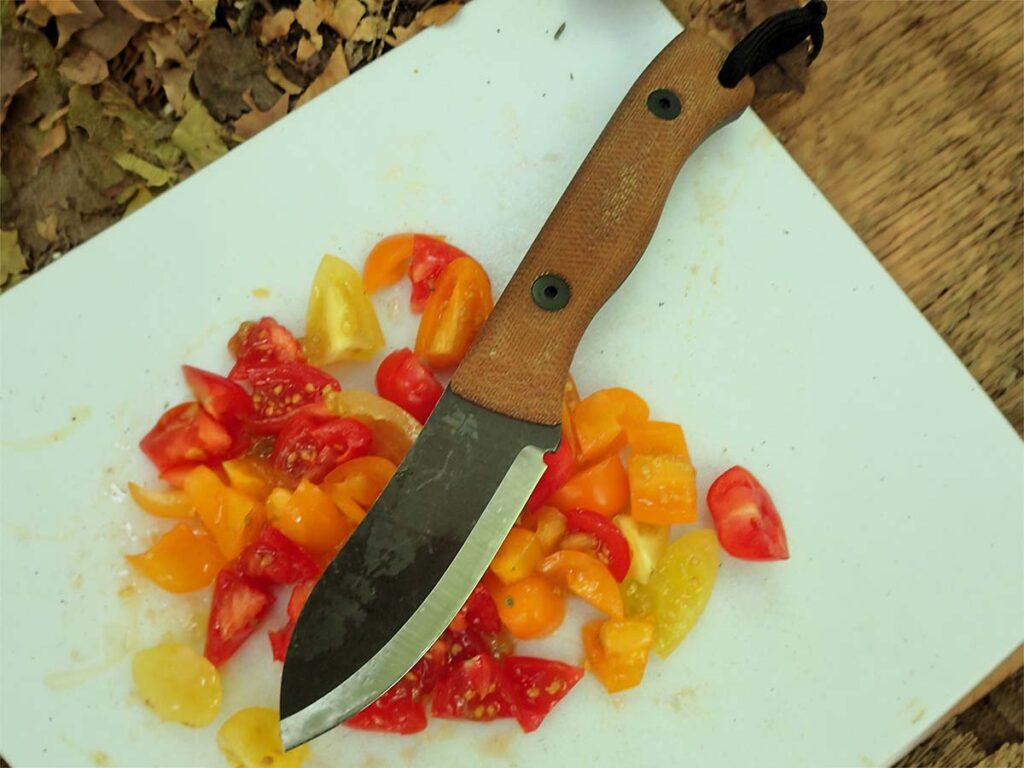
In the Adirondacks (upper right), the author prepared food for the camp using the KBK Cub-Muk. Proving the Scandi blade can slice tomatoes and process food.
In the Adirondacks, the author prepared food for the camp using the KBK Cub-Muk. Proving the Scandi blade can slice tomatoes and process food.

During my time in camp, the Knives By Nuge Cub‑Muk proved itself as a true workhorse. I carried it five days straight in the Adirondacks, relying on it for every small task that came up. Food prep, cordage cutting, and campcrafts were routine. The AEB‑L steel held a keen edge, and the hump‑backed spine added utility, scraping fish clean and even scooping meals when needed. Safely, of course.

Projects around camp highlighted the Nessmuk’s strengths. I carved pot hangers, stakes, and tool handles from both green and seasoned wood. Instead of chasing perfect points for stakes, I favored wedge ends that drove easily into the soil. Light taps with a stick set stop cuts for notches, giving me clean results without heavy batoning. The Scandi grind excelled at feather sticks, producing fine curls that caught quickly. Paired with a ferro rod, the squared spine showered sparks, igniting tinder in seconds.

The Cub‑Muk blends Nessmuk’s classic lines with modern materials, creating a compact knife that sees constant use. Its sharp edge, comfortable handle, and versatile design made it indispensable. From carving camp gear to starting fires, it delivered precision and reliability, proving that small knives often carry the biggest load in the woods.

Winkler Woodsman

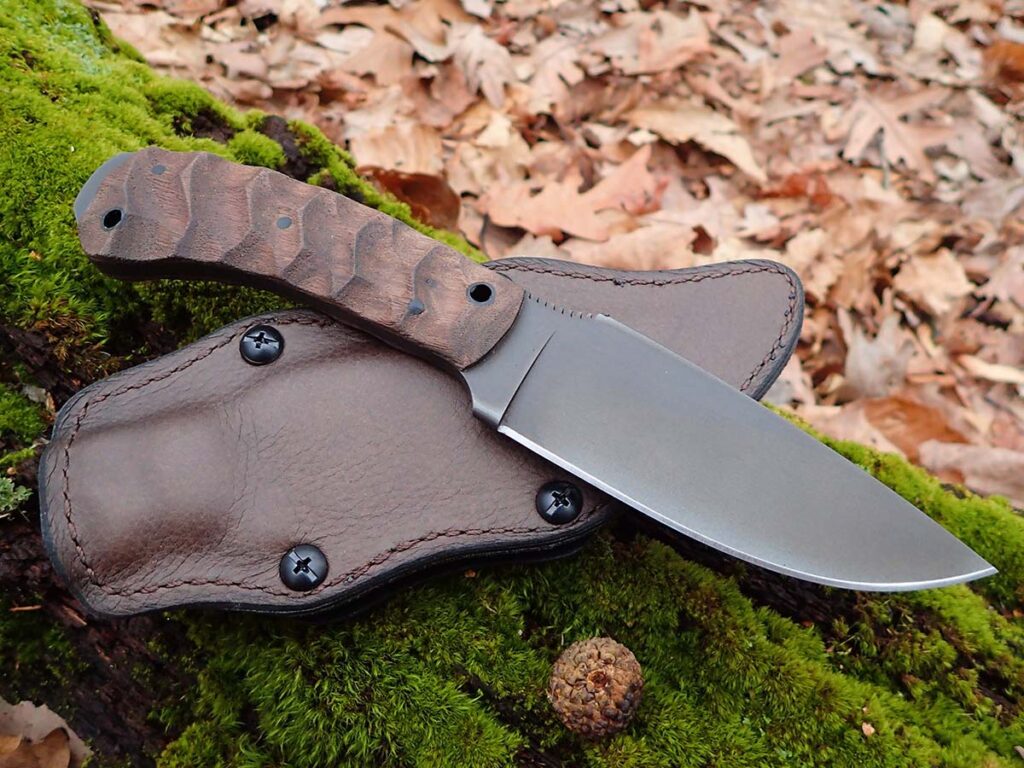
The Winkler Woodsman has an 8.75-inch overall length with a 4.25-inch blade forged from 80CrV2 steel and finished in Caswell black oxide.

The Winkler Woodsman measures 8.75 inches overall with a 4.25-inch blade forged from 80CrV2 steel and finished in Caswell black oxide for corrosion resistance. Its flat grind and drop-point profile provide versatility for carving, slicing and light chopping. The sculpted maple or canvas laminate handle offers a secure grip, while the skeletonized tang reduces weight without sacrificing strength.

A lined Boltaron sheath with a leather overlay and a spring-steel belt clip ensures reliable carry. Built for balance and control, the Woodsman blends rugged durability with refined handling, making it a standout choice for serious bushcraft tasks.

Table To Woods

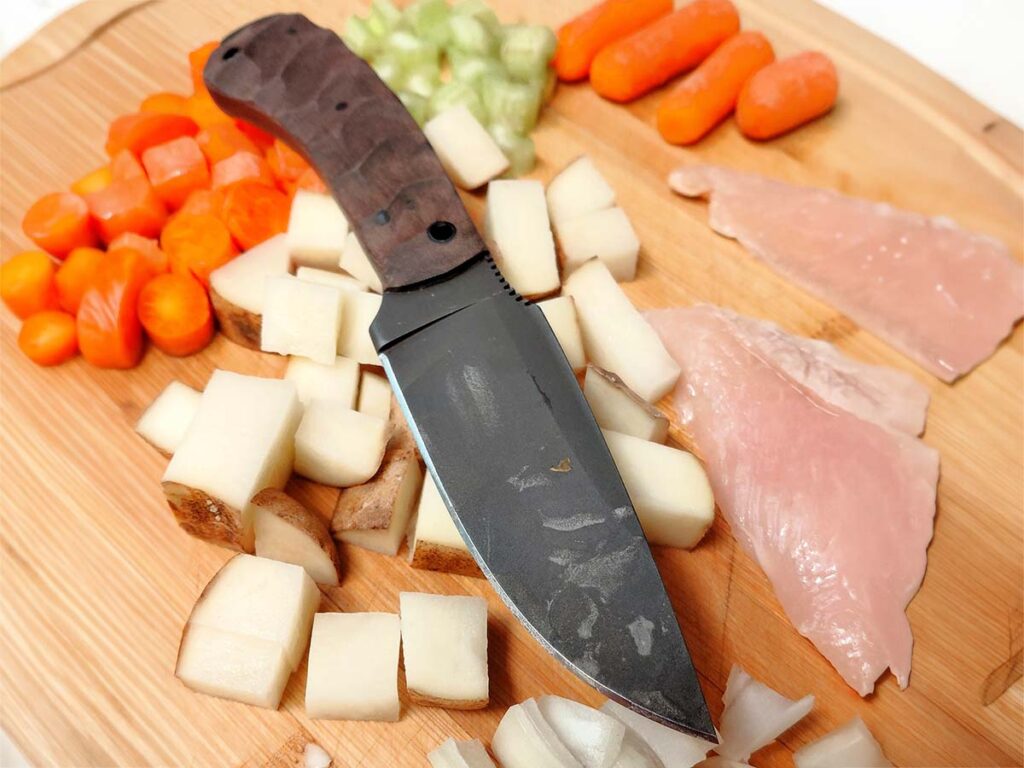
A bushcraft stew wizard, the Winkler Woodsman performed well on a rustic chicken stew.

It was a cold-weather stew week when I got the Winkler Woodsman, so I put it to work right away in the kitchen. Carrots are always a more challenging task for a bushcraft knife. Typically, bushcraft knives’ thickness and Scandi grind messily wedge and split root veggies. Luckily, the Winkler Woodsman has a high saber grind, which some would call flat. It easily cut the stubborn carrots using a longer stroke. Celery and onions were just as simple with the longish bush blade, thanks to its sharpness out of the box and its grind. I used a chef’s grip (pinch grip) with comfort. The potatoes were russet, which aren’t too hard and cook rather quickly. Still, they can be difficult like carrots. No worries with the Winkler Woodsman, however.

Lastly, there was a delicate chicken breast, which I butterflied and boiled for easier, faster cooking. The blade shape was perfect for this task. I don’t think any other blade for this review could have done the same stellar job for a winter chicken stew as the Winkler Woodsman.

Bear Forest Simple 2

The author uses the Bear Forest Knives Simple 2 in a chest-lever grip for making camp tools.

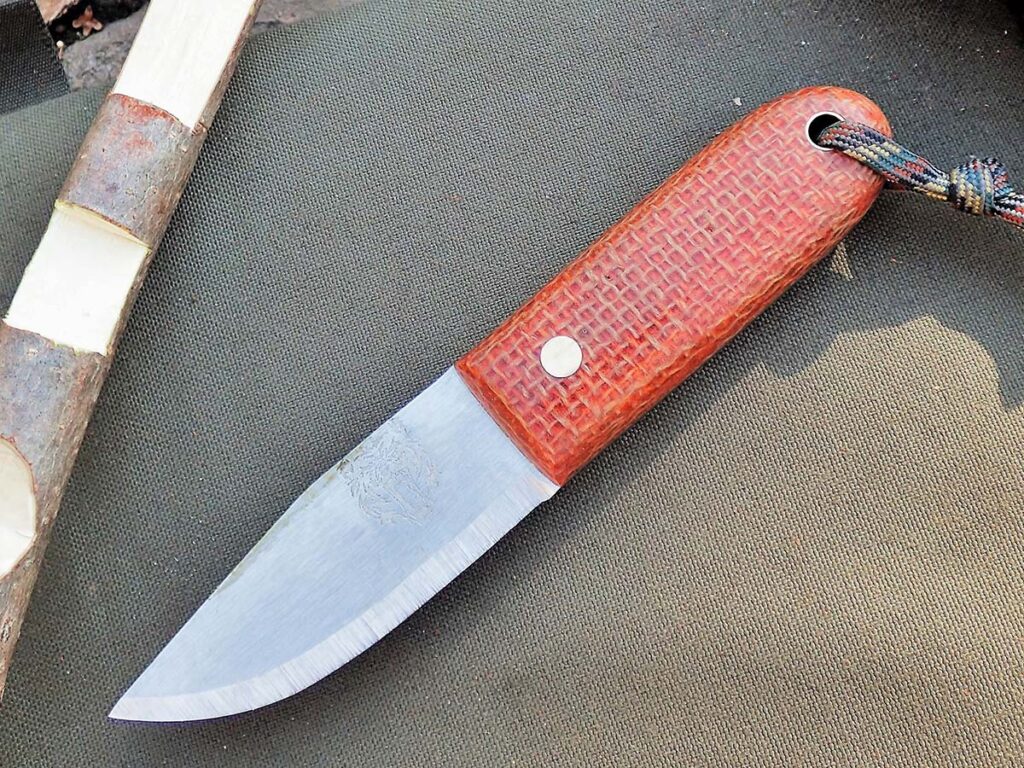
Sized down from the original Simple series (4-inch blade), the Bear Forest Simple 2 measures about 6 inches overall. It features a 3.5-inch AEB-L stainless steel blade. Its zero Scandi grind bites cleanly into wood, excelling at carving and slicing tasks. Butterscotch and Mocha paper Micarta with red burlap “bearcarta” scales give the handle a warm, secure feel.

The ambidextrous JRE leather sheath (black) allows for belt or neck carry. Lightweight yet tough, the Simple 2 blends corrosion resistance with practical design. It’s streamlined for everyday bushcraft chores, offering a reliable companion for carving, camp setup and field use without excess bulk.

Simply Qualified

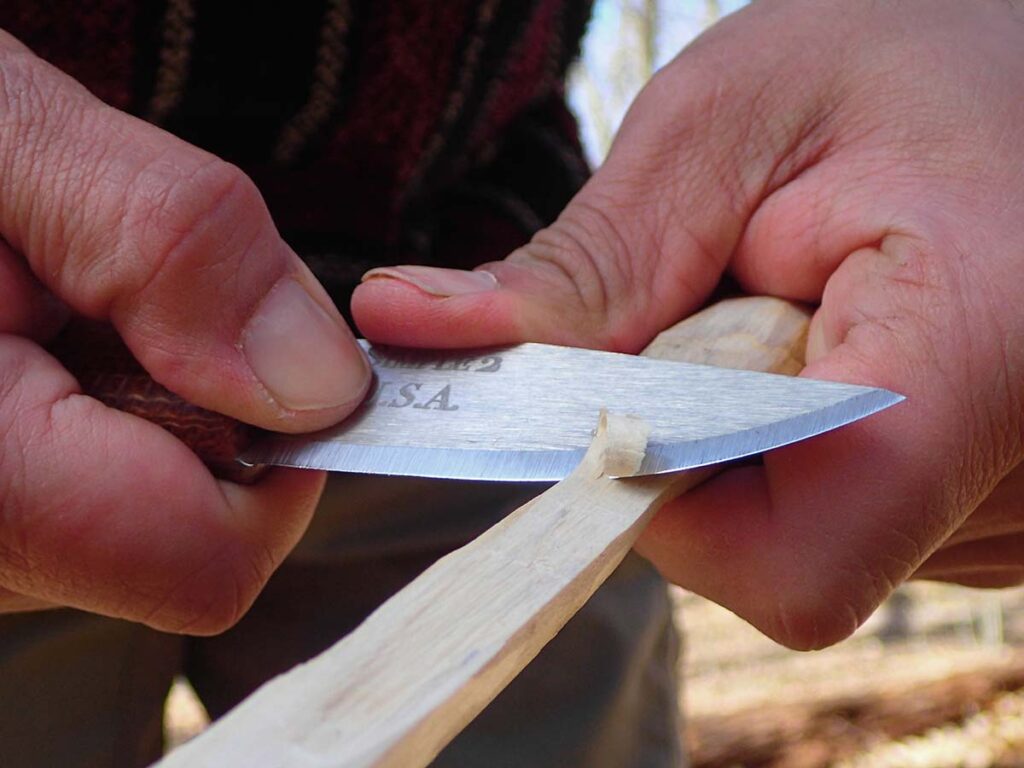
The author made a try stick with the Bear Forest knife, quickly and efficiently.

I gave each knife a project suited to its strengths. For the Bear Forest Knives Simple 2, I chose the classic try stick—a green branch about arm’s length and thumb to broomstick thick. It’s a perfect way to practice knife control and notch work. Over several months, I used the Simple 2 for fire prep, food tasks, and camp projects, including tarp stakes and a bowsaw, but the try stick demonstrated its precision. I carved 11 practical notches, from root strippers and V-notches to square reductions, latch notches, and lashing crosscuts. In the middle, I shaped double flats and pierced a square hole with the pointed tip, cradling the handle in my palm for control. I added a saddle notch, a round reduction, a pot hook and a rounded end for digging sticks or stakes.

The thin edge bit deeply, shaving clean curls for tinder. The belly of the blade handled reductions, while the sharp spine proved useful for peeling bark. The oval handle stayed comfortable, with a rounded butt that anchored the grip. Compact yet capable, the Simple 2 excelled at fine carving and practical camp work, proving itself a reliable bushcraft companion.

Bushcraft Breakdown

You can’t go wrong with any of the bushcraft blades here. They have their strengths without many drawbacks!

More Reviews:

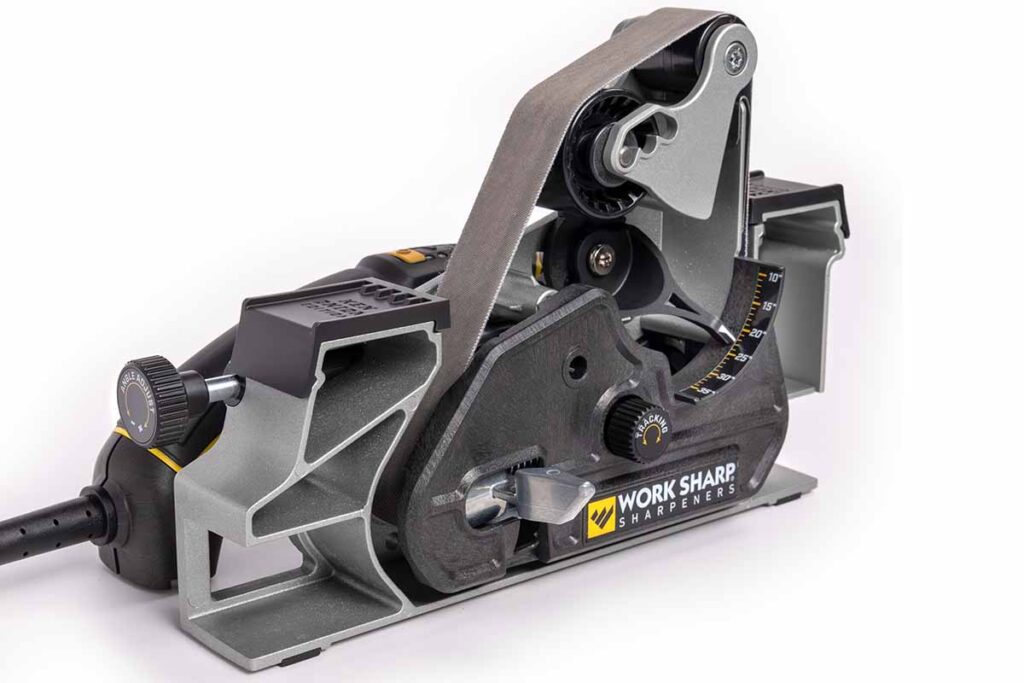
First Look: Work Sharp Ken Onion Knife & Tool Sharpener MK.2

The work-horse tool gets some upgrades.

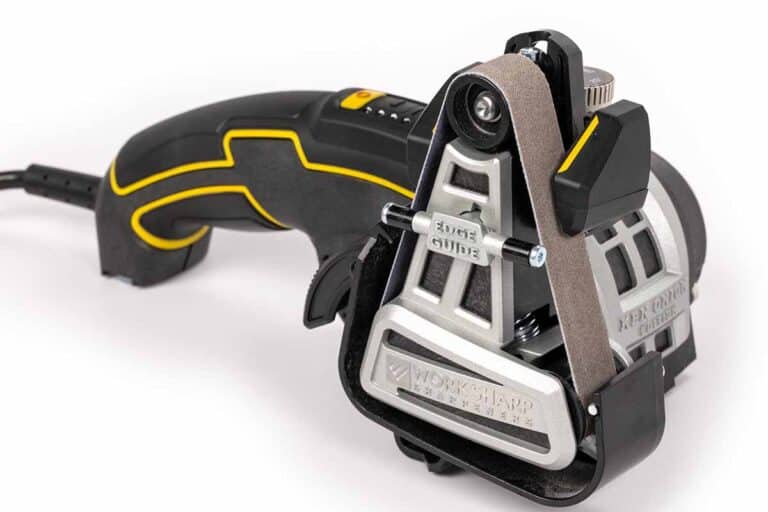
Work Sharp’s Ken Onion Knife & Tool Sharpener has been keeping knife enthusiasts’ edges sharp for a decade. A good run, by anyone’s measure. But the device’s time is up as the company welcomes the dawning of a new era—the Ken Onion Knife & Tool Sharpener MK.2. I’m sure some of you saw that coming.

Thankfully, Work Sharp hasn’t reinvented the wheel with the refresh of this time-tested multitool. Instead, the unit maintains many of the features that made it popular in the first place but offer a few notable enhancements that sharpeners and makers should find welcome, including a MK.2 Elite model with grinding functions.

Chief among the enhancements is the MK.2’s speed control, now offering seven preset speed settings to provide consistent and repeatable results. A new torque control delivers consistent power, even under load. To make the sharpener easier to dial in, Work Sharp has included a very clear amber LED indicator light for the belt speed selection for quick and precise adjustment. Furthermore, a scope click adjustment knob on the sharpening guide, with detent clicks, allows users to adjust in half-degree increments by touch. Incidentally, the guide is adjustable from 15 degrees at the low end to 30 degrees at the high, hitting nearly every angle for both knives and tools.

The MK.2 also comes with leather-lined angle guides that offer protection for knives during sharpening. Users will also note a lockout belt tensioner on the sharpening cassette that helps make changing abrasive belts fast and simple. The Ken Onion MK.2 will come with five grits to accommodate the full spectrum of sharpening from repair to ultra-fine polishing.

Ken Onion Elite MK.2

As for the grinding, the Ken Onion MK.2 Elite model has some interesting aspects too. The redesigned grinder attachment quickly and easily mounts to the power base without tools or calibration. Once attached, the grinder boasts on-the-fly motor speed control and continuous run time. Additionally, an adjustable, three-position convex pulley system allows users to customize their grind profile depending on personal preference or the type of knives being sharpened.

The Ken Onion Knife & Tool Sharpener MK.2 boasts a $200 MSRP for the base model and $300 MSRP for the Elite. While the original sharpener has been a standby for a long time, the new addition to the Work Sharp lineup should prove sharp.

Check Out More Knife Drops:

Cool Custom: Corey Ryenolds’ Copper-Mai Sawback Bowie

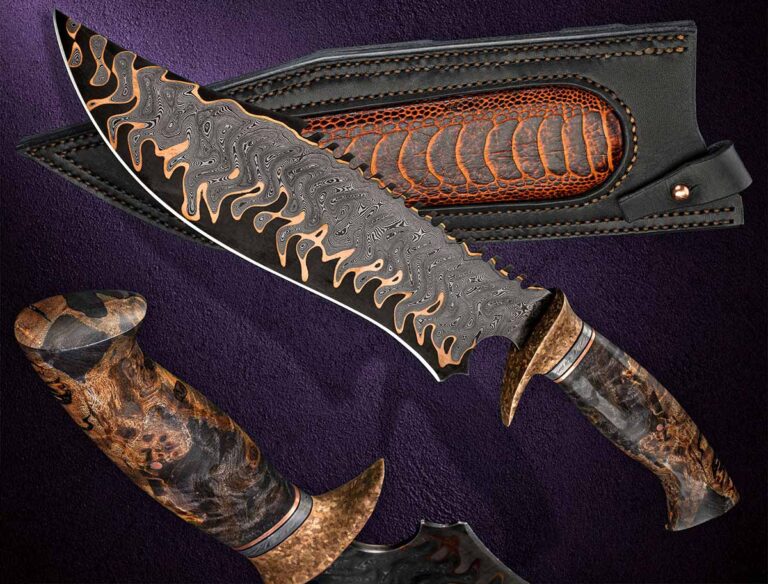
Inspired by Rambo’s knife, Corey Reynolds’ sawback bowie channels the genre in a copper-mai chevron pattern.

Like many boys his age, Corey Reynolds grew up watching Rambo movies. Now 43, he’s been making knives about three years and decided he wanted to make a knife with a Rambo look—and what better way to do that than with a sawback bowie?

For blade material he used copper-mai steel in a chevron pattern from Baker Forge and Tool, and for the piece de resistance configured the sawback so the copper would be exposed at the base of each tooth.

Though the way he did the teeth is mostly for looks, he said each tooth has a fairly good edge. The handle is spalted maple from Steelhead Forged Scales with spacers of copper, raindrop-clad feather damascus forged by Adam DeVille, and G-10. The guard is of a striking multi-etched material called gem bronze from Mike’s Metalworking.

Sawback Bowie Specs
Maker: Corey Reynolds
Blade Length: 9”
Blade Material: Copper-mai in a chevron pattern
Handle Material: Spalted maple w/copper, raindrop-clad feather damascus and G-10 spacers
Guard: Gem bronze
Overall Length: 15”
Sheath: By the maker of leather w/ostrich leg inlay from Ray’s Ostrich Leathers
Maker’s Price For A Similar Knife: $1,400

Check Out More Cool Custom Knives:

Fillet Knives That Are Bad To The Bone

0

These babies will unzip your catch with ease.

While you may think a fillet knife has only one purpose, there’s as much variation in fillet knives as there is with any other knife type. Just as there’s no one type of pocketknife, neither is there one type of hunting knife. Treating the fillet knife as an afterthought for your fishing is a mistake. In other words, you want to match your quarry to your blade.

Fillet Knife Size

The vast majority of American anglers, and most in Europe, fish either in inland waterways or along coastal waters. While it is certainly possible to catch large fish in these places, few people realize just how large of a difference there is between a 5-ounce bluegill and a 50-pound sturgeon. When you get above 10 pounds, you run the same risk of breaking fillet blades as you would breaking hunting blades on large game like deer. The flesh, bone and scales of fish are far tougher than many realize and a fragile blade can and will break if you put too much pressure on it. Heavy-duty fillet knives exist and are specially designed for larger fish.

Fillet knives handle
Handles are an important consideration. Texture matters on these fine knives and for some outings you need a very sure grip.

Likewise, small fish do not benefit from larger knives. This should seem like common knowledge, but I see anglers with 8-to-10-inch knives going after panfish. This is not a bad thing overall, just really unnecessary for the task. In my experience, large work like skinning deer and breaking down large game needs a 7-inch blade; you want to be able to see what you’re working with and keep your hand out of the body and highly visible. With small fish, you want the tip closer to your hand to better control your cuts. Fish cleaning is an activity that leads with the tip. You need to have it cut in easily and then glide. A paper-thin blade isn’t meant for chopping or sawing, unlike what you can accomplish with a thick-spined hunting knife.

Blade Flexibility

Flex is another important aspect of a fillet knife. Because of the way fish are shaped you want a blade that has the ability to match contours and glide along the spine or under the skin. Flex varies depending on the task. On large fish you’ll want the least flex, on small ones you’ll want the most. As for the tip, the largest fish need a reinforced tip because skin and fat can be extremely thick, and a thin tip is more likely to bend or break. Ideally, the tip should be as fine as possible and come to a narrow-angle. However, this becomes a hard thing to accomplish when you need a fillet knife that is also very strong. To get this, you need something like the tip of a wharncliffe pattern that provides a fine point while maintaining a thick blade.
Some Of The Best Fillet Knives

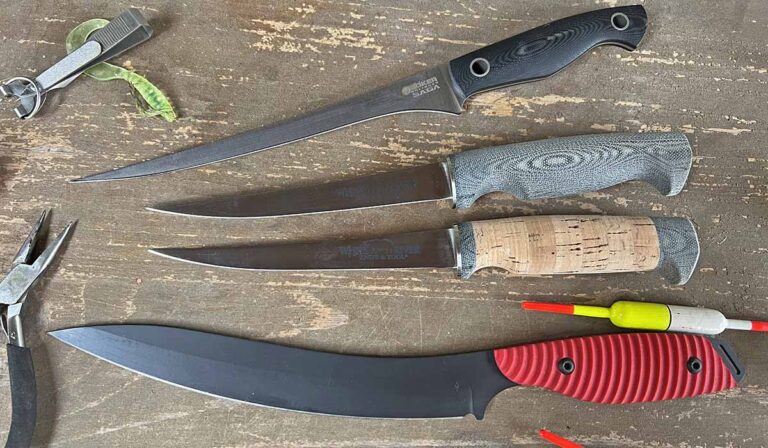
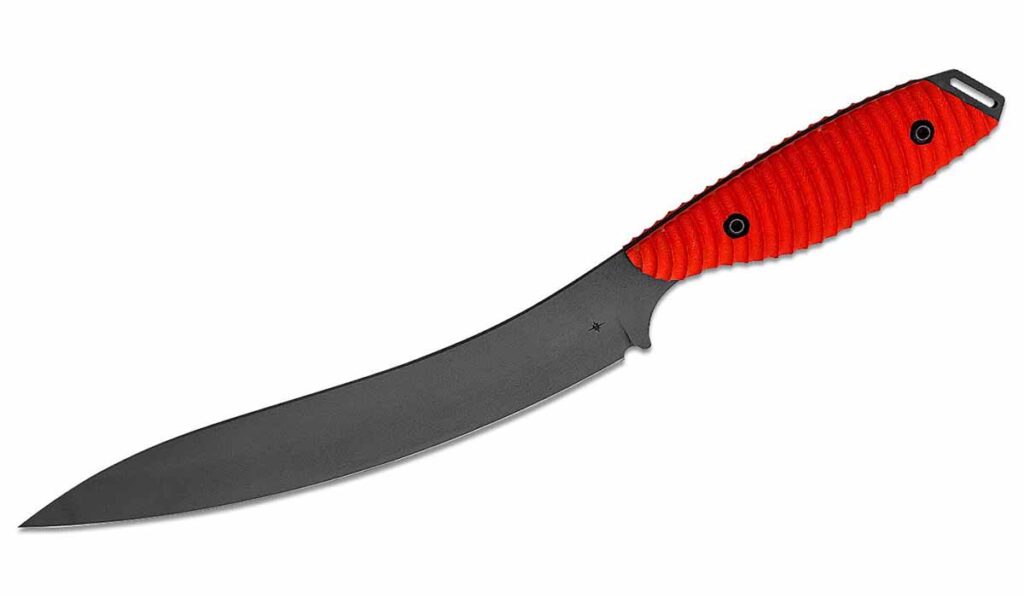
Toor Cardiff

Fillet Knife Toor

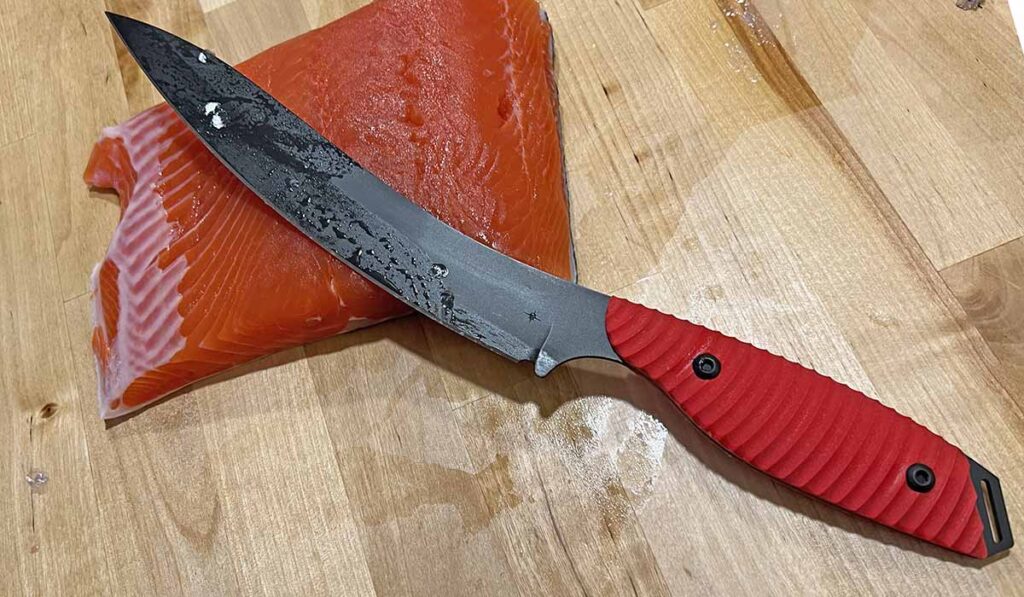
The Toor Cardiff is perhaps the most well-designed and best-thought-out knife for large fish. Just about every part of the knife is properly contoured and ground to achieve a light, thin blade that is also very strong and razor-sharp. It is the thickest knife of the test bunch, but, at just .09-inch thick, is still considerably thinner than standard blades. It does not taper substantially from pommel to tip. The point of the knife is quite fine but shaped with strength in mind. Its edge geometry enables it to be used on most sizes of fish, though it is at a slight disadvantage on the smallest bluegill or anything you would throw in the pan as one piece. This has more to do with the overall size of the knife than it does cutting ability.

Cardiff knife
Large salmon were no match for the Cardiff, a well-thought-out, hard-use fillet knife that can also be used for large game. It is a crossover knife meant for the field, not just light work at the dock.

The blade has a curve with a deep belly. It permits the hand to sit at a more relaxed angle if you are cutting steaks or slicing a thick fish along the spine. The grip is very aggressive and promotes a firm hold even when your hands are covered in fish slime, water and blood. The knife is ruggedly designed and a suitable tool even for large game, including deer. While it does have some disadvantages as compared to a dedicated hunting knife, you could certainly get away with it as your primary blade for a mixed-bag hunting/fishing adventure. It does very well in the kitchen but you can tell it needs to be in the field.

White River Knife & Tool Traditional Fillet

Fillet Knife Whit River

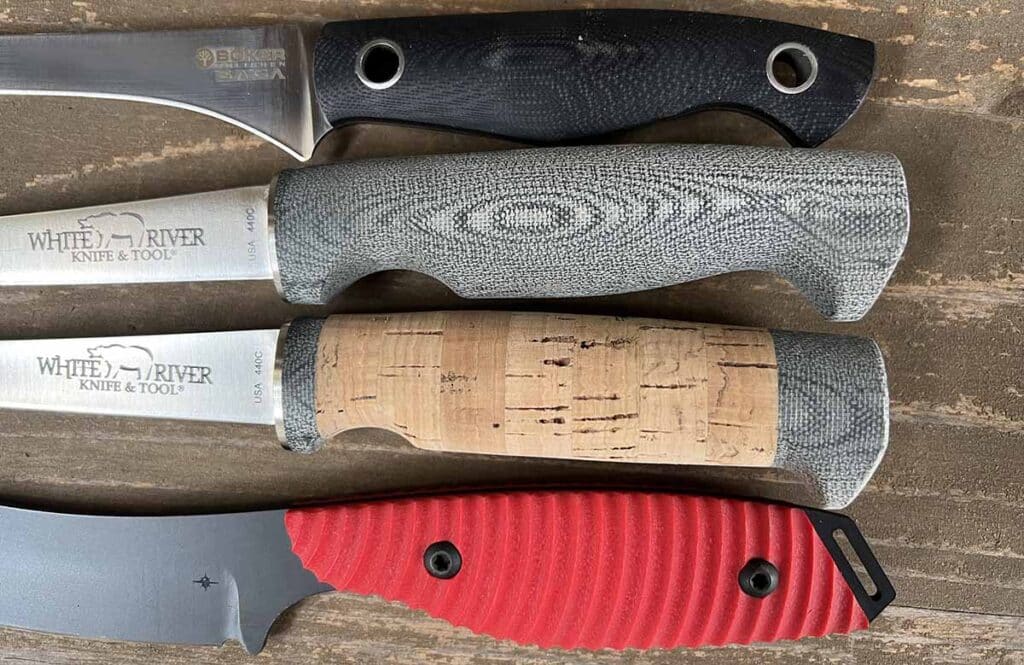
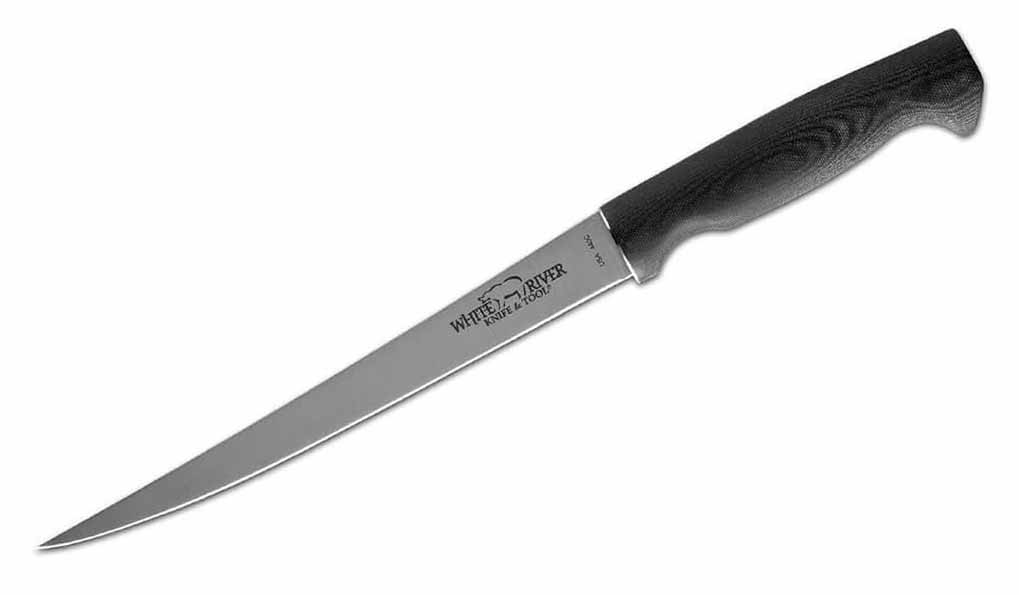
When you think of a fish knife, the White River Knife & Tool Traditional Fillet is probably what comes to mind. White River is excellent when it comes to delivering traditional appearance with modern function. I have been using White River knives almost exclusively in the field for years for deer hunting, and I jumped at the opportunity to look at its fillet knives. Not only are White River fillets some of the best money can buy, they also are the best across-the-board for general fishing use. Moreover, they display some noteworthy properties.

While there are two White Rivers in the review group, they are for all purposes the same except for the fact that the cork-handle version will float. I especially like this feature considering I spend some time in kayaks and canoes. A cork handle is not as durable as the full Micarta® version but will last a lifetime if properly maintained and not abused. The two are not for hunting. They are dedicated for fishing and should be used as such.

White River fillet knife
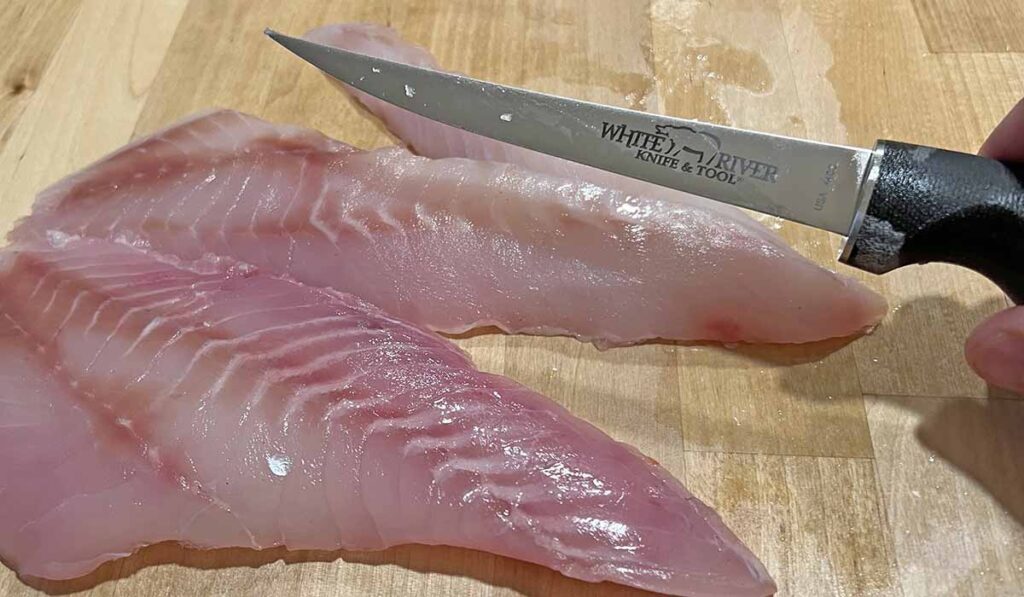
The White River fillets performed well for all general use.

As far as overall performance, the White Rivers will do everything you need and nothing you don’t. They are dedicated fillet knives that are, at least in the 6-inch size, best on intercontinental species. There really isn’t anything you can fish for in an American river that you can’t process with these knives. They are a tad thin for heavy-boned fish and the largest river catfish, but if you’re careful you should be just fine.

The knives come in an excellent wooden presentation box and have a functional, adjustable sheath with multiple mounting options. When sheathed, the blade can be used as a line cutter thanks to a small cutout toward the end that you can slip a line into. For dock work these knives are great. I eventually came to prefer the cork-handled version even though it is a little harder to keep clean. In the kitchen, they performed equally and stayed razor-sharp for the duration of testing.

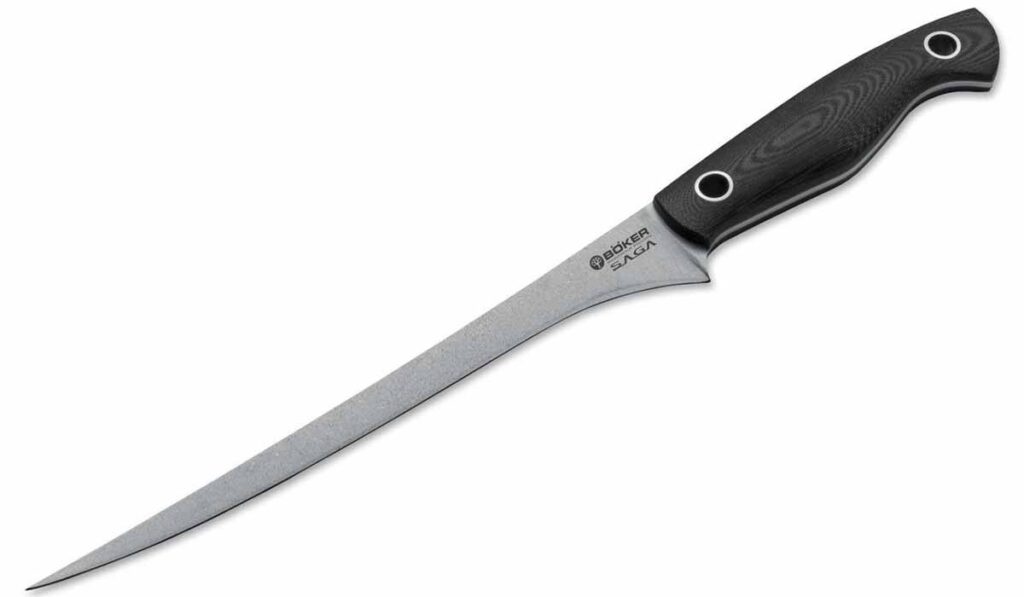
Boker Solingen Saga Filetiermesser

Fillet Knife Boker

From the moment you open the box, the quality of the Boker Solingen Saga Filetiermesser is immediately apparent. You can tell it was made with great attention to detail and is a singularly specialized tool. Unlike the other test models, it does not come with a sheath. It is also quite smooth in the grip and clearly meant for end processing in the kitchen.

It is the sharpest test blade and also the thinnest. The thickness at the choil is just .07 inch, and it tapers from grip to tip quite aggressively considering how thin it is to start. The tip is like a scalpel point. It is so incredibly fine that you must be aware of its presence when working. If you cut yourself with it, you probably wouldn’t even know. I didn’t.

Boker Fillet knife
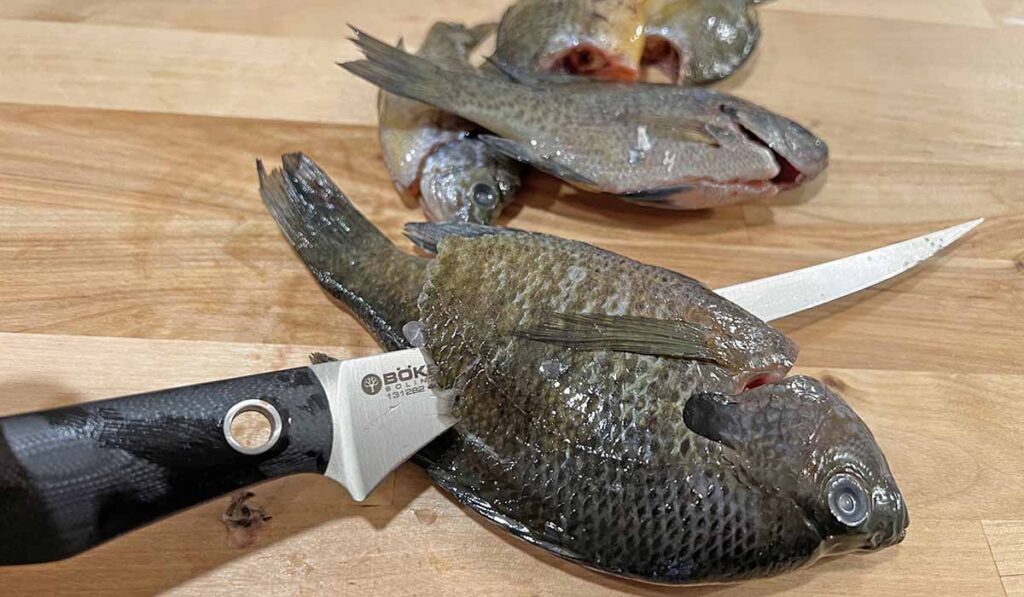
The Boker’s narrow edge makes it excellent on even the smallest catches.

Working with this knife in the kitchen is effortless. It is so sharp that it cut through all the fine bones in salmon; it simply glided right through. The blade is the most flexible in the review and bends quite a bit, though this is not a concern. The quality of steel and manufacture ensures it goes back to true even after substantial use. Because it has a smooth grip and is so incredibly fine at the tip, I would not immediately recommend the Boker for use in the field. If you decide to take it to camp, I would suggest either transporting it in a dedicated case or find a sheath that fits it.
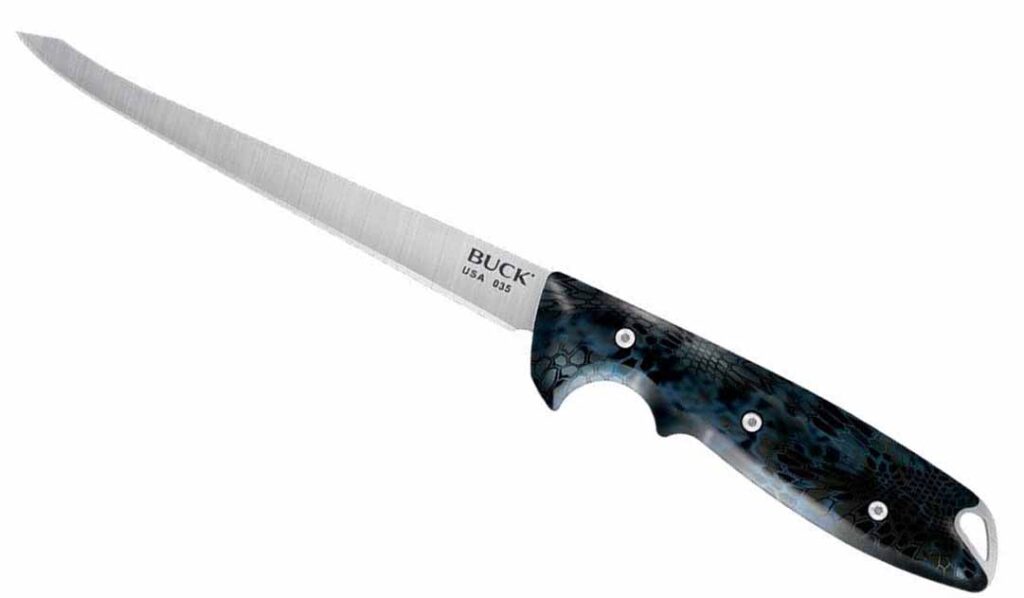
Buck Abyss

Fillet Knife Buck

The Abyss is a fillet knife Buck brought a little style to by using a Kryptek Pontus camo handle. Normally you just get some kind of bright rubber but this handle has some style to it. Overall length is 12 inches and the blade measure 6.5 inches. Buck lists it as a 6-inch blade but I can tell you my tape measure isn’t broken.

The 420HC stainless steel blade features a double-ground tip and a distal taper. The double grind gives you an edge on the back of the tip to make puncturing and entry cuts easier. The distal taper gives the blade stiff ness toward the handle for use with large game fish. A more flexible tip area makes it useful for smaller fish. By using a distal taper, Buck can get away with having the Abyss straddle the fence between a stiff fillet knife and a flexible one.

The Kryptek scales have a slight texture but they also sport lateral contouring to aid in a secure grip. Sure, the Abyss does not have a super blade steel, but 420HC has been holding its own for years.
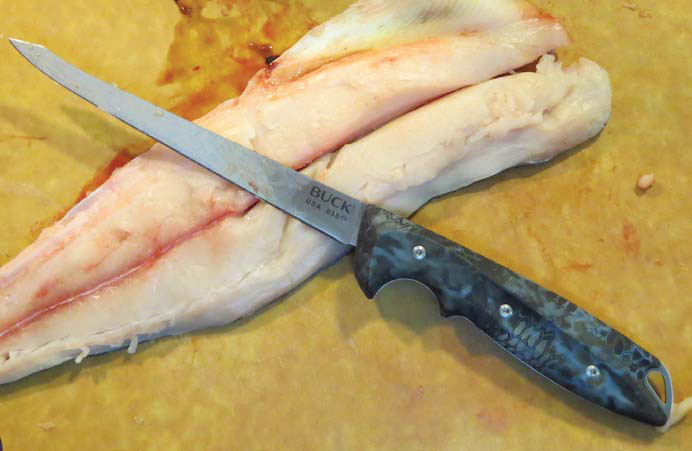
During testing the Abyss did fine for handling and cutting—in fact, I like the knife very much.

new fillet knives 2018
Buck’s Kryptek Pontus handle has style and utility. The appearance is somewhat reptilian and features a subtle texture. To add to the user friendliness, the contouring is well designed.

I would have to say my only doubts are about the sheath. Buck provides a simple pouch sheath with a plastic insert to carry the knife. Though I’m not planning any long adventures hauling it around with me, I still find the sheath lacking. Inserting and drawing the knife is a clumsy affair, as the fit is tight. I also find the material, in my opinion, not robust enough to take years of use.

Kershaw Folding Fillet K-Texture

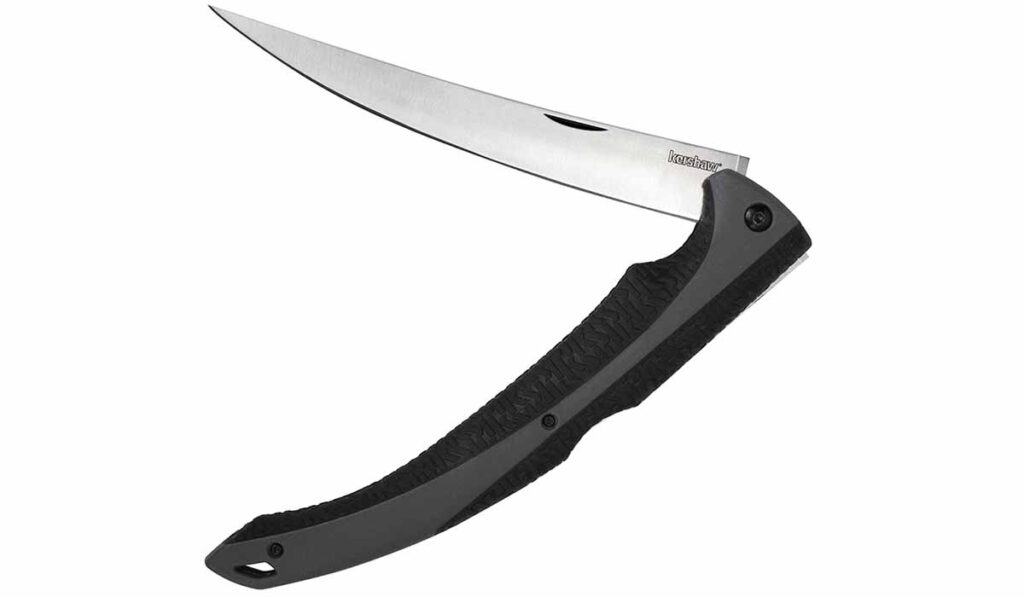
Fillet Knife Kershaw

As with many folding fillet knives, the excessively large handle of the Kershaw Folding Fillet K-Texture tends to be disproportionate to the entire design. The 6-inch blade has a slight distal taper and is 420J2 stainless steel.

Even with a distal taper the blade has a mid-range flex—not really stiff but not very flexible, either. The lockback folder’s closed length is 7.75 inches. The knife does not come with a sheath.
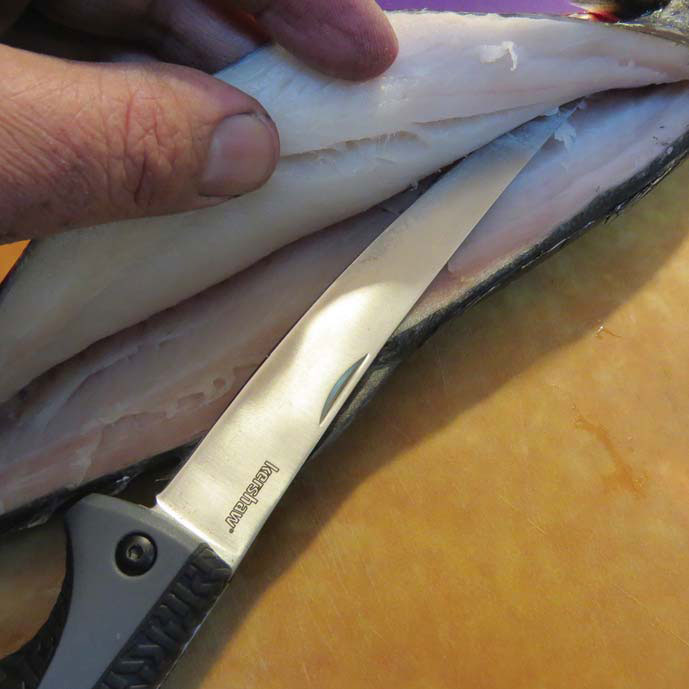
I like to test the blade’s edge right out of the box. One of the most difficult things to do with a knife, believe it or not, is put the first edge on the blade. To the best of my knowledge, with all the CNC machinery out there, this is an operation that is still predominantly done by hand. Out of the box, the Kershaw was razor sharp.

kershaw folding fillet knife
Kershaw’s fillet knife follows the spine bones for a perfect cut so you get the most from your catch.

Even before I took it fishing, I put it through some paces in the kitchen by skinning a tomato. I was impressed with the initial edge. Holding the knife is easy thanks to the duel-textured, or “K-Textured,” handle. The rubber has many small “K’s” patterned into it for the texture while the main plastic part of the scales is slightly textured. Accompanying the texture is an ergonomic handle, which seals the package.

Overall, I like the knife. It can be used for fishing under most any condition, but I see it as a great tool for fishing holes that require a long journey to access. The fact the knife folds gives you a fillet model in a smaller, safer and more convenient carry package.

Gerber Controller

Fillet Knife Gerber

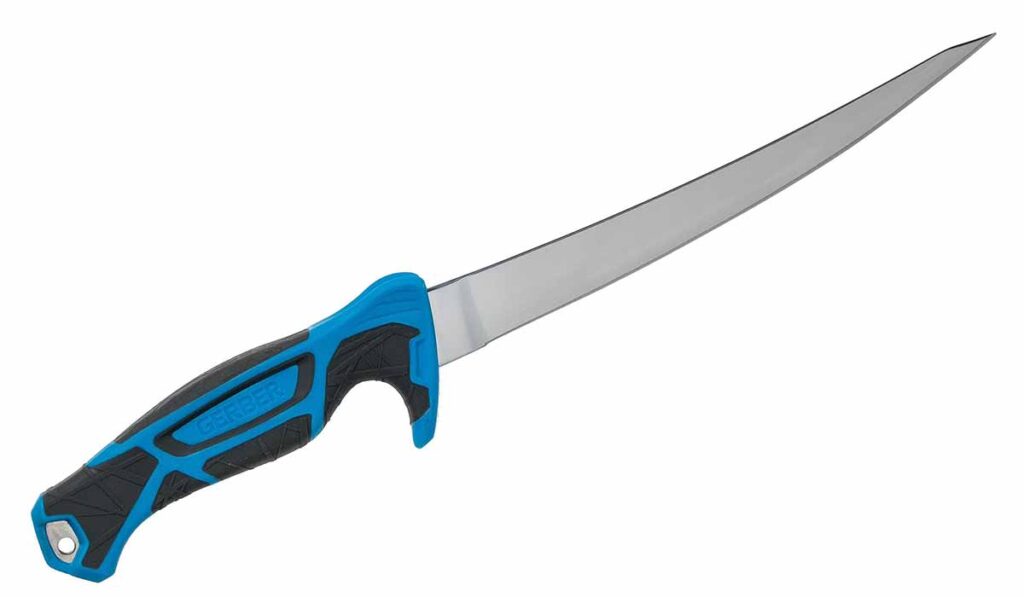
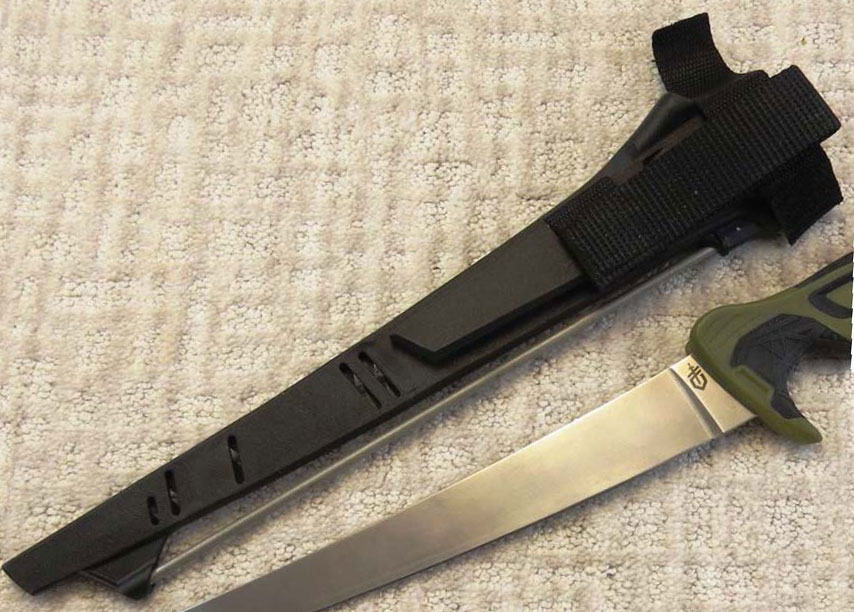
I am not in favor of loading a knife down with too many features. In the case of the Controller 10-inch fillet knife, Gerber has provided more than a knife but did not get carried away. The Controller is a full system fillet model. At 15.5 inches overall, it has a 10-inch blade of 9Cr18MoV stainless steel.

There are three knives in the series: the 10-inch and also 6- and 7-inch blades. I wish I had gotten the 6-inch model to test as well. All have a plastic molded sheath that provides secure carry and is puncture-resistant. Along the sheath’s body are multiple drainage points. On the sheath’s edge is a diamond rod sharpener for quick blade touch-ups.

best new fillet knives for fishermen
The Gerber Controller sheath features a diamond rod sharpener, plenty of drainage points and two carrying systems.

Here is where the devil is in the details. The sharpener is not fixed and can be rotated by hand so you won’t wear down one side of the diamond rod. The sheath impresses me. It comes with a nylon belt dangler and a clip molded in the back for belt carry. To finish it off they built in a natural thumb push-off that matches up with the handle. The knife clips into the sheath as well as having a fabric-fastener retaining loop.

If the sheath isn’t enough, Gerber hit it on the head with the knife. The handle consists of two materials: a hard plastic at the core and soft, textured rubber inlays at all the tactile points. The blade has a full flat grind with medium flexibility. The Controller sports the same style tip as the Buck Abyss except the edge is not ground back. I am very impressed with the whole system.

Editor’s Note: Josh Wayner contributed to this post.

Check Out More Outdoor Knives And Tools:

Advertisement

Must Read Articles

Read this before you make a knife

Knifemaking 101 – Read This Before You Make a Knife

  by Wayne Goddard My experience has taught me that there's nothing like digging in and getting started. I've often said the hardest part of the...
how to forge damascus steel

How to Forge Damascus

Advertisement
Advertisement