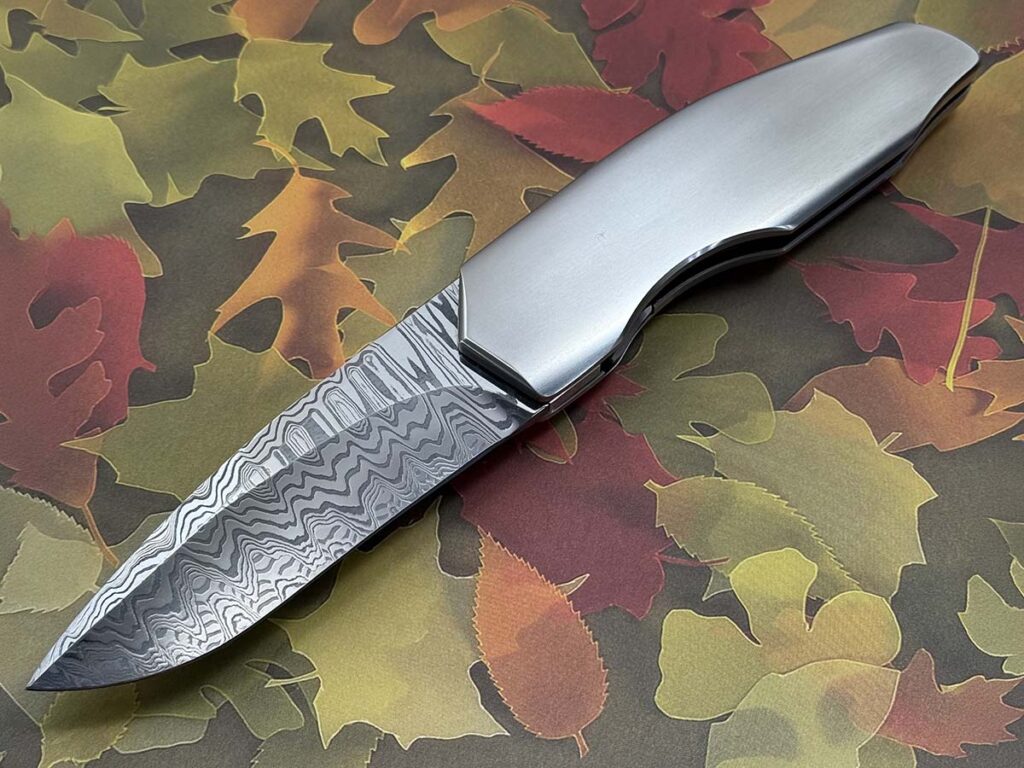
No need to go big to make a large impact, as these small fixed blades more than prove.
Few knives capture the spirit of cut as well as small fixed blades. The ideal size for makers of all skill levels to recreate, they never cease to amaze in their various blade and handle shapes, materials and other differences in design features so slight as to be almost imperceptible to all but the most discerning eye.
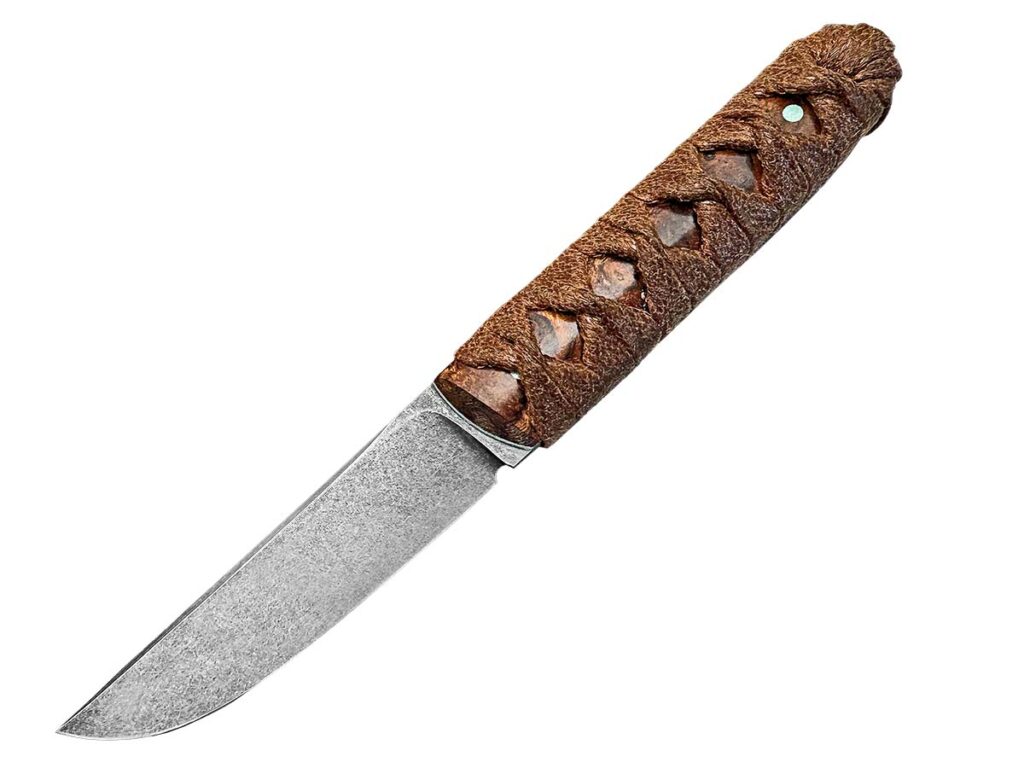
Neal Green and Christopher Adelhardt: Kwaiken
The Kwaiken by Neal Green and Christopher Adelhardt comes in a 3.5-inch blade of CPM 154 stainless, and an ironwood handle with G-10 liners and a brown tsukamaki (handle wrap). Overall length: 7.25 inches. It comes with a leather sheath (not shown) by Adelhardt. (Jocelyn Frasier image)
Peter Cocks: Hunter
Australian Knifemakers Guild member Peter Cocks won Best Hunter at the 2025 Perth Knife Show for Slug Life in a 3.55-inch blade of a flat-ground mosaic damascus of 1084 carbon and 15N20 nickel alloy steels. Scales: ringed gidgee. (Rod Hoare image)
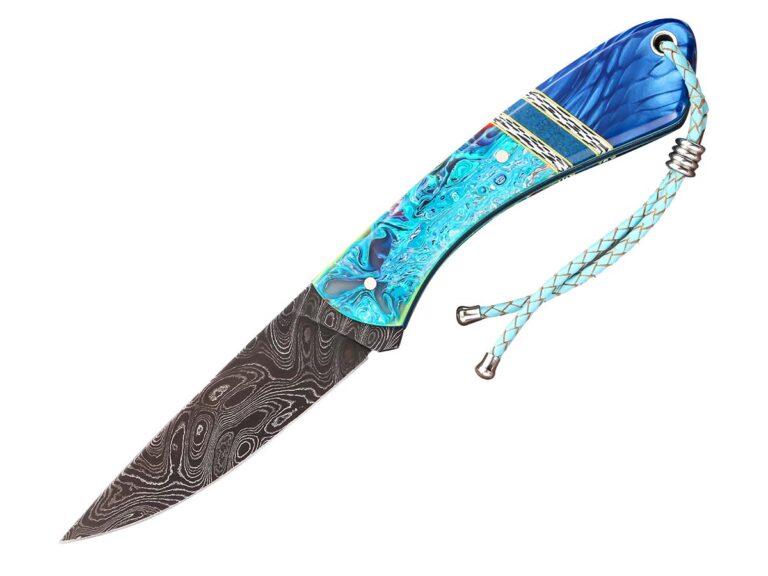
Tracy Jones: Cowgirl
Cowgirl by Tracy Jones earned the maker the Best General Member award at the 2025 Texas Select Custom Cutlery Event. The 4-inch blade is flat-ground damascus and the scales are by Sara. Overall length: 8 inches. (SharpByCoop image)
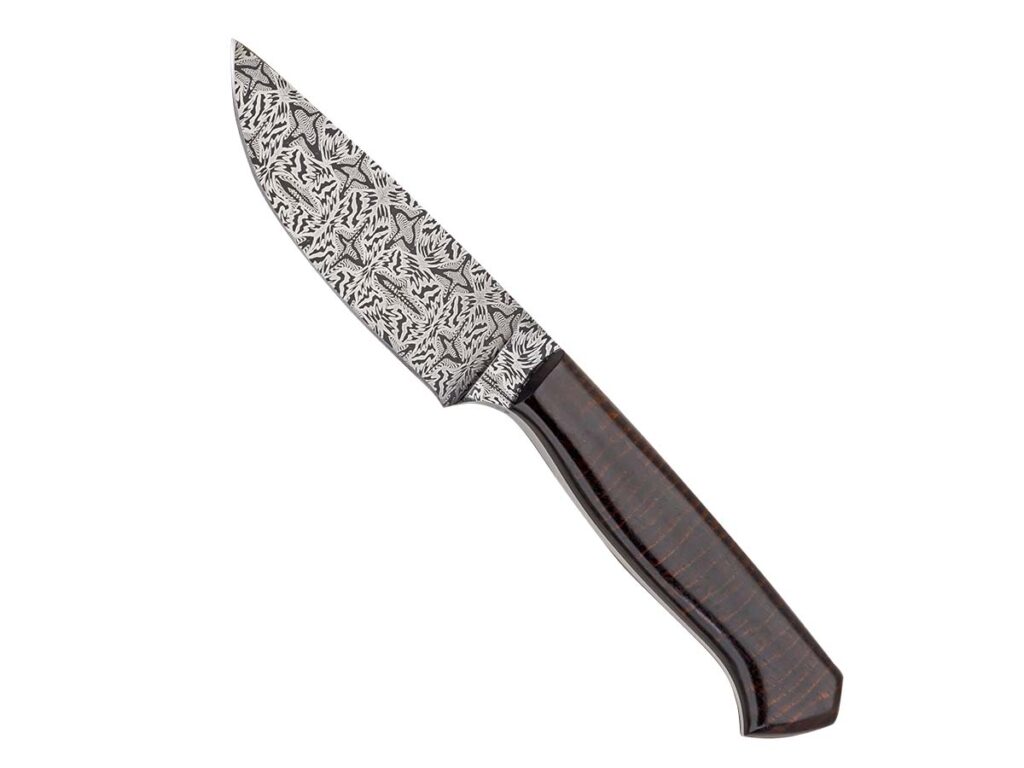
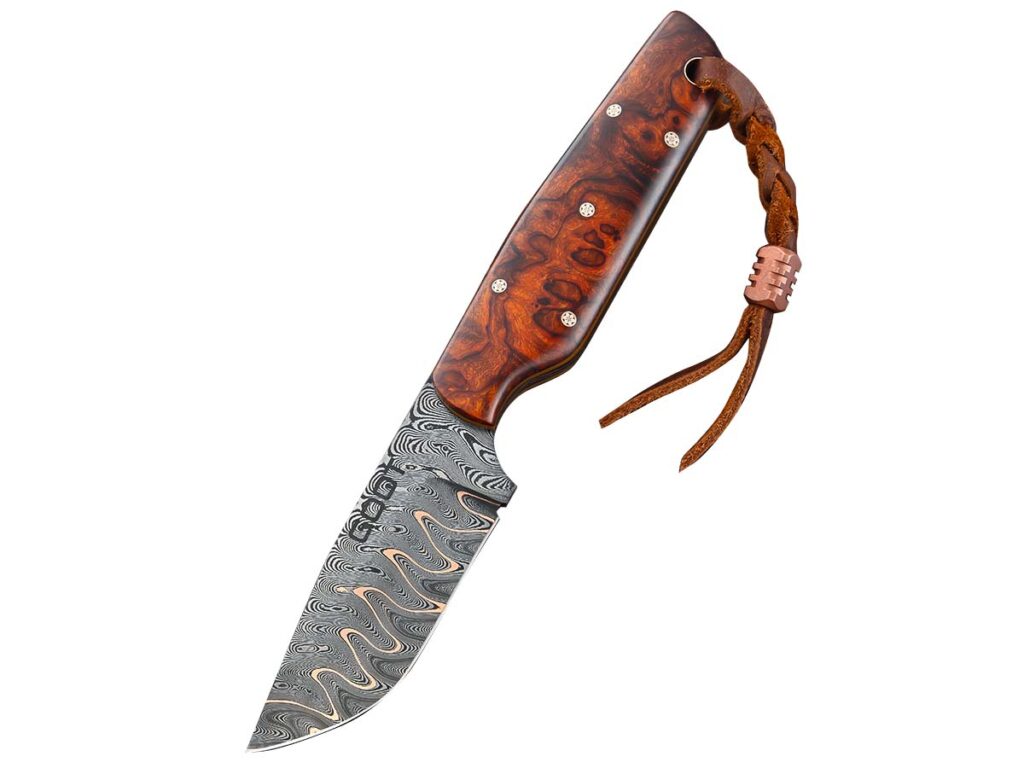
Daniel M. Gutierrez: Utility Fixed Blade
Daniel M. Gutierrez: Utility Fixed Blade
A 3-inch blade of a damascus of 1084 carbon and 15N20 nickel alloy steels and copper shim forged by Baker Forge & Tool, and a handle of ironwood burl help complete a utility fixed blade by Daniel M. Gutierrez. Blade grind: flat. Overall length: 7 inches. (SharpByCoop image)
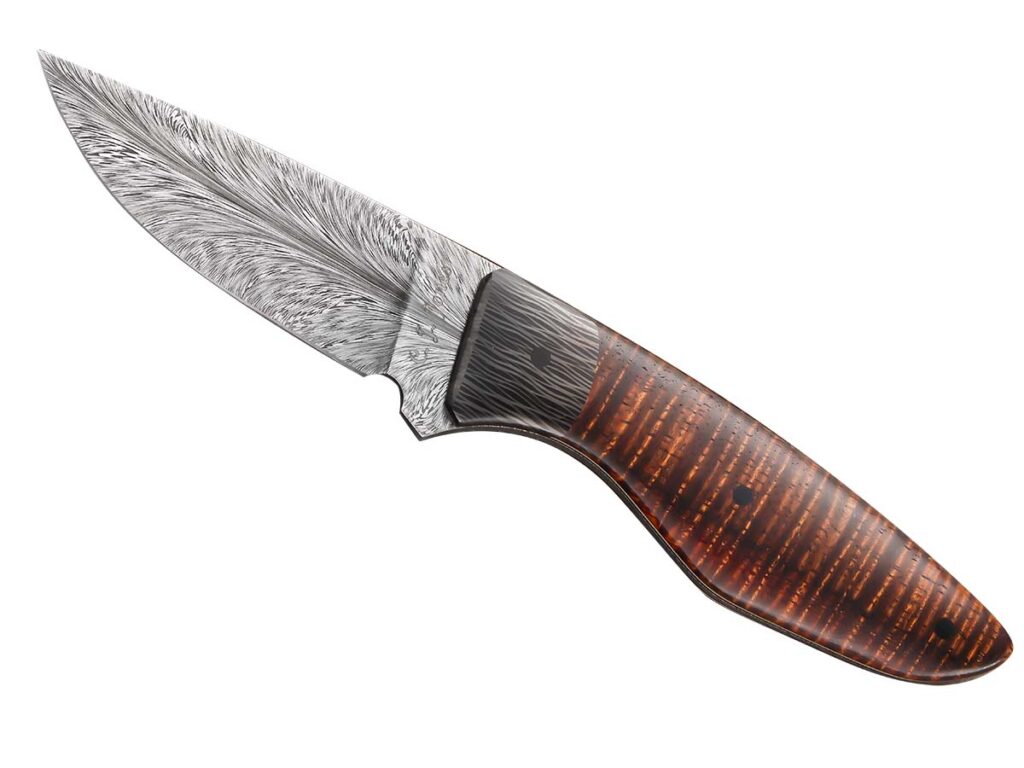
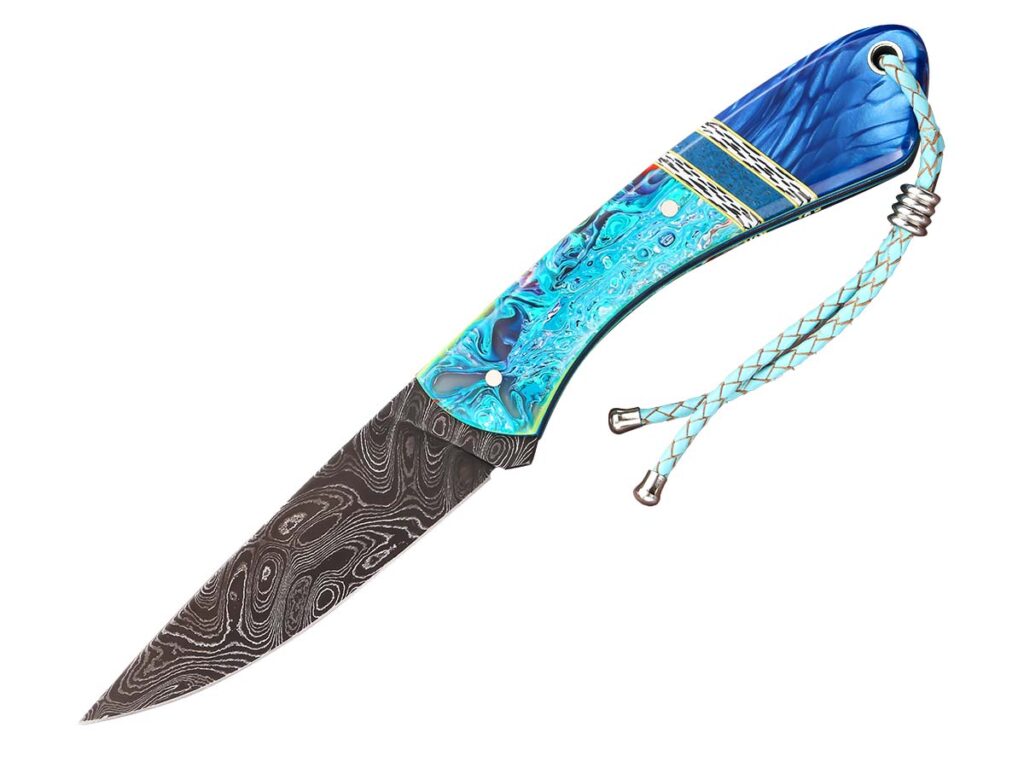
Chad Jones: Panther Fixed Blade
Chad Jones captured the title of Best Ranger Member at the 2025 Texas Select Custom Cutlery Event for his Panther fixed blade. The 3.25-inch blade is feather damascus and the scales are zebra carbon fiber and curly koa. Overall length: 7.25 inches. (SharpByCoop image)
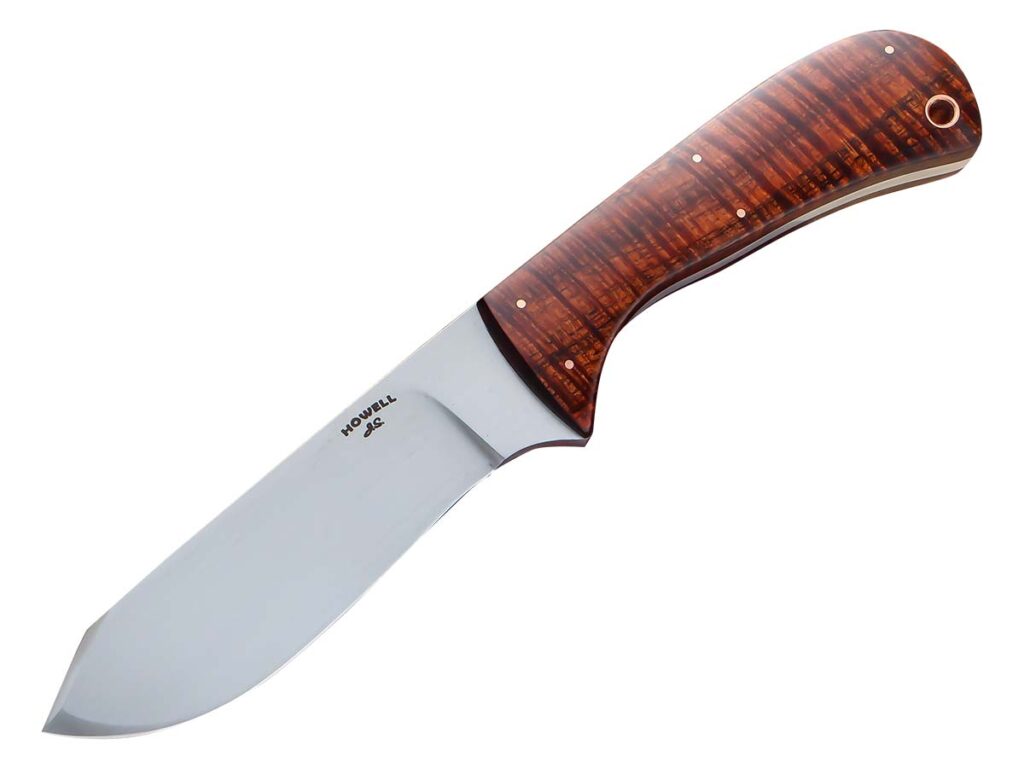
Jason Howell: EDC Fixed Blade
Jason Howell won the award for Troop 36 Scout Favorite at the 2025 Texas Select Custom Cutlery Event for his EDC fixed blade. The 3.75-inch spey blade is flat-ground 52100 carbon steel and the scales are French walnut. Overall length: 8.75 inches. The pouch sheath (not shown) is by Richard Epting. (SharpByCoop image)
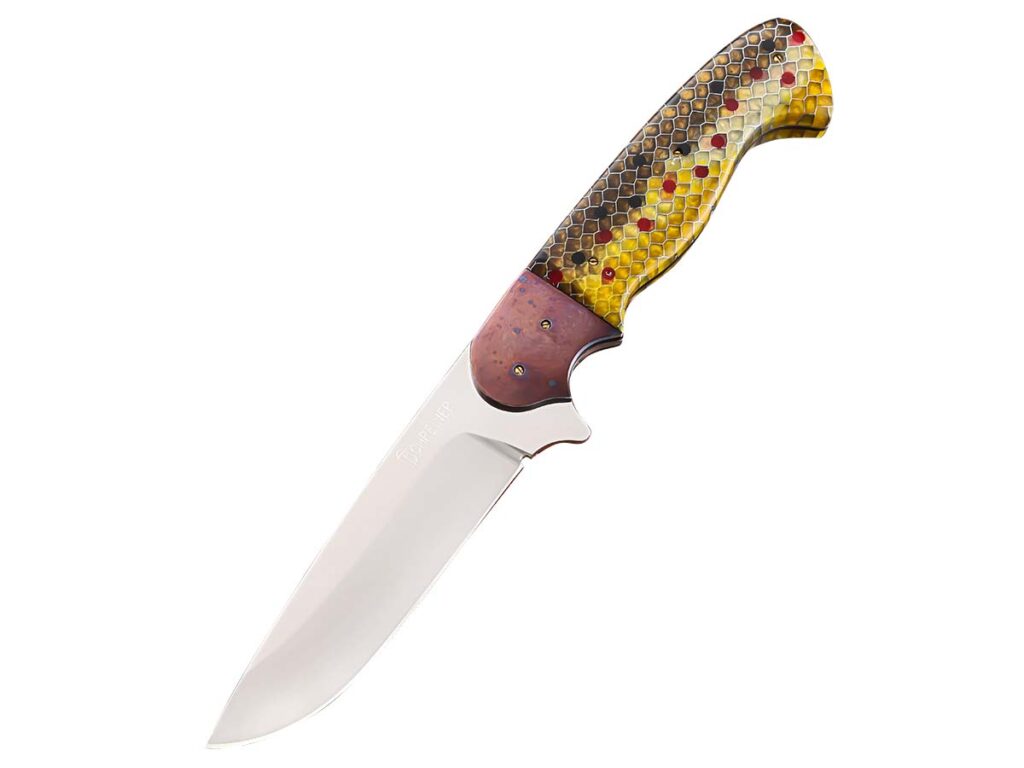
Dr. Terry Schreiner: Brown Trout Bird & Trout Knife
The brown trout/bird & trout knife by Dr. Terry Schreiner has a 4 1/16-inch blade of flat-ground CPM 154 stainless. The scales are a brown trout acrylic and the bolster is O1 tool steel. Overall length: 8 7/8 inches. (SharpByCoop image)
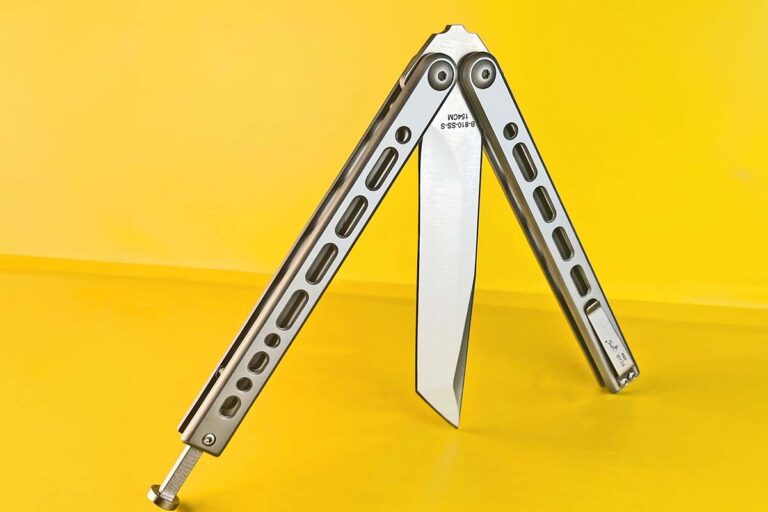
To be competitive, today’s balisongs must excel at flipping as well as cutting.
It’s a focus of versatility. From the style of opening to the enthusiasts who perform a variety of maneuvers with it, blade exposed, the balisong/butterfly knife is an object of curiosity and fascination.
The original term for the subject knife, balisong, is a favorite of Lucas Cao, founder and president of Squid Industries, which produces the popular Tsunami balisong. “Butterfly is a great slang name that describes the mechanism,” he remarked, “but the word balisong has a rich cultural history behind it.”
Flipping competitions have played a key role in the resurgence of the popularity of balisongs, especially among young enthusiasts. James Hill is an example of the latter. He won first prize of $1,000 at the West Coast Flipping Championship during BLADE Show West in Salt Lake City this past October.
With that observation in mind, the Tsunami is true to the Squid concepts of user accommodation. “Each knife we’ve created is on the basis of more variety while still offering a premium flipper experience no matter the price point,” Cao explained. “At the top of our ladder is the Tsunami, which we designed to embody peak performance and build quality.”
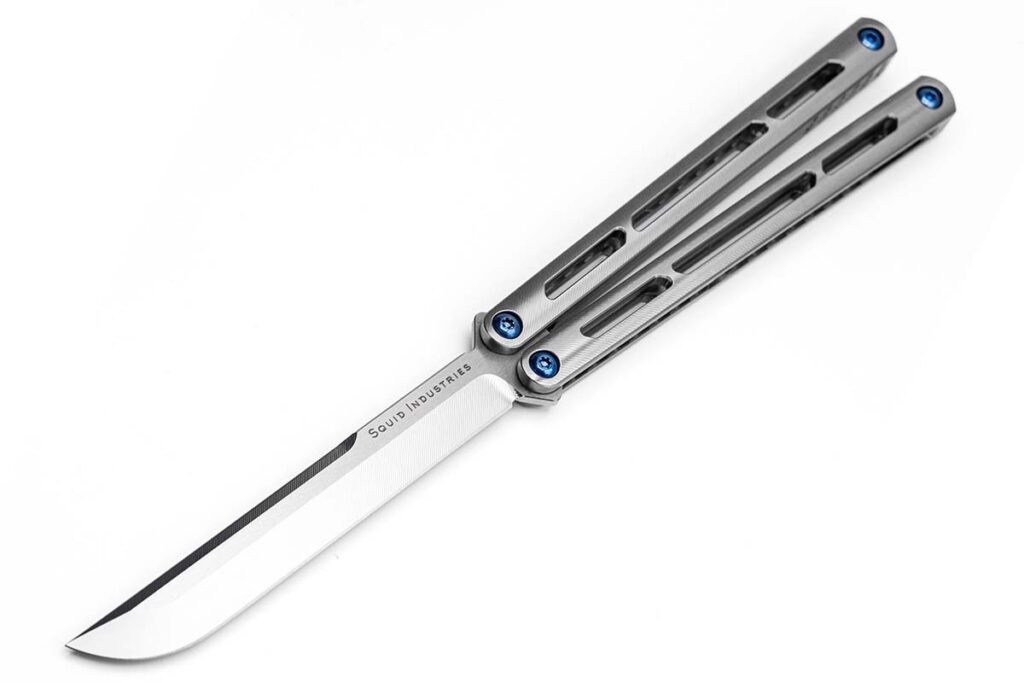
Squid Industries Tsunami
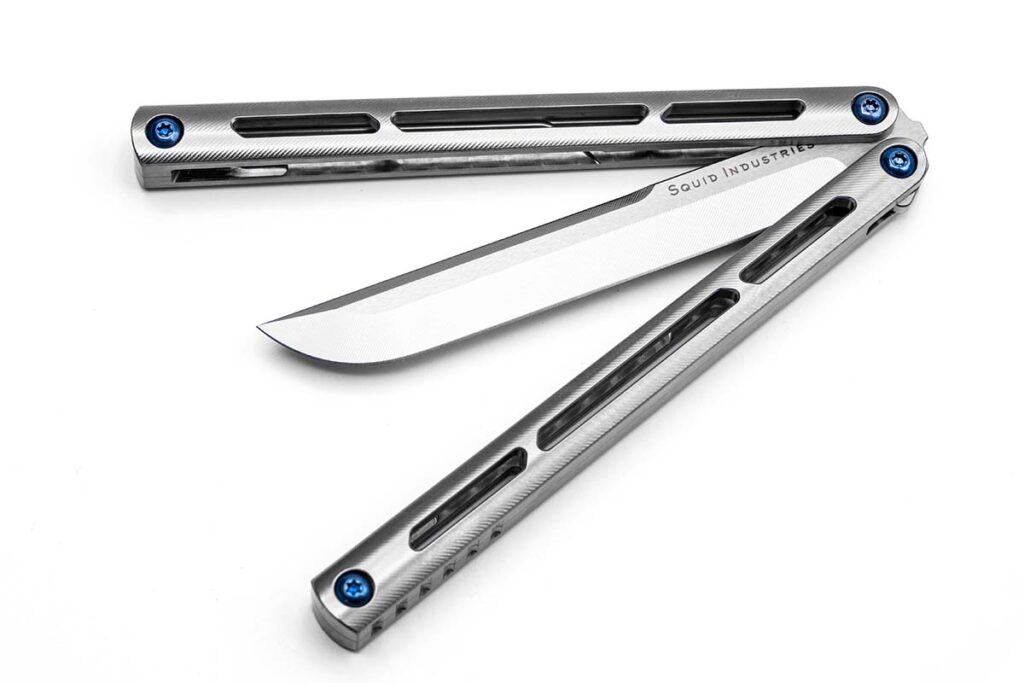
The Tsunami features a traditional Japanese-style tanto blade in a straight-back clip point and flat-ground CPM S35VN stainless steel.
The Tsunami features a traditional Japanese-style tanto blade in a straight-back clip point and flat ground CPM S35VN stainless steel intended to perform well across the spectrum of cutting requirements. However, the knife’s main constituency is the flipper community. “We serve a variety of customers with different requirements,” Lucas said, “but a majority of our customers are focused on the flipping aspect. If I had to estimate the customer desirability, I would say approximately 99 percent flipping and 1 percent cutting.”
The Tsunami employs a combination of bushings and phosphorous bronze washers in its mechanism, ensuring smooth deployment. “This is critical to flipping because it allows the user to consistently and reliably manipulate the knife,” he added. “Bearings aren’t used in our products and many other competitive balisongs from other brands because they produce a flipping experience that’s usually too smooth. Bushings are the preferred style because they offer a specific amount of smoothness and speed.”
The Tsunami reflects Squid Industries’ goal of offering balisongs that exhibit both variety and flipping fun, no matter the price. “At the top of our ladder is the Tsunami,” Squid’s Lucas Cao noted, “which we designed to embody peak performance and build quality.”
The Tsunami design is referred to as a “chainwich,” as its 6Al-4V titanium handles come together to mimic an integral grip. The handles themselves are designed with two specific tapers, one along the width and the other along the thickness. This dual taper design in combination with the rounding on the top create a comfortable and controllable feel in the hand, according to Cao.
Squid Industries Tsunami Specs Blade Length: 4.5” Blade Steel: CPM S35VN stainless Blade Grind: Flat Handle Material: 6Al-4V titanium Latch: N/A Pivot: Bushings and phosphorous bronze washers Weight: 4 ozs. Closed Length: 5.6” Country of Origin: USA MSRP: $775
Kershaw Lucha Carbon Fiber
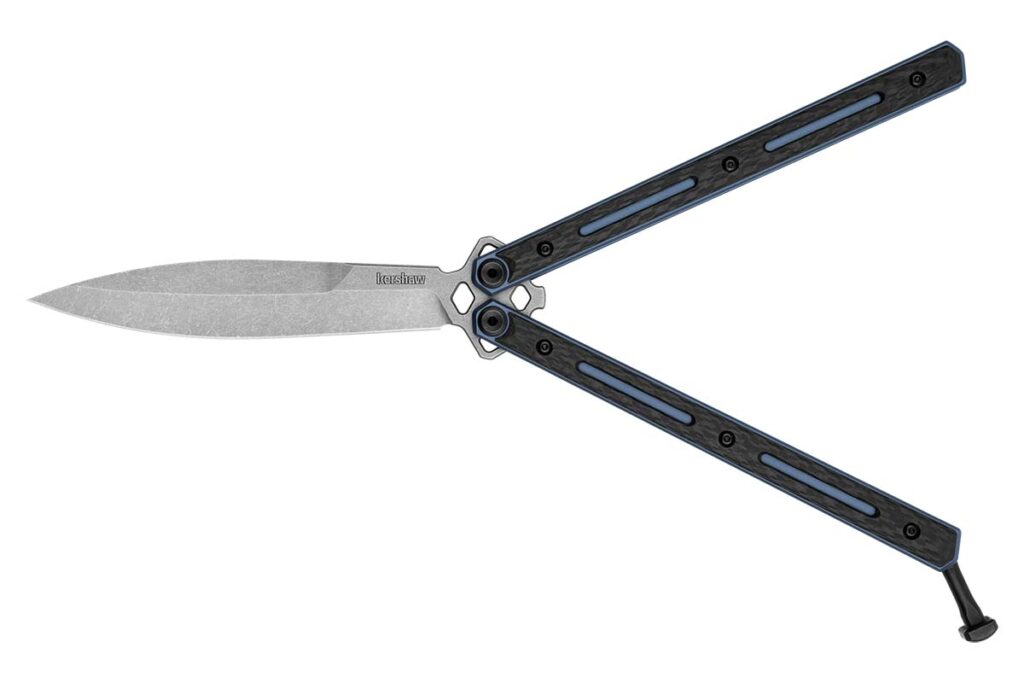
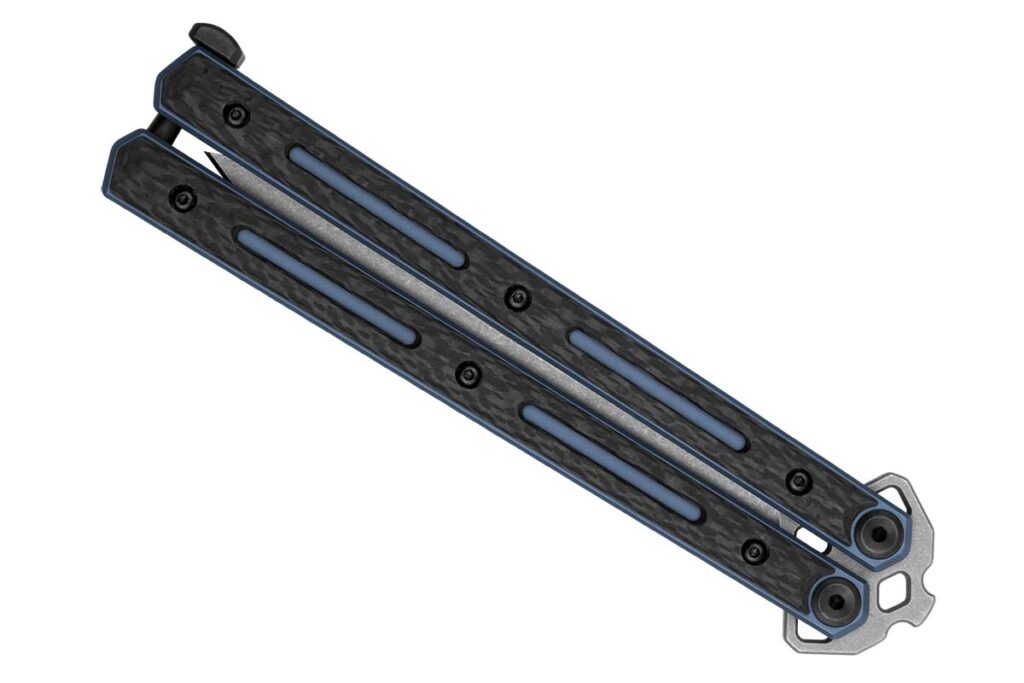
Kershaw’s Lucha Carbon Fiber is a premium edition of the company’s standard Lucha, including such high-end materials as CPM 20CV stainless blade steel and titanium handles with carbon fiber overlays.
The Kershaw Lucha Carbon Fiber’s spear-point blade of premium CPM 20CV stainless blade steel is ideal for piercing and slicing, while the “working” finish hides scratches from hard use. Company spokesperson Dominic Aiello related, “Our goal at Kershaw is to offer something for everyone, whether that be a budget-friendly knife you can abuse and lose all the way to a premium USA-made automatic. With that said, when we brought the original Lucha to the market, our goal was to offer a value packed, affordable, high-quality butterfly knife. It has been a huge hit and as a result we decided to release a premium version.”
Though the original emphasis on the practical use of the Lucha remains with cutting ability front and center, the knife illustrates the versatility inherent in the balisong style. “Of course, cutting is a critical component for any knife,” Aiello reasoned, “but with butterfly knives the flip ability, balance, and comfort are equally as important, if not more important. A lot of customers enjoy the Lucha for the fun and challenge of flipping, but there is also a segment of users that carry it as an EDC.”
The handles of the Lucha Carbon Fiber are titanium anodized blue overlaid with machined carbon fiber. The handles and carbon fiber are contoured for a rounded profile and ease of use.
The Lucha combines good looks with smooth mechanics and easy maintenance. “Each pivot uses two KVT ball bearings, four total,” Dominic commented. “The ball bearings provide an extremely fast and smooth action for easy flipping. The handles are blue anodized titanium with machined carbon fiber overlays. The handles and carbon fiber have been contoured for a rounded profile and ease of use.”
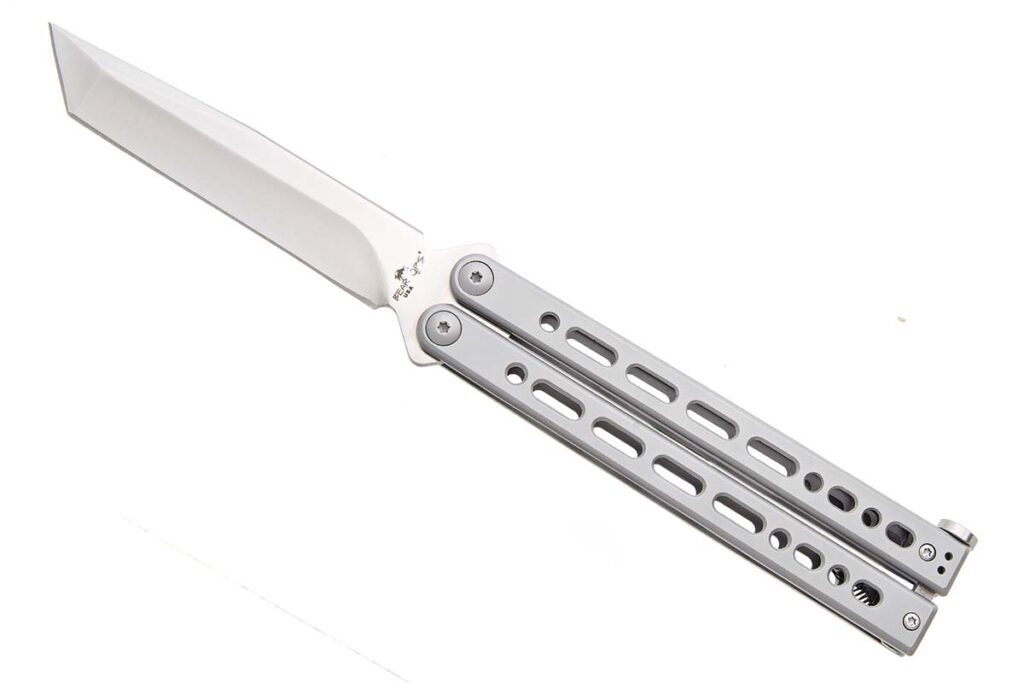
The Bear Song VIII includes a tanto-style blade in flat-ground 154CM stainless steel ideal for detailed cutting and general use.
Matt Griffey of Bear & Son Cutlery says the company has referred to the balisong as the “butterfly knife” since 1986. To that end, the company has continued to develop the famed flippers. With the release of the Bear Song VIII, the company’s design eye was fixed on a knife “being symmetrical and balanced, the most important design elements to start,” Griffey explained.
The Bear Song VIII includes a tanto-style blade in 154CM stainless steel, flat ground and ideal for fine cutting and general use. According to Griffey, the knife’s aptitude is 80 percent flipping and 20 percent cutting.
“A butterfly knife is the strongest folding knife, and as long as you are holding both handles it is as close to a fixed blade as possible for a folding knife,” Matt reasoned. “If the knife is maintained and tight there is almost no chance of lock failure. Maintenance should be just keeping it clean and oiled and checking it periodically to make sure it is not getting loose anywhere on the knife. If you find anything loose, remove the screw, and use Loctite® to replace the screw to the correct tension and let it set for at least twice as long as the thread locker recommends. We find they always give a time that is the bare minimum for the thread lock to work.”
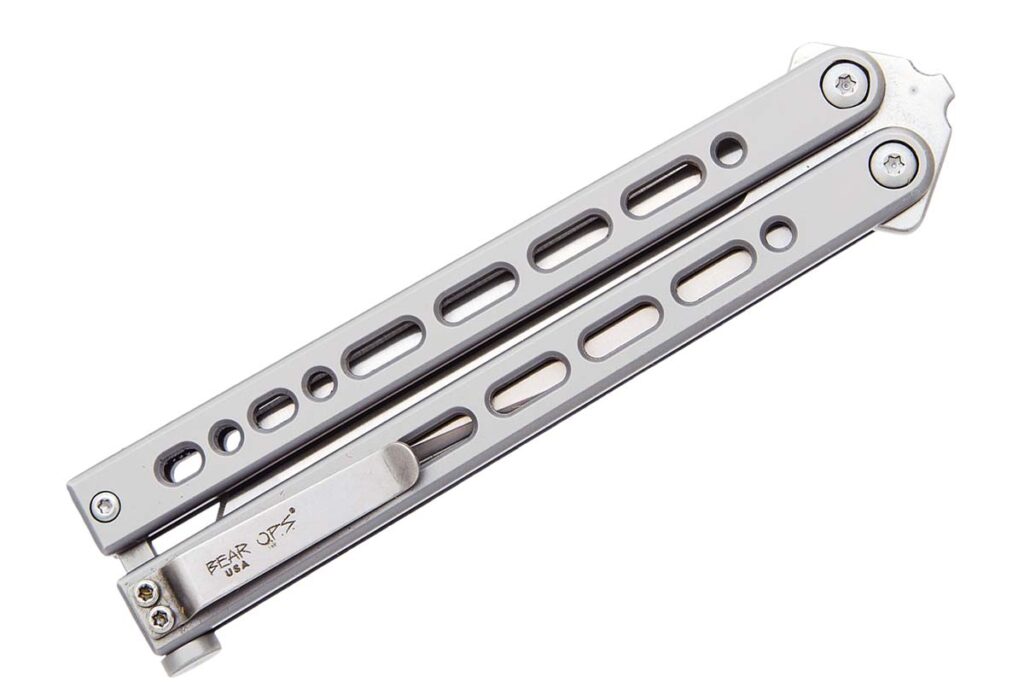
The Bear Song VIII sports stainless steel handles, rounded edges, and milled stepped holes and slots for user comfort. A spring-loaded locking latch and a stainless-steel pocket clip in a short design for easy carry and that can be removed if the user chooses completes the package.
In light of simple maintenance, the Bear Song VIII features an encased bearing design that is easily lubricated, while stainless steel handles, rounded edges, and milled stepped holes and slots provide user comfort. A spring-loaded locking latch makes operation a pleasure. A stainless-steel clip is in a short design for easy carry and can be removed if the user chooses.
“The Bear Song VIII has all the modern features with the timeless classic look,” noted Griffey, who sees the recent legislation regarding butterfly knives as positive (see sidebar). “Butterflies are far slower to open than a modern knife with a flipper on the blade that doesn’t have any spring mechanism. So anyone wasting time in their legislation to target this is just trying to fill time so they don’t have to do any work that might help the people they were elected to serve.”
Bear & Son Bear Song VIII Specs Blade Length: 4” Blade Steel: 154CM stainless Blade Grind: Flat Handle Material: Stainless steel w/Cerakote® finish Latch: Spring loaded Pivot: Ball-bearing washers Weight: 5.1 ozs. Closed Length: 5.25” Country of Origin: USA MSRP: $182.99
Butterfly Knife History
Butterfly knives, also known as balisongs, are one of the most popular knife styles today. They consist of a blade with two handles that rotate around a pivot and wrap around the blade in the closed position. That much is agreed upon. The origin of butterfly knives is still up for debate.
Where Were Butterfly Knives Invented?
Butterfly knives have a rich history, though much of it has been left up to speculation. Walk up to a knife enthusiast and ask, “Where did butterfly knives originate?” and you may get two very different answers.
Fuzzy historical records and well worn legends are to blame. The two main countries of focus are France and the Philippines. Each has evidence and supporters.
One Version: Butterfly Knives Came from the Philippines
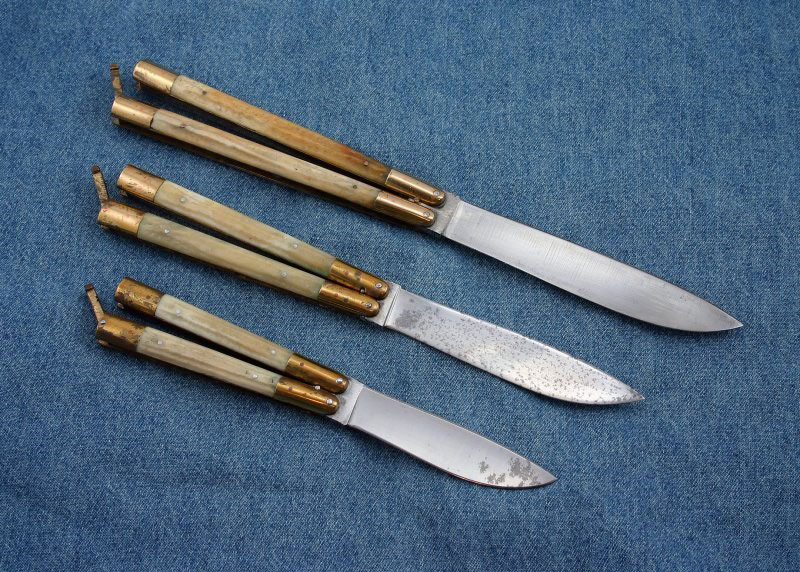
Authentic Filipino balisongs (Image from Balislinger on bladeforums.com)
The Philippines is often cited as the birthplace of butterfly knives, where “balisong” is a more appropriate term. Legend has it that the balisong knife has roots that go back to around 800 AD. This style of knife could be opened quickly with one hand and easily used as a weapon. It proved a common choice for self-defense and utility uses.
A rich balisong tradition has been present in the Philippines for more than a century. Countless stands and stores sell handmade butterfly knives today, and Filipino province of Batangas and the area of Balisong in Taal are known for the blades.
At the very least, the word “balisong” is widely recognized to have come from there. That said, the lack of physical evidence to support a Filipino origin fuels the argument.
Another Version: Butterfly Knives Came from France
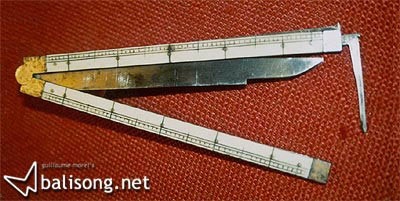
A vintage example of the Pied Du Roi. (Image from balisong.net)
Another claim is that the butterfly knife was invented in France between 1500 and 1700. The reason for this is the “Pied Du Roi,” which means “foot of the king” and is a French measurement tool that dates to the 1700s. The “Pied Du Roi” greatly resembles a butterfly knife. This tool has been pictured with measurement handles and a blade that folds out on one end. It looks like a butterfly knife, but could it be considered the first one ever made?
Proponents of the French origin argue that Spain, allied with France at the time, adopted the butterfly knife in their tasks and eventually took it to the Philippines as sailors sailed to different countries. Sounds reasonable, but hasn’t been proven.
Another supporting argument for the French is that these knives comes from Germany and England, where some butterflies can trace back to prior to 1900. I recently came across a collector’s piece online made in England with markings dating to 1873. This rules out the butterfly knife originating in the early 1900s in the Philippines, but like I said earlier, it has also been claimed to be influenced from similar Filipino knife models as early as 800 AD.
So Where Did Butterfly Knives Actually Come From?
Due to the popularity of balisongs in the Philippines, it isn’t surprising to suspect it started there. The lore passed down from generation to generation also support this idea.
On the other hand, France has pictures and documentation of a measurement device that resembles a butterfly knife and dates back hundreds of years. However, that measurement device likely wasn’t used for self-defense, flipping, or other tasks common to butterfly knives today. Could it be considered the same thing? Hard to tell.
Both sides have great arguments. More information is needed to finally determine this unsolved piece of butterfly knife history.
Butterfly Knives Today
Regardless of history, butterfly knives are rising in popularity due to the fun of “flipping.” Flipping involves tossing butterfly knives open to perform all kinds of tricks. Whether it’s the danger of it, the community, the collectible appeal, or anything else, there’s no doubt flippers are mesmerizing to watch.
Editor’s Note: Mike Haskew and Trevor Brown contributed to this article.
When It Comes To Tactical Pocketknives, These Five Blades That Are Worth Your Money And Your Time
The term “tactical knife” was created roughly 30 years ago to describe a specific-looking knife. In general, tactical knife has meant a non-reflective blade and a synthetic handle. However, over time the genre has grown to feature numerous looks and types of blades.
Today, tactical pocketknives are incredibly popular. Whether it’s a traditional flipper, an assisted opener, or even an OTF knife, the market has exploded and knife lovers are the biggest beneficiaries. Our list features five folders to show just how diverse the world of tactical pocketknives is today.
5 Best Tactical Pocketknives
The traditional pocketknife folds and easily slides away into your pocket, and there are many tactical pocketknives that fit that description. These five stand out from a crowded field.
Cold Steel Recon 1 Spear Point
Cold Steel Recon 1 Spear Point
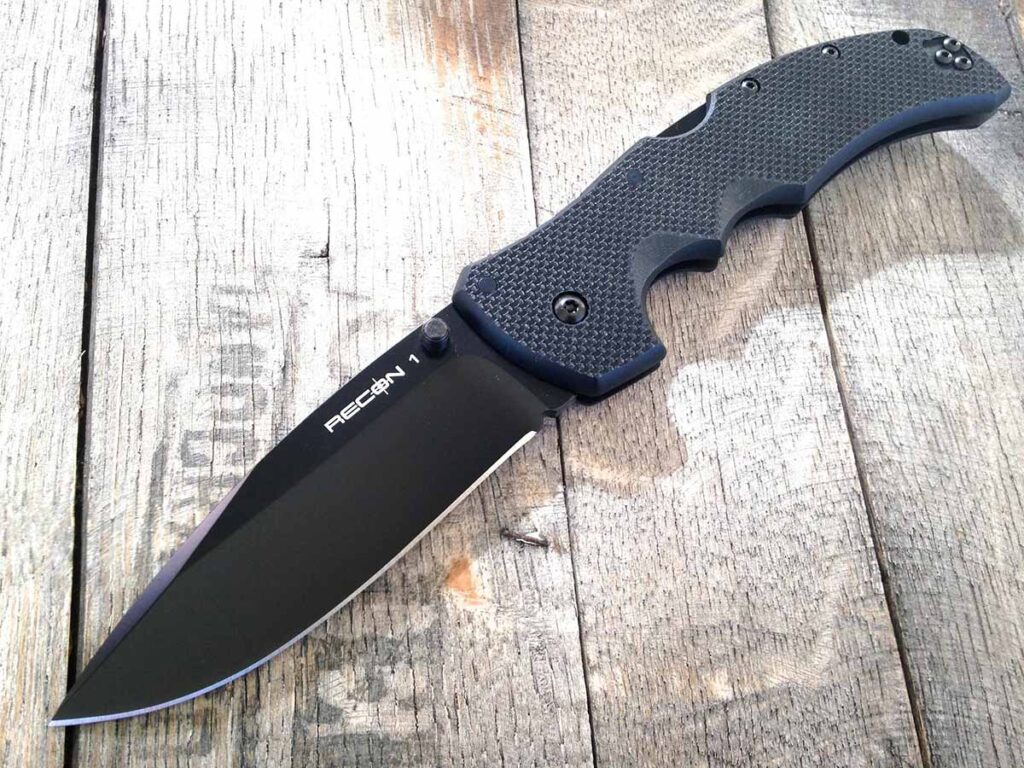
From one of the leaders in tactical knives comes the Recon 1 Spear Point. Cold Steel has made a knife popular with both first responders and civilians that is scalpel sharp and over-engineered to the point nearly everything has been thought of. The American S35VN blade has a DLC coating. The Tri-Ad lock is shock resistant and will keep you safe when deployed. The G-10 handle scales provide excellent grip.
Visually, the Recon 1 just looks cool. The all-black color scheme gives the knife a kinetic feel and encourages you to use it throughout your day.
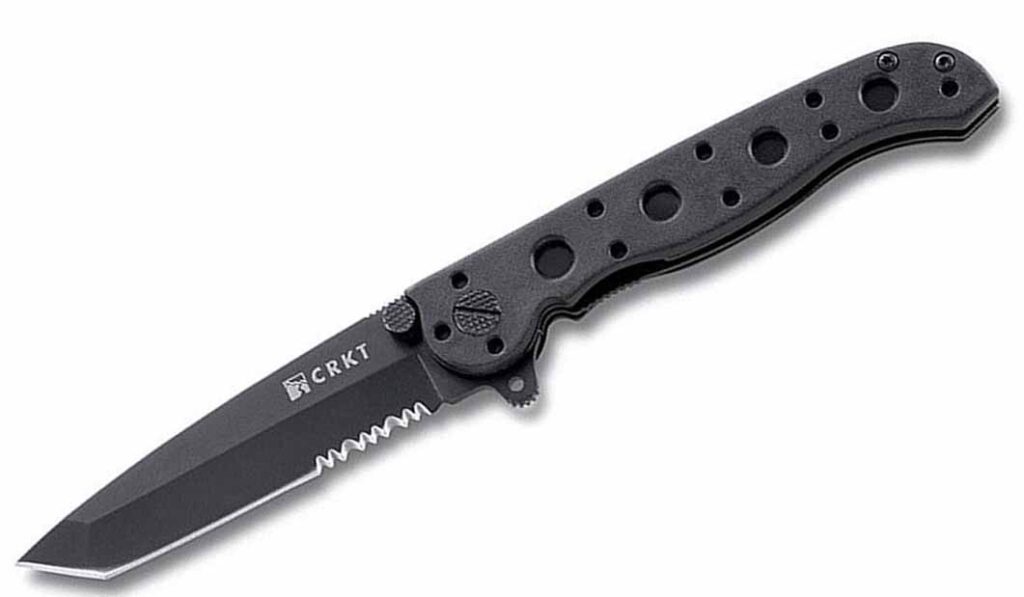
This Kit Carson-designed blade from CRKT is a versatile knife. The dual-grind tanto blade features a partial flat edge and partial Veff serrations. This gives you excellent cutting strength along with the ability to make different types of cuts in tight quarters.
The 1.4116 steel blade is Teflon-coated and connected to a G10 handle. The liner lock keeps the blade securely in place when open. Due to the knife’s open build, two Carson flippers can be incorporated into the piece to create a true hilt, a rarity in folding knives.
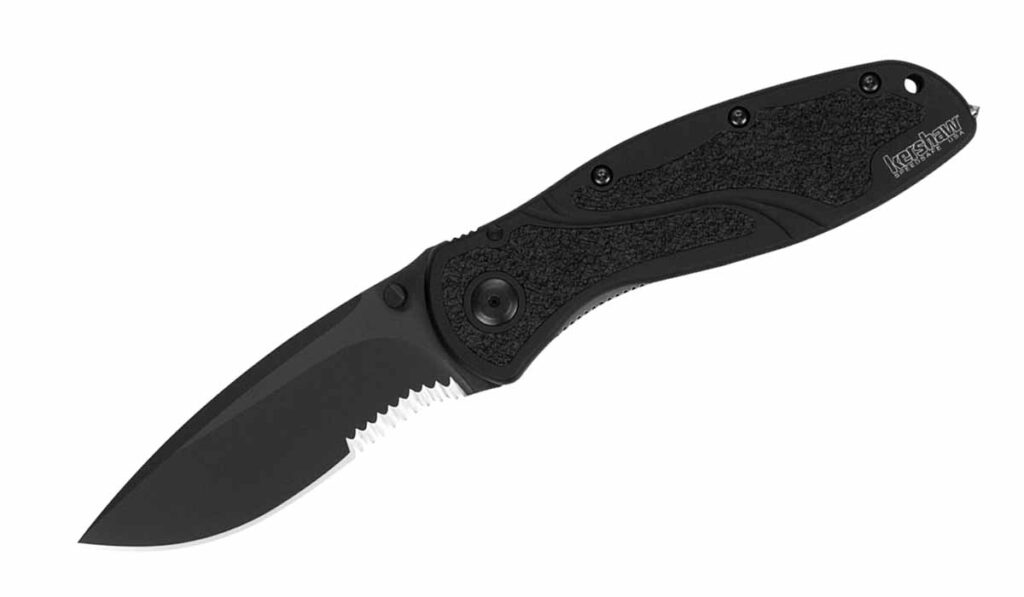
Light. Strong. Serrated. Those are just a few ways to describe this assisted folder from Kershaw. The all-black Blur is just under four ounces and is packed with features starting with the fast-moving assisted-opening mechanism.
The blade itself has a slight recurve, and in the recurve are a series of serrations to make the knife more multi-dimensional. The blade is finished in Cerakote to provide more durability and corrosion resistance. The carbide glassbreaker at the butt of the handle provides yet another way to use the Blur in your day-to-day.
This Ken Onion-designed knife is an excellent piece.
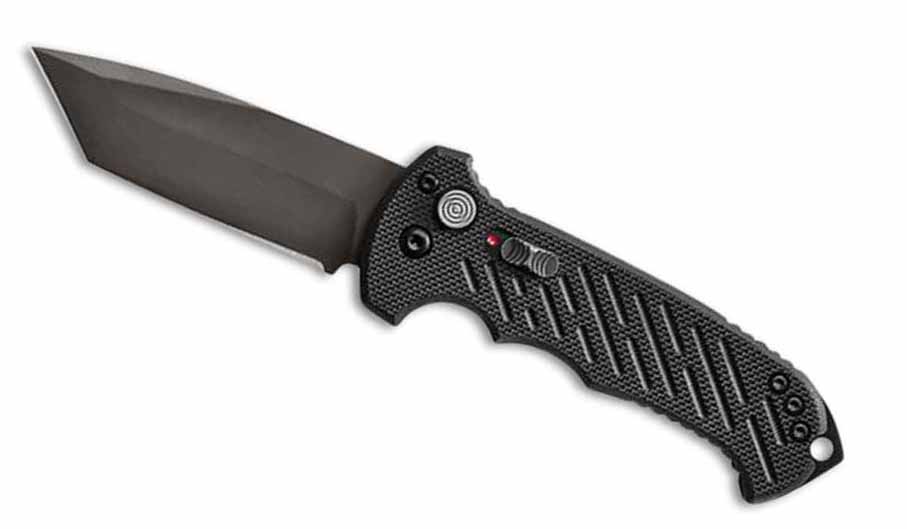
From Gerber Gear, this fully automatic folder is a rugged beast. The push button fires the stonewashed blade out at a high rate of speed, making using the knife that much easier and faster. It feels great in the hand thanks to a slightly higher weight that will give you the confidence to use the 06 in more intense situations.
The aluminum handle can hold up to the use and abuse of everyday life, and the long plain-edged blade makes cutting a breeze. The striking pommel with lanyard hole provides more use for the knife and allows you to travel with it easily.
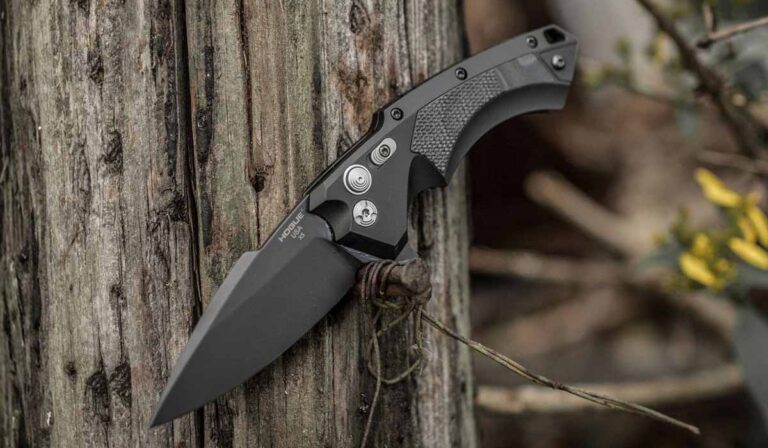
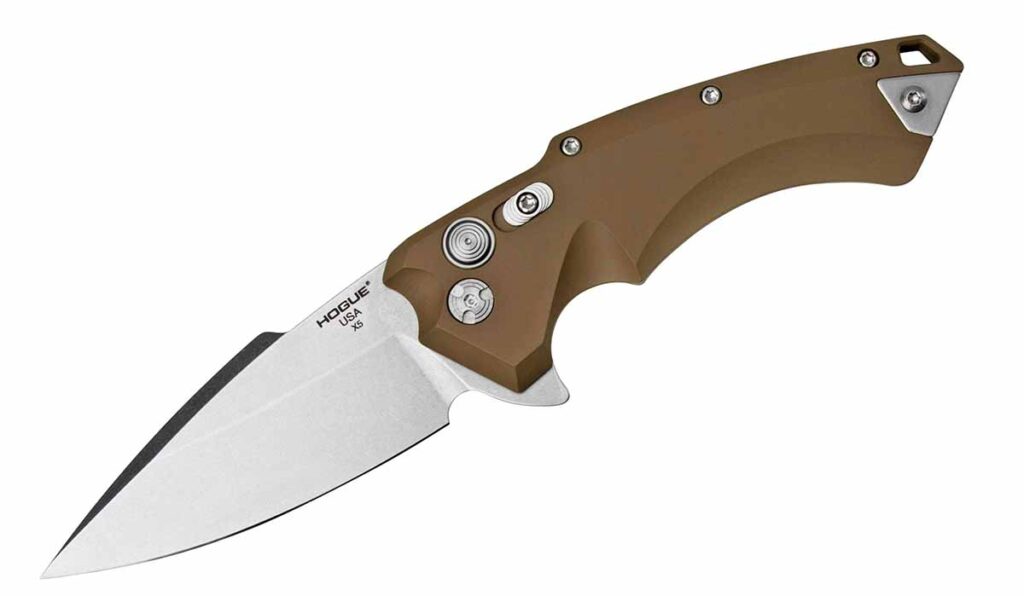
Coming in either a modified Wharncliffe or spear point blade style, the Hogue X5 is a cool, sexy knife. The flipper deploys the blade so fast you would think it is assisted, but it is a manual knife. The Cerakote finish on the blade looks great, and the aluminum handle can stand up to pretty much anything. The push-button lock lets you easily, and safely, close the knife one-handed, and the tip-up pocket clip allows for a deep, discrete carry.
Everything about this knife is cool and begging to be used. Hogue has made a tactical folder that is built well and is somehow even better than the sum of its parts.
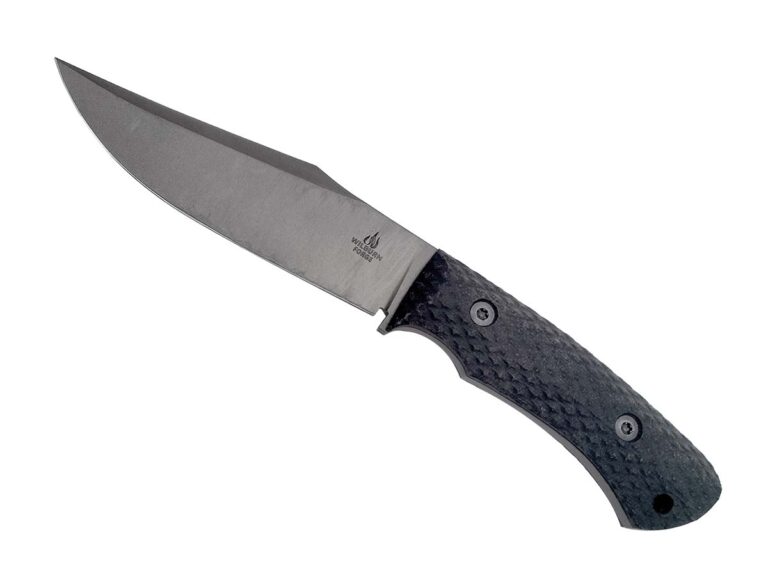
Aaron Wilburn’s BodyGuard pushes the performance bounds of a hard-work knife.
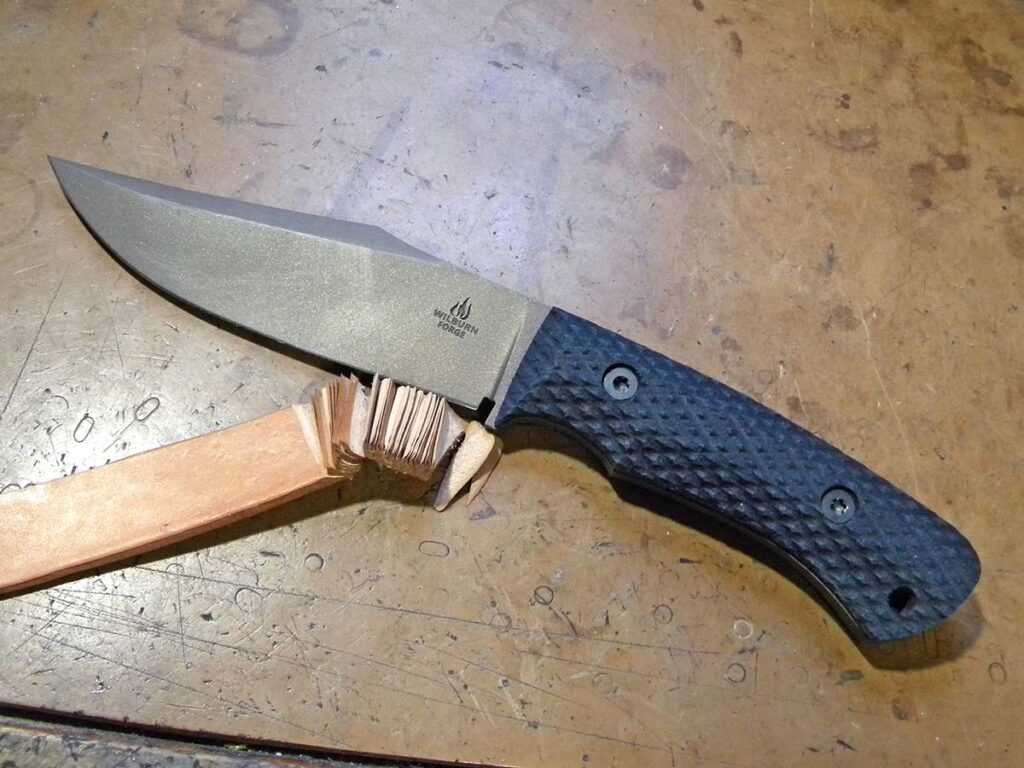
ABS master smith Aaron Wilburn produces spot-on precision works of art. His mosaic damascus is gorgeous, yet he still likes to make hard-working blades. The BodyGuard is one of the latter. It’s no frills, just tuned 52100 steel and textured non-slip Micarta handles.
A lot of knowledge is poured into these heavy-duty knives. It’s a little on the larger side for an EDC, but once in your hand, it’s very hard to use anything else. I’m all about the feel of a knife in your hand and the sharpness of its blade. Aaron’s BodyGuard is spot on in both fields. So, let’s get to cutting with the BodyGuard.
Skiving 8-ounce leather, the author found the slight curve to the belly of the knife let him roll rapidly into each thin slice.
To start, I executed a simple slice of paper to check the fresh edge. The BodyGuard sheared smoothly and quickly, with the edge showing itself on the aggressive side, meaning you could hear each slice. I had to move fast with my fingers so no nicks would occur. The knife’s balance felt correct while cutting.
Next, I was on to some single-walled cardboard. The BodyGuard was slicing so fast and so sharply that none of the cuts distorted the cardboard. This is due to its full flat grind. The Cerekote coating helped, as well, reducing drag. Once more, the edge was notably audible and forceful through the material.
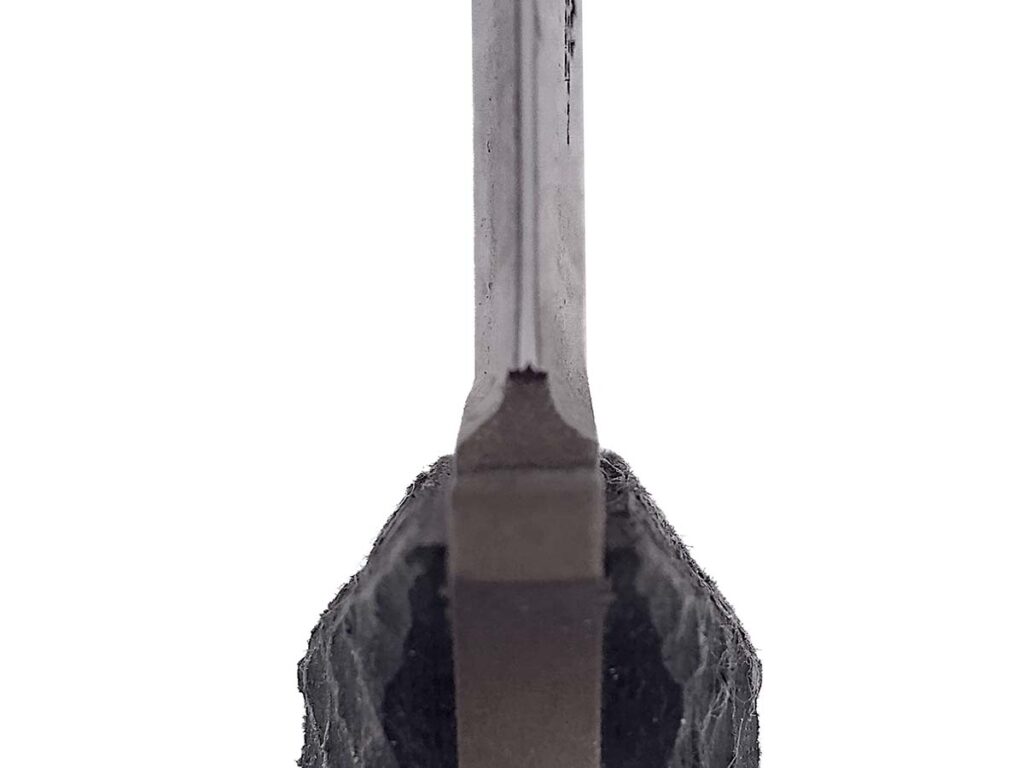
The BodyGuard’s plunge lines were spot on, uniform in depth and angle. This is always a sure sign of a well-made knife.
I pulled some scrap 8-ounce leather to skive. The BodyGuard made quick work of it. The slight curve to the belly of the knife let me roll rapidly into each thin slice. It was a fast enough pace that I managed to put a nick in my fingernail. The textured canvas handles proved very grippy and had a comfortable feeling. With the leather on its edge, I made more cuts, happily segmenting it without removing any of my flesh. Each cut gave me a nice crunching sound. Very sharp edge.
Laying The Wood
Using a leftover piece of pine, I did some whittling for a firestick. I ended up with thin curlicues and thick curlicue. All cuts were smooth, like they were from a carving tool. Its handle provided a positive grip on this more challenging medium and ensured smooth cuts. The finish took some wood smears, as expected, but the edge was still like a razor.
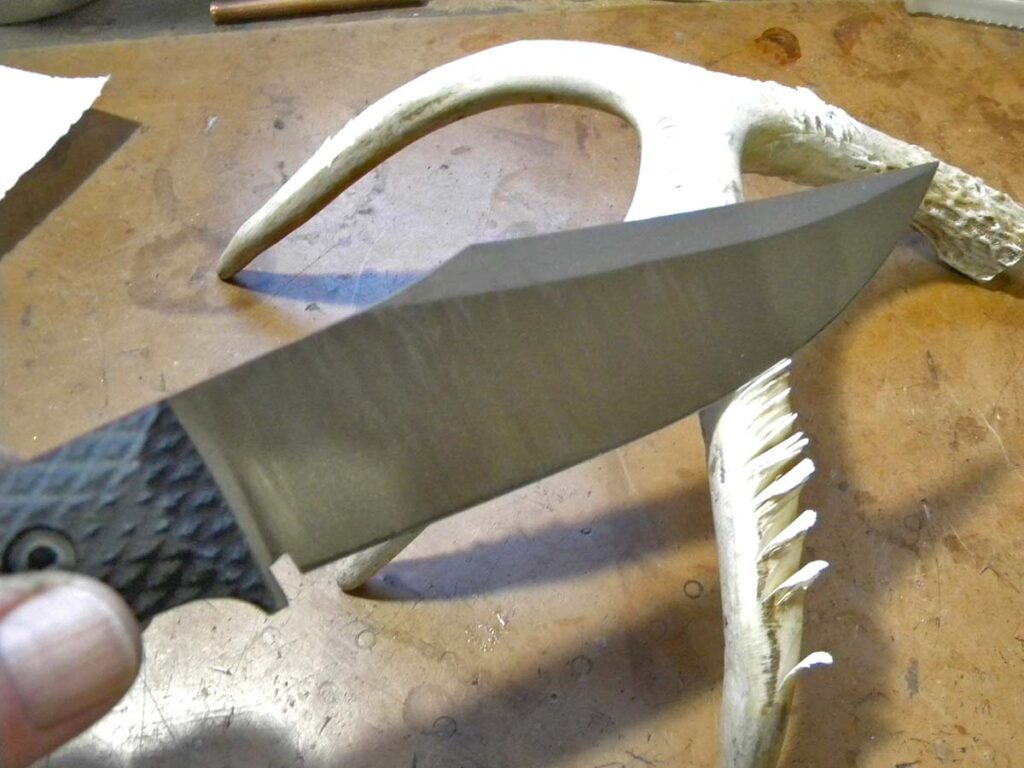
The BodyGuard was no hack in testing its edge against whitetail deer antler. The author littered his shop with antler fragments, however, the knife’s edge remained pristine.
Subsequently, I gave the BodyGuard a beating or I should say a batoning. Using a piece of seasoned hackberry, I batoned the blade into it to split some kindling. I found the false edge was ground almost too sharply; it wanted to stick into the baton piece of wood on the first two whacks. No issues after that with the BodyGuard making short work of the chunk of hackberry. I did notice the ends of the handles were a little sharp on the inside of my palm during this exercise. A few wipes of 400-grit sandpaper removed the edge. Again, more wood smears on the Cerakote, but the coating was 100 percent attached. Excellent job.
After some hard material, I tested the knife’s edge retention on 1/2-inch sisal rope. Man, does the BodyGuard cut, crunching through 200 cuts of the rope in record time. The edge felt like it was getting sharper with every slash. Even after all that, the knife remained extremely sharp.
The BodyGuard was no hack in testing its edge against whitetail deer antler. The author littered his shop with antler fragments, however, the knife’s edge remained pristine.
Finally, it was time to get busy on a whitetail deer antler with 30 hard whacks. All that did was send antler chunks all over my shop without even a micro nick on the edge. That demonstrated excellent heat treatment. And the edge still felt razor sharp.
The last step was to retest the edge on paper. The BodyGuard seemed to slice even faster after all its use. Smooth cuts through the 20-pound-bonded with no tear outs. Enough said and cut.
Bottom Line
I just make a minor softening on the end of the handle. Otherwise, the BodyGuard from Aaron Wilburn is in the top 1 percent of the knives I’ve tested. It will handle civilian, hunters and military chores with ease. Hats off to the maker.
A Switchblade Comb Is A Fun Take On The Knife Design. Unlike The Knife, The Switchblade Comb Can Be Taken On A Plane.
The switchblade looks cool. The blade firing out at speed and satisfyingly clicking into place is one of the great joys of the knife world. However, many legal codes of countries around the world don’t look fondly on the fast-moving blade. But that cool factor has endured and can be seen in switchblade combs. And they have the added benefit of being far, far cheaper than even the lowest-quality stiletto.
Switchblade combs?
Yes. It’s a comb that deploys like a switchblade. Maybe you’re looking for a comb with a burst of excitement, or a comb that isn’t made of cheap, flimsy plastic. Or maybe you’re a Jet or a Shark that needs to look good for their next rumble.
No matter what the reason, the switchblade comb is a fun little tool to have. This knife… I mean comb shows what the switchblade comb is all about.
Etrading Italian-Style Automatic Comb
This comb is a perfect example of what a switchblade comb can be. The handle is made from pearl-toned polymer, and the blade is made from 440 stainless steel that’s built to last. At nine inches in length, with a five-inch handle, the comb sits well in the hand and feels good to use.
The stainless bolsters help take the look to the next level, and it all comes together thanks to the push-button deployment that sends the comb out in a blink. Additionally, there is a trigger lock-out that prevents the comb from opening in your pocket or bag.
This is a fun piece that you can show off to friends and keep your hair well-coiffed too.
MSRP: $10.50
Tops Knives Tac-Rake
For something a bit more robust there is the Tac-Rake from TOPS Knives. This beard comb is of the fixed-blade variety (yes, not a switchblade but it’s so good) that’s made from black traction-coated steel meted to a tan canvas micarta handle.
It’s only 5.88 inches in total length so it’s probably not the best comb for a full head of hair, but it is specially made for a beard and will keep your facial hair looking clean and sharp. The fact that you’ll feel like a champ while using it is just an added bonus.
The included leather sheath makes traveling with the comb easy and stress-free.
MSRP: $105
Microtech UTX-85
This OTF comb is the Cadillac of combs. The blade is stainless, and the handle is anodized aluminum. It’s luxurious to use, and the dual-action mechanism deploys and retracts the knife in the blink of an eye.
The teeth are nice and fine so it’ll brush your hair and your beard with ease. Adding to the tactical nature of the comb, the glass breaker at the butt of the piece is a handy tool to have on your person. And, since this isn’t a proper sharpened knife, you can take this with you wherever you go from a baseball game to a restaurant and even on a plane.
MSRP: $340
BeardAir Tactical Beard Comb
For a tactical combing experience, there is this sleek comb from BeardAir. With a blade made from 17-4PH steel, and a handle made from aviation aluminum. It’s light and strong, and the automatic open/close function deploys the comb with speed and style.
Unlike the other combs on this list, the Tactical Beard Comb comes in all sorts of different colors so you can find the one that fits your aesthetic the best whether it’s a more traditional black knife with red accents or something more wild like the olive green and pink one above.
There Are Few Factory Makers As Well-Known As Kershaw. The Oregon-Based Company Continues To Innovate And Create Top-Tier Knives.
Kershaw is a beloved knife brand set to celebrate its 50th year in business in 2024. In the years since the company was founded a half-century ago, it has delivered some incredible products that continue to set industry standards today.
Kershaw has become a staple of the knife industry at large and they represent a significant percentage of what is being regularly carried in pockets all over the country. Pete Kershaw began the company to create excellent outdoor knives and eventually partnered with Japanese company Kai to bring more high-quality products to market.
The modern Kershaw knife is a truly high-quality tool, and lucky for us, the company has a dizzying number of options that can fit just about any niche you may have.
Kershaw’s Top Ten
Kershaw has a large fanbase because the company is incredibly consistent at making quality knives at quality prices. These 10 have stood out as some of the company’s best.
Kershaw Leek
The Kershaw Leek is arguably the most prominent product that the company has released in recent years. This knife is the epitome of what you would consider being an everyday carry tool: it is light, sleek, and has an extremely reliable mechanism.
The lines of the product are immediately recognizable and it has achieved iconic status among knife enthusiasts. At the time of this writing, Kershaw offers over a dozen variations of the Leek, and, while the internal mechanism is the same, you get your choice as far as cosmetic features go. Currently, handle materials range from plain aluminum or color-anodized aluminum to exciting options like copper.
The actual copper handle material will patina over time, giving your individual knife a unique look as you carry and use it. Despite the fact that copper weighs a little bit more than aluminum and this knife costs a bit more than the other products in the Leek line, it isn’t for everyone. The Leek’s mechanism is an assisted-open type, and it is one of the more reliable and energetic on the market. In carrying Leek knives over time, the author has never had a failure to open or to remain closed.
The Skyline was one of Kershaw’s most recognizable products. The simple, black-handled knife
was one of the more popular carry options of years past and it earned a reputation for being strong and reliable at a good price.
There are, of course, other products that now fill its niche, but the Skyline will not soon be forgotten. Its status as a common, affordable, and reliable knife helps it make this list even though it is no longer available.
Many Kershaw fans have lamented the decision to axe this otherwise popular knife, and it has achieved a moderate collector interest since early 2021 alongside the Shallot and Camber, themselves very well-received by fans of their respective styles.
Skyline Knife Specs
Overall Length: 7.4 inches
Blade Length: 3.1 inches
Blade Steel: 14C28N
Weight: 2.5 ounces
Handle Material: G-10
Kershaw Lucha Carbon Fiber
At a hefty $500 retail the Lucha in carbon fiber is one of the more unique and interesting offerings currently had by Kershaw. This balisong is arguably one of the highest quality production blades of its type. Even custom options available on the market may not be able to match the Lucha in terms of overall fit and finish at the price.
For fans of this type of knife, this is certainly a holy grail item, and it boasts some very nice features. The blade rides on KVT ball bearings for exceptionally smooth handling. At a full ounce lighter than the original model, the carbon fiber Lucha features striking handles that are composed of blued titanium and overlaid carbon fiber.
The price is quite hefty for an EDC knife, though it’s without a doubt worth it to the person who loves flipping and twirling. While the fidget spinner craze ended a few years ago, you’ll probably find yourself playing with this knife in your hand more than you will end up performing cutting tasks with it.
Lucha Carbon Fiber Specs
Overall Length: 10.25 inches
Blade Length: 4.6 inches
Blade Steel: CPM 20CV
Weight: 4.9 ounces
Handle Material: titanium with Carbon Fiber Overlay
MSRP: $499.99
Kershaw Federalist
Taking a departure from today’s tactical and overbuilt blades, the Kershaw Federalist is a rugged gentleman’s knife that has a number of interesting and tasteful features. While the company does make a number of traditional styles of gentlemen’s knives, the Federalist is geared for that man of taste that still has to get some work done throughout the day.
This knife has a more traditional closing and opening mechanism reminiscent of the knives of yesteryear. It has a nail nick for opening and lacks any assist mechanism. In fact, the company lists this blade as a non-locking slipjoint with a dual-detent system. You’ll likely want to save this knife for general tasks and leave the heavy lifting to a more substantial tool.
In place of polished wood and silver inlay, the Federalist features green Micarta grip panels and a matte finish. Seeing as how assisted opening and larger, tactical-style blades have the majority of market share, it is refreshing to see that Kershaw is still catering to people who view knives as simple, everyday objects.
Federalist Knife Specs
Overall Length: 7.5 inches
Blade Length: 3.25 inches
Blade Material: CPM 154
Weight: 2.1 ounces
Handle Material: Micarta
MSRP: $169.99
Kershaw Launch 14
The Launch 14 is a large, automatic opening, cleaver-bladed knife. This is a hard-use tool that has the looks of a collector’s piece. Not all automatic-opening knives are meant for daily use, but this one breaks the mold and is geared for any task you may find on the job site or in your daily adventures.
The cleaver blade is not for everyone. Some people prefer to have a distinct drop point while others definitely prefer the more adaptable Wharncliffe style. The knife lacks a true puncturing tip, which to some could be considered a detriment. The steep tip angle on these cleaver-type blades is actually excellent for true cutting tasks where spear point or drop point blades may be too fragile.
Using a cleaver-style knife for puncturing can be achieved, although the stout angle of the tip may be too coarse for fine work. When it comes to cutting things like straps and heavy tubing, the type of knife we see here definitely excels. The Launch 14 is elegant in its execution and has very functional, subtle features, such as a recessed opening button and carbon fiber panels.
Launch 14 Knife Specs
Overall Length: 7.75 inches
Blade Length: 3.375 inches
Blade Steel: CPM 154
Weight: 3.2 ounces
Handle Material: 6061-T6 Aluminum, Carbon Fiber Scale Front
MSRP: $239.99
Kershaw Reverb XL
Borrowing the same features as its smaller namesake, the Reverb XL is a daily carry knife that has a wide range of uses for the outdoors. The knife has a long, upswept blade, reminiscent of fillet knives. Because of its size and light weight, it makes an excellent companion for the fisherman who enjoys working out of a canoe or kayak.
The knife doesn’t take up much space and doesn’t require an additional sheath. Not only that, at under $50, it won’t cause you financial issues if it accidentally falls overboard. The knife is very simple in terms of operation, it is a manually opening blade with a liner lock.
Although it lacks a fast opening blade, the discerning outdoorsman or angler shouldn’t find this to be an issue, considering that once the blade is out, it is likely going to get used for quite some time. If you find yourself in coastal towns, or perhaps going for a cold one after a fishing trip, this knife will not stand out like a fixed blade will.
Reverb XL Knife Specs
Overall Length: 7.4 inches
Blade Length: 3 inches
Blade Steel: 8Cr13MoV
Weight: 2.2 ounces
Handle Material: G10 with Carbon Fiber Overlay Front
MSRP: $53.99
Kershaw Lonerock RBK2
Knives with replaceable blades are something that have been around for quite some time. In the last 10 years, we’ve seen a greater interest in this style of knife, if you can even call it a knife in the first place.
The Lonerock RBK2 is a kit that includes a main, folding handle assembly, and a non-folding ‘buddy’ handle. The ‘buddy’ is simple and non-folding, but takes the same blades as the folding assembly. The basis of this system is meant for hunters as a means to keep sharp blades at the ready with no additional maintenance.
Keeping a good edge on the blade is no easy task in less than ideal conditions. Many people think that sharpening is as simple as pulling the blade through an off-the-shelf sharpener, but inevitably every knife needs to be professionally re-edged at a certain point. If your blade is replaceable, you shouldn’t have to worry about that latter part of the process. If the knife goes dull, simply pop in a new blade and keep working.
At just under $60 retail, the Interstellar is a mean looking knife that has function at its heart. While it appears to be an out-the-front automatic, the Interstellar is instead a manual knife that opens in the same way as a standard box cutter. The blade features a serrated tanto point and has an affordable price to match its rugged looks.
Kershaw lists this knife under their work knife category, and while it looks tactical, this knife is perfect for the job site. It is easy to use with heavy gloves on, and is excellent for controlled, one-handed operation. The tanto point is excellent for getting into those tight spaces and it is serrated for cutting through various types of cord and material.
People that work with materials like drywall will enjoy its ability to score easily before cutting. If basic folders and box cutters aren’t your style, you should really consider the Interstellar for your daily use. After a long day, you may want to break open some cold ones, and the Interstellar comes with an integrated bottle opener in its frame.
Interstellar Knife Specs
Overall Length: 6.9 inches
Blade Length: 2.7 inches
Blade Steel: 8Cr13MoV
Weight: 3.1 ounces
Handle Material: Glass-Filled Nylon
MSRP: $71.99
Kershaw Blur With Glassbreaker
The Blur is a rugged and popular design from Kershaw. Not only is it a suitable knife for daily carry, the glass breaker version is a simple-to-use and affordable rescue tool. Similar to Kershaw’s other assisted opening knives, the Blur can open with one hand and is ready to go into action. The glass breaker can be used with blade open or closed.
Additionally, the particular model we are talking about here also has a deep, swept belly with aggressive, scalloped serrations. This type of situation should make quick work of seatbelts or other types of common materials found in vehicles if someone needs to be removed quickly after an accident.
This knife features a pointed tip, so unlike other types of rescue tools that are designed to be completely blunt, you will need to take care not to accidentally stabbed or cut someone you were trying to free with this tool.
Emerson is well known for producing some exceptional tactical knives. The company needs no introduction here, and luckily, for us, they have collaborated extensively with Kershaw.
This particular knife, the CQC-10K, is striking to look at with its green scale handles and aggressive, Bowie tip. The knife features the patented Emerson Wave Feature that allows for an otherwise unassisted knife to open instantly upon draw. With practice, this knife can be drawn and opened in a fraction of a second, even faster than can be attained with an assisted opening mechanism.
This knife is not just for self-defense situations, it is ruggedly built, and should be an excellent friend for the field and trail. Thanks to its fine point, it can also be used for tasks such as fishing or skinning small game.
CQC-10K Knife Specs
Overall Length: 8.5 inches
Blade Length: 3.5 inches
Blade Steel: 8Cr14MoV
Weight: 5.1 ounces
Handle Material: G10 Front, 410 Stainless Steel Back
Tips and tricks to get the most out of attending a knife show.
Magazines, websites, and social media only give you a two-dimensional look at a knife. Nothing replaces the experience of handling a knife in person. While the internet is convenient, it cannot match the visceral sensation of holding a knife at a show.
There are many knife shows across America. Some are big, like the BLADE Show, while others are smaller, regional events. All shows have one thing in common: custom knives. Makers offer blades in many styles, materials and price ranges. No matter the show’s size, you can gain an advantage—and get the knife or knives you want—by research.
Today, even smaller shows have websites or social media pages listing exhibitors. The exhibitor list will help you identify who will be at the show. Before every show I attend or consider attending, I go through this list, looking for both familiar makers and those of whom I am unfamiliar. In particular, I look for makers from outside the U.S. From this, I create my own list.
For unfamiliar makers, I visit their websites or social media pages to explore their knives. This research allows me to refine my list and home in on those I’m truly interested in. Once my list is complete, I prioritize the makers whose knives I want to see and handle.
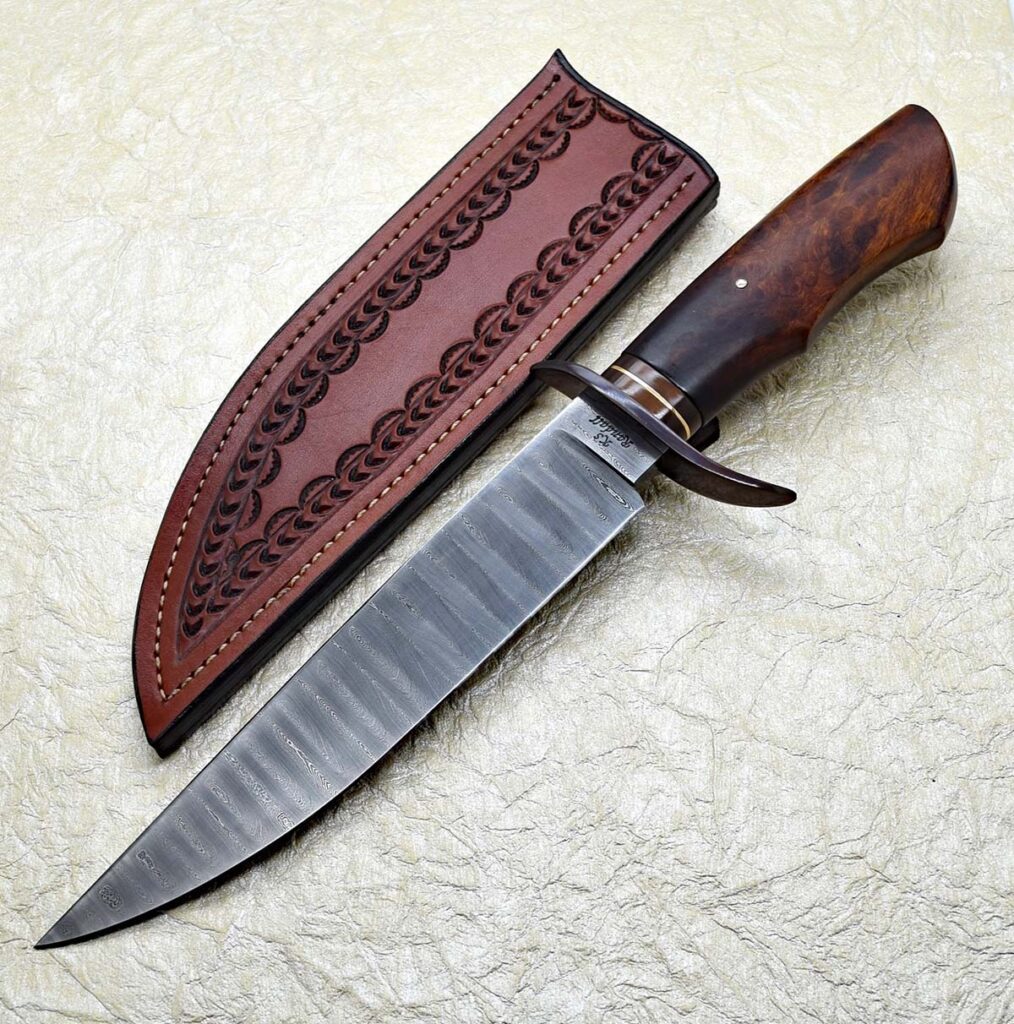
The ladder damascus on Steve Randall’s 8” bladed fighter hits the right balance between understated and complexity. (Alison Randall image)
The floor map is another invaluable tool for show planning. As its name implies, it is a map showing the location of each maker’s table or booth. The combination of the exhibitor list and the floorplan provides me with the first advantage of my show game plan—time management. The other aspect it helps with is money management; researching gives me an idea of how much a specific maker’s knives will cost. I adjust my priorities accordingly.
Bargain Hunting
Knowing who’s at a show out of the way, the next step is to use the various social media platforms again to discover what the makers are bringing to the show. Many show off the knives they are planning on displaying and selling well before the actual event. This helps me identify style, materials and prices of which I’m interested. Often, this information also further helps prioritize my list.
Note, due to constraints imposed by some social media platforms, pricing is not always included in knife descriptions on these platforms. There’s an easy way around this, given that there is nothing wrong with sending the maker a message asking for the price. Realize, for many makers, pricing the knife can be as challenging as making the knife. But knowing the price allows you to compare other makers’ prices for similar work.
Becoming familiar with pricing across the spectrum of a particular knife sector—say, bowies, EDC or hunting knives—ultimately helps you get the best knife for your money. And the best value often is a new maker discovered during list research. I make it one of my goals to find a new maker whose work I am unfamiliar with at every show I attend. While I am not successful every time, many of the makers I work with today I found exactly through this method.
Personal Logistics
An homage to a classic design from BLADE Magazine Cutlery Hall Of Fame® member Bob Loveless. The author contends this is one of those knives you can only appreciate its lightness and quickness when it’s in your hand. (Karis Fisher image)
Research shouldn’t solely focus on the who and what at a show’s tables and booths. There is also a bevy of other factors to consider beforehand to make a show more pleasant.
It might sound obvious, but know where the show is located. Some smaller shows I have attended have been off the beaten path and difficult to find. I personally get frustrated having to hunt around for a venue, only to end up there after it’s already open.
Identifying the show hours is also crucial, as is understanding how most events organize their hours of operation. Most shows open earlier on the first day than on the second or third day. The inverse is generally true for closing—the last day usually ends earlier, especially for three-day shows.
It’s a good idea to also consider the restaurants you’ll eat at and the hotels you’ll stay in. The larger the show, the more crowded the restaurants and hotels. This is especially true with a large group; heading to a show with friends, plan on reservations for both room and board.
Don’t assume parking is right outside of the show’s location. That’s a recipe for trouble. Do your research and see if there is plenty of parking, where it’s located and, at some venues, how much it costs.
The final consideration is actually getting into the show—your tickets. If the show offers advance tickets, I recommend you purchase them before you arrive. You don’t want to be standing in line when the doors open.
Show Etiquette
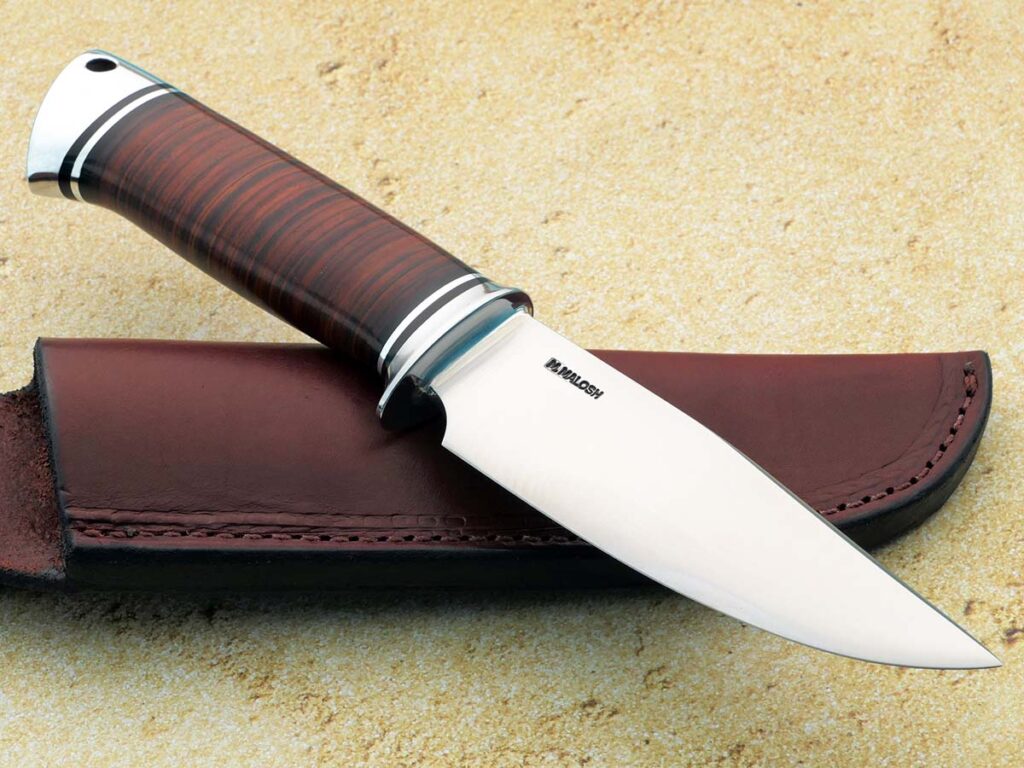
Beautifully spartan, Mike Malosh executes an extremely clean hunter that’s built for dead-serious work. (Robertson’s Custom Cutlery image)
It should come as no surprise that those attending a show are focused on the knives they came there to see. But don’t let your focus make you into a poor or even rude show attendee. Here are some recommendations to keep in mind while at the maker’s tables.
When in doubt, ask for permission to handle a knife. Makers want you to; they just want you to do so respectfully.
If you have children with you, watch their little hands. They want to grab the knives just like everyone else.
Replace the knife where you found it. Set the knife down and don’t just drop it on the table.
For those knife fighters out there, limit your moves at the table. Those knives are sharp!
Don’t put your drinks, backpacks, bags, etc., on the maker’s table. Accidents happen, and no one wants a knife scratched or damaged.
Wait for your turn. At a crowded table, more than one person has been cut trying to grab a knife.
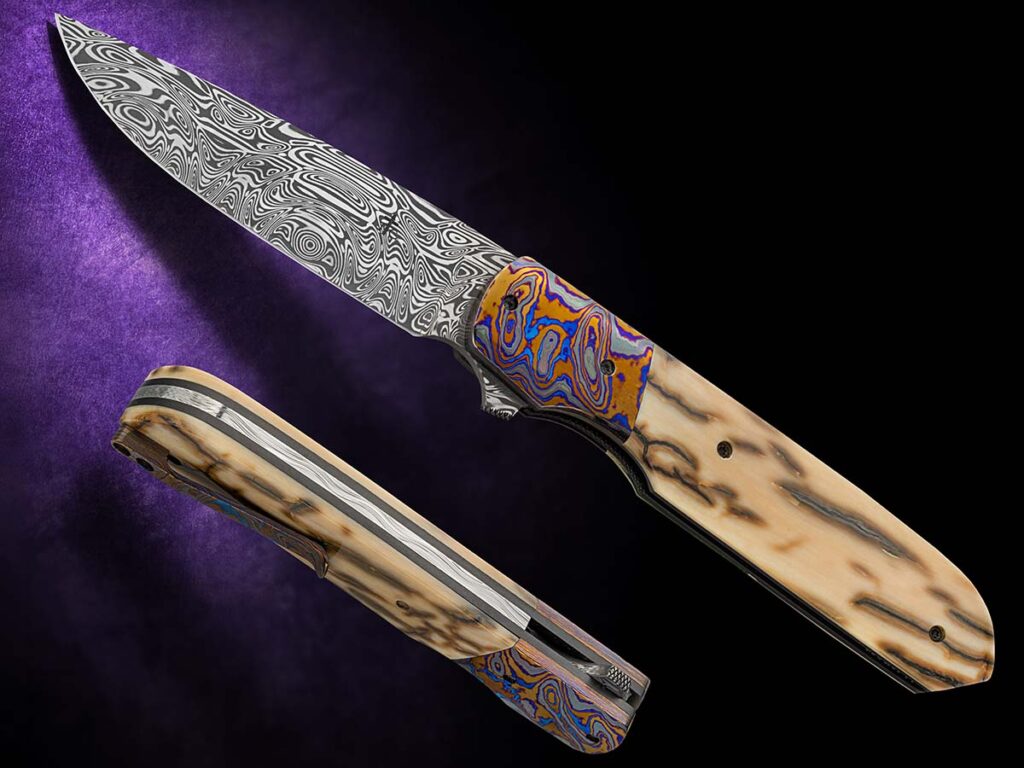
Jason Clack has a lot going on with his liner lock, from it’s 3.5-inch damasteel blade to black Timascus bolster and mammoth ivory scale. (Jocelyn Frasier image)
Take your non-knife-related conversation away from the front of the table. Don’t block the table from potential customers.
Everyone loves a deal, but no one wants to be insulted by a lowball price. Makers may adjust their price, but ultimately, that is their decision. That said, cash can tip the negotiation in your favor.
Ask as many questions as you like. Education directly from the maker is part of your admission price.
Here’s The Deal
Like the makers, dealers range from brand new to very experienced. Also, like makers, many have specialties. Unlike makers, they deal in the aftermarket. The prices they ask for knives, and are willing to pay for knives, are based on current market prices. Like many collectibles, those prices fluctuate based on several factors.
A stunner from GTC Enigma, the titanium-handled spring-loaded tab opener is lightning fast. Even at first blush, this pocket gem looks like it’s built for speed. (GTC Knives image)
Additionally, keep in mind that when trying to sell knives to a dealer, you walked up to their table. The price they offer you may not be what you were hoping for. There is no reason to swear at them, call them names or accuse them of low-balling you. I have turned down thousands of knives because I didn’t think I could resell them. It was as simple as that.
Plan For Success
Even with a three-day show like the BLADE Show, time quickly slips away. Having a plan to get into the event and to the makers, in turn, the knives you’re interested in ensures you’ll have a good experience. In essence, it comes down to time and money—be sure to get the most out of each!
Maker: Bob Earhart Model: Frame Handle Fighter Blade Length: 7.5” Overall Length: 12.3” Blade Steel: 5-bar Turkish twist damascus Guard Material: Blued 1018 Steel Handle Material: Mammoth ivory Leather Sheath: Custom-made by the maker Comments: The knife has excellent balance and handle ergonomics. The frame handle is forged to shape, revealing the pattern. Bob is an ABS master smith. His BLADE Show Table Number is 19S. Price: $1,700 Email Address:[email protected]
Maker: Steve Randall Model: Damascus Fighter Blade Length: 8” Overall Length: 13” Blade Steel: Ladder pattern Damascus Guard Material: Browned carbon steel Handle Material: Desert Ironwood Leather Sheath: Custom-made by the maker. Comments: Contoured guard and handle create a knife with excellent balance and comfort in the hand. Precise ladder pattern damascus, competent work from an ABS master smith. BLADE Show Table Number is 3R. Price: $1,800 Email Address:[email protected]
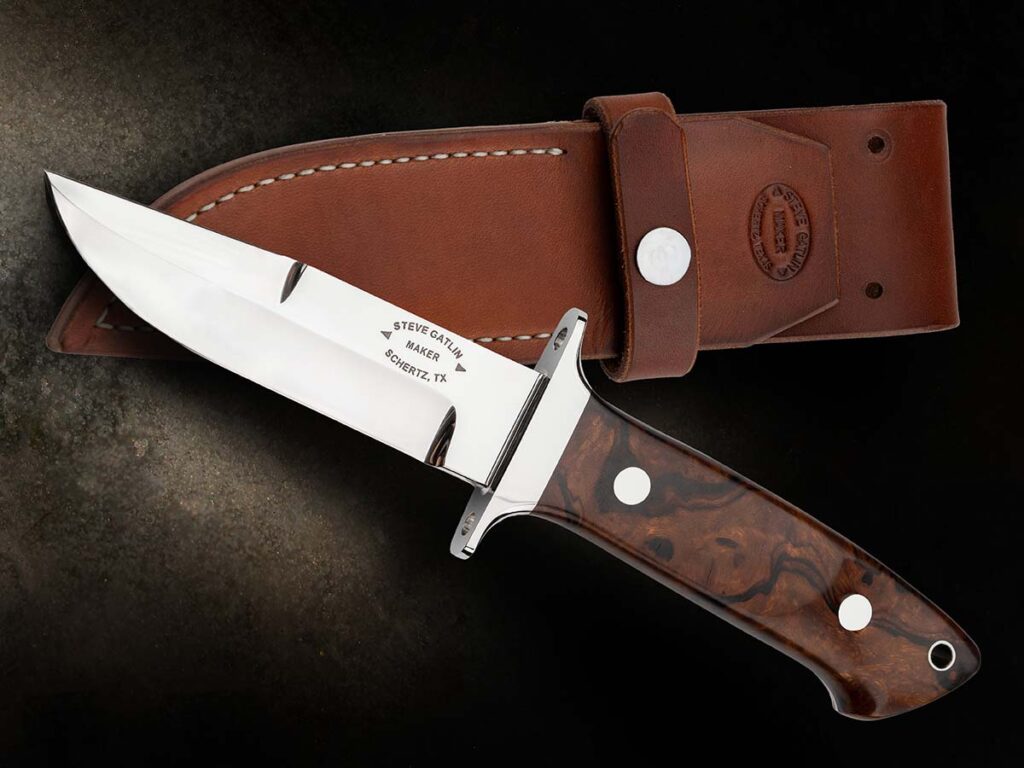
Maker: Steve Gatlin Model: Loveless Style Chute Knife Blade Length: 4.5″ Overall Length: 9.25″ Blade Steel: CPM 154 Guard Material: Stainless steel Handle Material: Exhibition-grade Desert Ironwood Leather Sheath: Custom-made by the maker Comments: Steve’s exceptional version of the classic Loveless Chute. Light and quick in the hand. BLADE Show Table Number is 7E. Price: $1,400 Email Address:[email protected]
Maker: Mike Malosh Model: Bear Hunter II Blade Length: 4.5” Overall Length: 9 1/8” Blade Steel: W-2 Guard Material: Stainless steel Handle Material: Leather Leather Sheath: Custom-made by the maker Comments: Excellent balance and handle ergonomics. Classic look. It is built for serious work. BLADE Show Table Number 6O. Price: $425 Email Address:[email protected]
Maker: Jason Clark Model: 77 Liner Lock Blade Length: 3.5” Overall Length: 8.12 Closed Length: 4.5” Blade Steel: Damasteel Bolster Material: Black Timascus Handle Material: Mammoth Ivory Opener: Flipper Lock: Liner Clip: Black Timascus tip up Comments: Sleek and smooth. Great lock up! BLADE Show Table Number is 12E. Price: $1,550 Email Address:[email protected]
Maker: GTC Knives Model: Enigma Blade Length: 4″ Overall Length: 9 Closed Length: 4.5″ Blade Steel: Stainless steel Damascus Handle Material: Titanium Opener: SLT (spring-loaded tab) Lock: Inset liner Clip: Titanium tip up Comments: Slick and smooth. Next-level construction and precision. This knife features screwless and toolless construction. WOW. Blade Show Table Number 19A. Price: $3,500 Email Address:[email protected]