Designers and companies join forces to help consumers win with these knife collaborations.
A collaboration knife is produced when a designer or knifemaker partners up with a knife company to produce a particular knife. And more often times than not, such models offer the best of both worlds. Designers able to focus purely on designing and not confined to the limits of their shop can shoot for the stars. While companies take the reigns of producing the knife to exacting specs and usually at a buyer’s price. In the end, the knife consumer wins. Here is a handful of the latest collaboration drops certain to get knife aficionados juices flowing.
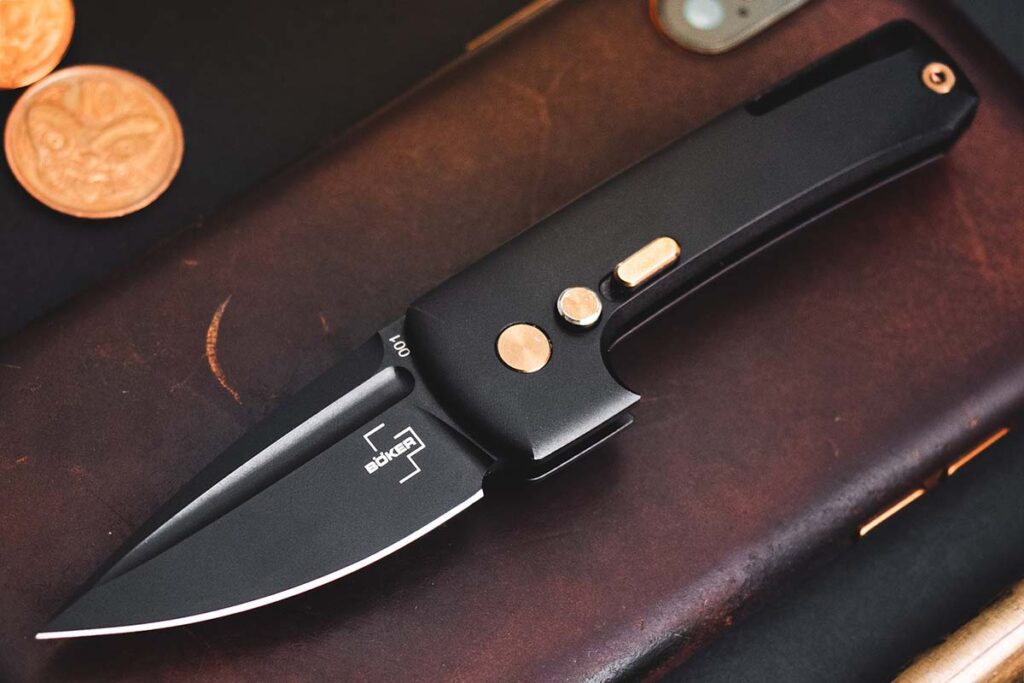
Harlock Mini / Boker Plus
A blade only .11 inch at the thickest helps the Boker Plus Harlock Mini tip the scales at a scant 2.19 ounces. At about 2.87 inches closed and with a lean, sexy pocket clip, the Harlock Mini is made for executive wear. It comes with a nylon pouch.
If you’re looking for an elegant knife present for that special someone, you could do a lot worse than gift him or her the Boker Plus Harlock Mini designed by custom knifemaker Darriel Caston.
Designer: Darriel Caston Knife type: Push-button automatic Blade length: 2.05” Blade steel: Black-coated 154 CM stainless Blade grind: Convex Handle material: Black-coated aluminum Hardware: Brass Knife to Know: A latching slide lock locks the blade closed and prevents accidental release Closed length: 2.87” Carry: Pocket clip and nylon pouch Country of origin: USA MSRP: $146
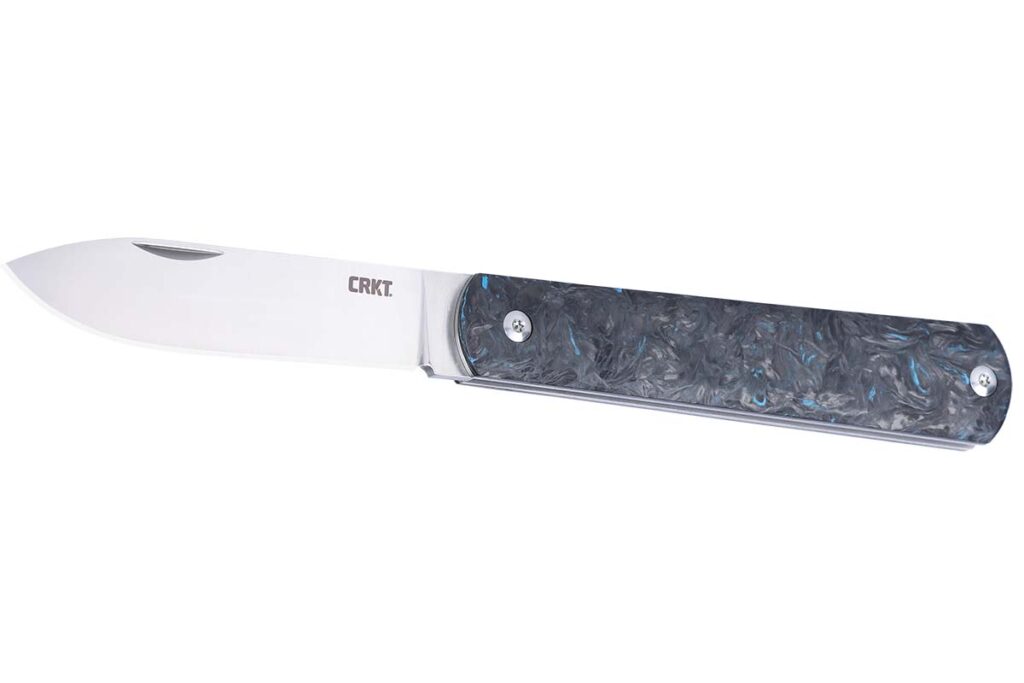
A.P.C. (Always. Pocket. Carry.) / CRKT
The A.P.C. is a two-hand opener, with the blade deploying via a traditional nail nick. The Fat Carbon Dark Matter handle material is strong and lightweight.
Unlike traditional slip joints, Steigerwalt’s new slip joint design for CRKT does not have a standard steel backspring. Instead, the slip joint springs from the liners and connects the liner springs with a hardened steel block that contacts the heel of the blade, eliminating the need for the backspring. Among other advantages, this reduces a fair amount of the weight a backspring would add, there is more space inside the handle to hold a wider blade, the position of the blade pivot pin can be changed and more.
Designer: Ken Steigerwalt Knife type: Slip joint Blade length: 2.88” Blade steel: Bohler M390 stainless Rockwell hardness: 59-61 HRC Blade grind: Flat Handle material: Fat Carbon Dark Matter Weight: 1.7 ozs. Closed length: 3.72” Country of origin: Taiwan MSRP: $175
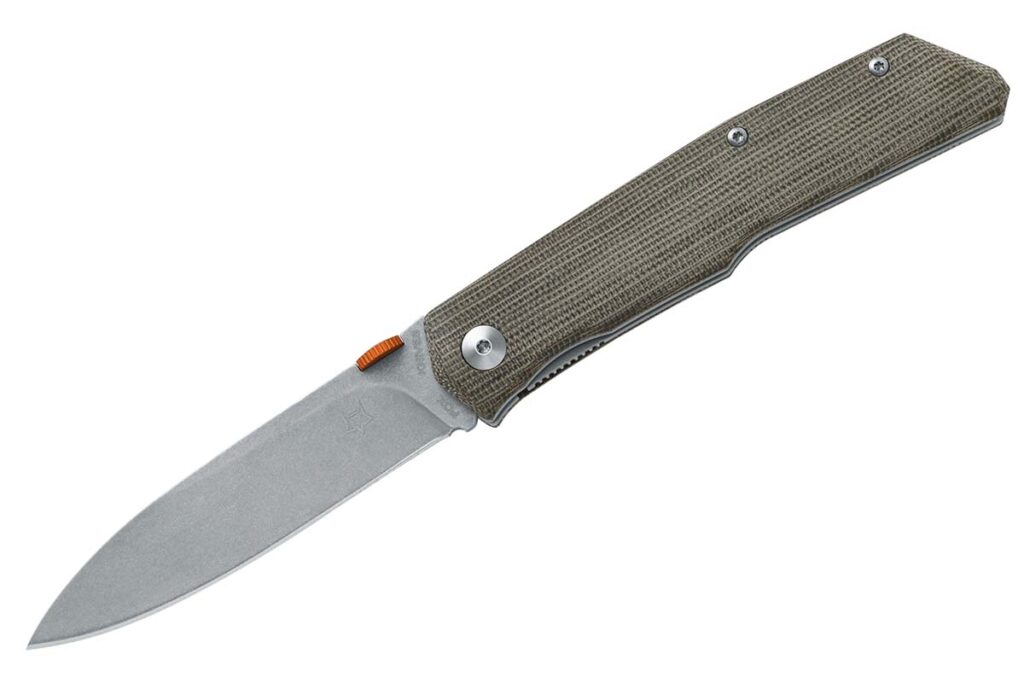
The Sicilian / Fox Knives
The Sicilian is a reinterpretation of Fox’s model FX-525, and the name pays homage to the Sicilian roots of Bob Terzuola’s family. Changes from the FX-525 include the BECUT stainless blade steel, the OD green canvas Micarta® handle and the wire pocket clip.
According to Fox’s Athena Greta Barbieri, “Bob Terzuola conceived the Sicilian taking inspiration from traditional knives used by ordinary people for everyday activities such as eating or working in the fields. The idea for this knife evokes images of landscapes warmed by the Sicilian sun and simple meals eaten among olive trees and vineyards.”
Designer: BLADE Magazine Cutlery Hall-Of-Fame® member Bob Terzuola Knife type: EDC folder Blade length: 3.35” Blade steel: BECUT stainless Rockwell hardness: 58-60 HRC Blade @ thickest: .12” Blade finish: Stonewashed Blade opener: Disc Handle material: OD green canvas Micarta® Spacer: Aluminum anodized orange Pocket clip: Wire Lock: Linerlock Weight: 3.53 ozs. Closed length: 4.52” Country of origin: Italy MSRP: $164
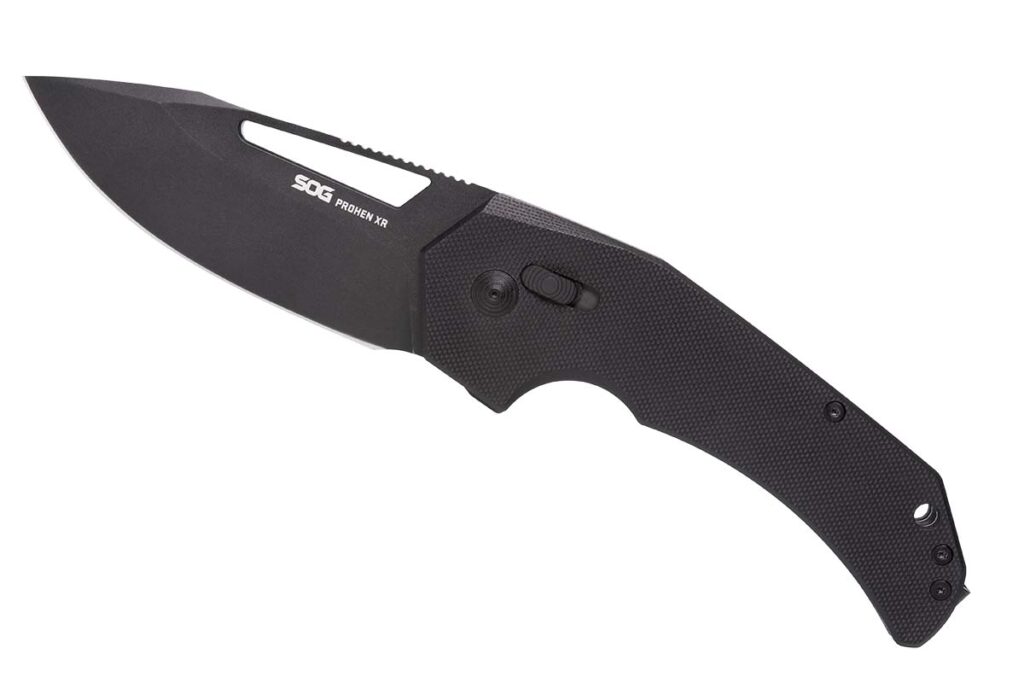
Prohen XR / SOG
The extremely strong G-10 handle is micro-textured for a secure, comfortable grip in wet or slippery conditions.
Designed by custom knifemaker Mikkel Willumsen for SOG, the beefy Prohen XR flipper folder is a mix of curves and angles that features the XR Lock, a sliding transverse bar that locks the blade in place and promotes ambidextrous one-hand operation.
Designer: Mikkel Willumsen Knife type: Flipper folder Blade length: 3.4” Blade material: Cryo D2 tool steel Blade @ thickest: .157” Blade grind: Flat Blade pattern: Drop point Blade finish: TiNi Blade opener: Flipper tab or thumb hole Handle: G-10 Pocket clip: Reversible, low carry Lock: XR Lock Knife to know: The XR Lock can withstand 1,500 lbs. of force Weight: 5.6 ozs. Closed length: 4.8” Country of origin: China MSRP: $70
Dmitry Sinkevich/ Spyderco
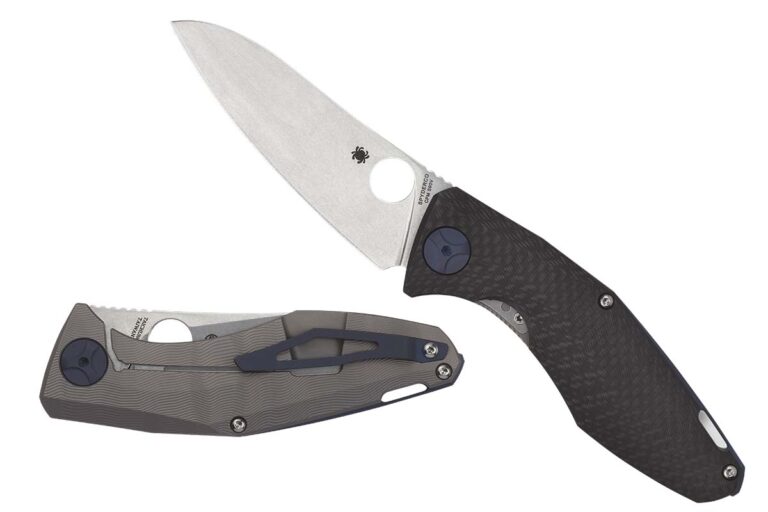
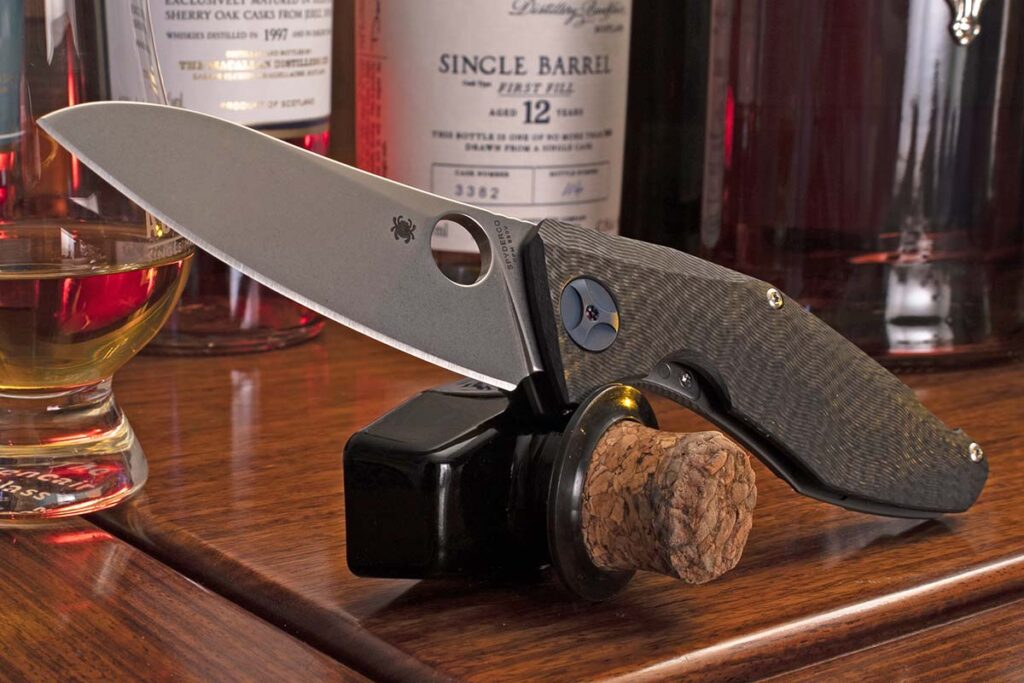
Drunken / Spyderco
The Spyderco knife’s handle includes a titanium scale on one side and a solid carbon fiber scale and nested stainless steel liner on the other. The titanium scale is “webbed” to reduce weight and forms the basis for the knife’s Reeve Integral Lock (R.I.L.) mechanism, which includes a long-wearing stainless steel interface. Both scales are meticulously machined with the intricate “drunken” texture that gives the knife its name, and are accented by a matching color-anodized backspacer, pivot assembly, and right-side, tip-up pocket clip.
Designer: Dmitry Sinkevich Blade length: 3.45” Blade steel: CPM S90V stainless Blade grind: Full-flat Blade @ thickest: .138” Blade finish: Tumbled Handle: Carbon fiber/ titanium Pocket clip: Right-handed, blade tip up Lock: R.I.L. (Reeve Integral Lock) Weight: 3.8 ozs. Closed length: 4.61” Country of origin: Taiwan MSRP: $770
Does the flow of new knives ever cease? Lord, I hope not.
Midspring is as good a time as any for knife companies to drop new models, variations and what have you. And with this round, we have five new blades from three manufacturers worth a gander.
These knives range across the board, from a very collectible outdoor option to a bevy of affordable pocket pals. Even if they don’t exactly tickle your fancy, these blades are worthwhile window-shopping fodder.
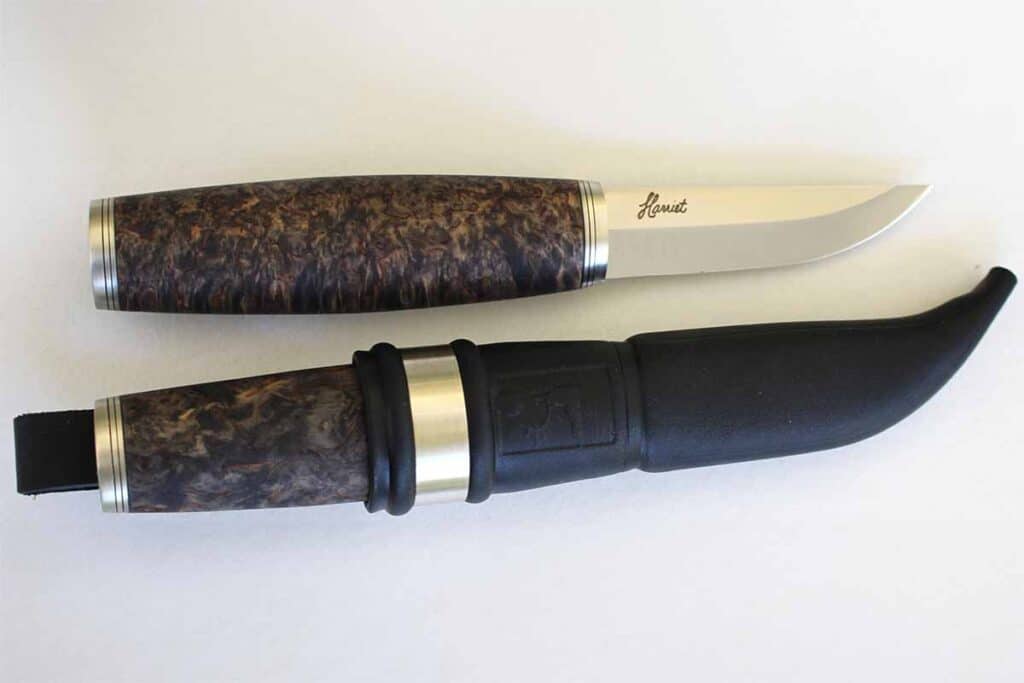
Kellam Knives Harriet70
Puukos are bread and butter at Kellam but its most recent introduction of this style of belt knife might prove better on the mantlepiece than on the hip.
Dubbed the Harriet70, the classic design is a tribute to Harriet Kellokoski, the wife of Kellam’s headman Jouni Kellokoski, for her 70th birthday.
There are a lot of nice points on this limited-edition knife, but what jumped out for me immediately was the handle—more exactly its wood. In this case, it’s arctic curly birch, darkly dyed and lightly oiled for the finish.
The curl pops and plays a beautiful counter to the nickel silver bolster and polished stainless-steel blade.
With 3-inches of wicked-sharp steel to play around with it’d make a solid hunting or fishing option, one dripping with class.
CRKT BOT Deadbolt
I can never complain about a design that puts fast deployment at the forefront of its engineering. Hence the BOT Deadbolt hits a sweet spot for me.
Assisted open with IKBS bearings, the action of this flipper doesn’t disappoint with the drop-point blade winking out in the blink of an eye.
Designed by Flavio Ikoma, the knife also features the Brazilian’s innovative lock—the Deadbolt—which relies on two lugs for extremely strong lockup.
This a much larger knife than what the Deadbolt is usually found on, intentionally so, since Ikoma was aiming for an overall robust system from tip to pocket clip.
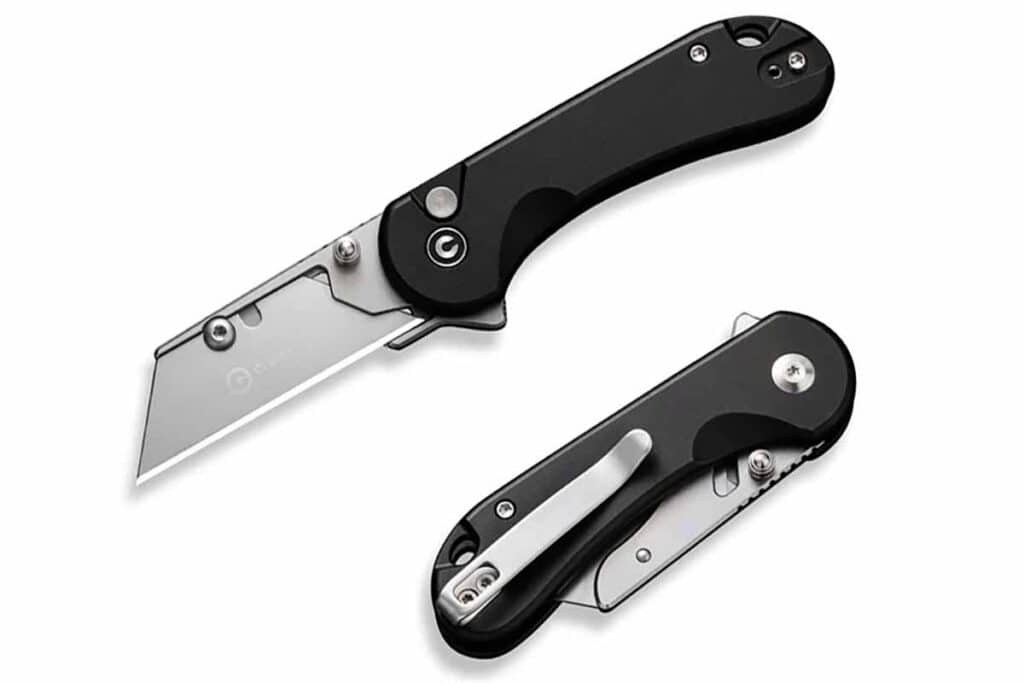
CIVIVI Elementum Utility
Quietly, there’s a utility knife war brew in the knife world. I, for one, say it’s about dang time.
An oft-overlooked corner of the blade world is getting some much-needed attention with the latest enhancement coming from juggernaut CIVVI.
Essentially a flipper/folder utility knife, the Elementum Utility offers perhaps the most important aspect of this class of knives—single-hand deployment. And it delivers it not in one, but three ways via kicker, thumb stud and button lock—if you like flicking out your blade.
CIVVI also delivers a bit of panache with the line, offering the replaceable-blade knife in a slew of colorways on its aluminum handle.
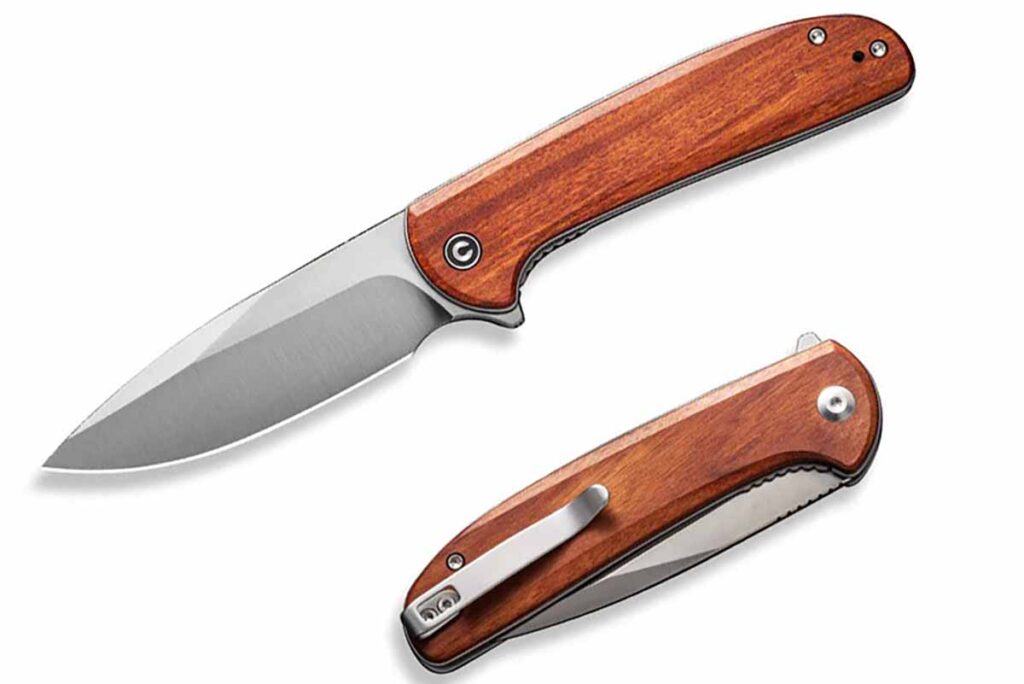
CIVIVI Primitrox
Even without looking at the branding, I think most knife aficionados would have sussed out this is a CIVIVI… or WE or Sencut. It just has the look, design points and action of the tirade’s knives and is close to several other options that already exist in the company’s catalog.
The one that comes to my mind is the WE Saakshi.
However, the Primitrox comes in a bit bigger thanks to a larger 3.89-inch drop-point blade.
The extra steel works to the knife’s advantage giving it not only a more robust design but more mass that flings the blade forward when opening.
I have to say, the handle options on the knife are nice as well, particularly the Guibourtia wood scale option, which gives the Primitrox a dignified look.
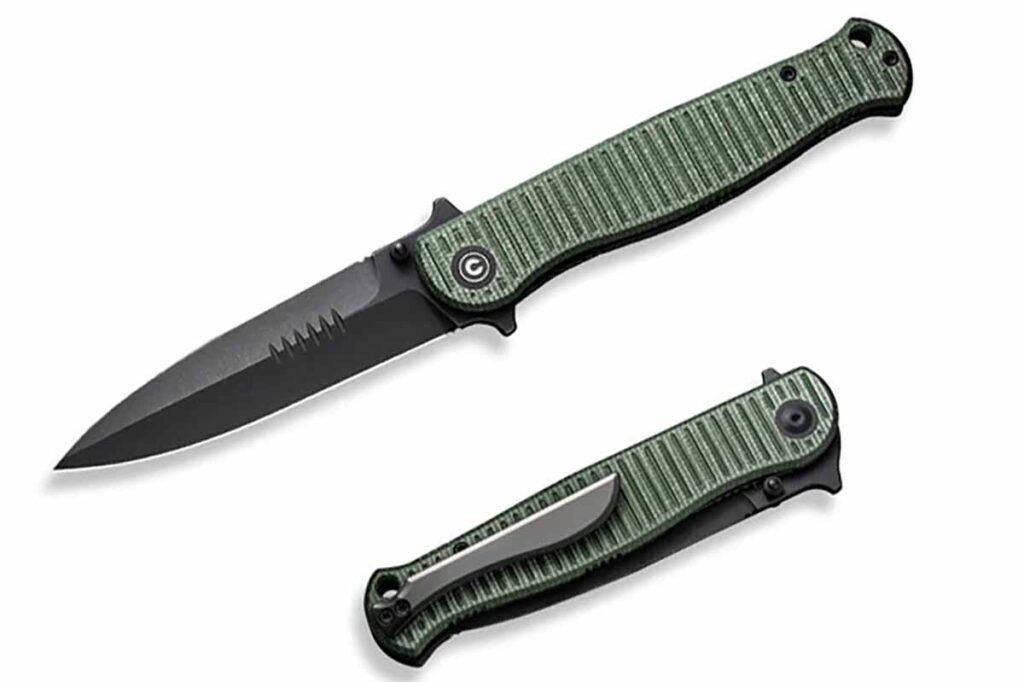
CIVIVI RS71
I have to confess this knife intrigues me. Of course, you’d have to have a heart of stone not to get geeked up over a dagger—or dagger-style—blade.
A Rob Saniscalchi design, the RS71 takes the deadly-looking blade style and tames it down for EDC with plenty of style. But plan on having plenty of pocket space to tote it around, because the CIVIVI borders on behemoth with a full 4-inch blade and 9.31-inch deployment length.
The knife fills the hand, yet the contoured handle makes it very manageable.
I also like the grooving on the scale, which gives it more purchase in the palm and a downright distinctive look.
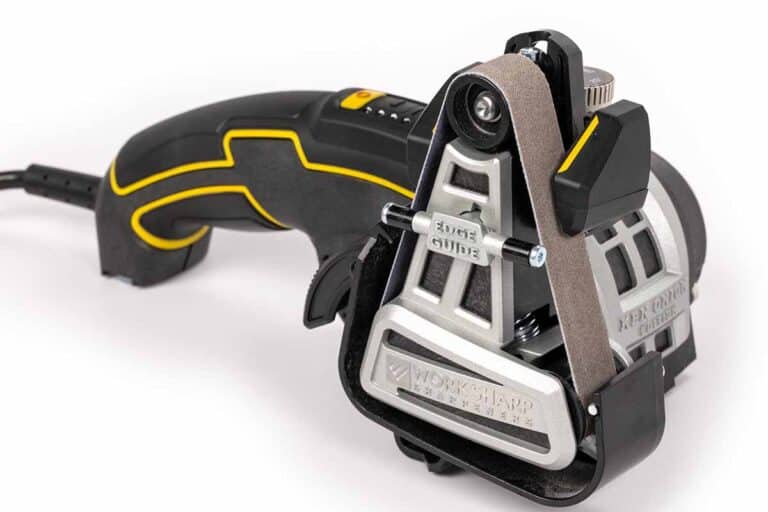
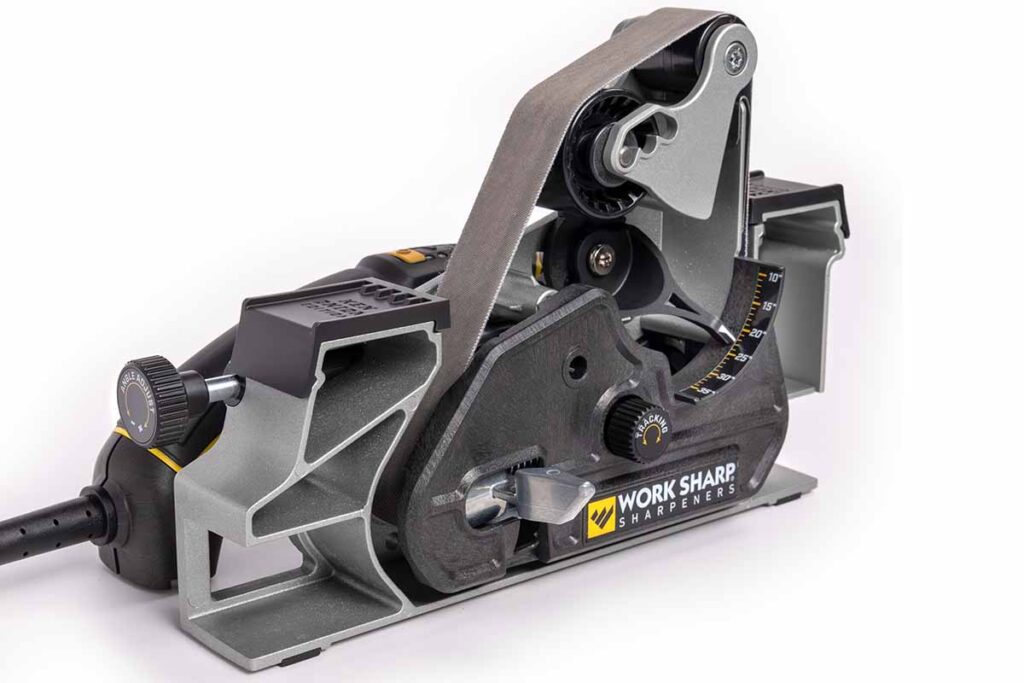
Work Sharp’s Ken Onion Knife & Tool Sharpener has been keeping knife enthusiasts’ edges sharp for a decade. A good run, by anyone’s measure. But the device’s time is up as the company welcomes the dawning of a new era—the Ken Onion Knife & Tool Sharpener MK.2. I’m sure some of you saw that coming.
Thankfully, Work Sharp hasn’t reinvented the wheel with the refresh of this time-tested multitool. Instead, the unit maintains many of the features that made it popular in the first place but offer a few notable enhancements that sharpeners and makers should find welcome, including a MK.2 Elite model with grinding functions.
Chief among the enhancements is the MK.2’s speed control, now offering seven preset speed settings to provide consistent and repeatable results. A new torque control delivers consistent power, even under load. To make the sharpener easier to dial in, Work Sharp has included a very clear amber LED indicator light for the belt speed selection for quick and precise adjustment. Furthermore, a scope click adjustment knob on the sharpening guide, with detent clicks, allows users to adjust in half-degree increments by touch. Incidentally, the guide is adjustable from 15 degrees at the low end to 30 degrees at the high, hitting nearly every angle for both knives and tools.
The MK.2 also comes with leather-lined angle guides that offer protection for knives during sharpening. Users will also note a lockout belt tensioner on the sharpening cassette that helps make changing abrasive belts fast and simple. The Ken Onion MK.2 will come with five grits to accommodate the full spectrum of sharpening from repair to ultra-fine polishing.
As for the grinding, the Ken Onion MK.2 Elite model has some interesting aspects too. The redesigned grinder attachment quickly and easily mounts to the power base without tools or calibration. Once attached, the grinder boasts on-the-fly motor speed control and continuous run time. Additionally, an adjustable, three-position convex pulley system allows users to customize their grind profile depending on personal preference or the type of knives being sharpened.
The Ken Onion Knife & Tool Sharpener MK.2 boasts a $200 MSRP for the base model and $300 MSRP for the Elite. While the original sharpener has been a standby for a long time, the new addition to the Work Sharp lineup should prove sharp.
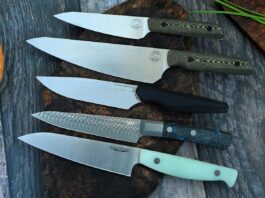
User-friendly custom takes on the classic Japanese knife handle abound.
The Japanese influence in kitchen knives is more or less a given. Those who work in food preparation, an art form unto itself, appreciate the style and utilitarian feel that the Japanese culture exerts on their vocation.
The kitchen knife has seen a wave of custom makers taking that context a step further. The knife is an extension of the hand and that extension starts with the handle. So, here again the ergonomics of Japanese influence emerge. The wa handle brings comfort and confidence to the kitchen user while also providing a sense of form, function and artistic expression for the custom maker.
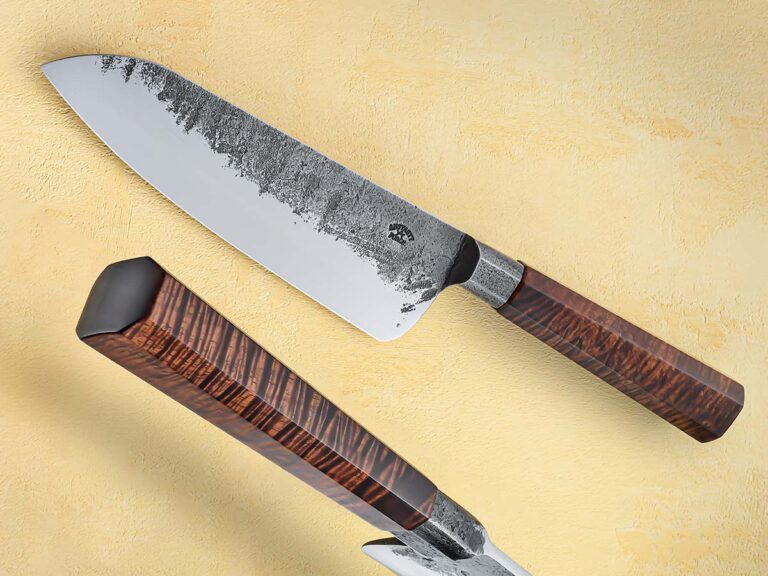
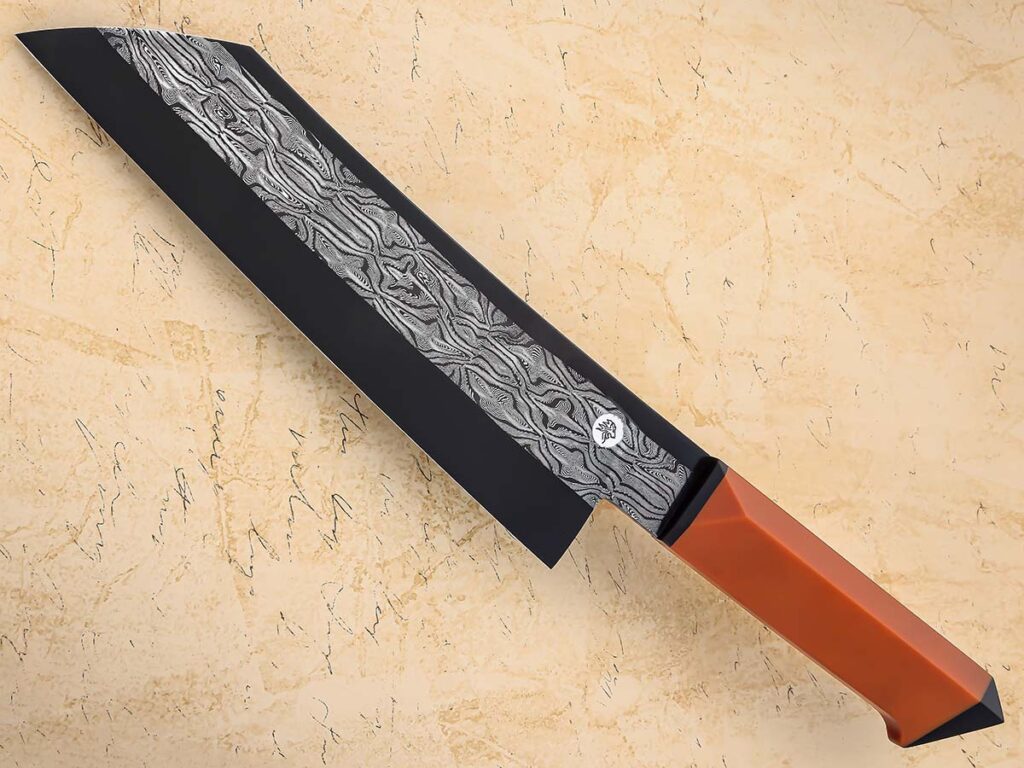
The wa handle of Aidan Garrity’s santoku has largely parallel sides to the width of the ricasso with a small ‘beak’ at the bottom for hand retention and aesthetics. Blade steel: mosaic damascus. Vintage butterscotch Micarta® scales boast flat-shield cross-sections and G-10 spacers. Overall length: 14 inches. His list price for a similar knife: $2,300. Its sister piece is a Garrity nakiri that was featured on the March 2024 BLADE® cover. (SharpByCoop image)
According to maker Jacob Anstaett, the name itself is rooted in the Japanese language.
“Wa comes from the Japanese language and broadly translates as ‘harmony’ or ‘balance,’” he explained. “In knifemaking, it refers to the traditional Japanese handle style, which emphasizes simplicity, lightness and an ergonomic connection between the handle and the blade.”
Anstaett further defines the wa handle as “lightweight with forward-balanced design. Typically, it is either octagonal, oval or D-shaped in cross-section. The handle is crafted as a separate piece that fits onto a hidden tang rather than a full tang. The construction is what gives the blade its distinct balance, where the cutting edge feels alive in your hand instead of weighed down.”
A resident of Plano, Texas and a custom knifemaker for eight years, Jacob says his wa handle is an interpretation of the Japanese style.
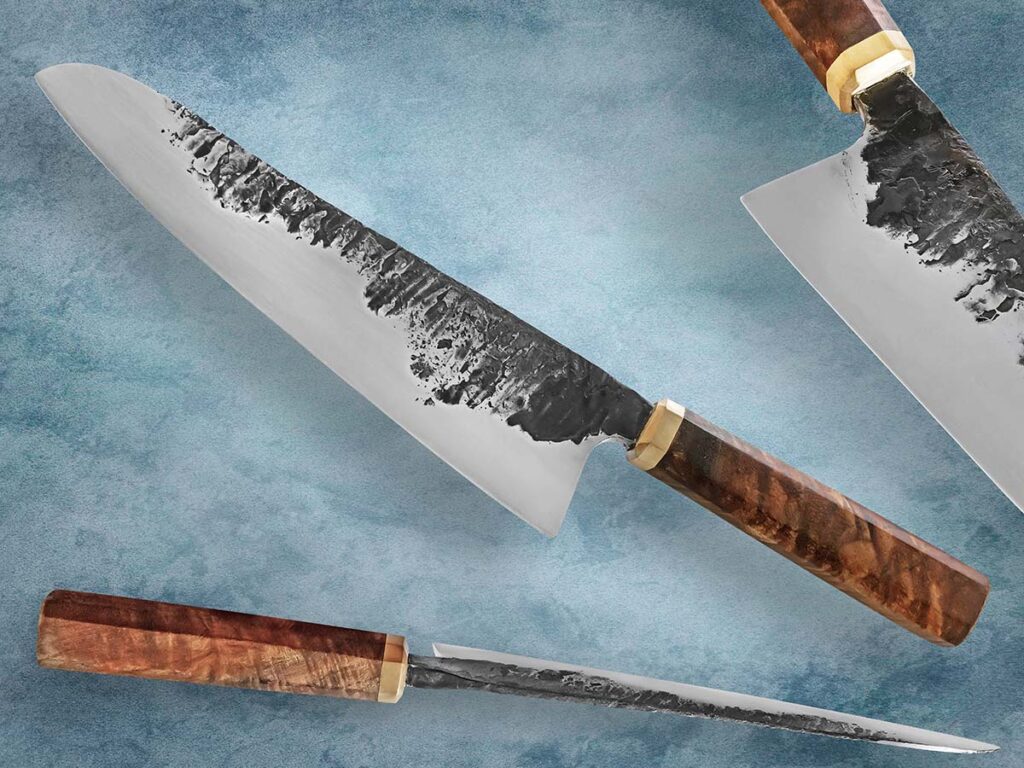
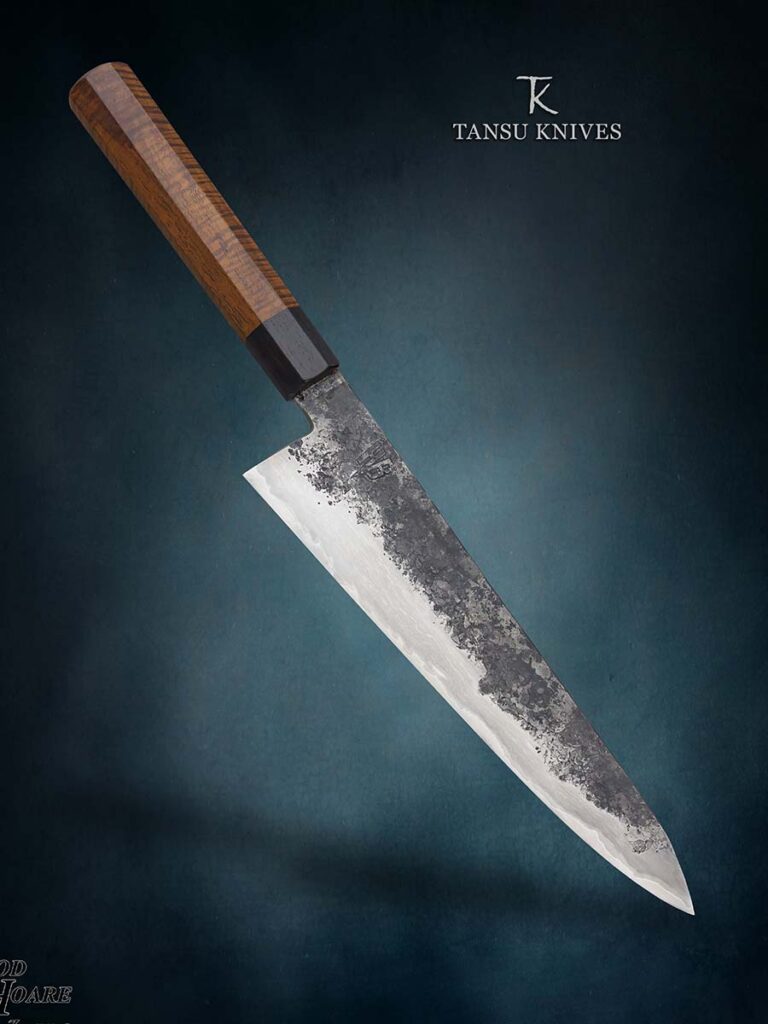
Alex Töpfer described his wa-handled piece as “a general-purpose kitchen knife based on various santoku. The blade is 80CrV2 as it’s a good general steel I can forge and heat treat. The handle is Tasmanian blackwood to add some fanciness, and the same is true for the bronze bolster. It’s functional art you can appreciate as you use it to cook.” His price for a similar knife: $325. (Rod Hoare image)
“It’s best described as a variation of the traditional wa,” he explained. “I keep the core geometry usually as an octagon cross-section, but I adapt the dimensions slightly for comfort. Western chefs often prefer a little more thickness and resilience, so I adjust proportions while preserving the forward balance that makes wa handles so effective.”
Jacob devoted extensive time to the study of traditional Japanese wa handles and then embarked on his road to interpretation.
“Over time I developed my own hybrid approach,” he commented. “My reasoning was simple: I wanted to honor tradition while building something that stands up to modern kitchens. For instance, I blend traditional shapes with stabilized woods or composites, ensuring they can handle daily use in a busy Western kitchen without losing the essence of the Japanese design.”
What Makes A Wa Handle?
Elaborating on the spirit and style of the wa, Aidan Garrity of Iron Lion Blades in Madison, Connecticut remarked, “There are two schools of thought for what exactly categorizes as a wa handle. One is that the handle’s construction involves a hole the width of the knife’s tang being drilled into the handle, and the tang being enclosed in a slotted dowel to tightly fit into that round cavity. The other is that it is simply the style of the handle, usually slimline and often having angular geometries. For questions like these, I always answer with the understanding that it is just the style of the handle, but I personally consider the true wa handle to be one utilizing the dowel bedding construction.”
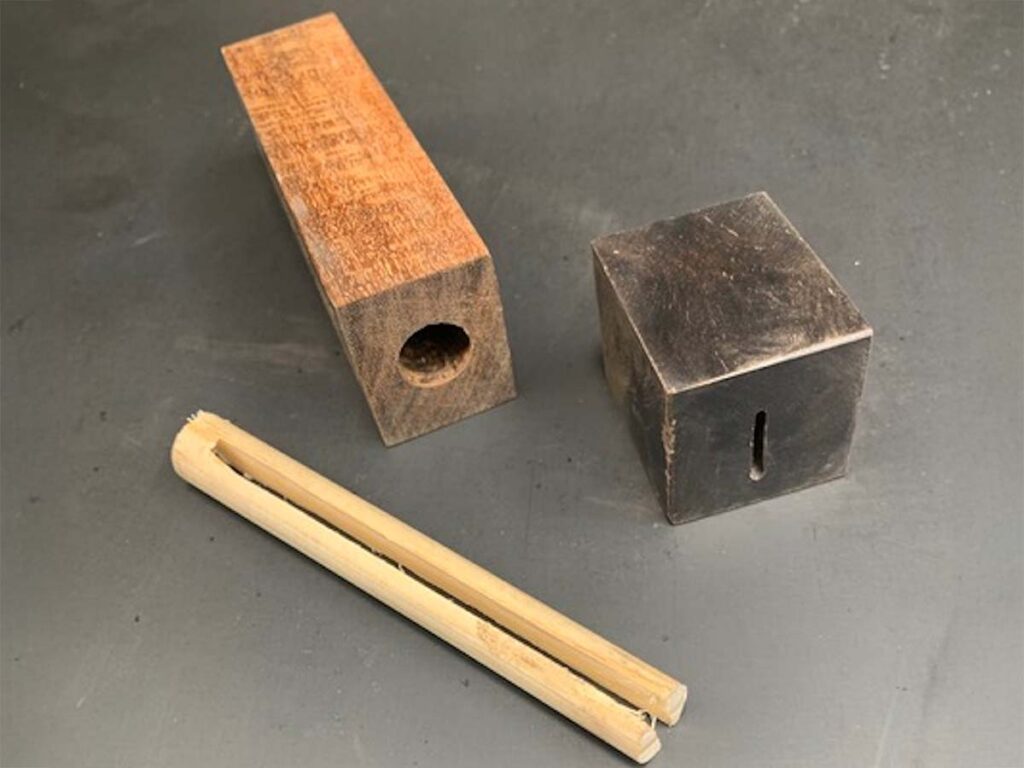
The wa handle of Mert Tansu’s gyuto has a half-inch-wide, 4-inch dowel (above) with a tang slot cut into it. “It is a traditional-shaped wa except for the internal structure,” Mert wrote. “While most Japanese blades are mounted to the handle with burning the tangs in, this is not possible with a hard timber-like ringed gidgee, and I glued mine in.”
Australian custom knifemaker Mert Tansu follows the wa tradition with his own interpretation. His perspective includes a geometric aspect that broadens the possibilities with the style.
“Wa handles come in a few different geometries,” he related, “from round to oval, to semi-octagonal to full octagonal and D-shape. Compared to their Western counterparts they are not sculpted and flat. Most of the traditional wa handles will have a horn ferrule and magnolia wood body.”
The wa handle of Mert Tansu’s gyuto has a half-inch-wide, 4-inch dowel (above) with a tang slot cut into it. “It is a traditional-shaped wa except for the internal structure,” Mert wrote. “While most Japanese blades are mounted to the handle with burning the tangs in, this is not possible with a hard timber-like ringed gidgee, and I glued mine in.”
Mert’s featured knife is a gyuto from his Hunter Valley Blades series of traditional Japanese chef’s knives with forged finishes and usually san-mai construction. He employed a dowel-bedding construction for the wa handle (page 16). He characterizes his chef’s knives as affordable and less time consuming to make than other custom types.
Specific features of the wa handle style translate into precision and control in the kitchen. He says that the flats allow the user to index the knife with ease. Despite the “stop sign” shape, the octagonal handle is quite comfortable and fashioned with precision on his disc grinder. Optimal length is a subjective question, but Mert likes paring knives with wa handles no longer than 4.7 inches, while handles of 5.3 to 5.5 inches work best in larger chef’s knives with overall lengths of 9.5 inches. For long slicing knives of overall lengths of 10.5 inches, he indicated he prefers a handle between 5.7 and 5.9 inches.
Wa Handle Interpretations
A custom knifemaker for seven years at his home near Melbourne, Australia, Alex Töpfer appreciates the employment of the hidden tang in his knife construction, and he says the wa-inspired handle works in both the active and aesthetic aspects of kitchen use.
“Obviously, I’m inspired by various styles of wa handles, specifically octagonal ones,” he commented, “and also the use of brass bolsters and guards in the Western context. The flats here are more to provide context with the organic, curved aspects of the wood grain and forged texture.
“I do think it’s important to have a flat [handle] surface that aligns with the blade, but the upper parts are more for looks. There is also the question of what an individual user likes. Personally, I prefer to use oval hidden-tang handles, but I do the occasional faceted one for practice and a change. I’ve only had problems when the tang is not long enough. So, I tend to go 2.75 to 3.15 inches of tang. That will support the handle during use. I have had issues with burl where the grain didn’t provide any strength, but a longer tang on that knife would have avoided the problem. Also, fancier materials might be easier to sell even if they’re not ideal. I like recycled ironbark but it doesn’t have that bling factor.”
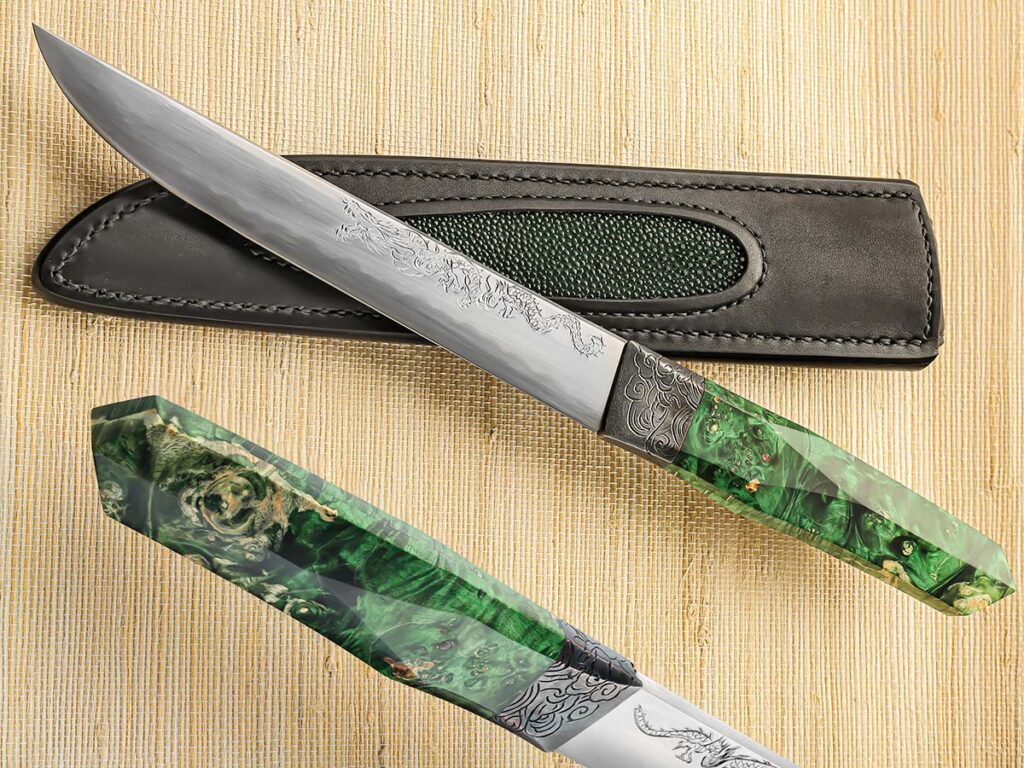
The traditional handle of Dew Hara’s suigetsu has stabilized burl scales and a copper bolster. The 7-inch blade is tamahagane steel with a hamaguri grind. Overall length: 12.4 inches. (SharpByCoop image)
Garrity demonstrates his skill with the wa in his mosaic damascus santoku blade that combines 1095 and 52100 carbon and 15N20 nickel-alloy steels. He used the Ferry Flip method* and then placed the multi-bar construction to be framed by a monosteel edge and spine bars. Aidan’s santoku has a sister blade, a nakiri featured on the cover of the March 2024 BLADE® (page 13). He made the nakiri with the same bar of mosaic damascus as his santoku.
“This handle is of my own design. It has largely parallel sides to the width of the ricasso with a small ‘beak’ at the bottom for hand retention, as well as aesthetics. It wasn’t based on any particular style,” he noted, “but it does categorize as a shield-shaped wa handle. The flats lend themselves to helping the user maintain proper edge alignment while cutting, as an overly round grip doesn’t offer much [user feedback]. In addition, the flats are somewhat easier to bring to a high finish.”
In constructing a wa handle, Aidan leans heavily on the length of the blade.
“Typically, 4½ to 5½ inches is seen as a natural range to balance average length and weighted blades,” he remarked. “Thicker and wider blades like nakiri and bunka will often be more forward weighted compared to the more generalist shapes like santoku. The handle is often too slim with poor retention for any large chopping blades or fighters. It’s best to stick to kitchen knives for this type of handle design.”
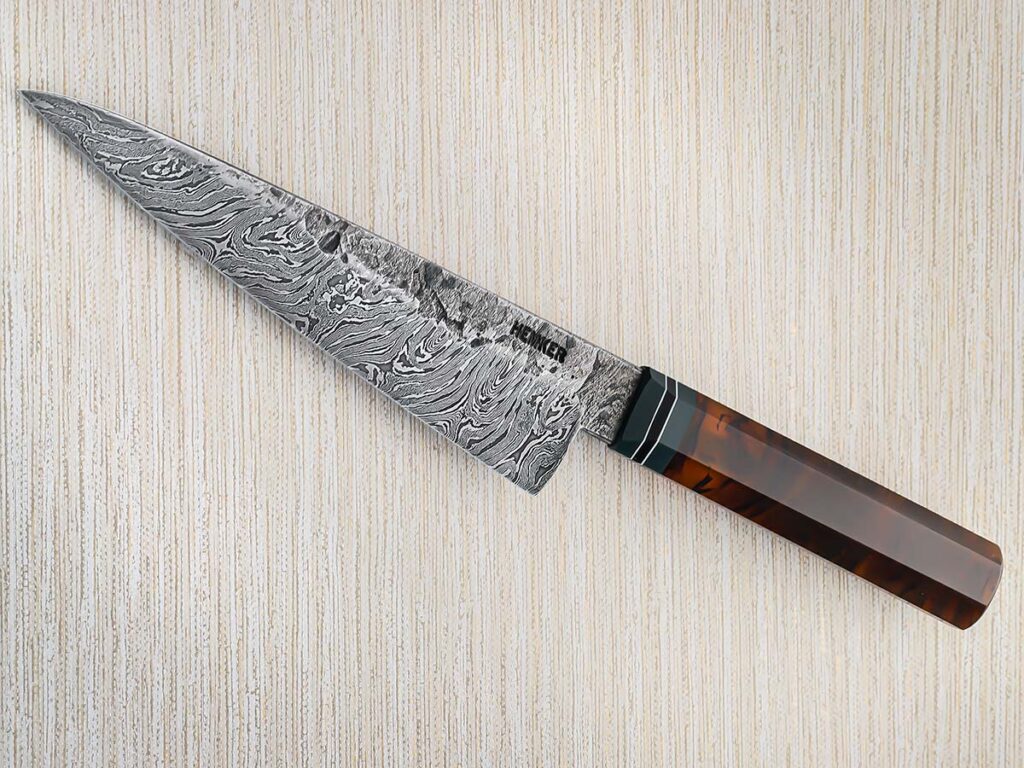
Eric Hemker uses synthetic tortoise shell for the wa handle of his chef’s knife. The flat-ground 7.785-inch blade is a damascus of 1084 carbon and 15N20 nickel-alloy steels. The spacers are green, black and white G-10. Overall length: 14 inches. (SharpByCoop image)
The where, why and how of the wa are revealed in various interpretations, put to work with enthusiasm in the kitchen, and exhibit style and beauty whether in the midst of meal preparation or displayed for all to see. Their aesthetic is timeless, but so is their capacity to make the work of the chef an adventure in creativity.
*Editor’s Note: Named in honor of its creator, award-winning bladesmith Tom Ferry, the Ferry Flip is a variation on the canned steel technique. It basically consists of cutting slices at a 35-degree angle off the end of a damascus billet. The resulting tiles are rotated and forge welded together to form a new billet. As a result, instead of the pattern showing on the end of the new billet, the pattern repeats itself along the new billet’s face.
Tradition meshes with modern in today’s new-age factory slip joint knives.
Like all tools, slip-joint pocketknives have seen their own evolutionary journey. In the olden days there were quality tools and then there were ones produced to be a bit more affordable, yet they still had their utility. These days many people buy knives for their utility, and I would say a number buy them for what I call the “Gucci factor.” As times change what’s considered attractive changes too, and, of course, makers leave their marks with their own innovations.
This time we’re not only going to test the latest in factory slip joints but also examine how companies and designers are innovating the age-old design to ensure it’s useful enough for the user and pretty enough for the collector. I took them all for a spin by shoehorning them into my everyday carry (EDC) rotation. The results are revealing.
CRKT Forebear
CRKT Forebear
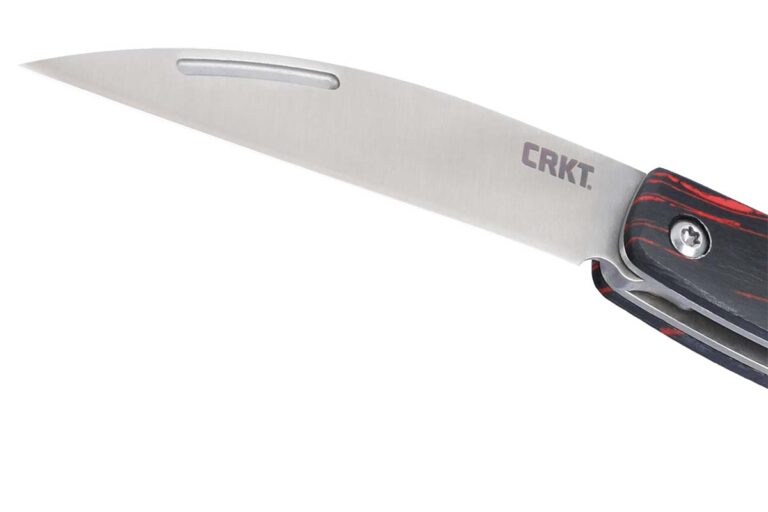
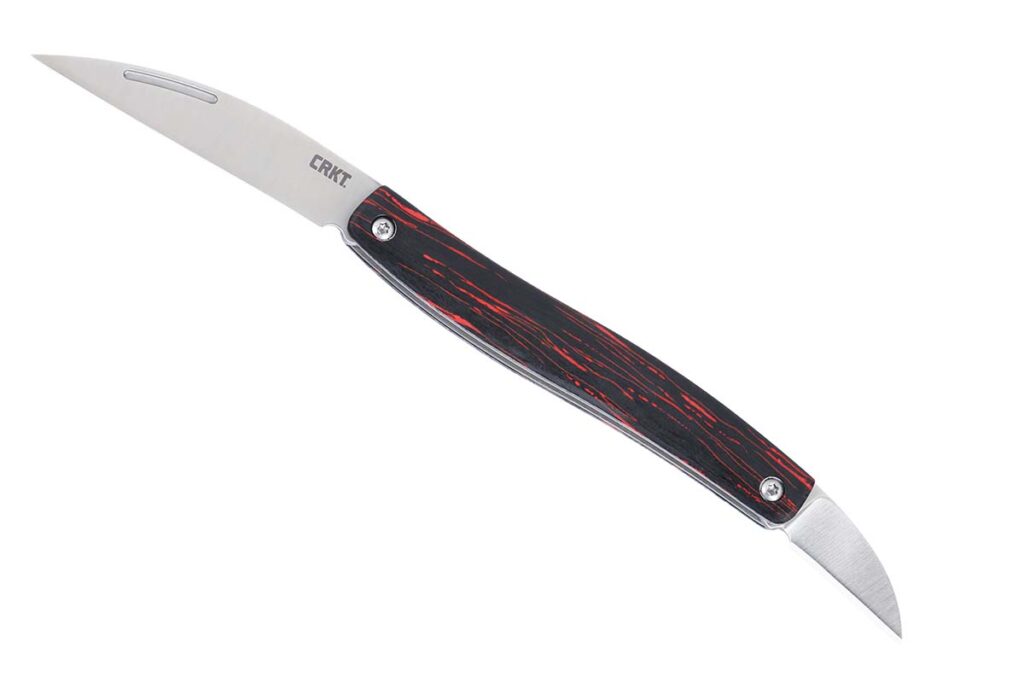
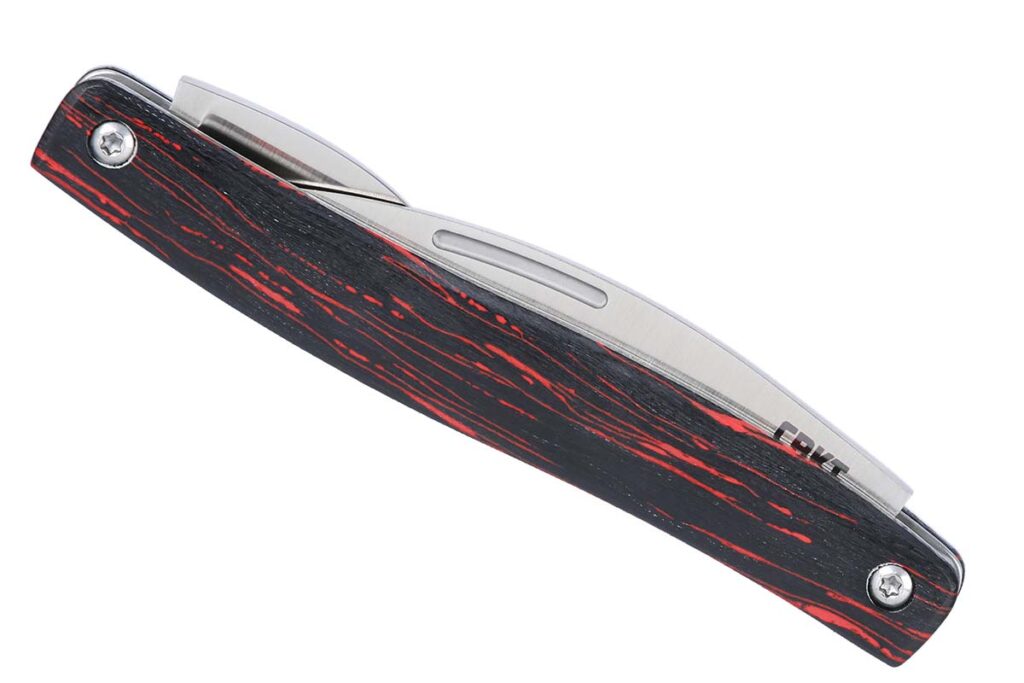
A couple of things update the CRKT Forebear. The first is the modified wharncliffe blades of 12C27 stainless steel. They’re not too big of a departure from the traditional style but still enough to make you notice. They are streamlined with an aggressive tip. Second is the use of a streaked-red-and-black G-10 handle. Unlike using texture to add dimension like, say, in a jigged material such as bone, the handle has two contrasting colors instead.
The knife is in a two-blade configuration—small and large wharncliffes—designed by custom maker Darriel Caston. The blades remind me of those on German chip-carving knives. Such blades are excellent for detail work and chores at which utility-style blades excel. They are flat ground and have long nail nicks that follow the spine.
I must say I was disappointed with the out-of-the-box finished edges on the blades. They were very uneven. One side had a larger micro bevel than the other. Machines do the great majority of the work creating the parts of a factory knife. In the end, though, the final edge is most often applied by hand. Before getting full use out of the knife I had to even out the bevels.
A handle closeup gives you a good idea of the depth the two-colored G-10 scales bring to the Forebear. At 3.43 inches closed, it’s a nice size for the watch pocket on your jeans.
Again, fit and finish was a bit of a disappointment, especially coming from CRKT. I have come to expect great value from the finishes on the company’s knives. Both scales exhibited shaping flaws and were left unpolished in spots, leaving an uneven appearance.
I actually like the design. It has great potential for everyday use with the two wharncliffes. It needs some work as mentioned on the edges. With a user knife it’s easier to overlook some fit-and-finish errors. After all, knives become better looking with familiarity as enthusiasts grow attached to their EDCs. As for the edge, it’s very fixable but it should come ready to use out of the box.
Boker Plus Koteyka
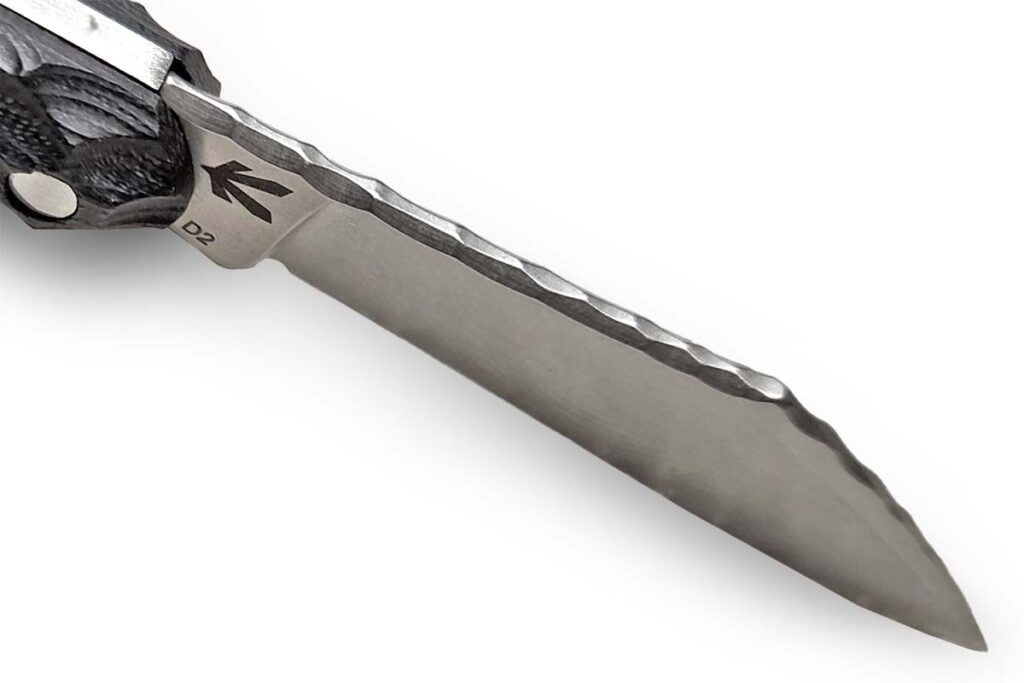
The file-style work on the spine of the Koteyka breaks up the profile and gives the blade some character.
The Boker Plus Koteyka is a stylized clip-point-blade folder. The handle is jigged black G-10. The blade is flat-ground D2 tool steel and opens via a nail nick. Closed length: 3.5 inches. I really like that Boker Plus sends the Koteyka in a box wrapped in wax paper like the old-time knives. On the back of the blade is some machining that resembles filework.
Out of the box it cut very well after I stropped it to bring it to the crazy sharp level. The finish on the G-10 has machining marks for a rustic look. One day I will end up hitting it on a buffing wheel. With a high luster polish I think it would be killer. Granted, the MSRP is only $69, so I’m just expressing my own thoughts on its presentation. Texture wise it can be a little rough on your hand, so that is another reason why I will buff it. The blade action and spring tension are good. It is a great little pocketknife update. I look forward to using it further.
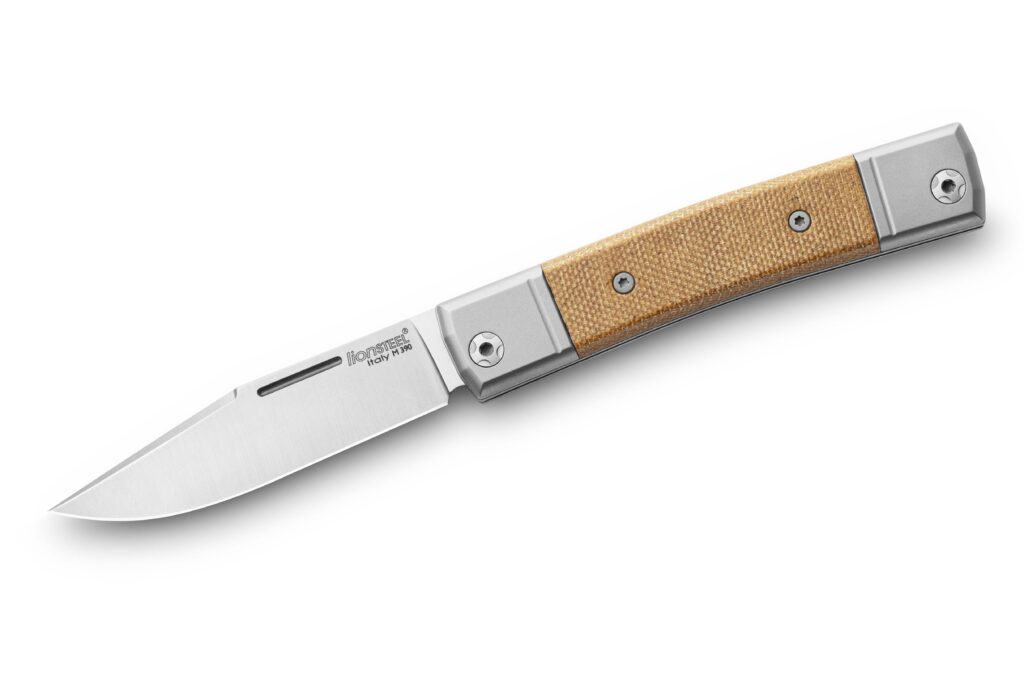
Lionsteel Bestman
Lionsteel Bestman
In the Bestman, Lionsteel offers a pocketknife with all the traditional elements, though it’s the presentation and materials that give it the updated look. The folder has three choices of blade configuration: clip and spear points and a combination two-blade set up of clip point and wharncliffe. I received the clip point for the test. Blade steel: M390 stainless. Closed length: 3.75 inches.
The Bestman features two sets of bolsters with a decorative groove. Handle materials come in an array of natural or synthetic materials, from olive wood to carbon fiber. I chose the canvas Micarta® for the rugged look. Lionsteel kept the design blocky while smoothing over the edges to avoid hot spots. None of the metal on the knife is polished. It has a satin finish, as did some of the older high-end brands in which one side of the blade would be polished and the other side hand rubbed. In place of pins are Torx fasteners. Even the execution of the grind on the clip point departs from the traditional by keeping all the lines crisp.
The blade opens via a nail nick. The blade action is smooth yet has a definite half stop. The spring tension is dead on. I must say I am impressed and like it. It came right out of the box ready for work. The materials and design will last a lifetime of chores.
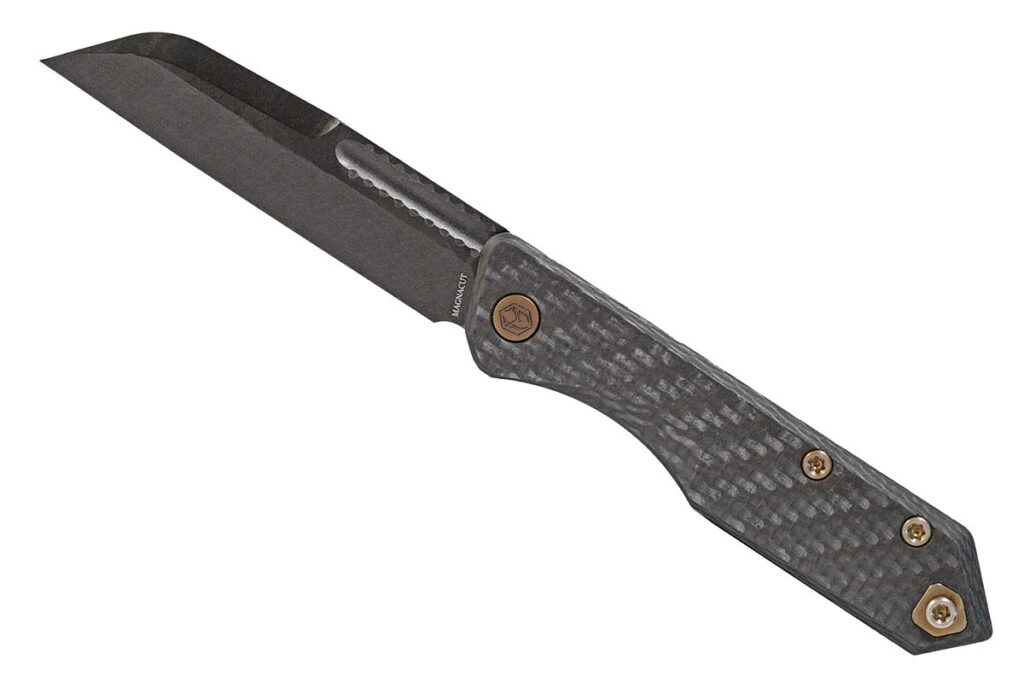
Heretic Jinn
Heretic JInn
At first, adding the Jinn by Heretic Knives to the review was iffy at best for me. I saw it on the company’s website and I somewhat reluctantly included it. To me, a pocketknife design from Heretic is akin to having a thrasher band perform Simon & Garfunkel. Nothing personal, I just thought Heretic couldn’t pull it off. In the end, though, I am the fool standing there clapping after the rest of the audience has stopped.
The sheepsfoot blade of CPM MagnaCut stainless with a combination serrated/plain edge has great application for EDC use. It can cut everything from soup to nuts. For style Heretic includes a false grind. The knife opens via a long nail nick at the blade’s back half. If I had one criticism it would be the position of the nail nick. There would be a greater advantage in opening the blade if the nick were farther away from the pivot point. Just pinching the blade closer to the tip allows for a smoother pull-on opening.
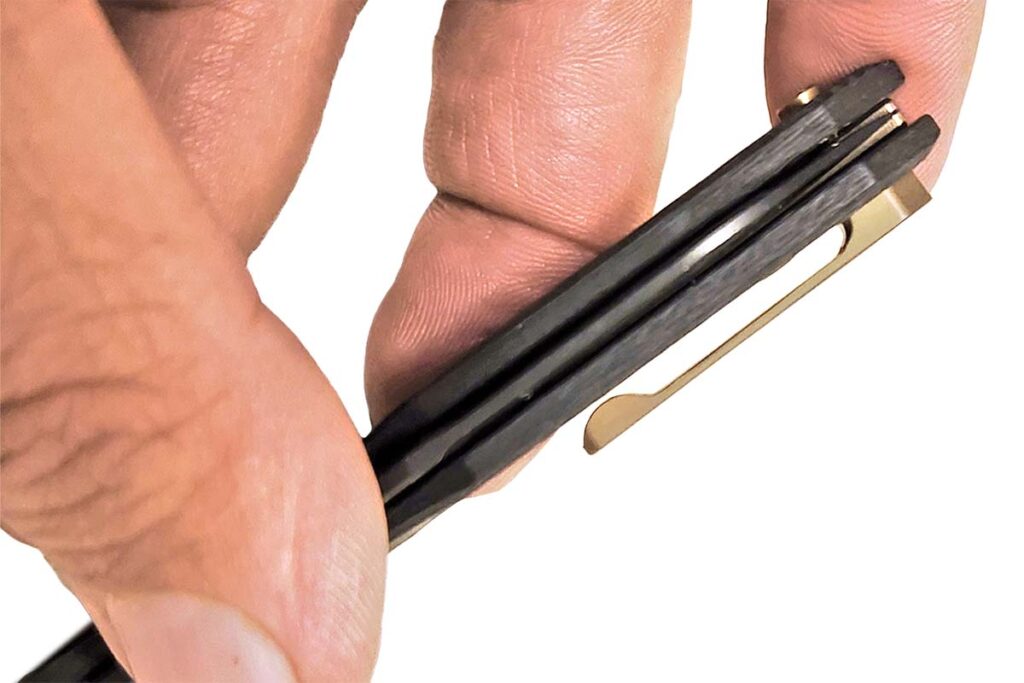
The Jinn is the only slip joint reviewed with a pocket clip.
A half stop enhances user safety and the knife is finished off in carbon fiber scales with a trim, low-profile pocket clip. The clip is my next issue. It is too tight to easily clip onto floppy and thick pocket rims. The design is such that you really don’t want to bend the clip, either.
All else considered, the Jinn really surprised me. It is a great worker. Overall, its looks fit right in with any modern one-hand-opening pocketknife. Closed length: 3.8 inches.
A CERTAIN ROMANCE Slip joints have a certain romance to them. On a base level the designs have tons of utility, and updating their appearances helps keep consumers interested. Of course, there will always be the ongoing love affair with the traditional designs. Many wouldn’t have it any other way.
Aaron Wilburn’s BodyGuard pushes the performance bounds of a hard-work knife.
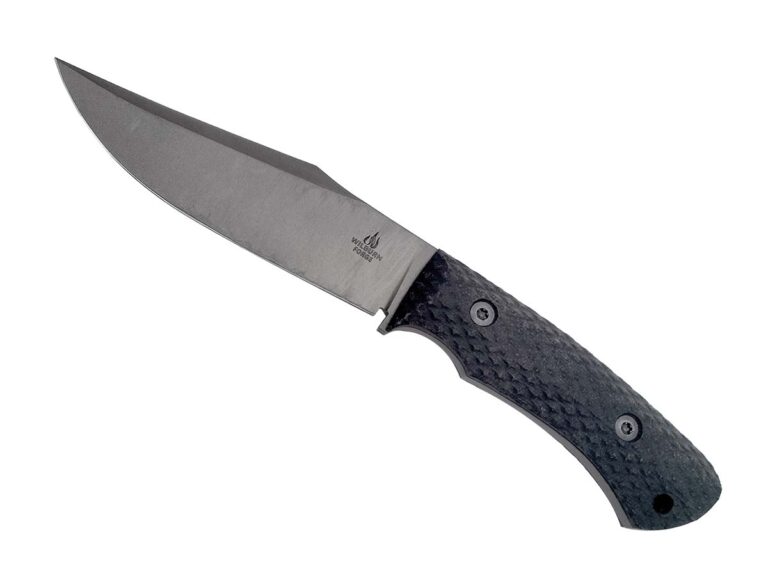
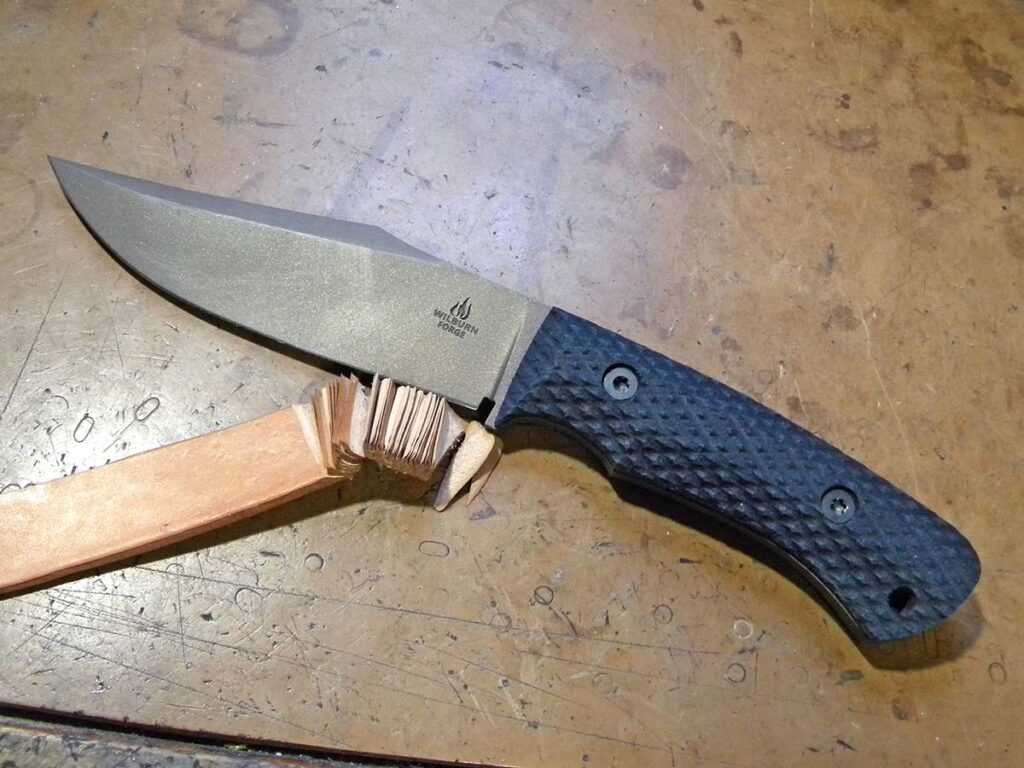
ABS master smith Aaron Wilburn produces spot-on precision works of art. His mosaic damascus is gorgeous, yet he still likes to make hard-working blades. The BodyGuard is one of the latter. It’s no frills, just tuned 52100 steel and textured non-slip Micarta handles.
A lot of knowledge is poured into these heavy-duty knives. It’s a little on the larger side for an EDC, but once in your hand, it’s very hard to use anything else. I’m all about the feel of a knife in your hand and the sharpness of its blade. Aaron’s BodyGuard is spot on in both fields. So, let’s get to cutting with the BodyGuard.
Skiving 8-ounce leather, the author found the slight curve to the belly of the knife let him roll rapidly into each thin slice.
To start, I executed a simple slice of paper to check the fresh edge. The BodyGuard sheared smoothly and quickly, with the edge showing itself on the aggressive side, meaning you could hear each slice. I had to move fast with my fingers so no nicks would occur. The knife’s balance felt correct while cutting.
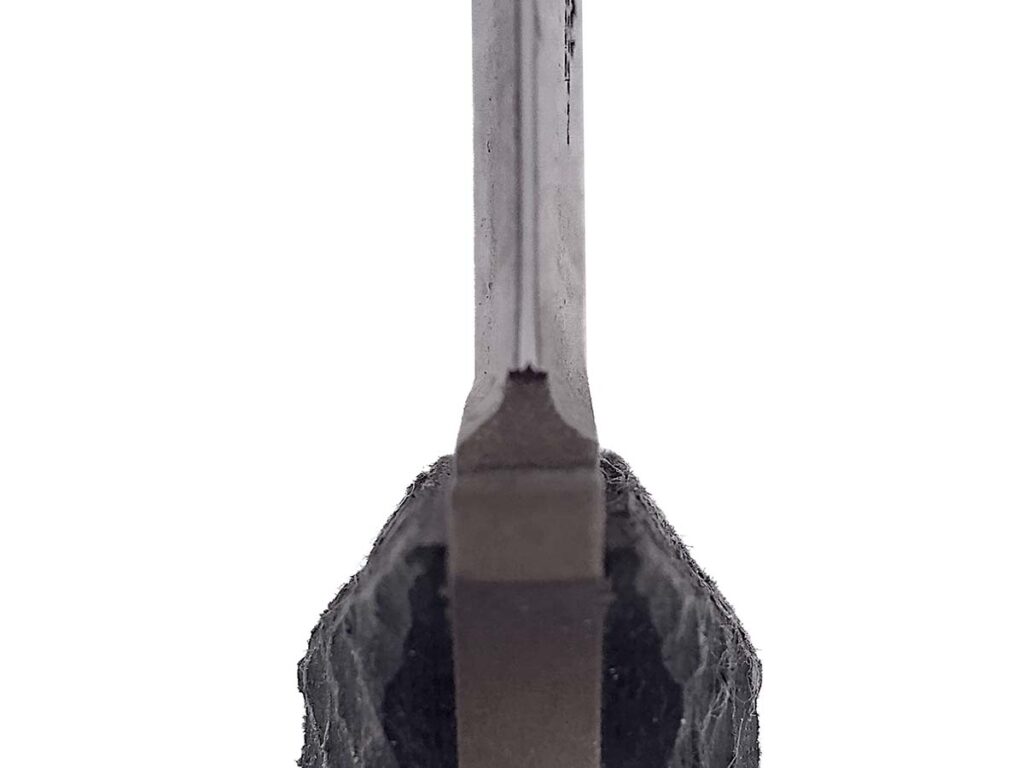
Next, I was on to some single-walled cardboard. The BodyGuard was slicing so fast and so sharply that none of the cuts distorted the cardboard. This is due to its full flat grind. The Cerekote coating helped, as well, reducing drag. Once more, the edge was notably audible and forceful through the material.
The BodyGuard’s plunge lines were spot on, uniform in depth and angle. This is always a sure sign of a well-made knife.
I pulled some scrap 8-ounce leather to skive. The BodyGuard made quick work of it. The slight curve to the belly of the knife let me roll rapidly into each thin slice. It was a fast enough pace that I managed to put a nick in my fingernail. The textured canvas handles proved very grippy and had a comfortable feeling. With the leather on its edge, I made more cuts, happily segmenting it without removing any of my flesh. Each cut gave me a nice crunching sound. Very sharp edge.
Laying The Wood
Using a leftover piece of pine, I did some whittling for a firestick. I ended up with thin curlicues and thick curlicue. All cuts were smooth, like they were from a carving tool. Its handle provided a positive grip on this more challenging medium and ensured smooth cuts. The finish took some wood smears, as expected, but the edge was still like a razor.
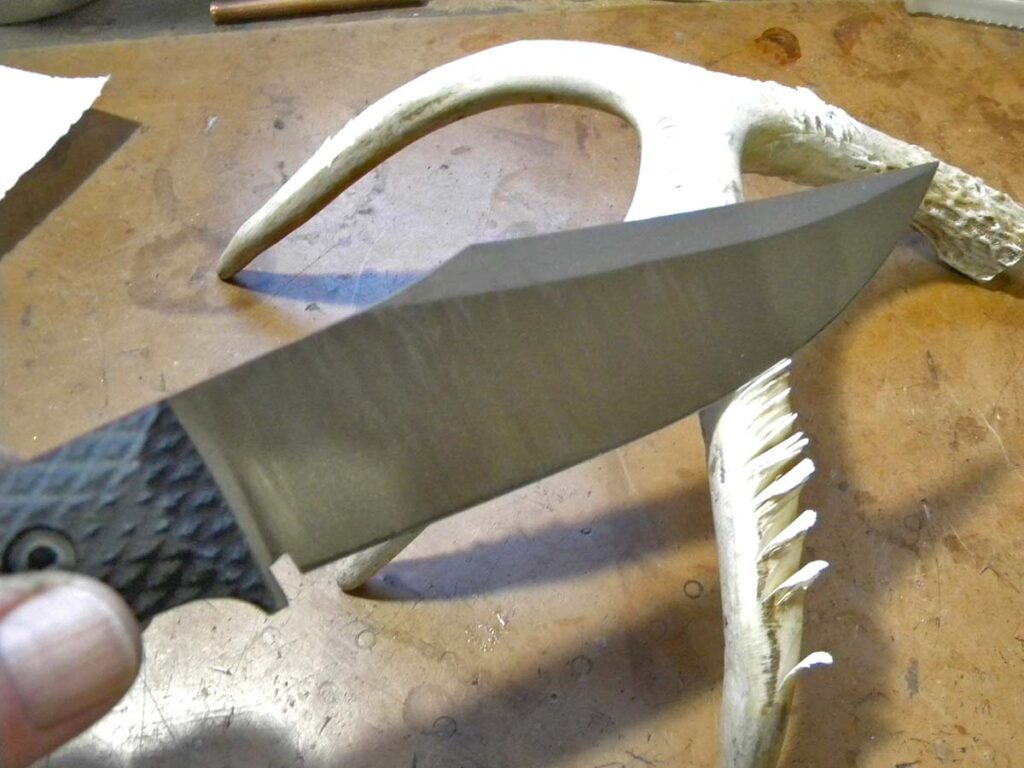
The BodyGuard was no hack in testing its edge against whitetail deer antler. The author littered his shop with antler fragments, however, the knife’s edge remained pristine.
Subsequently, I gave the BodyGuard a beating or I should say a batoning. Using a piece of seasoned hackberry, I batoned the blade into it to split some kindling. I found the false edge was ground almost too sharply; it wanted to stick into the baton piece of wood on the first two whacks. No issues after that with the BodyGuard making short work of the chunk of hackberry. I did notice the ends of the handles were a little sharp on the inside of my palm during this exercise. A few wipes of 400-grit sandpaper removed the edge. Again, more wood smears on the Cerakote, but the coating was 100 percent attached. Excellent job.
After some hard material, I tested the knife’s edge retention on 1/2-inch sisal rope. Man, does the BodyGuard cut, crunching through 200 cuts of the rope in record time. The edge felt like it was getting sharper with every slash. Even after all that, the knife remained extremely sharp.
The BodyGuard was no hack in testing its edge against whitetail deer antler. The author littered his shop with antler fragments, however, the knife’s edge remained pristine.
Finally, it was time to get busy on a whitetail deer antler with 30 hard whacks. All that did was send antler chunks all over my shop without even a micro nick on the edge. That demonstrated excellent heat treatment. And the edge still felt razor sharp.
The last step was to retest the edge on paper. The BodyGuard seemed to slice even faster after all its use. Smooth cuts through the 20-pound-bonded with no tear outs. Enough said and cut.
Bottom Line
I just make a minor softening on the end of the handle. Otherwise, the BodyGuard from Aaron Wilburn is in the top 1 percent of the knives I’ve tested. It will handle civilian, hunters and military chores with ease. Hats off to the maker.
Just in time for Christmas, CRKT adds a pair of sleek and stylish options.
Little surprise, CRKT’s insatiable march of designs continued in November with a couple of wickedly lithe designs.
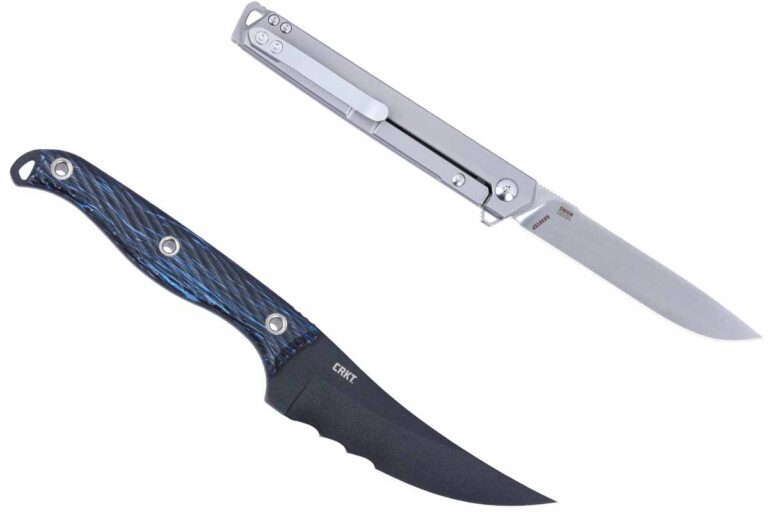
The Clever Girl Fixed and Stylus most certainly cut different profiles from each other and seem different as night and day. However, the new release certainly mimics each other in their sleek and slender designs, with their nimbleness apparent even out of hand. Additionally, both are in time for the impending Yuletide season, making them both perfect additions under the tree.
Let’s take a look at what each of these new CRKT drops brings to the table.
Clever Girl Fixed
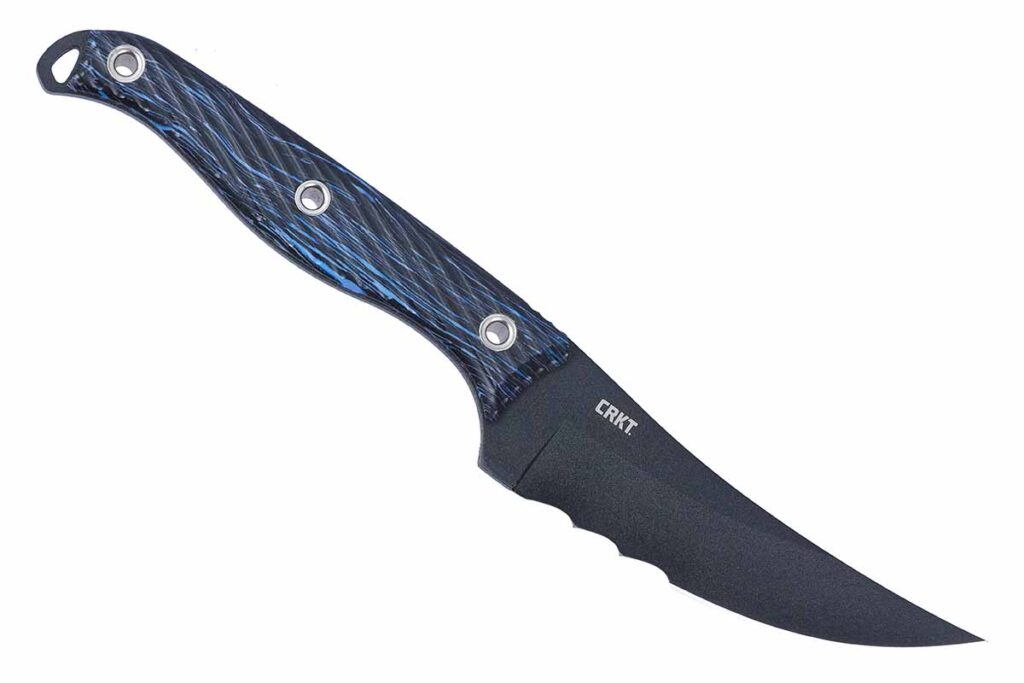
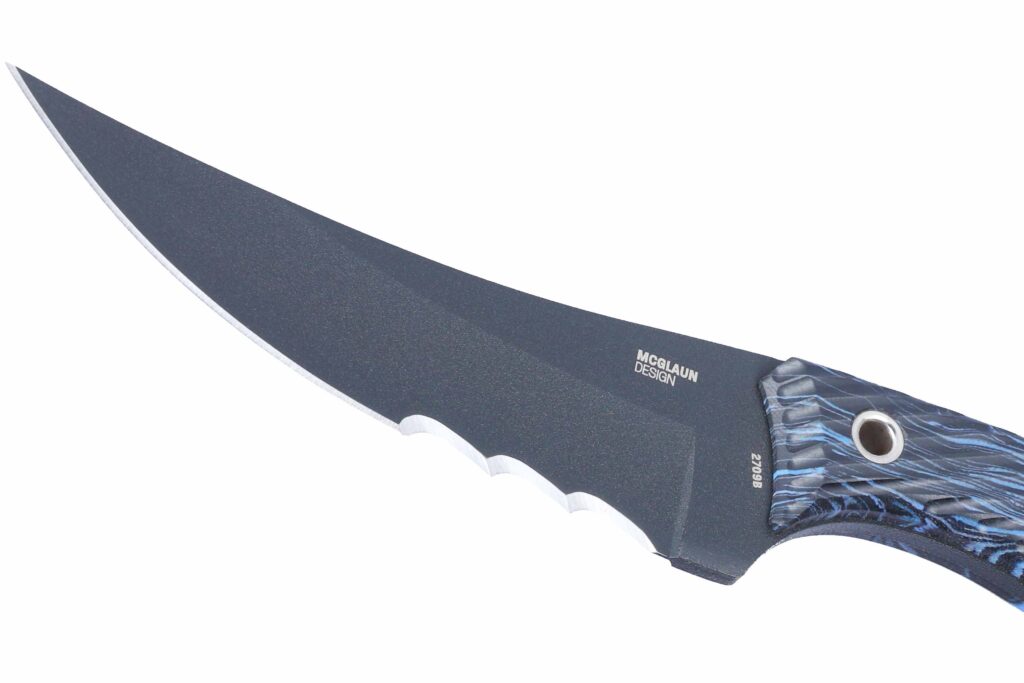
This knife somewhat returns to its roots, taking the Clever Girl back to the fixed-blade configuration. However, the Austin McGlaun design has some new twists that keep the Persian-style trailing point fresh. In particular, partial serration of the blade.
These are a series of three large, scalloped Veff serrations (CRKT proprietary and created by professional sharpener Tom Veff) running near the midpoint of the 4.6-inch blade. This enhances the knife’s sawing power, particularly against materials such as rope or fabric—think seatbelts. But let’s face it, it also takes a pretty menacing original design and makes it look a dash more ominous.
The other change on the Clever Girl Fixed is the handle, with CRKT bidding adieu to black G-10 scales and replacing them with marbled blew G-10. Not a huge switch-up, but one adding a touch of flair to the knife, particularly when offset by the black powder-coat finish on the blade.
As to the finer points of the knife, the blade is made from SK-5 steel, providing a good balance between toughness and ruggedness. It comes with a molded Kydex sheath for ease of carry. And it the Clever Girl Fixed watches her weight, tipping the scales at a very nimble 6.3 ounces. CRKT lists the knife at $114 on the company’s website and a portion of every sale—as with every knife in Columbia River’s Forged By War collection—is donated to the Green Bret Foundation.
CRKT Stylus
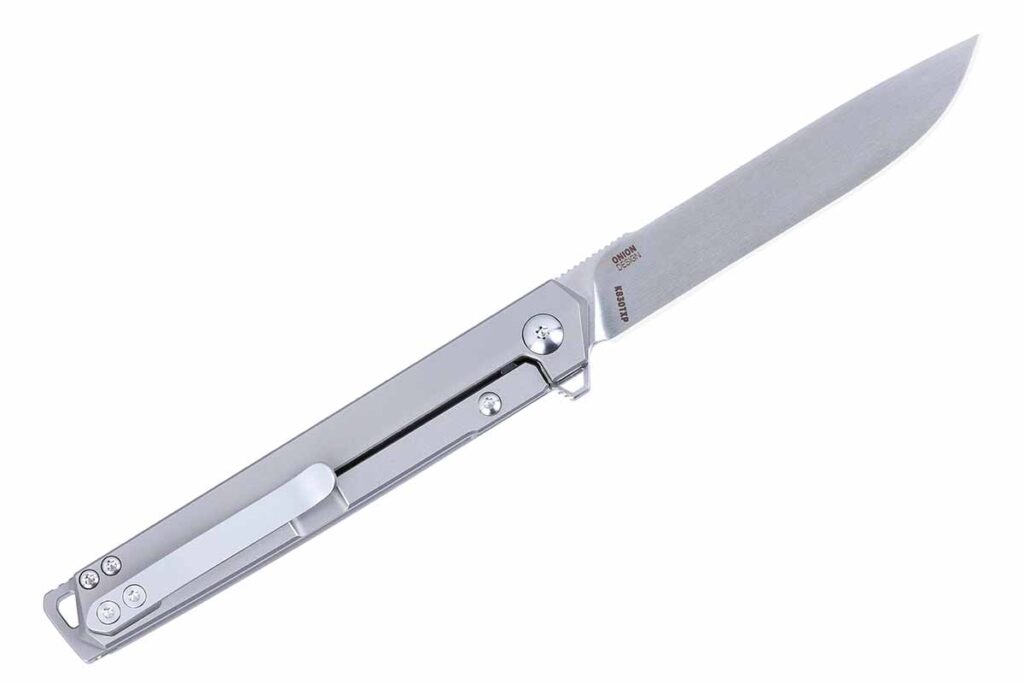
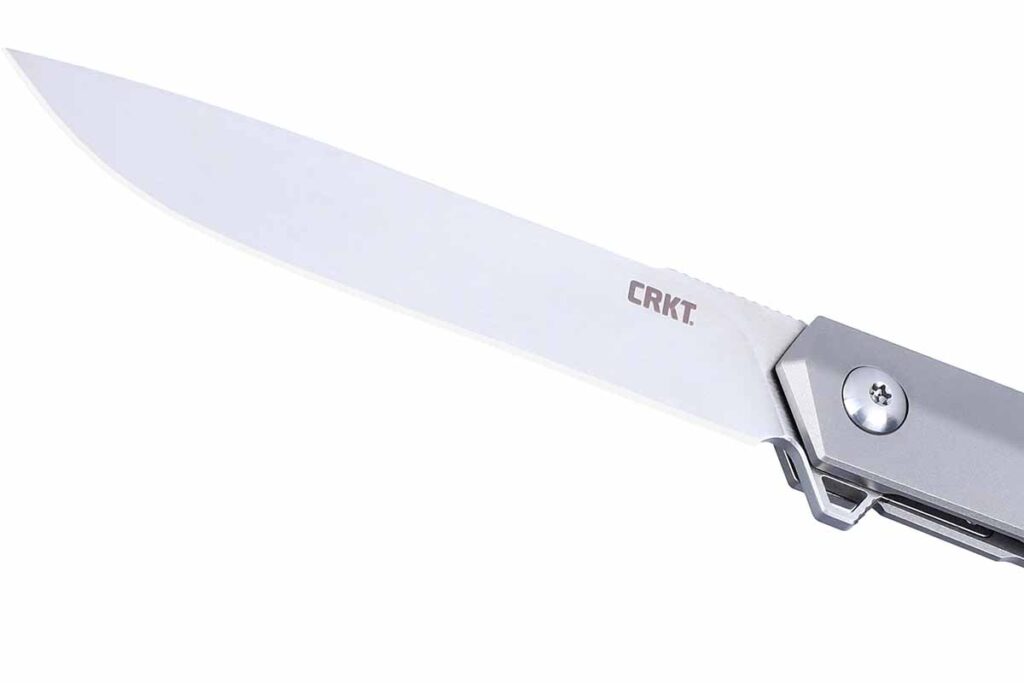
A Ken Onion classic CRKT brought to the masses a few years back, the Stylus has proven a popular addition to the company’s catalog. Unable to leave well enough alone—lucky for knife nuts—CRKT has released an updated version of the classy and svelte, assisted-open. In particular, the new version of the Stylus offers several upgraded materials, including a titanium handle and powerful CPM S35VN blade steel. The handle is especially nice, accentuating the crisp lines of the knife, making the already clean and sleek design seem even more so
The updated Stylus offers the points that have made the flipper a favorite of many, such as an IKBS ball bearing pivot for a silky blade deployment, a thick locking bar to secure the frame-lock’s blade and an extremely low profile. At present, CRKT lists the new Stylus listed at $195 on the company’s website.