Buyer's Guides

You’re looking for a new knife in a certain style – we’ve got recommendations on the best blades for every price point.

Best Sheepsfoot Blade Knives For Everyday Use

The Sheepsfoot Blade Isn’t The Most Popular Style, But It Is Certainly Quite Useful. This Quartet Of Knives Show Why You Should Try A Sheepsfoot.

I promise there will be no butchering graphics in this article. The sheepsfoot blade is one of many blade styles out there today, but it isn’t as popular as say the drop point or clip point. 

And that might be due to the shape of the blade. Instead of tapering down to a fine tip like a clip point, the sheepsfoot has a large belly and a smooth, usually curved, tip.

The name of the blade is a pretty literal one. It was named because it was made to trim the hooves of sheep. The shape of the blade looks nothing like a sheep’s foot. The use of the blade gave it its name, and it stuck.

Are Sheepsfoot Blades Only On Pocketknives?   

Yes, most sheepsfoot blades are on pocketknives and other EDC knives, but that’s not all. The popular Santoku knife features a sheepsfoot blade. The long dull spine that leads to the curved tip makes the knife great for slicing and chopping, and the wide belly allows it to act as an excellent scoop to get food off the board.

What Are Sheepsfoot Blades Good For?

Thanks to its long, flat edge, a sheepsfoot blade is perfect for slicing and chopping. Need to cut lengths of rope? Grab a sheepsfoot. Have to chop hard vegetables like carrots to drop in the pot over a campfire? Grab a sheepsfoot. 

Beyond slicing, a sheepsfoot is also great for tasks that involve longer knife strokes like opening boxes, slicing through sections of cardboard, and whittling wood. There’s countless uses for a sheepsfoot blade because it is such a basic, straightforward blade style. 

Why Might You Want To Pass On A Sheepsfoot?

The long, straight edge that makes a sheepsfoot perfect for slicing makes it a liability for things like piercing and. There is no fine point like a dagger or a clip point because the dull spine curves down to meet the cutting edge. This means that things like poking and puncturing are difficult with a sheepsfoot. Sure, you could angle it to puncture through a bag or a case, but it’s much harder than if you used something like a drop point.

Best Sheepsfoot Blades

This guide will stick with pocketknives as that is where the sheepsfoot is most widely seen. Classic EDC blades, keychain knives, the sheepsfoot appears across the knife landscape.

Benchmade Griptilian

griptilian

Benchmade makes excellent knives, that is without question, and the Griptilian is one of their best. The knife features a 3.45-inch CPM S20CV steel blade with a flat grind and treated to a 59-61 HRC. The satin finish looks great on it.

The gray G-10 handle scales look clean and provide a great grip. The AXIS lock keeps everything secure and is ambidextrous. Everything about the knife is class all the way down to the deep-carry pocket clip. This knife is a prime example of what a sheepsfoot blade can be.

MSRP: $149.95

Kershaw Copper Cinder Keychain Knife

copper cinder

A tiny sheepsfoot is still a sheepsfoot, and this fun multi-tool form Kershaw is a blast to use. The 3Cr13MoV blade has a 1.13-inch cutting edge with a hollow grind. It looks exotic with the machined copper handle, but this knife is all about practicality.

The small blade is sharp and can easily handle the simple day-to-day tasks that life can throw at you. The large keychain hole lets you easily pop it onto your chain with ease, and the integrated bottle opener will easily crack open your next beer. 

It’s not the biggest or the baddest, but the Copper Cinder performs exactly as advertised.

MSRP: $28.79

Kizer Vanguard Mini Sheepdog

kizer mini sheepdog

A compact, cleaver-style knife, the Vanguard Mini from Kizer is a great blade for someone who spends time camping. Yes, this is a strong EDC blade, and the 2.5-inch straight edge makes it ideal for cutting rope or slicing food to prepare over the campfire. Its versatility helps sell the knife in a major way.

The blade is a satin-finished 154CM stainless meted to a micarta handle. The flipper mechanism makes the knife a blast to use, and everything stays in place thanks to a liner lock. Functional, classy, enjoyable. That’s what the Vanguard Mini is all about.

MSRP: $99

Spyderco SpydieChef

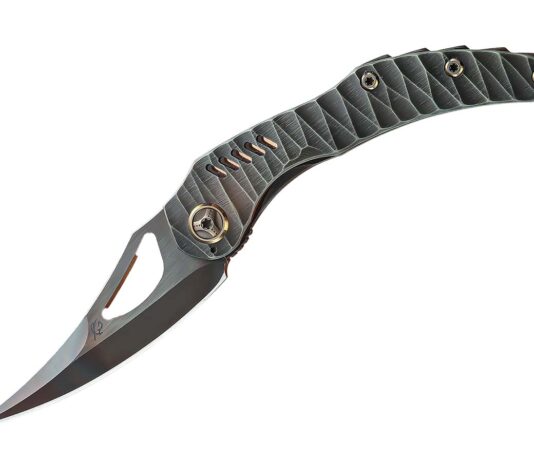
This folder from Spyderco is another excellent model from the company. The SpydieChef is an EDC folder designed to have the ergonomics and feel of a chef’s knife. The titanium handle is light yet robust in the hand, and the LC200N stainless blade is highly corrosion-resistant. That’s to be expected from a blade steel developed by NASA. 

The SpydieChef is multiple things depending on how you look at it. Its size makes it firmly an EDC that is made from high-quality materials. However, the design philosophy makes it look more like the most company kitchen knife on the market. Regardless, it has a steep price but more than makes up for it with its construction.

MSRP: $348.50

Read More

3 Sporty Kitchen Knives To Use In The Field

Knives Are Becoming More Multidimensional Every Year. These Sporty Kitchen Knives Are Ready For The Cutting Board Or The Campsite


When many of us blade enthusiasts think kitchen knives, we don’t necessarily associate them with outdoor or sport use. Likewise, many of us would not consider bringing our hard-use blades into the kitchen for prep work. Nonetheless, there are a few knives that have a broad range of uses in both the kitchen and camp. 

I tend to see a knife not just by the edge but by its blade thickness. While there is a utility to extremely thin-edged knives with thin spines, such blades are almost always designed for secondary or finishing uses. In my opinion, the thicker the spine the more utility a knife has for crossover work between kitchen and field. 

On the other hand, the thicker the spine gets, the harder it is to use for fine work—it can even be dangerous. Thinner blades are much better in the kitchen. As far as field use goes, they are pretty much only for light work and very small amounts of game processing. I’ve seen many thin blades break while working on deer. Some of these have resulted in injuries to the user.

Best 3 Sporting Kitchen Knives

There is a sweet spot for crossover, though, and the test knives fit the mold. None would be my preference for dressing a whitetail, but all certainly would be at home in camp or the kitchen after the heavy lifting has been accomplished. 

The TOPS Frog Market Special test knives could be used as skinning knives, as could the White River, but the main enemy of any thin blade is going to be breaking and edge chipping. Of the test group, the White River is the only one thick enough to be a primary use hunting knife, but it is a rather small knife with a slender handle. On small game it will work, if it’s not a bit obtuse in spine thickness, though when moving large amounts of muscle and skin, the hand would fatigue.

So, if we tend to think of a kitchen sporty as a secondary tool, a wide number of its features become handy that would not be so great on a primary field knife or even a primary kitchen knife. The first is the ease of cleaning and the ability to hold an edge. 

I put the review knives to work quite extensively in the kitchen, doing everything short of fully deboning large game. All were used on cuts of meat, to cut vegetables, peel apples, cook over an open flame, and as eating knives at the table or camp. In the process, I learned a few things about each one.

White River Exodus 4

Exodus 4

Of the test group, the White River Exodus 4 is probably the most well-rounded for field and table use. A relatively small knife, it is very slender in overall profile, both grip and blade. For general use, it is extremely functional. I found it suitable for virtually all small game, able to process a whole chicken and an excellent skinner.

It could be used for slicing vegetables, chopping onions, and cutting many other types of fruit and produce as well. The edge profile does not lend itself to fine cuts. For presentation or fancy plates, it tends to split rather than give clean cuts, especially in apples and things like cucumbers. This is not a major concern, just something to note.

The Micarta® handle is contoured superbly and cleans easily. It isn’t slippery when wet. Notably, it’s a full-tang blade that’s extremely strong. Despite its size, it has a blade profile thick enough for baton work on small pieces of wood, though it would not be my first choice for such a job. The blade spine has a sharp 90-degree profile excellent for use with a ferro rod.

There aren’t many if any, downsides to this knife. It can be used in just about any setting and will not look out of place if you take it to town for dinner. You also will not look like “that guy” if you use it to cut a sandwich in half or an apple for your kids in public. Note: The sheath is a bit stiff when you first get it but it breaks in fairly quickly. The knife was very easy to keep clean and sharp.

MSRP: $175

TOPS Knives Frog Market Special

frog market special

I’ve used the Frog Market Special (FMS) models by TOPS Knives for a couple of years. They’ve given me a long time of service in the kitchen as well as around the campfire. They’re available as individual pieces or a set. If you get the set, it comes with a piggyback sheath. The sheath is very nice and has a belt clip.

Steven Dick, U.S. Army ranger veteran and editor of the old Tactical Knives magazine, based his design for the FMS on knives he saw on a trip to Hanoi, Vietnam. He watched butchers and fishmongers using knives of a pattern he’d never seen before. They prepared meats and fish of many varieties easily using the blades.

I’ve done just about everything you can imagine with my FMS knives in the kitchen, and also processed dozens of deer with them. They maintain their edges very well and required only occasional resharpening. Because of the unusual blade shape, the knife can cut just about any type of meat and vegetable, including slicing, chopping, and in a rocking motion. They’ve replaced several other knives in my kitchen and serve as my go-to set.

While they have a large, deep-bellied profile, the FMS knives aren’t especially durable for field use. I have not used them to break down large game for the same reason I would be afraid of breaking any thin-spined knife. They excel for chicken and duck, as well as other small game. The Micarta handle is very comfortable and slip-resistant.

I’ve had an extremely good time with these knives but they have a downside—the blade finish. I’ve had excellent luck with all my TOPS knives, though I’ve never been a fan of the finish. I prefer knives that are bare metal. I don’t like it when the coatings begin to chip away. In a couple years of use, the finish has begun to flake and the metal underneath has become discolored, even with oiling and care. While it is a minor gripe, for knives used to process food I don’t like the idea I may also be eating blade coating. I would like to see this profile in some sort of stainless, or perhaps a slightly thicker spine in a tougher steel.

MSRP: $375 for the set

Spyderco Utility Knives

spyderco utility knives

Spyderco offers some very affordable and high-performance knives that are at home in the kitchen and easy to clean and maintain in the field. The company sent me its 4.5-inch Utility Knife with a serrated edge and red handle, as well as a plain edge 6.5-inch model in black.

The first thing about these knives is they are extremely slender and likely would not be suitable for hard field use. However, if you are already at camp, these are exceptional for end processing and cooking. I used them for weeks straight for all my cooking and they never dulled or chipped. They were both so sharp at the end of the review that they could still cut paper-thin slices of tomato, a hard feat for most knives.

One of the most important parts of these knives is they are essentially foolproof. Even after cooking with them for several meals a day for a long time, I cleaned them without issue and returned them to the knife block. The fact they are so easy to clean and stay sharp for so long really makes them worth the already low price. You don’t really have to worry about oiling them or keeping them in a special container.

In a pinch, the knives can be used for striking on a rod, though I would not recommend it long term. Their utility in the field is very limited, though when it comes to fishing or pursuits that don’t involve moving large animals, they’re just fine. I would not replace my fillet knives with either of these, though they certainly work for the task.

MSRP: $50 or $60

Read More

Keychain Knives: Unlocking The Secrets To The Convenience Blade

Handy keychain knives are pocket pards ready to sever and serve.

As competitive as today’s cutlery market is, it behooves a factory knife company to fill as many categories as it can—including the keychain knife. In fact, keychain knives offer a number of the same utilitarian functions as many contemporary tacticals and EDCs. Whether you need a small knife to handle daily chores or a back-up to your back-up in an emergency, a keychain knife can answer the call.

Keychain Knives
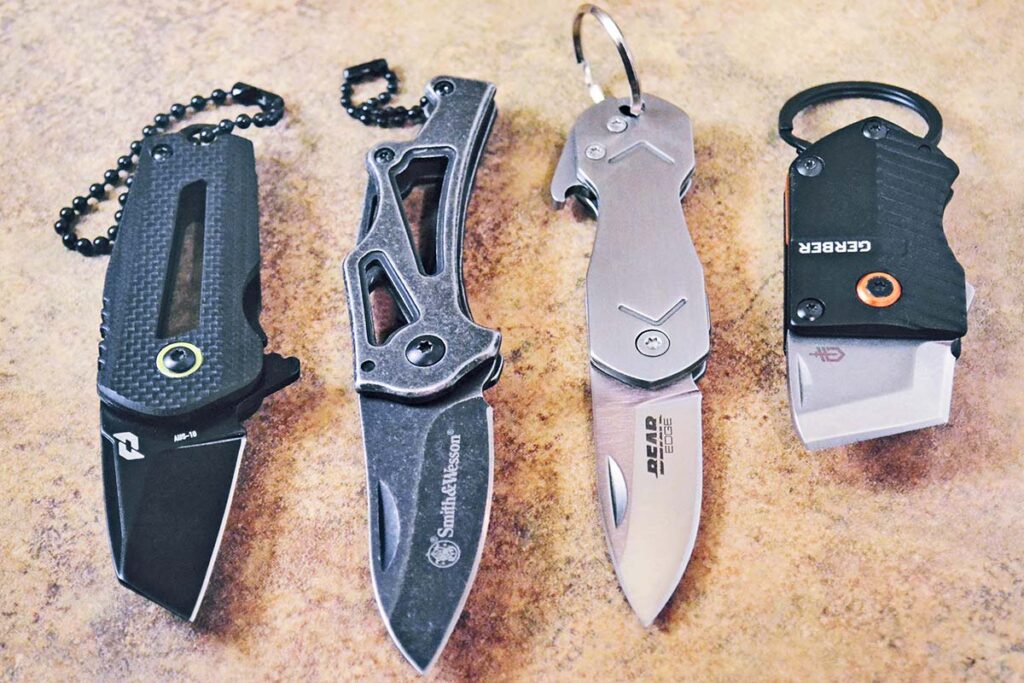
The test bunch, from left with manufacturer’s suggested retail prices in parentheses: Schrade Roadie ($25.99), Smith & Wesson Stonewash ($17.99), Bear & Son 3-inch Keychain Knife ($22.99) and Gerber Keynote ($27). All are made in China.

Bear & Son 3-inch Keychain Knife

Bear & Son 3-inch Keychain Knife
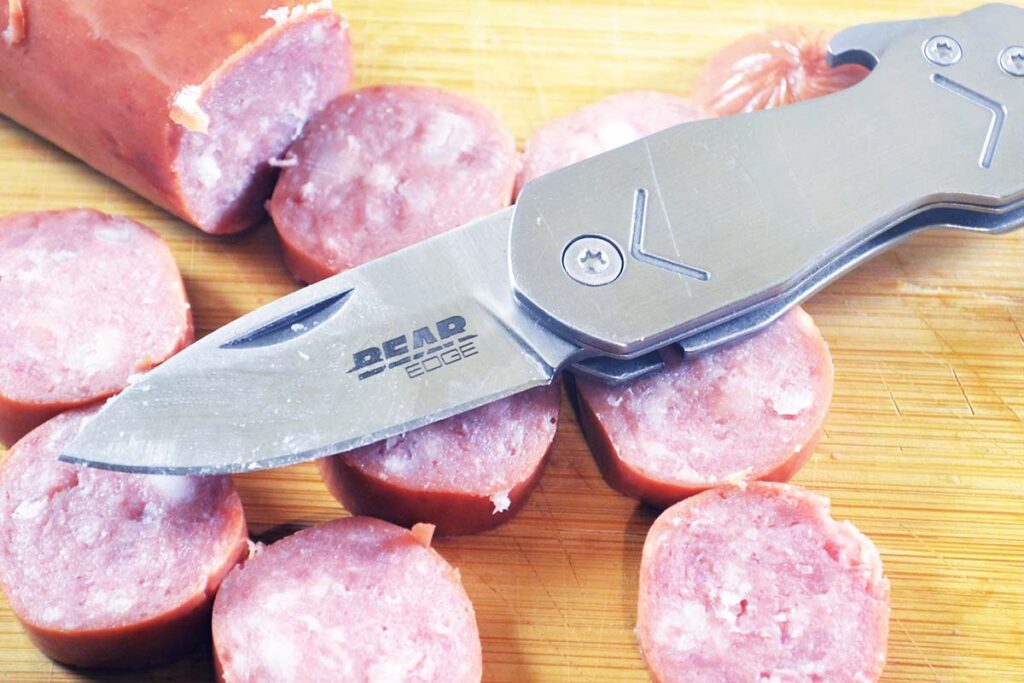
The Bear & Son’s 2-inch drop-point blade of 440 stainless steel in a brushed finish took off slices of 1-inch-diameter smoked sausage with no problem. Note the cap lifter on the rear of the handle spine. Weight: 2.3 ounces. Closed length: 2.8 inches.

The Bear & Son 3-inch Keychain Knife is a study in curves and its all-silver frame and blade add a classy touch. The blade sports a brushed finish and rolls out via a nail nick. Key hauling is handled by a 1-inch flat split ring on the base, very adequate unless you carry a large number of keys. In that case you can always add a larger split ring. A cap lifter is on the lower backside of the handle.

I sliced 1-inch-diameter smoked sausage and the blade performed admirably—not that you’d typically grab your keychain knife to perform such a task but it’s there if you need it. The cap lifter is handy. There is no pocket clip but the Bear & Son is not overburdening for loose pocket carry. This is a stout keychain knife well worth the money.

Schrade Roadie

Schrade Roadie
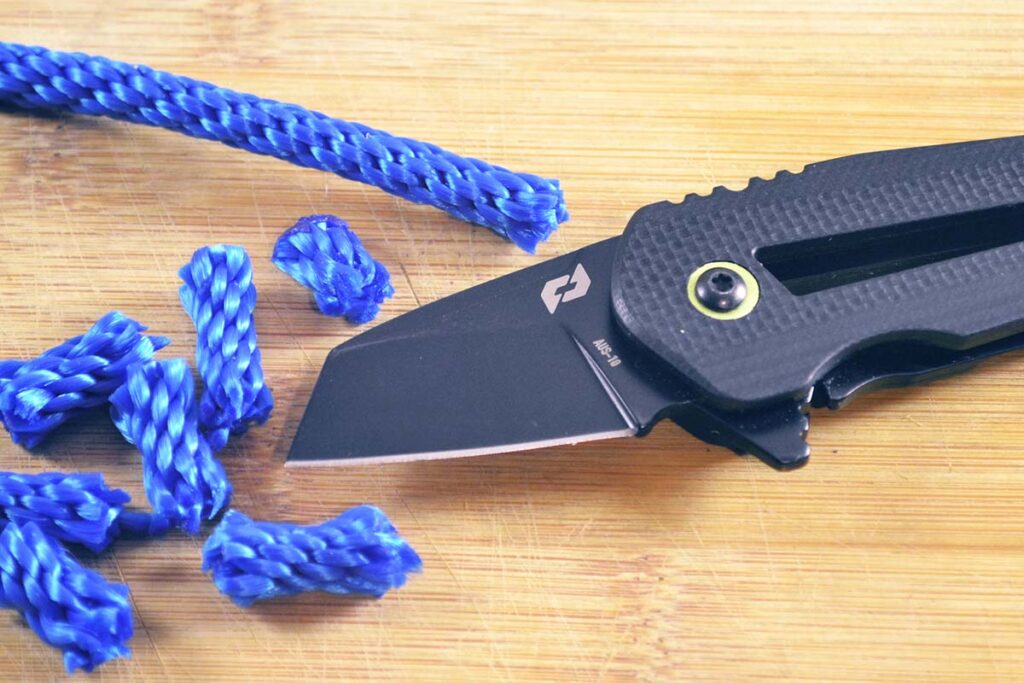
The Schrade Roadie is a little bulldog. The 1.5-inch blade of black-oxide-coated AUS-10 stainless steel bit through round after round of rappelling rope like a walk in the park. It’s a no-frills cutter meant for cutting. Weight: 2 ounces. Closed length: 3 inches.

The Schrade Roadie is a little bulldog of a keychain knife that doesn’t pretend to be anything else—it’s strictly a knife. In fact, it looks like a squeezed tactical folder. The blade opens via a flipper tab. The handle is black G-10 over black-coated stainless liners, with the rear liner serving as an unusual exposed locking leaf. Keys carry via a 4-inch black ball chain that dangles approximately 2 inches off a hole in the base.

I tested the blade on 3/8-inch synthetic rappelling rope to see how the reverse tanto pattern—a cousin to a modified wharncliffe—performed. It had no problem taking 3/8-to-1/2-inch slices in a single pass. The grip is excellent, aided even more by gimping on the upper rear handle close to the blade spine. This is a heck of a small knife and I only had one beef with it—the ball-chain key dangler. With the weight of keys tugging on the chain both sloshing around inside the pocket and while in use, you are asking for it to break. By the nature of ball-chain construction there are simply too many points along the way it can fail. I’ve got a remedy for that I’ll discuss later.

Smith & Wesson Stonewash Keychain

Smith & Wesson keychain knife
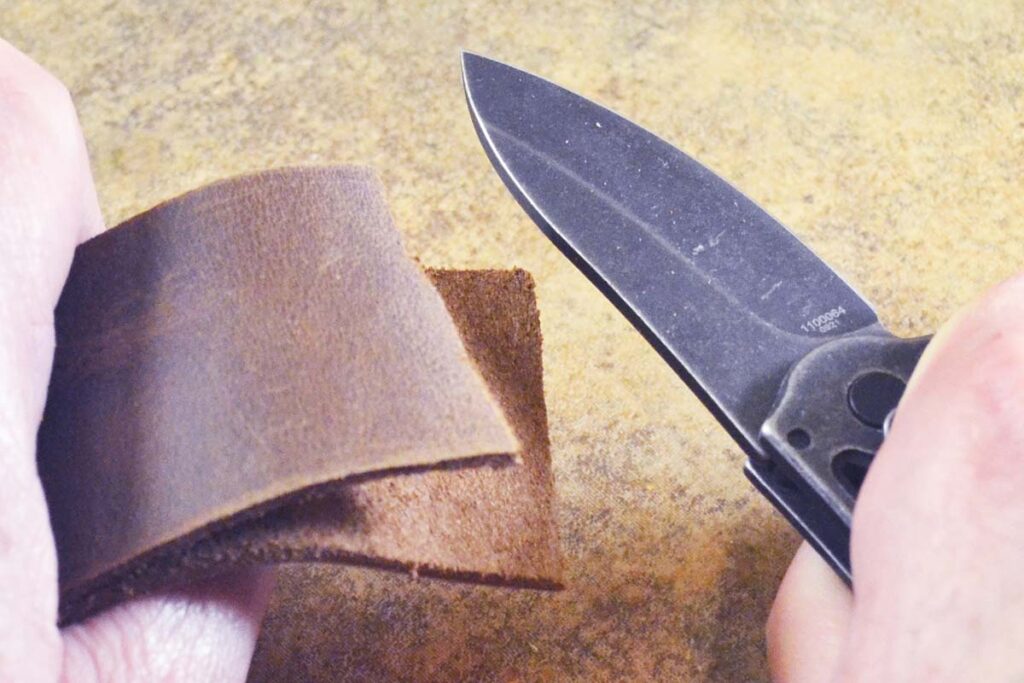
The Smith & Wesson’s 2.1-inch drop-point blade of ti-nitride-coated 8Cr13MoV stainless steel sliced its way through 1/8-inch harness leather, something the author indicated the other knives would have more trouble doing. Weight: 2 ounces. Closed length: 3.2 inches.

The Smith & Wesson Stonewash Keychain is the largest of the test bunch and it, too, resembles a scaled-down tactical folder. There’s a cap-lifter cut-out on the back frame slab. Keys mount at the base using a 3-inch ball-chain loop. This is the first of two review knives with a convenient pocket clip. The keys must be removed before using it because the clip is mounted for tip-up carry only, and if you use the keys they will hang out the top of your pocket. If this is acceptable to you, go for it.

I tested the blade on 2-inch-wide harness leather. Looping the leather strip over I did pull-throughs and found the little cutter more than up to the task. The framelock knife is built like a tank with the exception of a ball-chain key carrier which, as stated, I believe will give you issues down the road. That said, if you’re comfortable with it, go for it. I like this otherwise sturdy knife and it’s worth every penny of the price tag.

Gerber Key Note

Key Note cutting leather
The Key Note’s satin-finished 5Cr stainless blade is too short for slicing but the tip scores quite well.

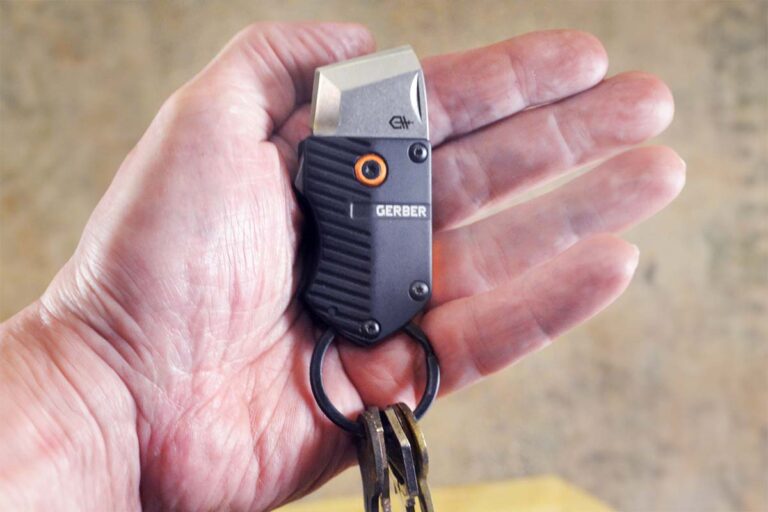
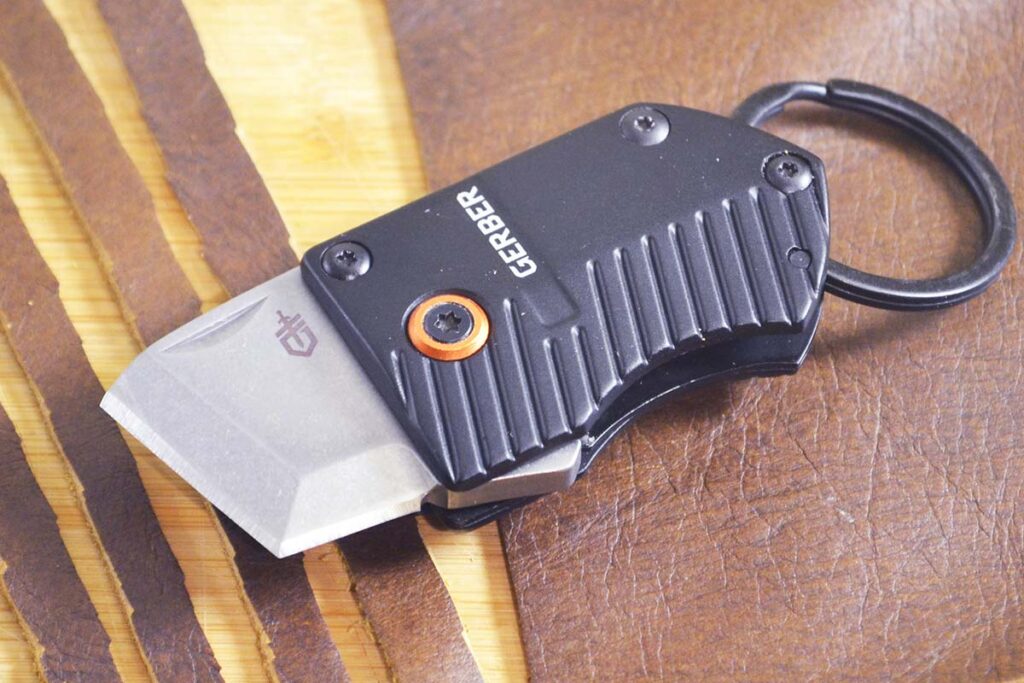
The Gerber Key Note wins the Keychain Outside The Box Award for its sheer imaginative design. With a stubby tanto blade, this offering radically differs from the pack. Both praised and panned on YouTube, the Key Note’s stubby .8-inch double-ground blade is certainly different. The frame has black-anodized aluminum rails with black stainless steel liners, the front which houses a linerlock. A flipper on the back side of the tang gets the blade rolling but only deploys it halfway, after which you pinch it for full deployment. You can also use the nail nick. Two nice touches are a wide tip-down pocket clip and a healthy 1.25-inch-diameter split ring for holding keys.

The blade is limited by its small size but I found it useful in scoring mode taking off strips of suede leather, and it is a heck of a box cutter. It will also push-cut paracord on a flat surface. The beefy tip-down pocket clip can be used with keys attached. The amply sized split ring is the best of the test knives, providing plenty of room for key-a-holics.

Is the Gerber Key Note different? Yes, but it may do just what you need a keychain knife to do.

Keychain Knife Carry Options

keychain knife carriers
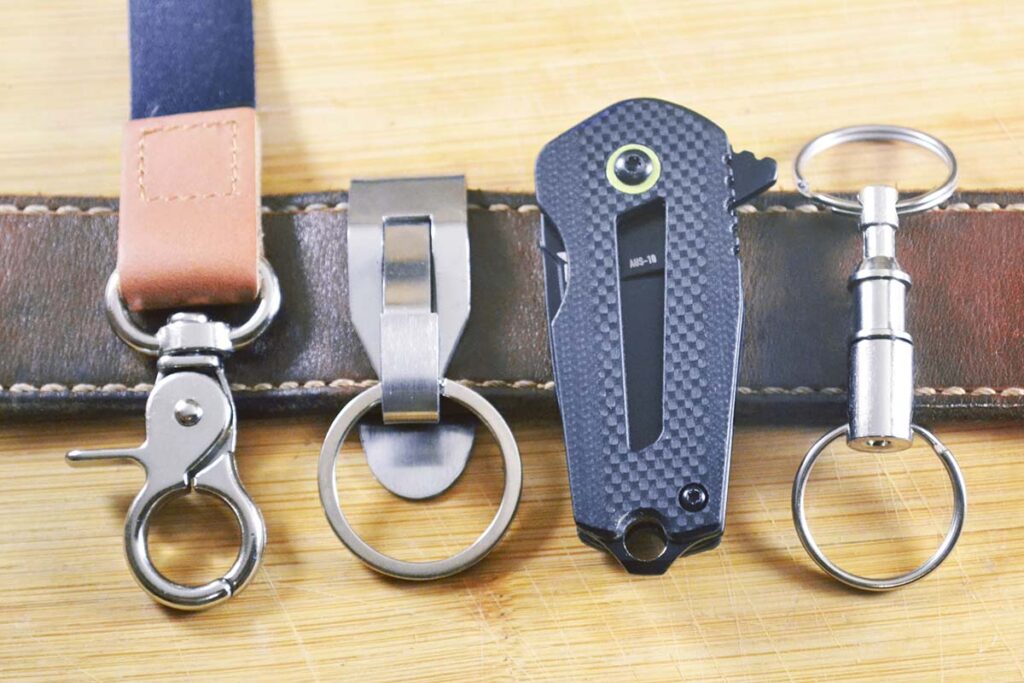
Modifying a keychain knife to suit your preferred carry can be done any number of ways. Examples include, from left: lanyard mini-carabiner for neck carry, a belt clip with split ring, the Roadie with ball chain removed, ready to modify, and a quick-release carrier that allows you to easily separate the knife from the keys.

There are other ways to carry these diminutive cutters than in or on the pocket. Accessories and findings (jewelry making parts) can be had by a various number of sources such as hobby stores, online at eBay and Etsy, or by doing an internet jewelry search such as Rio Grande Jewelry Making Supplies. Neck lanyards, belt clips, split rings large and small, breakaway connectors, small carabiners, and more are all available to modify your keychain carry to suit you. Any one of our candidates may suit your tastes as is, but if you want to mod it to suit your needs, there are plenty of options!

Check Out More Buyer’s Guides:

Cold Steel’s Frenzy II: Folding Knife With Samurai Swagger

Discover the new Cold Steel Frenzy II folding knife, designed by Andrew Demko and inspired by the Japanese Kabutowari.

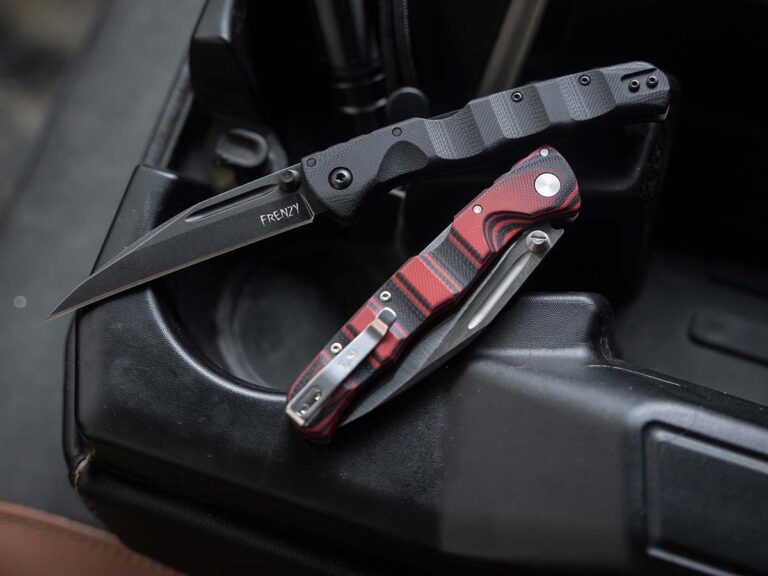
Cold Steel has never been shy about bold designs, and the new Frenzy II folding knife is no exception. Designed by custom knifemaker Andrew Demko, the Frenzy II takes its cues from the ancient Japanese Kabutowari and morphs those warrior-worthy aesthetics into a mega-folder ready for today’s EDC crowd.

Let’s start with the blade. At 5.5 inches, it’s not subtle—but it is refined. Forged from premium S35VN powdered steel, the long, flat edge and needle-sharp point make it as functional as it is fearsome. You get top-tier edge retention, durability and slicing performance, all dressed up with a satin line-grain polish and a deep fuller that plays with light like a katana in the sun.

But Cold Steel didn’t stop there. The Frenzy II is all about balance—of power and precision, size and slimness. Despite its impressive blade length, the handle is slim, flat and built for pocket comfort. Crafted from dual-tone, 3D CNC-machined G-10 scales, it’s grippy, eye-catching, and disappears under a shirt tail. This knife may look large, but it carries light and lean.

And yes, the Frenzy II comes equipped with Cold Steel’s bombproof Tri-Ad lock, so when that blade is deployed, it’s staying put. That kind of confidence is why Cold Steel has earned the trust of law enforcement, military and serious knife users for decades.

So, who’s the Frenzy II for? Anyone who appreciates a fusion of heritage-inspired design and modern performance. Whether you’re a collector, a gear geek, or someone who just wants a folding knife that can go toe-to-toe with fixed blades, this one’s worth a serious look.

Frenzi II Specs
Weight: 5.7oz
Blade Thickness: .14″
Blade Length: 5-1/2″
Blade Steel: American S35VN
Handle Length/Material: 6 3/4″ Long Duo Tone G10
Overall Length: 12-14″
Additional Features: Pocket / Belt Clip
Knife Type: Folder
Blade Length Range: 5+ in
Steel Family: CPM
Blade Shape: Sheepsfoot
Locking Mechanism: Tri-Ad Lock

More Knife Reviews:

5 Best Electric Knife Sharpeners [2022]

Whether It’s An Inexpensive Model Or One The Chefs Use, There’s An Electric Knife Sharpener Out There For You.

There is no one-size-fits-all for electric knife sharpeners. Some specialize in sharpening certain steels or styles of knives. Some have multiple stages, and others are a basic, affordable option for a less discerning home cook. And some are made for pocket knives rather than kitchen knives.

No matter your desire and needs, there is a sharpener out there for you. We’ve scoured the crowded marketplace to pick out five electric knife sharpeners we think will check the important boxes for you today and for years to come.

Chef’s Choice Model Trizor 15XV 3-Stage Professional Electric Knife Sharpener, Platinum

Chef’s Choice Model Trizor 15XV 3-Stage Professional Electric Knife Sharpener, Platinum

Our list starts with what is, arguably, the baddest sharpener on the block. Highly-rated, and with a price to match, this sharpener from Chef’s Choice is called professional for a reason. With three different stages (sharpening, honing, and polishing), the device truly can do it all and revive your knives.

The sharpener is engineered to the point of ridiculousness. The sharpening stage features proprietary diamond abrasives, and the polishing stage features patented stropping disks to give your knives a pristine finish. It can even convert a traditional 20-degree edge to a finer 15-degree edge.

If there is a knock on the machine, it’s it isn’t rated to sharpen ceramic knives or scissors. Everything from a chef’s knife to pocket knives and yes, even serrated knives, can be brought back to life using the Trizor 15XV.

In a test of nine different electric knife sharpeners, the 15XV was named the best by America’s Test Kitchen. You can take a look at their methodology and how they determined the winner below.

The hefty MSRP of $179.99 is eye-popping to start, but there is no other sharpener like this on the market today.

Presto EverSharp

Presto EverSharp

Maybe a three-stage, pro-level sharpener isn’t what you need, and you’d prefer something a bit more affordable. I’m right there with you. That’s where the Presto EverSharp comes in. 

The EverSharp uses Sapphirite sharpening wheels — a synthetic material almost as hard as diamond — to sharpen your blades to a razor’s edge. The EverSharp comes with two stages, one for sharpening and the other for honing & polishing. Each stage features internal guides so your knife always is at the perfect angle every time you pull it through. There’s two slots on each stage, one for each side of the blade.

It’s so easy to use you could probably do it with your eyes closed (but please keep them open so you don’t slice off a finger). The one drawback of the sharpener is it can’t sharpen serrated blades.

Durable and affordable with an MSRP of $47.99, the EverSharp provides great bang for your buck.

Wüsthof Easy Edge

Wüsthof Easy Edge Electric Knife Sharpener

From one of the legendary makers of kitchen knives, Wüsthof’s electric sharpener is robust and easy to use. 

Unlike the previous sharpeners on this list, the Easy Edge is a belt-drive sharpener. No stones or grinding wheels in this one. The machine can sharpen, hone, and shape your straight-edge knives. It does this by varying the speed of its sharpening belt.

While the device can’t sharpen serrated blades it can sharpen Asian-style knives, which typically are ground to a different angle than traditional German-style knives. 

Made of professional quality materials, and coming in with an MSRP of $160, the Easy Edge is worth the price and can replace your whetstones, honing steels, and many other pieces of knife maintenance equipment.

WorkSharp Combo Knife Sharpener

WorkSharp Combo Knife Sharpener

Unlike the other sharpeners on this list, which are made for kitchen knives, this sharpener from WorkSharp is made for pocket and EDC knives.

Like the Wusthof sharpener, this one uses an abrasive belt to sharpen your knives and uses internal guides to guarantee that your knives are at the perfect angle every time.

There’s also a ceramic honing rod built directly into the machine to help you polish and finish your flat-edge knives. The rod is also perfect for sharpening knives with small or large serrations. 

It’s also relatively small. Some of these sharpeners are a bit bulky; WorkSharp has made a nimble sharpener that won’t take up much space on your workbench. You’ll love using this every day, and it’ll make your knives like new. At an MSRP of $59.95, it’s worth the price for the type of product it is.

Smith Essentials Compact Electric Knife Sharpener

compact knife sharpener
Smith Essentials Compact Electric Knife Sharpener

If you’re looking for an electric knife sharpener on a budget, or simply don’t need the heft of professional machines, Smith has you covered. Their compact sharpener features both electric and manual elements for the low MSRP of $29.99.

The electric part of the machine features a synthetic sharpening wheel and built-in guides to keep your knives at the best angle. The ceramic rods on the manual side are there to hone and finish your blades.

It can only be used on straight-edge Euro/American style knives though so you would need some other sharpening implement if you have serrated knives at home. However, for a sharpener under $30, you may not be able find much more out there today.

Read More

Best Gyuto Knife: East And West Meet Over Dinner

The Japanese take on Western chef’s knives are mighty mealmakers. Here are some top-notch options.

A gyuto is a versatile, multi-purpose kitchen knife perfect for professional chefs and home cooks. It typically features a thinner, lighter blade than traditional chef’s knives, sharpened at a steeper angle for extremely precise and clean cuts. It often has a flatter profile toward the heel and a more gradual curve near the tip, making it versatile for various cutting techniques. The handle is often lighter and more agile, reflecting the Japanese emphasis on nimble and efficient movements in the kitchen.

Fox Knives Gyuto 2C 504 0L

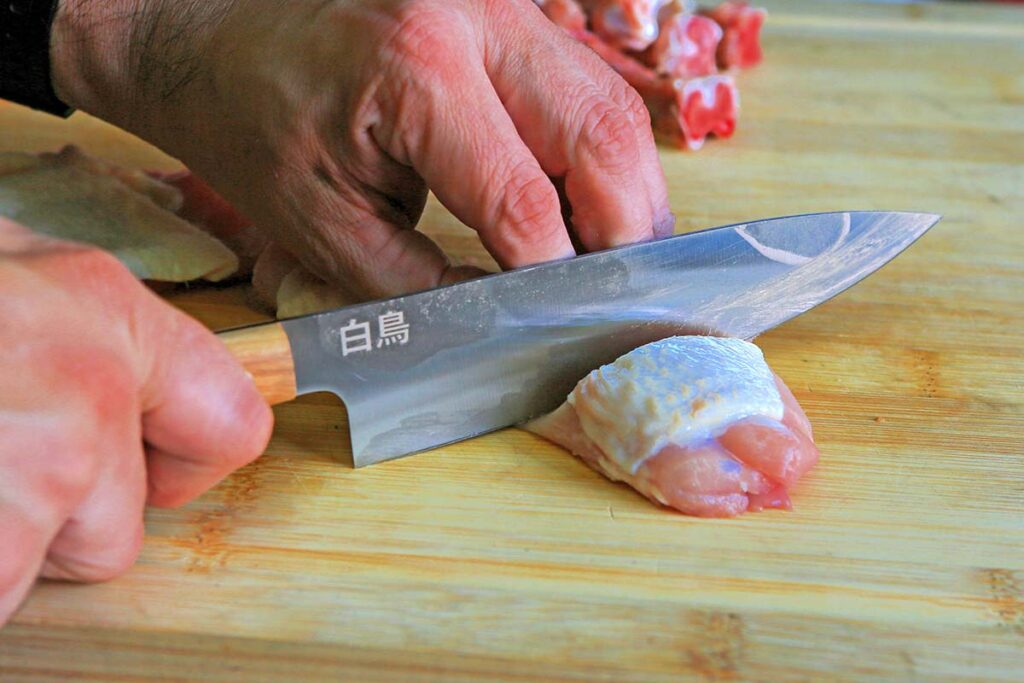
Fox gyuto effortlessly cuts chicken thighs
The Fox gyuto effortlessly prepared chicken thighs for delicious teriyaki chicken and yakitori, trimming excess fat and skin.

FOX Knives Gyuto 2C 504 OL
Blade Length: 6.69”
Blade Steel: 4119 nitro-B stainless
Blade Grind: Flat
Blade @Thickest: .08”
Blade Finish: Satin
Handle Material: Olive wood
Overall Length: 11.81”
Country of Origin: Italy
MSRP: $75.70

Pros

  • Durable 4119 Nitro-B Stainless Steel Blade
  • Exceptional Balance and Lightweight Design
  • Comfortable Olivewood Handle

Cons

  • Limited Grip for Large Hands

The Fox Knives Gyuto 2C 504 0L is a representative example of the genre. Crafted with precision and passion, it features a razor-sharp blade that is durable and holds an edge. The elegant handle offers a comfortable grip and a smidge of rustic charm.

At just 5.11 ounces, this featherweight beauty is a breeze to manipulate and perfectly balanced for effortless slicing, dicing and chopping. The 4119 nitro-B stainless steel blade’s Rockwell hardness of 55-57 HRC guarantees superior resilience, while the satin finish adds a touch of sophistication. Equipped with sturdy stainless-steel rivets, this gyuto is a culinary companion you can trust, not just a kitchen tool.

When in Japan, I love ordering yakitori—skewered, grilled chicken with a savory, slightly sweet flavor and smoky aroma. Making the dish was a team effort using specific knives for deboning and slicing the chicken into proper portions for the skewers. The key is to use a slow rocking/chopping motion to make clean, decisive slices rather than sawing through the meat, resulting in “chainsaw chicken.”

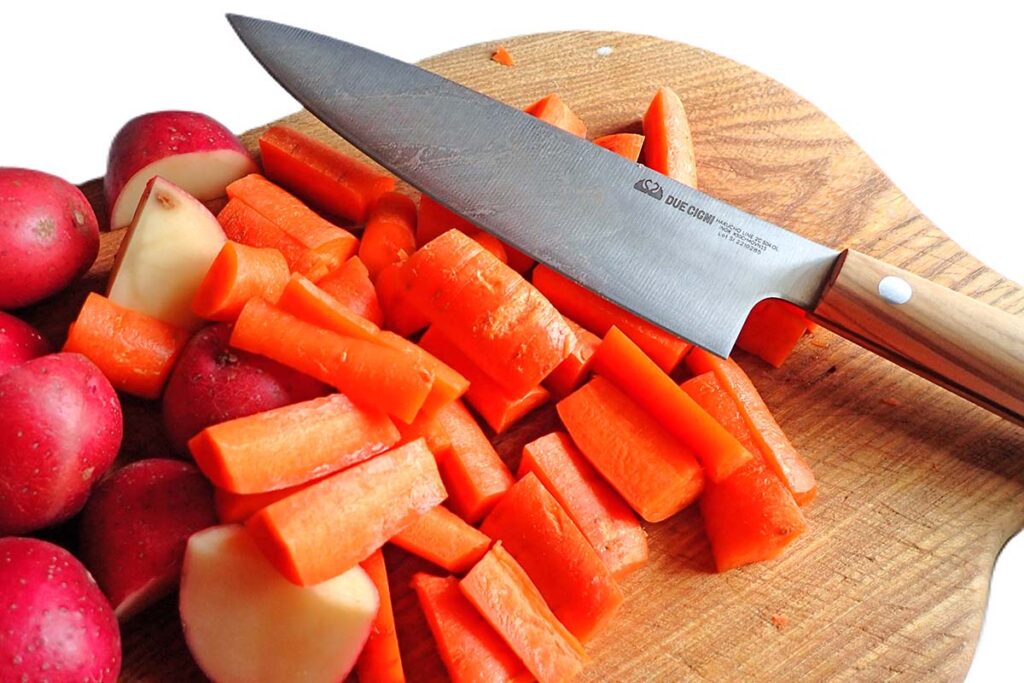
Fox knife cuts potatoes and carrots
The Fox sliced potatoes, onions, garlic and carrots for pot roast. The thin edge and super comfortable handle were unmatched.

Since the gyuto is the Japanese version of the archetypal Western chef’s knife, I made a Western dish—beef pot roast—and did the vegetable prep with the Fox. Slicing vegetables, potatoes, carrots and onions was a breeze with this slicing machine. I keep it simple, using rock chops, cross chops and pull cuts 90 percent of the time. Push cuts with the heel of the blade work well for hard veggies. Meanwhile, the olivewood handle remained comfy with no hot spots and grippy even when wet or covered with chicken fat. Leave it to the Italians to utilize this stunningly underused wood. Regarding plating, the Fox sliced the most elegant roast beef that ever graced a dish.

Fox Knives$78Check Price
BladeHQ$35Check Price

Condor Tool & Knife Shefu Kitchen Gyuto

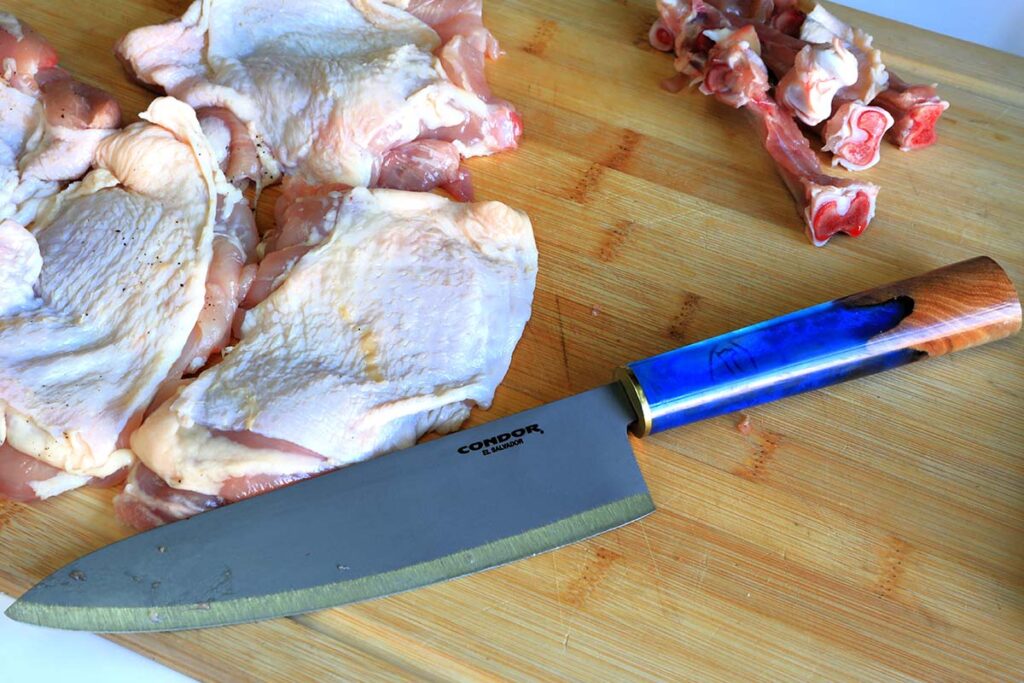
Condor gyuto deboned chicken thighs
The Condor Shefu deboned multiple chicken thighs using a roll-cutting method for yakitori skewers and teriyaki chicken.

Shefu Kitchen Gyuto Specs
Blade Length: 7.83”
Blade Steel: 440C stainless
Blade Grind: Full flat w/second bevel
Blade @Thickest: .12”
Blade Finish: Blasted satin
Handle Material: Epoxy resin and hickory
Overall Length: 12.92”
Sheath: Welted leather
Country of Origin: El Salvador
MSRP: $154.98

Pros

  • Versatile Outdoor and Culinary Tool
  • Comfortable and Ergonomic Handle
  • Full Flat Grind with Second Bevel

Cons

  • Bit hefty

The Shefu Kitchen Gyuto from Condor Tool & Knife is a multi-use knife designed for bushcraft enthusiasts who want to prepare delicious meals while enjoying the great outdoors. Crafted with precision in mind, the Shefu is perfect for slicing vegetables and expertly preparing meat and fish. It is a versatile tool ready to tackle any culinary challenge.

The Condor gyuto is hardy and beautiful. The full flat grind with a second bevel ensures optimal slicing performance, while the handle provides a comfortable, secure grip. The knife strikes the perfect balance between heft and maneuverability. The leather sheath provides safe storage and easy transport.

I pushed the Shefu into service sectioning beef roast and deboning and trimming six chicken thighs. The knife tackled the tasks with ease. Slicing 3.5-pound roast required a sharp yet hefty slicer like a cleaver. The Shefu fit the bill and delivered. Bottom round roast is tough as woodpecker lips, and a thin, flexible blade need not apply here. At 9.88 ounces, the Condor’s robust blade strikes the perfect balance between heft and finesse.

Condor gyuto in sheath
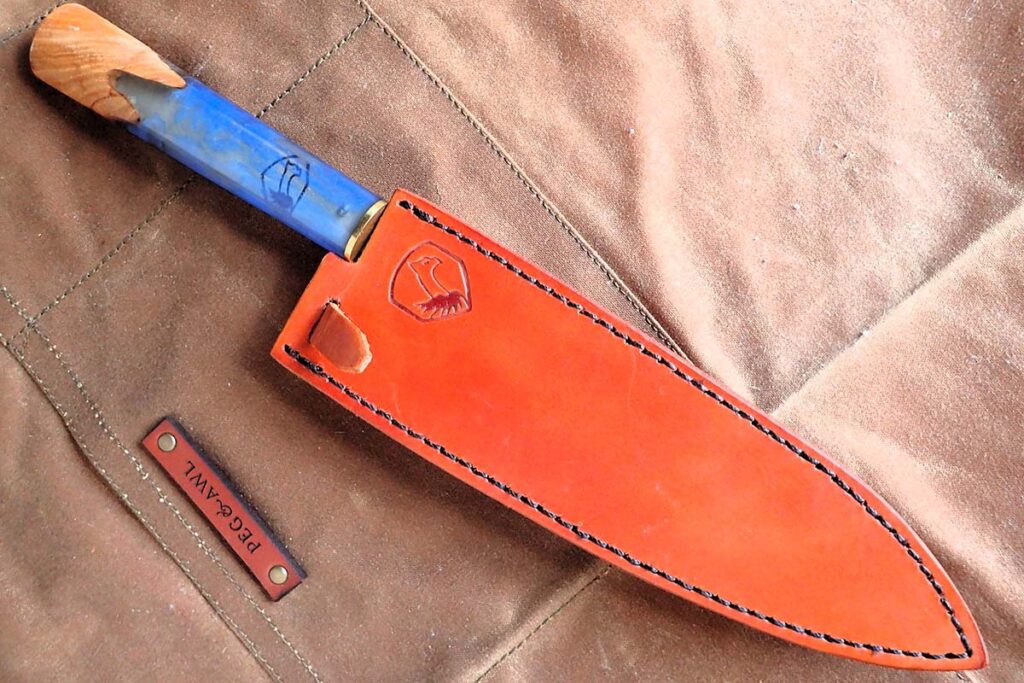
The Condor has the only sheath of the test bunch, of a beautifully handcrafted welted leather for safe storage and easy transport.

The handle has a colorful, comfortable oval shape that nestles in the hand. Hot spots and fatigue are nearly impossible with this grip. The full tang offers strength and security while keeping balance and weight at the forefront. The Shefu is an essential for any cooking enthusiast, whether at home or in the wild.

Condor$155Check Price
SMKW$132Check Price

Spyderco Itamae Gyuto

Spyderco Gyuto prepares food
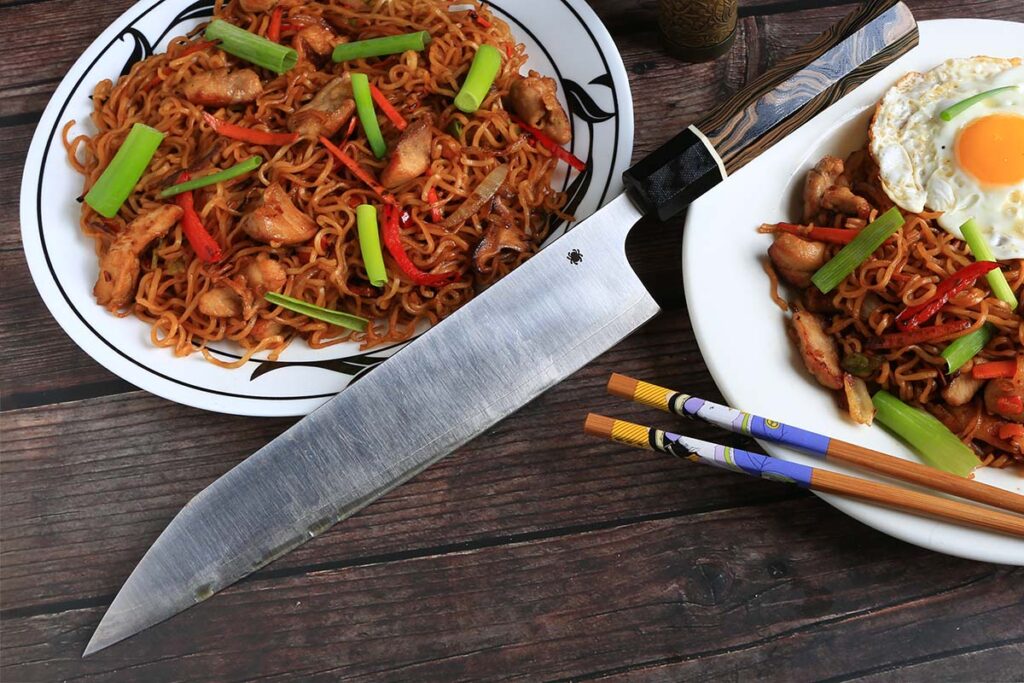
The author prepared the chicken yakisoba using the Spyderco. The knife sliced and diced carrots, onions, peppers, shiitake mushrooms, chicken and green onions for garnish.

Itamae Gyuto Specs
Designer: Murray Carter
Blade Length: 10.06”
Blade Steel: Super Blue/SUS410
Blade Grind: Full flat
Blade @Thickest: .094”
Blade Finish: Satin
Handle Material: Burl G-10 in the octagonal wa style
Overall Length: 15.35”
Country of Origin: Japan
MSRP: $334

Pros

  • Exceptional Blade Construction
  • High-Quality, Ergonomic Handle
  • Beautiful Design and Craftsmanship

Cons

  • Higher Price Point

The Itamae Gyuto is part of the Spyderco Murray Carter Collection Itamae Series. The elite cutlery series is designed for highly skilled sushi chefs and showcases uncompromising craftsmanship and premium materials.

The Itamae Gyuto features a blade expertly crafted from laminated steel—an Aogami Super Blue core clad between layers of high-quality stainless. The three-layer construction ensures exceptional durability and sharpness, with Carter’s signature “Carter Elbow*” adding strength to the blade’s tip.

Paired with a traditional wa-style octagonal handle of stunning burl G-10 and highlighted with a black G-10 ferrule, the Itamae Gyuto embodies the spirit of Carter’s coveted custom kitchen knives. Tipping the scales at 7.4 ounces, it sets an impressive standard in high-performance household cutlery.

The Itamae Gyuto is a sushi knife and I’m a fan. Part of my time in Japan was seeking out various types of sushi. The second most rewarding part was watching the chefs work precisely as if it were the most critical game of Operation ever played—they are pros!

I used the test model to prepare carrots, onions, shiitake mushrooms, peppers, green onions and chicken for the famed yakisoba dish: fried street food noodles choked full of veggies, savory sauce and protein. Simple ingredients still require various knife techniques.

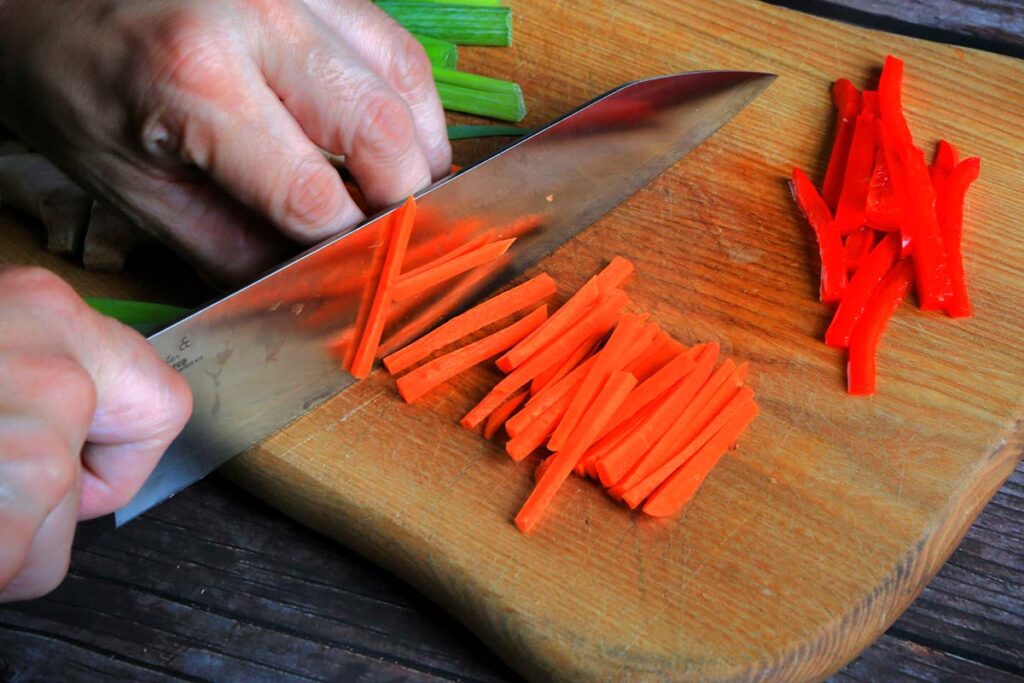
I used push-cuts on the tough carrots to square them to a safe position to stabilize them and make thin slices. From there, I stacked the slices for some rock-chopping to julienne a pile of carrots—in this instance, to make matchstick-sized carrot sticks. The secret to stir-fry cooking is preparation and cutting relatively equal-sized pieces of food to ensure equal cooking time.

Spyderco juliennes carrots
To create julienne slices, the author employed the rock-chopping method with the Spyderco, again utilizing a chef’s pinch-grip and a claw grip with the offhand to support the food.

I used rock chopping and pull cuts—two techniques in which the Itamae excels—to slice the red peppers. To pull cut them, I placed the knife tip down on the board and sliced backward. By this time, the laminated steel had formed a nice patina from avocado, peppers, onions and chicken on the bevel, giving it a nice used look. Crafted in Japan, the Itamae Gyuto is an ultimate favorite among professional chefs and passionate cooking enthusiasts.

*Editor’s note: Through the Carter Elbow, Murray Carter combines the best features of a traditional Japanese wabocho kitchen knife with his Wharncliffe Brute neck knife. The design feature allows more steel to reinforce the forward tip of the blade compared to standard gyuto or French-style chef’s knife profiles.

Spyderco Inc.$334Check Price
Knife Center$334Check Price

More Kitchen Knives:

5 Of The Best Chef’s Knife Options Available Today [2022]

If You Can Only Have One Knife In The Kitchen, The Chef’s Knife Is The One To Get.

When it comes to knives in the kitchen the alpha and the omega, without question, is the chef’s knife. A quality chef’s knife can do just about everything from butchering a side of beef and dicing up vegetables to crushing garlic and skinning a salmon filet.

Whether Japanese or German, stainless or high-carbon, forged or stamped, there are an amazing variety of chef’s knives available today, and there will be one at the right price for you.

History Of The Chef’s Knife

Humans, and their ancestors, have been eating hunted meats and foraged fruits for millions of years. The first predecessor of the chef’s knife, in the most liberal sense of the term, dates back 2.5-million years to what is now Ethiopia. Known as Oldowan knives, these sharp stone pieces were made by smashing rocks together to form fragments with razor edges to cut through game. 

The first proto-knife found with protein residue on it dates back 250,000 years and was discovered in the Azraq Oasis in Jordan. It had the residue of horse, cow, and rhinoceros on it.

As time progressed, knives evolved along with humans. The discovery of fire along with different types of metals allowed the creation of the earliest forged pieces. The bronze and iron ages saw more quality metals turned into knives by skilled artisans.

Each new material allowed for better, more durable knives and paved the way for the steel models we have today. Chef’s knives, as we know them now, have been found dating back to before the Roman Empire and were modified versions of swords and other weapons.

Why Should I Buy A Chef’s Knife?

Look, if you want to try and cut through a medium-rare ribeye or slice veggies with a standard butter knife, good luck. 

A quality chef’s knife will make your life in the kitchen much easier than if you tried to force it with a standard dinner knife. Will the chef knife be more money? Absolutely, but, as you’ll see with our list, it’s incredibly easy to find a strong, capable model without breaking the bank.

So you should have a chef’s knife in the same way you should have proper running shoes if you are a marathoner or a good driver if you golf. You could do those things without the right equipment, but it’s much easier and enjoyable when you have the right tools for the job.

5 Best Chef’s Knives

Chef’s knives, Japanese or German, should make you feel comfortable and secure in the kitchen, as well as make work there easier. This list has a little of everything from pro-quality damascus blades, to stamped models strong enough to be an everyday workhorse.

Misen Chef’s Knife

Misen Chef's Knife
Misen Chef’s Knife

Award-winning cookbook author J. Kenji Lopez-Alt called this knife “the holy grail of inexpensive chef’s knives.” The 8-inch blade is made from Aichi AUS-10 high-carbon stainless steel, is ground to a 15-degree edge, and has a 58 HRC.

The sloped bolster and handle design encourages a safe grip while chopping. It’s light in the hand at only 8 ounces in weight and can mince herbs and cut through chicken bones just as easily.

An added bonus is that there are four choices for the handle color (blue, red, gray, and black). For a budget knife, this piece from Misen really is about as good as it gets.

MSRP: $65

Wusthof Classic Ikon 8-Inch Chef’s Knife

Wusthof Classic Ikon 8-Inch Chef’s Knife

An icon of German engineering, Wusthof has been making knives in Solingen, Germany since 1814. The Classic Ikon is a timeless all-around blade that makes an excellent addition to your home, while also having the chops to cut it (pun intended) in a professional kitchen.

The forged blade is triple-riveted to the black synthetic handle and has a 58 HRC. The half bolster cuts down on weight while also making it easier to sharpen. When you buy a Wusthof you can trust in the two centuries of work that has built the company into what it is today, and this model won’t disappoint.

MSRP: $200

Mac Knife Pro Series 8-Inch Chef’s Knife With Dimples

Mac Knife Pro Series 8-Inch Chef’s Knife With Dimples

This professional-level Japanese chef’s knife is a popular choice for chefs and home cooks alike. The 8-inch hollow-edge blade is made from alloy steel and a Pakkawood, triple-riveted handle.

What sets this knife apart from the rest on our list are the dimples on the blade. Known as a Granton edge, these dimples are more common on a Santoku knife than on a chef’s knife. Regardless, they allow for food to more easily slide off while cutting so you don’t have to deal with the frustrating task of peeling bits off the blade when you’re cutting stickier foods like potatoes or apples.

Made in Seki, Japan, the traditional home of Japanese knifemaking, Mac Knife has made something modern built with techniques developed over centuries.

MSRP: $195

Victorinox Fibrox Pro Chef’s Knife

Victorinox Fibrox Pro Chef’s Knife

The lowest-priced knife on our list punches above its weight and is a great addition to your kitchen. The price is kept down because the blade is stamped, but don’t let that fool you. This model has the same quality you would expect from everything else Victorinox offers.

The eight-inch stainless blade is married to an ergonomic, non-slip handle that feels great in the hand. Made in Switzerland along with the brand’s famous Swiss Army knives, the Fibrox Pro is easy and efficient to use. While it is listed as dishwasher safe, we recommend hand-washing and drying it as that will preserve the blade for longer.

An added bonus of the stamped blade is that this is the lightest knife on our list, coming in at just 6 ounces.

MSRP: $42.95

Miyabi Chef’s Knife

Miyabi Chef's Knife
Miyabi Chef’s Knife

This is a professional knife and it looks the part. Made of 100 layers of damascus steel around a Cryodur-hardened SG2 micro-carbide steel core, it is topped off with a Masur birch handle. The damascus blade has a ridiculously hard 63 HRC and is ground to an edge between 9-12 degrees using the traditional Japanese three-stage honbazuke process. That sees the blade polished twice on custom whetstones and polished to a mirror finished on leather wheels.

This is one of the highest-quality kitchen knives on the market today. It’s also a love note to Japanese knifemaking from its tip to the end of the handle. Miyabi’s whole set of chef’s knives is of similar quality and if maintained properly, can last you a lifetime.

MSRP: $342.99

Read More

Advertisement

Must Read Articles

Read this before you make a knife

Knifemaking 101 – Read This Before You Make a Knife

  by Wayne Goddard My experience has taught me that there's nothing like digging in and getting started. I've often said the hardest part of the...
how to forge damascus steel

How to Forge Damascus

Advertisement
Advertisement