Does it deserve its reputation as a definitive EDC knife?
What makes a great EDC folder?
Well, the obvious would be a highly useful blade shape paired with an ergonomically shaped handle. Then, make both out of high-grade materials for durability and longevity. It wouldn’t hurt to have a popular knifemaker scratch up the design and make certain the QA is in line.
Put together this amalgamation and the result might just be the Benchmade 940.
Designed by the late Warren Osborne, the production knife is some somewhat an outlier in his portfolio. The Texas maker is perhaps best known for his high-dollar art knives favored by discriminating collectors around the world. Osborne’s 940 design was refreshingly non-tactical, especially for a company who a large presence in this niche.
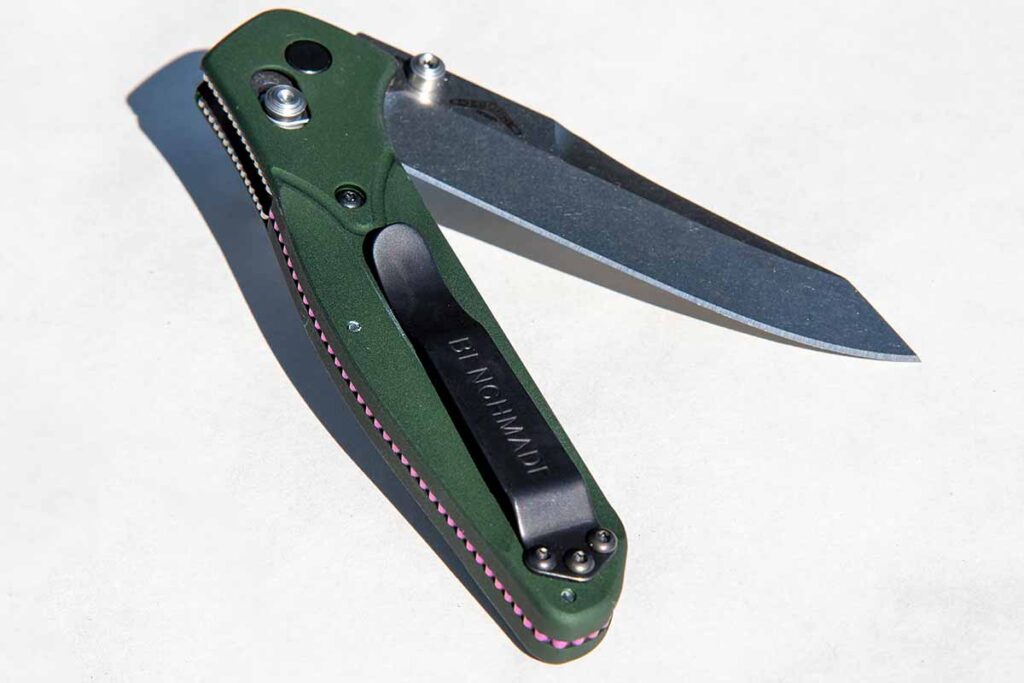
A top seller for Benchmade, the 940 has come to help define EDC knives. Photo: Marty Stanfield
Furthermore, it has a broad appeal for those who are serious about their daily carry knife checking all the boxes. It’s no stretch to call the 940 a workhorse of a folding knife.
Since its introduction in the early 2000s, the Benchmade knife’s popularity has skyrocketed to the point it has a sort of cult following. We’re going to take an in-depth look at why this is so. It is why the 940 might even be worth adding to your collection.
Benchmade 940 Blade
The blade profile of the 940 is a reverse tanto, in which the edge and spine of the classic tanto design are flipped. However, it does somewhat look like a clip-point blade, albeit one with an extremely abbreviated downward-sloping tip.
Measuring 3.4 inches long, the blade uses CPM S30V premium stainless steel for the ultimate edge-holding capabilities. The alloy provides the muscle required for most daily cutting chores inside and outside of your house as well as offering excellent corrosion resistance.
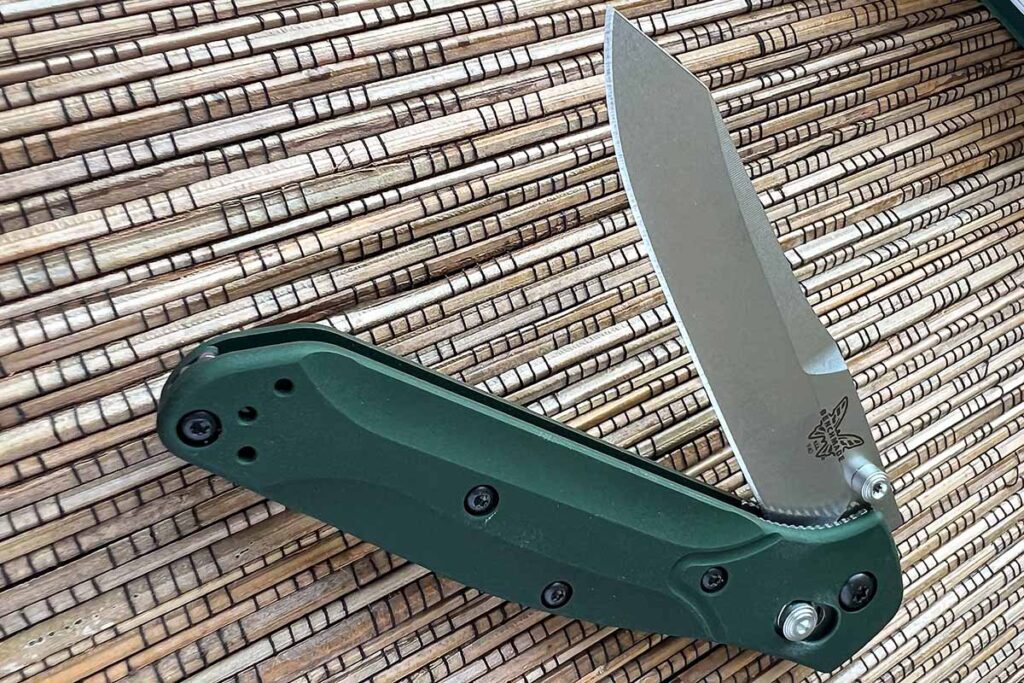
The 940 boasts thumb studs and Benchmade’s ambidextrous axis-lock. Photo: Marty Stanfield
Dual thumb studs provide an ambidextrous opening with either hand. Satin is the standard finish, though a black-coated blade is available at a minimal cost increase. The blade’s slender form factor allows the 940 to get in and out of a variety of cutting tasks with great efficiency. Not to mention, this svelteness doesn’t raise eyebrows in public like some bigger, more brawny tactical folder designs.
940 Handle
In the handle department, the 940 uses aircraft grade T6 6061 aluminum, offering excellent weight savings while not compromising strength. The handle is given a very nice dark green hard anodized coating, which is both scratch-resistant and aesthetically pleasing. Milled channels in the handle provide a slim-feeling knife in hand.
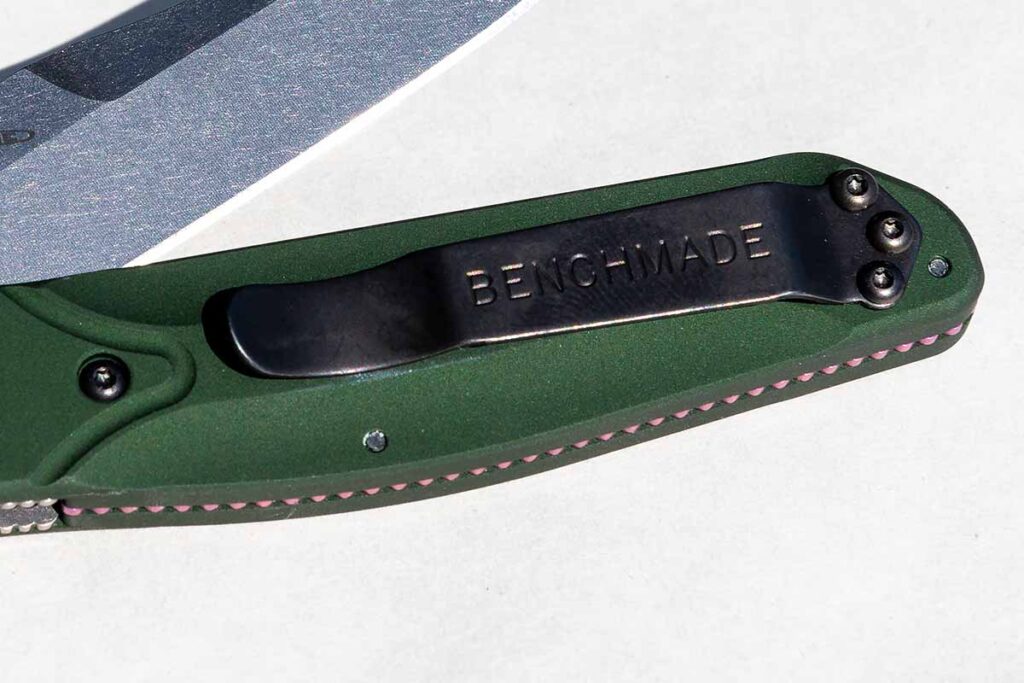
A tip-up-only pocket clip mounting is available on both sides of the handle to accommodate both left-handed and right-handed users alike.
The clip is situated at the butt of the handle for tip-up carry. Photo: Marty Stanfield
The blade is secured in the open position by Benchmade’s own Axis Lock—regarded as the original crossbar lock. It promotes a smooth opening and closing action as well as very positive blade engagement, securely holding the blade open until you release it. Ambidextrous thumb buttons on either side of the handle allow one to release the lock with either hand. The Axis Lock is truly righty and lefty friendly, unlike liner locks that are specifically for right-handers.
940 Performance
Not only does the 940 perform very well, but the knife also carries like a dream. It’s lightweight and compact, allowing it to disappear while clipped to jeans, casual pants, or dress slacks. It doesn’t weigh you down by any means. The handle sits deep enough in the pocket, away from prying eyes but there still is enough to grab onto when you want to retrieve the knife and put it to use.
In use, I appreciate the way the handle drops down a bit, forming a finger guard of sorts to keep your hand in place. It also helps to index your grip, as well. The purple anodized titanium handle spacer provides a neat pop of contrasting color against the green. Traction notches above the pivot give enough friction to hold your thumb or index finger in place during tough cutting tasks.
Final Cut
A great testament to Benchmade’s manufacturing quality, every single 940 I have seen out of the box, the blade is centered in the handle, and the action is very smooth. These knives are really dialed in when they come from the factory.
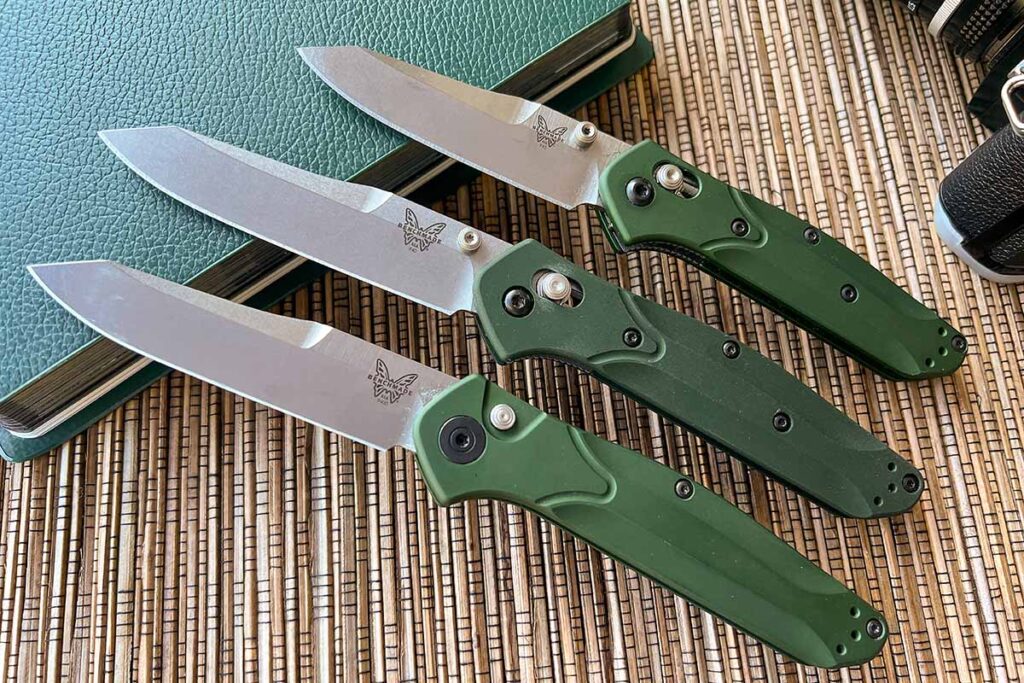
Aside from the standard 940 (middle), Benchmade offers the automatic 9400 (bottom) and compact 945 Mini Osborne (top). Photo: Marty Stanfield
Benchmade also expanded the selection of 940 to include variants that have carbon fiber handles, G-10 handles, and even an automatic opening version with the model 9400, which utilizes a coil spring-fired blade and a button plunge lock as opposed to the Axis Lock. There’s also the model 945 Mini Osborne which scales the 940 down some, creating a nice, ultra-compact folding knife with a 2.9-inch long blade. It still opens quickly, and cuts efficiently.
MSRPs understandably vary with size and handle materials. However, the MSRP for the standard 940 is $240, which puts it on par with other USA-made folders on the market.
Get one and it became fairly clear why the 940 resides at the top of Benchmade’s catalog. Even better yet, you will not be disappointed with the knife as your everyday companion.
Nothing cuts as wicked a profile as a tanto knife.
The tanto is one of the most iconic and recognizable knife designs to ever forged, and today you can find it being made all over the world. From pocket folders to heavy fixed blades, there are a lot of Tantos to choose from.
Today, we’re going to go over everything you need to know about the tanto, from its history and modern usage to the best modern examples you can add to your collection.
Let’s dive right in.
Tanto Knives: Rich, Battlefield-Proven History
Japan has gifted the world with some excellent things: sushi, Godzilla, anime, the Honda Civic… list goes on. Perhaps some of the most iconic pieces of Japanese culture to spread around the world though are its blade designs.
The katana is probably the most famous in terms of combat-focused designs, but a close second is the beloved tanto. A very core idea of many sword-based Japanese martial arts is the idea of daishō, which translates to “big-little”.
Daishō essentially just means having one long sword, and one short sword or long knife to accompany it. Traditionally, the larger sword would often be left outside when entering a palace or other government building, or a temple, and the shorter weapon would be carried inside, tucked through a sash.
The Sidearm of Choice Before Pistols
Originally conceived as a sidearm to be paired with a long sword, the tanto was first carried primarily by Samurai alongside a tachi, the precursor to the katana most of us are familiar with from modern popular culture.
Over time, the tanto become more widespread, and a smaller version known as a kaikenbecame popular as a self-defense tool for women. Over several hundred years, the tanto became shorter and thicker, and closer to the blade we know today.
Photo: Wikipedia
Though eventually replaced in serious warfare by the wakizashi (functionally just a shorter katana, though with some design differences) the tanto remained popular for ceremonial usage and became a matter of pride and expression to wear or own in later years.
The tanto then saw a resurgence in the years leading up to WWII, as they were viewed as more traditional by the Imperial Court. Following Japan’s defeat, limits on sword forging caused a decline in all traditional Japanese sword-making.
In the 1960s, American and European obsession with Japanese martial arts (spurred on by excellent films such as 7 Samurai, Yojimbo, and others) lead to a resurgence of the tanto, particularly as a combat-focused knife shape.
Today, the iconic tanto tip is found on traditional full-length fixed blades, as well as more modern folding pocket knives designed for tactical/defensive use. Plenty of manufacturers make tanto-tipped knives, as well as smiths making excellent traditional tantos. (We’re going to cover both in our reviews, don’t worry).
What makes a Tanto, a Tanto?
Today, the definition of a tanto has shifted far beyond the traditional knife of 10th-century Japan, but we’re going to start there and then we’ll talk about the more modern incarnation where we see tanto tips added to a variety of EDC and tactical knives.
Traditional Tanto Blades
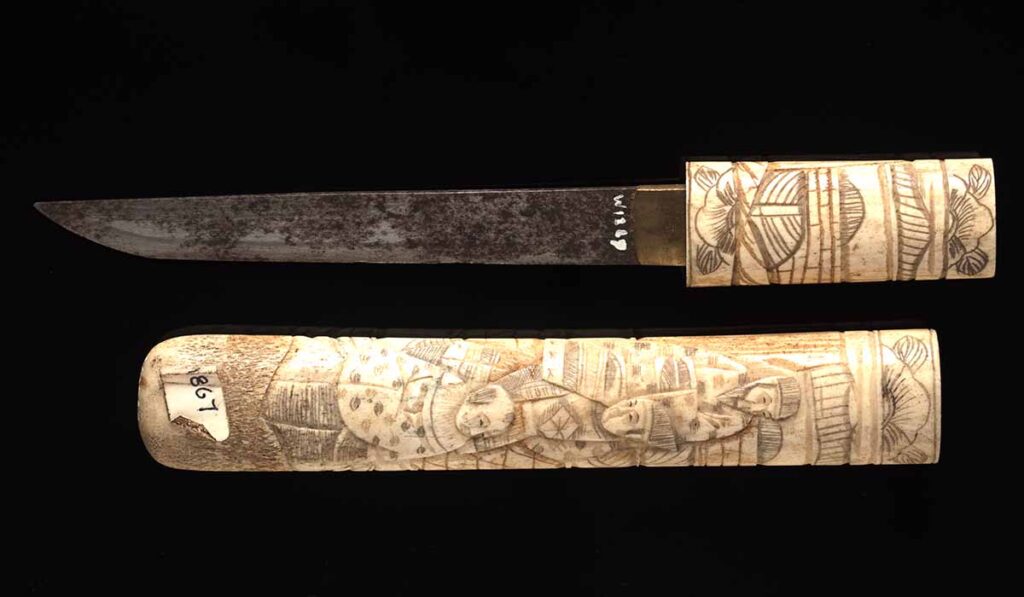
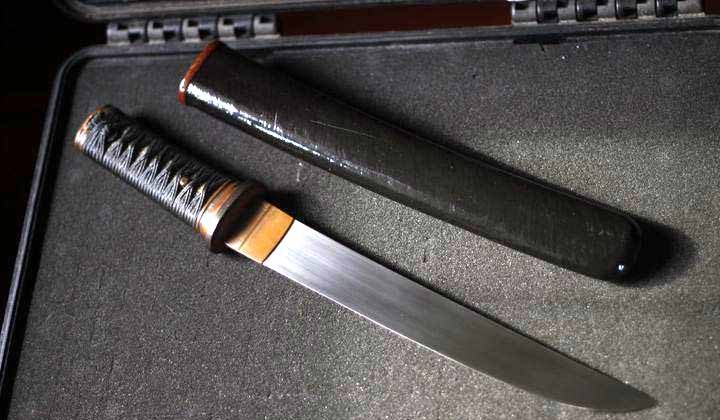
Originally, the tanto was more what we would call a short sword, or perhaps a long dagger, and was worn by samurai. It was very much a weapon to begin with, but become a more ornate and ceremonial piece over the years as weapon designs evolved.
The traditional tanto was a single or double-edged dagger with a length of around 6-12 inches and was designed primarily for stabbing. It was forged with very flat sides, and some were left short with an extra thick cross-section to aid in piercing armor.
Modern Tanto Blades
The more modern interpretation of the tanto is heavily influenced by American tactical knife designs and proves more common outside of Japan. Traditional blades are still made (and beautiful) but less practical for the modern world.
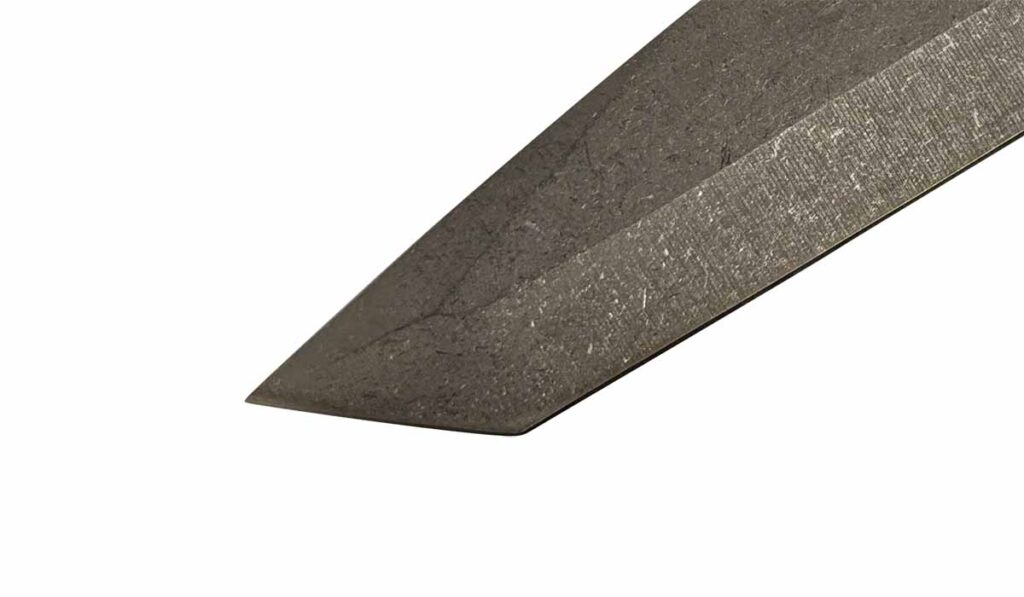
A variety of American and European knife makers now produce tanto-inspired knives with a very angular tip with the iconic sharply-upswept blade tip, essentially leaving you with two cutting planes—one parallel to the spine of the knife, and one at a 45-degree(ish) angle to the spine angling up towards the tip.
Most of these modern “American tanto” designs are folding knives, and while many are for “tactical” or defensive use, the tanto blade shape has become increasingly popular for EDC knives as well.
Pros of the Tanto Design
Piercing: Piercing, piercing, piercing. The shape of the tanto is optimized for stabbing and piercing, and it excels in those contexts.
Whether you’re a pre-Edo period Samurai trying to slip a blade between (or through) segments of your opponent’s armor, or a frustrated office worker attempting to poke your way into some plastic clamshell packaging, the tanto is ideal for putting a hole in something.
We see similar knives used for leather work around the world, and with good reason. The tanto is great for putting a hole in tough material.
Draw Cuts: Modern American tantos are also great for draw cuts and slices, particularly when you’re working with something on a flat surface like a cutting board. The dual edge geometry makes short work of many slicing tasks.
You can also (carefully) use that second point where the two edges meet like a chisel for shaving wood, scraping a sticker, etc. This makes for a very handy EDC.
Defense: Lastly, as a defensive tool, tantos excel because of their narrow, piercing point. This point easily defeats heavy clothing and makes for an effective means of defense in skilled hands.
Many knife-based martial arts focus on stabbing strikes as the most effective fight-enders, and the tanto fits that training paradigm very well, while still being perfectly capable of slashing.
Cons of the Tanto Design
Cutting Edge: The tanto’s main drawback, besides additional time and care needed when sharpening, is the fact that you lose some usable blade edge by having essentially two edges, one parallel to the spine and one swept forward and upwards.
In practical use, this means you have less effective blade length for certain tasks, around 20% less than you’d have with an equivalent-length drop or clip-point blade. To compensate, tanto blades intended for EDC are usually a bit longer than a similar knife with a different point.
All of this can be adjusted for, and as long as you aren’t doing something like spoon carving, you probably won’t notice a difference in real-world use.
At the end of the day, “real-world use” for most of us is opening boxes and packaging, and slicing apart those god-awful packing straps used to hold children’s toys in display boxes. And the tanto excels at all those tasks.
How The Hell Do You Sharpen a Tanto?
Sharpening a tanto may look a bit scary, but once you break the process down, it’s quite simple. All you’re doing is sharpening two edges that meet at a point. The only real pitfall is that it’s easy to round over the point where the forward edge and the edge parallel to the spine meet.
To avoid this, be mindful of that meeting point, and stop your sharpening stroke on or before it. Then, when sharpening the forward edge, rotate the blade and sharpen it in much the same way you would a chisel.
Just be careful not to pull through the point where the two edges meet so you don’t round over that point and you’ll be good to go. Beyond that, it’s just like sharpening any other knife.
10 Ten Knives with Tanto Blades: EDC, Fixed Blades, and Folders
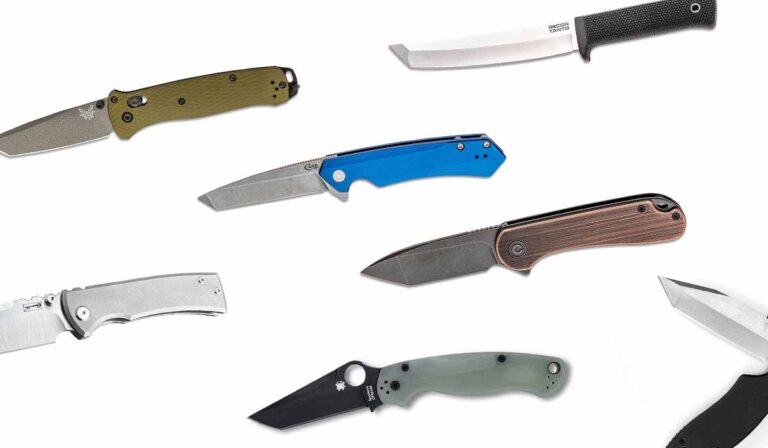
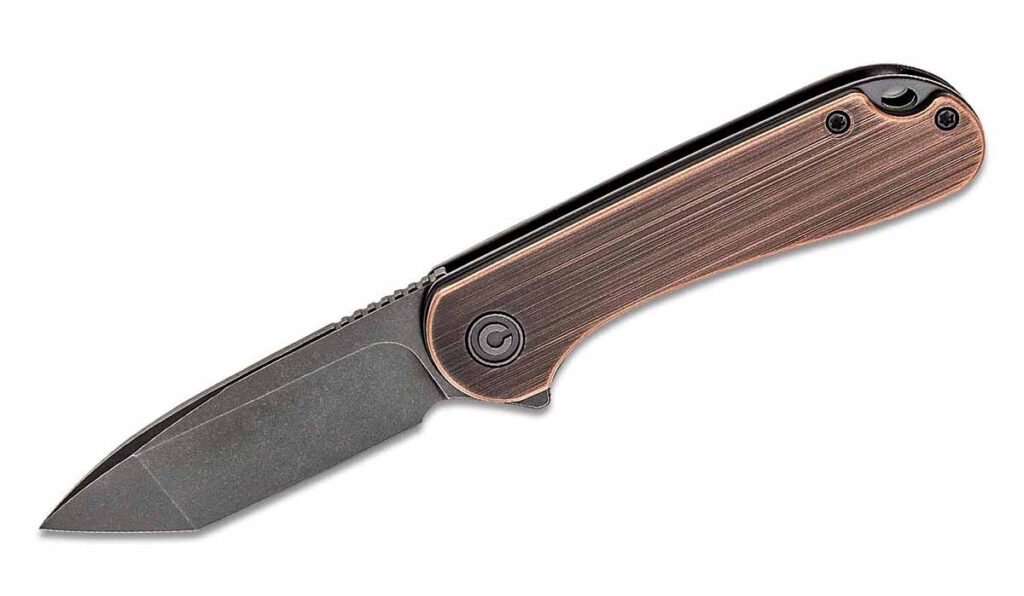
CIVIVI Elementum Tanto
The CIVIVI Elementum has become something of a modern classic in the EDC knife world. Since its release a few years ago has gone on to become one of the most popular pocket knives around.
There is a nearly limitless amount of blade and handle combinations out there now, but we’re going to focus on this excellent tanto blade with a copper handle.
At its core, this is still the same Elementum knife aficionados are already familiar with (a simple, dependable liner-lock flipper folder) but outfitted with a tanto blade that makes piercing tasks a cinch, without compromising on slicing performance.
Basically, it’s everything you need in an EDC knife for regular daily tasks, and it comes with a gussied-up stonewashed tanto blade and a lovely hand-polished copper handle that adds a touch of class and elegance to this very affordable knife.
The Elementum tanto is also available in a button lock version and features a 2.96-inch blade made of D2 steel.
MSRP: $80
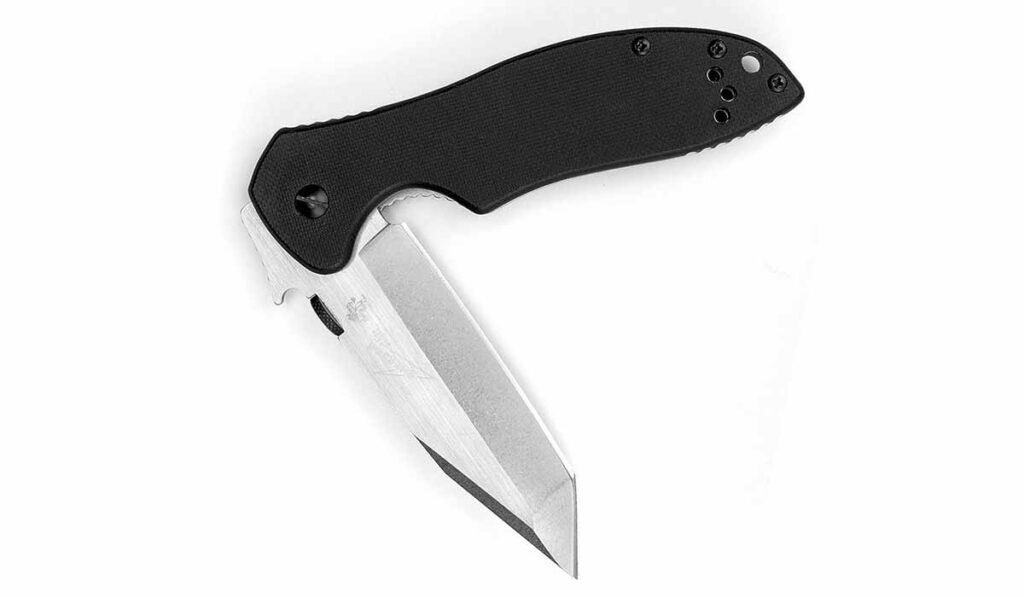
Kershaw Emerson CQC-7K
Ernest Emerson has brought much success to Kershaw with his designs. Back in 2014 he hit it out of the park again with the Emerson CQC-7k, which won that year’s Best Buy award at BLADE Show for sheer value. In the almost ten years since it’s held its own as one of the best EDC options out there.
It features the iconic Emerson Wave that facilitates blade deployment by simply pulling it from the pocket and hooking the “Wave-Shaped Feature” on the pocket on the way out (sort of an inverted kicker).
It also features an ambidextrous thumb disk that doubles as a comfortable place to press your thumb when doing fiddly work. The scales are nicely-textured G10, and the handle features a stainless frame lock that is one of the more secure we’ve tested (read: beat the hell out of).
The one thing to look out for is the blade steel. I would suggest spending an extra few bucks on the D2 stainless version and avoiding the 8cr14Mov version. There’s no reason to spend more than $40 on a knife with bottom-tier blade steel like that in this day and age.
You can get five gas station knives for that price and be better off.
The Emerson CQC-7K has a D2 blade that is 3.25-inches long.
MSRP: Starting at $74
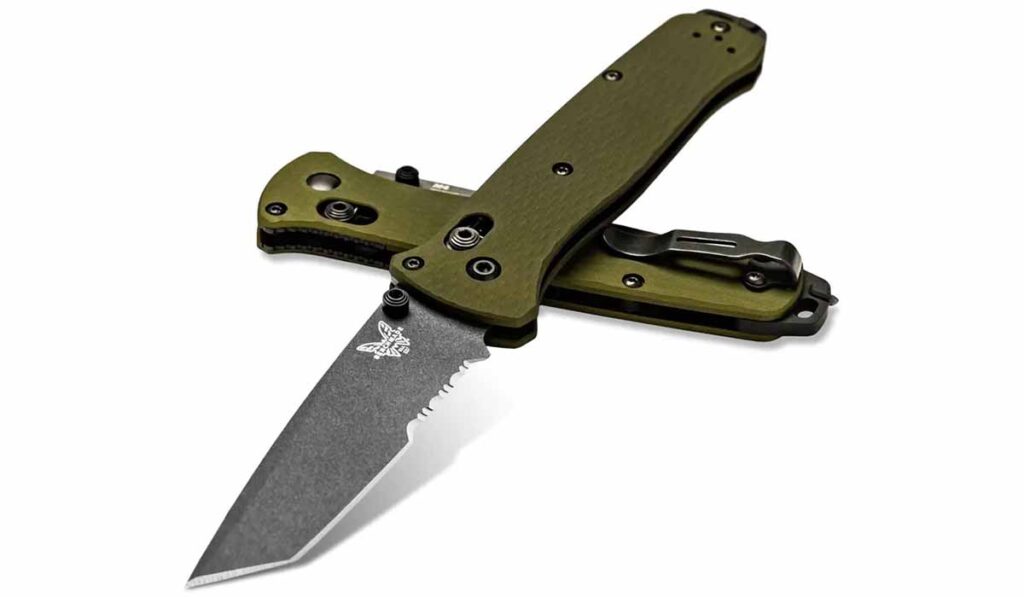
Benchmade Bailout
You’ve heard of the Bugout, surely. Now meet its newer, slightly-tacticooler cousin, the Bailout (one of my favorite knives of the past several years).
As you can surely imagine, the Bailout is a bit of a riff on the Bugout most of us knife fans know and love, but with some notable changes. Our favorite version is the CPM-M4 model which features woodland green anodized aluminum handles.
CPM-M4 is a great steel, which you would expect from Benchmade, and the knife itself is the perfect length to straddle the line between EDC knife and tactical folder. It also features a lanyard loop if you’re one of those people who like lanyard loops, and more interestingly a micro glass breaker.
How often do you need to break a car window in an emergency? Probably not very often, but it is nice to have it if you’re leaning toward a more tactical-style knife. You can also get a version that doesn’t have the glass breaker or the aluminum handles if you want to save a bit.
The Bailout features a 3.4-inches, CPM-M4 blade.
MSRP: $129
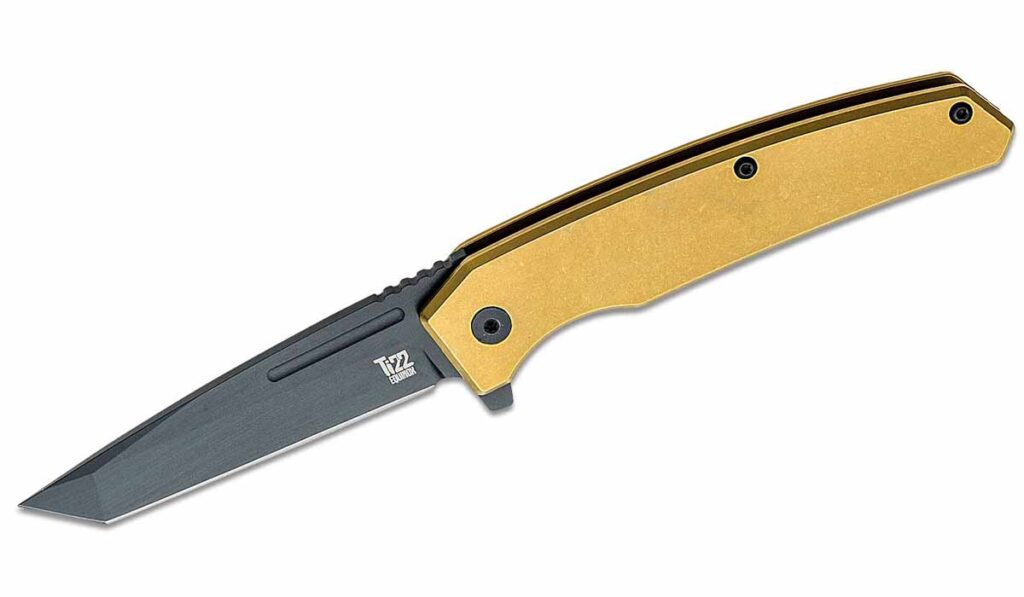
Ontario Ti-22 Equinox
Ontario Knife Co. is one of the most criminally underrated makers out there. Everything in its catalog is smartly designed and intended to excel in real-world conditions. That includes the Ti-22 Equinox.
It features, as the name suggests, a full titanium handle and an S35VN blade coated black to inhibit rust and corrosion in difficult environments. S35VN is a premium steel that holds an edge incredibly well, and the lightweight titanium handle is as robust as you could ever want.
The action is flippy and fidget-friendly, and the handle feels comfortable during extended use. The blade slices paper right out of the box, and comes to a sharp angle where the forward edge meets the primary cutting edge, giving you plenty of piercing power.
Draw cuts, slicing, and even some camp kitchen prep were easy and straightforward, and the knife handled being carried on a sailboat for a week without showing any signs of rust. All in all, a great EDC that again toes the line towards the more tactical/defensive side of things.
The Ti-22 has an S35VN blade that is 3.03-inches long.
MSRP: $138
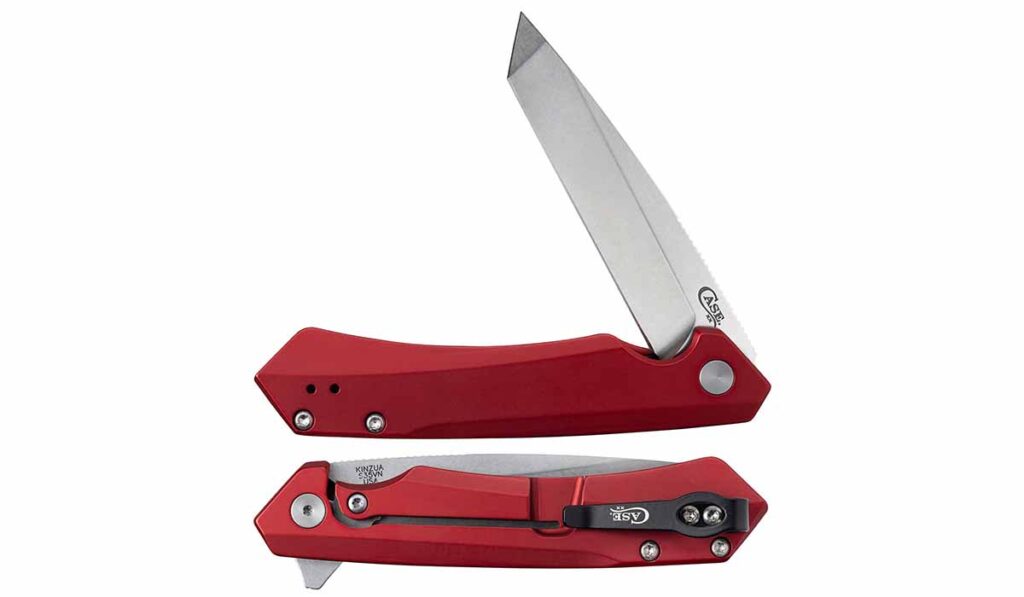
Case Kinzua
Case Knives made a flipper! Several actually, with the Kinzua being part of the first line of Modern Everyday Carry Knives to come from this iconic brand.
This isn’t your grandad’s Case knife, though we love some of those old three-blade traditional babies as much as anyone. These are incredibly modern designs for a modern audience that expects things like one-handed opening, a frame lock, and a deep-carry pocket clip.
In addition to all that, the Kinzua (named for a scenic forestry area in Allegheny County, PA) features an S35VN blade and faceted anodized aluminum handles that are a joy to hold. The flipper tab is nicely contoured, and the knife opens and closes smoothly.
The tip is a now-familiar American tanto and is great for piercing pesky packages, or anything else you might need to poke a hole into during your daily life.
MSRP: $179
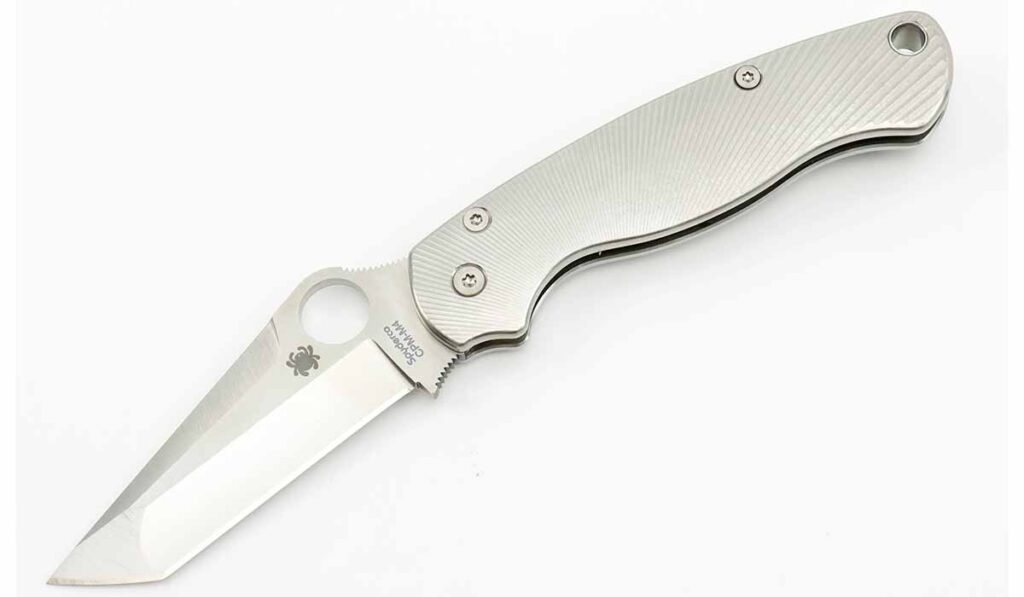
Spyderco Paramilitary 2 Tanto
The Spyderco Paramilitary 2 (or PM2) is beloved in the EDC community, and it’s not hard to figure out why.
It features a polished washer pivot system that is very smooth to open and close, features Spyderco’s iconic compression lock, and now, for the first time, comes with a tanto blade.
That blade is made of CPM-S30V steel, one of the best you can get in a pocket knife at this price range. Sharpening isn’t too difficult, and the edge will last you a very long time, even with aggressive daily use battering away as you slice open Amazon boxes (or whatever).
The PM2 has fine-textured G-10 handle scales out of the box, but you and your trusty screwdriver can pop those off and replace them with any one of roughly ten bazillion aftermarket options. Companies like Flytanium keep PM2 owners well-supplied with choices.
MSRP: $246
The Spyderco PM2 Tanto features a 3.44-inch blade made of CPM-S30V steel.
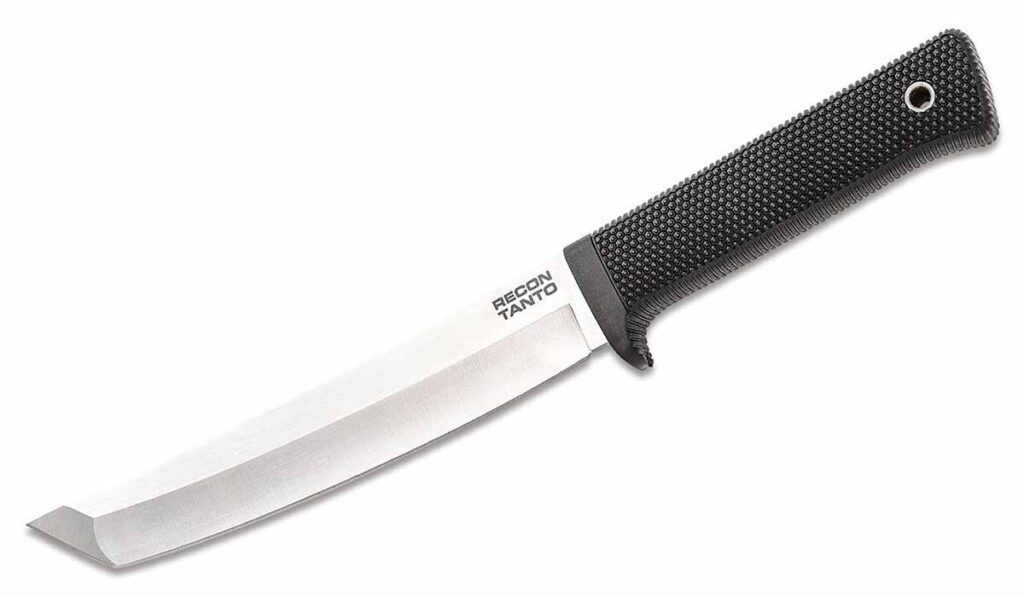
Cold Steel Recon Tanto
Of course, we can’t have a list of modern tanto knives without bringing out something from Cold Steel, the progenitors of the modern “American tanto” that is the most accurate description of most of the knives on this list.
Their Recon Tanto is our first fixed blade on this list and is positioned as a tactical/rescue blade. The incredibly robust SK5 steel used in the blade is a common for hard-use tools like machetes and survival knives, particularly military ones.
The grip is made with Kray-Ex, which is designed to maintain good friction in the hand at all times, even if your hands are wet or you’re wearing gloves. It also doesn’t shred your paws like some rougher materials.
If you’re looking for a more tactical tanto that can handle everything from camp tasks to self-defense, this is a great option that is a bit heavy, but bomb-proof and reliable.
The Recon Tanto has a 7-inch SK5 high-carbon steel blade.
MSRP: Starting at $70
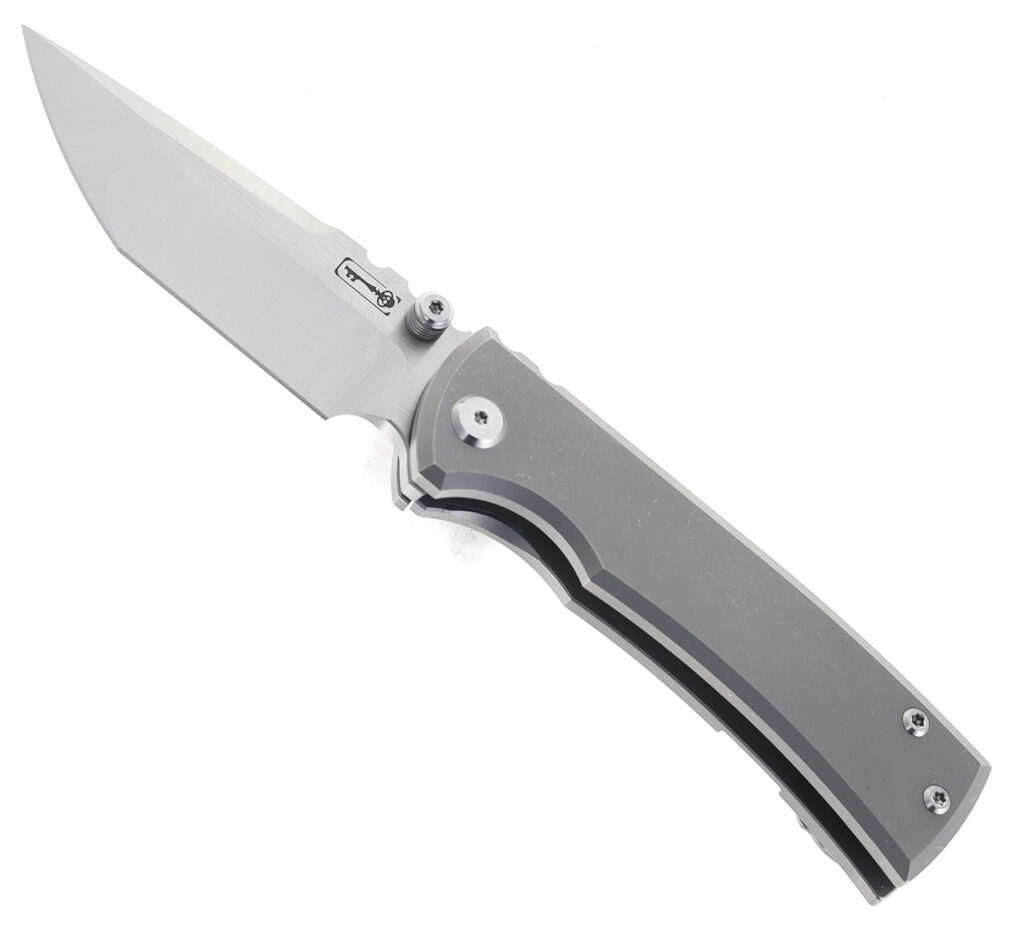
Chaves Redención Street Tanto
Ramon Chaves is a custom knife maker that has made a name for himself as one of the premier designers of tough, hard-wearing, but still stylish blades. His Redención tanto is…very expensive, and worth every penny, exactly the way a custom knife should be.
If you’ve got the cash and you like the look of it, especially if you enjoy the artisan nature of a custom knife, go buy that.
For those of us with slightly less to spend, Reate has put out a production version of the Redención that comes with a slightly more obtainable street price and is considerably easier to find in stock.
Ramon works hard, but it’s always going to take longer to produce a custom knife than a production knife coming from a factory with purpose-built tooling. The Redención Street is a great way to get your hands on the design, without waiting months for the custom version.
The Street Tanto is an incredibly well-built framelock folder with an aggressive piercing tip. Despite a 3.63-inch blade length, the whole thing weighs in at just over 6oz thanks to the titanium handle design (which you can get in about two dozen different colors).
The blade is made from the fabulous Bohler M390 steel, one of the best you’ll find in a pocket knife.
MSRP: $300
Siam Blades Traditional Black Copper Hira Tanto
Lastly, I’m throwing in a little treat for the two or three of you reading this who came here looking for traditional, no-fooling, tantos made the old way. Siam Blades is a traditional blacksmith shop located in Thailand, but they have Japanese-trained smiths that create blades using traditional methods.
For most people, this is going to be a good balance of value and authenticity. A traditional tanto made in Japan will probably run you about three times what this one does. The Black Copper Hira tanto is made to a similar standard, in the same traditional way, and is as beautiful as it is functional.
Best of all, they have stock ready to ship, so you don’t have to wait 18 months for your tanto to be finished and shipped. I’ve chosen the Black Copper version here, but there is a large variety available depending on what aesthetic you’re going after.
The blade itself is made of extremely durable high-carbon SK5 steel (very common in machetes, and battle-ready sword reproductions) and is 9.5-inches long.
MSRP: $820
Final Thoughts on Tanto Knives
The tanto is an iconic design, whether we’re talking about the traditional Japanese original or the modern American remix. This knife shape has stuck around for a thousand years for a reason.
Today, most production tantos are more in the American style at least as far as the tip goes, but this battle-tested design has its roots going back much farther. I hope you’ve enjoyed this brief look into that long history, and you’ve got a better idea of what your options are for picking up a tanto of your very own.
What to look for in a custom hunting knife and some sharp examples.
For outdoorsmen, a knife of some kind is almost a constant companion. Most carry a knife that falls into the category of a hunter.
The Merriam-Webster Dictionary defines hunting knife as a large, stout knife used to skin and process game. When I started judging custom knife competitions at knife shows 30 years ago, the category with the greatest number of entries was always the hunter. Why? Because there are so many interpretations of what a hunting knife is. Often the judges refer to their own experience using knives in the category. Entries generally range in blade length from 2.5 to 5 inches. I have seen knives entered in the category with 10-inch blades.
Blade Lengths
Blade lengths are often designed to process a particular bird or animal. Smaller blades in the 2.5-to-3-inch range are primarily used for dressing birds. The short blade length allows the hunter to quickly extract the bird’s breast meat. The most common blade length is 4 to 4.5 inches, a length that will dress out most game hunted regularly in North America. The dropped hunter/drop-point hunter designed by BLADE Magazine Cutlery Hall-Of-Fame® member Bob Loveless (page 26) is the world’s most copied hunting knife. The standard Loveless drop point features a 4-inch blade.
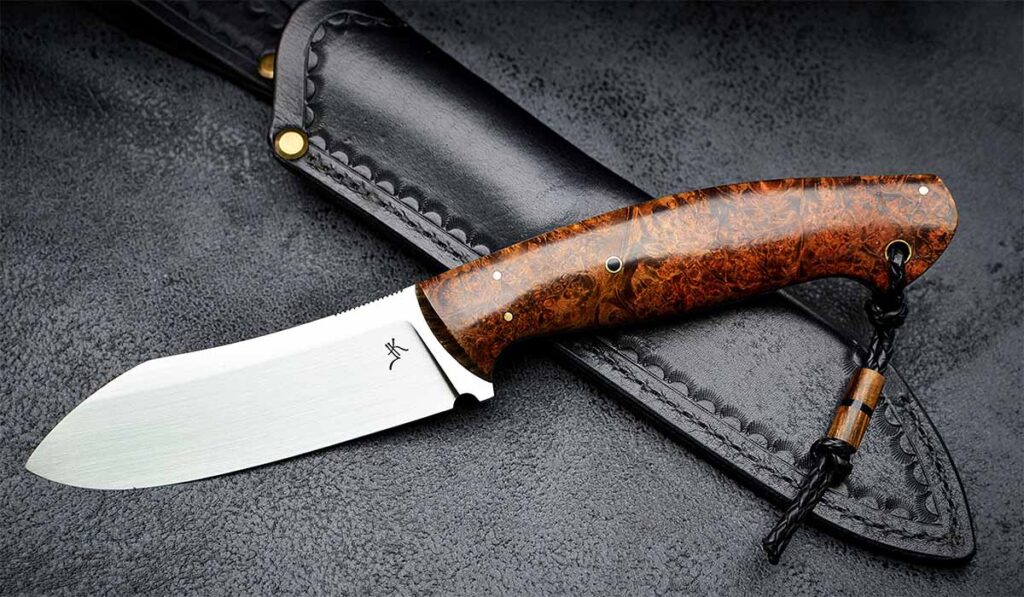
One of the more popular skinner designs is the Nessmuk, praised for its all-around versatility in the field. Luk Kuberski’s Nessmuk Hunter features Sleipner stainless blade steel with an impeccable satin finish and a mesmerizing handle of maple ash burl. (Luk Kuberski image)
Nessmuk Skinner Maker: Luk Kuberski Blade Length: 4.75” Blade Steel: Sleipner stainless Blade Finish: Satin Blade Style: Drop point Handle Material: Ash maple burl Overall Length: 8.6” Sheath: Leather pouch/belt model by the maker Author’s Comments: Full-tang construction; excellent balance and handle ergonomics; serrated thumb ramp enhances control Maker’s price for a similar knife: $350
When dressing out larger game such as moose or elk, many hunters prefer a longer blade because of the animal’s size. Why is the 5-inch blade the limit? The idea behind the hunting knife is to dress out the animal without losing control and cutting into the animal’s vital areas. Going much past a 5-inch blade can affect the average hunter’s ability to control the cutting edge.
Blade Steels
Materials for hunting knife blades are primarily stainless and carbon steels, though damascus has been gaining in popularity in recent years. The environment the hunters will be in and their skill level at resharpening a blade will enter into the choice of steel.
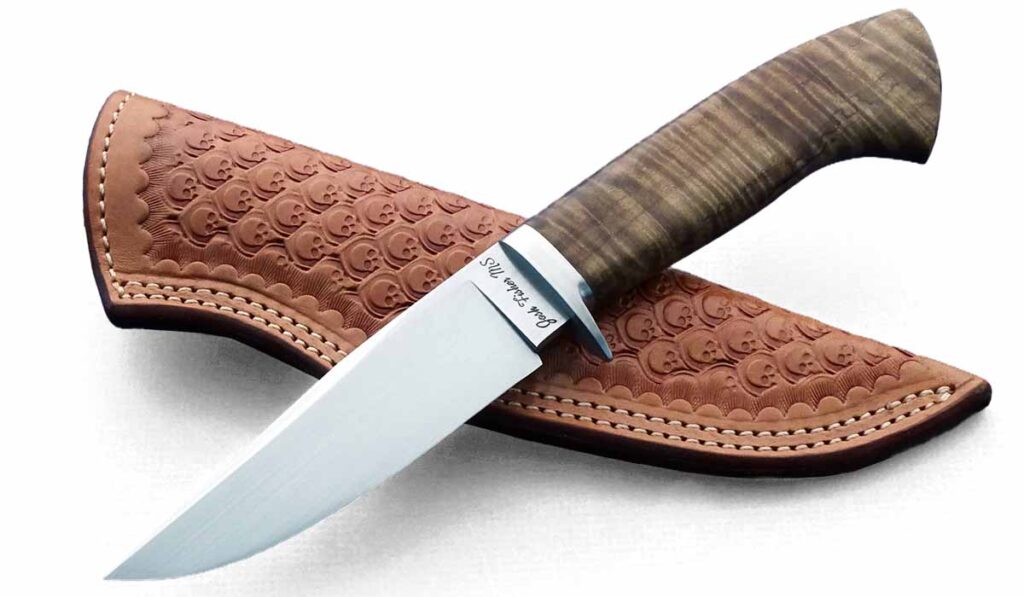
Wood is a popular handle material for custom hunting knives. Josh Fisher opts for curly maple on his drop-point hunter. And how about those skulls on the tooled-leather sheath by Bob Bobbert? (Robertson’s Custom Cutlery image)
Drop-Point Hunter Maker: Josh Fisher Blade Length: 4.5” Blade Material: 1084 carbon steel Blade Style: Drop point Guard Material: Stainless steel Handle Material: Curly maple Overall Length: 9” Sheath: Tooled-leather pouch/belt model in a skull motif by Bob Bobbert Author’s Comments: Excellent handle ergonomics and balance; Josh is an ABS master smith Maker’s list price for a similar knife: $625
Each steel has its advantage(s) concerning rust resistance, ease of sharpening and edge holding. Carbon steels such as 1084, 5160 and 52100 provide an extremely keen edge and can be easily resharpened. They do, however, require more corrosion maintenance. Stainless steels such as 440C, ATS-34 and CPM 154 make up the bulk of stainless steels used on custom hunters. These can be reasonably simple to sharpen and more forgiving regarding corrosion.
Whichever steel you choose, the blade should be cleaned after use and a light coat of oil should be applied. It is best not to store your knife long-term in a leather sheath, as the tannic acid found in the leather can rust your blade. Additionally, leather does hold moisture, which can hasten the rusting process of the steel. It is best to store knives in something other than their leather sheaths.
Handle Materials
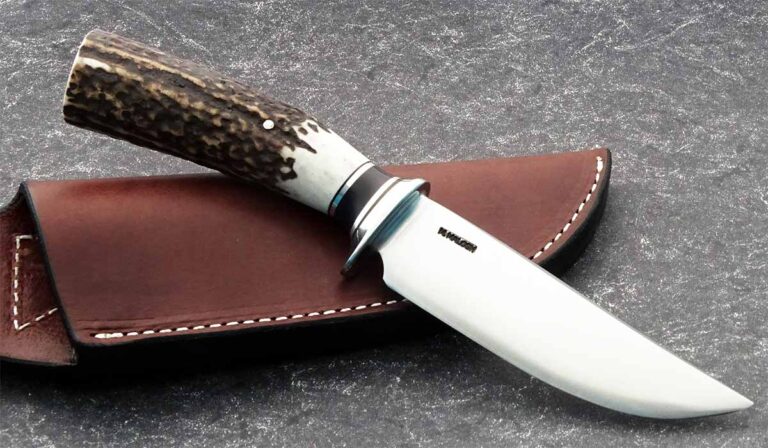
A wide variety of handle materials are used for hunting knives. A favorite among makers and outdoorsmen is Sambar stag, either in its natural color or dyed to create amber stag. Stag is favored not only for its looks but because its contours provide an excellent gripping surface, even when wet. Another handle material gaining favor is elk and much for the same reasons. Two advantages of elk are it can be found in larger sizes and is less expensive.
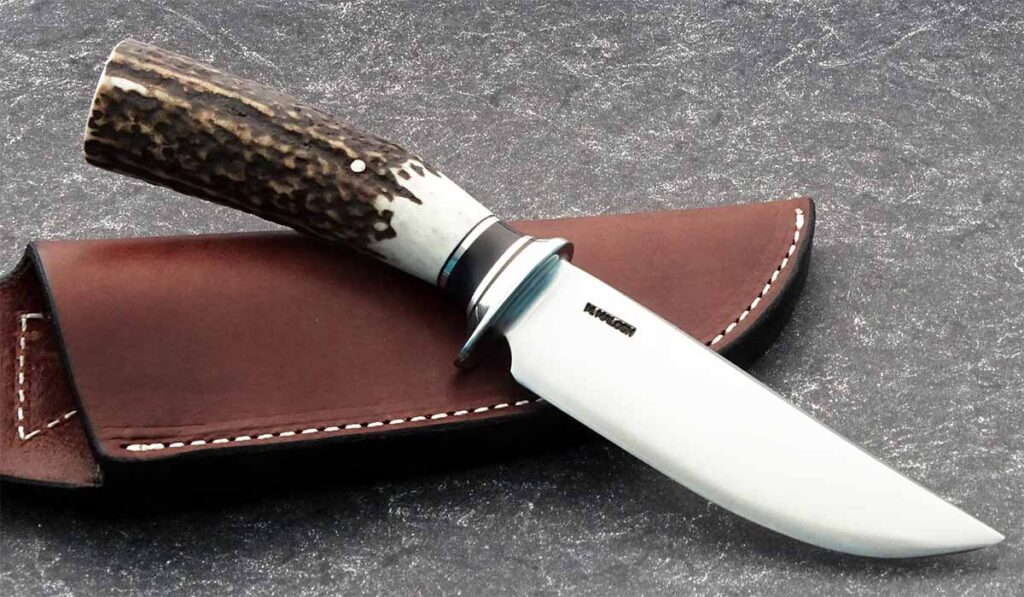
Sambar stag and elk are favored for their looks and because they provide an excellent gripping surface, even when wet. Mike Malosh’s Elk Hunter 23 custom hunting knife features elk scales. (Robertson’s Custom Cutlery image)
Elk Hunter 23 Maker: Mike Malosh Blade Length: 47/8” Blade Material: W-2 tool steel Blade Finish: Satin Guard Material: Stainless steel Handle Material: Elk w/black Micarta® and stainless steel spacers Overall Length: 9.5” Sheath: Leather pouch/belt model by the maker Author’s Comments: This knife is built for serious work; excellent balance and handle ergonomics Maker’s price for a similar knife: $395
Desert ironwood, curly koa, California buckeye burl and curly maple are among various kinds of popular handle woods used for hunters. Other popular materials are synthetics such as G-10 and Micarta®. The main advantage of these materials is that, for the most part, they are impervious to the elements. As such, they tend not to shrink and crack as some natural handle materials can do over time.
Guards
Guards are made primarily from either 304 or 416 stainless steel. If the knife features a hidden tang design, the joint between the guard and the blade should be soldered. Sealing the guard helps keep the moisture away from hidden tangs. Because their softness makes them prone to damage, along with their additional maintenance requirements, brass and nickel silver generally are not used for guards.
Blade Styles
The drop-point hunter is the most commonly made hunting knife. The drop-point blade maintains its thickness along the spine and then gently slopes to the point. Generally, the drop point is slightly thicker than other hunting blade patterns at the point. The blade thickness provides the drop point the versatility not only to skin but to disjoint and pry. These advantages can be critical to the hunter when dressing larger game.
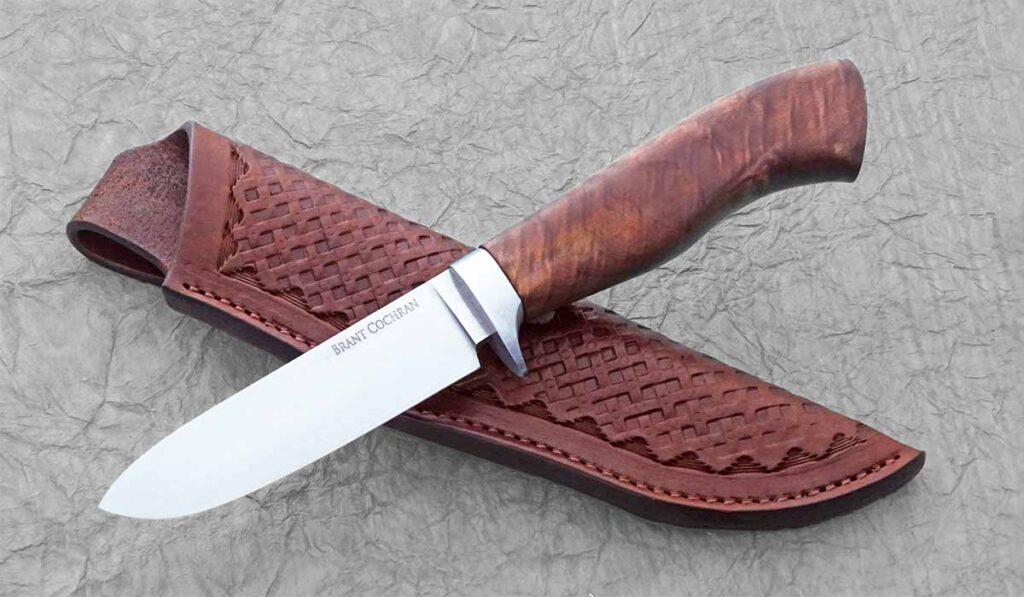
The slightly raised blade spine/hump extends the curved part of the semi-skinner blade for skinning while maintaining the drop point to avoid puncturing the abdominal cavity. Brant Cochran covers the pattern in a sturdy lightweight version of 80CrV2 carbon steel and walnut in his custom hunting knife. (Robertson’s Custom Cutlery image)
Semi-Skinner Maker: Brant Cochran Blade Length: 4.25” Blade Material: 80CrV2 carbon steel Blade Finish: Satin Guard Material: Stainless steel Handle Material: Walnut Overall Length: 9” Sheath: Tooled-leather pouch/belt model by the maker Author’s Comments: 80CrV2 is a carbon steel that is both tough and provides outstanding edge retention; excellent balance and handle ergonomics; sturdy lightweight knife, perfect for your next hunt; Brant is an ABS journeyman smith Maker’s price for a similar knife: $300
The idea of a skinner is basically to remove the skin/fur from the game. The skinning blade shape features a slightly thinner blade and edge meant for a specific purpose. The skinner is designed for elongated cuts and better control of the blade, ensuring the game’s fur maintains its integrity. While primarily intended to remove the fur, a knife with a skinner blade can be used to dress game out, too. One of the more popular skinner designs is the Nessmuk, praised for its all-around versatility in the field.
The semi-skinner blade is the middle ground between the drop-point and skinner blades. The slightly raised blade spine/hump extends the curved part of the blade for skinning while maintaining the drop point to avoid puncturing the abdominal cavity, which could taint the meat of the animal.
Conclusion
Picking the right edged companion for your time in the field should require some research. As noted, hunting knives come in various shapes and sizes. This variety enables you to choose the right size, steel and handle material necessary to get the job done. It would benefit you greatly to hold the knife in your hand, primarily for sizing. You must always be able to control the blade’s edge.
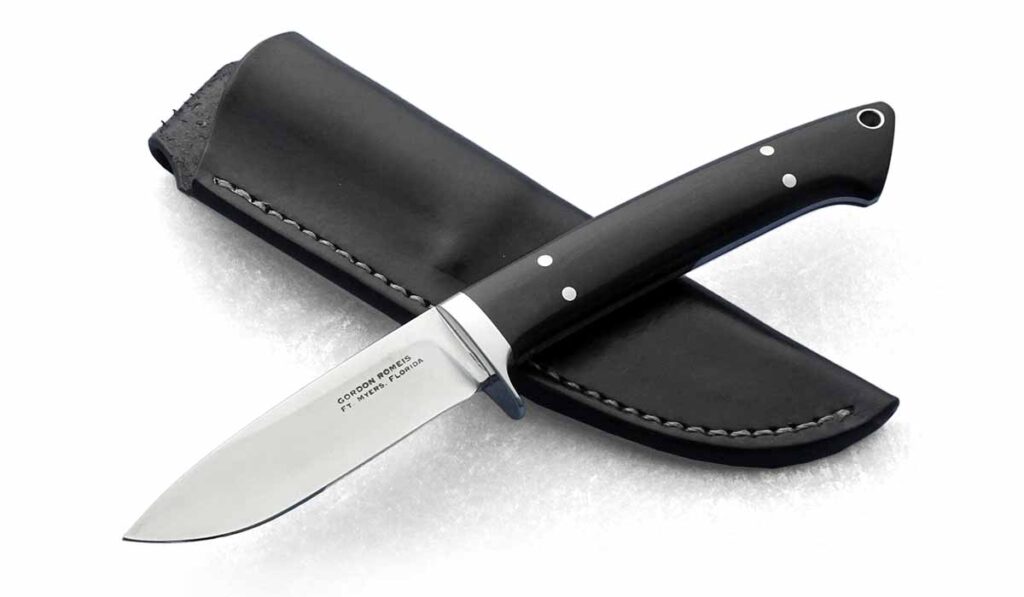
The drop-point hunter is the most commonly made hunting knife. A George Romeis drop point features CPM 154 stainless blade steel and a black G-10 handle. (Robertson’s Custom Cutlery image)
Drop-Point Hunter Maker: George Romeis Blade Length: 3.5” Blade Steel: CPM 154 stainless Blade Finish: Satin Guard Material: Stainless steel Handle Material: Black G-10 w/stainless-steel-lined thong hole Overall Length: 8” Sheath: Leather pouch/belt model by the maker Author’s Comments: Full-tapered tang, excellent balance, very comfortable in the hand Maker’s price for a similar knife: $300
Remember, the rifle or bow harvests the game but the knife creates what becomes dinner and the trophy.
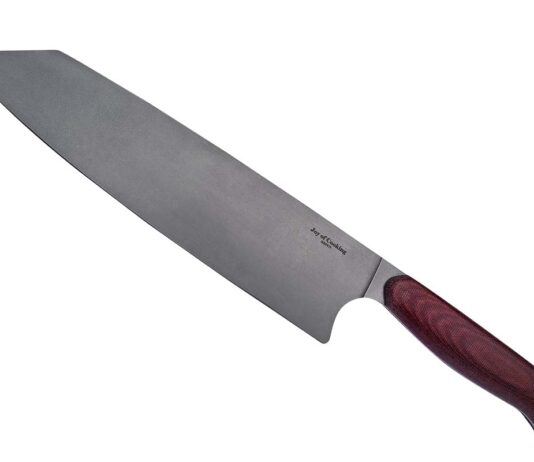
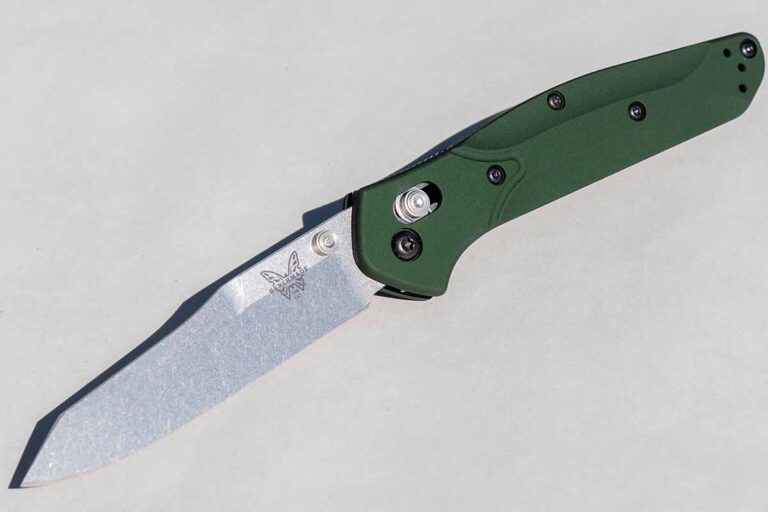
The Poros by Spartan Blades is a great feeling folder. The flipper design is spot-on for hand placement.
Company co-founders Curtis Iovito and Mark Carey are excellent to work with and built Spartan from scratch. Both are retired from Special Forces and have a lot of pride in workmanship. The Poros is their field-grade-version linerlock. It might not have the fancy material and looks but the performance is top shelf.
Poros Light Cutting Duties
Initial slicing of 20-pound copy paper was excellent. The Poros was very smooth and aggressive. The blade shape really helped slicing paper, especially when I employed a roll cut. The flat-ground blade sliced straight with no curling of the paper.
The 154CM stainless steel blade was exceptionally aggressive in the 8-ounce leather slice.
The Poros easily devoured single-walled cardboard. As with the copy paper, the blade sliced it both forcefully and effortlessly, resulting in nice, straight cuts. The slices were extremely quick with no resistance felt.
The folder was quite aggressive again in the 8-ounce leather slice. It was very easy to control the thickness of the skiving—I just needed to move my fingers faster. I had two fingernail nicks after the skiving. The edge remained sharp.
Poros Medium Cutting Duties
It was time to do a fire stick. The flat grind produced excellent curlicues. It sliced the wood incredibly fast and I had to slow down for more control to keep the curlicues on the stick. The handle was comfortable while making the deeper cuts. It was awfully simple to whittle with the knife.
The flat grind produced excellent curlicues. It sliced the wood awfully fast and the author had to slow down for more control to keep the curlicues on the stick.
For the next exercise I used 1-inch manila rope. The Poros crunched to 197 cuts before I ran out of rope. The edge was still good. The handle was very comfortable during heavy use. There were no issues with the blade lock. Nicely done, Spartan.
Poros Heavy Cutting Duties
I split kindling into smaller pieces to check lockup by doing baton work. There continued to be no issues with lockup or edge retention. The knife can handle a beating for sure. It’s not that I recommend baton work with a folder but if you have to it can be done with the Poros.
The author split kindling into smaller pieces to check lockup via some baton work. There were no issues with lockup or edge retention.
To push the knife a bit further, I grabbed my trusty whitetail deer antler. After 30 hard whacks on it, the edge was still sharp with no rolling or chips, indicating spot-on heat treatment.
The last test was back to the copy paper slice. The Poros continued cutting smoothly and my arm was tired. Outstanding job, guys!
Final Cut
The Poros folder is worthy of riding in anyone’s pocket. It’s well designed, sharp and easy on—and comfortable in—the hand. I really don’t know what I’d change on this one, though I would love to see an A-2 tool steel version.
Poros Specs Maker: Spartan Blades Knife type: Flipper folder Blade length: 3 7/8” Blade steel: 154CM stainless Rockwell hardness: 58-60 HRC Blade finish: Black PVD Handle: Carbon-fiber-patterned G-10 Lock: Linerlock Closed length: 5 1/8” Country of origin: USA MSRP: $190
With the K-Tact Kukri, Condor goes both old school and modern.
As with all knives, the steel is only as strong as the hand that wields it—and perhaps with no knife is this so true as the kukri.
The kukri—aka khukuri—has a reputation so legendary that even some non-knife enthusiasts recognize the knife when they see one. To understand how the kukri got its reputation, let’s examine the people who used it and help grow the legend.
Kukri History
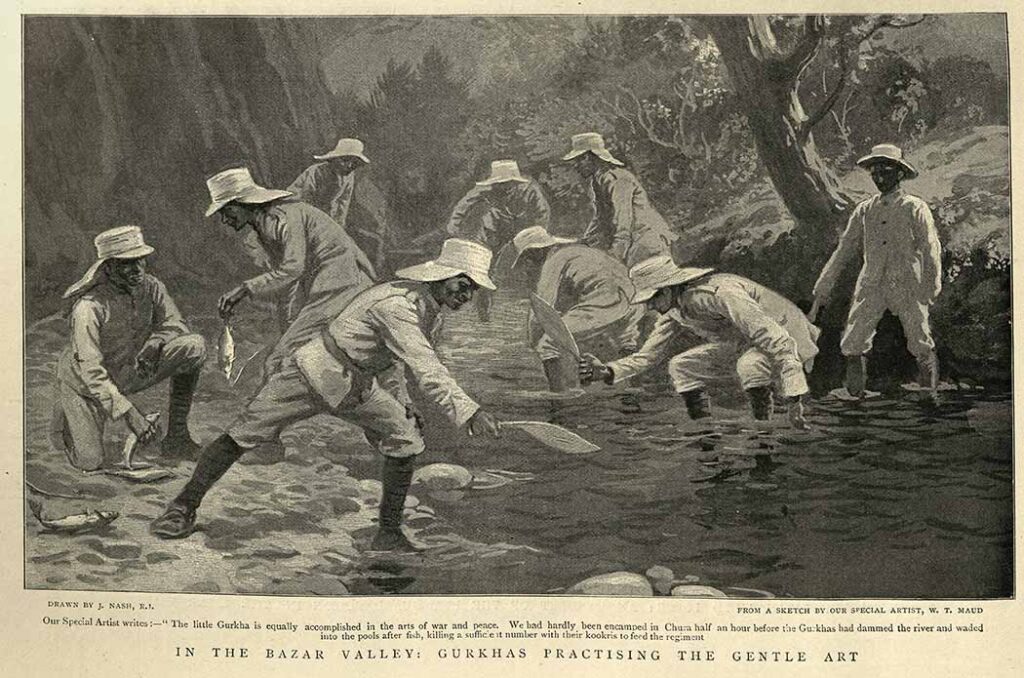
You can’t mention the kukri without mentioning the hand behind the blade: the Gurkhas. The history of the Gurkhas dates back several centuries to the small mountainous kingdom of Gorkha, located in what is now central Nepal. In the early 19th century, the British East India Company was expanding through the Indian subcontinent and faced challenges from local rulers and neighboring powers. The Gurkhas had a reputation for being a substantial military force in the region. So, the company began recruiting Gurkhas into its own army. The first Gurkha units were formed in 1815 and they quickly gained a reputation for bravery and loyalty.
Gurkhas not only were fearsome warriors with their kukris, they also used them for daily chores. This sketch shows Gurkhas catching fish with their kukris in India’s Bazar Valley circa 1900. (Istockphoto.com image)
Since the first Gurkha units were formed, they played a pivotal role in many conflicts and to this day remain an important part of the British Army. The Gurkhas fought for the British during the two World Wars, with Gurkha soldiers serving in various theaters of operations, including the Western Front, North Africa and Southeast Asia. About 200,000—virtually an entire male population—enlisted to fight in World War I. About 250,000 fought in World War II. In the two wars, 30,000 Gurkha troops were killed.
Continuing to serve with the British, they participated in the Falklands War in 1982, and have been involved in recent conflicts in Malaya, Borneo, Bosnia, Iraq—including the Gulf War—and Afghanistan. Soldiers that have served alongside the Gurkhas regard them with respect. The spine-chilling cry of “Ayo Gurkhali!”—“The Gurkhas are coming!”—has terrified countless enemies. The Gurkhas’ bravery and determination in battle earned them numerous honors and awards. In the two World Wars alone, they won nearly 5,000 medals for gallantry.
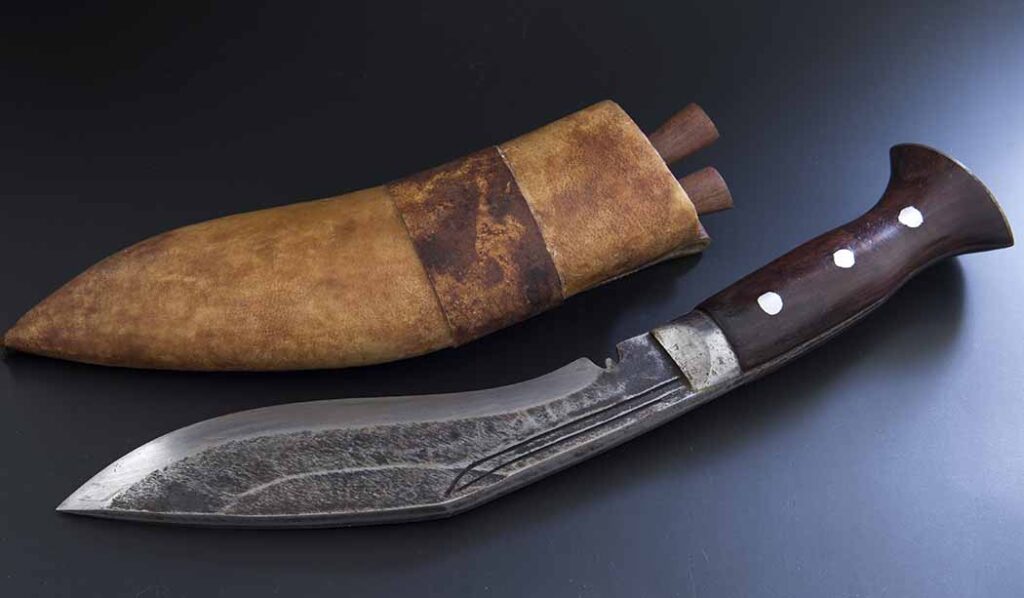
The traditional kukri includes a natural handle material and the double-notched choil. Note the extra small knife and a sharpening steel—their handles protrude from the sheath here—that ride in the sheath. (Istockphoto.com image)
After the second World War, the British started to pull back from their colonial interests, allowing their various colonies to practice more independent self-governance. Even so, the British Army continued including the Gurkhas as an important part of their operations. Meanwhile, the kukri legend had no choice but to grow as it was made famous by the Gurkhas’ outstanding reputation for bravery and loyalty.
K-Tact Kukri Updates
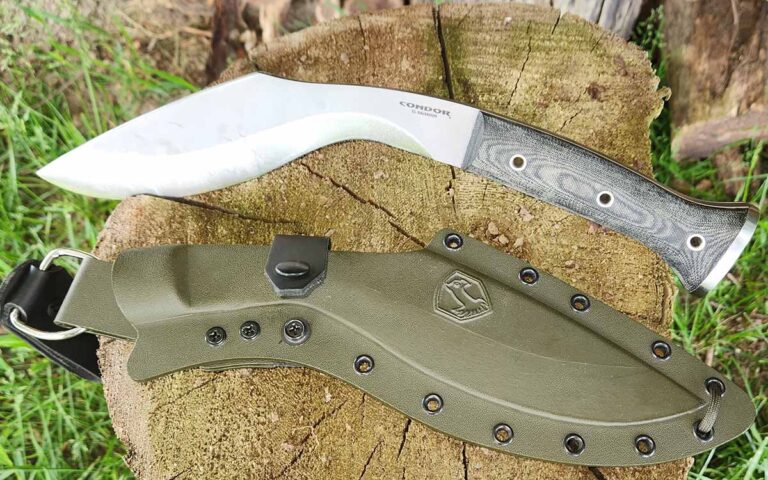
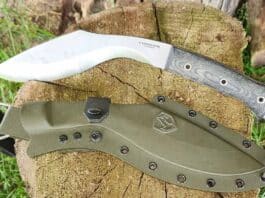
The traditionally made kukri is a coveted piece in anyone’s collection. Condor Tool & Knife has updated the design with the use of modern materials to bring about a new tool with a pedigree. With the K-Tact Kukri Knife Army Green designed by Joe Flowers, the company remains loyal to the original shape but modified some materials and proportions.
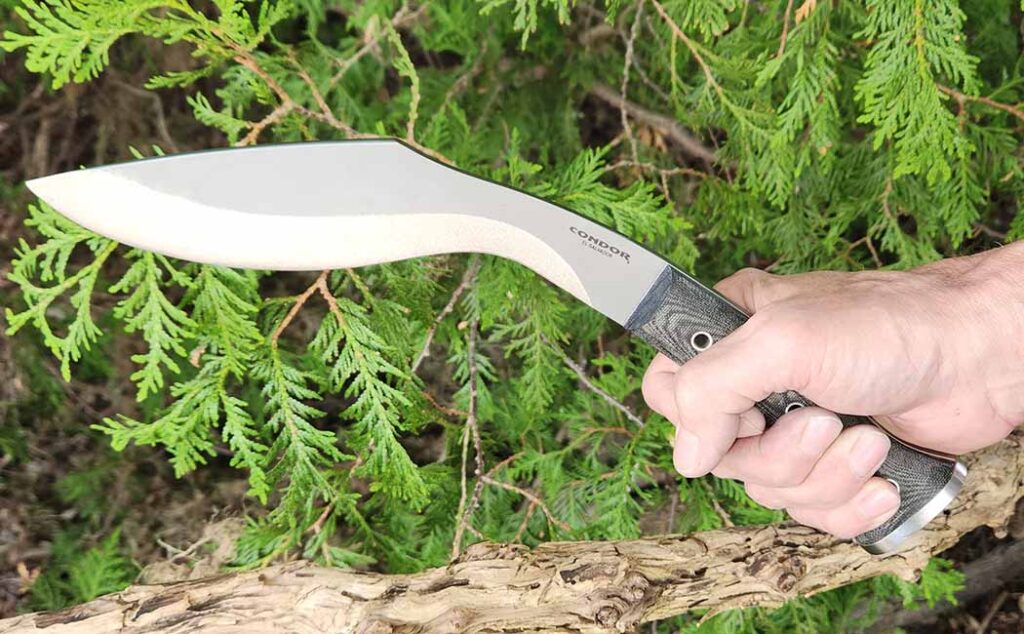
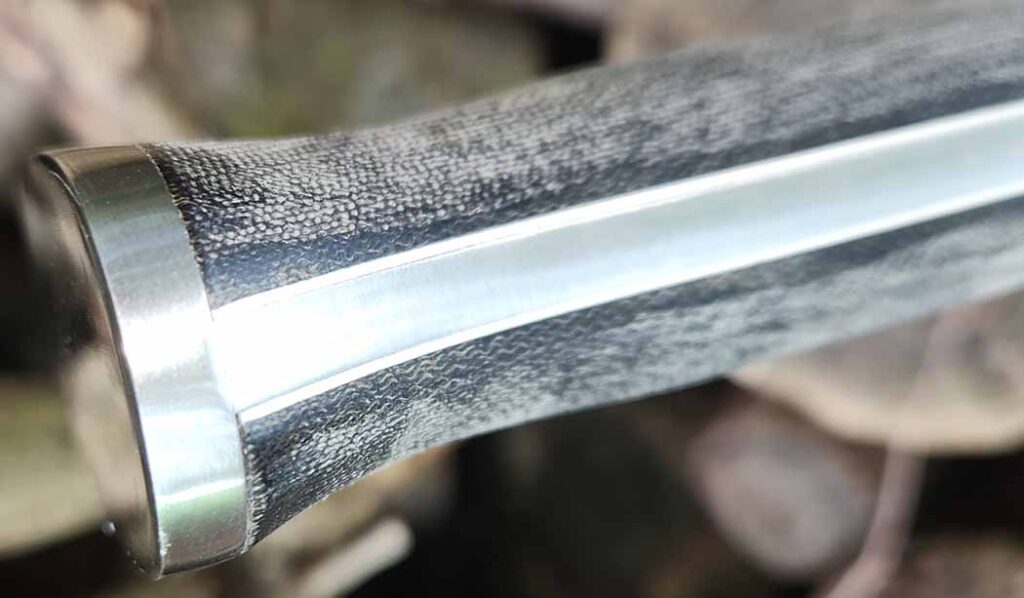
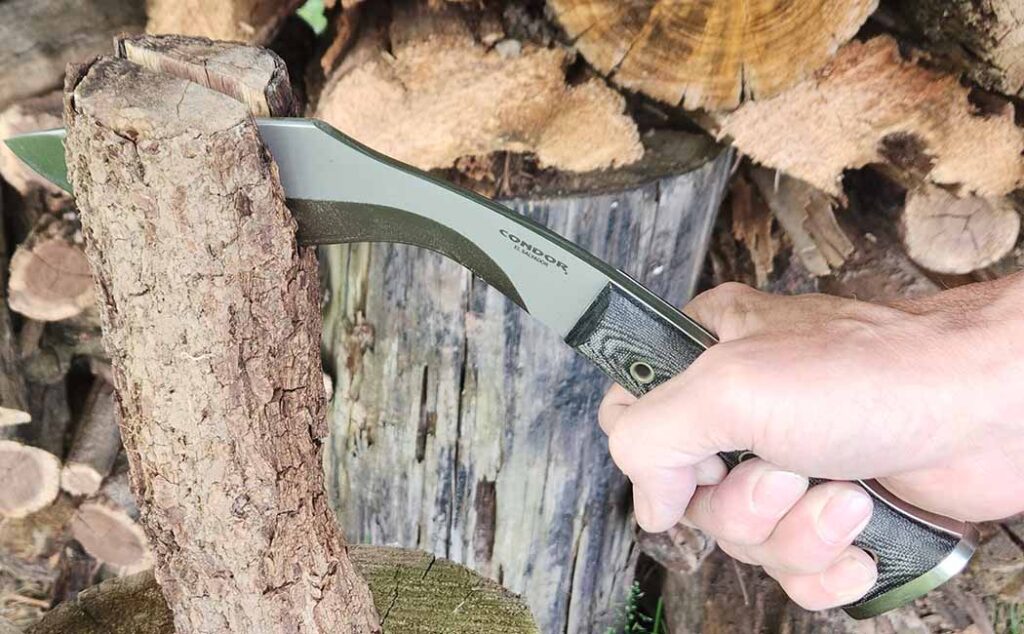
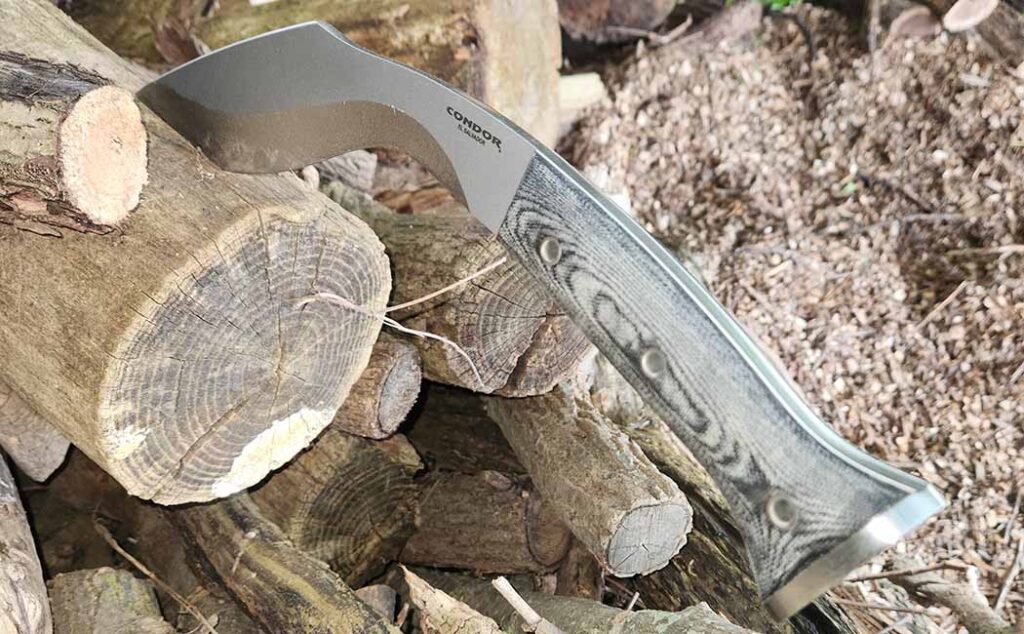
The overall profile of the Condor Tool & Knife K-Tact Kukri forms somewhat of a pistol grip. The grip angle serves well during chopping and carving. In less peaceful times, it accommodates thrusting without the need for a guard. Blade and overall lengths: 10 and 14.5 inches.
Instead of using the wide variety of natural handle materials seen on kukris over the years, Condor opted for a green Micarta®. Micarta is much more stable, and for better grip Condor gives it a textured bead-blasted finish.
You may have heard how the blades of the originals were made from truck leaf springs. Truck leaf springs were made from such carbon steels as 5160 or 1095, or reasonable facsimiles. I often wonder about the truck leaf spring story. If you think about it, seeing as how the kukri also was used by villagers along with other patterns of knives to get work done, that means a lot of trucks would be losing their springs. Condor uses 1075 carbon steel with a bead-blasted finish for the K-Tact, which is named after Alan Kay, season one winner of History Channel’s Alone reality survival show.
The pommel helps balance the knife and serves as a hammer. According to the author, the synthetic Micarta® deals with any vibration from hammering and chopping better than natural materials.
Traditional kukris have a convex edge and are finished in a high polish. Condor convexes the K-Tact only part way up the blade and then leaves it flat. Blade thickness is .2 inch, thinner than most traditional models.
The average Nepalese villager’s kukri was made differently than the official Gurkha model. Possibly due to the time needed to make them and the lack of available steel, villager kukris had stick tangs. The Gurkha models have always been full tang and so is the K-Tact. Because of the thinner stock and the fact Condor took some weight off the blade with a stylized dip in the spine, the knife is livelier in the hand and feels more balanced.
Any of the traditional kukris I have held have had forward-heavy blades. They have a thick pommel plate the same thickness as that of the blade material. Having a thick pommel gives you a convenient hammer when needed and also enhances the knife’s balance.
K-Tact Kukri Versatility
One of the big keys to the kukri design is that it’s a great maker’s tool. It is not used for combat only. Among the recognized attributes of the Gurkha fighting units is their resourcefulness, and a large part of that is that the kukri lends itself to being a maker’s tool. Just the overall shape allows you to do many chores. It can act as a small draw knife due to the arched shape.
The author is not a big fan of batonning. “If you are going to do so,” he observed, “the rule of thumb is baton through nothing larger than one third the length of the knife. Following that rule allows you to keep leverage on the cut.”
For the sheath, instead of the traditional water-buffalo-covered wood, Condor uses a molded Kydex with a drop-leg leather strap and a retention strap. Despite being a huge traditionalist at times, I have to say the modern sheath is a huge improvement. The fit is spot on and you get none of the Kydex-rattling syndrome.
If I had to voice a disappointment in the K-Tact, to be fair it would be more of a “I want my cake and eat it, too” complaint. On a traditional kukri you get an extra small knife and a steel that ride behind the blade next to your body in the same sheath. Though I don’t have much use for the sharpening steel—I carry other sharpeners—a secondary small blade is a key part to the maker’s aspect of the knife.
Due to the profile of the kukri, the sweet spot for chopping is at the belly a bit farther back from the tip than on a number of other chopper designs.
Yes, I know, I can carry another smaller knife, hence the “cake and eat it, too.” Having said that, there is still something about the knife presenting as a kit all in one housing. Keep in mind I am a father-and-son-knife-set collector. All I’m saying is, it would have been nice to have a matching small blade with it.
Use Before Buying
I must say I have enjoyed playing with this knife. It works well. Kukri-style knives aren’t for everyone, so do try and use one before you buy. Each knife style has its own little ins and outs. If all knives worked the same, what reason would enthusiasts have to collect multiples?
As a final thought, the K-Tact is a good, solid, dependable piece of kit and in the right hands can take you far. Who knows? You might discover that you just want a modern version of a legendary style. Made in El Salvador, it has an MSRP of $162.84.
These factory slip joint folders prove the design is alive and well.
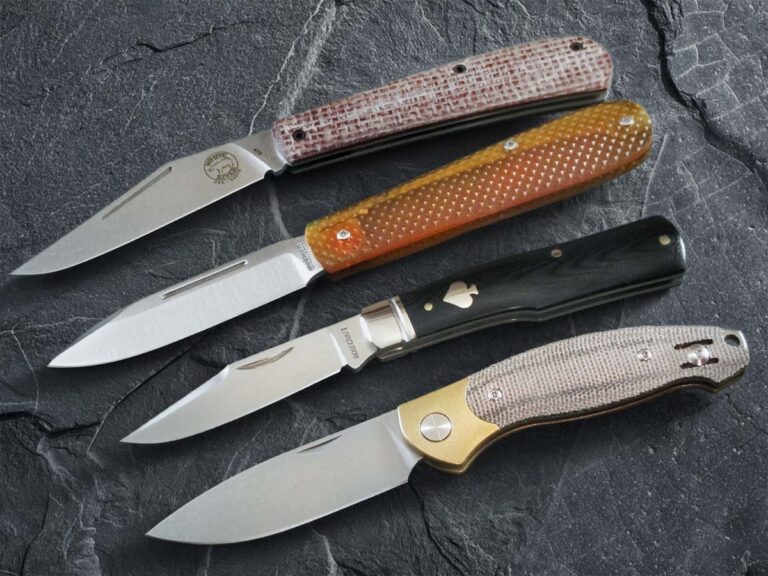
Those of us who were around long before just about every folding knife had a lock of some sort have fond memories of slip joints. These non-locking folders are still around, but you need to make Google your friend and look—not just in the U.S., but overseas—to root them out. Surprisingly, there are good ones to be had; you just have to do a little digging to find the gems. We’ve done the homework on a nice selection of fresh slip joints for BLADE® readers and present them to you now in these glossy pages.
RoseCraft Savage Creek
The gunstock folder pattern has been around for well over a century and seems to be a rite of passage for most slip joint manufacturers. Up-and-coming RoseCraft Blades has done a nice job of producing many traditional folders, and its Savage Creek Gunstock slip joint is a solid addition to its catalog. This company’s version has a 3.625-inch black Micarta handle with polished steel bolsters and a nickel silver spade escutcheon. The blade is a 2.8-inch swedge-ground D2 steel clip point with a nail nick. The gunstock handle is nicely done with a tastefully curved rise on the inside curve of the handle. MSRP on the RoseCraft Gunstock is $60.
Rosecraft Blades makes an impressive knife for the price. Its gunstock is just a tad over the 3.5-inch standard of the industry and can easily fit in the pocket to handle everyday chores. I tested its blade by cutting some paracord and found its D2 very much to my liking. I also tested it by slicing some thin-skinned leather and was also impressed. This steel has been around for many years; though it’s not true stainless, it has enough chromium content that it rarely rusts. D2 steel is a reliable steel that still finds its way on a lot of custom knives.’
Savage Creek Specs Design: Gunstock Folder Overall Length: 6.4” Blade Style: Clip Point Blade Steel: D2 Blade Length: 2.8” Handle Material: Black Micarta Handle Length: 3.625” Special Features: Spade Shield Weight: 2.7 oz. Country of Manufacture: China Retail Price: $60
GiantMouse Ace Farley V2
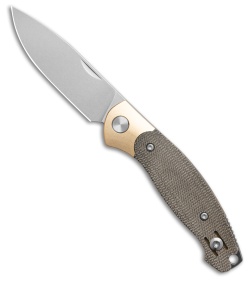
The GiantMouse Ace Farley V2 Slip Joint is everything you’d expect in a finely made pocketknife and more. I tested the colorful green canvas Micarta version with a brass bolster, which added a little color to my carry. This version is 6.375 inches fully opened and closes to 3.625 inches—very much in the standard pocketknife realm. The main body of the dark green Micarta is topped by an elliptical-base, flat-finished guard and a simple, reversible pocket clip resides at the base. The 2.75-inch Elmax stainless steel blade is a fully ground drop point with a common curved nail nick. The total weight of the knife is a svelte 2.6 ounces. MSRP is on the knife is $156.
This is a less expensive version of the Ace Farley V2 I tested in an earlier issue of BLADE, but I like the brass and green Micarta combination versus the somewhat staid titanium/carbon-fiber version. And this one is less expensive. This folder is similar in length to the previous RoseCraft, but the handle has much more girth, which offers a plusher grip and a wider blade. I tested this version on a much thicker, quarter-inch synthetic cord and it cut through nicely. It’s amazing the difference a fuller, more comfortable handle makes when slicing through tough material.
Ace Farley V2 Green Micarta Specs Design: EDC Pocketknife Overall Length: 6.375” Blade Style: Drop Point Blade Steel: Elmax Blade Length: 2.75” Handle Material: Green Micarta, Brass bolster Handle Length: 3.625” Special Features: Slip joint action w/half stops Weight: 2.6 oz. Country of Manufacture: China Retail Price: $156
Giantmouse ACE Farley V2 Pocket Knife Drop Point ELMAX Stonewashed Blad
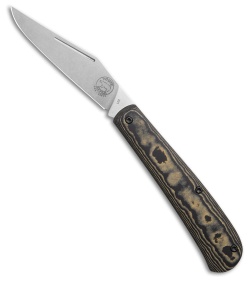
White River Knife & Tool entered the market in 2011 and has been a popular choice among fixed-blade users ever since. Finally, the company released its first folding knife—the Trailhead Trapper—and it was worth the wait. My first impression of the knife was that its ample 3.1-inch S35VN stainless steel blade is all business. The knife, designed for White River by Smith & Sons Knife Company, looks like it wants to cut! The brown 4.2-inch natural burlap Micarta handle features an excellent grip, with the burlap variety offering a slightly more substantial grip than the standard smooth Micarta. The weight is 2.5 ounces, and the $258 price tag is worth every penny.
An extra inch or more of handle and blade make huge difference on a folder. There’s more blade to cut with and more handle to grip and manipulate the knife. The White River Trailhead Trapper allowed me to extend the knife’s grip much better, and the longer blade was able to separate and remove whatever I cut more easily—in this case, sausage. With more room added to the equation, every task you tackle with a longer knife is easier.
Trailhead Trapper Specs Design: Classic Trapper Overall Length: 7.5” Blade Style: Clip Point Blade Length: 3.1” Blade Steel: S35VN Handle Material: Natural Burlap Micarta Handle Length: 4.2” Special Features: Half Stop Weight: 2.5 oz. Country of Manufacture: U.S.A. Retail Price: $259
White River Knives Trailhead Trapper Pocket Knife Clip Point CPM S35VN Blade Ri
We don’t get a lot of folding knives designed primarily for self-defense, so it’s good to see one enter the fray. The Böker Coffin Ultem is as purposeful as it is good-looking. The Coffin’s handle is a manageable 4.15 inches long, and you can clip it to the pocket or carry it loose in a pants pocket. The blade is 3.15 inches of premium MagnaCut stainless steel, so between that and the Ultem handle, there is no scrimping on Böker’s part. The Coffin opens the old-fashioned way, via a nail nick and a nice diagonal square texture. The length of the handle enhances the grip. This is a simple, well-made slip joint, especially for its MSRP of $285.
The designers at Böker wisely opted for a long, straight clip point blade for the Coffin to give the user more versatility outside of a pure defensive role. This adds to its usefulness in utility when cord or rope needs cutting and other roles such as meal prep in the field or on the go.
Coffin Ultem Specs Design: Self Defense Overall Length: 7.3” Blade Style: Spear Point Blade Length: 3.15” Blade Steel: MagnaCut Handle Material: Ultem Thermoplastic Handle Length: 4.15” Special Features: See-through Ultem Handle w/ Pocketclip Weight: 1.94 oz. Country of Manufacture: Solingen, Germany Retail Price: $230
Still Alive And Slippin’
Judging from our crop of slip joints, these simpler folders seem to be doing quite well in today’s cutlery market. Just the sheer variety of types and styles is impressive. Want traditional and hard-nosed? The White River Knife & Tool Trailhead Trapper and RoseCraft Blades Savage Creek Gunstock should whet your whistle. For outside the box and downright fancy, the Böker Coffin Ultem and GiantMouse V2 Green Micarta will whet it some more.
These are fat times for slip joint aficionados in the aftermarket as well. If your folder doesn’t come equipped with a pocket clip, there are plenty to be found in all sizes and types from aftermarket suppliers. Similarly, you can find leather and nylon belt sheaths for carrying your folder at the ready outside the pocket as well.
If for no other reason than simpler is better, with less to break and gum up your plans, I’ll leave you with this. A noted old-time knifemaker once left me with a piece of advice as to why he chooses to use a slip joint over any of the multitude of locks available for folding knives today. He simply said, “I know which side of the blade cuts.”
While Not As Plentiful As They Once Were, Quality Folding Hunters Can Still Be Had. These 4 Knives Meld The Robustness Of A Hunter With The Ease Of An EDC.
Folding knives have been used for hunting and skinning since they were first made. Today, the American knife industry has moved quite far in the direction of fixed blades for use in the field.
However, folding knives are seen in the pocket of just about every self-respecting individual these days and are still the top choice for daily use. Time and fashion being what they are, many pocket folders have become somewhat fragile and unsuitable for anything other than opening mail or packages. In short, they have lost their value as serious tools that can be used in the field as well as daily life. Nonetheless, luckily there are a number of very suitable hunting knives that fold and ride in the pocket.
The largest downside to folding hunters is they can be very difficult to clean and have the propensity to break under hard use. Folding knives promoted for hunting are, at least to me, a bit of an exaggeration in that they function but are much harder to get along with on big game. As a result, I try to limit my folders to small game where the weight of the animal has little bearing on blade stress.
Cleaning and maintaining a folding knife exposed to blood and other fluids is a challenge. The mechanical function of such knives can in many cases be impeded with fat, and likewise made dangerous if, for instance, a linerlock gets clogged up.
Washing a folding hunter is easy in some respects, but the best method remains soaking it in hot water with dish soap to dissolve fats and blood. Rust and corrosion can easily occur internally, so you’ll need to oil the knife after soaking it to prevent corrosion.
Lastly, ergonomics and blade length create the most limits for the big game hunter. Because most folders are designed to lay flat against the body in the pocket, they tend to be thin in profile, which can fatigue the hand if you have a great deal of work to do.
Since the blade fits in the handle, you’ll never really get as long a blade as you need for animals like deer without getting a handle that is proportionately as long. This makes for a degree of awkwardness in that you can only get more blade if you get more handle, and at that point a fixed blade is better.
Emerson Knives Market Skinner
I have developed a great fondness for Emerson knives. In fact, as much as I love carrying fixed-blade Winklers, I have ended up going about much of my daily life with an Emerson in my pocket. Much of the utility for me comes down to how well it fits my hand. The Market Skinner is a well-balanced and very functional cutting/slashing knife that has a mixture of hunting and tactical features.
The grip has a fine yet aggressive texture, and is easy to hold onto even when working with fatty meat. The blade has Emerson’s Wave Feature, thus allowing for instant opening coming out of the pocket.
I got to work in the kitchen on some small game and meat. The Market Skinner is designed to emulate the type of blade profiles used in old-world butcher shops to break down large cuts. Having spent the better part of my college years working for a high-end butcher shop, I had a good feel for what this type of knife could do.
For general use, the Emerson, above the others here, was probably the most functional for light-to-medium use. It was also by far the easiest to clean internally. Its open-handle design allows you to wash it easily.
The added upward curve at the Wave on the spine allowed me to put a great amount of pressure on the blade to cut deeply. When covered in fat it was functional. However, the very fine handle material was hard to clean and pulled fiber from my rags. Not a huge deal, just something to be aware of.
While it is profiled as a hunting blade, the tactical features are there and the knife is easy to use thanks to how quick it opens. The clip is righthanded and very stiff. If you intend to carry it lefthanded, Emerson offers a service to drill and tap the other side for you.
MSRP: $267.95
Boker Hunter’s Knife Duo
Styled in the manner most favored by German and European sportsmen, the Boker Hunter’s Knife Duo is not just a functional piece of art but also a very rugged tool. It is so nice looking that you’ll want to make sure to keep it that way—meaning don’t toss it in your gear drawer after a hunt.
Unlike the other test models, the Boker features two edged tools—one, a knife blade, the other a saw. In testing on a lamb rack, the saw performed extremely well and allowed me to make nice, even chops. The teeth are exceptionally aggressive, which is a positive for cutting bone, but they clog easily with fat and sinew.
The Hunter’s Knife Duo is made in Germany and the quality of each part is amazing. A notable feature is the real stag grip panels, a rarity on many production knives today. Care must be taken to not introduce this natural material to stress or harsh cleaning chemicals. Soap and water for cleanup is best, followed by a light coat of oil. In terms of mechanical function, this is a classic gentleman’s knife, slow to deploy and not designed with a day’s labor in mind.
Equal parts showpiece and tool, the Boker is best on small-to-medium game. Since it has no pocket clip, it will likely ride in a belt pouch or simply in a pocket.
The only real problem is the shape and contour of the handle. If your hands have blood or fat on them, the grip tends to be slippery. This is a very slick knife and every metal part is as smooth as glass. Under such conditions sawing also can be slightly hazardous, as can cutting should your hands slip up onto the blade. That being said since a true gentleman is never in a hurry, the Boker is the perfect find for rabbits, pheasant, and turkey, preferably with a fine double gun in hand.
MSRP: $409
Case Kickstart Mid-Folding Hunter
The smallest of the test knives, the Case Kickstart Mid-Folding Hunter performed very well considering its size and blade length. This is in no way a knife you would want to have if you were trying to take down a deer; however, for small game, medium cuts like lamb or chicken, or out harvesting spices in the garden, the Case is perfectly capable.
Like the Boker, it is a very, very slick knife—both visually and in terms of the limited amount of texture it has on the blade and grip. While it can be easy to work with, the knife is prone to slip or rotate in the hand.
In terms of cutting ability, it did just fine. The downward-swept blade lends itself to fine cuts, but very little else. The knife can be used and held like a pen. A full grip of the handle isn’t very safe.
The lock mechanism is easy to use—a bit too easy. The blade can be unlocked and closed with almost no effort, which can present a dangerous situation if you aren’t careful. Of note is that the blade is assisted, and it opens incredibly fast. It also has a pocket clip for easy carry.
MSRP: $127.99
A.G. Russell Folding Gent’s Hunter II
In the vein of classic sport folders from the 1960s and ’70s, the A.G. Russell Folding Gent’s Hunter II is designed along clean lines and minimalist features. It came out of the box with a very sharp edge and a functional, ergonomic grip. Despite being a full-size knife, it is the lightest of the review folders, lighter even than the smaller Case.
Using and cleaning the A.G. Russell was about the same as the others. However, the wood panels required a coat of oil after I used soap on them to remove fat. The blade sliced meat very easily, and it was also rigid enough to approach some larger projects and game. While I’d probably take the Market Skinner if I knew I was working on an adult deer, the A.G. Russell would come in a close second, its only downside being that it got slippery when wet.
This knife is right on the money for a walking hunter going after rabbit or fowl. It’s very light and sharp and still maintains classic lines. Because it is so light, it seems to disappear in the pocket and, if carried daily, won’t draw any unwanted attention. It has “classy” written all over it.


![Spartan Blades Poros Review [Tested]](https://blademag.com/wp-content/uploads/Poros-2-768x511.jpg "Spartan Blades Poros Review [Tested]")