Buyer's Guides

You’re looking for a new knife in a certain style – we’ve got recommendations on the best blades for every price point.

Top Knife Sharpeners: Five Options To Keep Your Edge

Keep your knife cutting ready with today’s top sharpeners.

It’s not much of a knife if it’s dull. Getting a blade sharp and keeping it that way is what the top sharpeners are all about. Pull throughs, V sharpeners, adjustable angle models and more, contemporary sharpeners not only will keep your knives keen, some are multi-tools with Torx tools and bits, screwdrivers, fire starters and window breakers. From those for use in the kitchen, camp or workshop to portable use and more, make way for today’s sharp makers.

Lansky Master’s Edge Sharpener
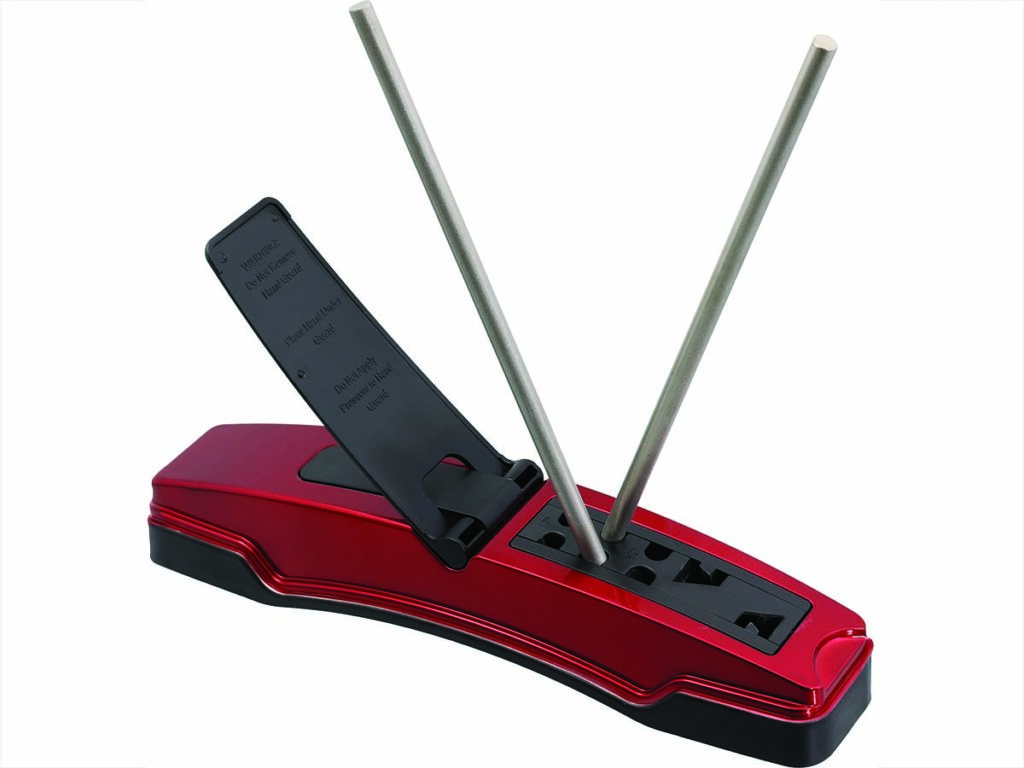
The Lansky Master’s Edge All Diamond Sharpener has a rubberized non-slip base with integrated hand guard for safe use.

Master’s Edge All Diamond Sharpener
Model type: V sharpener
Type of abrasive: Diamond coated
Grit: 400 & 600 grit round rods; triangular rod for serrations
Types of knives sharpened: Fillet/slicing, butcher, paring, skinning/kitchen/hunting, camping, utility and chef’s
Types of edges sharpened: Plain and serrated
Weight: 1.4 lbs.
Country of origin: China
MSRP: $139.95

Inspired by the design of Lansky’s top-selling Master’s Edge Sharpener, the Master’s Edge All Diamond Sharpener and its diamond-coated abrasives put a factory edge on hunting, utility, kitchen and other knives with just a few strokes. The unit includes a pair of medium (400 grit) and fine (600 grit) diamond-coated-abrasive rods for sharpening and polishing at your choice of preset angles: 17, 20 and 25 degrees. The 17-degree setting is for fillet and fine slicing knives, while the 20-degree angle is for slicing, butcher, paring and skinning knives. The 25-degree setting sharpens hunting, camping, utility and chef’s knives. A diamond-coated triangular rod sharpens serrated blades and also awls and fishhooks. A rubberized non-slip base with integrated hand guard ensures safe use and features easy snap-in storage in its underside. The unit can be kept on a counter or stores easily in a drawer.

Work Sharp Folding Field Sharpener
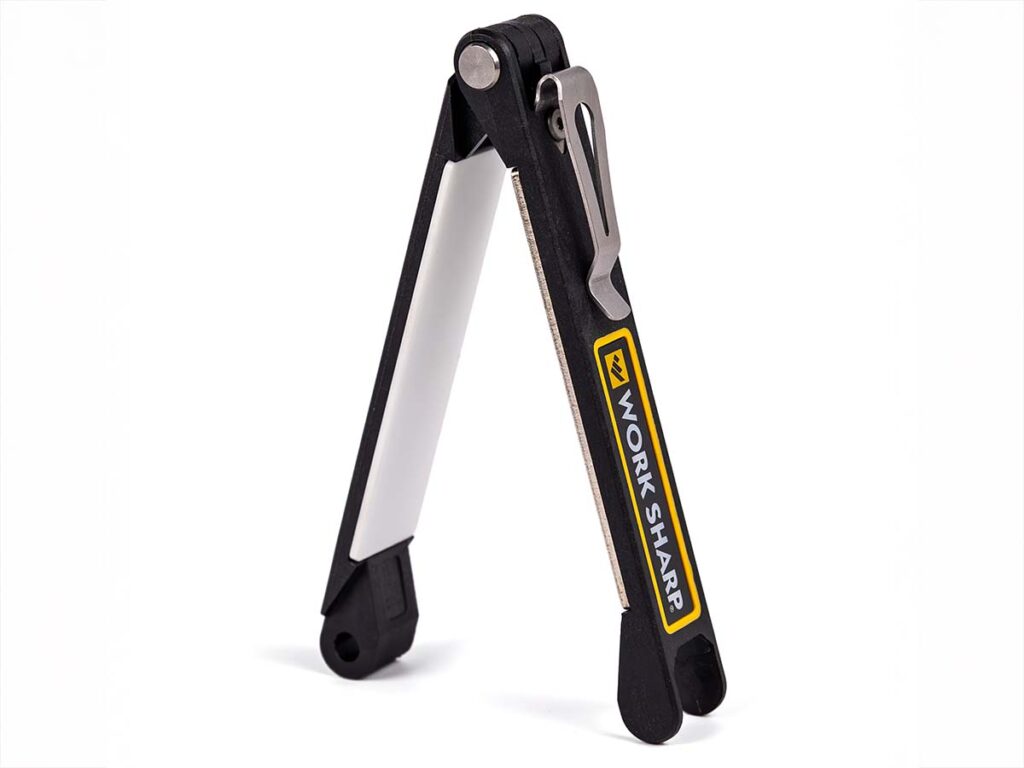
Especially effective on EDC knives, the new Work Sharp Folding Field Sharpener is one whiz-bang of a portable unit.

Folding Field Sharpener
Model type: Compact field sharpener
Type of abrasive: Diamond grit plate and fine grit ceramic plate
Grit: Coarse 400-grit for each plate
Unit dimensions:  4.75 x .75 x .5”
Unit materials: Sharpening plates, plastic, aluminum
Types of knives sharpened: Pocketknives, hunting knives, EDC
Types of edges sharpened: Plain 
Special features: Folding design; edge angle guides (20 & 25 degrees) help maintain a consistent angle when sharpening and honing; pocket clip
Weight: 4.6 ozs.
Country of origin: Designed, calibrated and quality checked in Ashland, Oregon, using foreign components
MSRP: $29.95

The Work Sharp Folding Field Sharpener is a compact, lightweight model designed for on-the-go sharpening. It features a 400-grit diamond plate with 20-degree sharpening guides and a fine-grit ceramic plate with 25-degree honing guides, ensuring consistent, reliable edges wherever you are. The folding design and integrated pocket clip make it easy to carry almost everywhere. A big package in a small platform, it’s designed to bring back an edge after a hard day’s use or simply for touchups. Especially effective on EDC knives, it is one whiz bang of a portable-type sharpener.

CRKT Knife Maintenance Tool
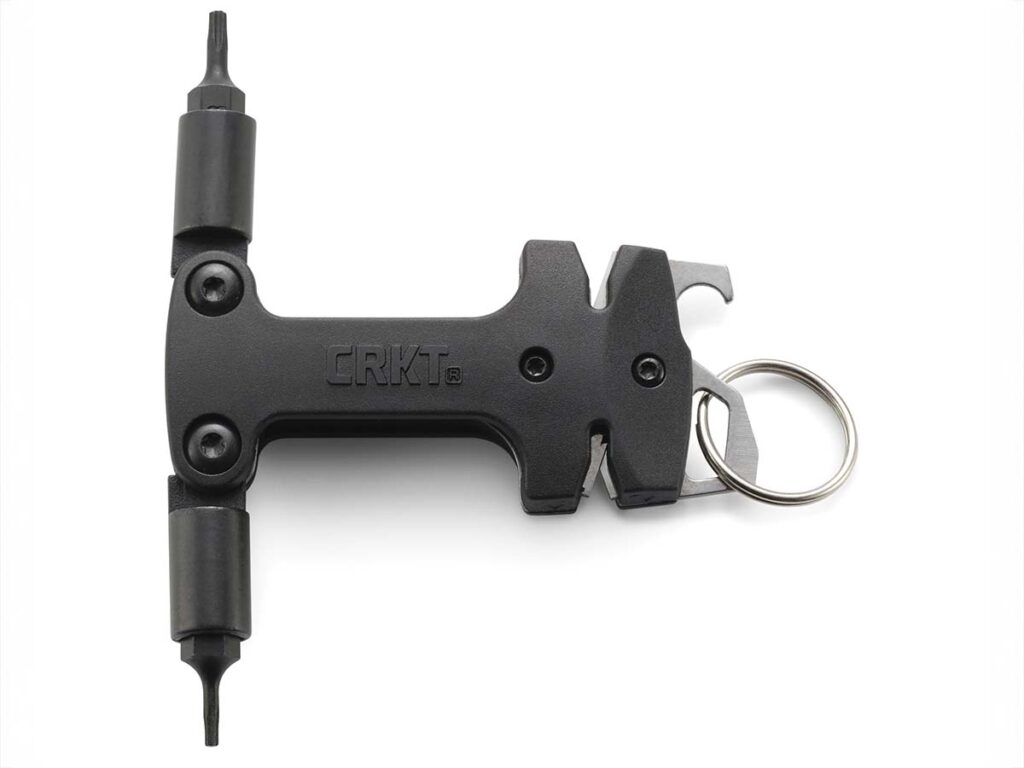
Designed by Tom Stokes, the CRKT Knife Maintenance Tool is two sharpeners and a multi-tool all rolled into one.

Knife Maintenance Tool
Model type: Keychain/pocket field sharpener and multi-tool
Type of abrasive: Tungsten carbide sharpener with ceramic honing edge
Unit dimensions: 2.7 x 1.18 x .47”
Handle: Glass-reinforced nylon
Types of knives sharpened: Pocketknives, EDC
Types of edges sharpened: Plain
Special features: T6 and T8 Torx tools/bits, flathead screwdriver, bottle opener, keychain compatible
Weight: 2.2 ozs.
Country of origin: China
MSRP: $30

Designed by mechanical engineer Tom Stokes, the CRKT Knife Maintenance Tool is a multi-tool sharpener that reflects Tom’s more than 25 years of experience in the aerospace industry, including his work with CAD software and rapid prototyping technology. He designed the Knife Maintenance Tool to prepare you for life’s various exigencies, everything from emergency repairs, popping a top on your favorite beverage—and, yes, sharpening your knives.

The Tool includes two pull-through sharpeners—one a tungsten carbide abrasive to establish a sharp edge, the other a ceramic abrasive to fine tune it—and two sizes of Torx tools/bits: T6 and T8. The sharpeners are on either side of the front of the handle, which is topped off with a bottle opener and flat-head screwdriver/lanyard hole for a keychain loop. The Torx tools are also on either side of the handle and fold out independently of one another for torquing screws pistol-grip style.

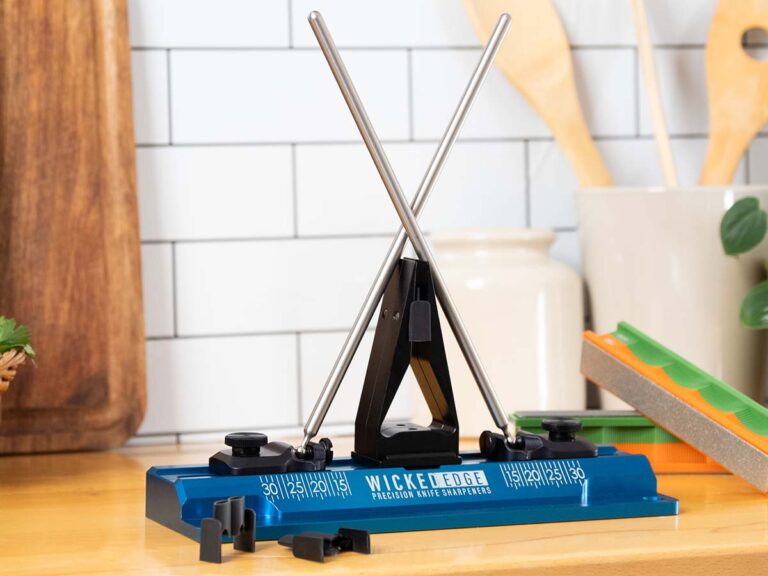
Wicked Edge GO-WE60 Precision Knife Sharpener
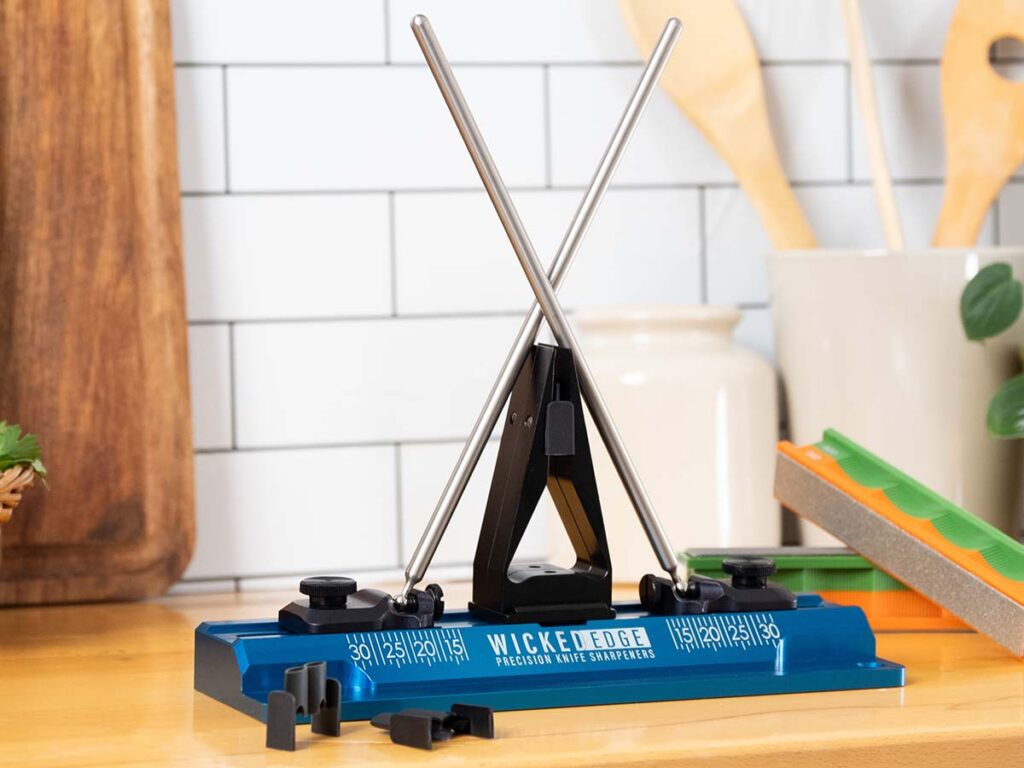
Premium abrasives on the Wicked Edge GO-WE60 are 200/600 grit monocrystalline diamond-coated stones.

GO-WE60 Precision Knife Sharpener
Blade Length Capacity: Up to 15”
Blade Thickness Capacity: Up to .25” (longer screws available for thicker blades)
Angle Markings: Calibrated for the blade’s edge to sit at 5/8” above the top of the vise
Guide Rod Length: 8.75”
Unit Weight: 3.6 lbs.
Country of origin: USA
MSRP: $299

The Wicked Edge GO-WE60 Precision Knife Sharpener is designed for novices and seasoned old pros alike, whether at home, in the field or on the road. A redesigned standard vise clamps fully flat-ground and distally tapered blades such as on pocketknives and household cutlery. Sharpening angles are adjustable from 13 to 31 degrees per side (26-62 degrees inclusive) in 1-degree increments for precise edge maintenance. Premium abrasives are 200/600 grit monocrystalline diamond-coated stones. Mounting options include securing to any flat surface with the included C-clamp or attaching directly using predrilled holes.

Bear & Son GATCO Scepter 2.0 Diamond
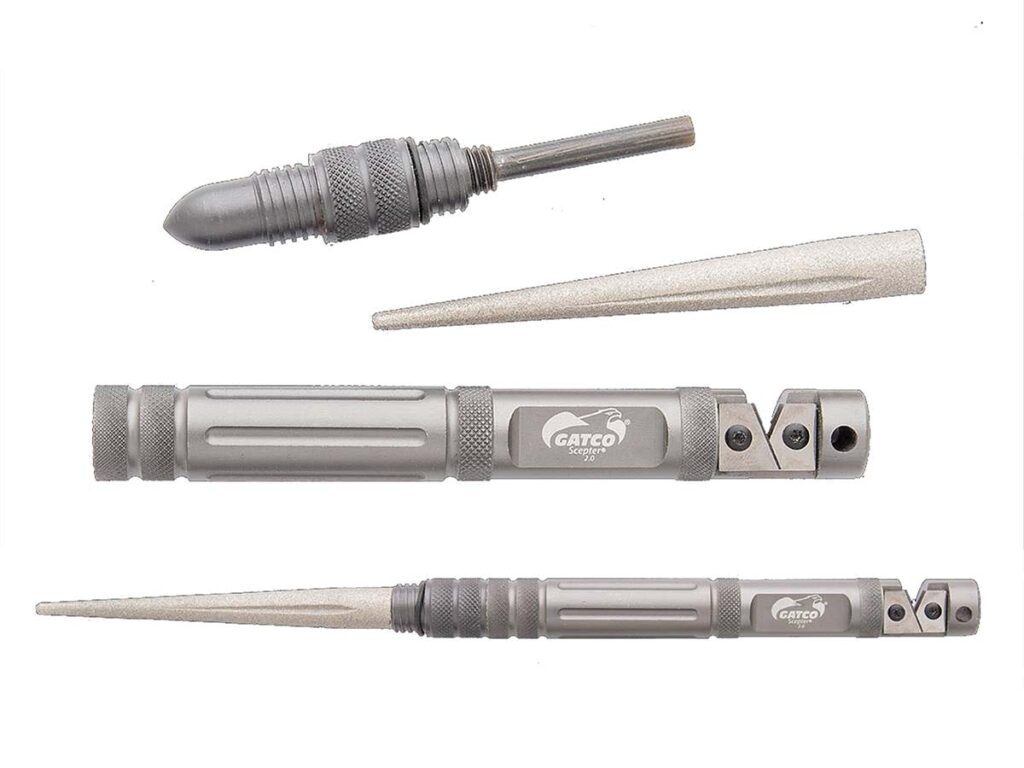
The multi-purpose GATCO Scepter 2.0 sharpens plain and serrated edges and has a magnesium rod for starting fires.

GATCO Scepter 2.0
Model type: Pull through and tapered diamond rod
Type of abrasive: Diamond coated and tungsten carbide
Unit dimensions: 6.125″
Unit material: 6061-T6 aluminum housing
Types of knives sharpened: Hunting, EDC, kitchen
Types of edges sharpened: Plain and serrated
Special features: Tapered diamond rod, magnesium fire starter rod, window breaker
Weight: 3.2 ozs.
Country of origin: China
MSRP: $49.99

The compact GATCO Scepter 2.0 Diamond Take Down Sharpener & Fire Survival Tool from Bear & Son is a multi-purpose implement for everyday pocket carry, the toolbox, to take camping and/or makes an ideal necessity for your bug-out bag. A magnesium rod for fire starting stows inside the tapered diamond sharpener, the latter which includes a groove for sharpening fishhooks. The rod and tapered sharpener are contained inside the CNC-machined, 6061-T6 aluminum carbide body, which has a pull-through tungsten carbide sharpener on the end. Each component features precision-machined threads and an outer “O” ring.

More Sharpening Articles:
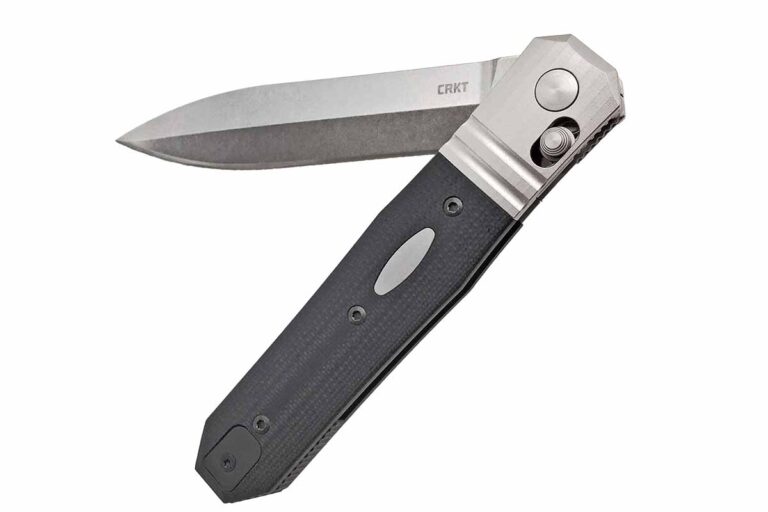
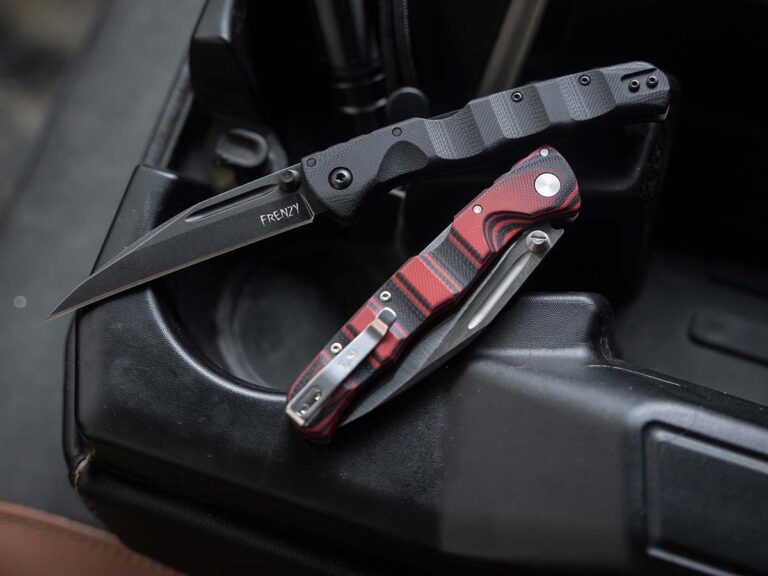
Cold Steel’s Frenzy II: Folding Knife With Samurai Swagger

Discover the new Cold Steel Frenzy II folding knife, designed by Andrew Demko and inspired by the Japanese Kabutowari.

Cold Steel has never been shy about bold designs, and the new Frenzy II folding knife is no exception. Designed by custom knifemaker Andrew Demko, the Frenzy II takes its cues from the ancient Japanese Kabutowari and morphs those warrior-worthy aesthetics into a mega-folder ready for today’s EDC crowd.

Let’s start with the blade. At 5.5 inches, it’s not subtle—but it is refined. Forged from premium S35VN powdered steel, the long, flat edge and needle-sharp point make it as functional as it is fearsome. You get top-tier edge retention, durability and slicing performance, all dressed up with a satin line-grain polish and a deep fuller that plays with light like a katana in the sun.

But Cold Steel didn’t stop there. The Frenzy II is all about balance—of power and precision, size and slimness. Despite its impressive blade length, the handle is slim, flat and built for pocket comfort. Crafted from dual-tone, 3D CNC-machined G-10 scales, it’s grippy, eye-catching, and disappears under a shirt tail. This knife may look large, but it carries light and lean.

And yes, the Frenzy II comes equipped with Cold Steel’s bombproof Tri-Ad lock, so when that blade is deployed, it’s staying put. That kind of confidence is why Cold Steel has earned the trust of law enforcement, military and serious knife users for decades.

So, who’s the Frenzy II for? Anyone who appreciates a fusion of heritage-inspired design and modern performance. Whether you’re a collector, a gear geek, or someone who just wants a folding knife that can go toe-to-toe with fixed blades, this one’s worth a serious look.

Frenzi II Specs
Weight: 5.7oz
Blade Thickness: .14″
Blade Length: 5-1/2″
Blade Steel: American S35VN
Handle Length/Material: 6 3/4″ Long Duo Tone G10
Overall Length: 12-14″
Additional Features: Pocket / Belt Clip
Knife Type: Folder
Blade Length Range: 5+ in
Steel Family: CPM
Blade Shape: Sheepsfoot
Locking Mechanism: Tri-Ad Lock

More Knife Reviews:

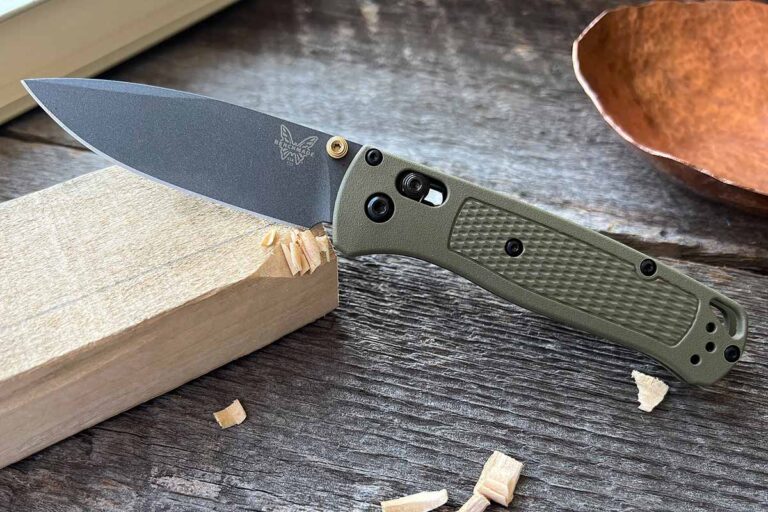
Benchmade Bugout Review: Getting A Handle On The EDC Icon

Is there a perfect EDC knife? If not, the Benchmade Bugout will do until perfect shows up.

When it comes to EDC folders, without a doubt the Benchmade Bugout is the king of the hill.

Its compact profile and just-right length make this model a popular hit with knife guys. It is all made in the USA with excellent fit, finish, and—perhaps key to EDC—Benchmade has cut its weight to the bone. Furthermore, the blade steel is premium level. In short, the Bugout is geared to go the distance.

So, if you haven’t yet checked out this icon, it’s high time you did. Because, if you take your everyday carry seriously, you owe it to yourself. We’ll lay a foundation for the knife in this article.

Bugout Blade

The Bugout is offered in two sizes—the Model 535, the company’s standard-sized version boasting a 3.2-inch blade, and 533 Mini, which pars the blade down to a very manageable 2.8 inches.

Benchmade Bugout Open
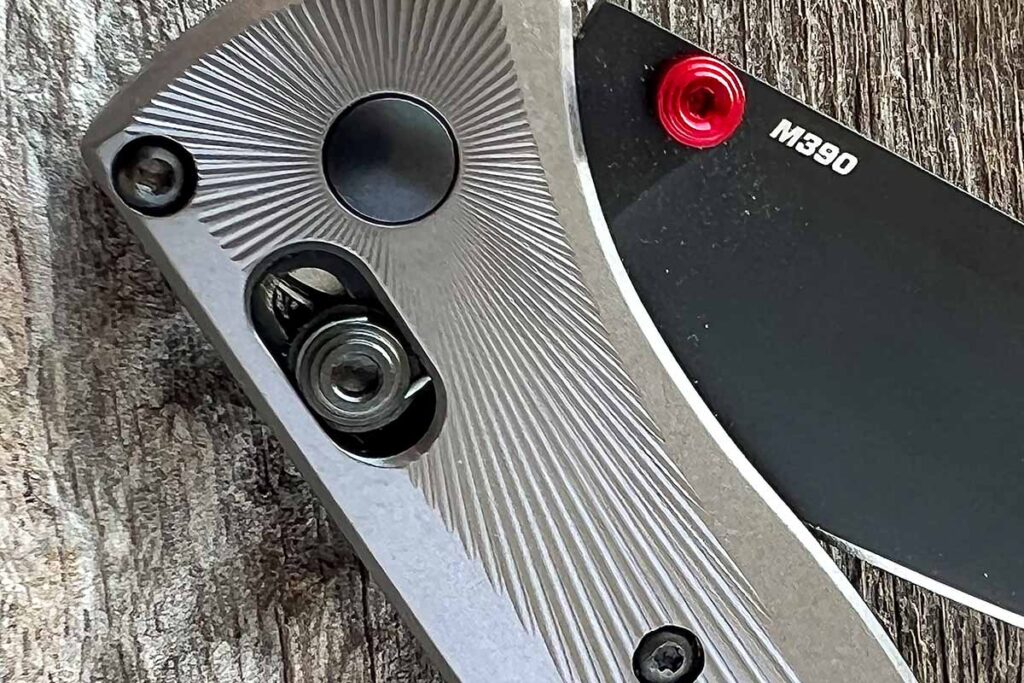
Standard-model Bugouts sport CPM S30V steel blades, however, S90V and M390 are available on higher-grade models. Photo: Marty Stanfield

The base models Bugouts use premium CPM S30V steel, a steel that is used widely for high-end factory knives. This is mainly due to its ability to hold an edge for an extended period, longer than most blade steels. Additionally, it is highly resistant to stains and corrosion.

As for the blade profile, the Bugout is a modified drop point and is highly adaptable to many tasks. Nicely, Benchmade outfits the knives with thumbstuds on either side of the blade, permitting ease of opening with either hand.  
Getting A Handle On The Bugout

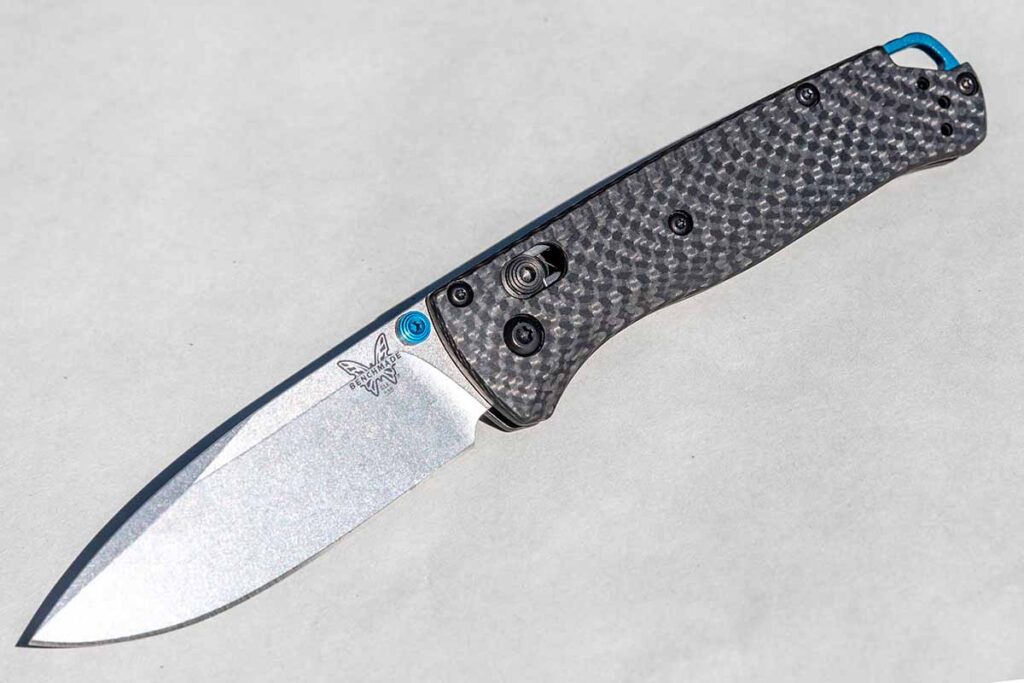
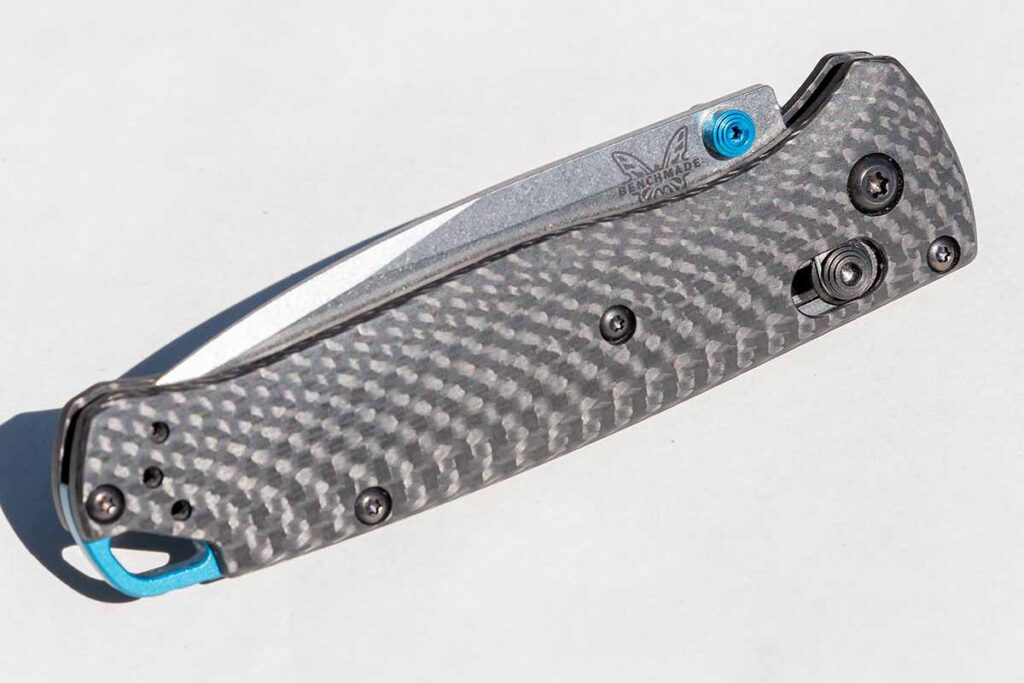
The handle of the base Bugout is made from molded Grivory, making the Bugout a very lightweight folder. The standard size tips the scales at 1.85 ounces and the Mini at 1.5 ounces. Benchmade offers other handle material options, including anodized aluminum, carbon fiber, and CF Elite (a glass-reinforced nylon synthetic material that is lightweight and stiff).

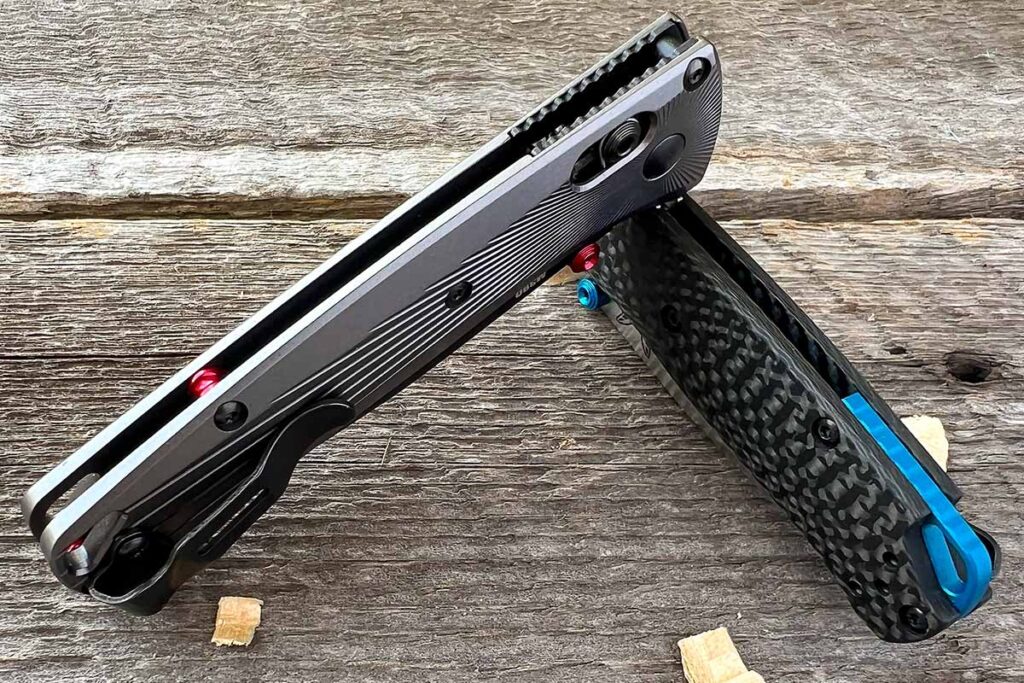
Benchmade Bugout Spines
Given there is a thriving aftermarket for Bugout scales, the sky is the limit on the knife’s handle. Photo: Marty Stanfield

And if you have to have custom, there are aftermarket scales for the knife in a host of materials—titanium, copper, brass, bronze, G-10, and Micarta. In turn, you can truly have a one-of-a-kind feel and look to your Bugout.

Bugout Action

The Bugout uses Benchmade’s critically acclaimed Axis Lock crossbar lock, hailed by many as ultra-strong yet extremely safe because you don’t put any fingers in the path of blade travel. Add on to this, it’s easy to unlock with either hand, and you have a naturally ambidextrous across the board. The lock is simple, just pull back on one of the exposed lock bar ends at the back of the handle and then rotate your blade closed. Internally, two Omega-shaped springs provide constant tension for the lock bar on the blade tang to ensure positive lock engagement.

Benchmade Bugout Axis Lock
The Bugout is outfitted with Benchmade’s rock-solid Axis Lock crossbar lock, which has the added benefit of being ambidextrous. Photo: Marty Stanfield

As for other odds and ends, the handle’s checkering does a great job of preventing your hand from slipping. A deep carry, fold-over pocket clip carries the Bugout deep in your pocket and can also be switched to provide easy carry for left-handers. Integrated lanyard hole permits the use of Paracord for a lanyard if you are into that sort of thing.  

Using The Bugout

In use, the Bugout hits hard in spite of its ultra-lightweight stature. The flat ground blade bites in and is very effective. Opening mail, opening packages, peeling an apple, cutting up hose, cutting cardboard, or stripping wire—the Bugout won’t break a sweat. Perhaps the best way of thinking about the knife is as a minimalist working folder.
The higher grades of the Bugout have carbon fiber handles and milled aluminum handles, paired with S90V and M390 blades respectively. These upgraded blade steels offer high-performance cutting with excellent edge holding. The higher-grade handle materials give a bit more heft to the Bugout as well as an enhanced, high-tech appearance. It only makes sense to have upgraded blade steel with upgraded handle material. 

Benchmade Bugout Closed
Overall, the knife is lightweight, rugged and more than capable of tackling most task. In short, it’s dang near the perfect EDC option. Photo: Marty Stanfield

Even with the base model’s S30V, you still pack plenty of muscle for those long-cutting jobs. I like how thin the Bugout’s blade stock is combined with the flat ground blade bevel giving it plenty of bite to it. 

Some knife folks favor not a high performance without the bulk. I get it, it all makes for a comfortable everyday carry folder. For those of you who favor these kinds of knives, the Benchmade Bugout is for you. You have a high-end blade steel with a proven and popular blade lock, with a no-frills handle design. 

MSRP for the full-size Bugout starts at $180 and varies up from there depending on handle material and blade steel. There is also a Mini Bugout which scales the size down some to an even more pocket-friendly size.

Go here for more information on the Benchmade Bugout.

Bugout Model 535 Specs
Blade length: 3.2″
Blade thickness: 0.090″
Overall length: 7.4″
Weight: 1.85oz
Blade material: S30V
Handle material: Grivory

Mini Bugout Model 533 Specs
Blade length: 2.8″
Blade thickness: 0.090″
Overall length: 6.5″
Weight: 1.5oz
Blade material: S30V
Handle material: Grivory

More Knife Reviews:

Best Karambits: Top Ferocious Southeast Asian Fighters (2023)

The Karambit Is A Historic Utility and Combat Knife From Asia That Has Grown In Popularity Around The World In Recent Decades.

The karambit looks unlike any other knife. The short, swooping curve of the blade dates back nearly a millennium in Indonesia and throughout Southeast Asia. First used mainly as a tool for farming and planting rice, the karambit evolved over time into a combat knife. The curve became more pronounced and became a main weapon in pencak silat, an indigenous Indonesian martial art, and Filipino martial arts.

Legend goes that as the knife became more combat-oriented, its shape was inspired by a tiger’s claw. The knife’s tight curve and finger ring allow it to stay securely in the hand in close-quarters combat.

Why Should I Use A Karambit?

The karambit today is very much a self-defense tool. Yes, it can still be used for outdoor tasks, but there are more practical blades available for such purposes. The karambit is a strong, durable combat knife used by law enforcement and militaries around the world. 

If you’re looking for a high-quality knife to keep on your person as protection, you can’t get much better than the karambit. The finger ring provides a natural, secure traditional grip or reverse grip to generate more power with each swing. 

The folks at Emerson Knives, Inc., have made a great video showing how to use a karambit.

Do I Need A Karambit?

Simply put: no. A karambit is a refined self-defense tool. If you live a life where life-and-death close-quarters combat is an extremely minute possibility then you can probably pass on a karambit.

Additionally, the sharp curve of the blade means it can be difficult to handle without experience or training, even with the finger ring. If it’s uncomfortable to use then don’t use it.

Best Karambits

Emerson Combat Karambit

Karambit Emerson

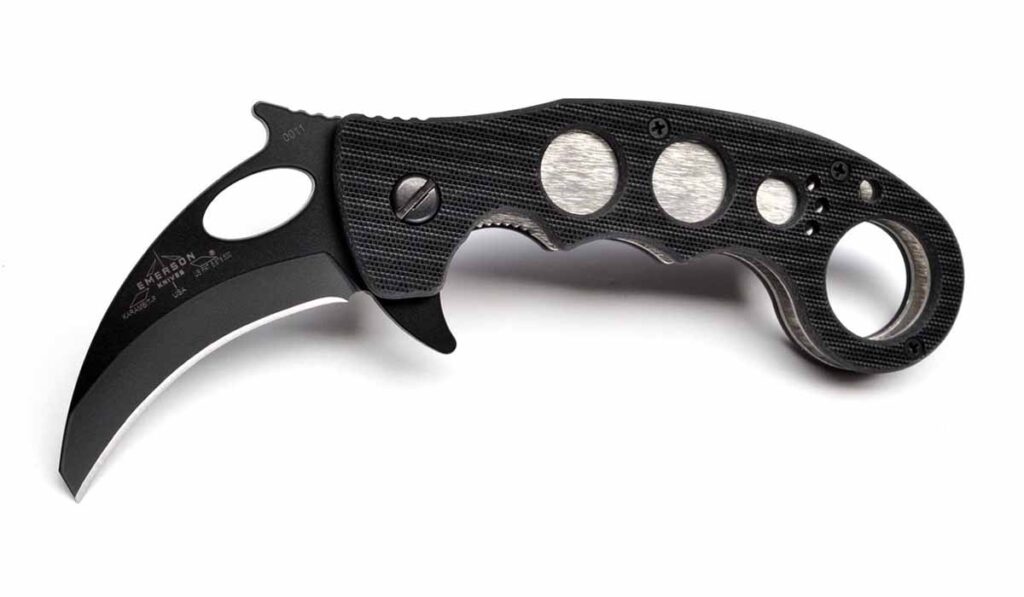
The Combat Karambit folder by Emerson Knives, Inc., was very well received when introduced years ago. It subsequently spawned a larger version called the Super Karambit. It shares the same award-winning features of its forerunner but in a larger, more impressive format. The 3-inch blade is 154CM stainless steel and opens by either the patented Emerson Wave or an oval blade hole. Handle material is G-10 reinforced by dual titanium liners for rigidity. The handle flows seamlessly into the finger ring in the butt. There are a lot of graceful curves on this knife. It’s a feast to behold. 

The handle fits my hand extremely well, instilling a high sense of security and user confidence. The Super Karambit carries nicely in a pocket though its presence is a constant reminder of just how big it is. A reverse grip feels exactly as secure as a forward one. Your hand isn’t moving once it’s wrapped around this handle!

To deploy the blade using the Wave remote pocket opener, hook your finger through the finger ring, pull the handle from your pocket and let the Wave hook engage the seam of your pants pocket. Keep pulling and as the handle comes free from the pocket, the hook grabs the seam and deploys the blade open and locked. To my knowledge, this results in faster blade deployment than any other karambit.

One thing I don’t care for is the overly aggressive texturing of the G-10. I like grippy texture but this one is downright abrasive on pants fabric. It might be a good idea to take a small piece of cardboard and rub it over the handle texture to smooth it out somewhat. The knife is offered exclusively in a stonewashed blade finish and a black G-10 handle. Country of origin: USA. Closed length: 5 inches.

MSRP: $325  

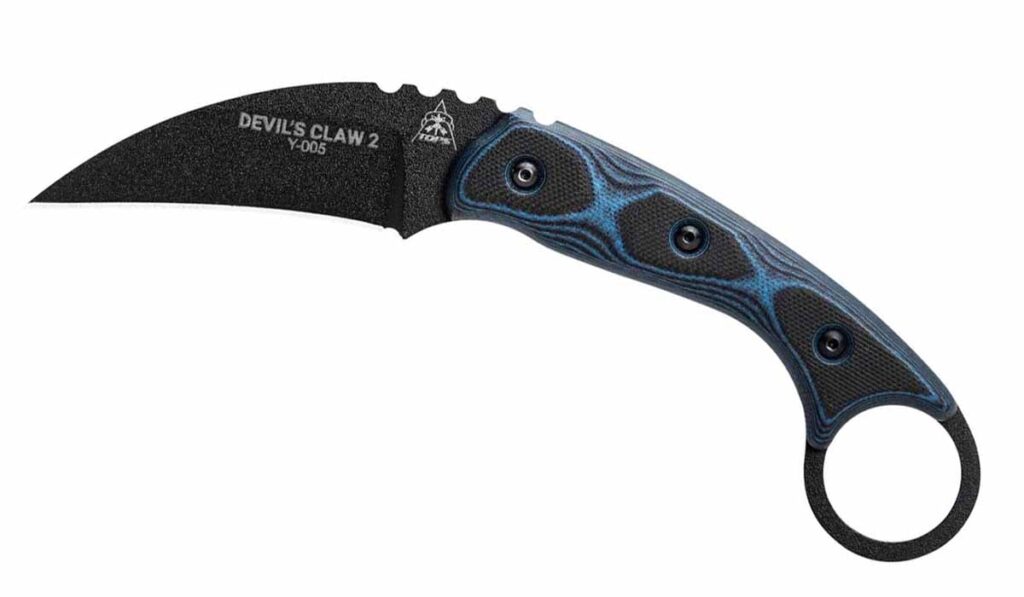
TOPS Devil’s Claw 2

TOPS Devil’s Claw 2

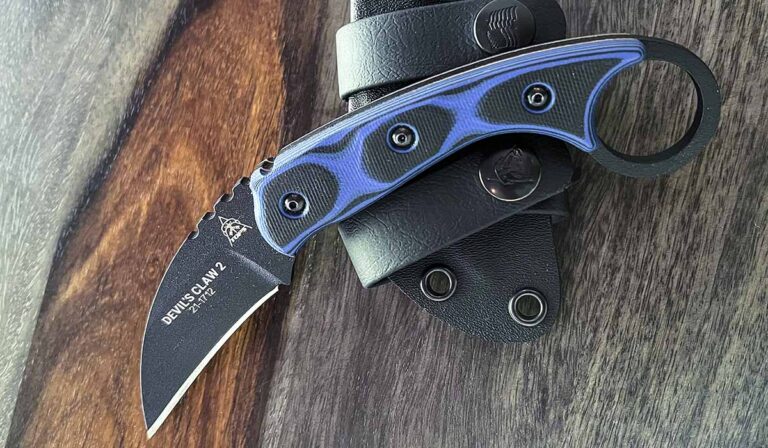
The Devil’s Claw 2 by TOPS Knives is a mid-sized fixed blade designed for personal protection. It’s built on the same platform as the company’s original Devil’s Claw but with an extended handle to accommodate a full grip as well as the traditional ring at the end. The 3-inch hawkbill blade is 1095 carbon steel in the company’s Black Traction Coating to help protect against corrosion, as well as provide a low profile. Overall length: 5.75 inches. Five large traction notches machined into the rest portion of the blade spine provide a non-slip grip for the thumb. The handle is blue and black G-10 with red fiber spacers at the tang—very eye catching! The sheath is molded Kydex with loops to carry horizontally on a belt. 

The DC2 is also a well-disguised utility knife. It feels agile and capable in hand. If you have jobs that require long, straight cuts, the DC2 is the answer. The angle of the blade makes it easy to use the tip to cut and score, while hiding the knife in a forward grip. The finger ring helps seat your hand during such tasks. The traction notches on the thumb rest aid with precise tasks such as wire stripping, whittling or any task that requires downward pressure on the blade. 

MSRP: $165

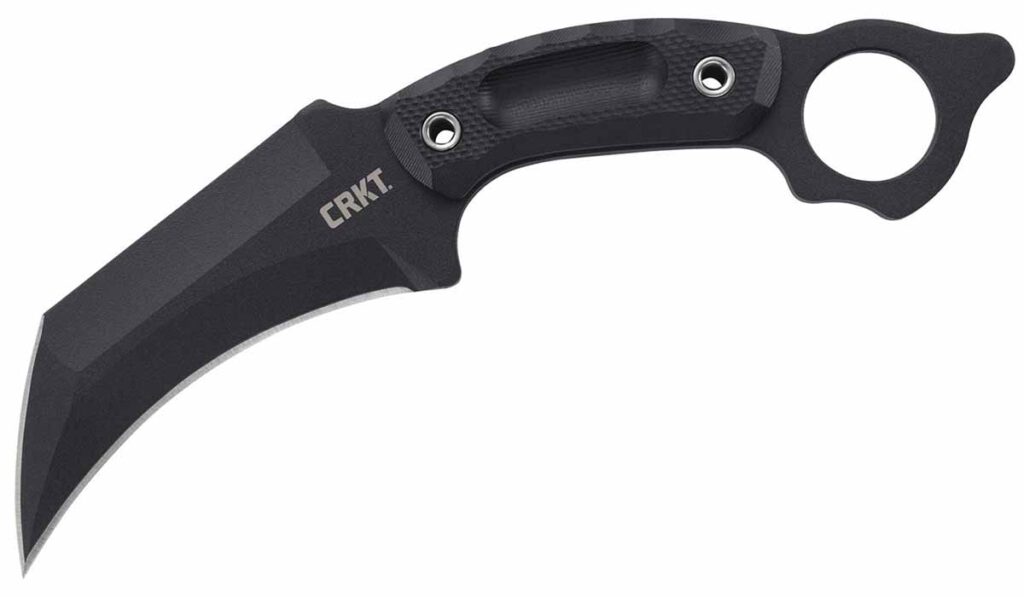
CRKT Du Hoc

CRKT Du Hoc

Sometimes bigger really is better, and that might be the case with the CRKT Du Hoc. This fixed blade designed by Austin McGlaun is a whopping 9.63 inches in length and 9.3 ounces in weight. McGlaun designed the knife to honor his late uncle who earned a Silver Star at Point Du Hoc.

The 5.1-inch blade is made from powder-coated SK-5 carbon steel. The G-10 handle provides an excellent grip, and the included thermoplastic sheath comes with mounting options and makes for easy transport. 

MSRP: $113

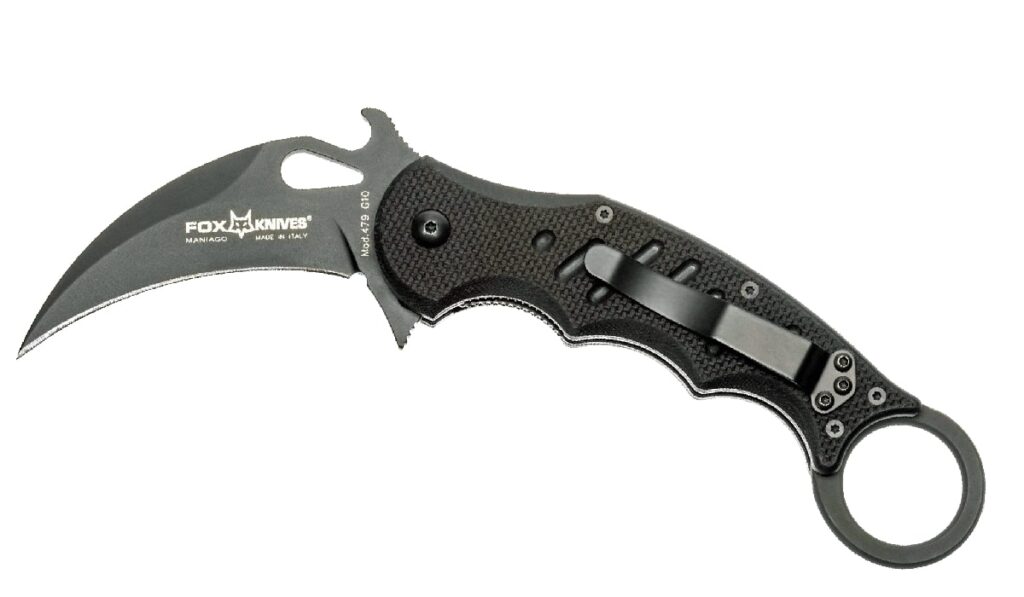
Fox Knives 479 

Fox Knives 479 

We return to folders with this piece from Fox Knives. The 479 is a large flipper that can handle whatever you throw at it. The 2.95-inch blade is made from N690Co stainless with a black Idroglider coating and a G-10 handle. The blade has been treated to 58-60 HRC, making it the hardest blade on our list. 

When opened, the knife is 7.48 inches long, and it weighs 4.58 ounces. The finger ring is made from aircraft aluminum to keep weight down without sacrificing toughness. The reversible pocket clip makes for easy carry no matter where you go.

MSRP: $156

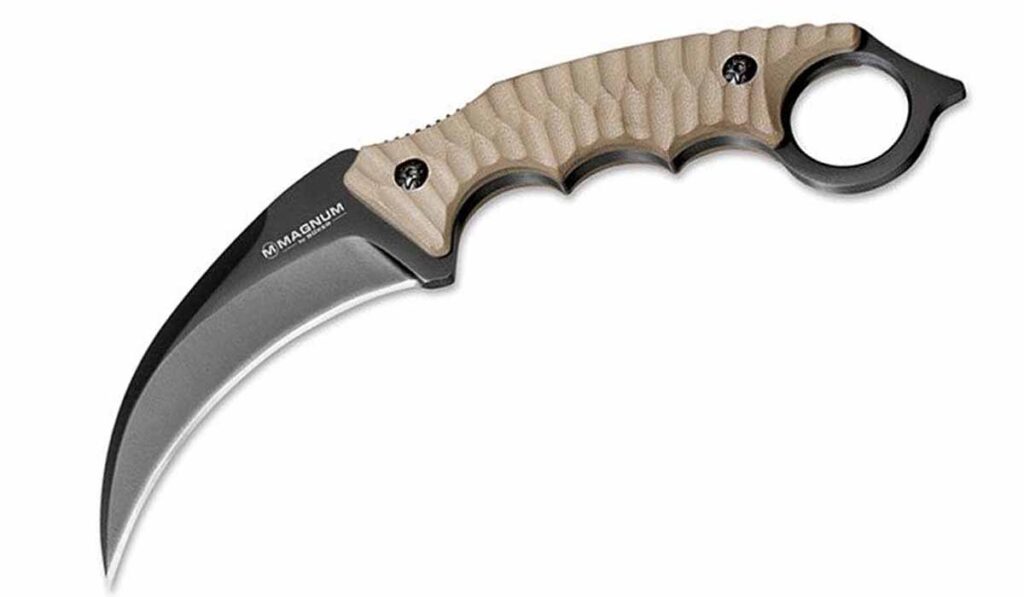
Boker Magnum Spike

Boker Magnum Spike

At 8.25 inches overall, the Boker Magnum Spike Karambit is a full-size fixed blade. Visually, this one is quite striking! The 4-inch talon-shaped blade is 440A stainless steel coated black for corrosion protection and a low profile. A full-length swedge adds attitude.

The handle is very well executed. Multiple finger grooves aid in seating your hand comfortably. There’s a groove on the handle spine with traction notches to securely seat your thumb and help index your grip. The tan G-10 handle features a 3D texturing pattern for an excellent non-slip grip. The edges of the G-10 are chamfered properly, further enhancing grip comfort. The finger ring has an integral spike at the end for a blunt strike option if needed. When held in the reverse grip, the spike helps form a comfortable thumb rest. A molded Kydex sheath with belt adapter promotes easy carry
.  
Due to its large size, the Spike isn’t as agile in-hand as the smaller test karambits. If you tend to manipulate a karambit, this one isn’t for you. Due to the swedge, the blade is somewhat thin and while sharp and able to penetrate like crazy, it might be prone to bending or breaking if used for rough cutting. A smaller version with a 3-inch blade that is more hawkbill than talon, flat ground and without the spike on the ring could be more agile and more EDC friendly. Still, at an

MSRP: $73

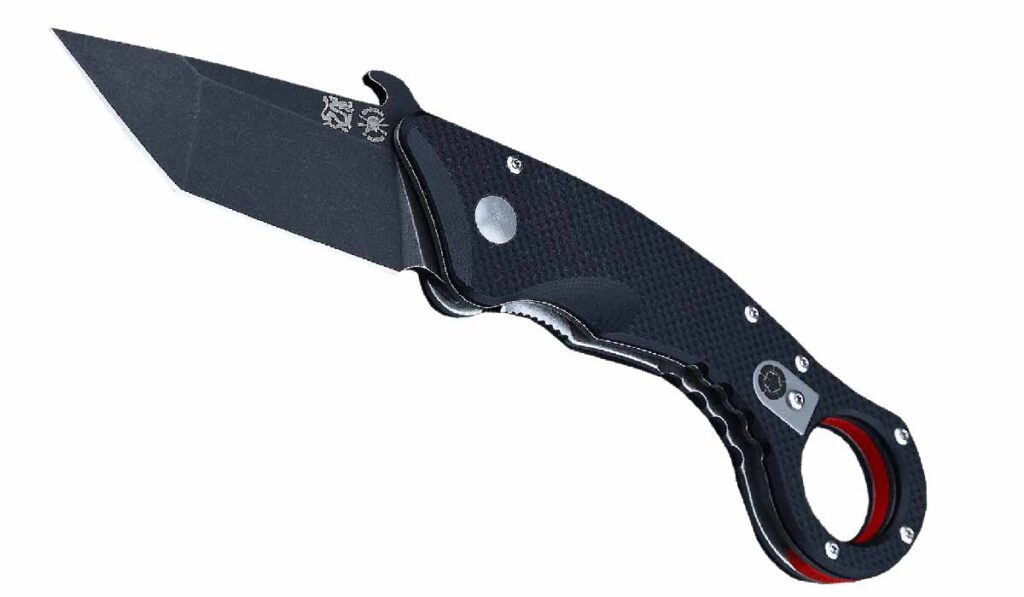
Spartan Blades Ronin Shoto

Spartan Blades Ronin Shoto

Spartan Blades teamed up with Tu Lam of Ronin Tactics to design the Ronin Shoto, a folding karambit that is part of the company’s Field Grade line of tactical knives. The Ronin Shoto design leverages the knowledge of Lam along with Spartan Blades co-owners Curtis Iovito and Mark Carey—all three saw action together in the Special Forces—and their experiences serving the USA overseas in Asia. The trio developed a fascination with the karambit during that time and it wasn’t until years later that their fascination manifested itself with the Ronin Shoto. 

The knife adopts 2.5 inches of a tanto blade, rarely seen in karambits. For blade steel, CTS XHP premium stainless provides edge longevity and durability. There’s also the Emerson Wave, the only opening method the Ronin Shoto has. The blade rides on Spartan’s OIBBS (oil-infused bronze bushing system). The bronze washers are permanently impregnated with lubricant to ensure glassy smooth blade operation at all times. Textured G-10 slabs conceal dual stainless liners. A linerlock secures the blade in the open position. A deep carry pocket clip carries the knife comfortably. A contrasting red G-10 handle spacer adds a tasteful pop of color. 
 
The Ronin Shoto sports a very impressive, heavy-duty build. Like the Emerson Super Karambit, the pocket presence is something you will notice, though it’s not uncomfortable. Opening the blade is very similar to the Super Karambit—index finger through the finger hole, pull and the blade opens as the knife exits the pocket, all in one continuous motion. If you prefer the reverse grip, re-orient the clip to the left side of the handle and you can still make use of the Wave.

Whereas the curved blades of standard karambits are limited in use, the short tanto of the Ronin Shoto is more utility friendly. It tackles general cutting tasks and the CTS XHP stainless steel ensures edge quality will go the distance. I wish the folder had an alternate way of deploying the blade other than just the Wave, though it is possible to place your thumb on the Wave and push on it to open the blade as you would any one-hand knife. Closed length: 5.2 inches.

MSRP: $155

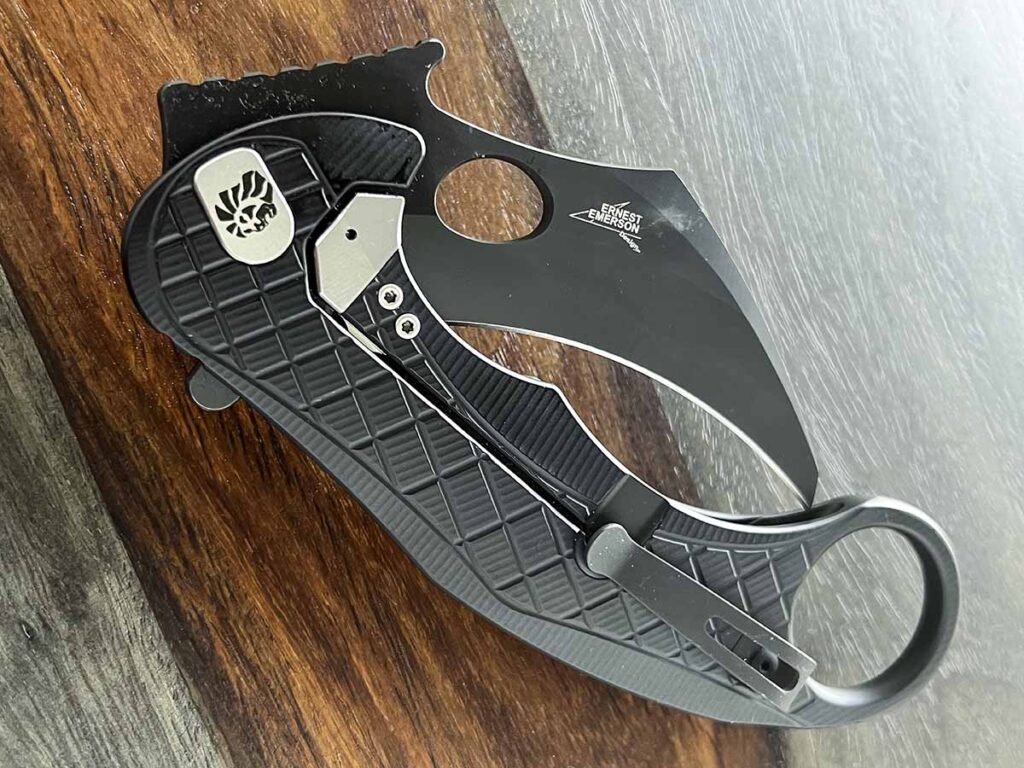
Lionsteel/Emerson LE One

Lionsteel/Emerson LE One

The Lionsteel/Emerson LE One is a collaboration between Ernest Emerson and Lionsteel. It quite possibly is the most advanced folding karambit on today’s market due to several notable features. The 3.23-inch blade is CPM MagnaCut stainless, the latest in high-performance “super steel.” It’s the most advanced steel in terms of edge holding, stain resistance and toughness. The blade opens via one of three methods—blade hole, Emerson Wave and a flipper. If you want to remove the flipper, you can do so using a T6 Torx® wrench. The removable flipper is the REF (removable flipper) system, exclusive to Lionsteel.

The framelock handle showcases another feature seldom seen on factory knives: no assembly screws because it’s machined from one billet of aluminum. The lockbar, semi-open backspacer and finger ring are all one piece of aluminum. The handle boasts a machined crosshatch pattern with milled striations. A stainless steel wear pad screwed to the end of the lockbar results in steel-on-steel lock integrity. A deep-carry pocket clip is reversible for ambidextrous use. Handle color options are black, green, red and brown. Blade finish options are stonewashed and black coated.  

A fraction over 5 inches closed, the LE One is one of the larger folding karambits. However, it’s so lightweight and carries so well that its sheer size doesn’t even factor in. I like how your hand is seated comfortably when in the forward grip—it definitely feels secure. All edges and corners are rounded and chamfered properly, making the handle melt in your hand. Even the finger ring is rounded both inside and out. The thumb ramp and blade spine are crowned—I totally dig this. These areas have a rounded appearance, not flat like most other blade spines. Crowning demonstrates that a company is willing to go the extra mile to pay attention to such a minor detail. Lionsteel has detail locked down for sure!

Sharp out of the box, the blade cuts very efficiently and the flat grind pull cuts easily. The framelock engages tight, with zero blade movement in any direction. The blade tip looks different from other karambits. It appears to be dull but is not. Emerson’s design eliminates the very pointy tip, which is prone to break during heavy use, by squaring it off slightly. This creates a strong tip. The Emerson Super Karambit has the same feature as well.

MSRP: $268

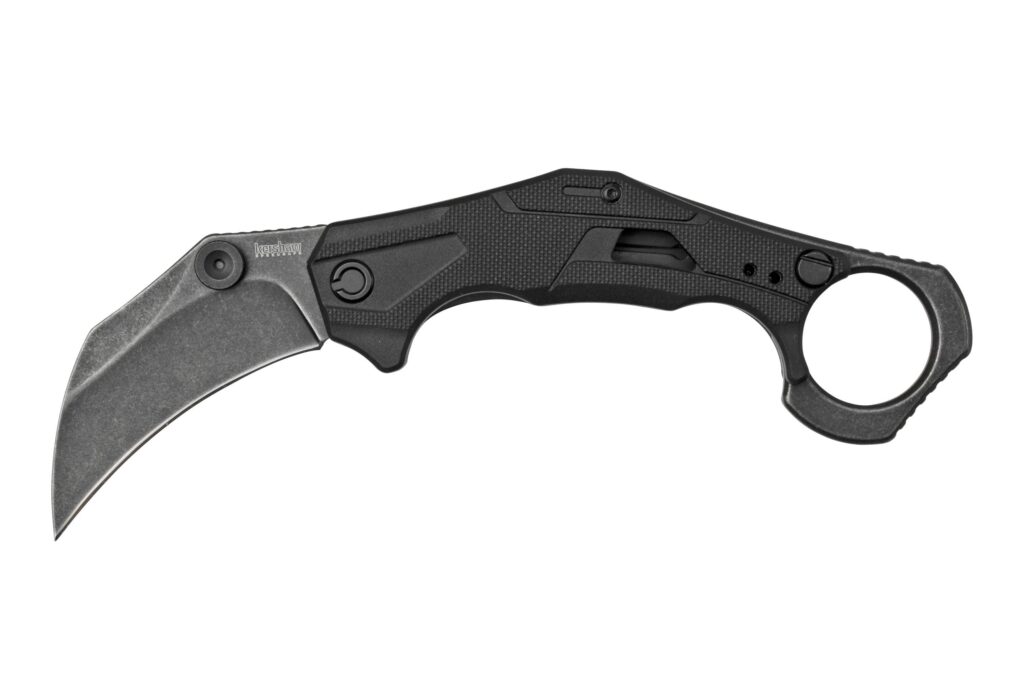
Kershaw Knives Outlier

Kershaw Knives Outlier

Anchoring the value end of the spectrum is the Kershaw Knives Outlier. In a somewhat angular handle design, the Outlier’s finger ring is integral with the handle spacer. The only karambit from Kershaw, it features a 2.6-inch blade of 8Cr13MoV stainless steel. The blade opens via Kershaw’s SpeedSafe assisted-opening mechanism designed by BLADE Magazine Cutlery Hall-Of-Fame® member Ken Onion. The opening starts via a choice of an oversized thumb stud and a flipper. The handle is a glass-filled nylon polymer outfitted with a deep-carry pocket clip and a linerlock.  

The Outlier feels very secure and comfortable in hand. Your grip is locked in via the large forward finger recess and finger recess at the butt just outside the finger ring. Fit and finish is top notch and an all-black tactical finish presents a subdued appearance. The 8Cr13MoV is a good middle-of-the-road steel, very comparable to AUS-8, which is popular in entry-level-to-mid-range knives. The curved blade is easy to sharpen with a rod-type sharpener and holds a decent edge. 

MSRP: $72

Editor’s Note: Dexter Ewing and Mike Ableson contributed to this article.

Read More

Damascus: What Are The Hot Patterns And Steels In 2026

Jesse Harber and Coy Baker forecast the hottest damascus steel for ’26.

There’s something about predicting the future that has intrigued humanity for ages. If you could just somehow know which stocks would turn a profit, which crypto would “go to the moon,” or which numbers were coming in the PowerBall, you like to imagine that you could really take advantage. Thus far the ability to accurately predict the future has been a challenge, which begs the question—what damascus steels and patterns will be hot for 2026?

Jesse Harber of Vegas Forge doesn’t hesitate to jump right in.

“Our Reptilian pattern stayed hot in 2025,” he observes, “and it should continue to do well.” Vegas most often uses a combination of AEB-L, 440C and 302 stainless steels for contrast in its stainless billets. It prefers the combination of O1 tool, 1075 carbon and nickel-alloy steels for its carbon varieties.

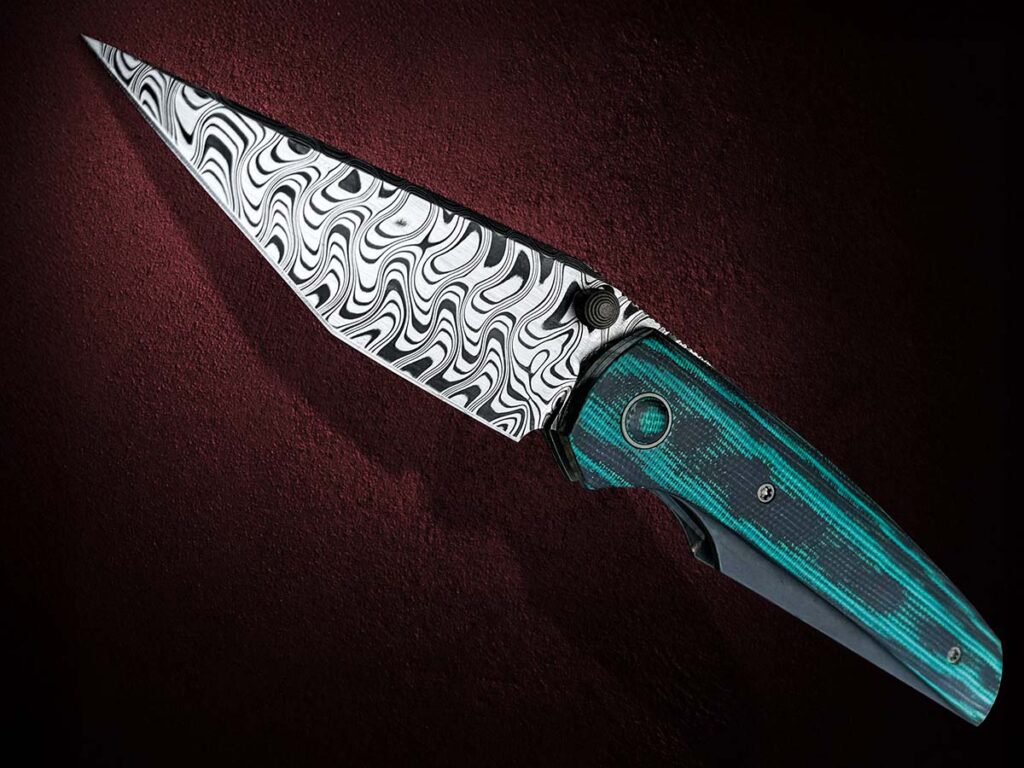
Jake McCoy used Baker’s Zeus stainless damascus for the blade of his folder.

Twenty-twenty-five was a fun year for Vegas Forge. It was able to continue making the steel it loves, the steel most knife enthusiasts all love to use—and it still managed to find time to innovate.

Makers have been using EDM cutouts in canisters to make unique figures and shapes for some time now. Over the past few years, a few have experimented with 3D-printed shapes inside canisters for truly limitless possibilities. Vegas has taken a different approach of using smaller cutouts within canisters that are then layered into “regular” damascus. There are obviously other critical details of the process not mentioned here, but the end result is small shapes or logos within the layers of the steel, not just as a shape like the other canister types you usually see.

Hammering Away At Baker Forge & Tool

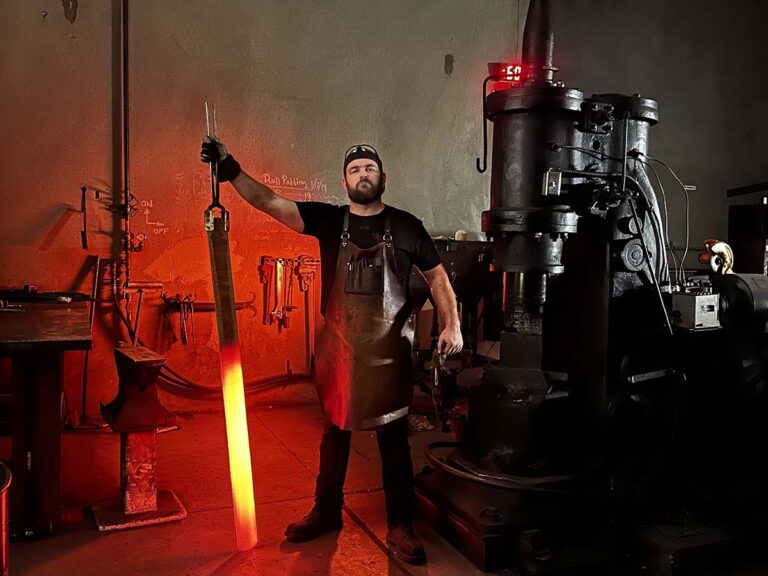
Coy Baker said Baker Forge & Tool is “really moving and shaking” for 2026, partly because of a new Chambersburg steam hammer converted to air. With a die surface of 6-by-14 inches and a 750-pound ram, the whole shop shakes when the hammer pounds on a giant billet. The hammer originally was used to make jib cranes for the Charlotte Railroad and runs on a 50-horsepower compressor with multiple 750-gallon air tanks. Coy stated he hasn’t pushed the hammer to its max, but said he thinks it can handle billets up to 35 pounds.

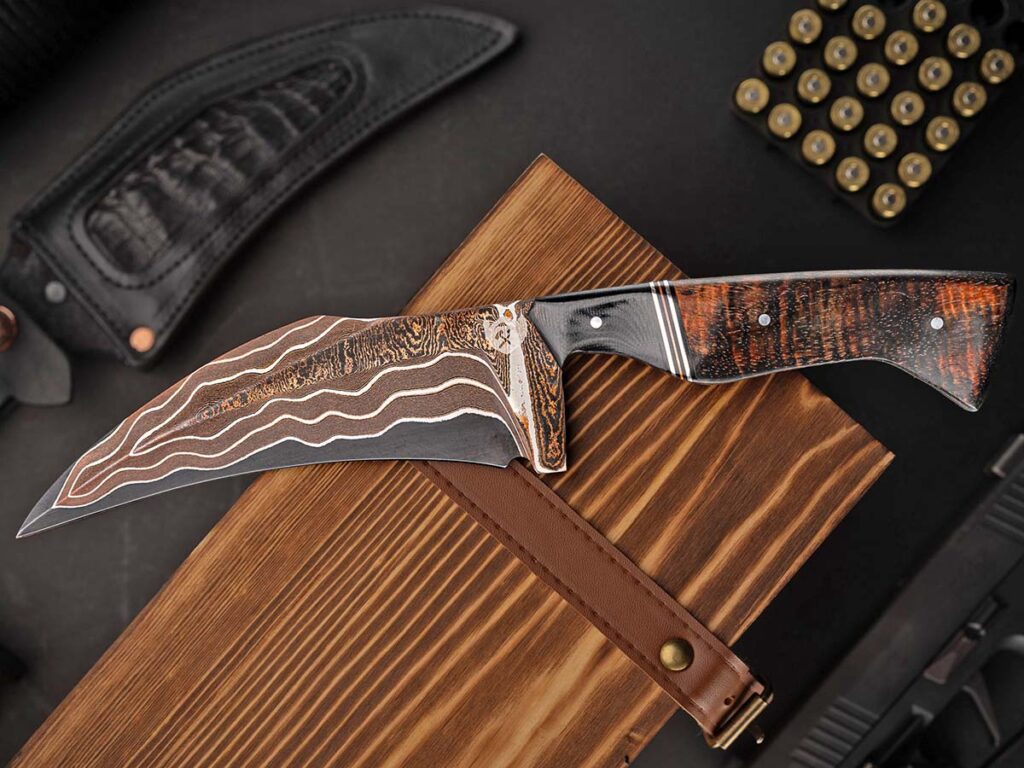
Baker’s Tsunami copper-mai steel is the material for the blade of a piece by Hans Molenkamp of Crimson Knife Co. (crimsonknives.com).

Why in the world would Baker Forge need such a giant hammer? Because the company, too, has been innovating and expanding into the production of stainless damascus. After two years of research and development and fine-tuning Baker’s processes for production, the prodigious pounder is finally up to speed. Baker prefers a combination of AEB-L and 154CM for its stainless damascus.

“The steel is really hard even when it’s hot,” Coy said. “Even with our 350-pound hammer it was like pounding on a rock.” The giant Chambersburg, on the other hand, moves a giant stainless billet with ease.

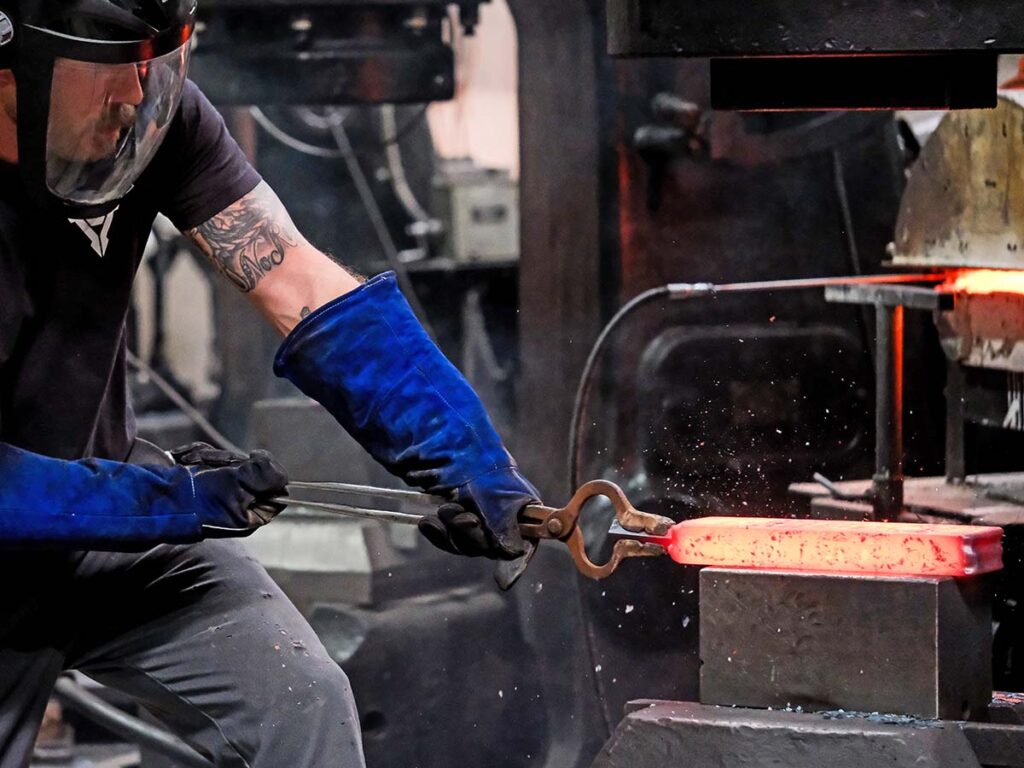
For those of you who don’t know, forging stainless damascus is quite a challenge, beyond the capability of many backyard smiths. Stainless steels contain high chromium, sometimes 12-to-15 percent, and chromium oxide doesn’t forge weld. Any oxygen at all in the forging environment and the welds simply will not stick. There are multiple ways to get around that, including inert gas purges and welding inside canisters. Add that to the fact that the stainless doesn’t like to move under the hammer and has only about a 100-degree-temperature window when you can safely work it, and you get a very difficult process.

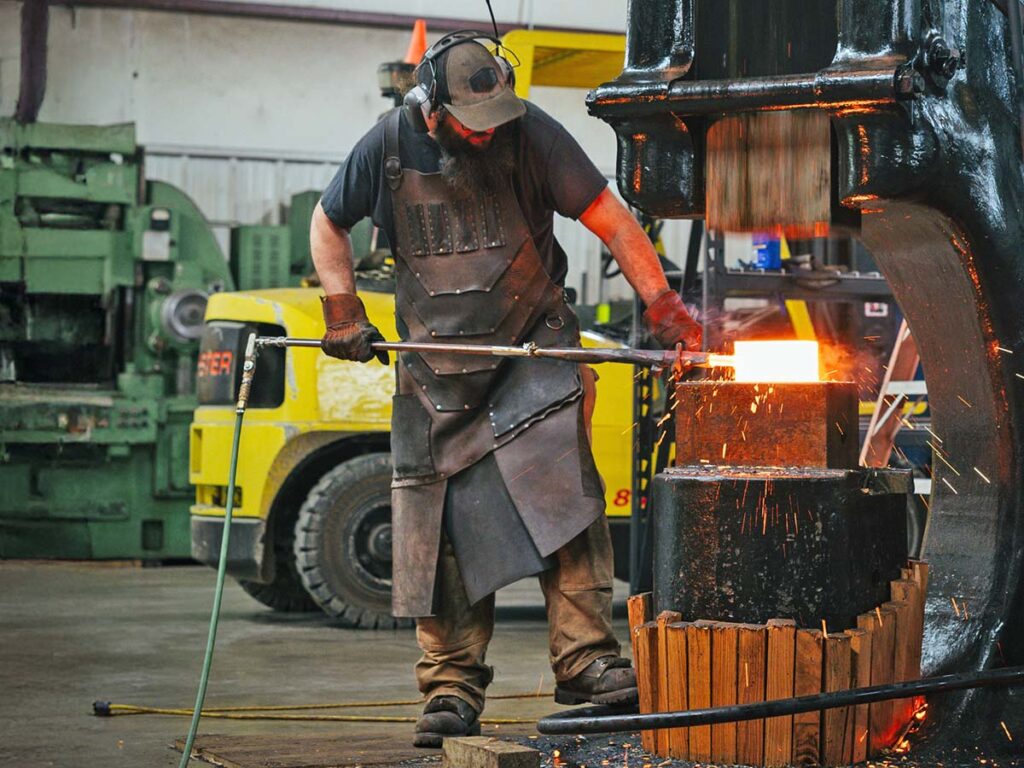
Baker Forge & Tool’s Will Spears forges a billet of stainless damascus on the Chambersburg high-frame power hammer at Baker. Built in 1946, the power hammer has a 750-pound ram and weighs just shy of 11 tons. “It took us 14 months to install,” Coy Baker laughed. “The foundation for it is over 12 feet deep.”

Baker isn’t just producing stainless damascus in run-of-the-mill patterns, it is innovating. It has developed patterns it will use in its stainless steel exclusively, particularly one called Zeus.

Copper damascus has long been Baker’s hottest commodity, and it’s still producing it at high volume and quantity. The company is pushing the limits there as well and has developed a method to weld and manipulate copper on the end grain. While the technique is under wraps, the results will be broadcast far and wide: copper damascus in formerly unobtainable mosaic patterns. When clad over a monosteel or carbon damascus core, the patterns stretch the imagination of what’s possible.

Steel Industry Challenges

Both Baker and Harber mentioned challenges and areas for growth in the steel industry. Baker was the first to put BLADE® on the story about Buderus apparently closing its primary mill for 10xx series steels. Coupled with the recent closing of Crucible on the stainless side (see our article on Crucible Industries closing), both Baker and Harber have been exploring new steel options in case their mainstays become unavailable. Vegas in particular is moving toward more cores of Nitro-V and Elmax and moving away from MagnaCut and XHP.

Vegas Forge team member Franklin draws out a 40-pound canister of stainless Raindrop-pattern damascus on the company’s 5B Nazel hammer.

The hot new kid on the block is ProCut, the brainchild of a partnership between Larrin Thomas and Pop’s Knife Supply. Both Vegas and Baker are looking forward to pushing the limits of ProCut. As a high-alloy steel, when combined with Apex Ultra, the maker achieves high performance out of what looks like “ordinary” 1084/15N20 damascus. If you think of the difference in performance between 1084 and 52100 carbon steels, you’re on the right track. Baker Forge is currently in the lead on the ProCut “arms race” but Vegas Forge has steel in hand and is ready to go.

What fun new things can we expect in the world of damascus in 2026? Vegas Forge is entertaining a few recent orders that sound interesting. There’s a maker in Alaska using Vegas material to make high-end custom ice skates, and another customer using the company’s material to make stainless damascus computer keyboards. Who’d a thunk it? For those who enjoy a good picture show, Vegas has another top-secret project in the works. Think aliens with amazing damascus weapons and tools and you’re on the right track.

Take two leaders in the field like Baker and Vegas, factor in the demand for their top steels and add lots of innovation, and you get the makings of a really great year to come in the world of damascus.

More On Damascus:

Stud Farm: Custom Folders That Get A Thumbs Up

The thumb stud is reliable, time-tested and add dynamic dash to these customer folders.

Aside from the good ol’ nail nick, thumb studs are among the most enduring opening systems for folding knives. Why not? Typically ambidextrous, easy to manipulate and lightning fast, the reliable deployment feature has a lot going for it. Not to mention, on these custom knives, they add equal parts dash and traditional appeal.  


Michael Raymond: Ziura folder

Michael Raymond Ziura folder

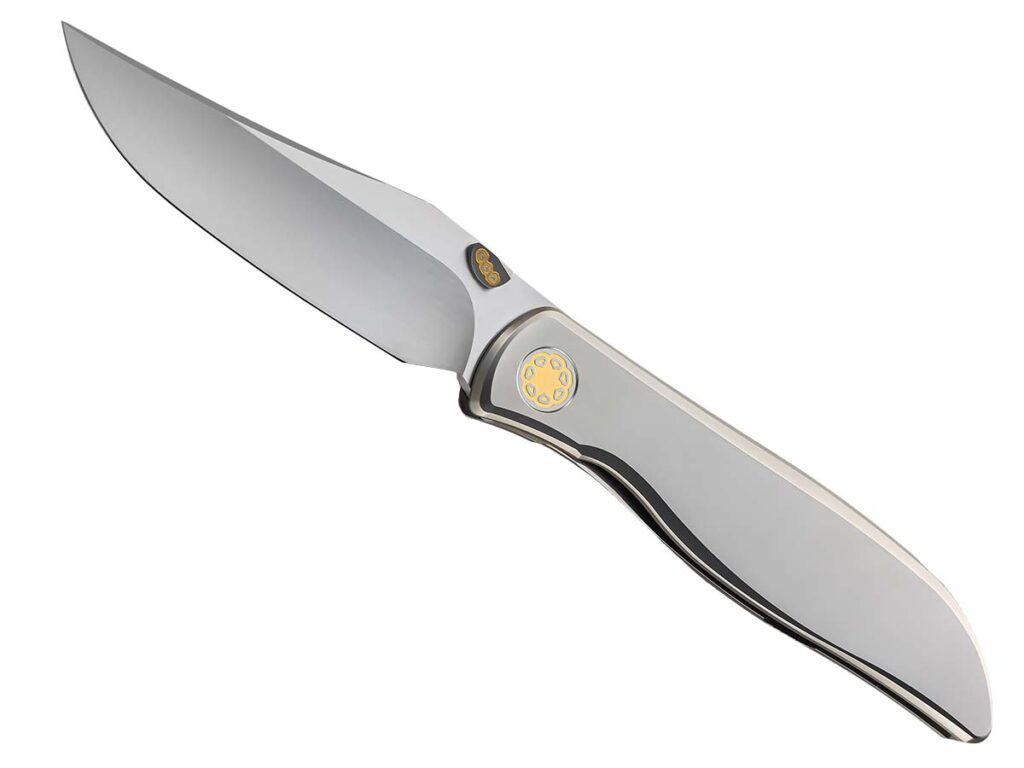
Forty-nine 24k gold inlays set into a 6-4 titanium frame elevate Michael Raymond’s Ziura folder. The swedge-ground Bohler M390 blade measures 3.53 inches with an 8.08-inch overall length. (SharpByCoop image)


David Beaver: Shogun Horizon Folder

David Beaver Shogun Horizon Folder

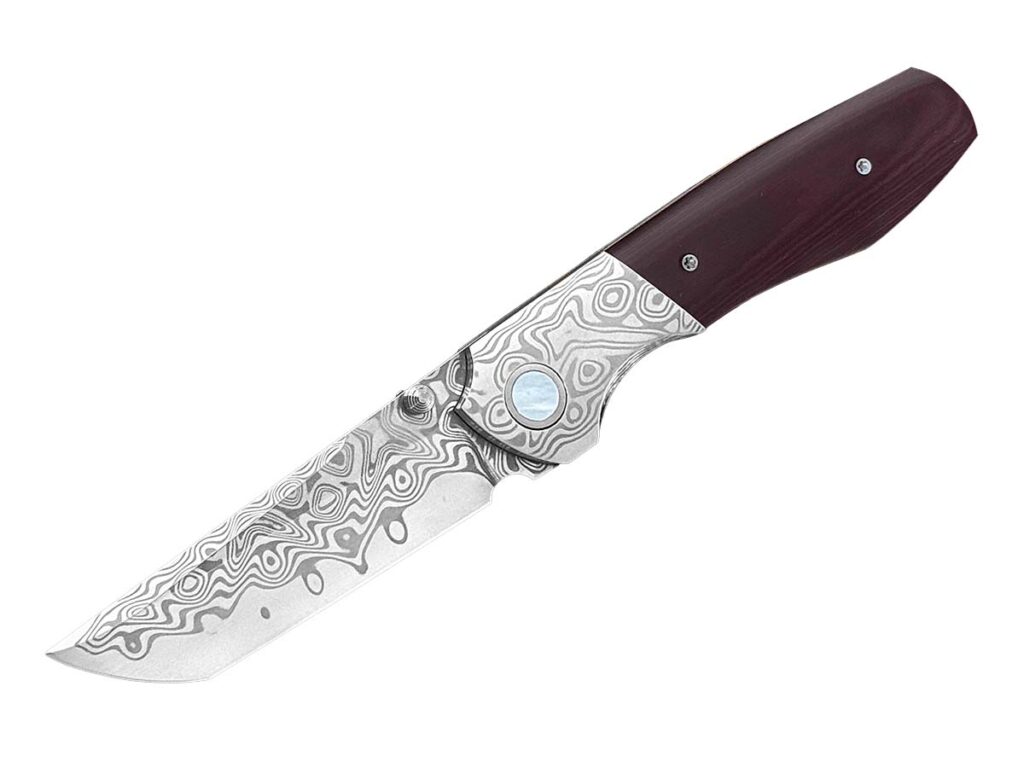
Vintage red linen Micarta scales and a hollow-ground Damasteel Baldur on Damacore blade highlight David Beaver’s Shogun Horizon folder. Blade and overall lengths: 3.75 and 8.5 inches. The maker’s price for similar knife is $1,800. (Jocelyn Frasier image)


Cody Hofsommer: Mammoth Ivory Folder

Cody Hofsommer Mammoth Ivory Folder

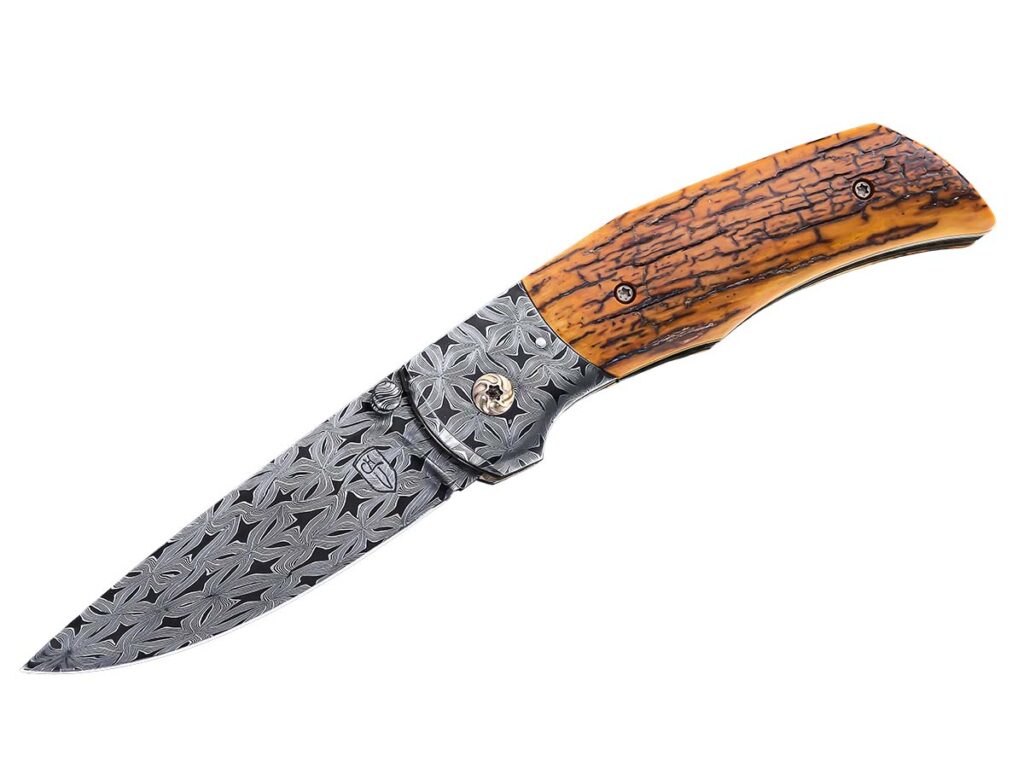
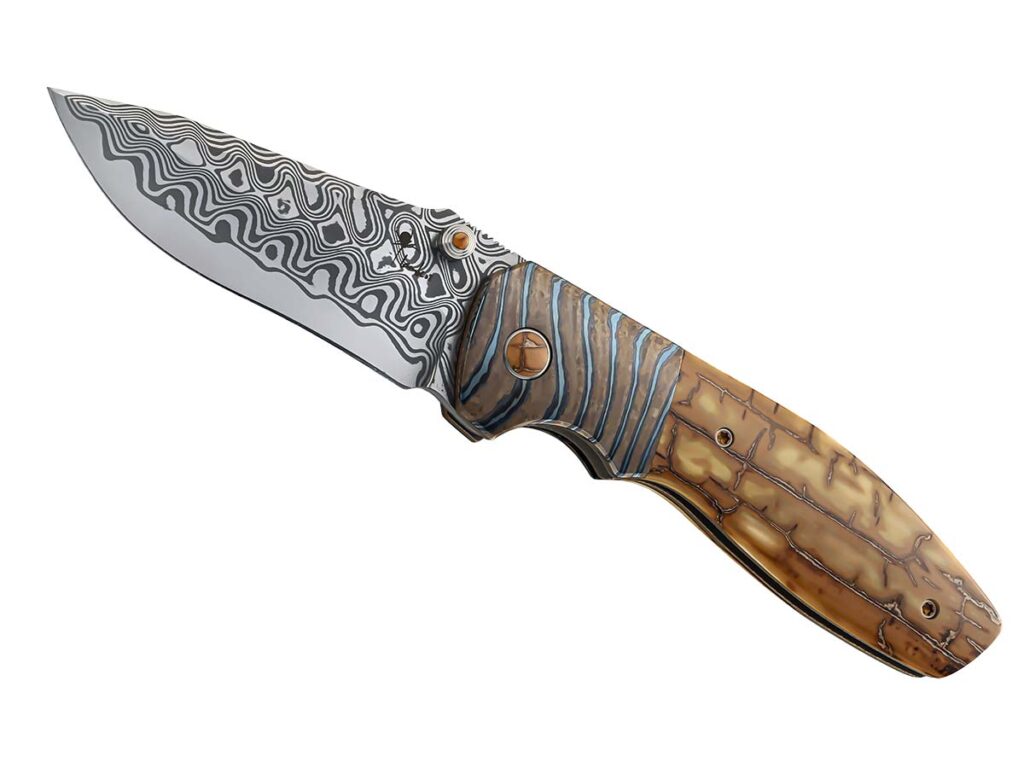
Mammoth ivory scales and mosaic damascus bolsters define a sole-authorship flat-ground folder by Cody Hofsommer. The 1080/15n20 mosaic Damascus blade measures 3.375 inches with an 8-inch overall length. (SharpByCoop image)


Kirby Lambert: Augustus Mini Folder

Kirby Lambert Augustus Mini Folder

A hollow-ground Damacore blade and mammoth ivory scales distinguish the Augustus Mini folder by Kirby Lambert. Bolsters are titanium and 2IRC damascus. Blade and overall lengths: 3.25 and 8 inches. (SharpByCoop image)


Brian Milinski: Paratrooper Elegante Linerlock

Brian Milinski Paratrooper Elegante Linerlock

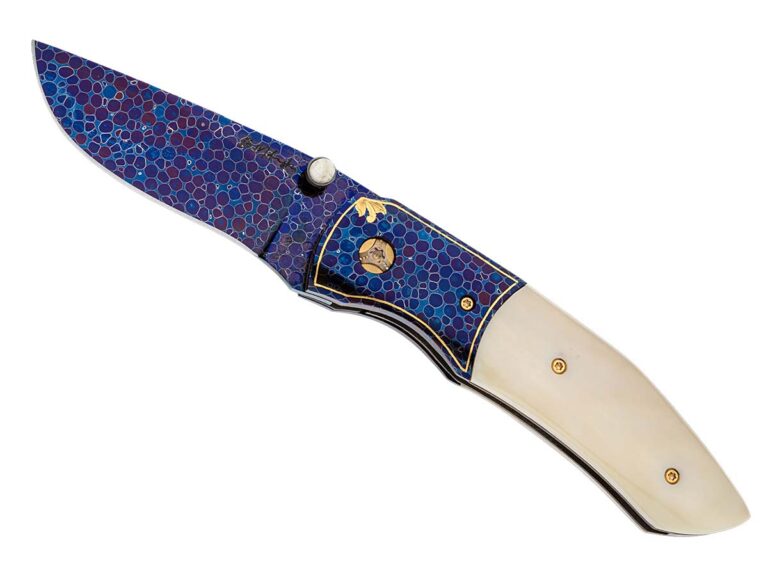
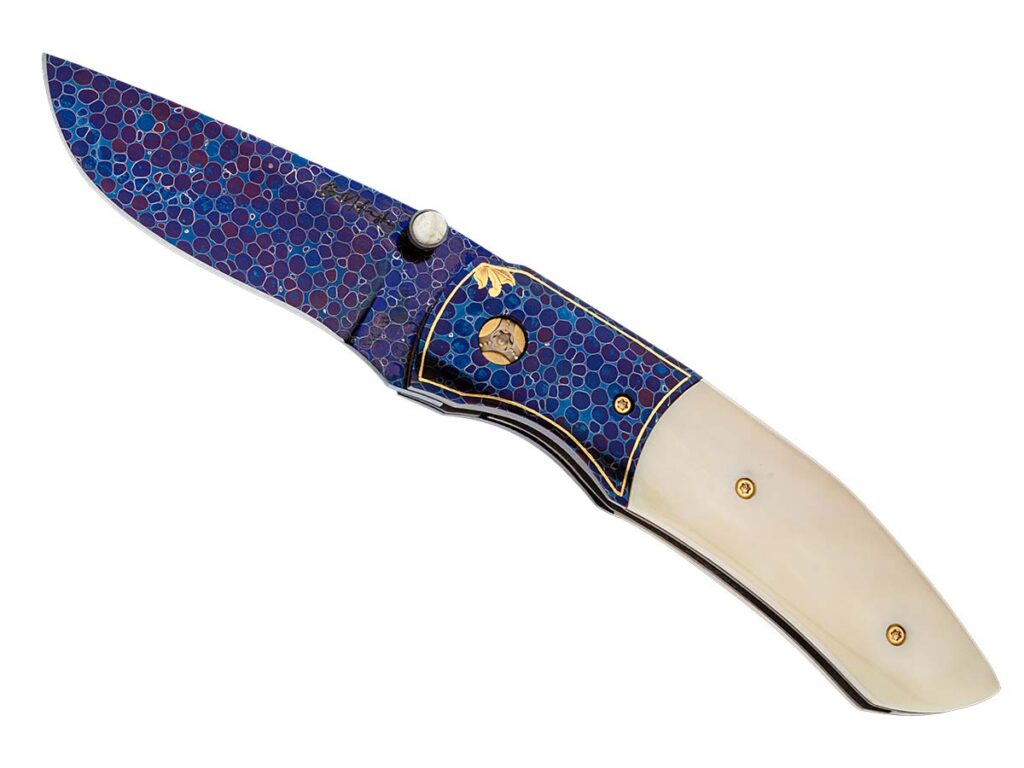
Nitre blued Rietveld damascus and fossilized walrus tusk scales characterize Brian Milinski’s Paratrooper Elegante linerlock. Joe Mason engraved and inlaid the matching bolsters. Blade and overall lengths: 3.25 and 7.75 inches. The maker’s price for a similar knife is $3,400. (Jocelyn Frasier image)


KC Gray: Titanium Folder

KC Gray Titanium Folder

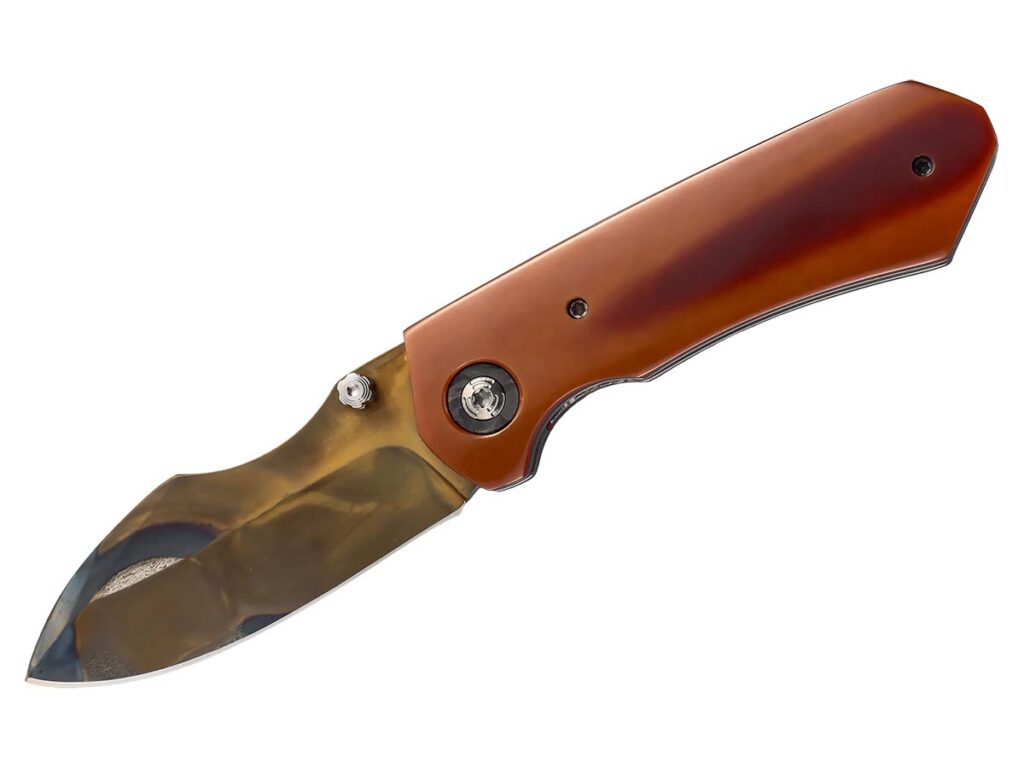
A 3.5-inch SM100 blade paired with vintage Micarta scales defines this 8-inch dress locking folder by Tucson maker KC Gray. The titanium frame includes marble carbon-fiber pivot collars and a black anodized clip. (SharpByCoop image)


Sean Alonzo: Ani

Sean Alonzo Ani

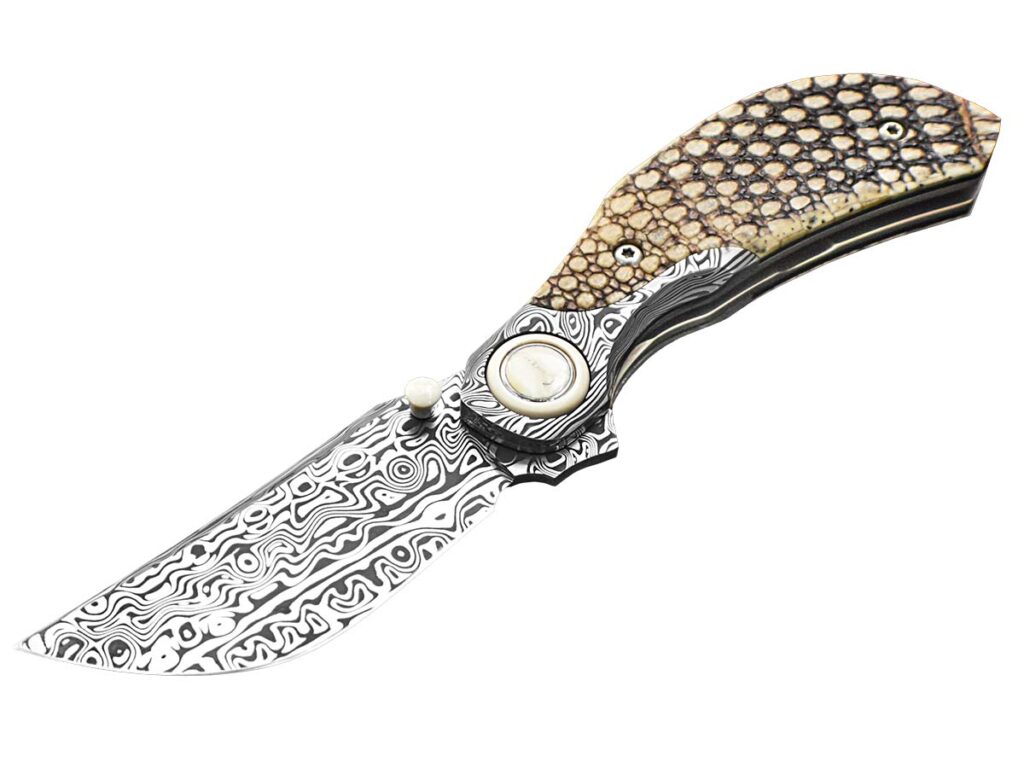
Sean Alonzo’s Ani 3.2 linerlock features armadillo carapace, warthog ivory, and a hollow-ground Yggdrasil Damasteel blade. Blade and overall lengths: 3.2 and 7.8 inches. Maker’s price for a similar knife $5,500. (Jocelyn Frasier image)


More On Flippers:

New Knives: From Tactical To Outdoor Blades

These babies are jaw droppers…

Have a hankering to extend your wish list with a little something new? Look no further as we’ve gathered up a slew of new custom and factory blades fresh on the market and ready to please. This collection has a definite tactical and outdoor tilt to it, with plenty of fixed blades. But, we’ve snuck a few worthy folders in just to keep the balance.


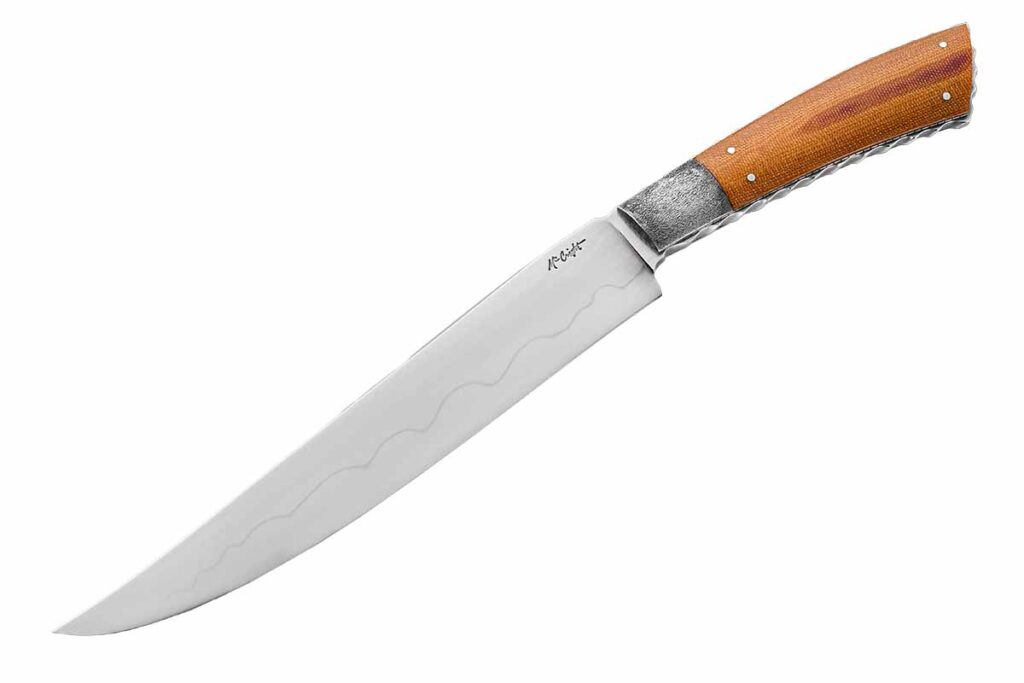
Erik McCright Fighter

New mccright

Fighter Specs
Blade length: 7.5”
Blade material: Old W2 tool steel w/hamon
Handle material: Vintage Micarta® w/a fileworked frame
Bolster: Textured mild steel
Overall length: 12”
Knife to know: Erik McCright is an ABS journeyman smith
Maker: Erik McCright (Jocelyn Frasier image)


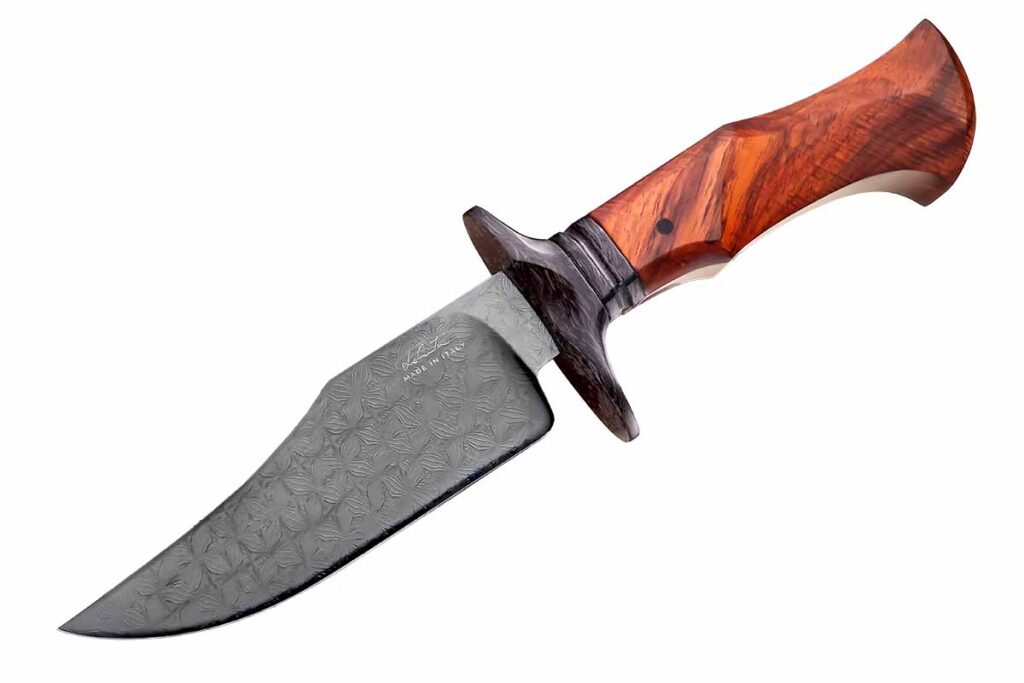
Simone Milanesi Lacantina Indy

New Lacantina

Indy Specs
Pattern: Bowie
Blade length: 6.29”
Blade material: Mosaic damascus of K720 tool and 15n20 nickel-alloy steels forged by Spina Gianluca
Blade grind: Full flat
Blade finish: DLC (diamond-like carbon)
Handle material: Rosewood w/carbon pin
Guard & fittings: Fat Carbon
Overall length: 11.6”
Maker’s price for a similar knife: $2,000
Knife to know: Simone Milanesi Lacantina’s Indy won The Knifemakers’ Guild Best Bowie Award at BLADE Show 2023
Maker: Simone Milanesi Lacantin (SharpByCoop image)


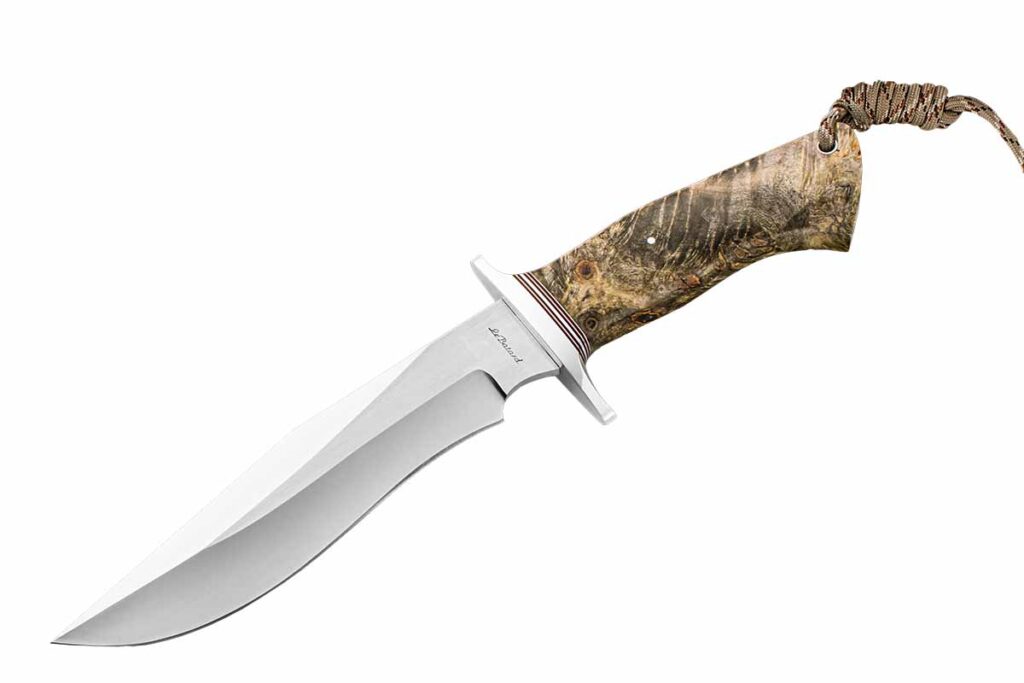
Paul LeBatard Recurve Bowie

New LeBatard

Recurve Bowie Specs
Blade length: 7”
Blade steel: CPM 154 stainless
Rockwell hardness: 61 HRC
Blade grind: The top false edge and primary bevels are hollow ground on a 10” contact wheel and satin polished; the flats are hand finished to 800 grit
Blade @ thickest: 3/16”
Handle material: California buckeye burl
Lanyard material: Desert camo 550 paracord
Double guard: 7075-T6 aluminum
Overall length: 12”
Maker’s price for a similar knife: $750
Maker: Paul LeBatard (Jocelyn Frasier image)


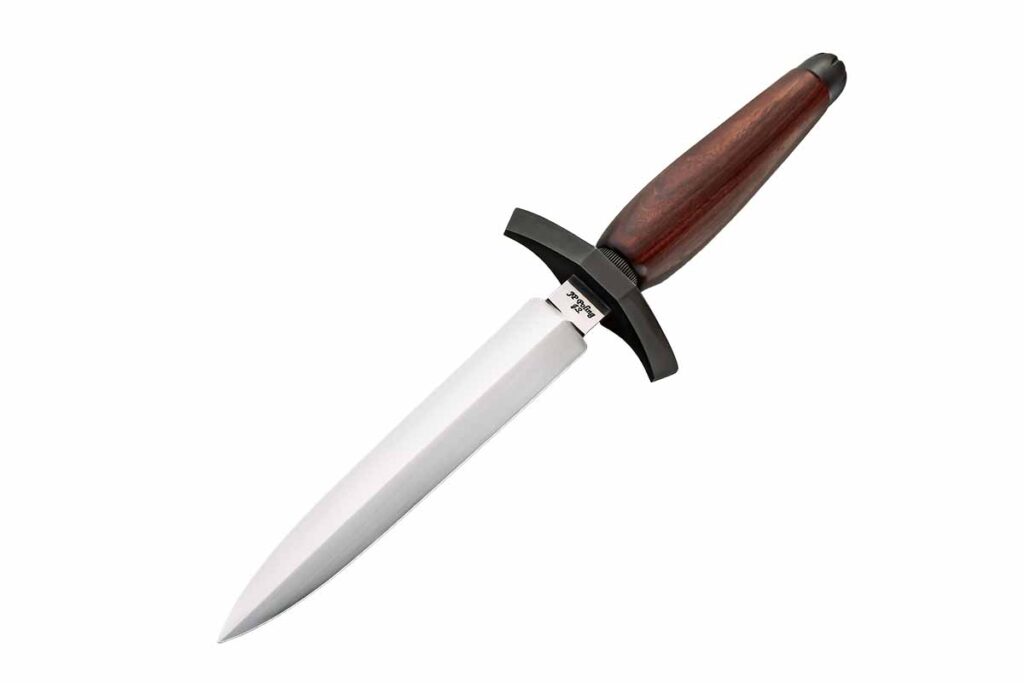
Jim Poling Dagger

New Poling

Dagger Specs
Blade length: 6.5”
Blade material: 5160 carbon steel
Blade grind: Flat/convex
Handle material: Rosewood
Fittings: Mild steel
Overall length: 12”
Maker’s price for a similar knife: $600
Maker: Jim Poling (SharpByCoop image)


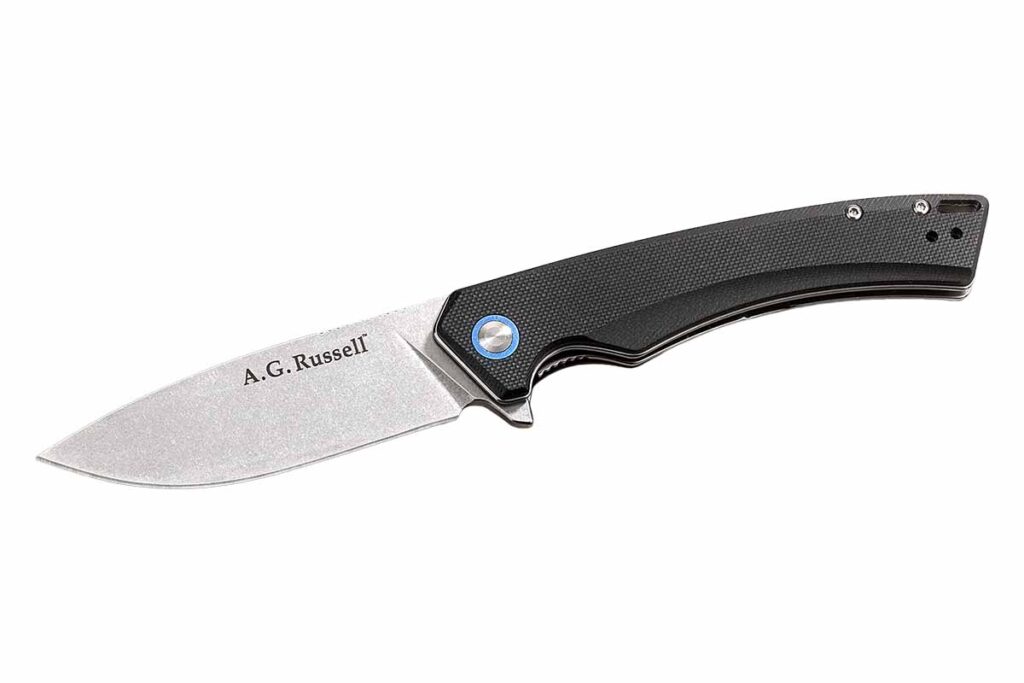
A.G. Russell Knives Power Ball C2

Russel Knife

Power Ball C2 Specs
Knife type: EDC
Blade length: 33/8”
Blade material: D2 tool steel
Rockwell hardness: 59-60 HRC
Blade finish: Stonewash
Blade pattern: Drop point
Handle: Black G-10 w/blue pivot accent ring
Pocket clip: Reversible, deep carry
Lock: Linerlock
Weight: 3.7 ozs.
Closed length: 4.75”
Knife to know: Also available in a green handle w/orange pivot accent ring
Country of origin: China
MSRP: $67.95
Company: A.G. Russell Knives


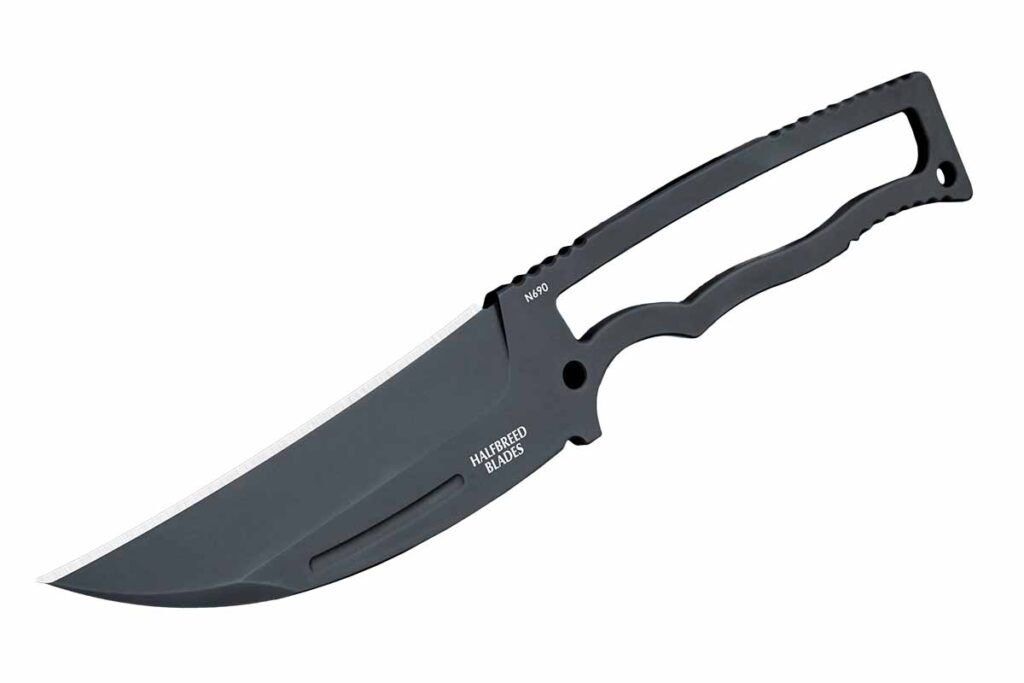
Halfbreed Blades CFK-02 (Compact Field Knife)

New CFK

CFK-02 (Compact Field Knife) Specs
Knife type: Fixed blade
Blade length: 4.01”
Blade steel: N690 stainless
Rockwell hardness: 59-60 HRC
Blade @ thickest: .16”
Blade finish: PVD coated and stonewash options
Blade pattern: Pikal
Handle steel: VG-10 stainless
Weight: 4.87 ozs.
Overall length: 8.07”
Sheath: Injection-molded plastic
Mounting: Ulticlip and DOTS Belt
Countries of origin: Australia and Taiwan
MSRP: $275
Company: Halfbreed Blades


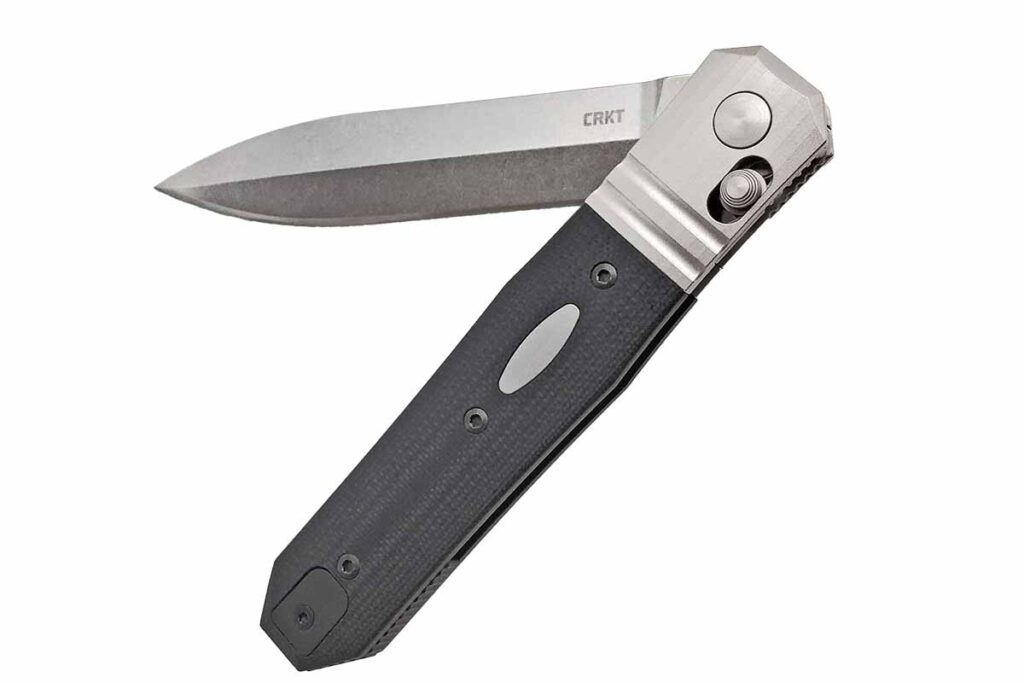
CRKT Redemption

New crkt redemption

Redemption Specs
Designer: BLADE Magazine Cutlery Hall-Of-Fame® member Ken Onion
Blade length: 4.06”
Blade steel: MagnaCut stainless
Blade @ thickest: .15”
Blade finish: Stonewash
Handle material: G-10
Bolster: Stainless steel
Lock: Crossbar
Weight: 4.9 ozs.
Closed length: 5.1”
Knife to know: The Redemption is based on Onion’s Deadman’s Hand custom knife named after the aces-and-eights hand Wild Bill Hickok purportedly held at the time of his death
Country of origin: Made in the USA in collaboration w/Hogue Knives
MSRP: $225
Company: CRKT


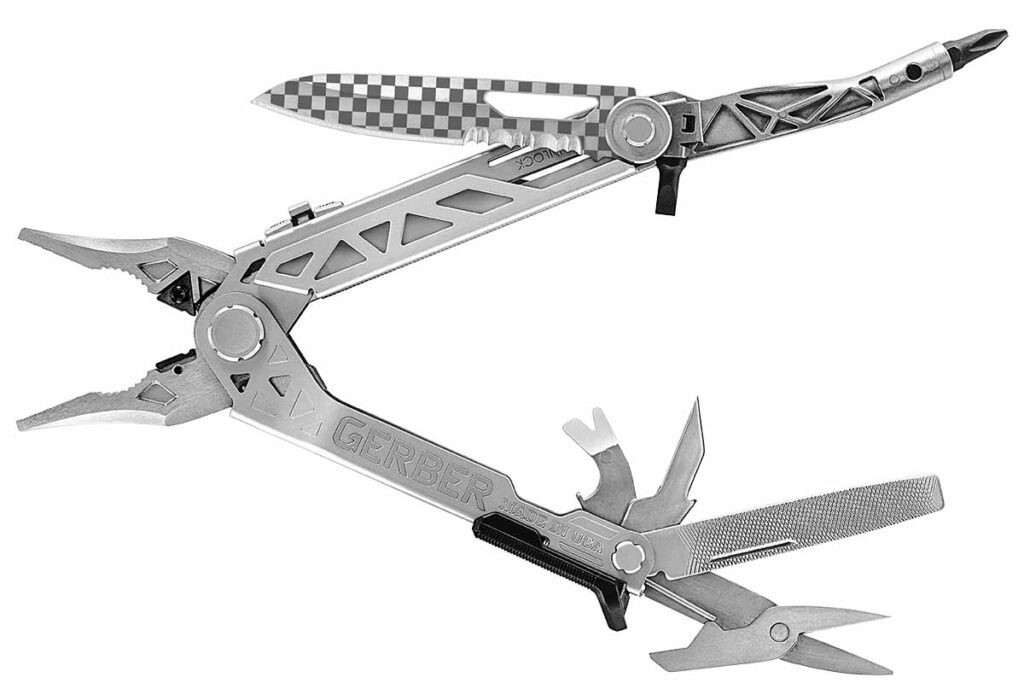
Gerber Center Drive

New Gerber CenterDrivePlus

Center Drive Specs
Knife type: Multi-tool
Blade length: 3.25”
Blade steel: 420HC stainless
Implements: Serrated blade, file, awl, pry tool w/nail puller & bottle opener, scissors, fine- & coarse-sided file, pliers, rotatable carbide wire cutters & strippers; magnetic flathead and Phillips bits; in/cm ruler
Weight: 9.5 ozs.
Closed length: 4.7”
Sheath: Fabric
Knife to know: One-thumb opening system; the pliers are spring-loaded; magnetic 3.2” Center-Axis bit driver; tool lock
Country of origin: USA (sheath made in China)
MSRP: $130-$145
Company: Gerber


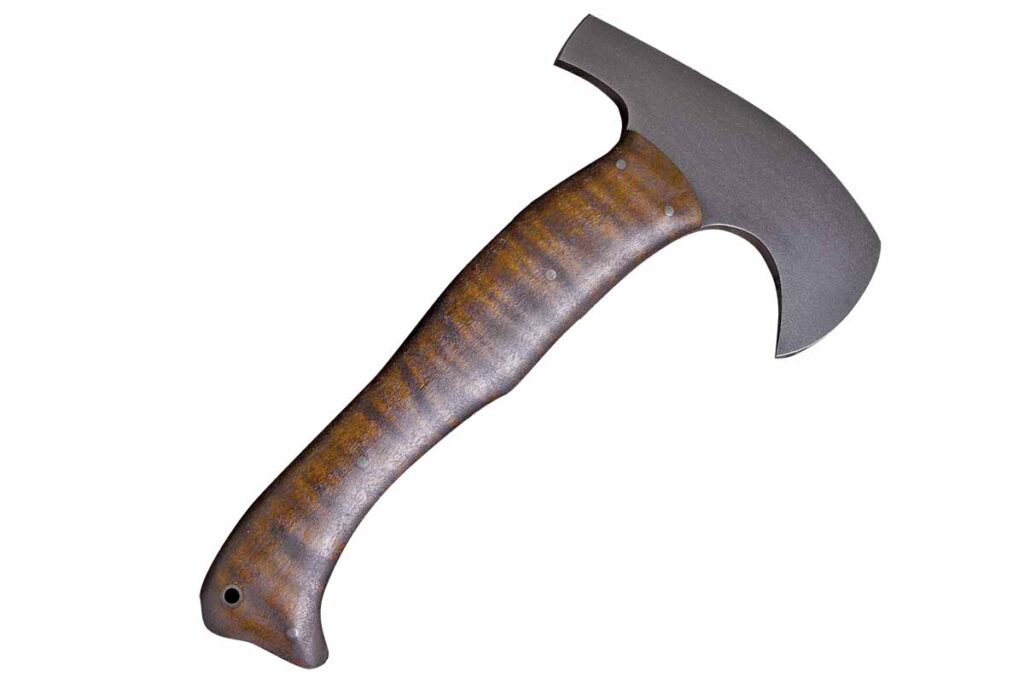
Winkler Knives WK Hunter Axe LT

New WK Hunter Axe LT

New LeBatard
Head length: 4.75”
Axe material: 80CrV2 carbon steel
Blade @ thickest: .25”
Blade finish: No-glare black oxide
Handle: A wide variety of natural and synthetic options; contact maker for info
Construction: Skeletonized full tang
Overall length: 9”
Sheath: Fast-draw carrier, lined Boltaron®, HD shockcord quick-release retention system, nylon belt straps, multi-carry options
Country of origin: USA
MSRP: $450
Company: Winkler Knives


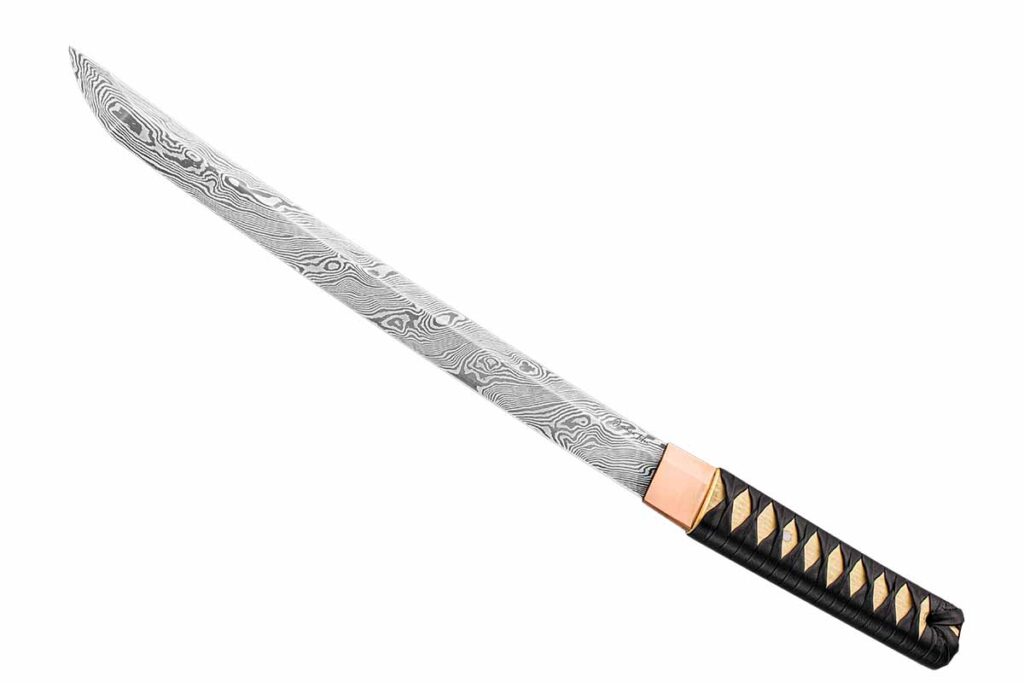
Jesse Hu Tanto

New Hu

Tanto Specs
Blade length: 12”
Blade material: Twist Damascus of 1084 carbon and 15N20 nickel-alloy steels
Blade grind: Traditionally ground w/a shinogi-zukuri geometry
Handle material: Poplar and leather w/brass spacer
Habaki (collar): Copper
Overall length: 17.5”
Maker’s price for a similar knife: $3,000-$4,000
Knife to know: The maker is an ABS apprentice smith
Maker: Jesse Hu (Jocelyn Frasier image)


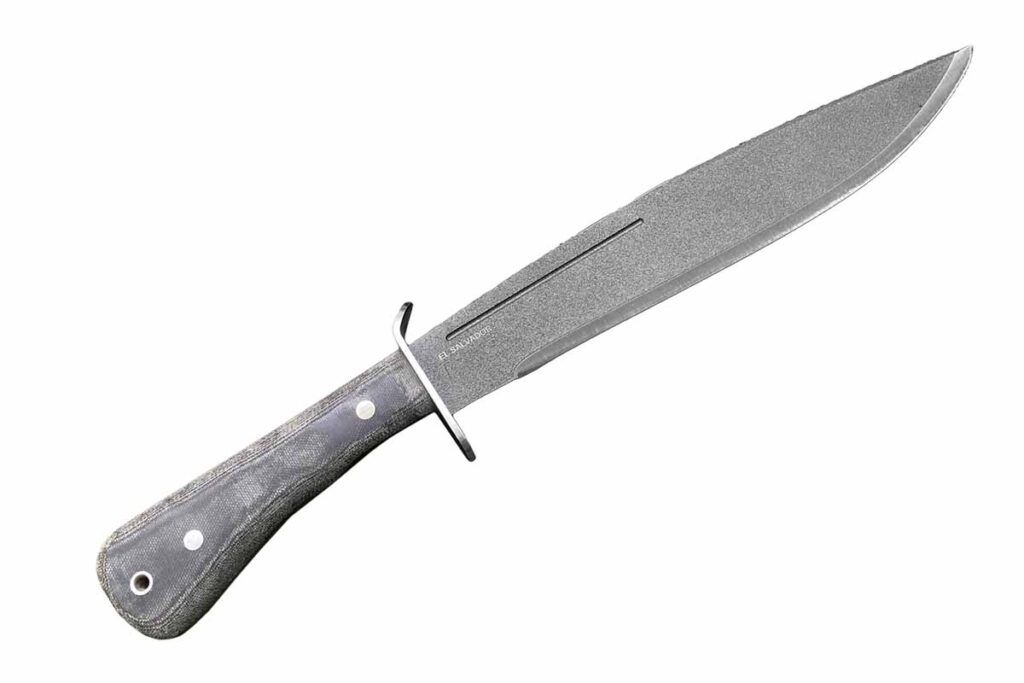
Pearson Industries MOST

Person

MOST Specs
Knife type: Fixed blade
Blade length: 11.375”
Blade material: 1075 carbon steel
Blade finish: Black Traction powder coat
Blade @ thickest: .196”
Handle material: Black canvas Micarta®
Construction: Full tang
Weight: 24 ozs.
Overall length: 17.125”
Sheath: Kydex
Country of origin: El Salvador
MSRP: $279.95
Company: Pearson Industries


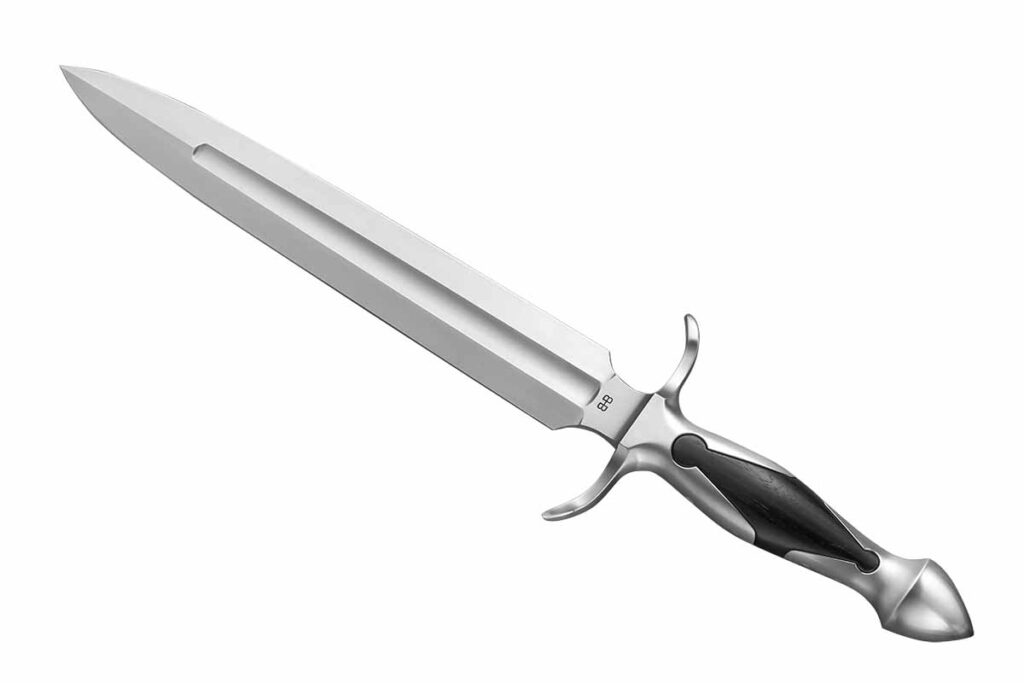
Joseph Bandeko Fixed Blade

New Bandeko

Fixed Blade Specs
Pattern: Double-keyhole dagger
Blade length: 11.28”
Blade material: 15N20 nickel-alloy steel
Blade grind: Flat
Handle material: African blackwood
Handle pins: Argentium silver
Pommel: 416 stainless steel
Overall length: 16.93”
Maker’s price for a similar knife: $4,495
Maker: Joseph Bandeko (SharpByCoop image)

Check Out More Knife Drops:

Advertisement

Must Read Articles

Read this before you make a knife

Knifemaking 101 – Read This Before You Make a Knife

  by Wayne Goddard My experience has taught me that there's nothing like digging in and getting started. I've often said the hardest part of the...
how to forge damascus steel

How to Forge Damascus

Advertisement
Advertisement