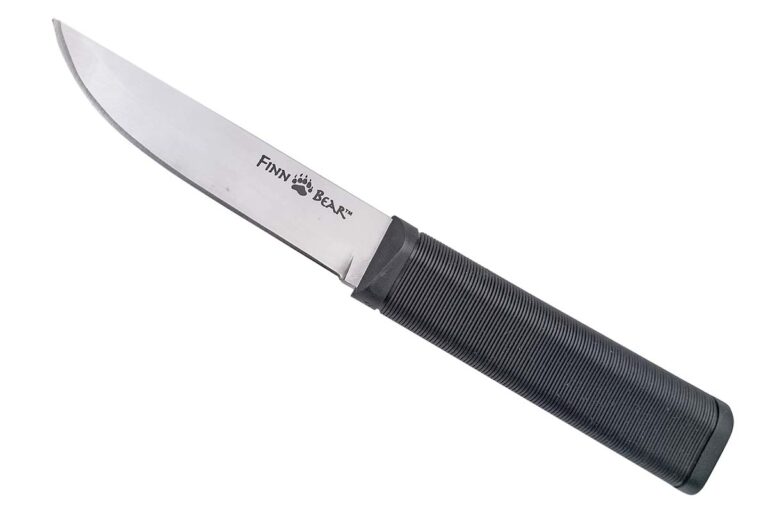
A very simple and practical design, Cold Steel’s Laplander-inspired knife cuts through chores.
It’s nice to see a lightweight knife that can fill a multiple range of uses. While attending Norway’s ski school, I was introduced to the Laplander style of knife.
Very light and super sharp, it is used for most every cutting chore. The Cold Steel Finn Bear reminds me of such knives. And don’t let the thin blade fool you, it’s a sturdy cutting instrument.
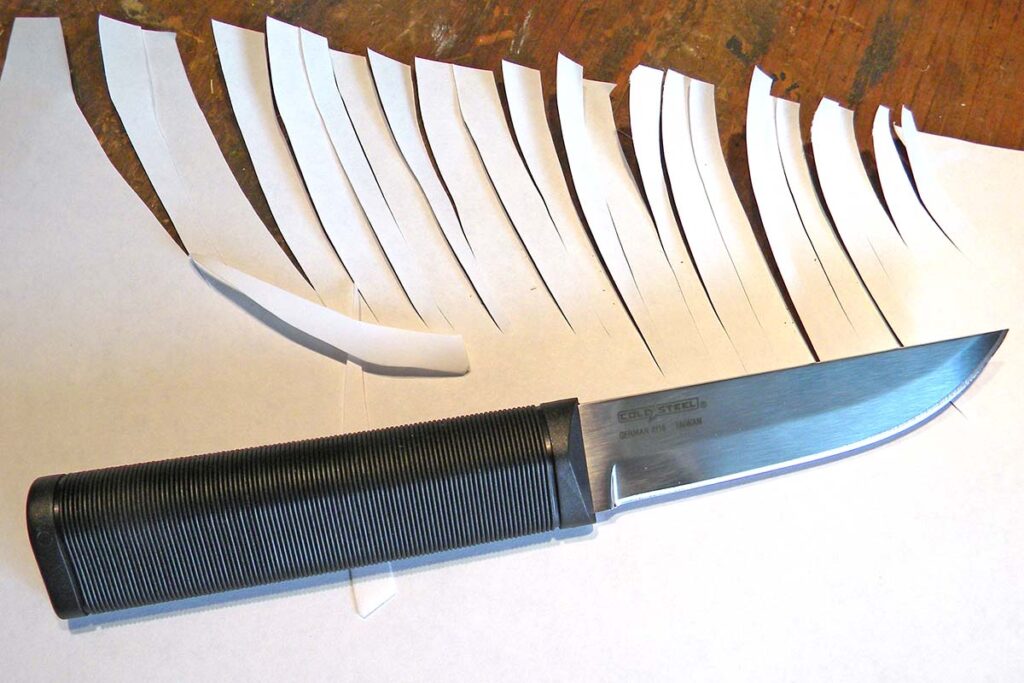
The author checked the new edge for sharpness on the copy paper and the blade sliced quickly and smoothly.
Slicing 20-pound bond paper checked the new edge for sharpness. It sliced quickly and smoothly. I had to move my fingers quickly so I didn’t nick myself. It was a great factory edge to start off with.
Finn Bear Light-Duty Cutting
Double-walled cardboard was next on the docket. Again, the Finn Bear was very smooth in its slices. It worked faster with a push cut rather than a pull cut. The knife made full-blade-length slices. The edge was very aggressive. The tear-drop handle shape designed by Tapio Wirkkala provided great control.
I fetched a piece of scrap 8-ounce leather to slice next. The material offered no resistance to the super-sharp blade. I could hear the edge biting into the leather. It was hard to control the depth of cutting as the blade zipped straight to the bottom of the medium.
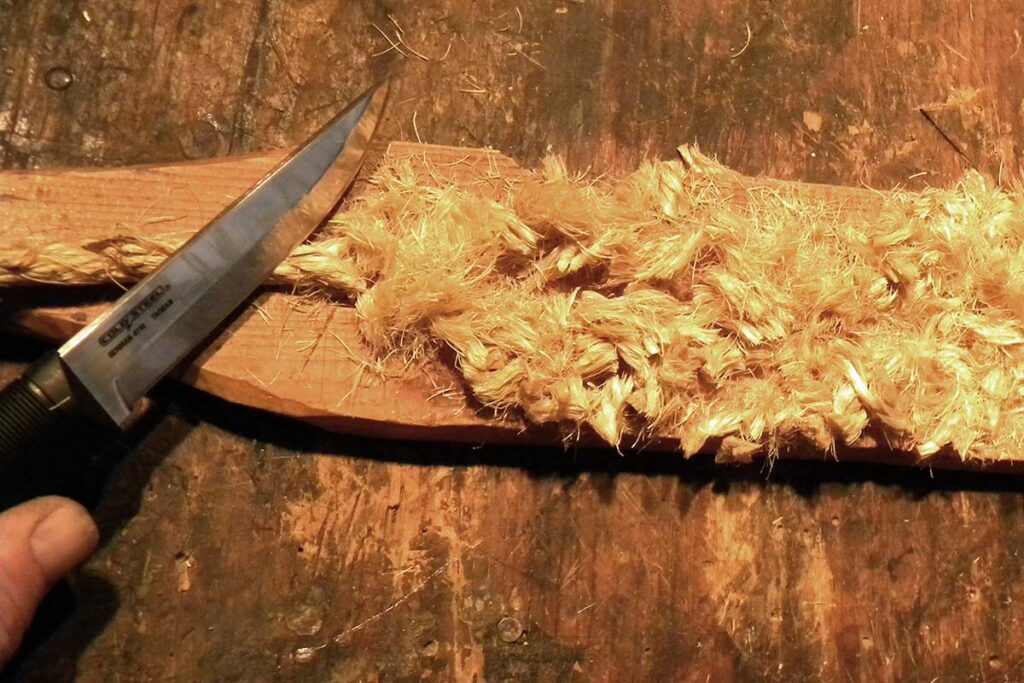
The Finn Bear quickly made 200 cuts in the half-inch sisal rope and was ready for more.
Using the other side of the leather strip, I did some skiving. The blade was very aggressive and cut as fast as I could move my fingers out of the way. It rendered smooth slices in the animal skin with hardly any pressure. I could hear the leather crunching sound with each pass. The tear-drop handle was very controllable.
Finn Bear Heavy-Duty Cutting
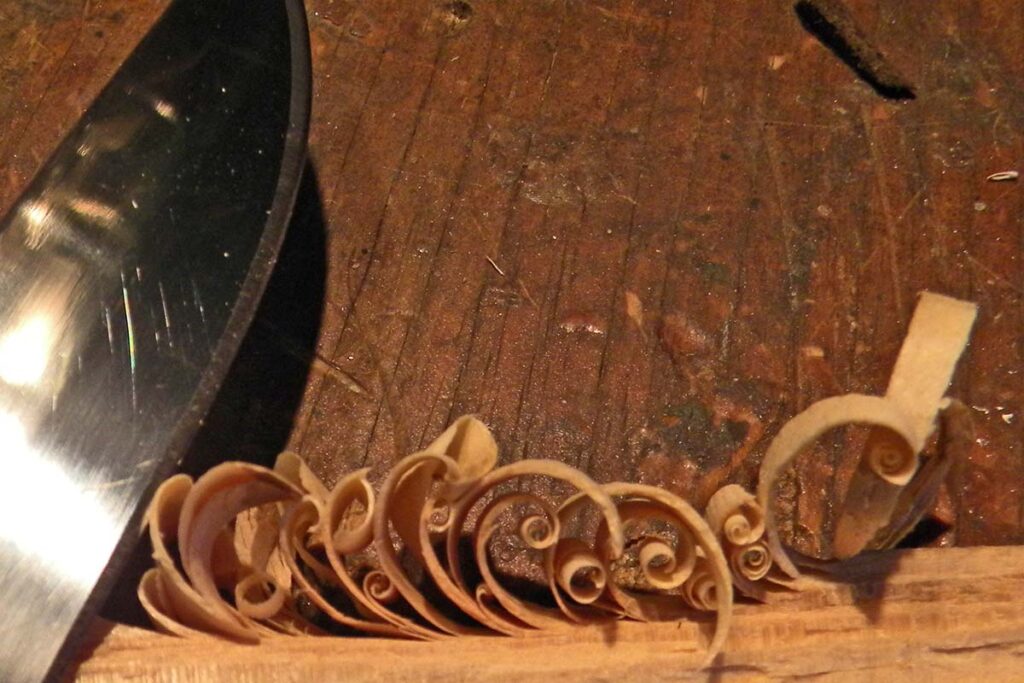
It was time to whittle a firestick from pine/fir wood. The Finn Bear produced the best curlicues I’ve seen in a long time—smooth wood cuts with multiple curls on each whittle. Performance at the task was excellent.
Next up: baton the knife into a 2×3. The thin blade split the wood in no time with no edge damage. Gripping the handle tighter to control the knife made the bottom of the tear drop seem too pointy for the shape of my hand—not uncomfortable, just harder to grip.
The Finn Bear produced the best curlicues the author’s seen in a long time—smooth wood cuts with multiple curls on each whittle.
It was on to the half-inch sisal rope. The Finn Bear quickly crunched to 200 cuts and was ready for more. I had to change my grip to more of a sidewinder style. I couldn’t place my thumb on the spine because of the blade’s thinness. No matter how I held the knife, it cut the rope. The knife is very sharp indeed.
Finn Bear Edge Retention Test
For the final test, it was back to the 20-pound bond paper. The Finn Bear sliced the medium just as quickly as the first time. I did have two tears in the paper but that was due to it being soggy. It rained the whole time I was testing.
Final Cut
A sturdy integral clip attaches the synthetic pouch sheath to a vest, pack, etc.
I would make the bottom of the handle a tad wider for a better grip. The Finn Bear is a “should have” knife. It’s lightweight and cuts like the wind. It’s perfect for everything from camp chores up to chopping.
Knife industry pros give their takes on what the hot knife steels will be in the year ahead.
Every cutlery buyer faces a dizzying array of steel choices when it comes to buying that next knife, an array that represents the proverbial “double-edged sword.” While it’s nice to have choices, it can also be hard to keep up with so many options. Fortunately, industry professionals are available to help sort out which stainless and carbon varieties are either catching fire or cooling off.
*The steels are listed in no particular order by the knife patterns/types for which they are favored most by users and makers, according to the story’s sources.
MagnaCut Reigns Supreme
Last year when BLADE took the temperature of steel suppliers, the clear-cut champion of blade materials was Crucible Industries’ CPM MagnaCut stainless. The creation of steel guru Larrin Thomas, MagnaCut remains on top and will stay there for the foreseeable future. Bob Shabala, president of Niagara Specialty Metals, praised the high-performance blade material last year and still does today.
CPM MagnaCut stainless ruled among knife steels in 2024 and will continue to hold sway in 2025. A representative example is the new CRKT Q, a folder in titanium and carbon fiber designed by Richard Rogers. Country of origin: Italy. MSRP: $225.
“We have sold about 320 tons of CPM MagnaCut since its introduction in 2020. It is our biggest selling cutlery grade right now and I don’t expect that to change anytime soon,” Bob said, adding the qualifier, “This is from Niagara Specialty Metals’ limited perspective. I’m sure other mills are working on new grades which I’m not privy to.”
One reason MagnaCut is so popular is it embraces all cutlery genres with ease.
“CPM MagnaCut remains in high demand across various knife patterns,” Bob observed. “Some customers currently using MagnaCut for fixed blades are expanding into folding knives and have expressed plans to continue using the steel for their new designs, reflecting its versatility and ongoing popularity.”
MagnaCut maestro Larrin Thomas
Scott Devanna, vice president of technology and a metallurgist for SB Specialty Metals, tends to concur.
“I’m not sure there will be a new ‘super steel’ introduced in 2025. The introduction of new steels seems to have a three-to-four-year cycle, and with the recent intro of CPM MagnaCut such new introductions may be a few years off. We sell a lot of MagnaCut,” he stated. “I’ve learned over the years that new is very often the primary driver when new grades are introduced. This is what happened with CPM S30V, CPM 20CV and its European equivalent M390, and a few other grades.”
It should be noted that MagnaCut technically is going into its fifth year of existence. As you can see, it takes a while for a steel to work its way into the manufacturing pipeline and be given a thumbs up or thumbs down by the end user.
Specialty Grade Steels
Meanwhile, other specialty grade steels aren’t being ignored. In fact, many knife consumers prefer other steels that suit their needs better, both of the stainless and carbon varieties.
CPM 154 stainless will continue to be a steel of choice for custom hunting knives, here on the Cowboy Knife by David Fleming in a handle of sheep horn from a Rocky Mountain bighorn. Overall length: 7 inches.
“CPM S30V, one of the original cutlery-grade steels, continues to be one of our best-selling products,” Shabala noted. “Despite its age*, S30V maintains a strong position in the market, demonstrating its enduring reliability and widespread appeal among knifemakers.
Devanna agrees.
“CPM S30V is still a favorite for hunting knives, as well as CPM 154,” he noted. “For everyday carry folders, M390, CPM 20CV and CPM 154 are still used quite a bit as well.”
Scott said CPM S30V and S35VN remain strong for tactical folders.
Bob Shabala, Niagara Specialty Metals
Custom knifemakers aren’t as easily swayed by trends and tend to go with steels they are comfortable using, are time-proven to them personally, or geared to their particular customer base. While many are on the MagnaCut train, they tend to be more diverse in their choices.
“Other steels popular among custom knifemakers are M390, CPM 20CV, CPM 154, and to a lesser extent CPM S30V and CPM S35VN,” Devanna stated. “I have heard that CTS-XHP will be re-introduced, and this grade developed quite a following when it was readily available—especially for kitchen knives and high-end folders.”
Added Shabala, “CPM 154 is always popular with the custom makers.”
Carbon Steel
THE CARBON EQUATION The outdoor crowd—bushcrafters, survivalists and open-air tactical users—has to be pleased with the attention they’ve been getting from the industry. These users’ requirements are different and they prefer a subset of steels all their own.
While major outdoor knife manufacturers like TOPS and ESEE still sell the bulk of their knives in 1095, they have been gradually offering their customers more steel diversity, including stainless versions such as S35VN. The TOPS Shadow Hunter has a 4.5-inch blade of 1095 carbon steel in a tungsten Cerakote®. Country of origin: USA. MSRP: $250.
“CPM 3V and 4V are favored for hard-use knives due to the steels’ toughness, while CPM S90V and 20CV are popular among users who prioritize wear and corrosion resistance,” Shabala observed. “CPM 3V and CPM 4V are carbon steels that continue to sell well in specific areas. 3V is in high demand for bushcraft knives and 4V is being used by the current national champion in BladeSports International cutting competitions, Ben Propst. His wife Sue Ann is now using it and in 2024 they both won cutting events in Kokomo and the Smoky Mountain Knife Works fall festival.”
“I think CPM 3V and CPM Cruwear—mostly for bushcraft/survival knives as well as tactical fixed blades—are gaining popularity in the market,” Devanna opined. “CPM 3V has proven itself over the years and continues to be a popular grade. CTS PD#1 was in this category but availability of this grade is a problem.”
While major outdoor knife manufacturers like TOPS and ESEE still sell the bulk of their knives in 1095 carbon steel, they have been slowly offering their customers more diversity in their lines, including such stainless versions as S35VN.
Overall Take
As Shabala and Devanna noted, MagnaCut will be the top dog among steels in 2025, but it’s certainly not the only hound in the kennel.
Shane Magnussen uses the CPM S90V supplied by New Jersey Steel Baron on his model BBV2 folder. Closed length: 4.54 inches. (SharpByCoop image)
The cutlery industry is so diverse in the competition among manufacturers, custom makers, genres of knives and budget categories, there’s room for many different stainless and carbon steels. While what’s in the works remains unknown to most, you can bet there are teams of metallurgists working on the next great knife steel as these words are written.
As a knife enthusiast and cutlery buyer your choices are bountiful in all categories—from EDC to outdoor, fixed blade to folder—and affordable to expensive. Some users buy one knife to last for years while others rotate their carry or require cutting fare for specific purposes.
The good news is your knife and steel options have never been better!
*Editor’s note: The first-ever steel both designed and made specifically for knife blades, CPM S30V has been used for knives since 2001.
Bowie knives are as legendary as the man their named after.
When it comes to iconic blades, few can match the legendary status of the Bowie knife. This distinctive and formidable knife has a storied history that spans centuries, and its enduring popularity is a testament to its imperishable design and utility.
In this comprehensive guide to the Bowie knife, we’ll take a deep dive into the world of the iconic knife. We’ll look at its history, design, modern uses, and legality. Then we’ll finish up with an extensive selection of the best Bowie knives currently on the market.
History of the Bowie
The debate about who made the first Bowie knife rages on to this day, adding to the mystique of this legendary blade. Some credit the knife’s creation to Jim Bowie himself, while others argue that it was the work of various blacksmiths and bladesmiths in the early 19th century. What is certain is that Jim Bowie’s association with the knife’s name and his prominent role in a violent sandbar fight in 1827 contributed significantly to its fame.
In addition to his participating in the famous Sandbar Fight after which his knife became a sensation on both sides of the Atlantic, Jim Bowie also fought and died in the Battle of the Alamo.
One of the most pivotal moments in the knife’s history was the infamous sandbar fight that took place in Mississippi in 1827. During this brutal encounter, Jim Bowie and a group of men defended themselves against an opposing faction. Jim Bowie’s remarkable fighting skills and his knife’s performance in the fight led to the weapon being forever associated with his name. This event catapulted the Bowie knife into the realm of legend, ensuring its enduring fame.
Bowie Knife Design: Choosing a Good Knife
The Bowie knife is known and loved for its distinctive design. While variations exist, several key features define this iconic blade:
Blade Style: The knives typically have a clip point blade, which is characterized by a concave curve on the top edge and a fine, sharp point. This design allows for both slicing and piercing, making it a versatile tool for a wide range of tasks.
Blade Length: Bowie knives come in various blade lengths, with the most common falling between 6 and 12 inches. The length of the blade influences its utility, with longer blades being suitable for chopping and combat, while shorter ones excel at precise cutting.
Crossguard: Most Bowie knives feature a crossguard, a metal piece positioned between the blade and the handle. This crossguard serves to protect the user’s hand during combat and can also be used for utility purposes.
Full-Tang Construction: Bowie knives are typically constructed with a full tang, meaning the blade extends through the handle, providing stability and strength. This design ensures the knife can withstand heavy use and remain a reliable companion in various situations.
Handle Material: Bowie knife handles come in a range of materials, from classic hardwoods to modern synthetics like Kraton. The choice of handle material impacts the knife’s aesthetics and grip comfort, catering to the user’s preferences.
Modern Uses for Bowie Knives
While the Bowie knife was originally designed for self-defense and survival in the wilderness, its uses have evolved over the years. Today, Bowie knives are valued for their versatility and can serve a variety of purposes:
Camping and Outdoor Activities: Bowie knives are popular among outdoor enthusiasts for tasks such as chopping wood, preparing food, and building shelters. Their sturdy design makes them reliable tools in the wilderness, where dependability is crucial.
Hunting: Many hunters rely on Bowie knives for field dressing and skinning game. The sharp blade and clip point make these knives well-suited for precision work, ensuring a clean and efficient process.
Collection and Display: Bowie knives have transcended their practical utility to become sought-after collectibles. Enthusiasts appreciate their historical significance and craftsmanship, often displaying them as works of art in custom cases or on stands.
Self-Defense: While not as commonly carried for self-defense as smaller knives or firearms, Bowie knives can still serve as formidable weapons in a close-quarters encounter. Their imposing presence and sharp blade can deter potential threats.
Survival: Bowie knives remain a popular choice for survivalists due to their robust construction and multi-purpose design. Whether it’s building a shelter, cutting through rope, or processing wood for fire, a Bowie knife is up to the challenge.
Cooking: In the kitchen, Bowie knives with shorter blades can be used as versatile chef’s knives. Their sharp edges and comfortable handles make them suitable for slicing, dicing, and other food preparation tasks.
Legality of Bowie Knives
The legality of owning and carrying Bowie knives varies from place to place and can be subject to specific regulations. It’s crucial to understand your local laws and regulations regarding these knives. In some areas, Bowie knives may be considered illegal if carried in public, while in others, they are legal for both open and concealed carry.
It’s important to note that while Bowie knives have a rich history and practical uses, they can be seen as intimidating weapons by law enforcement and the public. Therefore, it’s essential to use them responsibly and within the bounds of the law.
Best Bowie Knife Specs
Model
Type
Blade Lenght (inches)
Overall Length (inches)
Weight (ounces)
Blade Material
Handle Material
Other Features
MSRP
Cold Steel Trail Master
Fixed
9.5
14.63
18
VG1 San Mai III®
Kray-Ex™
Secure-Ex® Sheath
$500
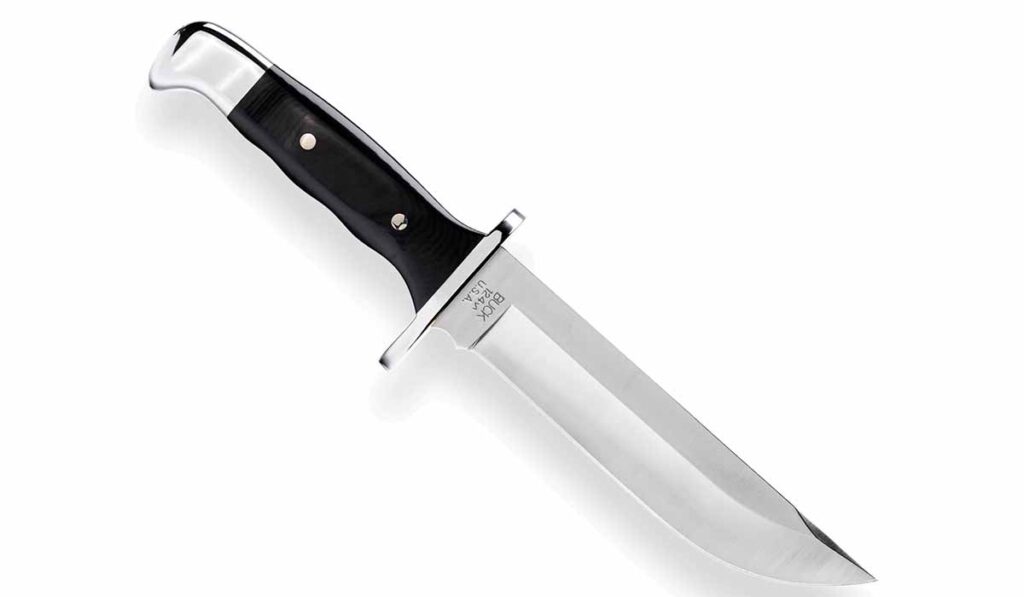
Buck Knives 124 Frontiersman
Fixed
6.25
11.75
13.3
420HC
Micarta
Leather Sheath
$200
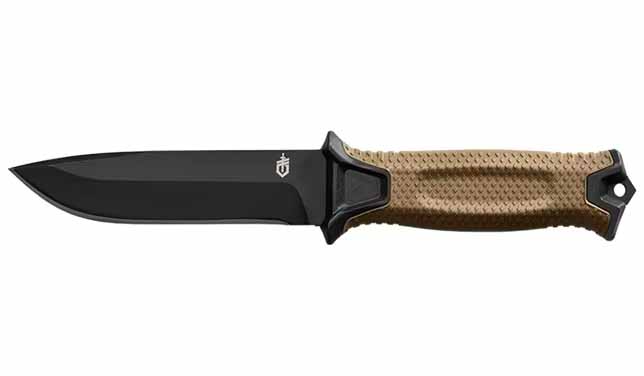
Gerber StrongArm
Fixed
4.8
9.8
7.2
420HC
Rubber
MOLLE-compatible multi-mount sheath
$90
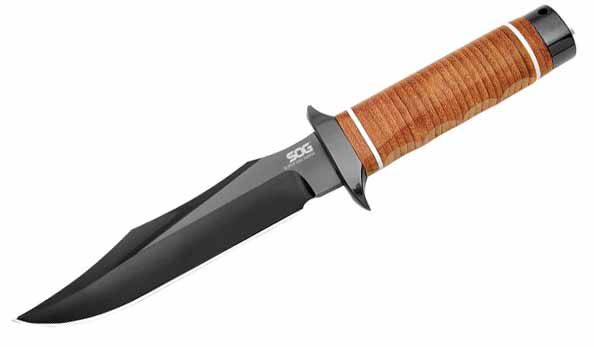
SOG Super Bowie
Fixed
7.5
12.88
17.4
AUS-8
Leather Washers
Leather Sheath
$250
Ontario Knife Company OKC 498
Fixed
7
12
16
1095
Kraton
Nylon Sheath
$98
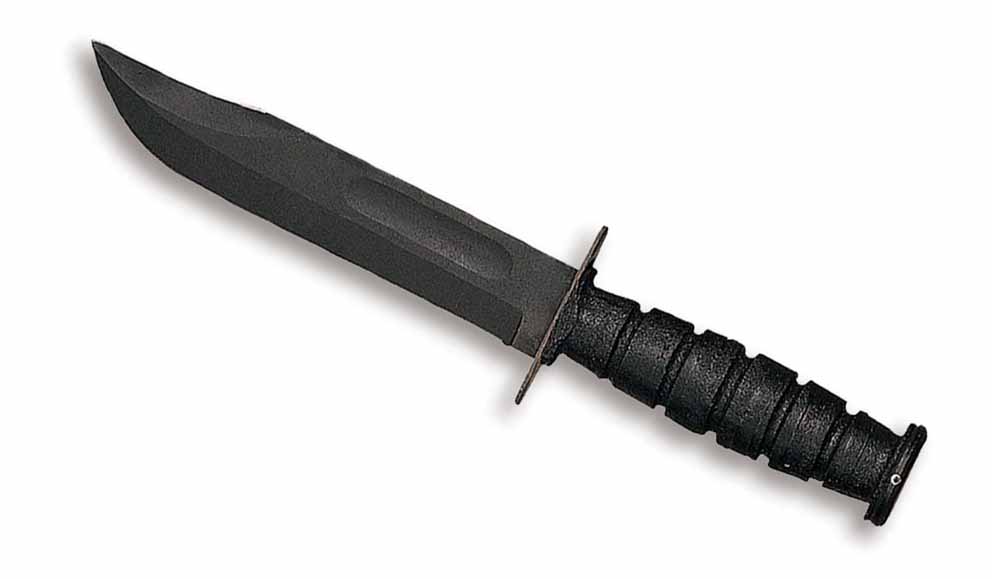
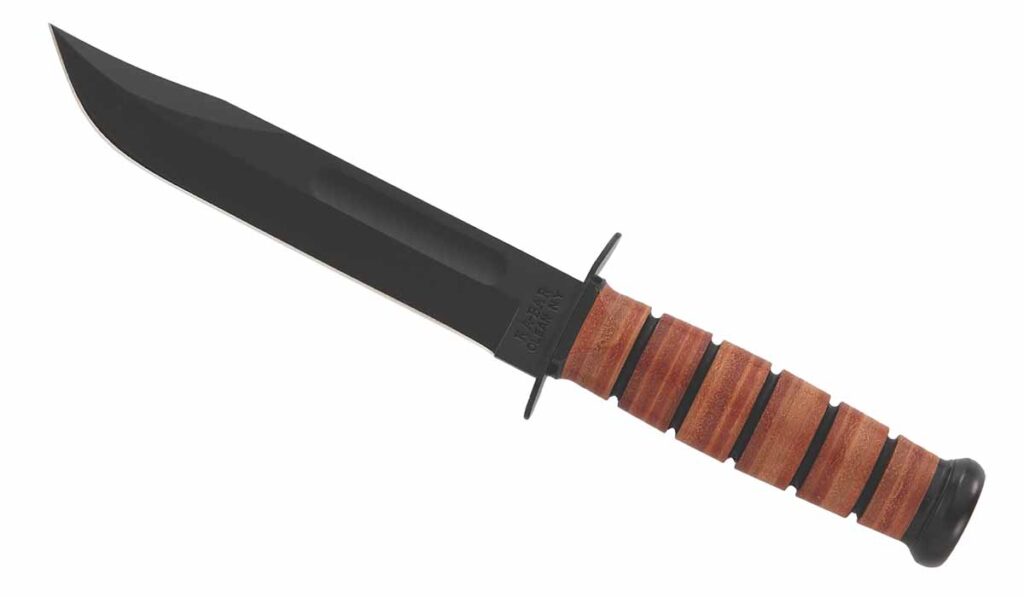
KA-BAR USMC Fighting Knife
Fixed
7
11.875
11.2
1095 Cro-Van
Leather
Leather Sheath
$140
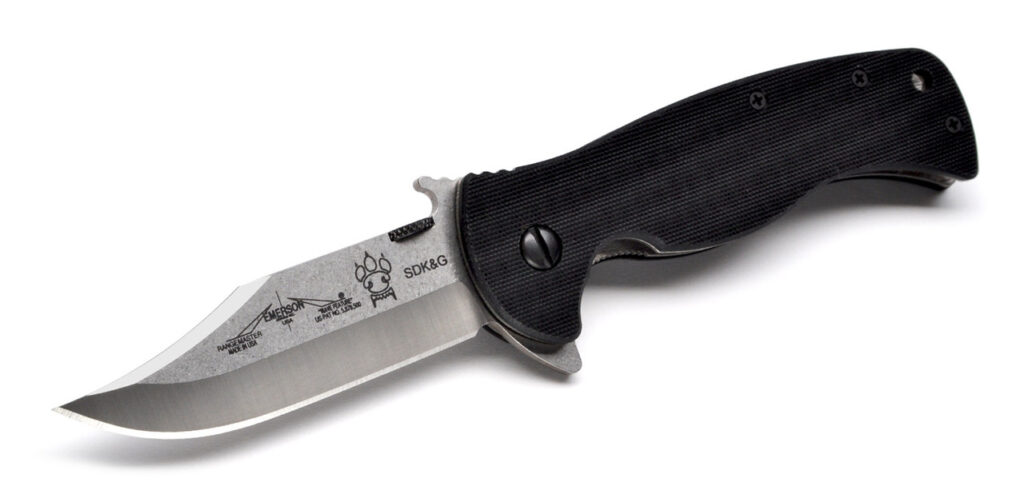
Emerson CQC-7BW
Folder
3.3
9
6.3
154CM
G-10
Wave Opener Blade
$275
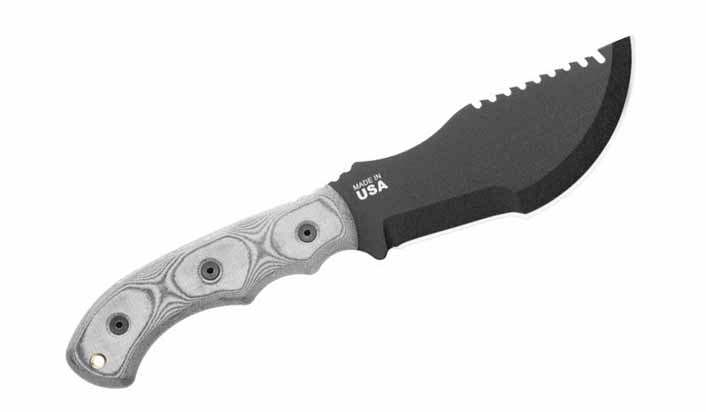
TOPS Knives Tom Brown Tracker
Fixed
6.38
11.88
21
1095
Micarta
Kydex Sheath
$365
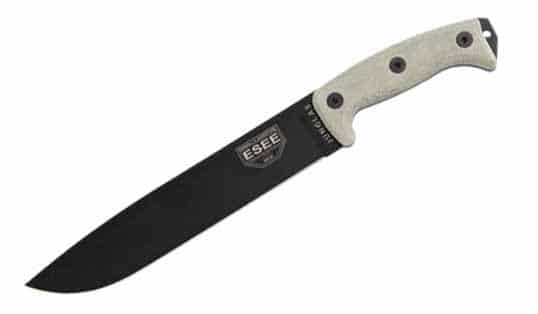
ESEE Junglas
Fixed
10.38
16.5
23
1095
Micarta
N/A
$310
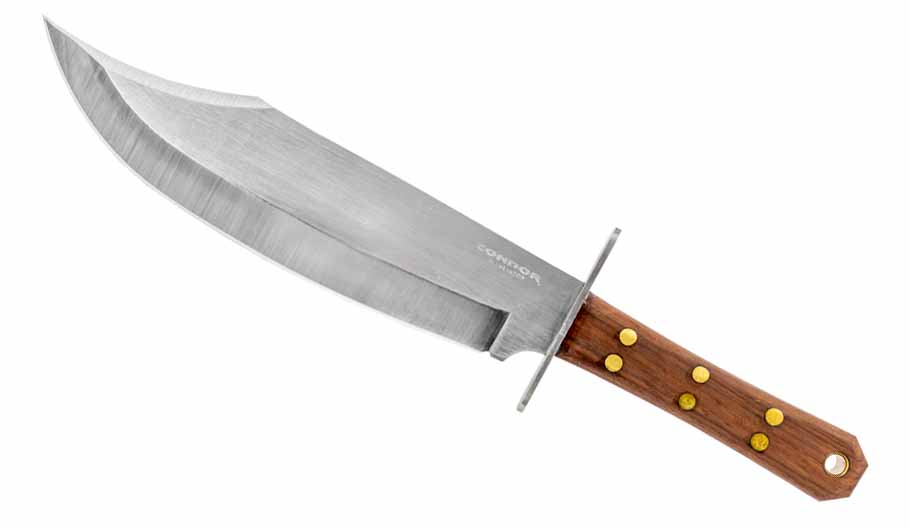
Condor Tool & Knife Undertaker Bowie
Fixed
10.2
15.6
24
1075
Walnut
Welted Leather Sheath
$118
Best Bowie Knives And Bowie-Inspired Knives For Any Budget
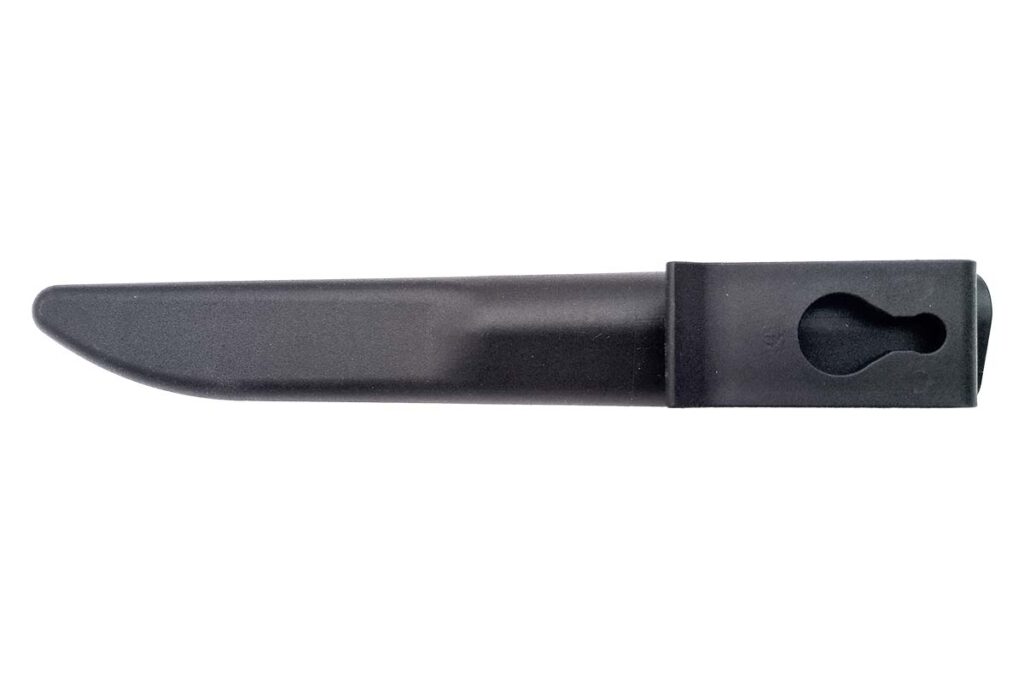
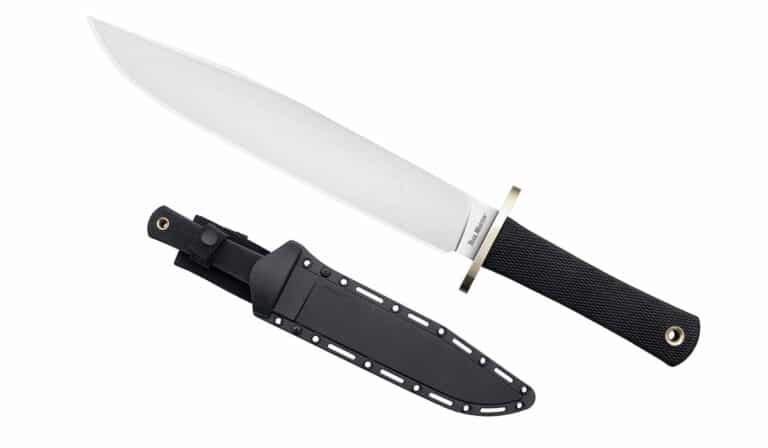
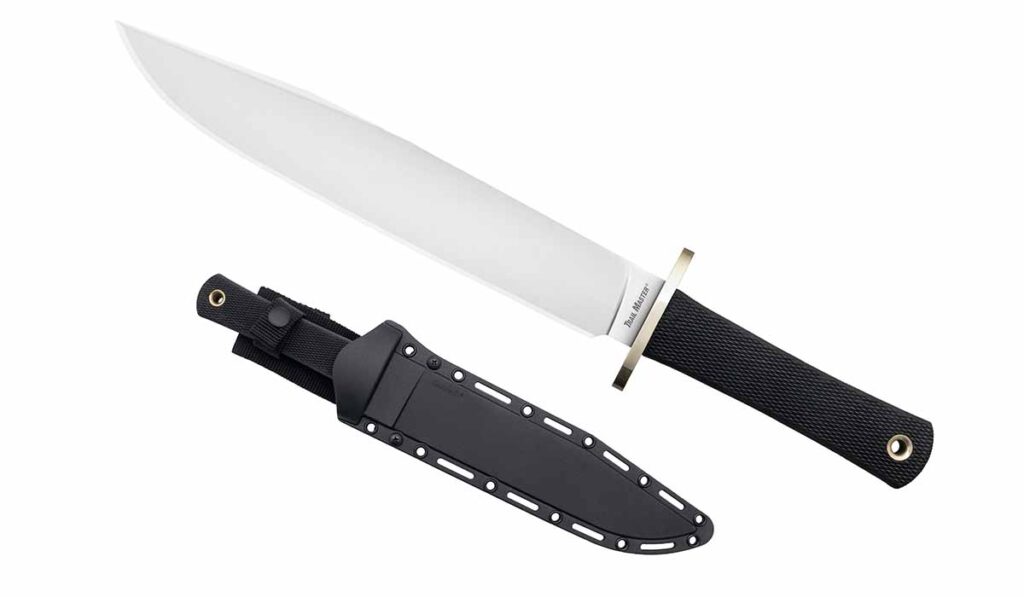
The Cold Steel Trail Master is a rugged Bowie knife designed for heavy-duty tasks. Its 9.5-inch blade is made from VG-1 stainless steel, known for its exceptional sharpness and resistance to corrosion. This knife’s clip-point blade design, with a concave curve on the top edge, allows for precise slicing and piercing.
The Kraton handle provides a comfortable and secure grip even in wet conditions, making it an excellent choice for outdoor enthusiasts. The full tang construction ensures durability and stability, making it capable of withstanding substantial abuse. The Trail Master is the go-to option when you need a reliable, high-performance Bowie knife for demanding tasks in the field.
Buck Knives’ 124 Frontiersman is a classic Bowie knife that pays homage to the heritage of American bladesmithing. Its 6.25-inch 420HC stainless steel blade is known for its edge retention and ease of maintenance. This Bowie knife boasts a timeless design with a sweeping clip-point blade and a polished brass guard.
The handle is made of rich and dark micarta, which not only adds to the knife’s aesthetics but also provides an excellent grip. This knife’s combination of traditional craftsmanship and modern materials makes it an excellent choice for those who appreciate the artistry of a well-made Bowie knife.
The Gerber StrongArm offers a modern take on the classic Bowie design. Its 4.8-inch stainless steel blade is versatile, featuring a fine edge and serrations on the spine for additional cutting options. The blade’s black ceramic coating enhances durability and corrosion resistance.
What sets the StrongArm apart is its diamond-textured rubber handle. This design ensures a secure grip in various weather conditions, making it an ideal choice for those who value a reliable grip during outdoor activities. The knife also features a striking pommel at the base of the handle, which can be used for various tasks, including glass breaking.
For those seeking a premium Bowie knife, the SOG Super Bowie delivers both style and substance. Its 7.5-inch AUS-8 stainless steel blade offers excellent edge retention and corrosion resistance. The stacked leather handle adds a touch of elegance while providing a comfortable grip.
This Bowie knife combines the best of classic design with modern materials and craftsmanship. It features a brass handguard and pommel, enhancing its overall aesthetics. The Super Bowie is an excellent choice for collectors and enthusiasts who appreciate the fusion of tradition and innovation in a high-quality knife.
The OKC 498 is a straightforward and dependable Bowie knife designed for practicality. Its 8-inch carbon steel blade is rugged and easy to sharpen, making it an excellent choice for outdoor enthusiasts who value simplicity and reliability.
The Kraton handle offers a secure and comfortable grip, even in wet conditions. This knife’s utilitarian design makes it a versatile tool for a wide range of tasks, from campsite chores to survival situations. If you’re looking for a no-nonsense Bowie knife that gets the job done, the OKC 498 is an excellent choice.
While not a traditional Bowie knife, the KA-BAR USMC Fighting Knife has earned its place among classic American blades. With a 7-inch 1095 Cro-Van steel blade, it’s renowned for its durability and edge retention. This knife has a rich military history, having served the U.S. Marine Corps during World War II.
The leather handle provides a comfortable and secure grip, while the double guard protects the hand during combat or utility tasks. The USMC Fighting Knife is a versatile and iconic choice for those who appreciate a knife with a storied history, and one that is of course tied to the Bowie that inspired it.
The Emerson CQC-7BW is a modern take on the Bowie design, featuring a folding blade for everyday carry (EDC) convenience. With a 3.3-inch stainless steel blade, this knife is compact and versatile, making it suitable for a wide range of daily tasks. The clip-point blade design provides excellent piercing capability, and the thumb disk allows for easy one-handed opening.
The G-10 handle scales offer durability and a secure grip. Emerson Knives are known for their tactical functionality, and the CQC-7BW lives up to this reputation. If you’re looking for a compact and reliable EDC option inspired by the Bowie style, this knife is an excellent choice.
The TOPS Knives Tom Brown Tracker is a unique Bowie-inspired knife with a distinctive multi-purpose design. Its 6.38-inch 1095 high carbon steel blade features a variety of edges and angles, making it suitable for a wide range of tasks, from chopping to carving. This versatility has made it a favorite among survivalists and outdoor enthusiasts.
The handle is made of Micarta, providing a comfortable and secure grip. The Tracker is designed to handle tough wilderness challenges, making it an excellent choice for those who want a dependable tool for camping, bushcraft, and survival scenarios.
The ESEE Junglas is a heavy-duty Bowie knife built to withstand the most demanding survival situations. With a massive 10.38-inch 1095 carbon steel blade and full tang construction, it’s a powerhouse of a knife. The blade’s black powder coating enhances durability and corrosion resistance.
The Micarta handle scales offer a comfortable and secure grip, even during extended use. The Junglas is designed for heavy chopping, batoning, and other rugged tasks that might arise in the wilderness. If you need a Bowie knife that can handle the toughest challenges, this is a top choice.
Condor’s Undertaker Bowie combines traditional craftsmanship with affordability. Its 10-inch 1075 high carbon steel blade is known for its toughness and ease of sharpening. This knife is designed for practicality, making it an ideal choice for outdoor enthusiasts and those who appreciate a robust tool.
The hardwood handle not only adds to the knife’s aesthetics but also provides a comfortable and secure grip. The Undertaker Bowie excels in tasks such as wood processing and campsite chores, making it a dependable companion in the great outdoors.
A budge-priced EDC cleaver that is priced for rough use.
Cleavers have broken out of the butcher shop and kitchen in recent years to become a sought-after EDC. Seems counterintuitive, but there’s a method in the knife-buying world’s madness.
One of the more interesting conversations I had at BLADE Show West 2024 came with a crane rigger who favored this style of blade. With the flat cutting edge that makes mincemeat of heavy-duty rope and a muted tip, he didn’t have to worry about perforating himself, the knife class is highly practical in the pocket.
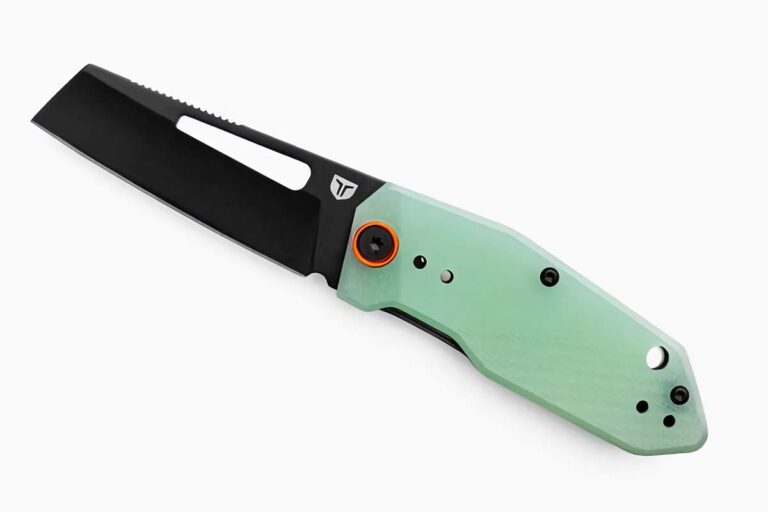
This is all a long way to say, there’s a new pocket cleaver in town with True Knives dropping the Berm Cleaver Flipper.
Part of the brand’s new Berm series, the knife offers a budget option most users won’t shy away from rough use. Yet, for its price, the knife offers a nice profile, though it might lack some in the steel True Knives uses for the blade.
Berm Cleaver Flipper Blade
To that point, the Berm Cleaver Flipper is constructed of 7Cr17MoV, a popular choice in budget knives. While the metal does take a good edge and has respectable hardness and excellent corrosion resistance, it has a few hitches in its giddyap. In particular, its toughness—particularly in thinner blades—is wanting, and edge retention is not among the best.
Still, this is a budget EDC we’re talking about. Despite the steel’s drawback, True Knife has come up with a fairly spiffy blade profile. The knife has a fairly traditional cleaver look, though the 2.5-inch blade boasts a slight belly and does have a bit of a tip. The tip is welcome, making the knife more useful for everyday tasks where a puncturing point is required.
The brand includes generous jimping on nearly the entirety of the spine, offering extra purchase on chopping tasks. Additionally, there is a good choil on the blade, which helps in making sure you can sharpen the entire blade.
Berm Cleaver Flipper Handle
The grip is where the cleaver shines, with a relatively nice affair laid out. First off, I’m a sucker for the translucent green G-10, it gives the knife a modern look without being too audacious. Plus, particularly on a build at this price point, the G-10 is a solid material choice—textured nicely to make it stick to the hand.
Also appreciated, the cleaver’s clip is not only reversible but can be situated for tip-up or down carry. A versatile bonus on the knife.
Berm Cleaver Flipper Action
As its name suggests, the Berm Cleaver Flipper, though it’s a front flipper offering both index finger and thumb deployment. Additionally, it has a prominent thumb hole.
Smartly, True Knives has cut away some of the handle to offer access to the deployment mechanism, allowing users plenty of leverage options to get the blade to work. Caged bearing aids in a smooth and fast opening.
Final Cut
With an MSRP of $30, the Berm Cleaver Flipper is made for heavy use and abuse. The best part, if you put it through the wringer you won’t cry over a broken knife.
What’s on the menu this month? A bevy of new kitchen knives–both factory and custom.
With the big holidays ahead, we’re heading into the thick of eating season. In turn, it might be time to up the game of your kitchen tools. We have selected a bevy of new custom and factory kitchen knives to show off this month, which only leaves the question—what’s on your menu?
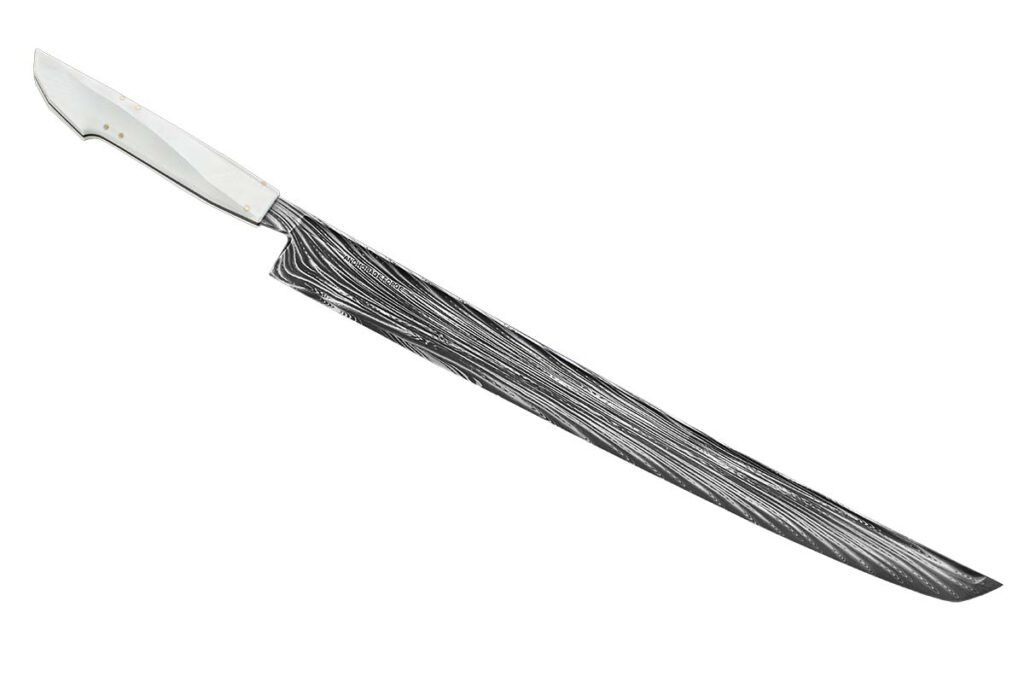
Gabe Fletcher and Don Nguyen Slicer
KNIFE TYPE: Slicer BLADE LENGTH: 17.25” BLADE MATERIAL: Damascus of 1080 carbon and 15N20 nickel-alloy steels BLADE GRIND: Convex w/a fuller HANDLE MATERIAL: Carbon fiber and G-10 OVERALL LENGTH: 23.25” MAKERS’ PRICE FOR A SIMILAR KNIFE: $8,000 KNIFE TO KNOW: The knife is a collaboration between Gabe Fletcher and Don Nguyen; Gabe forged the damascus and the blade, and Don finish ground it and made the handle; Gabe also made a special beer called Nguyen for the collaboration through his Anchorage Brewing Co.; Gabe is an ABS apprentice smith MAKERS: Gabe Fletcher and Don Nguyen, (Jocelyn Frasier image)
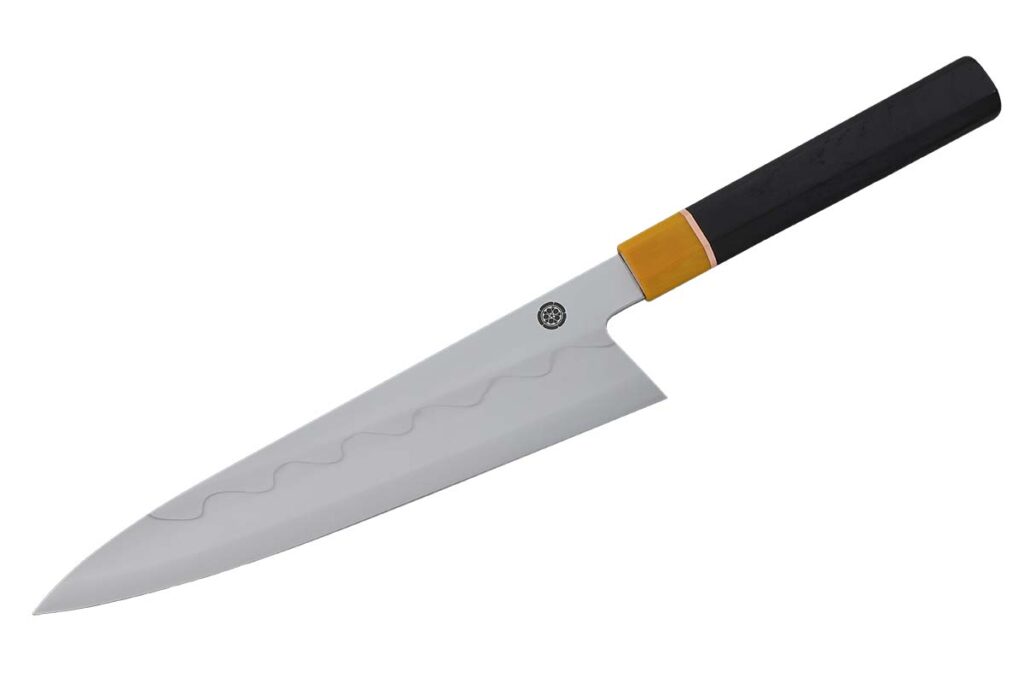
DP Custom Knives Chef’s Knife
PATTERN: Chef’s knife MODEL NAME: Honyaki gyuto BLADE LENGTH: 9.45” BLADE MATERIAL: W2 tool steel BLADE GRIND: “S” type BLADE FINISH: Hand-sanded satin HANDLE MATERIAL: Ukrainian bog oak BOLSTER MATERIAL: Antique Westinghouse Micarta® and copper OVERALL LENGTH: 15.95” KNIFE TO KNOW: The maker’s Honyaki Gyuto won Best Chef’s Knife at the 2024 Sydney Knife Show MAKER’S PRICE FOR A SIMILAR KNIFE: $1,546 at press-time exchange rate MAKER: Dmitriy Popov, DP Custom Knives, dpcustomknives.com.au, (Rod Hoare image)
Jonas Blade & Metalworks Senshi
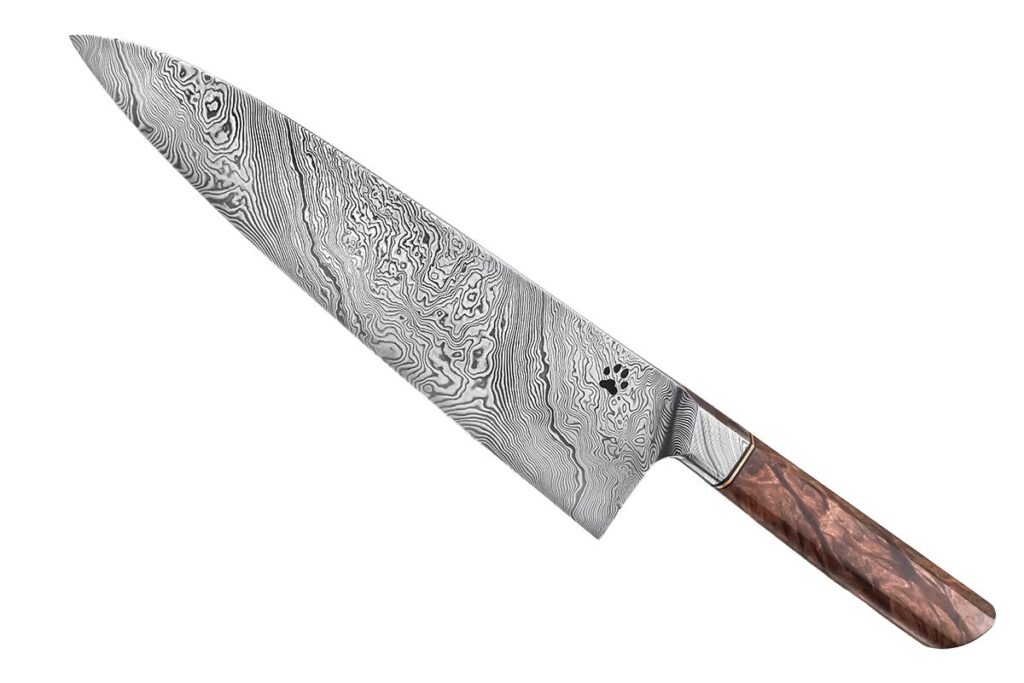
KNIFE NAME: Senshi PATTERN: Chef’s knife BLADE LENGTH: 9.25” BLADE MATERIAL: Damascus of 1084 carbon and 15N20 nickel-alloy steels DAMASCUS PATTERN: River of Fire + twist BLADE GRIND: Flat w/a convex edge HANDLE MATERIAL: Black stabilized amboyna BOLSTER: Micarta® and brass OVERALL LENGTH: 14” KNIFE TO KNOW: The maker is an ABS master smith MAKER’S PRICE FOR A SIMILAR KNIFE: $4,600 MAKER: Zack Jonas, Jonas Blade & Metalworks, (SharpByCoop image)
Brent Stubblefield Chef’s Knife
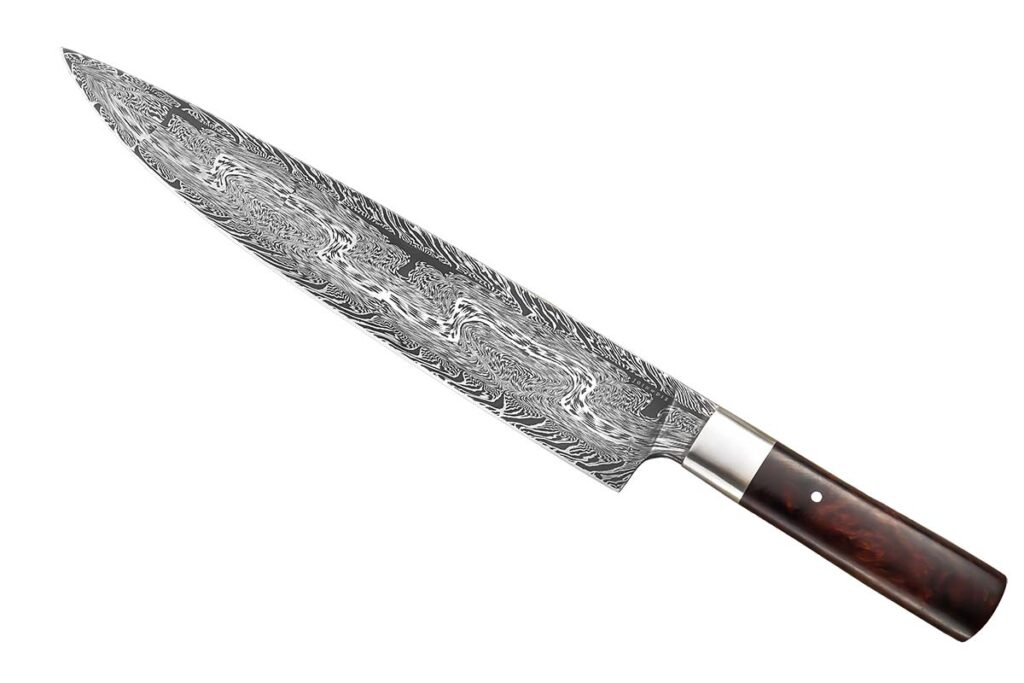
PATTERN: Chef’s knife BLADE LENGTH: 12” BLADE MATERIAL: Mosaic damascus BLADE GRIND: “S” type HANDLE MATERIAL: Desert ironwood BOLSTER: Fine silver OVERALL LENGTH: 17.5” MAKER’S PRICE FOR A SIMILAR KNIFE: $2,400 MAKER: Brent Stubblefield, joinordieknives.com, (SharpByCoop image)
Alexandre Chaves Chef’s Knife
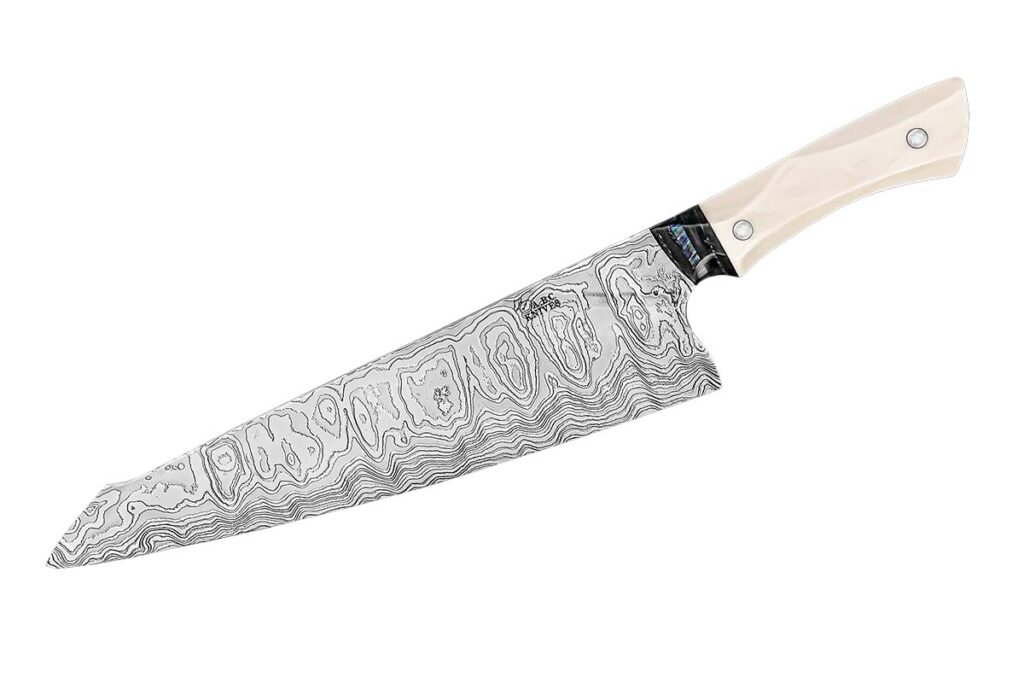
PATTERN: Chef’s knife BLADE LENGTH: 9.75” BLADE MATERIAL: A damascus of 1084 carbon and 15N20 nickel-alloy steels ROCKWELL HARDNESS: 60 HRC BLADE GRIND: Convex BLADE FINISH: Contrast etched w/Gator Piss etching solution HANDLE MATERIAL: Elforyn synthetic ivory; filework inlaid w/crushed natural Shattuckite and contrasted w/gold resin BOLSTER MATERIAL: 9,000-year-old bog oak w/purple maple spacer OVERALL LENGTH: 14” MAKER’S PRICE FOR A SIMILAR KNIFE: $3,000 KNIFE TO KNOW: The blade features a K-tip, aka kiritsuke tip, designed for precision and versatility in fine slicing, dicing and scoring, as well as more delicate work such as preparing fish and fine cuts of meat; the knife is a wedding present for the maker’s little sister MAKER: Alexandre Chaves, (Jocelyn Frasier image)
Modern Cooking UG Chef’s Knife
PATTERN: Chef’s knife BLADE LENGTH: 9.25” BLADE MATERIAL: Damasteel DS93x dense twist pattern stainless steel BLADE GRIND: Convex BOLSTER: Integral forged HANDLE MATERIAL: Redwood lace burl and copper OVERALL LENGTH: 10.4” SHEATH: Redwood lace burl and copper MAKERS’ PRICE FOR A SIMILAR KNIFE: $2,775 at press-time exchange rate KNIFE TO KNOW: The knife is a collaboration between Naohito Myojin of Japan and European Jonas Johnsson; Johnsson did the forging, profiling, handle and saya (scabbard), and Myojin ground the blade; Modern Cooking organized the collaboration in partnership with Bonsai Boys Trading MAKERS: Naohito Myojin and Jonas Johnsson, Modern Cooking UG, moderncooking.com, (SharpByCoop image)
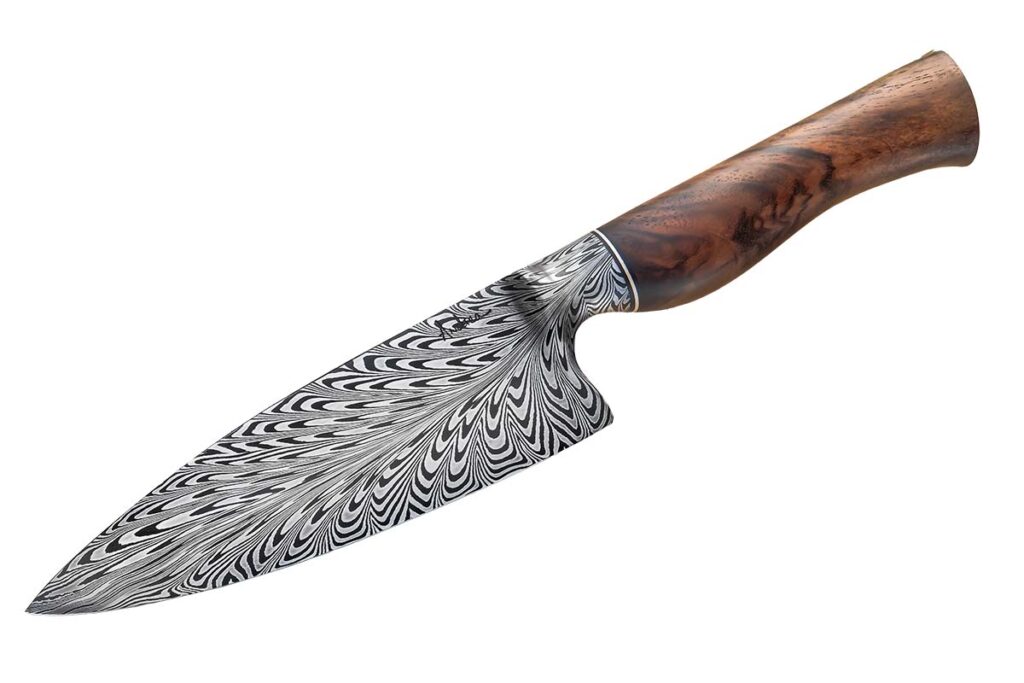
Andrea Lisch Chef’s Knife
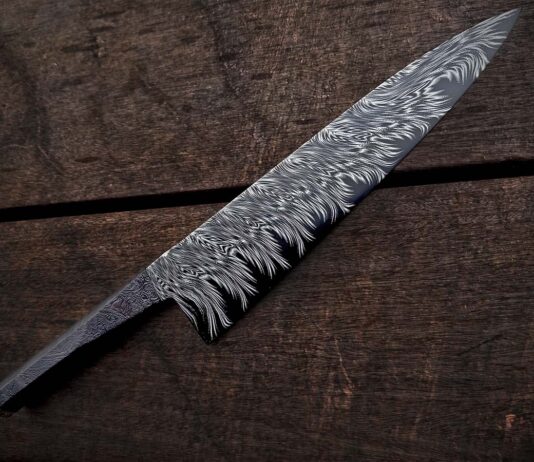
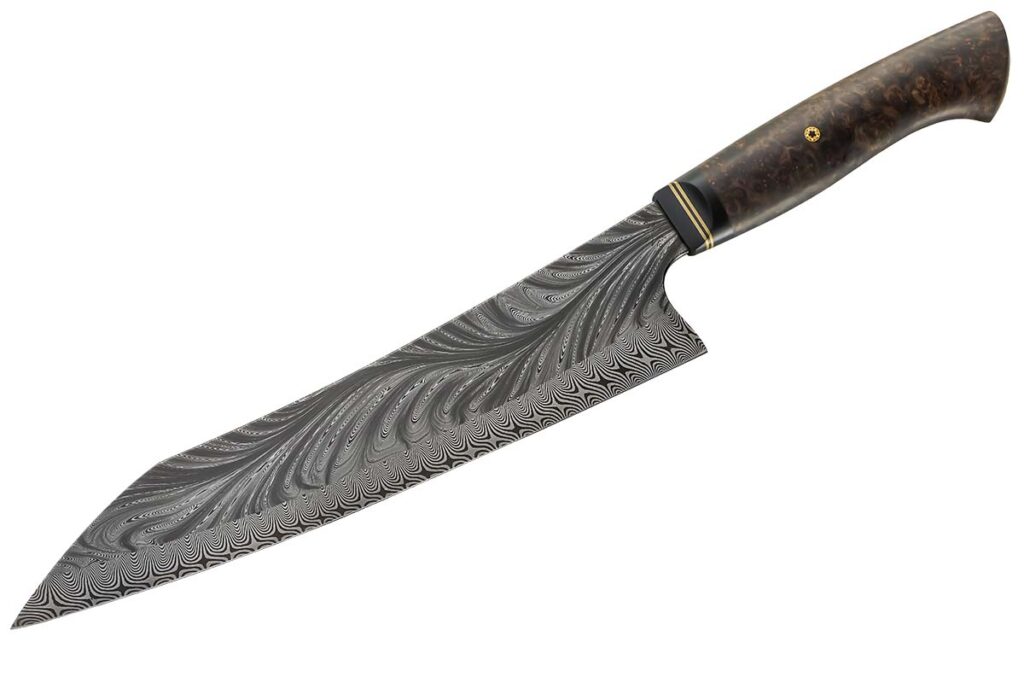
PATTERN: Chef’s knife BLADE LENGTH: 6.5” BLADE MATERIAL: Feather pattern damascus BLADE GRIND: Custom convex BOLSTER: Damascus HANDLE MATERIAL: Black walnut CONSTRUCTION: Forged integral OVERALL LENGTH: 11.25” MAKER’S PRICE FOR A SIMILAR KNIFE: $1,300 KNIFE TO KNOW: The maker is a journeyman smith in the American Bladesmith Society MAKER: Andrea Lisch, (SharpByCoop image)
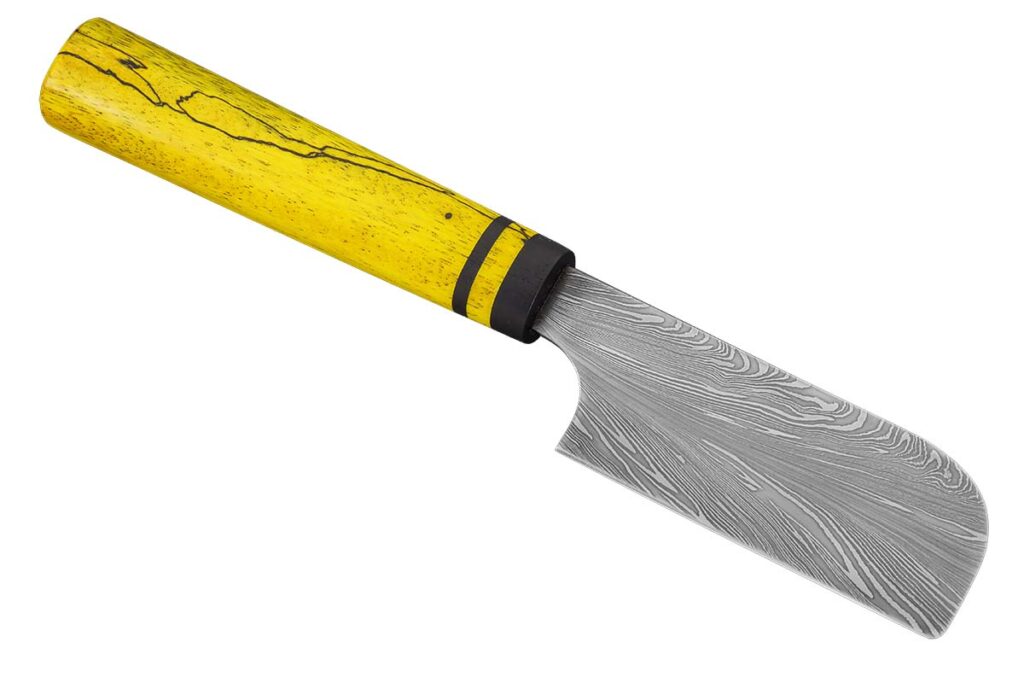
Ceilidh Dalton Veggie Chopper
KNIFE NAME: Yellowjacket KNIFE TYPE: Veggie Chopper BLADE LENGTH: 3.94” BLADE MATERIAL: Damascus of 1075 carbon and 15N20 nickel-alloy steels BLADE GRIND: Flat DAMASCUS PATTERN: Feather forged by Mathew McVicker HANDLE MATERIAL: Spalted tamarind BOLSTER: Ebony OVERALL LENGTH: 8.27” KNIFE TO KNOW: The maker is a probationary member of the Australian Knifemakers Guild MAKER: Ceilidh Dalton, (Rod Hoare image)
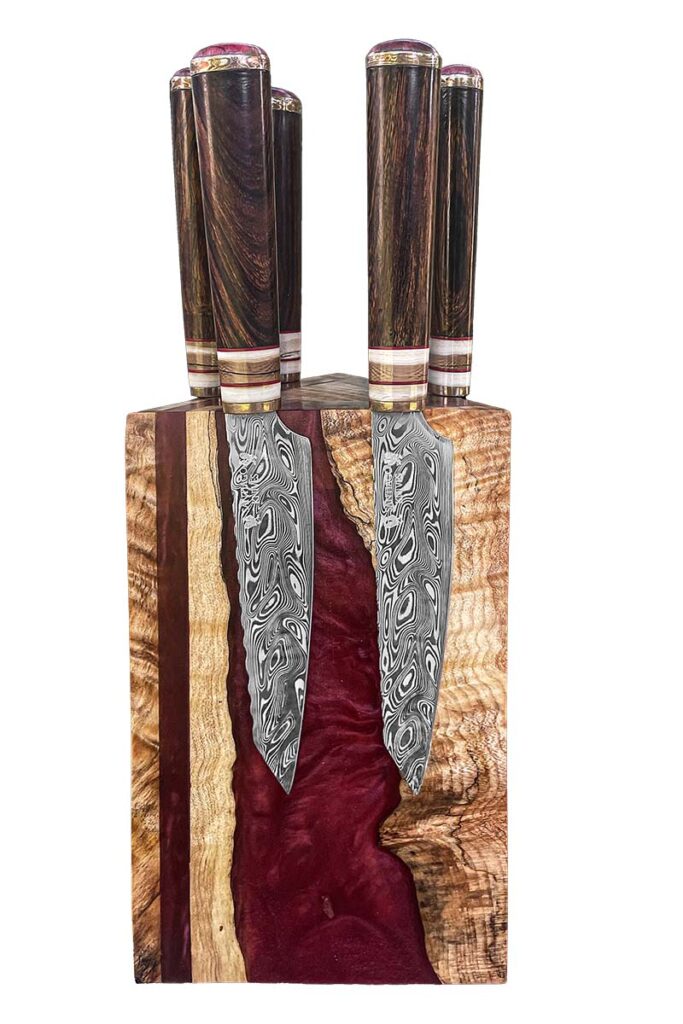
Jose Santiago-Cummings Steak Knife Set
PATTERN: Steak knife set BLADE LENGTHS: 5” BLADE STEEL: Damasteel stainless damascus in a Thor pattern BLADE GRIND: Full flat HANDLE: Mastodon ivory, red spacer, ironwood BUTTCAPS: Mokume gane and red-dyed coral OVERALL LENGTHS: 9” MAKER’S PRICE: $1,500 for the set, including stand; $300 per knife MAKER: Jose Santiago-Cummings, santiagoknives.com, (Jocelyn Frasier image)
Geoffrey Baze Chef’s Knife
PATTERN: Chef’s knife BLADE LENGTH: 9” BLADE MATERIAL: W2 tool steel BLADE GRIND: Flat HANDLE: Tasmanian blackwood w/bird’s-beak butt HANDLE PINS: Black Micarta® OVERALL LENGTH: 14” KNIFE TO KNOW: The maker is an ABS apprentice smith MAKER: Geoffrey Baze, (Jocelyn Frasier image)
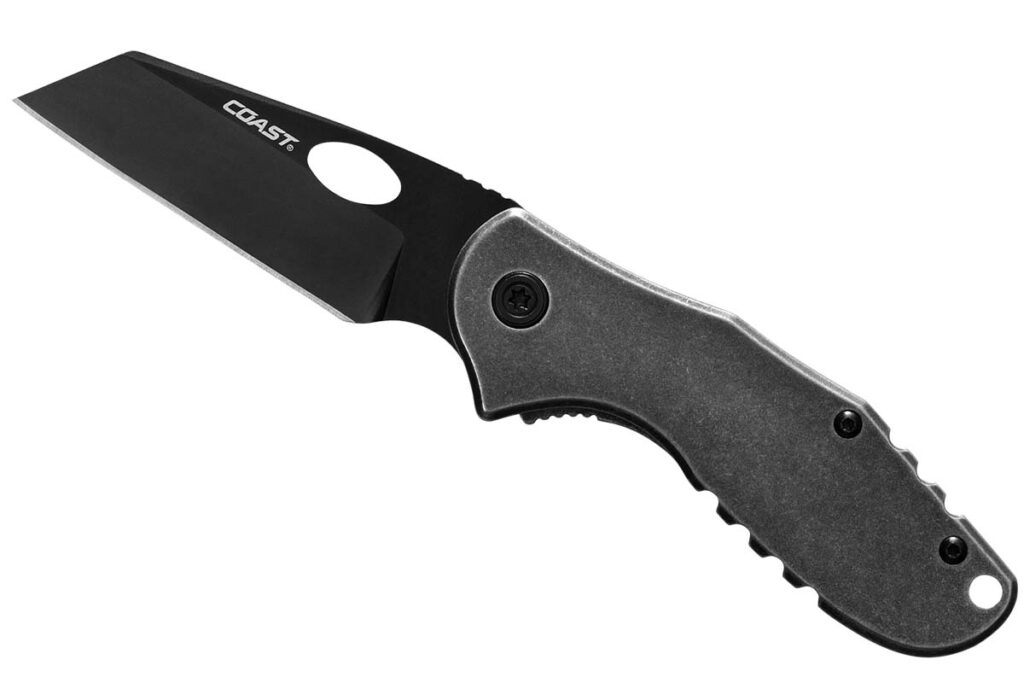
Coast Contra
KNIFE NAME: Contra MODEL TYPE: EDC pocketknife BLADE LENGTH: 2.5” BLADE STEEL: 7Cr17 stainless BLADE PATTERN: Wharncliffe BLADE FINISH: Flat black titanium nitride coating BLADE OPENER: Blade hole HANDLE MATERIAL: stainless steel w/hole for a lanyard POCKET CLIP: One position LOCK: Framelock CLOSED LENGTH: 3.75” CONTINENT OF ORIGIN: Asia MSRP: $29.99 COMPANY: Coast, coastportland.com
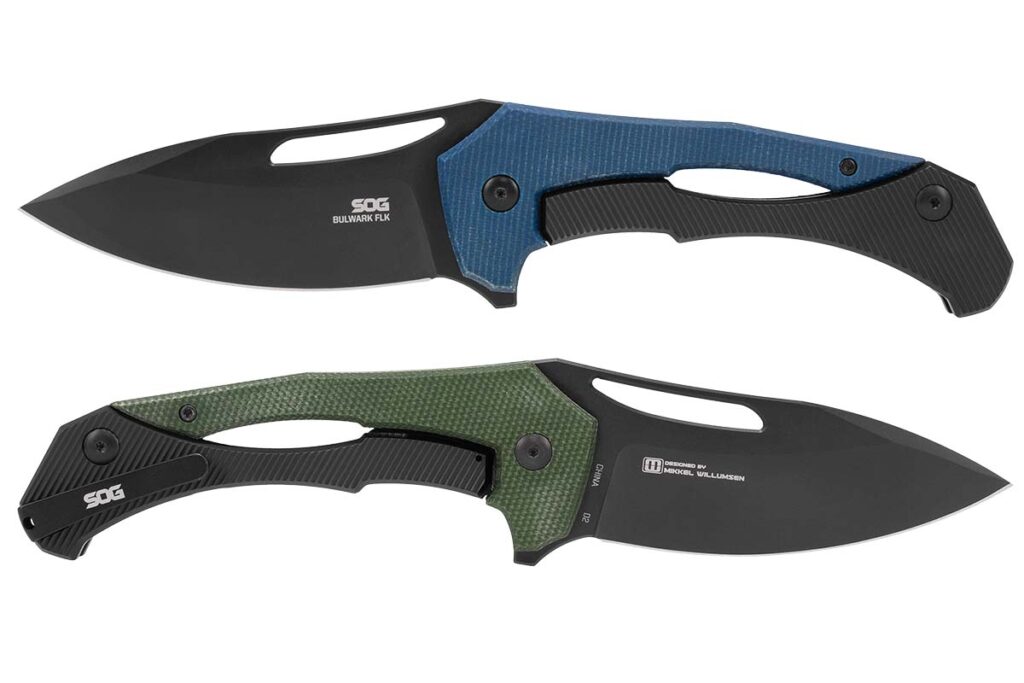
SOG Knives Bulwark
KNIFE NAME: Bulwark DESIGNER: Mikkel Willumsen KNIFE TYPE: Flipper folder BLADE LENGTH: 3” BLADE MATERIAL: D2 tool steel BLADE PATTERN: Drop point BLADE @THICKEST: .14” BLADE FINISH: Black PVD coating BLADE OPENERS: Blade hole and flipper tab HANDLE MATERIAL: Micarta® in green (shown) or blue color options POCKET CLIP: Reversible, low carry LOCK: Framelock WEIGHT: 3 ozs. CLOSED LENGTH: 4” CONTINENT OF ORIGIN: Asia MSRP: $124.95 COMPANY: SOG Knives, sogknives.com
The Japanese take on Western chef’s knives are mighty mealmakers. Here are some top-notch options.
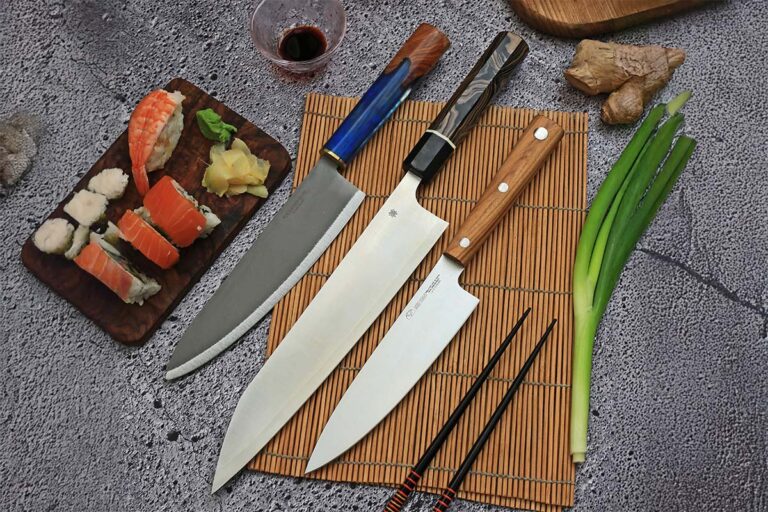
A gyuto is a versatile, multi-purpose kitchen knife perfect for professional chefs and home cooks. It typically features a thinner, lighter blade than traditional chef’s knives, sharpened at a steeper angle for extremely precise and clean cuts. It often has a flatter profile toward the heel and a more gradual curve near the tip, making it versatile for various cutting techniques. The handle is often lighter and more agile, reflecting the Japanese emphasis on nimble and efficient movements in the kitchen.
Fox Knives Gyuto 2C 504 0L
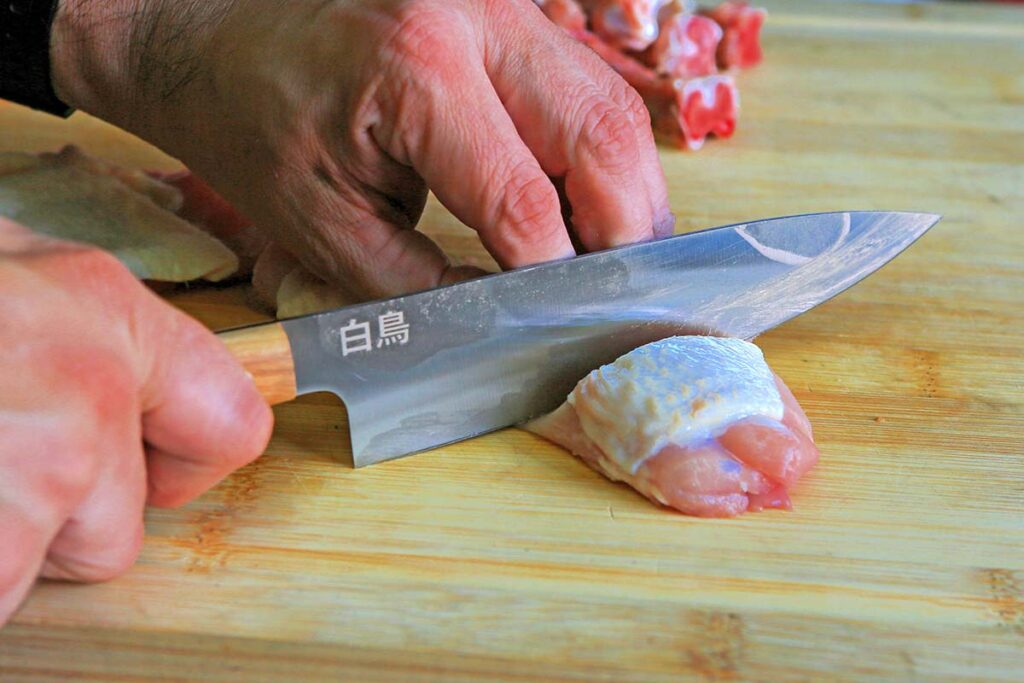
The Fox gyuto effortlessly prepared chicken thighs for delicious teriyaki chicken and yakitori, trimming excess fat and skin.
FOX Knives Gyuto 2C 504 OL Blade Length: 6.69” Blade Steel: 4119 nitro-B stainless Blade Grind: Flat Blade @Thickest: .08” Blade Finish: Satin Handle Material: Olive wood Overall Length: 11.81” Country of Origin: Italy MSRP: $75.70
Pros
Durable 4119 Nitro-B Stainless Steel Blade
Exceptional Balance and Lightweight Design
Comfortable Olivewood Handle
Cons
Limited Grip for Large Hands
The Fox Knives Gyuto 2C 504 0L is a representative example of the genre. Crafted with precision and passion, it features a razor-sharp blade that is durable and holds an edge. The elegant handle offers a comfortable grip and a smidge of rustic charm.
At just 5.11 ounces, this featherweight beauty is a breeze to manipulate and perfectly balanced for effortless slicing, dicing and chopping. The 4119 nitro-B stainless steel blade’s Rockwell hardness of 55-57 HRC guarantees superior resilience, while the satin finish adds a touch of sophistication. Equipped with sturdy stainless-steel rivets, this gyuto is a culinary companion you can trust, not just a kitchen tool.
When in Japan, I love ordering yakitori—skewered, grilled chicken with a savory, slightly sweet flavor and smoky aroma. Making the dish was a team effort using specific knives for deboning and slicing the chicken into proper portions for the skewers. The key is to use a slow rocking/chopping motion to make clean, decisive slices rather than sawing through the meat, resulting in “chainsaw chicken.”
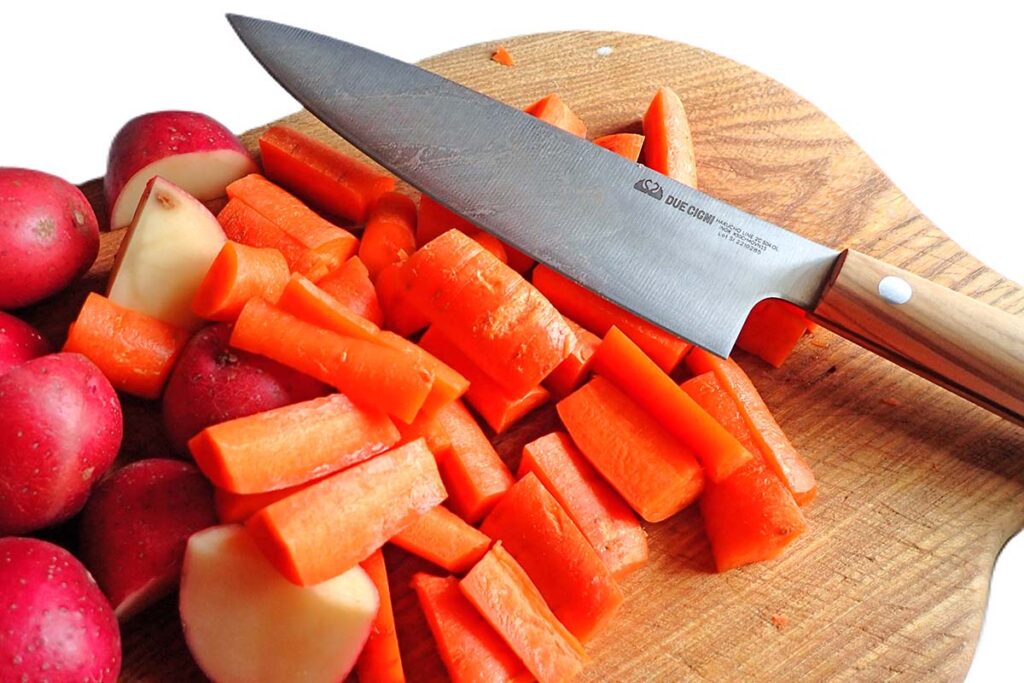
The Fox sliced potatoes, onions, garlic and carrots for pot roast. The thin edge and super comfortable handle were unmatched.
Since the gyuto is the Japanese version of the archetypal Western chef’s knife, I made a Western dish—beef pot roast—and did the vegetable prep with the Fox. Slicing vegetables, potatoes, carrots and onions was a breeze with this slicing machine. I keep it simple, using rock chops, cross chops and pull cuts 90 percent of the time. Push cuts with the heel of the blade work well for hard veggies. Meanwhile, the olivewood handle remained comfy with no hot spots and grippy even when wet or covered with chicken fat. Leave it to the Italians to utilize this stunningly underused wood. Regarding plating, the Fox sliced the most elegant roast beef that ever graced a dish.
Fox Knives
$78
BladeHQ
$35
Condor Tool & Knife Shefu Kitchen Gyuto
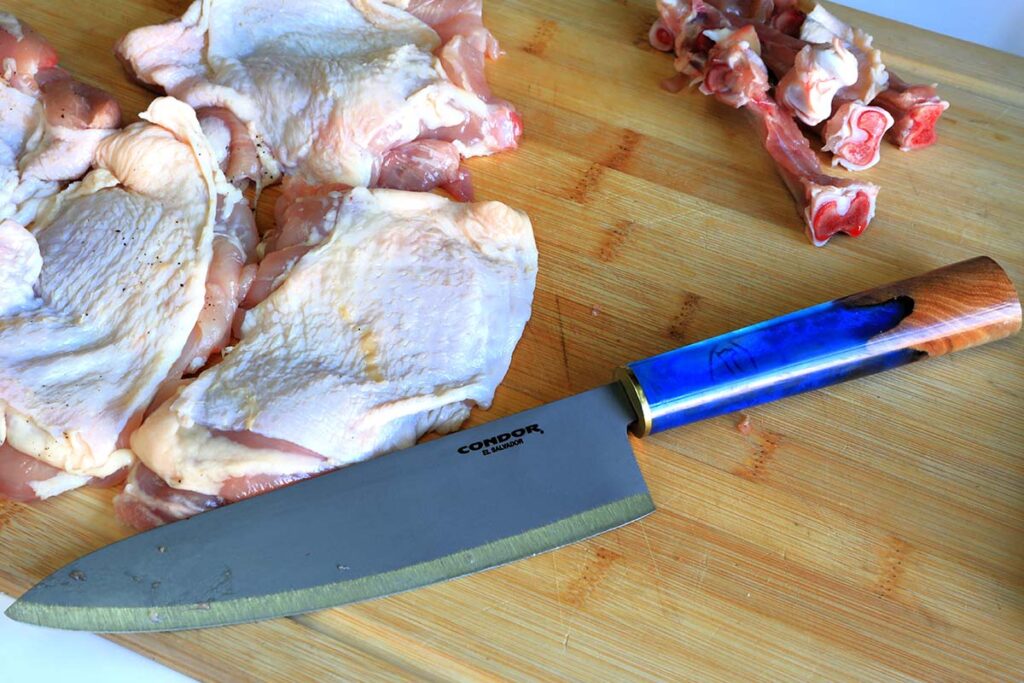
The Condor Shefu deboned multiple chicken thighs using a roll-cutting method for yakitori skewers and teriyaki chicken.
Shefu Kitchen Gyuto Specs Blade Length: 7.83” Blade Steel: 440C stainless Blade Grind: Full flat w/second bevel Blade @Thickest: .12” Blade Finish: Blasted satin Handle Material: Epoxy resin and hickory Overall Length: 12.92” Sheath: Welted leather Country of Origin: El Salvador MSRP: $154.98
Pros
Versatile Outdoor and Culinary Tool
Comfortable and Ergonomic Handle
Full Flat Grind with Second Bevel
Cons
Bit hefty
The Shefu Kitchen Gyuto from Condor Tool & Knife is a multi-use knife designed for bushcraft enthusiasts who want to prepare delicious meals while enjoying the great outdoors. Crafted with precision in mind, the Shefu is perfect for slicing vegetables and expertly preparing meat and fish. It is a versatile tool ready to tackle any culinary challenge.
The Condor gyuto is hardy and beautiful. The full flat grind with a second bevel ensures optimal slicing performance, while the handle provides a comfortable, secure grip. The knife strikes the perfect balance between heft and maneuverability. The leather sheath provides safe storage and easy transport.
I pushed the Shefu into service sectioning beef roast and deboning and trimming six chicken thighs. The knife tackled the tasks with ease. Slicing 3.5-pound roast required a sharp yet hefty slicer like a cleaver. The Shefu fit the bill and delivered. Bottom round roast is tough as woodpecker lips, and a thin, flexible blade need not apply here. At 9.88 ounces, the Condor’s robust blade strikes the perfect balance between heft and finesse.
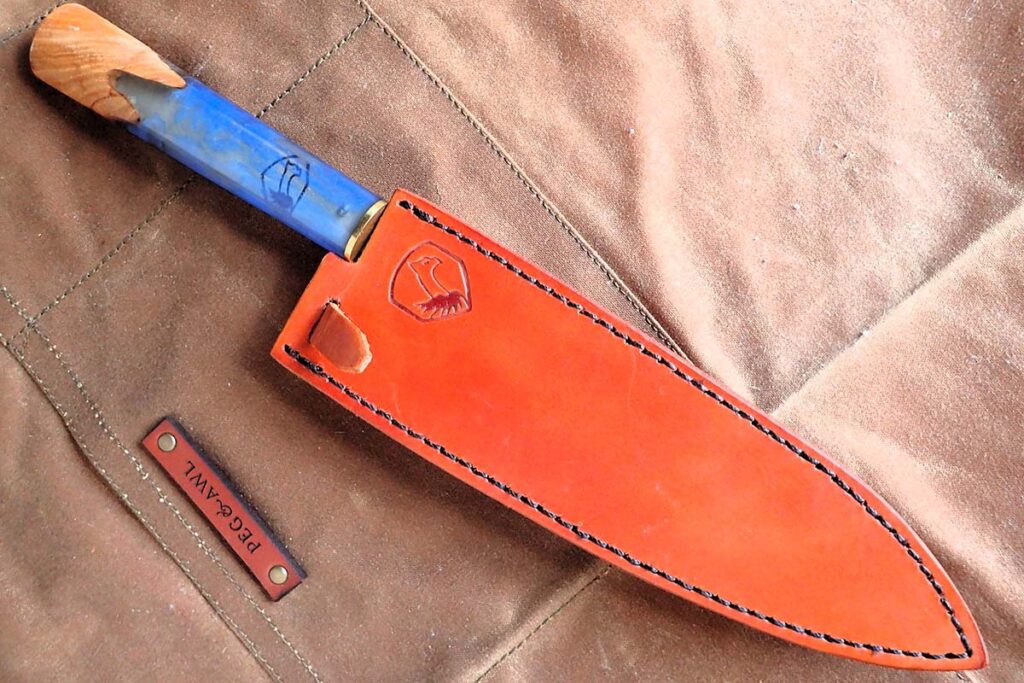
The Condor has the only sheath of the test bunch, of a beautifully handcrafted welted leather for safe storage and easy transport.
The handle has a colorful, comfortable oval shape that nestles in the hand. Hot spots and fatigue are nearly impossible with this grip. The full tang offers strength and security while keeping balance and weight at the forefront. The Shefu is an essential for any cooking enthusiast, whether at home or in the wild.
Condor
$155
SMKW
$132
Spyderco Itamae Gyuto
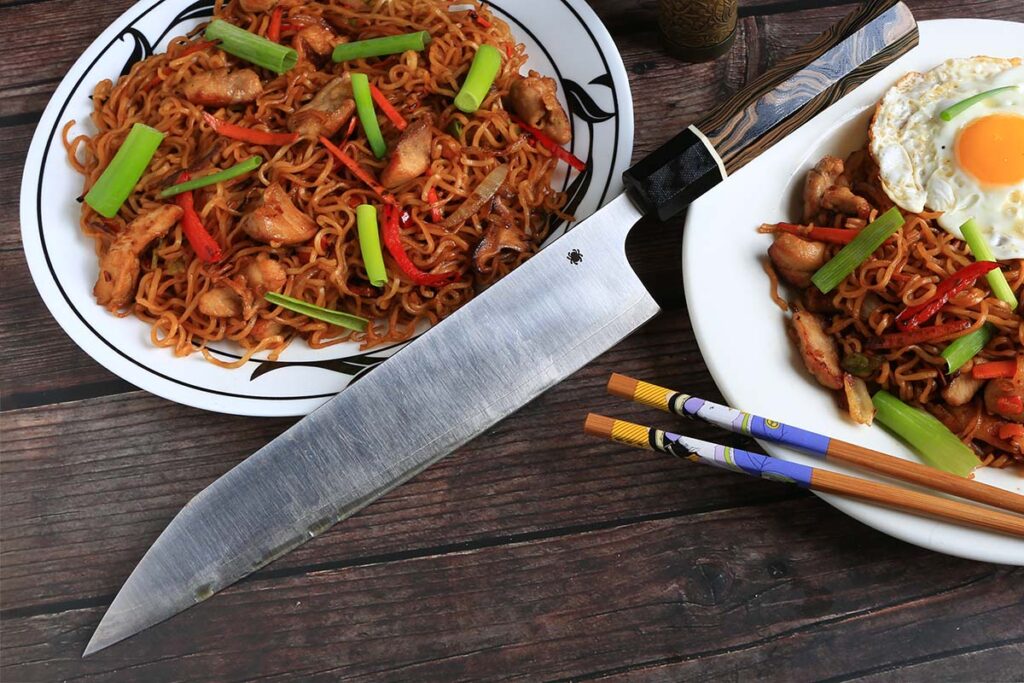
The author prepared the chicken yakisoba using the Spyderco. The knife sliced and diced carrots, onions, peppers, shiitake mushrooms, chicken and green onions for garnish.
Itamae Gyuto Specs Designer: Murray Carter Blade Length: 10.06” Blade Steel: Super Blue/SUS410 Blade Grind: Full flat Blade @Thickest: .094” Blade Finish: Satin Handle Material: Burl G-10 in the octagonal wa style Overall Length: 15.35” Country of Origin: Japan MSRP: $334
Pros
Exceptional Blade Construction
High-Quality, Ergonomic Handle
Beautiful Design and Craftsmanship
Cons
Higher Price Point
The Itamae Gyuto is part of the Spyderco Murray Carter Collection Itamae Series. The elite cutlery series is designed for highly skilled sushi chefs and showcases uncompromising craftsmanship and premium materials.
The Itamae Gyuto features a blade expertly crafted from laminated steel—an Aogami Super Blue core clad between layers of high-quality stainless. The three-layer construction ensures exceptional durability and sharpness, with Carter’s signature “Carter Elbow*” adding strength to the blade’s tip.
Paired with a traditional wa-style octagonal handle of stunning burl G-10 and highlighted with a black G-10 ferrule, the Itamae Gyuto embodies the spirit of Carter’s coveted custom kitchen knives. Tipping the scales at 7.4 ounces, it sets an impressive standard in high-performance household cutlery.
The Itamae Gyuto is a sushi knife and I’m a fan. Part of my time in Japan was seeking out various types of sushi. The second most rewarding part was watching the chefs work precisely as if it were the most critical game of Operation ever played—they are pros!
I used the test model to prepare carrots, onions, shiitake mushrooms, peppers, green onions and chicken for the famed yakisoba dish: fried street food noodles choked full of veggies, savory sauce and protein. Simple ingredients still require various knife techniques.
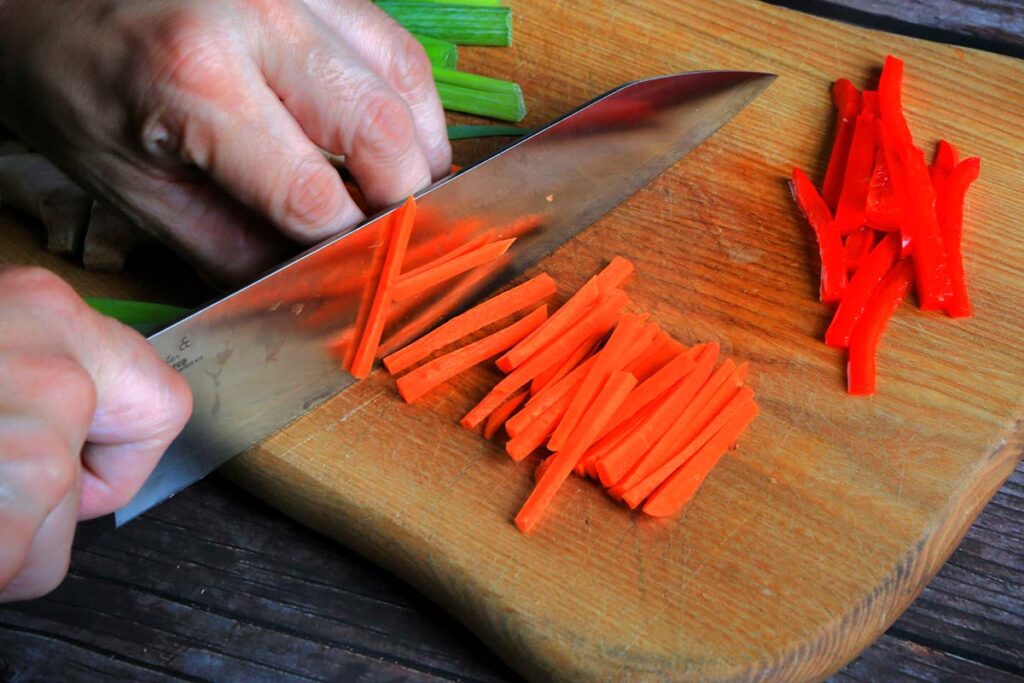
I used push-cuts on the tough carrots to square them to a safe position to stabilize them and make thin slices. From there, I stacked the slices for some rock-chopping to julienne a pile of carrots—in this instance, to make matchstick-sized carrot sticks. The secret to stir-fry cooking is preparation and cutting relatively equal-sized pieces of food to ensure equal cooking time.
To create julienne slices, the author employed the rock-chopping method with the Spyderco, again utilizing a chef’s pinch-grip and a claw grip with the offhand to support the food.
I used rock chopping and pull cuts—two techniques in which the Itamae excels—to slice the red peppers. To pull cut them, I placed the knife tip down on the board and sliced backward. By this time, the laminated steel had formed a nice patina from avocado, peppers, onions and chicken on the bevel, giving it a nice used look. Crafted in Japan, the Itamae Gyuto is an ultimate favorite among professional chefs and passionate cooking enthusiasts.
*Editor’s note: Through the Carter Elbow, Murray Carter combines the best features of a traditional Japanese wabocho kitchen knife with his Wharncliffe Brute neck knife. The design feature allows more steel to reinforce the forward tip of the blade compared to standard gyuto or French-style chef’s knife profiles.
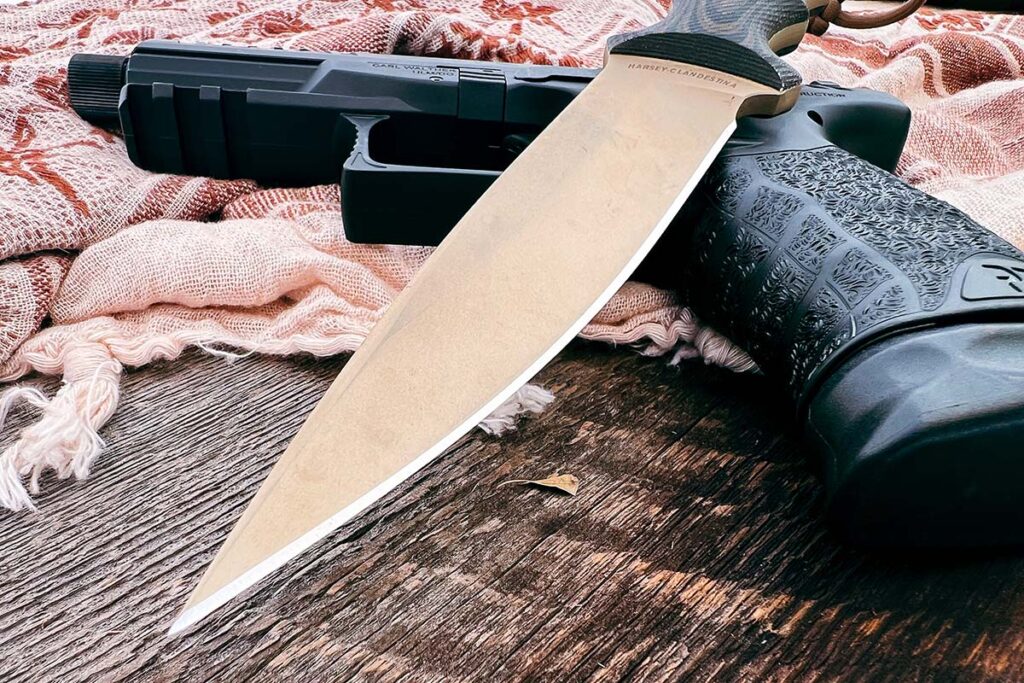
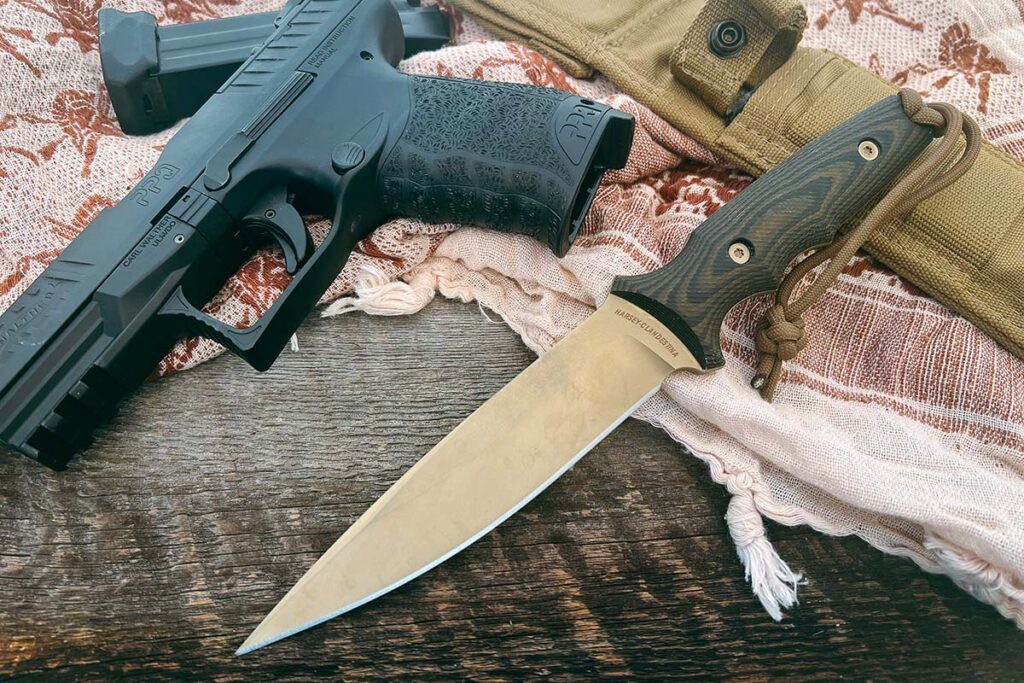
Find out why the Spartan Blades Clandestina took home Blade Knife of the Year, thanks to its standout tactical design, top-tier materials, and unbeatable performance.
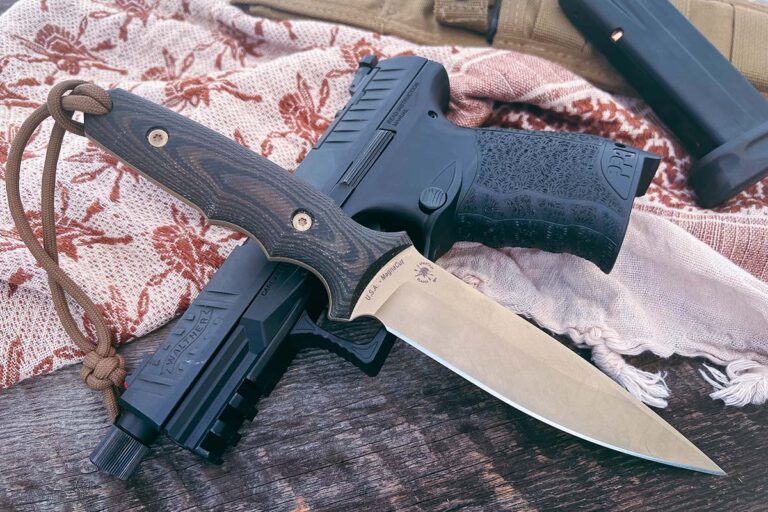
A deadly beauty, Spartan Blades’ Clandestina packages the best of both worlds. Yup, it’s a looker, but dang if it isn’t engineered to inflict damage.
The dueling personalities of the BLADE Knife of the Year aren’t surprising, given who cooked up this wicked fixed blade. Bill Harsey has built his reputation on designing robust outdoor and tactical knives.
Photos by Marty Stanfield, Marty Stanfield Photography
A favorite of Army Special Forces and figures such as Col. Rex Applegate, Harsey work also has a certain lethal aesthetic to it as well. But even with operators enamored with his work, Harsey’s Spartan project has an appeal beyond serving in foreign conflicts.
Spartan Clandestina Specs
Knife Type: Fixed Blade Type: Spear Point Blade length: 5.5 Blade steel: CPM MagnaCut Blade grind: Flat ground Handle material: Canvas Micarta Black and Camo Blade Hardness: 61-63 HRC Overall length: 10 3/16” Sheath type and material: MOLLE and Kydex options Special features: Available in Black and FDE PVD Coating, Double Deep Cryogenic Treatment MSRP:
Pros
Superior Ergonomics
Premium Blade Material
Sheath Options
Cons
Large For Everyday Carry
High Price Point
Niche Design
Spartan Clandestina Handle
Oddly enough for a knife review, I’m going to start at the handle. There’s a method in this madness, given this feature is what gives the Clandestina its edge.
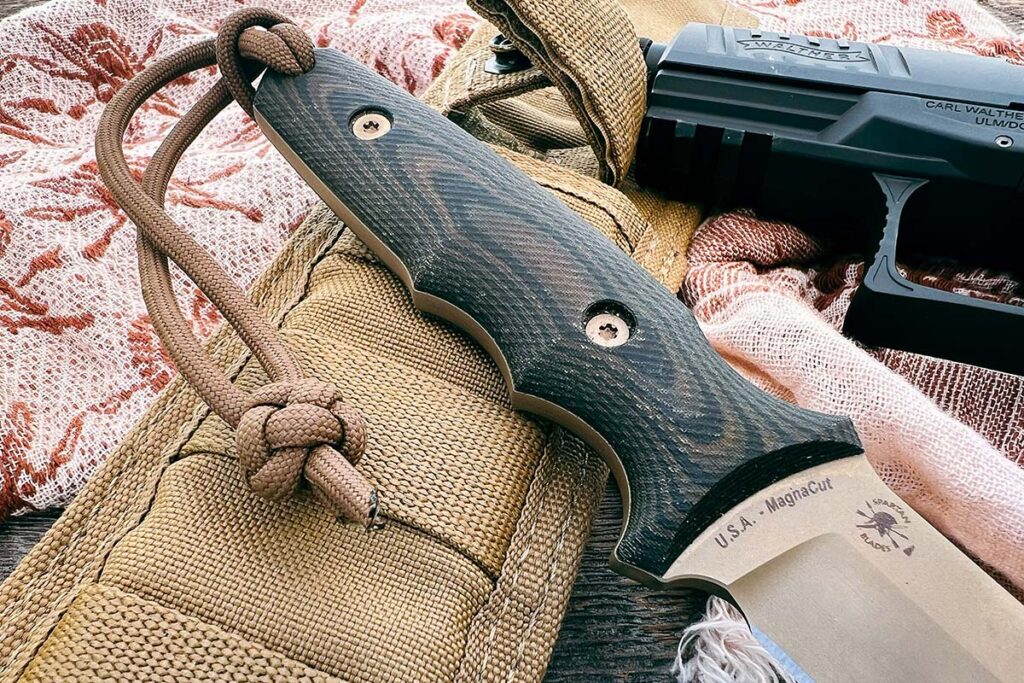
The canvas Micarta handle is slim in profile, even understated, yet sports big-league features.
Photos by Marty Stanfield, Marty Stanfield Photography
Boasting two-finger grooves leverage the use of the middle finger to help stabilize the knife in the user’s grip and help lock it in for security. The double guard is somewhat subtle but does its job very well.
The entire handle is rounded and therefore, extremely comfortable to hold. No hot spots or harsh angles to get in the way. Overall outstanding ergonomics make the knife one with the hand. In brief, it’s pure Harsey all the way.
Micarta itself was an excellent choice for the tactical fixed blade—it’s lightweight yet strong. Comprised of fabric saturated in phenolic resin, it is also impact-resistant and fluid-resistant.
These attributes were engineered in the Clandestina with combat in adverse conditions in mind. Yet, the everyday user benefits, given it’s a robust system that should last a lifetime. Not to mention, the Micarta is available in a multitude of colors, besides my black and camo.
Spartan Clandestina Blade
From the understated to the obvious—the knife’s nefarious.
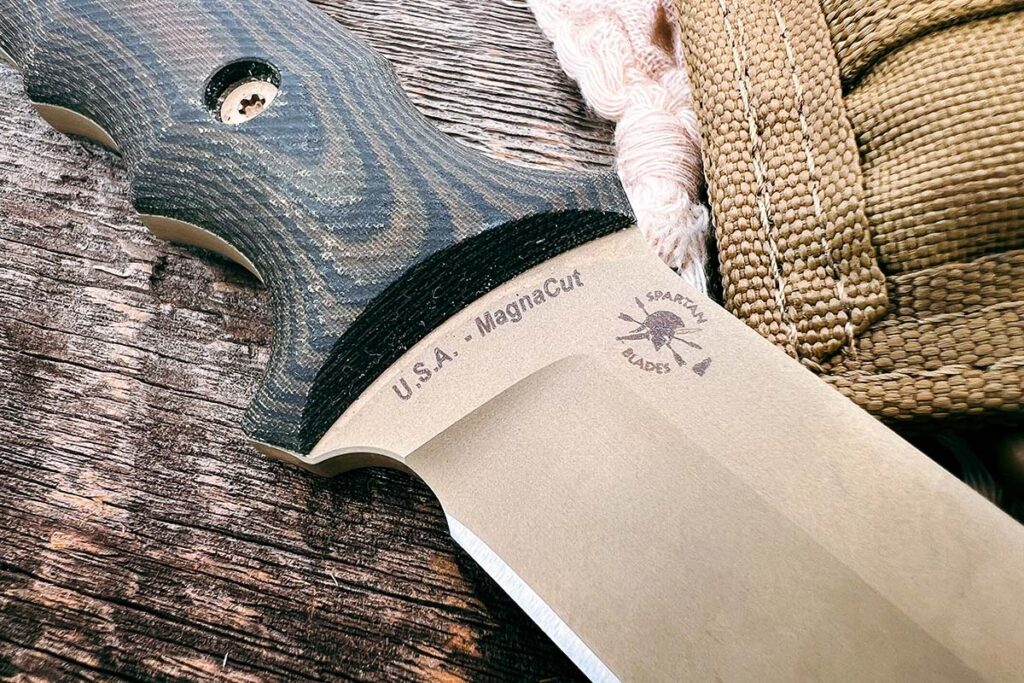
At 5.5 inches long and sporting a spear-point profile, the Clandestina was designed for more than opening boxes. A testament to this was Spartan opting for premium CPM Magnacut stainless steel.
Photos by Marty Stanfield, Marty Stanfield Photography
Know for its capability of long-term edge retention, the metal makes the ready to slash or perforate with ease. Again, this material also has superior corrosion resistance, adding to the overall hardiness of the knife.
The blade is flat ground and the factory edge right out of the box is outstanding. I found nothing needed to be done to improve the edge, I just took it out of the box and put it right to work!
While larger than most folks’ carry option, the blade length isn’t over the top. I found it nearly perfect for belt carry, hitting an elusive sweet spot many fixed-blades miss.
Spartan Clandestina Sheath
Sheath-wise, there are two options – form-fitting Kydex or a tried and true ballistic nylon. The sample knife shipped to me with the latter.
Photos by Marty Stanfield, Marty Stanfield Photography
I found the sheath is very well made, with double sewn edges and a button snap retention strap to hold the e knife in. A large belt loop allows the use of various widths of belts to be used.
Should you opt for Kydex, the sheath is of a riveted construction with a belt loop attachment. The form-fitting sheath locks up around the integral guard of the handle. There are two MOLLE straps that also double as belt loops.
Testing The Spartan Clandestina
Putting the Clandestina to work is nothing short of an excellent experience.
All of Harsey’s tactical fixed blade design expertise comes into play here, and you quickly realize you have a piece of serious bladeware in your possession. It makes slicing cuts with brash confidence thanks to the excellent factory edge coupled with the flat grind.
Photos by Marty Stanfield, Marty Stanfield Photography
The blade thickness tapers down progressively to the tip, allowing it to have the ability to do some serious piercing without being too thin where accidental breakage can occur. The overall blade profile is somewhat dagger-like, as you will notice.
The handle is downright comfortable. It allows the user to obtain a secure grip at all times, instilling and promoting user confidence. Thanks to the dual finger grooves, these allow the slender handle to have such a great grip quality. Locking your grip on the handle, it feels very stable and unlikely to rotate.
Furthermore, when you grip the handle and allow your thumb to rest on the blade spine, you can feel how secure this choke grip is and the knife is very controllable in this grip. Whittling and wire stripping are two such tasks that this grip facilitates. Simply put, the Spartan HARSEY Clandestina is built for use.
Short Cut
It’s definitely not a toy! Use it with confidence and use it hard. Spartan Blades’ craftsmanship skills are highly rated consistently, with each knife they turn out. You cannot go wrong with choosing the Clandestine.