
Buyer's Guides

You’re looking for a new knife in a certain style – we’ve got recommendations on the best blades for every price point.

Best Gyuto Knife: East And West Meet Over Dinner

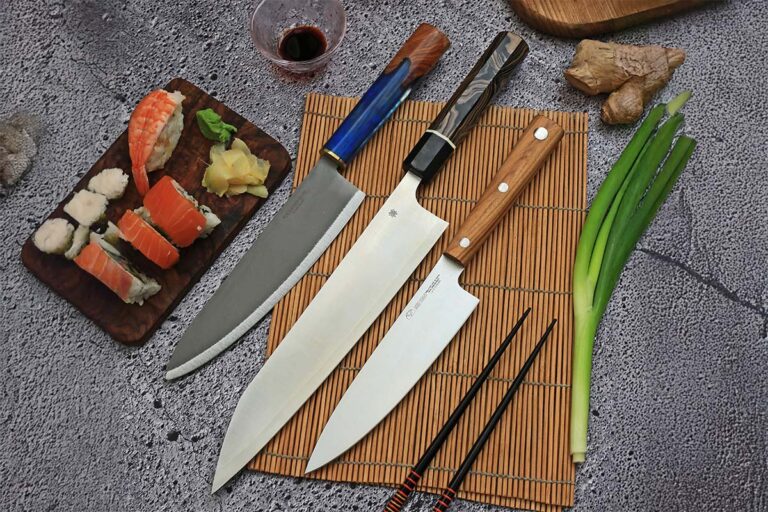
The Japanese take on Western chef’s knives are mighty mealmakers. Here are some top-notch options.

A gyuto is a versatile, multi-purpose kitchen knife perfect for professional chefs and home cooks. It typically features a thinner, lighter blade than traditional chef’s knives, sharpened at a steeper angle for extremely precise and clean cuts. It often has a flatter profile toward the heel and a more gradual curve near the tip, making it versatile for various cutting techniques. The handle is often lighter and more agile, reflecting the Japanese emphasis on nimble and efficient movements in the kitchen.

Fox Knives Gyuto 2C 504 0L
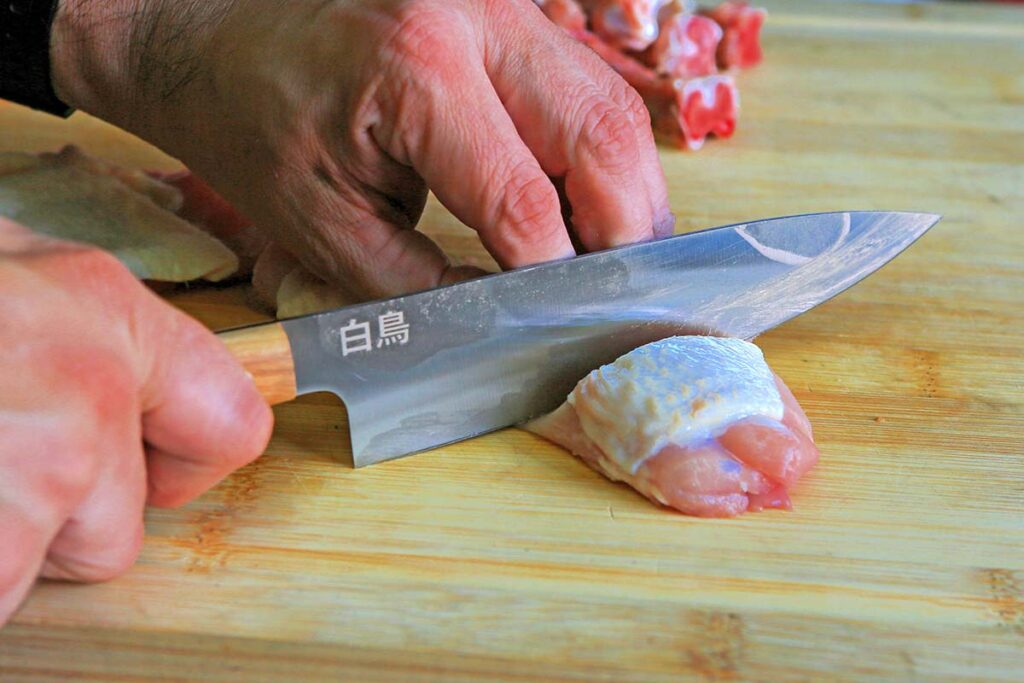
Fox gyuto effortlessly cuts chicken thighs
The Fox gyuto effortlessly prepared chicken thighs for delicious teriyaki chicken and yakitori, trimming excess fat and skin.

FOX Knives Gyuto 2C 504 OL
Blade Length: 6.69”
Blade Steel: 4119 nitro-B stainless
Blade Grind: Flat
Blade @Thickest: .08”
Blade Finish: Satin
Handle Material: Olive wood
Overall Length: 11.81”
Country of Origin: Italy
MSRP: $75.70

Pros

  • Durable 4119 Nitro-B Stainless Steel Blade
  • Exceptional Balance and Lightweight Design
  • Comfortable Olivewood Handle

Cons

  • Limited Grip for Large Hands

The Fox Knives Gyuto 2C 504 0L is a representative example of the genre. Crafted with precision and passion, it features a razor-sharp blade that is durable and holds an edge. The elegant handle offers a comfortable grip and a smidge of rustic charm.

At just 5.11 ounces, this featherweight beauty is a breeze to manipulate and perfectly balanced for effortless slicing, dicing and chopping. The 4119 nitro-B stainless steel blade’s Rockwell hardness of 55-57 HRC guarantees superior resilience, while the satin finish adds a touch of sophistication. Equipped with sturdy stainless-steel rivets, this gyuto is a culinary companion you can trust, not just a kitchen tool.

When in Japan, I love ordering yakitori—skewered, grilled chicken with a savory, slightly sweet flavor and smoky aroma. Making the dish was a team effort using specific knives for deboning and slicing the chicken into proper portions for the skewers. The key is to use a slow rocking/chopping motion to make clean, decisive slices rather than sawing through the meat, resulting in “chainsaw chicken.”
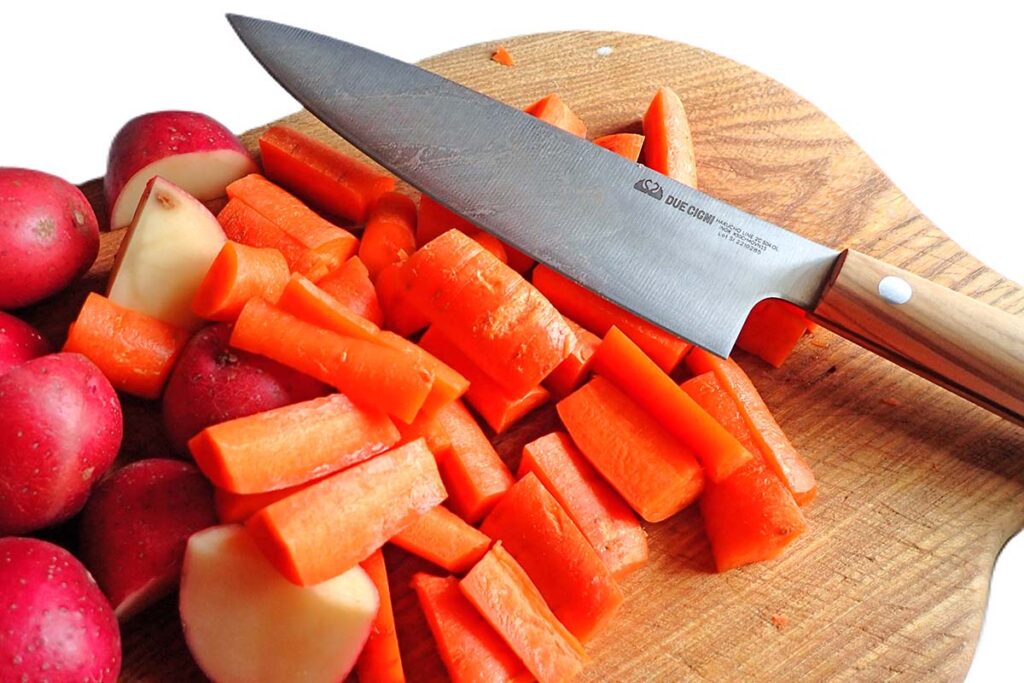
Fox knife cuts potatoes and carrots
The Fox sliced potatoes, onions, garlic and carrots for pot roast. The thin edge and super comfortable handle were unmatched.

Since the gyuto is the Japanese version of the archetypal Western chef’s knife, I made a Western dish—beef pot roast—and did the vegetable prep with the Fox. Slicing vegetables, potatoes, carrots and onions was a breeze with this slicing machine. I keep it simple, using rock chops, cross chops and pull cuts 90 percent of the time. Push cuts with the heel of the blade work well for hard veggies. Meanwhile, the olivewood handle remained comfy with no hot spots and grippy even when wet or covered with chicken fat. Leave it to the Italians to utilize this stunningly underused wood. Regarding plating, the Fox sliced the most elegant roast beef that ever graced a dish.

Fox Knives$78Check Price
BladeHQ$35Check Price

Condor Tool & Knife Shefu Kitchen Gyuto
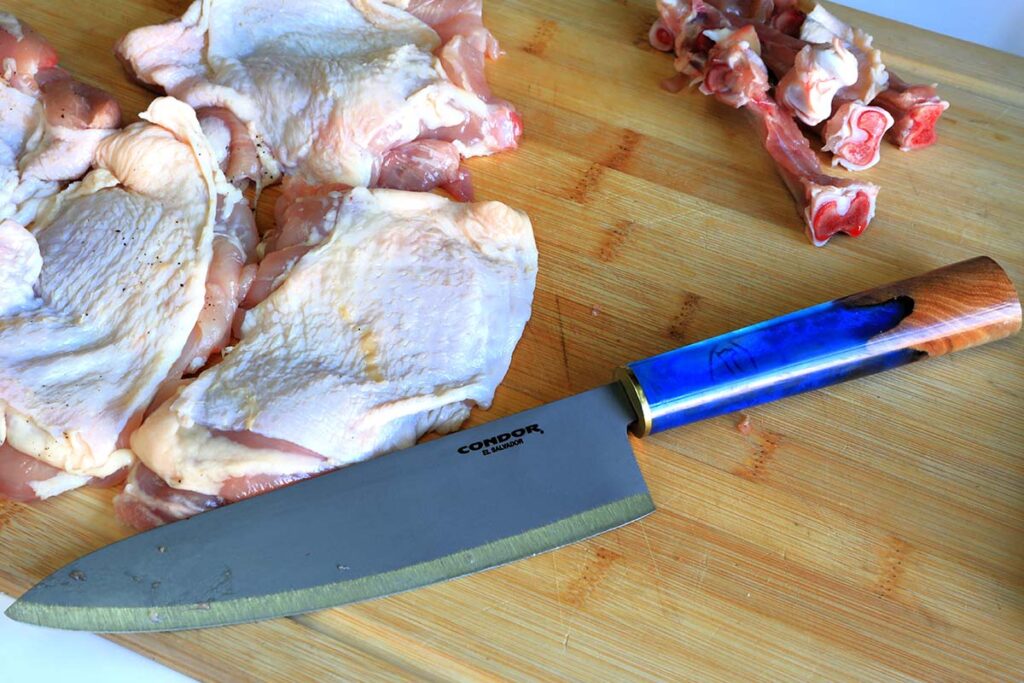
Condor gyuto deboned chicken thighs
The Condor Shefu deboned multiple chicken thighs using a roll-cutting method for yakitori skewers and teriyaki chicken.

Shefu Kitchen Gyuto Specs
Blade Length: 7.83”
Blade Steel: 440C stainless
Blade Grind: Full flat w/second bevel
Blade @Thickest: .12”
Blade Finish: Blasted satin
Handle Material: Epoxy resin and hickory
Overall Length: 12.92”
Sheath: Welted leather
Country of Origin: El Salvador
MSRP: $154.98

Pros

  • Versatile Outdoor and Culinary Tool
  • Comfortable and Ergonomic Handle
  • Full Flat Grind with Second Bevel

Cons

  • Bit hefty

The Shefu Kitchen Gyuto from Condor Tool & Knife is a multi-use knife designed for bushcraft enthusiasts who want to prepare delicious meals while enjoying the great outdoors. Crafted with precision in mind, the Shefu is perfect for slicing vegetables and expertly preparing meat and fish. It is a versatile tool ready to tackle any culinary challenge.

The Condor gyuto is hardy and beautiful. The full flat grind with a second bevel ensures optimal slicing performance, while the handle provides a comfortable, secure grip. The knife strikes the perfect balance between heft and maneuverability. The leather sheath provides safe storage and easy transport.

I pushed the Shefu into service sectioning beef roast and deboning and trimming six chicken thighs. The knife tackled the tasks with ease. Slicing 3.5-pound roast required a sharp yet hefty slicer like a cleaver. The Shefu fit the bill and delivered. Bottom round roast is tough as woodpecker lips, and a thin, flexible blade need not apply here. At 9.88 ounces, the Condor’s robust blade strikes the perfect balance between heft and finesse.
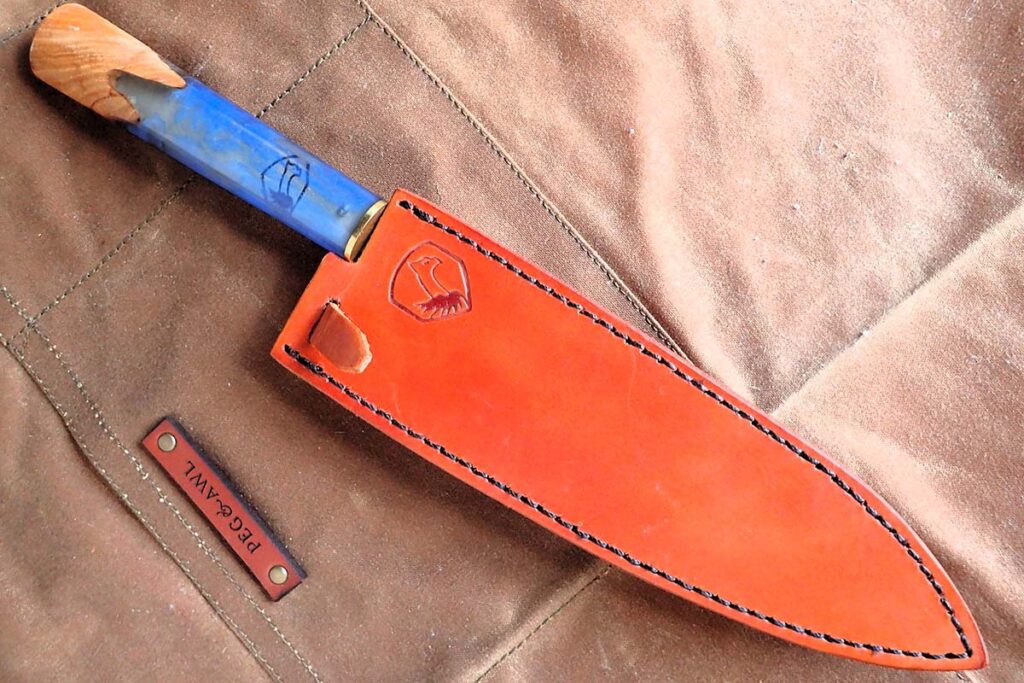
Condor gyuto in sheath
The Condor has the only sheath of the test bunch, of a beautifully handcrafted welted leather for safe storage and easy transport.

The handle has a colorful, comfortable oval shape that nestles in the hand. Hot spots and fatigue are nearly impossible with this grip. The full tang offers strength and security while keeping balance and weight at the forefront. The Shefu is an essential for any cooking enthusiast, whether at home or in the wild.

Condor$155Check Price
SMKW$132Check Price

Spyderco Itamae Gyuto

Spyderco Gyuto prepares food
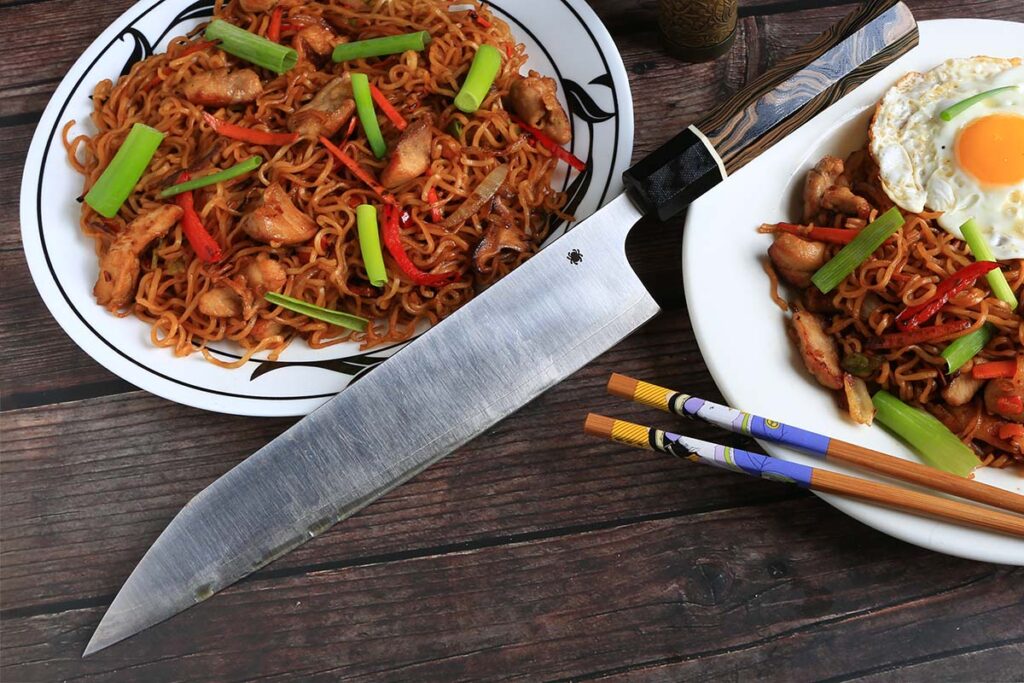
The author prepared the chicken yakisoba using the Spyderco. The knife sliced and diced carrots, onions, peppers, shiitake mushrooms, chicken and green onions for garnish.

Itamae Gyuto Specs
Designer: Murray Carter
Blade Length: 10.06”
Blade Steel: Super Blue/SUS410
Blade Grind: Full flat
Blade @Thickest: .094”
Blade Finish: Satin
Handle Material: Burl G-10 in the octagonal wa style
Overall Length: 15.35”
Country of Origin: Japan
MSRP: $334

Pros

  • Exceptional Blade Construction
  • High-Quality, Ergonomic Handle
  • Beautiful Design and Craftsmanship

Cons

  • Higher Price Point

The Itamae Gyuto is part of the Spyderco Murray Carter Collection Itamae Series. The elite cutlery series is designed for highly skilled sushi chefs and showcases uncompromising craftsmanship and premium materials.

The Itamae Gyuto features a blade expertly crafted from laminated steel—an Aogami Super Blue core clad between layers of high-quality stainless. The three-layer construction ensures exceptional durability and sharpness, with Carter’s signature “Carter Elbow*” adding strength to the blade’s tip.

Paired with a traditional wa-style octagonal handle of stunning burl G-10 and highlighted with a black G-10 ferrule, the Itamae Gyuto embodies the spirit of Carter’s coveted custom kitchen knives. Tipping the scales at 7.4 ounces, it sets an impressive standard in high-performance household cutlery.

The Itamae Gyuto is a sushi knife and I’m a fan. Part of my time in Japan was seeking out various types of sushi. The second most rewarding part was watching the chefs work precisely as if it were the most critical game of Operation ever played—they are pros!

I used the test model to prepare carrots, onions, shiitake mushrooms, peppers, green onions and chicken for the famed yakisoba dish: fried street food noodles choked full of veggies, savory sauce and protein. Simple ingredients still require various knife techniques.

I used push-cuts on the tough carrots to square them to a safe position to stabilize them and make thin slices. From there, I stacked the slices for some rock-chopping to julienne a pile of carrots—in this instance, to make matchstick-sized carrot sticks. The secret to stir-fry cooking is preparation and cutting relatively equal-sized pieces of food to ensure equal cooking time.
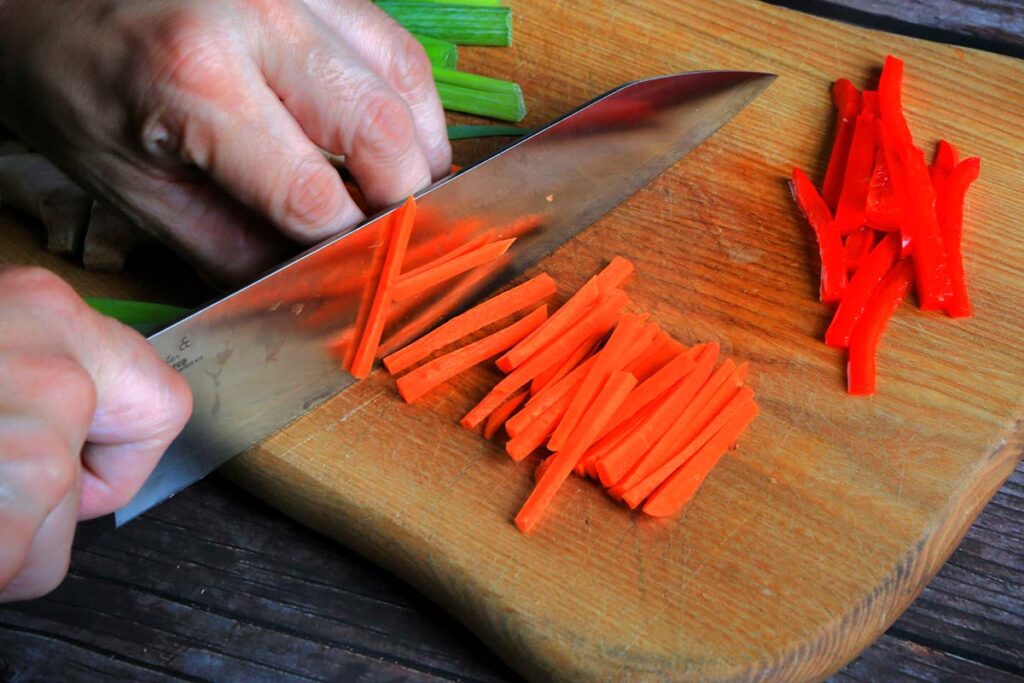
Spyderco juliennes carrots
To create julienne slices, the author employed the rock-chopping method with the Spyderco, again utilizing a chef’s pinch-grip and a claw grip with the offhand to support the food.

I used rock chopping and pull cuts—two techniques in which the Itamae excels—to slice the red peppers. To pull cut them, I placed the knife tip down on the board and sliced backward. By this time, the laminated steel had formed a nice patina from avocado, peppers, onions and chicken on the bevel, giving it a nice used look. Crafted in Japan, the Itamae Gyuto is an ultimate favorite among professional chefs and passionate cooking enthusiasts.

*Editor’s note: Through the Carter Elbow, Murray Carter combines the best features of a traditional Japanese wabocho kitchen knife with his Wharncliffe Brute neck knife. The design feature allows more steel to reinforce the forward tip of the blade compared to standard gyuto or French-style chef’s knife profiles.

Spyderco Inc.$334Check Price
Knife Center$334Check Price

More Kitchen Knives:

Combat Legacy: Modern Military Knives [Field-Tested]

Contemporary armed forces styles are chips off the old block.

While U.S. troops have long had a choice of carrying alternative knives as opposed to military issued ones, nothing prepared them for the explosion of choices that came with the modern tactical boom of the early-to-mid 1990s.

While the newly minted cutters were mostly of the folding knife variety, fixed blades also benefitted from the vast improvements in tactical designs and materials that shook the cutlery industry. That boom continues almost 35 years later as the tactical segment and its many spinoffs are still the largest chunk of the sporting knife market.

Many military knives have been issued over the years as the various branches, both main and special, selected their own. Large fixed blades and bayonets were common and outsourced to manufacturers along the way. Even though they may differ in size and modifications, the four review knives all have roots in military history.

SOG BAR15T Tanto Bayonet

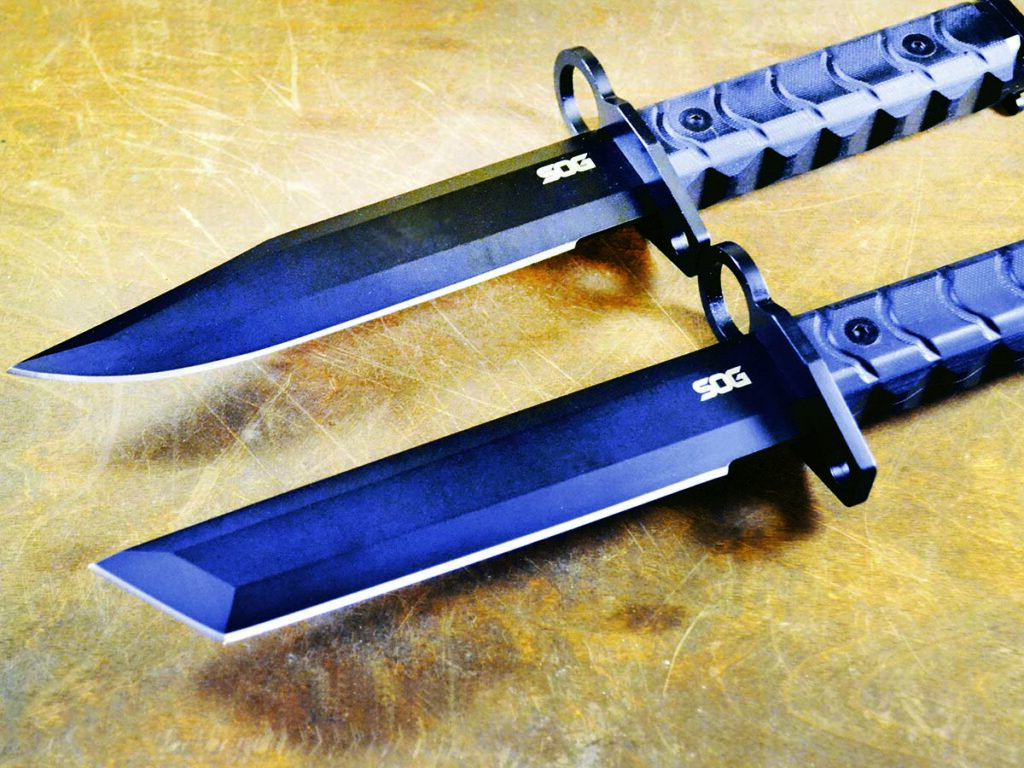
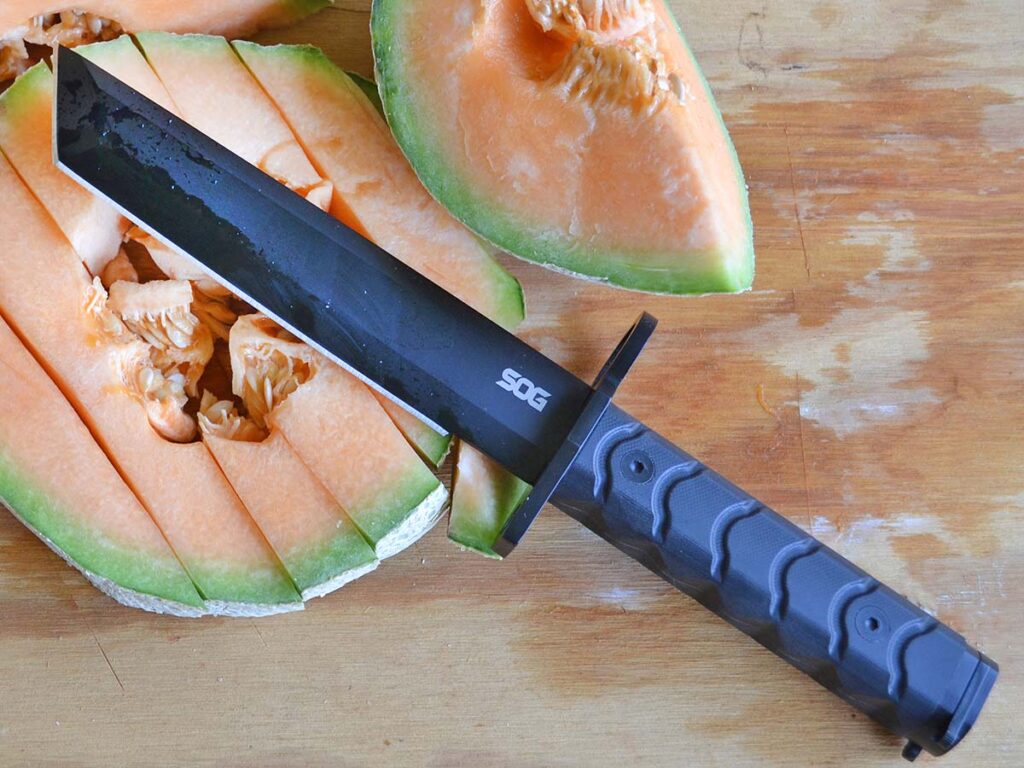
Two SOG bayonet offerings: the BAR15T Tanto and BAR15C Clip Point. The test tanto has a more than serviceable 5 inches of cutting edge.

Pros

  • Powerful Chopper
  • Strong Tip Design
  • Ergonomic Handle

Cons

  • Heavy And Bulky
  • Not Ideal For Finesse Tasks

BAR15T Tanto Bayonet Specs
Blade Length: 7.1”
Blade Steel: AUS-8 stainless
Handle Length: 5.1”
Handle Material: Black G-10
Overall Length: 12.2”
Sheath: Black Kydex
Country of origin: China
MSRP: $79.95

The SOG BAR15T is a big boy. True to modern tanto form, the blade is clipped from the frontal blade grind to the upper tip. The black-traction-coated blade’s main edge is flat ground and 5.2 inches long, with a quarter-inch grind to enhance penetration along the spine. The 4.8-inch handle includes a straight guard and pommel with hardware for mounting as a bayonet, with a hidden-tang main grip of black G-10 done up in a series of curved grooves on its top surface and angled pyramids along the sides. The BAR15T checks in at 19.2 ounces and is delivered with a MOLLE adaptable drop sheath, which includes black nylon and leather belt fittings.

CAS Iberia/APOC Smatchet

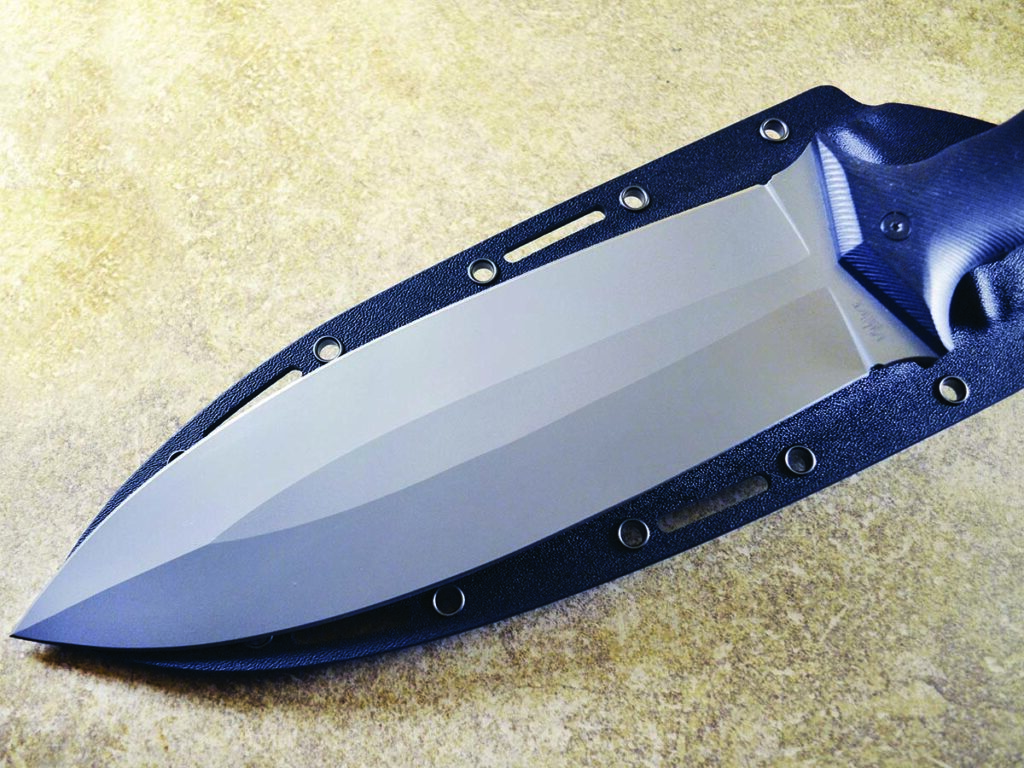
With its wicked 9.7-inch blade, the CAS Iberia/APOC Wallace Smatchet is loaded for bear. British and American forces used the original version of the knife to maximum effect during World War II.

Pros

  • Exceptional Chopping Power
  • Comfortable Handle
  • Battle-Ready Design

Cons

  • Overkill For Light Tasks
  • Difficult To Carry

Smatchet Specs
Blade Length: 9.7”
Blade Material: D2 tool steel
Blade Finish: Titanium coated
Handle Length: 6”
Handle Material: Black G-10
Overall Length: 15.5”
Sheath: Black Kydex belt mount
Country of origin: China
MSRP: $175

Designed by Mike Wallace, the CAS Iberia/APOC Smatchet is by far the largest, and most ususual, of the review bunch. The smatchet is not new and is best known for seeing action in World War II as a close combat fixed blade for British and American special forces. The Wallace Smatchet’s abbreviated, double-ground blade has a matte titanium coating. An ample finger-grooved handle can easily accommodate large and/or gloved mitts and is flared at the base for excellent purchase. Weight is a hefty 1 pound, 10 ounces. The knife is delivered with a MOLLE compatible drop sheath with steel and black nylon fittings.

The KA-BAR Dust II

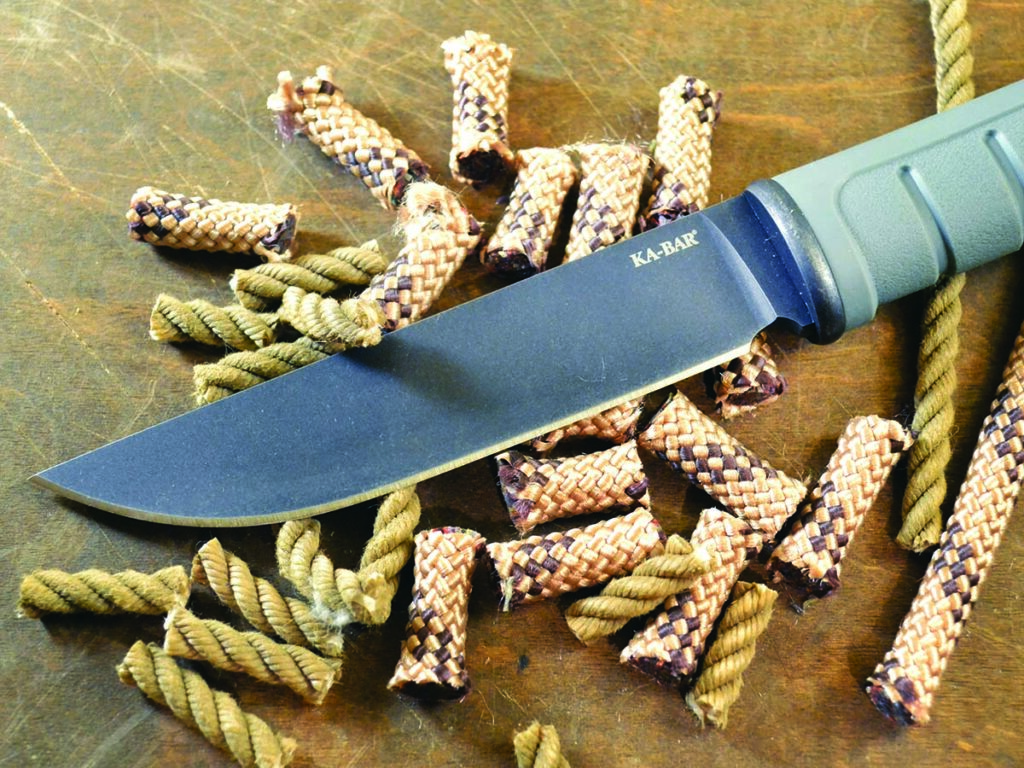
The KA-BAR Dust II tackled synthetic rappelling rope and stiff waxed cotton lariat rope. The full-ground D2 tool steel blade was no worse for wear and ready for more.

Pros

  • Compact And Lightweight
  • Good Edge Retention
  • Versatile Utility

Cons

  • Light-Duty Only
  • Basic Construction

Dust II Specs
Blade Length: 5.2”
Blade Material: D2 tool steel
Handle Length: 4.79”
Handle Material: Green glass-filled nylon
Overall Length: 9.58”
Sheath: Black, molded hard plastic
Country of origin: Taiwan
MSRP: $138.49

The KA-BAR Dust II, a down-sized version of its larger brother the Dust I, is better configured for light utility. It has a very staid, flat-ground, gently clipped, black-coated blade. The hidden-tang handle hasn’t a sumptous curve to its name and is arrow straight with wraparound grooving on three quarters of its surface. The handle has a hint of a guard top and bottom, the epitomy of understated good taste. It comes with a black, MOLLE-adaptable, hard-plastic belt sheath.

Montana Knife Co. Model V24

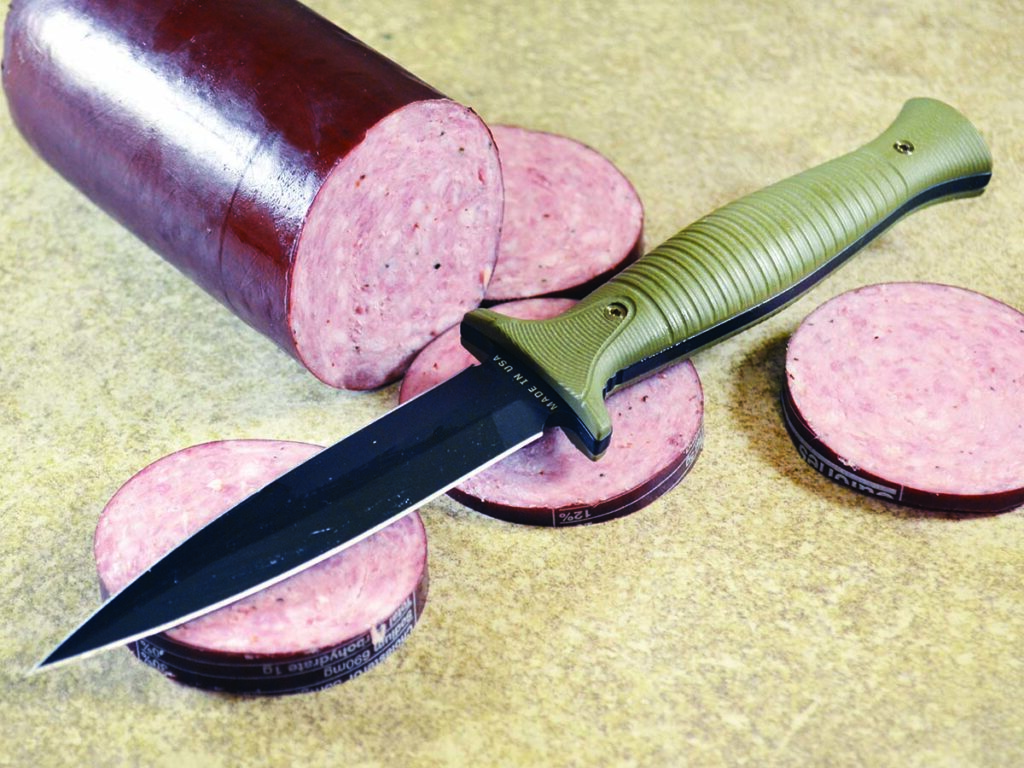
The Montana Knife Co. V24 stiletto turned out to be a little carnivore during testing. After doing stab tests on a chub of summer sausage proved a walk in the park, the author turned the slim 4-inch CPM MagnaCut blade to taking off slices of the meat. Note the clean edge work on the sausage casings.

Pros

  • Exceptional Penetration
  • Smooth Slicing
  • Near-Custom Quality

Cons

  • Purpose-Built Design
  • Less Robust For Batoning Or Chopping

V24 Specs
Blade Length: 4.25”
Blade Steel: CPM MagnaCut stainless
Blade Finish: Black Cerakote®
Handle Length: 5”
Handle Material: OD green G-10
Overall Length: 9.25”
Sheath: Black Kydex w/UltiClip
Country of origin: USA
MSRP: $475

Complete with thumbprint ricasso, the Montana Knife Co. Model V24 is a tribute to the V-42 stiletto used during World War II by the First Special Service Force, father of today’s U.S. Special Forces. This exqusite send-up was designed by MKC President/CEO Josh Smith, who, when he was all of 11 years old, began studying bladesmithing under ABS master smith Rick Dunkerley. The dagger-style blade is double ground and the hourglass handle boasts horizontal machined striations and guard art. The steel is gimped along the sides of the guard and curved base. The knife weighs 4.47 ounces and carries in a black belt sheath with an UltiClip 3.3 mounted on the front.

Testing Modern Military Knives

The review knives are very diverse and the two largest, the Smatchet and BAR15T, are definitely in the same playing field. I took their blades to task with a large, mature cantaloupe. The heavy Smatchet—all 26 ounces—had no probem hacking and slicing, and the fat handle made it easy to guide the big blade with no twisting or wobbling. On the battlefield this would be a formidable knife—as if its appearance alone weren’t enough to send the enemy heading for the hills.

The BAR15T is a load at just over a foot long with well over a pound of heft, and while not an easy tote it overshadows the EDC factor with sheer power. The beauty of the knife lies in its almost half-foot-long cutting edge and all that weight behind it. Tantos as a rule give up cutting edge to accommodate the wicked, pointy tip, and the shorter the blade the less edge there is for work.

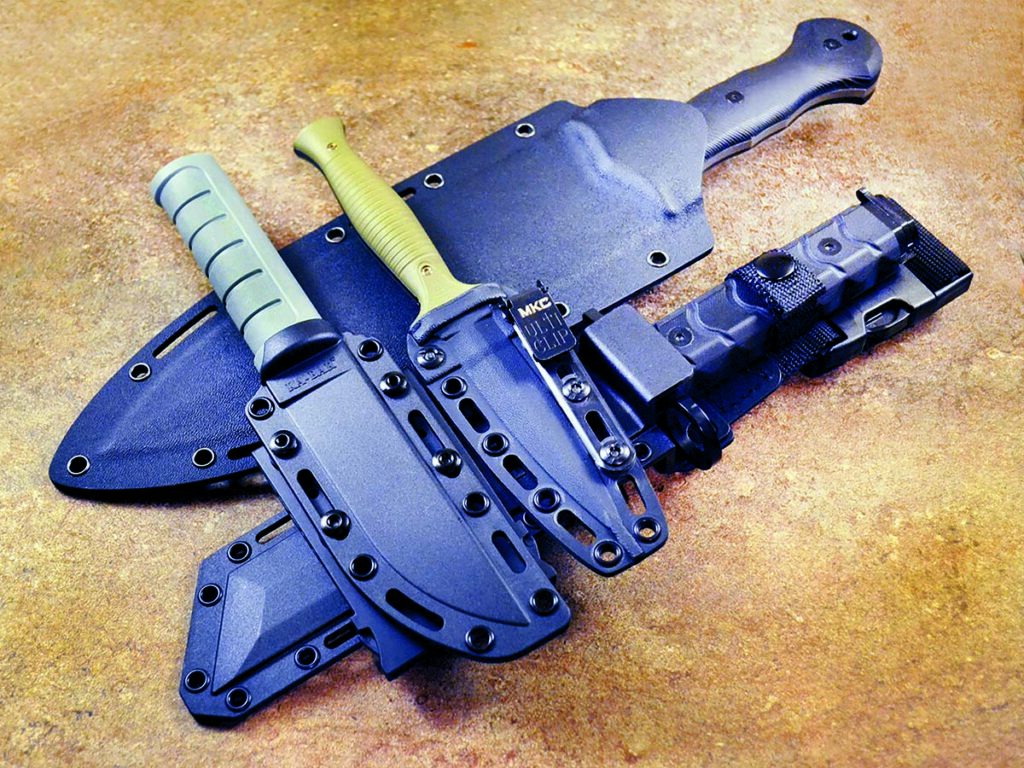
It’s a black synthetic sheath party with the review knives. All are Kydex except the hard molded plastic of the KA-BAR.

I tested the knife by cleaving the cantaloupe in large chunks and taking off 1-inch strips in push cuts, pull cuts and vertical slices. The blade length proved a real benefit when making cuts evenly and the weight added to making strokes effortless, not to mention plenty of handle for gripping and guiding the knife. If you want a tad smoother cutting edge, I suggest checking out the SOG BAR15C Clip Point without the tanto’s notched tip.

The KA-BAR Dust II is sized for light duty around the camp or trail where a large fixed blade would tend to drag you down. Not to demean it, but this would be an ideal first fixed blade for a youngster to learn the ropes with—it’s a serious knife without being too bulky and is comfortable in the hand.

The BAR15T is well suited for heavier chores as well as lighter cantaloupe assignments. The ample handle helps as well.

I used it to cut two types of rope that can be tougher on a blade than standard fare—3/8-inch synthetic rappelling rope and 1/4-inch stiff, twisted and waxed lariat cable—both of which can dull an edge pronto. I started with the rappelling rope, quickly taking off approximate inch lengths and then switching to the tough lariat cable. After slicing a couple of feet of each rope, the cuts were clean and the blade steel was ready for more.

The MKC V24 is about as tactical as a knife gets and about as close to being a custom as a factory model can be. In fact, I’ve owned customs that weren’t as well made. I started by stabbing the blade into a fat, 2-inch chub of summer sausage to check for penetration. The exercise was way too easy. Since stilettos primarily do two things—stab and slice—I did a slicing exercise on the sausage. Taking off roughly quarter-inch slices, the blade performed effortlessly, needing only a modicum of pressure to cleave off several clean lengths. The handle offered plenty of length and a level of comfort even a surgeon would love.

Read More:

New Knives October 2025

Explore the world of custom kitchen knives! See award-winning Chef’s Knives, Gyutos, and more, forged with exotic Damascus and unique handle materials.

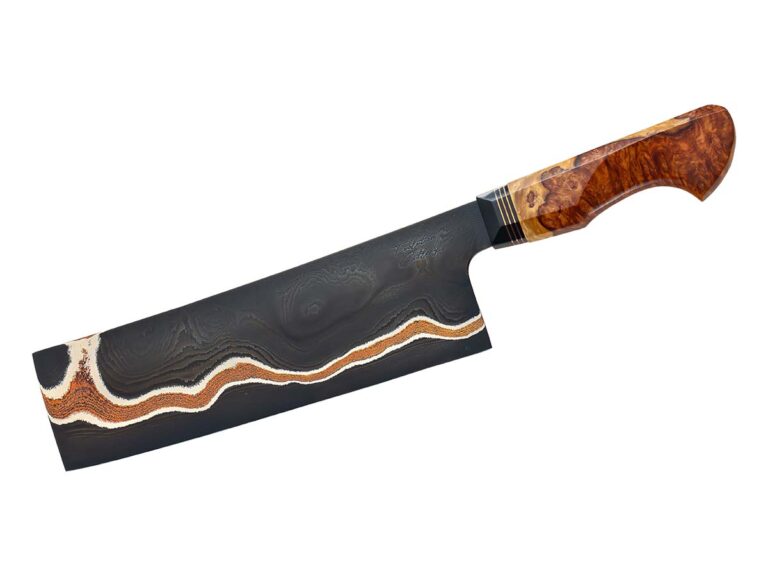
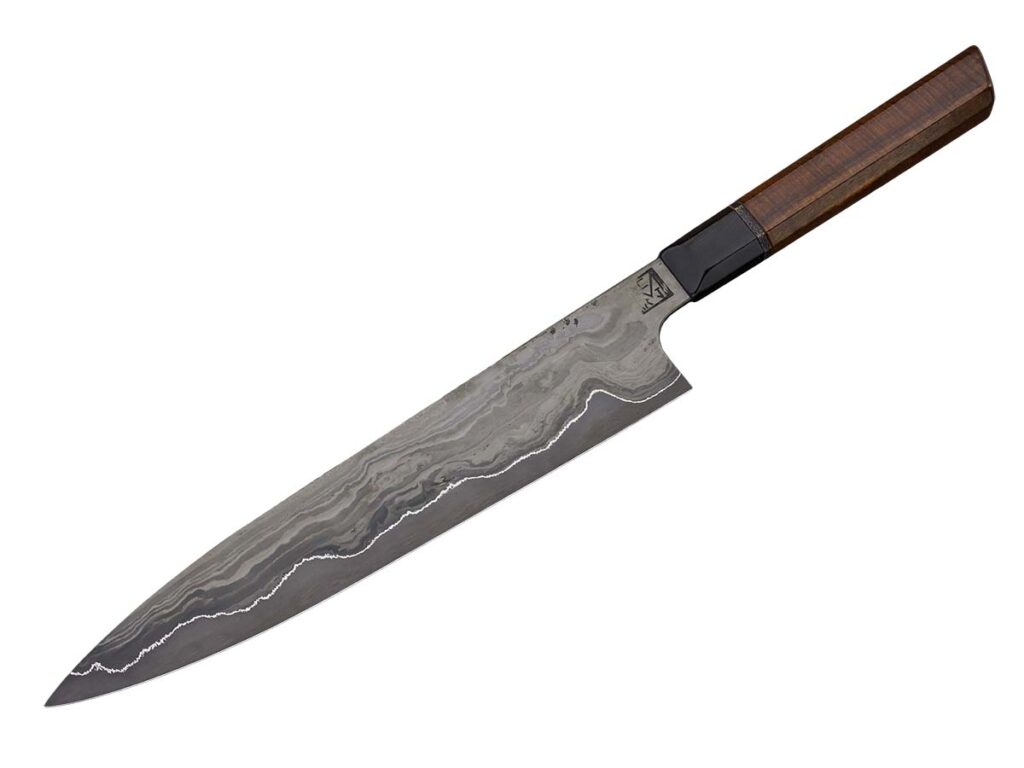
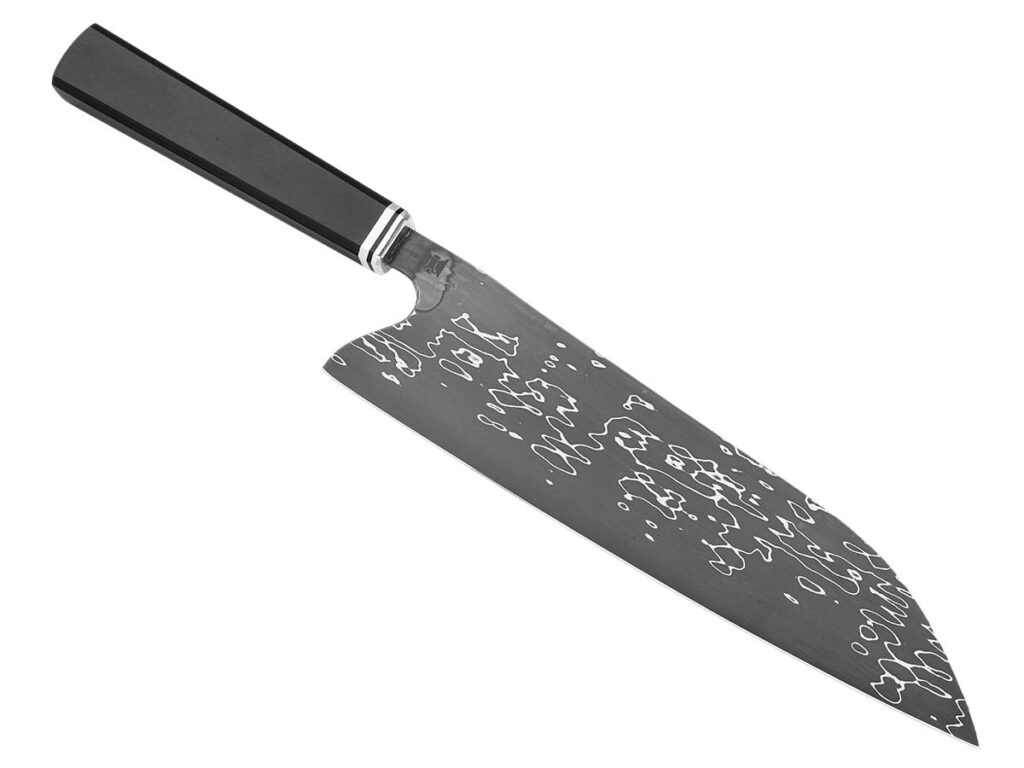
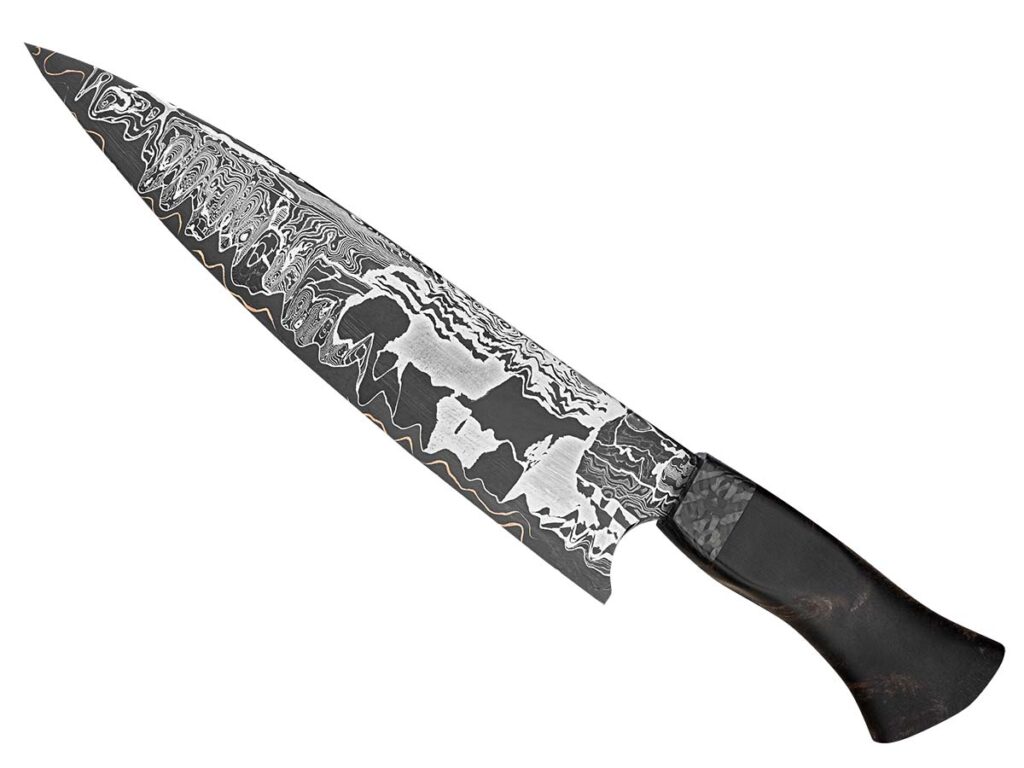
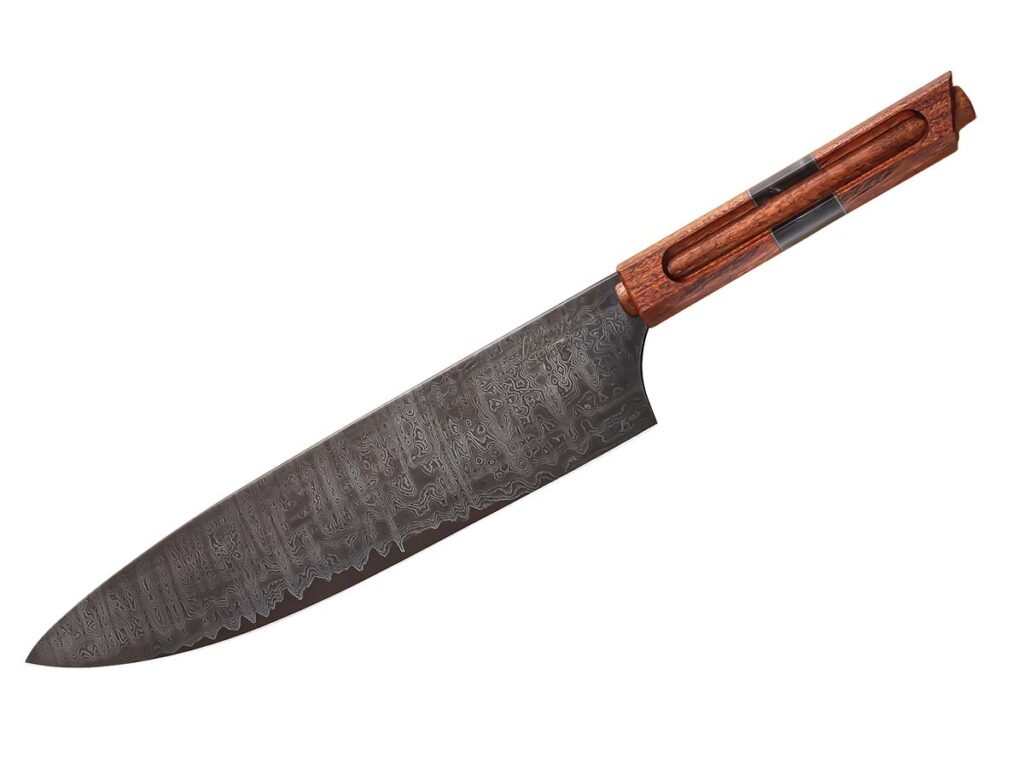
The art of knifemaking has officially stepped into the culinary arena, elevating daily prep into a true performance. This collection features some of the world’s most refined kitchen cutlery—from award-winning Gyutos and Nakiris to specialized Chef’s and Paring knives—each forged by today’s top custom makers. We’re showcasing a stunning array of blades that blend high-performance steel, such as Copper-clad 1084 and Aogami Super cores, with breathtaking handle materials like stabilized exotic burls, copper mesh resin, and mosaic damascus. These tools are built for precision and designed for prestige.


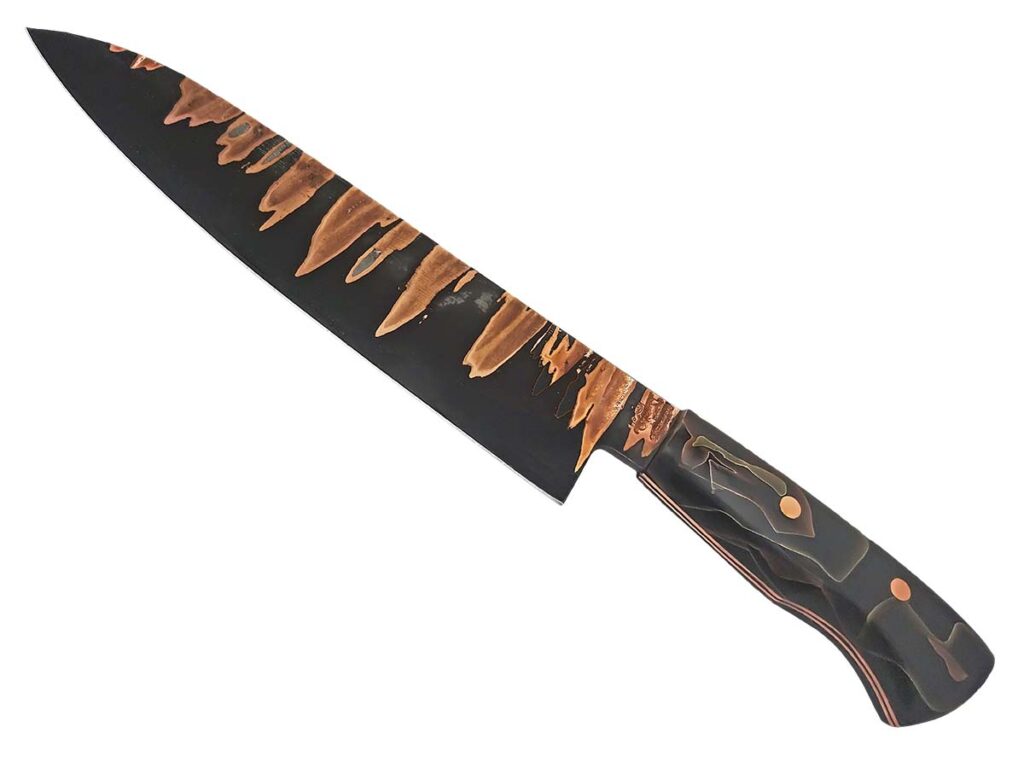
Joel Eckford Kitchen Knife

Signal One Forge Kitchen Knife

Blade length: 8.3”
Blade material: Copper-clad 1084 carbon steel forged by Dane Standen Knives
Blade grind: Flat
BLADE COAT: Dane Standen brutalist copper clad 1084 finish
Scales: Copper mesh in resin w/copper spacers
Overall length: 12.8”
Knife to know: The maker is a probationary member of the Australian Knifemakers Guild
Maker’s price for a similar knife: Contact maker for pricing
Maker: Signal One Forge, Joel Eckford (Rod Hoare image)


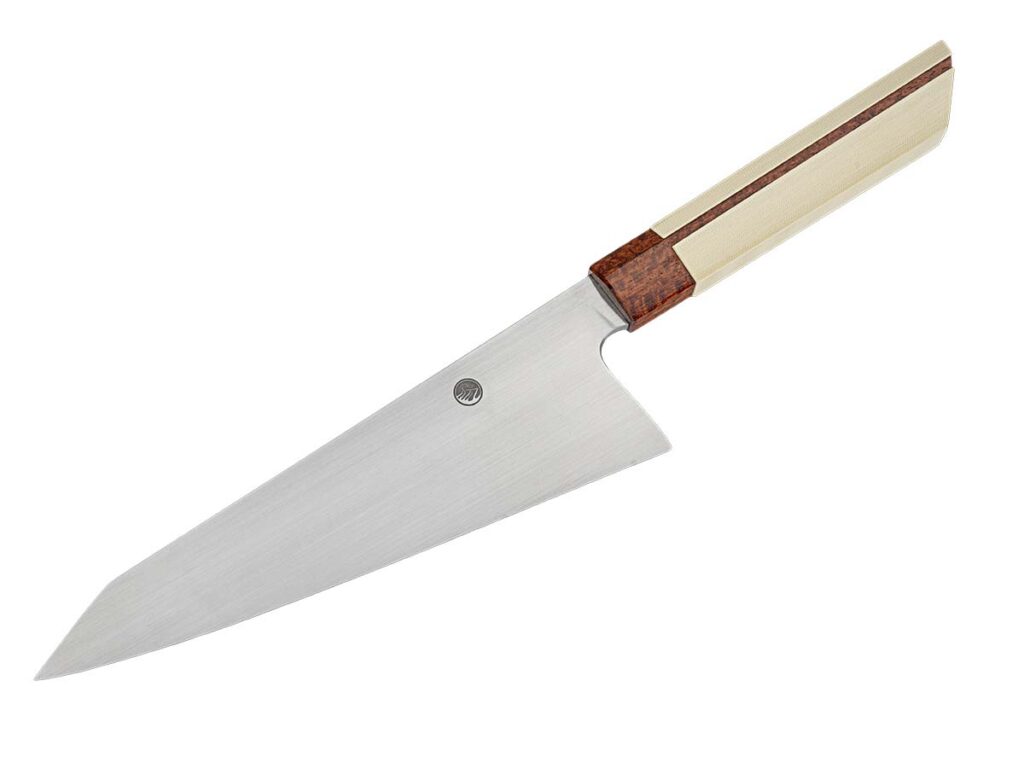
Evan Davis K-Tip Petty Chef’s Knife

Evan Davis K-Tip Petty Chef’s Knife

Blade length: 7.5”
Overall length: 12.5”
Blade material: 52100 carbon steel
Blade grind: Convex
Scales: Curly narra and ivory G-10
Maker’s price for a similar knife: $700
Maker: Evan Davis (Jocelyn Frasier image)


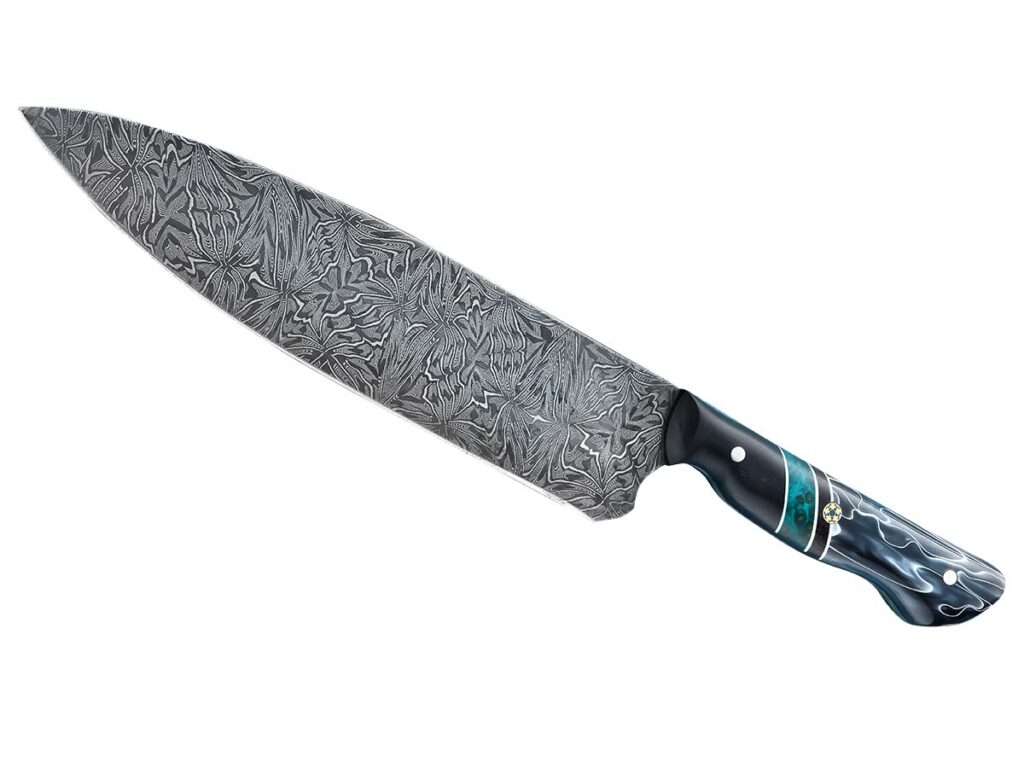
Kevin Korenek Chef’s Knife

Kevin Korenek Chef’s Knife

Blade length: 8.75”
Blade material: 80CrV2 carbon and 15N20 nickel-alloy steels forged by Jeff Waggenar
Damascus: Flower pattern
Blade grind: Flat
Scales: Blackwood amboyna/acrylic composite by Randy McBurrney
Overall length: 14.75”
Maker’s price for a similar knife: $1,175
Maker: Kevin Korenek (SharpByCoop image)


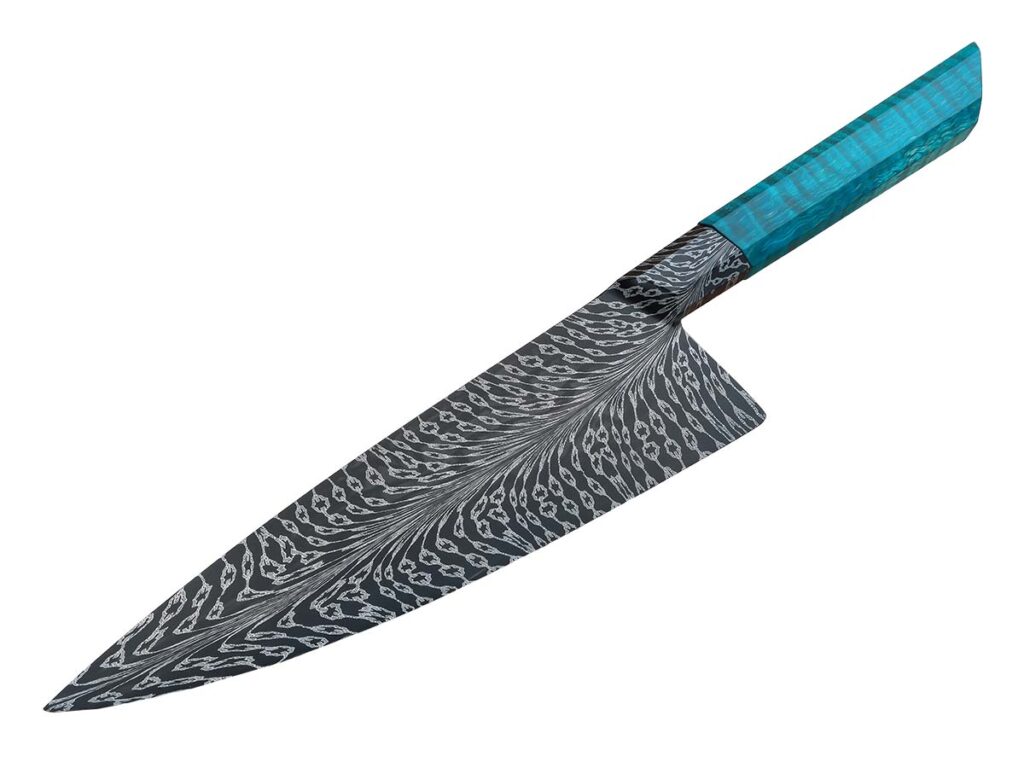
Paul Elkins Chef’s Knife

Paul Elkins Chef’s Knife

Blade length: 9.25”
Blade material: 1080 carbon and 15N20 nickel alloy steels
Blade grind: Convex
Scales: Dyed curly mango
Overall length: 14.5”
Knife to know: Integral bolster construction; the knife won the Texas Select 2025 Custom Cutlery Event’s Best Culinary Award
Maker’s price for a similar knife: $2,000
Maker: Paul Elkins (SharpByCoop image)


Cordina Customs Signature Series Gyuto

Cordina Customs Signature Series Gyuto

Blade length: 9.3”
Blade material: Aogami Super core, nickel and wrought iron forged by Oblivion Blades
Blade thickness @ricasso: .14”
Blade @widest: 1.9”
Blade grind: Compound bevel
Scales: Western myall wood
Spacer: Hand-stippled bronze w/heirloom fit
Bolster: Stabilized ebony
Overall length: 15.4”
Knife to know: Cordina’s Signature Series Gyuto won Best Kitchen Knife at the 2025 Australian Knifemakers Guild Melbourne Knife Show
Maker’s price for a similar knife: $700 at press-time exchange rate
Maker: Cordina Customs (Rod Hoare image)


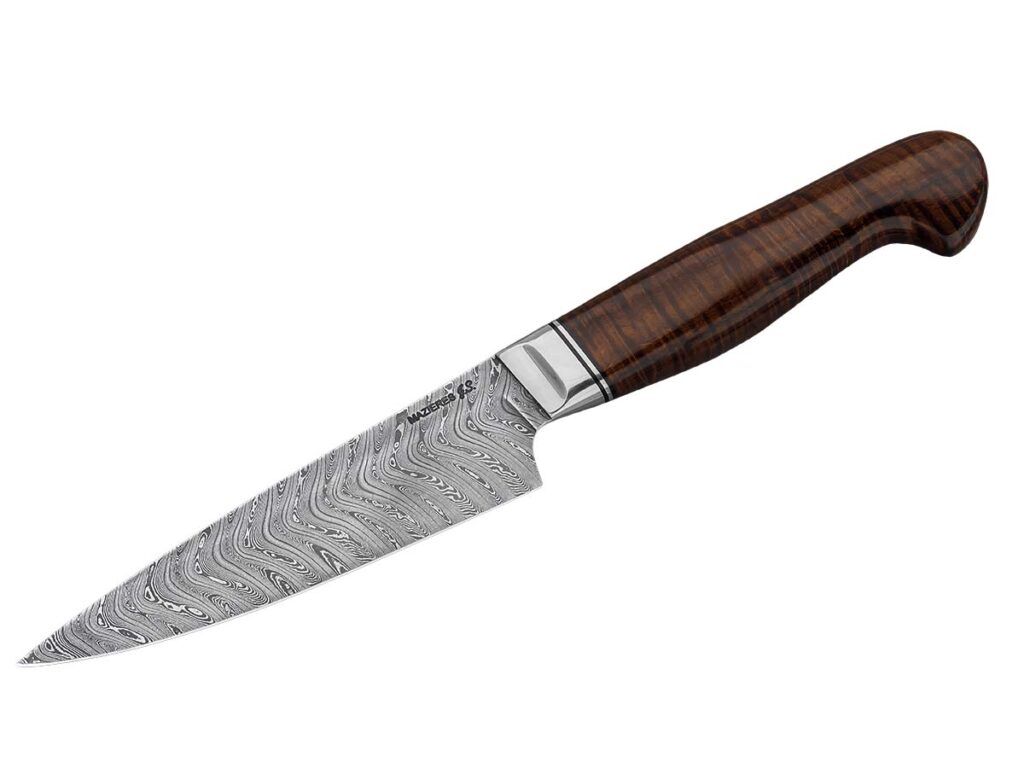
Mazieres FrancoisParing knife

Mazieres Francois Paring knife

Blade length: 5”
Blade material: 150 pattern-welded layers of 1084 and 1075 carbon and 15N20 nickel-alloy steels embossed using chevron dies for the final pattern
Blade grind: Flat
Construction: Hidden tang
Scales: Stabilized South Australian ringed Western myall wood shaped as a composite Western/cowboy style handle; G-10 and 410 stainless spacers
Bolsters: Scalloped, pinned and soldered 416 stainless steel
Overall length: 10”
Knife to know: The maker’s paring knife won for Best Chef’s Knife at the 2025 Perth Knife Show; the maker is a member of the Australian Knifemakers Guild and a journeyman smith in the American Bladesmith Society
Maker’s price for a similar knife: $325 at press-time exchange rate
Maker: YANDIWA, Mazieres Francois https://www.Yandiwa.com.au (Rod Hoare image)


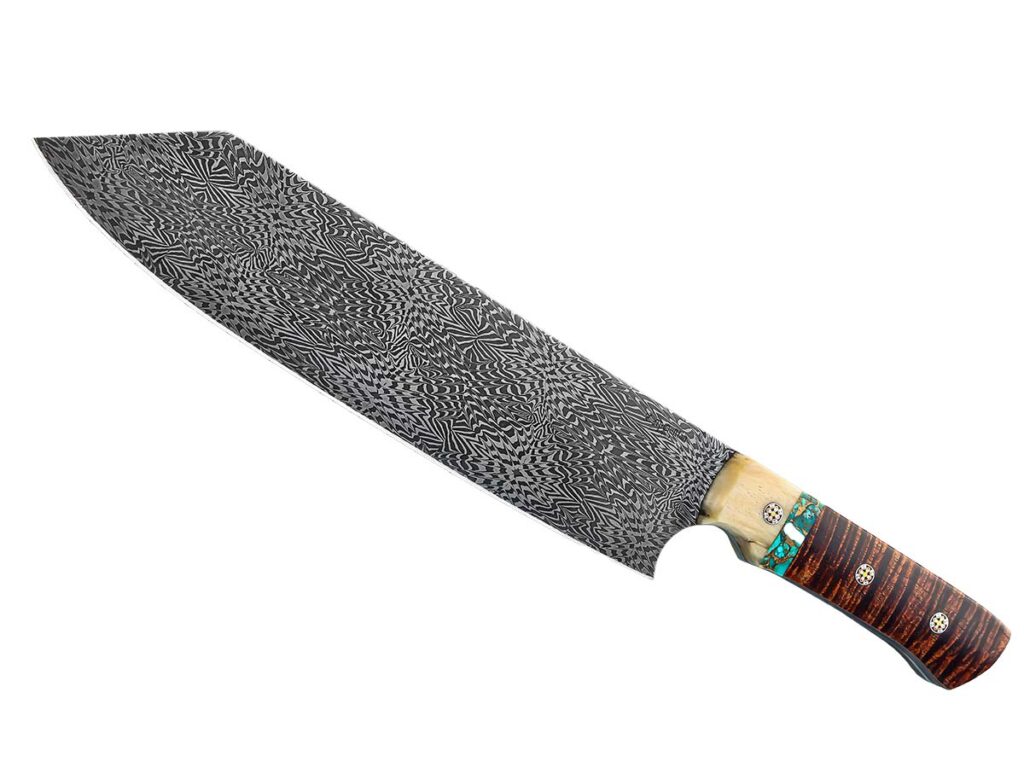
Jon McQuillan Kitchen Knife

Jon McQuillan Kitchen Knife

Blade length: 9”
Blade material: 1084 carbon and 15N20 nickel alloy steels
Damascus pattern: Mosaic Explosion
Scales: Tasmanian blackwood and turquoise cast w/bronze
Bolster: Muskox horn
Overall length: 13.5”
Maker’s price for a similar knife: $2,000
Maker: McQuillan Custom Works, Jon McQuillan j.mcquillan.com (SharpByCoop image)


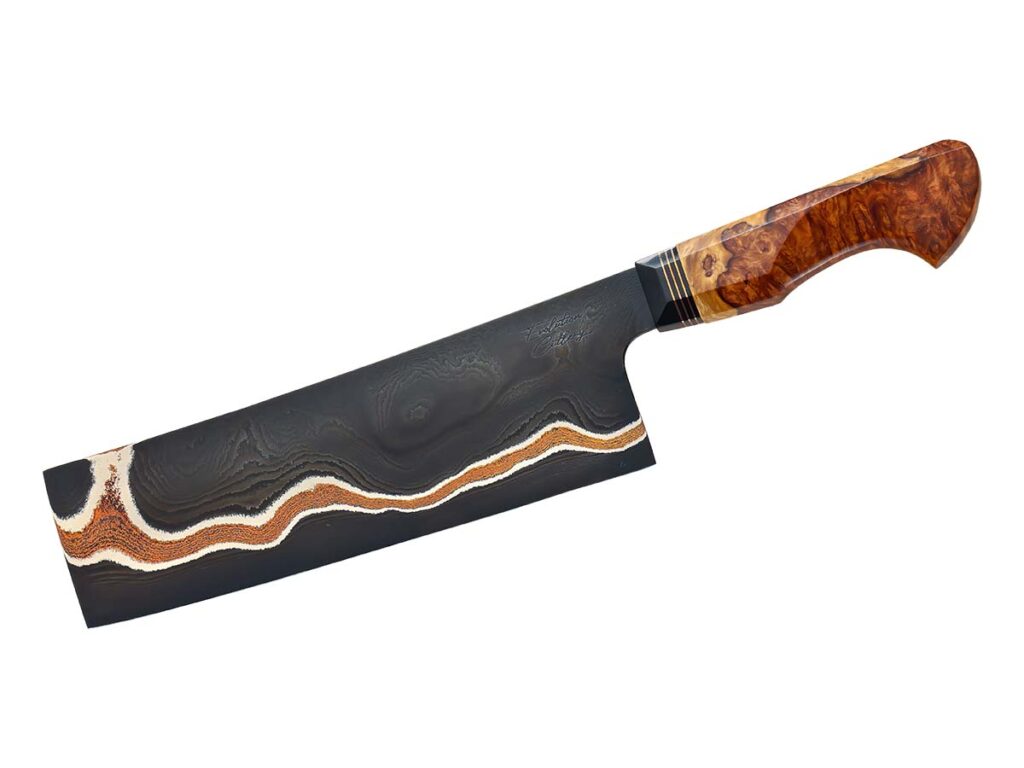
Dan Tompkins Coppermascus Nakiri

Dan Tompkins Coppermascus Nakiri

Blade length: 8.5”
Blade material: Baker Forge & Tool coppermascus
Blade grind: Slight convex
Scales: Amboyna burl
Bolster: G-10/copper
Overall length: 13”
Knife to know: Heirloom fit; patinaed copper
Maker’s price for a similar piece: $1,700
Maker: Evolution Cutlery, Dan Tompkins, evolutioncutleryllc.com (SharpByCoop image)


Joey Dello Russo Santoku

Joey Dello Russo Santoku

Blade length: 9”
Blade material: 80CrV2 carbon steel and pure nickel
Blade grind: Flat convex
Handle: Richlite
Bolster: Nickel silver
Overall length: 13.5”
Maker’s price for a similar knife: $600
Knife to know: The maker is an ABS apprentice smith
Maker: Joey Dello Russo, imperialcustomworks.com (Jocelyn Frasier image)


BCK Knives Chef’s Knife

BCK Knives Chef’s Knife

Blade length: 8”
Blade material: A multi-layered X-mai damascus of 8670 and 80CrV2 carbon and 15N20 nickel-alloy steels, nickel silver and copper
Blade grind: Flat
Handle: Stabilized box elder burl dyed black
Spacer/bolster: McLaren carbon fiber
Overall length: 12.5”
Maker’s price for a similar knife: $1,200
Maker: BCK Knives (Jocelyn Frasier image)


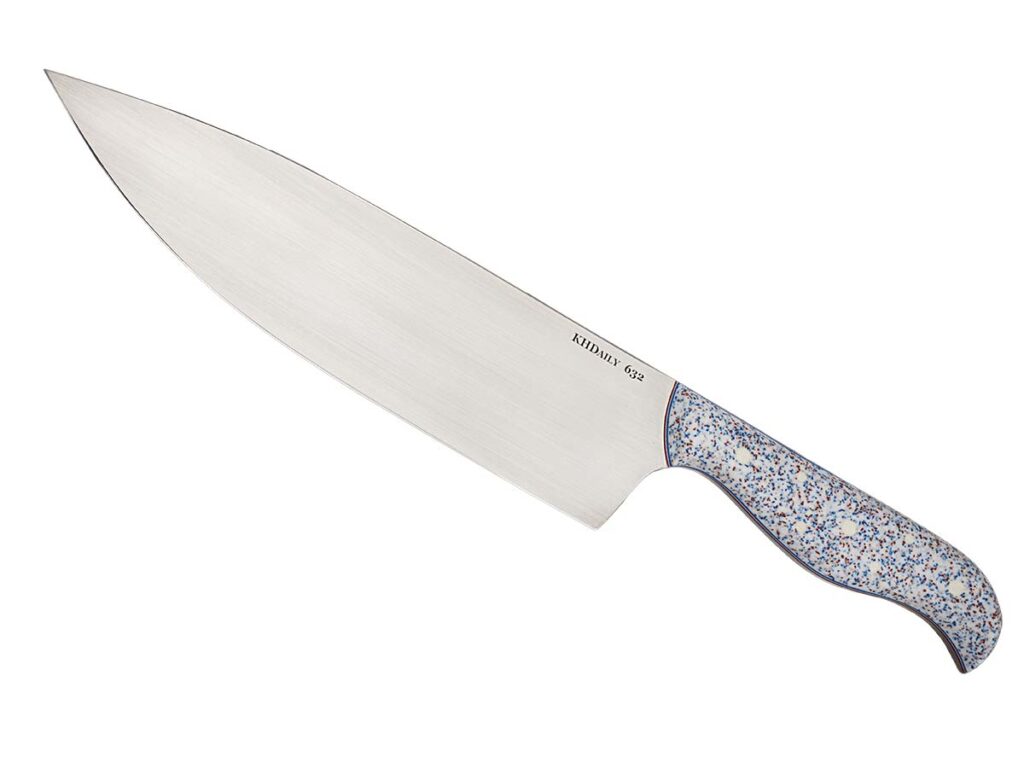
Kyle Daily Chef’s Knife

Kyle Daily Chef’s Knife

Blade length: 8”
Blade steel: CPM 154 stainless
Blade grind: Flat
Handle: Old Glory Limitless Grip-Tec w/red/white/blue G-10
Overall length: 13”
Maker’s price for a similar knife: $500
Maker: Kyle Daily khdailyknives.com (Jocelyn Frasier image)


Matt Williams Chef’s Knife

Matt Williams Chef’s Knife

Blade length: 9.5”
Blade material: 400-layer Lace-pattern damascus san-mai w/a 1084 carbon steel core
Blade grind: Flat
Scales: Mesquite and silver and black acrylic
Overall length: 14.5”
Maker’s price for a similar knife: $800
Maker: Matt Williams, lasterdaywoodworks.com (SharpByCoop image)


Check Out Other Months:

Spycraft Knives SK-4 Sentinel Review: Covert Ringer

Spycraft Knives’ wharncliffe gives you an undercover edge.

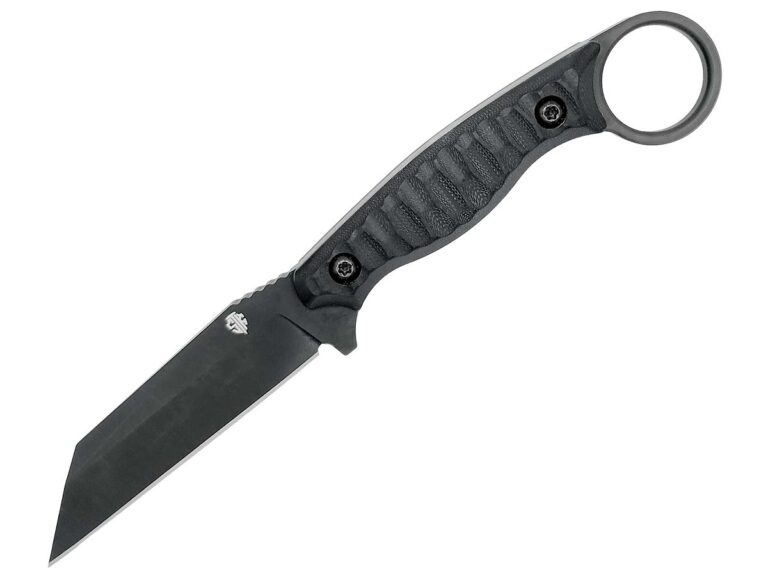
Spycraft Knives is a new player in the game and offers some cloak-and-dagger in its design. As the company’s name suggests, its SK-4 Sentinel is designed with input from ex-SpecOps personnel and is designed for carry on your person or gear.

It’s a ringed knife with a handle shape that feels good in the hand and feels heavy in the hand. Its wharncliffe-shaped blade is a great all-around style, and the angled false edge slims the tip a little. It’s definitely a stout knife, but above all, it must cut. So, let’s run it through the basics.

Light-Duty Testing

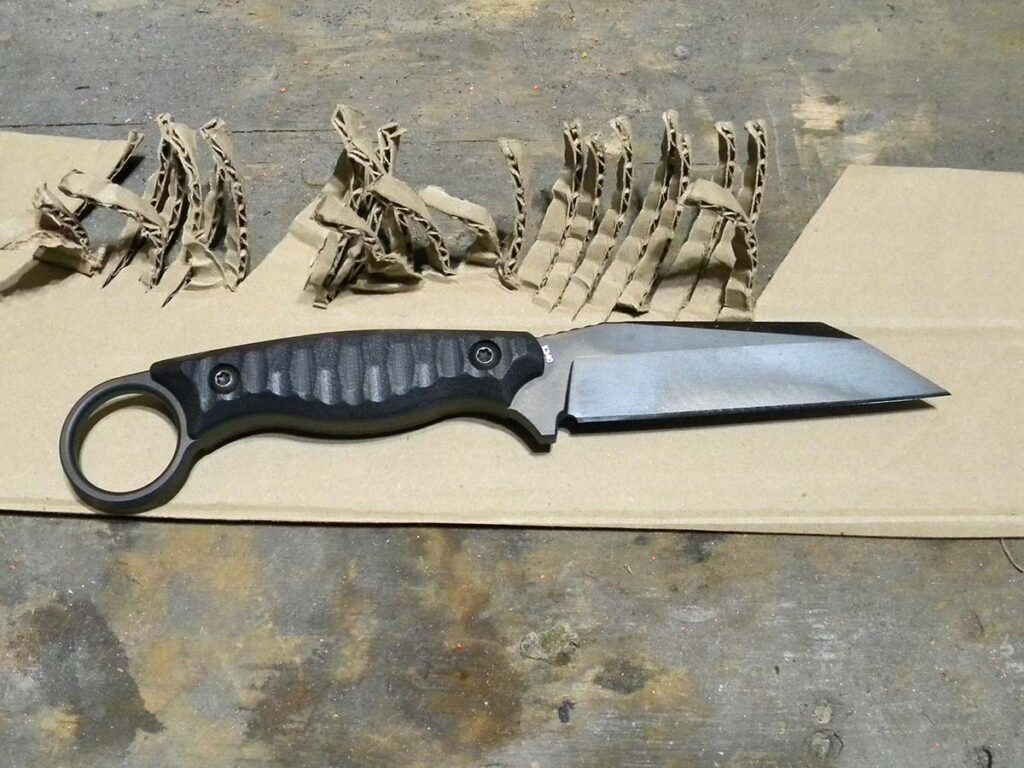
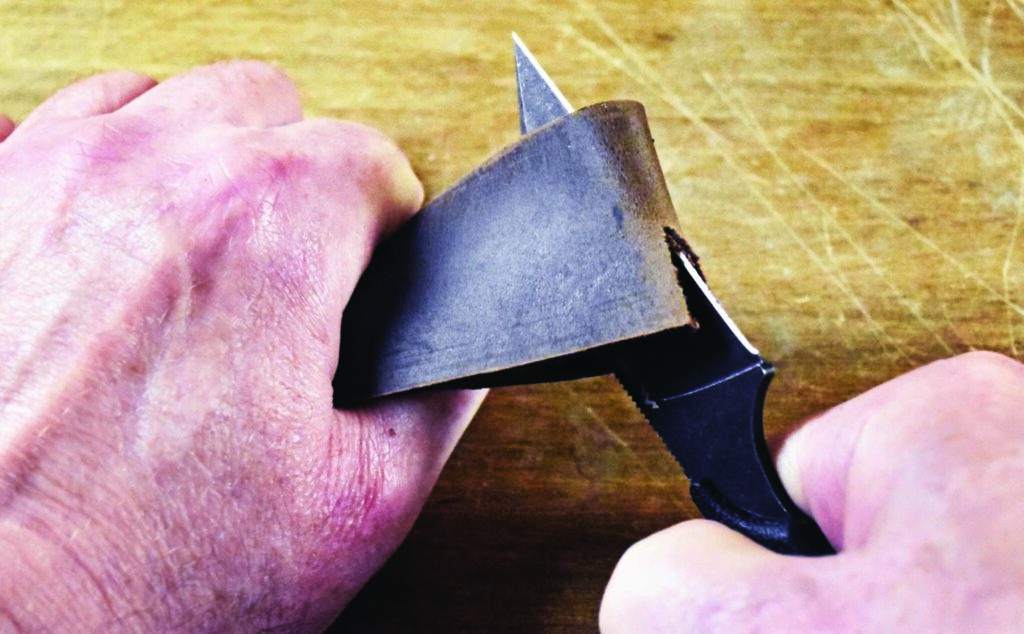
Cardboard did curl, but the author didn’t chalk that up to issues with the knife’s hollow grind. Instead, it was more a factor of the knife’s thickness binding on cuts through the stiffer material.

Up first I tested the edge out of the box with paper slices. The SK-4 sliced fairly quickly with its factory edge and produced a clean cut on all but one attempt. I had a tear, but I put that on operator error as I caught the sharpening notch. Overall, the edge seems to have a medium grit finish designed for heavier work.

I moved on to single-walled cardboard with the Sentinel producing nice, clean cuts with plenty of curling. This was thanks to the knife’s hollow grind in its thick blade steel. It’s possible to get a bit of binding in certain materials with the blade, but it’s possible to push through it. Here, the edge was aggressive, and I had to make sure to keep my fingers clear and had a few close calls with shaving skin.

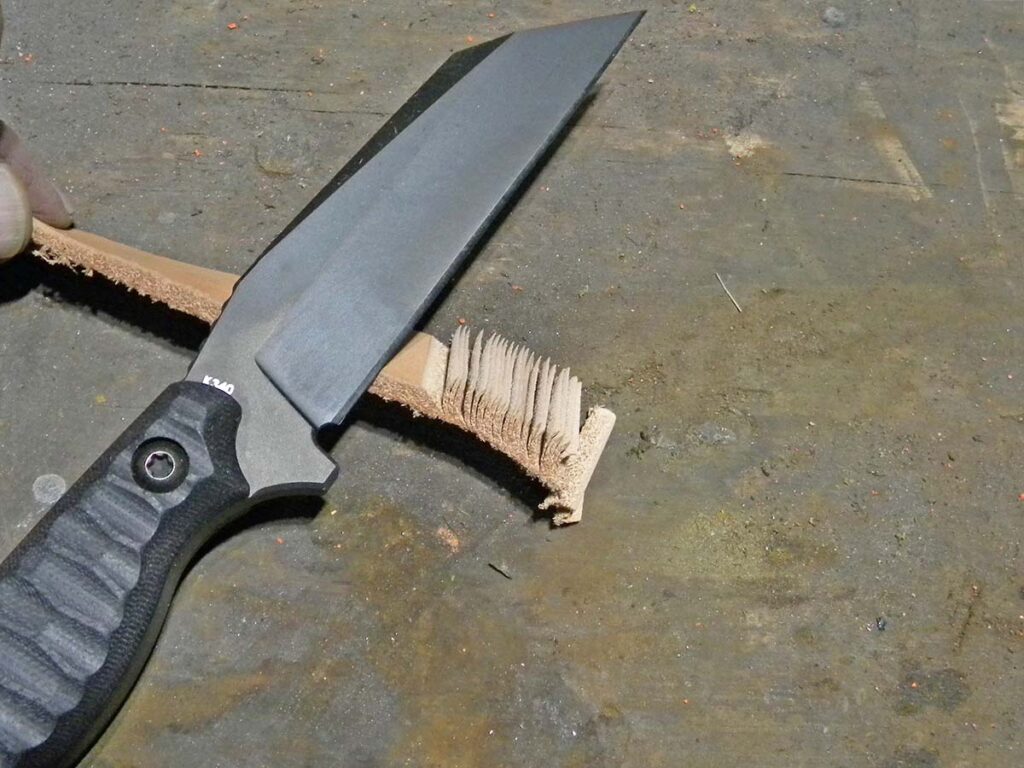
Through leather, the Sentinel was particularly aggressive, the author reports. Both cutting and skiving the hide were audible. Skiving was especially impressive, with the knife producing thin, uniform slices.

On to 8-ounce leather, the SK-4 was really aggressive. Slicing, I got a crunching sound with every cut and found the thumb notch helped keep the cuts evenly spaced. When I switched to skiving, the knife was still talking to me with every cut. Honestly, I didn’t feel any resistance when I was attacking the leather.

Heavy-Duty Testing

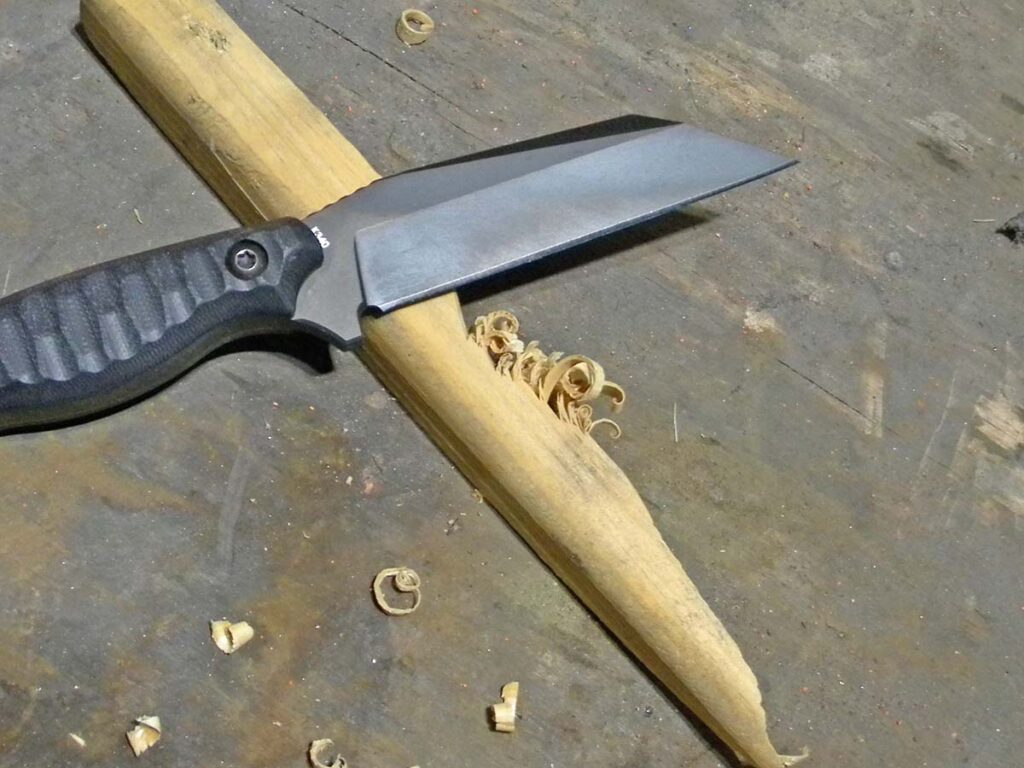
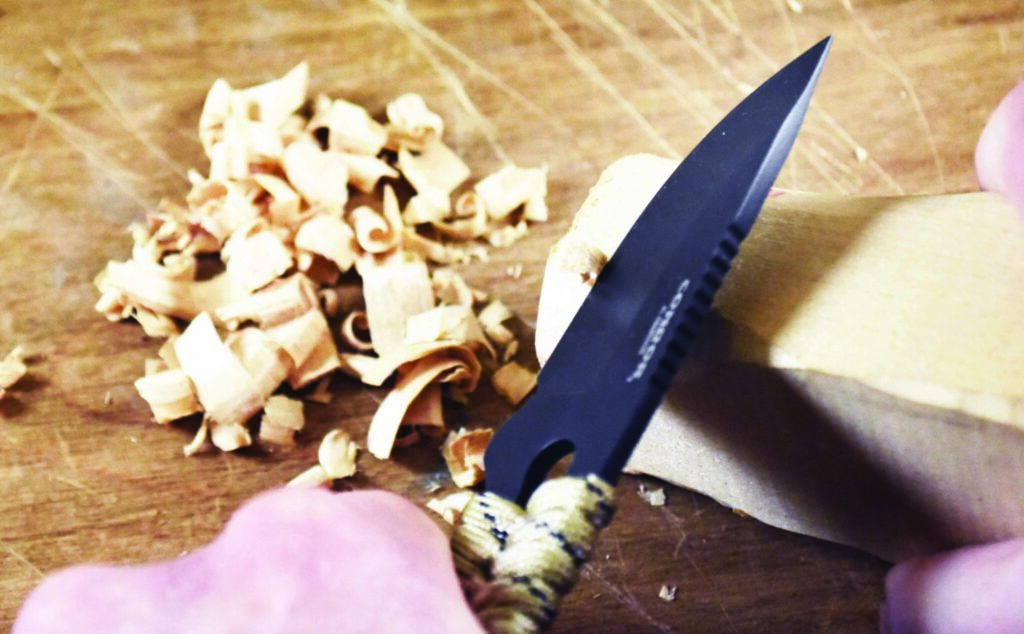
The knife had some nice attributes when challenging tougher materials, such as this pine. The author was able to exert more force when creating curly cues thanks to a smartly placed thumb notch on the spine.

Pinewood was the SK-4’s next task and some whittling. I had to use a steeper angle because of the grind, but the knife produced very uniform curly cues for a fire stick. The contoured handles gave me plenty of control while making the longest cuts and thickest curly cues.

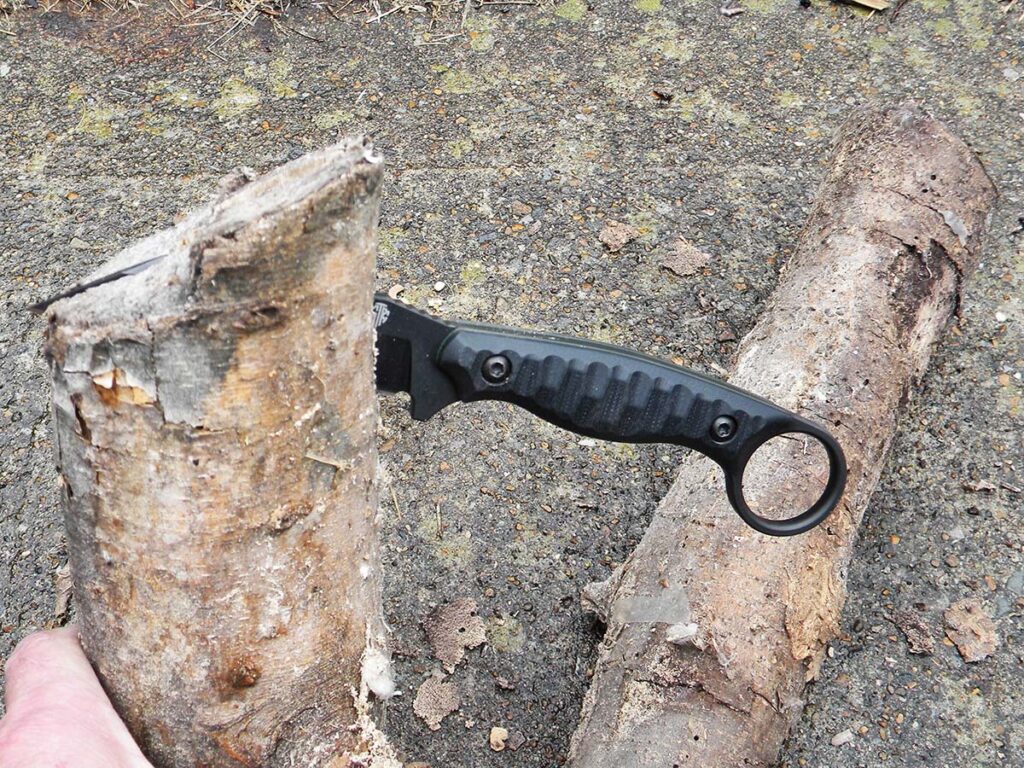
 I batoned the SK-4 into seasoned Hackberry wood. The first hit buried the blade, then I banged on the tip till the wood split. I tried holding the knife by the ring to give my hand room once the tip was buried. It worked, but I felt a lot of shock in my hand. Once the larger chunk of Hackberry was split, the SK-4 quickly split the thinner pieces. I found no noticeable damage to the edge, though it had a few wood smears to oil out.

The SK-4 was up to the tasks of splitting seasoned hackberry, however, it did leave the author with a sore hand when he tried to hold on to the ring while batoning.

Time for my favorite medium, sisal rope. The SK-4 crunched its way to 146 cuts before the edge started to slide. Nicely done. What was especially nice was that I found no hot spots on my hand from the handle. Overall, the wharncliffe blade aggressively zipped through the rope.

Overall Take

The SK-4 is a lot of knife in a smaller package. It has good edge retention with a comfortable handle. I am not a big fan of ringed knives, and I would like thinner steel used to keep weight down.

SK-4 Sentinel Specs
Maker: Spycraft Knives
Steel: K340 tool
Grind: Hollow
Overall Length: 9”
Blade Length: 4.09”
Weight: 7.26 ounces
Finish: PVD
Blade style: Wharncliffe
Handles: Textured G10
MSRP: $399

More Reviews:

Best Neck Knife: Options To Yoke Up With (2023)

2

Carrying A Concealed Yet Capable And Easy-To-Access Knife, These Neck Knife Options Won’t Leave You Dangling.

Neck knives are often overlooked as a form of everyday carry, which is surprising since they offer so many advantages. Neckers, as they’re slang-fully called, excel at concealment* as they are easily covered by a shirt or jacket, and, because they’re uncommon EDCs, offer an element of surprise.

While neck knives frequently may be thought of as tools of self-defense, they also offer utility aplenty. In addition, with a fixed-blade neck knife—like all fixers—you simply snatch it from its sheath and you’re ready to go.

Condor Tool & Knife Carlitos Neck Knife

Condor Tool & Knife Carlitos Neck Knife
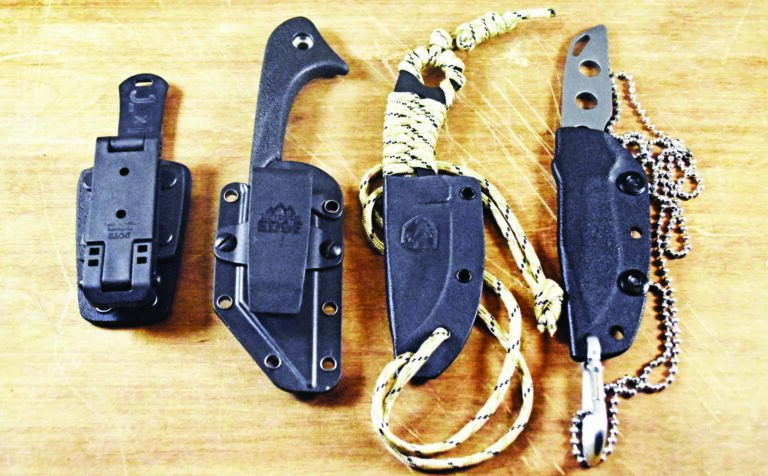
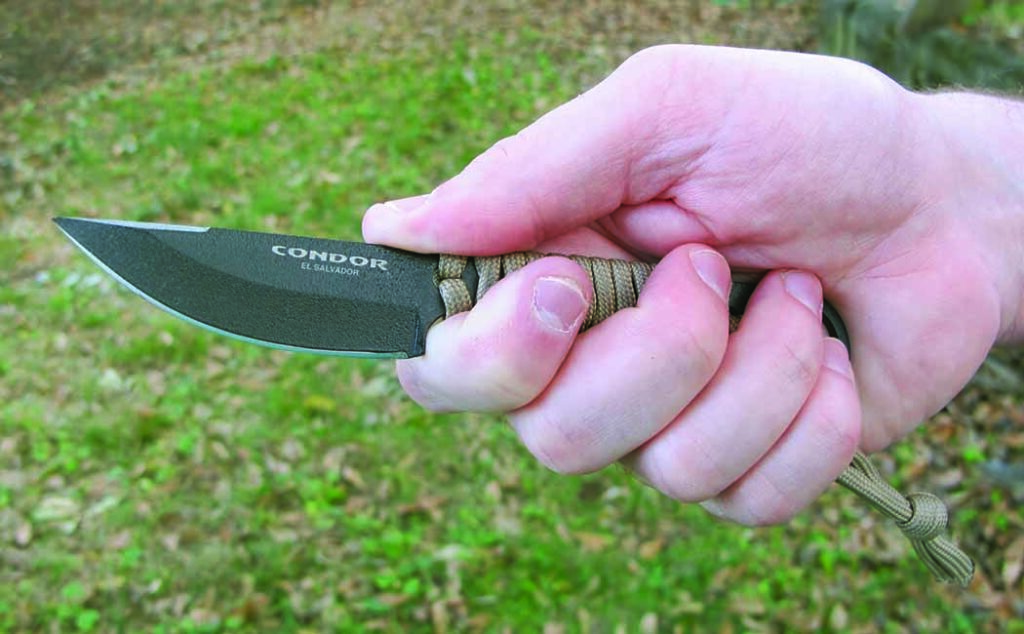
The Condor Tool & Knife Carlitos is pure necker and smacks a bit more of a field knife than a tactical. It shaves wood for fire starter very well and, in fact, could serve as a skinner. In addition, the paracord could come in handy in an emergency.

Condor Tool & Knife’s Carlitos Neck Knife is small and lightweight, its weight primarily reduced by its skeletonized design, with only a paracord wrap to add load to its black carbon steel mass. 

The blade is gimped on the lower spine for added grip. The handle is cord-wrapped with a braided lanyard at the base, handy for releasing the knife from the sheath. The grommets at the sheath’s base can take paracord or ball chain for neckwear.

MSRP: $43

Outdoor Edge LeHawk

Outdoor Edge LeHawk
The Outdoor Edge LeHawk is the largest of the test neckers and its 2.9-inch reverse tanto blade came to work. The blade was long enough to sever beefy harness leather with an upward pull-through in a single stroke.

The Outdoor Edge LeHawk, designed by knifemaker Jerry Hossom, is the largest of the test knives. The blade has a swedge grind and fine gimping along the spine. 

The 3.3-inch handle is grippy with a kicked-up bird’s-beak butt to prevent slippage. The sheath wears around a neck via a length of provided cord or carries on a belt.

MSRP: $35

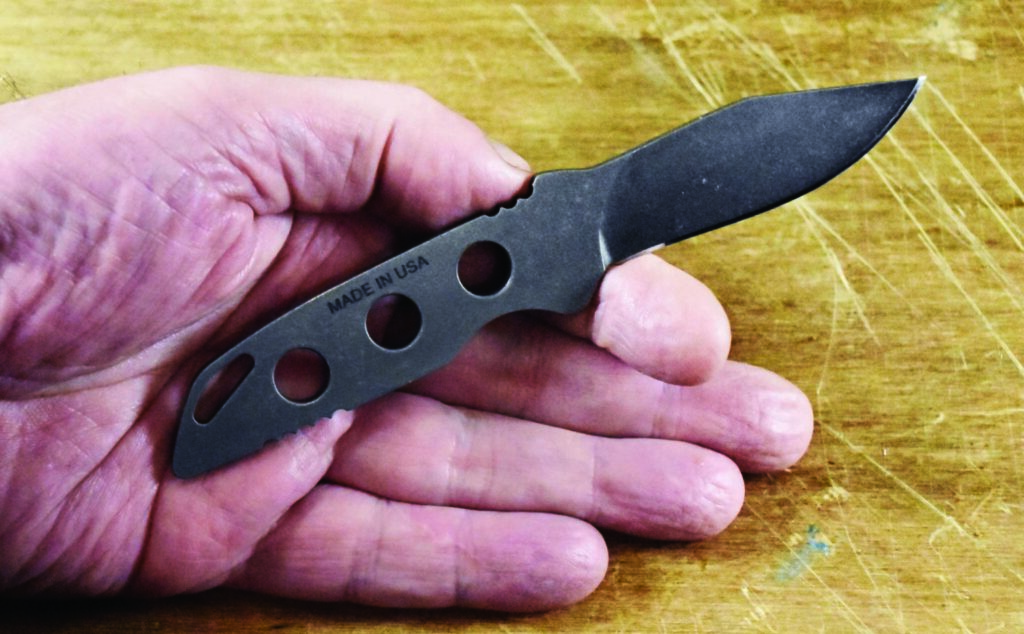
TOPS Knives Sneaky Pete Mini

TOPS Knives Sneaky Pete Mini neck knife
You can see how much hand you have to work with on a mid-size neck knife. The TOPS Sneaky Pete Mini is six inches overall with a 3.5-inch handle. A knife this size won’t fill the palm but there’s enough to get some chores done.

The TOPS Knives Sneaky Pete Mini resembles a scaled-down tactical knife. In fact, it is a miniaturized version of the company’s larger Sneaky Pete introduced in 2018. 

The blade’s recurved edge flows into a 3.5-inch skeletonized handle. The entire knife is carbon steel. Delivered with a sheath and ball chain necklace, the Mini also has a carabiner clip for dangler carry. The skeletonized construction makes for a very slim package.

MSRP: $115

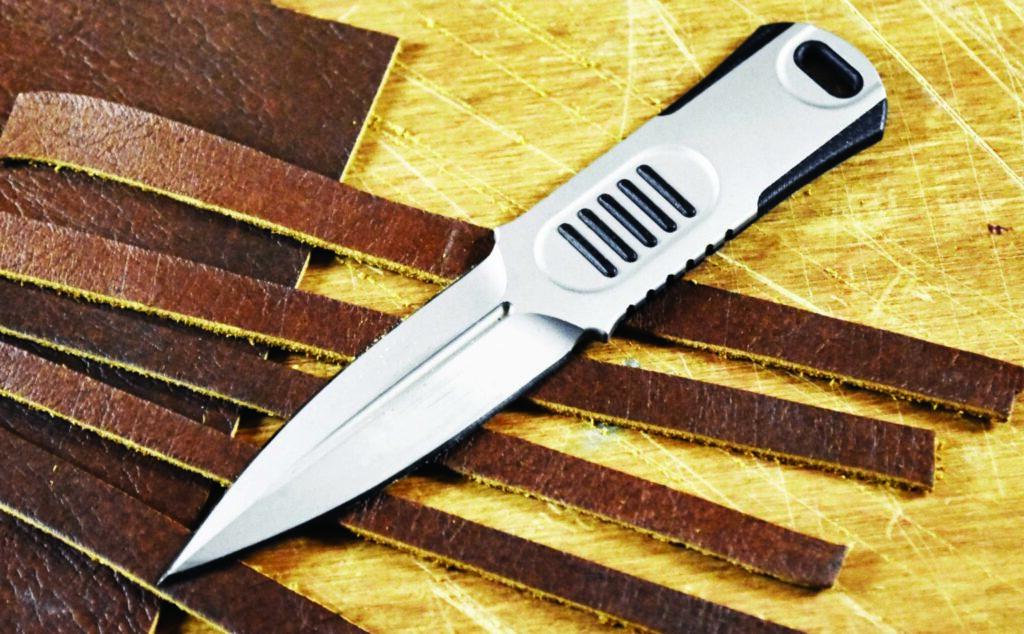
WE Knives OSS Dagger

WE Knives OSS Dagger neck knife
The little WE Knives OSS Dagger, 4.25 inches overall with a two-inch blade, is more of a hideaway knife than a utility hog, but it was not without its merits. The sharp blade of upscale CPM 20CV stainless steel took off nice, clean slices of leather scrap.

The WE Knives OSS Dagger is derived from the famed Fairbairn-Sykes/OSS daggers of World War II, though did you know there were variants this small? They were made for concealment for clandestine operations and called lapel, sleeve and thumb daggers, and it is from these that the WE version is derived. (And, of course, “WE” does not stand for the W.E. of William Ewart Fairbairn.) 

The double-ground blade has one edge sharpened and a tapered fuller. The back side of the blade is flat. Essentially an integral design of stainless steel, the handle has inlays for improved grip. The knife is delivered with a black sheath and ball-chain necklace.

MSRP: $105

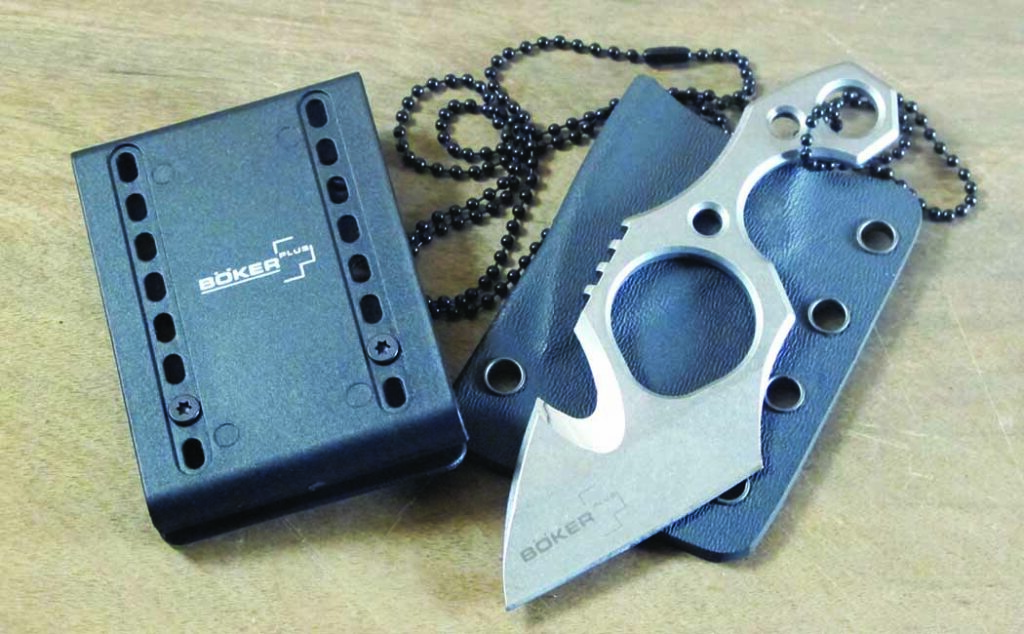
Boker Plus Rescue Kiridashi

Boker Neck Knife
The Boker Plus Rescue Kiridashi is the total package. In addition to the neck knife and black Kydex sheath, Boker includes a ball chain necklace and optional bolt-on Kydex belt loop.

The Boker Plus Rescue Kiridashi gets the “rescue” label by offering a large gut-hook-style web cutter. (For more on the latest rescue knives, see page 44). The blade has the flat edge of a kiridashi but is hollow ground on both sides to enhance slicing capabilities. The handle—the blade and handle length overlap—has a large index finger hole for a sure grip. A black Kydex sheath, black ball chain and bolt-on Kydex belt loop are included.

With its large wharncliffe blade, the knife proved to be a beast. I tested it on leather and 3/8-inch synthetic rappelling rope and it whipped through both with ease. The ring in the short handle enhances grip, making the index finger your main purchase point. Watch out for that gut hook webbing cutter, however, as it’s awfully close to the thumb rest. I tried the hook on seat belt webbing as well. In my experience, though gut-hook-style webbing cutters don’t perform as well as serrated blades, the Rescue Kiridashi will do the job in the heat of the moment.

MSRP: $45

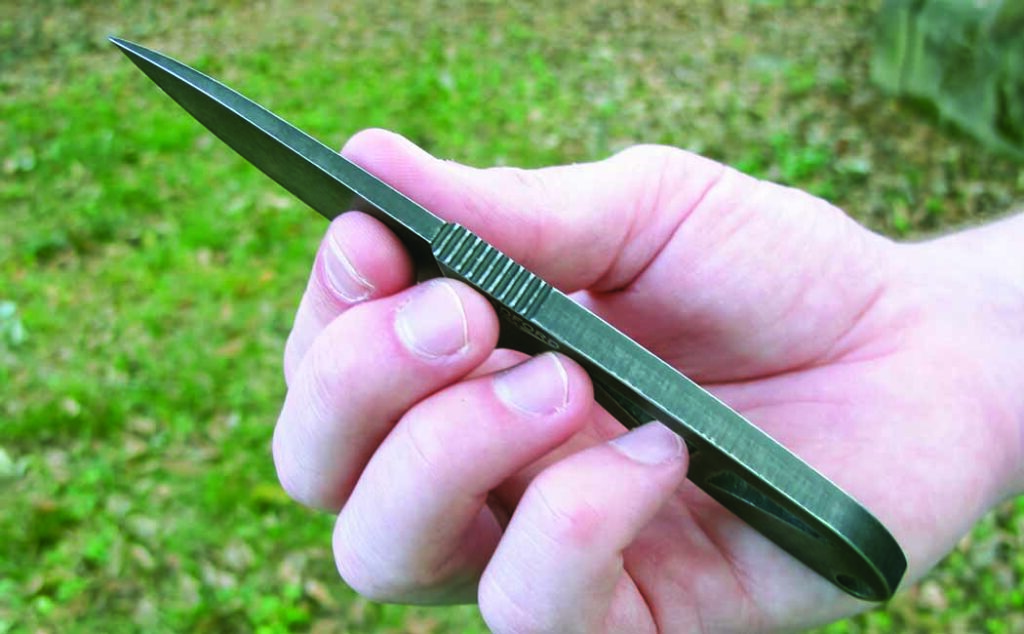
Bradford Knives’ G-Necker

Bradford Neck Knife
The G-Necker’s thick quarter-inch-plus steel is unusual on a neck knife but Bradford puts it to good use. Note how the blade tapers while the handle retains the full thickness for a comfortable grip.

Bradford Knives’ G-Necker eschews radical curves for more classic lines that give it the look of a standard small fixed blade. It departs from the norm, however, by flexing its muscle with top-shelf Elmax stainless steel in a graceful, flat ground drop point blade. The handle, thick enough to forgo a cord wrap or scales, has two triangulate holes to lighten the load. We tested the blackwash version—other finishes are available. Bradford provides a black Kydex sheath and ball chain necklace.

The quarter-inch-plus-thick handle is unusual among neck knives. However, if you think it might be a bit clumsy, that’s not the case. Bradford has struck a balance by keeping the steel’s thickness on the handle but tapering it on the blade for better slicing.

The Elmax steel cut like a house afire, taking off super crisp cuts on harness leather and whipping through 3/8-inch rope with ease. The handle rests in the palm nicely and the notched gimping on the thumb rest enhances grip. Handles with no scales or padding don’t bode well for long term use as those that have them, but if you’re using the Bradford G-Necker for quick chores, you’ll have no worries.

MSRP: $99

Condor Tool & Knife Kickback

Condor
The Condor Tool & Knife Kickback provides a hint of tactical with its swedge-ground spine, while the blade offers a deep belly for outdoor chores such as skinning.

Condor Tool & Knife designed the Kickback for both urban and field duty. The straight-back blade has a swedge grind for enhanced penetration, giving it a tactical feel, while its deep belly makes it at home in the field. The steel has a black traction coat stem to stern and there’s a large finger hole in the base. A nicely done tan paracord wrap with a knotted pull completes the handle. Condor provides a black Kydex sheath with ball chain for neck carry.

The blade did an excellent job of slicing through harness leather, which bodes well for the knife’s potential use as a skinner. I also found the swedge ground point adept at penetrating and boring into leather. Due to its light weight and short blade, the Kickback wasn’t quite as good at cutting 3/8-inch rope as at least one other of the test knives, but it gets the job done. The cord-wrapped handle is very comfortable. I found the ring at the base a bit tight for my pinkie finger but it works well for hanging the knife on a lanyard.

MSRP: $35

TOPS Knives Mini Tanimboca Puukko

Tops Neck Knife
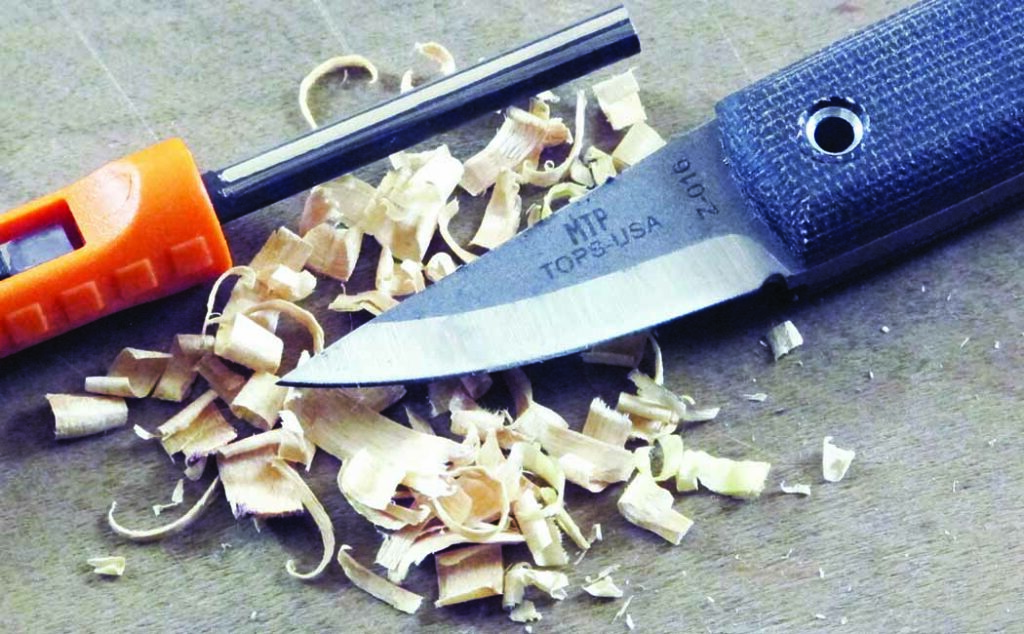
The TOPS Mini Tanimboca Puukko is an excellent little necker for fire prep. It cut fine wood slivers and curlicues for tinder, and the blade spine threw righteous sparks off a ferro rod.

The Mini Tanimboca Puukko by TOPS Knives makes no bones about its mission: It’s basically a small bushcraft knife. It is a full-tang design with a flat-back Scandi-ground blade. The little necker’s handle features comfortably plump black linen Micarta® scales with a large tube lanyard hole in the butt. At 1.28 ounces it’s the lightest of the test group and deviates from the rest in its uncommon top-loading brown leather neck sheath, which wears on a belt, too. The knife is also the smallest of the review neckers and, indeed, the most distinctive.

As noted, the Mini Tanimboca is a field knife. While it will cut leather strips and can saw its way through 3/8-inch rope, it really excels at fire prep. I tested it for taking fine shavings from a boxwood block and stick of pine, and it dug in with gusto and precision. I then tested the blade spine on a small ferro rod and it threw sparks like a champ. The blade tip bores holes in leather with accuracy. The tiny knife makes an excellent companion to its larger sibling, the TOPS Tanimboca Puukko.

MSRP: $110

Securing Your Lanyard

Neck knife lanyard
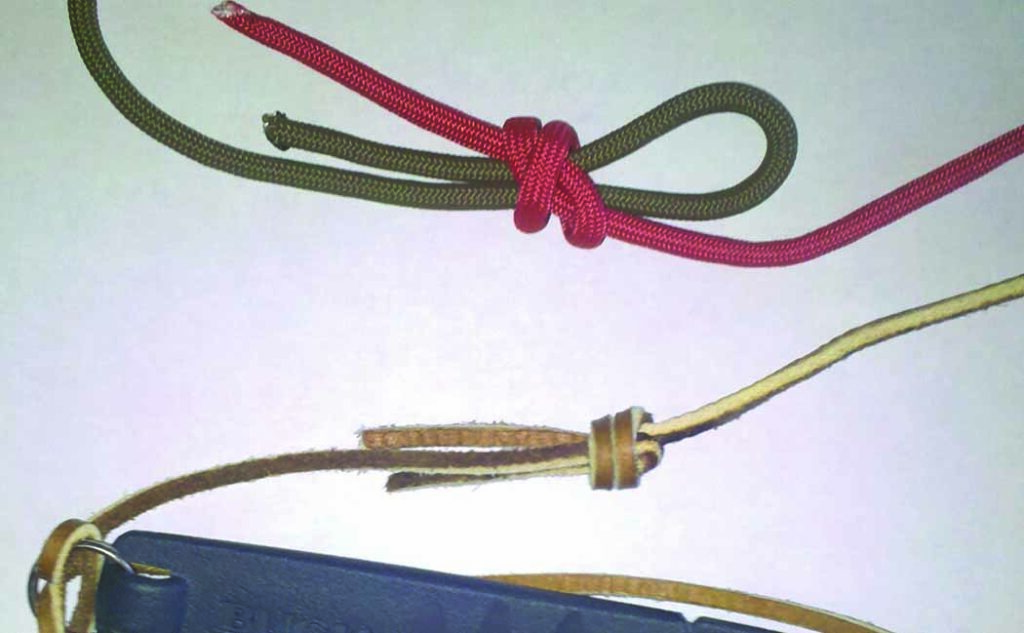
Two friction knots for neck knife “necklaces”: one tied loosely with two different colors of cord for clarity, and below it the same knot tightened up more neatly on a leather lanyard. (Bob Seymour image)

An area of concern with neck knives is the mode of carry around your neck; in other words, if the necklace does not give way if it catches on somethings, it can wring your neck—or worse.

Ball chains are designed to break easily in such instances and thus are considered safe. They’re also cheap and easy to replace. A nylon, leather or other cord, on the other hand, won’t snap in two easily. The solution? A friction or other knot that will release from around your neck with sufficient tension.

“Almost any knot around a loop will do the trick, though some knots may work better than others,” noted BLADE® reader Bob Seymour. In the accompanying image are two friction knots: one tied loosely with two different colors of cord for clarity, and below it the same knot tightened up more neatly on a leather lanyard. Note that the loop prevents the knobby end of the cord from catching during release.

Experiment with different materials and knots and test them to see if they will release with sufficient tension. The key is to arrive at a knot that does not release too easily and one that won’t release at all. If in doubt, trash the cord and use a ball chain.

*Be sure to check the laws concerning concealed knife carry in your area.

Read More

Best Sheepsfoot Blade Knives For Everyday Use

The Sheepsfoot Blade Isn’t The Most Popular Style, But It Is Certainly Quite Useful. This Quartet Of Knives Show Why You Should Try A Sheepsfoot.

I promise there will be no butchering graphics in this article. The sheepsfoot blade is one of many blade styles out there today, but it isn’t as popular as say the drop point or clip point. 

And that might be due to the shape of the blade. Instead of tapering down to a fine tip like a clip point, the sheepsfoot has a large belly and a smooth, usually curved, tip.

The name of the blade is a pretty literal one. It was named because it was made to trim the hooves of sheep. The shape of the blade looks nothing like a sheep’s foot. The use of the blade gave it its name, and it stuck.

Are Sheepsfoot Blades Only On Pocketknives?   

Yes, most sheepsfoot blades are on pocketknives and other EDC knives, but that’s not all. The popular Santoku knife features a sheepsfoot blade. The long dull spine that leads to the curved tip makes the knife great for slicing and chopping, and the wide belly allows it to act as an excellent scoop to get food off the board.

What Are Sheepsfoot Blades Good For?

Thanks to its long, flat edge, a sheepsfoot blade is perfect for slicing and chopping. Need to cut lengths of rope? Grab a sheepsfoot. Have to chop hard vegetables like carrots to drop in the pot over a campfire? Grab a sheepsfoot. 

Beyond slicing, a sheepsfoot is also great for tasks that involve longer knife strokes like opening boxes, slicing through sections of cardboard, and whittling wood. There’s countless uses for a sheepsfoot blade because it is such a basic, straightforward blade style. 

Why Might You Want To Pass On A Sheepsfoot?

The long, straight edge that makes a sheepsfoot perfect for slicing makes it a liability for things like piercing and. There is no fine point like a dagger or a clip point because the dull spine curves down to meet the cutting edge. This means that things like poking and puncturing are difficult with a sheepsfoot. Sure, you could angle it to puncture through a bag or a case, but it’s much harder than if you used something like a drop point.

Best Sheepsfoot Blades

This guide will stick with pocketknives as that is where the sheepsfoot is most widely seen. Classic EDC blades, keychain knives, the sheepsfoot appears across the knife landscape.

Benchmade Griptilian

griptilian

Benchmade makes excellent knives, that is without question, and the Griptilian is one of their best. The knife features a 3.45-inch CPM S20CV steel blade with a flat grind and treated to a 59-61 HRC. The satin finish looks great on it.

The gray G-10 handle scales look clean and provide a great grip. The AXIS lock keeps everything secure and is ambidextrous. Everything about the knife is class all the way down to the deep-carry pocket clip. This knife is a prime example of what a sheepsfoot blade can be.

MSRP: $149.95

Kershaw Copper Cinder Keychain Knife

copper cinder

A tiny sheepsfoot is still a sheepsfoot, and this fun multi-tool form Kershaw is a blast to use. The 3Cr13MoV blade has a 1.13-inch cutting edge with a hollow grind. It looks exotic with the machined copper handle, but this knife is all about practicality.

The small blade is sharp and can easily handle the simple day-to-day tasks that life can throw at you. The large keychain hole lets you easily pop it onto your chain with ease, and the integrated bottle opener will easily crack open your next beer. 

It’s not the biggest or the baddest, but the Copper Cinder performs exactly as advertised.

MSRP: $28.79

Kizer Vanguard Mini Sheepdog

kizer mini sheepdog

A compact, cleaver-style knife, the Vanguard Mini from Kizer is a great blade for someone who spends time camping. Yes, this is a strong EDC blade, and the 2.5-inch straight edge makes it ideal for cutting rope or slicing food to prepare over the campfire. Its versatility helps sell the knife in a major way.

The blade is a satin-finished 154CM stainless meted to a micarta handle. The flipper mechanism makes the knife a blast to use, and everything stays in place thanks to a liner lock. Functional, classy, enjoyable. That’s what the Vanguard Mini is all about.

MSRP: $99

Spyderco SpydieChef

This folder from Spyderco is another excellent model from the company. The SpydieChef is an EDC folder designed to have the ergonomics and feel of a chef’s knife. The titanium handle is light yet robust in the hand, and the LC200N stainless blade is highly corrosion-resistant. That’s to be expected from a blade steel developed by NASA. 

The SpydieChef is multiple things depending on how you look at it. Its size makes it firmly an EDC that is made from high-quality materials. However, the design philosophy makes it look more like the most company kitchen knife on the market. Regardless, it has a steep price but more than makes up for it with its construction.

MSRP: $348.50

Read More

Flip Out: Four Balisongs To Trick Out Your Collection

Known By Many Names, The Balisong Is A Flipper’s Favorite Knife. These Four New Balis Are On The Cutting Edge Of The Style.

The balisong presents knife manufacturers with an excellent opportunity to express their design creativity and material preferences in a style that promotes pure enjoyment among flipping enthusiasts.

Long popular amid the knife-buying public, the balisong—aka bali, butterfly knife or simply butterfly—is a favorite of those who appreciate its mechanics, good looks and the sheer fun of flipping. With safety in mind, the manufacturers whose stock in trade includes the balisong provide new and innovative models on a regular basis. 

Along with these, training versions are often available, while seminars, videos, instructional courses, and online conversations are always at hand for those learning to use the balisong for the first time, as well as seasoned veterans who want to broaden their horizons.

Squid Industries Krake Raken Bowie V2.5

Lucas Cao, president of Squid Industries, is excited with the performance of the company’s Krake Raken Bowie V2.5. 

“It’s wonderful that everything about it is highly optimized for the best flipping experience possible,” he said. “Some notable special features are the machined handle texture and its unique balance profile. The mechanism is a combination of stainless-steel bushings and phosphorus bronze washers. What makes the bushings special is we manufacture them in-house on our own Citizen Cincom L12 Type 7 Swiss lathe with extreme precision. Our expert assemblers use the bushings to then create the glassy smooth swing that the Krake Raken is known for.”

The Krake Raken is available in both live and training versions, allowing users to become familiar with its operations without the worry of an injury, according to Cao. And reliability is a watchword from the factory floor to the buyer’s hand.

“All of our balisongs go through rigorous testing across a long period of time and with many different users,” Lucas explained. “Balisong flipping is highly subjective, so we make sure that the feedback we gather is from both beginners and experts inside and outside of the organization. While Squid Industries has several top-tier flippers in our own ranks, we also work with top flippers around the world to hear their thoughts on our latest developments.”

An accomplished flipper in his own right, the Squid boss sees customers in the balisong universe always on the lookout for excellent ergonomics, grip, balance and durability. The ideals are addressed at Squid with continuing revisions and upgrades to its balisong line that are generated through robust customer feedback. 

Finding Squid in the marketplace is easy, and its commitment to the education and popularization of the balisong is evident in its sponsorship of the West Coast Flipping Championship, a 32-person-event live competition held each year at BLADE Show West. In addition, YouTube is well stocked with flipping and maintenance tutorial videos.

Knife Specs

Blade Length: 4.5 inches

Blade Steel: AEB-L stainless

Blade Closure: Latchless design

Handle Material: 7075 T651 aluminum

Weight: 4.33 ounces

Closed Length: 5.625”

Country of Origin: USA

MSRP: $284.99

Premium Alpha Beast Kukri

The Premium Alpha Beast Kukri is the latest from Bladerunner Systems and is another example of the continuing outreach the company provides relating to balisongs. 

“Spreading the word has been part of our primary focus,” commented Bladerunner’s Edward Anthonis. “We have been active in the community, hosted online tournaments, provided video content, and partnered with retailers to spread the word about balisongs and what a fulfilling and amazing hobby and sport it is and has become.”

With the Premium Alpha Beast Kukri, Bladerunner puts its best foot forward. 

“What makes any knife transcend being just a knife will always be the attention to detail given from a maker or designer that truly understands what makes a purpose-driven knife the best in actual application,” Anthonis remarked. “Our balisongs are built not only to be great knives but also to be great for balisong manipulation.”

The bushings of the Premium Alpha Beast Kukri are something special, and Edward says they are an integral component of most Bladerunner folding knives. 

“We use bushings in most of our knives, and we find the action of a balisong on bushings works best for the intended application,” he stated. “Having the critical dimensions of a balisong in place combined with a well-tuned bushing system makes for the best flipping experience.”

For Anthonis and company, testing is always a part of a quality manufacturing process, particularly since he and co-owner Lawrence Ho are flippers themselves. 

“Since we both flip and have our feet firmly planted in the balisong community,” Edward related, “we can test the products and also get them into the hands of other flippers to solicit their feedback.”

KnifeSpecs

Blade Length: 4.5 inches

Blade Steel: 154CM stainless

Blade Closure: Latch

Handle Material: Titanium

Pocket Clip: Yes

Closed Length: 5.375 inches

Weight: 5.3 ounces

Country of Origin: USA

MSRP: $439.99

Kershaw Moonsault 5050

“Our butterfly knives utilize four KVT-ball bearing systems,” explained Dominic Aiello of Kershaw/Kai-USA. “On each side of the two pivots is a ring of ‘caged’ ball bearings that enable the blade and handles to move quickly and smoothly.”

So it is with the Kershaw Moonsault 5050. Customer appreciation and response to knife offerings help move the company forward, and with its latest balisong the reviews have been quite positive.

“When we develop our butterfly knives, our goal is simple,” Aiello related. “We want to offer a high-quality USA-made product that is affordable and fun for everyday knife users and flippers. With that said, smooth flipping, comfortable handles, and good weight balance are keys with butterfly knives.”

For beginners interested in learning more about the fun of flipping, Kershaw offers the Lucha trainer. It closely replicates the size, weight and design of the original Kershaw Lucha bali.

Knife Specs

Blade Length: 4.6 inches

Blade Steel: 14C28N stainless steel

Blade Closure: Latch

Handle Material: Stainless steel

Weight: 6.1 ounces

Closed Length: 5.65 inches

Country of Origin: USA

MSRP: $249.99

Benchmade 85 Billet Ti Balisong

The Benchmade 85 Billet Ti Balisong is the product of modern technologies, processes and materials applied to a very traditional knife, says Vance Collver, company director of product line management. The knife’s best attributes include smooth, consistent action, and those who experience it are the best judges of that slick performance.

“If a balisong has any drag or ‘sticky’ spots in the rotation, it can affect timing during flipping,” Collver reasoned. “Durable materials—think about how often these knives get dropped when flippers are learning or trying out new or complex tricks—and style since it must look good too, are important factors. A balisong must be ‘cool,’ solid and function flawlessly.”

Benchmade folks take pleasure in walking customers through basic, fundamental flipping techniques at shows and various customer interactions, and several balisong enthusiasts and experienced flippers on staff at Benchmade put the company’s new product offerings through their paces.

“This knife is not available in a trainer version and is intended for experienced flippers or collectors only,” Collver advised. “Balisongs are part of our DNA at Benchmade. Our company was founded in the pursuit of the balisong, and to this day our logo remains a butterfly harkening back to our origin.”

Knife Specs

Blade Length: 4.4”

Blade Steel: CPM S30V stainless

Blade Closure: Latch

Handle Material: Titanium

Weight: 5.28 ozs.

Closed Length: 5.6”

Country of Origin: USA

MSRP: $750

Read More

Advertisement

Must Read Articles

Read this before you make a knife

Knifemaking 101 – Read This Before You Make a Knife

  by Wayne Goddard My experience has taught me that there's nothing like digging in and getting started. I've often said the hardest part of the...
how to forge damascus steel

How to Forge Damascus

Advertisement
Advertisement