
Buyer's Guides

You’re looking for a new knife in a certain style – we’ve got recommendations on the best blades for every price point.

The Joy of Cooking Knife Review

Ethan Becker and Dan Eastland collaborate on a sharp tool for the kitchen.

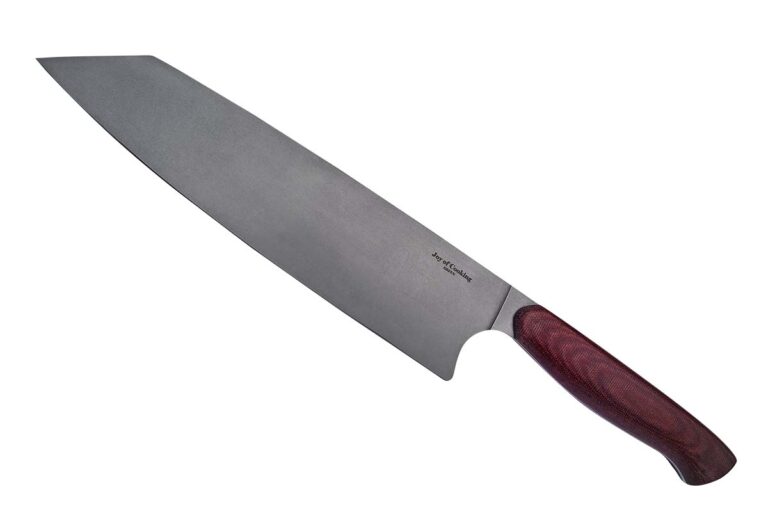
Long-time knife designer Ethan Becker and Dan Eastland of Dogwood Custom Knives have collaborated on a chef’s knife that combines each of the principals’ vision of exactly what such a knife should be.

Introduced at BLADE Show 2024, the Joy of Cooking 8-inch K-tip chef’s knife is a mix of Japanese and Western styles and premium stainless steel and synthetic handle materials.

It also has the iconic Joy of Cooking logo on the blade, Joy of Cooking the internationally renowned cookbook originally written by Becker’s mother, Irma Rombauer, and edited in some subsequent editions by Ethan. He handed those duties off and today the book is co-edited most ably by his son, John, and Megan Scott.
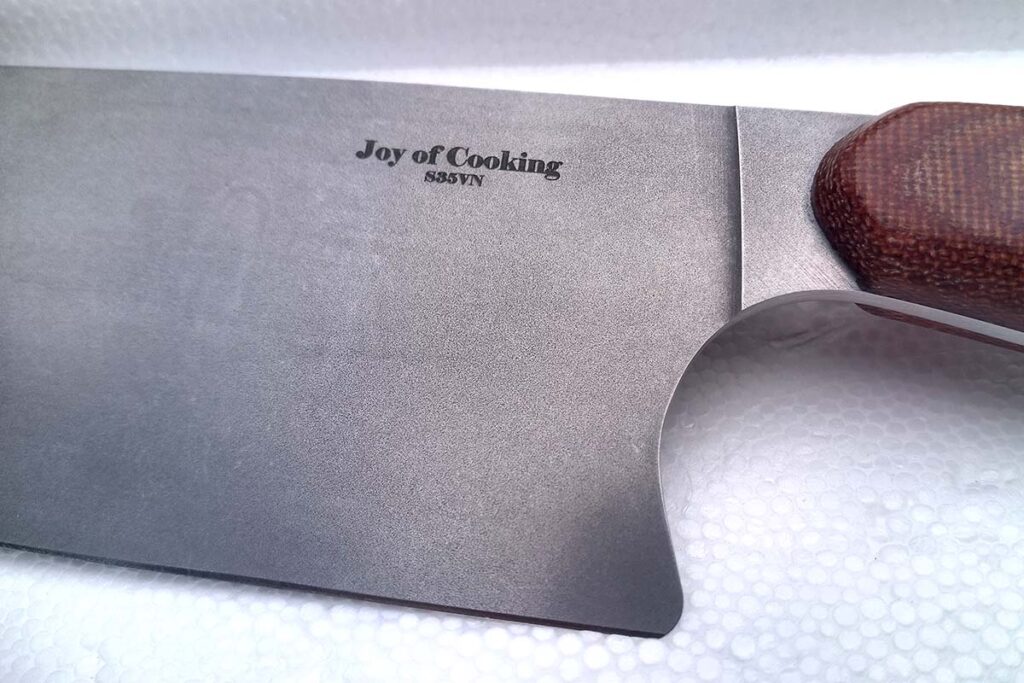
Joy of cooking logo on blade
The heel of the blade curves toward the rear and sits flat on the surface for controlled cutting.

With extensive experience as both a knifemaker and a cook, Eastland brings the kind of know-how to the project that gives it edged gravitas.

“Dan is pretty much the perfect person to do this because he’s been in a commercial kitchen and knows his way around that,” Ethan said.

Dan also spent a number of years as an apprentice maker to Georgia Knife Makers Guild member Andy Roy of Fiddleback Forge in North Georgia, and now builds knives at Dogwood Custom Knives in Greenville, South Carolina.
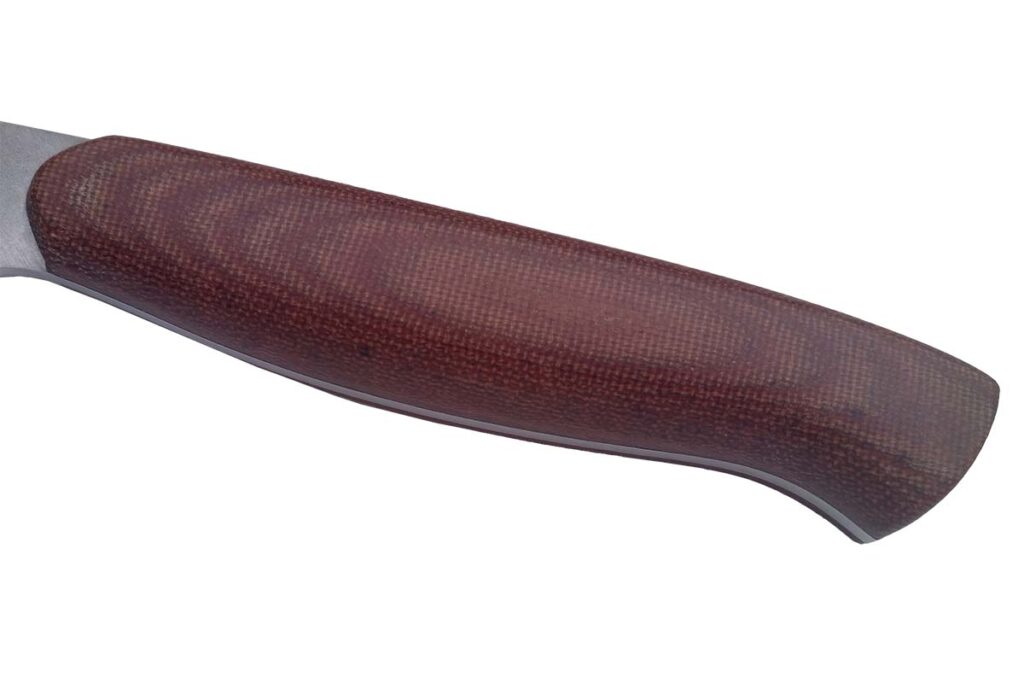
Joy of cooking knife handle
Handle materials come in a choice of natural (shown here; note the texture and grain) and black Micarta® and blue, red or black G-10.

As for the Joy of Cooking knife and its features, Dan approaches it all from the maker/cook perspective.

“The blade has a Japanese influence. I always liked Japanese blade geometry and balance, but I didn’t like their handles. Ethan and I both like a little palm swell,” he noted, “so we wanted more of a Western-style handle.”

In Joy of Cooking, Ethan writes about a grip for home cooks that’s comfortable, Dan said, so the handle has rounded corners to eliminate hot spots and an overall design that helps promote a pinch grip. The blade is weighted toward the front for balance and has the K tip for precise tip work.
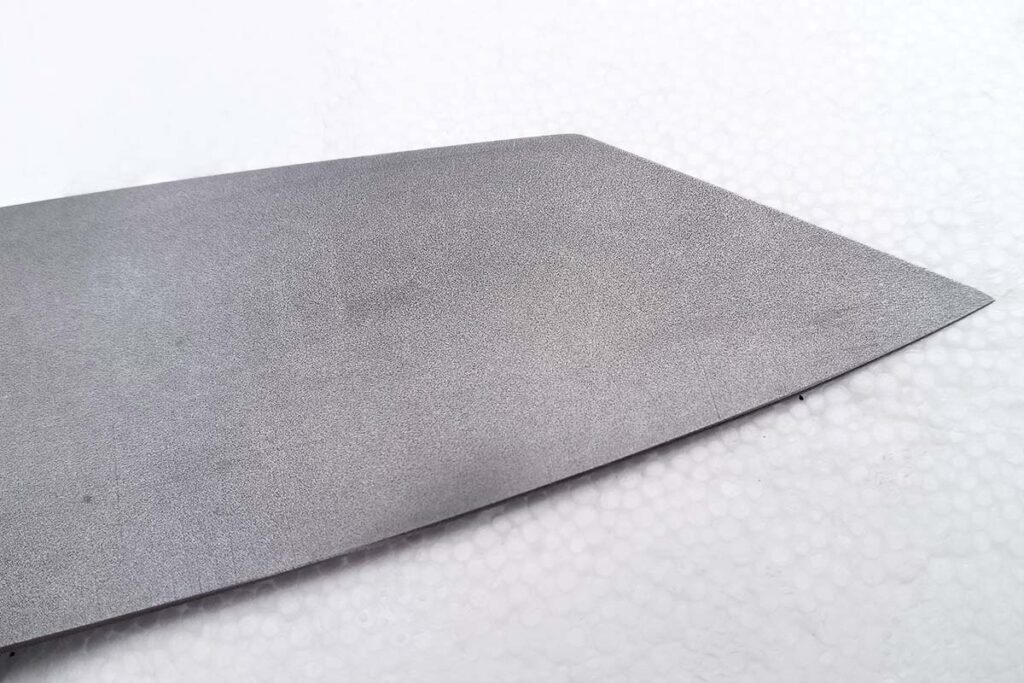
Tip of the joy of cooking knife
The K tip gives the knife a piercing feature lacking in such Japanese designs as the santoku.

Ethan said he’s a big fan of the santoku style and has designed santokus and used them in the kitchen almost exclusively for 20 years.

“The one problem with the santoku is it really doesn’t have a good piercer,” he noted. “You can get by without a piercer if you keep the knife really sharp but guess what—most people don’t keep their knives sharp enough. But for such jobs as taking off the top of a tomato, for instance, the K tip works pretty good.”

Dan lauded the utility of the K tip for other tasks as well, adding, “My grandmother opened all the packaging with the tip of a kitchen knife. No matter what knife you gave her, she sliced the top of the package open with the tip and went to work.” The K tip is tailor made for such chores, as well as others.
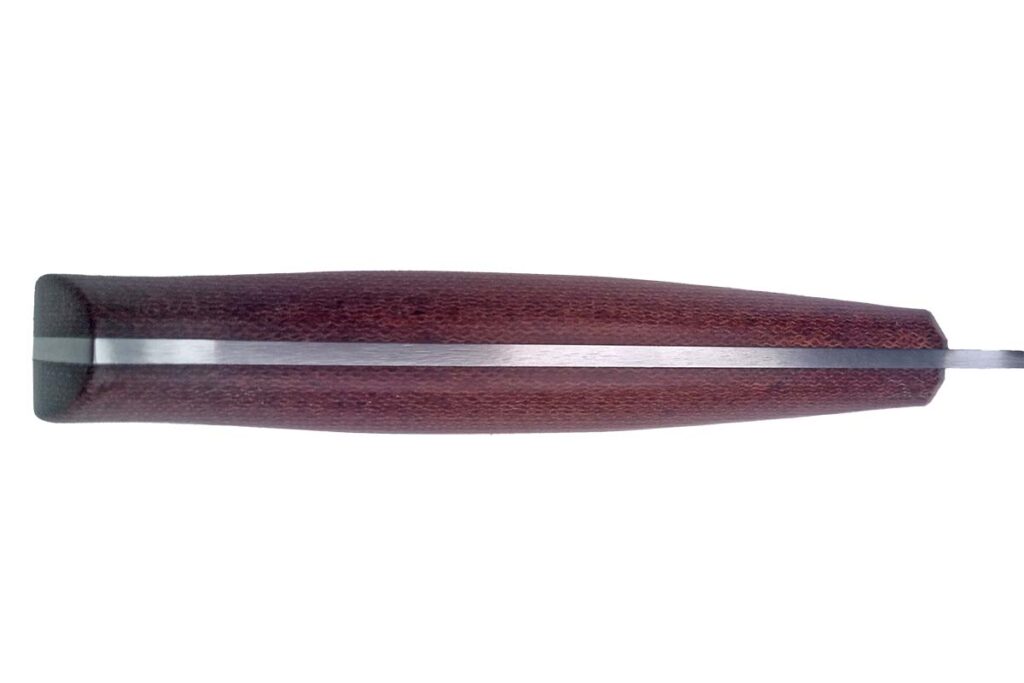
Joy of cooking knife handle palm swell
The collaborators prefer a Western-style handle and gave the Joy of Cooking Knife grip a palm swell as a result.

The edge has a nice curvature for rock chopping and push cutting meats and vegetables. The heel of the blade also curves toward the rear and sits flat on the surface for controlled cutting.

“The neat thing is when the blade comes down [at the heel during a rocking cut or chop], it stops,” Ethan explained. “It’s also good for a push cut,” Dan added, “so it’s good for both a rock chop and push cut. And having that heel down a little bit it will bottom out, so you cut all the way through something and don’t wind up with little partially cut bits at the end.”

Joy Of Cooking Knife Details

The 8-inch blade is CPM S35VN stainless steel. The Rockwell hardness is 60 HRC and the blade is 3/32-inch thick at the thickest. Along with the contoured handle the knife weighs in at a scant 5.5 ounces.
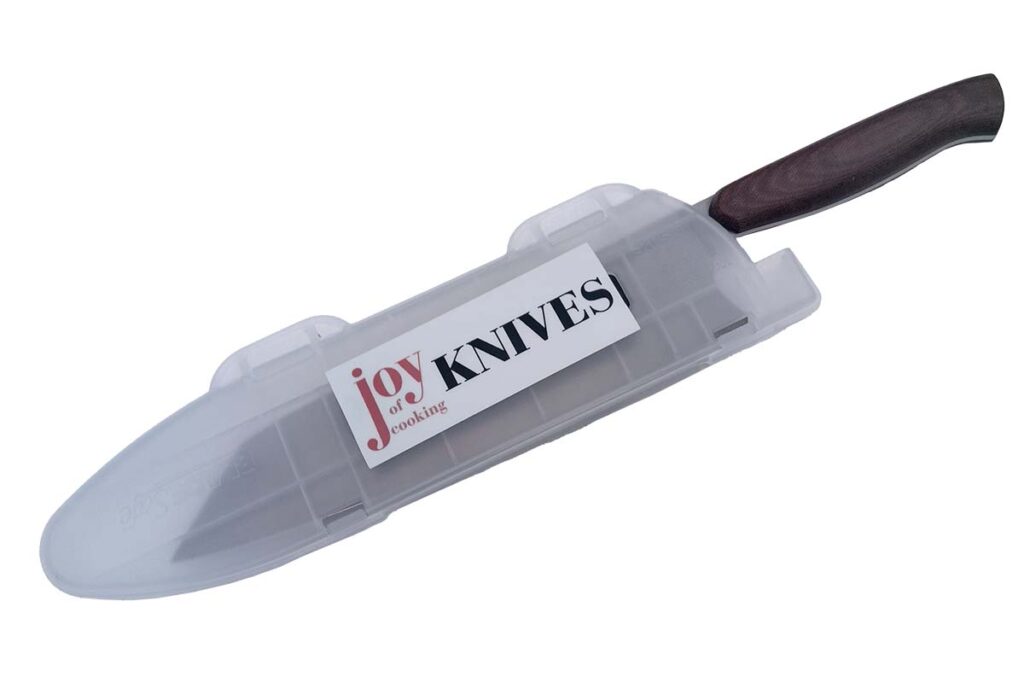
Joy of cooking knife sheath
A hard plastic cover with plastic snaps contains and protects the knife.

“I’m of the opinion the Greeks told us everything we need to know about a double-inclined plane—the longer the plane and the lower the angle, the more efficient it is,” Dan said. “A knife blade is a double-inclined plane, and I wanted to make this knife as light as possible.”

He returned to his grandmother’s experience.

“And again, my grandmother used to complain that Henckels and Wusthof, she loved the knives, but they weighed almost as much as she did. By using the S35VN we’ve been able to thin it out and get a mechanically better cutting blade, but also a lighter blade.”

Ethan agreed that most kitchen knives are too heavy.
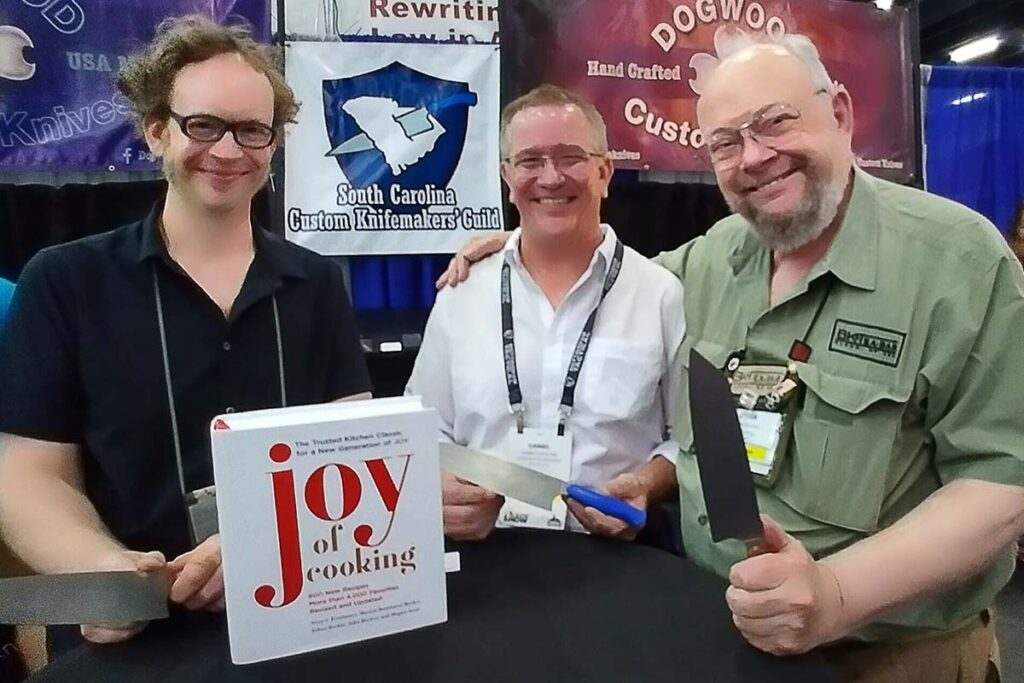
From left at BLADE Show 2024: John Becker, co-editor of Joy of Cooking, Dan Eastland of Dogwood Custom Knives and long-time knife designer Ethan Becker.

“The wrist gets tired easy and to be able to not have very much weight that you’re working with, hey, what’s wrong with that?” he observed. “Most traditional kitchen blades were thick because they were forged before they were ground … The cutlers in Europe were very, very concerned that the housewives would use the blades for things they weren’t supposed to, so they used soft steel so it wouldn’t nick and if they opened bottles with it it wouldn’t hurt it. The result was blades that didn’t hold an edge worth a damn and were not terribly efficient.”

Dan said the S35VN has good corrosion resistance and the edge retention is phenomenal.

“We tested the knife extensively in an industrial kitchen to ensure edge retention and durability, and I like S35VN because it’s a good balance of durability and edge retention. And we can get that 60 Rockwell so it can take a nice, keen edge and we don’t have to worry about it chipping out.”

As noted, Dan and Ethan wanted a Western-style handle with a palm swell and offer it in a choice of G-10 and Micarta®. The Micarta is available in black and natural versions, both with texture and grain for purchase. The G-10 comes in red, black and blue.

“Those colors will always be the same over time as we introduce other knives in the lineup, so you can buy a knife that will match whichever color knife you previously bought,” Dan said. The intent is for there to be a complete set of Joy of Cooking knives, though nothing was set in stone in that regard at press time.

Pros

  • Collaborative Expertise
  • Versatile Blade Design
  • Premium Blade Material

Cons

  • Higher Price Point
  • Plastic Snap Cover

Joy Of Cooking 8” Chef’s Knife Specs
Designers: Ethan Becker and Dan Eastland
Company: Dogwood Custom Knives
Blade Length: 8”
Blade Steel: CPM S35VN stainless
Rockwell Hardness: 60 HRC
Blade @Thickest: 3/32”
Handle: Black and natural Micarta® and blue, red and black G-10 options
Overall Length: 13”
Carry: Plastic snap cover
Knife to Know: K tip blade; lightweight design; hidden handle pins
Country of Origin: USA
MSRP: $200

More Kitchen Knives:

Case Axe Handle Lockback: Ruple Colabs With Case For First Time

First Case/Ruple collaboration officially debuts at BLADE Show ’24.

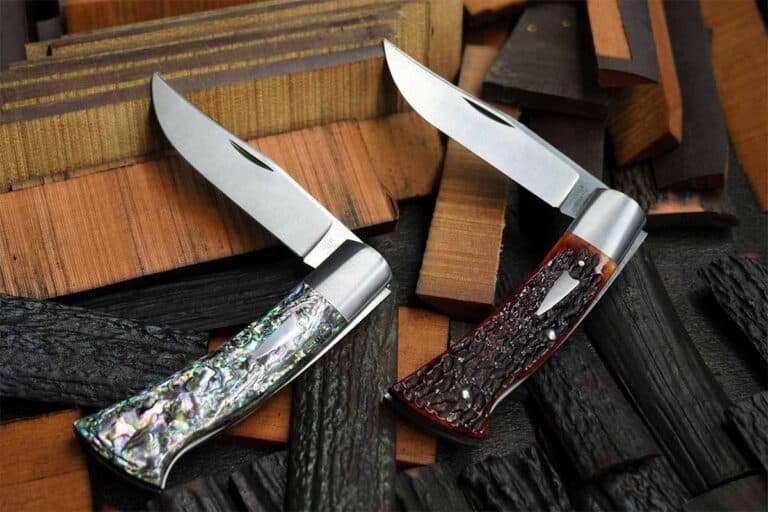
The combination of mechanical features, artistic design and choice of handle materials make the Bill Ruple x Case Axe Handle collaboration a unique knife for the user and collector.

Case Knives and BLADE Magazine Cutlery Hall-of-Fame® member Bill Ruple didn’t just bump into each other at the convenience store one day and say, “Hey, let’s do a knife collaboration.” That alone likely would have led to a great pocketknife, but no, there was a lot more planning and history that went into this new joint venture. We’ll talk about some of that but first let’s talk about the knife itself. It’s got some special character.

Case Axe Handle Design

Despite both being giants in the slipjoint field, Bill and Case sifted through some ideas and came up with a lockback pattern for an initial collaboration. It was not just one part but several features Bill combined together to make this knife unique.

Bill Ruple
Preeminent member of the Texas Slip Joint Cartel, Ruple more than understands what makes a good slippy.

As a man who had farmed the soil, he noted the end of the knife resembled the shape of an axe handle, thus the name. The upward curve of the handle butt provides some useful ergonomics but also strategically holds the tail of the lockbar. In this location, there is resistance to accidental unlocking of the blade while it’s in the open position. As well, it eliminates the need for a thumb cutout in the handle to release the blade. With an upward curve partially concealing the lockbar plus the absence of a thumb cutout, the handle makes the knife appear not to be a lockback pattern at all. In fact, since at first glance it seems to be a slipjoint, it has a bit of the trick-knife or mystery-lock character.

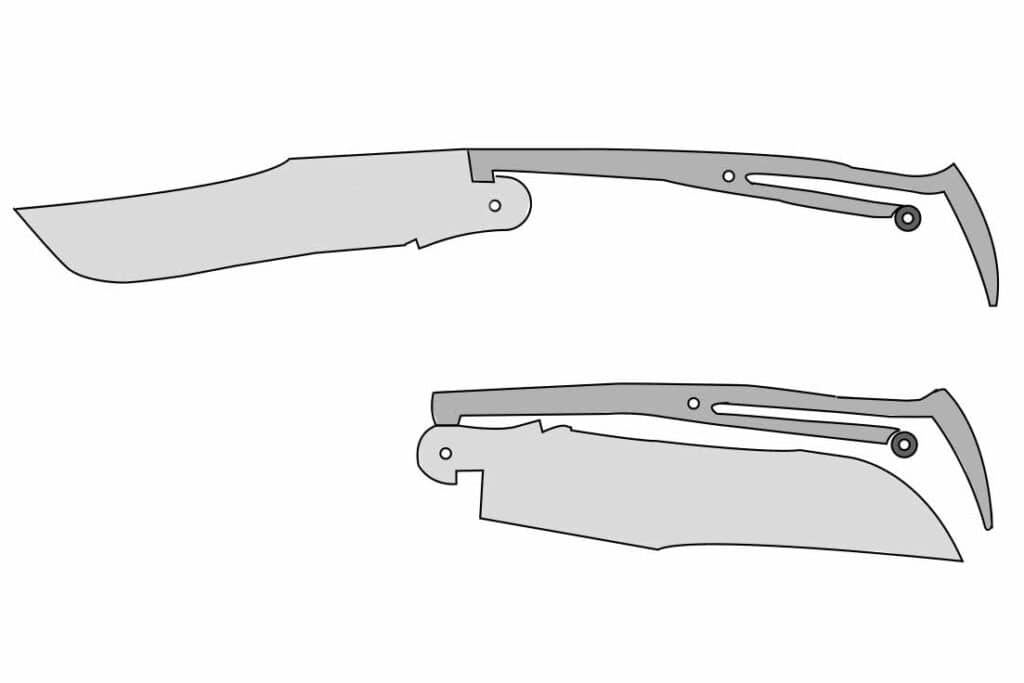
Initial prototyping by Bill in his shop hit a snag in that the slipjoint knives he’s used to creating have a rear bolster. That did not fit the artistic design for the new collaboration. However, Bill cleverly overcame the so-called snag by using a feature called a scissor spring (see illustration, page 40), which rests on a bushing to provide the needed tension to work the lockbar. Bill has prototyped knives for Case and also assisted with some aspects of manufacturing just as his Case collaboration predecessor, mentor, very close friend and fellow Cutlery Hall of Famer, Tony Bose, had done. Bill stated that nobody could replace Tony Bose and Case misses him. (Don’t be at all surprised if Case makes a commemorative knife in honor of Tony in the future.)

Bill Ruple's design drawning of the Case Axhandle
A few notes on Ruple’s design, the scissor spring (rear top right) is an efficient use of space with a one-piece unit of lockbar and spring. The bushing (lower fork of the spring), the spring rides on this avoiding excessive wear and taking up less room. It also acts as a rear spacer.

Both Case officials and Bill say Tony would be pleased with the new collaborative effort. The initial run will be 1,000 knives. Then the model will be made in a traditional slipjoint pattern. There is an aim at “near custom maker quality” for the first run, glibly naming the process “almost custom,” beginning with the parts being wire cut. That’s the cool way to say electrical discharge machining, or EDM. Production is assigned to a specific group of three workers only. No one else will work on the knives. That sort of consistency helps maintain quality control in manufacturing the knives.

MORE TO COME
Is this collaboration just an outlier or will there be more Case/Ruple lockbacks in the future? Interest in the knife at BLADE Show 2024 (page 26), where the knife was officially introduced, was quite favorable. Both Bill and Case officials were pleased with how things have turned out, so expect to see another collaboration introduced at next year’s BLADE Show. That knife likely will be a slipjoint. Another lockback might be seen in the future, though a bit further down the road.

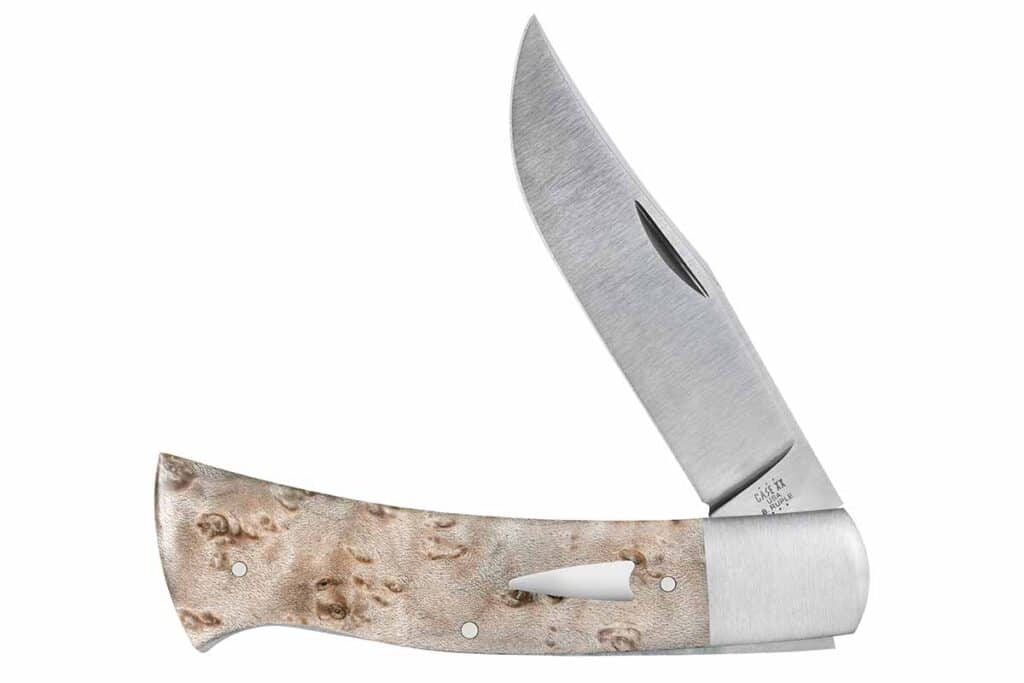
The Axe Handle with the birdseye maple handle
Natural birdseye maple is one of but several handle material options on the new Bill Ruple x Case Axe Handle.

As collaborative efforts go between manufacturer and custom maker, the Axe Handle knife is a superlative effort. And there is strong motivation to produce more collaborations, both commemorative and unique.

Ruple’s First Case

Does BLADE Magazine Cutlery Hall-of-Fame® member Bill Ruple remember his first Case knife? Is Texas big?

“Oh yeah,” the good-natured, award-winning knifemaker and South Texas Slipjoint Cartel trail boss said. “My dad gave me a Case knife when I was 9 or 10 years old, and it was a yellow handle Case trapper. And man, in about a month I had sharpened the blades completely out of that knife. And he gave me another one, and so he told me not to sharpen it quite as often. But yeah, a long time ago.”

Case Axe Handle Specs
Knife type: Lockback
Designer: BLADE Magazine Cutlery Hall-of-Fame® member Bill Ruple
Blade length: 3.46”
Blade material options: Wire-cut 154CM stainless steel or damascus
Rockwell hardness: 57-59 HRC
Blade grind: Flat taper
Blade @ thickest: .126”
Blade pattern: Clip point
Blade finish: Satin
Handle material options: Natural birdseye maple, Rogers jig chestnut bone, standard jig antique bone, marbled black carbon fiber, abalone, English walnut
Lock: Lockback
Opener: Nail nick
Pocket clip: None
Weight: 4.21 ozs.
Closed length: 4.4”
Carry: Suede leather taco pouch
Special features: One-piece designed backspring & lock mechanism.
Country of origin: USA
MSRP: $599.99 to $774.99
Available: Late Summer 2024

More On Case Knives:

Iron Sapper Forge Carver Review: Small But Mighty

Vincent Silva’s Carver packs healthy cutting power in a compact package.

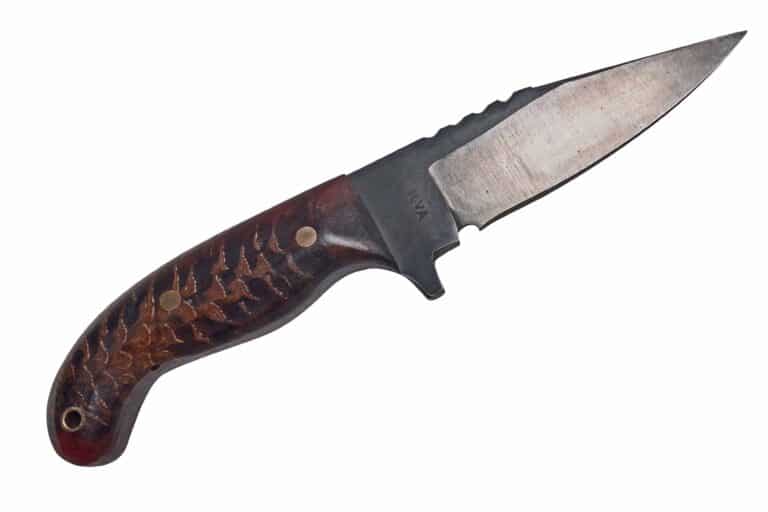
After Vincent Silva retired from the military, he came across HealingFlamesForge.org, a Tennessee-based non-profit blacksmith shop for veterans. He took to the hammers and hot steel quickly, which progressed into making knives. Creating a functional tool from a piece of steel became his goal, and the Carver is one result. It begged to be tested and I was only too happy to oblige.

Carver Light-Duty Cutting

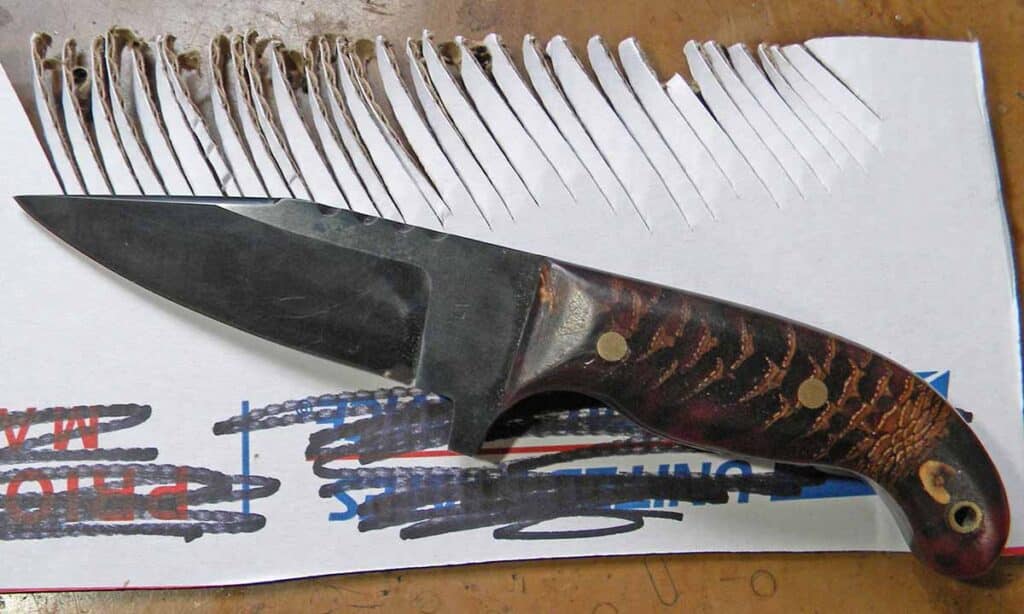
For the first edge test, the knife aggressively sliced into graphing paper even though the paper was slightly limp from the humidity. I applied smooth downward pressure and it cut cleanly. This is a well-balanced little blade.

Full-length push cuts went swiftly through the cardboard. The handle aided in blade control while keeping cuts as even as possible.

Single-walled cardboard supplied the next challenge. Full-length push cuts went quickly. It was hard to keep my fingers out of the cutting zone if I went too fast. The handle aided in control of the blade while keeping cuts as even as possible (in the cardboard, not my finger). I could hear a small crunch sound as the edge parted the material.

Carver Medium-Duty Cutting

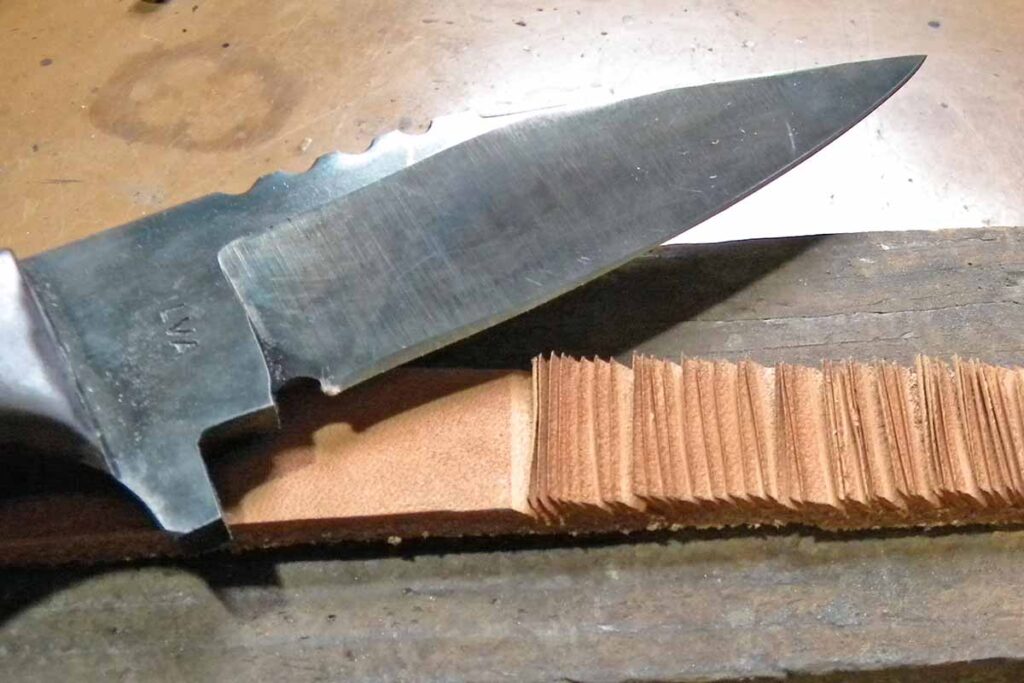
Next up: 8-ounce leather. The Carver zipped through it swiftly. The blade’s edge geometry is spot on for working leather. I used a push cut while skiving the material.

The Carver cuts leather
The Carver zipped through 8-ounce leather very quickly. The blade’s edge geometry is spot on for working leather. The author used a push cut while skiving the material.

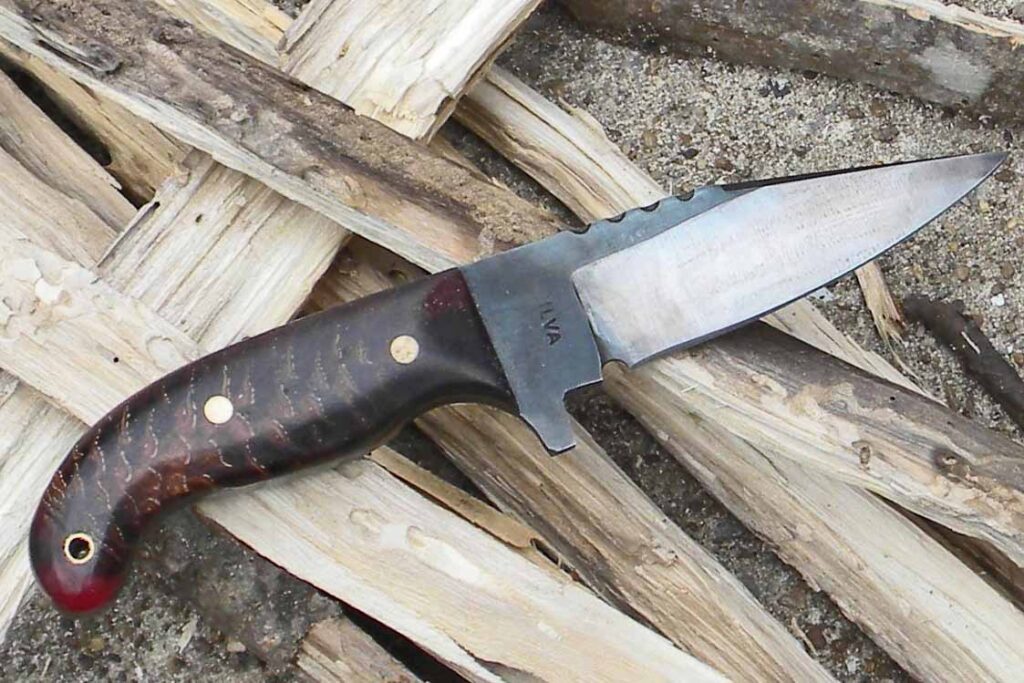
I like to be ahead of the game during camping weather, so a good supply of fire sticks is always a must. The Carver produced nice, feathered curlicues in some pine. The handle shape made it easy to control the depth of the feathering. All cuts came out smooth with just enough curl.

Carver Heavy-Duty Cutting

The Carver might be on the small side but it can handle such large jobs as splitting wood. Using a dead-blow hammer, I repeatedly pounded the blade through seasoned hackberry. A nice pile of kindling was the result. The handle was comfortable throughout and the blade was just big enough to beat on the tip to split the wood completely. There was no damage to the blued finish or the edge. Nicely done, Vincent.

It was time for my favorite cutting medium, natural rope—in this case, half-inch sisal on a cutting board. The Carver crunched its way to 192 cuts before the edge started to slide. The handle created no hot spots. The gimping was a tad sharp for my thumb but great for ferro-rod use. This is one cutting little knife!

The Iron Sapper Forge Carver splits wood
The knife is small but can handle such larger jobs as splitting wood. Using a dead-blow hammer, the author repeatedly pounded the blade through seasoned hackberry for a nice kindling pile.

It was back to the graphing paper for the final slice test. The blade still cut very well and lost only a bit of its aggressiveness.

To push things over the edge, I conducted a brass rod test to make sure the temper was done correctly. I could see the edge flex and return to true. Verdict: the heat treatment was spot on.

CHANGES
To mee, the edges could be softened a bit more, especially on the spine gimping. However, the Carver is a very well-made EDC sheath knife that performs at a higher level. It’s a sweet little blade.

Carver Specs
Maker: Vincent Silva of Iron Sapper Forge
Blade length: 3.5”
Blade material: 1095 carbon steel
Blade grind: Flat
Heat treatment: Differential
Handle: Pinecone resin by @sappercsmwife (Instagram)
Weight: 6.5 ozs.
Overall length: 75/8”
Sheath: Kydex or leather pouch
Maker’s list price: $250

Read More Knife Reviews:

G10 KNIFE HANDLES: ARE THEY THE BEST?

1

Rugged, Long-Lasting And Easy On The Eyes… G10 Might Just Be The Ultimate Knife Handle Material.

You often hear G10 lumped in with a variety of other materials, such as Micarta, glass-filled nylon, carbon fiber, and more. In this vein, you’ll also see misrepresentations such as ‘G10 Micarta’, this is generally incorrect despite being so close to right. This raises the question…

What The Hell Is G10 In The First Place?

G10 is its own material and is more or less a generic trade name for a subset of insulating fiberglass composite. Because it is a standard material used in both civilian and military manufacturing, it is very consistent and must meet certain standards to be called G10.

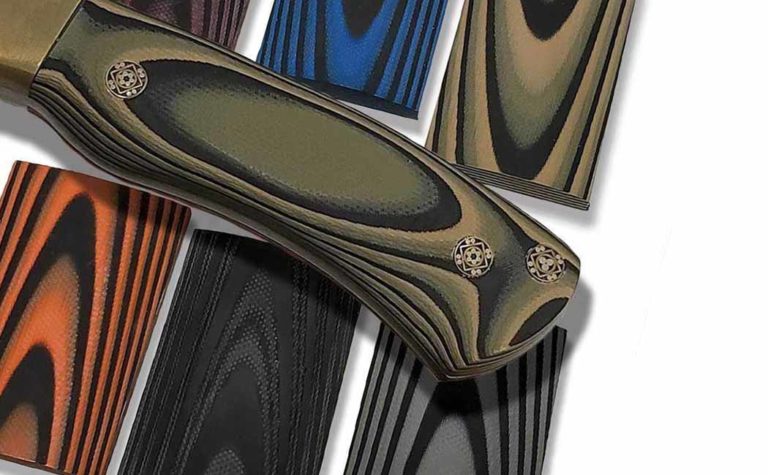
It is made in a similar way to Micarta, but instead of actual layers of cloth fabric being compressed, G10 uses glass cloth to achieve a similar result—a grainless, easily shaped material that is resistant to the elements and most chemicals.

It first appeared on the radar in the 1950s, but it arguably has seen the most use since 2000 and it has knives to thank for that.

G10 Usage And Properties

G10 is made colorful by alternating these glass cloth layers before it is heated and compressed. The original versions of this were a bit bland, and like Micarta, were developed to provide insulation barriers for electronics. G10 material is not common in electronics today, but in its day it was considered to be quite good at its job.

It is now primarily used for knife handles, gun grips and accessories, robotics, 3D printing, and in some aerospace roles. It has great strength-to-weight properties and is easily shaped, making it ideal for modern manufacturing techniques. Unlike Micarta, it won’t change color when wet and it doesn’t absorb water or chemicals. It is impervious to salt water, making it a great choice for any products that require a firm grip in maritime conditions.

Advantages Of G10

Durability is key to a knife handle. It is, after all, your interface with a sharp, dangerous tool. If you don’t trust your handle material, you don’t trust your knife, simple as that. G10 Gives you a lot to hang on to.

Very strong and light, it’s waterproof, corrosion-proof, and can be washed with normal cleaning products with no ill effect. On knives that are used for hunting or the outdoors, it isn’t bothered by blood, fat, or hasty cleaning methods.

If G10 is textured, it will provide a sure grip in all conditions. Don’t like that your grip is just a bit too textured and perhaps a bit sharp in places? Just take out some sandpaper and knock the edges off and then wipe it down with mineral oil. It will appear just as new.

G10 is just a rockstar material for knife handles because it does what we need it to do in all capacities from initial manufacture to end-use maintenance. G10 is a win-win material across the board and it shows.

Disadvantages Of G10

Due to the overwhelming amount of advantages G10 has over most other knife handle materials, the downsides are for the most part a personal matter. Some people don’t care for the appearance or texture of certain G10 products, and still, others don’t care for how widespread the material has become.

Wood, bone, and Micarta all have significant followings, but are less durable overall than G10 and are usually heavier. These materials do require regular maintenance unlike G10, but this is a relatively subjective thing at the end of the day.

GREAT G10 HANDLE KNIVES

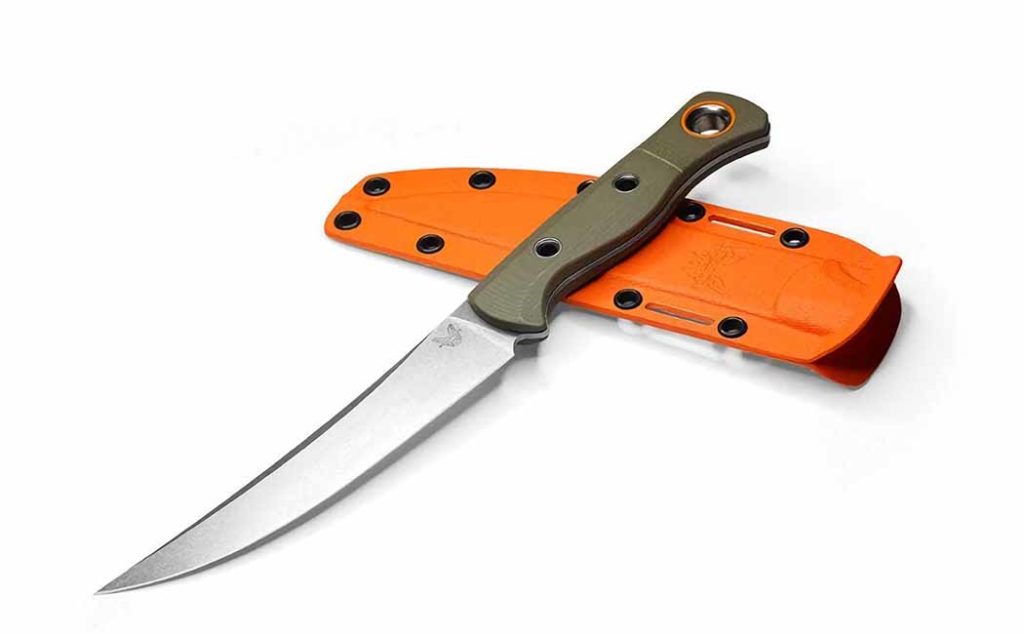
Benchmade 15500-3 Meatcrafter

Benchmade Meatcrafter

The Meatcrafter has been around for a few years, but it continues to undergo evolutions. This particular model features a razor-sharp blade using the company’s SelectEdge technology. The 15500–3 model is visually attractive and features green G10 grips with nice-looking accents.

The knife comes with a Boltaron sheath finished in high-visibility orange. The author has experience with the Meatcrafter series, and has found them extremely suitable for their niche. The blade profile is not especially thick, it borders on filet knife territory but is heavy-duty enough for working on large pieces of meat and big animals.

This knife isn’t meant for chopping or use on bone or camp chores. Rather it is for end processing of soft tissue only. The blade has a good degree of flex for boning, though not too much that it won’t give clean presentation cuts in the kitchen if you are trying to impress company. Though, the $370 price tag is impressive in its own right should your dish not wow your guests.

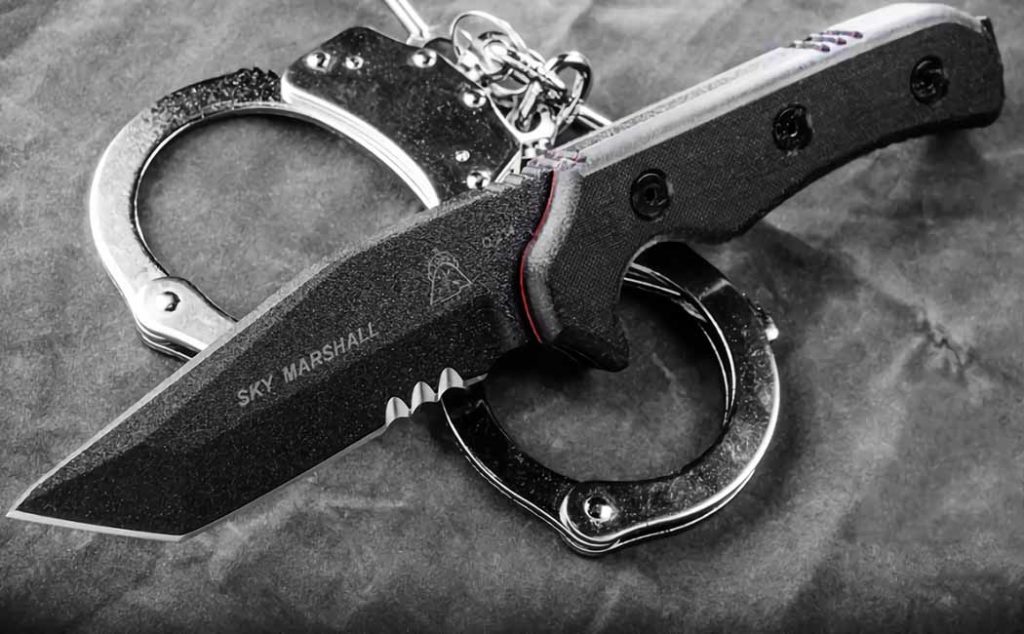
Tops Sky Marshall

Sky Marshall

Tops is known for making some of the most rugged and powerful cutting tools on the planet. Very few, if any, could be called under-engineered, rather it is just the opposite. Most Tops blades are thick, and heavy, and hold up to years of the worst abuse that their owners can put them through.

The Sky Marshall is one of those items in life you buy once and keep using. Barring being dropped into a lit forge, there is little that can deter the stout Sky Marshall. The knife has a tanto point and rear serration coupled with a daunting 1/4” spine. The knife is finished in all black with black G10 grips. It is both an attractive conversation piece and a hardcore tool. The blade profile has a lowered point and a specially contoured handle with a deep, secure finger choil to give it extra power when thrusting. The Sky Marshall retails at $210 and comes with a black Kydex belt sheath.

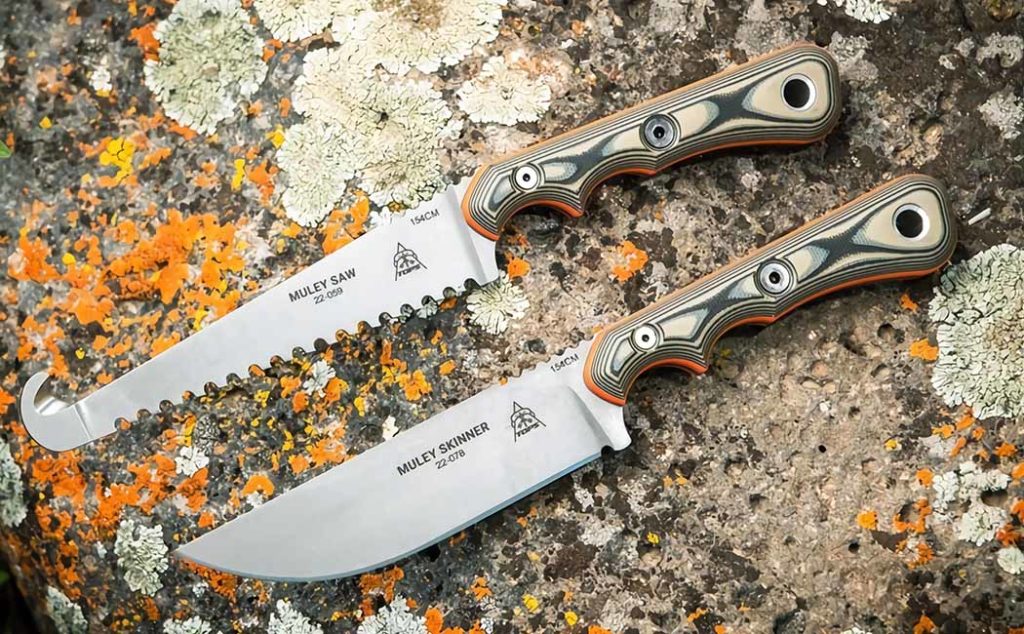
Tops Muley Combo

muley

Another G10-handled set from Tops is the new Muley series, made specifically to address materials that are hard on blades when hunting. The Muley series is born to hunt and is best purchased in a set with a double sheath ($500), though each knife can be purchased separately should you wish. One is a standard knife while the other is a knife-handled saw with a gut hook meant for dealing with bone and cartridge.

The combo doesn’t take up much space and affords the owner a high amount of general utility when both weight and durability are concerned. The backcountry hunter doesn’t always get away with pack animals or 4-wheelers, so having multi-use tools is very important when ounces count. The dedicated saws take up room in the pack, and knives with gut hooks are a liability when splitting kindling or skinning. In this set, you get the best of all worlds and each is made of super-tough, easy-to-clean 154CM.

The G10 grips are meant to be stylish but also high-visibility thanks to their orange liners. As field tools, the Muley combo here is hard to beat, and the author looks forward to putting them to hard use in the coming years.

LT Wright Apex

LTW-Apex

LT Wright is a name synonymous with edged tool quality. The Apex is an interesting knife not just in construction, but in shape and cosmetics. It features black G10 grips with a striking bright green liner and a bright, saber-ground A2 steel blade packed nearly in a brown leather sheath.

The knife has a profile common to many working knives and resembles a Puuko in overall aesthetic, though, it has one interesting point worth touching on. The blade and the spine are reverse curved, giving the blade a deep belly and the handle a distinctive upturned profile reminiscent of traditional Japanese tanto and katana profiles.

This intriguing knife is excellent for just about any task from kitchen chores to outdoor labor, breaking down game, and as a regular EDC knife. The Apex is a fascinating product that deserves more than a second look, and for a decent retail price of just under $200, it won’t break the bank, either.

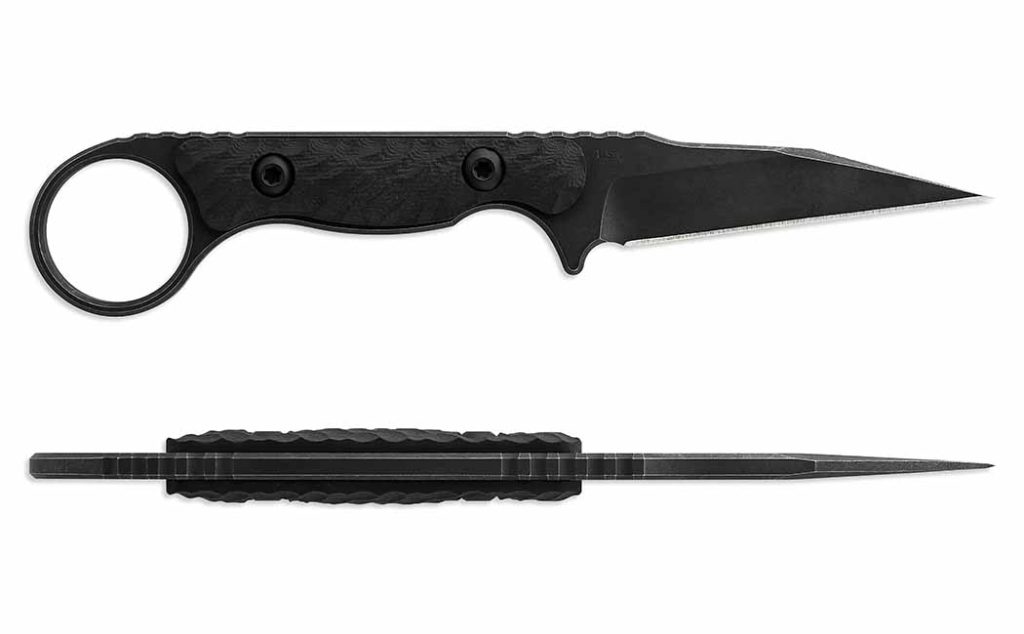
Toor Jank Shank

JANK-SHANK

One of the more interesting knives released recently, the updated Toor Jank Shank is part EDC knife, part karambit, part self-defense tool, and all American made.

The knife is beefed up over the original release and is thicker in more places while more ergonomic in others. The most visually appealing variant on Toor’s site is a black blade with eye-catching white G10 grip panels.

The knife has an easy-to-maintain straight edge that can be used in many ways in conjunction with the finger ring or without. The tip is aggressive and will easily penetrate through most common clothing and jacket materials.

While not a true karambit in that it lacks the signature curve, it should translate easily for fans of the design while offering daily utility lacking in a hook-shaped tip. The Jank Shank retails at $195 and the included Kydex sheath is compatible with a variety of mounting interfaces.

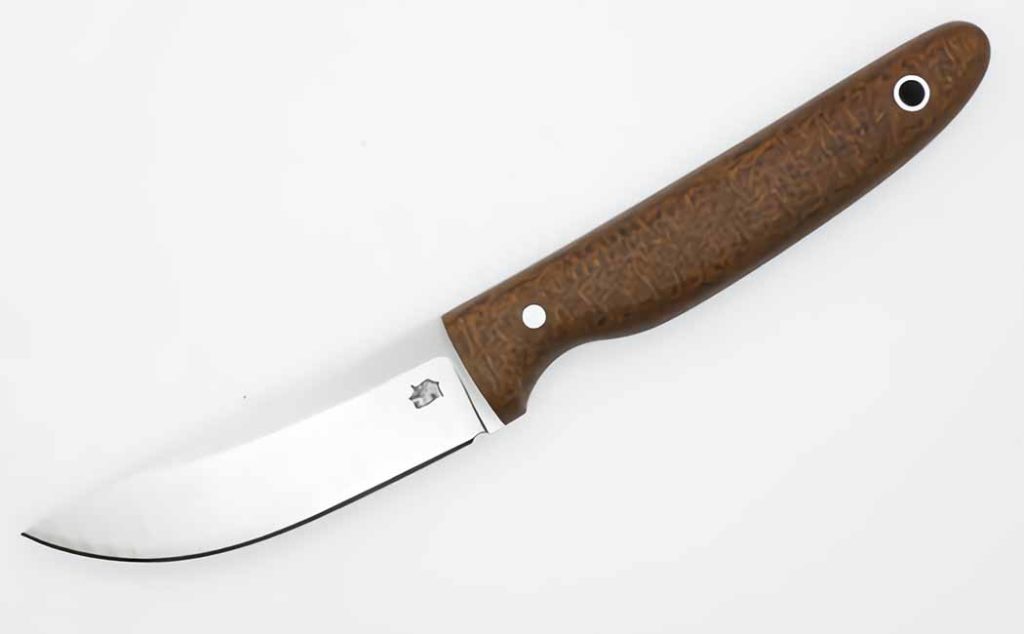
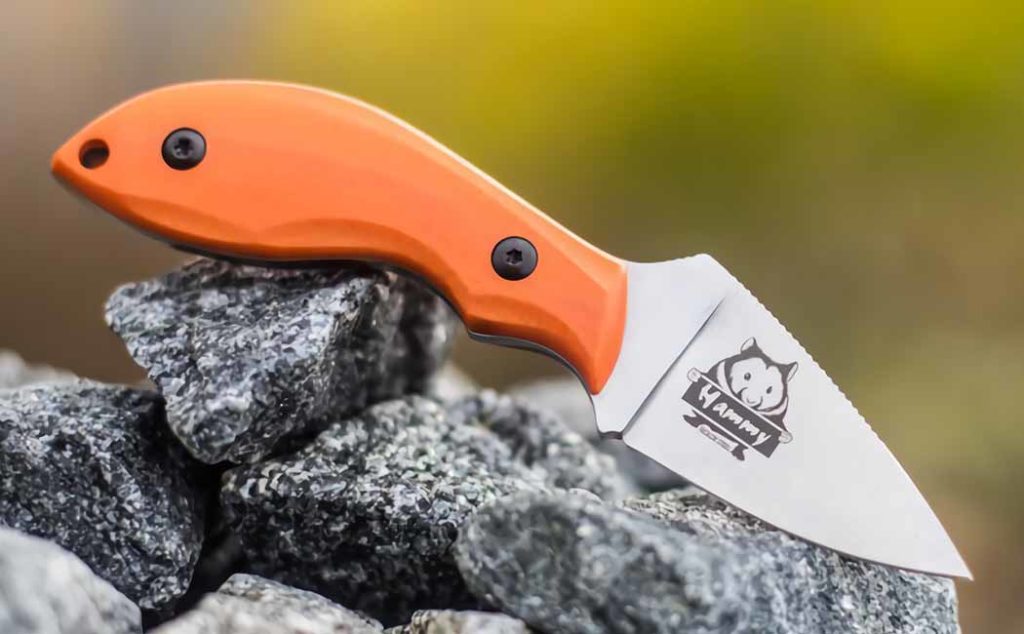
Kizlyar Supreme Hammy

KS-HAMMY

Hailing from Russia, the Hammy is a cute little blade that has a lovable little hamster engraved on it. While it is small, the Hammy lives up to its namesake—a tough, resourceful little animal that can pack several features into its cheeks… rather to say its small, easily carried profile.

The Hammy comes with bright orange G10 scales and is meant to be a highly visible working tool. The edge profile is designed for common cutting tasks and the handle is contoured for comfort in long periods of use.

The Hammy is the least costly of the bunch here at just $99, but it punches above its class and will probably be the knife in this group that you use the most daily basis. The Hammy comes with a multi-position leather sheath that also features a cute hamster motif.

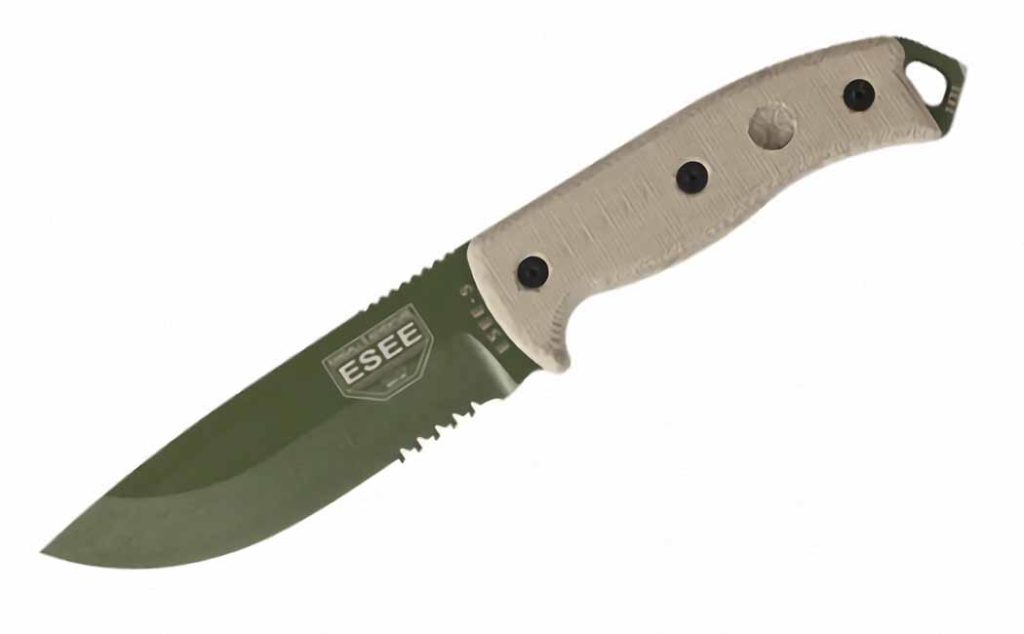
Esee 5

esee5

The Esee 5 is not a new knife, but it is notable for being so rugged and storied that it just had to be mentioned here when talking G10.

There are many models in the Esee 5 line, but the stand out—visually and functionally—is the all-orange model complete with black-and-orange G10 grips. This knife has a highly functional grip texture, is visible in many different light conditions, and is remarkably easy to maintain.

The Esee 5 is a weatherproof machine and it is a popular choice for bush crafters, rescue crews, hunters, and many military personnel for its wide-ranging capabilities. The G10 grips on this knife are available in other colors as well, and due to its popularity, a wide range of other G10 options are available aftermarket through renowned retailer The Knife Connection. TKC makes a full range of G10 grips for most of the Esee line should you wish to change colors or make your trusted blade just a bit more yours.

Check out More of Our Buyer’s Guides

Utility Knives: A Worker’s Best Friend

Utility Knives Are The Great All-Rounder For The Home. These Small Blades Are Popular With Contractors And Homeowners Alike To Solve All Sorts Of Problems.

Yes, there is a kitchen knife called a utility knife, but if use the phrase “utility knife” in conversation it’s almost a certainty that you’re talking about the diminutive yet mighty knives that are ubiquitous on job sites and in homes around the country. Even if you call it a box cutter, the person you’re talking to will absolutely know what you mean.

Also called a Stanley knife, because of the company that helped to pioneer them, utility knives are compact blades meant to breeze through the small and mundane tasks that can slow down your flow. 

Cutting through some rope? Utility knife. Need to score a piece of glass? Utility knife? Looking for the best tool to quickly open a box? The utility knife has your back there. 

Whether folding, fixed-blade, or even retractable, these are five of the best, most dynamic utility knives on the market today.

Milwaukee Fastback Flip Utility Knife
Milwaukee Fastback Flip Utility Knife
First on our list is this bright red folder from Milwaukee. Traditionally, folding utility knives have needed two hands just to open, but Milwaukee engineered a deployment system that not only drastically cuts down on time but is also a ton of fun to use.

By pressing the button on the handle you’re able to quickly flick the blade out and into a locked position. Sticking with the convenience theme, you can store a second blade in the handle and can change blades without tools. 

The fact that there is also a built-in gut hook and wire stripper that cuts up to 10 gauge is just ridiculous on top of all the other tech in the knife. The ergonomic handle in the famous Milwaukee red sits well in the hand. This knife really does do it all.

MSRP: $15.59

Workpro Retractable Utility Knife
Workpro Retractable Utility Knife
Retractable utility knives allow you to slide the blade in and out of a fixed handle. This model from Workpro is an excellent example of that with the added bonus of having a huge amount of storage.

The multi-color handle is made from a zinc alloy and rubberized, ergonomic grip. The knife features a four-stage deployment system so you can use just the tip of the blade for finite tasks or send out the whole thing to slice through something beefier.
Inside the handle there’s enough room to store five blades so you’ll never be without a fresh razor to switch to at a moment’s notice.

MSRP: $9.99

Gerber EAB Lite

Gerber EAB Lite
Gerber EAB Lite

This tight little folder from Gerber is great for your pocket or your purse. When folded, it can tuck away easily thanks to a beefy pocket clip, and when deployed it secures via a liner lock to provide a sturdy hold and cutting edge. 

The stainless steel body looks good and will serve you well when in use. At just 2.5 ounces it’s incredibly lightweight and easy to maneuver. The only knock on this knife is that there is no built-in storage compartment like the knives above. Even without the storage, this is a great utility knife to have with you for daily use. You could even make this your EDC.

MSRP: $18

Stanley 6 In Swivel-Lock Fixed Blade

Stanley 6 In Swivel-Lock Fixed Blade

From the company which innovated the utility knife, this multi-dimensional tool from Stanley is robust enough to be a handy companion on a job site. The contoured handle sits well in the handle and won’t slip even when sweaty on a hot day.

The handle swivels open to hold multiple replacement blades and is compatible with most Stanley replacement blades so you won’t need to stress about finding the right ones. It also comes with three replacement blades in the package to get you off on the right foot.

For a knife this inexpensive, it swings well above its weight. Whether a professional contractor or just a home DIYer, this knife would be perfect for you.

MSRP: $7.99

Olfa LA-X

Olfa LA-X
Olfa LA-X

Our list wraps up with the longest blade of the bunch from Olfa. This retractable knife has a massive, by the standard of a utility knife, 3.25-inch blade which is great for long cuts and can be retracted for more precise slices. The blade is also scored so the top section can be broken off to reveal a sharper tip section.

The handle is made from reinforced fiberglass with an ergonomic rubberized grip which gives you a secure hold of the knife when in use. 

The blade does have a few drawbacks at expense of the longer blade. The locking mechanism is a little wiggly and not as robust as some of the other knives on this list, and the flathead screwdriver tip at the end of the handle isn’t as strong as you might want it to be.

The LA-X is great for less intense cutting tasks, especially those when more extra blade length is needed.

MSRP: $12.50

Read More

New Knives December 2025

If it needs cutting, do it in style with one of these gems.

Of any class of knife, there’s nothing handier than an EDC blade. From mending hoses to knocking down cardboard boxes and prying open stuck latches, these knives trim down daily chores. Though what exactly defines an EDC knife? Honestly, anything could be an everyday carry if you simply carry it every day. And while a few of our new knife picks aren’t precisely what you call your typical EDC, they’re certainly worthy of keeping at hand to cut into your workload.

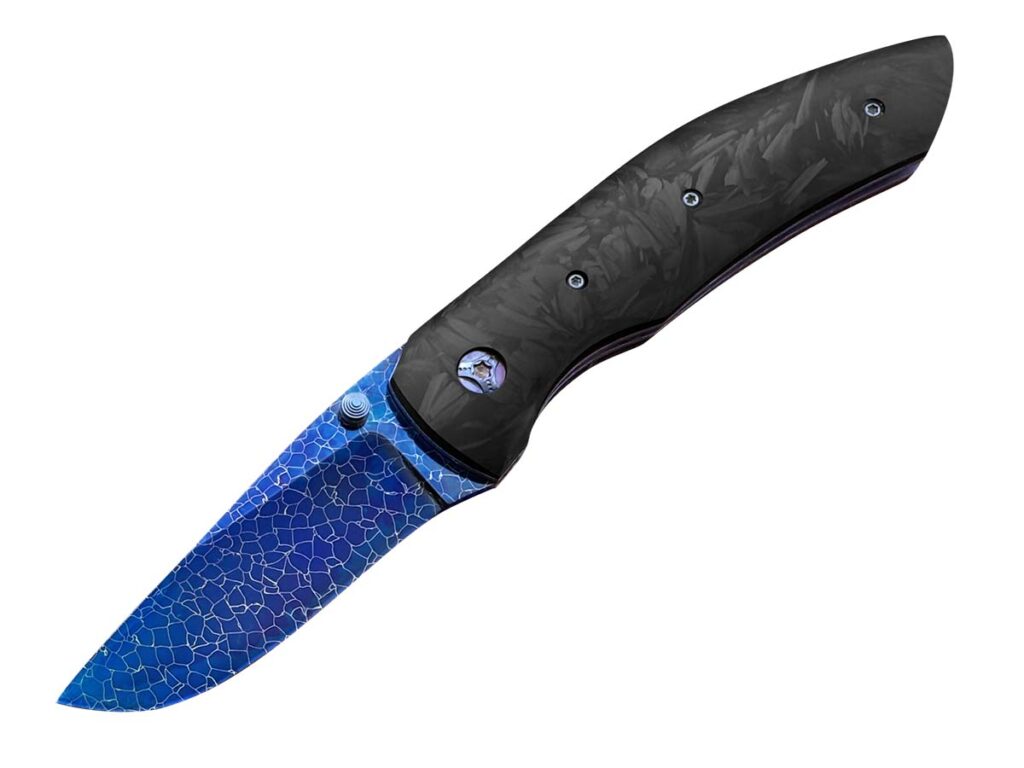
Brian Milinski Paratrooper

Brian Milinski Paratrooper

BLADE LENGTH: 3.25”
BLADE MATERIAL: Dragonskin damascus by Bertie Rietveld
BLADE GRIND: Hollow
BLADE FINISH: Nitre salt blued
SCALES: Carbon fiber
CLOSED LENGTH: 4.5”
MAKER’S PRICE FOR A SIMILAR KNIFE: $1,650
MAKER: Brian Milinski, mrknives.com (Felipe Silva image)


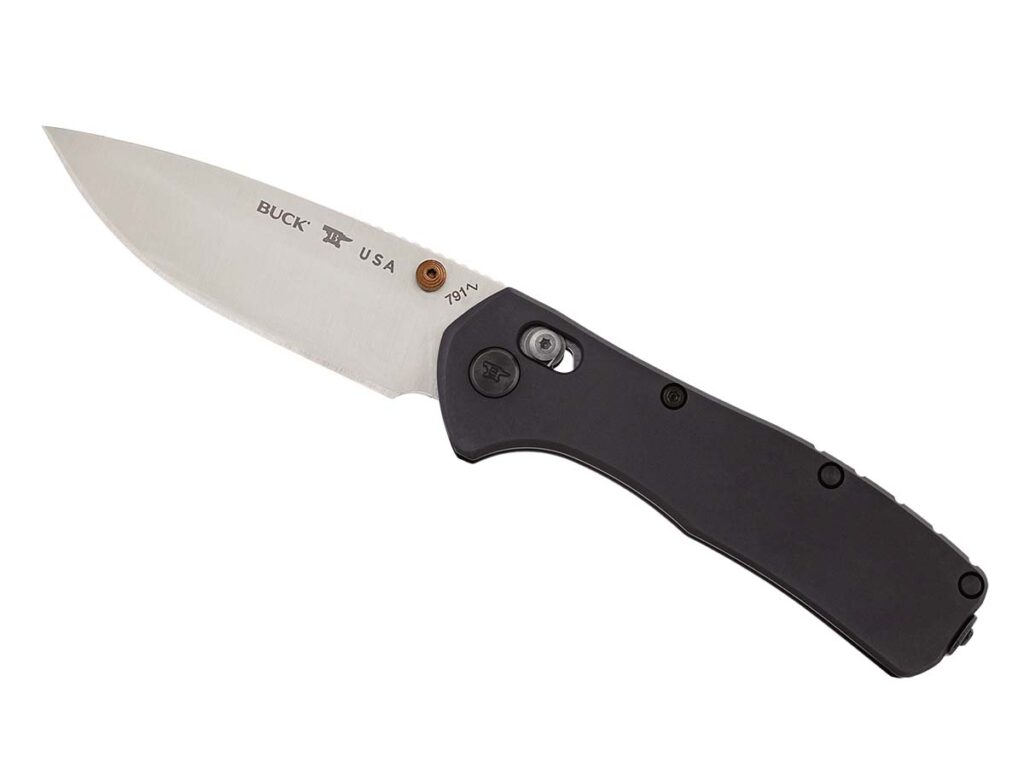
Buck Knives 791 Range Elite

Buck Knives 791 Range Elite

KNIFE TYPE: Folder
BLADE LENGTH: 3 3/8”
BLADE STEEL: MagnaCut stainless
BLADE GRIND: High-panel flat
BLADE OPENER: Thumb stud
HANDLE MATERIAL: Anodized aluminum
LINERS: Tumble-polished stainless
LOCK: Crossbar
POCKET CLIP: Deep carry, reversible
WEIGHT: 3.3 ozs.
CLOSED LENGTH: 4.5”
SPECIAL FEATURES: Spine gimping
COUNTRY OF ORIGIN: USA
MSRP: $275
COMPANY: Buck Knives, buckknives.com


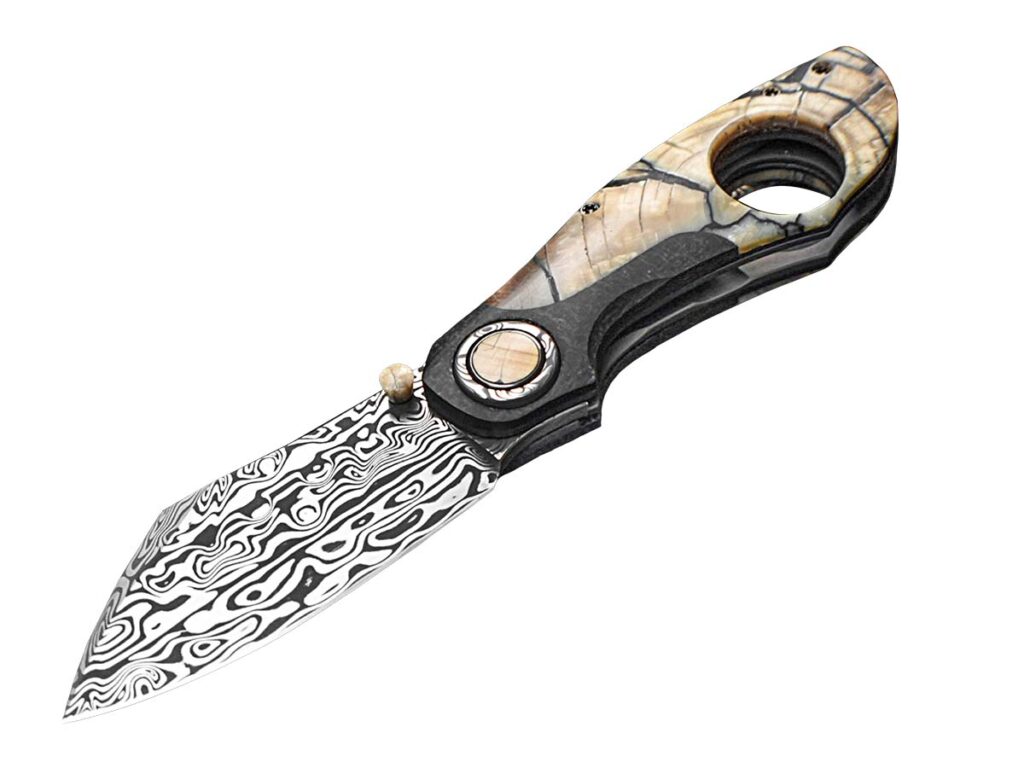
Sean Alonzo Dalisay 2.8 Cigar Cutter

Sean Alonzo Dalisay 2.8 Cigar Cutter

BLADE LENGTH: 2.8”
BLADE MATERIAL: Yggdrasil pattern damascus by Damasteel
BLADE GRIND: Single bevel
SCALES: Mammoth tusk ivory
BOLSTER: Black burlap Micarta®
KNIFE TO KNOW: Pivot collar, inlay and thumb screws are mammoth ivory; zirconium pivot and backspacer
MAKER’S PRICE FOR A SIMILAR KNIFE: $4,200
MAKER: Sean Alonzo, baleteblades.shop (Jocelyn Frasier image)


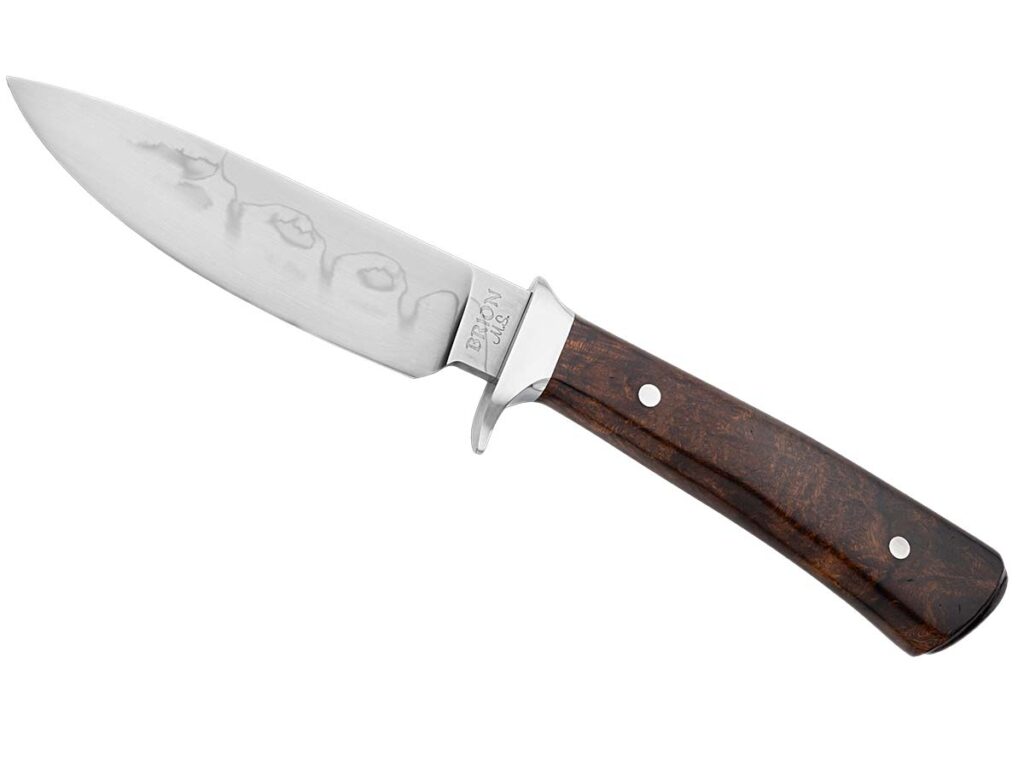
Brion Tomberlin Personal Carry Fighter

Brion Tomberlin Personal Carry Fighter

BLADE LENGTH: 4.5”
BLADE MATERIAL: W2 tool steel w/hamon
BLADE GRIND: Flat
SCALES: Ironwood
GUARD: 416 stainless steel
OVERALL LENGTH: 9.5”
MAKER’S PRICE FOR A SIMILAR KNIFE: $650
KNIFE TO KNOW: Brion Tomberlin is a master smith in the American Bladesmith Society
MAKER: Brion Tomberlin (Jocelyn Frasier image)


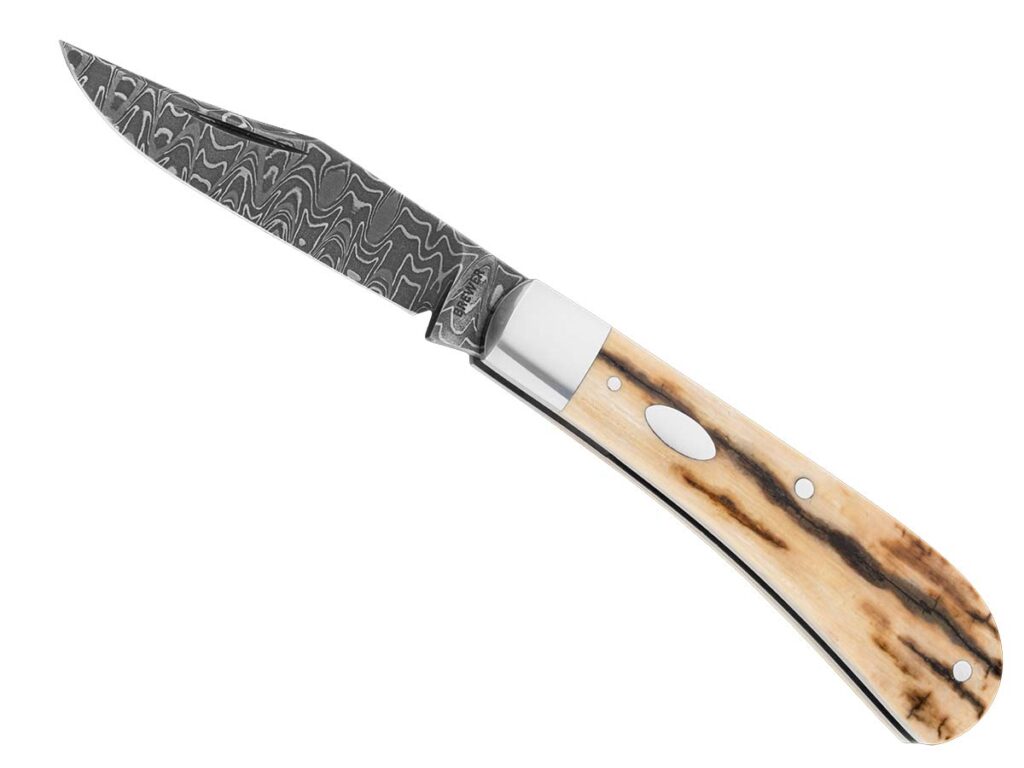
Craig Brewer Slipjoint

Craig Brewer Slipjoint

BLADE LENGTH: 2.5”
BLADE MATERIAL: Mike Norris stainless damascus in a Frequency pattern
BLADE GRIND: Hollow
SCALES: Mammoth ivory
CLOSED LENGTH: 3”
MAKER’S PRICE FOR A SIMILAR KNIFE: $1,100
KNIFE TO KNOW: Craig Brewer is an apprentice smith in the American Bladesmith Society
MAKER: Craig Brewer (Jocelyn Frasier image)


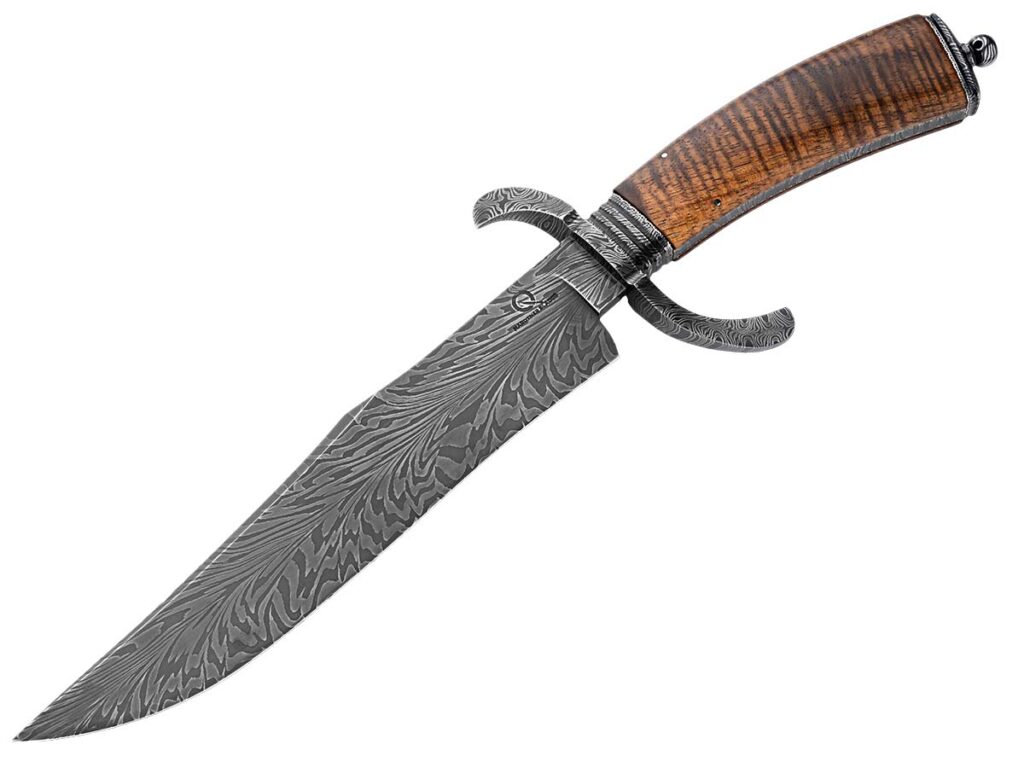
Quintin T. Hardtner IV Take-Down Frame-Handle Bowie

Quintin T. Hardtner IV Take-Down Frame-Handle Bowie

BLADE LENGTH: 8.25”
BLADE MATERIAL: Feather damascus of 1084 carbon and 15N20 nickel-alloy steels
BLADE GRIND: Flat
SCALES: Curly koa
FURNITURE MATERIAL: Same as blade
SPACERS: Nickel silver
OVERALL LENGTH: 13.5”
KNIFE TO KNOW: Won Best Fixed Blade and Best of Show at the 2025 Louisiana Knife Show
SHEATH: Leather; custom made by Bob Bobbitt
MAKER’S PRICE FOR A SIMILAR KNIFE: $3,000
MAKER: Quintin T. Hardtner IV (Jocelyn Frasier image)


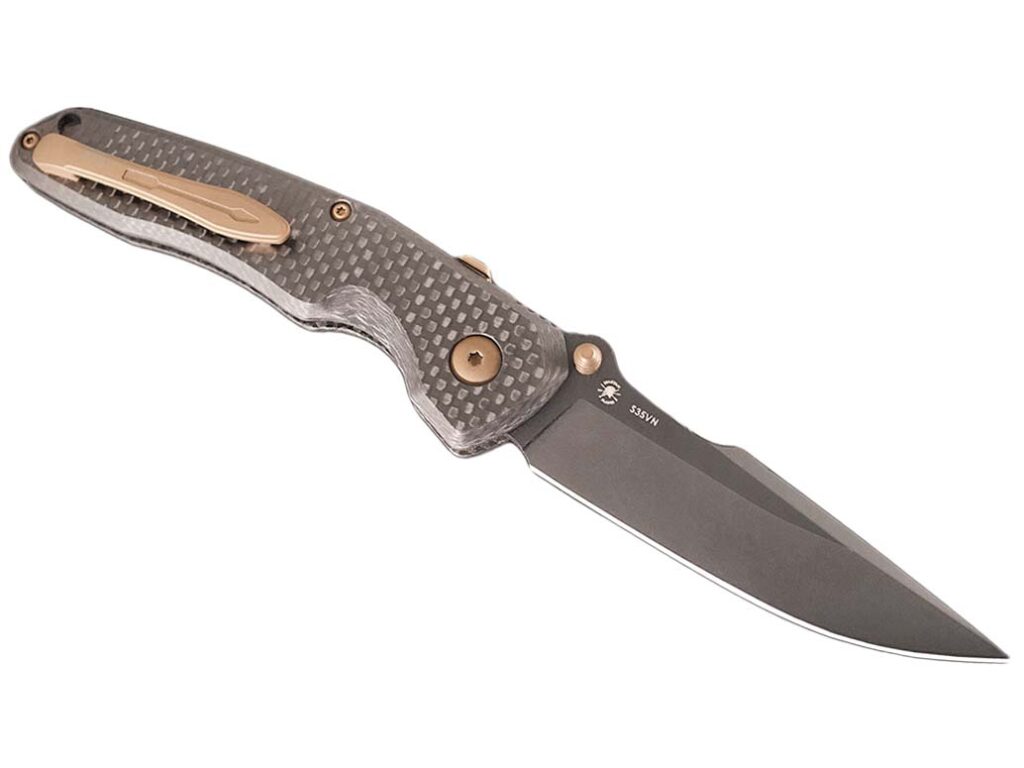
Spartan Blades Soter Carbon Fiber Edition

Spartan Blades Soter Carbon Fiber Edition

KNIFE TYPE: EDC folder
BLADE LENGTH: 3.25”
BLADE STEEL: CPM S35VN stainless
ROCKWELL HARDNESS: 58-60 HRC
BLADE FINISH: Satin
HANDLE MATERIAL: Carbon fiber/G-10 composite
LOCK: RaceLock™
POCKET CLIP: Machined from one piece of steel, PVD-coated in flat dark earth
WEIGHT: 3.9 ozs.
COUNTRY OF ORIGIN: USA
MSRP: $310
KNIFE TO KNOW: Soter is the Greek mythological figure known as the “protector”
COMPANY: Spartan Blades, spartanbladesusa.com


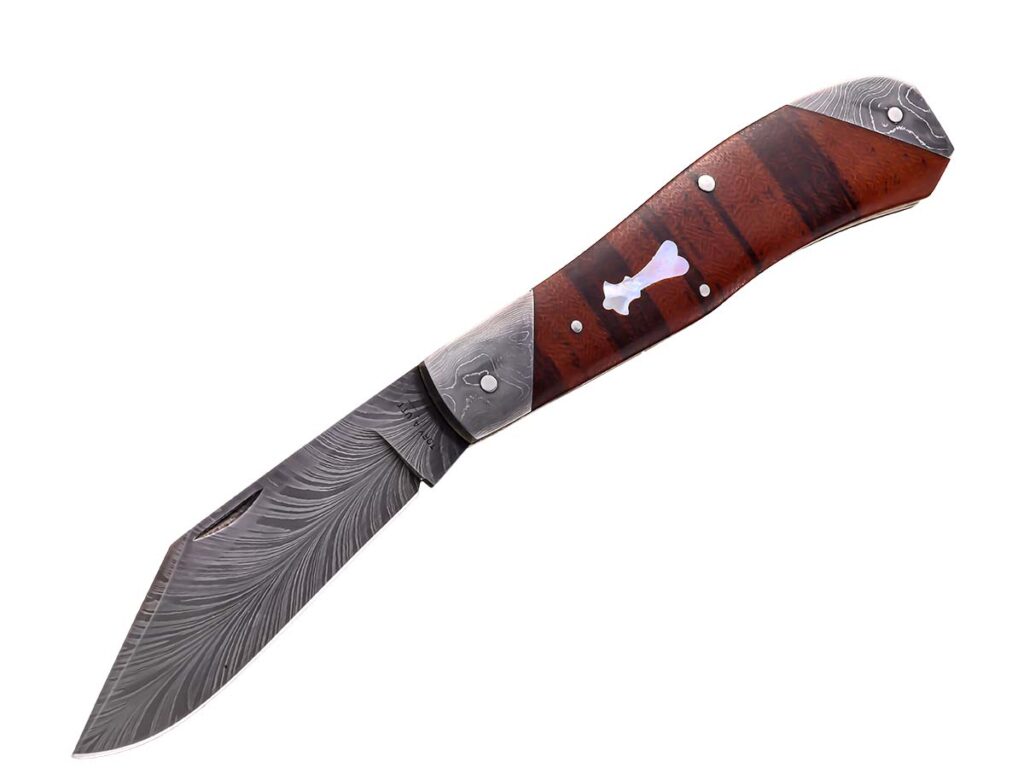
Tory Utt Arkansas Hunter

Tory Utt Arkansas Hunter

KNIFE TYPE: Slipjoint
BLADE LENGTH: 4”
BLADE MATERIAL: Feather pattern damascus forged by Bill Poor
BLADE GRIND: Flat
BLADE PATTERN: Clip point
HANDLE FRAME: Nickel silver
SCALES: Westinghouse Micarta®
SHIELD: Mother-of-pearl
BOLSTERS: Topo pattern damascus forged by Tory Utt
CLOSED LENGTH: 4.25”
MAKER’S PRICE FOR A SIMILAR KNIFE: $1,300 range
KNIFE TO KNOW: Tory Utt has been making knives for 12 years
MAKER: Tory Utt, sacredbearknives.com (SharpByCoop image)


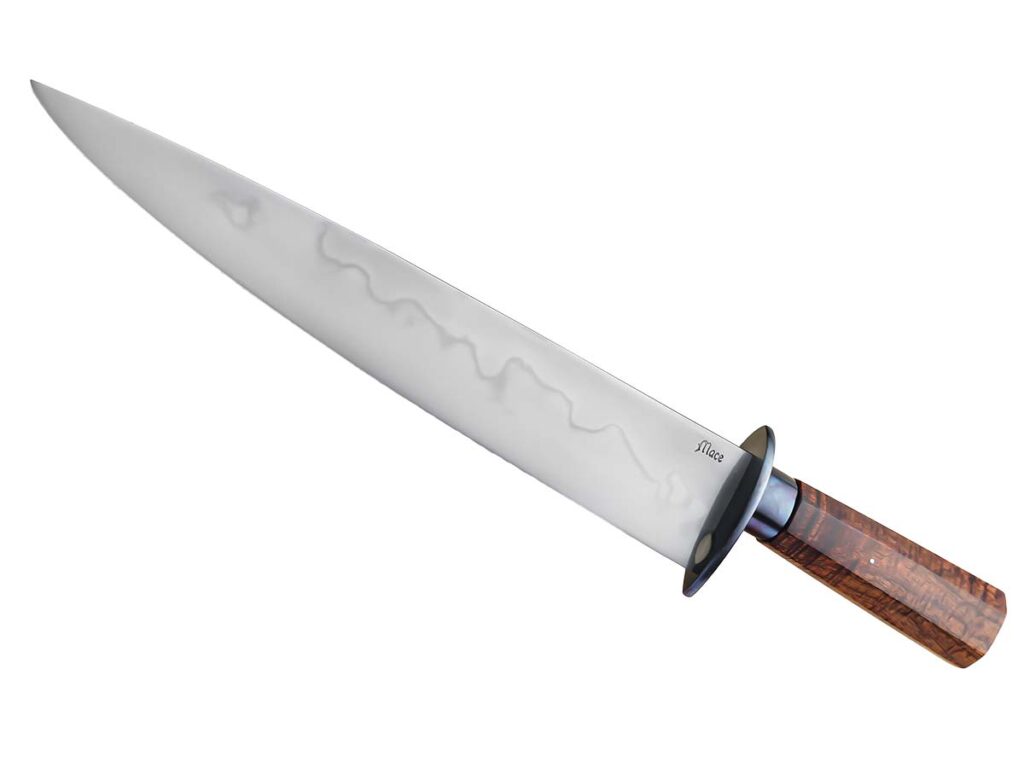
Mace Vitale Bowie

Mace Vitale Bowie

BLADE LENGTH: 12.5”
BLADE MATERIAL: W2 tool steel w/hamon
BLADE GRIND: Flat
SCALES: Tasmanian blackwood
GUARD & FERRULE: Mild steel
OVERALL LENGTH: 17.5”
KNIFE TO KNOW: The design is inspired by early American knives; Mace Vitale is a journeyman smith in the American Bladesmith Society
MAKER’S PRICE FOR A SIMILAR KNIFE: $1,750
MAKER: Mace Vitale (SharpByCoop image)


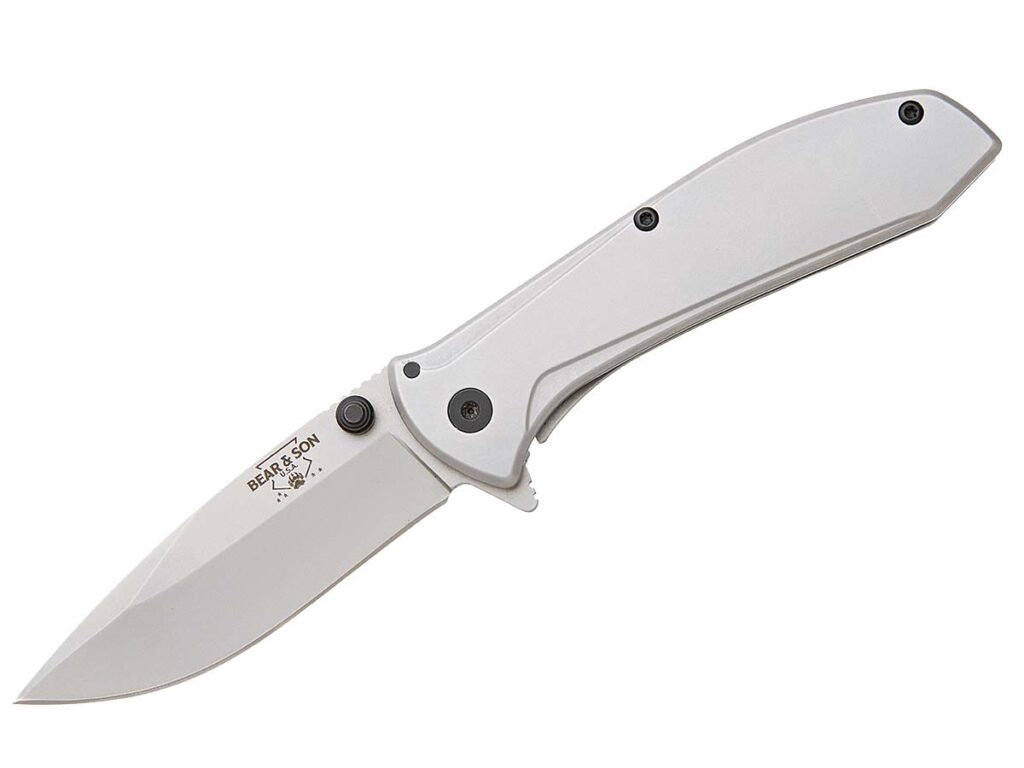
Bear & Son Cutlery 112A 4” Stainless Steel Framelock

Bear & Son Cutlery 112A 4” Stainless Steel Framelock

BLADE LENGTH: 2 7/8”
BLADE MATERIAL: Stainless steel
BLADE PATTERN: Drop point
BLADE OPENERS: Flipper and thumb stud
OPENING MECHANISM: Assisted
HANDLE MATERIAL: Stainless steel
LOCK: Framelock
POCKET CLIP: Yes
WEIGHT: 3.8 ozs.
CLOSED LENGTH: 3¾”
COUNTRY OF ORIGIN: USA
MSRP: $59.99
COMPANY: Bear & Son Cutlery, bearandsoncutlery.com


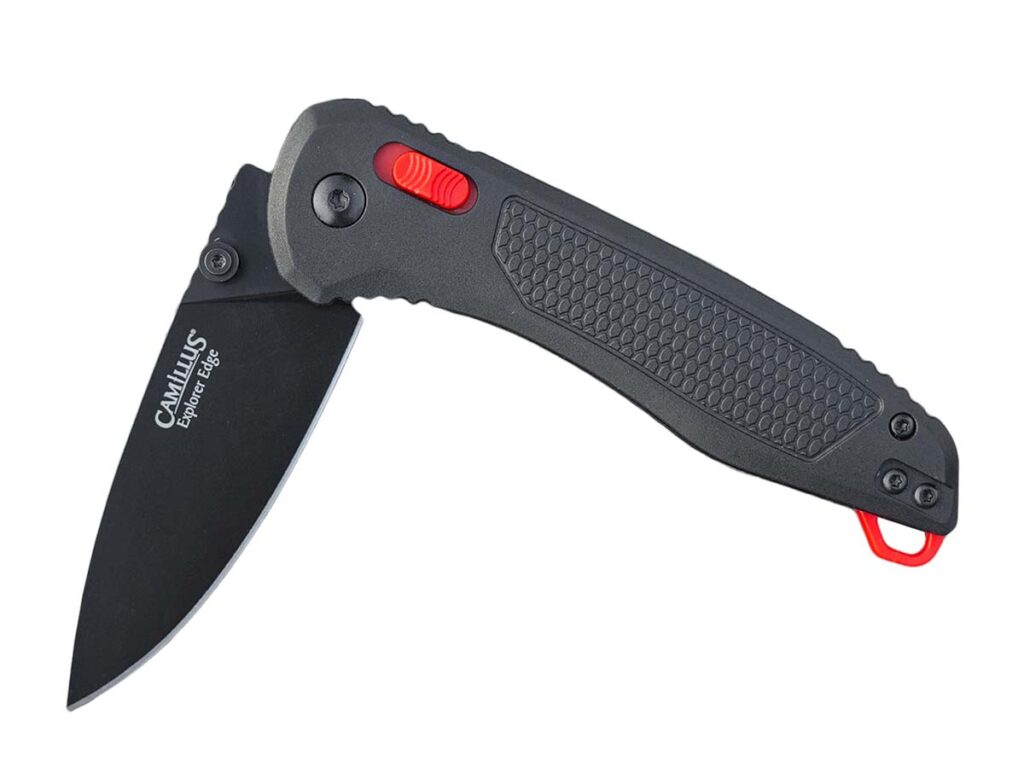
Camillus Explorer

Camillus Explorer


BLADE LENGTH: 3”
BLADE STEEL: 3Cr13 stainless
BLADE PATTERN: Drop point
HANDLE MATERIAL: Nylon glass fiber
LOCK: Crossbar
WEIGHT: 3 3/8 ozs.
CLOSED LENGTH: 4.5”
COUNTRY OF ORIGIN: Offshore
MSRP: $29.99
COMPANY: Camillus, camillusknives.com


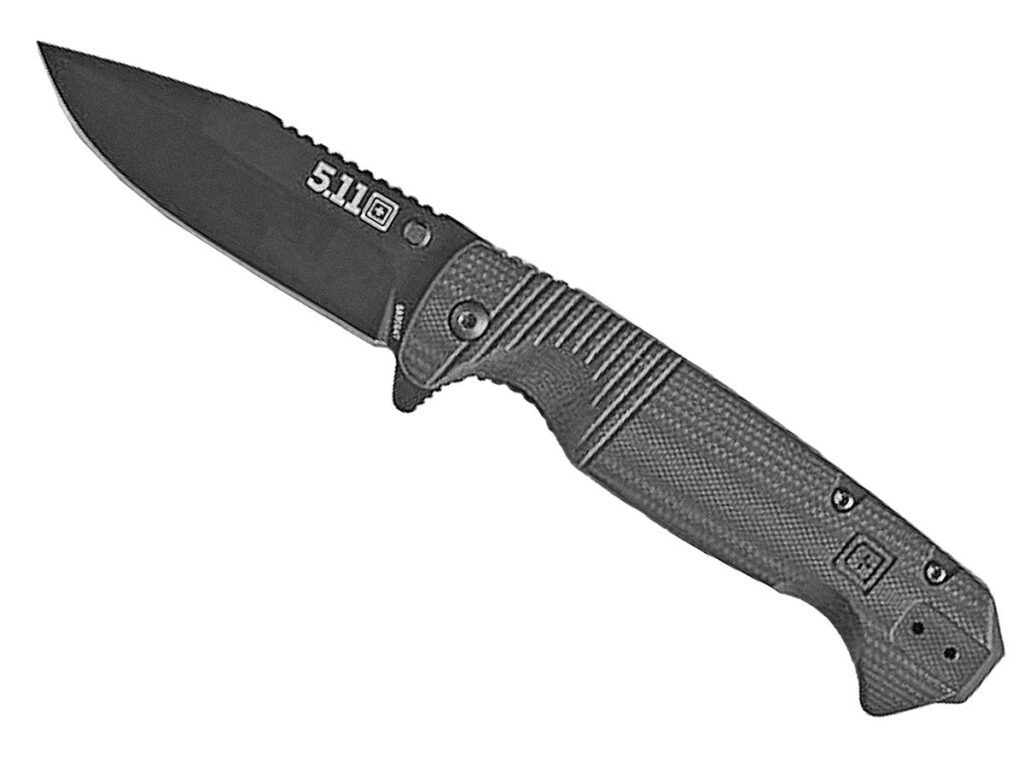
5.11 Pryme Double Duty DP

5.11  Pryme Double Duty DP

KNIFE TYPE: Folder
BLADE LENGTH: 3.25”
BLADE MATERIAL: D2 tool steel
BLADE GRIND: Compound
BLADE PATTERN: Drop point
BLADE OPENERS: Flipper and thumb stud
HANDLE MATERIAL: G-10 on mark side/420J2 stainless on lock side
BOLSTER MATERIAL: 420J2
LOCK: Framelock
POCKET CLIP: Steel, deep carry, reversible
WEIGHT: 5.3 ozs.
CLOSED LENGTH: 5.125”
SPECIAL FEATURES: Built-in, full-handle-length pry tool/screwdriver/optic
COUNTRY OF ORIGIN: China
MSRP: $85
CONTACT: 5.11, 5.11tactical.com

Check Out Other Months:

Best Machete For Taming Brush

0

We hack away at meaty machetes that cut to the quick and take no mercy on brush.

In many parts of the U.S.A., greenery is busting out all over with the year’s early warmth and rain. People are trimming shrubs, cutting grass, whacking vines and other yard tasks. If you are a camper or own land, chances are you have a need for a good machete to help clear brush and take down saplings.

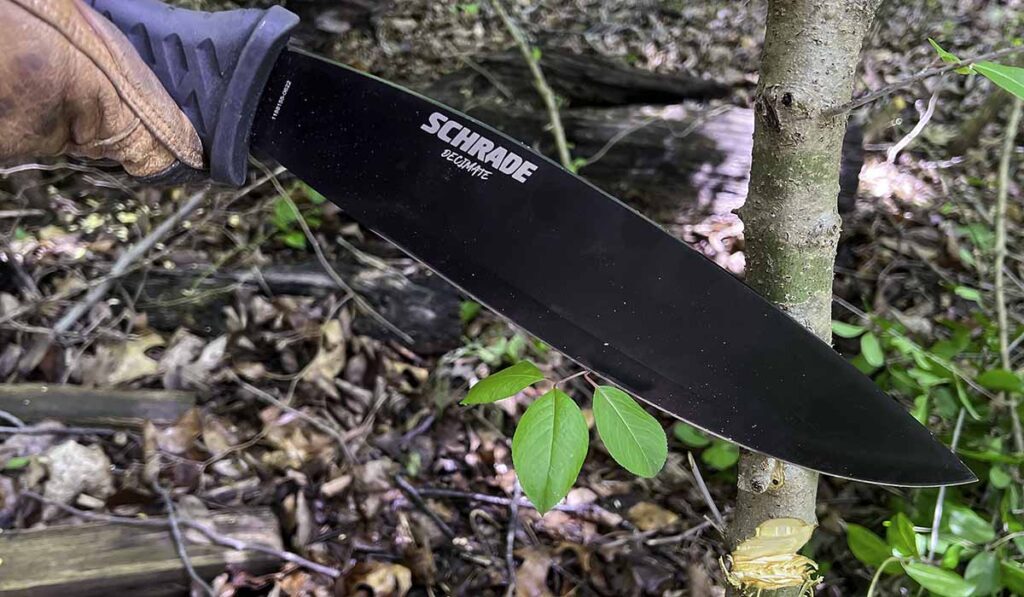
Schrade Delta Class Decimate Bolo

Schrade Decimate Bolo
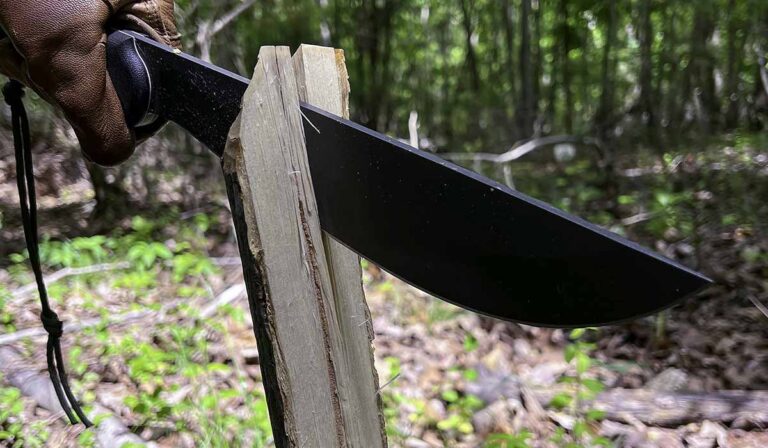
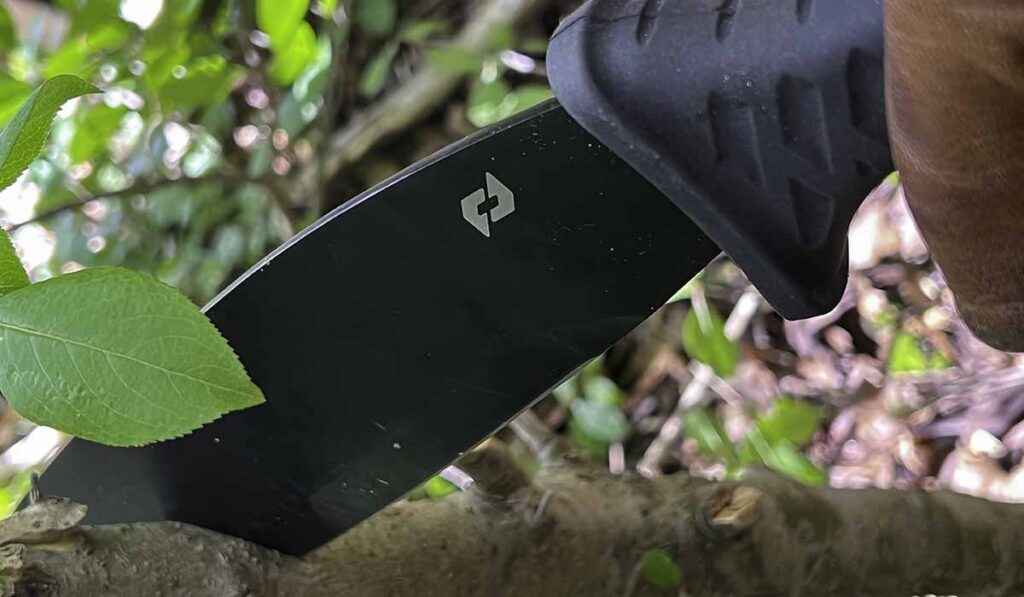
The shallow blade grind enables the Schrade Decimate Bolo to bite deep into green wood. 

The Decimate Bolo machete is part of Schrade’s Delta Class line of knives, and offers a good balance of performance and value pricing. The 12-inch blade and 8-inch handle make it a formidable slashing/chopping tool. The 3Cr13 stainless steel blade has the power and durability to hack through the toughest jobs without “decimating” your wallet. The steel seems to hold a decent edge and is easy to resharpen. I would compare it to 440A stainless. The blade shape is a fat spearpoint, offering easy forward-heavy balance that works well for extended use. A black coating enhances corrosion protection as well as low-profile visibility.

The handle seems well thought out with several key features. The integral guard prevents forward hand movement, while the bird’s-beak butt prevents rearward sliding of same. A generous swelling mid-handle fills your grip nicely. A heavy molded-in texture aids a nonslip grip and the black rubber overmold has a slightly tacky grab-you-back quality that works well with gloves or without. Wrap your hand around the grip and it feels secure and instills user confidence. 

The accompanying sheath, a ballistic nylon/covered flexible plastic with a riveted construction, is basic but works. Two button snaps near the handle allow the sheath to open wider for easy insertion and removal. A button snap strap affixes the handle to the sheath. The most interesting feature is it carries via a strap and not traditionally on a belt. The back and bottom have two eyelets for strap attachment. Adjustable in length, the strap can fit around your torso to carry sling style for easy portability.  

Schrade Decimate Bolo
The Schrade Decimate Bolo is an effective chopper due to the weight of the blade and the gentle curve of the cutting edge.

A broad profile lends the blade forward balance for delivering effective chopping blows that can take down saplings easily. The shallow grind enables the blade to bite deep into green wood. The slight-downward-angle-kukri-style-blade-to-handle design helps accentuate cutting power. 
One thing: At first it felt like the handle was oversized and too big for my hand. When I put the machete to use, it became apparent the oversized nature is on purpose. I could employ two grip styles to maximize effectiveness. 

If you grip it close to the forward guard, it allows you to execute detailed chopping maneuvers. The blade feels more controllable. But, when you slide your hand rearward to where your pinky catches on the bird’s-beak butt, it locks your grip in and promotes maximum leverage and power for strong chopping strokes. You never feel like the knife will get away from you. The rubber handle also assists in mitigating impact shock, which translates into a more comfortable user experience.

At an MSRP of $49.99, the Decimate Bolo is a fairly decent machete if you want to step up from something of lesser quality in a hardware store. Country of origin: China.

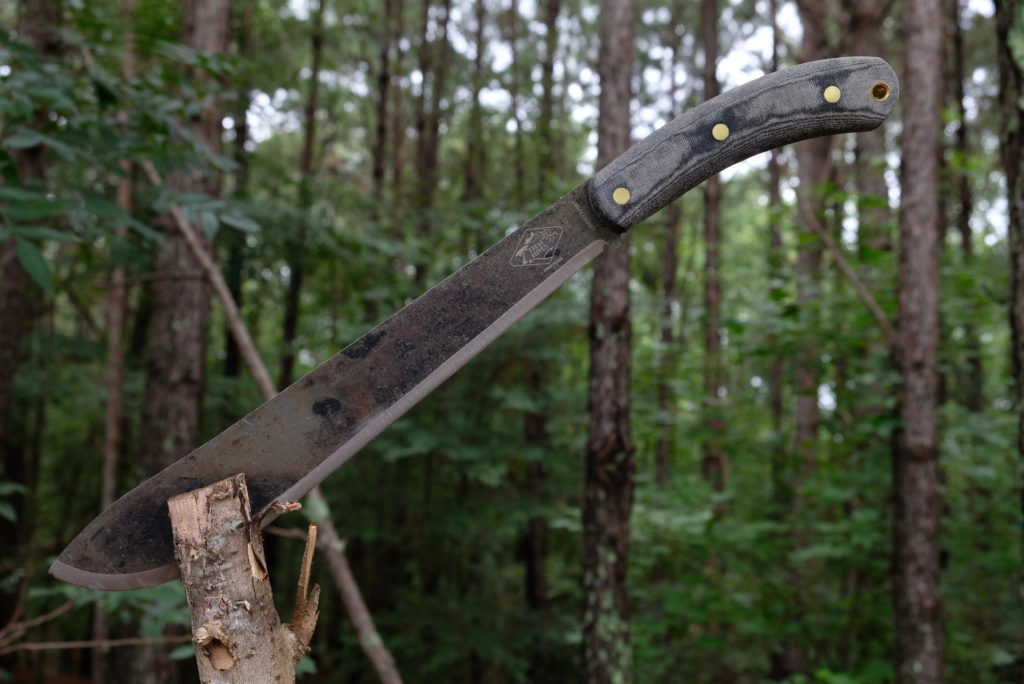
ESEE Knives Expat Darien Machete

ESEE Expat Darien
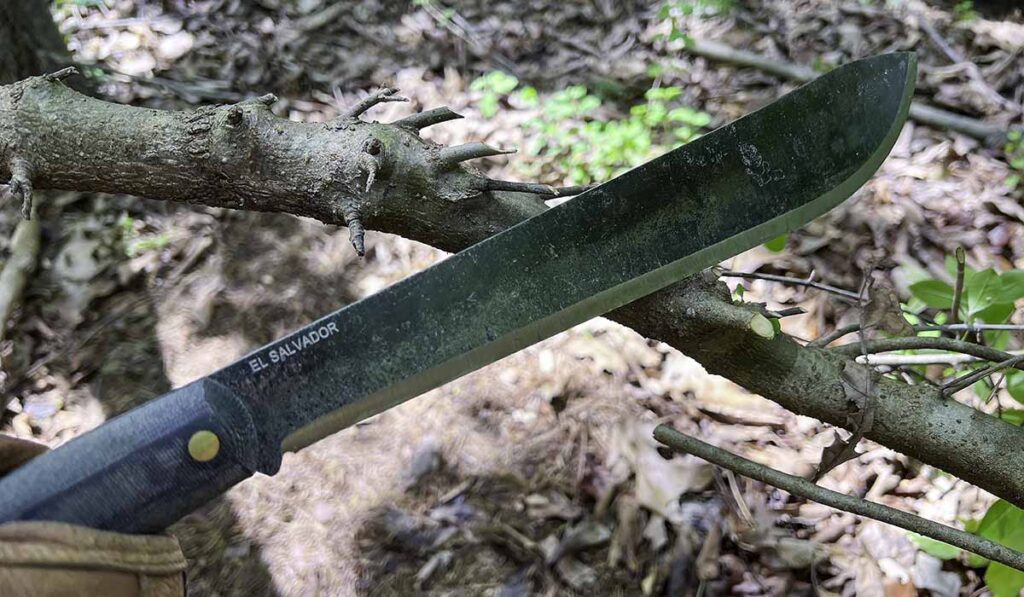
The ESEE Expat Darien is not only a great chopper but also good for more delicate work such as quickly removing smaller limbs in one motion.

The ESEE Knives Expat Darien Machete is ruggedly made with a 12.4-inch blade of 1075 carbon steel. The blade has a notable two-tone appearance from the heat-treat scale left on the flats and the satin finish of the main grind bevels. It gradually tapers from belly to tang, evening out balance somewhat while having enough blade-forward weight to facilitate easy swinging.  

The 6-inch Micarta® handle has some girth and fills your hand well. The downward curve profile helps lock in your grip and prevents rearward slippage. Three large brass rivets hold the Micarta slabs securely to the full tang. I like how the grip is a bit oversized, allowing you to wrap your hand around it while still feeling comfortable and secure. At 18 inches overall, the machete is an ideal size for serious work yet compact enough for comfortable carry and storing in a truck, SUV or side-by-side.  

The reinforced ballistic nylon sheath is of a sewn, riveted construction, offering the toughness needed for housing the Darien. The desert tan nylon fabric offers a great alternative to the standard, ubiquitous black sheath. A single-button snap strap secures the knife. A large loop accommodates the thickest belts and is sewn securely to the sheath. It’s definitely well-made. MSRP: $120 Country of origin: El Salvador.  

Gerber Gator Bolo

Gerber Gator Bolo
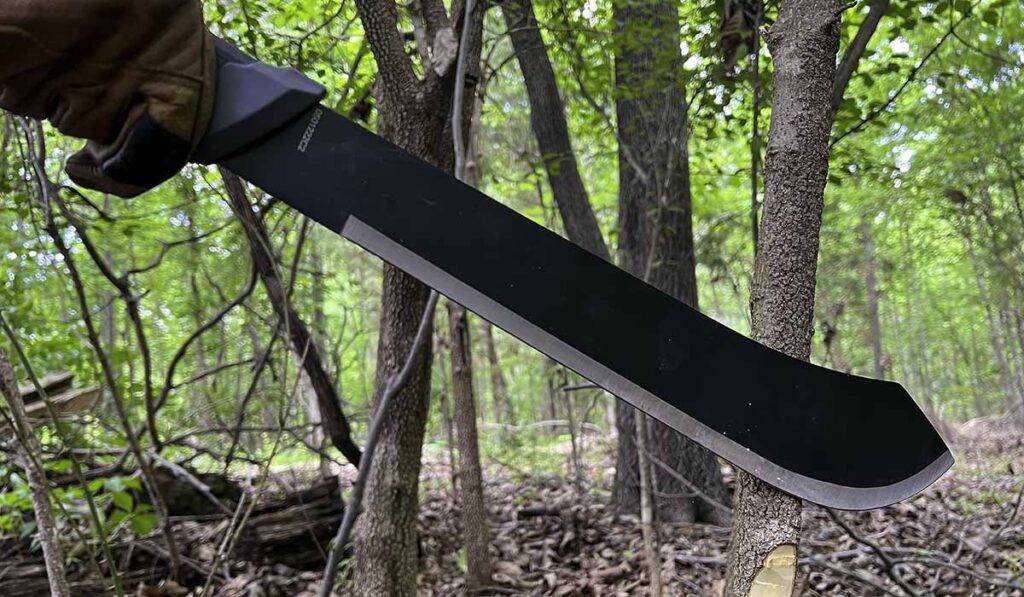
Chopping power is aplenty with the Gerber Gator Bolo and its longer blade. It has enough punch to make chopping saplings an easy task.

The Gerber Gator Bolo’s bolo-style blade flares at the tip to add a pronounced forward balance point that delivers powerful chops. The 15.4-inch blade is 1055 carbon steel in a black coating to resist corrosion. Overall length: 22.4 inches. The handle is a molded FRN with a textured rubber overmold for comfort in wet or dry conditions. The texturing is the same for all Gator series handles, with a simulated alligator hide pattern. Full-tang construction provides strength and improves balance.

The sheath is ballistic nylon lined with plastic to prevent blade puncture. A series of rivets holds the sheath together and a zippered portion opens it wide for easy removal/insertion. Two D-ring attachment points on the back anchor a shoulder strap. What’s weird is the strap is not included. You must supply your own. Neither is there a belt loop, which is somewhat surprising.  

The lengthy blade is ideal for taking out vines, tall weeds, etc. It can fell saplings, though delivering the necessary chopping blows can get tiring. It nonetheless remains an effective machete if weeds and assorted vegetation are your primary target. Out-of-the-box edge quality was sharp enough to do the job.

The handle is comfortable. A large finger recess at the guard is well-suited for wrapping your hand around the grip. The simulated gator-hide texturing excels at holding your hand in place, gloved or no. The lanyard works well in the event you lose your grip. Some users say lanyards are a danger as letting go of the handle may cause the dangling machete to swing around on you as opposed to letting it drop to the ground safely. If you don’t want the lanyard, cut it off.

I found the Gator Bolo an effective chopper despite its dramatic blade-heavy balance. Just remember to let the weight and gravity do their thing on the downstroke. The blade bit hard into green wood and the shallow grind thins out the cutting edge nicely. The blade held an edge fairly well and is easy to resharpen. I improved edge quality using a coarse-grit diamond sharpening rod followed by a fine-grit ceramic honing rod—not even five minutes and I had a good edge on it. MSRP: $60. Country of origin: China. If you need a machete with reach, this one’s for you.  

TOPS Knives Yacare

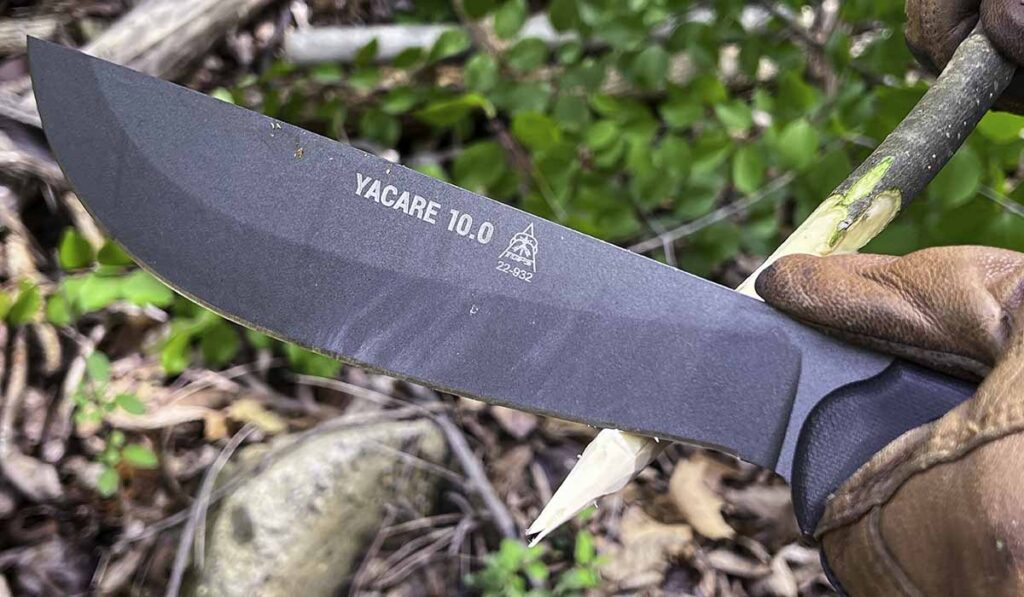
TOPS Yacare machete
Whittling is possible with the TOPS Yacare and its great balance and gently curving cutting edge. It’s got an excellent edge with plenty of bite right out of the box.

Designed by company general manager Craig Powell, the TOPS Knives Yacare 10.0 is a barong-style machete 15.5 inches overall.  The blade is 1095 carbon steel, a good performing material that’s easy to sharpen, and 10.25 inches—easily long enough for serious work. The blade’s forward balance works well as both a machete and a wood-chopping tool for dispatching saplings, vines and brush. The knife feels very controllable too, which is great for finer cutting tasks, something larger machetes normally don’t do well. The blade bites hard with every swing. The continuously curving cutting edge almost constantly presents itself at an angle to whatever is being cut, which enhances efficiency at powering through tall grass, weeds and saplings.  

The black Micarta handle features integral front and rear guards to capture your hand and is definitely a user. The grip edges are contoured and rounded for comfortable purchase, and white fiber spacers add a nice visual pop. Micarta has long been a favorite handle material of mine and I prefer it on fixed blades such as this one. It’s a very durable, lightweight material that is dimensionally stable and impervious to fluid absorption. It can be textured to add grip traction without being overly aggressive. Hence, TOPS uses Micarta in a lot of its knives, both big and small.  

The sheath is heavy-duty and well-made. It’s a ballistic nylon material that is quite rigid. A wide fabric-fastening strap secures the handle. As a nice added touch, there’s an exterior accessory pouch with a Fastex buckle closure. It stores things like a medium folder, sharpener or even a multi-tool. The belt loop is the same width as the sheath and heavy duty as well. MSRP: $270. Country of origin: U.S.A.

More Machetes

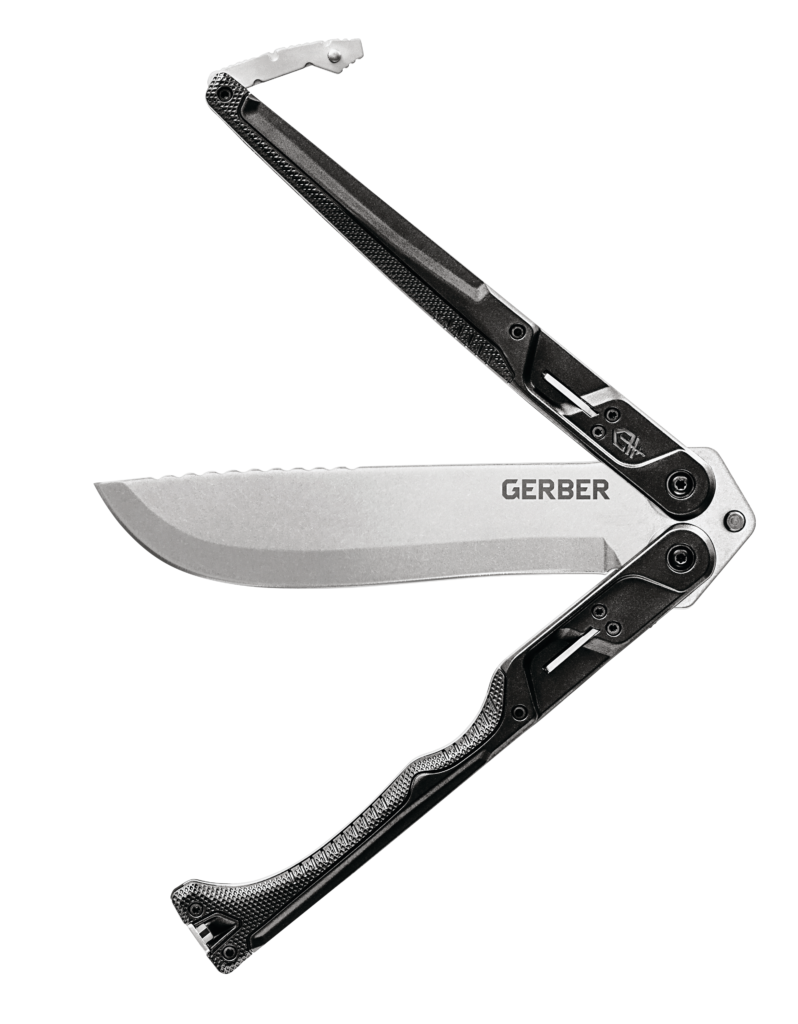
GERBER DUBLEDOWN FOLDING MACHETE

Blade length: 6.75”
Blade steel: 420HC stainless
Blade pattern: Recurve drop point
Blade Finish: Stonewashed
Weight: 18 ozs.
Overall length: 15.1”
Knife to know: Available in a green or black handle and a choice of blade finishes
Sheath: MOLLE/belt carry
Country of origin: USA
MSRP: $129-$139

ESEE Darien

The ESEE Darien features an ergonomic Micarta® handle for comfort and comes with a rugged canvas sheath. According to ESEE, the knife is a chopping machine whether in the Amazon, the jungle or your own backyard. It carries the same “no questions asked” warranty as the knives in the standard ESEE line.

ESEE DARIEN
Blade Length: 12.38”
Blade Material: 1075 carbon steel
Rockwell hardness: 54-56 HRC 
Blade’s Maximum Thickness: .094”
Handle: Micarta®
Knife weight: 15.5 ozs.
Overall Length: 18.18” 
Sheath: Canvas
Sheath weight: 4.5 ozs.
Country of origin: El Salvador
MSRP: $100 and up

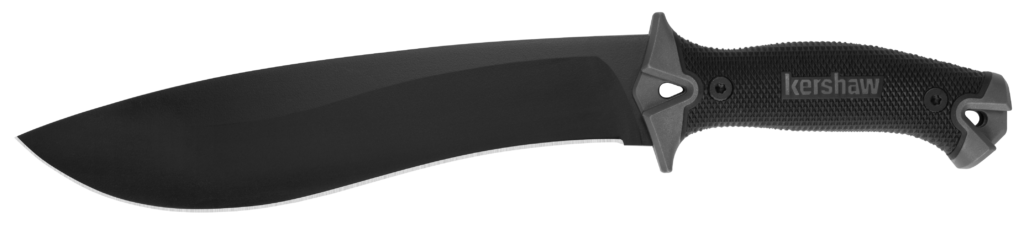
Kershaw Camp 10

Though a camp knife in design, the Kershaw Camp 10 doubles as a machete, too. Clearing brush, making kindling and more, it does the trick. The integral crossguard is a nice safety feature and the handle has holes for either a forward or rear lanyard.

KERSHAW CAMP 10
Blade length: 10”
Blade material: 65Mn spring steel
Blade finish: Black powdercoat
Blade pattern: Recurve drop point
Handle: Full tang, glass-filled nylon with Sure-Grip overmold
Knife weight: 1 lb. 2.3 ozs.
Overall length: 16”
Sheath: Glass-filled nylon w/gear straps and belt loop
Sheath weight: 5.7 ozs.
Country of origin:  Design, prototype and quality control in USA; manufactured in China
MSRP: $80.84

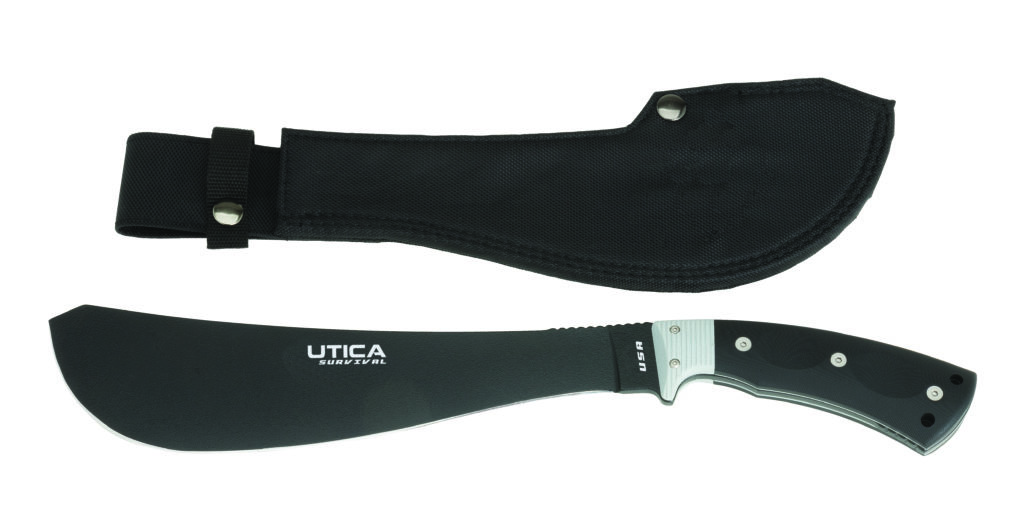
Utica Stealth I

The combination of a deep blade belly and dropped handle is designed to maximize the Utica Stealth I’s chopping and brush clearing performance. A single integral guard enhances user safety. The nylon belt sheath has a button strap to help secure the knife when sheathed.

UTICA STEALTH I
Blade length: 11.25”
Blade material: 1095 carbon steel
Blade finish: Black oxide
Handle material: Micarta®
Weight: 21.87 ozs.
Overall length: 17.5”
Sheath: Nylon
Country of origin: USA
MSRP: $129.60

Coast F1400 Machete

A D-guard and full-tang construction help highlight the Coast F1400 machete. The sheath has a metal clasp for a secure hold.

COAST F1400
Blade length: 14”
Blade steel: 3Cr13 stainless
Blade finish: Black oxide over glass bead
Handle material: Fiberglass-filled Nylon 6
Lanyard: Paracord
Weight: 1 pound, 1.2 ozs.
Overall length: 19.2”
Special feature: Sawback blade
Sheath: Nylon with hard plastic liner and riveted/sewn edge; includes belt loop 
Country of origin: China
MSRP: $29.99

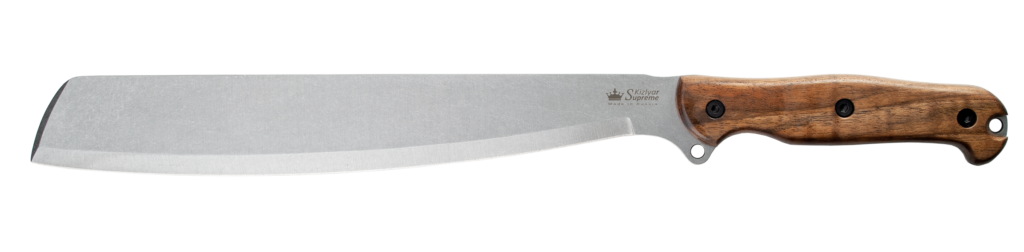
Kizlyar Supreme Bushmate

The Kizlyar Supreme Bushmate looks as much like a competition cutter as a machete, but the thin blade and Scandi grind makes it perform much better in the bush. The handle has two lanyard holes for rear or forward attachment, the latter doubling as an integral single guard.

KIZLYAR SUPREME BUSHMATE
Blade length: 10 7/8”
Blade steel: 420HC stainless
Blade grind: Scandi
Blade’s maximum thickness: .039”
Blade finish: Satin
Handle material: Caucasus walnut
Weight: 13 ozs.
Overall length: 17 3/8”
Knife to Know: The Bushmate is also available in a convex AUS-8 stainless steel version with a maximum blade thickness of .1889” and a 19-oz. weight
Sheath: Embossed leather
Country of origin: Russia
MSRP: $185

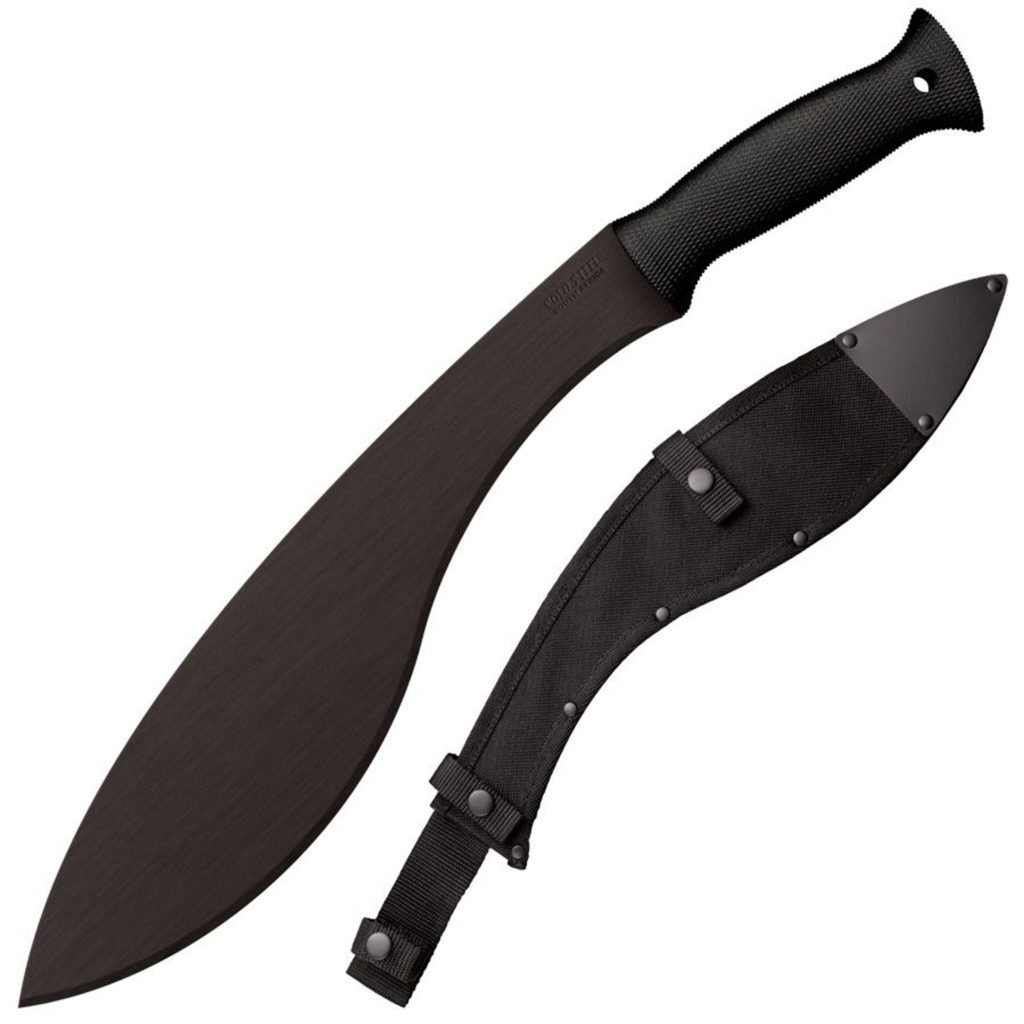
Cold Steel Kukri Machete

The Cold Steel Kukri Machete comes in two deep-bellied blade lengths: 13 (shown here) and 17 inches. Either is designed as a lightweight cutter for belt carry or lashed to a pack. The sheath comes with a reinforced tip and multiple snap downs.

COLD STEEL KUKRI MACHETE Blade length: 13”
Blade material: 1055 carbon steel
Blade finish: Black baked-on anti-rust matte
Handle material: Polypropylene thermoplastic w/hole for a lanyard
Handle length: 5”
Weight: 16 ozs.
Overall length: 18”
Sheath: Cor-Ex®
Country of origin: Import
MSRP: $29.99

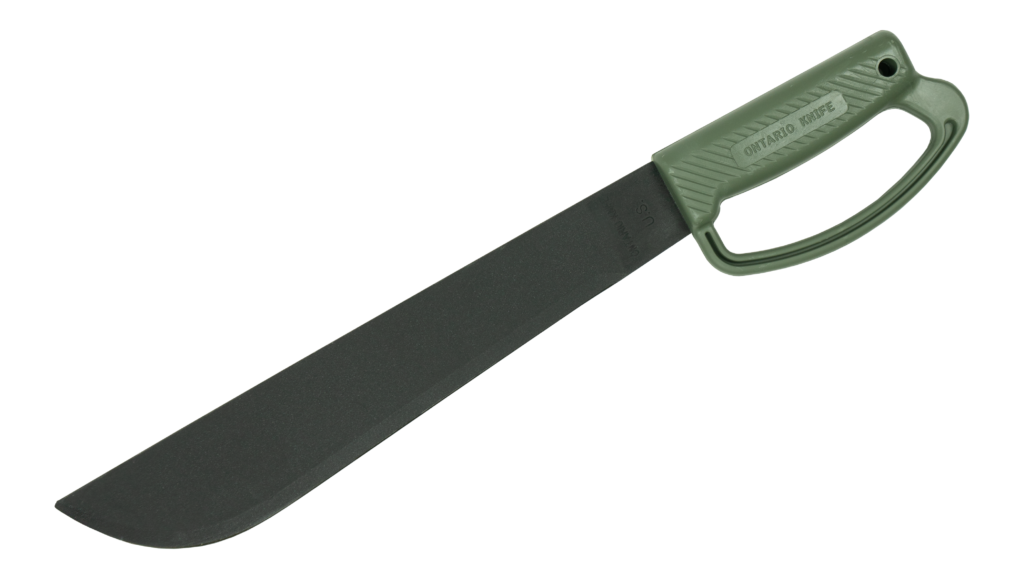
Ontario Camp Plus Machete

The Ontario Camp Plus Machete includes an ample D-guard handle for user safety. The carbon steel’s Rockwell hardness of 52-55 HRC renders the blade malleable enough to better endure high impacts.

ONTARIO CAMP PLUS MACHETE Blade length: 12.5”
Blade material: 1075 carbon steel
Blade finish: Phosphate coated
Handle material: OD green molded plastic
Weight: 1.65 lbs.
Overall length: 17.7”
Sheath: Black denier nylon packcloth w/heavy liner and belt loop
Country of origin: USA
MSRP: $29.07 (sheath sells separately for $11.95)

Smith & Wesson Cleaver Machete

The Smith & Wesson Cleaver Machete boasts blade cutouts to lighten the load, full-tang construction, an integral guard, and an ergonomic dropped handle with finger groove and a hole for a lanyard.

SMITH & WESSON CLEAVER MACHETE Blade length: 10”
Blade steel: 420 stainless
Handle: Overmolded rubber
Special features: Sawback blade and textured hammer pommel
Weight: 1.12 lbs.
Overall length: 16.54”
Sheath: Synthetic w/zipper and snap strap
MSRP: $51.99

Editor’s Note: Dexter Ewing contributed to this post.

Check Out More Buyer’s Guides:

Advertisement

Must Read Articles

Read this before you make a knife

Knifemaking 101 – Read This Before You Make a Knife

  by Wayne Goddard My experience has taught me that there's nothing like digging in and getting started. I've often said the hardest part of the...
how to forge damascus steel

How to Forge Damascus

Advertisement
Advertisement