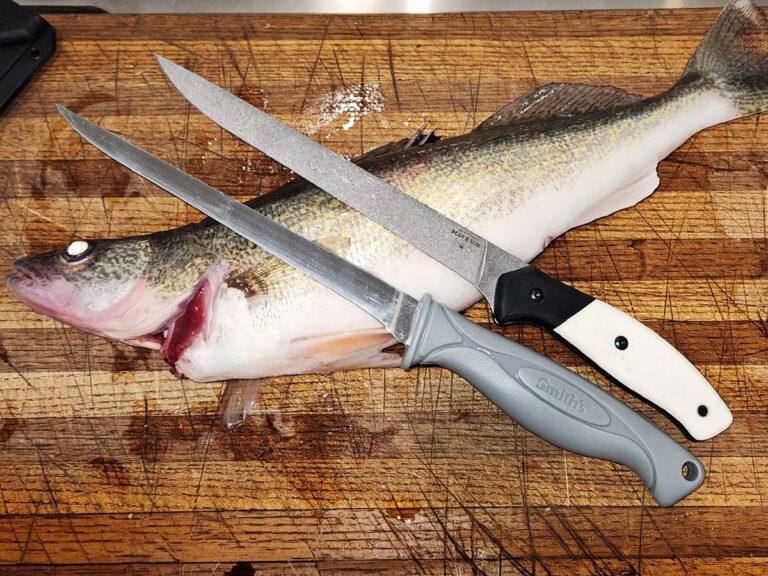
Comparing Smith’s Flex Fillet and Bear & Son Smooth White Bone Pro Fillet in fish-skinning dominance.
I was just about to type “fishing season is nearly upon us.” Living in Canada, it has never stopped. Up here, thousands of fishermen are manning their shanties, huddled over a hole, heaters blazing their favorite brand of barley pop nearby. Up north, fishing is a sport that runs year-round.
Why do men go ice fishing? Maybe they go for the love of it? Maybe the solitude and peace on the ice? Either way, they are out there. And certainly, a part of their kit is a good fillet knife. If you intend on eating some of what you catch, you need one. Which brings us to our topic.
We’ll head-to-head two fillet knives at opposite ends of the price spectrum. At the budget end is the Smith’s Flex Fillet Knife, and in the premium tier, the Bear & Son Smooth White Bone Professional Fillet Knife. Both knives have 7-inch-long blades, and both will be tested on some fresh catch from Lake Erie. Crossing my fingers, we get fillets for a meal.
A buddy of mine who is braver than I for facing the cold brought in a variety of pickerel (walleye for my American readers) and my favorite, yellow perch. Anyway, let’s talk knives. Some would figure that putting a $145 dollar knife up against a $20 isn’t a fair comparison. I would suggest that price sometimes doesn’t matter as much as value.
Tale Of The Tape
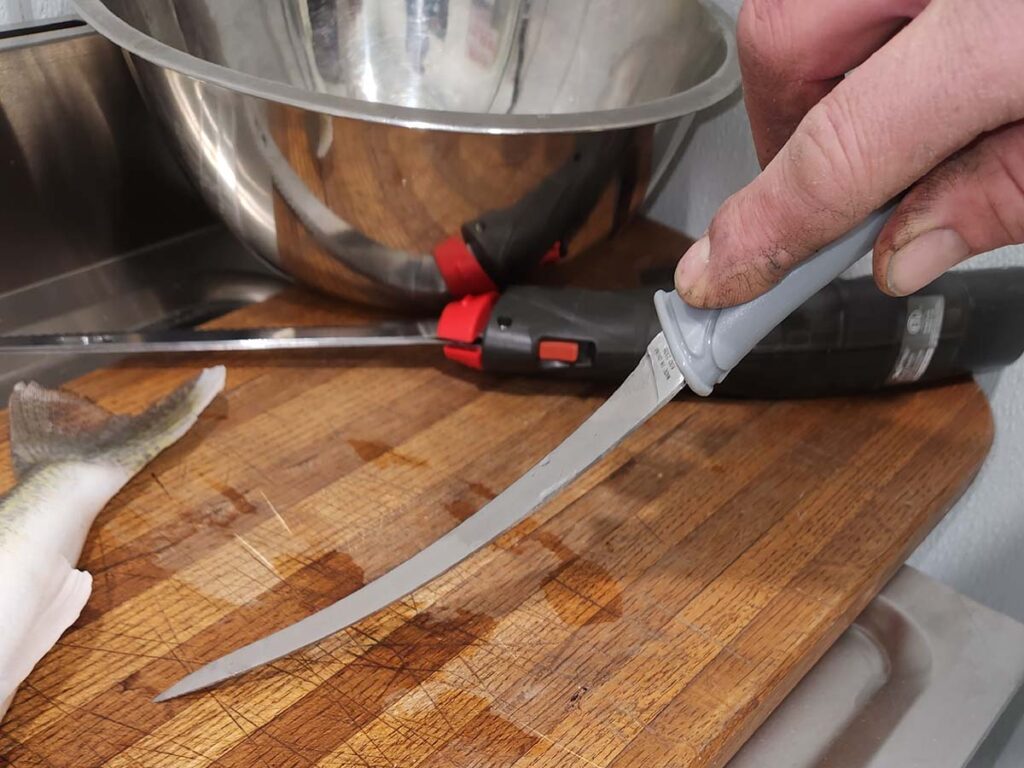
With a 7-inch blade, the Smith’s Flex has a mid-range flex to it. Beyond filleting fish, the author could see this stiffness making it a solid boning knife.
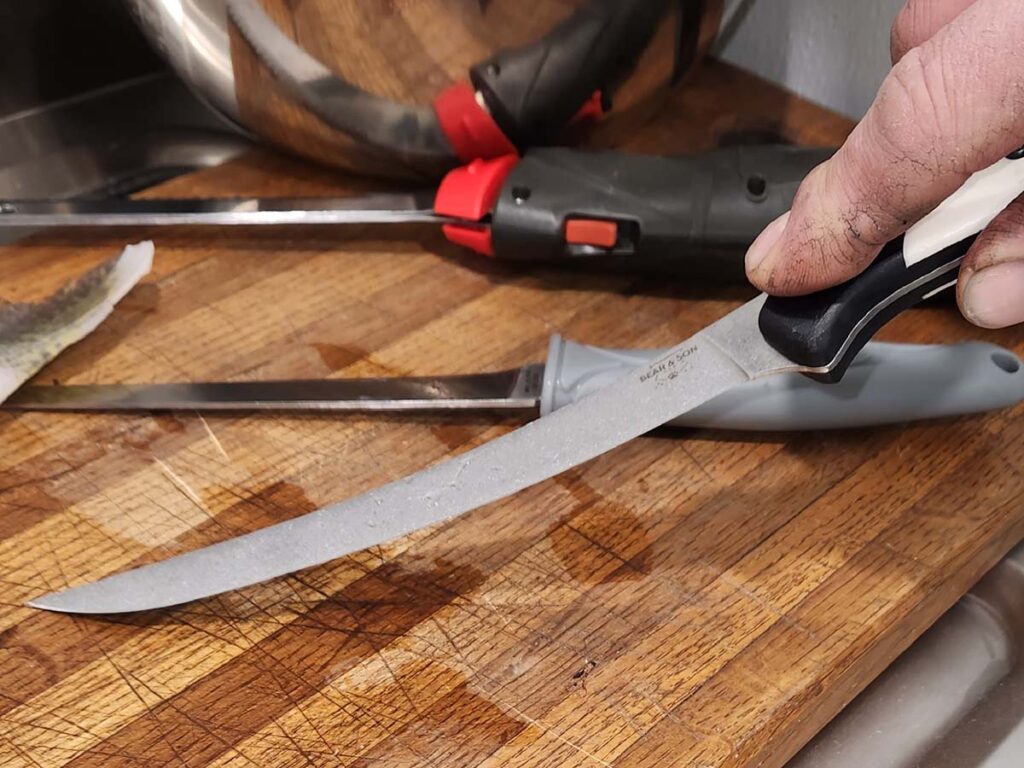
Given its thicker stock, the author found the White Smooth Bone’s blade on the stiff side. Out of the two blades, he could see this knife pulling duty cleaning game.
Handle ergonomics is important in a knife used for long periods of time. It is one thing to chop an onion and a completely different thing when you need to manipulate a blade to make detailed cuts repeatedly. Ergonomics on the Bear & Son are pretty good. The overall profile of the handle has the right contours. Out of the two, there is no doubt that the White Bone Professional has better looks with its split 25 percent black and 75 percent white handle scales. Part of the presentation of the handle is black liners that run into the black bolsters. Bear & Son use screws to fasten the scales to the full tang design. They also include a lanyard hole.
Smith’s, on the other hand, goes with a light injection-molded plastic handle. Unfortunately, they do not detail what material the handle is made from, and since do not play guessing games I will not hazard a misinformed guess. The molded handle on the Smith’s is lightweight. On the weight (without sheaths), the Bear & Son weighed in at 5.46 ounces, and the Smith’s weighed in at 2.98 ounces, according to my kitchen scale. Therefore, the Smith’s came in at almost half the heft. If you prefer a knife with a little heft to it, the Bear & Son is your model.
The author liked the Smith’s handle and found the design made the tip controllable for detailing jobs.
Sheaths for these knives are not a main area of concern, as a fillet knife isn’t generally meant for belt carry. You do want the blade protected. Naturally, you want to avoid holes in whatever you choose to tote your fishing gear in. Smith’s comes in a very minimal sheath, no belt loop and plenty of drainage holes, allowing the blade to dry. All those slots make sure the sheath is easy to wash out. The Professional comes with a sturdy molded sheath with various lashing points so you can attach it to your gear. Furthermore, it has a great friction lock-up. The only drawback to the Bear & Son sheath is a tiny drainage hole. This, however, is easily fixed with a large drill bit.
Fillet Fray
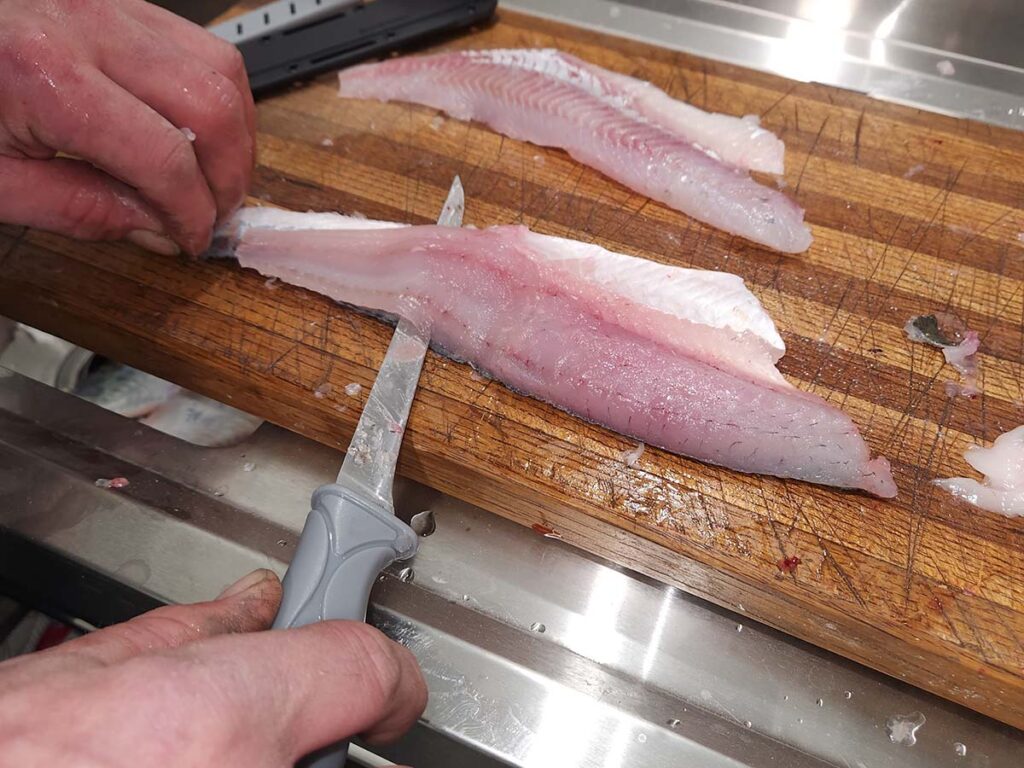
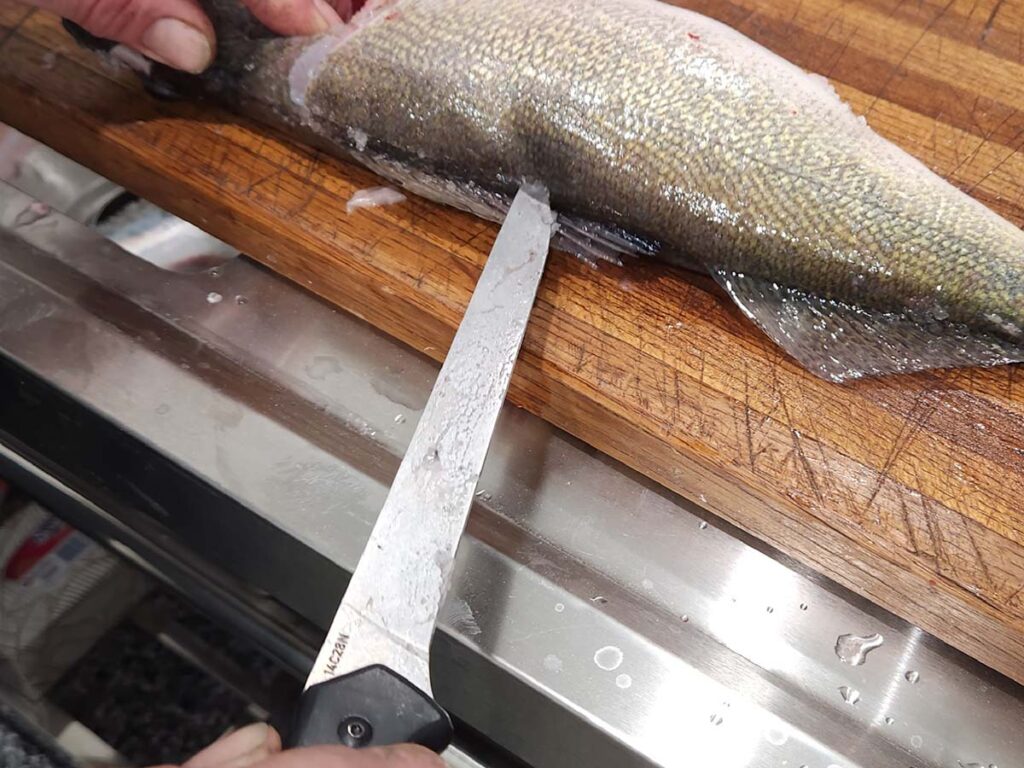
A good, sharp knife like the Smith’s Flex made it easy for the author to get clean fillets off the fish.
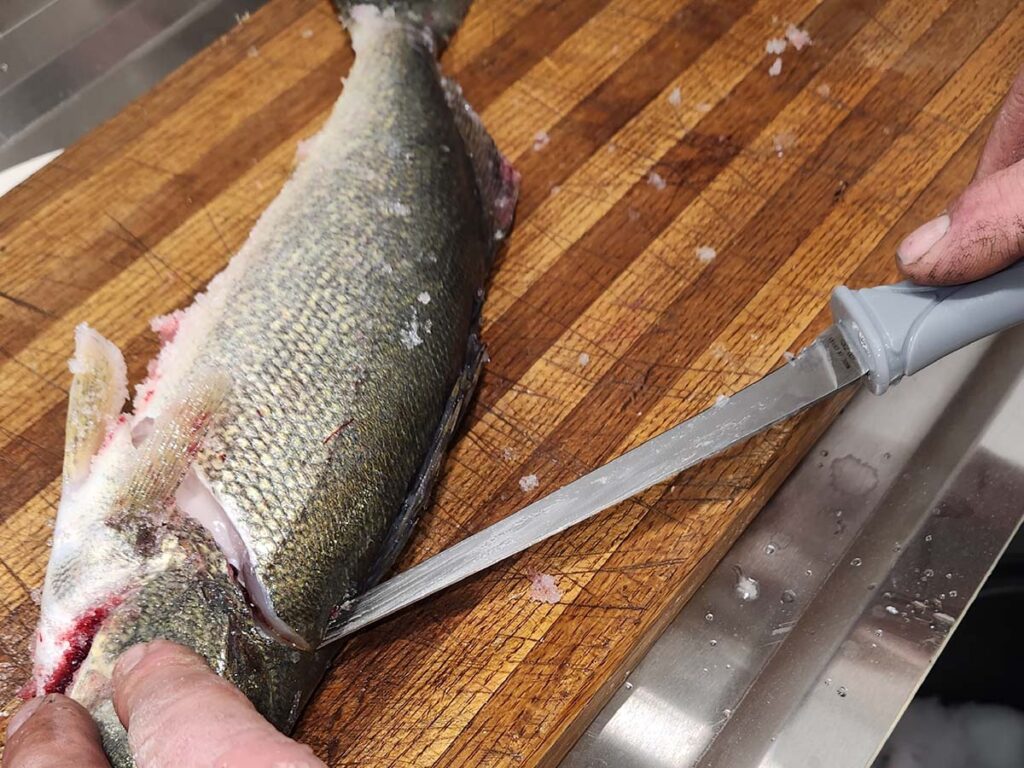
The Professional is made from 14C28N stainless steel, popular in fishing and fillet knives. The Smith’s is listed as a 400 series stainless steel, found in more budget-conscious blades—particularly kitchen cutlery. Despite the differences in materials, the Smith’s knife was sharp out of the box. The blade cleaned the fish with ease. We cut around the ribs to start, and, for the test, we cut through the ribs. Then, we deboned the fillets.
Next came the White Smooth Bone Professional. Right off, it needed work on its edge. Luckily, my friend had a draw-through type sharpener, and he touched up the edge. This improved the knife’s performance a bit, but it was still not optimal for the job at hand. Cutting through the ribs was more like breaking through them. Out-of-the-box sharpness, hands down, goes to the Smith’s Flex. In fact, we finished the rest of the haul with the knife, and it is still sharp enough to clean fish.
The author liked the Smooth White Bone Professional Fillet’s ergonomics and aesthetics. Once he upgraded the edge, it handled well and made easy work of its filleting tasks.
I will note that I worked on the Professional later after the test and did get the edge up to snuff, but it wasn’t there fresh from the box.
Final Cut
My final thoughts on the two are, for the money, the Smith’s probably gives a fisherman as much knife as most he’ll need. And it does so from the get-go. How will it perform long-term? I will have to do the hard work of going fishing to find out.
As for the Bear & Son? If you like the knife, you likely have to do some work to get its performance up. Please keep in mind that these are samples of one of each knife and may not hold true as a rule for either blade across the board. In the knifemaking process, the final step of putting an edge on the blade is mostly still done by hand. Whoever put the edge on the White Smooth Bone didn’t form it properly. Human error isn’t uncommon.
Either choice, good luck out there, and catch a bunch.
These EDC Fixed Blade Knife Options All Have Their Positives As Everyday Companions.
Fixed blades are common in the woods though far less so on the streets—politics has largely seen to that. Folders are in the pockets of many these days and are somehow considered “less dangerous” than fixed blades.
I cannot for the life of me understand this as there is little if any practical difference in terms of capability, with the exception of fixed blades in theory allowing for a longer blade.
There is this idea that a fixed blade is more lethal. Sure, a longer blade allows for greater reach and penetration, but it’s also harder to use in close confines—and substantially more difficult to deploy.
EDC Fixed Blade Knife Pros And Cons
The argument against the carry of larger fixed blades is certainly political, not practical. It could be considered in the same vein as the political arguments surrounding guns, most of which are dedicated to regulating what amounts to cosmetic features. If it looks scary, the thinking goes, you can convince people it is more dangerous.
The interesting part is that the small EDC fixed blade knife options in this article are, for the most part, around the same size as box cutters. The thing is, when we see EDC, we often think about how the item is meant to be on your person, at the ready for utility jobs and even self-protection if need be. The latter is more the case with guns, where there are no power settings, only a fully lethal one.
In my stories on guns, I have often talked about how accessory-laden modern self-defense arms can be, but at the end of the day you’re not going to open your FedEx deliveries with a gun. Self-defense is a major purpose of firearms, whereas your EDC knife should be a jack-of-all-trades and capable of handling all your daily cutting tasks.
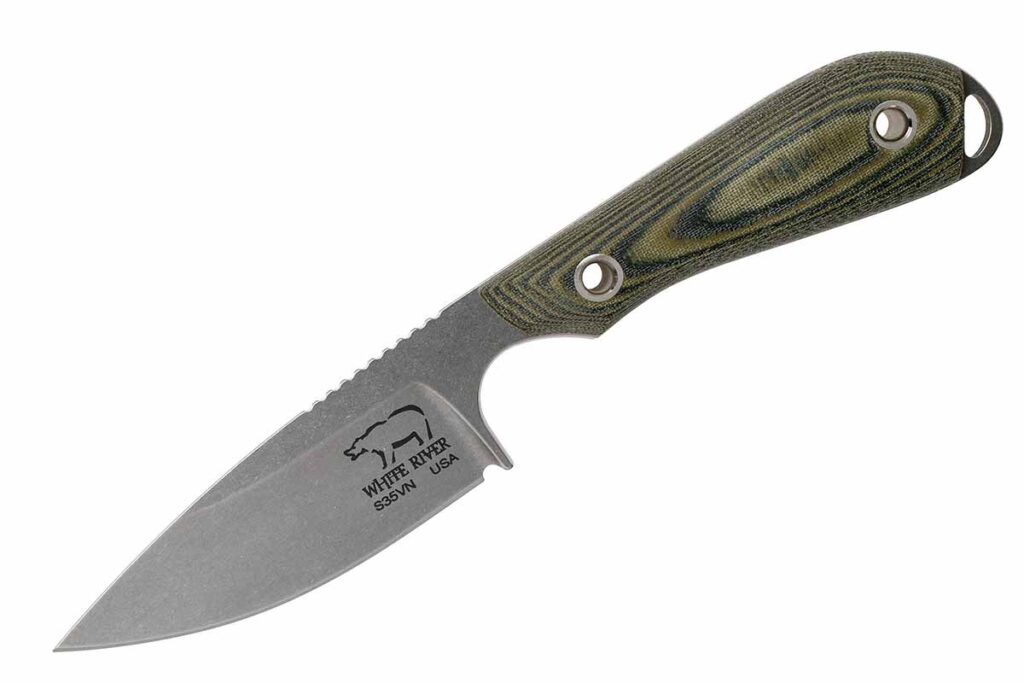
In the process of preparing this article, I had the pleasure of moving into a new house. As such I got to put the test blades through their paces, cutting everything from tape and cardboard to zip ties—and even dinner when I couldn’t find my silverware. In place of my carving knife I used the White River M1 Caper to serve chicken dinner.
The point is, these are supposed to be knives that benefit from fixed-blade construction, able to handle tasks that might damage a folder.
Best EDC Fixed Blade Knife Options
Fixed EDC Fixed Blade Knife Specs Comparision
Model
Overall Length
Blade Length
Blade Thickness
Weight
Blade Material
Handle Material
MSRP
Boker Pocket Knife
6.93 inches
3.39 inches
0.15 inches
3.74 ounces
440C
G10
$105
White River Knife & Tool’s Model 1 Caper
7 inches
3 inches
.130 inch
3.2 ounces
CPM S35VN or CPM Magnacut
Micarta
$120
Citadel Vannak V
5.75 inches
2.38 inches
.72 inch
2.9 ounces
DNH7
Palisander Wood
$175
Gerber Dibs
5.96 inches
2.5 inches
.12 inch
2.22 ounces
440A
440A
$36
Kizlyar Supreme Hammy
6 inches
2.13 inches
.13 inch
3.6 ounces
AUS-8, Niolox, Sleipner, K340, PGK
walnut, G10 or carbon
$117
Boker BFF
6.92 inches
2.76 inches
.10 inch
2.29 ounces
ABE-L
Walnut
$259
Spartan Blades Field Grade Enyo
6.25 inches
2.69 inches
.19 inch
2.816 ounces
AUS-8A
AUS-8A
$88
Boker Pocket Knife
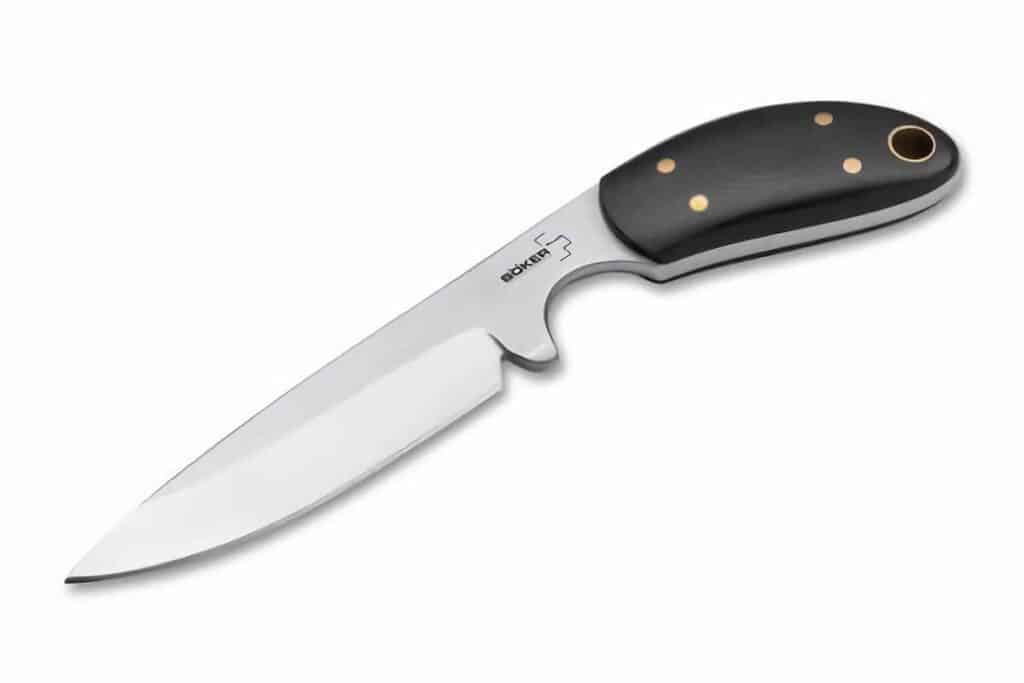
Boker has quite the little devil with the Pocket Knife. The name, of course, implies that it is to be carried in the pocket, and it comes with a sheath that works very well in this role. It’s the longest blade in the group but has the smallest handle.
The handle size is deceptive; it is very minimalist in the pocket and the sheath sits low, thus making the knife appear to have a much smaller blade. It carries well and is lightweight—two things I like. However, in use, it becomes a bit more of a challenge.
I do get that the Pocket Knife, designed by veteran knifemaker and police officer Mickey Yurco, has a self-defense vibe. The EDC fixed blade knife’s long, narrow tip is an obvious thruster, though the overall texture of the full piece is very slick. The handle shape forces the hand into a slightly uncomfortable angle. Sheathing the knife is also difficult if clipped deep in a pocket.
As a regular-use knife, I have seen better. That said, in a self-defense role, this would be the best of the bunch. If the blade is in your hand in the reverse grip, it feels solid and firm. The tang cutout between the choil and the handle is perfect for pinky finger placement in the reverse grip, and the knife is an effective stabber and slasher in tight spaces.
This is an excellent blade to pair with grappling techniques and for dealing with heavy clothing. All said, I like what Boker did here. It is a knife that goes in your pocket, but I don’t think it is well suited for the role of a traditional pocketknife.
White River Knife & Tool’s Model 1 Caper was the best performer of the reviewed EDC fixed blade knife bunch. I have come to expect great knives from White River, not just ergonomically but also in terms of the quality of steel the company uses. The blades are heat treated very well, are not brittle, and stay extremely sharp even in heavy use.
The first thing I noticed about this knife is the grip, which is not only minimal but very comfortable. I can tell White River spends a great deal of time on the small things, such as the tang cutout having a very nice rounded interior edge that feels great on the finger and never digs into it. The grip material and shape feel terrific in the hand. The only downside is the Micarta® handle gets dirty fast and can stain.
The sheath is very well constructed and allows for positive sheathing with an audible click when the knife is seated. The sheath is meant for belt carry and is not a clip style like the others in the test, and fits most standard belts. The sheath surprised me a bit; it was the easiest to use of the bunch.
As far as utility for a carry knife, this one is probably the most versatile of the group. It is extremely sharp and has an aggressive, fine tip. It is so sharp it can pass through just about any normal material easily. I used it to cut heavy packaging straps and minutes later to prepare dinner. This is the definition of an all-purpose knife.
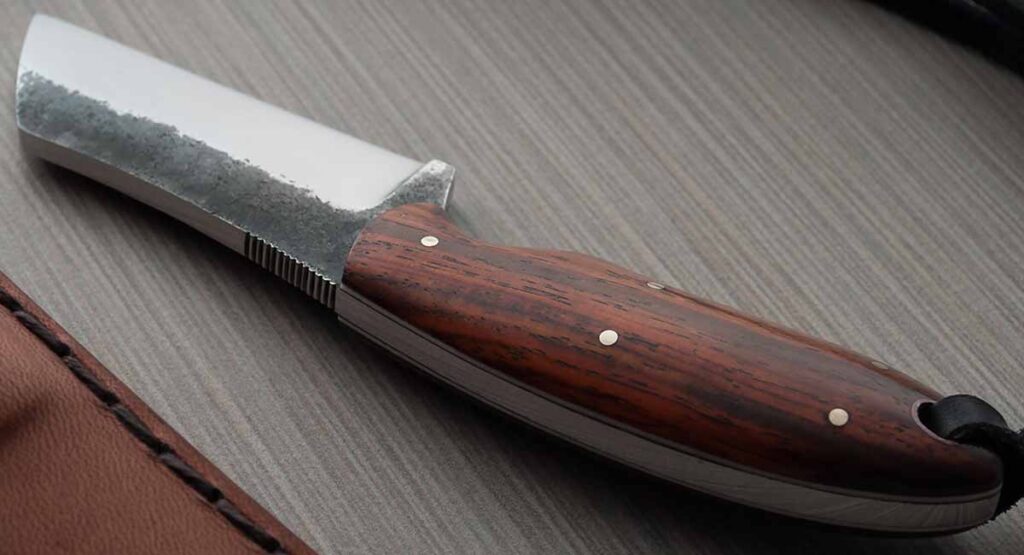
Made in Cambodia by Citadel, the Vannak V is an excellent EDC fixed blade knife. Overall, I really like this little guy. It doesn’t claim to be anything other than a daily use, small-task cutter. It’s great for opening mail and packages, light food prep, and small craft work. It is very pleasant to use and has an exceptional appearance.
Despite it being a great performer, I don’t have a tremendous amount to say about the Vannak V. It is devoid of gimmicks and is just a very tiny knife that does no more than its size allows. I like the wood grip and that the knife is made by hand by people who obviously care about what they’re doing.
The fit and finish are great. I have no complaints about grip texture or the depth of the tang cutout as the knife can’t really be used in the reverse grip—it’s just too small. The sheath is leather, minimalist, and completely functional.
Vannak V Specs Overall Length: 5.75 inches Blade Length: 2.38 inches Blade Thickness: .72 inch Weight: 2.9 ounces Blade Material: DNH7 Handle Material: Palisander Wood MSRP: $175
Gerber Dibs
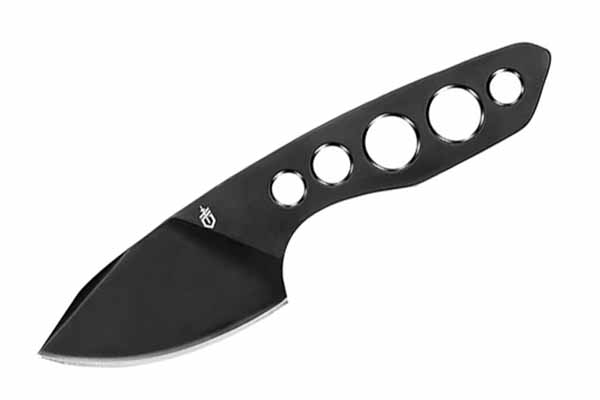
The Gerber Dibs is a one-piece, skeletonized-handle knife common among small examples of the genre. The 440A stainless steel blade is 2.5 inches and has a modified clip point. A flat grind gives the edge plenty of bite for tough cutting chores.
The ergonomic handle has a large finger recess that doubles as an integral guard. When you grab the handle, it expands a bit to fill your grip. In addition to reducing overall weight, the skeletonized holes accommodate a paracord wrap to further augment purchase.
An all-encompassing black PVD coating provides a low-profile appearance and enhanced corrosion resistance. Overall length is just shy of 6 inches, making the Dibs a great compact knife for general use or food prep.
Out of the box the edge was excellent, ready to work and featuring plenty of bite. It dispatched cardboard with minimal fuss. The edge quality along with the dropped blade design help promote overall knife security, using either a choke grip for precise maneuvers or resting a thumb on the blade spine to add more control or pressure for the cut.
With skeletonized fixed blades, it is important to have a more complex handle design with varying features to help you retain your grip in the absence of scales. Despite having no scales, the Dibs is quite comfortable to grip. Skeletonized fixed blades are not meant for long periods of continuous use and are for convenience of carry instead. Bottom line, the knife is a pleasure to use.
The sheath is sewn-and-riveted leather dyed yellow. At first it appears too big—which it probably is—for such a small knife, but sheathed the Dibs is advertised as totable inside the pocket as well, which explains the large design.
If you have cargo pants with larger front pockets, it carries very well there. A button-snap strap secures the knife and a large loop accommodates most belt sizes. The sheath’s edges are rough and not finished too well. Then again, Gerber targets affordability and as much bang for the buck as possible with the Dibs, so corners apparently were cut.
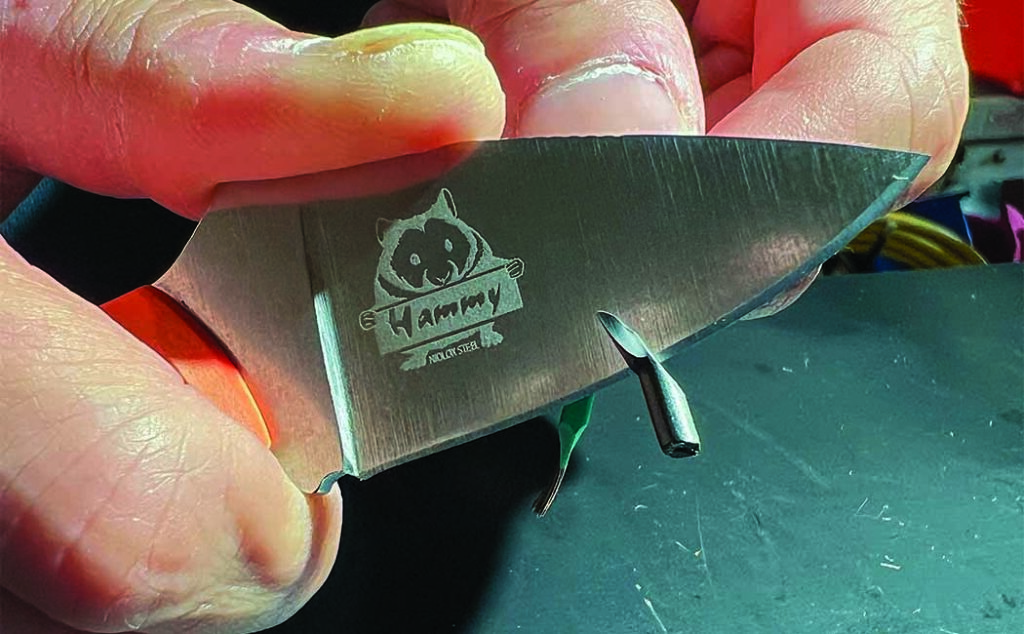
The Kizlyar Supreme Hammy is an incredibly ergonomic knife. The leaf-shaped blade is 2.1 inches long and sports a full flat grind for slicing power. Blade steel is Niolox stainless. The highly ergonomic handle is loaded with curves that feel molded for your hand. Orange G-10 scales provide a pop of color and a solid grip. The handle is expertly chamfered and contoured in the right places, further enhancing user comfort.
At first glance the Hammy appears cute—but don’t let looks fool you, as it’s designed and built for work. It’s a fixed blade the size of a small open folder. The blade is .11 inches thick at its thickest point and sports a distal taper to the tip. Jimping on the blade spine and thumb rest offer non-slip purchase for your thumb or index finger.
When you grip the handle and your thumb rests naturally on the blade spine, you feel how comfortable the Hammy is. You can also sense the knife is highly controllable, instilling user confidence. The jimping could be a little better. It could be more defined/aggressive to offer a better bite into your thumb.
The leather sheath has a button-snap retention strap. There are also two smaller belt loops attached to the main belt loop. These are provided to carry the Hammy horizontally, as it is set up for traditional vertical carry like most straight knives.
While the sheath itself is well made and includes a whimsical artwork stamping of a hamster (the same illustration appears as an etching on the blade’s right-hand side), it doesn’t have the snuggest fit around the knife. Even with the retention strap buttoned it is possible to still wiggle the Hammy out. This is not so critical if you carry the Hammy vertically, but it is a concern if you carry it horizontally. A properly fitted sheath at this price point is a must.
The Boker BFF fixed blade designed by Lucas Burnley is ultra-compact for discreet, comfortable carry. Its design cues are taken from the barlow pocketknife, a general go-to cutting tool for centuries. The 2.7-inch blade is AEB-L stainless steel in a clip-point shape that is very utility friendly. The blade has an acid-wash finish to hide scratches.
At 6 inches overall, the compact fixed blade almost disappears on your side. The handle comes in a choice of walnut or a more practical green canvas Micarta®. The Micarta is contoured nicely, making the handle rest in your hand snugly. The brass rivets and thong tube provide a nice visual contrast. The knife’s beauty lies in its simplicity of design and execution. It proves that no bells and whistles are needed for a cutter to be highly functional.
The sheath is a nicely made leather pouch style with a slight symmetrical taper toward the bottom. The iconic Boker tree logo is stamped into the leather. A sturdy steel pocket clip enables the BFF sheath to attach to or be removed from your belt quickly—no muss, no fuss.
With such a lightweight knife, a big belt loop would be overkill. The knife fits the sheath like a glove, with no rattling or wiggling. The sheath compresses down on the handle to hold it securely inside. When the knife is sheathed, the handle sticks up about an inch, plenty for you to grab onto. It also has a hole for a lanyard.
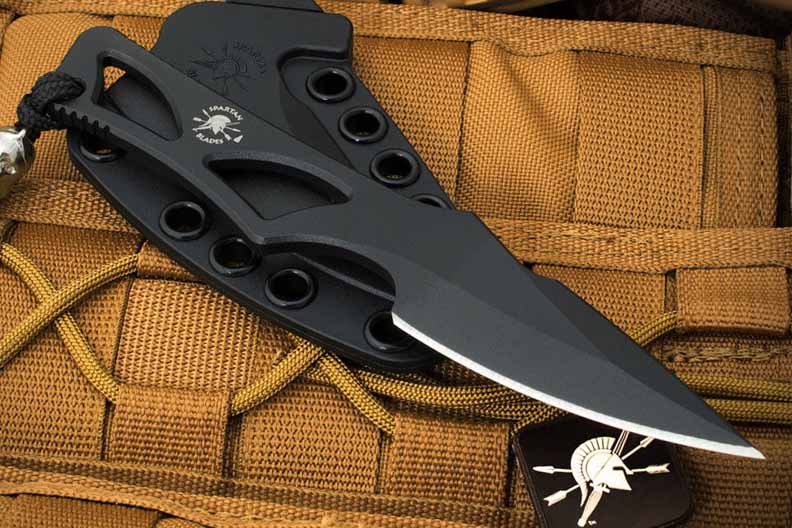
The Field Grade Enyo is a staple of the Spartan Blades line. It boasts an easily concealed blade designed for either utility or backup personal protection. It shares the same dimensions as its higher-priced sibling in CPM S45VN stainless steel, the Enyo, with the exception that the blade steel is AUS-8 stainless.
The modified clip point blade is 2.68 inches and the knife is 6.25 inches overall. The skeletonized one-piece design simplifies the knife and makes it easy to carry. The handle accommodates two different hand holds, which aids in increasing the knife’s versatility.
Several areas of jimping assist in getting a good non-slip grip. A black epoxy coating throughout provides a low-profile appearance. A paracord lanyard includes a polished Spartan helmet bead, which is pretty neat.
In action the Field Grade Enyo is all business. Don’t mistake it for a small, cute knife. It has attitude and packs a punch! The blade tip is reinforced a bit due to the false edge and penetrates fairly well. Thanks to the way the blade profile tapers, the tip cuts easily. The flat grind and superb edge quality out of the box enable the knife to handle business immediately.
The handle’s various curves seat your hand snug and solidly. The two-thumb rest provides the option of choking up further on the blade for a more reliable grip and improved control. It’s amazing such a small, compact fixed blade can feel so trustworthy in the hand.
When you tackle larger cutting chores, you can choke up on the handle to stabilize the knife and feel in charge at all times. The lack of handle scales means the knife is the bare minimum in bulk.
Those who say they do not like skeletonized knives might want to reconsider with the Field Grade Enyo. You’ll find yourself using it more and more. AUS-8 is well known in the industry for being a good, mid-grade steel, balancing edge holding and economy. It certainly doesn’t disappoint here. It is an excellent choice of steel for a knife of its price point.
The sheath is form-fitting molded plastic riveted for strength. One of the best things about the sheath is how well it locks the knife inside. There is a ramped, notched thumb button on the opening end that when pushed up releases a lock so the knife can exit the sheath. When sheathing the knife you will hear a tiny click indicating the lock has engaged. No amount of tugging on the handle or violent shaking of the sheath upside down can cause the knife to fall out.
This is very well done and a feature not commonly seen, not only on knives of this price class but more expensive ones, too. Included is a belt loop for IWB (inside waistband) carry, as well as a length of paracord for neck carry. The two carry choices promote both discreteness and ease of access.
Knives Are Becoming More Multidimensional Every Year. These Sporty Kitchen Knives Are Ready For The Cutting Board Or The Campsite
When many of us blade enthusiasts think kitchen knives, we don’t necessarily associate them with outdoor or sport use. Likewise, many of us would not consider bringing our hard-use blades into the kitchen for prep work. Nonetheless, there are a few knives that have a broad range of uses in both the kitchen and camp.
I tend to see a knife not just by the edge but by its blade thickness. While there is a utility to extremely thin-edged knives with thin spines, such blades are almost always designed for secondary or finishing uses. In my opinion, the thicker the spine the more utility a knife has for crossover work between kitchen and field.
On the other hand, the thicker the spine gets, the harder it is to use for fine work—it can even be dangerous. Thinner blades are much better in the kitchen. As far as field use goes, they are pretty much only for light work and very small amounts of game processing. I’ve seen many thin blades break while working on deer. Some of these have resulted in injuries to the user.
Best 3 Sporting Kitchen Knives
There is a sweet spot for crossover, though, and the test knives fit the mold. None would be my preference for dressing a whitetail, but all certainly would be at home in camp or the kitchen after the heavy lifting has been accomplished.
The TOPS Frog Market Special test knives could be used as skinning knives, as could the White River, but the main enemy of any thin blade is going to be breaking and edge chipping. Of the test group, the White River is the only one thick enough to be a primary use hunting knife, but it is a rather small knife with a slender handle. On small game it will work, if it’s not a bit obtuse in spine thickness, though when moving large amounts of muscle and skin, the hand would fatigue.
So, if we tend to think of a kitchen sporty as a secondary tool, a wide number of its features become handy that would not be so great on a primary field knife or even a primary kitchen knife. The first is the ease of cleaning and the ability to hold an edge.
I put the review knives to work quite extensively in the kitchen, doing everything short of fully deboning large game. All were used on cuts of meat, to cut vegetables, peel apples, cook over an open flame, and as eating knives at the table or camp. In the process, I learned a few things about each one.
White River Exodus 4
Of the test group, the White River Exodus 4 is probably the most well-rounded for field and table use. A relatively small knife, it is very slender in overall profile, both grip and blade. For general use, it is extremely functional. I found it suitable for virtually all small game, able to process a whole chicken and an excellent skinner.
It could be used for slicing vegetables, chopping onions, and cutting many other types of fruit and produce as well. The edge profile does not lend itself to fine cuts. For presentation or fancy plates, it tends to split rather than give clean cuts, especially in apples and things like cucumbers. This is not a major concern, just something to note.
The Micarta® handle is contoured superbly and cleans easily. It isn’t slippery when wet. Notably, it’s a full-tang blade that’s extremely strong. Despite its size, it has a blade profile thick enough for baton work on small pieces of wood, though it would not be my first choice for such a job. The blade spine has a sharp 90-degree profile excellent for use with a ferro rod.
There aren’t many if any, downsides to this knife. It can be used in just about any setting and will not look out of place if you take it to town for dinner. You also will not look like “that guy” if you use it to cut a sandwich in half or an apple for your kids in public. Note: The sheath is a bit stiff when you first get it but it breaks in fairly quickly. The knife was very easy to keep clean and sharp.
MSRP: $175
TOPS Knives Frog Market Special
I’ve used the Frog Market Special (FMS) models by TOPS Knives for a couple of years. They’ve given me a long time of service in the kitchen as well as around the campfire. They’re available as individual pieces or a set. If you get the set, it comes with a piggyback sheath. The sheath is very nice and has a belt clip.
Steven Dick, U.S. Army ranger veteran and editor of the old Tactical Knives magazine, based his design for the FMS on knives he saw on a trip to Hanoi, Vietnam. He watched butchers and fishmongers using knives of a pattern he’d never seen before. They prepared meats and fish of many varieties easily using the blades.
I’ve done just about everything you can imagine with my FMS knives in the kitchen, and also processed dozens of deer with them. They maintain their edges very well and required only occasional resharpening. Because of the unusual blade shape, the knife can cut just about any type of meat and vegetable, including slicing, chopping, and in a rocking motion. They’ve replaced several other knives in my kitchen and serve as my go-to set.
While they have a large, deep-bellied profile, the FMS knives aren’t especially durable for field use. I have not used them to break down large game for the same reason I would be afraid of breaking any thin-spined knife. They excel for chicken and duck, as well as other small game. The Micarta handle is very comfortable and slip-resistant.
I’ve had an extremely good time with these knives but they have a downside—the blade finish. I’ve had excellent luck with all my TOPS knives, though I’ve never been a fan of the finish. I prefer knives that are bare metal. I don’t like it when the coatings begin to chip away. In a couple years of use, the finish has begun to flake and the metal underneath has become discolored, even with oiling and care. While it is a minor gripe, for knives used to process food I don’t like the idea I may also be eating blade coating. I would like to see this profile in some sort of stainless, or perhaps a slightly thicker spine in a tougher steel.
MSRP: $375 for the set
Spyderco Utility Knives
Spyderco offers some very affordable and high-performance knives that are at home in the kitchen and easy to clean and maintain in the field. The company sent me its 4.5-inch Utility Knife with a serrated edge and red handle, as well as a plain edge 6.5-inch model in black.
The first thing about these knives is they are extremely slender and likely would not be suitable for hard field use. However, if you are already at camp, these are exceptional for end processing and cooking. I used them for weeks straight for all my cooking and they never dulled or chipped. They were both so sharp at the end of the review that they could still cut paper-thin slices of tomato, a hard feat for most knives.
One of the most important parts of these knives is they are essentially foolproof. Even after cooking with them for several meals a day for a long time, I cleaned them without issue and returned them to the knife block. The fact they are so easy to clean and stay sharp for so long really makes them worth the already low price. You don’t really have to worry about oiling them or keeping them in a special container.
In a pinch, the knives can be used for striking on a rod, though I would not recommend it long term. Their utility in the field is very limited, though when it comes to fishing or pursuits that don’t involve moving large animals, they’re just fine. I would not replace my fillet knives with either of these, though they certainly work for the task.
Emergencies happen anytime, anywhere. This means, having the best rescue tools & knives at hand is imperative.
When it comes to edged, prying, breaching and other tools for emergencies, there is no one-size-fits-all remedy as no two situations are ever alike. Because of this, many such tools are made to perform a broad range of tasks.
I have taken a fair number of classes and am certified in a wide variety of emergency skills. What I have learned across the board is there is no one right answer, and the tools you have on hand you had better know how to use. (Having these tools on hand or in your vehicle is really what we are looking at here; they must be readily accessible to be of use.)
Let’s take a look at some of the best options when it comes to rescue tools and knives. These instruments can handle situations from cutting a downing person out of a tangled line to prying an accident victim out of a car. And, most importantly, are sized to be at hand at all times.
What Makes A Good Rescue Tool
Given there is no way to prepare for every eventuality, it’s impossible to have one tool to address all emergencies. That said, the supreme value of a rescue tool is its versatility. In general, it should be capable of handling some of the most common tasks faced in most rescue situations, such as:
Cutting
Prying
Breaking Glass
Mechanical Manipulation
Yes, other situations require other tools. And certainly, there are options out there that are larded with all sorts of doodads to address these. However, these systems can prove overly complex and not as robust as more Spartan designs. Simple, reliable and flexible are the keys.
Buy Quality
It’s easy to blow off preparing for the worst. After all, the worst doesn’t happen all that often. However, when it does do you want to trust your life to a dime-store rescue tool?
Planning means spending money on the best possible equipment. In short, the best rescue tools are made of quality steel, built with robust materials, smartly designed and sized to be part of your kit. When your loved one is strapped into a wrecked car you need to get them out or other such disaster, you’ll be glad you spent the money.
White River Knife & Tool Lifespike
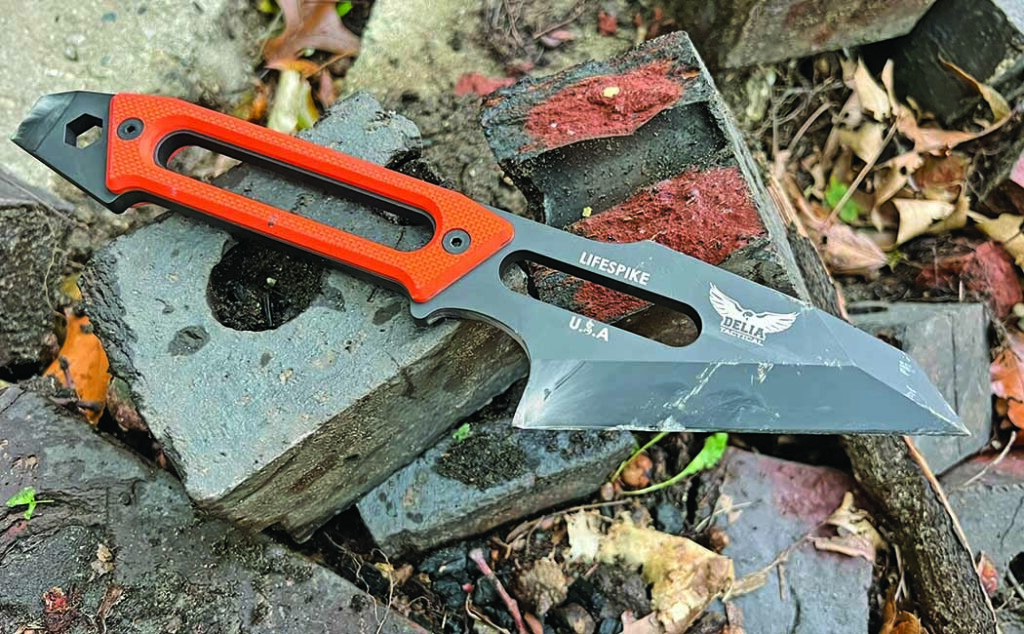
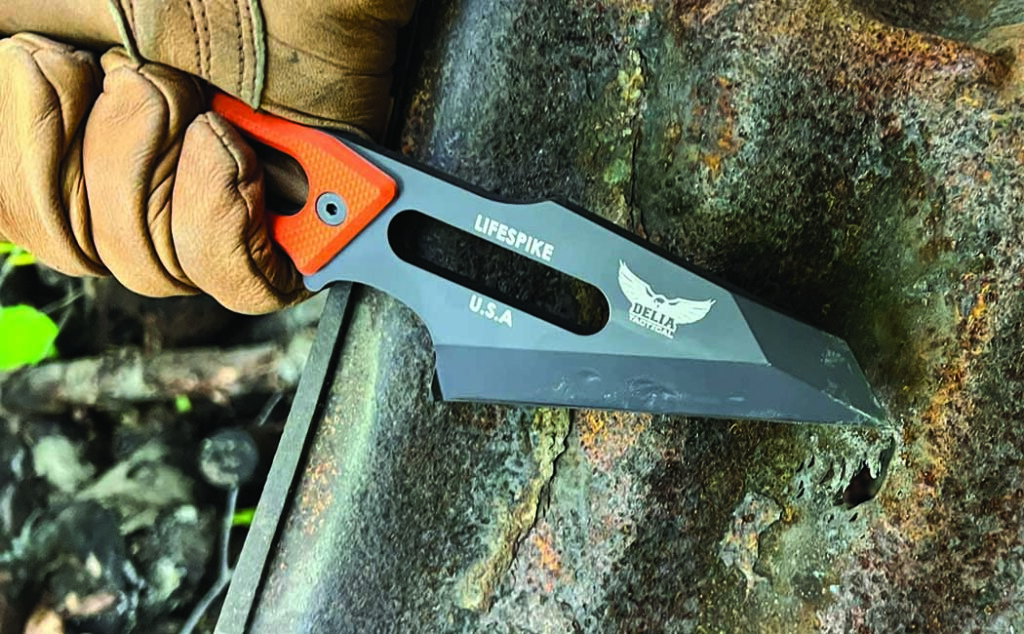
If swung like a hatchet, the White River Lifespike can slash sheet metal into shreds.
The Lifespike by White River Knife & Tool is arguably the most versatile of the review tools. Designed for first responders, it is an exceedingly tough implement that is very well thought out. However, it is not a do-all-be-all in that it lacks in a couple of important areas. I will cover those areas first to not detract from the utter beast of a tool it is.
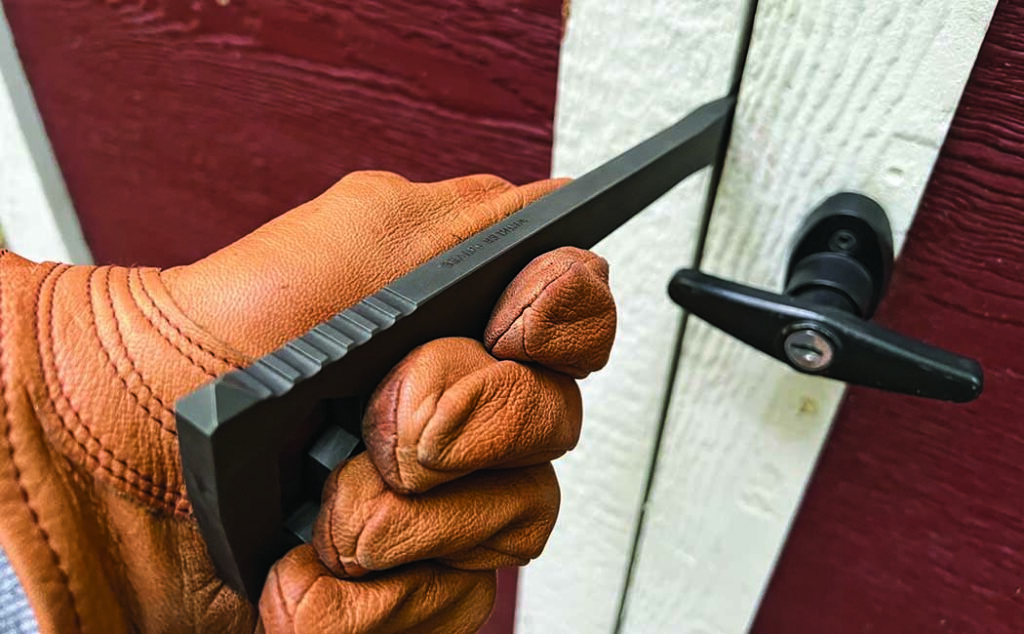
The Lifespike really needs a seatbelt cutter integrated into the pommel/pry tip area—just a small one but one that doesn’t necessarily present the sharp tip to the chest. Moreover, the pry end is opposite the sharp tip, and if you try to pry with it you’re going to put leverage on the blade and edge. Hence, a vigorous rescue could lead to the rescuer becoming a rescuee. The location of the wrench socket is also not ideal; the height of the handle scales can impede its utility if trying to turn a bolt.
The White River Lifespike can punch through some very serious metal without taking edge damage.
That said, the Lifespike can punch through just about anything. Not only can it penetrate sheet metal with eye-opening ease, if swung like a hatchet it can slash the metal into shreds. It simply blasted through most of the test media and the edge held up extremely well. As far as durability and ease of deployment, you really can’t ask for much more. Breaking glass is possible, but the Lifespike is hard to control in that it doesn’t have a dedicated conical point to use in the role. Overall, I think it’s nearly perfect for dealing with automobile accidents. I’d be confident in using it to force open a door, but by the nature of its design there is the possibility of harming yourself if you aren’t 100 percent aware of where the blade is pointing.
White River Knife & Tool Lifespike Specs Knife Type: Self-contained rescue multi-tool Blade Length: 4.65” Blade Material: 80CrV2 carbon steel Blade Grined/Edge: Chisel/plain Handle Material: G-10 Special Features: 1/2” channel gas line wrench, 9/16” wrench, pry bar pommel Weight: 13.4 ozs. Overall Length: 11.5” Sheath: Kydex Country of Origin: USA MSRP: $300
Winkler Knives AF-ERT (Air Force Emergency Response Tool)
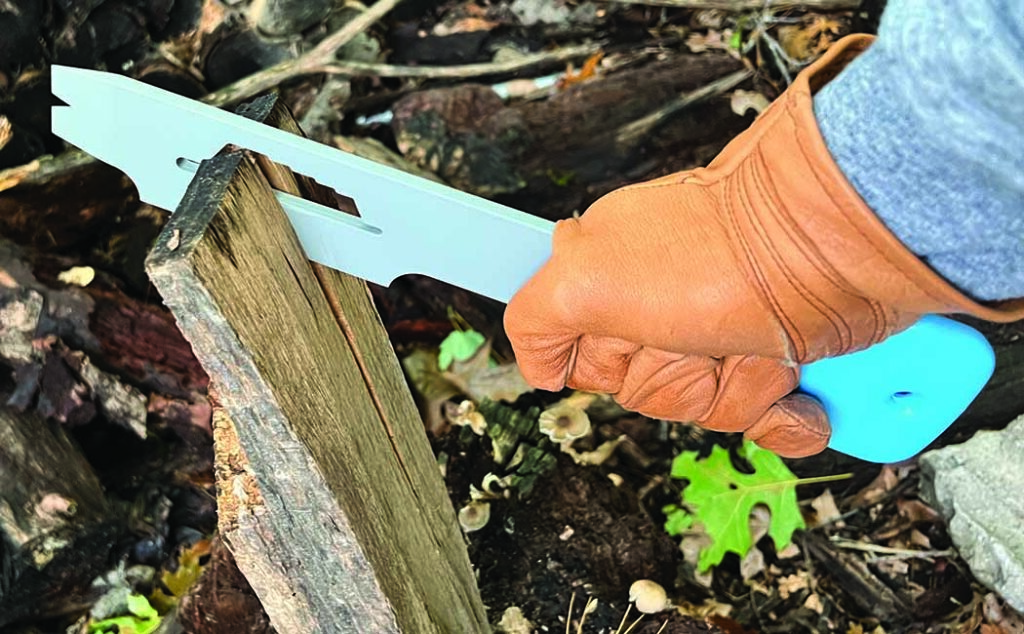
The Winkler AF-ERT is excellent for medium prying work and can be pounded into a gap quite easily.
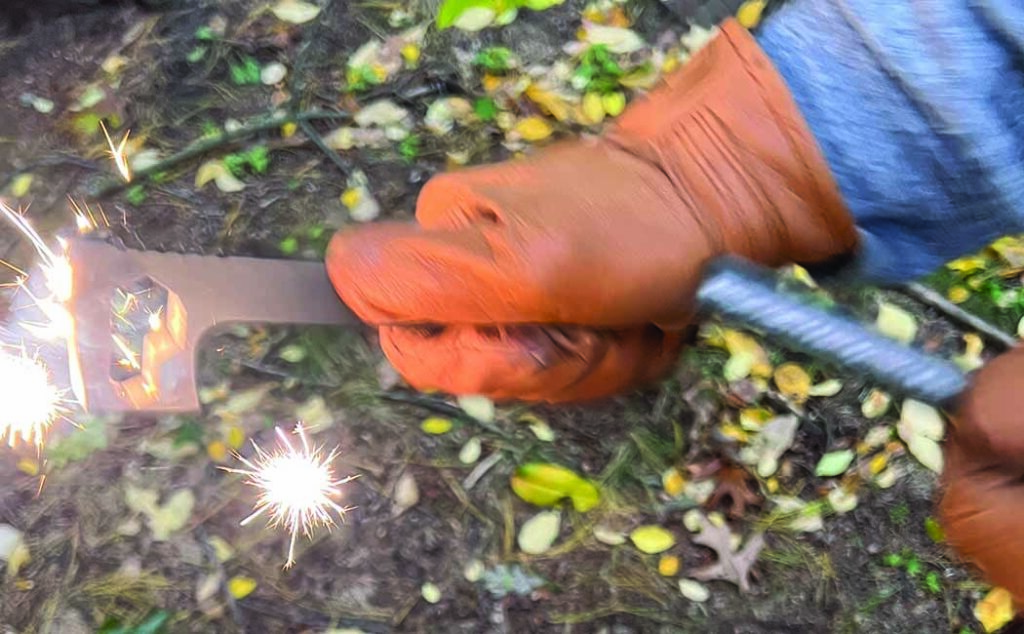
Constructed of the same material as the company‘s knives and axes and bearing the same rugged finish, the Winkler Knives AF-ERT (Air Force Emergency Response Tool) is extremely tough and surprisingly compact. It is so small and slender it can easily ride in the MOLLE loops on your gear. The AF-ERT provides a surprising degree of function and exceptional strength. The head functions not just as a two-size wrench but also as a hammer and a glass breaker. The interior edges of the head cutout are sharp and can even be used to pull a ferro rod through to generate sparks.
The wrench sizes are very functional and work with a wide number of common scope mounts and automotive nuts and bolts. The head, while narrow, is functional as a small hammer. Of all the tools tested, the glass breaker was the most utilitarian and safest to use. It keeps the hand at a healthy distance from the glass and reduces the chance of getting cut. You can also rest the glass breaker on the surface and strike the face of the hammer with another object if you don’t think you can get enough leverage to swing the tool itself. Though it works quite well, the AF-ERT is quite lightweight and doesn’t possess a great deal of momentum when swung.
Using the wrench of the Winkler Knives AF-ERT as a striker is not only safe but extremely effective.
Prying with the tool is easy; the tip of the prybar is quite narrow and can get into some tight spaces. It is simple to tap it in because the head is flat and not sharp in any way. While not the largest tool, it probably has the most across-the-board daily uses and would not be out of place in a camping bag or glove box.
Winkler Knives AF-ERT Specs Tool Type: Self-contained rescue multi-tool Tool Material: 80CrV2 carbon steel Head Width: 21/8” Tool Thickness: 3/8” Tool Finish: No-glare black oxide Handle Width: ¾” Special Features: Compact tool that can be tucked into MOLLE loops; features glass breaker, 3/4” and 1/2” wrench sockets, hammer head, nail-split pry bar Weight: 12 ozs. Overall Length: 9” Country of Origin: USA MSRP: $85
KA-BAR USSF (United States Space Force) Bridge Breacher Tool
Because of its mass and length, the KA-BAR Bridge Breacher easily outclasses the other review tools for prying material apart. You can get much more leverage with it than the other test tools.
The KA-BAR USSF (United States Space Force) Bridge Breacher Tool is a substantial, heavy piece of steel that can get most emergency jobs done. It has a stepped wrench cutout located toward the tool’s business end. You can operate it from the handle end if you are prying, turning a nut or splitting material. Because of its mass and length, it easily outclasses the other tools when it comes to prying stuff apart.
The Bridge Breacher has a relatively blunt-edged, chisel-like blade on one side for chopping. In a pinch it can even be used to split wood. It bends and crushes metal and does not cut through it the same way as the Lifespike. I am not a huge fan of the squared edges in the grip area. I would like to see them more rounded for comfort, and also something other than the rubberized grip material. If you need to hammer the Breacher in to open something, the grip material shreds away quickly. Nonetheless, it is an excellent choice for the heaviest tasks and for material breakdown.
KA-BAR USSF Bridge Breacher Tool Specs Tool Type: Self-contained rescue multi-tool Cutting Edge: 2” Edge/Tool Material: 1095 Cro-Van carbon steel Blade Grind: Chisel Handle Material: Blue Plastisol Special Featues: Nail-split pry bar tip, slotted wrench cutout, chisel edge Weight: 1 lb., 9.6 ozs. Overall Length: 13” Country of Origin: USA MSRP: $85
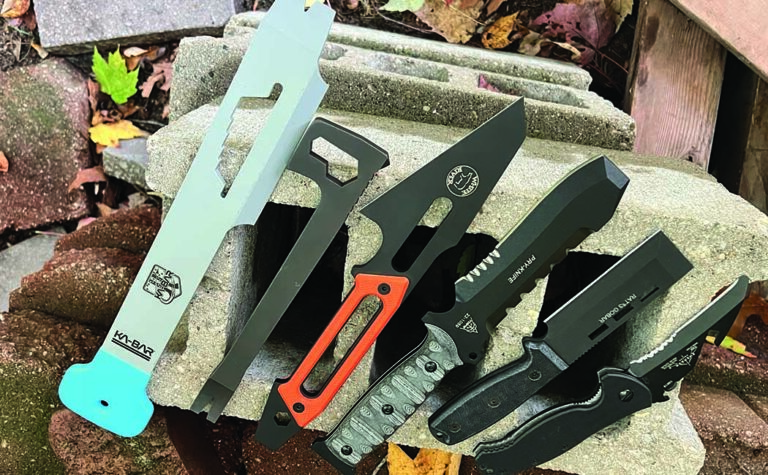
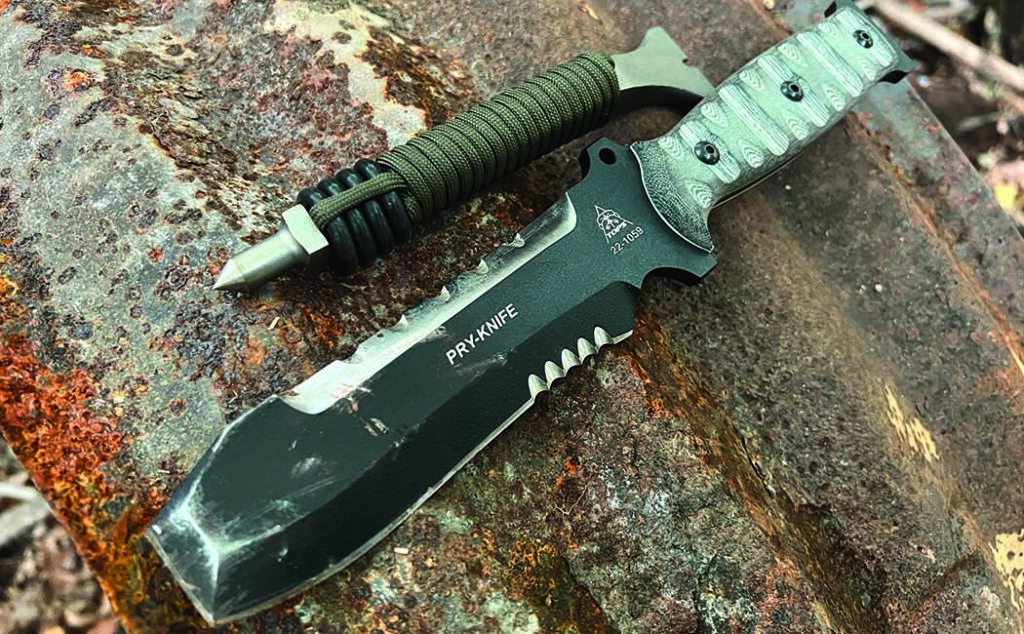
The Pry Knife and Pry Probe Punch (PPP) Tool Combo by TOPS Knives is a beefy, substantial dual package.
The Pry Knife and Pry Probe Punch (PPP) Tool Combo by TOPS Knives is a beefy, substantial dual package. It is truly a hybrid of a prybar and a knife, with some strengths and weaknesses of both. The knife has sharp edges and a very comfortable handle. It handles a wide variety of cutting chores. It can be used to split a dizzying amount of material, and is robust enough to chop wood and even through metal. The secondary edge has a steep angle and segmented serrations for cutting through such tough material as rope. When it comes to prying, the blade can be used with substantial force. Thanks to its chisel grind, it can be used to gain leverage from a variety of angles. The finish is quite durable, though it comes off the high points quickly.
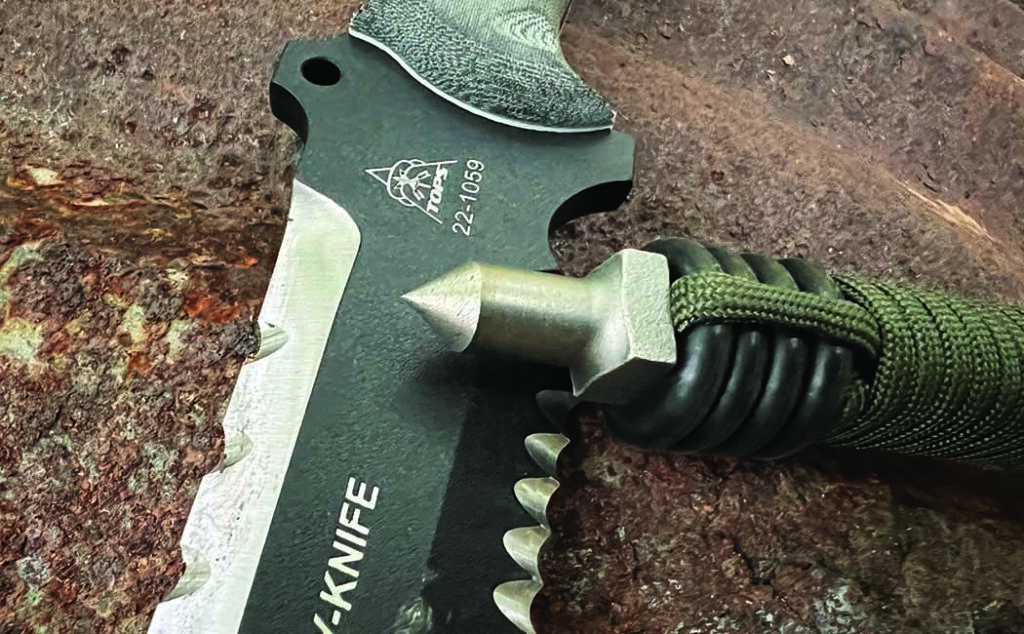
The PPP is a relatively compact, ergonomically designed device that features an angled prybar with a conical spike glass breaker. The tool is wrapped in paracord with rubber gaskets toward the end. It is quite effective at prying. However, I don’t like the location of the glass breaker. If you are prying quite hard and slip, you may end up skewering yourself on it. It is extremely sharp and, while very functional, is more of a liability than need be.
The aggressive glass-breaker punch of the TOPS PPP is utilitarian but not ideally located.
A weakness of this set is the sheath. It is a piggyback set up but features fabric-fastener and buckle closures. While it is easy to remove the tools, the sheath does not hold them very securely. Moreover, while I did not throw the sheath in the mud for this test, fabric fasteners do not work when clogged with debris.
TOPS Knives Pry Knife/PPP Combo Specs Tool Type: Combination knife/pry tool package w/piggyback nail-split pry bar/glass breaker Blade Length: 4.5” (pry knife) Edge: Serrated (pry knife) Blade/Tool Materials: 5160 carbon steel (pry knife)/5140 carbon steel (PPP [pry probe punch]) Handle Materials: Black linen Micarta® (pry knife) and rubber and paracord (PPP) Special Features: Piggyback sheath carries both tools; pry knife is 1/4” thick and can be used to cut and chop; PPP features a heavy-duty glass breaker and nail-split pry bar Sheath: Black nylon Weight: 16 ozs. Overall Length: 10.75” (pry knife) and 71/4” (PPP) Country of Origin: USA MSRP: $275
Ontario RAT-3 Gobar
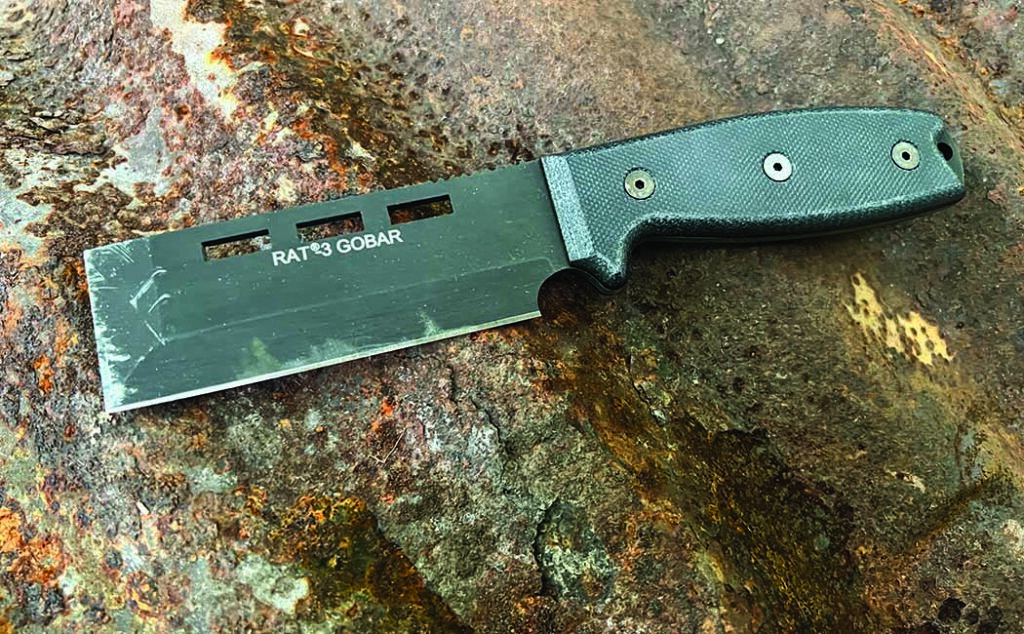
The Ontario RAT-3 Gobar is shaped like a 90-degree cleaver and can handle most knife tasks.
The Ontario RAT-3 Gobar is shaped like a 90-degree cleaver and functions for most knife tasks. The square-edge blade tip cannot be used for stabbing in the traditional sense and functions more along the lines of a fixed-blade box cutter. It has the ability to pry, though the blade material is relatively thin for any serious work. It can get under seat belts and cut them but is not ideal for the purpose.
It works in a pinch as a rescue tool and can be used to lever or jimmy windows and doors. It is not a tool I would baton with a mallet for fear of snapping off the blade. The cutout at the ricasso is too small to fit a finger into despite giving the appearance it should accept one. The corner of the edge recurves slightly backward, and if you get your finger in there like I did, you may get a nasty cut. A bonus is the tool is quite thin. It takes up little space and at only a few ounces is lightweight. The sheath is an afterthought. I would like to have seen this one come with a dedicated polymer model given that the one supplied is too long and features only a snap button to retain the blade.
Ontario Knife CO. RAT-3 Gobar Specs Knife Type: Fixed blade/pry tool Blade Material: Carbon steel Blade Grind: Chisel Handle Material: Black Micarta® Special Features: Lightweight fixed blade can chop and do light prying Weight: 5.8 ozs. Overall Length: 7.8” Sheath: Black nylon Country of Origin: USA MSRP: $91.95
Emerson N-SAR (Navy Search and Rescue)
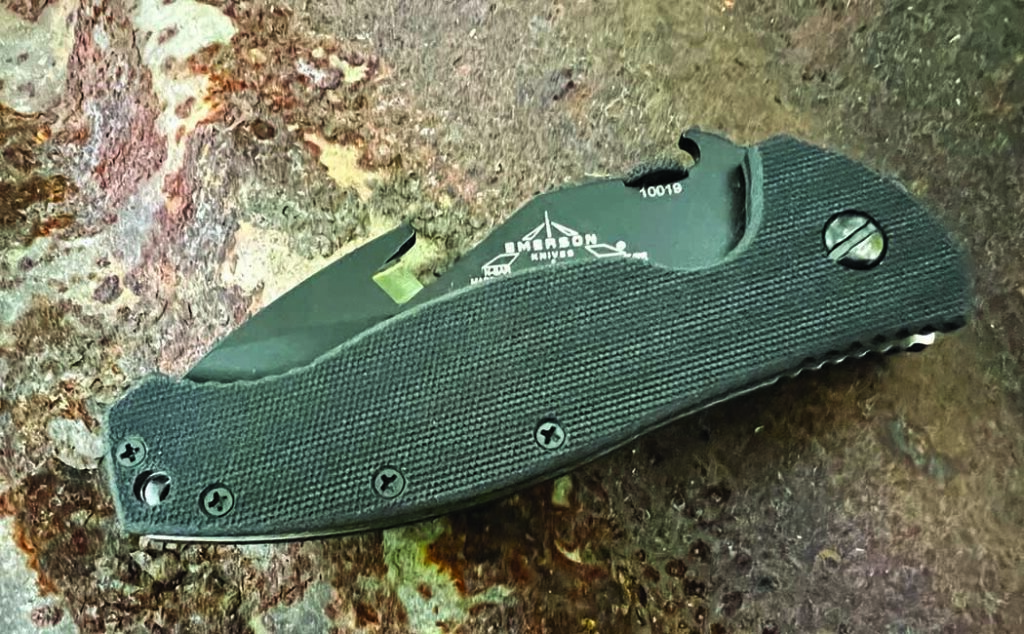
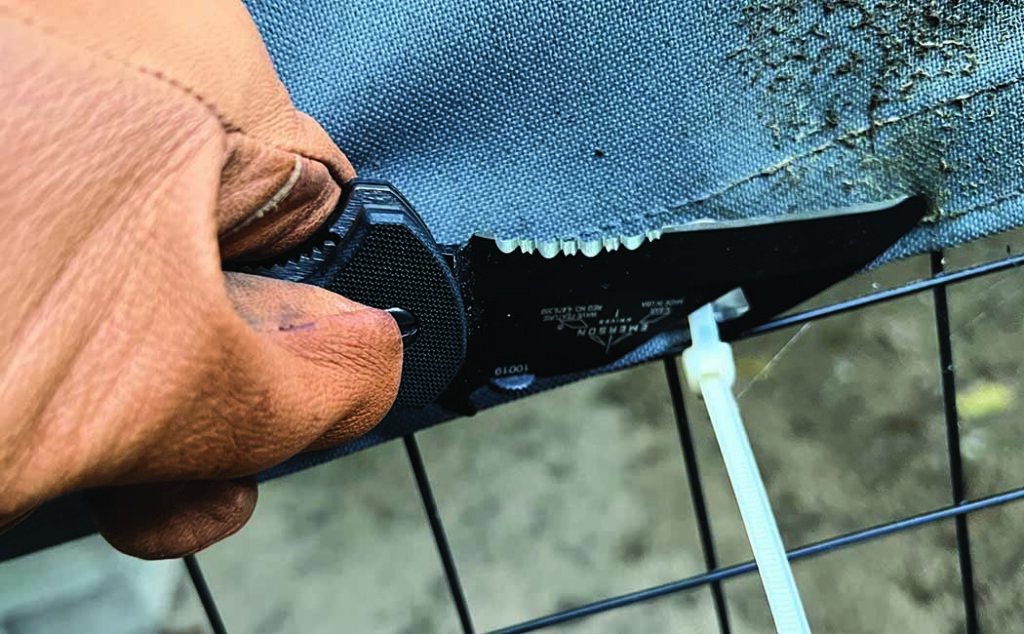
The N-SAR remains functional as a belt cutter with the blade closed.
The Emerson N-SAR (Navy Search and Rescue) is small and easy to store, and is also exceptionally durable and sharp in all the right places. This is a tool for cutting a person free safely. The blunt tip is not designed to stab. The blade is not impossible to cut with, it is simply unlikely you would stab through a person’s clothing when trying to free them. It zips through any type of common restraint. The main edge serrations can cut thicker material.
The blade opens one-handed or with the Emerson Wave feature when pulling it from a pocket. Care must be taken with the latter, as the dedicated belt cutter on the spine of the blade can become caught on a pocket accidentally and slice your clothing. I know this from experience. Though somewhat pricey for a knife that isn’t good for normal cutting chores, it is invaluable for extracting individuals from standard seat belts, child seats or any manner of physical restraints. The belt cutter can cut cable ties as well. I have begun leaving an N-SAR in an easy-to-reach place in my vehicle for cutting seat belts and straps in emergencies.
The Emerson N-SAR can easily and safely cut cable ties. Moreover, it wouldn’t damage your wrist if you should find someone needing rescue from a seat belt or other kind of strap.
Emerson Knives, Inc. N-SAR Specs Knife Type: Folding rescue Blade Length: 3.5” Blade Grind: Chisel Edge: Plain and serrated combo Blade Material: 154CM stainless Handle Material: Black G-10/glass laminate Pocket Clip: Yes Lock: Linerlock Special Stuff: Safety blade tip (blunted), Wave opening feature, integrated belt cutter Weight: 4.1 ozs. Closed Length: 4.7” Country of Origin: USA MSRP: $299.99
Read More On Survival And Rescue Tools And Knives:
The dynamic system offers a host of advantages to knife sharpening.
Where do you need a sharpener most? Chew on it a bit. Unless you’re a professional wood carver or mending fishing nets is part of your gig, most of us dull our knives puttering around the kitchen. Be it chicken bones or pepper skins, the sheer amount of time a majority of us spend on culinary pursuits our food prep knocks the edge off our most utilized knives.
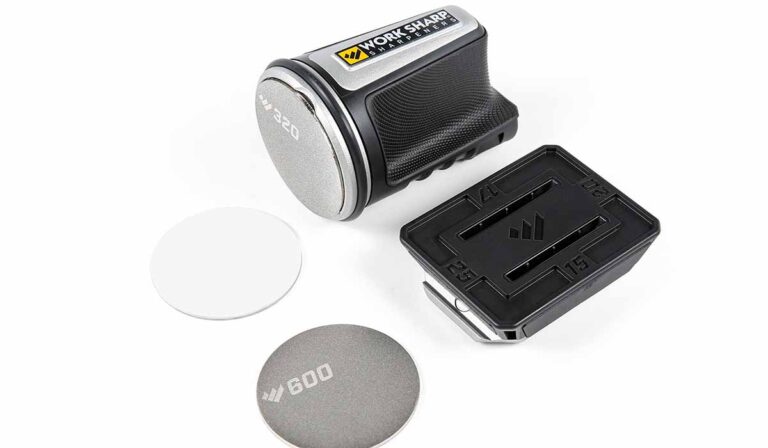
Recently expanding its kitchen sharpening collection, Work Sharp cobbled together an intriguing system to keep galley cutlery at its best.Dubbed the Rolling Knife Sharpener, the manually operated sharpener is designed to take the guesswork out of applying an edge to whatever kitchen knife requires honing—and likely more.
Rolling Knife Sharpener System
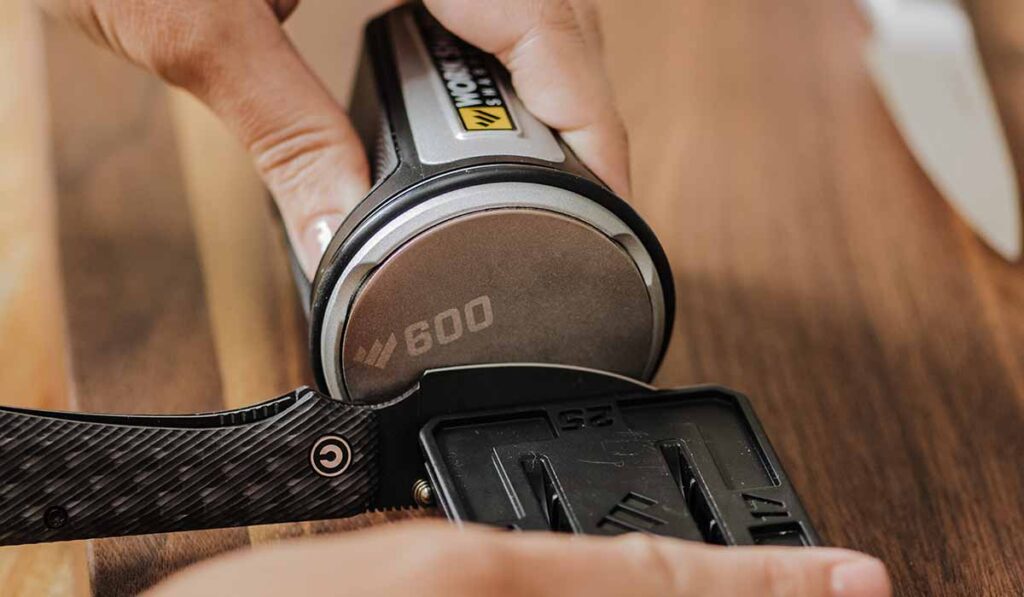
The Rolling Knife Sharpener system has two main components, a magnetic angle block and a rolling sharpener. As it suggests, the block has preset angles for the most common edges found— 15, 17,20, and 25 degrees—making it function on everything from common stainless steel to the acute edges found on Japanese chef’s knives. The roller holds the rotating 2.5-inch abrasive heads, with three grit sizes shipped along with the unit—a course 320 diamond grit, a find 600 diamond grit, and a ceramic polishing head. To use the system, the knife is attached to correct angle is found in the block, then the abrasive head is placed on the edge, from there it’s simply a matter of rolling the sharpener forward while maintaining contact with the knife.
Straightforward as it may sound, it’s a rather ingenious procedure. First off, given the sharpening surface is dynamic it ensures constant contact with the edge, always at the proper angle. Those who prefer the long and swooping bellies of traditional chef’s knives know, maintaining both facets proves tricky on each stroke. However, there’s another subtle feature at play in the Rolling Knife Sharpener—the entire length of the edge is honed with a fresh abrasive surface. Outside of Work Sharp’s belt-based sharpening system, there are few sharpeners that have this ability, which makes sharpening quicker and more precise, as well as extends the life of the abrasive itself. Pretty slick.
Final Cut
Honestly, sharpener seems like a whizz for most kitchen implements and other medium and large blades. Additionally, might be just what the doctor ordered for a more exotic blade style. Potentially, kukri owners might find it a godsend. But the Rolling Knife Sharpener does seem have its limitations.
Given its size, the unit is going to live in your kitchen or workshop—it’s certainly not designed for the field and needs a uniform surface to do its job properly. Furthermore, it could prove a bit tricky to get the most out of it with your smaller blades. Could it touch up a spey blade on a pocketknife? Absolutely. But it might be a bit awkward.
At present, Work Sharp has the Rolling Knife Sharpener listed at $149.95 on its website, which puts it toward to tonier end of its catalog. For folks who always want to keep their edge—in the kitchen and out—that might prove a small price.
Tradition meshes with modern in today’s new-age factory slip joint knives.
Like all tools, slip-joint pocketknives have seen their own evolutionary journey. In the olden days there were quality tools and then there were ones produced to be a bit more affordable, yet they still had their utility. These days many people buy knives for their utility, and I would say a number buy them for what I call the “Gucci factor.” As times change what’s considered attractive changes too, and, of course, makers leave their marks with their own innovations.
This time we’re not only going to test the latest in factory slip joints but also examine how companies and designers are innovating the age-old design to ensure it’s useful enough for the user and pretty enough for the collector. I took them all for a spin by shoehorning them into my everyday carry (EDC) rotation. The results are revealing.
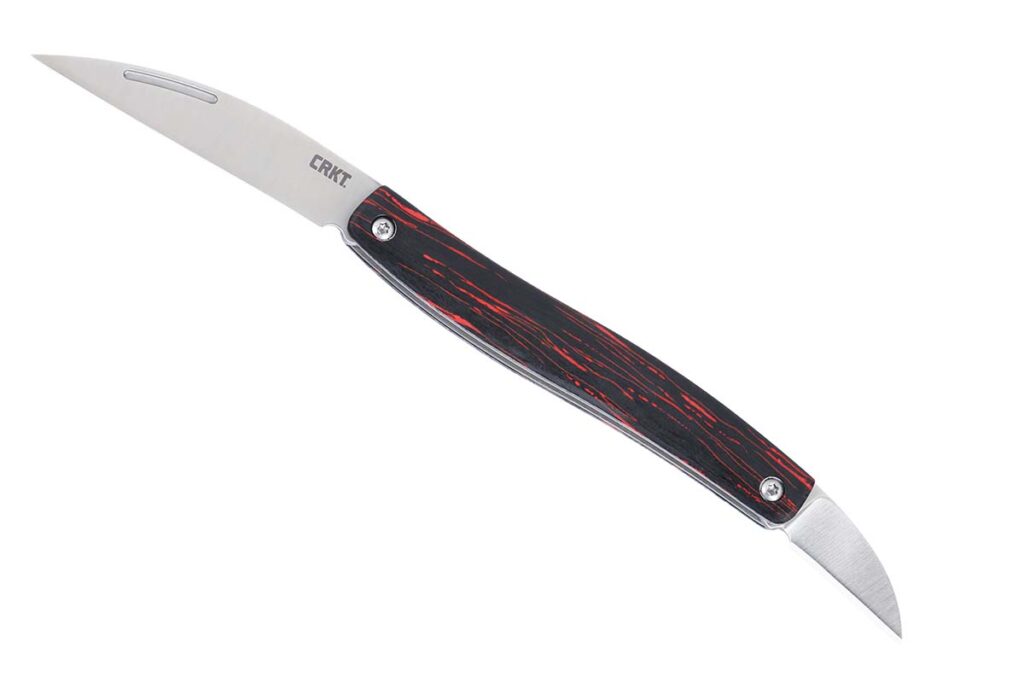
CRKT Forebear
CRKT Forebear
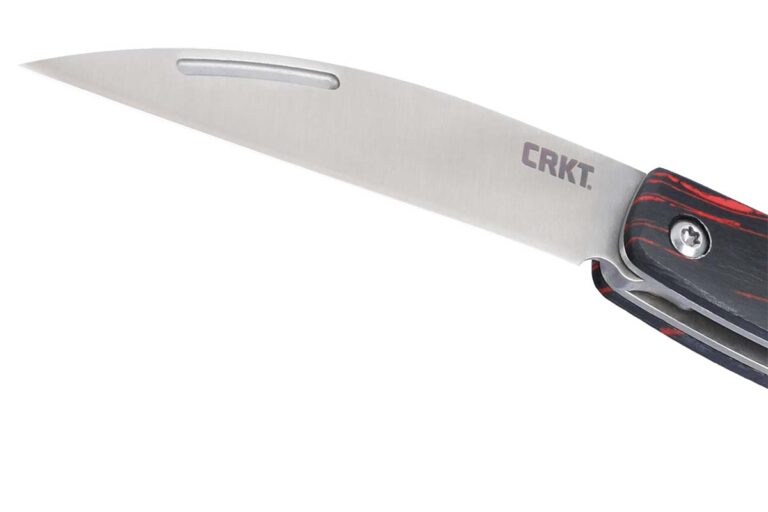
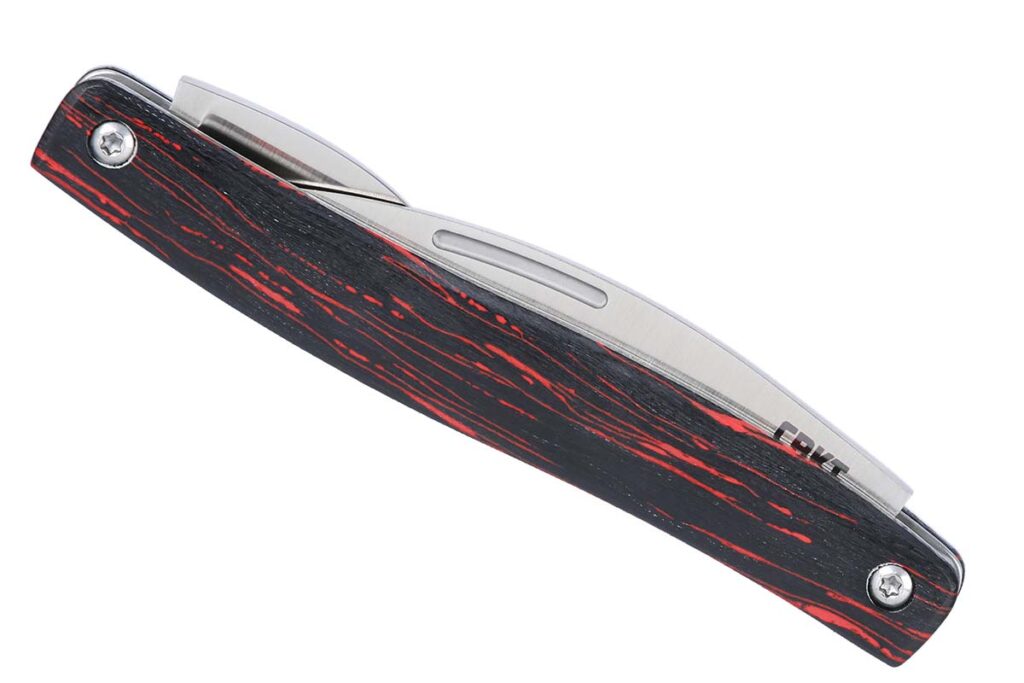
A couple of things update the CRKT Forebear. The first is the modified wharncliffe blades of 12C27 stainless steel. They’re not too big of a departure from the traditional style but still enough to make you notice. They are streamlined with an aggressive tip. Second is the use of a streaked-red-and-black G-10 handle. Unlike using texture to add dimension like, say, in a jigged material such as bone, the handle has two contrasting colors instead.
The knife is in a two-blade configuration—small and large wharncliffes—designed by custom maker Darriel Caston. The blades remind me of those on German chip-carving knives. Such blades are excellent for detail work and chores at which utility-style blades excel. They are flat ground and have long nail nicks that follow the spine.
I must say I was disappointed with the out-of-the-box finished edges on the blades. They were very uneven. One side had a larger micro bevel than the other. Machines do the great majority of the work creating the parts of a factory knife. In the end, though, the final edge is most often applied by hand. Before getting full use out of the knife I had to even out the bevels.
A handle closeup gives you a good idea of the depth the two-colored G-10 scales bring to the Forebear. At 3.43 inches closed, it’s a nice size for the watch pocket on your jeans.
Again, fit and finish was a bit of a disappointment, especially coming from CRKT. I have come to expect great value from the finishes on the company’s knives. Both scales exhibited shaping flaws and were left unpolished in spots, leaving an uneven appearance.
I actually like the design. It has great potential for everyday use with the two wharncliffes. It needs some work as mentioned on the edges. With a user knife it’s easier to overlook some fit-and-finish errors. After all, knives become better looking with familiarity as enthusiasts grow attached to their EDCs. As for the edge, it’s very fixable but it should come ready to use out of the box.
Boker Plus Koteyka
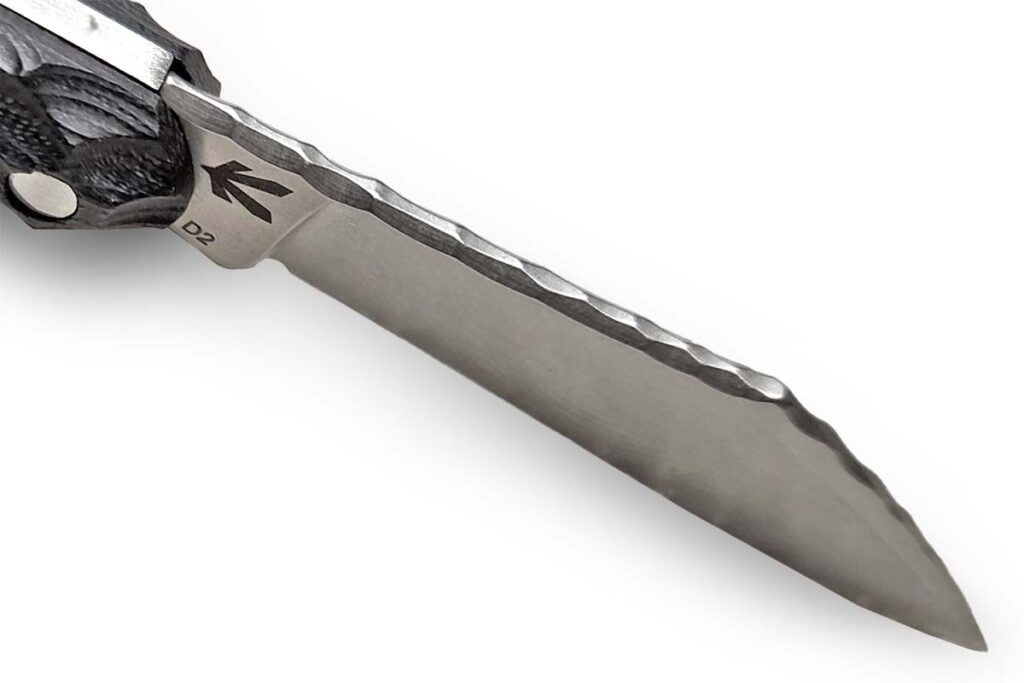
The file-style work on the spine of the Koteyka breaks up the profile and gives the blade some character.
The Boker Plus Koteyka is a stylized clip-point-blade folder. The handle is jigged black G-10. The blade is flat-ground D2 tool steel and opens via a nail nick. Closed length: 3.5 inches. I really like that Boker Plus sends the Koteyka in a box wrapped in wax paper like the old-time knives. On the back of the blade is some machining that resembles filework.
Out of the box it cut very well after I stropped it to bring it to the crazy sharp level. The finish on the G-10 has machining marks for a rustic look. One day I will end up hitting it on a buffing wheel. With a high luster polish I think it would be killer. Granted, the MSRP is only $69, so I’m just expressing my own thoughts on its presentation. Texture wise it can be a little rough on your hand, so that is another reason why I will buff it. The blade action and spring tension are good. It is a great little pocketknife update. I look forward to using it further.
Lionsteel Bestman
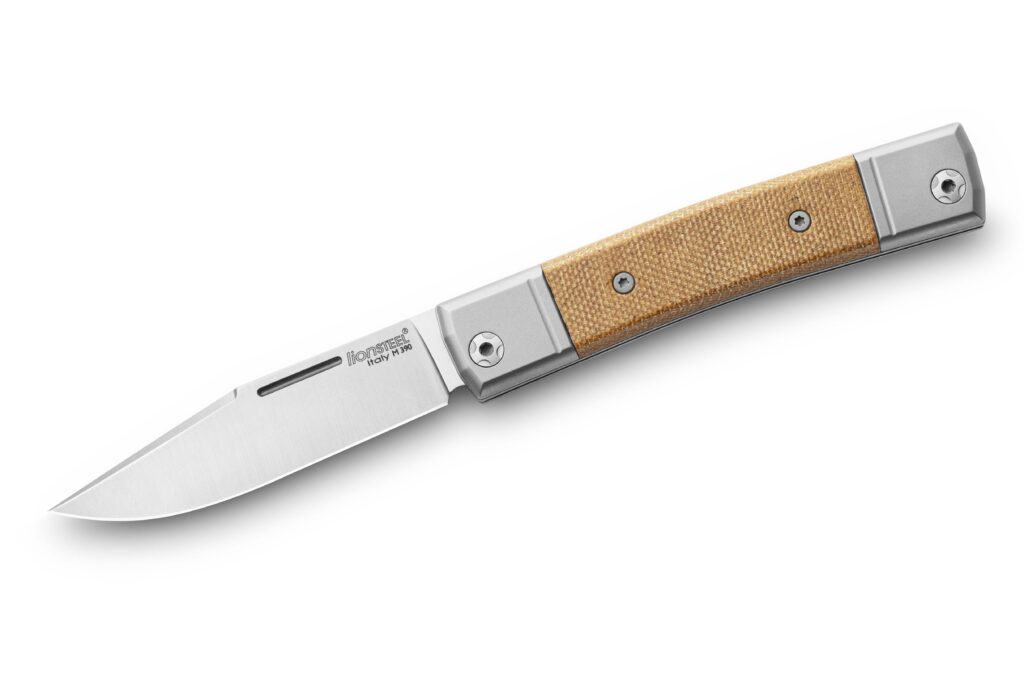
Lionsteel Bestman
In the Bestman, Lionsteel offers a pocketknife with all the traditional elements, though it’s the presentation and materials that give it the updated look. The folder has three choices of blade configuration: clip and spear points and a combination two-blade set up of clip point and wharncliffe. I received the clip point for the test. Blade steel: M390 stainless. Closed length: 3.75 inches.
The Bestman features two sets of bolsters with a decorative groove. Handle materials come in an array of natural or synthetic materials, from olive wood to carbon fiber. I chose the canvas Micarta® for the rugged look. Lionsteel kept the design blocky while smoothing over the edges to avoid hot spots. None of the metal on the knife is polished. It has a satin finish, as did some of the older high-end brands in which one side of the blade would be polished and the other side hand rubbed. In place of pins are Torx fasteners. Even the execution of the grind on the clip point departs from the traditional by keeping all the lines crisp.
The blade opens via a nail nick. The blade action is smooth yet has a definite half stop. The spring tension is dead on. I must say I am impressed and like it. It came right out of the box ready for work. The materials and design will last a lifetime of chores.
Heretic Jinn
Heretic JInn
At first, adding the Jinn by Heretic Knives to the review was iffy at best for me. I saw it on the company’s website and I somewhat reluctantly included it. To me, a pocketknife design from Heretic is akin to having a thrasher band perform Simon & Garfunkel. Nothing personal, I just thought Heretic couldn’t pull it off. In the end, though, I am the fool standing there clapping after the rest of the audience has stopped.
The sheepsfoot blade of CPM MagnaCut stainless with a combination serrated/plain edge has great application for EDC use. It can cut everything from soup to nuts. For style Heretic includes a false grind. The knife opens via a long nail nick at the blade’s back half. If I had one criticism it would be the position of the nail nick. There would be a greater advantage in opening the blade if the nick were farther away from the pivot point. Just pinching the blade closer to the tip allows for a smoother pull-on opening.
The Jinn is the only slip joint reviewed with a pocket clip.
A half stop enhances user safety and the knife is finished off in carbon fiber scales with a trim, low-profile pocket clip. The clip is my next issue. It is too tight to easily clip onto floppy and thick pocket rims. The design is such that you really don’t want to bend the clip, either.
All else considered, the Jinn really surprised me. It is a great worker. Overall, its looks fit right in with any modern one-hand-opening pocketknife. Closed length: 3.8 inches.
A CERTAIN ROMANCE Slip joints have a certain romance to them. On a base level the designs have tons of utility, and updating their appearances helps keep consumers interested. Of course, there will always be the ongoing love affair with the traditional designs. Many wouldn’t have it any other way.
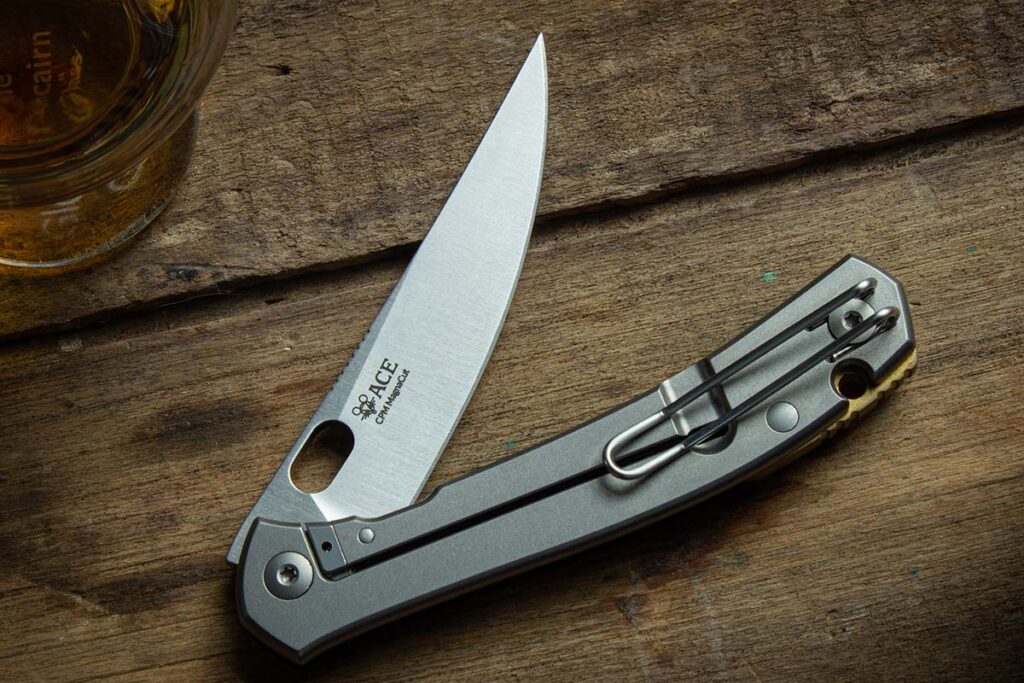
Somewhere between an EDC and a gentleman’s knife, the ACE Bleecker looks to be a slick sidekick.
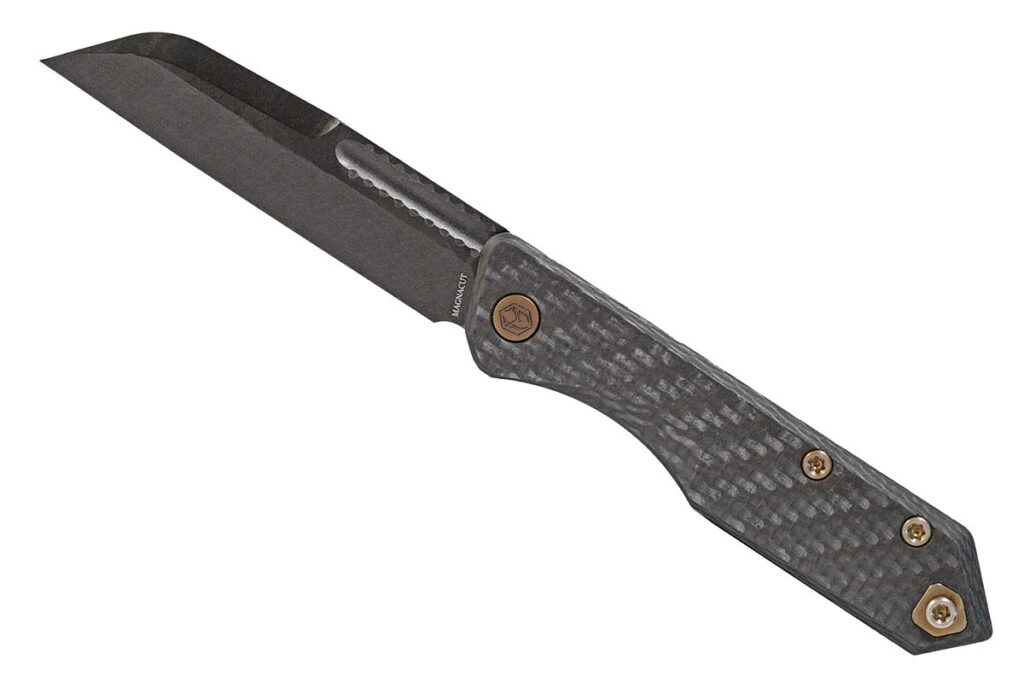
Giant Mouse is going gentlemanly but with an attitude. At least, that appears to happen with the newest addition to its catalog—the ACE Bleecker.
Named after Manhattan, N.Y.’s trendy Bleecker Street, the company seems to aim the frame lock toward hipsters’ hip pockets. The same with the sleek, yet somewhat understated lines. However, robustly built with premium steel and components the Italian import likely has the chops to pull off EDC duty—at least for those who tend to smaller knives.
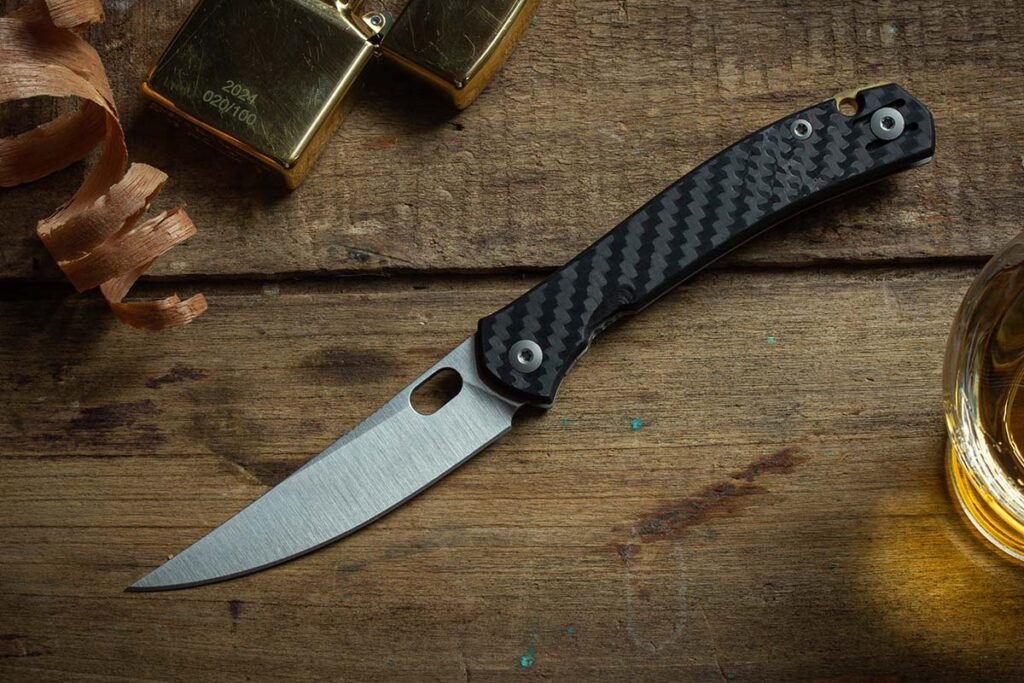
Right off the bat, the notable aspect of the ACE Bleecker is its slim design accentuated by a trailing point blade. In many respects, it’s reminiscent of Giant Mouse’s Knife of the Year award-winning GMX, only smaller and without an integral handle. Despite its svelteness, the company has ensured the knife is capable of more than cutting the foil off wine bottles by making the handle full-sized. It is a bit skinny in the hand, yet it nestles in the palm well enough to handle more aggressive cutting duties.
Giant Mouse went top-shelf for the blade steel, choosing Magnacut—albeit a softer version than some prefer. The company rates it at 62 HRC, a facet that might raise the hackles for the edge-retention obsessive. That aside, the geometry of the 3.26-inch blade is exquisite with a thick(ish) spine adding toughness to the design. The tip doesn’t jut too far above the spine, allowing users to choke up on the blade for finer work. And, boy howdy, should it ever prove apt at fine work, with a very fine tip.
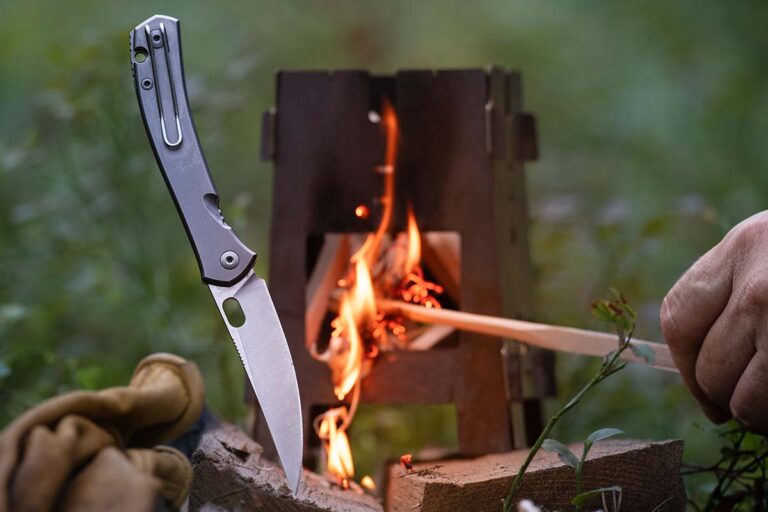
The company has opted for a thumb hole as the opening mechanism on the Bleecker but has made it oblong. The choice is for more than aesthetics, making the knife deployable not only in the traditional style—the thumb—but also in reverse open. As an added benefit, this also makes the knife relatively left-hand friendly. The Bleecker’s well-tuned detent also goes a long way in adding to all these aspects—not so light as to facilitate a negligent deployment, but not overly stiff where users will struggle to get the blade to work.
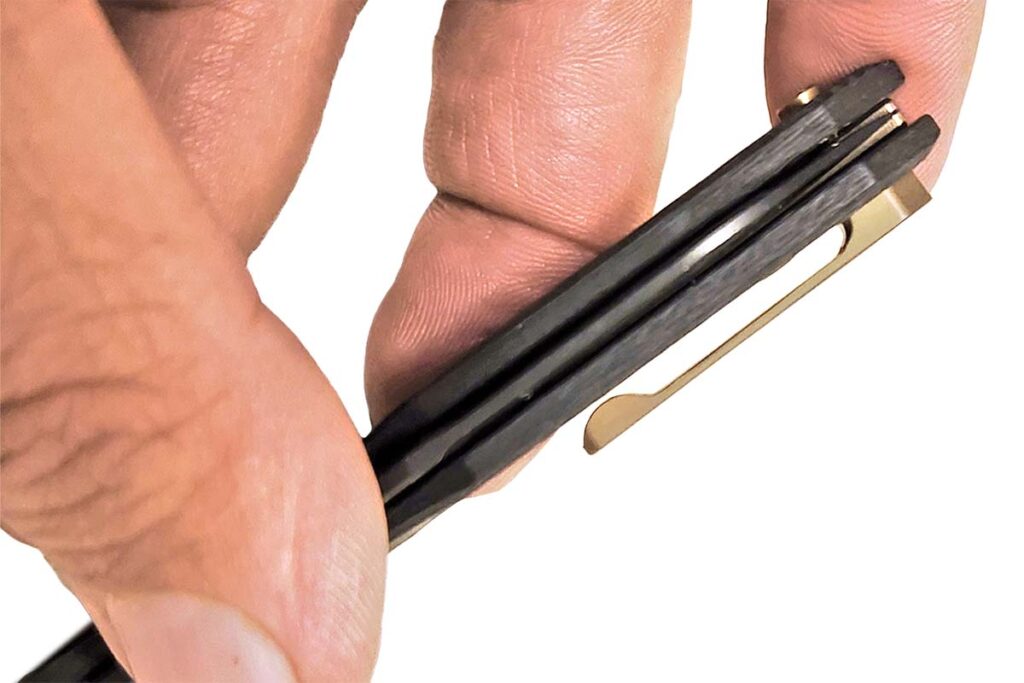
As for the handle, Giant Mouse offers two options—titanium and carbon fiber. Both are attractive, though I tend to the titanium as it gives the knife more overall continuity and class. In both cases, the knife tips the scales at right around 2 ounces—the titanium a hair more—and measures at 7.43 inches in overall length. Worth note, Giant Mouse includes a notch on the thumb side and a chamfer on the lock that go a long way in making opening the knife simple. Also, it boasts a reversible wire pocket clip for tip-up carry.
With a gentleman’s design comes a gentleman’s price on the Bleecker. Giant Mouse lists the titanium model at $285 and the carbon fiber version at a slightly more affordable $245.