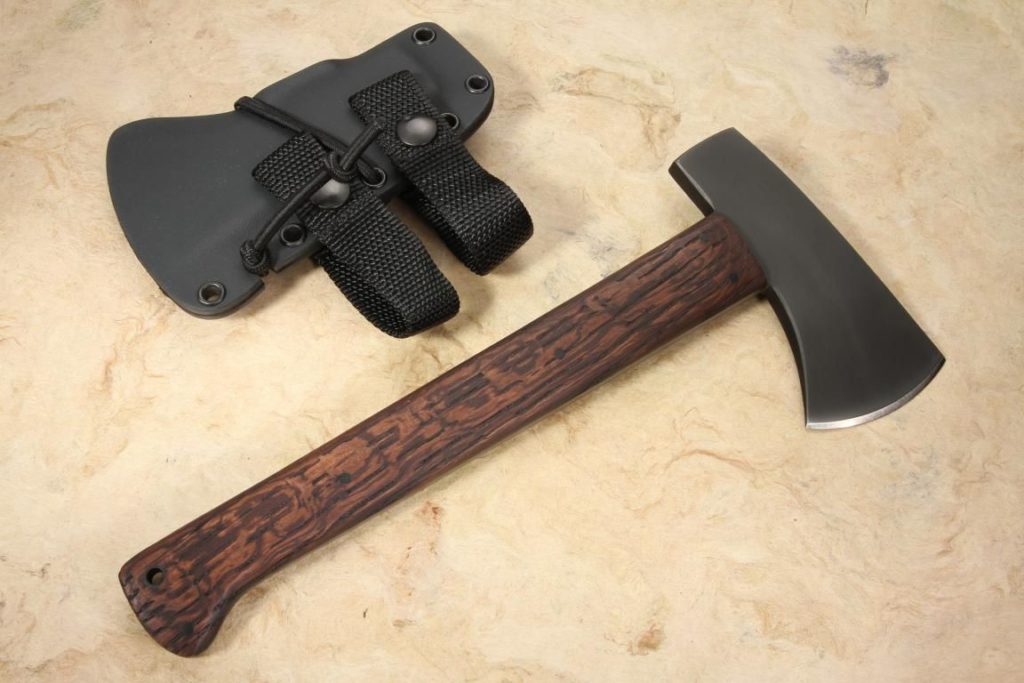
Buck Knives is among the most historic manufacturers in the county. We attempt to pick the best knives it has ever created.
The famous 110 Folding Hunter was introduced to the market in 1964. This was a significant point for Buck Knives, and a significant point for the knife industry as a whole.
Buck did not start in spirit in 1964, it began much earlier at the turn of the century, and was the culmination of over half a century of Hoyt Buck’s knifemaking experience. Several generations of the Buck family worked to build the company, and the result was nothing short of extraordinary. Buck Knives are one of the most recognizable brands in the country, and they have a well-earned reputation for quality. It is currently in its fourth generation of family ownership, an amazing feat in today’s fast-paced corporate environment.
Buck knives are exceptionally well-made and will hold up for a lifetime if properly maintained. The knives also carry one of the best warranties in the industry which guarantees their products against any defects for life. This whole segment has nothing from him about how Hoyt formally started and built the company.
History Of Buck Knives
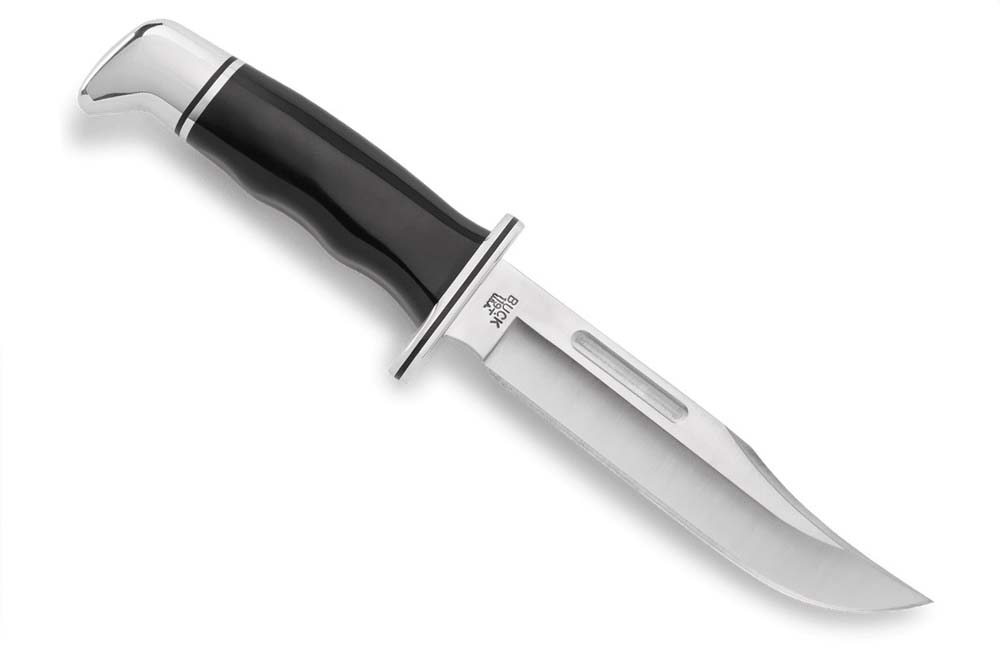
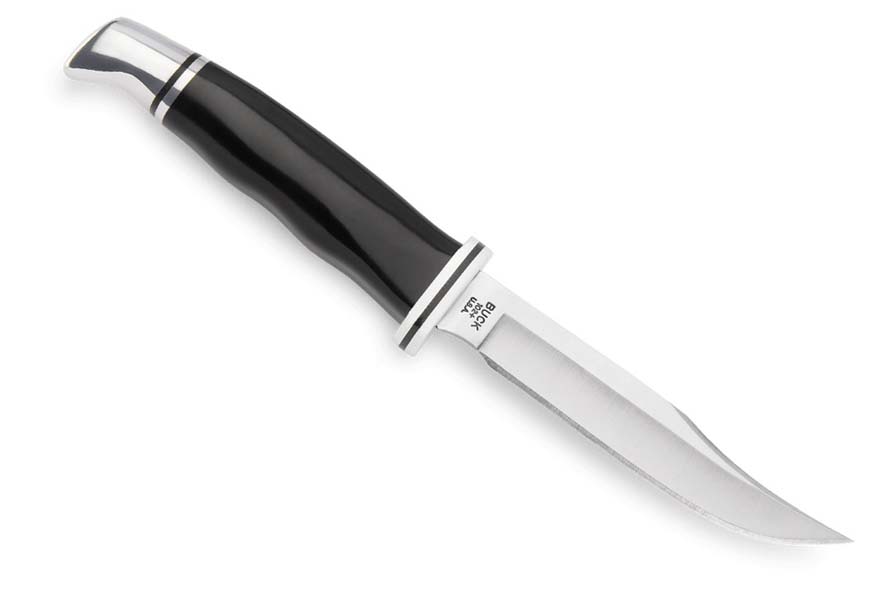
The Buck 119 Special is one of the company’s many fixed blades.
While it was not technically a company, Hoyt buck began making knives around 1900 and developed a way to temper steel that he deemed to be superior to what was being done at the time. It may seem a bit uppity of an apprentice blacksmith to take on something that had not been done in all of the history of man’s knife-making, but Hoyt Buck was not to be deterred.
Sure enough, his methods became well-known and he made knives one at a time for decades afterward. His knives had superior edge retention as a result of his tempering process and to this day Buck knives are well-known for their ability to hold an edge.
While the seeds of Buck Knives were planted thanks to Hoyt and his skill on the anvil, the company’s journey is so much more than that. Hoyt had six children, and his oldest son Al would eventually play a key role in the company’s growth.
By 1941 Hoyt and his wife were now living in Idaho, and he was a church pastor. However, the attack on Pearl Harbor roused his patriotism. As a way to help the war effort, he opened a small blacksmith shop in the basement of his church and began making knives once again. His knives became extremely popular on the military bases on the Pacific Coast and soldiers would come from all over to get one of his blades.
By the time the war ended in 1945 Hoyt and his wife Daisy decided to move south to San Diego and live near Al. In 1946 Hoyt opened his first manufacturing plant, really just a small lean-to attached to Al’s house, with his son. It was then that Buck Knives was officially born.
Al took over the company when his father passed, and today the company remains in the family as CJ Buck is the fourth-generation CEO and Chairman of Buck Knives.
Hoyt’s Tempering Process
Hoyt Buck was 13 years old and an apprentice blacksmith in 1902. According to the company’s own history, Hoyt was dissatisfied with the edge hardness on common farming implements. Farmers seemed to be bringing in their tools far more often than he liked to see and thought of some solutions to make the edges stronger and able to hold their sharpness longer. He began experimenting with these tools and eventually figured out a quenching method to achieve his desired result.
Essentially, the secret Buck discovered was quenching the entire blade when it was all precisely the same temperature. Not an easy task, especially in the day and age he came up with the process. However, overcoming the technological challenges reaped impressive benefits. The uniformity of the tempering process ensured the metal had no soft spots–weakness that could eventually lead to damage. Furthermore, the even tempering–when applied to knives–resulted in blades that were extremely hard and were capable of retaining an edge.
How To Date A Buck Knife
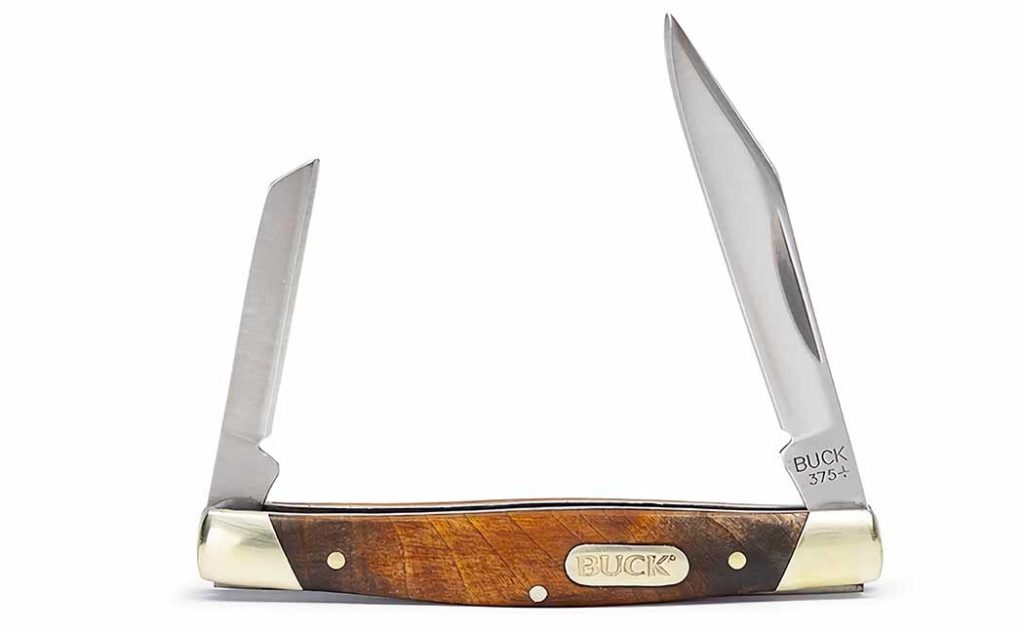
The Buck 375 shows off the company’s continued commitment to detail.
Unlike many knives across the industry, Buck knives are marked in certain ways to identify them based on the year they were made. The original Buck knives from 1961 to 1967 or simply stamped with ‘BUCK’.
From 1967 to 1972, the knives featured the mark ‘BUCK, USA’. The 1972 to 1986 period had the knives labeled with ‘BUCK 110, USA’ with additional model information. From 1986 onwards, each year of manufacture has a unique symbol that is added to the blade. You can very quickly and easily identify this and match it to the model year on the Buck website.
Buck knife collectors tend to have some of their own methods for identifying early knives. While it comes down to a degree of pseudoscience, there is demand for Buck knives that retain their original packaging, and even original receipts that can prove the age of the knife. Typically, the older the knife, the more it is worth.
Vintage Buck knives do not tend to sell for all that much by comparison to other knives, but there is a healthy following all across the country. Most people do not sell their Buck knives at all, and they are passed down generationally.
Best Buck Knives
Whether it’s a contemporary knife or a classic, these 10 knives from Buck continue to be top sellers and beloved by knife aficionados around the world.
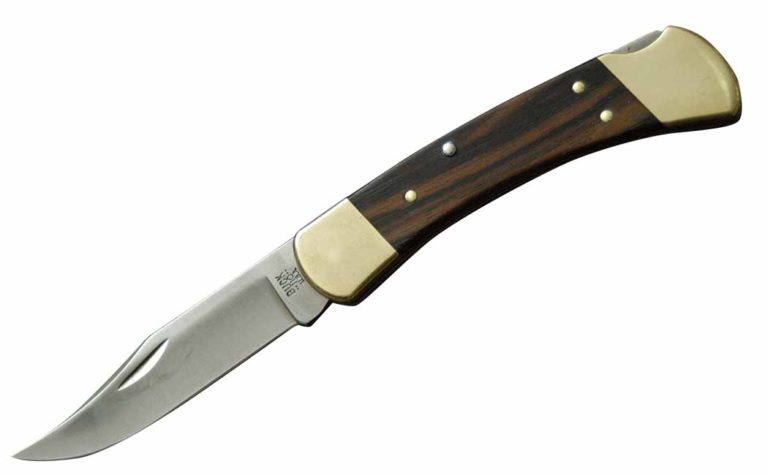
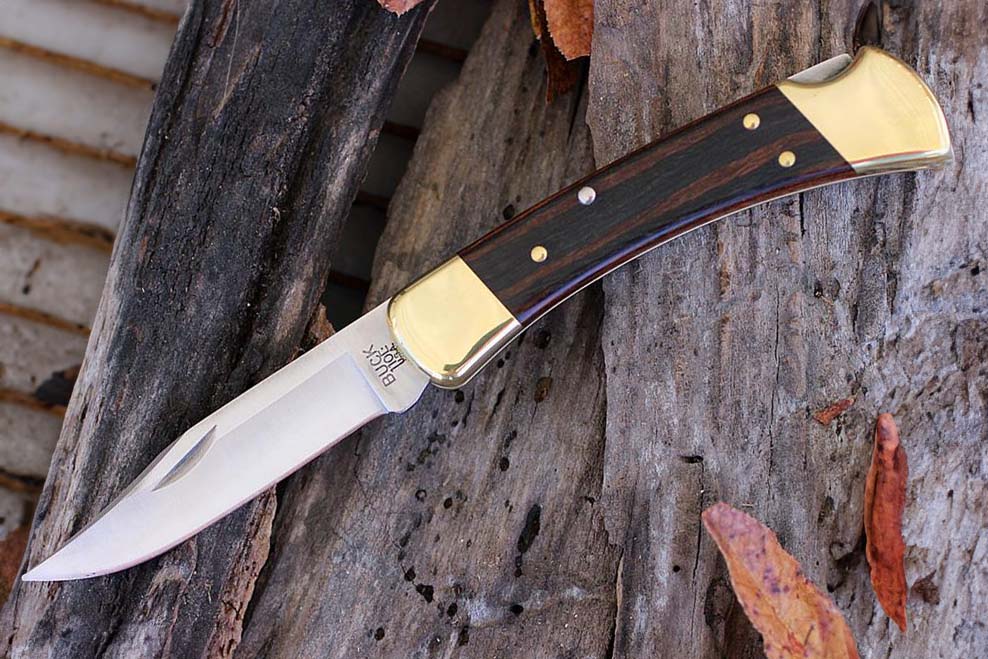
110 FOLDING HUNTER KNIFE
This is the one that started it all. The 110 Folding Hunter needs no introduction here. It is one of the most storied and respected knives in American history. What is remarkable is that the price is relatively low, even for Buck’s lineup. The price of this knife sets it apart because it is well-known for its durability and sharpness. At under $70, you can easily buy this knife without breaking the bank.
MSRP: $65
124 FRONTIERSMAN KNIFE
This knife harkens back to the old days in appearance but is all modern in terms of execution. The Frontiersmen knife is just about the perfect size if you prefer to carry a fixed blade. The design of the knife is completely functional and you should be able to accomplish just about anything you need to accomplish out in the woods or around the farm.
MSRP: $185
055 ‘THE 55’ KNIFE
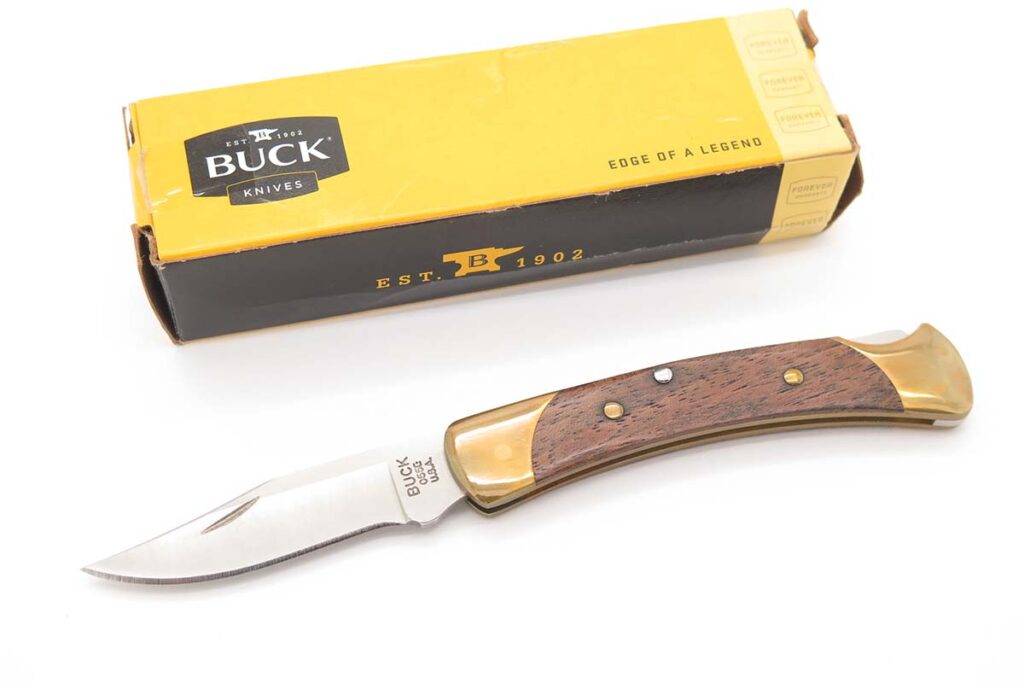
The 55 gets its name for being half the size of the famous 110. It is a popular and common pocket knife that is just as strong as its big brother. While it lacks many of the features of modern assisted-open knives or other types of more complicated designs, it makes up for it by being exceptionally durable and easy to use. Much like the larger 110, this is a knife that you will keep for life and pass down to your kids.
MSRP: $70
120 GENERAL KNIFE
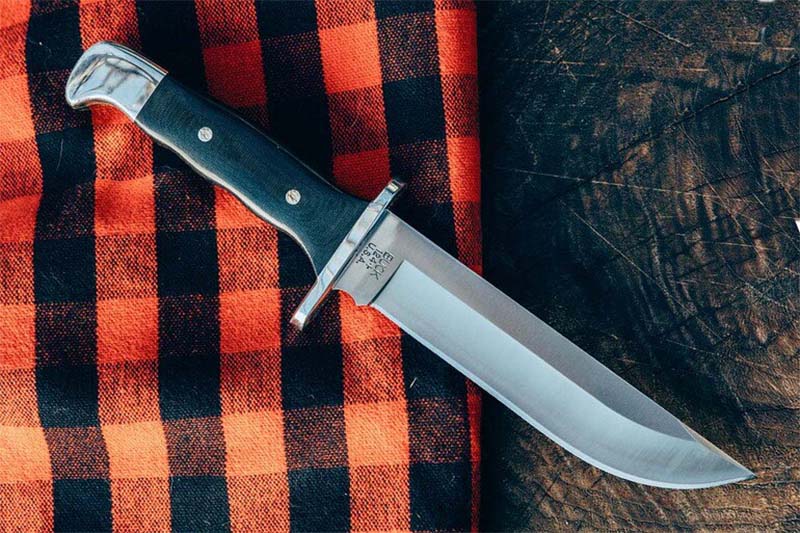
There are very few knives that are as recognizable as the 120 General Knife. This Buck design is a classic, reminiscent of the military Ka-Bar. It is a bigger knife than what most people use for their everyday chores. The General Knife will be a companion for hunting, skinning, and preparing wood near the campfire.
MSRP: $130
103 SKINNER PRO KNIFE
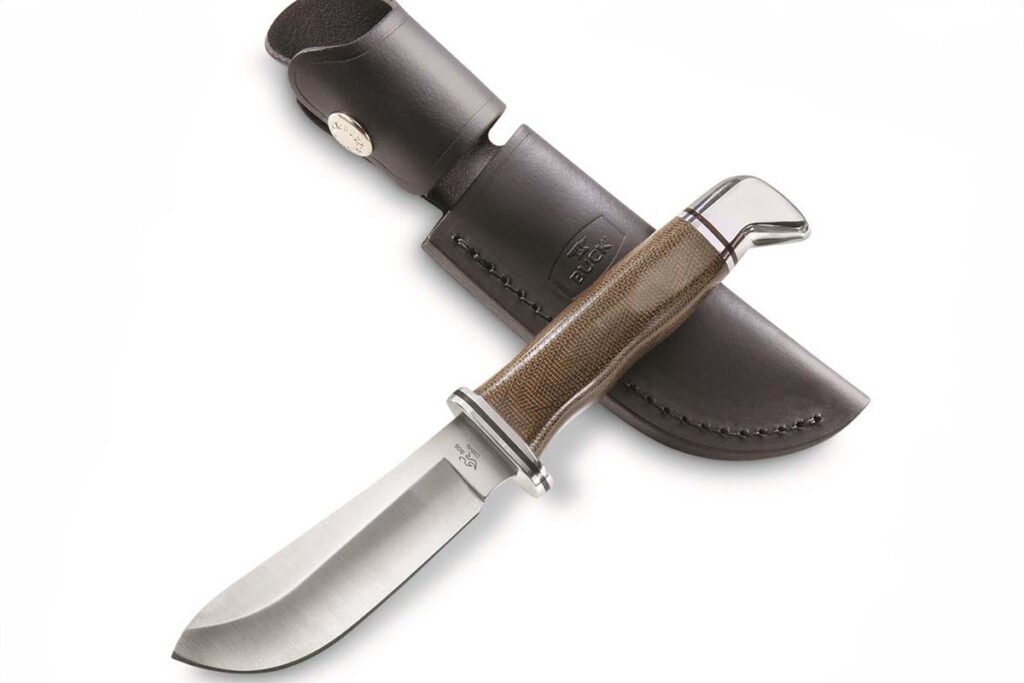
Back in the old days, a skinning knife was part of a larger set that you would take into the field. This knife profile saw its heyday during the decimation of the buffalo herds. Buck has an excellent skinning knife in the form of the 103 Skinner Pro. It is a fine tool and is exceptionally attractive in appearance. If you like to have separate tools for your various hunting chores, you would do yourself well to equip this knife alongside the larger 120 General Knife.
MSRP: $170
102 BUCK WOODSMAN KNIFE
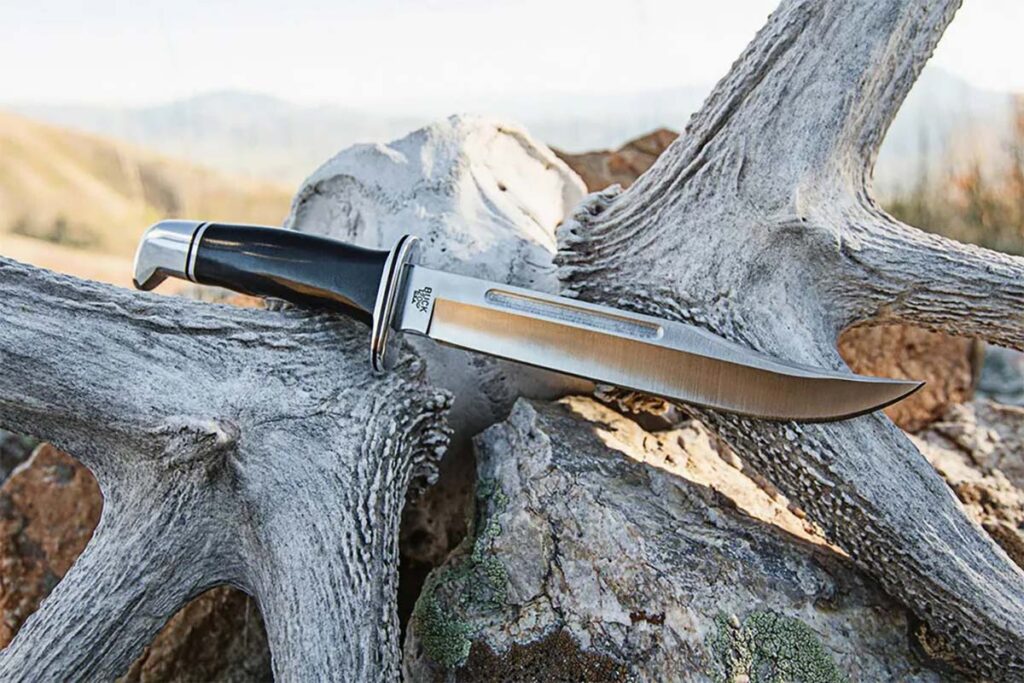
For many young men, the Woodsman was the first serious knife they ever received. This is a classic design and is among the most popular and well-recognized American fixed-blade knives ever made. It is not the largest knife Buck has made, but this medium-sized Bowie profile blade has seen more use than most knife models could ever hope to achieve.
This is an excellent knife for the aspiring outdoorsman. It can be used in just about any setting that requires medium lifting. It is a bit too thin to be used for wood splitting but can be used easily for making kindling by scraping. It is also an excellent small game knife and can be used for all sorts of camp chores. If you think about the knife that you would have in the Scouts, this would likely be as close to that knife as you can get.
MSRP: $75
BUCK ZIPPER KNIFE
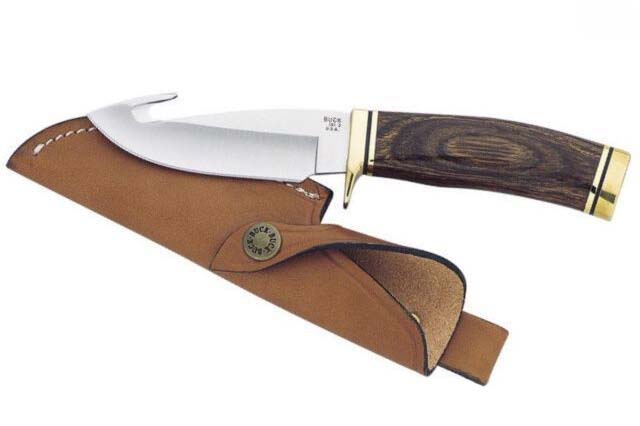
The Buck Zipper is one of the many knives sold by the company today.
The Buck Zipper knife is arguably one of the most popular gut hook knives in the country, and it is fair to say that it is in more deer hunters’ hands than it’s not. As far as traditional designs go, the Zipper knife is not just well-made, it is also a symbol of the trade for many hunters that take to the field every fall. Gut hook knives do have other utility, they can be used in fishing settings for cutting line and for gutting as well. For a general-use hunting knife, you really can’t go wrong here.
MSRP: $129.99
863 SELKIRK KNIFE w. FIRE STARTER
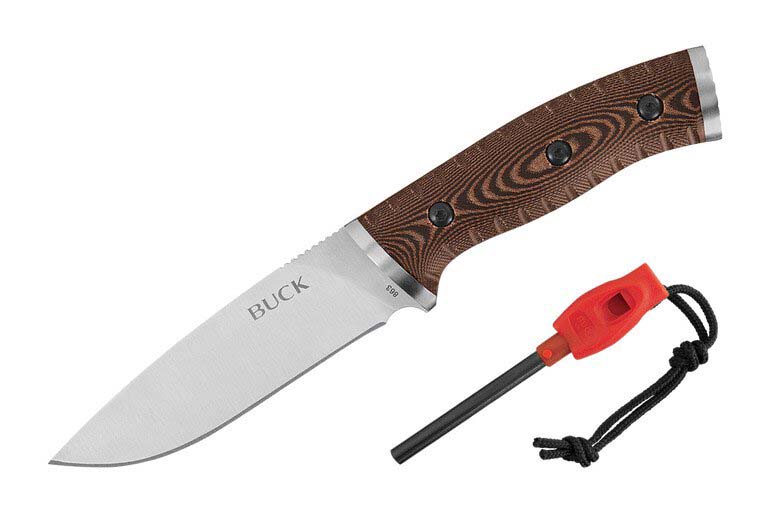
Bushcraft knives are all the rage these days. There are a plethora of TV shows dedicated to the topic, and it seems that every knife company out there is making something that fits the bill. The Selkirk knife is a nicely priced addition to the Buckline. The knife is well equipped and comes with a durable micarta handle and a sheath-mounted fire steel. The kit you get is able to function right out of the box. You can pretty easily get started with practicing right in your yard. MSRP $80
The knife does have a couple of downsides, though, from a Bushcraft perspective, it is relatively thin. A blade really needs to have some meat to it to be able to make it through the tanning for kindling You’ll never really get much life out of a thin blade if you snap it off in use. Even though Buck has a good warranty, you should take care to not treat a thin blade like this as a dedicated tool for splitting. The knife can, however, be used for making tinder out of smaller pieces of wood, and it should have no problem getting them to light.
MSRP: $80
841 SPRINT PRO KNIFE BURLAP MICARTA
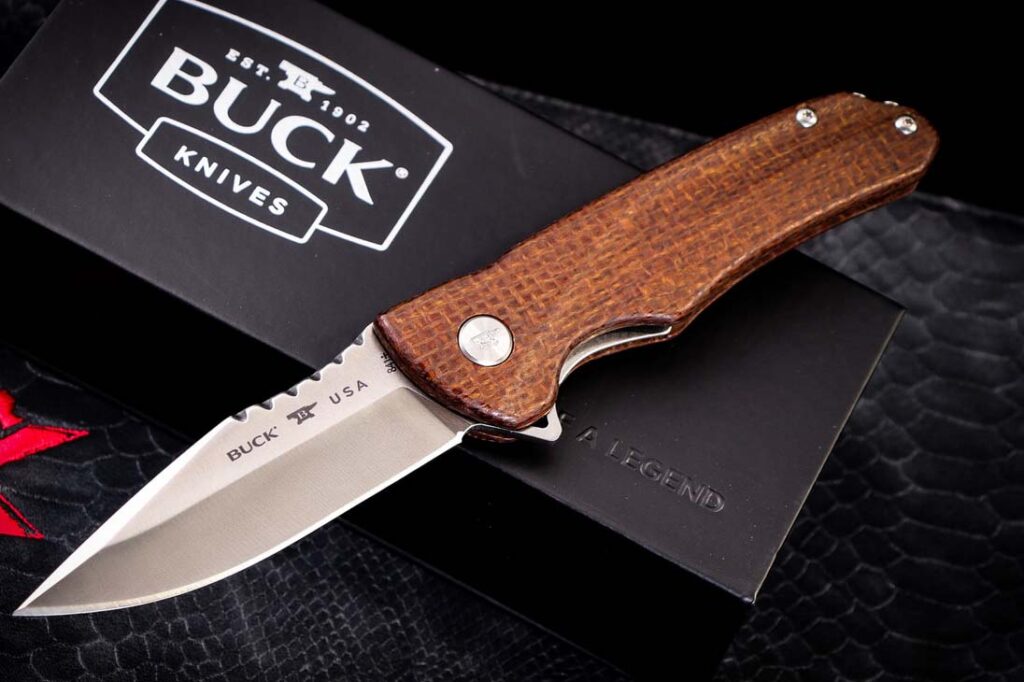
Another modern design, the Sprint Pro is a sleek looking folder that also has some classic lines. The knife is available in a couple of forms, most interesting is the burlap micarta model. Burlap micarta is made through an interesting process that suspends fabric in a resin base material. The result is a unique, very durable, and highly functional grip material that looks as good as it performs. This is a flipper-style knife and can be operated easily with one hand. The locking mechanism is a standard liner lock. Overall, it is a well-reviewed and well-designed knife that, while not the most visually striking, will give years of use.
MSRP: $155
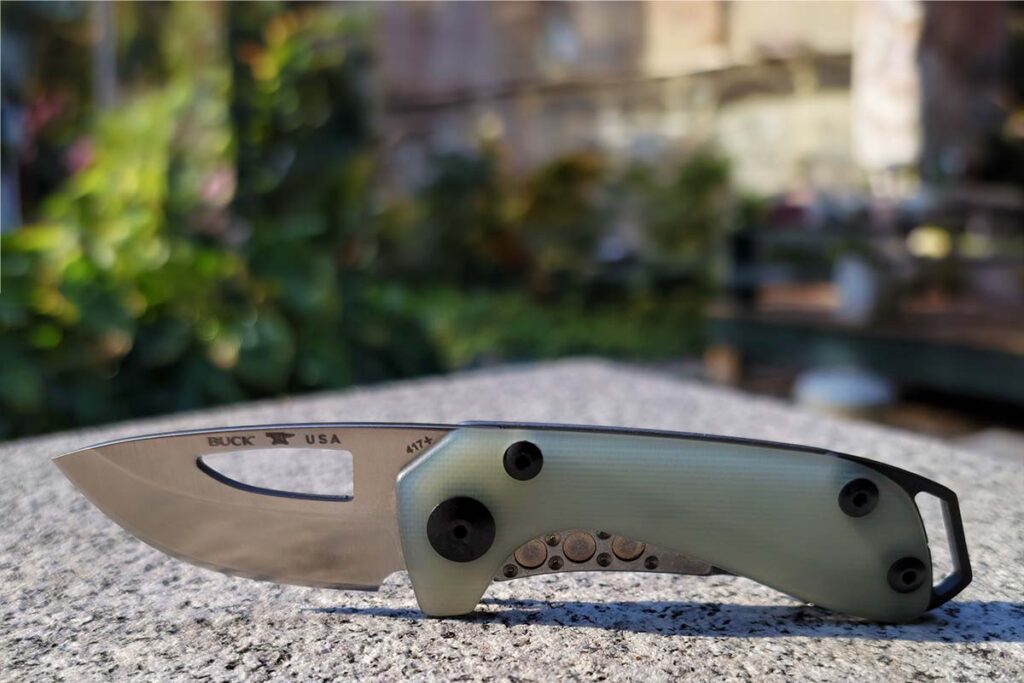
417 BUDGIE KNIFE
The Budgie is a very compact EDC knife that can go just about anywhere. The tiny design is minimalistic yet functional. It is a frame-like design that is available in a couple of colors, most notably natural green G10. This is a new design that does not necessarily have much in common cosmetically with the classic Buck lineup. That said, it is just about all the knife the average person needs for their daily life, and it can be kept on the person quite easily. While it is a bit more costly than the average mini pocket knife, the Budgie is backed by the same warranty extended to all Buck products and is going to last you for quite some time performing light and medium-duty tasks.
A reliable camping hatchet or axe can be the difference between mere survival and a truly memorable camping experience
Do any sort of camping and you’re more than aware there truly are the right tools for the job. While implements such as a bushcraft knife are an absolute must to get you out of a backwoods switch, they are, at best, only adequate for certain tasks. Chief among these is processing any amount of wood.
This, when your kit requirements allow, is where the good old camp hatchet or axe comes into play. Antiquated for large tree-felling projects nowadays, these lightweight and heavy-duty tools bring your woodcraft abilities to a new level. From facilitating more elaborate shelter-building attempts and arming you with the ability to collect a magnitude more firewood, hatches and small axes prove a godsend in the harshest environments.
Let’s hack away at what goes into the best of these sometimes overlooked camping and survival tools and what presently are some of the top choices in the wilderness tools.
Camp Axes vs Hatchets
While there is no bright line from when you crossover from an axe to a hatchet, there is a generally safe rule of thumb. Axes sport enough handle to facilitate a two-handed grip, while hatchets are generally wielded with one hand—hence their moniker “hand axe”. Most times too, axes boast a slightly larger and heavier head with a slighter taper. Hatchets, you’ll find, have a much more pronounced taper to their heads in addition to some having other functions incorporated—such as a hammer.
Given this, axes provide more striking power, thus a bit more versatility since they’re capable of heavier work than hatchets, in addition to all the tasks the smaller tool is proficient at. Bushcraters have understood this for some time, with some favoring relatively small axes that make shelter building and wood splitting much less labor intensive. There is a tradeoff in going the axe route, however—no matter what, the great majority of axe options will weigh more than a hatchet.
A hatchet, aside from convenience, has some underlying benefits. Splitting wood in camp is much easier and safer with the hand axe given it’s more controllable and can function in smaller spaces. Many—as mentioned—are tailored to the tasks of camping with multiple functions engineered into them—a tent stake puller is always nice. And even in the realm of bushcrafting, the hatchet proves nimbler than the axe on many tasks—such as using it to whittle wood.
Which is Right For The Wilderness?
Overall, the winner of axe vs hatchet debate when it comes to the outdoors is only something you can determine by analyzing exactly what your needs are when out in the wild.
If your outdoor plans require a deep push into the backcountry, where woodfires are a secondary source of heating and cooking, a hatchet seems more logical. The same goes for excursions where you plan to collect fuel wood immediately around your campsite, as opposed to cutting down a tree.
Conversely, if wood fires are your main source of heat and cooking, even in deeper parts of the forest, and you’re on extended trips an axe might prove more useful. Furthermore, if you are going straight up Grizzly Adams and virtually living off the land, building your own shelters, well an axe provides an advantage. Hunters too, in blind building from fallen trees, could also benefit from the extra leverage allotted by an axe.
Again, these are not hard and fast rules, simply examples of where a hatchet might trump an axe and vice versa. Using each as well as understanding your needs and capabilities in the wilderness will likely point you to making the right choice.
Best Hatchets And Camp Axes
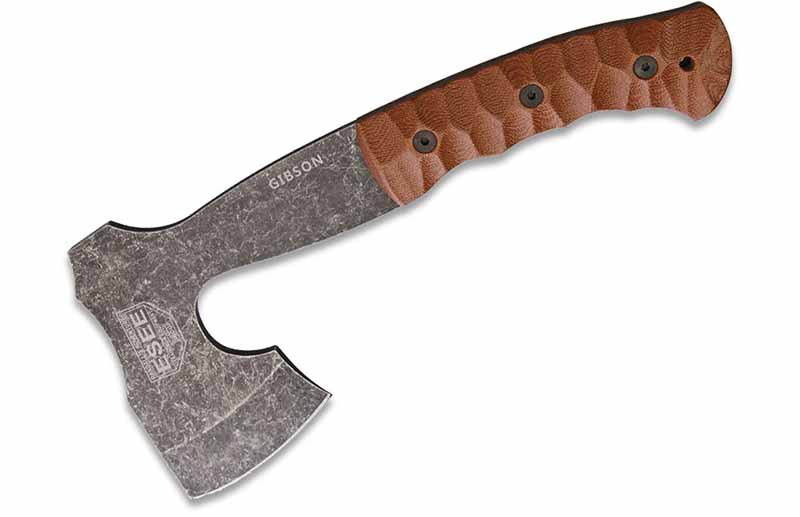
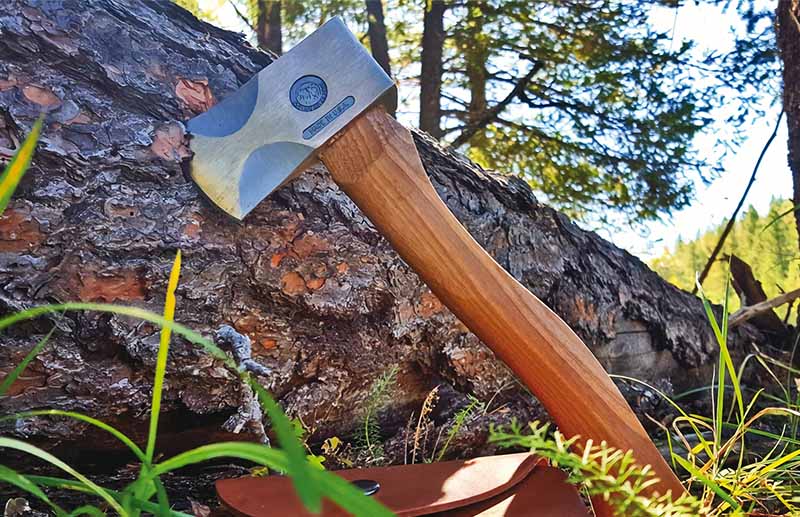
ESEE Gibson Axe
After the ESEE Gibson Axe was made, James Gibson learned a hidden feature of his design: it has enough finesse to carve small objects. He says he sharpens pencils with it and once cleaned a trout with it as well.
The hatchet is a James Gibson design which is now offered by ESEE. A knifemaker, flintknapper, and bushcraft instructor, James originally designed the Gibson Axe for himself, something to throw into a backpack as he tramped the hills and hollers of East Tennessee. As he tweaked his design, eventually cutting out a prototype made from thin plywood, he focused on its balance and “rocker.”
“An axe with perfect rocker is one of the best handling axes you can handle,” James said. “And I got the rocker perfect on this axe.”
And just what is rocker?
Gibson explains it’s when you take the hatchet and stand it up edge down on a straight surface. As he puts it, the bit’s edge should meet the surface in the “middle of the blade, the cutting edge and its dead center, and the handle [butt] should touch at the same time.”
When he showed a couple of prototypes of the axe to the folks at ESEE at a BLADE Show one year, they decided to add it to their lineup. At the time, ESEE was hearing from its customers that they wanted the company to offer an axe—and Gibson’s hatchet fit the bill.
James designed the handle to have finger grooves and a knob to secure the hand while swinging it. After the axe was made, he learned a hidden feature of his design: it has enough finesse to carve smaller objects. He says he sharpens pencils with it and once cleaned a trout with it. The result “is capable of doing some real work as well. It also has exceptional balance and you can choke up on it and use it like a knife for many applications,” explains Shane Adams, ESEE’s marketing director.
Of course, it being ESEE, the hatchet comes in the company’s oft-used blade material: 1095 carbon steel. “It’s us,” Adams said. “We know 1095 well.” It’s a steel that handles all the variables of the outdoors. “You can sharpen it with a rock if need be,” the marketing director advises. “Stones or systems, it doesn’t matter. I always like to finish on a loaded leather strop when possible.”
Gibson Axe Specs Company: ESEE Cutting Edge: 4.5″ Head Material: 1095 carbon steel Head At Its Thickest: .25″ Handle: Micarta Weight: 1.3 lbs. Overall Length: 10.5″ Sheath: Leather MSRP: $269
Knives Of Alaska Hunter’s Hatchet
“Hatchets are still one of the most useful tools a real outdoorsman can have in the fi eld,” says Charles Allen of Knives of Alaska, “and they can save your life by enabling you to quickly make a warming fire or emergency shelter.” The KOA Hunter’s Hatchet is designed to fi ll that bill in all regards.
Charles Allen, president and owner of Knives of Alaska (KOA), knows the importance of being prepared. The Alaskan master big-game guide who has flown in the Alaskan skies professionally for almost three decades always keeps a hatchet stashed in his bush plane—and for good reason.
“When you look back at the old photos of the early trappers and hunters, you will see three things: a rifle, a knife, and a hatchet or tomahawk on their belts,” he said. “Hatchets are still one of the most useful tools a real outdoorsman can have in the field, and they can save your life by enabling you to quickly make a warming fire or emergency shelter.” When consumers demanded a multi-purpose hatchet, Allen studied the designs carried by the folks who make preparedness their motto: the Boy Scouts. “I looked at the historic Boy Scout’s hatchet I grew up with and know that it is a proven design that is hard to improve on,” he says.
But improve on the Boy Scout model he did with the KOA Hunter’s Hatchet. The hickory handle remains tough yet easy on the hands. Heat-treated properly, the S7 tool steel is designed to absorb the shocks of hard blows. With a Rockwell hardness of 50-54 HRC, the edge of the Hunter’s Hatchet is intended to dent if it collides with something hard, Allen says, such as bone while butchering game. And the head can be returned to a razor-sharp bite with Allen’s recommended sharpening tool: a flat, fine-toothed file.
When designing the Hunter’s Hatchet, Allen was sure to include a wide-enough poll so that users could pound stakes, nails and the like with it, too.
Hunter’s Hatchet Specs Company: Knives of Alaska Cutting Edge: 4.25″ Head Material: S7 tool steel Handle: American red hickory Weight: 1 lbs. Overall Length: 11″ Sheath: Leather MSRP: $169
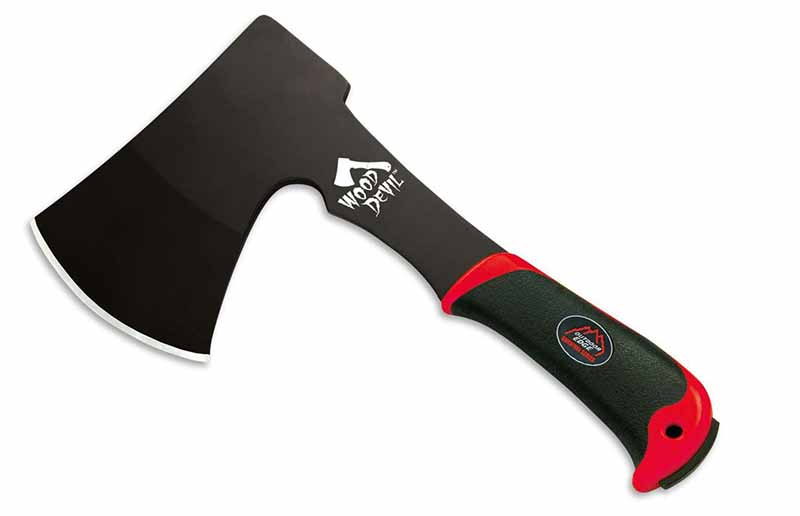
Outdoor Edge Wooddevil
David Bloch, president and founder of Outdoor Edge, wanted a hatchet that could out-cut its class: Something small enough to carry easily but with enough heft to take down a medium-sized tree. And thus the WoodDevil was born.
David Bloch, president and founder of Outdoor Edge, wanted a hatchet that could out-cut its class: Something small enough to carry easily but with enough heft to take down a medium-sized tree.
“I looked at and tested a number of compact hatchets on the market and came to the conclusion that most full-size hatchets were too large and heavy to take on outings where weight and volume were limiting factors,” Bloch said. “I also found that most every compact hatchet I tested, while cute in appearance, was not an effective chopping tool.”
During outdoor treks when the quality of your tools will make or break the trip, the Outdoor Edge WoodDevil may be a guardian angel, made possible by the marriage of a combination of the right balance, a good handle and a wide cutting head.
“The WoodDevil stands up to its name,” David said. “With a 4-inch cutting surface, it has the ability to cut through large diameter material with the respect of its compact size.” Plus, its compact size makes it unobtrusive in the camping bin or pickup truck until needed for whatever task—from hammering tent stakes to “slicing tinder shavings,” he adds.
The 3Cr13 stainless steel in a Rockwell hardness of 52-54 HRC is malleable and resharpens easily, and the black oxide finish allows it to better resist corrosion. The TPR rubber handle provides a non-slip grip that soaks up the shock and vibration during use. It’s packaged in a nylon sheath retained with a fabric fastener that can hang from a belt.
Wooddevil Specs Company: Outdoor Edge Cutting Edge: 4″ Head Steel: 3Cr13 stainless Handle: Red ABS plastic with black rubberized TPR Weight: 1.2 lbs. Overall Length: 10″ Sheath: Nylon MSRP: $40
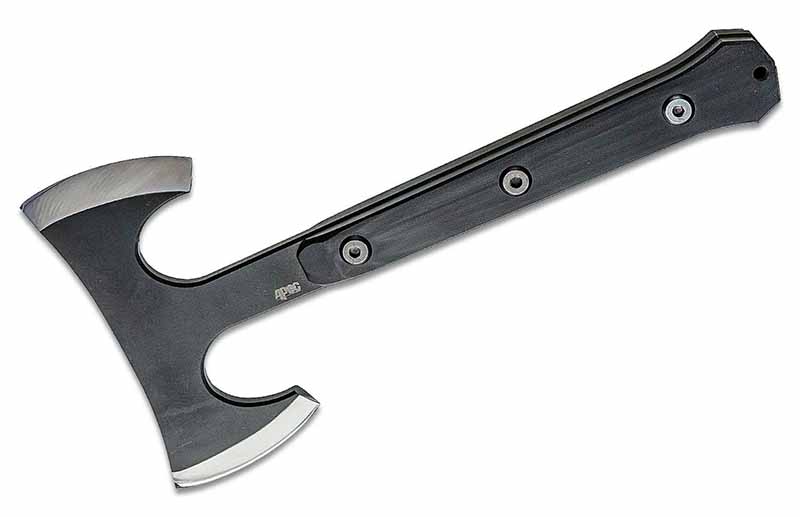
APOC Double Mukk
As Blake Pogue, product manager of CAS Iberia, tells it, the creation of the Double Mukk started with some pencil, plenty of erasing, and an idea.
“We wanted to bring a full-tang hatchet to market with some unique features at a good price point,” he said. Double-bit axes don’t seem as common as they used to be, but the Double Mukk’s design is grounded in some very real field experience. In fact, it is a design championed by George Sears, the famed outdoor writer with the nom de plume of Nessmuk.
“George Sears was an avid outdoorsman, canoe enthusiast, writer, and conservationist in the late 1800s,” Blake said. “He famously employed a trio of tools for woodcraft —a small folding knife, a thin-bladed belt knife and a short, double-bit hatchet.”
Pogue said after some field testing of their own, the makers learned they didn’t need to tweak much from Nessmuk’s favorite design. APOC Survival Tools makes the hatchet at a forge in Dalian, China, and it’s distributed by CAS Iberia. The blade is 9260 carbon steel, the same material used for swords, among others.
The double edge grants the hatchet additional versatility, as one side is flat ground for delicate carving tasks. The other side is convex ground to better slam through tough cutting jobs. Pogue recommends sharpening a hatchet with a hockey-puck-style sharpener designed for axes because it can easily follow the tool’s convex edges.
“I wanted one tool that could readily build a shelter, prep a fire for a meal, and do the intricate work required to make traps like the figure four,” he said. “If we can accomplish those three requirements, there isn’t much else you’d need but a small knife for food prep, and even then the carving side of the Double Mukk is no slouch!”
Double Mukk Specs Company: APOC Survival Tools Cutting Edge: 2.75″ Head Material: 9260 carbon steel Head At Its Thickest: .236″ Handle: G-10 Weight: 1.5 lbs. Overall Length: 11.75″ Sheath: MOLLE compatible MSRP: $99
Halfbreed Blades CRA-01
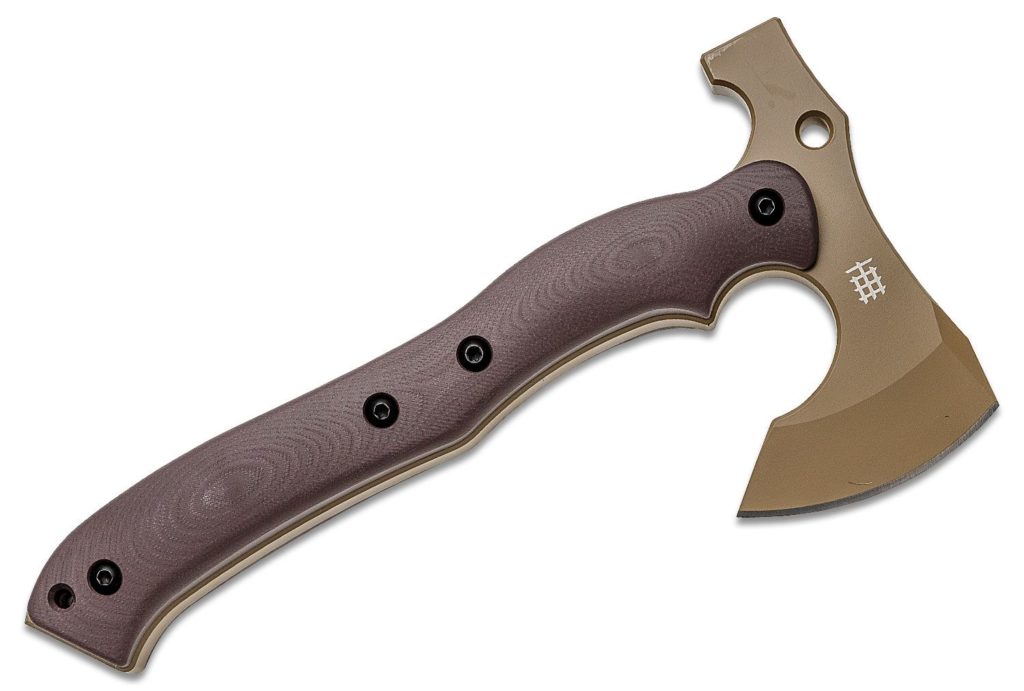
The Halfbreed Blades CRA-01 Hatchet: Made ready for extreme hard use, this multi-purpose tool is ideally suited for MOE, CQB, Rescue, and Survival roles and tasks. Photo Source: knifecenter.com
The Halfbreed is a very heavy-duty piece. It is thick and hefty, and capable of taking a serious beating and dishing one out. This variant is finished in a dark earth color and comes with a substantial sheath that allows for secure carry adaptable to a variety of belts and packs.
Notable is how heavy the little hatchet is. It feels very nice in the hand and allows for either a low or high grip depending on the task. The grip is round in profile and consists of somewhat smooth scales. The edge out of the box was shaving sharp and easily removed hair from the arm.
The high, comfortable grip allowed for great control when scraping tinder. It also was a beast breaking bricks to make a windbreak for small fires. That said, it is not great for splitting tasks and, due to the thickness of the edge, does not bite deep for chopping. The grip is very comfy for general chores, though because the hatchet has equal weight dispersion along its length, it can fatigue your hand in use. It can be swung quite hard but there is a great deal of wasted energy in each strike because the head doesn’t carry the bulk of the forward momentum.
The dark earth finish was also the fastest to come off in heavy use. This is to be expected; however, be aware that if used heavily, the hatchet head likely will show wear far more than the other review subjects.
In terms of fire-starting ability, the CRA-01 proved mediocre as a striking tool, though it was very easy to control the direction of the sparks. Overall, it is fine for small fire-starting work and if it was what I had, I could easily make it work.
HALFBREED BLADES CRA-01 SPECS: Style: Tomahawk Head Style: Curved edge w/hammer poll Blade Material: K110 D2 tool steel Head Thickness: .31” Blade Finish: Dark earth (available in Ranger green and black) Handle Material: G-10 Weight: 1.7 lbs. Sheath: Kydex w/safety strap, belt and PALS/MOLLE mounting options Overall Length: 9.52” MSRP: $400+
Winkler Knives Highland Hatchet
The Winkler has a full tang with scales attached. Worrisome for fear of the handle cracking in hard testing but it held up nicely. The finish is matte and held up well. It has a durable sheath that is simple and intuitive to use.
Despite the edge angles, it bit right into most wood, easily de-limbed trees and handled very light splitting. It stood no chance of taking a large log apart, though anything under 3 inches in diameter was taken to task.
For hammering and strength testing the Winkler held up extremely well. It broke bricks in a single strike and took very little finish damage in the process. Tent stakes were easy to drive in and were barely worth a mention, as a nice part of this little hatchet is it handles just like a 4-ounce tack hammer.
The Highland is a reliable fire maker, generating a showers of sparks and getting a flame going given equal materials. The edge showed no handicap in making kindling.
SPECS: WINKLER KNIVES HIGHLAND HATCHET Style: Camp hatchet Designer: Daniel Winkler Head Profile: Hammer poll Blade Material: 80CrV2 carbon steel Blade Finish: Black oxide Head Thickness: .336” Handle Material: Maple (laminate and walnut available) Weight: 20 ozs. Overall Length: 10 7/8” Sheath: Lined Kydex MSRP: $550
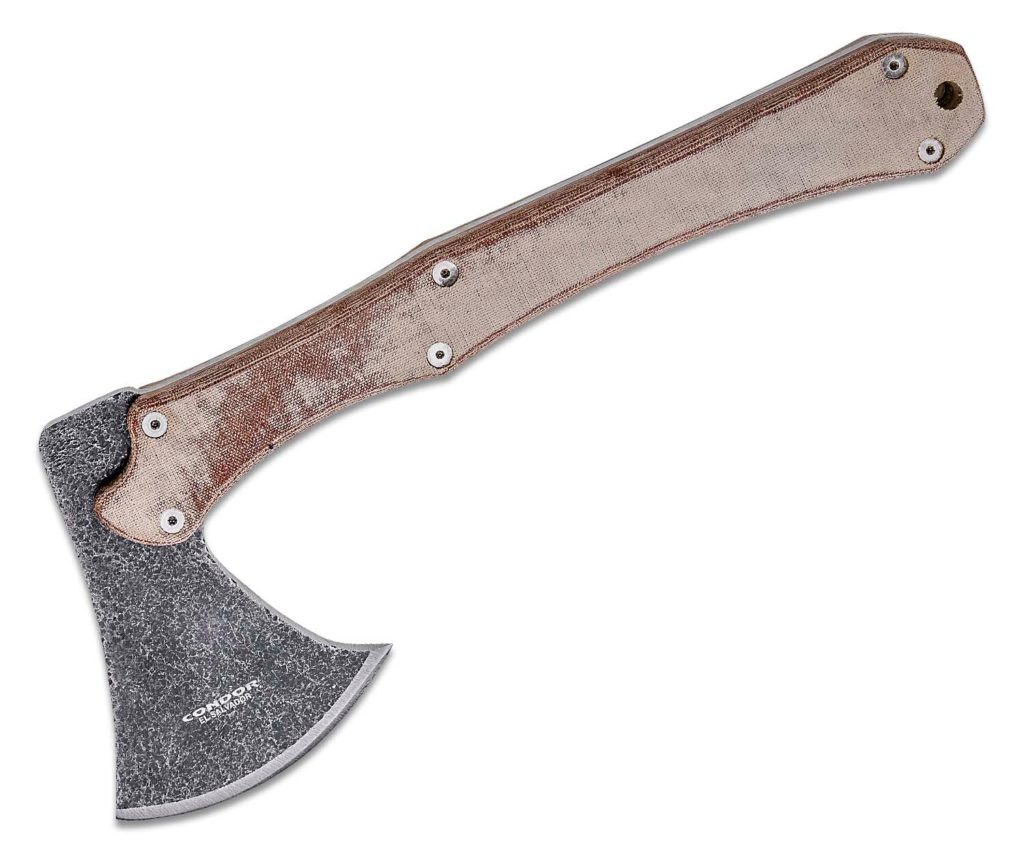
Condor Tool & Knife Mountain Pass AXE
knifecenter.com
The Condor Tool & Knife Mountain Pass might be classified as a jungle hatchet. It has a low beard and narrow thickness that is arguably much better at cutting wet wood, vines and bamboo in fast, repeated swings. For all intents and purposes, it is a foliage tool. As such it isn’t something for heavy splitting and camp chores. It ships with a very nice sheath of brown leather.
Swinging the Mountain Pass allowed for fast, accurate strikes. It bit in deep with each blow and was easy to withdraw. The edge was perfect for a camp axe when it arrived—not too sharp, not too obtuse. It handled limbs like a pro but was not up to heavy splitting. It sank in but lacked the mass to deliver sufficient splitting energy on the strikes.
A downside to hitting hard wood and other materials is Condor’s profile of the grip. It is visually appealing and very functional but narrow in cross section and wide front-to-back, thus making the impact of each hit apparent in a smaller area of the hand. If the grip was even 1/16 inch wider on each side it would have been an easy favorite in this test.
As far as hard camp work it broke brick easily with one hit, took little damage and easily drove tent stakes. It is not intended for either of these roles, but it did just fine considering it lacks a hammer poll.
The Mountain Pass was not particularly good at splitting fine kindling, but it did well and was easy to strike on, if not a bit large. Putting it in this role immediately made me realize it was really not meant for the work; it’s far better for clearing brush and gathering medium branches to process with a smaller tool.
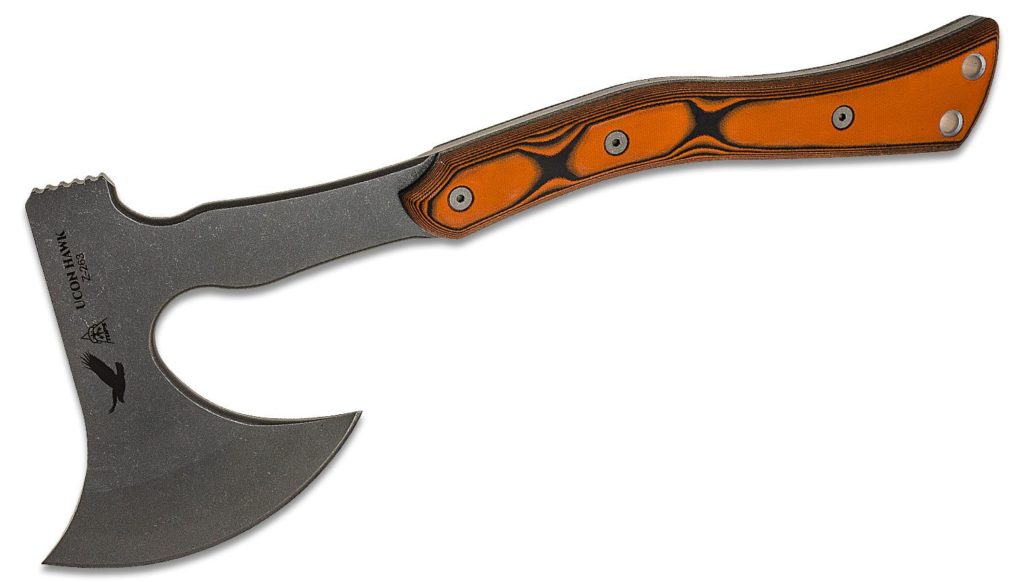
The Ucon Hawk from TOPS Knives is probably the most visually striking hatchet in the evaluation, as well as the sharpest. It’s large with a wide cutting edge and deep belly. It has a long, very pointy and sharp beard and a substantial grip. It’s questionable the edge needs to be as sharp as it is; a dull knife is clearly a danger but an extremely sharp, full-size hatchet can be a hazard.
The Ucon’s size makes it adept for general camp tasks. However, when it came to splitting, the deep belly and sharp tips made pulling it out of a stubborn log relatively dangerous as the blade rarely penetrated all the way, thus leaving the tips exposed. If you were to put your foot on the log to apply pressure to withdraw the head, a possibility exists that you could injure your foot in the process.
That said, performance was fantastic as a camp tool and it could simply lop off branches in a single swing. The finish held up nicely and the edge stayed sharp even after hard use. It should be noted that only the TOPS and the Winkler had edges unaffected by use. The Ucon ships with a two-part sheath—one part goes over the blade and the other is a belt loop the hatchet can slip through.
For heavy-duty tasks it did well, easily passing through limbs. Splitting was possible, though the hatchet was a bit thin and grip-heavy to dive deep enough to separate a full-size piece of firewood. Breaking brick with the hammer poll was easy; it left virtually no damage to the tool. Driving tent stakes also was easy.
Making fire was a challenge in that you had to be extremely aware of where the tips of the edge were at all times. If you get in the mode where you’re striking rapidly, say if you’re cold and frustrated, you need to calm down and take your time (as you should always do when using any sharp edge). The Ucon produced the finest kindling of the bunch by scraping with its sharp edge. The hatchet needs to lose the super-pointy beards—otherwise it is a great performer.
SPECS: TOPS KNIVES UCON HAWK Style: Camp axe Designer: Leo Espinoza Blade Material: 1095 carbon steel Blade Finish: Tumble Head Profile: Curved blade, hammer poll Head Thickness: .25” Handle Material: Orange and Black SureTouch G-10 Weight: 1.94 lbs. Overall Length: 15” Sheath: Black leather MSRP: $330
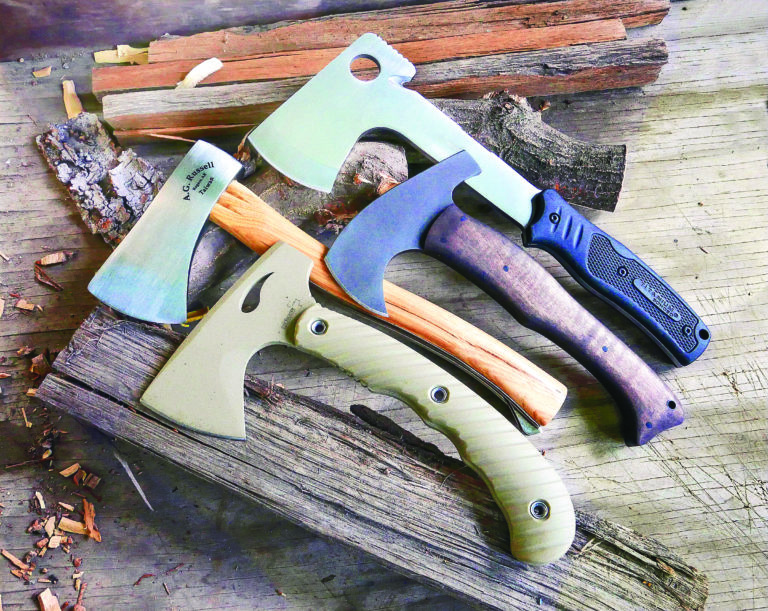
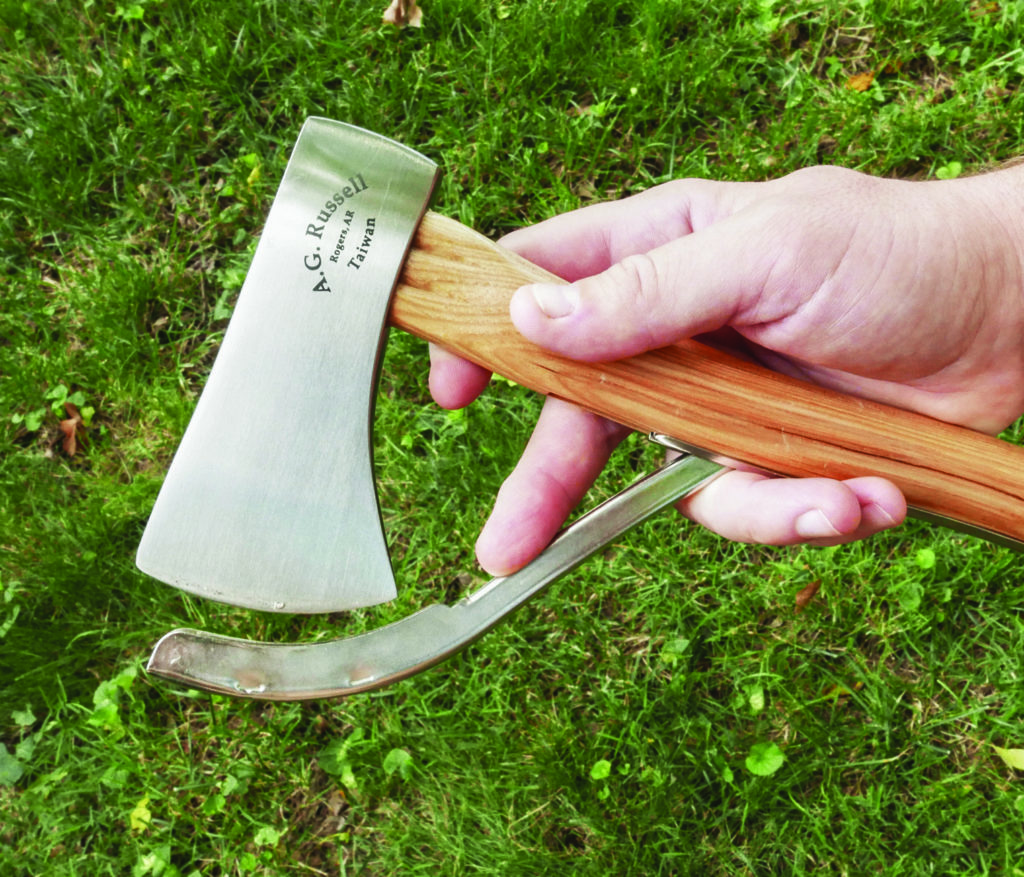
A.G. Russell Pocket Safety Axe
The fold-out blade shield of the Russell Pocket Safety Axe is pure wizardry, especially considering the design is well over 100 years old. You won’t be caught saying “Where did I put the sheath?” with this one.
The A.G. Russell Pocket Safety Axe is a Marble’s design from circa the early 20th century. Marble took a small hatchet, 10.6 inches overall, and designed a fold-out metal shield in the handle to cover the bit in lieu of a sheath. Simply ingenious. The A.G. Russell version has a 4.5-inch 1070 spring steel head with a 2.4- inch cutting edge, and a typical old-school hammering base at the rear. The head has a distinctive three-slot mounting system Marble deemed superior to the standard oval style. The 8.8 inch handle is hickory and the whole kit and caboodle weighs 1 pound. Manufacturer’s suggested retail price: $79.95.
With much of its overall weight in the head, this is a very top-heavy hatchet—which can work to its advantage. In the bite test on the privet log, the Pocket Safety Axe finished first simply because the business end has a lot more weight (see the side-by-side comparison image on head thicknesses). Consequently, it chopped each test material well.
The fold-out bit shield has pluses and minuses. On the upside, it’s very convenient and there’s no sheath to keep up with. On the other hand, you have to pack it since there’s no belt-sheath option. Also, you’ll want to wear gloves for extended use, as the hinge mechanism in the handle can dig into the inner fingers. All in all, though, the Pocket Safety Axe is a stellar performer.
SPEC CHECK: A.G. RUSSELL POCKET SAFETY AXE Cutting Edge: 2.4” Blade Material: 1070 spring steel Head Width: 4.5” Head Thickness: .7” at the thickest Blade Coating: None Handle Material: Hickory Special Features: Metal blade cover in handle Carry: Pocket or pack Weight: 1 lbs. Overall Length: 10.6” MSRP: $80
Boker Plus Escape Hawk
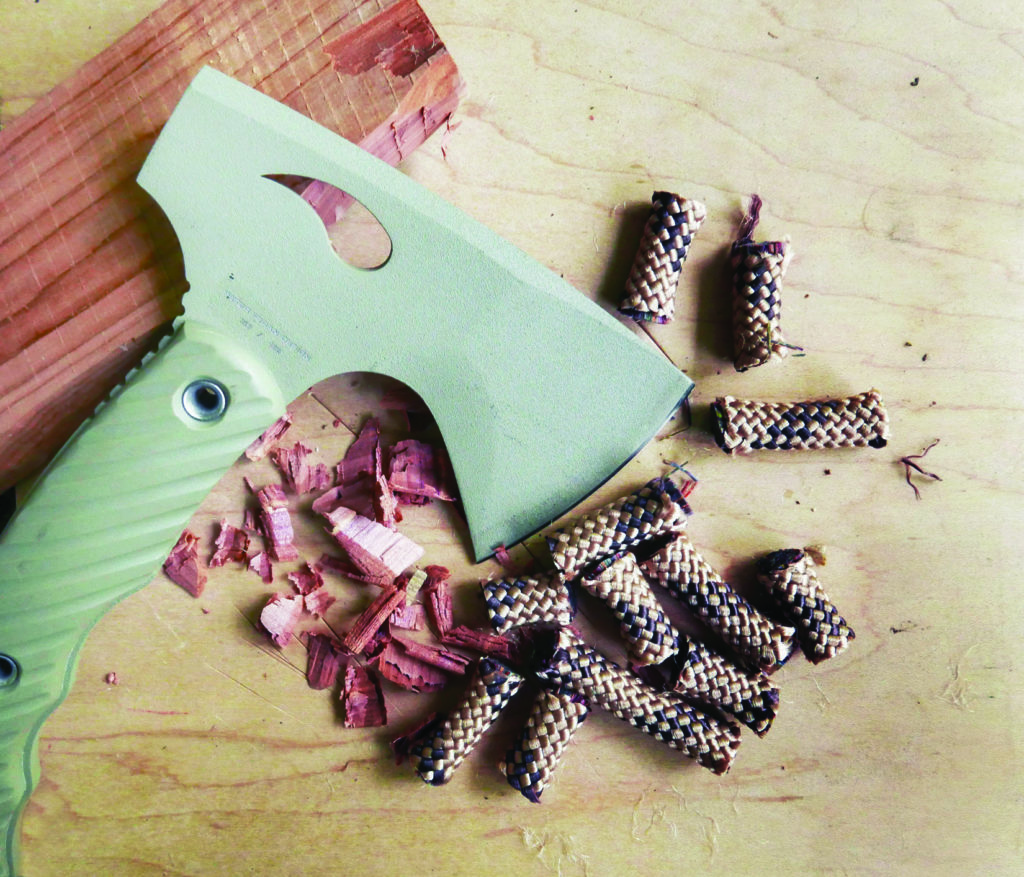
Designed by Australian knifemaker/ designer Peter Fegan, the Boker Plus Escape Hawk is tactical in design. Hawks are primarily used for breaching and combat but can full other chores as well. Only 9 inches overall, the Escape Hawk has a 4.75-inch head of quarter inch-thick SK5 tool steel and a 2.56- inch cutting edge. The head has enough beard to be used for carving, and the curved 7-inch handle is adorned with nicely sculpted, diagonally grooved FRN ( berglass-reinforced nylon) scales. The butt can be used for hammering. The steel is protected throughout with a powder coat. A dual-strap Kydex sheath covers the head. MSRP: $189.95.
The Boker Plus Escape Hawk is a hatchet in disguise. The small hack-it’s 2.56-inch SK5 tool steel bit chopped rope in nice, clean lops, and hacked off nice-sized cedar tinder chips with ease.
Due to its small size, you won’t be doing much breaching with the Boker Escape Hawk, but the pint-sized hack proved its worth. The SK5 steel had plenty of hack, chopping rope in nice, clean cuts, and knocking out chunks of seasoned cedar for tinder. Though the bearded bit can be used for carving, the inward slant of the handle mounting to the head impedes its effectiveness for the purpose a tad. The handle has full-length scales—a bonus for freedom of grip—and the diagonal grooves afforded it the best purchase of the bunch. The Boker Escape Hawk is a hawk that thinks it’s a hatchet.
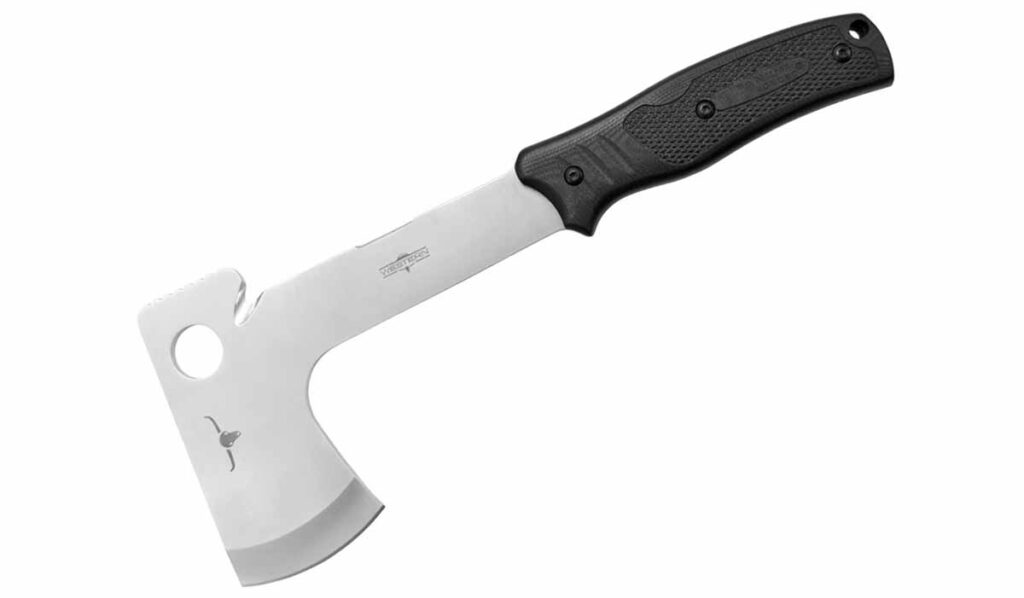
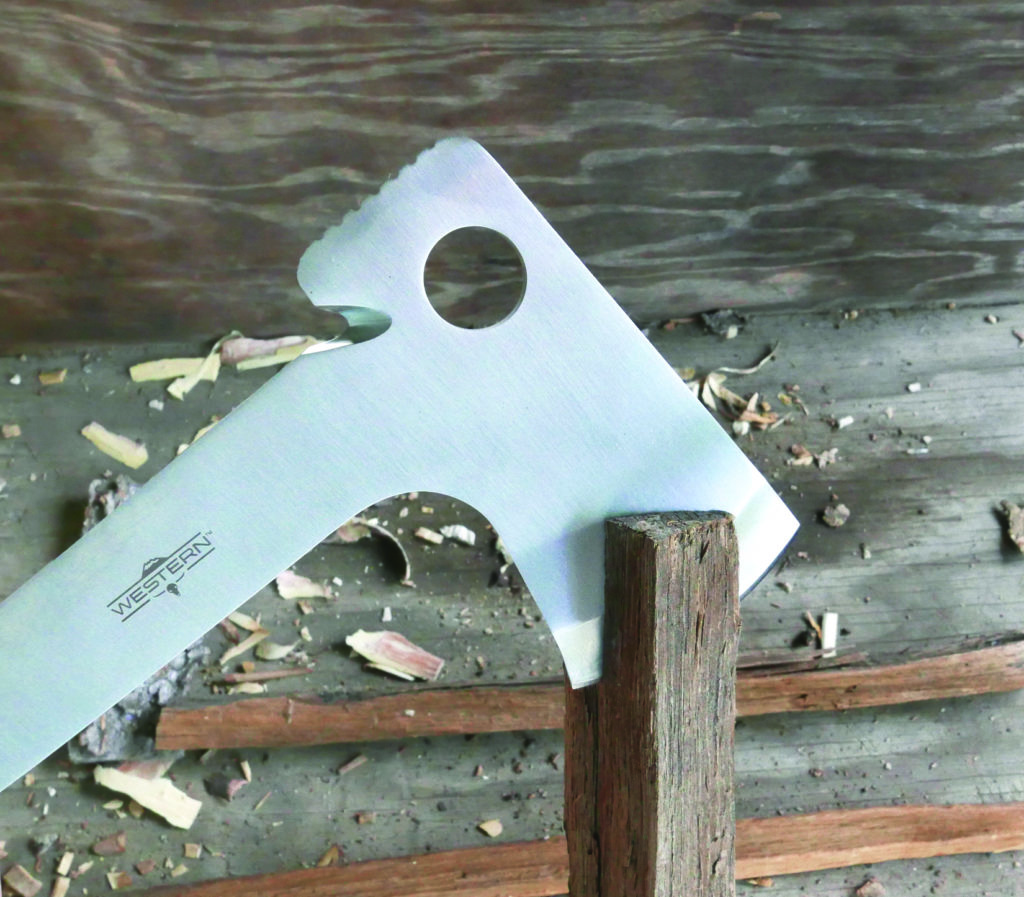
At 11.5 inches, the Western Blackriver Long Hatchet from Camillus is, indeed, the longest of the test hack-its. It sports a 4.5-inch-wide head with a 2.5-inch chopping edge. On the back side of the head is a gimped flat edge for hammering and a sharpened diagonal slot for cutting cord. The 9.5-inch handle has 5.25-inch black checkered rubber scales, and there is a shaving slot midway between the handle and the head. A ballistic nylon sheath with a firesteel pouch—with firesteel—is included. MSRP: $31.98.
The Western Blackriver Long Hatchet from Camillus is the batonner of the bunch. The thin bit cleaved into the tight hardwood grain like a thief in the night. Once the head was in, the final splitting was done by batonning the upper handle.
The Blackriver has the lightest head of the test group so it didn’t win the chopping wars, but its length and handle design give it a leg up on the others in some functions. The thin head is ideal for batonning, enhanced by the 4 inches of exposed steel below the bit, which can be used as a striking surface. The grip is very comfortable, the rubber scales aiding in impact absorption. The Blackriver will handle many chores around the camp, and the bonus firesteel and pouch on the sheath add value. It’s also by far the most affordable of the group.
Camillus/Wester Blackriver Long Hatchet Specs Cutting Edge: 2.5” Blade Steel: 420 stainless Head Width: 4.5” Head Thickness: .2” Blade Coating: Titanium bonded Handle Material: Rubber Special Features: Firesteel included Carry: Ballistic nylon belt sheath Weight: 1 lbs. Overall Length: 11.5” MSRP: $32
Winkler Hunter Axe LT
At only 9 inches long, the Winkler Hunter Axe LT is a small hack-it, but packs a full 19 ounces of weight—and that’s with a skeletonized handle tang. The Hunter Axe LT has a 3.5-inch-wide, bearded 80CrV2 carbon steel head with 2 inches of cutting edge, and there’s a hammering base out back. The steel thickness is a healthy .25 inch and is coated head to toe in Caswell black oxide. The scales are full-length, highly attractive curly maple. A padded Kydex sheath with nylon belt loops covers the head, and employs a shock-cord retention system for a quick draw. MSRP: $450.
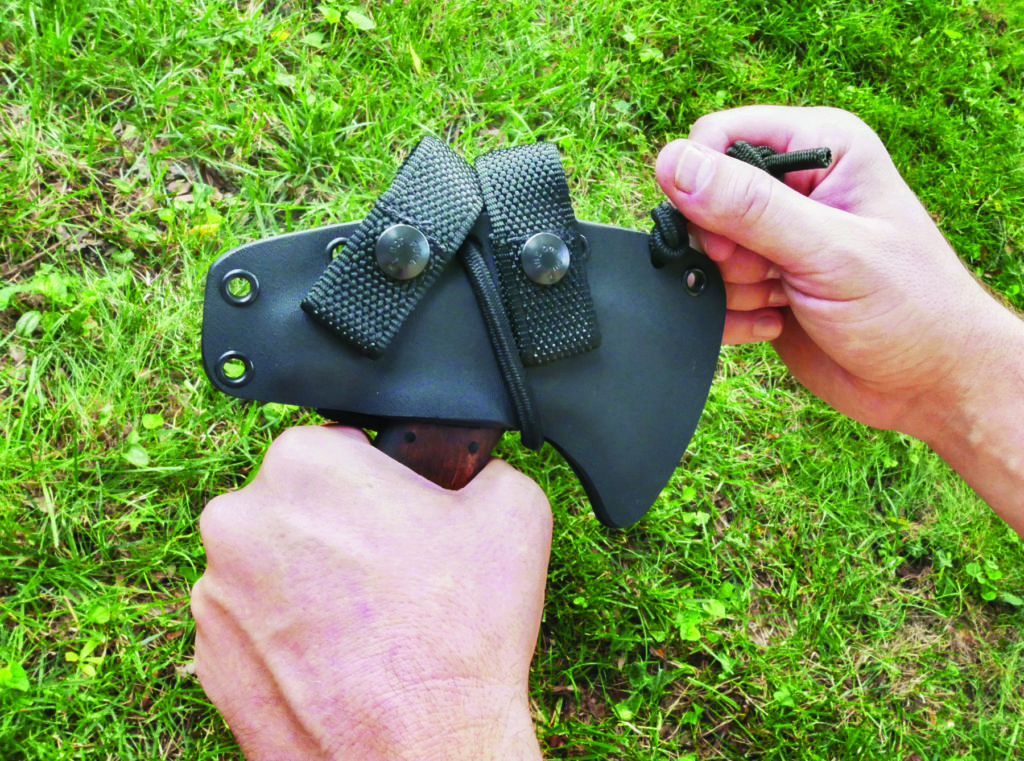
The Winkler Hunter Axe LT’s Kydex sheath has a bungee-style tension cord for quickly releasing the axe from its housing. The sheath as a whole is very well made—a Daniel Winkler trademark.
The Hunter Axe LT may be short but at 19 ounces is the heaviest of the test hack-its—a full 2 ounces more than its nearest rival. The LT almost won the bite contest but didn’t due in part to its weight being more equally distributed than the top-heavy Russell Pocket Safety Axe. The 80CrV2 steel chops extremely well and the Caswell finish is very tough. Though not a carving axe per se, the LT was our best candidate for the chore and would have performed even better with a lower grind angle on the lead edge. The price is high but the Winkler is as close to a custom as you’ll get—plus, the sheath is a marvel in itself.
WINKLER HUNTER AXE LTSpecs Cutting Edge: 2” Blade Material: 80CrV2 carbon steel Head Width: 3.5” Head Thickness: .28” Blade Coating: Caswell black oxide Handle Material: Curly maple Special Features: Skeletonized handle Carry: Kydex belt sheath w/tension release Weight: 1.9 lbs. Overall Length: 9” MSRP: $450
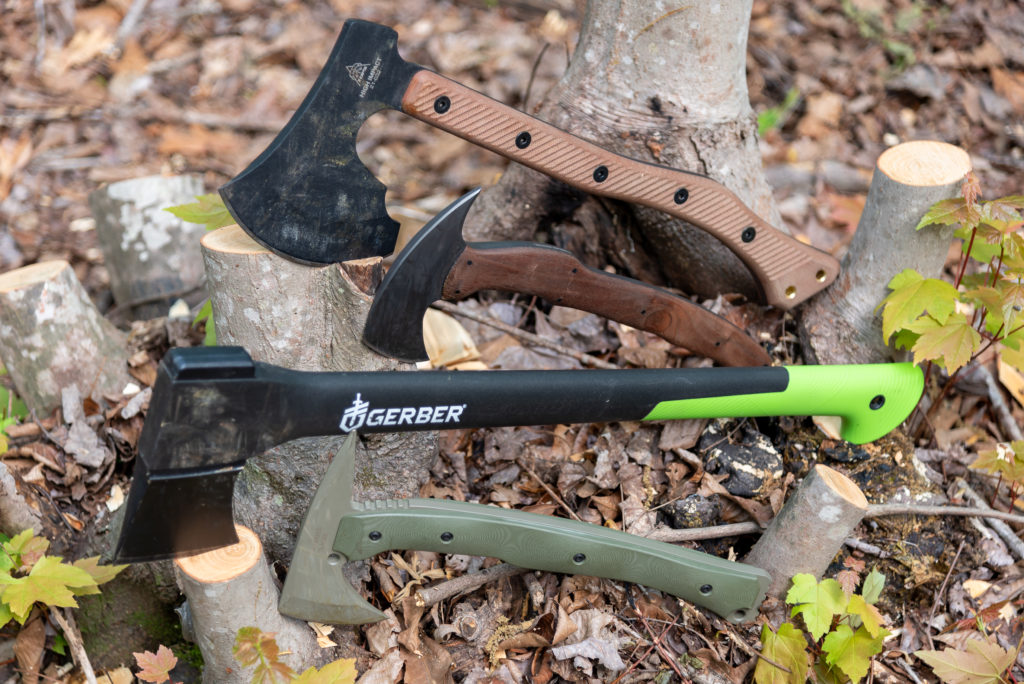
Gerber Freescale Axe
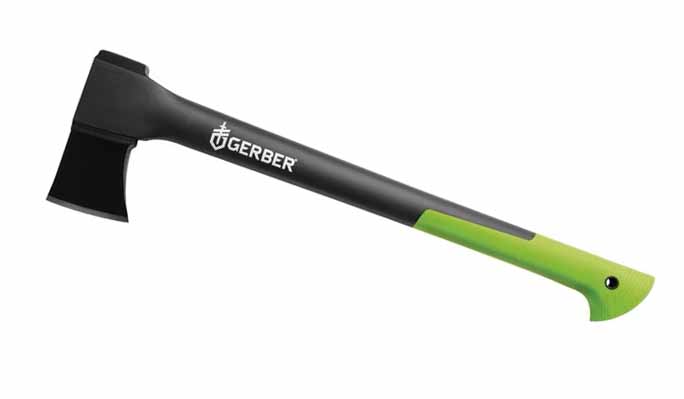
Gerber has had a successful series of axes and hatchets made in Finland that feature one-piece, hollow, molded handles for lightweight, optimum strength. An example is the 23.5-inch model in its Freescale series. The forged steel head is mated permanently to a lightweight composite handle, so there is little worry the handle will come loose during use. The oblong profile handle is hollow, which shifts the balance of the axe to being head-heavy. It is very forward weighted and that is a good thing. Use gravity to your advantage as you employ the axe, allowing it to fall naturally as you guide it. A tactile gripping surface in a contrasting green graces the handle. The handle flares at the butt, allowing your bottom hand to hook into it, trapping the handle in your hand so it doesn’t go flying. The handle style reportedly is virtually indestructible during heavy use.
The forged head exhibits a nice, steep “V” profile to help bite hard and deep into wood. A primary edge bevel thins the edge some and makes resharpening easier. A black PTFE coating provides additional corrosion resistance as well as a nonstick surface. A poll is designed as a hammer.
The Freescape is among the least expensive of the review axes, though don’t discount its performance based solely on price. Truth is, this axe is devastatingly effective. With each swing you can feel the forward-weighted balance power the Freescape through wood. The thickness and shape of the handle are just right, allowing a secure grip with both hands. Gerber includes a plastic caddy that seals the cutting edge and protects you and your belongings from being cut. The caddy has a large handle to carry the axe safely, as well for hanging on a pegboard in your garage or utility shed. For how it performs versus what you pay, it is an excellent value. If you’re a frequent axe user or just an occasional one, the Freescape will serve you very well.
Gerber Freescape Axe Specs Cutting Edge: 3.5″ Head Material: Stainless Steel Head At Its Thickest: N/A Handle: GFN Weight: 3.6 lbs. Overall Length: 23.5″ Sheath: Plastic, carry handle MSRP: $70
Winkler KnivesRnD Compact Axe
The tang sports a distal taper toward the handle butt of the Winkler RnD Compact to improve balance and shift weight distribution toward the head. Note the humpback in the handle.
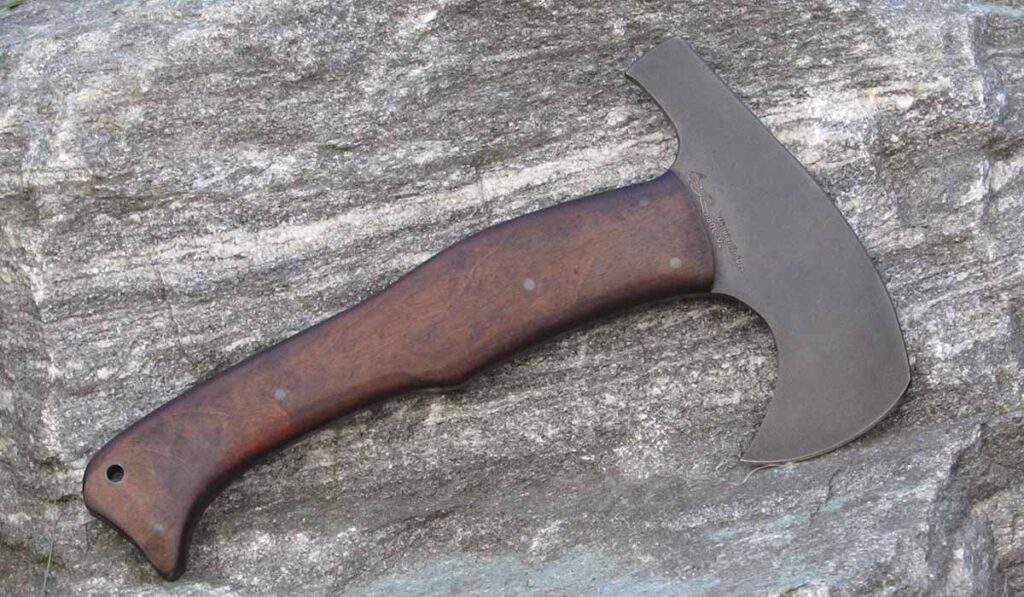
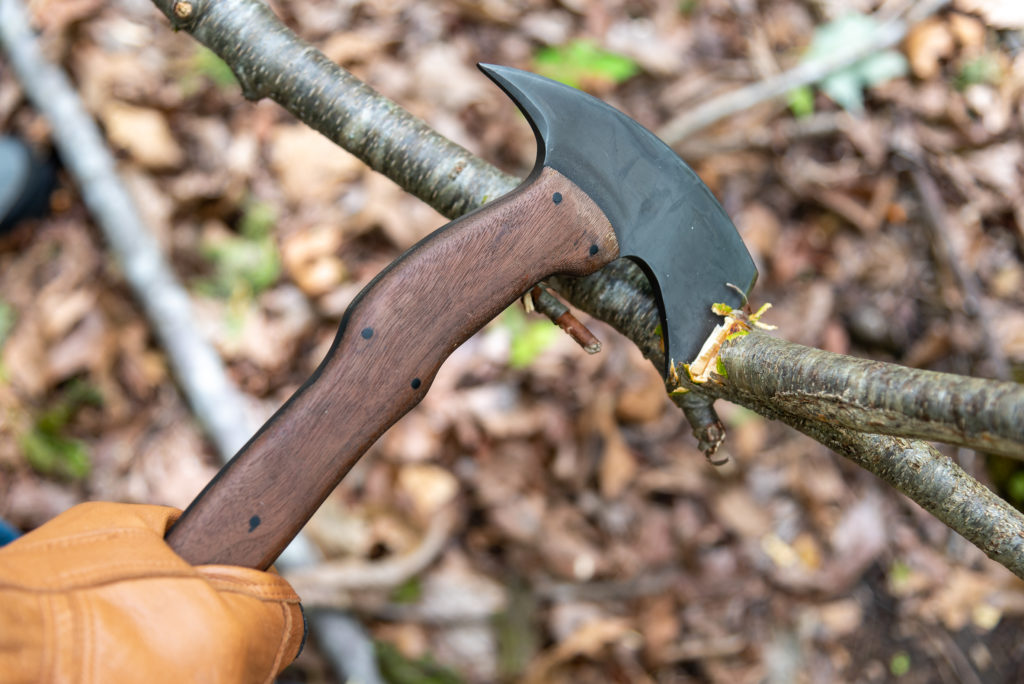
A spike model, the RnD Compact Axe is the smallest in the Winkler Knives (WK) axe line, though that doesn’t mean it’s the least capable. The hatchet-like head is only 5.5 inches long. The 80CrV2 carbon steel head is ⅜ inch wide. The tang sports a distal taper toward the handle butt to improve balance and shift weight distribution toward the head. The spike is commonly found on tomahawks and does everything from prying to puncturing. WK also offers a front spike option integrated into the head’s main cutting edge. A black oxide finish helps resist corrosion.
The 80CrV2 offers extreme toughness and edge retention. It withstands an impressive amount of abuse yet remains easy to resharpen, even in the field. Daniel Winkler is a fan of 80CrV2 and uses it a lot for both his knives and axes.
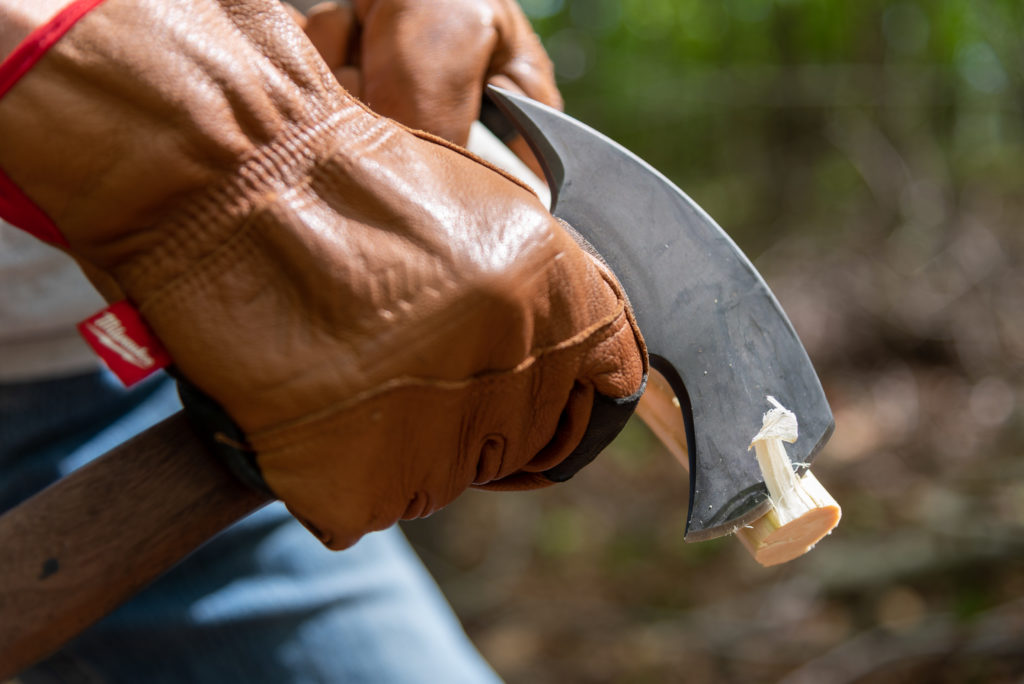
The handle features two prominent grip positions. One is the traditional axe grip held close to the butt. A series of subtle finger grooves seats your fingers, and the butt has a bird’s-beak design that hooks the handle into your hand to prevent it from sliding from your grip. A secondary close-quarters grip is below the axe head at the handle’s humpbacked portion. This facilitates choking up for control in carving, whittling and using the cutting edge like a knife. The RnD feels very balanced and agile in the latter grip, one the other review axes don’t offer. The Winkler would be great at processing kindling and bushcraft chores that require more control with close-in cutting or whittling. Due to its length and weight, it would not be a primary use axe but maybe a complement to a larger model that does heavy splitting or felling chores.
A secondary close-quarters grip is just below the head of the RnD Compact at the handle’s humpbacked portion. This facilitates choking up to provide control for carving, whittling and using the cutting edge like a knife.
The walnut handle looks luxurious but pay heed to where you lay it down in the woods. The walnut’s color blends in well with leaf ground cover and you might lose it easily. Thread a loop of brightly colored pink, red or yellow paracord through the lanyard hole to make the handle stand out. The RnD comes in three handle materials: black Micarta®, maple and walnut.
A molded form-fitting sheath of Boltaron encloses the head. A thick shock-cord-quick-release-retention device secures the sheath in place, yet releases easily and quickly. An interior felt lining facilitates the easy slipping on/off of the sheath, as well as muffling the sound. Two nylon webbing belt loops enable the RnD to ride comfortably at your side. MSRP is $815, the most expensive of the test group. WK is very well known for manufacturing excellence and attention to detail, and the RnD Compact is no exception. For a bigger axe in the same design, check out the full-size model.
Winkler KnivesRnD Compact Axe Specs Cutting Edge: 2.25″ Head Material: 80CrV2 carbon steel Head At Its Thickest: 3/8″ Handle: Walnut Weight: 1.3 lbs. Overall Length: 11″ Sheath: Boltaron MSRP: $815
TOPS Knives High Impact
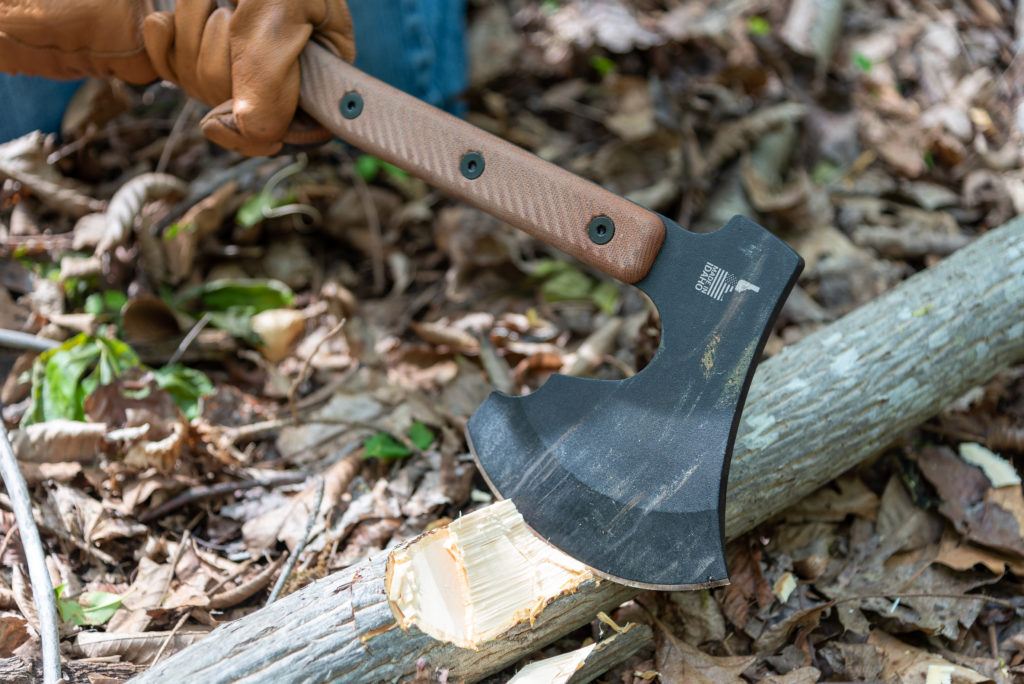
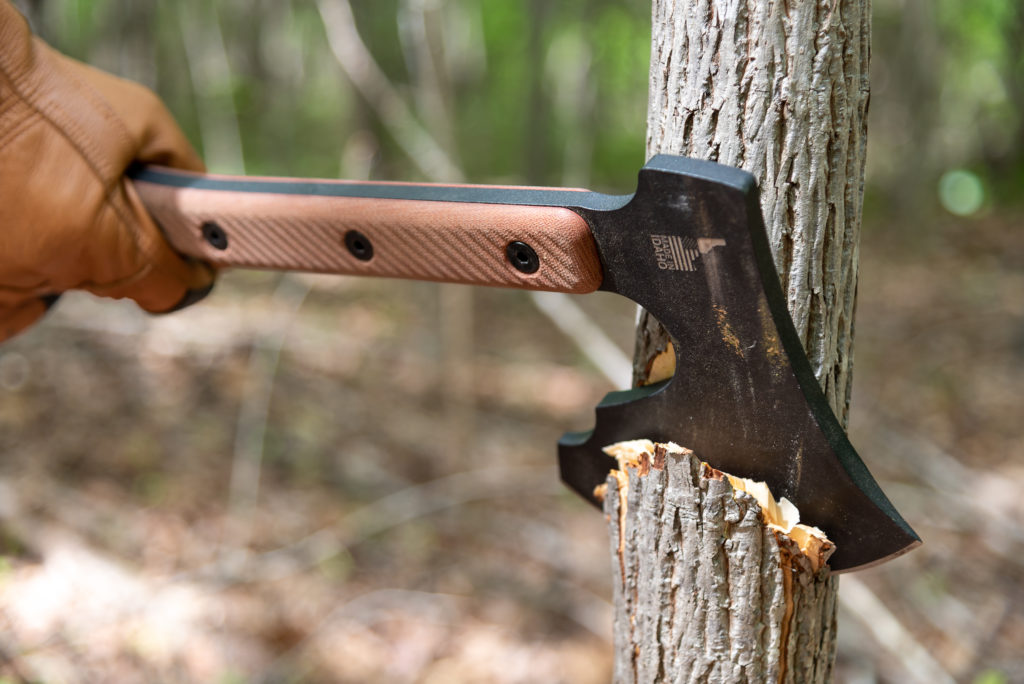
The High Impact’s curved cutting surface allows it to be devastatingly effective as a chopper, including sectioning the trunk of a sapling for easier handling.
The TOPS Knives High Impact is a full-sized hatchet/small axe hybrid that packs a punch. At 20 inches overall and around 3.5 pounds, it is a formidable chopping tool that can be used with two hands as a traditional axe or one handed a la a hatchet.
Starting with a backbone of .38-inch-thick 1075 carbon steel, the High Impact’s main cutting edge is a little over 5 inches—plenty of cutting surface for large and small chopping jobs alike. The Black Traction Coating creates a layer of protection against corrosion and wear. The ergonomic handle is tan Micarta®, with a diagonal machined groove pattern for hand traction. Five pairs of large hex head screws fasten the Micarta scales, and there are two large brass-lined lanyard holes. The handle has a distinctive bulge that helps seat your grip, especially for one-hand use. The handle flares at the butt, creating a comfortable seat for your bottom hand when using two hands.
The first thing you notice is the High Impact’s weight. It’s impressive but will take some getting used to. Once acclimated with the heft, you will discover it is also an advantage for getting momentum in your swing. And when it hits, it lives up to its name. The High Impact takes out chunks of wood with each blow. TOPS has the heat treat on the carbon steel dialed in perfectly. The 1075 retains an edge really well but sharpens easily and quickly.
The TOPS Knives High Impact is a beast. It has heft and momentum to bite deep and hard with each swing. The ergonomic handle makes it possible to use the axe with one or both hands.
I tried both grip styles. With one hand, this is where the weight takes some getting used to. Due to the axe’s weight, one-handed use might be limited to short spells. Conversely, using two hands is where the power of this beast is unleashed. You can put power behind the swing and each blow is devastating. You can feel the axe head bite in with each blow. It’s a sure bite as well. The performance with one or both hands is equally impressive. Due to its weight, it’s a great candidate to store in your truck or ATV.
A nicely made leather holster fastens over the head, sealing the edge. Two button-snap straps secure it, though only the one at the end needs to be undone to slide the sheath off. Note the absence of a belt loop attachment to carry the axe. It’s just too heavy. Despite the weight being a factor, the High Impact packs a serious punch and is the heavyweight champ of the test bunch. MSRP: $360. TOPS makes the axe in its factory in Idaho Falls, Idaho.
TOPS Knives High Impact Specs Cutting Edge: 5.75″ Head Material: 1075 RC 56-58 Head At Its Thickest: .38″ Handle: Tan Canvas Micarta Weight: 3.7 lbs. Overall Length: 20″ Sheath: Leather MSRP: $420
Wolf Valley Forge Camp Axe
The Wolf Valley Forge axe ate bundle after bundle of firewood like there was nothing to it.
The Wolf Valley Forge Camp Axe is in a class of its own. It came not with just a functional sling and cover, but also a small whetstone and a jar of wax by Axe Wax to help preserve it. Carrying the Camp Axe is comfortable and allows for a free hand while trekking. The handle is perfectly shaped and came with a leather strike guard.
Ike Bullington is the maker and the quality is immediately noticeable the second you unpack it. It is all properly shaped, textured and balanced for real work and has a very pleasing appearance. However, it is not a wall-hanger. The head is of a traditional profile and designed for a lifetime of work.
The edge arrived razor sharp, easily sharper than most knives. Not only that, but the edge is extremely durable and completely dispels the notion that you need a wedge-shaped splitter.
A sharp axe truly cuts the work in half and this one almost effortlessly passed through wood regardless of grain angle. In taking down bigger trunks it drove in the deepest and was the easiest to free. Chips flew with each chop and it made very short work of even the toughest test materials.
In addition to cutting wood, it was tested driving tent stakes and making kindling, which it did easily. As a camp axe it is very nice in the batoning role, and yes, you can baton an axe the same as you would a knife—so long as you grip it high up to the head and perform the task in a safe standing position as to not deflect the blade into your knee.
Wolf Valley Forge Camp Axe Specs Cutting Edge: 4″ Head Material: 4142 Head At Its Thickest: N/A Handle: Hickory Weight: 2.5 lbs. Overall Length: 23.62″ Sheath: Leather MSRP: $375
Fox Sekira
Considering what you get, the Fox Sekira is a great axe and relatively inexpensive. It handles like a traditional axe in the swing but has a crescent-profile edge that is shaped much the same as a carpentry axe, though with a longer handle. The head is wide at the cheeks and quite narrow in the blade. It splits very nicely though isn’t particularly deep-biting on each swing.
The head, while substantial, isn’t overly massive and there is a large concentration of weight in the handle. The weight is distributed across the axe, which could lend to some of the increased effort in getting it to send splinters flying.
As far as general performance, the Sekira is about as good as a traditionally constructed axe gets, and lacks nothing in utility. It stayed sharp and experienced no edge chipping, even after quite a bit of heavy use. The only noticeable downside is that the handle, while comfortable and very nicely finished, is somewhat on the large side and rounded from front-to-back.
When hands get wet or cold the axe has the tendency to want to rotate, which can be dangerous if you’re not holding on tight. Other than that minor issue, the Sekira is a fantastic axe that should offer years of hard-use service.
Fox Sekira Cutting Edge: 4.33″ Head Material: Carbon Steel C45 Head At Its Thickest: N/A Handle: Hickory Weight: 3.35 lbs. Overall Length: 23.62″ Sheath: Leather MSRP: $150
Editor’s note: Dexter Ewing, Josh Wayner and Daniel Jackson contributed to this post.
Josh Smith’s new knife company tackles the wild with bushcrafter Marshall Knife.
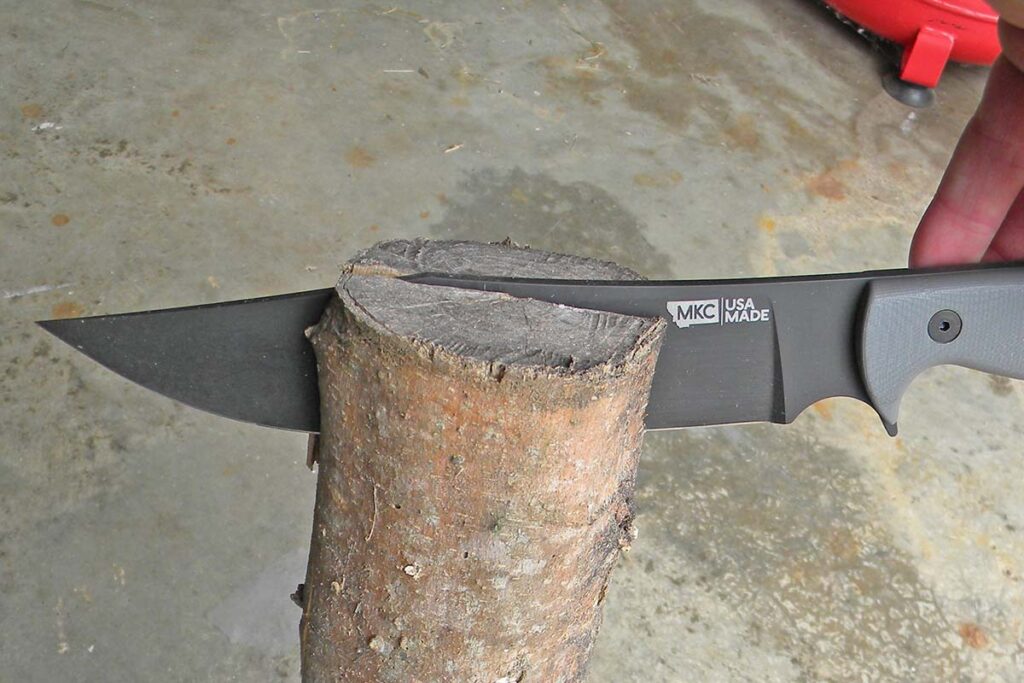
I was surprised at the thickness of the Marshall—.17 inch. Great design makes the blade wider, which adds weight for chopping, yet still keeps the knife lightweight enough to wear all day long without discomfort. The addition of a finger cutout just before the choil is perfect for control during smaller tasks. It is a nice knife on first glance. However, it has to cut and be comfortable to pass muster.
Light-Duty Cutting
To test the edge I sliced 20-pound bond copy paper. Supported by a full flat grind, the edge cut the paper effortlessly. The wide blade made indexing the slices very safe and smooth on each pass. It should be a cutter for sure, I figured.
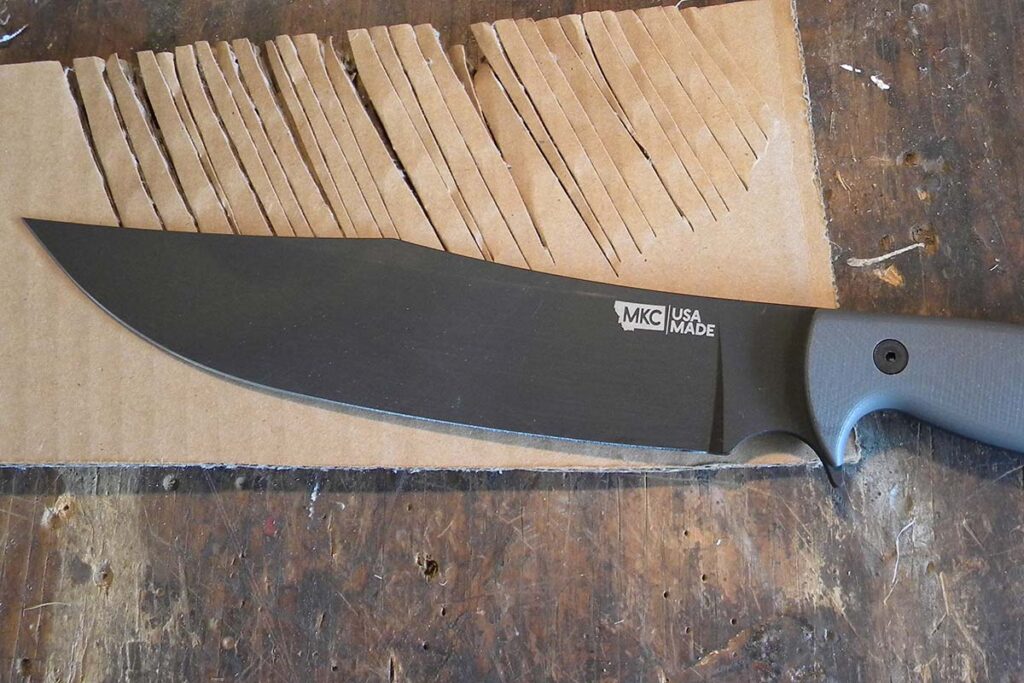
The knife zipped quickly through the double-walled cardboard. The slices were straight with no distortion of the cut pieces.
On to double-walled cardboard. I thought the blade would drag some with the deeper cuts but the Marshall zipped through quickly. The slices were straight with no distortion of the cut pieces. I enjoyed slicing the cardboard with the bigger blade.
I grabbed a piece of plastic board to dispatch while choking up via the finger cutout. This really helped in controlling the finer slices. The Marshall passed through the material quickly. I really like the finger cutout. It balances the knife in use.
Marshall Medium-Duty Chores
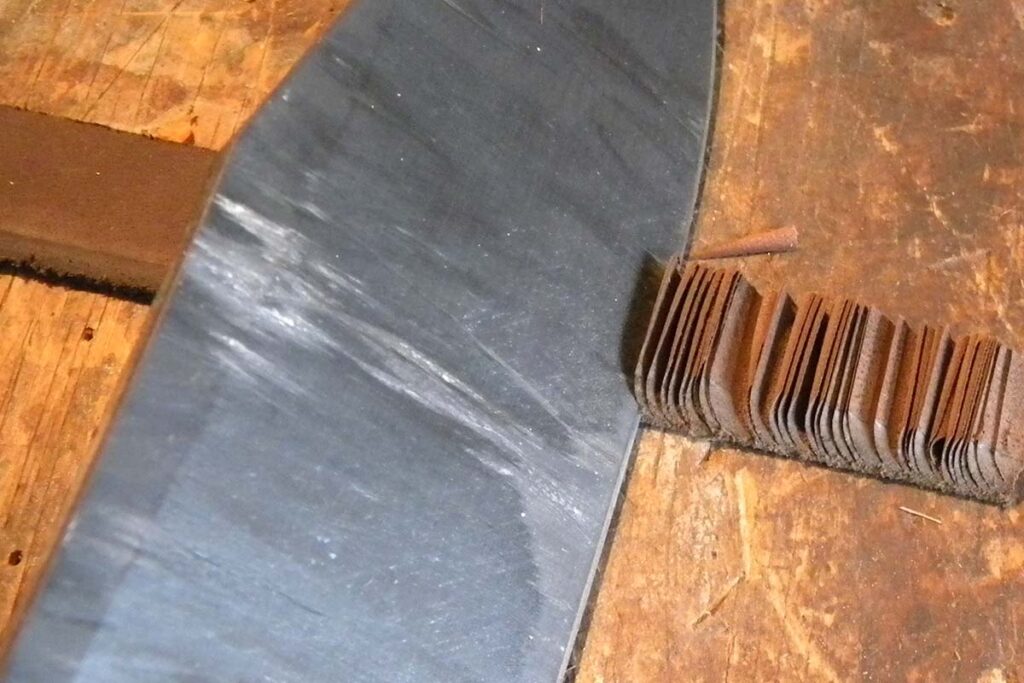
On to my favorite medium, half-inch sisal rope. As I used a push cut, the Marshall started crunching. After 200 clean crunching cuts, I wanted more out of the larger blade, so I switched to 1-inch manila rope. It took 35 crunching cuts to slow the Marshall down. The handle was comfortable throughout. Excellent work from Montana Knife Co.
Crunch, crunch; the Marshall cut nice and aggressive in skiving the 8-ounce leather.
I almost forgot to skive some 8-ounce leather. Crunch, crunch; the Marshall was nice and aggressive cutting the material. The knife provided great control, again using the finger cutout.
Heavy-Duty Cutting
It was time to whittle a firestick. The knife rendered large curly-cues. I tended to push the knife too far and cut the curly-cue off the stick. Don’t you hate it when that happens? The Marshall was controllable during whittling but the blade wanted to take bigger bites. Still, it did a nice job.
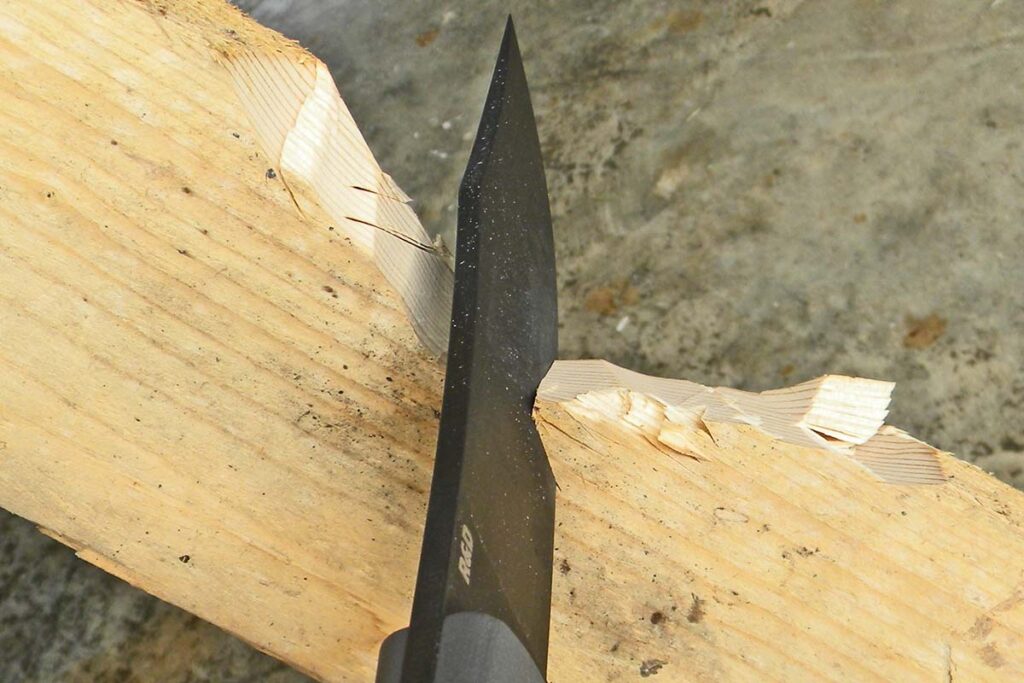
The blade bit deep into the 2×8 every swing and soon the author had wood chips scattered over the driveway. The handle was comfortable and transferred no shock up the author’s arm. It was easy to free the blade from the wood for each subsequent chop.
After rearranging the storage area, I found a piece of 2×8 that would work great for chopping. The blade bit deep every swing and soon I had wood chips scattered over the driveway. The slightly blade-forward balance really shines with chopping. The handle was comfortable and didn’t transfer any shock up my arm. It was easy to free the blade from the wood for each subsequent chop.
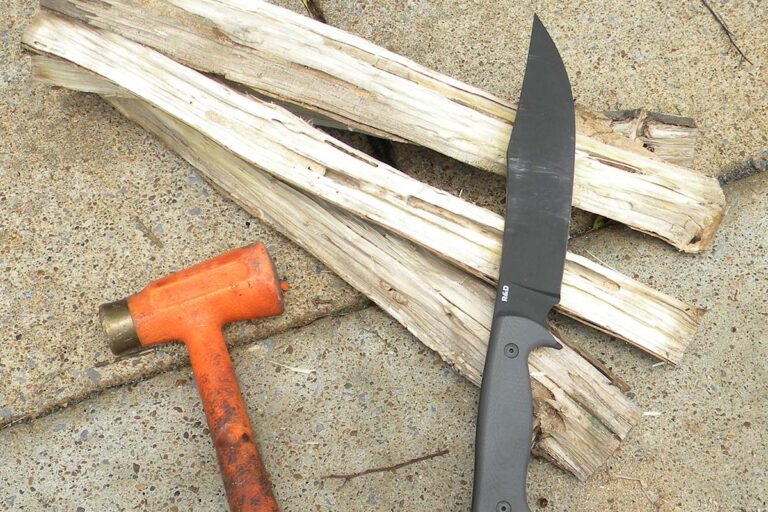
I split some seasoned hackberry using my trusty dead blow hammer as a baton. I split a 3.5-inch piece four ways for kindling. The Marshall penetrated deep with each blow of the hammer, averaging 3.5 whacks per split. The results were outstanding!
The author split some seasoned hackberry with the help of his dead blow hammer. He split a 3.5-inch piece four ways for kindling. The Marshall penetrated deeply with each blow of the hammer, averaging 3.5 whacks per split. The results were outstanding!
It was time for the whitetail antler chop to check for edge toughness. Thirty hard wrist snaps into the antler didn’t damage the edge at all, a sure sign of spot-on heat treatment. Wow!
The last is first—back to the 20-pound bond paper. The Marshall still sliced cleanly. It incurred a snag in the paper but I don’t know if it was because of a mistake on my part or the knife.
Final Cut
The Marshall is an excellent bushcraft knife with a large blade that’s not too heavy. I might make the handle a tad thicker for my personal use.
Consider three hot new throwers for an ancient sport gone international.
Once considered a lost pastime, axe throwing has grown in popularity worldwide. With the founding of such organizations as the International Axe Throwing Federation (IATF), the World Axe Throwing League (WATL) and others, and the pursuit’s establishment as a pub sport in the USA, Canada, Belgium, Poland and elsewhere, more people are interested in this thrilling activity. It’s no longer just a lumberjack’s hobby but an exciting sport most anyone can enjoy.
Condor Tool & Knife Cantina Axe
To get a perfect toe-first stick, adjust your distance by taking a step forward or back. The Condor Tool & Knife Cantina penetrated deeply due to its edge geometry and head weight.
Accompanying axe throwing’s growth in popularity is the demand for high-quality axes. The Cantina Axe from Condor Tool & Knife is an excellent all-purpose tool with features catering to professional axe throwers and seasoned axe users alike. The Cantina is versatile enough for both competition axe throwing and outdoor tasks, making it a valuable addition to any edged-tool array.
Crafted from 1060 high carbon steel, the axe head features a natural darkened finish that adds to its rugged appeal. The 18-inch burnt American hickory handle provides an excellent grip. The 4-inch blade bit weighs about 35 ounces, making it stout enough for outdoor splitting and chopping chores. The design promotes maximum performance, making it an excellent choice for anyone looking for a reliable multi-purpose axe.
Condor Tool & Knife Cantina Axe Specs Blade Length: 4” Blade Grind: Convex Blade Material: 1060 carbon steel Handle Material: Burnt American hickory Weight: 35 ozs. Overall Length: 18” Sheath: Rubber blade cover Country of Origin: El Salvador MSRP: $87.34
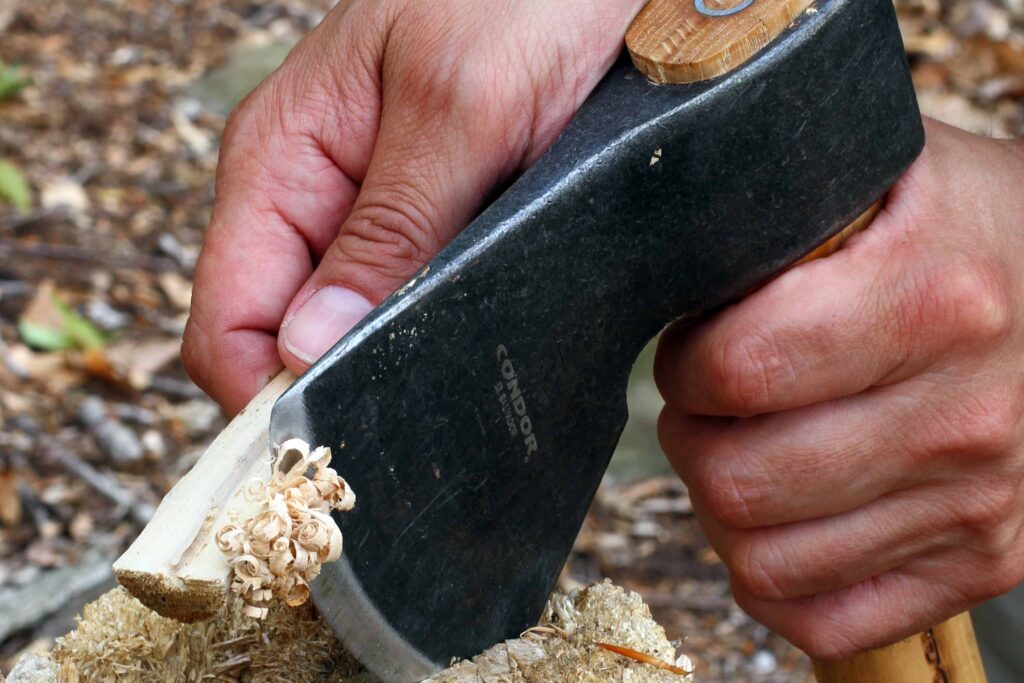
The Cantina’s convex edge made thin curlicues with minimal effort. The edge helps enable the axe to perform as both a throwing and camping tool.
FIELD TEST: The Cantina looks and feels like a small camp axe. The test model came with a good convex edge that stuck in a dead tree target and was camp-use capable out of the box. The head geometry is between a conventional and throwing axe profile. Despite the Cantina being the heaviest of the test bunch, it wasn’t a chore to throw. In fact, the weight helped it stick since the bit isn’t flat like many throwing axes with a pronounced heel and toe.
The handle is straight and burly, with a little more meat at the throat of the axe. It came well-seated and solid. However, after several throws it had a bit of play, though it never came visibly loose. I’m sure a boiled linseed oil bath would remedy this. The straight handle helped propel the axe and elegantly send it into flight.
The Cantina’s distinctive feature is its head shape combined with the convex edge. This makes it a jack of many tasks, easily doubling its duty as a camp axe. I like this aspect the most. The edge shaved fine feathers and chopped and split like a regular axe, with more head weight for its size. If you want to grab one axe and head out covering camp and leisurely axe throwing, the Cantina’s it.
Boker Plus Mohican Throwing Axe
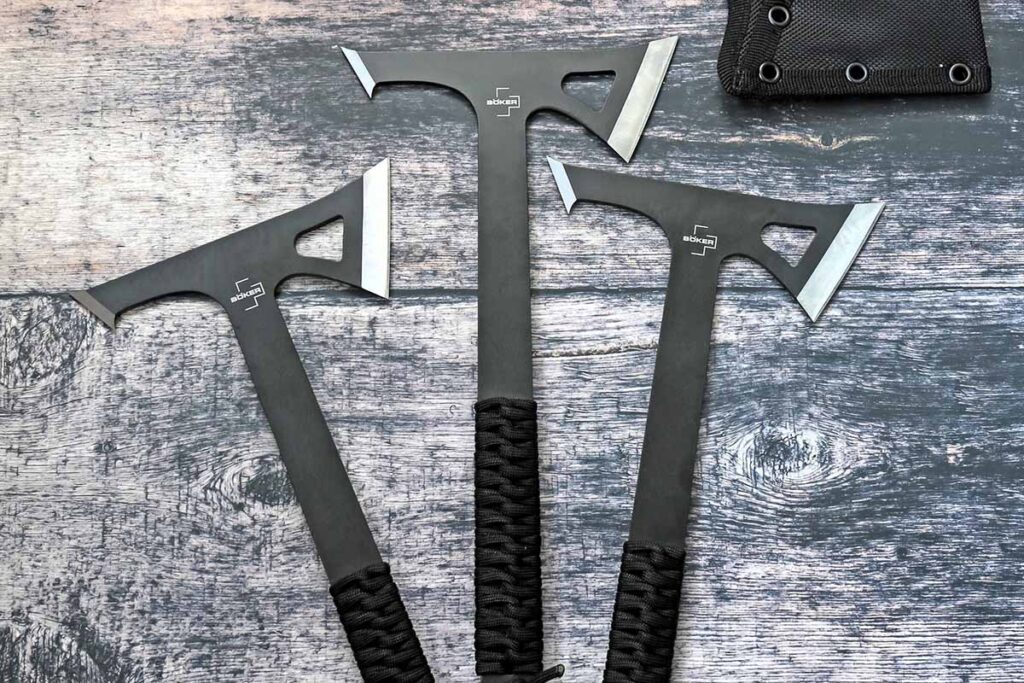
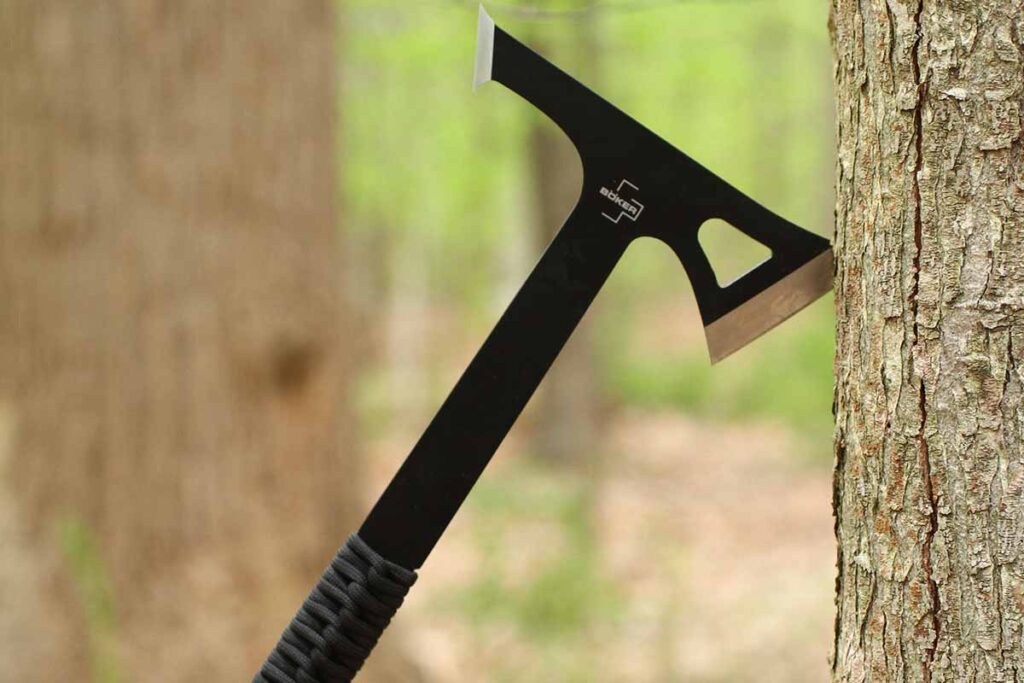
The Mohican set features all-3Cr13-stainless-steel construction and a black coating. Each piece is 10.94 inches overall.
If you’re looking for a reliable and stylish throwing axe outfit, the Boker Plus Mohican Throwing Axe 3-Piece set is worth considering. It is designed for both novice and experienced throwers, offering precision and comfort. Each axe features a 10.94-inch overall length and all-3Cr13-stainless-steel construction, with a black coating that makes it durable and visually appealing.
The design is based on the silhouette of traditional tomahawks of North American indigenous people, with an additional, shorter 2.36-inch cutting-edge blade on the axe head. The paracord-wrapped handle ensures a secure and comfortable grip and precision throwing. A blade recess ensures balance with even rotation for better accuracy. The set has a matching black nylon sheath and printed target overlay, making it perfect for home use. Each axe weighs approximately 8 ounces, making it easy to handle.
Boker Plus Mohican Throwing Axe 3-Piece Specs Blade Length: 2.36” Blade Grind: Hollow Blade Steel: 3Cr13 stainless Handle Material: Black cord Weight: 8.18 ozs. (each) Overall Length: 10.94” Sheath: Nylon Origin of Make: Asia MSRP: $84.95
This is a perfect stick, with the top of the toe of the Boker Mohican perfectly perforating the target.
FIELD TEST: The Boker Mohican axes look and handle more like tomahawks than axes. The set is designed for fun rather than competition, so you will get more sticks with these bad boys. The feel of throwing a Mohican is not unlike flinging a knife.
There are two places the hawk can stick—the main bit and the spike, the latter which seems to stick during an overthrow. To fix overthrowing, take a step forward or enjoy making it stick regardless. The edges are sharp and flared to enhance sticking ability.
The Mohicans are lightweight, so they require some getting used to if you’re accustomed to larger throwing axes. The handle is straight with cord wrapping, making the hand adhere to it too well for optimum throwing. However, an easy fix is to remove the wrap or open the hand drastically when throwing the hawk.
The Mohican’s notable features are the double options for sticking the target and the forward-protruding sharp toe. The edge looks cool and improves target penetration. Another outstanding feature is the nylon sheath, which adds safety and value to the overall package. It has fabric fasteners, keeping each hawk individually secure.
The three Bokers get my vote for the most fun of the axes/hawks. They combine the feel of tomahawk and knife throwing. The little gems can also handle light utility work for a day camp or cooking near a small wood stove, as they can shave wood and split light kindling.
Cold Steel Professional Throwing Axe
The Cold Steel performed flawlessly. It was light and flew like a hawk, eagerly seeking its target.
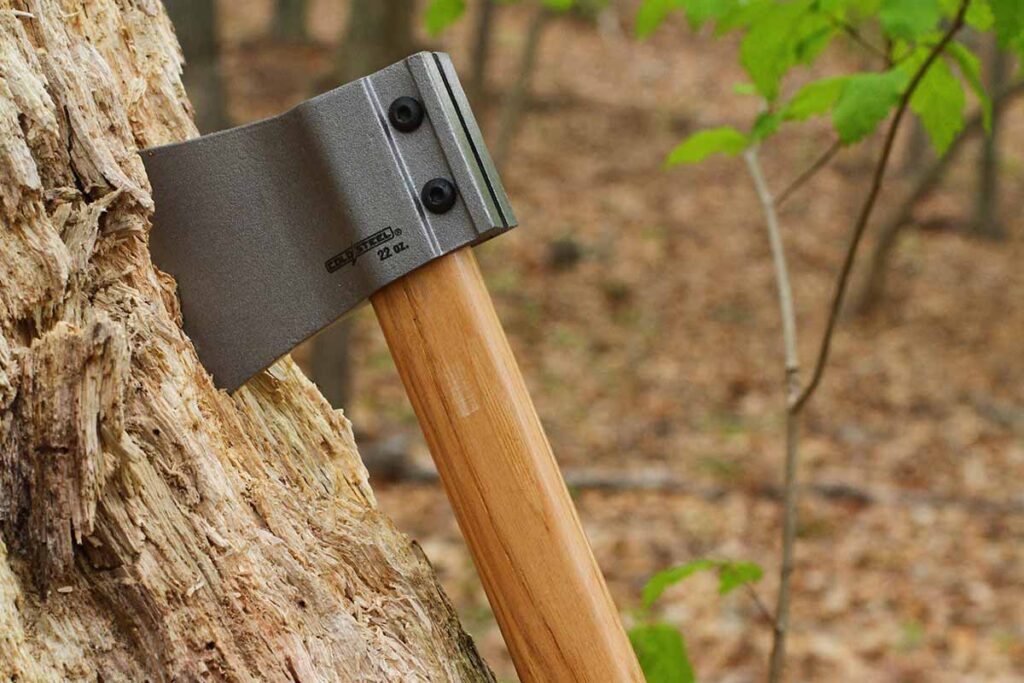
Experienced axe throwers will appreciate the Cold Steel Professional Throwing Axe, an upgraded version of the company’s Competition Throwing Hatchet. It boasts a 4-inch blade of 1055 carbon steel and meets official axe-throwing tournament requirements. The 16-inch American hickory handle provides excellent balance during target practice or competition, while the axe head weight of 22 ounces and overall axe weight of 31 ounces makes it easy to handle.
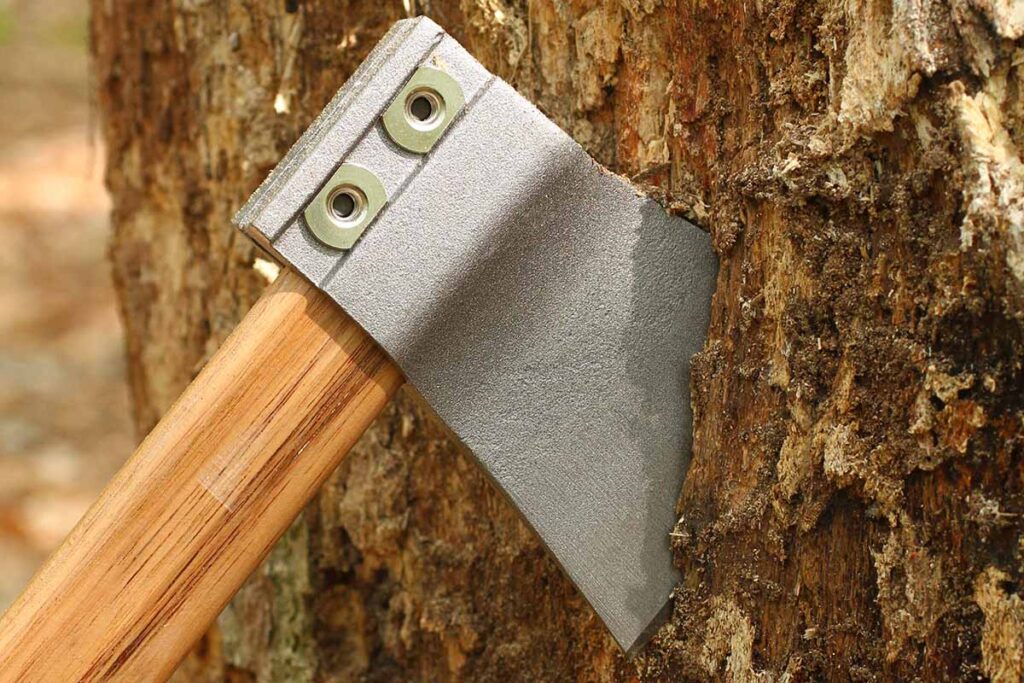
What sets this axe apart is its patent-pending locking mechanism that enables you to change a worn or damaged handle in under two minutes. Simply loosen two bolts, remove the handle and replace it with a new one. With this axe you can focus on your aim and technique without worrying about lengthy handle replacements.
Cold Steel Professional Throwing Axe Specs Blade Length: 4” Blade Material: 1055 carbon steel Blade Grind: Chisel Handle Material: American hickory Weight: 31 ozs. Overall Length: 16” Sheath: Rubber blade cover Country of Origin: Taiwan MSRP: $59.99
The Cold Steel Professional Throwing Axe has a patent-pending locking mechanism that lets you change a worn handle in under two minutes.
FIELD TEST: The Cold Steel had the best bit of the test bunch for sticking in the target, with a straight edge and slightly flared heel and toe. The blade geometry is thin and narrow as a throwing axe should be. The edge isn’t super sharp for an axe standard but it did well on my target, an old, rotting tree. The overall design definitely presents as a pro thrower.
Weight is a happy medium between a light throwing axe and a heavier one. Unlike conventional axes/hatchets of similar size, the weight is nestled solely in the head, which helps in propulsion.
The hickory handle has a nice grain and stayed robust despite a few blundering throws on my part. The classic straight handle helps the axe release without getting hung up on any design flare in the butt, etc. Besides, it’s not a chopping axe. The ingenious design allows for easy replacement of handles without loosening during testing. In my opinion, this axe is the most unusual of the three.
Instead of a sheath, the axe has a rubber blade guard that feels secure for transport and stays in the included pack while hiking. I like the compact, lightweight Cold Steel, and the MSRP, at $59.99, makes it the best buy of the test group.
A budge-priced EDC cleaver that is priced for rough use.
Cleavers have broken out of the butcher shop and kitchen in recent years to become a sought-after EDC. Seems counterintuitive, but there’s a method in the knife-buying world’s madness.
One of the more interesting conversations I had at BLADE Show West 2024 came with a crane rigger who favored this style of blade. With the flat cutting edge that makes mincemeat of heavy-duty rope and a muted tip, he didn’t have to worry about perforating himself, the knife class is highly practical in the pocket.
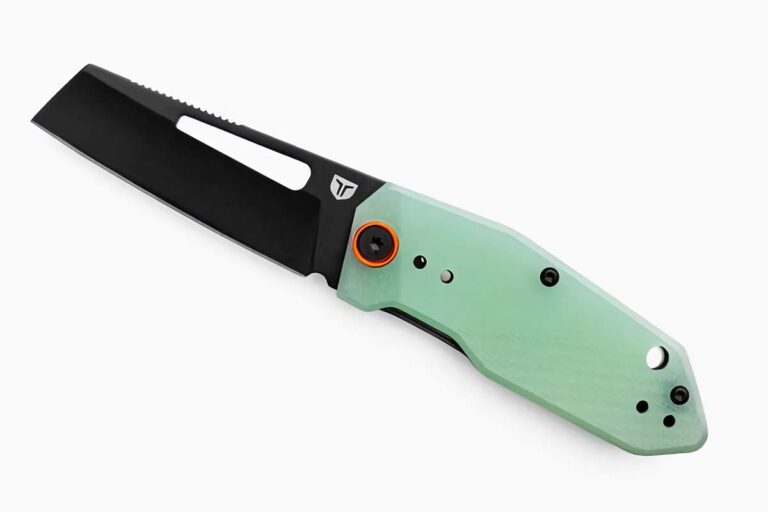
This is all a long way to say, there’s a new pocket cleaver in town with True Knives dropping the Berm Cleaver Flipper.
Part of the brand’s new Berm series, the knife offers a budget option most users won’t shy away from rough use. Yet, for its price, the knife offers a nice profile, though it might lack some in the steel True Knives uses for the blade.
Berm Cleaver Flipper Blade
To that point, the Berm Cleaver Flipper is constructed of 7Cr17MoV, a popular choice in budget knives. While the metal does take a good edge and has respectable hardness and excellent corrosion resistance, it has a few hitches in its giddyap. In particular, its toughness—particularly in thinner blades—is wanting, and edge retention is not among the best.
Still, this is a budget EDC we’re talking about. Despite the steel’s drawback, True Knife has come up with a fairly spiffy blade profile. The knife has a fairly traditional cleaver look, though the 2.5-inch blade boasts a slight belly and does have a bit of a tip. The tip is welcome, making the knife more useful for everyday tasks where a puncturing point is required.
The brand includes generous jimping on nearly the entirety of the spine, offering extra purchase on chopping tasks. Additionally, there is a good choil on the blade, which helps in making sure you can sharpen the entire blade.
Berm Cleaver Flipper Handle
The grip is where the cleaver shines, with a relatively nice affair laid out. First off, I’m a sucker for the translucent green G-10, it gives the knife a modern look without being too audacious. Plus, particularly on a build at this price point, the G-10 is a solid material choice—textured nicely to make it stick to the hand.
Also appreciated, the cleaver’s clip is not only reversible but can be situated for tip-up or down carry. A versatile bonus on the knife.
Berm Cleaver Flipper Action
As its name suggests, the Berm Cleaver Flipper, though it’s a front flipper offering both index finger and thumb deployment. Additionally, it has a prominent thumb hole.
Smartly, True Knives has cut away some of the handle to offer access to the deployment mechanism, allowing users plenty of leverage options to get the blade to work. Caged bearing aids in a smooth and fast opening.
Final Cut
With an MSRP of $30, the Berm Cleaver Flipper is made for heavy use and abuse. The best part, if you put it through the wringer you won’t cry over a broken knife.
Consider three cool tools to keep your scissors shearing sharp.
I sharpen knives frequently but must admit I’m a loathsome scissors sharpener. It’s not like I’ve never sharpened scissors but only when I had to and never in an organized way.
However, when my editor gave me an assignment on scissors sharpeners, I took it as a personal challenge to mend my ways—and off I went. What follows is a primer on scissors sharpening using three different systems.
Before starting, there are a few obvious things to point out.
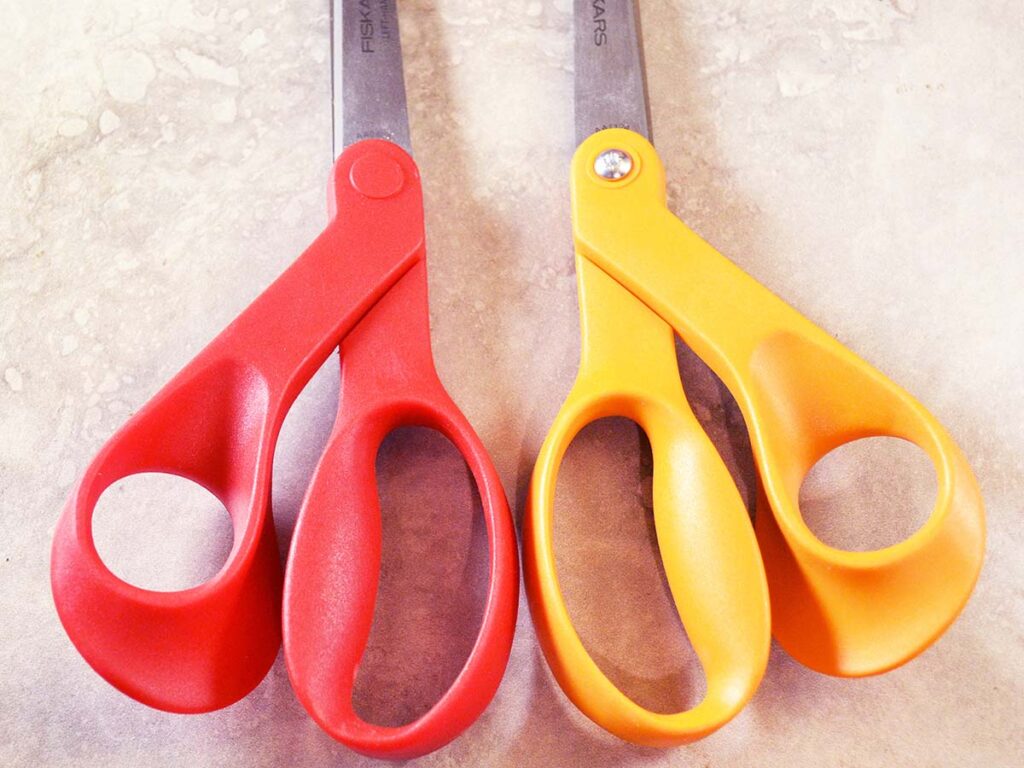
The most obvious is the fact that there are two blades to sharpen instead of one. Second, the two blade edges are sharpened to oppose each other. Third, most scissors are made for righthanders and can give lefthanders fits, especially models with asymmetrical handles. Some southpaws have more trouble than others, and if you are among them you might seek out companies that either offer lefthanded models, such as Fiskars, or those that specialize in such products, like Lefty’s Left Hand Store. My brother’s lefthanded and he’s never bought any lefty scissors. Instead, he simply buys and uses symmetrical right-hand-only models.
Simple handheld or desktop scissors sharpeners are the way to go if you want to keep a decent edge with very little hassle and time consumption.
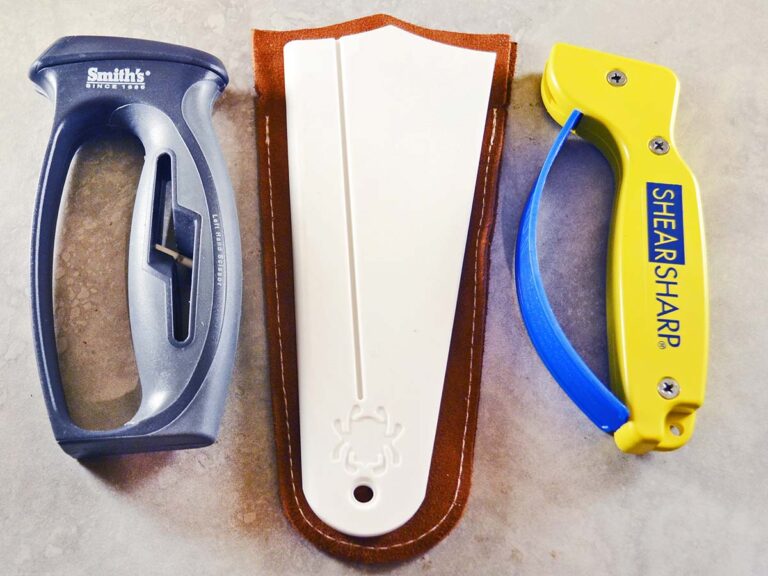
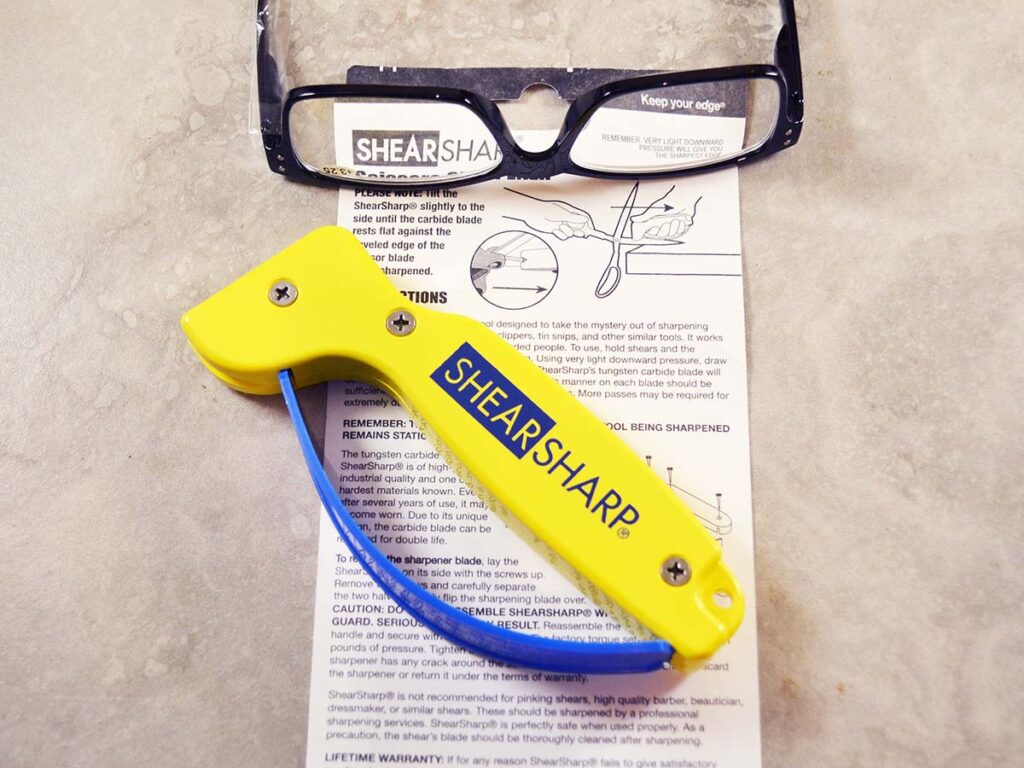
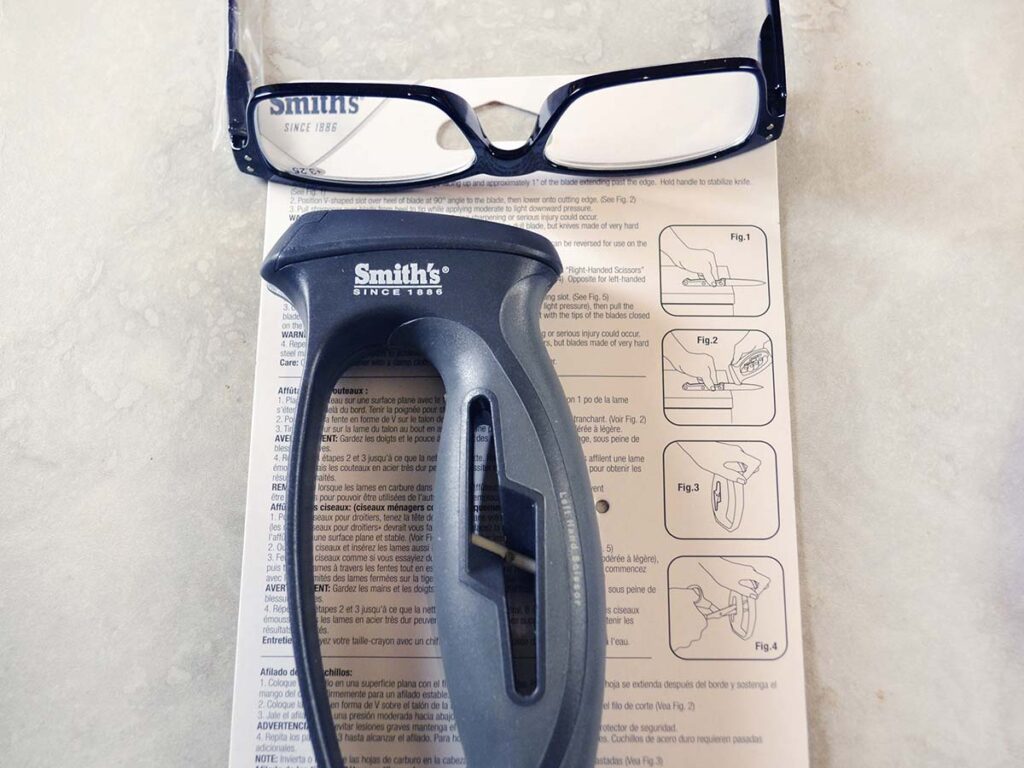
I tested two affordable versions: the AccuSharp ShearSharp Scissors Sharpener and the Smith’s V-Slot Knife & Scissors Sharpener. The pistol-grip-looking units appear similar at first but are actually quite different. The text and graphics on the back side of the cards the sharpeners are mounted on is very helpful, though if you’re like me you will need reading glasses to decipher them.
AccuSharp ShearSharp Scissors Sharpener
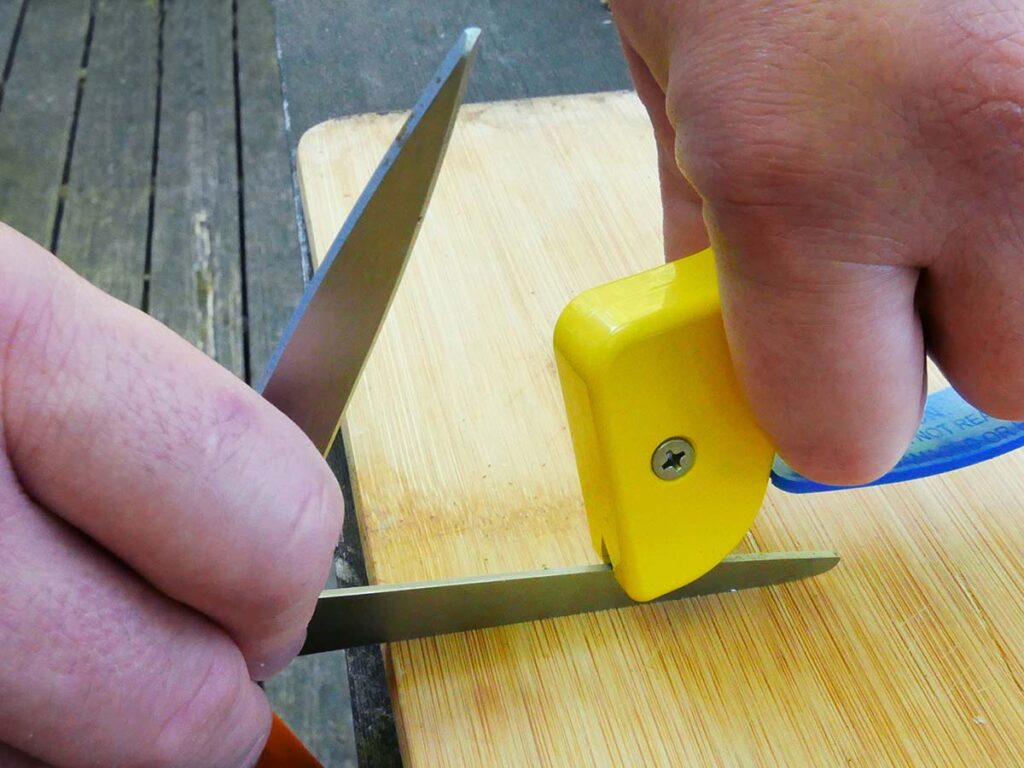
The AccuSharp ShearSharp Scissors Sharpener puts an edge on the blade bevels one side at a time. Here the blades are opened with one side resting on the flat work surface having the blade bevel sharpened. Note the other blade is off the surface. Once the first blade is done, the scissors are flipped and the second blade is sharpened in the same manner. (Covert image)
AccuSharp ShearSharp Scissors Sharpener Size: 5.5 x 2.4 inches Type: Hand-held, single sharpening blade Abrasive: Tungsten carbide Handle length: 5.6 inches Handle material: Plastic Country of origin: USA MSRP: $9.59
The AccuSharp ShearSharp has a grip with a guard for knuckle protection and there’s a slot on the fore-end with a tungsten-carbide-metal sharpener for running down the blade bevel, sharpening it in the process. Open the scissors and lay the blades, one at a time, face-up to the sharpening medium. The rear blade—the one not being sharpened—hangs off the table or you can put it on a raised platform such as a wood block or book.
A hand-held design, the AccuSharp ShearSharp Scissors Sharpener addresses the blade bevels one at a time. You’ll need your reading glasses for these instructions, too!
The ShearSharp metal sharpener is canted to the angle of the bevel and runs down the blade from base to tip, rear to front. Accusharp recommends two to three passes of the sharpener, then flip the scissors over and do the same to the second blade. As with all three test units, keep an eye on your progress as scissors come in all phases of disrepair.
Smith’s V-Slot Knife & Scissors Sharpener
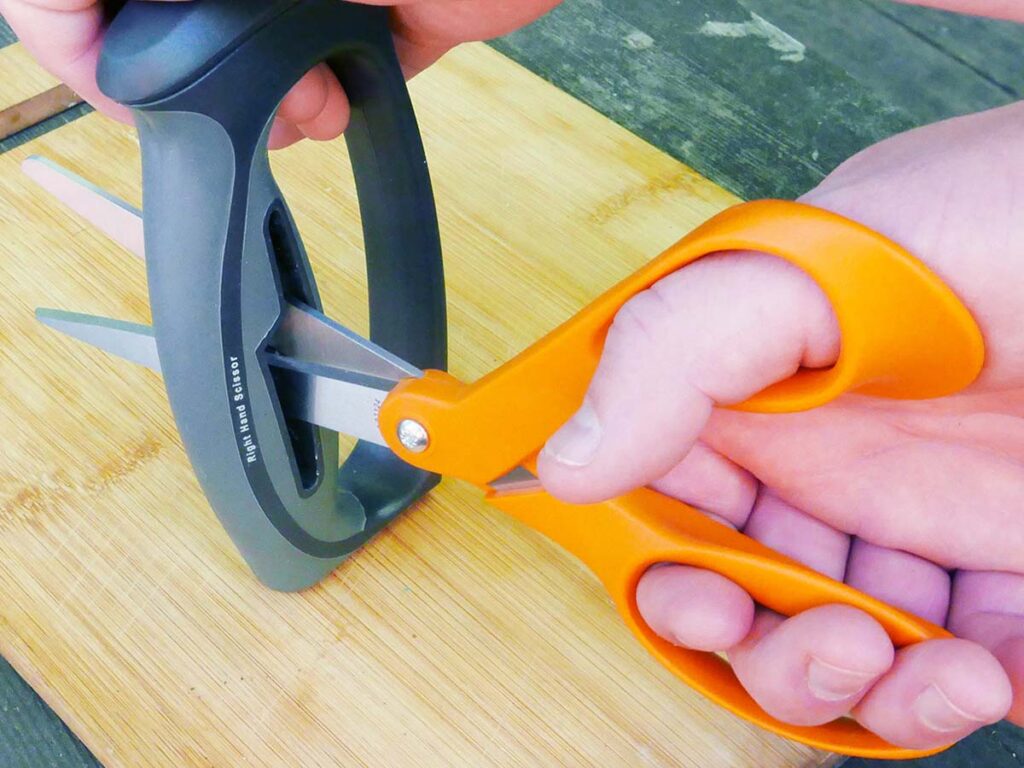
The bevels are sharpened when pushing the scissors blade tips simultaneously into the respective V-slots of the Smith’s unit. The diagonally mounted ceramic rod sharpens both blades at the same time. (Covert image)
Smith’s V-Slot Knife & Scissors Sharpener Size: 6.75 x 2.74 inches Type: Hand-held, two sharpening blades Abrasive: Ceramic Handle length: 6.75 inches Handle material: Plastic Country of origin: USA MSRP: $9.99
Smith’s V-Slot Knife & Scissors Sharpener is a bit more sophisticated with great finger protection, and is easier to use. Inside the handle is a slot that holds a 1,000-grit ceramic rod angled to sharpen the two scissors bevels at the same time. The bevels are sharpened when pushing the scissors blade tips into the respective V-slots simultaneously. (Smith’s recommends not sharpening by pulling the blades out.)
You may need your reading glasses to decipher the instructions for the Smith’s V-Slot Knife & Scissors Sharpener.
Two to three passes is usually enough for blades of average dullness, more if needed. Once again, stopping to gauge your progress is your friend. An added benefit with the Smith’s sharpener is you can sharpen both right- and left-handed scissors depending on which side of the handle slot you use, and it’s conveniently noted on the sides of the unit itself.
Spyderco Golden Stone
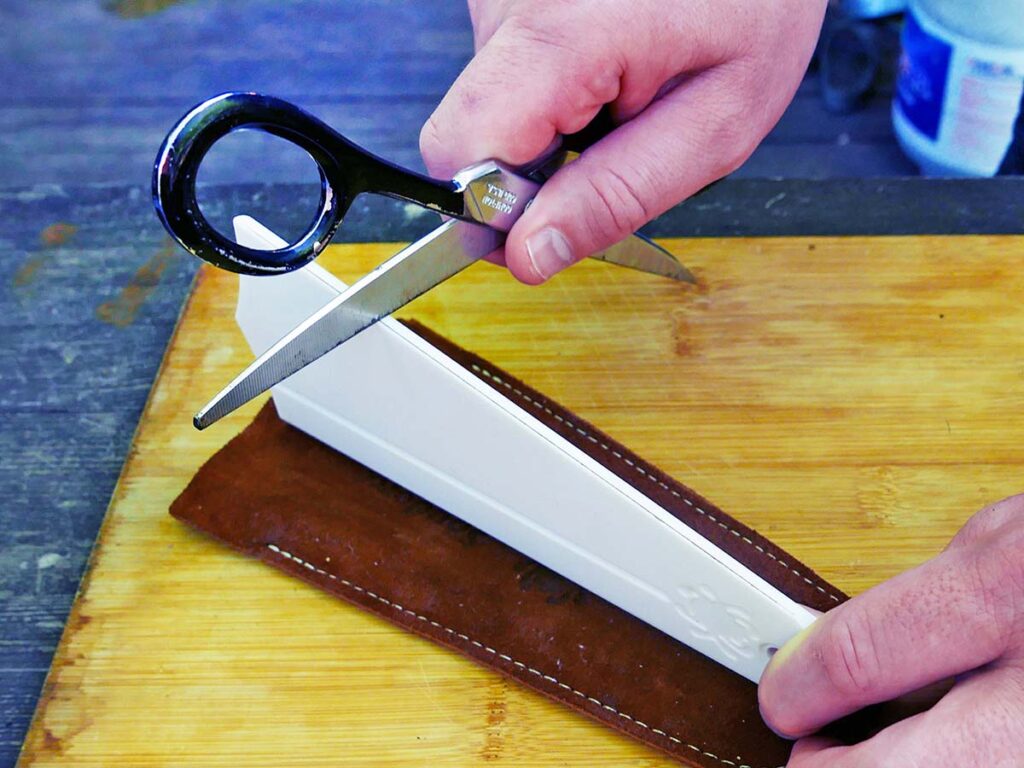
Starting at the top, slide the blade’s beveled edge down the length of the Golden Stone, gradually working the edge toward the tip. Once the edge is sharp, give the opposite blade the same treatment.
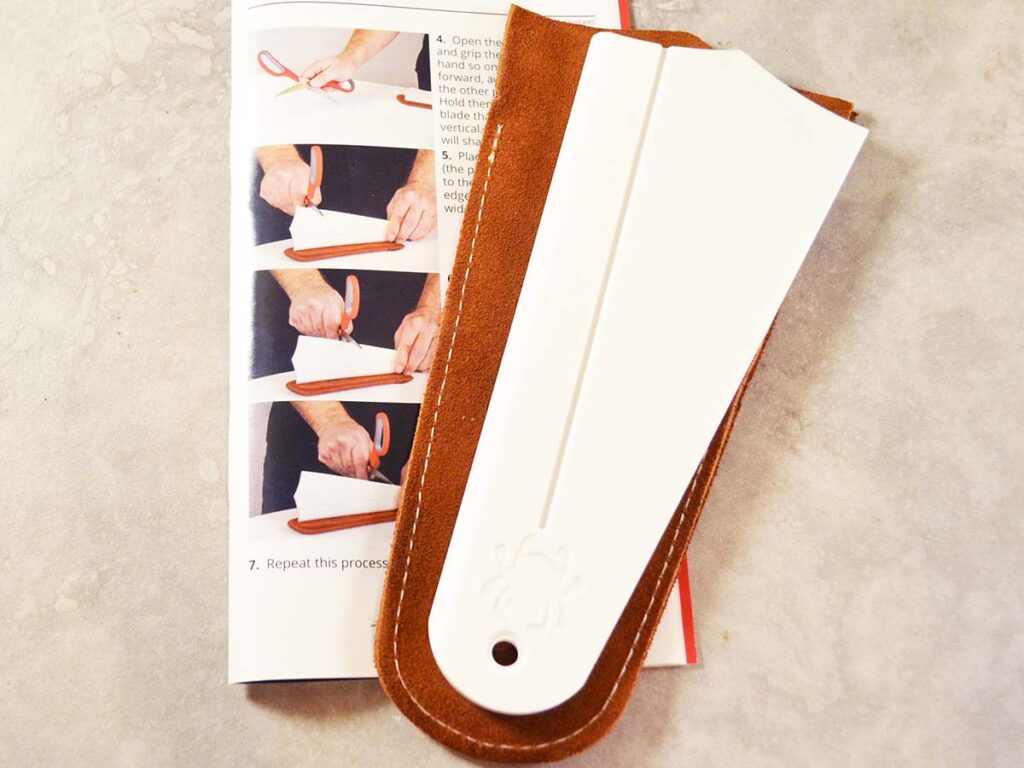
Spyderco Golden Stone Sharpener Size: 7.2 x 3 inches Type: Desktop sharpener Abrasive: Alumina Handle: None Carry: Suede leather pouch Country of origin: USA MSRP: $210
I have become very familiar with the Spyderco Golden Stone sharpener over the years and have included it in several articles, though not for sharpening scissors. Spyderco knives are well known for their premier out-of-the-box sharpness, and company founder and BLADE Magazine Cutlery Hall-of-Fame® member Sal Glesser is a long-time guru on the topic, including today on YouTube.
The Golden Stone is a Glesser design that enables you to sharpen knives in many ways and at different angles, and even serrated blades. Spyderco uses alumina (aluminum oxide) for the Golden Stone’s material and other of its sharpeners, and claims the resulting models do not require oil or water for surface sharpening. Check out Spyderco’s YouTube sharpening videos for a myriad of ways to sharpen the company’s knives.
Designed by Spyderco founder Sal Glesser, the Spyderco Golden Stone is an odd triangular ceramic sharpener fit for many uses—one of which is sharpening scissors. For sharpening, position the suede pouch that carries the Golden Stone on a flat base to provide a non-slip surface. (Covert image)
To start with the Golden Stone, use the accompanying suede pouch as a non-slip surface on a flat base. Employ the stone’s rough triangular shape with the long side sideways and vertically. Grip the short side of the triangle with the long vertical side to your right, forming the sharpening platform. Now you’re ready to sharpen the first blade bevel.
Open the scissors wide and position the top of the base of the bevel grind over the high point of the sharpener, and slide it toward the low end as you slowly pull toward you.
It’s like sharpening a knife where you start at one end and slowly slide the tip toward the opposite end as you go—you’re just putting an edge on the bevel instead. Spyderco recommends eight to 10 passes but, once again, use your judgment depending on the condition of the scissors. Once you’re pleased with the bevel on the first blade, flip the scissors over and repeat the process on the second blade. When done you can remove any burr on the edges of the two blades by opening and closing the scissors a few times.
Conclusion
Both handheld units did a good job of sharpening the bevels, and though I prefer a ceramic sharpening rod just because you can better “feel” it rubbing against the bevel, there was no noticeable difference in the results. These two sharpeners are capable of putting a very decent edge on your scissors.
Fiskars is one of the few major companies that manufactures scissors specifically for lefthanders, and is known for such radically asymmetrical designs as these two. The red pair is for lefties.
The end result of my efforts with the Golden Stone paid off with two razor-sharp beveled edges on the scissors blades. Spyderco doesn’t assign numbers to the grits on its sharpening media, but the best I can tell the white alumina like that used on the Golden Stone is in the fine, 2,000-grit range.
Where To Find Your Edge
Is all the cost, time and increased degree of skill required by the Spyderco Golden Stone worth it? That’s up to you and what your expectations of your scissors are. There are folks whose livelihoods depend on scissors, others that just want to get the mail out the door and scads of people in-between. Choose your sharpener!
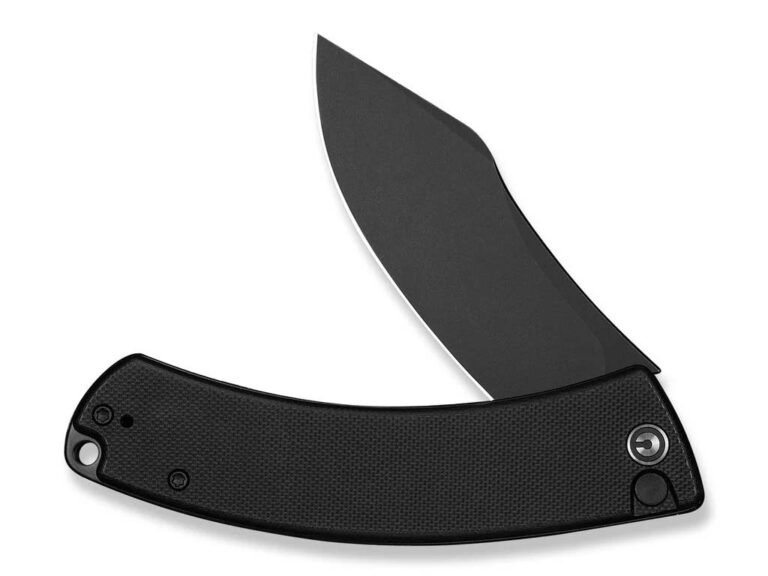
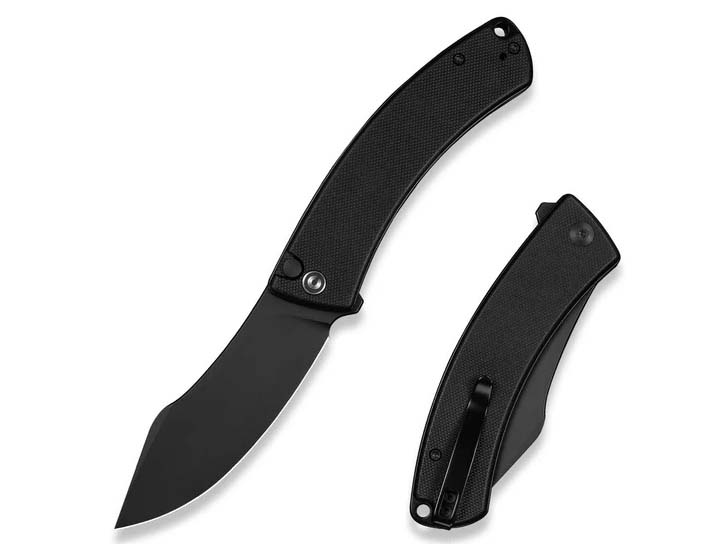
Explore the CIVIVI Outlaw Muk folder, a tactical EDC interpretation of the classic Nessmuk pattern featuring a smooth flipper and secure button lock.
The Nessmuk knives have deep roots in American outdoor history, instantly recognizable for their unique, sweeping blade profile. This knife style was championed by 19th-century writer and early ultralight camping pioneer George Washington Sears, who wrote under the pen name Nessmuk.
Traditionally, this design is a fixed blade—a dependable, do-it-all camp knife known for its pronounced hump on the spine and generous belly, perfect for tasks from skinning to food prep. Now, designer Trey Sprinkle, from the YouTube channel Last American Outlaw, has tackled the challenge of translating this timeless, fixed-blade archetype into a modern, pocket-friendly folder. The CIVIVI Outlaw Muk is Sprinkle’s first production collaboration and a striking reimagining of a legend, built with a distinct, tactical attitude setting it apart from its historical inspiration.
The design embodies a rugged, tactical aesthetic that aligns perfectly with Sprinkle’s online persona. The traditional Nessmuk shape is narrowed, given more of a dramatic sweep, and is accented with a harpoon swedge near the tip, lending it a formidable appearance. This aggressive yet refined profile takes the basic geometry of the original and infuses it with a contemporary, hard-use look.
The most significant design departure, however, is the inclusion of modern folder mechanics. The Outlaw Muk utilizes a highly secure button lock mechanism. The lock has been engineered with a specific spring tension under the button, providing just enough resistance to prevent accidental engagement, yet remaining easy to release for effortless one-handed retraction. This combination of speed and safety makes the knife practical for continuous daily use where quick access is essential.
Outlaw Muk Materials
This smooth operation is coupled with a highly responsive pivot system. The knife features caged ceramic ball bearings, ensuring that deployment via the subtle rear flipper is consistently smooth and fast, a hallmark of CIVIVI’s knives.
For performance, the Outlaw Muk offers a 3.47-inch blade crafted from 14C28N stainless steel. This Scandinavian steel is well-regarded in the mid-range category for its excellent balance of edge retention, corrosion resistance, and ease of sharpening. While the blade size is modest compared to a traditional fixed-blade Nessmuk, its full belly and acute tip provide plenty of capability for cutting smaller foods, slicing through twine, or efficiently opening boxes and stubborn clamshell packaging.
Outlaw Muk Design
The handle maintains a subtle, ergonomic curve, which provides a comfortable and secure grip. It is fitted with full G10 scales, which are durable, moisture-resistant, and lightweight, contributing to the knife’s overall carry weight of just 3.74 ounces.
CIVIVI offers the knife in several colorways, including solid options like dark green or black, but the most distinctive variant features a striking black and white split pattern that offers a more refined, geometric look. The knife also includes a reversible, tip-up pocket clip, making it easily adaptable for both left- and right-handed users.
From its roots in 19th-century woodcraft to its execution with a button lock and modern 14C28N steel, the CIVIVI Outlaw Muk is a successful and intriguing blend of history and hard-use utility. It provides a unique option for those seeking a highly functional EDC knife that carries the attitude of a legendary outdoor pattern.