
Buyer's Guides

You’re looking for a new knife in a certain style – we’ve got recommendations on the best blades for every price point.

Hatchets: Hackers That Pack A Punch

0

Four hot hatchets pack more punch for their size than most.

There’s a good reason hatchets have always been a staple of camp tools. They pack more punch for their size than just about anything else you can put in your hand. Sure, an axe can outperform its smaller sibling but can be both size and weight prohibitive on many outings. Saws are lighter but their blades can break, leaving you empty-handed without a hatchet in the wings.

CAS Iberia APOC Hundr

CAS Iberia/APOC Hundr’s bearded hatchet
The CAS Iberia/APOC Hundr’s bearded hatchet head shaved bark off a wooden shaft via push cuts.

The CAS Iberia APOC Hundr gets its name from the Old Norse word meaning hound in reference to man’s best friend. It is a bearded-style hatchet with a main handle and head of quarter-inch-thick 9260 carbon steel. Quarter-inch-thick smooth black G-10 scales bring the handle’s overall thickness to three quarters of an inch. The sheath is a black thermoplastic unit that slides open-backed over the hatchet head and is secured by two nylon straps that snap into place.

CAS Iberia/APOC Hundr Hatchet
Blade material: 9260 carbon steel
Cutting edge: 3.75”
Head length: 4.65”
Head @ thickest: .235”
Handle material: G-10 composite
Design feature: Bearded style
Weight: 1 lb., 7 ozs.
Overall length: 12”
Carry: Black synthetic sheath, MOLLE compatible, snap on
Country of origin: China
MSRP: $89

SOG Camp Axe

SOG Camp Axe
Hatchets take a ton of abuse, requiring sharpening from time to time. The author uses a fine-grit Eze-Lap diamond stone to touch up the edge of the SOG Camp Axe.

The SOG Camp Axe is the most modern looking entry and second bearded-style hatchet of the test bunch. Its 5-inch-long head is the longest of the review pieces, too. The head is attached by four Phillips-head screws to a black, ovate GRN (glass-reinforced nylon) handle, and an aluminum collar adds strength. The poll is a healthy .6 inch thick and the main handle is ribbed for added purchase. A minimalist blade cover has a strap that wraps around the back side of the hatchet head and, in a clever touch, hooks horizontally over the SOG logo on the opposite side.

SOG Camp Axe Specs
Blade steel: 2Cr13 stainless
Cutting edge: 3.1”
Head length: 5”
Head @ thickest: .6”
Blade coating: Bright finish w/dark recess
Handle material: GRN (glass-reinforced nylon)
Design feature: Added poll thickness
Weight: 16.1 ozs.
Overall length: 11.5”
Carry: Molded nylon sheath
Country of origin: China
MSRP: $68.69

Schrade Bedrock Axe

Schrade Bedrock
Hatchets such as the Schrade Bedrock can be used to point pegs for securing tents. Protective eyewear is recommended when the chips start flying. The author prefers gloves for a more comfortable grip, especially during extended use.

Dubbed the Bedrock Axe, Schrade’s entry has the test group’s largest poll, measuring 1.75 by .75 inch. Six-and-a-half inches of the handle is a grippy, black, hard rubber overmold. It is the heftiest of the review hatchets at 1 pound, 8.6 ounces. The black polyester sheath has a fabric-fastener flap at the rear.

Schrade Bedrock Axe
Blade steel: 3Cr13MoV stainless
Cutting edge: 3.5”
Head length: 4.7”
Head @ thickest: .79”
Blade coating: Satin/black oxide
Handle material: Black overmold
Design feature: Thick poll
Weight: 1 lb., 8.6 ozs.
Overall length: 11.75”
Carry: Black polyester/fabric-fastener sheath
Country of origin: China
MSRP: $39.99

Winkler Knives Highland Hatchet

Winkler Knives Highland Hatchet
The Winkler Knives Highland Hatchet proved a workhorse when it came to splitting wood both free-hand and with a baton. The head has a nice wedge shape for getting down to business.

The Winkler Knives Highland Hatchet has all the period visual trappings of Daniel Winkler’s full-blown custom work, though is made via the stock removal method only instead of mostly being forged. While it may be the smallest hatchet of the test bunch, it has the heart of a ram. The maple handle tapers gently toward the base and a lanyard hole. A heat-formed black Kydex sheath with two black nylon drop loops slips over the hatchet head and secures by a heavy-duty elastic rod that wraps around the sheath.

Winkler Knives Highland Hatchet
Blade material: 80CrV2 carbon steel
Cutting edge: 2.55”
Head length: 4.8”
Head @ thickest: .3”
Blade finish: Black Caswell
Handle material: Maple
Sharp stuff: Period design
Weight: 1 lb., 5 ozs.
Overall length: 11”
Carry: Kydex sheath, nylon straps
MSRP: $550
Country of origin: USA

Testing Hatchets

thicker the poll the easier it is to perform functions like hammering
The thicker the poll the easier it is to perform functions like hammering tent pegs. It also adds more weight behind the swing of the hatchet when chopping. The test group offers a selection of poll thicknesses and heights.

I started by checking out the hatchets’ bite with swinging overhand chops on a 14-inch-wide-by-12-inch-deep crosscut slice of seasoned oak. I took each hatchet and buried the upper blade into the cross-grain of the stump, and they all stood up on their own. From there I worked the edge at alternate angles with each hatchet to get an idea of its bite. None of the candidates gave any resistance and all averaged cuts of ¾-to-1-inch deep. I repeated the alternate cuts on a length of 2-inch-diameter green oak tree limb and got similar results with all the subjects.

I tested the hatchets on specific tasks such as pointing stakes, shaving bark and baton work, and the exercises brought out the differences in their dimensions and configurations. For instance, the two bearded hatchets—the SOG and CAS Iberia/APOC—excelled at shaving bark. The ability to grip them behind the blade to direct them simply makes shaving with precision much easier. The Schrade Bedrock, with its large, thin blade, edged out its brethren in pointing stakes.

CAS Iberia/APOC and SOG
The CAS Iberia/APOC (top) and SOG are the bearded type. The longer drop on the bottom front edge allows you to grip the handle and use it to shave or carve wood with precision.

The hatchets with thicker polls, the SOG and Schrade, did better at hammering tent stakes due to their ease of target acquisition and scope of impact. The Winkler Highland Hatchet excelled at baton work, its wedge shape and streamlined profile ideal for the task. The individual advantages along with the size of the hatchet can be priorities in choosing the right one for your needs. Keep in mind, however, just because I called out certain models as excelling at specific tasks, such as pointing stakes, doesn’t mean the others won’t serve you to some degree.

Hatchet Carry

four different takes on hatchet sheathing
The review hatchets offer four different takes on sheathing, from the minimalist SOG at bottom right to the top shelf Winkler Kydex version (second from right).

The sheaths range from the premium one provided with the Winkler Knives Highland Hatchet to the minimalist one accompanying the avante garde SOG Camp Axe. In my days of extended trips in the wild I preferred to pack-carry a hatchet, but some may like it on the belt, and the SOG can accommodate you there. Hatchets are typically made to take abuse but are relatively easy to sharpen, either with a bench stone around the shop or a portable sharpener in the field or on the trail.

Final Cut

Options abound in the hatchet world and those on a budget should have no trouble finding competent fare in the category. The Winkler may seem pricey but once you try it you’ll appreciate its rock solid construction and extraordinary fit and finish. You’ll never be caught saying, “They don’t make ’em like that anymore.” The best news is there is enough diversity in the category that you can choose a hatchet to fit both your needs and budget, and that’s always a good thing.

More Axes, Hatchets And Tomahawks:

  • Bearded Axe: Best Bashers From Here To Valhalla
  • Best Tomahawks: Our Top Hawks For Backwoods To Battlefields
  • Wicked Breacher: Ben Seward’s SWAT Axe
  • Awesome Axes for Chopping Wood Like a True Lumberjack
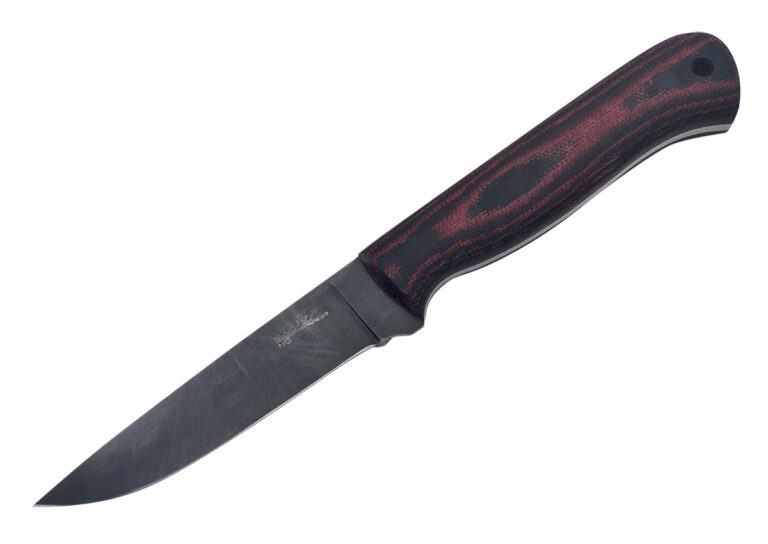
B. Goode H.U.T. 4 Review: All-Star Performance

B. Goode H.U.T. 4 high steps its way through the author’s test drills

The H.U.T. 4 by Brian Goode of B. Goode Knives reminds me of my military days—it just needs the “2, 3” before the “4.” The acronym and number stand for Hunter, Utility, Trail, 4 inch. An all-around edged tool that can be used for multiple tasks, it’s the one knife you always grab for when cutting needs to be done. How well it cut I’ll let you know.

Light Duty Cutting

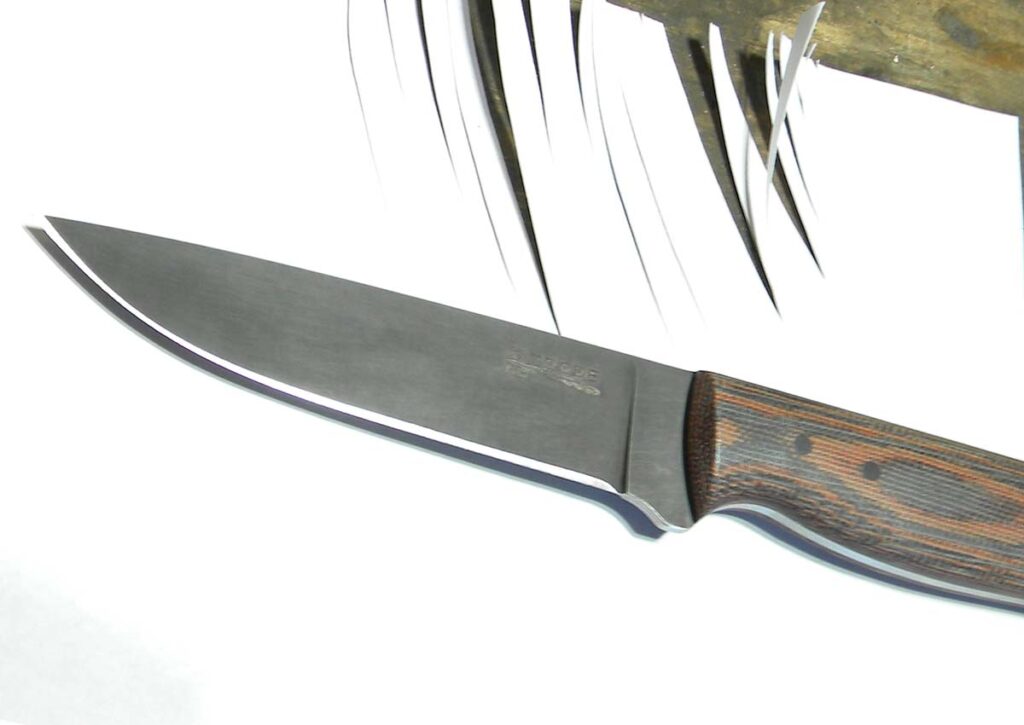
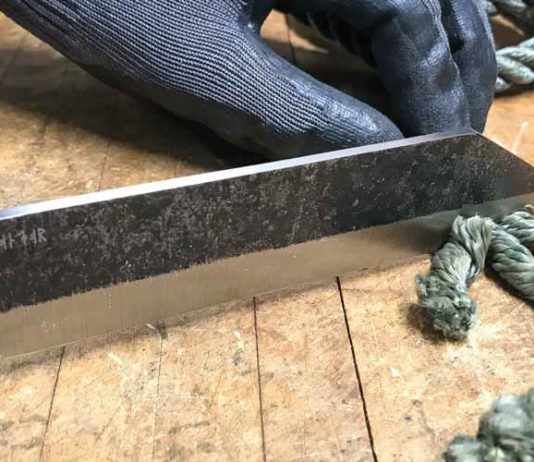
There was no difference between the first paper cut test and the last one. The H.U.T. 4 stayed sharp.

I began with a simple yet effective test—the paper slice. I grabbed the H.U.T. 4 with my thumb and index finger and slid the edge into the paper. It kept slicing for the entire blade length. I could hear each slice, so it’s very aggressive in the 20-pound bond paper. You really have to watch closely so you don’t skin a flap from your finger.

Single-walled cardboard was next. I used a push cut and the knife didn’t fail. I felt no resistance while cutting. The H.U.T. 4 zipped through quickly. The blade did get some wipe marks on the acid finish.

Medium Duty Cutting

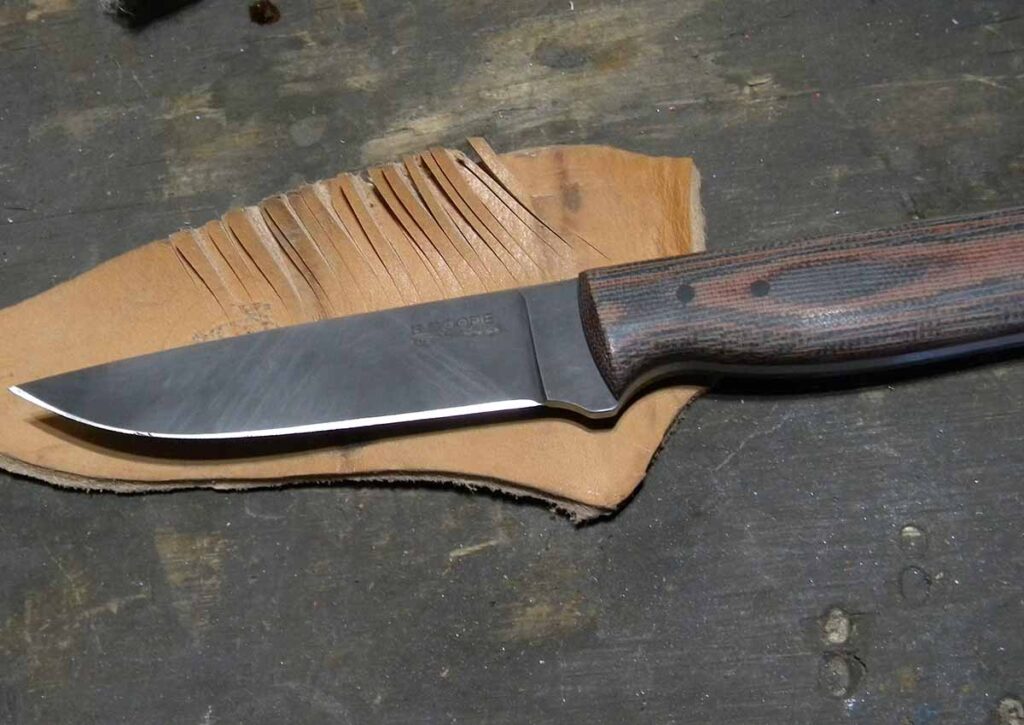
The knife sliced the 8-ounce leather quite forcefully. Each time the edge hit leather, the author heard it slice.

Grabbing some scrap 8-ounce leather, I did some skiving and slicing. The knife sliced quite forcefully once more. Each time the edge hit the leather, you could hear it cut. This is a very cool test to do. Brian’s knife is light and fast, so you must be quick and get your fingers out of harm’s way.

Heavy Duty Cutting

The H.U.T. 4 was a whittling beast on a ¾-inch dowel rod, providing extremely smooth cuts with nice curlicues at the end. The handle is very comfortable with no hot spots. I went from fine cuts to deep cuts with a slight movement of my wrist. The knife is easy to control.

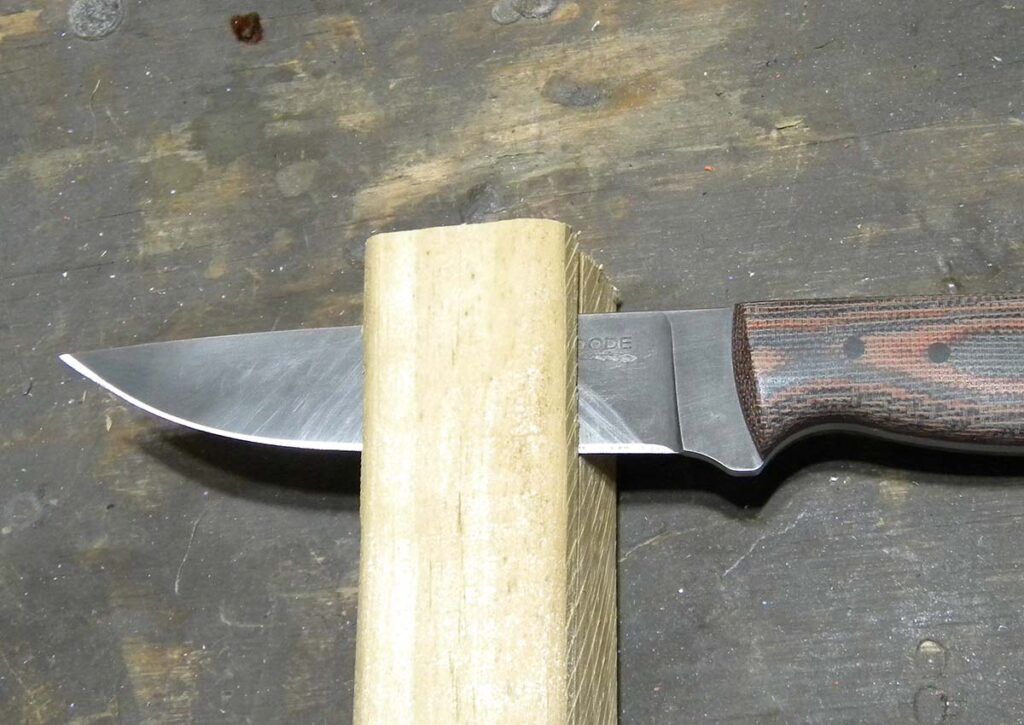
Using a chunk of wood railing as a baton, the author beat the H.U.T. 4 into another piece of railing. The wood split very fast and no shock carried up the author’s arm.

Even though the knife has only a 4-inch blade, it can handle larger trail chores like splitting wood. Using a chunk of wood railing as a baton, I beat the H.U.T. 4 into another piece of railing. The wood split very fast and no shock carried up my arm. I split both with the grain and across the grain with no difference. The edge was still perfect and I gave it some wood smears for character. It is a fun knife to use.

It was on to my favorite medium: sisal rope using push cuts. The H.U.T. 4 didn’t let me down. Two-hundred sweet crunching cuts happened very quickly. This is one smooth slicing, sharp knife. As fast as I could move the knife it was cutting. The handle is contoured for control and comfort.

In what could be construed as abuse, I gave the fixed blade 30 whacks into a deer antler. After scattering antler chips all over the workbench, the knife passed with flying colors—no damage and still very sharp. Excellent heat treat!

It was back to the 20-pound bond paper for the final cut. There was no difference between the first paper cut and the last one. The H.U.T. 4 stayed sharp.

Bottom Line

This is a great knife to have on you all the time—not too big, not too small and extremely sharp. Any changes? Maybe some thumb notches.

H.U.T. 4 Specs
Maker: Brian Goode, B. Goode Knives
Blade length: 4”
Blade material: 8670 carbon steel on the test knife; other steels available
Blade grind: Full flat
Blade @thickest: .125”
Blade finish: Acid dipped
Scales: Red and black canvas Micarta®
Handle pins: G-10
Weight: 4.5 ozs.
Overall length: 8.5”
Sheath: Leather pouch/belt model
Weight w/sheath: 6 ozs.
Maker’s price for a similar knife and sheath: $350

More Knife Reviews:

Delaware Repeals Switchblade Ban; 22nd State to Legalize Automatic Knives

0

Learn how the new law, SB 108, updates knife regulations and what this means for knife owners.

Delaware became the 22nd state to repeal switchblade/automatic knife bans or restrictions with the signing July 30 of bipartisan SB 108 by Governor Matt Meyer.

According to the Knife Rights website, the bill not only removes restrictions on the sale or possession of automatics in Delaware, it also amends the “Deadly Weapons” exemption for “ordinary pocketknife” by deleting “folding” in order to cover all knife types. It also increases the legal blade length from 3 to 3.75 inches.

“SB 108 is a common-sense update, modernizing Delaware’s knife laws, so citizens gain the freedom to carry and use these tools responsibly without fear of legal penalty,” Meyer said.

In addition to Delaware, states repealing switchblade bans or restrictions include Alaska; Colorado; Hawaii; Illinois; Indiana; Kansas; Louisiana; Maine; Michigan; Missouri; Montana; Nevada; New Hampshire; Ohio; Oklahoma; Pennsylvania; Tennessee; Texas; Vermont; Virginia; and Wisconsin.

This leaves only three states where civilian possession of automatic knives remains banned: New Mexico, Minnesota and Washington. Knife Rights is challenging Minnesota’s ban in federal court. Washington is in the Ninth Circuit where KR’s federal lawsuit against California’s partial ban is proceeding on appeal. A win there would apply to Washington’s ban.

More On Knife Bans:

Aaron Wilburn’s BodyGuard Review: Cutting At Another Level

Aaron Wilburn’s BodyGuard pushes the performance bounds of a hard-work knife.

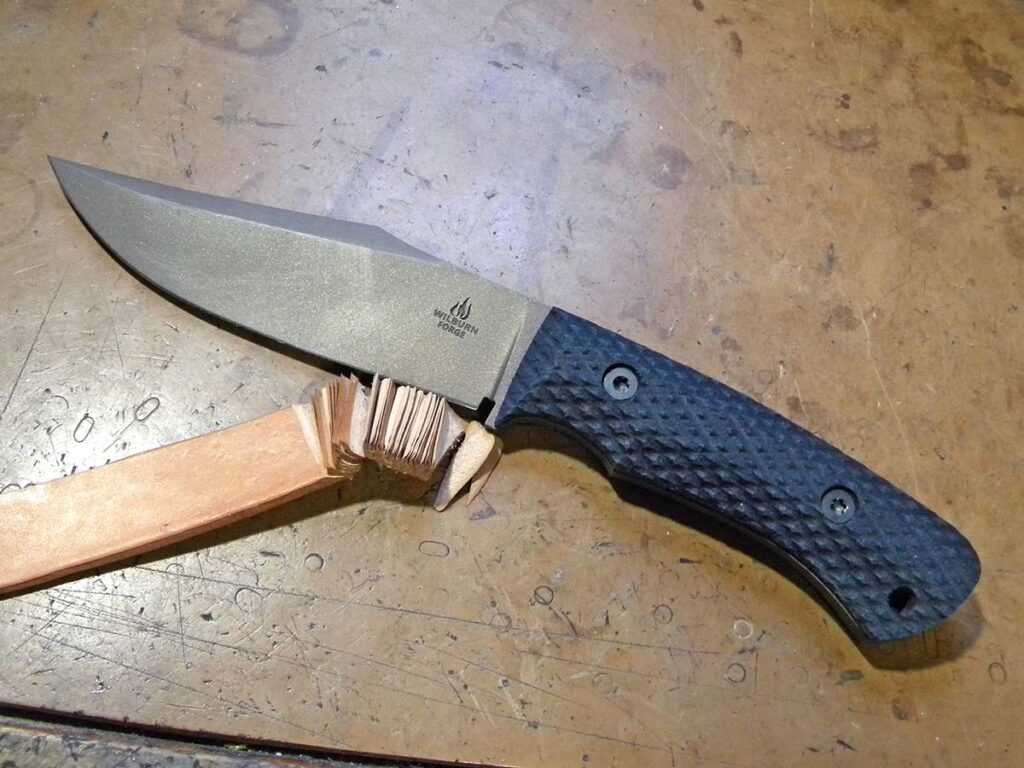
ABS master smith Aaron Wilburn produces spot-on precision works of art. His mosaic damascus is gorgeous, yet he still likes to make hard-working blades. The BodyGuard is one of the latter. It’s no frills, just tuned 52100 steel and textured non-slip Micarta handles.

A lot of knowledge is poured into these heavy-duty knives. It’s a little on the larger side for an EDC, but once in your hand, it’s very hard to use anything else. I’m all about the feel of a knife in your hand and the sharpness of its blade. Aaron’s BodyGuard is spot on in both fields. So, let’s get to cutting with the BodyGuard.

Skiving 8-ounce leather, the author found the slight curve to the belly of the knife let him roll rapidly into each thin slice.

To start, I executed a simple slice of paper to check the fresh edge. The BodyGuard sheared smoothly and quickly, with the edge showing itself on the aggressive side, meaning you could hear each slice. I had to move fast with my fingers so no nicks would occur. The knife’s balance felt correct while cutting.

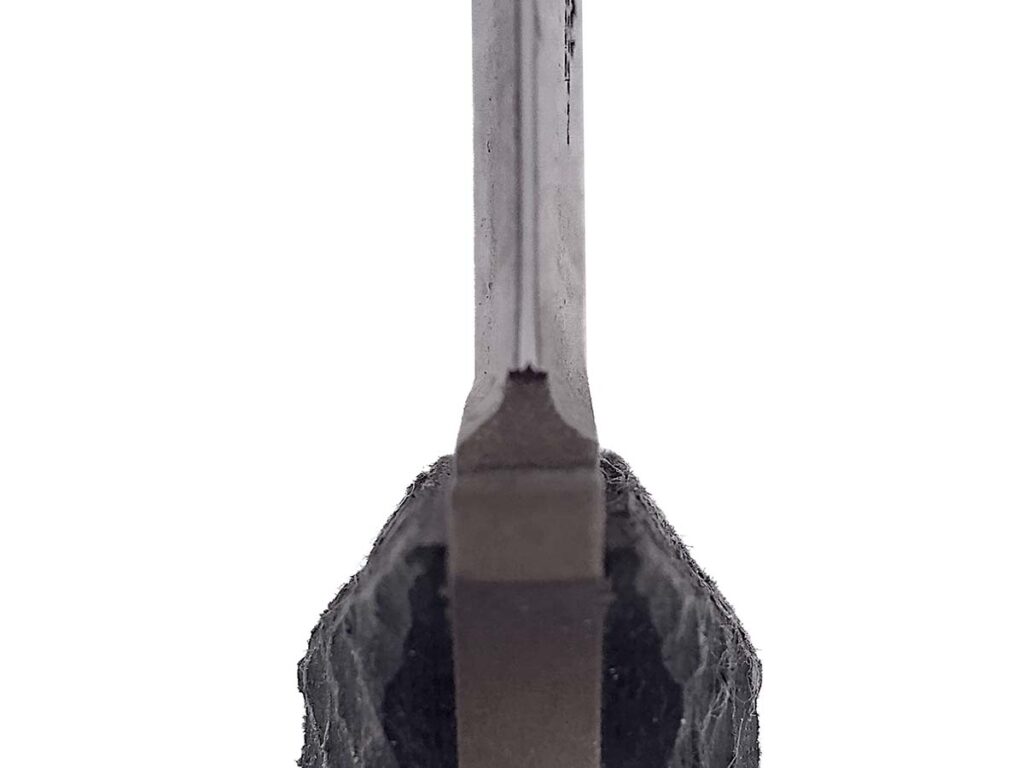
Next, I was on to some single-walled cardboard. The BodyGuard was slicing so fast and so sharply that none of the cuts distorted the cardboard. This is due to its full flat grind. The Cerekote coating helped, as well, reducing drag. Once more, the edge was notably audible and forceful through the material.

The BodyGuard’s plunge lines were spot on, uniform in depth and angle. This is always a sure sign of a well-made knife.

I pulled some scrap 8-ounce leather to skive. The BodyGuard made quick work of it. The slight curve to the belly of the knife let me roll rapidly into each thin slice. It was a fast enough pace that I managed to put a nick in my fingernail. The textured canvas handles proved very grippy and had a comfortable feeling. With the leather on its edge, I made more cuts, happily segmenting it without removing any of my flesh. Each cut gave me a nice crunching sound. Very sharp edge.

Laying The Wood

Using a leftover piece of pine, I did some whittling for a firestick. I ended up with thin curlicues and thick curlicue. All cuts were smooth, like they were from a carving tool. Its handle provided a positive grip on this more challenging medium and ensured smooth cuts. The finish took some wood smears, as expected, but the edge was still like a razor.

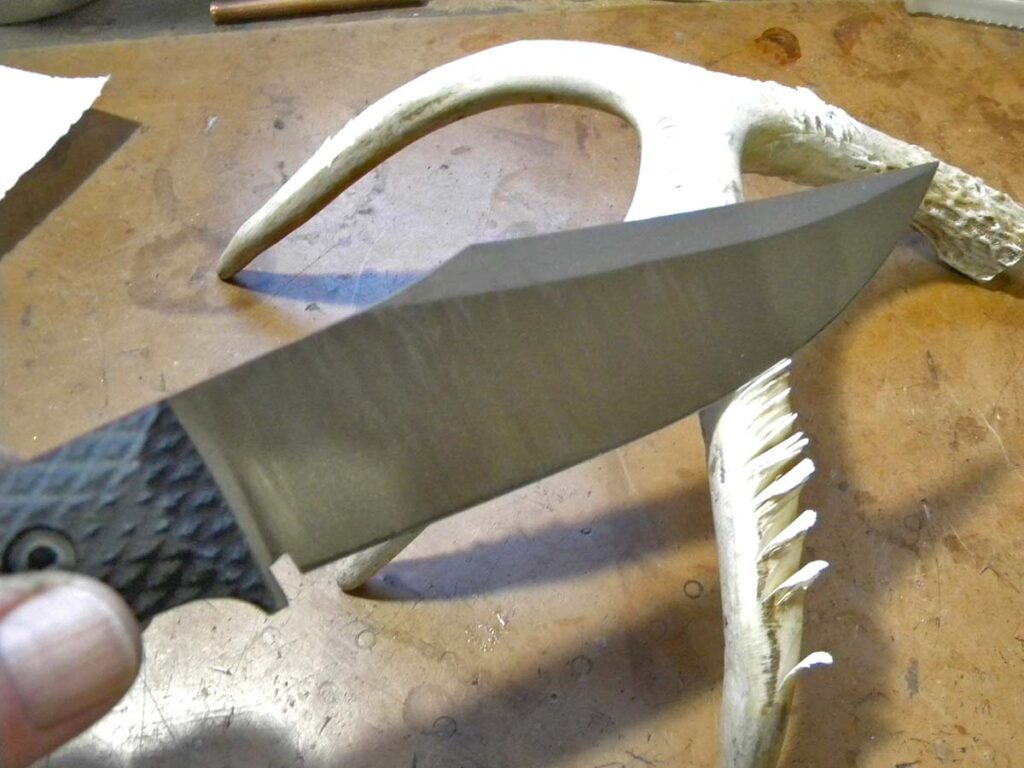
The BodyGuard was no hack in testing its edge against whitetail deer antler. The author littered his shop with antler fragments, however, the knife’s edge remained pristine.

Subsequently, I gave the BodyGuard a beating or I should say a batoning. Using a piece of seasoned hackberry, I batoned the blade into it to split some kindling. I found the false edge was ground almost too sharply; it wanted to stick into the baton piece of wood on the first two whacks. No issues after that with the BodyGuard making short work of the chunk of hackberry. I did notice the ends of the handles were a little sharp on the inside of my palm during this exercise. A few wipes of 400-grit sandpaper removed the edge. Again, more wood smears on the Cerakote, but the coating was 100 percent attached. Excellent job.

After some hard material, I tested the knife’s edge retention on 1/2-inch sisal rope. Man, does the BodyGuard cut, crunching through 200 cuts of the rope in record time. The edge felt like it was getting sharper with every slash. Even after all that, the knife remained extremely sharp.

The BodyGuard was no hack in testing its edge against whitetail deer antler. The author littered his shop with antler fragments, however, the knife’s edge remained pristine.

Finally, it was time to get busy on a whitetail deer antler with 30 hard whacks. All that did was send antler chunks all over my shop without even a micro nick on the edge. That demonstrated excellent heat treatment. And the edge still felt razor sharp.

The last step was to retest the edge on paper. The BodyGuard seemed to slice even faster after all its use. Smooth cuts through the 20-pound-bonded with no tear outs. Enough said and cut.

Bottom Line

I just make a minor softening on the end of the handle. Otherwise, the BodyGuard from Aaron Wilburn is in the top 1 percent of the knives I’ve tested. It will handle civilian, hunters and military chores with ease. Hats off to the maker.

More Reviews:

First Look: Civivi High Grass Field Knife Ready For Fowl Play

Engineered for upland hunting and fine-detail game prep, Civivi’s latest fixed blade puts precision first.

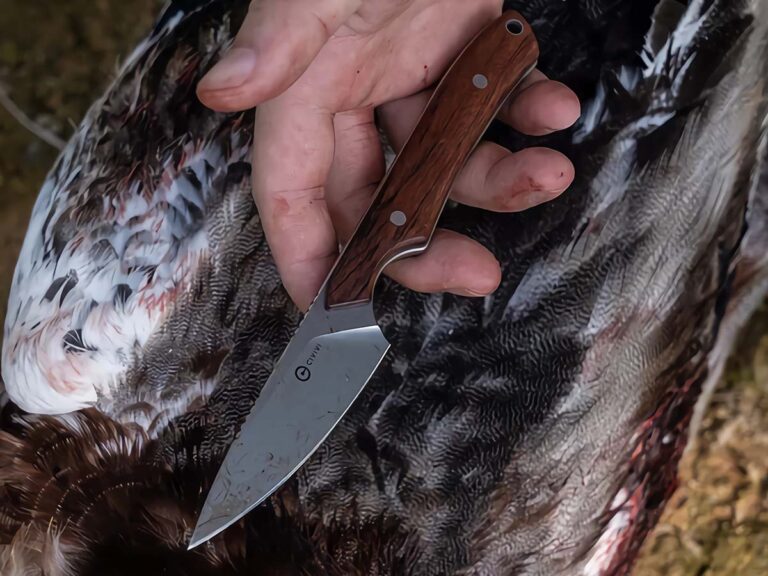
Civivi is expanding its lineup of dedicated field tools with the High Grass Field Knife, a compact fixed-blade built specifically for upland hunters and small-game processing. Designed by Michigan custom knifemaker Matt Gentry, the production model translates years of hands-on experience in Michigan’s Upper Peninsula into an accessible, purpose-built knife where fine control takes priority over raw size.

The inspiration for the High Grass stems directly from Gentry’s time spent pursuing small game with his son across Michigan’s northern terrain. Rather than modifying a general-purpose camp knife, Gentry set out to build a nimble tool optimized for delicate field-dressing tasks of fowl and small game.

To achieve that level of precision, the knife features a 2.93-inch drop-point blade with a flat grind and an ultra-fine tip, making detail work around joints and skinning far more manageable. Dual sections of jimping along the spine provide tactile indexing points, allowing users to safely choke up on the blade for tight, controlled cuts.

Field-Ready Materials

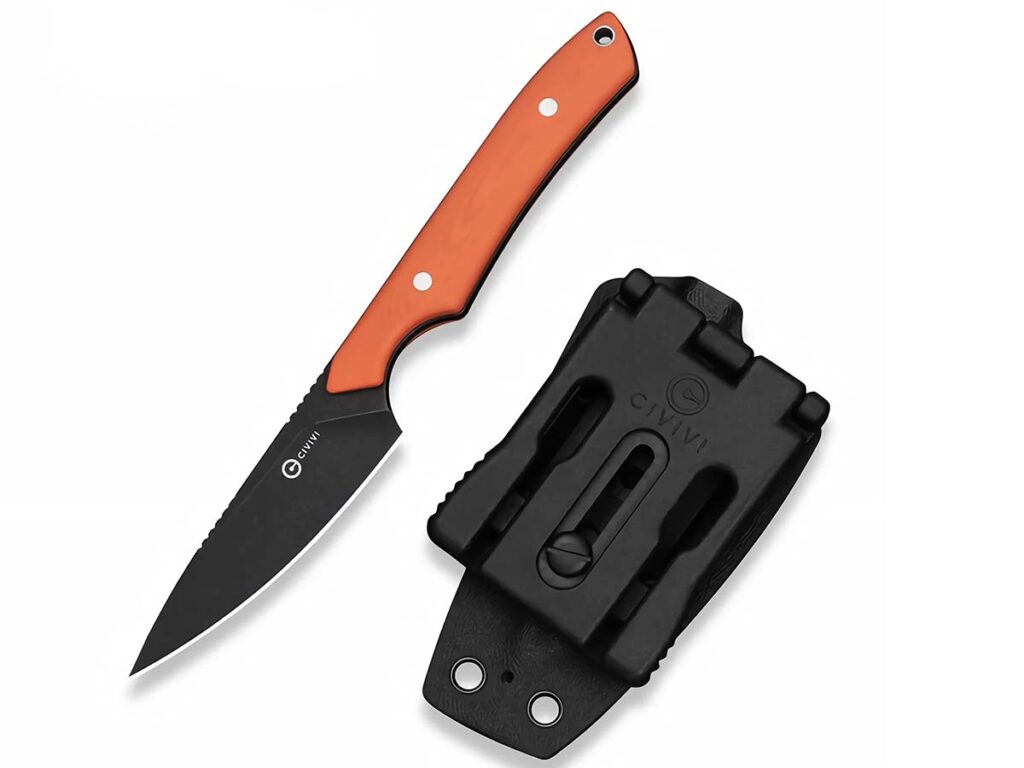
Civivi High Grass profile

Civivi opted for Sandvik 14C28N stainless steel for the blade stock, heat-treated to 58–60 HRC. The steel offers a solid balance of edge retention, corrosion resistance and ease of resharpening in the field. A stonewashed finish helps mask the inevitable scuffs and scratches that come with regular use.

For the handle, natural Guibourtia wood scales offer a classic look that honors traditional hunting gear while maintaining a comfortable, ergonomic fill in the hand. Stainless steel hardware keeps the construction secure, and at an overall length of 7 inches with a weight of 2.26 ounces, the knife carries light on a belt or in a pack.

The High Grass Field Knife ships ready for the field with a molded black Kydex sheath. The setup features a T-Clip mounting system designed by knife industry veteran and BLADE Magazine Cutlery Hall of Fame® member Bob Terzuola, providing versatile attachment options for belts or pack webbing. A pre-tied black paracord lanyard comes installed from the factory for added draw leverage.

High Grass Field Knife Specs
Designer: Matt Gentry
Overall Length: 7”
Blade Length: 2”
Cutting Edge: 3.09”
Blade Thickness: .12”
Blade Steel: Sandvik 14C28N (58–60 HRC)
Blade Grind/Finish: Flat grind, stonewashed
Handle Material: Guibourtia wood
Handle Thickness: .56”
Knife Weight: 2.26 oz.
Sheath: Black Kydex with Terzuola T-Clip
Extras: Tied black paracord lanyard
MSRP: Starting at $59

Knife Reviews:

5 Best Pocketknife Options For EDC [2022]

Looking for the best pocketknife for your EDC needs? These five are certainly top options to get you well equipped.

The pocketknife stands alone when it comes to edged tools. Whether it’s outdoors, in the shop, in the kitchen or elsewhere, the number of uses for the pocketknife are seemingly endless.


And just as endless is the variety of pocketknives available today. With dozens of blade types made of dozens of steels with dozens of functions, it’s a deluge of knives that can be hard to parse through. 

Types Of Pocketknives

SOG Recondo FX with serrated edge

While there are thousands of different individual pocketknives out there, the vast majority fall into two categories: the single blade and the multi-blade.

The single-blade pocketknife is exactly that: a knife with one blade. We’ll get to the types of blades shortly. While a single-blade piece could be a small fixed blade with a pocket-sized sheath, usually it’s a folding knife. The folding versions are especially good as EDCs.

The multi-blade knife will usually feature two or three blades—some more—across many different styles. A good chunk of these models are slip joints, which use a spring that helps either keep the blade tucked away or open.

There are many different types of slip-joint multi-blades. The Boker Trapper Red Bone is a prime example of a high-quality multi-blade knife.

When it comes to a multi-tool type of multi-blade, think of Swiss Army knives. These are pocket-sized tools that feature an assortment of tools ranging from blades and screwdrivers to toothpicks, pliers, corkscrews and more.

Types Of Pocketknife Blades

The Microtech Scarab II’s drop-point blade accommodates most cutting tasks with gusto.
The Microtech Scarab II’s modified drop-point blade accommodates most cutting tasks with gusto.

The first pocketknives date as far back as 600 BCE in Europe, and folding knives have been found that date from pre-Roman times.

In the millennia since, the pocketknife has morphed and evolved in myriad ways. Today there are dozens of different types of pocketknives. Some are great for EDC use while others are more specialized. 

While the styles of blades are all a bit different, these are three of the most common types.

Drop Point

A common blade style for a pocketknife, the drop point curves up from the edge to the point. Popularized by BLADE Magazine Cutlery Hall-Of-Fame® member Bob Loveless for fixed-blade hunting knives, it is a great style for hunters and for slicing, and ideal for all-around EDC as well. The point is good for piercing and the edge, being good for hunting, is more than capable of doing things throughout your day like opening envelopes, slicing rope, or even cutting vegetables in a pinch. The GiantMouse Ace Corta is an example of a modified drop point.

Clip Point

The clip point swoops down from the spine to the point of blade. Since it looks like the forward part of the blade was “clipped” off, the name clip point stuck. The spine is usually unsharpened, and the clip point has a narrower tip than a drop point. The clip point is seen on many bowie knives.

An example of a clip point on an EDC knife would be the SOG Recondo FX.

Spear Point

The spear point is the style of the main blade of many Swiss Army knives. A great puncture instrument, a blade with a spear point is ideal for penetration. Many daggers and swords are ground to a spear point. 

Five Premier Pocketknives

We scoured the world of knives to pick out five of outstanding pocketknives available today. Across different styles, companies and price points, these five stood out from the pack. 

Swiss Army Knife Huntsman

Swiss Army Knife Huntsman

One could argue that the Swiss Army knife is the gold standard of pocketknives. This classic multi-blade from Victorinox has stood the test of time and now comes in dozens of varieties.

The Huntsman was selected because of its tool set. There are 15 different implements within the knife, including classics like the spear-point blade, reamer and can opener, as well as a wood saw, tweezers, scissors and wire stripper, among others.

All the tools, like with other Swiss Army knives, are made from stainless steel. Having at least one SAK in your tool drawer or travel bag is an absolute must, and you can’t go wrong with the Huntsman.

MSRP: $37.99

Opinel #8 Carbon Steel Folding Knife

Opinel #8 Carbon Steel Folding Knife

By any measure, the Opinel #8 is a classic. First made in 1890, the #8 is still popular today due to its simplicity. It features a 3.28-inch blade of XC90 carbon steel. It’s robust yet delicate. The single blade is fine enough for an artisan or craftsman and tough enough to handle hard use in the kitchen or workshop.

In an era when EDC knives are becoming more complex and packed with features, Opinel sticks to its roots with a piece that is often imitated but rarely replicated.

MSRP: $18.

Benchmade Bugout

Benchmade Bugout
Benchmade Bugout

Coming in numerous different colors and styles, the Benchmade Bugout is one cool-looking pocketknife. Slim and ergonomic, and incredibly light, the Bugout knives were designed for the outdoorsman but are great for EDC too.

The clipped drop-point blade—you can choose between a plain or serrated edge—is made from CPM S30V stainless steel with a Rockwell hardness of 58-60 HRC. It’s 3.24 inches long with a satin finish that looks good when paired with any of the five different types of handles Benchmade offers.

Handle materials—options include Grivory or CF Elite—are lightweight. The entire knife weighs just 1.85 ounces. It’s almost lighter than air.

MSRP: $160.

Boker Damascus Duke

Boker Damascus Duke
Boker Damascus Duke

If you’re looking for a showpiece that’s also a great utility knife AND won’t break the bank, Boker has you covered. The Damascus Duke features a 2.44-inch blade forged from 37 layers of steel. The artistic qualities don’t stop with the blade. Etched bolsters add to the beauty of the knife, and the root wood scales provide a classy grip.

But this knife is more than just a pretty girl at the prom. The lockback mechanism will give you confidence to put this piece through its paces. The short length of the blade makes this knife great for detail work or other finite tasks at home or on the road.

MSRP: $64.95.

Kershaw Blur

Kershaw Blur
Kershaw Blur

Designed by Ken Onion, the youngest-ever inductee into the Cutlery Hall of Fame, the Kershaw Blur may be as good of an all-around edged tool as you’ll find in knife shops today.

The recurve drop-point blade can cut cord and small brush while camping, or slice open an over-taped FedEx package and keep rolling along.

The blade is 14C28N stainless steel in a black Cerakote coat for enhanced corrosion resistance and protection. It’s married to an aluminum handle that features Trac-Tec inserts and a reversible pocket clip.

Made in America and tough as nails, the Blur won’t let you down.

MSRP: $107.99

Read More

Tactical And Switchblade Combs That Keep You Looking Cool

A Switchblade Comb Is A Fun Take On The Knife Design. Unlike The Knife, The Switchblade Comb Can Be Taken On A Plane.

The switchblade looks cool. The blade firing out at speed and satisfyingly clicking into place is one of the great joys of the knife world. However, many legal codes of countries around the world don’t look fondly on the fast-moving blade. But that cool factor has endured and can be seen in switchblade combs. And they have the added benefit of being far, far cheaper than even the lowest-quality stiletto.

Switchblade combs?

Yes. It’s a comb that deploys like a switchblade. Maybe you’re looking for a comb with a burst of excitement, or a comb that isn’t made of cheap, flimsy plastic. Or maybe you’re a Jet or a Shark that needs to look good for their next rumble.

No matter what the reason, the switchblade comb is a fun little tool to have. This knife… I mean comb shows what the switchblade comb is all about.

Etrading Italian-Style Automatic Comb

Etrading Italian-Style Automatic Comb

This comb is a perfect example of what a switchblade comb can be. The handle is made from pearl-toned polymer, and the blade is made from 440 stainless steel that’s built to last. At nine inches in length, with a five-inch handle, the comb sits well in the hand and feels good to use.

The stainless bolsters help take the look to the next level, and it all comes together thanks to the push-button deployment that sends the comb out in a blink. Additionally, there is a trigger lock-out that prevents the comb from opening in your pocket or bag.

This is a fun piece that you can show off to friends and keep your hair well-coiffed too.

MSRP: $10.50

Tops Knives Tac-Rake

Tops Knives Tac-Rake

For something a bit more robust there is the Tac-Rake from TOPS Knives. This beard comb is of the fixed-blade variety (yes, not a switchblade but it’s so good) that’s made from black traction-coated steel meted to a tan canvas micarta handle.

It’s only 5.88 inches in total length so it’s probably not the best comb for a full head of hair, but it is specially made for a beard and will keep your facial hair looking clean and sharp. The fact that you’ll feel like a champ while using it is just an added bonus.

The included leather sheath makes traveling with the comb easy and stress-free.

MSRP: $105

Microtech UTX-85

Microtech UTX-85

This OTF comb is the Cadillac of combs. The blade is stainless, and the handle is anodized aluminum. It’s luxurious to use, and the dual-action mechanism deploys and retracts the knife in the blink of an eye.

The teeth are nice and fine so it’ll brush your hair and your beard with ease. Adding to the tactical nature of the comb, the glass breaker at the butt of the piece is a handy tool to have on your person. And, since this isn’t a proper sharpened knife, you can take this with you wherever you go from a baseball game to a restaurant and even on a plane.

MSRP: $340

BeardAir Tactical Beard Comb

BeardAir Tactical Beard Comb

For a tactical combing experience, there is this sleek comb from BeardAir. With a blade made from 17-4PH steel, and a handle made from aviation aluminum. It’s light and strong, and the automatic open/close function deploys the comb with speed and style.

Unlike the other combs on this list, the Tactical Beard Comb comes in all sorts of different colors so you can find the one that fits your aesthetic the best whether it’s a more traditional black knife with red accents or something more wild like the olive green and pink one above. 

MSRP: $59.99

Read More

Advertisement

Must Read Articles

Read this before you make a knife

Knifemaking 101 – Read This Before You Make a Knife

  by Wayne Goddard My experience has taught me that there's nothing like digging in and getting started. I've often said the hardest part of the...
how to forge damascus steel

How to Forge Damascus

Advertisement
Advertisement