Consider four large kitchen knives, all under $80 each.
As you get older and entertain bigger gatherings, do you find yourself wanting to improve your culinary chops?
A little more blade may be just what you need to sharpen your prep time so you can spend more time enjoying your food than getting it to the table. Larger and more focused kitchen tools can indeed improve your efficiency and your proficiency as a gourmet chef as well.
The focus here is on large and/or specialized kitchen knives, specifically the different types and what they can do to make your job easier and your cooking better, each for under $80. Large cooking knives vary widely and we’re going to show you four variations. Keep in mind, most kitchen knives aren’t just for cutting meat but are for preparing fruit, vegetables and other items such as breading or crusts, too.
Utica Meat Dad Chef’s Knife
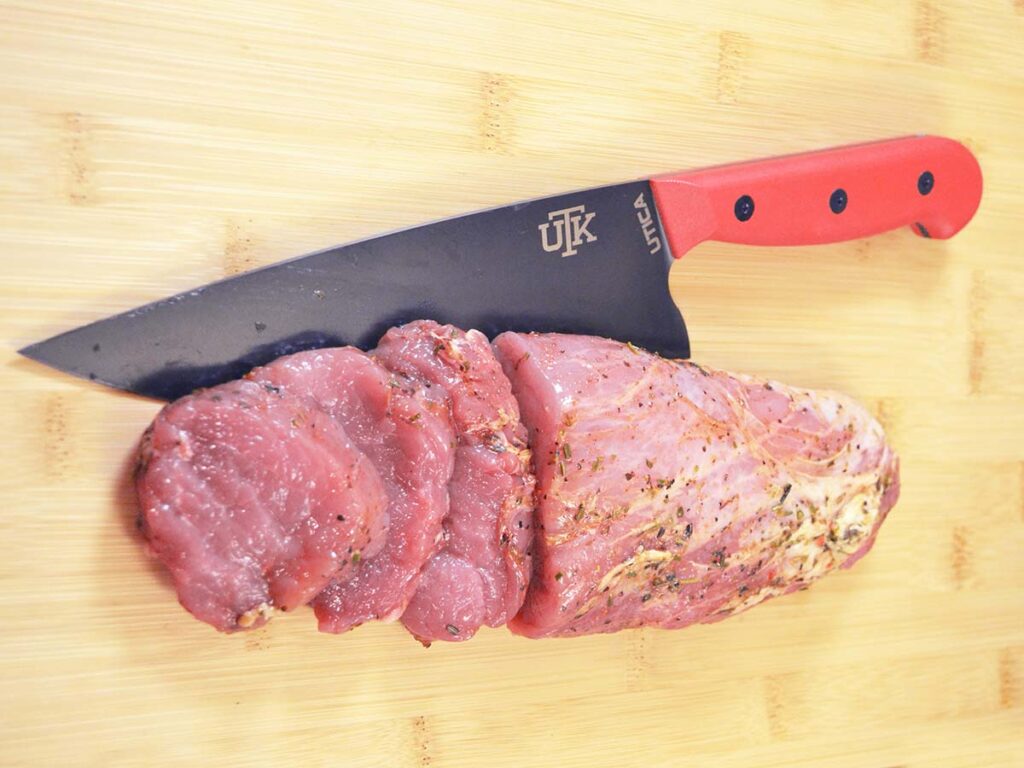
The Utica Meat Dad Chef’s Knife is for large cuts of meat, fruits and vegetables. It took half-inch medallions off a plump pork tenderloin for the sauté pan.
Meat Dad Chef’s Knife Specs Blade length: 7.54” Blade steel: 440C stainless Blade finish: Food Safe Black PVD Handle material: Orange G-10 Weight: 17” Overall length: 12.5” Country of origin: USA MSRP: $74.99
The Utica Meat Dad Chef’s Knife is a whopper with a blade belly 2.25 inches deep for carving the big stuff when needed and everyday slicing and dicing as well. The beefy orange G-10 handle helps maintain control on the wieldy blade for it all.
Though the test’s two chef’s knives—the Fox Knives Meat Slicer being the other—have meat in their names, they facilitate a much wider variety of meal prep tasks, including the slicing, dicing and mincing of a wide range of vegetables and other fare.
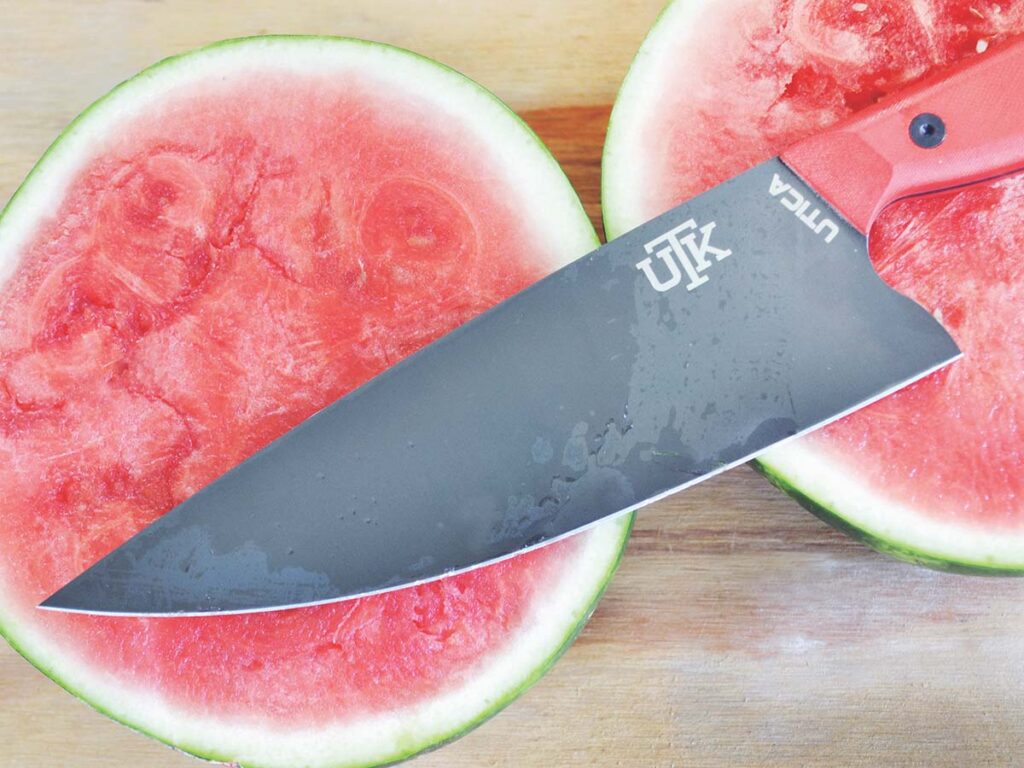
The Meat Dad is large enough to tackle a watermelon in a straight cut.
The Utica is large for a chef’s knife so we tested it on some heathy chores, such as cutting a nice, plump pork tenderloin into fat medallions for a tasty sauté. We also tried the Meat Dad out on a watermelon and, thanks to the stout blade, sliced it straight as an arrow from top to bottom. Sometimes you just need a large knife and the Utica tackles those requirements quite well.
Fox Meat Slicer Knife
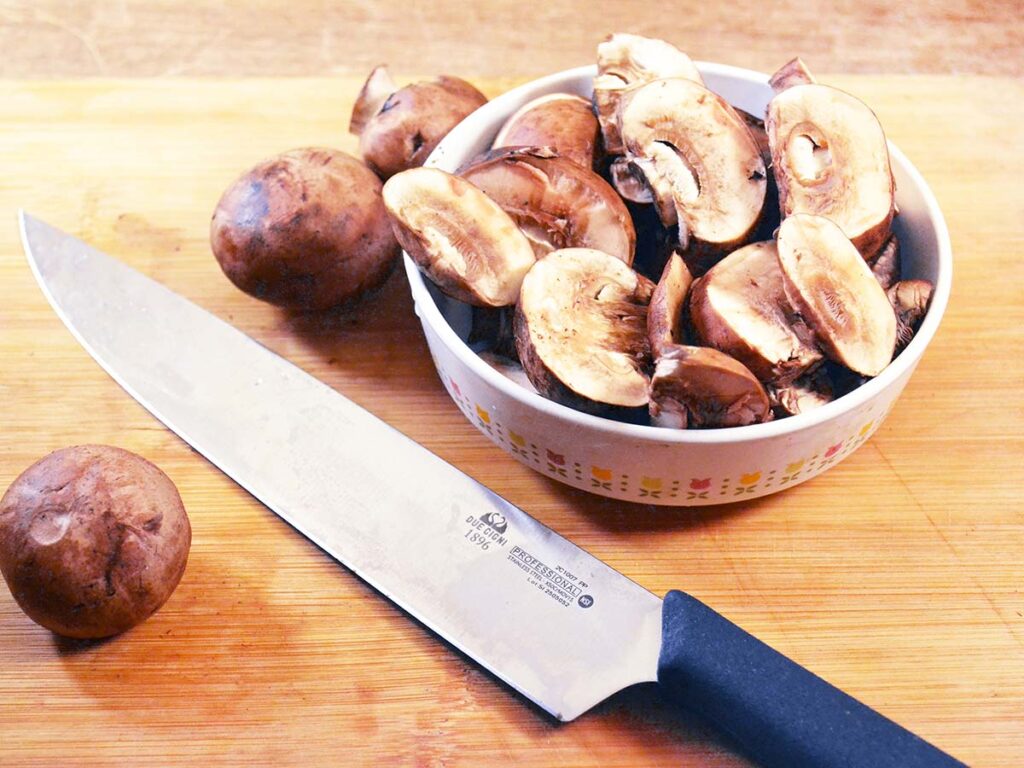
Like many typical chef’s knives, the Fox Meat Slicer is capable of many functions. Wrote the author: “I used the knife for slicing small brown portobello mushrooms to add to an omelet. Note the sharp, crisp cuts—a sign the mushrooms were not prepared by an ordinary kitchen knife.”
Meat Slicer Specs Blade length: 7.8” Blade steel: UNI X59CrMoV15 stainless Blade finish: Fine satin Handle material: Black PP synthetic Weight: 3.75 ozs. Overall length: 12.4” Country of origin: Italy MSRP: $36.94
All chef’s knives are relatively long but not all have blades that can be tiring to use. The Fox Meat Slicer Knife is a much trimmer, more svelte example. A large Italian cutlery company with an impressive presence in the USA, Fox offers a strong group of knives in its Due Cigni Coltellerie line.
One of the group is the Meat Slicer, a long chef’s knife with a slim profile sporting an extended, slender drop-point blade only .12-inch thick. It comes with a gently curved handle that has just enough drop at the base to protect your fingers during use.
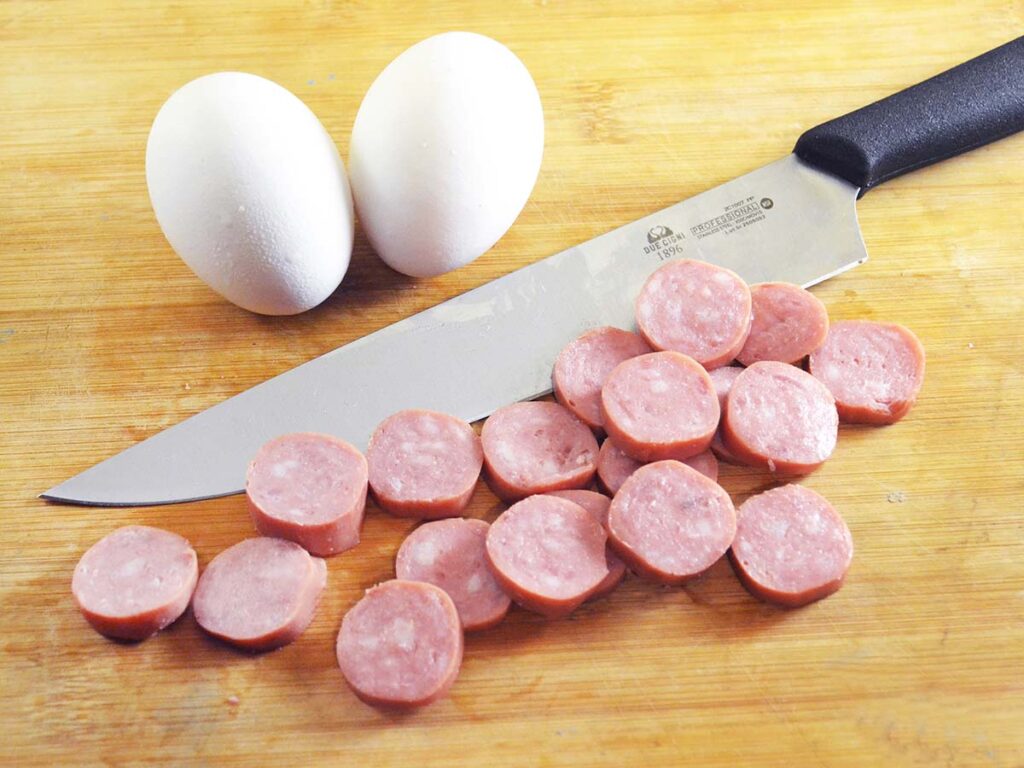
The Meat Slicer is more adept at less cumbersome tasks of both the meat and vegetable variety. We first used it on a couple of smoked sausage links, cutting roughly 3/16-inch slices down the length of each for an omelet. The knife performed quickly and with ease.
The Fox Meat Slicer is excellent for most meals that don’t require cutting thick slabs of meat or large fruit and vegetables. It made quick work prepping smoked sausage.
To add a little flavor, we turned to some portobello mushrooms. Taking a handful, I trimmed the stems off and sliced them up one by one in a jiffy. The German steel performed very well and the handle was the most comfortable of the test lot.
A.G. Russell 6-inch Boning Knife
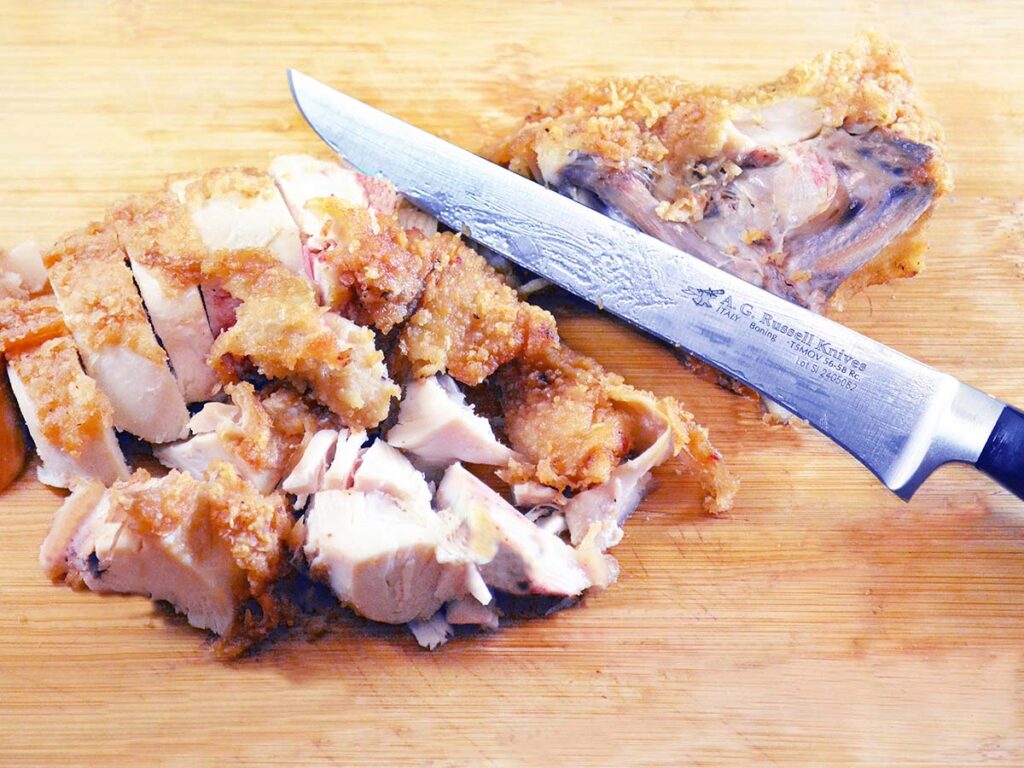
The A.G. Russell relieved the chicken breast of its hard-shell-bone understructure pronto. “Fowl such as chickens retain their juices and flavor much better when cooked on the bone,” the author noted. “Here the chicken breast is removed, sliced and ready to eat.”
The A.G. Russell 6-inch Boning Knife just might be your go-to counter slicer for a myriad of kitchen duties. While its name is designated for separating meat from bones, the A.G. Russell can perform a myriad of duties such as trimming, slicing and dicing both meat and veggies. Some even clean their afternoon catch with it as it is closely related to a fish knife. The blade is super thin and the piece is very lightweight.
The A.G. Russell got the most tedious work out of the foursome due to the nature of the beast. Fortunately, chickens go through extensive steps of processing before average folk ever set eyes on them. Whether fried, barbecued or roasted, the best way to keep a chicken breast moist is with the skin, breast meat and bone structure cooked together.
After cooking the bird, use the sharp cutting tip to cut the area around the breast skin so it can be removed with the meat. Next, peel the skin back and slowly work the blade between meat and bone structure and slowly use the fingers of your other hand to peel the entire breast off with the skin on. Slice and eat!
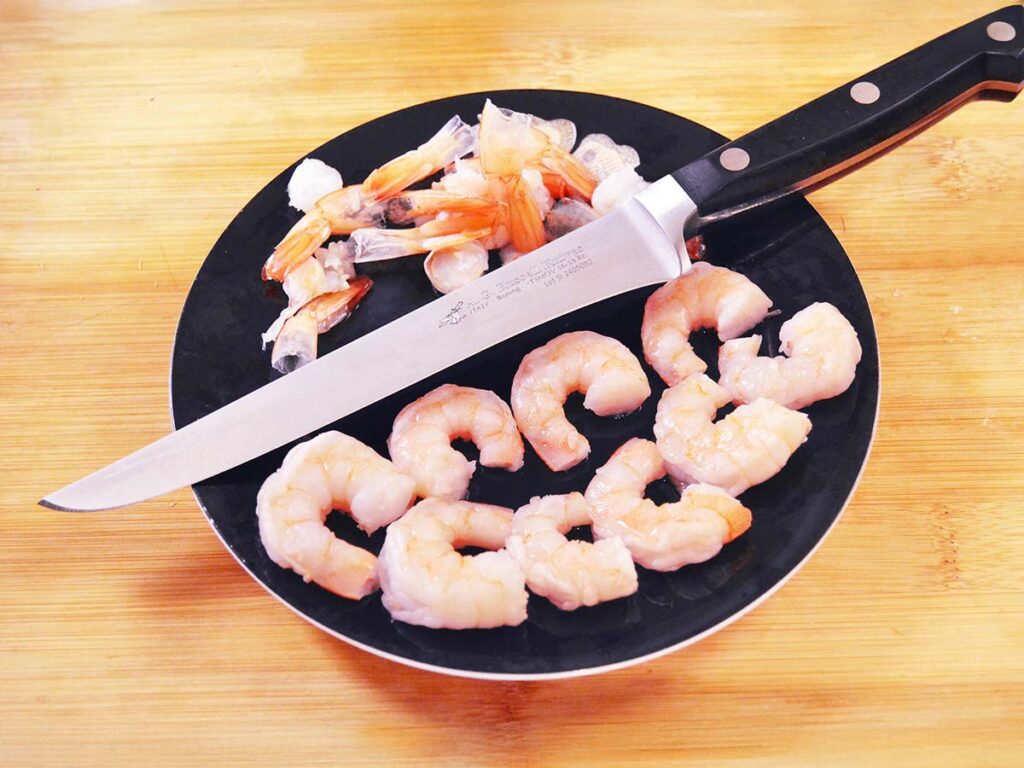
The A.G. Russell Boning Knife has a thin, sharp blade very much akin to a fish knife and can be used for other types of work around the kitchen. The author used the razor-sharp blade to cut off the tails of shrimp for a cocktail.
The Boning Knife, like the others, is handy in other ways as well. You can slice small veggies and fruits, trim fat and do all sorts of clean-up chores to make food more presentable.
Ontario Old Hickory 76 7-inch Cleaver
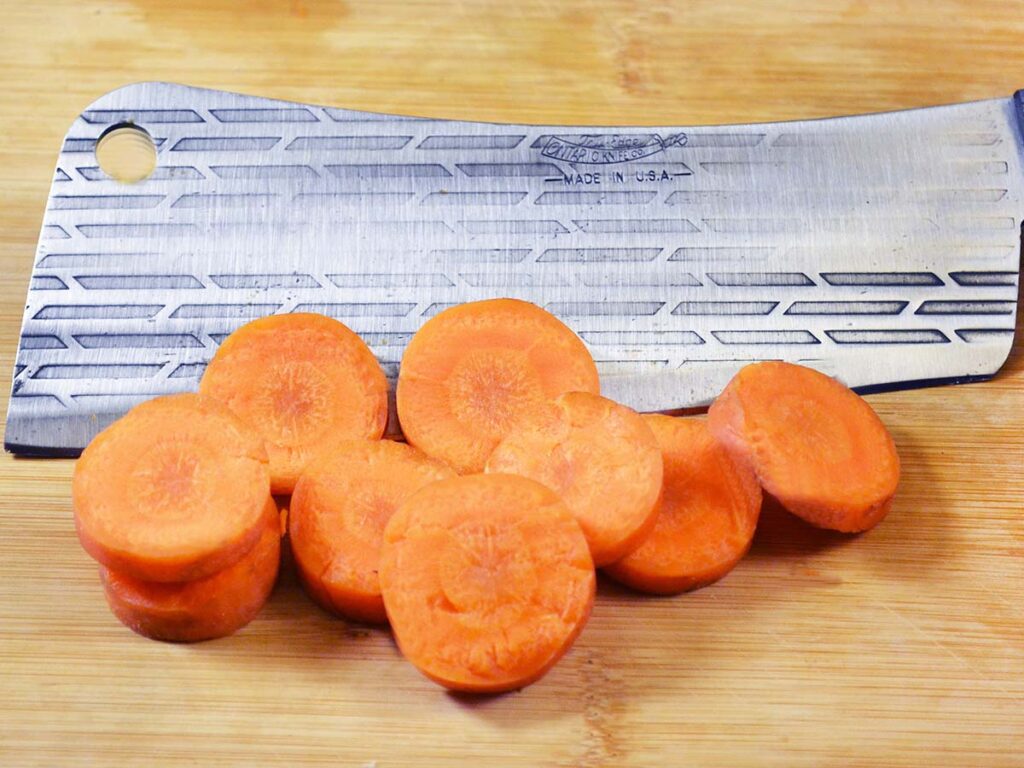
Cutting thick carrots across the grain can be tough on many kitchen knives but was easy for the Ontario Old Hickory 76 Cleaver.
Old Hickory 76 Cleaver Specs Blade length: 7.5” Blade material: 1075 carbon steel Blade grind: Flat bevel Blade finish: Brushed Handle material: Wood Weight: 10 ozs. Overall length: 12” Country of origin: USA MSRP: $30.50
We’ve saved the big gun for last: the Ontario Old Hickory 76 7-inch Cleaver. There’s something to be said for the simple, matter-of-fact Old Hickory edged tools. Maybe it’s the “If it ain’t broke, don’t fix it” attitude—and I like it! The blade has a horizontal pattern pressed into it, a hole for hanging in the upper lead edge, and an Ontario Knife Co., Tru Edge, Made In U.S.A., sword logo stamp in the top center. The blade climbs upward toward the tip at its spine and the cutting edge has a gentle curve to it.
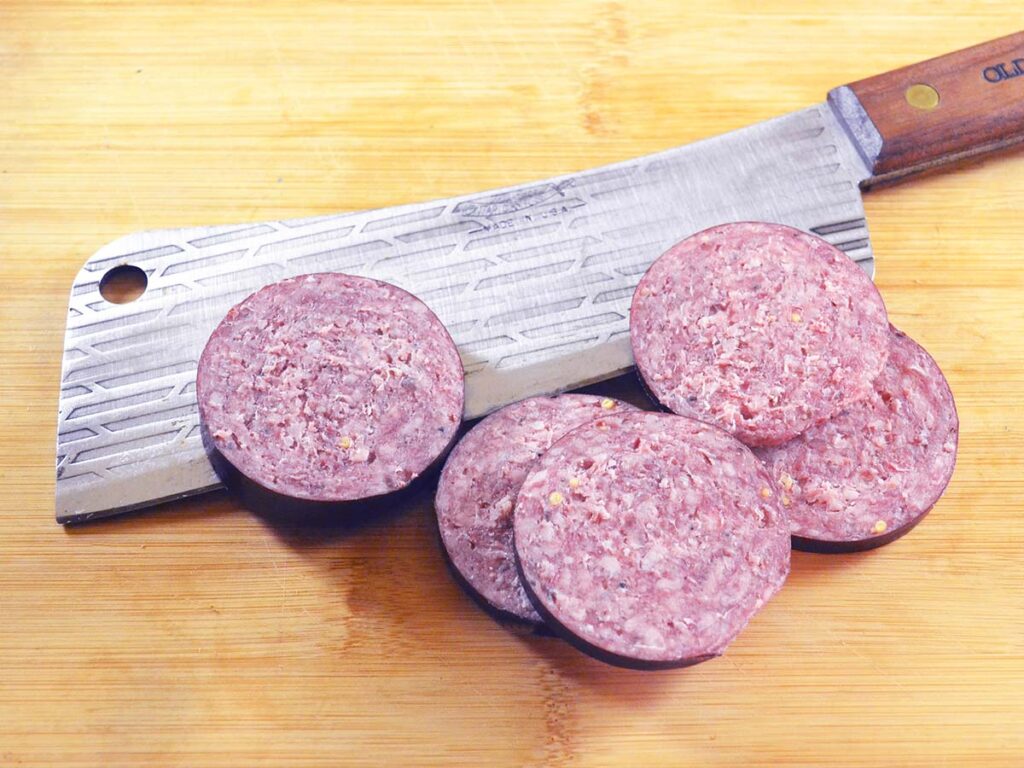
When you need a heavy hand and finesse is no object, the cleaver will get the job done. We used it for cutting some tough-as-nails carrots with no problem. The same went for hard sausage. There’s no sense in dulling a sharp knife blade on hard, tough foods when a cleaver can cut them with haste and look for its next challenge.
Chubs of hard summer sausage are what the Old Hickory 76 lives for.
Old Hickory blades are the kind of “git ’er done” kitchen knives and tools that take your tough challenges on their back and never cry uncle. My family grew up with Old Hickory blades and I recommend keeping them around the kitchen when tough times call for tough tools.
Final Cut
There you have it—four different ways to make your kitchen more useful without breaking the bank. If you’re ready to expand your culinary universe, look no further than these useful, able kitchen helpers.
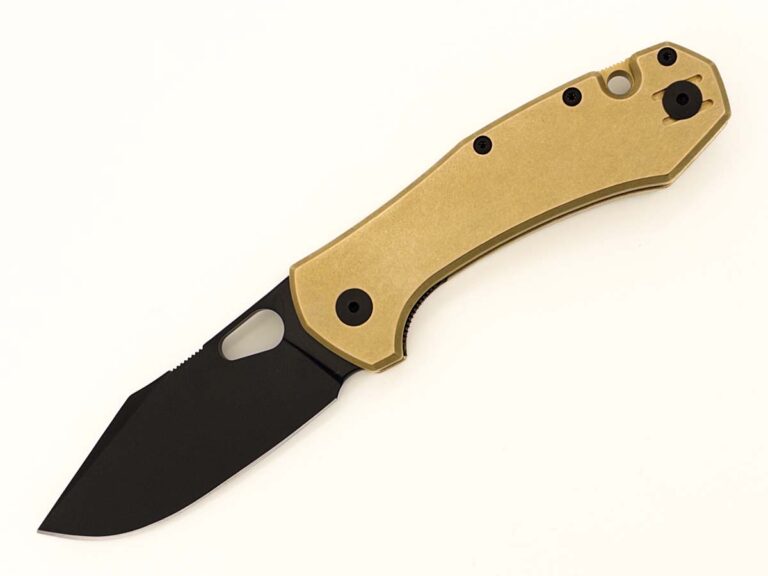
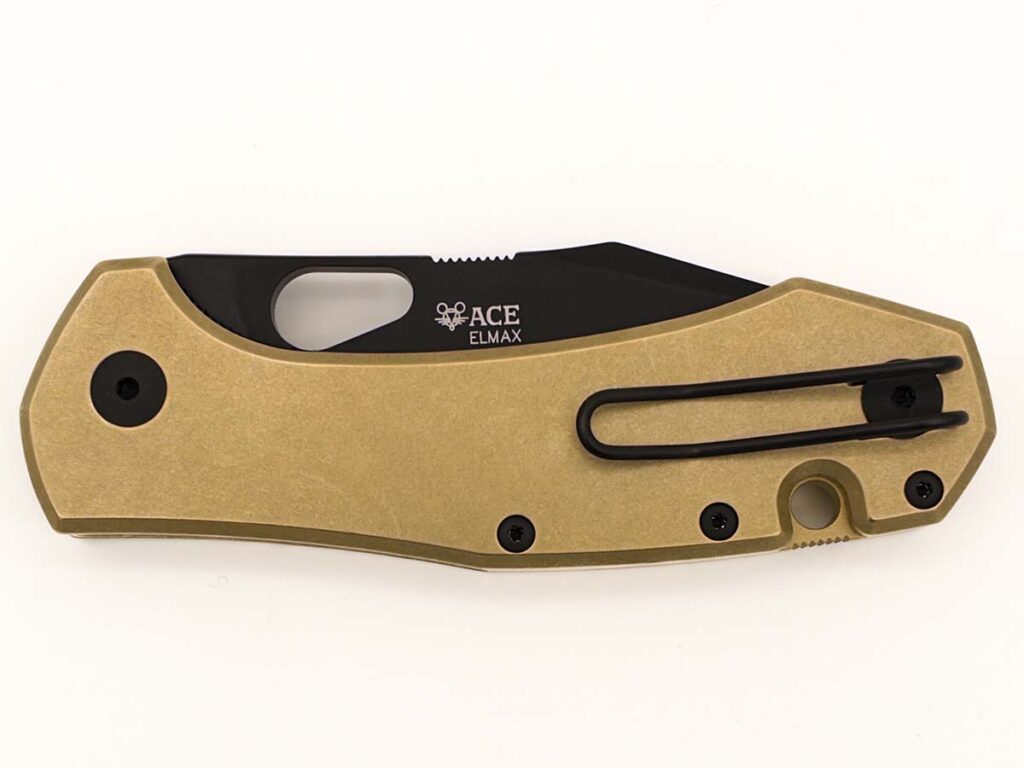
Explore the new GiantMouse ACE Atelier, with PVD-coated Elmax steel and a scale designed to develop a unique patina over time.
The GiantMouse ACE Atelier has always been defined by its surroundings. Named for the art-deco Atelier Bar located within the Grand Hotel in Nuremberg, Germany, the design was originally conceived as a more compact and refined sibling to the ACE Grand. While the initial versions of the Atelier emphasized lightweight carry and contoured ergonomics, this newest iteration moves in a different direction, prioritizing weight, tactile feedback and a sense of permanence.
The shift to solid brass scales transforms the character of the knife. By utilizing a flat, slab-sided profile, the Atelier gains a grounded presence that feels substantial in the hand. Brass is a material that rewards the user over time; it is not a static finish. Instead, the surface will naturally darken and develop a unique patina through regular carry, essentially recording the history of its use. This added heft provides a satisfying balance to the compact frame, offering the feel of a full-sized tool in a pocket-friendly footprint.
Performance remains at the forefront with a 2.875-inch blade crafted from PVD-coated Elmax steel. This premium alloy ensures excellent edge retention and toughness, while the dark coating provides a muted, low-profile contrast to the warm, evolving tones of the brass handle. It is a design for those who value restraint. Rather than relying on aggressive styling or unnecessary flourishes, the Flat Brass Atelier leans on the inherent quality of its materials and a clean silhouette to prove its worth as a daily companion.
Three options to stay keen when you’re out and about.
Active lifestyles often need specialized tools. Out hiking, camping or hunting, a workbench instrument is out of place. This is especially true for one of the most vital pieces of knife kit—sharpeners.
In recent years, the market has trended toward larger bench-mounted sharpeners that, while dynamite at extracting a precise edge, are all but impractical in the field. Out and about, a solid portable sharpener is more than worth its weight in gold. Even better, for those who take a more minimalist approach to edge-maintenance equipment, most mobile sharpeners are more than capable of serving as primary tools for bringing a knife back to life.
Given this isn’t the time of Charlemagne, this class of sharpeners should have an angle guide integral to their design, eliminating guesswork. And since they’re less elaborate, portable sharpeners should be cost-effective, as well. You do not want to spend a ton on something that might be lost. Most of all, these options should prove easy to tote around, be it in a pocket, tool pouch, vehicle glove compartment, backpack or anywhere else you want to cram one.
There are plenty of portable sharpeners available today, but in our trials, we found the following a cut above the rest.
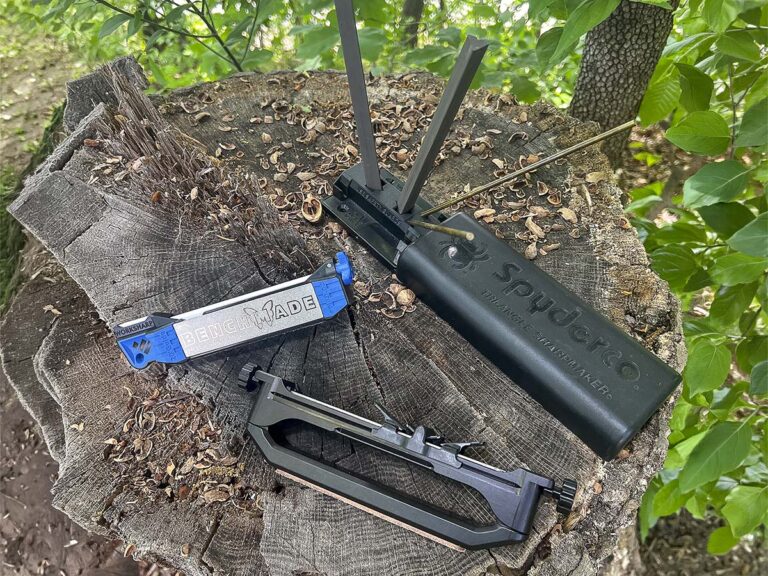
Wicked Edge Venture Pro WE26
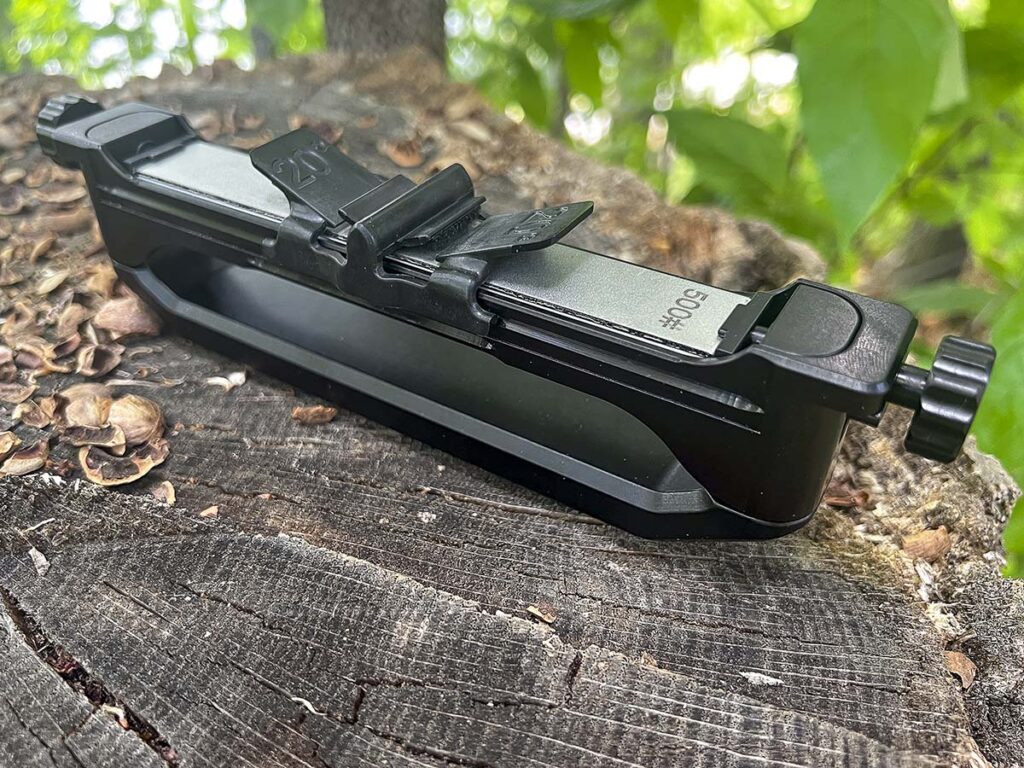
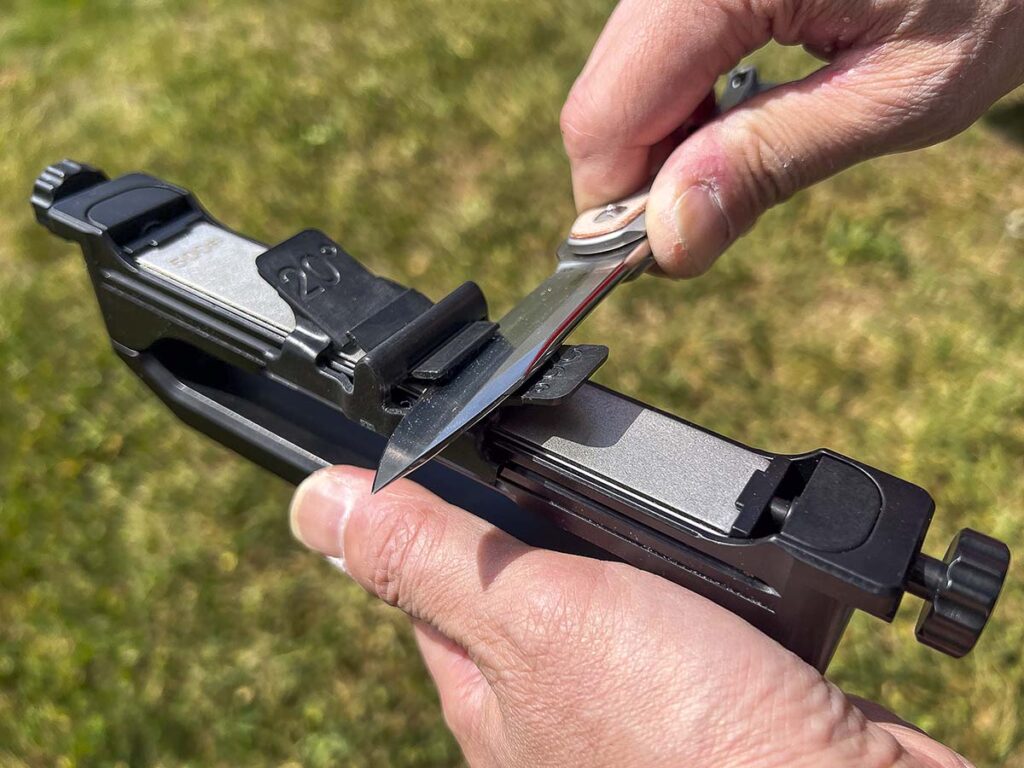
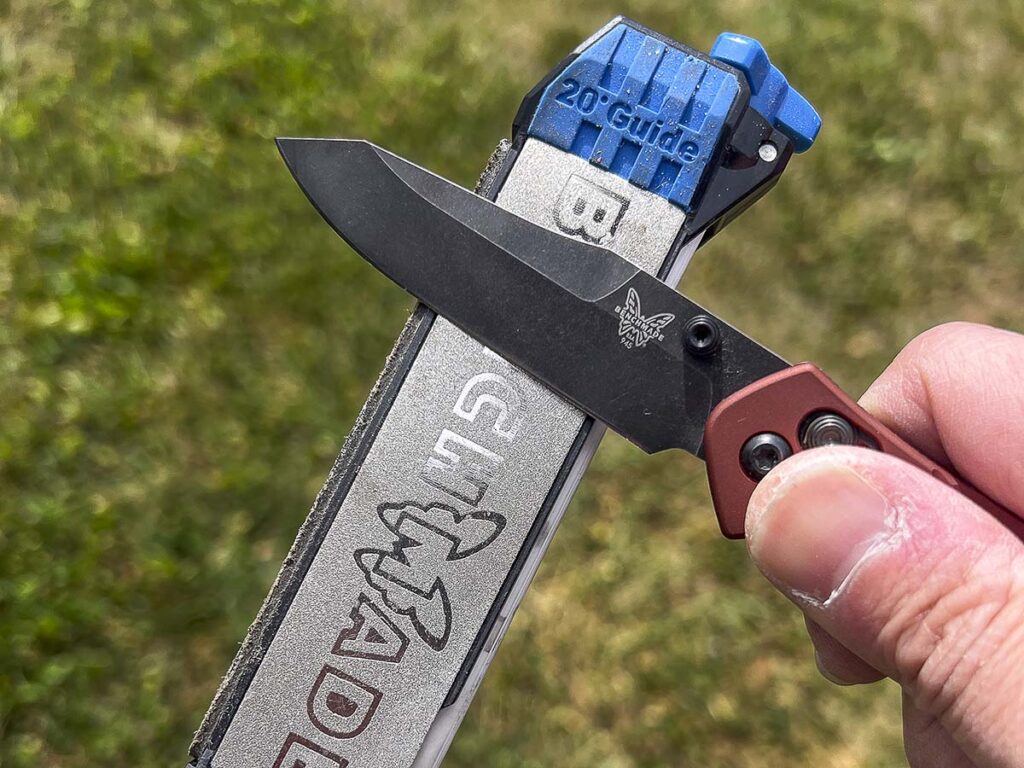
The Wicked Edge Venture Pro features a movable 20-degree angle guide that helps to keep your angle consistent, so that even beginners can achieve desirable results. And while not quite pocket sized, the until is perfectly proportioned for sharpening on the go.
Wicked Edge, primarily known for its high-end guide-honing systems, has recently turned its discerning eye to mobile sharpening. The result is the Venture Pro WE26. While more compact than most everything else the company offers, it is no less effective.
Starting with the build quality, Wicked Edge has constructed a system built to last. The Venture Pro’s frame is sturdy T6-6061 aluminum alloy, keeping the unit relatively light, yet extremely durable. The company holds the system together with stainless steel screws and a tension spring. And the honing surface is a double-sided diamond-coated steel plate—if you drop one, you don’t have to sweat it shattering. A cam system holds it in place and allows a painless switch between sides and grit size—500-grit diamond and a fine-grit ceramic. A plus. Yet this is only part of the sharpener’s selling points.
What really grabs attention is that the Venture Pro is a railed angle guide. The system is slick, essentially allowing you to pull your knife through, while the guide maintains a consistent 20-degree angle over the entirety of the sharpening surface. This element of the system deserves mention in and of itself. It is molded from a thermoplastic blend of POM (Delrin) and PTFE (Teflon), the result is a slick surface that all but guarantees a smooth stroke on each pass. The guide is removable and has a storage position on the rear of the sharpener for easy storage in a more compact configuration. The final perk, the unit includes a leather strop and a built-in guide on the rear side, so you can hone a blade to a mirror finish.
The Venture Pro features both 500-grit diamond stone and ceramic honing surface, as well as a leather strop. Wicked Edge sells other grits and different angled guides, to tailor the system to your knives.
The Venture Pro definitely isn’t pocket-sized, but it is small enough to be considered portable. Its size is a plus in this respect; it’s large enough to tackle a wide range of knife types and sizes. I found the system easy to master over the course of several sharpening sessions with pocketknives, tactical folders, kitchen knives and even scissors. The routine is simple: place the blade into the guide as far up to the tang as possible, draw the knife through while moving forward and repeat on the other side. The angle guide slides so easily across the frame of the sharpener that it almost feels like it’s not even there.
Given that the 500-grit side is diamond, I did not have to apply a ton of pressure to achieve the desired results. And, if you’re sure of your freehand skills, the guide can be removed to speed up the process.
At home, at camp or anywhere, the Venture Pro works every time to provide you with a guaranteed sharp edge. As a bonus, several other plates with different grit sizes are available as well as different angle guides (15, 17 and 25 degrees), in case you have a particular system you want to adhere to. No matter what, this made-in-the-U.S.A. sharpener has an edge.
Venture Pro Specs Frame Material: T6-6061 Aluminum Alloy Sharpening Material: 500-grit diamond stone, ceramic hone and leather strop Weight: 10 oz. Sharpening Surface: 8.25” Features: Continuous 20-degree angle guide, integral handle Country Of Origin: U.S.A. MSRP: $189
Spyderco Sharpmaker
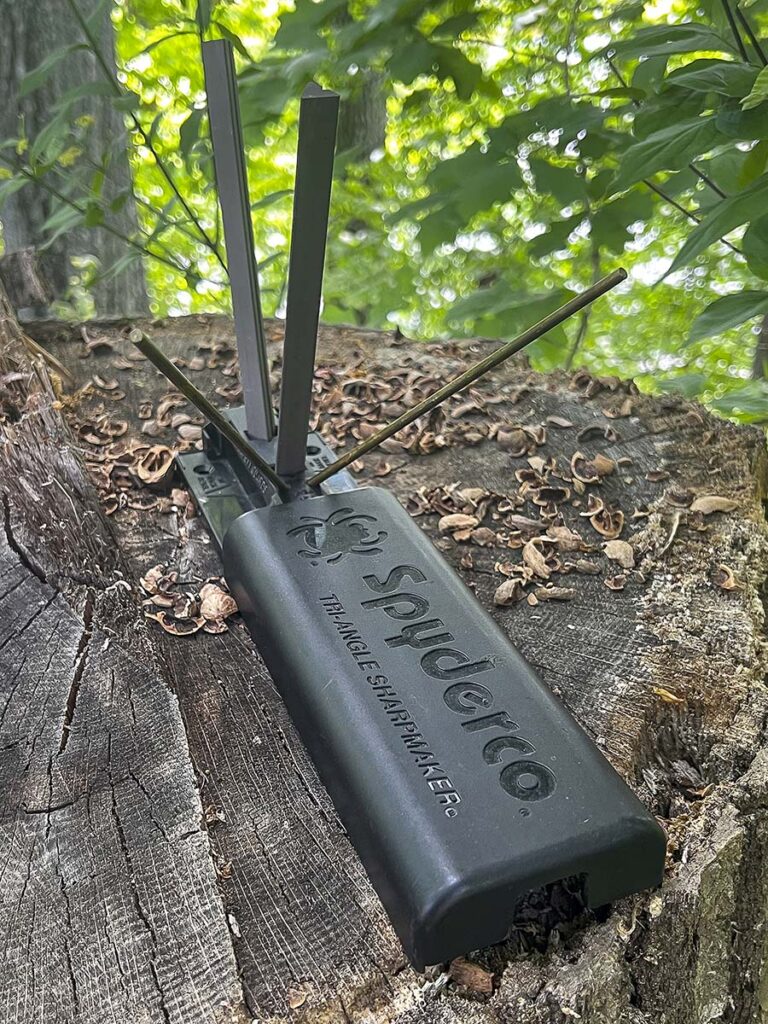
Absolutely time tested, the Sharpmaker has been a honing mainstay for a spell—namely because it works so well. Very simple in design, the portable sharpener features course and fine grain sharpening rods that can be set for a 20-degree edge and simply requires a downward stroke to do their business.
Spyderco’s model 204 Sharpmaker is a versatile, made in the U.S.A. sharpener and could be a primary sharpener on its own. But it’s how it breaks down, with all its hones nestled in the base, and the cover snaps over all of it, fully encasing the stowed sharpener that makes it a top choice for a portable sharpener.
The Sharpmaker utilizes two pairs of alumina ceramic rods—medium grit (brown) and fine grit (white)—held in the plastic base at a 20-degree angle, forming a “V” shape. The proper way to use this is to hold your knife to where the blade is perpendicular to the tabletop and then, starting at the blade tang end, place the blade onto the home and, in one motion, travel down the hone and at the same time pull the blade toward you. Gentle pressure is generally all that is required to achieve a sharp edge. As an added safety precaution, Spyderco includes two brass protection rods that prevent cutting your hand while holding the base.
The Sharpmaker’s design allows you to sharpen on any flat surface—tabletop, workbench, desk or even the tailgate of a pickup truck. Making the tool extremely convenient, the alumina ceramic rods do not require lubrication with oil or water. Though they do require occasional cleaning. The rods darken over time due to swarf collecting on the surface. Scotch-Brite pads and powder sink cleaner make quick work of this fouling and restore the sharpening surface. Another cool feature of the Sharpmaker is the two grooves on the bottom of the base. This allows you to set any two matching hones into the base, with their flat sides up for a makeshift bench stone.
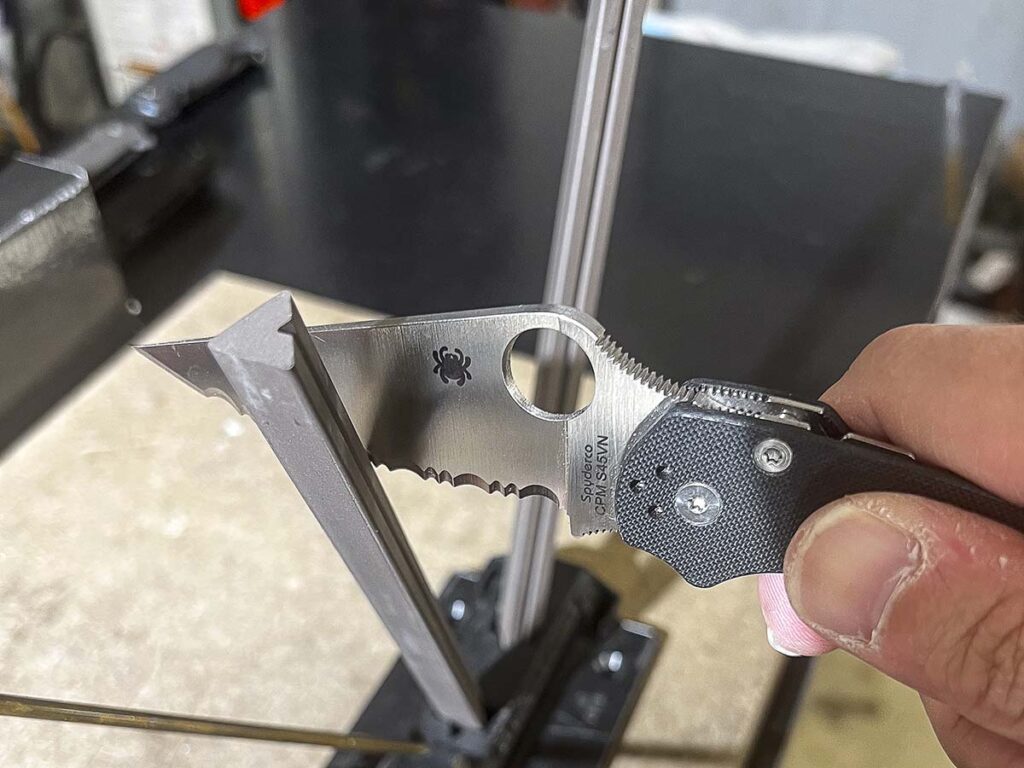
The Spyderco Sharpmaker 204 is the best sharpener to use with serrated knives, as it is easy to set up, easy to use and doesn’t use oil or water for lubrication. The points of the triangular-shaped hones capture each tooth in the serration pattern effectively.
The triangular shape of the hones was done on purpose and is a brilliant design. When you set up the honing where the flat sides face each other, the Sharpmaker effectively sharpens plain-edge blades. Rotate the hones so that the points face each other, and the Sharpmaker easily addresses serrated knives.
How well does the Sharpmaker work? Simply put—very well. It’s a must-have if you own any serrated knives, but as I said earlier, it will work just as well on plain-edge blades. The sharpener is easy to set up and easy to use. There’s no mess since you don’t use fluid for lubrication, and it breaks down into an ultra-compact form factor that stows easily.
Sharpmaker Specs Frame Material: ABS plastic base Sharpening Material: Alumina ceramic stones Weight: 1.4 lbs. Sharpening Surface: 7” Features: Plain edge and serrated sharpening surfaces Country Of Origin: U.S.A. MSRP: $127
Benchmade Guided Field Sharpener
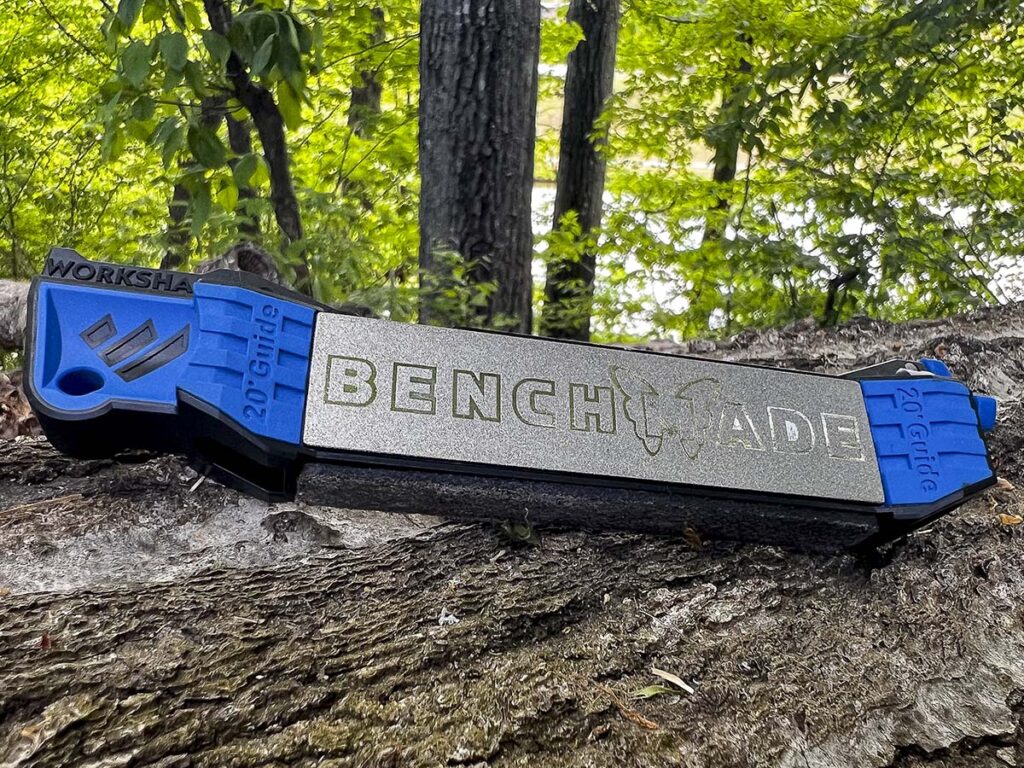
The Benchmade Guided Field Sharpener packs a lot into a small and affordable system. In addition to an integral angle guide, the system includes a diamond-infused sharpening plate, ceramic honing rods and a leather strop.
The Benchmade Guided Field Sharpener is the ultimate compact sharpener that is packed with so many features that you must use it to believe it. The unit is manufactured for Benchmade by Work Sharp, so it comes with a pedigree of a company that knows a thing or two about sharp cutting edges.
What you get with the Guided Field Sharpener (GFS) are coarse and fine diamond-coated sharpening plates held onto the body using rare-earth magnets. You also get a fine-grit ceramic rod for quick touch-ups. This rod has two sharpening surfaces—regular and ribbed, which are for more aggressive honing. You also get a smaller diameter ceramic rod, which addresses serrations. On top of all this, the unit has two sets of integral angle guides set permanently at 20 degrees. Finally, at one end of the sharpener frame is a leather strip for the final polishing of your edge. Folks, what you have right here is a comprehensive sharpening system in a pocket-sized form factor.
While the Guided Field Sharpener works very well on folding hunters, tactical folders, multi-bladed pocketknives and some smaller fixed blades, it also handles larger blades, such as kitchen knives, as well. You must be mindful when working with a larger blade on a smaller sharpener and move the blade more efficiently to cover the entire cutting edge in one stroke.
The Benchmade Guided Field Sharpener is made by Work Sharp and was designed as a comprehensive compact sharpener to take with everywhere. Aside from its accoutrements, one of the more desirable features of the tool is its lightweight, coming in at less than 5 ounces.
Using GFS is simple, you lay your blade onto the angle guide, then hold the handle steady and move the blade across the surface of the plate. You do need to remain conscious of your angle, as the guide only starts you at the right incline. Generally, you’ll start with the diamond hone to establish the edge, followed by the fine grit to define it. Finally, a few swipes on the ceramic rod, along with a finish on the leather strip, result in a hair-popping sharp edge.
Overall, the Benchmade sharpener is sized perfectly for everything from a rucksack to a coat pocket. It’s a powerful tool in a compact package, and a value. To this, it’s worth noting that the GFS is assembled in the U.S.A. from foreign and domestic components.
Guided Field Sharpener Specs Frame Material: Polymer Sharpening Material: Diamond plates, ceramic rods and leather strop Weight: 4.7 oz. Sharpening Surface: 6.87” Features: Integral 20-degree angle guide Country Of Origin: Assembled in U.S.A. from domestic and foreign components MSRP: $50
The Victorinox Swiss Army Knife Is An Icon. The Small Red Knife Has A Remarkable History And Is Popular All Around The World
Few knives are as immediately recognizable as the Swiss Army knife. The small red multi-tool has been manufactured for over a century and is known around the globe for its versatility and durability. Still made in Switzerland today by Victorinox, the Swiss Army knife has evolved as a tool since the founding of Victorinox in 1884.
History Of The Victorinox Swiss Army Knife
Victorinox was founded in the small town of Ibach in the canton of Schwyz in central Switzerland by Karl Elsener. It was initially just a small cutler’s workshop run by Karl and supported by his mother Victoria.
Just seven years later, Elsener was able to deliver his first major batch of knives to the Swiss military, and six years later patented the original “Swiss Officer’s and Sports Knife. That set the stage for a whole range of knives, each of which would be included under the umbrella name of Swiss Army knife, or SAK for short.
The Victorinox brand name came into existence in 1921. After Victoria’s passing in 1909, Karl chose her name as the brand name, but 13 years later the innovation of stainless steel swept through the knifemaking world. At the time the steel was known as “Inox,” and by combining that with his mother’s name, Karl created the brand name of Victorinox that has endured for more than a century.
After World War II, American GIs stationed in Europe took a liking to the Swiss Army knife and bought many of them, turning them into a popular souvenir to bring back to the states.
Since then, and the brand has continued to grow. Victorinox now makes other types of cutlery along with outdoor gear and watches. Rival maker Wenger, which also made a claim to the Swiss Army knife, was acquired by Victorinox in 2005, and its knives were absorbed into the Victorinox brand eight years later. The Wenger brand lives on through watches and other licensed products.
In 2017 the company produced its 500 millionth Swiss Army knife, a testament to the quality and popularity of the brand.
What Is The Best Swiss Army Knife?
That question depends on what you want out of your knife. Most all operate the same way, a slip joint with tools coming out of both ends of the knife thanks to a special spring system innovated in 1897 that every Swiss Army knife still uses today.
If you’re looking for a tool that can solve simple, everyday problems, there are many smaller models that will handle your needs. Many of those even fit on a keychain.
If you’re more of an outdoors person or just want something more rugged and diverse, there are many models that have dozens of different tools in them. You’ll see one with 73 tools in it shortly. Regardless of your wants or needs, Victorinox will have a knife for you.
Swiss Army Knife Options
The Victorinox Swiss Army knife is a living, breathing tool. New models come out regularly, and the team in Switzerland continues to find ways to create new tools and designs for the knives. Below are a trio that shows off what the SAK is capable of, from something simple to the opulently extravagant.
Signature Lite
Signature Lite
This is a prime example of how much can be deftly fit into a space so small. The Signature Lite is 2.3 inches long and weighs just .8 of an ounce. Even in those tiny dimensions, there are seven tools including a ballpoint pen, screwdriver, knife blade, and scissors. This is a quintessential Swiss Army knife. It can fit on a keychain and follow you wherever you go.
MSRP: $39.99
Trekker
Trekker
The Trekker shows how robust a Victorinox Swiss Army knife can be. This model features a dozen tools including three different screwdrivers, a can opener, and a wood saw. It’s designed for the outdoorsman, the hiker, the person camping under the stars. The Trekker does have a keychain loop although it’ll probably be better folded up in your pocket. At 4.6 ounces it’s far heavier than the Signature Lite but still far lighter than many other factory knives.
MSRP: $69
Swiss Champ XXL
Swiss Champ XXL
Last on our list is the most expensive model sold by Victorinox not including limited edition pieces. The XXL has so many tools in it that it doesn’t feel real. It’s 3.6 inches long, and in that space there are 73 individual tools. That’s not a typo. 73 tools.
Seven screwdrivers. Six blades. Three wire strippers. Too many wrenches to count. All that’s missing is the partridge in a pear tree.
The XXL also features some of the most unusual Swiss Army knife tools made today. That includes the pharmaceutical spatula, watch opener, fish scaler, and hook disgorger.
At 12.5 ounces it is a beast, and it even comes in a lined, branded case. While it might not be necessary for you, the Swiss Champ XXL flexes the design and manufacturing capabilities that Victorinox has developed in its decades of existence.
MSRP: $379
Editor’s Note: This post was written by Mike Ableson.
Nothing cuts as wicked a profile as a tanto knife.
The tanto is one of the most iconic and recognizable knife designs to ever forged, and today you can find it being made all over the world. From pocket folders to heavy fixed blades, there are a lot of Tantos to choose from.
Today, we’re going to go over everything you need to know about the tanto, from its history and modern usage to the best modern examples you can add to your collection.
Let’s dive right in.
Tanto Knives: Rich, Battlefield-Proven History
Japan has gifted the world with some excellent things: sushi, Godzilla, anime, the Honda Civic… list goes on. Perhaps some of the most iconic pieces of Japanese culture to spread around the world though are its blade designs.
The katana is probably the most famous in terms of combat-focused designs, but a close second is the beloved tanto. A very core idea of many sword-based Japanese martial arts is the idea of daishō, which translates to “big-little”.
Daishō essentially just means having one long sword, and one short sword or long knife to accompany it. Traditionally, the larger sword would often be left outside when entering a palace or other government building, or a temple, and the shorter weapon would be carried inside, tucked through a sash.
The Sidearm of Choice Before Pistols
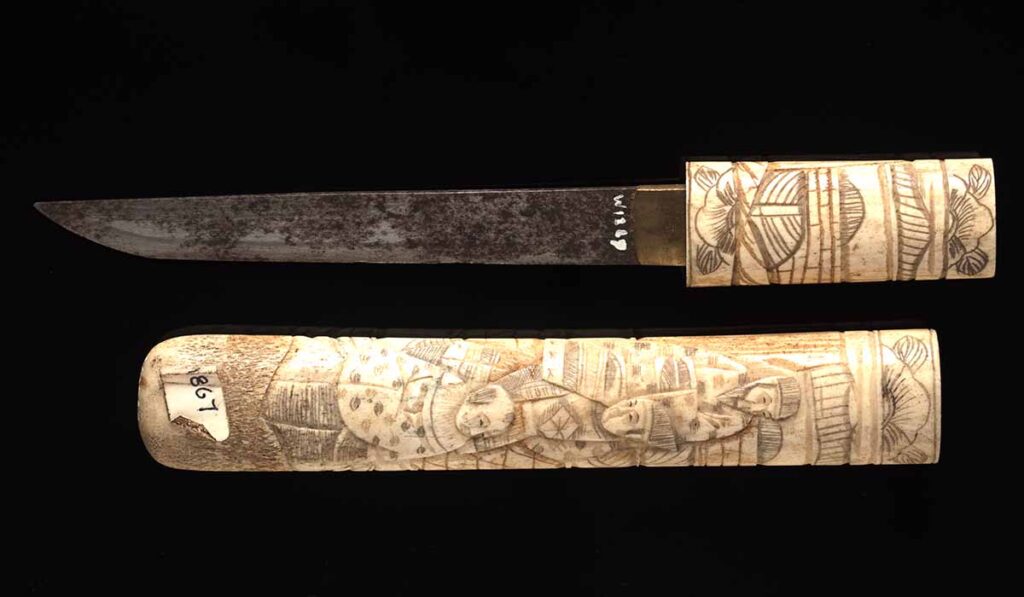
Originally conceived as a sidearm to be paired with a long sword, the tanto was first carried primarily by Samurai alongside a tachi, the precursor to the katana most of us are familiar with from modern popular culture.
Over time, the tanto become more widespread, and a smaller version known as a kaikenbecame popular as a self-defense tool for women. Over several hundred years, the tanto became shorter and thicker, and closer to the blade we know today.
Photo: Wikipedia
Though eventually replaced in serious warfare by the wakizashi (functionally just a shorter katana, though with some design differences) the tanto remained popular for ceremonial usage and became a matter of pride and expression to wear or own in later years.
The tanto then saw a resurgence in the years leading up to WWII, as they were viewed as more traditional by the Imperial Court. Following Japan’s defeat, limits on sword forging caused a decline in all traditional Japanese sword-making.
In the 1960s, American and European obsession with Japanese martial arts (spurred on by excellent films such as 7 Samurai, Yojimbo, and others) lead to a resurgence of the tanto, particularly as a combat-focused knife shape.
Today, the iconic tanto tip is found on traditional full-length fixed blades, as well as more modern folding pocket knives designed for tactical/defensive use. Plenty of manufacturers make tanto-tipped knives, as well as smiths making excellent traditional tantos. (We’re going to cover both in our reviews, don’t worry).
What makes a Tanto, a Tanto?
Today, the definition of a tanto has shifted far beyond the traditional knife of 10th-century Japan, but we’re going to start there and then we’ll talk about the more modern incarnation where we see tanto tips added to a variety of EDC and tactical knives.
Traditional Tanto Blades
Originally, the tanto was more what we would call a short sword, or perhaps a long dagger, and was worn by samurai. It was very much a weapon to begin with, but become a more ornate and ceremonial piece over the years as weapon designs evolved.
The traditional tanto was a single or double-edged dagger with a length of around 6-12 inches and was designed primarily for stabbing. It was forged with very flat sides, and some were left short with an extra thick cross-section to aid in piercing armor.
Modern Tanto Blades
The more modern interpretation of the tanto is heavily influenced by American tactical knife designs and proves more common outside of Japan. Traditional blades are still made (and beautiful) but less practical for the modern world.
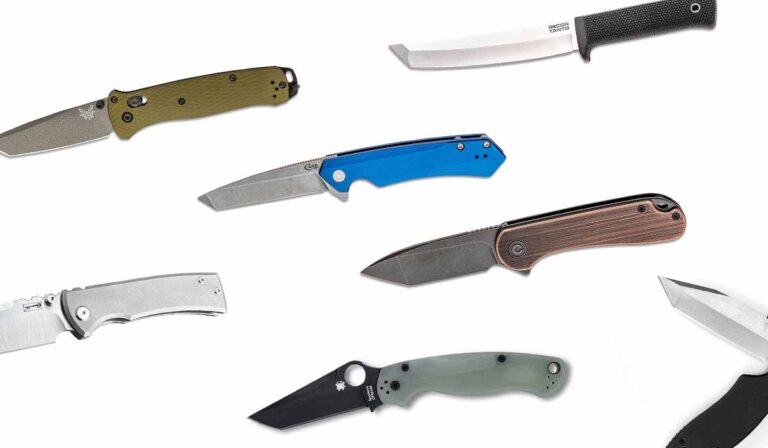
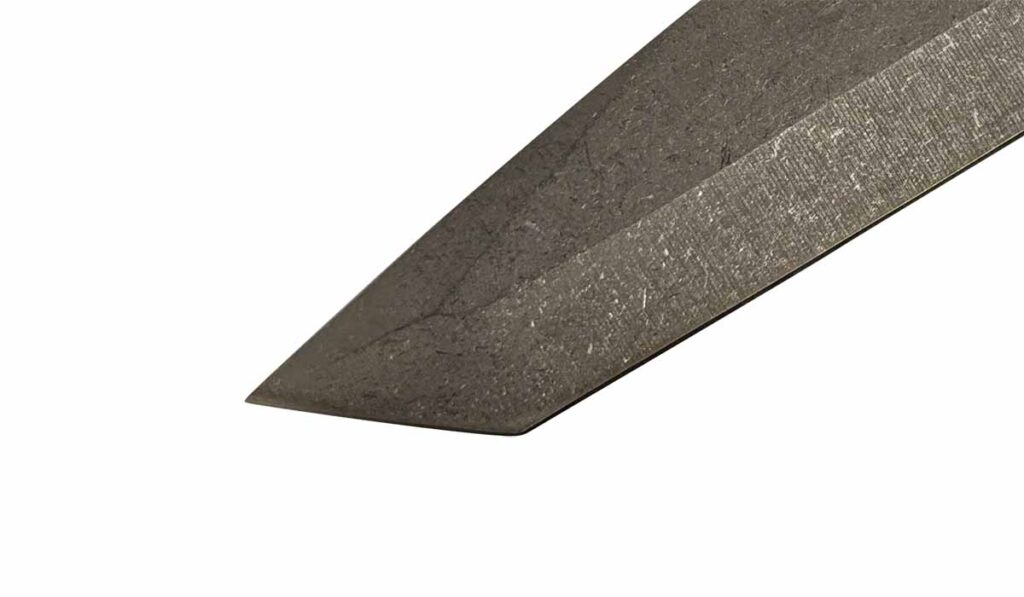
A variety of American and European knife makers now produce tanto-inspired knives with a very angular tip with the iconic sharply-upswept blade tip, essentially leaving you with two cutting planes—one parallel to the spine of the knife, and one at a 45-degree(ish) angle to the spine angling up towards the tip.
Most of these modern “American tanto” designs are folding knives, and while many are for “tactical” or defensive use, the tanto blade shape has become increasingly popular for EDC knives as well.
Pros of the Tanto Design
Piercing: Piercing, piercing, piercing. The shape of the tanto is optimized for stabbing and piercing, and it excels in those contexts.
Whether you’re a pre-Edo period Samurai trying to slip a blade between (or through) segments of your opponent’s armor, or a frustrated office worker attempting to poke your way into some plastic clamshell packaging, the tanto is ideal for putting a hole in something.
We see similar knives used for leather work around the world, and with good reason. The tanto is great for putting a hole in tough material.
Draw Cuts: Modern American tantos are also great for draw cuts and slices, particularly when you’re working with something on a flat surface like a cutting board. The dual edge geometry makes short work of many slicing tasks.
You can also (carefully) use that second point where the two edges meet like a chisel for shaving wood, scraping a sticker, etc. This makes for a very handy EDC.
Defense: Lastly, as a defensive tool, tantos excel because of their narrow, piercing point. This point easily defeats heavy clothing and makes for an effective means of defense in skilled hands.
Many knife-based martial arts focus on stabbing strikes as the most effective fight-enders, and the tanto fits that training paradigm very well, while still being perfectly capable of slashing.
Cons of the Tanto Design
Cutting Edge: The tanto’s main drawback, besides additional time and care needed when sharpening, is the fact that you lose some usable blade edge by having essentially two edges, one parallel to the spine and one swept forward and upwards.
In practical use, this means you have less effective blade length for certain tasks, around 20% less than you’d have with an equivalent-length drop or clip-point blade. To compensate, tanto blades intended for EDC are usually a bit longer than a similar knife with a different point.
All of this can be adjusted for, and as long as you aren’t doing something like spoon carving, you probably won’t notice a difference in real-world use.
At the end of the day, “real-world use” for most of us is opening boxes and packaging, and slicing apart those god-awful packing straps used to hold children’s toys in display boxes. And the tanto excels at all those tasks.
How The Hell Do You Sharpen a Tanto?
Sharpening a tanto may look a bit scary, but once you break the process down, it’s quite simple. All you’re doing is sharpening two edges that meet at a point. The only real pitfall is that it’s easy to round over the point where the forward edge and the edge parallel to the spine meet.
To avoid this, be mindful of that meeting point, and stop your sharpening stroke on or before it. Then, when sharpening the forward edge, rotate the blade and sharpen it in much the same way you would a chisel.
Just be careful not to pull through the point where the two edges meet so you don’t round over that point and you’ll be good to go. Beyond that, it’s just like sharpening any other knife.
10 Ten Knives with Tanto Blades: EDC, Fixed Blades, and Folders
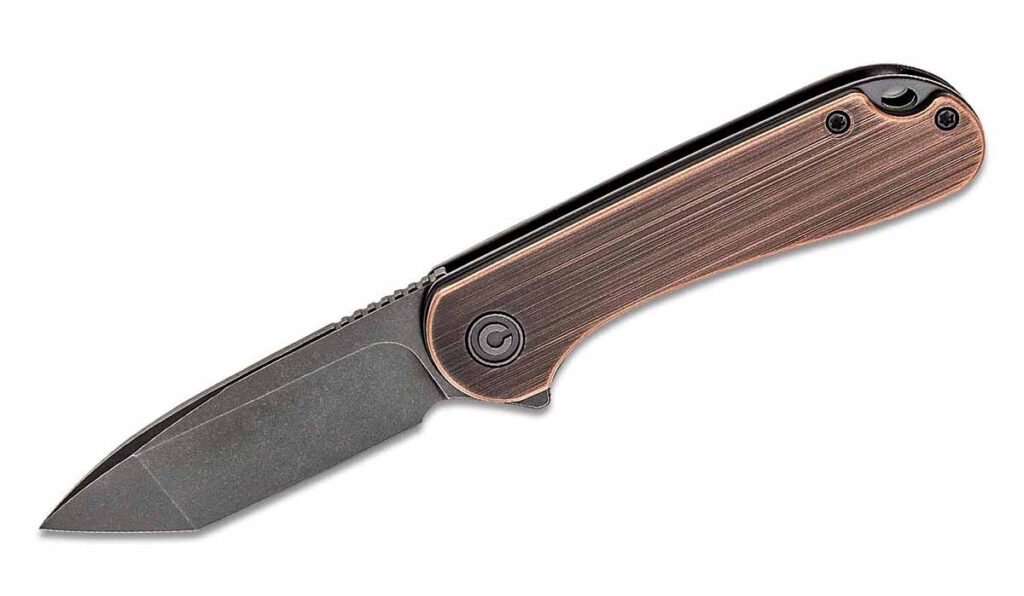
CIVIVI Elementum Tanto
The CIVIVI Elementum has become something of a modern classic in the EDC knife world. Since its release a few years ago has gone on to become one of the most popular pocket knives around.
There is a nearly limitless amount of blade and handle combinations out there now, but we’re going to focus on this excellent tanto blade with a copper handle.
At its core, this is still the same Elementum knife aficionados are already familiar with (a simple, dependable liner-lock flipper folder) but outfitted with a tanto blade that makes piercing tasks a cinch, without compromising on slicing performance.
Basically, it’s everything you need in an EDC knife for regular daily tasks, and it comes with a gussied-up stonewashed tanto blade and a lovely hand-polished copper handle that adds a touch of class and elegance to this very affordable knife.
The Elementum tanto is also available in a button lock version and features a 2.96-inch blade made of D2 steel.
MSRP: $80
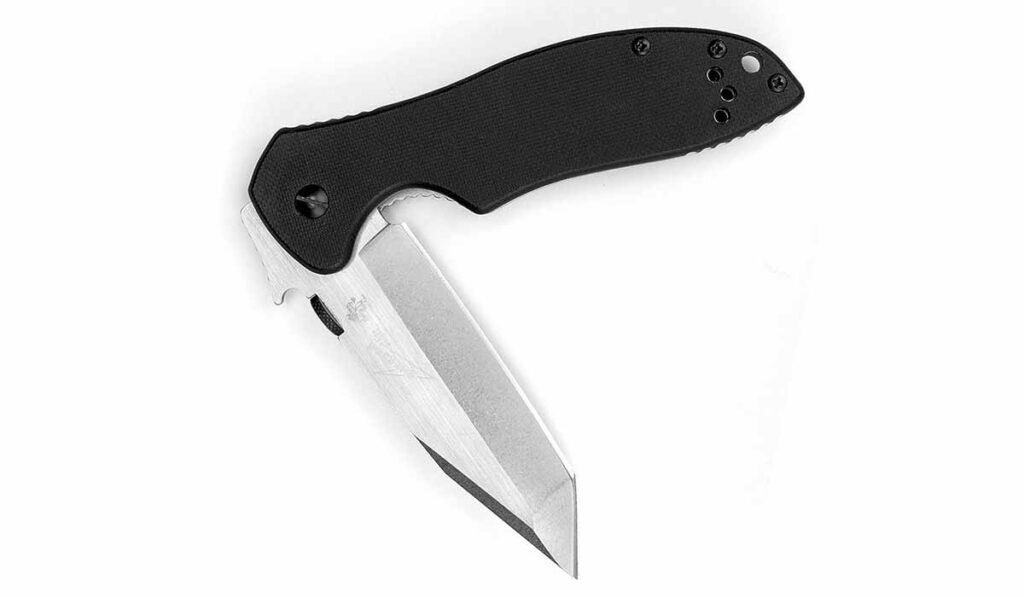
Kershaw Emerson CQC-7K
Ernest Emerson has brought much success to Kershaw with his designs. Back in 2014 he hit it out of the park again with the Emerson CQC-7k, which won that year’s Best Buy award at BLADE Show for sheer value. In the almost ten years since it’s held its own as one of the best EDC options out there.
It features the iconic Emerson Wave that facilitates blade deployment by simply pulling it from the pocket and hooking the “Wave-Shaped Feature” on the pocket on the way out (sort of an inverted kicker).
It also features an ambidextrous thumb disk that doubles as a comfortable place to press your thumb when doing fiddly work. The scales are nicely-textured G10, and the handle features a stainless frame lock that is one of the more secure we’ve tested (read: beat the hell out of).
The one thing to look out for is the blade steel. I would suggest spending an extra few bucks on the D2 stainless version and avoiding the 8cr14Mov version. There’s no reason to spend more than $40 on a knife with bottom-tier blade steel like that in this day and age.
You can get five gas station knives for that price and be better off.
The Emerson CQC-7K has a D2 blade that is 3.25-inches long.
MSRP: Starting at $74
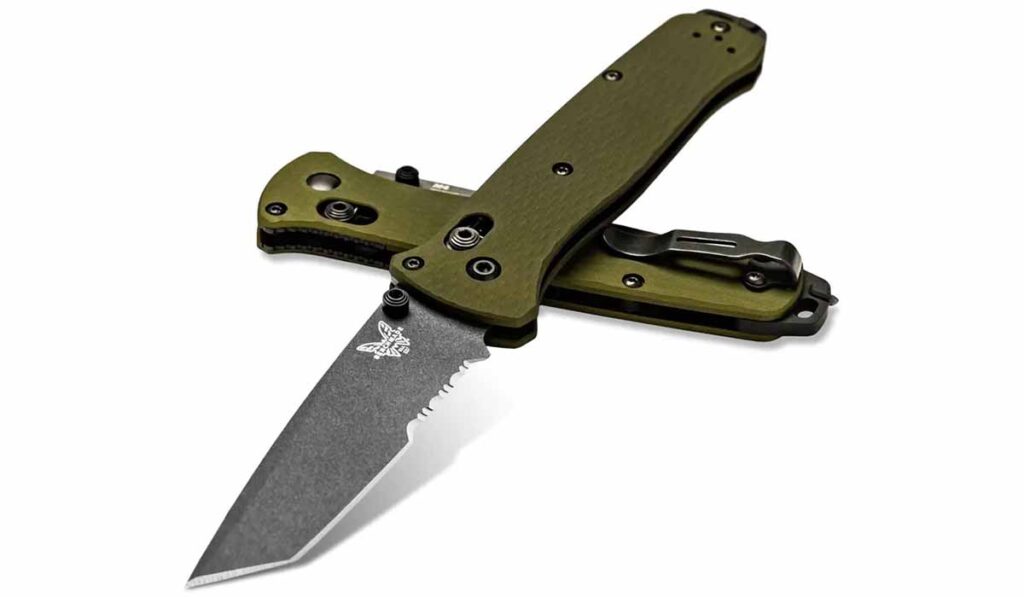
Benchmade Bailout
You’ve heard of the Bugout, surely. Now meet its newer, slightly-tacticooler cousin, the Bailout (one of my favorite knives of the past several years).
As you can surely imagine, the Bailout is a bit of a riff on the Bugout most of us knife fans know and love, but with some notable changes. Our favorite version is the CPM-M4 model which features woodland green anodized aluminum handles.
CPM-M4 is a great steel, which you would expect from Benchmade, and the knife itself is the perfect length to straddle the line between EDC knife and tactical folder. It also features a lanyard loop if you’re one of those people who like lanyard loops, and more interestingly a micro glass breaker.
How often do you need to break a car window in an emergency? Probably not very often, but it is nice to have it if you’re leaning toward a more tactical-style knife. You can also get a version that doesn’t have the glass breaker or the aluminum handles if you want to save a bit.
The Bailout features a 3.4-inches, CPM-M4 blade.
MSRP: $129
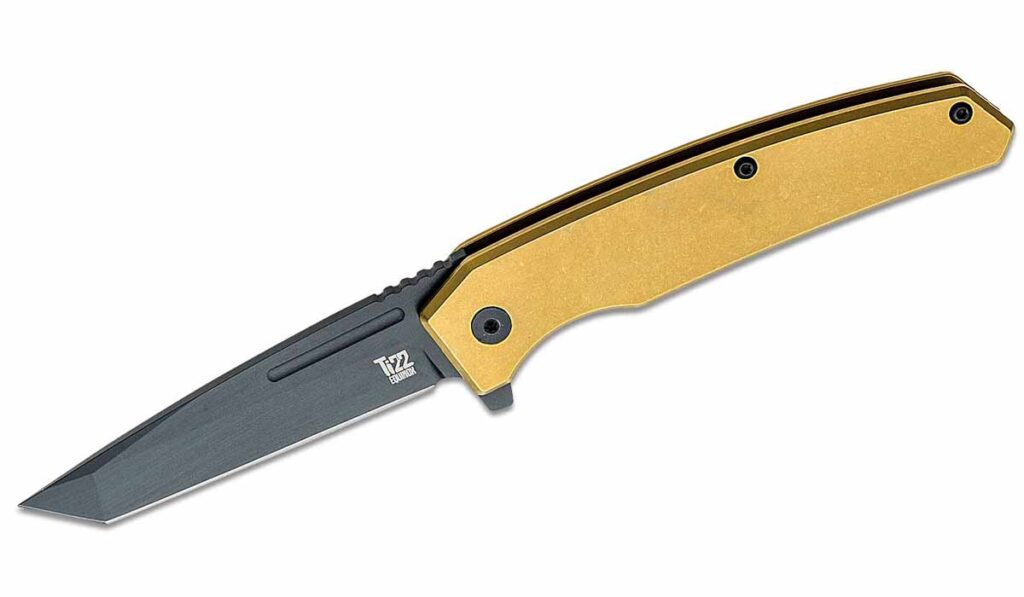
Ontario Ti-22 Equinox
Ontario Knife Co. is one of the most criminally underrated makers out there. Everything in its catalog is smartly designed and intended to excel in real-world conditions. That includes the Ti-22 Equinox.
It features, as the name suggests, a full titanium handle and an S35VN blade coated black to inhibit rust and corrosion in difficult environments. S35VN is a premium steel that holds an edge incredibly well, and the lightweight titanium handle is as robust as you could ever want.
The action is flippy and fidget-friendly, and the handle feels comfortable during extended use. The blade slices paper right out of the box, and comes to a sharp angle where the forward edge meets the primary cutting edge, giving you plenty of piercing power.
Draw cuts, slicing, and even some camp kitchen prep were easy and straightforward, and the knife handled being carried on a sailboat for a week without showing any signs of rust. All in all, a great EDC that again toes the line towards the more tactical/defensive side of things.
The Ti-22 has an S35VN blade that is 3.03-inches long.
MSRP: $138
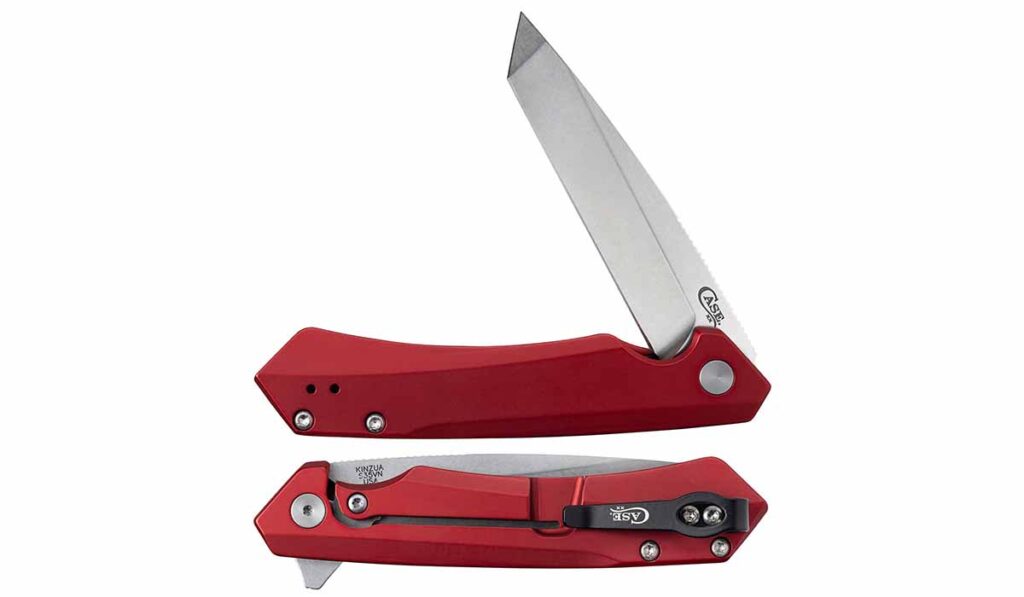
Case Kinzua
Case Knives made a flipper! Several actually, with the Kinzua being part of the first line of Modern Everyday Carry Knives to come from this iconic brand.
This isn’t your grandad’s Case knife, though we love some of those old three-blade traditional babies as much as anyone. These are incredibly modern designs for a modern audience that expects things like one-handed opening, a frame lock, and a deep-carry pocket clip.
In addition to all that, the Kinzua (named for a scenic forestry area in Allegheny County, PA) features an S35VN blade and faceted anodized aluminum handles that are a joy to hold. The flipper tab is nicely contoured, and the knife opens and closes smoothly.
The tip is a now-familiar American tanto and is great for piercing pesky packages, or anything else you might need to poke a hole into during your daily life.
MSRP: $179
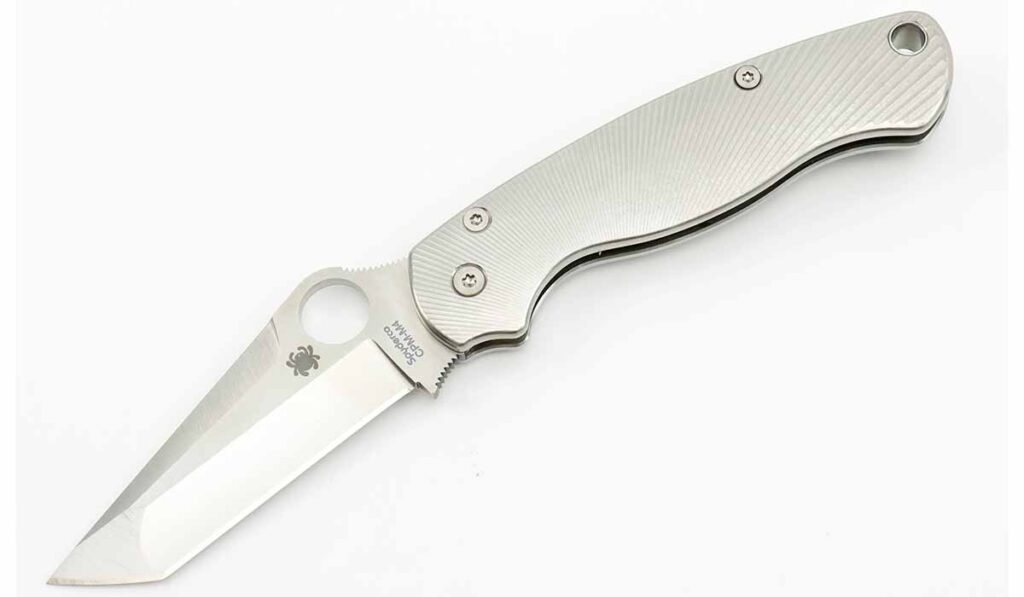
Spyderco Paramilitary 2 Tanto
The Spyderco Paramilitary 2 (or PM2) is beloved in the EDC community, and it’s not hard to figure out why.
It features a polished washer pivot system that is very smooth to open and close, features Spyderco’s iconic compression lock, and now, for the first time, comes with a tanto blade.
That blade is made of CPM-S30V steel, one of the best you can get in a pocket knife at this price range. Sharpening isn’t too difficult, and the edge will last you a very long time, even with aggressive daily use battering away as you slice open Amazon boxes (or whatever).
The PM2 has fine-textured G-10 handle scales out of the box, but you and your trusty screwdriver can pop those off and replace them with any one of roughly ten bazillion aftermarket options. Companies like Flytanium keep PM2 owners well-supplied with choices.
MSRP: $246
The Spyderco PM2 Tanto features a 3.44-inch blade made of CPM-S30V steel.
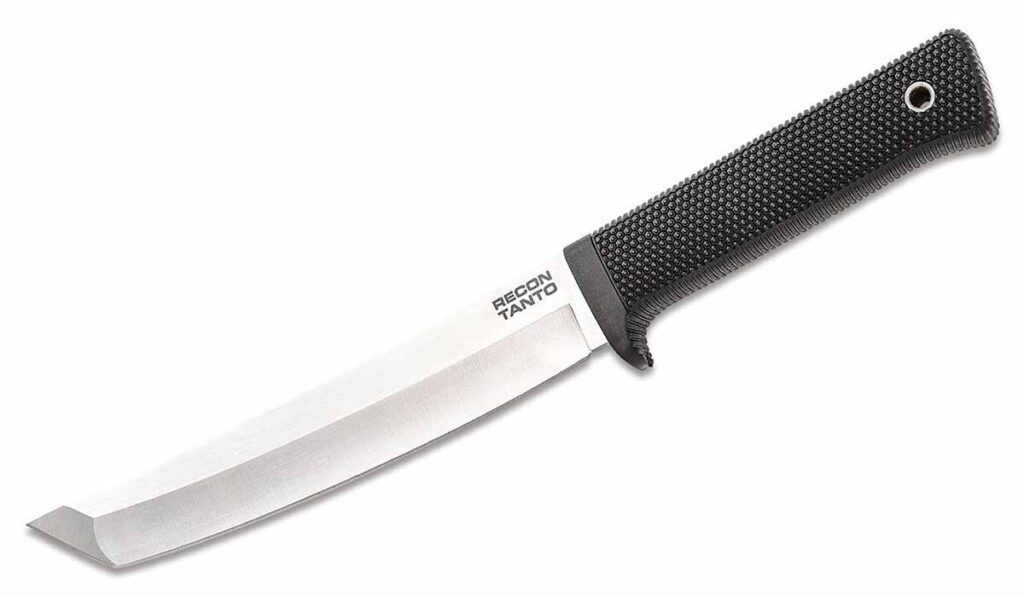
Cold Steel Recon Tanto
Of course, we can’t have a list of modern tanto knives without bringing out something from Cold Steel, the progenitors of the modern “American tanto” that is the most accurate description of most of the knives on this list.
Their Recon Tanto is our first fixed blade on this list and is positioned as a tactical/rescue blade. The incredibly robust SK5 steel used in the blade is a common for hard-use tools like machetes and survival knives, particularly military ones.
The grip is made with Kray-Ex, which is designed to maintain good friction in the hand at all times, even if your hands are wet or you’re wearing gloves. It also doesn’t shred your paws like some rougher materials.
If you’re looking for a more tactical tanto that can handle everything from camp tasks to self-defense, this is a great option that is a bit heavy, but bomb-proof and reliable.
The Recon Tanto has a 7-inch SK5 high-carbon steel blade.
MSRP: Starting at $70
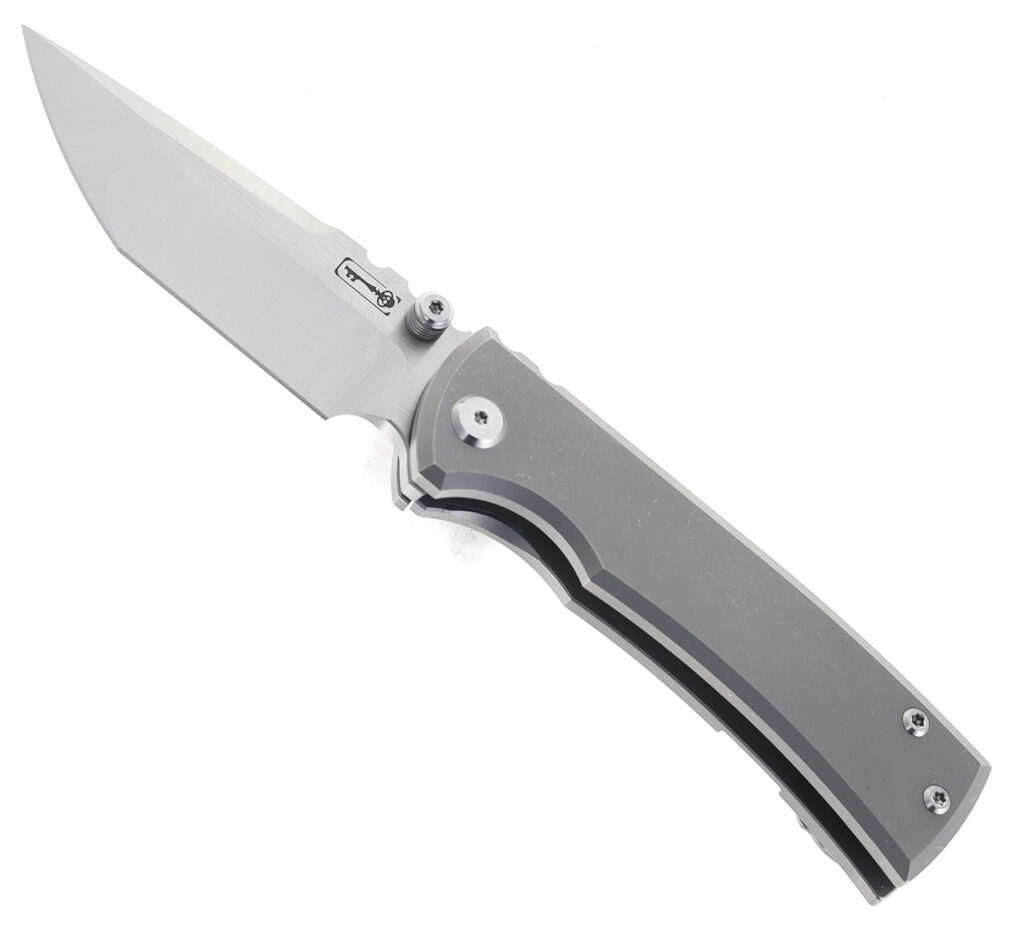
Chaves Redención Street Tanto
Ramon Chaves is a custom knife maker that has made a name for himself as one of the premier designers of tough, hard-wearing, but still stylish blades. His Redención tanto is…very expensive, and worth every penny, exactly the way a custom knife should be.
If you’ve got the cash and you like the look of it, especially if you enjoy the artisan nature of a custom knife, go buy that.
For those of us with slightly less to spend, Reate has put out a production version of the Redención that comes with a slightly more obtainable street price and is considerably easier to find in stock.
Ramon works hard, but it’s always going to take longer to produce a custom knife than a production knife coming from a factory with purpose-built tooling. The Redención Street is a great way to get your hands on the design, without waiting months for the custom version.
The Street Tanto is an incredibly well-built framelock folder with an aggressive piercing tip. Despite a 3.63-inch blade length, the whole thing weighs in at just over 6oz thanks to the titanium handle design (which you can get in about two dozen different colors).
The blade is made from the fabulous Bohler M390 steel, one of the best you’ll find in a pocket knife.
MSRP: $300
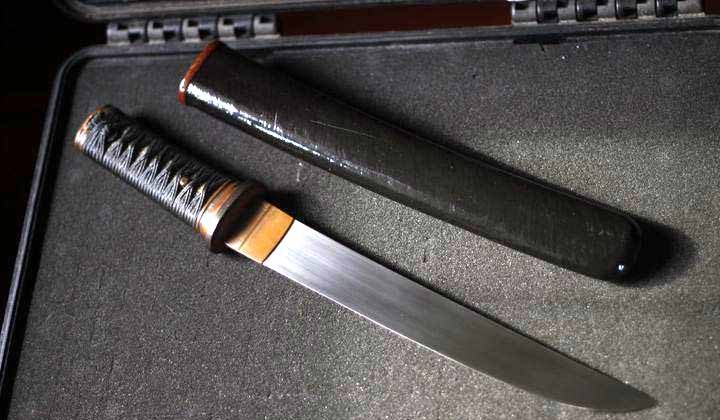
Siam Blades Traditional Black Copper Hira Tanto
Lastly, I’m throwing in a little treat for the two or three of you reading this who came here looking for traditional, no-fooling, tantos made the old way. Siam Blades is a traditional blacksmith shop located in Thailand, but they have Japanese-trained smiths that create blades using traditional methods.
For most people, this is going to be a good balance of value and authenticity. A traditional tanto made in Japan will probably run you about three times what this one does. The Black Copper Hira tanto is made to a similar standard, in the same traditional way, and is as beautiful as it is functional.
Best of all, they have stock ready to ship, so you don’t have to wait 18 months for your tanto to be finished and shipped. I’ve chosen the Black Copper version here, but there is a large variety available depending on what aesthetic you’re going after.
The blade itself is made of extremely durable high-carbon SK5 steel (very common in machetes, and battle-ready sword reproductions) and is 9.5-inches long.
MSRP: $820
Final Thoughts on Tanto Knives
The tanto is an iconic design, whether we’re talking about the traditional Japanese original or the modern American remix. This knife shape has stuck around for a thousand years for a reason.
Today, most production tantos are more in the American style at least as far as the tip goes, but this battle-tested design has its roots going back much farther. I hope you’ve enjoyed this brief look into that long history, and you’ve got a better idea of what your options are for picking up a tanto of your very own.
The Informant By Greg Wesley Is Another Quality Fixed-Blade EDC. But Just How Good Is This Small Custom Knife?
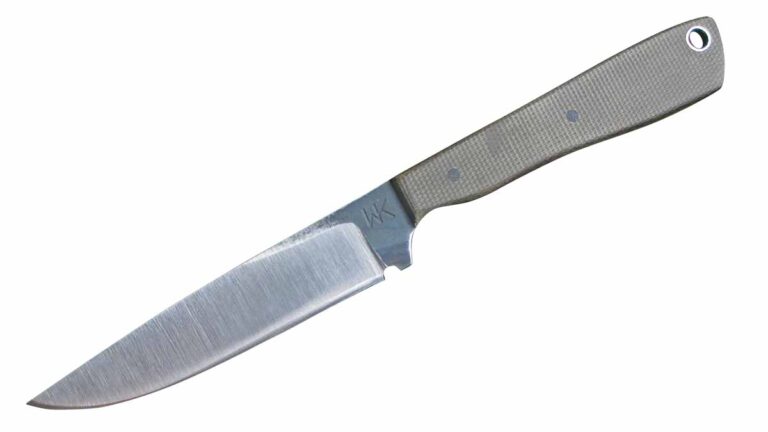
The trend for smaller EDC knives is still going strong. Set up with a leather sheath for belt or pocket carry, the Informant from Wesley Custom Knives fits the bill perfectly. Greg Wesley grinds them all by hand. This one is lean and mean.
Testing The Wesley Informant
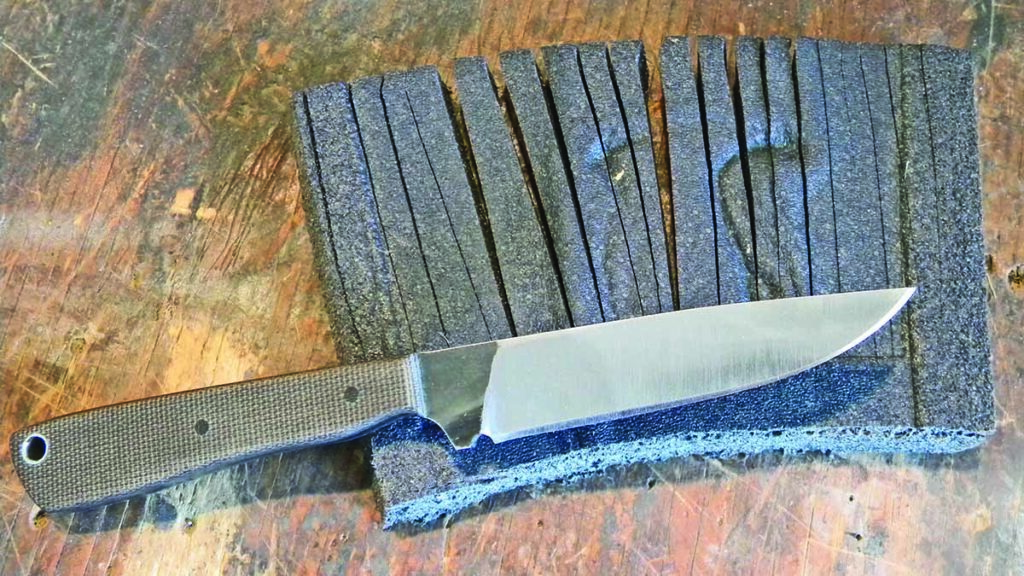
It was easy to control the width of cuts in the foam, all of which were straight without bending the medium.
I started with a piece of dense foam I use for making my Kydex sheaths. Manipulated with push and pull cuts, the knife started biting, slicing cleanly and quickly. It was easy to control the width of cuts, all of which were straight without bending the foam. Very nice.
One of my favorite tests,the 20-pound bond copy paper slice, provided little resistance. It puts a smile on my face when I hear every cut. I used a pull motion to shred the paper. The Informant came razor sharp. The balance of the blade made for a very quick test.
The knife had no challenges cutting through double-walled cardboard. I got carried away and pushed the blade too far into the cardboard, hitting the choil area and messing up the cut. The Informant is just fun to use. Cuts were mostly straight unless I took too big of a bite and the cardboard pinched the blade and slowed it down.
Plastic board was easy for the knife. It cut the plastic very quickly and I barely felt any resistance. Once I had the rhythm slicing, it was finished. This is a sharp little knife. Cuts were very controllable.
Pushing the Wesley Informant
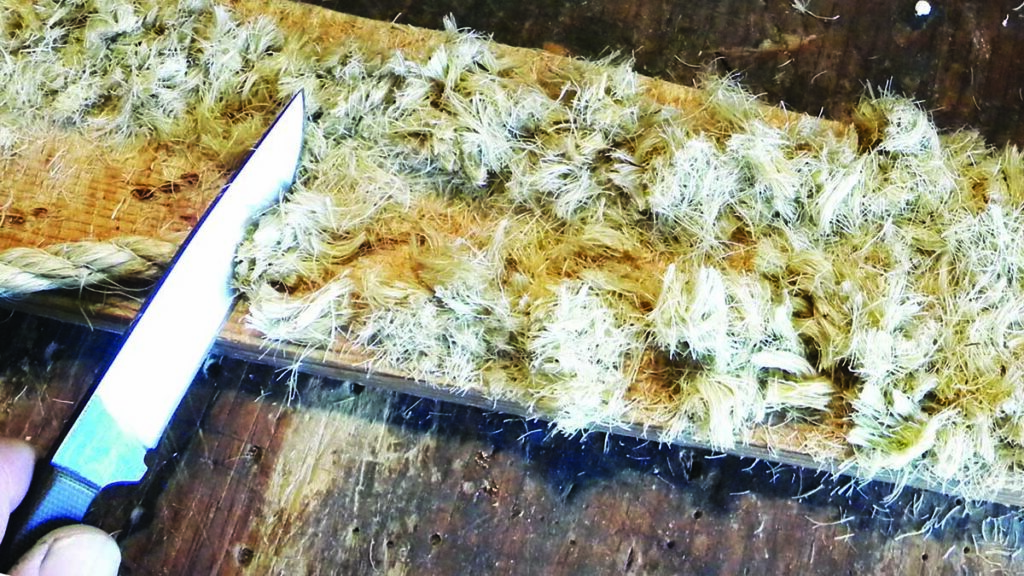
The Informant crunched its way to 188 cuts on the sisal rope before the edge started to slide a bit.
I grabbed some 8-ounce leather for skiving (thin, tapered slices). With a louder crunching sound, the Informant bit quickly. The thinness of the knife made controlling the skiving simple—I just had to move my fingers faster to keep from losing DNA. The edge remained just as sharp as when I started.
I had to whittle to get a better feel of the little fixed blade. The cuts in the wood were extremely smooth. The Informant peeled large curly-cues one after another. The blade spine was somewhat sharp on my thumb but not too bad. The handle was a great fit to my hand—no hot spots at all. Nice job, Greg.
The Informant crunched its way to 188 cuts of sisal rope before the edge started to slide a bit. Impressive! The handle was still comfortable with the extra power added for the high number of cuts. The knife’s light weight didn’t impact its cutting ability.
The last test is a little destructive at times: the antler chop. I gave a whitetail antler 20 hard chops with the Informant. I rolled a thin wire edge in a few places but the blade was still very sharp, so the heat treatment is good.
Final Thoughts
I would soften the blade spine a tad more and maybe round the scales a bit, though that’s being picky. The Informant is a small, high-performing utility tool that can handle most any knife chore. It’s a great EDC choice.
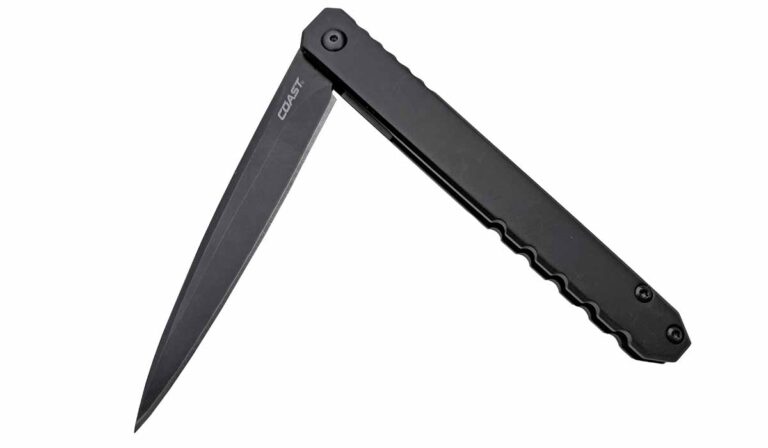
Every now and then I come across a folder that just feels right both in my hand and in my pocket, one that’s not too large nor too small, yet still has that sleek look to it. The Coast LX532 framelock does it all for me. I really love the blade shape. However, it still must be able to slice and dice to get a top place in my book.
Coast LX532 Edge Test
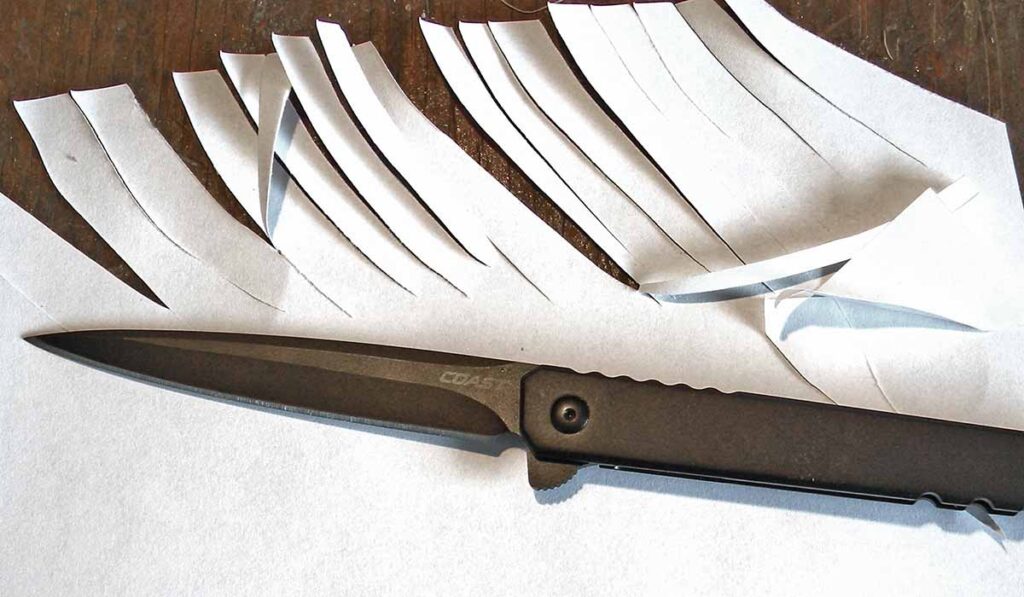
The good ol’ paper slice worked for starters. The LX532 sliced very smooth with no effort. The thin blade made for great control during the cuts. The only challenge was getting my fingers out of the way fast enough.
It was back to 20-pound bond copy paper for the final edge test. The LX532 didn’t miss a lick, slicing very smooth, aggressive cuts.
It was time for the single-walled cardboard. The knife was quite aggressive in cutting it. Again, control was great. The thinner handle takes some getting used to but that’s not a big deal. There was some twisting on the cut pieces but that was me getting accustomed to the handle.
Plastic board was next. The LX532 handled it with ease. The thumb notches on the handle spine really came in handy as more pressure was needed to make the cuts. They notches stopped the thin blade from twisting in my hand while cutting.
LX532 Meduim-Duty Cutting
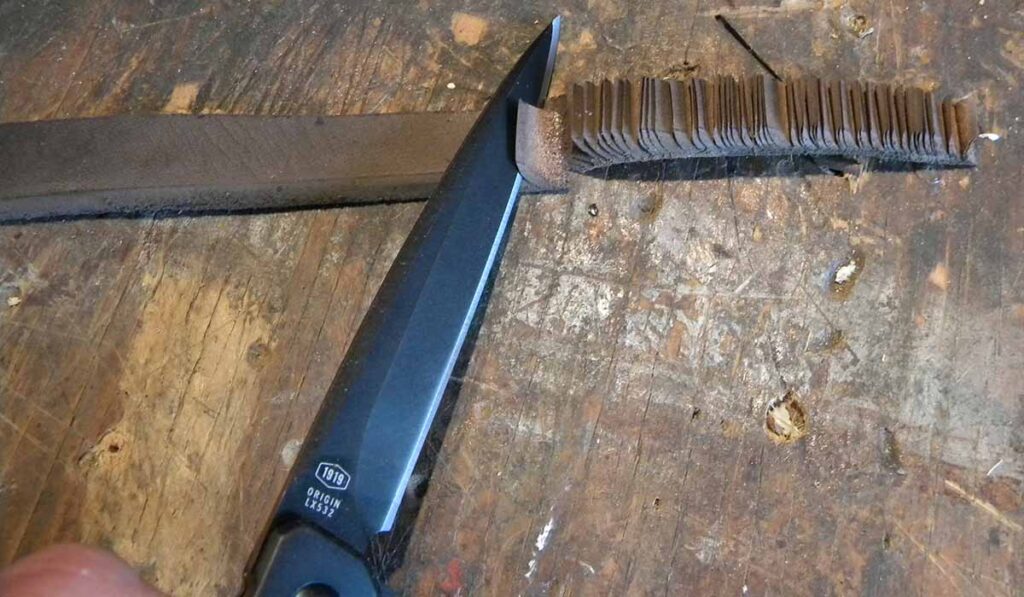
I had some leftover dense foam from the Kydex press to change out, so I decided to slice it up. The folder went through the foam like butter. The thin blade is extraordinarily sharp to say the least. Control was great yet again and I had to continue slowing my slicing down to keep my fingers intact.
The knife went through the foam like butter. The thin blade is extremely sharp to say the least.
Eight-ounce leather, anyone? I did some normal up-and-down slicing, along with some skiving. The edge was quite forceful slicing leather. I could hear each and every cut. The knife is exceptionally smooth and controllable for straight cutting. I switched positions and laid the leather flat for some skiving. The LX532 was very loud and aggressive slicing the material. I cut through the leather more times than I want to say. (It makes a better picture if the leather is all together rather than a bunch of smaller pieces.)
LX532 Heavy-Duty Cutting
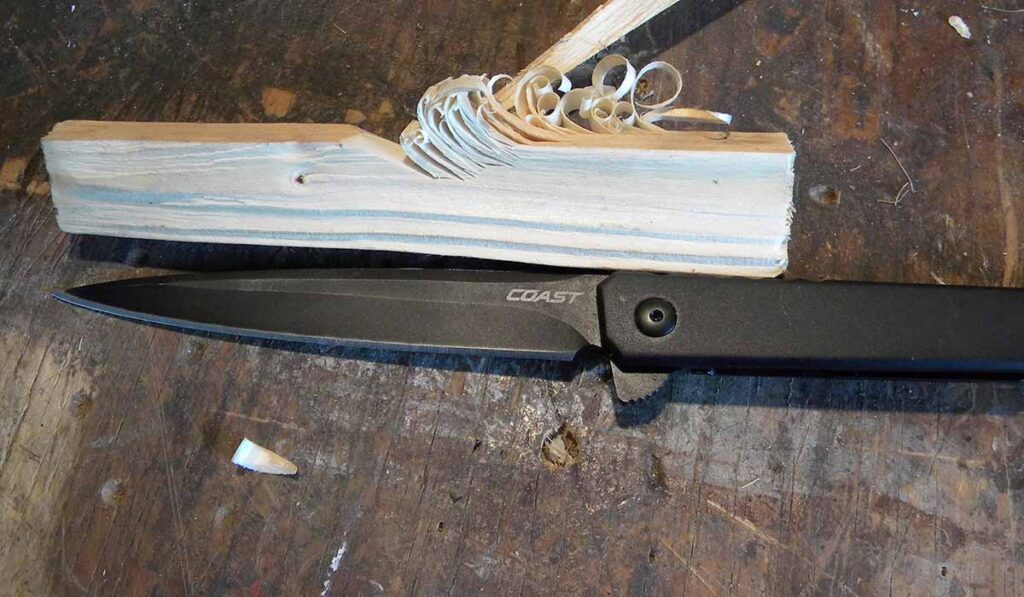
With camping season in full swing, I needed to stock up on firesticks to start the campfire. The LX532 worked perfectly. It made great thin curlicues in the pine. It also took deeper bites if needed. The blade zipped through the wood. Control was great with my thumb on top of the handle. It was a lot of fun to do.
The blade zipped through the pine and made great thin curlicues. It also took deeper bites if needed.
I had my doubts about cutting sisal rope with such a slim knife. However, the folder proved it could go the distance, providing 200 crunching cuts before I stopped. The knife was still going strong. I was impressed. The framelock stayed at 100 percent engagement the whole time and was still smooth upon closing. Hats off to the folks at Coast.
It was back to 20-pound bond copy paper for the final edge test. The LX532 didn’t miss a lick, making extra-smooth, uncompromising cuts.
Overall Take
The LX532 is one sweet framelock. The slim overall shape is right up my alley. Performance is in the top 10 percent. Excellent job, Coast. I wouldn’t change a thing. Maybe some texturing of the handle?