
Knife Sharpeners: Top Options Available Now

0

Need to keep your edge? These top knife sharpeners are sure to keep your blades sharp and in good working order in no time at all.

It’s not much of a knife if it doesn’t have a sharp edge. To that end, 2024’s hottest sharpeners will make your favorite tool cut like it ought to. Plain to serrated, short blades to long, kitchen to deer camp and just about any blade worth using can get keen quick with one or more of this year’s fresh edge makers.

Spyderco Golden Stone and Webfoot Set
pyderco Golden Stone and Webfoot Set includes a Golden Stone, Webfoot
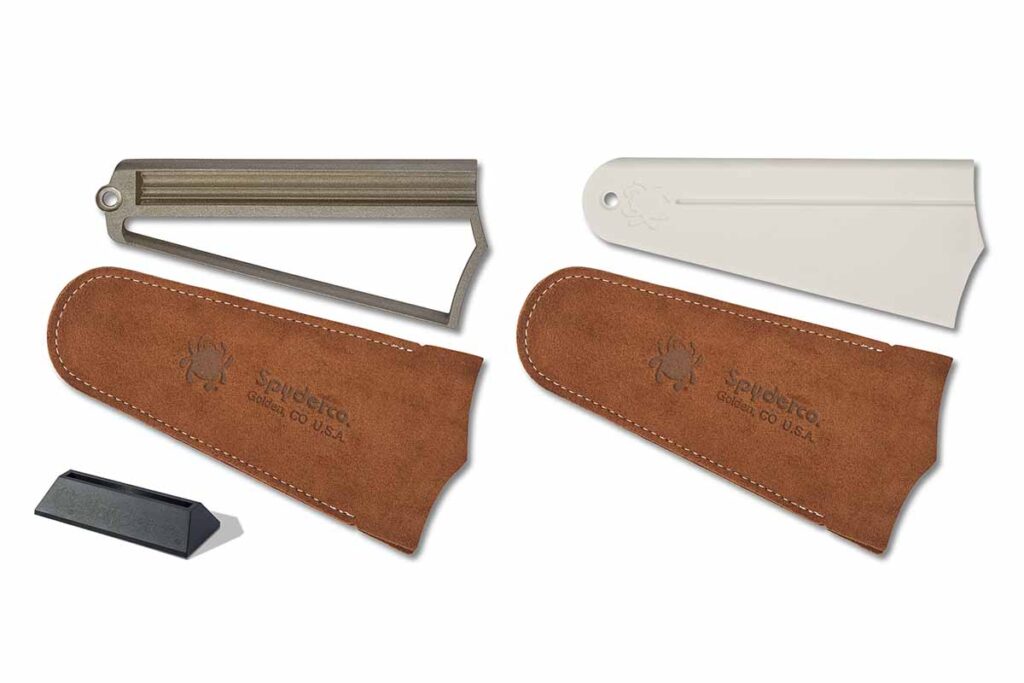
The Spyderco Golden Stone and Webfoot Set includes a Golden Stone (right), Webfoot (left), two suede pouches, one plastic base (lower left), and an illustrated instruction book that explains how to use the sharpeners to put an edge on practically any home cutting tool.

One of the coolest studies in sharp is the Spyderco Golden Stone and Webfoot Set. “The set offers a uniquely different approach to knife and tool sharpening,” began Michael Janich, Spyderco special projects coordinator. “Of similar design, they can be used anywhere, set up in seconds, and do not require oil, water, electricity or any complicated clamps or fixtures.”

Both sharpeners feature a distinctive “duck foot” design tapered on one end and that has twin scallops on the other. To use either sharpener, hold the narrow end in one hand and rest the wide end on a flat surface. The center point of the wide end, between the scallops, acts as a fulcrum.

“Rocking the sharpener from side to side until the outer points contact the surface aligns its outer edges to create a perfect 40-degree included angle,” Michael noted. “Simply keep the plane of your blade vertical and draw it from heel to tip down the outer edge. Then, rock the sharpener in the other direction and repeat the process on the other side of the stone. Alternating from side to side quickly creates a sharp, utilitarian 40-degree edge.”

For a thinner edge, the Webfoot and Golden Stone can also be used with the included ABS plastic base. Steps in the cavity of the base limit the rock from side to side, reducing the sharpening angle to 30 degrees. Laid on their sides, the sharpeners also offer a 12.5-degree angle for easily sharpening scissors and shears.

“The long edges of both sharpeners are tapered, so they naturally follow the contours of all blade shapes—even hawkbills and recurves—and can be used to easily sharpen serrated edges using the same sharpening technique,” Michael explained. “Their innovative designs also include rounded edges, grooves, and flat areas that provide multiple abrasive surfaces to sharpen tools of all shapes and sizes.”

The Webfoot is coated in an aggressive 600-mesh cubic boron nitride (CBN) abrasive. A form of synthetic diamond, CBN removes steel quickly and is ideal for reprofiling edges or sharpening very dull knives to a utility edge. For touch ups or to achieve a more refined edge after using the Webfoot, the Golden Stone features a fine-grit ceramic abrasive that is the equivalent of a 1,200 grit. Both sharpeners are supplied with suede pouches that protect them when not in use and do double duty as non-slip mats during the sharpening process.

The set includes one Golden Stone, one Webfoot, two suede pouches, one plastic base, and an illustrated instruction book that explains how to use the sharpeners to put an edge on practically any home cutting tool.

Spyderco Webfoot Specs
Sharpener Type:
Proprietary “rocking” design
Blades sharpened: All, including scissors, pointed tools, gouges and serrated edges
Abrasive Type: Cubic boron nitride
Grit: 600 mesh
Dimensions: 7” x 3” x 0.25”
Construction Materials: One-piece carbon steel embryo
Weight: 6.05 ozs.
SPECIAL FEATURES: Includes multiple abrasive surfaces and shapes
Country of origin: China
MSRP: $89 ($270 in a set w/Golden Stone)
Available: Now

Spyderco Golden Stone Specs 
Sharpener Type: Proprietary “rocking” design
Blades sharpened: All, including scissors, pointed tools and serrated edges
Abrasive type: High-alumina ceramic
Grit: 1,200 grit equivalent
Dimensions: 7.2” x 3” x 0.25”
Construction materials: One-piece fine-grit ceramic
Weight: 7.6 ozs.
SPECIAL FEATURES: Includes multiple abrasive surfaces and shapes
Country of Origin: USA
MSRP: $210 ($270 in a set w/Webfoot)
Available: Now

Work Sharp Ken Onion MK.2
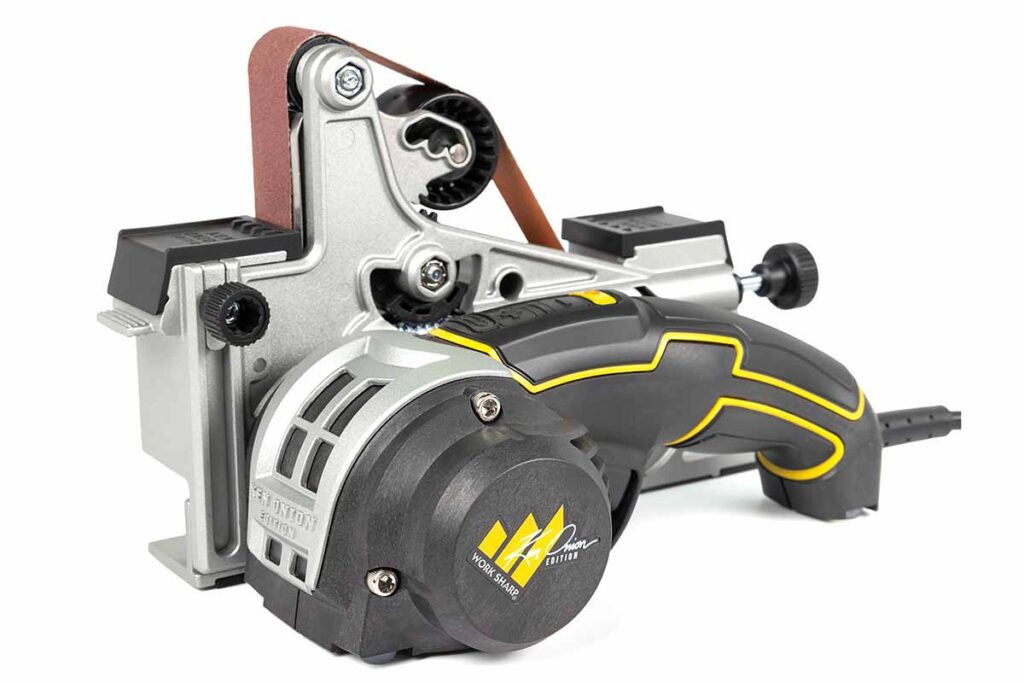
Ken Onion MK.2
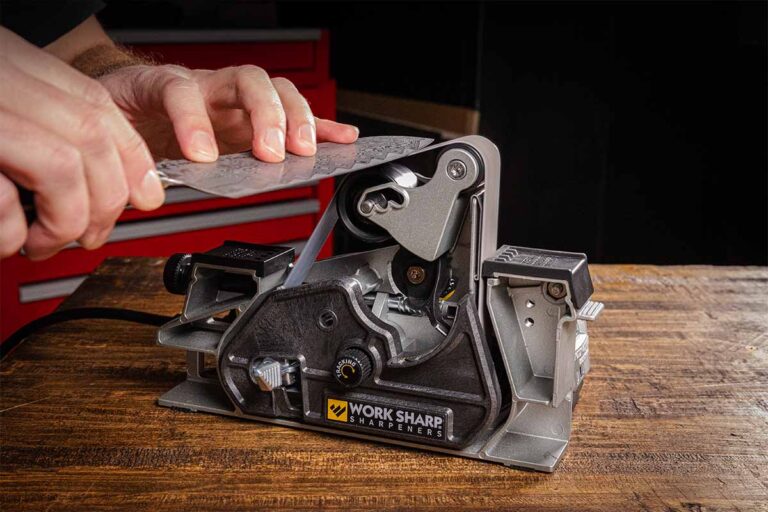
The Ken Onion MK.2 comes as a stand-alone sharpener or as one of the company’s Elite packages that includes the base sharpener along with a fully featured blade grinding attachment.

The new Ken Onion MK.2 from Work Sharp comes as a stand-alone sharpener or as one of the company’s Elite packages that include the base sharpener along with a fully featured blade grinding attachment.

The sharpener sports a fresh new look and improved ergonomics to make it feel better in the hand during use. A new motor speed control offers seven pre-set settings to provide a consistent and repeatable sharpening experience, while the new torque control delivers consistent power, even under load. Positioned prominently atop the unit, amber LED indicator lights make selecting belt speed fast and easy.

A sharpening guide has a scope click adjustment knob. Detent clicks in half degree increments from 15 to 30 degrees along the dial allow for improved precision, consistency and repeatability, meaning you get the exact same edge angle every time you sharpen.

New leather-lined angle guides offer protection for knives during sharpening, while the sharpener’s improved guide design allows for knives with thumb studs. A lock-out belt tensioner on the sharpening cassette helps make changing abrasive belts fast and simple. Five grits accommodate the full spectrum of sharpening, from repair to ultra-fine polishing.

The system includes the standard triangle cassette sharpener along with a complementary blade grinding attachment for those who want to elevate their sharpening game. It’s built on a rigid metal chassis designed to offer a stable platform and features metal components engineered to last.

An adjustable, three-position convex pulley system enables you to customize grind profiles depending on personal preference or the type of knives being sharpened. Grind profiles can be set to low, medium or high convex quick and easy, again without tools. An angle adjustment knob, now located in a more visible position, makes setting grind angles faster and easier than ever. At the turn of the knob, you can rotate the dial anywhere from 10 to 30 degrees to set your preferred angle and can even make precise adjustments while the machine is running.

Work Sharp Ken Onion MK.2 Specs
Sharpener Type: Electric benchtop w/grinding attachment
Blades sharpened: Pocketknife, kitchen knife, hunting knife, serrated, axe and scissors
Grit Selection: ¾” x 12” Belt Kit: (1 ea.) P120 (extra coarse), X65 (coarse), X22 (medium), X4 (fine), 6000 (extra fine); also 1” x 18” Belt Kit (for grinder): P120, X65, X22, X4, 12000 and cloth belt for stropping.
Dimensions: Stand-alone sharpener: 9 ¾” long x 5 ¾” wide x 5 ½” tall; w/blade grinding attachment: 10” long x 6 ¼” wide x 6 ½” tall
Construction materials: Metal, plastic and tactile rubber; grinding attachment is built on a rigid metal chassis designed to offer a stable platform and features metal components throughout that are engineered to last.
Weight: 7 lbs.
SPECIAL FEATURES
7-speed motor control with LED display;
Sharpening guide w/scope click adjustment knob. Detent clicks in half degree increments from 15 to 30 degrees along the dial;
Leather-lined angle guides offer protection for knives during sharpening;
Tool sharpening cassette with 65-degree angle scissor guide;
Blade grinding attachment quickly and easily mounts to the MK.2 power base without tools or calibration.
Once attached, the grinder boasts on-the-fly motor speed control and continuous run time with LED indicator lights that make selecting belt speed fast and easy;
An adjustable, three-position convex pulley system enables you to customize the grind profile depending on personal preference or the type of knives being sharpened;
Graphic user guide along with a quick start guide helps you understand and operate the sharpener successfully, and;
Flexible abrasive belts and angle guides provide precision results on just about anything that needs sharpening.
Country of origin: Made of foreign parts; designed, calibrated and quality checked in Ashland, Oregon
MSRP: $300
Available: Now

Wicked Edge Cobalt WE64
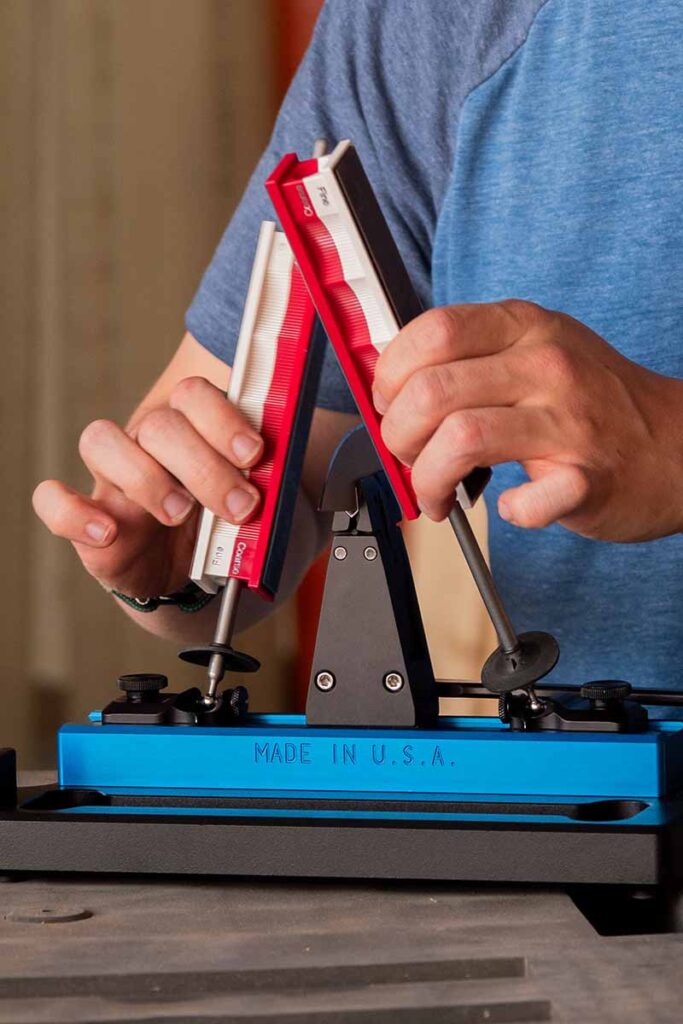
Wicked Edge’s patented Dual-Sided Sharpening Technology
Wicked Edge’s patented Dual-Sided Sharpening Technology, DualCam Vise and more highlight the new Cobalt WE64.

The Wicked Edge Cobalt WE64 features easy clamping ability with the company’s DualCam Vise to the portable form factor of the company’s GO-WE60 sharpening unit.

According to Wicked Edge, the result is the fastest sharpening experience in the 60 Series line, including both standard edge maintenance and touchups.

The WE64 is lightweight and compact for storage and travel and can be secured to a hard, flat surface with the included C-clamp, or directly mounted to a work surface through the predrilled holes in the base. It is compatible with all Wicked Edge sharpening stones and strops and assorted other of the company’s sharpening accessories.

Wicked Edge Cobalt WE64 Specs
Sharpener Type: Precision guided manual
Edges sharpened: All but serrated
Abrasive Type: Monocrystalline diamond stones
Grit Selection: 200/600 diamond stones (2 each)
Dimensions: 11.5” x 4” x 4.75”
Construction Materials: Type 2 anodized aluminum, stainless steel and Delrin
Weight: 3.5 lbs.
SPECIAL FEATURES
Patented Dual-Sided Sharpening Technology;
DualCam Vise, included repeatability tools, lightweight, portable design, C-Clamp, standard alignment guide, guide rod shields, practice knife, limited lifetime warranty
Sharpens blades up to 15” long
Angle range: 13-31 degrees per side (26-62 degrees inclusive)
Angle markings in 1-degree increments
Able to clamp blades up to 3/16” thick and able to clamp thicker blades with the unit’s .25-inch jaws
Country of Origin: USA
MSRP: $499
Available: Now

AccuSharp Explorer Knife & Tool Sharpener and Outdoor Survival Tool
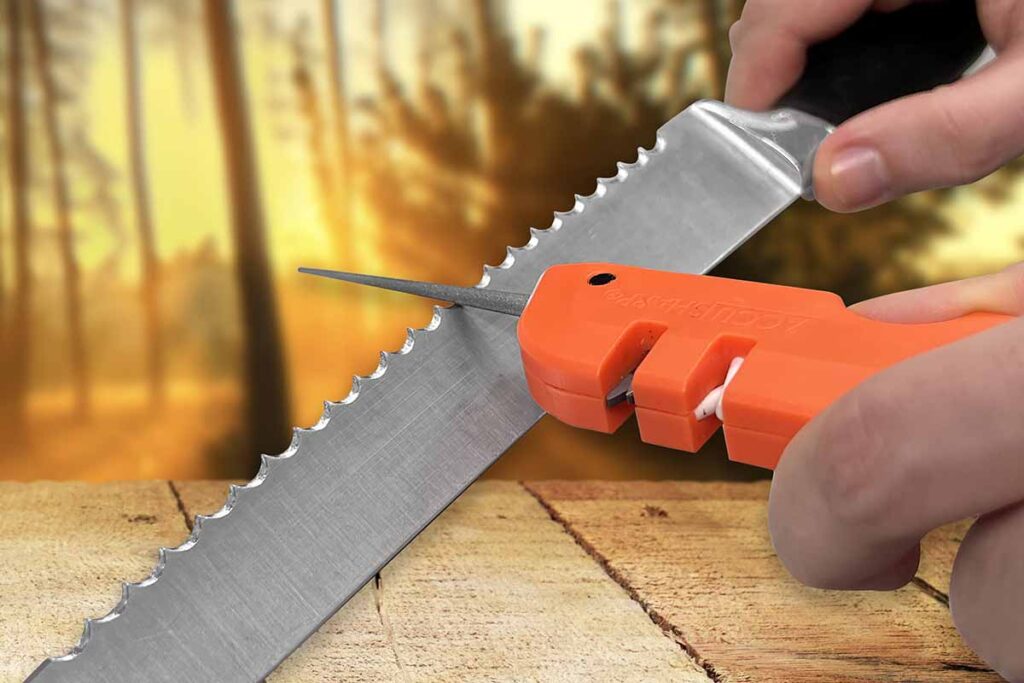
AccuSharp Explorer Knife & Tool Sharpener and Outdoor Survival Tool
The AccuSharp Explorer Knife & Tool Sharpener and Outdoor Survival Tool not only sharpens serrated and plain edge blades, it also boasts a selection of survival/emergency tools

The AccuSharp Explorer Knife & Tool Sharpener and Outdoor Survival Tool has a wealth of sharpening and survival tools for outdoor enthusiasts. Diamond-honed tungsten carbide blades and fine ceramic rods address plain edges. The diamond-tapered rod sharpens serrations and gut hooks, while a center groove sharpens fishhooks and various pointed objects. The multifunctional tool also features a fire starter, compass, emergency whistle and SOS mirror for survival situations.

AccuSharp Explorer Knife & Tool Sharpener and Outdoor Survival Tool Specs
Sharpener Type: Knife and tool w/survival tools
Edges sharpened: Plain and serrated
Sharpening Angle: Preset at 21 degrees
Abrasives/Grits: Tungsten carbide and fine ceramic/1500; diamond coated rod/400
SPECIAL FEATURES:
2 V-notched sharpening slots;
Reversible tungsten carbide blades preset at 21-degree angle;
Fine ceramic finishing rods preset at 21-degree angle;
Compact design;
Retractable diamond tapered rod to sharpen serrations and gut-hook blades;
A groove to sharpen fishhooks;
SOS mirror;
Compass;
Fire-Starter;
Emergency whistle;
Sharpener Dimensions: 5” wide x 1.25” long x .5” deep
Construction Materials: Hard plastic body, diamond-coated steel rod, fine ceramic rods, and tungsten carbide and metal screws­
Carry: A lanyard hole for easy attachment
Weight: 1.6 ozs.
Country of Origin: China
MSRP: $16.99
Available: Now

AccuSharp 4-in-1 Knife and Tool Sharpener
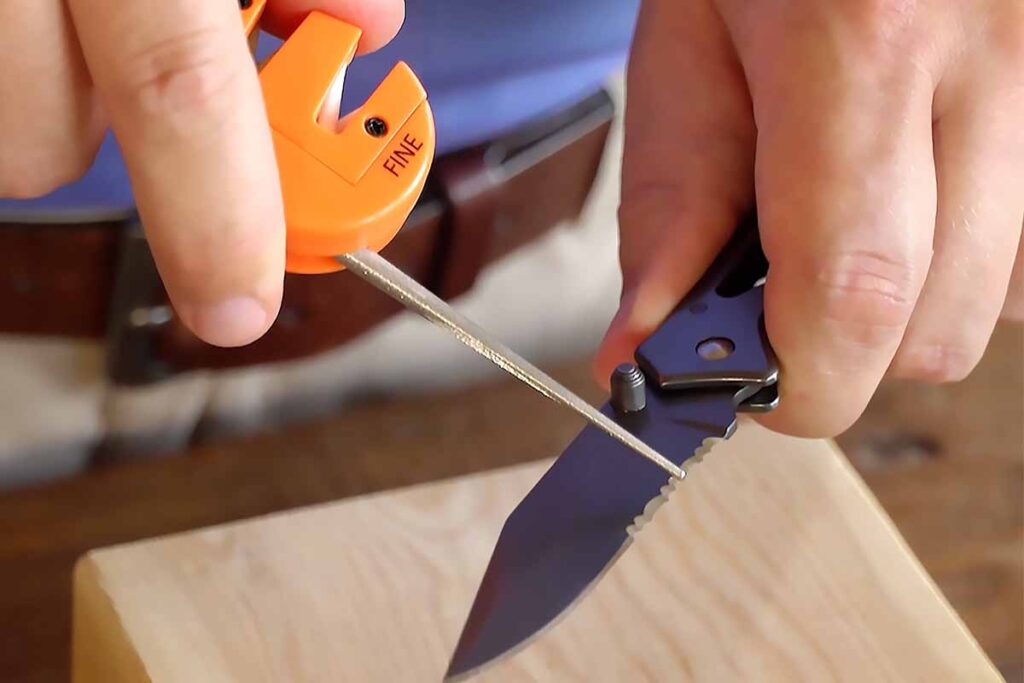
AccuSharp 4-in-1 Knife & Tool Sharpener
The AccuSharp 4-in-1 Knife & Tool Sharpener’s retractable diamond-tapered rod handles deep serrations.

The AccuSharp 4-in-1 Knife and Tool Sharpener is a keen companion for outdoor enthusiasts. The pocket-sized edge maintenance tool features pre-angled coarse tungsten carbide blades for initial sharpening and fine ceramic rods for refining the edge. A retractable diamond-tapered rod sharpens serrations and also features a groove for hooks and darts. If you prefer working on a flat surface, flip out the retractable diamond file for continuous sharpening. The unit’s rubber-molded feet ensure stability during use. Color options are black and blaze orange.

AccuSharp 4-in-1 Knife & Tool Sharpener Specs
Edges sharpened: Plain and serrated
Abrasive Type: Tungsten carbide, fine ceramic and diamond coated
Grit Selection: Diamond rod: 400; diamond file: 400; ceramic fine: 1500
Dimensions: 1.5” wide x 4” long x 0.75” deep (closed) and 1.5” wide x 8.75“ long x 0.75” deep (open)
Construction Materials: Hard plastic body, diamond-coated steel rod & file, fine ceramic rods, and tungsten carbide
Weight: 1.6 ozs.
SPECIAL FEATURES
2 V-notched sharpening slots;
Reversible tungsten carbide blades preset at 21-degree angle;
Fine ceramic finishing rods preset at 21-degree angle;
Rubber-molded feet for stability;
Compact design;
Retractable diamond tapered rod;
Groove to sharpen hooks and darts;
Retractable diamond flat file
Country of origin: China
MSRP: $16.99
Available: Now

Cold Steel Benchtop Sharpener
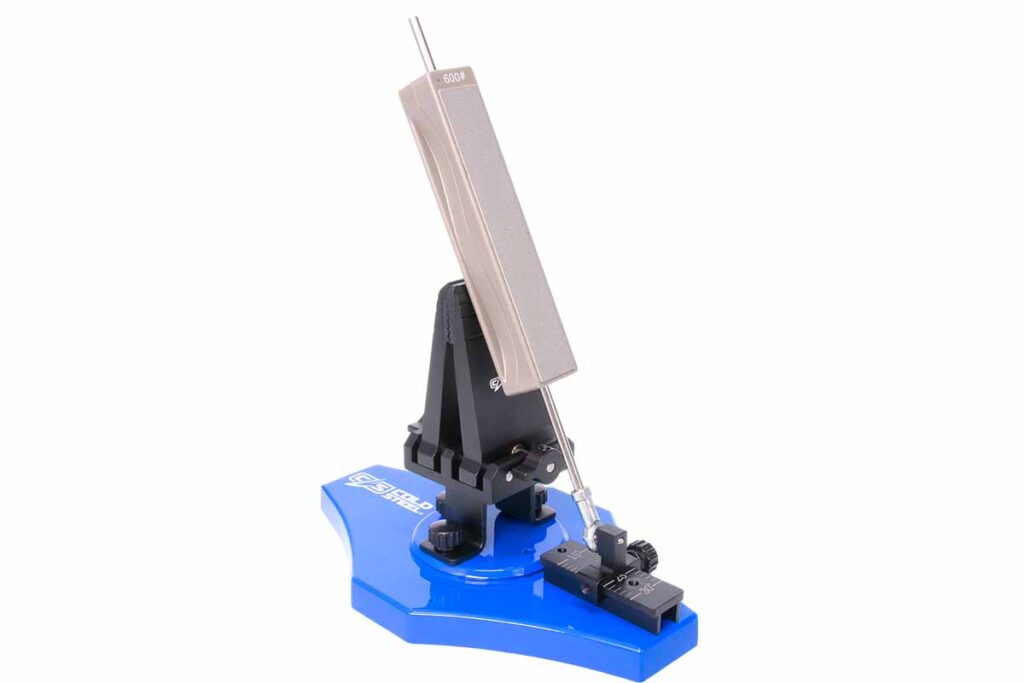
 Cold Steel Benchtop Sharpener
The Cold Steel Benchtop Sharpener has an ambidextrous clamp with a non-marring grip, and 180-degree rotation for sharpening two edges without removing the knife from the clamp.

The Cold Steel Benchtop Sharpener is angle adjustable from 15 to 30 degrees, and comes with four diamond sharpening grits.  It has an ambidextrous clamp with a non-marring grip and 180-degree rotation for sharpening two edges without removing the knife from the clamp. The base is weighted with non-slip feet providing a stable pedestal for benchtop sharpening. The unit includes a hardshell carrying case.

Cold Steel Benchtop Knife Sharpener Specs
Sharpener type: Adjustable benchtop stone
Edges sharpened: Plain
Abrasive Type: Diamond
Grit Selection: 300, 600, 800 and 1000
Dimensions: 5” long x .95” wide x .82” thick
Construction materials: Metal
SPECIAL FEATURES:
Adjustable sharpening stone;
15-30 degree angle;
Ambidextrous clamp with even clamping force;
180-degree rotation for sharpening two edges without removing knife from clamp, and;
Hard shell carry case
Country of Origin: China
MSRP: $149.99
Available: Now

More Sharpening Articles:

ABS Lose Two Long-Time Leaders In Passing Of Steve Dunn & Hanford Miller

Dunn and Miller left lasting impressions on ABS, students and custom knifemaking.

The American Bladesmith Society lost two of its finest leaders and bladesmithing instructors recently with the passing of ABS master smiths Steve Dunn and Hanford J. Miller.

Steve Dunn

Steve died on May 21. He was 68. Outgoing chairman of the ABS, he was a longtime Society member, receiving his master smith stamp in 1994 before going on to serve on the ABS board of directors and eventually being elected chairman.

“He was a craftsman of the highest level, as evident in the exceptional blades he made, and unsurpassed as an engraver, which he passed on to so many with his teaching,” americanbladesmith.org reported.

Many in the ABS were still recovering from the shock of the news as BLADE® was going to press, ABS master smith Billy Bob Sowell among them.

“I was stunned,” he wrote. “Steve was one of my judges for my master smith stamp. I took his engraving class and his folder class. I’ll miss him.”

According to his bio on the ABS website, Steve began making knives as a hobby in 1988. In 1990 he enrolled in the basic forging class at the Bill Moran School of Bladesmithing, where he started forging damascus. After achieving master smith, it wasn’t long before he began teaching at the Moran School. In 2003 he was selected to serve on the Society’s board of directors.

A strong believer in sole authorship of his knives, he enrolled in a basic engraving class at GRS Tools in 2002. He later studied with Chris DeCamillus on Bulino style engraving and was asked to be an instructor at the GRS school in 2005.

Hanford Dunn

Hanford passed away on March 25. He sold his first knife in 1968. He made knives in the Moran style, including bowies, fighters, camp knives and other large fixed blades, and also period pieces such as reproductions of the cinquedea. His mark was his initials or name within a bowie logo.

In addition to being an outstanding maker of forged knives, Hanford served on the ABS board of directors as treasurer for many years. According to americanbladesmith.org, he was best of friends with BLADE Magazine Cutlery Hall-of-Fame® member Bill Moran, with the pair being “like two peas in a pod.”

They first met in 1974 in Bill’s shop. Hanford read about Bill in a library book about knives and realized he was only a short drive away from Hanford’s home in Randallstown, Maryland.

“Bill was a great mentor,” the site observed, “and their friendship lasted long after Hanford moved to Colorado in 1976.”

Pros’ Secrets To Sharpening Knives

0

Four knife industry pros share the secrets of how they keep their edge when sharpening.

A knife is made to perform its function as a tool, and job number one is to cut.

It follows that the development and maintenance of the edge is the most important aspect of knife ownership and use. When users are in the shop, around the house, at the office or in the field, keeping the edge in top form and working order makes the task at hand easier and often saves time and effort.

Custom Knifemaker: Chris Berry

Chris Berry sharpens freehand
Chris Berry sharpens freehand, holding the DMT bench stone in one hand and his modified cleaver in the other. (Chris Berry image)

A custom knifemaker for 15 years, Chris Berry has made a name for himself in heavy-use choppers with blades of high-wear-resistant steel.

“When I finish a knife and get ready to sharpen it, I break the edges on the grinder to start the process and then work freehand after that,” he explained. “I’ll start with an extra-coarse DMT diamond stone and then go from extra coarse black to red medium and then green extra fine.”

In the field Berry carries a Spyderco cubic boron nitride (CBN) sharpening stone along with a Spyderco Double Stuff pocket stone.

“It has medium and fine ceramic for the edge,” Berry continued, “and then I’ll have some piece of leather to strop the blade and remove the burr.”

Chris knows it’s time to touch up an edge when it starts to drag through the cut.

“A blade is dull when it won’t cut printer paper,” he said, “so I’ll sharpen it before it reaches that point. I’m not obsessively sharpening a knife blade, but I’m just hitting the medium edge of the Double Stuff and going to the strop to bring back that popping edge. I usually only go back to the grinder if the edge is damaged, but, if the blade is really dull, starting with the extra coarse diamond and going through the grits will make it like a new knife.”

As Berry noted, the burr is the little, fine piece of steel that rolls up to the edge of the blade and is rough on one side and smooth on the other.

“If the burr isn’t gone after sharpening [the edge is] not sharp,” he advised. “In my opinion, it is the key to whether a knife is sharp or not. I tell people on social media that sharpening a blade is broken down to apexing the edge to raise the burr, refining the edge with progressively finer grits, and then removing the burr by stropping. If you progress through the grits and have the burr removed, you should be able to cut newsprint, phone book paper and even paper towels. That is as sharp as you are going to get.”

Knob Creek Forge: James Gibson

James Gibson of Knob Creek Forge designs knives for ESEE and teaches classes on bushcraft and survival.

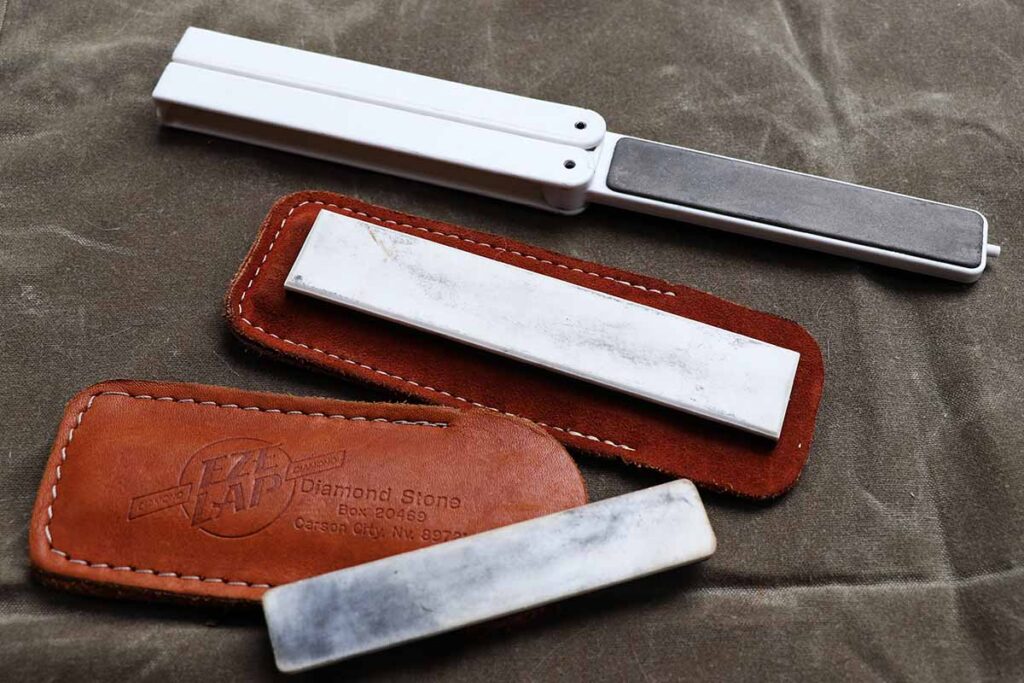
Some of the favorite field sharpeners of Joe Flowers include the EZE-Lap 530 Super Fine Diamond/Ceramic Folding Sharpener
Some of the favorite field sharpeners of Joe Flowers include the EZE-Lap 530 Super Fine Diamond/Ceramic Folding Sharpener (top) with a folding handle. “The Spyderco Double Stuff [middle] is a fantastic field sharpener,” Joe wrote. “It and the EZE-Lap Double Sided Sharpening Stone [bottom] both have a leather sleeve which can work as a strop.” (Joe Flowers image)
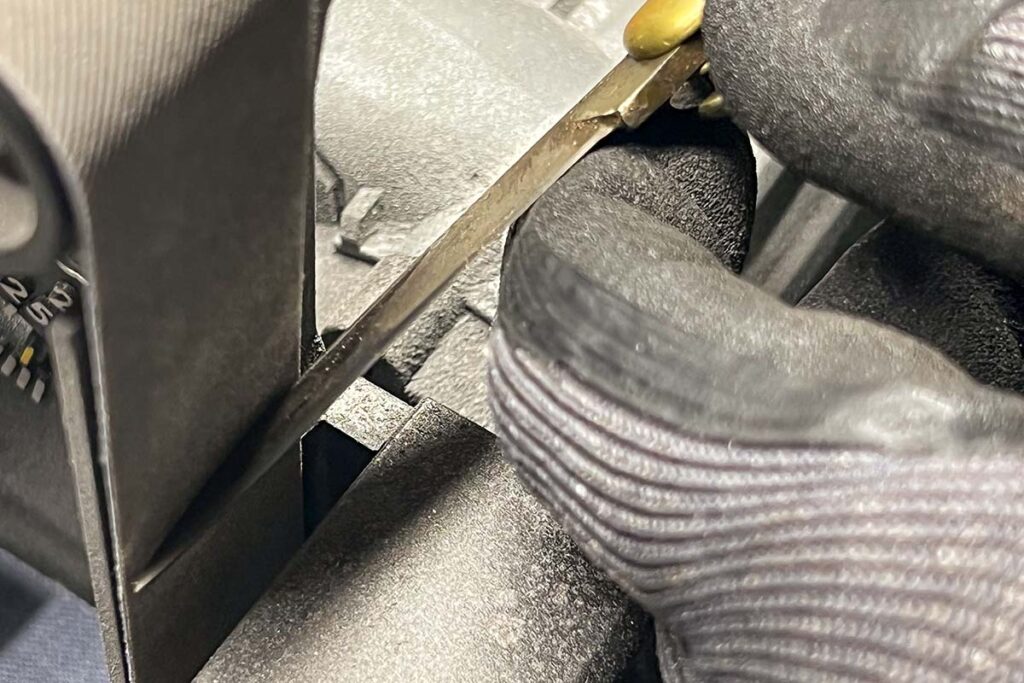
“I like a full flat grind with a convex edge,” he remarked. “They say the convex edge is the best, and when I have an extremely dull blade I use these little diamond files and then a ceramic rod or stone that will stand the edge up.”

An ABS journeyman smith, Gibson cautioned, “A dull knife will hurt you quicker than a sharp knife because you tend to lose control when you apply more pressure to get a job done. Most of the time I will sharpen a knife at the end of the day, but if it is not performing I will touch it up right then and there. If you ever watch a carver, they will carve for 15 minutes or so and then strop the blade to bring the edge back right quick. After a few days of stropping, they will have to do a bit of sharpening.”

Gibson sometimes uses a marker to spot the blade about a quarter inch up from the edge and then “floats” the edge up and down the diamond sharpener. He then moves to the leather strop and notes that if a compound has been used to keep the leather in shape the process will turn the leather black.

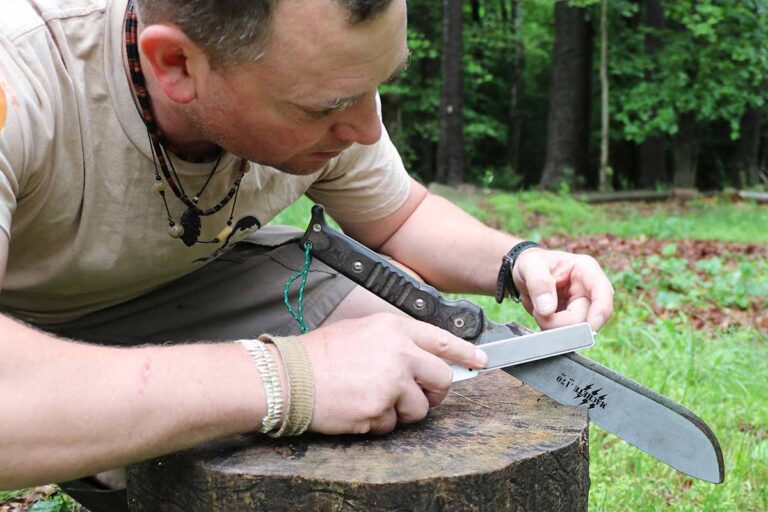
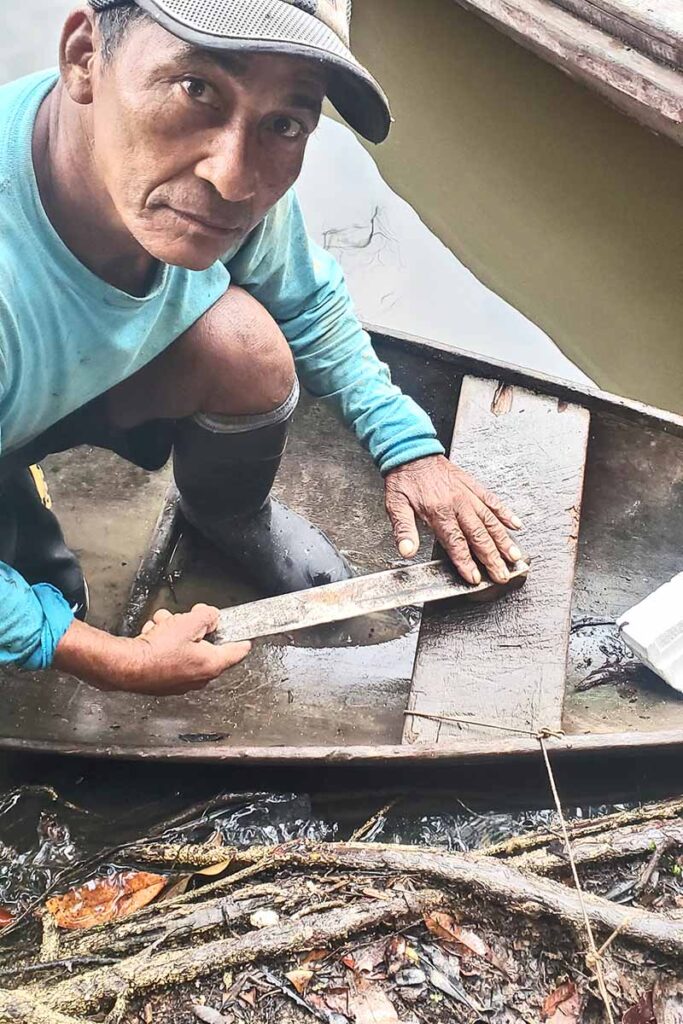
A Brazilian bushman files his machete on a stone
A Brazilian bushman files his machete on a stone, taking out the burrs and nicks in the edge. (Joe Flowers image)

“That means you are pulling steel off the edge,” he commented, “and where the two polished edges meet that will give you the sharpest blade you can get.”

Safety is a constant concern for Gibson and he stresses this aspect of knife use in his classes.

“We train people on the knife, and one of the first things we tell them is never to cut toward yourself. Keep everything out in front of you, or use a bench, log or stump so that everything is out of the way.”

CRKT: Russ Kommer

As a knife designer for Columbia River Knife & Tool (CRKT) and a hunting guide, Russ Kommer keeps blades sharp on a regular basis.

“When I finish up a custom knife, I run the blade on a brand new 400 grit slack belt with a real slight radius,” he remarked. “Then I will take it over a used 400 grit belt so that when the edge is curled and there is a little white line, I can use a leather strop or a 10-inch wheel and break off the burrs.”

Kommer carries a diamond sharpener in the field to touch up an edge.

“That will stand that line back up and remove some steel to get the edge back to infinity,” he said. “The only way to get a blade sharp is to remove enough steel. In the field you can use a leather strop or even the leather heel of your boot or something to help. When guiding, I have done two moose and a caribou in one day, and working on big animals is a big job. Sometimes I will carry two knives and touch both up to be ready for the next week, and I carry a pocketknife for cutting rope or other camp chores. It’s not good to use your hunting knife to cut burlap and dull it up on something like that.”

Testing for sharpness is a varied exercise, and Russ likes the simple standard.

“Guys like to shave their arms and that is all cool and dandy,” he smiled. “I just rake it across the back of my head, and when I feel it grab that hair I know the blade is sharp. There is also the fingernail task—if you feel the blade grab right there on the fingernail, then it is sharp. If you have practiced sharpening a blade enough, then you know quickly just how sharp a knife blade is.”

Condor Tool & Knife: Joe Flowers

As a knife designer for Condor Tool & Knife, Joe Flowers has sharpened thousands of blades through the years. The sharpening process is dependent largely on the work at hand.

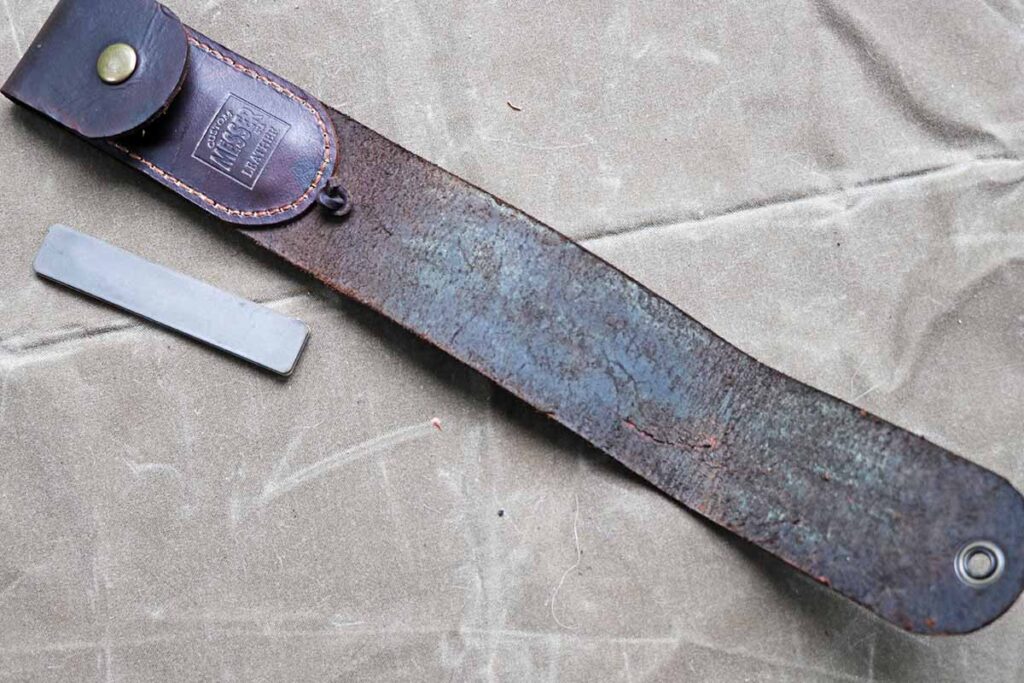
This combination of an EZE-Lap ceramic and diamond stone tucks into the JC Messer strop
This combination of an EZE-Lap ceramic and diamond stone tucks into the JC Messer strop, providing Joe Flowers with a large range of media in a small package. The large strop helps balance out the smaller stone. (Joe Flowers image)

“It can vary between jobs,” he explained. “I just have a 2×42 grinder that I do edge modification on—with every belt imaginable—but by far I use the leather belt the most because I am always using the blades and getting a fast strop. Most of the time, I try and use my field sharpeners and also complement them with the finer stones like my King stones or Spyderco ceramics.”

When Flowers ventures into the field, he is prepared for the occasional sharpening task.

“I really like EZE-Lap’s double sharpener,” he advised. “The files really bite down on carbon steel, and the ceramic on the other side keeps a finer edge. I’ve even used the sheath as a strop. That and the Spyderco Double Stuff are my two favorite compact sharpeners, although Work Sharp’s setup is great, too.”

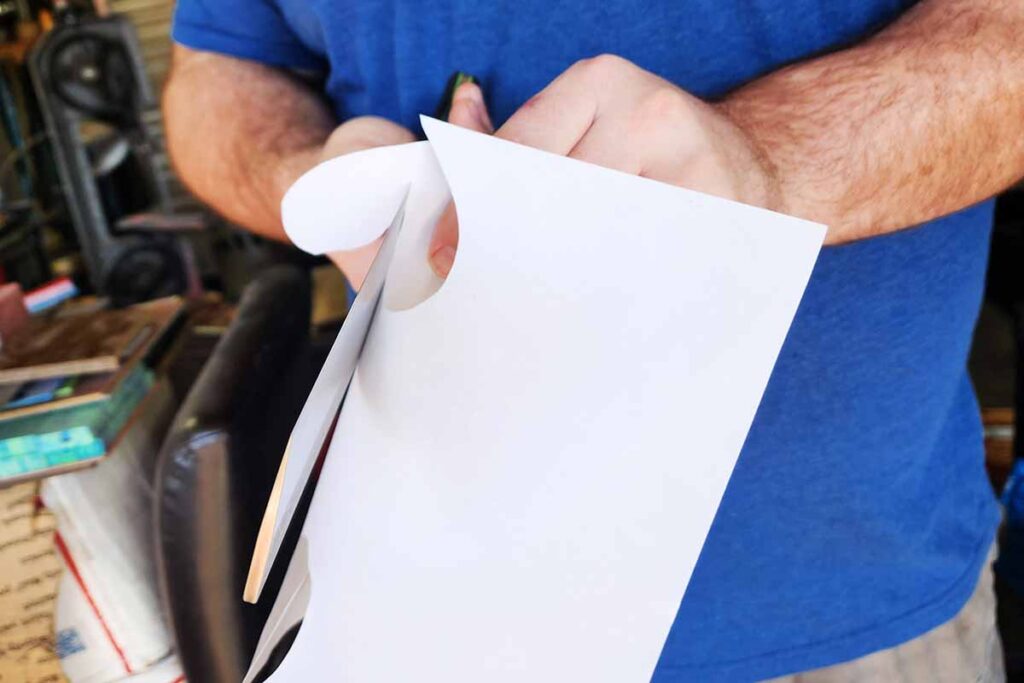
Chris Berry cuts a figure 6 in a sheet of paper
Chris Berry cuts a figure 6 in a sheet of paper. “A blade is dull when it won’t cut printer paper,” he said, “so I’ll sharpen it before it reaches that point.” (Chris Berry images)

When in the field, Flowers likes to settle down before taking on the sharpening of his knives.

“Normally, in camp situations, unless I’m working hours on a game animal or on a bushcraft project, I leave my sharpening to nighttime around the campfire. I also have my field sharpeners around my desk at work to use to understand how they work on different steels more. I like using EZE-Lap and diamond stones with harder-use bushcraft [carbon] steels like 1095. It can get an edge fast and you can go about your day.

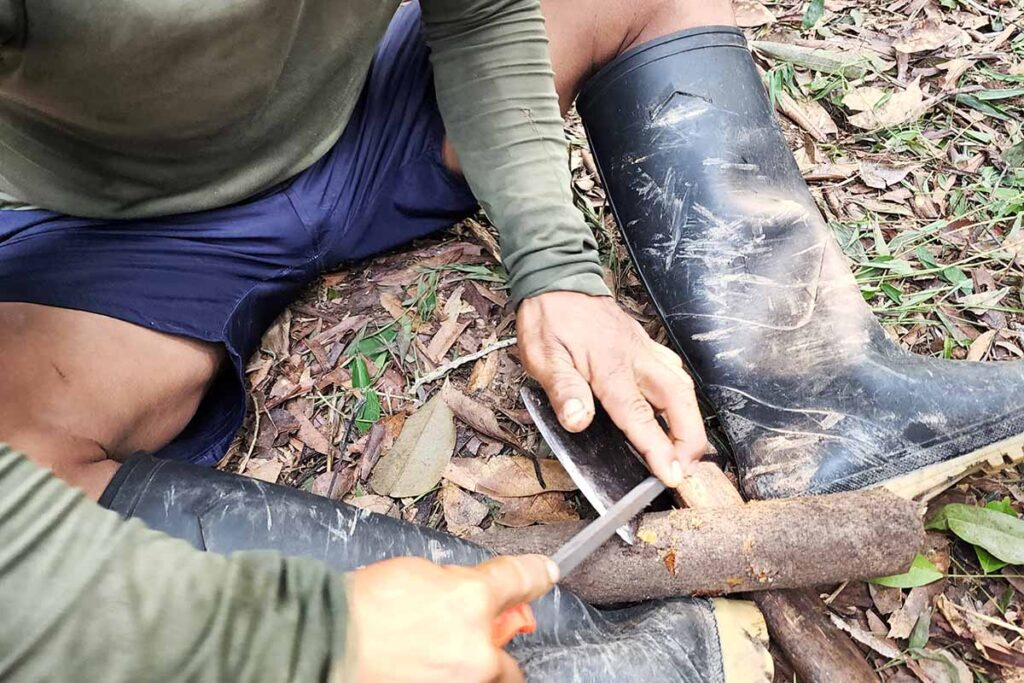
“For machetes,” Joe continued, “I stick with what the locals use, and that’s a file. Generally, I’m working with softer steels for machetes so a triangular single cut bastard or double cut bastard file about 6 inches long is a nice addition to my sheath. I’m finding better results in super steels on diamond stones until I move into these new crazy preloaded diamond powder strops. Those look incredible to try.”

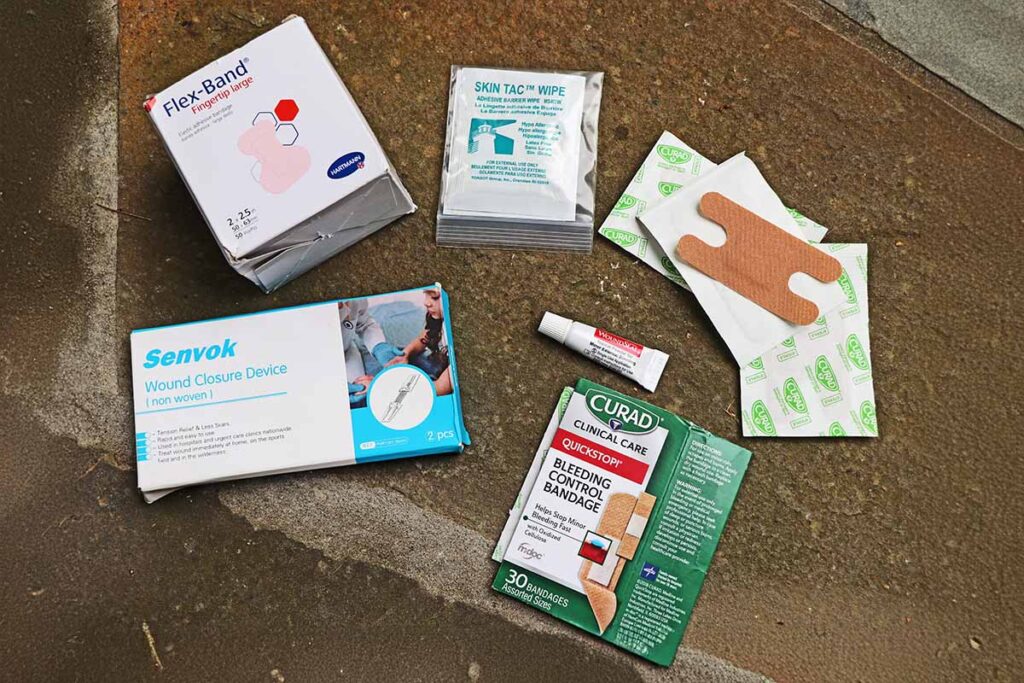
These items are extremely handy if you do anything with knives. The fingertip bandages are good anywhere on the bop
These items are extremely handy if you do anything with knives. The fingertip bandages are good anywhere on the bop, aka a survival experience, and bleed control Band-Aids® can also be handy. They have a coagulant. Besides a tourniquet, noninvasive wound closure devices coupled with a tape adherent like Skin Tac™ can save a trip to the emergency room for those annoying cuts. (Joe Flowers image)

When sharpening a dull blade, Flowers is known to use 60- to 80-grit belts to re-form edges when large chunks have been taken out of a machete, for example. He maintains that it can take the steel off the blade fast but there must be a bucket of water or a spray bottle handy to keep the grinding surface cool.

Bringing a knife back from dead dull involves a proven process.

“At home I would reprofile gently on a 1×30 Harbor Freight special I’ve had from the old days,” Joe commented. “Depending on the steel and use and the comfort of the hardness, I’ve reprofiled knives from dead dull with homemade sandpaper and mouse pad backing and keep heavier grits there as well. You can definitely over sharpen a knife by stropping so much you roll the edge. In the technique, you need to be able to tell when you have just the right amount of pressure.”

tribesman from Colombia, uses a common triangular file on the axes and machetes
Hari, a Huitoto tribesman from Colombia, uses a common triangular file on the axes and machetes on Bushcraft Global (bushcraftglobal.com) trips. For the final edge, the file is drawn from the edge to the poll. (Joe Flowers image)

Sometimes the type of sharpening medium used depends on the blade steel, the style of blade and the common utility of the knife.

“On many higher-end-steel kitchen knives, I stick with King stones because they are tried and true,” Joe related. “However, I like many different media for various steels, going for the extra-fine edges or a strop loaded with compounds for the final edge. For things like serrations, I use thinner round diamond rods for getting the radius, but I don’t deal with them much. I really like the flattest surface possible when I sharpen Scandi as it helps keep the angle straight.”

Retaining a sharp edge makes life easier wherever and whenever a knife is needed. A few minutes to shape up a blade is always time well spent.

More Sharpening Articles:
Latin America’s Elite Knife Crafters: Custom Blades and Their Makers

0

The knifemakers of Argentina and Brazil have revolutionized the world of cut.

The language of custom knifemaking and bladesmithing is universal, so, logically, the appeal of the industry would have global reach. Through the years, such has been proven in the work of gifted artisans around the world, and those from Latin America have gained increasing attention. The quality of their forged steel, the fine lines of their folders and fixed blades, and the attention to detail in their finished work have created a buzz.

The impact of Brazil and Argentina especially has been noticeable at the BLADE Show and elsewhere in recent years. Argentine winners in the BLADE Show custom knife competition include Claudio, Ariel and Marcelo Sobral, Mauricio Daletzky and Javier Vogt, while Brazilian winners include Fabio Barros, Gustavo “Gus” Cecchini and Franco de Souza, the latter whom recently copped multiple knife judging awards at this year’s BLADE Show Texas. Cecchini, meanwhile, pulled a rare double at last year’s BLADE Show, winning for Most Innovative Design in the custom knife competition and the BLADE Magazine 2023 Knife Collaboration of the Year® with WE Knife for the Solid folder.

Like their European, Asian and North American counterparts, bladesmiths and knifemakers from Latin America are acknowledged by manufacturers, purveyors and the buying public as among the best in the world. Their stories validate their commitment and emerging success.

Ricardo Vilar

Ricardo Vilar hunter
Now living in Arkansas, ABS journeyman smith Ricardo Vilar of Brazil won Best Hunting Knife at this year’s Texas Select Custom Cutlery Event for his hunter in a damascus of 1084 carbon and 15N20 nickel-alloy steels and a stag handle. Overall length: 9.25 inches. His price for a similar knife: $2,500. (SharpByCoop knife image)

One catalyst for the growth and resulting excellence among Latin American artisans is ABS journeyman smith Ricardo Vilar, a native of Brazil who relocated with his family to Arkansas several years ago. Vilar wanted to be the best, and so he sought out the counsel and advice of the best. He was so thoroughly committed to bringing award-winning bladesmith Jerry Fisk to Brazil for some learning and instruction that he was willing to sell his car to make it happen.

“It was in 2000 that I started exchanging messages with Jerry because I had come to the BLADE Show with one of my friends and talked to him about doing a hammer-in in Brazil,” Ricardo remembered. “Jerry came to Brazil in 2001 and had a meeting with 14 knifemakers and bladesmiths at my shop. We had nine dates with Jerry at my shop, and then after that the knowledge began to spread.”

Vilar and Fisk developed a close friendship along the way, and Ricardo has made the most of his innate talent and the skills he has sharpened with help from Jerry. Living within an easy drive of one another, Ricardo and Jerry are regularly in touch. In 2020, Ricardo won first place on an episode of Forged in Fire as a television audience witnessed his prowess. He also became involved with a Latin American version of FIF titled A Challenge Under Fire. In 2021, the two also embarked on a joint venture called FAV (Fisk and Vilar) to produce a limited number of collaborative pieces, up to 25 annually, for the collector market.

“After Jerry came to Brazil, we started sharing information and that sharing is very important,” Ricardo added. “We have had guys from Argentina come to meetings as well, and we like to ‘walk together’ in getting better.”

When Fisk arrived in Brazil for the first time, he informed the gathering that they would be better served using a gas forge. When the attendees were skeptical, still using coal and charcoal, he told them to have open minds.

Fabio Barros of Brazil won Best New Maker at BLADE Show 2022
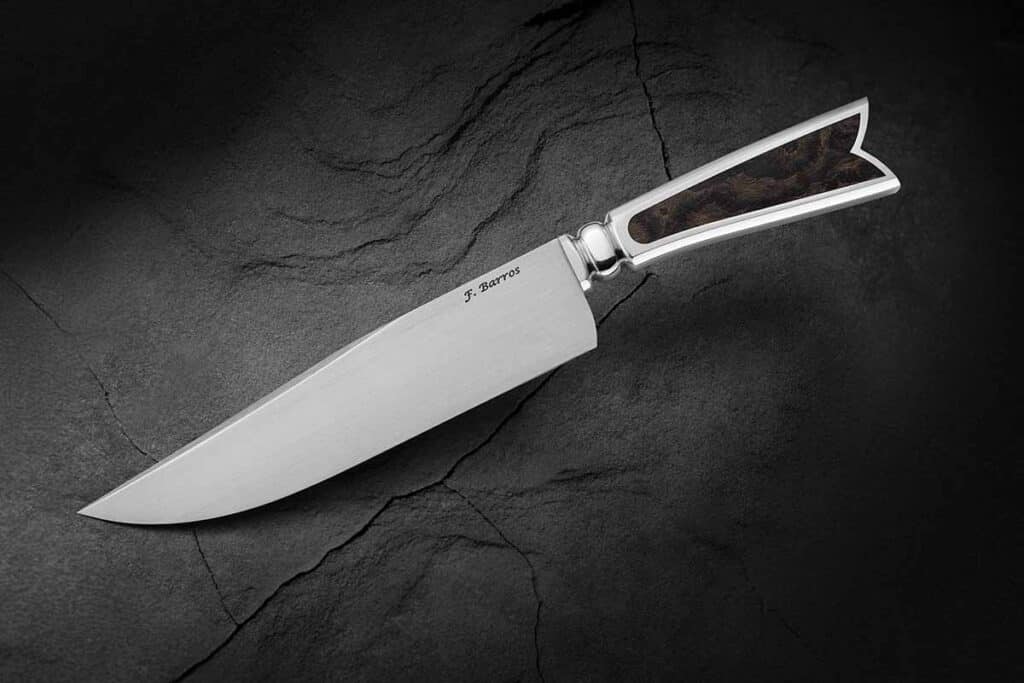
ABS journeyman smith Fabio Barros of Brazil won Best New Maker at BLADE Show 2022 for this beauty. He also won the show’s award for Best Handle with another knife, and Best Handle at BLADE Show ’23 for one of his integral fighters. (Andre Maino knife image)

“Ricardo and I went down to a junkyard and got what we needed,” Jerry recalled. “We set up the forge and made damascus and opened up everybody’s eyes. I also found out that bladesmiths from the different states in Brazil did not really share information with one another. When they told me that, I started to pack my bag. When they asked what I was doing, I told them that if they didn’t share information I was going home. ‘If you won’t share with each other, then why should I share with you?’”

The message was heard loud and clear. From there, the Brazilian bladesmiths and knifemakers made steady, significant progress, right along with others from neighboring countries in Latin America. “The intent was to show the rest of the world what they were capable of doing,” Jerry said. “I went there for a few years to teach them and show them a few things, but then there has to be a line where you are no longer teaching but cheerleading. I would cheerlead with them when they asked a question and say, ‘Yes! Yes! You’re doing it the right way!’”

Ricardo looks back at the investment of time and money that really helped bladesmithing and custom knifemaking to take off in Latin America. “I was willing to sell my car to buy Jerry’s plane ticket,” he laughed, “and I started telling other knifemakers that he was coming to Brazil and that they should come to my shop to see him work. He is my mentor, and I am still inspired by his work.”

For Fisk, teaching and cheerleading come naturally and fulfill an obligation to help others.

“Some of them call me the father of modern knifemaking down there,” he commented, “but what it amounts to is that my first students have had students, and it has just multiplied, so in a way I have multiple grandchildren and great grandchildren in bladesmithing and knifemaking.

“I remember telling them that if they wanted to show their knives in the U.S., they had to go above and beyond what others might do. I said, ‘Others will assume that your work is not as good as what they have been seeing. So if their knives cut through two 2x4s, make yours cut through 10. Make your knives cut more ropes than theirs. Dig deeper and go further!’”

Rodrigo Sfreddo of Brazil is the first accredited ABS master smith from Latin America
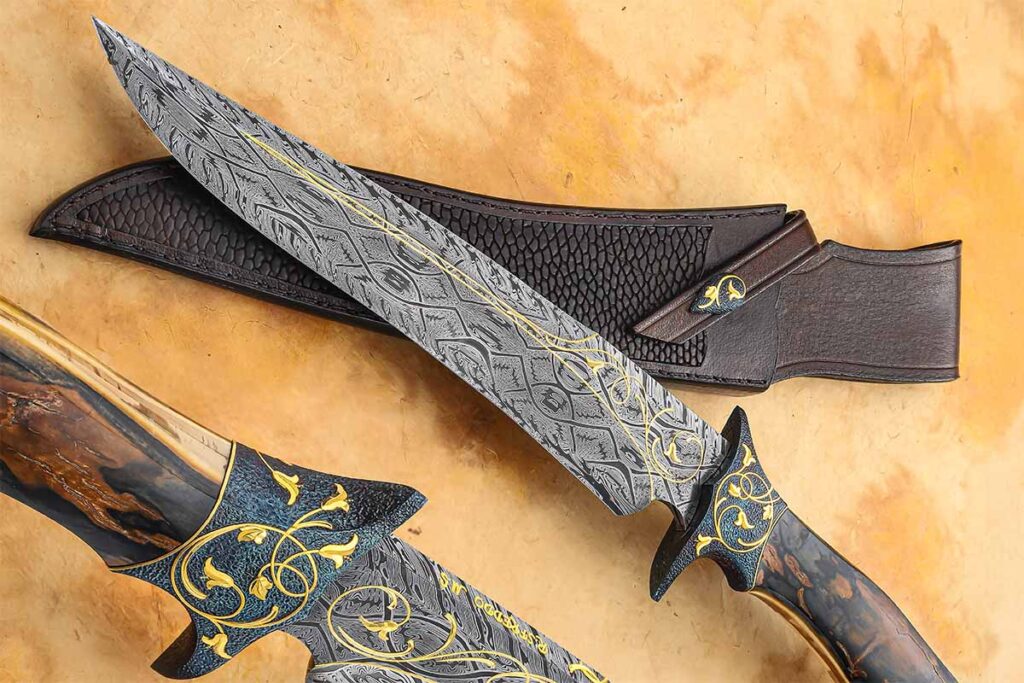
Rodrigo Sfreddo of Brazil is the first accredited ABS master smith from Latin America and forges some of the most spectacular damascus fixed blades of any hemisphere. (SharpByCoop knife image)

Jerry also singles out the work of ABS journeyman bladesmith Facundo Montenegro of Argentina and Brazilian Rodrigo Sfreddo, the latter the first Latin American accredited ABS master smith. Fisk sees an enthusiasm, a drive that helps set the Brazilians apart. “It’s their hustle,” he asserted.

“One of the reasons they hustle so hard goes back to the fact that you can’t get stuff quite as easily down there, and they have had to rely on innovation. When I first went to Brazil, Ricardo asked me what I needed, what kind of anvil or grinder, and I told him it didn’t matter. We would make knives with whatever they had. It’s not always what equipment is in the shop, but what is in the head, eye and hands.

“Still, years back if you wanted to buy an anvil, you had to buy it here in the United States and ship it there. That was true with grinders and other supplies, too. And you would pay heavy taxes as well. Now, we have businesses making supplies there in Brazil, and that has been encouraging.”

Flavio Ikoma

Brazilian Flavio Ikoma helped designed the Ikoma Korth Bearing System (IKBS), a ball-bearing pivot system used by custom and factory knifemakers worldwide.
Brazilian Flavio Ikoma helped designed the Ikoma Korth Bearing System (IKBS), a ball-bearing pivot system used by custom and factory knifemakers worldwide. As great a maker and knife designer as Flavio is, it is the IKBS among his contributions that has had the most impact on the folding knife industry. The IKBS as well as Flavio’s Deadbolt lock system help highlight one of the latest CRKT/Flavio collaborations, the Bot.

On the factory side, Brazilian Flavio Ikoma has developed a collaborative relationship with Columbia River Knife and Tool, while his apprentice, Pedro Buzetti (page 24), has also come into his own. The Ikoma Korth Bearing System (IKBS), which Flavio helped design along with Ricardo and Paulo Lala, and his Deadbolt locking system are major contributors to the popularity of his CRKT designs. The IKBS, in fact, has revolutionized both custom and factory folders alike.

“Every design of Flavio’s we have uses the IKBS,” remarked CRKT representative Doug Flagg. “His most famous model is the Fossil, and Walmart has sold it for the last seven or eight years. It is amazing because IKBS allows the knife to be opened super fast and the action is incredibly smooth. [Another Flavio] design, the Attaboy, incorporates IKBS. Fitting the bearings in along with Flavio’s patented Deadbolt lock took a herculean effort!”

Flagg and CRKT began their association with Flavio after a tip from BLADE Magazine Cutlery Hall-Of-Fame® member Ken Onion. When Onion mentioned Flavio’s use of bearings in the pivot, he encouraged Flagg to make a phone call to the Brazilian.

“All Flavio wanted was recognition that we would be using IKBS,” Doug commented, “so we agreed and started using IKBS on [the Ripple, another Onion design for CRKT]. IKBS worked great but was hard to mass produce. The original system was individual ball bearings in a milled-out track, and we eventually evolved to caged bearings. Flavio said he would have used caged bearings if they had been available in Brazil. CRKT and most of the industry credit Flavio with putting bearings in the pivot of knives. Also, the Deadbolt is super easy to use and really, really strong. It’s easy to clean out as well. Just unscrew the button and the Deadbolt comes out. Then use compressed air to blow out the crud and reassemble.”

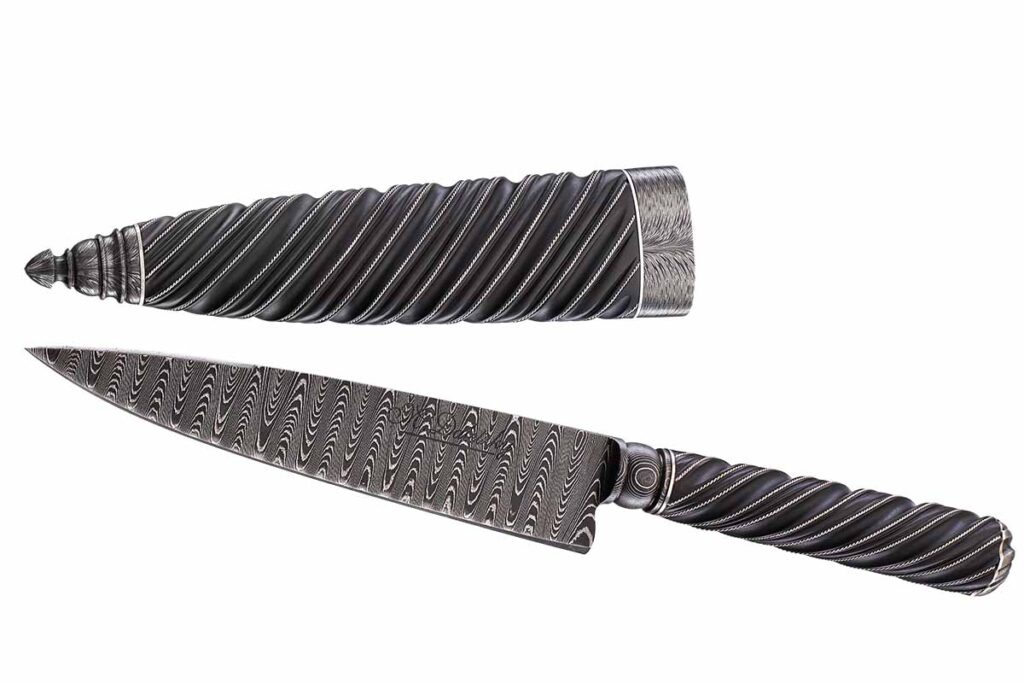
Mauricio Daletzky won Best Art Knife at BLADE Show 2021 for Creole in ladder pattern damascus
Argentine Mauricio Daletzky won Best Art Knife at BLADE Show 2021 for Creole in ladder pattern damascus and a wire wrapped ebony handle with matching sheath. Overall length: 12.2 inches. He won the same award at BLADE Show ’23 for The Gaucho Knife in damascus and mother-of-pearl. (Whetstone Studio knife image)

Flavio’s contribution is further evidence of the innovation and skill present in knifemakers and designers from Brazil. “I think they are so good because they have to try harder to penetrate the USA custom knife market,” Flagg reasoned. “They don’t really have a market for high-end custom knives in Brazil, although it is starting to become a thing. Therefore, they have to work really hard and make incredible designs to catch the attention of foreign knife collectors.”

CRKT is working with Pedro to produce current and future offerings. “We have a couple of models in the works with Pedro for 2024,” related Flagg. “As Flavio’s apprentice, he has taken up his own love for knives, and Flavio is now helping him to make custom knives. I expect Pedro to be one of the top makers in the coming years. He is young and absorbing all the knowledge that took Flavio years to acquire. Rick Lala has great designs also. I typically look forward to seeing his knives at the custom knife shows.”

Sobral Brothers

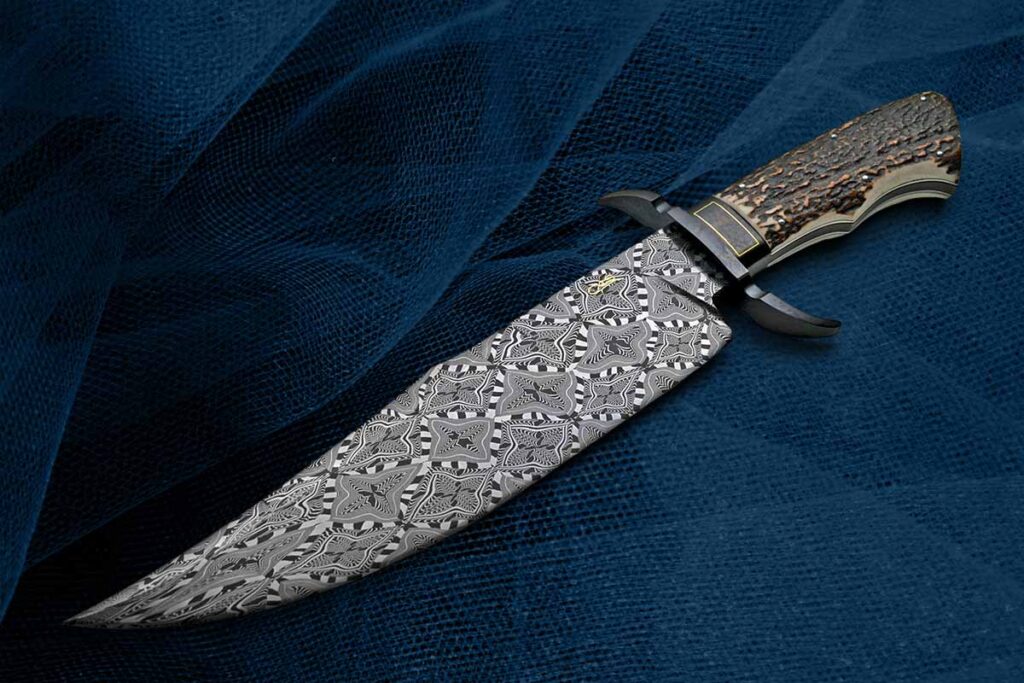
Sobral Brothers Ranger Bowie
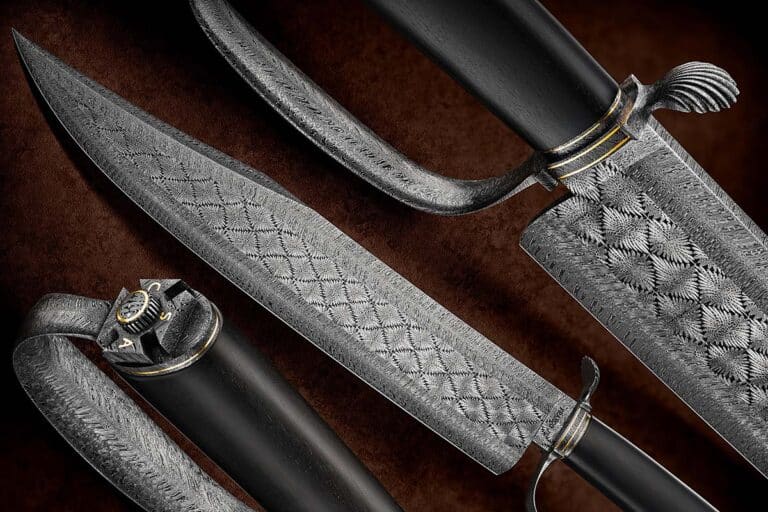
The Sobral Brothers—Argentines Claudio, Ariel and Marcelo—and awards go together like gauchos and knives. Their Ranger Bowie has a 10.5-inch mosaic damascus blade, blued fittings, a frame handle and stag scales with piened pins. Exquisiteknives.com’s price: $6,000. The Sobrals’ most recent BLADE Show winner was last year for Best Damascus. (Exquisiteknives.com knife image)

Through Exquisite Knives, custom knife purveyor and retired ABS master smith Dave Ellis has put high-end custom knives in the hands of collectors for many years. He praises the work of the Sobral Brothers, Claudio, Ariel and Marcelo (CAS), of Buenos Aires, Argentina, for setting a standard in bladesmithing excellence.

“At first it was their san-mai blades that seemed to attract my clientele,” Ellis explained. “Gradually, as their work progressed, their damascus steel, gun-blued fittings and their stunning designs really put them at the front of the pack. Organic materials are typically utilized for their handles, and Marcelo’s leatherwork has really become a complement to their amazing knives. Bold, dark damascus, as well as intricate mosaic damascus steel draws the eye, and once you hold a knife made by CAS it all comes together!
“They seem to work together seamlessly and produce singular works of art. With three of them working together you can sense the symbiosis that exists and once you meet them, their warmth and enthusiasm are refreshing as well as contagious.”

From wherever it emanates, quality work always speaks for itself. The Latin American bladesmiths and knifemakers have continually enhanced their quality work, and in turn to attract the attention of buyers around the globe.

Check Out More Cool Custom Knives:

Factory Drops: New Knives Hitting The Market This Spring

Five knives fit for EDC to the outdoors.

Does the flow of new knives ever cease? Lord, I hope not.

Midspring is as good a time as any for knife companies to drop new models, variations and what have you. And with this round, we have five new blades from three manufacturers worth a gander.

These knives range across the board, from a very collectible outdoor option to a bevy of affordable pocket pals. Even if they don’t exactly tickle your fancy, these blades are worthwhile window-shopping fodder.

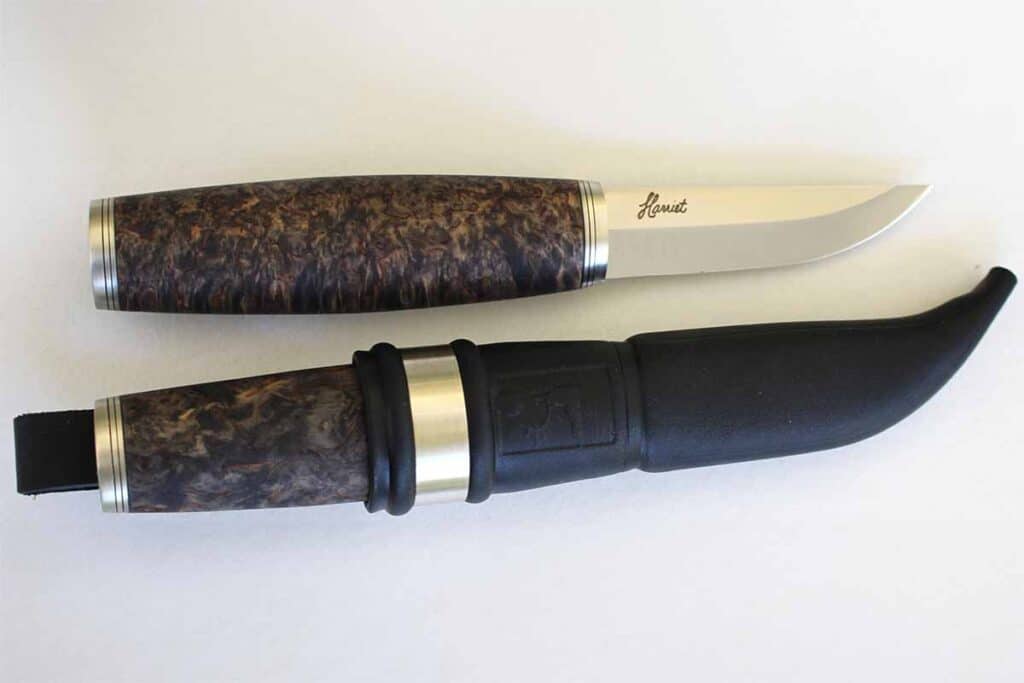
Kellam Knives Harriet70

Kellam Harriet70

Puukos are bread and butter at Kellam but its most recent introduction of this style of belt knife might prove better on the mantlepiece than on the hip.

Dubbed the Harriet70, the classic design is a tribute to Harriet Kellokoski, the wife of Kellam’s headman  Jouni Kellokoski, for her 70th birthday.

There are a lot of nice points on this limited-edition knife, but what jumped out for me immediately was the handle—more exactly its wood.
In this case, it’s arctic curly birch, darkly dyed and lightly oiled for the finish.

The curl pops and plays a beautiful counter to the nickel silver bolster and polished stainless-steel blade.

With 3-inches of wicked-sharp steel to play around with it’d make a solid hunting or fishing option, one dripping with class.

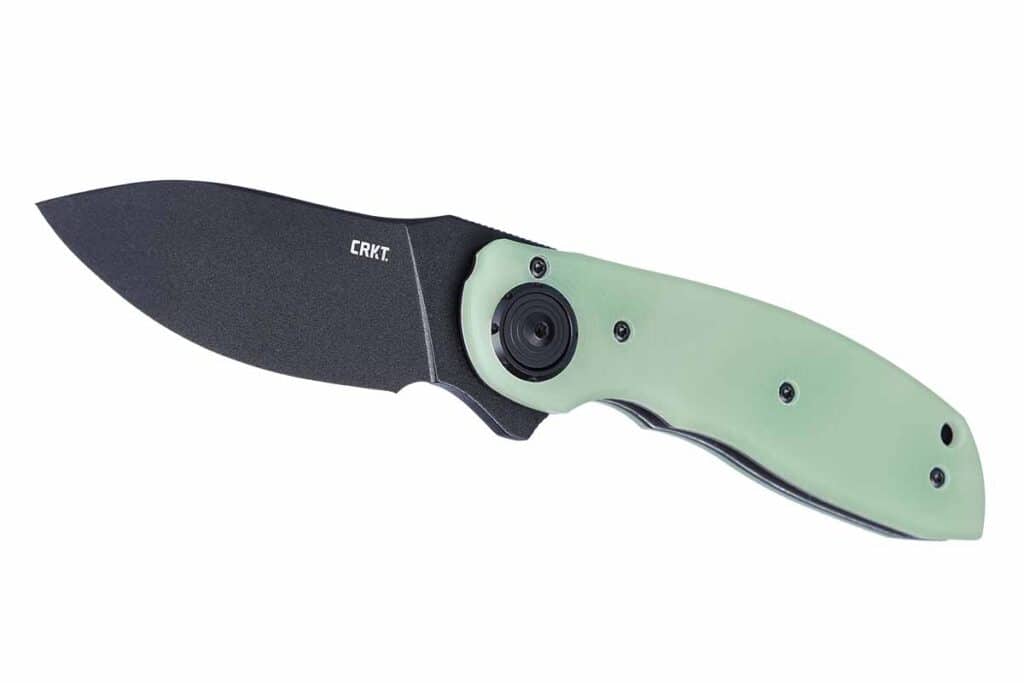
CRKT BOT Deadbolt

CRKT BOT Deadbolt

I can never complain about a design that puts fast deployment at the forefront of its engineering. Hence the BOT Deadbolt hits a sweet spot for me.

Assisted open with IKBS bearings, the action of this flipper doesn’t disappoint with the drop-point blade winking out in the blink of an eye.

Designed by Flavio Ikoma, the knife also features the Brazilian’s innovative lock—the Deadbolt—which relies on two lugs for extremely strong lockup.

This a much larger knife than what the Deadbolt is usually found on, intentionally so, since Ikoma was aiming for an overall robust system from tip to pocket clip.

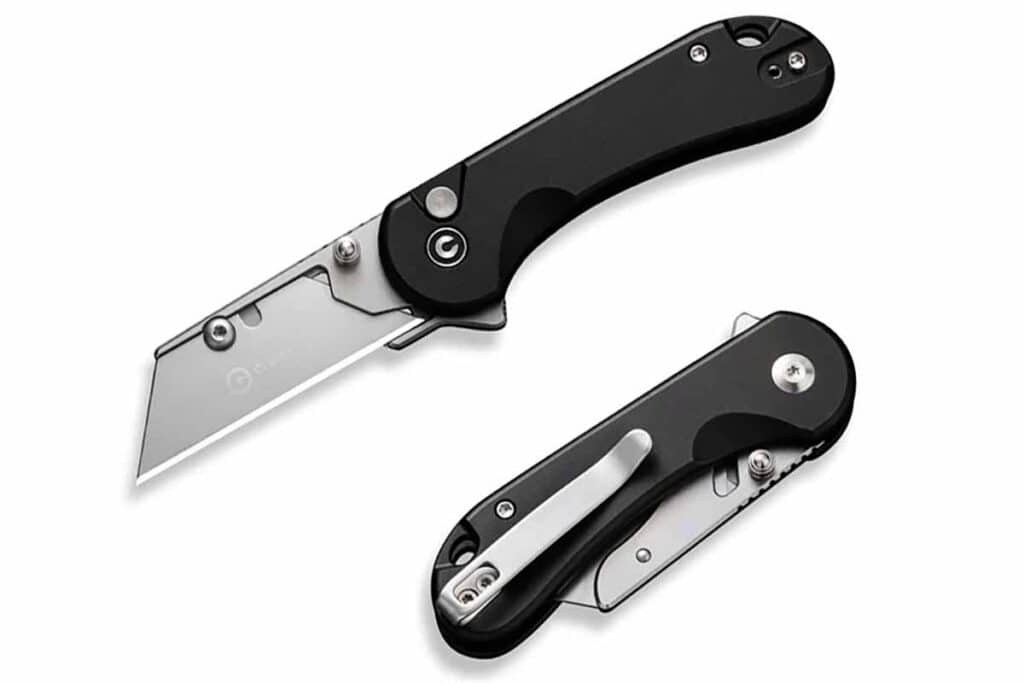
CIVIVI Elementum Utility

CIVIVI Elementum Utility

Quietly, there’s a utility knife war brew in the knife world. I, for one, say it’s about dang time.

An oft-overlooked corner of the blade world is getting some much-needed attention with the latest enhancement coming from juggernaut CIVVI.

Essentially a flipper/folder utility knife, the Elementum Utility offers perhaps the most important aspect of this class of knives—single-hand deployment. And it delivers it not in one, but three ways via kicker, thumb stud and button lock—if you like flicking out your blade.

CIVVI also delivers a bit of panache with the line, offering the replaceable-blade knife in a slew of colorways on its aluminum handle.

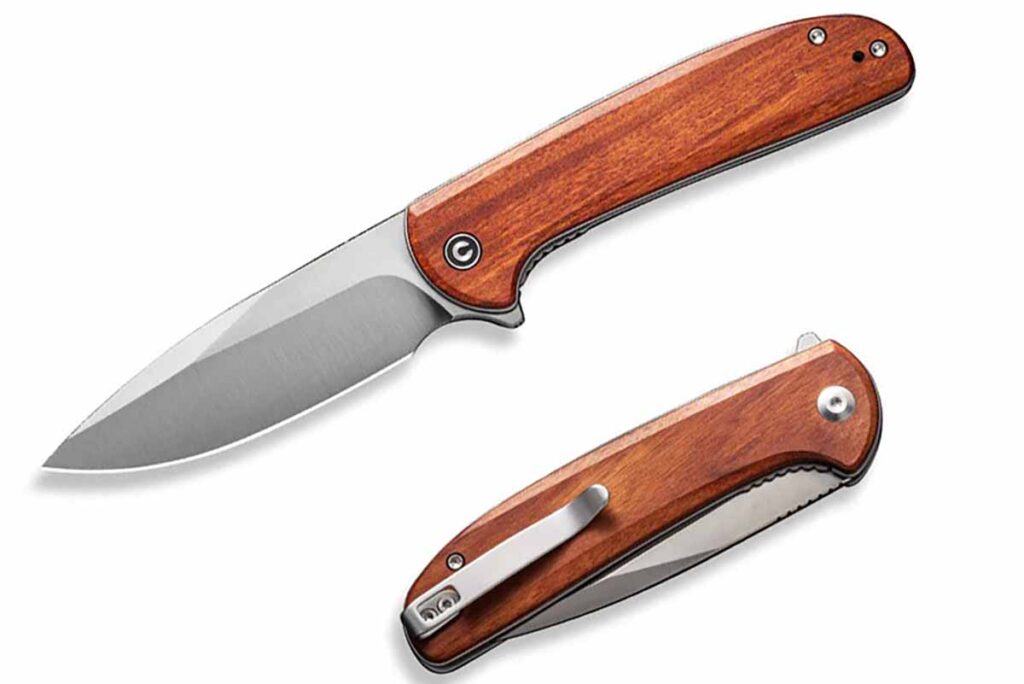
CIVIVI Primitrox

CIVIVI Primitrox

Even without looking at the branding, I think most knife aficionados would have sussed out this is a CIVIVI… or WE or Sencut. It just has the look, design points and action of the tirade’s knives and is close to several other options that already exist in the company’s catalog.

The one that comes to my mind is the WE Saakshi.

However, the Primitrox comes in a bit bigger thanks to a larger 3.89-inch drop-point blade.

The extra steel works to the knife’s advantage giving it not only a more robust design but more mass that flings the blade forward when opening.

I have to say, the handle options on the knife are nice as well, particularly the Guibourtia wood scale option, which gives the Primitrox a dignified look.

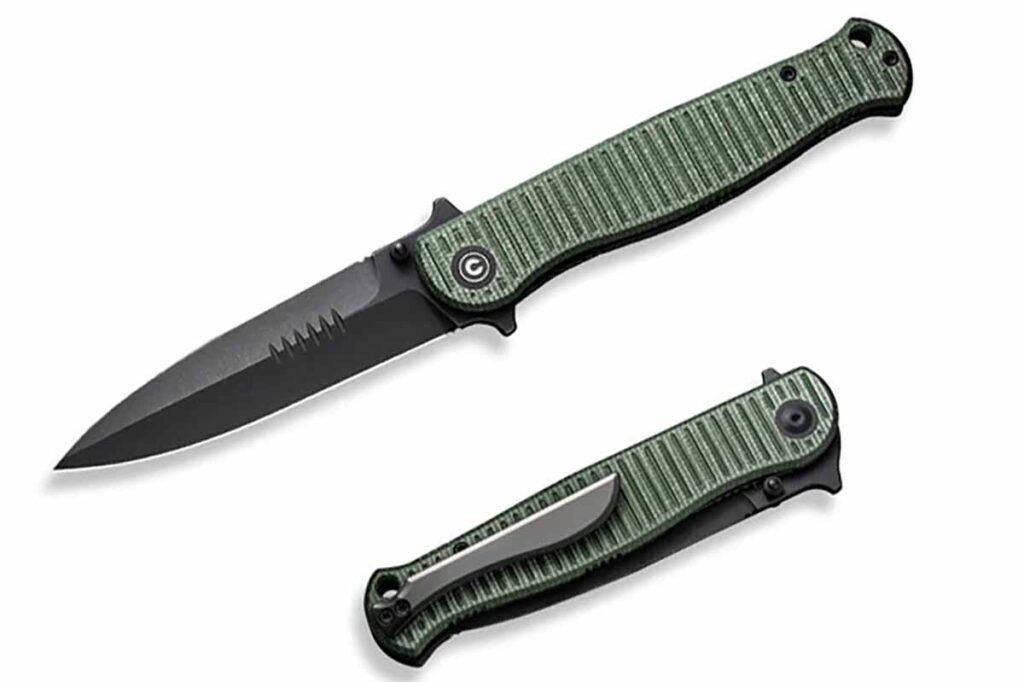
CIVIVI RS71

CIVIVI RS71

I have to confess this knife intrigues me. Of course, you’d have to have a heart of stone not to get geeked up over a dagger—or dagger-style—blade.

A Rob Saniscalchi design, the RS71 takes the deadly-looking blade style and tames it down for EDC with plenty of style.
But plan on having plenty of pocket space to tote it around, because the CIVIVI borders on behemoth with a full 4-inch blade and 9.31-inch deployment length.

The knife fills the hand, yet the contoured handle makes it very manageable.

I also like the grooving on the scale, which gives it more purchase in the palm and a downright distinctive look.

Check Out More Knife Drops:

Bob Cargill Knifemaker, Company Founder And NKCA BOD President Passes

0

Cargill’s impacted the knife industry in nearly every facet.

Bobby Lynn “Bob” Cargill, custom knifemaker, a president of the National Knife Collectors Association board of directors, and founder of Cargill Knives and Cripple Creek Cutlery, passed away January 3. Of Old Fort, Tennessee, he was 81.

Using old car springs for material, Cargill made his first knife when he was 10. He went full time in his mid-30’s circa 1975 making knives via the stock removal method, including folders, some fancy, lockbacks and multi-blades. He used 440C, 154CM, D2 and other steels for blades, and mother-of-pearl, stag, bone, Micarta®, ivory and wood for handles.

He joined the Guild in 1979. “What I enjoy most is the completed knife,” he was quoted as saying in Knifemakers: An Official Directory of the Knifemakers Guild, “because it is rewarding to see a design on paper developed … If I can’t deliver a knife that I’m proud of and make you a little bit happier and proud to collect my knives, then I don’t want your money.”

Cargill had his right leg amputated below the knee as a result of a car accident. However, instead of letting it hold him back, he used it as inspiration for the name of Cripple Creek Cutlery. Founded in 1981 in Lockport, Illinois, Cripple Creek specialized in slipjoints in classic patterns and natural handle materials.

Consisting mostly of slipjoints—they were called pocketknives back then—club knives were big in the late 1970s and throughout the ’80s, and Cripple Creek was among a number of companies that provided knives for knife clubs nationwide, companies that included Case, Queen, Hen & Rooster, A.G. Russell, Fight’n Rooster, KA-BAR, Boker, Schrade and others. Among the knife clubs Cripple Creek made club knives for included the Western Reserve Cutlery Association, Allegheny Mountain Knife Collectors Association, Central Kentucky Knife Club, Badger Knife Club, the Northeast Cutlery Collectors Association and others. He was active in the American Edge Collectors Association. Cripple Creek also made limited-edition slipjoints for Knife World in the early 1980s when BLADE Magazine Cutlery Hall-Of-Fame® member Houston Price owned the magazine. Knife World is now known as Knife Magazine. Bob also made club knives under the Cargill Knives mark for such knife clubs as the Soy Knife Collectors Club.

Bob sold Cripple Creek in 1993 and it operated under Blackjack Knives in Effingham, Illinois, until 1995. He was on the Guild’s “knifemaker emeritus” list at the time of his passing. He is survived by his three children, nine grandchildren, several great grandchildren, two sisters and a brother.

More About Custom Knives:

Knife Blade Repair: Bringing Old Blades Back To Life

0

Practice the proper steps with the proper equipment and, most important, be safe and knife blade repair is a snap.

I have been fortunate enough to make not just one but two side hustles out of my knife hobby. First is the obvious—writing for BLADE® Magazine. Second is running a knife-and-tool sharpening service out of my garage, serving folks in my community and metro area with full-service sharpening on most cutting tools found in the home, workshop and garage. I have always had a strong interest in sharpening in general and have been practicing the skill for about as long as I have been into knives in general.

While I sharpen many knives and scissors, I also repair damaged knife blades. Those repairs include—but are not limited to—straightening bent blade tips, fixing severely damaged cutting edges, and regrinding new blade tips from broken ones. While sharpening is something I still enjoy very much and to a degree it remains fun work for me, it’s these minor repairs at customer request that I love doing. You can too provided you have the proper equipment and the desire to learn.

Knife with sharpening stone
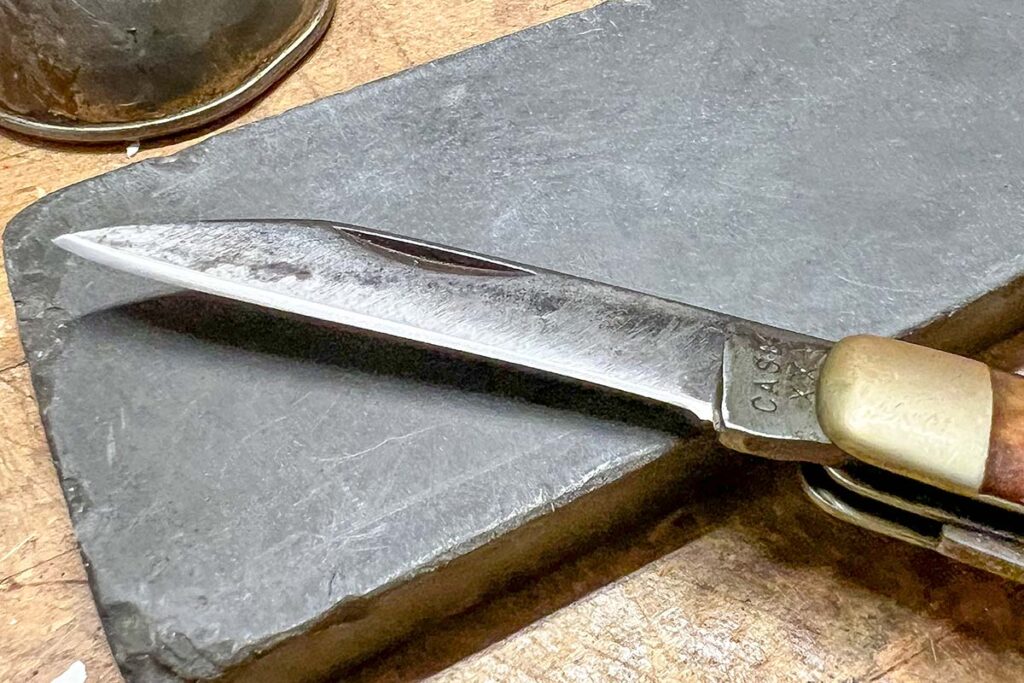
In knife blade repair, carbon steel blades make the steps easy as they sharpen up quicker than stainless blades.

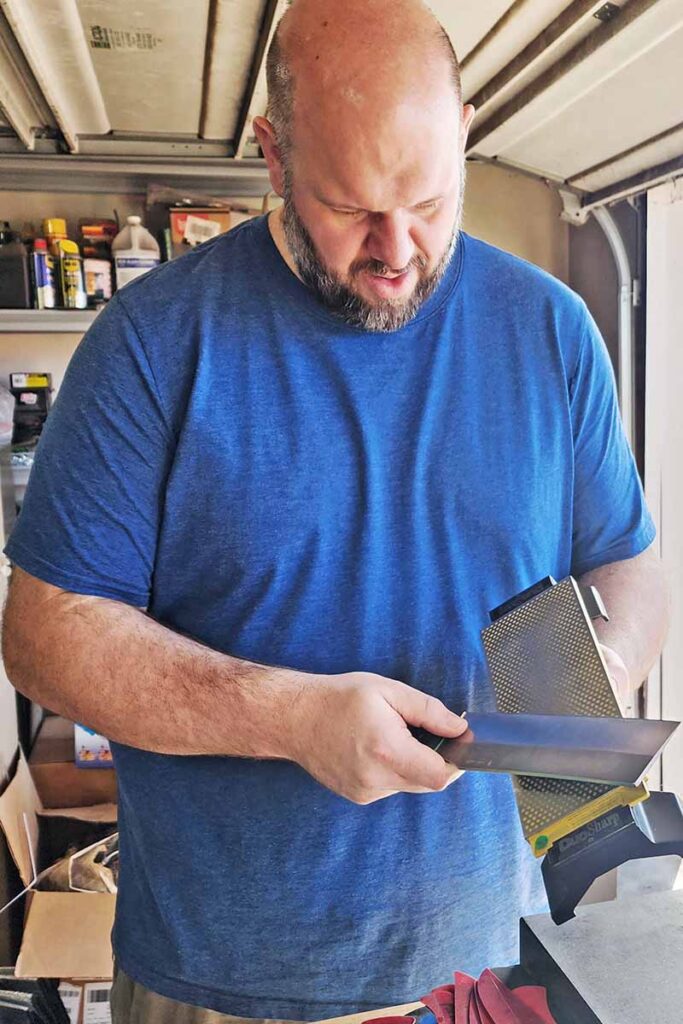
Before we get into the thick of blade repair, let’s discuss equipment. I run four Work Sharp Ken Onion Elite sharpening machines—I keep one as a backup or deploy it as backup should I need to augment what I’m already running—plus a 1×30 single-speed belt sander, a “Harbor Freight special.” I do all my sharpening on this equipment.

I have used the Ken Onion Elite since the start of my sharpening service almost 10 years ago. I started out with just one Work Sharp. I added a second one awhile after that. The 1×30 came about from trying to revive a few totally dull butcher knives. In the process, I realized I needed another machine that would be in charge of hogging off material to get a quick starter edge that the Work Sharp machines could sculpt into a razor-sharp edge.

Profiling the blade
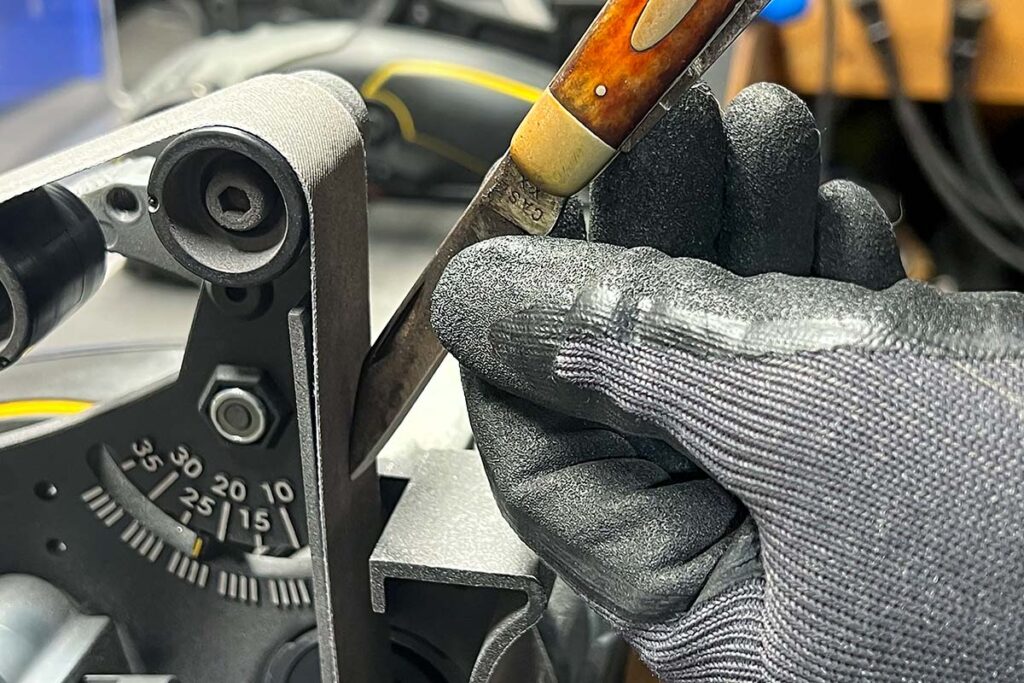
After profiling the basic shape of the new tip, the author uses the X65 belt of the Work Sharp Ken Onion Elite sharpener to further massage and fine tune it, as well as blend in the appearance of the blade spine at the tip to match the rest of the spine. 

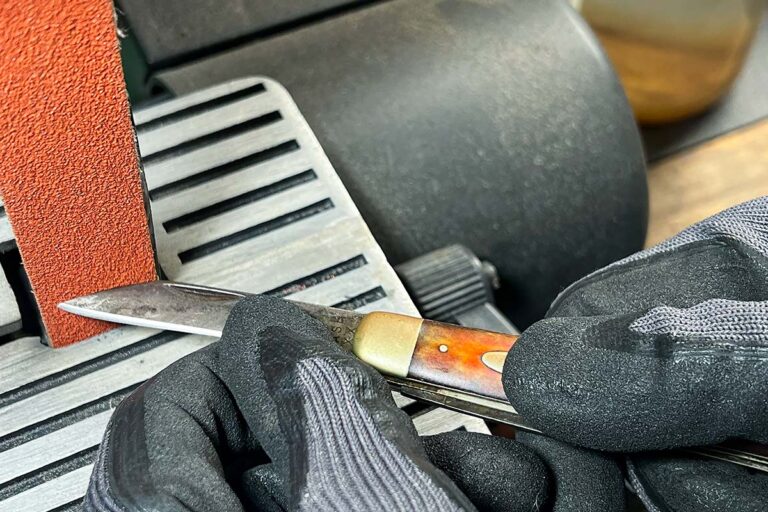
Keep in mind that the Ken Onion Elite is not just a sharpener but also a variable-speed miniature belt sander as well, especially when you turn the unit around 180 degrees and work off the platen side. You can easily work on plastic, PVC, metal and wood. This is also how I regrind new blade tips, as well as fixing blade damage caused by hitting something solid and chipping the edge out. We will dive more into specifics in a bit. It’s important to note here that to do blade repairs of any sort successfully, you must have some sort of variable-speed, motorized, belt-sander-type machine.  

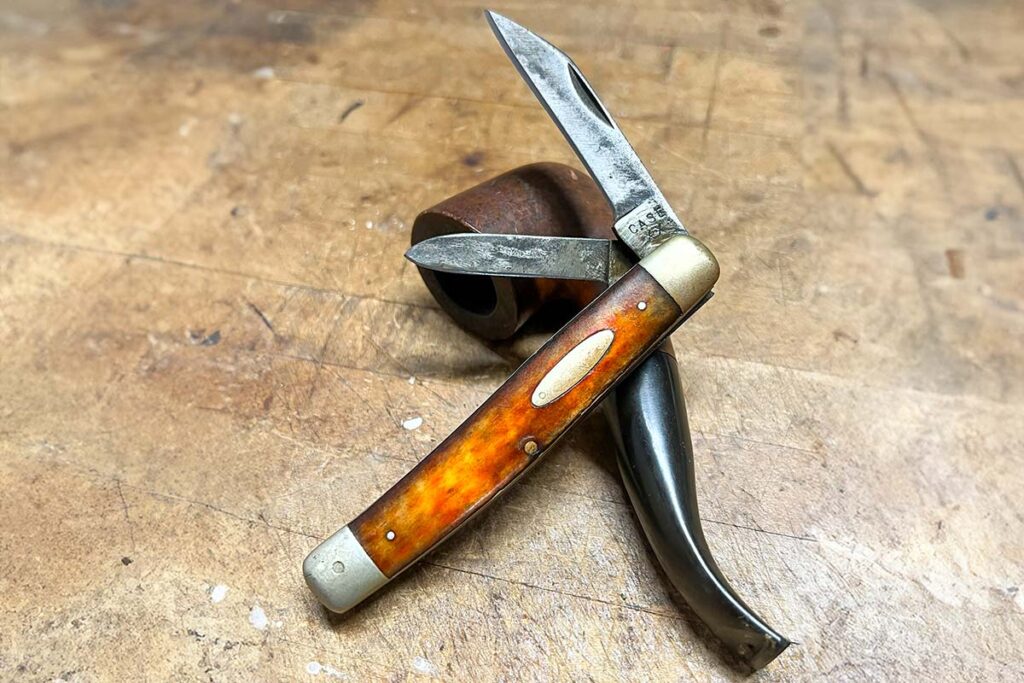
DEMO KNIFEThe demo knife is one a coworker on my day job gave me to refurbish. It is a vintage, carbon steel Case jackknife that saw a lot of use in a previous life. The blades were extremely worn down. Both tips were broken off. The main blade was resharpened so much that the cutting edge was a bit on the curved side. Both blades also had some dings in the edge as well. The owner wanted me to rehab the blades by regrinding new tips and sharpening them. I will take you through step by step on what I did and how it was done. WARNING! Please exercise caution when working with power tools such as belt sanders. Should you attempt such a task as outlined in this story, neither I nor BLADE is liable for any injuries that might occur as a result. 

Heat Management

Whenever executing such repairs on a knife blade, remember to not let the blade heat up or you can ruin the steel’s heat treat. Always keep a jar filled with water within arm’s reach of your machine and dunk the blade into the water every few seconds to keep it cool. Doing so will ensure that you will not overheat the steel. If working on a larger blade such as a machete, I recommend using a spray bottle filled with water. The blade is simply too long to dunk into a jar, so spraying it down every so often will help.  Something else that will help is to have a pair of cut-resistant gloves on hand and always wear them when handling the blade. The gloves usually have a textured coating on the gripping surfaces for the fingers and palms. This will help you hold the blade securely as well as keep your hands and fingers safe from accidental cuts. The gloves usually are inexpensive, less than $10, so there’s no excuse to not have a pair.

Where To Start Repairing A Blade

WARNING! Whenever faced with a blade-tip-rehab task, remember to sharpen the blade last. Why? Because you will be holding the blade as you regrind the new tip. This applies even if you’re wearing cut-proof work gloves.

Blade Tip

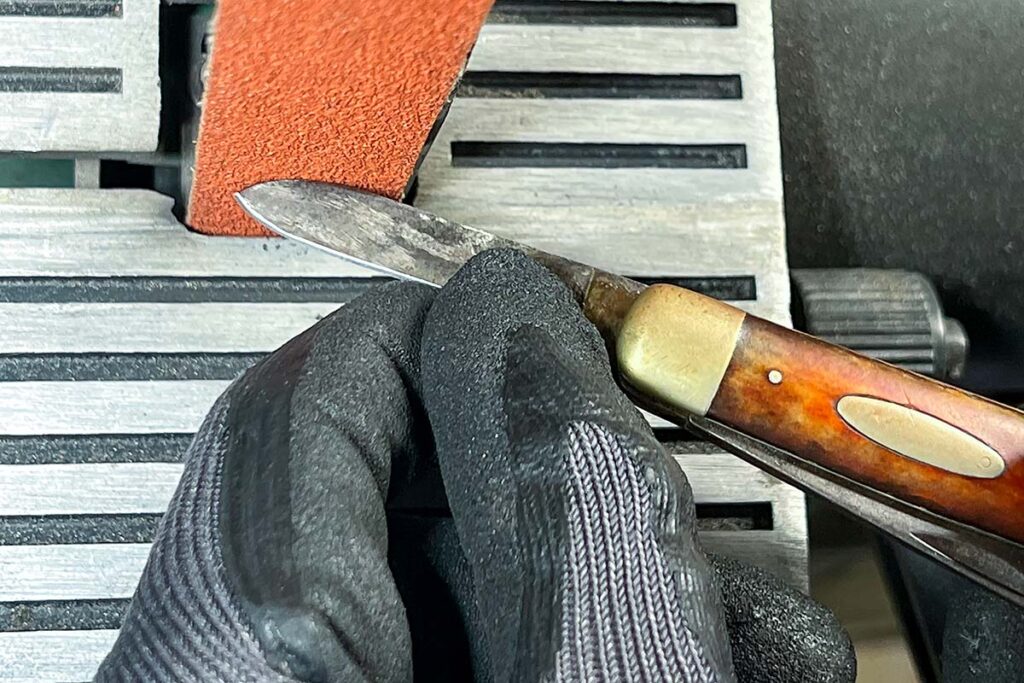
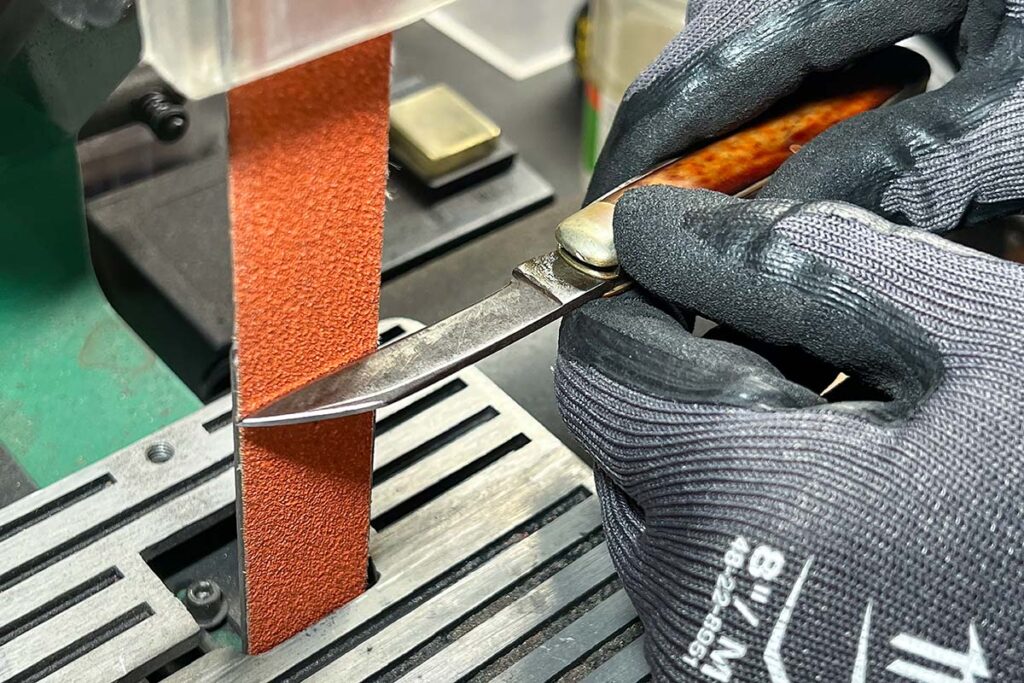
When regrinding tips, I always start with my 1×30 sander with an 80-grit Norton Blaze SG belt. It is the orange belt specifically engineered for knifemaking and removing steel. The 1×30 hogs off material and rough shapes the new blade tip.

Knife blade repair shaping the blade
The author reshapes the new tip on the pen blade using the 1×30 belt sander with an 80-grit Norton Blaze SG belt. 

I start by visualizing where the new tip is going to lie. I start at the uppermost point of the broken-off tip, usually on the blade spine side. I start grinding at that point and remove material to where eventually a new tip is created. As I grind it down, I also pay attention to the visual “flow” of the new tip and how it transitions to the rest of the blade spine. I may have to round off the harsh angle to blend it back into the spine. A lot of this is done by eye, making everything blend right in. The goal is to make the new blade tip look as though nothing happened.

Blade Shaping

After roughing out the new tip with the 1×30 belt sander, I begin to dial in the final shape of the new tip with the Ken Onion Elite. I have much more control at this juncture due to the less aggressive belt grit and the slower belt speed. I can finesse the new tip on, keeping a close eye on the evenness of the ground-down portion, making it parallel with the rest of the untouched blade spine.

chamfering the edges
The author carefully knocks off the sharp edge at the corner created by rough grinding the new tip.

Finish

After tweaking the new tip to final shape, I concentrate on the finished appearance of the ground portion by holding the knife almost vertical and sanding only on the ground portion, blending it in visually and removing the coarse-grit scratches with the 80-grit belt on the 1×30.

Chamfering And

When everything is blended in visually, the last step is to chamfer the ground portion and remove the crisp corners made by all the sanding. You’ve seen how blade spines have a small, rounded corner on both sides? You are essentially doing that here. Hold the blade at an angle and lightly touch the blade spine to the belt to cut the crisp corner down. Remember: you can always cut more later if needed. The key is to use a light touch and stop only when the corners are smooth to the touch and you don’t detect crisp edges. The result is a new blade tip that is highly functional but doesn’t look “factory,” though it will be awfully close.

Fixing An Uneven Blade

The main blade of the demo knife was worn away unevenly due to years of manual sharpening, so I straightened that out as well. Like the shaping of the new tip, I did the bulk of the straightening of the cutting edge on my 1×30 belt sander. I used a light touch on the belt—I cannot stress enough that it’s easier to grind cautiously—eyeing the straightness of the new cutting edge. Grind a bit then dunk the blade in water to keep it on the cool side.

Straightening the edge
After grinding the new tip on the main blade, the author uses the 1×30 belt sander to straighten the uneven cutting edge by evening it out back to straight. The 80-grit belt eats off material in a hurry. At this juncture the author eyeballs what is to be straight.  

Once I attained an even edge, it was time to grind the new edge. Straightening out the edge will cause a wide flat spot on it, so you have to grind the spot away evenly on both sides. Work diligently and carefully, and don’t forget to dunk the blade in water. With the smaller of the two blades, I repeated the same steps to even out the edge as there were some imperfections I wanted to remove also. As a result, I wound up starting a new edge on the small blade as well.

Once I ground the starter edges, I progressed to the Work Sharp machines to carefully sculpt the new final edges. This is the step where you bring the blades to life. The carbon steel blades make the steps easy as they sharpen up quicker than stainless blades. After the final sharpening of both blades, the result is a vintage pocketknife with a new lease on life sporting new tips and fresh cutting edges. 

Final Cut

Sharpening—transforming a cutting tool from dull to razor sharp in a few minutes—is very therapeutic. Toss in creating new blade tips on top of that and the combination is undeniably very satisfying. If you carefully follow these steps, you too can renew any knife blade with a broken tip. And it doesn’t have to be a pocketknife. I’ve ground new tips on tactical folders and karambits, too. Just follow the same steps outlined here. In fact, larger knives are probably easier because there is more to hold onto while working on them. If you have the equipment and the desire to renew and rehab knife blades, give it a try.

Final repaired knife
The end result is a demo knife with two sharp points and two sharp edges.

It is also possible to use a regular belt sander like mine to do all the shaping steps. Be sure to have an assortment of belts of various grits at your disposal. You will want to change to the finer grits to finesse your work. I recommend using only a 1×30 given the size and width of belt. Again, you can find an inexpensive 1×30 at Harbor Freight Tools for around $50. Who knows, you might even find some other uses for it outside of blade repair.

Knife blade repair can be very satisfying. And because you are working with knives as well as power tools, please exercise the utmost caution and pay attention to what you are doing to prevent serious injury.

Have fun and good luck!

Hone Your Knife Sharpening Knowledge:
Advertisement

Must Read Articles

Read this before you make a knife

Knifemaking 101 – Read This Before You Make a Knife

  by Wayne Goddard My experience has taught me that there's nothing like digging in and getting started. I've often said the hardest part of the...
how to forge damascus steel

How to Forge Damascus

Advertisement
Advertisement