
Best Clip-Point Knife: Picking The Sharpest Of This Classic Profile

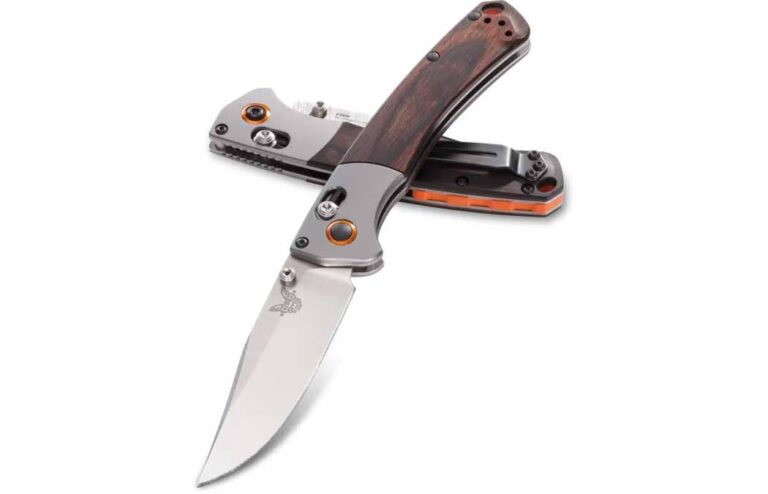
Clip-point blades are one of the most common profiles you will see throughout custom and production knives. You likely know the style, the familiar drop-off of the blade spine to a curved or linear transition that terminates at the blade tip.

The earliest noted clip-point blade style dates back to the Macedonian era. Flint-knapped stone blades in a clip-point shape were discovered from this time period. Today, clip points are found across a lot of knife genres from tactical to EDC to pocket knives to fixed blades.

Pros Of Clip Points

Due to its highly streamlined and optimized blade tip, the clip point has excellent puncturing capabilities. There is more of a true point that helps to penetrate thicker materials with ease. It is more aerodynamic than a drop point and even a spear point. Think of an arrowhead and how it penetrates, and you will get the idea. Clip points are also favored among the tactical crowd because of this characteristic.
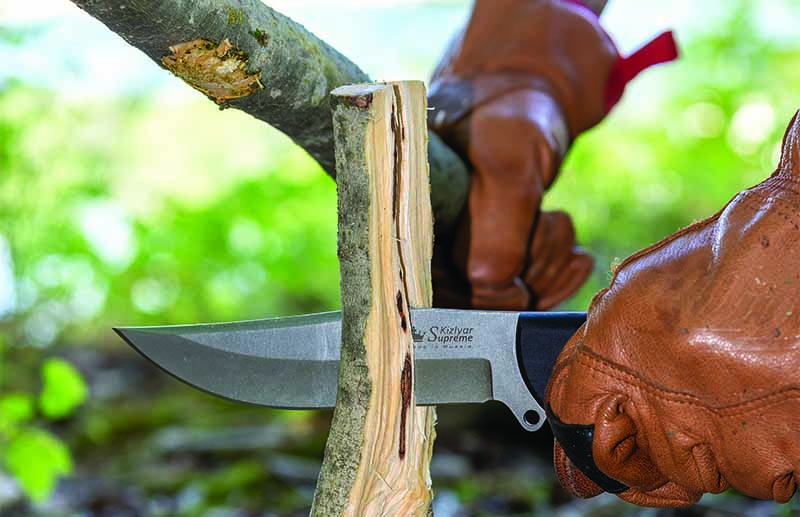
The 5.4-inch clip-point blade of the Kizlyar Supreme Caspian provides plenty of sharpened real estate to process camp tasks. Overall length: 10 inches.

The defined point also makes great scoring cuts because placing pressure on the blade tip results in the tip cutting through aggressively on the first cut. So, this blade shape is also one that is favored among those who use their knives for the trades, where having a good knife is imperative to the work at hand.

Cons Of The Clip Point

Conversely, the blade tip being tapered also results in a blade design that has a weaker tip. You cannot have everything, I guess! With a smaller clip-point blade like those found on pocket knives, refrain from any sort of prying with the tip because it will bend or break off entirely.

Clip-Point Styles

It’s interesting to note that there are different variants of the clip point blade. Two of the most recognizable are the California clip point and Turkish clip point.

California: Exhibits a long taper, which originates almost to the blade tang and gradually and progressively tapers down to the blade tip.

Turkish: It has a long taper as well (but not as dramatic as the California style) but also incorporates a little bit of a blade belly as well. The Turkish clip looks very stylish and eye-catching when done right.

You’ll see other variants like a saber ground clip point with a pronounced swedge, and even some fixed fighters with sharpened clip sections for added bite and powerful penetration.

Jack-Of-All-Trades

For general-purpose use, nothing beats a clip point for its versatility. You cannot go wrong by selecting a knife with this blade shape. Chances are high that if you are reading this, you already own a few knives that have a clip-point shape. If you don’t have any yet, here’s a rundown of 10 clip point blades knives that you should be on the lookout for and add one (or more) to your collection.

Among The Best Clip-Point Fixed Blade Knives Available Now

Kabar USMC Fighting Knife
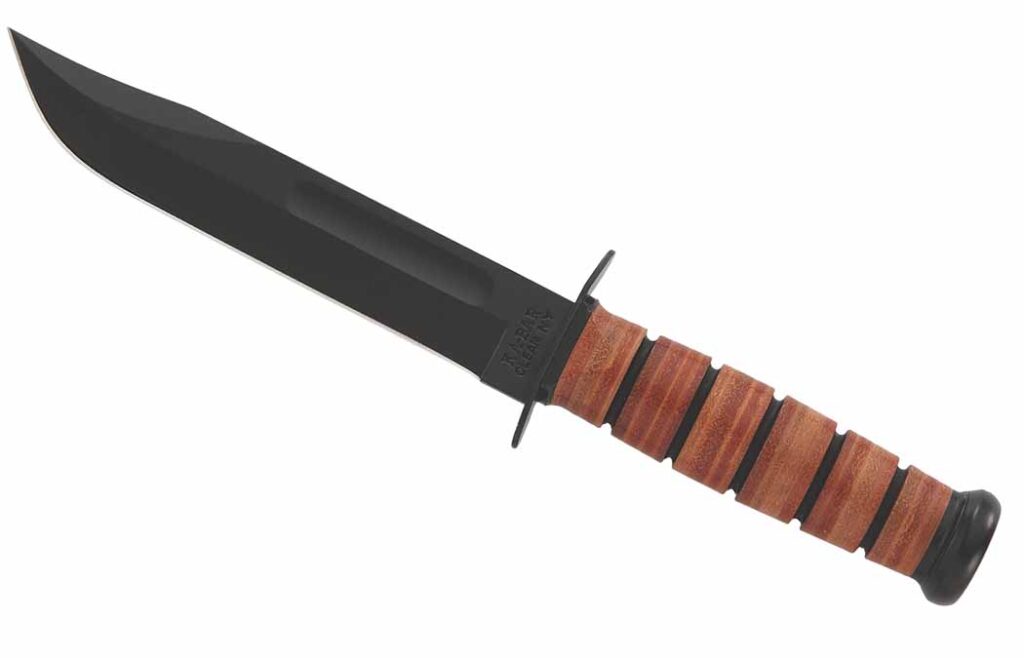
Kabar USMC Fighting Knife

This iconic fixed blade has seen action on battlefields the world over. This knife first saw action during WWII and it still is going to this day.

The 7-inch long blade is made from 1095 carbon steel, making it easy to maintain in the field. It’s fuller adds style and strength to the blade. The iconic stacked leather washer handle is both handsome as well as very practical with its deep grooves that enhance grip and the flat metal pommel which is useful for light hammering and crushing tasks. The double guard prevents your hand from sliding up on the blade. As a bonus, each USMC Fighting Knife comes with a leather sheath.

MSRP: $135 Origin: USA

CRKT Minimalist Bowie
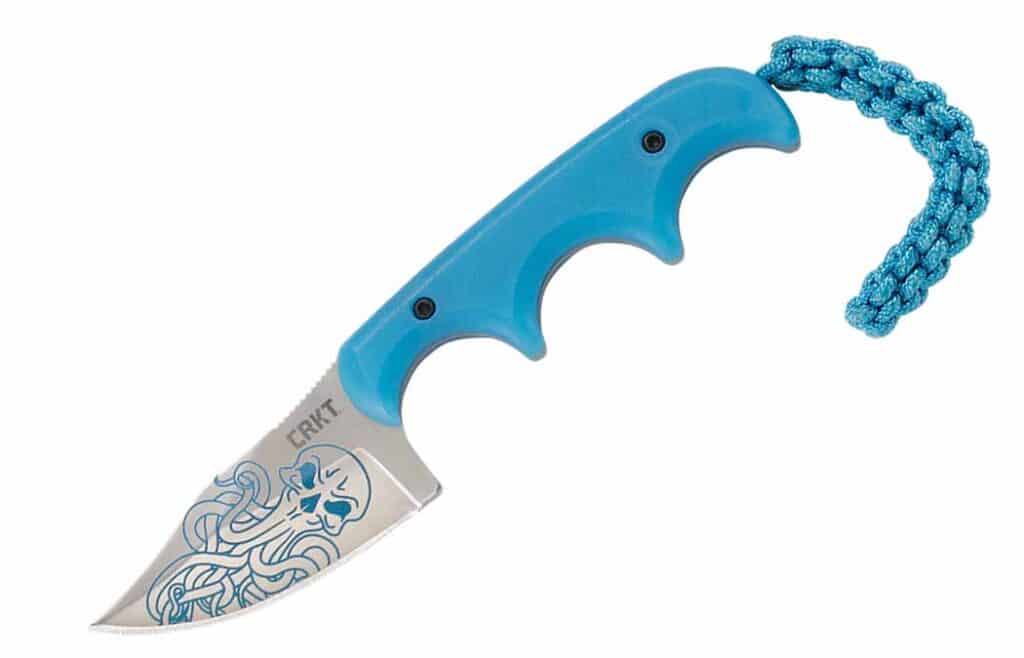
CRKT Minimalist Bowie

Designed by custom knifemaker Alan Folts, the Minimalist Bowie is one of Folts’ best-selling custom knives. It is available to the masses in the form of the CRKT version which sports a 2.1-inch long Bowie-style clip-point blade, made from 5Cr15MoV stainless steel.

Its prominent swedge adds style with function, permitting the blade easily penetrate most materials. The deep finger grooved handle has resin-infused fiber scales for light weight and strength. The entire knife is super comfortable to hold and it feels like the knife melts in your hand and remains very secure.
It’s a small fixed blade without the bulk.

MSRP: $45 Origin: China

Schrade Uncle Henry Golden Spike
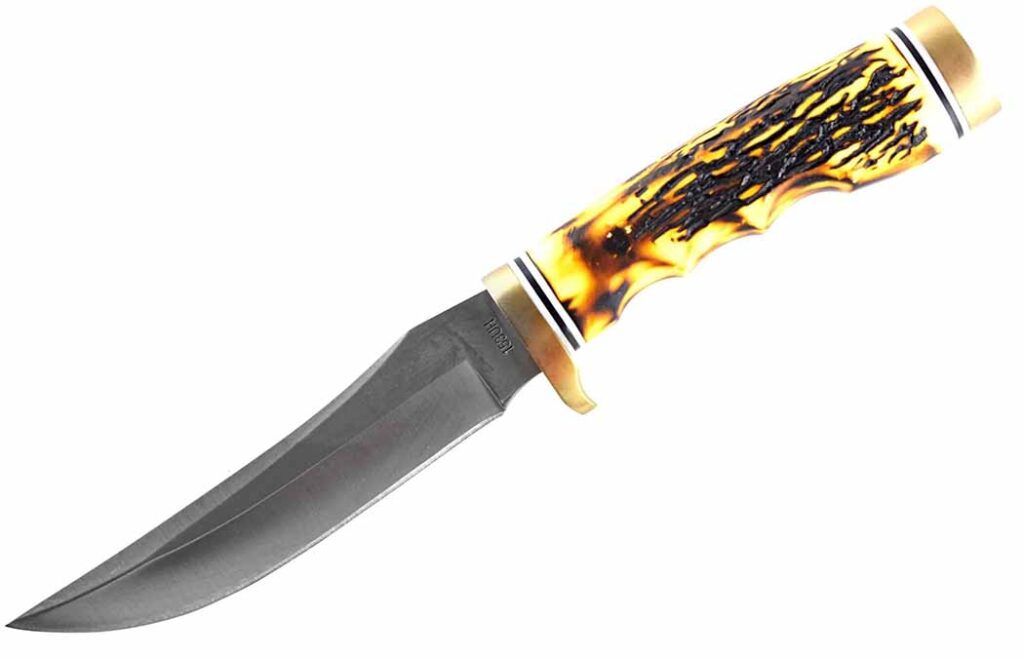
Schrade Uncle Henry Golden Spike

This one is an older design still manufactured today.

Its 5-inch 7Cr17MoV stainless steel clip point blade is a good example of what we call a California clip point, with its long taper to the blade tip. The handle is faux stag in Delrin, with finger grooves for security and control.

It is capped off at both ends with a brass guard and pommel to offset the overall appearance. This knife will fit the fill of an outdoor knife perfectly and not blow the budget. Each Golden Spike comes shipped with a leather sheath for easy portability.

MSRP: $46 Origin: China.

Cold Steel Trailmaster Bowie
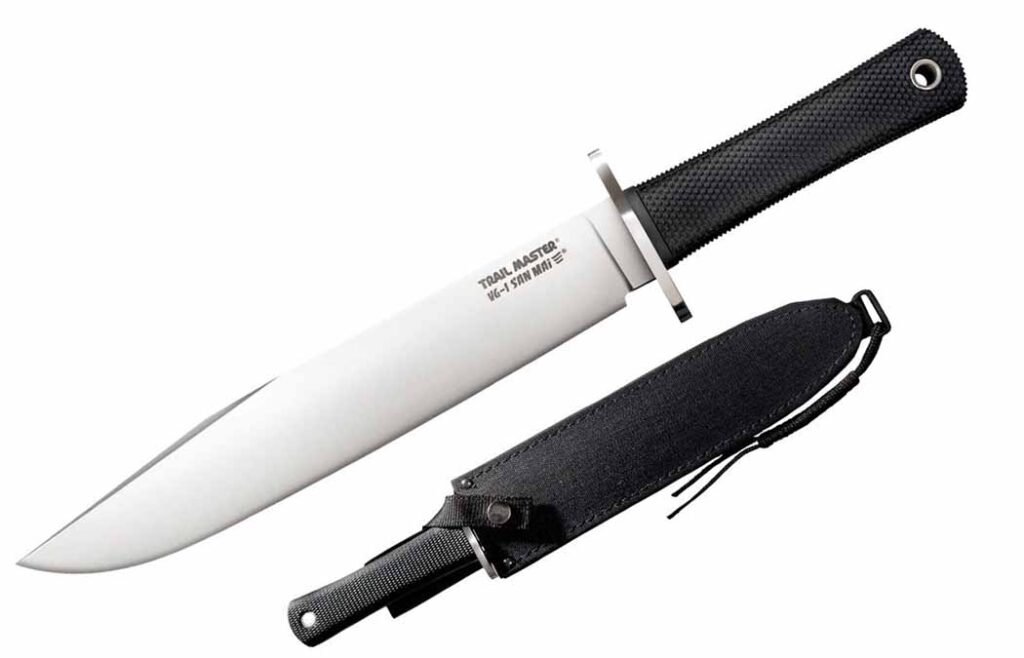
Cold Steel Trailmaster Bowie Clip-Point Knife

This knife commands attention with its sheer size and heavy-duty build.

The Trailmaster Bowie is one of Cold Steel’s most recognizable fixed blades. The impressive 9 ½ inch long clip point blade is made of CPM 3V tool steel for toughness and edge holding. The unsharpened swedge gives the knife its attitude, and a full flat grind allows the Trailmaster to be an effective slicer and chopper as well.

The textured Kray-Ex rubber handle helps the Trailmaster remain in your grip and a double guard up front keeps your hand in place during use. The Trailmaster is adept at chopping and other hard-use outdoor tasks for the campsite.

It is the knife to have with you and instills user confidence when tackling tough cutting and chopping chores.

MSRP: $540 Origin: Taiwan

Condor Tool & Knife Little Bowie
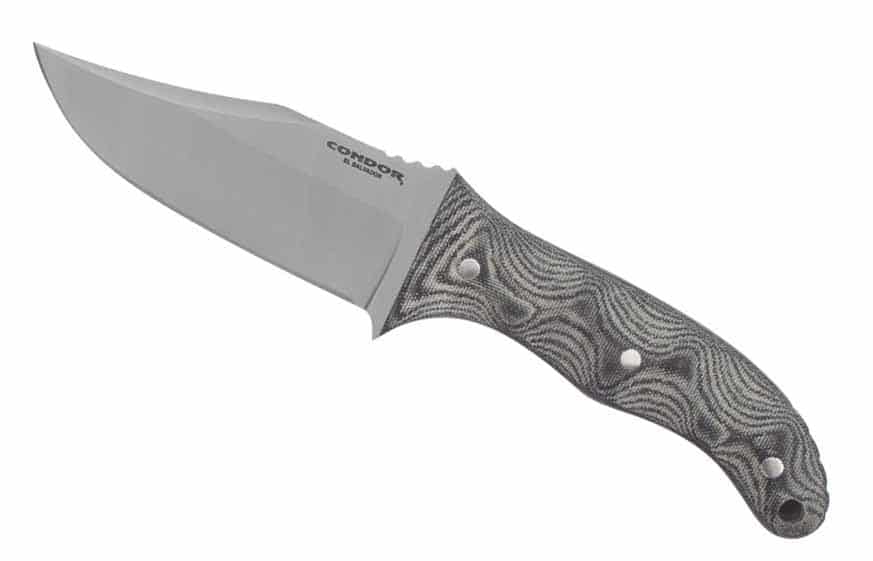
Condor Tool & Knife Little Bowie Clip-Point Knife

Little knife…big attitude! That’s exactly what you get with the Condor Tool & Knife Little Bowie.

The 4.6-inch long blade makes it compact enough to carry comfortably on the belt. Overall length is just over 9.5 inches, making this knife about as long as some of the higher-end tactical folders when open. 1075 carbon steel was selected for the blade, making this knife both tough and easy to maintain. The bead-blasted finish adds a subdued finish for low reflectivity.

The ergonomic-shaped handle has black Micarta scales for a comfortable, all-weather grip. If you like Bowie fixed blades but don’t want to carry a full-size Bowie on the belt, the Condor Little Bowie fits the bill nicely. Each knife is shipped with a sewn leather belt sheath to keep the knife close at hand.

MSRP: $123 Origin: El Salvador.

Among The Best Clip-Point Folders Available Now

Benchmade Crooked River
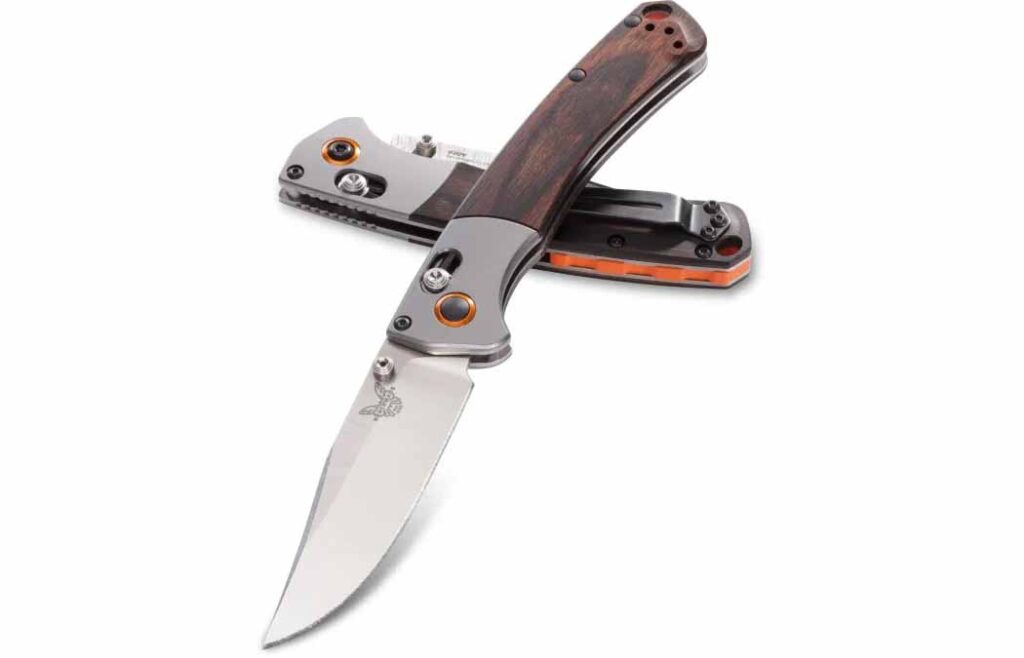
Benchmade Crooked River Clip-Point Knife

The flagship of their outdoor folding knife line, the Benchmade Crooked River is built tough for the outdoors, with a 4-inch clip point S30V stainless steel blade, anodized aluminum bolsters, and Dymondwood handle scales. The handle has a slight contour to it, making it lay in your grip that much easier.

The knife also features Benchmade’s own Axis Lock crossbar lock system for a safe and secure lockup. The Axis Lock is a Benchmade innovation that allows the blade to rotate smoothly and locks up tight, with very little blade play.

At over 9 inches overall, the Crooked River is a formidable folder that is ready to help tackle your field dressing or camp utility tasks. A steel pocket clip allows for easy carry. A Mini Crooked River is also available, scaling down the Crooked River model to a 3.4-inch blade length, and making it more EDC-friendly.

MSRP: $380 Origin: USA

SOG SEAL XR
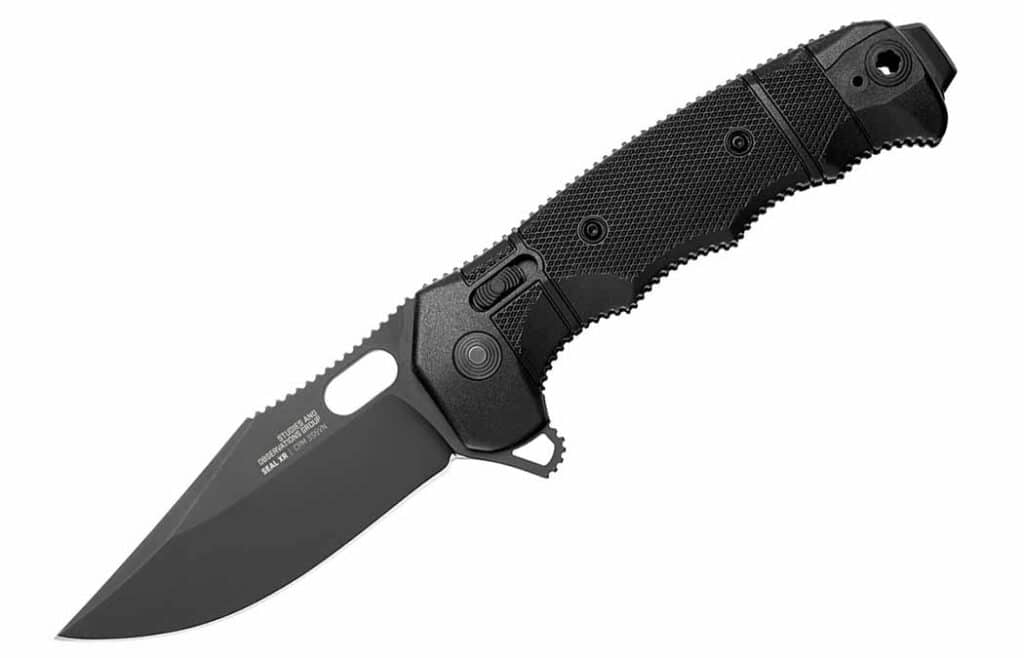
SOG SEAL XR

You want big and brawny? You got it with the SOG SEAL XR! Its 3.9-inch long Bowie style clip point blade is flat ground from premium CPM S45VN high-performance stainless steel. A blade hole and a flipper tab are present to offer two distinct methods of one-handed opening. The handle design is very similar to that of the SOG SEAL fixed blade. The build of the handle is definitely robust and heavy-duty, there’s weight to this knife that you notice when you pick it up.

Weighing in at a healthy 8.2 ounces, the handle has two steel liners, a steel handle spacer with an integrated extension that can be used as a blunt strike tool, and grooved, textured, and traction notches all around. The handle design is made to keep your hand in place. There is an integrated lower hand guard that prevents your hand from sliding forward. The blade lock is SOG’s own XR crossbar lock that offers true ambidextrous operation.

A beefy, wide steel pocket clip rounds out the SOG SEAL XR package. The clip won’t be sprung for sure, even with rough carry. This is by far an EDC folder due to the size and weight but if you need a knife for rough use and outdoor use, the SOG SEAL XR is it.

MSRP: $224.95 Origin: USA

Case Large Stockman 10375
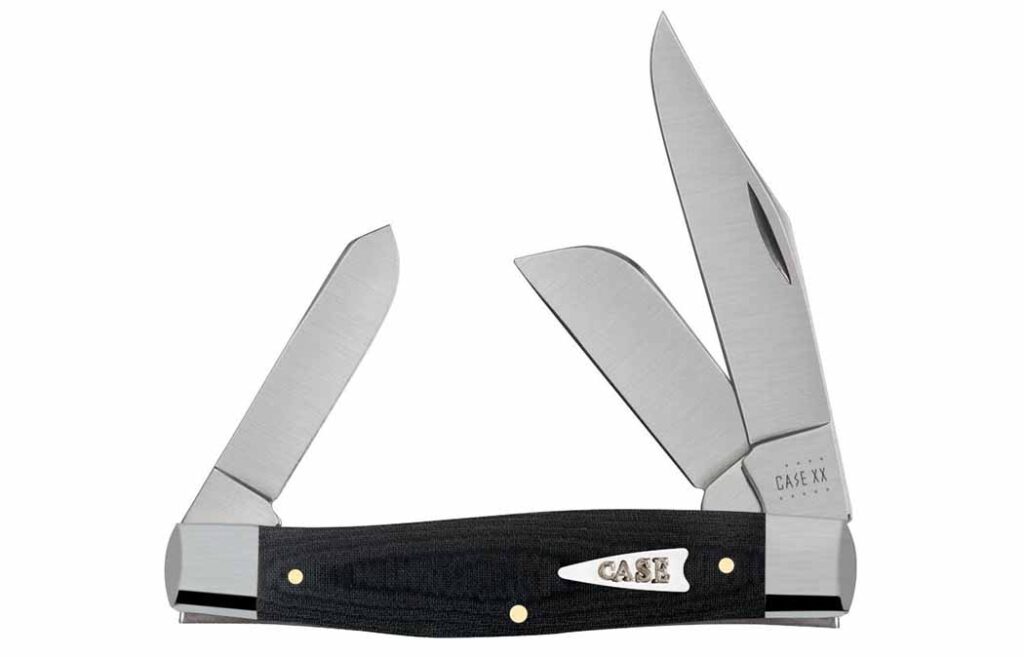
Case Large Stockman 10375

Clip points are found on many different patterns of multi-blade slipjoint knives, such as this Case Large Stockman pattern, model 10375. The main blade is a 3.3-inch long clip point, and two smaller blades – a 2.3-inch long sheepsfoot blade as well as a 2.2-inch spey blade. The blades are ground from Case’s proprietary Tru-Sharp surgical steel, and the handles are of black and green canvas micarta phenolic synthetic for long-lasting durability.

The beauty of knives like these is they are handy to have with you at all times as they sit in the pocket perfectly and they are low profile enough that using them in public won’t raise any eyebrows. These knives are used by everyone from farmers, ranchers, plumbers, electricians, carpenters, warehouse workers, and countless individuals who just want a good solid pocketknife. The main blade does well with opening packages, mail, cutting tape, stripping wire, cutting up cardboard, and any sort of utility or mundane cutting task that tend to pop up in daily life.

The clip point blade is ground fairly thin so it has really good performance characteristics and easily cuts whatever you need to. The Tru Sharp stainless sharpens up quickly and holds an edge fairly well. The stockman pattern is very handy due to the three distinct blade shapes, it’s the perfect pattern to have if you use a pocketknife frequently.

MSRP: $96 (Micarta Handle) Origin: USA

Buck 110 Folding Hunter
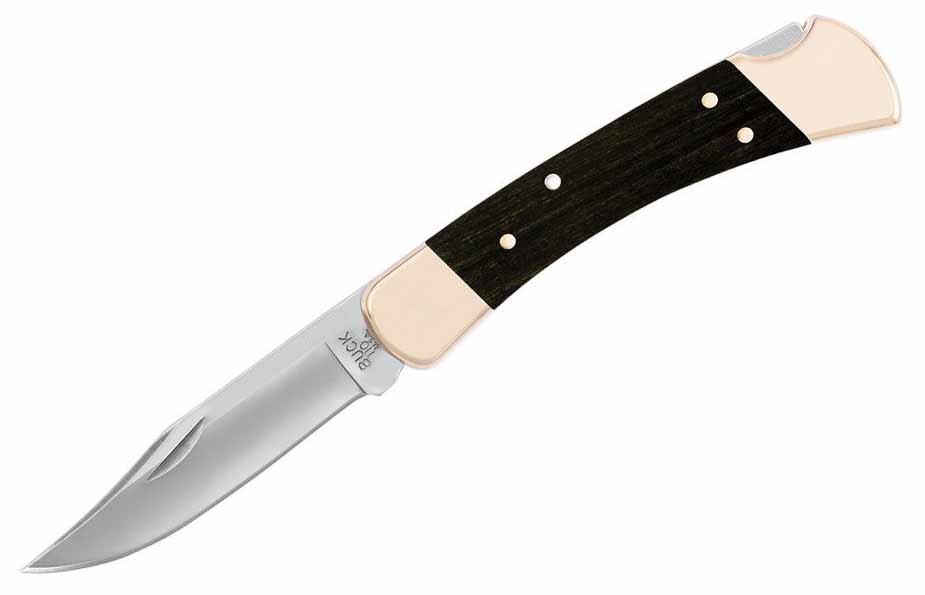
Buck 110 Folding Hunter Clip-Point Knife

This knife perhaps is the signature clip-point bladed folder. Its design was innovative back in 1963 when it was released, and its quality and build have withstood the test of time.

Even today, the 110 Folding Hunter is still made and enjoyed by many. The 3.75-inch long blade is of a Bowie shape and is hollow ground from 420HC stainless steel. The handle is of a robust build, with double brass bolsters and a Crelicam ebony, stabilized hardwood handle. The handle definitely has weight to it, and it’s this exact heavy-duty build that has allowed the 110 Folding Hunter to withstand hard use over time, and still hold up beautifully. The lockback design secures the blade in the open position with a satisfying audible click.

The clip-point blade is ideal for field dressing as well as general cutting tasks. The 110 Folding Hunter originally was designed for hunters as an alternative to a fixed-blade hunting knife. But the knife also found favor with those who are in agriculture, the military, law enforcement, and countless knife enthusiasts as well. For all intents and purposes, it was the predecessor to what we know now as the modern tactical folder.

Still produced to this day in the Buck Knives product line, the 110 Folding Hunter has a few variants including a lightweight budget version, a pro-grade modern version with high-end blade steel and handle material, an automatic opening version, as well as countless collector variants available through the years from Buck as well as select Buck Knives retailers as exclusives.

MSRP: $88 (original 110) Origin: USA

Spyderco C81GP2 Paramilitary 2
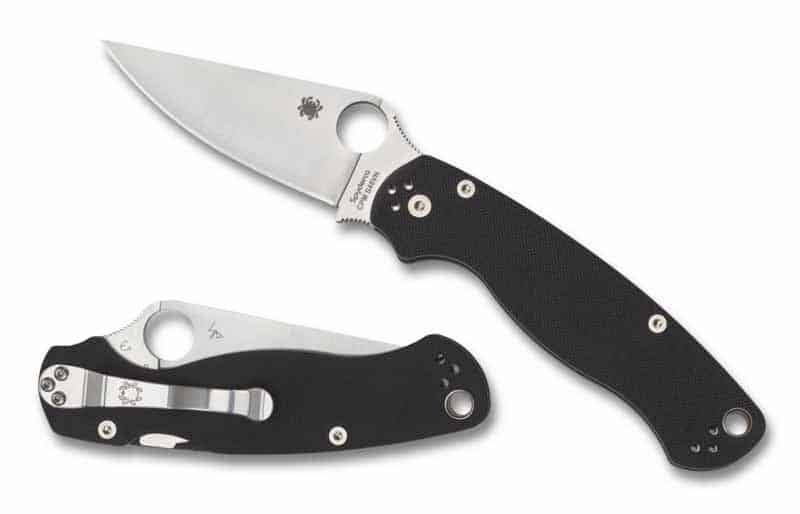
Spyderco C81GP2 Paramilitary 2

Spyderco’s Paramilitary 2 folder – better known simply as the Para2 – is a downsized version of the company’s popular C36 Military folder.

The Para2 offers the same cutting prowess of the full-size Military model with its full flat grind clip-point blade but in a more compact, pocket-friendlier form factor. The Para2’s blade measures 3.4 inches long and is ground out of premium CPM S45VN blade steel that is known for its enhanced edge-holding capabilities. The handle is textured black G-10 and mimics the ergonomics found on the C36 folder that make this one of the most comfortable and handy midsize folding knives on the market.

With an overall length of 8.2 inches, the Para2 is still large enough to tackle sizable cutting tasks. The blade is secured open by Spyderco’s own Compression Lock system, which permits easy one-hand opening and closing. It also allows the blade to have such smooth, silky-like action. The Para2 is a slender knife and carries well in the pocket.

The large blade hole allows for easy one-hand opening with either hand, even while wearing work gloves.

Performance-wise, this is one of the best in high-end folders as the flat grind clip-point blade sails through thick and tough materials easily. Spyderco engineers its blades to be some of the most efficient cutting tools on that market by paying attention to blade shape and blade grinds and optimizing both to create a cutting tool that is unmatched in both performance and value.

MSRP: $265 Orgin: USA.

Check Out More Buyer’s Guides:

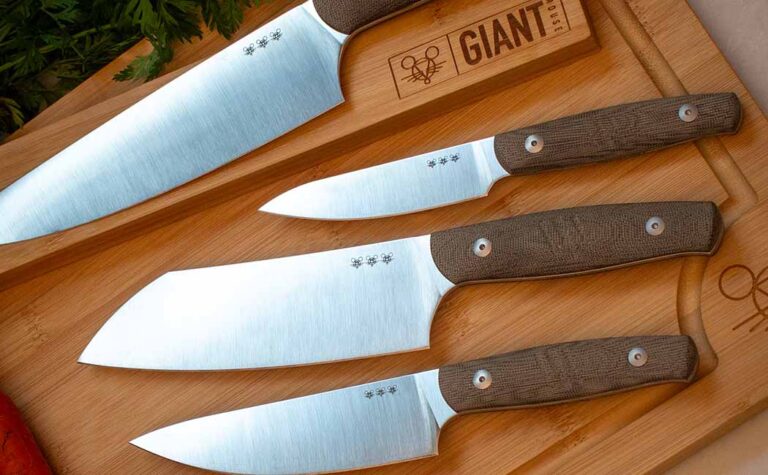
GiantMouse Kitchen Knives: Cooking Up Something New

GiantMouse takes a stab at the culinary world with a kitchen knife line.

EDC knives of a variety of stripes have been GiantMouse’s bread and butter, helping the Danish-design concern kick a solid toehold into the knife industry. This success somewhat culminated earlier this month in Atlanta, with the company’s GMX earning Knife-Of-The-Year® accolades at the 2023 BLADE Show. This trophy in hand is a pretty good indicator you’re doing things right. But, GiantMouse is far from living off past achievements.

In fact, it has a new vista in sight—kitchen knives.

Following a well-trod recent trend in knife manufacturing, GiantMouse is dipping its toe into the culinary end of the pool with the introduction of four kitchen knives. While this drop might prove unexpected to some, the expansion is something the company said has been in the works for nearly two years now. At least, that’s been the personal testing period of designers Jens Ansø and Jesper Voxnaes (Vox), refining the minutia of the knives. So, how did it shake out?

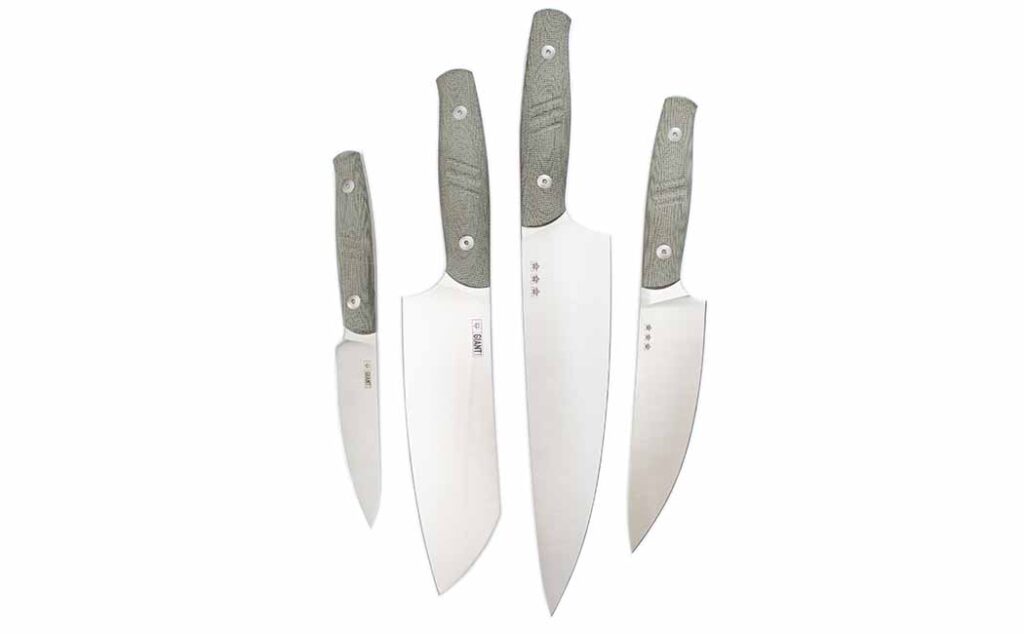
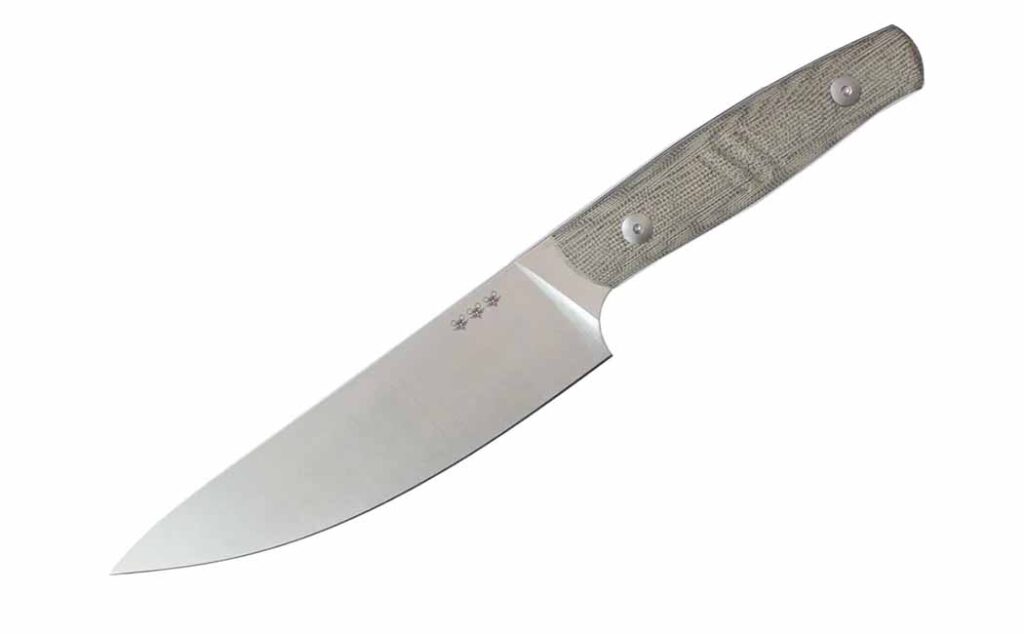
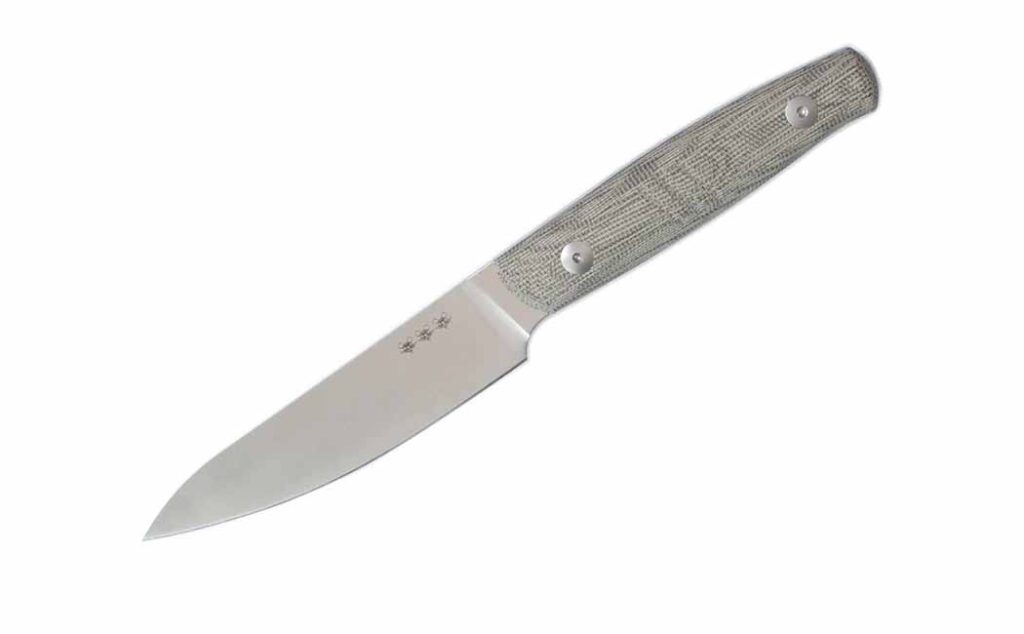
At first blush—and without a knife-in-hand, tomato-dicing torture test—not too shabby. The four-knife line appears attractively utilitarian, nice enough to show off along with your next dinner party. But the knives aren’t so pretty as to scare you off from actually using them in your day-to-day culinary adventures. At arm’s length, it’s difficult to discuss ergonomics, balance and performance. However, GiantMouse doesn’t appear to have to broken any of the major kitchen-knife rules, attempting to displace function for novel form. Though, the slightly hooking heel on the larger knives might prove a sore point—pun intended—for some.

The line, at present, includes:

  • Santoku
  • Chef
  • Carving
  • Paring
GiantMouse Kitchen Knives in a line

Essentially, GiantMouse has homed in on the basic food prep tools every kitchen requires. The knives are sold individually and as a set; there’s a branded bamboo magnetic knife bar available, as well. And, in the company’s announcement, it certainly sounds as if it has designs to continue expanding into more corners of the culinary arts. No hint on what that might include.

As to the Italian-made knives themselves, GiantMouse has opted for Nitro-B for the blade steel and given them an unstated satin finish. Having grown in popularity in recent years, high-nitrogen steel (.21% in the case of Nitro-B) has spurred its share of debates as well. Sufficed to say, it should thrive in a kitchen environment if for no other reason than its corrosion resistance. To top it off, the blades are stamped with a tirade of the company’s murine logo—jaunty, to say the least.

To this, the company has outfitted the knives with green micarta handles, which should prove popular. Generally providing an excellent gripping surface, even when wet, GiantMouse has further enhanced it with a run of three serrations at the midpoint to provide a bit more purchase.

As for price, expect to drop $95 to get into GiantMouse’s paring knife at the low end and $175 for the chef or santoku at the high end.

GiantMouse Kitchen Knives Specs:

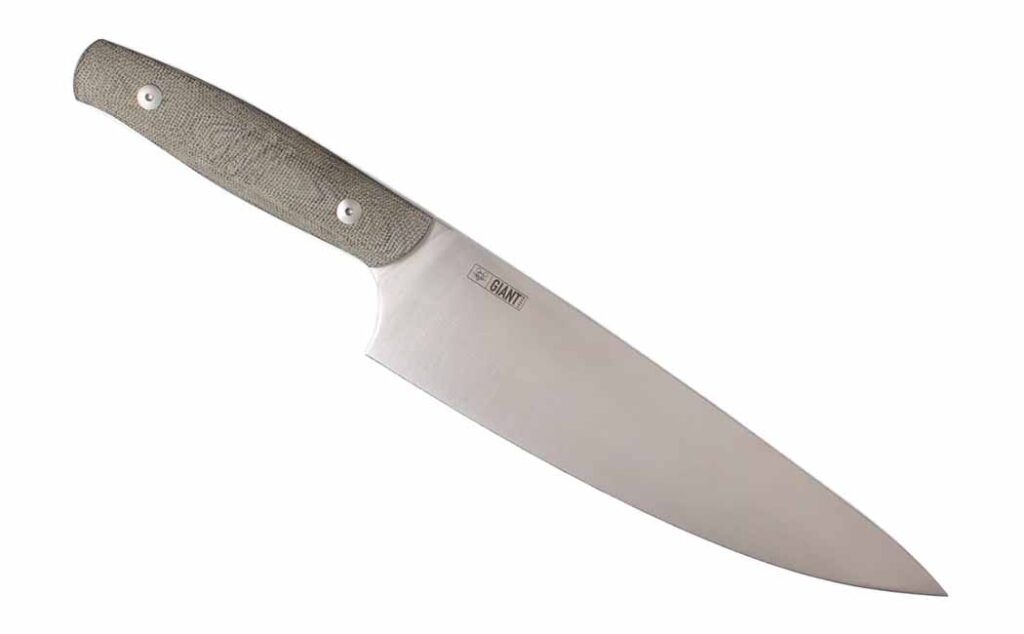
GiantMouse Chef Knife


Chef Knife
Blade Length: 8.375″ (212.725mm)
Weight: 6.9oz (195.612g)
Overall Length: 13.125″ (333.4mm)
Steel: Nitro B
Blade Thickness: .1125″ (2.875mm)
Finish: Satin
Handle: Green Micarta
MSRP: $175

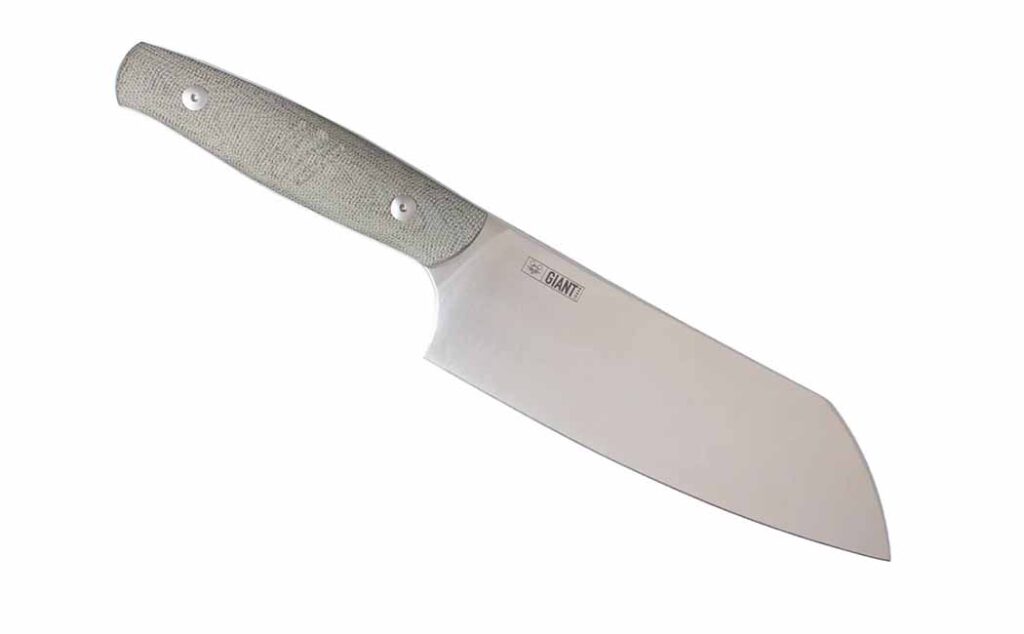
GiantMouse Santoku

Santoku
Blade Length: 6.75″ (171.45mm)
Weight: 6.8oz (192.777g)
Overall Length: 11.4″ (289.56mm)
Steel: Nitro B
Blade Thickness: .1125″ (2.875mm)
Finish: Satin
Handle: Green Micarta
MSRP: $175

GiantMouse Carving Knife

Carving Knife
Blade Length: 5.58″ (141.732mm)
Weight: 4.6oz (130.408g)
Overall Length: 9.75″ (247.65mm)
Steel: Nitro B
Blade Thickness: .116″ (2.87mm)
Finish: Satin
Handle: Green Micarta
MSRP: $125

GiantMouse Paring Knife

Paring Knife
Blade Length: 4.2″ (106.68mm)
Weight: 2.6oz (73.708g)
Overall Length: 8.250″ (209.55mm)
Steel: Nitro B
Blade Thickness: 0.0675″ (1.71mm)
Finish: Satin
Handle: Green Micarta
MSRP: $95

Read More

Huber Foxworth Bowie: The Men Behind The Blade

The men behind the Huber Foxworth Bowie are as captivating as the knife itself.

This is the story of a knife named in honor of an incredibly special man. In this highly populated world not many people get their name attached to anything. I do, however, know for a fact that Craig Fox Huber was very proud of the idea that people would be wanting the knife that bore his name for decades to come. He told me so in person. He lived a life that so many would aspire to but very few would have the moxie to follow through on. He was the real deal.

So, how did Craig impact a knifemaker to the point of naming a knife the Huber Foxworth Bowie? Here’s what my father, BLADE Magazine Cutlery Hall-Of-Fame® member Dan Dennehy, wrote about Craig in his 1970 Dan-D Knives Brochure:

Many self-styled “experts” have stopped by my shop from time to time to suggest to me how I should design the “perfect” knife … Not long ago a trim bearded crewcut type found his way to my shop, and we started talking knives. [Circa the late 1960s] I took an immediate liking to this handsome, rather cocky gent and was pleasantly surprised to learn that he spoke about knives with a rather rare understanding of design and more than just a rudimentary knowledge of metallurgy that I found uncommon even among some men whose names would be familiar to you as supposed “experts.” He not only talked good theory and design, but he spoke with considerable authority on how a fighting knife should be used.

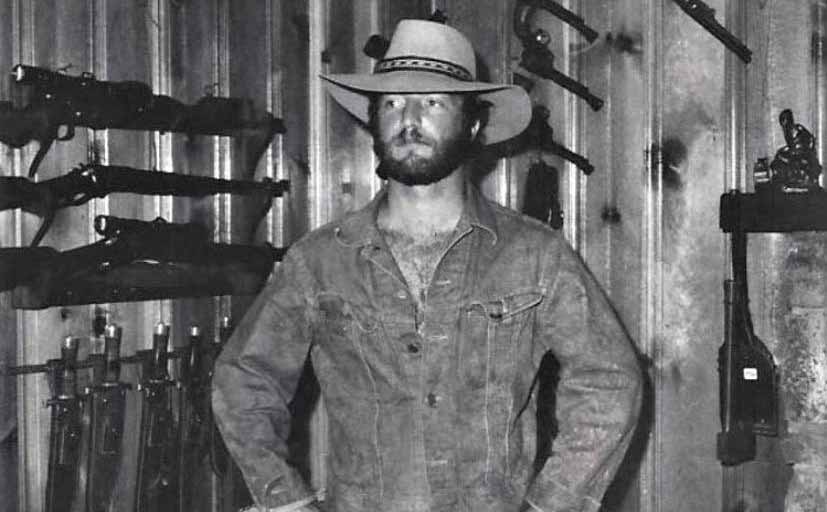
Craig Huber
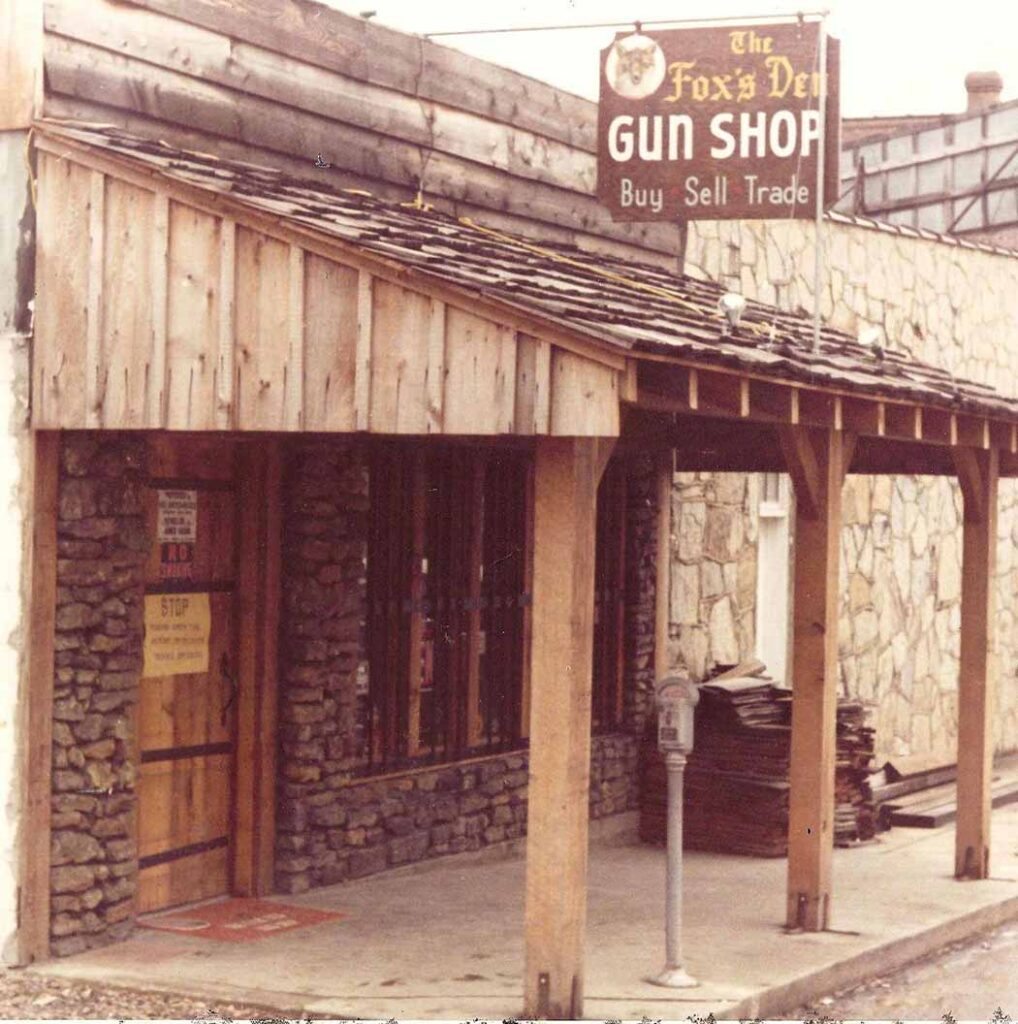
That’s Craig Fox Huber inset circa 1970 at the Fox Den’s second location in Mountain Home, Arkansas.

During our conversation I learned that he had earned three Purple Hearts while serving with a Marine Recon Unit in Viet Nam, and enough other “breast hardware” that when he spoke, I listened with both ears, and rather attentively.

Those who knew Dan might realize that these comments mean he really respected the “cocky gent.” And Craig respected Dan. Their long friendship stayed the course until the end. I also had a lot of respect for Craig and his vast knowledge of knives and other things.
I met him in the early ’70s at The Fox’s Den, his gun shop located in the small ranch community of Kirkland, Arizona. Dan took me there to meet Craig when I was about 13. I shook hands with a man wearing a drop-loop gun belt with rounds in every loop and a .45 Long Colt pistol in the holster. I was in awe. I also got to see some of the knives he carried and to learn why he carried them.

About a year later my family bought a small ranch in the area. I visited the gun shop at every chance. Dan would take me to Craig’s home occasionally. I was equally impressed at his collections. The next summer I worked for Craig, helping with his horses and other stuff around his place. They were good times and I must say that it was from his influence that I went to see the United States Marine Corps recruiter a few years later.

Craig Huber: Christian Patriot

Craig’s son Hunter can tell you better than anyone about his father. Of Craig he wrote:

Dad was a lot of things. He was a soldier, a gunfighter, inventor, storyteller, adventurer, hunter, fisherman, survivalist, outfitter, collector, gunsmith, writer, and the list goes on. He was a patriot and a Christian. He lived his life to the absolute fullest and would fight for everything he believed in and loved.

Two sides of bowie knife
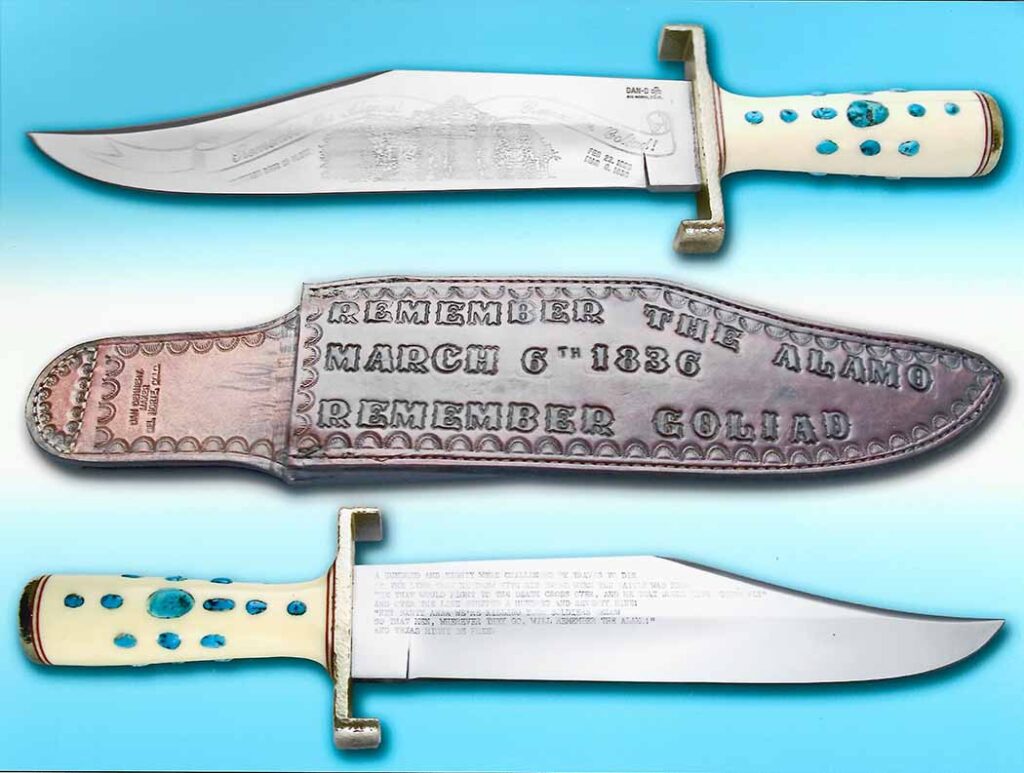
In his vast collection of Dan Dennehy knives, Craig’s favorites were the Dan-D Alamo Bowie and the Huber Foxworth Bowie. The Alamo Bowie has a 12-inch hollow-ground blade a quarter-inch thick and 2 inches wide. The blade’s non-mark side is etched with an eight-line poem that commemorates Col. Travis’s call for “defenders to step forward.” The handle is walrus ivory inlaid with 18 turquoise cabs. Overall length: 16.5 inches. The custom sheath is cowhide. (Bob Glassman image)

Despite having the option to go work for his father’s rapidly growing company in York, Pennsylvania, that was obviously of no interest to Dad so he went into the military. Even though he had trouble with authority and rules, he thrived in the Marines.

After the military his life got really interesting. His resume speaks for itself but here is a summary: police officer; sheriff; private investigator; horse wrangler; hunting guide, Ozark Mountains; fishing guide, French River, Canada; gun shop owner, Fox’s Den (Kirkland, Arizona, and Mountain Home, Arkansas); salesman, Camillus Knives and Levis; personal protection, bodyguard for Saudi Royal Family; professional hunter, South Africa; writer, Whitetail Times magazine and several personal protection books; gunsmith; gun dealer; private security, consulting and training; fugitive recovery; and much more. This is a very general overview and it took him to some very interesting places and dangerous spots, and he met some really interesting people along the way.

So here is what Dad loved. He loved his country and God. He loved our mom. He loved me and my sister. He loved adventure. And he loved guns and knives. Dad was an encyclopedia of firearms, handloading and ballistics. He had a real passion for Rugers, Ruger M77s in any and every caliber they make, but especially 7×57 and Ruger single action pistols. He was also a 1911 fanatic. I don’t remember a single occasion in my life where I ever saw Dad without a 1911 on his side or in a shoulder holster.

And he loved knives. Man did he love knives. I don’t know exactly where in his life this interest started, but he was as passionate about knives as guns, and maybe more. And this is coming from a guy whose gun collection is over 500. He loved all knives and always carried at least two at a time. He had a real appreciation for a good blade and considered knives the most valuable tool an outdoorsman or soldier could have.

Fox's Den Gun Shop
Here’s the second iteration of The Fox’s Den Gun Shop as it appeared in Mountain Home, Arkansas. Note the sidewalk parking meter.

As you would expect, just like factory rifles with factory ammo were not suitable for Dad’s standards, neither were factory knives. As a result he started reaching out to custom knifemakers and collaborating. He formed relationships with Bo Randall, Jimmy Lile, Art Wiman, Clyde Fischer, Blackie Collins, Harold Corby and George Herron, and most notably Dan D. Dad spoke of Dan D. with a manner of respect and admiration that he did not offer up lightly to many. A shared respect and appreciation for the art and skill behind making the ultimate tool, something that was practical and efficient, beautiful and deadly. Dad’s collection of Dan D. knives is vast but his two most prized are the Alamo Bowie and the Huber Foxworth Bowie.

Dad was the toughest man I’ve ever known. A real fighter, rock solid, set in his ways and unshakeable. No matter, if you had a problem, my Dad would be your first call and the man you wanted in your corner. Dad had a lot of fans and a lot of enemies. He had many acquaintances and peers and only a small handful of good friends. He always said if you get through life and only have a few good friends, real true friends, then consider yourself lucky. Dan D. was a true friend of Dad’s.

Machete and knife
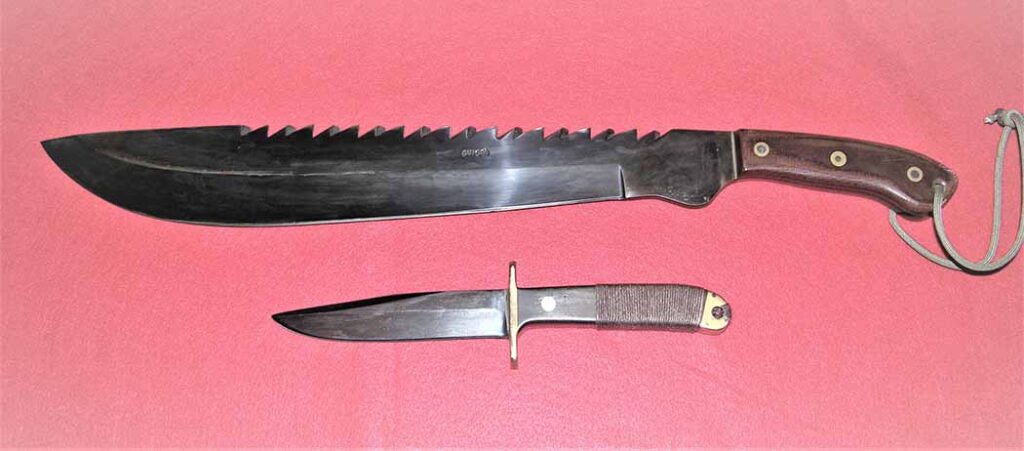
Two of Craig’s favorite Dan-D users included a survival machete and a Woodsman model. Craig designed both, with Dan-D making the former and helping Craig make the latter in the Dan-D shop. Craig carried the Woodsman more than any other knife for over 40 years.

Craig was one of those rare characters you meet along the road of life and always remember. Later he told me stories of discussions with Cutlery Hall-Of-Famer Bo Randall and knife designs for different purposes. Another story was how he talked to Cutlery Hall-Of-Famer Bob Loveless about the simplicity of balancing a knife using his personal theory of the tapered tang. He visited with his friend Cutlery Hall-Of-Famer Jimmy Lile long before the Rambo knife was created. John Horrigan told me about their hunting trip in Africa. Since Craig was a licensed guide the trip was arranged in exchange for a knife identical to the one John presented to President George W. Bush.

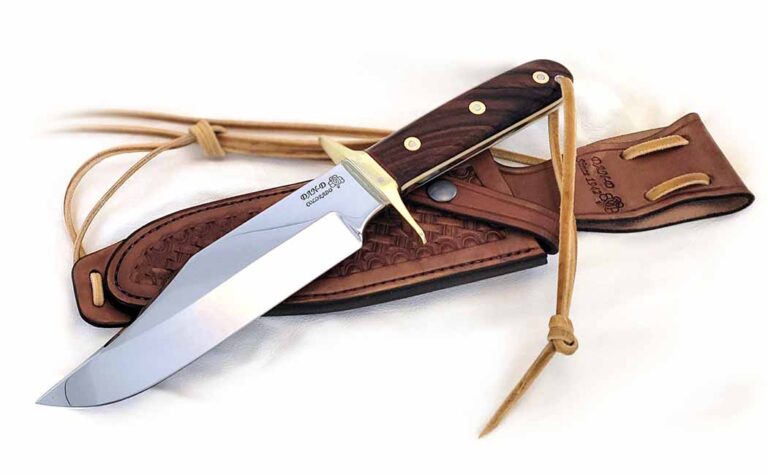
Huber Foxworth Bowie

But back to the Huber Foxworth Bowie. The brochure description continues:

This knife is a pure and simple Bowie style but with the handle dropped slightly which seems to give it a much better “pointing” ability and maneuverability not found in most common Bowie styles. [Craig] had a prototype of this knife made for him by a Philippine Negrito instructor while he was attending the armed forces Jungle Survival School in the Philippines. Pound for pound these little Negritos are about as slick and fierce a knife fighter as will be found anywhere.

Knives
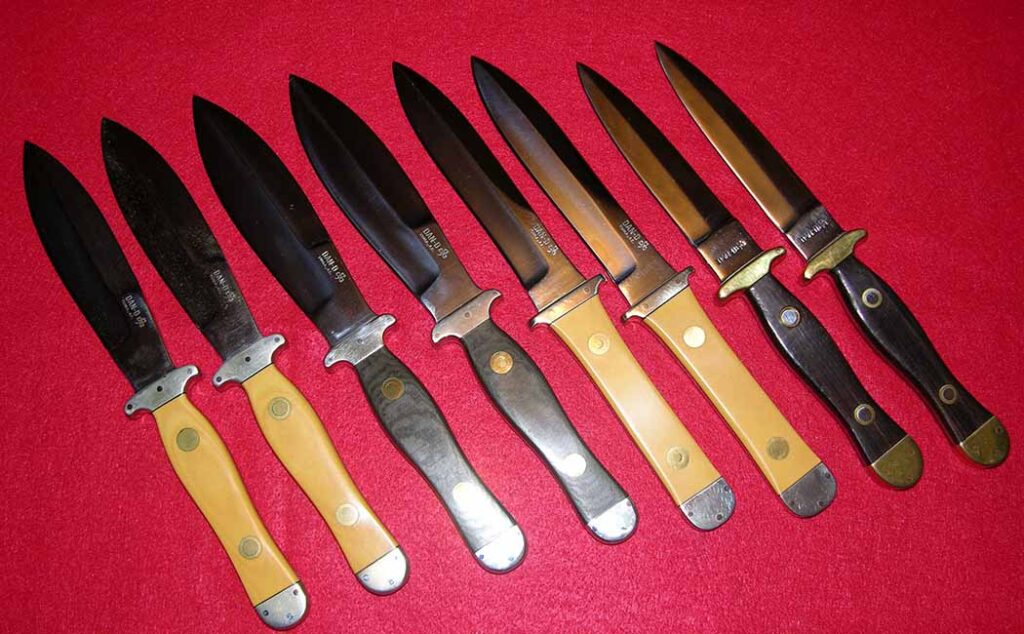
In a 2011 email to the author Craig wrote, “This [image] shows all four pair of boot knives your Dad did for me, including two pairs of my Model III. All have been carried extensively over the past 40 years, and two of the knives have saved my life.”
The blade is 8 inches long, 1.75 inches wide and in quarter-inch stock of 154 CPM stainless steel heat treated by Cutlery Hall-Of-Famer Paul Bos. It has a double guard and a 4.75-inch handle. According to the brochure, “This is a knife you could bet your life on.”

A couple of years ago, Hunter contacted me and told me of his father’s passing. Craig lived 76 years his way and made his mark in the world. His passion for God, his country and living life to the fullest extent had been accomplished. Hunter went on to explain that out of all the knives they cannot find the one that meant more to Craig than the Huber Foxworth Bowie.

Check Out More Cool Custom Knives:

Sarge Knives TK Retro Review: Throwback Bushcraft

Sarge Knives TK Retro has throwback looks, but modern performance.

The TK Retro from Sarge Knives reminds me of my first fixed blade.

The blade was pitted and the leather handle was cracking. Still, the knife field dressed many squirrel, rabbit and game birds throughout my childhood. It was an excellent camper’s or outdoorsman’s knife.

As for the TK Retro, like my first fixed blade, the stacked-leather handle still gives my hand a warm feel. It has a 440C stainless steel blade to make its good looks last even longer. However, how does it cut?

TK Retro Sharpness Test

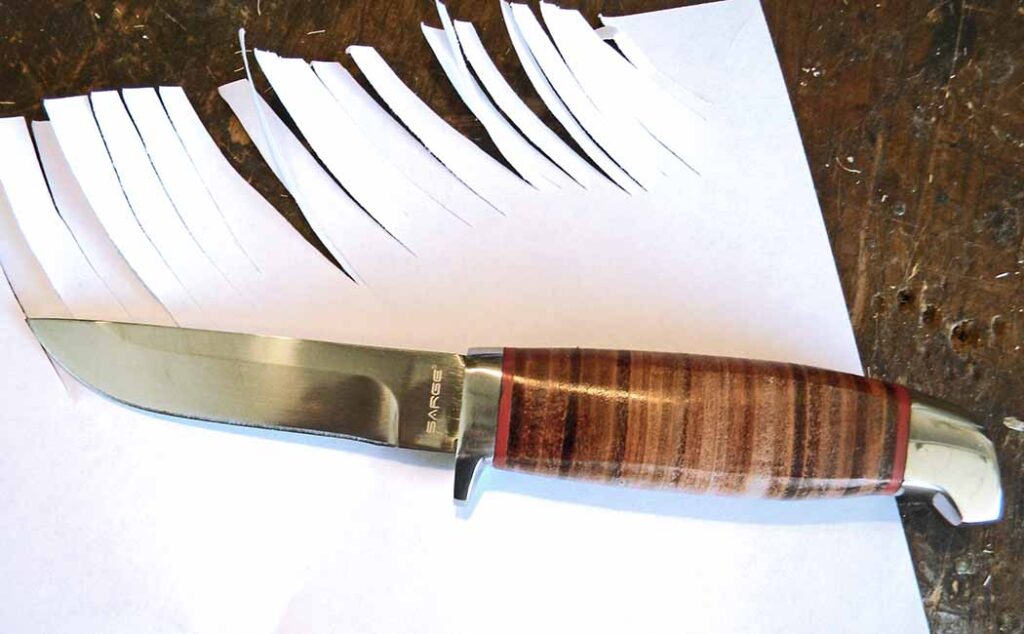
Retro cutting paper
Using the knife’s weight, the author employed push cuts in the stationery. There were no “bad starts,” just smooth slicing.

The first test medium was 20-pound bond copy paper. The TK Retro started slicing and made nice, clean cuts in the stationery. Using the knife’s weight, I employed push cuts. There were no “bad starts,” just smooth slicing.

TK Retro Light-Duty Cuting

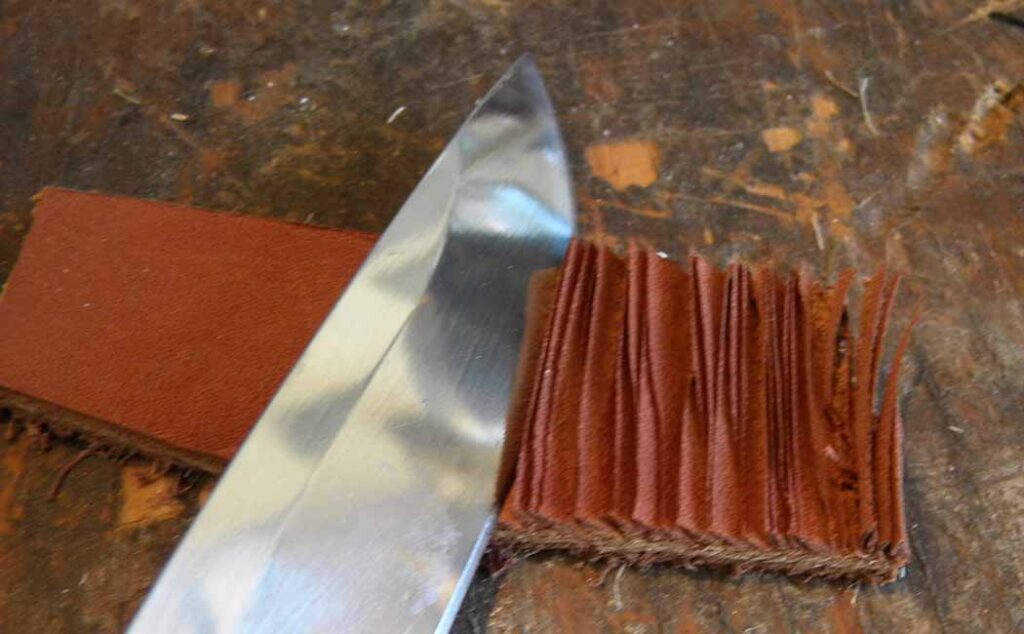
TK Retro vs leather
The blade audibly crunched the leather with each skive and made it easy to control the width of slices.

The TK Retro bit deep and smooth [into drywall], with minimal bending of the cut pieces. I could feel the cardboard’s layers with each cut. Edge performance was nice and aggressive. The handle provides a very secure grip.

Leather skiving followed. The blade audibly crunched the leather with each cut and made it easy to control the width of slices.

Heavy-Duty Cutting With Sarge’s Fixed Blade

Firesticks

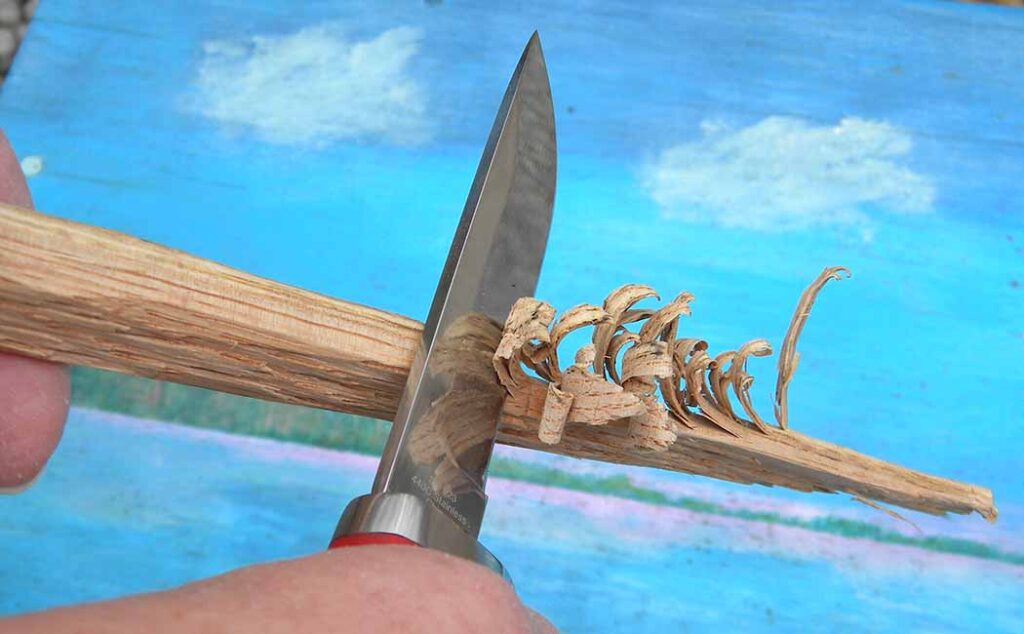
TK Retro firesticks
Melissa did a great job whittling a fuzz stick with the TK Retro over her painted bench.

While camping, I was splitting firewood for the weekend. My wife, Melissa, wanted to start the fire so I showed her how to make fire sticks. She took to whittling very quickly and did four of the sticks to aid in her fire starting. She used the TK Retro to make some very nice curlicues. Before I knew it she had a beautiful fire going—excellent job on her part! I was surprised to see her whittling over her bench that she had painted. She seemed to feel very confident using the little fixed blade.

Splitting Wood

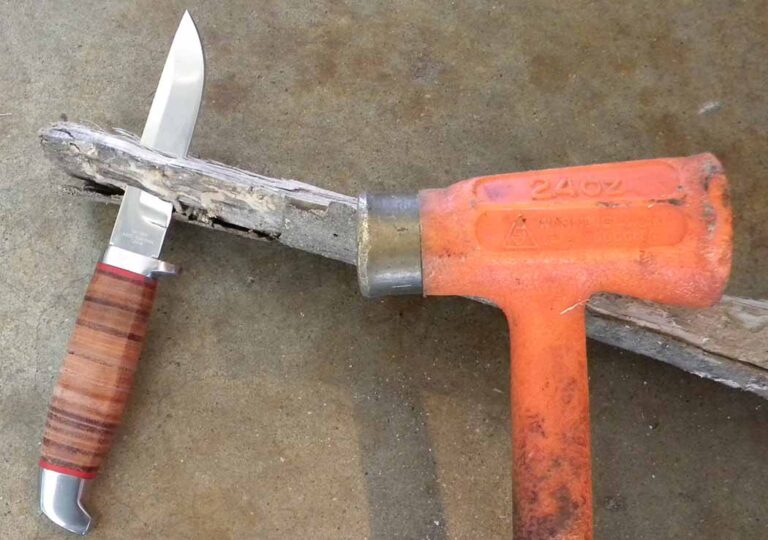
I had some dry hackberry wood to split for kindling. A dead blow hammer and the TK Retro made short work of the task. I didn’t see or feel any edge/knife damage while batonning the edge through the wood. The guard acted like a guide for my hold hand, keeping the wood away from my knuckles. The leather handle absorbed the vibrations perfectly.

Vs Rope

TK Retro cuts rope
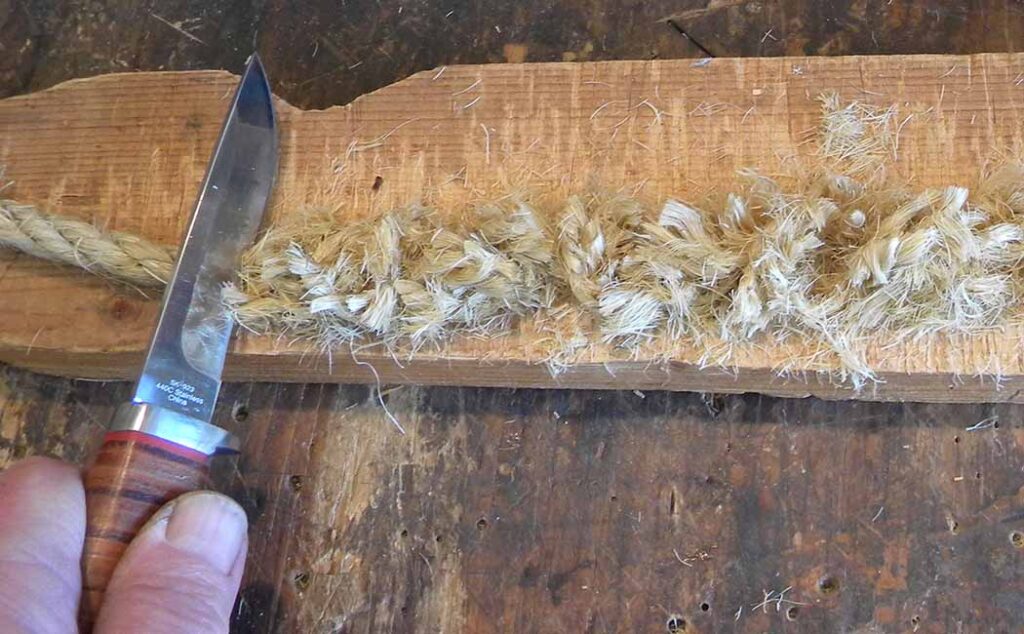
The fixed blade made 82 crunching cuts in the half-inch sisal rope before the edge started to slide.

On the half-inch sisal rope, the TK Retro crunched its way to 82 clean cuts before the edge started to slide. I did find that the guard had a sharp edge that needed softening a bit. It would create a hot spot on your hand after a while. It was an easy fix with some sandpaper.

Chopping Antlers

Chopping antler
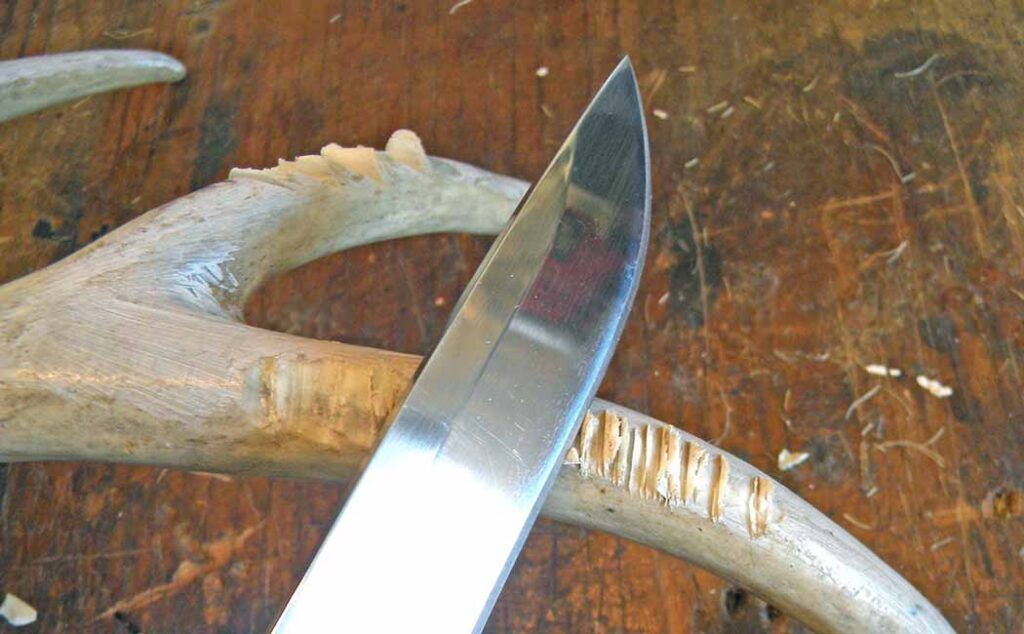
After 20 hard whacks on the antler the edge showed nary a chip, a sign of outstanding heat treating.

The last test for the edge consisted of a series of chops into a whitetail deer antler. After 20 hard whacks, I expected to see some minor edge chipping but there was none. The edge was as sharp as when I started. Sarge Knives nailed the heat treating.

Changes

The guard and buttcap need to be softened a tad. They will bite you after a period of hard use.

Final Cut

The TK Retro is a very nice medium-use knife great for game or camping.

Sarge Knives TK Retro Specs
Blade length: 3.5 inches
Blade steel: 440C stainless
Blade finish: Mirror polish
Handle: Stacked leather
Fittings: Stainless steel
Construction: Full tang
Weight: 4 ounces
Overall length: 7 3/8 inches
Sheath: Brown leather pouch w/snap and belt loop
Weight w/sheath: 5 ounces
MSRP: $53.95

Read More Knife Reviews:

Work Sharp Professional Precision Adjust Knife Sharpener Released

0

The Work Sharp Professional Precision Adjust Knife Sharpener is upgraded to ensure the utmost consistancy and sharpness.

No doubt, if you take keeping your knives sharp you’ve caught wind of Work Sharp. The purveyors of precision sharping systems, the company has opened razor-sharp edges to the everyman—not just those who’ve mastered the whetstone. Recently, the company has taken its honing system a step further.

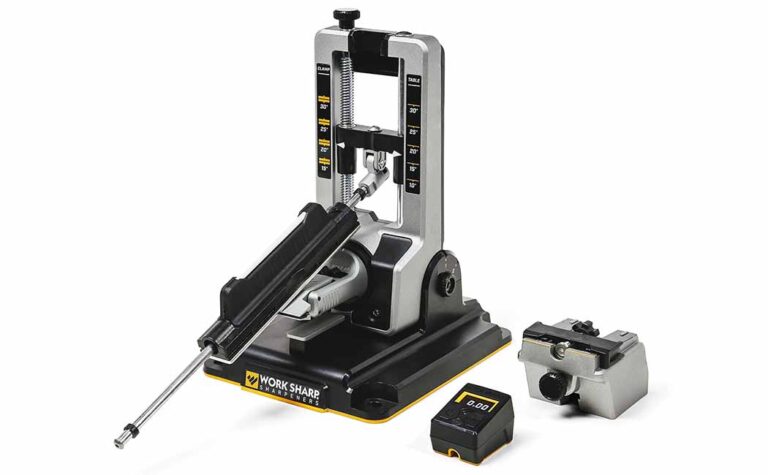
Shake hands with the Professional Precision Adjust Knife Sharpener.

The sharpener takes what most are familiar with in a Work Sharp system and enhances it in nearly every conceivable way to live up to its ‘professional’ moniker. Its design is very reminiscent of the Work Sharp Precision Adjust Knife Sharpener, however, the upgrades of the Profession command a much steeper price than the earlier iteration. At present, the company list’s an MSRP of $299.95—not cheap, for sure. But Work Sharp gives serious knife aficionados plenty of reasons to pony up the cash.

First and foremost is the Professional Precision Adjust Knife Sharpener’s all-metal construction. While perhaps one of the less flashy aspects of the adjustable sharpener, it forms a solid foundation to ensure the utmost precision and repeatability in applying an edge to a knife. And honestly, compared to other metal-frame sharpening systems, the Professional Precision Adjust Knife Sharpener actually comes in as a deal. To this, Work Sharp adds a V-Block Clamp that quickly, securely and repeatably secures your knife during the sharpening process. Furthermore, a weighted base provides a safe and stable platform that allows rotating the knife without removing the knife or clamp.

From there, Work Sharp has included a digital angle indicator, which many DIYers will heave a sigh of relief. Not that the old manually adjustable scales on the frame aren’t usable, but bringing angle adjustment into the digital age makes for much quicker corrections and more consistent blade to blade. The system allows for adjustments from 15 to 30 degrees, which covers a major swath of steel most knife owners are likely to encounter. Adding to this, the system comes with a full assortment of honing plats, including 220, 320, 400, 600 and 800 grit diamond, a ceramic honing plate and a leather strop. Essentially, it’s equipped to go from reapplying an edge to taking it to a mirrored polish. A note, if you sharpen a lot and often, don’t worry about if you wear the grit down on the plates. These are user-replaceable, so the integrity of the system itself is safeguarded for a lifetime of use.

Of other notables of the Professional Precision Adjust Knife Sharpener, it comes with a small knife attachment and includes a 3-year warranty. The device is certainly angled at knife pros—sharpening services, makers and shops. But for a serious knife owner who never wants to lose his edge, the system might be a dream come true.

Read More About Sharpeners:

How To Make An Atlatl

1

We’ll take a momentary break from knives to talk about how to make this ancient and useful hunting tool—the atlatl.

Over 20 years ago I attended a primitive skills event in Michigan where the Michigan Atlatl Association was having its annual competition. I was amazed at how accurate the people could be using an atlatl, not to mention how much energy they could generate throwing one. However, I don’t want to get too far ahead of myself. For starters I want to explain why I’m discussing atlatls in the first place.

One of the key points to remember during a survival situation is efficiency, because efficiency saves calories and resources. I know, many have heard of making a survival bow, but the time and resources used to make an atlatl are way less. An atlatl is simple: a throwing stick that allows you to increase your power when throwing a dart.

Imagine you were a pitcher in the major leagues and you could increase the length of your arm by half. The advantage you would create would be amazing. Similarly, not only is an atlatl easy and fast to make, it also increases your ability to throw a projectile farther and faster. Don’t get me wrong; I am not against bows by any means, but in the time it takes just to make a string for a bow, you can make an atlatl and a fist full of darts. In the end, if I were in a survival situation and needed something to hunt with, I would start with an atlatl.

How To Make An Atlatl

Handcrafted atlatls
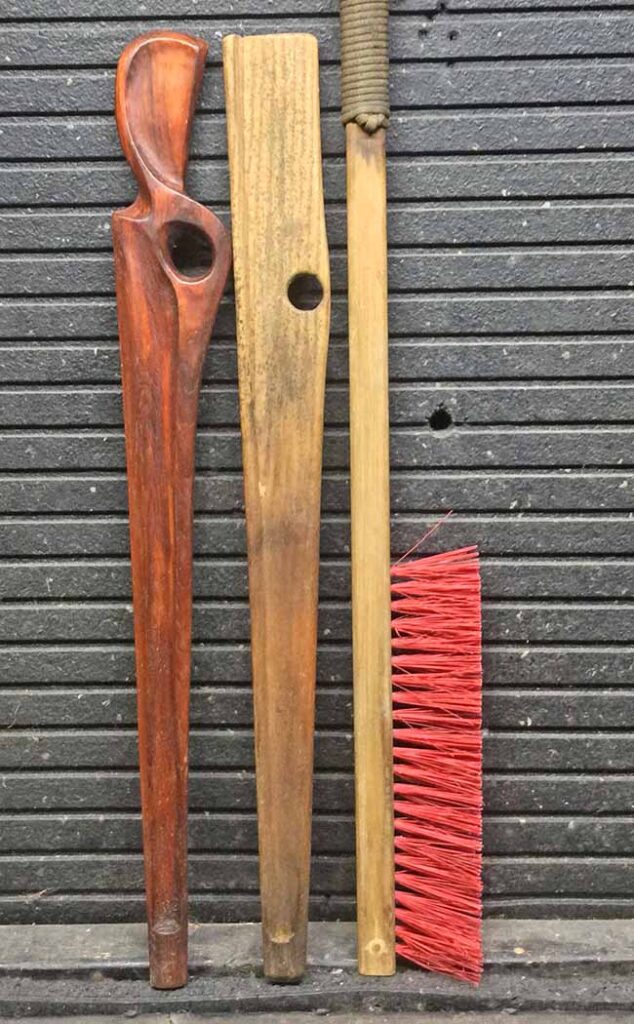
At left are two single-finger throwers. At right is a snowbrush Chris Oberg used as a thrower to win the Michigan Atlatl Association championship. A hammer-style grip works well with the snowbrush thrower as the scraper end acts as a stop.

As mentioned, the atlatl is simply a stick used to increase your throwing advantage. To start, the simplest version is a branch with a secondary branch sprouting off the main shaft.

Take a branch and cut it to the length of you forearm, being sure to leave the secondary branch near the end. Now all you need do is cut the secondary branch to a small point, or leave a pocket. Which method you use will affect how you make your darts. With the point configuration, you must put a bit of a dimple in the end of the dart so it can rest on the point of the thrower arm. Another method is to form a pocket by attaching other materials. These days most survival kits and a lot of EDC kits include duct tape. Simply cut yourself a stick, again the length of you forearm. At one end of the stick form a pocket with a piece of duct tape to cradle the back end of your dart.

There are a couple of methods to hold the atlatl. The first and easiest without having to do any more work on the atlatl itself is the hammer grip. To apply a hammer grip, grab the end of the thrower with the bottom three fingers of your throwing hand. Take your other hand and place the dart on the holder. Then rest the thrower in the palm of your hand and, with your thumb and index finger, grab the shaft of the dart, suspending it off the thrower.

A second method makes your thrower in the basketmaker’s* style. To do this you will need a bit of cord (a shoelace will work) or anything you can use to form two loops on the side of the atlatl shaft. At the end of your thrower, tie a knot that creates two loops on the handle. Insert your index finger in one loop and your middle finger in the other. Having the two loops makes it easier for you to retain the thrower throughout as it is now attached to your throwing hand. A thrower is that easy to make.

Making Spears And Darts

variety of darts
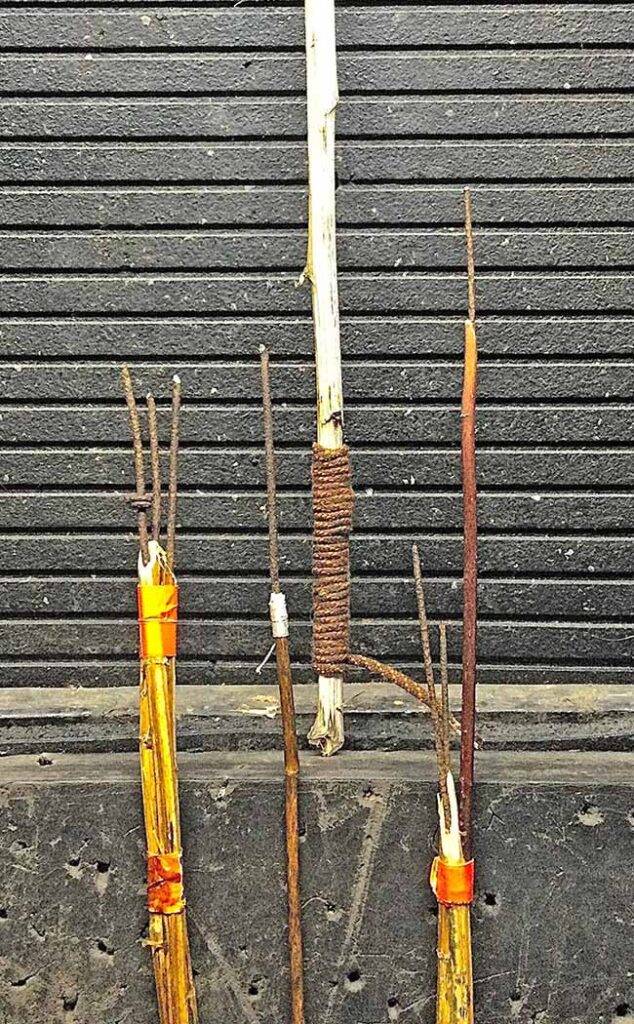
A thrower and a variety of darts illustrate the basic concepts of harvesting and utilizing various materials, including lashing smaller pieces together to make a dart.

An atlatl dart is simply a large arrow. If you can wrap your head around that, you start to see potential dart material everywhere—perhaps a piece of a broken fishing rod, the extra pole in your tent bag, a leg from a folding chair—the possibilities are pretty much endless. The mark of humanity is that there is plenty of garbage most everywhere, so remember to capitalize on any resource you run across.

For natural resources you can turn to plants and bushes that grow almost straight shaft shoots. Some examples in North America are those from mullein, rosewood cane, ragweed and dogwood. In places like Asia, bamboo is a natural selection. Since plant shafts grow in a tapered fashion, be sure to put the heavier end of your dart at the tip. Having the heavier end at the rear will cause the momentum of the heavier back to lift the tip, as the heavier end will want to pass the front.

For length, look for the dart to be at least twice that of the thrower or longer. The longer and lighter the dart, the more energy you can produce. Note: The heavier the dart, the strong the thrower must be.
Start by stripping the shafts and straightening them. During the initial straightening you can bend the shafts or create friction on the concaved side, which will release the tension in the material. As time passes you might do the occasional straightening over a campfire, as the heat helps.

Now that you have the shafts straight you need to carve a small dimple in the back of each one to rest on the point of the thrower. If you are using materials that have nodes along the shaft like bamboo and mullein, be sure to carve the pocket just before a node to avoid splitting the shaft of the dart.

Now for creating drag. Just like with an arrow, to keep a dart flying straight it helps to have drag. Consequently, fletch the dart by splitting leaves and lashing them to the shaft. A more expedient way is to make fletching out of duct tape. You don’t necessarily need fletching but for throwing longer distances it helps.

For making the tip, simply sharpen the point or as mentioned earlier get creative and find something to use that has been left behind—a soda can cut and folded to form tips, for example. How does the saying go? Recycle, reduce and reuse.

What’s An Atlatl Good For?

Thrower's take aim with atlatl and dart
Carter Gammill takes aim. In terms of accurate throwing, the hardest part is getting your timing down as to when to release the dart. Setting up a target for practice provides an added element of challenge.

Atlatls have been in use for thousands of years as hunting tools. There are still Inuit tribes that use them to hunt narwhal to this day. It is expedient, uses little resources and best of all you can carve one with your favorite knife in no time. You will want to try making one first to get the idea. After that you will be surprised how you start to see so many things that can be made into an atlatl. The hardest part is getting your timing down as to when to release the dart when you throw it. Most importantly, knowing how to make and use an atlatl puts yet another worthwhile tool in your kit.

*The Basketmaker culture of the pre-Ancestral Puebloans began about 1500 BC and continued until about 750 AD with the dawn of the Pueblo Era in what is now the American Southwest. They used the atlatl for hunting and as a combat weapon. The culture was named Basketmaker for the large numbers of baskets found at local archaeological sites dated circa 800 BC to 200 AD.

Read More About Wilderness Tools:

Walter “Blackie” Collins: Applying The Edge To BLADE Magazine

0

Blackie Collins brought The American Blade to an audience thirsting for knife news.

Editor’s note: This year marks BLADE®’s 50th anniversary. In recognition of that milestone, we are presenting a series of stories celebrating our half-century birthday. This time, how Blackie Collins founded the magazine then known as The American Blade.

Whether designing a new knife, making a knife of his own creation, flying along on a motorcycle—or starting a magazine—BLADE Magazine Cutlery Hall-Of-Fame® member Walter Wells “Blackie” Collins was a risk taker.

Fifty years ago, Blackie spearheaded the first issue of The American Blade, the original name of today’s BLADE® Magazine. It’s unlikely he ever thought his creation would endure as it has, or that it would grow to become the World’s No. 1 Knife Publication. But back then, the time was right to give it a try.

“I was in business with a friend of mine buying and selling knives, and Blackie would supply us with cutlery. He was an excellent custom knifemaker,” remembered Roger Aiple of New Orleans. “He was a close friend and you might say he was thinking about producing a magazine. He asked me what I thought about it, and, knowing Blackie and his dedication to knives, I said it was a great idea but that producing a magazine was not the easiest thing in the world.”

Blackie Collin's Knife on cover of blade
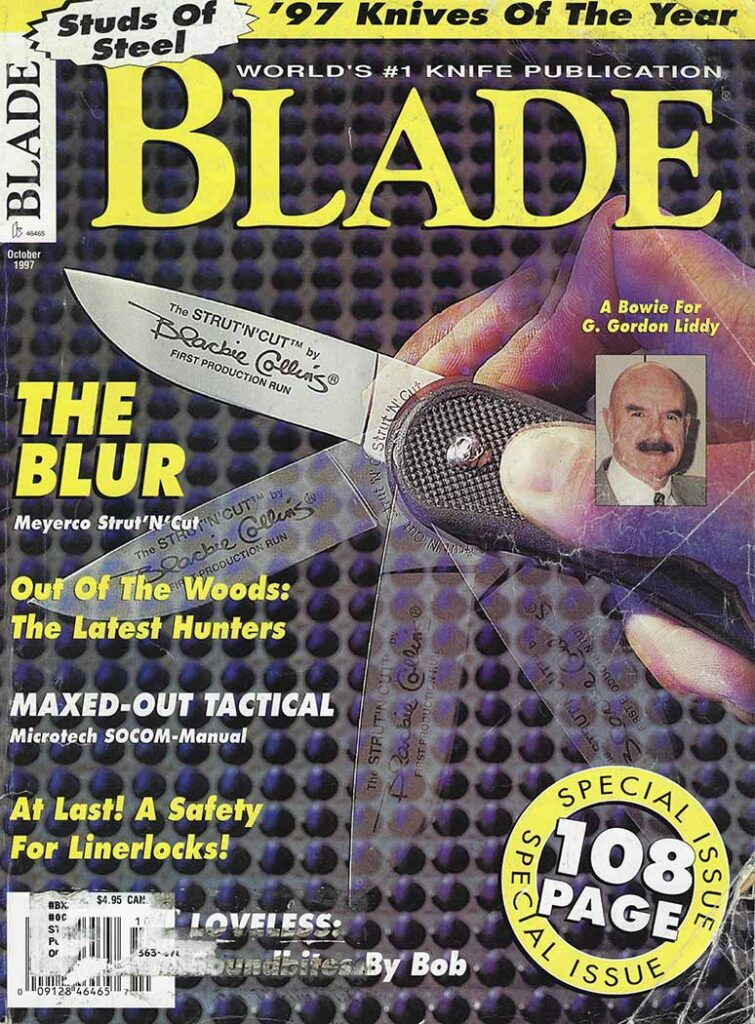
Blackie Collins loved motorcycles, including those by Ducati. In fact, he based the opening mechanism of his revolutionary Strut’N’Cut assisted-opening knife (inset gracing the cover of the October 1997 BLADE®) on the Ducati’s single-strut suspension system. He was killed in a motorcycle accident on July 20, 2011, at the age of 71.

Aiple introduced Blackie to Mal Mele and Sonny Molenaar, the owner of Molenaar Printing Company, in nearby Metairie, Louisiana, and the three men worked out a deal. Apparently, Mele and Molenaar were willing to share some of their insights on how magazine production worked, including printing, distribution, and other nuts and bolts items. Then, of course, there was editorial content to produce, copy to be written, and photos to be taken and reproduced for the new publication.

Blackie devoted energy and ideas to The American Blade, and there were two very good reasons for his drive to see the magazine concept become a reality. “Can you think of a better way, if you’ve got knives or knife designs, to get with other knife companies and everybody in the business?” reasoned Susan Collins, Blackie’s sister-in-law and wife of his brother, Michael. “The American Blade opened the door for him to walk into a shop or factory and say, ‘Let me do an article on you or on this or that subject.’ Blackie knew everybody, and it helped to make him very successful and Michael, too.”

While Blackie was putting The American Blade together, Michael was working away in the brothers’ shop. He knew Blackie was up to something but wasn’t sure exactly what was going on.

“I was working on knives and grinding blades, and he wouldn’t tell me what he was doing,” Michael smiled. “It was a surprise to me, but he got it done and it turned out well. Sometimes Blackie would do things and people would wonder why. He did a really good job of putting the magazine together and getting it published, and I sat back and watched it happen.”

Blackie Collins article
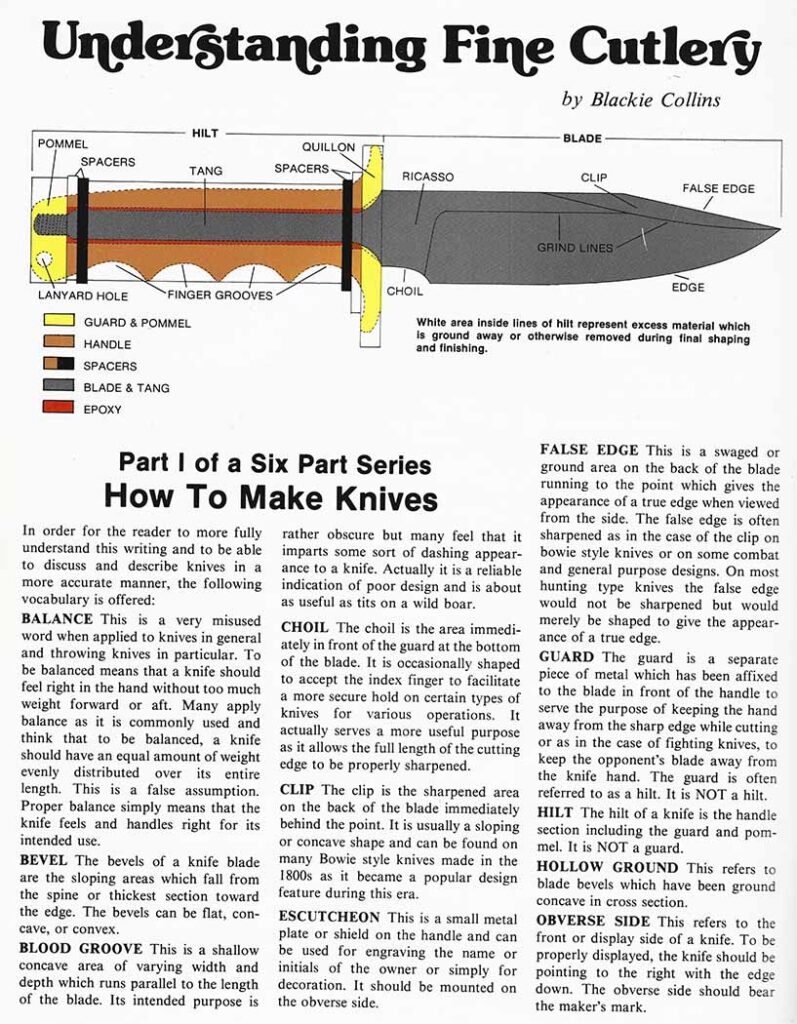
Blackie Collins wrote a series for the magazine titled, “Understanding Fine Cutlery,” and did his best to spread the good word of how to make knives, providing tips and pointers to up-and-coming makers.

Michael related that the two knives that graced the first cover of The American Blade were both his creations. After all, something had to go on that first cover, right? “He would set his mind to something, and that is what he was going to do,” Michael said of his industrious brother. “Sometimes, he would go a while before he would tell you what he was doing.”

Voice Of American Knifemaking

Cutlery Hall-Of-Famer Bill Adams, owner of long-time knife retailer Atlanta Cutlery for many years, was responsible in large part for the excitement that surrounded the knives of Sheffield, England, in the magazine in the early to mid-1970s. Sheffield was a center of knife production in Europe, and the quality of its cutlery was unsurpassed in the factory setting from the late 18th century until the early 20th century. After Bill put in long hours and travelled to Sheffield to search through the old local knife factories and make some key purchases, he had become an authority on Sheffield knives and co-wrote/wrote two articles on the topic in the first two issues of The American Blade. He later advertised Atlanta Cutlery in the magazine, too.

“There was something happening back at that time, and I thought The American Blade was an important development in the knife field,” Adams explained. “Up to that time, there was practically no news or information about custom knives, factory knives, sales outfits, or anything else if you were interested in collecting. Seems like I did write some articles for the magazine, and we probably swapped payment for advertising.”

Adams was right. There was something happening in the knife world in the 1970s, and The American Blade made information available to an ever-widening readership. Longtime knife-and-gun writer and one of the founders of the American Bladesmith Society, Cutlery Hall-Of-Famer B. R. Hughes, once said, “In the latter part of the 1960s, A.G. Russell supplied me with a list of all the custom knifemakers he knew at that time. There were 21 names on the list. The American Blade appeared in 1973, and there are literally thousands of known makers in America today. This is due primarily to BLADE’s features on knifemaking, prominent knifemakers, techniques, materials and the like, as well as information on knifemaking schools and expositions. This dramatic explosion of custom makers would never have occurred without BLADE.”

Walter and Jane Collins
Jane Collins (right) said Blackie read and wrote constantly, and it was not unusual for him to stop his motorcycle on the side of the road or to get up in the middle of the night to write down an idea for a knife design or knife project.

And the big idea for The American Blade belonged to Blackie Collins. The magazine debuted with the May-June 1973 issue, and soon enough there was a buzz building up among knife people. Some of the most recognized custom makers in the industry were appearing with regularity in the pages of the magazine. D. E. Henry and Cutlery Hall-Of-Famer Bill Moran were members of its “Board of Editors,” while Bob Dozier made a knife that was given away in one issue to a lucky winner, a Mr. T. L. Cox of League City, Texas. Dozier, Moran, Lloyd Hale, Ted Dowell, Pat Crawford, Chubby Hueske, Herman Schneider, Cutlery Hall-Of-Famers Bob Loveless, Ron Lake, Buster Warenski, Wayne Goddard and Billy Mace Imel, and a host of other great custom makers were featured in one way or another in the succeeding issues. Dowell, Michael Collins, John Nelson Cooper, Jim Small, and Hueske also contributed giveaway knives that generated quite a swirl of excitement among early readers.

Bringing Knifemaking To The Masses

Blackie wrote a series for the magazine titled, “Understanding Fine Cutlery,” and did his best to spread the word on how to make knives, providing tips and pointers to up-and-coming makers. “There were a lot of people who wanted to learn how to make knives,” recalled Jane Collins, Blackie’s wife. “He had written a book about how knives are made, and he wanted to put the magazine out there to help new makers, too. It was so everybody could learn from it. He had learned from other people, and other people had learned from him.”

Jane remembers Blackie’s drive and commitment to various projects throughout his life, and The American Blade was an all-consuming endeavor for a while. “It caught on well. He was a writer, and he wrote and read constantly. He had the most interesting way of thinking about stuff,” she recalled. “He might be riding a motorcycle and have something come to mind and stop and write it down with a pencil and paper he carried. Sometimes, he woke up in the middle of the night and would run out to the workshop to make notes.”

Blackie always seemed to have a formula to make something go. His dedication to The American Blade in those early days was as intense as his new knife designs that always seemed to be in high demand.

“The magazine was such a good idea then because of our love of cutlery,” Roger Aiple observed. “We knew all of those first custom knifemakers, and the magazine was intended to promote knives. Blackie didn’t have any idea how to publish a magazine back then, but when I introduced him to Mal and to Sonny, they worked it out and helped him get it printed to start things.”

Soon after The American Blade got off the ground, Blackie must have felt that old familiar tug to move along to some new project. He had been listed on the magazine masthead as managing editor, editor and publisher, and of course, he had written articles as well. Some of the details from those days gone by have literally been lost to history, but it is safe to say that Blackie’s energy got things going, gave the publication the push that it needed, and set the stage for something that would have a far-reaching impact on the knife world.

Knife designed by Blackie Collins
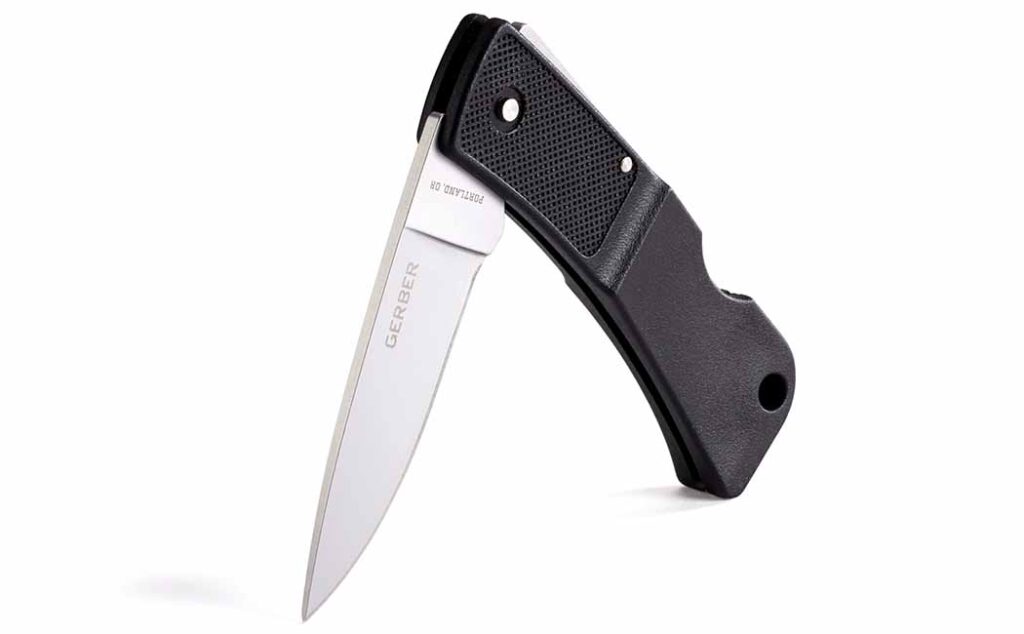
Blackie Collins designed the Gerber L.S.T. (1983), the first knife ever to have a handle of glass-filled nylon.

“Blackie was the kind of guy that would put things together, make some money and move on,” Aiple observed. “He was a great custom knifemaker, but his heart was in designing knives and having someone else make them. He did sell the magazine. I think he had gotten tired. It was taking up too much of his time, and it does take a lot of time to put a magazine together, writing articles, getting advertising, having photos prepared.”

Blackie resigned from The American Blade within months of the magazine’s launch, and an announcement ran in the November-December 1974 issue. The new editor, William L. Cassidy, noted that his predecessor was moving on and commented on Blackie’s important role in establishing a solid foundation and tapping into the knife community so well. “Blackie is, after all, the fellow who began this magazine—who lived with it through triumph and failure alike—and for this we all certainly owe him a debt of gratitude,” Cassidy wrote.

Blackie worked on the first seven issues of The American Blade in 1973-74. He saw his creation grow and prosper, becoming the icon in the knife publishing world that it is today. After half a century, BLADE’s staying power is proven. It still delivers on the desire of its founder to spread the good word about knives, and its message is as enduring as one of Blackie’s great knife designs that so many people have carried and used with pride through the years.

Read More On BLADE Magazine And Show:

Advertisement

Must Read Articles

Read this before you make a knife

Knifemaking 101 – Read This Before You Make a Knife

  by Wayne Goddard My experience has taught me that there's nothing like digging in and getting started. I've often said the hardest part of the...
how to forge damascus steel

How to Forge Damascus

Advertisement
Advertisement