

What To Know To Get The Best Dive Knife

A vital safety tool for underwater adventure, a solid dive knife is a must-have for your dive kit. Here’s what you need to know to get the best one.

Dive knives are specialized edged tool that is made for people who spend time in the water. This seems like a wide definition, but water sports are a huge series of pastimes as well as a profession for millions of people across the world.

Diving, be it scuba or free diving, is inherently dangerous and rife with hazards, including the gear you may have on your person. The dive knife varies in profile and material, but in the end, it is a tool that can be relied on to remove yourself or another from a tangle of floating netting, a strap caught on an underwater branch, or to evacuate a struggling diver from their tank.

The dive knife is more than a rescue tool, though. In the alien environment that exists underwater it is a lifeline to the surface and a last resort in the worst situations.

Dive Knife Construction

In the course of use, most real-world knives are going to get wet, however, but are not meant to stay wet for extended periods. Getting caught in a rainstorm or left outside by the fire are things that happen, but being submerged in saltwater for weeks on end would destroy most knives as well as erode and damage handles and sheaths. Leather is not found on serious dive knives, nor is wood or carbon steel. These materials are simply eaten away by salt water and are also easily damaged in fresh water.
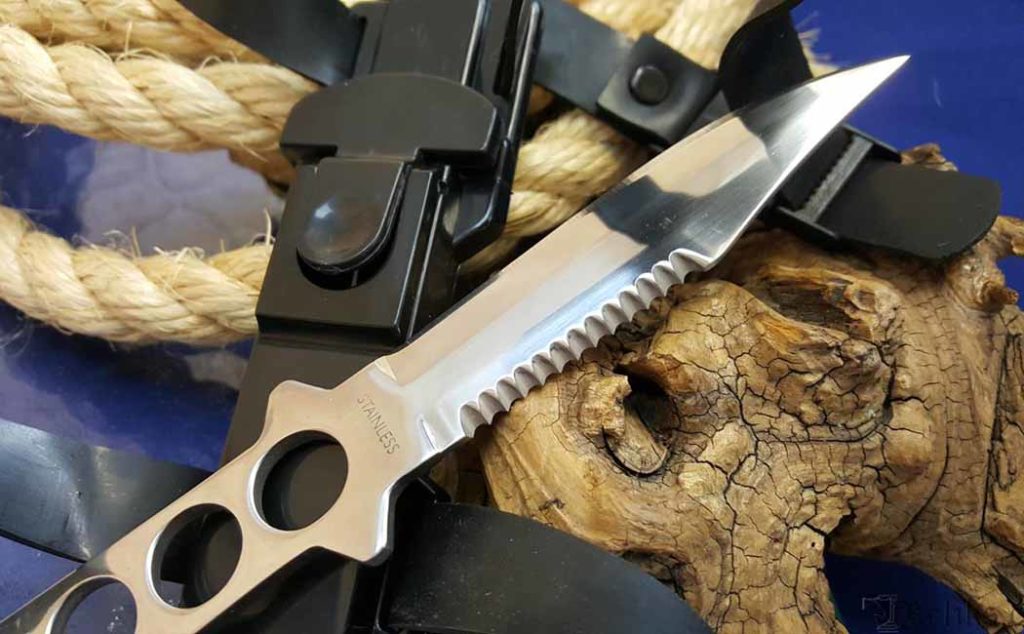
A safety tool, a dive knife is a worthy addition to many adventurer's underwater kit.

Dive knives are typically constructed using corrosion-resistant materials and have handles molded directly to them. The idea is to reduce the number of areas where water can enter, making the knives last longer. Very few materials are absolutely corrosion-proof, but they can be made resistant to the point where they won’t degrade for years or decades, sometimes even the lifetime of the owner.

Dive knives are also less rugged for on-land work. Most of the blades of dive knives are thin, sitting in the .12- to .16-inch range, making them unsuitable for heavy use on wood or for camp work. In the water, you’re likely not going to baton logs, so the thickness of the stock is unimportant except for its ability to cut through materials.

Nylon and plastic are the main prey of dive knives, it is the main material for everything from rope to fishing nets and is the basis of most straps on a diver’s gear. It is not that there is only one used in this sense, rather it is that the vast majority of materials a dive knife needs to cut are man-made and are of a relatively normative quality.

Dive Knife Features

When looking at the must-have features on dive knives, one finds that there is no specific answer.

As noted above, the general concept of a dive knife is to cut through maritime-related cordage. The secondary functions are almost irrelevant to this, self-defense isn’t even a tertiary topic considering that shark attacks are exceedingly rare. Natural obstacles like kelp can hang a diver up, and this is perhaps the only naturally occurring material dive knives are commonly used on.

A Sharp edge is the knife’s the main feature and is simply a must—no questions asked. Serration is very ideal on a whole edge and is truly better for cutting rope or nets over a plain edge. A plain edge is great as well, but for cuts that don’t necessitate a sawing motion. Glass breakers in the pommel, paracord wraps, and other features aren’t necessary and may even get in the way. Simplicity is paramount in a dive knife, you should never have to guess where your edges are when working in poor lighting conditions with limited oxygen.

Dive Knife Designs

Popular profiles vary, usually by tip profile. Some divers prefer a Bowie style with a sharp, aggressive tip. This is nice for fine work, especially on primary knives that may be used for harvesting oysters and other such tasks.
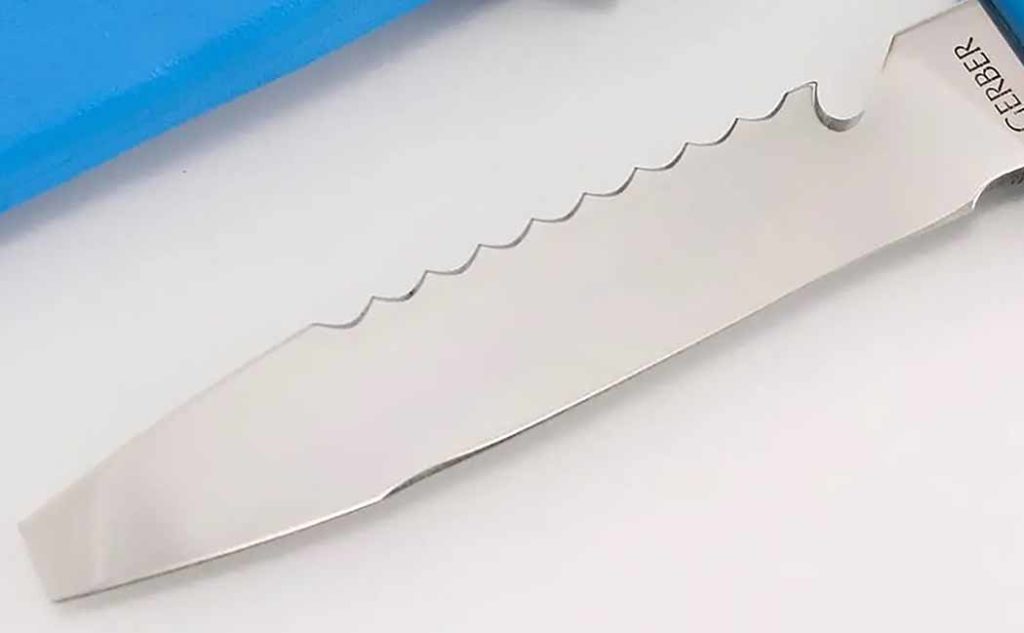
A flat tip can prove a safety feature for some on dive knives.

The other main category is blunted or flat-tip knives. These have a tip similar to pry knives in that they have an abbreviated, square-edged tip. They can also be used for various purposes, but their main advantage is that they can be slipped under straps on a diver’s body safely without risking stabbing or lacerating them. Injuries can still occur, but the serious risk is reduced.

Best Dive Knife Size

There is a general limit to the effectiveness of a knife used underwater. Thrusts and slashes are slowed down by the resistance of the water itself, and you tire much easier than on land. As a result, there is certainly too big of a knife, with the lower limit being around 3 inches, or just enough to get under most straps and tie-downs.

The handle should not be too small, however. Many of these designs have a dagger-like overall profile, though, a good scuba or dive knife should not have a dagger handle. You need to know where the edge is by indexing the handle. As a result, a beefy handle and 3- to 5-inch blade are what you want to look for a dive knife.

Steel Vs Titanium Dive Knives

Titanium is hands-down the better material for use on dive knives from a corrosion perspective. Titanium, however, doesn’t hold an edge as well as steel, but when sharp it cuts maritime materials just as well. Sharpness is a main benefit of steel, though even the best steel can experience corrosion over extended saltwater exposure.
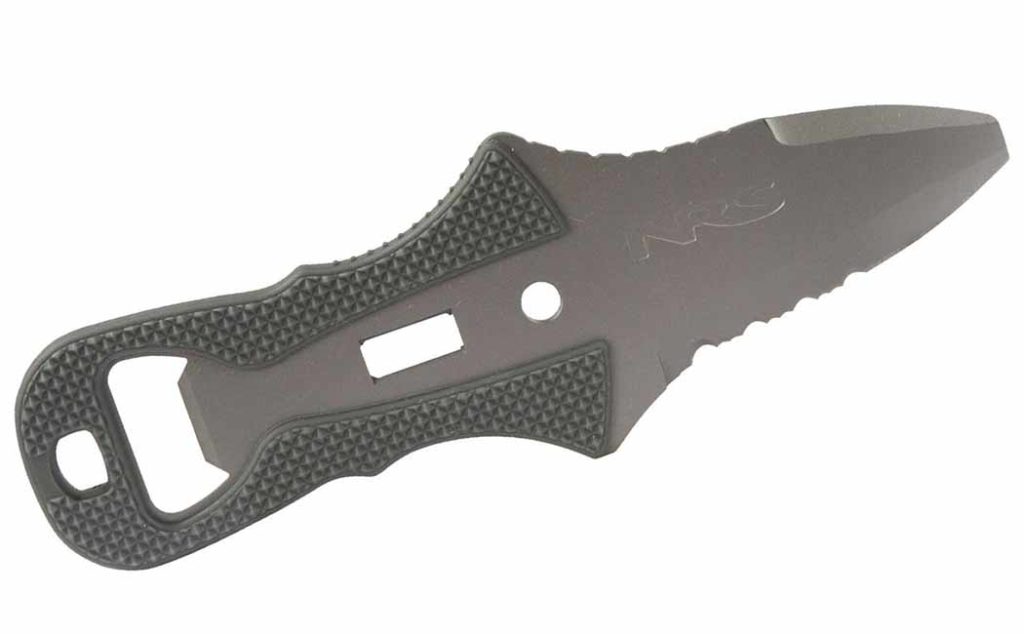
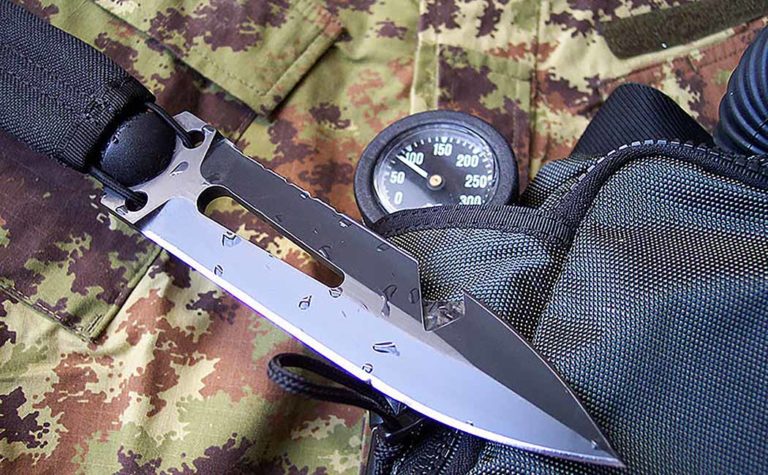
Steel or titanium (such as the one pictured), is an eternal debate over dive knife blade material.

Some divers swear by steel, others by titanium, and this seems to be an ongoing debate. Steel coatings are better and better these days, and some steel knives are available with a titanium coating. Again, the benefits are largely subjective, most users won’t notice a difference with regular maintenance. Like all hobbies, the vast majority of conjecture takes place in the 1-percent of professional or constant participants.

Best Dive Knives At All Price Points

Benchmade H20 Fixed Dive Knife
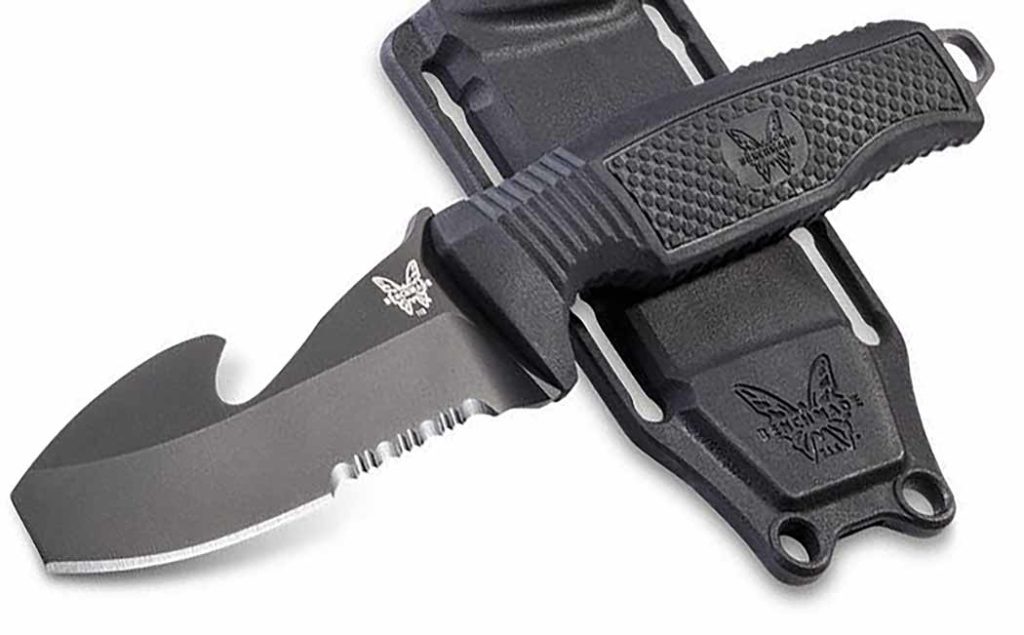
Benchmade H20 Fixed Dive Knife

Benchmade is well known for some incredible and durable products. The H2O fixed dive knife is an example of this.

Designed for military use, the knife carries a national stocking number (NSN) and is exceptionally well laid out for its purpose. Interestingly, this knife has features that are not necessarily in line with what many of the experts say are best.

For starters, it has a relatively simple grip that lacks the excessive texturing found on many other dive knives. The blade is also made of steel, which stands in the face of those that say titanium is a must-have for saltwater exposure. This is not to say that it is the end-all, be-all knife for use in the water.

While the military has picked some good products in the past, it can’t be said that they are correct every time. This knife is a great starting point at a medium price, you get a blunted tip, strap cutter and serration, as well as a generous lanyard loop. The sheath, while relatively basic, can be adapted to many types of carry depending on what you’re doing in the water.

MSRP: $170

Hogue Knives EX-FO2 Dive Knife
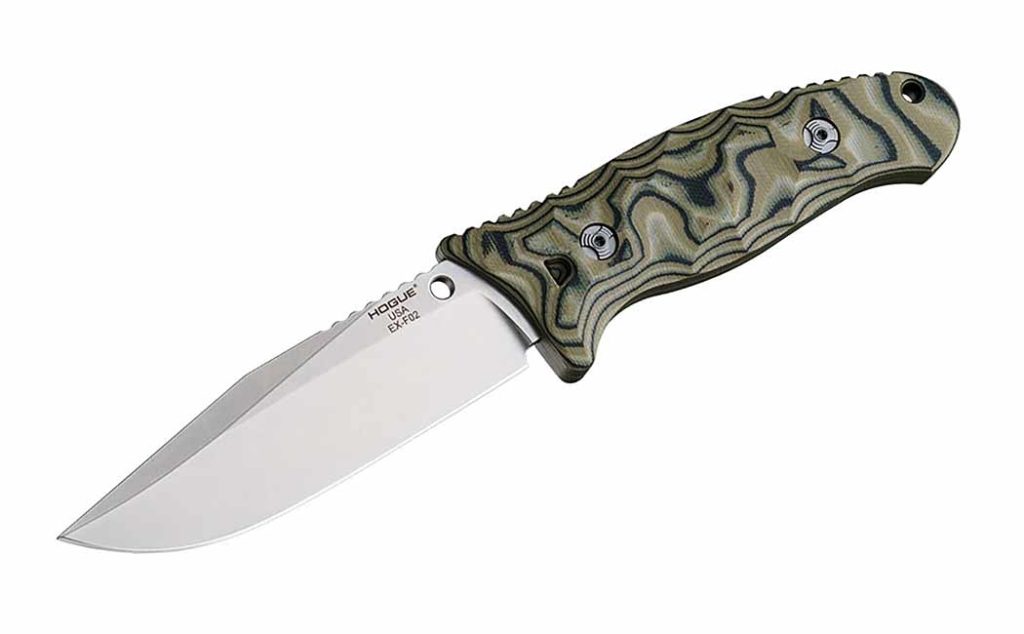
Hogue Knives EX-FO2 Dive Knife

As a general purpose outdoor knife, Hogue has a winner in the EX-FO2. This knife is right in the “perfect size” range for a dive knife, however, it has some features that make it both spot-on and a bit questionable at the same time.

Looking at the positive angle first, this knife is very well laid out and has a nicely shaped handle that has positive reviews for water use. The sheath setup is also excellent, it comes ready for attachment to your arm or leg with a padded backer. This is a knife that has multiple end uses. It is sort of a hybrid of a fishing knife and bushcrafter in that it has a stout blade that can be great for filleting but strong enough for general use.

This knife is available as listed with only a tanto point or clip point. For general use this is fine, however, it can be a liability diving. A completely sharp tip is a negative to some, the risk of puncture or personal injury is potentially much higher as opposed to a blunted point.

MSRP: $159

Fox Knives Tenko Military II Dive Knife
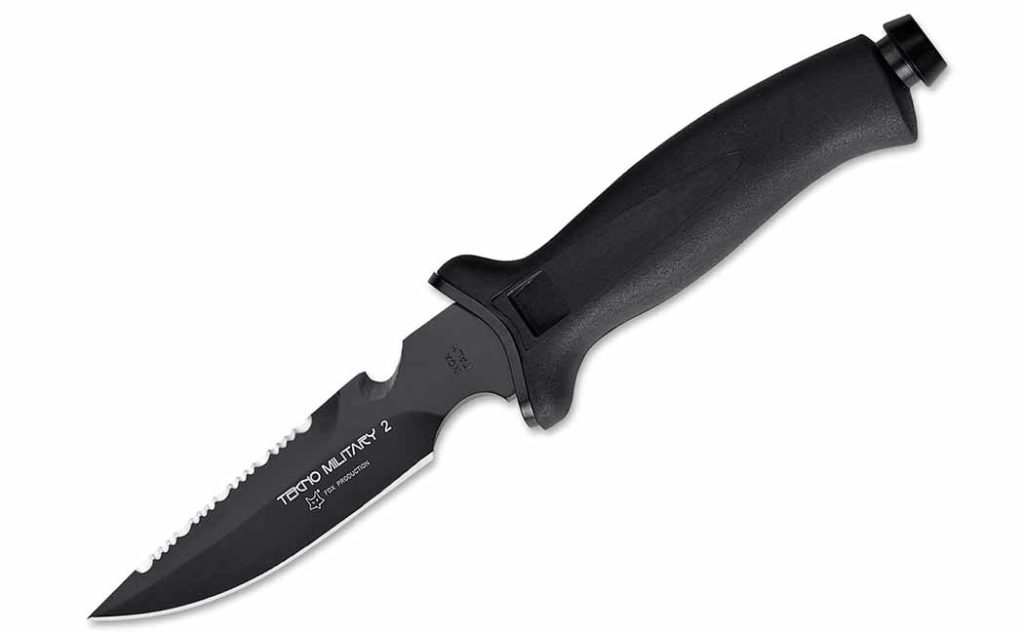
Fox Knives Tenko Military II Dive Knife

Fox Knives is an Italian company that makes high-quality products at reasonable prices. The author has used Fox products for quite some time, and all of them have held up very well.

Their dive knife is feature-rich, almost to a fault. The knife is double-edged, one serrated and the other clean. The rear part of the spine has a cord hook directly behind the separation. Unlike the others on this list, the Fox knife has a full cross guard that allows you to choke up on the blade for high-impact puncturing or slashing. This knife has a very fine tip, and while it is military-themed, this tip is a bit too aggressive for rescue work or freeing even yourself from a tangle. A bonus of this knife is that it has a full rubber handle as opposed to textured plastic.

MSRP: $117

Spyderco Salt Fish Hunter
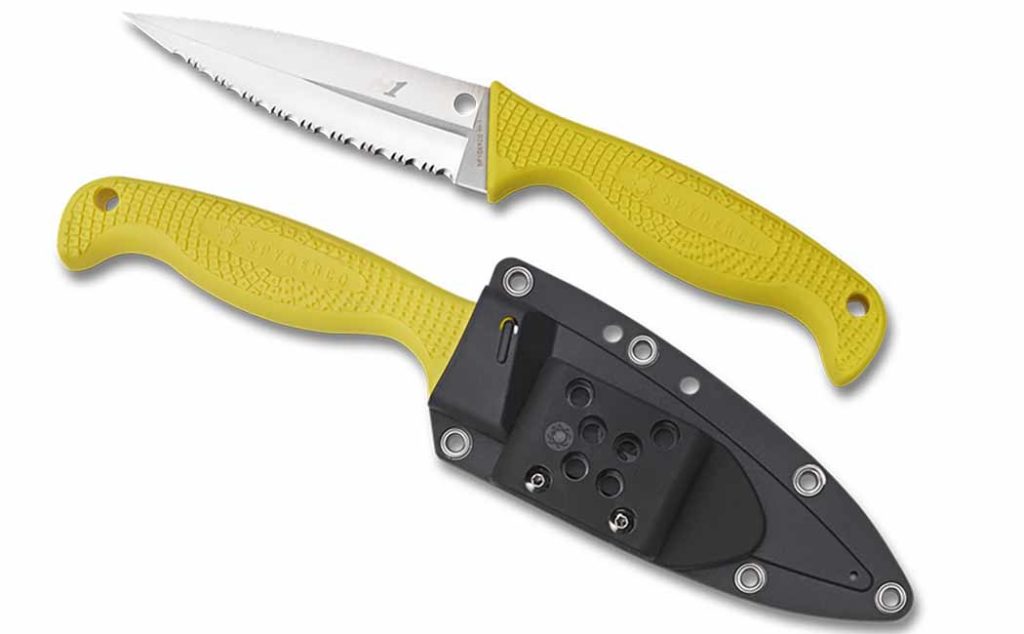
Spyderco Salt Fish Hunter

Unlike the rest of the names on this list, the Fish Hunter is exactly that, a hunting knife. While many of these knives can be used for fishing in general, Spyderco’s product here is expressly made with the intent to be used as a companion for spearfishing and adventurous free divers. This is a specially designed product, and shouldn’t be confused with other dive knives or dedicated scuba knives.

The blade is hollow ground and comes to a very aggressive tip. Serration starts just after the tip and continues to the handle. Many fish are surprisingly thick-skinned and are quite difficult to kill, this knife makes it relatively effortless and the serration allows for quick cuts through even the thickest scales.

While this knife of course can be used to aid in an emergency, it would likely be best to bring a dedicated, blunted rescue tool as well. Spyderco designed their Salt line to fit this bill, and you can find products that are geared towards rescue and escape as well in their lineup.

MSRP: $196

Extrema Ratio Ultramarine
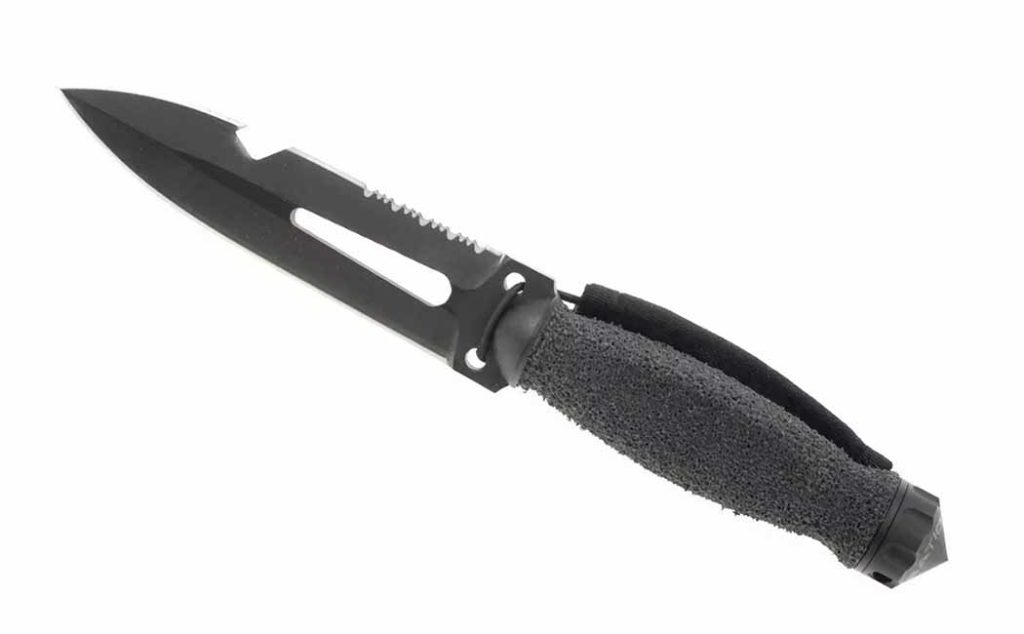
Extrema Ratio Ultramarine

By far the most expensive dive knife on this list, and perhaps the production market, the Italian-made Extrema Ratio Ultramarine is a purpose-built, do-all dive knife. Curiously, for being so costly, it is not made of titanium or another material less subject to corrosion.

Much like the Benchmade H2O, it is a steel knife. The Ultramarine is double-edged, one clean, and one serrated, and it includes a strap cutter and wrapped handle for a very sure grip underwater. The covering is removable. The knife comes with a functional sheath and case.

You may ask yourself just what you get in terms of the extra hundreds of dollars and, well, that is something only you can know. The possibility of losing such an investment in the deep is not something many people want to stomach considering that many dedicated dive knives are less than $100. This is one serious knife for perhaps the most serious users.

MSRP: $792

Aqua Lung Argonaut Blunt-Tip Titanium
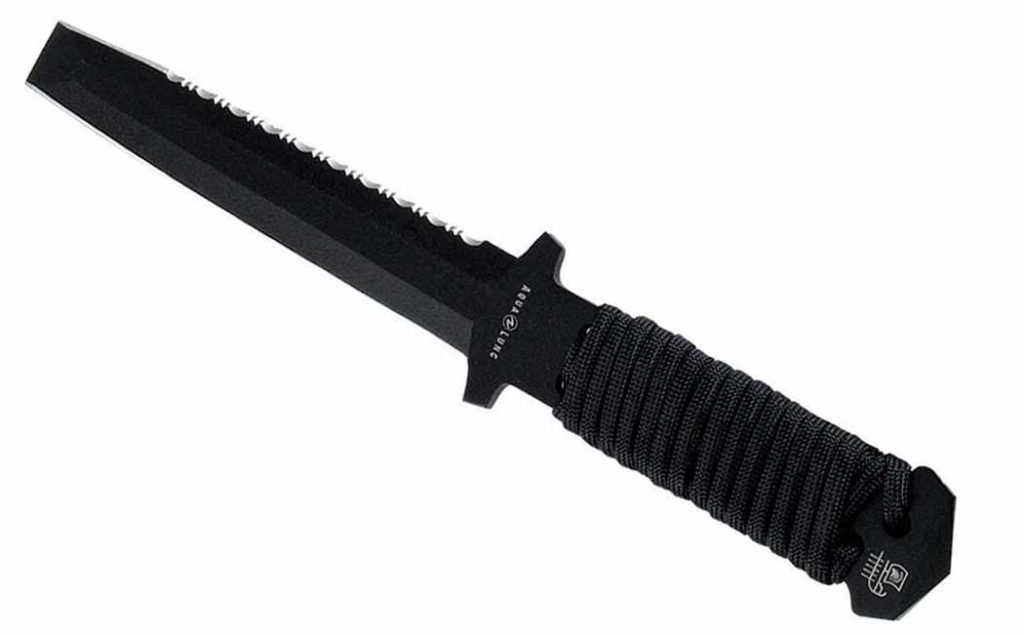
Aqua Lung Argonaut Blunt-Tip Titanium

Aqua Lung has a real winner here with the Argonaut. This knife is available as a blunt tip, as well as what they call a Spartan tip, which has a leaf-shaped, pointed profile. For our purposes, here, the blunt-tip version is the knife that we are going to be looking at.

As a scuba knife, it is perfectly suited for the task. The squared, blunt tip profile allows it to easily get underneath any strap, and, depending on what you need to cut, it has a sharp plain edge and a serrated edge. The knife is made of titanium, which is a choice for many people that spend time in the water. This material is far less vulnerable to corrosion and is also quite light. It is relatively thin for its end use at .15 inch, so prying is not on the menu.

This knife comes with a dedicated leg or arm sheath and is moderately affordable at around $200 retail. The handle is simply wrapped in cord, which somebody finds to be a detriment over a high texture Nylon handle.

MSRP: $195

Promate Snorkel SCUBA Knife Titanium
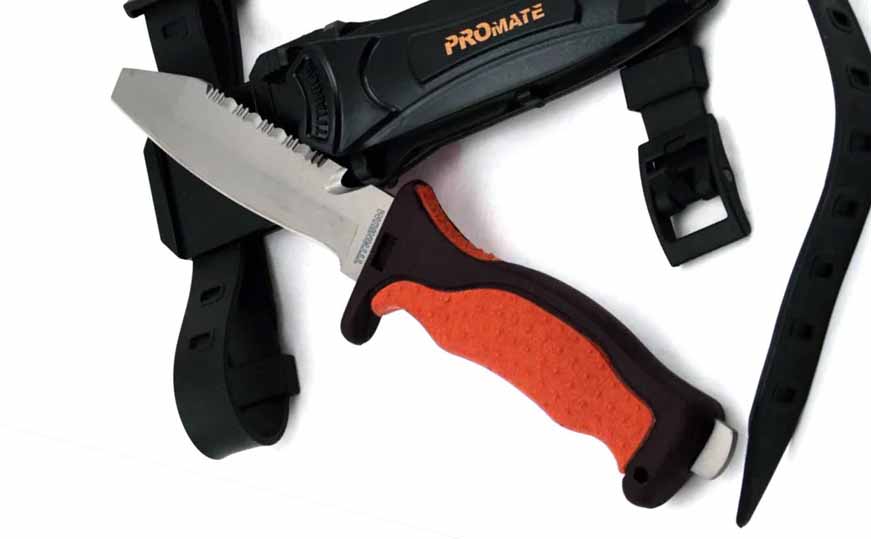
Promate Snorkel SCUBA Knife Titanium

The Snorkel is an affordable, multi-function, titanium knife that is very well thought out. It has a plain main edge and a serrated spine with a cord cutter. While it is substantially less expensive than the others on this list, it boasts very high reviews across the board and is by all accounts the standard, by which all scuba knives are judged. If it does not perform as well as this affordable model, it probably is not going to perform at all.

The Snorkel is available as a blunt tip, as well as a very aggressive Bowie profile. Depending on what you’re going to do with it, the former is more functional for general use, while the latter is going to give you an advantage if you are spearfishing or free diving. Because they are half the price or less than almost everything on this list, you can get one of each and still have cash in hand. These knives are available in different colors to suit your interest and come with a functional sheath setup for use in the water.

MSRP: $75

Check Out More Buyer’s Guides:

Stropping: What It Is And How It’s Accomplished

0

What is the purpose of stropping? Is it the same as sharpening a knife? We’ll answer those questions and more as we explore how to put the finishing touches on a blade.

Forged Knifemaking
This article is an excerpt from Forged: Making A Knife With Traditional Blacksmith Skills available at ShopBlade.com.

Burr is a term used to describe the turned-over edge of a freshly sharpened blade. The burr can be seen as an ultra-thin, wire-like structure at the edge. When sharpening you are bringing one edge surface closer to the other edge surface with alternating and even strokes, left-right-right-left against an abrasive such as a sharpening stone or metal grade sandpaper or strop. By alternating sides you simultaneosly remove surface material from both of the sides forming that burr. Sharpen back-and-forth, one side and then the other, and the burr appears.

What Sharpening Does To A Blade

At first the two opposite sides are divided by the blade’s edge thickness and there is no burr. This is seen as that paper thin shiny line from tip to choil. As one side is brought closer to its opposite side (i.e. sharpened), one side or the other will eventually meet the other and the thin shiny line will disappear.

At that point there isn’t enough mass to support the edge against the hard-abrasive surface, and the super-thin edge rolls/curves over in the opposite direction, forming the burr. The burr can be seen with the unaided eye and felt with your thumb. The objective at this point is to switch and sharpen the edge from the other direction with a yet finer grit abrasive. This maneuver makes an even smaller and thinner burr on the opposite edge. After you sharpen several times like this in opposite directions, with finer and finer grit paper, the burr will be reduced microscopically and be difficult to see or feel but will still be there. This final use of fine grits of abrasive is considered, and is called, a hone.

What Stropping Does

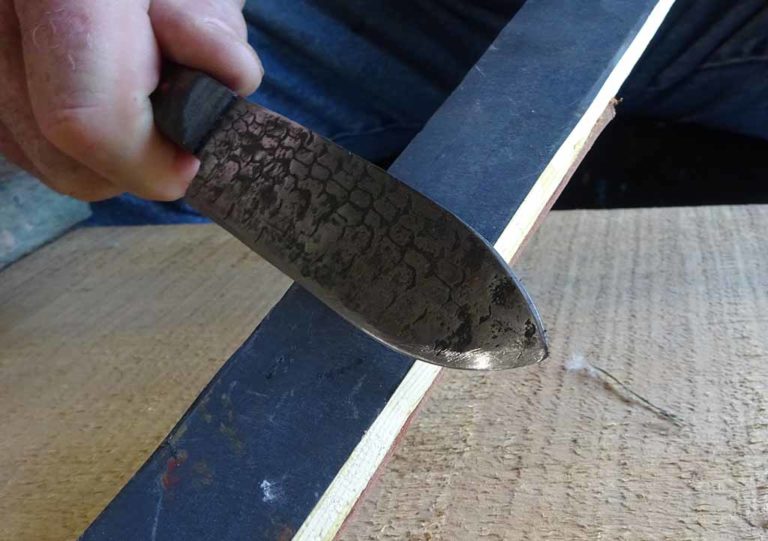
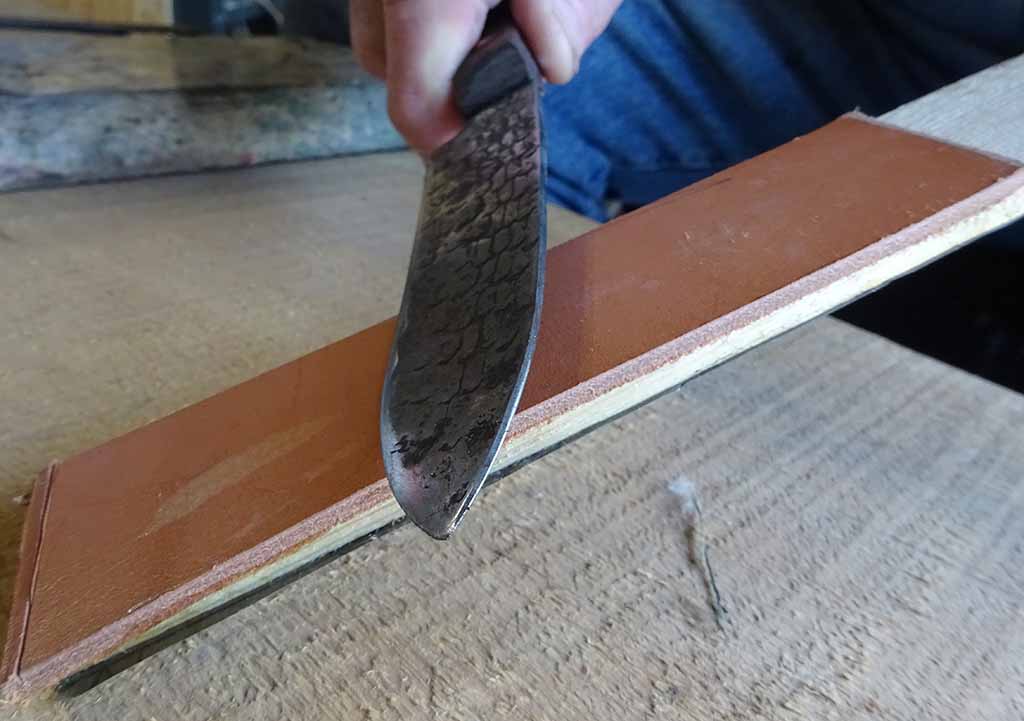
At this point switch from a superfine hone-grit paper (1500 plus grit) to a leather strap, belt, or section of a belt, called a strop. The fine sandpaper hones, and the leather strops. Strop with the same back and forth motion, strop the blade’s edge against the leather. This action bends the now unseen burr back and forth against the leather and the burr finally breaks free. The edge thickness is now just paper thin or less. So “paper thin” doesn’t sound like the edge would bear up during use, being this thin, right on the very pinnacle of the blade’s edge—but it does.

With removal of the burr the edge acquires maximum sharpness and can be re-honed repeatedly without subjecting the blade to recurring sharpening cycles with lower grit sandpaper. This maintains the thin-and-sharp element of your blade.

Choosing A Strop

Make your strop from a strip of leather belt (10-inches long) glued to a bit of yardstick or lath material. Glue a strip of 800-1500 grit wet-n-dry sandpaper to the other side for a hone.

The same exact motion is used on the leather side of the strop stick. When the smith is “into” the motion it is similar to a continuous figure-8 movement. Most of the time the leather is enough to restore the blade’s edge without using the sandpaper side of the stick.

How To Strop

Stropping is a low-angle slap and slide motion. The leather actually sharpens the microstructure of the blade’s edge. It 1) bends the burr back to a sharp edge or 2) bends it back and forth till it breaks, like bending a wire coat hanger back-and-forth, revealing a new raw edge. Visualize a barber in an old-west, cowboy movie slappin’-n-slidin’ his straight razor on a big leather strop. Slap-n-slide your Frontier blade on the 800 to 1500 grit black W/D sandpaper 10 to 15 times then on the leather the same number of swipes. When your edge dulls you can often just strop with the leather, forgoing the hone altogether, in the restoration of a keen cutting edge.

After stropping, if your knife edge isn’t near razor sharp, go back to your wet-n-dry-sharpening action with the higher numbered sandpaper grits (400, 600, 800) then strop again.

Testing The Edge

Feel the edge with your thumb, perpendicular to the edge. Never run your thumb or fingers vertically up or down the blade. It will cut. With time you’ll be able to tell in an instant various level of sharpness with just your thumb. With time you will feel the burr and know the angle of any blade with just a touch of your thumb.

Another sharpness indicator is the use of an old leather belt or scrap of leather. Almost any “sharp” knife can cut a sheet of paper but stiff leather is the true challenge. First, use a knife of known sharpness. Cut a bit from the leather. Note the force needed to peel off a few pieces of leather. Use the same piece of leather on subsequent blade edges you sharpen in the future. By comparison, the quality of those blades’ sharpness can be gauged.

This article is an excerpt from Forged: Making A Knife With Traditional Blacksmith Skills available at ShopBlade.com.

Get More Knife Sharpening Info:

Bachtel’s Bowie With A Pedigreed Background

A study of Michael Price’s work, Nick Bachtel’s reproduction gentleman bowie has the looks to wow.

Bladesmith Nick Bachtel has parlayed his fascination with the knives of 19th-century great Michael Price into a faithful reproduction of a Price-style gentleman’s bowie.

Nick studied every Price knife and other like ones of the genre he could find online and elsewhere to help arrive at the way the 19th-century cutler constructed the gentleman’s bowie. However, it was when he saw a picture of a Price knife in BLADE Magazine Cutlery Hall-Of-Fame® member Bernard Levine’s book, Knifemakers Of Old San Francisco, that “a light went off.”

Nick noticed that the handle had three pins so the knife had to have a full tang, not a hidden tang as he had previously thought, so he forged the knife, heat treated it, fit up the guard and forged the tang wider.

“I call it a captured-guard full tang,” the 24-year-old said of the method that apparently originated among bladesmiths in Ireland, Price’s native country. “It’s such a weird, unique, almost comical way of making a knife—and difficult to do as well,” Nick observed, “but boy, did Price make it!”

Nick Bachtel calls the construction he used to make his reproduction of a Michael Price Gentleman’s Bowie “captured-guard full tang.” For the style to work, it must be forged, Nick stressed. He said another way to do it would be in a frame handle construction and a tapered tang, though a Price aficionado would be able to tell the difference. (SharpByCoop knife images)
Nick Bachtel (inset) calls the construction he used to make his reproduction of a Michael Price Gentleman’s Bowie “captured-guard full tang.” For the style to work, it must be forged, Nick stressed. He said another way to do it would be in a frame handle construction and a tapered tang, though a Price aficionado would be able to tell the difference. (SharpByCoop knife images)

The icing on the cake for Nick was ABS journeyman smith Jordan LaMothe’s story, “How to Make the Price Guard” in the December 2019 BLADE®. As Nick noted, “The Price style is the pinnacle of the traditional forged blade.” What better style is there for a young, up-and-coming bladesmith to explore?

For more information contact N.M. Bachtel Forging Co., attn: Bachtelforgingcompany.com.

Gentleman Bowie Spec Check
Knife name: Michael Price
Style: Gentleman’s Bowie
Maker: Nick Bachtel
Blade length: 5 7/8 inch
Blade material: 52100 carbon steel
Handle: Elk antler and nickel silver
Overall length: 10¾ inch
Sheath: Traditional center-seam vegetable-tanned cowhide w/frog stud
Maker’s List Price For A Similar Knife: $1,100(includes sheath)

More Knife Collecting And Custom Knives

Why The X-Rhea Knife?

1

The X-Rhea Is The Result Of Having A Curious Mind And The Ability To Explore Possibilities.

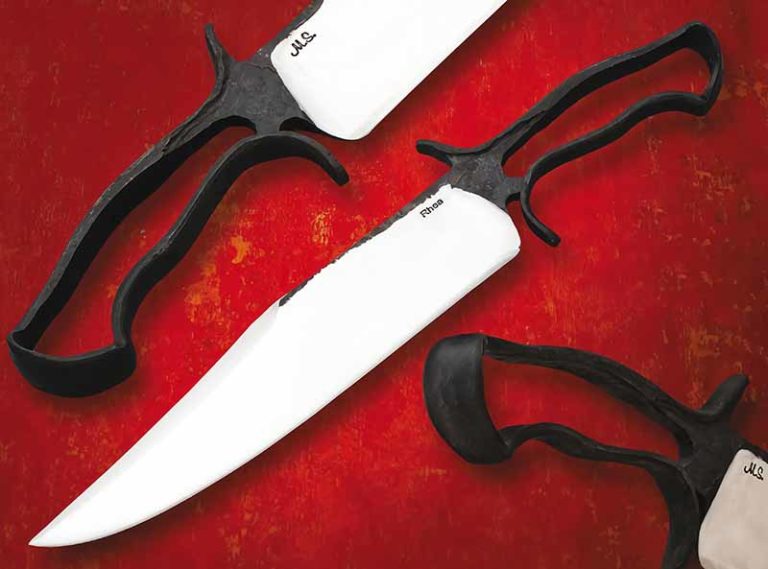
Why did I come up with the X-Rhea knife design? I’ve asked myself this several times and only recently have I been able to supply a reasonable answer. Th e X-Rhea started as a personal challenge. I wanted to make a knife, handle and all, from one piece of steel. Th at’s it: no scales, no added glues, pins, extra space fillers, inlays—nothing. Moreover, I wanted it to look good and be comfortable and as structurally sound as any good knife should be, without being overly heavy.

This challenge nagged at me. If I limited myself to steel and fire as my basic resources, could I forge a knife from one piece of steel, a knife that left no doubt about its viability? Could it look good, feel good and perform well? I also wanted a handle design versatile enough to fit different sizes and types of knives.

“A full tang knife is stronger than a hidden tang knife” is something I’ve heard many times. That statement oversimplifies the matter; which is better? I’ve heard some say, “At least with a full tang, if the scales fall off you still have a knife.” While I don’t agree with either statement, it indicates in some people’s minds a full tang blade alone qualifies as “a knife,” even without scales. And what qualifies as a knife, as well as what part strength plays, might differ from person to person.

In my visits with renowned historic blacksmith Peter Ross, my eyes were opened to the multi-dimensional vision the historic blacksmith needed in order to execute the complex forgings of everyday objects of the colonial era. The ability to understand how something is shaped, combined with the hand skills to actually shape it, are two separate things. The combination of those two qualities in one individual is rare. Peter showed me how to change the way I think about shaping steel. My mind raced with possibilities every time I worked with him. He taught me how to take a project from concept to reality.

Just as steel is shaped by the blows of a hammer, my thoughts were shaped to the challenge at hand. I felt I was in a unique set of circumstances that directed me to mix my forging with the mostly forgot ten techniques of historic blacksmithing. My years of training helped provide some ability to execute my ideas and theories. Theories? OK, it’s my “theory” that about 90 percent of tactile, meaningful contact between the hand and a knife handle is concentrated on the top and the bottom. Think pliers, wrenches, etc. The mind seems to understand the vacancy of the remaining areas between the top and bottom. Also, the hand “soaks up” and “fills in” to meet these vacancies to a degree. If I could add contouring and sculpting to the essential top and bottom, could the hand and mind fill in the rest? Can a knife with no scales be an option?

The Answer To X-Rhea

Finding the answer took significant effort and a lot of time. I worked out a forging sequence for my X-Rhea hunting knives that satisfied me, but I kept thinking it would be great to forge a bowie with top and bottom lugs. It took years to work out the stages of the process. While the accompanying photographs attest to my relative success, it leaves a lot unsaid about the adjustments I had to make in my thinking. I used the blacksmithing principle of eliminating things that hinder the process, and re-emphasizing and adjusting things that assist it. I also considered efficiency in timing, appropriate temperature, or other techniques** that are most practical.

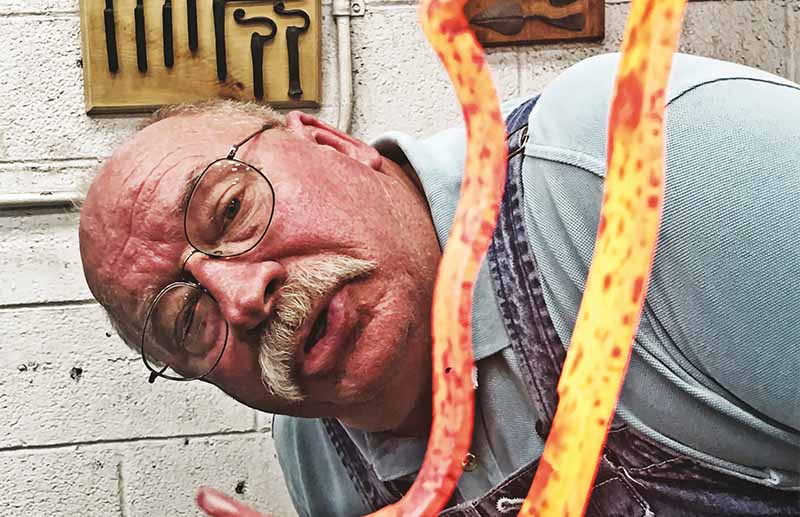
The author up close and personal with an X-Rhea Knife forged red hot.

While modern tooling could speed up some of the steps in my process, modern thinking and modern expectations would not. Aft er all, this process was being developed around the early 19th-century blacksmith tools: a coal forge, blacksmith leg vise, and the use of handheld hammers. This uncluttered my thinking and required me to face the same challenges as the early blacksmith. Elevating one’s skills with basic tools, improving understanding of the materials, and bearing full responsibility for the outcome was my expectation. While this might seem restrictive and limiting, the improved skill level and the readjusting of my views had a freeing effect. I am not as dependent on modern tools, which enables me to be more creative. The willingness to adjust one’s thinking was, and remains, an invaluable aid to the blacksmith.

Material Limits

When forging a complex shape, a smith must consider the limitations of the material, sometimes working near its limits but never exceeding them. Wisdom calls for choosing material suited for the extreme changes of geometry in the knife. Steels that are prone to air hardening must have special consideration or be avoided. Like some historic objects, the X-Rhea Knife is forged from one piece of steel, in this case, entirely high carbon steel. Those qualities and characteristics must be allowed for and considered.

Making an X-Rhea is a multi-step process. It must be pre-formed, with all needed parts and adjustments made before final shaping and peening the handle. Recognizing and maintaining a high standard of precision in the pre-form details is absolutely necessary to a satisfactory final result.

Even after I successfully made one of these knives, I found that part of the challenge was yet to come—acceptance. I showed up at a cutting competition with one of my X-Rhea bowies and sure got some stares. The safety judges looked it over as if it were a new species of animal. “Is it strong? Will it hurt your hand?” they asked. As I recall I placed well in the competition using it, but the initial reaction was still mixed.

Will it hurt your hand? I previously mentioned the handle contouring and sculpting. This is a standard part of the forging and filing process, as it is with any knife handle. Depending on the maker’s forging skill, it may require some filing in-between forging steps. Each step has some amount of adjustability to allow for correction, while leading to a beautiful profile and comfortable grip. It can be surprising to those who handle the knife just how good it feels, considering the remarkable difference in construction and the “open” appearance.

X-Rhea Strength

Is it strong? This is where the application of common blacksmith tool-making skills and logic are applied. Sufficiency was the guide for an early blacksmith. Making a piece overly strong for its intended use might sound impressive, but in use it becomes clear that this strength adds unneeded and undesirable weight for the intended use, and does not account for other desirable characteristics such as flex and toughness. I view heavy,
unwieldy blades generally as a mark of a novice. Unless the intended purpose calls for excessive strength, sufficiency should also, be the guide not only for blades but for knives overall.

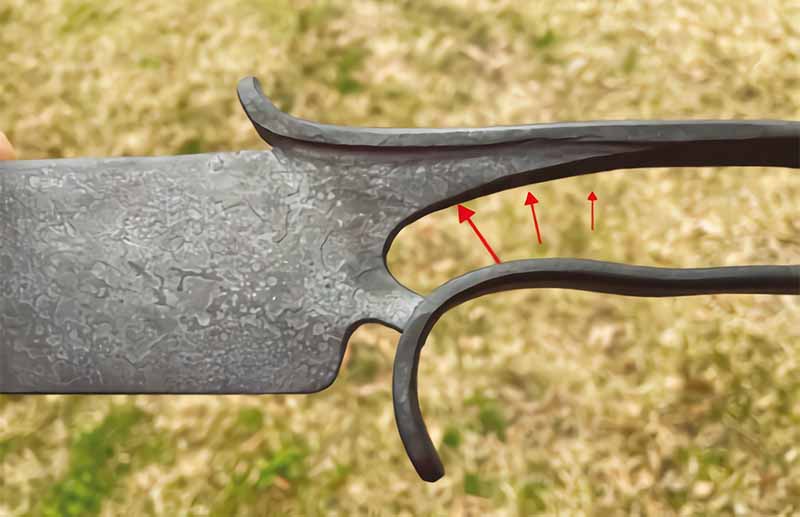
For those inclined to overthink a matter, look at the “T” cross section of the blade-to-handle transition. It eff ectively converts the stress loads in the needed directions.

Today when I see a thickly built knife, instead of looking at it and saying to myself “This thing sure is strong!” I ask, “Why does it need to be so heavy?” For the X-Rhea handle, I try to use sufficiency as my guide. Where it can structurally be lightened, I do that by forging and filing, leaving it sufficiently strong but not overly heavy. This distribution of strength serves to provide literal balance to the knife exactly as any conventional knife, regardless of construction. Either should have balance when properly built to a purpose and have sufficient strength to perform its purpose. That fact, while amazing to me at first, is testimony to the principle of sufficiency. In other words, the X-Rhea should compare well in balance and weight as well as function to any well-made conventional knife for the same application.

For those inclined to overthink a matter, look at the “T” cross-section of the blade-to-handle transition. It effectively converts the stress loads in the needed directions. Viewed from the profile, the slight rotation of the ricasso as an “X” instead of a vertical “cross” assists in adding strength with less material (weight) to the connection. The upper leg of the ricasso’s “X” tapers back to brace the upper part of the handle, which bears the majority of the workload. The handle then tapers in thickness slightly as it goes back to the forged integral pommel and proceeds to the handle tenon where it is peened. To further lighten the knife, the handle band is sculpted gently to taste. Taste? I try not to get so engrossed in the math and mechanics that I lose the necessity of making the knife look good. Like a scroll forged by a blacksmith, the application of math and mechanics are the basis for all aspects of proportion and form. To keep it simple, I want to make it graceful, not blocky, getting the absolute most out of a minimum of material volume.


The X-Rhea Process

In my situation, I set a challenge for myself and it led to the X-Rhea. For me, the process is as important as the knife itself. I made a lot of individual knives, some better than others, but what I was actually concentrating on was developing a forging process, so the one-piece forged knives could be repeated via a repeatable process with predetermined features, checkpoints and adjustability built-in along the way. To emphasize adjustability, whether by forging, grinding or filing, is key. It enables the smith to reach predetermined checkpoints before proceeding with the rest of the process. When following a well-designed process, the outcome will be consistent and meet a standard as would the product of a well-designed and adjusted machine.

While we are far from machines that guarantee specific outcomes, diligent attention to the execution of each heated and hammered step and making needed adjustments, when appropriate, will carry the project along. As aptly pointed out in David Pye’s book, The Nature and Art of Workmanship, “The quality of the result is continually at risk during the process.” Overcoming the risk by careful determination, as well as time spent in practice, is its own challenge and entirely rests upon the craftsperson.

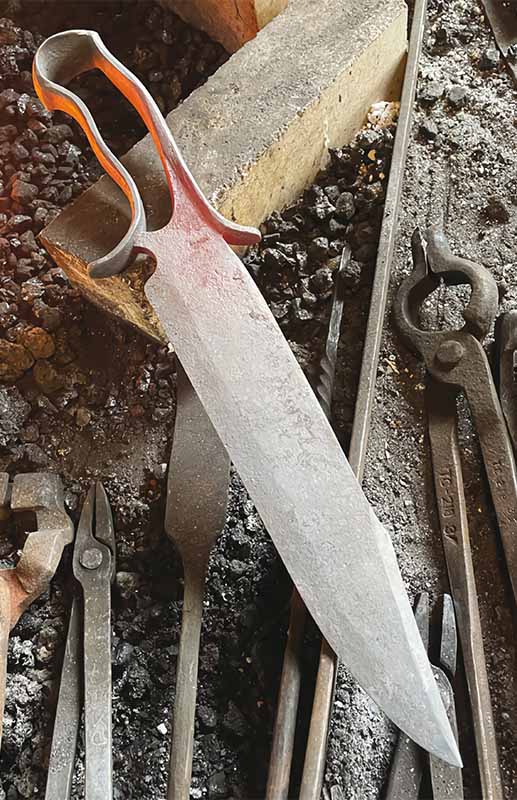
Like some historic objects, the X-Rhea Knife is forged from one piece of steel, in this case, entirely high carbon steel.

I believe it is noble to preserve cultural objects, and it’s also my belief that preserving the processes used to make those objects is equally important. The hand of the individual craftspeople, following already established processes, can be seen in the objects of the past. A society or culture can lose appreciation for the craftsman’s touch. Pye stated, “The danger is not that the workmanship of risk will die out altogether but rather that, from want of theory, and thence lack of standards, its possibilities will be neglected and inferior forms of it will be taken for granted and accepted.” It would be a shame to neglect the possibilities or take for granted why we craft things the way we do.

I also believe there is room remaining to explore new designs and theories in today’s knifemaking. We can find new ideas and inspiration from places we don’t expect. With the ever-changing laws and shortages of materials such as stag and ivory, we may be wise to consider creating a market based on a process we develop using otherwise unexpected, but available, materials and techniques. This requires time and risk. Are we willing to apply time and effort to follow through with a concept without certainty that there will be a payoff? Is the payoff worth it in monetary or cultural dividends? One can really never know the answers to such questions, and those possibilities were not a serious factor in my efforts.

The X-Rhea is the result of having a curious mind and the ability to explore possibilities. It was an idea, turned into a challenge, turned into reality. The simple sequence is available to everyone. Its cultural value is a matter of opinion, but the process of the X-Rhea Knife shows that new and interesting ideas can be pursued in knifemaking.

Also Read:

Shaving Sharp

Thanks To The Internet, Straight Razors Are Back In Style. These Trio Of Blades Can Keep You Looking Sharp And Feeling Smooth.

Mastering shaving with a sho-nuff handheld straight razor is a lost art that has recently become more popular thanks to social media shaving gurus and those who like a good challenge. 

Straight razors never went away, the internet just has a knack for making old things new and cool again. Let’s look at a trio of current offerings and shave them through their paces.

Boker King Cutter

Boker King Cutter

Boker has been producing straight razors since 1869 and the company offers many models today. The King Cutter, the company’s most popular razor, features a carbon steel blade with a deep hollow grind. The handle is a black polymer with a brass Boker Tree Brand logo escutcheon. The King Cutter was the lightest of the three review pieces, tipping the scales at a svelte 1.47 ounces. It features a monkey tail tang for quick blade access.

Being the most expensive of the test lot by a long shot and from a company that has been making straight razors for over 150 years, you’d expect the King Cutter to perform well. Simply put, it did. The blade was, ahem, razor-sharp right out of the box and glided through my two-day stubble clean as a whistle. I never had to back up and go over an area to get it smoother.

 The thinnest of the review blades, it got into tight spots a bit easier. However, a word of warning is in order. An extremely sharp blade like this will cut you faster, too, so take your time! The King Cutter’s high price tag may scare some away, though there are other straight razors out there that cost much more.

MSRP: $189.95

Rough Ryder Cinnamon Bone Stag Razor

Rough Ryder Cinnamon Bone Stag Razor

Rough Ryder’s Cinnamon Bone Stag Razor has all the trappings at a budget price, including the good looks of a traditional straight razor. The cinnamon bone stag handle, replete with an acorn escutcheon, is downright handsome—and Rough Ryder does bone stag well. 

The cutting portion of the blade has a light yet distinctive damascus pattern running across its face, and a barber’s notch at the point aids in safely opening and deploying the blade. A monkey tail tang completes the package.

Right out of the box, the Rough Ryder entry shaved the stubble straight from my face. The blade was plenty sharp and I was able to get into tight spots with good results. When you get down to the nitty-gritty, there are differences between this razor and an expensive one like the Boker.

There is a tad more drag on the blade and I had to back up a few times to get the area I was shaving totally smooth. To be honest, I expect this from a razor at this price point, and you should, too. That said, the Rough Ryder Cinnamon Bone got the job done and was no slouch. I recommend this razor to those who want to get their feet wet before taking the plunge on a high-dollar cutter. And, by golly, it was the most attractive of the bunch!

MSRP: $29.99

TOPS Knives Tac-Raze 2

TOPS Knives Tac-Raze 2

The TOPS Knives Tac-Raze 2 is designed as an EDC and not billed as a straight razor. Nonetheless, we threw it into the fray to see if we could shave with it, letting the chips fall where they may. 

A full 2.625 inches of the blunt-tipped blade has a slightly bowed edge. There’s a rat-tail tang reminiscent of the old friction folders, though not forged. The Tac-Raze 2 has a deep choil below the blade edge that splits time with the handle. TOPS includes a dark brown leather slip and a small bottle of protectant.

Would an EDC with a razor-style blade shave? Given how many YouTube videos there are of guys shaving with everything from bowies to kitchen fare, I figured why the heck not? A cursory check right out of the box with the blade warmed up and a light coat of shaving cream on a cheek gave me surprising results. Not only did the Tac-Raze 2 shave my stubbled skin with ease, it was darn smooth! Next, I cleaned the blade up and stropped it, and the shave was as smooth as I could get with a standard straight razor.

As I worked around my face I found some gremlins with the TOPS EDC. The handle is not nearly as nimble as a standard straight razor, which is to be expected since it’s not a standard straight razor. I found getting into tight areas like the crack between my upper lip and cheek particularly dicey. Bottom line? What you lose in dexterity with the Tac-Raze 2 you gain in versatility since, after all, this is an EDC knife with all the benefits—and it comes with a slick leather slip.

MSRP: $139

Scoring The Straight Razors

All three in our razor trio had their strengths and weaknesses, but all got the job done. The Boker King Cutter is the pro razor of the bunch. The Rough Ryder Cinnamon Bone is a nice entry-level shaver, and the TOPS Tac-Raze 2 is certainly the most versatile.

One final note: don’t be afraid to try a straight razor. As a knife enthusiast, chances are you’ve already developed a healthy respect for sharp blades. Wade in slowly and carefully—once you get a feel for the straight razor, it will feel right at home in your hand.  Happy shaving!

Read More

Knife Photos: 6 Fetching Custom Hunters

hl holbrook custom knives

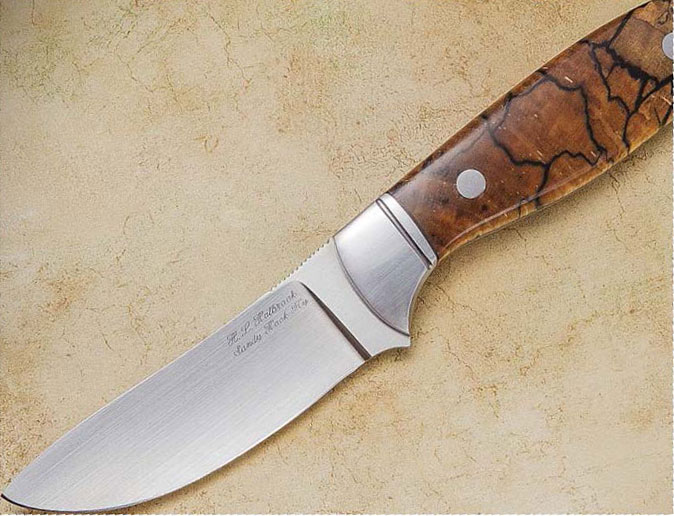
The gentle rise of the tip area of the blade is the classic sign of a skinner—or in this instance, the Semi Skinner #2 by H.L. Holbrook. The 3.5-inch blade is CPM 154 stainless and the handle is stabilized maple. Overall length: 8 inches. Contact H.L. Holbrook, Dept. BL3, POB 483, Sandy Hook, KY 41171 606-794-1497. (Chuck Ward image)


custom hunting knife

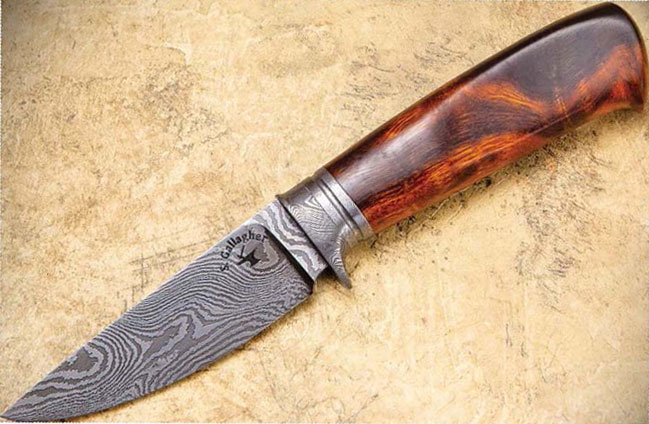
Scott Gallagher employs a 3-inch damascus blade, a damascus single guard and a handle of Arizona ironwood for his hunter. Overall length: 6.5 inches. Contact Scott Gallagher, Dept. BL3, 335 Winsten Manor Rd., Santa Rosa Beach, FL 32459 850-865-8264. (Chuck Ward image)


custom hunting knife pictures

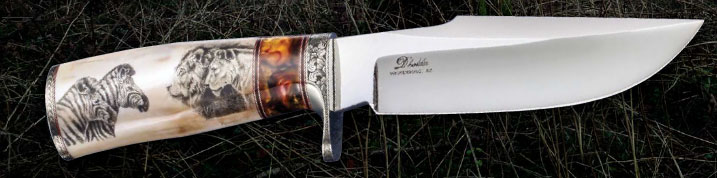
BLADE Magazine Cutlery Hall-Of-Fame© member D’ Holder outfits his Big Dog fixed hunter in a 5.5-inch blade of 154 CPMV stainless, an ancient walrus ivory handle with scrimshaw by Stan Hawkins, and an engraved buttcap and guard by Bruce Shaw. Contact D’Holder, Dept. BL3, 226 West Blue Wash Rd., New River, AZ 85087 623-742-7399 [email protected] (SharpByCoop image)


ben breda custom knives

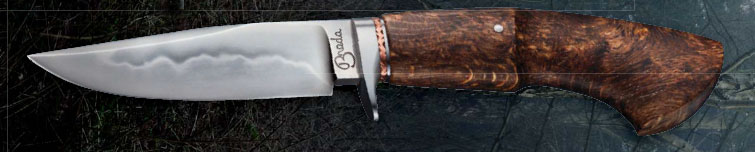
A 4-inch clip-point blade of W2 tool steel with hamon and a spalted sycamore handle and fileworked copper spacer distinguish Ben Breda’s hunter. Overall length: 9 inches. Contact Ben Breda, Dept. BL3, 56 Blueberry Hill Rd., Hope, ME 04847 [email protected]. (Caleb Royer image)


eli jensen custom knives

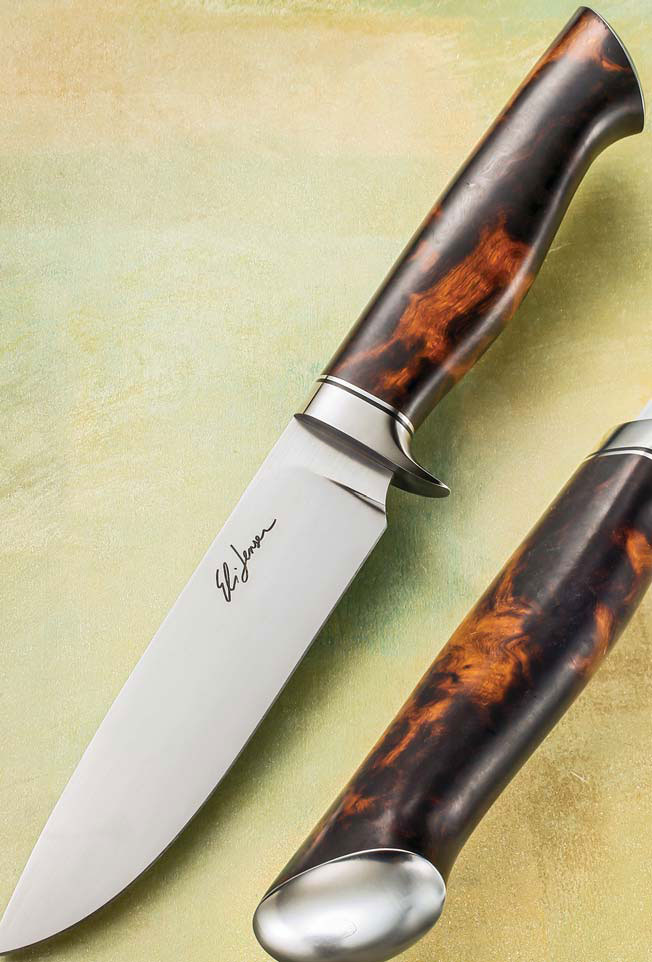
A gorgeous Arizona ironwood handle with a domed/curved 416 stainless steel butt plate and G-10 spacer, and a 5.75-inch blade of 1084 carbon steel help complete Eli Jensen’s Forester MKII hunting knife. Overall length: 10.75 inches. Contact Eli Jensen, Dept. BL3, 2840 W. Dreamscape Way, Chino Valley, AZ 86323 928-606-0373 [email protected], Facebook/Instagram: Eli Jensen. (Sharp-ByCoop image)


kenneth lange custom knives

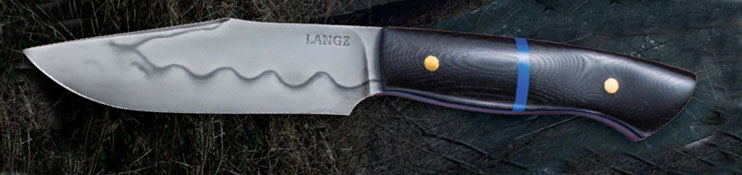
Kenneth Lange received an order for this hunter by a family friend whose husband is celebrating 10 years on the police force—thus the thin blue line on the black G-10 handle. The 4.5-inch blade is 1095 carbon steel. Overall length: 9 inches. Contact Kenneth Lange, Dept. BL3, 1200 County Road 5711, LaCoste, TX 78039 210-218-9415 [email protected], Facebook/Instagram: kjl_handmadegoods KJLhandmadegoods. (SharpByCoop image)

10 New Knives for Collections and Everyday Carry

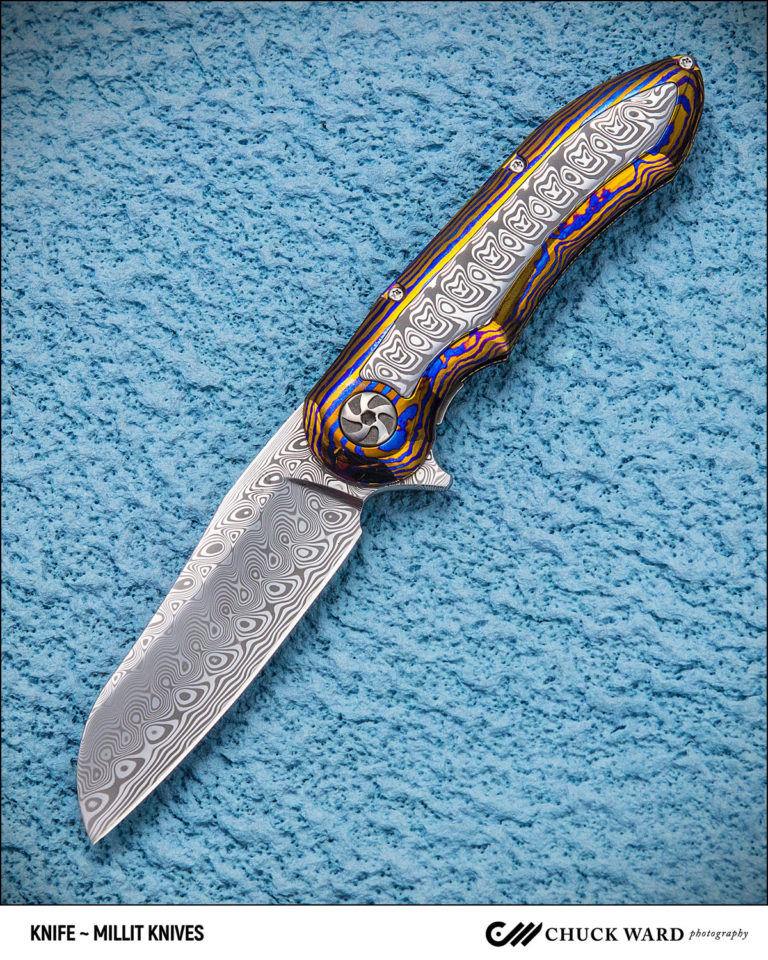
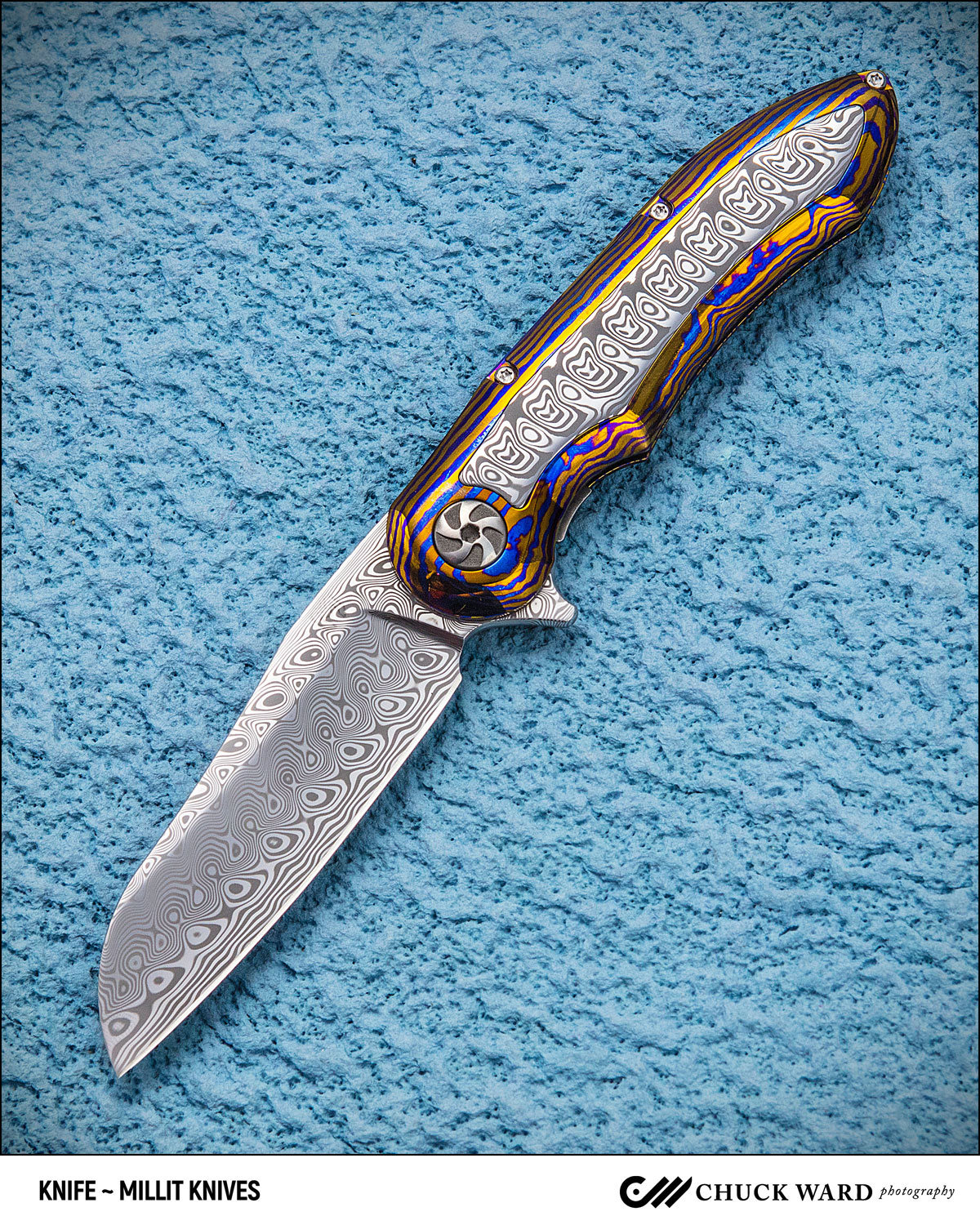
Millit Knives Max Evolution

max evolution custom knife

  • KNIFE MODEL: Max Evolution
  • BLADE LENGTH: 3.8”
  • BLADE MATERIAL: Damasteel pattern weld
  • HANDLE MATERIAL: Timascus™ w/Damasteel pattern-welded inlays
  • FITTINGS: Titanium
  • APPROXIMATE CLOSED LENGTH: 5”
  • MAKER: Millit Knives, Dept. BL3, 1380 E. Commercial Dr. 103, Meridian, ID 83654 208-907-0096 

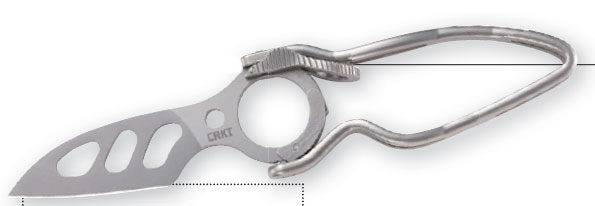
CRKT Daktyl

columbia river knife and tool daktyl

  • KNIFE MODEL: Daktyl
  • BLADE LENGTH: 3.05”
  • BLADE STEEL: 420J2 stainless
  • HANDLE MATERIAL: Stainless steel
  • ACTION: Opens w/180° swing motion
  • LOCK: Slide Lock
  • CLOSED LENGTH: 4.4”
  • MSRP: $59.99
  • COMPANY: CRKT, attn: L. Phelps, Dept. BL3, 18348 SW 126th Place, Tualatin, OR 97062 503.685.5015 www.crkt.com

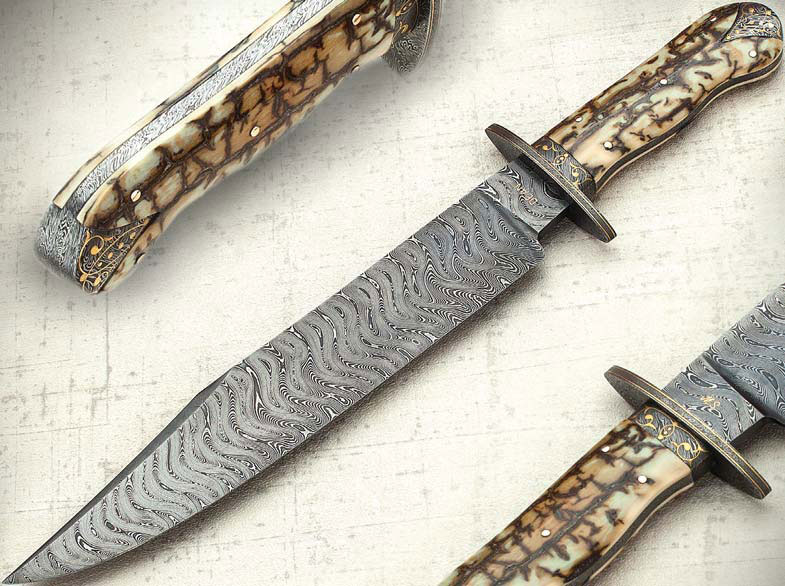
Harvey Dean Bowie

harvey dean knifemaker

  • KNIFE MODEL: Bowie
  • BLADE LENGTH: 11”
  • BLADE STEEL: Damascus
  • FITTINGS: Damascus
  • HANDLE MATERIAL: Mammoth ivory
  • ENGRAVING: By maker
  • OVERALL LENGTH: 16”
  • MAKER: Harvey Dean, Dept. BL3, 3266 CR 232, Rockdale, TX 76567 512-429-0009 harveydean.com (Chuck Ward image)

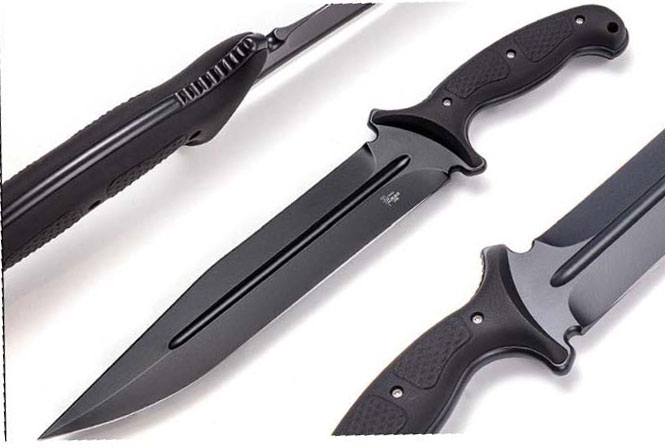
Todd Begg Silverback

todd begg knifemaker

  • KNIFE MODEL: Silverback
  • BLADE FINISH: Cerakote®
  • HANDLE MATERIAL: G-10
  • OVERALL LENGTH: 15 5/8”
  • MAKER: Todd Begg, Dept. BL3, 1341 N. McDowell Blvd., Ste. D, Petaluma, CA 94954 707-242-1790 http://beggknives.net (Chuck Ward image)

Jake Hoback Knives & PVK Tradecraft Collaboration

hoback knives

  • KNIFE MODEL: Tradecraft collaboration
  • KNIFE TYPE: Automatic
  • BLADE LENGTH: 3.25”
  • BLADE MATERIAL: CTS-XHP stainless steel
  • HANDLE FRAME: Grade 5 titanium; pivot thrust bearings
  • CARRY OPTION: Tip up, right-/ left-handed
  • WEIGHT: 5 ozs.
  • CLOSED LENGTH: 4.375”
  • MAKER: Jake Hoback Knives & PVK, 888-878-5643 2015 @pvk.com, pvk.vegas

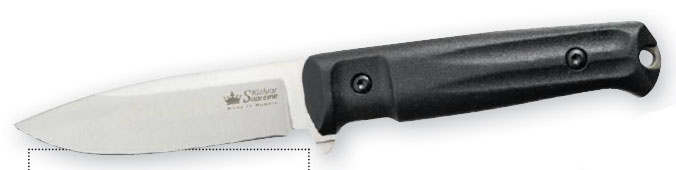
CAS Iberia Sturm HD Outdoor Knife

cas iberia sturm knife

  • KNIFE MODEL: Sturm HD Outdoor Knife
  • BLADE LENGTH: 4.25”
  • BLADE STEEL: CPM 4V powder metal tool steel
  • HANDLE MATERIAL: ABS/Kraton
  • WEIGHT: 8 ozs.
  • OVERALL LENGTH: 9.25”
  • MSRP: $230
  • COMPANY: Kizlyar, c/o CAS Iberia, attn: B. Pogue, Dept. BL3, 650 Industrial Blvd., Sale Creek, TN 37373 423.332.4700 www.casiberia.com

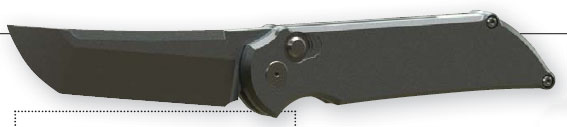
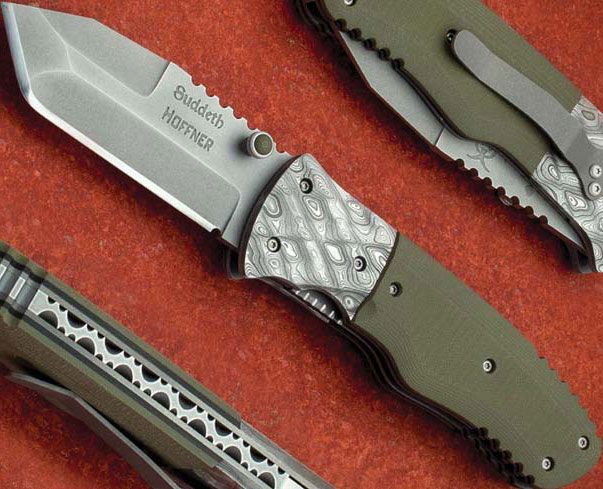
Matt Suddeth Bio Hazard Folder

matt suddeth custom knife

  • KNIFE MODEL: Bio Hazard Folder
  • BLADE LENGTH: 3.5”
  • BLADE MATERIAL: D2 tool steel
  • HANDLE MATERIAL: OD green G-10, gator skin
  • FITTINGS: Stainless steel
  • MAKER: Matt Suddeth, 281-433-1085 Facebook: facebook.com/matt.suddeth (Chuck Ward image)

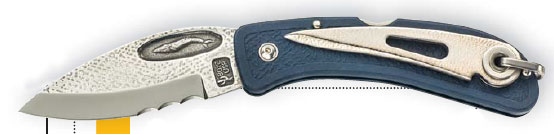
Boye Knives Blue Whale Folder

boye knives

  • KNIFE MODEL: Blue Whale Folder
  • BLADE LENGTH: 3”
  • BLADE MATERIAL: Boye Dendritic Cobalt w/internal bonded carbide crystals
  • HANDLE: Zytel, titanium marlinespike/multi-tool and clip
  • WEIGHT: 2.5 ozs.
  • CLOSED LENGTH: 4”
  • MAKER: Boye Knives, Dept. BL3, POB 1238, Dolan Springs, AZ 86441-1238
  • [email protected], Facebook/Instagram: www.facebook.com/boyeboatknives (SharpByCoop image)

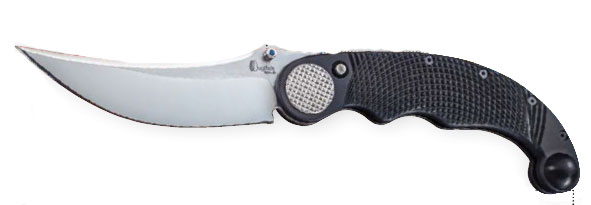
Dan Dugdale Scimitar

dan dugdale scimitar folder

  • KNIFE MODEL: Scimitar
  • KNIFE PATTERN: Tactical folder
  • BLADE LENGTH: 4.375”
  • BLADE MATERIAL: D2 tool steel
  • HANDLE: 6061 T6 aluminum
  • LOCK: Button lock, textured bearing pivot
  • APPROXIMATE CLOSED LENGTH: 5.625”
  • MAKER: Dan Dugdale, Dept. BL3, 11 Eleanor Rd., Walpole, MA 02081 508-404-6509 [email protected], Facebook/Instagram: dugdaleknives

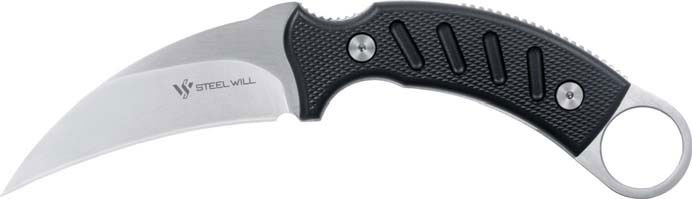
Steel Will 1360 Karambit

karambit folder

  • KNIFE MODEL: 1360 Karambit
  • BLADE LENGTH: 3.86”
  • BLADE STEEL: AUS-8 stainless
  • BLADE FINISH: Satin
  • HANDLE MATERIAL: Black nylon
  • WEIGHT: 5.54 ozs.
  • OVERALL LENGTH: 8.78”
  • MSRP: $64.99
  • COMPANY: Steel Will, attn.: K. Cahalan, [email protected], www.smgoutdoor.com

See More of the Latest and Greatest Knives in this Book

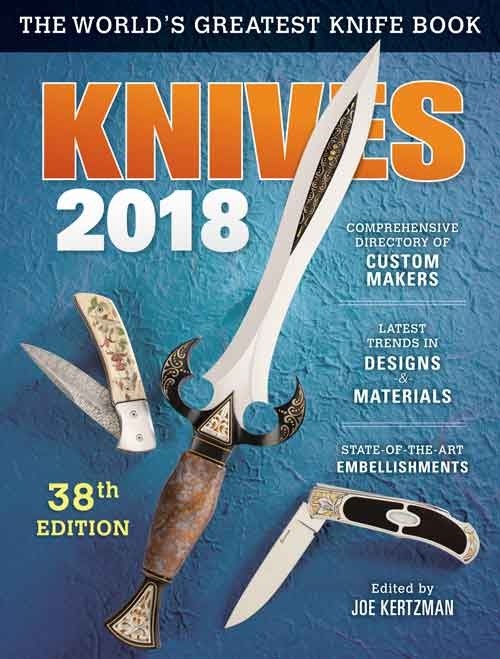
knives 2018

From BLADE‘s Sister Brand, Gun Digest

What is the best concealed carry holster? Click here to get more ideas at gundigest.com.

Advertisement

Must Read Articles

Read this before you make a knife

Knifemaking 101 – Read This Before You Make a Knife

  by Wayne Goddard My experience has taught me that there's nothing like digging in and getting started. I've often said the hardest part of the...
how to forge damascus steel

How to Forge Damascus

Advertisement
Advertisement