Custom Utility Hunters: Defining What Makes One The Best

0

When it comes to custom knives, the best utility hunters have many of the features outlined herein.

Countless articles have been written about hunting knives. Primarily, the stories discussed which knife is best for which game.

The two main features that get the most coverage are the blade-style/shape and the length. The knife referred to commonly as the hunter is more than likely a utility hunting knife.

No matter where you are, if you are using a guide—hunting or fishing—more than likely your guide is the one doing the dressing of the game. Chances are, he is using a utility hunting knife with some of the following features.

Blade Steel

If you ask 100 people what the best steel is for a hard-use field knife, you probably will get at least 50 different answers. Why? End users are very loyal to a steel that has proved itself in the field.
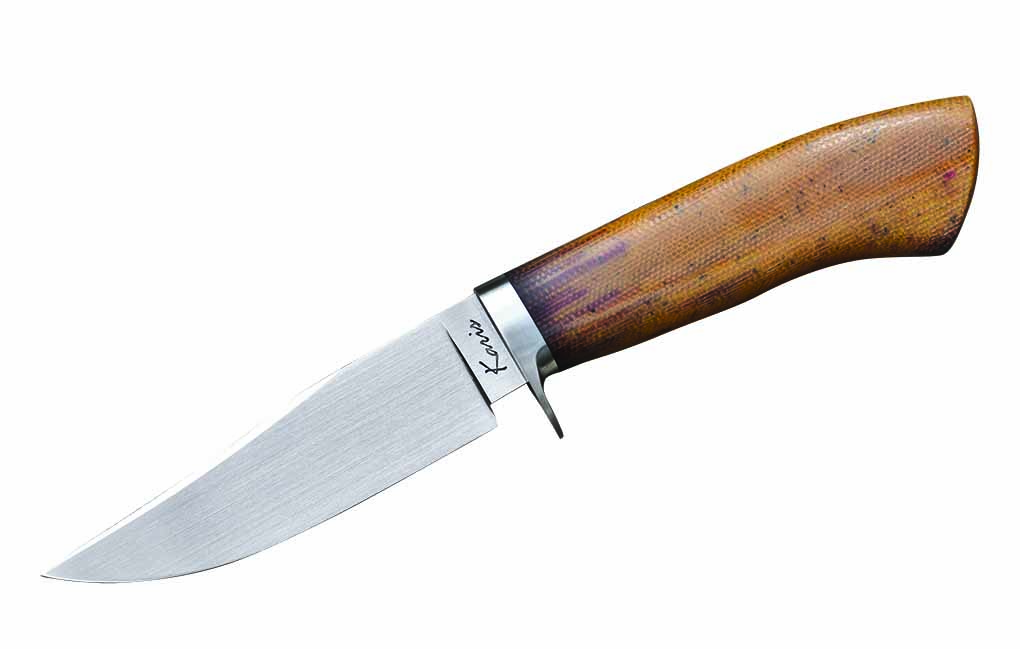
Karis Fisher (inset) is the daughter of ABS master smith Josh Fisher (see adjoining image). Karis not only earned her ABS journeyman smith (JS) stamp in March, she also won the Joe Keeslar Award for the best knife submitted by a JS applicant. The 4-inch blade is 1084 carbon steel and the handle is vintage Micarta®. Guard: 416 stainless steel. Overall length: 8.5 inches. Sheath: custom-made of leather. Fisher’s price for a similar knife: $375.

Steels are made primarily for commercial applications—very few are made specifically for knives. Knife blades have been made from saw blades, files and even railroad spikes. If the steel has enough carbon and can be hardened to hold an edge, somewhere in the past several hundred years someone made a blade of it.

The two primary choices for blade steel are carbon and stainless. Each has its pros and cons. Stainless steel’s biggest advantage is that it is rust resistant, meaning it will require less maintenance. Stainless is not code for “no maintenance.” Yes, stainless steel will rust.

Carbon steel requires maintenance. Many things will make carbon steel rust, several examples being the blood from the game that is being processed and some types of vegetation, including vegetables. However, the rust can be held to a minimum or eliminated simply by cleaning and oiling the knife after use. Keep in mind that storing your carbon steel knife in a leather sheath can also cause rust, especially a wet blade, as the tannic acid used to process the leather can cause rust spots.
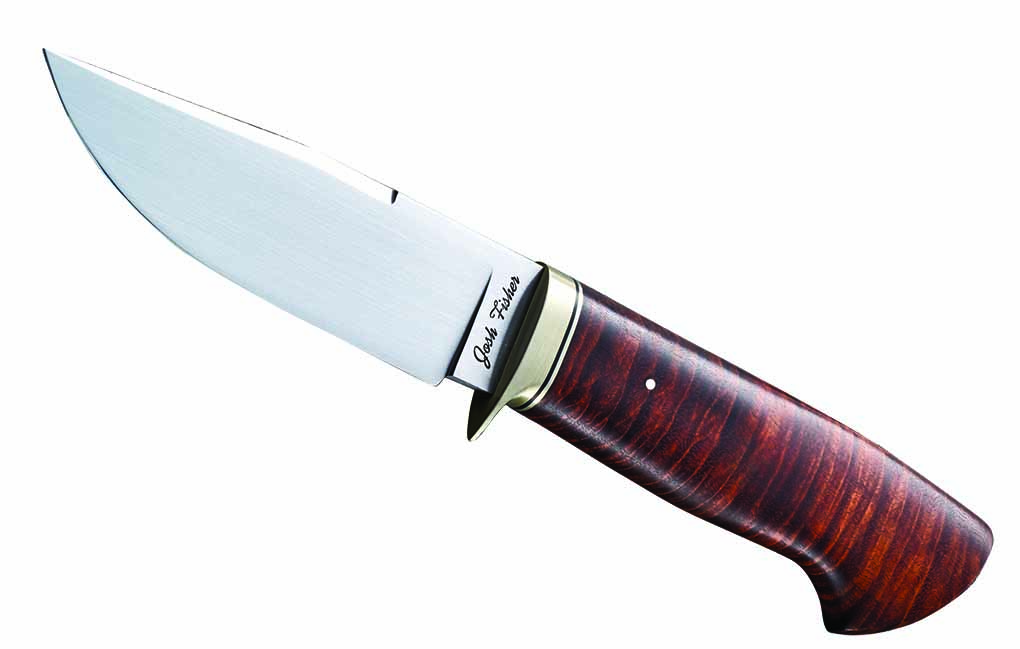
Winner of Best Utility Hunter at BLADE Show 2018, ABS master smith Josh Fisher’s model has a 4.25-inch blade of 1084 carbon steel, a ringed gidgee handle and a guard of brushed stainless steel. Overall length: 8.75 inches. The knife comes with a custom-made leather sheath. Maker’s price for a similar knife: $685. Josh (inset) earned both his ABS master smith (MS) stamp and the B.R. Hughes Award for the best knife submitted by an MS applicant at the same time his daughter Karis earned her JS stamp and the Joe Keeslar Award (see adjoining image). (Eric Eggly/PointSeven knife image)

While carbon steel can rust, it does have advantages over stainless steel, including two if the blade is forged. First, a number of bladesmiths forge distal taper into their carbon steel blades. The taper removes weight from the blade, thereby making the knife lighter in weight and thus easier to carry and manipulate. Second, carbon steel blades can be differentially heat treated to give them a hard edge for sharpness and a softer back for malleability, the latter resulting in a blade with greater flexibility that is much more likely to bend rather than break under high stress.

The steel you choose for your utility hunting knife should be one that can be sharpened in the field and fit the requirements for what you want your knife to accomplish. Remember—it is always best to resharpen your knife before it gets dull!

Handle Material

If you are looking for a group of custom knives that have diverse handle materials, utility hunting knives lead the way. Synthetics, wood, ivory, bone, antler, mother-of-pearl and others—you name it, utility hunters have it.
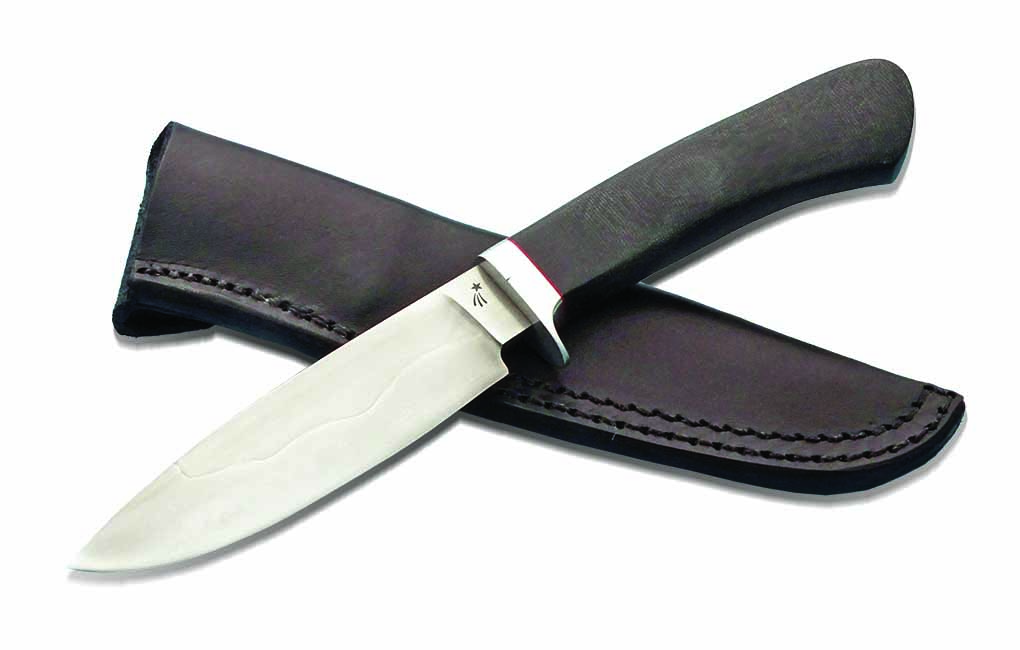
The 5-inch blade of W2 tool steel with hamon headlines a utility hunter by Jim Crowell (inset). The handle is black canvas Micarta® and the guard is stainless steel. Jim made the leather sheath. Overall length: 10 inches. Knife to know: this knife belongs to the author. Current price: $850. (Impress By Design image)

When many outdoorsmen dress their knives to impress, they want stag. Unfortunately, stag is experiencing two things simultaneously, and neither is good. Because of lack of supply, the quality is going down and the price is going up to the point that the ancient ivories are now becoming an alternative. After talking with knifemaker Mike Malosh at BLADE Show 2021, I have started to order some hunting knives with elk. While not as popular as stag, it is a great handle material and has a nice look.

My experience in the field has made me a true believer in synthetic handle materials. The two most popular are Micarta® and G-10. Canvas Micarta is my personal favorite. As the name implies, there are bits of canvas included when the Micarta is made. This gives the handle a little more grip when wet. Westinghouse Micarta is gaining in popularity. Often it’s referred to as vintage or antique due to the fact most of it was made before 1960.
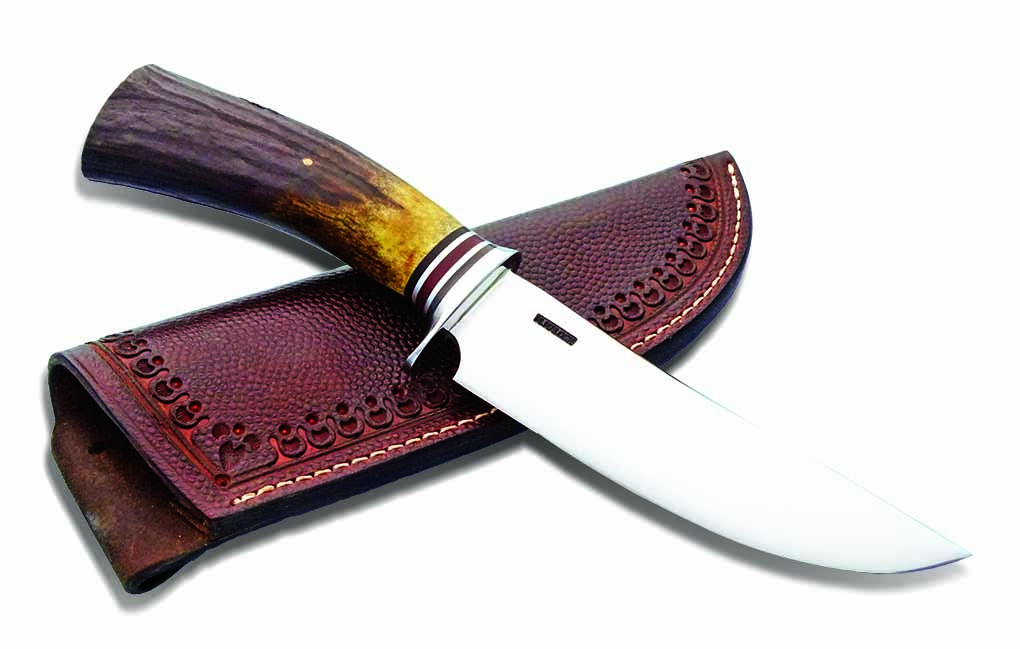
Mike Malosh opts for elk antler with black and maroon Micarta® and stainless steel spacers for the handle of his utility hunter. The 6-inch blade is W2 tool steel and the guard is stainless steel. Overall length: 10.75 inches. The knife comes with a leather sheath by Malosh. The maker’s price: $390. (Impress By Design image)

Carbon fiber is five times stronger than steel, twice as stiff and lighter in weight. This gave rise to numerous commercial applications, eventually finding its way into the custom knife market. Initially used by custom makers for scales on folders, you can now find them using it for fixed-blade handles, too.

The advantage of synthetics over natural handle materials is synthetics don’t shrink and, for the most part, are impervious to the elements. That said, natural handle materials can dress up a knife.

Guards

For the most part, integral guards are utilized as a quicker, less expensive way to make knives. Most are simply squared off to give the illusion that they are somehow protecting your index finger/hand. I learned the hard way that such a guard is not meant for hard work. If you are going to use a knife with this type of guard, wear a glove.
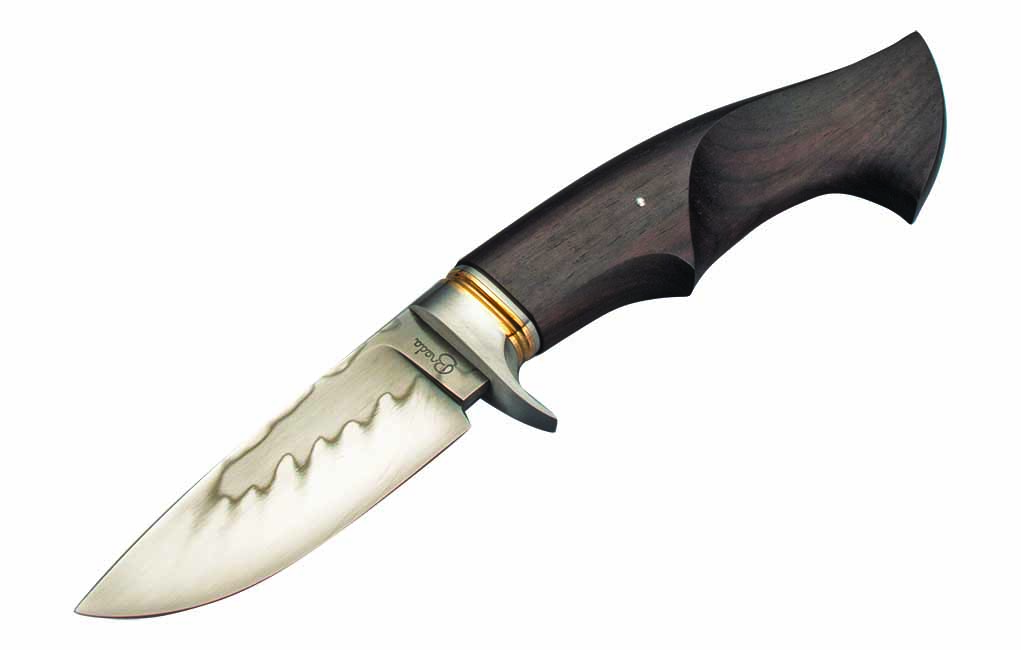
Ben Breda won Best Utility Hunter at BLADE Show 2019 for his model in a 4-inch blade of W2 tool steel with hamon. The handle is sculpted African blackwood with a bronze “S” collar and the blade is stainless steel. The knife comes with a leather sheath by Breda. Overall length: 8.75 inches. Current price: $575. (SharpByCoop knife image)

Most custom utility hunters have a single guard with some amount of curve built in to give you a better handle ergonomic. Additionally, it will provide some protection for your index finger/hand. The primary metals used for such guards are brass, nickel silver and stainless steel. While brass is a favorite among factories and new custom makers, the biggest problem is it is soft and can be easily nicked or cut, giving the guard a sharp edge or corner which can dig into your bare hand. Stainless steel guards provide the best protection and least amount of maintenance for your knife.

Ideal Sizes

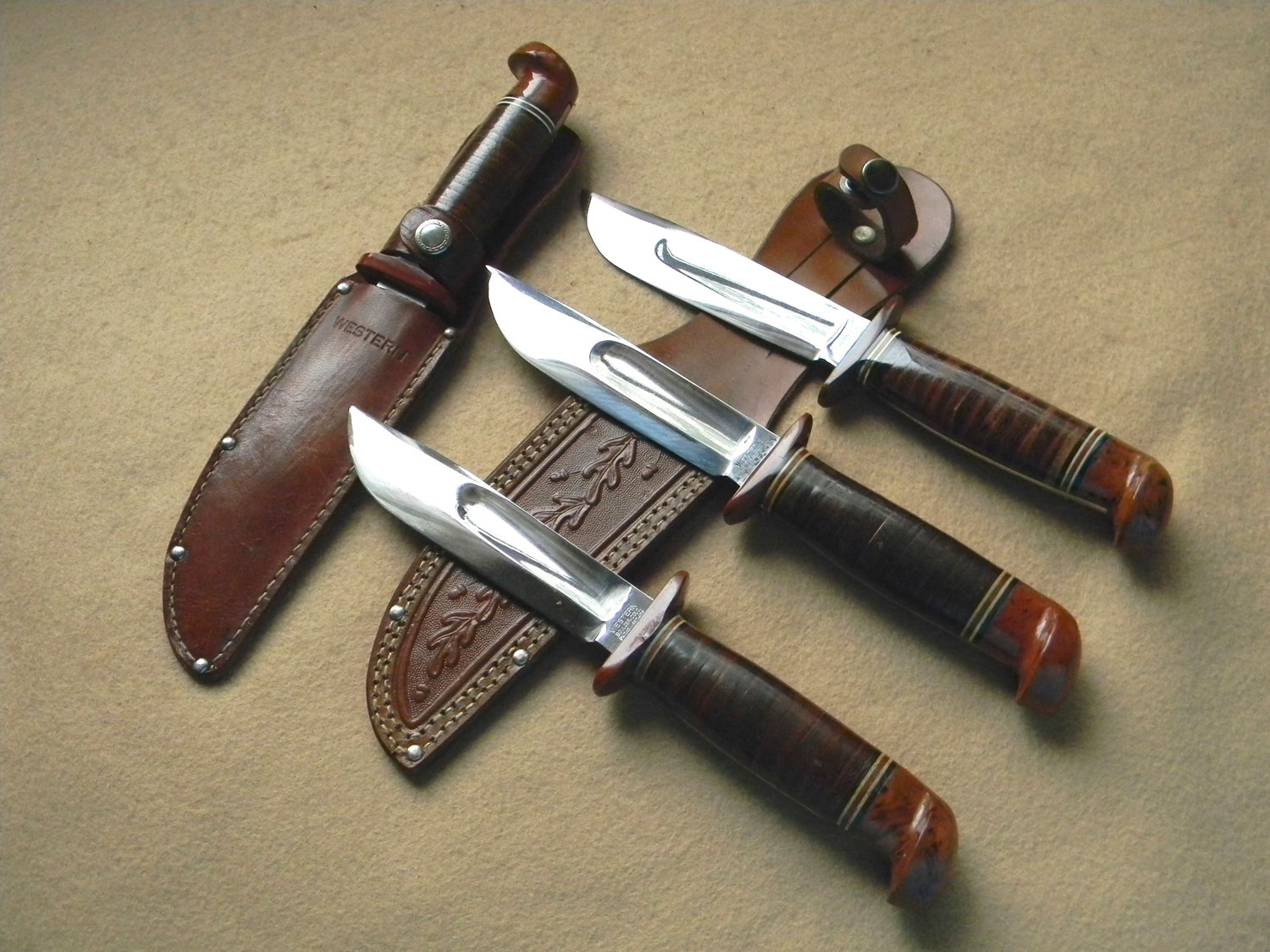
Having judged custom utility hunters at the BLADE Show for over two decades (page 42), I can tell you there is no one ideal size. That said, most of the judging competition winners feature a blade between 3 7/8 and 5 inches long. (For the makers reading this, please do not submit your 10-inch bowie or 2-inch miniature in this category for judging.) Among the accompanying images for this story are three past winners of the category at the BLADE Show. Note the differences and similarities. In addition to dimensions, the importance of handle ergonomics cannot be overstated. Most handles will feature some kind of contouring and generally will be between 4.5 and 5 inches long.

Sage Advice

The custom utility hunting knife will be a workhorse in the field. Consider the factors I have outlined before you buy one. What will you use it for primarily? What size handle is best for your hand? Will you be able to do the maintenance required for the blade steel? Can you sharpen the knife in the field and, if not, will you be able to practice how to do so before you get there?
I prefer a 5-inch blade as my experience has taught me that a big blade can do little knife chores, but not the other way around. As my 7th-grade shop teacher always said, “Use the right tool for the job.” Sage advice!


Raise Your Knife IQ:

YouTube Censorship: Losing The Battle For 1A & 2A

0

Editor’s Note: While this article pertains to the deletion of gun channels on YouTube — including our sister publication Recoil’s channel — we believe it is an interest and pertinent to the knife community. While it hasn’t happened yet, it is perceivable knife content may one day end up under social media’s microscope. Thus, we wish to keep our readership fully informed on the present-day digital landscape.

YouTube Bans Channels Days Before SHOT Show 2023

YouTube has everything from cat videos to documentaries about war to child predators, all six clicks away.

While even mainstream “family-friendly” content creators have complaints about YouTube, there is one form of YouTuber the platform loves to hate – GunTubers.

Recently, YouTube made another push to de-platform and demonize GunTubers. 

Starting just days before SHOT 2023 with the deletion of Ammoland.com’s YouTube page, the site either suspended or issued strikes against channels like Rodger Barrera, 1911 Syndicate, and Lucky Gunner.

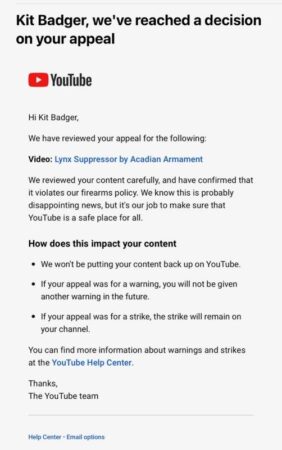
Spurring the writing of this article was the deletion of Kit Badger’s channel. Little did we know only a few days later, RECOILTv’s YouTube channel would also be summarily nuked.

Why is this happening, and what can we do about it? The answer isn’t very encouraging, but cold truths rarely are.

Why Does YouTube Hate Your Second Amendment?

Based on what we know – I don’t think YouTube actually hates the Second Amendment as a construct. 

From multiple conversations with multiple content creators on YouTube, they’ve spoken with many people that worked at YouTube who were pro-gun. The problem is, that’s not enough.

YouTube is here to make money. It isn’t here to make the world a better place or to uphold morals and values. The company is in it for the almighty dollar. 

Those dollars come from advertisers. While there are some firearm-friendly brands advertising with YouTube, the super majority of the site’s money comes from mega-corporations like Disney and Amazon, household goods manufacturers like Procter & Gamble, and electronics brands like Samsung. The names of those who advertise on YouTube are nearly endless, but you get the idea. 

YouTube made over $28 billion in 2021. 

Of that, GunTubers are a very small drop in the bucket. The exact totals are unknown, but it’s easy to conjecture firearms content is nowhere in the top ten on YouTube.

2017: YouTube’s Worst Nightmare

Since most major brands prefer to avoid controversy or even the appearance of being on the wrong side of issues, it’s easy to understand why most only want to advertise products on channels and videos no one objects to. 

But in 2017, YouTube screwed up. Truthfully, YouTube had been doing this for a long time – but people noticed in 2017. Due to a series of news articles showing YouTube ads playing alongside extremist videos — the kind with people’s heads being cut off — advertisers made it clear to YouTube that the money could stop.

Huge brands like Walmart and Verizon pulled ad dollars completely. In the month of April 2017, YouTube lost 5% of its top advertisers.

This happened again in 2019 when reports came out of YouTube’s grossly ineffective methods of dealing with child exploitation videos. Again, huge brands like Disney, Nestle, and others pulled ad money until YouTube fixed the problem or the public turned its attention to something else.

Firearm Hysteria

This is a supposition, I believe it’s reasonable to conclude YouTube hates gun channels because it is scared of firearms being the next big thing to lose money over.

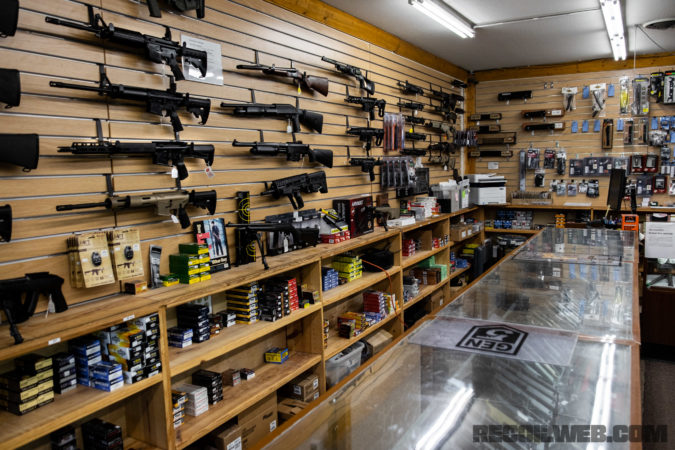
dk mags gun store rifle wall

With the mass media’s fetish for murder porn on the nightly news, guns are (as always) an easy target for (real or imagined) ire.

Even as large as the American firearm industry is, all of its marketing money combined isn’t enough for YouTube to sacrifice its Apple/Disney/Hulu cash.

The Omnipotent Algorithm

While firearms are clearly not on its list of favorite things as a corporation, even vanilla channels have a rough time of actually communicating with anyone at YouTube who can make a difference. 

Because of the staggering amount of content posted on the platform, the vast majority of moderation is automated. 

Every minute, over 500 hours of content are uploaded to YouTube. More than 30,000 hours of video are added per hour. While YouTube employs thousands of moderators, this is far, far short of the tens of thousands of human moderators required to view all the content.

Instead, YouTube uses powerful AI and machine learning algorithms to comb through videos automatically. Everything from the words spoken to the images shown is scanned and processed by the algorithm.

This algorithm — more accurately many sets of different algorithms — work together to control everything from what you see in your recommended feed to what videos are allowed to make money.

As much as everyone hates this system, there isn’t a practical alternative. Not without YouTube spending an astronomical amount of money to fund human moderation teams. Not exactly something the company is likely to do if it wants to keep profit margins high. 

YouTube Guidelines

One of the major problems all YouTubers have is the site’s guidelines don’t matter. While YouTube maintains two sets of rules, one set that covers everything on the platform and another set specifically for videos that are monetized, the rules often are simply ignored. 

When a channel gets a warning or a strike, the channel has the option to appeal it. This is, in theory, sent to a human moderator who looks at the issue and rules on it. The problem is these human moderators are unreliable in their judgment. 

Videos that clearly do not violate the rules are still removed or demonetized. Channels can try to delete the video, reupload it, wait for the automated demonetization, and appeal to a different moderator for a different ruling — but this also runs the risk of multiple strikes for one video.

Some rules are so broadly written they become nonsensical. For example, 1911 Syndicate received a warning for swapping a charging handle on camera and a strike for unthreading a suppressor from a rifle.

Other channels, like Kit Badger, don’t even know exactly why its channel was deleted.

Instead, all that is offered is the name of the video supposedly violating the rules and a copy of the entire YouTube Firearms Policy. Too many of these strikes and the channel as a whole is simply deleted.

Even when YouTube deletes an entire channel, it barely tells you why except there were “too many violations.”

Goal Posts Moving Faster Than Light Speed

Another huge obstacle YouTubers face is old videos.

As YouTube has updated and changed its policy over the years, these new rules apply to old videos as well.

Videos that have been up for 5, 7, or 10 years are subject to YouTube rulings overnight. One recent change was creators could not show 30-round magazines. This resulted in multiple channels I spoke with having to spend hours, even days, going through old videos to self-censor them before YouTube found them.

Instead of warnings or a grace period, these old videos can cause a channel’s deletion overnight.

As of this writing, this is what we believe happened to the RECOILTV YouTube channel. Videos that were years old featuring suppressors triggered strikes against the channel, followed by the entire channel being deleted.

Mo Money, Mo Problems

Something a few channels have found is YouTube cares much more about channels that are monetized than channels that are not. But this isn’t the good kind of caring like a mother’s hug. This is more like attracting the Eye of Sauron.

InRangeTV has been proactively demonetized for years, and Karl — the channel’s main host and creator — feels this helped keep the wolves at bay. Without ad revenue or sponsorships, InRange instead relies on the viewers to join and donate through other platforms like Patreon or Utreon.

However, even this has not kept the channel from receiving a warning in the past. 

InRange’s great crime? A video about the Ghost Gunner machine that even didn’t show the machine. Instead, Karl overlaid videos of cats playing with yarn to self-censor the version of the video uploaded to YouTube.

Other channels, like 1911 Syndicate, are demonetized but do not rely on the YouTube for revenue to stay afloat. For the concern, its channel is a marketing tool for its real estate business

We monetized our channel around 40,000 subscribers, and were demonetized about 2 months later.  Since then our channel has been demonetized, which probably helped us not get strikes

1911 Syndicate

This has (probably) helped keep it off YouTube’s naughty list, but as its recent warning and strike shows, being demonetized does not make it immune.

Best YouTube Alternatives

The main problem with other video platforms — YouTube’s competitors — is the lack of viewers. None of the channels I’ve spoken with actually like YouTube, but it’s the place where you can find the most viewers.

If you want to be the change you want to see in the world, the first step is to stop watching YouTube. 

These are some of the best platforms to make this move. 

Recoil.TV

Call it a shameless plug if you want, but Recoil.TV offers a video platform free of YouTube crapola. An aggressively pro-2A and 1A video platform, Recoil.TV is a great way to find and watch your favorite creators. It also acts as a backup in case YouTube persecutes your favorite channel. For example, you can still find Kit Badger on Recoil.TV.

You can also find original content from RECOIL Magazine and our sister publications like OffGrid, Gun Digest, Blade, and Carnivore. 

Utreon

The preferred site, according to several channels I know, Utreon is a mix of Patreon and YouTube. A video platform for people to watch their favorite channels, but also the ability to donate money directly to the channel.

Run by a founder and owner who believes in 2A and giving the people what they want, Utreon offers a lot of options and a lot of flexibility to channels while also using a fee structure that results in more of your donations going to the channel instead of the platform.

InRangeTV is a fan stating it’s their preferred alternative to YouTube:

From my content creator perspective, the best alternative to YouTube at this point is Utreon. They are a good mix of Patreon and YouTube combined, providing a lot of the benefits of both – it’s not a paywall, but does allow for direct viewer support and a lot of Patreon perks integrated into the platform. The owner has proven to be reliable, respectful and capable. I believe their heart is in the right place, but it is ultimately still a centralized solution.

Karl Kasarda, InRangeTV

BitChute

In the media, BitChute has a bad reputation, some of that is well earned. With a strong belief in freedom of expression, there comes the unavoidable reality of some real nut cases abusing the system to spread hate speech, crazy off-their-meds conspiracy theories, and lots of lies.

That said, BitChute offers a decentralized method of sharing and watching videos. Using a webtorrent for distribution means BitChute is extremely difficult to take down, reduces overhead costs, and gives a platform to those who would otherwise be left off major platforms like YouTube.

Viewers be warned: BitChute is definitely not a site I would let my children have free access. Scrolling through the most popular videos makes me want to take a shower and watch something wholesome, like cat videos… on YouTube.

Rumble

Another platform that is home to anyone with a video camera, Rumble hosts everything from wholesome content like America’s Funniest Home Videos to the likes of Alex Jones and Andrew Tate. 

Rumble also provides a clear and simple method for channels to monetize content, very similar to how YouTube AdSense works. 

While again falling victim to the reality that not everything on the internet is good content, Rumble does draw a line at pornography, harassment, racism, antisemitism, copyright infringement, and illegal content. 

I would still caution viewers to exercise their best judgment when browsing Rumble.

Loose Rounds

The writing is on the wall and has been for years. Sooner or later, YouTube will probably ban firearms from its platform. If it doesn’t, it will at least make it so hard and unprofitable for gun channels to stay on the platform that, by choice or force, all of them leave.

While there is probably very little that can be done to prevent this, there are at least some alternatives, as I mentioned. 

Until then, if you can and when you can, consider supporting your favorite channels directly via Patreon, Utreon, and other platforms.

Hawaii Knife Ban Stopped In Its Tracks

Vagueness of bill could have potentially banned the carry of all but a few knives.

Hawaii Knife Ban bill SB 433, which would have banned all carry of most knives and all knives in many public places in Hawaii, has been stopped. The stoppage occurred because the bill failed to receive a hearing by the stated deadline.

According to Knife Rights, one of the worst aspects of the bill was its vagueness. The bill added “bladed weapons” to the state’s sweeping firearms bans, which would have been expanded in SB 433.

“As written, nobody, not a resident, not a police officer, not a prosecutor, could possibly look at the proposed statute and know for sure what a ‘bladed weapon’ is that is being banned,” KR reported. “This is fundamentally unconstitutional and leaves the law open for law enforcement and prosecutorial abuse. Terms that capture everyday tools carried daily by the public for perfectly lawful uses should be defined crisply and clearly to provide fair notice as required by longstanding law.”

The bill banned all undefined “bladed weapons” everywhere in Hawaii except for switchblades and butterfly knives.

“So,” KR noted, “a not at all unreasonable interpretation of [‘bladed weapons’] would have banned carry of a common pocketknife in Hawaii, except for [switchblades and butterfly knives]! Who decides whether it’s a ‘bladed weapon’? Certainly not the average resident or visitor.” 

In other examples, fillet knives used for recreational, subsistence and commercial fishing and hunting knives used for boar hunting—a popular means of reducing feral hog populations on the islands and a popular tourist business—could have been banned, as could a box cutter carried to work by a warehouse worker.

More On Auto Knives:

7 Join BLADE Magazine Cutlery Hall of Fame®

New inductees span the world of custom and factory knives.

A notable assortment of those who for many years enhanced or continue to enhance the overall improvement of the knife industry highlights the 2026 class of inductees into the BLADE Magazine Cutlery Hall of Fame®.

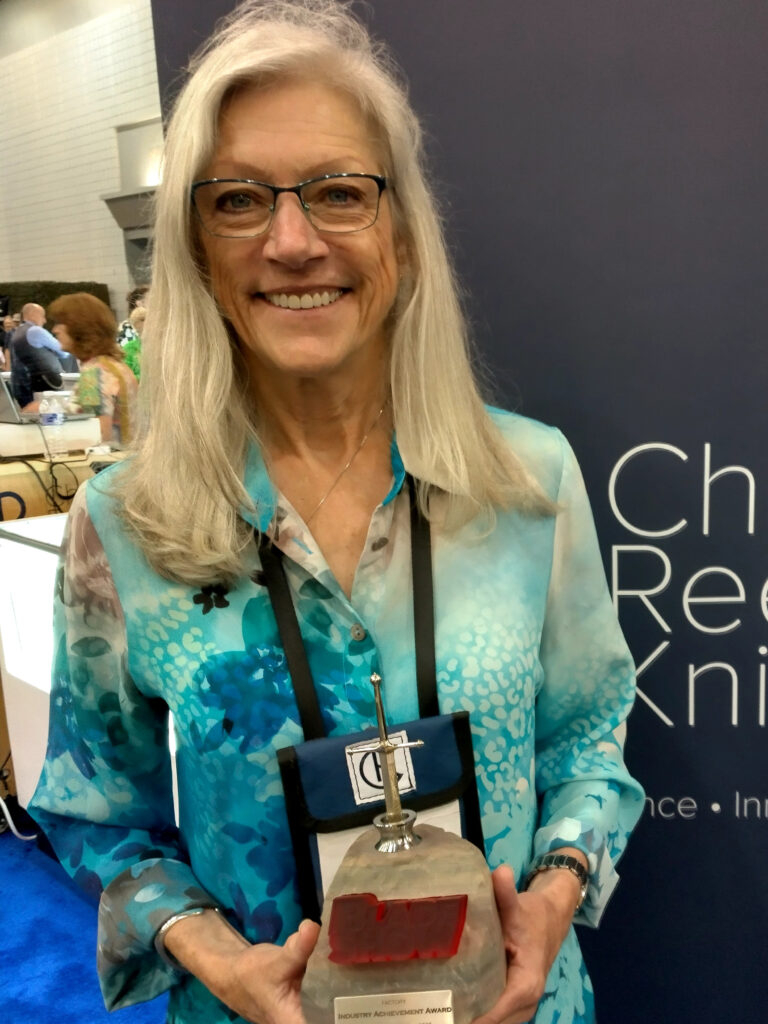
The new honorees include three living and four deceased members. Among the former are CRKT co-founder Rod Bremer and Anne Reeve, owner/president of Chris Reeve Knives, on the factory side, and American Bladesmith Society master smith Larry Fuegen from the custom realm.

The posthumous inductees are bladesmith/writer Ed Fowler, custom knife purveyor Nate Posner, knifemaker/knifemaking supplier Bob Engnath and ABS master smith Tim Hancock.

All will be formally inducted in a special ceremony during the BLADE Magazine Cutlery Hall-of-Fame Breakfast the Saturday morning of the BLADE Show, June 6, in the Renaissance Waverly, the host hotel adjoining the Cobb Convention Center in Atlanta. For ticket information email [email protected].

Rod Bremer

Rod Bremer

Along with partner Paul Gillespie, Rod Bremer started Columbia River Knife & Tool (CRKT) in 1994. The concept was to bring world-class-quality knives to the U.S. market in the designs of custom knifemakers—as of today, CRKT has used the designs of over 50 such makers—and innovation at a price that virtually all consumers can afford.

According to a nominator, Rod’s integrity qualifies him for the Hall of Fame, a good example being that “CRKT pays the makers/designers royalties for as long as the knife sells. To this day, Rod is still paying royalties to the estates of Ed Halligan, Jon Graham, Cutlery Hall-of-Famer Kit Carson and several others.” Added the nominator, “CRKT started the Forged by War program to help veterans and their charities. So far the program has donated over $500,000 to the charities of the veteran’s choice.”

Under Rod’s leadership, CRKT has won a number of BLADE Magazine Knife-of-The-Year® Awards. In the process, he helped enhance Southeast Asia knife manufacturing by teaching and demanding that the Taiwanese factories produce the highest-quality knives possible.
He has bolstered pro-knife initiatives through his work as an American Knife & Tool (AKTI) Board of Regents member, working on issues that benefit the knife industry. His resume includes: 1) Election to the AKTI Board of Regents (2009); 2) Playing an active role in the monumental defeat of U.S. Customs’ attempt to classify all one-hand knives as switchblades (2009); 3) Recipient of Knife Rights’ inaugural Freedom’s Guardian Award for his role in upholding knife rights industry wide (2011); 4) Elected AKTI vice president (2011); 5) Organized and hosted AKTI anti-counterfeiting round table and presented related seminars for BLADE University at BLADE Show 2013; and 6) Elected (2014) AKTI president, a position he held through 2016.

Anne Reeve

Anne Reeve

According to a nominator, in 1986 Anne Reeve joined the then-fledgling Chris Reeve Knives and quickly became an integral part of the company. Her partner, both in life and business, Cutlery Hall-Of-Famer Chris Reeve, was the craftsman, and a great one at that. While Chris’s forte was knife design, Anne’s strengths were administration and bookkeeping. Anne spent many of the following years lending a hand where she could, helping to build a company known for quality and excellence.

For most of the early years, Chris Reeve Knives was just Anne and Chris plus a handful of employees, which meant Anne wore many hats. As the company grew, Anne stepped more into working behind the scenes in administration and customer service. Her years of answering the phone and meeting customers, partnered with her determination to ‘do the right thing,’ laid the groundwork for the knife manufacturer’s international reputation for excellence. Today, the company has around 150 dealers worldwide.

On the knife legislation front, Anne showed support for both the American Knife & Tool Institute and Knife Rights with encouragement, donations of knives and cash, and attending and sponsoring related functions. She has been treasurer of the Idaho Knife Association since 2018 and is an active member of the organizing committee for the IKA’s annual show.

After a nearly 30-year partnership, Chris retired, and Anne took a massive leap of faith and bought Chris’s share of the company. With the help of their son, Tim, and a team of young, talented and enthusiastic leaders, Anne has trailblazed Chris Reeve Knives into new territory. As the nominator concluded, “Investment in equipment and employees has resulted in revenue more than doubling under her leadership, the quantity of knives produced each month continues to increase, the quality of those knives is better than ever, and demand continues to significantly outpace production. Her determination to keep the integrity of Chris Reeve Knives, coupled with the highest quality products and customer service, has set a standard in the knife industry.” Helping cap it off, Anne won the BLADE Magazine 2025 Industry Achievement Award for her many contributions to the craft and cutlery community.

Bob Engnath

Bob Engnath

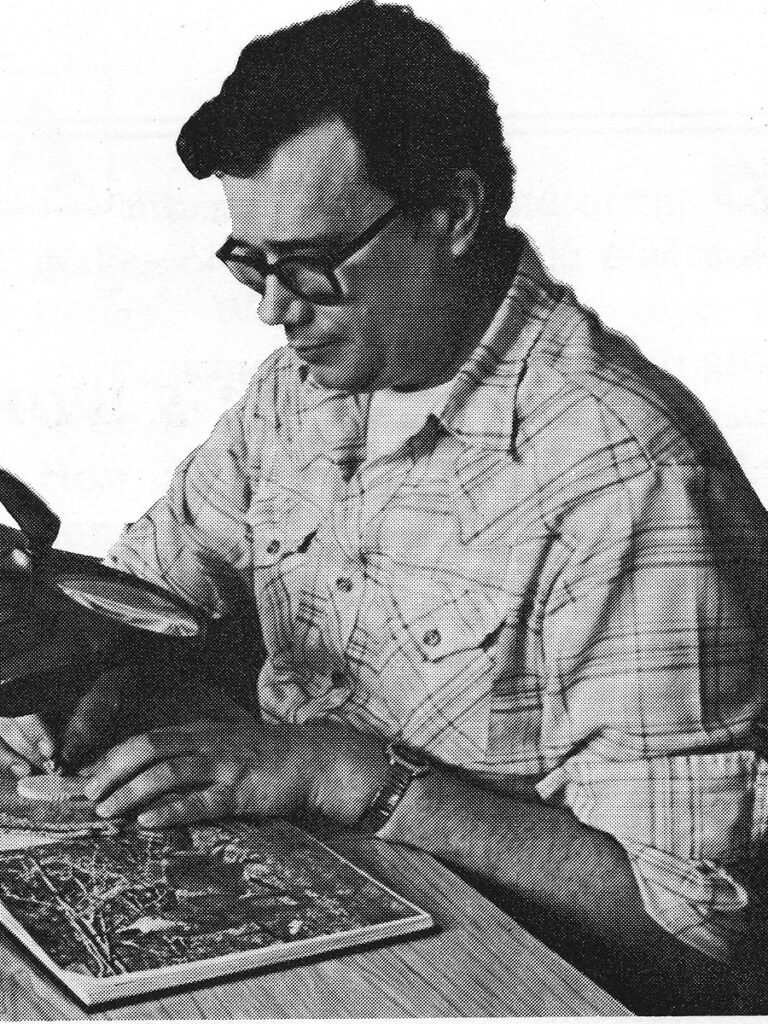
Bob Engnath built his first knife in 1972 and went full-time in ’79, making kit blades, tantos, swords and assorted knives in carbon steel. His base of operations was Blades ‘N’ Stuff, a retail shop he ran in Glendale, California, that offered tools, supplies and materials for knifemakers, bladesmiths and swordsmiths.

He produced several editions of a comprehensive publication he also called Blades ‘n’ Stuff, a 70-or-so-page 8-by-11-inch “Catalog and Instruction Manual featuring Handcrafted Blades by Bob Engnath and Knifemakers’ Supplies.” Sold for $5, it contained copious amounts of knowledge and instruction for anyone who wanted to make a knife or sword, including line art of his many patterns, knifemaking how-to’s with diagrams, tips and do’s and don’ts, and tons of sage advice on various steels, heat treating, knifemaking machines and materials, finishing, how to forge damascus, shop safety and other invaluable information. In addition to his catalogs, Bob also wrote the books The Scrimshaw Connection and The Second Scrimshaw Connection.

Engnath was a dedicated blade grinder and considered by many the best grinder of the time, providing blanks his customers could finish on their own. He gave many makers their start and dispensed an untold amount of knifemaking knowledge to anyone interested enough to listen, usually free of charge. According to one source, “Bob was a mentor to countless new makers through his knife kits, leaving a lasting legacy in the knife community.”

Summed up another source, Bob “was an excellent role model for any man in the knife business. He never said a bad word about anyone, took the knife business where it had not been before, his ethics were outstanding, his word was ironclad. I’d rather have had a handshake with Bob Engnath than a lawyered-up contract with any other knife name you care to mention. He was a hero and an example to a lot of people.”

Ed Fowler

Ed Fowler

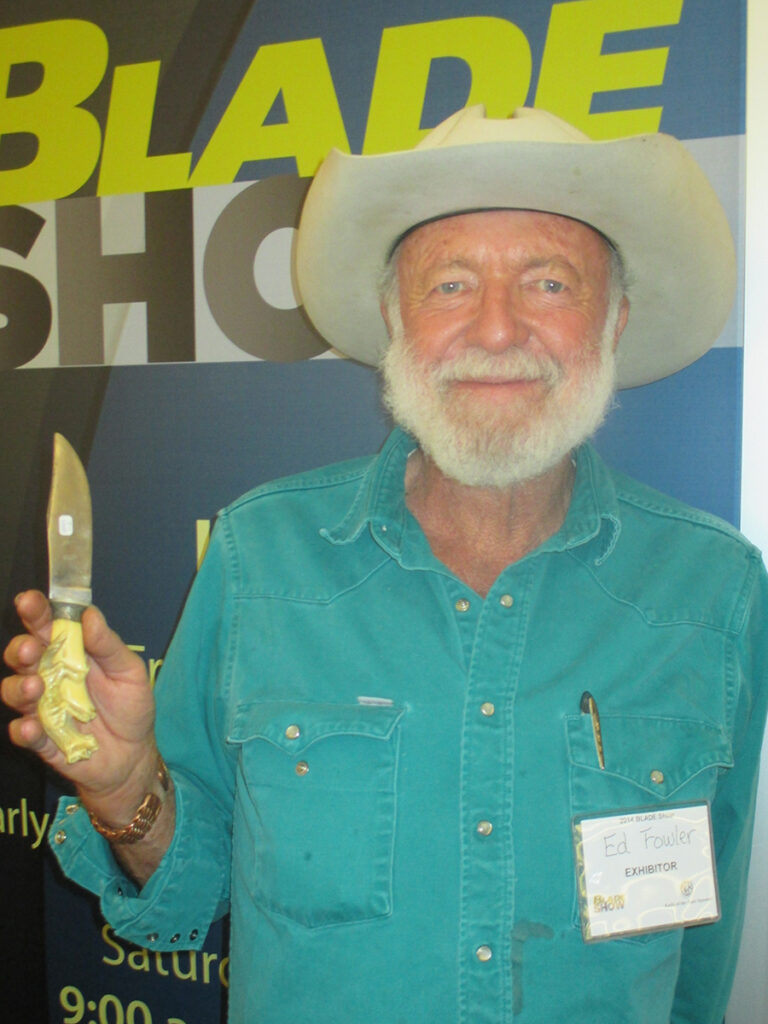
Selling his first knife in 1962, Ed Fowler epitomized “the philosophy of the cutlery fabricator,” noted one nominator. Though not the first to use 52100 carbon steel for knife blades, Ed helped popularize it as it became a go-to material among today’s bladesmiths. He long performed and encouraged the multiple quenching of blades during heat treatment.

He wrote the monthly column “Knife Talk” for BLADE® for well over a quarter century. In BLADE’s reader surveys, along with Cutlery Hall-of-Famer Wayne Goddard, Ed completed the top one-two team of most popular BLADE writers year-in and year-out. Ed compiled his “Knife Talk” columns into two books: Knife Talk I: The Art & Science of Knife Making and Knife Talk II: The High Performance Blade. He conducted demos for many years on a variety of subjects at the BLADE Show, plus a class at BLADE University.

Formerly an ABS master smith, he went on to create the High Endurance Performance Knife Association, an organization dedicated to a greater understanding of the knives its members make, the steels they use, the process necessary for the knives to reach their maximum performance potential, and to share this understanding with any and all who seek it. He taught knifemaking to many, including more than a few who have gone on to become ABS journeyman and master smiths, including Audra Draper, Wade Colter, Shane Taylor, Bill Burke and Cutlery Hall-of-Famer Rick Dunkerley among the latter.

Wrote one nominator, Ed was “very passionate about what a knife should do. He indulged anyone who wanted to share time or debate ‘the concept of cut,’ as he called it.” Ed would pit his high-performance 52100 knives against all comers in what he called “real world tests,” cutting and doing things with the knives many consider abusive, until the knives failed. Ed continued using this testing regimen, observing that though you may never have to use a knife in such a manner, “What if you had to and the only tool you had at your disposal was your knife? Wouldn’t you take comfort in knowing that if ever push came to shove, you had a knife you could stake your life on?”

Larry Fuegen

Larry Fuegen

Larry Fuegen started forging knives in 1975. According to a sitting Hall of Famer, from that time on all of Larry’s knives were sole authorship. He became a full-time knifemaker in 1987 and earned his American Bladesmith Society master smith rating in 1989.

“Since I’ve known Larry he has been a unique person who made unique knives,” the Hall of Famer wrote. “He started making friction folders after meeting Cutlery Hall-of-Famer Jim Schmidt at an ABS hammer-in. Years later Larry took those folders to a whole new level. For years he did gargoyle-type carvings on them and later started doing other renditions, like his folder featuring the Spanish explorer Hernan Cortes wearing a gold helmet and Larry’s carved face of his idea of what Cortes looked like. Besides these great folders he made many ornate bowies, daggers and hunters that had carving, texturing and engraving done in a way to set his work apart from anyone else.

“For me what stood out most were his push daggers. I believe if you Googled push daggers a picture of Larry Fuegen would come up. He not only crafted knives, he also did his own leatherwork, which was top quality. He also made some of the best bits and spurs anywhere. In addition to his quality work he designed and built the tools he needed to produce his knives, leatherwork, and bits and spurs.”

He was voted into the Art Knife Invitational in 1999 and every year thereafter until 2022. Circa 2008 another of his ornately done friction folders, entitled Alaric, King of the Visigoths, went on permanent display at the Smithsonian American Art Museum’s Luce Foundation. He has been featured in many magazine articles and books, among the latter including Greatest Living Knifemakers by Cutlery Hall-of-Famer Steve Shackleford.

Larry passed his knowledge on, teaching at numerous hammer-ins and seminars around the country. He is very knowledgeable and is willing to share with anyone. He is the personification of the traits required for induction into the Cutlery Hall of Fame.

Tim Hancock

Tim Hancock

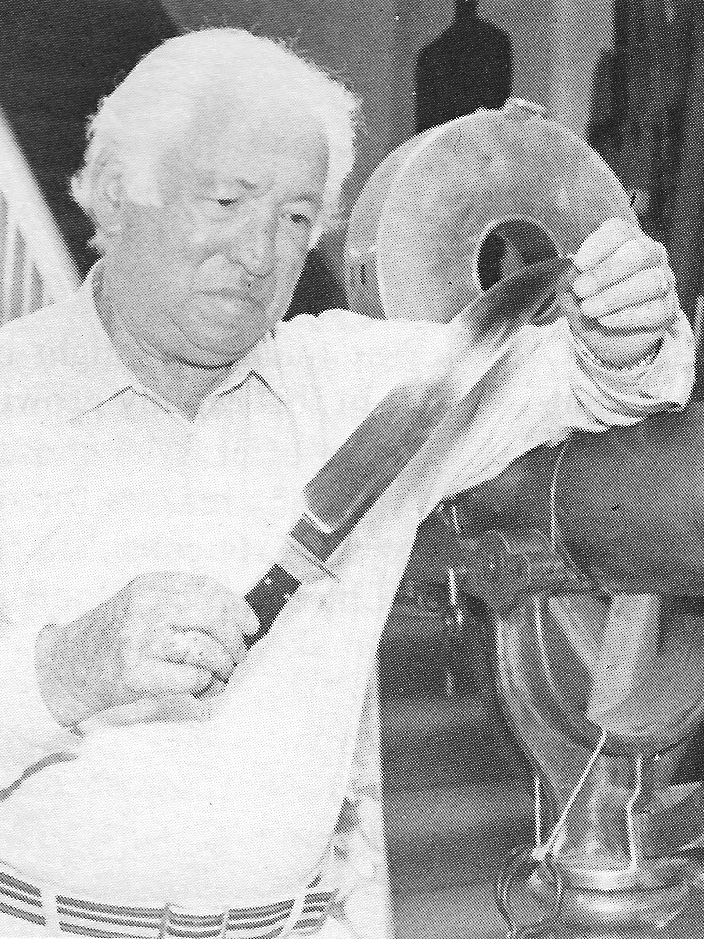
Teaching others how to make “the total knife” played a huge role in defining Tim Hancock. “He taught and demonstrated at many hammer-ins in the areas of embellishment, design, blade forging, grinding, heat treating and sheath making,” ABS master smith Larry Fuegen observed. “He wanted to share his methods and thoughts with others. He also gave private lessons in his shop to many aspiring makers. The influence of his recognizable style can be seen in the work of many makers. Just as [Cutlery Hall-of-Famers] Bill Moran and Bob Loveless influenced many with their designs, so did Tim with his work.”

Added knifemaker Michael Vagnino, “I suppose the most important thing I learned from Tim was integrity. The knife you make is in fact a part of you. How it turns out is more about how honest you were when making it. When Tim told me that, it really made me pause. From that moment on, I viewed making knives in a new light.”

Tim earned his ABS master smith rating in 1993 and won an impressive number of honors for his knives, including the 2010 W.F. Moran Award. He was known for his award-winning period bowies, including though not limited to dog-bone bowies. Dr. David Darom dedicated an entire hardback book, Tim Hancock: The Western Bladesmith, to highlighting Tim’s knives and knifemaking career, even his penchant for forging silver-mounted bits and spurs and other Western gear. From 2001-2015 Tim was a member of the Art Knife Invitational, an organization of the world’s 25 greatest knifemakers spearheaded by Cutlery Hall-of-Famer Phil Lobred.

Nate Posner

Nate Posner

Nate Posner started the San Francisco Gun Exchange in 1948 and built it into what he called the “Firearms Center of the West.” It had most everything firearm related but it was his displays of custom and factory knives that pertain here.

Along with Cutlery Hall-of-Famers A.G. Russell and Dan Delavan and also Bob Gaddis and Dave Harvey of Nordic Knives, Posner was among the first custom knife purveyors. He was known for telling his customers that to get the best price, instead of buying custom knives from middlemen such as him they should buy directly from the maker. Of course, if the customers wanted the handmade knife in question immediately, they often had to buy it from one of the few purveyors such as Nate to avoid spending what might be years on a waiting list. However, it was being up front that put Nate in good stead not only with his knife customers but the Guild, too—for both buying/selling the makers’ knives and treating what often were the makers’ customers/prospective customers in a professional manner.

At one time he had over 350 custom knives on display, with at least that many others in stock. Circa 1975 he ordered knives from dozens of makers, most active or past Guild members. Eventually he culled his list to about 25 or 30, including one of his favorites, D. E. Henry. Others included Tommy Lee, Jess Horn, Herman Schneider, Corbet Sigman, the-then-team of Scott Sawby and Steve Mullin, and future Cutlery Hall-of-Famers Frank Centofante, Jimmy Lile, Bob Loveless, George Herron, Bo Randall and more.

Thanks to the high store profile he gave custom knives and their makers to knife and gun buyers alike, Nate was one of the most important custom knife promoters of his or any era. As a result, the honor the Guild gives annually to an individual who provides “Outstanding Service in the Promotion of Handcrafted Cutlery” is called the Nate Posner Award.

See More Award Winners:

Hunting Knife Sheaths: The Constant Companion

The Correct Sheath Is Pivotal To The Complete Hunting Knife Package. A Good Sheath Can Keep Your Knives Safe And Sharp For Decades.

The Correct Sheath Is Pivotal To The Complete Hunting Knife Package. A Good Sheath Can Keep Your Knives Safe And Sharp For Decades.

For the hunter in the field, a dependable and durable hunting knife is indispensable equipment, and it follows that the sheath that holds the knife must be equally up to the task.

Secure carry, protection for the blade and handle, easy access, and the ability to stand up to the elements and hard use are essential. While there is a variety of sheaths available and each one contributes something to the equation, the sheathmakers themselves have come to eye-opening conclusions as to the making and deployment of the correct sheath for the hunting knife. Personal preference is still a prime mover, but the basics make the difference between cooperation and catastrophe in the field.

“The best style for a hunting knife sheath is whatever the hunter wants,” explained veteran sheathmaker Paul Long. “Personal preference is very important. However, the knife that would best be described as a hunter would be best suited in a deep seat pouch with a loop that would carry relatively high on the belt. In most cases the deep pouch would preclude the need for a retention strap. For a double-guard hunter, a drop-loop belt sheath would probably be best with a snap strap for secure retention.”

Depending on the style of the knife, the guard often dictates the best pouch configuration. “I favor the pouch-type sheath, and the hunting knife generally has a single guard as opposed to a double guard,” related sheathmaker Paul Lebatard, who also has found success with his custom knives through the years. “I make a lot of doubles, too. You would have to make a snap-type sheath with a keeper strap, but on hunting knives with single guards the pouch type is always best.”

Three different styles of pouch sheaths by Kenny Rowe, from left: regular pouch, plain leather; strap pouch, floral hand carved; and full flap pouch, full coverage gator. (Kenny Rowe image)

A sheathmaker for over 50 years, Chris Kravitt zeroes in on the personal preference perspective. “First and foremost, it’s a matter of the configuration of the knife, and then if more than one style will work it becomes a matter of personal preference,” he observed. “My preference is to go with the pouch because it is easier to draw and resheathe the knife without worrying about straps.”

At the same time, Kravitt acknowledges varying hunting knife construction and its influence in sheath form and function. “If a knife has a double guard, it isn’t going to work on a pouch sheath, and if you have a knife with an integral handle, possibly,” he said. “Certain things don’t lend themselves to the traditional style, like when the blade is the widest part of the knife or there is no bolster or ricasso extending beyond the edge.”

Kenny Rowe, owner of Rowe’s Leather in Hope, Arkansas, adds another option on the hunting knife sheath. “Ninety percent of these sheaths would be the pouch type because they cover most of the knife, and with the guard you can make a welt where the knife has some resistance coming in and out,” he noted. “Some sheaths will have a lid that has a snap on it, and that is as secure as you can get with the flap snapping over the front of the sheath.”

The consensus with the pouch sheath makes sense for all the reasons that the hunter encounters in the field. For its toughness and the ability to shape and mold the sheath as desired during the construction process, cowhide reigns supreme among sheath materials. Most sheathmakers use 7-to-9-ounce* vegetable-tanned cowhide.

Style Of Sheaths

The use of exotics such as ostrich, stingray, alligator, crocodile or other hides is a continuing option, though for the most part they are used as accents, often in the form of inlays, rather than adding any performance-related component to the sheath.

“Exotics are very useful in sheathmaking but primarily for aesthetics,” Long explained. “Elephant and shark are two that are tough enough to withstand very hard use and are usually built as an overlay on a vegetable-tanned base sheath. I work with various snakes, lizards, ostrich and many others.”

Ultimately, Chris Kravitt—here working on a sheath in his shop—stands by the individual perspective. “First and foremost,” he begins, “it’s a matter of the configuration of the knife, and then if more than one style will work it becomes a matter of personal preference.” (Chris Kravitt image)

As Kravitt noted, “The basic sheath is going to be cowhide 99 percent of the time, but for overlays and inlays my favorite is stingray, which is near bulletproof but more expensive and harder to work with—but great stuff. Ostrich leg or shin is very nice, and Malaysian horned frog has a very nice texture to it. Snakeskin is not very durable, but it’s fine when the knife and sheath are for show since it won’t hold up with regular use.”

Tooling and carving also provide style points and may be pleasing to the eye. However, neither actually contributes to the performance of the sheath in field use. “I occasionally do some tooling with stamps, but carving is a talent I don’t have,” Lebatard remarked. “Still, on almost every sheath I’ll put something in keeping with the theme of the knife, like a small deer. Someone might place an order and specify that they just want a bare, plain sheath, or they may want just their initials on it. That’s a good thing about leather. When it is wet it can be molded and stamped, and when it dries it will hold that impression.”

Tanning And Steel

Vegetable tanning is essential when the blade meets the sheath leather for an extended period. In contrast to chrome-tanned leather, a vegetable-tanned leather is not known to corrode or stain a blade left in the sheath for any length of time. That old admonition to store the knife itself separately from the sheath will then get a longer look.

“A lot of people say not to store knives in the sheaths, but as long as the sheath is made of good vegetable-tanned leather, I’ve never had a problem,” Lebatard noted. “I made a knife for a friend a few years ago and he didn’t want a sheath. He was going to get someone else to make the sheath for him. Several years later, he brought the knife to me and he had had it in a chrome-tanned leather sheath. It was nearly rusted through. The chrome-tanned leather is very corrosive.”

Kravitt has had similar experiences. “I hear so many people say not to store knives in leather sheaths, but I have kept knives in sheaths for years and never had a problem,” he recalled. “My sheaths are all vegetable tanned as opposed to chrome tanned. Chrome-tanned leather may have salts and other things in it.”

Drainage And Inserts

Waterproofing is another essential element, and in the construction itself there are questions surrounding drainage holes and inserts as well.

Most sheathmakers shy away from inserts since contact with the blade may dull the edge. After all, the welt and/or strap should suffice for a snug fit. Inserts in and of themselves may be judged to provide some measure of redundancy, but contribute little to the overall stability of the lockup or in protecting the knife itself. Long says, “Even the best inserts, being rigid, will do more harm to a blade than top grain leather.”

The different decorations Kenny Rowe offers with his sheaths include, from left: smooth; border tooled; basket weave; acorn and oak leaf hand carving; exotic skin overlay (gator); exotic skin inlay (beaver tail); and exotic skin full coverage (ostrich leg). (Kenny Rowe image)

At first glance it might appear that a drainage hole is a good idea to help maintain cleanliness and prevent the buildup of moisture or debris within the sheath. Not so fast!

“I do not ordinarily put a drain hole in my sheaths,” Long asserted. “Nor do I do any waterproofing of the interior of the sheath. Rather, I depend on the normal intelligence of my client to not go swimming with their sheath, and to at least try to clean the blood and guts off the blade before reinsertion.” 

Rowe agrees. “I don’t see any sense in it,” he commented. “I can count on one hand the number of sheaths I’ve made with drain holes in them, and I’ve been making sheaths for 35 years at least. The only time I would expect someone to have their sheath in really wet conditions would be if they accidentally rolled into a deep river or their boat sank. I wouldn’t expect someone to haul off into neck deep water with their hunting gear on. For debris, it’s easy enough to take a wire with a little hook in the end and just rake the sheath out, or blow it out with air, or stand it upside down and shake it or tap it on a table.”

Kravitt, on the other hand, will utilize a drain hole and an insert from time to time. Often, the insert itself is fashioned from leather to avoid additional friction against the knife edge. The employment of the drain hole is in direct response to the future use of the gear in the field.

“If I know the sheath will be used in harsher conditions, I think it should have a drain hole,” he remarked, “not just for draining moisture, but also removing debris—especially when the user has spent a lot of time in the woods.”

Sheathmakers do tend to rely on the owner of the product and of the hunting knife to exercise responsibility in the field. “Explain to the client, if they are a novice, about the ‘care and feeding of a leather sheath,’” Long smiled.

How To Care For A Hunting Sheath

The well-crafted sheath is the constant companion of the hunting knife, either in the field or a collector’s cabinet, and the best measure of the sheath’s contribution is its role in that partnership. For the sheath to function properly, owners must remember the fundamentals of hunting knife care. Keep both the knife and sheath clean. Wipe away moisture and other fluids. Maintain the surfaces as needed. Don’t put the knife away wet and expect the sheath to do more than expected.

Adhering to best practices will ensure long life for both the hunting knife and its all-important sheath.

*According to the Montana Leather Co. website (montanaleather.com), leather thickness is typically measured in ounces. For instance, an ounce of leather is equal to 1/64 inch. As a result, 7-to-9 ounce leather will be in the 1/8 inch range, give or take a few millimeters.

Read More

Bob Cargill Knifemaker, Company Founder And NKCA BOD President Passes

0

Cargill’s impacted the knife industry in nearly every facet.

Bobby Lynn “Bob” Cargill, custom knifemaker, a president of the National Knife Collectors Association board of directors, and founder of Cargill Knives and Cripple Creek Cutlery, passed away January 3. Of Old Fort, Tennessee, he was 81.

Using old car springs for material, Cargill made his first knife when he was 10. He went full time in his mid-30’s circa 1975 making knives via the stock removal method, including folders, some fancy, lockbacks and multi-blades. He used 440C, 154CM, D2 and other steels for blades, and mother-of-pearl, stag, bone, Micarta®, ivory and wood for handles.

He joined the Guild in 1979. “What I enjoy most is the completed knife,” he was quoted as saying in Knifemakers: An Official Directory of the Knifemakers Guild, “because it is rewarding to see a design on paper developed … If I can’t deliver a knife that I’m proud of and make you a little bit happier and proud to collect my knives, then I don’t want your money.”

Cargill had his right leg amputated below the knee as a result of a car accident. However, instead of letting it hold him back, he used it as inspiration for the name of Cripple Creek Cutlery. Founded in 1981 in Lockport, Illinois, Cripple Creek specialized in slipjoints in classic patterns and natural handle materials.

Consisting mostly of slipjoints—they were called pocketknives back then—club knives were big in the late 1970s and throughout the ’80s, and Cripple Creek was among a number of companies that provided knives for knife clubs nationwide, companies that included Case, Queen, Hen & Rooster, A.G. Russell, Fight’n Rooster, KA-BAR, Boker, Schrade and others. Among the knife clubs Cripple Creek made club knives for included the Western Reserve Cutlery Association, Allegheny Mountain Knife Collectors Association, Central Kentucky Knife Club, Badger Knife Club, the Northeast Cutlery Collectors Association and others. He was active in the American Edge Collectors Association. Cripple Creek also made limited-edition slipjoints for Knife World in the early 1980s when BLADE Magazine Cutlery Hall-Of-Fame® member Houston Price owned the magazine. Knife World is now known as Knife Magazine. Bob also made club knives under the Cargill Knives mark for such knife clubs as the Soy Knife Collectors Club.

Bob sold Cripple Creek in 1993 and it operated under Blackjack Knives in Effingham, Illinois, until 1995. He was on the Guild’s “knifemaker emeritus” list at the time of his passing. He is survived by his three children, nine grandchildren, several great grandchildren, two sisters and a brother.

More About Custom Knives:

Top Knife Sharpeners: Five Options To Keep Your Edge

Keep your knife cutting ready with today’s top sharpeners.

It’s not much of a knife if it’s dull. Getting a blade sharp and keeping it that way is what the top sharpeners are all about. Pull throughs, V sharpeners, adjustable angle models and more, contemporary sharpeners not only will keep your knives keen, some are multi-tools with Torx tools and bits, screwdrivers, fire starters and window breakers. From those for use in the kitchen, camp or workshop to portable use and more, make way for today’s sharp makers.

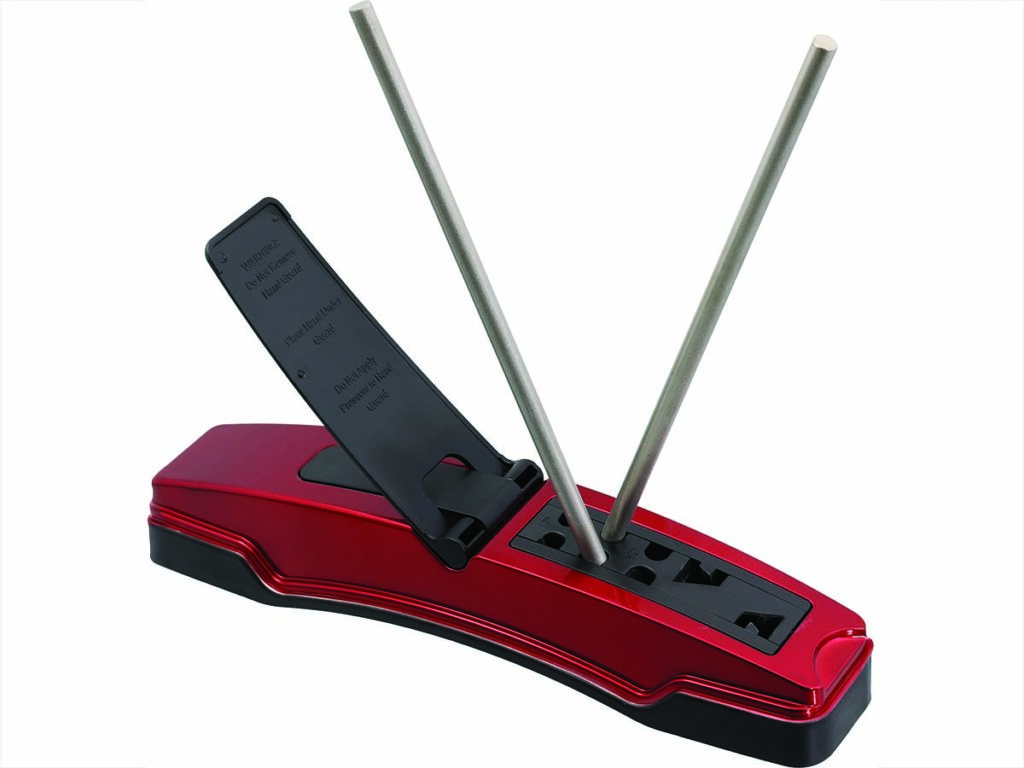
Lansky Master’s Edge Sharpener

The Lansky Master’s Edge All Diamond Sharpener has a rubberized non-slip base with integrated hand guard for safe use.

Master’s Edge All Diamond Sharpener
Model type: V sharpener
Type of abrasive: Diamond coated
Grit: 400 & 600 grit round rods; triangular rod for serrations
Types of knives sharpened: Fillet/slicing, butcher, paring, skinning/kitchen/hunting, camping, utility and chef’s
Types of edges sharpened: Plain and serrated
Weight: 1.4 lbs.
Country of origin: China
MSRP: $139.95

Inspired by the design of Lansky’s top-selling Master’s Edge Sharpener, the Master’s Edge All Diamond Sharpener and its diamond-coated abrasives put a factory edge on hunting, utility, kitchen and other knives with just a few strokes. The unit includes a pair of medium (400 grit) and fine (600 grit) diamond-coated-abrasive rods for sharpening and polishing at your choice of preset angles: 17, 20 and 25 degrees. The 17-degree setting is for fillet and fine slicing knives, while the 20-degree angle is for slicing, butcher, paring and skinning knives. The 25-degree setting sharpens hunting, camping, utility and chef’s knives. A diamond-coated triangular rod sharpens serrated blades and also awls and fishhooks. A rubberized non-slip base with integrated hand guard ensures safe use and features easy snap-in storage in its underside. The unit can be kept on a counter or stores easily in a drawer.

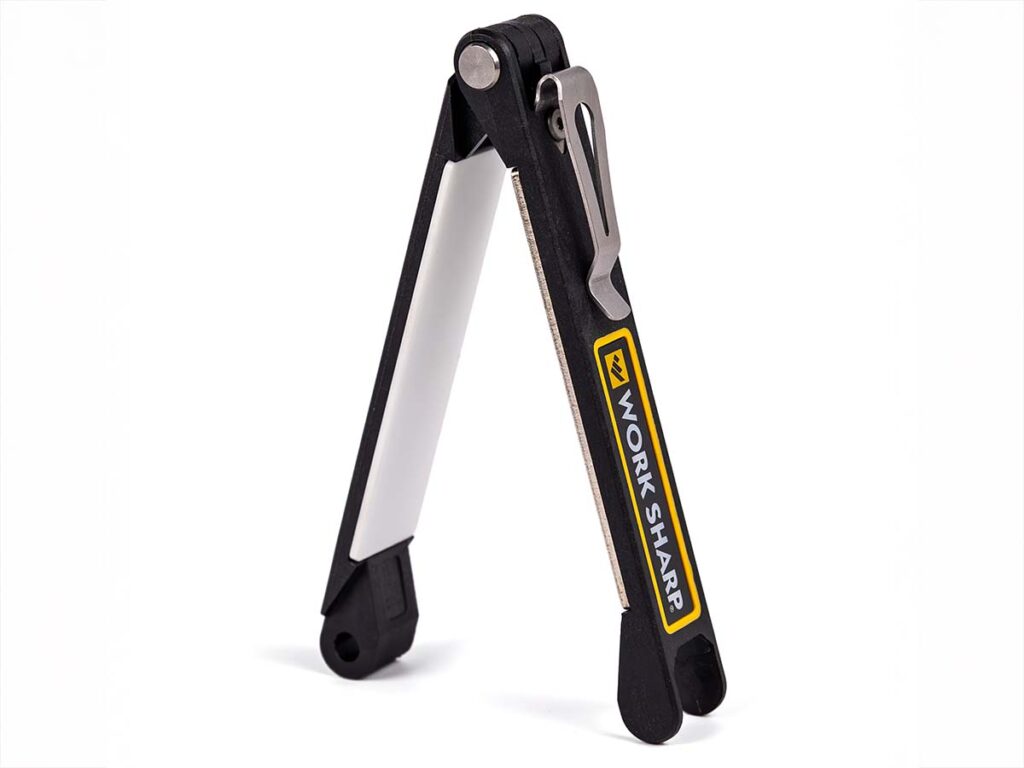
Work Sharp Folding Field Sharpener

Especially effective on EDC knives, the new Work Sharp Folding Field Sharpener is one whiz-bang of a portable unit.

Folding Field Sharpener
Model type: Compact field sharpener
Type of abrasive: Diamond grit plate and fine grit ceramic plate
Grit: Coarse 400-grit for each plate
Unit dimensions:  4.75 x .75 x .5”
Unit materials: Sharpening plates, plastic, aluminum
Types of knives sharpened: Pocketknives, hunting knives, EDC
Types of edges sharpened: Plain 
Special features: Folding design; edge angle guides (20 & 25 degrees) help maintain a consistent angle when sharpening and honing; pocket clip
Weight: 4.6 ozs.
Country of origin: Designed, calibrated and quality checked in Ashland, Oregon, using foreign components
MSRP: $29.95

The Work Sharp Folding Field Sharpener is a compact, lightweight model designed for on-the-go sharpening. It features a 400-grit diamond plate with 20-degree sharpening guides and a fine-grit ceramic plate with 25-degree honing guides, ensuring consistent, reliable edges wherever you are. The folding design and integrated pocket clip make it easy to carry almost everywhere. A big package in a small platform, it’s designed to bring back an edge after a hard day’s use or simply for touchups. Especially effective on EDC knives, it is one whiz bang of a portable-type sharpener.

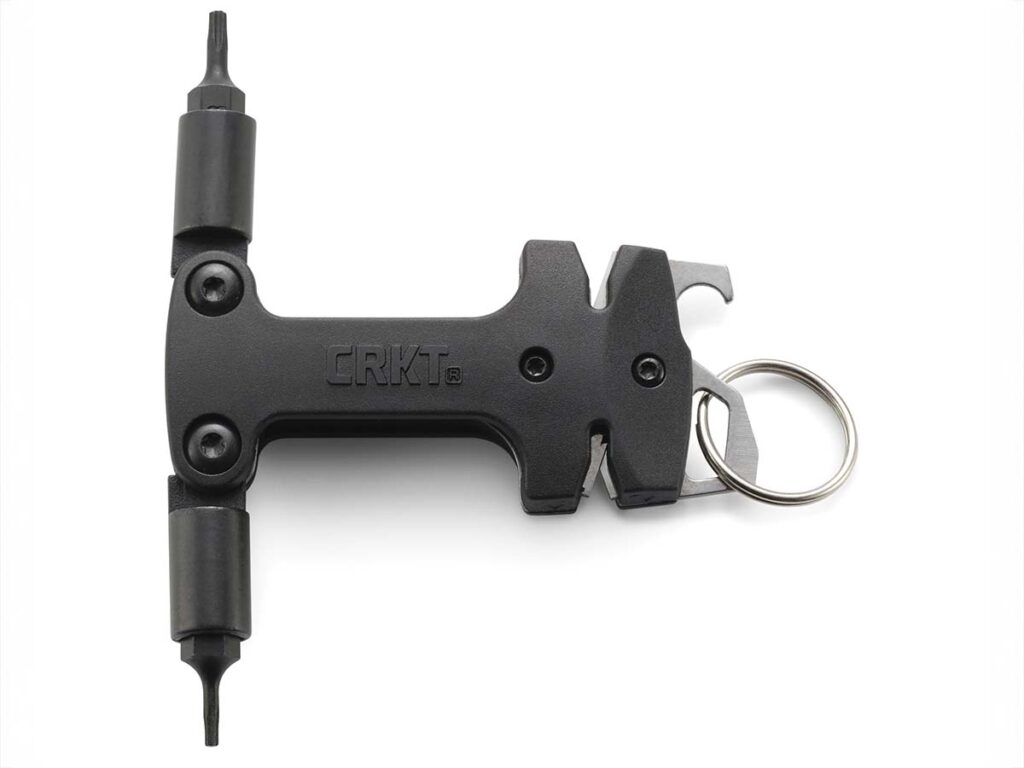
CRKT Knife Maintenance Tool

Designed by Tom Stokes, the CRKT Knife Maintenance Tool is two sharpeners and a multi-tool all rolled into one.

Knife Maintenance Tool
Model type: Keychain/pocket field sharpener and multi-tool
Type of abrasive: Tungsten carbide sharpener with ceramic honing edge
Unit dimensions: 2.7 x 1.18 x .47”
Handle: Glass-reinforced nylon
Types of knives sharpened: Pocketknives, EDC
Types of edges sharpened: Plain
Special features: T6 and T8 Torx tools/bits, flathead screwdriver, bottle opener, keychain compatible
Weight: 2.2 ozs.
Country of origin: China
MSRP: $30

Designed by mechanical engineer Tom Stokes, the CRKT Knife Maintenance Tool is a multi-tool sharpener that reflects Tom’s more than 25 years of experience in the aerospace industry, including his work with CAD software and rapid prototyping technology. He designed the Knife Maintenance Tool to prepare you for life’s various exigencies, everything from emergency repairs, popping a top on your favorite beverage—and, yes, sharpening your knives.

The Tool includes two pull-through sharpeners—one a tungsten carbide abrasive to establish a sharp edge, the other a ceramic abrasive to fine tune it—and two sizes of Torx tools/bits: T6 and T8. The sharpeners are on either side of the front of the handle, which is topped off with a bottle opener and flat-head screwdriver/lanyard hole for a keychain loop. The Torx tools are also on either side of the handle and fold out independently of one another for torquing screws pistol-grip style.

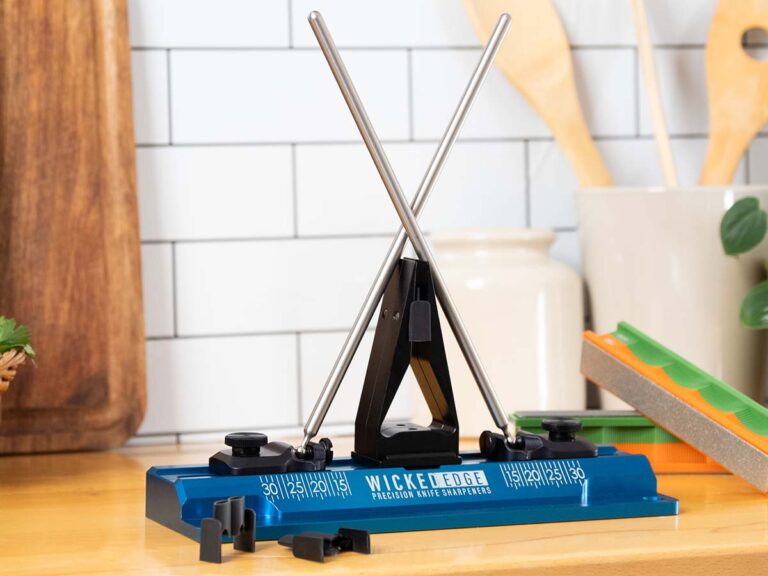
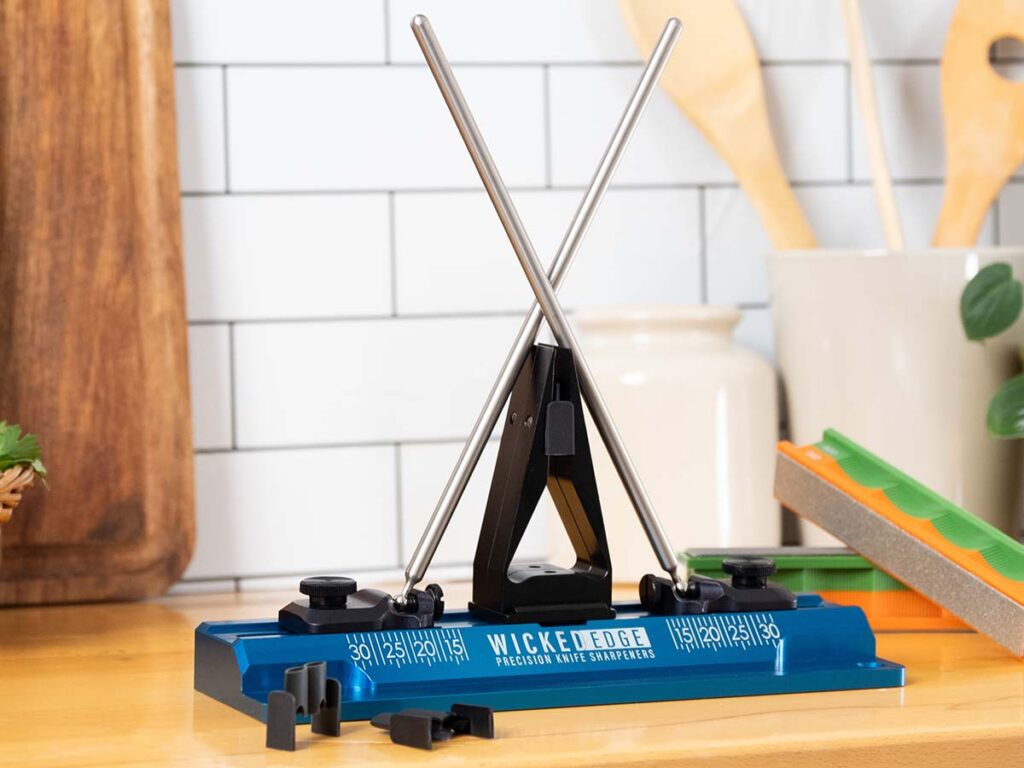
Wicked Edge GO-WE60 Precision Knife Sharpener

Premium abrasives on the Wicked Edge GO-WE60 are 200/600 grit monocrystalline diamond-coated stones.

GO-WE60 Precision Knife Sharpener
Blade Length Capacity: Up to 15”
Blade Thickness Capacity: Up to .25” (longer screws available for thicker blades)
Angle Markings: Calibrated for the blade’s edge to sit at 5/8” above the top of the vise
Guide Rod Length: 8.75”
Unit Weight: 3.6 lbs.
Country of origin: USA
MSRP: $299

The Wicked Edge GO-WE60 Precision Knife Sharpener is designed for novices and seasoned old pros alike, whether at home, in the field or on the road. A redesigned standard vise clamps fully flat-ground and distally tapered blades such as on pocketknives and household cutlery. Sharpening angles are adjustable from 13 to 31 degrees per side (26-62 degrees inclusive) in 1-degree increments for precise edge maintenance. Premium abrasives are 200/600 grit monocrystalline diamond-coated stones. Mounting options include securing to any flat surface with the included C-clamp or attaching directly using predrilled holes.

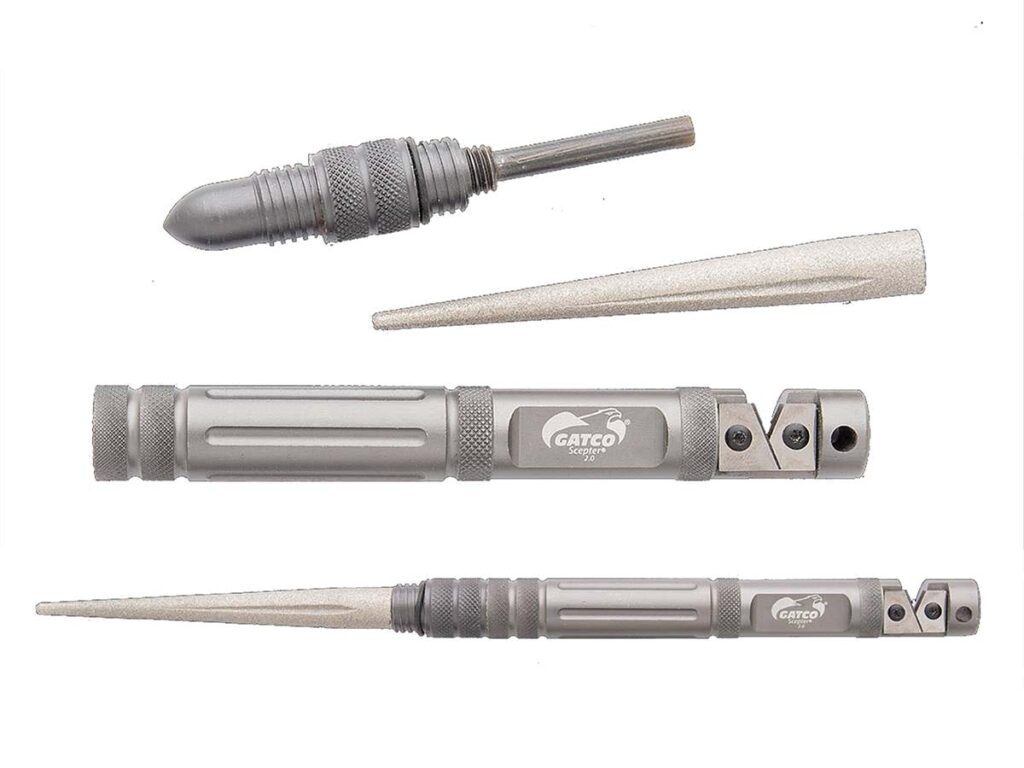
Bear & Son GATCO Scepter 2.0 Diamond

The multi-purpose GATCO Scepter 2.0 sharpens plain and serrated edges and has a magnesium rod for starting fires.

GATCO Scepter 2.0
Model type: Pull through and tapered diamond rod
Type of abrasive: Diamond coated and tungsten carbide
Unit dimensions: 6.125″
Unit material: 6061-T6 aluminum housing
Types of knives sharpened: Hunting, EDC, kitchen
Types of edges sharpened: Plain and serrated
Special features: Tapered diamond rod, magnesium fire starter rod, window breaker
Weight: 3.2 ozs.
Country of origin: China
MSRP: $49.99

The compact GATCO Scepter 2.0 Diamond Take Down Sharpener & Fire Survival Tool from Bear & Son is a multi-purpose implement for everyday pocket carry, the toolbox, to take camping and/or makes an ideal necessity for your bug-out bag. A magnesium rod for fire starting stows inside the tapered diamond sharpener, the latter which includes a groove for sharpening fishhooks. The rod and tapered sharpener are contained inside the CNC-machined, 6061-T6 aluminum carbide body, which has a pull-through tungsten carbide sharpener on the end. Each component features precision-machined threads and an outer “O” ring.

More Sharpening Articles:
Advertisement

Must Read Articles

Read this before you make a knife

Knifemaking 101 – Read This Before You Make a Knife

  by Wayne Goddard My experience has taught me that there's nothing like digging in and getting started. I've often said the hardest part of the...
how to forge damascus steel

How to Forge Damascus

Advertisement
Advertisement