Feather Damascus: Blades Forged Light And Airy

The variations on damascus steel themes are endless. The possibilities are tempered only by the maker’s time at the forge and his or her desire to create.

Among these many variations, one pattern has recently captured the spotlight. These days, feather damascus is trending and custom makers are producing knives that turn heads, captivating buyers with the intricate layering that produces hard steel intertwined with the look of the light and wispy. Feather damascus offers a medium of both performance and artistic expression that influences every aspect of the maker’s creativity.

Ethan Kolar of Plummer, Idaho, describes his interest in feather damascus as “chaotic flow.” He explains, “The pattern’s center seam, where the jagged W’s converge, creates a flow in the blade which really adds to the overall confluence of the knife as well as creating a controlled chaos as the pattern explodes from the center filling out the blade.”

Kolar enjoys the hint of “jaggedness” and the center line that ties the blade together, and in the making of his feather damascus, his focus lies in test etching every restack from the forge. He sees the pattern in many different forms with the observation that “a pattern is not right or wrong but more of what the maker envisions and creates and what is right to him for his knife.”

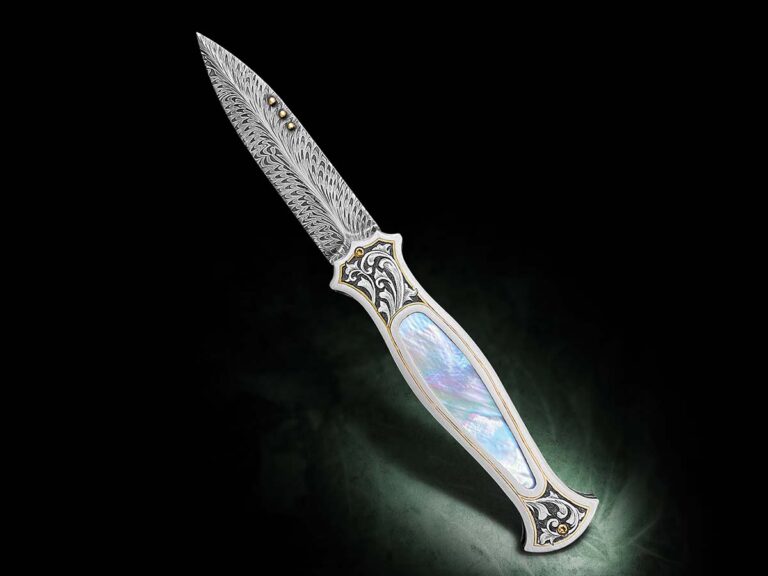
The folding dagger Ethan composed includes a 3-inch feather damascus blade of 1084 and 15N20 steels with an engraved gold inlay and scroll worked 416 stainless steel window frame fitted with exhibition-grade white-lip mother of pearl. Liners are 15N20 file-worked and nitre blued, while the backbar of 416 stainless is engraved and sports delicate file work. Its overall length is 7 inches.

“Most of the inspiration I have while making damascus comes from envisioning my final product,” Ethan remarked, “what engraving will go with it, the handle embellishment, and a lot to do with the overall color of the knife, deciding whether the pattern will be brighter or darker.”

Steel On Fire
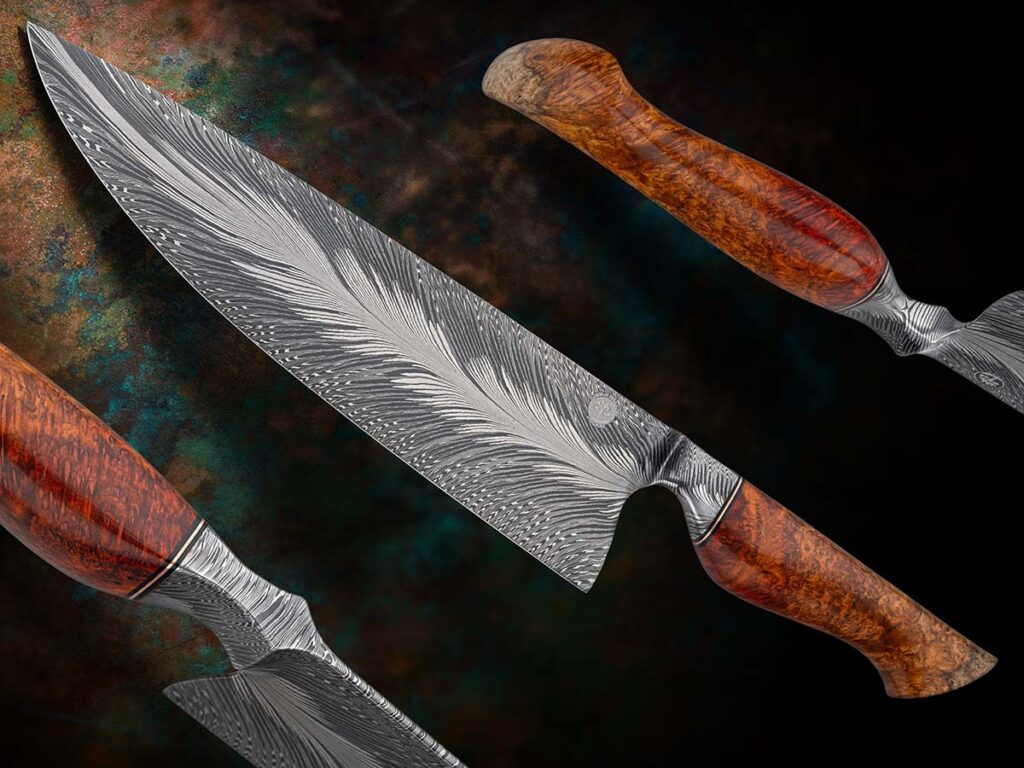
Winning Best Damascus at the 2025 BLADE Show West, Trevor Morgan’s “Torrent of Fire” chef’s knife includes a 9.25-inch blade of 1084 and 15N20 in a mix of W’s and straight layers with a fat core of 15N20. The knife’s overall length is 14.2 inches, and the handle is dark red tiger’s blood amboyna burl with a splash of sapwood for contrast. (Jocelyn Frasier image)

Another contemporary artisan exploring the feather damascus pattern is ABS journeyman smith Trevor Morgan. Having attended the Bill Moran School of Bladesmithing in Texarkana, Texas, in 2020, his goal with each feather damascus blade is to make the pattern “pop.” To achieve that look, his hand follows an artistic eye.

“Contrast, for sure, really makes any pattern cool,” said Trevor, “especially feather or mosaic damascus, larger pieces of dark and bright steel, gradients and that kind of thing. Also, out-of-the-ordinary stuff like feather [damascus] can be really cool to look at. Symmetry is always great with a feather pattern because it’s pretty easy to notice when something is out of whack with a feather due to the defined center. Complexity is also great. If it’s hard to figure out, all the better.”

According to Morgan, a resident of Apple Valley, California, the feather pattern can be challenging due to the hot-cut process, which puts enormous stress on the billet in somewhat weird ways and causes every forge weld to want to split open. The problem, however, can be mitigated by mig welding all the way around the seams. But this is his least favorite method of achieving the integrity of the billet because it requires grinding away the welds, wasting material and consuming time.

Trevor’s inspiration for feather damascus pieces comes from the world around him. “It’s places and people,” he commented, “from nature and the endeavor to make something organic and as lifelike as possible in steel. I regularly get swept up in the general zeitgeist surrounding the making of complex patterns. I see something on social media or somewhere, and I think, ‘Man, that’s really awesome! I’d love to try to make something like that.’ Then comes the real creative part, where I just get an idea of something that might look really cool and put it together.”

Morgan’s method is readily revealed in his featured piece, named “Torrent of Fire.” The knife includes a 9.25-inch blade of 1084 and 15N20 in a mix of W’s and straight layers with a fat core of 15N20. The knife’s overall length is 14.2 inches, and the handle is dark red tiger’s blood amboyna burl with a splash of sapwood for contrast.

Organic Appeal
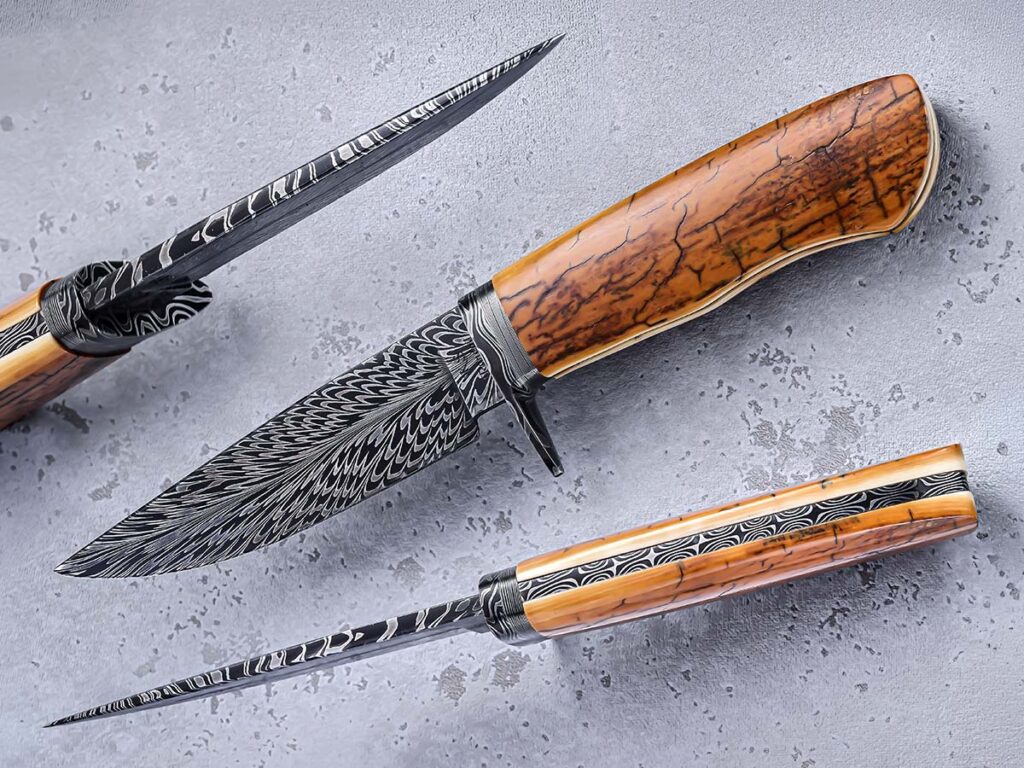
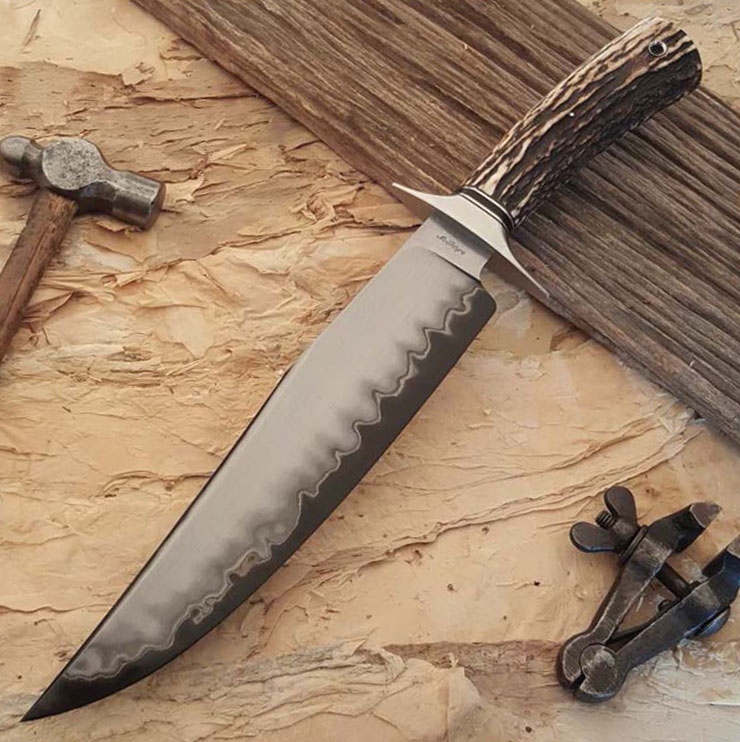
Splitting the billet down the center to maintain symmetry is among the trickiest aspects of feather damascus to Steve Randall. He nails it on his frame-handle hunter, with the axis of the pattern fountaining from the mastodon scales in a balanced and spectacular fashion. (SharpByCoop image)

Feather damascus has been a staple steel for ABS master smith Steve Randall for some time. He seeks a continual flow of the steel from the handle to the tip, and oriented so that the handle appears to actually hold a feather. “I was attracted to the feather pattern because of it’s a very cool, organic look,” he advised. “Like a snowflake, there are no two exactly the same. I’ve been forging feather damascus for at least seven years, and I’ve made several bowies and hunters.”

Randall, of Estancia, New Mexico, presents his feather damascus piece with frame-handle construction, showcasing mastodon scales with an overall length of 9½ inches and a blade of 4¾ inches. “Feather damascus is a more challenging pattern,” he said. “My tricks are patience and concentration. There are many welds involved in the pattern, which can contribute to cold shuts, which can destroy hours of hard work. The trickiest part is splitting the billet right down the middle and maintaining symmetry.”

While he describes the feather damascus forging process as complicated and labor-intensive, Steve sees the payoff in the harmony of the pattern and its related materials in the finished knife. “I always try to complement it with the best handle materials I have available,” he reasoned. “I prefer stag or ivory. If using wood, I avoid busy patterns and colors. I draw inspiration from many other makers. There are so many accomplished makers who produce a variety of feather patterns. It is one of my favorite patterns to forge because it can really accent the flow of the blade and give it a great overall look.”

Movement And Flow
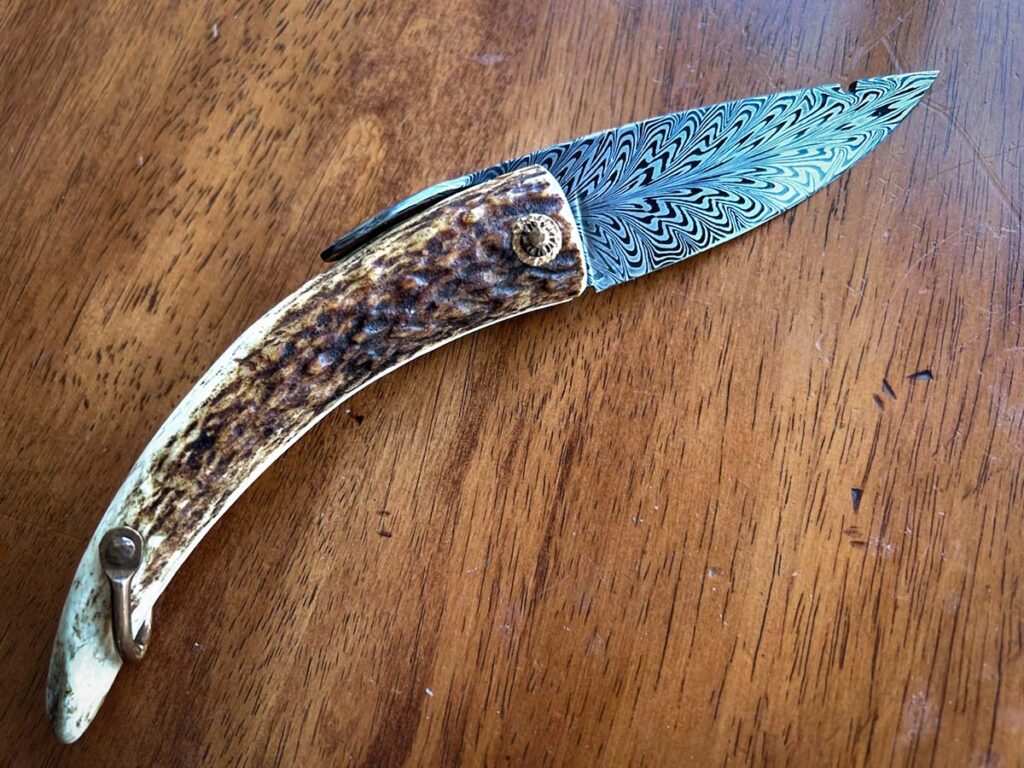
While David Lisch doesn't feel he's hit the limits of his Mountain Man folder, the style of knife is striking with its feather damascus blade set in stag-tip handle. Copper hardware and pivot give the knife its antediluvian look, while the flowing pattern of the blade anchors it in modern forge techniques. (David Lisch image)
While David Lisch doesn’t feel he’s hit the limits of his Mountain Man folder, the style of knife is striking with its feather damascus blade set in stag-tip handle. Copper hardware and pivot give the knife its antediluvian look, while the flowing pattern of the blade anchors it in modern forge techniques. (David Lisch image)

It took a single demonstration by the great master smith Harvey Dean to convince David Lisch, who earned his ABS journeyman stamp in 2009 and his master stamp six years later, to try the feather pattern. “I was always attracted to feather damascus,” he remembered, “but around 2008 I had the chance to see Harvey Dean demonstrate it at an event at Josh Smith’s, and I went right home and made the tools needed and gave it a go. I’ve been making feather damascus since his demo, and my hat is off to Harvey.”

For David, the making of feather damascus is challenging, but he says book matching the blocks really helps with the constant flow of the pattern. Sometimes, he says, makers will intentionally disrupt the flow by spinning one block one way and one the other to enhance the look. If it is done intentionally, he advises, there is no wrong way to stack the blocks. Forging all begins with the initial stack, and David starts with a 12- to 15-pound billet, acknowledging that the pattern can be wasteful in material. He tries not to go too far or stop too short in the forging process and offers that sometimes less is actually more.

“I love feather damascus because it looks different from maker to maker,” added Lisch. “I like a feather with movement and flow, not too bold and not way too fine, something that is easy to look at. For me, the more the pattern follows the forging, the more I like it. The center should lift up into the bolster or ricasso, showing that the blade was forged rather than running off the blade under the ricasso, showing it was just ground into a shape that disrupts the flow.”



Lisch gained a measure of popularity with his Mountain Man 2 folder, and the pictured knife is an example of what he describes as a “deep dive” into the style while using stag tips. “I set out trying to create my own version of one of the oldest knife designs in America,” he remarked, “and I believe I did just OK. But I’m not finished. So far, I’ve made several versions of the folder and have taken it even further with help from my friend and mentor [master smith] Mike Vagnino.”

Lisch had brought together his feather damascus touch and innovative design composition by introducing a clocking adjustable pivot that he has incorporated into a slipjoint, linerlock, lockback and flipper, all in the Mountain Man style with bronze, copper, stag and, of course, feather damascus. He has yet to reach the outer limits of his Mountain Man creativity and says that more will come in due time.

Check Out More Cool Customs:

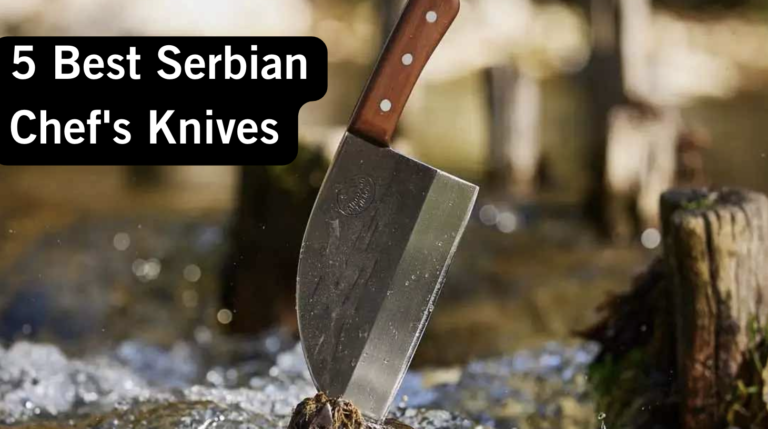
5 Best Serbian Chef’s Knives You Can Buy

Growing In Popularity, The Serbian Chef’s Knife Has Gained A Reputation For Strength And Versatility.

When many think of kitchen knives it falls into two categories: Japanese-style knives and German/Western-style knives. However, there is slowly a third type of knife gaining popularity: the Serbian knife.

Also known as an Almazan knife (or just an Almazan), the Serbian chef’s knife has a unique history when compared to other blade styles. Rather than evolving and adapting over time, the Serbian chef’s knife is tied back specifically to Almazan Kitchen.

Almazan Knife And Kitchen Backstory

The company was founded by two men in Serbia, uncle and nephew Boban and Aleksandar Almazan. Essentially, clever marketing and a unique look have vaulted the knife into the limelight.

Despite Almazan’s and other knives’ bucolic charm, there is little attaching the style to a particular historic Serbian design. Instead, the moniker comes from the Almanzan clan hailing from Serbia. In some corners of the globe, the knife is simply known as an Almanzan knife … makes sense.

Interestingly, the Almanzans seemed able to harness to disparate trends in the knife world with the Serbian chef’s knife. On one side, was the ever-growing interest in cooking, the other the rise of cleaver-like knives for bushcraft. They must have had some passing inkling of this crux, given they marketed their knives to both communities, as well as played up the wilderness and food prep in their marketing.

Serbian Chef Knife Design Points

Unless you’ve lost your glasses, it’s fairly apparent what sets the knife apart from its counterparts–its huge hooking blade. If we’re honest with ourselves it’s a cleaver with a tip–somewhat reminiscent of a large deba bōchō, but overall heftier.

Generally, most Serbian chef’s knife makers tout their wares as handmade–of course at factory scale, with all that entails. Most of the blades have a very thick spine giving them the chops to tackle heavy-duty jobs. Though, most lack a defined belly, lending them better hacking jobs.

By and large, Serbian knives are constructed of carbon steel and have won some kudos for maintaining a good edge. Furthermore, almost all makers favor a wood handle of some sort, most likely because it maintains the rustic, outdoorsy aesthetic Almazan originally pioneered.

Should I Get A Serbian Chef’s Knife?

Honestly, like all things knives, that’s up to you. Maybe the Serbian chef’s knife is the kitchen or backwoods tool you’ve been waiting for or perhaps is all online hoopla. There are many who fall in the latter category and are vocal about it.

Despite this, it does seem the cleaver-style design has a place in the galley, particularly if you happen to process chuck wagons full of meat. The large width of the blade makes it ideal for hacking, particularly joints and bone. Additionally, boasting a tip, it could potentially tackle basic kitchen jobs in a pinch.

That said, as a catch-all chef’s knife, most cooks are likely going to find themself more comfortable behind a traditional design. The large blade is unwieldy for basic cooking jobs, such as chopping and mincing. Furthermore, the lack of a belly on most examples slows the knife down considerably on general tasks.

Bushcraft? Sure, there’s the potential. A Serbian chef’s knife certainly has the ability to work in a hatchet’s stead. Outside of that, well, things get dicey. It’s not exactly the style of blade you’d reach for to skin a buck or whittle fuzz sticks. Not to mention, do you really envision toting one of those beasts in your kit? (Add a pound to your ruck, not mine!)

Of course, this is coming from a more traditional mindset of kitchen and backcountry work and utility. And much like beauty, utility is often times in the eye of the beholder.

5 Top Serbian Chef’s Knives

Almazan Kitchen Original Serbian Chef’s Knife

Almazan Kitchen Original Serbian Chef’s Knife

The blade that started the craze. The Original from Almazan Kitchen set the standard for every Serbian knife that’s come after it. Hand forged in Serbia, and weighing a shade under 1 pound, this blade is a menace in the best possible way. 

The carbon-alloy blade is tempered to a 58-60 HRC. The full-tang construction features a triple-riveted handle for grip and gives the user a sense of confidence. The uncle-and-nephew team that founded the company, Boban and Aleksandar Almazan, wanted to make a knife that would be as comfortable in the forest as it would be in the kitchen, for some they’ve succeeded.

Beyond just the knife itself, Almazan also sells accessories including leather sheaths, cutting boards, and kitchen equipment made from olivewood. 

The knives have also benefitted from the company’s wildly successful marketing, in particular the Almazan YouTube channel. Fueled by more than 3 million subscribers, the company and its knife have blown up in recent years.

MSRP: $152.92 (There is also a stainless version for $30 less)

Damas Knives Bushcraft Serbian Knife

Damas Knives Bushcraft Serbian Knife

This model from Damas Knives is emblematic of the new(ish) design, with its wide blade and rustic handle. The knife is hand-forged from a single sheet of XC75 high-carbon steel with a 59 HRC and ground to a 21-degree angle.

The blade’s strength and the Rosewood handle’s sturdiness allow the user to butcher big cuts of meats, nimbly dice veggies, and even slice right through small bones. Beyond the food uses, this piece can tackle cutting wood and brush on a hike. 

MSRP: $145

Imarku Butcher Knife

Imarku Butcher Knife

From one of the most trusted names in kitchen knives comes a budget Serbian chef’s knife that swings far above its price point. 

This knife from Imarku features a hammered design and is hand forged. The blade is made from high-carbon, high-manganese German X50CrMov15 steel. The hard 56-60 HRC steel holds a razor edge and has good rust resistance as well. You can see the spots from the hammering up and down the blade, which gives it its signature look.

The knife comes with a leather sheath and, like other Serbian knives, has the strength to cut through bones and butcher large meats. 

Imarku stands apart from other Almazans due to the price. The company has found a way to make a top-tier example for under $100. 

MSRP: $59.99

Kopala Original Kitchen Knife

Kopala Original Kitchen Knife

Now for a little something different from Kopala. Its original kitchen knife is made in the Serbian style but in a far different shape from the other knives on this list.

Instead of the rounded cleaver-esque design, Kopala has made a smaller, swooping blade–reminiscent of a scimitar–attached to a triple-riveted Rosewood handle. The high-carbon blade is balanced enough to cut through raw fish and other assorted meats.

The main drawback on the knife, unlike the others on this list, is the company did not design it to cut through bone. That takes away the versatility that makes the traditional Serbian knife so beloved. However, as the most inexpensive knife on our list, if that’s a compromise you’re willing to make then the knife is more than worth it.

MSRP: $29.88

HDMD Serbian Chef Knife

HDMD Serbian Chef Knife

Rounding out our list is a fine all-rounder from HDMD Knives. Handmade from high-carbon steel and pakkawood, this blade from HDMD is an excellent middle ground if you have any interest in a Serbian knife.

It follows the construction of knives like the original Almazan. It’s hand forged, roughly six inches long, and has a 56-58 HRC. It weighs about .75 pounds and can handle whatever you throw at it in the kitchen. 

Where it stands apart is in the price. This blade is under $100, which makes it a perfect entry point for this style of knife.

MSRP: $79

Read More

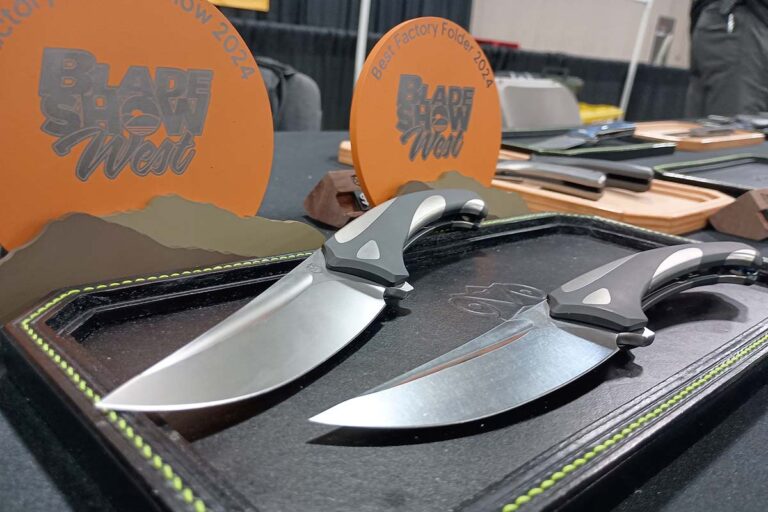
2024 BLADE Show West Factory Knife Award Winners

See Who Took Top Honors In Salt Lake City For The 2024 BLADE Show West Factory Knife Awards.

Over its short history in Salt Lake City, the BLADE Show West Factory knives competition has become very heated. Likely none have been as hot as the 2024 field.

Held during the Oct. 4-5 show at the Salt Palace Convention Center, the event drew its largest field of entrants yet, with companies worldwide bringing their best for the coveted hardware. The undisclosed panel of judges more than had their work cut out for them in choosing the top knives out of five categories.

As a side note, the folder section—which also produced the Best In Show knife—was particularly tense. The judges started in this category and spent the better part of 30 minutes deciding the winner.

Check out what these industry experts picked as the best of the best in the last BLADE Show of the year.


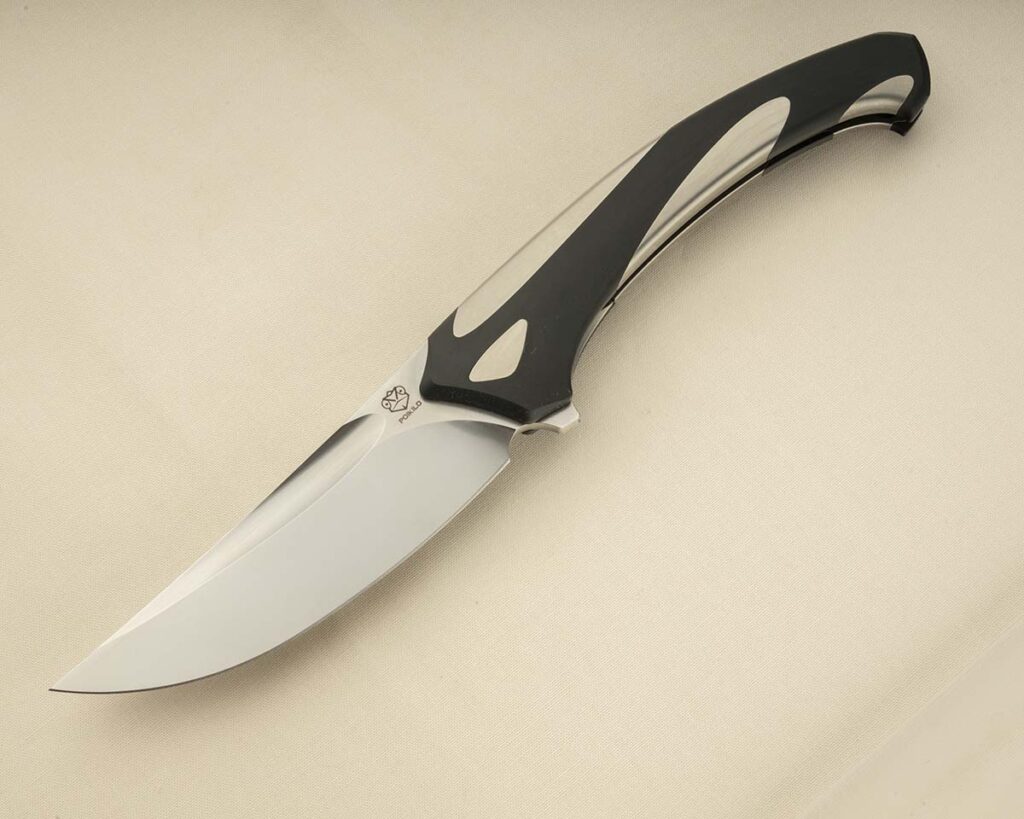
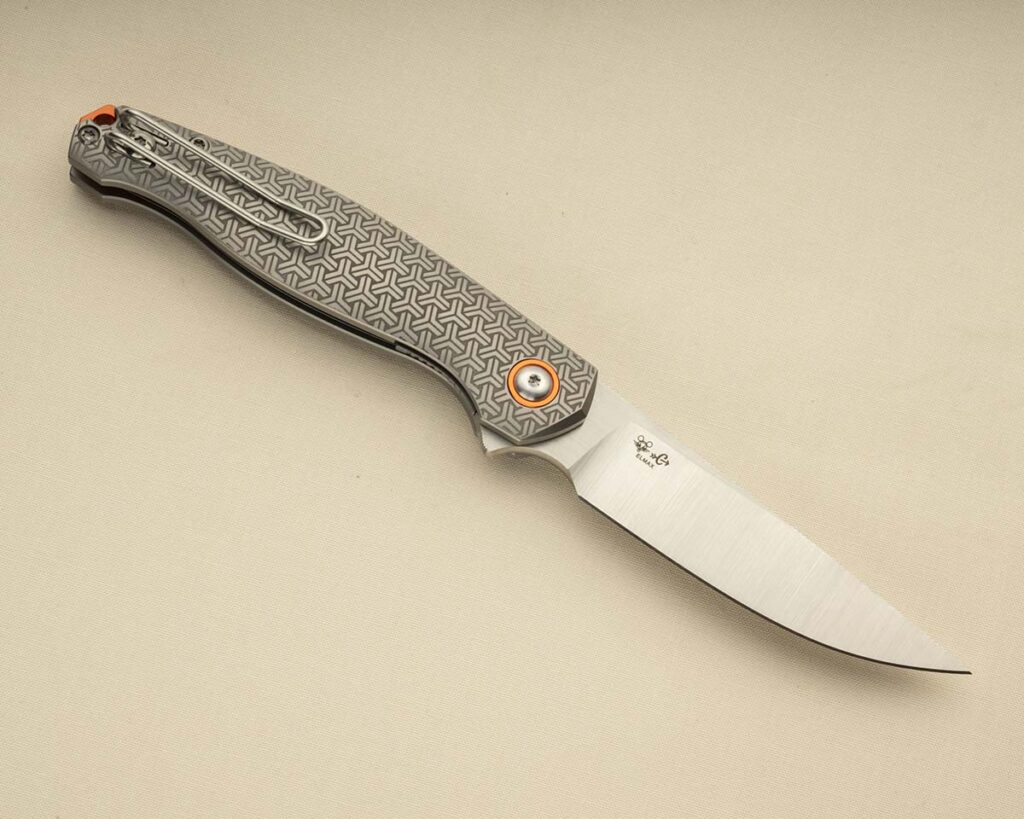
Best Folder And Best In Show: Poikilo Orca

Poikilo Orca
JFRASIER PHOTOGRAPHY

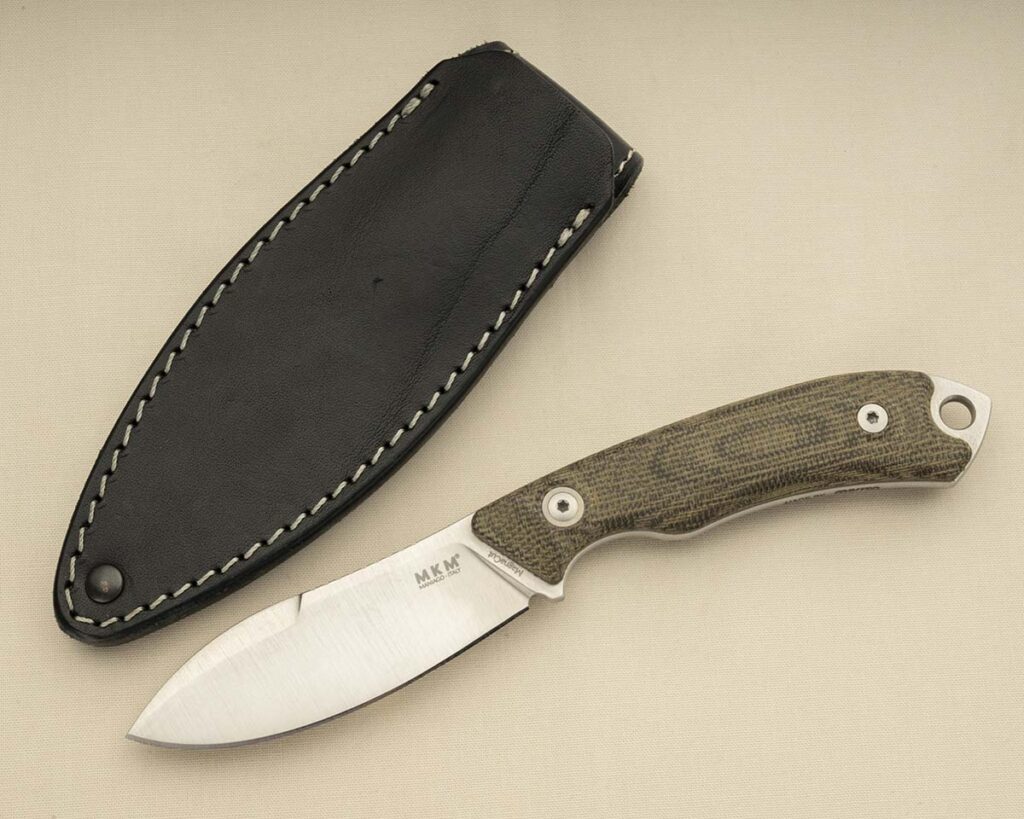
Best Fixed Blade Knife: MKM Pocket Tango

MKM Pocket Tango
Photo: J. Frasier Photography

Best EDC Knife: GiantMouse Sonoma V2 Titanium

GiantMouse Sonoma V2 Titanium
Photo: J. Frasier Photography

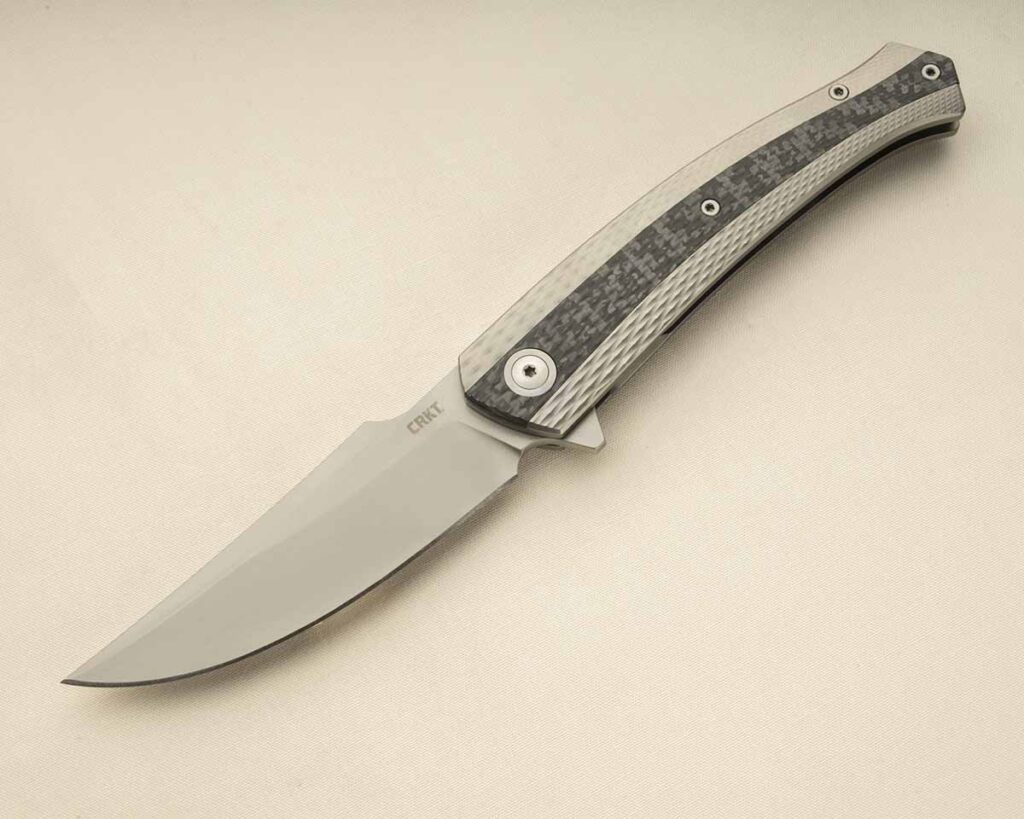
Best Imported Knife: CRKT Persain

CRKT Persian
Photo: J. Frasier Photography

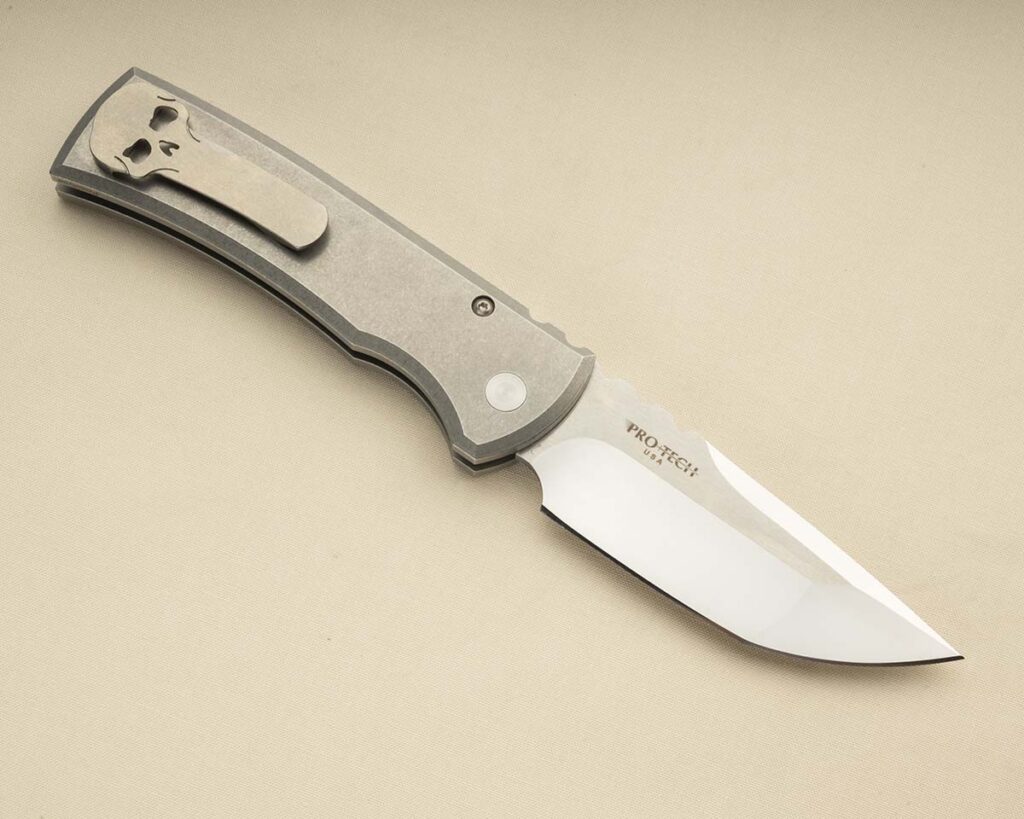
Best American-Made Knife: ProTech Redencion Prototype Chaves Auto

ProTech Redencion Prototype Chaves Auto
Photo: J. Frasier Photography

Past Blade Show Award Winners:

Bob Loveless’ Influence Still Touches Those Closest To Him

Robin Askew moves on, but her father remains there for her.

The constant, the heart and soul of BLADE Magazine Cutlery Hall-of-Fame® member Bob Loveless, was wrapped up in custom knives. There was little time for anything else and there were only rare occasions that he travelled. Bob and his wife, Yoshi, made a few trips to Japan or to Hawaii, on a rare occasion to Europe, but most often with some business purpose involved as well.

And over time, Robin Askew came to appreciate and understand the singular purpose, laser-like focus and personal intensity that drove her father. He was capable of kindness but often brutally frank. He was willing to entertain young knifemakers, share information and then criticize or dismiss flaws with stark, unvarnished perspective. With patience that was sometimes fleeting, he did not suffer fools gladly.

But then, his personality was a tapestry, like all of us, an amalgam of inherited traits and life experience. His mother and father had sent him to live on a farm with grandparents at a young age. According to Robin, he lived and worked with the hired hands, not as a grandchild. At just 15 years old, he joined the Merchant Marine when his mother told the white lie that he was of age.

In addition to the knife her dad made for her, Robin’s other favorite keepsake is a photo of him, a joyous grin radiating from his face, as a cluster of pigeons lands on his shoulders and arms during a visit to Rome many years ago. “It’s a beautiful picture,” Robin stated, “and I look at it every day.”

It wasn’t easy for Bob Loveless, right from the start. But he made something of his opportunities and his native talents, shared them in the way he knew how, paying the price along the way and leaving a body of work of insight into what is beauty and flow in a handmade knife, like no one else has. For the record, he never billed himself as the world’s best knifemaker. He wasn’t, and he freely acknowledged that others were much more deserving of applause for their skills. It was his eye, perspective and sense of beauty and design that thoroughly set him apart.

Four Careers

When Robin grew up, moved out and moved on, she carried the best and the most worrisome of life experiences with her. She made her own way and has come to understand and appreciate the journey.

“I’ve really had four careers,” she reflected. “I worked 11 years in the banking industry and 20 years as a correctional peace officer at Pelican Bay State Prison in Crescent City, California, with 12 years as a peace officer. Put that together with the work in Dad’s office and then when my husband, Jimmie Askew, and I had a restaurant in Crescent City, California.”
When she worked in banking, Robin went to Crescent City on business for her employer. While there she met the most eligible bachelor in town. “It was a 400-mile, eight-hour drive to Crescent City, and I was supposed to be there for a month,” she said. “It became one of those wonderful love stories. Jimmie and I were meant to be together.”

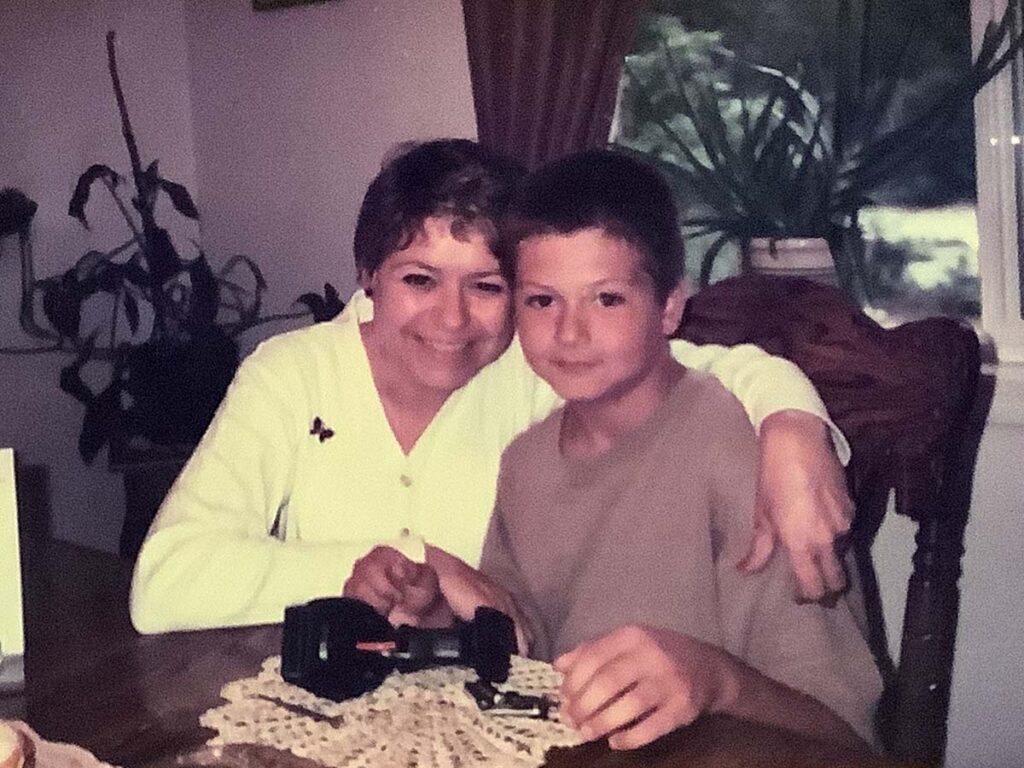
Bob Loveless photographed Robin’s son Nico during a regular visit while they were “out and about.” Nico was 9. The resemblance to his grandfather is striking. (Bob Loveless image)

Jimmie was an award-winning chef, and with Robin’s business background the couple put together a fine restaurant that served a variety of entrees.

“I met Jimmie in 1984,” she recalled wistfully. “We got married the next year, and he passed away 12 years later. He made prime rib, barbecue pork spareribs and fresh seafood. He would go out in the morning on his boat and catch 300 to 400 pounds of rock cod. He would clean the fish and then serve it that night. It was the best seafood in all of Crescent City—wonderful. We also had meat from our mesquite grill, chicken parmesan, grilled Italian sausage, vegetarian dishes and the deep-fried seafood platter.”

Nico

The couple had one son, Nico, who is now 36. When Robin speaks of those days, a tinge of heartache touches her words. But also during that time, she rediscovered the love and care that her father had always had for the family.

Nico and Robin
Nico and Robin

“Dad came up from Riverside to visit us a month before Jimmie died,” Robin recalled. He had been in touch by telephone continually and made himself the father figure that a 7-year-old boy needed during a tragic time.

“After Jimmie died, Dad would come up regularly,” Robin related. “He took Nico fishing four or five times a year. Grandpa was there for Nico. He taught him how to shoot a gun and would charter a boat on the Chetco River in Oregon and they would fish together. He came up to see Nico play soccer, baseball and football, and he stepped in to take care of my son.”

When Bob wasn’t physically present, he was always in touch with Robin and Nico. He worried that Robin worked in the toughest place at Pelican Bay State Prison. It was called the “shoe,” and he once told Robin how he worried for her safety. Her response was from deep inside, a manifestation of something she learned when her father made the introduction to that Japanese gentleman years earlier: “I told my dad, ‘I show them [the inmates] respect, and they show me respect. It’s really the safest place in the prison to work.’ I told him there were two officers for every inmate and that I really had no qualms about it.”

Bob took this picture when he visited Robin and Nico not long after Jimmie Askew passed away. Nico was 10.

That soft spot in Bob’s heart came through time and again as he cared for his daughter and grandson. “He would call us and say, ‘What’s Nico doing?’ He wrote a check to pay for Nico’s braces. He was there for both of us. Being a widow raising a young boy, I could call him anytime and we would talk. I also started to do that with my mother because I wanted to reach out and make sure that my contact with my family was really strong. Dad was so far away, but I talked to him at least once a week. He became the type of dad that my son needed.”

Traits & Quirks

All the while, the legend of Bob Loveless continued to grow. Tales were told. Knives were made and sold. Stories were swapped, and the maker slowly but surely grasped his own impact on the world of knives. At the same time, his various interests, personality traits and, yes, his quirks made him more than just a knifemaking phenomenon. They made him a marvel, a celebrity and an icon.

Bob always carried a gun. “Even when I was a little girl,” Robin laughed, “I remember that he would hang his gun on the towel rack in the bathroom.” For some time, he enjoyed rabbit hunting in the desert with friends. But then another fork in the road pointed a different direction when it came to outdoor activities.

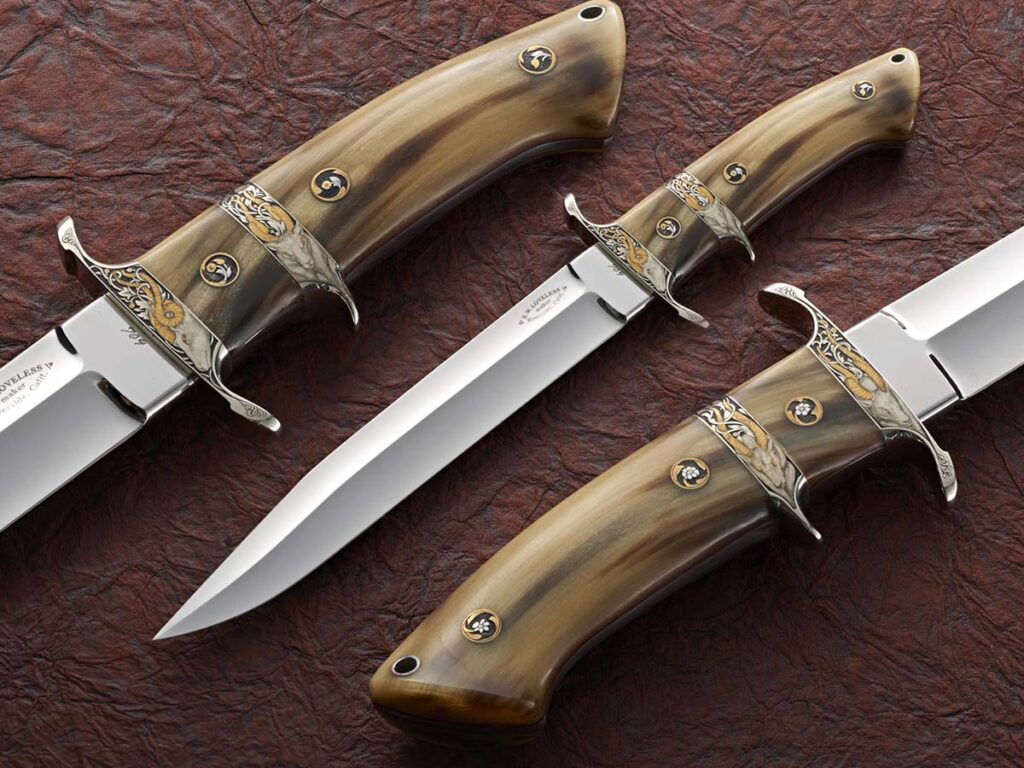
It was his eye, perspective and sense of beauty and design that set Bob Loveless apart. Few if any of his knives capture these traits better than his Big Bear fighter in sheep horn and gold engraving by Dan Wilkerson. (from the John Denton collection; Eric Eggly/PointSeven image)

Robin commented, “They took a lot of hunting trips, and one day Dad decided to stop shooting animals with a gun. He started shooting pictures with a camera. He loved photography, and I have no idea how all that started—but, gosh, I remember when I was a young kid he would take me and Allison on the weekends to camera stores. He would go in and talk for a couple of hours, and we were bored out of our minds. He would take pictures like you wouldn’t believe.”

Adding to Bob’s repertoire of activities, he was also an accomplished gunsmith. If these endeavors sound like a lot to pack into a lifetime, then there is no hesitation in labeling Loveless a true “Renaissance Man.”

Nonetheless, he had pursued his passions, probably without seeking the fame that came along with them. “I do know he never liked living in fancy houses,” Robin remarked. “But he had sports cars, and his favorite car depended on his age bracket. He would drive the back roads to the Chinese restaurant in Riverside and hit 100 miles per hour. At one time, he had three cars and two airplanes. He was a pilot with a lot of camera equipment. He probably got his pilot’s license before he moved to Riverside. I forget what year he got rid of his planes. He had crashed and it was no fault of his own. It happened when a bigger plane was landing and he got banged up. He had a limp after that.”

Keepsakes

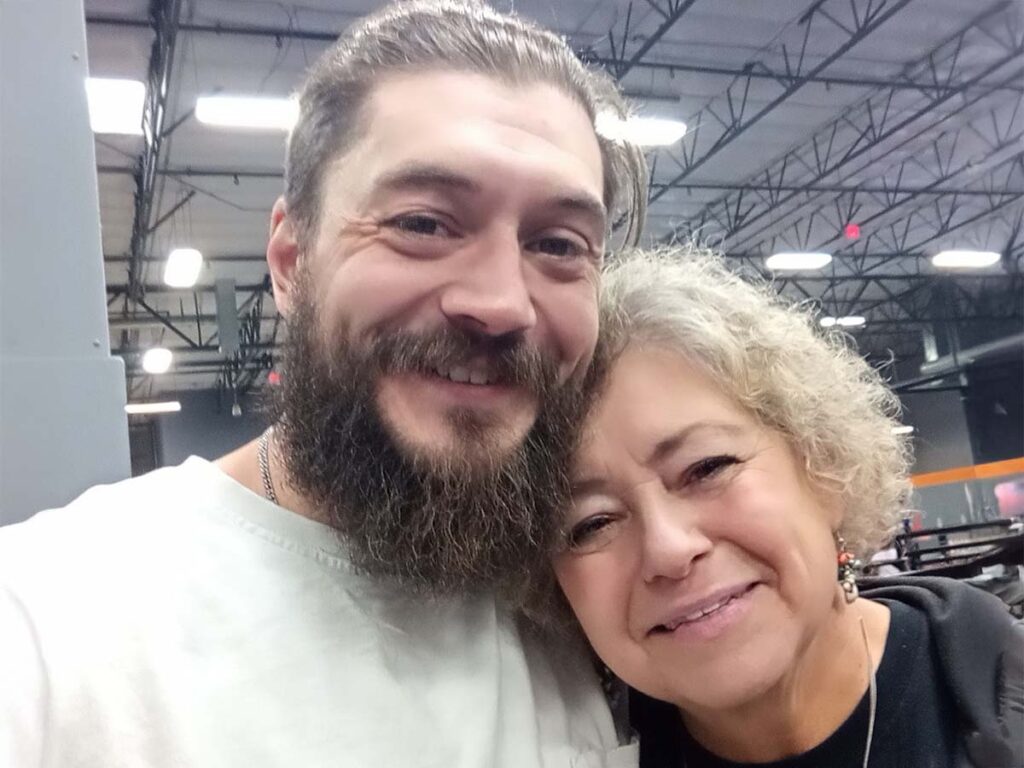
Writes Robin: “My handsome son Nico as he is today, shaggy beard and all. As a mother, I think his eyes and smile show what a kind and good man he is. I know his grandpa would agree with me and like this picture very much.”

Today, Robin’s heart is warmed by her memories, her strong Christian faith, and the knowledge that her dad truly became a father. His life was a mosaic of love and loss, turmoil and moments of calm, fiery and icy emotion, but always with a heart for the good and for his family. She clings to at least a couple of special items that symbolize the tie that binds.

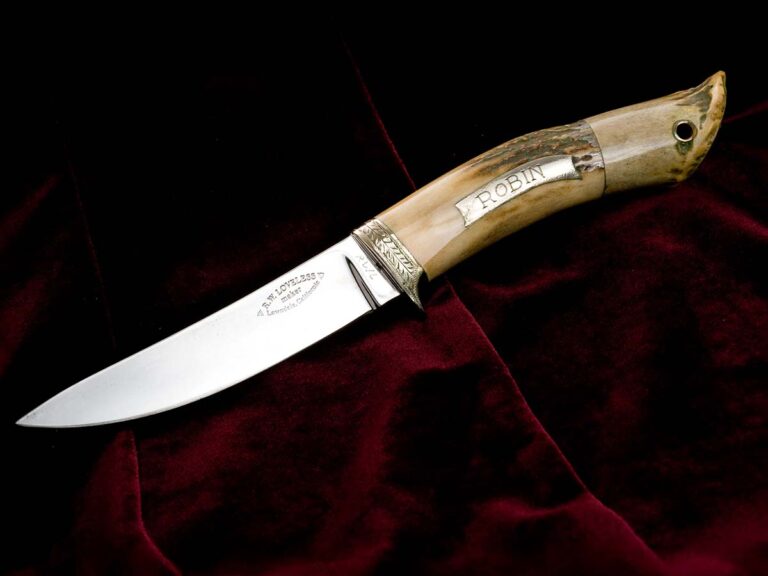
He made a banana skinner for her when she graduated from high school. “It has a stag handle with intricate engraving that he had done by a silversmith,” Robin said, “and I think the handle is at least 6 inches long with the blade about 7 inches. It is absolutely beautiful.”

A few years ago, Steve Johnson cleaned the knife up and put an edge on it. Dave Ellis took photographs of the one-of-a-kind piece, and John Denton, likely the foremost authority on Loveless knives in the world today, offered powerful words and urged her to treasure it always.

His various interests, personality traits and quirks made Bob Loveless more than just a knifemaking phenomenon—they made him a marvel, a celebrity and an icon.

The other keepsake is a photo of Bob, a joyous grin radiating from his face, as a cluster of pigeons lands on his shoulders and arms during a visit to Rome many years ago. It captures a sliver of his enjoyment of life, a glimpse into the heart and soul of just who he was. He was the gruff guy that gave generously to the local animal shelter, the edgy and matter-of-fact curmudgeon who handed substantial financial support to the UPS driver who had served faithfully in the area for years when Bob found out the guy had fallen on hard times. He was simply their quiet benefactor.

“It’s a beautiful picture and I look at it every day,” Robin offered. She ponders exactly where his genius came from and concludes that he inherited it from his mother. She admits that the spark of “genius” has not emerged from any other family member and concludes, “It was meant to be. That kind of genius is created before birth. My father was extremely gifted, and I always knew that.”

True enough, he was gifted, and in some ways that only a relative few others were even aware of.

Growing up Loveless and living within the sphere of influence her famous father created has been an adventure for Robin Askew, a thrill ride that began so many years ago, one that continues well after her dad’s departure from this Earth.

Read More On Bob Loveless:

U.S. Made Military Knives And Makers

Four U.S.-based companies embrace making military knives stateside.

Make no mistake—manufacturing knives in the USA comes with challenges, including regulations, taxes, high costs of doing business and much more. While imported knives often beat American-mades on price, companies that choose to produce knives domestically carry a long tradition of equipping the U.S. military with the best American design and manufacturing has to offer.

Spartan Blades

For Curtis Iovito, with Mark Carey co-founder of Spartan Blades, the tension between creating high-quality knives and keeping costs down has been one of the primary challenges in running Spartan for the past 13 years.

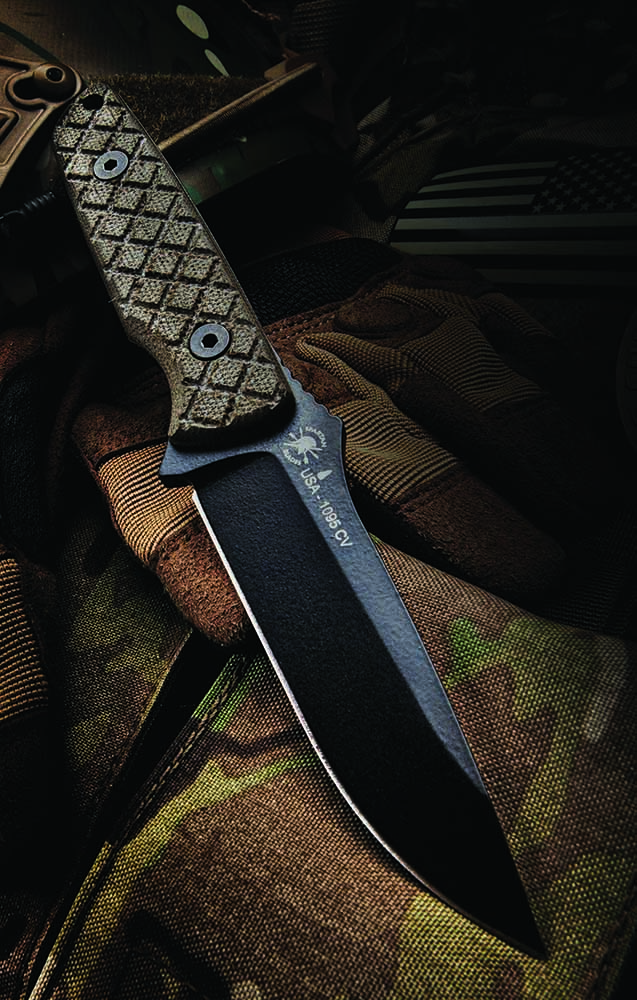
The Silver Line, also known as Pineland Cutlery, is a collaboration between Spartan Blades and KA-BAR to create a more affordable line made in the USA. The Alala is the first collaboration between the two. It has a 3.75-inch blade and a canvas Micarta handle. MSRP: $159.

“We did everything we could to keep our costs down, from buying in bulk, streamlining production and reducing shipping costs,” Curtis observed. “Even with that, we were lambasted by our customers for being ‘too expensive.’ It was our No. 1 complaint. We even received hate mail for it!”

For Iovito—who said those who staff Spartan Blades consider themselves soldiers first and knifemakers second—patriotism was among the top reasons to make knives in Southern Pines, North Carolina, despite the challenges of starting a manufacturing venture there. Another reason is the ability to have fine control over the deadlines and the manufacturing process, he added. That control and the pursuit of quality it allows has enabled Spartan Blades to make knives for special operations forces, the FBI, U.S. Marshals Service and “every other three-lettered group out there,” Iovito said.

Located on the backside of Fort Bragg, Spartan Blades has plenty of soldiers stopping by to shop, though there are many who do not have enough money to take home one of the company’s top-tier Gold Line knives. “Every single packing list I have ever seen for a soldier has ‘fixed blade knife’ listed on it,” Iovito said, “and most of the time the soldiers are required to acquire it themselves.”

Consequently, Spartan began offering two other grades of knives. The Bronze Line is manufactured in Taiwan and the Silver Line, also known as Pineland Cutlery, is a collaboration between Spartan and KA-BAR to create a more affordable line in the latter’s facility in Olean, New York. The Alala is the first result of that collaboration.

“We wanted to make a knife that was lightweight, easy to carry and that could be carried on airborne operations,” Iovito said. The Alala is made suitable for airborne operations by focusing a good deal of effort on developing a hard sheath with double retention. It’s been out for about a year now. It has a flat-ground 3.75-inch blade and a canvas Micarta® handle. It weighs just shy of a third of a pound and is ground from 1095 Cro-Van steel, where additional elements such as molybdenum and nitrogen make it tougher than standard 1095 spring steel. As Iovito noted, “KA-BAR has been using this steel for years and has the heat treatment down to a science.”

TOPS Knives

A couple of years ago, TOPS Knives of Ucon, Idaho, figured it hadn’t released any big combat knives in a while, so company president and knife designer Leo Espinoza developed the Operator 7.

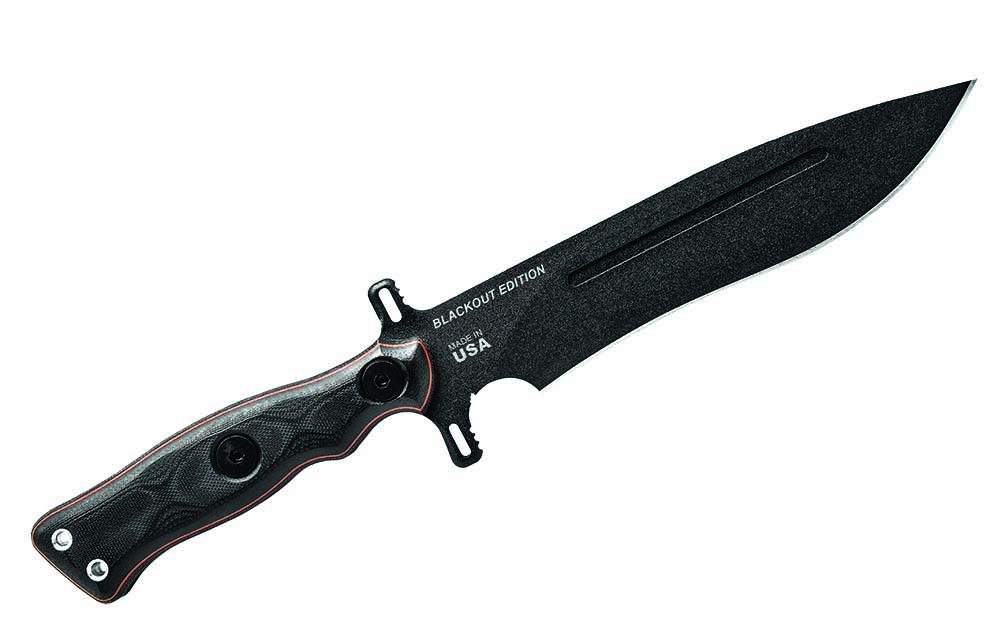
Every TOPS knife save one design is manufactured at the company’s shop in eastern Idaho. An example is the Blackout Edition of the Operator 7 in a 7.25-inch blade of 5/16-inch-thick 1075 carbon steel with a Black Traction Coating. MSRP: $240.

“Like most of our knives, we have a tendency to over-build them, so we made the Operator 7 out of 5/16-inch-thick, 1075 carbon steel to ensure that the knife could literally handle anything you need it to do,” wrote Dylan Waters, dealer liaison for TOPS. The Operator 7 and its 7.25-inch blade hit the market in 2018. In October of the same year, the company released the Blackout variation of the knife: Black Traction Coating on the blade and a black synthetic handle with a red border.

There are few cutting tasks that are too large for a big combat knife, a necessity when another knife isn’t an arm’s reach away.

“In a community where a lot of the time the only gear you have is what you carried in, the choice comes down to the individual’s personal preference,” Waters said, explaining why the knife is a good carry for members of the military. “The Operator 7 Blackout Edition is a very capable blade and it definitely has its place in the field.”

For the company known for its use of 1095, TOPS reached for 1075 steel for this project because it better resists impact and sharpens easily. Even the Micarta/G-10 combo handle helps aid in big cutting jobs. “The G-10 is on the bottom layer to help with impact because it is harder than Micarta,” Waters explained, “and the Micarta is on the top layer to help with grip.”

Every TOPS knife save one design is manufactured at its Idaho shop, and the company brain trust sees little advantage to manufacturing anywhere else. “We are a U.S. company supporting other U.S. companies by sourcing materials from them,” Waters pointed out. “Sure, sometimes prices are higher compared to sourcing overseas but when it is all said and done, the end user has peace of mind that they are getting quality product that they can trust.”

Though the U.S. military announced it is working toward leaving Afghanistan after about 20 years fighting terrorism there, the need for a good quality knife will continue, as the military is constantly training and preparing just in case, Waters said. And if things do go south, TOPS will “rest assured that these soldiers will have tools that are purpose-built and won’t fail when they need them the most.”

Bear & Son Cutlery

From the shipyards near Mobile to missile and rocket development in Huntsville, Alabama plays a big role in the nation’s space and military programs. Sitting amidst the state home to Fort Rucker and Maxwell Air Force Base is Bear & Son Cutlery, which takes pride in creating knives for customers that include troops and government contractors.

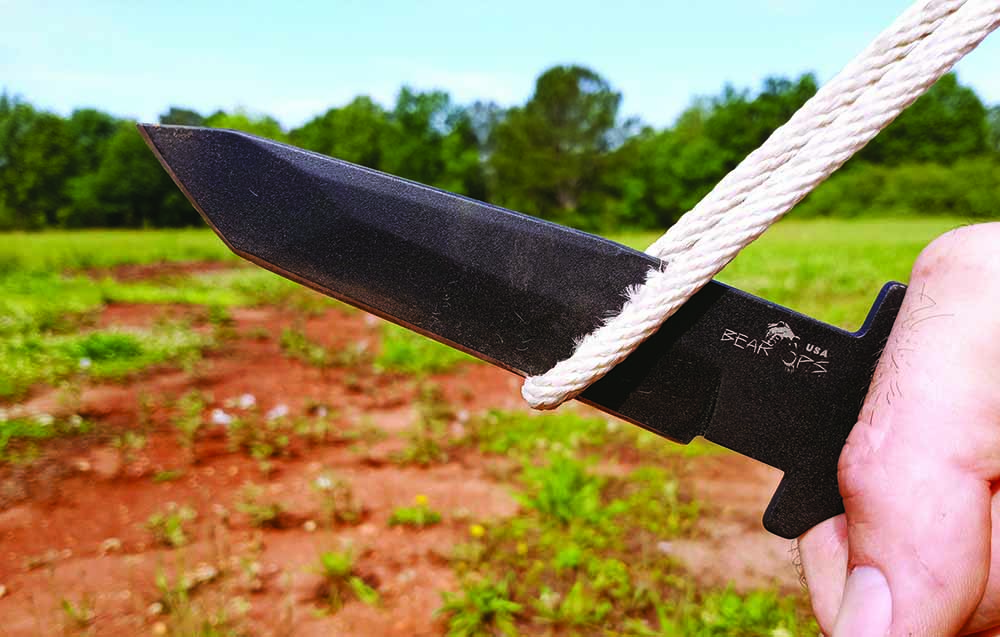
Bear & Son first released a version of the Bear Tac CC-110-B4-B in 1999. When the company launched its Bear Ops line in 2011, it brought the knife back because it liked the design with its “strong tip, full tang, solid handle material, non-reflective, easy to sharpen steel, and adaptable sheath,” company vice president Matt Griffey observed.

“We are one of only a handful of knife manufacturers in the United States, and the largest in the Southeast,” said Matt Griffey, company vice president. “Also, we’re a family-owned and operated business, something less common nowadays.”

Bear & Son has long manufactured knives with an eye toward people in uniform. For instance, the company first released a version of the Bear Tac CC-110-B4-B design using D2 tool steel and a Micarta handle back in 1999, a couple of years before 9/11 shifted the nation’s perception of what threats stood against it.

When Bear & Son launched its Bear Ops line in 2011, it brought the knife back because it liked the design with its “strong tip, full tang, solid handle material, non-reflective, easy to sharpen steel, and adaptable sheath,” Griffey observed. In a 1095 spring steel blade with an epoxy powder coat and a G-10 handle, the knife is 10.375 inches overall. The accompanying Kydex sheath is jump ready, meaning not only does the sheath hug the knife in place, it also has a snap for extra security.

Bear & Son makes the knife at its shop in Jacksonville, Alabama, a place where Griffey says members of the community quickly produce knife designs with pride and quality they can control. “A major advantage of keeping our Alabama factory in operation is providing families a career or skill they can be proud of,” Griffey said. “Understanding our products and services positively impact the lives of our friends, family and neighbors is worth the regulations and taxes of operating in the United States.”

For instance, students at a nearby state university gain real-world experiences at Bear & Son. Meanwhile, some Bear craftspeople and designers have 20-plus years of experience working with numerous types of steels and can develop client orders in a timely manner, Griffey noted.

While the mission of the nation’s military may change, the mission at Bear & Son continues to “provide quality made products that service personnel can depend on,” Griffey said. “The market for strong, reliable blades will be steady, though we will see some trends in sizes, shapes and materials move around.”

Winkler Knives

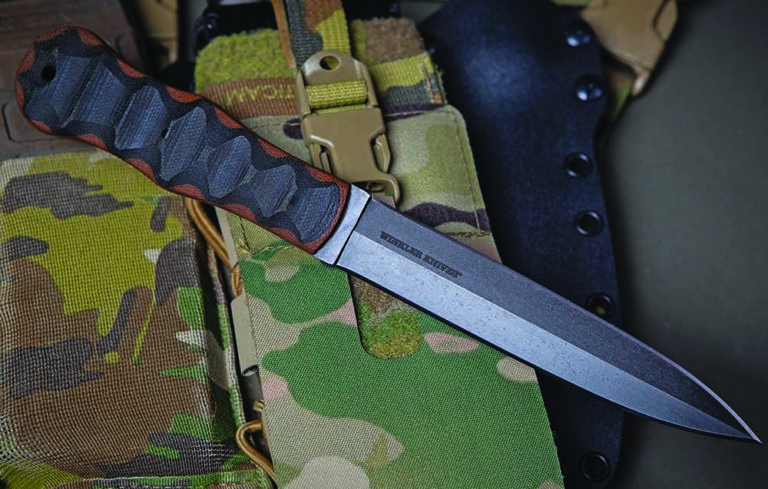
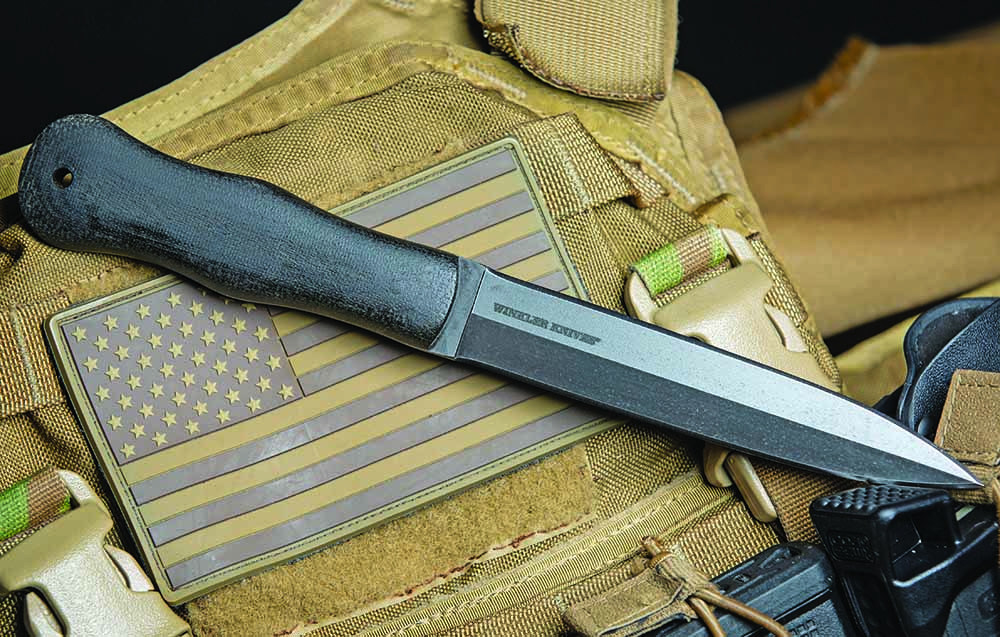
Daniel Winkler of Winkler Knives in Boone, North Carolina, readily admits that if you’re looking for a knife to take camping, his WK Tactical Dagger is not for you. With a 5.5-inch blade and short bevels the dagger has little utility use, he noted, beyond the thing knives can do when the enemy is close. “The design was a collaboration between me and one of the Army special operations team leaders,” he said. “It was a design they needed for their specialized type of fieldwork.”

Made in Boone, North Carolina, the Winkler Knives Tactical Dagger in a black Micarta® handle has the same specs as the WASP-pattern model pictured elsewhere herein. “The handle shape does not hang on clothing as a lot of cross-guard knives do,” Daniel Winkler noted. MSRP: $400.

The 80CrV2 carbon steel offers “the best consistent performance” of any steel Winkler works with, and the blade sits nestled in a lined, Boltaron sheath. “The handle shape does not hang on clothing as a lot of cross-guard knives do,” he noted. “The handle shape also gives good indexing and a flair to assist in removal leverage after use.”

The primary goal of Winkler Knives is to provide tools to first responders, law enforcement and the military, Daniel said, and most of its knives and other edged tools go to people working in those fields. He added that running a company in the USA allows Winkler Knives complete control over the tools it makes, thus ensuring consistency and quality.

Despite the taxes and other challenges of manufacturing domestically, Winkler said, “The advantage is we live in the greatest country on Earth. Taxes and regulations are sometimes tough but still better than any alternative I can see. We have been very fortunate to find great staff.”

When hiring people, Winkler usually passes over knifemakers as he wants to train workers to make the edged tools his way. Some of the folks working there have backgrounds in foodservice and construction fields. Staff must work well in the team and have integrity, he added.

Most design work is kept in-shop too, as most Winkler Knives customers are seeking out Winkler designs. In the end, Daniel does all his manufacturing for his military customers in the USA. As he concluded, “I wouldn’t have it any other way.”

Get More Knife Info:

Antique Switchblades: World War II And Beyond

Harking back to American military glory and post-war prosperity, antique switchblades from the 1940s and 1950 have enduring appeal.

From its first patent in 1884, the switchblade was an important addition to most early U.S. cutlery companies.

According to Mark Erickson, author of Antique American Switchblades, between 35-to-40 companies made and/or sold switchblades, including almost all of whose names long-time collectors recognize: Aerial, Camillus, Case, Challenge, Colonial, George Schrade, KA-BAR, L.L. Bean, Novel Shapleigh Hardware, Queen, Remington, Schrade Cutlery Co., Utica, Wade and Butcher, and Shapleigh Hardware, to list a few.

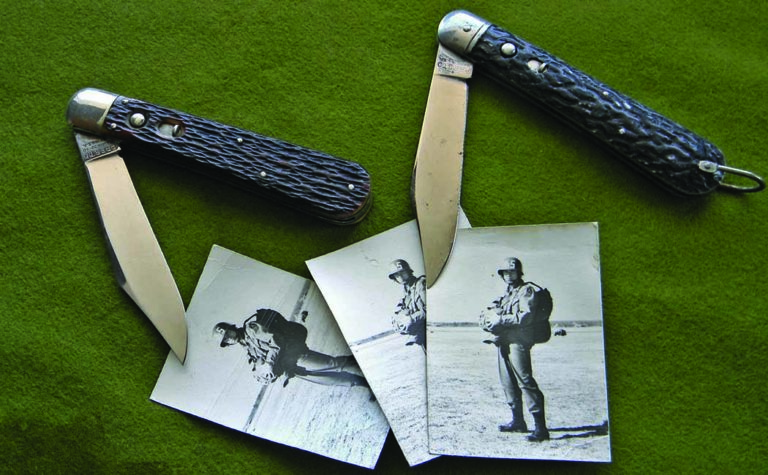
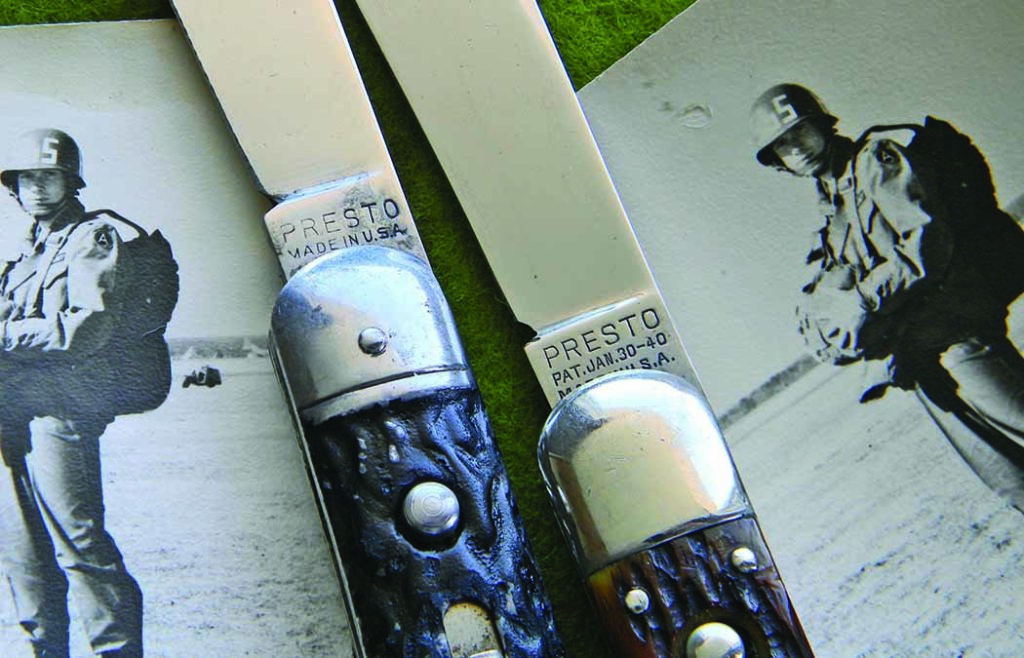
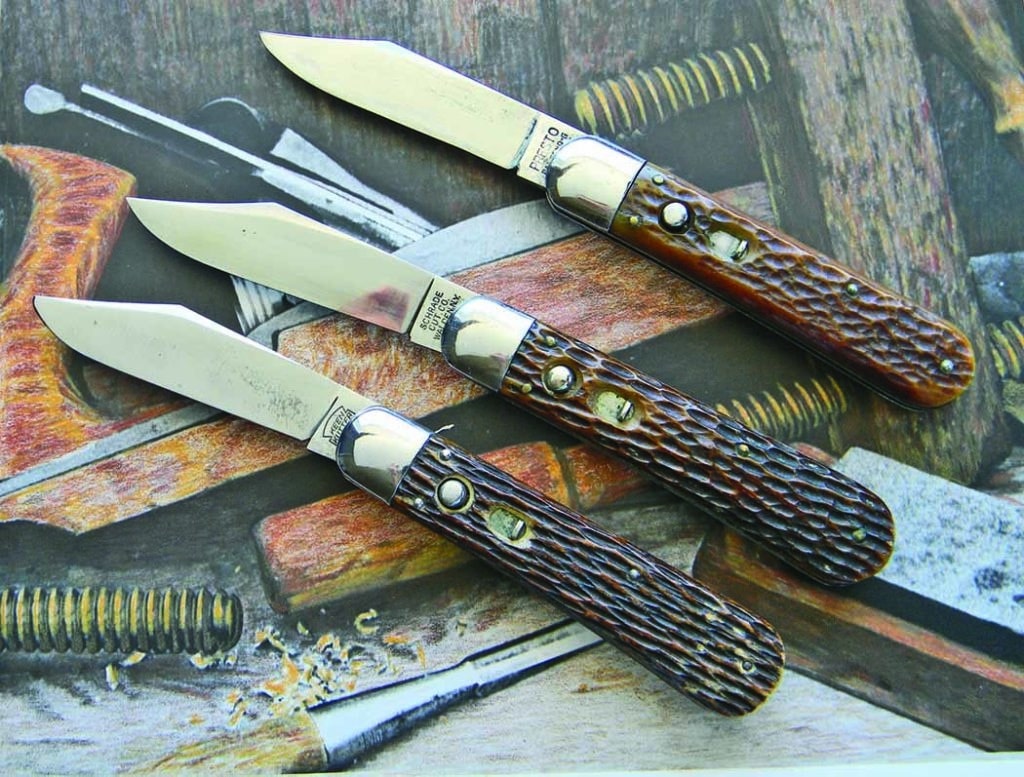
 These two switchblades with the Presto stamping by George Schrade Knife Co., are among those that played an important part in the success of American paratroopers during World War II. On the facing page, the one at left has “jigged iron” scales and the one at right has jigged bone.
These two switchblades with the Presto stamping by George Schrade Knife Co., are among those that played an important part in the success of American paratroopers during World War II.

Because of the collectibility of the named companies and the significant variety of styles, sizes and handle materials associated with them, switchblades have become a serious endeavor for many collectors of antique knives.

Invention Of The Switchblade

As a serious cutlery collector, my downfall has been fingernails that bend backward with even the smoothest opening blades. The switchblade innovators had fingernails in mind when they produced a knife that could be opened without using a nail. In fact, some of the best switchblades are found in women’s old sewing baskets.

In fact, early switchblade ads tout the folder’s ability to be used by people with weak fingernails. “These knives will be a wonder for those who have difficulty opening a traditional knife” stated one such ad.

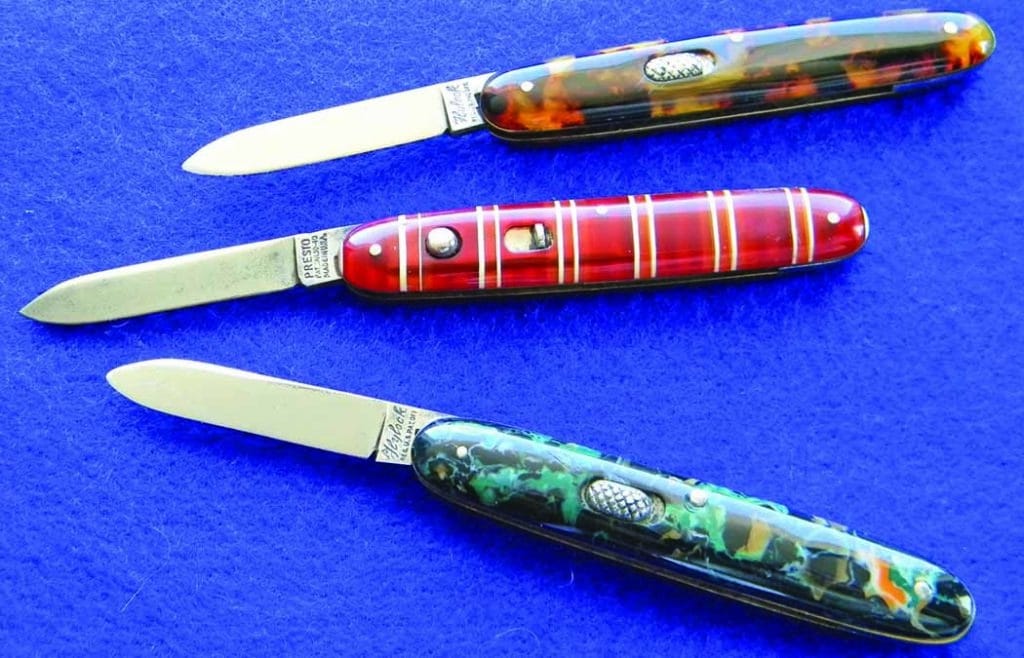
Celluloid was a very popular handle material on antique switchblades. Celluloid types, from top: a George Schrade in imitation tortoise, another George Schrade model in candy stripe, and one from Flylock Knife Co., in blue, pink and black swirl.

For many other occupations, the switchblade and its ability to be opened with one hand has proven immensely important. Mechanics, fishermen, ranchers, soldiers, veterinarians and even Boy Scouts were frequent users of the pocketknives. With a wiggling fish in one hand, it is easy to see how a switchblade could be a valuable asset to most fishermen when cutting a line.

Moreover, most switchblades have a lock/safety that keeps the blade from opening accidentally and the open blade from closing on the hand. An early Flylock Knife Co. ad touted, “The ideal knife for all outdoors and sports use. One hand only required to open or close, leaving the other hand free to grip a rod or gun.”

World War II Switchblades

World War II brought with it the necessity of supporting soldiers who parachuted behind enemy lines. Switchblades procured for the U.S. military were designed to cut the parachute suspension lines that became entangled during landing. The knives were carried in what has been described as “neck pockets’ in jump uniforms.

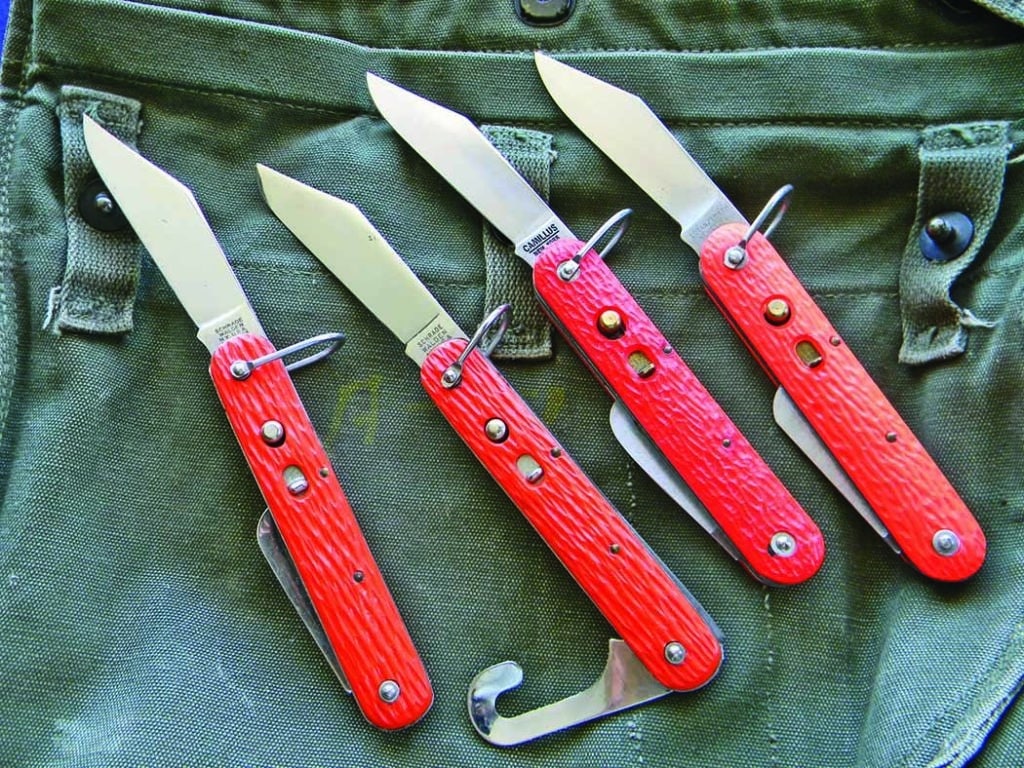
Military switchblades designated “MC1” included models in orange handles for heightened visibility. They were made by Schrade until 1960, when Camillus took over the contract. The knives have a master blade opened by a push button and a manual shroud cutter.

There are continuing discussions about the knives specifically made for and used by the U.S. military during the war. The discussions center around whether switchblades issued to troops all had jigged bone handles or jigged metal sides. Another discussion is whether all switchblades used by paratroopers had a bail—known in the military as a “lanyard staple”—or whether knives without bails also were used.

Units that used the knives included paratroopers in the 82nd Airborne and 101st Airborne Divisions, which included the 505th, 507th and 508th parachute infantry regiments. The 505th Infantry Regiment website shows switchblades made by Schrade Cutlery Co. stamped “Presto” with jigged bone handles and metal handles made to look like jigged bone painted black. Knives both with and without bails are included in the photographs. Switchblades made for World War II paratroopers also include those stamped Schrade-Walden and Schrade Cut. Co.

The book, 4 Stars of Valor: The History of the 505th Parachute Infantry, describes the equipment carried by paratroopers. In addition to main and reserve chutes, full uniform and helmet, the paratroopers carried over 70 pounds of equipment, including an M-1 carbine with ammo, Mae West life jacket, switchblade, water-filled canteen, trench knife, fragmentation and smoke grenades, mess kits, three days of K rations, escape map and compass, gas masks, toiletry items, 30 feet of rope, blanket, half a shelter and first-aid kit.

Post-War Military Switchblades

After World War II, several companies made switchblades for military personnel. According to one website, the first such knife was produced for the armed forces by Schrade Cutlery Co., designated as MC-1, an airman’s paratrooper knife, in 1957. Sometimes the knives are referred to as aircrew survival knives.

Three jigged bone switchblades, from top: Schrade Cutlery Co., George Schrade Knife Co. and one of the rarest of antique models, one stamped “Keen Kutter,” a trademark of Shapleigh Hardware. Schrade made the knife.

The first contract was awarded to Schrade Cutlery followed by a second contract to Camillus, and a third to Logan-Smyth. The orange-handle switchblades had two blades: one a master spear pattern opened by depressing the button, and a second blade shaped like a hook to cut parachute suspension lines. In my estimation, the hooked blade is not sharp enough to easily cut parachute lines and must be resharpened.

Civilian Switchblades

The early 1950s brought a renewed interest in cheap, colorful switchblades, with thousands of knives made by Imperial in its Jack-O-Matic Texas toothpick model, and Colonial, which used the Shur-Sharp stamp on its colorful models. The fishtail jackknives and the Texas toothpick styles were by far the favorite examples produced by the two companies.

The George Schrade Knife Co. continued to produce popular switchblades with celluloid handles stamped Presto. The knives were made with a single blade, double blades (the latter with a push button for each blade) and even a letter opener with a push button in one end.

Celluloid Handles On Antique Switchblades: Why?

The handle material for most of the inexpensive switchblades was celluloid. Thin sheets of the versatile plastic-like substance were molded around the knife’s metal sides. The most popular celluloid style was candy stripe. The knives also can be found in a wide variety of swirled celluloid handles in a myriad of different color combos, some with such recognizable celluloids as cracked ice and imitation tortoise.

Because the knives were inexpensively priced, they were extremely popular with boys in the 1950s. Because of the knives’ widespread use, some advertisers saw an opportunity to emboss various ads on them, giving them away as a novel company promotion gimmick.

Allure Of Antique Switchblades

Because of their connection with the heroic actions of airborne troops during World War II, antique switchblades have continued to be a popular cutlery collecting niche. Moreover, since almost three dozen companies, each producing a vast array of sizes and handle materials, made the knives, the collecting field is wide open.

Even in the 1950s cheap construction, made more evident by the continuous opening and closing of the blades, the knives remain popular collectibles. No doubt one reason for the popularity is that antique switchblades remind many of the Golden Age of the 1950s and ’60s when kids played outside all day, shot their BB guns, and hit the corner gas station for a cold soda and a candy bar.

Ah, those were the days!

More On Switchblades:

Bushcraft Tips and Tricks

0

Elevate your survival skills with these bushcraft tips!

A good bushcraft knife is characterized by its manageable size and weight, allowing for comfortable handling and easy resharpening.

Typically, a knife designed for bushcraft and carving tasks lacks spine gimping for the thumb. The cutting edge should have a continuous curvature that extends the entire length of the blade. A general-purpose bushcraft knife should have a blade that matches the width of your palm, with the tip aligned closely to the handle’s centerline. The handle and blade spines should remain on the same line.

The handle should feature an oval cross-section made from such materials as wood, Micarta® or plastic. It should not include finger cutouts that limit your grip, as such restrictions can lead to blisters. The handle length should fit comfortably in your palm. While Scandinavian blade grinds are standard for bushcraft knives, other blade grinds are also acceptable.

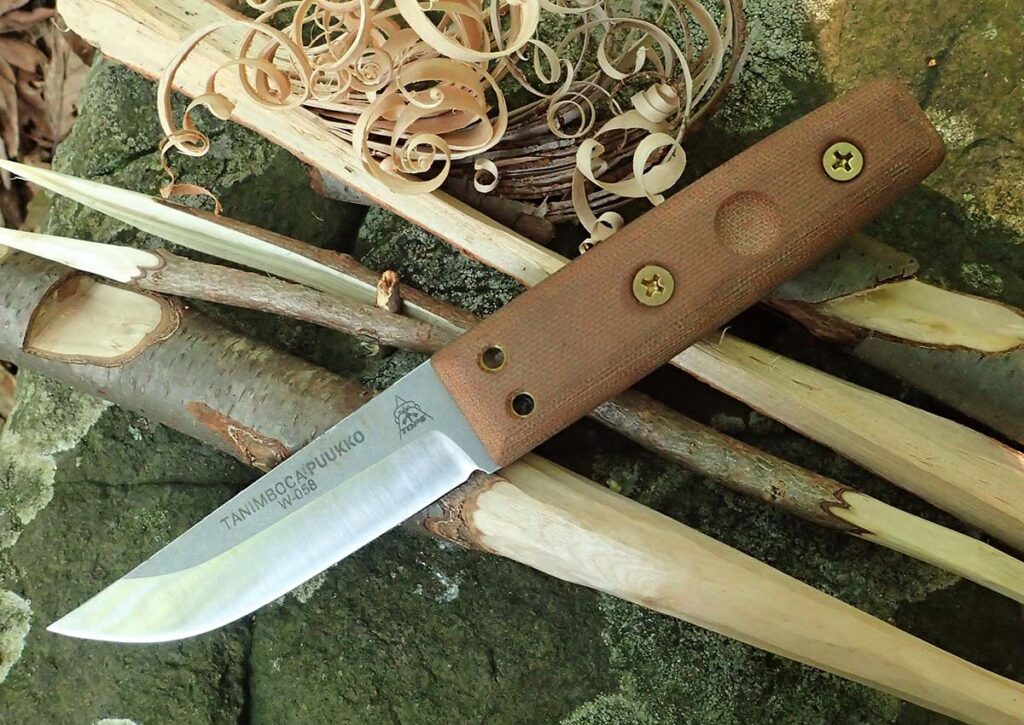
The Tanimboca Puukko from TOPS Knives made stakes, pot holders, fuzz sticks, bush forks, skewers, roasting sticks and traps. According to the author, it’s the perfect size for a bushcraft knife. Note the bow drill divot/socket on the handle for fire starting.

To quote Mors Kochanski, Canadian bushcraft and wilderness survival instructor and author of Bushcraft: Outdoor Skills and Wilderness Survival, “The knife is the smallest and most portable of all the cutting tools. Light and unobtrusive, the knife is readily available for hundreds of everyday tasks in bush living.”

Knife Safety

Always start with a safety briefing when working with tools, especially those that can cause serious injury. Books and teachings have provided several tips and procedures for knife use and safety. One key concept is the blood circle.

Stretch out your arm with the knife in hand and ensure you can make a complete circle without hitting anyone or anything, including tarps, backpacks, tents and water containers. The blood or death triangle is crucial when sitting and carving. Never use your leg as a backstop or cutting board. When removing large amounts of wood, cut to the side of your body on your dominant knife-hand side or lean forward, resting your forearms and elbows on your knees, keeping your work project and knife out of your blood triangle. Remember the blood circle. Some cuts, like a pull-cut, allow you to cut toward yourself in a controlled, slow manner, but generally cut away from yourself.

Bushcraft Grips And Cuts

Use an icepick grip to split small pieces of wood for a one-stick fire. Strike the knife and wood against a hard surface together, then twist slightly to split the wood.
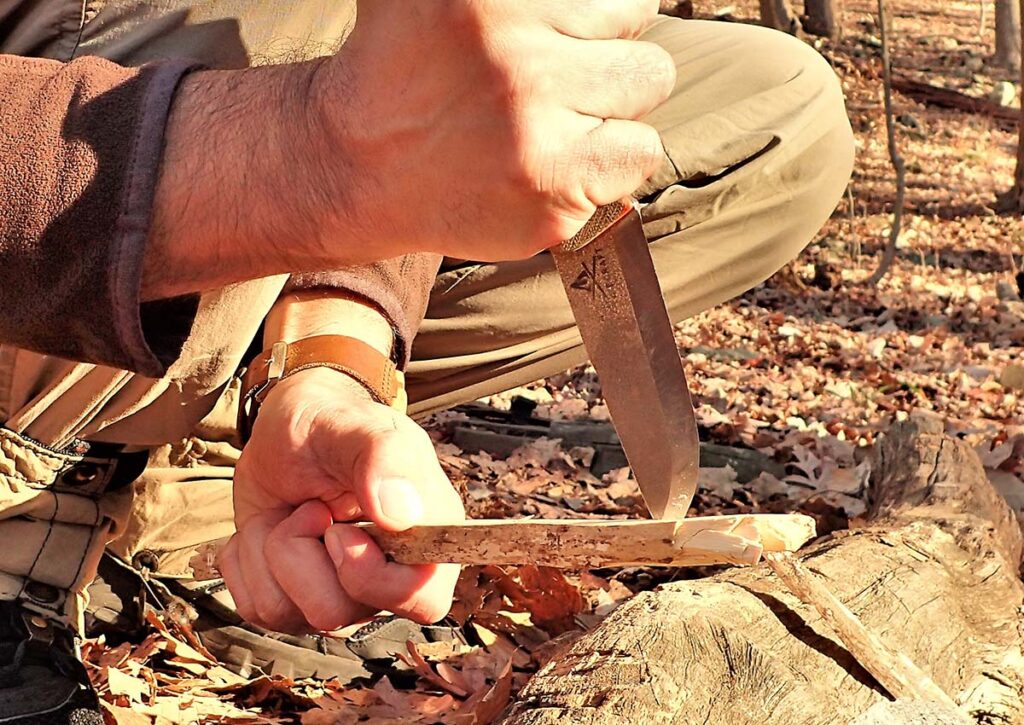
  • Forehand (Fist) Grip: The forehand grip is the most basic and natural way to hold objects securely. This grip is ideal for power cutting, allowing you to roughly remove a significant amount of material to shape the wood. To use this grip, curl all your fingers around the handle, creating a fist. Avoid placing your thumb on the knife’s spine, an everyday habit. Hold the wood off to the side, with the blade tip pointing slightly upward, and slice from the base of the blade to the tip. Lock your wrist and elbow and use your shoulder to push down as if punching through the floor. The motion resembles shrugging your shoulder. Alternatively, you can adapt this technique by pulling the wood back against the knife using your work hand.
    Pro Tip: This is not a jarring-of-the-elbow motion.
  • Thumb-Assisted Push Cut: This is commonly called a scissor grip cut. When viewed from above, the arrangement of the wood and the knife resembles the operation of scissors. It involves a thumb-assisted push cut, where the non-dominant hand’s thumb helps cut. The blade and wood pivot together like scissors, while the thumb on the non-knife hand presses the back of the knife into the wood. This technique features a short-cutting reach, applies soft-to-medium force, and offers a high degree of control. It is a more refined and detailed version of the chest-lever grip with a thumb-assisted push cut.
  • Chest-Lever Grip: The chest-lever grip is a powerful and controlled cutting technique commonly used in bushcrafting, characterized by a typical palm-up grip. To execute this cut, engage your lat muscles and leverage your body for power. Start by turning the knife blade outward to your right (if you’re right-handed) with your palm facing up. Grip the knife firmly, placing your thumb on the handle or side of the blade while your other hand holds the workpiece. Once the blade contacts the area you want to cut, rotate your shoulders forward and pull your hands apart as your shoulders open up, leveraging against your torso. Keep your hands connected to your ribs throughout the process. This technique and the forehand grip allow you to make powerful cuts for removing significant amounts of wood.
  • Peel Grip: Also known as a draw grip, apple peeling grip or paring grip, the peel grip facilitates more detailed, finishing cuts rather than powerful ones. Use it to finish the ends of a spoon handle, shape the top of the spoon bowl, chamfer a tent stake or trim wood to achieve a flat surface. To execute the peel grip, hold the knife in a reverse position with the blade facing you. Place your fingers on the back of the knife handle, positioning your thumb on the back end of the workpiece while your other hand clasps the work. Keep your knife-hand thumb out of the blade’s path as you close your hand into a loose fist, allowing for a slow, controlled cut. Author’s note: This grip is helpful for precise carving and finishing the edges of items.

Bushcraft Techniques

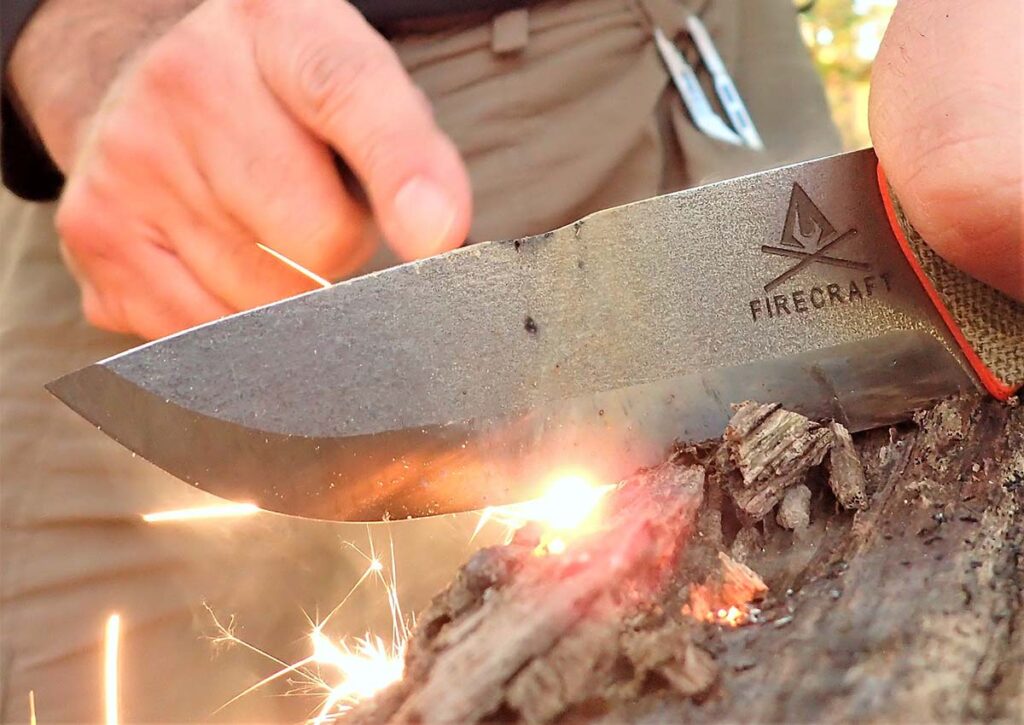
The author strikes the supplied ferro rod against the fire notch to ignite the tinder.

After addressing the basic grips, it’s time to learn a few helpful knife techniques commonly employed in bushcraft. Practice them at a comfortable pace and avoid rushing.

  • Bushcraft Batonning: A knife alone often lacks the weight needed for effective chopping. However, striking the blade’s spine with a heavy object can produce strong cuts. A sturdy, comfortably held stick serves as a baton to help cut down and limb small trees, making various cutting tasks much more straightforward. You can quickly cut through branches and small saplings using a knife and a baton. Bushcraft batonning describes using a baton for controlled cross-grain cuts, creating V-notches and splitting wood no wider than your wrist. Using a baton for limbing branches generally proves faster and safer than using an axe.
  • Beaver Chew: To cut a green or dry branch to the desired size, use the beaver chew technique, which leaves a somewhat rounded end for pounding into the ground. Make a series of cuts (nicks) around the stick. Thicker sticks require more time, so repeat this process several times, cutting deeper with each pass. Once the cut is halfway or two-thirds through the stick, you can break it off and trim the end.
  • Tension Cutting Saplings: To take down small green trees up to wrist size in thickness, first apply tension by bending the tree while holding it firmly with one hand. Start your cut at a 45-degree angle at the bend point, where the stress is most significant. There’s no need for a sawing motion; instead, use a gentle rocking back and forth with the blade to slice through the fibers under tension. Be careful during the crucial last part of the cut, as you need to restrain the tree from falling prematurely, which would require extra work to finish the cut. If done correctly, this process should take no more than 10 seconds.

To section long saplings, step on the top to hold it and bend it over your thigh or hip. Cut the bend to ensure avoid cutting yourself during the follow-through.

Pro Feather Sticks

Creating tinder by shaving very thin pieces and kindling from deadwood is known as making a feather or fuzz stick. You can use various techniques but here’s the most basic approach.

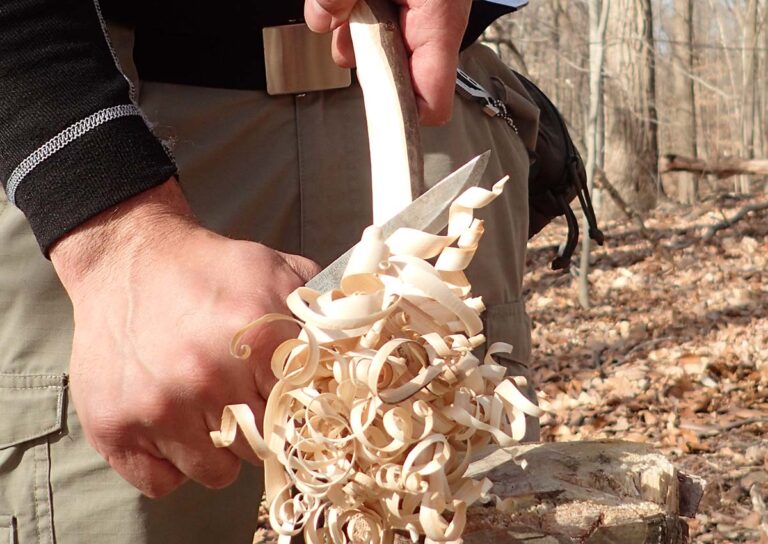
Start with a forehand grip and resist the urge to place your thumb on the spine of your knife. Using gimping or a gimping grip applies uneven pressure, which often causes feathers to detach from the stick. When you reduce green wood for carving projects, think ahead and keep the shavings for fire making, regardless of their thickness. Thinly shaved greenwood dries quickly. Try to make them as thin as possible or save larger shavings to use as kindling. Emphasizing multi-use and maximizing the utility of everything you work on and cut truly embodies bushcrafting!

Try Stick It!

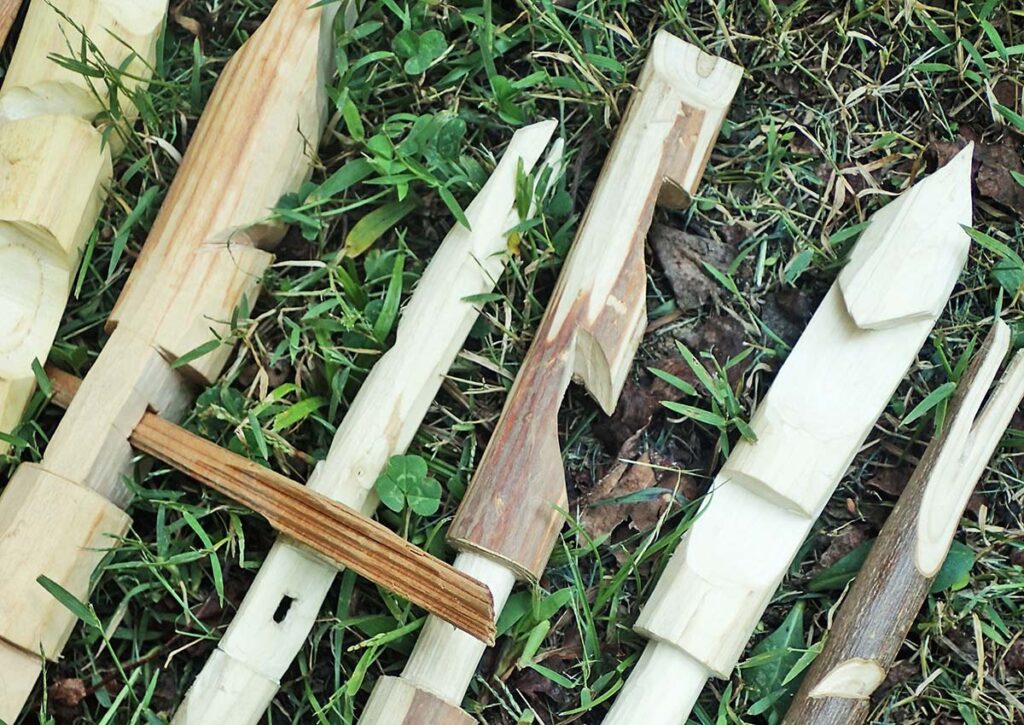
The author carved various try sticks with essential notches and additional features.

The Try Stick, made famous by wilderness educator, survival instructor and author Mors Kochanski, is a tool designed for practicing and showcasing knife skills in wood carving. While some notches are functional and often used to create items such as tent pegs, pot hangers and digging sticks, many notches on a Try Stick are more decorative and less commonly utilized. You can incorporate around 17 different types of notches on a Try Stick, but including as many as possible is typical. There’s no required number of notches to create; a Try Stick focuses on knife handling and safe practice.

Try Stick Notch types include:

  1. Round Notch
  2. Pot Hook
  3. Saddle Notch
  4. Square Notch
  5. Mitred Lapped Notch
  6. Jogged and Wedge Splice
  7. Dovetail Pin and Socket
  8. Dovetail Notch
  9. “V” Notch
  10. Spear Notch
  11. Knife Tip Mortice
  12. Diameter Reduction
  13. Knife Edge
  14. Split
  15. Bow Notch
  16. Latch Notch
  17. Bark Stripping
  18. Whistle Project

Check Out More Outdoor Knives:

Advertisement

Must Read Articles

Read this before you make a knife

Knifemaking 101 – Read This Before You Make a Knife

  by Wayne Goddard My experience has taught me that there's nothing like digging in and getting started. I've often said the hardest part of the...
how to forge damascus steel

How to Forge Damascus

Advertisement
Advertisement