Whether It’s An Inexpensive Model Or One The Chefs Use, There’s An Electric Knife Sharpener Out There For You.
There is no one-size-fits-all for electric knife sharpeners. Some specialize in sharpening certain steels or styles of knives. Some have multiple stages, and others are a basic, affordable option for a less discerning home cook. And some are made for pocket knives rather than kitchen knives.
No matter your desire and needs, there is a sharpener out there for you. We’ve scoured the crowded marketplace to pick out five electric knife sharpeners we think will check the important boxes for you today and for years to come.
Chef’s Choice Model Trizor 15XV 3-Stage Professional Electric Knife Sharpener, Platinum
Chef’s Choice Model Trizor 15XV 3-Stage Professional Electric Knife Sharpener, Platinum
Our list starts with what is, arguably, the baddest sharpener on the block. Highly-rated, and with a price to match, this sharpener from Chef’s Choice is called professional for a reason. With three different stages (sharpening, honing, and polishing), the device truly can do it all and revive your knives.
The sharpener is engineered to the point of ridiculousness. The sharpening stage features proprietary diamond abrasives, and the polishing stage features patented stropping disks to give your knives a pristine finish. It can even convert a traditional 20-degree edge to a finer 15-degree edge.
If there is a knock on the machine, it’s it isn’t rated to sharpen ceramic knives or scissors. Everything from a chef’s knife to pocket knives and yes, even serrated knives, can be brought back to life using the Trizor 15XV.
In a test of nine different electric knife sharpeners, the 15XV was named the best by America’s Test Kitchen. You can take a look at their methodology and how they determined the winner below.
The hefty MSRP of $179.99 is eye-popping to start, but there is no other sharpener like this on the market today.
Presto EverSharp
Presto EverSharp
Maybe a three-stage, pro-level sharpener isn’t what you need, and you’d prefer something a bit more affordable. I’m right there with you. That’s where the Presto EverSharp comes in.
The EverSharp uses Sapphirite sharpening wheels — a synthetic material almost as hard as diamond — to sharpen your blades to a razor’s edge. The EverSharp comes with two stages, one for sharpening and the other for honing & polishing. Each stage features internal guides so your knife always is at the perfect angle every time you pull it through. There’s two slots on each stage, one for each side of the blade.
It’s so easy to use you could probably do it with your eyes closed (but please keep them open so you don’t slice off a finger). The one drawback of the sharpener is it can’t sharpen serrated blades.
Durable and affordable with an MSRP of $47.99, the EverSharp provides great bang for your buck.
Wüsthof Easy Edge
Wüsthof Easy Edge Electric Knife Sharpener
From one of the legendary makers of kitchen knives, Wüsthof’s electric sharpener is robust and easy to use.
Unlike the previous sharpeners on this list, the Easy Edge is a belt-drive sharpener. No stones or grinding wheels in this one. The machine can sharpen, hone, and shape your straight-edge knives. It does this by varying the speed of its sharpening belt.
While the device can’t sharpen serrated blades it can sharpen Asian-style knives, which typically are ground to a different angle than traditional German-style knives.
Made of professional quality materials, and coming in with an MSRP of $160, the Easy Edge is worth the price and can replace your whetstones, honing steels, and many other pieces of knife maintenance equipment.
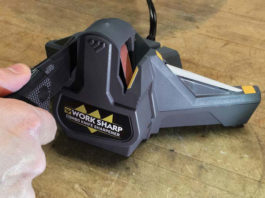
WorkSharp Combo Knife Sharpener
WorkSharp Combo Knife Sharpener
Unlike the other sharpeners on this list, which are made for kitchen knives, this sharpener from WorkSharp is made for pocket and EDC knives.
Like the Wusthof sharpener, this one uses an abrasive belt to sharpen your knives and uses internal guides to guarantee that your knives are at the perfect angle every time.
There’s also a ceramic honing rod built directly into the machine to help you polish and finish your flat-edge knives. The rod is also perfect for sharpening knives with small or large serrations.
It’s also relatively small. Some of these sharpeners are a bit bulky; WorkSharp has made a nimble sharpener that won’t take up much space on your workbench. You’ll love using this every day, and it’ll make your knives like new. At an MSRP of $59.95, it’s worth the price for the type of product it is.
Smith Essentials Compact Electric Knife Sharpener
Smith Essentials Compact Electric Knife Sharpener
If you’re looking for an electric knife sharpener on a budget, or simply don’t need the heft of professional machines, Smith has you covered. Their compact sharpener features both electric and manual elements for the low MSRP of $29.99.
The electric part of the machine features a synthetic sharpening wheel and built-in guides to keep your knives at the best angle. The ceramic rods on the manual side are there to hone and finish your blades.
It can only be used on straight-edge Euro/American style knives though so you would need some other sharpening implement if you have serrated knives at home. However, for a sharpener under $30, you may not be able find much more out there today.
Practice the proper steps with the proper equipment and, most important, be safe and knife blade repair is a snap.
I have been fortunate enough to make not just one but two side hustles out of my knife hobby. First is the obvious—writing for BLADE® Magazine. Second is running a knife-and-tool sharpening service out of my garage, serving folks in my community and metro area with full-service sharpening on most cutting tools found in the home, workshop and garage. I have always had a strong interest in sharpening in general and have been practicing the skill for about as long as I have been into knives in general.
While I sharpen many knives and scissors, I also repair damaged knife blades. Those repairs include—but are not limited to—straightening bent blade tips, fixing severely damaged cutting edges, and regrinding new blade tips from broken ones. While sharpening is something I still enjoy very much and to a degree it remains fun work for me, it’s these minor repairs at customer request that I love doing. You can too provided you have the proper equipment and the desire to learn.
In knife blade repair, carbon steel blades make the steps easy as they sharpen up quicker than stainless blades.
Before we get into the thick of blade repair, let’s discuss equipment. I run four Work Sharp Ken Onion Elite sharpening machines—I keep one as a backup or deploy it as backup should I need to augment what I’m already running—plus a 1×30 single-speed belt sander, a “Harbor Freight special.” I do all my sharpening on this equipment.
I have used the Ken Onion Elite since the start of my sharpening service almost 10 years ago. I started out with just one Work Sharp. I added a second one awhile after that. The 1×30 came about from trying to revive a few totally dull butcher knives. In the process, I realized I needed another machine that would be in charge of hogging off material to get a quick starter edge that the Work Sharp machines could sculpt into a razor-sharp edge.
After profiling the basic shape of the new tip, the author uses the X65 belt of the Work Sharp Ken Onion Elite sharpener to further massage and fine tune it, as well as blend in the appearance of the blade spine at the tip to match the rest of the spine.
Keep in mind that the Ken Onion Elite is not just a sharpener but also a variable-speed miniature belt sander as well, especially when you turn the unit around 180 degrees and work off the platen side. You can easily work on plastic, PVC, metal and wood. This is also how I regrind new blade tips, as well as fixing blade damage caused by hitting something solid and chipping the edge out. We will dive more into specifics in a bit. It’s important to note here that to do blade repairs of any sort successfully, you must have some sort of variable-speed, motorized, belt-sander-type machine.
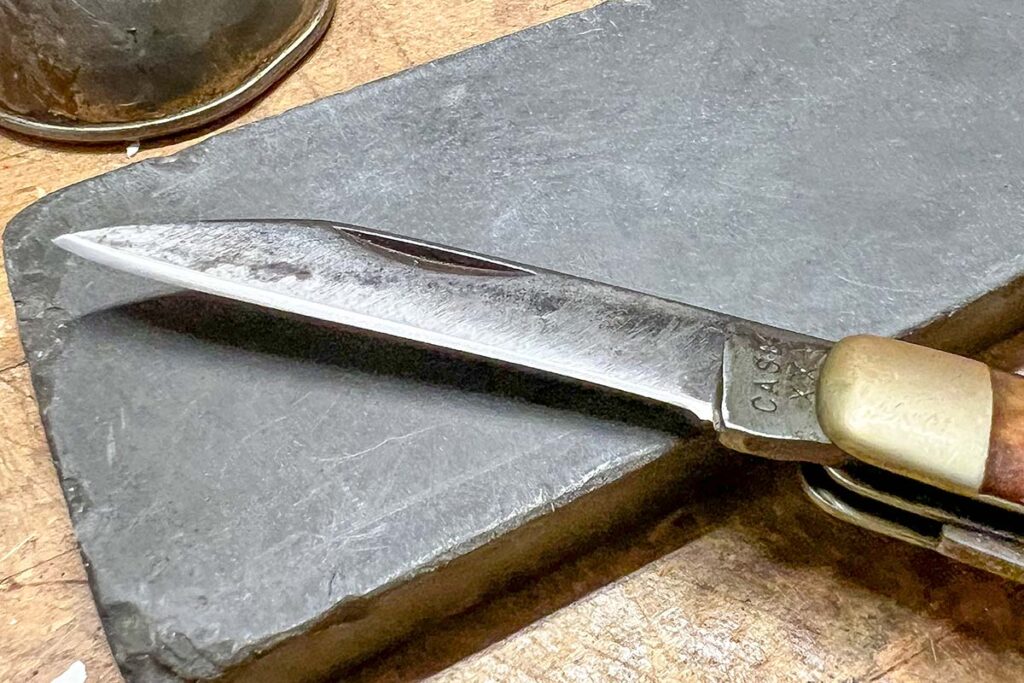
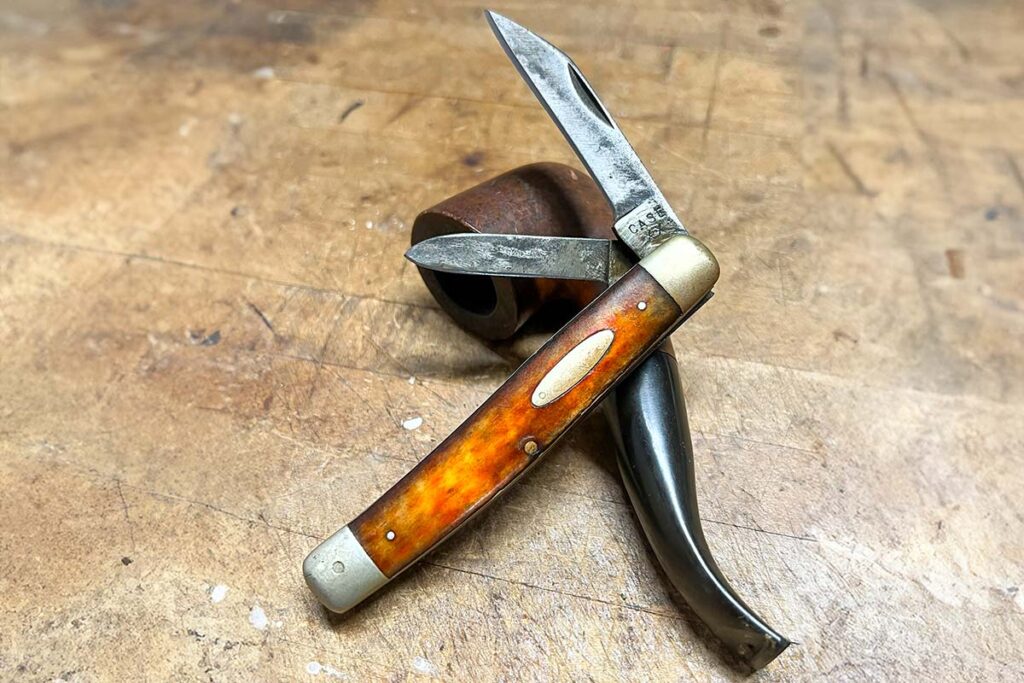
DEMO KNIFEThe demo knife is one a coworker on my day job gave me to refurbish. It is a vintage, carbon steel Case jackknife that saw a lot of use in a previous life. The blades were extremely worn down. Both tips were broken off. The main blade was resharpened so much that the cutting edge was a bit on the curved side. Both blades also had some dings in the edge as well. The owner wanted me to rehab the blades by regrinding new tips and sharpening them. I will take you through step by step on what I did and how it was done. WARNING! Please exercise caution when working with power tools such as belt sanders. Should you attempt such a task as outlined in this story, neither I nor BLADE is liable for any injuries that might occur as a result.
Heat Management
Whenever executing such repairs on a knife blade, remember to not let the blade heat up or you can ruin the steel’s heat treat. Always keep a jar filled with water within arm’s reach of your machine and dunk the blade into the water every few seconds to keep it cool. Doing so will ensure that you will not overheat the steel. If working on a larger blade such as a machete, I recommend using a spray bottle filled with water. The blade is simply too long to dunk into a jar, so spraying it down every so often will help. Something else that will help is to have a pair of cut-resistant gloves on hand and always wear them when handling the blade. The gloves usually have a textured coating on the gripping surfaces for the fingers and palms. This will help you hold the blade securely as well as keep your hands and fingers safe from accidental cuts. The gloves usually are inexpensive, less than $10, so there’s no excuse to not have a pair.
Where To Start Repairing A Blade
WARNING! Whenever faced with a blade-tip-rehab task, remember to sharpen the blade last. Why? Because you will be holding the blade as you regrind the new tip. This applies even if you’re wearing cut-proof work gloves.
Blade Tip
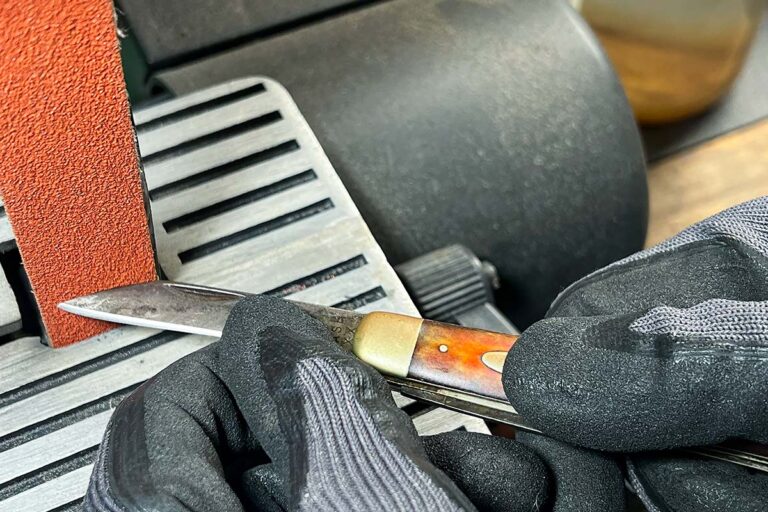
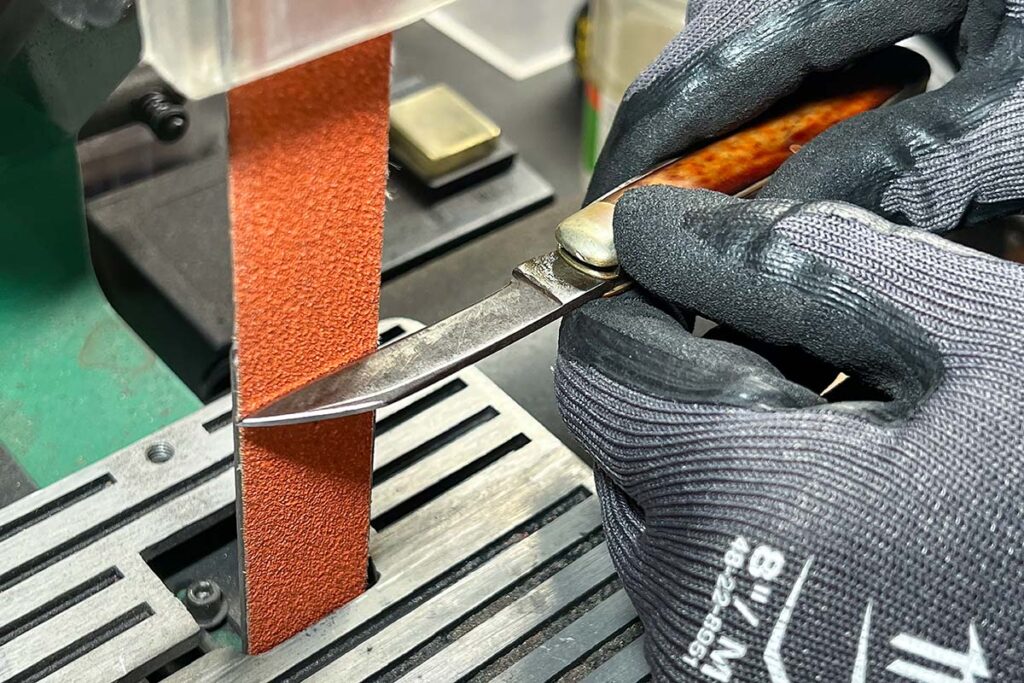
When regrinding tips, I always start with my 1×30 sander with an 80-grit Norton Blaze SG belt. It is the orange belt specifically engineered for knifemaking and removing steel. The 1×30 hogs off material and rough shapes the new blade tip.
The author reshapes the new tip on the pen blade using the 1×30 belt sander with an 80-grit Norton Blaze SG belt.
I start by visualizing where the new tip is going to lie. I start at the uppermost point of the broken-off tip, usually on the blade spine side. I start grinding at that point and remove material to where eventually a new tip is created. As I grind it down, I also pay attention to the visual “flow” of the new tip and how it transitions to the rest of the blade spine. I may have to round off the harsh angle to blend it back into the spine. A lot of this is done by eye, making everything blend right in. The goal is to make the new blade tip look as though nothing happened.
Blade Shaping
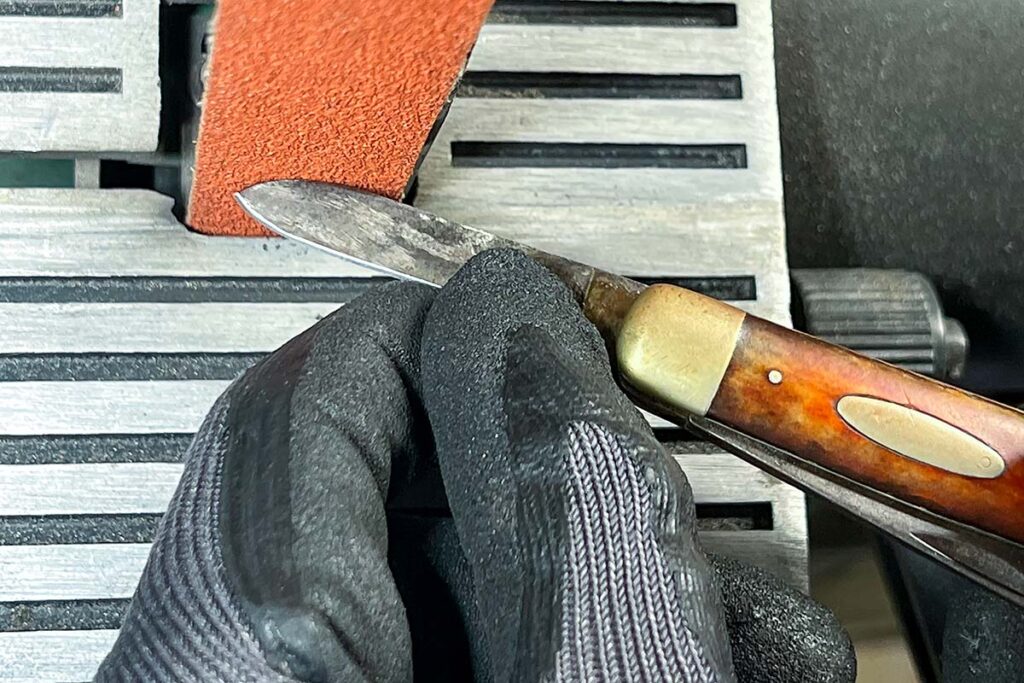
After roughing out the new tip with the 1×30 belt sander, I begin to dial in the final shape of the new tip with the Ken Onion Elite. I have much more control at this juncture due to the less aggressive belt grit and the slower belt speed. I can finesse the new tip on, keeping a close eye on the evenness of the ground-down portion, making it parallel with the rest of the untouched blade spine.
The author carefully knocks off the sharp edge at the corner created by rough grinding the new tip.
Finish
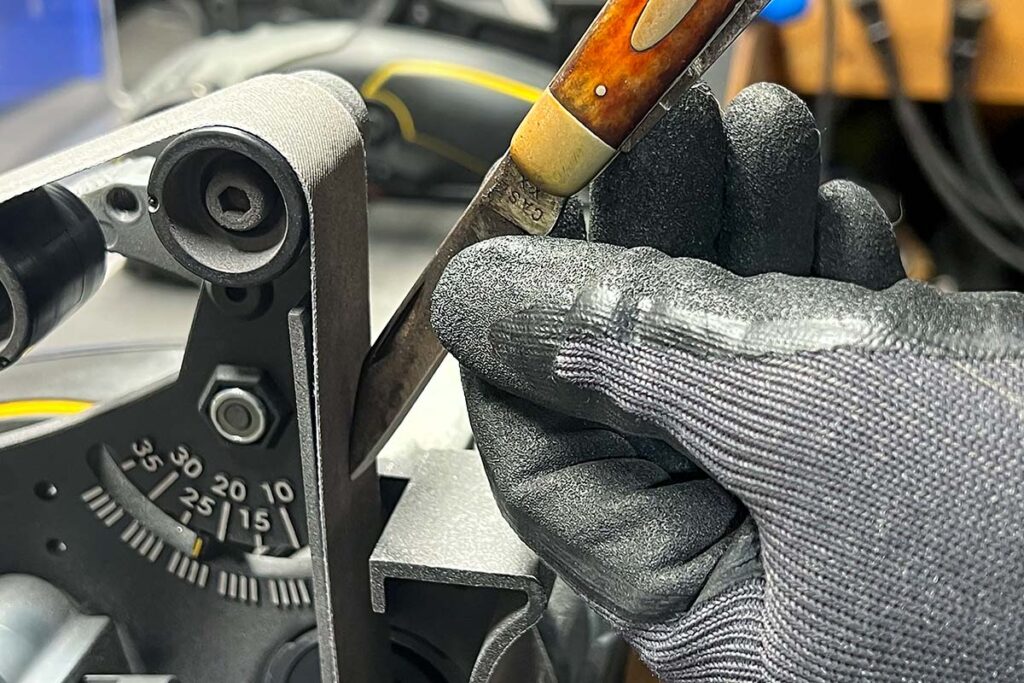
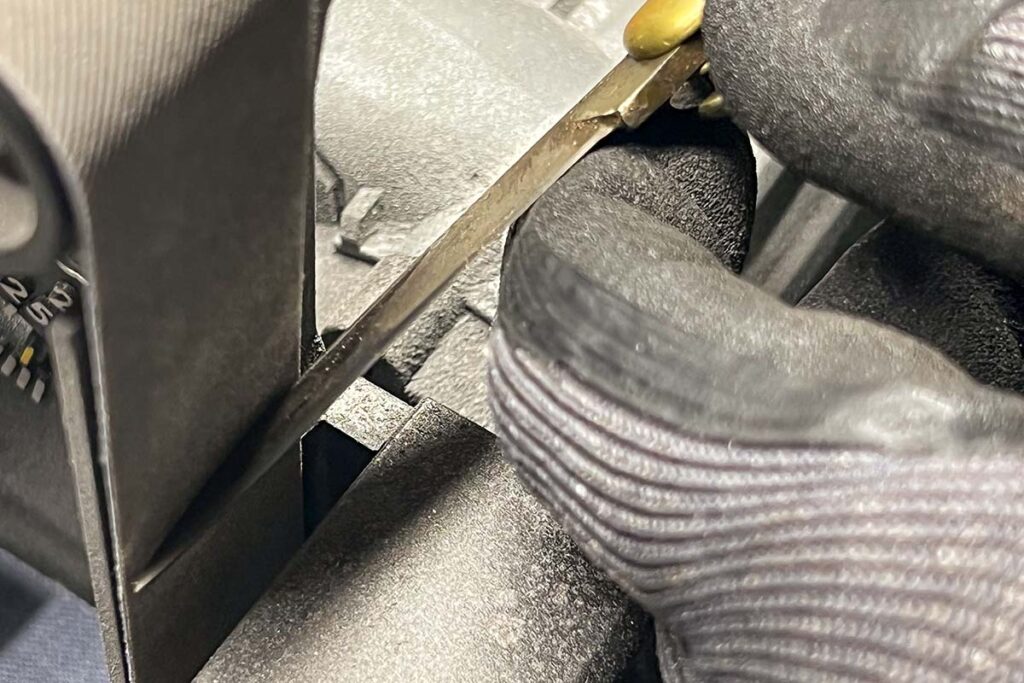
After tweaking the new tip to final shape, I concentrate on the finished appearance of the ground portion by holding the knife almost vertical and sanding only on the ground portion, blending it in visually and removing the coarse-grit scratches with the 80-grit belt on the 1×30.
Chamfering And
When everything is blended in visually, the last step is to chamfer the ground portion and remove the crisp corners made by all the sanding. You’ve seen how blade spines have a small, rounded corner on both sides? You are essentially doing that here. Hold the blade at an angle and lightly touch the blade spine to the belt to cut the crisp corner down. Remember: you can always cut more later if needed. The key is to use a light touch and stop only when the corners are smooth to the touch and you don’t detect crisp edges. The result is a new blade tip that is highly functional but doesn’t look “factory,” though it will be awfully close.
Fixing An Uneven Blade
The main blade of the demo knife was worn away unevenly due to years of manual sharpening, so I straightened that out as well. Like the shaping of the new tip, I did the bulk of the straightening of the cutting edge on my 1×30 belt sander. I used a light touch on the belt—I cannot stress enough that it’s easier to grind cautiously—eyeing the straightness of the new cutting edge. Grind a bit then dunk the blade in water to keep it on the cool side.
After grinding the new tip on the main blade, the author uses the 1×30 belt sander to straighten the uneven cutting edge by evening it out back to straight. The 80-grit belt eats off material in a hurry. At this juncture the author eyeballs what is to be straight.
Once I attained an even edge, it was time to grind the new edge. Straightening out the edge will cause a wide flat spot on it, so you have to grind the spot away evenly on both sides. Work diligently and carefully, and don’t forget to dunk the blade in water. With the smaller of the two blades, I repeated the same steps to even out the edge as there were some imperfections I wanted to remove also. As a result, I wound up starting a new edge on the small blade as well.
Once I ground the starter edges, I progressed to the Work Sharp machines to carefully sculpt the new final edges. This is the step where you bring the blades to life. The carbon steel blades make the steps easy as they sharpen up quicker than stainless blades. After the final sharpening of both blades, the result is a vintage pocketknife with a new lease on life sporting new tips and fresh cutting edges.
Final Cut
Sharpening—transforming a cutting tool from dull to razor sharp in a few minutes—is very therapeutic. Toss in creating new blade tips on top of that and the combination is undeniably very satisfying. If you carefully follow these steps, you too can renew any knife blade with a broken tip. And it doesn’t have to be a pocketknife. I’ve ground new tips on tactical folders and karambits, too. Just follow the same steps outlined here. In fact, larger knives are probably easier because there is more to hold onto while working on them. If you have the equipment and the desire to renew and rehab knife blades, give it a try.
The end result is a demo knife with two sharp points and two sharp edges.
It is also possible to use a regular belt sander like mine to do all the shaping steps. Be sure to have an assortment of belts of various grits at your disposal. You will want to change to the finer grits to finesse your work. I recommend using only a 1×30 given the size and width of belt. Again, you can find an inexpensive 1×30 at Harbor Freight Tools for around $50. Who knows, you might even find some other uses for it outside of blade repair.
Knife blade repair can be very satisfying. And because you are working with knives as well as power tools, please exercise the utmost caution and pay attention to what you are doing to prevent serious injury.
Three top sharpeners help you determine the proper sharpening angle.
Understanding sharpening angles is crucial for maximizing your knife’s performance. It doesn’t matter if you’re slicing a ripe tomato or carving a roast, the right angle makes all the difference. Let’s dive into the world of knife sharpening, where tradition meets innovation, and discover the top-tier systems that will keep your blades razor sharp.
I had three sharpening systems to use over one month. Luckily, I had a variety of knives that needed sharpening. I delegated what I felt were the appropriate knives for the sharpening system at hand.
One thing that was essential with each sharpener was safety first. Before you do anything, read the instructions and watch the video supplied by the manufacturer (if the latter is applicable). Move slowly—wearing light work gloves that offer dexterity wouldn’t hurt.
A.G. Russell Knives V Sharpener
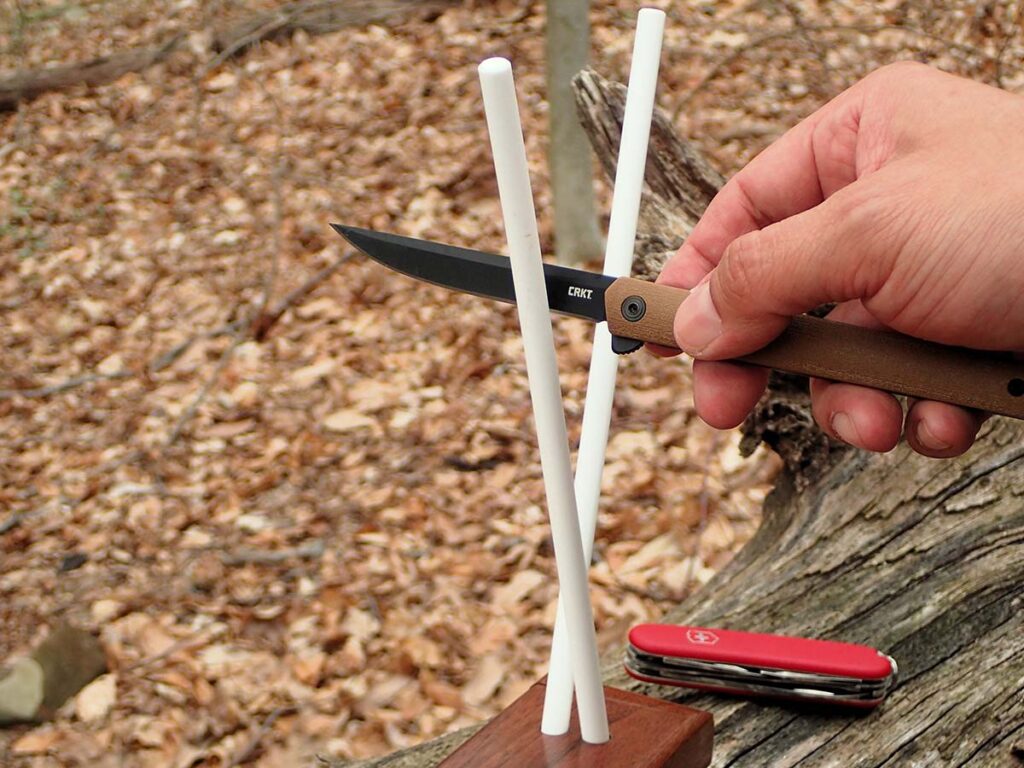
To preset the 15-degree angle with the A.G. Russell V Sharpener, start at the knife hilt and draw down steadily with moderate pressure.
5° per side, creating a compound 30° angle on the blade edge
90 percent+ Alumina Ceramic sharpening rods
Diamond Rods (optional)
Rod Storage
Walnut base is 10.25 inches long
Weight: 16 ounces
Made in USA
MSRP: $71.95
Pros
Consistent Edge Every Time
Durable Materials
Simple & Portable
Cons
Single Angle Only
No Intermediate Grit
The A.G. Russell Knives V Sharpener is a simple yet highly effective tool for keeping your knives razor sharp. Designed with a sturdy walnut base, it holds two ceramic or diamond rods in a precise V-shape, making it easy to maintain a consistent edge. The ceramic rods, made from 90 percent+ alumina, are built to last for years—unless you drop and break them, of course. On the other hand, the diamond rods are more aggressive and perfect for restoring dull blades before you hone them to perfection with the ceramic rods.
Using the V Sharpener is a breeze. Hold your knife straight up and down, like you’re slicing cheese, and draw it down one side of the V and then the other. In no time, you’ll have a razor-sharp edge ready for action. The walnut base is 10.25 inches long and keeps everything neatly in place. If the ceramic rods start looking dark from metal buildup, a quick rub with an A.G. Russell Rust Eraser will return them to peak performance.
Why 15 Degrees
I caught up with Jake Broce from A.G. Russell Knives to ask why the company went with one sharpening angle, settling on 15 degrees.
“A.G. Russell preferred a 15-degree-per-side [compound 30-degree] bevel for his slicing knives because it created a sharper, more efficient cutting edge,” Jake explained. “His knives were ground thinner than most, which made them slice exceptionally well. Since his sharpener was made for most general-use and kitchen knives, he chose a 15-degree angle per side.
“He once worked with a German knifemaker, a Mrs. Dahmann, who hesitated to grind A.G.’s blades so thin out of concern they’d be too fragile. A.G. told her his customers wouldn’t break them because he’d teach them how to use them properly. For tasks like chopping, however, he used thicker blades and more obtuse bevels—he tailored each edge to its specific function.”
Setup & Use
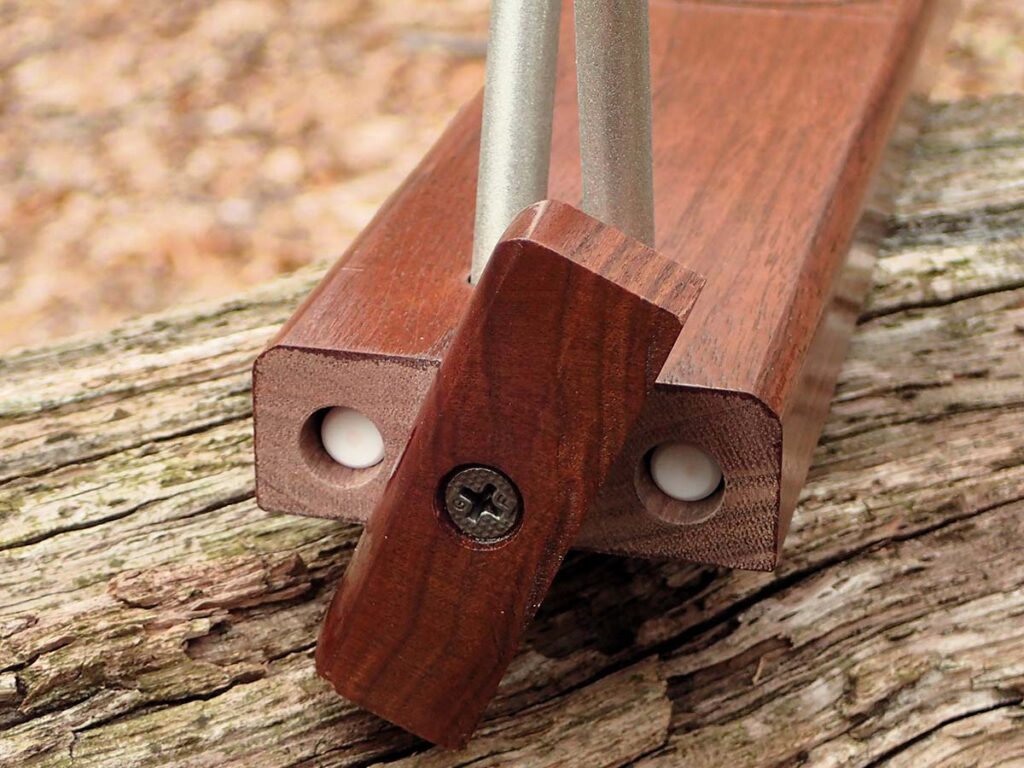
The A.G. Russell’s ceramic rods store in a walnut base with a wooden gate, while a plastic slip and cap protect the diamond rods against weather and damage from other gear.
Setting the V Sharpener up is a breeze. It was the second easiest to assemble of the test sharpeners. The ceramic rods are housed in the walnut base with a simple wooden gate. The diamond rods come in a plastic slip securely fastened with a plastic cap for protection against weather and from your other gear.
Once the sharpener is set up, start at the knife hilt on the diamond or ceramic and draw down. Keep it as steady as you can. Keep your hand behind the line depicted on the walnut base. Use moderate pressure, nothing too intense. Listen to the sound and feel the abrasives do their work.
This unit works easily at home or in the shop. It also fits easily into a pack for camping or a multiday cabin stay.
Report Card
The V Sharpener is a medium-weight unit. The only change I might make would be to add grit between the diamond and ceramic rods.
Whether you’re a seasoned chef or simply someone who appreciates a sharp blade, the V Sharpener is a solid investment that outperforms fancy gadgets and expensive machines. It’s simple, effective and built to last.
Warthog Elite A4 Sharpener
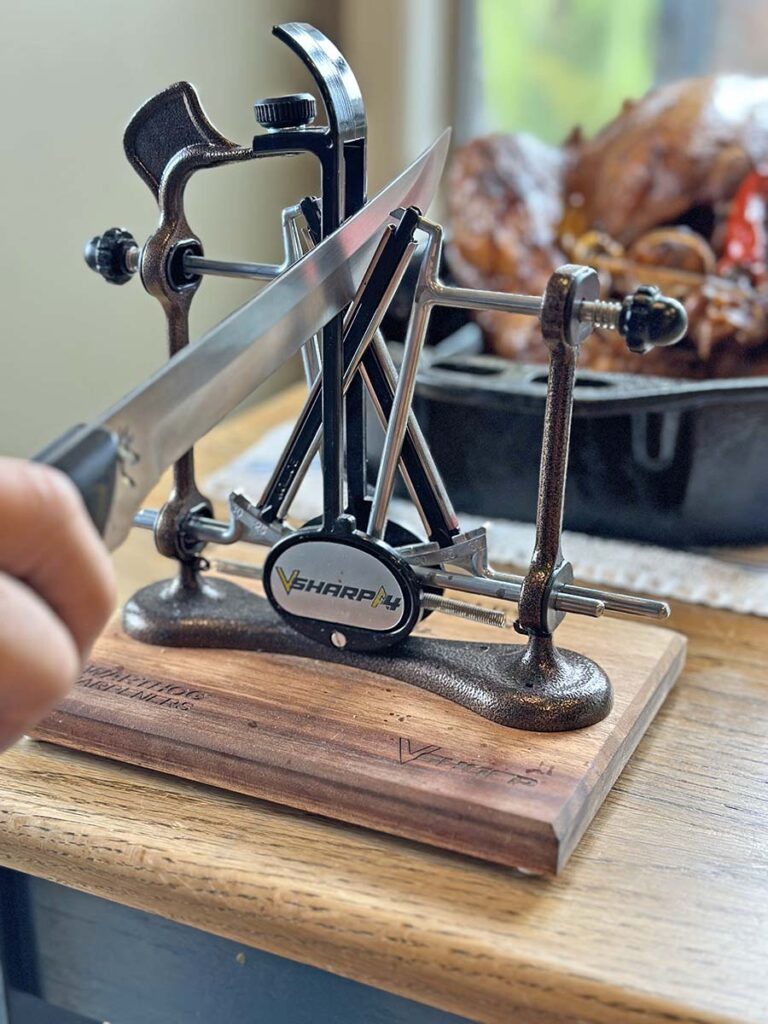
The Warthog A4 Elite uses a patented V-Sharp system with two spring-loaded diamond hones that sharpen both sides of the blade simultaneously—no more struggling to hold the perfect angle. (Warthog image)
15° angle for high-end specialty knives
Patented V-Sharp system for precision angle adjustments
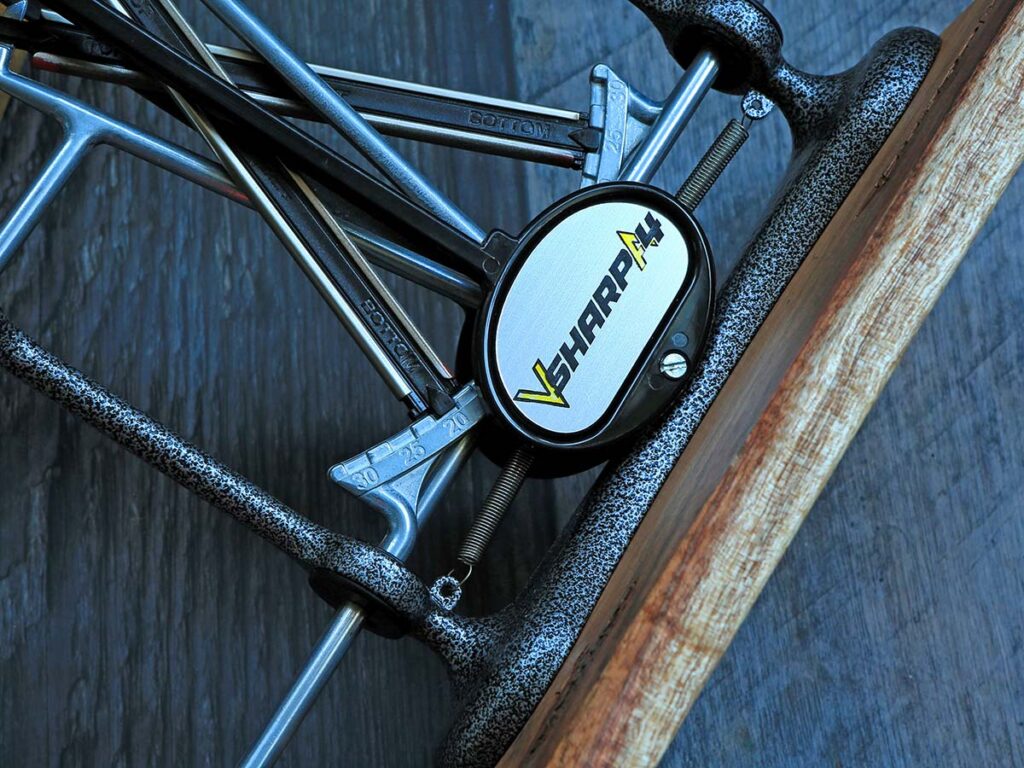
4 Adjustable Angles of 15, 20, 25 and 30°
325-Grit Natural Diamond Hones w/finishing steels included
Metal Frame Construction
Durable Powder Coat Finish
Additional 270, 325, 600 and 1,000 grit and ceramic hones available
Base of deluxe African wood
Weight: 1 pound 13 ounces
Made in South Africa
MSRP: $144.99
Pros
Dual-Side Sharpening
Adjustable Angles
User-Friendly
Cons
Not Travel-Friendly
The Warthog Elite A4 Sharpener is a game-changer that keeps your knives razor sharp with minimal effort. It uses a patented V-Sharp system with two spring-loaded diamond hones that sharpen both sides of the blade simultaneously—no more struggling to hold the perfect angle.
The A4 has a sturdy wooden base that keeps everything stable while you work, and the metal frame construction ensures durability. You can adjust the sharpening angle to 15, 20, 25 or 30 degrees, making it versatile enough for everything from delicate sushi knives to rugged outdoor blades. The included 325-grit diamond honing stones do the heavy lifting, while built-in finishing steels refine the edge. For even more control, you can swap in aftermarket hones with grits ranging from 270 to 1,000, or ceramic for serrated blades.
Setup & Use
You’re ready to rock and roll once you open the package and assemble the unit. The A4 setup stands out as the easiest among the three test sharpening systems.
“If you can slice a tomato, you can sharpen a knife,” asserts the Warthog video. Hold the knife securely and slice down along the ready-set angles. It’s as easy as that. The A4 is the user-friendliest of the test sharpeners.
This one is made for use at home or in the shop. It can be awkward to pack and take along with you. Let it stay ready for action in a semi-permanent location and carry a smaller field-worthy sharpener to the outdoors, on the go, etc.
Report Card
You can adjust the sharpening angle on the Warthog to 15, 20, 25 or 30 degrees, making it versatile enough for everything from delicate sushi knives to rugged hunting blades.
The A4 is a lightweight sharpener. I wouldn’t change much to the already simplistic method of sharpening. Despite its complex nature, I like the multi-angle positions and the hand protector.
Using it is simple. Slide your knife through the vertical guide and the sharpener does the rest. Whether you’re a home cook, professional chef or an outdoor enthusiast, the A4 makes sharpening fast, easy and precise. It comes in multiple colors, so pick one that matches your style.
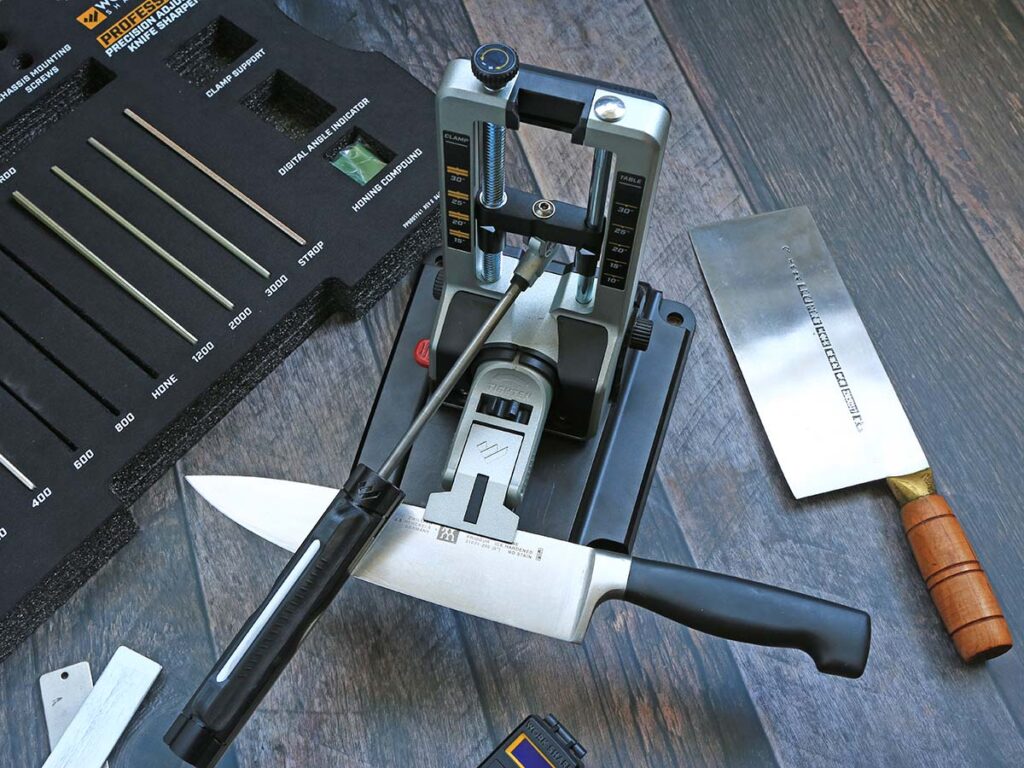
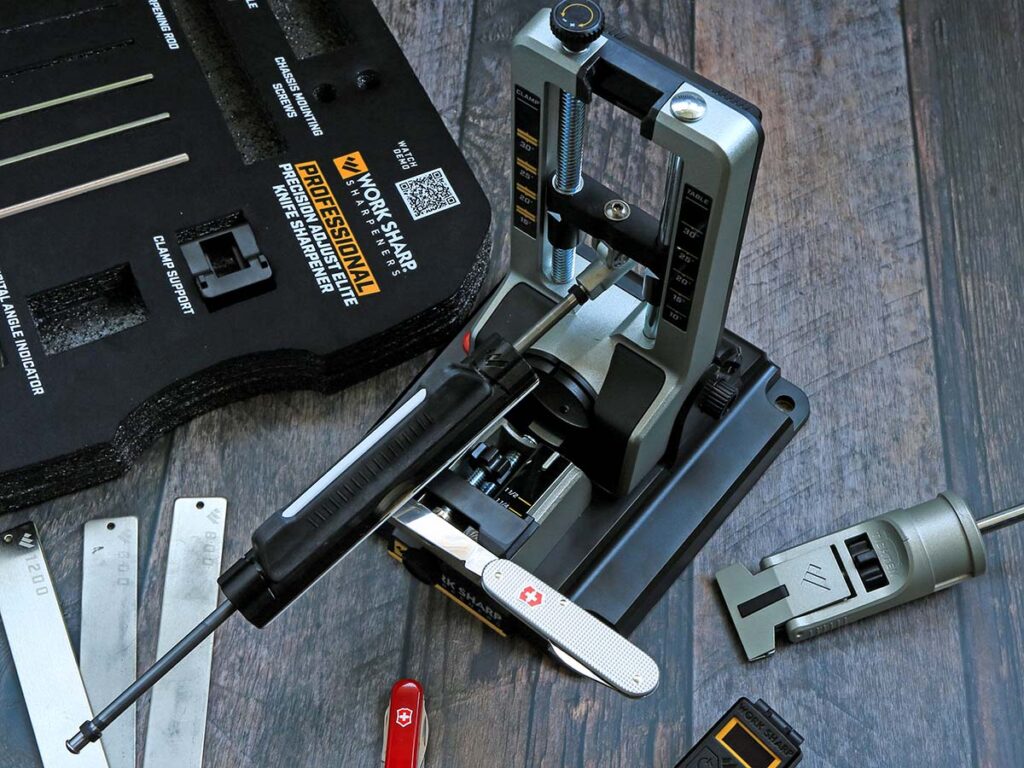
Work Sharp Professional Precision Adjust Elite Sharpener
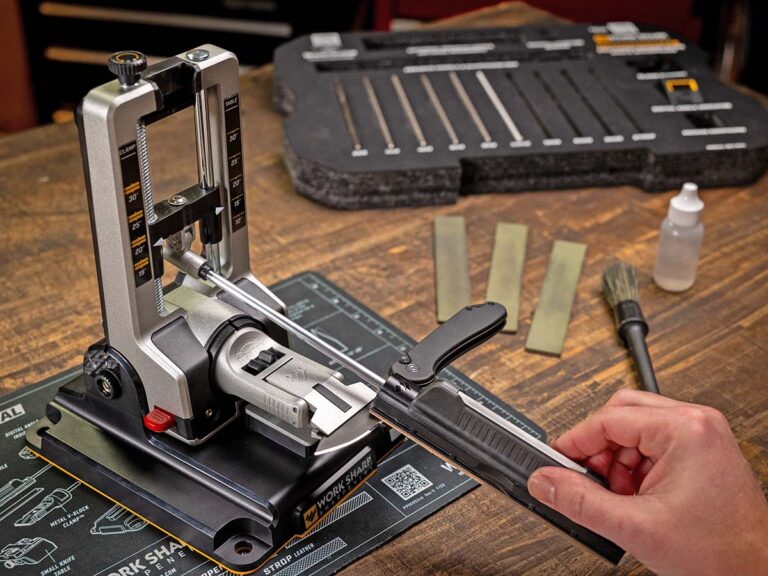
The supplied clamp support works on larger knives and eliminates any play, leaving a solid workspace with the Work Sharp unit.
Digital Angle Indicator
Comprehensive 10-Abrasive System
Coarse diamond plates (220, 320, 400 grit)
Fine diamond plates and ceramic plate (600, 800 grit, fine ceramic)
Designed, engineered and calibrated at Work Sharp’s facility in Ashland, Oregon. Work Sharp sources materials from various manufacturers, so some components may come from different locations.
MSRP: $449.95
Pros
Pro-Level Precision
Versatile & Comprehensive
Secure & Stable
Cons
Complex Setup
The Work Sharp Professional Precision Adjust Elite Sharpener is a powerhouse for anyone serious about keeping knives razor sharp. Built with solid metal construction and rugged hard plastic, the sharpener holds your blade steady while you work, ensuring accuracy every time. It features a fully adjustable angle system ranging from 15 to 30 degrees so you can fine tune your edge to match your needs.
The unit’s 10-abrasive system (1 x 6 inches) sets it apart. You get everything from coarse diamond plates (220, 320, 400, 600 and 800 grit) and ceramic hones to ultra-fine resin-bonded diamonds (1200, 2,000, 3,000 grit) and a leather strop for the final polished finish. Whether restoring a dull edge or refining an already sharp one, the Work Sharp covers you.
A V-block clamp securely holds your knife in place, making sharpening effortless, and the included knife table attachment ensures that even smaller blades get the same precision treatment. A rugged carry case keeps everything organized and portable when needed.
Setup & Use
While not challenging, setting this bad boy up takes time. The instructions are excellent, as all of them are for the reviewed sharpening units. Nonetheless, this required me to view a few videos. Read and watch to make yourself proficient in the use and setup. Though the Work Sharp is the hardest unit to assemble, it’s worth the trouble. Don’t let this factor deter you before giving it a chance. Take the time to familiarize yourself with the sharpener’s working parts and then you’ll be a believer. Once you master the process, you will pat yourself on the back!
The Work Sharp comes with a carrying case. However, where would you go besides a buddy’s house to show it off? It’s heavy and bulky for toting around. As a result, the sharpener is an ordained home and shop unit.
Report Card
The magnet system of the Work Sharp’s knife attachment helps keep smaller blades in place while a support hand helps steady them.
I like the 10 sharpening abrasives and leather attachment with honing compound. That’s a nice personal touch. I love how effortlessly I can tuck the abrasive sharpening rod away when I’m done. Whenever I need to flip the blade or make adjustments, the handle slides right into its designated slot in a flash. Plus, checking the blade burr before flipping is a breeze. Bravo, Work Sharp!
I wish there were an easier way to tell the difference between the unit’s clamp and table numbers and how they relate to the digital reader. Of course, this aspect can easily be chalked up to user confusion.
If you’re a knife enthusiast, chef or collector, the Pro Precision Adjust Elite delivers professional-level results efficiently. It’s not just a sharpener—it’s an investment in keeping your blades performing at their best.
A USA-made tribute to a quarter millennium of American freedom, limited to just 250 numbered pieces.
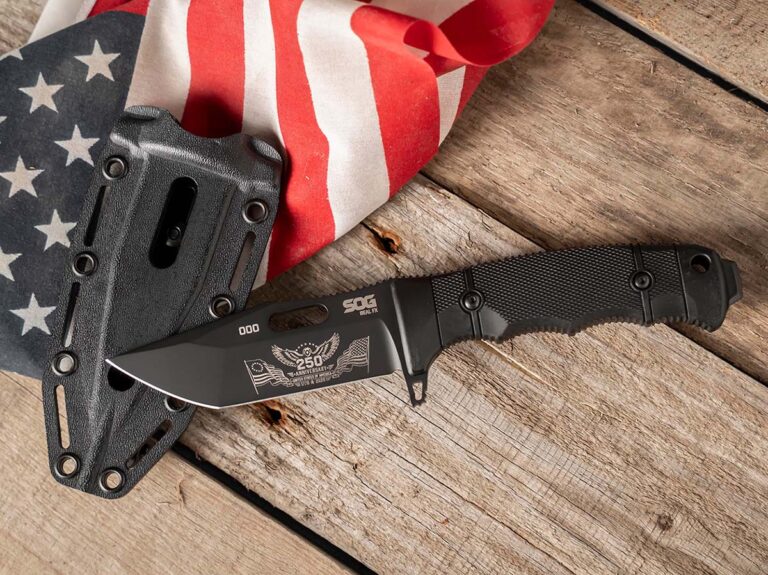
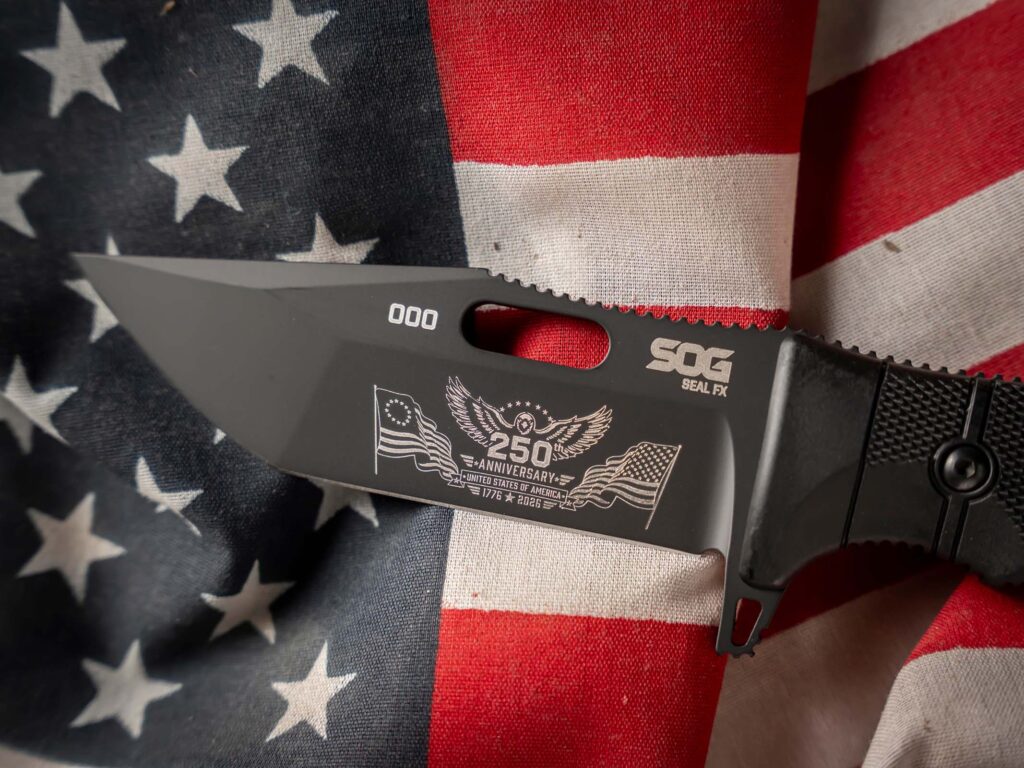
As the United States approaches its semiquincentennial, SOG Knives is marking the milestone with a highly exclusive tribute to American grit. The company has unveiled its 250th Anniversary Limited Edition SEAL FX Fixed Blade, a commemorative tool that honors a quarter-millennium of history, sacrifice, and resolve.
True to its heritage, this special edition is forged and assembled entirely in the USA. True to its name, production is strictly capped at just 250 individually numbered pieces, making it a true collector’s item.
Beneath the commemorative engraving lies a serious tool designed for professional use. The knife features a capable 4.3-inch blade forged from premium S35VN steel, known for its excellent edge retention and toughness. The handle is crafted from a durable glass-reinforced nylon, paired with an ambidextrous Kydex sheath that offers versatile mounting options for any loadout.
Whether it is destined for a display case or a survival kit, the 250th Anniversary SEAL FX is built to stand the test of time. It serves as a functional symbol of the values that have shaped the nation for 250 years. The limited-edition blade retails for $250. Given the low production run, interested collectors should act quickly.
SEAL FX SPECS Overall Length: 9.20″ Blade Length: 4.30″ Weight: 7.20 oz Blade Thickness: .19″ Product Family: SEAL Product Type: Fixed Blade Country of Origin: U.S.A. Finish: Black Cerakote Edge Type: Straight Blade Steel Type: CPM S35VN Blade Shape: Tanto Handle Material: Glass Reinforced Nylon Handle Color: Black Hardness: Rc. 58-60 Sheath Material: Kydex Sheath Color: Black MSRP: $250
Thanks To The Internet, Straight Razors Are Back In Style. These Trio Of Blades Can Keep You Looking Sharp And Feeling Smooth.
Mastering shaving with a sho-nuff handheld straight razor is a lost art that has recently become more popular thanks to social media shaving gurus and those who like a good challenge.
Straight razors never went away, the internet just has a knack for making old things new and cool again. Let’s look at a trio of current offerings and shave them through their paces.
Boker King Cutter
Boker King Cutter
Boker has been producing straight razors since 1869 and the company offers many models today. The King Cutter, the company’s most popular razor, features a carbon steel blade with a deep hollow grind. The handle is a black polymer with a brass Boker Tree Brand logo escutcheon. The King Cutter was the lightest of the three review pieces, tipping the scales at a svelte 1.47 ounces. It features a monkey tail tang for quick blade access.
Being the most expensive of the test lot by a long shot and from a company that has been making straight razors for over 150 years, you’d expect the King Cutter to perform well. Simply put, it did. The blade was, ahem, razor-sharp right out of the box and glided through my two-day stubble clean as a whistle. I never had to back up and go over an area to get it smoother.
The thinnest of the review blades, it got into tight spots a bit easier. However, a word of warning is in order. An extremely sharp blade like this will cut you faster, too, so take your time! The King Cutter’s high price tag may scare some away, though there are other straight razors out there that cost much more.
MSRP: $189.95
Rough Ryder Cinnamon Bone Stag Razor
Rough Ryder Cinnamon Bone Stag Razor
Rough Ryder’s Cinnamon Bone Stag Razor has all the trappings at a budget price, including the good looks of a traditional straight razor. The cinnamon bone stag handle, replete with an acorn escutcheon, is downright handsome—and Rough Ryder does bone stag well.
The cutting portion of the blade has a light yet distinctive damascus pattern running across its face, and a barber’s notch at the point aids in safely opening and deploying the blade. A monkey tail tang completes the package.
Right out of the box, the Rough Ryder entry shaved the stubble straight from my face. The blade was plenty sharp and I was able to get into tight spots with good results. When you get down to the nitty-gritty, there are differences between this razor and an expensive one like the Boker.
There is a tad more drag on the blade and I had to back up a few times to get the area I was shaving totally smooth. To be honest, I expect this from a razor at this price point, and you should, too. That said, the Rough Ryder Cinnamon Bone got the job done and was no slouch. I recommend this razor to those who want to get their feet wet before taking the plunge on a high-dollar cutter. And, by golly, it was the most attractive of the bunch!
MSRP: $29.99
TOPS Knives Tac-Raze 2
TOPS Knives Tac-Raze 2
The TOPS Knives Tac-Raze 2 is designed as an EDC and not billed as a straight razor. Nonetheless, we threw it into the fray to see if we could shave with it, letting the chips fall where they may.
A full 2.625 inches of the blunt-tipped blade has a slightly bowed edge. There’s a rat-tail tang reminiscent of the old friction folders, though not forged. The Tac-Raze 2 has a deep choil below the blade edge that splits time with the handle. TOPS includes a dark brown leather slip and a small bottle of protectant.
Would an EDC with a razor-style blade shave? Given how many YouTube videos there are of guys shaving with everything from bowies to kitchen fare, I figured why the heck not? A cursory check right out of the box with the blade warmed up and a light coat of shaving cream on a cheek gave me surprising results. Not only did the Tac-Raze 2 shave my stubbled skin with ease, it was darn smooth! Next, I cleaned the blade up and stropped it, and the shave was as smooth as I could get with a standard straight razor.
As I worked around my face I found some gremlins with the TOPS EDC. The handle is not nearly as nimble as a standard straight razor, which is to be expected since it’s not a standard straight razor. I found getting into tight areas like the crack between my upper lip and cheek particularly dicey. Bottom line? What you lose in dexterity with the Tac-Raze 2 you gain in versatility since, after all, this is an EDC knife with all the benefits—and it comes with a slick leather slip.
MSRP: $139
Scoring The Straight Razors
All three in our razor trio had their strengths and weaknesses, but all got the job done. The Boker King Cutter is the pro razor of the bunch. The Rough Ryder Cinnamon Bone is a nice entry-level shaver, and the TOPS Tac-Raze 2 is certainly the most versatile.
One final note: don’t be afraid to try a straight razor. As a knife enthusiast, chances are you’ve already developed a healthy respect for sharp blades. Wade in slowly and carefully—once you get a feel for the straight razor, it will feel right at home in your hand. Happy shaving!
Knife buying–particularly custom–can prove daunting. We gathered industry pros to give the top mistakes to avoid.
When it comes to acquiring knives, the informed buyer is most often the satisfied buyer when the transaction is complete. So in the spirit of friendly advice, BLADE® has enlisted the help of several knife industry pros to offer a few words on making the most of the knife-buying experience—or to put it another way, 11 mistakes to avoid when buying a knife.
Don’t Deal With Questionable Sellers
“A lot of it revolves around reputation,” said custom knife purveyor and collector Paul Farina of Farina Fine Arts. “Human beings can be different, but 80 to 90 percent of the people you meet out there are great. In the knife world, many of them will give you a refund if you aren’t happy.”
Dave Harvey of Nordic Knives echoed that sentiment. “Honest sellers are not hard to find, thankfully,” he said. “Look for those with years of experience. Generally speaking, dishonest sellers will not be in the business very long.”
Along the same lines, Daniel O’Malley of bladegallery.com cautions folks interested in buying online. “If purchasing online, make sure you are buying from a company that has been around a while,” he offered. “There are a lot of fraudulent websites out there these days—often ones that are trying to appear to be a well-known website. One dead giveaway that you may be on a fake purveyor website is if the prices are too good to be true. Unfortunately, you are unlikely to find a legitimate site selling knives for half the price of other legitimate sites.”
Don’t Buy Knives On Pictures Alone
“In most cases today, knives will be purchased online, and therefore you may have to judge the knife by photographs and listed descriptions,” O’Malley advised. “Since the value of the knife is greatly affected by small scuffs and scratches, it is important that the photos are clear enough that any imperfections will be noticeable.”
Along the same track, Harvey noted, “Pictures are great, but they never fully substitute for being able to see and hold a knife in person. Make sure you buy from someone or a dealer with a 100-percent-return guarantee. If you are not satisfied with your purchase, you should be able to return it in a reasonable period of time.”
Don’t Buy Knives On Steel Only
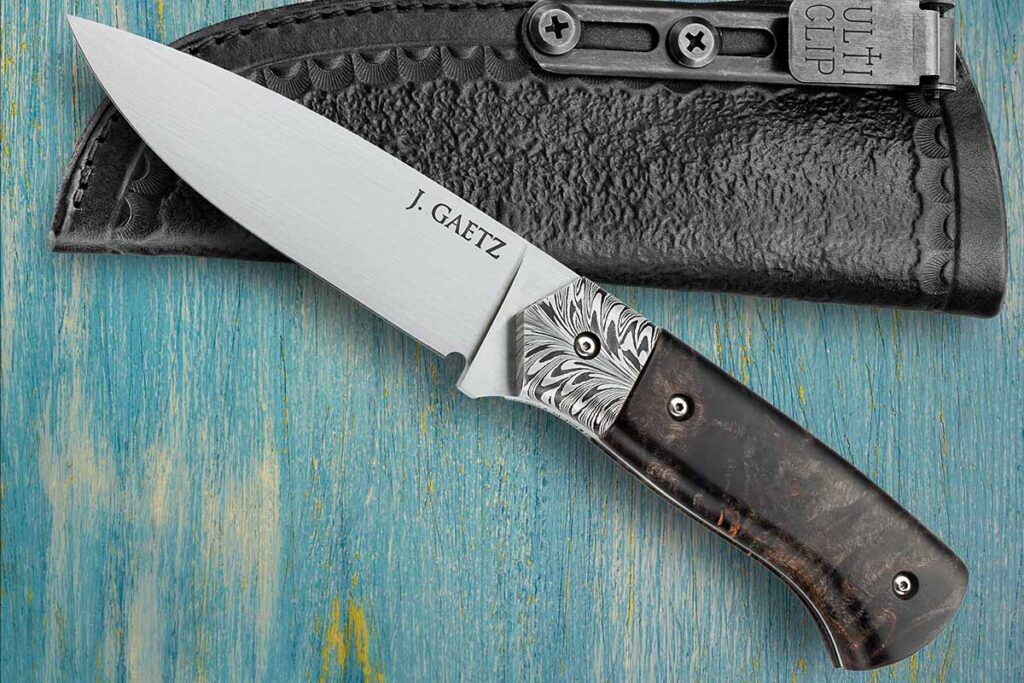
Daniel O’Malley advised that each year new miracle steels appear but often lose popularity after a year or two because they may not pan out. Conversely, tried and tested steels like CPM S35VN, Takefu SG2, 52100 and more are great benchmarks to test against. Jacob Gaetz forged the 4-inch blade of his fancy hunter from 52100. (Jocelyn Frasier image)
“I never talk to people too much about a particular blade steel,” commented Dave Ellis of Exquisite Knives. “I usually discuss with clients how the complete knife was made, how it was fashioned, and that is more important, I think. Someone may be enamored with a certain type of steel, but that is rare with my clientele and only a consideration in talking about the whole knife.”
Harvey reckons that few knife buyers take the “blade-steel-first” approach. “At least I would hope not,” he asserted. Farina added, “There are a few exotic blade steels out there right now, and these may be sought after just because they’re exotic. Also, some steels have been discontinued and knives with those steels may be selling because of the rarity.”
Taking the entire knife into account is the best way to reinforce a purchasing decision, according to O’Malley. “Knowing the stats on the knife is important,” he reasoned. “We want to know where it was made, who made it, in what country it was made, and what materials they used. That said, judging a knife by just the blade materials used ignores fit and finish as well as heat treatment quality. In some cases the identical steel at the identical Rockwell hardness can still have tremendously different edge holding. In fact, over the years I have found that the quality of heat treatment is perhaps even more important than the steel used.”
Don’t Buy Knives On The Handle Comfort
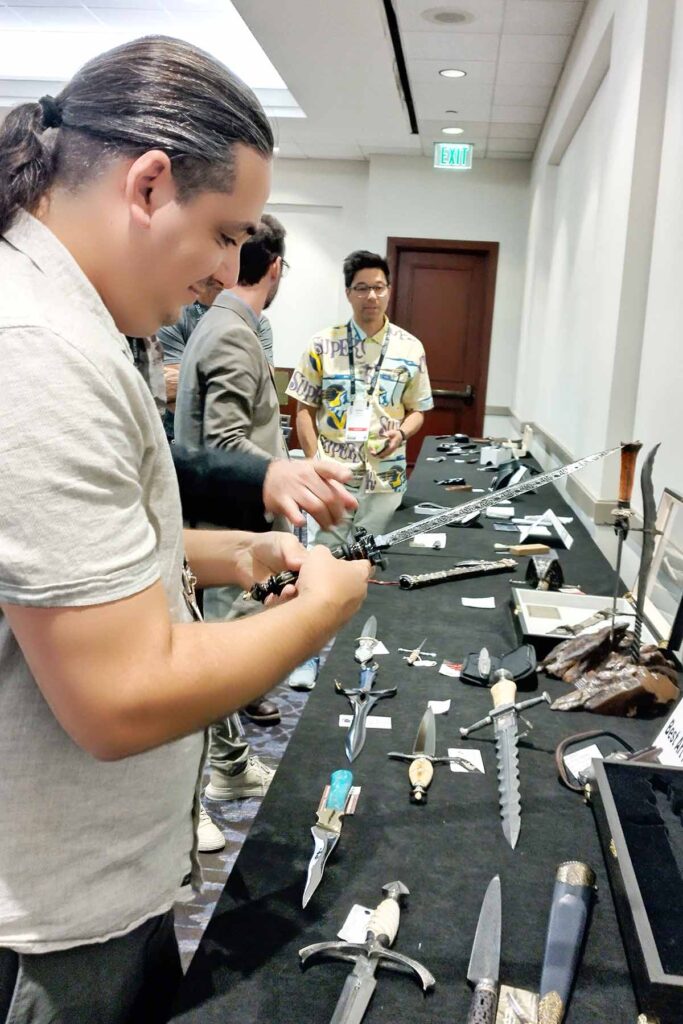
Daniel O’Malley said that even if it’s the best knife in the world, if you don’t like the way it feels it isn’t the best knife for you. Lee Lerman, a custom knife judge at BLADE Show 2024, checks the handle of one of the knives entered. In the background are observer Henry Wu (right) of the BLADE Show and judge Rodrigo Sfreddo (center).
“Getting a knife in hand and seeing what it feels like is ideal, though sometimes not possible if you are purchasing from far away,” O’Malley related. “I often advise potential buyers that even if they are holding the best knife in the world, if they don’t like the way it feels it isn’t the best knife for them. That said, some buyers feel a knife is comfortable just because it is familiar—similar to their last knife. They may have gotten used to the last knife and like the way it feels, but a different feel might actually be better, that is, a more ergonomic handle or lighter design. Sometimes it takes using the knife for a while before you know how you really feel about it.”
Don’t Adopt A Herd Mentality
“There are trends out there, but because I’m older and been around the art knife world so long, I’ve thought about the places to put my money,” Farina commented. “If you’re looking at an up-and-comer in knifemaking, check their quality, find out who taught them. That is how I get introduced to them. If they have been taught by an experienced maker, you can tell the quality, and the price may reflect in less money with younger guys.”
From the perspective of “hot styles,” Harvey remarked, “I don’t object to those who want to buy the ‘hot’ knives as long as they are styles and makers that they enjoy and collect. Buyers should always beware of ‘hot’ knife prices and not fall for overpricing.”
“What’s currently ‘hot’ isn’t always best,” O’Malley commented. “The knife industry develops relatively slowly and though each year we see new miracle steels come out, they often lose popularity after a year or two because they may not have panned out. Tried and tested steels like S35VN, Takefu SG2, 52100 and more are great benchmarks to test against.”
Don’t Overlook Makers By Name
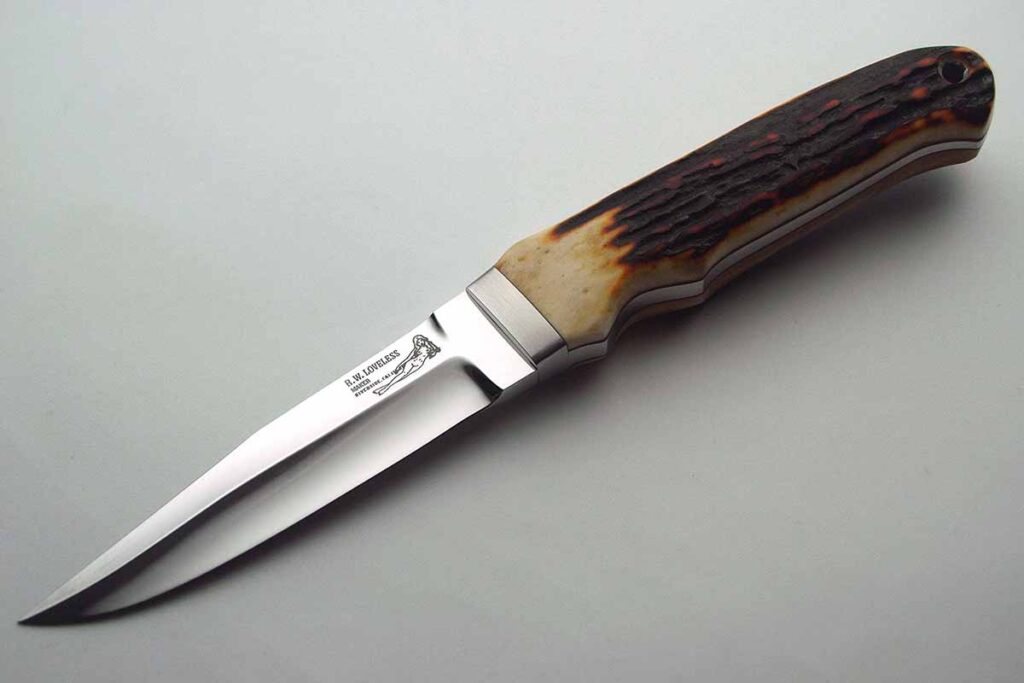
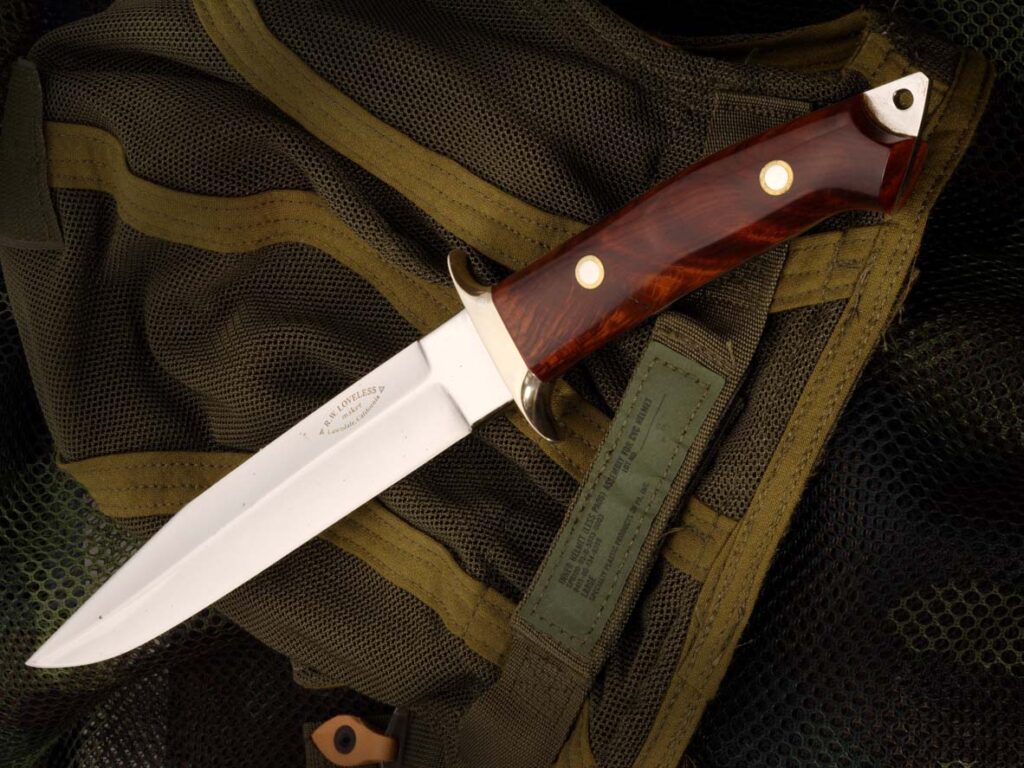
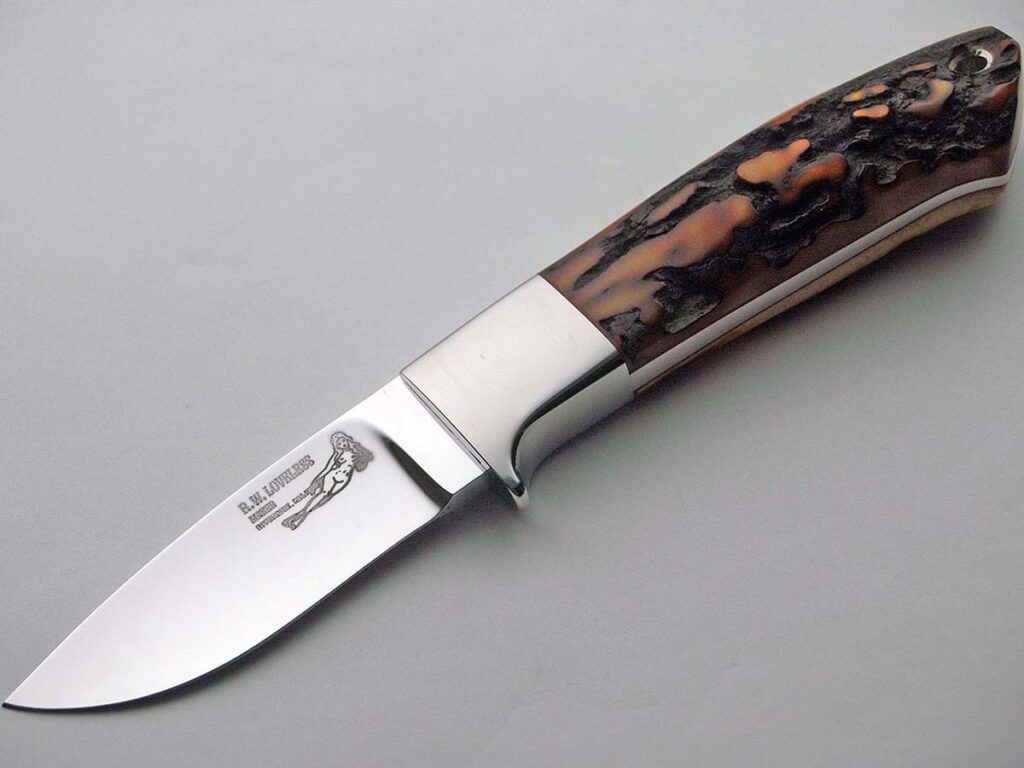
Dave Ellis said that instead of buying 10 knives you can afford, save up and buy one made by Bob Loveless. A Loveless hideout model in stag and with the iconic Naked Lady logo would be a good place to start. (Exquisiteknives.com image)
Ellis looks long-term and sees intrinsic value in the known commodities. “I recommend the blue-chip makers,” he declared. “Instead of buying 10 knives you can afford, save up and buy that one Loveless. This year I’ve sold 14 Lovelesses and the pricing has not gone crazy. So, an entry level $5,000 knife is not so ‘out there’ for someone.”
According to Harvey, most big-name makers have an established collector following, which typically relates to a lasting market for their knives down the road. However, O’Malley points out the benefits of considering numerous makers.
“The knife industry is full of tiny workshops that are doing the best work in the industry,” he noted. “While there are also some great big-name makers, these smaller shops are more likely to provide more bang for your buck. Additionally, in many cases, small workshops may be putting more attention toward quality of heat treatment, which can result in much higher performance.”
Don’t Overrate The Investment Factor
“Buying for investment is something I love because of the fact I can make money on knives,” Farina explained, “but this is not a blue-chip investment stock. So do it for the passion and love of the product. However, if the goal is only for investment, then be very structured. Listen to an adviser. I had a customer come to me after spending a lot of money in four years. He wanted to sell and make 20 percent profit on all the knives [he had bought]. Maybe that would happen on some stuff, but it is a bit unrealistic.”
O’Malley added, “Knives can be a great investment. Over the years, I have seen many knives increase dramatically in price, though certainly there are some that hold their price and even some that go down. Picking the right knives for investment does take a time commitment. You need to research and know the maker and their work. How does the knife fit in the range of knives that maker creates? Will the materials hold up over time? Where is the maker in his or her career? Taking all this into account, it is possible to collect knives as a great investment, though keep in mind that even with the best research not every investment will work out.”
For Harvey, the investment path requires some preparation. “Smart buyers can and do successfully invest in certain knives,” he said. “This does require a lot of knowledge and patience, as you generally won’t see significant increases in value in the short term. For most buyers, I suggest buying what you like and enjoy for your collection, not expecting a large return for it upon sale.”
Don’t Exceed Your Knife Buying Budget
Dave Ellis recommended setting a price limit at auctions and don’t exceed it or you will find yourself paying a lot more than necessary. “I remember a particular Jurgen Steinau fixed-blade knife a few years ago when an overseas bidder and a guy from the Bay Area were in there. The knife went for $110,000,” Dave noted. “People were in there butting heads and then it became an ego thing.” Steinau’s unique style is reflected here in his Folding Knife LBS. (Eric Eggly/PointSeven image)
Ellis provides sound wisdom on auction bidding. “Set a price at the auction and don’t go over the limit and find yourself suddenly paying a lot more than you wanted to pay. I remember a particular Jurgen Steinau fixed-blade knife a few years ago when an overseas bidder and a guy from the Bay Area were in there. The knife went for $110,000,” he noted. “People were in there butting heads and then it became an ego thing. Also, don’t buy with an eye toward flipping the knife. Avoid bid ups like the plague.”
“Auction sites tend to have horrible photos, making it impossible to ascertain what a knife is really like—and what it is worth. Since fit and finish as well as condition are so important to value, figuring out what to bid can be near impossible. Additionally,” O’Malley opined, “auctions can be a way to end up paying much higher than a direct-from-maker price.”
Don’t Discount Second Opinions
“Second opinions are nice and not too hard to get on many knives,” Harvey pointed out. “There are online forums and other social media outlets where collectors share information on many makers and knives.” Take advantage, then, of the availability of information but consider the source always.
“Knives are pretty personal,” O’Malley observed. “What works for you might not work for your buddy. It’s always fun to walk around a show with someone so that you can bounce ideas off each other, but at the end of the day, buying what you like is probably most important.”
Don’t Buy Knives Under Duress
Never feel pressured to make a knife purchase. Don’t always accept the line that the knife you are considering could be gone in the next few minutes. Take a deep breath and make the most informed decision possible in the current environment. If you don’t feel totally positive, walk away.
“Many knives are literally one in the world,” O’Malley said. “This means that if you don’t buy it, there is a chance that it will be gone. Over the years, I’ve found a good way to evaluate is to ask yourself, ‘If this knife sells to someone else, in three to five weeks will I be frustrated and still want to purchase it?’ If the answer is no, you probably didn’t need to purchase the knife. There will always be others. There are, however, a few knives that I didn’t buy that even years later I wish I had purchased. Figuring out if this is one of those knives lets you know to buy it before someone else does. Any big collector has had a few knives they didn’t purchase quickly enough that they still regret not purchasing today.”
Don’t Always Discount Deposits
Over the years of buying and selling knives, Daniel O’Malley said he found that the quality of heat treatment is perhaps even more important than the steel used.
“If a maker requires a deposit, he or she must be a good accountant,” Farina related. “Some are not businessmen. They are artists and machinists. So, it’s about reputation and feeling good about the maker you are working with.”
Trust is a big factor across the board. “Paying for a knife before it is completed can be complicated,” O’Malley maintained. “A well-regarded maker once summed up the problem: ‘It’s very hard to work on a knife that’s already paid for.’ That said, collectors often commit to a purchase, have a knife made, and don’t complete the purchase or just ghost [stop communicating with] the seller. For this reason, I feel it is reasonable to pay a relatively minimal deposit, 10 to 20 percent of the cost of the knife, when purchasing directly from the maker. If working through a purveyor and having a knife made, it isn’t unusual to have to pay the full amount up front since the purveyor is committing to the purchase for you.”
Stay Informed
Advice is free, for sure, but it comes from the voices of experience. When buying a knife, it pays to listen to those already engaging in the process. Of course, every situation is a bit different. There are always additional considerations. The bottom line is to approach a knife purchase on an informed basis. That translates into a confident buy!
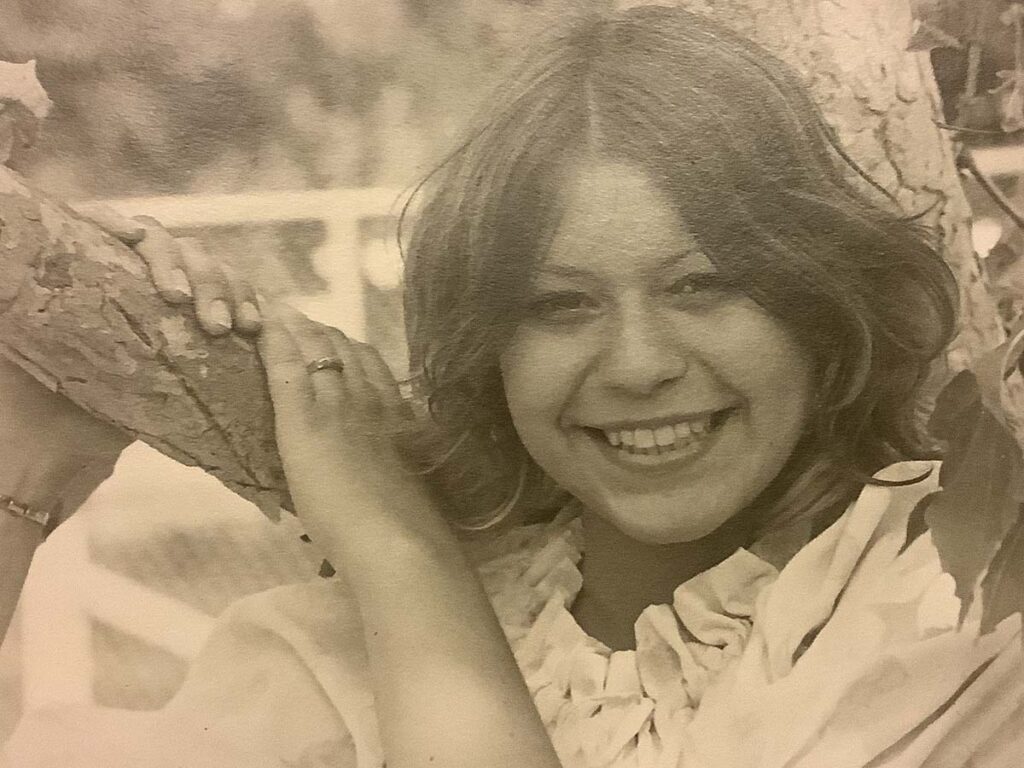
Robin Askew reflects on being the daughter of Bob Loveless.
It was intimate and distant. It was warm and aloof. It was youth, adulthood, hope and memory—all at the same time.
Robin Askew is 70 years old now. She lives a quiet life in Sacramento, California, and her recollections of growing up as the daughter of a legend offer insights into years of experiences that few could imagine. Her father, BLADE Magazine Cutlery Hall-of-Fame® member Bob Loveless, was and remains one of the titans of the custom knife industry. He has been gone more than 15 years, but his imprint on the past, present and future of custom knives is unmistakable and not about to wane.
Bob Loveless (center) talks with David Crosby (right) of Crosby, Stills and Nash at the 1989 California Custom Knife Show. The two were good friends, with Loveless an inveterate harmonica player who at times would play with CSN at a local bar or night club. At left is a young, mustachioed Steve D’Lack, coordinator today of the New York and Nashville Custom Knife Shows. (John Denton image)
Likewise, those who knew him remember his unforgettable, often larger-than-life persona. Creative genius, irascibility, generosity and unique perspective came together in Loveless, the man who shaped custom knives and literally changed the landscape in tangible ways, including steel and its components, and in intangible ways such as the sweep of the blade, its flow and form, and the aesthetic qualities that characterized his legacy.
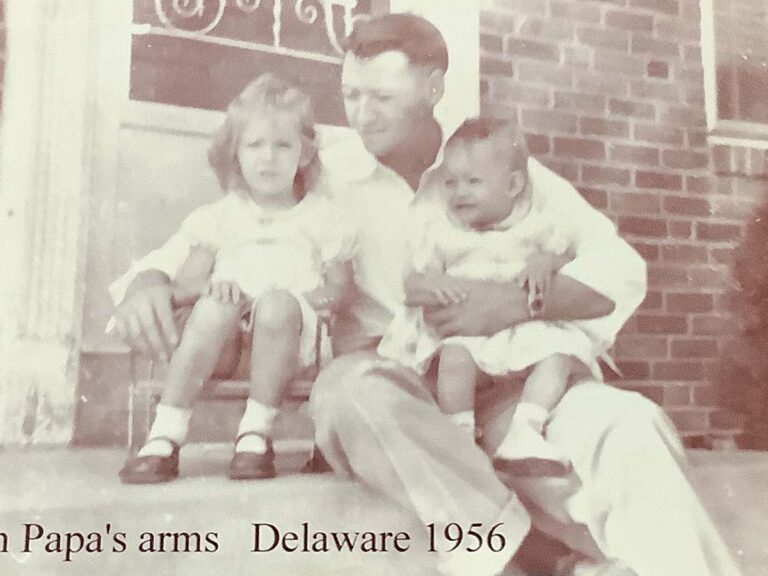
Robin experienced the evolution, both in the life of Loveless and in the industry that he forever altered. From her earliest memories, her father was a busy man building a future one knife at a time, crafting a legend—whether he knew it or not—one innovation after another from a basement in Delaware to his shops in California. In the midst of it all, growing up Loveless was a complex, frustrating, fallible, forgiving and ultimately joyous journey.
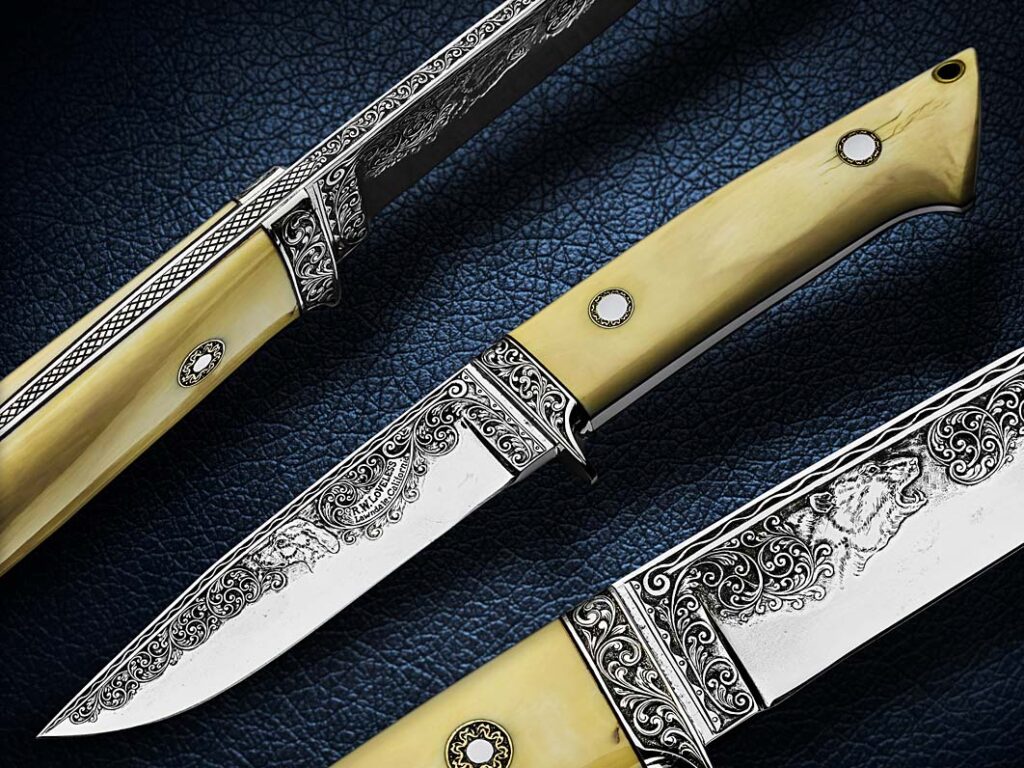
David Crosby owned this ivory-handled Loveless utility knife fully engraved by H.H. Frank. According to John Denton, it sold for $22,000 a few years ago. (Cory Martin image)
“Some people were actually frightened of him,” Robin smiled. “They might have been put off. But his bark was so much worse than his bite. Over the years, my father was so amazed by the fact that others regarded him with such a high standard. He didn’t embrace that at all. One time he said to me, ‘They still think I’m the greatest.’ That was something that he had never imagined and never really came to terms with.”
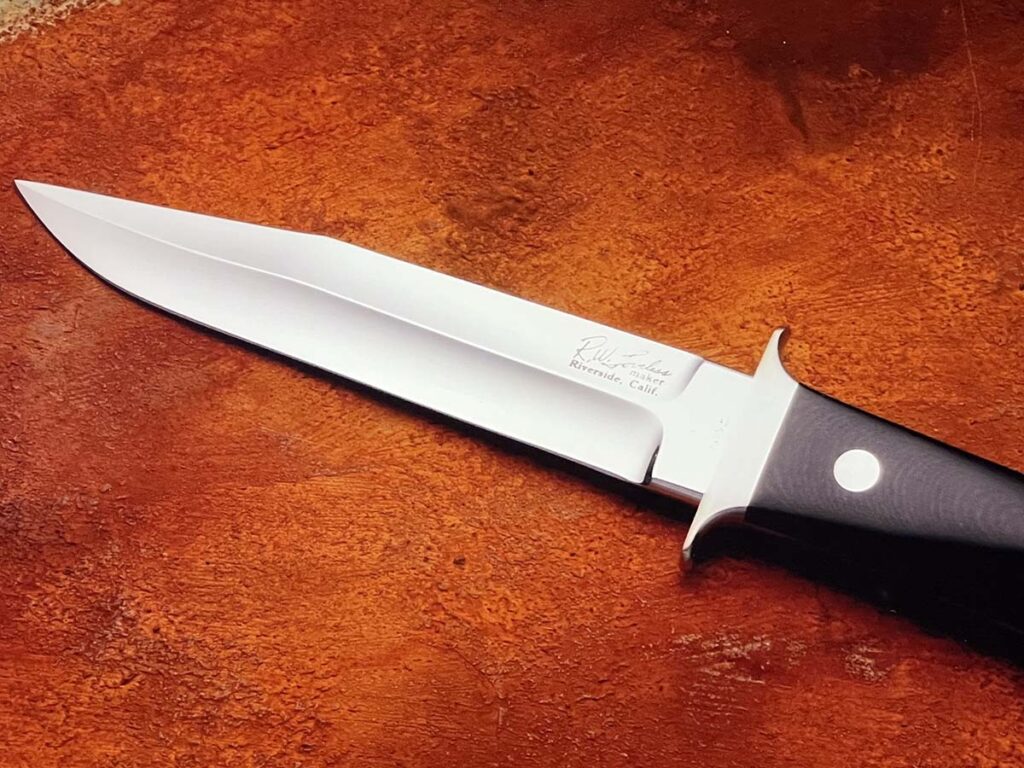
Bob Loveless made contributions to the knife industry on multiple levels. He was instrumental in the formation of The Knifemakers’ Guild and in establishing the custom knife market in concert with other great men like the incomparable Cutlery Hall-of-Famer A.G. Russell. Loveless reached across the globe and developed relationships in Japan that eventually brought ATS-34 stainless steel, a staple in blade construction, to other markets. He was a metallurgist who concocted his own steel composition and made Micarta® a handle material of choice. The curve and the sweep of the drop-point hunter and other Loveless creations touch the senses and influence generations of admirers even now.
Robin Askew is alive and living well today at 70.
For Robin, more than half a century of a legend in the making is remembered in light and shadow, the image of her father at work tirelessly building and brainstorming and striving to make his way, and in turn taking care of those close to him. It was, at times, both turbulent and tender, but always something new.
“Daddy was super, super busy,” Robin recalled. “I never made a knife, just swept the shop floor. He would do things in batches and stages, and one of the most fascinating things I remember was when he would cut the leather and make the sheaths on a big stitching machine. He did everything with the knives, from drawing out the patterns to grinding the blades down and shaping them and putting the Micarta, stag or ivory handles on them. After he ground batches of blades, he would test them, pointing them down and dropping them onto the concrete floor of the shop. If the tip cracked, the whole batch of blades would be thrown away—but that never happened.”
Through the years, there were times when the family fractured, quite probably due at least in part to the stress and strain of a one-man enterprise that was on the rise, moving through uncharted territory and challenges. While something incredible was eventually gained, there was a cost to be counted. But such is true in life, true for everyone and in every relationship.
Lawndale & Riverside
For much of her young life in Lawndale, California, Robin lived in a small house with her mother and sister while her father lived in a studio apartment just down the road and worked in his basic shop.
“At the time I grew up with my dad, Allison and I were the oldest, and then Mary came along nine years later,” Robin commented. “Dad was getting to be known while the shop was in Lawndale, and when I was a senior in high school in 1973, the shop in Riverside, California, was not quite ready.
Taken on Christmas 1982, Loveless’s three daughters appear together, in back from left, Robin, Alison and Mary. Bob has his arm around Alison’s daughter Anna, the first Loveless grandchild.
“Still, he was getting telephone calls all the time. We would answer them in the house when he was working, and finally he put a phone in the shop because we had been taking all the calls,” she laughed. “He hired me to be his little secretary, and I would send out the catalogs and address them and seal them and take messages. It was a little weekend job, nice and fun.”
The relocation to Riverside occurred about 1974, and Robin remembers the dramatic change from Lawndale in terms of shop sophistication. “I had moved away,” she said, “and when I came to the shop in Riverside, it was so much more advanced than the little Lawndale shop with so many machines and things to look at. I was fascinated by everything he did, and it was fun to sit in his office.”
Along For The Ride
“Some people were actually frightened of him,” Robin said of her father. “They might have been put off. But his bark was so much worse than his bite.”
By that time, though, the Loveless mystique was already established. Bob was well on his way to custom knife stardom. And those around him? Well, they were along for the ride.
“People had started to come over and meet my dad,” Robin smiled. “There were so many people, different people, ordering knives. He would hang up the phone and say, ‘OK, John Wayne just ordered a knife.’”
Bob Loveless became a friend to the prominent, the eclectic and a diverse spectrum of admirers. Although they may have shared little else, they were each drawn, like moths to a flame, to the world and work of a master. Loveless met David Crosby, Stephen Stills and Graham Nash, stars of the pop music scene with their fame growing exponentially in the late 1960s. Crosby was a frequent visitor.
“When Dad first met them, the three were playing the circuit,” Robin remarked. “They were performing in bars and night clubs, and Dad would sit in with them on stage and play his harmonica. He loved to play the harmonica and had a lot of fun with them. Crosby would come to where Dad lived in the studio apartment about a quarter mile down the street from the house in Lawndale and just hang out. One time, he came to the door and said, ‘Is your dad here?’ and I yelled, ‘Dad, David Crosby is at the front door!’ They would just talk and enjoy themselves and do their thing.
“One time Crosby came into the kitchen and said, ‘Robin, can you make me a cup of coffee? You’re the only one who knows how I like it.’ This is 1973. These guys are really hot. And I’m a senior in high school!”
Vietnam
Robin visited her dad after he set up shop in Riverside, California, where this shot was taken in the backyard. She was 18.
During the 1960s and ’70s, Bob made many knives for military personnel, but Robin says he was sensitive to the situation when it came to his children. “My war was Vietnam,” she reflected, “and Dad made a lot of combat knives for Marines and Special Operations people who went overseas. I never knew that until I was an adult, and I don’t think Dad wanted us to know that. The war was so horrific in my eyes, but I supported everyone who ever went there. Some of them were my schoolmates.
“Dad was not a part of the California culture of that time,” she continued, “because he was always making knives. He had a lot of them on back order, and he would tell me the wait time was five years or six years, and later it got up to 10 years. He didn’t ever really have time to leave the shop, and he never discussed political things unless I called and asked his opinion about something. I do know that he made fighting knives—and these were like ‘killer knives.’ They were unbelievable. Then, his mother and stepfather were murdered in Ohio in 1985. They were stabbed to death in a robbery while he was in Japan.
According to John Denton, Loveless made this fighter in tulip wood with skull-cracker in Lawndale, California, for CIA operative Harry Archer. (Hiro Soga image)
“The decision was made not to tell him about it until he came home. He had already had a heart attack. So, after he was given the terrible news, I believe he felt bad about making knives because sometimes knives took people’s lives. Afterward, he no longer made combat knives.”
The life and times of Bob Loveless were surreal, energized and unequalled in excitement. “I remember once when a gentleman from Japan visited us in California,” Robin added. “My dad was instrumental in helping the Japanese Guild get started, and they would send makers over to work with him. I had no idea who this gentleman was, and you’ve got to remember that the Lawndale shop was just a tiny square box, not fancy but where he had put everything he had into it. This Japanese gentleman bowed to me. I was 16 at the time—and honored that he would bow to me. I didn’t really understand, but Dad said, ‘That’s what they do. They respect us, and they copy us because they respect our work.’”
Bob’s Beehive
Bob also cultivated a relationship with his one-time landlord, Dr. Dixon. He rented a house from Dixon and subsequently bought it. He made knives that Dixon collected, even naming a fighter style after his friend, this one with the Loveless signature logo. (John Denton image)
The Loveless shop, in Lawndale and then Riverside, was a beehive of activity. First, Bob was a solo act, and then great partnerships and friendships emerged. “In the morning, I would go to school, and he was busy all day,” Robin said. “Steve Johnson came in and was his partner. Steve was like an older brother to me. He was a very good boy, very shy and dedicated to learning the craft from my dad. He is maybe five years older than I am, and he grew into a wonderful man.
“Steve had a Camaro, and he would let me drive it,” she continued. “It had a manual shift, not an automatic. I went for the test to get my driver’s license in that car, and it didn’t go too well. The instructor said, ‘Are you all right? You turned too much!’ When we got back to the DMV, I told Steve I had flunked. But he still let me drive his car back home.”
The most famous Loveless knife of all, the drop-point hunter or, as he called it, the dropped hunter.(Dave Ellis/Exquisiteknives.com image)
Bob also cultivated a relationship with his one-time landlord, Dr. Dixon. He rented a house from Dixon and subsequently bought it. He made knives that Dixon collected, even naming a fighter style after his friend. Bob’s buddy Ray Randall was a frequent visitor as well. Robin recalled, “Ray was a sales representative, and he would bring us girls all kinds of shampoos and cream rinses for our hair when he came out to visit Dad.”
Read More On Bob Loveless:
Bob Loveless: The Icon’s Indelible Mark On The Knife Industry