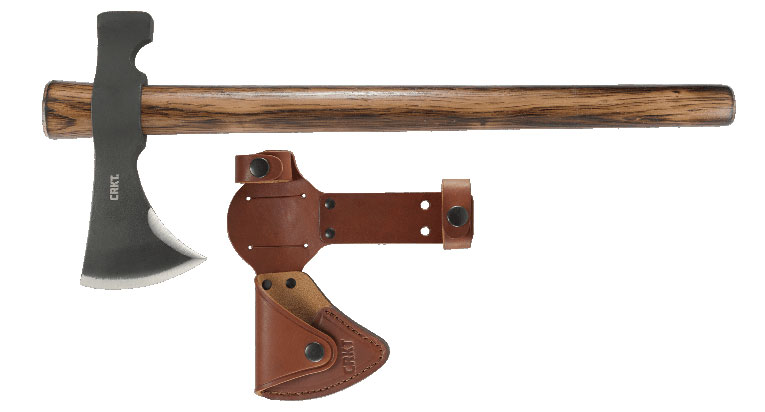
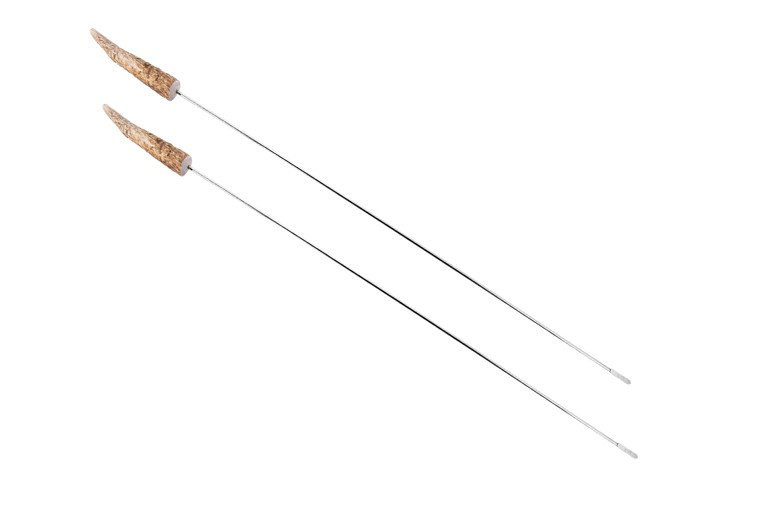
Designer Ryan Johnson’s latest tomahawk, a new spin on the Woods Chogan T-Hawk released in 2014, will only be available through CRKT.com. This new version sports a “black magnesium phosphate coating on the head for corrosion resistance and an aesthetically cool firewood-burned handle,” per CRKT.
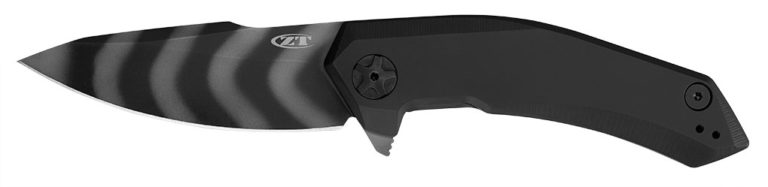
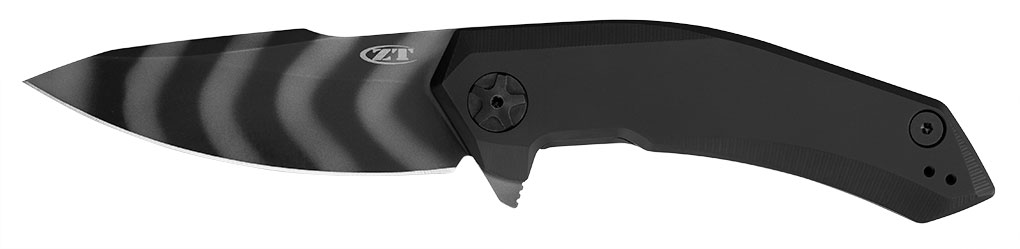
Zero Tolerance’s new 0095TS offers a step up from its 0095 with premium steel and tactical aesthetics. The “TS” in the model name comes from the tiger stripes design on the blade.
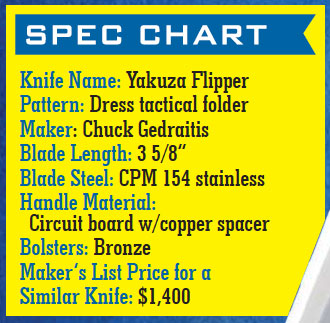
The Yakuza Flipper by Chuck Gedraitis includes a hand-rubbed blade finish, titanium frame and liners, and a Timascus™ pocket clip. Yakuza is a nickname for “transnational organized crime syndicates”—i.e., the mafia—in Japan. Click for larger view. (SharpByCoop knife image)
Chuck Gedraitis Flipper Meshes Modern Materials with Traditional Style
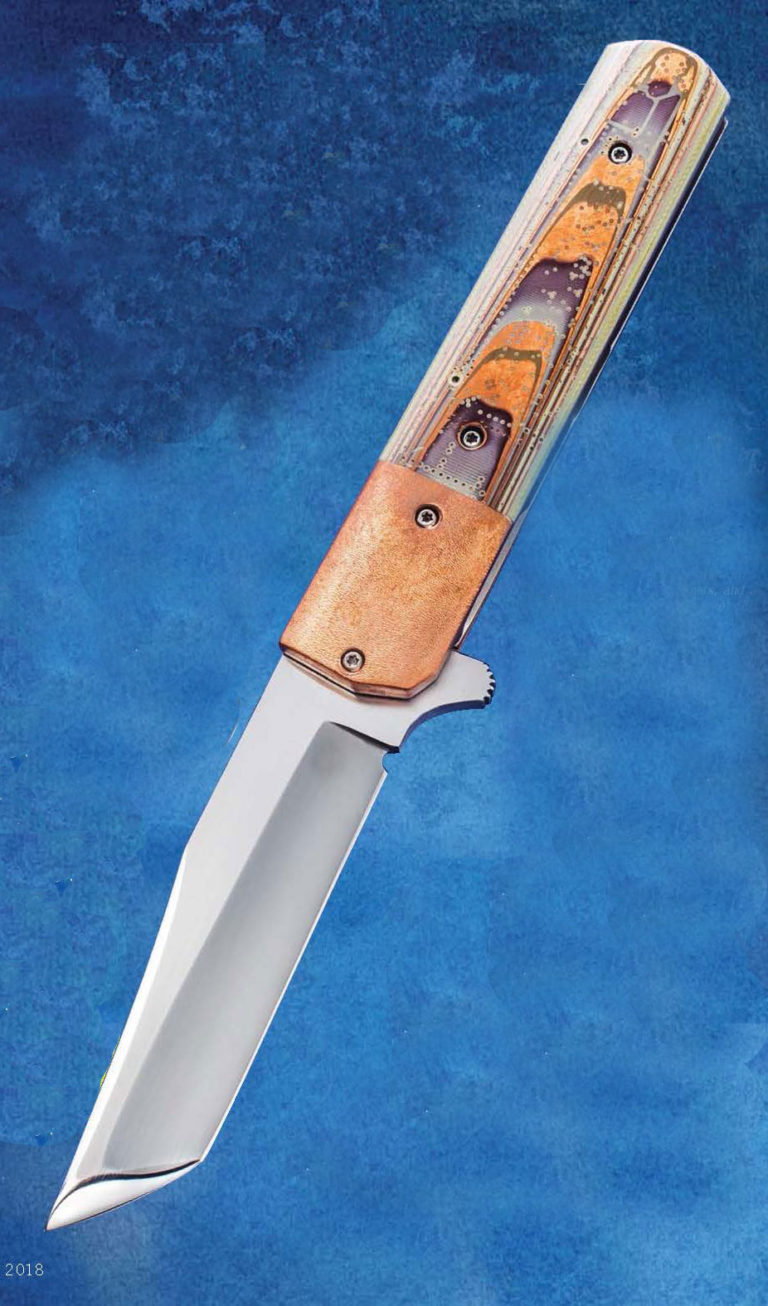
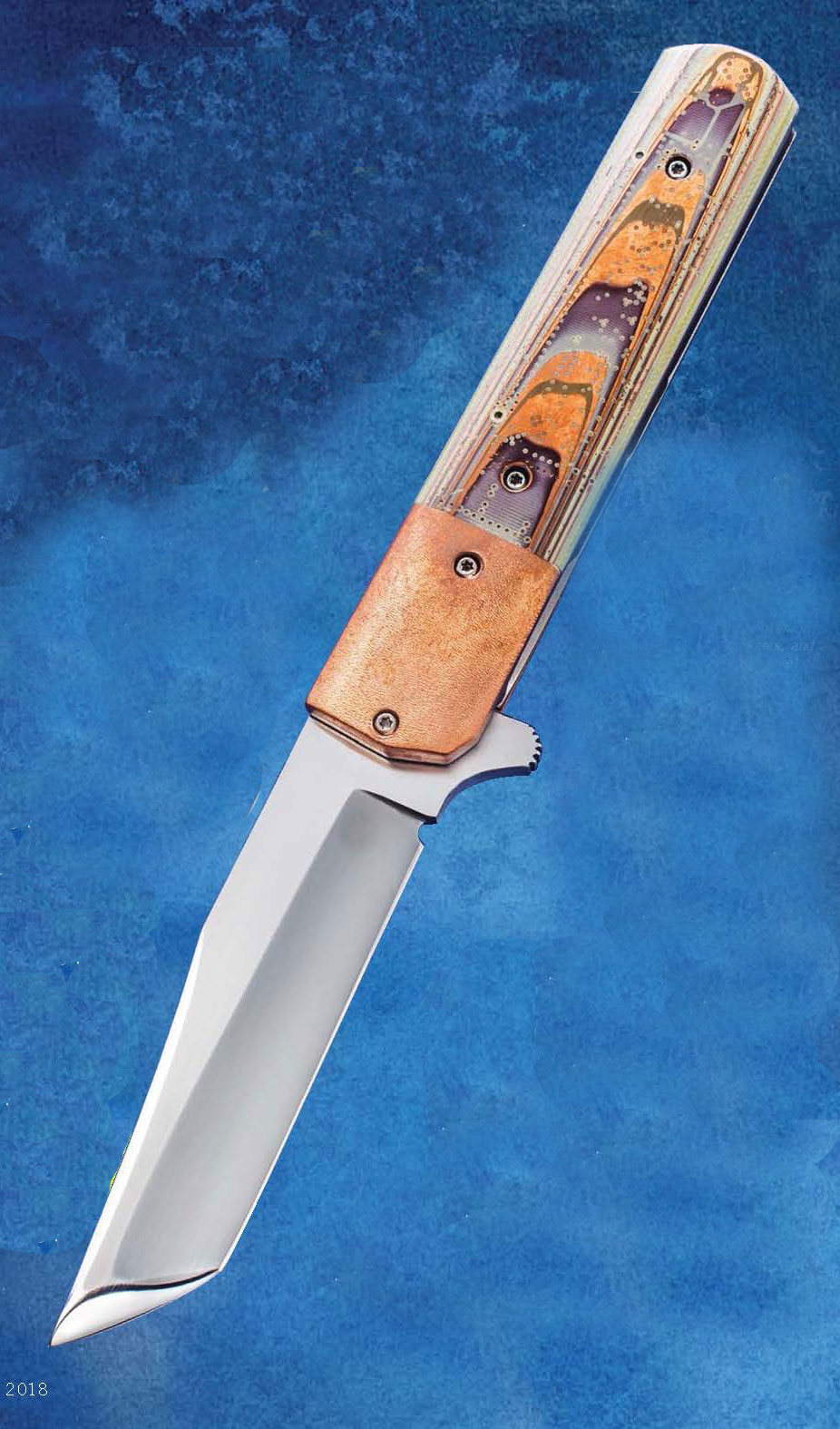
The Yakuza Flipper by Charles “Chuck” Gedraitis meshes classic styling with an unusual modern handle material in a folder that reflects both the traditional and the modern. The traditional is the Japanese-style instead of an American-style tanto blade.
“The American style would have more of a straight cutting tip,” Gedraitis noted. “This one has a little curve to it.”
The modern is the circuit board scales. Gedraitis highlights the copper of the circuit board with the bronze bolsters and a copper spacer, the latter two both in an orange-peel finish. He exposed the pattern of the circuit board by grinding into it, thus revealing the copper in the different layers of the scale material.
For more information contact Chuck Gedraitis, Dept. BL4, 444 Shrewsbury St., Holden, MA 01520 508-963-1861 [email protected], gedraitisknives.com, Facebook/Instagram: @gedraitisknives gedraitisknives.
Meet the Maker at BLADE Show
Balisongs are a Chuck Gedraitis specialty and he will show you how he designs and makes them in his special class “How To Make a Balisong” at 2 p.m. June 2 at BLADE University in the Cobb Galleria Centre in Atlanta.
Held in conjunction with the 37th Annual BLADE Show June 1-3, also at the Cobb Galleria, BLADE U. is the most comprehensive array of classes on knives and knifemaking of any knife show. Click here for more information.
Whether for bushcraft, carving, or just straight woodworking, drawknives are handy tools that range quite a bit in size, function, and style. There are large drawknives to peel bark or hew small logs, as well as models for specialty purposes such as coopering or making chair seats. There even used to be specialty drawknives for shaping round handles small in diameter for brooms, rakes, and other implements.
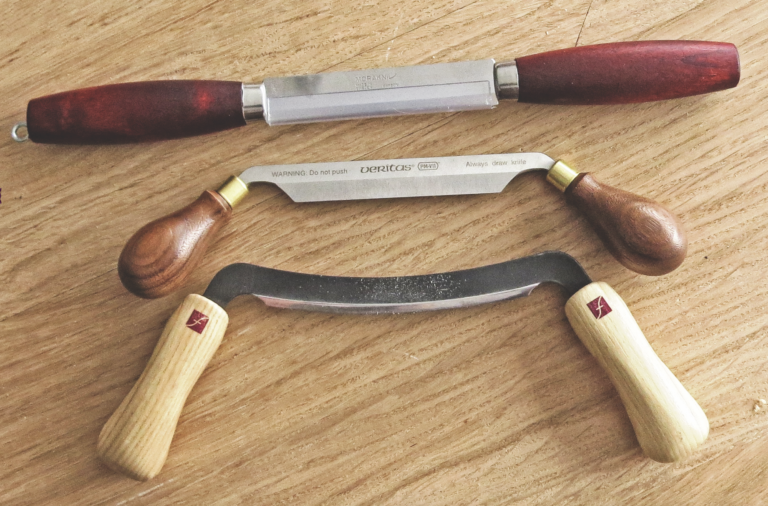
Three small drawknives for carving and crafting are the focus this time: the MoraKniv Classic wood splitting knife, Flexcut Drawknife, and Veritas Drawknife. They are great because they are relatively compact and portable, and help comprise part of what you could call a portable rustic tool kit.
DUAL BEVEL
I know, right off the bat the MoraKniv Classic is called a wood splitting knife and not a drawknife. I thought this model would be interesting to test because it departs from the regular one-bevel blade geometry. The handle positioning is straight, giving the tool a compact configuration for transporting. It also comes with a sheath.
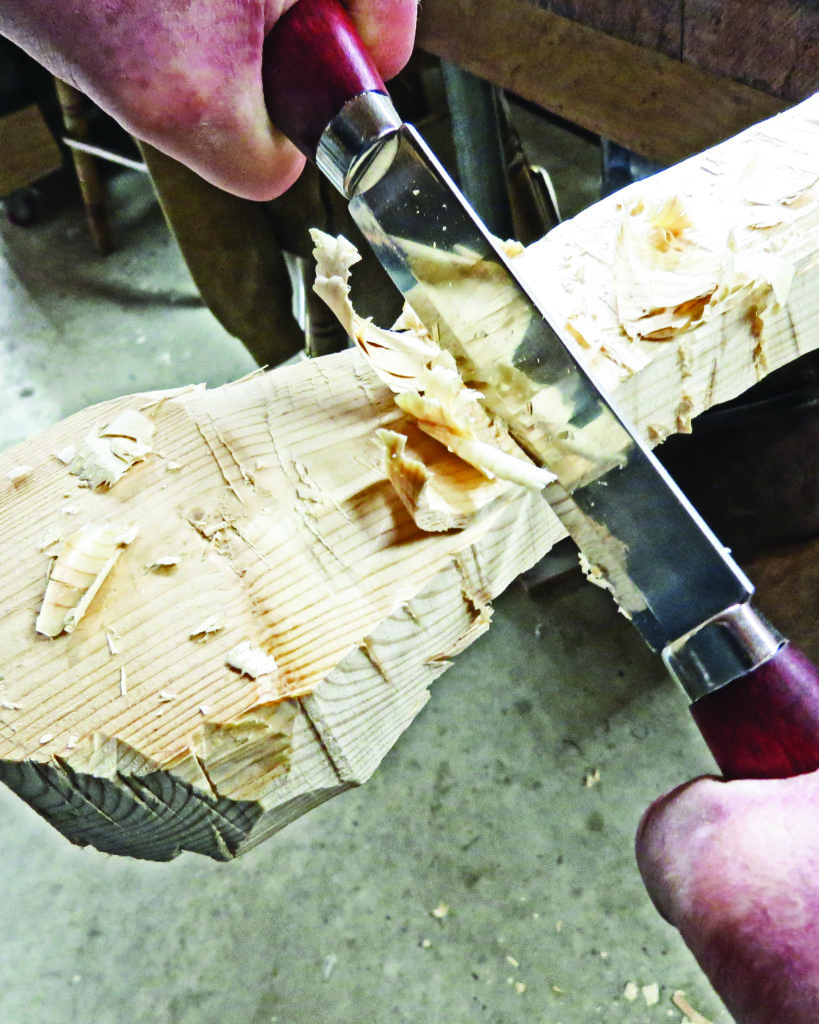
The author uses the MoraKniv Classic wood splitting knife in a push-cut motion to perform a stop cut while contouring the grip on a paddle.
Over the years, I’ve seen many a bushcrafter try and find a way for a standard knife to act as a drawknife. You can do many bushcraft chores with the MoraKniv Classic, from spoon work to shaping a tenon on a stool leg. You can do some of the same things with a regular knife, but with a drawknife it can be easier.
The 4.5-inch carbon steel blade has a dual bevel. An advantage of such a bevel is it makes the knife more versatile. A disadvantage is you don’t have depth control on a cut like you do with a single bevel. Single-bevel blades provide control similar to using a woodworking plane or a chisel. You shear through the levels you need to and, once you establish your depth of cut, you can remove material without bogging down by using a bit of depth control. Given that the dual bevel is a Scandi grind, it makes control easier than, say, a grind with a micro and major bevels on both sides. Control is most certainly easier than, for instance, with a convex grind. In the end, it is no big deal. Having to control a blade only becomes a problem when its design is not conducive to the job at hand.
Having in-line handles and a dual bevel, the Mora allows use like a sheath knife. It adds to the tool’s versatility and saves time, as you don’t have to put one knife down and pick up the other.
For the most part, control affects how much energy you put into making the blade do exactly what you want. In the case of a convex-ground blade, if you want to make a long, straight cut at the same depth, you will expend more energy than you should trying to keep the blade from “porpoising” (that is, front to rear bouncing of the blade). The alternative is simply getting used to making shorter controlled cuts more frequently.
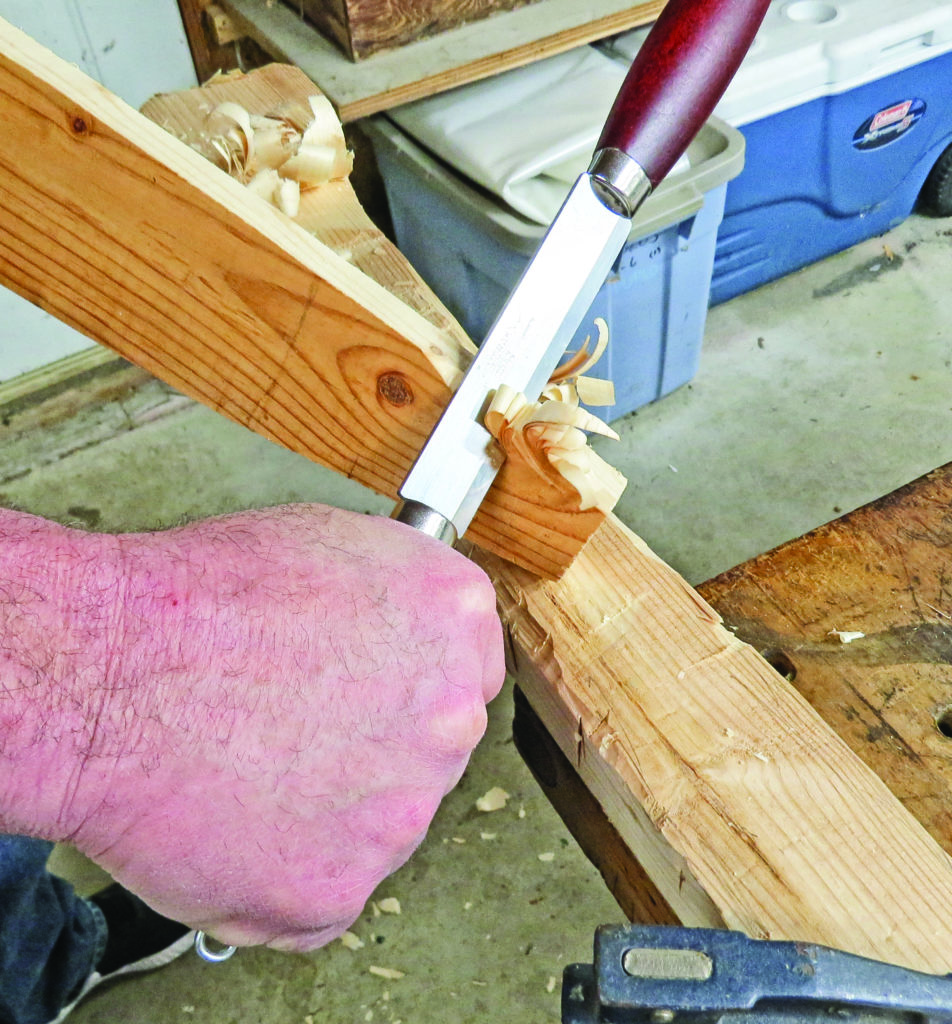
The Classic cuts extremely well. Due to the straight handles and dual-bevel blade, you can switch and use it like a sheath knife in a split second.
WESTERN TRADITIONAL
Flexcut has a variety of tools covering chip, relief, and decoy carving, just to name three. The company also has a couple of drawknife styles. The Flexcut Drawknife is more of a traditional Western version. The 5-inch blade is 1095 carbon steel with the bevel brought to a mirror shine.
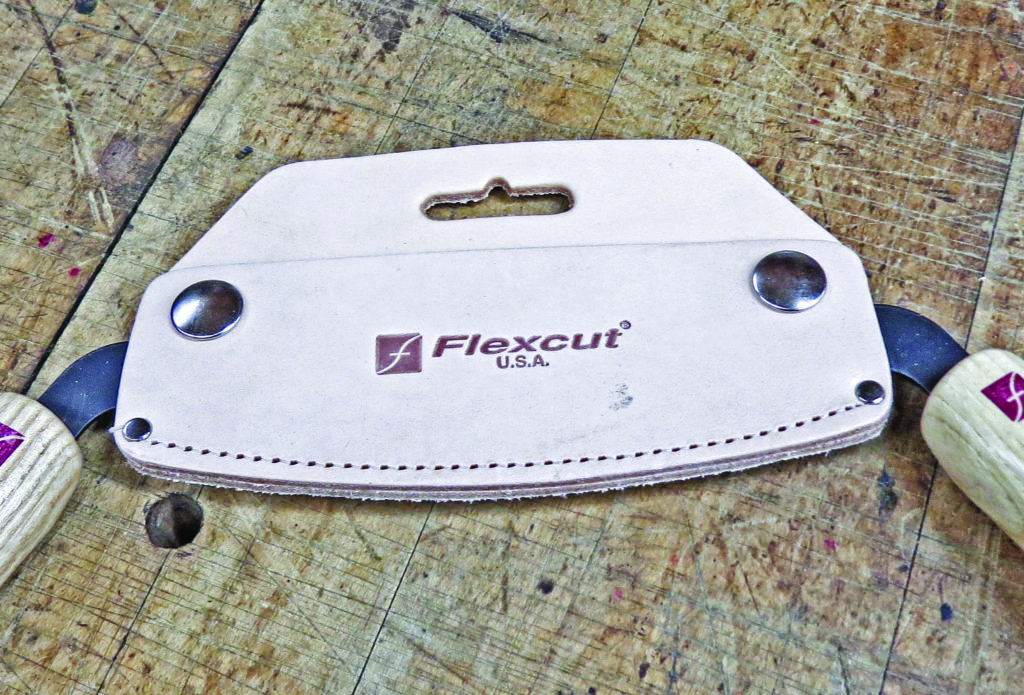
The Flexcut comes with a well-made sheath. It is always nice to have something protecting the edge—if not for safety’s sake, for that of preserving the edge from accidental harm.
Right out of the box, this thing is wicked sharp. It comes in a leather case with a peg-hole loop. It has a curved blade, which gives it a natural tendency to skew in a leading edge cut. If you haul the spine up a bit on your cuts, it will make more of a scraping action for a hollowing effect. It is a thin blade and not suited for hogging off large amounts of wood at one time. It is great for detailed jobs like the subtle contours you might find in a canoe yoke.
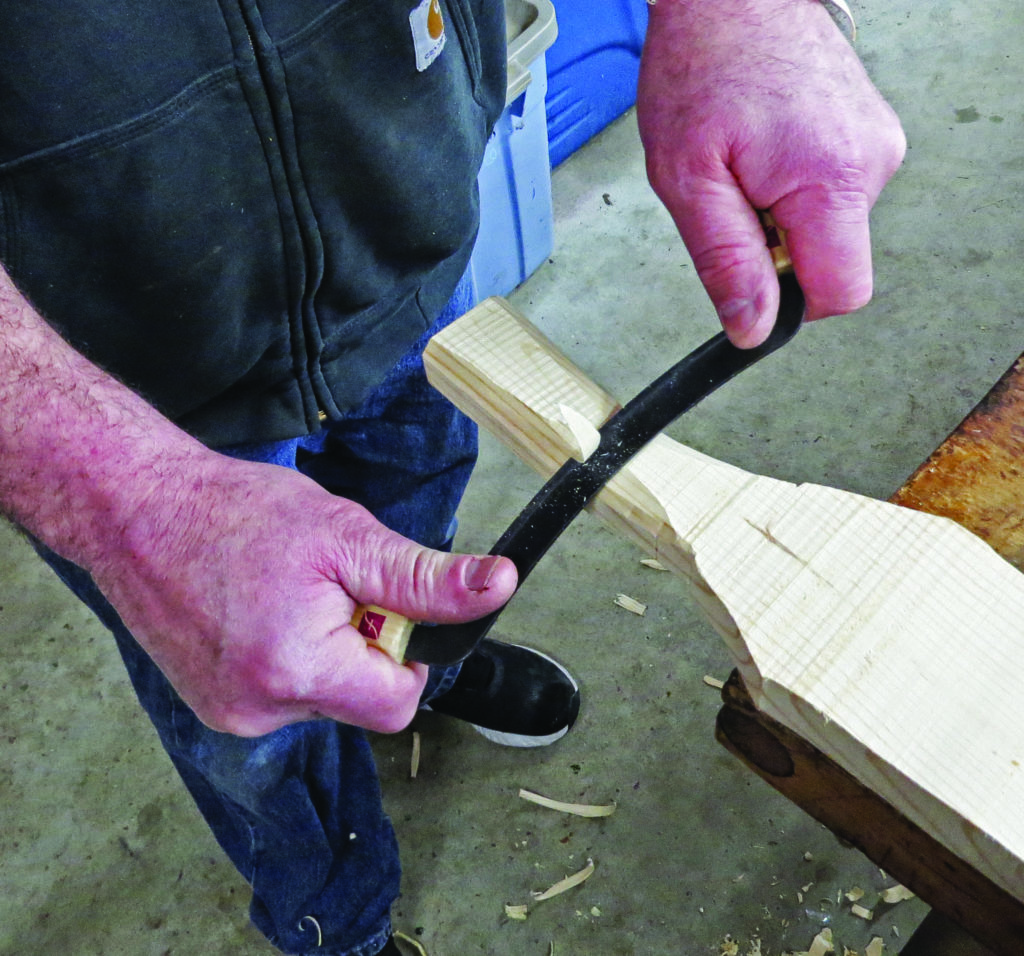
Using the Flexcut Drawknife, the author shapes the handle for a flat-board atlatl. The efficiency you gain using a drawknife is hard to beat for control and energy.
Such a small drawknife is a good tool not only to create art but to make utilitarian items. Given its Western-style handles, it doesn’t make a streamlined package for carrying in a pack like the Mora does, but it still has very little bulk and weight. The arched blade can be sharpened with a flat stone, though I find sharpening it with a small handheld stone and using a dynamic sharpening method easier. The Flexcut Drawknife is the kind of tool that suits the creative mind.
HOB-KNOBBER
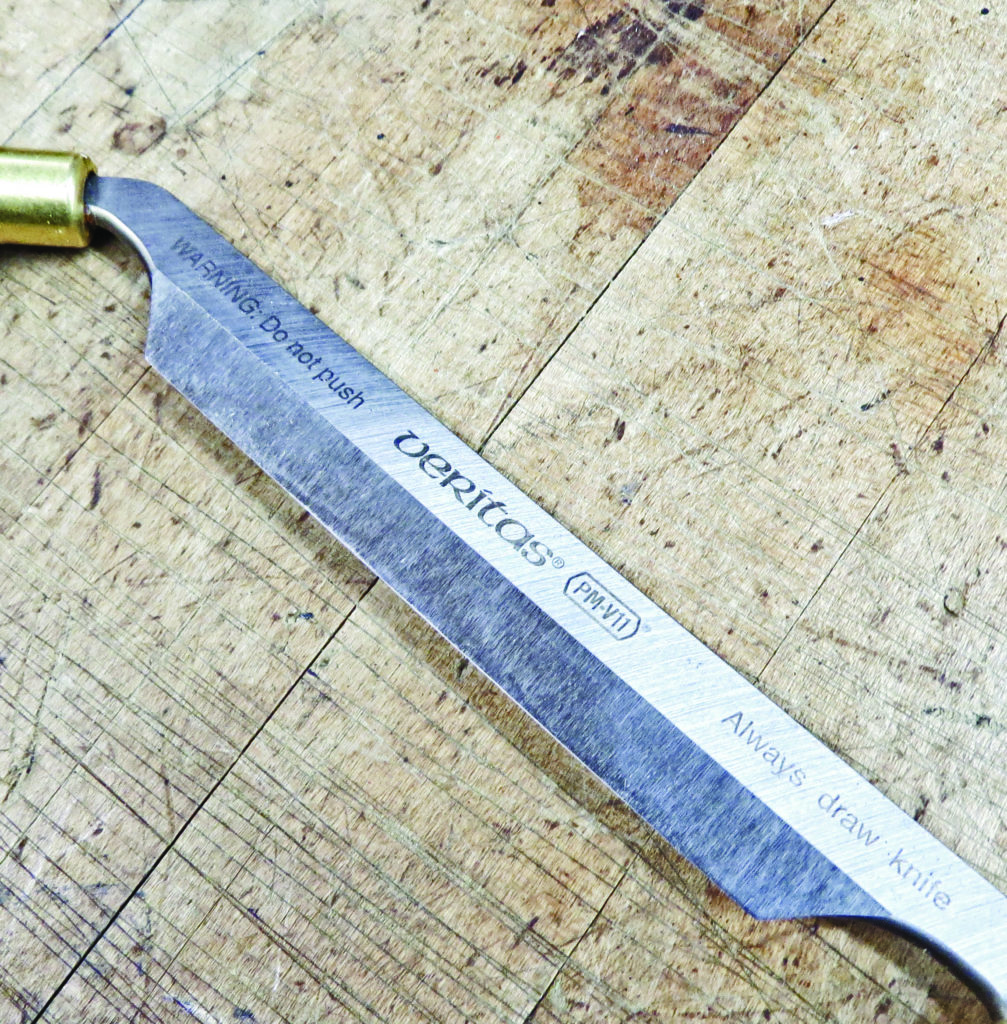
The Veritas tool company manufactures the last of the test drawknives in Ottawa, Canada. Sporting a 4-inch blade, it is a small carving-style model. Steel is PMV-11, a stainless with a Rockwell hardness of 61-63 HRC. Veritas made the switch from traditional tool steels like O1 and A2 to up cutting performance and edge retention. A case for the knife sells separately.
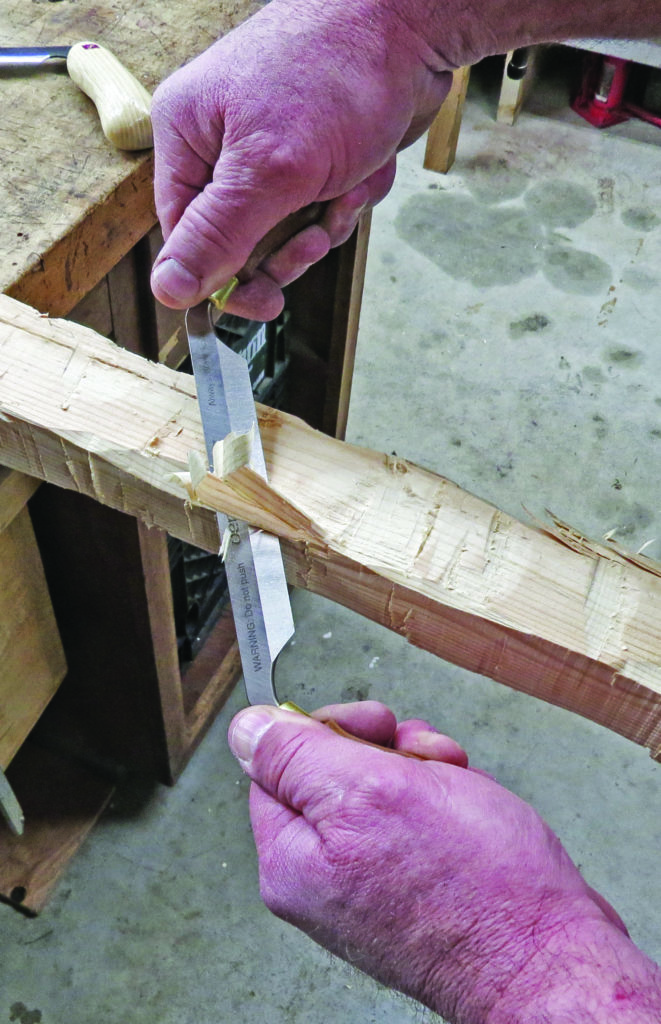
The Veritas Drawknife’s 20-degree angle cuts aggressively and you have complete control with the well-shaped handles. Here the knife is skewed compared to its cutting path. Skewing the knife provides a leading edge to the cut, reducing resistance
The company’s technical information says the bevel is ground at 20 degrees. To sharpen the Veritas, be sure the sharpener is of a flat design. Given the knife’s size, you can sharpen it in either a dynamic or a static style*. To cover/sharpen the entire bevel, you will need a flat surface. There is no micro bevel on the Veritas, though that’s not to say you can’t apply one. However, if you want to keep it original, you will need to cover the bevel.
The angling of the handles is a traditional Western style, though they have more of an elongated knob shape to them. The shape helps reduce fatigue. Because of the handle angling the Veritas does not offer as compact of a carry as the Mora, but the .125-inch-thick blade makes it a bit sturdier user than the
Flexcut. Handle material is torrefied maple. Due to the kilning process, the material has a greater stability to it without the use of chemicals. At the top of each handle is a brass ferrule.
The author stated he has been known to push a drawknife to make a quick cut. The Veritas Drawknife clearly warns not to do that. At a 20-degree bevel, you take a chance of damaging the edge if you were to catch and roll it.
It is a good-looking product and out of the box is ready to work. It is the most expensive of the review knives, yet is not so much more that you wind up scratching your head. A drawknife like this can be put to work doing a number of things limited only by your imagination. Veritas promotes it more as a carving tool and actually shows it making a decoy in the company’s marketing media.
Staying within the bounds of this tool, I can’t think why you couldn’t get chores done or entertain yourself by making pieces of art with it. Keeping you busy in the woods and not necessarily only during a survival situation promotes better mental health. It is a great little package and a good tool—I just think the company could include the sheath. When you hold the knife you see where the extra cost is as the precision work shows in the fit and finish.
EXPLORING OPTIONS
Once you leave the big city behind, in order to thrive you must know how to make what you need. Many of the tools you carry will depend on what you plan on doing. If you’re building up a getaway spot, you might need to build items for the camp. When planning to build a more substantial base, you will need more tools. Again, it all depends on what you plan on doing. A good drawknife can greatly increase your cutting and carving options—not to mention that being able to use two hands greatly reduces fatigue. If you haven’t tried a drawknife yet, I highly recommend doing so.
*Static sharpening is when the stone is stationary, and dynamic is when the stone is moving.
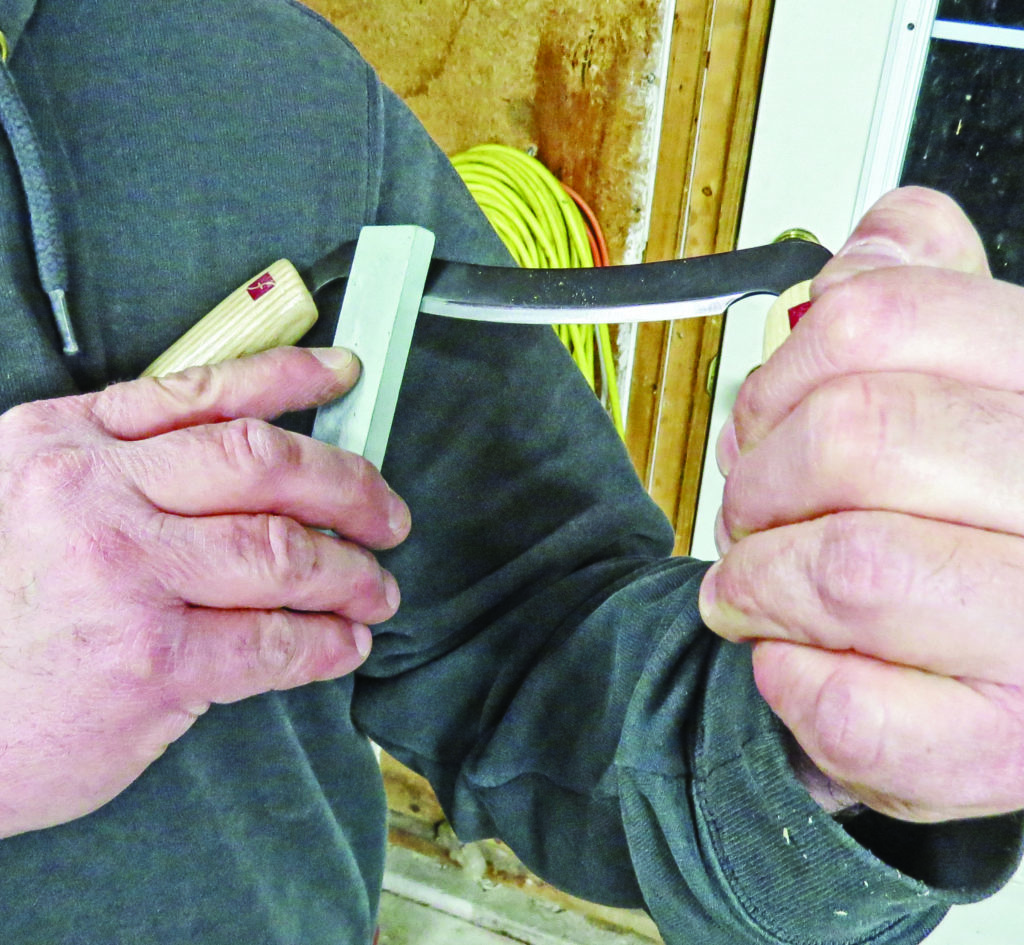
A trick to sharpening drawknives both in the shop and field is to brace one handle against your armpit or chest. After bracing the knife, simply use a dynamic sharpening method with a small stone running parallel to the edge.
SHEATH: Tri-Composite System Kydex w/3” nylon webbing, Box X stitching, stainless hex fasteners and liners; locks blade in; MOLLE system sheath also available
It’s one for the record books, but it’s nothing to celebrate.
The murder totals in London for February and March tallied at 37. That’s two more than New York City’s 35 for the same time period. This marks the “first time in modern history” that London surpassed New York City for murders, according to the The Times.
Despite that, stabbings accounted for 31 of London’s murders, and knife crime in general is the driving factor for the increase. This would seem to indicate the ineffectiveness of London’s knife restrictions overall, as indicated by this tacit admission from MP Sarah Jones.
“We need a proper strategy that looks at all of the issues.
“Knife crime and violent crime acts like an epidemic, so you need to go in at the source to cut it off and then you need to inoculate the future young people against it.
“Going in at source means major intervention work with youth workers, inoculating means going into schools, changing the social norms, educating kids, teaching them what it is to be a man, teaching them how they don’t need to carry knives.”
This quote, also from the BBC, from the former superintendent of London’s Metropolitan Police, Leroy Logan, echoed those sentiments.
“Police can’t just arrest or stop and search their way out of this problem; it has to be done in partnership with the communities.”
This is in line what many in the knife community have argued for years. Knives aren’t why someone commits a violent act. There are other factors at play that influence behavior, and those should be identified and addressed.
Granted, banning certain items, such as knives (or firearms, a parallel discussion in the United States), may well prevent someone from committing a violent act with that item, but left unaddressed are the would-be aggressors’ motivations and circumstances. Until and unless that happens, the sliding scale of destructive tools will simply move on to the next item. Case in point: UK acid attacks are on the rise. That follows extensive prohibitions on firearms and knives.
Even The Guardiancalled into question the term “knife crime” as being misleading or overly simplified.
“Knife crime” is a construct. It does not simply mean, as one might reasonably expect, crimes committed with knives. It denotes a certain type of crime committed by a certain type of criminal in a certain kind of context.
Those “certain types” often single out particular groups of people, which makes “knife crime” as a concept even more insidious. From The Guardian again (emphasis is mine):
In 2007, then prime minister Tony Blair told an audience in Cardiff: “The black community – the vast majority of whom in these communities are decent, law-abiding people horrified at what is happening – need to be mobilised in denunciation of this gang culture that is killing innocent young black kids. But we won’t stop this by pretending it isn’t young black kids doing it.”
When politicians frame the issue in this way, the results can disproportionately impact communities of color via increased law enforcement scrutiny. It’s as if white majority populations are somehow exempt from the factors that lead to “knife crime.” Or, worse, that there is something inherent about people of color that predispose them to violent acts.
When white kids are killed, people opine about the state of youth today, the demise of the town in which they died, or the world in general. When black kids are killed, usually the assumption is that their race had something to do with it.
It comes full circle when comments come in following a murder involving a knife and a person of color.
And yet a few days after his death, a Conservative councillor in Dover, Bob Frost, posted a news story about Djodjo’s murder on Twitter with the message “#BlackKnivesMatter. The carnage continues into 2017. Any protest from the ‘community’? Thought not.”
This phenomenon is well-known to the knife community at large. For example, New York’s restrictions on “gravity knives,” enforced with enthusiasm in New York City, levy an oversized impact on minority groups.
That this toxic stew of tunnel vision, racial bias and misleading terminology should finally express itself in a historic first for murders in London shouldn’t come as a surprise. It should come as a warning. If the root of “knife crime” isn’t dug out, London may, unfortunately, find itself positioned at the floor of a rising trend, not the ceiling.
Planning for a backwoods excursion? Here are four of the best hunting knife options, the fixed blade variety, presently rolling off factory lines.
As the fall outdoor season approaches, it’s important to assess your gear and decide if you need to purchase new equipment—hunting knives included. It’s time to maintain what you have or buy brand new models that will assist in camp chores and/or dressing game.
Fixed-blade hunters play an important role on the hunt as they do a lot more than just field dress. They also help prepare meals, prep firewood for cooking, and any other cutting chores that crop up.
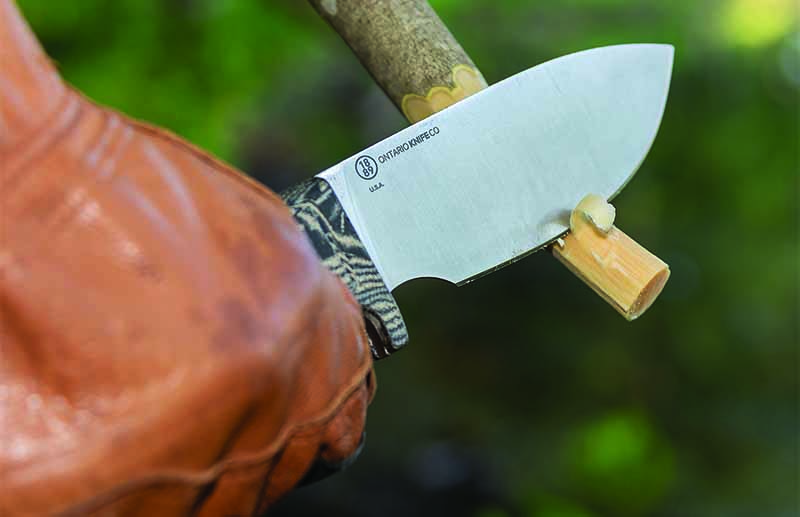
Ontario Knife Co ADK Keene Valley Hunter
An example of one of the latest such edged tools is the ADK Keene Valley Hunter from Ontario Knife Co. The wide drop-point blade of 420HC stainless steel adapts to cutting or camp tasks easily. It offers plenty of belly to do the aforementioned chores and field dressing, too. Full-tang construction provide plenty of strength and balance. Interesting multicolor Micarta® scales supply a great grip in all weather conditions, and are highly resistant to cracking, chipping and peeling. The material’s highly stable nature and purchase qualities make it a favorite among users. The scales are tapered from the handle spine, allowing the knife to rest in your hand comfortably. The integral single guard and distinctive choil work in harmony to enable you to choke up on the handle for ever-greater cutting control and user confidence.
The best hunting knife? The deep-bellied blade of the Ontario ADK Keene Valley Hunter makes a case for it. It easily slices large cutting jobs down to size. ADK is short for the Adirondack Mountains, a range in Ontario’s home state of New York.
While 420HC is not my blade material of choice on such a knife, it has a good combination of both edge holding and ease of sharpening. Rounding out the package is a nicely sewn and riveted leather sheath that sports button-snap retention to hold the knife. Sheaths are often an area some manufacturers cut corners on to save money and hit the targeted price point, but not the ADK Keene Valley. The sheath is very nice in quality and holds the knife quite securely.
The handle feels a bit blocky but there are no crisp edges or anything to create hot spots. Micarta is one of my favorite handle materials due to its strength, light weight and color selection. It also has a nice grip-you-back quality. At 11.2 ounces the knife has a noticeable heft. The blade at its thickest is around .2 inch, which also contributes to the heavier weight but also plenty of thickness to withstand tough, unforgiving use. The flat grind thins it out nicely yet remains thick enough for strength. With its wide blade and generous belly, the knife slices really well—one of the traits to look for in a hunter.
Kizlyar Supreme Caspian
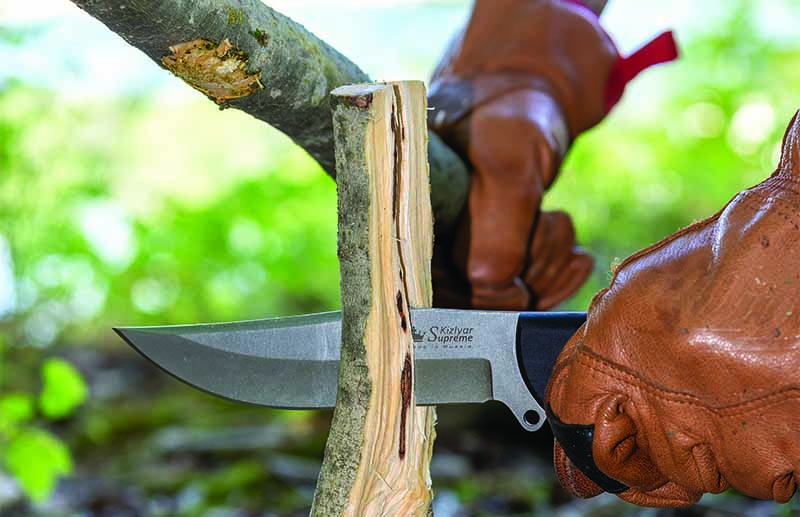
Ten inches overall, the Kizlyar Supreme Caspian features a hollow-ground blade of D2 tool steel and a handle of hornbeam wood. The classic clip-point-bowie blade never gets old and has a defined tip along with a prominent swedge. The bowie shape does equally well in the tactical and outdoor genres, a great overall pattern for both a tool and weapon. The hollow grind thins out the edge and gives the blade an extremely good bite. D2 has respectable edge-holding ability and is widely used in the production knife industry as an upgrade to lower-grade steels. It is well known for toughness and high impact resistance, which makes it an ideal inexpensive steel for outdoor knives.
The 5.4-inch clip-point blade of the Kizlyar Supreme Caspian provides plenty of sharpened real estate to process camp tasks and makes it a top hunting knife. Overall length: 10 inches.
The ergonomic handle features multiple finger recesses, and the butt turns down to form a pinky catch to prevent your hand from sliding rearward. The tang helps form an integral single guard, resulting in a comfortable, smart, secure handle design. Largely flat, the scales are secured via two hex-head screws. The handle edges are contoured for comfort.
The leather sheath is a riveted, sewn fold-over design. As a nice visual touch, contrasting thread is used for the stitching. The belt loop is a dangler type, allowing the hunting knife to ride a bit lower when affixed to the belt, as well as promoting greater freedom of movement to accommodate you in a seated position. Not every fixed blade has this sheath design and it is a plus in my book. To top things off, the sheath is stamped with the Kizlyar Supreme logo and website address.
The knife performs very well. It has the power to slice through various media with ease. It’s somewhat large for a hunter but does multiple cutting jobs, including camp chores and some food processing. The hornbeam scales are not stabilized so extra care might be required, such as but not limited to drying off the handle immediately after you wash the knife.
Spyderco Bow River
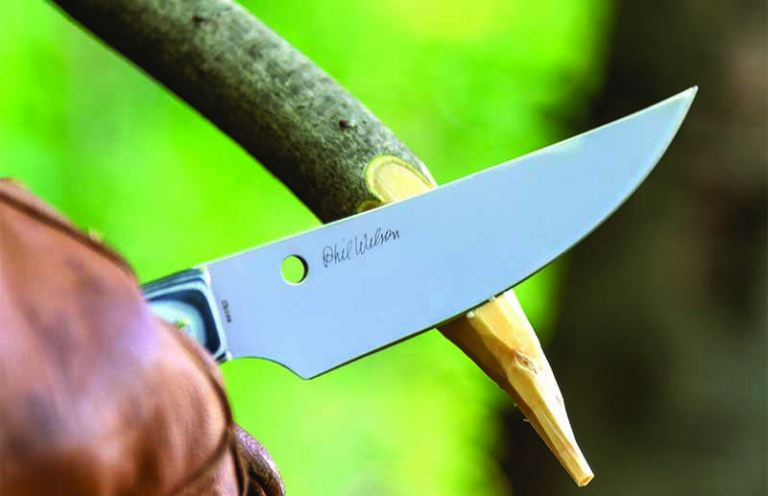
The FB46G Bow River is one of Spyderco‘s latest fixed blades. The design by custom knifemaker Phil Wilson is based on his experience as an avid hunter and fisherman. Spyderco has produced several of Wilson’s fixed-blade designs but those were always higher-end knives in terms of materials and price—until now.
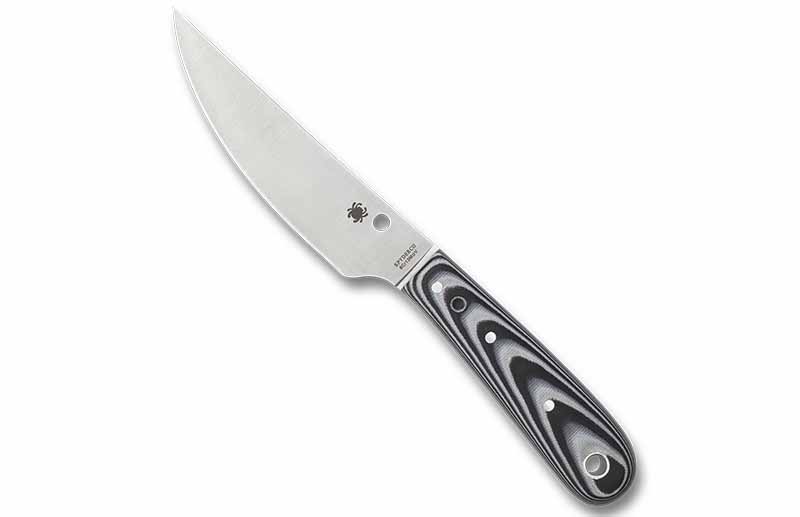
The Spyderco Bow River is tailored for fine precision work such as field dressing and food prep in camp. It would make a great kitchen knife as well. (Spyderco image)
The Bow River is designed for the budget-minded outdoor enthusiast who demands performance and superior design in an edged field companion. Starting with the blade, 8Cr13MoV stainless steel is used for a good balance of edge holding and ease of resharpening in the field. The 4.36-inch blade is big enough to tackle most hunting chores but small enough to easily manipulate, as well as carry comfortably in a belt sheath. Wilson selected a trailing point blade design due to its generous sweeping belly that tackles slicing chores with ease. The full flat grind and distal taper enable the blade to sail through media easily.
The handle is rounded, contoured black-and-gray G-10. The alternating colored layers form a wood-grain-type pattern that is very eye-catching. The hunting knife rests in your hand comfortably and has no hot spots or crisp edges. The way the end of the handle is rounded off tucks into your palm snugly. Some with larger hands might find the handle a bit lacking but for me it’s just right. The surface finish is slick and devoid of texturing, though with the way the handle is shaped you can always get a secure hold no matter what. There is a large hole in the butt for a lanyard. The leather sheath is a sewn and riveted fold-over design with belt loop. It’s simple and executed very well, just like the Bow River. The knife fits inside the sheath well.
As for performance, it is definitely one efficient cutting tool. It is a well-designed fixed blade regardless of price. It is tailored for fine precision work such as field dressing and camp food prep. It would make a great kitchen knife as well.
Case Winkler Kyle Lamb Hunter
The Case Winkler Kyle Lamb Hunter salutes the design expertise of Daniel Winkler and military service of retired U.S. Army Sergeant Kyle Lamb. The 5-inch spear-point blade’s saber grind leaves enough material for strength—the full .195-inch thickness runs to the tip—but removes enough to thin the blade out for effective cutting. The choil and pronounced thumb rest help exert extra control when choking up on the blade. The 80CrV2 carbon steel is extremely tough and sharpens easily.
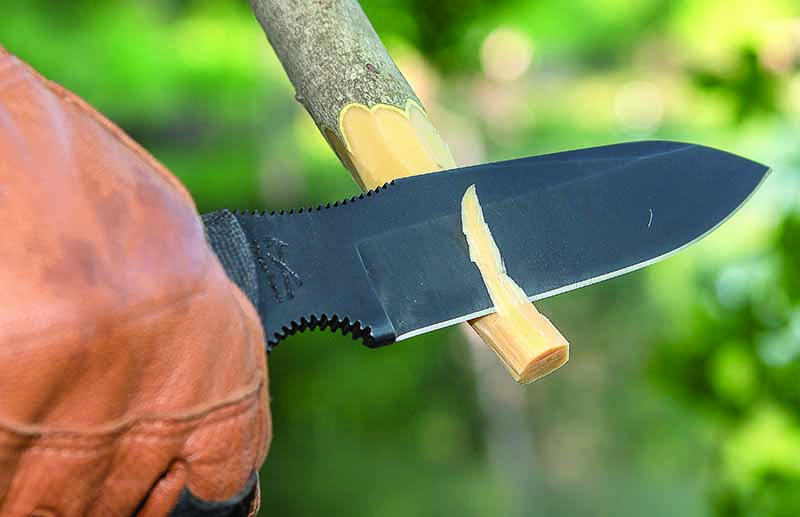
The Case Winkler Kyle Lamb Hunter serves well in outdoor or tactical settings. The 80CrV2 carbon steel blade provides the horsepower to tackle a variety of cuts. Overall length: 9.5 inches.
The black canvas Micarta® handle offers a great grip in most all weather conditions. It is rounded for comfort and has no hot spots. Two thong-tube pins secure the slabs, and there’s an extra-large oblong hole in the butt for a lanyard.
The hunting knife is a substantial tool. It has a good heft that conveys a solid feel and instills user confidence. It is equally at home as a tactical or outdoor knife because it has the features of both: great user blade shape, ergonomic handle and superior-grade materials. The blade is scary sharp out of the box. It dispatches large cutting jobs easily and quickly. Because the handle accommodates most hands very well, you can easily bear down and power through media. And when finesse is needed, you can choke up on the choil and thumb rest. The spear-point blade adapts to a wide range of tasks.
One word of note: some might find the gimping on the thumb rest and choil a bit harsh. It does bite into flesh just a bit but that can be a good thing, especially when your hands are wet, covered in animal blood or freezing. The gimping also works well if you wear gloves. They do a great job of biting into the glove material to keep the knife positioned in your grip.
The Kydex sheath is top-notch. Instead of a typical fold-over design it is a riveted one that incorporates a phenolic spacer material. The interior is lined with a felt-type material to reduce clatter. The exterior sports a laser cutout of Lamb’s Viking Tactics logo, a very nice touch. On the reverse side is a heavy-duty metal clip that affixes the hunting knife to belts up to 2 inches wide. The knife fits firmly inside the sheath with absolutely no play and no fear of falling out whatsoever.
The proper angle is key to a sharp blade. Here are the angle-guide sharpeners that ensure you’ll always get it right.
A big part of sharpening, aside from proper sharpener selection, is how to select and maintain the proper angle of the blade to the sharpener. In fact, the key to successfully sharpening any blade regardless of the grade of steel is being able to maintain that angle. Ever try sharpening freehand on a bench stone with little experience doing so? The reason folks get frustrated with learning to sharpen is they don’t keep the angles consistent. It’s all about the angles. You must take into account what use your knife will see and sometimes that determines the specific angle to use.
You probably know of the angle guide kits with a metal clamp that affixes to the blade and has uprights on either end with a series of holes that correspond to various degrees of angles. Such kits all help instill confidence and the ability to subtract guesswork at maintaining the desired angle.
SHARPENER TYPES
There are plenty of sharpeners capable of reproducing keen edges. Avoid the pull-through types that require you to drag the blade through. Those are set at one angle and use carbide to get the job done. These will ruin a blade in time, and I don’t recommend them. You need a sharpening kit that’ll help establish and hold a consistent angle. All you need to be concerned with is making the motions to get the edge sharp.
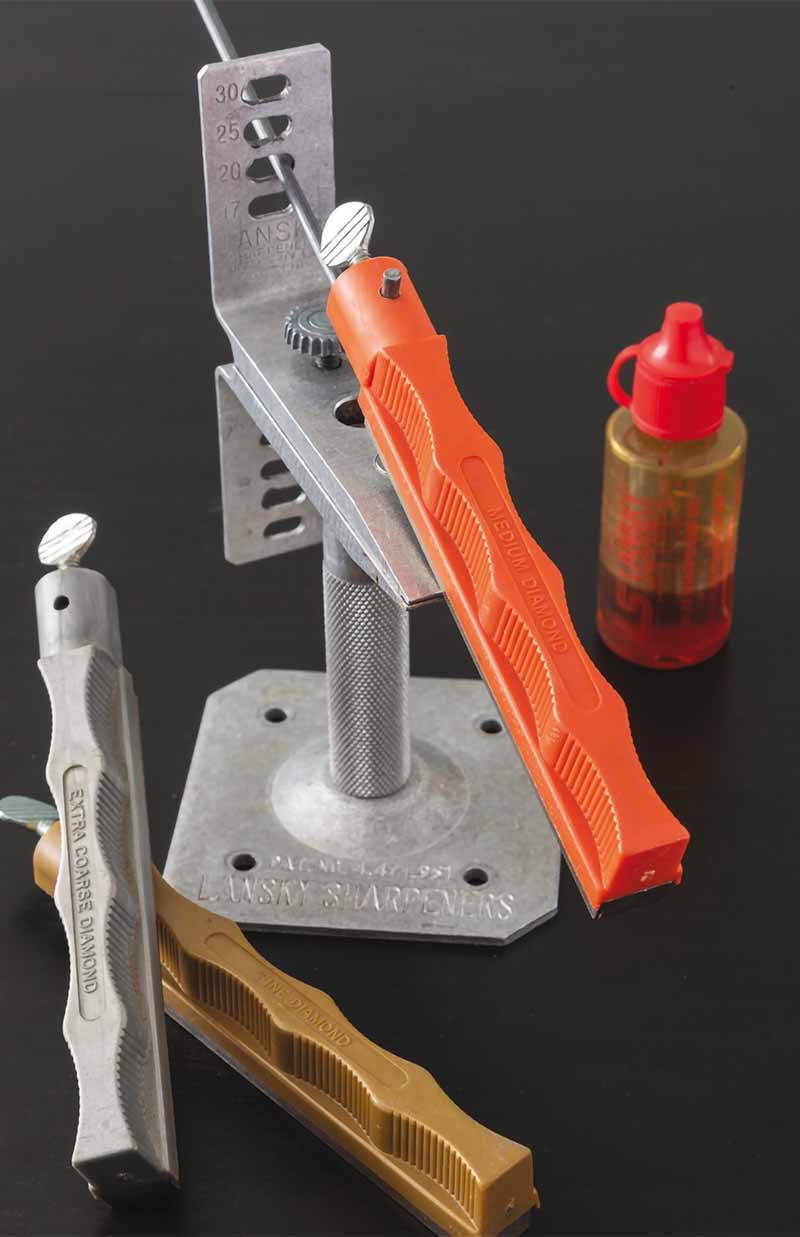
The Lansky Deluxe Diamond Knife Sharpening System is one of the oldest angle guide kits on the market. Four various grits of diamond-coated hones are featured, including extra-coarse for fast work of reviving dull blades. The sturdy aluminum clamp holds the knife securely.
Lansky’s four-stone Deluxe Diamond System Precision Knife Sharpening Kit is the best the company offers in angle guide clamp units. It includes an extra coarse hone great for reprofiling edge angles. It also has coarse-, medium-, and fine-grit diamond-coated hones for fine-tuning the edge once it’s been established. The aluminum clamp is sturdy and offers four edge angles: 17, 20, 25, and 30 degrees. The kit stores in a sturdy plastic storage case. MSRP: $114.99.
GATCO offers the Ultimate Diamond Hone Sharpening System, which is similar to the Lansky. Featuring coarse-, medium-, and fine-grit diamond-coated abrasives, the kit includes Ultimate Finishing and triangular-shaped serration hones, too. It works on plain, serrated, and partially serrated edges. The hones are wider and longer for more effective use and have molded-in integral handguards for safety. There’s also a plastic storage case. MSRP: $119.99.
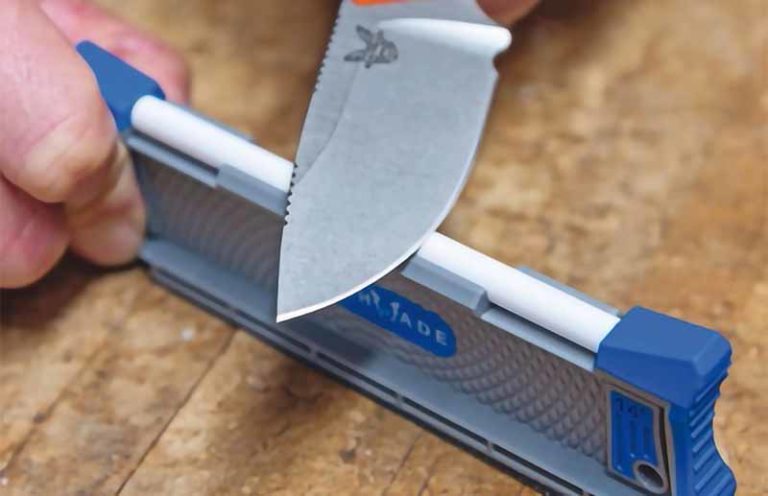
To sharpen the CPM S90V blades with the SelectEdge 14 degree angle of its Hidden Canyon Hunter and Saddle Mountain Skinner, Benchmade offers the model 50082 14 Degree SelectEdge Guided Hone Tool. Designed in conjunction with and manufactured by Work Sharp, this compact sharpener incorporates a fine grit ceramic rod and a leather strap on the backside. Built-in guides set the blade at the correct 14-degree angle. The idea with this one is to apply frequent edge touchups. A premium steel, S90V is notoriously difficult to resharpen, a difficulty negated via frequent edge maintenance sessions with the 50082. MSRP: $25.
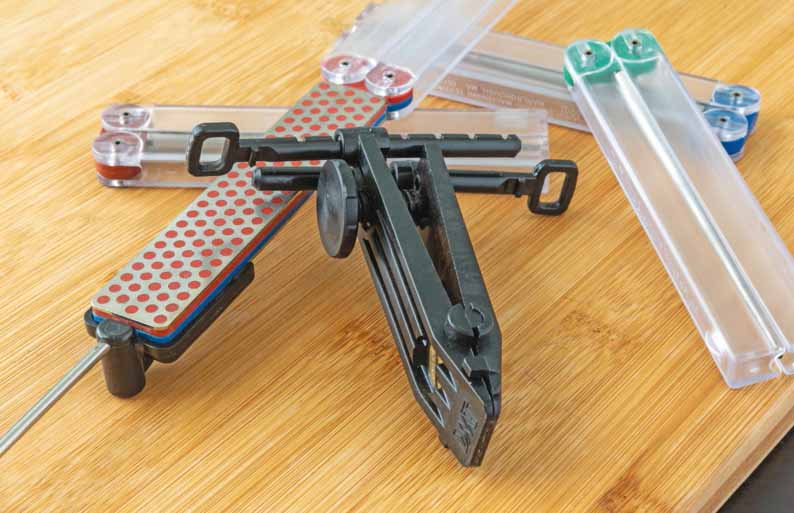
DMT’s Magna-Guide angle kit includes a magnetic guide rod and sturdy blade clamp with adjustable angles. Use any model DMT Double Sided Diafold folding fi le and you have two sharpeners in one—a freehand fi le and an angle guide kit.
For knives without the SelectEdge technology, Benchmade offers the Edge Maintenance Tool, also designed with and manufactured by Work Sharp. It uses a fine-grit ceramic rod and a leather strop but in a more compact folding format with a pocket clip for easy carry. As with the 14 Degree SelectEdge Guided Hone Tool, built-in guides assist in achieving the optimal angle for edge restoration. The Edge Maintenance Tool works well with pocketknives, fixed blades, and tactical folders—pretty much any knife. MSRP: $50.
DOWNSIZED 2X72
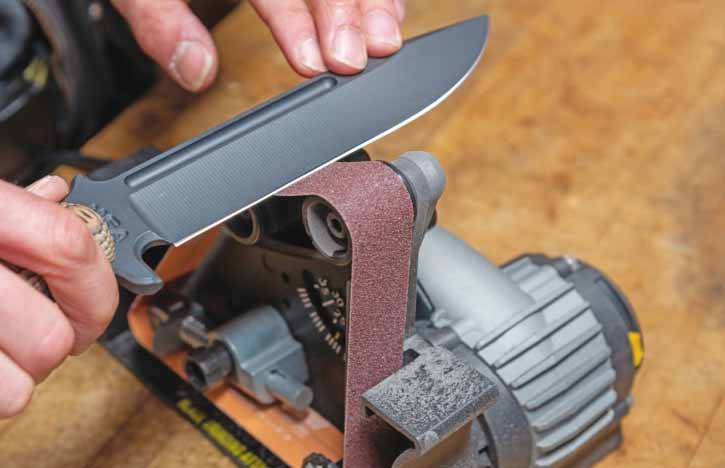
For the more advanced sharpeners among you, Work Sharp offers the Ken Onion Elite Sharpening System, a variable speed motorized unit employing long-lasting flexible abrasive belts made by Norton Abrasives. It’s pretty much a downsized version of a larger and much more expensive 2×72 slack belt grinder used by many knifemakers.
The Work Sharp Ken Onion Elite sharpener is pretty much a downsized version of a larger and much more expensive 2×72 slack belt grinder used by many knifemakers.
Designed by BLADE Magazine Cutlery Hall-Of-Fame® member Ken Onion, the Elite makes quick work of bringing completely dull and/or damaged knife edges back to life and is fully adjustable for applying edges between 10 and 35 degrees. The abrasive belts measure 1 by 18 inches and make quick work of any sharpening task. Once you become comfortable with how the sharpener operates, you can consistently grind an even edge on your blades. (Author’s note: Motorized sharpening is best left to those with sharpening experience.) MSRP: $199.95.
Diamond Machining Technology (DMT) offers the Double Sided Diafold Magna-Guide Sharpening System centered around the company’s Double Sided Diafold folding diamond files. The Magna-Guide System features the Aligner Blade Guide clamp with integrated, adjustable angle guides. A metal guide rod affixes securely to the Double Sided Diafold file via a large rare earth magnet. Attached to an FWCX Extra Coarse/Coarse Double Sided Diafold, the manual system can easily reprofile an edge to any one of seven pre-set angles.
DMT’s Double Sided Diafold diamond files are built well, highly effective, and among the best compact sharpeners on the market. One of the best things about the Magna-Guide is you can use the Double Sided Diafold files as stand-alone sharpeners without the guide rod and angle guide clamp. Consequently, you get a guided sharpening system and a standalone sharpener for the price of one. The Magna-Guide Kit’s MSRP: $27.49 (works with any Double Sided Diafold file).