Outdoor Edge Pivot: Light, Nimble And Affordable

Oh, the Outdoor Edge Pivot is a budget option, but not one without its charms.

Traditionally outdoor focused—hence the name—Outdoor Edge has crept into other knife niches. Perhaps it’s a directive from the powers on high at Revo Brand Group (think Real Avid), who acquired the knife company in 2022. Or perhaps it’s because you can only make so many gut hooks and replaceable-blade caping knives. In either case, the company has come out with some intriguing EDC designs that are definitely budget options, but ones that get the job done.

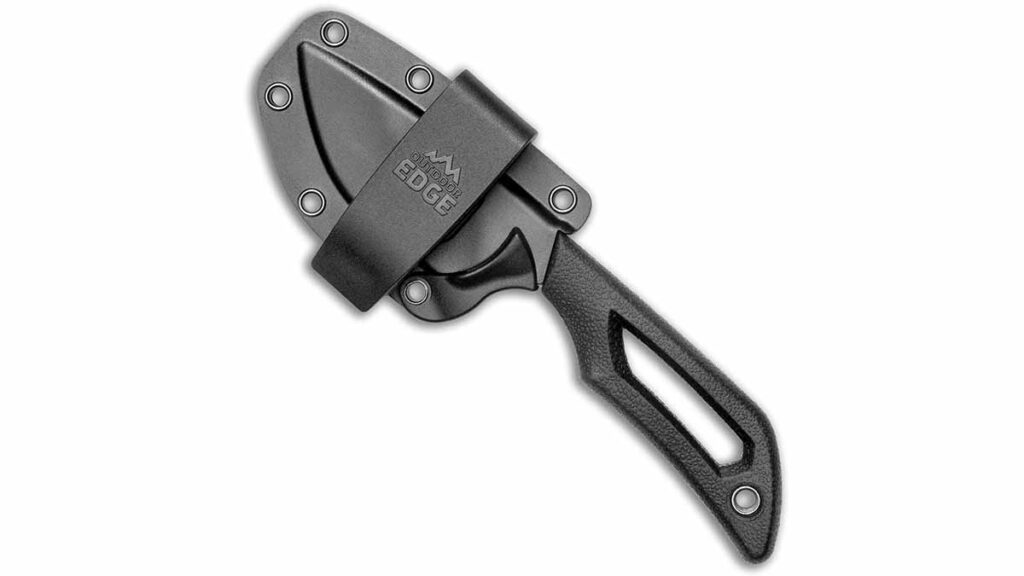
Its most recent unveiling is the lightweight, skeletonized handled Pivot. For most knife enthusiasts, it’s difficult not to like what Outdoor Edge has offered up in the redesign of the company’s Le Hawk and Le Duck knives —particularly its price. A cool $30 ($29.99) puts the fixed blade on your beltline, giving you an edged tool you can treat like a rented mule and not shed any tears if a rough task delivers a coup de gras. Everybody needs one of those to pry away at rusty latches and strip spools of copper wire.

Pivot’s Steel

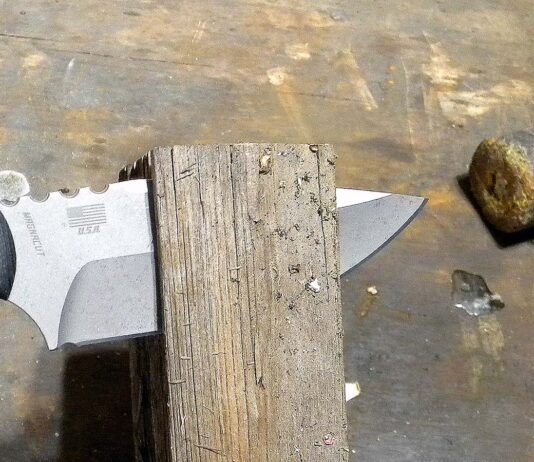
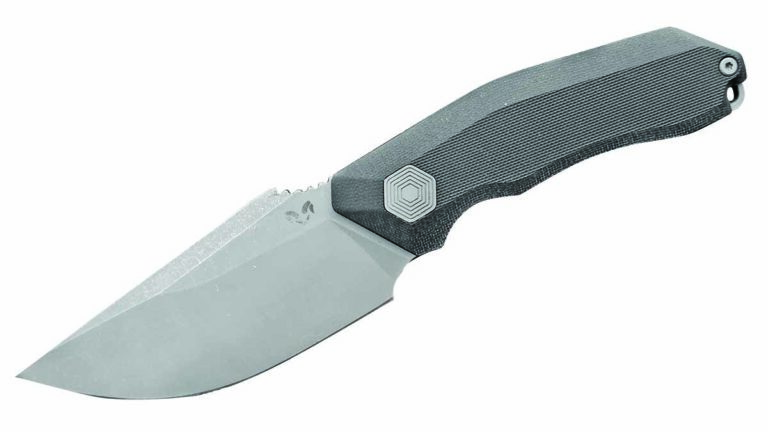
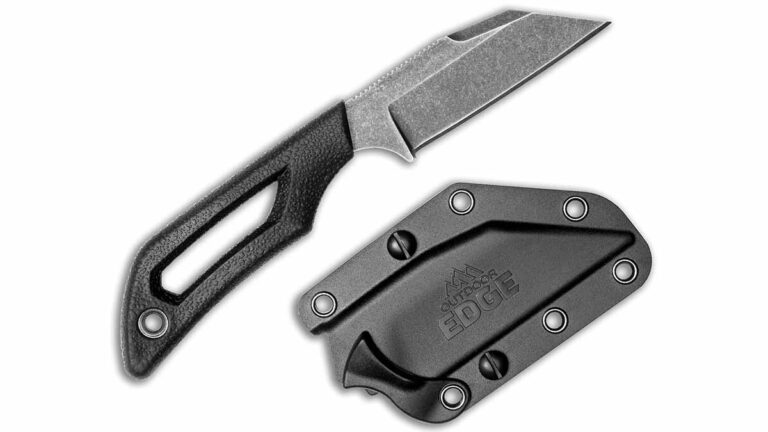
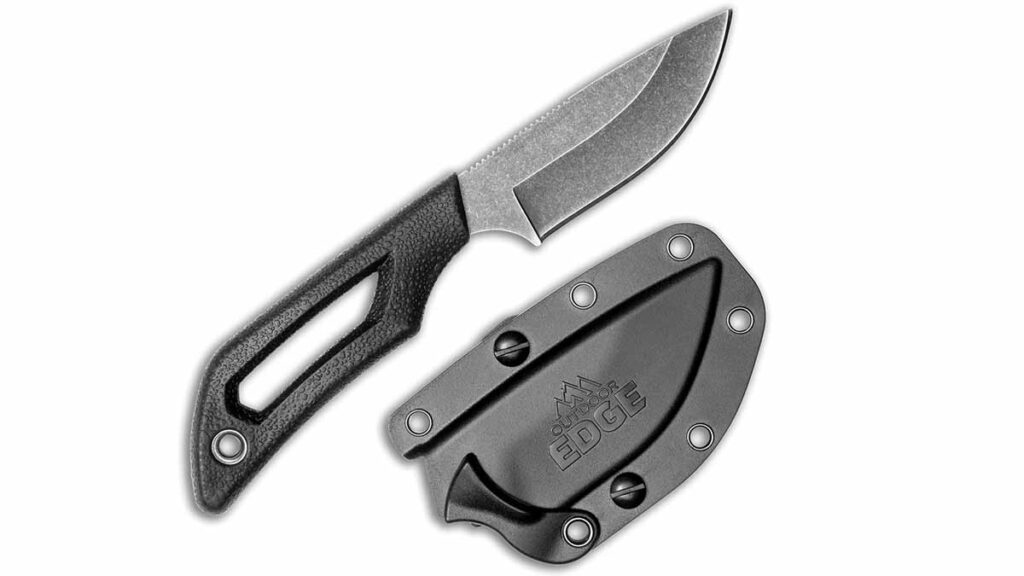
Outdoor Edge Pivot drop point

Constructed from 8Cr13Mov stainless steel, the knife was likely birthed in China—it’s one of the country’s budget stainless options. While inexpensive, the steel generally acquits itself well in wear and corrosion resistance but maybe doesn’t earn top honors in hardness (57 HRC) and edge retention. Though, 8Cr13Mov is known to be pretty forgiving in sharpening, so its edge is quickly regained. Outdoor Edge gives the Pivot’s blade an extra barrier to environmental factors with what it calls its Blackstone Coating, which also gives the knife a dark appeal.

Blade Profiles

The company offers two blade styles on the model, a drop-point and Wharncliffe both virtually the same length. The drop-point measures in at 2.5 inches, and the Wharncliffe is another .1-inch longer. In either case, married to a roughly 4-inch handle, the blade should prove fairly nimble and quite deft at most everyday tasks around the home, ranch or worksite. As mentioned, the handle is skeletonized, which cuts the Pivot’s weight down to a svelte 3.2 ounces. And Outdoor Edge applies a rubberized coat to it, giving the knife a fairly positive grip even if wet.

Where Exactly Does It Pivot?

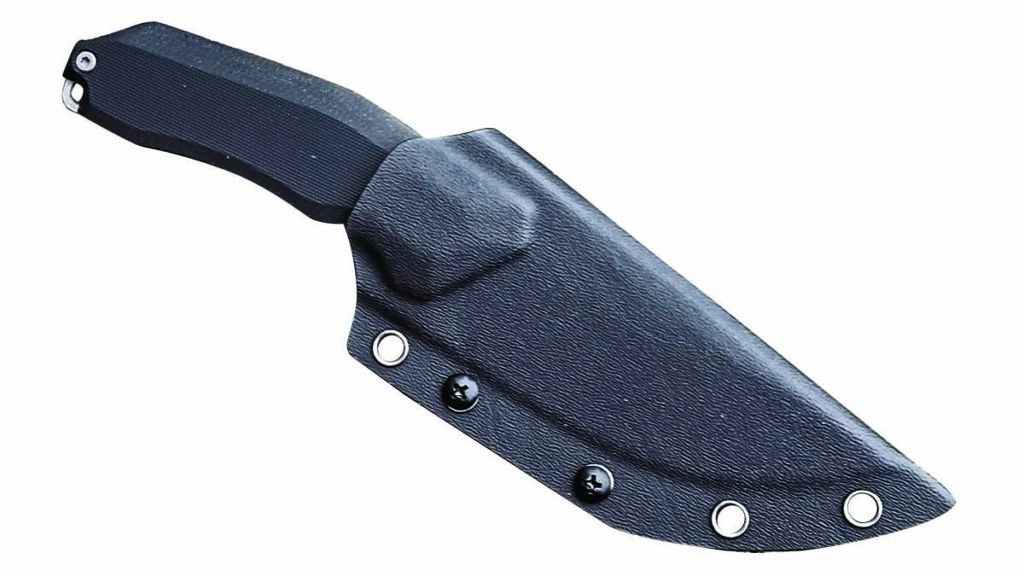
Outdoor Edge Pivot sheath

Now we get to the name of the knife—the Pivot—which seem much more apt for a folder than a fixed blade. But there’s a method in Outdoor Edge’s madness, with it referring to the carrying system. The polypropylene sheath comes with a quick-release locking latch and a removable 360-degree rotating clip (there’s the pivot point) for easy attachment to a belt or MOLLE webbing. It’s a nice system, allowing the user to adjust the cant to their carry style, putting the blade at quick access no matter where it’s carried.

Most would agree the Outdoor Edge Pivot isn’t the Superman of EDC knives, nor the one somebody pulls out for bragging rights. But for a blade to use and abuse on your day’s dirtiest jobs, well it pretty well fits the bill.

More On Fixed Blades:

Damned Designs Basilisk Review: Wide And Wicked

The Basilisk is a lightweight fixed blade that cuts well above its weight class.

I’m really liking the wider blade of the Basilisk* by Damned Designs. The full flat grind combined with the blade’s ample width makes for almost perfect edge geometry—a thin edge for slicing with enough meat behind it for added strength. The thinner blade stops any binding while slicing thicker material like cardboard.

Basilisk in sheath
The fold-over Kydex sheath is first class.

The G-10 slabs have enough texture for a good grip. The Basilisk is a solid EDC knife. It uses Sandvik 14C28N stainless for blade material, a great using steel.

But how well does it cut?

Basilisk Sharpness Test

A baseline edge check using 20-pound bond copy paper went fast. The blade was very sharp from the factory. I’m glad I have calluses on my fingers as the Basilisk nicked them twice because I was slow getting them out of the way.

Light Cutting Duty

Single-walled cardboard was the second test medium. The blade sliced very smoothly and was aggressive its entire length. The cut strips laid straight due to the flat grind, so no binding on this one. I slowed the slicing down to save my fingers and all went well.

Damned Design Basilisk cutting leather
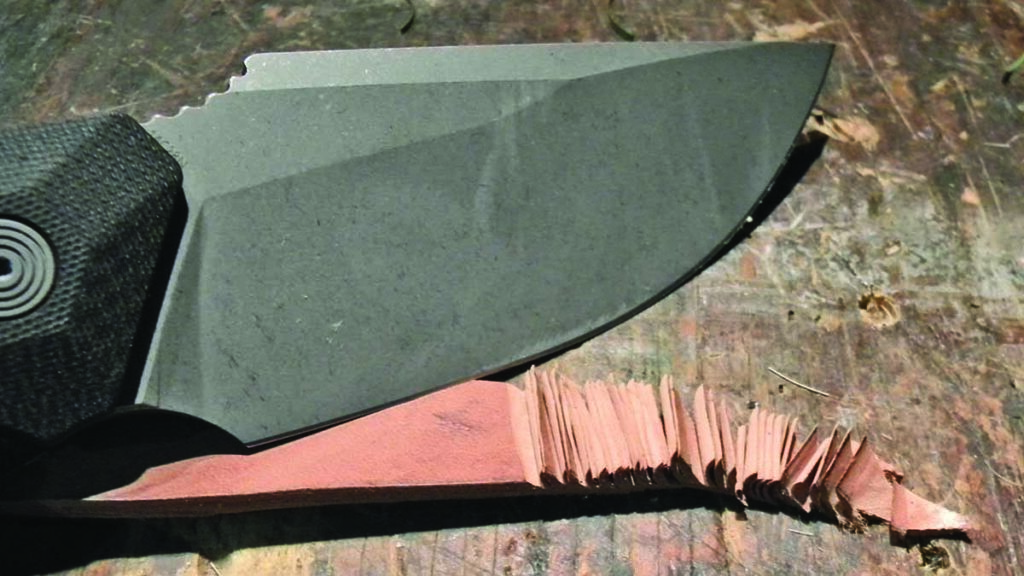
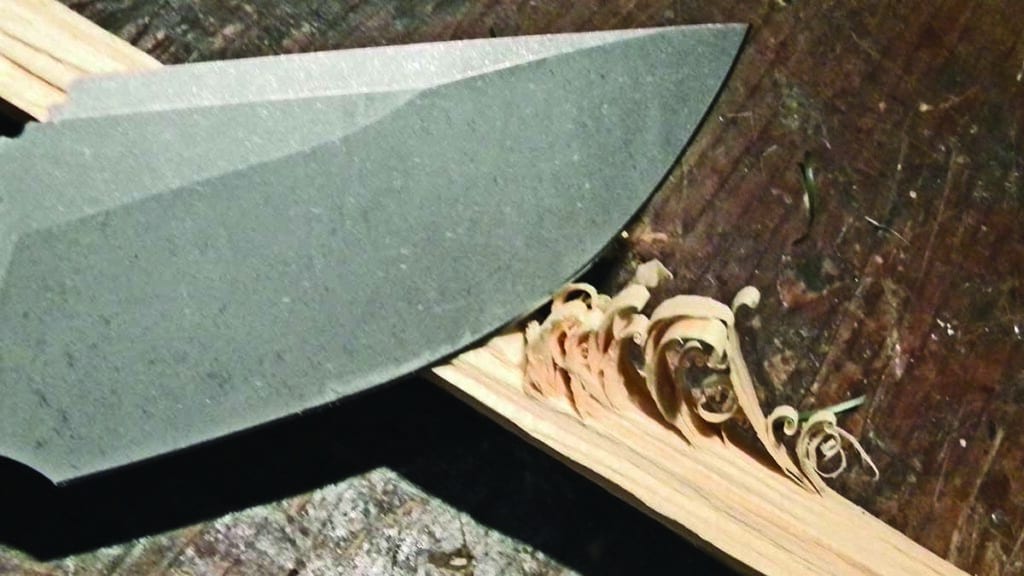
The thin edge and flat grind produced excellent curlicues for a firestick.

Eight-ounce leather was next. The Basilisk was very aggressive cutting animal skin. I could hear it slice its way through. The handle shape made it easy to control each cut’s width while also being comfortable. I also did some skiving. The Basilisk skived very quickly and evenly. Man, this knife is sharp!

Heavy Duty Cutting

Time for making some firesticks by whittling curlicues. The thin flat grind produced excellent wood curls. The thickness of the curlicues was eminently controllable. However, when I went in for deep cuts the edges of the G-10 handle were a bit hard on my hand.

Damned Design Basilisk vs rope
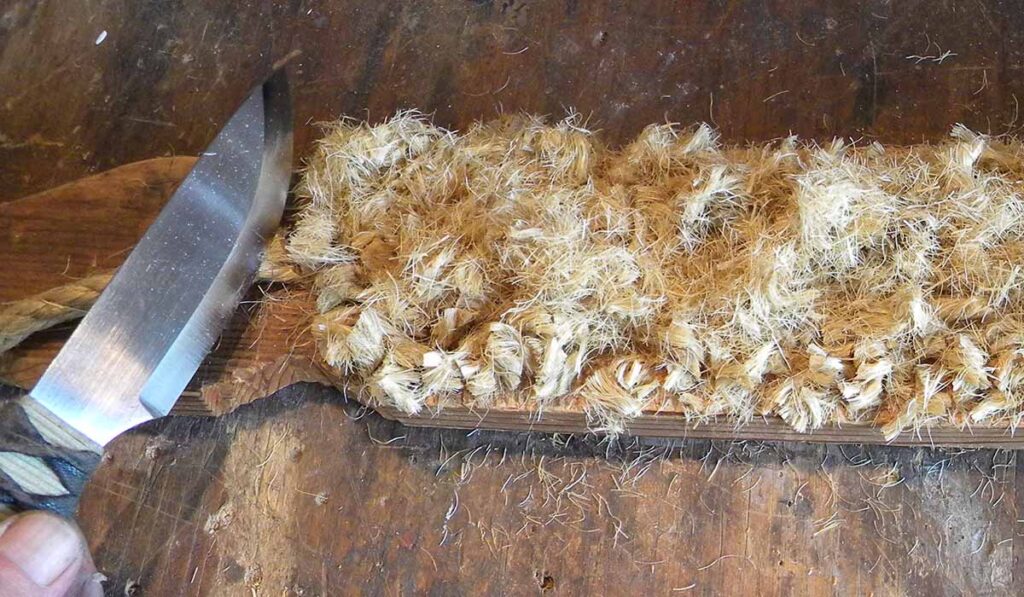
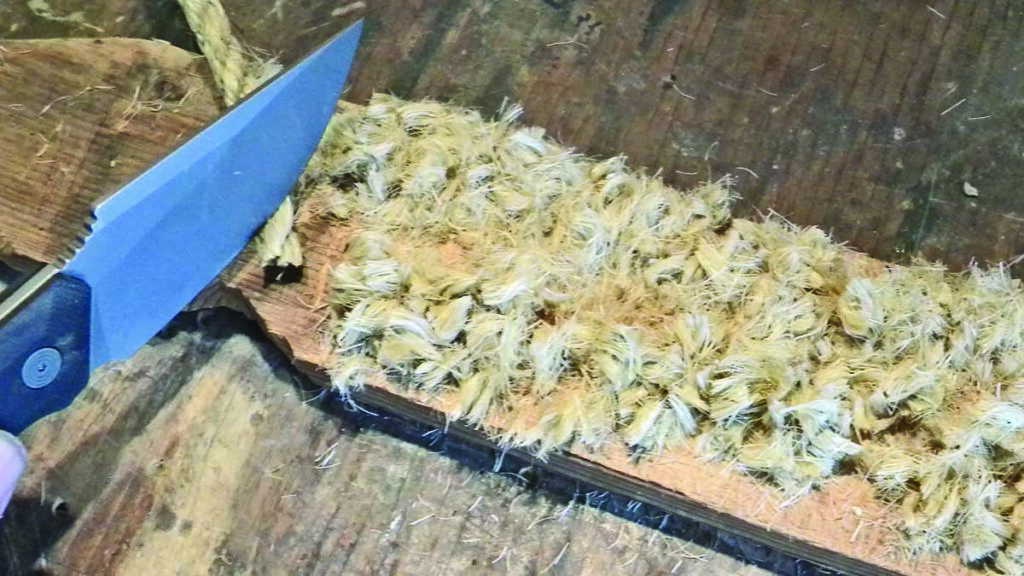
A total of 225 crunching cuts made mincemeat of the half-inch sisal rope.

Next up: half-inch sisal rope. The Basilisk made 100 crunching cuts before I had to don a glove to cover a hot spot. The knife dished out another 125 crunching cuts before I stopped. The edge showed no signs of slowing down. Total: 225 crunching cuts.

Toughness Tests

I batonned the Basilisk through some aged hackberry, a tough wood when dried. I whacked the rear, middle and tip of the blade spine for four complete splits. It worked excellent, with no damage to the edge or knife overall other than some wood smears on the stonewashed finish.

Basilisk vs wood
The thin edge and flat grind produced excellent curlicues for a firestick.

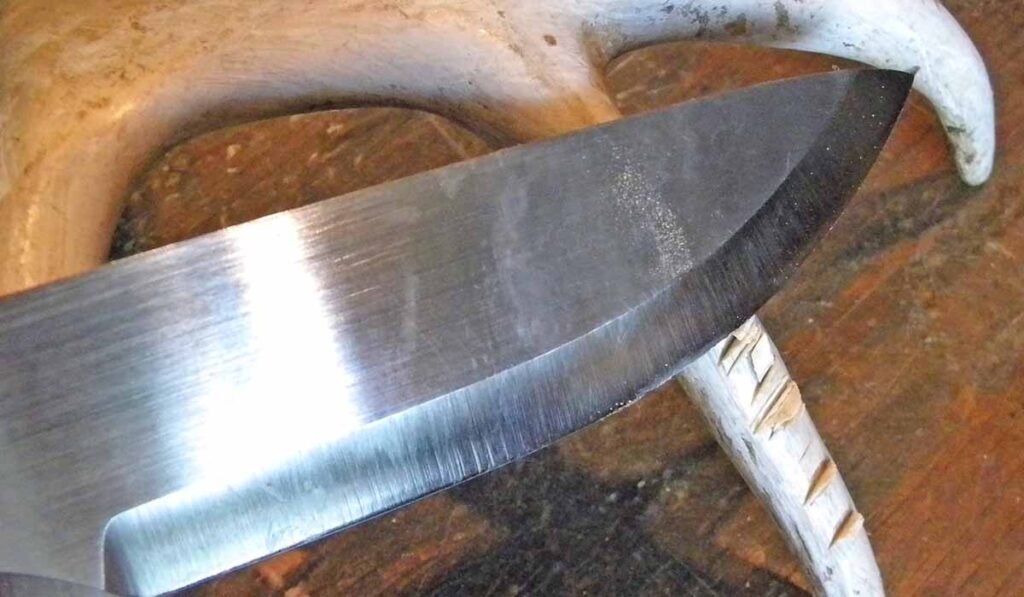
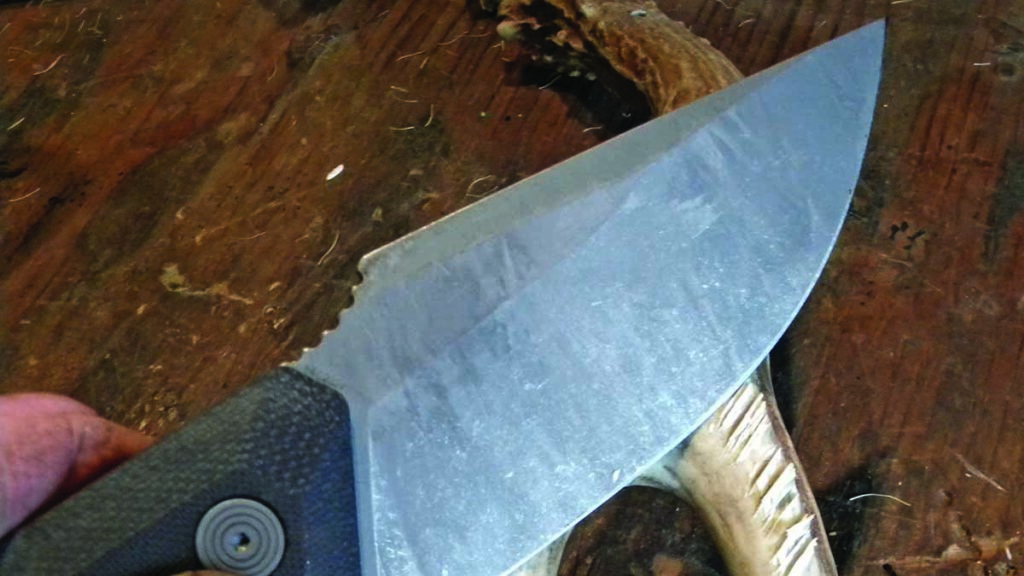
To really push the edge/heat treatment, I grabbed an old whitetail deer antler. After 30 hard whacks on it I checked the edge for chipping. There was none to be found. Heat treat is on the money for sure. Excellent job.

Edge Retention

Time to check the final edge with the 20-pound bond paper. The Basilisk still sliced smoothly even though the paper was getting damp from it raining all day. There were a few tears in the paper from the dampness.

Suggest Changes To The Basilisk

I would soften the handle edges a bit more.

Basilisk chopping antlers
After 30 hard whacks on the deer antler, the author checked the edge for any chipping. There was none to be found. The heat treat is on the money.

Final Cut

The Basilisk is a very nice knife, excellent for EDC or camp. It’s definitely a top pick on my list.

Damned Designs Basilisk Specs

Knife Type: Fixed blade
Blade Length: 4.25”
Blade Steel: Sandvik 14C28N stainless
Blade Width at Widest: 1.75”
Blade Finish: Stonewashed
Handle: G-10
Handle at Thickest: .5”
Weight: 7.25 ozs.
Overall Length: 8.75”
Sheath: Kydex fold-over
Weight w/Sheath: 11 ozs.
MSRP: $75

*The basilisk is a legendary serpent king that killed those who looked into its eyes.

Read More Knife Reviews:

Fire Starter Knife: Blades Designed To Spark A Flame

Fire-starter knives make sparks when you need them most.

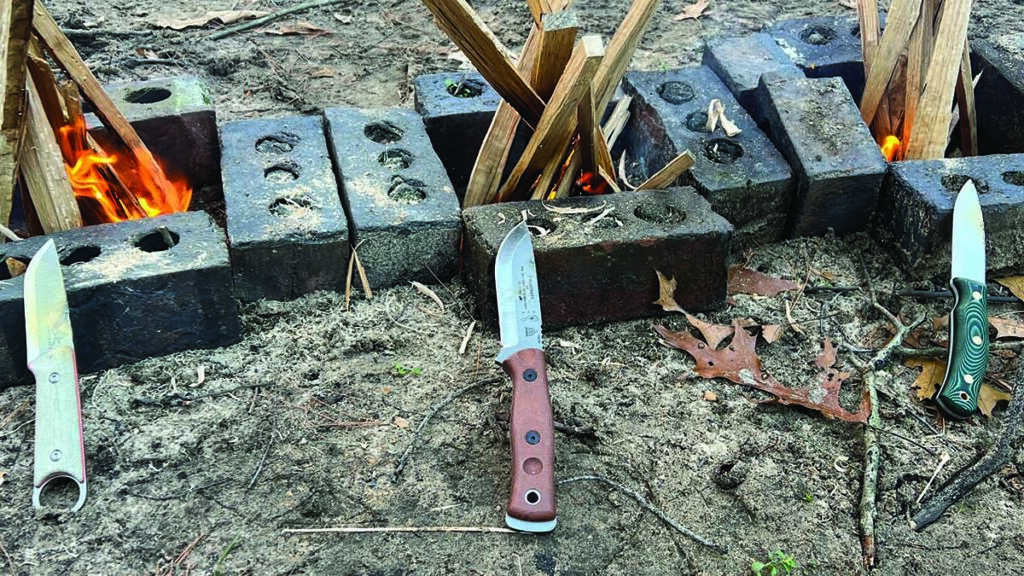
Bushcraft skills have grown immensely in popularity in the past few years. It could be the slew of TV shows promoting survival situations or just perhaps an interest in self-sufficiency. What is true is that the knife industry is playing catch-up to the bushcrafting market, and many new products pop up that have features dedicated to keeping you alive and warm in the woods.

Fire Starting Knives

Recent years have seen an influx of knife features deemed ideal for use with another essential tool—the ferro rod striker. Ferro rods are made of ferrocerium, an alloy consisting of several base metals and magnesium. Magnesium is highly reactive and generates showers of sparks as it is scraped against steel. Think of it as a more modern version of flint. Ideally, the ferro rod is struck against a sharp, acute surface. Many people use the blade’s edge for this, though this is not recommended as dull spots can emerge quickly.

As time passed, people began sharpening the blade spines to 90 degrees, making a hard, sharp angle that is not on the cutting edge. Still, others find this feature annoying, as it is fully possible to injure your hand on a squared spine. I know because I’ve done it.

As a remedy, people started cutting in little semi-circular cutouts into the spine that still retain a square shoulder, thus allowing for safer handling when striking. Both a fully sharpened spine and the sharpened cutout are valid features; it depends on what style you prefer.

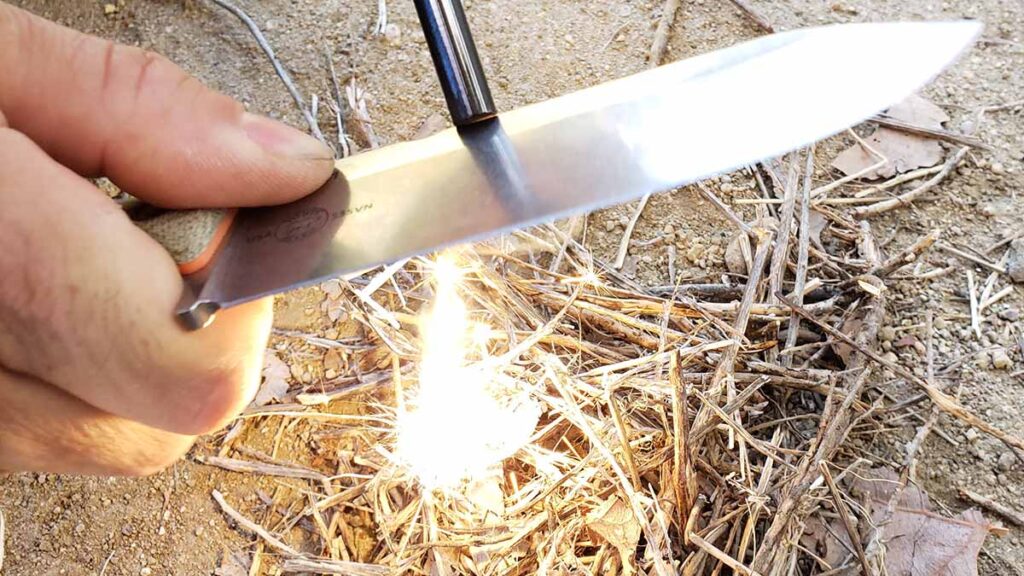
Striking the rod
Strike the rod against the sharp corner of the blade spine to create sparks and ignite the tinder. (Mary Lou Ayres image)

The smaller cutout is really just a striking feature but the fully sharpened spine can be used for a number of other ends, most notably an easy and effective means of peeling carrots, potatoes and other root vegetables for the camp kitchen. Many top fire-making knives have sharp-angled spines and cutouts ideal for striking.

Bowdrill Divits

Some bushcraft knives have bow drill divots in the grips. No less than 10 knives I’ve tested in the past year have the feature and I’ve yet to master its use.

A bow drill is a very primitive means of starting a fire with friction. It takes about forever and even then is not a guaranteed success. In terms of time management and the amount of calories used in a survival situation, I really don’t think it is worthwhile, though it’s nice that the feature is there.

The bow drill is basically a stick you press down on while at the same time you spin it with a bow (a stick with string wrapped around it) to create an ember. The idea behind a knife with a divot on the handle is it allows you to make kindling and all the tools you need to make a basic fire. You can use the knife to make the string (plant fiber), the drilling board (piece of dry wood) and bow/drill (stick).

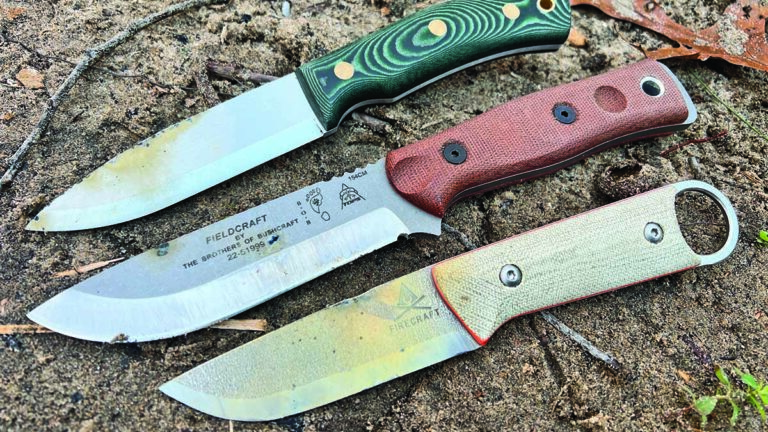
Knives with fires started
All three knives were tested side-by-side in equal conditions to see how well they performed in making a fire. All succeeded.

BLADE® Editor Steve Shackleford asked me to test the knives in this capacity as long as it didn’t detract from the other standard knife testing. “Skip it if it’s too much,” he stated. “I don’t want to wear you out.” However, in the spirit of making the story as detailed as possible inside the 1,500-word limit, I tried the TOPS and White River knives with the handle divots to see if I could, in fact, start a fire using the bow drill.

I was unsuccessful with both but did end up getting a fire going with a cheap bow drill kit from Amazon. No matter how you slice it, using a bow drill is just a huge pain in the keister and I’d rather stick a standard lighter in every pocket of my gear and an extra one in my boot than have to resign myself to using a bow drill.

A large reason why I really didn’t like using the divot features was that they really require you to keep the knife in the sheath. Otherwise, you’re just sitting there putting pressure on a knife with the edge floating out in space. It is easy to get into a trance while using a bow drill, and I found myself not paying attention at several points—not a safe situation.

Holding the knives in their sheaths is not very comfortable as they are hard Kydex. There was no real comfortable way to put pressure on the drill while gripping the sheath. Eventually, I gave up and decided if I ever did have to use a bow drill, I’d just find another piece of wood and carve a divot with the knife instead.

White River Knife & Tool FC-PKO

White River FC-PKO
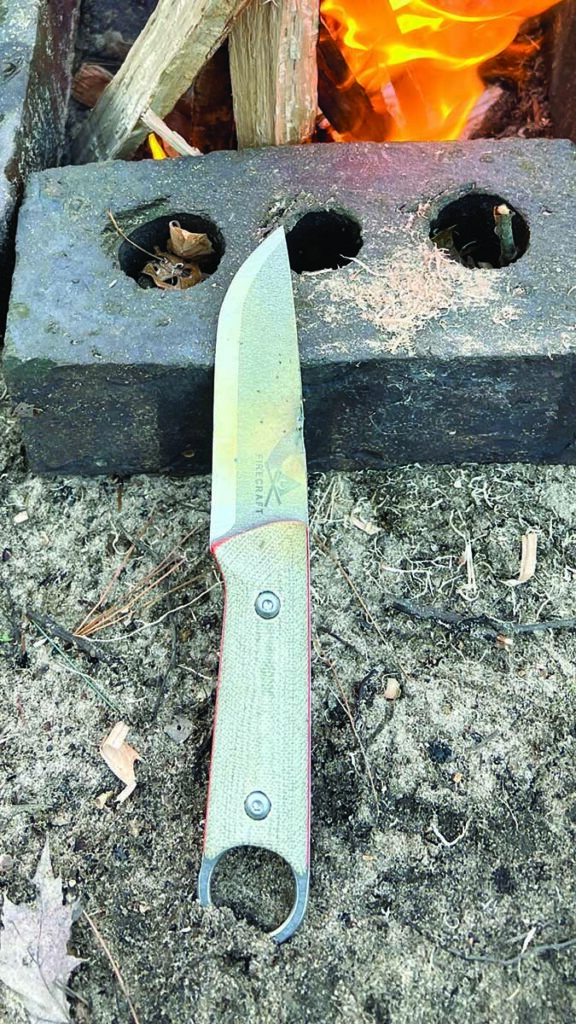
The White River FC-PKO is an end-stage tool in that it can readily start fires, the author noted, but lacks the strength and blade thickness to take down anything more than sticks.

White River Knife & Tool makes excellent knives. In fact, they are some of the most well-laid out and functional I’ve tested in my time with BLADE®. I have used the company’s larger FC7 as my main deer hunting knife in camp and have, between myself and my friends, packed out no less than 50 deer with it. I was happy to review the smaller FC-PKO, sort of a little brother to the FC7.

The FC-PKO is a modified puukko style with a Scandi grind and a ring pommel. The Kydex sheath is low profile. My initial impressions were that the knife is small, thin and razor sharp. I immediately thought it would be a perfect knife for pheasant or duck. I found it a champion at cutting tinder and kindling, but not up to larger work. The knife is an end-stage tool in that it can readily start fires, but lacks the strength and blade thickness to take down anything more than sticks. You’ll need a larger tool to actually prepare the wood prior to using the FC-PKO.

As far as fire-making ability, it is a solid performer. The knife has a small notch on the spine that ignites the ferro rod easily. The edge can trim extremely fine curls of tinder. Where I ran into problems was the ring pommel. I have large hands and long fingers, so this may not be an issue to everyone, but I found my pinky largely just floating in space. I couldn’t get comfortable with the ring. That said, it is overall a great knife that will ultimately see years of service on my belt.

White River Knife & Tool FC-PKO Specs
Knife Type: Modified puukko
Blade Length: 3.7”
Blade Steel: CPM S35VN stainless
Blade Grind: Scandi
Blade at Thickest: .125”
Handle Material: Micarta® w/orange liners and bow-drill divot
Weight: 4.6 ozs.
Overall Length: 8.1”
Sheath: Black Kydex w/striker loop
Striker: Included, basic rubber grip
Country of Origin: U.S.A.
MSRP: $200

TOPS Knives Fieldcraft

TOPS Fieldcraft
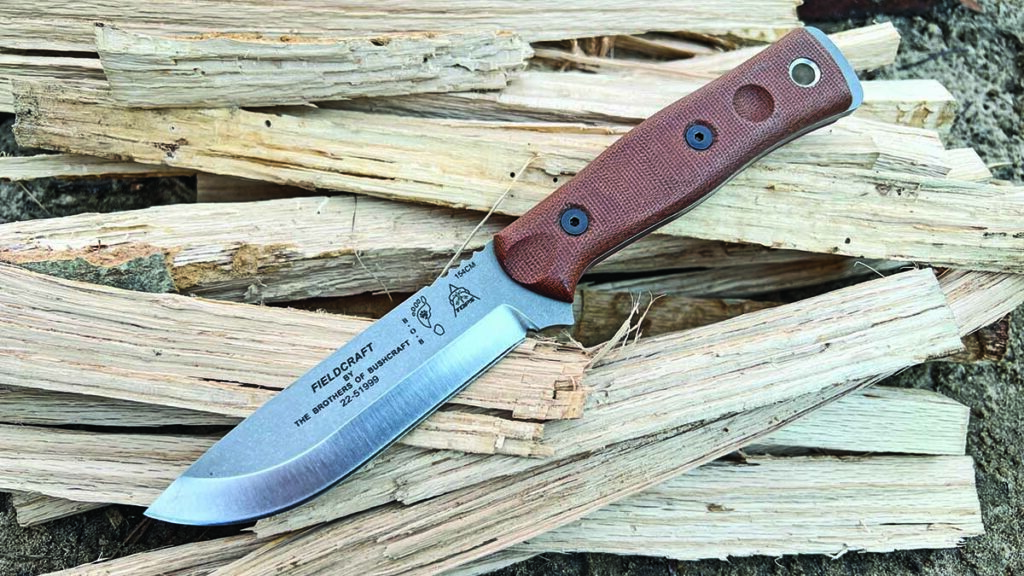
The author described the Fieldcraft as “a beast of a knife that weighs nearly a pound and is built like a tank.”

The TOPS Knives Fieldcraft by Brothers of Bushcraft is a beast of a knife that weighs nearly a pound and is built like a tank. The edge is razor sharp despite the steep grind and can split medium-size firewood easily. The handle is thick and robust and you can really get a grip on it. I find large knives like this almost too much for regular use, but this one fits into the niche of being large enough for constant use and not too big to be a burden.

The knife has a striker cut in the pommel as opposed to the blade spine. That said, you can order it with a sharpened spine if you wish. I wanted to test the base model to get an idea of what the average owner would experience. If I want to add a sharp spine, I can do so on my grinder or have TOPS do it. The pommel striker is not easy to get used to—you have to find a safe direction to point the blade, which can be difficult. That said, you can leave it in the sheath for this part—just be careful not to launch it out while striking. The cutout is effective once you get used to it.

TOPS Knives Fieldcraft Specs
Knife Type: Full-size bushcrafter
Blade Length: 4.75”
Blade Steel: 154CM stainless
Blade Grind: Modified Scandi
Blade at Thickest: .19”
Handle Material: Tan canvas Micarta® w/red liners and bow-drill divot
Weight: 14 ozs.
Overall Length: 10”
Sheath: Black Kydex w/striker loop
Striker: Included, basic aluminum grip
Knife to Know: There are numerous other Fieldcraft models available in different materials and colors
Country of Origin: U.S.A.
MSRP: $295

Casström No. 10 Swedish Forest Knife

Casstrom fire starter knife
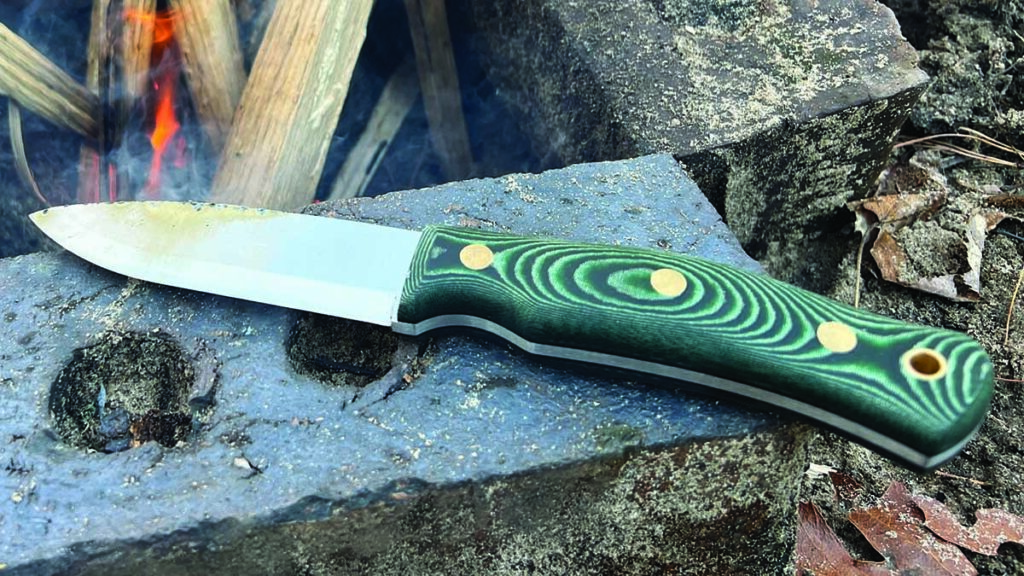
According to the author, the Casström “has everything I like and nothing I didn’t—not too big, not too small and pleasant to look at.”

The classic-looking Casström No. 10 Swedish Forest Knife is reminiscent of such Scandinavian knives as the puukko. It is not a traditional puukko but rather a somewhat modern take on the longstanding Nordic tradition of general-use fixed blades. Many American knives in the bushcraft world have a somewhat gritty, tactical feel and a somewhat industrial appearance. The No. 10 is not terribly exciting in looks but hides its function under a gentle exterior. It was my favorite knife in the review, which may surprise you. It has everything I like and nothing I didn’t—not too big, not too small and pleasant to look at.

The knife has a smooth grip—be careful if you’re not wearing gloves, it can get a tad slippery—and a plain, graceful blade. The angle of the spine is sharpened but not so aggressively that it would risk injury. It is not a particularly thick blade but can handle some medium-to-small splitting work if you’re careful, and makes kindling and scrapes tinder well. The knife strikes easily anywhere on the spine and offers a great deal of control. Of note, the sheath is leather and has a ferro rod with a matching green/black Micarta® grip. As a set the knife and rod look very nice together. The rod was also the easiest to hold onto thanks to it having the largest grip area.

Casström No. 10 Swedish Forest Knife Specs
Knife Type: General-purpose Scandi
Blade Length: 3.75”
Blade Steel: Sandvik 14C28N stainless
Blade Grind: Full flat
Blade at Thickest: .13”
Handle Material: Green/black Micarta® w/black liners
Weight: 5.75 ozs.
Overall Length: 8.6”
Sheath: Black leather w/striker loop
Striker: Included, matching green/black Micarta handle
Knife to Know: According to the author, the knife has the most user-friendly sheath of the test bunch
Country of Origin: Sweden
MSRP: Approximately $200

Fire Starter Knife Final Cut

Starting a fire can be a challenge, especially in adverse conditions. Considering just how cheap common lighters and survival matches are, knives like the ones in this article should probably not be your primary means of starting a fire in an emergency. These knives are capable tools that provide a level of redundancy to your kit in some very good, non-obtrusive ways. The base-level skills needed to start a fire can be obtained with each of these knives with relative ease, but you will still need to make sure to have the skills necessary to maintain a fire in the wilderness.

Always be sure that you are not making a bad situation worse with fire, and make sure you’re not using a knife under less-than-ideal conditions. If you have a lighter or matches, use them first, especially in the dark.

More Wilderness Knives:

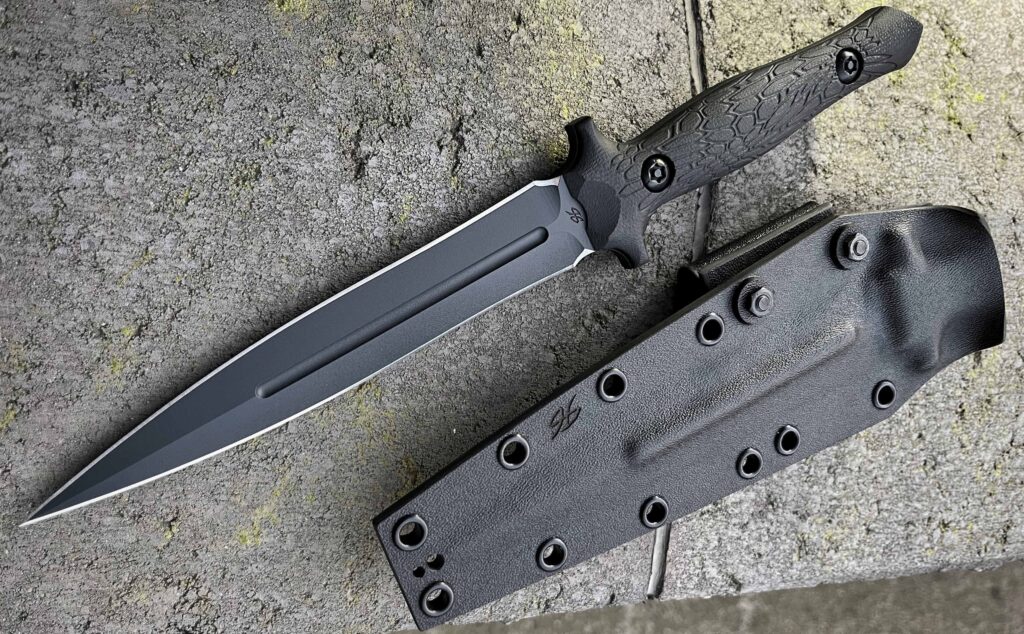
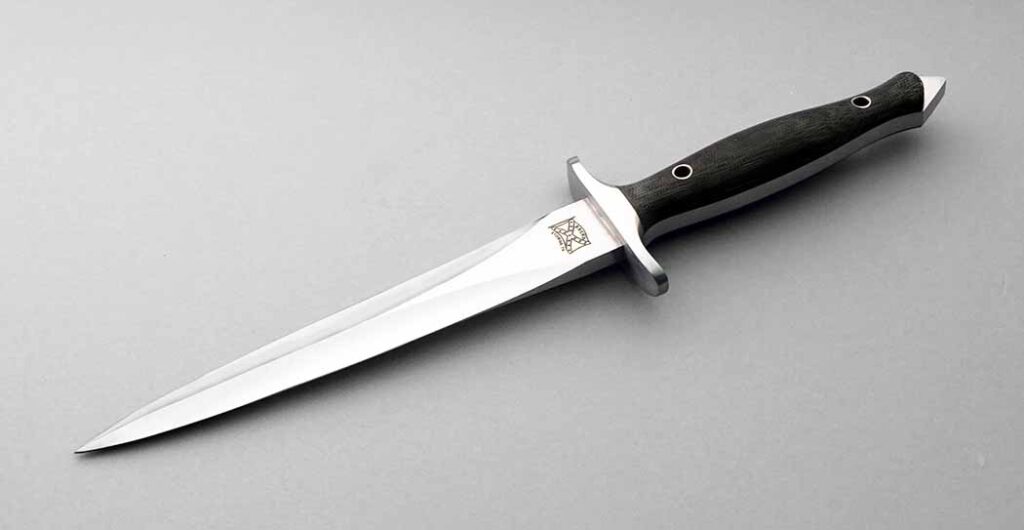
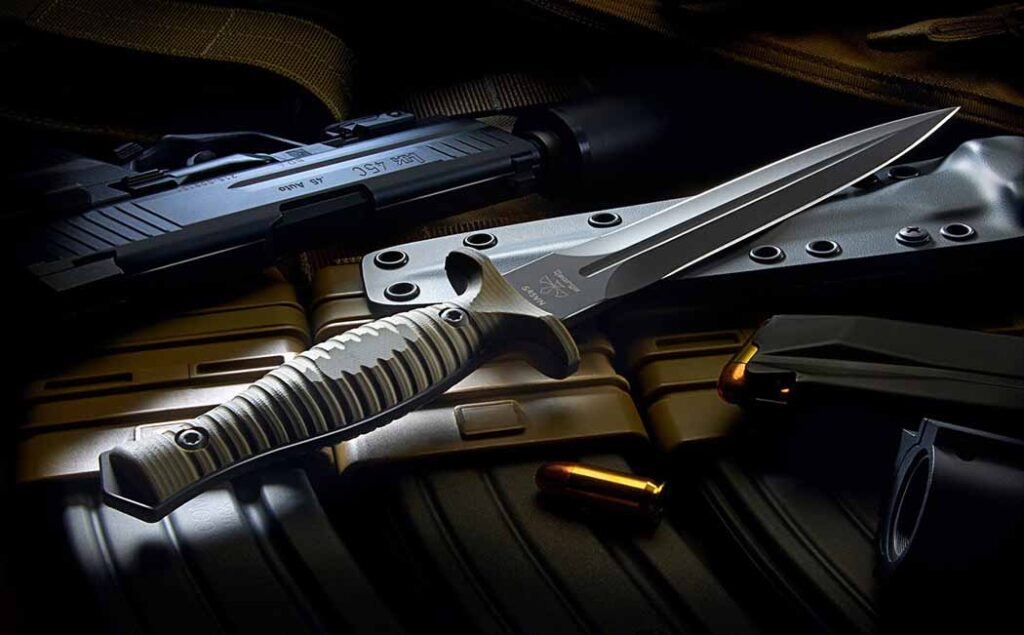
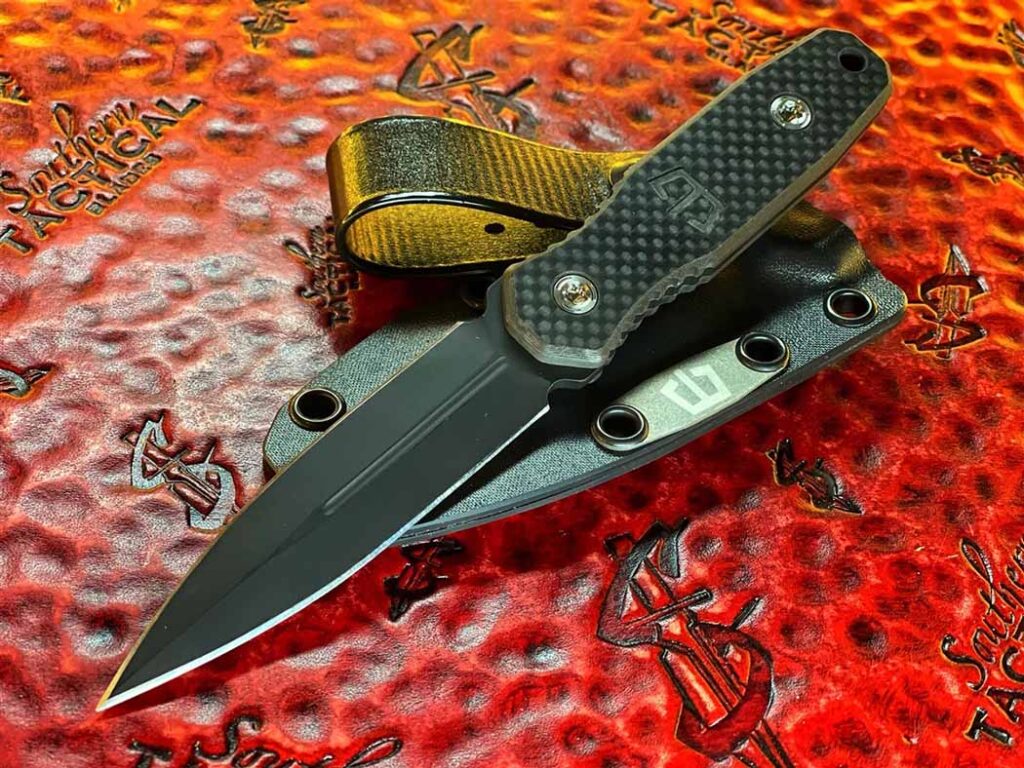
Dagger: Custom And Production Buyer’s Guide (2023)

Daggers have a colorful past and a collectible present.

Early in history, warriors concluded they needed a stabbing weapon they could carry because using a sword, club or spear was not always convenient or practical. Daggers were developed to fill that role.

The exact origin of the word dagger has yet to be discovered. It is believed to come from the old French daque or old Italian daga. Dagger gained acceptance during the 14th century when knives with blades that come to a very sharp point became consistently distinguishable from swords.

In peacetime, daggers were often made from expensive materials and worn in ornate sheaths as part of formal dress. Doing so indicated status and wealth. However, daggers weren’t always for the wealthy.

Since daggers are stabbing weapons, they could also be made from bone or antler. This gave those who could not afford items made from metal an effective self-defense tool. 

Daggers For Self-Defense

Out of necessity, those who wore a knife in America in the 1800s would usually choose what today we call a bowie. Not only was this knife imposing when worn, it was also large enough to perform the day’s chores while the West was settled. As America became more civilized and cities became more commonplace, the days of wearing such a large knife in public became less acceptable. Self-defense was still at a premium, and small firearms and daggers replaced the large knife. A dagger had to be used at very close range to be effective. No wonder revolvers grew in popularity as the defensive weapon of choice.

Iconic Styles Of Daggers

Trench Knife

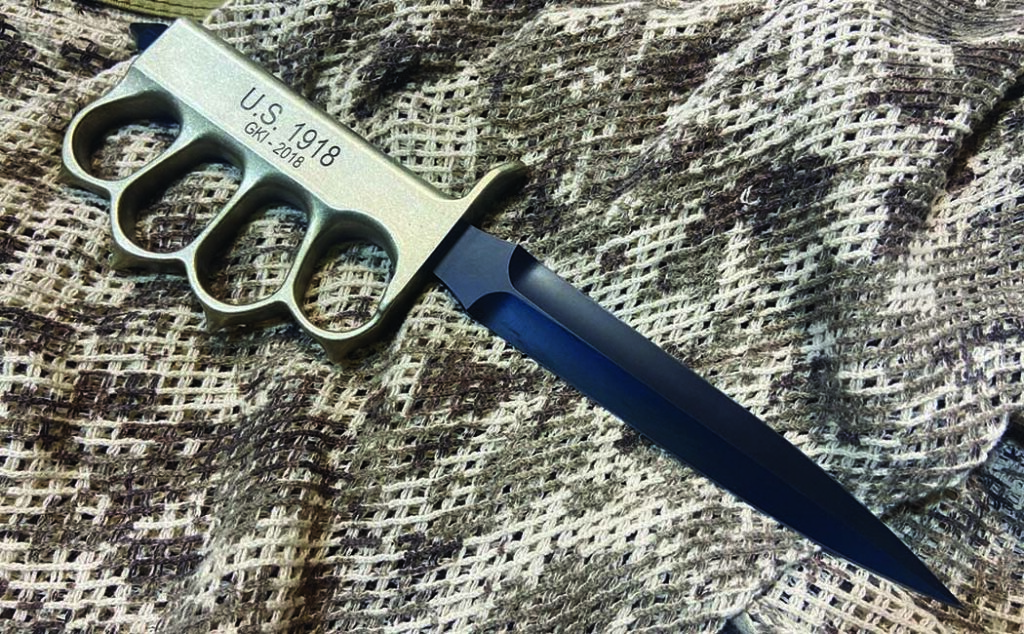
During World War I, close-quarters combat was a significant part of trench warfare, where enemy soldiers would fight in tight and narrow quarters in attempts to capture trenches. The best-known dagger of World War I is the 1918 knuckle knife. American weapons inventor Maj. Eugene McNary of the Air Expeditionary Force designed the knuckle knife. He incorporated the same spear-point blade design as the French M1916 Trench Dagger. In addition, McNary added the knuckles and skull crusher point on the handle butt to increase the knife’s lethality. The Landers, Frary & Clark Co. of New Britain, Connecticut, manufactured the knuckle knife. The handle is marked “U.S. 1918” and is maker-marked “L.F.&C.” 

Push Dagger

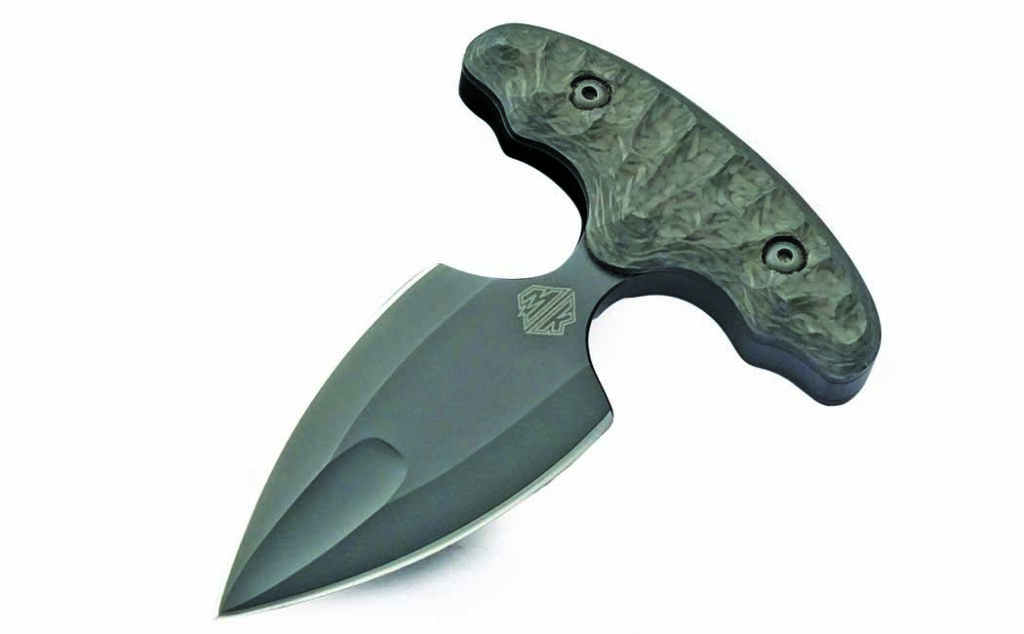
The push dagger is designed primarily as a last-resort weapon for close-quarters defense. While not generally utilized as a primary weapon, it does allow the user to carry it concealed and employ it one-handed, giving him the ability to manipulate the push dagger with one hand while using his off hand to help defend himself. The blade of a push dagger is shorter and broader than that of a standard dagger. In addition, the handle is longer horizontally/wider and thicker to give the user more leverage for pushing.

F-S DAGGER

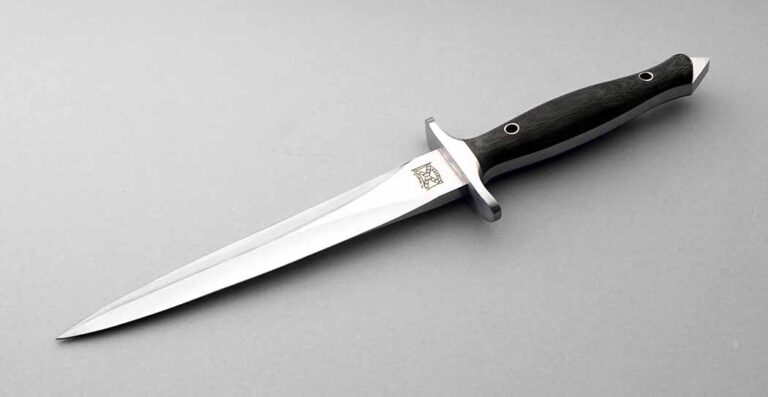
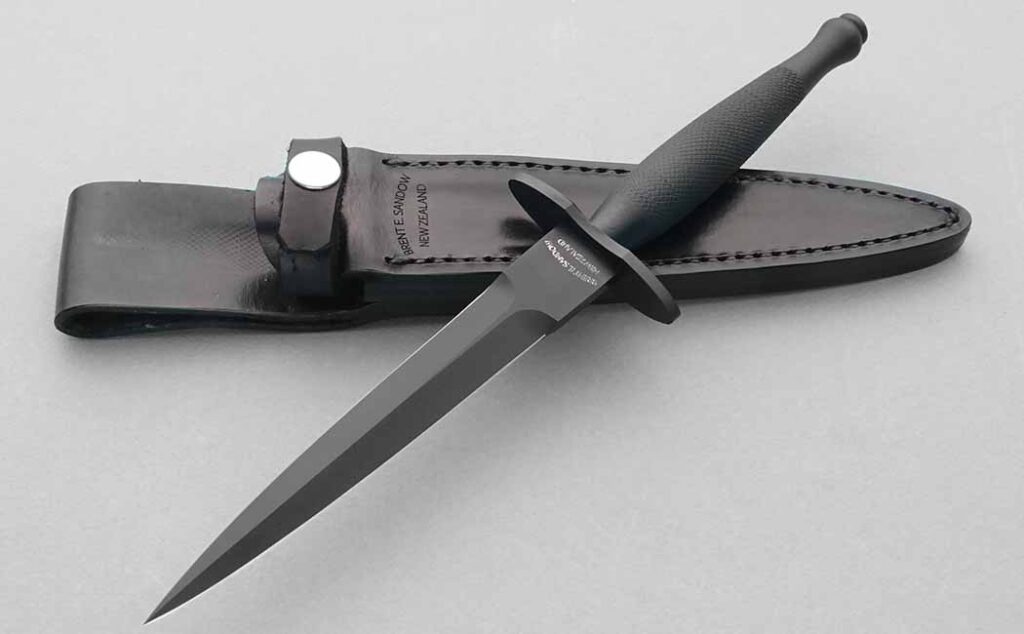
No dagger developed during World War II carries more lore or recognition than the one designed and developed by William Fairbairn and Eric Sykes. The Fairbairn-Sykes dagger can be used for slashing cuts. However, its acutely tapered and sharply pointed blade led the knife to be described as a stiletto, a weapon primarily designed for thrusting. In addition, the knife was configured for surprise attacks, with its slender blade quickly penetrating the ribcage. From 1940 to 1943, Fairbairn and Sykes developed three different patterns of the dagger.

Final Cut

In September 1983, I started taking the U.S. Army Infantry Officers Basic Course at Ft. Benning, Georgia. Traveling with me was the dagger I received as a present from my wife for being commissioned a second lieutenant.

Because of the knife’s reputation during the Vietnam War, it was a factory dagger I had wanted. I was excited to go on the first training exercise so I could finally put my knife through its paces. After cutting some 550 cord, I stuck my dagger in a tree while I tied the knot. I pulled the knife from the tree to find I had only a handle in my hand. I felt shocked, disappointed and angry all at the same time, as this legendary dagger was anything but. Upon closer inspection, I saw that the knife’s tang was 1 inch long and secured by glue in the handle. 

The lessons I learned that day were a) don’t believe the hype and b) only use daggers with full tangs. Please note that the custom knives featured in this article all have full tangs. The plus side to the catastrophic failure of my factory dagger is it made me realize I must research my future knife purchases more carefully.

In April 1984, I bought my first custom knife. I never purchased or used a factory knife again. When it comes to an infantryman and his knife, compromise elsewhere!

Custom Dagger Buyer’s Guide

Les Geroge: Model 1918 Trench Knife

George Trench Knife Dagger

U.S. Marine Corps veteran/custom knifemaker Les George has a fondness for classic U.S. military knives. In 2018, he created his version of the 1918 trench knife. Except for the cast brass handle, Les updated the materials, including a 6.75-inch blade of CPM S35VN stainless steel and a titanium tang nut, both of which have a black Cerakote® finish. As of this writing, he planned to do another limited run of the knife.

Model 1918 Trench Knife Specs
Maker: Les George
Blade Length: 6.75”
Blade Steel: CPM S35VN stainless
Blade Finish: Black Cerakote®
Handle Material: Cast brass w/titanium tang nut
Overall Length: 11.5”
Sheath: Made by George of leather
Maker’s Price: $425 (SharpByCoop knife image; image of Les George by Ronald S. Smith)

Paul McDanie:l Mako Push Dagger

McDaniel-Paul-Tactical-Push-Dagger

Custom knifemaker Paul McDaniel incorporates all the above-mentioned traits of the push dager in his Mako Push Dagger. The 3-inch double-edge blade is 80CrV2 carbon steel and has a fuller. The 3.75-inch handle is black, textured G-10. The accompanying custom-made Kydex sheath features multiple attachment points.

Mako Push Dagger Specs
Maker: Paul McDaniel
Blade Length: 3” w/full double edge
Blade Material: 80CrV2 carbon steel
Blade Finish: Black Cerakote®
Handle Material: Textured black G-10
Handle Width: 3.75”
Overall Length: 5.25”
Sheath: Made by McDaniel of Kydex w/leather straps
Maker’s Price: $365 (Robertson’s Custom Cutlery image)

Brent Sandow: Fairbairn-Sykes Dagger

Sandow-Fairbairn-Sykes

Maker Brent Sandow of New Zealand builds all three F-S dagger variants. The featured one has a 6.75-inch blade of D2 tool steel, a stainless steel guard, and a checkered handle. All the metal parts feature a flat-black Gun-Kote™ finish. In addition, Brent has slightly modified the knife by adding scalloping to the guard. The scalloping allows the user to index the knife. Indexing helps the user by providing a locating mark to help control the blade while maneuvering it*.

A version of the F-S dagger by maker Piotr Gosciniak of Poland sports a slightly shorter blade with a fuller down the center. Contrary to popular belief, a fuller is not a “blood groove.” Instead, it is a feature that reduces the knife’s weight and stiffens the blade. At the same time, it can help the maker provide a knife with enhanced balance. Piotr’s dagger features a 6.3-inch blade of 80CrV2 in black Cerakote. The black G-10 handle is laser-cut to enhance grip. For additional control, the knife has a scalloped guard.

Mako Push Dagger Specs
Maker: Paul McDaniel
Blade Length: 3” w/full double edge
Blade Material: 80CrV2 carbon steel
Blade Finish: Black Cerakote®
Handle Material: Textured black G-10
Handle Width: 3.75”
Overall Length: 5.25”
Sheath: Made by McDaniel of Kydex w/leather straps
Maker’s Price: $365 (Robertson’s Custom Cutlery image)

Piotr Gosciniak: Dagger

The texture of the black Micarta® handle enhances grip, particularly in a wet environment. The fuller reduces the blade’s weight while at the same time improves its strength. The thumb cutout provides extra stability during use.

Dagger Specs
Maker: Piotr Gosciniak
Blade Length: 6.3”
Blade Material: 80CrV2 carbon steel
Blade Finish: Black Cerakote®
Handle Material: Laser-cut-textured black G-10
Overall Length: 11.5”
Sheath:  Made by Gosciniak of Kydex
Maker’s Price: $425 (Piotr Gosciniak images)

Walter Brend: SF Dagger

Brend-Tactical-Dagger-Blade

The SF Dagger by Walter Brend features an 8-inch blade of D2 tool steel with a satin finish and Walter’s impeccable grind lines. Handle: black Micarta®. Guard: stainless steel. Special features: Full-tang construction, double edge, thong hole and a skullcrusher pommel. Overall length: 12.75 inches.

SF Dagger Specs
Maker: Walter Brend
Blade Length: 7”
Blade Steel: CTS XHP stainless
Blade Finish: Satin
Handle Material: Black Micarta®
Guard Material: Stainless steel
Overall Length: 12”
Sheath: Custom-made of leather
Maker’s Price: $2,800 (Robertson’s Custom Cutlery image)

Production Dagger Buyer’s Guide

Winkler Tactical Dagger

Winkler Tactical Dagger

This tactical dagger from Winkler was designed for the military by people in the military. It isn’t a show knife for people looking to cosplay as their favorite action star. This is the real deal.

The 5.5-inch blade is 3/16-inch-thick 80CrV2 carbon steel with a black oxide Caswell finish and has a Rockwell hardness of 59-60 HRC. The blade is made for combat and will handle the abuse you throw at it. Both edges are ground to a razor edge.

A tapered tang runs through the entirety of the wasp sculpted canvas laminate handle to give you a strong, sturdy grip. The piece comes with a custom-lined Kydex sheath for secure carry. Made in the USA, the knife is an absolute winner.
WK Defense Dagger Specs
Maker: Winkler
Blade Length: 4.25″
Blade Steel: 80CrV2
Blade Finish: Black oxide no-glare finish
Handle Material: Black Canvas Laminate, Camo G10, Maple, Walnut, WASP
Overall Length: 8
Sheath: Lined Boltaron® Sheath
Maker’s Price: $325

Spartan Les George V14 Dagger

Spartan Les George V14 Dagger

Designed by award-winning knifemaker Les George, the V14 from Spartan Blades is about as high quality as it gets. A Marine veteran, Les knows what is needed from a dagger and puts it all into this one.

The V14 has a beefy 6.75-inch blade of symmetrically ground CPM S35VN stainless steel heat-treated to a Rockwell hardness of 58-60 HRC that provides great edge retention and durability. The handle is 3D-contoured black G-10 that wraps a full tang to provide a strong grip. This knife isn’t going anywhere in your hand, and the blade’s not going to snap in two when deployed. The Kydex sheath is MOLLE compatible.

George V1-14 Dagger
Maker: Spartan Blades
Blade Length: 6 3/4″
Blade Steel: CPM S45VN
Blade Finish: SpartaCoat – PVD – Tungsten DLC (Black) or ZrN (Flat Dark Earth)
Handle Material: 3D Contoured G10, Black or Green
Overall Length: 11 1/2″
Sheath: Kydex Sheath
Maker’s Price: $495

Blackside Customs P7 Dagger

Blackside Customs P7 Dagger

This piece from Blackside Customs is the smallest of the three knives on our list but no less functional. 

The 3.5-inch blade is CTS-XHP stainless steel with an OD green Cerakote® finish. The smaller size makes the P7 more feasible as an EDC if you prefer your standard carry to be a fixed blade. The G-10 grips are double-riveted to the tang for a comfortable grip when deployed.

The Kydex sheath lets you carry the knife easily and discreetly. The smaller blade means a lower weight. At just 3.5 ounces, almost three times lighter than the heaviest knife on this list, the P7 is a sleek piece that moves with grace and ease.

Phase 7 Dagger Specs
Maker: Blackside Customs
Blade Length: 3.5″
Blade Steel: CTS-XHP
Blade Finish: Black Cerakote®
Handle Material: Black G10
Overall Length: 7.35″
Sheath: Kydex Sheath w/ BSC Titanium Tag
Maker’s Price: $290

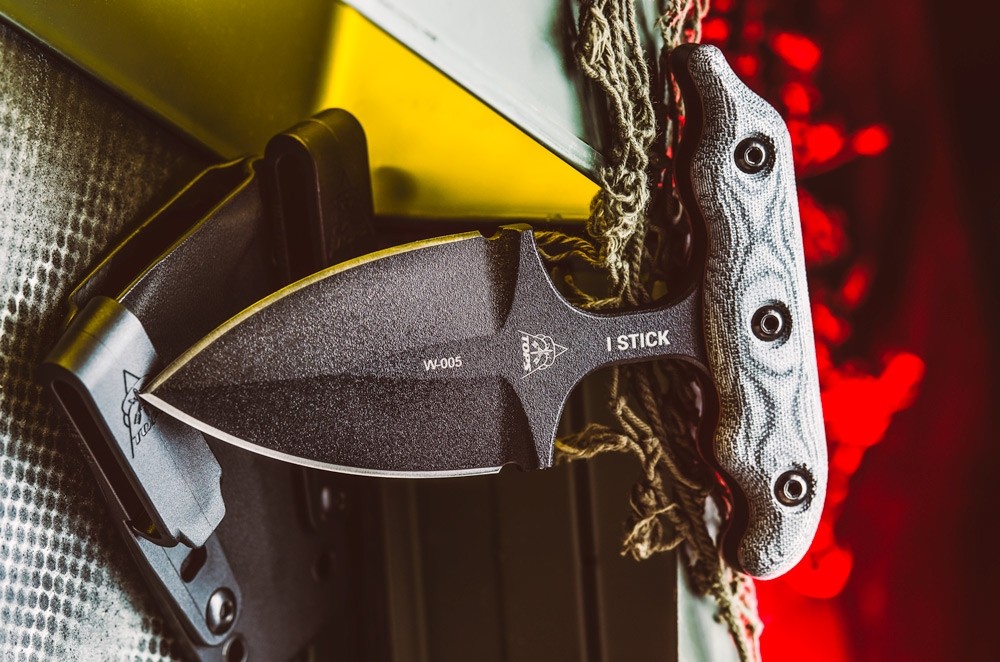
TOPS Knives I Stick

Tops I Stick side

The commendable quality of the TOPS Knives I Stick lies in its ability to live up to its advertised purpose. It excels in the task of sticking objects securely, and credit is due to the TOPS team for their rare commitment to truthful advertising.

The I Stick embodies the original intent behind the push dagger’s design, which is to protect the wielder by swiftly striking those who pose a threat. Possessing a generous blade length and an impressive thickness that instills a sensation of being able to puncture a shipping container, it undeniably proves its efficacy in defensive scenarios.

Featuring sharp edges on both sides, it surpasses the 3.5-inch blade measurement that could attract the attention of law enforcement officers seeking to find fault. Consequently, it may not be the ideal choice for individuals residing in states with stringent knife regulations. However, if you find yourself in a state with fewer restrictions or if you possess a weapons carry permit, the TOPS Knives I Stick presents itself as a formidable contender.

*Editor’s note: Though meant to be inferred from the author’s description, we might add that indexing enables the user to know by feel how the blade is oriented during use, an invaluable feature in situations where the user cannot see the blade for whatever reason.

I Stick
Maker: TOPS Knives
Blade Length: 3.50″
Blade Steel: 1075 RC 56-58
Blade Finish: Black Traction Coating
Handle Material: Black Canvas Micarta
Overall Length: 5.63″
Sheath: Black Kydex
Maker’s Price: $210

Editor’s Note: Michael Ableson contributed to this post.

Read More

Sarge Knives TK Retro Review: Throwback Bushcraft

Sarge Knives TK Retro has throwback looks, but modern performance.

The TK Retro from Sarge Knives reminds me of my first fixed blade.

The blade was pitted and the leather handle was cracking. Still, the knife field dressed many squirrel, rabbit and game birds throughout my childhood. It was an excellent camper’s or outdoorsman’s knife.

As for the TK Retro, like my first fixed blade, the stacked-leather handle still gives my hand a warm feel. It has a 440C stainless steel blade to make its good looks last even longer. However, how does it cut?

TK Retro Sharpness Test

Retro cutting paper
Using the knife’s weight, the author employed push cuts in the stationery. There were no “bad starts,” just smooth slicing.

The first test medium was 20-pound bond copy paper. The TK Retro started slicing and made nice, clean cuts in the stationery. Using the knife’s weight, I employed push cuts. There were no “bad starts,” just smooth slicing.

TK Retro Light-Duty Cuting

TK Retro vs leather
The blade audibly crunched the leather with each skive and made it easy to control the width of slices.

The TK Retro bit deep and smooth [into drywall], with minimal bending of the cut pieces. I could feel the cardboard’s layers with each cut. Edge performance was nice and aggressive. The handle provides a very secure grip.

Leather skiving followed. The blade audibly crunched the leather with each cut and made it easy to control the width of slices.

Heavy-Duty Cutting With Sarge’s Fixed Blade

Firesticks

TK Retro firesticks
Melissa did a great job whittling a fuzz stick with the TK Retro over her painted bench.

While camping, I was splitting firewood for the weekend. My wife, Melissa, wanted to start the fire so I showed her how to make fire sticks. She took to whittling very quickly and did four of the sticks to aid in her fire starting. She used the TK Retro to make some very nice curlicues. Before I knew it she had a beautiful fire going—excellent job on her part! I was surprised to see her whittling over her bench that she had painted. She seemed to feel very confident using the little fixed blade.

Splitting Wood

I had some dry hackberry wood to split for kindling. A dead blow hammer and the TK Retro made short work of the task. I didn’t see or feel any edge/knife damage while batonning the edge through the wood. The guard acted like a guide for my hold hand, keeping the wood away from my knuckles. The leather handle absorbed the vibrations perfectly.

Vs Rope

TK Retro cuts rope
The fixed blade made 82 crunching cuts in the half-inch sisal rope before the edge started to slide.

On the half-inch sisal rope, the TK Retro crunched its way to 82 clean cuts before the edge started to slide. I did find that the guard had a sharp edge that needed softening a bit. It would create a hot spot on your hand after a while. It was an easy fix with some sandpaper.

Chopping Antlers

Chopping antler
After 20 hard whacks on the antler the edge showed nary a chip, a sign of outstanding heat treating.

The last test for the edge consisted of a series of chops into a whitetail deer antler. After 20 hard whacks, I expected to see some minor edge chipping but there was none. The edge was as sharp as when I started. Sarge Knives nailed the heat treating.

Changes

The guard and buttcap need to be softened a tad. They will bite you after a period of hard use.

Final Cut

The TK Retro is a very nice medium-use knife great for game or camping.

Sarge Knives TK Retro Specs
Blade length: 3.5 inches
Blade steel: 440C stainless
Blade finish: Mirror polish
Handle: Stacked leather
Fittings: Stainless steel
Construction: Full tang
Weight: 4 ounces
Overall length: 7 3/8 inches
Sheath: Brown leather pouch w/snap and belt loop
Weight w/sheath: 5 ounces
MSRP: $53.95

Read More Knife Reviews:

Cool Customs: Joe Mangiafico’s Trout Knives

Inspired By His Time Fly Fishing In The Pacific Northwest, Joe Mangiafico’s Trout Knives Are Durable, Eye-Catching Tools.

Joe Mangiafico’s trout knives not only are built to use but are cool and colorful to boot.

The 28-year-old Massachusetts maker acid etched the flat areas of the blades for a damascus look, yet it’s the handles and sheaths that really stand out. 

The grips are structural mosaics of G-10, brass, and copper. For instance, the blue haloed red center pins of the model with the green handle are inlaid plugs, and the brass pins are press fit and epoxied all the way through. He designed the Kydex sheaths with centered pocket clips to attach to your pocket or waders while fishing. The red-banded model is inspired by the redband trout Joe fly fishes for in the Deschutes River Valley of central Oregon.

Who Is Joe Mangiafico

Joe Mangiafico

Mangiafico began making knives while still a college student several years ago. Joe makes his knives in his shop in Cotuit, on the southern coast of Cape Cod. While the majority of his work is custom knives, he does have a factory collaboration with the German company Boker Knives. His Brook fixed blade is made from VG-10 steel and, like his trout knives, showcases his deft ability to craft an eye-popping handle. It retails for $156.95 and can be found on Boker’s website.

Trout Knife Specs
Model names: Brook Trout, Brown Trout and Rainbow Trout
Knife type: Trout knife
Blade lengths: 3 inches
Blade steel: Nitro V stainless
Blade grinds: Flat
Handle materials: G-10, copper and brass
Bolster materials: Brass, Micarta® and mokume gané
Overall lengths: 6.5 inches
Sheaths: Kydex
Maker’s price for similar knives: $375 each

Read More

Cool Customs: Damascus Gentleman’s Hunter

Brandon Hyner’s First Knife Is One Of His Most Current Knives As His New Work Takes Inspiration From His First Blade

Sometimes things take their own sweet time before coming to fruition. Such is the case with Brandon Hyner’s damascus gentleman’s hunter.

Hyner is an accomplished maker. He is a champion of History Channel’s Forged in Fire and has built a business of knifemaking and blacksmithing in his shop in Groton, on the Connecticut coast of Long Island Sound. He has built a following of just over 9,000 followers on Instagram where he showcases his work and produces behind the scenes videos in his shop of him doing everything from welding to forging by hand. 

The damascus gentleman’s hunter is the second of a design Brandon made when he first started blacksmithing and knifemaking. With the help of a Texas bladesmith, he forged a damascus billet for the first knife, and “was forever grateful” for the opportunity. Four years later Brandon decided to finish the knife and was very pleased with how it turned out. As he noted, “I decided to keep the blade as is, as it was a big milestone knife for me.”

It has a six-inch blade with a desert ironwood handle. The brass spacer and carbon fiber bolster complete the look. 

He posted the knife online and someone asked to buy it. However, rather than sell it, Brandon made a similar knife instead. “The second knife came out much better than the first one,” he noted, “but I’m extremely happy with them both.”

It’s a matched pair he can always point to as proof of his maturation as a maker and a beginning of possibly greater things to come. It was a four-year odyssey well worth the wait.

Damascus Gentleman’s Hunter Knife Specs

Knife name: Damascus gentleman’s hunter

Blade length: 6 inches

Blade material: Low-layer twist damascus

Handle: Desert ironwood w/brass spacer

Bolster: Carbon fiber

Overall length: 10 inches

For more information contact Brandon Hyner, Dept. BL4, 852 Bank St., New London, CT 06320 631-742-7227 [email protected].

Read More
Advertisement

Must Read Articles

Read this before you make a knife
Knifemaking 101 – Read This Before You Make a Knife
  by Wayne Goddard My experience has taught me that there's nothing like digging in and getting started. I've often said the hardest part of the...
how to forge damascus steel

How to Forge Damascus

Advertisement
Advertisement