The TILI Ultralight By Origin Handcrafted Goods Might Be Small But It Packs One Heck Of A Bite.
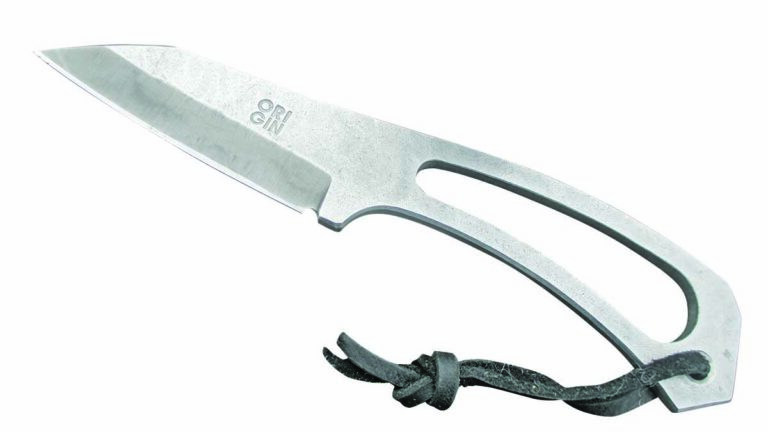
The TILI Ultralight by Origin Handcrafted Goods is a small fixed blade that can fit in your pocket like a pocketknife with no need to figure out how to open the blade or disengage a safety. Pull it clear of the pocket sheath and you’re ready to cut. Among the things I love about smaller fixed blades is that people don’t give you the evil stink eye when you use the knives in public.
Testing The Ultralight
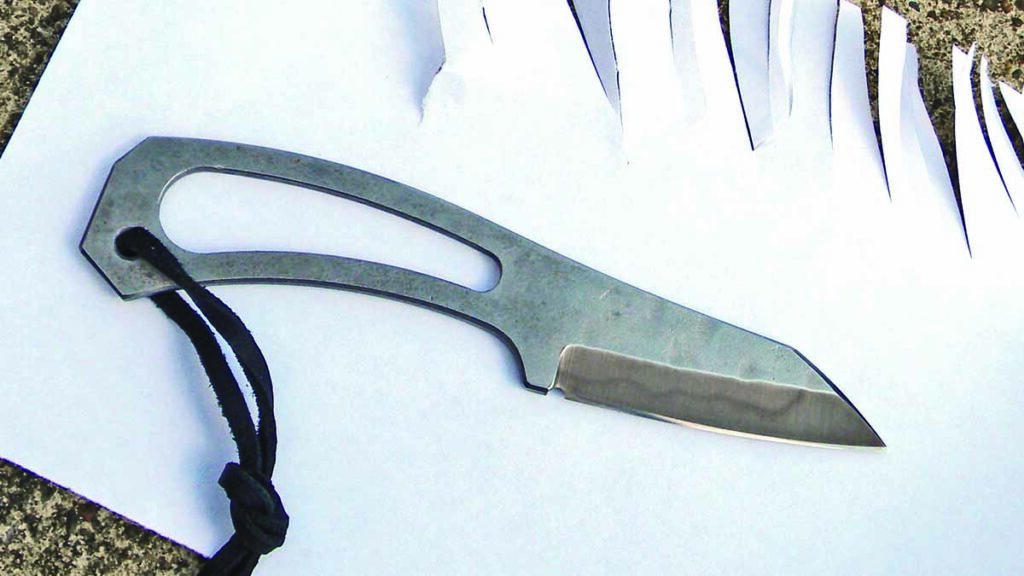
The TILI Ultralight handled slicing copy paper with ease.
I started with a simple paper slice using 20-pound bond copy paper. The TILI sliced very smoothly using both a draw cut and a push cut. The knife was controllable in making the width of the slices—I just had to move my fingers out of the way fast.
Next up: single-walled cardboard. The handle shape of the TILI Ultralight made for extremely controllable slices in the cardboard as well. I could hear the aggressive edge as it sliced. The edge is very fine and ideal for such a job.
Plastic board was next. There was a little more blade grab in this medium as the TILI’s blade bevel is short—around 3/8 of an inch. The full thickness of the blade engaged the plastic board quickly. It still made quick, clean cuts as fast as I could move my fingers.
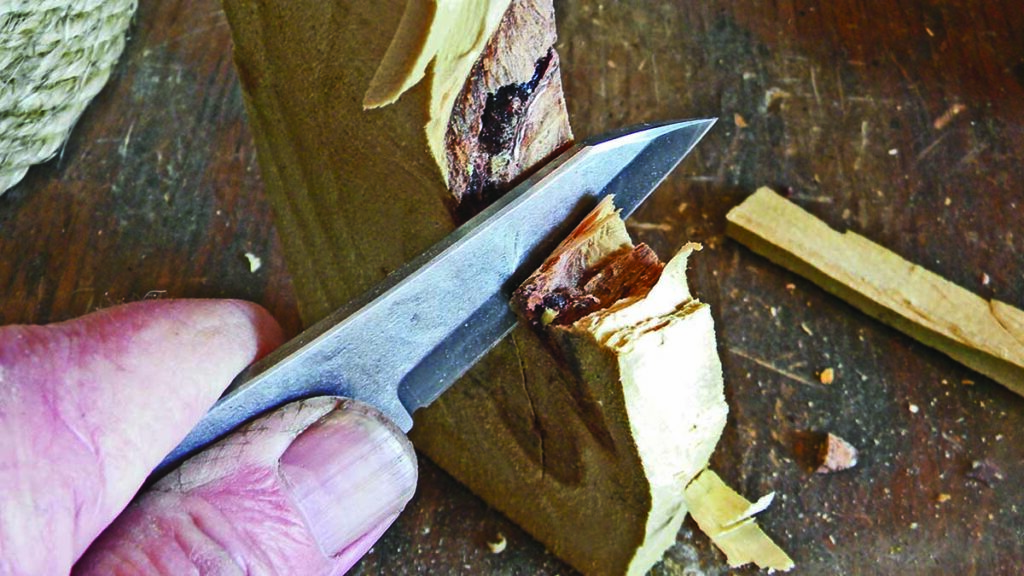
The little fixed blade produced beautiful curly-cues in half-inch pine, producing nice, clean cuts. It was easy to control the depth and thickness of the curly-cues. The TILI Ultralight is great for making fire sticks and a handy little knife to put in a pack. It would be excellent at cleaning small game.
Slicing Through Challenges
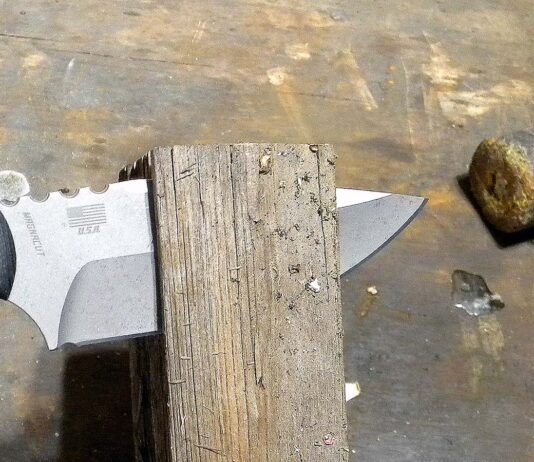
The author drove the edge through a pine knot twice. He felt some micro chipping on the edge but it still cut great.
Skiving leather strips was next on the menu. The blade made a forceful crunching sound as it parted the 8-ounce leather. The small blade was controllable in making the slices thin. It favored skiving with the tip more than with the blade’s belly. This is a very sharp knife!
To push the fine edge more, I switched to 3/8-inch sisal rope. The TILI crunched to 125 cuts before my hand said “enough!” It’s hard to keep the pressure on a thin knife without your hand getting sore somewhere. The edge was still sharp and ready for more.
I switched to half-inch pine for some baton practice. The knife was easy to hold onto and it split the wood great. I even drove the edge through a knot twice. I felt some micro chipping on the edge but it still cut great. The steel might be a point too hard on the Rockwell hardness scale for heavy work. Keep the use to slicing and you won’t have any issues.
The TILI comes with a leather pouch sheath to protect the blade. I would put stainless steel pins in the holes at the end of the sheath to prevent accidental penetration as this knife is very pointy and razor sharp.
Bottom line: The TILI Ultralight is a handy knife that’s a perfect little backup blade for all-around use.
Changes I’d Make To The TILI Ultralight
I would add a couple of thumb notches on the blade and extra protection on the tip of the sheath to prevent blade penetration. (EDITOR’S NOTE: The latter is especially crucial if you carry the knife sheathed in your pocket.)
TILI Ultralight Specs
Blade Length: 2.38 inches Blade Material: 1095 carbon steel Blade Grind: Hollow Heat Treat: Differentially Hardened with Hamon Handle: Skeletonized Steel with hole for included leather lanyard Weight: 2 ounces Overall Length: 2.75 inches Sheath: Black Veggie Tanned Leather Weight with Sheath: 3 ounces MSRP: $125
First Announced At SHOT Show 2023, CRKT And Hogue Knives Announced A New Manufacturing Partnership To Create The Next Generation Of CRKT Knives.
The collaboration between the brands launched at SHOT Show 2023 in Las Vegas with the release of two new American-made knives: the Definitive and LCBK. This new joint effort showcases CRKT’s eye for design, craftsmanship, and making purpose-driven products.
First announced at SHOT Show 2023, Columbia River Knife & Tool and Hogue Knives will join forces in a new manufacturing collaboration. The partnership blends the Oregon-based CRKT’s innovative and user-friendly ethos with Hogue’s long history of precision engineering and will focus on the next era of CRKT knives.
CRKT Definitive And LCBK
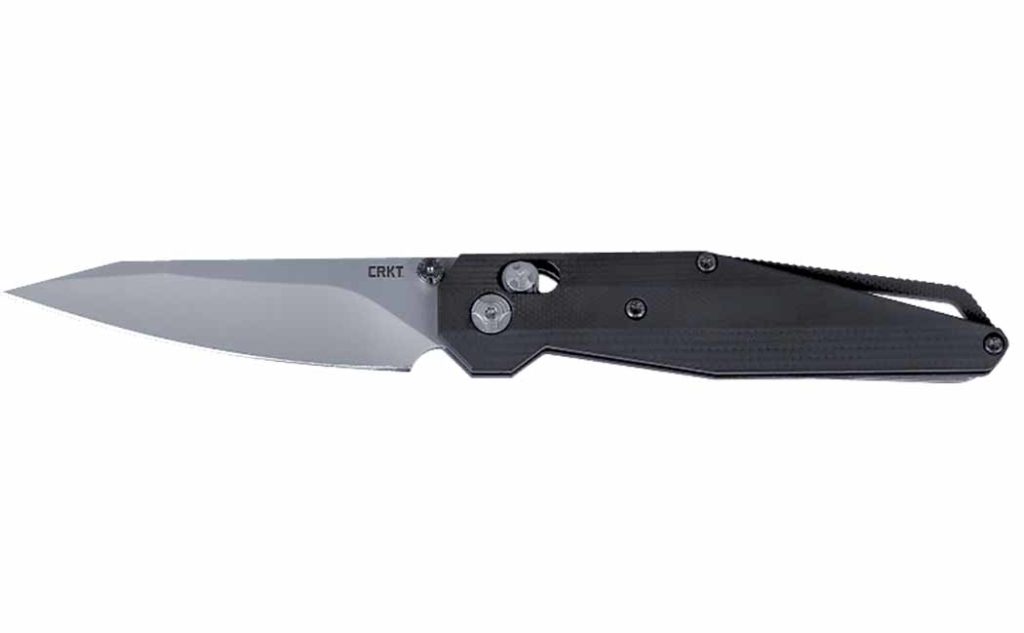
The sleek CRKT Definitive has an MSRP of $215, the same as the LCBK.
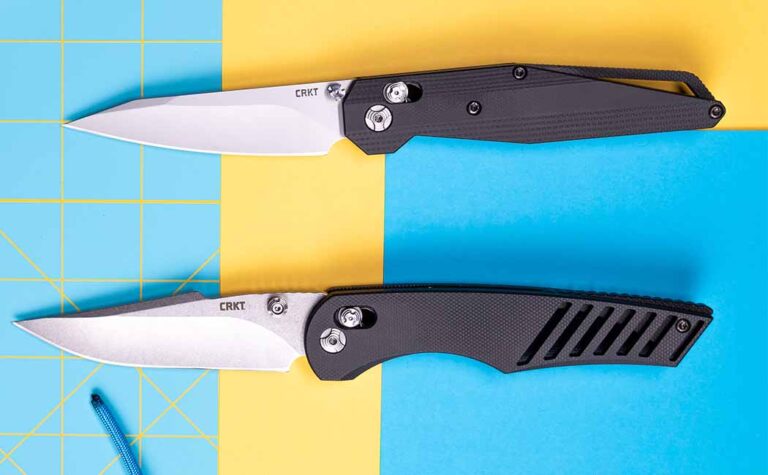
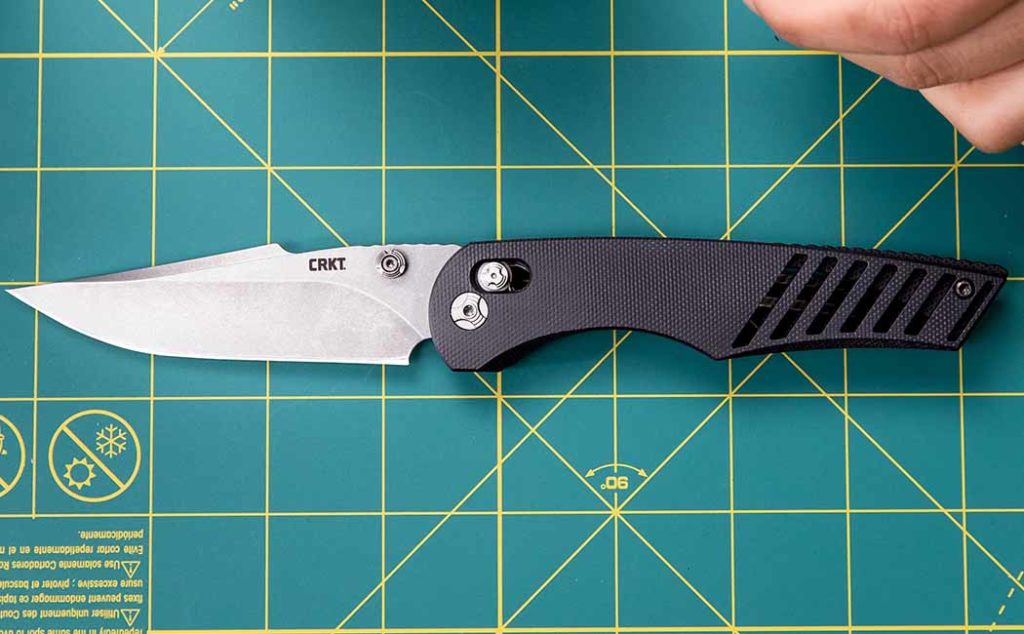
The companies showcased their first two knives together at SHOT: the Definitive and LCBK. Both models are high-end folding EDC knives made from 154CM steel married to a G10 handle. Both are also among the first in the CRKT lineup to feature a crossbar lock, the ambidextrous, one-handed locking mechanism.
The Definitive is the bigger of the two knives with a 3.7-inch blade (vs a 3.48-inch blade on the LCBK), and it outweighs the LCBK 3 ounces to 2.8 ounces. The blade on the Definitive features a stonewashed finish while the LCBK has a bead blast finish.
Both knives have an MSRP of $215.
The Future Of The CRKT/Hogue Collaboration
The LCBK has a bead blast finish and is a light 2.8 ounces.
These knives are meant to be the first launch in a long-term, wide-sweeping alliance between the two companies. Both have said they are excited to work together and learn from each other’s expertise.
“We’ve known the team at Hogue Knives for quite some time and their sterling reputation in the marketplace is well deserved,” said Doug Flagg, VP of Marketing & Innovation for CRKT. “As we looked towards partners in US manufacturing, they were an obvious fit in helping us develop top-notch American-made knives and we couldn’t be more pleased to be working with them.”
“This partnership with CRKT is a natural extension for our business,” said Jim Bruhns, President of Hogue Knives.“CRKT’s penchant for design and willingness to take risks and stand out fits right in with the ethos here at Hogue Knives and we’re excited for what the future holds for both brands.”
Few Blades Are As Historic As The Bayonet. The Knife Has Evolved Into An All-Rounder Still Issued By The Marines.
Oddly enough, the history of the bayonet likely began in the hunting field, not the battlefield. By at least one account, the edged weapon was a tool of the French boar hunter in the 1500s. Tusks and a bad attitude, it’s understandable why these gents strapped their hunting knives to the muzzles of their muskets.
Soon after some enterprising soldier figured the invention–in original French baïonnette–might prove useful in warfare, and the iconic edged weapon was off to the races for the next four centuries. Presently, bayonets have essentially become military relics, if employed generally only as a training tool to acclimate soldiers to close-quarters combat.
Despite this, these fairly antiquated edged weapons still stir the imagination of military heroics of yore. Not to mention, in nearly all their versions, bayonets remain one of the coolest and most accessible historic edged weapons to collect.
In the article, we’ll look at some of the major styles of these modified edged tools, how the implement has evolved and who actually continues to make them. So gird your loins, we’re charging forward on bayonets.
Major Bayonet Styles
A bayonet is so much more than just that. There were, and still are, several different designs of the implement, most mirroring the technology and ethos of war fighting of its particular era.
Plug Bayonet
The plug bayonet is the earliest known bayonet and dates back to the 1500s or 1600s. The idea is rather simple. if you couldn’t use your gun to shoot or simply don’t have time to reload you turned to the knife. In this case, typically a double-edged dagger with a rounded handle that affixed the implatment directly in the muzzle of a musket barrel.
These earliest bayonets were really fully-fledged daggers in their own right. They lacked a proper pommel as can be imagined, but they could be used exactly like any other dagger. Most in this era were used in a manner of last resort. If a soldier found himself out of ammunition or facing a fast-moving enemy, he would likely want to put in his bayonet and hope for the best.
The bayonet at this time was the product of changing warfare. While firearms were becoming more prevalent on the battlefield, they were slow to load. Additionally, the close-quarters combat of the medieval era still reigned supreme. In turn, soldiers required an option to hold off infantry and cavalry charges once their one shot was spent.
Offset (Socket) Bayonet
While it may surprise some, the classic socket bayonet most think of during the flintlock era of warfare was not in full use by 1700. Attempts had been made prior to developing an offset bayonet allowing the soldier to load and fire with it attached. But it wasn’t until several critical battles in the late 1600s that evolution took hold. In particular, the battle of Killiecrankie in 1689. HereScottish Protestant forces were thoroughly defeated by Jacobite Scottish Highlanders, who charged and destroyed their enemy with broadswords and targes.
This defeat came in part due to the plug bayonets the Protestants utilized. In what would be a rather ironic turn, the Scottish Jacobites would eventually meet their end and the end of their cause at the tip of the bayonet. Outfitted with socket bayonets at the Battle of Culloden in 1746, the British were able to let loose a point-blank volley on the charging Highlanders, then finish the rest with their bayonets. The British had even devised tactical doctrine for the use of the weapon, training to a charging man to their side, instead of in front to strike beneath his raised sword arm.
History Of The American Bayonet
The M7 is a legendary American bayonet that is still manufactured today.
Americans were somewhat slow to adopt the bayonet in warfare, giving the British somewhat an edge in the early days of the Revolutionary War. Of course deadly in charges, attached to the British Pattern 1769 Short Land musket–or Brown Bess–the implement also was somewhat a psychological weapon. Said to be the most feared weapon of the British arsenal, the Red Coats mass assaults with a long, gleaming triangular knife at the end of their muskets made all but the most disciplined break.
The Continental Army proved a quick study once trained with the bayonet by Maj. Gen. Baron von Steuben at Valley Forge in 1773. By the end of the war, there were even strokes of genius with the American use of the bayonet, such as when American Lt. Col. Alexander Hamilton (also the first Secretary of the Treasury) led a bayonet-only assault on redoubt 10 during the last days of the Battle of Yorktown.
Early on, the Continental Army utilized a triangular socket bayonet similar to the British, however on the French Charleville Musket. But its use spread and the wicked device was eventually found on the Brown Bess–the most used arm of the Continental Army.
The bayonets in American service were standard European-style socket-mounted with triangular blades. This remains so through several iterations, including the Harper’s Ferry 1801 pattern, 1807 and 1810 Springfield patterns, M1816, and M1855.
The M1855 served through the Civil War, where it saw extensive use on the Springfield rifle muskets. The .58 caliber rifle muskets loaded the same way as old muskets and could fire quickly and were very accurate and had substantial range. The bullets used in these guns had a hollow base that expanded into the rifling when it was fired, thus imparting spin. The war was devastating, and there were many bayonet charges, most with mixed results and high casualties.
More accurate firearms and the introduction of repeating arms mitigated the effectiveness of the bayonet during the Civil War. It is estimated, only around 1 percent of all casualties were a result of bayonet wounds.
Sword Bayonet
Pattern 1907 Bayonet. (Source: CC by 4.0)
Despite the effectiveness of “cold steel” assaults waning in the face of technological advancement, the bayonet persisted, though evolved to remain relevant.
A more interesting detour around the time of the American Civil War, was the multi-purpose sword bayonet used by the British. The British Infantry Rifle of 1800–1840–later known as the Baker Rifle–utilized this style. The idea, essentially, was to give soldiers the ability to stave off cavalry charges when used as a bayonet, but also outfit them with a side arm–a short sword–for close-quarters combat. These sword bayonets had knife handles mated to exceedingly long blades, sometimes over 20 inches.
Surprisingly, this style of bayonet was used all the way into World War I, despite little evidence the elongated blade provided any advantage. Perhaps the most famous final rendition was the Pattern 1907 Sword Bayonet, found on the British Short Magazine Lee Enfield rifle in the Great War.
The American bayonets of the pre-WW1 era were a bit more well-designed. The bayonet designed for the American Krag rifle (the M1892), for example, had an 11.7-inch blade and could serve as a camp tool as well for daily chores. The Americans ended up following the Europeans’ lead in World War I a bit with the M1905 bayonet, which sported a 16-inch blade. Additionally, there were 17-inch versions used on the trench shotguns and backup rifles like the M1917 Enfield.
Knife Bayonet
The M9 bayonet works as a traditional bayonet but is more commonly used as a fighting/camp knife.
After WWI, most militaries of the world focused on making the bayonet in the form of a camp knife, something that was worth it to carry for general use that had more than one regular use. The time leading to WW2 produced the highly functional and realistically-sized M1 bayonet for the M1 rifle. The M1 carbine was also set up to use one, and it had its own small setup in the M4 bayonet knife. These knife-style bayonets eventually ran through several iterations leading up to the M7 bayonet for the M16 rifle in the late 1950s.
As a regular tool, the knife bayonet is great and doesn’t remove any of the function in either role. It can be used for all sorts of tasks and also be mounted on the gun. The later M9 became a full-on utility and fighting knife for the M16 series. It is a large, Bowie-style knife that closely resembles the Ka-Bar. It added some additional utility features like serrations for cutting straps and rope and a wire cutter. Later on, the OKC-3S knife bayonet was adopted by the USMC. These remain standard today.
Bayonet Realities
The reality of the bayonet is that it is not a principle fighting weapon. Today we are seeing most rifles fitted with a mountain of accessories, from variable power optics, lasers, suppressors, and bipods.
The bayonet has, for most of its history, been a weapon of intimidation. Very few times did any two armies charge each other with bayonets, usually one side fled first. Even in our modern era there have been bayonet charges, but again to no effect other than to scatter the enemy.
Edged weapons do have a role in modern warfare; everyone needs a good knife at minimum. If your rifle has no provision to attach one or you’re using a suppressor, there is no real need to carry a bayonet specifically as opposed to a dedicated knife that serves your purposes.
Bayonets will always be a curiosity not because of how they were used, but rather why they were used well beyond their abilities. While it is certainly a dangerous thing and absolutely lethal, getting that close to your enemies means you’re having an exceedingly bad day. But, as history has shown, a man with a sharp stick and nothing to lose can sometimes win the day.
The Dirk Has A Long, Exciting History And Has Been Used For Everything From Farming To War All Around The World.
The general definition of a dirk is that of a one-handed thrusting knife. Depending on region and style, it may be single-edged or double-edged. It also may or may not have a defined cross guard and pommel.
Dirk as a term is loosely associated with several Scottish and English regions. It is most commonly credited to the former, though no one really knows for sure, and it also has a long history of use across medieval Europe. It was a very important object to people in the Highlands of Scotland at an individual level and had significant ceremonial and practical uses.
Weapons Before The Dirk
As is common in the era of gunpowder in Europe, many types of knives and daggers owed their roots to the bollocks dagger and other stabbing weapons that originated hundreds of years prior when soldiers wore heavy armor. Contrary to popular belief, most swords are not like how you see in the movies. These stabbing and thrusting weapons seldom had what we’d expect as edges, rather they were made to parry and bludgeon. Maces, picks, and hammers were very common in this time, prized for their ability to bash and smash, where swords, while deadly, were not always the first choice.
These long, thin daggers were sometimes the choice when things got up close and personal, though even then the textile layers of armor were hard to penetrate. All that changed with gunpowder weapons causing a wide decline in armor use, and the dirk as we know it today was the product of that evolution. The dirk became something quite different than other edged weapons of the time and developed in its own way, largely apart from other European designs.
The Scottish were some of the first to begin independent development of swords and daggers alongside guns in the post-armor age along with strategies to fight against firearm-equipped soldiers. The heavily tribal Scottish Highlands were not especially invested in standardized firearm technology.
Guns did figure heavily into the culture, but the Scottish never developed a well-oiled machine akin to what the British developed when it came to battles. The Scottish had two primary tools for the battlefield, the broadsword and the targe (buckler), itself a small shield held in the weak hand. The combination of buckler and broadsword allowed the Highlander to easily kill British soldiers, usually armed with nothing more than a musket and bayonet.
They specialized in fast ambushes, often called a ‘Highland Charge’ where they wore virtually no protection of any kind and ran headlong at their enemy. If the enemy didn’t flee on sight, they would only have one shot at most before they had to fight hand-to-hand.
How The Dirk Developed
The dirk traces its lineage to the Scottish Highlands.
The dirks developed in the post-armor era became focused on all-purpose use, not just stabbing or bludgeoning. As a result, sharp, light-bladed swords and short-sword like knives and daggers became the norm.
Slashing through clothing wasn’t difficult and the Highlanders found themselves at a distinct advantage using these tactics. That is, until the Battle of Culloden in 1746.
Here the entirety of the Highlander army was soundly defeated by the British in a battle that lasted an hour. The British faced them on an open field and modified their tactics to anticipate the Highland Charge, resulting in a complete defeat of the Scottish Jacobite movement that had made an invasion into England a year earlier.
Dirks were common even after Culloden. The carrying of knives wasn’t necessarily seen as carrying arms in most cases, and dirks were something of a common, everyday tool for most people. They would be not only used for self-defense but also for regular tasks like eating, splitting kindling, and standard daily chores.
Dirks vs Daggers
Is the dirk a dagger? The short answer is yes and no, and that is because there is a great degree of ambiguity in the definition. A dirk is classically a large, single-bladed knife with a blade anywhere from 12 inches all the way up to 20 inches.
Naval dirks were commonly used for ship-to-ship fighting as they were short enough to be used in tight confines yet large enough to still be effective. Daggers at this time would have been primarily understood to be stabbing weapons, whereas the dirk was large enough and stout enough to be used in a primary slashing role.
Daggers are, by type, geared mostly for stabbing. Rarely do companies refer to any large, single-edged knives as ‘daggers’, but the dirk is often classified right alongside them by name in many laws.
The American dirk which evolved in the early 1700s, was almost always single-edged and was primarily used as a support knife alongside the tomahawk and rifle. It could be said that a significant and wide-ranging number of knife styles, including the Bowie, evolved directly from the Scottish dirk on the American frontier.
Daggers as stabbing knives were somewhat uncommon in America because they lacked general utility in the field at a time when larger camp knives and multi-purpose tools saved weight.
Is It Legal To Own A Dirk?
Unfortunately, Dirks have a wide legal definition across the board that often describes them as daggers or stabbing weapons. In many municipalities, this type of weapon is not legal to carry. There is a blurred line in this definition, as many places considered double-edge, stabbing weapons as the verboten item. As many historical dirks are single-edged, there could be room in these laws that skirts one definition or another.
4 Best Dirks Available Today
COLD STEEL SCOTTISH DIRK- $119.99
Cold Steel is well known for making some very durable and interesting products. They pay great attention to detail and their Scottish Dirk is no different. While it is not the most costly, it is a step above the rest, and it is affordable and backed by Cold Steel’s legendary standard of excellence. The Cold Steel Scottish Dirk is a working tool that does everything the historical versions did and then some. If you’re looking for a hard-use dirk, look no further.
Knife Specs
Overall Length: 18.38 inches
Blade Length: 13 inches
Weight: 1 pound
Blade Steel: 1055 Carbon
Handle Material: Rosewood
WINDLASS BONNIE SCOTTISH DIRK- $149.00
If you’re looking for a prettier dirk than the rest, Windlass makes some excellent historical replicas that reflect various periods of Scottish history. The Bonnie Scottish Dirk is reminiscent of the late stage of refinement on these weapons. It is ornate yet functional and is sure to be a conversation starter. While other companies tend to take some liberties, this is a very accurate replica of what may have been on the belts of Highland Warriors at the Battle of Culloden.
Knife Specs
Overall Length: 17.5 inches
Blade Length: 11.75 inches
Weight: 18 ounces
Blade Steel: 1055 Carbon Steel
Handle Material: Wood
WINDLASS EARLY SCOTTISH DIRK- $139.95
This product is a replica of some early dirks as they would have looked descending from the bullock dagger. A functional reproduction, this early replica features a more basic feature set as would’ve been seen a few hundred years prior to the Battle of Culloden. Although it has unrefined features, it is still not out of place for costuming or period reenacting.
Knife Specs
Overall Length: 21.25 inches
Blade Length: 15 inches
Weight: 16.2 ounces
Blade Steel: 1055 Carbon Steel
Handle Material: Hardwood
CAS IBERIA (LEGACY ARMS) SCOTTISH DIRK- $159.00
This dirk has some classic lines, but is all about function. It will not look odd at a cultural event, although it is made with a slight skew to the modern. The handle design is reminiscent not of the bullock dagger, but the earlier Rondel form characteristic of the late medieval era prior to the renaissance. While it is the most expensive so far on the list, it is right in the same price range as most common dirks. If you prefer this look over the more classic Scottish design, this is the one for you.
Knifemakers Continue To Evolve Their Use Of Social Media Platforms To Promote Their Work And Expand Their Customer Base.
It’s been around a while now—long enough for an update on its relevance and impact on the knife industry. Meanwhile, social media in some ways remains a new frontier for both knifemakers and the market.
It isn’t unusual for those interested in buying an existing knife or commissioning one from a pro to use social media such as Instagram, Facebook, and other windows into the lives and work of custom makers. The media provide outreach and information on an unprecedented scale, and custom makers who take advantage of the opportunity to put themselves in front of the buying public take different approaches.
Some use video, others still photos. Some use music, others narration of what the viewer is seeing. Some allow the hum and whir of machines or the ring of the hammer to set the tone and convey the message. The answers to the questions of where and how to apply social media in their work lives vary among makers, but the involvement of social media in their marketing and sales efforts has become a regular part of their routine.
“Instagram broadens the customer base, and if you aren’t using it you are missing out on that client base,” related knifemaker/5th Special Forces veteran/BLADE® field editor Kim Breed (@kimbreed1911 on Instagram). “I was dead set against it, but my son Keith got me going and said that it was something I needed to do. You can target your audience with a hashtag, and then when someone searches for something in particular it will come up.”
Kim likes to use music as a backdrop for his videos and especially enjoys the rock band AC/DC (the band’s song “Thunderstruck” is among Kim’s favorites). Of course, there are other musical selections, and he ties the tune into what is happening on his Instagram and Reels posts.
“When I’m doing hand hammering or power hammering, I love AC/DC,” he smiled, “and sometimes I’ll use dramatic songs when I’m etching, or whatever. Instagram is easy. I can do it on my phone and post it in five minutes, and I’m sure you can do the same thing with Facebook.”
Since the social media surge, Kim has found that how-to video posts are more popular than pictures of knives alone. He also advocates frequent posting of relevant work in progress.
“I try to post something at least once a day,” he remarked, “and it may be something like etching damascus steel. I get good hits and feedback on that and anytime I post videos working with a milling machine or grinder so people can actually see me building a knife.”
Making Social Media Work For You
Isaiah Schroeder, whose forged gyuto was featured on page 82 of the October BLADE®, uses both Instagram and Facebook and publishes an email newsletter around once a month with his latest knives and prices. That way, everyone signed up for the newsletter gets it at the same time and has an equal chance to get one of his new knives. (SharpByCoop image)
Isaiah Schroeder uses both Instagram and Facebook with the handle @schroederknifeworks and has found a much wider audience than might otherwise have become familiar with his work. He is regularly in front of his followers with updates and information.
“I started doing my email newsletter [www.schroederknifeworks.com/newsletter] several years ago,” he commented, “mostly so that I don’t have to be completely dependent on Instagram’s algorithm to show my customers when my new work is available. With this newsletter, everybody who is signed up for it gets it at the same time and has an equal chance to get one of the knives. I do the whole thing myself using a service called Mailchimp, which just makes it easier to keep the list and format the content. My goal is to have one batch of knives per month and one newsletter per month.”
Schroeder uses Instagram primarily but cross-posts to Facebook when preparing social media input. He sees Instagram as a way to reach more people, and a gallery of his work conveys the quality of his knives and materials he uses. Recently, he has seen short videos take hold and is using these to reveal his shop work. The result has been dramatic.
“Instagram has been great for my business,” he smiled. “I’ve sold knives around the world because of it. I focus on cooking knives, and there is a large foodie presence on Instagram so that meshes well with my content.”
Isaiah also appreciates the free flow of information afforded by social media, everything from the knifemaking process to presentation to pricing. The volume of information at the fingertips of the viewer is incredible, and knowledge is buying power.
“I’m not too shy about posting my prices for the public to see,” he reasoned. “I’ve always wondered why some makers won’t post prices. It’s something people always ask about, so they clearly want to know. I’d rather make it known. Then people can have time to decide whether they think it’s worth it for them or not. I guess it might be different if I were selling through a retailer or making custom orders.”
Knifemakers Grow Their Brand
For his custom knives, Mike Vagnino indicated posting work in progress seems to get the best response and exposure regardless of whether they are still shots or videos. (Vagnino image)
Just getting a custom knife enterprise off the ground from a marketing perspective can be a huge challenge, and when custom knifemaker Mike Vagnino and business partner Patrick Ma kicked off Terrain 365, they immediately began looking for ways to raise their new company’s profile.
“Our primary source for promoting the business is social media, which has worked very well for us,” Mike explained. “Our goal, of course, is to sell knives by making people aware of our brand and drawing them to our website. Patrick handles our social media for Terrain 365, and the key seems to be posting often and consistently.”
While Mike emphasizes he is no social media expert, he acknowledges social media’s inclusion in a sales-and-marketing strategy will pay dividends.
“I use Instagram and Facebook primarily to promote my custom knives and any new projects I’m working on, not necessarily to generate immediate sales, but to keep my name out there. For my custom knives, posting work in process seems to get the best response and exposure regardless of whether they are still shots or videos. I choose not to speak during the video because I think what I’m showing is explanation enough—not because I think it’s more intriguing—although that may be the effect. Actually, I think telling a story might help if it’s interesting enough, but keeping the video short to match the people’s attention span nowadays is what I keep in mind.”
In promoting Terrain 365, Mike and Patrick have found that outdoor photos of the knives in action work best. Since their company is geared toward everyday carry knives and those that are ideal for use in the outdoor environment, their knives are constructed in rust-proof, non-magnetic materials. Take a look at Mike on Instagram @michaelvagnino.
Making First Impressions
David Lisch says Instagram may be the place many knife consumers see a maker’s work for the first time, so everything the maker posts should be first rate.
ABS master smith David Lisch issues both an endorsement and a warning when it comes to his use of social media.
“I have found that social media is both a blessing and a curse,” he observed. “It has been a struggle for me to find a balance. If you let it, social media can eat up so much of your time, time you could spend creating, making, and being in life. It is important to find the balance.”
Indeed, every opportunity carries a requirement for thorough evaluation and an awareness of the unintended consequences.
“I have focused my social media on Instagram primarily,” David added. “It is where I share my knowledge and sell my knives and meet my students. I have taken time to figure out what works for me and how to present myself. It might not seem like it at times, but I take Instagram very seriously.”
For those makers beginning to consider social media as an enhancement to their overall livelihood, Lisch provides a voice of experience and makes a few sound recommendations.
“My advice for knifemakers new to Instagram is to treat your feed like a portfolio page. This is the place people will see your work, maybe for the first time. It is your first chance to make an impression on a potential collector. Go in and clean up your feed on occasion and remove any stupid stuff.
“Keep it engaging,” Lisch continued. “Show work in progress as well as finished work. Use your storyline to keep folks up to date with what you are working on, or what is happening on a lighter side. Because your storyline is only up for 24 hours, it is self-cleaning. It is a great opportunity to have fun and connect with the folks interested in your life. Be yourself; do not try too hard to create content that is not you. Use hashtags and try different ones. Post to Reels, and if they are good they may go viral. As your audience grows, remember you are also a role model. If you are working, wear your safety gear. Be real.”
David can be found on https://www.instagram.com/davidlisch/. Click “Highlights” on his Instagram home page for his free video classes.
The social media phenomenon is sure to stay with makers into the future, and participating in the most effective ways will produce the desired benefits for them and their customers. True enough, getting involved may be a bit intimidating, but taking the plunge is becoming more of a necessity every day.
Acclaimed Makers Tom Krein, Jerry Moen, And Ben Breda Take Us Into Their Workshops And Show Us How They Turn Steel Into Knives.
For Tom Krein, making the shop comfortable is a big step in being productive and efficient.
“While it might not be quite what you expect, I consider things like a restroom, central heat and air, and a full kitchen as things that keep me at the shop and productive,” he commented. “I’m often here 12-to-15 hours a day, and having these available makes me comfortable and able to work longer. While it’s probably not something that would immediately come to mind, I consider this setup one of my most useful tools.”
Since Tom’s shop is not at his home, these add-ons make a difference in time and travel. No doubt, the ability to work and then take a quick break improves the quality of his finished knives as well.
When hard at work, Tom utilizes several key pieces of equipment. A variable speed mini mill from Little Machine Shop is a workhorse.
Tom does his CNC work on his HAAS Super Mini Mill.
“I have two of these that are very similar,” he said. “I’ve used these to build many folders. They take a lot more time than a floor model Bridgeport, but they can get the work done. Now that I have the HAAS CNC, I mostly use these for precision drilling, deburring and counterboring.”
While working for long-time custom maker Bob Dozier in 1998, Tom bought a grinder from his employer.
“I actually got paid to put it together,” he smiled. “I grind on it day in and day out. It wasn’t cheap when I purchased it, but it has never let me down. I’ve literally ground thousands of blades on it.”
Dozier was also influential on another of Tom’s most important shop tools.
“Bob helped me build a variable speed buffer in 1998, too,” Tom said. “This is another machine that I use on every single knife multiple times. I don’t know how I would make knives without it. It is currently set up with a ¼-inch cardboard wheel on the left-hand side for sharpening and a deburring wheel on the right-hand side.”
Tom Krein gravitates more toward making folders these days, such as his Alpha model. (Whetstone Studio knife image)
Tom has been making custom knives for nearly 30 years, and he is gravitating more toward folders now due to a touch of arthritis in his hands, but continues to make some fixed blades. His signature materials are D2 tool steel—a preference he gleaned from Dozier—and NitroV stainless steel as well. He uses a lot of G-10 and Micarta® for handles along with stabilized koa, stag and mammoth.
Jerry Moen
The day-to-day grind in the custom knifemaker’s shop is typically only as productive as the maker’s tools will allow. Skill, investment of time, and precision in the finished product are heavily influenced by the function and quality of the tools, and what the available equipment will allow.
For veteran knifemaker Jerry Moen, his best offerings from the shop are homegrown to a great extent. After selling a large number of shop tools and pieces of equipment to custom knifemaker and friend Todd Begg a few years ago, he regularly employs his own creations from Moen Tooling.
The Moen Blade Grinding Fixture includes carbide file guide blade clamps, a rugged anodized coating, friction-free nylon gliding surface, dual handles and adjustable blade standoffs. Jerry demonstrates it here in conjunction with the Turbo Grind Evo3 at BLADE Show Texas 2022.
“I use the basic stuff in my shop when I’m making a knife,” Jerry began, “so there really isn’t anything special about those things. But the platen from Moen Tooling has been a game changer for many makers who have ordered it so far. I can’t thank Princeton Wong enough for his contribution to Moen Tooling, either. Princeton is a brilliant young engineer, and I first realized his talent at the Fort Worth Show when he won best new maker.”
The platen indexes the knife blade and virtually eliminates the problems with belt bumps and heat that go along with other such products. The result is better symmetry and a smoother grind. The grinding process is also cooler, allowing the maker to use finer belts and minimize the bump.
“I’m a user of all the grinding fixtures Jerry has produced,” commented custom maker Tom Overeynder. “Using the new platen and grinding fixtures will greatly jump start new makers as well as old timers in accomplishing more accurate grinds. The user can hog off stock and can do the most delicate jobs. Overall, I love it and highly recommend it to anyone interested in doing top drawer workmanship.”
Moen pairs his platen with two other indispensable pieces of shop equipment. The first is his functional Outlaw grinder, and he believes it is adequate for the jobs at hand. However, he is close to a deal with AmeriBrade to promote its products.
He has also developed the Moen Blade Grinding Fixture, which includes carbide file guide blade clamps, a rugged anodized coating, friction-free nylon gliding surface, dual handles and adjustable blade standoffs. The dovetailed clamps help with transitions and the fixture is well-suited for flat, hollow or small-wheel grinding.
“This fixture takes all the guesswork out of it,” Moen noted. “It’s all indexed perfectly, and you can set angles where you need them. It holds the blade and sets the bevel you put on it, and you can flip it from one side to the other and take it to a 1200-grit finish in 30 minutes.”
Jerry sold Princeton 25 percent of Moen Tooling some time ago, and the two have made an impressive team.
Jerry Moen makes fine folders such as this one in a lightning-strike carbon fiber handle and is founder of Moen Tooling. (Eric Eggly/PointSeven knife image)
“He can do CAD and has helped with the design on some of our new stuff,” Moen added. “I might be the one with imagination but I depend on the best people I can find for what I’m short at.”
Custom maker Bob Ohlemann has put the Moen platen and fixture system to work as well.
“These days, I spend about as much time teaching knifemaking as I do making my own knives,” Bob remarked. “Most of my ‘dress tactical linerlock’ students are established makers looking to expand their skill set and offer new products to their customers. One of the most important techniques students look to learn in my classes is how to create high-precision bevel grinds with beautiful sweeping plunges and reduce their time hand finishing blades. This is where the Moen Tools platen and fixture system excel.”
Ben Breda
American Bladesmith Society Journeyman Smith Ben Breda tackles the forging of custom knives with an array of proven shop tools and equipment.
He has been forging knives for 10 years and has been full time for six of those, specializing in chef’s knives, hunters , bowies and fighters. He uses premium handle materials such as wood burls, stag and ivory. When fully engaged making knives, Ben has John Perry handle broaches nearby.
“These are a must for properly fitting hidden-tang handles,” he explained. “They are very well built and make fitting handles effortless.”
Ben said his John Perry handle broaches are a must for properly fitting hidden-tang handles.
Ben’s variable-speed-head Bridgeport milling machine is in continual use, and for good reason.
“This machine allows the maker to fit guards quickly and accurately, which is a must in any knife shop,” he commented. “This machine was a Craigslist find and similar machines often come up for sale. They are pretty easy to find.”
Pounding away at a piece of steel is part of the process for Ben, and he depends on a 50-pound Little Giant Power Hammer to get the job done.
Ben Breda counts such majestic bowies as this one among his specialties.
“With this old mechanical hammer, the maker can break down large steel stock and damascus billets and forge blades with ease,” Ben noted. “I bought this hammer from a retired knifemaker and had it shipped to my shop.”
Ben identifies the Wuertz TW90 belt grinder as another of the most important tools in his shop.
“Blades can be ground to very precise dimensions with this,” he related, “as well as hardware shaping and, of course, sculpting knife handles. The machine can be used at slow speeds for wood and high speeds for grinding steel away fast. It comes with several attachments as well as a horizontal option, making it a very versatile machine. These grinders can be bought directly from the Wuertz machine company.”
The CRKT Skeggox Is A Fun Little Hatchet That Swings A Big Game And Can Handle The Daily Tasks Around Your Property
A good hatchet is worth its weight in gold, and in the case of the CRKT Skeggox it weighs just 1.63 pounds.
This fun, tactical hatchet is one of the newest offerings from CRKT. I had the chance to try it out on my property as winter descended. I had never used a hatchet before. I don’t think I’ll be needing to get another one for quite a long time.
What Is The Skeggox Made Of?
Let’s start with the particulars. The Skeggox is 12.94 inches long with a 4.83-inch blade made from SK-5 carbon steel for good edge retention. The glass-reinforced nylon handle is lightweight, cool, and feels excellent in the hand when swung. The blade is powder coated for extra corrosion resistance and gives the Skeggox an all-black look.
The hatchet includes a thermoplastic sheath that I loved. It has a clip to fasten it securely shut, but it fit so snug that you could easily travel with it and not clasp the clip (although you absolutely should).
Testing the Skeggox
The vines I first went at with the Skeggox
When I went to test the Skeggox I had the perfect patient: this nightmare of vines and saplings in my backyard. Before the arborist came to remove it all I took the hatchet out there to see what it could do.
With the vines it was a thumbs down. The thin, almost grassy material was not easy to chop through. The fact that the blade would slide off of the vines instead of slicing through made me uncomfortable because I didn’t know where the blade was going to go. I quickly moved onto the saplings, which were entwined with the vines in their upper reaches.
But as you can see, these saplings were the perfect size to really see what the Skeggox could do. And boy howdy, could it do a lot!
The saplings before meeting the Skeggox.
I went to work swinging the hatchet with a smile on my face. The Skeggox is weighted so well that each swing made me want to swing it again. I was wearing my outdoor gloves and the handle never once slipped as I chopped at the tree.
It took a touch over two minutes, and it wasn’t the cleanest cut, but in the end, the sapling stood no chance.
The sapling after meeting the Skeggox.
I’m also getting my fence replaced in a few weeks so I took the Skeggox and began laying blows into the tops of the fence posts. I went as hard as I could to beat up the hatchet as much as possible.
Final Cut
And finally, I returned to my kitchen, put a fresh Campari tomato on a plate, and drew the Skeggox down toward it. It went through like a hot knife through butter. Then, for good measure, I even quartered the tomato just as easily.
This is an excellent piece of kit. I can’t recommend it more highly. If you own a home and are looking for an affordable hatchet to use in the yard, this is the piece to get.