A Woodworker By Trade, Matt Williams Crafts Knives Meant For Rugged Use, Including His BBQ Chef’s Knife.
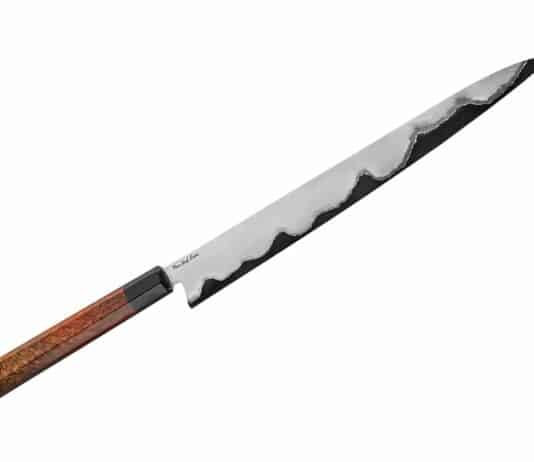
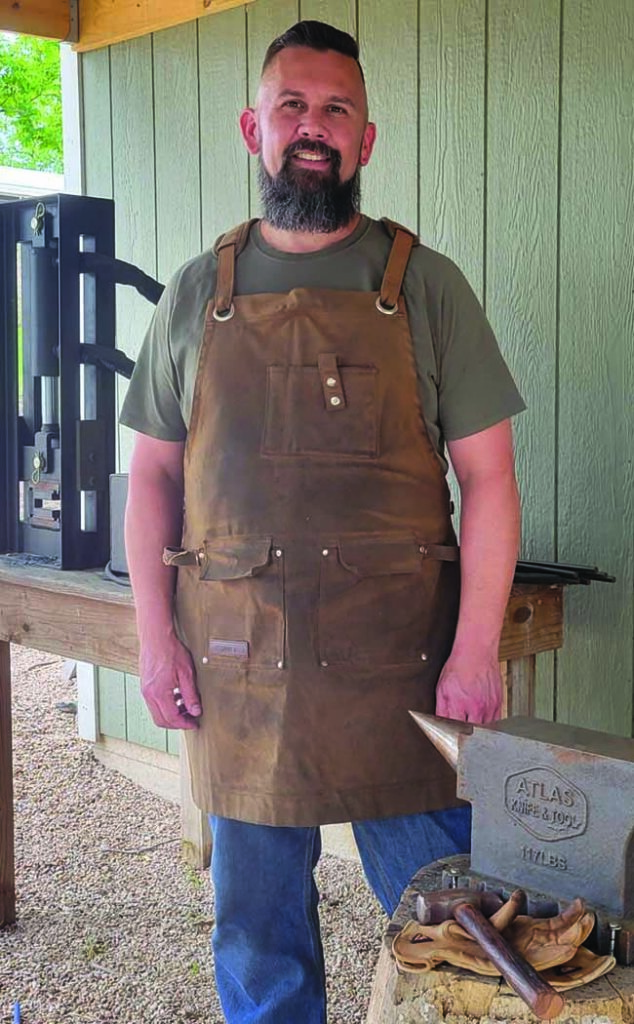
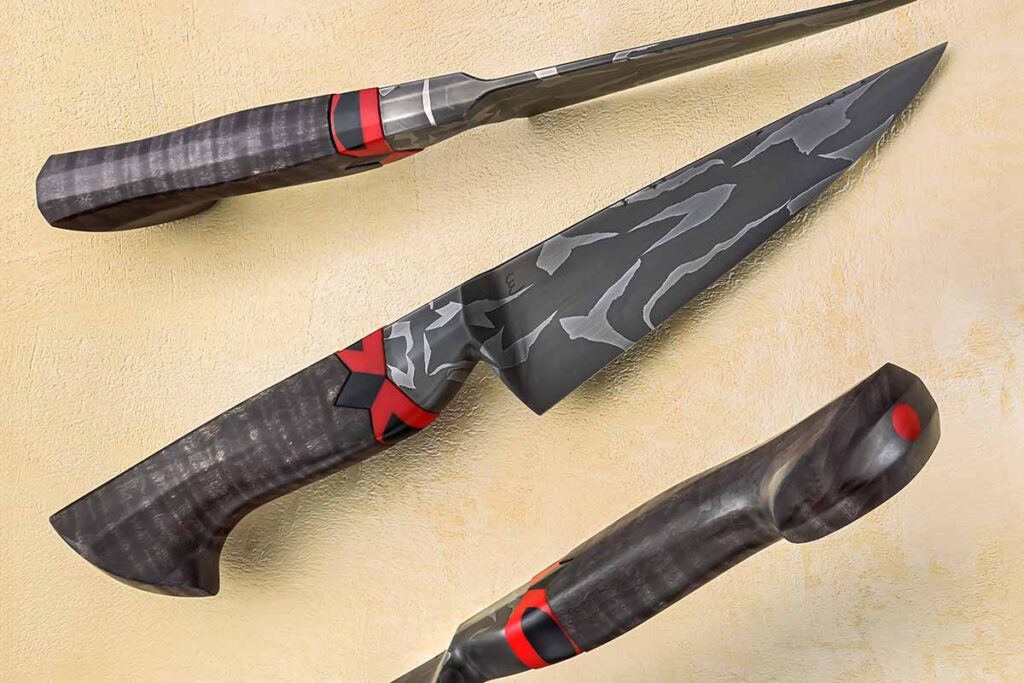
A woodworker by profession that includes making cutting boards, Matt Williams got into knifemaking too and is glad he did because of the feedback he gets from customers. His BBQ Chef’s Knife is a case in point.
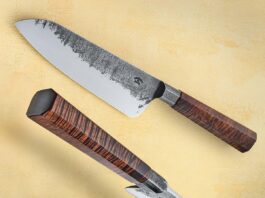
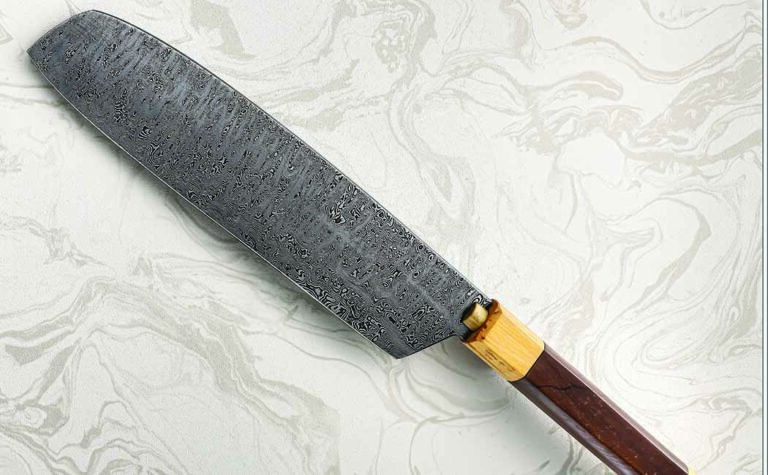
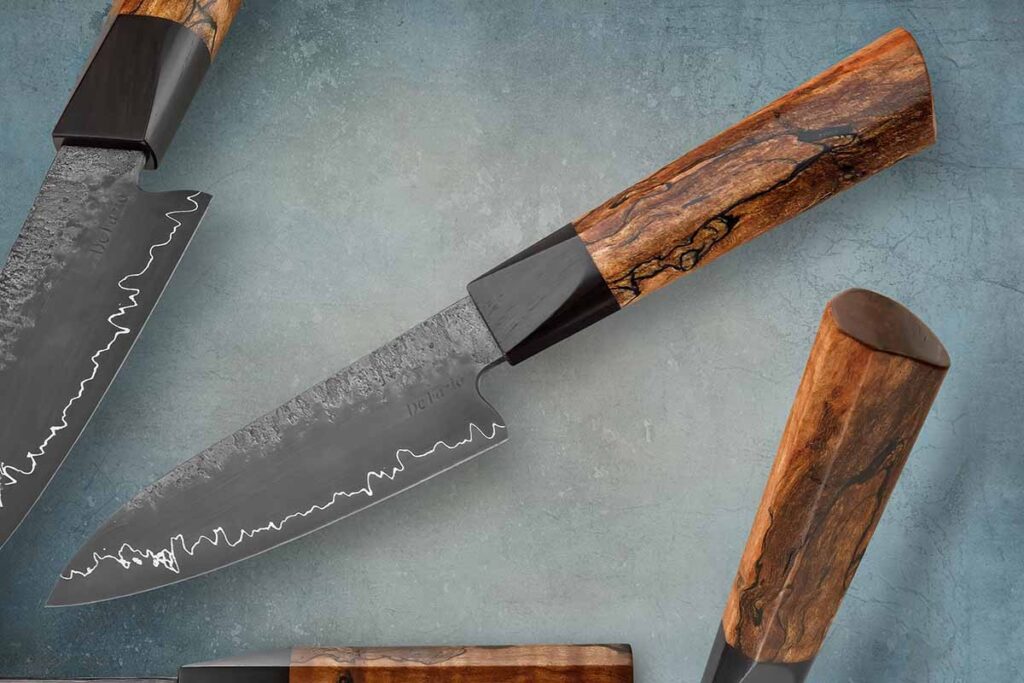
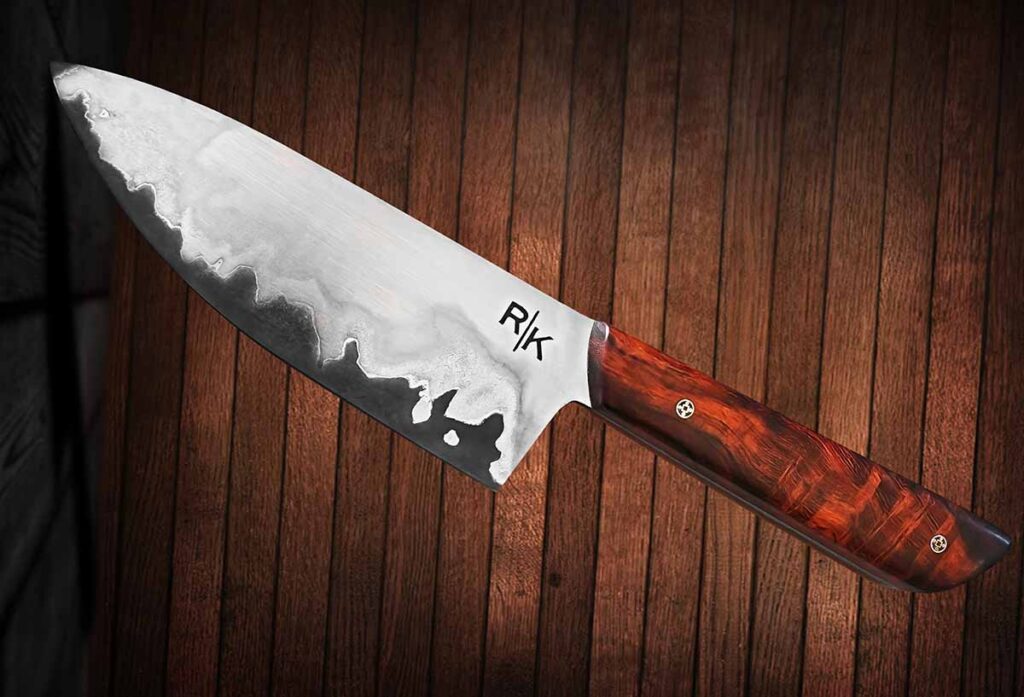
His clients told him his chef’s knives were too thin, especially the local Texas barbecue chefs who need thick, tough blades for separating ribs and joints in competitive barbecue events. As a result, he built the BBQ Chef’s Knife on a santoku cutting base with a thicker blade and a “really aggressive feel” built to take abuse.
Matt lives on an old pecan orchard by the Colorado River and stabilizes and spalts the pecan for his turned-wood handles. The handle for his BBQ model is done in a wa style split down the middle with round dowels of white oak left proud to contrast with the darker pecan. He also forged the steel and made pretty much everything but the coffee for the blade etch.
The combination of his new-style chef’s knives and cutting boards is just the ticket for the highly competitive local Texas barbecue chefs. Along with his custom knife work, Williams also makes one-of-a-kind cutting boards as well that he sells through his website.
BBQ Chef’s Knife Specs Blade Length: 9 inches Blade Material: 400-layer damascus of 15N20 nickel alloy and 1084 carbon steels Hande Material: Spalted pecan, cedar elm and white oak Handle Style: Wa Overall Length: 15 inches Knife To Know: The blade tapers from .169 of an inch at the thickest point to .05 of an inch at the thinnest point Maker’s Price For A Similar Piece: $750
Looking for a blade to cut to the quick of most kitchen chores?
As a knife guy for pretty much my entire life, I can own up to the fact that I don’t collect knives, I hoard them. Among the hoard are kitchen knives. I even scour secondhand stores looking for discarded gems or diamonds in the rough. Having said that, I must admit there are only a couple that are my go-to knives in the kitchen. One of them is my old Regent 6-inch-high carbon steel cleaver.
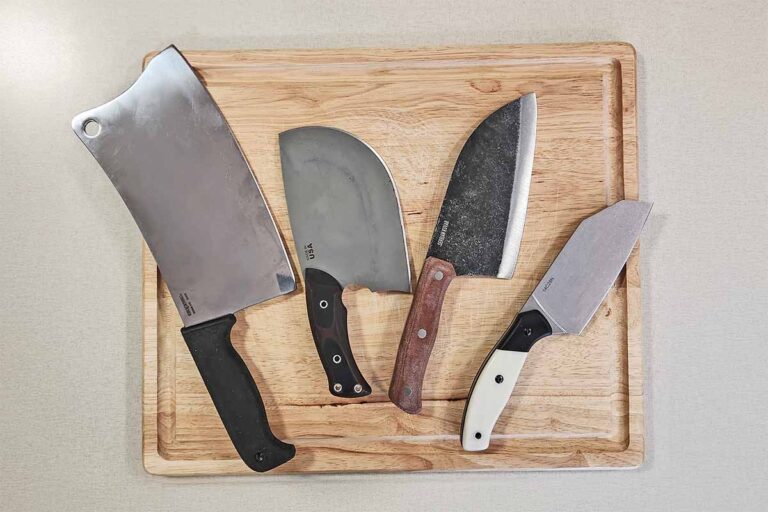
In a sea of kitchen knife styles with various design influences, it seems we periodically return to the cleaver. I use mine for almost everything and love it. Next to my Victorinox paring knives, I could not imagine a kitchen without it. Therefore, this time we look at four cleavers, some traditional and some with a modern twist.
Best Cleavers Specs Comparison
Cleaver
Overall Length (inches)
Blade Length (inches)
Blade @Thickest (inches)
Blade Steel
Handle Material
Sheath
Weight (ounces)
MSRP
Country Of Origin
Cold Steel Cleaver Commercial Series
13.75
9
.137
German 4116 stainless
Kray-Ex
None
23.7
$60
Taiwan
TOPS Knives XXX Dicer
8.88
7
.13
440C stainless
Red and black G-10
Black Kydex
13.6
$330
U.S.A
Condor Serbian Kuvar Cleaver
11.29
6.29
.1
1075 carbon
Natural Micarta w/red liners
Leather
14.46
$110
El Salvador
Bear & Son Professional Chopping Knife
10.125
5
.125
14C28N Sandvik stainless
Black G-10 and white bone
Thermal plastic
4
$160
U.S.A.
Cold Steel Cleaver Commercial Series
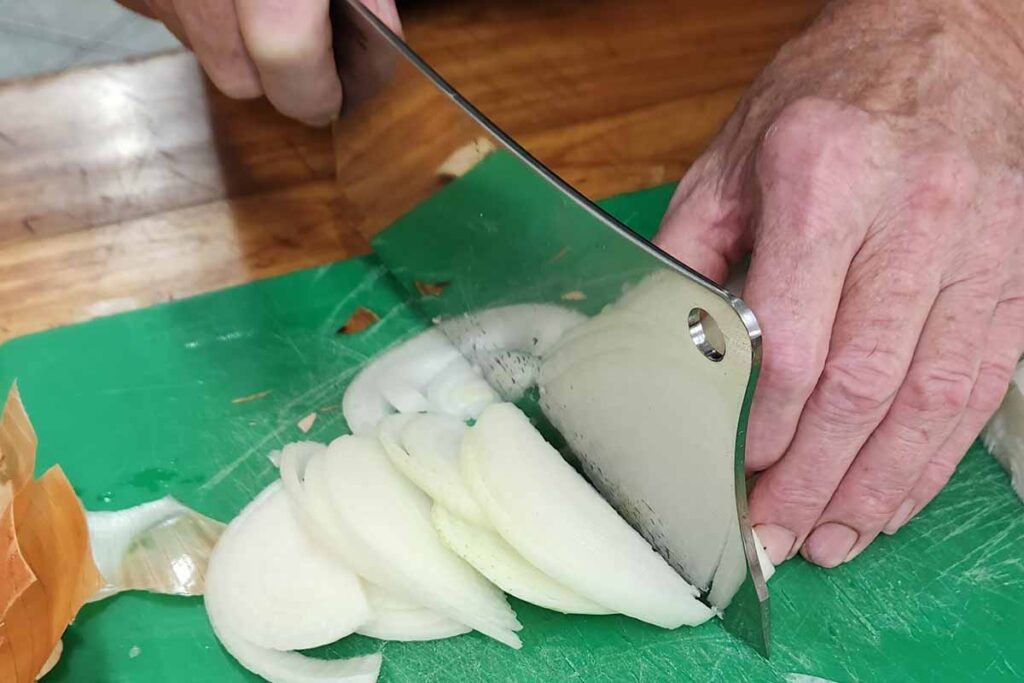
Onions are hardly a challenge for the Cold Steel Cleaver. On the other hand, its weight does make it sing through whatever you’re cutting. The effort is in picking it up—gravity handles the rest.
The Cold Steel Cleaver Commercial Series is a traditional style European design and is a behemoth. I could make three small knives just from the blade. It works great in the kitchen but, due to its size and weight, can be a bit much for such chores as chopping veggies. However, for butchering jobs it is a brawler. I had a chance to process some meat with it, mostly pork chopping up ribs and cutting belly up for the roaster. Not much will stand in its way.
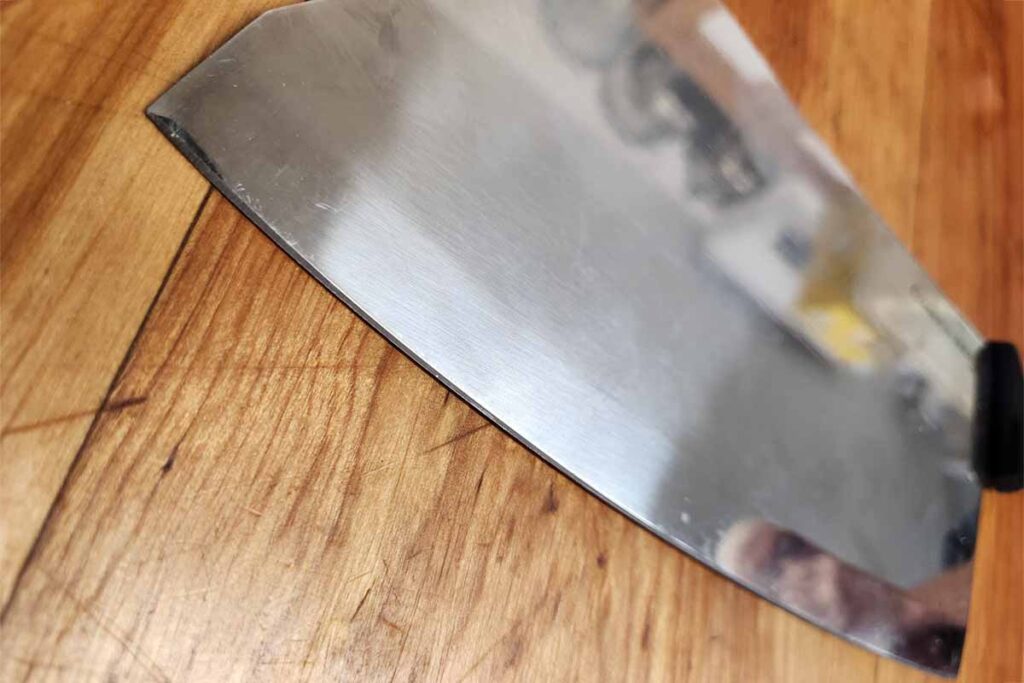
The handle is Kray-Ex, a firm rubber for a solid, vibration-free grip. The high-polished blade finish really cuts down the friction when cutting meat. The meat just slides across the surface. The polished blade is prone to showing scratches if it gets banged around in the drawer with other kitchen wear. I only mention that as I know some people get uptight over it.
As a large butchering tool it works great. I would even pack it for hunting camp. It functions fine as a kitchen chopper, though be prepared for a workout.
The polished finish on the Cold Steel Cleaver might not stay pristine but such a high polish isn’t just for looks. As the author noted, “The friction factor on such blades is low, allowing them to just glide through materials that might otherwise cling to a rough-finished blade.”
Commercial Cleaver Deals
Cold Steel
$57
BladeHQ
$57
Knife Center
$50
TOPS Knives XXX Dicer
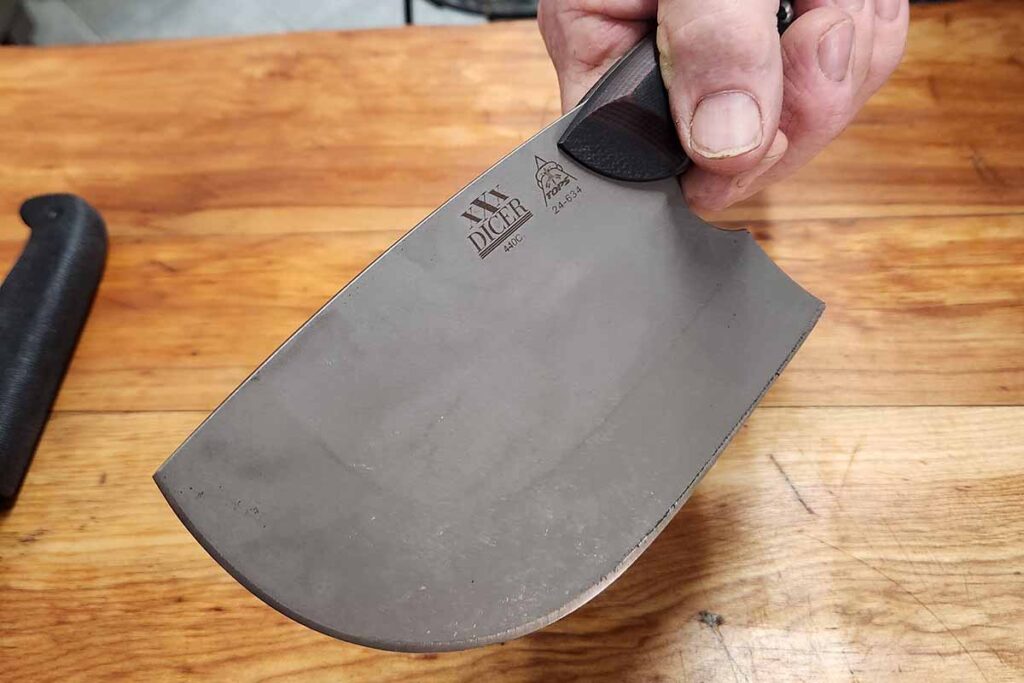
The belly of the TOPS XXX Dicer is quite pronounced. “I suppose you could use it for rocking the blade but the forward position would make it awkward,” the author opined. “For long, drawn-out slicing moves during butchering it could work well.”
XXX Dicer Specs Overall Length: 8.88″ Blade Length: 7″ Blade @Thickest: .13″ Blade Steel: 440C stainless Handle Material: Red and black G-10 Sheath: Black Kydex Weight: 13.6 ozs. MSRP: $330 Country of Origin: U.S.A
Pros
Versatile for kitchen and game processing
Great control for chopping
Thin blade for easy cutting
Cons
Hollow pins trap debris
At first look, the broad, sweeping blade with a huge belly of the TOPS Knives XXX Dicer reminds me of a Japanese fishmonger’s knife. The fishmongers who process the large fish such as tuna and marlin often can be seen using similar blade styles. I volunteer in my local shooting club’s kitchen, so when I took the XXX Dicer there for them to try, many of the hunters commented how they would like to try it for skinning big game.
For use in the kitchen, the handle is designed so that you choke up for your chopping chores. A forward design also helps you to gain better control over the exaggerated belly curve. It is a large blade yet ground thin enough to make easy work of chopping and slicing jobs. I personally would not mind a bit more handle for when I want to back off on my grip and put some oomph behind it. The handle material works well. I must say, though, I am not fond of the hollow pins as food debris finds its way in there.
What I like about the blade overrides what problems I have with the handle. In the end, I can say I like the Cold Steel cleaver due to its utility.
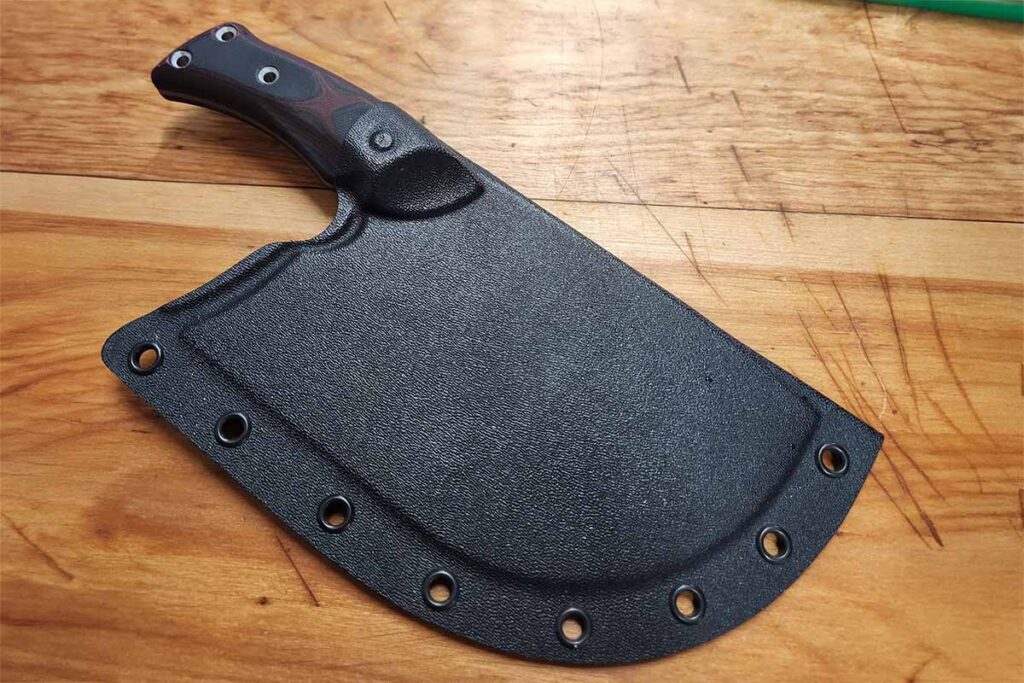
The author praised the streamlined blade cover for the TOPS XXX Dicer. It not only protects the cleaver but other blades in the kitchen drawer from being banged up.
XXX Dicer Deals
TOPS Knives
$330
Midway USA
$330
The Knife Connection
$193
Condor Serbian Kuvar Cleaver
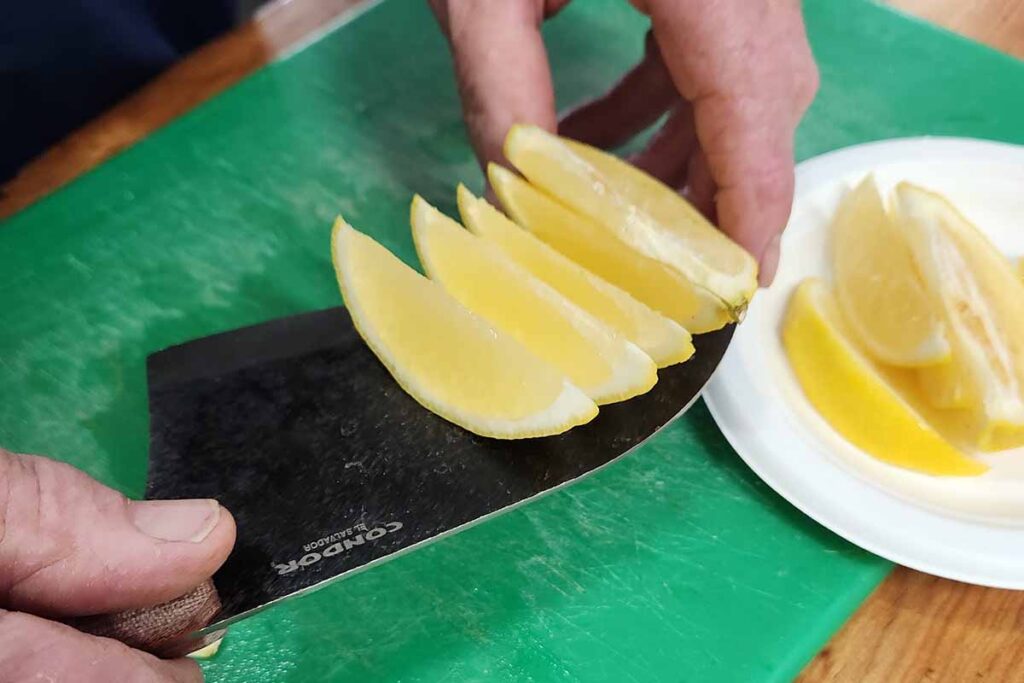
The Condor’s broad blade not only gives the cleaver some chopping weight, it also doubles as a good serving knife.
Kuvar Cleaver Specs Overall Length: 11.29″ Blade Length: 6.29″ Blade @Thickest: .1″ Blade Steel: 1075 carbon Handle Material: Natural Micarta® w/red liners Sheath: Leather Weight: 14.46 ozs. MSRP: $109.98 Country of Origin: El Salvador
Pros
Versatile for kitchen and field use
Durable convex edge
Easy-to-clean handle
Cons
Sheath Design Issues
Even though Goran Mihajlovic designed the Condor Serbian Kuvar Cleaver, for years now—and I mean years—it has been Joe Flowers’ job to spot designers and designs for Condor Tool & Knife and bring them to market. I think I have known Joe for over 20 years, and his passion for cutlery has been unwavering. I think many people are unaware of the passion that drives the knife industry. Now, back to the Kuvar.
The Condor cleaver is a great example of how a different concept gets noticed. In the early days of the North American fur trade, many knife designs were simple kitchen or butcher models. With the Kuvar you not only have a knife that rides well for your kitchen chores, but you can use it in camp.
It does not have a particularly thick blade but what gives it some toughness is the convex edge. The edge is ground high to make it a cutter, though not so high as to make it fragile. As you chop, the convex edge helps the food fall away from the blade. Because of the blade style it would not be my first choice for carving. It would serve well as a field knife if need be. It would be great for chores around the kitchen and processing game. I would not hesitate taking it with me on a wild edibles trek either, while still feeling totally equipped.
The handle is durable and easy to clean. My only beef is the sheath’s snap closure. The knife gets hung up by it on deployment, but then that is the issue with many snap closures.
According to the author, vegetables just pop off the Condor’s convex-edged blade when cut.
Condor
$110
BladeHQ
$92
Knife Center
$110
Bear & Son Professional Chopping Knife
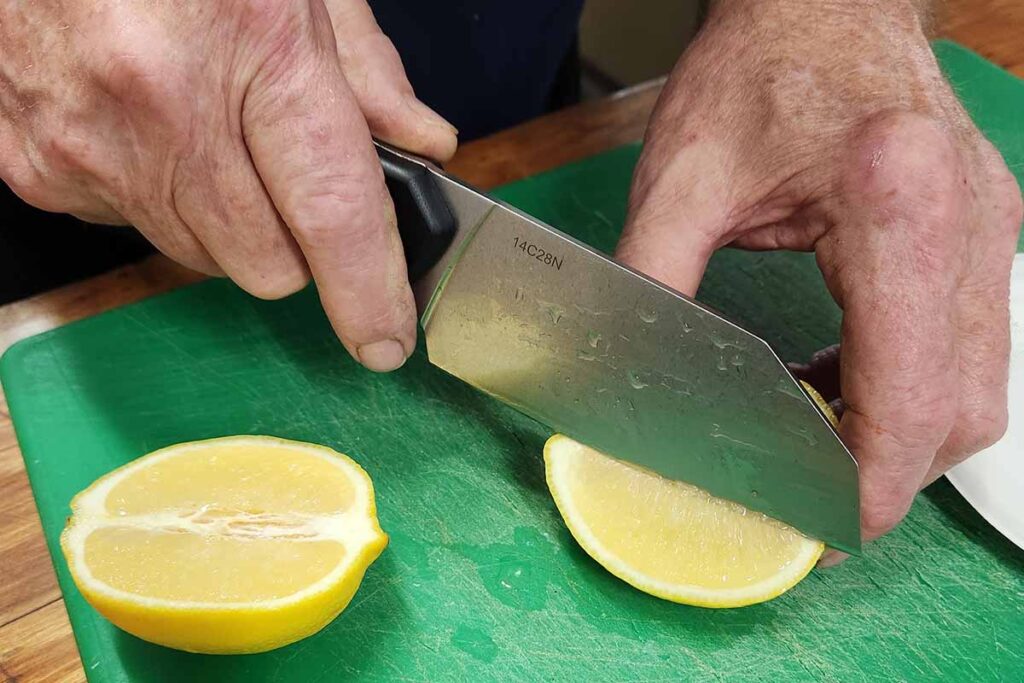
The Bear Professional Chopping Knife has a full handle and the 5-inch blade “is perfect” for the majority of everyday kitchen work. “It’s large enough to cut most food,” the author wrote, “and nimble enough for light, lively control of each cut.”
Professional Chopping Knife Specs Overall Length: 10.125″ Blade Length: 5″ Blade @Thickest: .125″ Blade Steel: 14C28N Sandvik stainless Handle Material: Black G-10 and white bone Sheath: Thermal plastic Weight: 4 ozs. MSRP: $159.99 Country of Origin: U.S.A.
Pros
Visually appealing design
Thin-ground blade for chopping
Light and nimble
Cons
Handle can get slippery when wet
Limited heavy-duty capability
As mentioned, I took the test knives to my shooting club’s kitchen. The Bear & Son Professional Chopping Knife made such a splash that I barely got out of there with it in hand. The overall presentation of the handle with the stonewashed blade turned heads. It not only is a looker but, with its thin-ground blade, works great as a small chopper.
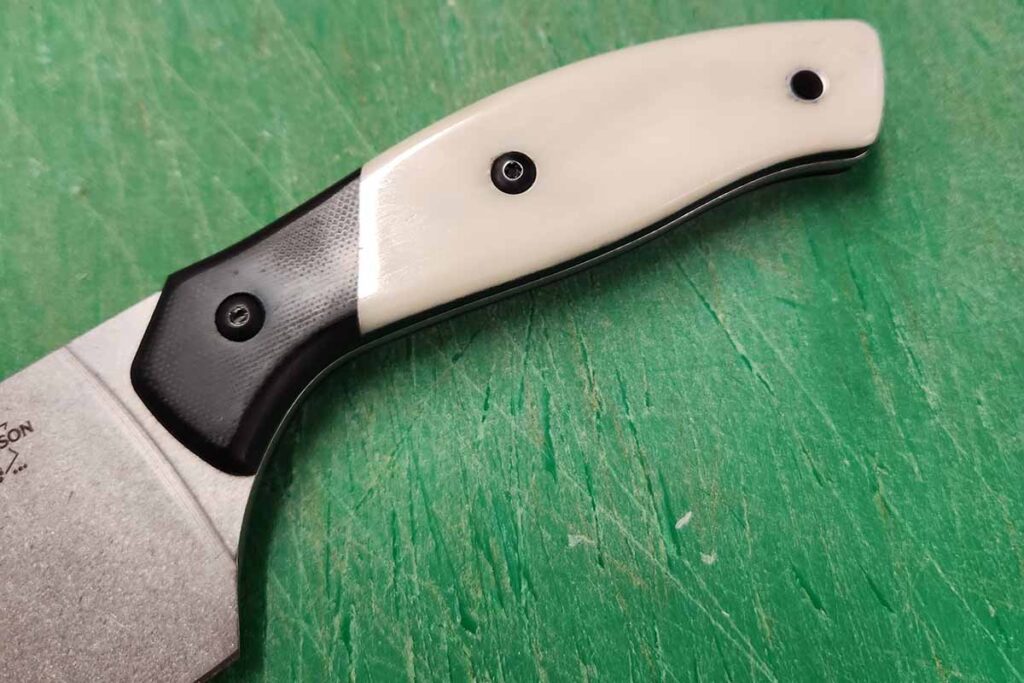
The handle ergonomics are great. The handle is highly polished and, seeing there is no texture or give to the material, it can get a bit slippery when wet. Bear & Son includes a lanyard hole at the butt but used mechanical fasteners up front. There is a slight curve to the blade and a nicely defined point.
It is a great little knife, light and nimble and suited to all kinds of chores. It is very much like one of my go-to knives, a small chef’s style. The grind on the chopper, though, is far better than my small chef’s knife. The sheath protects the blade while in transport or just sitting in a drawer. If anyone wants to buy a small chef’s knife, I need to make room for this one in my kitchen drawer.
The Bear has good handle ergonomics. The use of white bone and black G-10 really make the split handle design pop.
Professional Chopping Knife Deals
Bear & Son
$160
SMKW
$107
Discount Cutlery
$104
Favorite Go-To?
It is not easy being a knife guy these days because there are so many good choices. At BLADE®, we try to bring you a number of selections and along the way introduce you to something you might not find otherwise. Cutting tools come in so many styles and for so many varieties and uses. Even with today’s latest cleavers there is variety and innovation. Use one or more of these designs and you might find your favorite go-to knife.
Isaiah Schroeder’s Gyuto Comes In A Spectacular Damascus Pattern And Showcases The Maker’s Skill.
Isaiah Schroeder considers his gyuto the best knife he’s made, and the blade’s electrifying stainless damascus pattern and the ergonomic handle make it hard to argue the point.
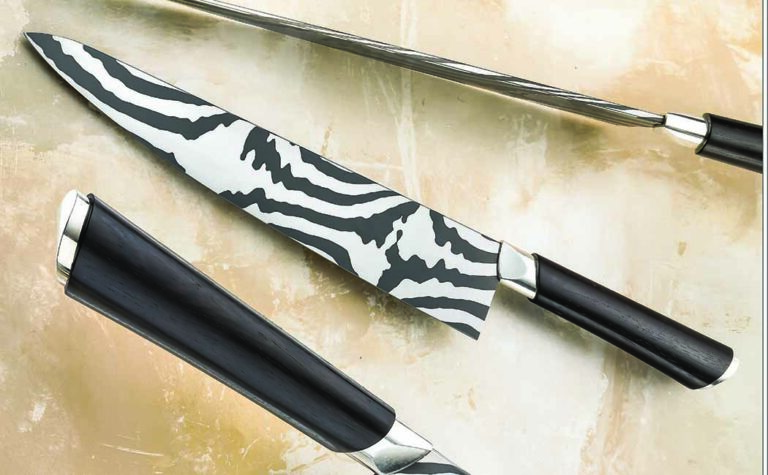
Of the blade Isaiah said, “It’s a pretty simple pattern, one I’ve done in carbon steel quite a bit. A low-layer lazy twist is what I call it.” It consists of only 11 or so alternating layers that he twists three or four times. “That’s pretty much all it is,” he observed. “I love the way it turns out with the bold layer lines and everything. It looks kind of topographical and I always like that.” The darker steel is AEB-L stainless and the lighter parts are 154CM stainless.
He said the convex blade grind works great for food release. He is especially proud of the look and feel of his thin handle design that includes silver fittings done in the lost-wax-casting method. Combined with the 1/8-inch-thick blade, he said it’s, “Thin to win for a kitchen knife.”
A full-time knifemaker based in Madison, Wisconsin, Schroeder makes kitchen knives of all types in the Japanese style including a sujihiki, a long knife made for fine slicing of meats, fish, and precisely cutting through sinew. He also makes a petty knife as well in damascus.
Gyuto Knife Specs Pattern: Gyuto Japanese chef’s knife Blade length: 9.44 inches Blade material: Low-layer lazy twist damascus of AEB-L and 154CM stainless steels Blade grind: Convex Handle material: African blackwood Fittings: Fine silver (2 ozs. worth) Overall length: 14.44 inches Maker’s price for a similar knife: $2,000 Knife to know: Isaiah is a full-time knifemaker
Ethan Becker and Dan Eastland collaborate on a sharp tool for the kitchen.
Long-time knife designer Ethan Becker and Dan Eastland of Dogwood Custom Knives have collaborated on a chef’s knife that combines each of the principals’ vision of exactly what such a knife should be.
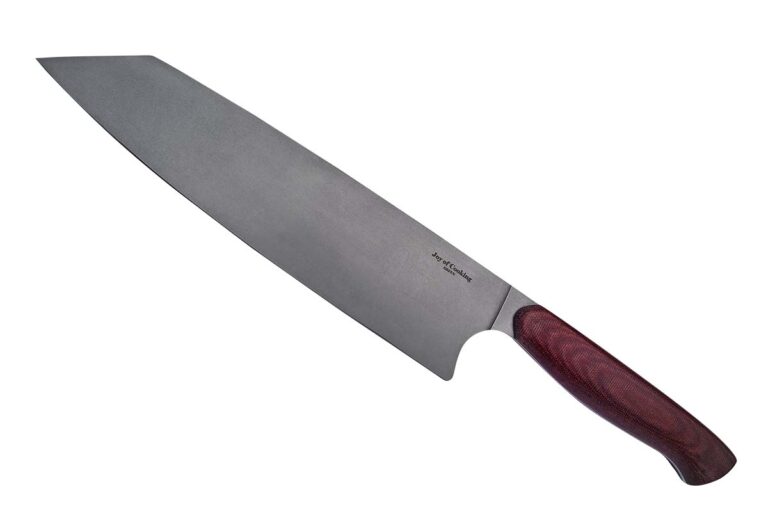
Introduced at BLADE Show 2024, the Joy of Cooking 8-inch K-tip chef’s knife is a mix of Japanese and Western styles and premium stainless steel and synthetic handle materials.
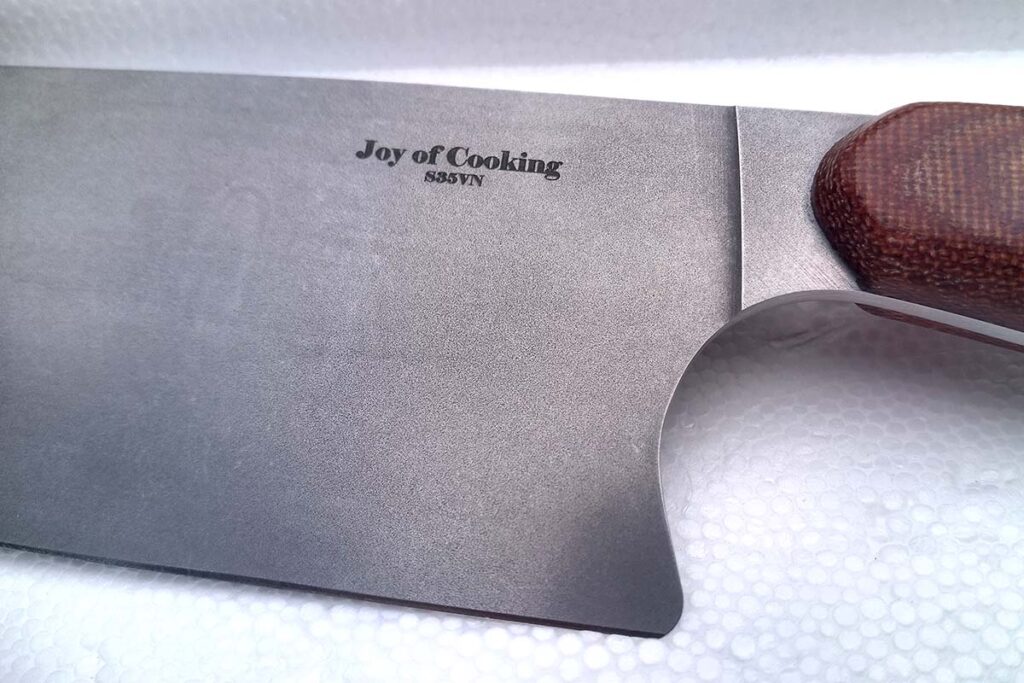
It also has the iconic Joy of Cookinglogo on the blade, Joy of Cooking the internationally renowned cookbook originally written by Becker’s mother, Irma Rombauer, and edited in some subsequent editions by Ethan. He handed those duties off and today the book is co-edited most ably by his son, John, and Megan Scott.
The heel of the blade curves toward the rear and sits flat on the surface for controlled cutting.
With extensive experience as both a knifemaker and a cook, Eastland brings the kind of know-how to the project that gives it edged gravitas.
“Dan is pretty much the perfect person to do this because he’s been in a commercial kitchen and knows his way around that,” Ethan said.
Dan also spent a number of years as an apprentice maker to Georgia Knife Makers Guild member Andy Roy of Fiddleback Forge in North Georgia, and now builds knives at Dogwood Custom Knives in Greenville, South Carolina.
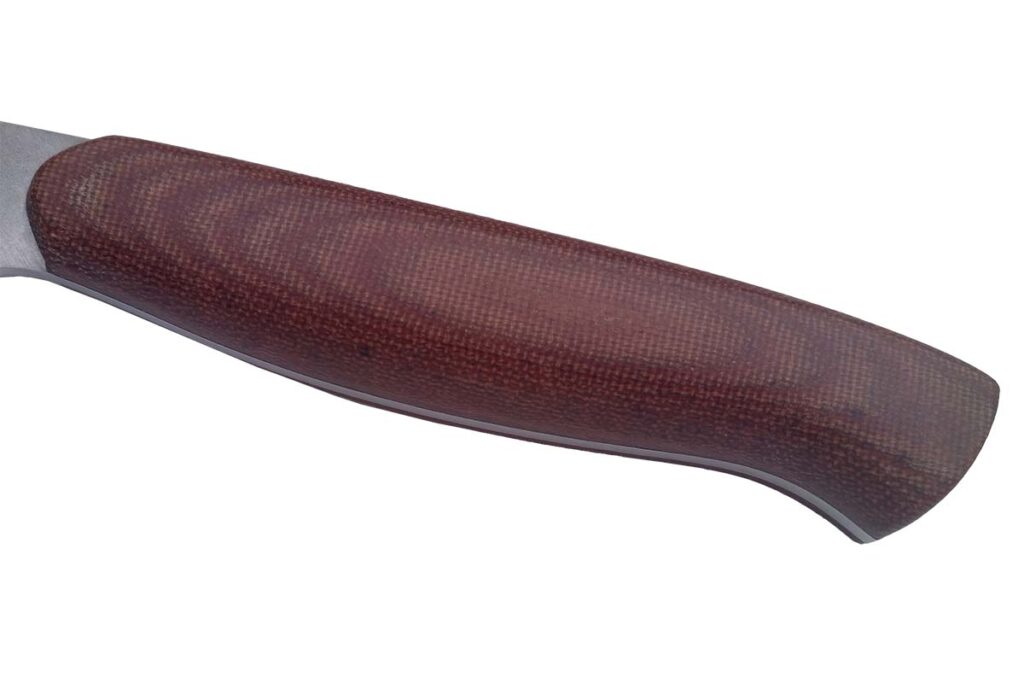
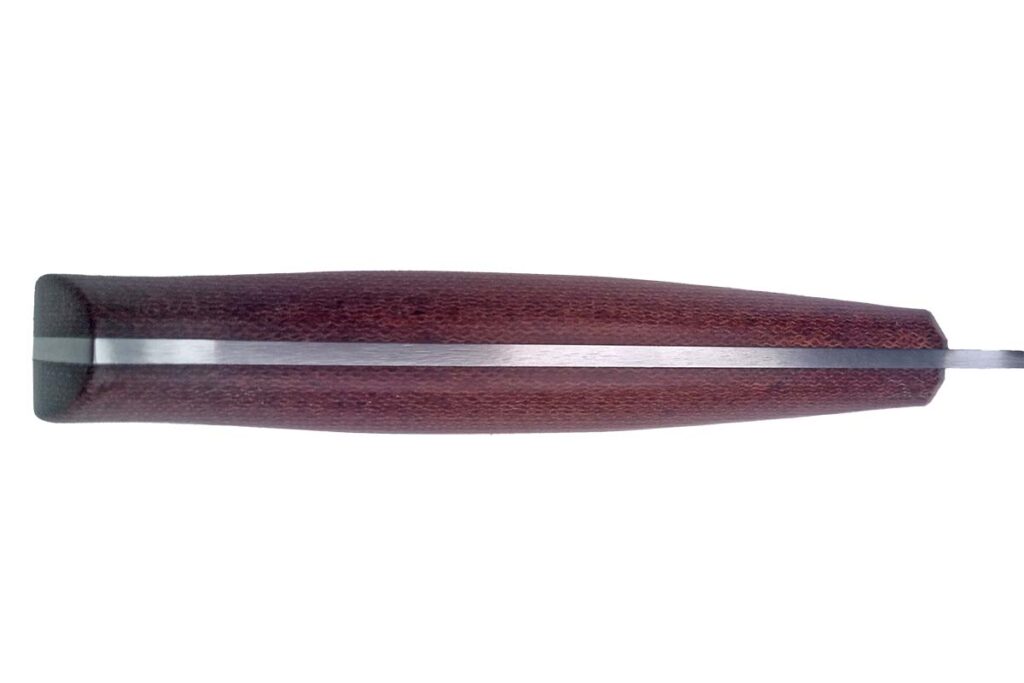
Handle materials come in a choice of natural (shown here; note the texture and grain) and black Micarta® and blue, red or black G-10.
As for the Joy of Cooking knife and its features, Dan approaches it all from the maker/cook perspective.
“The blade has a Japanese influence. I always liked Japanese blade geometry and balance, but I didn’t like their handles. Ethan and I both like a little palm swell,” he noted, “so we wanted more of a Western-style handle.”
In Joy of Cooking, Ethan writes about a grip for home cooks that’s comfortable, Dan said, so the handle has rounded corners to eliminate hot spots and an overall design that helps promote a pinch grip. The blade is weighted toward the front for balance and has the K tip for precise tip work.
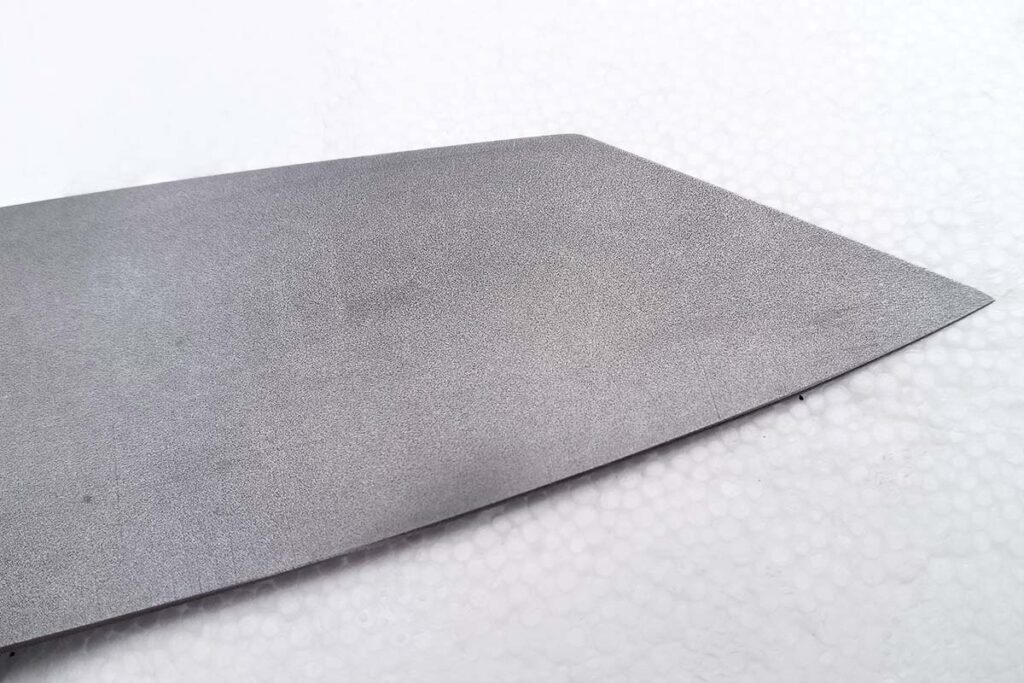
The K tip gives the knife a piercing feature lacking in such Japanese designs as the santoku.
Ethan said he’s a big fan of the santoku style and has designed santokus and used them in the kitchen almost exclusively for 20 years.
“The one problem with the santoku is it really doesn’t have a good piercer,” he noted. “You can get by without a piercer if you keep the knife really sharp but guess what—most people don’t keep their knives sharp enough. But for such jobs as taking off the top of a tomato, for instance, the K tip works pretty good.”
Dan lauded the utility of the K tip for other tasks as well, adding, “My grandmother opened all the packaging with the tip of a kitchen knife. No matter what knife you gave her, she sliced the top of the package open with the tip and went to work.” The K tip is tailor made for such chores, as well as others.
The collaborators prefer a Western-style handle and gave the Joy of Cooking Knife grip a palm swell as a result.
The edge has a nice curvature for rock chopping and push cutting meats and vegetables. The heel of the blade also curves toward the rear and sits flat on the surface for controlled cutting.
“The neat thing is when the blade comes down [at the heel during a rocking cut or chop], it stops,” Ethan explained. “It’s also good for a push cut,” Dan added, “so it’s good for both a rock chop and push cut. And having that heel down a little bit it will bottom out, so you cut all the way through something and don’t wind up with little partially cut bits at the end.”
Joy Of Cooking Knife Details
The 8-inch blade is CPM S35VN stainless steel. The Rockwell hardness is 60 HRC and the blade is 3/32-inch thick at the thickest. Along with the contoured handle the knife weighs in at a scant 5.5 ounces.
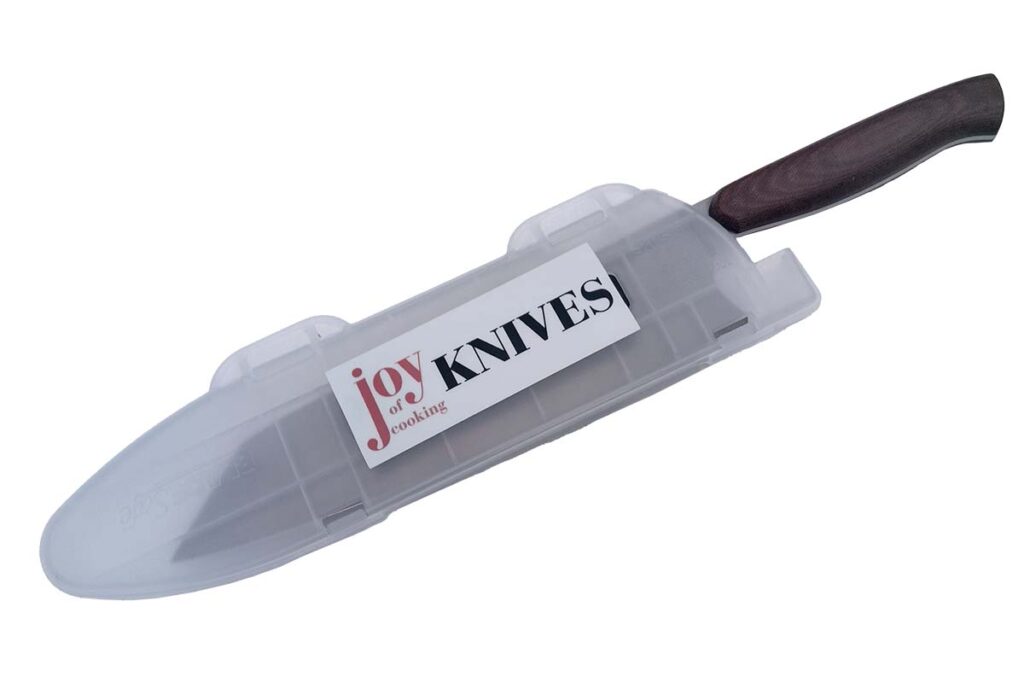
A hard plastic cover with plastic snaps contains and protects the knife.
“I’m of the opinion the Greeks told us everything we need to know about a double-inclined plane—the longer the plane and the lower the angle, the more efficient it is,” Dan said. “A knife blade is a double-inclined plane, and I wanted to make this knife as light as possible.”
He returned to his grandmother’s experience.
“And again, my grandmother used to complain that Henckels and Wusthof, she loved the knives, but they weighed almost as much as she did. By using the S35VN we’ve been able to thin it out and get a mechanically better cutting blade, but also a lighter blade.”
Ethan agreed that most kitchen knives are too heavy.
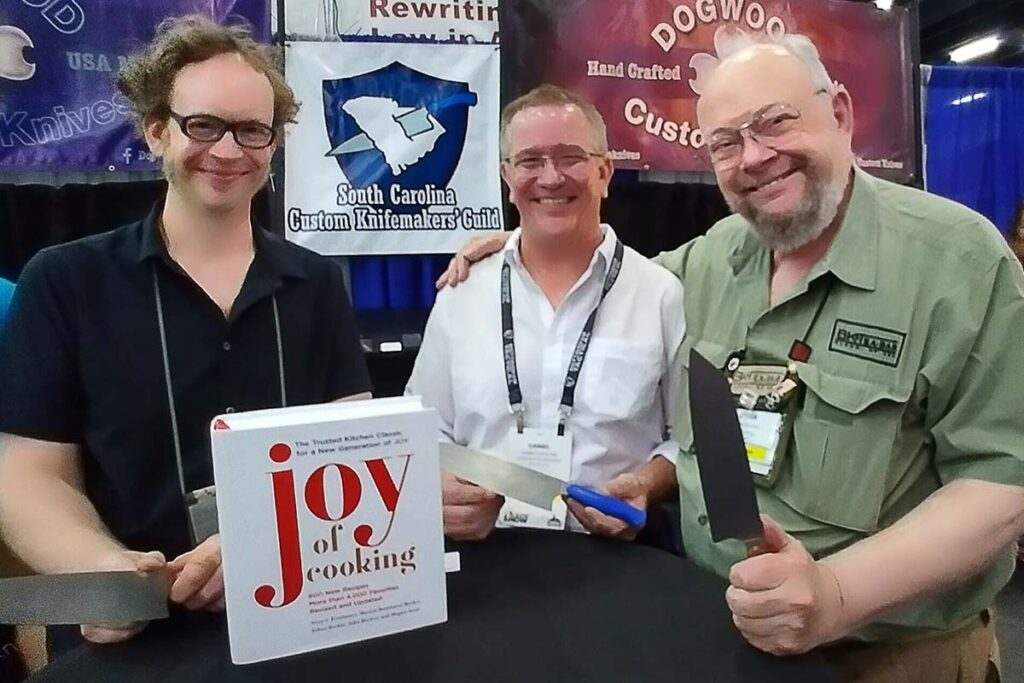
From left at BLADE Show 2024: John Becker, co-editor of Joy of Cooking, Dan Eastland of Dogwood Custom Knives and long-time knife designer Ethan Becker.
“The wrist gets tired easy and to be able to not have very much weight that you’re working with, hey, what’s wrong with that?” he observed. “Most traditional kitchen blades were thick because they were forged before they were ground … The cutlers in Europe were very, very concerned that the housewives would use the blades for things they weren’t supposed to, so they used soft steel so it wouldn’t nick and if they opened bottles with it it wouldn’t hurt it. The result was blades that didn’t hold an edge worth a damn and were not terribly efficient.”
Dan said the S35VN has good corrosion resistance and the edge retention is phenomenal.
“We tested the knife extensively in an industrial kitchen to ensure edge retention and durability, and I like S35VN because it’s a good balance of durability and edge retention. And we can get that 60 Rockwell so it can take a nice, keen edge and we don’t have to worry about it chipping out.”
As noted, Dan and Ethan wanted a Western-style handle with a palm swell and offer it in a choice of G-10 and Micarta®. The Micarta is available in black and natural versions, both with texture and grain for purchase. The G-10 comes in red, black and blue.
“Those colors will always be the same over time as we introduce other knives in the lineup, so you can buy a knife that will match whichever color knife you previously bought,” Dan said. The intent is for there to be a complete set of Joy of Cooking knives, though nothing was set in stone in that regard at press time.
Pros
Collaborative Expertise
Versatile Blade Design
Premium Blade Material
Cons
Higher Price Point
Plastic Snap Cover
Joy Of Cooking 8” Chef’s Knife Specs Designers: Ethan Becker and Dan Eastland Company: Dogwood Custom Knives Blade Length: 8” Blade Steel: CPM S35VN stainless Rockwell Hardness: 60 HRC Blade @Thickest: 3/32” Handle: Black and natural Micarta® and blue, red and black G-10 options Overall Length: 13” Carry: Plastic snap cover Knife to Know: K tip blade; lightweight design; hidden handle pins Country of Origin: USA MSRP: $200
GiantMouse takes a stab at the culinary world with a kitchen knife line.
EDC knives of a variety of stripes have been GiantMouse’s bread and butter, helping the Danish-design concern kick a solid toehold into the knife industry. This success somewhat culminated earlier this month in Atlanta, with the company’s GMX earning Knife-Of-The-Year® accolades at the 2023 BLADE Show. This trophy in hand is a pretty good indicator you’re doing things right. But, GiantMouse is far from living off past achievements.
In fact, it has a new vista in sight—kitchen knives.
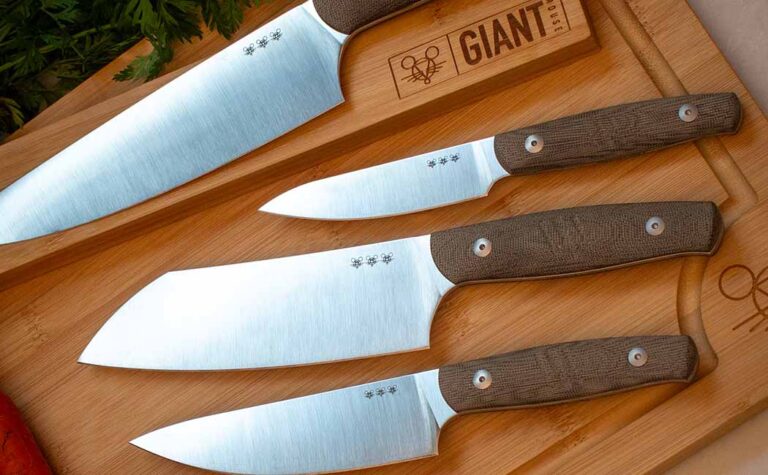
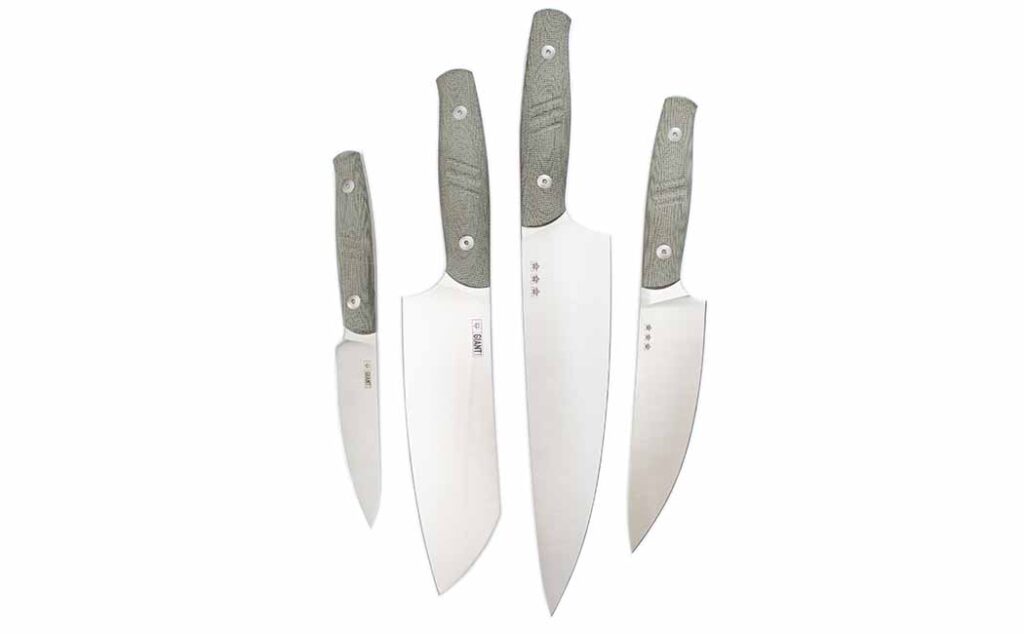
Following a well-trod recent trend in knife manufacturing, GiantMouse is dipping its toe into the culinary end of the pool with the introduction of four kitchen knives. While this drop might prove unexpected to some, the expansion is something the company said has been in the works for nearly two years now. At least, that’s been the personal testing period of designers Jens Ansø and Jesper Voxnaes (Vox), refining the minutia of the knives. So, how did it shake out?
At first blush—and without a knife-in-hand, tomato-dicing torture test—not too shabby. The four-knife line appears attractively utilitarian, nice enough to show off along with your next dinner party. But the knives aren’t so pretty as to scare you off from actually using them in your day-to-day culinary adventures. At arm’s length, it’s difficult to discuss ergonomics, balance and performance. However, GiantMouse doesn’t appear to have to broken any of the major kitchen-knife rules, attempting to displace function for novel form. Though, the slightly hooking heel on the larger knives might prove a sore point—pun intended—for some.
The line, at present, includes:
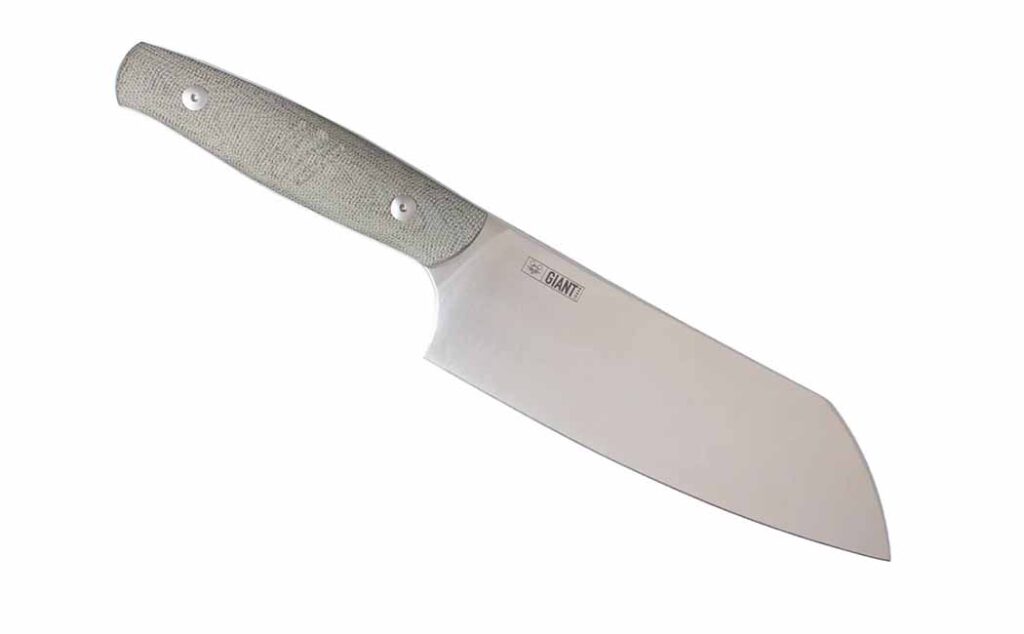
Santoku
Chef
Carving
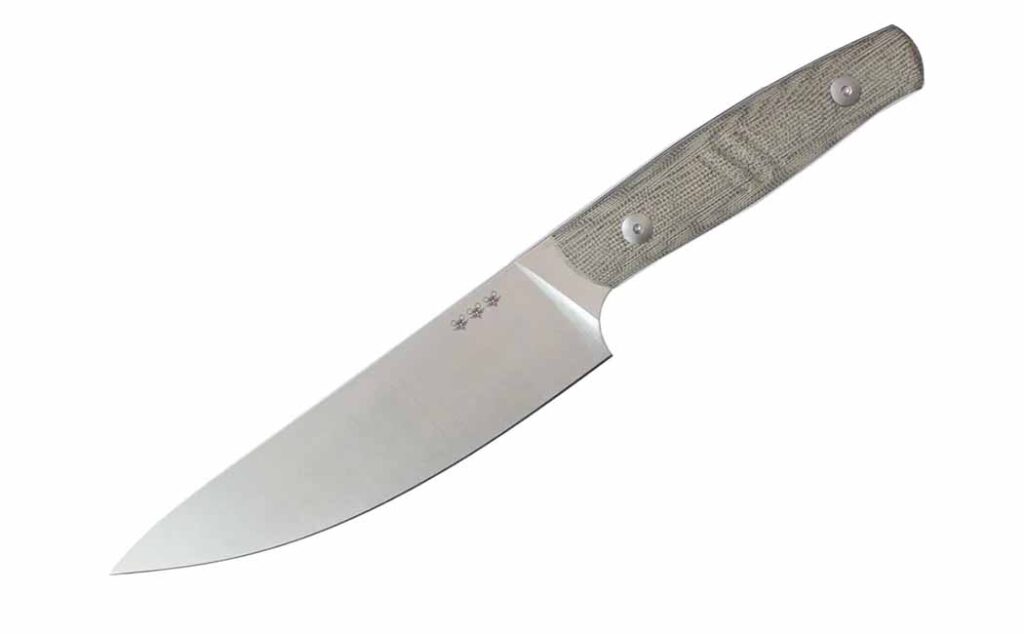
Paring
Essentially, GiantMouse has homed in on the basic food prep tools every kitchen requires. The knives are sold individually and as a set; there’s a branded bamboo magnetic knife bar available, as well. And, in the company’s announcement, it certainly sounds as if it has designs to continue expanding into more corners of the culinary arts. No hint on what that might include.
As to the Italian-made knives themselves, GiantMouse has opted for Nitro-B for the blade steel and given them an unstated satin finish. Having grown in popularity in recent years, high-nitrogen steel (.21% in the case of Nitro-B) has spurred its share of debates as well. Sufficed to say, it should thrive in a kitchen environment if for no other reason than its corrosion resistance. To top it off, the blades are stamped with a tirade of the company’s murine logo—jaunty, to say the least.
To this, the company has outfitted the knives with green micarta handles, which should prove popular. Generally providing an excellent gripping surface, even when wet, GiantMouse has further enhanced it with a run of three serrations at the midpoint to provide a bit more purchase.
As for price, expect to drop $95 to get into GiantMouse’s paring knife at the low end and $175 for the chef or santoku at the high end.
GiantMouse Kitchen Knives Specs:
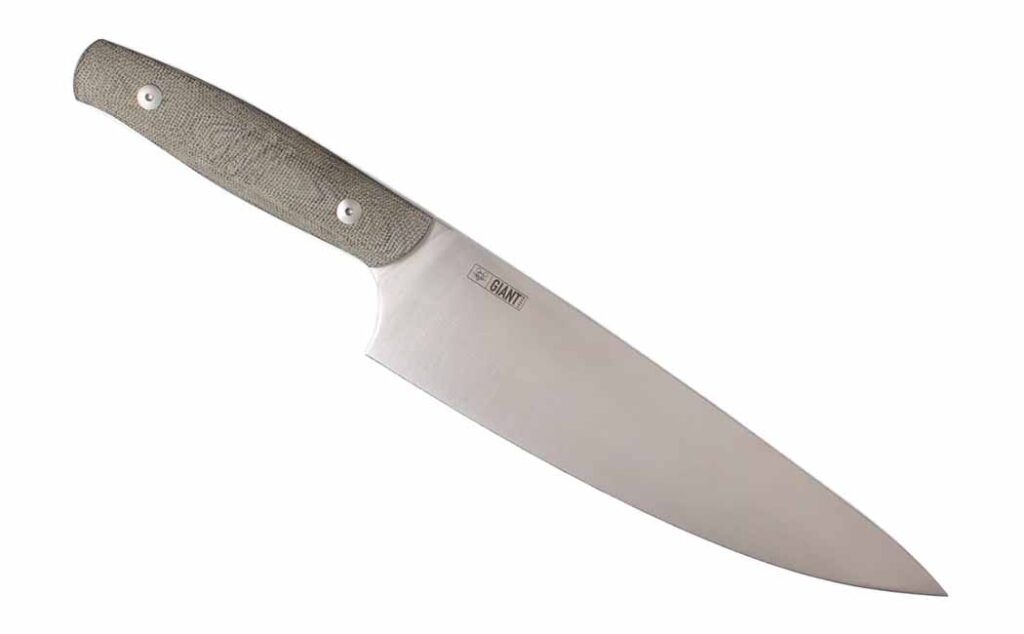
Chef Knife Blade Length: 8.375″ (212.725mm) Weight: 6.9oz (195.612g) Overall Length: 13.125″ (333.4mm) Steel: Nitro B Blade Thickness: .1125″ (2.875mm) Finish: Satin Handle: Green Micarta MSRP: $175
The Japanese take on Western chef’s knives are mighty mealmakers. Here are some top-notch options.
A gyuto is a versatile, multi-purpose kitchen knife perfect for professional chefs and home cooks. It typically features a thinner, lighter blade than traditional chef’s knives, sharpened at a steeper angle for extremely precise and clean cuts. It often has a flatter profile toward the heel and a more gradual curve near the tip, making it versatile for various cutting techniques. The handle is often lighter and more agile, reflecting the Japanese emphasis on nimble and efficient movements in the kitchen.
Fox Knives Gyuto 2C 504 0L
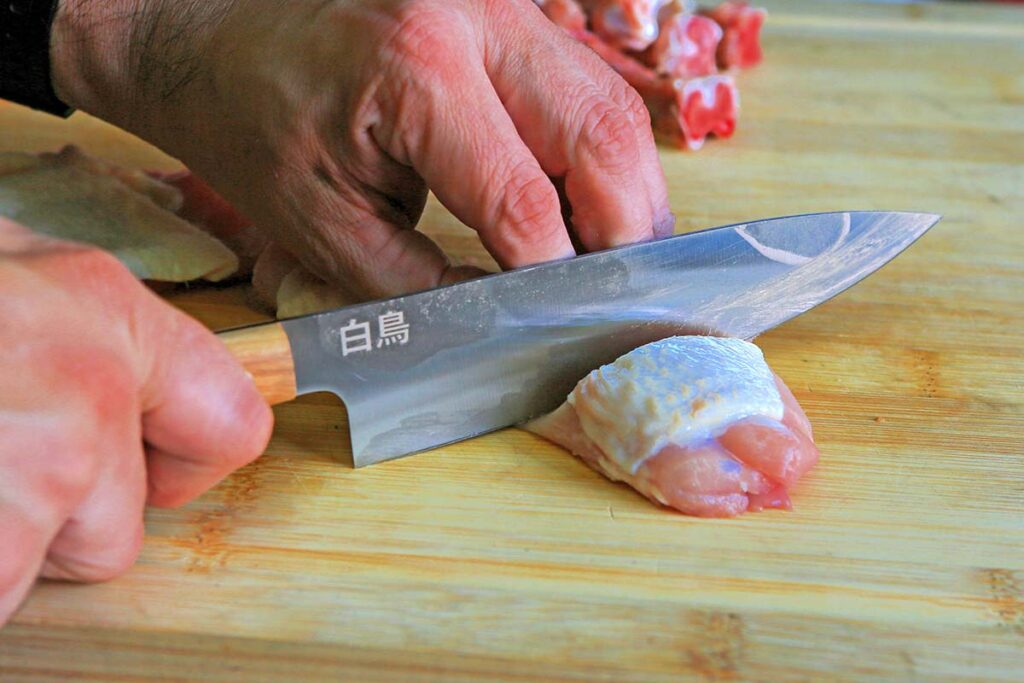
The Fox gyuto effortlessly prepared chicken thighs for delicious teriyaki chicken and yakitori, trimming excess fat and skin.
FOX Knives Gyuto 2C 504 OL Blade Length: 6.69” Blade Steel: 4119 nitro-B stainless Blade Grind: Flat Blade @Thickest: .08” Blade Finish: Satin Handle Material: Olive wood Overall Length: 11.81” Country of Origin: Italy MSRP: $75.70
Pros
Durable 4119 Nitro-B Stainless Steel Blade
Exceptional Balance and Lightweight Design
Comfortable Olivewood Handle
Cons
Limited Grip for Large Hands
The Fox Knives Gyuto 2C 504 0L is a representative example of the genre. Crafted with precision and passion, it features a razor-sharp blade that is durable and holds an edge. The elegant handle offers a comfortable grip and a smidge of rustic charm.
At just 5.11 ounces, this featherweight beauty is a breeze to manipulate and perfectly balanced for effortless slicing, dicing and chopping. The 4119 nitro-B stainless steel blade’s Rockwell hardness of 55-57 HRC guarantees superior resilience, while the satin finish adds a touch of sophistication. Equipped with sturdy stainless-steel rivets, this gyuto is a culinary companion you can trust, not just a kitchen tool.
When in Japan, I love ordering yakitori—skewered, grilled chicken with a savory, slightly sweet flavor and smoky aroma. Making the dish was a team effort using specific knives for deboning and slicing the chicken into proper portions for the skewers. The key is to use a slow rocking/chopping motion to make clean, decisive slices rather than sawing through the meat, resulting in “chainsaw chicken.”
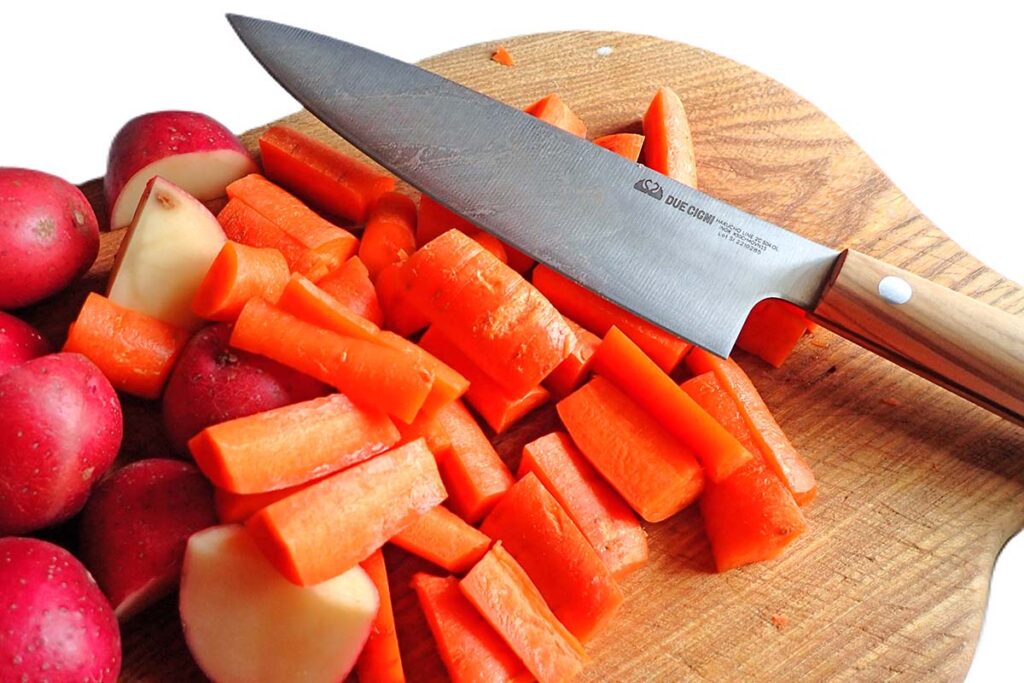
The Fox sliced potatoes, onions, garlic and carrots for pot roast. The thin edge and super comfortable handle were unmatched.
Since the gyuto is the Japanese version of the archetypal Western chef’s knife, I made a Western dish—beef pot roast—and did the vegetable prep with the Fox. Slicing vegetables, potatoes, carrots and onions was a breeze with this slicing machine. I keep it simple, using rock chops, cross chops and pull cuts 90 percent of the time. Push cuts with the heel of the blade work well for hard veggies. Meanwhile, the olivewood handle remained comfy with no hot spots and grippy even when wet or covered with chicken fat. Leave it to the Italians to utilize this stunningly underused wood. Regarding plating, the Fox sliced the most elegant roast beef that ever graced a dish.
Fox Knives
$78
BladeHQ
$35
Condor Tool & Knife Shefu Kitchen Gyuto
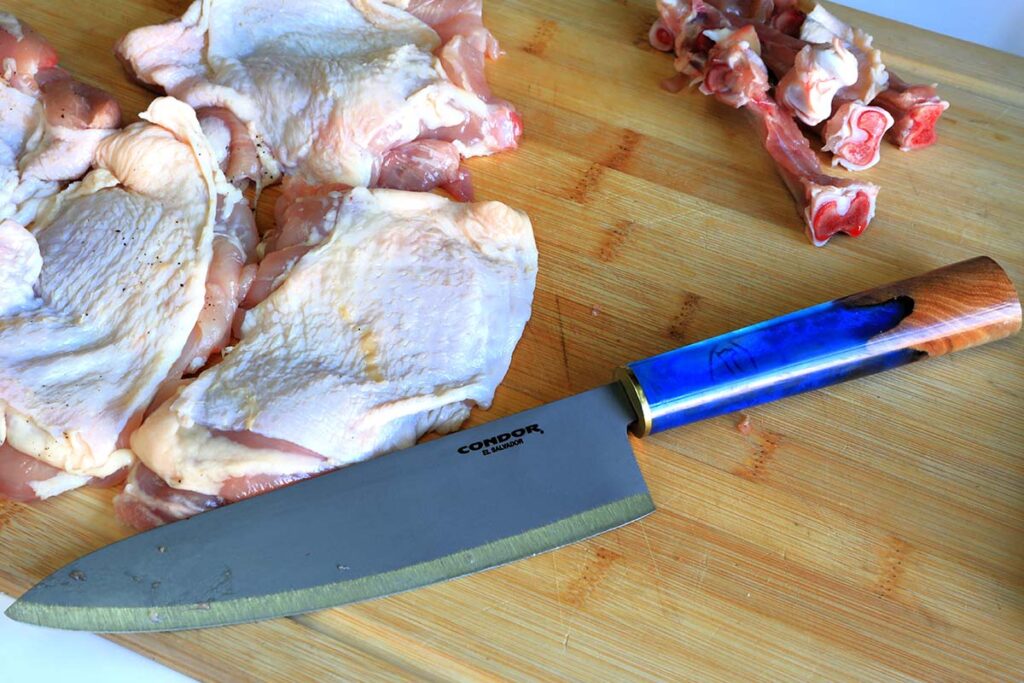
The Condor Shefu deboned multiple chicken thighs using a roll-cutting method for yakitori skewers and teriyaki chicken.
Shefu Kitchen Gyuto Specs Blade Length: 7.83” Blade Steel: 440C stainless Blade Grind: Full flat w/second bevel Blade @Thickest: .12” Blade Finish: Blasted satin Handle Material: Epoxy resin and hickory Overall Length: 12.92” Sheath: Welted leather Country of Origin: El Salvador MSRP: $154.98
Pros
Versatile Outdoor and Culinary Tool
Comfortable and Ergonomic Handle
Full Flat Grind with Second Bevel
Cons
Bit hefty
The Shefu Kitchen Gyuto from Condor Tool & Knife is a multi-use knife designed for bushcraft enthusiasts who want to prepare delicious meals while enjoying the great outdoors. Crafted with precision in mind, the Shefu is perfect for slicing vegetables and expertly preparing meat and fish. It is a versatile tool ready to tackle any culinary challenge.
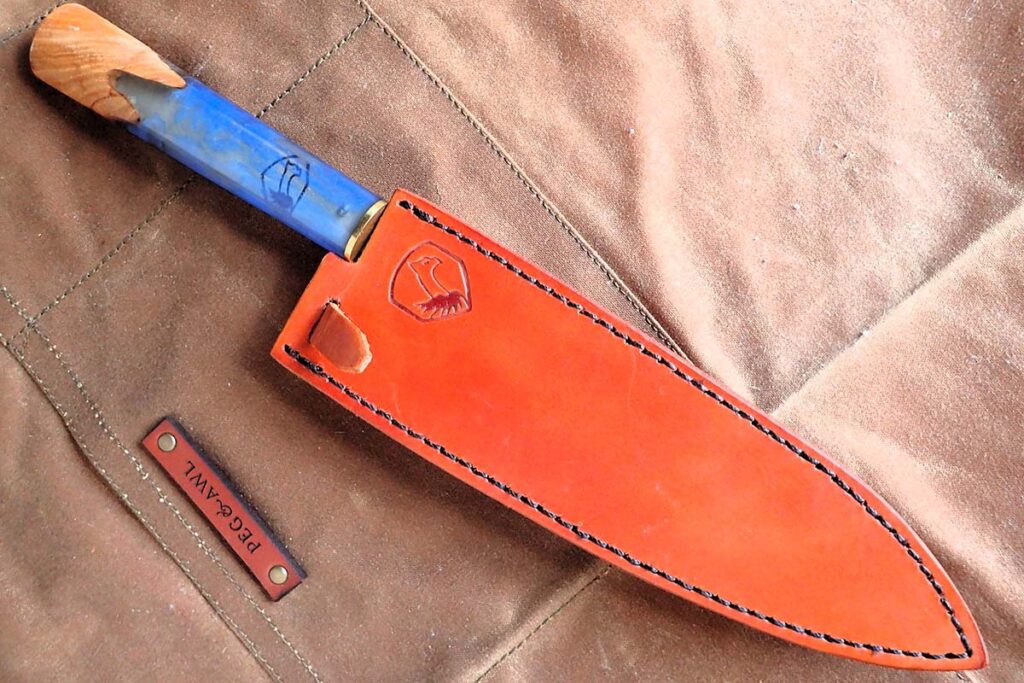
The Condor gyuto is hardy and beautiful. The full flat grind with a second bevel ensures optimal slicing performance, while the handle provides a comfortable, secure grip. The knife strikes the perfect balance between heft and maneuverability. The leather sheath provides safe storage and easy transport.
I pushed the Shefu into service sectioning beef roast and deboning and trimming six chicken thighs. The knife tackled the tasks with ease. Slicing 3.5-pound roast required a sharp yet hefty slicer like a cleaver. The Shefu fit the bill and delivered. Bottom round roast is tough as woodpecker lips, and a thin, flexible blade need not apply here. At 9.88 ounces, the Condor’s robust blade strikes the perfect balance between heft and finesse.
The Condor has the only sheath of the test bunch, of a beautifully handcrafted welted leather for safe storage and easy transport.
The handle has a colorful, comfortable oval shape that nestles in the hand. Hot spots and fatigue are nearly impossible with this grip. The full tang offers strength and security while keeping balance and weight at the forefront. The Shefu is an essential for any cooking enthusiast, whether at home or in the wild.
Condor
$155
SMKW
$132
Spyderco Itamae Gyuto
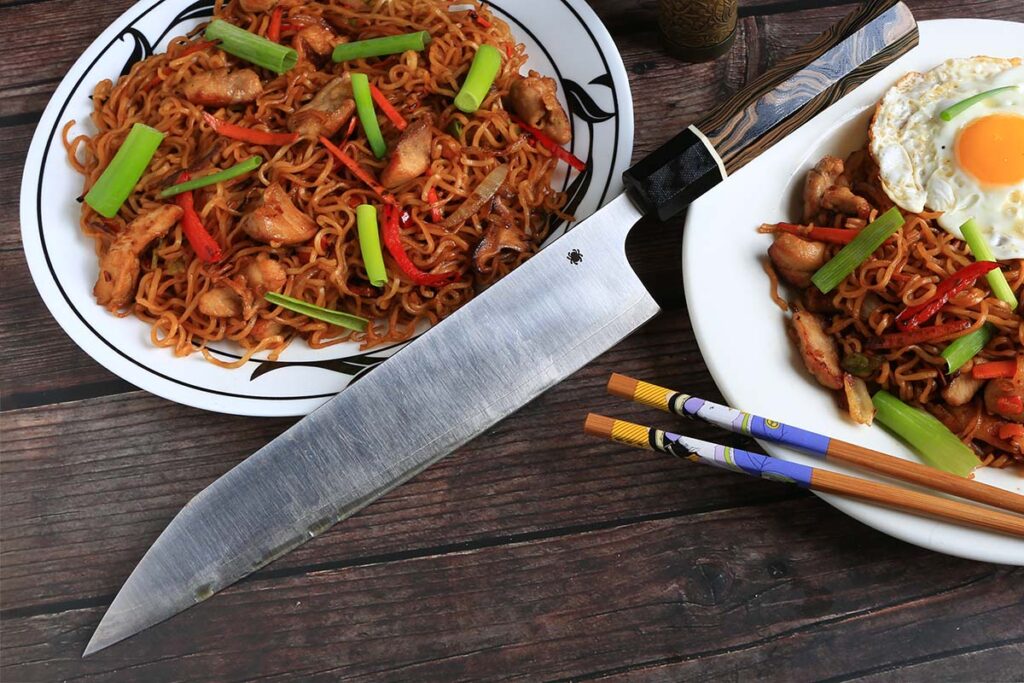
The author prepared the chicken yakisoba using the Spyderco. The knife sliced and diced carrots, onions, peppers, shiitake mushrooms, chicken and green onions for garnish.
Itamae Gyuto Specs Designer: Murray Carter Blade Length: 10.06” Blade Steel: Super Blue/SUS410 Blade Grind: Full flat Blade @Thickest: .094” Blade Finish: Satin Handle Material: Burl G-10 in the octagonal wa style Overall Length: 15.35” Country of Origin: Japan MSRP: $334
Pros
Exceptional Blade Construction
High-Quality, Ergonomic Handle
Beautiful Design and Craftsmanship
Cons
Higher Price Point
The Itamae Gyuto is part of the Spyderco Murray Carter Collection Itamae Series. The elite cutlery series is designed for highly skilled sushi chefs and showcases uncompromising craftsmanship and premium materials.
The Itamae Gyuto features a blade expertly crafted from laminated steel—an Aogami Super Blue core clad between layers of high-quality stainless. The three-layer construction ensures exceptional durability and sharpness, with Carter’s signature “Carter Elbow*” adding strength to the blade’s tip.
Paired with a traditional wa-style octagonal handle of stunning burl G-10 and highlighted with a black G-10 ferrule, the Itamae Gyuto embodies the spirit of Carter’s coveted custom kitchen knives. Tipping the scales at 7.4 ounces, it sets an impressive standard in high-performance household cutlery.
The Itamae Gyuto is a sushi knife and I’m a fan. Part of my time in Japan was seeking out various types of sushi. The second most rewarding part was watching the chefs work precisely as if it were the most critical game of Operation ever played—they are pros!
I used the test model to prepare carrots, onions, shiitake mushrooms, peppers, green onions and chicken for the famed yakisoba dish: fried street food noodles choked full of veggies, savory sauce and protein. Simple ingredients still require various knife techniques.
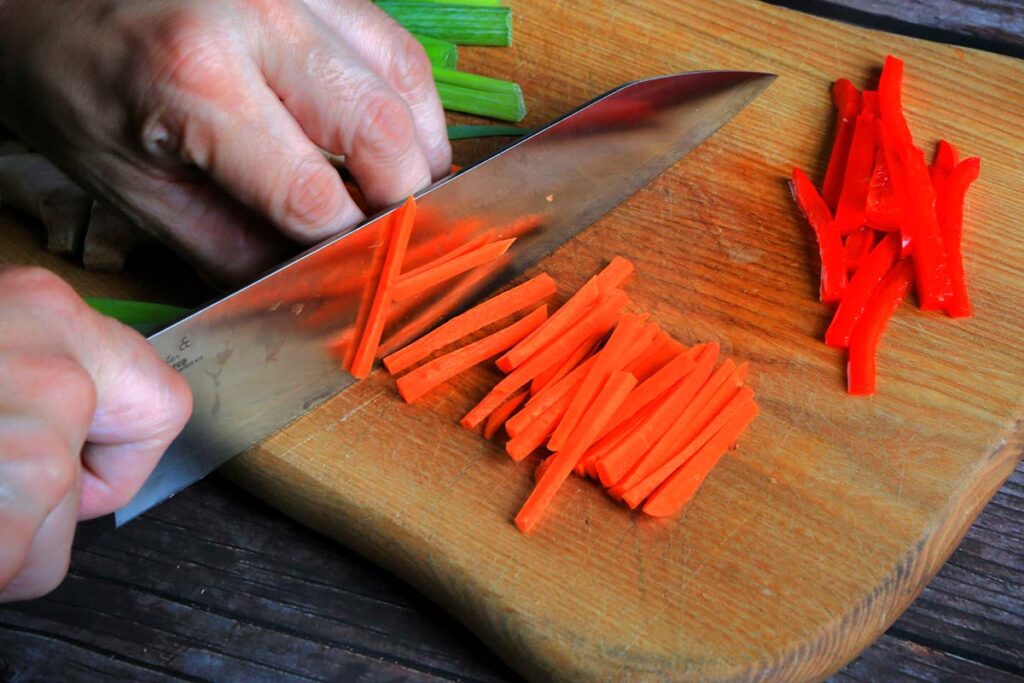
I used push-cuts on the tough carrots to square them to a safe position to stabilize them and make thin slices. From there, I stacked the slices for some rock-chopping to julienne a pile of carrots—in this instance, to make matchstick-sized carrot sticks. The secret to stir-fry cooking is preparation and cutting relatively equal-sized pieces of food to ensure equal cooking time.
To create julienne slices, the author employed the rock-chopping method with the Spyderco, again utilizing a chef’s pinch-grip and a claw grip with the offhand to support the food.
I used rock chopping and pull cuts—two techniques in which the Itamae excels—to slice the red peppers. To pull cut them, I placed the knife tip down on the board and sliced backward. By this time, the laminated steel had formed a nice patina from avocado, peppers, onions and chicken on the bevel, giving it a nice used look. Crafted in Japan, the Itamae Gyuto is an ultimate favorite among professional chefs and passionate cooking enthusiasts.
*Editor’s note: Through the Carter Elbow, Murray Carter combines the best features of a traditional Japanese wabocho kitchen knife with his Wharncliffe Brute neck knife. The design feature allows more steel to reinforce the forward tip of the blade compared to standard gyuto or French-style chef’s knife profiles.
Larger than a paring knife, smaller than a chef’s knife, the petty knife is right-sized for heavy-duty precision work.
Sometimes food preparation calls for something especially suited for close, even intricate, work. The petty knife was made for such employment.
While it may be a bit smaller in stature than other knives chefs regularly use, the petty knife makes short work of otherwise laborious functions.
Its name is derived from the French petit or small, but it’s big on getting the job done.
“Ask a dozen makers what the petty knife is and you’ll get a dozen different answers,” offered custom maker Ian Ronald of Elderslie, New South Wales, Australia. “But for me, I would define a petty knife as a culinary knife that is shorter than a chef’s knife but with a broader blade than a paring knife. I find a petty knife to be incredibly handy for household food preparation tasks, with a blade that is big enough to cut most food items but not so large as a full-sized chef’s knife, making it a little more versatile for ‘in hand’ food prep tasks such as cutting avocados and similar things. I have a few in my kitchen and they are the most commonly used knives in the knife block by far.”
The full-flat-ground blade of 18-year-old Aidan De Fazio’s petty knife is also slightly convex to preserve edge longevity and provide better food release. (Rod Hoare knife image)
Representative of Ronald’s petty knife work is a piece the price of which varies depending on materials chosen. With a 4.92-inch blade of Takefu Special stainless clad in san-mai fashion over V-Toku2 carbon steel, a desert ironwood handle and 9.25-inch overall length, the petty remains with the maker—and he uses it frequently.
“I designed this knife with quite clean lines and simple shapes, as it was intended to be a workhorse from the beginning,” Ian commented. “I used some premium materials but I didn’t add any embellishments or unnecessary details. I follow that aesthetic with most of the knives I make, preferring to let the form follow the function for the most part. This particular knife has a relatively deep blade with a reasonably high tip profile, which allows it to be used for [rocking/chopping] and push cuts despite its unassuming size.”
The steel combination on Ronald’s knife includes a carbon core with stainless cladding from the Takefu steel company of Japan. According to Ian, it is quite corrosion resistant and maintains a bright appearance, as the carbon steel core etches dark and develops character and patina with use. The blade grind is nearly flat with a slight convex slant near the edge, which is intended to create a fine cutting edge while maintaining toughness.
Precision Worker Petties
Sixty-year-old Australian Zohar Oshinsky has been making knives since he was 12 but became more serious about his work just a few years ago, becoming a full-time maker in the past five years. His petty knife features a 5.12-inch blade of M390 stainless damascus steel from Sanwa Special Steel of Japan, handle scales of stabilized red mallee burl timber—a hardwood from the York peninsula of South Australia—and an overall length of 10.04 inches.
Ian Ronald said a petty knife has a blade big enough to cut most food items but not so large as a full-sized chef’s knife, making it a little more versatile for avocados and similar things. Overall length of his Kitchen Petty: 9.25 inches. (Rod Hoare knife image)
“This petty knife is a smaller Japanese utility knife,” Zohar said, “generally used for precision knife work and fine slicing. My knives are often made to order, so the material is to the customer’s liking. The san-mai is an excellent steel for kitchen knives in this construction with a very high rust resistance and excellent edge retention. The damascus cladding is made from 67 layers of 410 and high nickel stainless.”
Oshinsky says his blade grind is shallow, convex, very thin and incredibly sharp. The blade’s soft cladding protects the core from shock and provides a small amount of flexibility.
Semi-Dark Theme Petty Knives
Aidan De Fazio is all of 18. He began his knifemaking journey at 11 and his progress has been steady. His petty knife includes a 4.5-inch, full-flat-ground blade of san-mai in 1084 clad carbon steel with nickel. The handle is stabilized spalted maple and ebony. The blade is slightly convex ground to preserve edge longevity and provide better food release. Overall length: 9 inches.
Charlie Ellis and BLADE Magazine Cutlery Hall-Of-Fame® member Steve Schwarzer collaborated on the Penrose Petite Chef. The 6-inch blade is Penrose tiling billet of 15N20 nickel-alloy steel in a pattern based on never-repeating Penrose tiling. Overall length: 11.75 inches. (SharpByCoop image)
“The petty knife is a small general-purpose knife,” Aidan explained. “It’s used for peeling, shaping, and slicing fruits and vegetables, chopping herbs, and making garnishes. I design everything by eye and chose this design because everything flowed nicely, and it just looked right. I was going for a semi-dark-themed knife, so to complement the dark san-mai I chose a piece of ebony with some heavily spalted maple for the handle.
“As this is a carbon steel knife, it will change color with use,” Aidan continued. “It’s a patina and it’s a good thing. It develops on carbon steel when exposed to air for extended periods of time or to acids for short periods of time. It is a type of oxidation that helps ward off the rust that eats away at steel and destroys your knife.” De Fazio recommends regular care for his petty knife, washing lightly with soap and water, avoiding abrasives that could scratch the patina, and then wiping dry for storage.
Light, Thin, Comfy Kitchen Tools
When Ross Arnold makes a petty knife—or any other style knife for kitchen use—he is leveraging experience to produce the most utilitarian design he can. “To me, a petty knife is an all-around food preparation knife for use when a larger knife is not necessary or possible,” he said. “In my earlier years, I worked in kitchens every night. I had a good idea of what worked and what was comfortable for me. This design was focused on being light, thin and comfortable. This resulted in a knife that weighs only 3.8 ounces, and the rounded choil and spine make it a pleasure to use all day every day.”
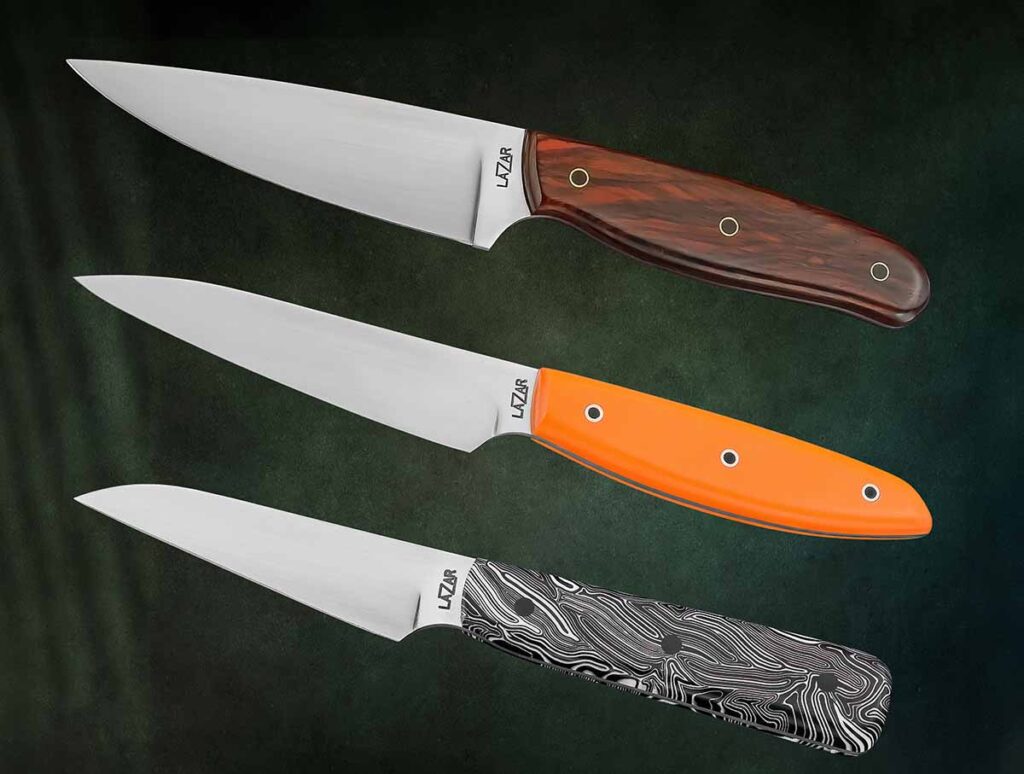
Andrew Lazarevic offers his petty knives in a selection of handle materials affixed with brass and carbon fiber pins. The blades are flat ground of AEB-L stainless steel. Overall lengths: approximately 9 inches each. (Rod Hoare image)
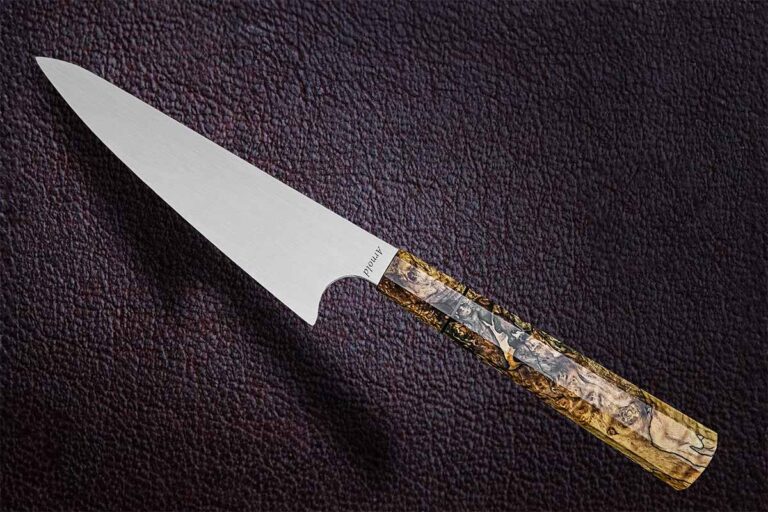
A resident of Glenalta, Australia, Arnold learned a great deal from custom maker Peter Bald early in his career. Ross finished his petty knife with a 5.91-inch blade of RWL-34 stainless steel and a handle of spalted sassafras wood. Overall length: 11.02 inches. His price for a similar knife: $390.
“I went with a traditional Japanese hexagonal handle purely for aesthetics,” he related. “As I use this knife primarily with a pinch grip, the handle shape does not have a massive impact on usability. That being said, it is still very comfortable to hold normally. I ground the blade with a plunge-less distal taper design. I came up with the grind design myself, but I’m sure it’s probably been done before. In my opinion, it is a solid performing grind as it gives the knife a light and flexible blade that isn’t super thick toward the tip.”
The petty knife is up to the challenge when a more intricate or tight kitchen job is at hand. The latest custom examples are affordable, provide good looks and perform with style. Dig in.
Editor’s note: All prices are in U.S. dollars and are according to the press time rate of exchange. Due to fluid market conditions, all are subject to change. Please check with the applicable maker for the latest in pricing.