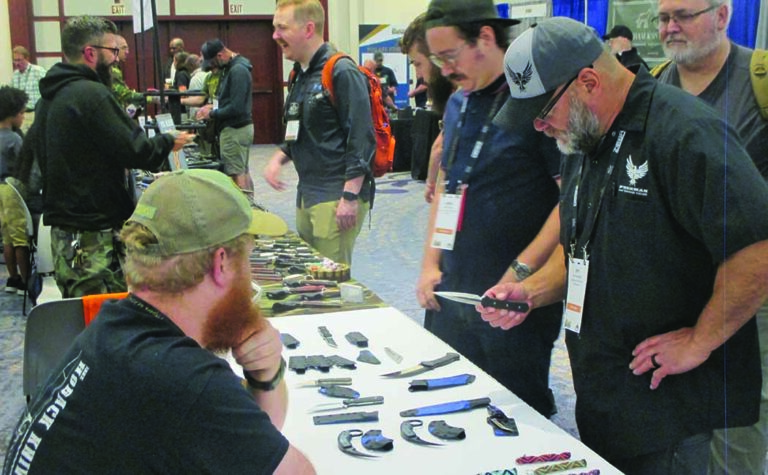
Knife collecting is an extremely rewarding experience for knife enthusiasts. There truly is a knife for everyone. Many increase or hold their value throughout the years, making collecting knives something to pass on to the next generation of knife collectors.
A sushi knife that developed a taste for Texas brisket.
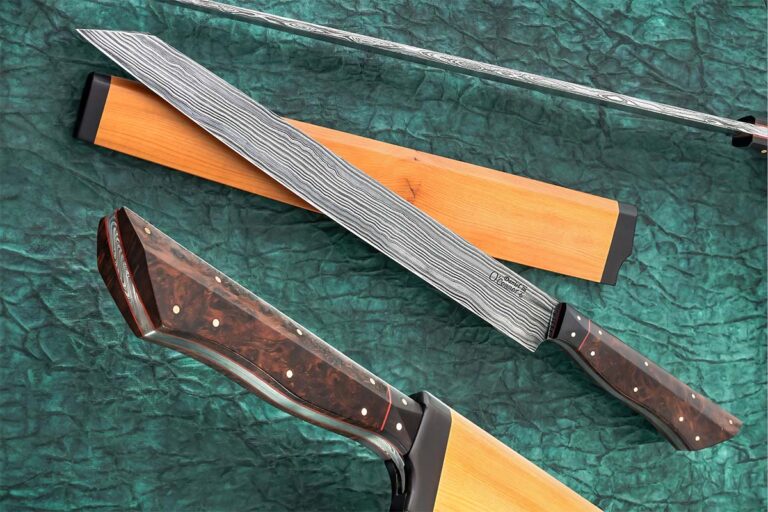
You might say Daniel O’Connor’s Black Widow leads a double life. It started as a sushi knife but when one of Daniel’s Texas pals said it looked like it would make a great brisket knife, O’Connor went with the flow, telling his friend, “It’s about whatever you want it to be.”
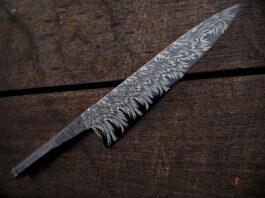
Based on a kiritsuke yanagi-ba sushi knife, Black Widow features a damascus of 150 layers of 1084 carbon and 15N20 nickel-alloy steels. Daniel forged the steels in a square and then forged them flat, perpendicular to the original stack. This resulted in the edges of the layers showing up in more or less straight lines, what Japanese swordsmiths call masame hada.
The accompanying image of the knife’s butt shows how the layers distorted when forged on edge. Daniel indicated he will use the pattern in the future.
Black Widow Specs Blade length: 12” Blade grind: A double urashi—double bevel w/a slight hollow on each side Handle: Bocote burl w/red fiber liners Bolster: Bog oak Overall length: 17” Sheath: Irish yew and bog oak Maker’s price for a similar knife and sheath: $1,500
Designers and companies join forces to help consumers win with these knife collaborations.
A collaboration knife is produced when a designer or knifemaker partners up with a knife company to produce a particular knife. And more often times than not, such models offer the best of both worlds. Designers able to focus purely on designing and not confined to the limits of their shop can shoot for the stars. While companies take the reigns of producing the knife to exacting specs and usually at a buyer’s price. In the end, the knife consumer wins. Here is a handful of the latest collaboration drops certain to get knife aficionados juices flowing.
Harlock Mini / Boker Plus
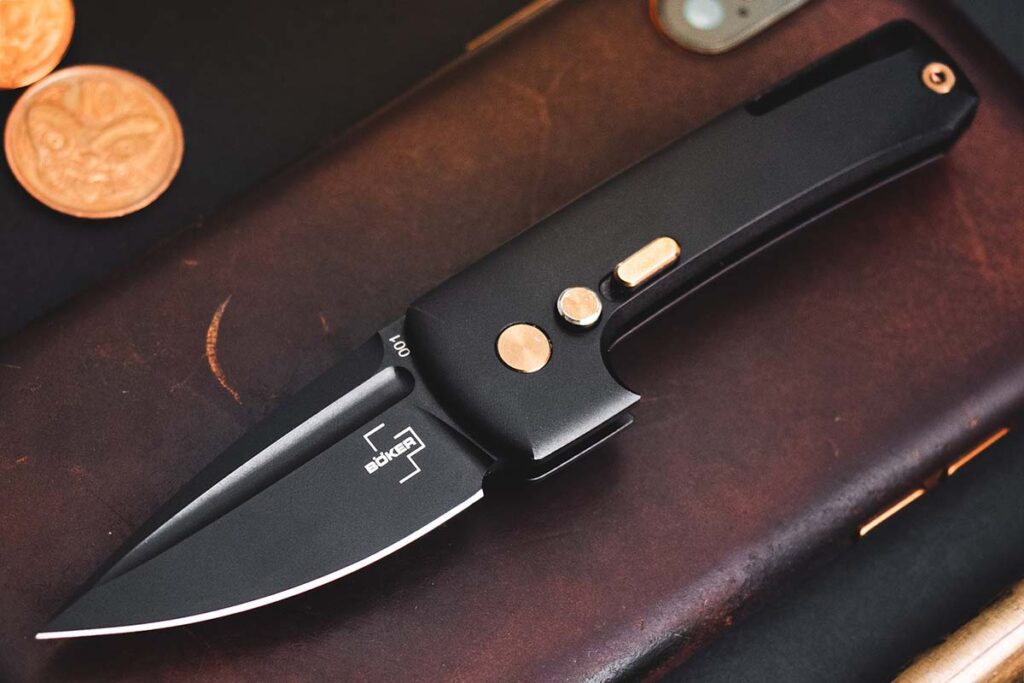
A blade only .11 inch at the thickest helps the Boker Plus Harlock Mini tip the scales at a scant 2.19 ounces. At about 2.87 inches closed and with a lean, sexy pocket clip, the Harlock Mini is made for executive wear. It comes with a nylon pouch.
If you’re looking for an elegant knife present for that special someone, you could do a lot worse than gift him or her the Boker Plus Harlock Mini designed by custom knifemaker Darriel Caston.
Designer: Darriel Caston Knife type: Push-button automatic Blade length: 2.05” Blade steel: Black-coated 154 CM stainless Blade grind: Convex Handle material: Black-coated aluminum Hardware: Brass Knife to Know: A latching slide lock locks the blade closed and prevents accidental release Closed length: 2.87” Carry: Pocket clip and nylon pouch Country of origin: USA MSRP: $146
A.P.C. (Always. Pocket. Carry.) / CRKT
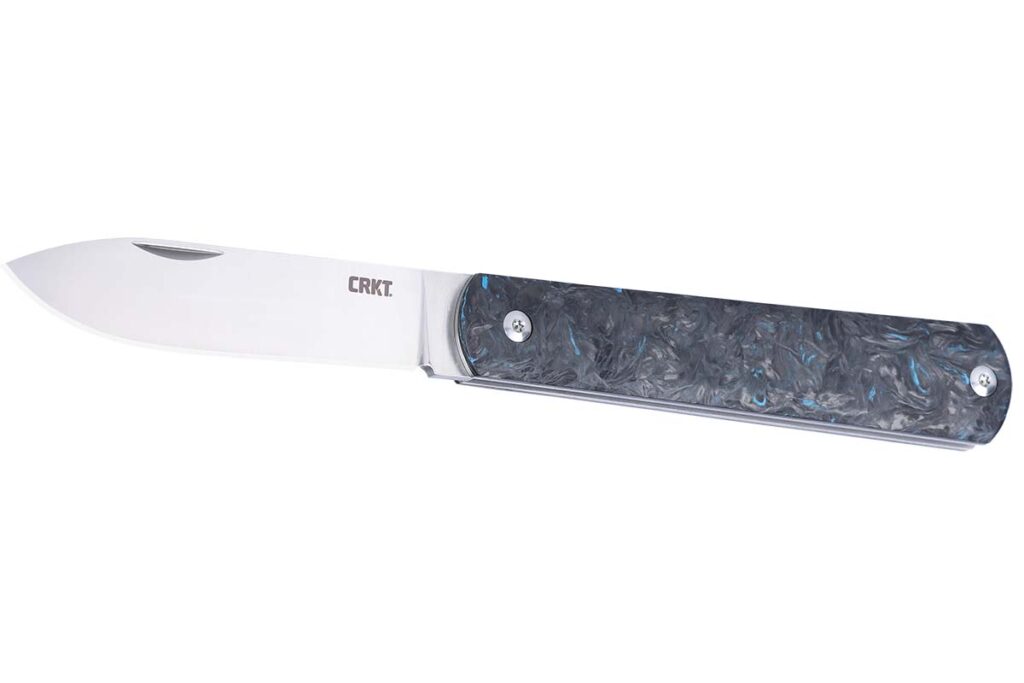
The A.P.C. is a two-hand opener, with the blade deploying via a traditional nail nick. The Fat Carbon Dark Matter handle material is strong and lightweight.
Unlike traditional slip joints, Steigerwalt’s new slip joint design for CRKT does not have a standard steel backspring. Instead, the slip joint springs from the liners and connects the liner springs with a hardened steel block that contacts the heel of the blade, eliminating the need for the backspring. Among other advantages, this reduces a fair amount of the weight a backspring would add, there is more space inside the handle to hold a wider blade, the position of the blade pivot pin can be changed and more.
Designer: Ken Steigerwalt Knife type: Slip joint Blade length: 2.88” Blade steel: Bohler M390 stainless Rockwell hardness: 59-61 HRC Blade grind: Flat Handle material: Fat Carbon Dark Matter Weight: 1.7 ozs. Closed length: 3.72” Country of origin: Taiwan MSRP: $175
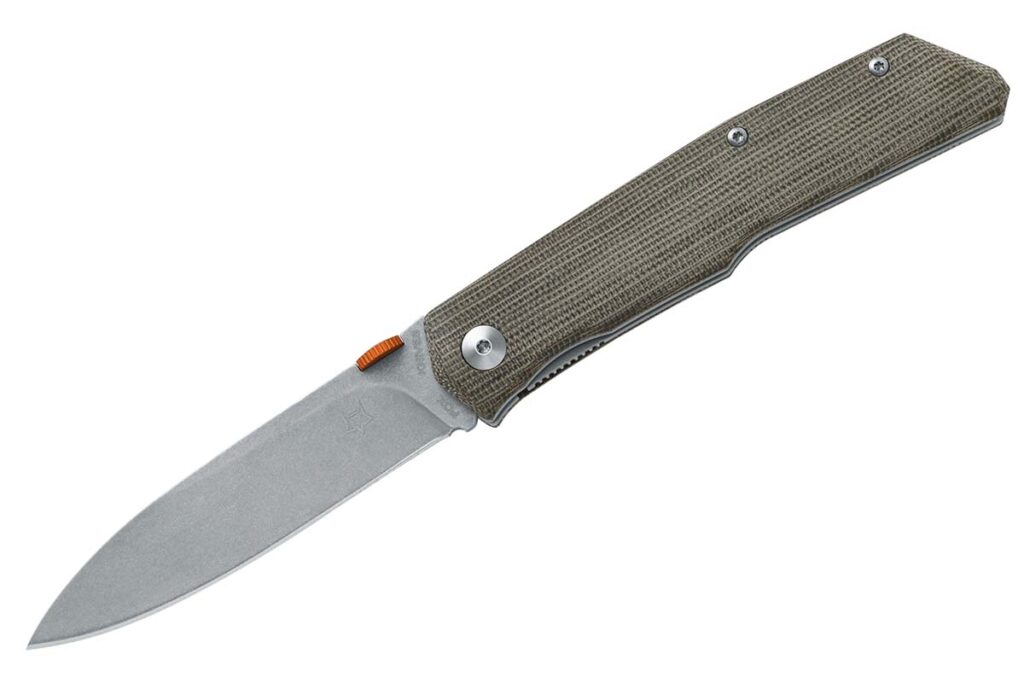
The Sicilian / Fox Knives
The Sicilian is a reinterpretation of Fox’s model FX-525, and the name pays homage to the Sicilian roots of Bob Terzuola’s family. Changes from the FX-525 include the BECUT stainless blade steel, the OD green canvas Micarta® handle and the wire pocket clip.
According to Fox’s Athena Greta Barbieri, “Bob Terzuola conceived the Sicilian taking inspiration from traditional knives used by ordinary people for everyday activities such as eating or working in the fields. The idea for this knife evokes images of landscapes warmed by the Sicilian sun and simple meals eaten among olive trees and vineyards.”
Designer: BLADE Magazine Cutlery Hall-Of-Fame® member Bob Terzuola Knife type: EDC folder Blade length: 3.35” Blade steel: BECUT stainless Rockwell hardness: 58-60 HRC Blade @ thickest: .12” Blade finish: Stonewashed Blade opener: Disc Handle material: OD green canvas Micarta® Spacer: Aluminum anodized orange Pocket clip: Wire Lock: Linerlock Weight: 3.53 ozs. Closed length: 4.52” Country of origin: Italy MSRP: $164
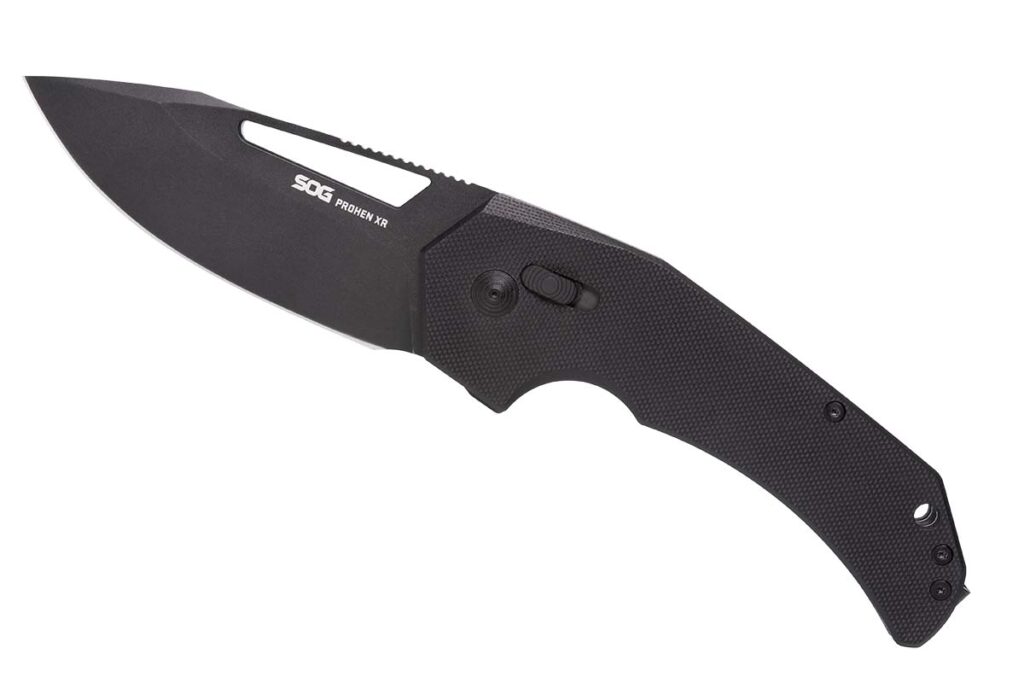
Prohen XR / SOG
The extremely strong G-10 handle is micro-textured for a secure, comfortable grip in wet or slippery conditions.
Designed by custom knifemaker Mikkel Willumsen for SOG, the beefy Prohen XR flipper folder is a mix of curves and angles that features the XR Lock, a sliding transverse bar that locks the blade in place and promotes ambidextrous one-hand operation.
Designer: Mikkel Willumsen Knife type: Flipper folder Blade length: 3.4” Blade material: Cryo D2 tool steel Blade @ thickest: .157” Blade grind: Flat Blade pattern: Drop point Blade finish: TiNi Blade opener: Flipper tab or thumb hole Handle: G-10 Pocket clip: Reversible, low carry Lock: XR Lock Knife to know: The XR Lock can withstand 1,500 lbs. of force Weight: 5.6 ozs. Closed length: 4.8” Country of origin: China MSRP: $70
Dmitry Sinkevich/ Spyderco
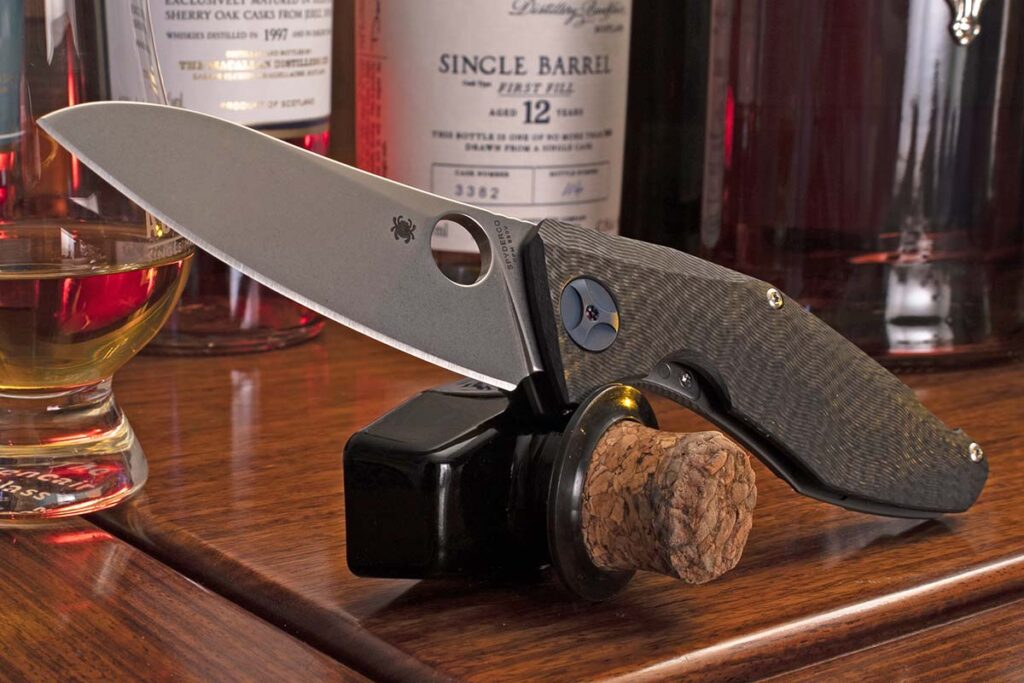
Drunken / Spyderco
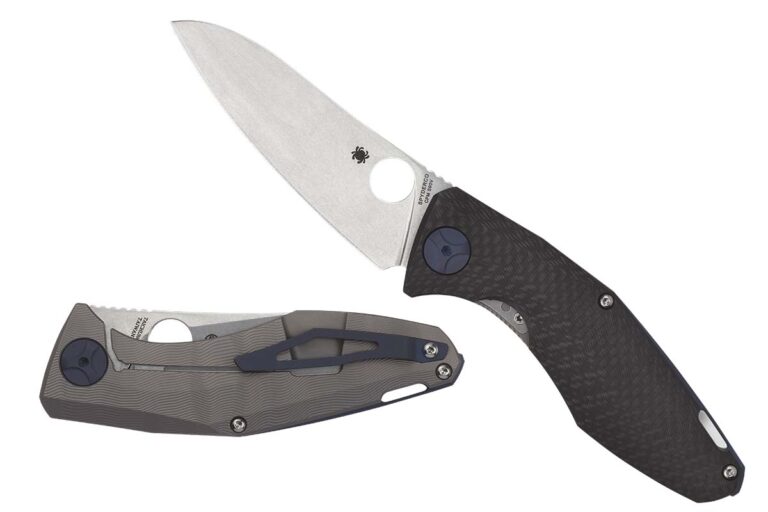
The Spyderco knife’s handle includes a titanium scale on one side and a solid carbon fiber scale and nested stainless steel liner on the other. The titanium scale is “webbed” to reduce weight and forms the basis for the knife’s Reeve Integral Lock (R.I.L.) mechanism, which includes a long-wearing stainless steel interface. Both scales are meticulously machined with the intricate “drunken” texture that gives the knife its name, and are accented by a matching color-anodized backspacer, pivot assembly, and right-side, tip-up pocket clip.
Designer: Dmitry Sinkevich Blade length: 3.45” Blade steel: CPM S90V stainless Blade grind: Full-flat Blade @ thickest: .138” Blade finish: Tumbled Handle: Carbon fiber/ titanium Pocket clip: Right-handed, blade tip up Lock: R.I.L. (Reeve Integral Lock) Weight: 3.8 ozs. Closed length: 4.61” Country of origin: Taiwan MSRP: $770
Tony Bose said if you can make a lockback whittler, you have arrived as a knifemaker.
While the whittler is a classic pocketknife pattern that dates back at least to the 1850s, a variation on the theme incorporating both the lockback and slip joint mechanisms offers a challenge to the custom knifemaker and a delight to the owner of this intriguing style.
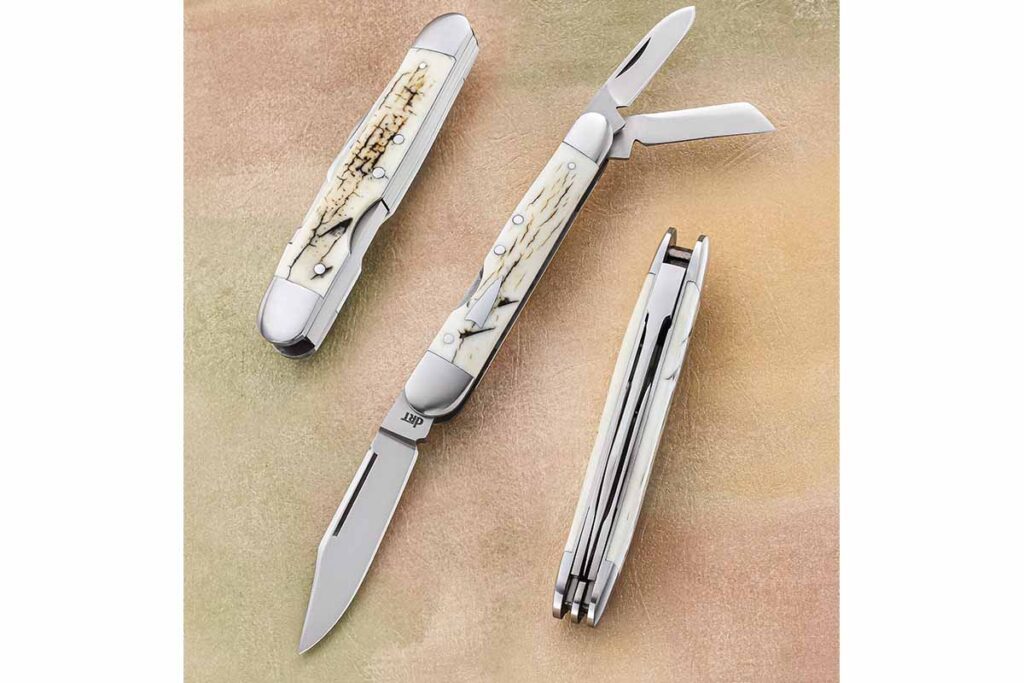
Custom knifemaker David Taber explains his take on the whittler as a three-blade knife with the main blade on one end and two secondary blades on the other. Simple as that. However, from definition to completed construction it’s a bit more complicated, particularly when the lockback mechanism is thrown into the mix.
“The whittler as originally designed was very functional in that the larger main blade is used for making larger cuts and the two smaller blades are for more detailed cutting,” Taber advised. “The knife is necessarily thin by design with the two small blades nestled on either side of the main blade in the closed position, which makes for a slim, pocket-friendly knife.”
Taber’s rendering of the lockback whittler features hollow-ground blades of CPM 154 stainless steel and a mammoth ivory bark handle. The main locking blade length is 3 inches and his price for a comparable piece would be $2,100. He attributes an early interest in the lockback whittler to comments made by BLADE Magazine Cutlery Hall-Of-Fame® member Tony Bose in a 2008 issue of BLADE® relating to the skill level required to make one.
BLADE Magazine Cutlery Hall-Of-Fame® member Tony Bose (Kerry Hampton image)
“I was intrigued and called Tony,” David remembered. “That single conversation started a lasting friendship and started me collecting and eventually making knives. In later years he challenged me to make a lockback whittler and shared his pattern with me. He said, ‘If you can make one of these, David, you will have arrived.’”
Taber took on the task with gusto and through personal experience describes the challenge. “The difficulty, in my opinion, lies in centering the main locking blade in the closed position between the two slip-joint blades at the opposite end without rubbing during function. Equally difficult is balancing the two springs that operate the two slip joints on the one end and the underside of the lockbar on the other end. Think of it like a sophisticated teeter-totter,” he explained. “Care must also be taken to maintain the length, particularly the end that controls the lock tab. It has been my experience that to shorten it even the slightest amount will increase the load deflection rate and thereby make the lock tab not function properly.”
David Taber’s lockback whittler sports hollow-ground blades of CPM 154 stainless steel, stainless bolsters and a mammoth ivory bark handle. His price for a similar knife: $2,100. (SharpByCoop knife image)
The level of difficulty in making the lockback whittler contributes to its collectability, Taber says, which in turn makes the design rarer in the marketplace. “The typical collector of the lockback whittler is usually aware of the skill required to make such a knife and achieves great satisfaction from owning one,” he reasoned.
MOST DIFFICULT?
Knifemaker Luke Swenson shares a connection to Bose with Taber. The Case-Bose collaboration effort introduced Swenson to the design. “The blade configuration and the smaller blades being half the thickness of the main blade set it apart from other patterns,” he commented. “Some whittlers have a ‘catch bit’ or a piece of liner material to hold the blades apart at one end so the main blade clears, and some have a tapered wedge, commonly called a splitback. In the case of the lockback whittler, there is a full spacer that rests between the rear slip-joint blades. Also, in a lockback whittler the small blades and spacer are exactly one-third the thickness of the main blade. The main blade locks, and I believe this is for safety and allows for harder use.”
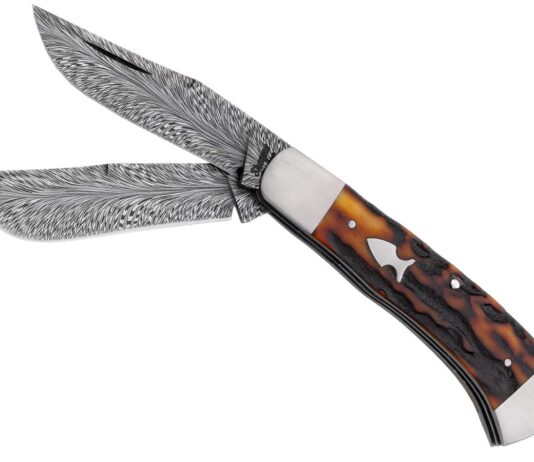
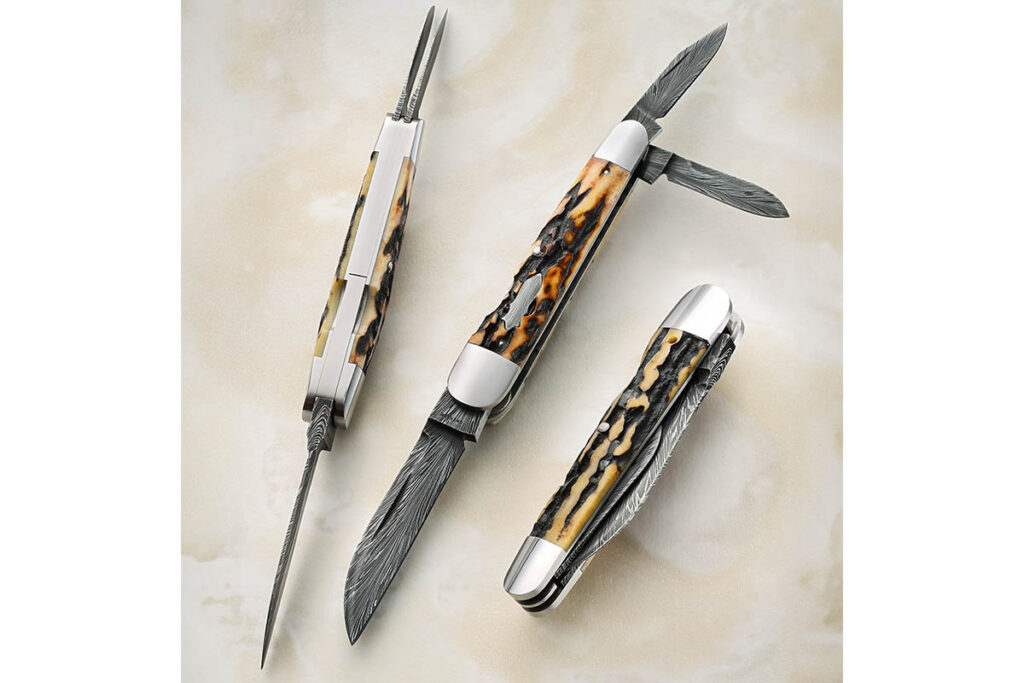
Swenson’s lockback whittler features a hollow-ground 2.8-inch blade of feather damascus forged by Mike Tyre. The fittings are 416 stainless steel and the handle is natural stag. Luke’s price for a similar piece is around $3,000. He describes the lockback whittler as “the most difficult pattern to build, even more so than a six-blade. I believe it isn’t just the combining of elements, but the springs are somewhat tricky in that you have to be paying attention—one false move, or even one over-aggressive pass on your grinder, and you’ll be making new springs. Grinding the small blades isn’t easy and requires a developed feel for getting them right. Very challenging! But if it’s right, the results are magic.”
Feather damascus forged by Mike Tyre comprises the hollow-ground blades of a lockback whittler by Luke Swenson (inset)in natural stag and integral bolsters and liners of 416 stainless. Closed length: 4 inches. Luke’s price for a similar knife: $3,000. (SharpByCoop knife image)
According to Luke, the construction of the slip joint and the lockback are completely different, at least in the opening stages. Putting the two mechanisms together with tiny parts, delicate springs and narrow tolerances tests the skills of the knifemaker in an extraordinary way. “The blades have to sit in the handle to make their tips sit in the handle,” he concluded, “and yet the nail nicks have to be accessible. That takes time and patience to get right.”
Renowned custom knifemaker Wolfgang Loerchner happened past Swenson’s table at the East Coast Custom Knife Show some time back and asked if Luke could make a lockback whittler. “This was in the March of that year, and we agreed on a BLADE Show delivery in June,” Luke laughed. “Keep in mind I’m an unknown maker, and starstruck doesn’t quite describe what I was feeling. I said, ‘Sure, I can get one built.’”
From there, Swenson went to “The Maestro,” Cutlery Hall-Of-Famer Bill Ruple. “He was quite amused and laughed, a little more than was polite I thought, but he agreed to help me through the process,” Luke recalled. “Like all my slip-joint making, anything I learned to do right was in Bill Ruple’s shop. He was key. I don’t believe I would have made the deadline if he hadn’t helped me. I’d send him pictures, and he’d say, ‘remake this and fit it like this instead.’”
The bottom line for the Swenson lockback whittler is its tremendous appeal. “It is a sleek, streamlined beauty,” he offered. “Like anything Tony Bose decided to do, it is elegant and feels comfortable in the hand.”
COMPLEX SIMPLICITY
When knifemaker Tim Robertson envisions his next lockback whittler project, he knows what he’s getting into. “What truly makes the lockback whittler so difficult to build is the way the springs operate,” he noted. “The slip joint is a standard arch spring pushing down on the blade tang while also lifting up at an equal force on the rear of the lockbar, keeping the blade firmly in position. Too much load on either end loosens the opposite end. In a nutshell, the springs have to be balanced between lockbar function and slip-joint function.”
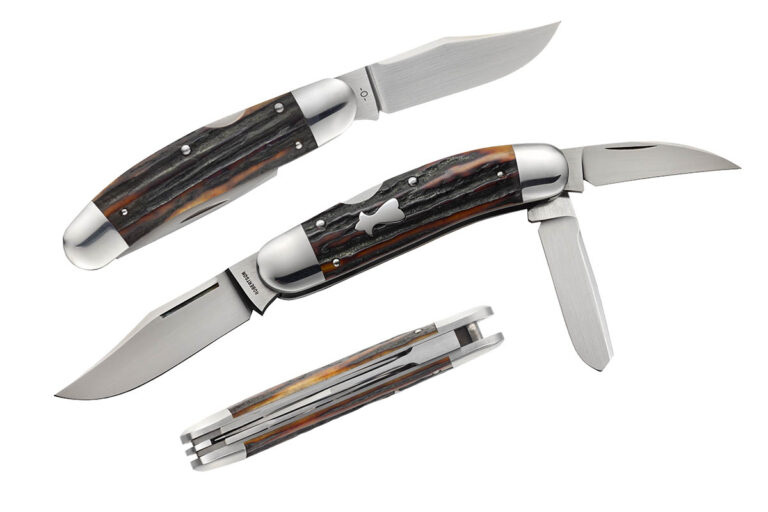
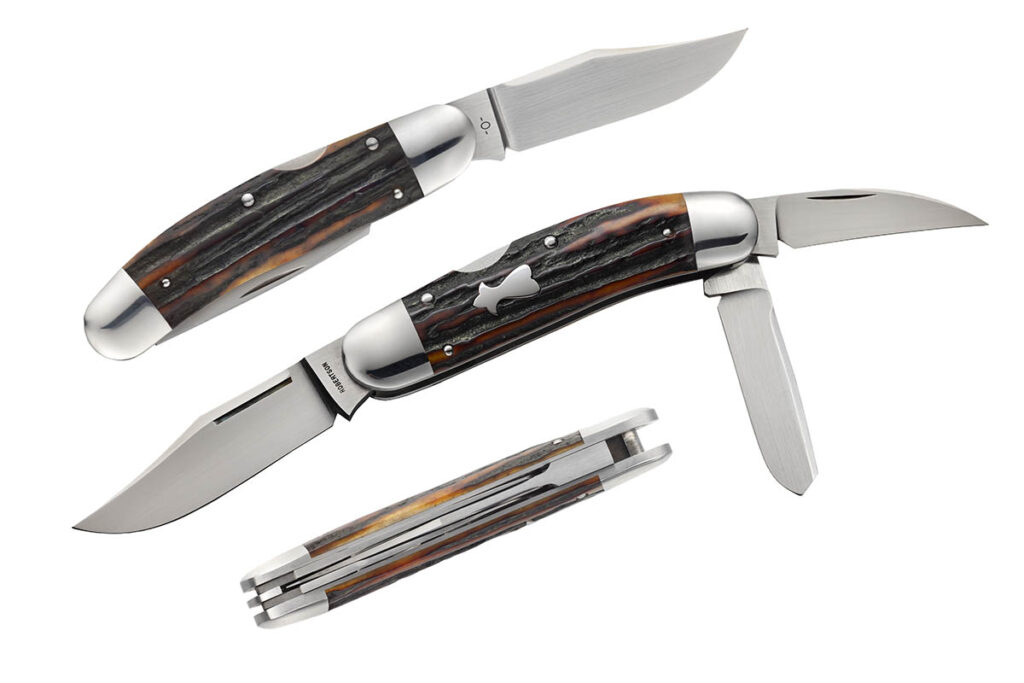
According to Tim Robertson, “The lockback whittler is appealing due to the complexity of the multiple parts and simplicity of design and operation.” Note the spacer that separates the two smaller blades Robertson mentions in the story at the bottom of the closed knife at right. (Mitchell Cohen knife image)
Robertson has become well known for his lockback whittler proficiency, and two recent examples have won awards. His winners of Best Locking Folder at BLADE Show West 2022 and the 2023 Knifemakers’ Guild Best Multiblade Folder both sport CPM 154 stainless blade steel, 416 stainless frames and stag handles. His prices for similar knives would be about $2,500 each.
With a simple explanation for his foray into lockback whittlers, Robertson remarked, “I just wanted to see if I could do it. The lockback whittler is appealing due to the complexity of the multiple parts and simplicity of design and operation.”
Defining the whittler as a knife with three blades and two springs, Tim commented, “The most common types are the splitback variety with a tapered spacer separating the two pen blades. The reason for the tapered spacer is to allow clearance for the blade to fold into the handle without having to have the main blade thickness increased, and then offset ground for the clearance so that one pen blade falls on each side of the main blade.”
SIDE-BY-SIDE KNIVES
Knifemaker Rhidian Gatrill consulted friend and historian Neal Punchard on the origin of the lockback whittler. In response, Rhidian learned that the earliest examples of it were probably made in Sheffield, England, a major center of European cutlery, and later by German and American cutlers.
“It is a premium pattern and difficult to make, so not many companies took on the challenge,” Gatrill explained. “Some of the early Sheffield multiblade sportsman knives and a few rare jackknives had lockback main blades and slip-joint blades, but they are basically two knives side by side. There’s nothing quite like the lockback whittler. There are a few other pocketknives that have locking main blades and slip-joint secondary blades, but they’re not lockback knives. The electrician knives, for example, have a [locking liner] on the screwdriver blade. And there are pen-blade-release knives where the small secondary pen blade gets pushed in to unlock the main blade.”
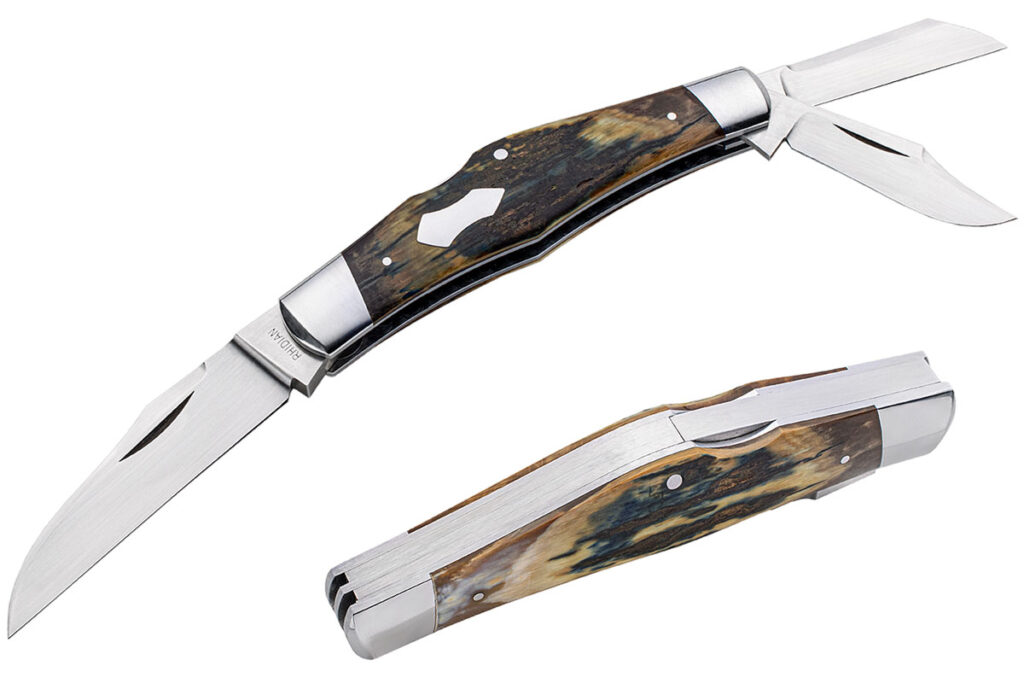
Rhidian Gatrill’s Lockback Rhiddler captured Best Folder in the custom category at last year’s BLADE Show West. The cleverly named lockback whittler features a locking 2 7/8-inch flat-ground wharncliffe and 2-inch hollow-ground slip-joint clip and coping blades of CPM 154 stainless steel. His price for a similar knife: $2,600. (Jocelyn Frasier knife image)
Motivation to make the challenging pattern was easy for Gatrill, who won Best Folder at BLADE Show West 2023 for his lockback whittler cleverly named Lockback Rhiddler. “I like interesting mechanisms and figuring out how to make them work,” he related. “I wanted to challenge myself and see how hard it was to make. Plus, I was attending my first knife show ever, which was the Oregon Knife Collectors Association show in Eugene, Oregon, and I wanted to take something that would possibly win an award. That knife ended up winning Best Folder and Best of Show.”
Looking for examples of lockback whittlers that were striking in appearance and function, Rhidian did some research and recalls, “Like most pocketknife makers, I admire the knives of Tony Bose, Bill Ruple, Ken Erickson and other masters that came before me. I traced photos of their knives and read forum posts that give a few tips, and I asked a few questions from other maker friends that have made lockback whittlers.”
That research led to an opportunity to present a lockback whittler interpretation that resonated with the collector community. “I believe knife collectors like them for their rarity, complexity of mechanism, and interesting function of combining the lockback blade with the slip-joint blades,” Rhidian concluded. “They also look cool with the thick tang on the main blade that steps down thinner and tapers to a point. A locking blade is always a little safer than a slip joint technically, so there’s that for the user. Not many custom makers have made them, and those who do don’t make many!”
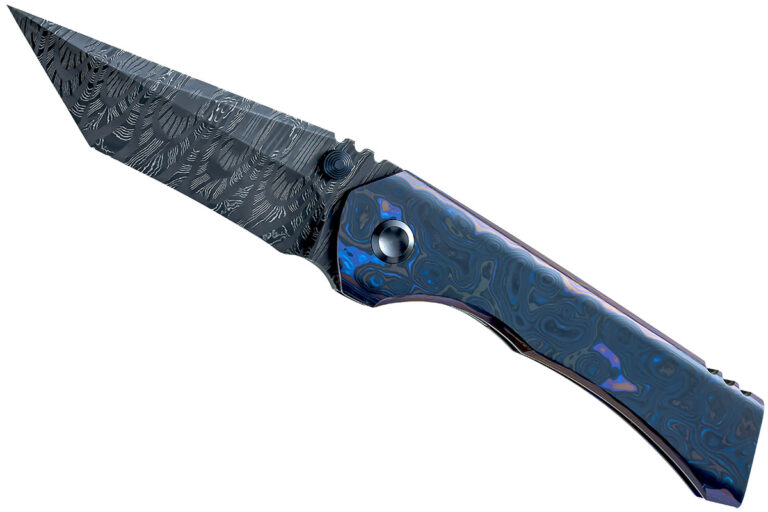
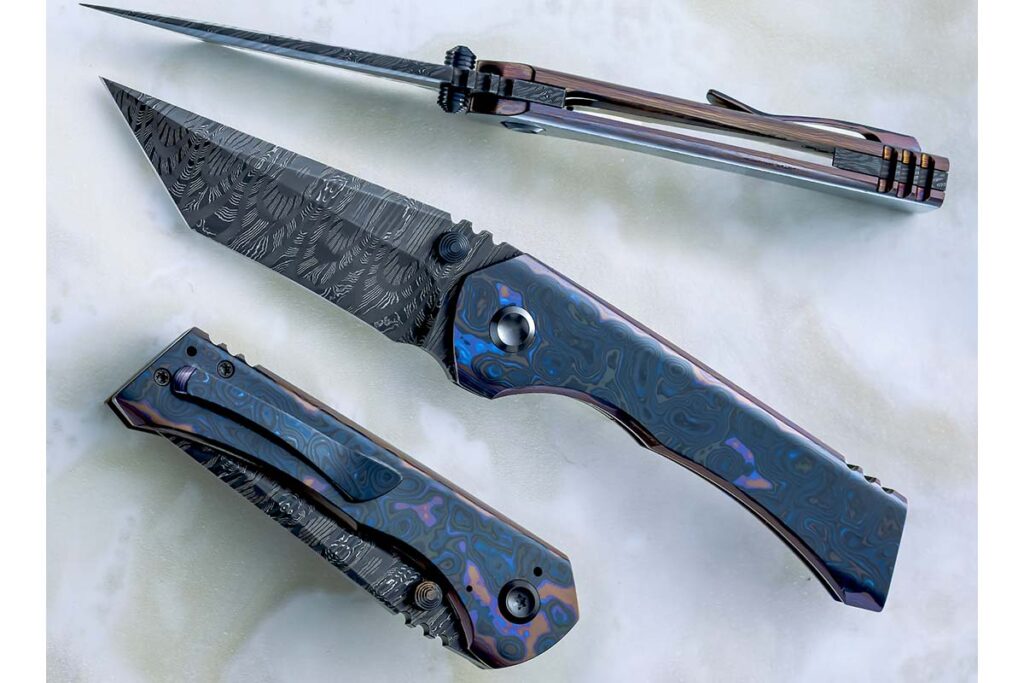
Not one of his everyday builds, the Taka v2s by Brian Brown features a notable blade, handle and lock.
Brian Brown likes a good, pointy tanto.
“It’s kind of a straight hollow grind all the way from the choil to the tip in a climbing grind,” he explained of the blade on his Taka v2s dress tactical folder. Grinding it that way helped him keep the blade extremely thin from the recurve edge to the tip. “You’ve got to be really careful [at the edge] because that’s gonna be the lowest spot where it gets thinnest the fastest—and I’ve burned through them before,” he noted.
Brian Brown said he had to be careful grinding/removing the top layer of the Black Top Timascus™ handle material by Alpha Knife Supply or he would expose too much of the titanium and change the color—somewhat visible here on the spine. The 3.125-inch blade is FireClone 2 forged by Mike Norris, which Brian lauded as some of the best stainless damascus anywhere. Closed length: 4.375 inches. (SharpByCoop knife image)
Only the second one he’s done, the folder’s linerlock-like inset lock enabled him to use the fancy handle material paired with a straight, solid piece of Grade 5 titanium for the lockbar. There are several more steps involved but the upshot is the scales are symmetrical as with a linerlock—a symmetry Brian prefers to that of a framelock. Plus, the inset lock results in a thinner handle than with a linerlock because the lock side must be relieved to make room for the lockbar.
Sourced from Geronimo country Rybar’s Prospector dagger and bolo combo prove pure gold.
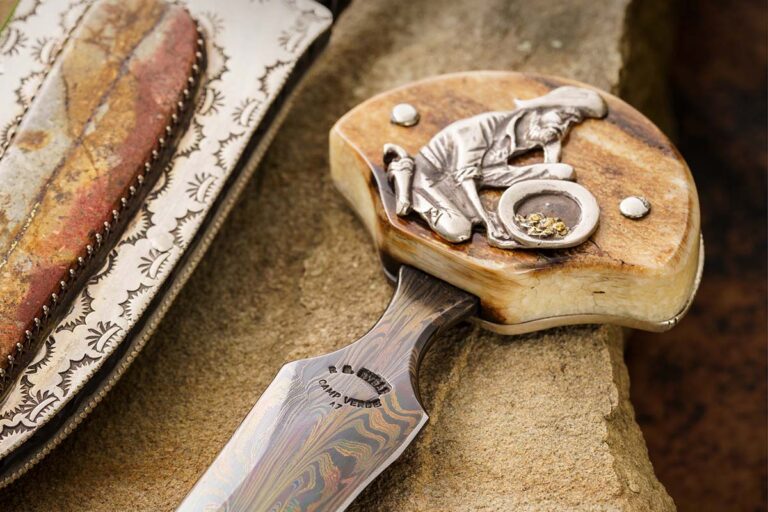
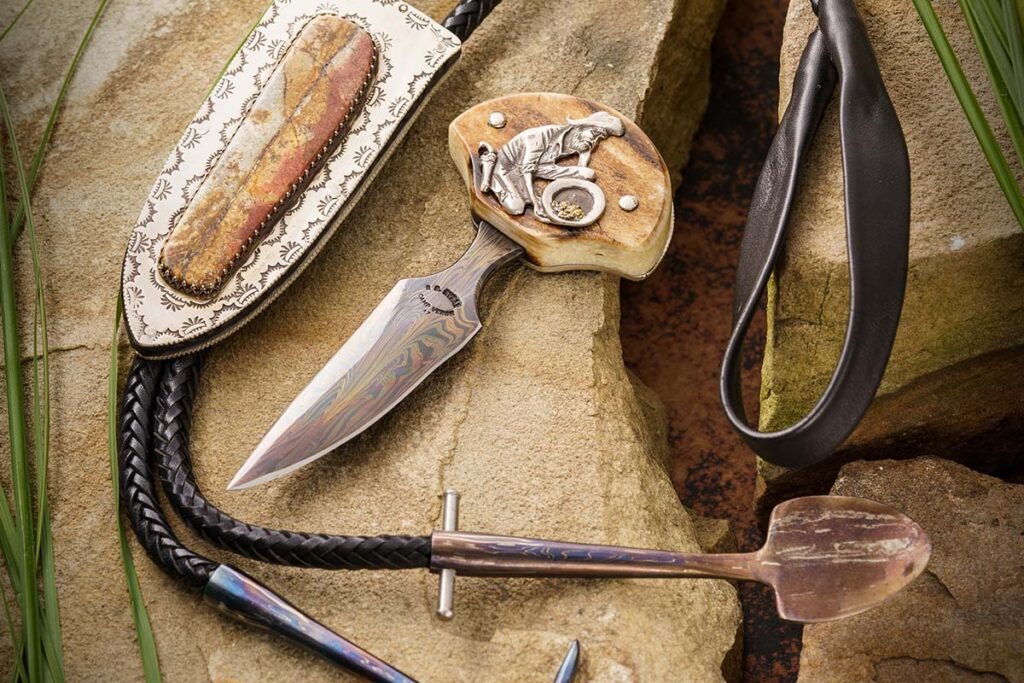
The Prospector by Ray Rybar is a push dagger/bolo combo that bespeaks not only his talent as an ABS master smith but also the array of beautiful, valuable ore in and around his home in Camp Verde, Arizona.
Ray lives in the middle of an Apache reservation where he owns three or four gold mine claims. Camp Verde was the headquarters of U.S. Army Gen. George Crook during the Army’s pursuit and eventual defeat of Geronimo and his Chiricahua Apache band in 1886. Navajos live in the area as well.
Also from near one of his claims, the rock for the inlay has a naturally occurring “stringer” of gold down the center. A local Apache weaved the beautiful leather bolo strap, and Ray forged the shovel and pick of carbon steel and heat colored them. (Eric Eggly/PointSeven images)
Ray teaches various forging and other classes. On occasion he takes his students out to forage for blade and other materials in and around his claims. There they find not only gold every so often but also iron/nickel meteorite, samples of Fe3 and Fe4 iron, ore that can be developed into copper, silver and more. He teaches his students how to convert the iron ore into high-carbon steel. He saves up the leftover steel forged by his students and also rocks he finds and slices with a slab saw for his knives and sheaths. The results can be spectacular—of which The Prospector is a most representative example.
Prospector Specs Knife name: The Prospector Maker: ABS master smith Ray Rybar Knife type: Push dagger/bolo Blade length: 4” Blade material: Damascus forged from iron ore converted to high carbon steel and also iron/nickel meteorite Handle: Ancient walrus ivory w/silver pins and backing Handle inlay: Prospector is solid silver and his tray contains real gold nuggets Sheath: Silver front and back and ebony center w/silver pins; decorated with various marks/designs made with stamps Ray cut from carbon steel and based on those used by the local Apaches and Navajos Sheath inlay: Rock containing quartz, feldspar and a stringer of gold Bolo strap: Leather weaved by a local Apache Maker’s price for a similar push dagger/bolo: $6,500
These classic custom daggers dare the steal the show.
The custom dagger is enjoying a renaissance, in no small part because it is a style that takes so much talent to do properly. Double grinds, fluted handles and a high level of fit and finish are just three of the things a maker likely will have to do well at one time or another in making a dagger. And if he or she nails the dagger build, it’s a crucial step on the way to the next level.
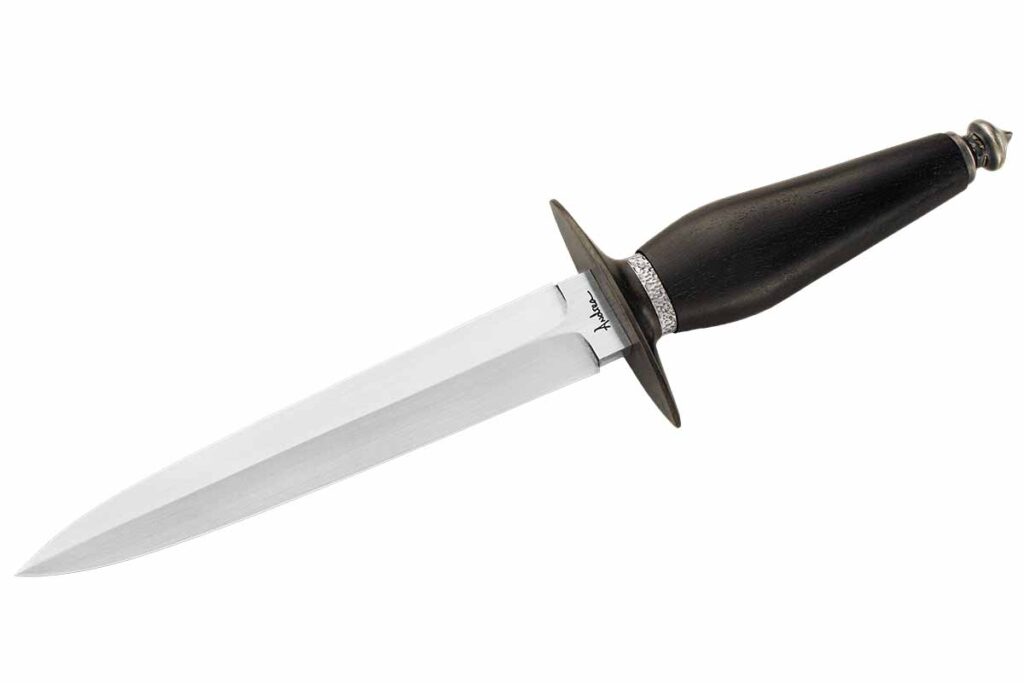
Camille Sennegon: Wenge Wood Handle
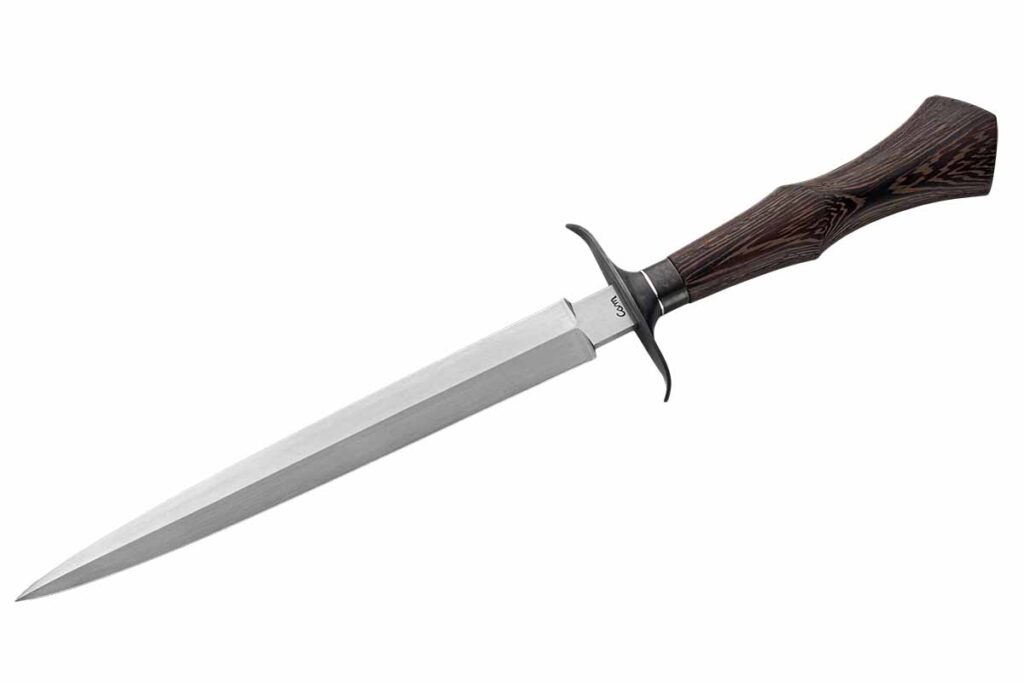
A masterfully sculpted wenge wood handle and a 9-inch blade of 1095 carbon steel sandwich the stainless steel crossguard of a custom dagger by ABS journeyman smith Camille Sennegon. Overall length: 15 inches. (Jocelyn Frasier image)
James Bishop: Death Watch Dagger
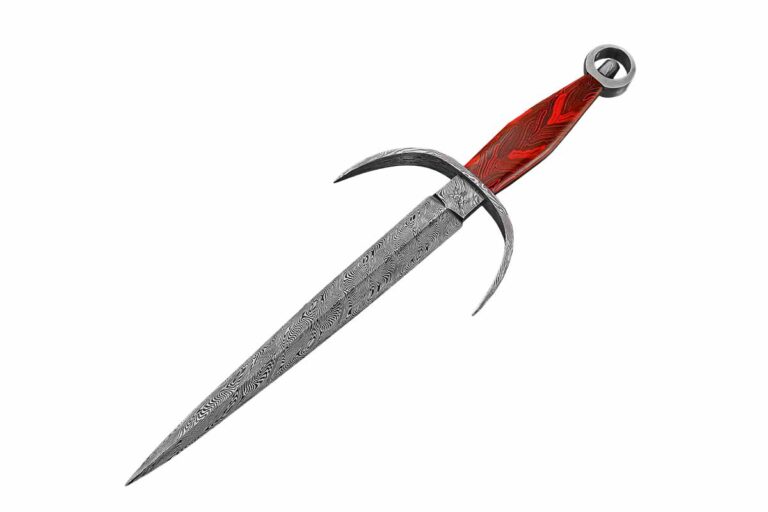
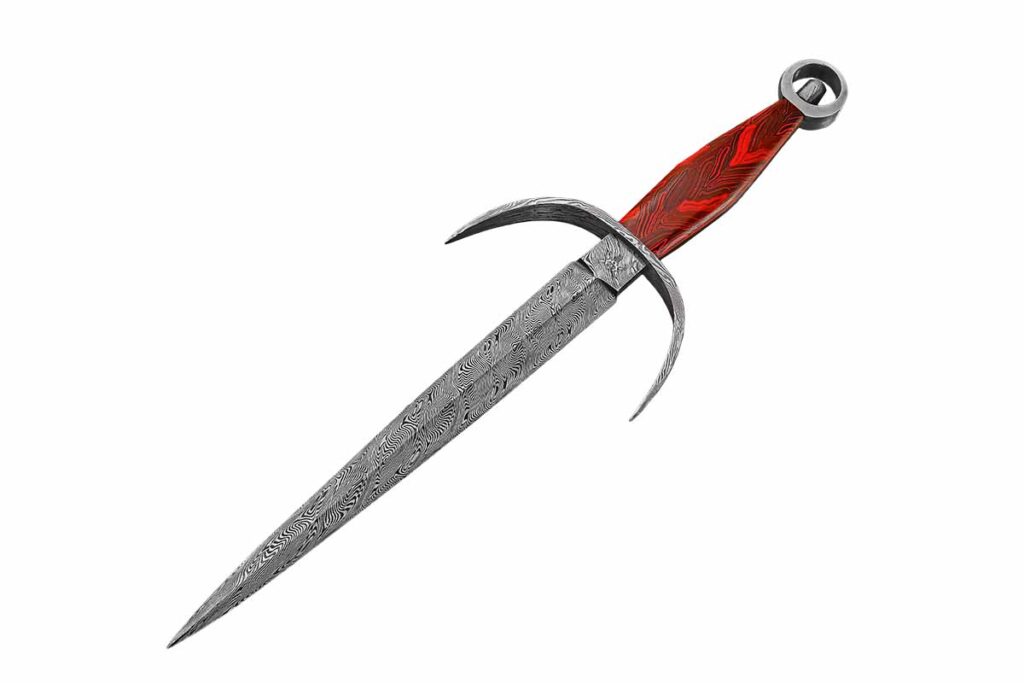
A dramatically upswept guard and 11.5-inch blade, both of twist damascus, and a handle of “damascus pattern” G-10 carry the load for the Death Watch Dagger by James Bishop of Sausage Man Forge. Grind: Flat double edge. Overall length: 19.2 inches. (Rod Hoare image)
Mike Tyre: Quillon Dagger
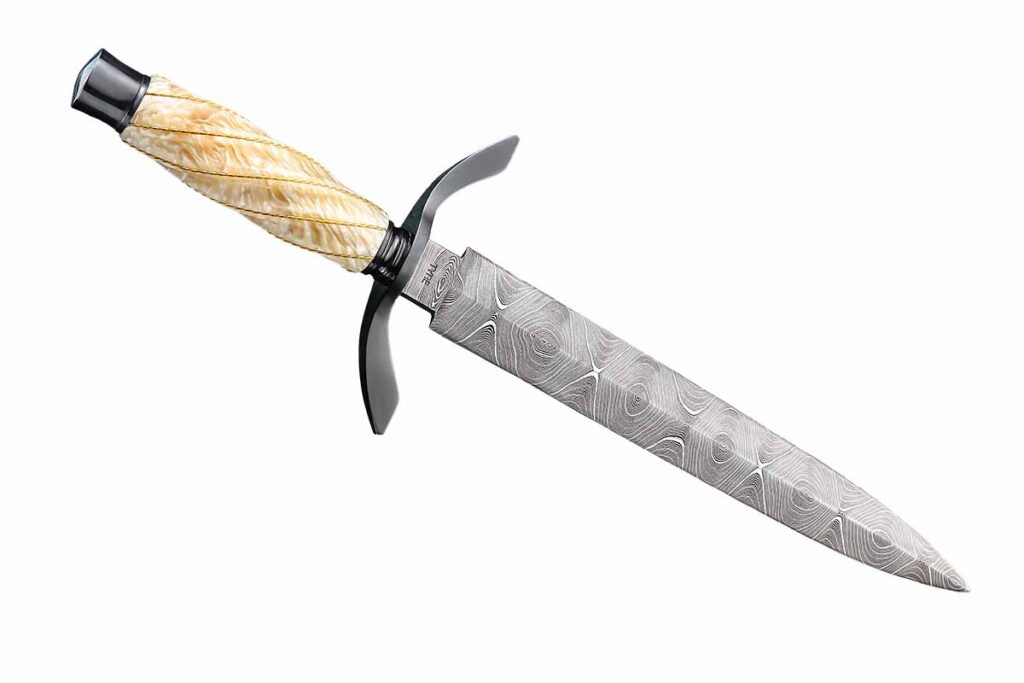
ABS journeyman smith Mike Tyre’s quillon dagger boasts a 10.5-inch blade of double-flat-ground damascus in O1 and L6 tool steels, and a fluted musk ox handle with 12k-gold wire inlays. The knife features takedown construction and a guard of gun-blued mild steel. Overall length: 15.5 inches. Mike’s price for a similar knife: $4,800. (SharpByCoop image)
Andrea Lisch: Blackwood Handle
A 7.5-inch blade of 5160 carbon steel, a blackwood handle with stippled stainless steel spacers, and an O1 tool steel guard complete a dagger by Andrea Lisch. It is one of five test knives that earned her the rank of ABS journeyman smith during BLADE Show 2023. (Jocelyn Frasier image)
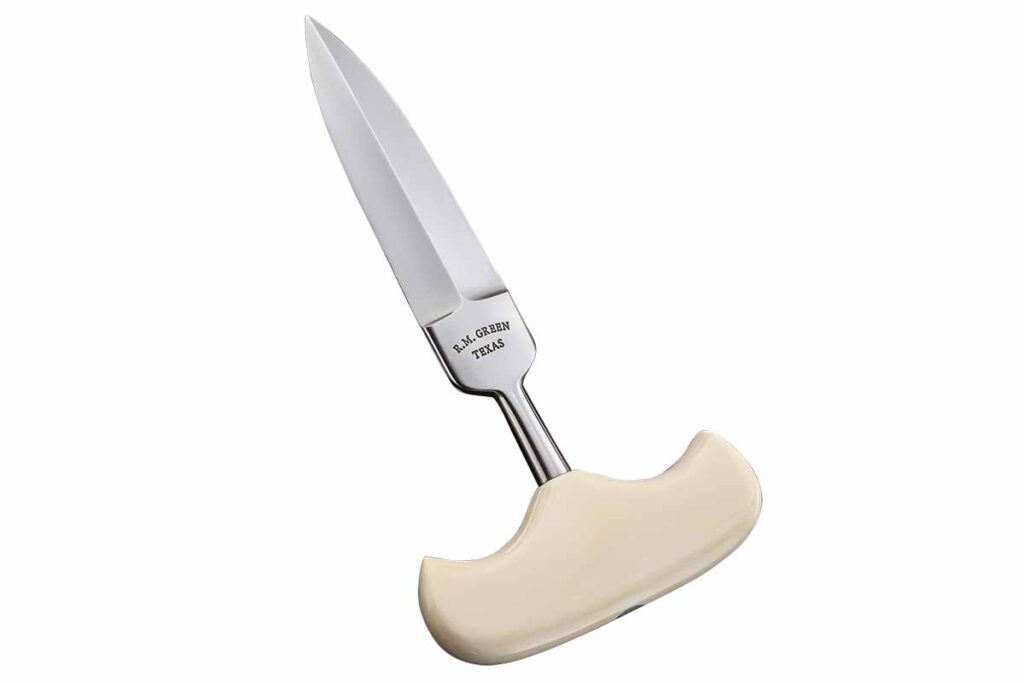
Roger Green: Will & Finck-Style Push Dagger
Based on a 19th-century Will & Finck-style push dagger, Roger Green’s repro has a 6.75-inch blade of hollow-ground 440C stainless steel and an ivorite handle. The sheath (not shown) is nickel silver with a Will & Finck 1872 patented belt clasp. Roger’s price for a similar knife and sheath: $3,500. (SharpByCoop image)
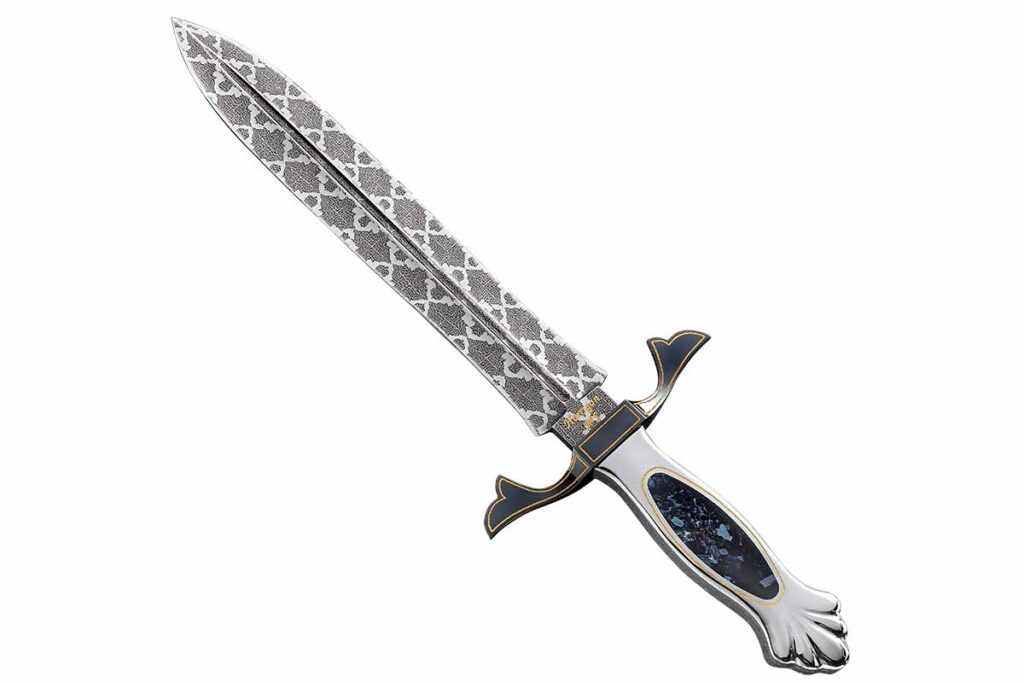
John Horrigan: Art Dagger
A 10-inch blade in hollow-ground quilt-pattern damascus, a 416 stainless steel handle with petersite inlay, and a guard of hot-blued 1045 carbon steel top off ABS master smith John Horrigan’s art dagger. Overall length: 14.5 inches. John’s price for a similar knife: $10,200. (SharpByCoop image)
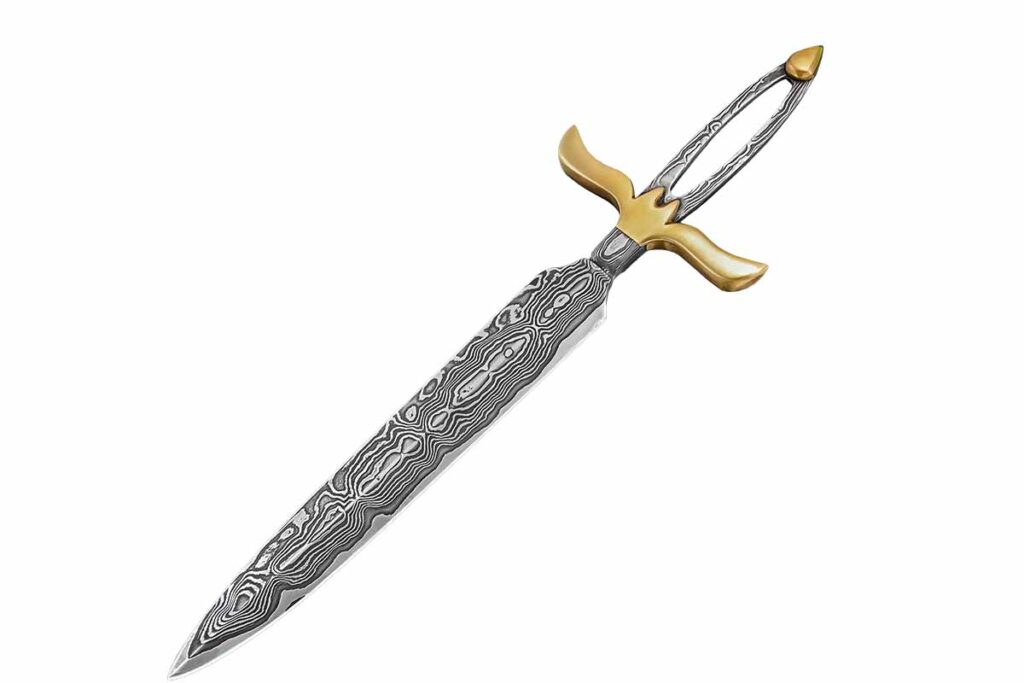
Tony Docherty: Skeleton-Style Dagger
Tony Docherty’s skeleton-style custom dagger sports a 9.25-inch damascus blade, a damascus handle and a brass guard and pommel. Blade grind: Double bevel. Overall length: 14.7 inches. (Rod Hoare image)
After smashing years in the post-pandemic, knife buying has somewhat cooled for the time being.
While the outward signs of the pandemic—masks, shutdowns, etc.—that ravaged the world in the earlier part of the decade are largely gone now, the economic impacts remain. That includes in the world of knives.
Factory knife sales rolled right along in the first couple of years or so of the pandemic, due partly to the federal government stimulus checks and extended unemployment benefits offered to many Americans. The checks and benefits eventually stopped but healthy knife sales continued unabated throughout much of the factory knife industry into mid-2022. That’s when one company experiencing record sales the first six months saw consumer spending “suddenly jerk to a halt in the second half” of the year.
“Dealers had loaded up with knives going into the summer because they expected the Covid spending wave to continue and were left holding a ton of inventory that’s been moving very slow ever since,” wrote the company’s spokesperson. Consequently, he noted, his company’s sales were down about 30 percent in 2023.
However, again according to the company spokesperson, as important a role as the end of the flow of the “free” government money to Americans would seem to have played in the knife sales downturn, it “was small potatoes” in comparison to two larger factors—a poor economy and a lack of consumer discretionary funds in general.
“Confidence is down, so people are being conservative with their discretionary spending,” he noted. “Second, not everyone has discretionary funds, so while the cost of pretty much everything continues to rise, income growth is stagnant for people who were already underpaid.”
Another company spokesperson who stated his company’s sales were down about 8 percent in 2023 cited another cause.
“There is also pent-up demand to go out to restaurants and clubs since the pandemic. People are spending money on experiences [instead of on knives],” he opined. “I see this as temporary and will subside as they realize hamburgers cost $18 and service stinks.”
Even though TOPS Knives’ sales were up 15 percent at BLADE Show West ’23 over the previous year’s show, company general manager Craig Powell indicated he still noticed a sign of conservative knife buying at this year’s show in Salt Lake City.
“We are seeing people tighten their belts and being a little more frugal than in years past,” he observed after the show. Rather than the belt-tightening being reflected in the prices paid for individual knives, Craig wrote, “We saw people that otherwise would have purchased two or three knives buy just the one.”
It should be noted that not every company BLADE® contacted experienced sales drops in ’23. For instance, Condor Tool & Knife reported sales were even compared to ’22, while Coast reported a solid increase of 12 percent in ’23. Officials of both companies indicated they would not be raising prices in ’24, though the aforementioned companies that suffered sales drops in ’23 will be.
“We have a few products going up in price in 2024,” one company spokesperson wrote, “somewhere between 3 and 5 percent, mostly to cover our increased costs in labor and fuel.” Another company spokesperson stated his company would be implementing a 5 percent increase across the board for similar reasons. “We’re hearing that other brands are raising their prices much more than that, so we’re doing everything we can to keep our knives as affordable as possible for consumers without reducing quality,” he observed.
It should be noted here that the companies cited in this story represent a small segment of the industry. Moreover, we at BLADE believe in the ebb and flow of knife sales as outlined by Chris Quinn of GP Knives, and that most of the players in the knife industry who experienced down years won’t be down for long.
Nonetheless, perhaps more than ever, BLADE urges you to monitor the prices charged for knives in 2024. Today’s knives are of higher production quality and materials than their predecessors but, as always, it’s up to you to ensure that you get the best knife with the best bang for your buck.