Knife collecting is an extremely rewarding experience for knife enthusiasts. There truly is a knife for everyone. Many increase or hold their value throughout the years, making collecting knives something to pass on to the next generation of knife collectors.
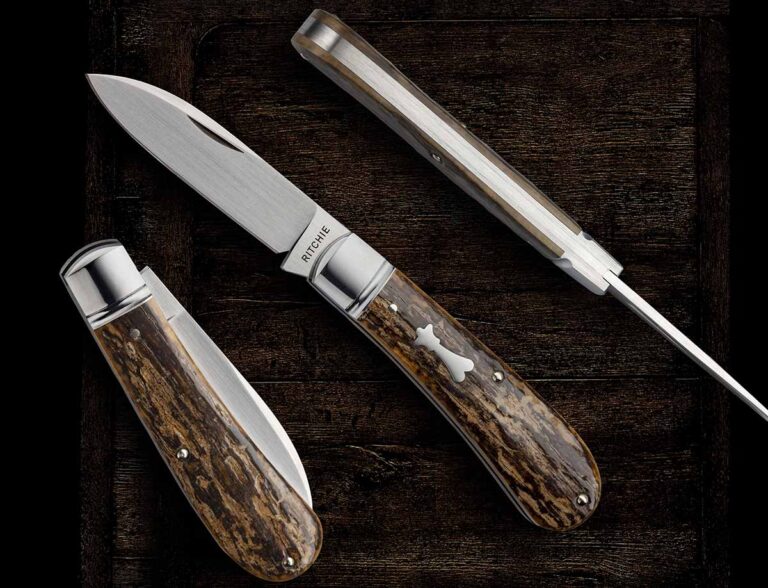
Jason Ritchie’s knives and the way he sells them have a special appeal.
It’s not all the way here yet but a significant portion of the future of knives may be personified in the person of Jason Ritchie and his handsome slip joints.
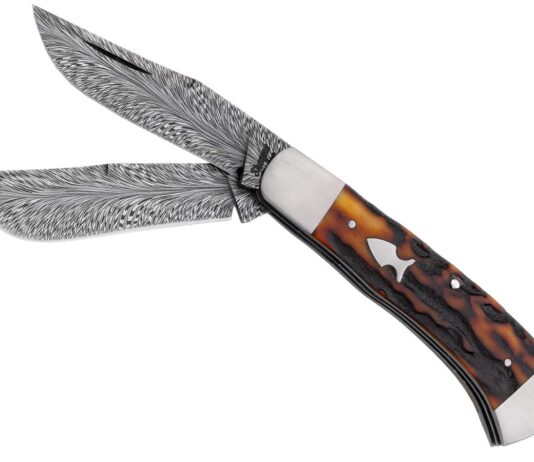
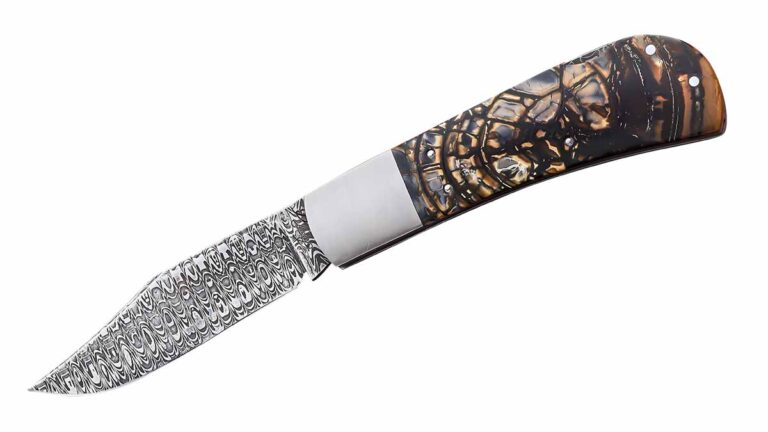
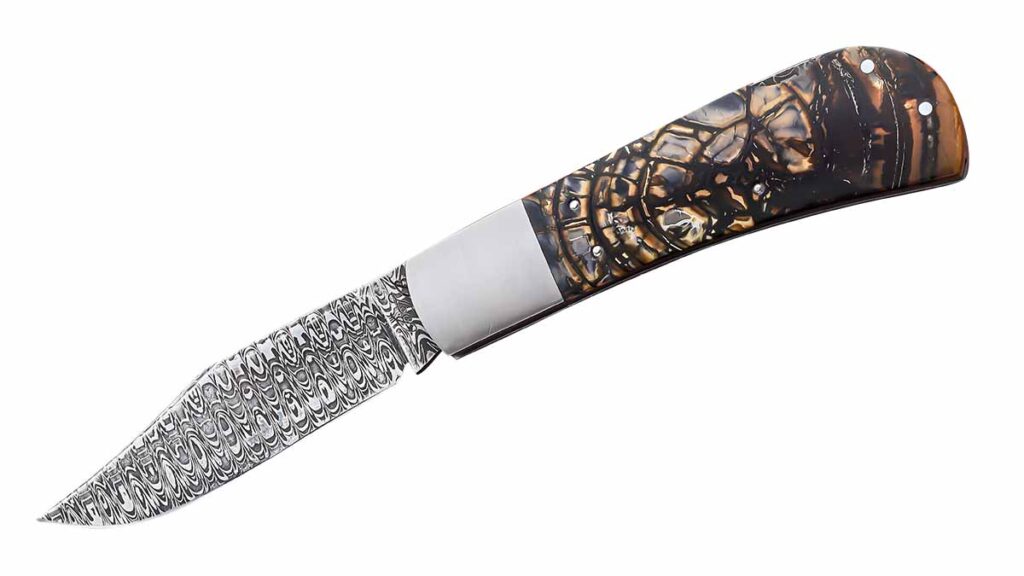
An example of his work is his repro of BLADE Magazine Cutlery Hall-Of-Fame® member Tony Bose’s Zulu Spear in mammoth ivory and AEB-L stainless steel. Jason’s been making knives less than three years but his workmanship is that of a much more experienced cutler.
Nonetheless, it’s the way the 46-year-old approaches the making and selling of his knives that’s as notable as the knives themselves. The Marine Corps infantry veteran describes himself as a hobbyist—he builds 25 to 28 slippies a year at most—and does not take orders. Other than a few sold by Windy City, he sells all his knives on Instagram via lottery or first-come, first-served buyers.
The resident of Hanover, Illinois, says all the knives he puts on his Instagram page sell in seconds. He does not exhibit at knife shows because between making knives, his full-time job as a signal maintainer for the railroad and the campground he operates during the summer months, he simply doesn’t have the time. Rather than exhibit, he prefers meeting people and hanging out at the shows.
As he noted, “I’m just a knife enthusiast at heart.”
Zulu Spear Repro Specs Maker: Jason Ritchie Blade Steel: AEB-L stainless Blade Finish: Hand-rubbed satin Rockwell Hardness: 61 HRC Handle Material: Mammoth ivory from Fine Turnage Productions Liners, Shield, Pins & Fluted Bolster: 410 stainless; the liners are jeweled Closed Length: 3 7/8” Maker’s Price For A Similar Knife: $1,200
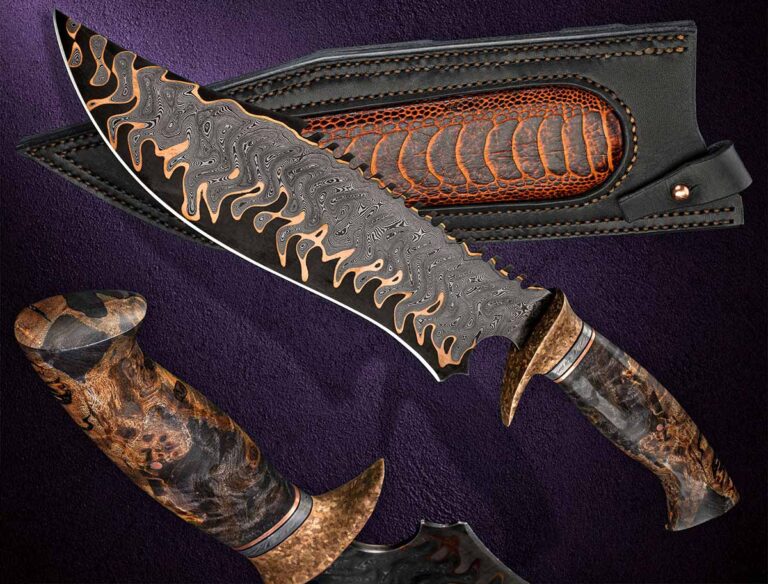
Inspired by Rambo’s knife, Corey Reynolds’ sawback bowie channels the genre in a copper-mai chevron pattern.
Like many boys his age, Corey Reynolds grew up watching Rambo movies. Now 43, he’s been making knives about three years and decided he wanted to make a knife with a Rambo look—and what better way to do that than with a sawback bowie?
For blade material he used copper-mai steel in a chevron pattern from Baker Forge and Tool, and for the piece de resistance configured the sawback so the copper would be exposed at the base of each tooth.
Though the way he did the teeth is mostly for looks, he said each tooth has a fairly good edge. The handle is spalted maple from Steelhead Forged Scales with spacers of copper, raindrop-clad feather damascus forged by Adam DeVille, and G-10. The guard is of a striking multi-etched material called gem bronze from Mike’s Metalworking.
Sawback Bowie Specs Maker: Corey Reynolds Blade Length: 9” Blade Material: Copper-mai in a chevron pattern Handle Material: Spalted maple w/copper, raindrop-clad feather damascus and G-10 spacers Guard: Gem bronze Overall Length: 15” Sheath: By the maker of leather w/ostrich leg inlay from Ray’s Ostrich Leathers Maker’s Price For A Similar Knife: $1,400
An overinflated market for forged blades at home caused the author to look elsewhere. Oftentimes this has been to Eastern European Knife Makers.
This article originally appeared in the 2024 KNIVES Annual.
Since 2017, forged blades have taken the lead. Niche markets like chef’s knives, slip-joint folders, and tactical fixed blades retain enough interest to be powerful sub-markets. Price points and availability in primary and secondary markets lead to the demise of the front-runners. Popular market sectors inspire experienced and new makers to build that type of knife.
Two problems arise from this:
Makers will rapidly join a market sector, but collectors are slower to follow.
Pricing is primarily based on what other makers are getting for their work and not, for example, the quality of a maker’s knives, name recognition, status among the competition, etc.
Higher prices from less qualified knifemakers encourage the well-known makers to raise their prices, and the cycle continues until the knives become unaffordable. Currently, this is what is happening today in the forged blade market. I saw this trend emerging in 2020, and I started emphasizing makers who offer value for the money with their work.
Overpriced knives led me to increase my research for custom knives with good value in the United States and worldwide. Social media was a great help in this area. As I researched, I found myself saving photos of knives I was interested in. When I returned to re-look at the pictures I had saved, I found many of these makers were from Eastern Europe.
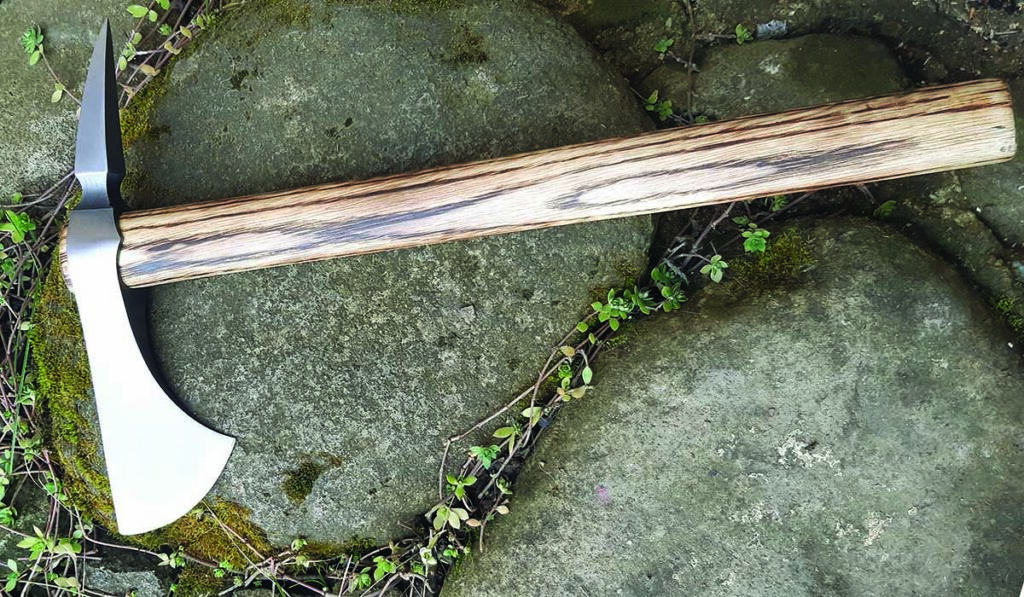
In the spike tomahawk realm is this Csizmar Szilard model with a forged 5160 high-carbon steel head, a hickory haft, and a custom leather sheath. Szilard is a well-known maker in Romania. (Csizmar Szilard photo)
Much like in the United States, prices ranged from reasonable to what seemed extreme. I contacted well over a hundred makers asking questions about materials, construction techniques, pricing, and sheaths, and requested several additional photos. While there are other makers I plan to contact soon, the following are the seven makers I have already started working with.
Meet The Eastern European Makers
Maksim Tjulpin
Maksim Tjulpin has been making knives for 11 years in his home country of Latvia. His interest comes from the diversity of knives that can be made as well as the array of materials. Maksim builds knives utilizing both the stock-removal and forging methods of blade making. He favors forged blades as each has its own unique character.
He primarily uses stabilized wood for his handles, often combined with mammoth ivory spacers. I have found his craftsmanship to be impeccable. The knives feature excellent fit and finish as well as ideal balance and handle ergonomics.
Petr And Peter Dohnal
Petr Dohnal and his son, Peter, have been making knives for 21 years in their native country of the Czech Republic. Working as a computer graphic designer, Petr realized he wanted to build something with his hands. So, he chose to make custom knives. As with many makers, his favorite part is forging the blades, usually damascus. In addition to making his own steel, he uses Elmax, Vanadis 8, and M390, as well as other alloys. He understands that the knife’s intended purpose will often determine the most suitable steel. His handle materials of choice are stabilized wood and antler. I find Petr’s knives a joy to hold in my hand, being sleek, well-made, and exhibiting superior balance and handle ergonomics.
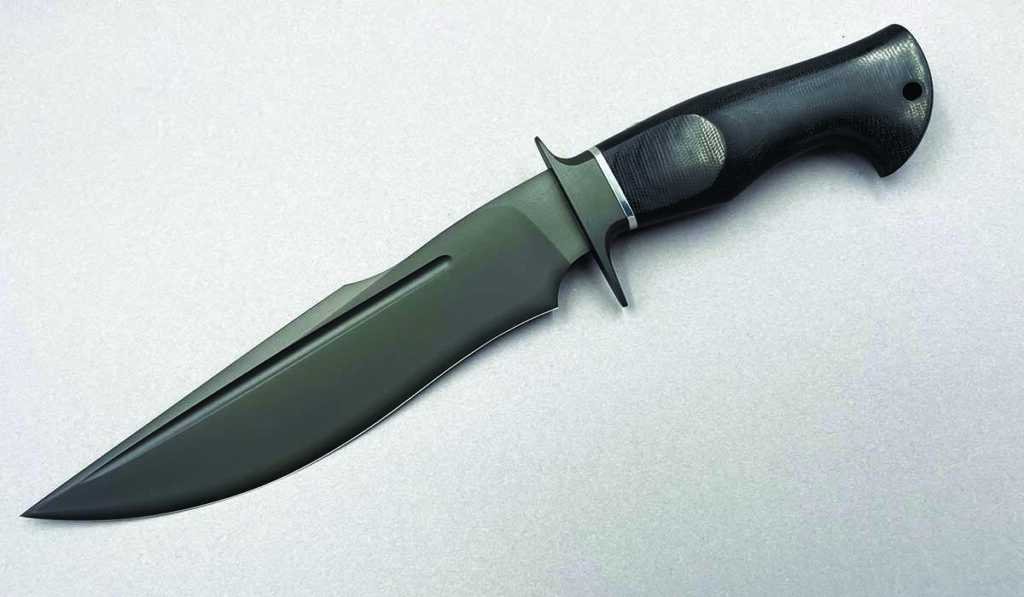
The sleek, stealthy, and sexy fighter by Eastern European knife maker Michal Komorovsky exhibits a 7.75-inch, black DLC-coated Elmax blade, a black canvas Micarta handle, and a leather sheath. The balance of the knife makes it deceptively quick, and a fuller reduces the weight while increasing blade strength. (Michal Komorovsky photo)
Michal Komorovsky
Michal Komorovsky started making knives, in 2011, in his home country, Slovakia, or officially, the Slovak Republic—doing so primarily because he wanted to try something different, and he never looked back. He favors Sleipner steel, which is a new-generation alloy like D-2, as well as M390. When time allows, he forges damascus for his knives, including a wide variety of fixed blades. Michal builds an array of knives, from hunting and tactical models to bowies and even an occasional art dagger.
Many of his tactical knives feature black DLC-coated blades, but he also offers sandblasted and bead-blasted steel, as well as satin- and mirror-polished finishes. Michal uses various handle materials, with desert ironwood being his favorite. I’ve taken a liking to his fighters that exhibit excellent fit and finish, have an outstanding balance, and feel great in the hand.
The Tactical Realm
Piotr Gosciniak
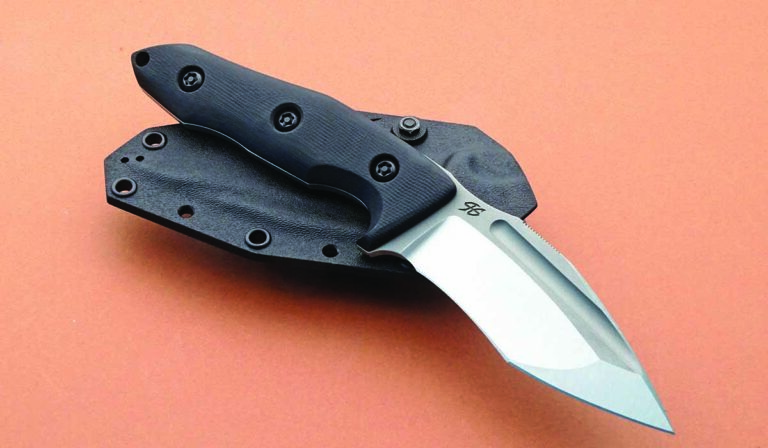
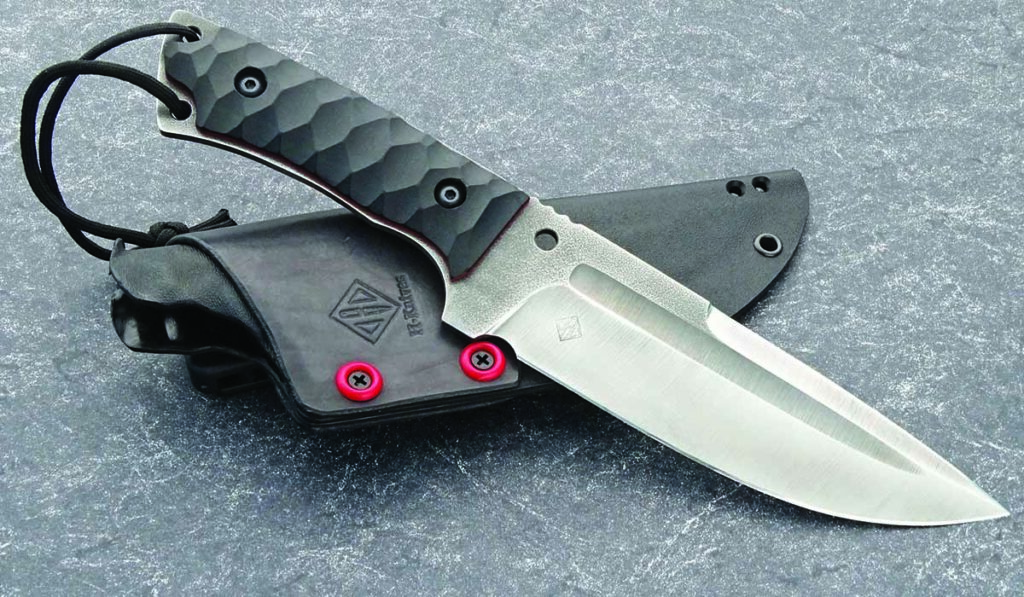
Piotr Gosciniak has been fashioning custom knives in his home country of Poland since 2017. Having a keen interest in the military, Piotr decided to focus his talent on making tactical knives. He occasionally uses high-carbon steel such as 80CrV, but most of his knives are built using quality stainless steels such as Elmax or Sleipner.
Piotr prefers synthetic handle materials like Micarta, G-10, and carbon fiber. He also offers Cerakote coating for his knives. As a former infantry officer, I appreciate the crisp, clean lines of Piotr’s knives. His designs are purpose-driven; these are tools meant to be used. The blade fullers, textured handle material, and thumb serrations add to each knife’s capability.
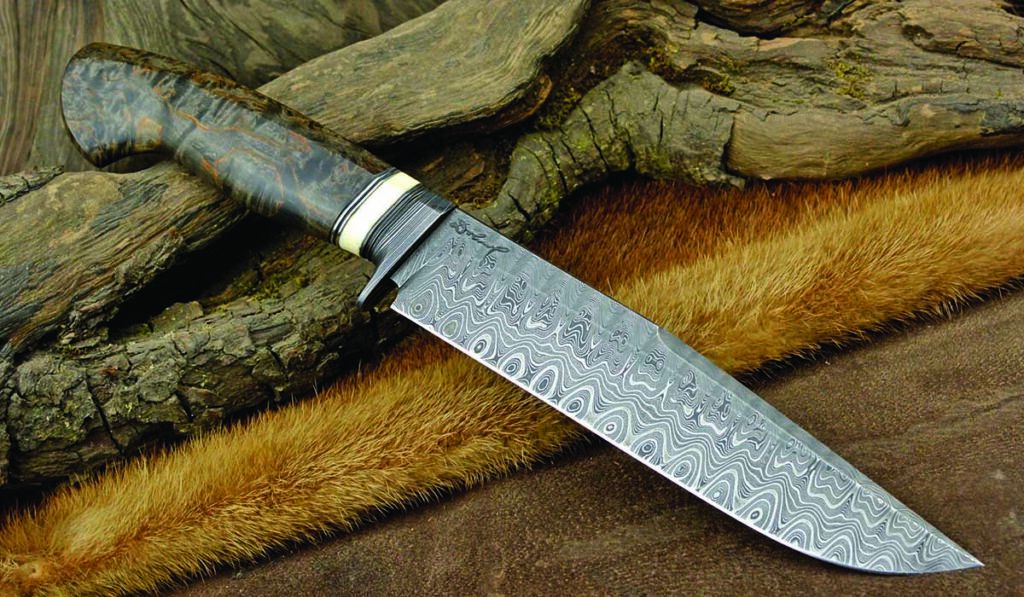
Petr Dohnal forged a damascus camp knife, including the guard, adding a stabilized Karelian birch handle and fossil walrus ivory spacer. It comes with a custom leather sheath. (Petr Dohnal photo)
Jacek Hnatow
Also from Poland, Jacek Hnatow has been building knives for eight years. He started as a collector, then decided he didn’t want to buy knives anymore; he wanted to make them. As an avid outdoorsman, it should come as no surprise that Jacek’s specialties are survival and bushcraft blades. He prefers working with Bohler N690 and Elmax, as well as high-carbon alloys and san mai steel. Jacek’s handle material offerings include synthetics such as G-10 and Micarta, as well as stabilized wood at the customer’s request. His knives, many of which can be huge, are well-balanced with great handle ergonomics. His bushcraft blades are a perfect size to carry in the field, and all of Jacek’s knives are well thought out for the tasks at hand.
Csizmar Szilard
Romanian Csizmar Szilard has been a full-time knifemaker since 2007. When he was younger, he enjoyed video games and one of them allowed players to forge their weapons virtually. So, Csizmar decided to make that a reality. Forging is his favorite part of fashioning knives, hatchets, and axes. He prefers 5160 high-carbon steel for its simplicity and ease of forging. Handle materials are all-natural, with wood and antler being his favorites. Csizmar’s work is clean and balanced, precisely what you would expect from a maker who builds tools that are meant to be used.
Szymek Szlagor
A native of Poland, Szymek Szlagor has been making knives since 2017. Building a knife for himself led to making them for friends and eventually becoming a full-time knifemaker. He enjoys forging and machining carbon steel and damascus. He gravitates toward 5160 high-carbon steel and combines K720 and 15N20 to make damascus. His handle material preferences are natural materials such as stabilized wood and antlers. For his everyday carry (EDC) knives, he prefers to use Micarta. Szymek feels making knives is a beautiful job that involves taking a piece of steel, giving it shape, and improving on it until the blade becomes a tool that will be used and passed down from generation to generation. Having handled his work, he has accomplished his goal.
Working With Eastern European Makers
Language: There are several languages throughout Europe. While it is true that many Europeans speak English, it is equally noteworthy that they do not read and write the universal language well. This is important to know as, more than likely, collectors will be contacting the makers via email or social media. When writing, I often rely on an online translator for help. Understand that such online translating programs could be better. I always let the maker know upfront I am using a translator.
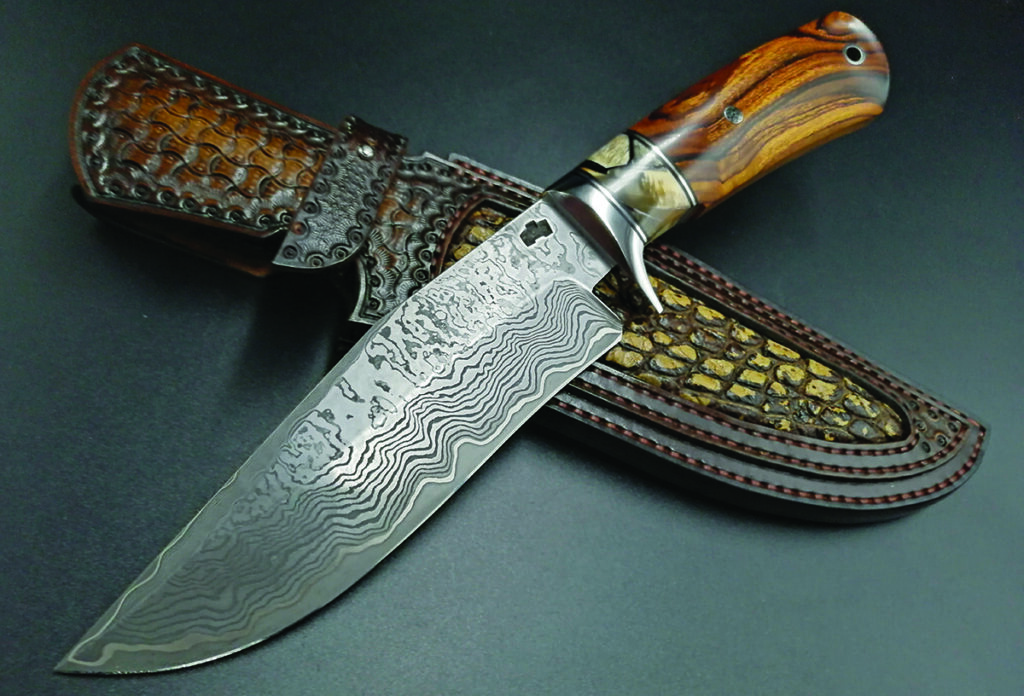
Eastern European knife maker Maksim Tjulpin’s camp knife features a 7.1-inch san mai damascus blade, a stainless guard, a black G-10 spacer, and a mammoth tooth and desert ironwood handle. It comes with a custom leather sheath. (Maksim Tjulpin photo)
When emailing or writing to makers, try not to use slang or acronyms, as these usually translate into something that might not have the intended meaning. Remember to be patient with this process, as both collector and maker must understand exactly what each is expecting.
Payments: The preferred method for knife transactions is PayPal. As with most makers worldwide, many are not set up to take credit cards. Those who have traveled to Europe know there are additional fees for using U.S. bank credit cards. Although wire transfers can be made, it is best to check with your bank to find out what the fee for an international wire transfer will be.
Lastly, Western Union is an option that usually comes with an $8 fee. Some buyers might find the process of paying upfront and then having to wait up to a month difficult. However, I have been buying knives regularly from Eastern Europe for the last three years and have never had a package go missing.
Shipping: The maker will generally ship the knife through his or her country’s postal service. Most countries work with the U.S. Postal Service, and once a package is accepted, you can track it coming from Europe. The delivery time frame will average between two and four weeks. While FedEx can be an option, the cost associated will generally eliminate this service from the ideal options.
The 13-inch camp knife from Szymek Szlagor showcases a forged Bohler K720 blade with hamon (temper line), a stainless guard and sambar stag handle scales. (Robertson’s Custom Cutlery photo)
Measurements: Europe uses the metric system. As foreign as the metric system is to you, the same is true for the imperial system the United States uses to makers in Europe. Fortunately, there are conversion programs on the internet. In conversing with European makers, please pay attention and differentiate between when they use centimeters (cm) or millimeters (mm), as 1 centimeter equals 10 millimeters, and when it comes to a knife, that could be a huge difference.
Forged In Fire Influence
Most of the makers in this article offer forged blades as part of the repertoire. However, Piotr Gosciniak is the exception, as he specializes in stainless and some high-carbon steel tactical knives. The U.S. market will see a resurgence of this category of knives in 2023-’24. For now, forged blades are the most significant market sector in the United States, partly due to increased interest in forging knives due to the TV show “Forged in Fire.” The interest created by this show was partly responsible for 38 makers earning their American Bladesmith Society (ABS) journeyman smith ratings at the 2022 BLADE Show.
Talking with several ABS master smiths, I was told they saw an increase in the number of makers taking their journeyman smith performance test before the 2023 BLADE Show as well. As a result, I anticipate the final numbers to show a record number of candidates testing for their journeyman smith stamps in 2023. With an increase in knife shows across the United States, hammer-ins, and the accessibility of in-person training and videos on social media, the number of forged blade makers will continue to increase over the next several years.
As these new makers enter the custom knife market, their pricing will be based more on what their peers charge for knives as opposed to a position in the market that their work has earned. In the short term, collectors will be the ones subsidizing too many who are bound to have short careers as custom knifemakers. Long term, the aftermarket will sort out the winners and losers. Therefore, it is incumbent on buyers to understand value pricing and that they should not buy a custom knife that will lose value.
Eastern European knife maker Jacek Hnatow offers the “Wicher” tactical fixed blade in Bohler N690 stainless steel, a black G-10 handle and a custom Kydex sheath. Of full-tang construction, the contoured handle provides excellent grip even when hands are wet. (Robertson’s Custom Cutlery photo)
Over the last 37 years, I have bought and sold knives on every continent except Antarctica. Today, it is easy to find exceptional makers in Eastern Europe and worldwide. I understand that ordering from makers outside the United States can be a leap of faith.
My hints regarding purchasing knives from Eastern Europe should help you with your concerns. The styles, materials, and craftsmanship of makers worldwide have never been better. This is why I suggest you give the makers in this article and others around the world consideration to become part of your collection.
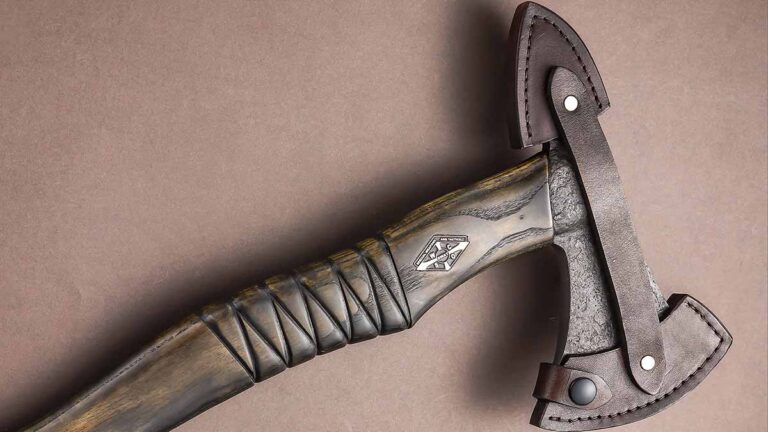
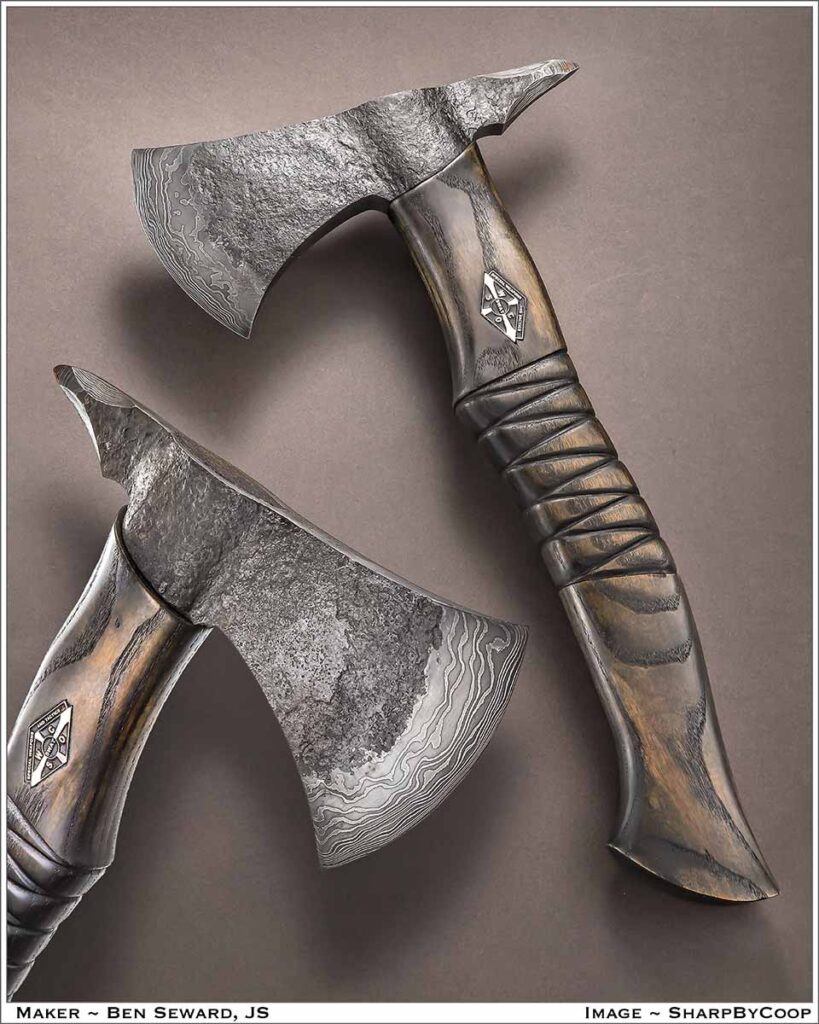
Ben Seward’s breacher SWAT Axe salutes officer’s 21 years of police service
When ABS journeyman smith Ben Seward went to make his first axe, he didn’t settle for something easy—he went the whole hog on a special breaching model as a retirement gift for a 21-year law enforcement veteran.
Sgt. Magnus Gervol retired from the Whatcom County, Washington Sheriffs Office after a career that included 15 years on the SWAT team and 14 years as a sniper.
Members of the Sheriffs Office contacted Ben, who forged the axe from the barrel of a Remington 700 SPS tactical sniper rifle. The idea was to make a tactical axe with a beard and a tomahawk spike. The handle is Ozark white oak. Ben’s dad, David, who specializes in sheaths, made the leather sheath.
Ben forge welded the rifle barrel into a bar and layered it up with other carbon steels. He forged the two flats of the head roughly into a triangle and pieced in the bit for the cutting edge. All of the head, including the edge and spike, is forged of the same damascus.
SWAT Axe Specs Maker: Ben Seward Head Size: 7.75” Bit Size: 3.5” Head/Bit Material: Damascus forged from the barrel of a sniper rifle and 1080 carbon and 15N20 nickel-alloy steels; includes a rough-forged finish Handle: Ozark white oak Handel Length : 14” Maker’s Price For A Similar Breaching Axe (excluding the steel from the sniper rifle): $1,500
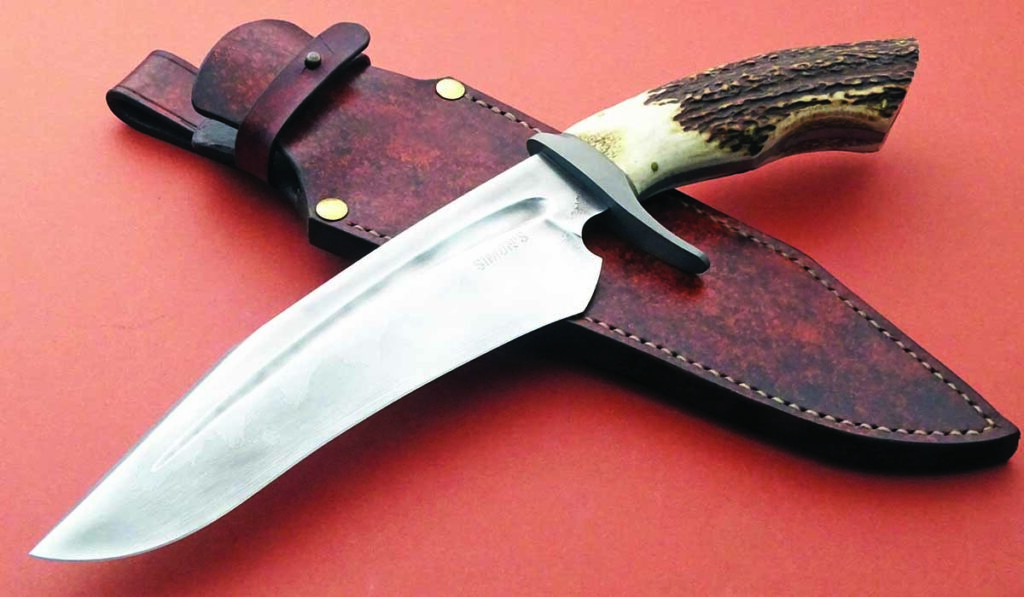
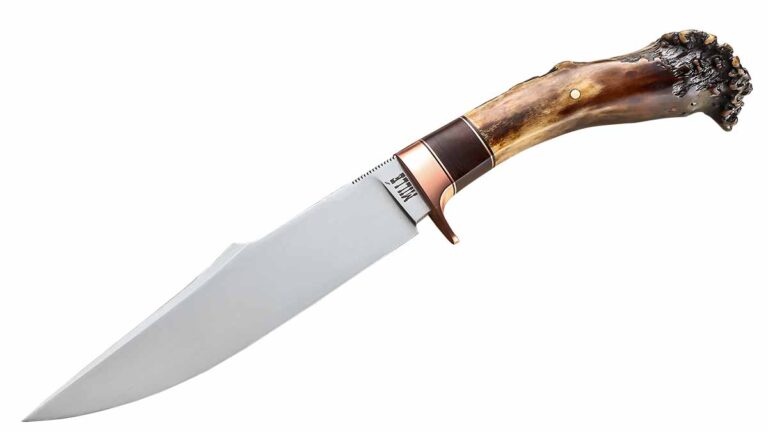
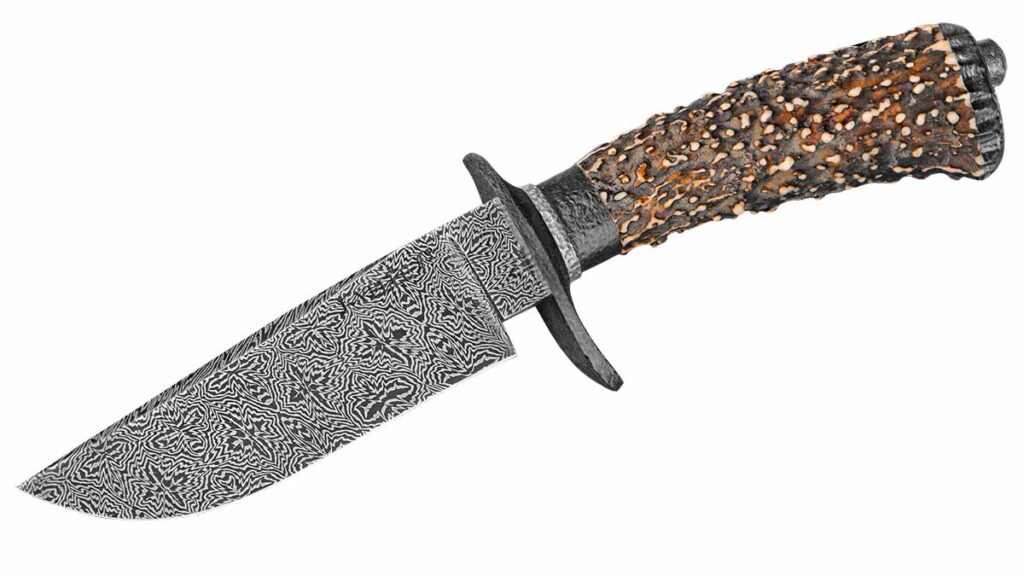
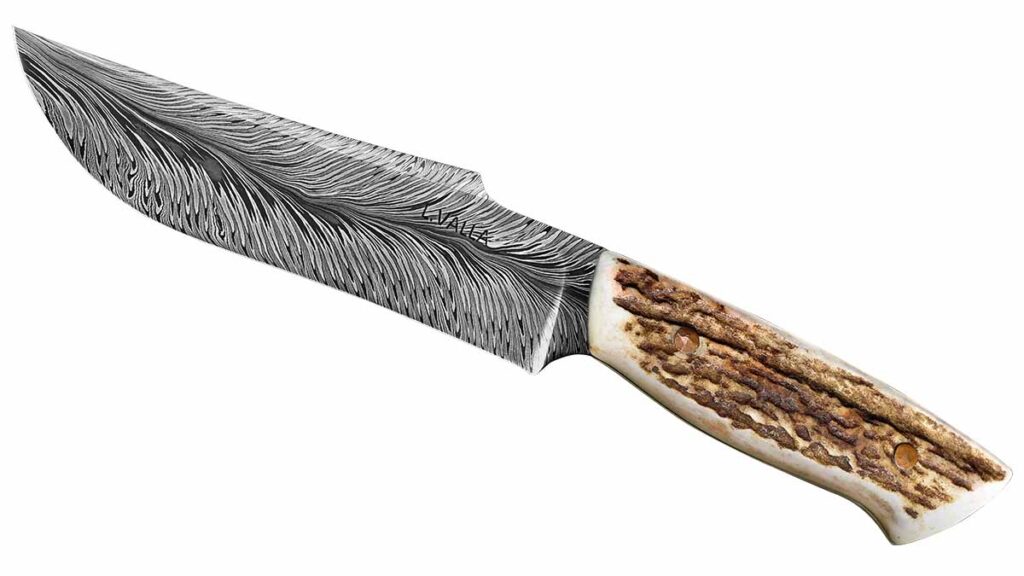
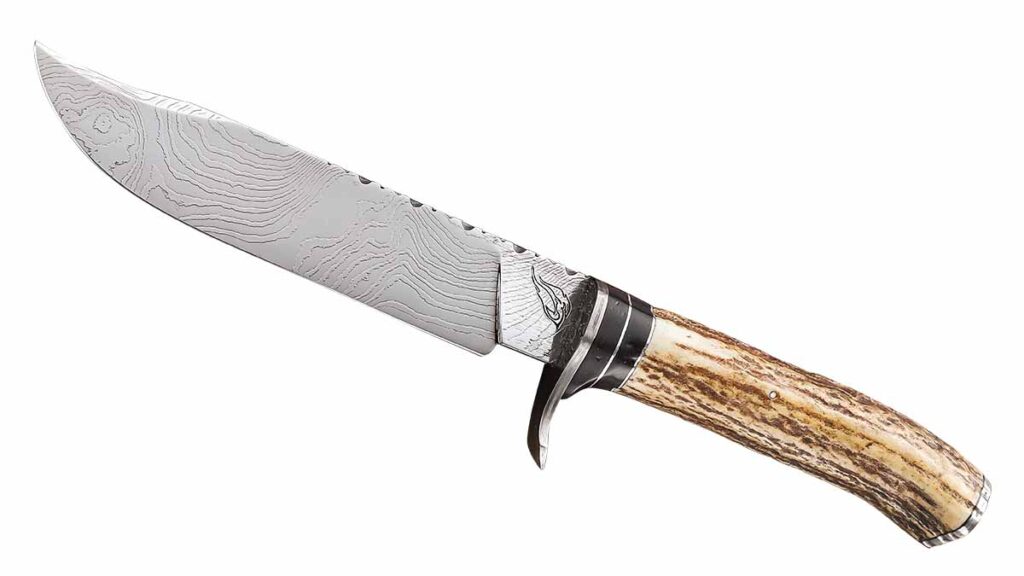
Rough as a mountain ridge and ready as razor-sharp edge, nothing beats stag handles—especially on these custom stunners.
Stag is to knives what red is to rover, rock is to roll and John is to Wayne. It’s the total package in looks, feel and tradition. Sambar, axis, popcorn or whatever the type or style, when it comes to knife handles, stag has it all.
Jeremy Yelle: Takedown pocket bowie
You can almost see and smell the popcorn popping on the popcorn stag of Jeremy Yelle’s takedown pocket bowie. The guard and fittings are 416 stainless steel fire-etched and textured black. Blade and overall lengths: 4.5 and 9 1/8 inches. (Joyce Frasier image edit)
Liam Walle: Full-tang fighter
ABS apprentice smith Liam Walle opts for deer antler scales with copper pins for his full-tang fighter. The 5.7-inch harpoon blade is 2,340 layers of feather damascus in 1084 carbon and 15N20 nickel alloy steels. Overall length: 10.4 inches. (Jocelyn Frasier image edit)
Cowboy Szymanski: Bowie
Axis stag and ebony spacers comprise the handle of a bowie by Cowboy Szymanski. Blade steel is an accordion twist damascus of 1095 carbon and 15N20 nickel-alloy steels. The bolster is raindrop pattern damascus. Overall length: 11.75 inches. (SharpByCoop image)
Lin Rhea: D-guard bowie
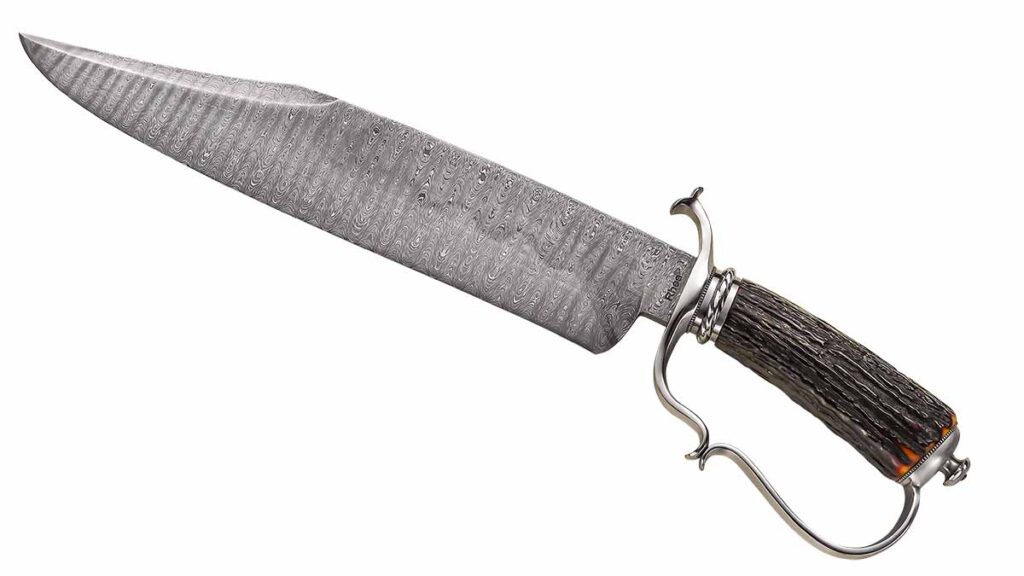
A stag handle and a blade of ladder-pattern damascus in 1084 carbon and 15N20 nickel alloy steels help complete ABS master smith Lin Rhea’s D-guard bowie. The sheath (not pictured) is by Cody Rowe. (SharpByCoop image)
Erik McCright’: Camp knife
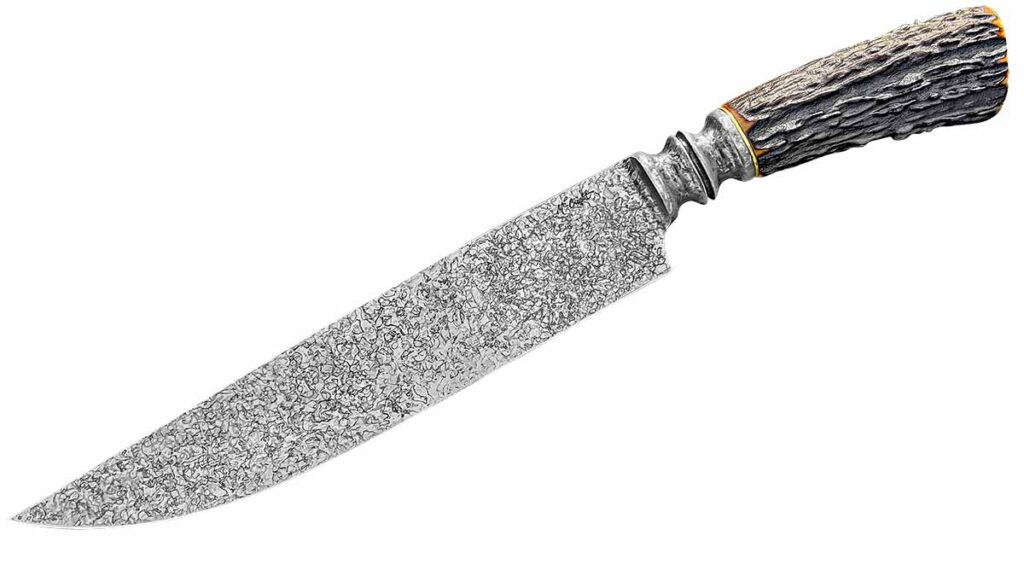
The dark Sambar stag—not to mention the fancy ferrule connection between handle and blade—of Erik McCright’s camp knife screams 19th-century Sheffield. The 8.75-inch blade is 52100 ball-bearing steel with a forced patina. (Jocelyn Frasier image edit)
David R. Davis: Slipjoint
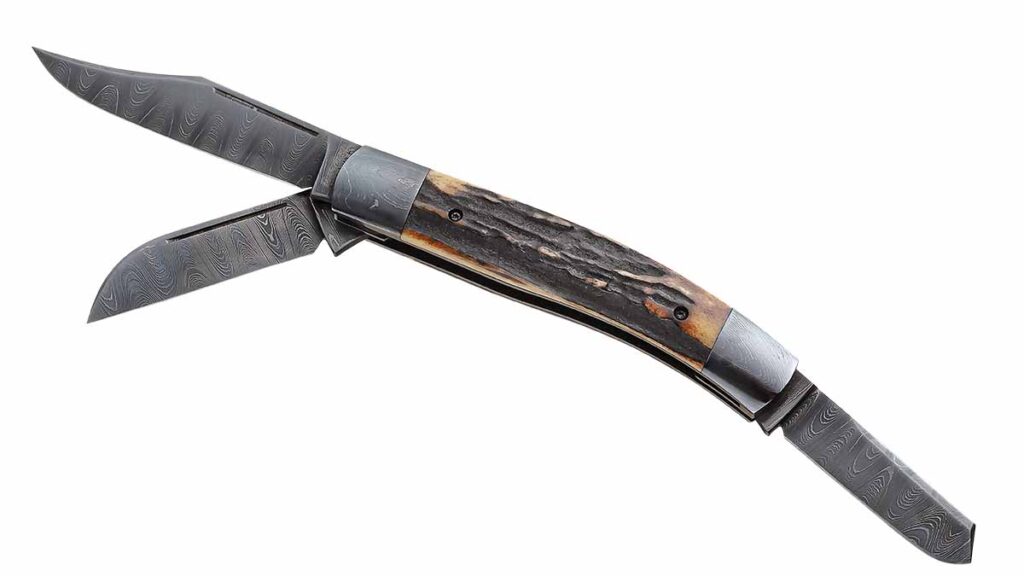
David R. Davis chose Sambar stag and pattern-welded blade steel from Alabama Damascus for his stockman. Blade lengths: 3, 2.25 and 2.5 inches. Blade grinds: flat. Closed length: 4.25 inches. His price for a similar knife: $1,100. (SharpByCoop image)
Adam Millé: Classic hunter
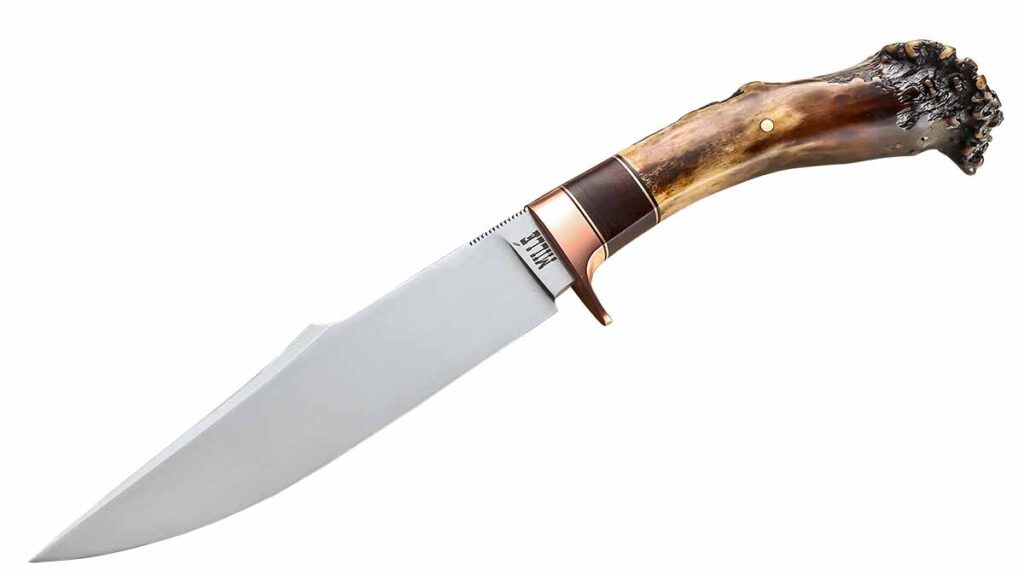
Crown stag and vintage Micarta® complete the handle of Adam Millé’s classic hunter. The bolster is copper. The 6-inch harpoon blade is W2 tool steel. Overall length: 11.25 inches. The handmade leather sheath (not shown) has python snakeskin inlay. (SharpByCoop image)
Top custom makers from around the world showcase rarefied knives at the annual ABS auction.
Each year when the BLADE Show rolls into Atlanta, the American Bladesmith Society (ABS) holds its auction of selected knives forged by ABS master and journeyman smiths. Here is a gander at the knives that crossed the block at the exclusive auction! ABS master smith and instructor Brion Tomberlin serves as a director and secretary of the society, and he handles the ABS auction from start to finish.
“I choose the smiths, mainly from the recent journeyman and master smiths who have gotten their stamps that year,” he explained, “and I also ask other master smiths and journeyman smiths, basically whoever I can get to say yes! The proceeds go to the general fund of the ABS.”
Support for the ongoing educational activities and programs of the ABS is vital to the health and future of the craft. Participants are honored to be involved and have their handiwork sold at auction by ABS director Robert Wilson. For years, Wilson has served as the event’s auctioneer, and Tomberlin said he likes to go with experience. For this year’s auction, several outstanding knives, both by American and international bladesmiths, will be available.
International ABS Journeyman Smith Knife—Jeremy Yelle: Gentleman’s Bowie
Jeremy Yelle, a 22-year-old bladesmith from Sherbrooke, Quebec, Canada, is excited to be involved and to offer one of two international journeyman smith knife entries. “I truly love the ABS and what it does,” he said, “and I felt like giving it my first-ever journeyman smith piece was the honorable thing to do.
“I personally love the antique and classic look of older knives, which is why I chose to make a coffin-handle bowie. The handle is a coffin shape, which happens to be a partial takedown. It has several lineup pins, my textured and fire etched 416 stainless steel fittings and a 416 textured spacer.”
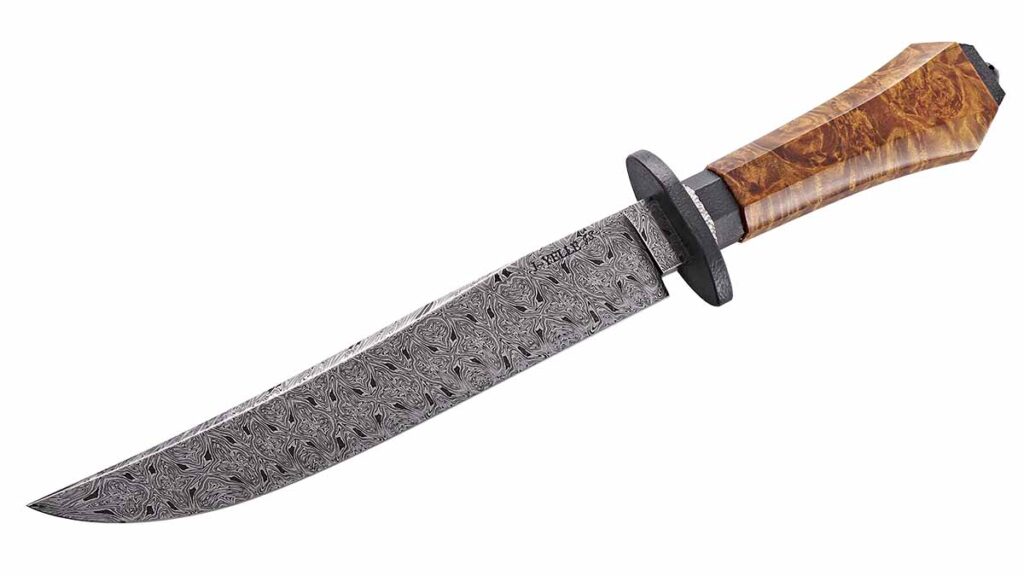
Jeremy has been making knives for about five years, and his mosaic damascus blade was inspired by the process he learned from ABS master smith David Lisch. The handle of Jeremy’s gentleman’s bowie is particularly noteworthy with Canadian maple burl from Maritime Knife Supply that he stabilized and dyed. The knife is completed by a protective case.
International ABS Journeyman Smith Knife Maker: Jeremy Yelle Knife name: Gentleman’s Bowie Blade length: 8.625 inches Blade material: Mosaic damascus of 15N20 nickel alloy and 1084 carbon steels Handle material: Canadian maple burl Overall length: 13.5 inches
International ABS Journeyman Smith Knife—Pablo Lanaspa: Bisaurin
The second international journeyman smith knife entry is from Pablo Lanaspa Ubeira from the small town of Berdun in the north of Spain. “I am very grateful to the ABS for bringing me the opportunity to make this knife,” he said. “Special thanks to Brion for his kindness and ability to help in every circumstance.”
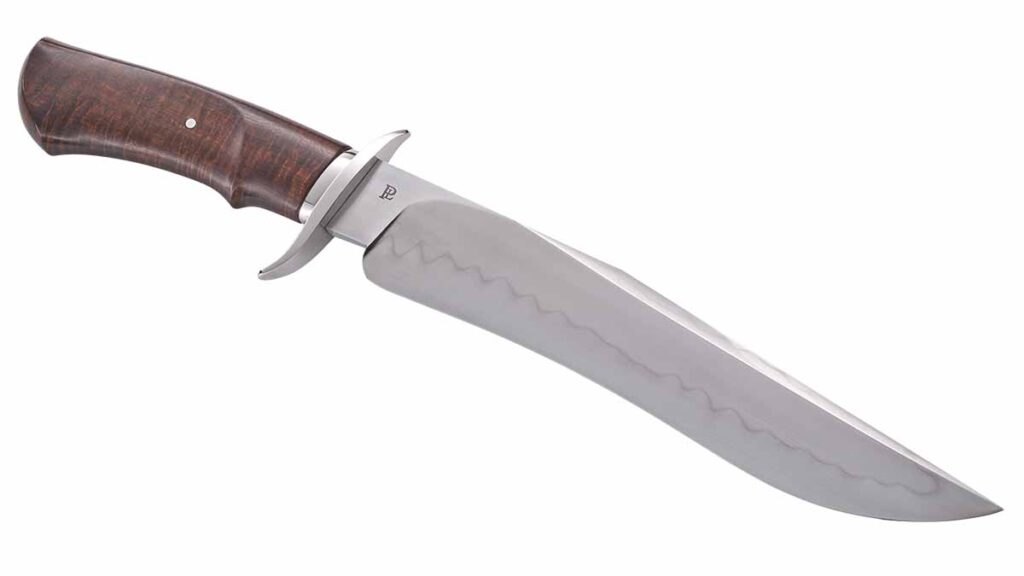
Ubeira has been making knives since 2008, and this piece, a bowie-inspired design, comes with a zippered case. “I was already a collector and then started to make my own blades from recycled steel when I made a rudimentary coal forge and a small belt grinder,” he said of his earlier days. His knife features a blade with a hamon that is clay differentiated and hardened. The blade is also slightly recurved with a full sharpened edge on the back, while the wood used for the handle, Australian ringed gidgee, is a gift from Belgian ABS master smith Sam Lurquin.
International ABS Journeyman Smith Knife Maker: Pablo Lanaspa Ubeira Knife name: Bisaurin Blade length: 12 inches Blade material: W2 steel with hamon Handle material: Australian ringed gidgee wood Overall length: 17 inches
U.S. ABS Journeyman Smith Knife—Joshua States: Stylized Quillon Dagger
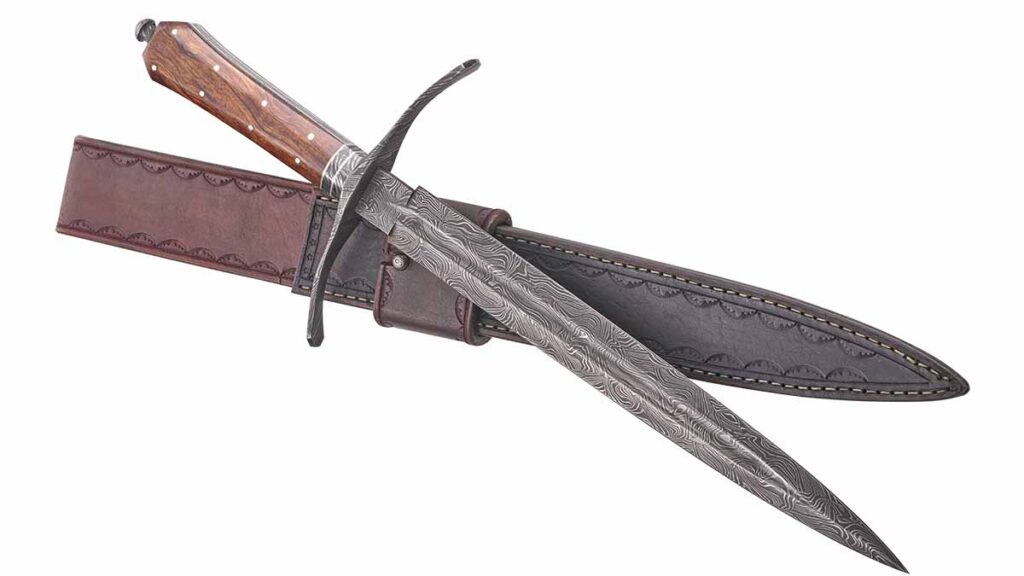
Can you think of a better name for a maker of a United States journeyman smith knife than Joshua States? Of New River, Arizona, Joshua fashioned his U.S. JS model as a stylized version of a quillon dagger. “The coffin-frame handle is a complex build, and the blade is flat ground on the bevels with a central fuller,” he explained. “I took my first class with Tim Hancock, and that was a game changer. Previous to that I had spent about a year trying to do things without any training or reference material.”
According to States, his JS knife was originally undertaken as a commission. “A customer had seen a similar dagger I had made in 2014 and wanted a copy of that knife,” he recalled. “Unfortunately, he passed away soon after I had made the blade, and I hadn’t started making any of the other parts. So, I was now free to redesign the handle/guard/finial.”
Joshua also made the leather sheath with minor decorative tooling and a multi-color dye job. The leather is 5/16-inch thick in a heavy oak tanned sole bend.
U.S. ABS Journeyman Smith Knife Maker: Joshua States Knife pattern: Stylized quillon dagger Blade length: 11 inches Blade material: Pattern-welded 1095 carbon and 15N20 nickel-alloy steels, and nickel Handle material: Pattern-welded frame/desert ironwood scales Overall length: 16.3 inches Sheath: Hand-tooled-and-stitched leather
U.S. ABS Master Smith Folder—Bill Burke: Lanny’s Clip
One of two U.S. master smith knives to be auctioned is a folder from Bill Burke of the Boise, Idaho, area. A custom knifemaker for 25 years, Bill pays homage to the late Tony Bose, BLADE Magazine Cutlery Hall-Of-Fame® slipjoint making wizard, with a Lanny’s Clip pocketknife in a shark’s tooth damascus blade and mammoth ivory scales. “A lockbar and spacer of damascus are included,” Bill said, “with integral liners and bolsters.” The liners are fileworked and the knife comes with a zippered case.
U.S. ABS Master Smith Folder Maker: Bill Burke Knife name: Lanny’s Clip Blade length: 3.25 inches Blade material: Shark’s tooth damascus of 15N20 nickel-alloy and 1080 carbon steels Handle material: Mammoth ivory Lock mechanism: Lockback Closed length: 4.1875 inches
U.S. Master Smith Knife—Nick Rossi: Hybrid European Chef
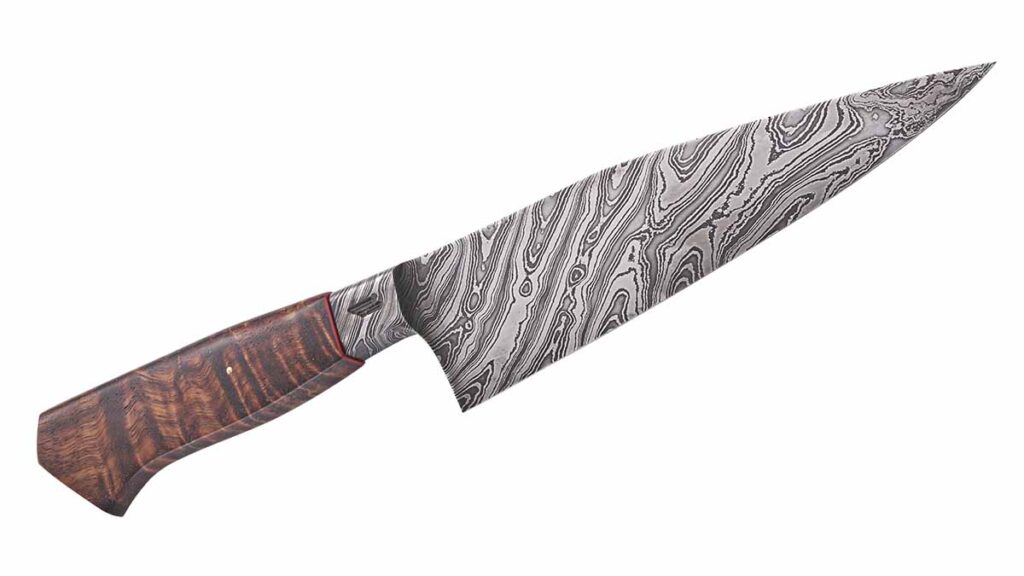
Nick Rossi of Vassalboro, Maine, contributed an integral European hybrid chef’s knife with a 50-layer twist damascus blade and curly koa handle as the second U.S. master smith knife. Both blade and handle are fashioned in the 25-year-veteran smith’s signature styles. The blade is flat ground with a subtle convex edge, and the handle features a bronze domed pin and a G-10 spacer. “This is my favorite type of knife to make,” he said. “It features an integral bolster, which makes it stronger and gives it better balance. It was inspired by European chef’s knives with a little Japanese flavor.” The knife comes complete with a padded case.
U.S. Master Smith Knife Maker: Nick Rossi Knife name: Hybrid European Chef Blade length: 7.5 inches Blade material: A twist damascus of 1084 carbon and 15N20 nickel-alloy steels Handle material: Curly koa Overall length: 12 inches
T.O.M.B. Knife—Steve Culver: Fighter
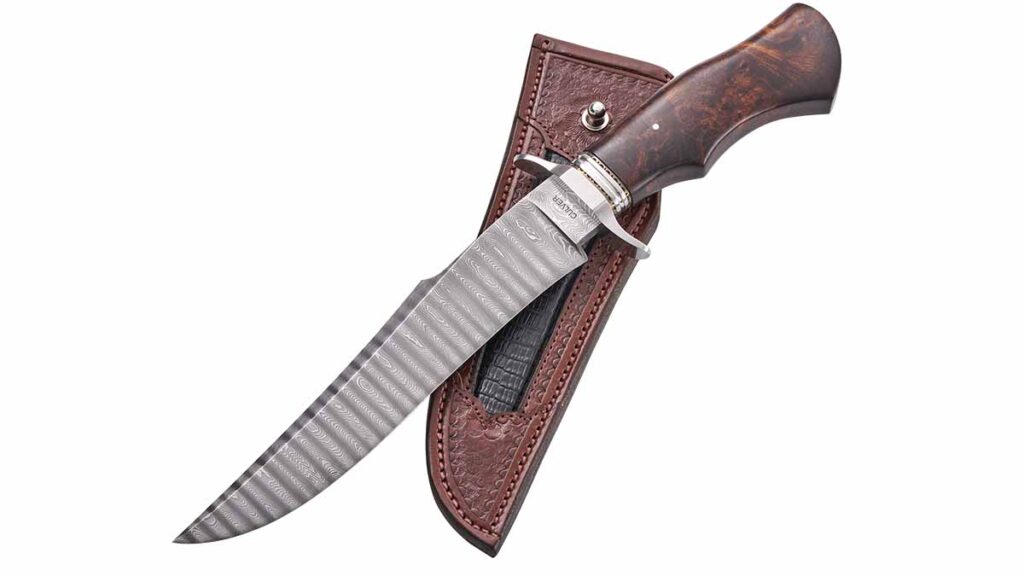
This year’s T.O.M.B. (The Order of the Mystic Brotherhood) Knife is by ABS master smith Steve Culver of Meriden, Kansas. Culver has been an active knifemaker for 36 years, and his fighter was inspired by “all the cool recurve bowies that I’ve seen others make.”
In fact, the knife is Steve’s first venture into the recurve blade style. The blade is 220-layer ladder-pattern damascus, while the handle is Arizona desert ironwood with guard and spacer materials of anodized titanium and stainless steel. Steve also made the lined sheath, which sports lizard skin inlay.
T.O.M.B. Knife Maker: Steve Culver Knife pattern: Fighter Blade length: 8 inches Blade material: Ladder-pattern damascus of 15N20 nickel-alloy and 1084 carbon steels Handle material: Desert ironwood Overall length: 13.125 inches Sheath: Lined and features lizard-skin inlay
Handsomely pinned and with a handle to die for, Richard Dawes’ dog-bone bowie finds nearly the perfect chemistry.
Richard Dawes got a double pump of inspiration from the late, great ABS master smith John White for a long, lanky dog-bone bowie.
Dawes helps oversee an annual competition in White’s memory on Bladeforums for antique bowie repros. In so doing he came across one of White’s old work-in-progress frame-handle dog-bone projects on the web and found it most useful.
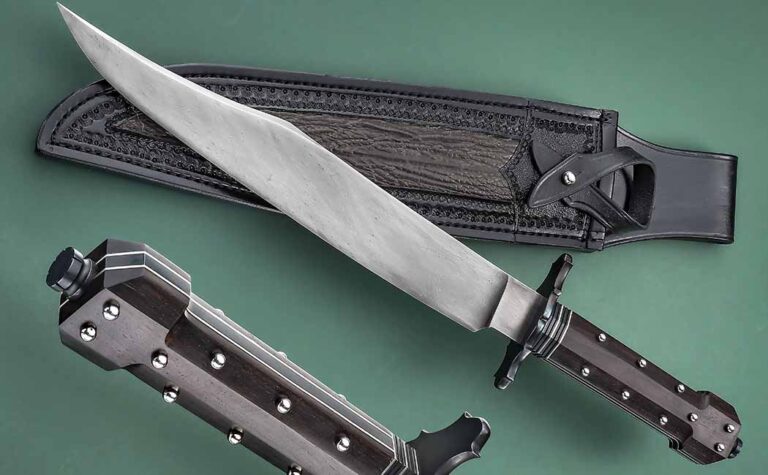
The resulting knife has a handsomely pinned dog-bone handle with a clip-point cable damascus blade, and it’s accompanied by a shark-skin-inlaid sheath by Paul Long. It’s Richard’s first frame-handle knife and first with pins, too.
Richard Dawes
“The key part of this knife looking good is to get a good fit on the guard,” he explained. “Once you’ve got that you want the rest of the parts to line up, and if you’ve got some 1/16-inch guide pins in there and got them all drilled for when you do the assembly, everything lines up, and that’s the key.”
A full-time chemistry professor at the Missouri University of Science and Technology who at press time was working for the National Science Foundation, Richard makes knives “on the side.” If this one is any indication, he has a career option waiting on him.
Dog-Bone Bowie Specs Maker: Richard Dawes Blade Length: 11” Blade Material: Cable damascus Handle Material: African blackwood Handle Frame: Mild steel and nickel silver Overall Length: 16” Sheath Material: Custom leather inlaid w/shark skin, all by Paul Long Maker’s Price For A Similar Knife And Sheath: $2,500