Knife Collecting

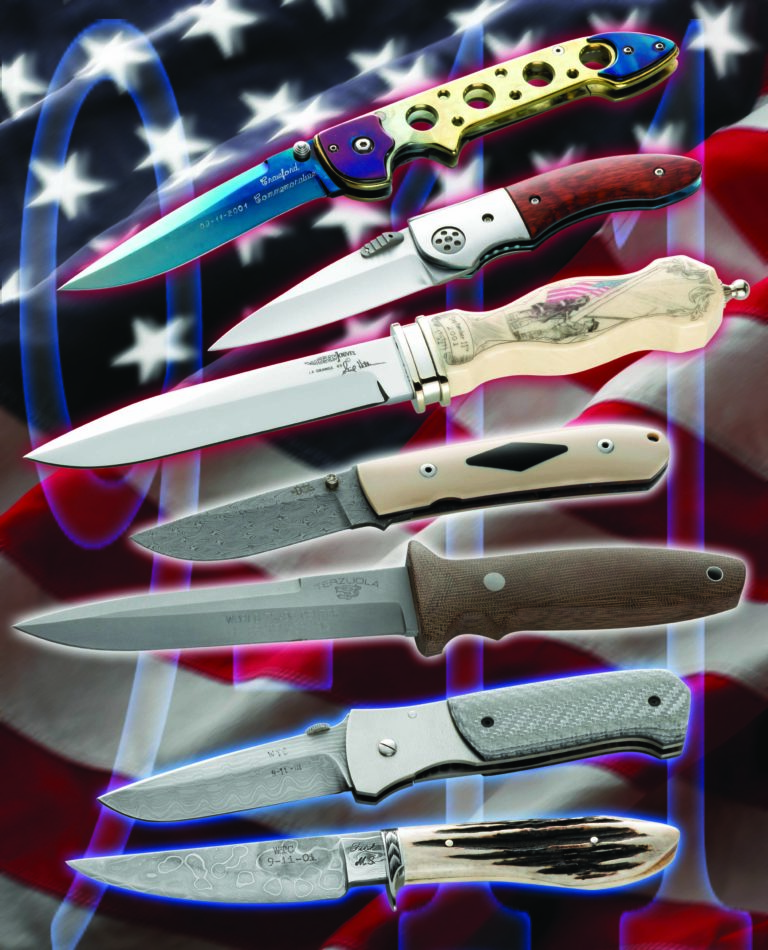
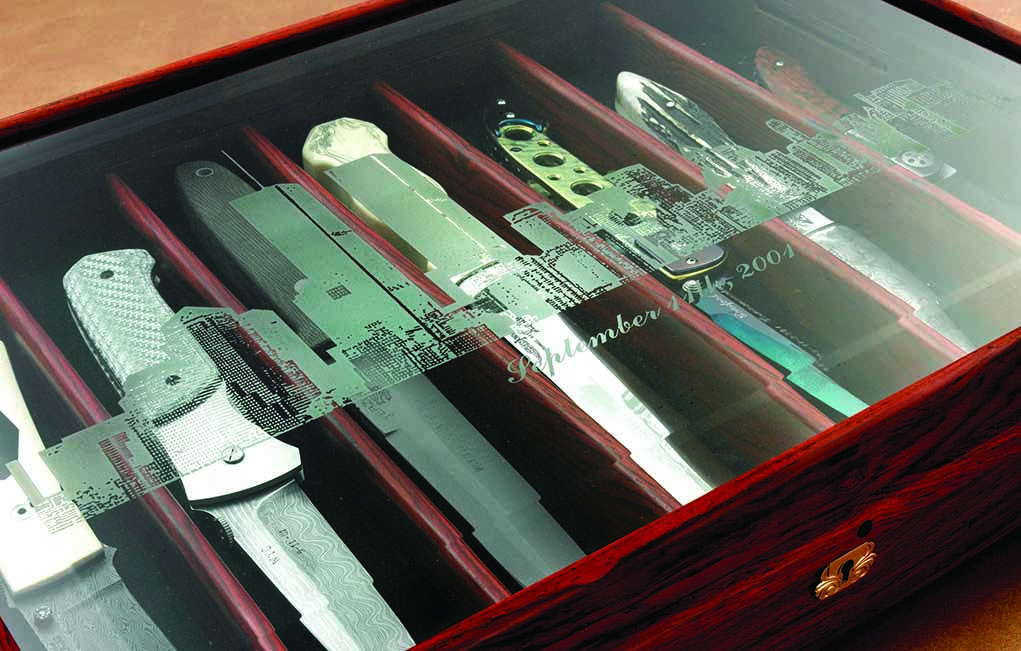
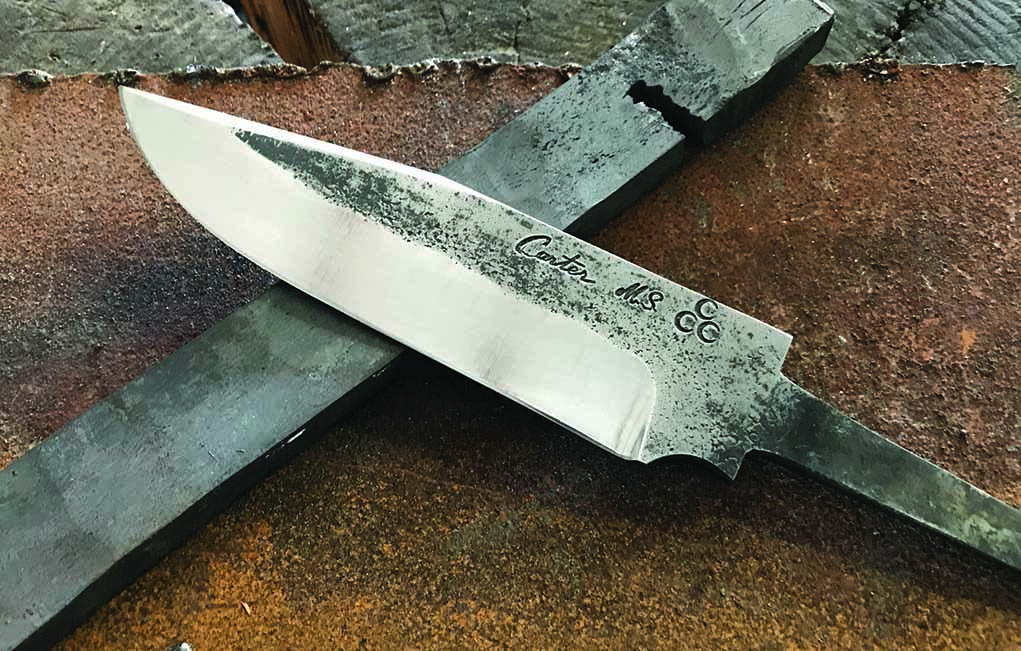
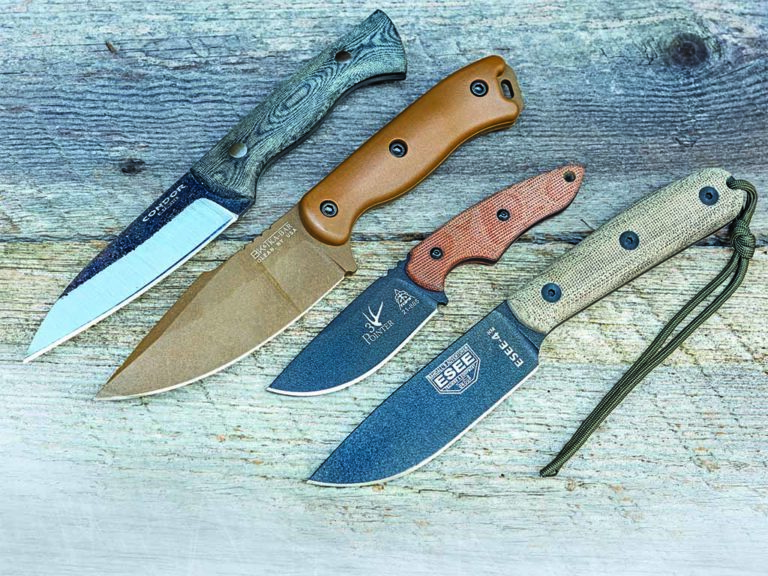
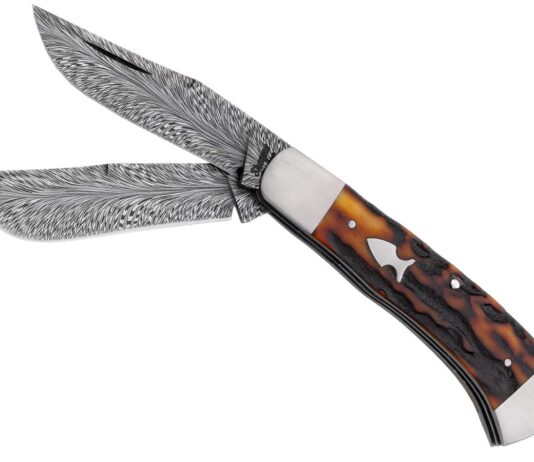
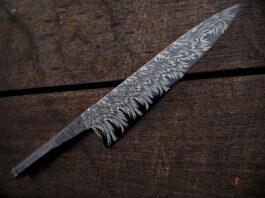
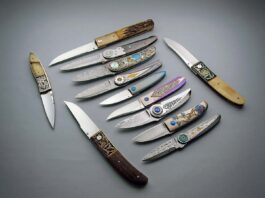
Knife collecting is an extremely rewarding experience for knife enthusiasts. There truly is a knife for everyone. Many increase or hold their value throughout the years, making collecting knives something to pass on to the next generation of knife collectors.


Knife Profile: Shrike Out Hits A Home Run


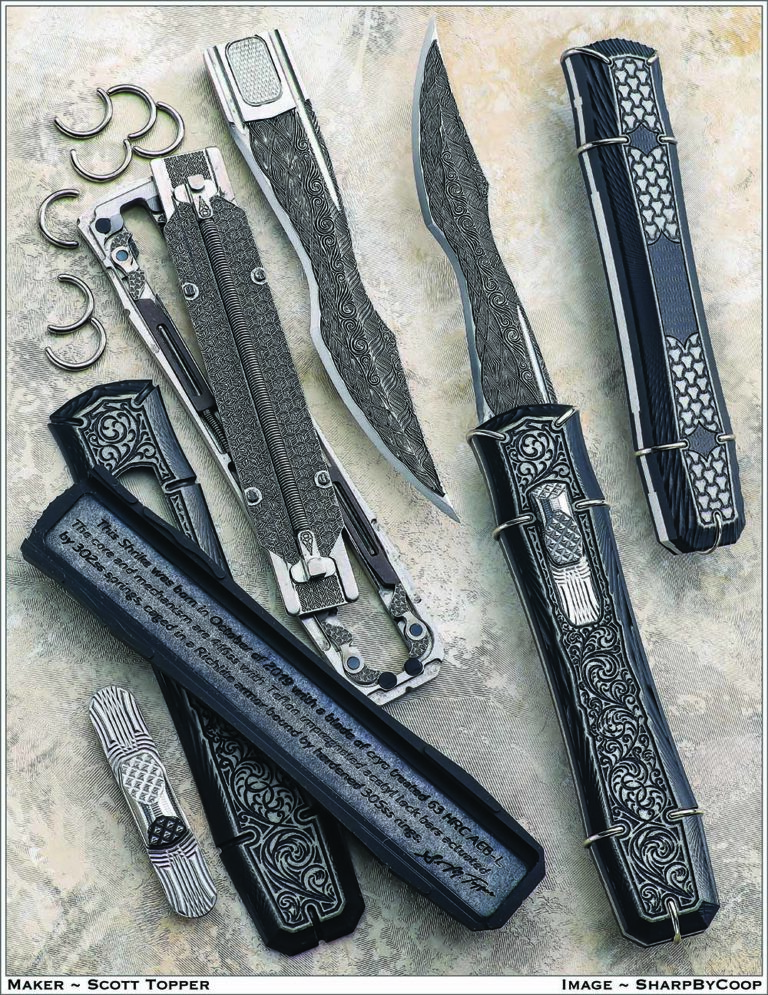
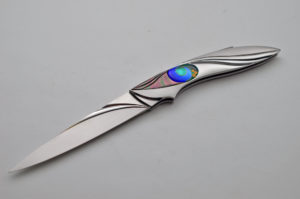
Scott Topper’s off-the-charts out-the-front is a multi-part marvel, the Shrike Out, brings an artistic twist to the automatic.

It’s hard not to like the Shrike, a custom out-the-front dual-action automatic by Scott M. Topper.

The blade is cryogenically treated AEB-L stainless steel. According to Scott, since AEB-L’s micro-structure allowed for a finer edge, it originally was a go-to steel for disposable razors. He indicated the version of the material he uses competes well against crucible steels, and is made through a conventional metallurgy technique.

The six inside springs are hand wound stainless steel. The four locks are independent. The brown lock parts are Teflon-impregnated Delrin for permanent lubricity. The black Richlite scales are inlaid with white to add contrast to the engravings.

The knife comes nested in a velvet-lined walnut box. Plain and all-stainless versions of the Shrike are also available. According to Scott, the various styles of the knife are available through the PVK Showroom (888-878-5643 pvk.com) in Las Vegas.

Shrike Out Specs
Knife: Shrike Out The Front Dual Action Auto
Blade length: 4”
Blade steel: Cryogenically treated AEB-L stainless
Frame material: 416 stainless steel
Handle material: Paper phenolic composite
Closed length: 5”

Also Read:

How to Collect Knives: 7 Knife Collecting Tips

1

Purveyors help knife buyers and collectors with what they need to know

Working with a reputable purveyor/dealer enhances the knife acquisition experience. The buyer/collector develops a sense of trust, with time and money well spent as the dealer provides advice and access to certain knives that otherwise may be hard to find.

Talking with a dealer offers an educational opportunity, but often enough the experience falls short of realizing its full potential.  What questions should buyers and/or collectors be asking? Going to the source of the answer is a good place to start.

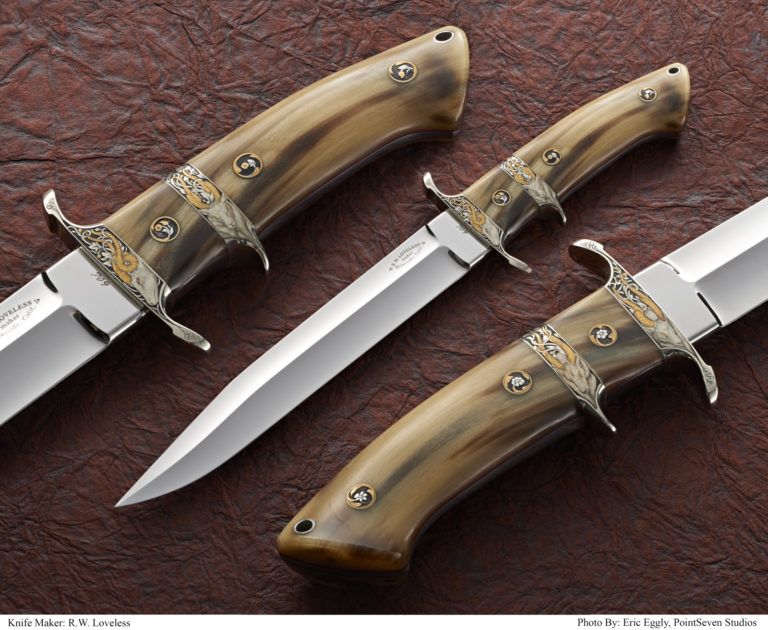
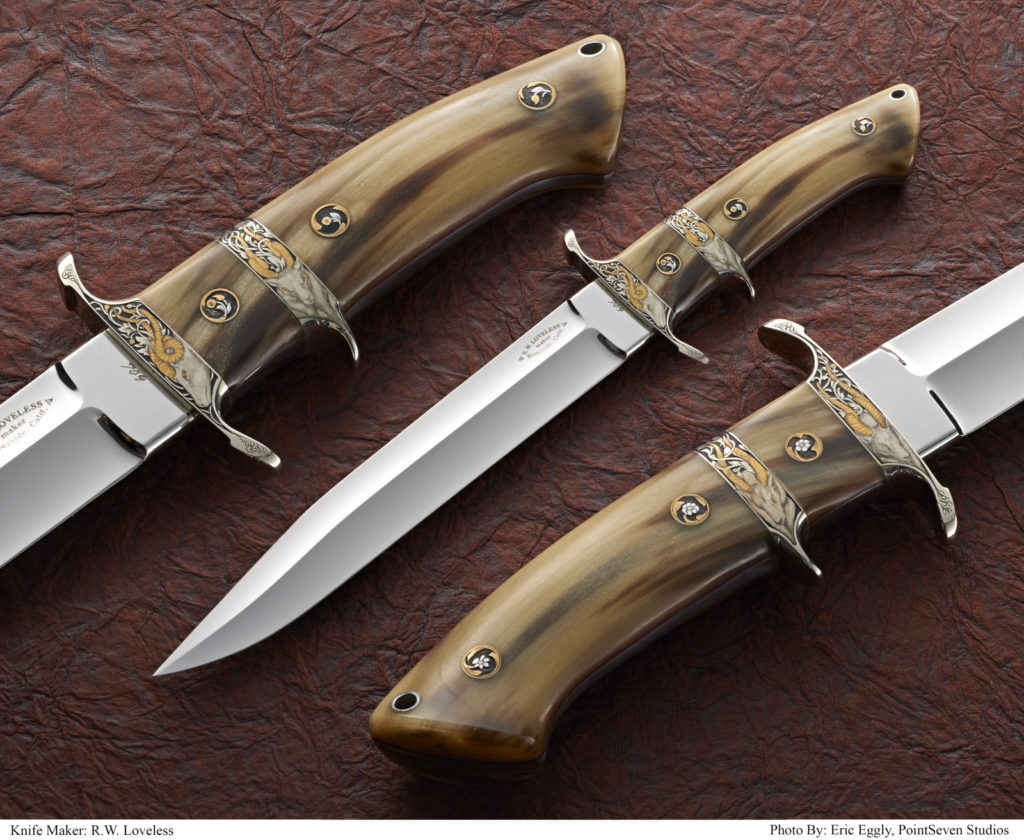
Bob Loveless knives are amongst some of the most sought-after knives in the collecting world. Photographed above is a Loveless Big Bear in sheep horn and Dan Wilkerson engraving (PointSeven knife image)

1. Know the Knife Collecting Trends

Loveless knife specialist John Denton says that staying informed is important.

“This has got to be through the old way of human contact,” Denton observed, “sort of like the lunchroom in school. You hang out, listen, see what is moving, what dealers are buying and, of course, now with the ‘inter-web,’ we have so much more information within seconds, while in the ’70s or ’80s we had to wait for BLADE® Magazine or the gun magazines to run stories on Loveless. Shows are still important to attend, but nowhere like they were years ago. Face to face is still part of the knife world.”

2. Maker Charisma 

Gauging which knives and makers are hot is an integral byproduct of the dealer’s intuition and experience. How does the dealer determine what makes a knife or knifemaker hot? A lot depends on whether the maker has the kind of personality that appeals to the knife enthusiast.

At BladeGallery, Daniel O’Malley specializes in one-of-a-kind custom knives. The answer includes multiple factors. “There are a lot of things that go into making a knifemaker’s knives ‘hot,’” he reasoned. “Part of it is the personality of the maker. When a collector meets a maker for the first time, the collector often has a picture in his head of what the maker will be like. If the maker falls short [of the collector’s expectations], it can be quite disillusioning.”

3. Customer Service

“[The maker] being willing to repair knives when there is a problem is also very important,” O’Malley continued. “It can easily make the difference in a collector continuing to purchase a maker’s work. It can even be the difference in whether a person continues to collect the maker’s knives over time. After all, if a collector has spent a large sum of money on their collection, it can be very nerve wracking to find that it’s hard to get a damaged knife repaired. Similarly, it can be comforting if a problem can be relatively painlessly solved.”

Daniel O’Malley of BladeGallery.com said the maker’s willingness to repair a knife when there is a problem is very important.

4. Do Your Homework

Les Robertson of Robertson’s Custom Cutlery offers custom fixed blade and folding knives, including tacticals and presentation pieces, as well as some exclusives. His take on the delicate topic of a maker’s reliability and the quality of the maker’s work is sage advice for knife enthusiasts in any price range or level of experience.

“I give my client the very best information I have at the time,” Robertson asserted. “This includes issues with a maker or the quality of their work. Often, a maker’s skill level, quality, customer service, and/or delivery issues are overlooked because the knife can be sold immediately for a profit. Given the prices of many of the custom knives today, I highly recommend that collectors do their homework before purchasing a knife. I realize this takes away from the thrill of instant gratification and removes some of the fun out of the hobby. Long term, though, you will feel great about every knife you have bought, and your wallet will thank you.”

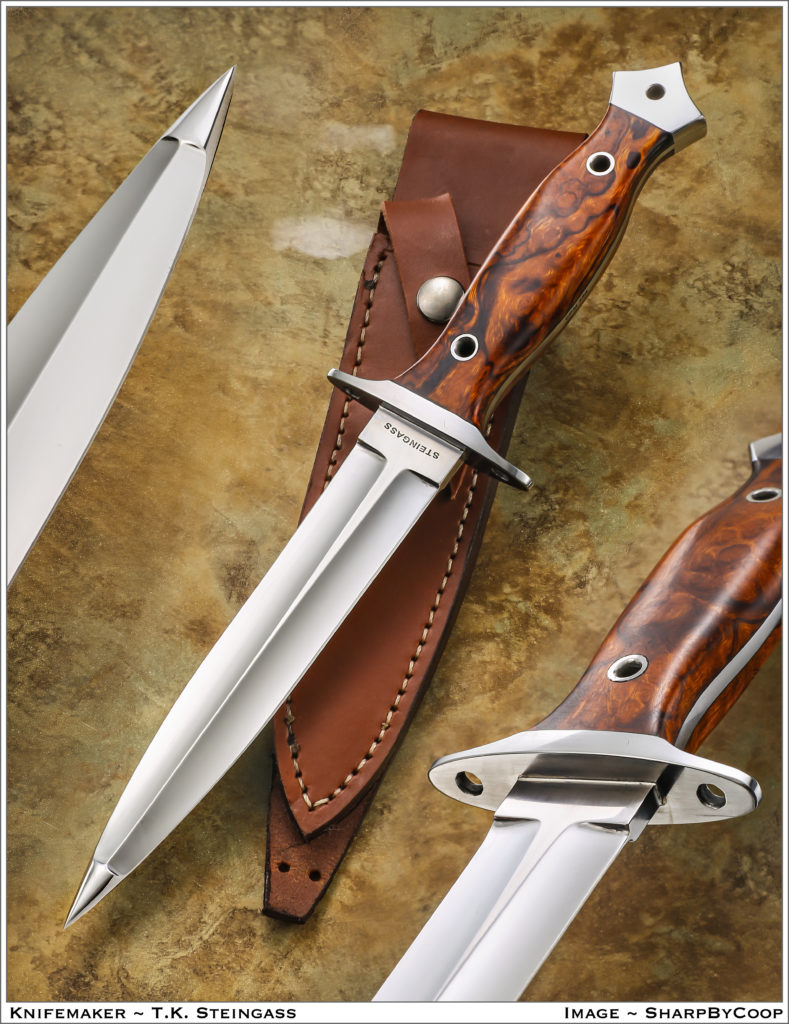
Les Robertson said many buyers/collectors make the mistake of overlooking a maker’s skill level, quality, customer service, and/or delivery issues because the knife can be sold immediately for a profit. The presentation Bastion Dagger by Tim Steingass features an armor-piercing tip. (SharpByCoop knife image)


5. Set An Allowance

Everyone, it seems, has spending limits. The role of the dealer often involves assisting clients in determining how much to spend. Recognition of the amount of disposable income available keeps a buyer/collector in the game.

6. Collect with a Purpose

Denton advises customers to acquire some knowledge on prices and to assess their real purpose for buying custom knives in the first place. “First of all, you want collectors to be educated,” he commented, “and not to be buying just to make money. That is the most risky way to approach collecting. But then if they buy what they like and in three years can’t get 10 cents on the dollar, it will cut their knife buying down and drive them out of the market.”

Dealer Dave Ellis of Exquisiteknives.com notes that the investment perspective differs greatly from that of the collector who wants to enjoy, build and retain knives for years to come. “When I chat with newbies,” he remarked, “a lot of them get into knives from an investment standpoint. They have read in the Wall Street Journal that investing in knives is a good idea, or heard about a knife that was purchased for $800 and then sold for $8,000. I tell them to buy what they like first and to worry about resale later because if it doesn’t pan out, then they won’t have to hold onto something they don’t like.”

Taking a measured approach is key to successful, price-sensitive acquisitions. “I tell the collector to pace themselves,” Denton said. “Get into a knife that will be easy to turn if you get tired of it down the road. I’ve had several people ask me to build them a $300,000 collection, and I tell them I don’t do that because they will get mad if they don’t make 14 percent growth per year—and they don’t know why they’re buying the knife. The true collector has studied the knives and the market, and he will realize what knives are worth and what he can resell them for.”

Those who are new to the custom knife market can tap a great resource in a top dealer. Advice on the market, prevailing prices and hot makers is only part of the relationship. High-end folders by BLADE Magazine Cutlery Hall-Of-Fame© member Ron Lake, Warren Osborne and Jim Martin, along with Loveless fixed blades are among Ellis’s offerings, and when he talks with a new buyer/collector he asks a few basic questions.

“There are more heavy hitters getting in the game with lots of money,” he said, “but that doesn’t mean they are buying the right things. What have their interests been up to now? Did they grow up with knives? Do they carry and use a knife? What is their reason for buying now? Use it? Collect it? Give it to a nephew for college graduation? I don’t want to offer a $7,000 Loveless hunter when a $150 skinner by any smith will do.”

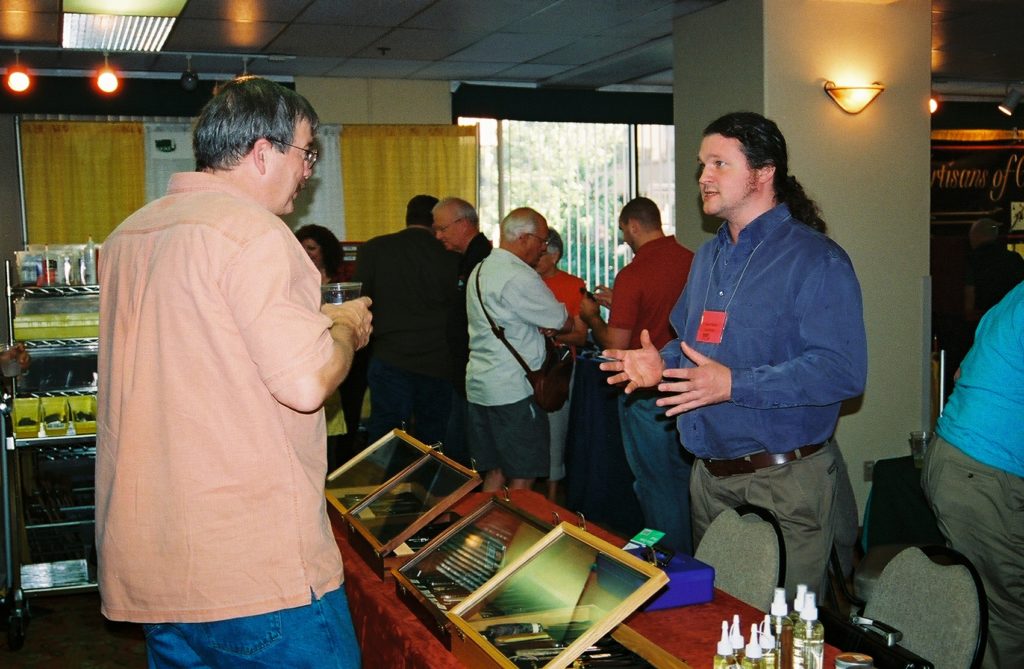
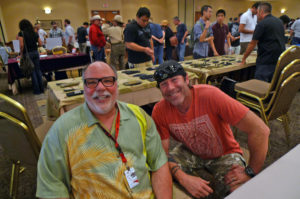
Above: Purveyor Dave Ellis—seated at left with Mick Strider at a past California Custom Knife Show—says to always buy what you like first and worry about resale later. The fixed-blade art knife is by E.C. Loerchner. (Dave Ellis images)

7. Attend Knife Shows that Fit

Though knife shows may be one of many ways to gain information and see what is out there, the individual contact with dealers, makers and other knife enthusiasts is invaluable. Attending shows that mean the most to the individual buyer’s needs and wants helps in the education process and in finding the people and knives that enhance the experience.

Robertson attends the BLADE Show due directly to its diversity of custom knives for sale. He says that the Arkansas Custom Knife Show is also one of the premier forged blade shows and features apprentice, journeyman and master smiths in the American Bladesmith Society.

“The New York Custom Knife Show offers a variety of knives from very well-known custom knifemakers,” Robertson added. “This show in recent years has had more of a tactical knife flavor. The USN Show offers the widest variety of tactical folders you will see at any show in the world.” These are just a few of Robertson’s picks. Other shows are out there, and many of them are quite beneficial to knife enthusiasts looking for certain styles of knives and/or makers.

DEVELOP a DIALOGUE

The questions are endless. The enjoyment of knife collecting can be boundless. Develop a dialogue with a dealer. Ask the questions herein and others that come to mind, and feel the positive energy of a well-executed knife purchase.

Danes to Dragons: Custom Hawks

Custom hawks and axes combine history, fantasy and imagination

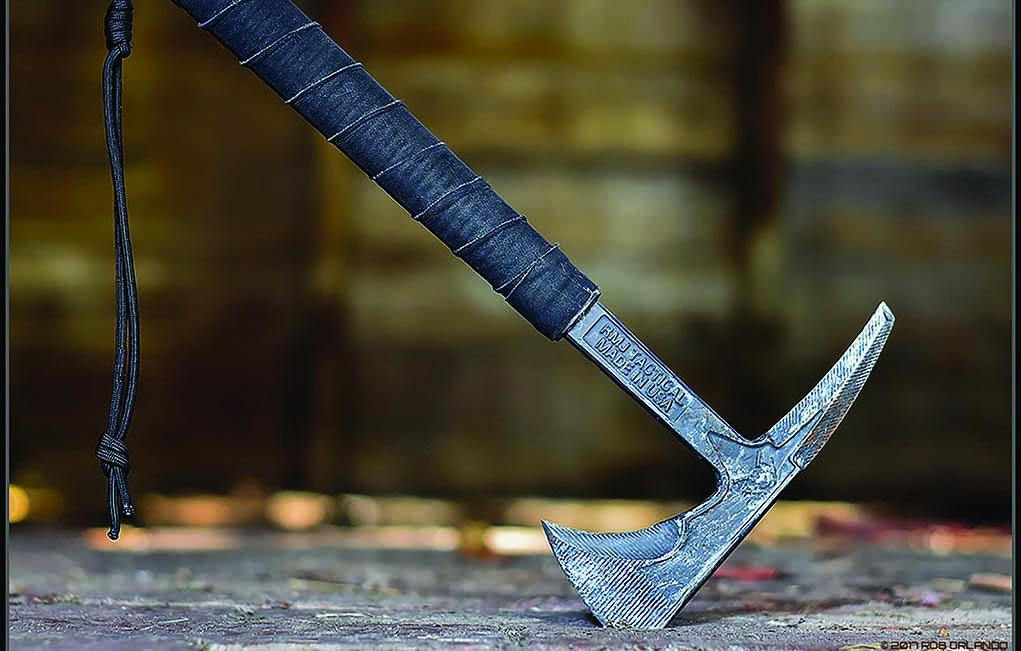
From Danes to dragons, draft horses and drawing smoke, the axe and the hawk have become avenues of artistic expression for some of the most innovative artisans of sharp blades. Long a trusted and dependable companion on the trail, in the bush, around the camp and in the military, axes and hawks are utilitarian and versatile, both in form for their intended purposes and as striking examples of imagination, innovation and aesthetic appreciation.

Utilizing the best in materials and employing their long study of the axe and the hawk, several makers have produced notable works in recent years, among them Peter Pruyn, Tom Ward, Dave Armour and Bill Burke. Each has his own approach to the craft and adds perspective in producing works of incredible beauty.

“My motivation was to try something new,” related Armour, a knifemaker for about 12 years, fashioning hawks and axes for six years and turning his attention to full-time blade work only seven months ago. “In addition, a small, easy-to-carry axe can be a great complement to a hunting or other working knife. I call my style ‘sufficiently evil and deliberately casual.’ I take the function side of things—like heat treating and edge geometry—very seriously, but treat the rest of knifemaking as a chance to play and have some fun.”

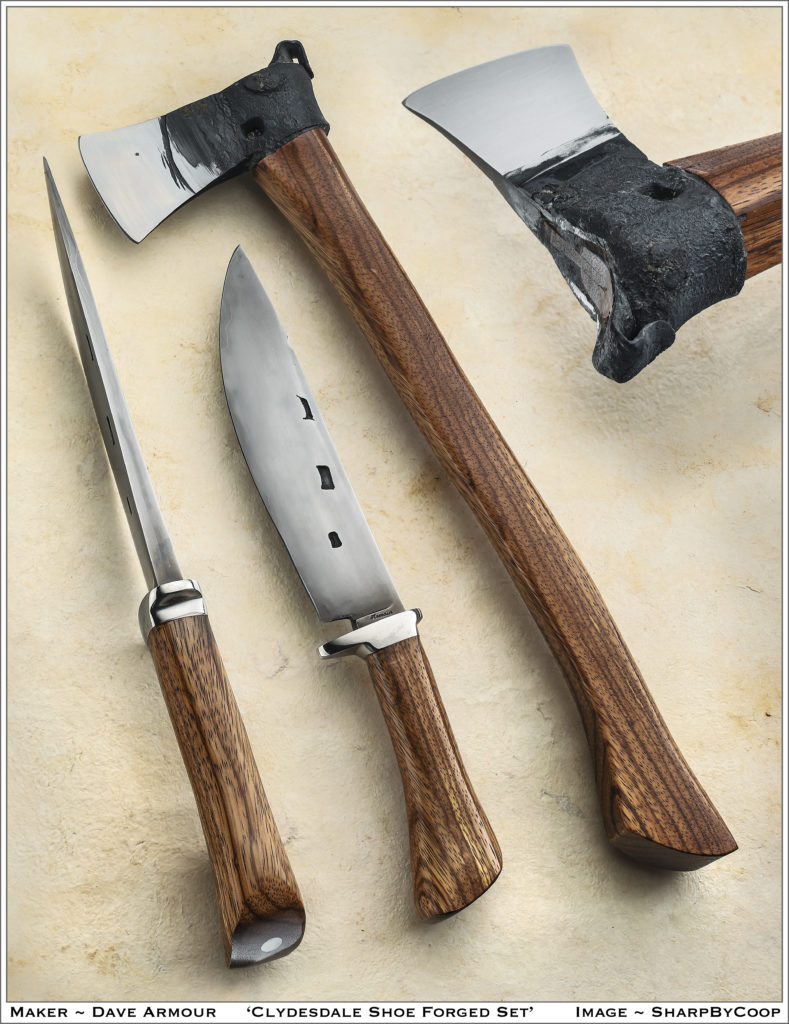
With his Clydesdale Set, which includes both a 12.5-inch knife and a 17-inch axe, Dave Armour (inset) lets his ingenuity gallop through. The set is made with a single Clydesdale horseshoe that he obtained through his wife’s employment, involving a tour of Warm Springs Ranch in Missouri, home of the world famous Budweiser Clydesdales. (SharpByCoop axe image)

With his Clydesdale Set, which includes both a 12.5-inch knife and a 17-inch axe, Armour’s ingenuity gallops through. The set is made with a single Clydesdale horseshoe that he obtained through his wife’s employment, involving a tour of Warm Springs Ranch in Missouri, home of the world famous Budweiser Clydesdales.

“I used the sides of the shoe for the outer layers of the knife blade and the bottom for the body of the axe,” Dave said. “I wanted something rustic without looking primitive. So, I made choices like leaving the shoe nail holes unfilled and using a simple hardwood for the handles. I used W2 for the knife core steel and 80CrV2 for the axe bit. Anytime you’re using a unique material, it is stressful. If I messed this up, it wasn’t like I could just scrounge another Clydesdale shoe lying around somewhere.”

Armour, who plies his craft in Auburn, Illinois, uses the term “foundwood” for his handle material. Though he isn’t completely sure, he said he believes it is sassafras, liberated from the bottom of a box of cast-off exotic pieces in a local lumberyard.

The finished Clydesdale Set consists of the beautifully forged san-mai blades, foundwood handles, and a stainless steel bolster/guard. The blade measures 7.5 inches while the edged surface on the axe is 2.25 inches. Dave stated he would produce a similar set for $750 or the axe alone for $300—and he would enjoy the journey “tailoring my technique to the piece.”


MAGIC DRAGON

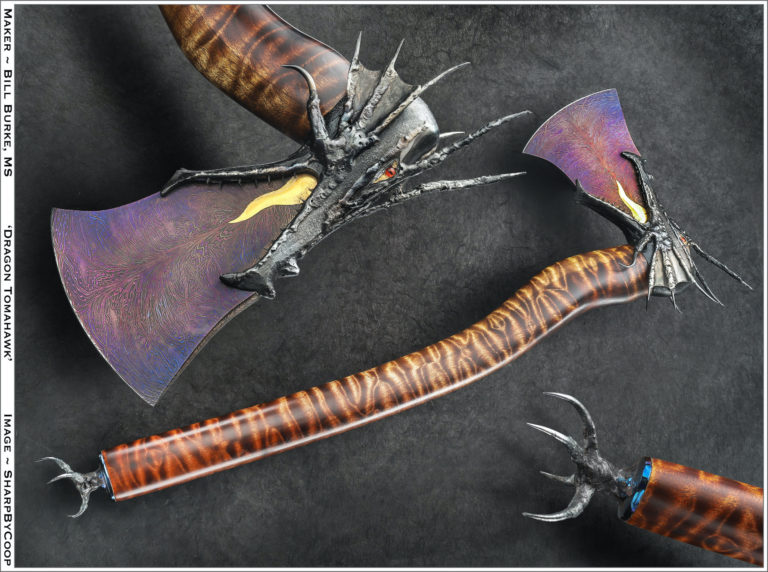
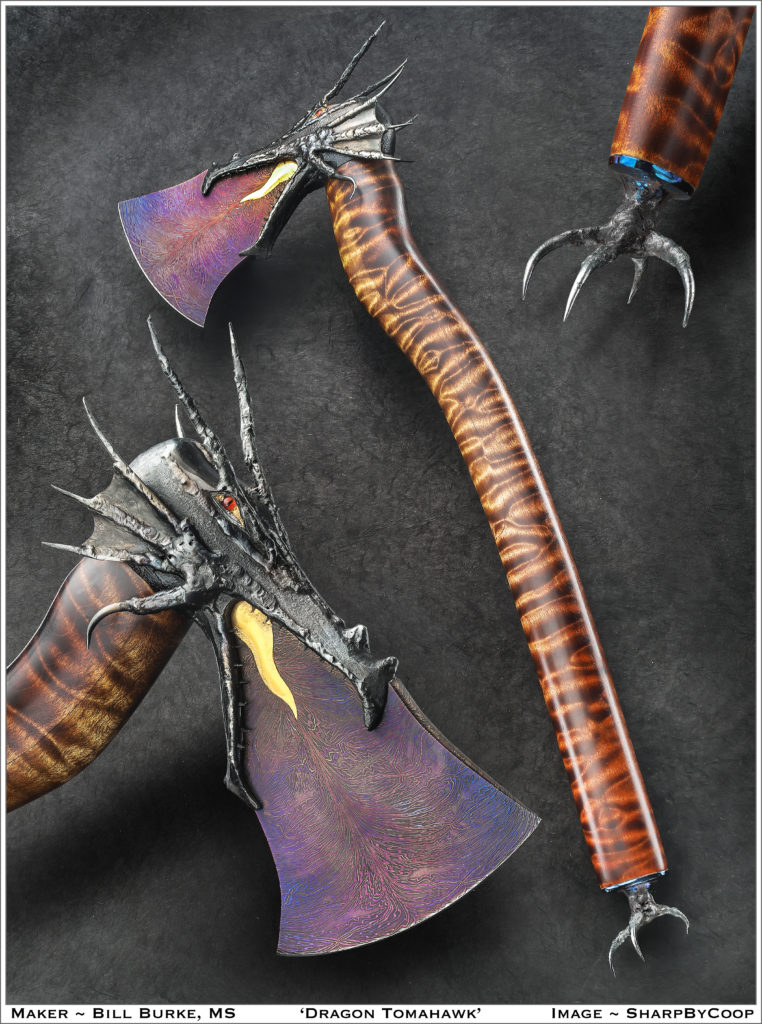
Forging knives since 1998, Burke received his ABS journeyman smith stamp at the 2003 BLADE Show. “I returned home, quit my job, and have been a full-time maker ever since,” he grinned. His Dragon Tomahawk is nothing short of breathtaking, and he acknowledges that the project was an investment of energy in his Boise, Idaho, shop. “This piece took three months of six- to eight-hour days, seven days a week for me to complete,” he noted. “I have a second piece flying around in my head now.”

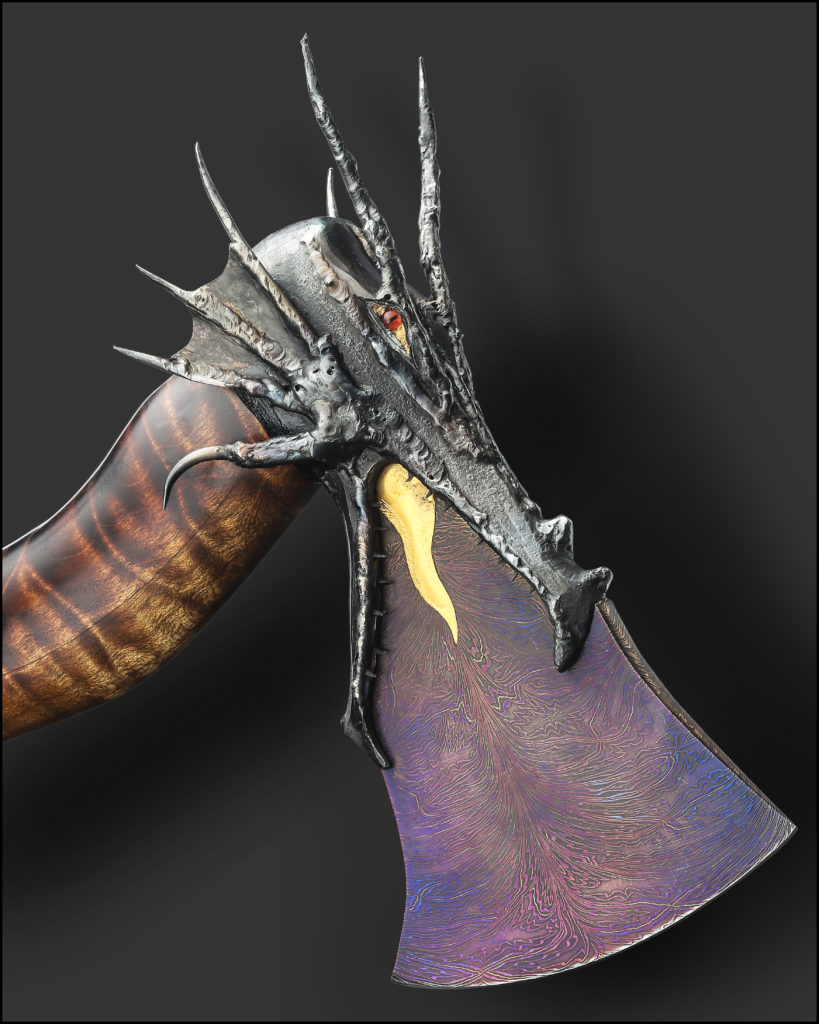
The Dragon Tomahawk is 20.5 inches overall, with a 4-inch cutting surface of damascus and a curly maple handle. The head is wrought iron and 1018 mild steel forged into a “W’s” pattern, and the blade steel is 1080, 15N20 and 201 series nickel forged together to create Bill’s Dragon’s Breath pattern. (SharpByCoop image)

The second will be a show-stopper if it compares to the 20.5-inch masterpiece that sports a 4-inch cutting surface of damascus and handle of stout curly maple. “The head is wrought iron and 1018 mild steel forged into the ‘W’s’ pattern,” he commented. “The blade is 1080, 15N20 and 201 series nickel forged together to create my Dragon’s Breath pattern. The handle was first drawn and cut/carved from a piece of red fir, and then, after a few refinements, the pattern was drawn on the piece of maple and the handle made from that.”

Bill Burke lightly fire-etched the head of his Dragon Tomahawk, along with heat coloring the blade in niter salts to achieve a purple/blue-and-red coloration before it was welded to the dragon’s head. The teeth were raised from the steel of the head, and the tongue, inlaid into the blade, gleams in 24k gold. (SharpByCoop image)

Bill has been noted for his quality damascus, and with this piece took inspiration from the work of ABS master smith Joe Szilaski. “All my knives and hawks are forged by me in my shop,” Bill said. “I normally just get an idea of what I want to make and start forging. From almost the first moment that I made the Dragon’s Breath pattern, I knew I wanted to make a dragon-headed tomahawk, breathing fire down the blade of the hawk.”

The dazzling result includes a lightly fire-etched head “because dragons are born in fire and should look that way,” along with heat coloring the blade in niter salts to achieve a purple/blue-and-red coloration before it was welded to the dragon’s head. The teeth were raised from the steel of the head, and the tongue, inlaid into the blade, gleams in 24k gold. Bill indicated he would produce a similar piece for about $17,000, depending on embellishments.


NO PIPE DREAM

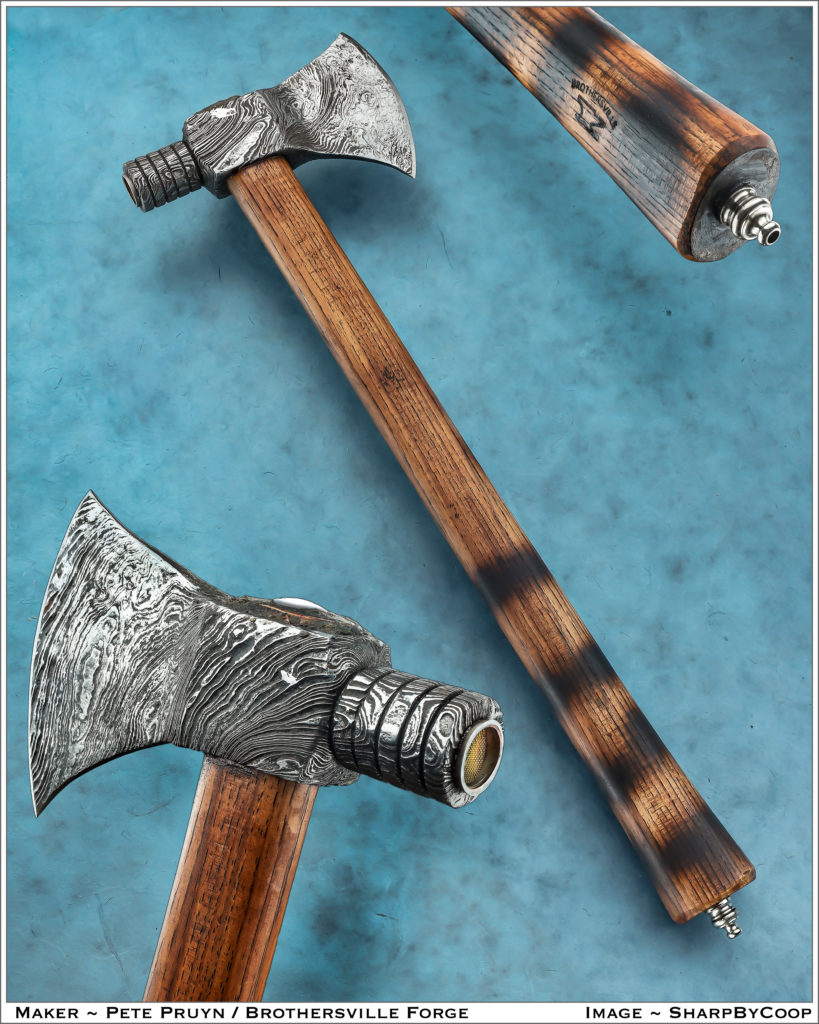
One of the most intriguing works by Peter Pruyn is his 15-inch Pipe Axe with ash handle, 4-inch blade and a bowl of hammered twist damascus. He forged the steel from layers of 1070, 15N20 and nickel. (SharpByCoop axe image)

Peter Pruyn was self-taught for quite a while after taking up knifemaking when he lost a valued knife he had carried for years. He later learned the stock removal method from Gene Martin and also attended an ABS bladesmithing class. “That definitely made me a more diverse maker, and it opened me up to forging different types of edged weapons and tools,” he said. From there, he worked with ABS master smith Red St. Cyr, who taught him to forge a tomahawk from a ball-peen hammer.

Through 14 years making knives—12 of those full time—Peter developed an interest in Viking blades, and he has sold a number of pieces on BladeGallery.com. One of his most intriguing works is his 15-inch Pipe Axe with ash handle and 4-inch blade and bowl of hammered twist damascus. He forged the steel from layers of 1070, 15N20 and nickel.

“I was forging an axe for the BLADE Show about seven or eight years ago when I had the idea of making it into a pipe axe, which is similar to a pipe tomahawk,” Peter remembered. “It really only has a larger blade.”

While working on the Pipe Axe, Peter greeted a friend who had come to his shop to work on the electrical setup. “He spotted the head when I removed it from the etchant,” Pruyn recalled, “and immediately claimed it.  I was trying something different on this particular one. I did a very long etching process, and it gave a very deep, rough texture and an antiquated look to the steel. I did the Viking rings on the handle, but I also wanted to put some rings on the pipe bowl to give it a better look.”

The effect was certainly achieved, and Peter successfully tested it using cigar tobacco. “It worked quite well,” he concluded. He said a similar model would run $700.


HALVDAN SWUNG ME

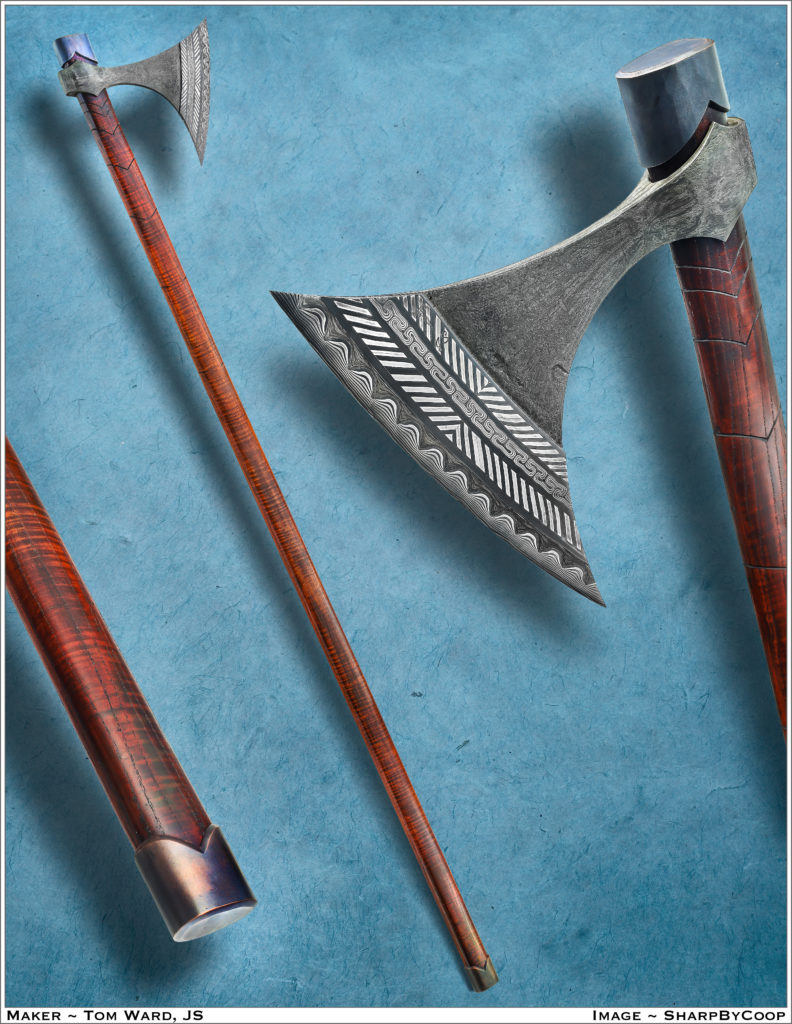
Christened “Halvdan Swung Me,” the Dane Axe by Tom Ward is based on Viking lore and representative of the weapons Viking mercenaries may have wielded in the service of the emperor of Constantinople, today known as Istanbul. His list price for a similar axe: $3,200. (SharpByCoop axe image)

After recently relocating his enterprise, along with his wife’s furniture business, from Carbondale, Illinois, to Istanbul, Turkey, Tom Ward looks forward to future custom orders. Among these may well be a request for a piece similar to his hefty Dane Axe.

When in design school in Boston, Tom took an elective course on forging damascus and bladesmithing taught by ABS master smith J.D. Smith (see May and June issues of BLADE®). “I really fell in love with the process and the idea of making high-quality objects to last someone’s entire life or longer,” he related. “I also loved the history of it and what you could learn through those venues. J.D. was my mentor for about four years before I left school and Boston. My work was fairly independent until 2017, when I started my degree at Southern Illinois University and spent three years researching damascus steel with Richard Smith in Carbondale.”

One of the most significant results of Ward’s career in steel, the Dane Axe, christened “Halvdan Swung Me,” is based on Viking lore and representative of the weapons Viking mercenaries may have wielded in the service of the emperor of Constantinople, today known as Istanbul.

“The phrase ‘Halvdan was here’ is carved into the bannister of the balcony of the Hagia Sophia in Istanbul,” Ward remarked. “So, he was the inspiration for the piece and the name. The shape is not exactly like any Dane axe but serves the same idea with an angled broad blade and beard, and a thin cross section as most war axes had. The angle of the blade is to deliver a deeper chopping or swinging cut, and it is the same cutting concept as the curve of a saber. The forward point is also hypothesized for stabbing, and the beard for hooking legs and shields.”

Damascus legend Daryl Meier sold the wrought iron, salvaged from a bridge that was torn down in Illinois, for inclusion in the Dane Axe steel combination, and encouraged Tom’s pursuit of pattern welding. The Dane Axe haft, fashioned from sturdy hickory and ash laminate, extends beyond 5 feet.

“The pattern welding on the blade is sort of an East meets West thing,” Tom commented, “with traditional wolf’s tooth from northern Europe and the Persian chain patterns, as well as the Byzantine tendency for geometric patterns with the chevrons.”

These exceptional craftsmen are among many who have explored the addition of hawks and axes to their repertoire. They set the bar high and bring additional interest to another creative frontier.

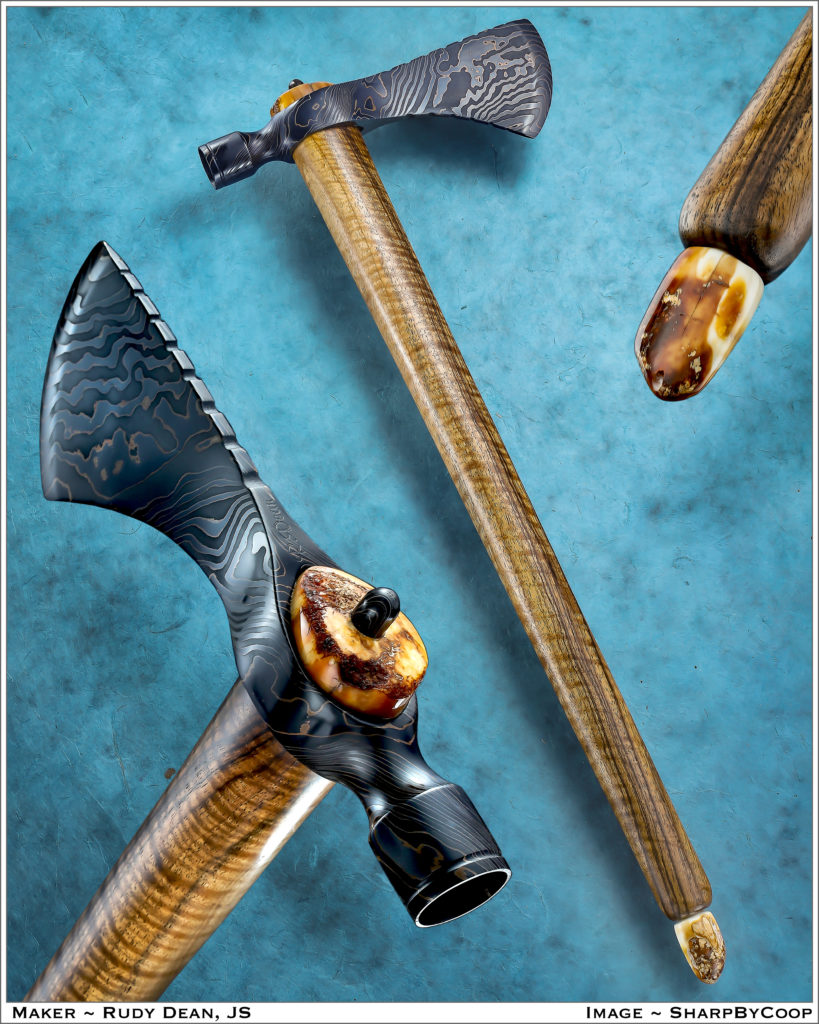
Above: Rudy Dean’s pipe hawk features a 4.5-inch blade of twist damascus and a handle of curly English walnut. The smoke  hole plug is damascus and the mouthpiece and eye cap are ancient walrus ivory. (SharpByCoop image)


Fit and Finish 101: How to know it when you see it on a knife

By Pat Covert

Fit and finish is bandied about so often in cutlery circles it’s almost become one word, pronounced something like fittenfinnish. A newbie collector who hangs around seasoned custom knifemakers, purveyors and collectors soon learns the “fit-and-finish thing” is a mighty nice trait for the knives in his or her stable to have.

All that being said, is fit and finish the key to a knife being all it can be, or does a knife exhibiting it simply look nicer and cost more? Or does the answer lie somewhere in between? We recruited a panel of authorities to help sort through it all, including purveyors Neil Ostroff of True North Knives, Dave Ellis of Exquisite Knives, Dan Delavan of Plaza Cutlery, and seasoned custom maker Tim Britton.

We started by asking our authorities how they define fit and finish. Britton, who makes highly finished customs, said, “There should be no adhesive or solder showing anywhere. No gaps in inappropriate places. Metal-to-metal joints should be indiscernible. And no visible scratches or grind marks, period. One thing custom knifemakers should be able to do well,” he observes “is finish metal.”

Having the grinds match on each side of the blade as on Marcus Lin’s Andalusian bowie is an indication of fine fit and finish.

In addition to being a purveyor, Ellis also is a retired ABS master smith and knows fit and finish from the maker’s point of view as well. “I define fit and finish of a custom knife to mean is it overall appealing to the eye,” he begins, “are there any obvious gaps in guard or handle fitting, is it a design that will truly work?” Ellis stressed that good, sound design is a factor. “The first thing I look for is the overall appearance. Is the design clean? Is there an organic flow? How does it feel in the hand in different grips? Then I look at the finer details such as guard fit, blade finish, handle design and comfort,” he explains. “As an ABS master smith I also look at things like edge geometry, tapered tangs and plunge cuts. All of these should be [executed properly] in a piece with excellent fit and finish.”

Equality of all aspects on both sides of the knife is one sign of top fit and finish. Greg Cimms achieves it on his kitchen knives.

“Fit and finish is a standard required for all knives,” Ostroff says. “It used to be almost exclusively for custom knives—which are at a higher price level—but more and more the buyers are demanding the same standard for a factory or mid-tech knife which will sell for a remarkably lower price. Fit and finish is generally a well-centered blade—in the case of a folder—no blade play in either direction, flush-fitting bolsters, and a blade finish as the maker intended. By this I mean one cannot expect a stonewashed blade, or handle, not to have scratches. Recently the matter of the strength of the detent has become an issue—again, another subjective item.”

The late Bruce Bingenheimer centered the blade of his folder in the closed position (right), splitting the gold anodized standoffs right down the middle. Note the symmetry between each side of the knife (left) and the slick fit between bolster and handle material (center).

“The criteria for fit and finish depend on the expectations of the buyer,” Delavan qualifies. “Plaza Cutlery also believes design as well as craftsmanship is important. Most important is the design. It has to make sense to me. Any guards should be clean with no gaps, bevels should be the same and no 2-inch glitches. Also, handles have to be clean to the tang or guard with no gaps.”

According to Tim Britton, metal-to-metal joints should be indiscernible. Note the partial knife image second from left. The seam between the blade and backspring of BLADE Magazine Cutlery Hall-Of-Fame® member Ron Lake’s tail-lock interframe is invisible.


PERFORMANCE

Does fit and finish affect a knife’s performance? “Poor fit and finish will really show when a knife is put to hard use,” Ellis advises, pointing out potential problems such as hot spots from badly designed and finished handles, guards or buttcaps with sharp edges, bad edge geometry that might cause the blade to dull quicker and be difficult to remove from the sheath, and so on.

David Mirabile achieves a nice, tight fit between the habaki (collar) and tsuba (guard) of his Asian-style piece.

Britton’s take was interesting, to say the least.

“One of my first knives was made in 1972. It was ugly and poorly finished,” he recalls. “[BLADE Magazine Cutlery Hall-Of-Fame® member] Frank Centofante helped me sell the knife to a hunting guide from Montana. The guide later wrote to me wanting four more just like it. The knife skinned and dressed three elk before needing sharpening. Steel was Latrobe D2 and Paul Bos did the heat treat. Fit and finish had little or nothing to do with function. Quality of steel, heat treat, grind and sharpening angle were much more relevant.”

Mark Bartlett gets the bolster of case-hardened mild steel and gold-anodized titanium spacers to meld seamlessly with the curly koa handle of his fixed fighter.

“A good finished knife just has a better feel, but a lot of people will not use it,” Delavan notes. “A knife with a lot of cosmetic issues can still be a good tool, and there are makers that don’t worry about those details. Most makers say a knife is meant to be used, not to sit in a safe.” Ostroff tends to agree. “Performance is not typically an issue [with fit and finish]. For example, a knife with an off-centered blade will still function as well as one that is centered—but the customer has the right to get what he or she wants, so we do whatever it takes to make them happy.”

Top fit and finish includes the knife exhibiting no visible scratches or grind marks. Tim Britton’s lockback follows this dictate. As Tim noted, “One thing custom knifemakers should be able to do well is finish metal.”


F&F: OVERRATED?

Are there cases where fit and finish is overrated? In other words, are there knives that perform very well even though they may not have the polish of an expensive model but have excellent heat treat, blade geometry, comfort and a more affordable price?”

“Fit and finish is not overrated when trying to satisfy the buyer,” Ostroff opines, “but taking out the collector/safe-queen members of our community, all knives are meant to cut, and all will do so if built to industry standards.”

“I have seen a few knives that performed well with poor fit and finish,” Ellis says. “Usually if a maker takes the time to finish their piece to tight tolerances, they also have taken the time to be sure that the piece has a credible heat treat, edge geometry and an overall good feeling in the hand.” Adds Delevan, “Many of the small production companies do a good job. Fit and finish is good, not perfect, but you have an excellent tool at a more affordable price.”

Note how each grind, bolster and slab mirrors its opposite on the Fenix fixed-blade hunter by Evgeny Khokhlov.


WHAT do YOU WANT?

Our authorities made excellent points for and against performance being a factor in fit and finish. Though there were several substantive points about design, in this writer’s opinion it isn’t really a fit-and-finish issue. Design is, of course, very important because no matter how well a knife is made, if the design is poor so will be the performance. From an aesthetic standpoint fit and finish is everything, but, as Delavan points out, many collector-grade knives become safe queens, never seeing action in the field.

A good analogy here would be comparing a Bark River Knives fixed blade to a comparably sized one made by ESEE Knives. Both companies have a huge, extremely dedicated following. Bark River’s fare is finely finished while the ESEE knives are more roughly done, but the latter are half the price or more of the former, depending on materials. Will both knives perform well? You better believe it. Both have stellar performance records. It really depends on whether you want to pay extra for a nicely finished knife or a rough finished one. Beauty is in the eye of the beholder and both do their job in spades.

Bottom line is you have some very good options available—and choices make the world of knives go around!

Note the tight fit with no gaps between the color-case-hardened bolster, stainless steel spacers and stabilized ringed gidgee handle of Steve Filicietti’s bowie.

Best Big Knives: Four Behemoths That Are A Cut Above The Rest

Looking for a blade that can handle jobs and and small? These four giants are some of the best big knives out there.

What Are The Big Knives:

Little knives are convenient to carry but, if you have a lot of work to do, big knives are it. I’ve lived and worked with indigenous peoples in Latin America and Southeast Asia and found that wherever folks live close to the earth, they use big knives—machetes, parangs, goloks, bolos and the like. They use them for everything from rough work such as cutting poles and opening coconuts, to dressing out pigs and game, to delicate work such as slicing mangoes.

The advantage of the big blade was illustrated to me one day when I was working alongside a villager who, with his bolo and its 14-inch blade, cut wood for a fire, bamboo poles for a cooking rack, and lopped off a banana leaf on which he filleted two large fish and sliced them thin as a sushi chef—all in the time it took me to bring down a few stalks of bamboo with my hair-shaving-sharp Randall Model 1.

We reviewed the test knives with that standard in mind. We chopped and split wood and sliced meat and tomatoes. We also, just because, cut hanging rubber hose and slashed through water-filled plastic bottles.

A tree branch succumbs to the reflective blade of the Boker Arbolito El Gigante. It cleaved 2-inch pine saplings in one stroke

Boker Arbolito El Gigante

The Boker Arbolito El Gigante is a handsome classic bowie with a stonewashed blade, comfortable handle and nice leather sheath. Balance is excellent, all very much in the bowie tradition. Construction is top quality; so is performance. It cleaved 2-inch pine saplings with one stroke. The quarter-inch-thick spine was brought down to a well-supported edge fine enough to slice tomatoes thin enough to see light through the slices. We slashed rubber hose and the water bottles with ease.

Like all well-designed and crafted bowies, this is a versatile all-around knife.

BOKER ARBOLITO EL GIGANTE
BLADE LENGTH: 9.25”
BLADE STEEL: Bohler N695 stainless
BLADE THICKNESS: .24”
BLADE GRIND: Flat
BLADE FINISH: Stonewash
HANDLE THICKNESS: .94”
HANDLE MATERIAL: Green Micarta®
WEIGHT: 15.75 ozs.
OVERALL LENGTH: 14.75”
SHEATH: Leather
COUNTRY OF ORIGIN: Argentina
MSRP: $229


The KA-BAR Gunny chomps into dry pine. Its forward weight and blade design promote effi cient chopping

KA-BAR Gunny

The KA-BAR Gunny is a hybrid design that resembles a bolo. I suspect R. Lee Ermey, the unforgettable Gunny who serves as the knife’s namesake, spent some time in jungles because this combination chopper/slicer’s performance is on par with village-forged bolos I’ve used in Southeast Asia, and that’s a high compliment. Its forward weight and terrific blade design promote efficient chopping. We cut through 3-to-4-inch-thick saplings with two strokes. We took down a tree with a 6-inch-thick truck just because we could. After the chopping, the blade was still sharp enough for camp kitchen work. The belly, good balance and fine edge combined to make slicing meat and vegetables a pleasure. Slashing hanging rubber hose and the water bottle were a piece of cake. The comfortable handle lends itself both to heavy chopping and fine meat cutting, which is unusual.

The Gunny is an excellent all-around bush knife. The sheath has a pocket for a sharpening stone, which was not included with the review model.

KA-BAR GUNNY
DESIGNER: R. Lee “Gunny” Ermey
BLADE LENGTH: 9.75”
BLADE MATERIAL: 1095 Cro-Van carbon steel
BLADE WIDTH: 2”
BLADE THICKNESS: .2”
BLADE GRIND: Flat
HANDLE WIDTH: 1.5”
HANDLE THICKNESS: .94”
HANDLE MATERIAL: Wood
WEIGHT: 15.29 ozs.
OVERALL LENGTH: 15.5”
SHEATH: Leather
COUNTRY OF ORIGIN: USA
MSRP: $292


The Medford Knife & Tool Bonfire slashed through water-filled plastic bottles with more consistency than the other review blades

Medford Knife & Tool Bonfire

The Medford Knife & Tool Bonfire came from the maker absolutely razor sharp! The blade design is interesting in that we do not often see a contemporary styled drop point and hollow grind on such a big blade. I don’t know its Rockwell hardness, but the steel is hard and tough.

It was just as razor sharp after we put it through its paces as when we started. The fine edge made for a very good slicer and slasher and lopped off thin branches with one cut. The hollow grind tended to bind when chopping wood, though that’s to be expected—hollow grinds aren’t chopping designs. It’s better to think of this knife as a well-designed and crafted big knife rather than a bush tool such as a panga or kukri. It sliced rubber hose with a snap of the wrist and slashed through water bottles with more consistency than the other review blades, and cut meat just fine. You probably could dress out a bear with it. Use it as a big knife on soft materials and you won’t be disappointed. It comes

MEDFORD KNIFE & TOOL BONFIRE
BLADE LENGTH: 8.25”
BLADE MATERIAL: CPM 3V carbon steel
BLADE THICKNESS: .24”
BLADE GRIND: Hollow
HANDLE THICKNESS: .64”
HANDLE MATERIAL: G-10
WEIGHT: 19.16 ozs.
OVERALL LENGTH: 13”
SHEATH: Nylon
COUNTRY OF ORIGIN: USA
MSRP: $450


TOPS Bestia

The TOPS Knives Bestia’s kukri-styled 13-inch blade and hefty weight made it the blade of choice for serious chopping or, as the author puts it, “zombie cleaving.”

The TOPS Bestia is just a beast. A kukri-styled 13-inch blade and hefty weight make it the blade of choice for serious chopping or zombie cleaving. We hacked through a 3-inch sapling with one stroke, and used it to clear a stand of saplings and brush. The handle remained comfortable during an hour or so of work. Heavy as a small hatchet, it is more versatile and safer in use, especially in thick brush.

During many survival classes, I’ve seen more injuries from hatchets than from big blades with their longer cutting edges. Given its heft, blade design and chopping ability, the Bestia is surprisingly usable in the camp kitchen. We found it could slice meat quite well, allowing for adjustments in maneuverability due to its blade length.

TOPS KNIVES BESTIA
DESIGNER: Leo Espinoza
BLADE LENGTH: 13”
BLADE MATERIAL: 1095 carbon steel
ROCKWELL HARDNESS: 56-58 HRC
BLADE WIDTH: 2.25”
BLADE THICKNESS: .25”
BLADE GRIND: Flat
HANDLE WIDTH: 2.125”
HANDLE THICKNESS: .97”
HANDLE MATERIAL: Green Micarta®
FRAME/LINER: Micarta
WEIGHT: 1 lb., 13.18 ozs.
OVERALL LENGTH: 19.5”
SHEATH: Kydex
COUNTRY OF ORIGIN: USA
MSRP: $300

VERSATILE BUSH TOOLS

If you haven’t spent much time with a big blade, try one. Work with it for a while. Direct close attention to your work and you’ll find a good big blade to be a terrific, versatile bush tool.

Also Read:

TOPS Little Bugger: Svelte-Bladed Straight-Edge

1

Ultra-thin and razor-sharp, the TOPS Little Bugger makes for a nimble and practical EDC fixed blade.

What The Little Bugger Has To Offer:

  • Thin blade makes for a light and nimble knife.
  • Straight edge with a saber grind makes quick work of most jobs.
  • Sturdy Micarta handle is ample enough for a solid purchase.

I have reviewed more TOPS Knives models than I can remember. Some have been hit-and-miss and others have been pretty good with just an issue or two. My biggest complaint with TOPS knives over the years has been their blade geometry. Blade profiles, handles, and sheaths have all worked out in some of the designs. As for the blade geometry, I have always thought, But only if they went a little thinner!

The Little Bugger’s sheath makes for a great little belt carry that provides quick, easy access to the blade.

Thin isn’t the issue with the company’s Little Bugger fixed blade. The blade is thin and cuts like a razor. I couldn’t be more ecstatic with it—seriously. As a knife reviewer, sometimes I find it hard to share what I think about a knife—if I hate it, someone will say I don’t know what I’m talking about, and if I really like it, someone will call me a paid shill.

Well, let the haters hate.

The Skinny

The Little Bugger has a nice wharncliff e-style blade that gives a good articulated tip very similar to a utility knife. TOPS uses a saber grind to form the geometry—oh, and did I mention it was thin? TOPS not only puts a nice, high grind on the blade but starts out with thin stock. To begin with, the blade measures only .9-inch thick. The Little Bugger cuts like a razor. It was a sheer pleasure to use right out of the box. For once, I’m not even going to complain about the choil, though when I first started cutting with it I couldn’t resist the what-if urge and strapped the blade.

You can peel a lime with many knives, but the straight edge of the Little Bugger excels at the task. A little  knife with a fi ne edge can do a range of chores, from semi-heavy to delicate
You can peel a lime with many knives, but the straight edge of the Little Bugger excels at the task. A little
knife with a fi ne edge can do a range of chores, from semi-heavy to delicate

Accessories

The sheath is spot on. It is not big and clunky but snug fitting with a crisp lock. Best of all, the fit is so good there was no notorious plastic rattle during carry—it is quiet as a church mouse. (Though oddly enough, I can’t really tell you how quiet a church mouse is because I’ve never heard one.)

I know many like the Little Bugger style as a neck knife but TOPS includes a belt clip with this knife, and I see why. Between belt-carry clip and a tether carry system, you can EDC this little fixed blade with no problem. I won’t summarize what I think of the Little Bugger. If you haven’t got that by now, I haven’t written well enough. I will say, however, that now that TOPS has found this level of thin, I am excited and filled with anticipation as to see what other small fixed EDCs the company releases in the future.

Little Bugger Specs:
Overall Length: 5.75 inches
Blade Length: 2.38 inches
Blade Grind: Saber
Blade Material: 1095 Spring Steel
Handle Material: Tan Canvas Micarta
Carry: Injection-Molded Sheath
Weight: 37 ounces W/Sheath
Style: Fixed Blade
MSRP: $129
topsknives.com

Also Read:

First-Rate Fliers: Best Throwing Knives Tested

5

Fun to fling, today’s throwing knives fly like the wind.

The Throwing Knives Tested:

We used a variety of throws to fully test the knives: handhold, blade hold, overhand, underhand, no-spin from three-to-five paces, half-spin from five to seven paces, and full-spin from seven to ten paces. Throwing at longer distances than this is, for me, frivolous and fruitless. Our targets were the sawn end of a pine stump on its side and a pine tree we are planning to take down. The stump was from a cut last year when we were clearing an area. It had seasoned somewhat and was a tougher target than the standing tree, so penetration was deeper in the standing tree.

Boker Magnum Mini Bo-Kri

Designed by veteran knife thrower John Bailey, the Boker Magnum Mini Bo-Kri is the kind of throwing knife a performer would choose to use on stage.

It has a flashy, fierce-looking recurve blade and you know at first glance it’s a throwing knife. The largest and heftiest of the three review knives, the Bo-Kri is well balanced and flew true with each throw, handle hold or blade hold. Its weight aided penetration in both stump and standing tree. Its design is best for handle throws—it just feels better that way.

CAUTION: A thing to keep in mind is that with the Bo-Kri’s recurve blade there’s a good deal of spinning edge, which means that not only the point is sharp. You should ensure your target area is clear of people when throwing any knife, but in this case a deflection would send a long edge spinning wildly. A nice leather sheath is included.

Boker Magnum Mini Bo-Kri Specs
Blade Length: 5.71”
Blade Steel: 420J2 stainless
Blade Thicknes: .25”
Blade Pattern: Drop point
Blade Grind: Sabre, recurve
Blade Finish: Brushed
Edge Type: Plain
Weight: 8.1 ozs.
Overall Length: 10.71”
Continent Of Origin: Asia
MSRP: $34.95


Kizlyar Supreme Strij

I have the strong impression that Russians are serious about throwing knives and actually use them in the field. The Strij by Kizlyar Supreme would be my choice if I were going to hunt rabbits with a throwing knife like that 10-year-old kid—which I would not. Now I know enough to use the knife to make a throwing stick, spear, bow, etc. Nonetheless, the Strij appears to have been designed with field use in mind. Kizlyar’s information says the knife was designed by Russian “Throwing Knife Instructor Grandmaster” V.S. Kovrov. I think it’s amazing there is such a thing as a Throwing Knife Grandmaster, and it illustrates just how serious Russians are about this skill.

The Strij is balanced precisely in the middle, which facilitates both handle and blade throws, as well as spin and no-spin throws. Kizlyar’s promotional material also says that “the Strij definitely requires a master’s touch to be accurate.” I disagree. My son, Justin, stuck it deep in the center of the target with his first throw. This one is a keeper.

Kizlyar Supreme Strij
Blade Length: 5.25”
Blade Steel: Stainless
Rockwell Hardness: 42 (spine) and 45 (edge) HRC
Blade Style: Modified dagger
Blade Grind: Sabre
Blade Finish: Brushed
Edge Type: Plain
Weight: 6.7 ozs.
Overall Length: 8.5”
Country Of Origin: Russia
MSRP: $42


Colonial Throwing Knife

My impression of Colonial’s throwing entries? They look like ninja knives—black, radically curved, lightweight, perfect for a ninja. Colonial promotes these as “sport” or “pastime” knives to be used like darts. I get that. They’re balanced like darts, weight forward, which makes accurate handle-hold, no-spin throws easy. Even so, we also threw them with a blade hold and a spin, which worked fine. I can see a group of folks with a handful of these knives and a dartboard-like target. I can also imagine a ninja slinging a handful of these at pursuing samurai. (I have an active imagination.)

If you’re going for penetration with these knives, velocity is the thing. With little mass and weight, velocity is what will give them the power to penetrate. Whipping your arm—not your wrist—adds velocity. These little guys are fun to throw. Well-made nylon sheaths house each of the two Colonial throwers (they come in a set) until needed.

Colonial Throwing Knife
Blade Length: 4.5”
Blade Steel: 440A stainless
Blade Thickness: .08”
Rockwell Hardness: 57 HRC
Blade Style: Dagger
Blade Grind: Sabre
Blade Finish: Brushed
Edge Type: Plain
Weight: 3.2 ozs.
Overall Length: 8.5”
Country Of Origin: China
MSRP: $29.99 (set of two; includes a nylon carry case and sheaths)


Tips On Throwing Knives

The Bo-Kri and the Colonial knives are clearly designed as dedicated throwing knives, not all-around tools. The Kizlyar Strij, though also designed as a throwing knife, is quite usable as a general-purpose knife. None of the test knives came with paper-cutting sharp edges, as is proper for throwing knives. They can, however, be sharpened. They are also tempered fairly soft, as is proper so they won’t break if a powerful throw misses the target and the knife hits something hard. This means they won’t hold an edge long if used much. That’s OK. Edge holding is much overrated. If you want these knives to have a sharp edge, a few strokes on a good stone will do it. So, too, when they go dull—a few strokes will re-sharpen them.

If you want to throw knives, here’s a couple of tips: keep your wrist stiff when releasing the knife. Do not snap your wrist. Let the power come from your body, as when throwing a football, baseball, or javelin. Throw at a big, soft target and make sure there’s a large, safe backstop for when you miss—as you will at first if you’re new to the game. Even veterans miss on occasion. As you progress you can move on to smaller targets and moving targets. Have patience and, most of all, have fun.

Also Read:

Advertisement

Must Read Articles

Read this before you make a knife

Knifemaking 101 – Read This Before You Make a Knife

  by Wayne Goddard My experience has taught me that there's nothing like digging in and getting started. I've often said the hardest part of the...
how to forge damascus steel

How to Forge Damascus

Advertisement
Advertisement