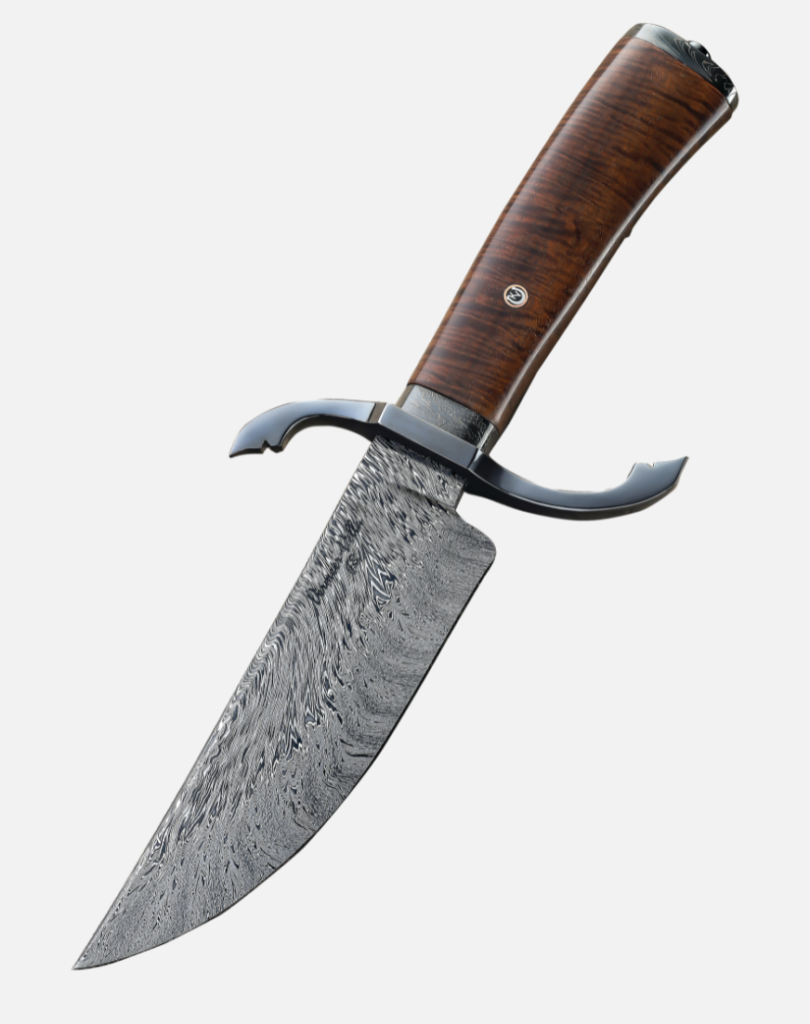
Knife collecting is an extremely rewarding experience for knife enthusiasts. There truly is a knife for everyone. Many increase or hold their value throughout the years, making collecting knives something to pass on to the next generation of knife collectors.
Knife to Know: Blade has a forged distal taper; handle butt flared to enhance purchase
Weight: 12 ozs.
Overall Length: 20″
Sheath: Wood with handcarved details
Sheath Weight: 3 ozs.
I received a bolo made in the Philippines from my friend, Mike Key, as a gift a couple of years ago. He went on a three-day search for good bolos made from carbon steel in villages, not the souvenir type. He was successful in his quest.
I ran a triangle file down the edge and it skated off, an indication the blade is hardened steel for sure. The forged blade has a smooth distal taper, starting around 3/16-inch thick down to 0 inches at the tip. The knife sports hidden-tang construction. The wood for the sheath and handle are from a local shop in the Philippines. Of course, a blade must cut no matter where it’s made.
Cutting Tests
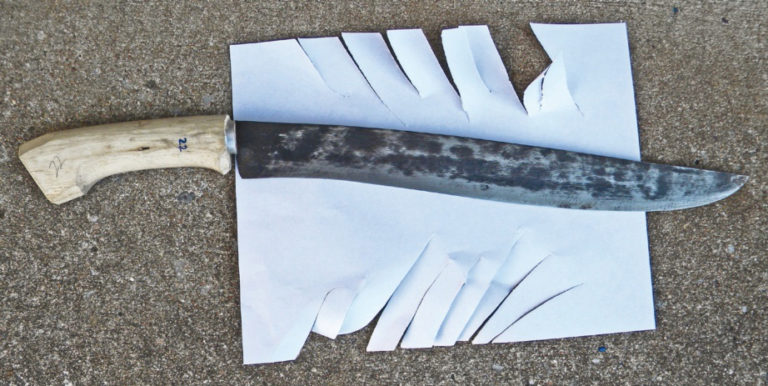
Up first: the paper slice. Despite a coarse edge, the bolo still managed to give clean slices in 20-pound bond paper. Normally, a bigger blade is cumbersome slicing paper, but the bolo has a perfect balance due to its distal taper.
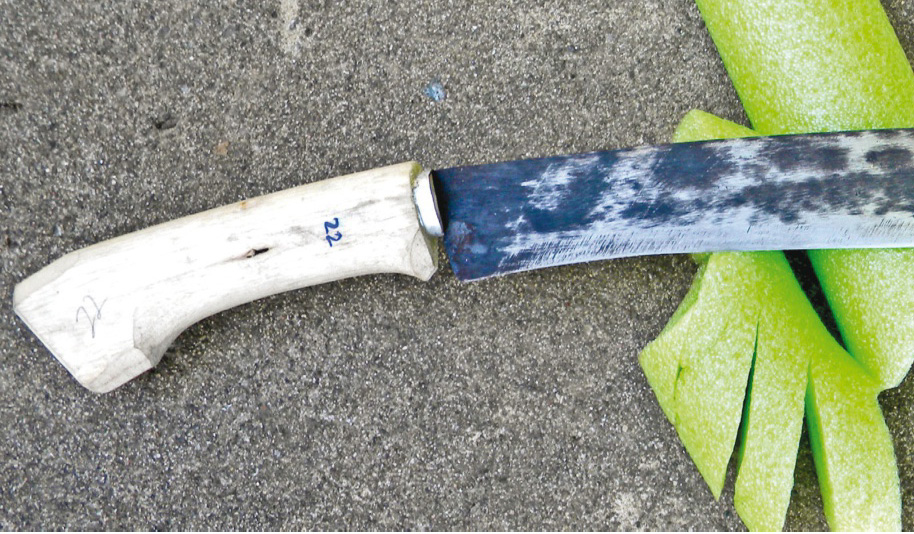
The bolo was very aggressive on the plastic foam. The author held the pool noodle suspended in air with one hand and sliced it. He indicated the knife is very controllable and the handle is indexed perfectly.
A pool noodle was next on the test menu. The bolo was very aggressive on the plastic foam. I held the pool noodle suspended in air with one hand and sliced it. The knife is very controllable and the handle is indexed perfectly.
Next up: chopping into a hard cardboard tube with the noodle inserted to prevent wall collapse. It worked on the first two chops, but then I hit too close to the previous pair of chops and the tube crushed under the force of the blows. Still, the blade made it halfway through the tube.
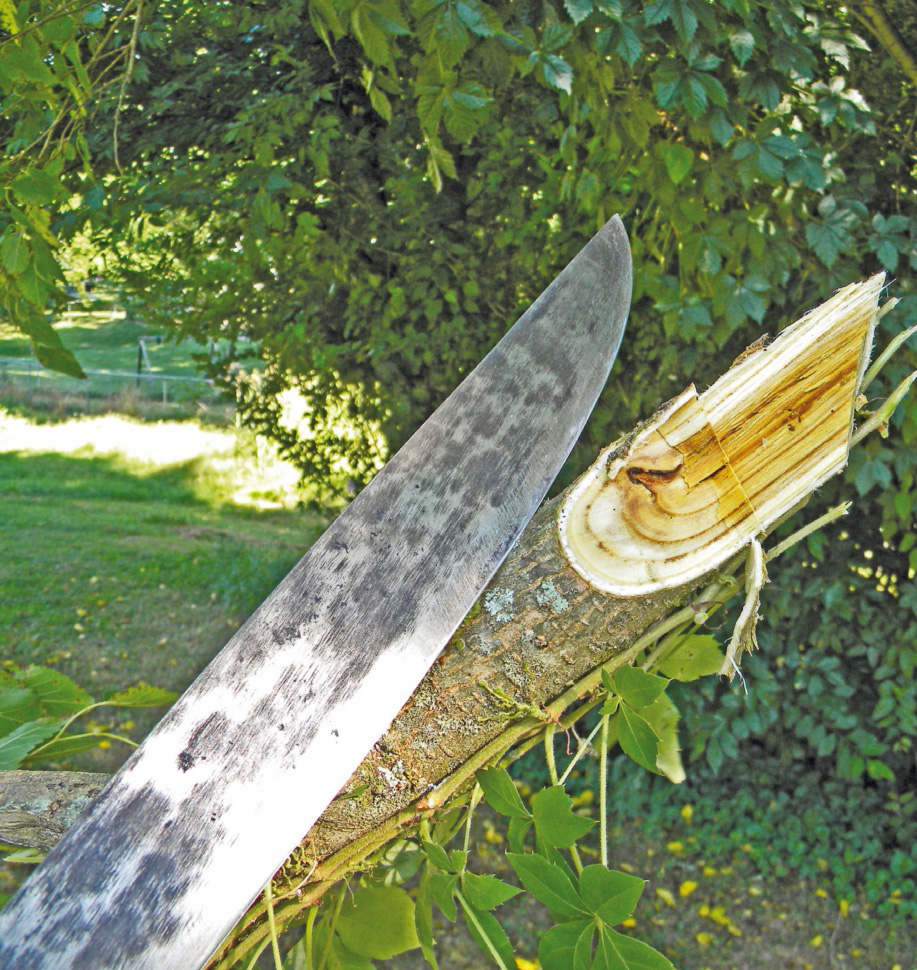
When you have trees encroaching on your property, you have to take steps to keep your yard clear. One such branch had scraped me for the last time while I was mowing the lawn. Its 2.5-inch diameter was a breeze for the bolo. Five whacks and the branch was down.
Five whacks and the 2.5-inch-diameter branch was down.
I dragged it away from the fence to whack it into smaller pieces. This is what the bolo was designed to do. One chop per branch and it was in pieces quickly. Just a wrist snap carried the blade halfway through a 1.5-inch-diameter branch. The bolo is a very fast chopper.
A note on the wooden sheath: It’s flat on one side for resting against your body and slightly rounded on the other. The maker even added some hand-carved detail into the wood. Excellent workmanship!
A big thank you goes out to Mike Key for finding this gem of a bolo for me.
Changes
On a blade this long, I would like to see a pin in the handle for a mechanical connection.
Final Results
The bolo is a very balanced working model. You can use it all day without wearing your hand or arm out. It exhibits great workmanship in the forging and the woodwork!
There’s never a bad time for outside fun, but the COVID era provided a serious force multiplier for fresh air. For instance, golf surged in popularity in the United States since the start of the pandemic, adding 500,000 new sand trap junkies to the sport.
From the perspective of the knife world, that begs a question: what blade is in your pocket when you’re working on that birdie?
Enter Golphers, a company turning out everyday carry (EDC) knives worthy of a PGA tour.
EDC Knives for Golfers
It was nearly guaranteed that the push in recent years toward urban EDCs—high-performance folders that don’t raise eyebrows—would yield knives tailored to sports and hobbies. Golphers got out ahead of the curve with its catalog of blades purpose-built for the putting green.
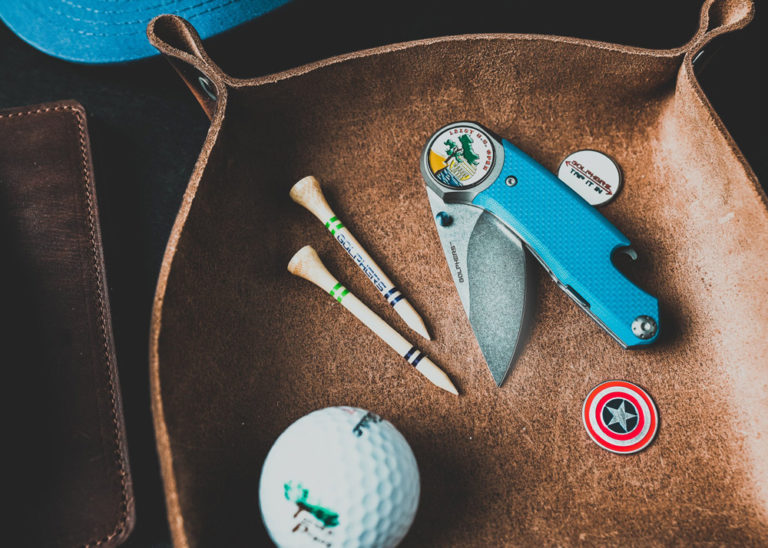
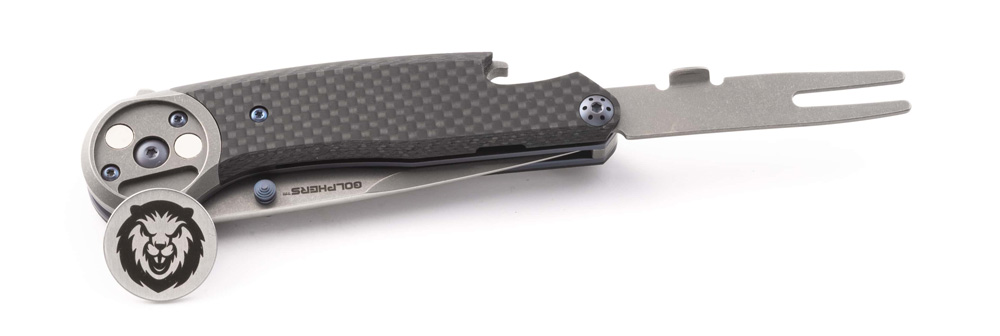
In addition to being tidy EDC designs, the three knives that make up the core of Golphers—the Ace, the Scottsdale and the Wichita—feature a bottle opener, a fold-out divot tool and a detachable ball marker.
How Not to Lose Your Ball Marker while Golfing
The detachable ball markers can be customized. This excellent feature makes it harder to lose these small discs.
The built-in marker is a stroke of genius I didn’t fully appreciate until talking with a few golf enthusiasts. These small discs constantly get lost or misplaced through nine or 18 holes.
Attaching the marker to something with presence clipped into a pocket, like one of these Golphers knives, solves that problem with style.
The fold-out divot tool on the trio of Golpher knives is the icing on the cake.
The Ace, Scottsdale and Wichita come with fold-out divot tools, the lemonade to the iced tea of these knives. Some designs are smarter by half when it comes to multitools, but this addition is entirely necessary and baked in seamlessly between the frame and the handle scale.
A person could start to feel spoiled by the time and attention spent on these designs. But how do they actually perform?
How Do They Perform? The Ace
The Ace is the largest of the trio, sporting a three-inch blade and 7.5-inch OAL.
Golphers sent in three knives for this review. I’ll tackle each one at a time.
The Ace is an Eric Ochs-designed flipper with a three-inch S35VN blade, available with a variety of handle materials. I received the blue carbon fiber version, much to my enjoyment. The Ace includes a bottle opener, ball marker and divot tool.
Three-inch blades are the right size for EDC, and this flipper snaps into place with a crisp “click.” It’s infinitely fidget-able (not a technical term, but close enough), which isn’t to be discounted while waiting for the duffers up ahead to finish.
When I showed off the knife, the divot tool always surprised and delighted. It waits inside the Ace for a sneak attack. It’s a simple thing, sure, but this divot tool could’ve easily been bungled in the design. Simple is hard to do.
The Ace works well as an EDC even if you never touch the golf-centric features.
Honestly, the Ace would be a respectable EDC on or off the course. I’d be happy to include this in my regular rotation.
That said, I wish the design allowed my index finger to choke up on the blade a bit more. I’m missing a little jimping, too. That’s my personal preference, though, and certainly not a knock on the knife itself.
Along the same lines, a three-inch blade may be overkill for the golf course. This feels to me more like a knife that plays to the culture of golf, like a T-shirt with a logo on it, than something to be used for its stated purpose.
Again, that’s a personal preference. If three inches is your style, you won’t be disappointed with the Ace.
If not, Golphers still has you covered.
The Scottsdale
The Scottsdale was this reviewer’s favorite of the three knives, but that comes down to personal preference.
The Scottsdale is the 2.5-inch blade version of the Ace. It sports the same golf-friendly features, but in a more compact package. For me, this is the sweet spot, and it made the Scottsdale my favorite of the three.
Golphers wisely went with framelocks on each of their knives, and the Scottsdale I received made it clear why that’s the right choice. The blade locked up nicely each time, maintaining its sturdiness for each task I put it through.
The detent arrived hard out of the box, too, which is always a plus for staying secure in the pocket.
Other than the blade length, the key difference between the Ace and the Scottsdale is the flipper tab. The Ace has it, while the Scottsdale doesn’t. This isn’t necessarily good or bad. It’s a preference thing, and it’s worth keeping in mind in case thumb studs alone won’t do.
And if you don’t want thumb studs at all, Golphers didn’t stop at the Scottsdale.
The Wichita
The Wichita wouldn’t look out of place at the Masters. This is what the urban EDC category is all about.
Like the Scottsdale, the Wichita also wields a 2.5-inch blade. However, the belly on the Wichita’s blade is a bit beefier, and a thumb hole is in place of the studs.
Golphers calls the Wichita the “holy grail” of its knives, and it’s hard to disagree. The Wichita is the most classed up of the trio, ready for an experienced caddy to open with two gloved hands. Of course, the Wichita can be opened with one hand, too, but this is the picture it paints in my mind.
To the point, the Wichita is only offered with G10 handles in swatches that shout “urban EDC.” Were this knife to pop up on TV during the Masters, I doubt anyone would find it out of place.
That’s saying something for a knife that retails a hair under $100, as of this writing.
The Verdict
The Scottsdale takes the cake as the best of Golphers’ three knives, but that’s just me. Golfers will find at least one Golphers knife to suit their tastes.
Golphers shows why there’s so much vitality in the knife industry. Just when you think you’ve seen everything, along comes another wave of innovation and creativity. Golphers is good news for every knife enthusiast, whether they golf or not.
If you do hit the links, you seriously need to consider getting one of these knives. They may not stop you from pulling too hard to the left on your drive, but they will make your time on the green more enjoyable.
Harry Archer is no stranger to fans of BLADE Magazine Cutlery Hall-Of-Fame® members Bob Loveless and A.G. Russell, as well as followers of Steve Johnson, Bob Dozier and other inhabitants of the custom knife scene. A larger-than life “operator” for the CIA, among others, Archer designed the chute knife, a fixed blade that got its name for use when a parachutist landed in a tree or in some other sticky situation and needed to cut the shroud lines to free himself.
Archer fell in love with Loveless knives and designed a chute knife that Bob made. In the process, Archer and Loveless became close friends and the chute one of Bob’s best-known knives, one reproduced today by scores of custom makers.
A.G. and Loveless had a special relationship, so it should come as no surprise that A.G. became friends with Archer as well—and neither should it come as a revelation that A.G. saw the potential for reproducing a chute knife. In fact, as it turns out, A.G. Russell Knives wound up ordering three different chute repros.
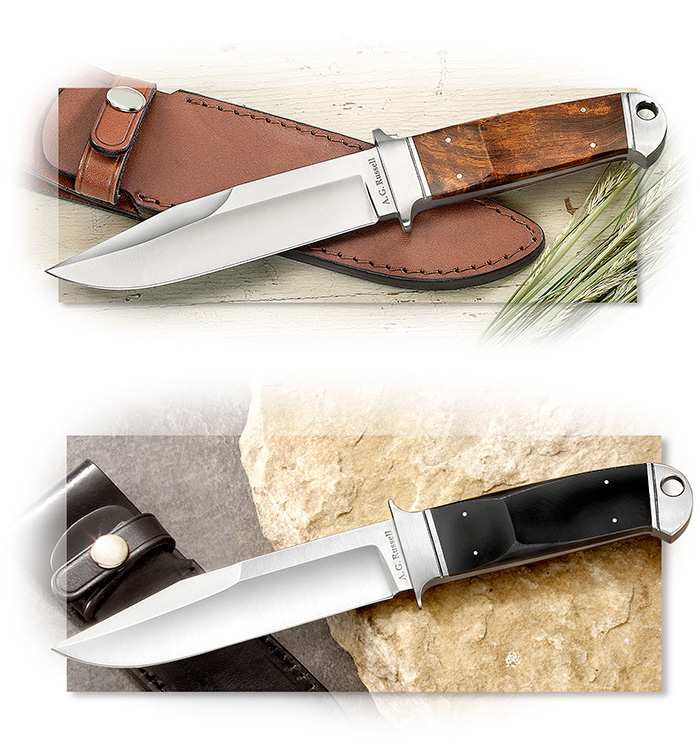
There are great similarities between A.G.’s chute knives and those by Loveless, but also differences. For one, A.G. included a hole in each end of the double guard. Loveless did not. A.G.’s early A.G. Russell and Morseth chutes used narrow-tang construction with distinctly shaped, solid handles. Loveless’s were full tang with applied scales.
Dozier was the maker behind the first A.G. Russell and Morseth chute knives. Aside from a few changes, the Dozier design is much like the Loveless, including no holes in the guard, full-tang construction and the Loveless signature green Micarta® scales.
As A.G. wrote, “In the beginning, Loveless probably would have used A2 tool steel for the blade, and later 154CM and/or ATS-34 stainless. Dozier’s design uses Dozier’s signature D2 tool steel.” It also features one of Dozier’s solidly built leather sheaths.
From 2003-2007, A.G. offered a chute knife designed in collaboration with award-winning German knifemaker Dietmar Kressler.
Russell took Archer’s basic chute and “added as much elegance” as he could manage, “using the talents of that most talented maker [i.e., Kressler]. Dietmar is the master of integral hilt-and-butt [aka hilt-and-cap] hunting and combat knives,” A.G. wrote. “He has taken my design and executed it beautifully.”
Just 75 were made and the last one sold for $2,195. They are available today on the secondary market only.
After that, A.G. began work on a more economical drop-forged version of the chute. It took 10 years to get the tooling finished in Taiwan and the knives made. From the blade tip to the end of the pommel, the entire knife is drop forged of 440C stainless steel and has a “very tapered” tang.
“The standard model has ebony Rucarta® scales. Blade and overall lengths: 5.5 and 9.5 inches. MSRP: $245. With ironwood scales the MSRP is $295.
As Russell wrote, “Harry Archer could well have been the pattern for Mr. Clark, the ubiquitous CIA problem solver in Tom Clancy’s novels … He spent a lot of time in the jungle teaching jungle combat and survival to American soldiers and soldiers of other countries as well … He loved knives, well made knives. In his lifetime he was probably Loveless’s #2 or #3 customer. He was a strong influence on the design of custom combat knives and his design for the chute knife is classic.”
The best sharpening angle depends on the use of the knife, the thickness of the blade, the type of blade steel, the sharpening materials used and more.
What is the Best Sharpening Angle?
What determines the best sharpening angle? The answer is one that plagues knife neophytes and old hands alike.
“The best angle of sharpening is one of those very intriguing topics that many have explored but most have come up with different answers,” states Jake Broce, online marketing coordinator for A.G. Russell Knives.
Agrees Kyle Crawford, brand manager for Work Sharp, “The answer is often different for everyone.”
He says the two keys are knife type/use and edge retention/maintenance. In fact, all of our story sources cited the intended use of the knife as a deciding factor. For tough chores such as chopping or batonning, a wider angle is best.
“Generally, the wider the angle of edge, the more steel is behind it, which increases the edge’s toughness,” Broce observes.
“For kitchen knives that see light duty cutting food on cutting boards, or a task-specific hunting knife like a camping knife, a low angle is ideal,” counters Crawford.
By “low” he means an edge angle between 15 and 20 degrees.
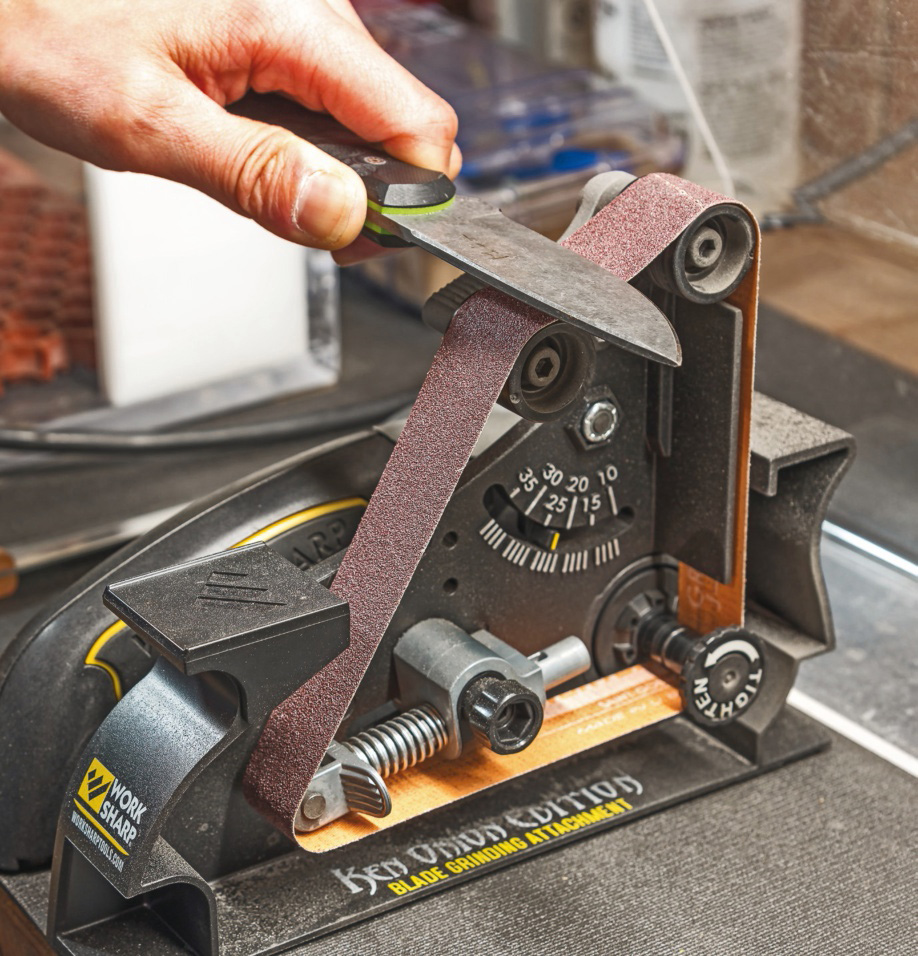
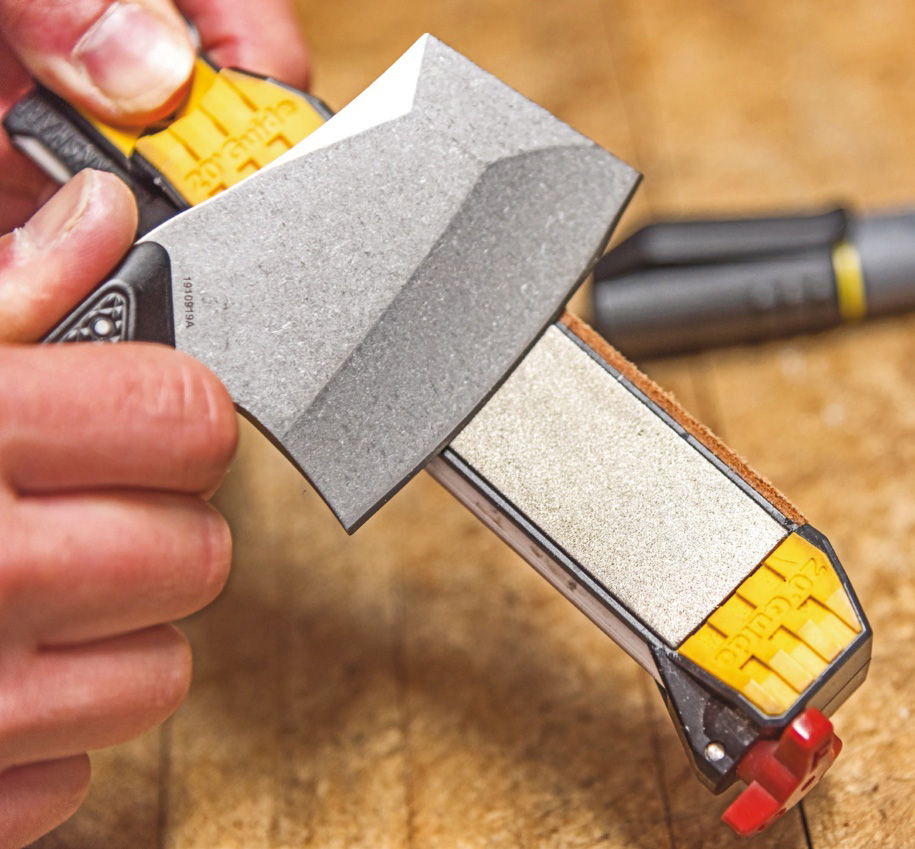
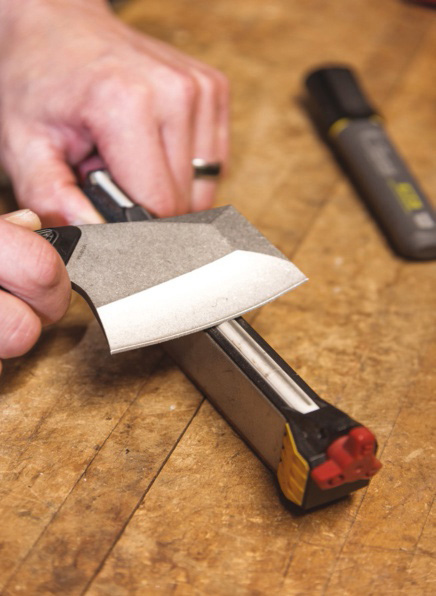
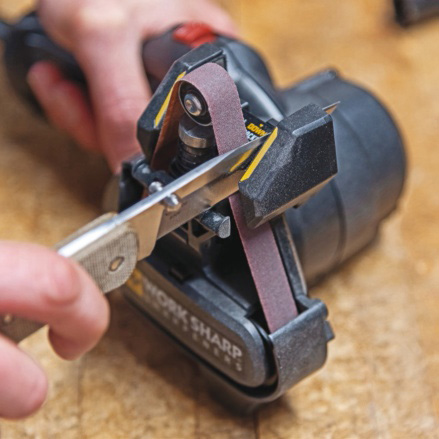
Knives come with a standard edge from the factory, around 22 degrees inclusive. The edge is sharp and durable, and a good middle-of-the-road angle that is a good balance between durability and cutting ease. The Work Sharp Ken Onion Elite sharpener is set here to sharpen at 22 degrees. (Marty Stanfield Photography)
Edge angle also affects edge retention.
“If you sharpen your heavy-use EDC knife to a low angle such as 15 degrees, it will be incredibly sharp,” Crawford says, “but the trade-off you are making is edge retention and durability.”
Conversely, he adds, if you sharpen at a wider angle, such as 25 degrees, the edge will still be very sharp but you gain improved edge retention and, thus, eliminate the need for more frequent maintenance.
However, Kendra Tobler, marketing communications manager for Benchmade Knife Co., indicates grades of blade steel also factor in as well.
“A harder steel with higher yield strength can be ground to a small included angle with less worry about rolling or deforming the edge,” she says. “Conventionally cast steels with large carbides are better suited to larger included angles.”
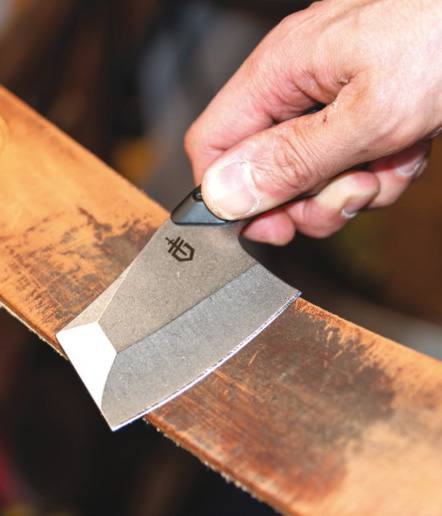
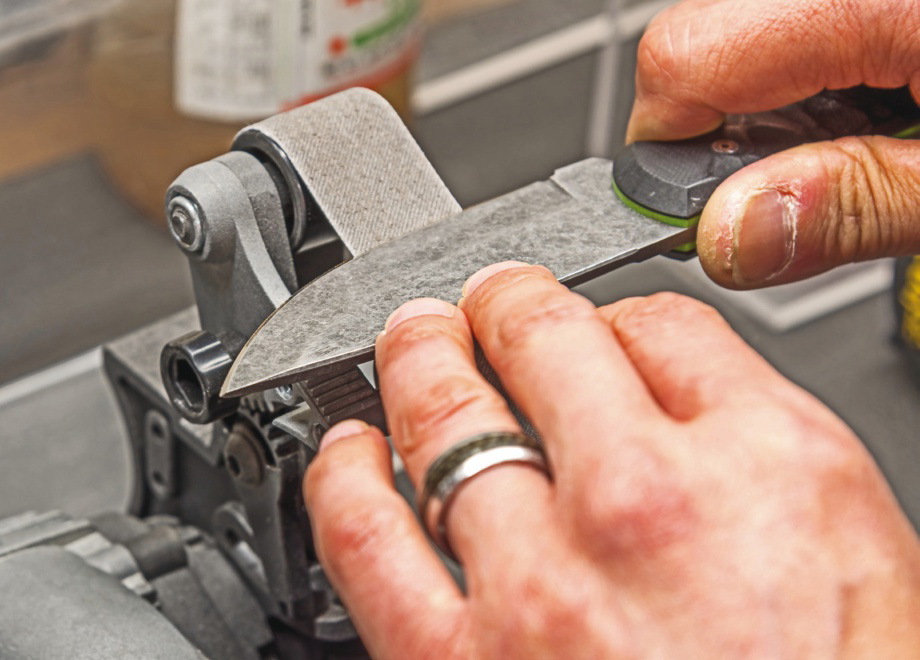
Lesser grades of steel such as the 7Cr17MoV stainless of the Gerber Tri-Tip should not be taken down to an acute angle. (Marty Stanfield Photography)
This is done so for edge durability. A prime example of Tobler’s point is Benchmade’s 15017-1 Hidden Canyon Hunter, a compact drop-point fixed blade in premium CPM S90V stainless steel well known for its extreme edge-holding ability.
Benchmade uses its SelectEdge 14-degree included edge on the knife. It is ground thinner because S90V is a high-yield-strength steel that can retain its strength with a thinner edge without deforming or chipping.
With task-specific knives of high-yield-strength steels for hunting/field dressing, you may opt for a more acute edge angle, anywhere between 15 and 20 degrees. (Marty Stanfield Photography)
Blade thickness is a factor as well.
“Thin blades are much easier to sharpen to low edge angles than thick knives,” Crawford states. “The thicker the blade, the more material you will have to remove to create a low edge angle.”
And it usually takes time to thin down a thick blade.
As he warns, “If you choose to sharpen a low edge angle onto a thick blade, be prepared to be patient.”
Blade thickness is a factor as well. “Thin blades are much easier to sharpen to low edge angles than thick knives,” Crawford states. “The thicker the blade, the more material you will have to remove to create a low edge angle.” (Marty Stanfield Photography)
Establishing Angles
How should you go about establishing the edge angle when you sharpen? A safe bet is to invest in a sharpener that sets and maintains the edge angle for you—all you have to do is set the sharpener to the desired angle.
“Angle guides are tried and true and solve one of the biggest sharpening challenges—establish the angle and be consistent,” Crawford says.
Cautions Broce, “The first time you use [a guide kit] on your knife will usually take the longest, as your edge angle adjusts to the way you use the sharpener.”
The angle guide kits subtract the science of maintaining a consistent angle, so all you need do is concentrate on getting the edge sharp. The kits have been a game changer for consumers who struggle with freehand sharpening on a bench stone.
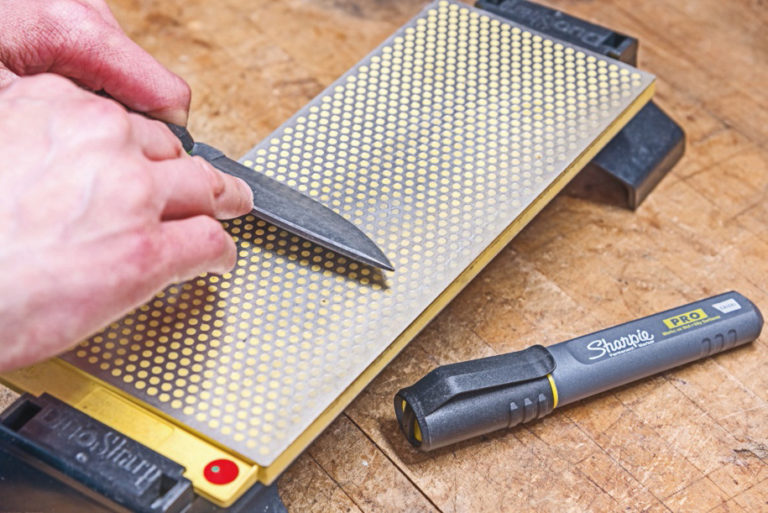
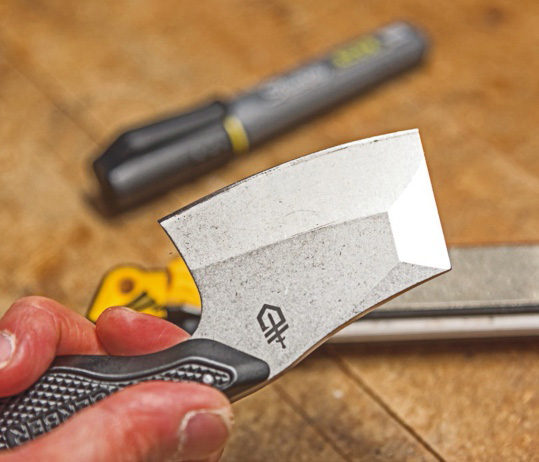
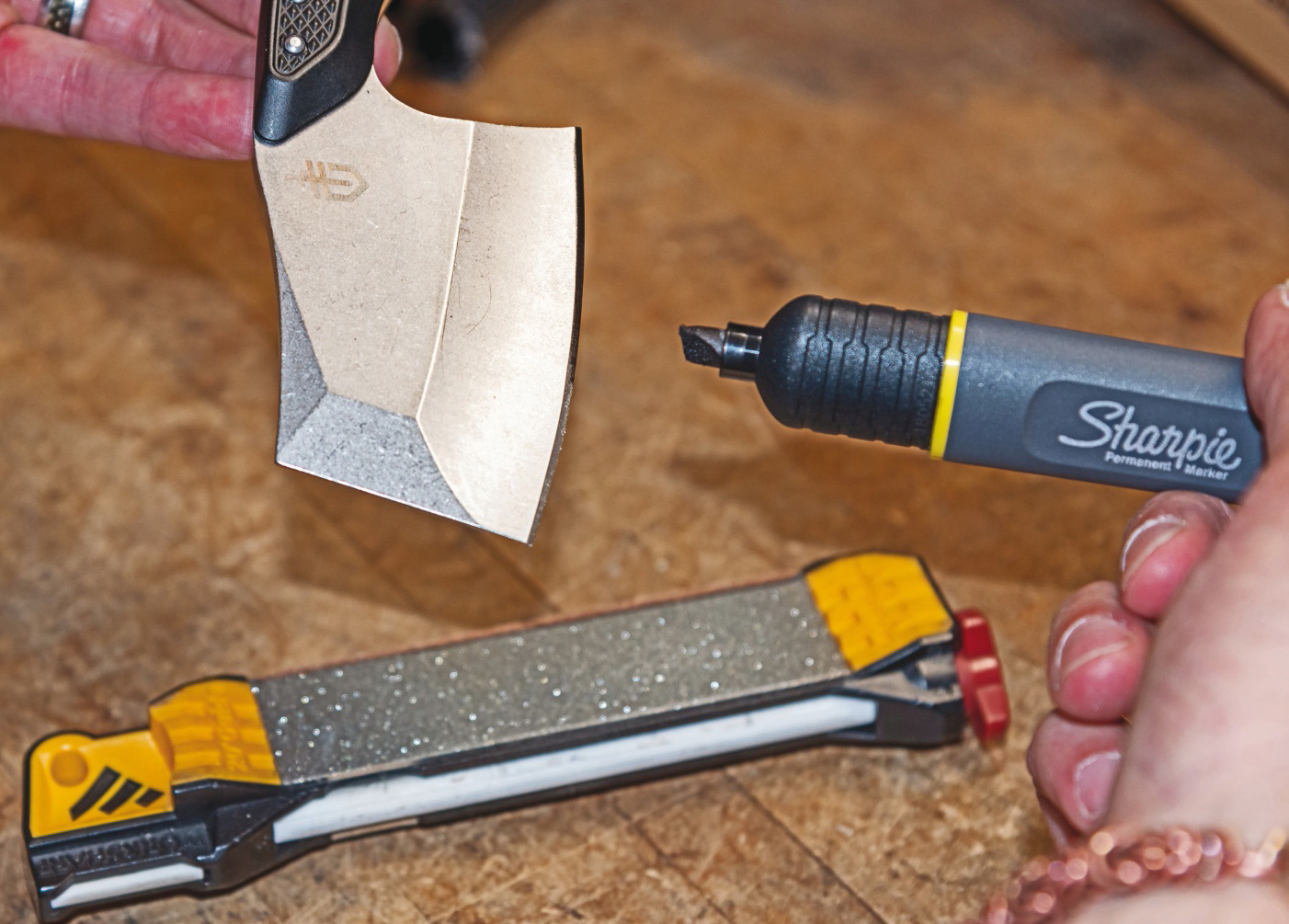
A good tip is the black marker trick. Using a permanent black marker with a wider chisel tip, color the edge bevel on both sides of the blade. The goal is to sharpen the blade—here on the Gerber Tri-Tip—removing the black marker ink from both sides. (Marty Stanfield Photography)
Another good tip, regardless of which sharpener you use, is the tried-and-true black marker trick. Using a permanent black marker with a wider chisel tip, color the edge bevel on both sides of the blade. The goal is to sharpen the blade, removing the black marker ink from both sides. When you accomplish this, your edge angle is correct and you should have a sharp blade.
“The goal is to remove all of the ink in one swipe,” Crawford says. “If you are removing the marker at the cutting edge, your edge angle is too high and you are micro-beveling.”
From there adjust your edge angle to a lower degree and take a few more passes to see how the ink is being removed.
“It is a process of trial and error,” Crawford notes.
Tobler is another proponent of the marker method. “It helps for matching the edge angle already on the blade when resharpening,” she observes.
According to Jason Broce of A.G. Russell Knives, “The blade grind determines how much steel is behind the edge. More steel behind the edge improves edge stability, whereas less material behind the edge can improve the pass-through.” (Marty Stanfield Photography)
You can use the method in conjunction with one of the guide kits even if the kit holds the angle constant for you. The method enables you to see how much more you must sharpen off in order for the edge bevel to be reestablished.
In this regard, you’re using it to determine how much more you have to go as opposed to if you’re holding the angle correctly.
Another tip is sharpen in a well-lighted area. Good visibility is very important and key to doing a thorough, well-executed sharpening job. And if you use the marker method a lot, abundant lighting helps you see clearer without eye strain.
Finally is sharpener selection. You can use any quality sharpener as long as it fits the steel type. The key here is to select a sharpener you feel very comfortable in using.
Another tip is sharpen in a well-lighted area. Good visibility is very important and key to doing a thorough, well-executed sharpening job. And if you use the marker method a lot, abundant lighting helps you see clearer without eye strain. (Marty Stanfield Photography)
Knife Sharpening Safety
Sharpening can be dangerous, so be sure you are in the right frame of mind when you do it—not mentally or physically tired, nor pre-occupied. Focus on sharpening with little to no distractions.
Not only is your own personal safety at stake, but the more focused you are, the better job you can do. This is especially true if you’re learning a new sharpening technique, such as re-establishing edge angles.
Most of all, be safe, have fun and take satisfaction in the knowledge that, once you master establishing edge angles, you have become self-sufficient at sharpening.
Focus on sharpening with little to no distractions. Not only is your own personal safety at stake, but the more focused you are, the better job you can do. (Marty Stanfield Photography)
The late Gunny’s final knife collaboration was certainly not his least.
KA-BAR Gunny Review
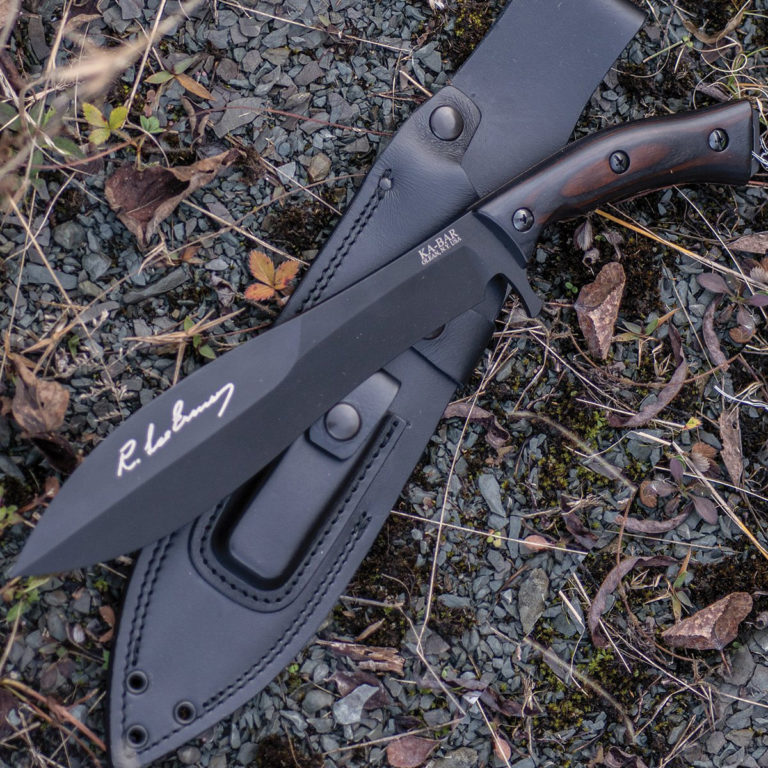
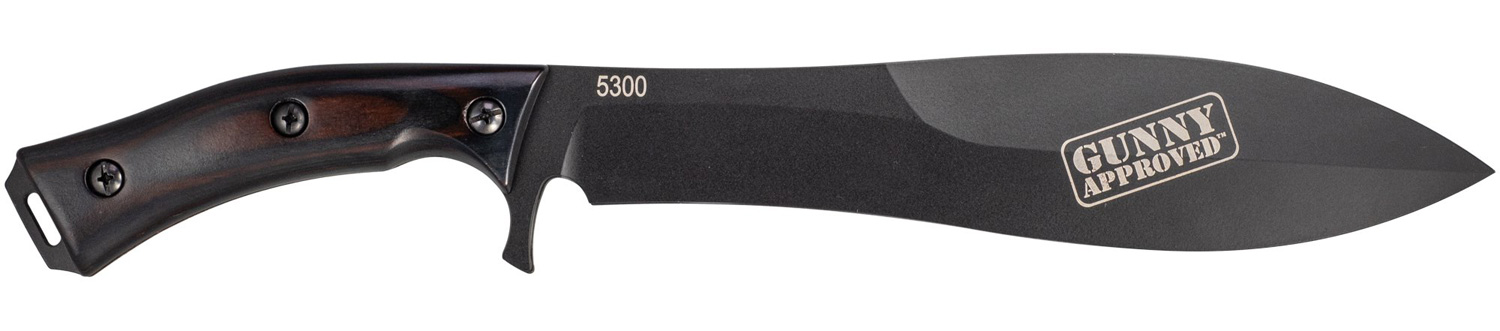
The KA-BAR Gunny is a hybrid design that resembles a bolo. I suspect R. Lee Ermey, the unforgettable Gunny who serves as the knife’s namesake, spent some time in jungles because this combination chopper/slicer’s performance is on par with village-forged bolos I’ve used in Southeast Asia, and that’s a high compliment.
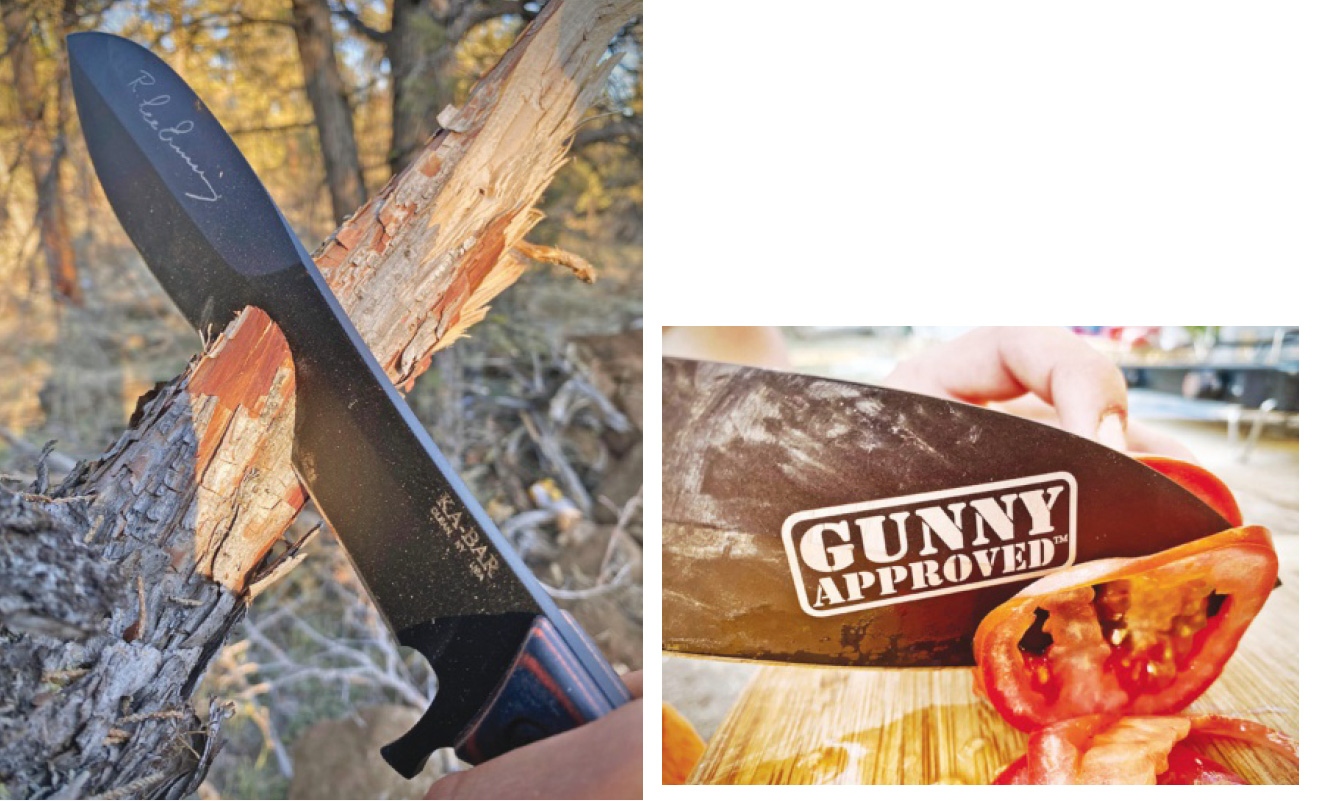
Its forward weight and terrific blade design promote efficient chopping. We cut through 3-to-4-inch-thick saplings with two strokes. We took down a tree with a 6-inch-thick truck just because we could.
After the chopping the blade was still sharp enough for camp kitchen work. The belly, good balance and fine edge combined to make slicing meat and vegetables a pleasure. Slashing hanging rubber hose and the water bottle were a piece of cake.
The comfortable handle lends itself both to heavy chopping and fine meat cutting, which is unusual.
Bottom line: The Gunny is an excellent all-around bush knife. The sheath has a pocket for a sharpening stone, which was not included with the review model.
After chopping wood, the Gunny sliced tomatoes like a chef’s knife.
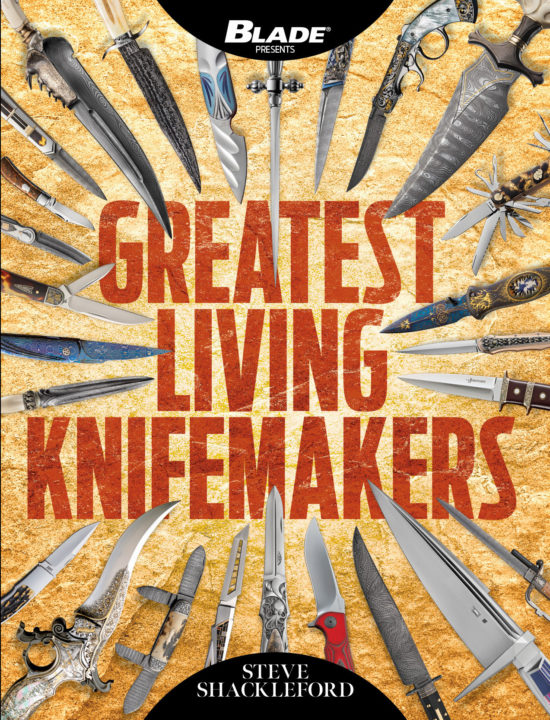
A new book from the publishers of BLADE magazine, Greatest Living Knifemakers, celebrates today’s legends who make knives in ways that most can only dream about. They make knives that can easily fetch tens of thousands of dollars, and even more.
Given all that talent, how does a book like this come together? Who gets to decide who is counting among the “Greatest Living Knifemakers” anyway? If you’re someone looking to collect or make knives, you’ll enjoy this interview with the editor of the book, Steve Shackleford, who is also a member of the BLADE Magazine Cutlery Hall of Fame®.
Many talented people make knives of outstanding quality. How did you go about choosing who should appear in this book?
Steve Shackleford
The hardest part was choosing who NOT to include. I’ve been covering the knife industry for BLADE®, the world’s No. 1 knife publication, since 1985, so I’ve had the privilege of seeing and handling some of the world’s greatest knives, and meeting some of the world’s greatest knifemakers.
As a result, some of the makers I picked peaked years ago and don’t even make that many knives anymore. On the other hand, some are peaking now. However, at some point in their careers each has made knives that are among the world’s best.
In addition, each has either made knives and/or introduced designs, techniques, folding mechanisms, damascus or other steels and other materials, etc., that in turn have set a standard or inspired other makers in the way they make knives.
And, of course, to qualify as per the book’s title, each must be living, though Tony Bose passed away after the book was finished. We decided to include him as a tribute to his fantastic slip joints and the overall impact he had on the knife industry, which was and remains monumental.
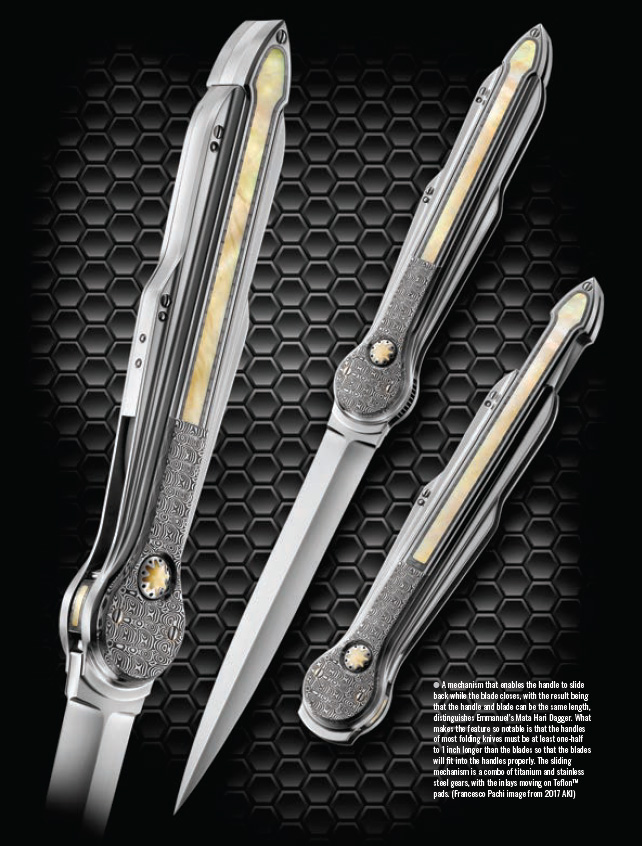
A mechanism that enables the handle to slide back while the blade closes, with the result being that the handle and blade can be the same length, distinguishes Emmanuel’s Mata Hari Dagger. What makes the feature so notable is that the handles of most folding knives must be at least one-half to 1 inch longer than the blades so that the blades will fit into the handles properly. The sliding mechanism is a combo of titanium and stainless steel gears, with the inlays moving on Teflon™ pads. (Francesco Pachi image from 2017 AKI)
What makes a knifemaker “great”?
Some of that is covered in my first answer above but there are other things as well. They must have a lifelong dedication to making knives, which all of those profiled have exhibited, as well as a passion to make knives for much more than just the money.
It’s kind of hard to explain unless you’ve followed knives for a long time, but, in a nutshell, most great knifemakers make knives because they sweat the load, they agonize over the details, and they don’t provide just a “product”—they produce a knife that almost always acts, looks and feels like it’s the best knife that maker makes. There’s much more but that’s part of it.
Are there any names that couldn’t make it into the book due to space limitations?
As noted above, yes, many make knives worthy of inclusion. However, I won’t name names here in case we decide to do a second volume of the book.
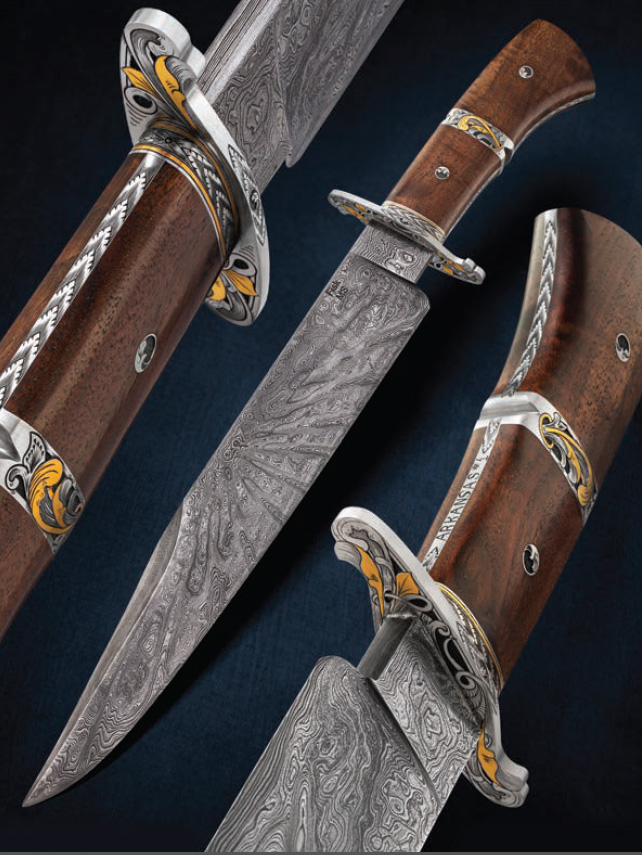
The Razorback State is the theme for Jerry Fisk’s Arkansas #1. The 11-inch blade has a Dog Star-pattern damascus with 1836 layers to represent the year Arkansas became a state. The blade also has steel welded into it from the Statue of Liberty. The walnut handle is from the official James Black walnut from the cemetery where Black is buried in Historic Washington Arkansas. Some believe Black made a bowie knife for James Bowie. The mountings are fully engraved and carved, including deep relief scrollwork and 24k-gold inlay—all by Jerry. (Whetstone Studio image)
Are the names ranked or is this just a collection of noteworthy knifemakers?
Since they are all great and, as John Wayne’s character once said of two great gunfighters in the movie Rio Bravo, “I’d hate to have to live on the difference,” I decided to list them all in alphabetical order—with the exception of R.J. Martin.
His profile appears first in the book because it is the only profile written by the maker himself. I did not ask him to write it, he volunteered to do it. I was so taken by the quality of his writing and the information he provided on what being a great knifemaker is really like that it was a no-brainer to include it.
In my opinion, it’s one of the best ways for the reader to truly appreciate what it’s like to be a great knifemaker—done from a great knifemaker’s point of view. I think it’s the best profile in the book, hands down.
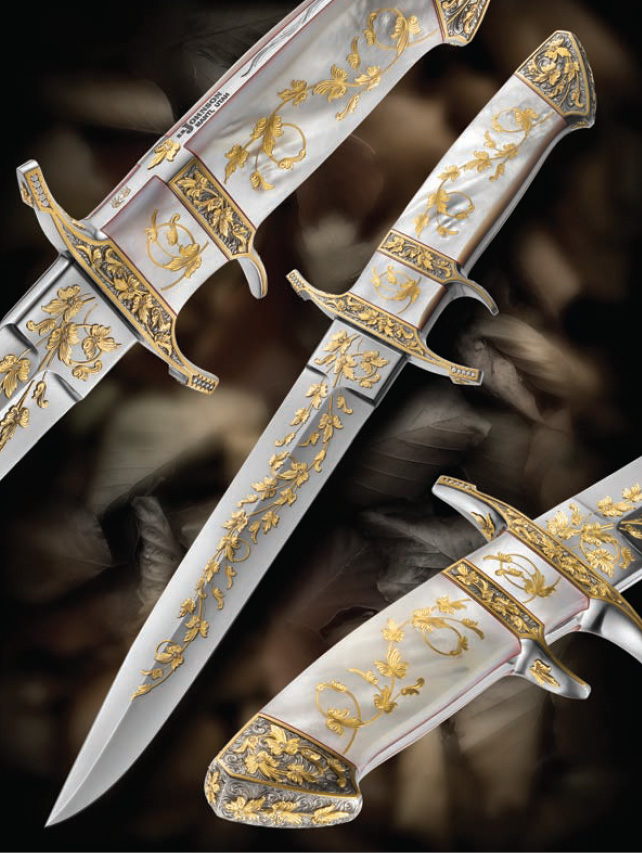
Steve Johnson’s spectacular repro of a Loveless Big Bear sub-hilt fighter is highlighted by Barry Lee Hands engraving that includes 24k-gold inlays and overlays set with diamonds and gilded mother-of-pearl. The knife is made from one block of 5/8-inch thick, 4-inch-wide and 16-inch long CPM 154 stainless steel. The blade is a quarter-inch thick and 8.5 inches long. Overall length: 14 inches. Steve made it for the 2015 Art Knife Invitational. (Francesco Pachi image)
Do great knifemakers have a peak or a golden era within their careers, or are they great throughout their careers?
As with most all great talents, they do indeed seem to peak at certain times. Some peak for longer periods than others and some even seem to have more than one peak. Some may burn out early and then something happens to help them regain their mojo.
However, in most cases the great ones maintain varying levels of greatness throughout their careers, and I think that’s the case with all of those featured in the book.
Is there a list of the knifemakers featured in this book posted somewhere for people to check out?
Maybe it’s a bit of a contradiction, but both elegance and simplicity are elements of African blackwood, a handle material with a rapidly rising profile in the custom knife industry.
The color of the material combined with properties that make it a pleasure to work with has resulted in an explosion of interest. Ranging in luster from a reddish to a deep black hue, the wood is the product of a flowering tree also known as granadilla or mpingo. A relatively small tree, it grows primarily in the forests of Senegal east to the horn of Africa and in some parts of South Africa. Long used in musical instruments and high-end furniture, African blackwood is protected in order to prevent overharvesting.
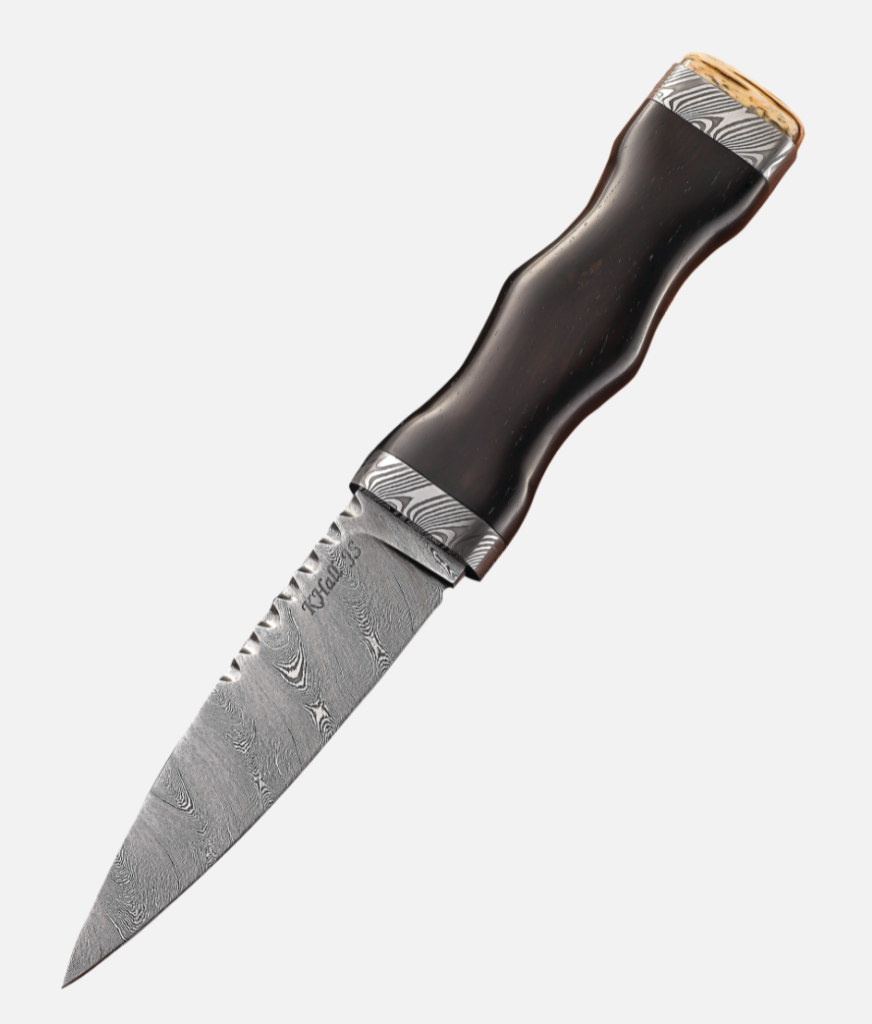
Ken Hall’s sgian dubh features a 4.25-inch blade of twist damascus in a blend of 1075 spring and 15N20 nickel alloy steels. The pommel is formed from stone and giraffe bone. The African blackwood handle not only is ideal for its carvability but also in keeping with the sgian dubh’s name, which is Scottish for black knife.
When the material finds its way to a knife handle, something dazzling happens, and the makers who use it sing its praises. “I’ve always loved black-handled knives, especially with brass,” related Abel Price of Fayetteville, Arkansas, a part-time maker who is completely self-taught. “The black and gold combo just pops and gives it a beautifully elegant Art Deco feel.”
In the mountains of western North Carolina, ABS master smith Andrew Meers finds African blackwood a pleasure to work with. “It’s a dense and stable wood with a consistent grain structure that is excellent for handle material. It is workable and carves well,” he noted. “It has a rich, dark color and finishes out beautifully when sanded, and I haven’t noticed any cracking, shrinking or expanding, especially compared to the cracking I’ve noticed at times in similar looking wood such as ebony. I think these qualities contribute to its growing popularity among makers.”
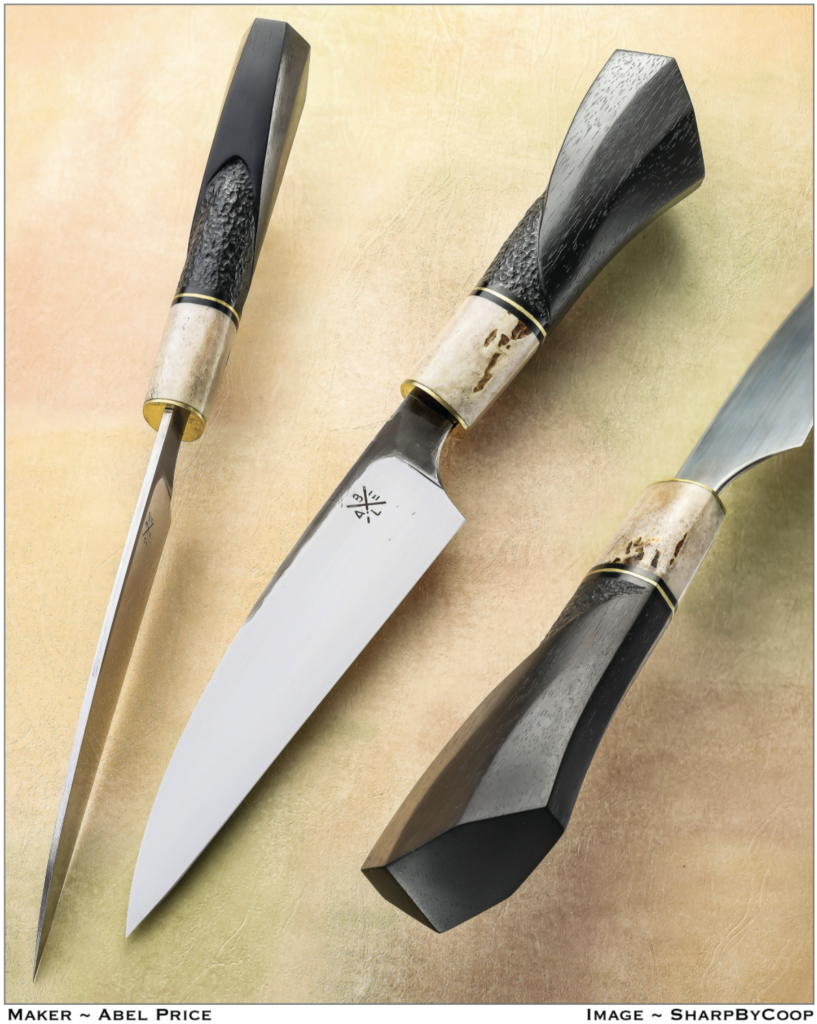
Abel Price used African blackwood for the handle of his Deco Petty kitchen knife. He said the handle “was sculpted to contain design elements of the Art Deco era while hitting several notes of contrast: smooth and stippled, round and flat, black and white, and straight and sweeping lines.”
Andrew uses rasps and files for shaping, a flex shaft for carving, and prefers to sand and buff to finish his handles of the material. Last of all, he applies a coat of Danish oil. So, the finished product is just what the maker wants, and getting there is most often a pleasurable journey rather than an arduous trek. African blackwood exhibits excellent stability and takes a shine quite well. Custom makers agree that the material is ideal for carving, though whether it carves easily or not is open to the interpretation of the individual maker.
“I think the main reason for its carving ability is that it is hard,” commented Pekka Tuominen, a 17-year maker from Keitele, Finland. “Wood has to be hard if you wish to carve it with sharp and tight curves, and also polish those curves. Let’s say it’s not easy to carve, but when wood is hard you can get a good finish. Of course, it’s popular, too,” he observed. “Everybody knows that if some famous knifemaker uses a material, then the rest of the makers at least want to test it.”
MORE ATTRIBUTES
Waynesville, North Carolina-based ABS journeyman smith Ken Hall appreciates additional attributes of African blackwood. “I like using it because it’s a very dense wood, doesn’t require stabilizing, is hard and does not crack easily,” he stated. “It has a tight grain structure, so you don’t have to fill voids, and it can be carved or shaped without difficulty and provides a dark contrast to a steel blade.”
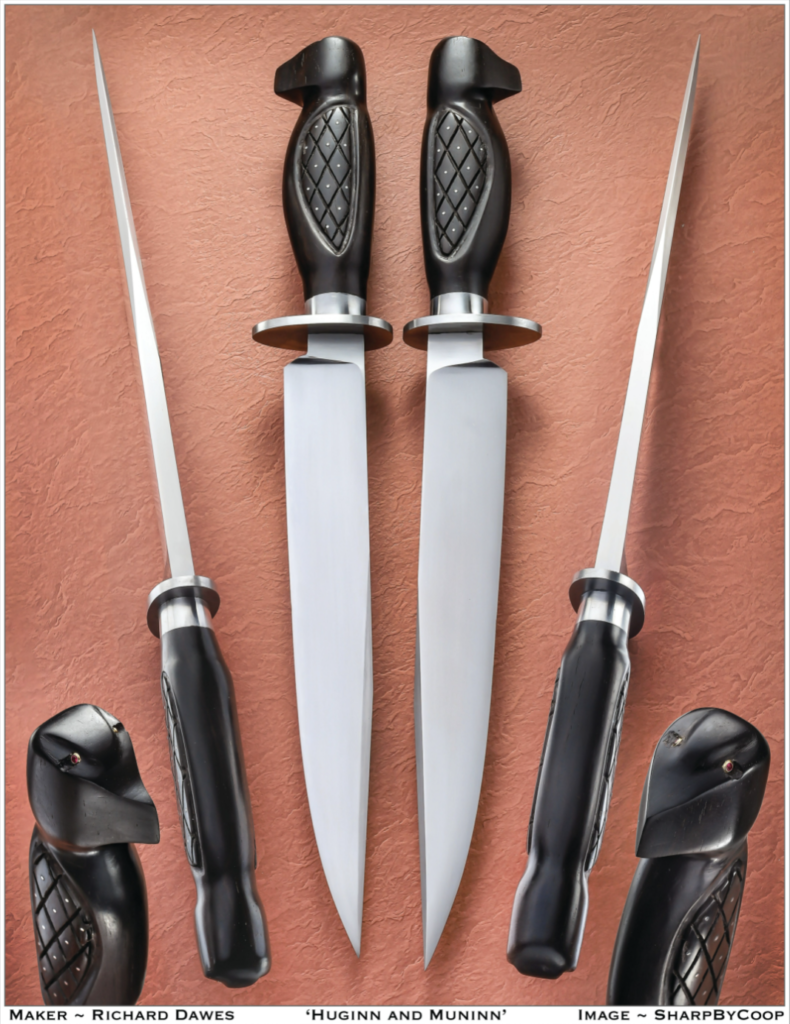
Huginn and Muninn are the names for two bowies by Richard Dawes. Huginn and Muninn are two mythical ravens that attend Odin. Dawes carved the African blackwood handles in a bird’s-head motif based on the style of bladesmith Bill Bagwell, one of the founders of the American Bladesmith Society.
Securing the handle to the blade most often involves a quality epoxy and a combination of pins, depending on the type of knife under construction. “I use rivets, pins and epoxy,” Pekka said, “but I don’t use African blackwood for full tangs. With hidden tangs sometimes just epoxy will keep the tang solid inside the handle.”
When Price went to work on his Deco Petty, a kitchen knife creation with a 6.5-inch blade of AEB-L stainless steel, overall length of 12 inches, and a handle of African blackwood, deer antler and a copper spacer, he knew just what he wanted to achieve. “The goal was to hit form and function,” he commented. “The ultra-thin cutting edge flexes with lateral pressure, and a Rockwell hardness of 61 [HRC] makes for a laser sharp tool in the kitchen. The handle was sculpted to contain design elements of the Art Deco era while hitting several notes of contrast: smooth and stippled, round and flat, black and white, and straight and sweeping lines. African blackwood does everything you want it to do with a perfect finish.”
Hall fashioned his sgian dubh as an interpretation of a historical Scottish knife. “African blackwood is the ideal wood for the sgian dubh because it can be carved and shaped to the hourglass design of the traditional sgian dubh handle,” he noted, “and provide an eye-catching contrast to the stainless steel bolster and pommel.” He added that blackwood is his preferred wood for a handle with a keyhole design because it can take the force applied to pressing the wood into the keyhole.
AESTHETICS & FUNCTION
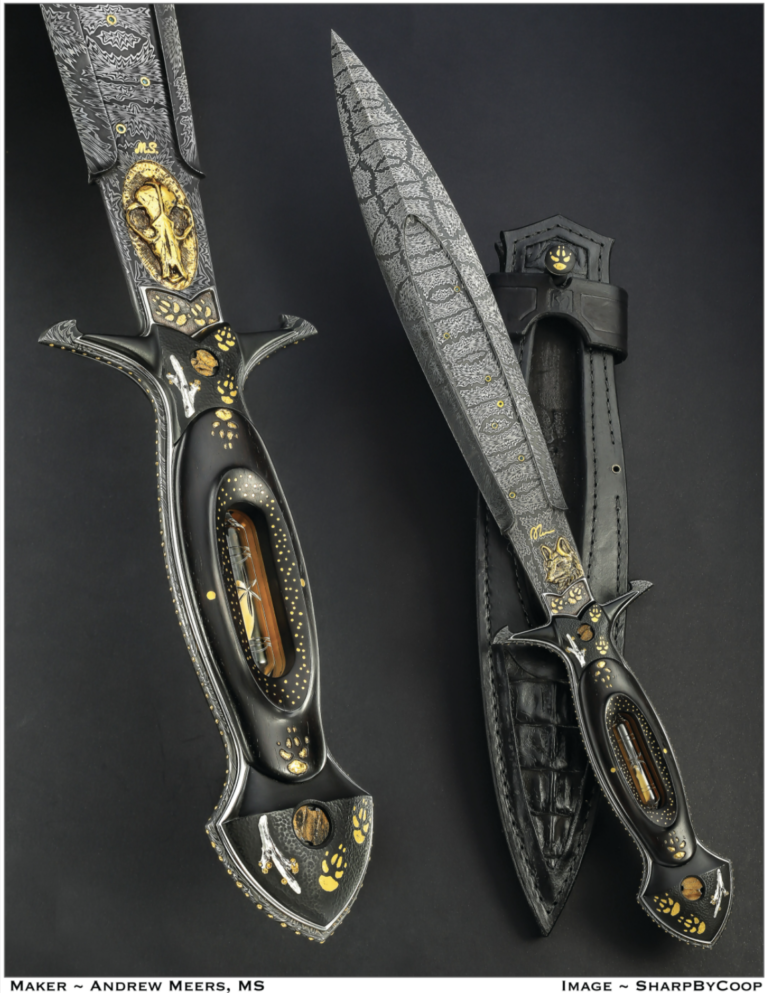
Meers made the striking Vulpecula with a 12-inch damascus blade of 1084 carbon and 15N20 nickel alloy steels. Meanwhile, something of a surprise is embedded in the African blackwood handle.
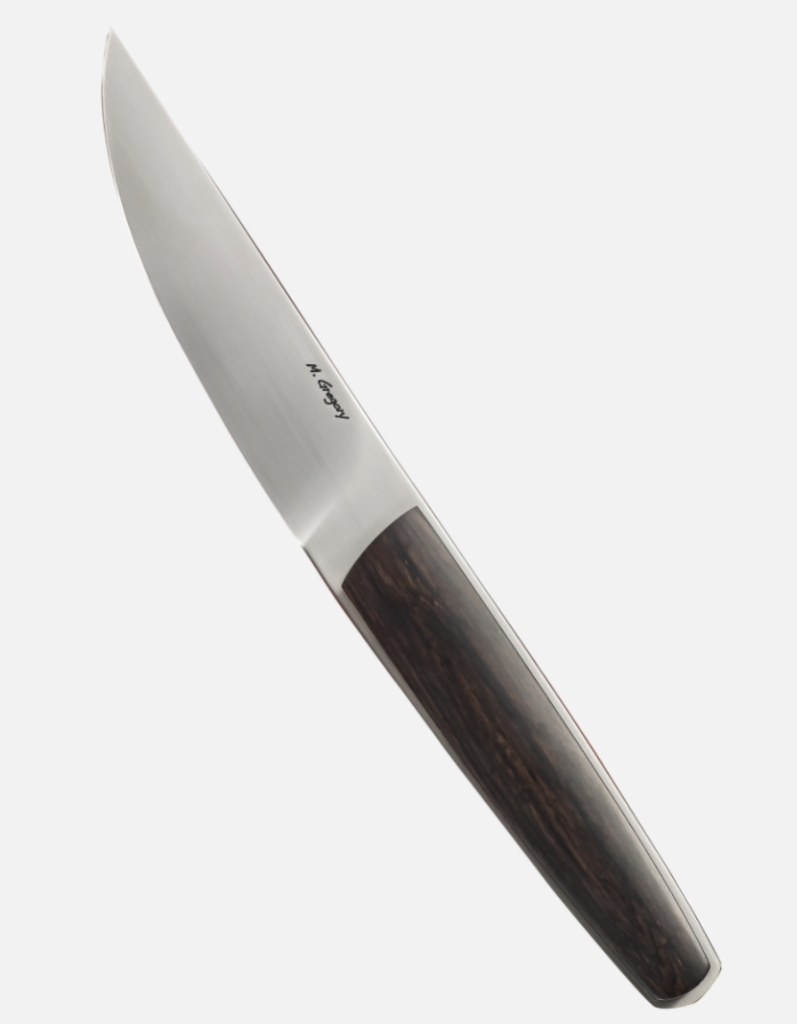
Matt Gregory’s LWT (Lum-Walton Tanto) is based on a design by Mike Walton inspired by the late Bob Lum. The African blackwood handle is polished to a mirror shine and tapers slightly in reverse of the tang, and has a delicate bulge in the center to provide for a subtle yet improved grip. The sheath (not shown) is by Jill Gregory.
“Vulpecula is a reliquary dagger,” Andrew explained. “It is inspired by the tradition of keeping objects, often hair or remains, in an embellished vessel. I found a fox tooth and had it sealed in a glass vial by a friend. I then built this dagger to house the vial as a reliquary.
“The blade fittings and handle are adorned with 24-karat gold inlay depicting a large fox, its skull and paw prints. The hardware is torch-cut steel plated with gold that is brushed back. Vulpecula, the ‘Little Fox’ constellation, is set into the blade with blue diamonds.
“It was a combination of aesthetic and functional choices that made me choose blackwood for this piece,” he concluded. “The wood machines and carves well, so for this handle it was the ideal choice. The blackwood’s depth serves as a rich contrast to the bright gold used in small inlays to represent a starry sky and the fox prints as well.”
Tuominen built his Protector, or Suojaleijee, dagger with a 5-inch welded damascus blade of 1080 and 80CrV2 carbon and 15N20 nickel-alloy steels, a guard of Nicorros (a copper/nickel alloy), African blackwood handle, and a handmade leather sheath with stainless clip. The blade is 7 inches and overall length is 12 inches. “It’s a custom order for an American collector,” he noted. “I used African blackwood because it’s black and more stable than other black-colored woods.”
SOURCES
While African blackwood remains protected, it can be found through various sources. However, Abel has a warning.
“I stocked up at a Rockler store a few years ago,” he remarked. “I’m not looking forward to finding another supplier. I believe the demand is outpacing the supply, and as conservation efforts increase, as they should, so will the price.”
Kelly Vermeer Vella em- ploys African blackwood and sterling silver for the handle of her dagger. The blade is a damascus of 1075 spring and 15N20 nickel-alloy steel.
Hall searches eBay for African blackwood and makes his selection based on what is available. Pricing, he says, runs $20 to $30 for a handle block or set of scales. While Pekka often sources his African blackwood from European knife shows, he also checks the internet for block-size pieces. Meers has had success with retail suppliers and finds a broad range of dimensions.
The custom knifemaker and the consumer alike have taken a new interest in African blackwood, and that fascination is not likely to fade in the near future.