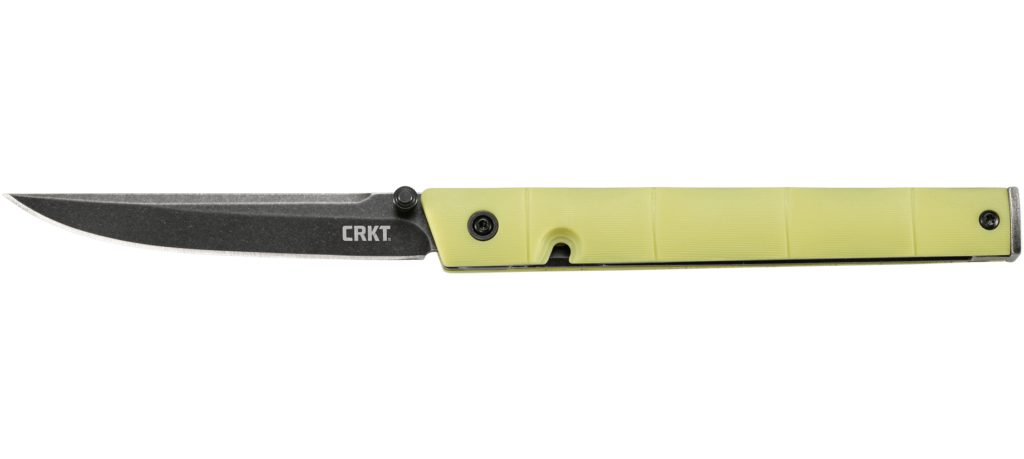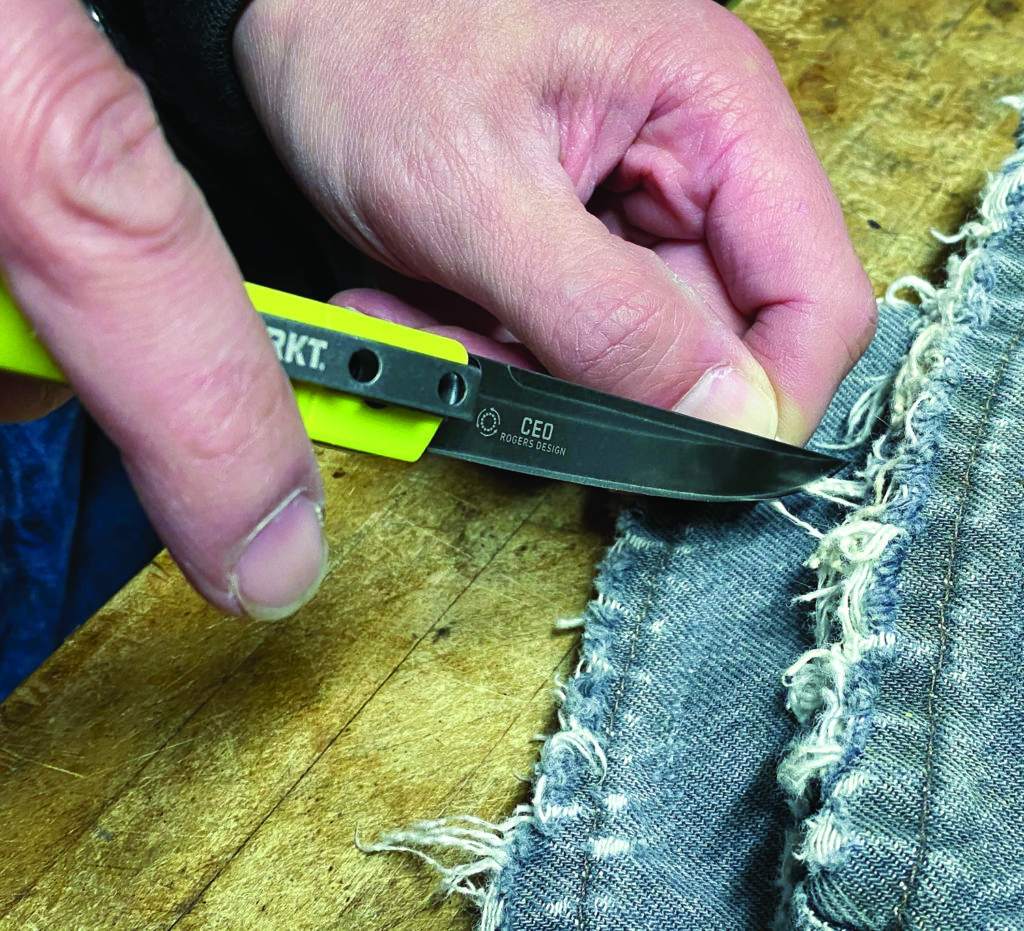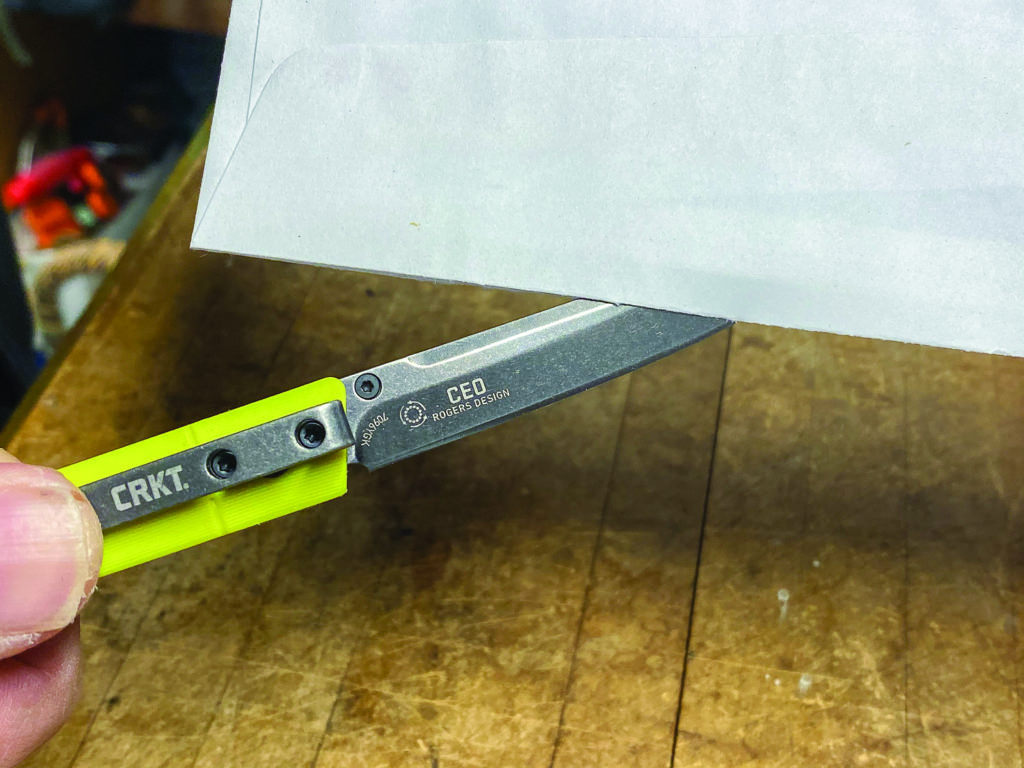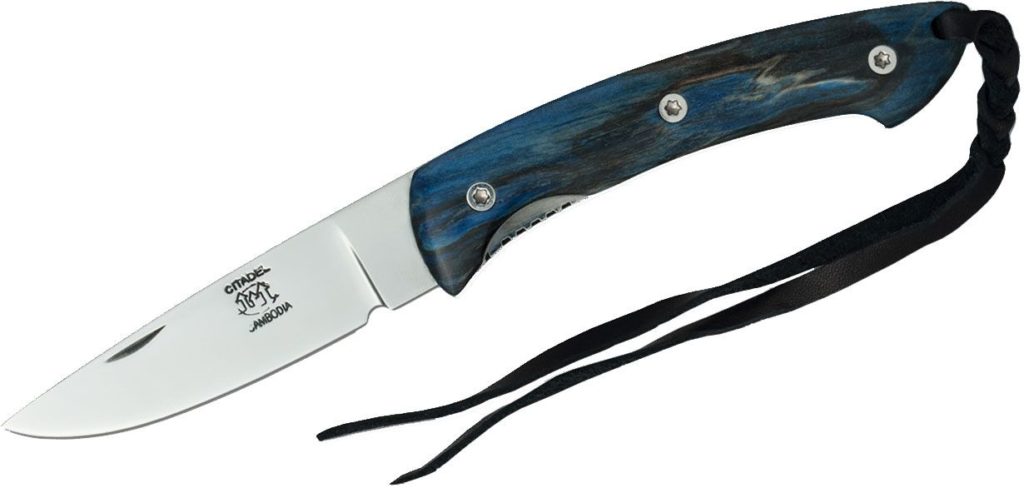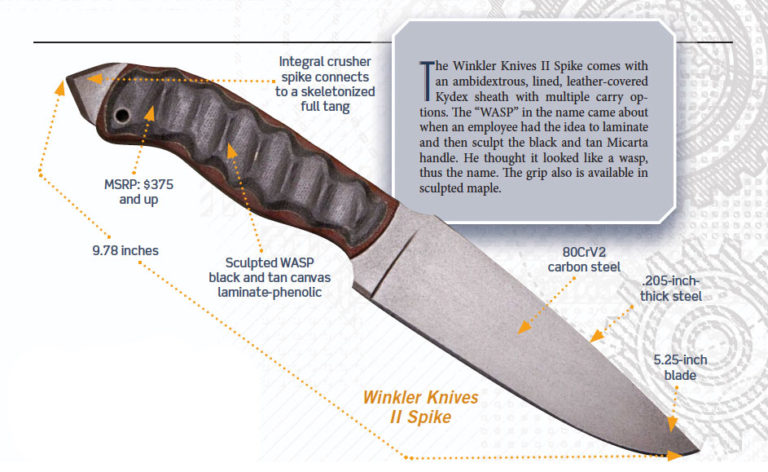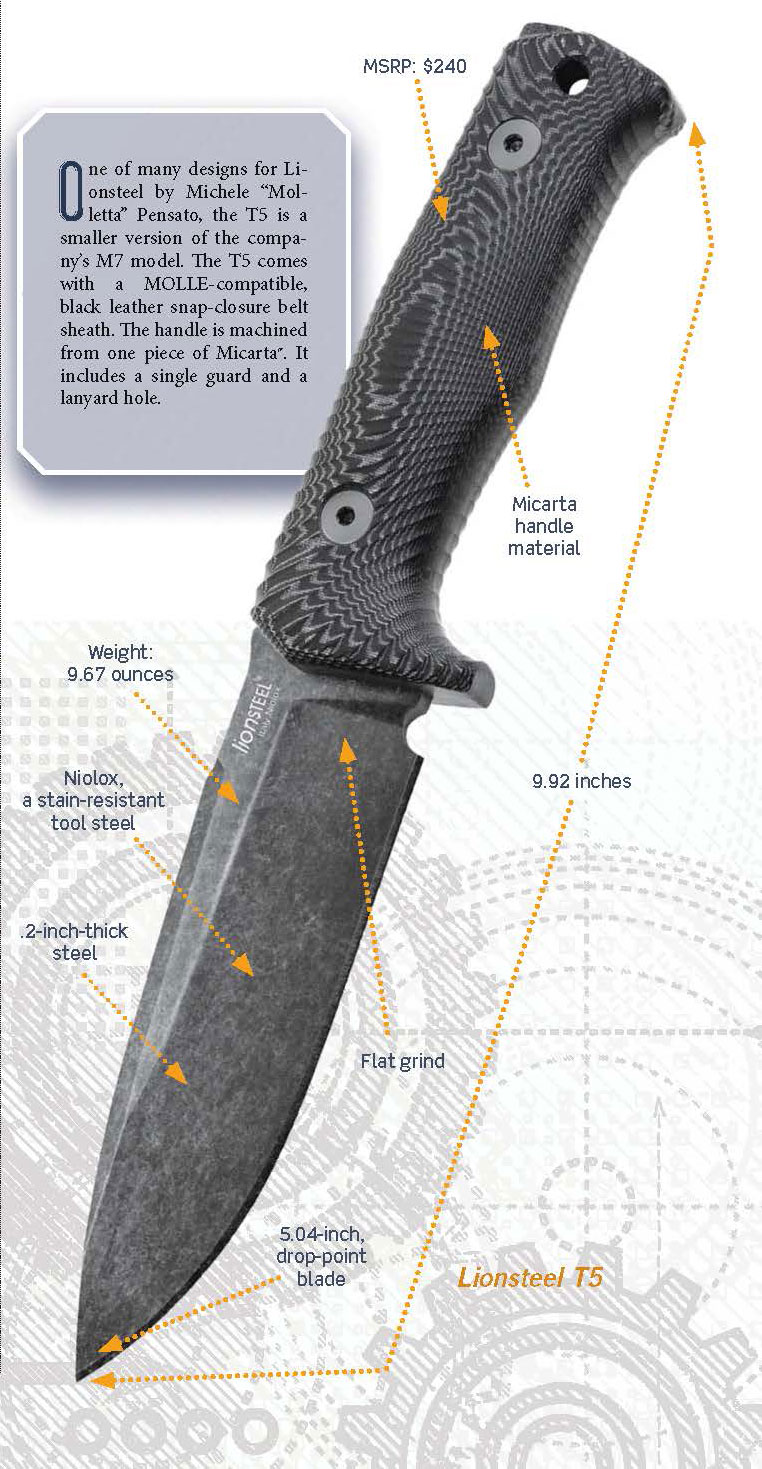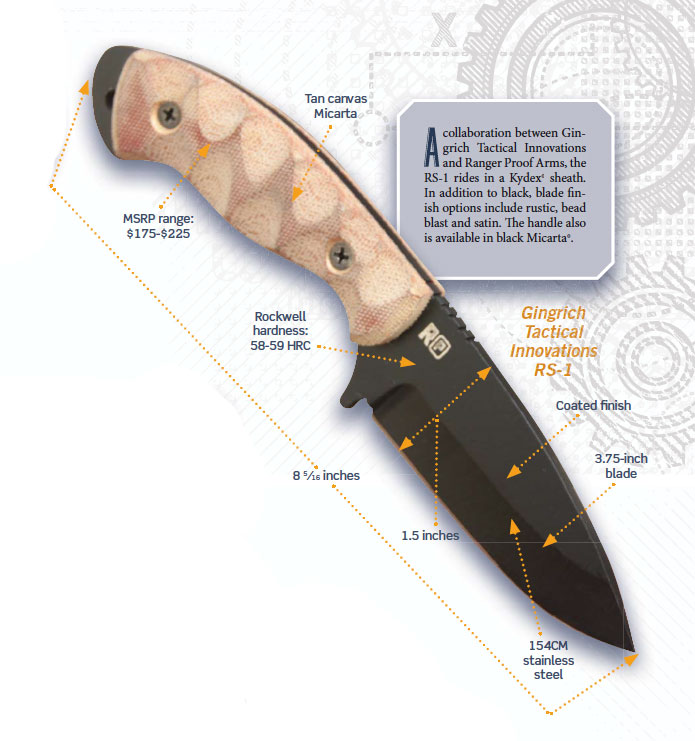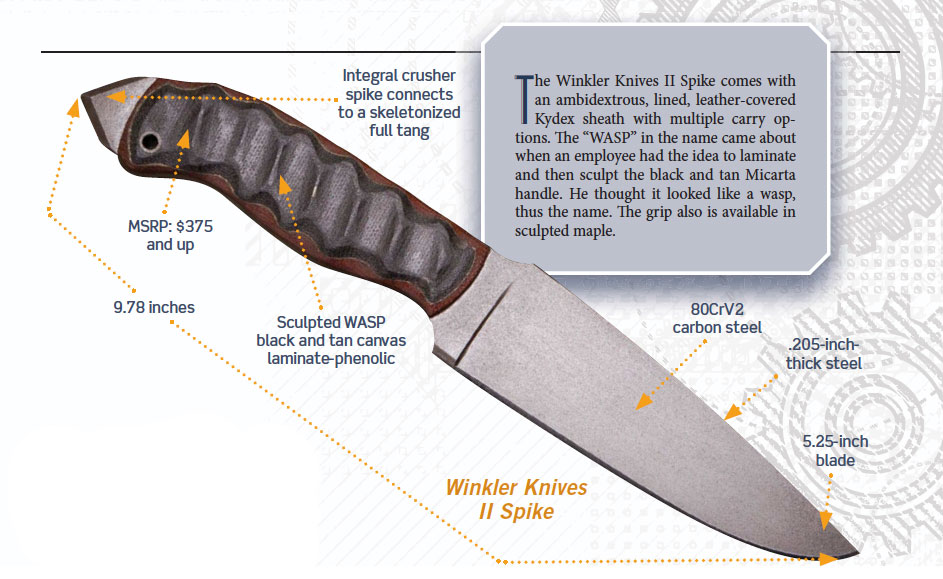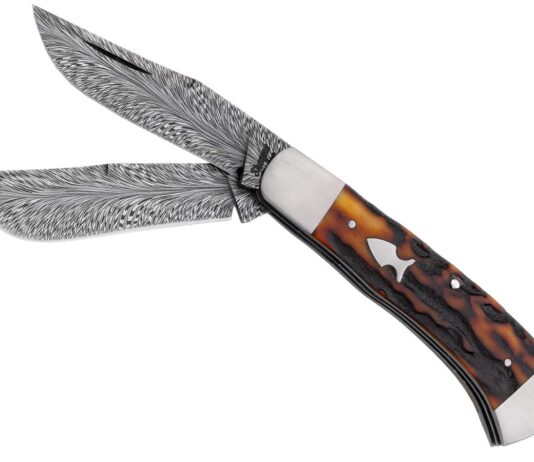
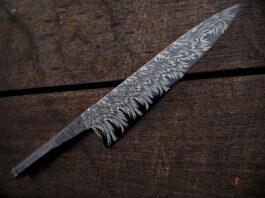
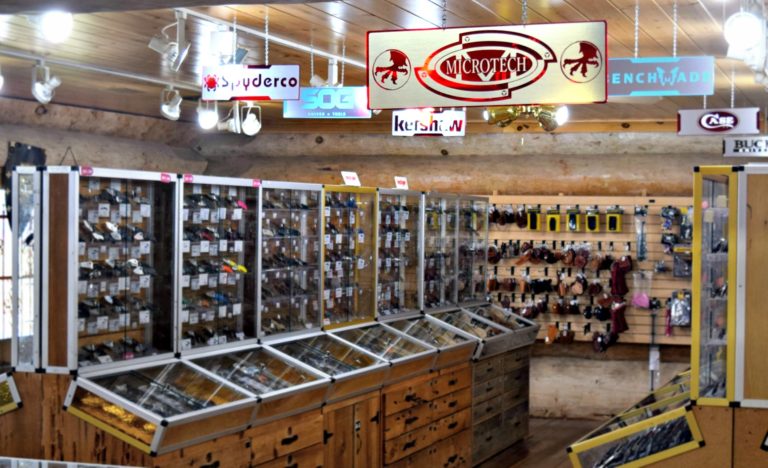
Knife collecting is an extremely rewarding experience for knife enthusiasts. There truly is a knife for everyone. Many increase or hold their value throughout the years, making collecting knives something to pass on to the next generation of knife collectors.
Spyderco founder Sal Glesser once said, a tactical knife is any knife you have with you when you need a knife.
Some say custom knifemaker Bob Terzuola made the first tactical folding knife, while others say Ernest Emerson did.
Maybe it’s all a marketing gimmick!
A Brief History the Tactical Knife
The term “tactical knife” was coined in the mid-1990s to define a look with certain characteristics. Regarding fixed blades, the characteristics included a non-reflective blade coupled with either no guard or one of stainless steel. Some still use brass and others incorporate titanium for guards, while some use black zirconium. Currently, zirconium’s price deters both makers and collectors. If the price comes down you can expect to see more zirconium for guards. Handle materials should be synthetics, including but not limited to Micarta®, G-10 and carbon fiber. However, these three are far and away the most popular handle materials on today’s custom tactical fixed blades.
Over the past century grip materials have evolved from wood, leather washers and even cast brass and aluminum to the current synthetics. In the mid ’90s, primarily Micarta was used. Linen, paper and rag Micarta were the staples of the day. G-10 then came along, offering more colors and configurations. Over the past five years carbon fiber has increasingly become a handle material of choice.
The non-reflective blade was accomplished through several methods, the most common being a belt satin finish. As the name implies the finish was applied simply by using a sanding belt. This gave the blade a good-looking surface that was not reflective.
Key Tactical Knife Feature: Non-Reflective Finish
Another method was sand blasting. While providing a non-reflective finish, this technique had a problem. The sand created micro pits in the steel. The pits held moisture, leading to blade rust. That led to replacing the sand with silicon glass beads that did not leave pits and produced a more even, flat-gray, non-reflective finish.
Walter Brend and BLADE Magazine Cutlery Hall-Of-Fame® member Chris Reeve were early proponents of techniques previously used on firearms to blacken their blades/knives.
Chris utilized a black Gun-Kote® finish early on, and Chris Reeve Knives still does today. Brend was asked to produce blades with a black finish and he used Parkerizing to do it. Both finishes were/are subject to scratches. The scratches were especially noticeable when the knife was combined with a Kydex sheath.
Today finishes such as those from Cerakote® and other specialty outfits can provide choices not only of color but also of surface designs for your blade.
See More Tactical Knives at BLADE Show West
The world’s biggest and best knife show, BLADE Show, is coming to Portland, Oregon, from Oct. 5 to 7, 2018.
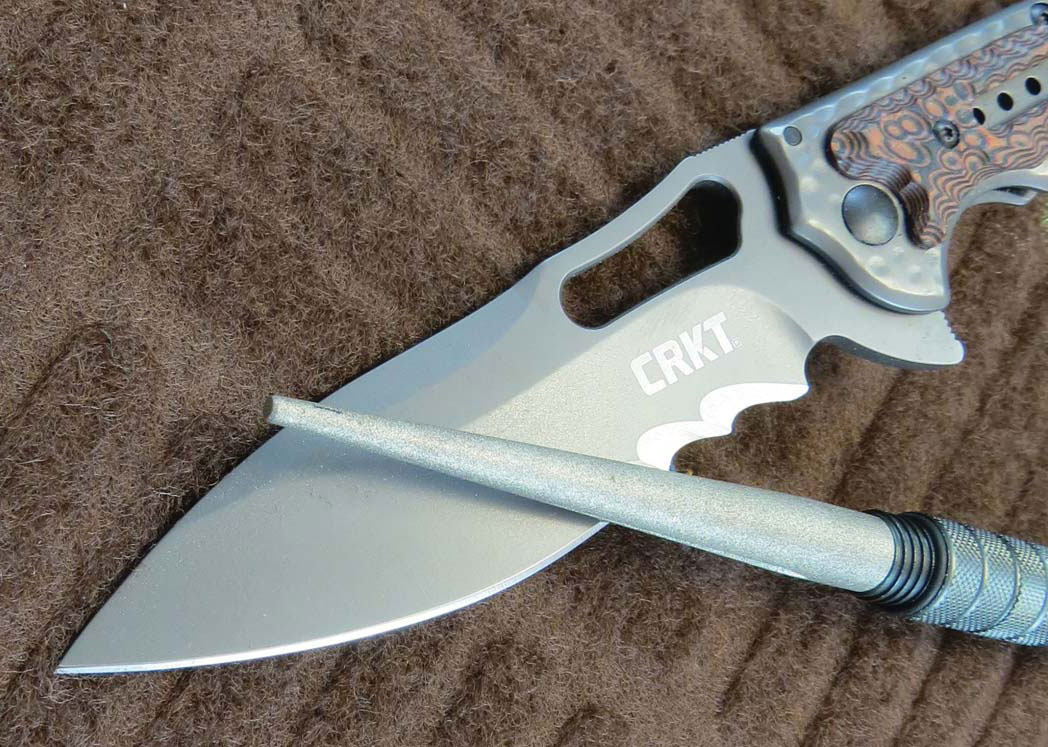
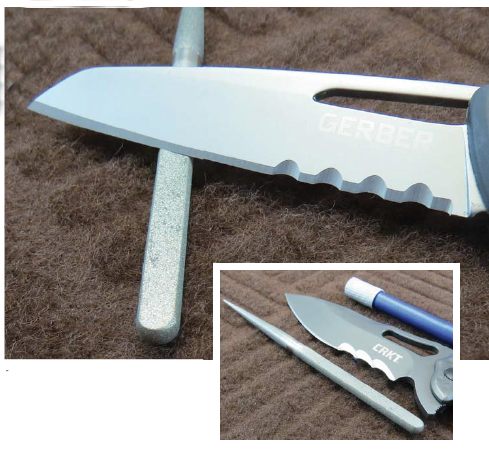
The broad cone of the GATCO Scepter 2.0 comes in handy when working on the wide serrations of the CRKT Fossil.
How to Sharpen a Serrated Knife: Quick Tips
Use a small sharpening rod
Lock the rod into a “gullet,” the groove of the serration
Work the rod with slow, smooth motions away from the knife, applying light pressure
Work the rod in one direction; don’t rub it back and forth
Don’t sharpen wider than the serration
Sharpening Rods are Musts for Sharpening Serrated Knives
No matter what edge style of knife you carry, it must be sharpened. In the case of serrated blades, you need specialized tools, called sharpening rods.
Some rods, like the ones you’ll typically find in a kitchen, are large. Those won’t be helpful for working with small serrations. You need to find a small rod that will lock into place inside the serration. Don’t worry about sizing, though. Most small sharpening rods are tapered so that you’ll have the right fit no matter what.
Practice Makes Perfect
Learning how to sharpen serrated knives is like any other technique—you need practice to get good at it. I recommend buying some cheap knives and practicing before you move on to your $200 Spyderco. Also, remember that not all diamond sharpeners are created equal. Diamonds are manufactured and certain diamonds are more durable than others—then again, that’s a topic for a different time.
Know Your Geometry
There are a couple of key points about geometry for learning how to sharpen a knife with serrations.
As with a plain edge, you are polishing a surface. In the case of serrated blades, there are two geometries to work.
One is the gullet. The gullet is the internal section that normally has a curved shape between the points of a serrated edge. Since sharp gullets are necessary, many people mistakenly focus too much on the gullets and not enough on the teeth of the pattern. The teeth do the initial entry into the material and begin the cut.
Hence, when sharpening serrated blades you not only polish the gullet of the serration but also re-point the teeth at the same time. Much like sharpening a saw, you reform the teeth and restore the geometry of the teeth along with the geometry of the gullet.
Four Sharpeners for Sharpening Serrated Rods
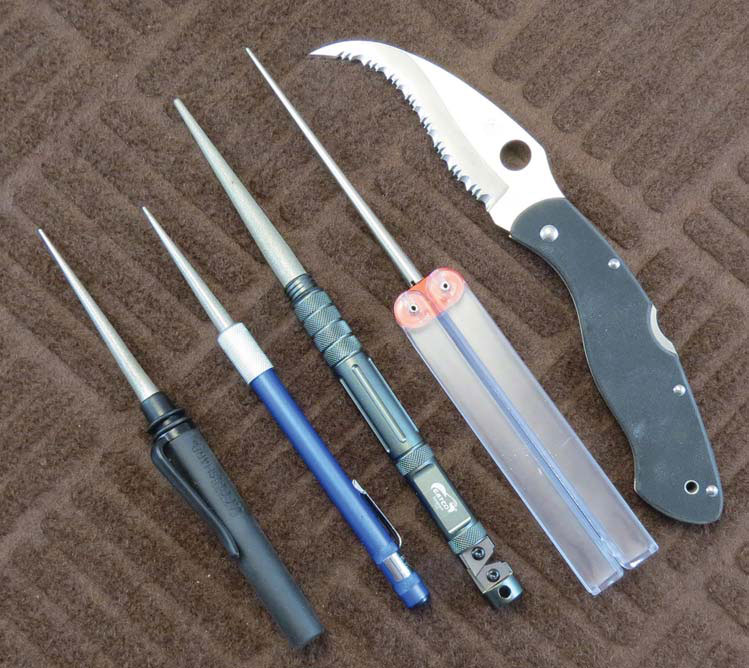
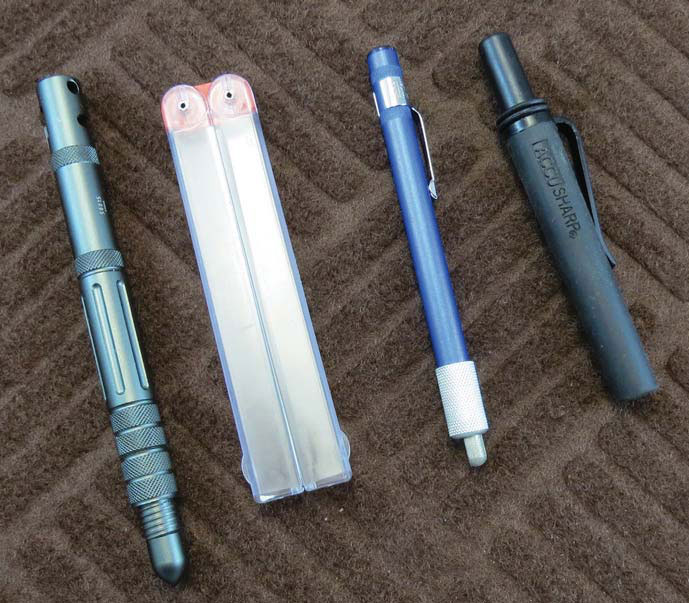
From left, with manufacturer’s suggested retail prices in parentheses: Accusharp Diamond Compact Sharpener ($11.99); Smith’s Diamond Retractable Sharpener ($7.99); GATCO Scepter 2.0 ($25.95); and DMT Diafold Serrated Sharpener ($32.99). The knife is the author’s Spyderco Civilian.The foursome in the closed position, from left: GATCO Scepter 2.0, DMT Diafold Serrated Sharpener, Smith’s Diamond Retractable Sharpener and Accusharp Diamond Compact Sharpener.
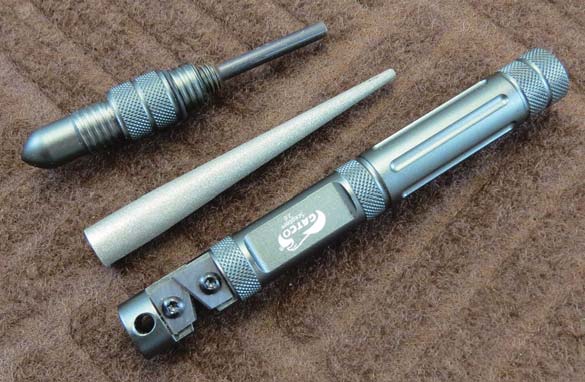
The GATCO is a bit of a multi-tool with, from right, a carbide sharpener, diamond cone and a ferrocerium rod all in one.
Of the four, the GATCO Scepter 2.0 is more multi-tool than sharpener only.
If you are into gadgets that serve more than one purpose, the Scepter 2.0 is for you. It has two tungsten-carbide blades for sharpening, a ferrocerium rod and a diamond cone sharpener. All are in a compact package that resembles a tactical pen. The diamond rod has a groove for sharpening fishhooks.
The cone has a medium-grade texture and a broad taper. The cone is 3.75 inches long and tapers from .113 to .392 of an inch in diameter. Why does the taper matter? If the taper is steep, during sharpening you will have a shorter cut as the cone will get too wide too quickly for some smaller serrations. Overall length: 6.125 inches.
If you’re looking for a sharpener as an everyday carry tool, the Scepter 2.0 is a good choice. The cone is a bit chunky but works fine for all but the smallest serrations. I am not a big fan of carbide sharpening blades because they hog off a lot of metal, though I don’t mind them on rough cutting tools. I haven’t had the Scepter long enough to testify to the durability of the diamond cone but so far it is holding up well.
Smith’s Diamond Retractable Sharpener
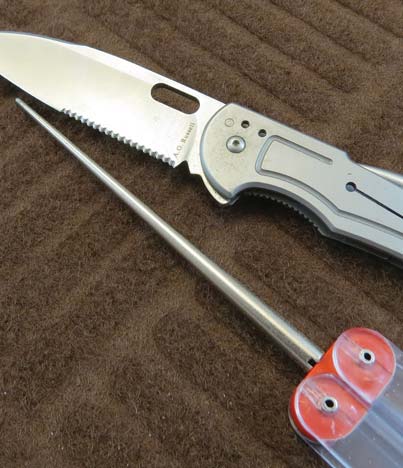
The Smith’s rod has three surfaces—flat, conical and round (inset)—to tackle any number of sharpening jobs. The flat surface in combination with the diamond cone makes it easy to sharpen combo-edge blades.
Smith’s Diamond Retractable Sharpener is the trimmest of the group and looks like a pen when collapsed. It is possible to use the cone shape to sharpen a plain edge, but with the Smith’s model the diamond coated sharpener has two ends.
One end has a flat section and the other is tapered for serrated edges. Of the group the Smith’s hone has the most aggressive grit. The body of the holder is aluminum and has a pen clip. (The GATCO Scepter could use a pen clip to complete it.) Closed length: 5.187 inches.
Again, I could see this tool in someone’s EDC kit, a tackle box or camping gear. At the tip the cone measures .06 inch and at the widest point .256 inch in diameter. With such a fine tip expanding in size over its 2.375-inch length, the Smith’s hone sharpens a wide range of serration styles. At a manufacturer’s suggested retail price of $7.99, it does not have to last a lifetime to pay for itself.
DMT Diafold
A sharpener with a fine tip like the DMT Diafold is needed to get small serration patterns back to sharp again.
The DMT Diafold serrated sharpener comes in three color-coded grits: coarse (blue) 325 mesh or 45 micron, fine (red) 600 mesh or 25 micron, and X fine (green) 1200 mesh or 9 micron. I used the red.
Of the quartet it was the longest, finest-grit tapered cone. Overall length: 4.5 inches. It tapers in diameter from .62 inch at the tip to .25 inch at the base.
To store the sharpening cone DMT uses a folding handle system similar to a butterfly knife. The handle is a clear polycarbonate. At 5 inches closed and as with the others the Diafold is compact enough to be EDC’d.
I’ve had a number of DMT Diafolds over the years and they are still in working order. You have to use some of the diamond sharpeners a lot before they will wear out. I will say when open, the very appearance of the Diafold can send shivers down your spine as it resembles an icepick. It works well and if you like something with a fuller handle to it, a Diafold might be your shtick.
Accusharp Diamond Compact Sharpener
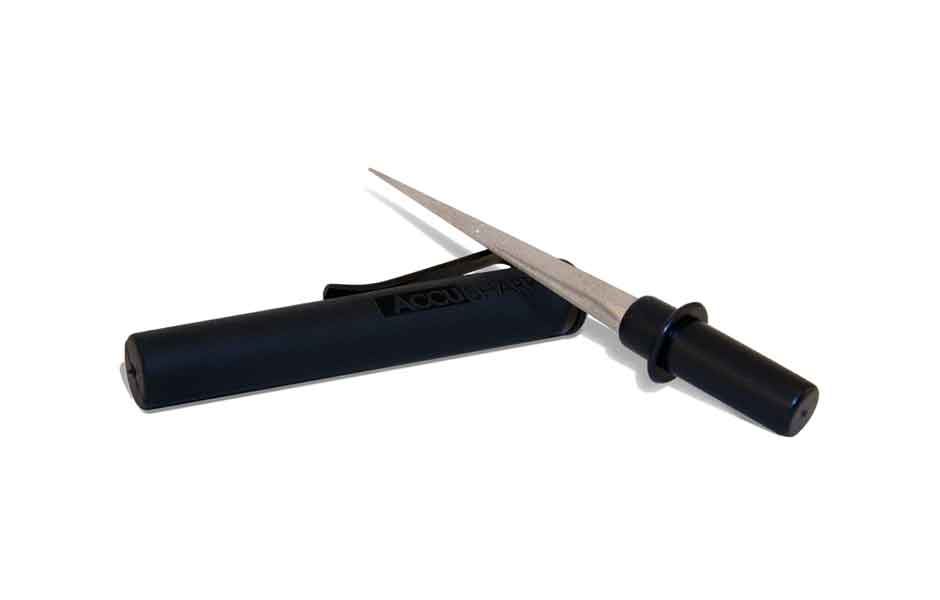
Accusharp uses a friction fit to hold the Diamond Compact Sharpener open and closed.
The Accusharp Diamond Compact Sharpener is 3.125 inches long with inch diameters of .06 at the tip and .305 at the base. A plastic body with a rubberized coating houses the unit—definitely low tech and follows the K.I.S.S. principle. A friction fit holds the sharpener open and closed. The fit is tight and you don’t have to worry about the two sides separating accidentally. An integral pen clip is on the main body’s housing. The clip doesn’t seem robust and I can see it eventually snapping off.
The sharpener has a medium-grit diamond coating and functioned well during testing. Accusharp includes a hook groove I find rather large. Maybe it’s for big fish. The closed length is the shortest of the group: 4.75 inches.
I like the design because as with the Smith’s sharpener it appears to be a standard pen as opposed to the GATCO model’s large-tactical-pen look. If you want to carry a sharpener and not let anyone know you have one so you aren’t constantly loaning it out, the Smith’s might be the ticket. As far as feel, the handle diameter is nice and comfortable.
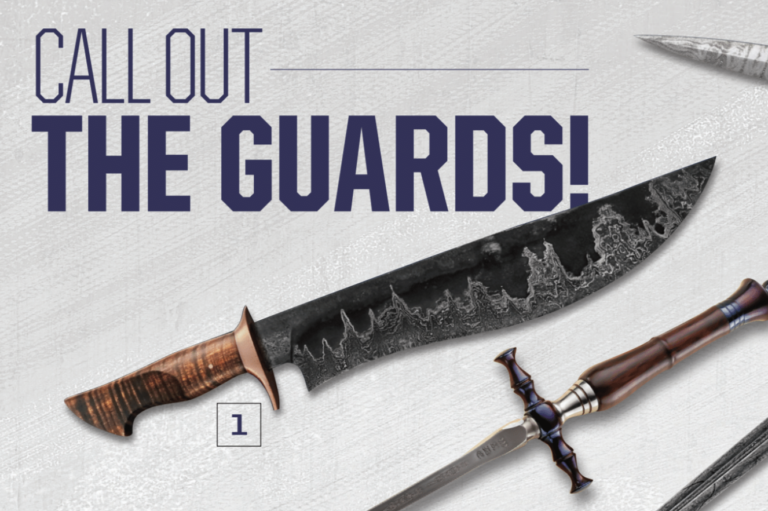
Constantly on the lookout for something that will make their knives better and stand out at the same time, many of today’s custom makers don’t hesitate to jazz up the guard.
And why not? A handsome, well-made guard adds to a knife’s looks, and, more importantly, serves as a sure safety feature in helping keep your hand where it needs to be—on the handle.
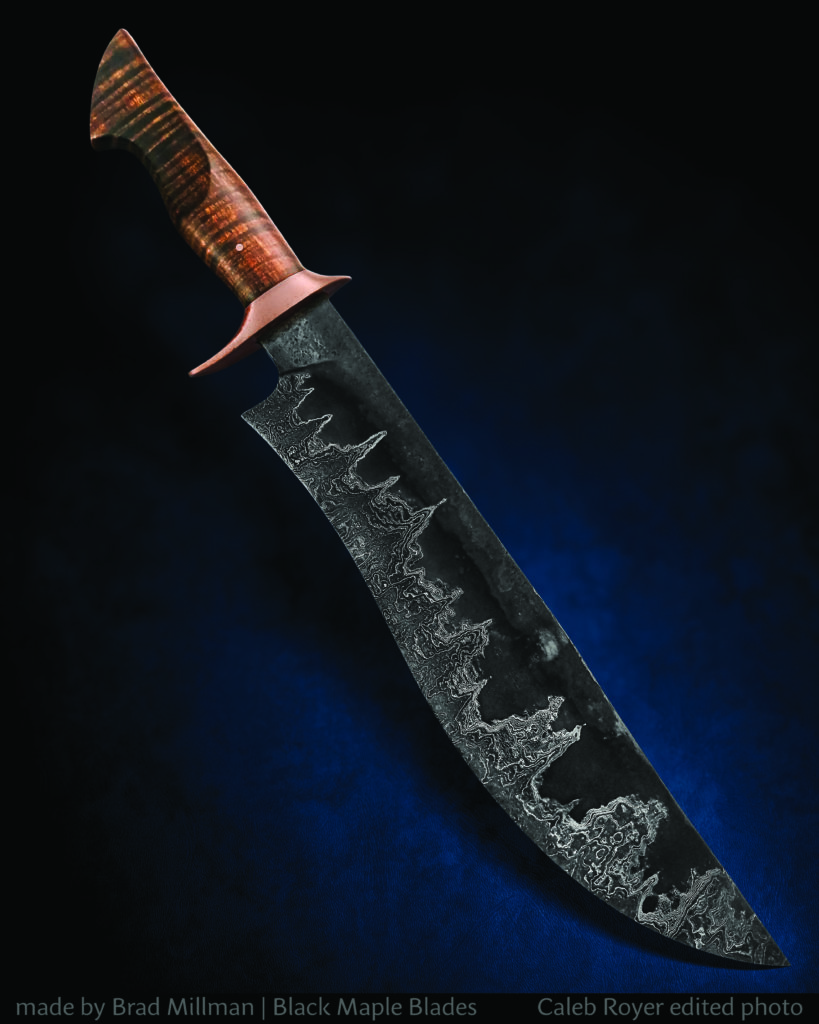
Above: Brad Millman forged the hammer-finished copper guard of his Wolftooth bowie. The 12-inch recurve blade is a san-mai construction of 360 layers of 1095 carbon and 15N20 nickel-alloy steels for the core sandwiched in a jacket of 1084 carbon steel. The bird’s-beak handle is curly Tasmanian blackwood. Overall length: 18 inches. (Caleb Royer edited image)
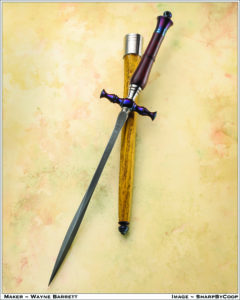
Above: Wayne Barrett heat-colored the shapely mild-steel crossguard of his 14.56-inch stiletto. The 10.6-inch blade is vintage butcher’s steel by F. Dick of Germany and features a classic triangular grind. The handle is Merino ram’s horn. (SharpByCoop image)
.
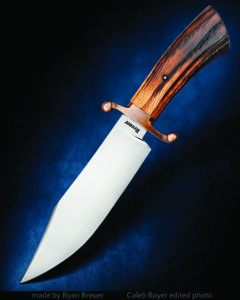
Above: It’s easy to see how Ryan Breur’s Ball-Guard Bowie got its name. The guard is cast bronze and the handle is flamed white oak with a domed inconel pin. The blade has a sharpened clip and is forged from 80CrV2 carbon steel. (Caleb Royer edited image)
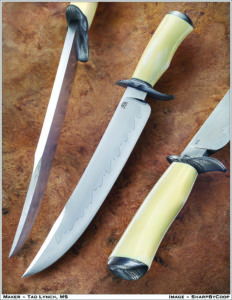
Above: A stylish guard of wrought iron helps put the finish- ing touches on an ancient-walrus-ivory bowie by ABS master smith Tad Lynch. The 11.25-inch clip-point blade is W2 tool steel—a material some leading smiths consider ideal for producing a handsome hamon—and the knife is 16.375 inches overall. (SharpByCoop image)
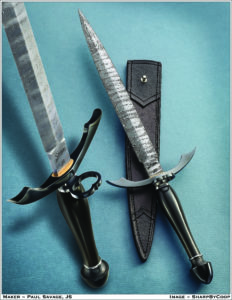
Above: An upturned guard with a finger ring—each of hot- blued 4340HT steel—and a ladder-pattern damascus blade of 1095 carbon and 15N20 nickel-alloy steels help complete a quillon dagger by ABS journeyman smith Paul Savage. The handle is buffalo horn. (SharpByCoop image)
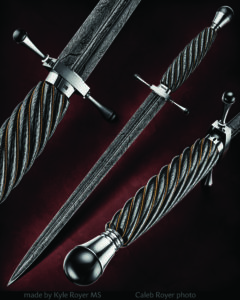
Above: Black mirror accent balls cap the stainless steel quillons on ABS master smith Kyle Royer’s Maiden Voyage Stiletto. The 11.75-inch damascus blade features an extra-deep hollow grind, a fuller and a reinforced piercing tip. The sculpted, fluted handle is wrapped in 24k-gold twisted wire. Overall length: 17.5 inches. (Caleb Royer image)
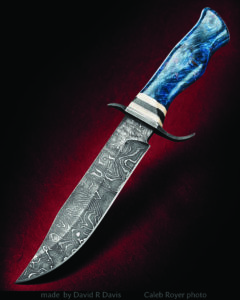
Above: The handforged nickel-silver finger guard “with curls” gives a damascus bowie by David Davis a curvaceous look. The 7.25-inch blade is pattern-welded steel forged by Alabama Damascus. Blade finish: acid etched. The handle is stabilized buckeye burl and the spacers/ liners are ebony and bone. Construction: hidden tang. Overall length: 12.25 inches. (Caleb Royer image)
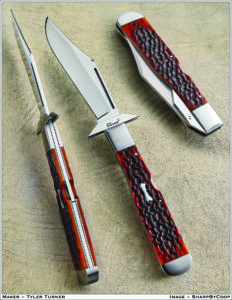
Above: Tyler Turner outfits his coke-bottle-pattern pocketknife with a folding swing guard of 416 stainless steel. The 4-inch blade is CPM 154 stainless steel in a hollow sabre grind and the scales are jigged bone. Closed length: 5 3/8 inches. (SharpByCoop image)
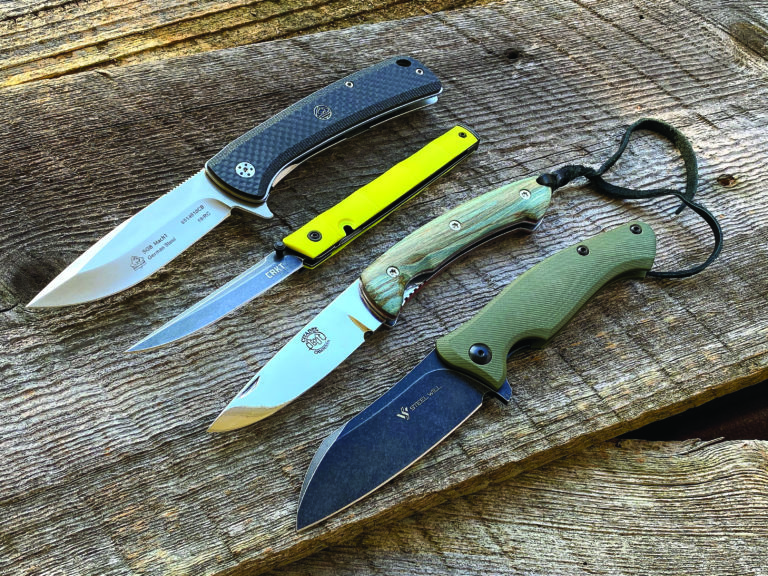
A wise man never said knives should be in color but he never said they shouldn’t be, either. Colorful knives are nothing revolutionary in the cutlery world, but it does seem manufacturers are broadening the spectrum by introducing new models with color and rejuvenating older ones. And why not? Unless you’re a dark-ops type or desire to keep a low profile in life, a little spice in the knife can add personality to your carry.
A lot of color to be had in the cutlery world includes, from left: Steel Will Scylla Blue, Bear & Son 5-inch Pink Butterfly, Puma SGB Orange Featherweight Hunter and SOG-TAC CA Auto.
Bear & Son 5-Inch Pink Butterfly
Bear & Son has been making butterfly knives since 1991, and the 5-inch Pink Butterfly is a bright send-up of one of the company’s most popular models. The 5-inch skeletonized handles are zinc with a bright pink powder coat, and a pivoting T-shaped gate lock at the bottom joins them when fully employed. The handle halves rotate off two pivots on the short tang clip-point blade, with a stop pin at the base. The Pink Butterfly’s pivots are very slick with no drag and the T-lock joins them firmly once employed.
Butterfly knives are simple in their mechanisms but require dedicated practice to employ safely and effectively. The basic idea is to grasp the handle, flip the blade out, and then quickly orient your hand to grip the two halves. Expert users employ the blade and launch into a plethora of flipping techniques in the blink of an eye.
The Bear & Son Pink Butterfly made quick work slicing up link sausage for a pot of jambalaya
Heck, butterfly knife users have to eat just like everybody else, so I locked the blade down and took to the kitchen, using the knife to slice link sausage for a pot of jambalaya. The Pink Butterfly performed quite admirably and the color kept this chef, dare I say, in the pink.
Bear & Son 5-Inch Pink Butterfly
BLADE LENGTH:4.25”
BLADE STEEL:440 stainless
BLADE PATTERN:Clip point
HANDLE MATERIAL:Powder-coated zinc
SPECIAL FEATURE:T-latch at base
WEIGHT:5.33 ozs.
CLOSED LENGTH:5”
COUNTRY OF ORIGIN:USA
MSRP:$55.99
SAFETY ORANGE SLICER: The Puma SGB Orange Featherweight
The Puma SGB Orange Featherweight
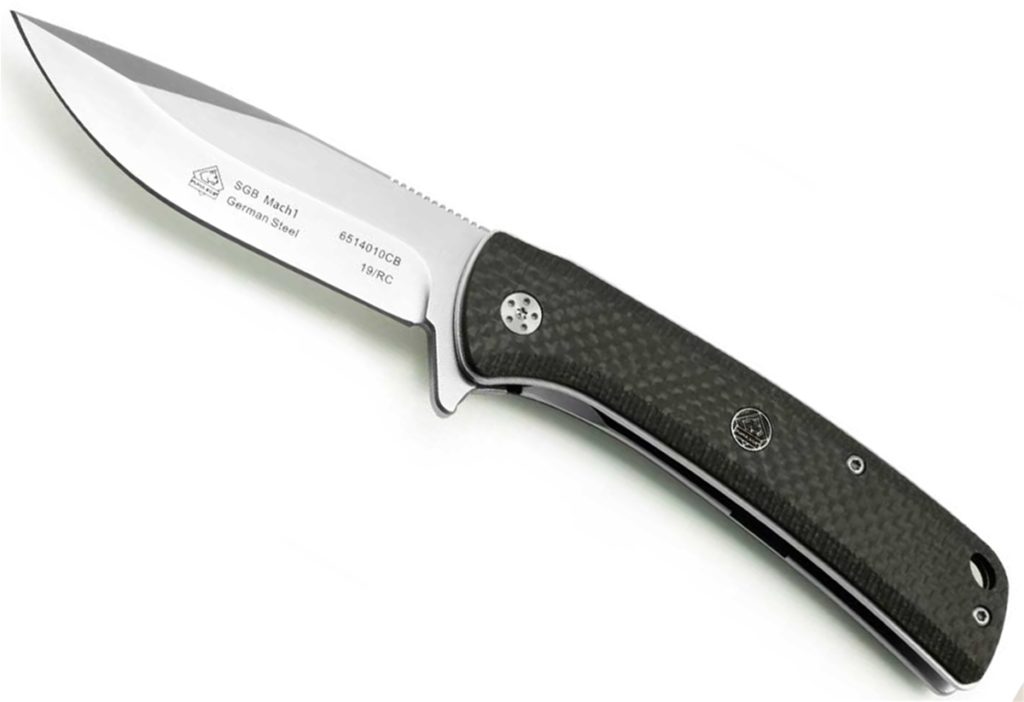
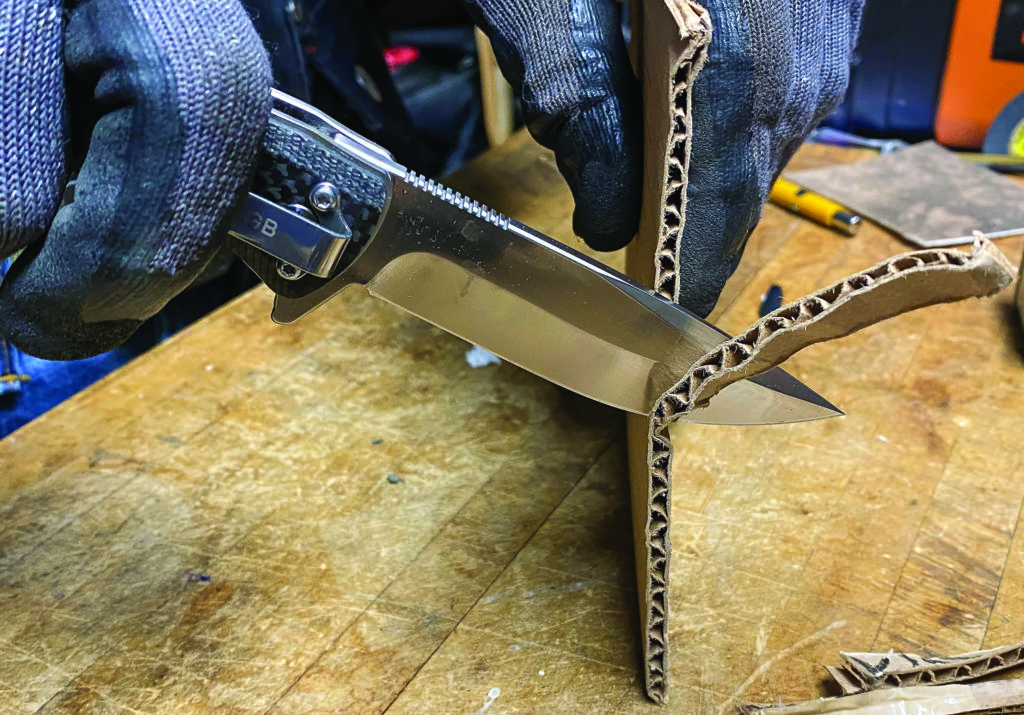
The Puma SGB Orange Featherweight Hunter is the newest rendition in the company’s Warden line of lockback folding hunters. It lightens the load to a svelte 2.8 ounces thanks to its 5-inch G-10 composite slabs, shaving two ounces off the standard Warden model. An added feature not seen on many folding hunters is a blade-tip-up pocket clip, 2.25 inches long, on the base of the back slab. The G-10 has a checkered texture which does a nice job of enhancing the grip.
The blade offers up a long-pull nail nick with fine gimping on the lower spine to enhance grip. I tested the edge on 3/8-inch synthetic rope and it easily sliced off short lengths in one slice, so I jacked it up to two. No problem. I tried three lengths side by side with firm pressure and lopped them off as well. Like so many folding hunters before it, the lightweight Puma would serve up light field chores and skinning in spades. While the bright handles make the Puma Orange Featherweight Hunter stand out, an OD green model is available if you’d like a more subdued color.
The Puma SGB Featherweight carries blade tip up via its handy pocket clip.
CRIMSON CUTTER: The SOG-TAC CA Crimson
The SOG-TAC CA Crimson
The SOG-TAC CA Crimson is especially designed to be street legal in California, where blades on automatics must be 2 inches long or less. The knife uses the SOG-TAC Mini handle in an aluminum anodized an attractive crimson color, with a push-button blade release on the front. SOG adds a slide safety to keep everything in check when not in use, and there’s also a blade-tip-up pocket clip.
Handle size is, indeed, a subjective thing. While the author had around 3/4 of an inch left in his mitt, the SOG-TAC Auto CA handle fit his girlfriend’s hand perfectly. “I still wouldn’t hesitate to carry this little powerhouse,” the author noted.
I was somewhat familiar with this folder because I’ve carried the larger 4.5-inch version in my rotation. Push the SOG-TAC CA’s button release and the blade opens clean and crisp at the blink of an eye. While its blade length is limited, it’s also a nice little EDC. I tested the edge on some tough quarter-inch-thick two-ply corrugated cardboard, and the AUS-8 stainless steel cut it across the grain in clean, easy strokes.
The SOG-TAC CA Auto did its due diligence as a competent everyday carry. It did an excellent job of taking off against-the-grain slices of thick corrugated cardboard.
I have medium-size mitts and the SOG-TAC CA handle left about a 3/4-inch deficit in padding on my lower palm. I let my girlfriend try it and it fits her hand just as the larger-size SOG-TAC fits mine. In fact, she said she wants one!
SOG-TACCA Auto Crimson
BLADE LENGTH:1.9”
BLADE STEEL:AUS-8 stainless
BLADE PATTERN:Trailing point
HANDLE MATERIAL:Anodized aluminum
SPECIAL FEATURE:Push-button release/safety
POCKET CLIP:Blade-tip-up carry
WEIGHT:2.5 ozs.
CLOSED LENGTH:3.75”
COUNTRY OF ORIGIN:China parts/U.S.assembly
MSRP:$129.95
BIG and BLUE: The Steel Will Scylla Blue
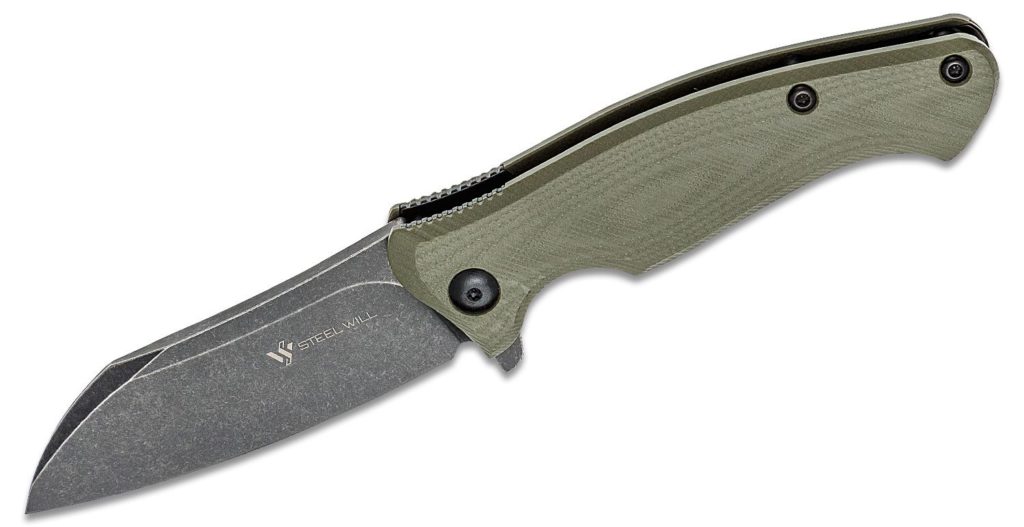
The Steel Will Scylla Blue is a full-size linerlock folder with an interesting twist: it has a top flipper as opposed to the typical side-winder on most folders with thumb studs. The knife features a vibrant, curvaceous handle with a fine fabric texture to enhance grip. A kidney-shaped lanyard hole is designed into the curved base and on the back slab is a blade-tip-up pocket clip.
Steel Will’s Scylla Blue has a deeply ground blade ready made for carving wood. Starting with fine slivers the author moved up the ladder to take off large curls, ending with a nice pile of fire starter.
Top flippers take some getting used to, but like anything else practice makes perfect. Rather than pushing the thumb stud out,the thumb pad or side of the thumb rotates the stud up and over the top of the handle until the blade locks.
The Steel Will Scylla Blue has a top flipper that, once mastered, opens in just a flick by rolling the thumb stud over the upper handle. Here the author uses the right side of his thumb to do the opening chores, though the thumb pad will work just as well.
I tested the Scylla Blue’s deeply ground blade on boxwood. Starting with short slivers of tinder and moving up to long curls, I had a nice pile of fire starter before long. The edge did its job well aided by a comfortable handle grip that fit my palm nicely. If you can master the top flipper, you’ll like the Steel Will Scylla Blue.
Steel Will Scylla Blue
BLADE LENGTH:3.25”
BLADE MATERIAL:D2 tool steel
BLADE FINISH:Stonewashed black
BLADE PATTERN:Drop point
HANDLE MATERIAL:Blue G-10
ACTION & LOCK:Top flipper and linerlock
LINERS:Stainless steel
POCKET CLIP:Blade-tip-up carry
WEIGHT:4.42 ozs.
CLOSED LENGTH:4.5”
COUNTRY OF ORIGIN:China
MSRP:$69.99
The Art Knife Invitational—the biennial knife event that made biennial knife events cool—is now under the direction of Barry Lee Hands, and will be Oct. 30, 2021 at the M Hotel Casino Resort and Spa in Las Vegas.
Consisting of some of the world’s top custom knifemakers, each of whom votes on any additions to the group’s membership, the show had been held for many years in San Diego. Spearheaded by BLADE Magazine Cutlery Hall-Of-Fame® member Phil Lobred when it started in 1983 in Reno, Nevada, the AKI was held again in 1984 before undergoing a hiatus until 1993, when it was moved to San Diego. It had been there every other year since.
When Phil passed away in 2016, his daughter Sandee took over the reins and coordinated the show in 2017 and 2019. In a meeting in July, Barry and Sandee discussed moving the show, for one reason because the member makers wanted to try something new. Meanwhile, one thing led to another and the show was in new hands—Barry’s. “I knew my dad admired Barry’s work [Hands is a leading knife and gun engraver], Barry’s experience with running shows, [and his] being the president of the Firearms Engravers Guild of America,” Sandee wrote. “So, we made a deal.
“I will admit it was heartbreaking at first, but when I see the good job Barry is doing on social media, managing things, the new hotel location in Las Vegas—wow!—and with the members voting in really good people, I know that we made the right choice.”
Barry is equally complimentary of Sandee. “I would like to say on behalf of our members that Sandee has been very helpful in the transition,” he observed, “and at AKI she will be an honored and respected show guest.”
Barry indicated the biggest change about AKI is the Vegas move.
“The members voted for a location change before I took over,” he noted, “and when I came in they let me know they still wished to move. With that in mind, and on the suggestion of one of our collectors, which happened to coincide with my own opinion, we chose the M Hotel Casino Resort and Spa. The M is a beautiful hotel and is the closest major property in Las Vegas to Los Angeles.”
Barry takes an aggressive approach to marketing, including a “beefed up” online presence with a “dramatic yet functional” new website. “We also have linked our Instagram @artknifeinvitational page to our Facebook page and are creating new graphics about our members and their work, which we post most every day,” he wrote.
Voting for AKI membership also has been updated. “Some members of the AKI advisory panel told me that since they are busy at the bench and the knife world is so large compared to the past, it is hard for them to know who may be the best to vote in,” he stated. Hence, after many communications they formulated a standard procedure for nominating and voting in new members. The panel approved the proposed rules, put them to a vote and a majority of the members approved them.
If you are a member of AKI, an invited guest or a maker who would like to be considered, submit your nomination at [email protected]. After a review of the nominations, Barry vets and selects a group of six or more. Biographical sheets are written on each maker and sent to the membership and panel for review. After 48 hours, if there are no objections, the group becomes nominees and is voted on by the membership. “The process has occurred four times since July,” Barry wrote. “It has been working very well and our membership seems highly pleased with the results.”
During the changeover, a few members resigned. “Some requested privacy, so respecting that, we will not list their names,” Barry noted. “Their reasons were varied. Some cited age, some preferred other opportunities, and others were not in full agreement with the rules voted in by fellow members.”
The present members are: Ron Appleton; Edmund Davidson; Harvey Dean; Jerry Fisk; Alex Gev; Shaun and Sharla Hansen; Anders Hedlund; Steve Hoel; Dietmar Kressler; Elizabeth Loerchner; Andrew Meers; Tom Overeynder; Bertie Rietveld; Rodrigo Sfreddo; Fabrizio Silvestrelli; Jürgen Steinau; Vasiliy Vorobiev; Owen Wood; and John Young. Guest makers for the 2021 AKI will include Corrado Moro, Veronique Laurent and others.
Carbon steel knives continue to be among the top factory performers.
High-performance stainless steels—CPM S30V, S35VN, S90V and 20CV, along with CPM 154, M390 and CTS 204P, to name some— rule in many corners of today’s knife market. While such steels exhibit astonishing edge-holding power and the ability to go the distance without much maintenance, the tradeoff is they can be difficult to sharpen. With the ascendance of such “super steels” you might think carbon steels would be gone for good.
Nothing could be further from the truth. While carbon steels may not attract the attention they once did, that doesn’t mean they’re no less a viable option for hunting, camping and even tactical knives. Many still prefer carbon steels over the high-performance stainless ones, and the primary reason is ease of sharpening, especially in the field. While carbon steels require a bit more maintenance, such as a light coat of oil to prevent corrosion and staining, they can give premium stainless steels a run for the money. Another factor is the all-important lower cost of carbon steels.
SANDBOX STEEL: A.G. Russell Knives Sandbox Dagger
Photo from agrussell.com
The inspiration for the Sandbox Dagger from A.G. Russell Knives comes straight from the old Camillus Marine Raider Stiletto and legendary Fairbairn-Sykes dagger, both of World War II fame. BLADE Magazine Cutlery Hall-Of-Fame® member A.G. Russell’s intent was to recreate the effectiveness of the venerable dagger designs while boosting the durability of the blade, as the tapered, relatively thin blades were prone to break. Carefully studying the old combat knives, A.G. devised the Sandbox Dagger.
Most daggers fail with broken tips. The A.G. Russell Sandbox Dagger in DM1 carbon steel is redesigned to allow for more blade tip thickness. The knife survived this sideways snap-out treatment with no damage whatsoever.
Beginning with a wider blade that takes longer to taper, thus giving it more body, he discovered new ways of grinding that allowed more stock thickness to remain, enhancing lateral strength. Traditionally a weak spot for daggers, the point thickness is more considerable as well. Another A.G. idea was to offer a “varied edge angle.” Most of the blade would be sharpened at A.G.’s preferred angle of 15 degrees, but toward the tip it changes to a more obtuse angle to bolster point strength. Phil Gibbs, company design engineer, was in charge of torture testing prototypes. One of the tests he successfully performed was driving the dagger through an AK-47 magazine, with absolutely no damage to the tip, and the edge remaining very sharp.
The Sandbox Dagger from A.G. Russell is a highly functional cutting tool. It sliced up cardboard just as well as any single-edge knife would. It is razor sharp out of the box.
The 6-inch blade is DM1 steel, named in honor of bladesmith/metallurgist Dan Maragni, who assisted in its development and heat treatment for A.G. Russell Knives. It is a modified version of the 0170-6C carbon steel the old Camillus used when it made the Becker Knife & Tool line. (Today, KA-BAR makes all BK&T knives.) DM1 can sustain hard use without edge deformation or chipping, yet remains easy to resharpen.
The ergonomic handle is green, rib-textured Rucarta. The rounded handle expands toward the tang to better fit your hand. Indentations on either side give your thumb a non-slip resting place for grip retention, as well as a reference point for blade indexing. The blade is razor sharp out of the box. Manufacturer’s suggested retail price (MSRP): $375.
A-R-RMY, SIR! Case Hambone
Photo source: knifecenter.com
Knifemaker Daniel Winkler and U.S. Army veteran Clint Romesha (page ??) designed the Case Hambone to be a “do-all” field knife for field dressing, batonning wood, preparing food and more. Hambone was the nickname of the legendary U.S. Army pack mule Hamilton T. Bone. Hambone was based at Fort Carson, Colorado, as part of the pack mule program and served from 1943-56, including two combat missions during World War II—the same base Romesha operated from during his military career.
Is it tactical or outdoor? How about both? The Case Hambone is a heavy-duty fixed blade of 80CrV2 carbon steel that will serve either function very well. The flat-ground blade slices easily.
Hambone the knife embodies the hardworking spirit of Hambone the pack mule. The 80CrV2 carbon steel is tough and holds an edge. The trailing point/skinner blade is 4.75 inches with a full flat grind and generous belly that facilitate chores like slicing and chopping/batonning. Handle material options are black canvas Micarta®, curly maple and black textured rubber. The finger-grooved handle with a bird’s-beak butt and integral guard ensures a secure grip in most conditions.
The eight stars engraved on the handle spine memorialize Romesha’s eight teammates who gave their lives during the Battle of Kamdesh in Afghanistan (page ??). The exposed blade tang can be employed as a hammer or glass breaker. The felt-lined Kydex sheath promotes sure knife retention and easy deployment equally well. Rather than having a typical fold-over or sandwich construction, the sheath uses a Micarta spacer to separate its Kydex halves. The OD green Kydex features black overlay with a star laser cut into it to symbolize the Army’s colors and logo.
The eight stars on the blade spine of the Case/Winkler Hambone memorialize the eight men who were part ofArmy Staff Sgt. Clint Romesha’s Cavalry unit who perished during a 2009 battle with Afghan rebels. Along with Daniel Winkler, Romesha designed the Hambone.
The Hambone’s deep blade belly is great for cutting meats and vegetables. The blade is fairly thick up to the tip, which makes it strong for heavy use and abuse. The handle is quite comfortable, providing ample blade control at all times, even with wet hands. The Micarta material is an excellent choice for an all-around user.
The only downside might be the weight. Some may find the knife too heavy on a belt, but, then again, the weight is one of the contributing factors to its cutting power. MSRPs: $325.99 (black canvas Micarta), $333.99 (curly maple) and $342.99 (textured rubber).
TACTICAL CLASSIC: Steel Will Barghest
The Steel Will Barghest has all the hallmarks of a great tactical folder. The test model’s modified clip-point blade of 3.5 inches is full-flat ground from D2 tool steel, a favorite among production companies and custom makers for its toughness and ease of sharpening. The blade opens via a flipper or ambidextrous thumb studs, and the swedge grind adds a bit of attitude. The action is quick, smooth and precise, with the blade riding on a pair of phosphor bronze washers.
The Barghest and its D2 tool steel blade is the latest tactical folder from Steel Will. It comes in two sizes and two blade finishes, and features flipper opening as well as dual thumb studs. It’s a rugged EDC folder at a great MSRP ($84.99 and $89.99)
The handle is a study in the perfect tactical folder design well suited for prolonged use regardless of the elements. The integral guard prevents your hand from slipping forward, and the handle gracefully curves and expands slightly at the midsection to fill your palm nicely without feeling too unwieldy. The blade secures via a linerlock, and dual steel liners provide rigidity. Black G-10 scales feature a series of machined grooves that enhance your grip with or without gloves. A pronounced chamfer on the edges of the scales makes the Barghest feel very comfortable, eliminating any hot spots. A fold-over steel pocket clip carries the knife deep in a pocket. Steel Will also offers a second clip for lefties—just switch clips. The G-10 handle spacer sports large traction notches, and is slightly oversized to make the notches stand out.
The Steel Will Barghest and its D2 blade packs the punch to get tough cutting jobs accomplished and still hold an edge very well.
The Barghest offers what I like in a tactical folder. The blade shape and size is ideal for many cutting tasks, not too small nor too large, and has plenty of bite to power through a variety of tough materials. D2 is a time-proven steel that withstands abuse yet is easy to maintain.
The only negative I see is the pocket clip. Yes, it is a positive as well, but not everyone likes the deep-carry feature, as no part of the handle sticks above the pocket to grab onto. Hence, you must fish around a bit to grab the knife. Hey, you can’t please everyone! MSRPs: $84.99 (3.5-inch blade) and $89.99 (4-inch blade).
STOUT as it is SOLID: Condor Tool & Knife Blue Havoc
condortk.com
The Condor Tool & Knife Blue Havoc features a 5.5-inch drop-point blade of 1075 carbon steel mated to two-tone black-and-blue paper Micarta scales and a black phenolic bolster. The knife is a handful, a beast that can tackle any cutting task at camp or, in a pinch, use for combat. It is stout as it is solid. The satin-finished blade’s full flat grind is aces in cutting efficiency. A series of traction notches filed into the blade spine provide optimal positioning for applying downward pressure for tougher cutting tasks.
The Condor Tool & Knife Blue Havoc and its beastly blade of 1075 carbon steel can tackle most any camp cutting task.
The handle sports a generous palm swell that fills your grip comfortably, is non-slip and offers precise blade control. Micarta is an excellent choice for using knives because it is strong yet lightweight. It is impervious to most fluids and isn’t affected by weather changes, humidity, heat or most any external factor that would cause integrity issues. Plus, it comes in a myriad of hues to please the pickiest knife enthusiast. The dual-color Micarta® layers show through, adding an exciting visual texture, more so than any solid color Micarta can offer. Integral front and rear guards prevent unwanted hand movement in either direction, and the front guard enables you to choke up to exercise control for precise cutting. As big as the knife is, it’s important that it be able to tackle finer cutting as well, especially in a camp or survival scenario.
The Condor Tool & Knife Havoc is an edged tool to take on your next camping trip. Its droppoint blade and ergonomic handle are ideal for a variety of cutting tasks.
The Blue Havoc’s sheath materials are an unusual mix: molded Kydex and a leather belt loop. Most Kydex sheaths usually have either a Kydex belt loop or some sort of quick-release attachment, such as a Blade-Tech Tek-Lok. The reason Condor went with the leather belt loop on a Kydex sheath is to allow you to remount the belt loop in the event the sheath orientation must be reversed to accommodate left-hand/side-body carry. Simply remove/replace two screws to dismount/remount the loop. Also, the leather allows the entire sheath to move on your belt to a degree to prevent the knife from being caught up in bushes, branches, etc.
Condor’s catalog states the Blue Havoc can be used in either a tactical or outdoor setting, though due to its appearance, the knife is probably better suited for outdoor use. Moreover, the drop-point blade shape makes it a great camp utility knife for food prep or field dressing/skinning tasks. The 1075 carbon steel resharpens very well, which helps at the campsite. MSRP: $134.98.
STILL RELEVANT
Carbon steel is alive and well at a time when super steels are all the rage. It remains the steel of choice of many hardcore knife users, not only for the lower cost but primarily for the ease of sharpening. It may require a bit more maintenance than stainless, but carbon steel is still relevant and here to stay.
No matter the brand or model, sharpening steels are used the same way. Most manufacturers recommend using one while standing at the kitchen counter or seated at a table.
The Set Up
Take the sharpening steel and place the tip on the table, held upright with the handle at the top.
With one hand, grasp the handle firmly, keeping it perpendicular with the flat surface at all times.
With the other hand, grasp the knife handle and place the blade at a 20-to-30 degree angle in relation to the sharpening steel. Place the blade as close to the guard as possible, set to start at the part of the blade closest to the tang.
Move the Blade
In one motion, move the blade down the length of the rod while at the same time draw the blade fully across the steel. When you near the flat surface you are working from, though without touching the surface, you should be at the blade tip.
Repeat
Raise the blade to where you started from, switching the blade to the opposite side, then repeat the same stroke. Then, return to the side you started from, and repeat once again. Do an equal amount of strokes for both sides of the blade.
Getting Better
As you become more comfortable using the sharpening steel, you can forego the flat surface and hold the steel with one hand similar to how you would a large kitchen knife. With the other hand, place the blade on the rod at the recommended 20-to-30 degree angle and lightly push the blade across the rod, ending at the blade tip.
I highly recommend you not proceed to this step until you are confident enough, because with this alternate method chances for not holding the angle correctly is greater.
Let the Rod Do the Work
Whatever method you use, remember to always use light strokes. There is no need to bear down on the blade with pressure. Let the rod do the work.